Category: Home & Design

  • Their South Philly neighborhood was everything they wanted. With a baby on the way, they renovated

    Their South Philly neighborhood was everything they wanted. With a baby on the way, they renovated

    Last summer, after six years in their home, Danielle and Jonah Abrams decided to upgrade their 1,000-square-foot, two-story rowhouse in East Passyunk. The neighborhood was ideal, Danielle said, but they needed to accommodate their growing family.

    “We love our location and have great relationships with our neighbors. We know at least half our block by first name,” she said.

    Both are heavily involved in the neighborhood, both politically and civically.

    “When we were expecting our daughter, everyone asked us if we were moving to the suburbs,” Danielle said. “Instead, we doubled down on our investment in our home by renovating.”

    They contracted with City Living Construction to complete the renovations. The process required staying with Danielle’s parents for three weeks, when she was seven months pregnant, while contractor Christtian Mazza, “transformed our full bath into the respite of our dreams,” Danielle said.
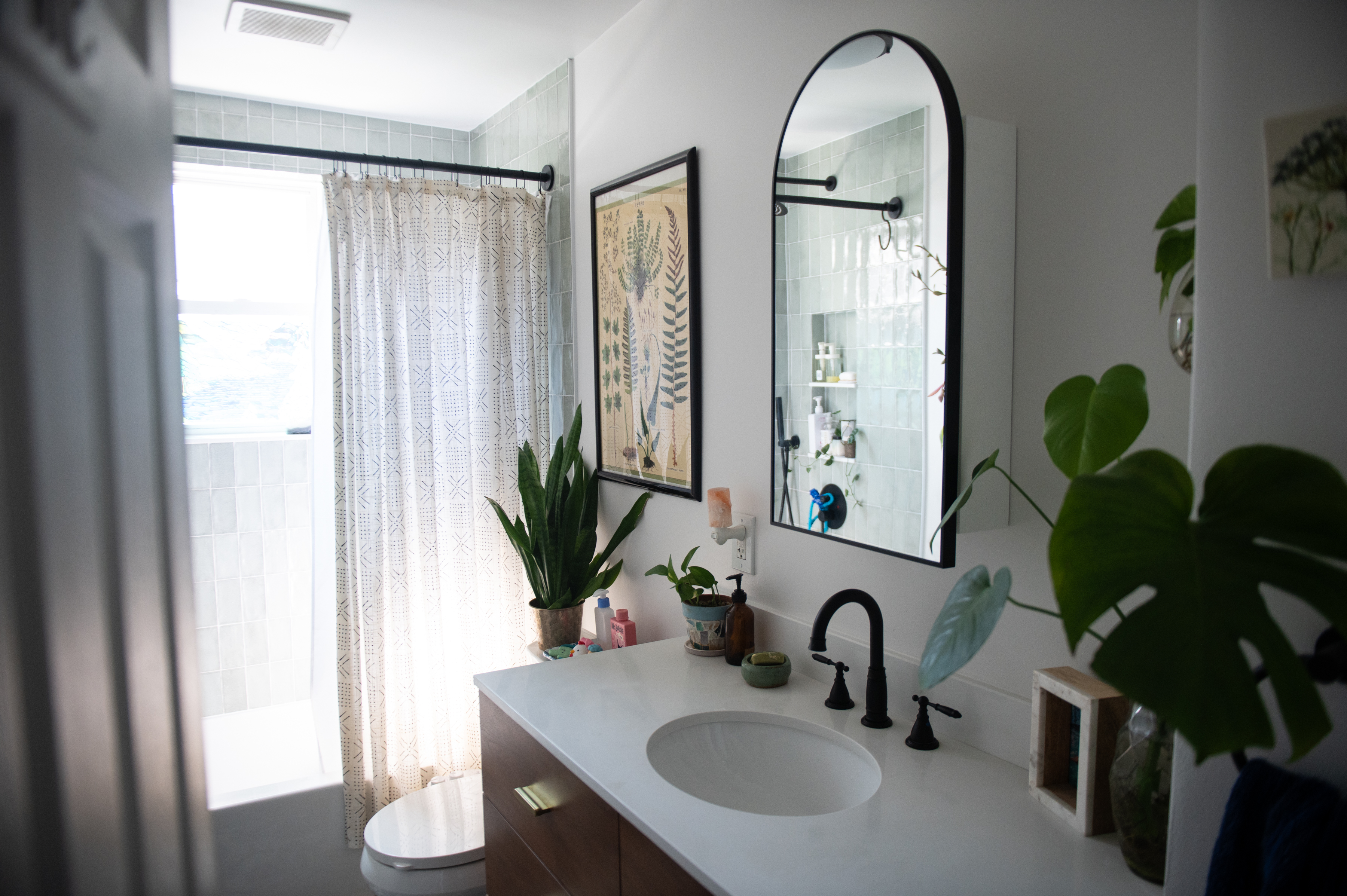
    Danielle and Jonah Abrams’ second-floor bathroom, which they renovated before their child was born.
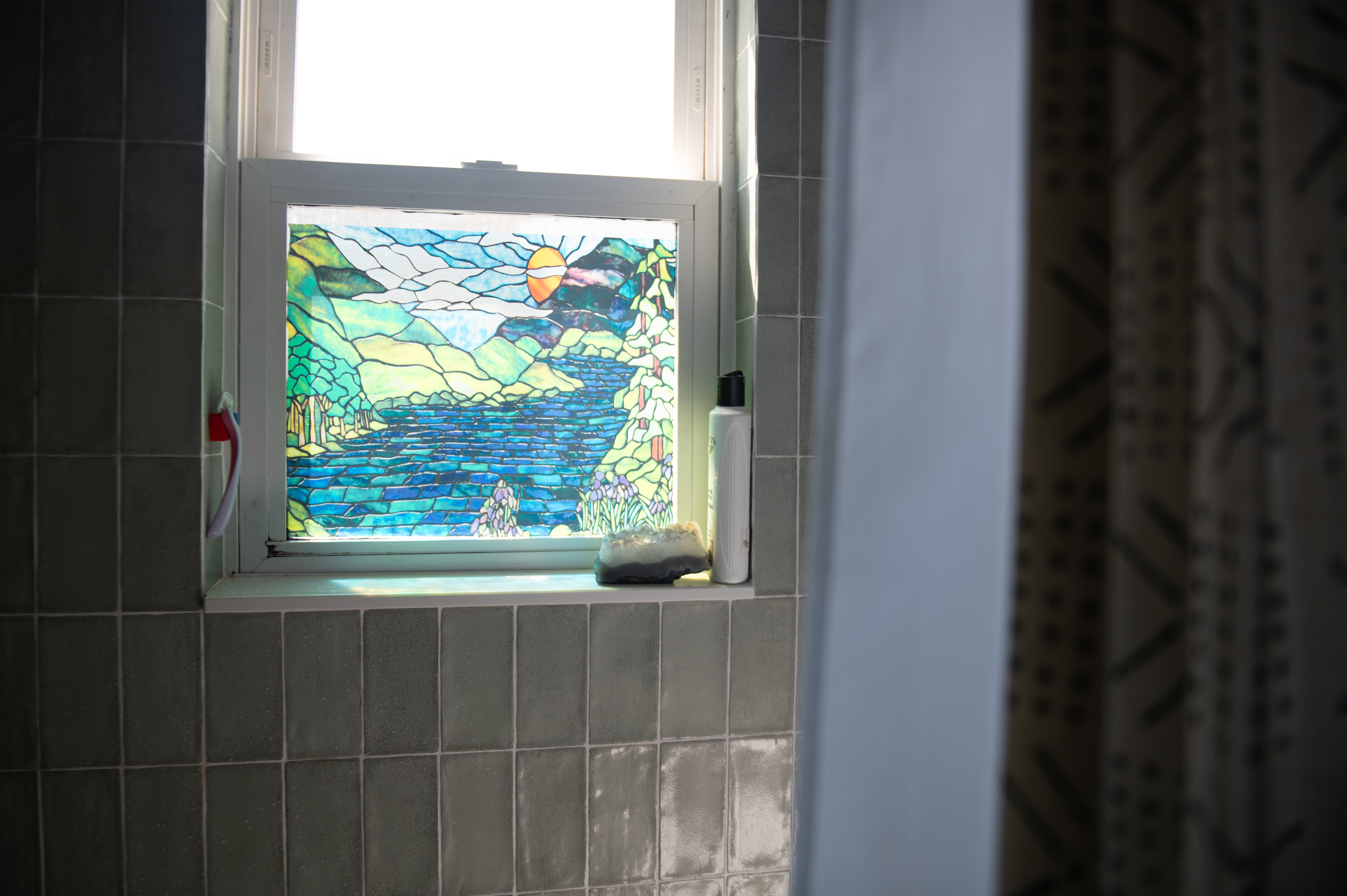
    A decorative window covering in the second-floor bathroom.
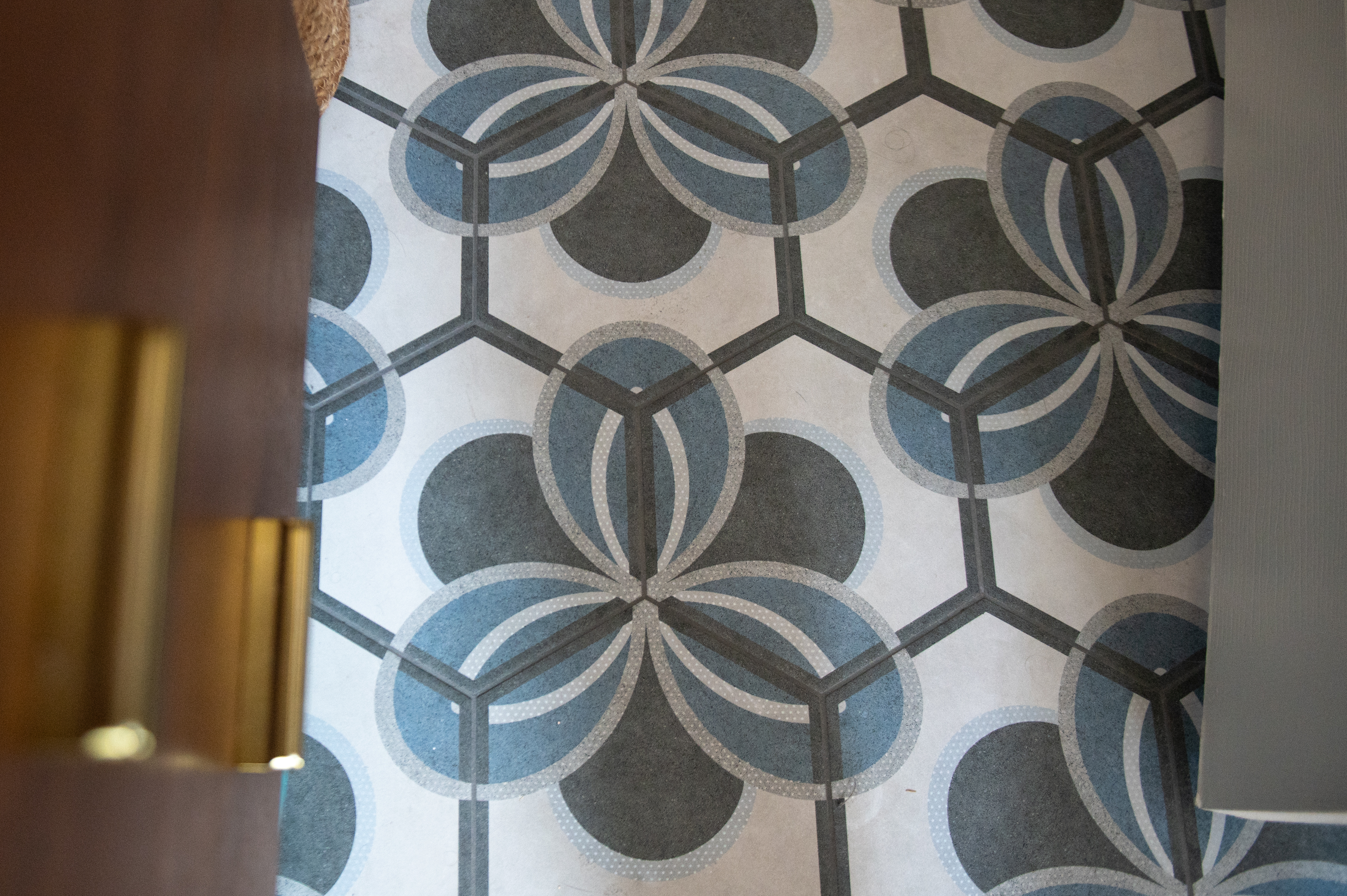
    Bathroom tiles, which the couple chose at a store in Fishtown.
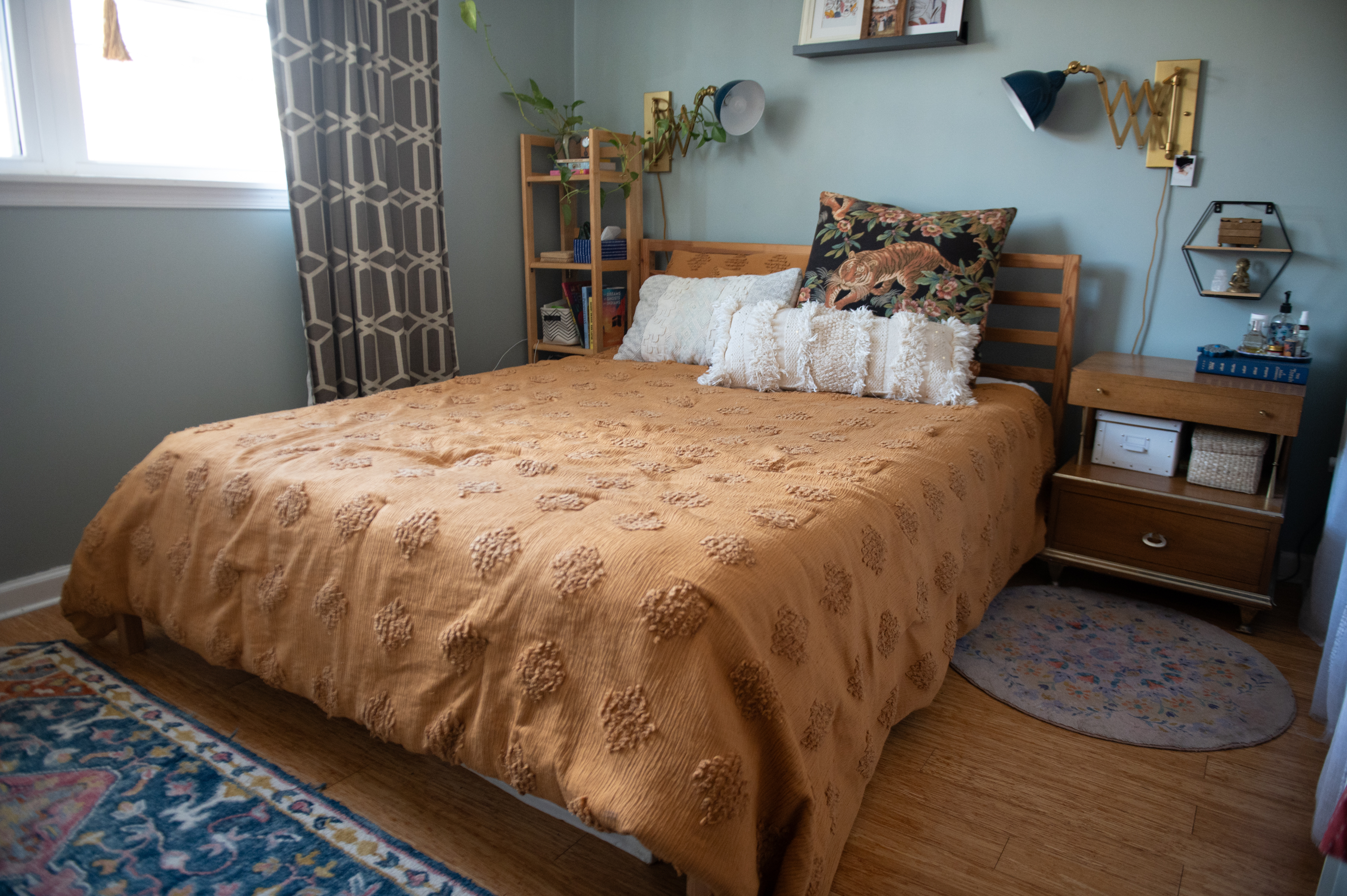
    Danielle and Jonah Abrams’ primary bedroom.

    “I designed the space by picking the fixtures and making multiple mood boards in PowerPoint showing the different tile, vanity, mirror, and fixture options,” Danielle said. ”We visited a tile store in Fishtown together and chose the flooring and shower tile, which took over an hour of laying different options on the floor of the showroom.”

    Most of the home’s furniture was secondhand and sourced from local social media groups, Danielle said.

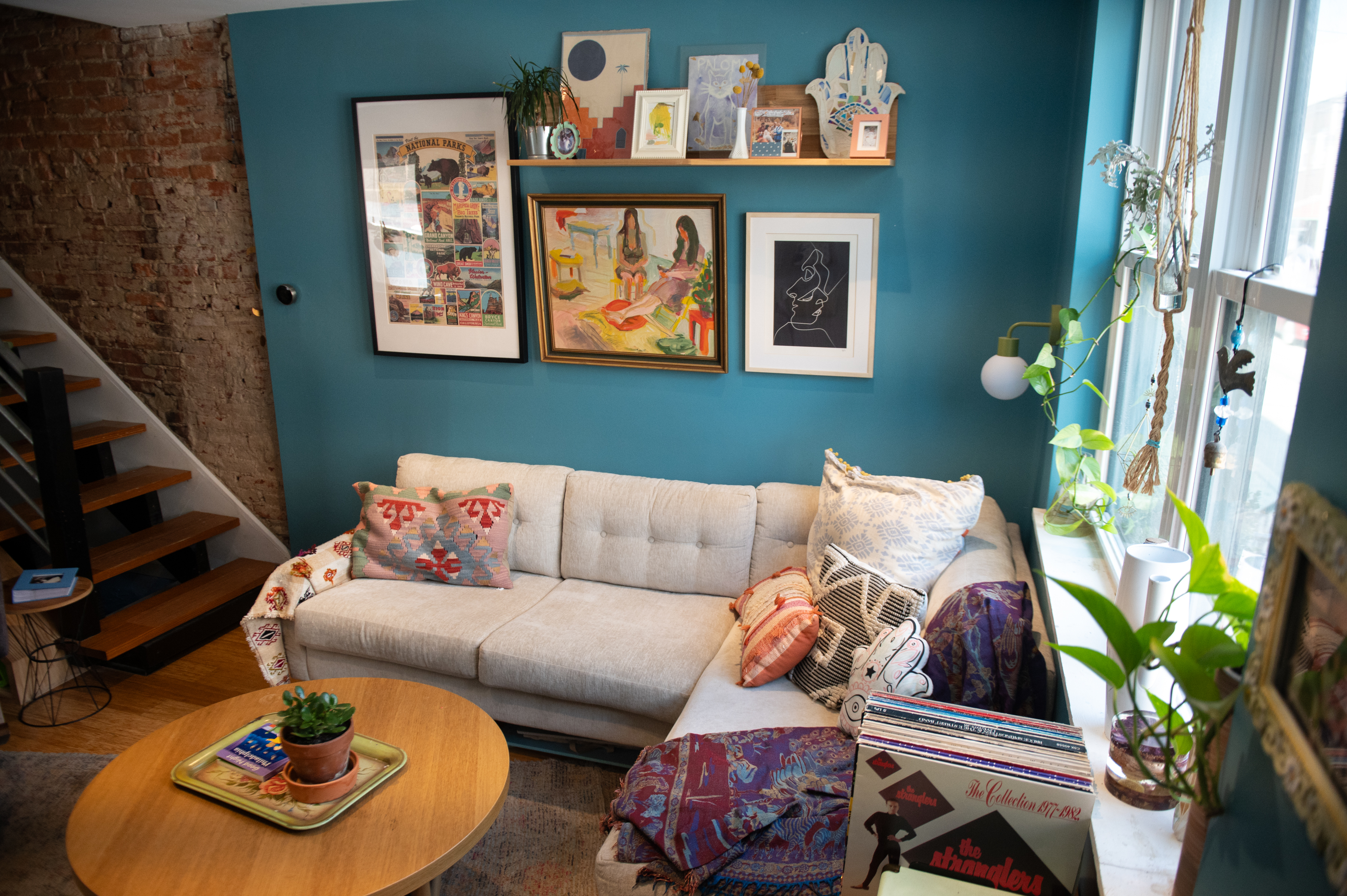
    “The one piece we splurged on was our sofa, which is from Joybird,” she said. “We chose the ivory pet-proof fabric to brighten up the space and also to hide cat hair.”
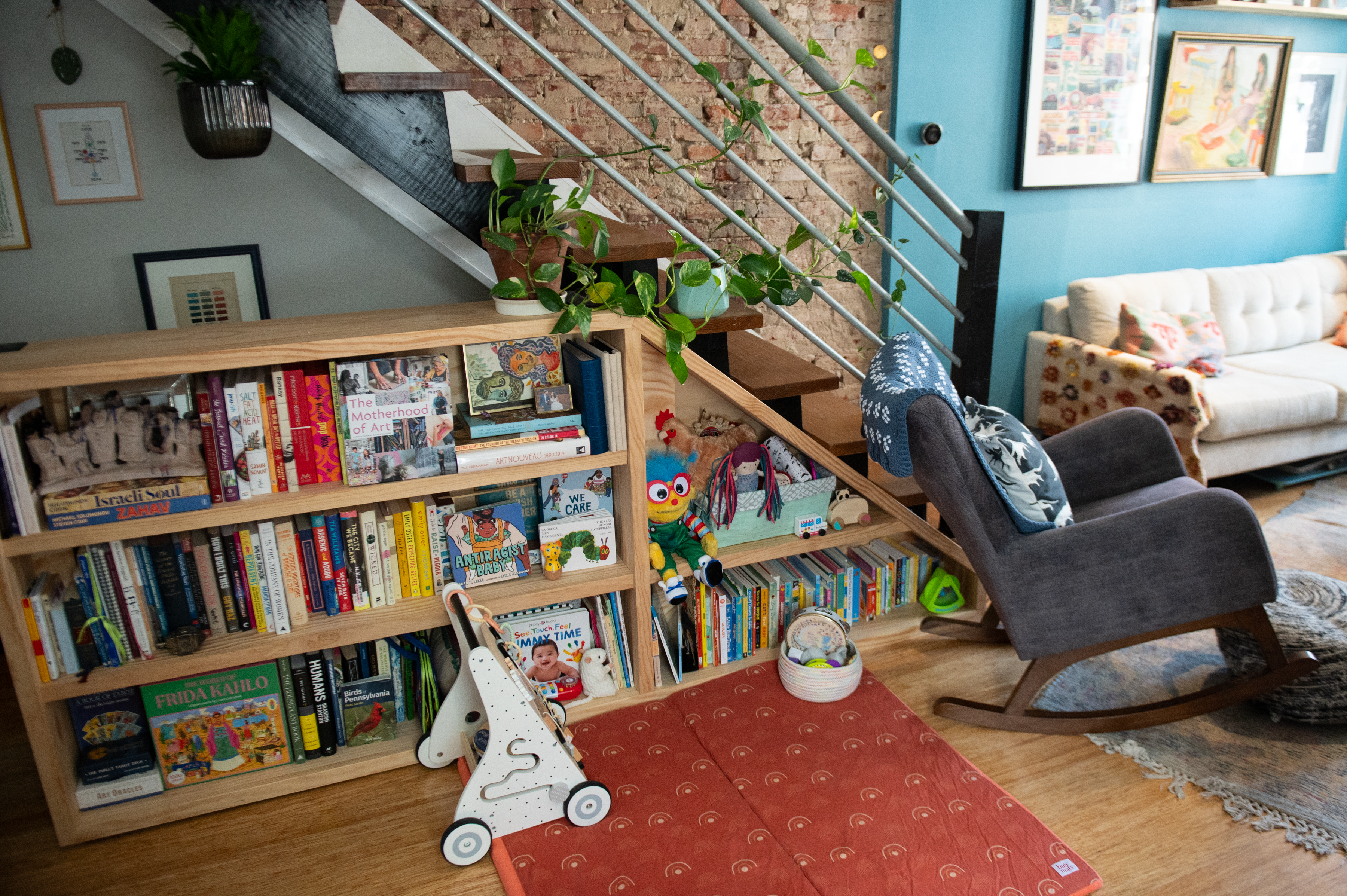
    A play area between the living room and kitchen in the Abrams’ home. The bookshelf, which also serves as a railing to the basement, was added while the couple renovated the home.
    The couch was one splurge item for the couple in their renovations.

    The nursery is the smallest room in the house. Again, the couple’s practical sense took a role.

    “We worked with furniture we already had, including the rocking chair from my childhood bedroom,” Danielle said.

    They added handmade touches throughout the space, including the felt mobile in the window and the name garland on the wall.

    “The only new piece of furniture in the room is the crib,” Danielle said. “We opted to get a mini crib from Babyletto that would better fit the small space.”
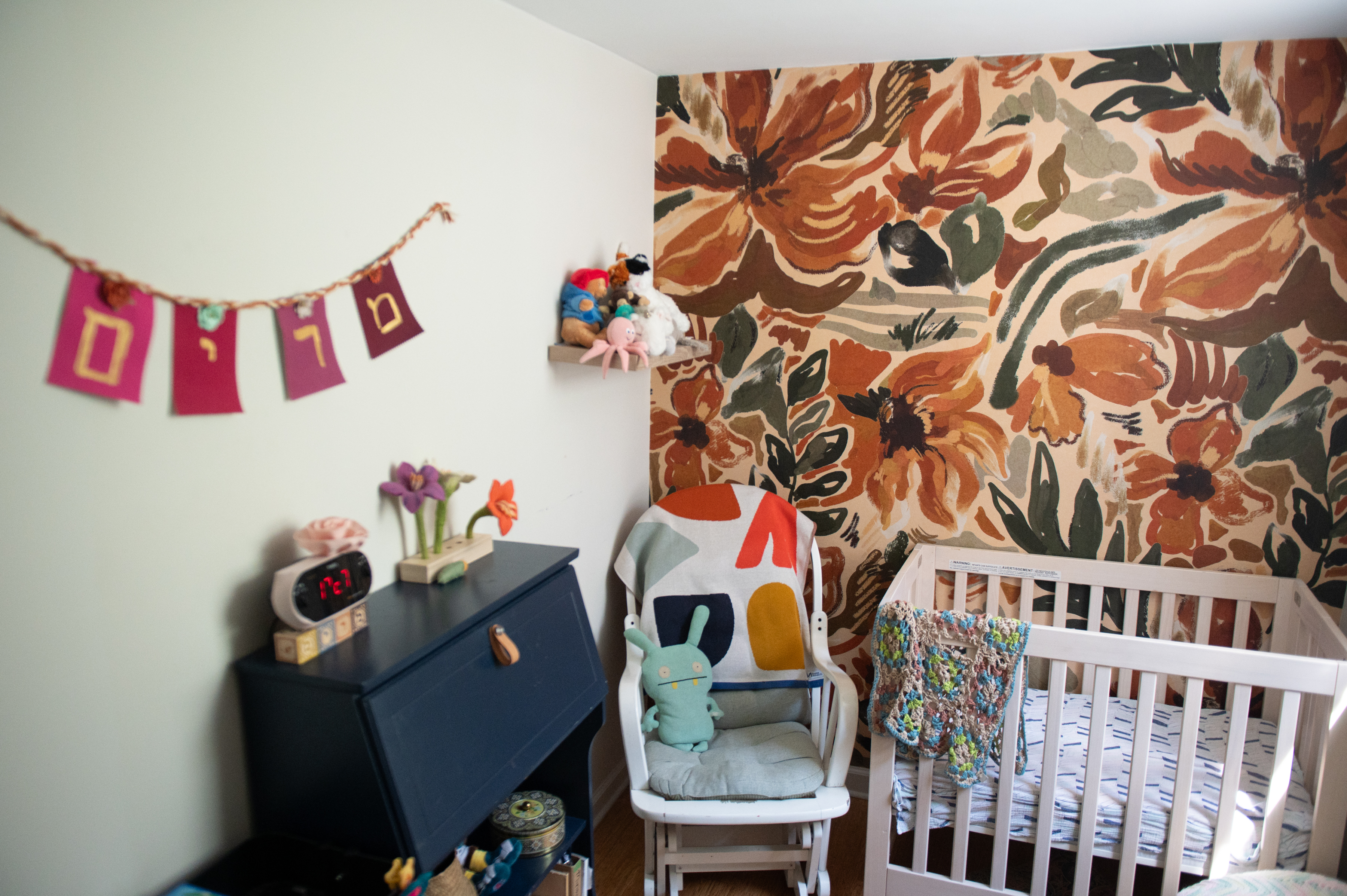

    In Miriam’s nursery, the couple purchased a mini crib to better fit the small bedroom space.
    A homemade felt mobile hangs in the nursery window.
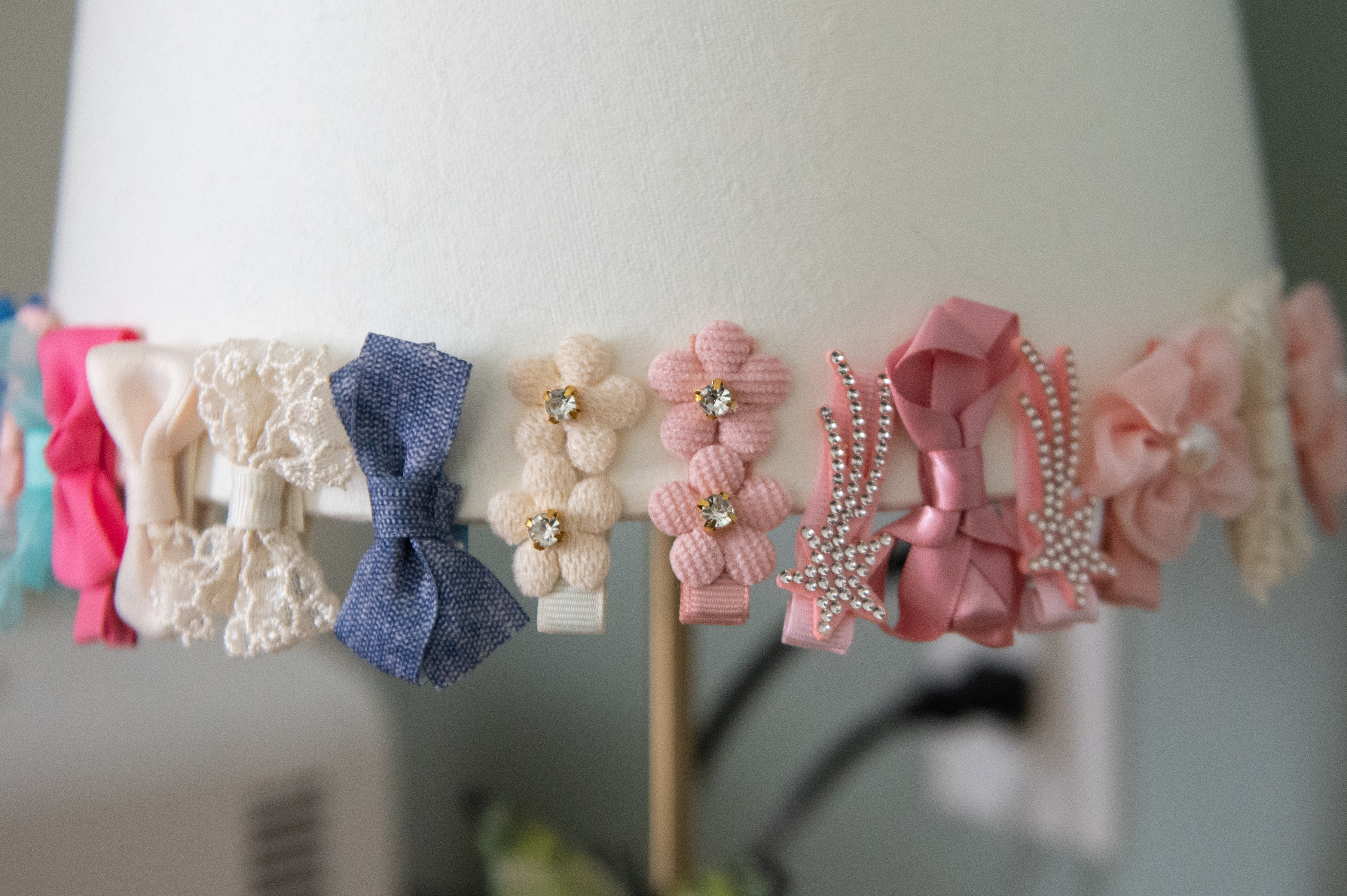
    Bows line a lampshade in the nursery.
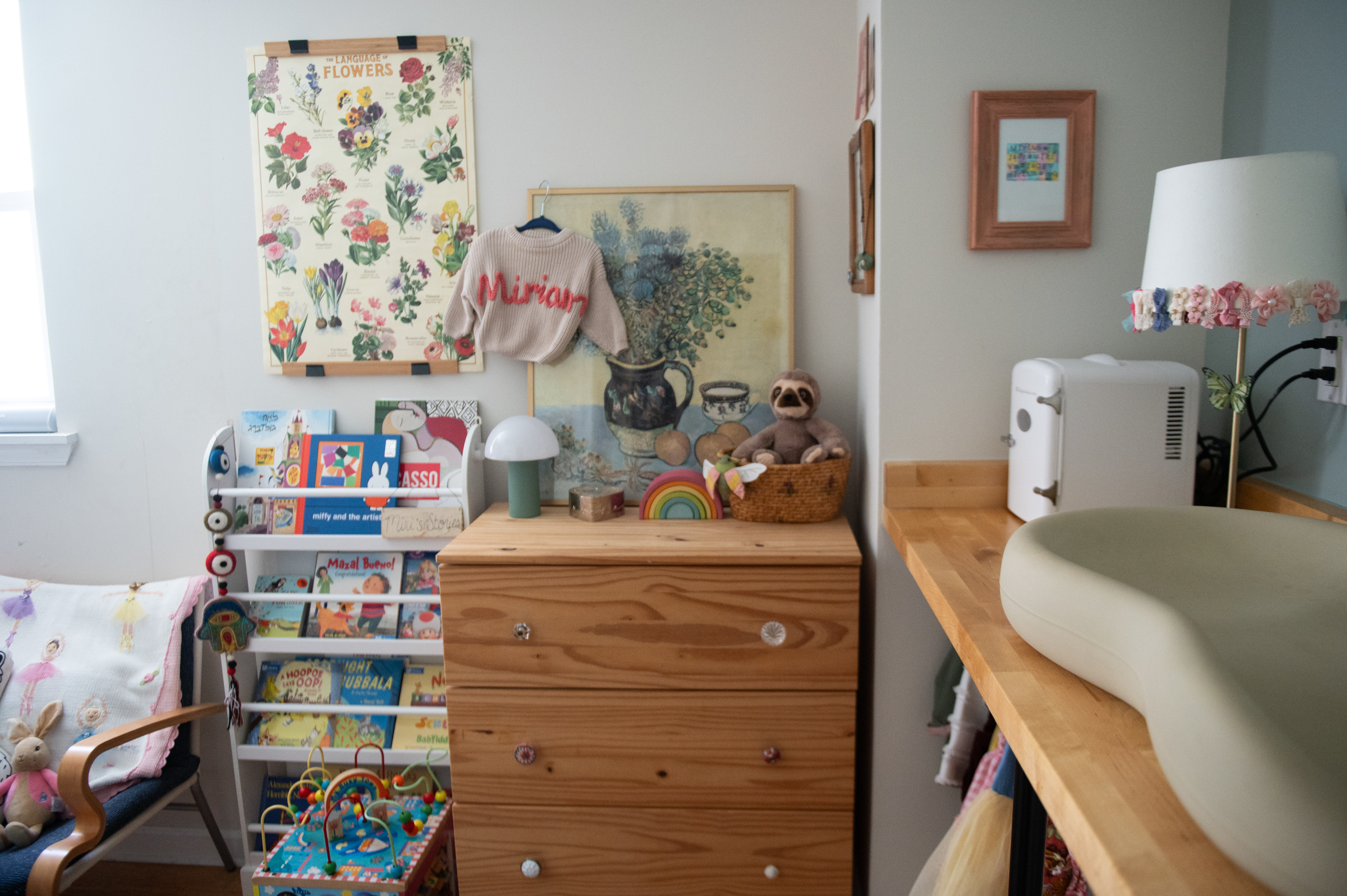
    Children’s books and decorations in Miriam’s nursery.

    In terms of color, the home showcases blue and sage green throughout. Danielle also added her own personal artwork. She is especially proud of a mural that she painted in the kitchen, a continuous line design that incorporates botanical leaf shapes and the Hebrew letters that spell out Shalom.

    The stairwell was the couple’s final project, with a goal to create a space for their daughter’s books and toys.

    “Choosing to stay in the city after having a baby makes our home stand out from many of our neighbors’ homes,” Danielle said. It “demonstrates how to be resourceful and creative in your home design rather than moving out to a larger property in the suburbs.”
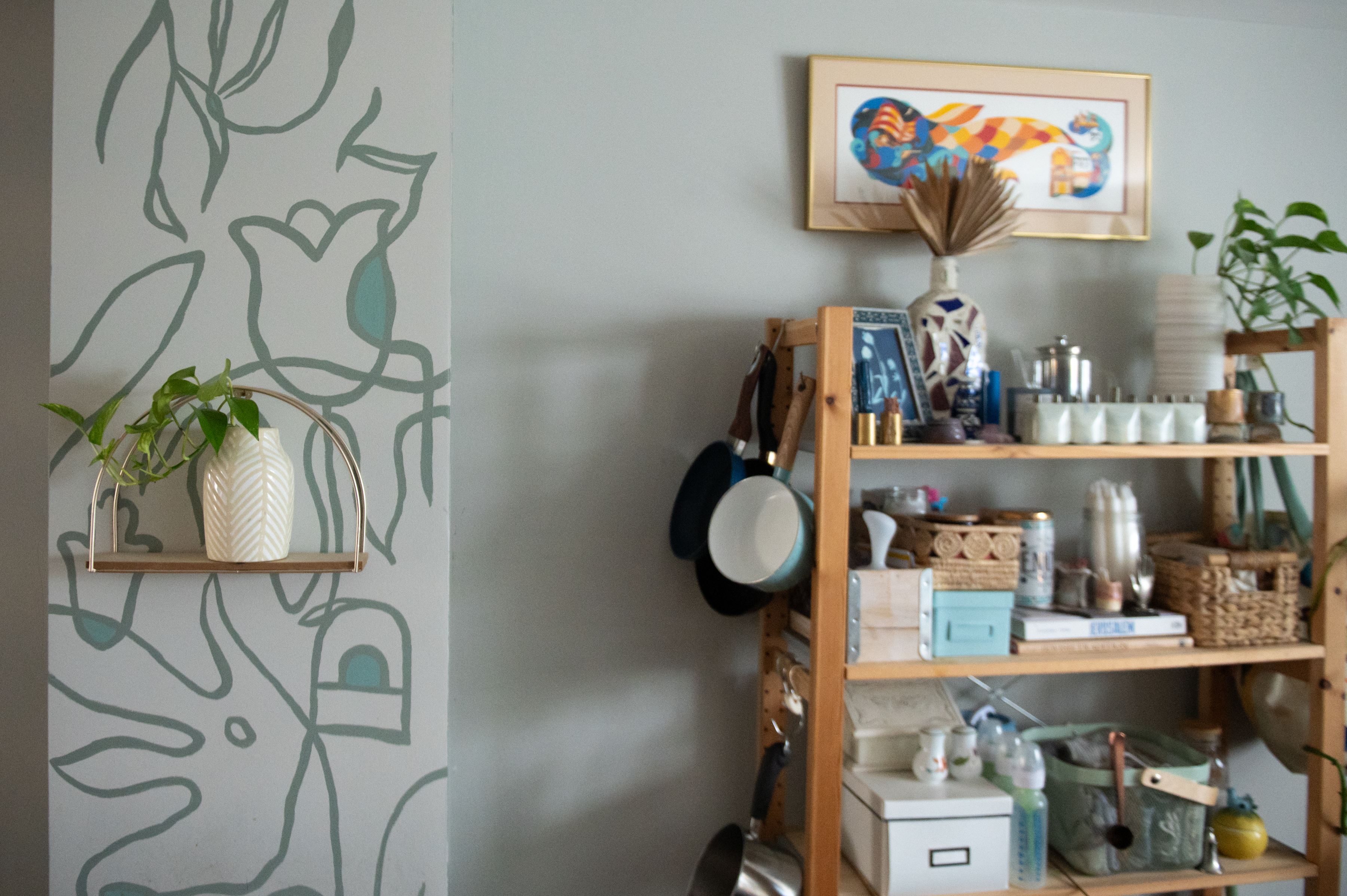
    Decorations and storage for kitchen items on the first floor of the home.

    A 15-year retail veteran who has worked at many retailers in the Philadelphia area, including Burlington, Five Below, Anthropologie, and Terrain, she is a graduate of Drexel’s Westphal College of Media Arts & Design. She currently runs her own business, a sustainable Judaica brand called HamsaMade, while also working for a local woman-owned company that sells safety accessories to essential workers.

    Jonah is a project manager in the renewable energy field. He’s equally happy to be living in the city.

    “Being right by Goldstar Park, Capitolo Park, and Paolone Park is one of our favorite things about where we live,” he said. “Before we moved in together, I was living in Queen Village and Danielle was in Bella Vista so we clearly love South Philly.”
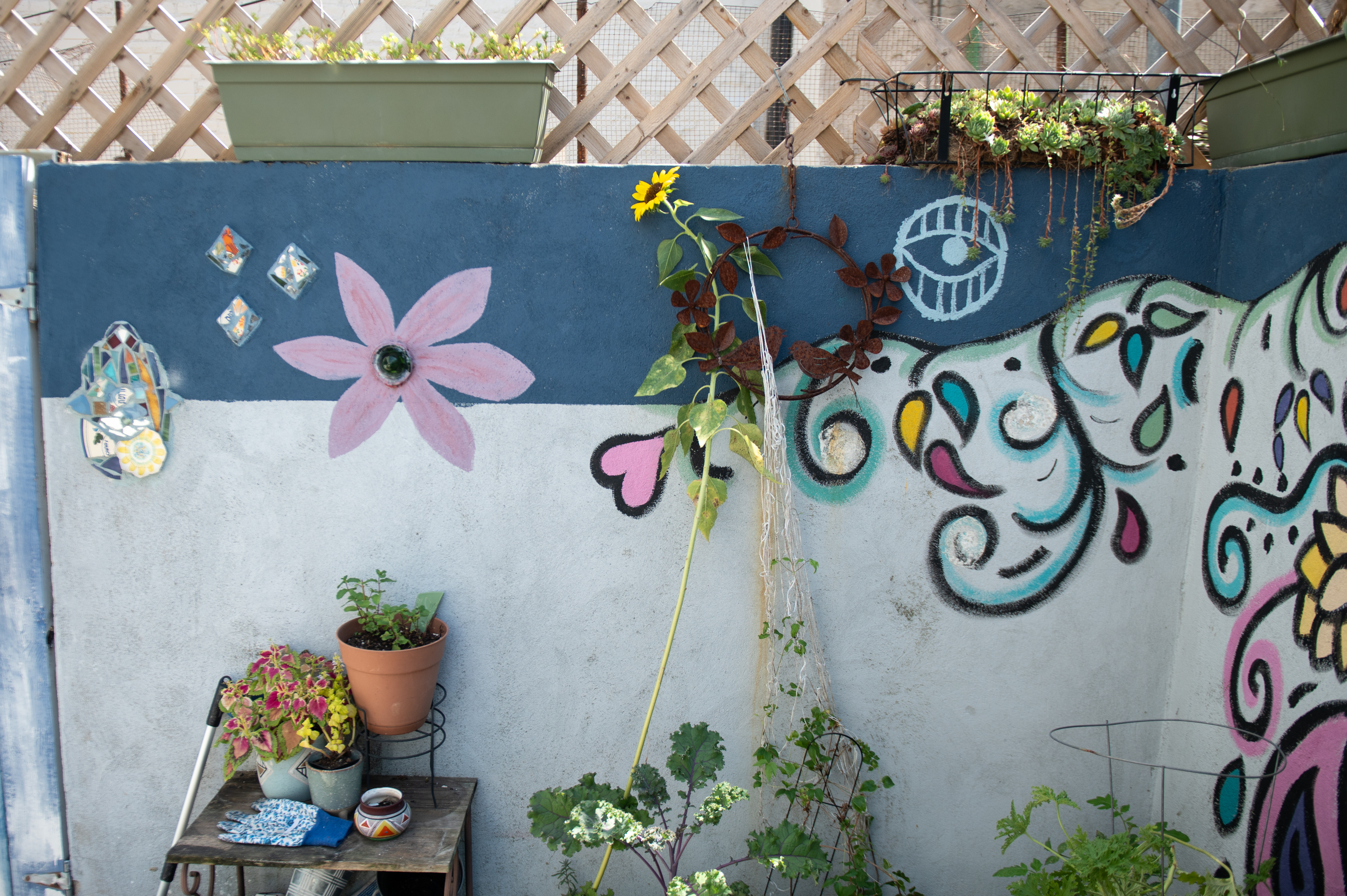
    Paintings and mosaics decorating Danielle and Jonah Abrams’ backyard.

    Last year’s renovation, Jonah noted, was not the couple’s first home project since they bought the house in 2018, but it was the first “that was not to solve an immediate problem.” He appreciates the surrounding community, and serves as a ward committeeperson. He can sometimes be found traveling the neighborhood by foot, “wearing our baby as I knock the doors of my neighbors, hearing about their challenges and helping them to vote.”

    “We love being able to walk to so many of our favorite places and favorite people, and we want our daughter to grow up being able to do the same,” Jonah said. “And we are dedicated to making our neighborhood even better.”

    Is your house a Haven? Nominate your home by email (and send some digital photographs) at properties@inquirer.com.
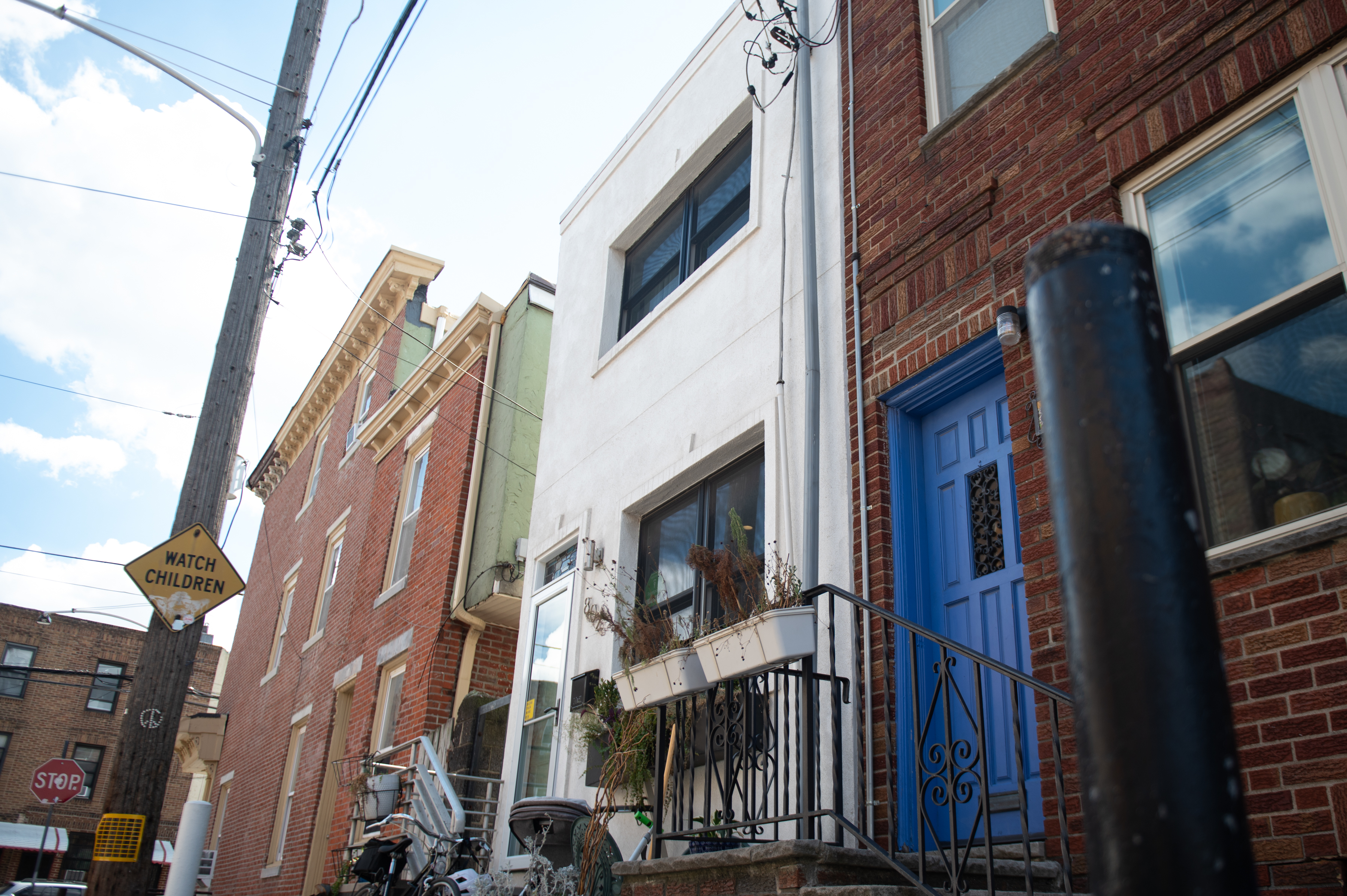
    The outside of Jonah and Danielle Abrams’ South Philadelphia home.
  • House of the week:  A three-bedroom former architect’s home in Graduate Hospital for $795,000

    House of the week: A three-bedroom former architect’s home in Graduate Hospital for $795,000

    Nikka Landau and Peter Beaugard‘s townhome in the Graduate Hospital area serves three generations.

    They moved there to be closer to both sets of parents, and their kids like the accessibility of the YMCA across the street, and its pool.

    “It’s a great block,” Landau said, “lots of kids.”

    Kitchen

    Landau, who manages communications for a nonprofit, and Beaugard, who is in fashion marketing, aren’t moving far away, just a few houses closer to her parents. Both grew up in the Philadelphia area, and had been living in Connecticut for several years before moving to Graduate Hospital in 2022.

    The 1,830-square-foot, three-bedroom, 2½-bathroom house was built in 1920, and at some point was bought by two architects who redesigned it over a period of years.

    “There was a lot of sensitivity to the design,” Beaugard said.

    Backyard

    Entry is through a vestibule, which has space for coats and bags. The first floor is open concept, with a sunken living room with high ceilings and large south-facing windows with built-in shelving.

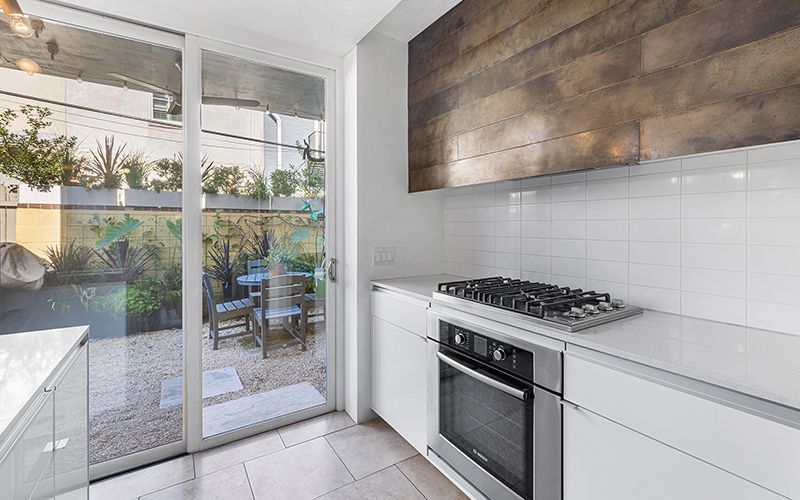
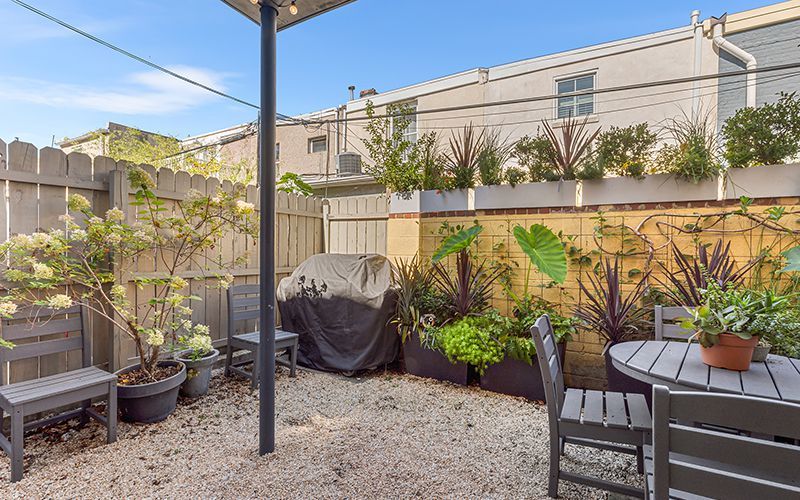
    The kitchen has quartz countertops, stone flooring, stainless steel appliances, a Wolf range, and a magnetic blackened steel wall. There is a private garden patio.

    The second floor has two bedrooms, a full bath with cast iron tub, and a den. The third floor has the primary suite, and the bathroom has a marble-top vanity and a tiled shower.

    Roof deck

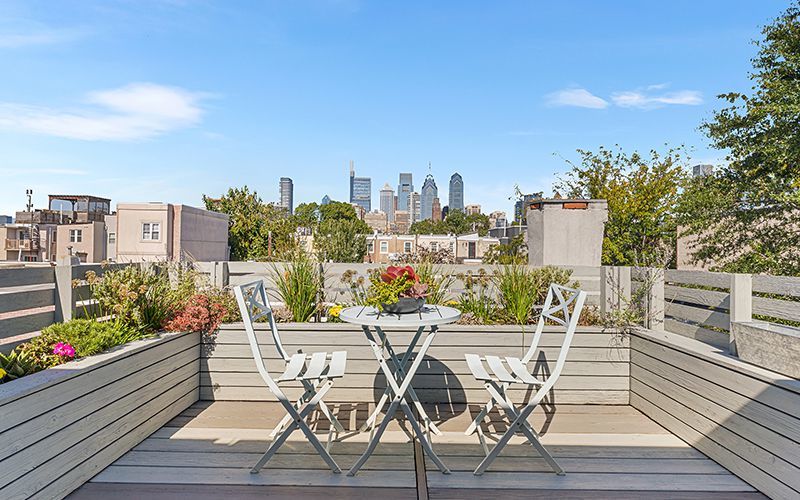
    The roof deck has unobstructed skyline views.

    The house is in the Edwin M. Stanton School catchment area.

    It is listed by Kyle Miller of Compass Realty for $795,000.

  • The wooded Malvern-area home of a famous Main Line builder is for sale for nearly $2 million

    The wooded Malvern-area home of a famous Main Line builder is for sale for nearly $2 million

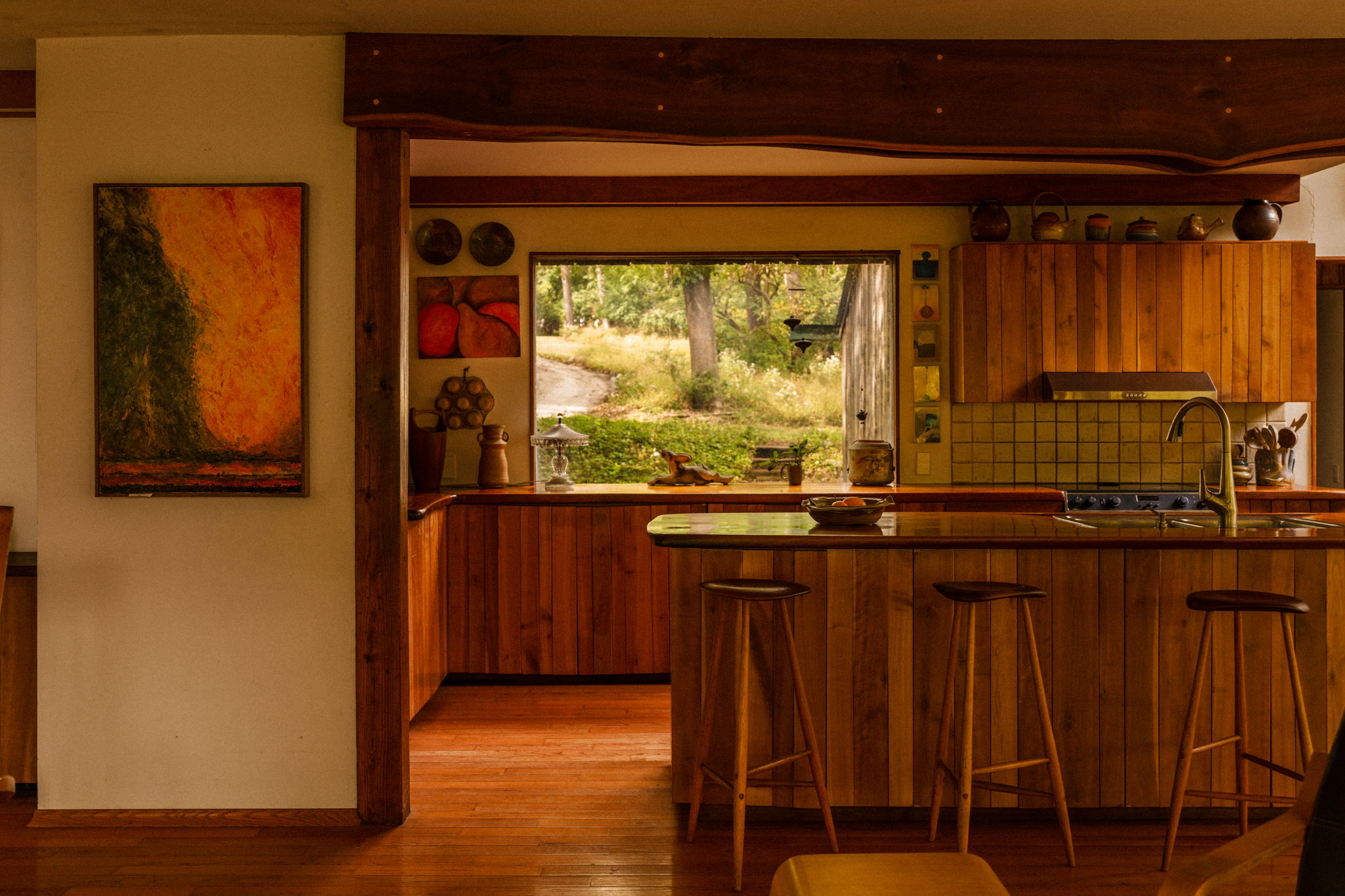
    A Chester County home full of beautiful woodwork and secluded on five acres of land is for sale for nearly $2 million.

    Advertised as the “McElroy House” in an ode to the late builder Robert McElroy, the 4,300-square-foot property near Malvern hit the market last week for $1.99 million.

    This Willistown Township home, for sale for nearly $2 million, was designed by Robert McElroy and has a wing that was devoted to his wife Annamaria’s art studio.

    McElroy, who is credited with building more than 200 homes around the Main Line, designed and built this home for his own family in 1975, according to Marion Dinofa, Compass RE Realtor and modern home specialist.

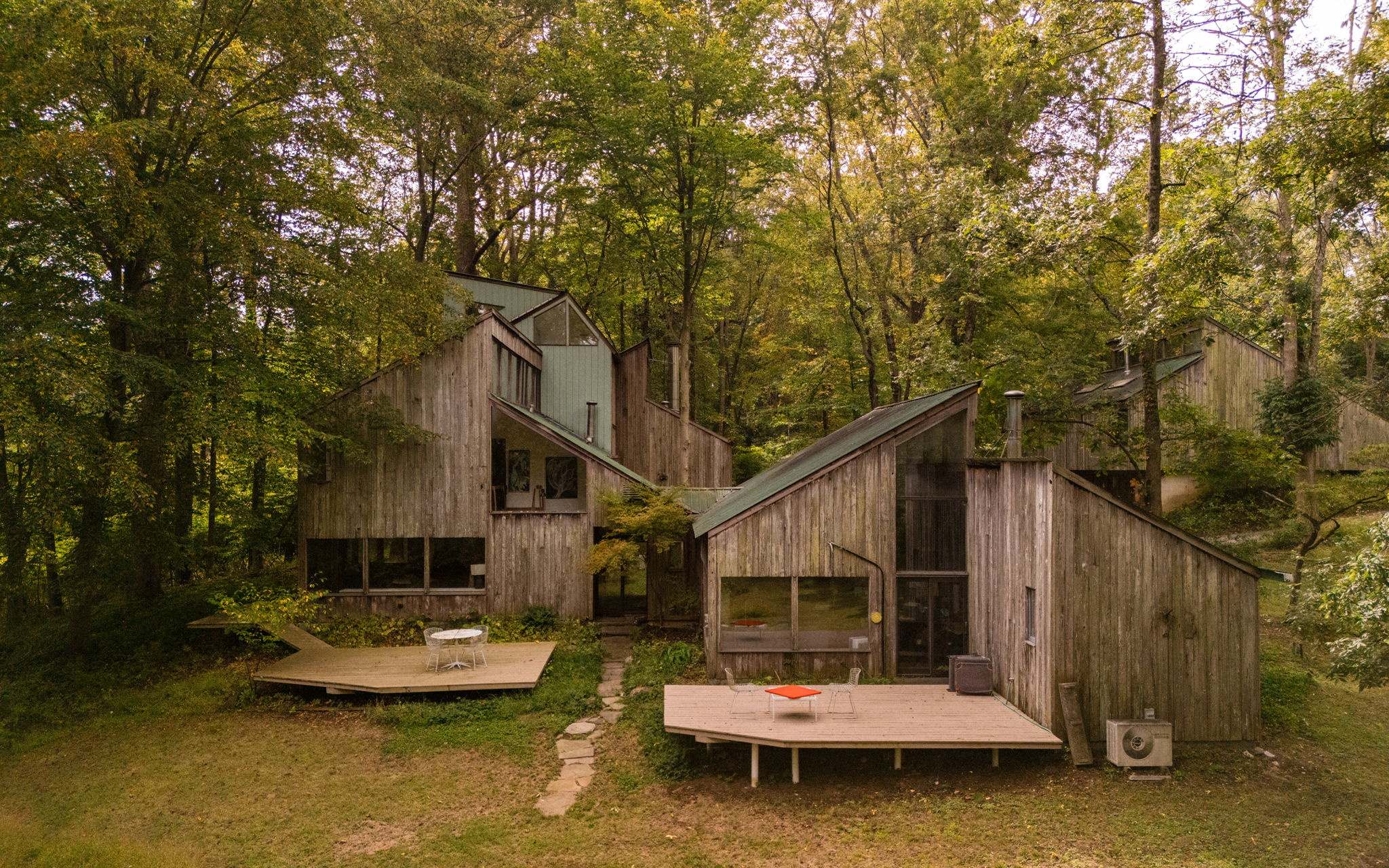
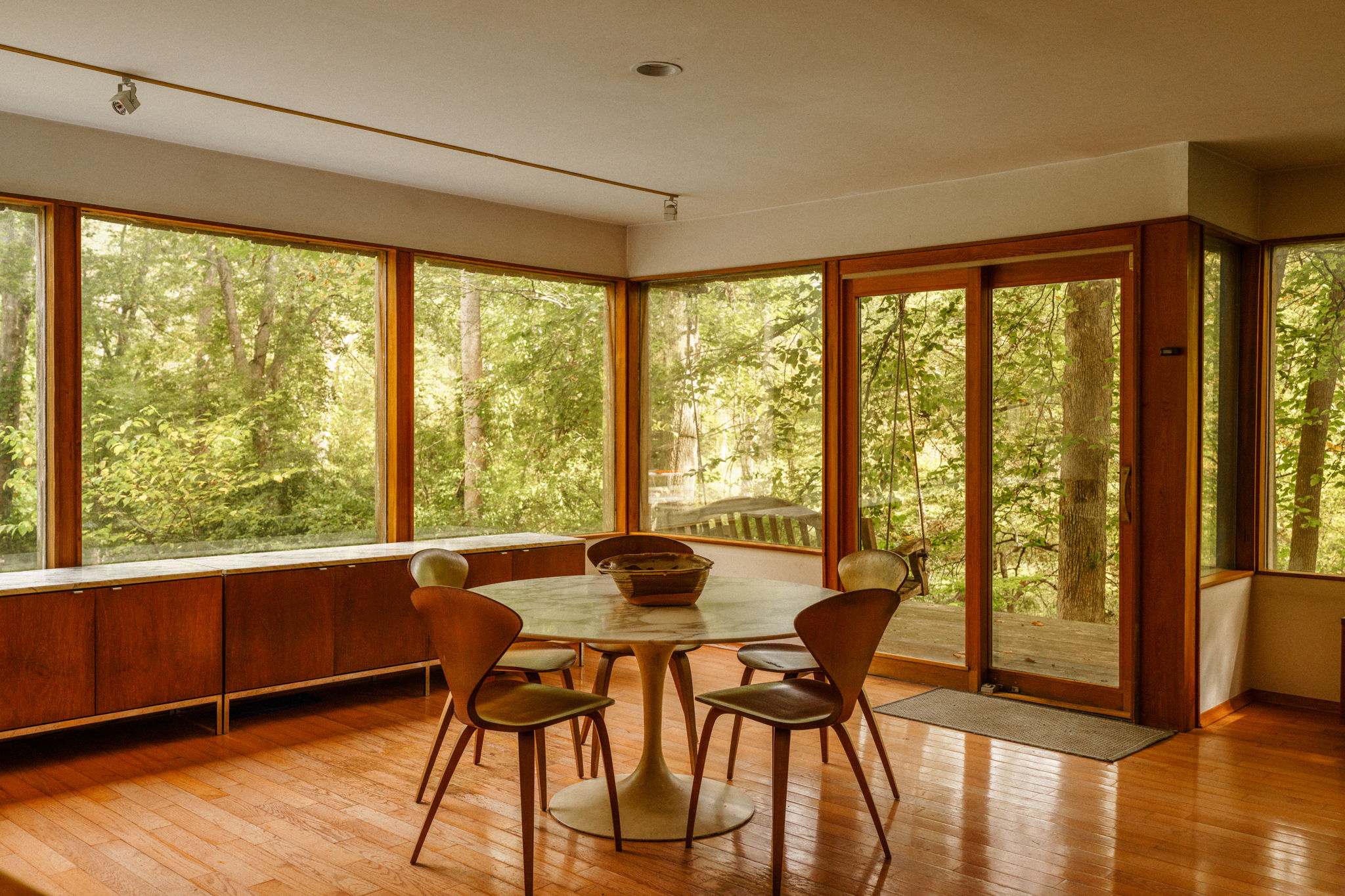
    Tucked far off Rabbit Run Road in Willistown Township, McElroy’s three-bedroom, 3½-bath home features a contemporary design and floor-to-ceiling windows that let in abundant natural light.

    “I see a lot of really cool houses, but this one, almost more than any other house, is truly like you’re living in a work of art, between the craftsmanship of the woodworking, the views through the windows that are ever changing with the seasons, and the design of the home itself,” Dinofa said.

    Wooden details make Robert McElroy’s former home in Willistown Township unique, said Realtor Marion Dinofa.

    Almost every piece of wood in the home was crafted by Horace Hartshaw, who collaborated with the renowned sculptural furniture maker Wharton Esherick. This includes everything from the wood doors to the custom kitchen cabinets to the staircases, including a spiral one at its center.

    McElroy wasn’t the only artist who resided in the home: His wife, Annamaria, a painter and sculptor, also left her mark, showcasing her artwork on the walls and using a wing of the home as her studio.

    Dinofa noted that the house also includes a detached two-story garage that could be converted into more creative space.

    The secluded home features custom wood features that were crafted by renowned artist Horace Hartshaw and lots of windows.

    Between Robert’s vision and Annamaria’s artistic touches, their home “was a labor of love,” Dinofa said. “And it’s really well preserved. You can tell it hasn’t changed much.”

    Annamaria and Robert lived at the home into their 90s, Dinofa said. They died in 2023 and 2024, respectively. Dinofa said the home is being sold by their daughter, Loretta.

    Dinofa said she could see the property being bought by artists or by adventurous young parents who want to raise their children amid nature.

    “It would be such a fun place for kids to play outside,” with a stream in the backyard and plenty of space to run around, Dinofa said. “I can only imagine the wildlife that they have viewed from that house.”

  • How one family found room for eight in Mount Airy | How I Bought My House

    How one family found room for eight in Mount Airy | How I Bought My House

    The buyer: Kim Sephes, 40, learning coach

    The house: a 1,380-square-foot 1950s twin with three bedrooms and 2½ baths

    The price: $255,000

    The ask: Kim Sephes didn’t want to live in a house attached to her father’s church anymore. It “felt strange,” she said, living there after he passed away in 2019.

    So in 2022, she and her husband, Matthew, began searching for a home for their family of eight. Safety, location, and a driveway were top priorities. They needed four bedrooms and dreamed of a backyard.

    The search: At first, the couple searched in Northeast Philadelphia, where they found a lot of nice houses, but were worried about their kids walking around safely without supervision. They expanded their search to Mount Airy, but the competition was stiff. They made offers on four houses only to get outbid every time.

    “It was a crazy housing market where people were offering cash offers left and right,” Sephes said.

    Soon after, the family “stepped on the gas” with their search and found a house they loved in August 2022.

    The appeal: The house was move-in ready. Only the kitchen needed updating.

    But they had to make a few compromises.

    It was three bedrooms, not four — but it had a finished basement that Sephes says could be converted. It was a twin, not their preferred single, home — but it was attached to the corner house.

    “At least we weren’t in the middle of the block,” said Sephes. Most importantly, it was in a great section of Mount Airy, and it had a back patio.

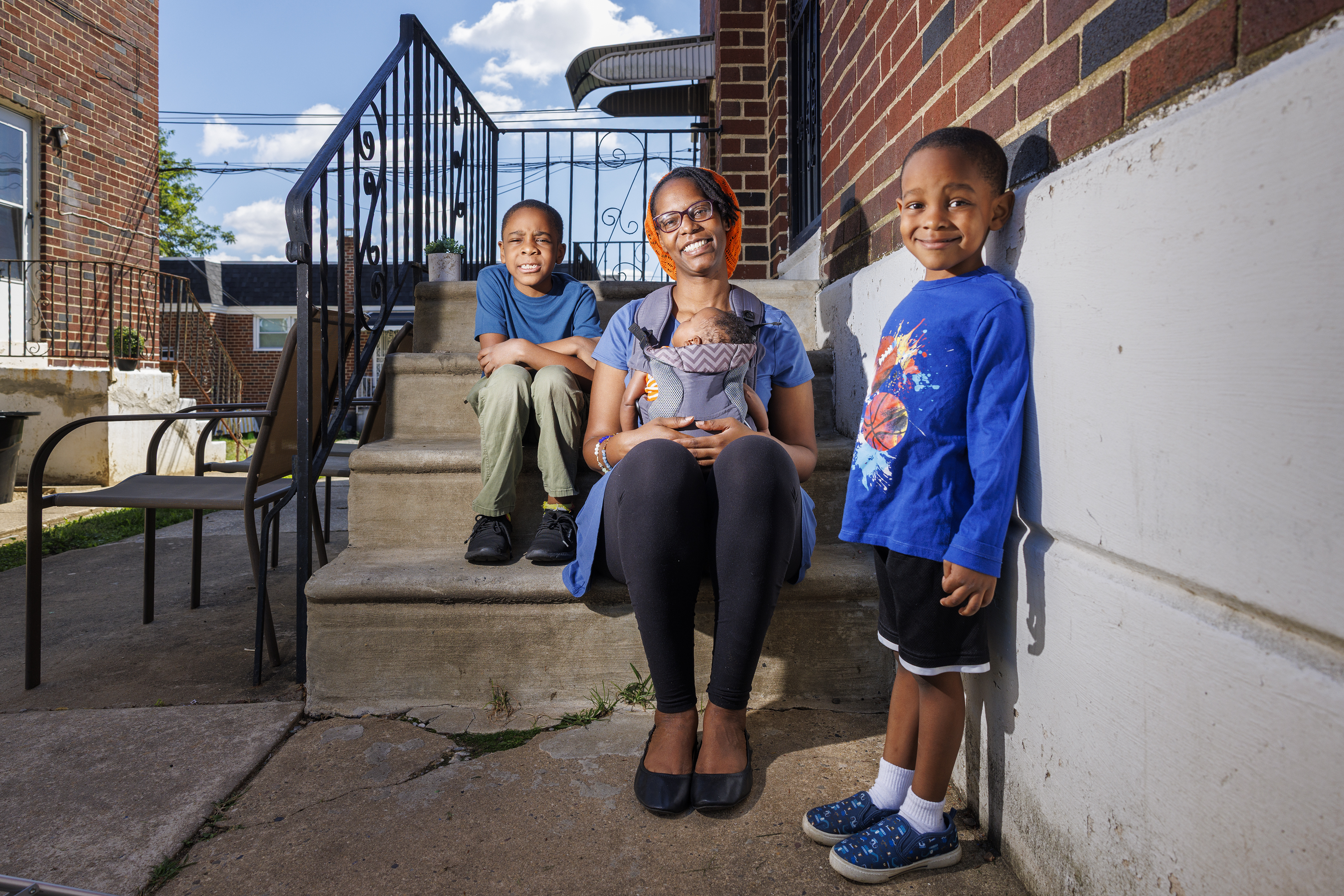
    Kim Sephes with children (from left) Darius, 8, and Solomon, 4, on the steps of their home. She is carrying 1-month-old Adam.

    The deal: They offered $5,000 over the asking price of $250,000. The house attracted several offers from investors but “the sellers really wanted to sell it to a family,” said Sephes. “Our real estate agent went hard trying to convince them to sell it to us, because they did have a cash offer on the table for more than what we were going to offer.”

    In the end, the Sepheses’ offer was accepted and, after a little back and forth about the inspection, they sealed the deal with a $5,000 non-refundable earnest money deposit.

    The money: The couple saved $18,000 for a down payment, socking away the previous two years’ tax returns and parts of their paychecks. For three years, they put a little bit away every time they got paid.

    “I was so determined,” said Sephes.

    They also got a $15,000 forgivable loan through the Neighborhood Lift program, which they do not have to pay back as long as they stay in the house for 10 years.

    Through their lender, Fulton Bank, they secured an additional $2,000 grant and a Federal Housing Authority (FHA) mortgage with a 5% interest rate.

    The Neighborhood Lift grant “helped get us in the home,” Sephes said. Without it, they “would’ve qualified for something way less.”

    The move: The Sepheses closed on Sept. 26 and started moving right away.

    To ensure they had enough time to move, they paid October rent. However, they were officially out of the house within the first week, so the church gave them the full month’s rent back. “I really appreciated that because they didn’t have to do that,” Sephes said.

    Any reservations? The only issue with the house is that “it’s a little small,” Sephes said. But the garage has extra space for storage.

    More than anything, Sephes is grateful they were able to move.

    “We were ready to leave the church house,” she said.

    Life after close: Sephes says the best thing about their new home is the neighborhood.

    “It’s a beautiful block, very quiet, and it’s wide, too, so we don’t have to worry about traffic.”

    She also appreciates its 2½ bathrooms.

    Did you recently buy a home? We want to hear about it. Email acovington@inquirer.com.

  • A Bucks County couple built an architectural retreat in the woods

    A Bucks County couple built an architectural retreat in the woods

    When cookbook author Pamela Anderson and her husband, David, were looking for a bucolic escape in Bucks County, they found a forested stretch of land sandwiched between a high ridge and a stream to put down roots.

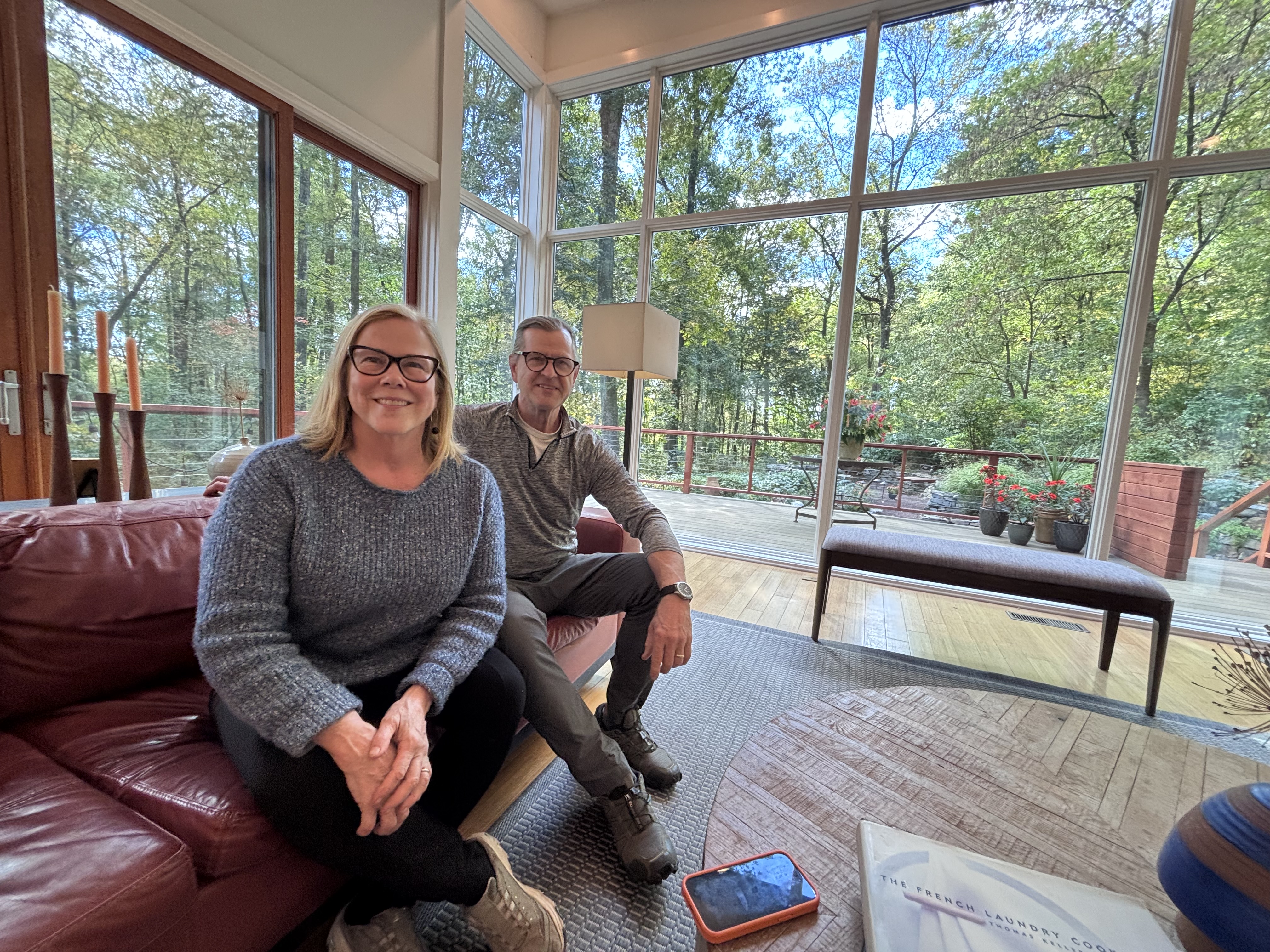
    The couple, who previously lived in New Hope, toured the 11-acre parcel in Riegelsville with an architect back in 2003, learning how their new home could flow with the land. Today, the focal point of Copper House might be the living room, with 180-degree views from floor-to-ceiling windows. It’s like forest bathing, from a comfortable couch.

    “We wanted a place to get away,” Anderson said on a recent October afternoon.

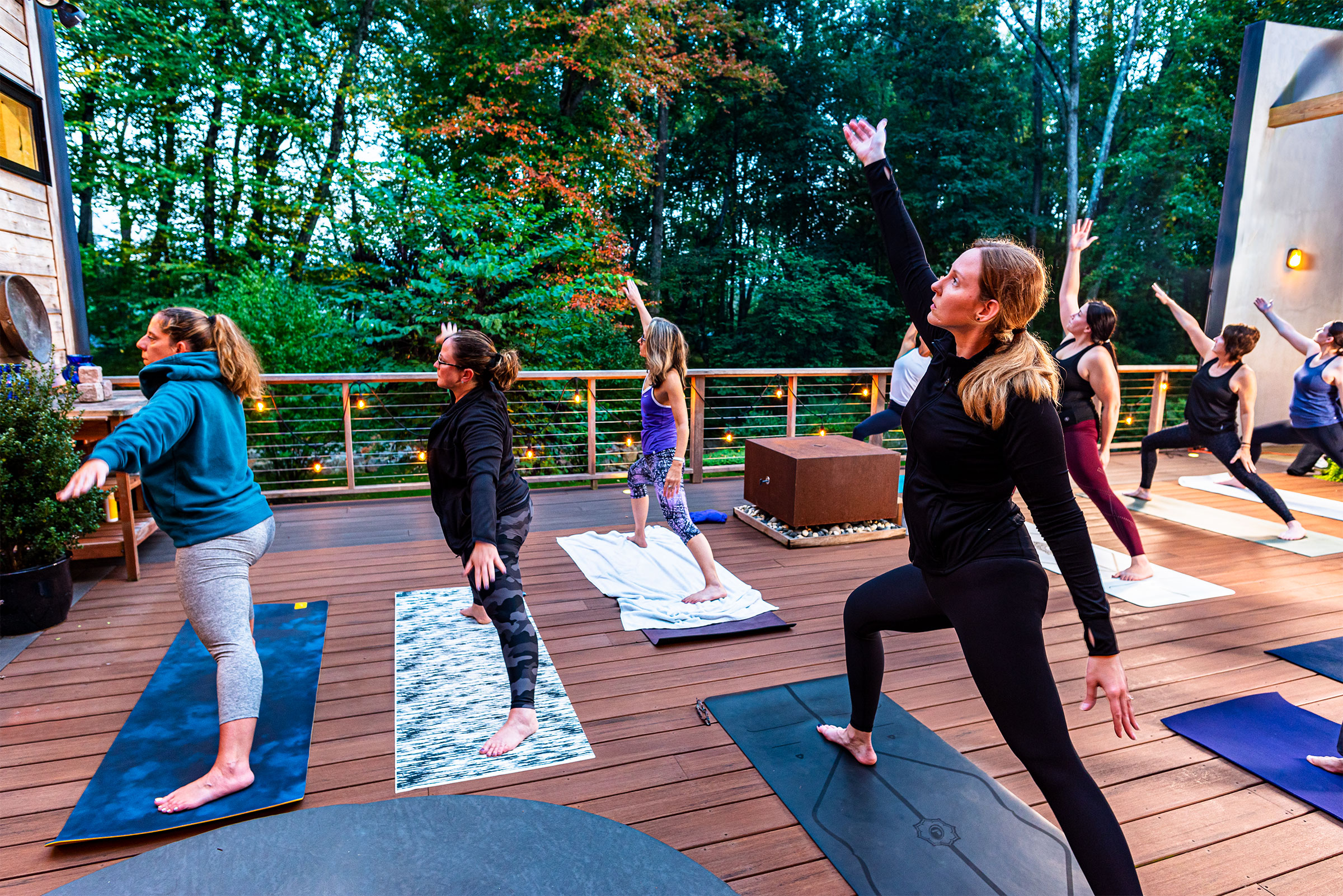
    Outside, they’ve woven gravel trails into countless grottos, fire pits, and other quiet gathering places for the numerous visitors who’ve descended upon their home for sound baths, yoga, and meditations. On this Friday afternoon, about a dozen architects and interior designers gathered at their home for a corporate retreat to learn about sustainable flooring.

    “Some people just want to come here to have a meeting in a lovely place,” Anderson said.

    Pamela and David Anderson sit on their couch in their home, Copper House, where they host events and retreats.

    The Andersons didn’t just want to live at Copper House, so they went beyond having friends over for dinner. They started hosting corporate events and retreats at their home during the early days of the COVID-19 pandemic, stopped for a bit, and got things back up again afterward.

    “We’ve done most of the work ourselves. We built all the walls ourselves from rocks we had here. It’s expensive to maintain this place, and these events help with that,” Anderson said. “It made sense for us.”

    Anderson, along with being a best-selling cookbook author, cooks most of the food for the retreats, harvesting local fruits and vegetables and cooking wood-fired pizza from an outdoor oven.

    “This was just a natural transition for me from that career to this one,” she said.

    David Anderson, a longtime Episcopal priest, said the landscape was wild when they first toured it, filled with brambles and invasive species. The couple has methodically rid the invasive species from various patches of their property, but that work never ends.

    Copper House in Upper Bucks County.

    Their latest retreat was hosted by Interface, an indoor flooring company that specializes in sustainable projects. Monica Blair-Smith, an account executive with Interface, said they’ve had meetings by a bonfire and in the labyrinth, so far, at Copper House. The team also took a sound bath.

    “We toured several places from here to southern New Jersey, but we really loved how much this space was integrated with nature. Hosting in such a beautiful space is important to us,” Blair-Smith said. “Once we toured it, we didn’t go anywhere else. It was a no-brainer.”

    Retreat packages at Copper House begin at $1,500.

    While events and retreats have become a lucrative business, the Andersons said Copper House is still a home they cherish.

    “You’re always seeing something new and different, and our senses are so heightened living here,” Pamela Anderson said. “In winter, it’s like living in a snow globe.”

  • Winter weather is on the way: Tips to prevent frozen pipes, safely heat your home

    Winter weather is on the way: Tips to prevent frozen pipes, safely heat your home

    When it gets colder, it’s not only important to be mindful of your pets and your plants but also your home’s pipes and water heater.

    Yes, those inanimate objects need extra care, too.

    As temperatures drop across the region, the risk of your home’s pipes freezing increases. There are steps, however, that homeowners can take to help stop that from happening and help you avoid a hefty plumbing bill this winter.

    Here’s a list of plumber-approved tips on how to keep a pipe from freezing, spotting a frozen one, and what to do if it bursts.

    How to prevent your pipes from freezing

    “It comes down to three main things: draining outside faucets, keeping pipes warm, and checking for leaks,” said Vincent Thompson, owner of Thompson Plumbing and Heating. Thompson is a master plumber of more than 50 years and for two decades taught plumbing at Dobbins Vocational School in North Philadelphia.

    💧 Draining outside faucets

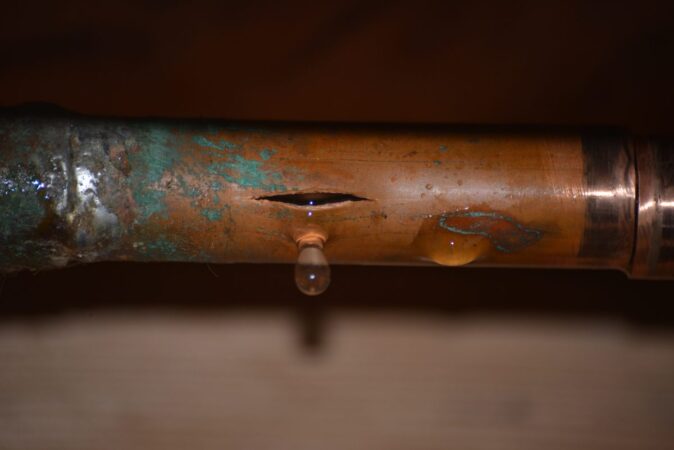
    Over the summer, we use outside faucets and hoses to water the plants, rinse of sidewalks, or simply cool down. When the temperature dips, water can freeze and build pressure, ultimately causing a burst pipe, a situation far too common, according to Thompson.

    He recommends disconnecting your hose (and storing it for the winter), shutting off the valve that feeds the faucet or spigot (usually found near the hot water heater), and letting the remaining water in the pipe drain out. You can leave the faucet or spigot slightly open, according to Thompson. Letting the faucet drip is also a good suggestion for inside fixtures.

    “If it’s empty, it’ll never freeze,” Thompson said. “But if there’s water, it can expand and explode. Then you’ll come out in the spring to use your hose and the water will be shooting out of the wall.”

    🌡️ Keep your pipes warm

    When the freezing weather descends upon us, we bundle up to stay warm. Pipes need that treatment too. Ideally, the lowest you want to keep your thermostat set at is 50 degrees, but heating is expensive. According to Thompson, the absolute lowest you can go is 40 degrees, because your pipes will start freezing at 39 degrees.

    Opening the cabinets underneath your bathroom sink can be a good way to keep pipes from getting too cold. And for the ones in extra-cold spots, using electrical heating tape or fitting them with foam and rubber sleeves is a good idea. Be sure to check for any leaks beforehand, because if water is accumulating, they won’t prevent a pipe from bursting and it will become an added step.

    🚽 Check for leaks

    “Every drop that goes down the drain will turn into an icicle and eventually can clog up the entire soil stack,” explained Thompson. Not addressing it can result in frozen pipes, flooding, and even water backing up through your toilet.

    After 50 years of handling these cases, he advises looking at your water meter because sometimes the leak might not be obvious. Make sure no water sources are open, and look at the blue or red triangle (depending on your meter). If it’s turning that can be a sign of a leak.

    If you suspect the culprit is your toilet, he recommends adding a couple of food dye drops into the tank. If the water in the bowl changes color, your suspicions are correct.

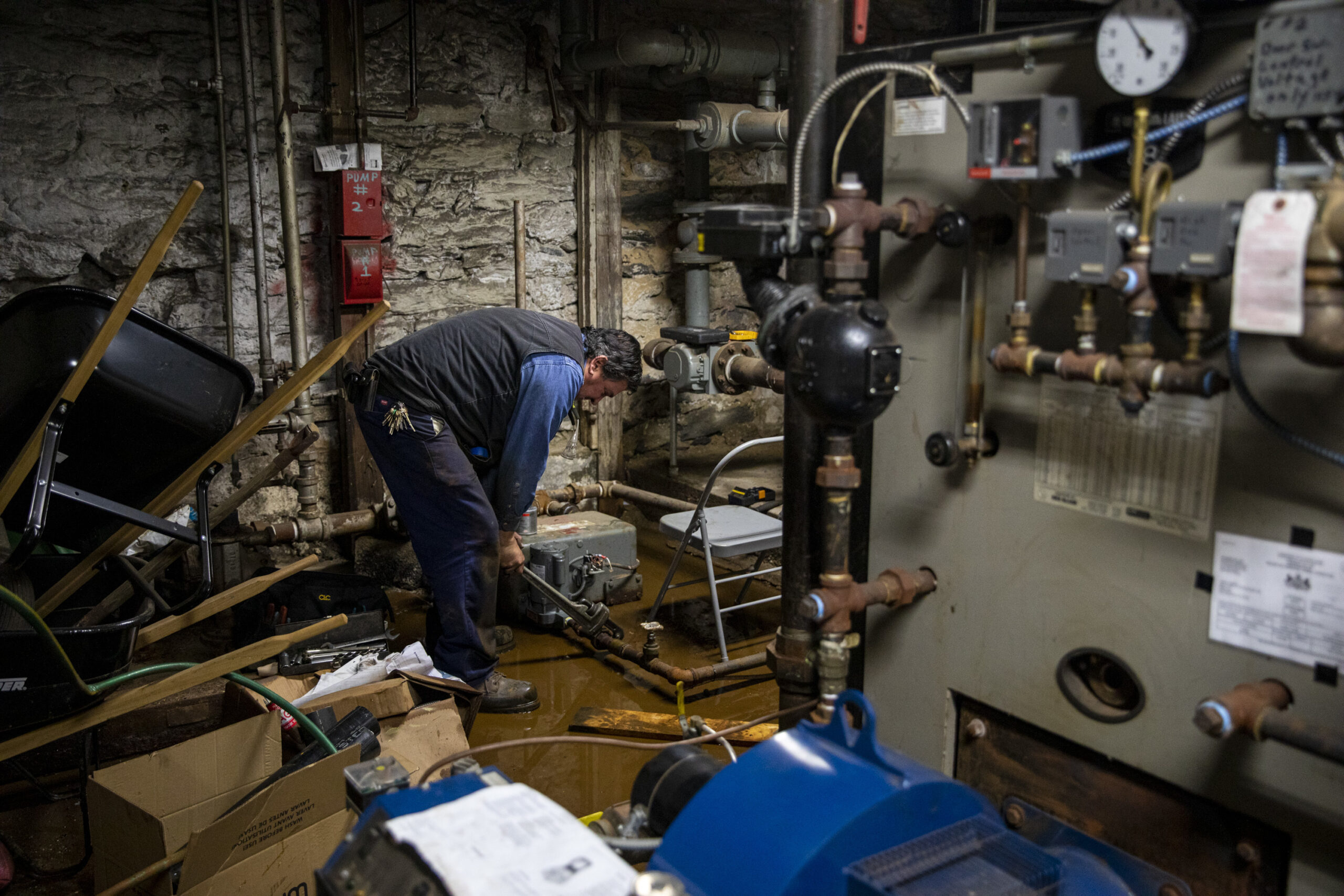
    Andrew Gadaleta, contractor, works on getting the heat fixed at Visitation BVM School in Philadelphia in December 2021 so that students could return to school. Thieves broke into the school Tuesday morning, ripping copper pipes from the walls that caused flooding. The water rendered the school unusable for a week.

    How to spot a frozen pipe

    Your house is filled with water pipes, and while it’s not hard to figure out when you’re dealing with a frozen pipe, it can be tricky to figure out where the frozen section is. If you turn on a faucet and nothing comes out, you’re going to have to do a little detective work.

    The first step should be to try all the other faucets in your house. If all the faucets in a room aren’t working, the freeze is likely in a split from the main pipe. If all the faucets on a floor aren’t working, the freeze is likely between where the first- and second-floor pipes separate. If all the faucets in your house aren’t working, then the freeze is probably near where the main pipe enters the house.

    The frozen section of the pipe, if exposed, will sometimes have condensation over it. You’ll also be able to tell that it’s colder just by touching it.

    How to thaw a frozen pipe

    Before thawing a frozen section of pipe, you should open the faucet to relieve the water pressure and allow the water to escape once it thaws. You should also begin the thawing process close to the faucet and work your way to the blockage. If melted water and ice get caught behind the blockage, the chance that the pipe will burst increases.

    One of the easiest ways to thaw a frozen pipe is with a hair dryer. You can also use hot towels or a heat lamp to warm up the pipe. Never use an open flame.

    What to do if a pipe bursts

    Don’t panic. The first thing you should do is shut off the main water line into your property. This will prevent your house from flooding. The main water valve is usually near your water meter. After you’ve done that, call your plumber. Locating and tagging the valve to your main water line ahead of time can help make the moment less stressful.