Category: Weather

  • Philly residents thought they had a winter parking system. Then the snow stuck around.

    Philly residents thought they had a winter parking system. Then the snow stuck around.

    By the time Taylor Schuler finally freed their car, they were exhausted. It had taken five hours across two days, hacking at the wall of ice encasing their Prius’ bumper, shoveling piles of frozen snow off the tires, to complete the job. As the sun set on their afternoon of labor, they were tempted to put a piece of furniture in their hard-earned spot, a practice sometimes known as “savesies” in Philadelphia.

    But they knew better. Having just moved to Philly from Houston, the 28-year-old academic librarian wasn’t all that familiar with cold-weather etiquette, so they took to the internet ahead of January’s snowstorm to figure out what exactly Philly’s rules are. They gathered that people weren’t all that fond of the “savesies” practice, so, tempted as they were to hold onto their spot, they let it go.

    Once the spot was cleared, they circled the block, a quick trip to make sure their car was still working. Their internet research had also led them to believe no one would just take their spot immediately. As they rounded the corner toward their house, though, they saw another driver lurch into the spot they just spent hours digging out.

    “Oh jeez,” Schuler thought to themselves. “It’s like the Wild West out here.”

    In some snow-burdened cities, saving a shoveled-out parking spot is a deeply ingrained winter habit. Boston even formally acknowledges the practice by allowing residents to mark a spot they dug out for up to 48 hours after a storm. In Chicago, protecting your precious dug-out parking space with a lawn chair is called “dibs,” and it’s been a beloved and widely accepted tradition since the great blizzard of 1967.

    But Philadelphia exists in a murkier middle ground. Until about two weeks ago, it snowed infrequently enough and melted fast enough that any theory about our collective approach to storm parking was never really put to the test. But the lingering snow has revealed a kind of civic chaos, with neighbors operating under wildly different assumptions and fights breaking out over who is entitled to snow-cleared parking spots.

    The divide is often generational. Older residents, who experienced harsher winters, are more likely to embrace savesies as another classic Philly tradition while younger residents and transplants see it as territorial nonsense, out of step with the values of densely populated city life.

    Schuler finds the entire debate exhausting. “I just want to be able to go to work and come home,” they said. “I didn’t ask for any of this.”
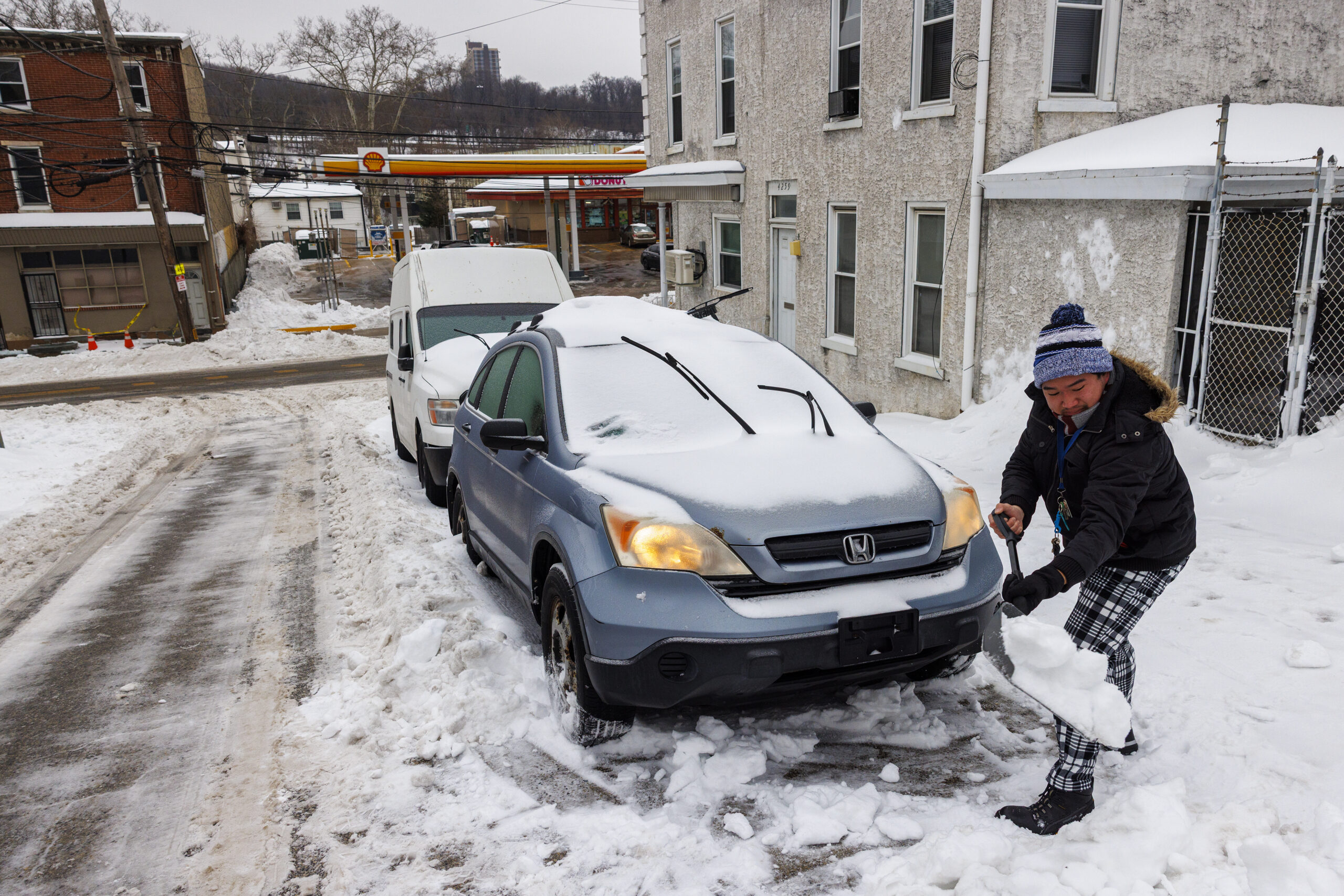
    Connor Phan digs his car out after the recent snowstorm.

    Jeff Martin, 43, who lives in South Philly, describes himself as firmly “no savesies” but with caveats. He won’t put out a chair. He won’t defend one. But he also won’t move someone else’s. “I don’t believe in the chair,” Martin said. “But I’m going to obey the chair.” His reasons are entirely practical. “I don’t want to get keyed,” he said.

    Martin argues Philadelphia’s parking wars are a symptom of the changing climate. “The fact that over the last 20 years, we haven’t gotten as much snow as we did over the previous 20 years has made us forget how to deal with it,” he said, “and the city forget how to deal with it to the point where they don’t properly fund the removal of snow.”

    For the record, the city is firmly in the “#nosavesies” camp, and the police routinely remind Philadelphians that saving parking spots is illegal. Of course, that doesn’t stop people from doing it — and other people complaining about it.

    Lucas Tran didn’t see the cinderblock in the spot he parked in on Tuesday night. It wasn’t until another driver pulled up and told him that he was in her spot that he became aware of it. She said she had dug out the spot herself, saved it with the cinderblock, and that Tran had to move.

    At first, he refused. But he backed down after she called him a liar and a “little b—.” He didn’t want things to escalate. The next day, she left a handwritten apology on his car. “Thank you for moving your car,” it read. “You are NOT a little b—.”

    Tran takes a “special exception” approach to the savesies debate. If the woman had been elderly or a first responder, or if it had been two or three days after the storm rather than a full week later, he might have been more understanding. “But the roads are drivable now, he said. “There are more options to park. You can’t keep claiming a spot that’s public property.”

    Back in West Philly, Schuler spent the week parking wherever they could. The spot they dug out remained occupied until one evening, when they pulled up, excited to reclaim what was once theirs — only to find a folding table balanced on two overturned pots in their way. Someone had “savesied” Schuler’s spot.

    Schuler snapped a photo and uploaded it to Reddit, where the response was nearly unanimous. As one Redditor put it, “that’s diabolical.”

    It was the one version of “savesies” Schuler had never seen defended. “If there’s anything people agree on,” they said, “it’s that you don’t do that.”
  • Weekend to stay frigid, forecasters say, but heat wave to near 40 may arrive on Wednesday

    Weekend to stay frigid, forecasters say, but heat wave to near 40 may arrive on Wednesday

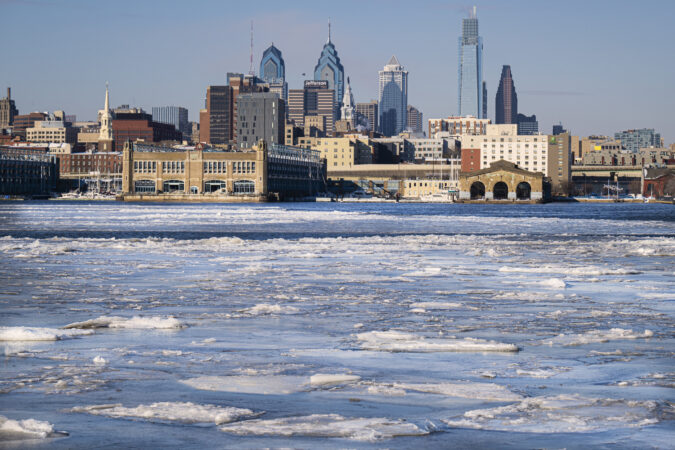
    The frigid temperatures, the blocks of ice clogging the Delaware and Schuylkill Rivers, and the mounds of snow piled high in driveways and parking lots across the Philadelphia region are not likely to change much Sunday and Monday, Zack Cooper said Saturday afternoon.

    Cooper, a meteorologist at the National Weather Service in Mount Holly, said to expect a high of just 18 degrees on Sunday, a significant drop from Saturday’s high of 28. For Monday’s return to work for many, the weather service predicts a high of 36.

    “It’s been a long time since we’ve seen this type of prolonged stretch of cold weather,” Cooper said. “It’s been about 10 years.”

    The good news, he said, is that the temperature should peak for the week at near 41 on Wednesday. More good news, he said, is that the daytime highs are expected to reach above freezing for the rest of the week, 36 on Tuesday, Thursday, and Friday, and 38 on Saturday. But the nighttime lows should still dip below the freezing point of 32 degrees.

    In that case, Cooper said, some of the ice will melt during the warmer daytime hours but not enough to cause widespread flash flooding near rivers, lakes, and streams. A slow warmup, with warmer days and colder nights, is always best, he said.

    That’s also important regarding the giant snow piles around town because Friday was the 12th consecutive day of a snowpack of at least 5 inches at Philadelphia International Airport. In 2014, the weather service issued warnings of flash floods along the Delaware River south of Trenton after a rapid warmup, and a presidential disaster declaration was needed in 1996 when melting ice jams caused major flooding along the Delaware and the Susquehanna Rivers.

    It’s been a rough February so far for Philadelphia area residents. Daily average temperatures have been below freezing every day since Jan. 23, and the region went nine days, from Jan. 24 to Feb. 2, without reaching 32 degrees at all.

    Last week, a barge heading north got stopped in the ice on the Delaware River, ferry service was halted in the Delaware Bay due to ice, and the Coast Guard had to deploy a 175-foot-long cutter to smash up ice floes in the Delaware all the way up to Trenton.

    Cooper said the recent nine-day stretch of temperatures below freezing is likely among the top 10 longest local cold snaps on record. The last period of such frigidity, he said, was an eight-day stretch in 2015.

    As for the wind chills, Saturday night could reach minus 13 degrees. Sunday could go to minus 12, and Monday could be minus 3. High wind warnings are expected to be lifted on Sunday. No snow is expected next week.

    So what should folks do until Wednesday? Hang in there, Cooper said. “We take weather as it comes,” he said. “It’s ever-changing, and you have to adapt and adjust.”

    And if it does reach 41 on Wednesday, Cooper said, “It will feel nice.”

  • Ice is building on Philly’s waterways as the snowpack persists and the cold intensifies

    Ice is building on Philly’s waterways as the snowpack persists and the cold intensifies

    Accompanying one of the more-enduring snowpacks in the period of record, ice has continued to build in the Philadelphia region’s waterways, and all indications are that it’s going to intensify in the next three days, perhaps significantly.

    With temperatures expected to fall to single digits by Saturday night and wind gusts up to 55 mph, the region is about to experience an assault from a “cold air gun,“ said Alex Sosnowski, senior meteorologist at AccuWeather Inc.

    The combination, plus the below-freezing temperatures at least through Monday and the ongoing cold spell that began last month, will not only deepen the ice cover but will make it more uniform by freezing over breaks in the ice.

    “You’re going to see the ice-over become more extensive,” Sosnowski said.

    Earlier in the week, icing temporarily stranded a vessel on the Delaware River that was delivering much-needed salt supplies to Philly. (They did eventually get here.)

    The U.S. Coast Guard was using a 175-foot-long cutter to break up ice on a portion of the river channel that runs from the mouth of the ice-covered Delaware Bay — where Cape May-Lewes Ferry service was disrupted this week — to Trenton.

    As of Friday morning, the craft had been ramming ice for 45 hours since the freeze began at the end of last month, U.S. Coast Guard Petty Officer Matthew West said.

    So far, however, the ice hasn’t reached crisis levels, said Ryan Mulvey, a spokesperson for the Philadelphia Regional Port Authority. For ship traffic on the river, it’s been more a matter of “road work ahead” rather than ”road closed.”

    “We’re open as usual,” he said. “I think the largest ships help with breaking up some of the ice flow.”

    One thing is certain, meteorologists are warning: The ice factory is going to be in full production mode until Tuesday.

    And, ironically, even as precipitation deficits and drought conditions persist, flooding potential is a source of concern.

    The short-term outlook for icing in the Philly region

    A key to melting, said Sosnowski, is having a sequence of daily average temperatures above freezing, not just daytime highs above 32 degrees. Nights also have to warm up.

    The prospects of that happening aren’t looking good for the next several days. Officially, Friday was the 12th consecutive day of a snowpack of at least 5 inches at Philadelphia International Airport, the seventh-longest such stretch in records dating to the winter of 1884-85.

    Daily average temperatures have been below freezing every day since Jan. 23.

    Highs on Saturday and Sunday, even in the city, may struggle to reach 20 degrees, with lows in single digits Sunday and Monday mornings.

    A promised warmup during the workweek wasn’t looking as toasty on Friday as it was earlier in the week. Monday’s temperatures were forecast to top out in the 20s, and no daily average temperatures are forecast above freezing through Friday.

    Some rain or snow also is possible Wednesday, said Nick Guzzo, a meteorologist with the National Weather Service in Mount Holly. A storm is possible next weekend, but computer models continue to disagree with each other, and themselves.

    To erase the snowpack, the region could use a warm, moist air mass and rain that would produce “river rises” that would help break up the ice, the weather service says.

    But not too much rain.

    The long-term outlook: Flooding concerns amid a drought

    Some of the worst flooding on record has resulted from ice-jamming, a signature example occurring after Philadelphia’s mammoth 1996 snowstorm.

    Moist air preceding a rainfall all but erased the snowpack with a historic melt. When that air came in contact with the snow, it condensed, releasing latent heat that sped up the melting.

    Rain followed, and liberated ice jams led to destructive flooding along the Delaware and the Susquehanna Rivers and a presidential disaster declaration.

    NOAA’s Middle Atlantic River Forecast Center is well aware of the potential and is monitoring conditions, said senior hydrologist Johnathan Kirk.

    “That’s what we have to watch for,” said Sosnowski, who well remembers 1996.

    “It is going to take one of the more mild-mannered thaws to avoid ice-jam flooding,” he said.

    A mild thaw is possible, Sosnowski said, but “the odds are stacked against it. It’s been so cold for so long.”

  • Philly is not dumping snow in the Schuylkill, but it has in the past

    Philly is not dumping snow in the Schuylkill, but it has in the past

    Many Philadelphians are continuing to deal with snow-clogged, slushy, ice-laden streets nearly two weeks after a winter storm produced the city’s biggest snowfall in a decade.

    To deal with the snow, the city has deployed roughly 1,000 workers and 800 pieces of snow-removal equipment, and instituted programs to break up ice at crosswalks and streets in residential neighborhoods, among other efforts. But to some Inquirer readers, the solution has been right in front of us all along.

    “I know we used to toss snow into the river,” one reader wrote via Curious Philly, The Inquirer’s forum for questions on all things local. “What happens to it now?”

    » ASK US: Have something you’re wondering about the Philly region? Submit your Curious Philly question here.

    In the past, the city has dumped snow into the Delaware River and the Schuylkill on various occasions. But in recent decades, that practice has been used rarely — if at all — primarily over environmental concerns. Here is what we know:

    An old practice

    Newspaper archives show references to dumping snow in the Delaware and Schuylkill dating back at least to the late 19th century — during a storm colloquially known as the “Great Arctic Outbreak of 1899.” That storm dumped 19 inches of snow on Philadelphia around Valentine’s Day.

    In the aftermath, the city sought permission from its Board of Port Wardens to dump snow in the rivers surrounding Philadelphia, but there were concerns over the “considerable amount of dirt” that would be thrown into the water.

    The practice was utilized in the winter of 1909, when 21 inches of snow fell. Initially, snow was dumped into the rivers at three points, but officials later expanded approved dumping sites to be “at any point and from any wharf” along either river.

    “It was contended that this was perfectly proper, since snow is not refuse, but will readily melt after it is thrown into the water,” The Inquirer reported at the time.

    https://www.newspapers.com/article/philadelphia-daily-news/190719291/

    Article from Jan 10, 1996 Philadelphia Daily News (Philadelphia, Pennsylvania) <!— –>

    The blizzard of ’96

    Perhaps the most well-known modern use of Philadelphia’s rivers as a snow dump came in 1996, when a debilitating 30.7 inches of snow fell in early January. The city was left with few options, and got a permit from state environmental officials to dump snow in the rivers, Inquirer reports from the time indicate.

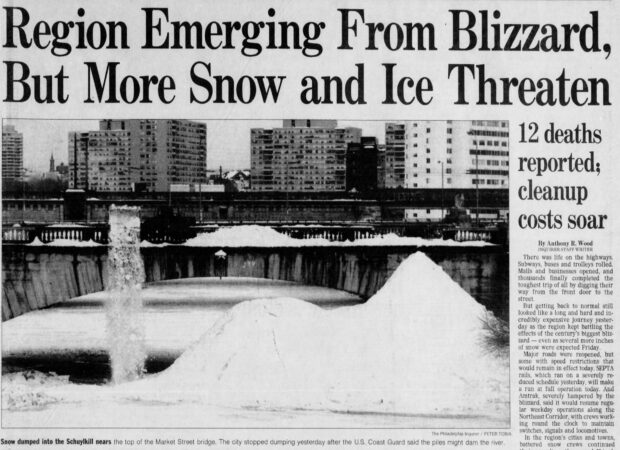
    Within days, roughly 500 tons of snow were dumped into the rivers, and that total would grow into the thousands. Famously, city trucks were spotted dumping snow into the Schuylkill from the Market Street Bridge — until being asked to stop by the U.S. Coast Guard.

    “We did advise the city to stop dumping snow into the Schuylkill. Our concern was the accumulation of ice in the river,” a Coast Guard spokesperson said at the time. The piles of snow in the river ran the risk of forming dams that could cause flooding.

    The piles became so severe they had to be beaten back down. By mid-January, one Inquirer report noted, wrecking balls were sent in to break up at least one mountain of snow that threatened to clog the Schuylkill.

    https://www.newspapers.com/article/the-philadelphia-inquirer/190719516/

    Article from Feb 22, 2003 The Philadelphia Inquirer (Philadelphia, Pennsylvania) <!— –>

    An ‘option of last resort’

    The city again in 2003 dumped snow into Philadelphia’s rivers, this time in an attempt to mitigate the impacts from a February storm that left about 19 inches of the white stuff. This time, though, city officials seemed to at least feel bad about it, calling it an “option of last resort.”

    For this storm, roughly 400,000 pounds of snow was dumped into the Schuylkill. But along with it went road salt, antifreeze, trash, and other pollutants, prompting concerns from regional environmental groups. That pollution, they said, could harm marine life and devastate the riverbanks.

    “All the stuff that’s on the road surface goes into the water,” Delaware Riverkeeper Network head Maya van Rossum told The Inquirer that year. “This is not the appropriate way to deal with the snow. There are plenty of places on the land to put it.”

    The dumping, Streets Commissioner Clarena Tolson said, was limited. And the Pennsylvania Department of Environmental Protection said it asked the city to only dump “virgin snow” into the rivers.

    https://www.newspapers.com/article/the-philadelphia-inquirer/190719722/

    Article from Feb 12, 2010 The Philadelphia Inquirer (Philadelphia, Pennsylvania) <!— –>

    No more dumping, officially

    By 2010, the city appeared to have officially abandoned the practice of dumping snow into city riverways. That February, one storm caused more than 28 inches of snow to fall, but Mayor Michael A. Nutter’s administration declined to pour it into the rivers.

    “We’re going to take some of that down to the Navy Yard. We will not dump in the river,” Tolson said. “There are environmental concerns with placing snow in the river. The snow accumulates pollutants and salt, and dumping it in the river would be a very extreme measure.”

    The Center for Environmental Policy at the Academy of Natural Sciences applauded the Nutter administration’s decision, writing in a letter to The Inquirer that the move would “prevent serious environmental damages to the river.”

    “Urban precipitation, including snow, acquires a witch’s brew of contaminants such as oil, grease, litter, road salt, and lawn fertilizer,” director Roland Wall wrote. “We salute the city for making a commonsense decision that will protect one of Philadelphia’s natural treasures.”

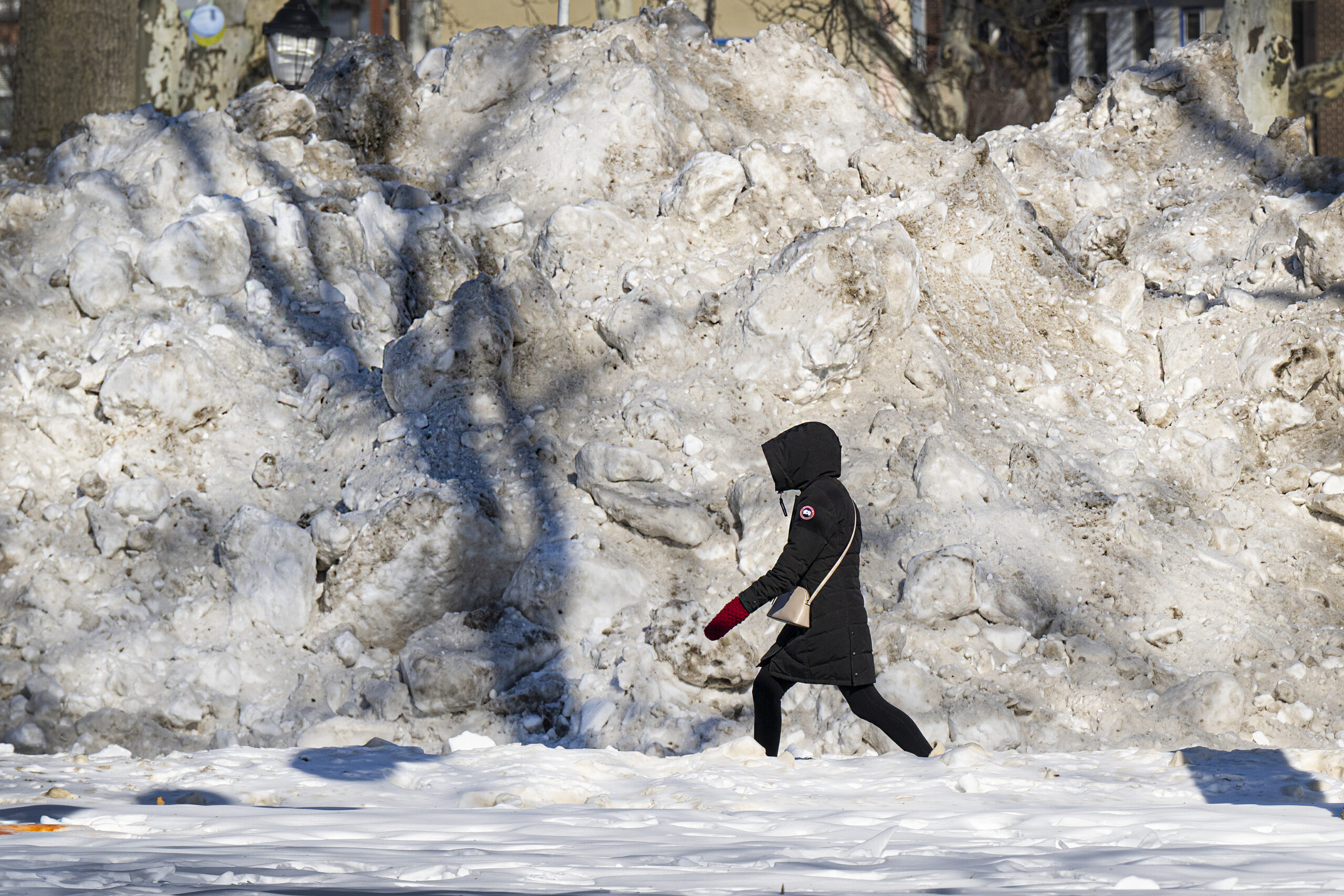
    A pedestrian walks past a large pile of snow and ice along the Benjamin Franklin Parkway days after a fierce winter storm dropped up to 9 inches of snow and sleet, with freezing temperatures leaving large banks of ice and snow on streets and sidewalks in Philadelphia, Monday, Feb. 2, 2026.

    So what do we do now?

    On Wednesday, Carlton Williams, the city’s director of clean and green initiatives, said the city does not dump snow in Philadelphia’s rivers, as that practice is “not an EPA standard.” Instead, the city has gravitated toward removing the snow from city streets and placing it at 37 snow dump sites around Philadelphia.

    The city did not respond to a request for comment regarding those dump sites’ locations. Some of them contain mounds of snow up to 12 feet high that stretch for blocks, Williams said Wednesday. Officials also brought in a snow-melting machine from Chicago.

    Pennsylvania Department of Environmental Protection guidelines, meanwhile, recommend municipalities push snow at least 100 feet away from surface waters, where it will be able to melt with less environmental impact.

    “Dumping of snow directly into a stream carries with it the shock of loading de-icing chemicals and anti-skid agents,” the agency said in a recent recommendations document. “Allowing a natural melt provides a slow release of the water, dilutes the chemicals, and provides filtration of the solids through the soil.”

  • A dash of snow, an Arctic chill, and 55 mph wind gusts are possible this weekend in Philly

    A dash of snow, an Arctic chill, and 55 mph wind gusts are possible this weekend in Philly

    By now Arctic air may qualify for a frequent-visitor pass around here, but the version coming this weekend will be of a different quality and have a particular sting.

    “It’s going to be a slap in the face,” said Cody Snell, a meteorologist with the National Oceanic and Atmospheric Administration’s Weather Prediction Center.

    After a day in which highs will be around freezing on Friday — a solid 10 degrees below normal — some nuisance snow is possible late in the day or evening and early Saturday, and maybe even squalls. Then temperatures are going to tumble through the teens in the wake of another potent Arctic front.

    They might not see 20 degrees in the Philly region until Monday.

    Adding bite will be winds that could gust to 55 mph, and the National Weather Service says wind chills of 10 and 15 below are likely Saturday in the immediate Philly area. The agency has issued an “extreme-cold warning” — a relatively new addition to the advisory list — in effect Saturday afternoon through Sunday morning. Wind chills of 17 below zero are possible, and winds could gust to 55 mph, the weather service says.

    Said Ray Martin, a lead meteorologist at the weather service office in Mount Holly, “It’s going to be awful.” Among the recent sequence of Arctic invasions, “it looks like the worst.”

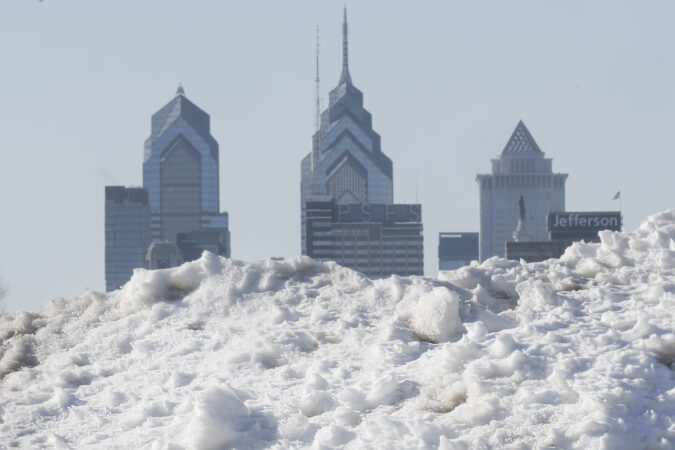
    In short, that unusually tenacious snowpack that was left over from the 9.3 inches of snow and white ice that fell on Jan. 25 and has since mutated into a form of frozen slurry will be spending at least another weekend in Philly.

    What’s more, it’s likely to be a harvest weekend for the ice that is solidifying upon the region’s waterways, a growing concern.

    A warm-up is due to begin Monday and pick up steam during the workweek, with highs maybe reaching 40 degrees on Thursday. But it may encounter some resistance, and another storm threat might be brewing for next weekend, forecasters say.

    The snowpack already has achieved an elite status

    Friday marked the 12h consecutive day in which the official snow cover at Philadelphia International Airport, measured daily at 7 a.m., was at least 5 inches.

    In the 142-year period of record, that ties for seventh place for a snow-cover duration of that depth.

    “To hold on to a snowpack like this is unusual,” said Johnathan Kirk, senior hydrologist at NOAA’s Middle Atlantic River Forecast Center, in State College, Pa., which is keeping a close eye on the waterway icing.

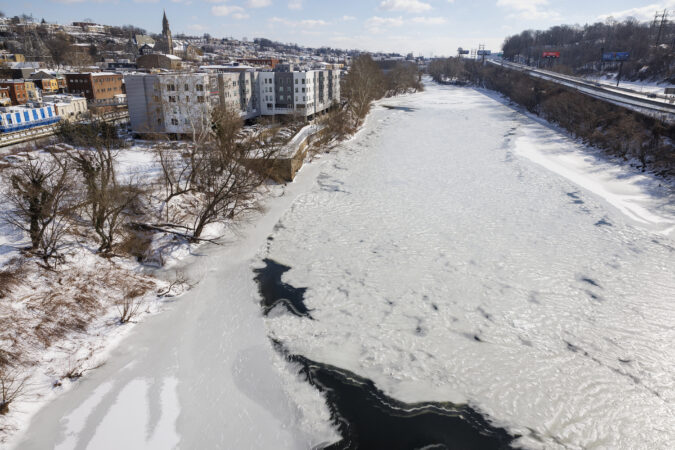
    The Schuylkill in Philly is ice-covered, as is the Delaware River from Trenton to Washington Crossing.

    In addition to an eight-day stretch when temperatures failed to reach 30, the durability is related to the 2 or so inches of sleet that capped the snow on Jan. 25. Sleet is white ice that melts more slowly than snow.

    The dry and cold air has been a natural preservative; snow and ice melt more readily when the air is moist.

    Another factor was the impressive liquid content of the snow and sleet, Snell said. The frozen mass contained 1.39 inches of liquid, the weather service said, comparable to what is contained in 15 to 18 inches of snow.

    As temperatures finally nudged above freezing, some melting did occur this week, which would explain that unsightly slushy porridge at Philly intersections. However, the official snow depth lost only an inch between Jan. 27 and Wednesday.

    The snowpack may receive a fresh frosting Friday night into early Saturday with up to an inch of snow, Martin said, but it’s not going to have the same staying power.

    What’s different about this Arctic air mass

    Any snow that falls is likely to get blown away in a hurry, Martin said, as winds will pick up before daybreak Saturday and gusts howl to 50 mph by late morning.

    Typically, cold air pours into the region from the northwest and becomes modified as it passes over land, the Great Lakes, and the mountains.

    This is going to be a straight-up Arctic shot. It will come more or less from the north, and the icy lakes are not going to do much to impede it, said Matt Benz, senior meteorologist at AccuWeather Inc.

    The weather center’s Snell said a weak storm system moving off the Atlantic coast is forecast to blow up as it interacts with warm Gulf Stream waters. The differences between the cold high pressure with its heavier air over the East and the lighter air of the storm are going to place the Philadelphia region in a frigid sandwich.

    Heavier air tends to rush toward lighter air, like air escaping from a punctured tire.

    A thaw is coming to Philly, eventually

    Just how warm it gets next week remains unclear, AccuWeather’s Benz said.

    “Arctic air is hard to dislodge sometimes,” he said, adding that recent model trends suggest the warm-up will not be quite as robust as expected earlier.

    A wild card would be a potential storm next weekend. The European forecast model was seeing rain and 60 degrees, Martin said, while the U.S. model was suggesting a blizzard.

    His take: “I have no clue at this point.”

    An anniversary of note

    On Feb. 5, 2010, 6.6 inches of snow fell upon the airport, the beginning of an unprecedented siege in which 44.3 inches accumulated in a six-day period.

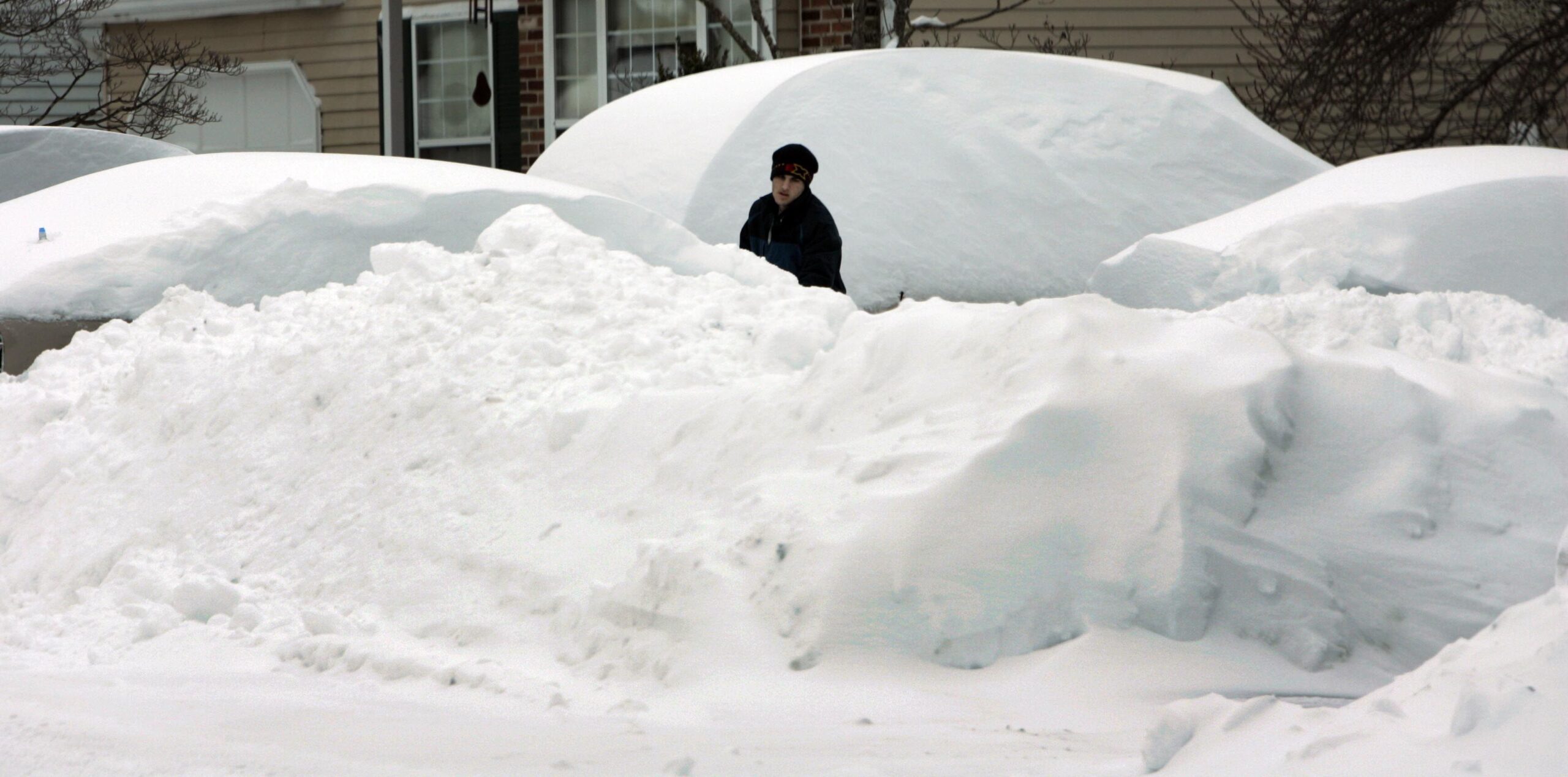
    A man shovels cars out under mountains of snow in West Bradford Township, Chester County, during the incredible snow siege of February 2010.

    Twelve days after the snow stopped, the official snow depth was down to 4 inches.

  • As cold-stunned invasive iguanas fall from trees, Floridians scoop them up for killing

    As cold-stunned invasive iguanas fall from trees, Floridians scoop them up for killing

    Ryan Izquierdo woke up on a recent morning groggy, cold and most of all ready — to go iguana hunting.

    Temperatures in Jupiter, Fla., where the 27-year-old social media star lives, had dipped well below 50 degrees, as a cold front swallowed much of the East Coast in snowfall and record-breaking low temperatures. As flurries fell on parts of the state, residents braced for the inevitable: Cold-stunned green iguanas — one of Floridians’ most reviled invasive pests — began to lose consciousness and fall out of trees.

    The dry, scaly deluge is a familiar forecast in those parts. These cold-blooded reptiles’ nervous systems shut down when temperatures dip into the 40s and below. They become paralyzed and fall from their leafy perches. This time, for some unlikely conservationists, as well as state officials, that meant killing season.

    In a first, officials capitalized on the paralyzed pests and told residents they could bring them in for disposal.

    “This is the first time we have organized a removal effort of invasive iguanas,” said Shannon Knowles, communications director for the Florida Fish and Wildlife Conservation Commission (FWC).

    “South Florida has not experienced this level of cold weather in many years,” she added. “So we used this opportunity to remove this invasive non-native species from the landscape.”

    The commission issued an executive order that allowed people without permits to gather and transport the iguanas to one of several offices to be humanely killed, “or, in some cases, transferred to permittees for live animal sales.”

    Typically people can themselves humanely or painlessly do away with green iguanas when they see them, but they’re not allowed to transport them. Knowles added that people lined up, cloth bags and bins brimming with the lizards, to drop them off Sunday and Monday. While she said the commission did not yet have an official estimate, Izquierdo was floored by what he saw.

    “It was a madhouse,” Izquierdo said of the FWC site near Fort Lauderdale where he deposited about 100 iguanas Monday. “There were iguanas that were pushing six to six-and-a-half feet long. They look like dragons, absolutely crazy.”

    Green iguanas are a scourge of South Florida. First documented in the 1960s, their population has since exploded to, by some estimates, more than 1 million. They’ve wreaked havoc on the region’s infrastructure, burrowing holes around homes, sidewalks and seawalls. They’ve chewed through some of the state’s most crucial native plants such as nickerbean, which helps sustain the endangered Miami Blue butterfly.

    Izquierdo has been catching iguanas since he was 10 years old. In his grandmother’s backyard, he found them to use as fishing bait for peacock bass.

    “I’ve always loved nature and the outdoors,” he said.

    Now, he makes a living out of it as a content creator, documenting his fishing excursions around the world. But as the dipping temperatures created a new opportunity last weekend, he decided to temporarily pivot to the quest he dubbed “a Florida man Easter egg hunt for dinosaurs.”

    He jumped into his pickup truck and began hunting.

    In warm temperatures, iguanas are almost impossible to nab. You need either a gun or a 15-foot-long pole with an invisible lasso attached to it, Izquierdo said.

    “If you want to do iguana management, this is a good time to do it because they’re very vulnerable to removal,” said Frank Mazzotti, a professor of wildlife ecology at the University of Florida.

    But in the cold, chase proved easy and bountiful. “This is the most I’ve ever found,” he said. “We were practically almost stepping on them.”

    Despite the fun and viral Instagram reels, he’s not immune to the difficult decisions that come with maintaining a balanced ecosystem.

    “They’re animals, so people do have a soft spot in their heart for them and so do I because they’re really cool, especially the little baby ones,” Izquierdo said. “But you have to look at the bigger picture of things.”

    He’s passionate about making the most of a dead green iguana. On Monday night, he and his friends baked an iguana pizza, (delicious, he said, they’re nicknamed “chicken of the trees”) and he plans to use the skin and some meat for fishing lures and bait.

    On Tuesday morning, as the temperatures in Florida finally began to creep up to milder levels, Izquierdo sat in his truck, filled with about a dozen stunned iguanas, knowing his hours of hunting were numbered.

    “As the temperature starts climbing back up, it’s going to get back to normal,” he said. Two motionless lizards, a male and a female, lay in his lap. “Yeah, these iguanas will be back about their business.”

  • The Schuylkill is frozen, but that doesn’t mean you can ice fish on it

    The Schuylkill is frozen, but that doesn’t mean you can ice fish on it

    Have you been looking longingly at your fishing gear during the Philadelphia winter? Are Deadliest Catch reruns not hitting the same?

    With the surface of the Schuylkill River still frozen solid and frigid temperatures returning this weekend, a reader asked through Curious Philly, The Inquirer’s outlet for answering questions, whether they were allowed to ice fish on it.

    Ice fishing, after all, is a practice that began with subarctic Indigenous peoples thousands of years ago, well before the advent of the modern fishing rod in the late 1700s. Fishing along the Schuylkill is accepted and celebrated in warmer temperatures, so what about its frozen cousin?

    Unfortunately for those Philadelphians dreaming about an Arctic lifestyle, the answer is no.

    “Ice fishing is illegal in Philly,” Philadelphia Police Department spokesperson Sgt. Eric Gripp said by email. The practice is not explicitly outlawed, but walking out onto the ice in order to carve a hole and cast a line underneath violates city rules.

    A pedestrian walks past a large pile of snow and ice along the Benjamin Franklin Parkway on Monday.

    “You can’t walk, swim, or be in/on the waterway — unless in a vessel — regardless as to whether or not it’s frozen,” Gripp said.

    Philadelphia police began spreading the message to not venture out onto the frozen Schuylkill this week, after local CBS News video captured several adults and children walking across it Sunday. The Police Department’s directive on code violation notices lists ice skating, skiing, and sledding in some areas of Fairmount Park as potential offenses.

    Ice fishing could put you in violation of a few city ordinances, too. While you would likely be subject only to a summary offense and a $25 fine for each violation, police say you would be breaking rules about using areas managed by Parks and Recreation outside of their approved use, and risk violating the ban on “swimming” or wading out onto any Philadelphia creek, lake, river, or stream.

    » ASK US: Have something you’re wondering about the Philly region? Submit your Curious Philly question here.

    Even though the Schuylkill’s frozen surface may be several inches thick in certain locations, ice’s integrity can’t be judged based upon only how it looks, how fresh it is, or the temperature outdoors, according to the Pennsylvania Fish and Boat Commission. Ice’s strength is also informed by several other factors, including the depth of the water underneath the ice, and nearby fish activity.

    “Anyone that walks onto the Schuylkill River, … they’re taking their life into their own hands. It’s not a smart thing to do,” said commission spokesperson Mike Parker. Parker said the commission highly advises against walking on top of or fishing on the frozen surface of any moving body of water, like a river.

    “There’s no such thing as safe ice,” in those cases, he said.

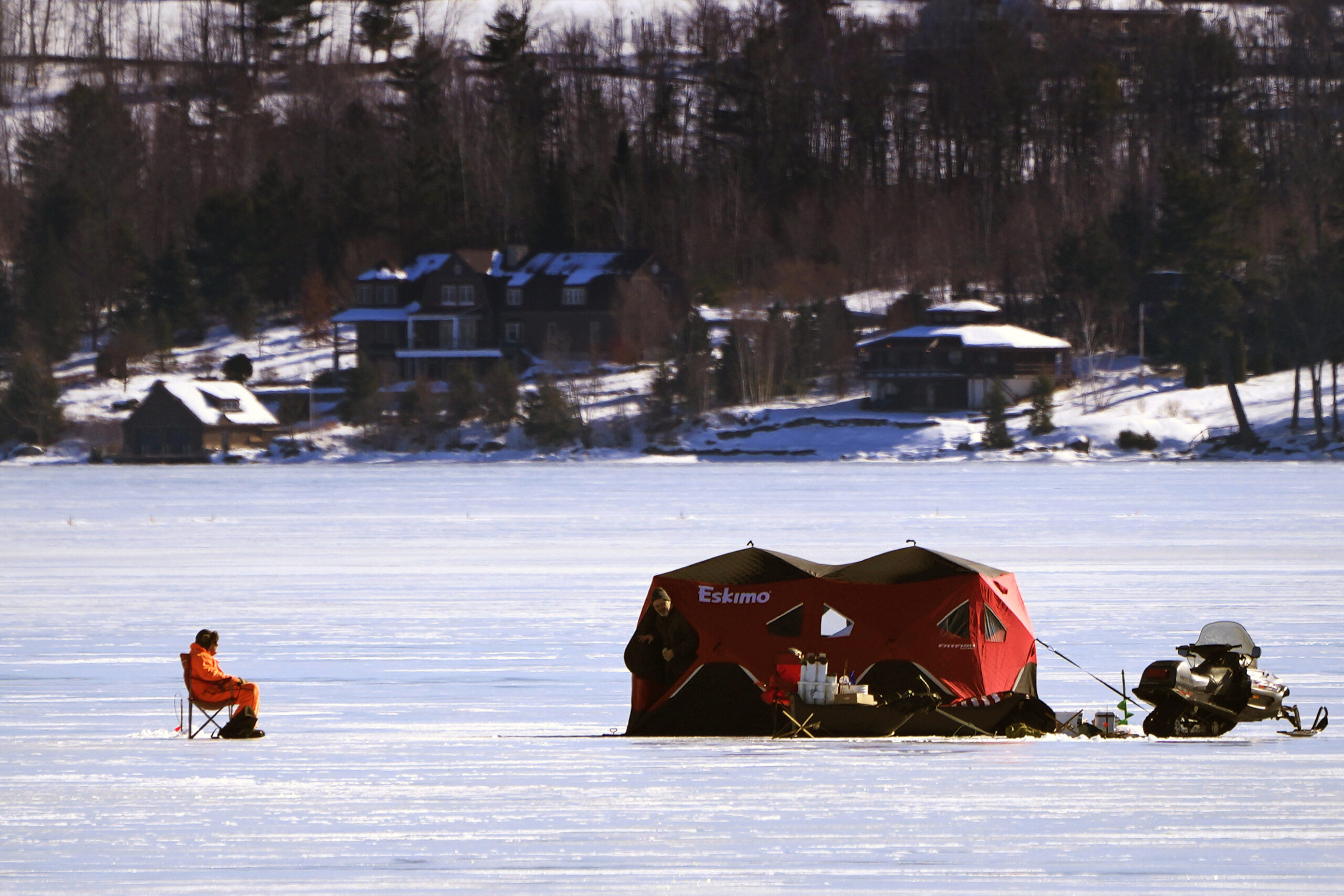
    A fisherman sits in the sun outside a pop up shelter while ice fishing on frozen Lake Wentworth in Wolfeboro, N.H.

    But ice fishing can be relatively safe on still bodies of water, like lakes and ponds. As general guidelines, the fish and boat commission advises that anglers fish only on those bodies of water when ice is at least five inches thick, and never to go out onto ice alone.

    If you are still interested in ice fishing during the region’s cold spell, the Fish and Boat Commission offers a map of approved ice fishing destinations across the state.

    The closest ones to Philadelphia include Deep Creek Dam in Montgomery County; Marsh Creek Lake, in Chester County; and Lake Galena in Bucks County.

  • A ‘significant’ portion of the Schuylkill is frozen. Don’t do anything stupid.

    A ‘significant’ portion of the Schuylkill is frozen. Don’t do anything stupid.

    It should go without saying, perhaps, but city officials this week are saying it anyway:

    Just because temperatures have dipped into the teens (or lower) in recent days, doesn’t mean it’s safe to walk, skate, or drive across the area’s frozen lakes, rivers, and waterways.

    “We’re getting reports of people walking and ice skating on Philadelphia’s rivers,” the Philadelphia Police Department said in a post to X on Sunday. “This is illegal for a reason. River ice is not as thick as it looks — moving water underneath weakens it and conditions can change fast. Please stay safe and stay off the ice!”

    Though the Philadelphia Police said Monday there had been no rescues at this point, the department has fielded more than a dozen calls already, according to Capt. Anthony LaSalle of the city’s police Marine Unit.

    LaSalle said a “significant” portion of the Schuylkill was currently frozen over, something that hasn’t happened in a decade.

    “In some areas, it could be thicker than other areas, and you’ve got to realize that water is flowing underneath it,” LaSalle said. “You can have six inches in some areas and one inch in another area. And if there’s debris, that makes the ice even weaker.”

    It’s a sentiment echoed by City Hall, which this week also urged residents to stay off all frozen waterways for the safety of both themselves and first responders.

    “Police and medical staff have been advising residents and visitors to stay off all frozen rivers, lakes and waterways,” a city spokesperson said in an email. “Ice conditions are unpredictable, and walking, skating, or driving on frozen surfaces is extremely dangerous.

    “Falling through ice can become fatal within minutes and places both the public and first responders at serious risk. For everyone’s safety, the City is asking everyone to stay on solid ground and avoid all frozen waterways.”

  • 300 ‘ambassadors’ to chip away at ice on Philly’s crosswalks

    300 ‘ambassadors’ to chip away at ice on Philly’s crosswalks

    Those stubbornly frozen crosswalks with mounds of snow and ice across Philadelphia are getting chipped away with the assist of a 300-person workforce, starting Tuesday.

    The 300 ambassadors, as they are called, are tasked with manually breaking up ice at crosswalks and streets in residential neighborhoods, according to Mayor Cherelle. L Parker.

    “We are not resting and stopping until every street in the city of Philadelphia is walkable and drivable, and that people feel it when they are driving it and they see it in their neighborhoods,” she said Monday, highlighting the nonstop work municipal workers had been doing since the largest snowfall in a decade blanketed the city with 9.3 inches on Jan. 25.

    The dayslong cold snap that followed, however, has complicated dig-out efforts for the city and led to widespread complaints from residents. Photos of commercial corridors with piles of ice on crosswalks, unplowed side streets, untreated SEPTA bus and trolley stops, and unshoveled sidewalks next to public parks and recreation centers flooded social media after the storm as the city asked for patience.

    Still, Parker said Monday that the city has melted 4.7 million pounds of snow, put down 15,000 tons of salt on streets and roadways, and treated at least 85% of streets at least one time.

    The city has deployed snowplows, compactors, front-end loaders, backhoes, and a snow melter that came from Chicago, the mayor said. And just this weekend, the city made a “coordinated pedestrian safety push,” working across city agencies as well as SEPTA and the Philadelphia School District to clear bus stops, school crossings, crosswalks, and ADA ramps.

    The Philadelphia Streets Department has also tapped into its Future Track Program for snow-removal efforts. The trainees are typically at-risk young adults who are not enrolled in higher education and are unemployed. They get job experience, as well as other services, and they help in beautification projects. In the snow cleanup, Parker said, the trainees cleared more than 1,600 ADA ramps.

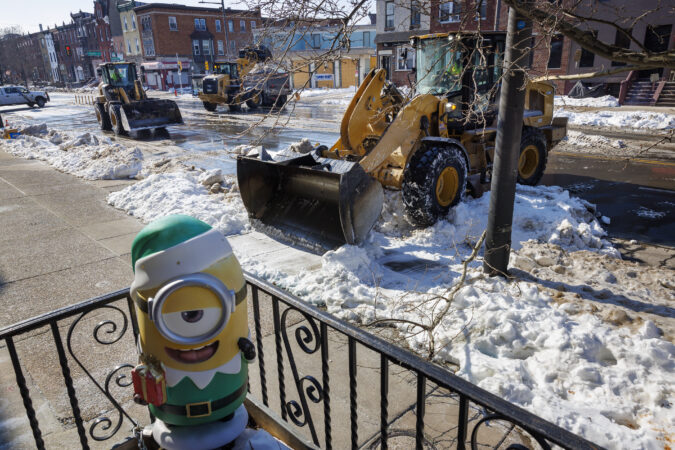
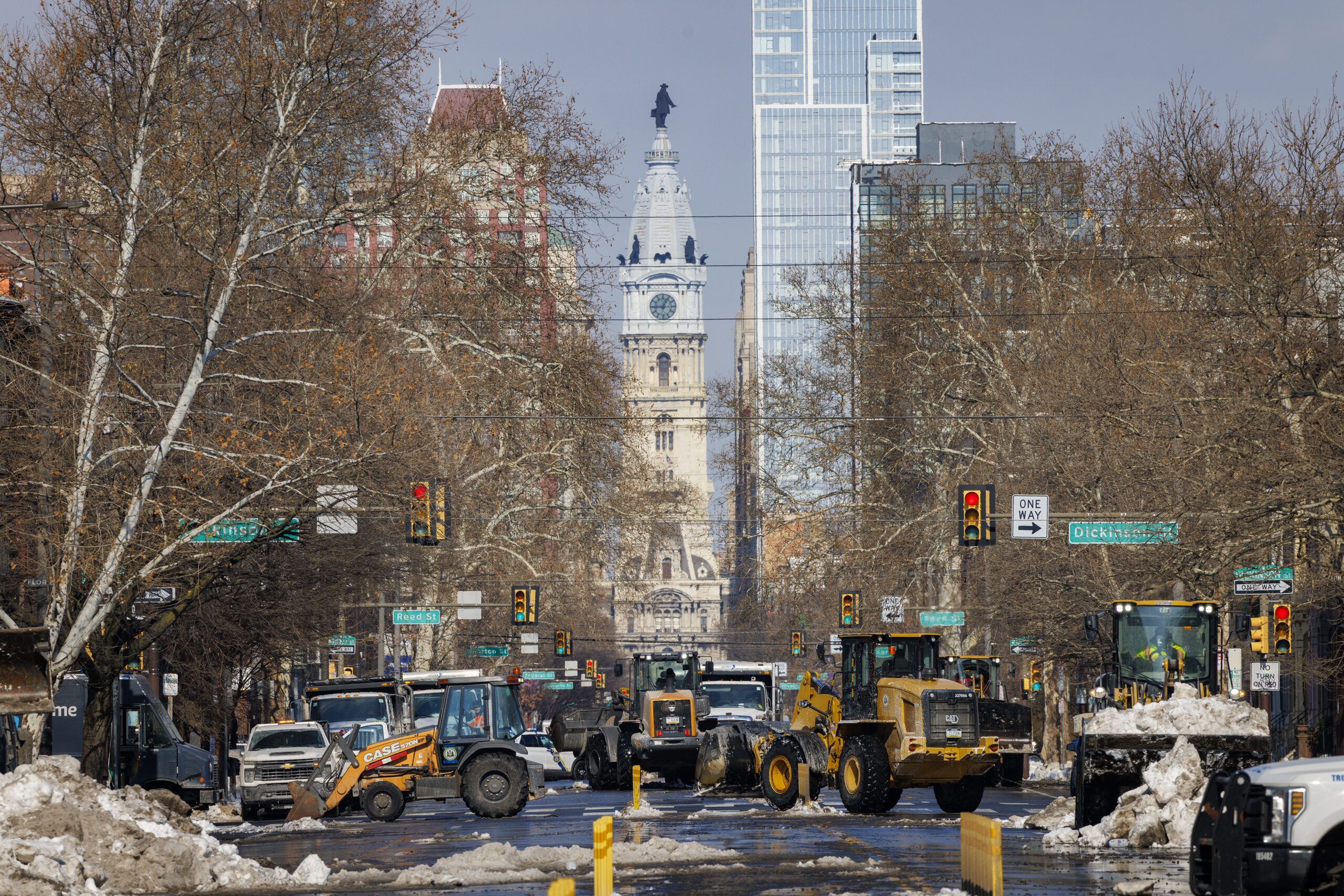
    Heavy equipment clearing snow along S. Broad Street at Dickinson Street.

    Carlton Williams, the city’s director of clean and green initiatives, said the hundreds of workers aiding in the cleanup have made significant progress in areas like North Philadelphia; South Philadelphia, which was the epicenter of 311 complaints days after the snowfall; and Manayunk, which posed a challenge because of its hills.

    He noted the complexity of the city’s narrow residential streets, which required bringing in specialized equipment, and where he previously said cleanup was further complicated by illegal parking.

    Throughout the week, the city had also conducted lifting operations where machines dumped snow and ice into dumpsters to be hauled to storage sites across the city.

    A Facebook video on the mayor’s social media page, along with responses to clips of the dig-out update shared online, offered a glimpse of how residents feel. Parker, many said rising to her defense, cannot control the freezing temps. Others were less forgiving, listing their blocks as forgotten sections in the cleanup.

    Philly is far from alone in the continued cleanup efforts hampered by below-freezing temperatures. At the request of Washington, D.C., officials, 50 National Guard members were deployed over the weekend to help clear schools of snow. Baltimore was able to get a snow melter on loan from D.C. this week, a machine officials told WBAL-TV the city had not needed in a decade.

    Even New York Mayor Zohran Mamdani, who received generally good marks on cleanup from the media in the early days after the storm, was pressed by reporters Monday on lingering snowbanks and delays in trash pickup.

    In Philadelphia on Tuesday, the city conducted a snow-clearing operation along a 1.5-mile stretch of Broad Street through 6 p.m., towing cars along the street in South Philly to make way for equipment on the major corridor.

    City workers received the slightest respite as they continued snow-clearing efforts as temperatures reached the mid-30s Monday and Tuesday.

  • Parking restrictions planned for snow removal Tuesday on South Broad Street

    Parking restrictions planned for snow removal Tuesday on South Broad Street

    Parking restrictions along a 1½-mile stretch of South Broad Street will take effect at 7 a.m. Tuesday so the Streets Department can begin removing piles of curbside snow, the city said.

    Snow removal has gone slowly since the storm more than a week ago because of the ongoing deep freeze across the region.

    Parked vehicles must be moved from Broad between Washington and Oregon Avenues ahead of 7 a.m. to clear the way for a Streets Department “lifting operation” that will remove the snow, the city said.

    Free off-street parking will be available at lot U near Citizens Bank Park between 7 a.m. and 6 p.m. Tuesday, the city said. All vehicles must be moved from the parking lot by 6 p.m.

    The operation, which will involve excavators and loaders, may temporarily disrupt traffic, the city said.

    “The Streets Department urges everyone traveling near this lifting operation, and others taking place across Philadelphia, to plan extra travel time, slow down, and help keep our crews safe by giving them plenty of space to do their work,” the department said.