Category: Associated Press

  • Gaza’s Nasser Hospital condemns MSF decision to suspend most services

    Gaza’s Nasser Hospital condemns MSF decision to suspend most services

    CAIRO — One of Gaza ‘s last functioning large hospitals condemned the decision by Doctors Without Borders to pull out of operations over concerns about armed men, claiming on Sunday that the facility had installed civilian police for security.

    The rare public friction between two well-known health care providers in Gaza came as the Palestinian death toll since the current ceasefire surpassed 600. At least 11 Palestinians were killed by Israeli fire in the last 24 hours, hospitals said.

    Doctors Without Borders, also known by its French acronym MSF, said in a statement Saturday that all its noncritical medical operations at Nasser Hospital were suspended due to security breaches that posed “serious” threats to its teams and patients. MSF said there had been an increase in patients and staff seeing armed men in parts of the compound since the U.S.-brokered October ceasefire was reached.

    Nasser Hospital said Sunday the increase in armed men was due to a civilian police presence aimed at protecting patients and staff and said MSF’s “allegations are factually incorrect, irresponsible and pose a serious risk to a protected civilian medical facility.”

    One of Gaza’s few functioning hospitals

    Hundreds of patients and war wounded have been treated daily at Nasser Hospital in the southern city of Khan Younis, and the facility was a hub for Palestinian prisoners released by Israel in exchange for Israeli hostages as part of the current ceasefire deal.

    MSF said its teams had reported “a pattern of unacceptable acts including the presence of armed men, intimidation, arbitrary arrests of patients and a recent situation of suspicion of movement of weapons.” The suspension occurred in January but was only recently announced.

    Nasser Hospital staff say that in recent months it has been repeatedly attacked by masked, armed men and militias, which is why the presence of an armed civilian police force is crucial.

    Hamas remains the dominant force in areas of Gaza not under Israeli control, including the area where Nasser Hospital is located. But other armed groups have mushroomed as a result of the war, including groups backed by Israel’s army in the Israeli-controlled part of the strip.

    Israel’s military said it had intelligence that Nasser Hospital is being used as a headquarters and military post for senior Hamas officials, without providing evidence. It called MSF’s move “an important decision, but one that comes too late.”

    Throughout the war, which began with the Hamas-led attack on Israel on Oct. 7, 2023, Israel has repeatedly struck hospitals, including Nasser, accusing the militant group of operating in or around them. Hamas security men often have been seen inside hospitals, blocking access to some areas.

    Some hostages released from Gaza have said they spent time during captivity in a hospital, including Nasser Hospital.

    11 Palestinians killed in strikes across Gaza

    At least 11 Palestinians were killed Sunday by Israeli fire in Gaza, hospital authorities said.

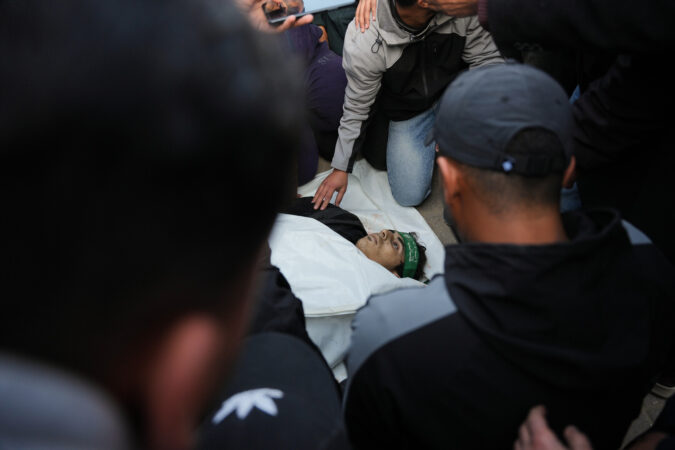
    The dead include five men in their 20s who were killed in the eastern part of Khan Younis, according to Nasser Hospital, which received the bodies. The strike hit a group of people close to the Yellow Line that separates Israeli-controlled areas from the rest of Gaza, it said.

    Rami Shaqra said his son, al-Baraa, was among the militants securing the area from potential attacks by Israeli forces or Israeli-backed armed groups when they were hit. He said they were killed by an airstrike.

    “They were in the area they say is safe,” Shaqra said.

    Associated Press footage from the morgue showed at least two of the men had headbands denoting membership in the Qassam Brigades, the militant arm of Hamas.

    In northern Gaza, a drone strike hit a group of people in the Falluja area of Jabaliya refugee camp, killing five people, according to Shifa Hospital. A separate drone strike killed a man in Gaza City, according to the hospital.

    Israel’s military said it had carried out multiple strikes in response to several ceasefire violations near the Yellow Line, including militants attempting to hide in debris and others who attempted to cross the line while armed.

    The U.S.-brokered ceasefire deal that took effect Oct. 10 attempted to halt more than two years of war between Israel and Hamas. While the heaviest fighting has subsided, the ceasefire has seen almost daily Israeli fire.

    Israeli forces have carried out repeated airstrikes and frequently fire on Palestinians near military-held zones, killing 602 Palestinians, according to Gaza health officials. The ministry, which is part of the Hamas-led government, maintains detailed casualty records that are seen as generally reliable by U.N. agencies and independent experts. It does not give a breakdown of civilians and militants.

    Militants have carried out shooting attacks on troops, and Israel says its strikes are in response to that and other violations. Four Israeli soldiers have been killed.

    Two Israeli soldiers attacked by ultra-Orthodox Jews

    In Israel, two female Israeli soldiers were rescued from riots in the ultra-Orthodox city of Bnei Brak. Footage shows two soldiers being hurried away by police from thousands of ultra-Orthodox men running after them and yelling.

    Many in Israel’s ultra-Orthodox community are furious over laws that may force them to serve in the Israeli military, holding frequent protests.

    Israeli police said the soldiers were performing a welfare visit but had not coordinated it with police. At least 22 people were arrested as protesters set police motorcycles on fire, attacked officers, threw trash, and overturned a police car, police said.

    Prime Minister Benjamin Netanyahu strongly condemned the attack on the soldiers but blamed an “extremist minority” for the violence.

    Roughly 1.3 million ultra-Orthodox Jews make up about 13% of Israel’s population and oppose enlistment because they believe studying full time in religious seminaries is their most important duty. The broad exemptions from mandatory military service have reopened a deep divide in the country and infuriated much of the general public, especially during the war in Gaza.


  • Indonesia says 8,000 troops ready for possible peacekeeping mission in Gaza by June

    Indonesia says 8,000 troops ready for possible peacekeeping mission in Gaza by June

    JAKARTA, Indonesia — Indonesia’s military said Sunday that up to 8,000 troops are expected to be ready by the end of June for a potential deployment to Gaza as part of a humanitarian and peace mission, the first firm commitment to a critical element of U.S. President Donald Trump’s postwar reconstruction plan.

    The Indonesian National Armed Forces, known as TNI, has finalized its proposed troop structure and a timeline for their movement to Gaza, even as the government has yet to decide when the deployment will take place, army spokesperson Brig. Gen. Donny Pramono said.

    “In principle, we are ready to be assigned anywhere,” Pramono told the Associated Press, “Our troops are fully prepared and can be dispatched at short notice once the government gives formal approval.”

    Pramono said the military prepared a composite brigade of 8,000 personnel, based on decisions made during a Feb. 12 meeting for the mission.

    Under the schedule, troops will undergo health checks and paperwork throughout February, followed by a force readiness review at the end of the month, Pramono said. He also revealed that about 1,000 personnel are expected to be ready to deploy as an advance team by April, followed with the rest by June.

    Pramono said that being ready does not mean the troops will depart. The deployment still requires a political decision and depends on international mechanisms, he said.

    Indonesia’s Foreign Ministry has repeatedly said any Indonesian role in Gaza will be strictly humanitarian. Indonesia’s contribution would focus on civilian protection, medical services, and reconstruction, and its troops would not take part in any combat operations or actions that could lead to direct confrontation with armed groups.

    Indonesia would be the first country to formally commit troops to the security mission created under Trump’s Board of Peace initiative for Gaza, where a fragile ceasefire agreement between Israel and Hamas has held since Oct. 10 following two years of devastating war.

    Indonesia, the world’s most populous Muslim majority nation, does not have formal diplomatic relations with Israel and has long been a strong supporter of a two-state solution. It has been deeply involved in providing humanitarian aid to Gaza, including funding a hospital.

    Indonesian officials have justified joining the Board of Peace by saying it was necessary to defend Palestinian interests from within, since Israel is included on the board but there is no Palestinian representation.

    The Southeast Asian country has experience in peacekeeping operations as one of the top 10 contributors to United Nations missions, including in Lebanon.

  • Trump says Board of Peace will unveil $5 billion in Gaza reconstruction pledges at inaugural meeting

    Trump says Board of Peace will unveil $5 billion in Gaza reconstruction pledges at inaugural meeting

    WEST PALM BEACH, Fla. — President Donald Trump said Sunday that members of his newly created Board of Peace have pledged $5 billion toward rebuilding war-ravaged Gaza and will commit thousands of personnel to international stabilization and police forces for the territory.

    The pledges will be formally announced when board members gather in Washington on Thursday for their first meeting, he said.

    “The Board of Peace will prove to be the most consequential International Body in History, and it is my honor to serve as its Chairman,” Trump said in a social media posting announcing the pledges.

    He did not detail which member nations were making the pledges for reconstruction or would contribute personnel to the stabilization force. But Indonesia’s military said Sunday that up to 8,000 of its troops are expected to be ready by the end of June for a potential deployment to Gaza as part of a humanitarian and peace mission. It’s the first firm commitment that the Republican president has received.

    Rebuilding the Palestinian territory will be a daunting endeavor. The United Nations, World Bank, and European Union estimate that reconstruction of the territory will cost $70 billion. Few places in the Gaza Strip were left unscathed by more than two years of Israeli bombardment.

    The ceasefire deal calls for an armed international stabilization force to keep security and ensure the disarming of the militant Hamas group, a key demand of Israel. Thus far, few countries have expressed interest in taking part in the proposed force.

    The Oct. 10 U.S.-brokered ceasefire deal attempted to halt a more than 2-year war between Israel and Hamas. While the heaviest fighting has subsided, Israeli forces have carried out repeated airstrikes and frequently fire on Palestinians near military-held zones.

    It is not clear how many of the more than 20 members of the Board of Peace will attend the first meeting. Israeli Prime Minister Benjamin Netanyahu, who held White House talks with Trump last week, is not expected to be there.

    Trump’s new board was first seen as a mechanism focused on ending the Israel-Hamas war in Gaza. But it has taken shape with his ambition for a far broader mandate of resolving global crises and appears to be the latest U.S. effort to sidestep the United Nations as Trump aims to reset the post-World War II international order.

    Many of America’s top allies in Europe and elsewhere have declined to join what they suspect may be an attempt to rival the Security Council.

    Trump also confirmed that Thursday’s meeting will take place at the U.S. Institute of Peace, which the State Department announced in December it was renaming the Donald J. Trump U.S. Institute of Peace.

    The building is the subject of litigation brought by former employees and executives of the nonprofit think tank after the Republican administration seized the facility last year and fired almost all the institute’s staff.

  • What to know about student loan repayment plans and collections

    What to know about student loan repayment plans and collections

    NEW YORK — It’s been a confusing time for people with student loans. Collections restarted, then were put on hold. At the same time, borrowers had to stay on top of changes to key forgiveness plans.

    Last year, the long-contested SAVE plan introduced by the Biden administration ended with a settlement agreement. President Donald Trump’s “Big Beautiful Bill” introduced new borrowing limits for graduates and raised challenges to the Public Service Loan Forgiveness program. While several changes for student loan borrowers will take effect this summer, other key questions remain unresolved.

    More than 5 million Americans were in default on their federal student loans as of September, according to the Education Department. Millions are behind on loan payments and at risk of default this year.

    Borrowers “genuinely struggle to afford their loans and then to hear that the administration is making it more expensive and taking away some of the tools and resources that help folks afford their loans is really, it’s panic-inducing,” said Winston Berkman-Breen, legal director at Protect Borrowers.

    Last month, the Education Department announced that it would delay involuntary collections for student loan borrowers in default until the department finalizes its new loan repayment plans. The date for this is still unclear.

    If you’re a student loan borrower, here are some key things to know.

    If you were enrolled in the SAVE plan

    The SAVE plan was a repayment plan with some of the most lenient terms ever. Soon after its launch it was challenged in court, leaving millions of student loan borrowers in limbo. Last December, the Education Department announced a settlement agreement to end the SAVE plan. What is next for borrowers who were enrolled in this repayment plan is yet to be determined.

    “Seven and a half million borrowers who are currently enrolled in SAVE need to be moved to another plan,” Berkman-Breen said.

    As part of the agreement, the Education Department says it will not enroll new borrowers, will deny pending applications, and will move all current SAVE borrowers into other repayment plans.

    The Education Department is expected to develop a plan for borrowers to transition from the SAVE plan, yet borrowers should be proactive about enrolling in other repayment plans, said Kate Wood, a lending expert at NerdWallet.

    If you are looking to enroll in an income-driven repayment plan

    Borrowers can apply for the following income-driven plans: the Income-Based Repayment Plan, the Pay as You Earn plan, and the Income-Contingent Repayment plan.

    “They all have similar criteria, and they function similarly. Your payment is set as a percentage of your income, not how much you owe, so it’s usually a lower payment,” Berkman-Breen said.

    The payment amount under income-driven plans is a percentage of your discretionary income, and the percentage varies depending on the plan. Since many people are looking to switch plans, some applications to income-driven repayment plans might take longer to process, said Jill Desjean, director of policy analysis at the National Association of Student Financial Aid Administrators.

    You can find out which repayment plan might work best for you by logging on to the Education Department’s loan simulator at studentaid.gov/loan-simulator/.

    If you’re working toward your Public Service Loan Forgiveness

    There are no changes to the Public Service Loan Forgiveness Program yet. Last year, the Trump administration announced plans to change the eligibility requirements for participating nonprofits.

    The policy seeks to disqualify nonprofit workers if their work is deemed to have “substantial illegal purpose.” The Trump administration said it’s necessary to block taxpayer money from lawbreakers, while critics say it turns the program into a tool of political retribution.

    The proposal says illegal activity includes the trafficking or “chemical castration” of children, illegal immigration, and supporting foreign terrorist organizations. This move could cut off some teachers, doctors, and other public workers from federal loan cancellation.

    “This is something that obviously is very stressful, very nerve-wracking for a lot of people, but given that we don’t know exactly how this is going to be enforced, how these terms are going to be defined, it’s not really something that you can try to plan ahead for now,” Wood said.

    While this policy is currently being challenged by 20 Democrat-led states, it’s expected to take effect in July. In the meantime, Wood recommends that borrowers enrolled in the PSLF program continue making payments.

    If your student loans are in default

    Involuntary collections on federal student loans will remain on hold. The Trump administration announced earlier this month that it is delaying plans to withhold pay from student loan borrowers who default on their payments.

    Federal student loan borrowers can have their wages garnished and their federal tax refunds withheld if they default on their loans. Borrowers are considered in default when they are at least 270 days behind on payments.

    If your student loans are in default, you can contact your loan holder to apply for a loan rehabilitation program.

    “They essentially come up with a payment plan where you’re making a reduced payment,” Woods. “After five successful payments on that rehabilitation plan, wage garnishment will cease.”

    If you’re planning to attend graduate school

    Trump’s “Big Beautiful Bill” has changed the amount graduate students can borrow from federal student loans. Graduate students could previously borrow loans up to the cost of their degree; the new rules cap the amount depending on whether the degree is considered a graduate or a professional program.

    Wood said that if you’re starting a new program and taking out a loan after July 1, you will be subject to the new loan limits.

    Under the new plan, students in professional programs would be able to borrow up to $50,000 per year and up to $200,000 in total. Other graduate students, such as those pursuing nursing and physical therapy, would be limited to $20,500 a year and up to $100,000 total.

    The Education Department is defining the following fields as professional programs: pharmacy, dentistry, veterinary medicine, chiropractic, law, medicine, optometry, osteopathic medicine, podiatry and theology.

    If you want to consolidate your loan

    The online application for loan consolidation is available at studentaid.gov/loan-consolidation. If you have multiple federal student loans, you can combine them into a single loan with a fixed interest rate and a single monthly payment.

    The consolidation process typically takes around 60 days to complete. You can only consolidate your loans once.

  • All-Star reliever Elroy Face, 97, who saved 3 games for Pirates in 1960 World Series, has died

    All-Star reliever Elroy Face, 97, who saved 3 games for Pirates in 1960 World Series, has died

    PITTSBURGH — Elroy Face, an All-Star reliever for the Pittsburgh Pirates who saved three games in the 1960 World Series to help them upset the New York Yankees, has died. He was 97.

    In a news release Thursday, the Pirates announced they confirmed Mr. Face’s death. Team historian Jim Trdinich said the club was contacted by Mr. Face’s son, Elroy Jr., and informed the former pitcher died earlier in the day at an independent senior living facility outside Pittsburgh in North Versailles, Pa.

    No cause of death was provided. Mr. Face was eight days shy of his 98th birthday.

    “It is with heavy hearts and deep sadness that we mourn the passing of Pirates Hall of Famer Elroy Face, a beloved member of the Pirates family,” team chairperson Bob Nutting said in a statement.

    “Elroy was a pioneer of the modern relief pitcher — the ‘Baron of the Bullpen’ — and he played a critical role in our 1960 World Series championship.”

    Selected to six All-Star teams, Mr. Face went 104-95 with a 3.48 ERA in 16 major league seasons with Pittsburgh (1953-68), Detroit (1968), and Montreal (1969). He pitched in 848 games, starting only 27, and compiled 191 career saves — although saves didn’t become an official statistic until 1969.

    The 5-foot-8 right-hander holds the National League record for wins in relief with 96 and the major league mark for relief wins in one season after going 18-1 with a 2.70 ERA in 1959.

    He topped the National League with 68 appearances and 61 games finished in 1960, when the underdog Pirates stunned Mickey Mantle, Yogi Berra, and the mighty Yankees on Bill Mazeroski’s famous home run that won Game 7 of the World Series at Forbes Field in Pittsburgh.

    Mr. Face made four relief appearances in the Series, posting a 5.23 ERA in 10⅓ innings. He closed out Pirates wins in Games 1, 4, and 5.

    Inducted into the Pirates Hall of Fame in 2023, he is the club’s career leader in appearances with 802. And the team noted that if saves had been an official stat before 1969, he also would hold that franchise record with 188.

    Mr. Face was born in Stephentown, N.Y., on Feb. 20, 1928. He is survived by his three children, Michelle, Valerie, and Elroy Jr., and his sister Jacqueline, the Pirates said.

  • Iran’s crown prince says survival of Tehran government ‘sends a clear signal to every bully’

    Iran’s crown prince says survival of Tehran government ‘sends a clear signal to every bully’

    MUNICH — Some 200,000 people demonstrated Saturday against Iran’s government on the sidelines of a gathering of world leaders in Germany, police said, answering a call from Iran‘s exiled Crown Prince Reza Pahlavi for cranked-up international pressure on Tehran.

    Banging drums and chanting for regime change, the giant and boisterous rally in Munich was part of what Pahlavi described as a “global day of action” to support Iranians in the wake of deadly nationwide protests. He also called for demonstrations in Los Angeles and Toronto. The police estimate of 200,000 protesters in Munich was reported by German news agency dpa and was higher than organizers had expected.

    “Change, change, regime change” the huge crowd chanted, waving green-white-and-red flags with lion and sun emblems. Iran used that flag before its 1979 Islamic Revolution that toppled the Pahlavi dynasty.

    At a news conference on the sidelines of a security conference in Munich, Pahlavi warned of more deaths in Iran if “democracies stand by and watch” following Iran’s deadly crackdown on protesters last month.

    “We gather at an hour of profound peril to ask: Will the world stand with the people of Iran?” he asked.

    He added that the survival of Iran’s government “sends a clear signal to every bully: Kill enough people and you stay in power.”

    At the Munich rally, demonstrators sported “Make Iran Great Again” red caps, mimicking the MAGA caps worn by U.S. President Donald Trump‘s supporters. Many waved placards showing Pahlavi, some that called him a king. The son of Iran’s deposed shah has been in exile for nearly 50 years but is trying to position himself as a player in Iran’s future.

    The crowd chanted “Pahlavi for Iran” and “democracy for Iran” as drums and cymbals sounded.

    “We have huge hopes and (are) looking forward that the regime is going to change hopefully,” said Daniyal Mohtashamian, a demonstrator who traveled from Zurich, Switzerland, to speak for protesters inside Iran who faced repression.

    “There is an internet blackout and their voices are not going outside of Iran,” he said.

    About 500 protesters also rallied outside the presidential palace in Nicosia, Cyprus, with many holding up banners with slogans against Iran’s government and in favor of Pahlavi.

    On Saturday night in Iran’s capital, Tehran, witnesses said they heard people chanting against the country’s theocracy. The cries included “death to the dictator” and “long live the shah.” The protest came after calls from Pahlavi for people to chant against the government from their homes over the weekend.

    Meanwhile, Iranian Foreign Minister Abbas Araghchi criticized the Munich conference, saying it was “sad to see the usually serious Munich Security Conference turned into the ‘Munich Circus’ when it comes to Iran.”

    The U.S.-based Human Rights Activists News Agency says at least 7,005 people were killed in last month’s protests, including 214 government forces. It has been accurate in counting deaths during previous rounds of unrest in Iran and relies on a network of activists inside Iran to verify deaths.

    Iran’s government offered its only death toll on Jan. 21, saying 3,117 people were killed. Iran’s theocracy in the past has undercounted or not reported fatalities from past unrest.

    The Associated Press has been unable to independently assess the death toll, given authorities have disrupted internet access and international calls in Iran.

    Iranian leaders are facing renewed pressure from Trump, who has threatened U.S. military action. Trump wants Iran to further scale back its nuclear program. He suggested Friday that regime change in Iran “would be the best thing that could happen.”

    Iran was also the focus of protests in Munich on Friday, the opening day of an annual security conference in the city gathering European leaders and global security figures. Supporters of the Iranian opposition group People’s Mujahedeen Organization of Iran, also known as the Mujahedeen-e-Khalq, demonstrated.

  • L.A. Olympics leader Wasserman will sell talent agency in wake of Epstein emails discovery

    L.A. Olympics leader Wasserman will sell talent agency in wake of Epstein emails discovery

    LOS ANGELES — Casey Wasserman, the chairperson of the 2028 Los Angeles Olympics organizing committee, is selling his eponymous talent agency in the wake of the release of emails between himself and Ghislaine Maxwell.

    Wasserman’s emails with Maxwell were revealed by his appearance in recently released government files on Jeffrey Epstein. Wasserman, whose agency represents some of the top pop music artists in the world, has not been accused of any wrongdoing.

    The recently released documents revealed that in 2003 he swapped flirtatious emails with Maxwell, who would years later be accused of helping Epstein recruit and sexually abuse his victims. Wasserman said in a Friday evening memo to his staff that he has begun the process of selling the company, according to a company spokesperson who provided the memo to the Associated Press.

    Wasserman’s memo to staff said that he felt he had become a distraction to the company’s work.

    “During this time, Mike Watts will assume day-to-day control of the business while I devote my full attention to delivering Los Angeles an Olympic Games in 2028 that is worthy of this outstanding city,” the memo stated.

    The memo arrived days after the LA28 board’s executive committee met to discuss Wasserman’s appearance in the Epstein files. The committee said it and an outside legal firm conducted a review of Wasserman’s interactions with Epstein and Maxwell with Wasserman’s full cooperation.

    The committee said in a statement: “We found Mr. Wasserman’s relationship with Epstein and Maxwell did not go beyond what has already been publicly documented.” The statement also said Wasserman “should continue to lead LA28 and deliver a safe and successful games.”

    Wasserman has said previously that he flew on a humanitarian mission to Africa on Epstein’s private plane at the invitation of the Clinton Foundation in 2002. Exchanges between Wasserman and Maxwell in the files include Wasserman telling Maxwell: “I think of you all the time. So, what do I have to do to see you in a tight leather outfit?”

    His agency, also called Wasserman, has lost clients over the Maxwell emails. Singer Chappell Roan and retired U.S. women’s soccer legend Abby Wambach are among them.

    Wasserman said in his memo to staff that his interactions with Maxwell and Epstein were limited and he regrets the emails.

    “It was years before their criminal conduct came to light, and, in its entirety, consisted of one humanitarian trip to Africa and a handful of emails that I deeply regret sending. And I’m heartbroken that my brief contact with them 23 years ago has caused you, this company, and its clients so much hardship over the past days and weeks,” the memo said.

  • TSA agents are working without pay at U.S. airports due to another shutdown

    TSA agents are working without pay at U.S. airports due to another shutdown

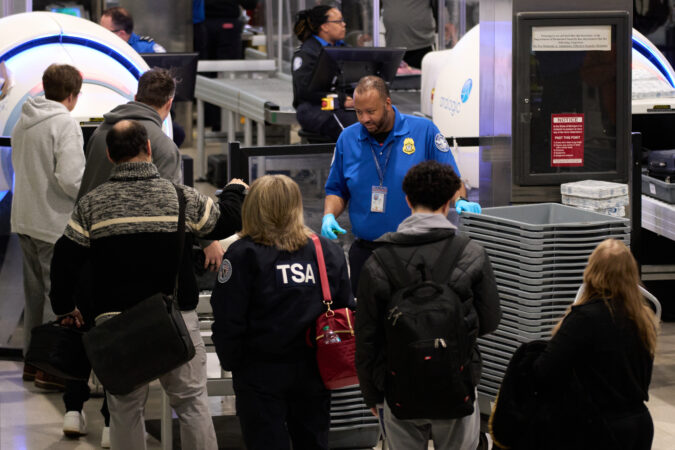
    A shutdown of the U.S. Department of Homeland Security that took effect early Saturday impacts the agency responsible for screening passengers and bags at airports across the country. Travelers with airline reservations may be nervously recalling a 43-day government shutdown that led to historic flight cancellations and long delays last year.

    Transportation Security Administration officers are expected to work without pay while lawmakers remain without an agreement on DHS’ annual funding. TSA officers also worked through the record shutdown that ended Nov. 12, but aviation experts say this one may play out differently.

    Trade groups for the U.S. travel industry and major airlines nonetheless warned that the longer DHS appropriations are lapsed, the longer security lines at the nation’s commercial airports could get.

    Here’s what to know about the latest shutdown and how to plan ahead.

    What’s different about this shutdown?

    Funding for Homeland Security expired at midnight Friday. But the rest of the federal government is funded through Sept. 30. That means air traffic controllers employed by the Federal Aviation Administration will receive paychecks as usual, reducing the risk of widespread flight cancellations.

    According to the department’s contingency plan, about 95% of TSA workers are deemed essential personnel and required to keep working. Democrats in the House and Senate say DHS won’t get funded until new restrictions are placed on federal immigration operations.

    During past shutdowns, disruptions to air travel tended to build over time, not overnight. About a month into last year’s shutdown, for example, TSA temporarily closed two checkpoints at Philadelphia International Airport. That same day, the government took the extraordinary step of ordering all commercial airlines to reduce their domestic flight schedules.

    On Saturday afternoon, the Philadelphia airport’s website showed all checkpoints open with normal brief wait times of 10 minutes or less.

    John Rose, chief risk officer for global travel management company Altour, said strains could surface at airports more quickly this time because the TSA workforce also will be remembering the last shutdown.

    “It’s still fresh in their minds and potentially their pocketbooks,” Rose said.

    What is the impact on travelers?

    It’s hard to predict whether, when, or where security screening snags might pop up. Even a handful of unscheduled TSA absences could quickly lead to longer wait times at smaller airports, for example, if there’s just a single security checkpoint.

    That’s why travelers should plan to arrive early and allow extra time to get through security.

    “I tell people to do this even in good times,” Rose said.

    Experts say flight delays also are a possibility even though air traffic controllers are not affected by the DHS shutdown.

    Airlines might decide to delay departures in some cases to wait for passengers to clear screening, said Rich Davis, senior security adviser at risk mitigation company International SOS. Shortages of TSA officers also could slow the screening of checked luggage behind the scenes.

    What travelers can do to prepare

    Most airports display security line wait times on their websites, but don’t wait until the day of a flight to check them, Rose advised.

    “You may look online and it says 2½ hours,” he said. ”Now it’s 2½ hours before your flight and you haven’t left for the airport yet.”

    Passengers should also pay close attention while packing since prohibited items are likely to prolong the screening process. For carry-on bags, avoid bringing full-size shampoo or other liquids, large gels or aerosols, and items like pocketknives in carry-on bags.

    TSA has a full list on its website of what is and isn’t allowed in carry-on and checked luggage.

    At the airport, Rose said, remember to “practice patience and empathy.”

    “Not only are they not getting paid,” he said of TSA agents, “they’re probably working with reduced staff and dealing with angry travelers.”

    Will the shutdown drag on?

    The White House has been negotiating with Democratic lawmakers, but the two sides failed to reach a deal by the end of the week before senators and members of Congress were set to leave Washington for a 10-day break.

    Lawmakers in both chambers were on notice, however, to return if a deal to end the shutdown is struck.

    Democrats have said they won’t help approve more DHS funding until new restrictions are placed on federal immigration operations after the fatal shootings of Alex Pretti and Renee Good in Minneapolis last month.

    In a joint statement, U.S. Travel, Airlines for America, and the American Hotel & Lodging Association warned that the shutdown threatens to disrupt air travel as the busy spring break travel season approaches.

    “Travelers and the U.S. economy cannot afford to have essential TSA personnel working without pay, which increases the risk of unscheduled absences and call outs, and ultimately can lead to higher wait times and missed or delayed flights,” the statement said.

  • What to know about the investigation into Nancy Guthrie’s disappearance

    What to know about the investigation into Nancy Guthrie’s disappearance

    TUCSON, Ariz. — Law enforcement agents have been gathering more potential evidence as the search for Today show host Savannah Guthrie‘s mother heads into its third week.

    Nancy Guthrie, 84, was last seen at her Arizona home on Jan. 31 and was reported missing the following day. Authorities say her blood was found on the front porch. Purported ransom notes were sent to news outlets, but two deadlines for paying have passed.

    Authorities have expressed concern about Nancy Guthrie’s health because she needs vital daily medicine. She is said to have a pacemaker and have dealt with high blood pressure and heart issues, according to sheriff’s dispatcher audio on broadcastify.com.

    Here’s what to know about her disappearance and the intense search to find her:

    Video of masked man

    The Federal Bureau of Investigation released surveillance videos of a masked person wearing a handgun holster outside Guthrie’s front door in Tucson the night she vanished. A porch camera recorded video of a person with a backpack who was wearing a ski mask, long pants, jacket, and gloves.

    On Thursday, the FBI called the person a suspect. It described him as a man about 5 feet, 9 inches tall with a medium build. The agency said he was carrying a 25-liter “Ozark Trail Hiker Pack” backpack.

    Investigators initially said there was no surveillance video available since Guthrie didn’t have an active subscription to the doorbell camera company. But digital forensics experts kept working to find images in back-end software that might have been lost, corrupted, or inaccessible.

    Studying DNA

    Investigators collected DNA from Guthrie’s property which doesn’t belong to Guthrie or those in close contact with her, the Pima County Sheriff’s Department said. Investigators are working to identify who it belongs to.

    Evidence requiring forensic analysis is being sent to the same out-of-state lab that has been used since the beginning of the case, the department said.

    Investigators found several gloves, the nearest about 2 miles from Guthrie’s home, and submitted them for lab analysis, the sheriff’s department said. It did not specify what type of gloves.

    The sheriff stressed his department is working closely with the FBI.

    Sorting through tips

    The Pima County sheriff and the FBI announced phone numbers and a website to offer tips. Several hundred detectives and agents have been assigned to the case, the sheriff’s department said.

    The FBI said it has collected more than 13,000 tips since Feb. 1, the day Guthrie was reported missing. The sheriff’s department, meanwhile, said it has taken at least 18,000 calls.

    The sheriff’s department has not said whether any tips have advanced the investigation.

    Intensive searches

    Late Friday night, law enforcement sealed off a road about 2 miles from Guthrie’s home as part of their investigation. A parade of sheriff’s and FBI vehicles, including forensics vehicles, passed through the roadblock.

    The two agencies also tagged and towed a Range Rover SUV from a Culver’s restaurant parking lot. The restaurant is just over 2 miles from Nancy Guthrie’s home. This activity took place at the same time the sheriff’s office closed a road just north of the Guthrie home.

    The Pima County Sheriff’s Department confirmed Saturday that a federal court-ordered search warrant was executed at the home Friday in connection with the Guthrie case. The warrant was based on a lead the agency had received. No arrests were made.

    A traffic stop was also conducted, and while someone was questioned, no arrests were made, the sheriff’s office said.

    No additional information was released Saturday.

    On Tuesday, sheriff deputies detained a person for questioning during a traffic stop south of Tucson. Authorities didn’t say what led them to stop the man but confirmed he was released.

    The same day, deputies and FBI agents conducted a court-authorized search in Rio Rico, about an hour’s drive south of the city.

    Family pleas

    Savannah Guthrie, her sister, and her brother have shared on social media multiple video messages to their mother’s purported captor.

    The family’s Instagram videos have shifted in tone from impassioned pleas to whoever may have their mom, saying they want to talk and are even willing to pay a ransom, to bleaker and more desperate requests for the public’s help.

    The latest video on Thursday was simply a home video of their mother and a promise to “never give up on her.”

    A quiet neighborhood

    Nancy Guthrie lived alone in the upscale Catalina Foothills neighborhood, where houses are spaced far apart and set back from the street by long driveways, gates, and dense desert vegetation.

    Savannah Guthrie grew up in Tucson, graduated from the University of Arizona, and once worked at a television station in the city, where her parents settled in the 1970s. She joined Today in 2011.

    In a video, she described her mother as a “loving woman of goodness and light.”

  • Russia poisoned Alexei Navalny with dart frog toxin, European nations say

    Russia poisoned Alexei Navalny with dart frog toxin, European nations say

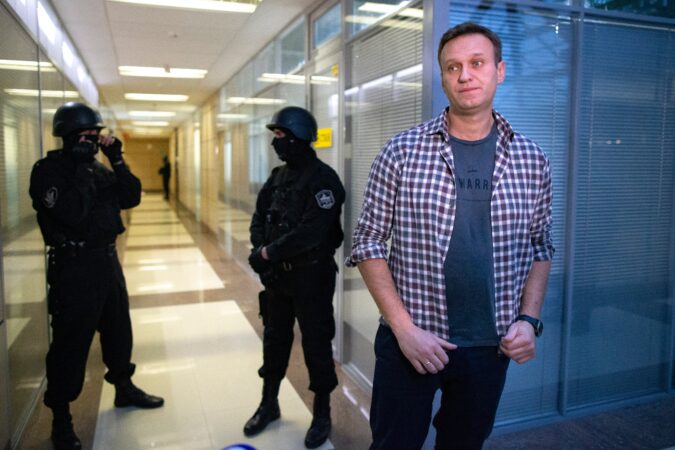
    LONDON — Russian opposition leader Alexei Navalny was poisoned by the Kremlin with a rare and lethal toxin found in the skin of poison dart frogs, five European countries said Saturday.

    The foreign ministries of the U.K., France, Germany, Sweden, and the Netherlands said analysis in European labs of samples taken from Navalny’s body “conclusively confirmed the presence of epibatidine.” It is a neurotoxin secreted by dart frogs in South America that is not found naturally in Russia, they said.

    A joint statement said: “Russia had the means, motive and opportunity to administer this poison.”

    The five countries said they were reporting Russia to the Organization for the Prohibition of Chemical Weapons for a breach of the Chemical Weapons Convention. There was no immediate comment from the organization.

    Navalny, who crusaded against official corruption and staged massive anti-Kremlin protests as President Vladimir Putin’s fiercest foe, died in an Arctic penal colony on Feb. 16, 2024, while serving a 19-year sentence that he believed to be politically motivated.

    “Russia saw Navalny as a threat,” British Foreign Secretary Yvette Cooper said. ”By using this form of poison the Russian state demonstrated the despicable tools it has at its disposal and the overwhelming fear it has of political opposition.”

    French Foreign Minister Jean-Noël Barrot wrote on X that the poisoning of Navalny shows “that Vladimir Putin is prepared to use biological weapons against his own people in order to remain in power.”

    Navalny’s widow says results confirmed her accusations

    The European nations’ assessment came as Navalny’s widow, Yulia Navalnaya, attended the Munich Security Conference in Germany, and just before the second anniversary of Navalny’s death.

    She said last year that two independent labs had found that her husband was poisoned shortly before he died. She has repeatedly blamed Putin for her husband’s death. Russian officials have vehemently denied the accusation.

    Navalnaya said Saturday that she had been “certain from the first day” that her husband had been poisoned, “but now there is proof.”

    “Putin killed Alexei with chemical weapon,” she wrote. She said Putin was “a murderer” who “must be held accountable.”

    Russian authorities said that the politician became ill after a walk and died from natural causes.

    U.K. has accused Russia of previous attacks

    Epibatidine is found naturally in dart frogs in the wild, and can also be manufactured in a lab, which European scientists suspect was the case with the substance used on Navalny. It works on the body in a similar way to nerve agents, causing shortness of breath, convulsions, seizures, a slowed heart rate, and ultimately death.

    Navalny was the target of an earlier poisoning in 2020, with a nerve agent in an attack he blamed on the Kremlin, which always denied involvement. His family and allies fought to have him flown to Germany for treatment and recovery. Five months later, he returned to Russia, where he was immediately arrested and imprisoned for the last three years of his life.

    The U.K. has accused Russia of repeatedly flouting international bans on chemical and biological weapons. It accuses the Kremlin of carrying out a 2018 attack in the English city of Salisbury that targeted a former Russian intelligence officer, Sergei Skripal, with the nerve agent Novichok. Skripal and his daughter became seriously ill, and a British woman, Dawn Sturgess, died after she came across a discarded bottle with traces of the nerve agent.

    A British inquiry concluded that the attack “must have been authorized at the highest level, by President Putin.”

    The Kremlin has denied involvement. Russia also denied poisoning Alexander Litvinenko, a former Russian agent turned Kremlin critic who died in London in 2006, after ingesting the radioactive isotope polonium-210. A British inquiry concluded that two Russian agents killed Litvinenko, and Putin had “probably approved” the operation.