Category: Business Wires

  • Russia batters Ukraine’s power grid again as officials seek momentum in U.S.-led peace talks

    Russia batters Ukraine’s power grid again as officials seek momentum in U.S.-led peace talks

    KYIV, Ukraine — Russia bombarded Ukraine with more than 300 drones and ballistic and cruise missiles in its latest nighttime attack on the Ukrainian power grid, President Volodymyr Zelensky said Tuesday, as Moscow gives no public sign that it’s willing to end the invasion of its neighbor anytime soon.

    The attack knocked out heating to more than 5,600 apartment buildings in the capital, Kyiv Mayor Vitali Klitschko said. Nearly 80% of the affected buildings had recently had their heating supply restored after a major Russian barrage on Jan. 9 that plunged thousands of people into a dayslong blackout, he said.

    Ukraine is enduring one of its coldest winters for years, with temperatures in Kyiv falling to minus 4 Fahrenheit. At the same time, Russia has escalated its aerial attacks on the electricity supply, aiming to deny Ukrainians heat and running water and wear down their resistance almost four years after Moscow launched its full-scale invasion on Feb. 24, 2022.

    Meanwhile, Ukrainian officials are trying to keep up the momentum of U.S.-led peace talks. A Ukrainian negotiating team arrived in the United States on Saturday. Their main task was to convey how the relentless Russian strikes are undermining diplomacy, according to Zelensky.

    The Ukrainian leader said last week that the delegation would also try to finalize with U.S. officials documents for a proposed peace settlement that relate to postwar security guarantees and economic recovery. If American officials approve the proposals, the U.S. and Ukraine could sign the documents at the World Economic Forum in Davos, Switzerland, this week, he said.

    Kremlin spokesman Dmitry Peskov said Tuesday that presidential envoy Kirill Dmitriev plans to meet with some American representatives at Davos.

    He refused to name the officials Dmitriev would meet with, but media reports said they would include U.S. envoy Steve Witkoff and U.S. President Donald Trump’s son-in-law, Jared Kushner.

    Attacks described as ‘cruel’

    Ukrainian Foreign Minister Andrii Sybiha said his country needs urgent assistance and additional sanctions on Russia to make Moscow change course.

    Russian President Vladimir Putin’s “barbaric strike this morning is a wake-up call to world leaders gathering in Davos,” Sybiha said on X.

    U.N. Human Rights Chief Volker Türk said that he was outraged by the repeated large-scale attacks on Ukraine’s energy infrastructure, which especially affect children, older people, and those with disabilities.

    The strikes “can only be described as cruel,” he said in Geneva. “They must stop. Targeting civilians and civilian infrastructure is a clear breach of the rules of warfare.”

    Several electrical substations providing power vital for nuclear safety in Ukraine were affected, said Rafael Mariano Grossi, director-general of the International Atomic Energy Agency.

    Air defense systems are expensive

    Ukraine’s air force command said that 27 missiles and 315 drones were shot down or jammed, while five missiles and 24 drones hit 11 locations.

    The Russian Defense Ministry claimed that its forces targeted Ukrainian military and industrial installations as well as energy and transport infrastructure used by the Ukrainian armed forces.

    The constant attacks have stretched Ukraine’s air defenses and, according to Zelensky, some systems recently ran out of ammunition before a new shipment arrived.

    The fight is also expensive: the air defense ammunition that Ukraine used against the Russian missiles overnight cost about 80 million euros ($93 million), Zelensky said.

    Ukrainian air defenses are adopting a new approach, with the appointment of a new deputy air force commander, Pavlo Yelizarov, according to Zelensky.

    “This system will be transformed,” he said late Monday, without providing details.

    Ukraine relies on sophisticated air defense systems produced by Western countries, especially the U.S., to thwart Russia’s missile and drone attacks.
  • AP Source: Fed Chair Powell to attend Supreme Court argument on Cook case

    AP Source: Fed Chair Powell to attend Supreme Court argument on Cook case

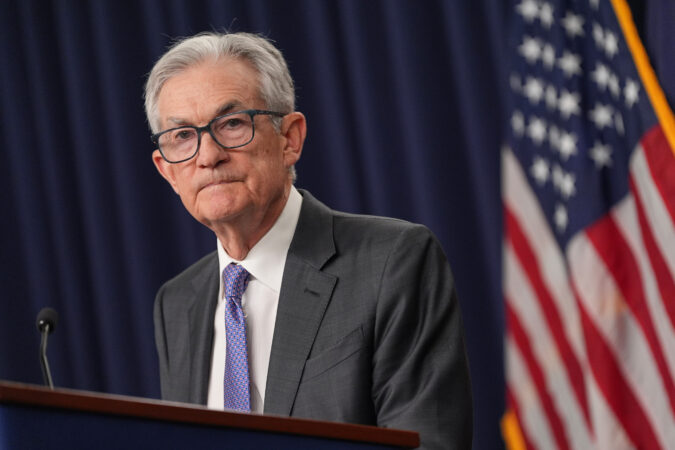
    WASHINGTON — Federal Reserve Chair Jerome Powell will attend the Supreme Court’s oral argument Wednesday in a case involving the attempted firing of Fed governor Lisa Cook, an unusual show of support by the central bank chair.

    The high court is considering whether President Donald Trump can fire Cook, as he said he would do in late August, in an unprecedented attempt to remove one of the seven members of the Fed’s governing board. Powell plans to attend the high court’s Wednesday session, according to a person familiar with the matter, who spoke on condition of anonymity.

    It’s a much more public show of support than the Fed chair has previously shown Cook. But it follows Powell’s announcement last week that the Trump administration has sent subpoenas to the Fed, threatening an unprecedented criminal indictment of the Fed Chair. Powell — appointed to the position by Trump in 2018 — appears to be casting off last year’s more subdued response to Trump’s repeated attacks on the central bank in favor of a more public confrontation.

    Powell issued a video statement Jan. 11 condemning the subpoenas as “pretexts” for Trump’s efforts to force him to sharply cut the Fed’s key interest rate. Powell oversaw three rate cuts late last year, lowering the rate to about 3.6%, but Trump has argued it should be as low as 1%, a position few economists support.

    The Trump administration has accused Cook of mortgage fraud, an allegation that Cook has denied. No charges have been made against Cook. She sued to keep her job, and the Supreme Court Oct. 1 issued a brief order allowing her to stay on the board while they consider her case.

    If Trump succeeds in removing Cook, he could appoint another person to fill her slot, which would give his appointees a majority on the Fed’s board and greater influence over the central bank’s decisions on interest rates and bank regulation.

  • Valentino, 93, fashion designer to the jet set

    Valentino, 93, fashion designer to the jet set

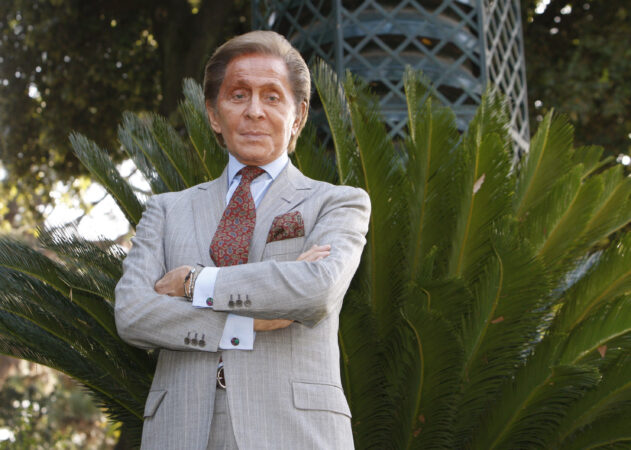
    MILAN — Valentino Garavani, the jet-set Italian designer whose high-glamour gowns — often in his trademark shade of “Valentino red” — were fashion show staples for nearly half a century, has died at home in Rome, his foundation announced Monday. He was 93.

    “Valentino Garavani was not only a constant guide and inspiration for all of us, but a true source of light, creativity and vision,″ the foundation founded by Mr. Garavani and his partner, Giancarlo Giammetti, said in a statement posted on social media.

    Universally known by his first name, Valentino, Mr. Garavani was adored by generations of royals, first ladies, and movie stars, from Jackie Kennedy Onassis to Julia Roberts and Queen Rania of Jordan, who swore the designer always made them look and feel their best.

    “I know what women want,” he once remarked. “They want to be beautiful.”

    Though Italian-born and despite maintaining his atelier in Rome, he mostly unveiled his collections in Paris, and spoke French with his Italian partner Giammetti, an entrepreneur.

    Alessandro Michele, the current creative director of the Valentino fashion house, wrote in Instagram that he continues to feel Mr. Garavani’s “gaze” as he works on the next collection, which will be presented March 12 in Rome, departing from the usual venue of Paris. Michele remembered Mr. Garavani as “a man who expanded the limits of the possible” and possessing “a rare delicacy, with a silent rigor and a limitless love for beauty.’’

    Another of Mr. Garavani’s successors, Pierpaolo Piccoli, placed a broken heart emoji under the announcement of his death. Former supermodel Cindy Crawford wrote that she was “heartbroken,” and called Valentino “a true master of his craft.’’

    Condolences also came in from the family of the late designer Giorgio Armani, who died in September at the age of 91, and Donatella Versace, who posted two photos of Mr. Garavani, saying “he will forever be remembered for his art.’’

    Italian Premier Giorgia Meloni remembered Mr. Garavani as “an indisputable maestro of eternal style and elegance of Italian high fashion.”

    Never one for edginess or statement dressing, Mr. Garavani made precious few fashion faux pas throughout his nearly half-century-long career, which stretched from his early days in Rome in the 1960s through to his retirement in 2008.

    His fail-safe designs made Mr. Garavani the king of the red carpet, the go-to man for A-listers’ awards ceremony needs. His sumptuous gowns have graced countless Academy Awards, notably in 2001, when Roberts wore a vintage black and white column to accept her best actress statue. Cate Blanchett also wore Valentino — a one-shouldered number in butter-yellow silk — when she won the Oscar for best supporting actress in 2004.

    Mr. Garavani was also behind the long-sleeved lace dress Jacqueline Kennedy wore for her wedding to Greek shipping magnate Aristotle Onassis in 1968. Kennedy and Mr. Garavani were close friends for decades, and for a spell the one-time U.S. first lady wore almost exclusively Valentino.

    He was also close to Diana, Princess of Wales, who often donned his sumptuous gowns.

    Beyond his signature orange-tinged shade of red, other Valentino trademarks included bows, ruffles, lace, and embroidery; in short, feminine, flirty embellishments that added to the dresses’ beauty and hence to that of the wearers.

    Perpetually tanned and always impeccably dressed, Mr. Garavani shared the lifestyle of his jet-set patrons. In addition to his 152-foot yacht and an art collection including works by Picasso and Miro, the couturier owned a 17th century chateau near Paris with a garden said to boast more than a million roses.

    Mr. Garavani and his longtime partner Giammetti flitted among their homes — which also included places in New York, London, Rome, Capri, and Gstaad, Switzerland — traveling with their pack of pugs. The pair regularly received A-list friends and patrons, including Madonna and Gwyneth Paltrow.

    “When I see somebody and unfortunately she’s relaxed and running around in jogging trousers and without any makeup … I feel very sorry,” the designer told RTL television in a 2007 interview. “For me, woman is like a beautiful, beautiful flower bouquet. She has always to be sensational, always to please, always to be perfect, always to please the husband, the lover, everybody. Because we are born to show ourselves always at our best.”

    Mr. Garavani was born into a well-off family in the northern Italian town of Voghera on May 11, 1932. He said it was his childhood love of cinema that set him down the fashion path.

    “I was crazy for silver screen, I was crazy for beauty, to see all those movie stars being sensation, well dressed, being always perfect,” he explained in the 2007 television interview.

    After studying fashion in Milan and Paris, he spent much of the 1950s working for established Paris-based designer Jean Desses and later Guy Laroche before striking out on his own. He founded the house of Valentino on Rome’s Via Condotti in 1959.

    From the beginning, Giammetti was by his side, handling the business aspect while Mr. Garavani used his natural charm to build a client base among the world’s rich and fabulous.

    After some early financial setbacks — Mr. Garavani’s tastes were always lavish, and the company spent with abandon — the brand took off.

    Early fans included Italian screen sirens Gina Lollobrigida and Sophia Loren, as well as Hollywood stars Elizabeth Taylor and Audrey Hepburn. Legendary American Vogue editor-in-chief Diana Vreeland also took the young designer under her wing.

    Over the years, Mr. Garavani’s empire expanded as the designer added ready-to-wear, menswear, and accessories lines to his stable. Mr. Garavani and Giammetti sold the label to an Italian holding company for an estimated $300 million in 1998. Mr. Garavani would remain in a design role for another decade.

    In 2007, the couturier feted his 45th anniversary in fashion with a 3-day-long blowout in Rome, capped with a grand ball in the Villa Borghese gallery.

    Mr. Garavani retired in 2008 and was briefly replaced by fellow Italian Alessandra Facchinetti, who had stepped into Tom Ford’s shoes at Gucci before being sacked after two seasons.

    Facchinetti’s tenure at Valentino proved equally short. As early as her first show for the label, rumors swirled that she was already on her way out, and just about one year after she was hired, Facchinetti was indeed replaced by two longtime accessories designers at the brand, Maria Grazia Chiuri and Pierpaolo Piccioli.

    Chiuri left to helm Dior in 2016, and Piccioli continued to lead the house through a golden period that drew on the launch of the Rockstud pump with Chiuri and his own signature color, a shade of fuchsia called Pink PP. He left the house in 2024, later joining Balenciaga, and has been replaced by Michele, who revived Gucci’s stars with romantic, genderless styles.

    Valentino is owned by Qatar’s Mayhoola, which controls a 70% stake, and the French luxury conglomerate Kering, which owns 30% with an option to take full control in 2028 or 2029. Richard Bellini was named CEO last September.

    A public viewing will be held at the Valentino Garavani and Giancarlo Giammetti Foundation on Wednesday and Thursday, and a funeral will be held Friday in the Basilica di Santa Maria degli Angeli e dei Martiri in central Rome.

  • Valentino Garavani, an Italian fashion designer known for his signature shade of red, has died at 93

    Valentino Garavani, an Italian fashion designer known for his signature shade of red, has died at 93

    ROME — Valentino Garavani, the jet-set Italian designer whose high-glamour gowns — often in his trademark shade of “Valentino red” — were fashion show staples for nearly half a century, has died at home in Rome, his foundation announced Monday. He was 93.

    “Valentino Garavani was not only a constant guide and inspiration for all of us, but a true source of light, creativity and vision,″ the foundation said in a statement posted on social media.

    His body will repose at the foundation’s headquarters in Rome on Wednesday and Thursday. The funeral will be held Friday at the Basilica Santa Maria degli Angeli e dei Martiri in Rome’s Piazza della Repubblica.

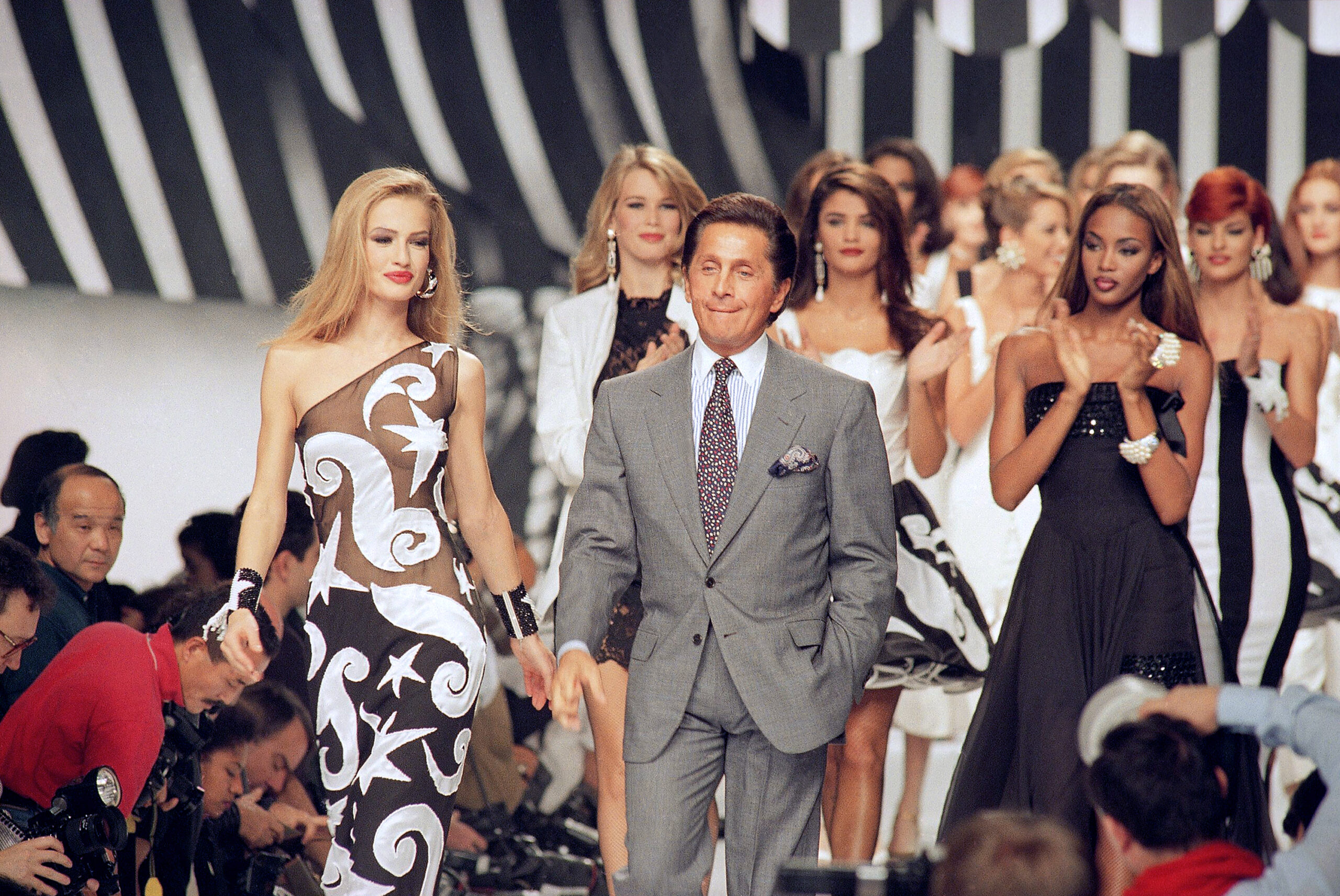
    Italian fashion designer Valentino Garavani walks the catwalk with his models after a fashion show on October 20, 1991 in Paris, France.

    Universally known by his first name, Valentino was adored by generations of royals, first ladies and movie stars, from Jackie Kennedy Onassis to Julia Roberts and Queen Rania of Jordan, who swore the designer always made them look and feel their best.

    “I know what women want,” he once remarked. “They want to be beautiful.”

    Never one for edginess or statement dressing, Valentino made precious few fashion faux-pas throughout his nearly half-century-long career, which stretched from his early days in Rome in the 1960s through to his retirement in 2008.

    His fail-safe designs made Valentino the king of the red carpet, the go-to man for A-listers’ awards ceremony needs. His sumptuous gowns have graced countless Academy Awards, notably in 2001, when Roberts wore a vintage black and white column to accept her best actress statue. Cate Blanchett also wore Valentino — a one-shouldered number in butter-yellow silk — when she won the Oscar for best supporting actress in 2004.

    Valentino was also behind the long-sleeved lace dress Jacqueline Kennedy wore for her wedding to Greek shipping magnate Aristotle Onassis in 1968. Kennedy and Valentino were close friends for decades, and for a spell the one-time U.S. first lady wore almost exclusively Valentino.

    He was also close to Diana, Princess of Wales, who often donned his sumptuous gowns.

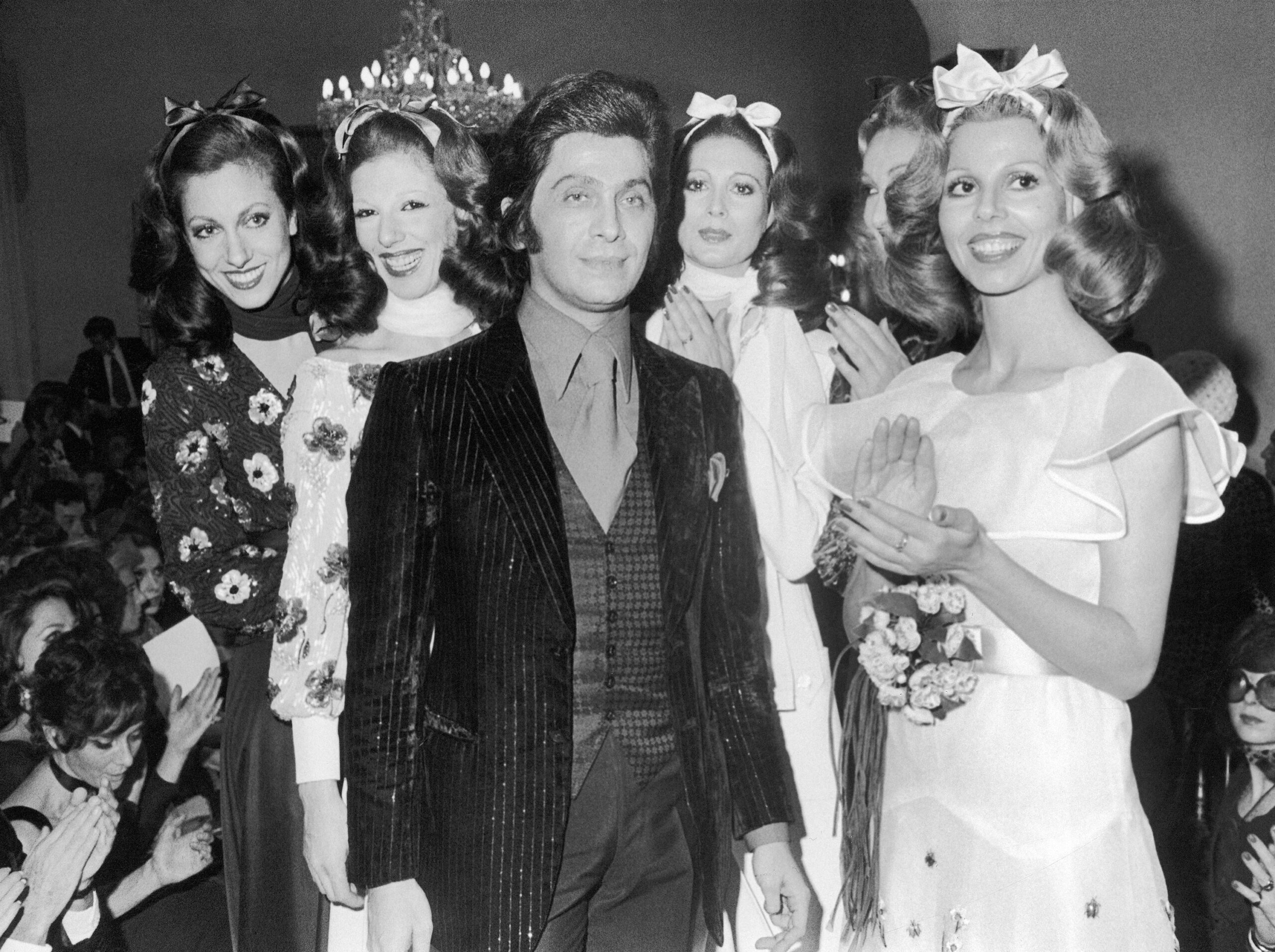
    Models flank Italian fashion designer Valentino Garavani in Rome, Italy, at the end of the fashion show for his spring-summer collection on Jan. 20, 1971.

    Beyond his signature orange-tinged shade of red, other Valentino trademarks included bows, ruffles, lace and embroidery; in short, feminine, flirty embellishments that added to the dresses’ beauty and hence to that of the wearers.

    Perpetually tanned and always impeccably dressed, Valentino shared the lifestyle of his jet-set patrons. In addition to his 152-foot (46-meter) yacht and an art collection including works by Picasso and Miro, the couturier owned a 17th-century chateau near Paris with a garden said to boast more than a million roses.

    Valentino and his longtime partner Giancarlo Giammetti flitted among their homes — which also included places in New York, London, Rome, Capri and Gstaad, Switzerland — traveling with their pack of pugs. The pair regularly received A-list friends and patrons, including Madonna and Gwyneth Paltrow.

    “When I see somebody and unfortunately she’s relaxed and running around in jogging trousers and without any makeup … I feel very sorry,” the designer told RTL television in a 2007 interview. “For me, woman is like a beautiful, beautiful flower bouquet. She has always to be sensational, always to please, always to be perfect, always to please the husband, the lover, everybody. Because we are born to show ourselves always at our best.”

    Valentino was born into a well-off family in the northern Italian town of Voghera on May 11, 1932. He said it was his childhood love of cinema that set him down the fashion path.

    “I was crazy for silver screen, I was crazy for beauty, to see all those movie stars being sensation, well dressed, being always perfect,” he explained in the 2007 television interview.

    After studying fashion in Milan and Paris, he spent much of the 1950s working for established Paris-based designer Jean Desses and later Guy Laroche before striking out on his own. He founded the house of Valentino on Rome’s Via Condotti in 1959.

    From the beginning, Giammetti was by his side, handling the business aspect while Valentino used his natural charm to build a client base among the world’s rich and fabulous.

    After some early financial setbacks — Valentino’s tastes were always lavish, and the company spent with abandon — the brand took off.

    Early fans included Italian screen sirens Gina Lollobrigida and Sophia Loren, as well as Hollywood stars Elizabeth Taylor and Audrey Hepburn. Legendary American Vogue editor-in-chief Diana Vreeland also took the young designer under her wing.

    Over the years, Valentino’s empire expanded as the designer added ready-to-wear, menswear and accessories lines to his stable. Valentino and Giammetti sold the label to an Italian holding company for an estimated $300 million in 1998. Valentino would remain in a design role for another decade.

    In 2007, the couturier feted his 45th anniversary in fashion with a 3-day-long blowout in Rome, capped with a grand ball in the Villa Borghese gallery.

    Valentino retired in 2008 and was briefly replaced by fellow Italian Alessandra Facchinetti, who had stepped into Tom Ford’s shoes at Gucci before being sacked after two seasons.

    Facchinetti’s tenure at Valentino proved equally short. As early as her first show for the label, rumors swirled that she was already on her way out, and just about one year after she was hired, Facchinetti was indeed replaced by two longtime accessories designers at the brand, Maria Grazia Chiuri and Pier Paolo Piccioli.

    Chiuri left to helm Dior in 2016, and Piccioli continued to lead the house through a golden period that drew on the launch of the Rockstud pump with Chiuri and his own signature color, a shade of fuchsia called Pink PP. He left the house in 2024, later joining Balenciaga, and has been replaced by Alessandro Michele, who revived Gucci’s stars with romantic, genderless styles.

    Valentino is owned by Qatar’s Mayhoola, which controls a 70% stake, and the French luxury conglomerate Kering, which owns 30% with an option to take full control in 2028 or 2029. Richard Bellini was named CEO last September.

    Valentino has been the subject of several retrospectives, including one at the Musee des Arts Decoratifs, which is housed in a wing of Paris’ Louvre Museum. He was also the subject of a hit 2008 documentary, “Valentino: The Last Emperor,” that chronicled the end of his career in fashion.

    In 2011, Valentino and Giammetti launched what they called a “virtual museum,” a free desktop application that allows viewers to feast their eyes on about 300 of the designer’s iconic pieces.

  • Ukrainian drone strikes cut power to hundreds of thousands in Russia-occupied southern Ukraine

    Ukrainian drone strikes cut power to hundreds of thousands in Russia-occupied southern Ukraine

    KYIV, Ukraine — Ukrainian drone strikes damaged energy networks in Russia-occupied parts of southern Ukraine, leaving hundreds of thousands of people without power on Sunday, according to Kremlin-installed authorities there.

    Meanwhile, Moscow has kept up its hammering of Ukraine’s energy grid in overnight attacks that killed at least two people, according to Ukrainian officials.

    More than 200,000 households in the Russia-held part of Ukraine’s southern Zaporizhzhia region had no electricity on Sunday, according to the Kremlin-installed local governor.

    In a Telegram post, Yevgeny Balitsky said that nearly 400 settlements have had their supply cut, because of damage to power networks from Ukrainian drone strikes.

    Russia has hammered Ukraine’s power grid, especially in winter, throughout the nearly four-year war. The strikes aim to weaken Ukrainians’ will to resist in a strategy that Kyiv officials call “weaponizing winter.”

    Russia targeted energy infrastructure in Odesa region overnight on Sunday, according to Ukraine’s Emergency Service. A fire broke out and was promptly extinguished.

    At least six people were wounded in the Dnipropetrovsk region from Russian attacks, the emergency service said.

    Ukrainian President Volodymyr Zelensky said in a Telegram post that repairing the country’s energy system remains challenging, “but we are doing everything we can to restore everything as quickly as possible.”

    He said that two people were killed in overnight attacks across the country that struck Sumy, Kharkiv, Dnipro, Zaporizhzhia, Khmelnytskyi, and Odesa.

    In total, more than 1,300 attack drones, 1,050 guided aerial bombs, and 29 missiles of various types were used by Russia to strike Ukraine this week, Zelensky said.

    U.S. talks

    “If Russia deliberately delays the diplomatic process, the world’s response should be decisive: more help for Ukraine and more pressure on the aggressor,” Zelensky said.

    He spoke the day after a Ukrainian delegation arrived in the United States for talks on a U.S.-led diplomatic push to end the war.

    On Friday, Zelensky said that the delegation would try to finalize with U.S. officials documents for a proposed peace settlement that relate to postwar security guarantees and economic recovery.

    If American officials approve the proposals, the U.S. and Ukraine could sign the documents next week at the World Economic Forum in Davos, Switzerland, Zelensky said at a Kyiv news conference with Czech President Petr Pavel. U.S. President Donald Trump plans to be in Davos, according to organizers.

    Russia would still need to be consulted on the proposals.

    Drones strike Russian Caucasus

    Separately, in Russia’s Caucasus Mountains, two children and an adult were wounded overnight as debris from a Ukrainian drone fell on a five-story residential building in North Ossetia, according to the regional governor.

    Seventy people had to be evacuated from the building, in the town of Beslan, and there was damage to its roof and windows, Gov. Sergei Menyaylo said in a Telegram post on Sunday morning.

    Russia’s Defense Ministry said that its forces shot down or suppressed 63 Ukrainian drones overnight over Russia and the occupied Crimean Peninsula. One person was hospitalized in Russia’s Krasnodar region east of Crimea following a drone strike, local authorities said.

    Nuclear plant repairs

    Ukrainian crews have started repair work on the backup power line connecting the Zaporizhzhia Nuclear Power Plant to the power grid, under a ceasefire brokered by the International Atomic Energy Agency, the Vienna-based U.N. organization said in an X post on Sunday.

    The fate of the plant, occupied by Russia and the largest in Europe, is a central issue in ongoing U.S.-brokered peace talks.

    “Crucial repair works on the essential back up Ferosplavna-1 330 kV power line connecting Ukraine’s ZNPP to the grid have begun under another IAEA-brokered ceasefire,” the agency said in the post.

    The 330-kilovolt power line, which was damaged and disconnected because of fighting, is crucial to supplying the plant with electricity.

  • Trump’s voice in a new Fannie Mae ad is generated by artificial intelligence, with his permission

    Trump’s voice in a new Fannie Mae ad is generated by artificial intelligence, with his permission

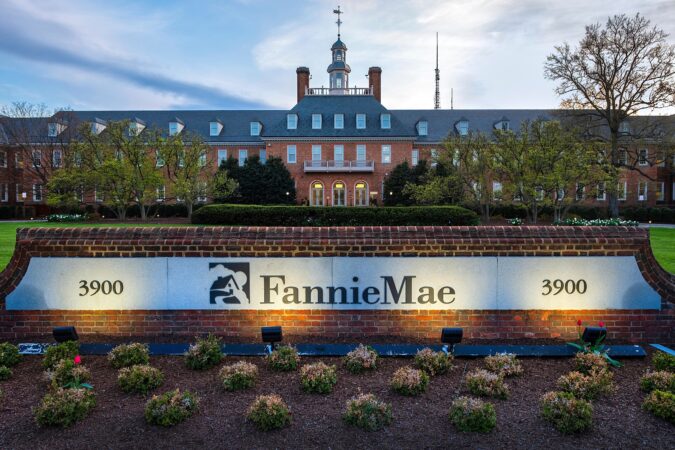
    NEW YORK — What sounds like President Donald Trump narrating a new Fannie Mae ad actually is an AI-cloned voice reading text, according to a disclaimer in the video.

    The voice in the ad, created with permission from the Trump administration, promises an “all new Fannie Mae” and calls the institution the “protector of the American Dream.” The ad comes as the administration is making a big push to show voters it is responding to their concerns about affordability, including in the housing market.

    Trump plans to talk about housing at his appearance at the World Economic Forum in Davos, Switzerland, where world leaders and corporate executives meet this week.

    This isn’t the first time a member of the Trump family has used AI to replicate their voice, first lady Melania Trump recently employed AI technology firm Eleven Labs to help voice the audio version of her memoir. It’s not known who cloned President Trump’s voice for the Fannie Mae ad.

    Last month, Trump pledged in a prime-time address that he would roll out “some of the most aggressive housing reform plans in American history.”

    “For generations, homeownership meant security, independence, and stability,” Trump’s digitized voice says in the one-minute ad aired Sunday. “But today, that dream feels out of reach for too many Americans not because they stopped working hard but because the system stopped working for them.”

    Fannie Mae and its counterpart Freddie Mac, which have been under government control since the Great Recession, buy mortgages that meet their risk criteria from banks, which helps provide liquidity for the housing market. The two firms guarantee roughly half of the $13 trillion U.S. home loan market and are a bedrock of the U.S. economy.

    The ad says Fannie Mae will work with the banking industry to approve more would-be homebuyers for mortgages.

    Trump, Bill Pulte, who leads the Federal Housing Finance Agency, and others have said they want to sell shares of Fannie Mae and Freddie Mac on a major stock exchange but no concrete plans have been set.

    Trump and Pulte have also floated extending the 30-year mortgage to 50 years in order to lower monthly payments. Trump appeared to back off the proposal after critics said a longer-term loan would reduce people’s ability to create housing equity and increase their own wealth.

    Trump also said on social media earlier this month that he was directing the federal government to buy $200 billion in mortgage bonds, a move he said would help reduce mortgage rates at a time when Americans are anxious about home prices. Trump said Fannie Mae and Freddie Mac have $200 billion in cash that will be used to make the purchase.

    Earlier this month, Trump also said he wants to block large institutional investors from buying houses, saying that a ban would make it easier for younger families to buy their first homes.

    Trump’s permission for the use of AI is interesting given that he has complained about aides in the Biden administration using autopen to apply the former president’s signature to laws, pardons, or executive orders. An autopen is a mechanical device that is used to replicate a person’s authentic signature.

    However, a report issued by House Republicans does not include any concrete evidence that autopen was used to sign Biden’s name without his knowledge.

  • Why U.S. cities are reverting 1-way streets back to their original 2-way design

    Why U.S. cities are reverting 1-way streets back to their original 2-way design

    Excessive speeding was so common on parallel one-way streets passing a massive electronics plant that Indianapolis residents used to refer to the pair as a “racetrack” akin to the city’s famous Motor Speedway a few miles west.

    Originally two-way thoroughfares, Michigan and New York streets switched to opposite one-way routes in the 1970s to help thousands of RCA workers swiftly travel to and from their shifts building televisions or pressing vinyl records. But after the RCA plant closed in 1995, the suddenly barren roads grew even more enticing for lead-footed drivers — until last year, when city officials finally converted them back to two-way streets.

    “The opening and conversion of those streets has just been transformative for how people think about that corridor,” said James Taylor, who runs a nearby community center.

    Embracing the oft-repeated slogan that “paint is cheap,” transportation planners across the U.S. — particularly in midsize cities — have been turning their unidirectional streets back to multidirectional ones. They view the step as one of the easiest ways to improve safety and make downtowns more alluring to shoppers, restaurant patrons and would-be residents.

    A street design U-turn

    Dave Amos, an assistant professor of city and regional planning at California Polytechnic State University, said almost no major streets in the U.S. originated as one-way routes. Two-way streets were the standard, before mass migration to the suburbs prioritized faster commutes over downtown walkability.

    “One-way streets are designed for moving cars quickly and efficiently,” Amos said. “So when you have that as your goal, pedestrians and cyclists almost by design are secondary, which makes them more vulnerable.”

    But the propensity to speed isn’t the only reason one-way streets are viewed as less safe.

    Wade Walker, an engineer with Kittelson & Associates who has worked on street conversion projects in Lakeland, Fla., Lynchburg, Va.;, and Chattanooga, Tenn., said there is a misperception that one-way streets are safer because people on foot only have to look one direction to see the incoming traffic. The confusion arises when one-way streets combine with two-way streets to form a city grid, he said.

    Pedestrians crossing a signalized intersection of two-way streets can expect to encounter vehicles in a certain sequence: those turning left on green, traveling straight, and turning right on red. But when one-way streets are included, there are 16 potential sequences depending on the type and direction of the roads that intersect, Walker said.

    “It’s not the number of conflicts, it’s the way those conflicts occur,” he said.

    One way to divide a community

    Louisville, Ky., about two hours south of Indianapolis, has been restoring one-way streets to their original two-way footprints. The state is leading an ongoing project to reconvert a stretch along Main Street that passes such landmarks as the Louisville Slugger Museum, the KFC Yum! Center arena, and a minor-league baseball stadium.

    One of the city’s biggest redesigns is happening this year in the predominantly Black western part of the city, where many roads changed to one-way routes in the 1970s to feed a new interstate bridge over the Ohio River. However, it decimated neighborhoods and cut off the once-thriving community from downtown.

    “All those mom-and-pop shops and local businesses over time kind of faded because that connectivity got taken away,” said Michael King, the city’s assistant director of transportation planning. “It just feels more like, ‘This is a road to get me through here pretty quickly.’”

    Within three years after some of Chattanooga’s two-way streets were transformed into unidirectional ones, business vacancies skyrocketed and the University of Tennessee at Chattanooga became “landlocked” to prevent students from having to cross a dangerous road, Walker said.

    In 2022, almost two decades after the road was redesigned, he returned to find the college campus had expanded across it and business construction had surged.

    Converting streets and skeptics

    When Lynchburg, Va., launched a long-discussed plan to change its downtown Main Street back to two ways, Rodney Taylor voiced concerns that it would doom his restaurant by blocking delivery vehicles. After the city completed the section in 2021, he acknowledged the fears were unfounded.

    “An important thing to do is to admit when you’re wrong,” he said. “And I was just flat-out wrong.”

    Many residents also changed their tune in Austin, Texas, when the city began reconverting some of the one-way streets in its urban core, said Adam Greenfield, executive director with Safe Streets Austin.

    “It just worked,” said Greenfield, who is now lobbying the city to do away with all its one-way streets. “That’s what you’ll find with these conversions — they’ll be done and then instantly people will be like, ‘Why didn’t we do this 20 years ago?’”

    After Chicago went the opposite direction last year and suddenly changed some of its two-way streets to one-way in the busy West Loop restaurant district, a politician representing an adjacent area got numerous calls from confused constituents.

    “Even if this was the right move to make these streets one-way, it certainly doesn’t make sense to not ask the opinion of the neighbors,” Alderman Bill Conway said.

    Opportunity in Indianapolis

    Now that Indianapolis has finished the redesigns for Michigan and New York streets, there are 10 other conversions on tap next, said Mark St. John, chief engineer for the city’s Department of Public Works. The total cost for those projects is estimated at $60 million, with around $25 million of that from a 2023 federal grant.

    James Taylor, who runs the community center near the old RCA plant, said it is too early to know the full impact. Some business owners, however, have signaled construction plans along the redesigned streets, which Taylor says still feel a little strange.

    “I’ve been driving around that neighborhood for 30 years,” he said. “It’s all kind of familiar, but you’re coming at it from a whole different perspective.”

  • AP: Venezuelan leader Delcy Rodríguez has been on DEA’s radar for years

    AP: Venezuelan leader Delcy Rodríguez has been on DEA’s radar for years

    WASHINGTON — When President Donald Trump announced the audacious capture of Nicolás Maduro to face drug trafficking charges in the U.S., he portrayed the strongman’s vice president and longtime aide as America’s preferred partner to stabilize Venezuela amid a scourge of drugs, corruption, and economic mayhem.

    Left unspoken was the cloud of suspicion that long surrounded Delcy Rodríguez before she became acting president of the beleaguered nation earlier this month.

    In fact, Rodríguez has been on the radar of the U.S. Drug Enforcement Administration for years and in 2022 was even labeled a “priority target,” a designation DEA reserves for suspects believed to have a “significant impact” on the drug trade, according to records obtained by The Associated Press and more than a half dozen current and former U.S. law enforcement officials.

    The DEA has amassed a detailed intelligence file on Rodríguez dating to at least 2018, the records show, cataloging her known associates and allegations ranging from drug trafficking to gold smuggling. One confidential informant told the DEA in early 2021 that Rodríguez was using hotels in the Caribbean resort of Isla Margarita “as a front to launder money,” the records show. As recently as last year she was linked to Maduro’s alleged bag man, Alex Saab, whom U.S. authorities arrested in 2020 on money laundering charges.

    The U.S. government has never publicly accused Rodríguez of any criminal wrongdoing. Notably for Maduro’s inner circle, she’s not among the more than a dozen current Venezuelan officials charged with drug trafficking alongside the ousted president.

    Rodríguez’s name has surfaced in nearly a dozen DEA investigations, several of which remain ongoing, involving agents in field offices from Paraguay and Ecuador to Phoenix and New York, the AP learned. The AP could not determine the specific focus of each investigation.

    Three current and former DEA agents who reviewed the records at the request of AP said they indicate an intense interest in Rodríguez throughout much of her tenure as vice president, which began in 2018. They were not authorized to discuss DEA investigations and spoke on the condition of anonymity.

    The records reviewed by AP do not make clear why Rodríguez was elevated to a “priority target,” a designation that requires extensive documentation to justify additional investigative resources. The agency has hundreds of priority targets at any given moment, and having the label does not necessarily lead to being charged criminally.

    “She was on the rise, so it’s not surprising that she might become a high-priority target with her role,” said Kurt Lunkenheimer, a former federal prosecutor in Miami who has handled multiple cases related to Venezuela. “The issue is when people talk about you and you become a high-priority target, there’s a difference between that and evidence supporting an indictment.”

    Venezuela’s Communications Ministry did not respond to emails seeking comment.

    The DEA and U.S. Justice Department also did not respond to requests for comment. Asked whether the president trusts Rodríguez, the White House referred AP to Trump’s earlier remarks on a “very good talk” he had with the acting president Wednesday, one day before she met in Caracas with CIA Director John Ratcliffe.

    Almost immediately after Maduro’s capture, Trump started heaping praise on Rodríguez — this past week referring to her as a “terrific person — in close contact with officials in Washington, including Secretary of State Marco Rubio.

    The DEA’s interest in Rodríguez comes even as Trump has sought to install her as the steward of American interests to navigate a volatile post-Maduro Venezuela, said Steve Dudley, co-director of InSight Crime, a think tank focused on organized crime in the Americas.

    “The current Venezuela government is a criminal-hybrid regime. The only way you reach a position of power in the regime is by, at the very least, abetting criminal activities,” said Dudley, who has investigated Venezuela for years. “This isn’t a bug in the system. This is the system.”

    Those sentiments were echoed by opposition leader Maria Corina Machado, who met with Trump at the White House Thursday in a bid to push for more U.S. support for Venezuelan democracy.

    “The American justice system has sufficient information about her,” said Machado, referring to Rodríguez. “Her profile is quite clear.”

    Rodríguez, 56, worked her way to the apex of power in Venezuela as a loyal aide to Maduro, with whom she shares a deep-seated leftist bent stemming from her socialist father’s death in police custody when she was only 7 years old. Despite blaming the U.S. for her father’s death, she steadily worked while foreign minister and later vice president to court American investment during the first Trump administration, hiring lobbyists close to Trump and even ordering the state oil company to make a $500,000 donation to his inaugural committee.

    The charm offensive flopped when Trump, urged on by Rubio, pressured Maduro to hold free and fair elections. In September 2018, the White House sanctioned Rodríguez, describing her as key to Maduro’s grip on power and ability to “solidify his authoritarian rule.” She was also sanctioned earlier by the European Union.

    But those allegations focused on her threat to Venezuela’s democracy, not any alleged involvement in corruption.

    “Venezuela is a failed state that supports terrorism, corruption, human rights abuses, and drug trafficking at the highest echelons. There is nothing political about this analysis,” said Rob Zachariasiewicz, a longtime former DEA agent who led investigations into top Venezuelan officials and is now a managing partner at Elicius Intelligence, a specialist investigations firm. “Delcy Rodríguez has been part of this criminal enterprise.”

    The DEA records seen by AP provide an unprecedented glimpse into the agency’s interest in Rodríguez. Much of it was driven by the agency’s elite Special Operations Division, the same Virginia-based unit that worked with prosecutors in Manhattan to indict Maduro.

    One of the records cites an unnamed confidential informant linking Rodríguez to hotels in Margarita Island that are allegedly used as a front to launder money. The AP has been unable to independently confirm the information.

    The U.S. has long considered the resort island, northeast of the Venezuelan mainland, a strategic hub for drug trafficking routes to the Caribbean and Europe. Numerous traffickers have been arrested or taken haven there over the years, including representatives of Joaquín “El Chapo” Guzman’s Sinaloa cartel.

    The records also indicate the feds were looking at Rodríguez’s involvement in government contracts awarded to Maduro’s ally Saab — investigations that remain ongoing even after President Joe Biden pardoned him in 2023 as part of a prisoner swap for Americans imprisoned in Venezuela.

    The Colombian businessman rose to become one of Venezuela’s top fixers as U.S. sanctions cut off its access to hard currency and Western banks. He was arrested in 2020 on federal charges of money laundering while traveling from Venezuela to Iran to negotiate oil deals helping both countries circumvent sanctions.

    The DEA records also indicate agents’ interest in Rodríguez’s possible involvement in allegedly corrupt deals between the government and Omar Nassif-Sruji, the brother of her longtime romantic partner, Yussef Nassif. Nassif-Sruji and Nassif did not respond to emails and text messages seeking comment.

    Companies registered by the two brothers in Hong Kong received more than $650 million in Venezuelan government contracts between 2017 and 2019 to import food and dialysis medicine, according to copies of the contracts obtained in 2021 by Venezuelan investigative journalism outlet Armando.info.

    Taken together, the DEA investigations underscore how power has long been exercised in Venezuela, which is ranked as the world’s third most corrupt country by Transparency International. For Rodríguez, they also represent something of a razor-sharp sword over her head, breathing life to Trump’s threat soon after Maduro’s ouster that she would “pay a very big price, probably bigger than Maduro” if she didn’t fall in line. The president added that he wanted her to provide the U.S. “total access” to the country’s vast oil reserves and other natural resources.

    “Just being a leader in a highly corrupted regime for over a decade makes it logical that she is a priority target for investigation,” said David Smilde, a Tulane University professor who has studied Venezuela for three decades. “She surely knows this, and it gives the U.S. government leverage over her. She may fear that if she does not do as the Trump administration demands, she could end up with an indictment like Maduro.”

  • Trump says 8 European countries will be charged a 10% tariff for opposing US control of Greenland

    Trump says 8 European countries will be charged a 10% tariff for opposing US control of Greenland

    President Donald Trump said Saturday that he would charge a 10% import tax starting in February on goods from eight European nations because of their opposition to American control of Greenland, setting up a potentially dangerous test of U.S. partnerships in Europe.

    Denmark, Norway, Sweden, France, Germany, the United Kingdom, the Netherlands. and Finland would face the tariff, Trump said in a social media post while at his golf club in West Palm Beach, Fla. The rate would climb to 25% on June 1 if no deal was in place for “the Complete and Total purchase of Greenland” by the United States, he said.

    The Republican president appeared to indicate that he was using the tariffs as leverage to force talks with Denmark and other European countries over the status of Greenland, a semiautonomous territory of NATO ally Denmark that he regards as critical to U.S. national security.

    “The United States of America is immediately open to negotiation with Denmark and/or any of these Countries that have put so much at risk, despite all that we have done for them,” Trump said on Truth Social.

    The tariff threat could mark a problematic rupture between Trump and America’s longtime NATO partners, further straining an alliance that dates to 1949 and provides a collective degree of security to Europe and North America. Trump has repeatedly tried to use trade penalties to bend allies and rivals alike to his will, generating investment commitments from some nations and pushback from others, notably China.

    Trump is scheduled to travel on Tuesday to the World Economic Forum in Davos, Switzerland, where he likely will run into the European leaders he just threatened with tariffs that would start in little more than two weeks.

    There are immediate questions about how the White House could try to implement the threatened tariffs because the European Union is a single economic zone in terms of trading, according to a European diplomat who was not authorized to comment publicly and spoke on the condition of anonymity. It was unclear, too, how Trump could act under U.S. law, though he could cite emergency economic powers that are currently subject to a U.S. Supreme Court challenge.

    Trump has long said he thinks the U.S. should own the strategically located and mineral-rich island, which has a population of about 57,000 and whose defense is provided by Denmark. He intensified his calls a day after the military operation to oust Venezuela’s Nicolás Maduro earlier this month.

    The president indicated the tariffs were retaliation for what appeared to be the deployment of symbolic levels of troops from the European countries to Greenland, which he has said was essential for the “Golden Dome” missile defense system for the U.S., He also has argued that Russia and China might try to take over the island.

    The U.S. already has access to Greenland under a 1951 defense agreement. Since 1945, the American military presence in Greenland has decreased from thousands of soldiers over 17 bases and installations to 200 at the remote Pituffik Space Base in the northwest of the island, the Danish foreign minister has said. That base supports missile warning, missile defense and space surveillance operations for the U.S. and NATO.

    Resistance has steadily built in Europe to Trump’s ambitions even as several countries on the continent agreed to his 15% tariffs last year in order to preserve an economic and security relationship with Washington.

    ‘Important for the whole world’

    Earlier Saturday, hundreds of people in Greenland’s capital, Nuuk, braved near-freezing temperatures, rain and icy streets to march in a rally in support of their own self-governance.

    Tillie Martinussen, a former member of Greenland’s parliament, said the push to preserve NATO and Greenland’s autonomy were more important than facing tariffs, though she added that she was not dismissing the potential economic impact.

    “This is a fight for freedom,” she said. ”It’s for NATO, it’s for everything the Western Hemisphere has been fighting for since World War II.”

    Thousands of people also marched through Copenhagen, many of them carrying Greenland’s flag. Some held signs with slogans such as “Make America Smart Again” and “Hands Off.”

    “This is important for the whole world,” Danish protester Elise Riechie told The Associated Press as she held Danish and Greenlandic flags. “There are many small countries. None of them are for sale.”

    The rallies occurred hours after a bipartisan delegation of U.S. lawmakers, while visiting Copenhagen, sought to reassure Denmark and Greenland of their support.

    NATO training exercises

    Danish Maj. Gen. Søren Andersen, leader of the Joint Arctic Command, told the AP that Denmark does not expect the U.S. military to attack Greenland, or any other NATO ally, and that European troops were recently deployed to Nuuk for Arctic defense training.

    He said the goal is not to send a message to the Trump administration, even through the White House has not ruled out taking the territory by force.

    “I will not go into the political part, but I will say that I would never expect a NATO country to attack another NATO country,” he said from aboard a Danish military vessel docked in Nuuk. “For us, for me, it’s not about signaling. It is actually about training military units, working together with allies.”

    The Danish military organized a planning meeting Friday in Greenland with NATO allies, including the U.S., to discuss Arctic security on the alliance’s northern flank in the face of a potential Russian threat. The Americans were also invited to participate in Operation Arctic Endurance in Greenland in the coming days, Andersen said.

    In his 2½ years as a commander in Greenland, Andersen said that he hasn’t seen any Chinese or Russian combat vessels or warships, despite Trump saying that they were off the island’s coast.

    But in the unlikely event of American troops using force on Danish soil, Andersen confirmed that Danish soldiers have an obligation to fight back.

    ‘Almost no better’ ally

    Trump has contended that China and Russia have their own designs on Greenland and its vast untapped reserves of critical minerals. He said recently that anything less than the Arctic island being in U.S. hands would be “unacceptable.”

    The president has seen tariffs as a tool to get what he wants without having to resort to military actions. At the White House on Friday, he recounted how he had threatened European allies with tariffs on pharmaceuticals and he teased the possibility of doing so again.

    “I may do that for Greenland, too,” Trump said.

    Earlier in the week, the foreign ministers of Denmark and Greenland met in Washington with Trump’s vice president, JD Vance, and secretary of state, Marco Rubio.

    That session did not resolve the deep differences, but it did produce an agreement to set up a working group — on whose purpose Denmark and the White House then offered sharply diverging public views.

    European leaders have said that it is only for Denmark and Greenland to decide on matters concerning the territory, and Denmark said this week that it was increasing its military presence in Greenland in cooperation with allies.

    “There is almost no better ally to the United States than Denmark,” said Sen. Chris Coons, (D., Del.), while visiting Copenhagen with other members of Congress. “If we do things that cause Danes to question whether we can be counted on as a NATO ally, why would any other country seek to be our ally or believe in our representations?”

  • An app’s blunt life check adds another layer to the loneliness crisis in China

    An app’s blunt life check adds another layer to the loneliness crisis in China

    BEIJING — In China, the names of things are often either ornately poetic or jarringly direct. A new, wildly popular app among young Chinese people is definitively the latter.

    It’s called, simply, Are You Dead?

    In a vast country whose young people are increasingly on the move, the new, one-button app — which has taken the country by digital storm this month — is essentially exactly what it says it is. People who live alone in far-off cities and may be at risk — or just perceived as such by friends or relatives — can push an outsized green circle on their phone screens and send proof of life over the network to a friend or loved one. The cost: 8 yuan (about $1.10).

    It’s simple and straightforward — essentially a 21st-century Chinese digital version of those American pendants with an alert button on them for senior citizens that gave birth to the famed TV commercial: “I’ve fallen, and I can’t get up!”

    Developed by three young people in their 20s, Are You Dead? became the most downloaded paid app on the Apple App Store in China earlier this month, according to local media reports. It is also becoming a top download in places as diverse as Singapore and the Netherlands, Britain and India, and the United States — in line with the developers’ attitude that loneliness and safety aren’t just Chinese issues.

    “Every country has young people who move to big cities to chase their dreams,” Ian Lü, 29, one of the app’s developers, said Thursday.

    Lü, who worked and lived alone in the southern city of Shenzhen for five years, experienced such loneliness himself. He said the need for a frictionless check-in is especially strong among introverts. “It’s unrealistic,” he said, “to message people every day just to tell them you’re still alive.”

    A reflection of life in modern China

    Against the backdrop of modern and increasingly frenetic Chinese life, the market for the app is understandable.

    Traditionally, Chinese families have tended to live together or at least in close proximity across generations — something embedded deep in the nation’s culture until recent years. That has changed in the last few decades with urbanization and rapid economic growth that have sent many Chinese to join what is effectively a diaspora within their own nation — and taken hundreds of millions far from parents, grandparents, aunts, and uncles.

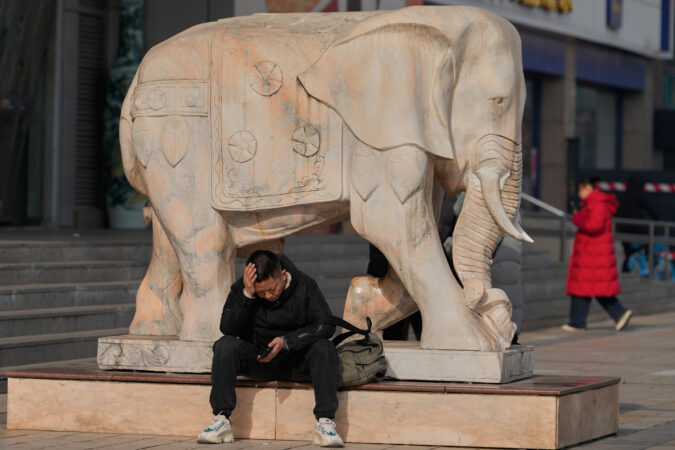
    Today, the country has more than 100 million households with only one person, according to an annual report from the National Bureau of Statistics of China in 2024.

    Consider Chen Xingyu, 32, who has lived on her own for years in Kunming, the capital of southern China’s Yunnan province. “It is new and funny. The name Are You Dead? is very interesting,” Chen said.

    Chen, a “lying flat” practitioner who has rejected the grueling, fast-paced career of many in her age group, would try the app but worries about data security. “Assuming many who want to try are women users, if information of such detail about users gets leaked, that’d be terrible,” she said.

    Yuan Sangsang, a Shanghai designer, has been living on her own for a decade. She’s not hoping the app will save her life — only help her relatives in the event that she does, in fact, expire alone.

    “I just don’t want to die with no dignity, like the body gets rotten and smelly before it is found,” said Yuan, 38. “That would be unfair for the ones who have to deal with it.”

    Is the app tapping into a particular angst?

    While such an app might at first seem best suited to elderly people — regardless of their smartphone literacy — all reports indicate that Are You Dead? is being snapped up by younger people as the wry equivalent of a social media check-in.

    “Some netizens say that the ‘Are you dead?’ greeting feels like a carefree joke between close friends — both heartfelt and gives a sense of unguarded ease,” the business website Yicai, the Chinese Business Network, said in a commentary. “It likely explains why so many young people unanimously like this app.”

    The commentary, by writer He Tao, went further in analyzing the cultural landscape. He wrote that the app’s immediate success “serves as a darkly humorous social metaphor, reminding us to pay attention to the living conditions and inner world of contemporary young people. Those who downloaded it clearly need more than just a functional security measure; they crave a signal of being seen and understood.”

    That name, though

    Death is a taboo subject in Chinese culture, and the word itself is shunned to the point where many buildings in China have no fourth floor because the word for four and the word for death sound the same — si. Lü acknowledged that the app’s name sparked public pressure.

    “Death is an issue every one of us has to face,” he said. “Only when you truly understand death do you start thinking about how long you can exist in this world, and how you want to realize the value of your life.”

    Early Friday, the app had disappeared from Apple’s App Store in China, at least for the time being. The developers wouldn’t say why, only that the incident “occurred suddenly.”

    A few days ago, though, the developers said on their official account on China’s Weibo social platform that they’d be pivoting to a new name. Their choice: the more cryptic Demumu, which they said they hoped could “serve more solo dwellers globally.”

    Then, a twist: Late Wednesday, the app team posted on its Weibo account that workshopping the name Demumu didn’t turn out “as well as expected.” The app team is offering a reward for whoever offers a new name that would be picked over the weekend. Lü said more than 10,000 people have weighed in.

    The reward for the new moniker: $96 — or, in China, 666 yuan.