Category: Nation World News Wires

  • Alan Greenspan, former Federal Reserve chairman, dies at 100

    Alan Greenspan, former Federal Reserve chairman, dies at 100

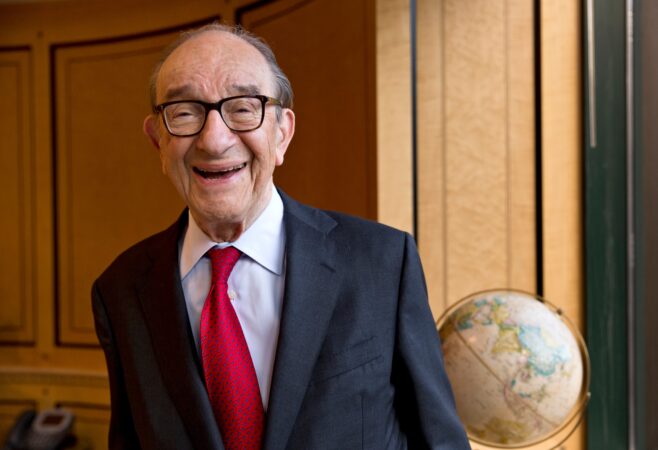
    WASHINGTON — Alan Greenspan, the jazz-playing U.S. Federal Reserve chair who was celebrated for engineering a decade of prosperity but later shared the blame for a devastating financial crisis, died Monday. He was 100.

    Mr. Greenspan died from complications of Parkinson’s disease, said his wife of 29 years, NBC News correspondent Andrea Mitchell.

    “To me he was my husband, who shaped my life from our very first date in 1984,” Mitchell wrote. ”He had ‘irrational exuberance’ for baseball, the Washington Commanders, tennis, golf, and music, especially jazz. He will be remembered for his brilliance and his kindness. Being his life partner was the joy of my life.”

    The Fed said Mr. Greenspan helped to cement trust in the Fed during a time of economic uncertainty.

    “Under his leadership, the Federal Reserve achieved a sustained era of price stability that supported economic growth and helped anchor the public’s confidence in the institution,” the central bank said in a statement Monday.

    Greenspan was hailed as “Maestro’’ — before crisis hit

    In 18½ years at the Fed, Mr. Greenspan presided over a breathtaking surge in stock prices and a 10-year economic boom that started in March 1991. He was celebrated as “Maestro’’ and “Oracle’’ — an economic virtuoso whose every utterance was dissected for clues on where interest rates and the economy were headed.

    The intense scrutiny of Mr. Greenspan’s intentions gave birth to new Fed folklore: the “Briefcase Indicator.” A stuffed briefcase carried into Fed meetings implied changes might be afoot because Mr. Greenspan carried with him charts and research to make his point.

    But his reputation began to suffer almost as soon as he left the Fed in 2006. American housing prices tumbled rapidly, causing huge losses for banks that had repackaged mortgage loans into a dizzying array of complex securities. The growing financial crisis pushed the U.S. economy into the Great Recession of 2007-2009 — the deepest downturn since the 1930s.

    Critics blamed the devastation on Mr. Greenspan’s easy money policies and his support for deregulated financial markets. Mr. Greenspan himself later acknowledged “I made a mistake’’ in assuming that banks could essentially regulate themselves.

    The authoritative voice on the U.S. economy

    For almost two decades, it seemed that Mr. Greenspan could do no wrong. Not only in the United States but across the world, he was regarded with a mixture of reverence and awe. Many openly dreaded the day when he would leave the Fed.

    Investors hung on his sometimes inscrutable observations. In the most well-known such remark, Mr. Greenspan sent financial markets reeling on Dec. 5, 1996, when he suggested with just two words — “irrational exuberance” — that stock prices were too high.

    Mindful of his power to move markets, Mr. Greenspan typically resorted to obfuscation. At times, he even joked about his habit of doing so. “I know you believe you understand what you think I said, but I am not sure you realize that what you heard is not what I meant,” Mr. Greenspan once told a befuddled congressional committee.

    Mr. Greenspan was one of the few Fed chairs that Kevin Warsh, chosen by Trump to lead the Fed, praised at his swearing-in last month. Warsh has said one of his goals is to dial back the Fed’s communications, particularly the guidance it gives financial markets, an approach closer to Mr. Greenspan’s than to Warsh’s immediate predecessors as chair.

    Yet for all his circumspect comments, Mr. Greenspan did make the Fed more transparent. He was the first chair to issue a statement explaining the Fed’s interest-rate decisions. Before Mr. Greenspan, investors had to divine the Fed’s intentions from market changes. Mr. Greenspan also began to release minutes and even full transcripts of meetings, though those changes were in response to pressure from Congress.

    A protégé is born

    Born in the Washington Heights neighborhood of Manhattan, the young Mr. Greenspan was a math whiz who was trotted out by his mother to show off for visitors.

    “I was a prop at parties,’’ he said in a 2007 interview with PBS NewsHour. A Julliard School dropout, he worked as a professional musician in his teens, playing clarinet and saxophone alongside the future jazz great Stan Getz. It was a humbling experience that persuaded the young Mr. Greenspan to seek another line of work.

    He pursued undergraduate and graduate study in economics at New York University, eventually earning a doctorate there. For most of three decades, he ran an economic consulting firm. During the 1950s, he became a disciple of the libertarian philosopher Ayn Rand, who stuck him with the nickname the “Undertaker’’ for his dark clothes and quiet bearing. When Mr. Greenspan was sworn in as President Gerald Ford’s chief economic adviser in 1974, Rand stood beside him.

    An early trial for a new Fed chair

    President Ronald Reagan tapped Mr. Greenspan to run the Fed in 1987. He was tested almost immediately. On Oct. 19, 1987, which came to be known as “Black Monday,” the stock market suffered the worst one-day percentage loss in American history just two months into his term. The Dow Jones Industrial Average plunged 22.6% for reasons that remain opaque to this day.

    Mr. Greenspan was credited for helping restore stability. He assured Wall Street that the Fed would supply as much money to the financial system as was needed to restore calm. Stocks recovered, and the American economy emerged unscathed by the market crash.

    During his tenure at the Fed, Mr. Greenspan drew praise for presiding over what was at the time the longest economic expansion in American history. (It was later surpassed by a 128-month expansion that ran from June 2009 through February 2020.) During Mr. Greenspan’s tenure at the Fed, the nation’s unemployment rate briefly dropped below 4% for the first time since 1970.

    And inflation, which had bedeviled the United States and much of the global economy during the 1970s, was remarkably dormant during Mr. Greenspan’s chairmanship, something many economists thought impossible for so long a period.

    During the long boom, Mr. Greenspan argued that improvements in technology had made the economy so efficient that it could run faster and at lower rates of unemployment, without unleashing inflation. As a consequence, the theory went, the Fed could keep interest rates low even when the economy was roaring.

    The economy soared in the late 1990s, expanding by 4% or more for four straight years, and Mr. Greenspan was credited with holding off on rate hikes and allowing the boom to run.

    Warsh has said that AI could reproduce the 1990s experience of high growth with low inflation, though economists are skeptical it will play out the same way.

    A passion for numbers and life

    As Fed chair, Mr. Greenspan relished poring over obscure economic data, from monthly boxcar loadings to steel production, all in a bid to assess where the economy was going. He would often phone economists at other government agencies to discuss details. He would rise early each morning for a two-hour soak in his bathtub, time that he used to review statistics and Fed staff memos.

    Improbably, Mr. Greenspan also made the gossip pages as an unlikely ladies’ man. He dated the television journalist Barbara Walters and later married Mitchell after a 12-year courtship. They had no children. Mitchell graduated from the University of Pennsylvania and worked for KWY radio and TV. She founded the Andrea Mitchell Center for the Study of Democracy in 2017.

    Mr. Greenspan dated Walters while working as an adviser to President Gerald Ford. According to a biography of Mr. Greenspan, The Man Who Knew by Sebastian Mallaby, when Ford read a newspaper item about the pair, he cut it out and sent it to his chief of staff, Dick Cheney, with a note that said, “I don’t believe it.”

    Faith in self-regulating markets is challenged

    All along, Mr. Greenspan held fast to the belief that financial markets could largely regulate themselves. With officials from President Bill Clinton’s White House, he helped block efforts by Brooksley Born, the nation’s top commodities regulator, to bring federal oversight in the late 1990s to the shadowy market in over-the-counter derivatives. The derivatives allowed speculators to make bets on everything from the price of oil to high-risk mortgages.

    Eventually, history would vindicate Born, not the Maestro.

    The low interest rates Mr. Greenspan had engineered helped swell housing prices into a dangerous bubble. And the financial deregulation he supported allowed banks and other financial firms to pile up huge risks, often hidden from government supervision. Bad derivatives bets helped sink insurance giant American International Group, which required a $180 billion taxpayer bailout. Vaunted investment firms Bear Stearns and Lehman Brothers failed and U.S. financial markets nearly collapsed.

    The Financial Crisis Inquiry Commission, which was assigned to investigate the debacle by Congress, concluded:

    “More than 30 years of deregulation and reliance on self-regulation by financial institutions, championed by former Federal Reserve chairman Alan Greenspan and others … had stripped away key safeguards, which could have helped avoid catastrophe.”

    Life after the Fed

    In the years after stepping down as Fed chairman in 2006 just shy of his 80th birthday, Mr. Greenspan kept busy doing what he loved to do most — following the economic data. He ran his own consulting firm, Greenspan Associates, through which he dispensed advice to Wall Street clients and collected handsome speaking fees.

    He kept up a busy schedule well into his 90s, writing his memoir and two other books on the economy, as well as opining on the latest economic developments on television news shows.

    He also signed onto opinion articles and statements defending the Federal Reserve’s political independence from President Donald Trump’s ongoing attacks. In January 2026 he signed a statement criticizing the Trump administration’s investigation of Fed Chair Jerome Powell. The statement, which was also signed by two other former Fed chairs and five former Treasury secretaries, called the investigation “an unprecedented attempt to use prosecutorial attacks to undermine” the Fed’s independence and warned it would have “highly negative consequences for inflation.”

    In his 2013 book The Map and the Territory, Mr. Greenspan defended himself against critics who assigned him significant blame for the 2008 financial meltdown. He argued that traditional economic forecasting was no match for the irrational risk-taking that can feed catastrophic price bubbles.

    “Bubbles go up very slowly as euphoria builds,” Mr. Greenspan said in a 2013 interview with the Associated Press. “Then fear hits, and it comes down very sharply. When I started to look at that, I was sort of intellectually shocked.”

  • Quarantine comes to an end for the last of the hantavirus ship passengers in Nebraska

    Quarantine comes to an end for the last of the hantavirus ship passengers in Nebraska

    OMAHA, Nebraska — The last eight American passengers who endured 42 days in a specialized hospital quarantine unit after exposure to an unusual hantavirus outbreak on a cruise ship that killed three people have left the Nebraska facility.

    U.S. Department of Health and Human Services officials on Monday confirmed the end of the quarantine.

    “Through close collaboration among federal, state, and local partners, HHS helped protect the American people, contain potential risks, and bring this response effort to a successful conclusion,” HHS spokesperson Emily Hilliard said in an email.

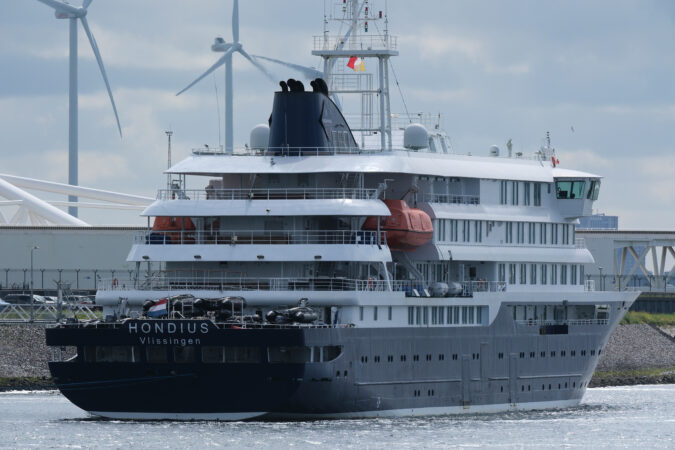
    More than 120 people were evacuated from the MV Hondius in Spain’s Canary Islands early last month — including the 18 Americans who wound up in the National Quarantine Unit in Omaha — though most were from other countries.

    In addition to those people evacuated by health officials in full protective suits, at least 30 other passengers had left the ship earlier before the outbreak was documented. That included seven Americans, who were allowed to monitor for any symptoms at home. When the ship eventually docked in the Netherlands, 25 crew members and two medical personnel were on board and had to quarantine.

    The World Health Organization didn’t immediately respond Monday to questions about the status of all the other people who had to quarantine around the globe. A total of 13 cases of the virus, including the three who died, were identified among people who were on the ship.

    Most Americans returned home but some were forced to quarantine

    One of the American passengers, Angela Perryman, had been held against her will and against the recommendation of a government medical expert. She said in an interview Monday passengers were told that the quarantine monitoring period ended Sunday at 2 p.m. She left on a flight that evening. Others were flying out Monday, she said.

    “We were locked in our rooms until 1:55. And at 2 o’clock, ‘OK, well, everybody walk out and go home,’” Perryman said, speaking from her Florida home.

    Some stayed the night elsewhere in Omaha, but Perryman pushed for a flight home that evening. The government paid for the flights, she said.

    Seven of the last remaining patients stayed there voluntarily, but Perryman was forced to stay as the result of a controversial quarantine order that was deemed unnecessary even by some health officials.

    Perryman and seven others spent six weeks at the National Quarantine Unit at the University of Nebraska Medical Center. That monitoring period was set because symptoms of hantavirus have taken as long as 42 days to appear in previous outbreaks. None were reported to have developed the illness.

    Ten others who were at the facility were allowed to leave earlier under an agreement that they would be closely monitored in their home states.

    Outbreak developed on a small cruise ship

    The passengers were on a Dutch cruise ship, the MV Hondius, traveling in the South Atlantic that became the setting of a hantavirus outbreak that killed three people, including a Dutch couple who health officials believe were the first exposed to the virus while visiting South America.

    Hantaviruses usually spread when people inhale contaminated residue of rodent droppings, but the hantavirus that caused the outbreak, called the Andes virus, may be able to spread between people in rare cases, health officials say.

    Some 25 Americans were on the ship, including about seven who disembarked in April and 18 who remained on board. Sixteen were evacuated to the Nebraska quarantine unit in Omaha on May 11, and two other Americans joined them a few days later.

    Passengers staying in Omaha enjoyed Nebraska hospitality

    During the passengers’ stay, local Omaha restaurants and food trucks delivered special meals for them to enjoy almost daily. And the nurses sometimes made Starbucks runs to deliver some of the passengers’ favorite drinks.

    The rooms they stayed in are like hotel rooms equipped with a desk, television, internet connection, and exercise equipment to help the passengers pass the time.

    One of the passengers, Jake Rosmarin, on Monday morning posted an “I’m finally coming home” video that showed him leaving his room at the quarantine center, hauling two suitcases and a backpack and turning out the lights as he walked out the door. Later Monday, he posted a video of the Omaha skyline shot out the window of his plane as he headed home to his fiance in Boston and his family.

    Rosmarin, who is a travel blogger, posted a tearful video Sunday thanking the staff of the quarantine unit, the Omaha community, and his family and friends who helped him get through quarantine.

    “I want to thank the Omaha, Nebraska, community for welcoming us with open arms and showing us complete kindness and generosity. And a big thanks to all of you who have helped me get through this because I really don’t know if it would have been as easy without the support from strangers,” he said while wearing a Nebraska Huskers sweatshirt that someone sent him.

    Florida wouldn’t agree to monitor passenger round the clock

    Perryman had a darker take. She was forced to stay after Florida officials refused a federal demand that the state provide round-the-clock surveillance on her if she were returned home. This happened even as they had started making travel arrangements for the passengers weeks ago, she said.

    “Nobody actually expected anybody to get sick at that point,” she said. “Everybody was well aware that we were all going home on commercial flights.”

    She called the six-week quarantine “a political stunt.”

  • Confirmed Ebola cases in Congo outbreak top 1,000 with 254 deaths, authorities say

    Confirmed Ebola cases in Congo outbreak top 1,000 with 254 deaths, authorities say

    BUNIA, Congo — Confirmed cases in the Ebola outbreak in eastern Congo have reached 1,003, including 254 deaths, officials said, as tracing those who had been in contact with patients remains a major challenge.

    A total of 100 people have recovered in the outbreak concentrated in the Ituri province since it was declared on May 15, Congo’s Ministry of Health said Sunday. At least 365 patients are in hospitals or in isolation, it said.

    The Ebola outbreak caused by the rare Bundibugyo virus, which has no vaccines or treatment, was the worst ever in its first month. Officials admit there could be far more cases they still don’t know about and that the peak of the outbreak is still ahead.

    Contact tracing remains a key issue for local authorities, who have only achieved a 55% coverage rate, the ministry said.

    “If you want to control an outbreak, especially Ebola outbreak, you must know the index case. We don’t have confidence on when this outbreak started,” the Africa Centers for Disease Control and Prevention Director-General Jean Kaseya told the Associated Press last week.

    Officials also are yet to identify the patient zero and trace more than 35,000 people who have come in contact with infected individuals as of last week, authorities said.

    That’s partly because eastern Congo is also battling ongoing violence from rebels. In Ituri, attacks by the Islamic State group-backed Allied Democratic Force have cut off access to many villages and forced people to flee their homes, including those sheltering in overcrowded camps and others constantly on the move.

    More than a month into the outbreak, officials believe the disease continues to outpace response efforts and no one knows its true scale.

    Displaced persons at risk

    At the Kigonze displacement camp in Bunia, the capital of Ituri province, camp officials said Friday that 10 people had died last week in unusual circumstances, raising the fear of a possible outbreak in the camp of over 20,000 displaced people.

    There had been no Ebola case confirmed at the site, camp officials said, but added that the death rate was unprecedented and called for investigation.

    The U.N. refugee agency has said at least 2 million people forcibly displaced from their homes, including over 320,000 refugees, live in areas at risk of Ebola in Congo.

    In a statement on Friday, the agency said it was “deeply concerned by the accelerating spread” of the virus and “the growing risks it poses to displaced communities across the region.”

    “If a disease or epidemic were to spread among the thousands of people living at this (Kigonze) site, it would be a real catastrophe given our already very precarious living conditions,” said Charité Banza, a civil society leader in Ituri.

  • Top Justice Department officials can remain part of prosecution of press gala attack, judge rules

    Top Justice Department officials can remain part of prosecution of press gala attack, judge rules

    WASHINGTON — A federal judge on Monday denied a request to disqualify top Justice Department officials from supervising the prosecution of the man charged with trying to kill President Donald Trump at the White House Correspondents’ Association dinner.

    Cole Tomas Allen had argued that involvement in his prosecution by Acting Attorney General Todd Blanche and District of Columbia U.S. Attorney Jeanine Pirro created a potential conflict of interest because they were among many administration officials present at the April dinner. Allen’s attorney also had raised concerns about the close friendship between Trump and Pirro, a former Fox News commentator.

    U.S. District Judge Trevor McFadden wrote in his ruling that neither their attendance at the dinner nor Pirro’s personal relationship with the president merited their disqualification. McFadden noted that Allen is not charged with attempting to harm Blanche and Pirro, and there is no evidence to suggest he even knew they would attend the dinner.

    “They are unlikely to be trial witnesses, nor do they meet the legal definition of victims,” wrote McFadden, who was nominated to the bench by Trump.

    Allen has been accused of trying to breach a security checkpoint armed with guns and knives. He has pleaded not guilty to various charges, including assaulting a federal official with a deadly weapon and attempted assassination of the president. He faces a maximum sentence of life in prison if convicted of the attempted assassination charge alone.

    Allen also is accused of firing a shotgun at a Secret Service agent during the attack, which disrupted and ultimately prompted an early end to one of the highest-profile annual events in the nation’s capital. The Secret Service officer who was shot once in a bullet-resistant vest fired his own weapon five times without hitting anyone. Allen, of Torrance, Calif., was injured but was not shot.

  • Trump-endorsed de la Espriella holds slim lead in Colombia’s election as rival challenges vote

    Trump-endorsed de la Espriella holds slim lead in Colombia’s election as rival challenges vote

    BOGOTA, Colombia — Conservative political outsider Abelardo de la Espriella held a narrow lead Monday with almost all votes counted in Colombia’s polarized presidential runoff, as the ruling party’s progressive candidate vowed to challenge the results.

    De la Espriella, a business owner and lawyer who earned U.S. President Donald Trump’s endorsement despite never having run for office, led with 49.7% of the votes over lawmaker Iván Cepeda, with 99.9% of results released by electoral authorities. Cepeda, ally of outgoing President Gustavo Petro, had 48.7%.

    Election officials have not formally announced a winner.

    A victory by de la Espriella is expected to usher in policies that will reverse Petro’s agenda, including a contentious plan to hold parallel peace negotiations with illegal armed groups. Cepeda, Petro’s protégé, had pledged to push forward that strategy and other social reforms if he won Sunday’s vote.

    The election was colored by people’s fears of renewed internal conflict.

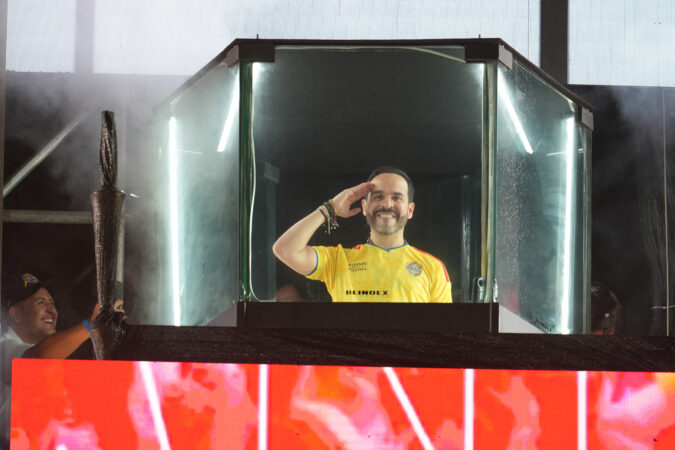
    “I will govern for all Colombians,” de la Espriella, nicknamed “The Tiger,” told thousands of supporters as he stood behind bulletproof glass in the northern city of Barranquilla on Sunday night. But his conciliatory tone changed as he spoke.

    “Pack your bags and prepare to become the opposition,” he added. “Make no mistake, Mr. Cepeda. You already know how fiercely the tiger roars.”

    Progressive candidate calls count “unofficial”

    Cepeda on Monday responded to de la Espriella’s remarks, warning him against threats, veiled or otherwise.

    “Let me be perfectly clear: We are half of this country in political terms, and we have a long history of resistance,” Cepeda said in the capital, Bogota. “We are very hardened. Don’t come threatening us. Neither your roars nor your screams frighten us.”

    He asked supporters to remain calm and maintain “exemplary behavior.” Hours earlier, people in the western city of Cali took to the streets, damaging a public bus, several surveillance cameras, and an ATM.

    The vote count showed that the municipality that includes Cali favored Cepeda with nearly 60%. Authorities there said four police officers were injured in the protest and two demonstrators were arrested.

    After the results became public Sunday, Cepeda characterized the count as “unofficial and non-binding” and announced that his team was challenging results from more than 30,000 voting stations. Petro also vowed to challenge the outcome.

    No recount has flipped the results of a presidential election in Colombian history.

    Sunday’s winner will begin a four-year term Aug. 7.

    The candidates pitched voters widely different strategies to protect the South American country from the nonstop violence, such as car bombs, kidnappings, disappearances, and forced displacements, that Colombians have lived with in previous decades.

    De la Espriella, 47, promised a heavy-handed approach to crime-fighting, including drug trafficking. He also said he plans to end Petro’s attempts to establish dialogue with multiple armed groups — an effort that has largely failed — and to build mega-prisons, emulating Salvadoran President Nayib Bukele’s aggressive policies. Those tactics have lowered homicide rates in the Central American country but have fueled accusations of human rights abuses.

    De la Espriella holds dual Colombian and U.S. citizenship. He’s a Trump supporter and a member of the Republican Party.

    “He Won, BIG!” Trump said on social media.

    ‘It’s always the same violence’

    Yolanda Hernández, who recycles trash for a living, voted for Petro in 2022 but cast her ballot for de la Espriella this time. While she acknowledged that Petro was unable to deliver on promises meant to help the poor because of congressional gridlock, she said Colombia cannot afford another four years under his vision for the country.

    “We want change in Colombia because it’s always the same violence, always the same thing,” Hernández, 49, said. “(Petro) said he was going to lower the cost of services, that he was going to lower the price of food, and everything is more expensive.”

    More than 426,000 voters chose a third, no-name option on the ballot meant to allow people to express dislike of both candidates. Another 29,000 voters cast blank ballots.

    Will Freeman, a fellow for Latin American Studies at the Council on Foreign Relations, said Sunday’s result shows the country “has not shifted overwhelmingly or decisively” against Petro’s project or for de la Espriella’s outsider “iron fist showmanship.”

    Freeman said the result also underscored Colombia’s regional divisions.

    “It’s regional, not just ideological, polarization; or rather, the two overlapping,” he said. “Ironically, de la Espriella’s iron-fist message performed best in the core of the country, not the periphery, which bears the brunt of Colombia’s violence.”

    Colombia’s illegal groups have more than 27,000 members.

    Last year, authorities recorded 14,780 homicides, the most since at least 2015, driven by clashes among illegal armed groups. Among those killed was conservative presidential hopeful Miguel Uribe.

  • Federal judge halts Trump administration effort to subpoena Walz in immigration enforcement probe

    Federal judge halts Trump administration effort to subpoena Walz in immigration enforcement probe

    A federal judge has blocked an attempt by the Trump administration to subpoena Minnesota Gov. Tim Walz and other state officials, calling it an effort to “harass and retaliate against them.”

    In a ruling unsealed Monday, U.S. District Judge Patrick Schlitz found the “dominant purpose” of the subpoenas was to “coerce Minnesota officials into assisting the federal government with enforcing civil immigration law and to harass and retaliate against them for failing to do so.”

    The subpoenas seeking records were served in January as part of an investigation into whether Walz and other officials obstructed or impeded law enforcement during a sweeping immigration operation in the Minneapolis-St. Paul area. They were sent to the offices of Walz, Attorney General Keith Ellison, Minneapolis Mayor Jacob Frey, St. Paul Mayor Kaohly Her, and officials in Ramsey and Hennepin counties.

    The ruling is the latest rebuke by the federal judiciary of Justice Department efforts to aggressively implement the Trump administration agenda in courts and target the president’s political adversaries through subpoenas and similar demands.

    The judge ruled that there appeared to be “extremely weak to nonexistent” connections between the information sought in the subpoenas and any possible criminal violation. The subpoenas seek materials “that largely if not entirely relate to constitutionally protected conduct,” the judge wrote, noting that Minnesota has the legal right not to devote its resources to enforcing federal immigration law.

    The Justice Department “is not conducting a criminal investigation,” the judge wrote, “but is instead using the grand jury process for other (unlawful) purposes.”

    The evidence that the subpoenas were issued for unlawful reasons is overwhelming, the judge said, arguing that the Justice Department “has struggled — without success — to identify a single plausible investigatory justification” for them.

    The Justice Department didn’t immediately respond to an email seeking comment.

    Walz, in a statement, called the ruling “a victory for the rule of law and our democracy.”

    “The U.S. Justice Department is pursuing criminal investigations into the President’s political opponents,” said Walz, the 2024 Democratic nominee for vice president. “This case was just one example of that, but we are seeing daily reminders of this administration’s lawlessness — in Minnesota and around the country. We all must continue to seek justice and uphold the rule of law.”

    Ellison said “it should disturb every American that Donald Trump is weaponizing the criminal justice system against people he disagrees with.”

    The subpoenas were “a politically motivated retaliation against our city for lawfully standing up to ICE and fighting for our residents,” Her said in a statement, referring to U.S. Immigration and Customs Enforcement.

    Frey said the investigation was “never about justice, law, and order, but the absence of it.”

    “Subpoenaing political opponents because they spoke on behalf of their constituents violates the core tenets of our democracy and human decency,” he said.

    Frey also observed that criticizing government action is not a crime.

    “One of the defining strengths of our democracy is the ability to challenge those in power without fear of retribution. Elected officials have both the right and the responsibility to speak honestly about how government decisions affect the people they serve,” he said.

    Over the last year, judges have dismissed indictments against two prominent Trump foes, former FBI Director James Comey and New York Attorney General Letitia James, and grand juries have repeatedly refused to return indictments sought by the Justice Department.

    The moves reflect mounting public concerns that the Justice Department, an institution meant to make investigative and prosecution decisions independent of the White House, is being politicized under the current Trump administration.

    Vice President JD Vance has separately called on the Justice Department to investigate Walz and Ellison over allegations they failed to stop widespread social services fraud, though the department has not said whether it will open an investigation. Walz and Ellison have described those allegations as politically motivated and defended their efforts to combat fraud in Minnesota.

  • Wyndham Clark avoids record collapse and holds on to win the U.S. Open

    Wyndham Clark avoids record collapse and holds on to win the U.S. Open

    SOUTHAMPTON, N.Y. — Wyndham Clark couldn’t remember being in a darker place. He was publicly reviled for a moment of petulance when he smashed a locker at Oakmont after missing the cut in the U.S. Open last year. His game, his reputation, he felt it all was slipping away.

    Sunday at Shinnecock Hills wasn’t much better. The New York crowd behind Scottie Scheffler in his bid for a career Grand Slam turned on Clark, cheering his misses and wishing for the worst.

    That’s what made this U.S. Open title so much sweeter.

    On the edge of the greatest collapse in U.S. Open history, Clark held his nerve against a charge by Sam Burns and a Shinnecock Hills crowd that never gave him much love until he showed his mettle with his second U.S. Open title in four years.

    “The first one was kind of just the breakthrough of knowing I can do it,” Clark said after a two-putt par from 50 feet for a 3-over 73 and a one-shot victory. “And then this one was a lot of redemption. Last year was so tough, a terrible year. I left this place in shambles, and it’s amazing what a year can do. I’m leaving here this Sunday as a champion, and I’m just so blessed.”

    Clark, who won the 2023 U.S. Open at Los Angeles Country Club, became the first wire-to-wire winner of the U.S. Open since Martin Kaymer at Pinehurst No. 2 in 2014.

    This sure didn’t feel like a stroll through the Hamptons.

    He had the largest 54-hole lead in the U.S. Open in 15 years. It was down to a single shot in just five holes, and stress followed him the rest of the way.

    The clincher for Clark was on the par-5 16th, where on Saturday he made the only eagle of the week. This time it was his worst drive, well left into the gnarly fescue. He gouged that out and narrowly cleared a bunker. His 8-iron barely stayed on the back of the green. He rolled in a 30-foot birdie putt for a two-shot lead with two holes to play.

    It was a signature moment with muted applause. The gallery rooted against him all day, putting all their support behind Scheffler, who made his own share of mistakes and never got closer than three shots of Clark all day.

    “Winning major championships is extremely difficult,” Scheffler said after a 71 to tie for fourth. “He had some stones down the stretch. … Being in the arena is not for everybody, and I think it shows a lot about Wyndham, how he handled not only this golf course but I think the crowd today. And he is a well-deserving champion.”

    Clark had the highest final round of a U.S. Open champion since Graeme McDowell closed with a 74 to win at Pebble Beach. No matter. The 32-year-old American has two U.S. Open titles, and two wins in the last month.

    Burns closed with a 67, his second chance in as many years to win the U.S. Open. He bounced back from a three-putt bogey on the 15th with an 18-foot birdie to stay within one shot. He made a weak pass at a 10-foot birdie putt to tie for the lead on the 17th. What haunts him is a 17-foot birdie chance on the 18th that grazed the right edge of the cup, causing him to drop to his knees.

    “I would say last year at Oakmont I felt more I lost the golf tournament. I certainly don’t feel that way today,” Burns said. “I did everything I could to have a chance to win today.”

    Clark finished at 4-under 276 and got a surprise at the end when his father, Randall, took an overnight flight from Denver to watch his son win for the first time.

    Even the New York crowd had no choice but to salute him.

    “New York didn’t really like me — I love you guys,” Clark said at the closing ceremony, hoisting the silver trophy. “But I get it. Some of it’s self-deserved. I did some unfortunate things last year that I really regret, and I’ve been sorry multiple times and I’m still sorry, so hopefully I can win you guys over eventually.”

    Clark noticed fans leaving early on Saturday and hoped for a big crowd and big energy for the final round. He got every bit of that, and it was uncomfortable at times. One was ejected when he shouted, “Don’t choke, Wyndham.” The grandstand behind the seventh green broke into cheers when his shot rolled off the green and into the bunker.

    “I get it — they were rooting for Scottie,” Clark said. “Grand Slams only happen a few times. He’s going to get it. He’s the best player in the world. But today it’s my day.”

    It almost wasn’t.

    But Burns never caught him. No one did.

    Tom Kim, who like Scheffler celebrated a birthday on Sunday, was on the fringes of seriously contending until he fell back with a bogey on the 17th and shot 70 to finish third.

    Clark’s hit a superb wedge that spun back to 4 feet for birdie on the 10th to restore the lead to two shots. But then he went long on the 13th with a pitching wedge and couldn’t save par. And then came his big moment on the 16th, and one last act of lagging a 50-foot putt to tap-in range.

    That’s how it was at Los Angeles in 2023, when he needed two putts from 60 feet and lagged it close. Clark simply is at his best against tough tests, and rough arenas. Three years ago, he denied Rory McIlroy. This time it was Scheffler.

    “The first one was amazing, and this one seems even better,” Clark said. “I think especially after such a sour taste last year in this championship, to have some redemption and win this again is almost surreal.”

    A month ago, he was two years without a win and No. 75 in the world. Then he shot 60 in the final round to win The CJ Cup, contended the next two weeks and won his second major. It moves him to No. 8 in the world.

    The smile he wore holding that U.S. Open trophy would suggest he feels on top of the world.

  • Ukrainian attacks prompt Russian-held Crimea to halt civilian gasoline sales

    Ukrainian attacks prompt Russian-held Crimea to halt civilian gasoline sales

    Officials in Russia-occupied Crimea suspended civilian gasoline sales Sunday as Ukraine ramped up attacks on fuel supplies on the Black Sea peninsula.

    Gov. Sergey Aksyonov, the Kremlin-appointed head of Crimea, said that overnight Ukrainian strikes killed four people and wounded 28 others. He did not specify the target of the attack.

    He later wrote on social media that local gas stations would halt all sales to nonstate companies and individuals for an undefined period.

    “Fuel will be sold only to government agencies that ensure the functioning and security of the Republic of Crimea,” Aksyonov said. “I ask everyone to remain calm and to only trust official sources of information.”

    Ukrainian forces have repeatedly targeted fuel supplies to Crimea in recent weeks, triggering the worst energy crisis in the region since it was illegally annexed by Russia in 2014.

    Ukrainian President Volodymyr Zelensky said in a statement Sunday that a Crimean oil depot as well as an oil transport facility in Russia’s southern Krasnodar region were among the targets. He described the attacks as part of Ukraine’s “long-range sanctions” against Russia’s energy infrastructure.

    “Russia understands only strength, and our long-range strength is certainly working for peace,” he wrote.

    Russian officials in Krasnodar reported earlier Sunday that a drone strike sparked a fire at a Black Sea oil terminal in the village of Chushka. They said that Ukrainian attacks struck a ferry, killing one person.

    Motorists struggle to find fuel

    The Crimean peninsula has had periodic fuel shortages from Ukrainian strikes before, but the current crisis is the worst since its 2014 annexation.

    At the end of May, authorities restricted the sale of gas to 20 liters (5⅓ gallons) per vehicle owner per week, using prepaid coupons. Those were snapped up immediately following their release on an official messaging app channel, and motorists lined up for hours, waiting to refuel.

    Social networks have been abuzz with requests and advice on where to find fuel, and authorities launched a hotline for tourists in the area who have found themselves trapped.

    Some motorists bring their own gas from Krasnodar and elsewhere via the Kerch bridge, but they are restricted to carrying 100 liters (about 26½ gallons) per vehicle. Some speculators are selling gas at double the market price.

    In a rare public acknowledgment, the Kremlin has recognized the scope of the problem and promised to address the issue quickly.

    However, Ukraine’s successes have highlighted its ability to inflict painful damage on Russia and change the course of the conflict while Moscow’s advances recently have ground to a near halt. On June 11, Russia’s full-scale invasion of Ukraine reached its 1,569th day, surpassing the duration of World War I.

  • Trump post seems to push Starmer to resign

    Trump post seems to push Starmer to resign

    LONDON — President Donald Trump appeared to scoop Downing Street on Sunday, announcing that Prime Minister Keir Starmer would resign before any public statement from Starmer himself.

    “Keir Starmer will resign as Prime Minister of The United Kingdom,” proclaimed in a social media post, in which he also asserted that Starmer had “failed badly” on immigration and energy policy.

    Then, Trump added: “I wish him well!”

    Doubts about Starmer’s political future have swirled for weeks since his Labour Party suffered staggering losses in local elections in May, and prospects of a leadership challenge increased markedly on Friday after his most formidable rival, Greater Manchester Mayor Andy Burnham, won a special election for an open seat in parliament.

    Earlier on Sunday, British media had reported that Starmer was considering resigning. Still, Trump’s intervention represented an extraordinary foray into British domestic politics that left some veteran political observers stunned.

    “There is literally no boundary this American president will not bulldoze through,” ITV’s Robert Peston wrote on X.

    Peston also cited a cabinet minister who said that, despite Trump’s “scoop,” Starmer had “genuinely not made a decision to quit.”

    Broadcaster Piers Morgan called it “the final humiliation.”

    Downing Street told the Washington Post on Sunday evening that Starmer and Trump had not spoken over the weekend, raising questions about how the U.S. president came to make such a definitive prediction.

    But it also didn’t mean Trump was wrong about Starmer’s plans. A senior Labour Party MP told the Post on Sunday evening that some Labour Party lawmakers were “being briefed that he will step down tomorrow and that he realizes his position is untenable.”

    Speaking on the condition of anonymity because she wasn’t authorized to discuss the matter publicly, she added that Starmer “no longer has the confidence” of his peers and that it was “only right that he now steps aside.”

    However Trump reached his conclusion, the president’s ties with close European allies are increasingly strained. In recent days, Italian Prime Minister Giorgia Meloni accused Trump of lying after he claimed she had “begged” to have her photograph taken with him.

    Relations between Starmer and Trump have been rocky for months.

    Earlier this year, Trump branded Starmer “no Winston Churchill” during a dispute over Britain’s support for U.S. strikes on Iran, and the two leaders did not hold a bilateral meeting at the Group of Seven summit in France last week.

    Starmer led the Labour Party to a landslide election victory just two years ago, but has faced increasing pressure from within his own party and growing calls for him to step aside since the local elections in which Labour and the Conservatives lost badly to Reform UK, the populist party led by Nigel Farage, one of the key architects of Brexit, the U.K.’s departure from the European Union.

    Starmer on Friday vowed to fight any leadership challenge. He has not commented publicly on the matter since then, but briefings from senior lawmakers have suggested that he spent the weekend weighing his position.

    Some commentators have suggested that the question is no longer if Starmer will leave, but how, and when.

    The focus, they say, has shifted to choreography — whether Labour will stage a full leadership contest, with figures such as Wes Streeting, the former health secretary, also entering the race — or rally around a single successor.

    British politics have been remarkably unstable since the 2016 Brexit referendum. If Starmer does announce his resignation, it would usher in Britain’s seventh prime minister in a decade.

    In the special election last week, Burnham won a decisive victory against a Reform UK opponent — a win that for many Labour lawmakers provided a test case of whether Burnham could help reverse Labour’s dire poll ratings of late.

    Starmer, for his part, took to social media on Sunday only to comment on Father’s Day. “Being a dad is my great joy,” he wrote.

  • France restricts public drinking and outdoor sports as heat wave bakes parts of Europe

    France restricts public drinking and outdoor sports as heat wave bakes parts of Europe

    PARIS — France sizzled Sunday, canceling trains, concerts, and sports events and cracking down on public drinking as an exceptional heat wave unfurled across parts of Europe. Multiple drownings were reported as people sought relief in whatever water they could find.

    About a third of France is under ‘’red alert″ heat and temperatures reached 104 degrees Fahrenheit in some areas, in a country where air-conditioning isn’t widespread. The forecast for Monday is even hotter.

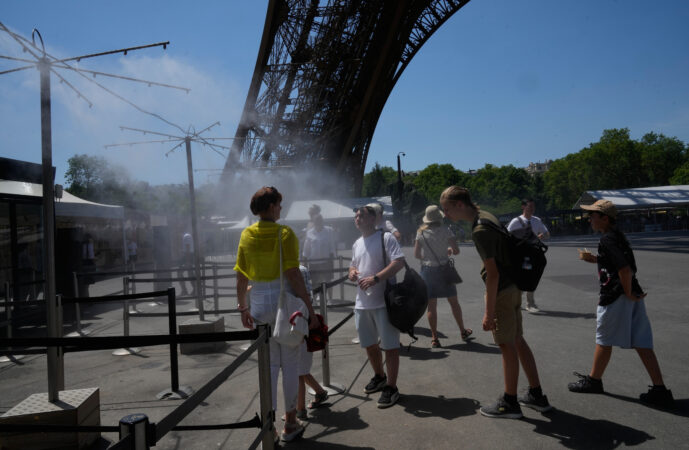
    The Eiffel Tower and other Paris venues set up misting stations to cool crowds, among a raft of measures introduced by authorities to minimize risks. Tourists in Rome dunked in fountains. Spain’s Basque Country canceled some sports and cultural events.

    More than 200,000 people across Europe died from heat-related causes over the last four years, and most of the fatalities were preventable, the World Health Organization’s Europe office said this month. More above-average temperatures are expected this summer, which can cause heat exhaustion and life-threatening heat stroke.

    Human-caused climate change is tied to increasing extreme weather events and U.N. climate agency projections say the next five years should shatter more heat records. A rapid study found that human-caused climate change was responsible for killing about 1,500 people in an unusually early European heat wave in May.

    In this latest European hot spell, French media reported that four children drowned Saturday. Summer drownings are an annual problem that health authorities say worsens during hot spells.

    Solstice parties draw large crowds in extreme heat

    France’s annual Music Day on Sunday was of particular concern. The nationwide summer solstice celebration involves thousands of concerts in village squares, rave venues, and Paris clubs, bringing communities together and increasingly drawing British and other international visitors. Some of the concerts outside Paris were canceled.

    The French government banned public drinking in ’’red alert″ zones, and ordered organizers of music day events to limit alcohol consumption to “preserve emergency services and allow medics to concentrate on taking care of the most vulnerable.”

    Scores of French trains were canceled, and the national rail authority dispatched thousands of extra staff to deal with potential problems as the heat threatened rails and electrical cables.

    Authorities are notably worried about people living in the baking streets, and elderly people in nursing homes or isolated in their homes. About 15,000 older people died in France in a 2003 heat wave that became a national reckoning.

    The government mobilized emergency services and military forces for reinforced wildfire readiness, imposed tightened surveillance of water supplies to France’s many nuclear reactors, and ordered 845 schools to close Monday.

    Spain, Italy, Germany swelter as tourists seek relief

    Spain kicked off the summer with large parts of the country on alert due to temperatures expected to hover around 104 F — even in the interior of Basque Country, a northern region that typically experiences cooler temperatures.

    Authorities have suspended outdoor sports and cultural activities in the region. The heat wave is expected to scorch Spain at least through Wednesday.

    In Italy, authorities expanded heat warnings — referred to locally as “red flags” — to eight cities Sunday in northern and central parts of the country. Temperatures there are mostly in the high 90s to low 100s F.

    At one farm outside Milan, owners set up fans and sprinklers to keep cows cool, while visitors to Milan Fashion Week huddled under parasols and clutched fans. In Rome, tourists dunked their arms and occasionally their faces into the city’s famed fountain pools.

    The German Weather Service is forecasting temperatures of up to 98 F for Monday and Tuesday, and up to 102 F Wednesday.

    A 23-year-old man drowned Saturday in a lake near Rheinstetten in the southwestern region of Baden-Württemberg, the German news agency dpa reported. Three other people are missing after swimming in the Rhine River, a police spokesperson told dpa.

    Britain’s weather office has issued an “extreme heat” warning for much of southern England and parts of Wales from Monday until Thursday, saying temperatures could reach 100 F. The current record for a June day is 96 F, reached in 1976.

    Thunderstorms also threatened regions in Germany and Poland.

    French Prime Minister Sebastien Lecornu convened a new government heat crisis meeting Sunday, and ordered government ministers to plan for better adapting France to heat waves in the future — including “via air-conditioning, if necessary.”