Category: Wires

  • Trump says Board of Peace will unveil $5 billion in Gaza reconstruction pledges at inaugural meeting

    Trump says Board of Peace will unveil $5 billion in Gaza reconstruction pledges at inaugural meeting

    WEST PALM BEACH, Fla. — President Donald Trump said Sunday that members of his newly created Board of Peace have pledged $5 billion toward rebuilding war-ravaged Gaza and will commit thousands of personnel to international stabilization and police forces for the territory.

    The pledges will be formally announced when board members gather in Washington on Thursday for their first meeting, he said.

    “The Board of Peace will prove to be the most consequential International Body in History, and it is my honor to serve as its Chairman,” Trump said in a social media posting announcing the pledges.

    He did not detail which member nations were making the pledges for reconstruction or would contribute personnel to the stabilization force. But Indonesia’s military said Sunday that up to 8,000 of its troops are expected to be ready by the end of June for a potential deployment to Gaza as part of a humanitarian and peace mission. It’s the first firm commitment that the Republican president has received.

    Rebuilding the Palestinian territory will be a daunting endeavor. The United Nations, World Bank, and European Union estimate that reconstruction of the territory will cost $70 billion. Few places in the Gaza Strip were left unscathed by more than two years of Israeli bombardment.

    The ceasefire deal calls for an armed international stabilization force to keep security and ensure the disarming of the militant Hamas group, a key demand of Israel. Thus far, few countries have expressed interest in taking part in the proposed force.

    The Oct. 10 U.S.-brokered ceasefire deal attempted to halt a more than 2-year war between Israel and Hamas. While the heaviest fighting has subsided, Israeli forces have carried out repeated airstrikes and frequently fire on Palestinians near military-held zones.

    It is not clear how many of the more than 20 members of the Board of Peace will attend the first meeting. Israeli Prime Minister Benjamin Netanyahu, who held White House talks with Trump last week, is not expected to be there.

    Trump’s new board was first seen as a mechanism focused on ending the Israel-Hamas war in Gaza. But it has taken shape with his ambition for a far broader mandate of resolving global crises and appears to be the latest U.S. effort to sidestep the United Nations as Trump aims to reset the post-World War II international order.

    Many of America’s top allies in Europe and elsewhere have declined to join what they suspect may be an attempt to rival the Security Council.

    Trump also confirmed that Thursday’s meeting will take place at the U.S. Institute of Peace, which the State Department announced in December it was renaming the Donald J. Trump U.S. Institute of Peace.

    The building is the subject of litigation brought by former employees and executives of the nonprofit think tank after the Republican administration seized the facility last year and fired almost all the institute’s staff.

  • Trump claims victory on affordability as public anxieties persist

    Trump claims victory on affordability as public anxieties persist

    The White House is declaring victory on turning around the economy, after months of aides’ urging the president to find a more empathetic tone on Americans’ financial struggles.

    But public attitudes about the economy have not risen to match the record-breaking stock market and expectations-beating inflation and jobs report, defining the challenge for the president’s party in November’s midterms. Most Americans say the economy is on the wrong track and disapprove of Trump’s handling of it, recent surveys show.

    The gap between macroeconomic indicators and public sentiment echoes the dynamic that encumbered Trump’s predecessor, which the current president is similarly hoping to overcome through direct appeals to voters.

    “I think we have the greatest economy actually ever in history,” Trump said in an interview with Fox Business’s Larry Kudlow that aired on Tuesday. “I guess I have to sell that because we should win in a landslide.”

    Since the fall, advisers sensitive to the persistent pinch of higher prices urged Trump to modulate his tone on the economy by acknowledging the pain, blaming the conditions on former President Joe Biden, and highlighting his efforts to tame inflation. White House spokespeople and surrogates proved more faithful to that message than the president himself, who largely continued to insist that the economy was great and he deserved more credit.

    Trump’s preference has now prevailed thanks to a record-high stock market, surprisingly strong January job numbers, and easing prices for gas, groceries, and housing.

    “President Trump is absolutely right to celebrate inflation finally cooling and real wages finally growing for everyday American workers,” White House spokesperson Kush Desai said.

    “While Biden downplayed and ignored this reality, President Trump has been focused on ending the Biden economic disaster since Day One with policies that work. That’s why inflation has cooled, real wages are up, and GDP growth has far surpassed expectations.”

    The Dow Jones Industrial Average closed at about 50,000 points for the first time on Tuesday, and the S&P 500 is also trading at all-time highs. The economy added 130,000 jobs in January, more than double economists’ forecast. A gallon of gas averaged $2.94 on Wednesday, the lowest for this time of year since 2021, according to AAA. And inflation in January dropped to a low last seen in May, before Trump raised tariffs.

    “We’re hitting all-time-high stock numbers,” Trump said Friday in a speech to troops at Fort Bragg in North Carolina. “All I know is forget about the stock market, forget about Wall Street, your 401(k)s are doing very well. I don’t have to ask you, ‘Is anybody doing poorly with their 401(k)?’ If they were, you’re a pretty bad investor.”

    But the positive signs are unevenly felt, and skew toward the wealthy. About 40% of adults in the U.S. do not have a 401(k) or any other retirement savings account, according to a 2025 Gallup survey. Consumer sentiment among people without stock holdings remained near its lowest level since at least 2018, and the overall average was about 20% lower than in January 2025, according to the University of Michigan’s benchmark survey.

    Desai said the stock market highs reflect pro-business policies that are driving investment and will create jobs and increase wages. Most business spending and stock market increases are driven by investments in artificial intelligence by tech companies such as Microsoft, Google, Amazon, and Meta. The data centers they’re building demand electricity and produce fewer jobs than traditional factories, and some members of Trump’s coalition, such as Tucker Carlson, argue that AI will reduce American jobs in the future.

    Fifty-nine percent of Americans disapprove of Trump’s handling of their cost of living, 43% strongly, according to a Reuters-Ipsos poll conducted Jan. 23-25. He performed better on employment and jobs, though half of respondents still disapproved. The survey found only 28% of Americans said the economy is on the right track.

    White House officials also pointed to a four-year low in median national rents and a four-year high in the Intercontinental Exchange’s measure of mortgage affordability. But those measures offer only a partial snapshot. To return to pre-pandemic affordability levels, household incomes would need to rise more than 15% while home prices remain flat, the exchange reported this month. Grocery prices remain volatile, with some falling and others rising — a mix that has made day-to-day food costs uneven for consumers.

    “I brought prices way down,” Trump said in response to a question from the Washington Post last week. “You don’t hear it anymore — when I first came in, the Democrats were screaming ‘affordability.’”

    Mark Mitchell, the head pollster at the conservative Rasmussen Reports, has been critical of the Trump administration’s emphasis on a surging stock market while young Americans are experiencing difficult job and housing markets. “Let them eat S&P,” he wrote repeatedly on X in response to videos of Trump and top administration officials touting stock performance.

    White House officials acknowledged that voters are hard to persuade about their own personal financial circumstances. Since the start of the administration, economic advisers regularly met to focus on policy actions that would deliver benefits Americans would feel in time for the midterms, one of the officials said. The White House was determined to adopt tax cuts earlier than in Trump’s first term to ensure refunds would begin reaching households in 2026.

    The White House is also counting on more momentum, including interest rate cuts from Trump’s new pick to chair the Federal Reserve, Kevin Warsh, and cheaper prescription drugs available through government-negotiated deals on a website called TrumpRx. The website currently lists 43 medications. Desai said the administration is working to add more pharmaceuticals from companies with existing deals and through negotiations with other drugmakers.

    “There’s reason for some hope” now for Republicans in Congress, said Gregg Keller, a GOP strategist working for a super PAC supporting Texas Attorney General Ken Paxton in the state’s Senate race. “If the economy rolls this year and if voters give Trump and Republicans credit for it, that bodes well [for] us avoiding a drubbing in the elections.”

    Voters say Trump’s economy is better than Biden’s, but they want to hear more about what the administration is doing to ease everyday costs of living, according to Mitch Brown, a partner at the Republican polling firm Cygnal. Only 30% of voters can handle an unexpected expense of $1,000 or more, heightening their anxiety, Brown said.

    “President Trump knows this and his administration is working to not only address these concerns with policy, but getting the rest of the GOP to hit this message hard that we have done great work but will continue to fight hard to lower costs in the midterms,” Brown said. “Democrats don’t hold a majority of voters’ trust on a single issue, so the opportunity to keep the majority is well within the GOP’s grasp.”

    Whit Ayres, a longtime Republican consultant specializing in polling, said while people with “substantial resources invested in the stock market” are satisfied with a surging Dow, the data suggest “most Americans are still not happy” with progress on inflation and the strength of the economy.

    “Presidents who’ve done a good job capturing the sentiments of the American people are those who articulate a message that is consistent with what most people feel,” Ayres said. “Bill Clinton was probably the best of anyone at that, but it’s very difficult to persuade Americans to believe something they’re not feeling in their daily lives.”

    House Republicans need Trump to use the full weight of his presidency to make the case that his administration has brought down the cost of living, said longtime GOP strategist Ron Bonjean.

    “House Republicans are entering a really dangerous phase. They have to defy history. They need everything,” he said. “They need a president who has the loudest megaphone in the country’s history.”

  • What to know about student loan repayment plans and collections

    What to know about student loan repayment plans and collections

    NEW YORK — It’s been a confusing time for people with student loans. Collections restarted, then were put on hold. At the same time, borrowers had to stay on top of changes to key forgiveness plans.

    Last year, the long-contested SAVE plan introduced by the Biden administration ended with a settlement agreement. President Donald Trump’s “Big Beautiful Bill” introduced new borrowing limits for graduates and raised challenges to the Public Service Loan Forgiveness program. While several changes for student loan borrowers will take effect this summer, other key questions remain unresolved.

    More than 5 million Americans were in default on their federal student loans as of September, according to the Education Department. Millions are behind on loan payments and at risk of default this year.

    Borrowers “genuinely struggle to afford their loans and then to hear that the administration is making it more expensive and taking away some of the tools and resources that help folks afford their loans is really, it’s panic-inducing,” said Winston Berkman-Breen, legal director at Protect Borrowers.

    Last month, the Education Department announced that it would delay involuntary collections for student loan borrowers in default until the department finalizes its new loan repayment plans. The date for this is still unclear.

    If you’re a student loan borrower, here are some key things to know.

    If you were enrolled in the SAVE plan

    The SAVE plan was a repayment plan with some of the most lenient terms ever. Soon after its launch it was challenged in court, leaving millions of student loan borrowers in limbo. Last December, the Education Department announced a settlement agreement to end the SAVE plan. What is next for borrowers who were enrolled in this repayment plan is yet to be determined.

    “Seven and a half million borrowers who are currently enrolled in SAVE need to be moved to another plan,” Berkman-Breen said.

    As part of the agreement, the Education Department says it will not enroll new borrowers, will deny pending applications, and will move all current SAVE borrowers into other repayment plans.

    The Education Department is expected to develop a plan for borrowers to transition from the SAVE plan, yet borrowers should be proactive about enrolling in other repayment plans, said Kate Wood, a lending expert at NerdWallet.

    If you are looking to enroll in an income-driven repayment plan

    Borrowers can apply for the following income-driven plans: the Income-Based Repayment Plan, the Pay as You Earn plan, and the Income-Contingent Repayment plan.

    “They all have similar criteria, and they function similarly. Your payment is set as a percentage of your income, not how much you owe, so it’s usually a lower payment,” Berkman-Breen said.

    The payment amount under income-driven plans is a percentage of your discretionary income, and the percentage varies depending on the plan. Since many people are looking to switch plans, some applications to income-driven repayment plans might take longer to process, said Jill Desjean, director of policy analysis at the National Association of Student Financial Aid Administrators.

    You can find out which repayment plan might work best for you by logging on to the Education Department’s loan simulator at studentaid.gov/loan-simulator/.

    If you’re working toward your Public Service Loan Forgiveness

    There are no changes to the Public Service Loan Forgiveness Program yet. Last year, the Trump administration announced plans to change the eligibility requirements for participating nonprofits.

    The policy seeks to disqualify nonprofit workers if their work is deemed to have “substantial illegal purpose.” The Trump administration said it’s necessary to block taxpayer money from lawbreakers, while critics say it turns the program into a tool of political retribution.

    The proposal says illegal activity includes the trafficking or “chemical castration” of children, illegal immigration, and supporting foreign terrorist organizations. This move could cut off some teachers, doctors, and other public workers from federal loan cancellation.

    “This is something that obviously is very stressful, very nerve-wracking for a lot of people, but given that we don’t know exactly how this is going to be enforced, how these terms are going to be defined, it’s not really something that you can try to plan ahead for now,” Wood said.

    While this policy is currently being challenged by 20 Democrat-led states, it’s expected to take effect in July. In the meantime, Wood recommends that borrowers enrolled in the PSLF program continue making payments.

    If your student loans are in default

    Involuntary collections on federal student loans will remain on hold. The Trump administration announced earlier this month that it is delaying plans to withhold pay from student loan borrowers who default on their payments.

    Federal student loan borrowers can have their wages garnished and their federal tax refunds withheld if they default on their loans. Borrowers are considered in default when they are at least 270 days behind on payments.

    If your student loans are in default, you can contact your loan holder to apply for a loan rehabilitation program.

    “They essentially come up with a payment plan where you’re making a reduced payment,” Woods. “After five successful payments on that rehabilitation plan, wage garnishment will cease.”

    If you’re planning to attend graduate school

    Trump’s “Big Beautiful Bill” has changed the amount graduate students can borrow from federal student loans. Graduate students could previously borrow loans up to the cost of their degree; the new rules cap the amount depending on whether the degree is considered a graduate or a professional program.

    Wood said that if you’re starting a new program and taking out a loan after July 1, you will be subject to the new loan limits.

    Under the new plan, students in professional programs would be able to borrow up to $50,000 per year and up to $200,000 in total. Other graduate students, such as those pursuing nursing and physical therapy, would be limited to $20,500 a year and up to $100,000 total.

    The Education Department is defining the following fields as professional programs: pharmacy, dentistry, veterinary medicine, chiropractic, law, medicine, optometry, osteopathic medicine, podiatry and theology.

    If you want to consolidate your loan

    The online application for loan consolidation is available at studentaid.gov/loan-consolidation. If you have multiple federal student loans, you can combine them into a single loan with a fixed interest rate and a single monthly payment.

    The consolidation process typically takes around 60 days to complete. You can only consolidate your loans once.

  • South Koreans are shunning dangerous shipbuilding jobs envied by Trump

    South Koreans are shunning dangerous shipbuilding jobs envied by Trump

    South Korea has promised to help “Make American Shipbuilding Great Again,” pitching its world-leading shipyards to President Donald Trump as a model to revive U.S. manufacturing and create desirable blue-collar jobs. But in reality, the sector is reliant on low-paid migrants and plagued by a high accident rate. Shipbuilding is among the country’s most dangerous industries, killing dozens of people each year, prompting more South Korean workers to shun those jobs — a growing problem for Lee Jae Myung, the nation’s leader.

    “If we bring in foreign workers on around 2.2 million won ($1,500) a month to fill shipyard jobs, we have to ask what happens to domestic employment, and whether that truly helps the long-term development of the industry,” Lee said at a cabinet meeting Tuesday.

    At first glance, the country’s shipyards are formidable: fast, cheap, and relentlessly efficient. Seoul made the industry an integral part of a $350 billion trade agreement with the U.S., and has also sought to leverage it into contracts for military vessels and permission to build nuclear-powered submarines. Yet a closer look reveals a more complicated picture. South Korea’s occupational fatality rate is almost 4 deaths per 100,000 workers, vs. an OECD average of roughly 3, according to International Labour Organization data compiled by Bloomberg. Risks are especially acute in shipbuilding, where the fatality rate in 2024 was more than four times the national average, government data showed.

    South Korean President Lee Jae Myung (center) and Pennsylvania Gov. Josh Shapiro (left) visited the Hanwha Philly Shipyard in August 2025 in Philadelphia. The event marked the christening of the NSMV State of Maine and highlighted growing industrial and strategic cooperation between South Korea and the United States.

    The safety record helps explain why many skilled Korean workers have deserted the yards. To keep up production as big orders roll in, shipbuilders have turned to foreign workers, often using layers of subcontracting to keep costs low.

    As of April 2025, more than 23,000 migrant workers hold the main work visas used in South Korea’s shipyards, industry data shows. The government has repeatedly eased strict quotas, now allowing foreigners to make up as much as 30% of the workforce in certain skilled shipbuilding roles — one of the highest rates of any sector. The data point to a central contradiction: The productivity Washington admires is sustained by jobs many Koreans no longer take, filled instead by workers with far fewer options to refuse them. This sits uneasily with Seoul’s $150 billion pledge to support a revival of U.S. shipbuilding and U.S. manufacturing jobs.

    Modern servitude

    “What worries me most is that we’re exporting a shipbuilding model whose reality is barely sustainable at home,” said Kim Hyunjoo, head of the Ulsan Migrant Center. “If this industry is being kept afloat by highly constrained foreign labor, it’s hard to see how that model can simply be transplanted to the U.S., where regulations and scrutiny are far stricter.”

    Aslam Hassan, a migrant worker from Sri Lanka, was injured while working at a shipyard in Ulsan, South Korea. “When you look closely at migrant worker visas, it feels like they were designed to create a kind of modern servitude.”

    Three years ago, while working at a shipyard in Ulsan, a sudden blast from a high-pressure spray machine knocked Sri Lankan worker Aslam Hassan to the ground, shattering his protective gear and shooting toxic paint into both eyes.

    “As I fell, I thought, ‘So this is how I die, without even seeing my baby,’” said Hassan, who was working as a subcontractor at the time. His vision never fully recovered.

    His experience reflects the dangerous conditions that underpin South Korea’s shipbuilding efficiency. Government data show nonaffiliated workers, including subcontracted and dispatched labor, make up about 63% of shipbuilding employment, far above the economy-wide average of roughly 16%.

    “When you look closely at migrant worker visas, it feels like they were designed to create a kind of modern servitude,” said Hassan, who now works for an auto parts company after his injury. “During the contract period, we can’t move even in unfair conditions.”

    Safety rules are enforced more strictly during regular shifts for directly employed workers, one migrant worker told Bloomberg News, asking not to be identified as he’s not authorized to speak publicly. More hazardous tasks are often pushed to subcontractors, who are called in early, late, or overnight, when oversight is looser.

    Demand is growing as the industry enjoys a new boom that puts further strains on its workforce. Fresh orders last year reached nearly $36 billion for HD Korea Shipbuilding & Offshore Engineering Co., Hanwha Ocean Co., and Samsung Heavy Industries Co., accounting for about 20% of global new ship orders by volume, according to SK Securities.

    Shipbuilding ties have also bolstered Seoul’s security goals. President Lee has received Trump’s conditional approval to pursue nuclear-powered submarines, a long-standing ambition. But the growing strategic role has raised the stakes.

    Tensions have also become more acute in recent weeks, with Trump warning that the U.S. could again raise tariffs on South Korean goods, citing frustration over what he sees as slow or uneven follow-through on trade commitments. The threat has pushed senior officials back to Washington to explain delays and reassert Seoul’s promises.

    Further straining ties is South Korea’s probe into a massive data breach at Coupang Inc., the Seattle-headquartered e-commerce firm known as the “Amazon of South Korea.” Vice President JD Vance has framed Seoul’s actions as an assault on the U.S. tech sector.

    With the trade deal still very much up in the air, shipbuilding — as one of the highest-profile deliverables — is under the microscope. And any failure to deliver what has been promised could derail the entire agreement.

    Ignoring rights

    The sector’s heavy reliance on migrant workers on restrictive contracts is also likely to pose problems in any wholesale export of the model stateside, experts say. South Korea is painfully aware of Trump’s anti-immigrant drive after Hyundai and LG workers were detained in a massive Immigration and Customs Enforcement sweep at a battery plant in Georgia last year, just weeks after Lee first met Trump.

    Sri Lankan welder Manoj Wijesekara paid a broker to secure a skilled-worker visa and a job at HD Hyundai Heavy Industries Co. When the pay turned out to be far lower than expected, Wijesekara resigned — only to discover that his visa effectively tied him to HD Hyundai, leaving him unemployed and at risk of deportation.

    In the shipyards, many South Korean companies rely on a visa regime that binds overseas workers to a single employer, limiting their ability to change jobs, experts say. Sri Lankan welder Manoj Wijesekara paid a broker about 20 million won to secure a skilled-worker visa and a job at HD Hyundai Heavy Industries Co., hoping the move would allow him to support his two children.

    When the pay turned out to be far lower than expected, Wijesekara resigned — only to discover that his visa effectively tied him to HD Hyundai, leaving him unemployed and at risk of deportation. He says the company misled him. The company says he resigned of his own accord. The dispute is pending before South Korea’s National Labor Relations Commission.

    “I am terrified to speak out for fear of being deported,” said Wijesekara, who missed his mother’s funeral in November but said he was determined to hold his former employer to account. “People tell me it’s foolish to fight a company this big.”

    But this broken labor model doesn’t just hurt migrant workers, said Kim Doona of Korean Lawyers for Public Interest and Human Rights, if it continues “it will hurt Korean shipbuilders.”

    “Ignoring labor rights in an industry built on high-skilled work ultimately weakens global competitiveness,” she said. “Once companies fall short of international human rights standards and domestic labor laws, that risk can weigh on exports.”

  • All-Star reliever Elroy Face, 97, who saved 3 games for Pirates in 1960 World Series, has died

    All-Star reliever Elroy Face, 97, who saved 3 games for Pirates in 1960 World Series, has died

    PITTSBURGH — Elroy Face, an All-Star reliever for the Pittsburgh Pirates who saved three games in the 1960 World Series to help them upset the New York Yankees, has died. He was 97.

    In a news release Thursday, the Pirates announced they confirmed Mr. Face’s death. Team historian Jim Trdinich said the club was contacted by Mr. Face’s son, Elroy Jr., and informed the former pitcher died earlier in the day at an independent senior living facility outside Pittsburgh in North Versailles, Pa.

    No cause of death was provided. Mr. Face was eight days shy of his 98th birthday.

    “It is with heavy hearts and deep sadness that we mourn the passing of Pirates Hall of Famer Elroy Face, a beloved member of the Pirates family,” team chairperson Bob Nutting said in a statement.

    “Elroy was a pioneer of the modern relief pitcher — the ‘Baron of the Bullpen’ — and he played a critical role in our 1960 World Series championship.”

    Selected to six All-Star teams, Mr. Face went 104-95 with a 3.48 ERA in 16 major league seasons with Pittsburgh (1953-68), Detroit (1968), and Montreal (1969). He pitched in 848 games, starting only 27, and compiled 191 career saves — although saves didn’t become an official statistic until 1969.

    The 5-foot-8 right-hander holds the National League record for wins in relief with 96 and the major league mark for relief wins in one season after going 18-1 with a 2.70 ERA in 1959.

    He topped the National League with 68 appearances and 61 games finished in 1960, when the underdog Pirates stunned Mickey Mantle, Yogi Berra, and the mighty Yankees on Bill Mazeroski’s famous home run that won Game 7 of the World Series at Forbes Field in Pittsburgh.

    Mr. Face made four relief appearances in the Series, posting a 5.23 ERA in 10⅓ innings. He closed out Pirates wins in Games 1, 4, and 5.

    Inducted into the Pirates Hall of Fame in 2023, he is the club’s career leader in appearances with 802. And the team noted that if saves had been an official stat before 1969, he also would hold that franchise record with 188.

    Mr. Face was born in Stephentown, N.Y., on Feb. 20, 1928. He is survived by his three children, Michelle, Valerie, and Elroy Jr., and his sister Jacqueline, the Pirates said.

  • LaMonte McLemore, 90, 5th Dimension singer and Jet photographer, has died

    LaMonte McLemore, 90, 5th Dimension singer and Jet photographer, has died

    Touring the world with the 5th Dimension, LaMonte McLemore liked to say he had a microphone in one hand and his camera in the other.

    Mr. McLemore, who died Feb. 3 at age 90, was best known as a founding member of the 5th Dimension, the genre-blending vocal group behind cheery, chart-topping hits like 1969’s “Aquarius/Let the Sunshine In,” a medley from the rock musical Hair. In an era of political violence and racial unrest, he and his fellow singers honed a fizzy style they called “champagne soul,” reaching a post-hippie audience — “This is the dawning of the Age of Aquarius,” they sang — while fusing jazz, pop, and R&B.

    Between 1967 and 1973, the group won six Grammy Awards, landed 20 songs on the Top 40 of the Billboard Hot 100, and performed in Las Vegas with Frank Sinatra and at the White House for President Richard M. Nixon. Mr. McLemore was a key part of that run, singing bass on hits like “One Less Bell to Answer” and “(Last Night) I Didn’t Get to Sleep at All,” in addition to serving as an occasional emcee, introducing his bandmates onstage by their zodiac sign.

    He was the only Virgo of the bunch.

    “LaMonte would be the first to tell you he may not have been our group’s strongest lead singer,” his former bandmates Marilyn McCoo and Billy Davis Jr. said in a statement. Yet it was Mr. McLemore “who brought us all together,” they said, adding that it was also Mr. McLemore who helped keep the group whole for 10 years, persuading the singers to postpone solo careers that ultimately led the original lineup to split apart in 1975.

    “Every time you hear a 5th Dimension harmony, every time you hear an Original 5th Dimension melody, pause and give thanks for our beloved friend,” McCoo and Davis said. “Without his grace, the egos of everyone else might have kept that dream from ever coming true.”

    Mr. McLemore, a onetime medical photographer for the Navy, toured with the 5th Dimension even as he pursued his other vocation, photography. He took pictures of fellow musicians including Marvin Gaye and Stevie Wonder; contributed to Harper’s Bazaar, where he was said to be the first Black photographer the magazine ever hired; and freelanced for publications including Ebony, Playboy, and People.

    For more than four decades, his photos were also a mainstay of Jet magazine, which once reached more than 1 million print subscribers each week. Mr. McLemore photographed more than 500 women — most of them nonprofessional models — for the publication’s “Beauty of the Week” feature, a reader favorite designed to showcase Black style and beauty from around the world.

    “LaMonte had a good eye. He was a sure shot,” said Sylvia Flanagan, a former Jet senior editor who worked with Mr. McLemore for 35 years. “And I knew that if LaMonte was shooting it, it was going to be perfect.”

    That was partly because Mr. McLemore was able to put his subjects at ease, Flanagan said. It was also because Mr. McLemore knew the assignment: “If a person was more voluptuous on the top, not so much on the bottom, LaMonte would put them in water. Because that magnifies everything.”

    Jet’s “Beauty of the Week” subjects were everyday women — college students, nurses, postal workers — confidently posing in a swimsuit or stockings. A brief caption identified them by name, noting their profession and hobbies along with their measurements.

    “They looked like someone whom you might catch a glimpse of at the Jersey Shore one day,” Jennifer Wilson wrote in the New Yorker in 2024, in an essay that praised the column for having “democratized the thirst trap.” “’Hey, did I see you in Jet?’ was a pickup line someone once tried on my aunt.”

    According to Flanagan, some of Mr. McLemore’s subjects were women he encountered while on tour with the 5th Dimension. Others were more personal: Mr. McLemore photographed his daughter, Ciara McLemore, 23 years after he photographed her mother, Lisa Starnes, wearing the same leopard-print swimsuit.

    Many of his Jet photographs were collected in a 2024 book, Black Is Beautiful, which he prepared with Washington gallerist Chris Murray. Artist Mickalene Thomas, who cited Mr. McLemore as an inspiration, wrote in an introductory essay that the pictures “served as a radical depiction of the Black female body as both effortlessly beautiful and exceedingly powerful.” Mr. McLemore’s images also “provided a much-needed space for Black women to see themselves represented as desirable,” she wrote.

    “To me, women are the miracle of life,” Mr. McLemore told Ebony in a 1989 interview. “As mysterious as they are, I got tired of trying to figure out the mystery. It’s better enjoyed than understood.”

    ‘A rare mixture’

    The first of four children, Herman LaMonte McLemore was born in St. Louis on Sept. 17, 1935. His first love was baseball, although he sang doo-wop ever since he was a boy, harmonizing on street corners with friends.

    When Mr. McLemore was 5, his father, a janitor and sometime musician, left the family. He was raised by his mother and maternal grandmother, who taught him a lesson that Mr. McLemore adopted as his motto: “We are only in this world to help one another.”

    After graduating from high school, Mr. McLemore enlisted in the Navy, buying his first 35 mm camera while stationed in Alaska. He went on to play minor league baseball, pitching in the Los Angeles Dodgers’ farm system before breaking his arm in a car crash, he said.

    In the offseason, he took pictures, working as a freelance photographer whenever he could. His assignments took him to the Miss Bronze California beauty pageant, where he photographed two contestants, McCoo and Florence LaRue, who became founding members of the 5th Dimension.

    Formed in 1965, the group was originally known as the Versatiles, and also included two of Mr. McLemore’s friends from St. Louis, Billy Davis Jr. and Ron “Sweets” Townson.

    “I pulled them together as friends,” Mr. McLemore told the Stuart News of Florida in 2004. “Ron happened to sing opera, Billy sang rock and roll, me and Marilyn were singing jazz and Florence was singing pop. It was just a rare mixture, but it blended.”

    The group had success almost immediately, scoring their first Top 40 hit with a cover of the Mamas & the Papas’ “Go Where You Wanna Go.” Later in 1967, they released their first million-selling record, “Up — Up and Away,” written by Jimmy Webb, a rising songwriter and pianist who backed them in the studio. The song’s title, usually rendered with a comma instead of a dash, became a national catchphrase, and the group went on to find repeated success with Webb and songwriter Laura Nyro, who crafted their hits “Stoned Soul Picnic” and “Wedding Bell Blues,” which went to No. 1.

    Their music resonated even behind the Iron Curtain. When the 5th Dimension embarked on a State Department cultural tour in 1973, performing in Eastern Europe and Turkey, they stopped to chat with admiring fans at embassies and elementary schools. “A lot of soul in Czechoslovakia,” Mr. McLemore observed on his return.

    His death — at his home in Henderson, Nev., a few years after suffering a stroke — was confirmed by Murray and by Robert-Allan Arno, who co-wrote Mr. McLemore’s memoir, From Hobo Flats to the 5th Dimension.

    In addition to his daughter, Ciara, survivors include his wife, the former Mieko Tone, whom he married in 1995; a son, Darin; a sister; and three grandchildren.

    Mr. McLemore and the 5th Dimension received renewed attention in 2021, when they were featured in Summer of Soul (… Or, When the Revolution Could Not Be Televised), Questlove’s Oscar-winning documentary about the 1969 Harlem Cultural Festival.

    Intended to promote Black pride and unity, the concert series featured acts including Nina Simone and Sly & the Family Stone. The 5th Dimension headlined the series’s first weekend, though, as the film noted, the singers had a mixed reputation among Black audiences. Hearing echoes of pop and folk rock acts like the Mamas & the Papas, some listeners mistakenly assumed that Mr. McLemore and his bandmates were white.

    Ebony magazine summed up the confusion in a 1967 cover story headlined, “The Fifth Dimension: White sound in a black group.”

    “Black people, when we first started … they didn’t understand what we were doing at all,” Mr. McLemore told an interviewer in 2017. He and his fellow singers were put off — “We said, ‘How can you color a sound? This is our sound. And it’s different and we ain’t gonna change it’” — but were gratified when the mood began to shift, just as the group notched its first No. 1 hit with “Aquarius.”

    “All of a sudden,” he said, “all the Black people came up and said, ‘We were with y’all all along!’”


  • Iran’s crown prince says survival of Tehran government ‘sends a clear signal to every bully’

    Iran’s crown prince says survival of Tehran government ‘sends a clear signal to every bully’

    MUNICH — Some 200,000 people demonstrated Saturday against Iran’s government on the sidelines of a gathering of world leaders in Germany, police said, answering a call from Iran‘s exiled Crown Prince Reza Pahlavi for cranked-up international pressure on Tehran.

    Banging drums and chanting for regime change, the giant and boisterous rally in Munich was part of what Pahlavi described as a “global day of action” to support Iranians in the wake of deadly nationwide protests. He also called for demonstrations in Los Angeles and Toronto. The police estimate of 200,000 protesters in Munich was reported by German news agency dpa and was higher than organizers had expected.

    “Change, change, regime change” the huge crowd chanted, waving green-white-and-red flags with lion and sun emblems. Iran used that flag before its 1979 Islamic Revolution that toppled the Pahlavi dynasty.

    At a news conference on the sidelines of a security conference in Munich, Pahlavi warned of more deaths in Iran if “democracies stand by and watch” following Iran’s deadly crackdown on protesters last month.

    “We gather at an hour of profound peril to ask: Will the world stand with the people of Iran?” he asked.

    He added that the survival of Iran’s government “sends a clear signal to every bully: Kill enough people and you stay in power.”

    At the Munich rally, demonstrators sported “Make Iran Great Again” red caps, mimicking the MAGA caps worn by U.S. President Donald Trump‘s supporters. Many waved placards showing Pahlavi, some that called him a king. The son of Iran’s deposed shah has been in exile for nearly 50 years but is trying to position himself as a player in Iran’s future.

    The crowd chanted “Pahlavi for Iran” and “democracy for Iran” as drums and cymbals sounded.

    “We have huge hopes and (are) looking forward that the regime is going to change hopefully,” said Daniyal Mohtashamian, a demonstrator who traveled from Zurich, Switzerland, to speak for protesters inside Iran who faced repression.

    “There is an internet blackout and their voices are not going outside of Iran,” he said.

    About 500 protesters also rallied outside the presidential palace in Nicosia, Cyprus, with many holding up banners with slogans against Iran’s government and in favor of Pahlavi.

    On Saturday night in Iran’s capital, Tehran, witnesses said they heard people chanting against the country’s theocracy. The cries included “death to the dictator” and “long live the shah.” The protest came after calls from Pahlavi for people to chant against the government from their homes over the weekend.

    Meanwhile, Iranian Foreign Minister Abbas Araghchi criticized the Munich conference, saying it was “sad to see the usually serious Munich Security Conference turned into the ‘Munich Circus’ when it comes to Iran.”

    The U.S.-based Human Rights Activists News Agency says at least 7,005 people were killed in last month’s protests, including 214 government forces. It has been accurate in counting deaths during previous rounds of unrest in Iran and relies on a network of activists inside Iran to verify deaths.

    Iran’s government offered its only death toll on Jan. 21, saying 3,117 people were killed. Iran’s theocracy in the past has undercounted or not reported fatalities from past unrest.

    The Associated Press has been unable to independently assess the death toll, given authorities have disrupted internet access and international calls in Iran.

    Iranian leaders are facing renewed pressure from Trump, who has threatened U.S. military action. Trump wants Iran to further scale back its nuclear program. He suggested Friday that regime change in Iran “would be the best thing that could happen.”

    Iran was also the focus of protests in Munich on Friday, the opening day of an annual security conference in the city gathering European leaders and global security figures. Supporters of the Iranian opposition group People’s Mujahedeen Organization of Iran, also known as the Mujahedeen-e-Khalq, demonstrated.

  • L.A. Olympics leader Wasserman will sell talent agency in wake of Epstein emails discovery

    L.A. Olympics leader Wasserman will sell talent agency in wake of Epstein emails discovery

    LOS ANGELES — Casey Wasserman, the chairperson of the 2028 Los Angeles Olympics organizing committee, is selling his eponymous talent agency in the wake of the release of emails between himself and Ghislaine Maxwell.

    Wasserman’s emails with Maxwell were revealed by his appearance in recently released government files on Jeffrey Epstein. Wasserman, whose agency represents some of the top pop music artists in the world, has not been accused of any wrongdoing.

    The recently released documents revealed that in 2003 he swapped flirtatious emails with Maxwell, who would years later be accused of helping Epstein recruit and sexually abuse his victims. Wasserman said in a Friday evening memo to his staff that he has begun the process of selling the company, according to a company spokesperson who provided the memo to the Associated Press.

    Wasserman’s memo to staff said that he felt he had become a distraction to the company’s work.

    “During this time, Mike Watts will assume day-to-day control of the business while I devote my full attention to delivering Los Angeles an Olympic Games in 2028 that is worthy of this outstanding city,” the memo stated.

    The memo arrived days after the LA28 board’s executive committee met to discuss Wasserman’s appearance in the Epstein files. The committee said it and an outside legal firm conducted a review of Wasserman’s interactions with Epstein and Maxwell with Wasserman’s full cooperation.

    The committee said in a statement: “We found Mr. Wasserman’s relationship with Epstein and Maxwell did not go beyond what has already been publicly documented.” The statement also said Wasserman “should continue to lead LA28 and deliver a safe and successful games.”

    Wasserman has said previously that he flew on a humanitarian mission to Africa on Epstein’s private plane at the invitation of the Clinton Foundation in 2002. Exchanges between Wasserman and Maxwell in the files include Wasserman telling Maxwell: “I think of you all the time. So, what do I have to do to see you in a tight leather outfit?”

    His agency, also called Wasserman, has lost clients over the Maxwell emails. Singer Chappell Roan and retired U.S. women’s soccer legend Abby Wambach are among them.

    Wasserman said in his memo to staff that his interactions with Maxwell and Epstein were limited and he regrets the emails.

    “It was years before their criminal conduct came to light, and, in its entirety, consisted of one humanitarian trip to Africa and a handful of emails that I deeply regret sending. And I’m heartbroken that my brief contact with them 23 years ago has caused you, this company, and its clients so much hardship over the past days and weeks,” the memo said.

  • Rubio says U.S., Europe ‘belong together,’ despite rifts over Trump policies

    Rubio says U.S., Europe ‘belong together,’ despite rifts over Trump policies

    MUNICH — Secretary of State Marco Rubio declared that the United States and Europe “belong together” in a speech Saturday aimed at unifying the Western alliance, while condemning hallmarks of globalization, open borders, unfettered free trade, “deindustrialization,” and mass migration.

    Rubio’s message, in a keynote address at the annual Munich Security Conference, received applause from a demoralized audience of European leaders who are deeply distressed about divisions with the United States stoked by President Donald Trump’s punitive tariffs, territorial ambitions for Greenland, and disagreements over how to end Russia’s war in Ukraine.

    “We are bound to one another by the deepest bonds that nations could share, forged by centuries of shared history, Christian faith, culture, heritage, language, ancestry, and the sacrifices our forefathers made together,” Rubio said.

    But even as he appealed to those ties, Rubio promoted several Trump administration positions that are deeply controversial among the United States’ closest traditional allies. He showed disdain for policies to reduce carbon emissions, staunchly criticized the United Nations — which many in Europe view as critical to protecting smaller states’ sovereignty — and lauded unilateral U.S. military action in Latin America and the Middle East.

    “On the most pressing matters before us, [the U.N.] has no answers and has played virtually no role,” Rubio said.

    Compared, however, to Vice President JD Vance’s blistering speech in Munich last year, which left the audience stunned by his seeming contempt for Europe, Rubio’s appeal to strengthen the alliance was received as more constructive.

    “Our home may be in the Western Hemisphere, but we will always be a child of Europe,” Rubio said.

    The moderator of the event, Wolfgang Ischinger, called the remarks a “sigh of relief” and a message of “reassurance” and “partnership.”

    Europe’s top leaders descended on the Bavarian capital this weekend, proclaiming the need to overhaul the relationship with the U.S. that has spurred economic prosperity and guaranteed security since World War II.

    European leaders promised to chart their own course and forge a version of the Western alliance in which they depend less on the United States.

    “In today’s fractured world, Europe must become more independent — there is no other choice,” European Commission President Ursula von der Leyen said in a speech early Saturday, to applause.

    As European and American politicians issue post-mortems for the world order in Munich, officials from each side of the Atlantic said it was high time for Europe to pay its own way for security. On that point, European and U.S. leaders appeared in sync.

    For the Europeans, the call to take charge of the continent’s defense is about more than addressing U.S. demands: It could also provide the ability to stand up to Washington and an administration with which they concede they do not share some interests.

    Rubio’s remarks about Europe were softer than Vance’s criticism of the suppression of far-right parties — and, in his characterization, free speech — or Trump’s threats to seize Greenland from NATO ally Denmark.

    But European leaders know well that a crisis with the administration could still erupt on an array of issues, including Greenland, negotiations with Russia over Ukraine, and regulation of hate speech and Big Tech.

    The leaders of Europe’s political and economic powerhouses, France and Germany, stressed that a more powerful Europe could shield itself from the whims of Washington and Moscow, and they delivered a stern rebuke of Trump’s foreign policy gyrations including on trade and climate.

    French President Emmanuel Macron, speaking at the conference Friday night, said Europe had been unjustly “vilified” as a continent of unfettered immigration and repression — an apparent reference to Vance’s speech and to a recent U.S. National Security Strategy that said Europe was facing “civilizational erasure.”

    “Everyone should take their cue from us, instead of criticizing us or trying to divide us,” Macron said. He called for “derisking vis-à-vis all the big powers,” not just in defense, but also in the economy and technology.

    “Europe is rearming, but we must now go beyond,” he added. “Europe has to learn to become a geopolitical power.”

    German Chancellor Friedrich Merz, in his welcoming remarks on Friday, said: “The culture wars of MAGA in the U.S. are not ours.”

    Merz also said that the U.S. claim to global leadership was being “challenged” in an era of great power rivalry, including rising Chinese influence, and he warned that Washington will need allies.

    “Even the United States will not be powerful enough to go it alone,” he said. “Dear friends, being a part of NATO is not only Europe’s competitive advantage. It is also the United States’ competitive advantage.”

    British Prime Minister Keir Starmer said that “we shouldn’t get in the warm bath of complacency. He said the U.K. must reforge closer ties with Europe to help the continent “stand on our own two feet” in its own defense, and said there needs to be investment that “moves us from overdependence to interdependence.”

    Hanno Pevkur, the defense minister of EU and NATO member Estonia, said it was “quite a bold statement to say that America is ‘a child of Europe’.”

    “It was a good speech, needed here today, but that doesn’t mean that we can rest on pillows now,” he told The Associated Press. “So still a lot of work has to be done.”

    A meeting on Greenland

    Rubio didn’t mention Greenland. After last month’s escalation over Trump’s designs on the Arctic island, the U.S., Denmark, and Greenland started technical talks on an Arctic security deal.

    The Secretary of State met briefly in Munich on Friday with the Danish and Greenlandic leaders, a meeting Danish Prime Minister Mette Frederiksen described as constructive.

    But Frederiksen suggested Saturday that although the dispute has cooled, she remains wary. Asked whether the crisis has passed, she replied: “No, unfortunately not. I think the desire from the U.S. president is exactly the same. He is very serious about this theme.”

    Asked whether she can put a price on Greenland, she responded “of course not,” adding that “we have to respect sovereign states … and we have to respect people’s right for self-determination. And the Greenlandic people have been very clear, they don’t want to become Americans.”

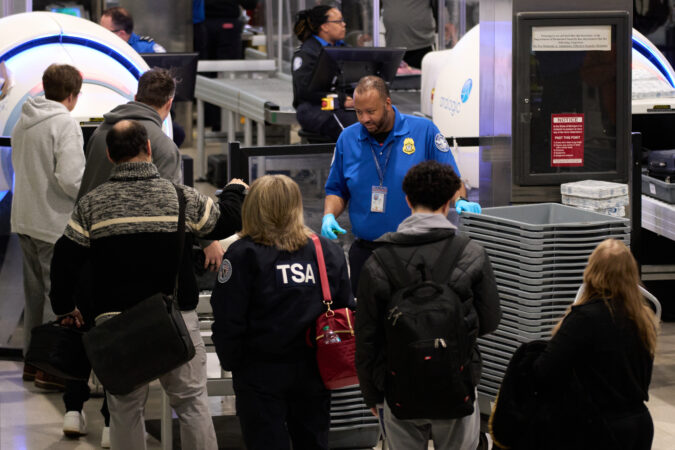
  • TSA agents are working without pay at U.S. airports due to another shutdown

    TSA agents are working without pay at U.S. airports due to another shutdown

    A shutdown of the U.S. Department of Homeland Security that took effect early Saturday impacts the agency responsible for screening passengers and bags at airports across the country. Travelers with airline reservations may be nervously recalling a 43-day government shutdown that led to historic flight cancellations and long delays last year.

    Transportation Security Administration officers are expected to work without pay while lawmakers remain without an agreement on DHS’ annual funding. TSA officers also worked through the record shutdown that ended Nov. 12, but aviation experts say this one may play out differently.

    Trade groups for the U.S. travel industry and major airlines nonetheless warned that the longer DHS appropriations are lapsed, the longer security lines at the nation’s commercial airports could get.

    Here’s what to know about the latest shutdown and how to plan ahead.

    What’s different about this shutdown?

    Funding for Homeland Security expired at midnight Friday. But the rest of the federal government is funded through Sept. 30. That means air traffic controllers employed by the Federal Aviation Administration will receive paychecks as usual, reducing the risk of widespread flight cancellations.

    According to the department’s contingency plan, about 95% of TSA workers are deemed essential personnel and required to keep working. Democrats in the House and Senate say DHS won’t get funded until new restrictions are placed on federal immigration operations.

    During past shutdowns, disruptions to air travel tended to build over time, not overnight. About a month into last year’s shutdown, for example, TSA temporarily closed two checkpoints at Philadelphia International Airport. That same day, the government took the extraordinary step of ordering all commercial airlines to reduce their domestic flight schedules.

    On Saturday afternoon, the Philadelphia airport’s website showed all checkpoints open with normal brief wait times of 10 minutes or less.

    John Rose, chief risk officer for global travel management company Altour, said strains could surface at airports more quickly this time because the TSA workforce also will be remembering the last shutdown.

    “It’s still fresh in their minds and potentially their pocketbooks,” Rose said.

    What is the impact on travelers?

    It’s hard to predict whether, when, or where security screening snags might pop up. Even a handful of unscheduled TSA absences could quickly lead to longer wait times at smaller airports, for example, if there’s just a single security checkpoint.

    That’s why travelers should plan to arrive early and allow extra time to get through security.

    “I tell people to do this even in good times,” Rose said.

    Experts say flight delays also are a possibility even though air traffic controllers are not affected by the DHS shutdown.

    Airlines might decide to delay departures in some cases to wait for passengers to clear screening, said Rich Davis, senior security adviser at risk mitigation company International SOS. Shortages of TSA officers also could slow the screening of checked luggage behind the scenes.

    What travelers can do to prepare

    Most airports display security line wait times on their websites, but don’t wait until the day of a flight to check them, Rose advised.

    “You may look online and it says 2½ hours,” he said. ”Now it’s 2½ hours before your flight and you haven’t left for the airport yet.”

    Passengers should also pay close attention while packing since prohibited items are likely to prolong the screening process. For carry-on bags, avoid bringing full-size shampoo or other liquids, large gels or aerosols, and items like pocketknives in carry-on bags.

    TSA has a full list on its website of what is and isn’t allowed in carry-on and checked luggage.

    At the airport, Rose said, remember to “practice patience and empathy.”

    “Not only are they not getting paid,” he said of TSA agents, “they’re probably working with reduced staff and dealing with angry travelers.”

    Will the shutdown drag on?

    The White House has been negotiating with Democratic lawmakers, but the two sides failed to reach a deal by the end of the week before senators and members of Congress were set to leave Washington for a 10-day break.

    Lawmakers in both chambers were on notice, however, to return if a deal to end the shutdown is struck.

    Democrats have said they won’t help approve more DHS funding until new restrictions are placed on federal immigration operations after the fatal shootings of Alex Pretti and Renee Good in Minneapolis last month.

    In a joint statement, U.S. Travel, Airlines for America, and the American Hotel & Lodging Association warned that the shutdown threatens to disrupt air travel as the busy spring break travel season approaches.

    “Travelers and the U.S. economy cannot afford to have essential TSA personnel working without pay, which increases the risk of unscheduled absences and call outs, and ultimately can lead to higher wait times and missed or delayed flights,” the statement said.