Category: Wires

  • TSA agents are working without pay at U.S. airports due to another shutdown

    TSA agents are working without pay at U.S. airports due to another shutdown

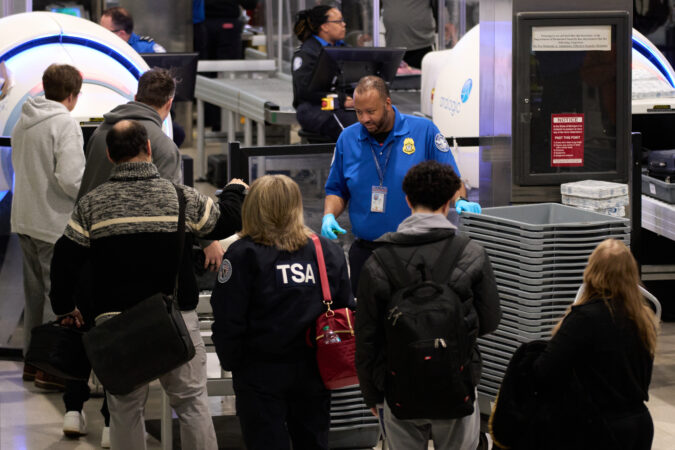
    A shutdown of the U.S. Department of Homeland Security that took effect early Saturday impacts the agency responsible for screening passengers and bags at airports across the country. Travelers with airline reservations may be nervously recalling a 43-day government shutdown that led to historic flight cancellations and long delays last year.

    Transportation Security Administration officers are expected to work without pay while lawmakers remain without an agreement on DHS’ annual funding. TSA officers also worked through the record shutdown that ended Nov. 12, but aviation experts say this one may play out differently.

    Trade groups for the U.S. travel industry and major airlines nonetheless warned that the longer DHS appropriations are lapsed, the longer security lines at the nation’s commercial airports could get.

    Here’s what to know about the latest shutdown and how to plan ahead.

    What’s different about this shutdown?

    Funding for Homeland Security expired at midnight Friday. But the rest of the federal government is funded through Sept. 30. That means air traffic controllers employed by the Federal Aviation Administration will receive paychecks as usual, reducing the risk of widespread flight cancellations.

    According to the department’s contingency plan, about 95% of TSA workers are deemed essential personnel and required to keep working. Democrats in the House and Senate say DHS won’t get funded until new restrictions are placed on federal immigration operations.

    During past shutdowns, disruptions to air travel tended to build over time, not overnight. About a month into last year’s shutdown, for example, TSA temporarily closed two checkpoints at Philadelphia International Airport. That same day, the government took the extraordinary step of ordering all commercial airlines to reduce their domestic flight schedules.

    On Saturday afternoon, the Philadelphia airport’s website showed all checkpoints open with normal brief wait times of 10 minutes or less.

    John Rose, chief risk officer for global travel management company Altour, said strains could surface at airports more quickly this time because the TSA workforce also will be remembering the last shutdown.

    “It’s still fresh in their minds and potentially their pocketbooks,” Rose said.

    What is the impact on travelers?

    It’s hard to predict whether, when, or where security screening snags might pop up. Even a handful of unscheduled TSA absences could quickly lead to longer wait times at smaller airports, for example, if there’s just a single security checkpoint.

    That’s why travelers should plan to arrive early and allow extra time to get through security.

    “I tell people to do this even in good times,” Rose said.

    Experts say flight delays also are a possibility even though air traffic controllers are not affected by the DHS shutdown.

    Airlines might decide to delay departures in some cases to wait for passengers to clear screening, said Rich Davis, senior security adviser at risk mitigation company International SOS. Shortages of TSA officers also could slow the screening of checked luggage behind the scenes.

    What travelers can do to prepare

    Most airports display security line wait times on their websites, but don’t wait until the day of a flight to check them, Rose advised.

    “You may look online and it says 2½ hours,” he said. ”Now it’s 2½ hours before your flight and you haven’t left for the airport yet.”

    Passengers should also pay close attention while packing since prohibited items are likely to prolong the screening process. For carry-on bags, avoid bringing full-size shampoo or other liquids, large gels or aerosols, and items like pocketknives in carry-on bags.

    TSA has a full list on its website of what is and isn’t allowed in carry-on and checked luggage.

    At the airport, Rose said, remember to “practice patience and empathy.”

    “Not only are they not getting paid,” he said of TSA agents, “they’re probably working with reduced staff and dealing with angry travelers.”

    Will the shutdown drag on?

    The White House has been negotiating with Democratic lawmakers, but the two sides failed to reach a deal by the end of the week before senators and members of Congress were set to leave Washington for a 10-day break.

    Lawmakers in both chambers were on notice, however, to return if a deal to end the shutdown is struck.

    Democrats have said they won’t help approve more DHS funding until new restrictions are placed on federal immigration operations after the fatal shootings of Alex Pretti and Renee Good in Minneapolis last month.

    In a joint statement, U.S. Travel, Airlines for America, and the American Hotel & Lodging Association warned that the shutdown threatens to disrupt air travel as the busy spring break travel season approaches.

    “Travelers and the U.S. economy cannot afford to have essential TSA personnel working without pay, which increases the risk of unscheduled absences and call outs, and ultimately can lead to higher wait times and missed or delayed flights,” the statement said.

  • CIA, Pentagon investigated secret ‘Havana syndrome’ device in Norway

    CIA, Pentagon investigated secret ‘Havana syndrome’ device in Norway

    Working in strict secrecy, a government scientist in Norway built a machine capable of emitting powerful pulses of microwave energy and, in an effort to prove such devices are harmless to humans, in 2024 tested it on himself. He suffered neurological symptoms similar to those of “Havana syndrome,” the unexplained malady that has struck hundreds of U.S. spies and diplomats around the world.

    The bizarre story, described by four people familiar with the events, is the latest wrinkle in the decadelong quest to find the causes of Havana syndrome, whose sufferers experience long-lasting effects including cognitive challenges, dizziness, and nausea. The U.S. government calls the events Anomalous Health Incidents.

    The secret test in Norway has not been previously reported. The Norwegian government told the CIA about the results, two of the people said, prompting at least two visits in 2024 to Norway by Pentagon and White House officials.

    Those aware of the test say it does not prove AHIs are the work of a foreign adversary wielding a secret weapon similar to the prototype tested in Norway. One of them noted that the effects suffered by the Norwegian researcher, whose identity was not disclosed by the people familiar, were not the same as in a “classic” AHI case. All spoke on the condition of anonymity because of the subject’s sensitivity.

    But the events bolstered the case of those who argue that “pulsed-energy devices” — machines that deliver powerful beams of electromagnetic energy such as microwaves in short bursts can affect human biology and are probably being developed by U.S. adversaries.

    “I think there’s compelling evidence that we should be concerned about the ability to build a directed-energy weapon that can cause a variety of risk to humans,” said Paul Friedrichs, a retired military surgeon and Air Force general who oversaw biological threats on the White House National Security Council under President Joe Biden. Friedrichs declined to comment on the Norway experiment.

    The Trump administration took office promising to pursue the AHI issue aggressively. But there has been little apparent movement. A review ordered by Director of National Intelligence Tulsi Gabbard is expected to focus mostly on the Biden administration’s handling of the issue, and its release has been delayed, people familiar with the issue said.

    In a separate development that has become public in recent weeks, the U.S. government covertly purchased at the end of the Biden administration a different foreign-made device that produces pulsed radio waves and which some experts suspect could be linked to AHI incidents, according to two people familiar with the matter.

    The device is being tested by the Defense Department. It has some Russian-origin components, but the U.S. government still has not determined conclusively who built it, said one of the people.

    The U.S. acquisition of the device was first reported last month by independent journalist Sasha Ingber and CNN, which said it had been purchased for millions of dollars by Homeland Security Investigations, part of the Department of Homeland Security.

    The device that the scientist constructed in Norway was not identical to the one that the U.S. government covertly acquired, one of the people familiar with the events said. The Norwegian device was built based on “classified information,” suggesting it was derived from blueprints or other materials stolen from a foreign government, this person said.

    At about the same time the U.S. became aware of the two pulsed-energy machines, two spy agencies altered their previous judgment and concluded that some of the incidents involving AHIs could be the work of a foreign adversary, delivering that verdict in an updated U.S. intelligence assessment issued in January 2025 during the Biden administration’s final weeks.

    “New reporting,” the assessment said, led the two agencies “to shift their assessments about whether a foreign actor has a capability that could cause biological effects consistent with some of the symptoms reported as possible AHIs.”

    One was the National Security Agency, which intercepts and decodes foreign electronic communications, several people familiar with the issue said. The other, said two of those people, was the National Ground Intelligence Center, a U.S. Army intelligence agency in Charlottesville that produces intelligence on foreign adversaries’ scientific, technical, and military capabilities.

    The majority of U.S. intelligence agencies, including the CIA and four others, said they continued to judge it “very unlikely” that the attacks were the result of a foreign adversary or that a foreign actor had developed a novel weapon. In conversations intercepted by U.S. spy agencies, American adversaries were heard expressing their own surprise at the AHI incidents and denying involvement, U.S. officials have said.

    The CIA declined to comment on the Norwegian test or how it impacted the agency’s analysis. Norway’s embassy in Washington did not respond to a request for comment.

    Some former officials and AHI victims have pointed to Russia as the prime suspect in the AHI incidents because of its decades of work in directed-energy devices. So far, no conclusive proof has publicly emerged, and Moscow has denied involvement.

    Taken together, the two known directed-energy devices along with other research appear to have prompted a reconsideration by some of the causes of Havana syndrome, so named because of the mysterious 2016 outbreak of symptoms reported by personnel at the U.S. Embassy in Havana.

    In subsequent years, U.S. personnel reported hundreds of cases globally, in China, Eastern Europe, and elsewhere. A top aide to then-CIA Director William J. Burns reported symptoms while traveling in India in 2021.

    At a conference in Philadelphia earlier this month, retired Air Force Lt. Col. Chris Schlagheck, at times his voice breaking, said he was hit five times in 2020 in his home in Northern Virginia, where a Russian family lived across the street. It was not until last year that a doctor told him his symptoms were the same as those reported from Havana a decade earlier.

    Much about the Norway test remains obscured by its highly classified nature. People familiar with the events declined to identify the scientist or the Norwegian government agency he worked for.

    The results were all the more shocking because the Norwegian researcher had earned a reputation as a leading opponent of the theory that directed-energy weapons can cause the type of symptoms associated with AHIs, those familiar with the events said. Trying to dramatically prove his point, with himself as a human guinea pig, he achieved the opposite.

    “I don’t know what possessed him to go and do this,” one of the people said. “He was a bit of an eccentric.”

    A delegation of Pentagon officials traveled to Norway in 2024 to examine the device. In December of that year, a group of intelligence and White House officials also went to Norway to discuss the issue, those familiar with the events said.

    In January 2022, the CIA produced an interim assessment that concluded a foreign country was probably not behind Havana syndrome. It emerged weeks before a major panel of government and nongovernment experts produced a report commissioned by the director of national intelligence and deputy CIA director that came to a markedly different conclusion.

    That panel concluded in February 2022 that pulsed electromagnetic energy, particularly in the radio-frequency range, ‘’plausibly explains the core characteristics of reported AHIs,” although it acknowledged many unknowns. “Information gaps exist,” it reported.

    The conclusion marked the first time a report issued publicly by the U.S. government acknowledged that the symptoms could be caused by human-made, external events.

    The IC Experts Panel, as it was known, interviewed several people who had suffered accidental exposure to electromagnetic energy, said David Relman, a Stanford University microbiologist who chaired the panel.

    But the CIA interim assessment overshadowed the expert panel’s report. Then, in March 2023, the full intelligence community issued an assessment that unanimously concluded that it was unlikely that a foreign adversary was behind the incidents. “There is no credible evidence that a foreign adversary has a weapon or (intelligence) collection device that is causing AHIs,” the unclassified version of their report said, citing secret intelligence data and open-source information about foreign weapons and research programs.

    U.S. intelligence agencies “essentially ignored” the experts panel’s work, Relman told the conference in Philadelphia. The agencies, particularly the CIA, “had developed a very firm set of conclusions, world view that caused them I think to become dug in,” he said.

    By late 2024, senior White House officials in the Biden administration had come to question the absolutist position taken by U.S. intelligence agencies in their 2023 assessment.

    There were some officials, including within the intelligence community, who insisted that “there was nothing here” — that every reported case could be explained by some environmental or medical factor, said one person familiar with the administration’s views.

    The more “responsible” view, the person said, was to admit “we don’t know the answers” and that it was “plausible that pulsed electromagnetic energy could account for some subset of cases.”

    After the November 2024 election, White House officials who were working on an AHI brief for the incoming Trump administration invited several victims to a meeting to offer their input. The officials also wanted to reassure the victims that they realized the intelligence community assessment called into question the very real health issues they experienced and what caused them.

    At one point, an official turned to the victims who were gathered in the Situation Room and said, “We believe you.” The White House wasn’t yet certain it was a foreign actor but believed it was plausible that the symptoms had been caused by external factors, said the person familiar with the administration’s views.

    Marc Polymeropoulos, a former CIA officer and AHI victim who attended the unclassified meeting, said, “It was clear to the victims, but also unsaid, that new information had come into the NSC that had caused them to make such a statement.”

  • What to know about the investigation into Nancy Guthrie’s disappearance

    What to know about the investigation into Nancy Guthrie’s disappearance

    TUCSON, Ariz. — Law enforcement agents have been gathering more potential evidence as the search for Today show host Savannah Guthrie‘s mother heads into its third week.

    Nancy Guthrie, 84, was last seen at her Arizona home on Jan. 31 and was reported missing the following day. Authorities say her blood was found on the front porch. Purported ransom notes were sent to news outlets, but two deadlines for paying have passed.

    Authorities have expressed concern about Nancy Guthrie’s health because she needs vital daily medicine. She is said to have a pacemaker and have dealt with high blood pressure and heart issues, according to sheriff’s dispatcher audio on broadcastify.com.

    Here’s what to know about her disappearance and the intense search to find her:

    Video of masked man

    The Federal Bureau of Investigation released surveillance videos of a masked person wearing a handgun holster outside Guthrie’s front door in Tucson the night she vanished. A porch camera recorded video of a person with a backpack who was wearing a ski mask, long pants, jacket, and gloves.

    On Thursday, the FBI called the person a suspect. It described him as a man about 5 feet, 9 inches tall with a medium build. The agency said he was carrying a 25-liter “Ozark Trail Hiker Pack” backpack.

    Investigators initially said there was no surveillance video available since Guthrie didn’t have an active subscription to the doorbell camera company. But digital forensics experts kept working to find images in back-end software that might have been lost, corrupted, or inaccessible.

    Studying DNA

    Investigators collected DNA from Guthrie’s property which doesn’t belong to Guthrie or those in close contact with her, the Pima County Sheriff’s Department said. Investigators are working to identify who it belongs to.

    Evidence requiring forensic analysis is being sent to the same out-of-state lab that has been used since the beginning of the case, the department said.

    Investigators found several gloves, the nearest about 2 miles from Guthrie’s home, and submitted them for lab analysis, the sheriff’s department said. It did not specify what type of gloves.

    The sheriff stressed his department is working closely with the FBI.

    Sorting through tips

    The Pima County sheriff and the FBI announced phone numbers and a website to offer tips. Several hundred detectives and agents have been assigned to the case, the sheriff’s department said.

    The FBI said it has collected more than 13,000 tips since Feb. 1, the day Guthrie was reported missing. The sheriff’s department, meanwhile, said it has taken at least 18,000 calls.

    The sheriff’s department has not said whether any tips have advanced the investigation.

    Intensive searches

    Late Friday night, law enforcement sealed off a road about 2 miles from Guthrie’s home as part of their investigation. A parade of sheriff’s and FBI vehicles, including forensics vehicles, passed through the roadblock.

    The two agencies also tagged and towed a Range Rover SUV from a Culver’s restaurant parking lot. The restaurant is just over 2 miles from Nancy Guthrie’s home. This activity took place at the same time the sheriff’s office closed a road just north of the Guthrie home.

    The Pima County Sheriff’s Department confirmed Saturday that a federal court-ordered search warrant was executed at the home Friday in connection with the Guthrie case. The warrant was based on a lead the agency had received. No arrests were made.

    A traffic stop was also conducted, and while someone was questioned, no arrests were made, the sheriff’s office said.

    No additional information was released Saturday.

    On Tuesday, sheriff deputies detained a person for questioning during a traffic stop south of Tucson. Authorities didn’t say what led them to stop the man but confirmed he was released.

    The same day, deputies and FBI agents conducted a court-authorized search in Rio Rico, about an hour’s drive south of the city.

    Family pleas

    Savannah Guthrie, her sister, and her brother have shared on social media multiple video messages to their mother’s purported captor.

    The family’s Instagram videos have shifted in tone from impassioned pleas to whoever may have their mom, saying they want to talk and are even willing to pay a ransom, to bleaker and more desperate requests for the public’s help.

    The latest video on Thursday was simply a home video of their mother and a promise to “never give up on her.”

    A quiet neighborhood

    Nancy Guthrie lived alone in the upscale Catalina Foothills neighborhood, where houses are spaced far apart and set back from the street by long driveways, gates, and dense desert vegetation.

    Savannah Guthrie grew up in Tucson, graduated from the University of Arizona, and once worked at a television station in the city, where her parents settled in the 1970s. She joined Today in 2011.

    In a video, she described her mother as a “loving woman of goodness and light.”

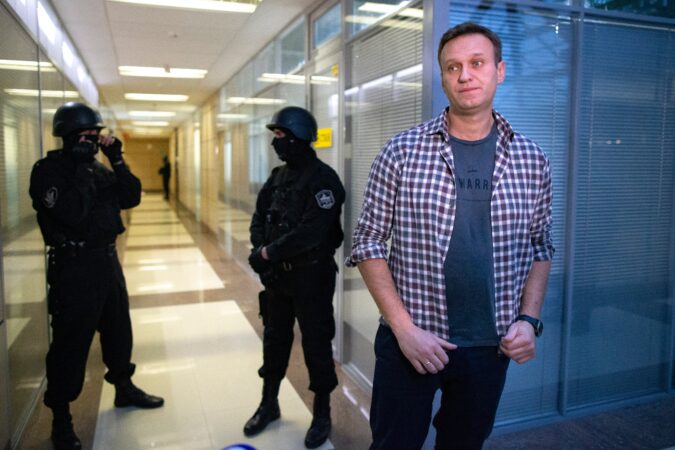
  • Russia poisoned Alexei Navalny with dart frog toxin, European nations say

    Russia poisoned Alexei Navalny with dart frog toxin, European nations say

    LONDON — Russian opposition leader Alexei Navalny was poisoned by the Kremlin with a rare and lethal toxin found in the skin of poison dart frogs, five European countries said Saturday.

    The foreign ministries of the U.K., France, Germany, Sweden, and the Netherlands said analysis in European labs of samples taken from Navalny’s body “conclusively confirmed the presence of epibatidine.” It is a neurotoxin secreted by dart frogs in South America that is not found naturally in Russia, they said.

    A joint statement said: “Russia had the means, motive and opportunity to administer this poison.”

    The five countries said they were reporting Russia to the Organization for the Prohibition of Chemical Weapons for a breach of the Chemical Weapons Convention. There was no immediate comment from the organization.

    Navalny, who crusaded against official corruption and staged massive anti-Kremlin protests as President Vladimir Putin’s fiercest foe, died in an Arctic penal colony on Feb. 16, 2024, while serving a 19-year sentence that he believed to be politically motivated.

    “Russia saw Navalny as a threat,” British Foreign Secretary Yvette Cooper said. ”By using this form of poison the Russian state demonstrated the despicable tools it has at its disposal and the overwhelming fear it has of political opposition.”

    French Foreign Minister Jean-Noël Barrot wrote on X that the poisoning of Navalny shows “that Vladimir Putin is prepared to use biological weapons against his own people in order to remain in power.”

    Navalny’s widow says results confirmed her accusations

    The European nations’ assessment came as Navalny’s widow, Yulia Navalnaya, attended the Munich Security Conference in Germany, and just before the second anniversary of Navalny’s death.

    She said last year that two independent labs had found that her husband was poisoned shortly before he died. She has repeatedly blamed Putin for her husband’s death. Russian officials have vehemently denied the accusation.

    Navalnaya said Saturday that she had been “certain from the first day” that her husband had been poisoned, “but now there is proof.”

    “Putin killed Alexei with chemical weapon,” she wrote. She said Putin was “a murderer” who “must be held accountable.”

    Russian authorities said that the politician became ill after a walk and died from natural causes.

    U.K. has accused Russia of previous attacks

    Epibatidine is found naturally in dart frogs in the wild, and can also be manufactured in a lab, which European scientists suspect was the case with the substance used on Navalny. It works on the body in a similar way to nerve agents, causing shortness of breath, convulsions, seizures, a slowed heart rate, and ultimately death.

    Navalny was the target of an earlier poisoning in 2020, with a nerve agent in an attack he blamed on the Kremlin, which always denied involvement. His family and allies fought to have him flown to Germany for treatment and recovery. Five months later, he returned to Russia, where he was immediately arrested and imprisoned for the last three years of his life.

    The U.K. has accused Russia of repeatedly flouting international bans on chemical and biological weapons. It accuses the Kremlin of carrying out a 2018 attack in the English city of Salisbury that targeted a former Russian intelligence officer, Sergei Skripal, with the nerve agent Novichok. Skripal and his daughter became seriously ill, and a British woman, Dawn Sturgess, died after she came across a discarded bottle with traces of the nerve agent.

    A British inquiry concluded that the attack “must have been authorized at the highest level, by President Putin.”

    The Kremlin has denied involvement. Russia also denied poisoning Alexander Litvinenko, a former Russian agent turned Kremlin critic who died in London in 2006, after ingesting the radioactive isotope polonium-210. A British inquiry concluded that two Russian agents killed Litvinenko, and Putin had “probably approved” the operation.

  • At 82, he’s as fit as a 20-year-old. His body holds clues to healthy aging.

    At 82, he’s as fit as a 20-year-old. His body holds clues to healthy aging.

    As a model of successful aging, you can’t beat 82-year-old Juan López García.

    Really, you can’t beat him.

    Sixteen years ago, at age 66, López García first tried running a mile. He’d recently retired after spending his entire working life as a car mechanic in Toledo, Spain. In all those years, he’d never trained as an athlete or exercised much at all.

    He couldn’t finish that first mile. He could barely start it.

    Now, at age 82, López García is the world record holder in the 80-to-84 age group for the 50-kilometer (31-mile) ultramarathon. In 2024, he also won the world marathon championship for his age group, with a time of 3:39:10, setting a European record in the process.

    His outsize success caught the attention of a group of European scientists who study aging. They invited López García to their lab for extensive testing. Their findings, published in January in Frontiers in Physiology, are, at once, revealing and “inspiring,” said Julian Alcazar, an exercise scientist at the University of Castilla-La Mancha in Spain and a co-author of the study.

    The researchers found that López García has the highest aerobic fitness recorded in an octogenarian, matching that of healthy 20-to-30-year-old men. His muscles also absorb and use oxygen unusually well. But in other ways, his biology, biomechanics, and training seem relatively ordinary.

    Taken as a whole, López García’s physiology and performance in his 80s may help upend some common assumptions about what’s possible and normal as we age, the researchers concluded, including whether it’s ever too late for the rest of us to tackle that first mile.

    What sets older athletes apart?

    “There are still many questions about the trajectory of aging,” said Simone Porcelli, an exercise physiologist at the University of Pavia in Italy and senior author of the study.

    To help answer them, he and colleagues in Italy and Spain recently began collaborating on a major research project about whether growing old necessarily involves steep, inevitable declines in muscle, speed, strength, and agency.

    That interest led them, unsurprisingly, to older, elite athletes, whose trajectory of aging can seem almost otherworldly. Deep into their 70s, 80s, and even 90s, these men and women typically preserve or even add to their fitness and strength, and they rarely develop serious illnesses. Most appear younger than their birth years.

    What sets them apart, the researchers wondered? Is it training, genetics, luck? How do their bodies differ from those of their peers, and what lessons can we take from their daily routines?

    An unusual athlete

    Enter López García, a man whose aging has been both ordinary and exceptional. Physically unprepossessing at about 5-foot-2 and 130 pounds, he once spent several weeks walking 500 miles of the Camino de Santiago pilgrimage route in France and Spain. But otherwise, exercise had always been, at best, an afterthought for him. Then, at 66, he tried running and slowly, stubbornly upped his mileage until, at 70, he began to compete, starting with the 800 meters, then longer distances and, eventually, ultras.

    The older he got, the longer and faster he ran.

    “That’s not,” Alcazar said, pausing for words, “ … usual.”

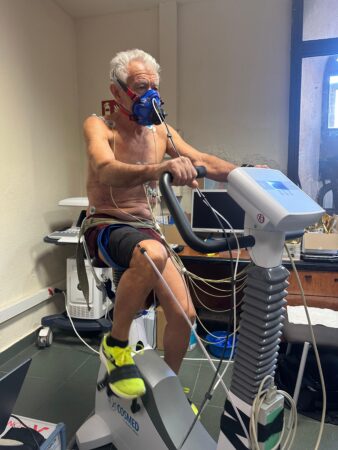
    Intrigued, Alcazar and his Italian colleagues set up López García on a treadmill and a stationary bicycle at their lab and tested his endurance capacity, running economy, fuel usage, power, muscle oxygen uptake, and other measures of how his body responds to high-speed exercise. They also asked about his training and nutrition.

    The greatest fitness ever measured

    Some of the numbers proved eye-popping.

    López García’s VO2 max, the standard gauge of aerobic fitness, was the highest the researchers had seen in someone in their 80s. A measure of how much oxygen the body takes in and delivers to muscles, VO2 max usually declines by about 10% each decade after middle age. But his almost certainly had been rising after he reached his mid-60s and began to train and is similar to someone a quarter his age.

    His muscles also were better able than those of most older — or younger — people to absorb and use that oxygen, allowing López García to run for long periods at a fast, steady pace. He averaged a 9:14 mile during his record-setting ultramarathon. He also produced considerable power during each stride.

    But he didn’t have an especially high lactate threshold or running economy, both of which contribute to endurance and speed. His were good, similar to those of competitive athletes in their 60s, but not spectacular, suggesting he still has room to improve as a runner.

    How he eats and runs

    Even López García was startled by his prowess. His only thought when he started to train, he said, “was to run a little to maintain my health, never to reach the level I have reached today.”

    Now, he runs about 40 miles a week when he’s not readying for a competition and almost double that mileage in the buildup to a race. Most of his workouts are long and moderately taxing. But a few times a week, he does intervals of various lengths, sprinting at near or past race pace for a brief spurt, slowing and then sprinting again. (He has a professional coach guiding his workouts.)

    He also weight-trains a few times a week, mostly at home, primarily with body weight exercises, and eats a “totally normal” Mediterranean-style diet, he said.

    ‘It’s never too late’

    The big question with López García’s or any older athlete’s successful aging is whether the rest of us can replicate it. Or is he somehow unique, gifted with an ideal mix of genes and background unavailable to most people?

    Alcazar suspects it’s both. López García was fortunate to have reached age 66 without serious illnesses or disabilities, Alcazar said, despite being sedentary, which might have been, in large part, because of his genetics, as well as lifestyle.

    But Alcazar and his colleagues also believe López García’s successful aging is not just aspirational but achievable by most of us. “Not so long ago, it wasn’t really seen as possible or a positive for older people to do much exercise,” Alcazar said. López García shows otherwise. “It is not only possible. It should be recommended,” Alcazar said.

    Begin slowly, if you are older and new to exercise, López García said, as he did. “Start by walking fast and then maybe start running, which is very beneficial,” he said.

    “It’s never too late,” Porcelli said. He and the other scientists are continuing to study López García and other aging athletes, as well as more sedentary older people, to understand the molecular and functional differences between them. The researchers expect to publish more studies soon.

    In the meantime, López García’s example is already a lodestar for the researchers. “I’m 35,” Alcazar said. “I’m thinking about how to age well. Having seen him, of course I exercise.”

    For his part, López García has no plans to slow down. “When I think about the number 80,” he said, “I remember my grandparents. At this age, they were like little old people. Today, I do not feel old.”

  • Wendy’s closes U.S. restaurants and focuses on value to turn around falling sales

    Wendy’s closes U.S. restaurants and focuses on value to turn around falling sales

    Wendy’s is closing several hundred U.S. restaurants and increasing its focus on value after a weaker-than-expected fourth quarter.

    The Dublin, Ohio-based company said Friday that its global same-store sales, or sales at locations open at least a year, fell 10% in the October-December period. That was worse than the 8.5% drop expected by analysts polled by FactSet.

    U.S. same-store sales fell even further in the fourth quarter. Wendy’s said late last year that it planned to close underperforming U.S. restaurants, but it gave more details about those closures Friday.

    Wendy’s said it already closed 28 restaurants in the fourth quarter and ended 2025 with 5,969 U.S. locations. It expects to close between 5% and 6% of its U.S. restaurants — or 298 to 358 locations — in the first half of this year.

    Those actions come on top of the closure of 240 U.S. Wendy’s locations in 2024. At the time, the 57-year-old chain said many of its locations are simply out of date.

    Like McDonald’s, Taco Bell, and other rivals, Wendy’s also plans to emphasize value as it tries to win back inflation-weary customers.

    “One learning from 2025 around value, we swung the pendulum too far towards limited-time price promotions instead of everyday value,” said Ken Cook, Wendy’s interim CEO and chief financial officer, in a conference call with investors.

    In January, Wendy’s introduced a permanent “Biggie Deals” value menu with three price tiers: $4 Biggie Bites, $6 Biggie Bags, and an $8 Biggie Bundle. Cook said Wendy’s also has new products coming this year, including a new chicken sandwich.

    Wendy’s said its revenue fell 5.5% in the fourth quarter to $543 million. That was higher than the $537 million analysts had forecast.

    Wendy’s expressed confidence that its U.S. turnaround plans and international growth will help arrest its sales slide this year. The company said it expects global systemwide sales — which includes sales at both company-owned and franchised restaurants — will be flat this year. Systemwide sales fell 3.5% last year.

    Wendy’s shares closed up nearly 3% on Friday.

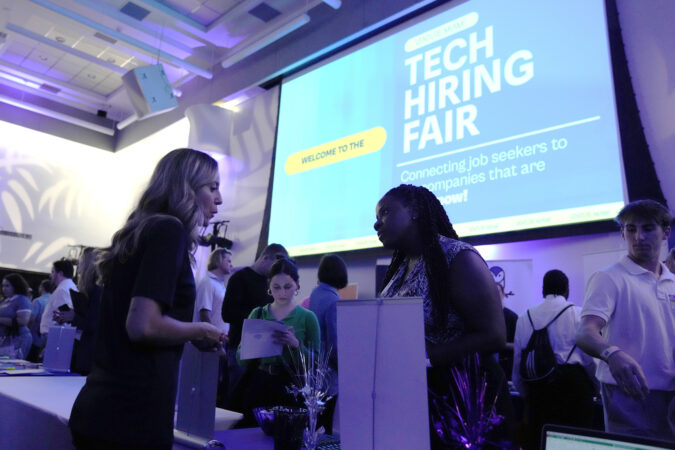
  • Some of the most coveted jobs in America aren’t safe anymore

    Some of the most coveted jobs in America aren’t safe anymore

    After years of working as a recruiter, Justin Kirkwood landed in tech, eventually becoming a technical project manager for a vendor inside Meta’s Seattle campus. He had clawed his way into the industry with an associate’s degree, getting to work with some of the brightest people in tech in a role he thought was secure.

    But his perception shifted when the social media giant laid off 11,000 employees in one day in 2022, his first year working there. When he got his pink slip last month, he says grief set in, then denial and anger. He half-jokingly entertained the idea that he might become a cobbler or hot dog vendor.

    The tech industry, once viewed as prestigious and safe, has become tumultuous, with some economists even warning of a looming recession in jobs. While tech companies continue to invest billions of dollars into AI, they’re slashing jobs while touting AI-forward strategies and leaner organizations. People who pursued careers in the tech industry expected big salaries, job security, and an abundance of opportunity that would take them to retirement. But now, as tech companies continue to shed jobs, workers are shifting their expectations even with an AI boom.

    “My perception of [tech] as the most viable path to job stability has definitely waned,” Kirkwood, 47, said. “Is a constant soul-crushing ambient anxiety a stage of grief?”

    The layoffs continued to trickle in. In January Amazon announced that it cut 16,000 roles — in addition to 14,000 cuts it announced in October — as it aims to reduce bureaucracy and get rid of some layers of management. (Amazon founder Jeff Bezos owns the Washington Post.) Pinterest also announced layoffs, stating it would cut 15% of staff in pursuit of its “AI-forward strategy.” Meta cut more than 1,000 workers earlier this year while Microsoft announced that it was slashing 15,000 jobs last year.

    Meta CEO Mark Zuckerberg said on an earnings call recently that AI would “dramatically change the way that we work” this year, as Meta invests in AI tools to help workers be more productive, noting that it would be need to “flatten” teams. Amazon CEO Andy Jassy had warned employees in June that cuts were coming, attributing the reductions to efficiencies created by the company’s use of AI.

    The layoffs come as the U.S. economy shows signs of growth. The Federal Reserve opted to hold interest rates steady in January noting that “economic activity has been expanding at a solid pace” and the unemployment rate shows “signs of stabilization.” The unemployment rate is near historic lows at 4.3% but the labor market has largely been frozen, leaving those who are employed “clinging to their jobs,” said Diane Swonk, chief economist at KPMG.

    Unlike the dot-com boom of the 90s, the AI boom is not creating a major influx of new jobs because AI brings the promise of efficiency, she said. Meanwhile, tech companies are feeling financial pressure as they continue their costly build-out of data centers to support their AI ambitions.

    “Over time, AI could be a productivity miracle … but in the near term we have to deal with the transition cost,” she said.

    Amazon says AI is not the reason behind the reductions but rather to drive speed and ownership for invention and collaboration. Microsoft has said that even as it cuts, it’s continuing to hire and invest in strategic areas, though it did not provide specifics. Meta declined to comment.

    Daniel Keum, an associate professor at Columbia Business School who researches labor market policy said the massive cuts in the tech industry are likely driven by a mix of restructuring around AI as well as the winding down of projects that companies pursued while rapidly expanding during the height of the pandemic.

    “Everybody is realizing the need to be quicker and more agile,” he said. “You can do things a lot faster now.”

    No more job security

    Tech workers who’ve been in the industry for decades say the current period feels like a moment of transformation — one that’s reduced job security.

    Six years ago, the thought of Amazon making massive cuts was unthinkable, said Fintan Palmer, a former Amazon senior software engineer who got his layoff notice in October. But in the past few years, tech companies have become less of a “safe harbor,” often hurting junior employees the most as they don’t have the network or skills to easily move on, he said.

    “It’s both a really exciting and really scary time to be in tech,” said Palmer, who added that he’s felt like he’s spent the past six weeks working harder than in the past six months to solidify a new job through networking. “I’m excited to see where it goes, but I’m nervous there will be damage done to people’s lives and the industry.”

    The tough job market is forcing workers across industries to spend long periods unemployed. People spent an average of 24.4 weeks unemployed in December, up from 19.5 in December 2022, according to data from the Bureau of Labor Statistics. As a result, workers, even in tech, are having to tweak their job search strategies.

    Brian Morales was laid off last fall from an information technology managerial post at the Kroger supermarket chain. The 55-year-old lamented what felt like his inability to break through AI screening of job applications — until he started to tactically use AI to outgun the filters.

    Morales went through AI certification programs to brush up his resume and is using ChatGPT to tailor outreach messages to potential employers. He says he’s getting more traction now but is feeling the pressure to land a job to support his wife and three children.

    “It’s a lot of work compared to when I was last looking for a new role,” he said. “It’s very, very different.”

    Steven Stark, a 32-year-old data scientist in Ann Arbor, Mich., who recently lost his job for the second time in a year, said that he’s had to hone his LinkedIn strategies to try to catch the eye of potential employers. He’s spent years relentlessly posting on the professional networking site to build a following, which he says translates into more people now seeing his job-hunting posts.

    While another job search feels a little exciting, it’s also odd. “Most days blend together and feel the same now,” Stark said.

    For younger people entering the industry, the challenges in landing a job appear even more pronounced.

    A frustrating job search has made 24-year-old Frank Uribe-Medina wonder why he gravitated to technology work in the first place. Uribe-Medina’s employer told people after Christmas that it’s relocating jobs from the Los Angeles area to Virginia. Since then, he’s applied to nearly 150 openings without landing an interview.

    Uribe-Medina taught himself software development and put himself through a degree program following advice that if he learned to code, he’d always have a job.

    “Well, I’m looking for a job,” he said. “It feels like a big lie.”

    For those still employed, the mood isn’t much different, with many worrying about when the ax will hit them as layoffs continue.

    “It’s tense,” said a program manager at Microsoft, who spoke on the condition of anonymity for fear of professional retribution. “I’m doing everything I can to avoid the pink slip with very little confidence that I can. I feel like so much of this is out of my hands.”

    Internally, leaders are overhyping the capabilities and efficiencies of AI as they cut head counts and leave remaining staff to pick up the slack, he said. Meanwhile, they’re raising the bar on expectations. People are less likely to take bold stances, “terrified” of taking big risks and cautious about voicing concerns, especially as they relate to the use of AI, he said.

    “The concern is if you say anything negative about AI, it’s death for your career,” he said.

    Microsoft declined to comment on the AI initiatives.

    Meta workers are also turning to Blind, an app that gives users with a company email access to a private and anonymous message board, to speculate about the company’s future workforce. In one message entitled “Mark wants to flatten teams,” a worker wrote “it’s been very clear in the earnings call that there may be massacres soon,” according to copies of the messages viewed by the Washington Post. Another commented that “managers will all be asked to become [individual contributors]. Anyone who can’t perform as an IC will be let go.”

    Meta declined to comment on the posts.

    The Microsoft worker said he gets inundated by inquiries from jobseekers, often young people trying to make their way in or industry veterans who lost their jobs. But he’s no longer convinced the tech industry is a safe place to build a career.

    Kirkwood says while the job hunt has been “brutal,” he’s landed a few interviews after applying to more than 100 jobs. But he expects to have contingency plans the next time around.

    “I won’t take employment for granted anymore,” he said. “You have to keep multiple irons in the fire at this point because you never know when the carpet will get pulled out from under you.”

  • Brazilian au pair gets 10-year sentence for scheme to kill lover’s wife and another man

    Brazilian au pair gets 10-year sentence for scheme to kill lover’s wife and another man

    FAIRFAX, Va. — An au pair who schemed with her employer-turned-lover to kill his wife and another man received a 10-year prison sentence on Friday.

    Prosecutors had recommended Juliana Peres Magalhães walk free after she pleaded guilty to a downgraded manslaughter charge in the February 2023 killing of Joseph Ryan. Instead of being tried for second-degree murder, she became their star witness, testifying that she had fatally shot Ryan as Brendan Banfield was fatally stabbing his wife, Christine, in the couple’s bedroom.

    Brendan Banfield was convicted by a jury this month of aggravated murder in the deaths of his wife and Ryan.

    “I know my remorse cannot bring you peace,” Magalhães told the victims’ families on Friday, wiping away tears and muffling sobs. “I hope you can someday understand that I really did not believe his plan would actually happen.”

    Instead of sentencing her to time served, Judge Penney Azcarate delivered the maximum possible sentence to the woman from Brazil.

    “Let’s get it straight: You do not deserve anything other than incarceration and a life of reflection on what you have done to the victim and his family. May it weigh heavily on your soul,” the judge said.

    At Banfield’s trial, Magalhães testified that she and the IRS agent created an account in the name of his wife, a pediatric intensive care nurse, on a social media platform for people interested in sexual fetishes. Ryan connected with the account and agreed to meet for a sexual encounter involving a knife.

    Magalhães, then 22, said she and Brendan Banfield took the couple’s 4-year-old child to the basement, and then found Ryan surprising Christine Banfield with a knife in the couple’s bedroom. She said Brendan Banfield shot Ryan and then began stabbing his wife in the neck. When she saw Ryan moving, Magalhães said, she fired the second shot that killed him.

    The au pair wasn’t arrested until eight months later, and hasn’t left jail since. Prosecutors raised concerns that if she were to be allowed bail, she would flee to Brazil or be deported by immigration officials before they could finish their case. She didn’t talk with investigators for more than a year, until she changed her mind as her trial date approached.

    “I lost myself in a relationship, and left my morals and values behind,” Magalhães told the judge.

    “You were texting and speaking to Joseph Ryan, encouraging him to bring a knife and ultimately, through the phone conversation, getting his consent, knowing all along you were bringing him to his death,” the judge responded.

    Ryan’s mother, Deirdre Fisher, told the court that her son, born days before Christmas, was her “greatest gift.” Three years after his killing, she can’t bear taking down their Christmas tree. An urn with Ryan’s ashes sits in front of the decoration.

    “I say good morning to him each day when I turn on the tree’s lights,” she said. “But of course that’s not Joe sitting there. He can’t say ‘I love you’ back.”

    Sangeeta Ryan described her nephew as “inquisitive, curious, smart, charming and so dang talkative.” She said he loved martial arts and role-playing with his friends. She also noted that he had moved in with his octogenarian grandmother to care for her.

    “His sudden murder devastated his grandma — she could no longer live in the family home without Joe,” his aunt said. The woman quietly moved away, hoping to avoid her memories and the reporters knocking at the door.

    Christine Banfield’s relatives attended Friday’s hearing. A judge has said Banfield will be sentenced in May.

  • Feds open a perjury probe into ICE officers’ testimony about the shooting of a Venezuelan man

    Feds open a perjury probe into ICE officers’ testimony about the shooting of a Venezuelan man

    MINNEAPOLIS — Federal authorities have opened a criminal probe into whether two immigration officers lied under oath about a shooting in Minneapolis last month, as all charges were dropped against two Venezuelan men.

    Immigration and Customs Enforcement Director Todd Lyons said Friday that his agency opened a joint probe with the Justice Department after video evidence revealed “sworn testimony provided by two separate officers appears to have made untruthful statements” about the shooting of one of the Venezuelan men during the Trump administration’s immigration crackdown across the Minneapolis-St. Paul area.

    The officers, whose names were not disclosed, are on administrative leave while the investigation is carried out, he said. Lyons said the two ICE officers could be fired and face criminal prosecution.

    “Lying under oath is a serious federal offense,” said Lyons, adding that the U.S. attorney’s office is actively investigating.

    “The men and women of ICE are entrusted with upholding the rule of law and are held to the highest standards of professionalism, integrity, and ethical conduct,” Lyons said. “Violations of this sacred sworn oath will not be tolerated. ICE remains fully committed to transparency, accountability, and the fair enforcement of our nation’s immigration laws.”

    Earlier Friday, U.S. District Court Judge Paul A. Magnuson dismissed felony assault charges against Alfredo Alejandro Aljorna and Julio Cesar Sosa-Celis, who were accused of beating an ICE officer with a broom handle and a snow shovel during a Jan. 14 fracas. The officer fired a single shot from his handgun, striking Sosa-Celis in his right thigh.

    The cases were dropped after a highly unusual motion to dismiss from U.S. Attorney for the District of Minnesota Daniel N. Rosen, who said “newly discovered evidence” was “materially inconsistent with the allegations” made against the two men in a criminal complaint and at a hearing last month.

    The reversal follows a string of high-profile shootings involving federal immigration agents in which eyewitness statements and video evidence have called into question claims made to justify using deadly force. Dozens of felony cases against protesters accused of assaulting or impeding federal officers have also crumbled.

    The immigration lawyer representing Aljorna and Sosa-Celis said they are “overjoyed” that all charges have been dismissed. Had they been convicted, the two immigrants would have faced years in federal prison.

    “The charges against them were based on lies by an ICE agent who recklessly shot into their home through a closed door,” said attorney Brian D. Clark. “They are so happy justice is being served.”

    It is unclear whether the men could still be deported.

    A chase, claims of an attack, and a shot fired

    Last month, an FBI investigator said in a now-discredited court affidavit that ICE officers attempted to conduct a traffic stop on a vehicle driven by Aljorna on Jan. 14. He crashed the vehicle and fled on foot toward the apartment duplex where he lived. An immigration officer chased Aljorna who — according to the government — violently resisted arrest.

    The complaint alleged Sosa-Celis and another man attacked the officer with a snow shovel and a broom handle as the officer and Aljorna struggled on the ground. The officer, who is not named in court filings, fired his handgun, striking Sosa-Celis. The men ran into an apartment and eventually were arrested.

    After the shooting, Homeland Security Secretary Kristi Noem attacked Minnesota Gov. Tim Walz and Minneapolis Mayor Jacob Frey, accusing the Democrats of “encouraging impeding and assault against our law enforcement which is a federal crime, a felony.”

    “What we saw last night in Minneapolis was an attempted murder of federal law enforcement,” Noem said in a Jan. 15 statement. “Our officer was ambushed and attacked by three individuals who beat him with snow shovels and the handles of brooms. Fearing for his life, the officer fired a defensive shot.”

    The Department of Homeland Security did not responded Friday to questions about whether Noem stands by those statements, which ICE — part of DHS — says are now under investigation.

    Robin M. Wolpert, a defense attorney for Sosa-Celis in the criminal case, said she was pleased ICE and the Justice Department are publicly acknowledging and investigating apparent untruthful statements by the two ICE officers.

    “These untruthful statements had serious consequences for my client and his family,” Wolpert said. “My client is a crime victim.”

    Clark, the immigration lawyer for Aljorna and Sosa-Celis, urged the government to release the name of the ICE officer who shot his client and charge him.

    Court filings show state authorities have opened their own criminal investigation into the shooting, though the FBI has thus far refused to share evidence, provide the name of the ICE officer who fired his weapon or make him available for an interview.

    Holes already apparent in prosecution case

    Rosen’s motion seeking to drop the charges did not detail what new evidence had emerged or what falsehoods had been in the government’s prior filings, but cracks began to appear in the government’s case during a Jan. 21 court hearing to determine whether the accused men could be released pending trial.

    In court, the ICE officer’s account of the moments before the shooting differed significantly from testimony from the two defendants and three eyewitnesses. Available video evidence did not support the ICE officer’s account of being assaulted with a broom and snow shovel.

    Aljorna and Sosa-Celis denied assaulting the officer. Testimony from a neighbor and the men’s romantic partners also did not support the agent’s account that he had been attacked with a broom or shovel or that a third person was involved.

    Frederick Goetz, a lawyer representing Aljorna, said his client had a broomstick in his hand and threw it at the agent as he ran toward the house. Wolpert, representing Sosa-Celis, said he had been holding a shovel but was retreating into the home when the officer fired, wounding him. The men’s attorneys said the prosecution’s case relied wholly on testimony from the agent who fired the gun.

    Neither Aljorna and Sosa-Celis had violent criminal records. Both had been working as DoorDash delivery drivers at night in an attempt to avoid encounters with federal agents, their attorneys said.

    Aljorna and Sosa-Celis retreated into their upstairs apartment and barricaded the door, so federal officers used tear gas to try to force the men out, the FBI agent said. Concerned about the safety of two children under 2 inside the home, Aljorna and Sosa-Celis surrendered.

    A third Venezuelan man, Gabriel Alejandro Hernandez Ledezma, who lived in the apartment downstairs was also arrested.

    Though he was never federally charged, a Jan. 30 court petition seeking his release says Hernandez Ledezma was detained without a warrant and within hours flown to an ICE detention facility in Texas. He alleges his removal was to prevent him becoming a material eyewitness who could undercut the federal government’s case and help the Minnesota state investigation.

    Hernandez Ledezma was returned to Minnesota and discharged from ICE custody on Monday after a federal judge ordered his release.

  • ‘Quad God’ Ilia Malinin falls twice in disastrous Olympic free skate; Mikhail Shaidorov claims gold

    ‘Quad God’ Ilia Malinin falls twice in disastrous Olympic free skate; Mikhail Shaidorov claims gold

    MILAN — Ilia Malinin wound his way through the tunnels beneath the Milano Ice Skating Arena on Friday night, trying in vain to explain — or even just understand — exactly went wrong in an Olympic free skate that could only be described as a disaster.

    In the arena, Mikhail Shaidorov was taking a victory lap wearing the gold medal everyone expected the American to win.

    Meanwhile, Coldplay’s song “Viva La Vida,” and the lyrics that begin, “I used to rule the world …” played over the loudspeakers.

    In one of the biggest upsets in figure skating history, Malinin fell twice and made several other glaring mistakes, sending the “Quad God” tumbling all the way off the podium and leaving a star-studded crowd in stunned silence. And that cleared the way for Shaidorov, the mercurial but talented jumping dynamo from Kazakhstan, to claim the first gold medal for his nation at these Winter Games.

    “Honestly, I still haven’t been able to process what just happened,” Malinin said. “I mean, going into this competition, I felt really good this whole day. Feeling really solid. I just thought that all I needed to do was trust the process that I’ve always been doing.

    “But it’s not like any other competition. It’s the Olympics, and I think people [don’t] realize the pressure and the nerves that actually happen from the inside. So it was really just something that overwhelmed me and I just felt like just I had no control.”

    Ilia Malinin falls during his free skate.

    Out of control is a good way to summarize the performance.

    The 21-year-old Shaidorov finished with a career-best 291.58 points, while Yuma Kagiyama earned his second consecutive Olympic silver medal, and Japanese teammate Shun Sato took bronze.

    Then there was Malinin, also 21, who dropped all the way to eighth. The two-time world champion finished with 264.49 points, his worst total score in nearly four years and one that ended a two-plus year unbeaten streak covering 14 competitions.

    “Honestly, yeah, I was not expecting that,” Malinin said. “I felt, going into this competition, I was so ready. I just felt ready going on that ice. I think maybe that might have been the reason, is I was too confident it was going to go well.”

    Much of Malinin’ journey during the Milan Cortina Games had felt a little bit off.

    He was beaten by Kagiyama in the short program of the team event, later acknowledging for the first time the pressure of winning at the Olympics was starting to get to him. And he still wasn’t quite his dominant self in the team free skate, even though a head-to-head win over Sato was enough to clinch the second consecutive gold medal for the American squad.

    But by the time of his individual short program Tuesday night, Malinin’s fearless swagger and unrivaled spunk seemed to be back. He took a five-point lead over Kagiyama and Adam Siao Him Fa of France that seemed insurmountable entering Friday night.

    “Going into the competition,” Malinin said, “I felt like this is what I wanted to do, this is what we planned, this is what I practiced, and really just needed to go out there and do what I always do. That did not happen, and I don’t know why. ”

    Malinin had decided to practice early in the day at U.S. Figure Skating’s alternate training base in Bergamo, just outside of Milan, and that gave him a brief reprieve from the pressure of the Olympic bubble. And he was the essence of calm throughout his warmup, never once falling in all of his practice jumps while wearing his familiar glittering black-and-gold ensemble.

    Then came the performance that could haunt Malinin for the rest of his career.

    As the atmospheric music with his own voice-over began, he opened with a quad flip, one of a record-tying seven quads in his planned program. Then he appeared to be going after the quad Axel that only he has ever landed in competition and had to bail out of it.

    Malinin recovered to land his quad Lutz before his problems really began.

    He only doubled a planned quad loop, throwing his timing off. He fell on a quad Lutz, preventing him from doing the second half of the quad Lutz-triple toe loop combination. And in his final jumping pass, which was supposed to be a high-scoring quad Salchow-triple Axel combination, Malinin only could muster a double Salchow — and he fell on that.

    “He never messes up,” Italy’s Daniel Grassl said, “so, obviously, we’re all a little surprised by how it went.”

    By the time the music stopped, Malinin was left trying to mask his sorrow for a crowd that included Nathan Chen, the 2022 Olympic champion, along with seven-time Olympic gold medal gymnast Simone Biles, actor Jeff Goldblum, and his wife, Emilie.

    “I knew that I could not have necessarily a perfect program and still manage to have a good skate. But just really, something felt off,” Malinin said, “and I don’t know what it was, specifically. I’m still trying to understand what that was.”

    Shaidorov seemed just as shocked as everyone as the realization hit that he had won the gold medal.

    He was only in sixth after the short program and an afterthought as the night began. But the world silver medalist, known for high-flying jumps but maddening inconsistency, delivered the performance of his life, landing five quads in a technically flawless program.

    “It was my goal,” Shaidorov said simply, when asked about the gold medal. “It’s why I wake up and go to training. That’s it.”

    Mikhail Shaidorov of Kazakhstan (right) reacts in the kiss and cry after his free skate on Friday.