Meteorologists don’t have the specific forecast ready yet, but there is a growing consensus that December will be a frigid one for parts of the United States.
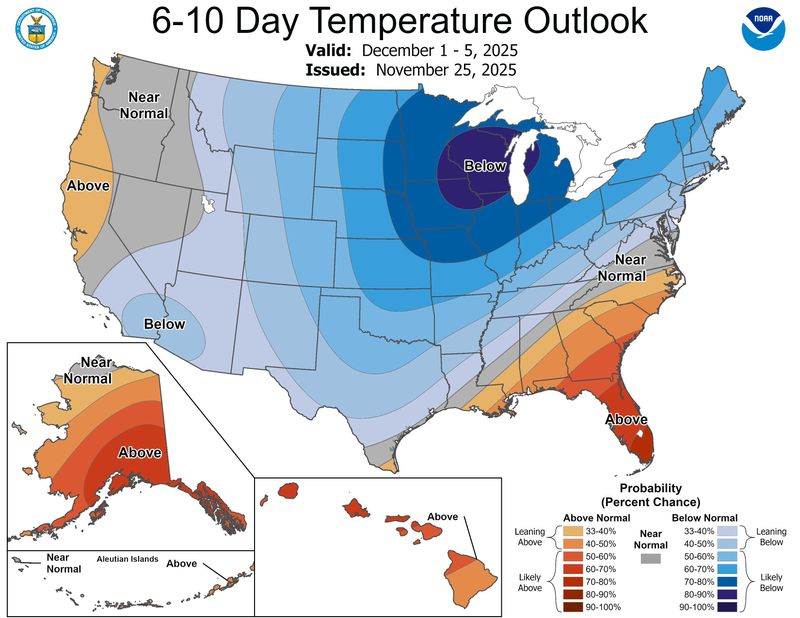
The National Weather Service’s Climate Prediction Center says colder-than-normal weather is most likely in the northern and northeastern United States, but some forecasters say a complex dance involving the polar vortex could send some of Earth’s most extreme cold toward the United States.
“My thinking is that the cold the first week of December is the appetizer and the main course will be in mid-December,” said climatologist Judah Cohen, a research scientist at MIT, in an email to USA TODAY.
Unusually cold temperatures are expected for most of the north-central U.S. by the first week of December.
Indeed, according to Cohen’s computer model, “which I can credibly claim as the world’s best — is predicting that the most expansive region of most likely extreme cold on Earth stretches from the Canadian Plains to the U.S. East Coast in the 3rd week of December.”
As for snow, that remains a wild card, as the weather systems that produce snow typically can’t be predicted more than a few days in advance. Suffice it to say that having cold air present is half of the battle.
Polar vortex on hold?
The main “polar vortex” load of very cold air will remain mostly locked up in Canada through the next 7-10 days, said Weather Trader meteorologist Ryan Maue in a Substack post. Maue continues to monitor the polar vortex intrusion risk into the Lower 48 into December.
Indeed, the complex dances of large-scale climate patterns far above our heads — which include the infamous polar vortex and a phenomenon known as “sudden stratospheric warming” — will determine the intensity and duration of the cold weather in the United States in December, Cohen said. But “I am conflicted about exactly what is happening with the polar vortex,” he admitted.
How cold will it get?
Although the most extreme cold won’t arrive until later in December, widespread and persistent below-average temperatures for this time of year can be expected for a wide expanse of the country from the western High Plains to the East Coast next week, with some near average conditions for the Southeast states and warmer over Florida, according to the National Weather Service.
The coldest anomalies for both highs and lows are forecast over the Midwest Monday Dec. 1 and Tuesday Dec. 2, with highs only in the 10s to middle 20s for many of these areas, and lows in the 0s getting down to northern Missouri and Illinois by Monday morning as the arctic airmass becomes established over the region.
Some subzero overnight lows are well within the realm of possibility from eastern Montana to North Dakota, the weather service said.
U.S. President Donald Trump said on Thursday his administration will “permanently pause” migration from all “Third World Countries,” following the death of a National Guard member in an attack near the White House.
The comments mark a further escalation of migration measures Trump has ordered since the shooting on Wednesday that investigators say was carried out by an Afghan national who entered the U.S. in 2021 under a resettlement program.
Trump did not identify any countries by name or explain what he meant by third-world countries or “permanently pause.” He said the plan would include cases approved under former President Joe Biden’s administration.
“I will permanently pause migration from all Third World Countries to allow the U.S. system to fully recover, terminate all of the millions of Biden illegal admissions, including those signed by Sleepy Joe Biden’s autopen, and remove anyone who is not a net asset to the United States,” he said on his social media platform, Truth Social.
Trump said he would end all federal benefits and subsidies for “non-citizens,” adding he would “denaturalize migrants who undermine domestic tranquility” and deport any foreign national deemed a public charge, security risk, or “non-compatible with Western civilization.”
White House and U.S. Citizenship and Immigration Services did not immediately respond to Reuters’ requests for comment.
Trump claims hundreds of thousands of migrants are unvetted
Earlier, officials from the Department of Homeland Security said Trump had ordered a widespread review of asylum cases approved under Biden’s administration and green cards issued to citizens of 19 countries.
The alleged gunman, identified by officials as 29-year-old Rahmanullah Lakanwal, was granted asylum this year under Trump, according to a U.S. government file seen by Reuters.
He entered the U.S. in a resettlement program set up by Biden after the U.S. military withdrawal from Afghanistan in August 2021 that led to the rapid collapse of the Afghan government and the country’s takeover by the Taliban.
In a separate post prior to his “permanently pause” announcement, Trump claimed that hundreds of thousands of people poured into the U.S. totally “unvetted and unchecked” during what he described as the “horrendous” airlift from Afghanistan.
The U.S. Citizenship and Immigration Services on Wednesday stopped processing all immigration requests relating to Afghan nationals indefinitely.
Trump pushes reverse migration
Trump indicated that his administration’s goals are aimed at significantly reducing “illegal and disruptive populations,” suggesting that measures would be taken to achieve this outcome.
“Only REVERSE MIGRATION can fully cure this situation.”
Even though Lakanwal was in the country legally, the incident bolsters Trump’s immigration agenda. Cracking down on both legal and illegal immigration has been a key focus of his presidency, and this case gave him an opportunity to broaden the debate beyond legality to include stricter vetting of immigrants.
Trump has already deployed additional immigration officers to major U.S. cities to achieve record deportation levels, including many long-term residents and individuals with no criminal record.
Over two-thirds of the roughly 53,000 people arrested by U.S. Immigration and Customs Enforcement and detained as of Nov. 15 had no criminal convictions, according to ICE statistics.
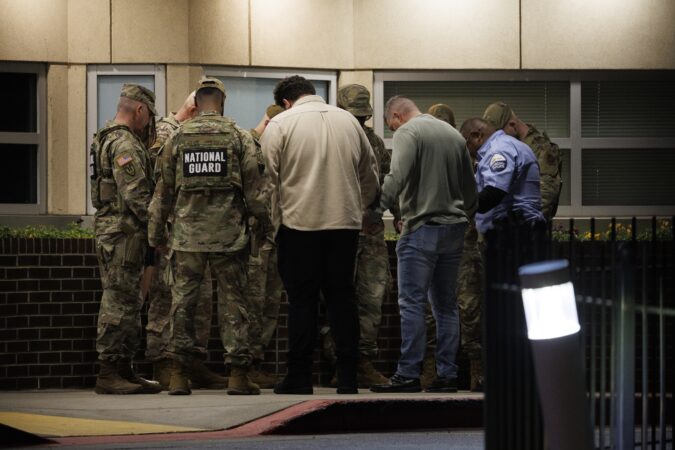
WEST PALM BEACH, Fla. — President Donald Trump said that one of the two West Virginia National Guard members shot by an Afghan national near the White House had died, calling the shooter who had worked with the CIA in his native country a “savage monster.”
As part of his Thanksgiving call to U.S. troops, Trump said that he had just learned that Specialist Sarah Beckstrom, 20, had died, while Staff Sgt. Andrew Wolfe, 24, was “fighting for his life.”
“She’s just passed away,” Trump said. “She’s no longer with us. She’s looking down at us right now. Her parents are with her.”
The president called Beckstrom an “incredible person, outstanding in every single way.”
Trump used the announcement to say the shooting was a “terrorist attack” as he criticized the Biden administration for enabling Afghans who worked with U.S. forces during the Afghanistan War to enter the United States. The president has deployed National Guard members in part to assist in his administration’s mass deportation efforts.
Trump suggested that the shooter was mentally unstable after the war and departure from Afghanistan.
“He went cuckoo. I mean, he went nuts,” the president said. “It happens too often with these people.”
Staff Sgt. Andrew Wolfe and Specialist Sarah Beckstrom.
The shooter worked with U.S. forces in Afghanistan
The suspect charged with the shooting is Rahmanullah Lakanwal, 29. The suspect had worked in a special CIA-backed Afghan Army unit before emigrating from Afghanistan, according to two sources who spoke to the Associated Press on condition of anonymity due to the sensitivity of the situation, and #AfghanEvac, a group that helps resettle Afghans who assisted the U.S. during the two-decade war.
Jeanine Pirro, the U.S. attorney for the District of Columbia, declined to provide a motive for Wednesday afternoon’s brazen act of violence which occurred just blocks from the White House. The presence of troops in the nation’s capital and other cities around the country has become a political flashpoint.
The Veterans of Foreign Wars post in Webster Springs, where Beckstrom is from, will hold three prayer vigils Thursday, Friday, and Saturday evenings, according to a Facebook post from the Webster County Veterans Auxiliary.
Pirro said that the suspect, Lakanwal, launched an “ambush-style” attack with a .357 Smith & Wesson revolver. The suspect currently faces charges of assault with intent to kill while armed and possession of a firearm during a crime of violence. Pirro said that “it’s too soon to say” what the suspect’s motives were.
The charges could be upgraded, Pirro said, adding: “We are praying that they survive and that the highest charge will not have to be murder in the first degree. But make no mistake, if they do not, that will certainly be the charge.”
The rare shooting of National Guard members on American soil, on the eve of Thanksgiving, comes amid court fights and a broader public policy debate about the Trump administration’s use of the military to combat what officials cast as an out-of-control crime problem.
Trump issued an emergency order in August that federalized the local police force and sent in National Guard troops. The order expired a month later. But the troops have remained in the city, where nearly 2,200 troops currently are assigned, according to the government’s latest update.
The guard members have patrolled neighborhoods, train stations and other locations, participated in highway checkpoints and been assigned to pick up trash and guard sports events. The Trump administration quickly ordered 500 more National Guard members to Washington following Wednesday’s shooting.
The suspect who was in custody also was shot and had wounds that were not believed to be life-threatening, according to a law enforcement official who was not authorized to discuss the matter publicly and spoke to AP on condition of anonymity.
Shooting raises questions about legacy of Afghanistan War
A resident of the eastern Afghan province of Khost who identified himself as Lakanwal’s cousin said Lakanwal was originally from the province and that he and his brother had worked in a special Afghan Army unit known as Zero Units in the southern province of Kandahar. A former official from the unit, who spoke on condition of anonymity because of the sensitivity of the situation, said Lakanwal was a team leader and his brother was a platoon leader.
The cousin spoke to the Associated Press on condition of anonymity for fear of reprisals. He said Lakanwal had started out working as a security guard for the unit in 2012, and was later promoted to become a team leader and a GPS specialist.
Kandahar is in the Taliban heartland of the country. It saw fierce fighting between the Taliban and NATO forces after the U.S.-led invasion in 2001 following the al-Qaeda attacks on Sept. 11. The CIA relied on Afghan staff for translation, administrative and front-line fighting with their own paramilitary officers in the war.
Zero Units were paramilitary units manned by Afghans but backed by the CIA and also served in front-line fighting with CIA paramilitary officers. Activists had attributed abuses to the units. They played a key role in the chaotic U.S. withdrawal from the country, providing security around Kabul International Airport as the Americans and withdrew from the country.
CIA Director John Ratcliffe said in a statement that Lakanwal’s relationship with the U.S. government “ended shortly following the chaotic evacuation” of U.S. service members from Afghanistan.
Lakanwal, 29, entered the U.S. in 2021 through Operation Allies Welcome, a Biden administration program that evacuated and resettled tens of thousands of Afghans after the U.S. withdrawal from the country, officials said. Lakanwal applied for asylum during the Biden administration, but his asylum was approved under the Trump administration, #AfghanEvac said in a statement.
The initiative brought roughly 76,000 people to the U.S., many of whom had worked alongside U.S. troops and diplomats as interpreters and translators. It has since faced intense scrutiny from Trump and others over allegations of gaps in the vetting process, even as advocates say there was extensive vetting and the program offered a lifeline to people at risk of Taliban reprisals.
The Philadelphia region played a crucial role in supporting the largest resettlement effort since the end of the Vietnam War, as the United States evacuated thousands of allies from Afghanistan as Kabul fell to the Taliban.
Philadelphia International Airport served as the nation’s main arrival point for more than 25,000 evacuees, about 1,500 of whom needed immediate medical attention for everything from diabetes to gunshot wounds. The flights to Philadelphia came from first-stop, emergency evacuation centers in Germany, Bahrain, Qatar, Spain, the United Arab Emirates, and elsewhere.
Most arrivals to Philadelphia were bused from the airport to temporary living quarters at Joint Base McGuire-Dix-Lakehurst in South Jersey. Others went to seven other military installations being used as “safe havens,” from where they were resettled in communities across the country.
At one point more than 11,000 Afghans were living in a tent city, christened “Liberty Village,” on the South Jersey base. The Trump administration recently designated the base as one of two military sites where it intends to hold immigration detainees.
Ultimately at least 600 evacuees were resettled in the Philadelphia area, many of them living in the Northeast, which already had a significant Afghan population.
Almost everyone who came to Philadelphia and to this country served the United States in a military, diplomatic, or development capacity, or was the family member of someone who did. Others worked in media, women’s organizations, or humanitarian groups that faced Taliban retaliation.
Lakanwal has been living in Bellingham, Wash., about 79 miles north of Seattle, with his wife and five children, said his former landlord, Kristina Widman.
The director of U.S. Citizenship and Immigration Services, Joseph Edlow, said in a social media post Thursday that Trump directed him to review the green cards of people from countries “of concern.”
Edlow didn’t name the countries. But in June, the administration banned travel to the U.S. by citizens of 12 countries and restricted access from seven others, citing national security concerns. Green card holders and Afghans who worked for the U.S. government or its allies in Afghanistan were listed as exempt.
Attack being investigated as terrorist act
FBI Director Kash Patel said the shooting is being investigated as an act of terrorism. Agents have served a series of search warrants, with Patel calling it a “coast-to-coast investigation.”
Washington Mayor Muriel Bowser, a Democrat, has previously questioned the effectiveness of using the National Guard to enforce city laws. Last week, a federal judge ordered an end to the deployment there, but the judge also paused her order for 21 days to allow the administration to remove the troops or appeal.
On Thursday, Bowser interpreted the shooting as a direct assault on America itself, rather than specifically on Trump’s policies.
“Somebody drove across the country and came to Washington, D.C., to attack America,” Bowser said. “That person will be prosecuted to the full extent of the law.”
Staff writer Jeff Gammage contributed to this article.
WASHINGTON – The FBI searched multiple properties in Washington state and San Diego on Thursday in what officials said was a terrorism probe into an Afghan national suspected of shooting two National Guard members, who remained in critical condition.
Investigators seized numerous electronic devices from the suspect’s house in Washington state, including cellphones, laptops, and iPads, and interviewed the suspect’s relatives, FBI Director Kash Patel told a news conference in Washington, D.C.
U.S. Attorney for Washington, D.C. Jeanine Pirro identified the two wounded Guard members as Sarah Beckstrom, 20, and Andrew Wolfe, 24.
Pirro said the suspect ambushed the Guard members while they were patrolling near the White House on Wednesday afternoon. Armed with a powerful revolver, a .357 Magnum, he shot one member who fell and then shot again before firing multiple times at the second member.
Suspect worked with U.S. forces in Afghanistan
Attorney General Pam Bondi told Fox News the U.S. government planned to bring terrorism charges against the gunman and seek a sentence of life in prison “at a minimum.”
At her briefing, Pirro said the gunman faces three counts of assault with intent to kill while armed and a charge of possession of a firearm during a crime of violence.
He could be charged with murder in the first degree if either of the Guard members does not survive their injuries, she said.
Patel described the shootings as a “heinous act of terrorism,” but neither he nor Pirro offered a possible motive.
The assailant appeared to have acted alone, said Jeff Carroll, executive assistant chief of the Washington Metropolitan Police Department.
The suspect has been identified by authorities as 29-year-old Rahmanullah Lakanwal, who lived in Washington state with his wife and five children.
Lakanwal, who was wounded in an exchange of gunfire before he was arrested, had been involved with U.S. partner forces during the war in Afghanistan, Patel said.
CIA Director John Ratcliffe told Fox News and the New York Times that Lakanwal had worked with CIA-backed local units in Afghanistan.
“He drove his vehicle cross-country from the state of Washington with the intended target of coming to our nation’s capital,” Pirro told the news conference.
According to the Department of Homeland Security, Lakanwal entered the U.S. in 2021 under Operation Allies Welcome, a Biden-era program to resettle thousands of Afghans who assisted the U.S. during the Afghanistan war and feared reprisals from Taliban forces who seized control after the U.S. withdrawal there.
President Donald Trump, who was at his Florida resort at the time of the attack, released a video statement late on Wednesday calling the shooting “an act of evil, an act of hatred and an act of terror.”
It was unclear if the shooting would lead to changes to how the Guard operates in cities. Members typically patrol in small groups, including on foot, mostly armed with pistols.
Lakanwal approved for U.S. asylum this year
Trump said his administration would “re-examine” all Afghans who came to the U.S. during Joe Biden’s presidency.
Pirro and Patel blamed the Biden administration for improperly vetting Lakanwal, although they offered no evidence to support this assertion.
A Trump administration official who spoke on condition of anonymity said Lakanwal applied for asylum in December 2024 and was approved on April 23 this year, three months after Trump took office. Lakanwal, who resided in Washington state, had no known criminal history, the official said.
The U.S. Citizenship and Immigration Services said on Wednesday it had halted processing of all immigration requests relating to Afghan nationals indefinitely, “pending further review of security and vetting protocols.”
FBI Director Kash Patel, center, and District of Columbia Mayor Muriel Bowser, left, speak after two National Guard soldiers were shot near the White House on Wednesday, Nov. 26.
Vance defends immigration policy
Vice President JD Vance, who was in Kentucky on Wednesday, said on social media that the shooting proved the Trump administration’s immigration policy was justified.
“We must redouble our efforts to deport people with no right to be in our country,” he said.
Critics of the administration’s immigration policy say it has employed harsh and illegal tactics and swept up immigrants indiscriminately, including many with no criminal history and others in the U.S. legally.
The two Guard members from West Virginia were part of a militarized law enforcement mission ordered by Trump in August and challenged in court by Washington, D.C., officials. Trump ordered 500 more troops to be deployed in the capital in the wake of the shooting, joining about 2,200 already in the city as part of the president’s immigration and crime crackdown targeting Democratic-led cities.
Trump, a Republican, has suggested repeatedly that crime has disappeared from the capital as a result of the deployment, an assertion at odds with the police department’s official crime statistics. (Reporting by Leah Douglas, Jana Winter, Phil Stewart, Ted Hesson, Lucia Mutikani, Jasper Ward and Tim Reid; Additional reporting by Idrees Ali, Jeff Mason, Steve Gorman; Writing by Julia Harte and Rod Nickel; Editing by Ross Colvin and Deepa Babington)
Philadelphia role in Afghan resettlements
The Philadelphia region played a crucial role in supporting the largest resettlement effort since the end of the Vietnam War.
Philadelphia International Airport served as the nation’s main arrival point for more than 25,000 evacuees, about 1,500 of whom needed immediate medical attention for everything from diabetes to gunshot wounds. The flights to Philadelphia came from first-stop, emergency evacuation centers in Germany, Bahrain, Qatar, Spain, the United Arab Emirates, and elsewhere.
Most arrivals to Philadelphia were bused from the airport to temporary living quarters at Joint Base McGuire-Dix-Lakehurst in South Jersey.
At one point more than 11,000 Afghans were living in a tent city, christened “Liberty Village,” on the South Jersey base. The Trump administration recently designated the base as one of two military sites where it intends to holds immigration detainees.
Ultimately at least 600 evacuees were resettled in the Philadelphia area, many of them living in the Northeast, which already had a significant Afghan population.
Almost everyone who came to Philadelphia and to this country served the United States in a military, diplomatic, or development capacity, or was the family member of someone who did. Others worked in media, women’s organizations, or humanitarian groups that faced Taliban retaliation.
Inquirer staff writer Jeff Gammage contributed to this article.
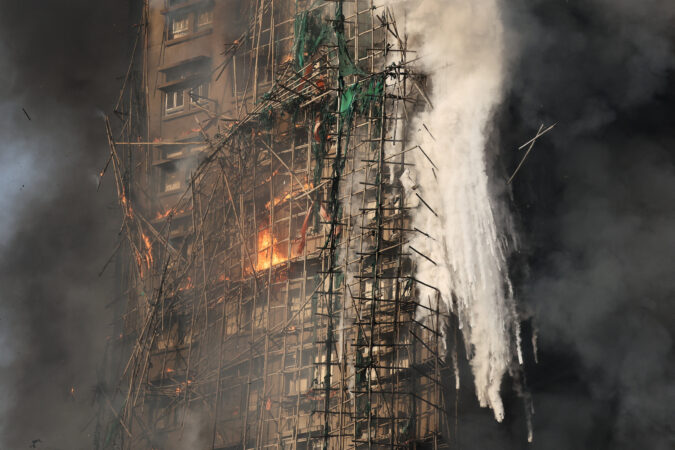
HONG KONG – Hong Kong’s deadliest fire in three decades has highlighted its risky use of flammable bamboo scaffolding and mesh for building work in a tradition dating back centuries to mainland China. Authorities have not determined the cause of the blaze, but images from the scene showed the fire spreading rapidly across green netting covering the scaffolding erected around the housing complex.
Some of the bamboo lattices crashed to the ground in flames. For decades in the skyscraper-strewn former British colony, bamboo has been the material of choice for scaffolding – cheap, abundant and flexible – bound together with nylon cords.
The craft originated on mainland China where bamboo, viewed as symbolizing grace and moral fortitude, has since ancient times been a cornerstone of architecture, even reputedly used for scaffolding and tools in the building of the Great Wall.
Now, though, it has largely been phased out in Mainland China for sturdier metal scaffolding and clamps. But Hong Kong, despite its modernity, still has around 2,500 registered bamboo scaffolding masters, according to official figures.
The number of metal scaffolders is around triple that. Small teams of scaffolders scrambling up vertiginous gleaming facades to sheathe a building in a matter of weeks is a familiar sight in the global financial hub.
The bamboo lattices are also often used alongside green construction mesh to prevent debris from injuring passers-by, as was the case in the tower blocks at the Wang Fuk Court housing complex in Hong Kong’s northern Tai Po district.
Scaffolding checks promised
The fire that began Wednesday afternoon killed at least 55 people with nearly 300 missing. Hong Kong police said on Thursday that “the building’s exterior walls had protective nets, membranes, waterproof tarpaulins, and plastic sheets suspected of not meeting fire safety standards.”
The city’s Independent Commission Against Corruption (ICAC) said it had launched an investigation, while Hong Kong’s Chief Executive John Lee said a task force had been set up to investigate the cause of the blaze. He said the government would check whether scaffolding mesh materials meet fire retardant standards and other safety standards on other projects.
Police arrested two directors of the contractor responsible for the renovation of the building and a consultant on manslaughter charges after finding materials were used in construction that did not meet safety standards.
The company, Prestige Construction & Engineering, did not answer repeated requests for comment.
In March, the government said 50% of new public works contracts would be required to use metal scaffolding going forward.
But the emphasis appeared to be more on worker safety rather than fire risks. There were 22 deaths involving bamboo scaffolders between 2019 and 2024, according to official figures.
A firefighter works to extinguish the blaze that broke out at Wang Fuk Court in Hong Kong.
Lee told reporters on Thursday that Hong Kong’s government was considering mandating the use of metal scaffolding in the future and had met with industry to discuss a phase-out of bamboo. In October, a massive bamboo scaffolding caught fire at the Chinachem Tower in the Central business district. Fire consumed construction netting and bamboo poles, leaving windows burnt out and external walls badly seared.
The Association for the Rights of Industrial Accident Victims in Hong Kong said in a Facebook post that there had been at least two other fires involving bamboo scaffolding this year.
Protective nets, screens and tarpaulins or plastic sheeting installed on the face of scaffolding “should have appropriate fire retardant properties in compliance with a recognized standard,” says the Hong Kong Labour Department’s Code of Practice for Bamboo Scaffolding Safety.
Whistle-blower points to risks in other housing blocks
Jason Poon, a whistle-blower who has previously exposed shoddy construction work in Hong Kong, said in a Facebook post on Wednesday that fire hazard risks existed in scaffolding at many housing complexes.
He said he had reached out to various government departments last year concerning the lack of fire retardant in scaffolding nets at another complex, but he was ignored.
Firefighters work to extinguish the fire at Wang Fuk Court on Wednesday.
Hong Kong’s fire and building safety regulators did not respond to a request to comment.
“Of course, in terms of material, metal scaffolding is less flammable. That’s a fact,” said Chau Sze Kit, chairman of the Hong Kong Construction Industry Employees General Union. But he said the fire risk for bamboo scaffolding could be limited if a construction management team takes the right steps.
“Fires on scaffolding usually happen because construction debris accumulates on it – things like paper, towels, clothing, or other flammable materials,” he told Reuters. “Poor management leads to these incidents.”
HONG KONG/BEIJING – A huge fire still burning in a Hong Kong high-rise apartment complex that has killed at least 55 people with almost 300 missing poses the biggest test of Beijing’s grip on the city it has transformed since the mass pro-democracy protests of 2019.
Under sweeping legislative changes, pro-democracy voices and other critics have been silenced and elections limited to “patriotic” candidates, with the next legislative council poll set for December 7.
The fire struck as Hong Kong braces for the sentencing of media tycoon Jimmy Lai – the most prominent of hundreds of pro-democracy figures and activists facing lengthy jail terms under national security and protest-related charges.
“I think Beijing is attaching great importance to two issues – number one, how will the government handle this tragedy? And secondly, will we see a changing perception of the citizens on the Hong Kong government,” said Sonny Lo, a political scientist who has written several books on Hong Kong politics.
“The government has done well on national security, but national security includes a human security dimension.”
The leadership of both the Hong Kong government and China’s Communist Party moved quickly to show they attached utmost importance to the tragedy, with police targetting the construction company in charge of the renovations.
Hong Kong’s sky-high property prices have long been a trigger for discontent and the tragedy could stoke resentment towards authorities despite their efforts to tighten political and national security control, analysts said.
From faulty fire alarms to workers smoking cigarettes and the risks of traditional bamboo scaffolding, many residents questioned whether risks were ignored and safety systems installed and operational.
As they huddled in shelters, some criticized what they saw as negligence and cost-cutting as a cause of the fire, echoing similar sentiments online.
Around 10 p.m. on Wednesday night – with flames still shooting out of windows – Chinese President Xi Jinping in Beijing urged an “all-out effort” to extinguish the fire and to minimize casualties and losses, according to state media reports.
Xi “expressed sympathy to the families of the victims and those affected by the disaster” and “attached great importance to the accident and immediately sought updates on the rescue efforts and casualties.”
Four hours later, Hong Kong leader John Lee held a news conference after touring shelters for survivors of the blaze.
Some 4,600 people live in the complex’s eight towers, seven of which caught fire.
“The priority is to extinguish the fire and rescue the residents who are trapped,” Lee said. “The second is to support the injured. The third is to support and recover. Then, we’ll launch a thorough investigation.”
But at 5:54 a.m., only three hours after Lee’s news conference and before the fire was fully under control, police announced the cause of its spread and said three officials from the construction company had been arrested.
As well as the towers being covered with sheets of protective mesh and plastic that may not meet fire standards, some windows on one unaffected building were sealed with a foam material that had been installed by a construction company carrying out maintenance work, police said.
“We have reason to believe that the company’s responsible parties were grossly negligent, which led to this accident and caused the fire to spread uncontrollably, resulting in major casualties,” said Eileen Chung, a Hong Kong police superintendent.
Three men from the construction company, two directors and one engineering consultant, had been arrested on suspicion of manslaughter over the fire, she added.
Questions of accountability
While protests are relatively tightly controlled in Hong Kong, a full range of online forums remain accessible and are likely to offer an early barometer of the public mood.
Analysts say public anger and concern may spread beyond the construction firms to the government’s fire safety and building regulators and pressure is likely to build for extensive and open investigations into what happened.
Traditionally, the Hong Kong government has staged open inquiries into large-scale tragedies, often headed by an independent judge.
One comparison raised by experts is a commission of inquiry into a fire in a Kowloon commercial building that killed 41 people in 1996, a year before the handover of Hong Kong from Britain to China.
That inquiry sparked new building and fire safety laws and regulations. But it may no longer be enough.
“I believe we need to seriously review fire safety and site safety management across the entire industry, including government oversight,” said Chau Sze Kit, chairman of the Hong Kong Construction Industry Employees General Union.
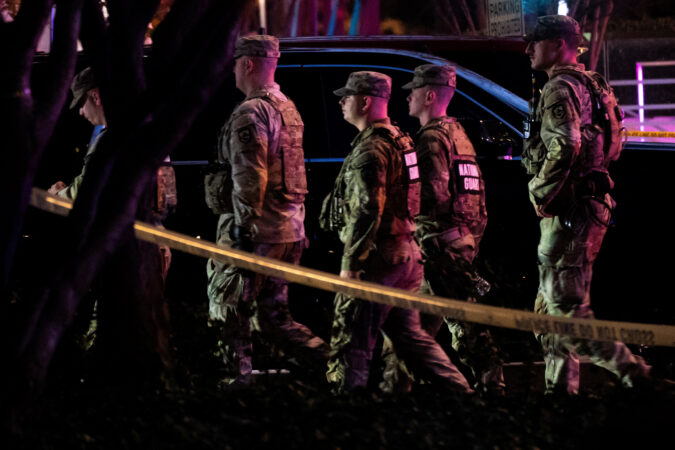
WASHINGTON – Two National Guard soldiers were shot on Wednesday near the White House in what officials described as a targeted ambush, and the suspect was in custody after suffering gunshot wounds during the attack.
Investigators identified the suspect as Rahmanullah Lakanwal, a 29-year-old Afghan national from Washington State, according to a Justice Department official who spoke on condition of anonymity. The attack is being investigated as an act of terrorism, the official said.
Lakanwal came to the U.S. in 2021 on a special visa program for Afghans who assisted the U.S. during the Afghanistan war and were vulnerable to reprisals from the ruling Taliban after the U.S. withdrawal, the official said. But he overstayed his visa and is in the country illegally, according to the official.
President Donald Trump was in Florida at the time of the attack, which prompted the White House to go into lockdown as law enforcement from multiple federal and city agencies swarmed the area.
The two soldiers, members of the West Virginia National Guard, were part of a “high-visibility patrol” around 2:15 p.m. ET (1915 GMT) near the corner of 17th and I streets, a few blocks from the White House. The suspect came around a corner and “ambushed” them, Metropolitan Police Assistant Chief Jeff Carroll said at a press briefing.
After an exchange of gunfire, other National Guard troops were able to subdue the shooter, he said. The two wounded soldiers were in critical condition at local hospitals, FBI Director Kash Patel said.
“This is a targeted attack,” Washington Mayor Muriel Bowser said at the briefing.
The shooter appeared to have acted alone, officials said.
Trump is at his resort in Palm Beach ahead of Thursday’s Thanksgiving holiday, while U.S. Vice President JD Vance is in Kentucky.
In a social media post, Trump called the suspected shooter an “animal” who would “pay a very steep price” and praised the National Guard.
He also ordered 500 more guard soldiers deployed to Washington, Secretary of Defense Pete Hegseth told reporters, joining about 2,200 already in the city as part of the president’s contentious immigration and crime crackdown targeting Democratic-led cities.
Witnesses describe chaotic scene
The shooting unfolded near Farragut Square, a popular lunch spot for office workers just a few blocks from the White House. The park, where light posts are wrapped in wreaths and bows for the holiday season, is flanked by fast-casual restaurants and a coffee shop, as well as two metro stops.
Witnesses described a chaotic scene after shots were fired, with pedestrians fleeing.
Mike Ryan, 55, said he was on his way to buy lunch nearby when he heard what sounded like gunfire. He ran half a block away and heard another round of apparent gunfire.
When he made his way back to the scene, he saw two National Guard soldiers on the ground across the street, with people trying to resuscitate one of them. At the same time, other guard troops had pinned someone on the ground, Ryan said.
Another witness, Emma McDonald, said she saw one of the soldiers carried away on a stretcher minutes after the shooting, his head covered in blood and an automated compression system attached to his chest.
National Guard soldiers have been in Washington since Trump’s initial deployment in August, a move that was opposed by local officials and criticized by Democrats. The guard troops in the city include contingents from the District of Columbia as well as Louisiana, Mississippi, Ohio, South Carolina, West Virginia, Georgia and Alabama.
Trump, a Republican, has suggested repeatedly that crime has disappeared from the capital as a result of the deployment, an assertion at odds with the police department’s official crime statistics.
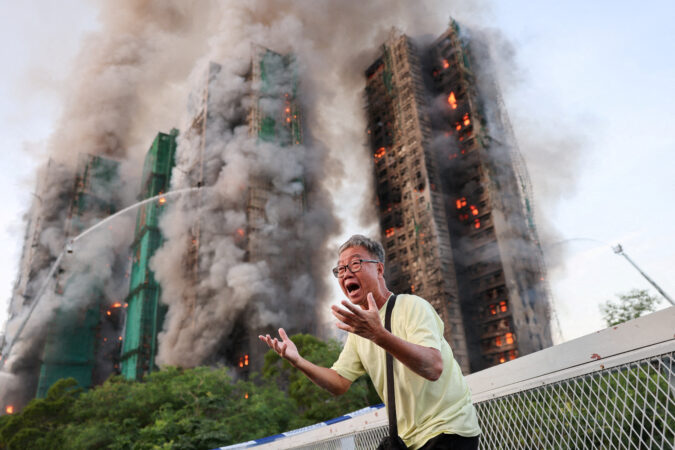
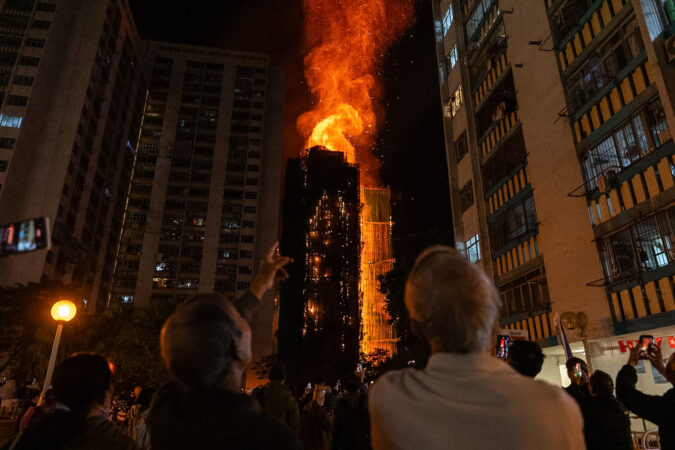
HONG KONG – At least 36 people were killed and 279 were missing on Wednesday after Hong Kong’s deadliest fire in three decades ripped through high-rise residential towers sheathed in flammable bamboo scaffolding, authorities said.
More than 10 hours after the fire started in the northern Tai Po district, flames and thick smoke still engulfed the 32-story towers as rescue workers swarmed the site and shocked inhabitants watched nearby.
The cause of the blaze was not immediately known, but it was fanned by green construction mesh and bamboo scaffolding which the government began phasing out in March for safety reasons.
Firefighters work to extinguish a blaze that broke out at Wang Fuk Court in Hong Kong on Wednesday.
Working through the night, firefighters were struggling to reach upper floors of the Wang Fuk Court housing complex, which has 2,000 apartments in eight blocks, due to the intense heat.
One 71-year-old resident surnamed Wong broke down in tears, saying his wife was trapped inside.
A firefighter was among the 36 killed, and 29 people were in hospital, Hong Kong leader John Lee told reporters. Some 900 people were in eight shelters.
“The priority is to extinguish the fire and rescue the residents who are trapped. The second is to support the injured. The third is to support and recover. Then, we’ll launch a thorough investigation,” Lee told reporters. Harry Cheung, 66, who has lived at Block Two in one of the complexes for more than 40 years, said he heard a loud noise about 2:45 p.m. (6:45 GMT) and saw fire erupt in a nearby block.
“I immediately went back to pack up my things,” he said.
“I don’t even know how I feel right now. I’m just thinking about where I’m going to sleep tonight because I probably won’t be able to go back home.”
A firefighter was among those killed, the director of Fire Services said.
China’s XI urges ‘all-out’ effort against fire
Frames of scaffolding were seen tumbling to the ground as firefighters battled the blaze, while scores of fire engines and ambulances lined the road below the development.
From the mainland, China’s President Xi Jinping urged an “all-out effort” to extinguish the fire and to minimize casualties and losses, China’s state broadcaster CCTV said.
Hong Kong’s sky-high property prices have long been a trigger for social discontent in the city and the fire tragedy could stoke resentment towards authorities ahead of a city-wide legislative election in early December.
The cause of the blaze was not immediately known, but it was fanned by green construction mesh and bamboo scaffolding which the government began phasing out in March for safety reasons.
Hong Kong’s Transport Department said that due to the fire, an entire section of the Tai Po road, one of Hong Kong’s two main highways, had been closed and buses were being diverted.
At least six schools will be closed on Thursday due to the fire and traffic congestion, the city’s Education Bureau said.
It was Hong Kong’s worst fire since 41 people died in a commercial building in the heart of Kowloon in November 1996.
That fire was later found to be caused by welding during internal renovations.
A public inquiry yielded sweeping updates to building standards and fire safety regulations in the city’s high-rise offices, shops and homes.
Dozens of shocked residents and onlookers in Hong Kong watched from nearby walkways as smoke funneled up from the complex.
Bamboo scaffolding being phased out
Hong Kong is one of the last places in the world where bamboo is still widely used for scaffolding in construction.
The government moved to start phasing that out in March, citing safety. It announced that 50% of public construction works would be required to use metal frames instead.
Wang Fuk Court is one of many high-rise housing complexes in Hong Kong, one of the most densely populated areas in the world. Tai Po, located near the border with mainland China, is an established suburban district with some 300,000 residents.
Occupied since 1983, the complex is under the government’s subsidized home ownership scheme, according to property agency websites. According to online posts, it has been undergoing renovations for a year at a cost of HK$330 million ($42.43 million), with each unit paying between HK$160,000 and HK$180,000.
Owning a home is a distant dream for many in Hong Kong, one of the world’s most expensive housing markets and where residential rents are hovering around record highs.
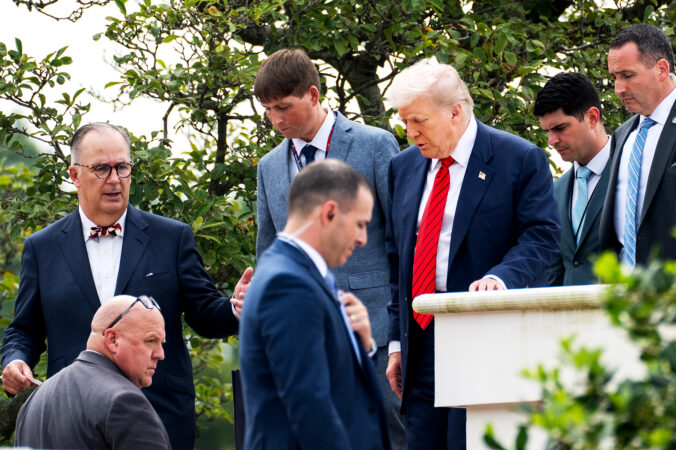
President Donald Trump has argued with the architect he handpicked to design a White House ballroom over the size of the project, reflecting a conflict between architectural norms and Trump’s grandiose aesthetic, according to four people who spoke on the condition of anonymity to describe internal conversations.
Trump’s desire to go big with the project has put him at odds with architect James McCrery II, the people said, who has counseled restraint over concerns the planned 90,000-square-foot addition could dwarf the 55,000-square-foot mansion in violation of a general architectural rule: don’t build an addition that overshadows the main building.
A White House official acknowledged the two have disagreed but would not say why or elaborate on the tensions, characterizing Trump and McCrery’s conversations about the ballroom as “constructive dialogue.”
“As with any building, there is a conversation between the principal and the architect,” said the official, who spoke on the condition of anonymity to discuss private conversations. “All parties are excited to execute on the president’s vision on what will be the greatest addition to the White House since the Oval Office.”
McCrery declined an interview request through a representative who declined to answer questions about the architect’s interactions with Trump in recent weeks.
Trump’s intense focus on the project and insistence on realizing his vision over the objections of his own hire, historic preservationists and others concerned by a lack of public input in the project reflect his singular belief in himself as a tastemaker and obsessive attention to details. In the first 10 months of his second term, Trump has waged a campaign to remake the White House in his gilded aesthetic and done so unilaterally – using a who’s-going-to-stop-me ethos he honed for decades as a developer.
Multiple administration officials have acknowledged that Trump has at times veered into micromanagement of the ballroom project, holding frequent meetings about its design and materials. A model of the ballroom has also become a regular fixture in the Oval Office.
The renovation represents one of the largest changes to the White House in its 233-year history, and has yet to undergo any formal public review. The administration has not publicly provided key details about the building, such as its planned height. The 90,000-square-foot structure also is expected to host a suite of offices previously located in the East Wing. The White House has also declined to specify its plans for an emergency bunker that was located below the East Wing, citing matters of national security.
On recent weekdays, a bustling project site that is almost entirely fenced off from public view contained dozens of workers and materials ready to be installed, including reinforced concrete pipes and an array of cranes, drills, pile drivers and other heavy machinery, photos obtained by The WashingtonPost show.
Plans for the addition as of Tuesday had not been submitted to the National Capital Planning Commission, a 12-member board charged by Congress with overseeing federal construction projects and now led by Trump allies. A preliminary agenda for the commission’s next meeting, scheduled for Dec. 4, does not include the ballroom project under projects expected to be covered at the meeting or reviewed by the body in the next six months. White House officials say that the administration still plans to submit its ballroom plans to the commission at “the appropriate time.”
The administration’s rapid demolition of the East Wing annex and solicitations from companies and individuals to fund the new construction have caused controversy over the project, which Trump believes the White House needs to host special events. Democrats, historical preservation groups and some architects have criticized the project’s pace, secrecy and shifting specifications. The White House initially said this summer that the ballroom would cost $200 million and fit 650 people, while Trump in recent weeks asserted that it could cost $300 million or more and would fit about 1,000 people.
McCrery has kept his criticism out of the public eye, quietly working to deliver as Trump demanded rushed revisions to his plans, according to two of the people with knowledge of the conversations. The president – a longtime real estate executive who prides himself on his expertise – has repeatedly drilled into the details of the project in their Oval Office meetings, the people said.
McCrery has wanted to remain with the project, worried that another architect would design an inferior building, according to a person with knowledge of his thinking.
McCrery, a classical architect and the founder and principal of McCrery Architects, had designed works like the U.S. Supreme Court bookstore and the pedestal for President Ronald Reagan’s statue in the U.S. Capitol. The ballroom was the largest-ever project for his firm, which has specialized in designing churches, libraries and homes.
Trump hired McCrery for the project on July 13. Eighteen days later, the White House announced the ballroom project, with officials promising to start construction within two months and finish before the end of Trump’s second term.
Trump also appointed McCrery in 2019 to serve a four-year term on the U.S. Commission of Fine Arts, which provides advice to the president, Congress and local government officials on design matters related to construction projects in the capital region.
Democrats have pressed the White House and its donors for more details on the planned construction and what was promised to financial contributors. The ballroom is being funded by wealthy individuals and large companies that have contracts with the federal government, including Amazon, Lockheed Martin and Palantir Technologies. (Amazon founder Jeff Bezos owns The Post.)
Several donors have cast the decision in statements as an investment in the future of a building that belongs to the American people, pushing back on the suggestion that their largesse sought to curry favor with Trump.
A donor list released by the White House of 37 businesses and individuals who underwrote the ballroom is not comprehensive, administration officials acknowledged, leaving open the possibility that millions of dollars have been funneled toward the president’s pet project with no oversight.
“Billionaires and giant corporations with business in front of this administration are lining up to dump millions into Trump’s new ballroom – and Trump is showing them where to sign on the dotted line,” Sen. Elizabeth Warren (D-Massachusetts) said in a statement last week. Warren andhercolleagues also introduced legislation that would impose restrictions on White House construction and require more transparency from donors.
In the early ’90s, Colleen Mazzella walked into a newly opened pizzeria and met the man who would become not only her boss, but her husband.
She was visiting a friend who had been hired at Italian Affair in Stafford, and owner Dominick Mazzella, then a recent Staten Island transplant, offered her a job, too.
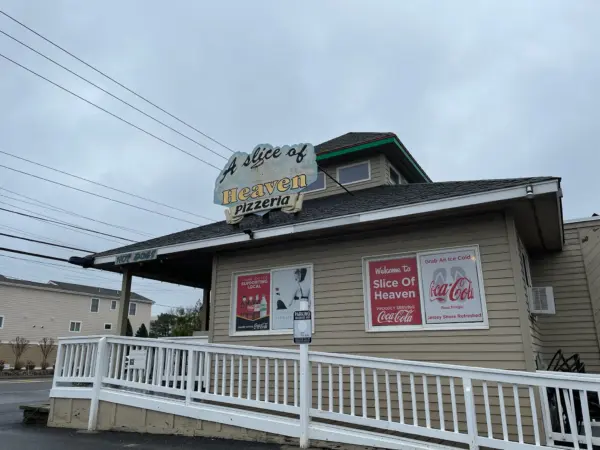
They soon became a couple, and a year later, in May 1995, opened A Slice of Heaven across from Fantasty Island Amusement Park on Long Beach Island. The building at 7th Street and Bay Avenue in Beach Haven had housed a car wash, candy store and photo shop through the years, and when the two met with owner Peter Buterick, “he said ‘I’m going to take a chance on you. I’ve got a good feeling about this,’” Mazzella said.
They made a name for themslves, thanks to a menu of dishes like stuffed cheesesteak pizza, scratch-made meatballs and cheesesteaks.
Thirty years later, the building is full of memories that became precious to Mazzella after Dominick died just days before his 50th birthday in 2024. She recalls the Stanley Cup being brought to the restaurant (“My husband was a gigantic hockey fan,” she said), staying open to serve pizza until 4 a.m. and borrowing ingredients from other restaurant owners to get through busy days.
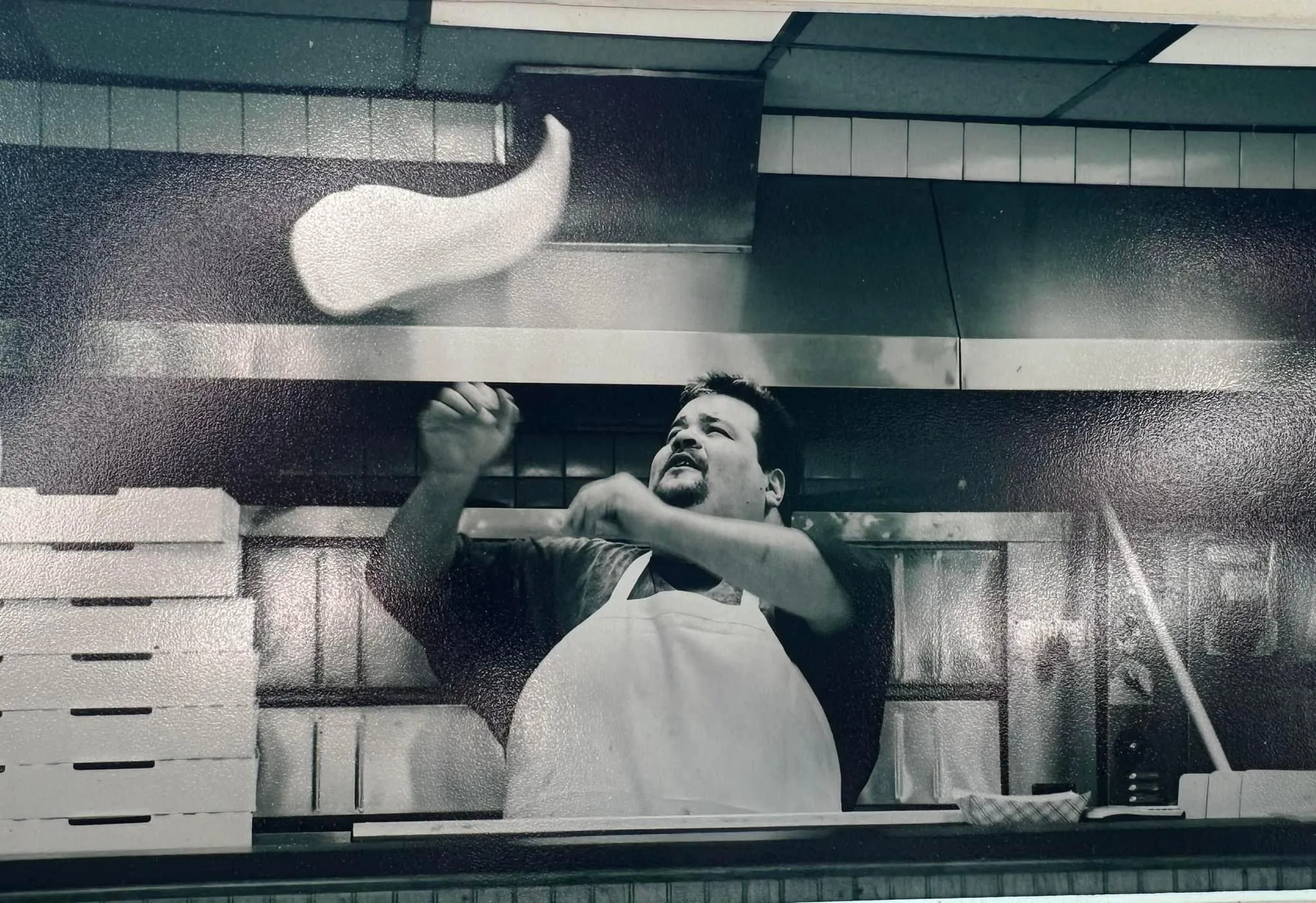
Dominick Mazzella is pictured behind the counter of A Slice of Heaven, the Long Beach Island pizzeria he opened with his wife, Colleen, in 1995.
She remembers when a family who lost their father stopped in for his favorite pizza before spreading his ashes on the beach, rebuilding after Superstorm Sandy sent four feet of water into the dining room and making pizza by flashlight during a power outage.
The restaurant is also where Dominick taught his son to make pizza, a legacy the 18-year-old — also named Dominick — has dreamed of continuing.
But it will have to happen somewhere else, as A Slice of Heaven closed earlier this month. The Mazzellas leased their restaurant space and the building has been sold.
“The plan was to take this place over,” Mazzella said of her and her husband’s plans for their son, a third-generation pizza maker whose grandfather emigrated from Naples, Italy, and owned restaurants in New York before opening the Stafford pizzeria with Dom.
A Slice of Heaven’s last day in business was Nov. 17, and Mazzella must vacate the building by the end of the month. She has been searching for a new location since learning of the impending sale several years ago, and while she wants to keep the restaurant on Long Beach Island, rentals that will work for her business are hard to come by, she said.
“My intention is to be on the island,” said Mazzella, who grew up in Brant Beach and now lives in Cedar Run on the mainland. “I love the people here. I grew up here. I love everything about it.”
“It’s just a fact of finding a place to land,” she said. “It’s been tough. I just have to keep believing that the places that I found that didn’t work out didn’t work out for a reason, and that it’s because we’re waiting for the right place.”
“We’ll find something,” she said. “I gotta believe that.”
Since announcing the closing date in early November, Mazzella has seen an outpouring of support online and in person, with customers sharing memories and well wishes.
One spoke of how the elder Dominick fulfilled her request to spell “It’s a boy!” in pepperoni on a pizza for her gender reveal. Another customer wrote of how the restaurant’s delivery driver checked on her elderly father when she couldn’t reach him. Dozens more said A Slice of Heaven’s pizza is part of their vacation tradition.
For Mazzella, it is stories like these that make giving up not an option.