Category: Wires

  • As Russia’s war grinds on, its society is fraying

    As Russia’s war grinds on, its society is fraying

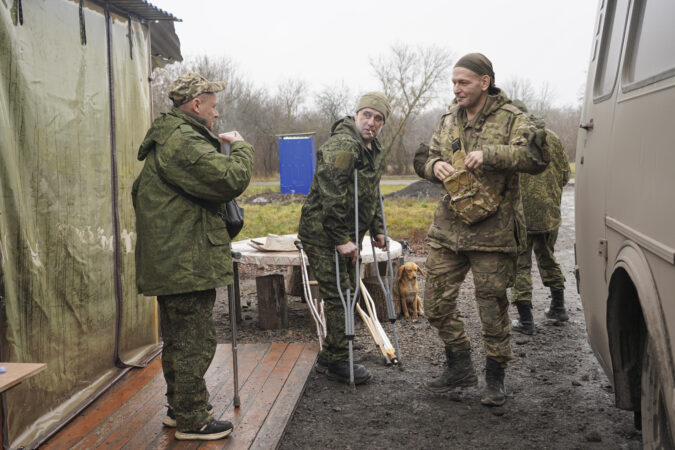
    OLKHOVATKA, Russia — The bus from the front lines ground to a halt outside the roadside kitchen, and the soldiers on board limped out into the winter mud.

    Most were missing feet or a leg.

    A water bottle filled with blood swung precariously from a plastic tube attached to one soldier’s stomach as he was helped toward a bench. Another stared blankly at the bloodied stump where his right hand had once been.

    “I would never have signed a contract if I’d known what it’s like out there. Our television is lying to us,” said Fyodor, a young soldier from Siberia. Like others in this article, he is not being identified by his full name to protect him from repercussions for criticizing the war.

    Fyodor’s lower leg had been blown off by a mine two days previously during an advance on Lyman in Ukraine with what remained of his unit. He said he was one of just 10 people left of the 110-strong unit he joined two years ago.

    He had no regrets over the loss of his leg. “It means that I can finally go home — alive.”

    “We’re fighting for fields that we cannot even take,” interjected a fellow soldier, Kirill, also in his 20s, laughing wryly. “This war will never end. … It feels like it’s only just begun.”

    Scenes like this one remain invisible to most Russians, erased by state propaganda and glossy government projects supporting returning veterans. But inside the country, fatigue and resentment are festering beneath the suppression of dissent.

    There is no outlet for public frustration and no relief from the mounting national exhaustion with a nearly four-year-long war that is corroding the country from within and making society more dysfunctional, broken, and paranoid, according to observers and those interviewed for this article.

    Over the last year, the Russian economy has lurched from spectacular growth to near-stagnation. Russia’s digital repression and isolation are deepening as more apps and platforms are banned. According to Western intelligence, more than a million Russian fighters have been killed or wounded — many in battles for marginal gains. And as Moscow’s search for internal enemies intensifies, its machine of repression is turning on its own children and patriots.

    During Russian President Vladimir Putin’s meeting with his Human Rights Council this month, film director Alexander Sokurov spoke out against censorship, the country’s suffocating foreign agent laws, the rising cost of living, and the lack of opportunities for young people. “If Russia doesn’t change how it works with young people, it faces a dead end,” he said. Putin said he would respond later to his grievances.

    A former senior Kremlin official told the Washington Post that he was “very worried” about the “dark picture inside Russia.”

    “We can’t turn the clock back easily; political will is needed to reverse this, and it simply does not exist,” the former official said, speaking on the condition of anonymity to freely discuss sensitive matters.

    Bearing the brunt

    In Belgorod, a Russian border city that once enjoyed close links to Ukraine’s Kharkiv — just 46 miles to the southwest — the price of this war is particularly tangible.

    Daily drone attacks have long become part of the routine here. Mud-spattered ambulances and camouflaged air-defense units tear through the center of town. The city’s volunteer networks — integral parts of the war effort that have supported the troops with clothing, food, and equipment where the government has failed — continue to work around the clock, with retirees sewing anti-drone netting and 3D-printing plastic bomb casings for drones.

    Despite the suffering and mass destruction taking place just across the border, Belgorod regards itself as the main victim of this war. The city illustrates the widening gap in Russian society between the indifferent, metropolitan majority and the “warring” few.

    On a cold November afternoon, a group of volunteers helping deliver supplies to the army huddled around a table to eat soup. They told the Post that they felt abandoned by Moscow.

    “They have absolutely no idea what is going on here!” exploded Edik, 52. “In Moscow there are parties, people having fun, going on vacations. How is that possible? Here blood is being spilled, and there they’re celebrating. How can they reconcile that?”

    Several volunteers said they had noticed a lull in donations since the start of the year, as many expected the war to end soon. Yevgenia Gribova, 35, who coordinates a center in Belgorod, said the volunteer movement is facing a crisis. In the first year, she said, people were spending the last of their rubles to support the troops, working constantly, without days off or vacation.

    “Now people want to rest. They want to spend money on themselves rather than on materials for the front lines,” she said.

    But while people said they want to see an end to the conflict, some also spoke of their desire to keep fighting and the need to end the war under the “right” conditions.

    “Everyone still wants to take Odesa. It’s a common opinion: People want to go to Odesa on vacation again,” Gribova said. “For us, this is a civil war between Russians and Russians who have forgotten a bit that they are Russians, that’s all.”

    Belgorod and residents of Russia’s regions bordering Ukraine form part of what pro-Kremlin sociologist Valery Fyodorov, the director of VCIOM polling institution, has defined as “warring Russia”: a minority of the country — roughly 20% — consisting of soldiers, their families, patriotic volunteers, and workers in military factories who consider the war vital for Russia’s survival and who are pushing for victory. The rest, he says, are passively loyal, indifferent to the war, opposed to it but taking refuge in their private lives, or living in exile.

    Dmitry, a deputy commander of a grenade-launcher platoon in Russia’s 116th special purpose brigade, said that Russia would fight for a very long time and “with sticks, if necessary.”

    “Everyone wants to go home. Everyone wants all of this to end. But even tired people carry out their tasks,” he said.

    Return of the heroes

    How does a nation sell to its people a war that is destroying the country — and how does it ensure that it continues?

    To keep the war effort rolling and to stave off discontent, the Kremlin has poured money into projects supporting soldiers and veterans, including the nationwide Defender of the Fatherland State Foundation, which was established in 2023 by Putin and is led by his niece, Deputy Defense Minister Anna Tsivaleva.

    For their sacrifice, soldiers are rewarded with financial benefits, social prestige, and significant employment and education opportunities for themselves and their children.

    Denis Poltavsky lost the sight in his right eye after he was swarmed by drones in battle last year. Unwilling to share many details about his time on the front, Poltavsky said he suffered from extreme PTSD, haunted by nightmares and insomnia.

    But without a doubt, he says, his life has materially improved since returning home. “The support is very extensive. The state is doing everything for veterans and soldiers. … They didn’t abandon us. They keep track of you and provide everything.”

    Poltavsky was paid an initial $51,000 for his injury, plus insurance and a military pension. He has access to free transportation, and tickets to museums and theaters. He recently completed Belgorod’s Time of Our Heroes management and leadership training, and hopes to soon receive a grant for his metalworking business.

    Veterans also have access to round-the-clock support from psychologists, doctors, and volunteers; they are given tax breaks and secure employment, even with disabilities. Belgorod’s program is even offering veterans free land on which to build a house.

    Middlebury College professor Will Pyle, who studies Russia’s economy, has found that in some regions a larger share of Russians report being satisfied with their lives than at any time during the decade preceding the February 2022 invasion. The finding is based on analysis of data from the Russian Longitudinal Monitoring Survey, which is maintained by Moscow’s Higher School of Economics.

    According to Pyle’s research, conducted with the Bank of Finland, the increase in reported life satisfaction is especially pronounced in regions whose economies have benefited from wartime and military-adjacent industrial production.

    This mirrors Fyodorov’s research. “The more depressed the region, the more people have noticed their improvement in life,” he said.

    But underneath the lionizing of the soldiers and this temporary uptick in prosperity is the darker impact of returning veterans and the longer-term social consequences of the invasion. Already, horrific crimes including murders and rapes have been committed by returning soldiers, and many of the convicted criminals who signed contracts to win their freedom have returned home to commit more crimes.

    “Every governor in Russia knows that a wave of problems is coming with the soldiers returning home from the front with serious post-traumatic stress disorder,” said a Kremlin insider, speaking on the condition of anonymity because of the sensitivity of the issue. “And they know the responsibility to deal with this will fall to them.”

    The patriots and the teens

    Since the start of the war, Russia has gone after its dissenters, pursuing LGBTQ+ people, artists, and opposition figures, and made criticism of the conflict and the military illegal. But now, some of the state’s most fervent supporters are running into trouble as well.

    The vocal, ultrapatriotic “Z” military bloggers, initially a backbone of support for Putin’s invasion, have gone on to criticize corruption and shortcomings in the army. The most radical of their leaders, such as ultranationalist hawk Igor Strelkov, were initially jailed. But this fall, they saw their ranks swept by an unexpected purge as the whole movement became the focus of repression.

    In September, authorities branded Roman Alyokhin, a prominent blogger with 151,000 subscribers on Telegram, a foreign agent, a label usually reserved for liberal opposition figures. In October, blogger Tatyana Montyan was declared a “terrorist and extremist.” Another, Oksana Kobeleva, was detained by the police. All had publicly criticized senior officials or other propagandists. The Z community has since turned on itself, with bloggers racing to denounce one another.

    “The moment of unity did not last very long, and after almost four years, we are seeing how people begin to oppose each other as well, deciding which of them is more patriotic,” said military blogger Mikhail Zvinchuk, the founder of the Rybar Telegram channel, which has links to the Defense Ministry.

    He added that the movement became corrupt and embezzled funds that were raised to support the troops. “Over the years, there have been a number of crooks who are trying to exploit the war.”

    In Russia’s second city, St. Petersburg, security services have found a different target: teenagers.

    At the Izmailsky courthouse last month, masked police officers escorted two teenage musicians from their hearing to the secret service cars waiting outside. The pair, 18-year-olds Diana Loginova and Alexander Orlov — from the street band Stoptime — had just had their arrest extended for a third time. Orlov, the guitarist, fist-bumped one of his friends as he exited the courthouse. Officially, they stood accused of blocking the entrance to a metro station during an impromptu street concert this autumn, but their true crime was their viral performances of anti-war songs.

    To many, the consequences of Stoptime’s performances were inevitable. But the young musicians’ case sent a chill through this still-liberal Baltic city, where street performances are an integral part of local culture.

    Copycat acts and musicians performing in solidarity with the imprisoned band members in the Urals and other cities in Russia were also arrested and charged as security services moved swiftly to crack down on the slightest flicker of dissent. Now, even singing the wrong kind of music can get you jailed, a development many regard as a return to the days of the Soviet Union.

    The hearing in St. Petersburg was tense, at times Kafkaesque, as the defense lawyer unpacked the details of the performance in question. “There are approximately 47 meters between the entrance to the metro and the spot where they were performing. It is therefore impossible that the people who stood in a circle around Stoptime could have blocked that space,” she said.

    Loginova, known by her stage name, Naoko, spent the last 20 minutes in the courtroom clasping her mother’s hands. “I really hope this is the last time they arrest me,” she whispered. Irina, her mother, smiled and held her daughter close, looking dazed. “Don’t you remember that they said that they would let you go on the first night? It’s now been a month.”

    What made Stoptime’s rebellious music performances so striking was that they came at a time when free, creative spaces and opportunities to escape are fading fast.

    “The very fact that they performed such songs was captivating,” said Ivan, 26, a history teacher, who attended many of their performances. “It was like an echo of normal life in our time. These are songs you want to listen to: They are kind, they’re meaningful, they promote universal human values, they remind that you can overcome things.”

    He said in Russia right now the state is trying to build a strict loyalty based on behaving a certain way “in order to simply exist.” Around him he has watched people accept a situation they were once horrified by and shift into a survival mode.

    On Nov. 23, the Stoptime musicians were secretly and unexpectedly released, and they immediately fled the country. They were spotted in early December in Yerevan, Armenia, performing the same opposition songs that got them arrested.

    Others have not been so lucky.

    Tatiana Balazeikina’s 19-year-old son, Yegor, is three years into his seven-year sentence for terrorism after he attempted to throw a Molotov cocktail at a local military registration office in 2023. Yegor is one of hundreds of teenagers and children arrested for anti-war protests, sabotage, or treason since the war began.

    “Stoptime were singing what so many people already had on the tip of their tongues,” Balazeikina said from her home an hour south of St. Petersburg. “This is dissent. And the only way for this state to remain what it is is to cut off all these signs of dissent right at the root.”

    She believes young people present a special kind of threat to the Kremlin.

    “These young people who essentially have nothing to lose except their freedom are very dangerous,” she said. “And if those young people are not only capable of thinking but can also sing what they think … that’s an even bigger threat.”

  • Where are the wackiest New Year’s Eve drops in the U.S.?

    Where are the wackiest New Year’s Eve drops in the U.S.?

    Why let New York City have all the fun with its Times Square ball drop on New Year’s Eve?

    Dozens of places across the U.S. will ring in 2026 by dropping a quirky assortment of fruits, vegetables, sea creatures, and balls of all shapes and sizes.

    Many have a hometown flair.

    There’s the giant cheese wedge in Plymouth, Wis., a chili pepper in Las Cruces, N.M., a pinecone in Flagstaff, Ariz., and a conch shell in Key West, Fla.

    Pennsylvania is home to a bonanza of bizarre New Year’s Eve events — the bologna drop in Lebanon, the pickle drop in Dillsburg, and the potato chip drop in Lewistown.

    It’s a New Year’s tradition that goes back to 1907, when a 700-pound ball measuring 5 feet in diameter debuted in Times Square. Copycat celebrations have surged coast to coast over the last few decades and around the beginning of the new millennium.

    Here’s a look at some of those events around the nation:

    Fruity traditions on New Year’s Eve

    It’s said in some cultures that eating fruit on New Year’s Eve brings luck and wealth. Perhaps that is why many cities mix fruit into their celebrations. Miami has its “Big Orange” drop, while Sarasota, Fla., features a pineapple. There are cherry drops in Milwaukie, Ore., and Traverse City, Mich. Brightly lit grapes plunge from above in Temecula, Calif. Atlanta this year is replacing its peach drop with a “digital drone peach in the sky.”

    Beach balls and flip-flops

    It’s tough to beat ringing in the year while watching a pair of sparkly flip-flops diving into Folly Beach, S.C. In Panama City Beach, Fla., there’s an evening-long bash in which 15,000 beach balls are dropped above revelers just hours before a giant beach ball descends a tower at midnight.

    MoonPies and a giant Peep

    What could be better than seeing a 600-pound MoonPie make a 60-second descent in Mobile, Ala.? How about getting a slice of MoonPie cake at the city’s biggest event of the year? Not sweet enough? Check out the 400-pound yellow Peeps chick that drops into Bethlehem, Pa.

    Seafood smorgasbord

    Waterfront cities celebrate the sea on New Year’s Eve. Brunswick, Ga., has the shrimp drop, while Easton, Md., serves up its annual crab drop. The oyster drop is the main event in Bay St. Louis, Miss. The biggest catch might be in Port Clinton, Ohio, along Lake Erie, home to a 600-pound walleye named Wylie. The original papier-mache version debuted 30 years ago and has given way to a menacing fiberglass fish.

    Potatoes and pierogi

    There’s definitely a food theme to these New Year’s drops. Just outside Chicago, watch out for a 10-foot pierogi in Whiting, Ind. The Idaho Potato Drop in Boise has been going for more than a decade, and Mount Olive, N.C., celebrates its hometown pickle brand by dropping a glittery green pickle that is close to 6 feet long.

    Possum drop lives on

    All of these events are meant to be fun, boost civic pride, and attract tourists. But one created such a stir that it ended up in court. Residents in western North Carolina no longer lower a live possum inside a glass box at midnight, having called off the event in 2019 after years of protests and legal challenges. There is still a possum drop in Tallapoosa, Ga., a town long ago known as Possum Snout. That one, though, stars a stuffed possum named Spencer.

  • Buddhist monks persist in peace walk despite injuries as thousands follow them on social media

    Buddhist monks persist in peace walk despite injuries as thousands follow them on social media

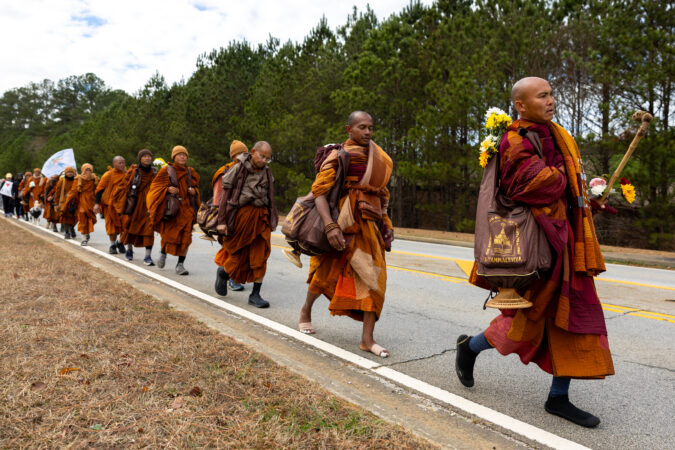
    ATLANTA — About two dozen Buddhist monks are persevering in their walking trek across much of the U.S. to promote peace, even after two of them were injured when a truck hit their escort vehicle.

    After starting their walk in Fort Worth, Texas, on Oct. 26, the group has made it to Georgia as the monks continue on a path to Washington, D.C., highlighting Buddhism’s long tradition of activism for peace.

    The group planned to walk its latest segment through Georgia on Tuesday from the town of Morrow to Decatur, on the eastern edge of Atlanta. Marking day 66 of the walk, the group invited the public to a Peace Gathering in Decatur on Tuesday afternoon.

    The monks and their loyal dog, Aloka, are traveling through 10 states en route to Washington. In the coming days, they plan to pass through or very close to Athens, Ga.; the North Carolina cities of Charlotte, Greensboro, and Raleigh; and Richmond, Va., on their way to the nation’s capital.

    The group has amassed a huge audience on social media, with more than 400,000 followers on Facebook. Aloka has its own hashtag, #AlokathePeaceDog.

    The monks’ Facebook page is frequently updated with progress reports, inspirational notes, and poetry.

    “We do not walk alone. We walk together with every person whose heart has opened to peace, whose spirit has chosen kindness, whose daily life has become a garden where understanding grows,” the group posted recently.

    The trek has not been without danger. Last month outside Houston, the monks were walking on the side of a highway near Dayton, Texas, when their escort vehicle, which had its hazard lights on, was hit by a truck, interim Dayton Police Chief Shane Burleigh said.

    The truck “didn’t notice how slow the vehicle was going, tried to make an evasive maneuver to drive around the vehicle, and didn’t do it in time,” Burleigh said at the time. “It struck the escort vehicle in the rear left, pushed the escort into two of the monks.”

    One of the monks had “substantial leg injuries” and was flown by helicopter to a hospital in Houston, Burleigh said. The other monk, with less serious injuries, was taken by ambulance to a hospital outside Houston. The monk who sustained the serious leg injuries was expected to have a series of surgeries to heal a broken bone, but his prognosis for recovery was good, a spokesperson for the group said.

    Buddhism is a religion and philosophy that evolved from the teachings of Gautama Buddha, a prince-turned-teacher who is believed to have lived in northern India and attained enlightenment between the sixth and fourth centuries B.C. The religion spread to other parts of Asia after his death and came to the West in the 20th century. The Buddha taught that the path to end suffering and become liberated from the cycle of birth, death, and reincarnation includes the practice of nonviolence, mental discipline through meditation, and showing compassion for all beings.

    While Buddhism has branched into a number of sects over the centuries, its rich tradition of peace activism continues. Its social teaching was pioneered by figures like the Dalai Lama and Thich Nhat Hanh, who have applied core principles of compassion and nonviolence to political, environmental, and social justice as well as peace-building efforts around the world.

  • How RFK Jr. upended the public health system

    How RFK Jr. upended the public health system

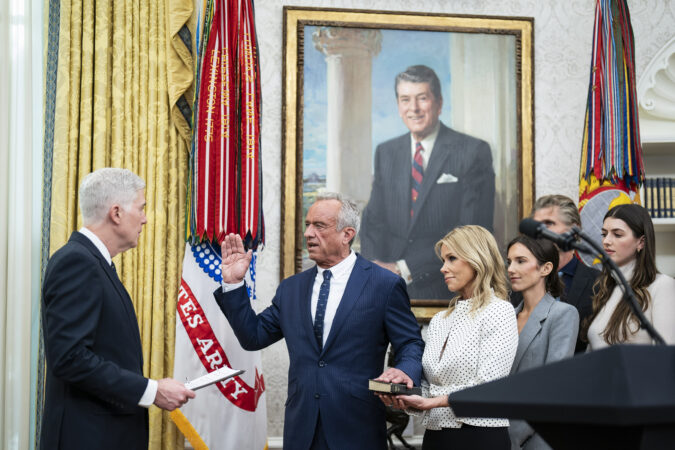
    On his way to being confirmed as the nation’s top health official, Robert F. Kennedy Jr. promised lawmakers he would do nothing that “makes it difficult or discourages people from taking vaccines.”

    Almost 100 days into the job, amid rising measles outbreaks and congressional scrutiny of his messaging on vaccines, Kennedy made clear behind the scenes that he wanted to reshape the nation’s immunization system.

    Kennedy, the founder of a prominent anti-vaccine group, presented several top federal health officials with a new vision.

    “Bobby has asked for the following changes,” Kennedy’s deputy chief of staff for policy at the time, Hannah Anderson, wrote to the officials in a May 19 email later reviewed by the Washington Post.

    Among his requests was to replace the entire membership of an influential independent committee of experts that makes recommendations for how and when to vaccinate Americans. Kennedy also asked the panel to reconsider a long-standing recommendation that all newborns get a hepatitis B vaccine and to revisit the use of multidose flu shot vials, which contain a mercury-based preservative.

    Anti-vaccine activists have criticized those vaccines for years, claiming they unnecessarily endanger children. Career federal scientists who learned of Kennedy’s asks said they represented a sea change for shots that have been extensively studied and deemed safe.

    “At that point we were just bracing for upheaval,” said Demetre Daskalakis, who was then the CDC’s top respiratory diseases and immunization official.

    Kennedy would get what he wanted. The May 19 email reveals his previously undisclosed influence on some of these changes in a highly unusual way, according to legal experts and former and current health officials, showing how Kennedy has wielded government power to overhaul a public health system he has blasted as corrupt and ineffective.

    Andrew Nixon, a spokesperson for the Department of Health and Human Services, said of the email: “All this was was a suggestion.”

    “This was a newly reconstituted committee, and the secretary was providing a North Star to make sure suggestions were communicated to the members for consideration,” Nixon said.

    Over the course of the year, Kennedy’s actions have alarmed public health experts, medical associations, and current and former health officials, who say he is eroding trust in science and dismantling confidence in long-standing public health measures.

    “I do feel shocked by how quickly he has been able to implement these things that he has clearly been pretty passionate about for many years,” said Kerry Kennedy Meltzer, Kennedy’s niece and a physician who this year released email exchanges with her uncle in an attempt to foil his Senate confirmation to lead HHS.

    Kennedy has challenged years of public health messaging on vaccines, including instructing the CDC to contradict the long-settled scientific conclusion that vaccines do not cause autism. His once-fringe views have moved to the center of the nation’s health strategy amid a growing distrust in the medical establishment after the coronavirus pandemic.

    “It is now acceptable to talk about all these issues,” said Leslie Manookian, a leader in the “medical freedom” movement, which opposes vaccine mandates. “The person that we have most to thank for that is Bobby Kennedy, together with President Trump.”

    Kennedy has maintained the backing of the White House and a warm relationship with President Donald Trump, whom he speaks to often, as the two aligned on their Make America Healthy Again initiative to encourage better nutrition and address chronic disease and childhood illness, according to two people familiar with the matter.

    Besides his heavy focus on immunizations, Kennedy has also taken on the food industry. Next year will test, ahead of the midterms, whether he can deliver sweeping change on this more broadly popular agenda.

    This account of Kennedy’s ascent and leadership since becoming HHS secretary is based on interviews with almost 100 current and former federal health officials, Kennedy allies, public health experts, and others. Many spoke on the condition of anonymity to detail private conversations or internal deliberations, or out of fear of retaliation.

    In response to an interview request, Kennedy said in a text message: Wapo has been more consistently unfair, biased, and inaccurate, and it’s reporting about me than any other major outlet. Im not inclined to validate that bias with an interview.”

    He referred the request to Stefanie Spear, a top aide, who said Kennedy wanted to share a Substack article with a Post reporter that described the “invisibility of vaccine injury,” adding Kennedy could perhaps do an interview after the first of the year.

    The HHS media relations office did not answer detailed questions for this article but in a statement commented on the email from Anderson and identified what Kennedy has done so far.

    “Under Secretary Kennedy’s leadership, HHS is exercising its full authority to deliver results for the American people,” Nixon said.

    “In 2025, the Department confronted long-standing public health challenges with transparency, courage, and gold-standard science — eliminating petroleum-based food dyes from the nation’s food supply, removing the black box warning for many menopause hormone therapies, lowering drug prices, advancing [Organ Procurement and Transplantation Network] reform, streamlining prior authorization, investing in rural health, accelerating biosimilars, doubling funding for childhood cancer research, launching an agency-wide AI strategy, and increasing transparency in drug advertising,” Nixon added. “HHS will carry this momentum into 2026 to strengthen accountability, put patients first, and protect public health.”

    RFK Jr.’s rise to power

    In August 2024, Kennedy strode onto a stage in Arizona to suspend his long-shot independent presidential bid. Flanked by American flags, he explained why the scion of a famous Democratic family was endorsing a Republican, Trump.

    “I asked myself what choices must I make to maximize my chances to save America’s children and restore national health,” Kennedy said.

    Kennedy quickly became viewed as one of the campaign’s top surrogates, bringing along some voters who might not have backed Trump. Before winning the presidency, Trump promised to let Kennedy “go wild on health.”

    Although some Trump aides had weighed making Kennedy, a lawyer, a White House health czar, Kennedy told Trump he wanted to be considered as HHS secretary, according to three people familiar with the matter. Donald Trump Jr. and Charlie Kirk, the conservative activist who was fatally shot this year, advised Kennedy that he needed to be in charge of an actual bureaucracy to make lasting change and avoid being sidelined, one person said. Trump Jr. and Turning Point USA, Kirk’s organization, did not respond to requests for comment.

    Just over a week after Election Day, Trump tapped Kennedy to helm the nation’s sprawling health department, an almost $2 trillion portfolio responsible for administering health insurance, approving drugs and medical devices, and responding to infectious-disease outbreaks.

    The luxury Florida beach house of Mehmet Oz — a physician and former daytime television star who is now the nation’s Medicare and Medicaid chief — quickly became ground zero for pushing MAHA’s agenda and securing Kennedy’s position in Washington, according to multiple attendees. Those weeks forged an alliance among some who challenged the medical establishment, including Del Bigtree, head of the anti-vaccine group Informed Consent Action Network (ICAN), and Spear, a longtime ally to Kennedy in his environmental and anti-vaccine advocacy, and newer people in Kennedy’s orbit, such as Calley Means, a health entrepreneur.

    One night, several of those at the beach house bonded over listening to the Grateful Dead, according to Michael Caputo, who was Trump’s HHS spokesperson in 2020. They viewed the book Good Energy — a bestseller, written by now-surgeon general nominee Casey Means along with her brother Calley, that promotes healthy eating and exercise to optimize metabolic health — as MAHA’s bible, he said.

    “Food expanded the movement overnight,” Bigtree, who was Kennedy’s communications director during his presidential campaign, said in an interview.It was an easier topic to sell to moms across America.”

    On Capitol Hill, Kennedy’s messaging pushing for healthier, less-processed foods proved far more popular than his views on immunization.

    Kennedy’s confirmation largely hinged on Sen. Bill Cassidy (R., La.), a physician and chair of the Senate health committee, who begged Kennedy to disavow his false claims linking vaccines and autism and raised concerns about Kennedy’s involvement in vaccine safety litigation.

    “[Does a] 71-year-old man who has spent decades criticizing vaccines and who’s financially vested in finding fault with vaccines, can he change his attitudes and approach now that he’ll have the most important position influencing vaccine policy in the United States?” Cassidy asked during Kennedy’s confirmation hearing.

    As Cassidy vacillated, Vice President JD Vance stepped in to help negotiate his eventual support, according to two people familiar with the matter.

    In a speech on the Senate floor, Cassidy detailed the commitments he received from Kennedy in exchange for his vote, including to protect the nation’s vaccine infrastructure. All but one Republican voted yes: Sen. Mitch McConnell of Kentucky, a childhood polio survivor who said he would “not condone the re-litigation of proven cures.” A week later, McConnell announced he would not seek reelection.

    Cassidy’s doubts proved prescient. Within months, Kennedy found ways to bypass some of his pledges.

    A fierce critic becomes the boss

    Kennedy has called for the ouster of what he describes as “corrupt, industry-captured” federal health officials, arguing the health department had failed to keep Americans healthy.

    “I’m not scared to disrupt things,” Kennedy said at a recent event at George Washington University.

    Since February, health agencies have been inundated by continuous waves of departures involving more than 30 high-ranking senior career leaders — representing decades of experience on managing infectious-disease outbreaks, administering billions in research dollars, and overseeing the nation’s drug supply, according to a Post review.

    Thousands more staffers were laid off in what some called the “April Fools’ Day massacre,” a sweeping purge and proposed reorganization of the health agencies. Some including lead poisoning specialists and lab scientists were rehired, but many administrative support staff, communications staffers, and program officers are among those who remain laid off.

    As secretary, Kennedy brought in fierce critics of the public health COVID-19 response and federal health agencies more broadly. Bigtree told the Post that candidates for top health roles were questioned to see whether they agreed with some of Kennedy’s longtime vaccine safety priorities.

    Under Kennedy, prominent figures in the anti-vaccine movement have been working within the department on vaccine safety issues, including Lyn Redwood, a former leader of the anti-vaccine group Kennedy founded, Children’s Health Defense, and David Geier and Mark Blaxill, two longtime proponents of false claims that vaccines can cause autism. The three did not return requests for comment.

    In a statement, White House spokesperson Kush Desai said Kennedy and his team at HHS are restoring “Gold Standard Science and accountability to our public health bodies” after the medical establishment pushed “unscientific lockdowns and mask mandates” during the coronavirus pandemic.

    Kennedy has accused public health agencies of being dishonest during the pandemic. He repeated that criticism, arguing the government overreached on COVID vaccines, when a reporter asked how to avoid the violence the CDC witnessed in August, when a gunman incensed by coronavirus vaccines attacked the agency’s Atlanta campus.

    Public health and medical experts say the turnover in staff and leadership has hollowed out the federal government’s scientific capacity to anticipate and respond to health threats.

    “For people who are still left at the [CDC], there is chaos and confusion, and morale is at an all-time low,” Aryn Melton Backus said at a November rally in support of public health. She was a health communication specialist placed on administrative leave as part of pending layoffs from the CDC’s Office on Smoking and Health, which has funded state tobacco control programs.

    The reduction of CDC staff and programs is being felt across the country. In Georgia, where smoking is the leading cause of preventable death, state officials cut a tobacco control and prevention program. An online concussion training that many school youth sports coaches must complete will no longer be updated with the latest research. Local officials who want to fluoridate their drinking water to improve oral health no longer have access to technical experts who can help calibrate the proper levels.

    As Kennedy upended the public health workforce, he leaned into his more broadly popular messaging around overhauling the food industry. He has posted on social media more than twice as frequently about food than vaccines while in office, according to the Post’s analysis of his personal accounts and official HHS accounts. Last summer, almost 1 in 3 social media posts focused on food.

    He often highlights posts about companies pledging to remove artificial dyes from food products, which has been one of his signature efforts.

    Some in the food sector have been trying to accommodate Kennedy and downplay differences with his initiatives, in hopes of avoiding MAHA criticism, according to two people involved in the industry. That is a stark shift for an industry accustomed to viewing the GOP as an ally.

    “Wanting to eat simpler foods, more real foods, look at the ingredients, all of that is not a Democrat hippie thing anymore,” said Vani Hari, an author, activist, and Kennedy ally who also writes under the name of the Food Babe. “It’s a Republican thing, too, now.”

    Kennedy returns to his core issue: Vaccines

    As Kennedy sought senators’ support to become health secretary, he told them he supported the childhood immunization schedule, including the shot for measles, which he had previously described falsely as increasing the odds of spreading the virus.

    In the past, Kennedy had decried the “exploding vaccine schedule,” claiming that the series of vaccines recommended to children is linked to the rise of autism, chronic disease, and food allergies. Medical experts have argued that these purported links have no basis in evidence and that the increase in vaccinations has successfully combated more disease. He wrote a book in 2014 calling for removal of the mercury-based preservative thimerosal from vaccines. He questioned why newborns should get the hepatitis B vaccine, which health authorities say is safe, claiming on an online show that it “poisoned” kids.

    Kennedy faced his first big test on vaccines soon into his tenure. A measles surge had started in an under-vaccinated region of Texas, driving the country’s largest annual case tally in at least 33 years and threatening to end the nation’s measles elimination status.

    At first, Kennedy downplayed the severity of the outbreak and later, under pressure, acknowledged vaccines prevent the virus’ spread. But he muddled that message by also falsely claiming the vaccines were not safety-tested and contained aborted fetal debris — a stark contrast from the first Trump administration’s unequivocal support for vaccination during a 2019 outbreak.

    He repeatedly offered to send Texas doses of vitamin A, an unproven measles treatment in the U.S. embraced by vaccine skeptics as an alternative to immunization, even though the vitamin is primarily used for malnourished children abroad and public health workers and doctors said their focus was vaccination, according to a top state health official, Jennifer Shuford.

    In June, he fired every member of the Advisory Committee on Immunization Practices, which makes vaccine recommendations, setting in motion plans to remake the vaccine system. Kennedy argued the panel had become “little more than a rubber stamp for any vaccine” with members too closely tied to the pharmaceutical industry. He selected new members, some of whom had histories of criticizing vaccine guidance. The former CDC director, Susan Monarez, said she was fired in August for refusing to be a “rubber-stamp” to the new committee.

    The panel has voted on some of Kennedy’s requests detailed in the May email from Anderson, who is no longer with HHS and did not respond to requests for comment.

    The vaccine panel voted in June to remove thimerosal — which the CDC had concluded is safe but Kennedy and his allies have decried as unnecessarily exposing children to mercury — from the rare multidose flu shot vials that contain it. In that same meeting, they vowed to form a work group to look at vaccines that have not been subject to review in more than seven years, in line with Kennedy’s request.

    The panel over several months grappled with how to revise the guidance for all newborns to receive a hepatitis B vaccine. It ultimately voted in December to stop recommending the shot when the mother tests negative and instead to encourage those parents to consult doctors about whether and when to begin vaccination.

    José Romero, who began serving on ACIP in 2014 and chaired the panel from 2018 to mid-2021, described Kennedy’s asks to the committee as “extremely” unusual.

    “The secretary is within his legal rights to make these suggestions or requests, but it’s unheard of as far as I know,” said Romero, who was a top health official in Arkansas during the pandemic and then at the CDC. He now consults for the pharmaceutical industry on vaccines and is a member of the American Academy of Pediatrics infectious diseases committee.

    An HHS official, who spoke on the condition of anonymity because of legal concerns, said that the career CDC official who oversees ACIP sets its agenda and that members of the committee are ultimately responsible for writing the questions they vote on.

    In reference to the May email, the official said HHS officials worked with the CDC’s administrative officer for the vaccine panel to communicate the suggestions to the members, but those suggestions were not directives.

    Joseph Hibbeln, a neuroscientist who has become a dissenting voice on the vaccine panel, said committee members have not been given clear answers when they have asked who is determining which vaccines they are scrutinizing.

    Robert Malone, a prominent critic of coronavirus vaccines who is now the panel’s vice chair, said that he did not know how the agenda items were developed but that there would be nothing “nefarious” about Kennedy or other top Trump administration officials “contributing” to agenda items because the panel’s job is to provide advice.

    During the panel’s December meeting, Kirk Milhoan, chairman of the vaccine committee, was overheard telling another member that he felt “a little bit like puppets on a string as opposed to really being an independent advisory panel,” according to a transcript of the exchange captured by videoconferencing software and reviewed by the Post. He later told the Post he was referring to pressure from outside groups critical of changes to vaccine recommendations, not the administration.

    ‘Raise the risk, bury the benefits’

    Kennedy and his aides have repeatedly said the Trump administration is not limiting access to vaccines for those who want them, but is instead working to help people make informed decisions. Critics say they are exaggerating the downsides and obfuscating the value of immunization.

    “The secretary and his committee have stopped doing the hard job of balancing the risks and benefits of vaccines,” said Dan Jernigan, who oversaw the CDC’s vaccine safety office. He described their playbook as “raise the risk, bury the benefits, sow confusion, drive down use.”

    In the late summer, Jernigan and two other high-ranking officials resigned in protest over what they called an unscientific and politicized approach to vaccines.

    In one instance that alarmed career staff, Kennedy wanted Aaron Siri, a top lawyer for the anti-vaccine movement, and perhaps Paul Offit, a scientist at Children’s Hospital of Philadelphia who is a prominent proponent of vaccines and critic of Kennedy, to speak publicly during the June meeting of the new vaccine advisers, according to three former health officials familiar with a meeting where a CDC senior adviser relayed the secretary’s request. Siri has been involved in legal challenges to school vaccine mandates and petitioned the government to reconsider its approval of Sanofi’s stand-alone polio vaccine.

    But the plan to invite Siri fell apart after objections from career CDC staff and legal advisers who raised concerns about providing a platform to a man who has repeatedly sued the agency seeking data about vaccine safety on behalf of ICAN, the anti-vaccine group. Kennedy was informed of those concerns, one of the officials said.

    After almost six months and an exodus of CDC leaders, Siri was invited to the agency’s headquarters for the December meeting of the vaccine advisers and spent more than 90 minutes arguing that the history of childhood immunization in the U.S. is marred by insufficient research and improperly performed vaccine clinical trials. HHS did not answer questions from the Post about Siri’s appearance.

    Siri said he has a “significant knowledge base” about vaccines based on his legal work, including regularly suing health authorities and deposing and cross-examining leading vaccinologists. “If you were standing in my office with me right now, you would be looking at a bookshelf that is filled with medical textbooks on vaccinology, immunology, infectious disease, and pediatrics,” he said.

    Cassidy, the Republican senator, reacted with shock to Siri’s appearance at ACIP.

    It was his latest frustration with the health department’s handling of vaccine issues under Kennedy, including the revisions to the CDC website language on autism. The page includes an asterisk after the header “Vaccines do not cause Autism,” explaining that the header was not removed as part of an agreement with Cassidy. But the revised webpage also claims that the assertion that vaccines do not cause autism is not evidence-based and that health authorities ignored studies supporting a link.

    Cassidy’s office declined repeated requests for a formal interview. Approached at the Capitol and asked about Kennedy’s vaccine commitments, Cassidy said, “You can compare those actions to those commitments I enumerated in my floor speech, and I’ll let you draw your own conclusions.”

    But what were his conclusions? “I’ll leave it at that,” he said.

    The looming fight

    Kennedy has spent much of this year laying the groundwork for bigger changes to the nation’s vaccine and food policy.

    Findings from investigations Kennedy commissioned into the causes of autism, the safety of vaccines, and whether fluoridated water harms children are expected to be released.

    The Trump administration is weighing plans to shift the federal government away from directly recommending most vaccines for children and to more closely align with Denmark’s immunization model of suggesting fewer shots, according to two people familiar with the matter.

    Kennedy plans to release revised federal dietary guidelines for healthy eating habits early next year, which will be partly tied to when Americans are making New Year’s resolutions, according to a federal health official. Kennedy has said the guidelines will focus on eating whole foods.

    The health department is also hoping to finalize a plan as soon as next year to require labels on the front of food and drink packages to alert Americans about unhealthy foods. Under Kennedy, health officials are working internally to determine the best approach to the labels, which were first proposed in the Biden administration, according to two people familiar with the matter.

    Meanwhile, Kennedy has crisscrossed the country to support governors who have restricted using food stamps to buy soda and candy and signed bills to remove artificial dyes from school meals. Some MAHA proponents want to see another wave of policies next year that would promote nutrition education and also challenge long-standing public health practices such as vaccine mandates. The nonprofit advocacy group MAHA Action has met with almost 20 top state officials as it pushes for states to embrace the movement.

    “Bobby Kennedy is doing the work he was put on the planet to do,” said Tony Lyons, president of MAHA Action.

    Kennedy’s allies say he’s just getting started. They hope he will be secretary for eight years.

  • Tatiana Schlossberg, journalist and granddaughter of JFK, dies at 35

    Tatiana Schlossberg, journalist and granddaughter of JFK, dies at 35

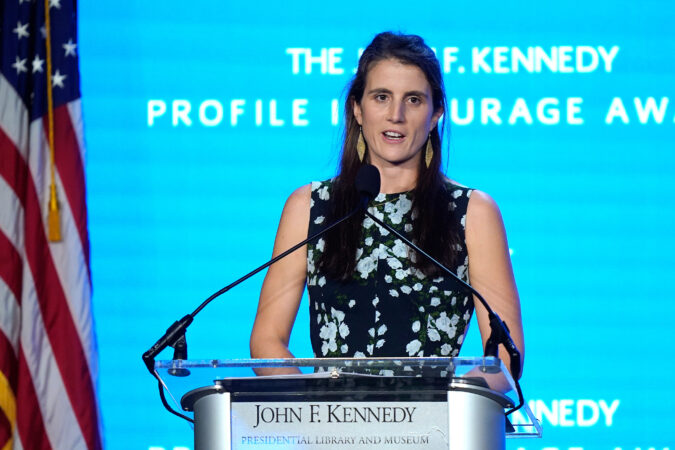
    Tatiana Schlossberg, 35, a journalist who told stories of the changing climate and the ways humans can help protect the environment, and whose terminal illness and position in the Kennedy family thrust her into the national spotlight late in life, died Tuesday.

    Her family announced the death in a social media post shared by the John F. Kennedy Presidential Library and Museum. The statement did not say where she died.

    Ms. Schlossberg published a New Yorker essay in November revealing that she had been diagnosed with a rare form of acute myeloid leukemia, a cancer of the blood and bone marrow. Between reflections on her family and mortality, she harshly criticized her cousin Robert F. Kennedy Jr., the secretary of health and human services, for his opposition to government-funded medical research and vaccines.

    “I watched from my hospital bed as Bobby, in the face of logic and common sense, was confirmed for the position, despite never having worked in medicine, public health, or the government,” she wrote.

    As an environmental journalist, Ms. Schlossberg was drawn to stories that humanized sprawling and complicated policy issues — often while offering her a chance to participate in the action herself.

    While chronicling the impact of climate change, she jumped in a cranberry bog in Massachusetts. She later spent nearly eight hours skiing the Birkebeiner, a cross-country race in Wisconsin threatened by warm weather and a lack of snow.

    “On the lake, my cross-country skis began to skate in a rhythm, something that had eluded me for much of the day,” she wrote in a dispatch for Outside magazine. “I felt like I was flying.”

    Ms. Schlossberg studied at Yale and Oxford before launching her journalism career at the Record newspaper in North Jersey, covering crime and local affairs. She joined the New York Times in 2014 as an intern and was named a staff writer on the paper’s Metro desk before moving to the science section, where colleagues regarded her as a curious, hardworking reporter who wore her privilege lightly.

    A granddaughter of President John F. Kennedy and first lady Jacqueline Kennedy Onassis, Ms. Schlossberg was the second child of Caroline Kennedy, a former U.S. ambassador to Australia and Japan, and Edwin Schlossberg, an artist and designer.

    “She was a total delight,” said Henry Fountain, a longtime climate and science reporter at the Times. Ms. Schlossberg “just researched her butt off on stories,” he added.

    After leaving the Times in 2017, Ms. Schlossberg began freelancing and, in 2019, published Inconspicuous Consumption: The Environmental Impact You Don’t Know You Have. The book examined the hidden costs of everyday activities — streaming videos, buying jeans, eating burgers — and was honored by the Society of Environmental Journalists.

    “Using history, science and a personal narrative, Schlossberg provides a better understanding of both individual and systemic drivers of ecological destruction,” the judges said in awarding her the Rachel Carson book prize. “Readers will find solace, humor and a route to feeling empowered with possibilities for positive change, rather than drained by an accumulation of bad news.”

    Ms. Schlossberg had been planning to write a second book, on the oceans, when she was found to have cancer in May 2024, while in the hospital for the birth of her second child.

    In her New Yorker essay, she wrote of her shock at getting the diagnosis — “This could not be my life” — and of the turbulent 18 months that followed, in which she received stem cell donations from her sister as well as a stranger in the Pacific Northwest; underwent chemotherapy; and participated in a clinical trial, testing a new type of immunotherapy.

    In recounting her experience, Ms. Schlossberg implicitly acknowledged that her family, and her mother in particular, had dealt with years of grief. Her mother was only 5 when her father, President Kennedy, was assassinated in Dallas in 1963. She was 10 when the same fate befell her uncle, Robert F. Kennedy, while he was campaigning for president in Los Angeles. Her younger brother, John Jr., died in a plane crash in 1999.

    “For my whole life, I have tried to be good, to be a good student and a good sister and a good daughter, and to protect my mother and never make her upset or angry,” Ms. Schlossberg wrote. “Now I have added a new tragedy to her life, to our family’s life, and there’s nothing I can do to stop it.”

    Ms. Schlossberg recalled that she was in her hospital bed when her cousin “Bobby, in the face of logic and common sense, was confirmed” as health and human services secretary, “despite never having worked in medicine, public health, or the government.”

    Kennedy had previously run for president as an independent, in what Ms. Schlossberg called “an embarrassment to me and the rest of my immediate family.” He faced blowback when he acknowledged that he had placed a dead bear in Central Park a decade earlier, a bizarre episode that — in an odd twist of fate — Ms. Schlossberg had reported on for the Times, writing in 2014 that state investigators concluded the bear had died after being struck by a car, but did not know how it ended up in the park.

    “Like law enforcement, I had no idea who was responsible for this when I wrote the story,” Ms. Schlossberg told The Times last year.

    In her New Yorker essay, Ms. Schlossberg wrote that her cousin’s health policy decisions threatened her own survival, and that of “millions of cancer survivors, small children, and the elderly.”

    “I watched as Bobby cut nearly half a billion dollars for research into mRNA vaccines, technology that could be used against certain cancers; slashed billions in funding from the National Institutes of Health, the world’s largest sponsor of medical research; and threatened to oust the panel of medical experts charged with recommending preventive cancer screenings,” she wrote.

    She also noted that the drug misoprostol, which she received to stop a postpartum hemorrhage that nearly killed her, was “part of medication abortion, which, at Bobby’s urging, is currently ‘under review’ by the Food and Drug Administration.”

    “I freeze when I think about what would have happened if it had not been immediately available to me and to millions of other women who need it to save their lives or to get the care they deserve.”

    ‘I was not just a sick person’

    Tatiana Celia Kennedy Schlossberg was born in Manhattan on May 5, 1990. She was raised on the Upper East Side with her older sister, artist and filmmaker Rose Schlossberg, and her younger brother, Jack Schlossberg, who is now running for Congress in New York.

    Ms. Schlossberg studied history at Yale University, where she received a bachelor’s degree in 2012 and served as editor in chief of the weekly Yale Herald. She later earned a master’s in American history from the University of Oxford.

    As a freelance journalist, Ms. Schlossberg contributed to publications including the Washington Post, the Atlantic, and Vanity Fair. She wrote a weekly newsletter, News From a Changing Planet, until 2024.

    Juliet Eilperin, the Post’s deputy futures editor, called her “one of the least pretentious journalists I have ever dealt with.”

    “Tatiana had an intense desire to be out in the field, immersing herself in nature and talking with scientists,” Eilperin said. “She was meticulous and exhaustive in her research, scrutinizing environmental problems and what might be done to fix them.”

    In 2017, Ms. Schlossberg married George Moran at her family’s home on Martha’s Vineyard, in a ceremony officiated by former Massachusetts Gov. Deval Patrick. Moran, a urologist, was a resident at Columbia-Presbyterian when Ms. Schlossberg was diagnosed with cancer at the hospital.

    “He did everything for me that he possibly could,” she wrote in her essay. “He talked to all the doctors and insurance people that I didn’t want to talk to; he slept on the floor of the hospital; he didn’t get mad when I was raging on steroids and yelled at him that I did not like Schweppes ginger ale, only Canada Dry.”

    In addition to her husband, survivors include their two children; her parents; and her brother and sister.

    While battling cancer, Ms. Schlossberg held her profession up as a point of pride. “My son knows that I am a writer and that I write about our planet,” she wrote. “Since I’ve been sick, I remind him a lot, so that he will know that I was not just a sick person.”

  • ICE doesn’t plan to detain Abrego Garcia again as long as judge’s order banning it stands

    ICE doesn’t plan to detain Abrego Garcia again as long as judge’s order banning it stands

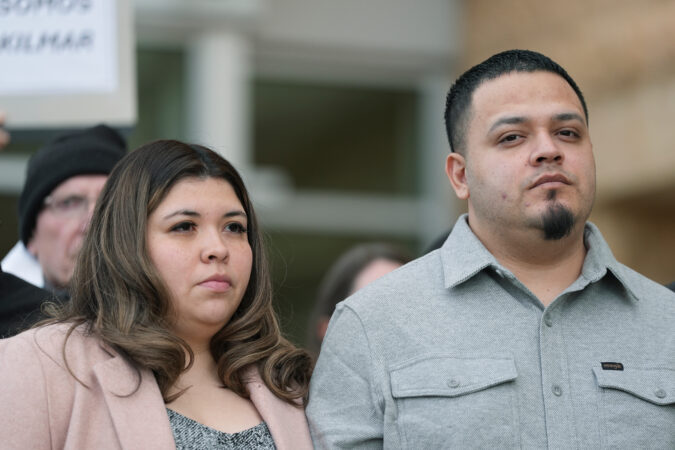
    NASHVILLE — U.S. Immigration and Customs Enforcement officials do not plan to detain Kilmar Abrego Garcia again as long as a judge’s order banning it stands, according to a Tuesday court filing.

    The Salvadoran citizen’s case has become a lightning rod for both sides of the immigration debate as he fights to remain in the U.S. after a mistaken deportation to his home country, where he was imprisoned. Officials in President Donald Trump’s administration have accused him of being a member of the MS-13 gang, but he has vehemently denied the accusations and has no criminal record.

    The government court filing comes after U.S. District Judge Paula Xinis earlier this month questioned whether government officials could be trusted to follow orders barring them from taking Abrego Garcia into immigration custody or deporting him.

    Earlier Tuesday, a newly unsealed order in Abrego Garcia’s criminal case revealed that high-level Justice Department officials pushed for his indictment, calling it a “top priority,” only after he was erroneously deported and then ordered returned to the U.S.

    Abrego Garcia has pleaded not guilty in federal court in Tennessee to charges of human smuggling. He is seeking to have the case dismissed on the grounds that the prosecution is vindictive — a way for the Trump administration to punish him for the embarrassment of his mistaken deportation.

    To support that argument, he has asked the government to turn over documents that reveal how the decision was made to prosecute him in 2025 in connection with an incident that had occurred nearly three years earlier. On Dec. 3, U.S. District Judge Waverly Crenshaw filed an order under seal that compelled the government to provide some documents to Abrego Garcia and his attorneys. That order was unsealed Tuesday and sheds new light on the case.

    Earlier, Crenshaw found that there was “some evidence” that the prosecution of Abrego Garcia could be vindictive. He specifically cited a statement by Deputy Attorney General Todd Blanche on a Fox News program that seemed to suggest that the Department of Justice charged Abrego Garcia because he had won his wrongful-deportation case.

    Rob McGuire, who was the acting U.S. attorney for the Middle District of Tennessee until late December, argued that those statements were irrelevant because he alone made the decision to prosecute, and that he has no animus against Abrego Garcia.

    Abrego Garcia was freed earlier this month from the Moshannon Valley Processing Center in Pennsylvania.

    In the newly unsealed order, Crenshaw writes: “Some of the documents suggest not only that McGuire was not a solitary decision-maker, but he in fact reported to others in DOJ and the decision to prosecute Abrego may have been a joint decision.”

    The U.S. Attorney’s Office for the Middle District of Tennessee released a statement saying: “The emails cited in Judge Crenshaw’s order, specifically Mr. McGuire’s email on May 15, 2025, confirm that the ultimate decision on whether to prosecute was made by career prosecutors based on the facts, evidence, and established DOJ practice. Communications with the Deputy Attorney General’s Office about a high-profile case are both required and routine.”

    The email referenced was from McGuire to his staff stating that Blanche “would like Garcia charged sooner rather than later,” according to Crenshaw’s order.

    The human smuggling charges stem from a 2022 traffic stop in Tennessee where Abrego Garcia was pulled over for speeding. There were nine passengers in the car, and state troopers discussed the possibility of human smuggling among themselves. However, Abrego Garcia was ultimately allowed to leave with only a warning. The case was turned over to Homeland Security Investigations, but there is no record of any effort to charge him until April 2025, according to court records.

    The order does not give a lot of detail on what is in the documents that were turned over to Abrego Garcia, but it shows that Aakash Singh, who works under Blanche in the Office of the Deputy Attorney General, contacted McGuire about Abrego Garcia’s case on April 27, the same day that McGuire received a file on the case from Homeland Security Investigations. That was several days after the U.S. Supreme Court ruled in Abrego Garcia’s favor on April 10.

    On April 30, Singh said in an email to McGuire that the prosecution was a “top priority” for the Deputy Attorney General’s Office, according to the order. Singh and McGuire continued to communicate about the prosecution. On May 15, McGuire emailed his staff that Blanche “would like Garcia charged sooner rather than later,” Crenshaw writes.

    On May 18, Singh wrote to McGuire and others to hold the draft indictment until they got “clearance” to file it. “The implication is that ‘clearance’ would come from the Office of the Deputy Attorney General,” Crenshaw writes.

    A hearing on the motion to dismiss the case on the basis of vindictive prosecution is scheduled for Jan. 28.

  • Judge blocks White House’s attempt to defund the CFPB, ensuring employees get paid

    Judge blocks White House’s attempt to defund the CFPB, ensuring employees get paid

    NEW YORK — The White House cannot lapse in its funding of the Consumer Financial Protection Bureau, a federal district court judge ruled on Tuesday, only days before funds at the bureau would have likely run out and the consumer finance agency would have no money to pay its employees.

    Judge Amy Berman ruled that the CFPB should continue to get its funds from the Federal Reserve, despite the Fed operating at a loss, and that the White House’s new legal argument about how the CFPB gets its funds is not valid.

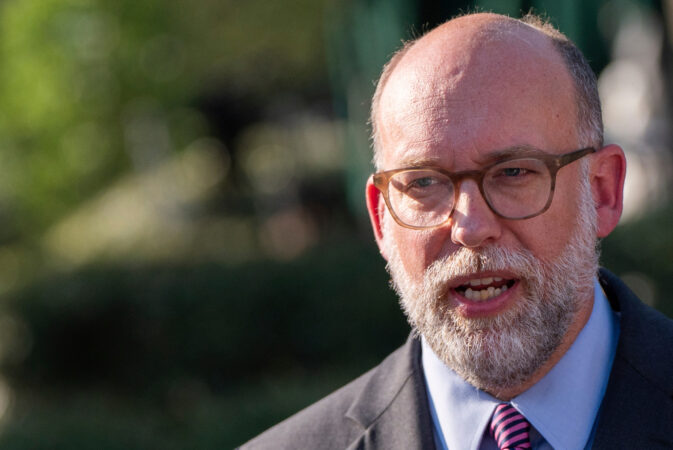
    At the heart of this case is whether Russell Vought, President Donald Trump’s budget director and the acting director of the CFPB, can effectively shut down the agency and lay off all of the bureau’s employees. The CFPB has largely been inoperable since Trump has sworn into office nearly a year ago. Its employees are mostly forbidden from doing any work, and most of the bureau’s operations this year have been to unwind the work it did under President Joe Biden and even under Trump’s first term.

    Vought himself has made comments where he has made it clear that his intention is to effectively shut down the CFPB. The White House earlier this year issued a “reduction in force” for the CFPB, which would have furloughed or laid off much of the bureau.

    The National Treasury Employees Union, which represents the workers at the CFPB, has been mostly successful in court to stop the mass layoffs and furloughs. The union sued Vought earlier this year and won a preliminary injunction stopping the layoffs while the union’s case continues through the legal process.

    In recent weeks, the White House has used a new line of argument to potentially get around the court’s injunction. The argument is that the Federal Reserve has no “combined earnings” at the moment to fund the CFPB’s operations. The CFPB gets its funding from the Fed through expected quarterly payments.

    The Federal Reserve has been operating at a paper loss since 2022 as a result of the central bank trying to combat inflation, the first time in the Fed’s entire history it has been operating at a loss. The Fed holds bonds on its balance sheet from a period of low interest rates during the COVID-19 pandemic, but currently has to pay out higher interest rates to banks who hold their deposits at the central bank. The Fed has been recording a “deferred asset” on its balance sheet, which it expects will be paid down in the next few years as the low-interest bonds mature.

    Because of this loss on paper, the White House has argued there are no “combined earnings” for the CFPB to draw on. The CFPB has operated since 2011, including under Trump’s first term, drawing on the Fed’s operating budget.

    White House lawyers sent a notice to the court in early November in which they argued, using the “combined earnings” argument, that the CFPB would run out of appropriations in early 2026 and does not expect to get any additional appropriations from Congress.

    This combined earnings legal argument is not entirely new. It has floated in conservative legal circles going back to when the Federal Reserve started operating at a loss. The Office of Legal Counsel, which acts as the government’s legal advisers, adopted this legal theory in a memo on November 7. However, this idea has never been tested in court.

    In her opinion, Berman said the OLC and Vought were using this legal theory to get around the court’s injunction instead of allowing the case to be decided on merits. A trial on whether the CFPB employees’ union can sue Vought over the layoffs is scheduled for February.

    “It appears that defendants’ new understanding of ‘combined earnings’ is an unsupported and transparent attempt to starve the CPFB of funding and yet another attempt to achieve the very end the Court’s injunction was put in place to prevent,” Berman wrote in an opinion.

    “We’re very pleased that the court made clear what should have been obvious: Vought can’t justify abandoning the agency’s obligations or violating a court order by manufacturing a lack of funding,” said Jennifer Bennett of Gupta Wessler LLP, who is representing the CFPB employees in the case.

    A White House spokesperson did not immediately respond to a request for comment on Berman’s opinion.

  • Patriots receiver Stefon Diggs faces strangulation charges, denies allegations

    Patriots receiver Stefon Diggs faces strangulation charges, denies allegations

    BOSTON — New England Patriots star wide receiver Stefon Diggs is facing strangulation and other criminal charges in connection with an incident that happened earlier this month, police said.

    News of the charges emerged after a court hearing Tuesday in Dedham, Mass. It is unclear what led to the charges, which include felony strangulation or suffocation and misdemeanor assault and battery.

    Diggs’ lawyer, David Meier, said in an emailed statement that Diggs “categorically denies these allegations.”

    Meier said the allegations never occurred, describing them as unsubstantiated and uncorroborated.

    “The timing and motivation for making the allegations is crystal clear: they are the direct result of an employee-employer financial dispute that was not resolved to the employee’s satisfaction,” Meier wrote.

    In a statement, the Patriots said they were also standing by Diggs: “We support Stefon,” the team said.

    Diggs, 32, established himself as one of the NFL’s best wide receivers during a run with Minnesota and Buffalo from 2018 to 2023, when he had six consecutive 1,000-yard receiving seasons and was selected to the Pro Bowl four times.

    After a lackluster stint in Houston last year, Diggs ended up in New England, signing a three-year, $69 million deal in free agency that guaranteed him $26 million.

    Diggs has been a reliable target for second-year quarterback Drake Maye and is a big reason the team has once again clinched the AFC East title.

    Off the field, though, his tenure with the Patriots got off to a rocky start when a video surfaced on social media in May showing Diggs passing what appeared to be a bag of pink crystals to women on a boat.

    It wasn’t clear what the substance was, and an NFL spokesperson said the league would not comment. Patriots coach Mike Vrabel said the team would handle that matter internally.

  • Khaleda Zia, former Bangladeshi prime minister and archrival of a previous premier, dies at 80

    Khaleda Zia, former Bangladeshi prime minister and archrival of a previous premier, dies at 80

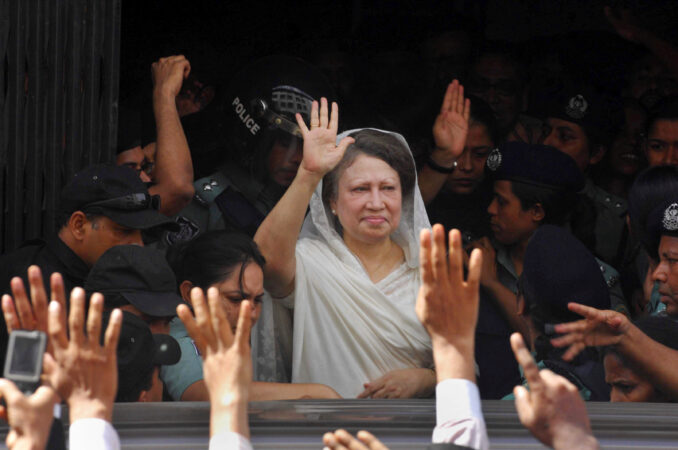
    DHAKA, Bangladesh — Former Bangladeshi Prime Minister Khaleda Zia, 80, whose archrivalry with another former premier defined the country’s politics for a generation, has died, her Bangladesh Nationalist Party said in a statement Tuesday.

    Ms. Zia was the first woman elected prime minister of Bangladesh.

    Bangladesh’s interim government announced a three-day mourning period. A general holiday also was announced for Wednesday, when Ms. Zia’s funeral prayers are scheduled be held in front of the country’s national Parliament building in Dhaka.

    Bangladesh’s interim leader, Muhammad Yunus, issued a statement Tuesday citing Ms. Zia’s contributions to the country.

    “Her role in the struggle to establish democracy, a multi-party political culture, and the rights of the people in Bangladesh will be remembered forever,” Yunus said.

    Indian Prime Minister Narendra Modi offered condolences in a statement Tuesday, noting that “as the first woman Prime Minister of Bangladesh, her important contributions toward the development of Bangladesh, as well as India-Bangladesh relations, will always be remembered.”

    Sajeeb Wazed, son of former Bangladesh Prime Minister Sheikh Hasina, said in a statement Tuesday that Ms. Zia’s demise “will leave a deep impact on the country’s [democratic] transition.”

    “She will be remembered for her contributions in nation building but her death is a blow to stabilize Bangladesh,” said Wazed, whose mother was Ms. Zia’s greatest political rival.

    Hasina issued a statement from exile in India saying Ms. Zia’s death was “an irreparable loss” for politics in Bangladesh and recalling her contributions in establishing the nation’s democracy.

    Ms. Zia had faced corruption cases she said were politically motivated, but in January 2025 the Supreme Court acquitted Ms. Zia in the last corruption case against her, which would have let her run in February’s general election.

    The BNP said that after she was released from prison due to illness in 2020, her family sought permission for treatment abroad at least 18 times from Hasina’s administration, but the requests were rejected.

    Following Hasina’s ouster in 2024, the Yunus-led interim government finally allowed her to go. She went to London in January and returned to Bangladesh in May.

    Fighting military dictatorship

    Bangladesh’s early years of independence, gained in a bloody 1971 war against Pakistan, were marked by assassinations, coups, and countercoups as military figures and secular and Islamic leaders jockeyed for power.

    Ms. Zia’s husband, President Ziaur Rahman, had grabbed power as a military chief in 1977 and a year later formed the Bangladesh Nationalist Party. He was credited with opening democracy in the country but was killed in a 1981 military coup. Ms. Zia’s uncompromising stance against the military dictatorship helped build a mass movement against it, culminating with the ousting of dictator and former army chief H.M. Ershad in 1990.

    Ms. Zia’s opponent when she won her first term in 1991 and in several elections after that was Hasina, the daughter of independence leader Sheikh Mujibur Rahman, who was assassinated in a 1975 coup.

    Ms. Zia was criticized over an early 1996 election in which her party won 278 of the 300 parliamentary seats during a wide boycott by other leading parties, including Hasina’s Awami League, which demanded an election-time caretaker government. Ms. Zia’s government lasted only 12 days before a nonpartisan caretaker government was installed, and the new election was held that June.

    Ms. Zia returned to power in 2001 in a government shared with the country’s main Islamist party, Jamaat-e-Islami, which had a dark past involving Bangladesh’s independence war.

    Ms. Zia’s Bangladesh Nationalist Party was previously closely allied with the party and her government maintained the confidence of the business community by following pro-investment, open-market policies. Ms. Zia was known to have a soft spot for Pakistan and used to deliver anti-Indian political speeches. India alleged insurgents were allowed to use Bangladesh’s soil to destabilize India’s northeastern states under Ms. Zia, especially during her term from 2001 to 2006.

    During that term, Ms. Zia also was tainted by allegations that her elder son, Tarique Rahman, was running a parallel government and was involved in widespread corruption.

    A rivalry with Hasina

    In 2004, Hasina blamed Ms. Zia’s government and Rahman for grenade attacks in Dhaka that killed 24 members of her Awami League party and wounded hundreds of people. Hasina narrowly escaped the attack, which she characterized as an assassination attempt, and subsequently won the 2008 general election.

    Ms. Zia’s party and its partners boycotted the 2014 election in a dispute over a caretaker government, giving a one-sided victory to the increasingly authoritarian regime of Hasina. Her party joined the national elections in 2018 but boycotted again in 2024, allowing Hasina to return to power for a fourth consecutive time through controversial elections.

    Ms. Zia was sentenced to 17 years in jail in two separate corruption cases for misuse of power in embezzling funds meant for a charity named after her late husband. Her party said the charges were politically motivated to weaken the opposition, but the Hasina government said it did not interfere and the case was a matter for the courts.

    Hasina was bitterly criticized by both her opponents and independent critics for sending Ms. Zia to jail.

    Health concerns placed over politics

    Ms. Zia was released from jail by Hasina’s government in 2020 and was moved to a rented home, from which she regularly visited a private hospital. Her family repeatedly requested that Hasina’s administration allow Ms. Zia to travel abroad for medical treatment, but was refused.

    After 15 years in power, Hasina was ousted in a mass uprising in August 2024 and fled the country. Ms. Zia was given permission to travel abroad by an interim government led by Yunus, a Nobel Peace Prize laureate.

    Ms. Zia was silent about politics for years and did not attend political rallies, but she remained the BNP chairperson until her death. Rahman has been the party’s acting chair since 2018.

    She was last seen at an annual function of the Bangladesh military in Dhaka Cantonment on Nov. 21, when Yunus and other political leaders met her. She was in a wheelchair and appeared pale and tired.

    She is survived by Rahman, her elder son and heir apparent in the political dynasty. Her younger son, Arafat, died in 2015.

  • Is red wine better for you than white? The answer may surprise you.

    Is red wine better for you than white? The answer may surprise you.

    The question: Is red wine healthier than white wine?

    The science: Many people think red wine is better for you than white wine or other types of alcohol.

    The notion was partly born from studies — some of which have been disputed — that suggested that certain compounds found in red wine could improve cardiovascular health.

    Now the evidence suggests that any type of alcohol — including red wine — is unlikely to make you any healthier than drinking no alcohol at all.

    “There’s no isolated health benefit of red wine over white wine over any other beverage containing alcohol,” said George Koob, the director of the National Institute on Alcohol Abuse and Alcoholism. And, he added, “There’s no physical health benefits of which we can attribute to alcohol.”

    While it’s long been known that heavy alcohol consumption can cause serious health problems, the potential benefits and risks of moderate drinking — defined as up to two drinks per day for men and one for women — have been murkier. In the past, some research suggested that people who drank small amounts of alcohol in general might have a health advantage compared with those who didn’t drink at all.

    But as research has evolved over the years, we now know that even modest drinking is linked to a higher risk of developing certain cancers such as breast, colorectal and esophageal cancers, as well as brain changes and dementia, heart problems and sleep problems.

    Dietary guidance has also changed. Current guidelines from the U.S. Department of Agriculture state that “emerging evidence suggests that even drinking within the recommended limits may increase the overall risk of death from various causes.” The American Heart Association recommends limiting or abstaining from alcohol, even though the association published a scientific review in 2025 that concluded that light drinking poses no risk for coronary artery disease, stroke, sudden death and possibly heart failure, and may even reduce the risk of developing such conditions — though not all experts agreed with that conclusion.

    The argument in favor of red wine used to focus on certain compounds.

    Red wine contains more polyphenols — plant compounds with antioxidant and anti-inflammatory properties — because the grape juice is fermented with the grape skins, where these compounds are concentrated. (White wine grapes are pressed, and the skins removed, before the fermentation process.)

    These polyphenols include procyanidins, flavonoids and resveratrol, which is often mentioned in cancer research. Another type, anthocyanins, helps give red wine its rich color and has been studied for potential cardiovascular benefits.

    Most of the health benefits associated with these polyphenols have been observed in studies at much higher doses than what you would get from a couple glasses of wine, so there’s no real advantage, experts said.

    “The concentrations are sufficiently low that you would have to drink more than moderate amounts to truly get that much more benefit from the polyphenols in red wine,” which could lead to health issues, said Eric Rimm, a professor of epidemiology and nutrition at the Harvard T.H. Chan School of Public Health, who has studied the health effects of alcohol.

    Instead, you could add stronger sources of anthocyanins into your diet, including darker berries such as blueberries, apples, onions, black or green tea, and dark chocolate, Rimm said.

    As for other risks and benefits, some people may avoid red wine because it can stain teeth and cause headaches and even allergy-like symptoms. While red wine headaches are not fully understood, some people may be especially sensitive to the tannins in the grapes, histamines or sulfites produced through fermentation, or the additional sulfites added to preserve wine. Some research suggests quercetin, an antioxidant found in grapes, may be responsible.

    In one study, people who had a wine intolerance were more likely to report allergy-like symptoms such as nasal congestion, itching, flushed skin and stomach upset more often after drinking red wine than white wine.

    What else you should know

    While drinking alcohol probably won’t lead to any positive health effects, you may be able to reduce potential negative effects by how you drink it.

    First, speak with your health care provider about whether drinking alcohol is safe for you. People who are pregnant, have certain medical conditions, take medications that interact with alcohol, or have or are recovering from an alcohol-use disorder should not drink, according to USDA. Also, teetotalers, people who don’t already drink, should not start drinking for any health reasons, health officials said.

    Assuming you’re of legal drinking age — 21 years or older in the United States — here are some tips from experts:

    1. Eat first: Food, particularly foods with some protein, fats and carbohydrates, slows the absorption of alcohol into the bloodstream, reducing potential ill effects.
    2. Understand drink sizes: A standard alcoholic drink has 0.6 ounces of pure alcohol. That’s equal to 5 ounces of wine with 12 percent alcohol, 12 ounces of beer with 5 percent alcohol, or a shot — 1.5 ounces — of an 80-proof liquor. When buying alcohol at a store, check the alcohol content. “Beer used to be 4 or 5 percent alcohol. There are a lot of beers now that are 8 to 10 percent. So you may want to drink a little bit less if you have a higher alcohol-containing beer or a higher alcohol-containing spirit,” Rimm said.
    3. Keep in mind that men and women may process alcohol differently: Women generally don’t produce as much of an alcohol-metabolizing enzyme called alcohol dehydrogenase, which means they break down alcohol more slowly and are at a higher risk of alcohol-related health problems.
    4. Drink in moderation: Moderation is defined as up to two drinks per day for men and one for women. Also, space out drinks throughout the week — meaning don’t drink all 7 or 14 drinks in one weekend.
    5. The bottom line: While red wine has more polyphenols, which are associated with cardiovascular benefits, than white wine, they aren’t in a high enough concentration to provide a health advantage. In addition, red wine may be more likely than white wine to cause headaches and allergy-like symptoms in people who are susceptible.