Category: Wires

  • Record U.S. Black Friday crowds will likely find fewer bargains amid high prices

    Record U.S. Black Friday crowds will likely find fewer bargains amid high prices

    NEW YORK — Unprecedented numbers of Americans are expected to hit stores this Black Friday, but they are likely to curtail their spending as they find fewer bargains from tariff-hit retailers.

    Marking the biggest turnout ever for the five-day stretch between Thanksgiving and Cyber Monday, 186.9 million people will shop, up from 183.4 million last year, the National Retail Federation projects. But sales growth for the last two months of the year, crucial for retailers, is expected to slow.

    “Everything seems to be way more expensive” at malls, said Kate Sanner, a New Yorker who runs an online aggregator for secondhand listings. Last year, Sanner, 33, spent around $500 on gifts, but this season she plans to trim her budget to $300, eschewing most Black Friday discounts for targeted deals on specific products.

    Thanksgiving falls on Nov. 27 this year, giving retailers an extra day in the holiday window, which typically accounts for a third of annual profits. Retailers have launched early promotions to lock in sales: Walmart’s began on Nov. 14 and will run in three phases through Dec. 1, with Walmart+ members getting early access. Amazon started its Black Friday deals week on Thursday, while Macy’s has opened a dedicated Black Friday portal.

    Sales in November and December — in physical stores and online — are forecast to top $1 trillion for the first time, rising between 3.7% and 4.2%, but are likely to grow at a slower pace than last year’s 4.8% gain, NRF projections show.

    Shoppers avoid dipping into savings for purchases

    While the sticker shock alone could deter some buyers, others are budgeting for the increased costs of other necessities.

    “Knowing that our healthcare premium bill is going to jump astronomically in 2026 … all of our discretionary spending has dropped significantly,” said Liz Sweeney, founder of marketing agency Dogwood Solutions, who lives in Boise, Idaho.

    “While we spent close to $2,000 on gifts in 2024, our 2025 budget is $750,” said 52-year-old Sweeney, who is skipping electronics and big buys this year, sticking to shoes, books, and kitchenware.

    Shoppers still have plenty in the bank, with households across all income levels holding more deposits than they did in 2019, before the COVID-19 pandemic, November data from Bank of America data shows. Consumers were also not using a significant portion of their savings, the data showed.

    “Consumers are sentimentally weak and fundamentally sound,” said Mark Mathews, the NRF’s chief economist. “U.S. household balance sheets are still strong.”

    The federation estimates average spending on gifts and seasonal items such as decorations, cards, food and candy will reach $890 per person, slightly less than last year’s $902. Nearly two-thirds of the 8,427 consumers polled say they will wait for Thanksgiving weekend deals, up from 59% in 2024, with older shoppers driving the trend.

    ‘Definitely seen fewer promotions’

    “Knowing when is the right time to buy this year is more difficult,” said Edgar Dworsky, founder of Consumer World, who tracks holiday pricing. “With so many pre-Black Friday sales, there are no assurances the same deals will be offered again on the real Black Friday or that popular items will still be in stock.”

    Historically, Dworsky said, stores such as Kohl’s, JC Penney, and Macy’s offered small kitchen appliances for as little as $5 after some combination of sales prices, percentage-off coupons, and mail-in rebates, but many of those discounts have disappeared. Kohl’s, for instance, is offering toasters, blenders, and electric frying pans for $9.99 without a rebate but with a coupon for 15% off this year, he said.

    “I’ve definitely seen fewer promotions this year both in-store and online. The first two weeks of November usually bring some activity — though in recent years the discounts haven’t been very deep — but this year there’s been very little and much more full price,” said Jessica Ramirez, who runs brand consultancy the Consumer Collective.

    “When promotions do show up, they’re spot promotions, meaning they aren’t set and don’t last long,” she added.

    While some retailers appear to be pulling back on promotions, Walmart is teasing some aggressive price cuts for Black Friday.

    Some of Walmart’s featured deals include an 85-inch TCL Roku TV, originally priced at $678, marked down to $498 for Black Friday, according to a Reuters review of the retailer’s website. Last year, Walmart highlighted a $120 discount on a 75-inch Vizio TV. This year’s lineup also features a Blackstone outdoor grill offered at $157, reduced from its list price of $224.


  • Raiders fire offensive coordinator Chip Kelly after another rough performance

    Raiders fire offensive coordinator Chip Kelly after another rough performance

    LAS VEGAS — Las Vegas Raiders offensive coordinator Chip Kelly was fired Sunday night after yet another rough offensive performance.

    Kelly’s dismissal came less than four hours after the Raiders were beaten 24-10 by Cleveland. Las Vegas allowed the Browns to sack Geno Smith 10 times.

    “I spoke with Chip Kelly earlier this evening and informed him of his release as offensive coordinator of the Raiders,” coach Pete Carroll said in a statement. “I would like to thank Chip for his service and wish him all the best in the future.”

    Kelly was the biggest-name assistant hired by Carroll, who’s in his first year coaching the Raiders after leading the Seattle Seahawks for 14 seasons.

  • Sixers lose to the Heat as VJ Edgecombe and Joel Embiid sit out

    Sixers lose to the Heat as VJ Edgecombe and Joel Embiid sit out

    Norman Powell scored 32 points while Kel’el Ware had 20 points and 16 rebounds to help the Miami Heat win their fourth in a row with a 127-117 victory over the 76ers on Sunday at Xfinity Mobile Arena.

    The Sixers played without former MVP Joel Embiid for the seventh straight game. Embiid (right knee injury management) has missed 10 of 16 contests this season. In addition, rookie VJ Edgecombe sat out with tightness in his calf.

    Jaime Jacquez Jr. scored 22 points, and Bam Adebayo contributed 18 for the Heat.

    Tyrese Maxey had 27 points to pace the Sixers. Maxey, who entered second in the NBA in scoring at 33.4 points per contest, was coming off a career-high 54 points in Thursday’s 123-114 overtime win at Milwaukee.

    Andre Drummond added 14 points and 23 rebounds for the 76ers. This was the first of three contests between the clubs.

    Miami controlled the contest throughout, but the 76ers got within 105-103 with 8 minutes, 28 seconds left after Trendon Watford’s layup. The Heat then scored 13 of the next 15 points, capped by Powell’s running layup with 4:40 remaining, to go ahead by 13.

    The 76ers honored the 25-year anniversary of the 2001 Eastern Conference champions by wearing replica black jerseys from that era. Allen Iverson, who was named MVP that season, was in attendance. Theo Ratliff rang the ceremonial Liberty Bell prior to the contest. Ratliff helped the 76ers to a 41-14 record before a midseason trade sent him to Atlanta for Dikembe Mutombo.

  • Kaytron Allen becomes Penn State’s career rushing leader as Nittany Lions pound Cornhuskers 37-10

    Kaytron Allen becomes Penn State’s career rushing leader as Nittany Lions pound Cornhuskers 37-10

    STATE COLLEGE — Kaytron Allen ran for 160 yards and two touchdowns, and Penn State’s defense played its best game of the season to keep the Nittany Lions’ bowl hopes alive with a 37-10 win over Nebraska on Saturday night.

    Allen, who racked up 181 yards rushing in last week’s win against Michigan State, became Penn State’s career rushing leader with 3,954 yards, passing Evan Royster’s 3,932 set in 2010.

    The senior back plowed through and zipped around the Huskers all night. Allen passed Saquon Barkley on the school’s career rushing list in the first half before eclipsing Royster with a 3-yard run in the fourth quarter.

    By then the Nittany Lions (5-6, 2-6 Big Ten) had put the game out of reach, scoring on five-straight possessions while their defense stymied the Cornhuskers.

    Allen ripped off a 50-yard run around Nebraska’s left flank on the Nittany Lion’s opening drive to help setup a short touchdown toss from Ethan Grunkemeyer to tight end Andrew Rappleyea.

    Ryan Barker booted a 26-yard field goal, then Nicholas Singleton capped Penn State’s next two drives with 4- and 10-yard rushing touchdowns to make it 23-3 at halftime.

    Emmett Johnson had 19 carries for 103 yards and eight catches for 48 for yards for the Cornhuskers (7-4, 4-4), who have lost three of their last five.

    They didn’t give themselves much of chance in head coach and State College native Matt Rhule’s return to Beaver Stadium.

    Nebraska mustered just 140 yards in the first half, turned the ball over on downs twice and punted twice more. Penn State forced three more turnovers on downs in the second half.

    Kyle Cunanan kicked a 31-yard field goal in the second quarter, but the Cornhuskers didn’t find the end zone until quarterback TJ Lateef scrambled 11 yards through a broken play to cut Penn State’s lead to 30-10 with 0:55 left in the third.

    Allen scored on a 3-yard run to open the second half. He added a 13-yard rushing touchdown early in the fourth, which prompted bundled-up Penn State fans to chant “Terry, Terry, Terry!” as interim coach Terry Smith wiped tears from his eyes on the sideline.

    The takeaway

    Nebraska: The Huskers struggled to move the line of scrimmage on both sides of the ball and as a result, may have cost themselves a shot at a top-tier bowl game.

    Penn State: The Nittany Lions won back-to-back games for the first time under Smith, but will need to win a third to extend their season and avoid their first losing full-season record since 2004.

    Up next

    Nebraska: Hosts Iowa on Friday.

    Penn State: Visits Rutgers on Saturday.

  • 5 common mistakes grandparents make, according to a pediatrician

    5 common mistakes grandparents make, according to a pediatrician

    Why is there so often tension between grandparents and parents when it comes to the grandchildren?

    Watching your child turn into a parent — and care for your grandchild — is one of the great joys that life has to offer. And yet, grandparents often give unsolicited opinions on the decisions that parents are making, from bedtime to mealtime to general attitudes about discipline — or pretty much anything else. As a grandparent who’s also a pediatrician of more than 30 years, I understand why it’s tempting to play the parental-experience card (not to mention the medical training card), but the better part of valor is to wait and give advice only when — and if — you’re asked for it.

    We’ve had our innings. We got to make each and every one of those decisions when we were bringing up our own children, and, child-rearing being what it is, we made them over and over, day after day, all those bedtimes, all those mealtimes, all those opportunities to teach, to set limits, to celebrate, to discipline.

    We reared responsible adults, able to take on the complex tasks of parenting, ready to make good choices. So this is our moment to stand back and respect those choices, weigh in when we’re asked to, and recognize that there are many different ways to navigate the complex waters of parenthood.

    Here are a few common mistakes grandparents make and my advice on how to become a respectful and helpful grandparent.

    Failing to accept that parenting patterns change with time

    There are real changes that happen over time in parenting styles. My own parents decided that they would never spank their children, which was a deliberate break from their own upbringings in the 1930s. Their parents would have seen that as moving in a permissive direction. On the other hand, they also would have thought that my parents were too preoccupied with knowing where the children were at any given moment. Still, I was allowed to walk without an adult to second grade in New York City, keeping an eye on my younger brother, which I wouldn’t have allowed my own children to do.

    I couldn’t resist asking my own son, Benjamin Klass, a child and adolescent psychiatrist, who is also the father of my almost 3-year-old grandson, about his perspective. (And you can just imagine the complex dynamics of the pediatrician mother trying to decide how to give advice — or not — to the child psychiatrist son!)

    He told me that even though grandparents worry all the time about how their grandchildren are doing, it can seem to parents like they don’t worry enough or realize how much parents may agonize over small issues of diet or behavior. “It’s understandable why there is a push and a pull all the time,” he said.

    Thus, some grandparents want to be more casual about food treats, screen time, or even supervision, which creates conflict with parents who take them all much more seriously.

    Remember that you are indeed in a different role now and may see things very differently than you did when you were the parent, with all the responsibility resting on you.

    Blaming your child’s partner

    You don’t want to be in conflict with your child over your grandchild. You don’t want to be in conflict with your child over your child’s partner. As much as possible, respect that parental unit, assume that your child is an integral part of the decision-making process, and remind yourself that if you love being a grandparent, you owe a good deal to the partner who made it possible. And if you do find yourself making a suggestion, treat it as a suggestion that you are in fact making to that parental unit — don’t go behind the other parent’s back.

    Assuming it’s the parents’ fault when a grandchild is struggling

    Remember how bad it feels to have a child who isn’t happy or isn’t doing well or is in some other way going through a bad patch? This is not the time to say “I told you so” or to point out that things in the home have been too disorganized or too strictly organized. Given the complexities of parenting, it’s rare to be able to attribute a child’s distress to any one factor, and it’s common for parents to beat themselves up over everything, including things they don’t control. If there’s a grandchild with a problem, be part of that child’s support system and part of the parents’ support system; ask them how you can help and listen when they want to talk.

    Making it a fight instead of a discussion

    You probably saw this coming, but I’m going to give you permission to advocate for regular pediatric care, immunizations and, within reason, to discuss other specific health-related issues. With immunizations, after all, since you’re among the older adults who will be caring for this child, you have a vested interest in knowing that said child is immunized against measles, RSV, influenza, coronavirus, etc.

    You don’t want to see your grandchild sick with measles (the most infectious virus in the world) for lots of reasons. But I also tell you, as a pediatrician, these can be very hard conversations — in the home as well as in the pediatric exam room — and you have to try to stay respectful, be clear that you’re speaking out of love and concern, make your case, leave the question open if necessary, and return to it — and don’t let it dominate the relationship.

    And you should certainly set a good example by making it clear that you’re getting all the recommended vaccines yourself.

    Weighing in too often, especially when you weren’t asked to

    You already know that picking your battles is a big part of parenting. Every parent of a toddler learns this, and every parent of an adolescent really learns it. There may turn out to be issues along the way, but choose those topics carefully — and pick your words with even more care.

    The goal of this entire enterprise is to help your precious grandchild grow into a responsible adult who can make good choices. You did this once, with your own child, so you know it can be done — and the more you recognize and respect those choices as your child makes them, the more you will be honoring your new role and helping everyone involved understand what goes into making a family.

    Perri Klass is a pediatrician and professor of journalism and pediatrics at New York University, and author of “The Best Medicine: How Science and Public Health Gave Children a Future.”

  • ‘The White Lotus’ sparked online interest in risky anxiety pills, study says

    ‘The White Lotus’ sparked online interest in risky anxiety pills, study says

    The latest season of “The White Lotus” delivered big ratings for HBO — and fueled a surge of Google searches for a risky antianxiety prescription drug featured on the show, according to research published this month.

    The paper, published in JAMA Health Forum, highlights Hollywood’s outsize cultural influence and the common use of benzodiazepines, a class of anxiety-relieving medications that can cause physical dependence and agonizing withdrawal symptoms.

    The third season of the show, which depicts well-heeled guests at a luxury resort in Thailand, includes a storyline of a mother hooked on lorazepam pills and her husband who starts to steal and take them as he faces financial ruin and criminal charges.

    Researchers from the University of California at San Diego found that Google searches for lorazepam and two benzodiazepines with different names remained stable for years before the release of the show’s third season in February. Searches for lorazepam skyrocketed for the next 12 weeks, nearly 99% higher than expected — representing 1.6 million additional searches. During that time, searches for similar drugs, alprazolam and clonazepam, remained at expected levels, the study showed.

    Many of the queries asked how to get lorazepam, although that doesn’t mean viewers bought them, said Kevin Yang, the study’s lead author and a psychiatrist specializing in addiction at the UC-San Diego School of Medicine. “But it’s at least a good indicator of public interest in that medication,” he said.

    Yang got the idea for the study on his couch while watching “The White Lotus” with his now-wife. “It almost felt as if it was being glorified,” Yang said.

    A long history

    Benzodiazepines — which include drugs such as Xanax and Valium — are commonly prescribed for anxiety, bouts of panic, and insomnia.

    The sedative drugs are highly effective but should not be used longer than two to four weeks because of the risk of dependence, said Alexis Ritvo, assistant professor of psychiatry at the University of Colorado School of Medicine and a member of the nonprofit Alliance for Benzodiazepine Best Practices.

    “Very rarely are people adequately educated about that before they’re given a prescription for these meds,” Ritvo said.

    The medical community has long known about the dangers of prolonged use of benzodiazepines, or benzos, as they are often called.

    In 2020, the Food and Drug Administration issued stronger warnings for benzodiazepines, detailing the risk of abuse, addiction, and withdrawal symptoms. The updated boxed warning came amid rising concerns about benzodiazepine abuse, with the agency estimating half of prescriptions were for longer than two months.

    Stopping the drugs abruptly after prolonged use can worsen anxiety and insomnia, leading some patients to start again on higher doses. Withdrawals can last months or even years. Nicole Lamberson, a physician assistant who began taking prescription Xanax for anxiety in her early 20s, spent eight years battling withdrawal symptoms. During that time, she became gaunt and bedridden, afflicted by bedsores.

    “I was crippled with panic, anxiety, terror, racing thoughts, suicidality. I was fully dissociated,” said Lamberson, medical director of the Benzodiazepine Information Coalition, a nonprofit aimed at raising awareness about the dangers of the medications.

    Patients have access to other pharmaceutical anxiety medication, including SSRIs and buspirone. Earlier this year, the American Society of Addiction Medicine published new guidelines for reducing doses for patients who have been regularly taking benzodiazepines.

    Long-term benzodiazepine use poses other risks such as memory loss, difficulty concentrating, and brain fog — particularly dangerous for elderly patients susceptible to falls.

    Benzodiazepines can also amplify the effects of other prescription drugs or alcohol. “If you have an opioid problem or alcohol problem, adding benzos to the equation is like pouring gasoline onto a fire,” said Wayne Kepner, a Stanford University addiction researcher involved in the “White Lotus” study.

    (Victoria, the mother taking lorazepam in “The White Lotus,” slurs at dinner while drinking wine.)

    Researchers have also noted cases of “designer” benzos — which are not approved for medical use but can be purchased online — creeping into the illicit drug supply, an added wrinkle to the nation’s drug crisis. Sometimes known as “benzo dope,” the mix of opioids such as fentanyl and benzodiazepines slows breathing and heart rate and lowers blood pressure, increasing the possibility of an overdose.

    Cultural imprint

    Benzodiazepines have long made appearances in popular culture, reflecting their common use as a prescription and recreational drug.

    Books, TV shows, and movies have depicted or hinted at housewives grappling with suburban malaise by taking Valium. The hard-partying stockbroker in “The Wolf of Wall Street” mentions taking Xanax to “take the edge off.” Hip-hop artists rap about them, and not always to glorify — Future’s “XanaX Damage” is about the drug’s harms.

    “We have a culture of, ‘You work hard, keep going, you shouldn’t feel pain, you shouldn’t feel distress,’” said Ritvo, the addiction psychiatrist. “If you feel anxious, if you feel overwhelmed, then you should do something to take that feeling away.”

    An HBO spokesperson did not return a request for comment.

    The visibility of benzodiazepines on “The White Lotus” could serve as a learning moment, the study researchers said.

    In the paper, they noted the surge in Google searches showed “a level of engagement that few public health interventions achieve in such a short time frame.”

    Yang and Kepner, in an interview, suggested that such shows could include disclaimers on benzodiazepine misuse or steer viewers to help lines or websites, as is often done when media touches on suicide, child abuse, or gambling. “There needs to be some discussion on guardrails,” Kepner said.

    On “The White Lotus” (spoilers ahead), Victoria Ratliff appears to be spared excruciating withdrawal as her husband, Timothy, raids her lorazepam supply and descends into a detached, drugged haze. He considers killing himself and his family but eventually runs out of the drug and finds peace.

  • TSA to charge $18 fee for travelers without proper ID

    TSA to charge $18 fee for travelers without proper ID

    A new program from the Transportation Security Administration will charge travelers $18 to pass through airport security if they are not carrying valid identification, such as Real ID or a passport.

    According to the agency, the fee will cover the cost of a “modernized alternative identity verification program” that relies on biometrics instead of documents or interviews.

    A Federal Register notice posted Thursday explained the new initiative. Travelers who arrive at the airport without correct identification can choose to use the automated biometric kiosk. The $18 fee, which will “address the government-incurred costs,” is nonrefundable and valid for 10 days. Even with payment, entry into the secured area is not guaranteed, the register noted.

    The memo did not mention a timeline for the installation and deployment of the kiosks, which airports will participate in the program, or how people will submit their payment. According to the notice, TSA will open registration for the identity-verification program before it begins collecting fees.

    “This notice serves as a next step in the process in REAL ID compliance, which was signed into law more than 20 years ago and finally implemented by Secretary Noem as of May 2025,” the TSA said in a statement. “Additional guidance will be announced in the coming days.”

    The majority of travelers are ID-compliant — around 94%, according to the TSA. However, Caleb Harmon-Marshall, a former TSA officer and founder of the travel newsletter Gate Access, said people are still showing up at security unprepared.

    “Travelers arriving at TSA checkpoints without proper ID is very common,” Harmon-Marshall said. “It’s so common that now the government can capitalize off of it.”

    Gary Leff, founder of the travel blog View From the Wing, said a few hundred people a day are subjected to alternative screening because they lack proper ID.

    “When you don’t have ID, they don’t send you away,” Leff said. “There’s a process where they get commercially available information about you and have you verify your identity with questions like what addresses have you had in the past, where have you worked, and what car have you owned.”

    Leff said the biometric kiosk will replace this more time-consuming method, an advantage echoed by the TSA.

    “The current alternative identity verification process is time and resource intensive, limiting the number of individuals for whom TSA can provide the service,” the Federal Register post said.

    The TSA noted that the $18 fee falls under a congressional directive that allows the agency to “impose a fee for any registered traveler program undertaken by the Department of Homeland Security.” The amount cannot “exceed the aggregate costs associated with the program.”

    According the Federal Register memo, the fee will cover such expenses as information technology infrastructure and services; software development; identity verification and validation; mobile computing; data infrastructure, integration, security and compliance; program management; and customer service and administrative expenses.

    The TSA said it will publish the fees on its website and may “update” the program’s amount and availability in the Federal Register.

  • The job market is heating up — for jobs that people usually don’t want

    The job market is heating up — for jobs that people usually don’t want

    Jobseekers can’t be choosy in today’s stalling U.S. labor market. Even when the job is flagging traffic for 12 hours in the Atlanta sun.

    Two years ago, the chief executive officer of AQC Traffic Control fielded around 10 applications a week for long shifts directing motorists to stop or slow down near construction sites, braving both the summer heat and the winter cold. Today, Marcus Rush is seeing up to 80.

    “When my office phone rings, my ears perk up because I wonder if it’s a new customer,” Rush said. “Now, every time I hear a phone ring, it’s someone calling in to check on a job application. That never used to happen.”

    From substitute teachers to prison guards, staffing agencies and employers are reporting a pickup in applicants for roles often shunned for their low pay, inconsistent hours, or unpleasant conditions. Even the messy work at materials recovery facilities, where people still sort recyclables partly by hand, is fetching more takers.

    With fewer businesses hiring, nearly half of employed Americans in a recent Harris Poll conducted for Bloomberg News said it would take them four months or more to find a job of similar quality if they lost their jobs today. That offers employers who have traditionally struggled to fill roles the upper hand, especially for those still reeling from rampant vacancies and a 27% gain in wages since the onset of the pandemic.

    “In 2022, it was darn near impossible to find workers,” said Rick Hermanns, CEO at staffing firm HireQuest Inc., which recruits for recycling centers among other industries. Today, “that really isn’t the case.”

    The job-hopping days of the COVID-19 era, dubbed the Great Resignation, have given way to the “low hire, low fire” economy. However, a recent rash of layoff announcements suggest companies have lost their fear of firing.

    While overall the jobless rate remained fairly low at 4.3% in August — the latest data available as of mid-November — those out of work are lingering in unemployment for longer. Almost 26% of unemployed workers that month had been out of work for more than half a year, one of the highest shares in a decade, according to data from the Bureau of Labor Statistics.

    After getting laid off last fall, Danielle Norwood, a radio veteran, is now working toward getting her substitute teacher certification.

    Danielle Norwood is among them. The 53-year-old radio veteran spent the last three years of her career hosting a show in Topeka, Kan., until the station let her go last fall. After a brief stint as an Uber driver and countless unanswered job applications, she’s now working toward getting her substitute teacher certification. She’s leery of the horror stories, having recently read about a sub who got “kicked in the gut,” but the pay’s OK at $140 to $200 a day and she’s excited to make a difference.

    “Kids don’t have the boundaries,” Norwood said. “But I think I can handle it. And financially, this is the only way I can see forward.”

    In fact, firms that help school districts fill substitute teacher spots report more applicants per role lately. After a sharp drop in available subs during the pandemic, the pool eventually rebounded to around pre-COVID levels, according to a 2024 blog post by education staffing firm Edustaff. However, shortages persisted because many of the remaining subs cut back on accepting assignments and were turned off by low pay and only sporadic work, Edustaff said. Substitute teachers make about $18.50 an hour, according to the latest median wage data from the BLS.

    Today, the Kansas City area’s Morgan Hunter staffing firm, which has a substitute teaching unit, has seen “our best year for hiring since COVID,” education program director Angela Hunt said in an email. The weak economy is one of a few reasons for the pickup, she said. Staffing giant Kelly Services Inc., which fills almost 6 million substitute teaching assignments a year, has also seen more applications this year, although they attribute it to professionals wanting to try education after tiring of other fields.

    Likewise, firms with jobs that sometimes go begging in stronger job markets are seeing some of the best recruiting in years.

    Waste Management Inc. and some of its competitors have reported better employee retention in recent earnings calls, with the Houston-based firm boasting on a call last month that turnover among garbage truck driver and technician roles “is at an all-time company low.” To be sure, recent automation of certain tasks has allowed it to keep some hard-to-fill jobs vacant.

    And at materials recovery facilities — which sort homeowners’ blue-box recyclables, often using day laborers — interest from jobseekers is also higher. In HireQuest’s division that includes waste management and recycling facilities, the number of job applications per opening is up as much as 50% from a couple years ago. That’s a result of more applicants overall, as well as a reduction in open positions, a spokesperson said.

    “We can fill those roles, where three years ago we would’ve been hard-pressed if a waste company called us and said, ‘We need 30 people,’” HireQuest’s Hermanns said.

    In the notoriously high-turnover corrections industry, one large operator, the Georgia Department of Corrections, reports receiving more than a thousand applications in each of the past three months for all roles, including correctional officers. That’s up more than 40% from a year ago. A spokesperson for the agency attributed the interest to more advertising and job fairs.

    And the U.S. military, which can be a tough sell because of the risk of danger and separation from family, is hitting its recruiting targets again, said Beth Asch, a senior principal economist who specializes in defense manpower at the think tank RAND. In 2022, the Army missed its goal by 25%, but now it and other branches report reaching their marks ahead of schedule.

    “A consistent finding is when the economy gets a little worse, when the unemployment rate rises, you get an increase in enlistments in the military,” Asch said, adding that recent pay raises probably also played a role.

    Nowadays, Rush is able to command employees with traffic flagging experience, whereas a couple years ago he hired almost everyone who passed a drug test and a flagging certification. Among them is Ieshia Jones, 36, a 15-year flagging veteran who joined Rush’s firm six weeks ago.

    Ieshia Jones, a 15-year flagging veteran who joined Rush’s firm recently. She enjoys her job. “I love it, honestly.”

    “A lot of people just can’t stand being outside in the cold or heat,” Jones said. “I love it, honestly. It makes me feel like I’m a part of something.”

    Rush graduated from Stanford University with an MBA in 2020, purchasing AQC Traffic Control a year later. He’s only able to hire 15% of the workers who apply for flagging jobs these days, and chuckled when told he’s almost as selective as Stanford is in selecting first-year students.

    “I never expected we would be in the position we’re in now,” Rush said.

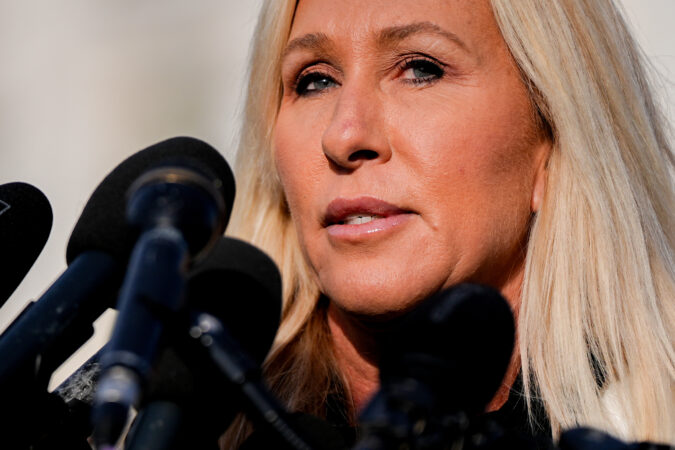
  • Rep. Marjorie Taylor Greene of Georgia, former Trump loyalist, says she is resigning from Congress

    Rep. Marjorie Taylor Greene of Georgia, former Trump loyalist, says she is resigning from Congress

    WASHINGTON — Rep. Marjorie Taylor Greene of Georgia, a loyal supporter-turned-critic of President Donald Trump who faced his political retribution if she sought reelection, said Friday she is resigning from Congress in January.

    Greene, in a more than 10-minute video posted online, explained her decision and said she didn’t want her congressional district “to have to endure a hurtful and hateful primary against me by the president we all fought for,” she said.

    Greene’s resignation followed a public fallout with Trump in recent months, as the congresswoman criticized him for his stance on files related to Jeffrey Epstein, along with foreign policy and health care.

    Trump branded her a “traitor” and “wacky” and said he would endorse a challenger against her when she ran for reelection next year.

    She said her last day would be Jan. 5, 2026.

    The White House did not immediately respond to a message seeking comment Friday night.

    Greene was one of the most vocal and visible supporters of Trump’s Make America Great Again politics, and she embraced some of his unapologetic political style.

    Her break with him was a notable fissure in his grip over conservatives, particularly his most ardent base. But her decision to step down in the face of his opposition put her on the same track as many of the more moderate establishment Republicans before her who went crosswise with Trump.

    The congresswoman, who recorded the video announcing her resignation while sitting in her living room wearing a cross necklace and with a Christmas tree and a peace lily plant behind her, said, “My life is filled with happiness, and my true convictions remain unchanged, because my self-worth is not defined by a man, but instead by God.”

    A crack in the MAGA movement

    Greene had been closely tied to the Republican president since she launched her political career five years ago.

    In her video Friday, she underscored her longtime loyalty to Trump except on a few issues, and said it was “unfair and wrong” that he attacked her for disagreeing.

    “Loyalty should be a two-way street and we should be able to vote our conscience and represent our district’s interest, because our job title is literally ‘representative,’” she said.

    Greene swept to office at the forefront of Trump’s MAGA movement and quickly became a lightning rod on Capitol Hill for her often beyond-mainstream views. In her video Friday, Greene said she had “always been despised in Washington, D.C., and just never fit in.”

    As she embraced the QAnon conspiracy theory and appeared with white supremacists, Greene was initially opposed by party leaders but welcomed by Trump. He called her “a real WINNER!”

    Yet over time she proved a deft legislator, having aligned herself with then-GOP leader Kevin McCarthy, who would go on to become House speaker. She was a trusted voice on the right flank, until McCarthy was ousted in 2023.

    While there has been an onslaught of lawmakers from both parties heading for the exits ahead of next fall’s midterm elections, as the House struggles through an often chaotic session, Greene’s announced retirement will ripple throughout the ranks — and raise questions about her next moves.

    Greene was first elected to the House in 2020. She initially planned to run in a competitive district in northern Atlanta’s suburbs, but relocated to the much more conservative 14th District in Georgia’s northwest corner.

    The opening in her district means Republican Gov. Brian Kemp will have to set a special election date within 10 days of Greene’s resignation. Such a special election would fill out the remainder of Greene’s term through January 2027. Those elections could take place before the party primaries in May for the next two-year term.

    Conspiracy-minded

    Even before her election, Greene showed a penchant for harsh rhetoric and conspiracy theories, suggesting a 2017 mass shooting in Las Vegas was a coordinated attack to spur support for new gun restrictions. In 2018, she endorsed the idea that the U.S. government perpetrated the attacks on Sept. 11, 2001, and mused that a “so-called” plane had hit the Pentagon.

    Greene argued in 2019 that Reps. Ilhan Omar, D-Minn., and Rashida Tlaib, D-Mich., both Muslim women, weren’t “official” members of Congress because they used Qurans rather than Bibles in their swearing-in ceremonies.

    She was once a sympathizer with QAnon, an online network that believes a global cabal of Satan-worshipping cannibals, including U.S. government leaders, operates a child sex trafficking ring. She eventually distanced herself, saying she got “sucked into some of the things I had seen on the internet.”

    During the pandemic, she drew backlash and apologized for comparing the wearing of safety masks to the horrors of the Holocaust.

    She also drew ridicule and condemnation after a conspiracy she speculated about on Facebook in 2018, in which she suggested a California wildfire may have been caused by “lasers or blue beams of light” controlled by a left-wing cabal tied to a prominent Jewish family.

    When Trump was out of power between his first and second terms, Greene was often a surrogate for his views and brash style in Washington.

    While then-President Joe Biden delivered his State of the Union address in 2022, Greene stood up and began chanting “Build the wall,” referring to the U.S.-Mexico border wall that Trump began in his first term.

    Last year, when Biden gave his last State of the Union address, Greene again drew attention as she confronted him over border security and the killing of a nursing student from Georgia, Laken Riley, by an immigrant in the country illegally.

    Greene, wearing a red MAGA hat and a T-shirt about Riley, handed the president a button that said “Say Her Name.” The congresswoman then shouted that at the president midway through his speech.

    Frustration with the GOP

    But this year, her first serving with Trump in the White House, cracks began to appear slowly in her steadfast support — before it broke wide open.

    Greene’s discontent dates back at least to May, when she announced she wouldn’t run for the Senate against Democratic incumbent Jon Ossoff, while attacking GOP donors and consultants who feared she couldn’t win.

    Greene’s restlessness only intensified in July, when she announced she wouldn’t run for Georgia governor, either.

    She was also frustrated with the Republican leadership on Capitol Hill, which worked in lockstep with the president.

    Greene said in her video that “the legislature has been mostly sidelined” since Republicans took unified control of Washington in January and her bills “just sit collecting dust.”

    “That’s how it is for most members of Congress’ bills,” she said. “The speaker never brings them to the floor for a vote.”

    Messages left with House Speaker Mike Johnson’s office were not immediately returned.

    Republicans will likely lose the midterms elections next year, Greene said, and then she’d “be expected to defend the president against impeachment after he hatefully dumped tens of millions of dollars against me and tried to destroy me.”

    “It’s all so absurd and completely unserious,” she said. “I refuse to be a battered wife hoping it all goes away and gets better.”

  • Zelensky says Ukraine faces a stark choice and risks losing American support over U.S. peace plan

    Zelensky says Ukraine faces a stark choice and risks losing American support over U.S. peace plan

    KYIV, Ukraine — Ukrainian President Volodymyr Zelensky told his country in an address Friday that it could face a pivotal choice between standing up for its sovereign rights and preserving the American support it needs, as leaders discuss a U.S. peace proposal seen as favoring Russia.

    Russian President Vladimir Putin, meanwhile, cautiously welcomed the U.S. plan to end Moscow’s nearly four-year war in Ukraine, which contains many of the Kremlin’s longstanding demands while offering limited security guarantees to Ukraine. Putin said it “could form the basis of a final peace settlement,” while accusing Ukraine of opposing the plan and being unrealistic.

    The plan foresees Ukraine handing over territory to Russia — something Kyiv has repeatedly ruled out — while reducing the size of its army and blocking its coveted path to NATO membership.

    Zelensky, in his address hours earlier, did not reject the plan outright, but insisted on fair treatment while pledging to “work calmly” with Washington and other partners in what he called “truly one of the most difficult moments in our history.” He said he spoke for almost an hour Friday with U.S. Vice President JD Vance and Army Secretary Dan Driscoll about the peace proposal.

    “Currently, the pressure on Ukraine is one of the hardest,” Zelensky said in the recorded speech. “Ukraine may now face a very difficult choice, either losing its dignity or the risk of losing a key partner.”

    Speaking at a meeting of Russia’s National Security Council, Putin called the plan “a new version” and “a modernized plan” of what was discussed with the U.S. ahead of his Alaska summit with President Donald Trump in August, and said Moscow has received it. “I believe that it, too, could form the basis for a final peace settlement,” he said.

    But he said the “text has not been discussed with us in any substantive way, and I can guess why,” adding that Washington has so far been unable to gain Ukraine’s consent. “Ukraine is against it. Apparently, Ukraine and its European allies are still under illusions and dream of inflicting a strategic defeat on Russia on the battlefield,” Putin said.

    Trump says he wants Ukraine to respond within a week

    Trump said Zelensky is going to have to come to terms with the U.S. proposal, and if he doesn’t, “they should just keep fighting, I guess.”

    Asked by reporters about Zelensky saying his country faces a difficult choice, Trump alluded to their tense meeting in February that led to a brief rupture in the U.S.-Ukraine relationship: “You remember right in the Oval Office not so long ago? I said you don’t have the cards.”

    Trump in a radio interview earlier Friday said he wants an answer from Zelensky on his 28-point plan by Thursday, but said an extension is possible to finalize terms.

    “I’ve had a lot of deadlines, but if things are working well, you tend to extend the deadlines,” Trump said in an interview on “The Brian Kilmeade Show” on Fox News Radio. “But Thursday is it — we think an appropriate time.”

    While Zelensky has offered to negotiate with the U.S. and Russia, he signaled Ukraine has to confront the possibility of losing American support if it makes a stand.

    He urged Ukrainians to “stop fighting” each other, in a possible reference to a major corruption scandal that has brought fierce criticism of the government, and said peace talks next week “will be very difficult.”

    Europe says it will keep supporting Ukraine

    Zelensky spoke earlier by phone with the leaders of Germany, France and the United Kingdom, who assured him of their continued support, as European officials scrambled to respond to the U.S. proposals that apparently caught them unawares.

    Wary of antagonizing Trump, the European and Ukrainian leaders cautiously worded their responses and pointedly commended American peace efforts.

    German Chancellor Friedrich Merz, French President Emmanuel Macron and British Prime Minister Keir Starmer assured Zelensky of “their unchanged and full support on the way to a lasting and just peace” in Ukraine, Merz’s office said.

    The four leaders welcomed U.S. efforts to end the war. “In particular, they welcomed the commitment to the sovereignty of Ukraine and the readiness to grant Ukraine solid security guarantees,” the statement added.

    The line of contact must be the departure point for an agreement, they said, and “the Ukrainian armed forces must remain in a position to defend the sovereignty of Ukraine effectively.”

    Starmer said the right of Ukraine to “determine its future under its sovereignty is a fundamental principle.”

    Existential threat to Europe

    European countries see their own futures at stake in Ukraine’s fight against the Russian invasion and have insisted on being consulted in peace efforts.

    “Russia’s war against Ukraine is an existential threat to Europe. We all want this war to end. But how it ends matters,” EU foreign policy chief Kaja Kallas said in Brussels. “Russia has no legal right whatsoever to any concessions from the country it invaded. Ultimately, the terms of any agreement are for Ukraine to decide.”

    Trump in his radio interview pushed back against the notion that the settlement, which offers plentiful concessions to Russia, would embolden Putin to carry out further malign action on his European neighbors.

    “He’s not thinking of more war,” Trump said of Putin. ”He’s thinking punishment. Say what you want. I mean, this was supposed to be a one-day war that has been four years now.”

    A European government official said the U.S. plans weren’t officially presented to Ukraine’s European backers.

    Many of the proposals are “quite concerning,” the official said, adding that a bad deal for Ukraine would also be a threat to broader European security.

    The official was not authorized to discuss the plan publicly and spoke to The Associated Press on condition of anonymity.

    European Council President Antonio Costa, in Johannesburg, said of the U.S. proposals, “The European Union has not been communicated any plans in (an) official manner.”

    Proposal meets with skepticism in the U.S. Senate

    “This so-called ‘peace plan’ has real problems, and I am highly skeptical it will achieve peace,” said Sen. Roger Wicker, the Republican chair of the Senate Armed Services Committee. “Ukraine should not be forced to give up its lands to one of the world’s most flagrant war criminals in Vladimir Putin.”

    Wicker added that Ukraine should be allowed to determine the size of its military and Putin should not be rewarded with assurances from the U.S.

    Democratic Sen. Chris Coons, who serves on the Senate Foreign Relations Committee, said there’s “general concern and alarm that this is a Russian wish list proposal.”

    Ukraine examines the proposals

    Ukrainian officials said they were weighing the U.S. proposals, and Zelensky said he expected to talk to Trump about it in coming days.

    A U.S. team began drawing up the plan soon after U.S. special envoy Steve Witkoff held talks with Rustem Umerov, a top adviser to Zelensky, according to a senior Trump administration official who was not authorized to comment publicly and spoke on the condition of anonymity.

    The official added that Umerov agreed to most of the plan, after making several modifications, and then presented it to Zelensky.

    However, Umerov on Friday denied that version of events. He said he only organized meetings and prepared the talks.

    He said technical talks between the U.S. and Ukraine were continuing in Kyiv.

    “We are thoughtfully processing the partners’ proposals within the framework of Ukraine’s unchanging principles — sovereignty, people’s security, and a just peace,” he said.