Category: Wires

  • A person has been detained for questioning in the disappearance of Nancy Guthrie, AP sources say

    A person has been detained for questioning in the disappearance of Nancy Guthrie, AP sources say

    TUCSON, Ariz. — A person has been detained for questioning in the disappearance of Nancy Guthrie, according to two people familiar with the matter.

    The people said the person was detained in an area south of Tucson on Tuesday. They did not immediately provide additional details, and it wasn’t clear if the person being questioned is the person captured on surveillance video from outside Guthrie’s house released earlier Tuesday.

    The people were not authorized to discuss details of an ongoing investigation and spoke to The Associated Press on condition of anonymity.

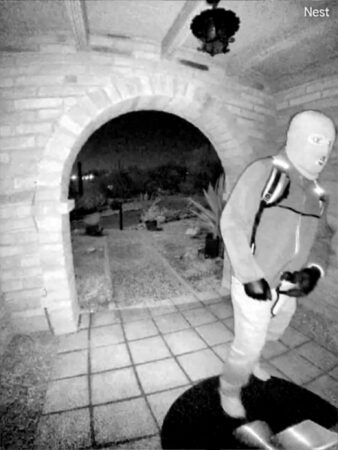
    The FBI released surveillance images of a masked person with a handgun holster outside Guthrie’s front door the night she vanished, offering the first major break in a case that has gripped the nation for more than a week.

    The person wearing a backpack and a ski mask can be seen in one of the videos tilting their head down and away from a doorbell camera while nearing an archway at the home of the mother of “Today” show host Savannah Guthrie.

    The footage shows the person holding a flashlight in their mouth and trying to cover the camera with a gloved hand and part of a plant ripped from Nancy Guthrie’s yard.

    The videos — less than a combined minute in length — gave investigators and the public their first glimpse of who was outside Nancy Guthrie’s home just outside Tucson, but the images did not show what happened to her or help determine whether the 84-year-old is still alive.

    FBI Director Kash Patel said the “armed individual” appeared to “have tampered with the camera.” It was not entirely clear whether there was a gun in the holster.

    The videos were pulled from data on “back-end systems” after investigators spent days trying to find lost, corrupted or inaccessible images, Patel said.

    “This will get the phone ringing for lots of potential leads,” said former FBI agent Katherine Schweit. “Even when you have a person who appears to be completely covered, they’re really not. You can see their girth, the shape of their face, potentially their eyes or mouth.”

    By Tuesday afternoon, authorities were back near Nancy Guthrie’s neighborhood, using vehicles to block her driveway. A few miles away, law enforcement was going door-to-door in the area where daughter Annie Guthrie lives, talking with neighbors as well as walking through a drainage area and examining the inside of a culvert with a flashlight.

    Investigators have said for more than a week that they believe Nancy Guthrie was taken against her will. She was last seen at home Jan. 31 and reported missing the next day. DNA tests showed blood on her porch was hers, authorities said.

    She has high blood pressure and issues with mobility and her heart, and she needs daily medication, officials have said.

    This image provided by the FBI shows surveillance images at the home of Nancy Guthrie the night she went missing in Tucson, Ariz. (FBI via AP)

    Authorities initially could not pull images from camera

    Until now, authorities have released few details, leaving it unclear if ransom notes demanding money with deadlines already passed were authentic, and whether the Guthrie family has had any contact with whoever took Nancy Guthrie.

    Savannah Guthrie posted the new surveillance images on social media Tuesday, saying the family believes Nancy Guthrie is still alive and offering phone numbers for the FBI and county sheriff. Within minutes, the post had thousands of comments.

    Investigators had hoped cameras would turn up evidence right away about how Nancy Guthrie disappeared from her home in an secluded neighborhood.

    But the doorbell camera was disconnected early on Feb. 1. While software recorded movement at the home minutes later, Nancy Guthrie did not have an active subscription, so Pima County Sheriff Chris Nanos had initially said none of the footage could be recovered. Officials continued working to get the footage.

    Savannah Guthrie expressed desperation a day ago

    Heartbreaking messages by Savannah Guthrie and her family shifted from hopeful to bleak as they made pleas for whoever took Nancy Guthrie. In a video just ahead of a purported ransom deadline Monday, Savannah Guthrie appeared alone and spoke directly to the public.

    “We are at an hour of desperation,” she said. “We need your help.”

    Much of the nation is closely following the case involving the longtime anchor of NBC’s morning show.

    White House press secretary Karoline Leavitt said President Donald Trump watched the new surveillance footage and was in “pure disgust,” encouraging anyone with information to call the FBI.

    The FBI this week began posting digital billboards about the case in major cities from Texas to California.

    Connor Hagan, a spokesperson for the FBI, said Monday that the agency was not aware of ongoing communication between Guthrie’s family and any suspected kidnappers. Authorities also had not identified any suspects, he said.

    Videos from Guthrie siblings appealed directly to whoever took their mom

    Three days after the search began, Savannah Guthrie and her two siblings sent their first public appeal to whoever took their mother, saying, “We want to hear from you, and we are ready to listen.”

    In the recorded video, Guthrie said her family was aware of media reports about a ransom letter, but they first wanted proof their mother was alive. “Please reach out to us,” they said.

    The next day, Savannah Guthrie’s brother again made a plea, saying, “Whoever is out there holding our mother, we want to hear from you. We haven’t heard anything directly.”

    Then over the past weekend, the family posted another video — one that was more cryptic and generated even more speculation about Nancy Guthrie’s fate.

    “We received your message, and we understand. We beg you now to return our mother to us so that we can celebrate with her,” said Savannah Guthrie, flanked by her siblings. “This is the only way we will have peace. This is very valuable to us, and we will pay.”
  • FBI cited debunked claims to obtain warrant for Fulton County vote records, documents show

    FBI cited debunked claims to obtain warrant for Fulton County vote records, documents show

    The FBI relied heavily on previously debunked claims of widespread election irregularities in Georgia as it persuaded a federal judge last month to sign off on plans to seize scores of 2020 voting records from the state’s most populous county, court documents unsealed Tuesday show.

    In a pair of Jan. 28 search warrant affidavits, authorities said they were seeking evidence that would determine whether “deficiencies” in the vote tabulation in Fulton County, home to Atlanta, were the result of intentional wrongdoing that could constitute a crime.

    But many of the irregularities they raised — including claims of duplicate ballots and missing ballot images — have been previously explained by county officials as the types of routine errors that frequently occur, are typically corrected in the moment, and are not significant enough to sway the outcome of an election. Independent reviews have backed up that conclusion.

    The affidavits cited previously aired theories from several prominent election deniers whose names were redacted in the documents unsealed Tuesday but whose descriptions align with publicly known details about those who advanced conspiracy theories about the election.

    The documents also revealed that the FBI’s investigation was prompted by a referral from former Trump campaign lawyer and prominent election denier Kurt Olsen, who was recently appointed to a White House position tasked with monitoring election integrity.

    “Some of those allegations have been disproven while some of those allegations have been substantiated, including through admissions by Fulton County,” FBI Special Agent Hugh Raymond Evans wrote in the affidavits, which sought court authorization to search the county’s primary election warehouse and the office of the county’s clerk of courts.

    He added, “If these deficiencies were the result of intentional action, it would be a violation of federal law,” whether or not any of them were significant enough to affect the outcome of the race.

    Evans’s affidavits were made public Tuesday after Fulton County officials and a coalition of news outlets, including The Washington Post, urged a federal judge to release the typically sealed court filing. The Justice Department did not oppose the request.

    The assertions laid out in the 23-page documents are likely to stoke alarm among county officials and democracy advocates who have condemned the investigation as an attempt by the Justice Department to substantiate Trump’s long-held grievances about his 2020 election loss to Joe Biden.

    Multiple audits, nearly a dozen court rulings and former Trump attorney general William P. Barr have found no evidence of widespread fraud sufficient enough to affect the outcome of the race in Georgia.

    More broadly, Trump’s critics have raised concerns that the criminal probe of Fulton County officials could pose a threat to state-level control of voting and the future of independent elections.

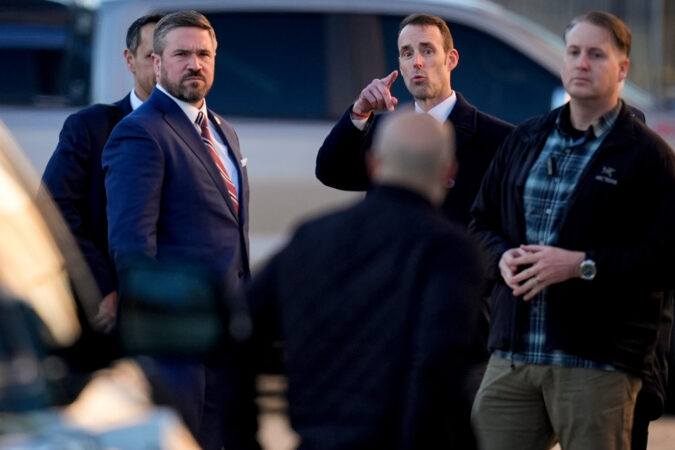
    Dozens of agents descended on Fulton County’s election warehouse last month and spent several hours combing through the county’s records under supervision from FBI Deputy Director Andrew Bailey. They left with more than 700 boxes of material, including all physical ballots from the 2020 race.

    A copy of the search warrant, previously obtained by The Post, revealed that the search was part of a criminal inquiry into possible violations of two federal laws: one requiring officials to retain voting records and the other criminalizing efforts to defraud voters through denying them an impartially conducted election.

    But until the public release Tuesday of the affidavit underlying the warrant, the exact focus of the investigation — and the evidence agents cited to persuade a judge to sign off on the search — was unknown.

    Federal authorities did not have to prove any claims laid out as the basis for the warrant. They were required only to demonstrate a substantial likelihood that a crime occurred and that evidence of that crime could be found at the two locations they sought to search.

    U.S. Magistrate Judge Catherine M. Salinas in Atlanta found the Justice Department had met that threshold and signed off on the warrant Jan. 28 — just hours before agents arrived at the warehouse.

    Since the search, FBI Director Kash Patel has waved off concern expressed by Trump’s critics over the bureau’s investigation, describing the search as “just like one we would do anywhere else.”

    “We did the same thing there we do in any criminal case or investigation,” Patel told Fox News in an interview last week. “We collected evidence, we presented that evidence to a federal magistrate judge, who made a finding of probable cause.”

    Fulton County officials have urged a different federal judge — Trump appointee J.P. Boulee — to order the return of all material seized by the FBI.

    “Claims that the 2020 election results were fraudulent or otherwise invalid have been exhaustively reviewed and, without exception, refuted,” Fulton County Attorney Y. Soo Jo wrote in a recent filing. “Eleven different post-election lawsuits, challenging various aspects of Georgia’s election process, failed to demonstrate fraud.”

    Boulee has yet to rule on that request.

    — — –

    Aaron Schaffer and Mark Berman contributed to this report.

  • Gov. Tim Walz says federal immigration crackdown in Minnesota could end within days

    Gov. Tim Walz says federal immigration crackdown in Minnesota could end within days

    MINNEAPOLIS — Gov. Tim Walz said Tuesday that he expects the federal immigration crackdown in Minnesota will end in “days, not weeks and months,” based on his recent conversations with top Trump administration officials.

    The Democratic governor said at a news conference that he spoke Monday with border czar Tom Homan and with White House chief of staff Susie Wiles on Tuesday morning. Homan took over the Minnesota operation in late January after the second fatal shooting by federal officers and amid growing political backlash and questions about how the operation was being run.

    “We’re very much in a trust but verify mode,” Walz said. He added that he expected to hear more from the administration “in the next day or so” about the future of what he said has been an “occupation” and a “retribution campaign” against the state.

    While Walz said he’s hopeful at the moment because “every indication I have is that this thing is winding up,” he added that things could change.

    “It would be my hope that Mr. Homan goes out before Friday and announces that this thing is done, and they’re bringing her down and they’re bringing her down in days,” Walz said. “That would be my expectation.”

    Officials with the Department of Homeland Security did not immediately reply to a request for comment on the governor’s remarks.

    Walz said he has no reason not to believe Homan’s statement last week that 700 federal officers would leave Minnesota immediately, but the governor added that still left 2,300 on Minnesota’s streets. Homan at the time cited an “increase in unprecedented collaboration” resulting in the need for fewer federal officers in Minnesota, including help from jails that hold inmates who could be deported.

    The governor also indicated that he expects the state will get “cooperation on joint investigations” into the shooting deaths of Renee Good and Alex Pretti by federal officers, but gave no details. That’s been a point of friction between federal authorities and state investigators, who complain that they have been frozen out of those cases so far with no access to evidence.

    Walz called the news conference primarily to denounce the economic impact of the enforcement surge. He spoke at The Market at Malcolm Yards, a food hall where owner Patty Wall said the entire restaurant sector of the local economy has become “collateral damage” from the surge.

    Matt Varilek, the governor’s employment and economic development commissioner, said Malcolm Yards would normally be bustling, but is now struggling because employees and customers are afraid to come due to the crackdown.

    “So it is great news, of course, that the posture seems to have changed at the federal level toward their activities here in Minnesota,” Varilek said. “But, as the governor said, it’s a trust-but-verify situation. And frankly, the fear that has been sown, I haven’t really noticed any reduction in that.”

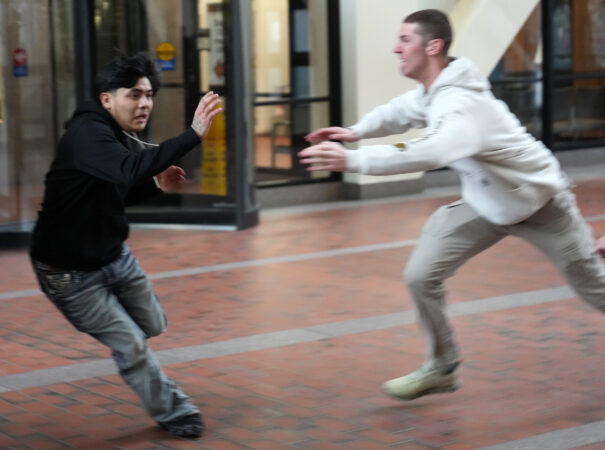
    Even as Walz was expressing optimism that the crackdown would end soon, federal officers made a highly visible arrest inside the lobby of the main county building in downtown Minneapolis.

    After a short foot chase, ICE officers grabbed a man who had arrived for a court appearance on charges of possessing over 50 pounds of methamphetamine.

    The county’s top prosecutor, Hennepin County Attorney Mary Moriarty, protested that the arrest was “disruptive and disturbing to many” and left staffers in the building afraid to leave their offices for fear of being racially profiled.

    The man could go unpunished on the state drug charges if he’s deported first.

    “Using local government courthouses for federal civil immigration enforcement interferes with the administration of justice, prevents witnesses from testifying and robs victims of their opportunity to seek justice,” Moriarty said in a statement. She has also objected to earlier arrests by ICE officers of people making court appearances there.

  • Trump administration takes down a rainbow flag at the Stonewall National Monument

    Trump administration takes down a rainbow flag at the Stonewall National Monument

    NEW YORK — The Trump administration has stopped flying a rainbow flag at the Stonewall National Monument, angering activists who see the change as a symbolic swipe at the country’s first national monument to LGBTQ+ history.

    The multicolored flag, one of the world’s most well known emblems of LGBTQ+ rights, was quietly removed in recent days from a flagpole on the National Park Service-run site, which centers on a tiny park in Manhattan’s Greenwich Village. It’s across the street from the Stonewall Inn, the gay bar where patrons’ rebellion against a police raid helped catalyze the modern LGBTQ+ rights movement.

    The park service said it’s simply complying with recent guidance that clarifies longstanding flag policies and applies them consistently. A Jan. 21 park service memo largely restricts the agency to flying the flags of the United States, the Department of the Interior and the POW/MIA flag.

    LGBTQ+ rights activists including Ann Northrop don’t buy the explanation.

    “It’s just a disgusting slap in the face,” she said by phone Tuesday as advocates planned a rally and some city and state officials vowed to raise the flag again.

    One of them, Manhattan Borough President Brad Hoylman-Sigal, called the removal “petty and vindictive.”

    “On one level, removing a flag seems extremely, I guess, pedestrian. But the symbolism of doing it here at Stonewall is what is so profoundly disappointing and frightening,” said Hoylman-Sigal, a Democrat and the first openly LGBTQ+ person to hold his office.

    A rainbow flag still appears on a city-owned pole just outside the park, and smaller ones wave along its fence. But advocates fought for years to see the banner fly high every day on federal property, and they saw it as an important gesture of recognition when the flag first went up in 2019.

    “That’s why we have those flag-raisings — because we wanted the national sanction to make it a national park,” said Northrop, who co-hosts a weekly cable news program called “GAY USA.” She spoke at a flag-related ceremony at the monument in 2017.

    The flag is the latest point of contention between LGBTQ+ activists and President Donald Trump’s administrations over the Stonewall monument, which Democratic former President Barack Obama created in 2016. Activists were irritated when, during the Republican Trump’s first administration, the park service kept a bureaucratic distance from the raising of the rainbow flag on the city’s pole.

    Then, soon after Trump returned to office last year and declared that his administration would recognize only two genders, the government scrubbed verbal references to transgender people from the park service website for the Stonewall monument.

    The park service didn’t answer specific questions Tuesday about the Stonewall site and the flag policy, including whether any flags had been removed from other parks.

    “Stonewall National Monument continues to preserve and interpret the site’s historic significance through exhibits and programs,” the agency said in a statement.

  • AMA joins effort to launch vaccine science review amid CDC turmoil

    AMA joins effort to launch vaccine science review amid CDC turmoil

    The American Medical Association and a leading public health research group focused on vaccines are teaming up to create a system to review vaccine safety and effectiveness, mirroring a role long played by the Centers for Disease Control and Prevention.

    The groups, which will operate independently from the federal government, say their work is needed because the CDC’s vaccine review process has “effectively collapsed.” The parallel effort will initially focus on reviewing immunizations for influenza, COVID-19 and respiratory syncytial virus, or RSV, ahead of the coming fall respiratory season.

    The groups will not be making vaccine recommendations but will provide the evidence reviews to state health officials, clinicians, and others making vaccine decisions.

    The nation’s largest physician organization and the Vaccine Integrity Project at the University of Minnesota will convene leading medical professional societies, public health groups, and healthcare organizations to “ensure a deliberative, evidence-driven approach to produce the data necessary to understand the risks and benefits of vaccine policy decisions for all populations — the approach traditionally used by the federal government,” according to a joint statement announcing the effort Tuesday.

    The involvement of the AMA is significant because the doctors group has traditionally focused on issues such as physician reimbursement, billing practices and the economics of medical practice — not on broad public health evidence reviews. Its decision to help stand up a parallel vaccine review process reflects how seriously medical leaders view the breakdown of confidence in the federal government’s vaccine system under Health Secretary Robert F. Kennedy Jr.

    “This signals a really important foray for them to come into this space,” said Jeanne Marrazzo, chief executive of the Infectious Diseases Society of America and the former director of the National Institute of Allergy and Infectious Diseases. “It shows the considerable concern around where we are going with evidence-based recommendations.”

    For decades, the CDC’s outside panel of vaccine experts — the Advisory Committee on Immunization Practices — set the standards for which vaccines the agency should recommend and who should get them. Even though the recommendations were guidance, not law, physicians, school systems, health insurers and others broadly adopted them. The vaccine panel, in coordination with CDC staff, conducted extensive data reviews of benefits and risks, and held exhaustive discussions during its public meetings before voting to make new vaccine recommendations or change existing ones.

    But Kennedy fired all 17 members of the vaccine panel in June and replaced them with a handpicked group that included several vaccine skeptics. The Department of Health and Human Services has also disallowed several doctors groups that had long provided input from participating in the panel’s work groups, the teams that do the detailed analysis for the full committee.

    Since then, the panel has made recommendations that have been strongly criticized by public health and medical experts, including voting in December to drop the long-standing recommendation that all newborns be given the hepatitis B vaccine.

    Andrew Nixon, an HHS spokesman, said the “claim that ACIP’s evidence-based process has collapsed is categorically false. ACIP continues to remain the nation’s advisory body for vaccine recommendations driven by gold standard science.” He added, “While outside organizations continue to conduct their own analyses and confuse the American people, those efforts do not replace or supersede the federal process that guides vaccine policy in the United States.”

    The new effort comes after the acting CDC director, a top deputy to Kennedy, took the unprecedented step of reducing the number of vaccines that the United States routinely recommends for every child. Leading public health experts and medical organizations raised alarms, saying the shift, which bypassed vaccine experts at CDC and its vaccine advisory panel, could weaken protections against preventable deadly disease.

    “Everything that has been done since the new ACIP has all been about ideology and not based on science,” said Michael Osterholm, director of the University of Minnesota’s Center for d Research and Policy, which established the Vaccine Integrity Project last year.

    Osterholm said the new initiative is an attempt to fill “a huge black hole in public health and medical practice.”

    “It is our duty as healthcare professionals to work across medicine, science, and public health to make sure the U.S. has a transparent, evidence-based process by which vaccine recommendations are made,” said Sandra Adamson Fryhofer, an AMA trustee and the organization’s liaison to the CDC vaccine panel. “Together, we are committed to ensuring the American public has clear, evidence-based guidance that inspires confidence when making important vaccination decisions.”

    The Vaccine Integrity Project published an evidence review and convened panels that looked at scientific studies on COVID-19, influenza, and RSV vaccines in 2025, and is conducting a review of the HPV vaccine.

  • Number of Americans who expect ‘high quality lives’ drops to two-decade low

    Number of Americans who expect ‘high quality lives’ drops to two-decade low

    The number of Americans who anticipate they will have “high-quality lives” in five years’ time has dropped to a nearly two-decade low, according to a poll released Tuesday.

    Around 6 in 10 people surveyed said they expected their lives would be significantly better in the future than today. That is about nine percentage points lower than during the height of the COVID-19 pandemic, according to Gallup, which began measuring Americans’ sense of optimism in 2008.

    “I think that’s disconcerting, and says a lot about the mood of the American public today,” said Dan Witters, the research director for Gallup’s National Health and Well-Being Index.

    American optimism is down across the board by 3.5 percentage points since 2024, and Hispanic adults have had the greatest drop in optimism in the past year, from about 69% to roughly 63%, according to Gallup. (The new figures are based on four quarterly surveys conducted throughout 2025 involving 22,125 respondents, and the poll’s margin of error is plus or minus half a percentage point. The margin is higher — plus or minus two percentage points — for divisions of race and political party.)

    Gallup has used two questions to gauge the national mood as part of its National Health and Well-Being Index. Its poll asked around 22,000 adult respondents to rank their current life — and where they imagine their lives will be in five years’ time — on a scale of 1 to 10.

    Both ratings have slumped over the past five years across a pandemic, affordability issues, turbulent national politics, and global conflicts. The steep drop in optimism in 2025 suggests some Americans think their lives will worsen still, Witters said.

    In the past year, around 62% of American adults ranked their current life at a 7 or higher, and around 59 percent anticipated their life in five years’ time would rank at an 8 or higher, according to Gallup.

    The Gallup poll did not ask respondents to give reasons for their answers, but Witters said the recent slump in optimism began as high inflation rates staggered American consumers in 2021 and 2022, during the Biden administration.

    “Even as the pandemic was kind of receding, those affordability issues, which of course linger on in not insignificant ways to this day, I think, had a lot to do with it,” Witters said.

    The downturn has persisted after the reelection of Donald Trump. Democrats feel a lot worse about their future, reporting a 7.6 percentage-point drop in ratings of their future lives from 2024, while independents’ future ratings dipped by 1.5 percentage points. Republicans’ future life ratings increased by 0.9 percentage points.

    It is common for optimism among partisans to swing after a new party wins the White House, but changes among Democrats and Republicans largely offset each other in 2021, after when Joe Biden was elected president, Witters said. That was not the case in 2025.

    Black and Hispanic adults reported some of the largest declines in optimism in recent years. Witters said the trend suggests that minority groups have been hit hardest by affordability issues.

    That Hispanic adults reported the steepest drop in optimism in 2025 — coupled with the partisan divide in optimism — could suggest Trump’s policies are partly to blame, Witters said. Latino voters swung against the Republican Party in November’s special elections, a break Democrats claim is a repudiation of the Trump administration’s aggressive immigration enforcement campaign.

    Can American morale recover? Witters said Gallup’s polling is “highly sensitive to changes that are going on in the world” and has seen the country emerge from other periods of pessimism.

    “There’s no reason to think that that can’t happen again,” Witters said. “It’s just a bit of a trough right now.”

  • Republicans are pushing to drastically change the way you cast ballots

    Republicans are pushing to drastically change the way you cast ballots

    As President Donald Trump calls for sweeping changes to election law — including saying that Republicans should “take over the voting” — Republicans in Congress are planning to vote this week on the SAVE America Act, which would make massive changes to how Americans vote ahead of November’s midterms.

    They want to require all Americans to prove they are citizens when registering to vote, and to show an ID when voting in person or by mail, as well as make mail voting more difficult.

    Trump and Republicans say this would make voters feel more confident there’s no fraud in federal elections. “We need elections where people aren’t able to cheat,” Trump told NBC News. “And we’re gonna do that. I’m gonna do that. I’m gonna get it done.”

    But there’s no evidence of widespread election fraud. There is evidence, say some nonpartisan elections experts, that this bill could disenfranchise millions of eligible voters by requiring new voters to provide documents that tens of millions of U.S. citizens lack immediate access to.

    The nonpartisan Campaign Legal Center asserts the bill “is harmful to our democracy and a threat to the freedom to vote for all Americans. … Its extreme documentation requirements would actually amount to one of the harshest voter suppression laws nationwide.”

    Here’s how the SAVE Act could dramatically change elections and its chance of becoming law.

    3 major changes

    1. You’d have to provide a proof of citizenship to register to vote: Millions of Americans register to vote every year, and they are already required to verify they are citizens when they do. Under this bill, they’d have to prove it.

    For example, those who change states, or are newly eligible to vote would have to provide proof of their citizenship, like a passport, a military ID submitted with proof of place of birth, or — when submitted alongside other documents — a birth certificate. Newly married voters who change their last name would have to reregister to vote with all of these documents — plus provide proof as to why their current name doesn’t match their birth certificate.

    But about half of Americans don’t have passports, and not all Americans have a copy of their birth certificate.

    “Our research shows that more than 21 million Americans lack ready access to those documents,” writes the nonpartisan Brennan Center for Justice.

    Even some Republican election experts have questioned whether all this documentation is necessary.

    “The premise of the SAVE Act is we need to ensure there are processes that confirm citizenship,” says Matt Germer, director of the governance program at the R Street Institute, a conservative think tank. “But I think much of the burden of citizenship verification should be on the government, which holds much of this data in the first place.”

    2. It requires IDs to vote nationwide: Strong majorities of Americans, including Democrats, support voters presenting a photo ID to cast ballots.

    Only government (state, tribal, or federal) IDs would be accepted.

    3. It would probably make voting by mail more difficult: Mail-in voting is popular and safe, say election experts. Almost all states offer some form of it. Trump has voted by mail, and Republicans certainly use it too.

    But this bill would put strict restrictions on who can vote by mail without providing valid identification. Some disabled voters and active duty troops would be exempt from the new rules.

    Some Republican election officials have expressed concern this takes away from states’ constitutional right to run their own elections how they best see fit. Mail-in voting first became popular among rural conservatives in Western states.

    “When I was in office,” former Kentucky secretary of state Trey Grayson said in a recent interview, “the number one principle of election administration was that the states run elections and Congress should be minimally involved. On the Republican side, we really believed that. It was really, really important.”

    Democrats adamantly oppose

    The bill could pass the Republican-controlled House this week, but in the Senate, Democrats plan to block the legislation by filibustering it.

    “It’s Jim Crow 2.0,” Senate Minority Leader Charles E. Schumer (D., N.Y.) told MS NOW recently. “What they’re trying to do here is the same thing that was done in the South for decades to prevent people of color from voting.”

    This isn’t the first time Republicans have tried to pass some version of the bill, and Trump has been increasingly vocal about election reform. Some of his ideas appear blatantly unconstitutional. But that hasn’t stopped the president from arguing for them.

  • Annual governors gathering with White House unraveling after Trump excludes Democrats

    Annual governors gathering with White House unraveling after Trump excludes Democrats

    WASHINGTON — An annual meeting of the nation’s governors that has long served as a rare bipartisan gathering is unraveling after President Donald Trump excluded Democratic governors from White House events.

    The National Governors Association said it will no longer hold a formal meeting with Trump when governors are scheduled to convene in Washington later this month, after the White House planned to invite only Republican governors. On Tuesday, 18 Democratic governors also announced they would boycott a traditional dinner at the White House.

    “If the reports are true that not all governors are invited to these events, which have historically been productive and bipartisan opportunities for collaboration, we will not be attending the White House dinner this year,” the group wrote. “Democratic governors remain united and will never stop fighting to protect and make life better for people in our states.”

    Oklahoma Gov. Kevin Stitt, a Republican and the chairman of the NGA, said in a letter Monday to fellow governors obtained by The Associated Press that the White House intends to limit invitations to the association’s annual business meeting, scheduled for February 20, to Republican governors only.

    “Because NGA’s mission is to represent all 55 governors, the Association is no longer serving as the facilitator for that event, and it is no longer included in our official program,” Stitt wrote.

    The NGA is scheduled to meet in Washington from Feb. 19-21. Representatives for Stitt, the White House and the NGA didn’t immediately comment on the letter.

    Brandon Tatum, the NGA’s CEO, said in a statement last week that the White House meeting is an “important tradition” and said the organization was “disappointed in the administration’s decision to make it a partisan occasion this year.”

    The governors group is one of the few remaining venues where political leaders from both major parties gather to discuss the top issues facing their communities. In his letter, Stitt encouraged governors to unite around common goals.

    “We cannot allow one divisive action to achieve its goal of dividing us,” he wrote. “The solution is not to respond in kind, but to rise above and to remain focused on our shared duty to the people we serve. America’s governors have always been models of pragmatic leadership, and that example is most important when Washington grows distracted by politics.”

    Signs of partisan tensions emerged at the White House meeting last year, when Trump and Maine’s Gov. Janet Mills traded barbs.

    Trump singled out the Democratic governor over his push to bar transgender athletes from competing in girls’ and women’s sports, threatening to withhold federal funding from the state if she did not comply. Mills responded, “We’ll see you in court.”

    Trump then predicted that Mills’ political career would be over for opposing the order. She is now running for U.S. Senate.

    The back and forth had a lasting impact on last year’s conference and some Democratic governors did not renew their dues last year to the bipartisan group.

  • Commerce Secretary Howard Lutnick acknowledges meetings with Epstein that contradict previous claims

    Commerce Secretary Howard Lutnick acknowledges meetings with Epstein that contradict previous claims

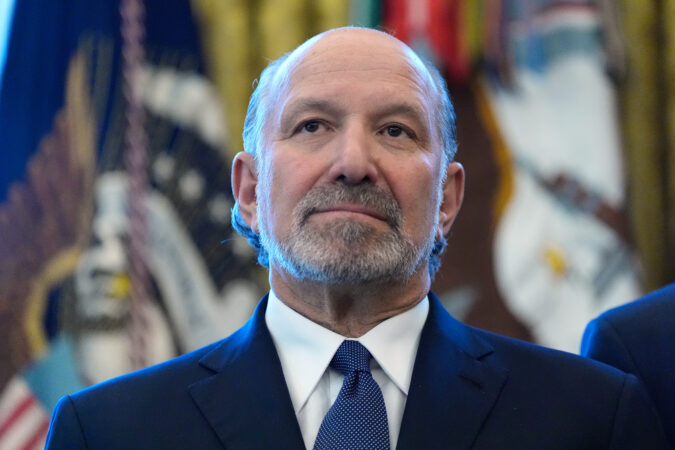
    WASHINGTON — Under questioning from Democrats Tuesday, Commerce Secretary Howard Lutnick acknowledged that he had met with Jeffrey Epstein twice after his 2008 conviction for soliciting prostitution from a child, reversing Lutnick’s previous claim that he had cut ties with the late financier after 2005.

    Lutnick once again downplayed his relationship with the disgraced financier who was once his neighbor in New York City as he was questioned by Democrats during a subcommittee hearing of the Senate Appropriations Committee. He described their contact as a handful of emails and a pair of meetings that were years apart.

    “I did not have any relationship with him. I barely had anything to do with him,” Lutnick told lawmakers.

    But Lutnick is facing calls from several lawmakers for his resignation after the release of case files on Epstein contradicted Lutnick’s claims on a podcast last year that he had decided to “never be in the room” with Epstein again after a 2005 tour of Epstein’s home that disturbed Lutnick and his wife.

    The commerce secretary said Tuesday that he and his family actually had lunch with Epstein on his private island in 2012 and he had another hour-long engagement at Epstein’s home in 2011. Lutnick, a member of President Donald Trump’s Cabinet, is the highest-profile U.S. official to face bipartisan calls for his resignation amid revelations of his ties to Epstein. His acknowledgement comes as lawmakers are grasping for what accountability looks like amid the revelations contained in what’s known as the Epstein files.

    In countries like the United Kingdom, the Epstein files have triggered resignations and the stripping of royal privileges, but so far, U.S. officials have not met the same level of retribution.

    Senators want to dig into Lutnick’s ties to Epstein

    Sen. Chris Van Hollen, the Democrat who questioned Lutnick, told him, “There’s not an indication that you yourself engaged in any wrongdoing with Jeffrey Epstein. It’s the fact that you believe that you misled the country and the Congress based on your earlier statements.”

    Van Hollen, (D., Md.) stopped short of calling for Lutnick’s resignation on Monday, but requested documentation from Lutnick on any of his ties to Epstein.

    “It’s absolutely essential that he provide Congress with those documents, given the misrepresentations he’s made, and then we’ll go from there,” he said.

    Lutnick during the Senate hearing said he would give that request some thought, adding, “I have nothing to hide.”

    However, several Senate Republicans were also questioning Lutnick’s relationship with Epstein. Sen. Roger Wicker, (R., Miss.) said the visit to Epstein’s private island “would raise questions.” And Sen. Thom Tillis, (R., N.C.) told reporters, “It’s something I’m concerned with.”

    Tillis stayed away from calling for Lutnick to leave his post, but added that “he would do himself a service by just laying exactly what and what did not happen over the course of what seems to be an interesting relationship that included business entanglements.”

    House members call for resignation

    Meanwhile, House members who initiated the legislative effort to force the release of the files are calling for Lutnick to resign. Republican Rep. Thomas Massie of Kentucky called for that over the weekend after emails were released that alluded to the meetings between Lutnick and Epstein.

    Rep. Ro Khanna, a California Democrat, joined Massie in pressuring Lutnick out of office on Monday.

    “Based on the evidence, he should be out of the Cabinet,” Khanna said.

    He added, “It’s not about any particular person. In this country, we have to make a decision. Are we going to allow the rich and powerful people who are friends and (had) no problem doing business and showing up with a pedophile who is raping underage girls, are we just going to allow them to skate?”

  • Former Roman star Jalen Duren among four players ejected after fight at Pistons-Hornets game

    Former Roman star Jalen Duren among four players ejected after fight at Pistons-Hornets game

    CHARLOTTE, N.C. — Detroit Pistons center Jalen Duren, a former Roman Catholic star, was among four players ejected Monday night after a fight broke out in the team’s game with the Charlotte Hornets.

    Charlotte’s Moussa Diabate and Miles Bridges were tossed along with Detroit’s Isaiah Stewart and Duren. Hornets coach Charles Lee was ejected in the fourth quarter after he had to be restrained from going after an official while arguing a call.

    The Pistons won, 110-104. The loss ended the Hornets’ bid to match a franchise record with 10 straight wins.

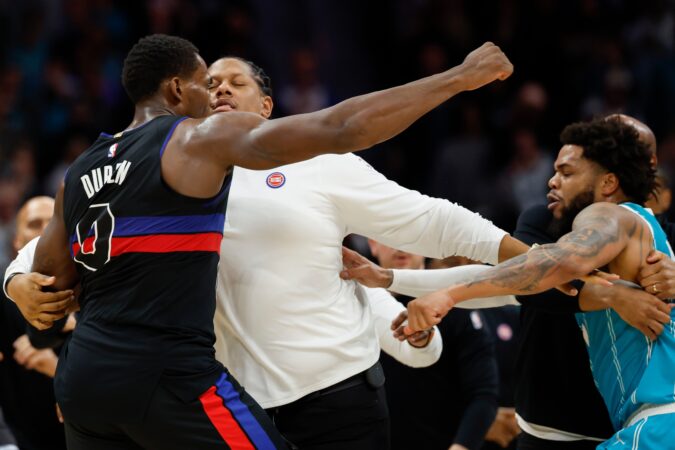
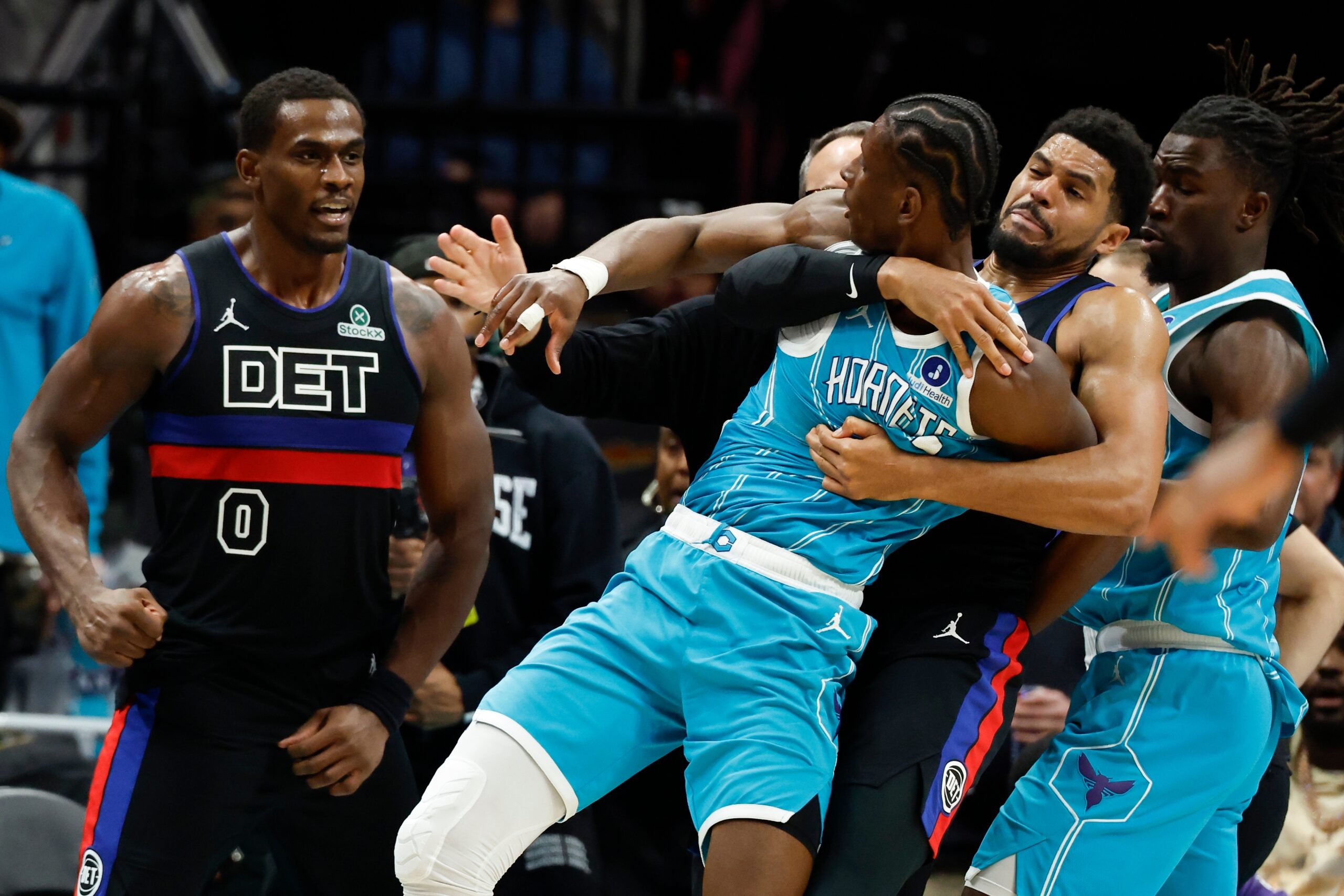
    Duren had the ball and was driving toward the basket with just over seven minutes left in the third period when he was fouled by Diabate. Duren turned around to get face-to-face with Diabate and the two appeared to butt heads. Duren then hit Diabate in the face with his open right hand, starting a confrontation that lasted more than 30 seconds and ultimately ended with a brief police presence on the floor.

    While Pistons forward Tobias Harris was holding Diabate back, Diabate threw a punch at Duren. Duren walked away and Bridges charged at him, throwing a left-handed punch. Duren retaliated with a punch. Diabate attempted to charge again at Duren and had to be held back.

    Charlotte Hornets forward Moussa Diabate is held back by Detroit’s Tobias Harris as he fights with Pistons center Jalen Duren (0).

    Stewart left the bench to confront Bridges, who responded with a punch, and the players tussled. At one point, Stewart got Bridges in a headlock and delivered multiple left-handed blows to his head.

    Duren called it an “overly competitive game.”

    “Emotions were flaring,” Duren said. “At the end of the day, we would love to keep it basketball, but things happen. Everybody was just playing hard.”

    Duren said that opposing NBA teams have been trying to “get in our head” all season.

    “This isn’t the first time that people have tried to be like extra aggressive with us and talk to us, whatever the case may be,” Duren said. “But as a group we have done an OK job of handling that energy and intensity. At the end of the day, emotions got high with everybody being competitive. Things happen.”

    Duren did not say how the fight started, referring reporters instead to the video replays.

    The Hornets did not make Bridges and Diabate available for interviews after the game.

    However, Bridges took to Instagram late Monday night to say: “Sorry Hornets nation! Sorry Hornets Organization.! Always gonna protect my teammates forever.”

    “It looked like two guys got into a heated conversation and it just kind of spiraled from there,” Lee said.

    Crew chief John Goble said in a pool report after the game that the players were ejected because they “engaged in fighting activity during the dead ball. After review, we assessed fighting fouls and by rule they were ejected from the game.”

    Pistons coach J.B. Bickerstaff defended his players after the game.

    “Our guys deal with a lot, but they’re not the ones that initiated, they’re not the ones who crossed the line tonight,” Bickerstaff said. “It was clear, through frustration, because of what J.D. [Duren] was doing, that they crossed the line. I hate that it got as ugly as it got.

    “That’s not something that you ever want to see,” Bickerstaff added, “but if a guy throws a punch at you, you have a responsibility to protect yourself. That’s what happened tonight. If you go back and watch the film, they’re the ones who initiated crossing the line and our guy had to defend himself.”

    Tensions continued to mount at the Spectrum Center after the fight.

    Midway through the fourth quarter, Lee was ejected and had to be restrained by Hornets guard Brandon Miller while yelling at officials for a no-call after Charlotte’s Grant Williams collided with Detroit’s Paul Reed.

    “Grant was walking down the paint and barely touched somebody and the guy fell over and that is what we are going to call a foul,” Lee said. “They have a hard job to make these calls, but I don’t think that was the consistency with which that had been called the rest of the game.”