Category: Wires

  • Major historical documents start journey across U.S. as part of nation’s 250th anniversary celebration

    Major historical documents start journey across U.S. as part of nation’s 250th anniversary celebration

    Some of the United States’ most important historical documents are embarking on a first-of-its kind journey as part of the country’s 250th anniversary commemoration.

    Typically housed in highly controlled vaults under the watch of preservation experts at the National Archives, documents such as the 1783 Treaty of Paris that formally ended the Revolutionary War and the 1774 Articles of Association that urged colonists to boycott British goods are rarely moved.

    But those documents, signed by George Washington, John Adams, Benjamin Franklin, and other American revolutionary leaders, will be making their way across the country and put on display for free at local museums.

    “It’s tangible history, and tangible history inspires,” said Jim Byron, senior adviser to the acting archivist of the United States. “These documents have not traveled, and they’ve certainly not traveled collectively, ever. They are here in vaults.”

    The Boeing 737 “Freedom Plane” transporting the documents is just one of many events and activities planned across the country to mark America’s forthcoming 250th anniversary celebrating the signing of the Declaration of Independence on July 4, 1776, in Philadelphia. A congressionally chartered commission, America 250, and a separate White House-led initiative, called Freedom 250, are both coordinating events, an overlap that has faced some criticism in Washington.

    Among the planned activities are a fleet of mobile museums driving across the country, a story collection initiative, and a Great American State Fair on the National Mall in Washington. President Donald Trump has even announced plans for a “Patriot Games” sporting event featuring high school athletes and a UFC mixed-martial arts fight at the White House.

    The “Freedom Plane” departed Ronald Reagan Washington National Airport on Monday en route to its first stop in Kansas City, Mo., where the documents are being transferred to the National WWI Museum and Memorial. The records include a rare original engraving of the Declaration of Independence printed in 1823 from a copperplate of the original; the Oaths of Allegiance, signed in 1778 by George Washington, Alexander Hamilton, and other officers of the Continental Army; and a rare draft copy of the U.S. Constitution that includes handwritten notes by the delegates.

    Other planned stops will be in Atlanta, Los Angeles, Houston, Denver, Miami, the Detroit suburb of Dearborn, and Seattle.

    “The reality that these documents are leaving D.C. and coming to the heartland is fantastic,” said Matt Naylor, president and CEO of the National World War I Museum and Memorial, where they will be on display for a little over two weeks starting Friday. “There’s a lot of excitement about that and a lot of talk in and around the city about what that means.”

    Naylor said the early response has been overwhelming. Local schools have already booked visits for more than 5,000 schoolchildren.

    “That’s indicating that there’s a lot of enthusiasm for this,” he said.

    The “Freedom Plane” tour was inspired in part by the “American Freedom Train” that toured 48 states in 1975 and 1976 as part of the country’s Bicentennial celebration. It carried various pieces of American history, including the original Louisiana Purchase documents, Judy Garland’s dress from The Wizard of Oz, and Jesse Owens’ gold medals from the 1936 Olympic Games.

  • Rep. Gonzales faces ethics investigation over allegations of affair with aide

    Rep. Gonzales faces ethics investigation over allegations of affair with aide

    The House Ethics Committee will investigate allegations that Rep. Tony Gonzales (R., Texas) had an affair with a former staff member who later died after setting herself on fire, the committee said Wednesday, ensuring that the scandal that has dogged Gonzales through his bitter primary race will continue to factor heavily as he heads into a runoff.

    An investigative subcommittee will look into allegations Gonzales “engaged in sexual misconduct towards an individual employed in his congressional office” and “discriminated unfairly by dispensing special favors or privileges,” Rep. Michael Guest (R., Miss.), chair of the Ethics Committee, wrote in a letter Wednesday.

    Under House rules, lawmakers are not permitted to engage in sexual relationships with staff.

    Gonzales, a married father of six, has been accused of having an improper relationship with a then-aide, Regina Ann Santos-Aviles, who died in September after lighting herself on fire in her backyard. Her death was ruled a suicide.

    Since then, the former aide’s estranged husband has shared text messages that showed Gonzales pressing Santos-Aviles for a “sexy pic” and asking her about her favorite sex position. Santos-Aviles pushed back against the lawmaker, writing, “This is going too far boss,” at one point in the May 2024 conversation.

    Gonzales recently declined to say whether the messages are authentic.

    Gonzales has denied any wrongdoing or improper relationship with Santos-Aviles, and he adamantly refused calls to resign from Congress or to end his reelection bid — several of which came from his Republican colleagues.

    Representatives for Gonzales’ office did not immediately respond to requests for comment Wednesday.

    House Speaker Mike Johnson (R., La.), who is holding onto a razor-thin majority in the House, has called the accusations against Gonzales “very serious” but not called on Gonzales to step aside, saying the issue would “play out” in his reelection bid.

    Gonzales on Tuesday fell short of the majority vote required to avoid a runoff. Now he will face off against the other top finisher in the GOP primary, Brandon Herrera, a YouTuber with a gun business who calls himself “the AK Guy.” Herrera maintained a narrow lead Wednesday morning with most of the votes counted.

    The Office of Congressional Conduct, a nonpartisan office governed by a board of private citizens, had begun looking into allegations against Gonzales in November, according to the San Antonio Express-News, and it was required to refer the matter to the House Ethics Committee by Wednesday for either further review or dismissal.

    Under House rules, the Ethics Committee has up to 90 days to release the OCC’s report — unless it creates an investigative subcommittee, as it has this time, in which case it still must release the OCC’s findings within a year. Members of the investigative subcommittee have not been selected yet, Guest said Wednesday, suggesting findings of the investigation will not be made public very soon. There is no timeline for Ethics Committee investigations, which can take months.

    Rep. Nancy Mace (R., S.C.), one of the GOP lawmakers who has called on Gonzales to resign, introduced a resolution last week that would compel the Ethics Committee to release, within 60 days of adoption, all reports related to sexual harassment violations involving lawmakers, their staff members, or lobbyists.

    “I mean, literally, [Santos-Aviles] killed herself in the most heinous way,” Mace told Fox News on Tuesday, referring to the Gonzales allegations that she said had motivated her to introduce the bill. “She literally lit herself on fire and died, and we’re just going to sit here and say, ‘Let the process play out’? No.”

    Voters do not always punish scandals, and this was apparent Tuesday night in other Texas primary races. Rep. Henry Cuellar (D., Texas) handily defeated a primary challenger, despite being charged in 2024 with bribery, money laundering, and conspiracy and being pardoned by President Donald Trump last year.

    Texas State Attorney General Ken Paxton, who faced a lengthy impeachment trial and a very public divorce in which his wife accused him of adultery, nevertheless will head into a runoff against Sen. John Cornyn (R., Texas) for his seat after neither captured a majority of the vote Tuesday.

  • Top defense officials push back on concerns about U.S. munitions shortage

    Top defense officials push back on concerns about U.S. munitions shortage

    The Pentagon is rapidly burning through its stocks of precision weapons less than a week into the massive campaign of airstrikes against Iran, while also expending sophisticated air defense missiles at a rate that puts the U.S. military potentially “days away” from having to prioritize which targets to intercept, according to three people familiar with the matter.

    The scope of “Operation Epic Fury,” which U.S. Central Command’s Adm. Brad Cooper says has hit more than 2,000 targets so far, is forcing U.S. military commanders to make difficult calculations about how quickly their Iranian adversaries will burn through their own munitions — even as President Donald Trump says the war may last four to five weeks.

    Top Pentagon leaders dedicated considerable time at a news briefing Wednesday morning to addressing worries the military is reaching too deeply into its inventory at the cost of readiness. “We have sufficient precision munitions for the task at hand, both on the offense and defense,” said Gen. Dan Caine, chairman of the Joint Chiefs of Staff, without offering specifics or numbers.

    The United States will rely on its larger stores of less-sophisticated weapons as Iranian defenses are degraded in the coming days, allowing American forces to get closer for their attacks, he said.

    “The hardest hits are yet to come from the U.S. military,” Secretary of State Marco Rubio told reporters Monday before a classified briefing with select lawmakers.

    In retaliation, Iran has launched thousands of one-way attack drones and hundreds of missiles at an array of U.S. military installations and civilian targets across the region, including in Bahrain, Kuwait, Iraq, Israel, and the United Arab Emirates. At least six U.S. troops were killed in a drone attack in Kuwait, and U.S. Embassies in Riyadh, Saudi Arabia, and Kuwait City have come under Iranian fire.

    So far, the U.S. military has expended hundreds of its most sophisticated munitions, including Patriot and Terminal High Altitude Area Defense (THAAD) interceptors — considered the world’s premier missile defense systems — and Tomahawk cruise missiles aimed at Iranian leaders and ballistic missile sites, four people familiar with Pentagon assessments said, speaking on the condition of anonymity to discuss the highly sensitive numbers.

    Late Monday night, Trump posted on social media that the U.S. inventories of “medium and upper medium grade” munitions are “virtually unlimited” and could sustain the pace of attacks in Iran indefinitely. He also wrote that weapons at “the highest end” are in “good supply, but are not where we want to be.”

    A spokesperson with U.S. Central Command, which oversees operations in the Middle East, referred questions to the Pentagon.

    A Pentagon spokesperson, Sean Parnell, said in a statement Tuesday that the military “has everything it needs to execute any mission at any time and place of the President’s choosing and on any timeline.” Trump and Defense Secretary Pete Hegseth, Parnell added, “have made restoring American military dominance their top priority from day one, and American dominance has been proved again and again following every major military operation under this administration.”

    Behnam Ben Taleblu, who tracks Tehran’s weapons programs at the Foundation for Defense of Democracies, a think tank, said Iran had more than 2,000 ballistic missiles before the conflict began and “many more-fold” drones.

    “It is very apparent it has learned lessons from the 12-day war” in June and is trying to use its weaponry more efficiently, Taleblu said.

    Iran, he said, is targeting the United States’ Persian Gulf allies with low-cost drones to terrorize and exhaust limited air defenses, while focusing its ballistic missile attacks on Israel.

    “Iran is firing smaller volleys of missiles, signaling an interest in preserving their stocks while still testing and attriting Israel’s air and missile defenses,” Taleblu said. “The goal over time is to make Israel focus its dwindling interceptor stocks on defending smaller patches of terrain.”

    “Iran is conscious of missile math, perhaps more so than ever before,” he said.

    For the U.S., the trends underscore the urgency of an “effective defanging operation” that aggressively destroys Iran’s missile caches and infrastructure, he added.

    The rate at which the U.S. military is expending its most sophisticated munitions has slowed since the first day of the conflict, in which Iran fired many of its highest-end weapons, a U.S. official said, noting that the pace has not fallen “dramatically.”

    In the days since, the U.S. and Israel have established air superiority, allowing fighter jets to soon fly closer to targets and use less expensive munitions such as precision-guided glide bombs, the official said, speaking on the condition of anonymity to describe ongoing operations.

    Hegseth said Wednesday that the Pentagon would increasingly rely on massive GPS-guided gravity bombs, “of which we have a nearly unlimited stockpile,” and that the military would “no longer need” to dip into its inventory of more sophisticated weapons.

    “Iran cannot outlast us,” Hegseth said.

    U.S. munitions stocks have been depleted by years of trade-offs in the defense budget, aid to countries such as Ukraine, and more recently the Trump administration’s vast use of the military to carry out its foreign policy. After little more than a year in office, Trump has launched attacks in seven countries — Iraq, Iran, Nigeria, Somalia, Syria, Venezuela, and Yemen — and fired dozens of missiles in more than 40 strikes on alleged drug traffickers at sea around Latin America.

    “When you combine the amount of munitions that we have spent over the last year attacking the Houthis, the amount of munitions that are spent on … the seven different military conflicts the president has put America into, our munitions are low,” Sen. Mark Warner of Virginia, the ranking Democrat on the Senate Intelligence Committee, said after attending the briefing with Rubio and other top Trump officials Monday.

    The Washington Post previously reported that Caine warned Trump ahead of the operation that an extended campaign posed acute risks for the U.S. military, including a drain on its limited stores of precision weapons, according to multiple people familiar with the discussions.

    Following classified briefings before each chamber of Congress on Tuesday, Sen. Andy Kim (D., N.J.) said he asked Caine about the number of munitions the U.S. has depleted compared with Iran. The general, Kim said, did not provide specifics but was not “raising alarms himself” while speaking with lawmakers.

    Still, the scarcity could intensify a long-term problem for America’s ability to deter a conflict with China, particularly around the self-governing island of Taiwan, where Beijing has hosted increasingly complex and aggressive military drills in recent years.

    Two of the people familiar with the U.S. inventories said that an extended conflict in the Middle East could require drawing down munitions stocks in the Indo-Pacific region. A separate U.S. official, speaking on the condition of anonymity to describe the sensitive state of munitions, said that inventories were so thin that a lengthy campaign against Iran would not leave enough munitions for other threats, especially China.

    The first U.S. official said that senior U.S. military leaders around the world are making decisions now about where to reallocate munitions, based on assessments of how far they can dip into stockpiles.

    Warner and House Speaker Mike Johnson (R., La.) said that the operation will almost certainly require Congress to pass supplemental money for the Defense Department to replace stocks spent during the attack, though the specific dollar figure would depend on the length of the ongoing campaign in Iran.

    Sen. Chris Coons of Delaware, the top Democrat on the Senate Appropriations defense subcommittee, has asked the administration to provide the cost of munitions expended in the war, and said he expects the supplemental funding request to be “in the billions” of dollars.

  • Bettors wagered $54 million on Khamenei’s death. Now they’re not getting paid.

    Bettors wagered $54 million on Khamenei’s death. Now they’re not getting paid.

    When he learned last weekend about the killing of Iran’s Ayatollah Ali Khamenei, the Israeli American business executive in New York was excited to cash in.

    On the prediction-market site Kalshi, the executive — who spoke on the condition of anonymity due to concern over what his friends would think — had placed two bets, totaling $3,460, that Khamenei would be “out as Supreme Leader” by March or April 1. His Kalshi app placed green check marks next to his bets, indicating he had won payouts worth more than $63,000.

    Minutes later, however, Kalshi froze the $54 million trade for everyone who bet on that scenario, saying the site does not allow transactions “directly tied to death.” The change triggered an online uproar, as Kalshi users flooded social media to argue the site had unfairly robbed them of winning bets.

    “I was booking my trip to Courchevel,” the French Alps ski resort, he said jokingly to the Washington Post. “Then they changed the rules … and everybody got screwed.”

    The outrage has intensified scrutiny into the explosive rise of prediction markets, which run like traditional sportsbooks but allow people to gamble on elections, international affairs, and real-world events.

    Supporters of Kalshi and its biggest competitor, Polymarket, have defended the sites as game-like platforms for following and perhaps profiting off the news. But critics like Sen. Chris Murphy (D., Conn.) have said they are creating a more “dystopian world” by helping people gamble on life-and-death crises and military assaults in a way that could incentivize political violence.

    “This is American commercial immorality on steroids,” Murphy said in an interview. “Once events that involve good and evil simply become a financial product, I don’t know how right and wrong matters any longer. … People shouldn’t be rooting for people to die because they placed a bet.”

    Kalshi heavily promoted the trade to bettors on its home page and app and in push notifications before Khamenei’s death was publicized. Kalshi also tweeted the morning of the strike that the odds “Khamenei is out as Supreme Leader have surged to 68%,” along with a disclaimer that Kalshi did not broker trades that “settle on death.” In a follow-up, the company said the post was “grammatically ambiguous” and offered to reimburse traders’ lost value.

    Murphy said in an interview he is drafting legislation that would broadly ban prediction-market trades related to government actions, saying they could corrupt public decision-making by allowing military or government officials to profit off secret information.

    Polymarket said in August that the president’s eldest son, Donald Trump Jr., had joined its advisory board, and a handful of recent bets on the administration’s moves have sparked public accusations of insider trading.

    The analytics firm Bubblemaps said it found six “suspected insiders” on Polymarket that had made $1.2 million by betting that the U.S. would hit Iran by Feb. 28, the date that Operation Epic Fury began. All of the accounts were made last month and bet exclusively on Iran-strike timing; some of the bets were made within hours of the first explosions in Tehran. One account bet $60,000 and won $560,000.

    Murphy said in an online post that the trades indicated “people around Trump are profiting off war and death.” Davis Ingle, a White House spokesperson, said on Monday that “the only special interest guiding the Trump administration’s decision-making is the best interest of the American people.”

    Polymarket did not respond to questions about whether it knew or would help investigate whether the account holders had internal knowledge of the military campaign. Donald Trump Jr. did not respond to requests for comment.

    A similar debate played out in January when an anonymous Polymarket trader won roughly $400,000 after successfully predicting, within a few hours, the timing of Venezuelan President Nicolás Maduro’s capture. The Defense Department said then that it prohibited personnel from using classified information for personal gain.

    In the case of Khamenei, Kalshi has argued that the trade, known as an “event contract,” was not specifically a bet on his demise. The company’s chief executive, Tarek Mansour, said on X that long-standing rules ban people “from profiting from death” but that he believed the trade was still “important because leadership changes in Iran have major impact on the world order,” including on oil prices and geopolitical relations.

    “It’s always possible for a ruler to step down or transition power without death, even in autocracies. It just happened in Venezuela,” Mansour said.

    Furious Kalshi bettors have since flooded social media to argue that the site’s rules were muddled and that they believed they would be paid out upon his death. In one video, the cryptocurrency-content creator Gabriel Haines mocked Kalshi by saying, “We meant a peaceful transition or riding off on a unicorn to kiss [Israeli Prime Minister Benjamin] Netanyahu on a cheek.”

    Some users have vowed to close their Kalshi accounts and take their money elsewhere, with one posting, “You owe me $2,500+ & you owe many innocent, casual traders millions more.”

    Amanda Fischer, a former chief of staff at the Securities and Exchange Commission who now works as a policy director at the financial advocacy group Better Markets, said the trade offered a “really good mini-model of just how problematic this business is.”

    “How is an 86-year-old theocratic leader supposed to lose his power other than through death?” Fischer said. “All of the Kalshi users who placed bets on this believed they were voting on a death market, and many are very angry at how Kalshi broke the trades.”

    Lawmakers have worried that allowing death-related trades could offer fatal incentives; an assassin, for instance, could plan and then profit off the date of a victim’s death. “There’s a reason we don’t let people take fire insurance policies out on [other people’s homes] — because it would incent arson,” Fischer said.

    The Commodity Futures Trading Commission, which regulates prediction markets, bans any bets that involve or reference terrorism, assassination, or war, and six Democratic senators sent a letter last month voicing concern about any bet that “resolves upon or closely correlates to an individual’s death.”

    Dustin Gouker, a gaming-industry consultant and the publisher of Event Horizon, a newsletter about prediction markets, said Kalshi could have a financial incentive to keep the rules vague. It could have specified that the bet would pay out only in the case of a peaceful regime change, but that might have reduced bettors’ interest — and the ensuing fees Kalshi earns from every transaction.

    “They could have easily made the title ‘by way other than death,’ but that’s obviously not as exciting to trade, and that’s why they didn’t do it,” Gouker said.

    Kalshi has sought to quiet the firestorm by reimbursing any bets, fees, or losses from the trade, which Mansour said led the company to incur “a substantial loss to make users whole.” A person familiar with Kalshi discussions, who spoke on the condition of anonymity to detail internal deliberations, said the payments have cost the company roughly $2.2 million.

    Mansour said that the company did not change the trade rules after the incident but that a disclaimer on the listing noting the company’s “death carveout” exception has been overly confusing and will be revised for future bets. Some bettors have pointed out that, after former President Jimmy Carter died, the company paid users who had bet that Carter would not attend President Donald Trump’s inauguration.

    For some in the industry, the episode has triggered a moment of self-reflection. Aaron Courtney, the cofounder of market-tracking firm Kalshinomics, said in an online essay that war-related trades are “simultaneously one of the most important and most uncomfortable things prediction markets have produced” and have raised big questions. “Is it morally acceptable to profit from correctly predicting that bombs will fall on people?” he asked.

    Polymarket, however, has trumpeted its war-related bets, saying in a note that prediction markets’ ability to create forecasts for world affairs is “particularly invaluable in gut-wrenching times like today” and can give people “the answers they needed in ways TV news and X could not.”

    While Kalshi is regulated in the United States, Polymarket operates under different trade rules overseas, and its users have bet more than $500 million on trades related to the timing of American strikes against Iran, according to platform data. Unlike Kalshi, Polymarket has not frozen trades for bettors wagering that Khamenei would be “out as Supreme Leader” by the end of this month; its trading volume now stands at more than $61 million.

    On the first morning of the assault, Polymarket posted a meme image of a man with five screens laying out bets about Khamenei’s ouster and the caption, “Can’t right now babe, I’m monitoring the situation.”

    But Polymarket now faces its own questions around potential insider trading. Murphy said in an interview on Monday that he was horrified by the “corrupt and immoral” trades, adding, “It doesn’t smell right to people that these markets are rigged and people inside know the answers … making thousands off whether we send their kids to war.”

    Emily Austin, a conservative influencer and sports podcaster who has promoted Polymarket online, said she had friends and siblings who were upset about lost winnings on Kalshi’s Khamenei bet. Despite the scandal, however, she said her love of prediction-market betting remains as strong as ever. She said she sees the bets as a “social community” and a way to keep in touch with friends.

    “I’ve been a huge sports bettor since I was allowed to legally bet, but I never thought you’d be able to bet on world leaders being out,” she said. “And if I’m being totally honest, I find it so fun.”


  • U.S. soldiers who died in the Iran war remembered for their service and devotion to their families

    U.S. soldiers who died in the Iran war remembered for their service and devotion to their families

    WEST DES MOINES, Iowa — Sgt. Declan Coady had been checking in with his family from Kuwait every hour or two after the U.S. and Israel launched their military campaign against Iran, even as Tehran launched retaliatory strikes against Israel and Persian Gulf Arab states that host U.S. armed forces.

    When he didn’t respond to messages Sunday, “most of us started to wonder,” Coady’s father, Andrew, told the Associated Press. “Your gut starts to get a feeling.”

    A drone strike at a command center in Kuwait killed Coady, 20, of West Des Moines, Iowa, and five other members of the U.S. Army Reserve who worked in logistics and kept troops supplied with food and equipment.

    The other soldiers identified Tuesday by the Pentagon were: Sgt. 1st Class Nicole Amor, 39, of White Bear Lake, Minn.; Capt. Cody Khork, 35, of Winter Haven, Fla.; and Sgt. 1st Class Noah Tietjens, 42, of Bellevue, Neb. U.S. Army base Fort Knox wrote on Facebook that the names of the other two will be released once next-of-kin notifications are complete.

    The soldiers were assigned to an Army Reserve unit headquartered in Des Moines, Iowa, which is temporarily operating under the 1st Theater Sustainment Command at Fort Knox in Kentucky.

    “Sadly, there will likely be more, before it ends. That’s the way it is,” President Donald Trump said of the deaths. Trump will attend the dignified transfers of the soldiers when they arrive in the U.S., the White House said Wednesday. The ritual honors service members killed in action.

    Defense Secretary Pete Hegseth said the military “ensured that the maximum possible defense and maximum possible force protection was set up before we went on offense.”

    “The terms of this war will be set by us at every step,” Hegseth said Wednesday.

    Nicole Amor and Joey Amor in an undated photo.

    A mother of two who loved gardening

    Amor, 39, was an avid gardener who enjoyed making salsa from the peppers and tomatoes in her garden with her son, a senior in high school. She also enjoyed roller-blading and bicycling with her fourth-grade daughter.

    A week before the drone attack, Amor was moved off-base to a shipping container-style building that had no defenses, Joey Amor said.

    “They were dispersing because they were in fear that the base they were on was going to get attacked and they felt it was safer in smaller groups in separate places,” he said.

    He last spoke to her about two hours before she was killed. He said she was working long shifts and they had been messaging about her tripping and falling the night before.

    “She just never responded in the morning,” he said.

    Childhood friend Natalie Caruso wrote on Facebook that she was “absolutely heartbroken” about Amor’s death.

    “Nicole was always up for an adventure and she had such a contagious laugh!” Caruso wrote Wednesday. ”Growing up next door to you was some of my fondest childhood memories!”

    ‘He loved being a soldier’

    Coady had just told his father last week that he had been recommended for a promotion from specialist to sergeant, a rank he received posthumously.

    He was among the youngest people in his class, trained to troubleshoot military computer systems, but he impressed his instructors, Andrew Coady said Tuesday.

    “He trained hard, he worked hard, his physical fitness was important to him. He loved being a soldier,” Coady said. “He was also one of the most kindest people you would ever meet, and he would do anything and everything for anyone.”

    Coady trained as an information technology specialist with the Army Reserves and was studying cybersecurity at Drake University in Des Moines. He was taking online classes while in Kuwait and wanted to become an officer.

    “I still don’t fully think it’s real,” his sister Keira Coady said. “I just remember all of our conversations about what he was going to do when he came back.”

    A calling to serve his country

    Khork was very patriotic and drawn from a young age to serving the U.S., his family said in a statement Tuesday.

    He enlisted in the Army Reserve and joined Florida Southern College’s ROTC program.

    “That commitment helped shape the course of his life and reflected the deep sense of duty that was always at the core of who he was,” said his mother, Donna Burhans, father, James Khork, and stepmother, Stacey Khork, in a statement.

    Khork also loved history and had a degree in political science.

    His family described him as “the life of the party, known for his infectious spirit, generous heart, and deep care for those who served alongside him and for everyone blessed to know him.”

    Abbas Jaffer posted Monday on Facebook about his friend of 16 years.

    “My best friend, best man, and brother gave his life defending our country overseas,” Jaffer said.

    A loving father and husband

    Tietjens lived with his family in the Washington Terrace mobile home park in the Omaha suburb of Bellevue, Neb. He was married with a son, according to a Facebook page.

    Tietjens earned a black belt in Philippine Combatives and Taekwondo and was “an instructor who gave his time, discipline, and leadership to others,” the Philippine Martial Arts Alliance said in a Facebook post.

    On the mat and as a soldier, “he carried the same values: honor, discipline, service, and commitment to others,” the organization said.

    Army Staff Sgt. Jeff Coleman said Tietjens was his mentor.

    “You could call him day or night,” Coleman told KETV. “He always took the time, you know, he made you feel important. And that’s hard to find sometimes in the military.”

    Nebraska Gov. Jim Pillen on Wednesday ordered U.S. and state flags flown at half-staff until the evening of Tietjens’ burial. State lawmakers held a moment of silence Wednesday to honor the fallen soldier.

    “Noah stepped up to serve and defend the American people from foreign enemies around the world — a sacrifice we must never forget,” Pillen wrote in a tribute Tuesday.

    “We are holding the Tietjens family close in our hearts during this unbelievably difficult time and will keep them in our prayers,” he said.

    Tietjens’ cousin Kaylyn Golike asked for prayers, especially for Tietjens’ 12-year-old son, wife, and parents, as they navigate “unimaginable loss.”

    “We lost a brave soldier this weekend and many hearts are broken,” Golike wrote on Facebook Tuesday.

  • Sixers blown off the court by the Spurs in a 131-91 home loss

    Sixers blown off the court by the Spurs in a 131-91 home loss

    Dylan Harper scored 22 points and Victor Wembanyama needed only 10 to help the San Antonio Spurs bounce back from their first loss in 12 games and rout the 76ers 131-91 on Tuesday night.

    The Spurs hit 18 three-pointers and wrapped their annual rodeo road trip with a 5-1 record. They had won 11 straight games overall before they lost Sunday to the New York Knicks.

    There were no worries in Philly about a losing streak. San Antonio never trailed and led by 49 points at the end of the third quarter.

    Devin Vassell hit six three-pointers and scored 22 points for the Spurs.

    Tyrese Maxey scored 21 points for the Sixers. They scored only 11 points total in the third quarter.

    The Sixers played again without Joel Embiid as he sat out the second of a scheduled three straight games with a strained right oblique. The 76ers were also without the suspended Paul George and Kelly Oubre Jr. (illness), which left them undermanned and greatly overwhelmed from tip against the superior Spurs.

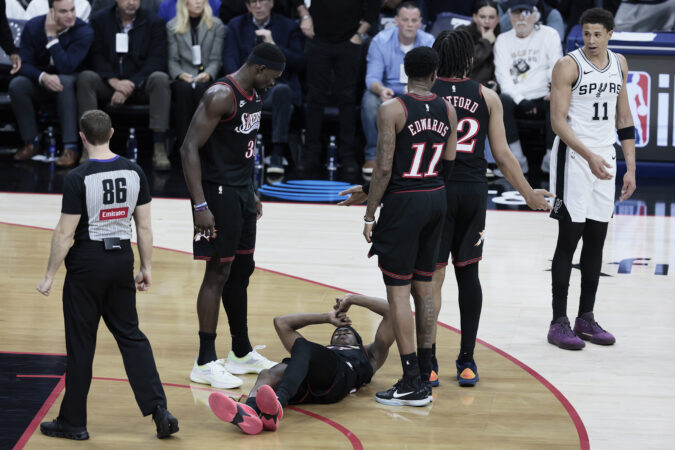
    The Sixers lost VJ Edgecombe after he had a hard landing on his back on a three-point attempt in the first half.

    The Spurs put on a show in front of Bob Costas, Doug Collins and more familiar broadcasters as part of a throwback night for NBC’s NBA coverage.

    Sixers’ Adem Bona (right) and Spurs’ Luke Kornet battle for the ball in the first half of Tuesday’s game.

    The Sixers would like to throw this one back.

    Carter Bryant buried a three for to push San Antonio’s lead to 60-36 in the first half and the Sixers were booed off the court headed into a timeout. Harper scored 14 points in the half to take a 78-53 lead — all done without forward Harrison Barnes, who had his 364 consecutive games played streak end when he woke up from a nap with a sore ankle.

    The Sixers host the Utah Jazz on Wednesday (7:30 p.m., NBCSP) for the second night of a back-to-back.

  • High-tech snowplows and AI help cities clean up from big storms

    High-tech snowplows and AI help cities clean up from big storms

    Residents of Syracuse, N.Y. — America’s snowiest city — once barraged a service hotline with street neglect complaints during blizzards, even if plows had passed two hours earlier but the work was hidden by fresh snow.

    Now public trust seems to be rising as Syracuse and other cities across the U.S. integrate upgrades such as video monitoring, GPS mapping and artificial intelligence into snow operations that once relied almost entirely on manual planning.

    Syracuse was one of the first to revamp the way it deploys its snowplows, and complaint calls have dropped by 30% under the new system, said Conor Muldoon, the city’s chief innovation officer.

    “People will look out their window and say, ‘Hey, you guys are doing a terrible job,’” Muldoon said. “And we can point to a public map and say, ‘Here’s all the breadcrumbs for when that plow was there.’”

    Snowier than usual in the U.S. snow capital

    Each winter, Syracuse averages 126 inches (3.2 meters) of snow, more than any other U.S. city of at least 100,000 people. Even before the blizzard that pounded the Northeast last week, the city had already surpassed its typical average due to a record 2-foot (60-centimeter) accumulation on one day in late December.

    With a goal of clearing every street within 24 hours after a storm, Syracuse partnered in 2021 with San Francisco-based Samsara to put live GPS tracking and dashcams on city fleet vehicles including snowplows. Integrated with GIS mapping software, the system allows officials to monitor live video and plow locations in real time.

    While residents can’t access live feeds, they can view a public map that updates every 5 minutes to show which roads have been cleared.

    Samsara started incorporating AI into its products in 2019. This winter, for the first time, it has provided customers with footage from other cameras within its large network, helping officials better understand conditions on a street even when no worker is there.

    Kiren Sekar, the company’s chief product officer, cited an example of needing to dispatch the closest plow for a snow emergency in Plainwell, Michigan.

    “Rather than having to sift through a list of vehicles, it can actually figure this out: ‘We’ve got Trevor in vehicle 203, 15 minutes away,’” Sekar said.

    New York City’s approach

    Samsara partners with communities of various sizes to upgrade their snowplow systems, but the nation’s largest city — New York City — developed its own.

    Its tracking program known as BladeRunner monitors snow removal equipment (including garbage trucks with plows attached) while a human in a command center — not AI — analyzes the GPS data. The city is exploring AI in the future to process the thousands of 311 calls and online service requests it can get in a single day.

    The other way the big city’s approach differs from its upstate neighbor of Syracuse is that each plow runs a specific route during storms, ensuring main and side streets get essentially the same treatment.

    “So what it does is allow equity,” said Joshua Goodman, deputy commissioner at the city’s Department of Sanitation.

    Typically 99% of the city’s roads will be plowed within the first four hours after a moderate snowfall under ideal conditions, but Goodman said it didn’t quite meet that mark during last week’s historic storm.

    Cutting costs and insurance claims

    With U.S. cities and states spending upward of $4 billion each year on snow operations, the new technology also helps assure roads aren’t overplowed or oversalted, which can cause environmental damage.

    Fayetteville, Ark., launched a public-facing snow removal map for the first time this winter. It reported improvements in plowing time, labor costs and fuel savings, despite enduring about double the snow from a year ago.

    “This is the first year some roads have ever been treated or plowed, and that goes right back to being able to see where we need to go and if we’ve been there,” said Ross Jackson Jr., the city’s fleet operations manager.

    The township of Edison, N.J., reduced its spending on salt and brine by 35% and its insurance payouts by 60%, thanks to video that helped prove plow drivers usually weren’t at fault when the vehicles collided with another motorist’s car.

    Video installed on snowplows in Iowa helped demonstrate that all but one of 12 snowplow accidents in a single day were the other driver’s fault, said Craig Bargfrede, the state’s winter operations administrator.

    “How can you not see this big orange truck with flashing lights ahead of you?” he said. “Boom, they just drive right into us.”

    Kalamazoo County was the first county in Michigan to employ turn-by-turn navigation to dispatch snowplows during a storm. Rusty McClain, assistant general superintendent of its road commission, called it a huge improvement in efficiency.

    “The old-school way of doing it, that bird’s-eye view of where everyone needs to go to plow, was just in a large book with paper maps,” McClain said. “You’d have to pull over, find the page you’re looking for, call somebody on the phone and ask if they have plowed that area.”

  • Commerce Secretary Lutnick to appear before House panel investigating Epstein

    Commerce Secretary Lutnick to appear before House panel investigating Epstein

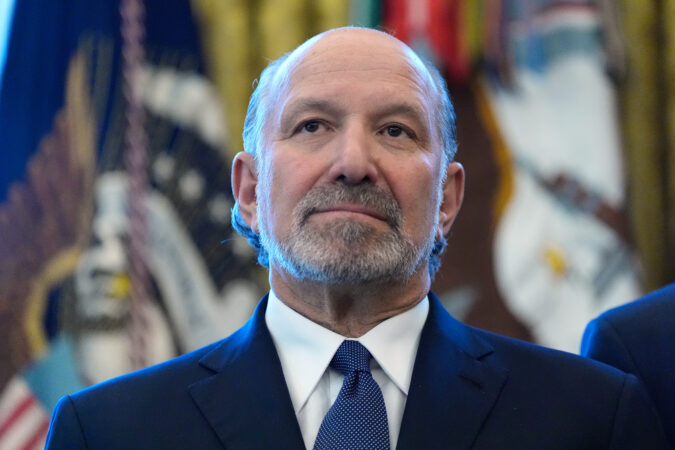
    Commerce Secretary Howard Lutnick, a former Manhattan neighbor of Jeffrey Epstein, has agreed to voluntarily testify before the House Oversight Committee as part of its investigation into the convicted sex offender, the panel’s chairman announced Tuesday.

    Lutnick has faced growing bipartisan pressure to testify about his ties to Epstein following the Justice Department’s release of a tranche of documents that suggested Lutnick maintained contact with Epstein years after claiming to have distanced himself from him.

    “Secretary Lutnick has proactively agreed to appear voluntarily before the House Committee on Oversight and Government Reform,” Rep. James Comer (R., Ky.), the committee’s chairman, said in a statement. “I commend his demonstrated commitment to transparency and appreciate his willingness to engage with the Committee. I look forward to his testimony.”

    Lutnick’s connection to Epstein also has caused controversy at Haverford College, where president Wendy Raymond is considering convening a committee that would review whether the mega donor’s name should remain on the campus library.

    Lutnick will soon become the latest participant in a series of high-profile interviews conducted by the committee for its Epstein probe — the most recent of which included former President Bill Clinton and former Secretary of State Hillary Clinton. They took part in a pair of contentious, closed-door depositions in New York last week.

    The Department of Commerce did not immediately respond to a request for comment about Lutnick’s interview.

    “I look forward to appearing before the committee. I have done nothing wrong and I want to set the record straight,” Lutnick said in a statement to Axios, which first reported his planned appearance.

    Testifying before Congress last month, the commerce secretary said he recalled meeting with Epstein three times over the course of 14 years. Lutnick also said he and his family had lunch with Epstein on his Caribbean island in 2012 — after previously claiming that he and his wife had distanced themselves from Epstein around 2005.

    The exchanges made public by the Justice Department show that Lutnick, a former chairman of the financial services firm Cantor Fitzgerald, and Epstein kept communicating years after Epstein pleaded guilty to two charges of soliciting prostitution, including one involving a minor, and was sentenced to 13 months in jail.

    Their last known exchange in the Justice Department documents came in 2018, when Lutnick reached out to Epstein about the Frick Collection, a museum near their neighboring homes, planning construction.

    “Are you aware as to them building to block our park views,” Lutnick wrote in an email that his assistant forwarded to Epstein, “What should we do about it? Time is of the essence.” Lutnick also urged Epstein to involve a lawyer, to which Epstein replied, “Will do.”

    The following year, Epstein was arrested on federal sex trafficking charges and later died in federal custody. His death was ruled a suicide.

    Some lawmakers, including Rep. Robert Garcia of California — the top Democrat on the House Oversight Committee — as well as Rep. Thomas Massie (R., Ky.), have called for Lutnick to step down over his connection to Epstein. But President Donald Trump last week signaled he remained confident in Lutnick.

    “Howard would go in and do whatever he has to say,” Trump told reporters on Friday about possible Epstein testimony. “He’s a very innocent guy. He’s doing a good job.”

    The Oversight Committee has already scheduled depositions for Darren Indyke and Richard Kahn, the co-executors of Epstein’s estate, this month. And Rep. Anna Paulina Luna (R., Fla.) has said she plans to ask the committee to bring in “some of the [Epstein] co-conspirators that were given lesser sentences that were known to have trafficked young girls.”

    Garcia told the Washington Post that if Democrats retake the House in November and become the majority next year, they will “absolutely” pursue an interview with Trump regarding Epstein. “There’s a long list of subpoenas that we will be engaged in,” Garcia added.

  • Pentagon dispute bolsters Anthropic reputation but raises questions about AI readiness in military

    Pentagon dispute bolsters Anthropic reputation but raises questions about AI readiness in military

    Anthropic’s moral stand on U.S. military use of artificial intelligence is reshaping the competition between leading AI companies but also exposing a growing awareness that maybe chatbots just aren’t capable enough for acts of war.

    Anthropic’s chatbot Claude, for the first time, outpaced rival ChatGPT in phone app downloads in the United States this week, a signal of growing interest from consumers siding with Anthropic in its standoff with the Pentagon, according to market research firm Sensor Tower.

    The Trump administration on Friday ordered government agencies to stop using Claude and designated it a supply chain risk after Anthropic CEO Dario Amodei refused to bend his company’s ethical safeguards preventing the technology from being applied to autonomous weapons and domestic mass surveillance. Anthropic has said it will challenge the Pentagon in court once it receives formal notice of the penalties.

    And while many military and human rights experts have applauded Amodei for standing up for ethical principles, some are also frustrated by years of AI industry marketing that persuaded the government to apply the technology to high-stakes tasks.

    “He caused this mess,” said Missy Cummings, a former Navy fighter pilot who now directs the robotics and automation center at George Mason University. “They were the No. 1 company to push ridiculous hype over the capabilities of these technologies. And now, all of a sudden, they want to be for real. They want to tell people, ‘Oh, wait a minute. We really shouldn’t be using these technologies in weapons.’”

    Anthropic didn’t immediately respond to a request for comment. The Defense Department declined to comment on whether it is still using Claude, including in the Iran war, citing operational security.

    Cummings published a paper at a top AI conference in December arguing that government agencies should prohibit the use of generative AI “to control, direct, guide or govern any weapon.” Not because AI is so smart that it could go rogue, but because the large language models behind chatbots like Claude make too many mistakes — called hallucinations or confabulations — and are “inherently unreliable and not appropriate in environments that could result in the loss of life.”

    “You’re going to kill noncombatants,” Cummings said in an interview Tuesday with the Associated Press. “You’re going to kill your own troops. I’m not clear whether the military truly understands the limitations.”

    Amodei sought to emphasize those limitations in defending Anthropic’s ethical stance last week, arguing that “frontier AI systems are simply not reliable enough to power fully autonomous weapons. We will not knowingly provide a product that puts America’s warfighters and civilians at risk.”

    Anthropic, until recently, was the only one of its peers to have approval for use in classified military systems, where it has partnered with data analysis company Palantir and other defense contractors. President Donald Trump said Friday, around the same time he was approving Saturday’s military strikes on Iran, that the Pentagon would have six months to phase out Anthropic’s military applications.

    Cummings, a former Palantir adviser, said it’s possible that Claude has already been used in military strike planning.

    “I just fundamentally hope that there were humans in the loop,” she said. “A human has to babysit these technologies very closely. You can use them to do these things, but you need to verify, verify, verify.”

    She said that’s a contrast to the messaging from AI companies that have suggested that their technology is evolving to the point where it is “almost sentient.”

    “If there’s culpability here, I’d say half is Anthropic’s for driving the hype and half is the Department of War’s fault for firing all the people that would have otherwise advised them against stupid uses of technology,” Cummings said.

    One social media commentator this week described Anthropic’s government problems as a “Hype Tax” — a message that was reposted by President Donald Trump’s top AI adviser, David Sacks, a frequent critic of the company.

    And while it has caused legal hassles that could jeopardize Anthropic’s business partnerships with other military contractors, it has also bolstered its reputation as a safety-minded AI developer.

    “It’s applaudable that a company stood up to the government in order to maintain what it felt were its ethics and were its business choices, even in the face of these potentially crippling policy responses,” said Jennifer Huddleston, a senior fellow at the libertarian-leaning Cato Institute.

    Consumers have already spoken, leading to a surge of Claude downloads that made it the most popular iPhone app starting on Saturday and for all phone systems in the U.S. on Monday, according to Sensor Tower. That’s come at the expense of OpenAI’s ChatGPT, which saw its consumer reputation damaged when it announced a Friday deal with the Pentagon to effectively replace Anthropic with ChatGPT in classified environments.

    In the Apple store, the number of 1-star reviews — the worst rating — of ChatGPT grew by 775% on Saturday and continued to grow early this week, forcing OpenAI to do damage control.

    “We shouldn’t have rushed to get this out on Friday,” OpenAI CEO Sam Altman said in a social media post Monday. “The issues are super complex, and demand clear communication. We were genuinely trying to de-escalate things and avoid a much worse outcome, but I think it just looked opportunistic and sloppy.”

    Altman was planning to gather employees for an “all-hands” meeting on Tuesday to discuss next steps.

    “There are many things the technology just isn’t ready for, and many areas we don’t yet understand the tradeoffs required for safety,” Altman said. “We will work through these, slowly, with the [Pentagon], with technical safeguards and other methods.”

  • Who leads Iran now? An uncertain path to new supreme leader after Khamenei’s death.

    Who leads Iran now? An uncertain path to new supreme leader after Khamenei’s death.

    Iran announced the first step in a succession process that remains opaque and fraught with uncertainty Sunday after the government confirmed the killing of Supreme Leader Ayatollah Ali Khamenei in U.S. and Israeli attacks.

    What comes next is uncertain. Iran’s constitution calls for an assembly of experts to choose the next supreme leader, but that may not be possible in wartime. And with so many of the country’s top leadership reportedly targeted in the U.S. and Israeli strikes, it is unclear who remains among the country’s power brokers and those considered candidates to replace Khamenei.

    “The martyrdom of the Supreme Leader at the hands of Israel and the criminal America was a great disaster for our country,” said Iranian President Masoud Pezeshkian in an address to the nation Sunday, his first since the conflict erupted.

    An interim leadership council assumed its duties and began leading the country, Pezeshkian said. “With the power of God, we will continue the path of the Imam, the path of the dear leader, and the path of all those who seek justice in the world with power,” he said.

    Long anticipated, the succession of Iran’s 86-year-old supreme leader was always expected to bring with it a degree of regime instability. But now, that will likely be magnified, with various rivals and factions jockeying for wartime power amid vastly diminished popularity and perhaps support among Iran’s military establishment.

    Iran has only held one other supreme leader succession, that which brought Khamenei to power in 1989 after the death of Ayatollah Ruhollah Khomeini, the founder of the Islamic Republic. Though the process is outlined in the country’s constitution and the Iranian system has had years to prepare, experts caution that a smooth process is nearly impossible.

    “Irrespective of what the guidelines say and what the politics may have been, it was always going to be improvisational,” said Suzanne Maloney, a vice president at the Brookings Institution who has advised both Democratic and Republican administrations on Iran policy.

    “Under the circumstances of an existential conflict, the succession process is going to be very much dictated by the context of the moment,” Maloney said. In the near term, she expects Iran to keep the temporary council in place.

    The supreme leader is both the head of state in Iran and a religious figure, believed to be a representative of God by his Shiite followers. Khamenei served in the position for 37 years, during which time he greatly expanded the power and scope of rule over the democratically elected civilian government. As supreme leader, Khamenei had the last say on all matters in the country, but often only arrived at decisions after a lengthy consultative process.

    Iran’s former president, Ebrahim Raisi, had long been considered the next in line to Khamenei. But after Raisi’s death in a 2024 helicopter accident, the question of succession has remained open, creating a kind of power vacuum. Several names have been considered front-runners, but most lack a significant public profile.

    One of the top contenders on the interim council appointed Sunday is Ayatollah Alireza Arafi, who has deep ties to the Iranian system and security establishment. He is a member of the guardian council and the assembly of experts, the body that chooses the next supreme leader.

    After Raisi’s death, one of Khamenei’s sons, Mojtaba, was widely expected to be the favored successor, but Khamenei was reportedly against the idea of transferring the position along hereditary lines. Others in Iran feared such a move would echo the very ruling system — the shahs of the Pahlavi dynasty — that the Islamic republic under Khomeini toppled in 1979.

    It’s unclear how many figures from Khamenei’s inner circle were killed alongside him or elsewhere during U.S. and Israeli strikes. The status of his son Mojtaba remains unclear, but state media confirmed Khamenei’s son-in-law and daughter-in-law were killed Saturday.

    “The structure of the Islamic Revolution has been designed in such a way that after the martyrdom of any commander, at any rank or level, qualified and capable individuals immediately replace them,” read a report Saturday from the state-run Fars News Agency.

    As long as the war continues, the succession process could remain a secondary concern to Iran’s remaining leadership, according to Alex Vatanka, an Iran analyst with the Middle East Institute.

    “The succession process is not key in the short term because they’re going to try and fight on. Firing off missiles does not require a supreme leader,” he said. But if Iran’s regime survives war with the United States and Israel, the supreme leader’s role could be critical to holding the system together in a weakened state.

    Already this year, Iran faced massive nationwide protests that began in response to economic grievances but quickly morphed into thundering calls for an end to the regime. The protests plunged the country into crisis and Iran’s leadership chose to respond to the unrest with overwhelming violence, killing thousands of people in a matter of days.

    In the aftermath of the protests, many Iranians reached by the Washington Post described deep, simmering anger toward their government. And some said they were eagerly anticipating a U.S. attack as President Donald Trump threatened Iran with an expanding military buildup over the past month.

    Celebrations broke out in Tehran and other parts of the country after news of Khamenei’s death Saturday night. Amid the ongoing near-total internet blackout it was impossible to determine how widespread the celebrations were. But Iranians reached inside the country by the Post reported that security forces were deployed Saturday night to break up the revelers.

    When Trump announced the initial waves of U.S. and Israeli attacks against Iran he issued a direct call to the Iranian people.

    “Bombs will be dropping everywhere. When we are finished, take over your government. It will be yours to take,” Trump said. “This will be probably your only chance for generations.”

    Prominent members of Iran’s opposition are hoping Khamenei’s death will build momentum for protests and demonstrations. Reza Pahlavi, the son of Iran’s deposed shah and a prominent opposition exile, has repeatedly called on Iranians to rise up against the regime. After Khamenei’s death he issued a renewed call to the country’s security forces to defect.

    “Any attempt by the remnants of the regime to appoint a successor to Khamenei is doomed to fail from the outset,” he wrote. Though he has lived in exile for most of his life, Pahlavi is Iran’s most prominent opposition leader, and in recent mass protests inside the country Iranians chanted for his return.

    “To the military, law enforcement, and security forces: any effort to preserve a collapsing regime will fail,” he said in a social media post.