Category: Washington Post

  • Trump aides struggle with how to spend $500 billion more on military

    Trump aides struggle with how to spend $500 billion more on military

    Trump administration officials have struggled to figure out how to increase U.S. military spending by a whopping $500 billion in their forthcoming budget, slowing the overall White House spending plan, four people familiar with the matter said.

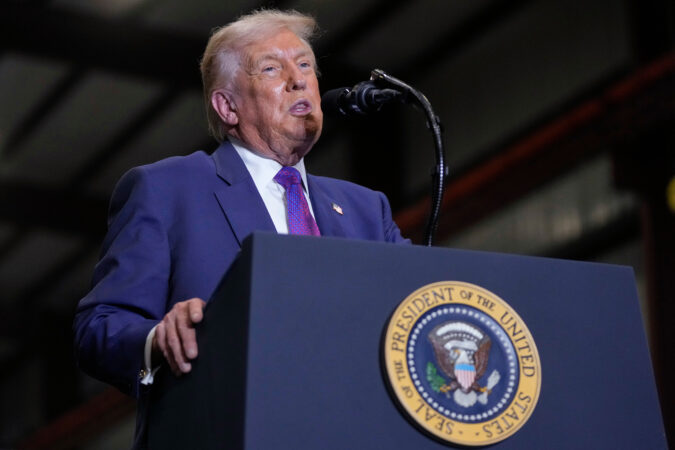
    President Donald Trump last month agreed to a roughly 50% funding boost sought by Pete Hegseth, the defense secretary, in the White House’s annual budget proposal. The idea ran into internal criticism from several other officials, including White House budget chief Russell Vought, who warned about its potential impact on the widening federal deficit, said the people, who spoke on the condition of anonymity to reflect internal deliberations.

    Since Trump agreed to the higher number, White House aides and defense officials have run into logistical challenges surrounding where to put the money, because the amount is so large, the people said. The White House is more than two weeks behind its statutory deadline to send its budget proposal to Congress, in part because it is unclear how precisely to spend the additional $500 billion, according to the people familiar with the matter.

    Senior Pentagon officials have consulted with former senior defense officials as they grapple with the challenge, said one person familiar with the matter. Part of the discussion centers on how much emphasis should go into buying weapons the military already uses versus investing in high-end technologies, such as artificial intelligence, that the Pentagon envisions as part of its future.

    The roughly $900 billion defense budget approved last year was the largest in U.S. history. While other nations have also increased their military spending, the United States already spends more on defense than the next nine countries combined, according to 2023 data from the Peter G. Peterson Foundation, a nonpartisan think tank.

    “I’m not surprised they’re having difficulty doing that,” said G. William Hoagland, senior vice president at the Bipartisan Policy Center, a nonpartisan think tank. “That’s an awful lot of money in one year.”

    Spokespeople for the White House and the Defense Department declined to comment.

    Trump, Hegseth, and many congressional Republicans have defended the proposed increase in the military budget as necessary to pay for an array of new priorities and confront foreign adversaries. Hegseth has said that the money would be spent “wisely” and that the larger budget would send “a message to the world.”

    The forthcoming White House budget for fiscal 2027 will spell out the administration’s proposed spending levels across the government. It requires congressional approval to be enacted and faces long odds.

    “This will allow us to build the ‘Dream Military’ that we have long been entitled to and, more importantly, that will keep us SAFE and SECURE, regardless of foe,” Trump said in a Truth Social post this month confirming his support for the $1.5 trillion budget number.

    The Pentagon has been grappling with how to rapidly replenish expensive munitions that it has relied on heavily, including Tomahawk cruise missiles, Patriot missile-defense interceptors, and ship-launched munitions known as Standard Missile-6s, or SM-6s.

    It also is wrestling with how to upgrade its Cold War-era nuclear weapons program with expensive next-generation systems like the B-21 bomber and the Columbia-class submarine. The aircraft, with an estimated cost of about $700 million each, is expected to replace the Air Force’s fleet of B-1 and B-2 bombers. The Columbia-class submarines are expected to cost at least $9 billion each.

    Hegseth, upon taking office, directed each military service to look for budget reductions of 8%; the money could then be invested in other Pentagon priorities better aligned with Trump’s agenda. Hegseth bristled at the suggestion that such reprogramming should be considered cuts, saying he would be “reorienting” about $50 billion in defense spending that the Biden administration had planned.

    More recently, Hegseth has called for “supercharging” the U.S. industrial base, seeking to speed up how quickly the military can field new weapons and other capabilities, in part by not relying as heavily on traditional defense contractors.

    With such a significant jump in spending planned, it now appears that the Pentagon budget is detached from a new national defense strategy that Hegseth’s team released in January, said Mark Cancian, a retired Marine Corps colonel and senior adviser with the Center for Strategic and International Studies. That strategy calls for the Pentagon to focus first on defense in the Western Hemisphere, with less emphasis on Europe, Africa, and the Middle East.

    It’s a “head-scratcher” that the Pentagon wants to spend so much money while also cutting back in those areas, Cancian said.

    “If you’ve got a 50% budget increase, you don’t have to do any of that,” he said. “You’d be talking about all the new places you’d be making investments.”

    The federal deficit, or the gap between what the government spent and what it collected in tax revenue, was $1.8 trillion last year. That number was down from the surges of red ink during the COVID years but up significantly from the standard deficit before the pandemic.

    Vought, a deficit hawk, has long called for reducing federal spending while also supporting Trump’s general goal of rebuilding the American military. He was instrumental in securing additional funding for the military last year in the GOP’s tax bill, which bypassed the typical bipartisan process for setting military spending.

    The increase in military spending alone would amount to one of the biggest federal programs. One Democratic plan to expand Medicare to cover dental, vision, and hearing benefits would cost $350 billion over the next decade, by comparison. If Congress were to spend an additional $500 billion every year on the military, the cost would be $5 trillion over the next decade. It is unclear if the Trump administration’s proposal is for an additional $500 billion just for next year, or $500 billion each year for a decade.

    “I’m sure there are very difficult conversations happening right now. Obviously, it would have a huge impact,” said Charles Kieffer, who spent several decades across administrations in the White House Office of Management and Budget and working for Democrats on the Senate Appropriations Committee. “A 50% increase requires a completely different formulation for your priorities.”

    Some experts in military spending panned the proposed increase as likely to increase fraud and waste. Julia Gledhill, a research analyst for the national security reform program at the nonpartisan Stimson Center, pointed to failed audits at the Pentagon and a lack of clear guardrails on much of the new military spending approved last year in the GOP’s One Big Beautiful Bill, which she said has been used like a “slush fund.”

    “We don’t know what we’re already spending money on. We don’t have details on how the Pentagon is using its trillion-dollar budget,” Gledhill said. “How are you supposed to make educated, informed decisions about the military budget if you don’t know where it’s already going?”

  • Big Tech is taking on more debt than ever to fund its AI aspirations

    Big Tech is taking on more debt than ever to fund its AI aspirations

    Big Tech is taking on record levels of debt, marking a new chapter in the artificial intelligence boom as names such as Oracle, Alphabet, and Meta pour big money into massive data centers and the energy systems needed to run them.

    Technology companies issued a record $108.7 billion in corporate bonds in the last three months of 2025, according to data from Moody’s Analytics. That’s the largest total for any quarter and roughly double that of the previous three months. And the trend is extending into 2026: Some $15.5 billion in bonds were issued in the first two weeks of the year alone.

    For now, investors are assuaged by the eye-popping cash flow numbers from major tech companies. In the past 20 years, Big Tech companies including Google, Microsoft, Meta, Amazon, and Apple have built what are arguably the most profitable business models in history. In the third quarter, Google brought in just over $100 billion, with a margin of over 30%. All five are trillion-dollar companies, as are such AI darlings as Nvidia, Broadcom, and TSMC.

    But some economists and business analysts say the massive new bonds are spreading risk throughout the economy, with hundreds of billions being spent on a technology whose profit-making potential is not yet clear.

    “It’s a lot of debt, and a lot of it all of a sudden,” said Mark Zandi, chief economist for Moody’s. When companies are funding risky ventures with debt “it does put the broader financial system at risk. If the financial system is at risk, then the broader economy is.”

    A bond is a form of debt that companies or governments can use to raise large sums of money, typically from investment banks or private-equity firms, to be paid back with interest. They historically have been used to fund major infrastructure projects such as power plants, natural gas drilling operations, or offshore wind farms — projects with large up-front costs that are expected to generate revenue for many years. Once issued, a bond can be bought, sold, or packaged into other debt products, which can end up in the portfolios of unrelated investments such as pension funds.

    Automakers, utilities, and other mainstays of heavy industry have historically been the biggest issuers of corporate bonds, Moody’s data shows. Analysts note that in past technology build-outs, such as the rise and rapid investment in internet-based companies in the 1990s, companies didn’t have to spend nearly as much on infrastructure.

    That has now changed, given the unprecedented energy demands of running and training AI algorithms. While tech companies took on more debt, adjusting for inflation, in 2021 than in 2025 — with a total of $296.6 billion in 2025 dollars issued that year — interest rates were significantly lower at the time. That made financing debt cheaper.

    “The technology industry has gone from being an also-ran in terms of corporate debt, to becoming the largest player of investment-grade corporate debt, out of nowhere, compared to two years ago,” said venture capitalist Paul Kedrosky.

    Because training and running AI algorithms take up much more computing power and energy than previous forms of technology, staying ahead in the AI race costs billions. Google, Microsoft, Amazon, and Meta indicated in company announcements that they planned to collectively spend well over $300 billion on AI data centers in 2025 alone.

    If they continue to spend at that rate, they may have to take on even more debt.

    “If these companies are so profitable, why are they using debt?” Kedrosky said. “It gives you a sense of the scale of what’s going on.”

    Amazon spokesperson Amy Diaz said the proceeds from Amazon’s bond issuance in November are being used to support business investments, capital expenditures, and repayment of earlier debt, adding that the company regularly evaluates its operating plan to make financing decisions. (Amazon founder Jeff Bezos owns the Washington Post.)

    Representatives from Alphabet, Meta, and Oracle either declined to comment or did not answer questions. An Apple spokesperson referred to the company’s SEC filing, which states that proceeds from the bond issuance would be used for “general corporate purposes” including stock buybacks and unspecified capital expenditure, among other uses.

    Among large tech companies, Meta used the most debt to fund its data center build-out in 2025, according to Moody’s. The social media company has invested deeply in AI in a race to become the leading AI assistant for companies and everyday people, putting it in a tight race with Microsoft, Apple, and Alphabet.

    Mark Mahaney, who has covered tech companies for more than two decades and is now managing director at the investment bank Evercore ISI, views the bonds as part of a strategy by tech firms to raise money without degrading their stock price. Bond offerings are a sign that management is “confident or cocky” about their future, as they’ve taken on debt that requires steady cash flow to pay down, Mahaney said.

    Also loading up on debt is Oracle, which issued some $25.75 billion in bonds last year as it seeks to become the AI computing power provider of choice. In September it disclosed a $300 billion deal with OpenAI, prompting an immediate 36% spike in its stock price that briefly made founder Larry Ellison the richest man in the world. (The Post has a content partnership with OpenAI.)

    But in the ensuing weeks investors became uncomfortable with Oracle’s debt. Citi analyst Daniel Sorid told CNBC in December that there was something “inherently uncomfortable” about the “enormous” amount of capital Oracle will require.

    The stock has declined about half from its Sept. 10 peak. Bondholder Ohio Carpenters’ Pension Plan recently sued Oracle and several investment banks, alleging that Oracle failed to disclose how much debt it needs.

    “The sheer scale of new debt issuance has forced investors to reassess whether the economics of relentless AI [spending] are truly sustainable,” said Thomas Urano, chief investment officer at Sage Advisory in Austin.

    Urano added that many of the companies getting AI-driven investment are part of the infrastructure that enables today’s AI chatbots and other applications, which cannot be immediately monetized.

    “This creates a paradox: The strategic case for AI is compelling, but the revenue model is still evolving,” Urano said.

    At least one firm has raised the prospect of getting government support to build out more data centers. OpenAI’s chief financial officer, Sarah Friar, said in November that it will require “innovation” on the finance side, with government providing a “backstop” or “guarantee.” Her comments triggered backlash from politicians and tech critics, who questioned whether taxpayers should take on some of these private companies’ risk. Friar and CEO Sam Altman both later clarified that they weren’t seeking federal guarantees for OpenAI data centers specifically, although Altman did say in a lengthy social media post that a government-funded “strategic national reserve of computing power” would make sense.

    The Trump administration has gone all in on AI, pushing aside concerns within the MAGA movement and seeking to sweep away regulations that it says hamper innovation. But neighbors of the vast warehouses of computer chips that form the technology’s backbone — including in conservative states — have objected to how the facilities sap power from the grid, guzzle water to stay cool, and secure tax breaks from local governments. President Donald Trump has recalibrated his approach, pushing tech companies to fund their own power.

    “Historically, when we’ve had major bubbles they’ve tended to be about real estate, or technology, or government policy,” Kedrosky said. “This is the first bubble in history that combines all of these things.”

  • Trump banner on Justice Dept. building draws authoritarian comparisons

    Trump banner on Justice Dept. building draws authoritarian comparisons

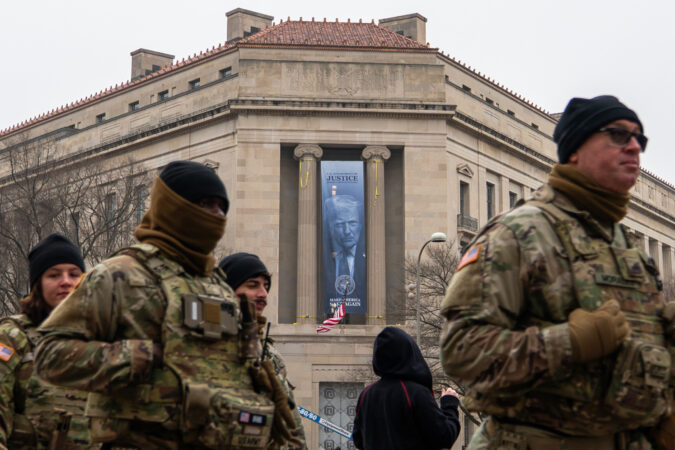
    A new banner hanging along the facade of the Justice Department’s headquarters in Washington is sparking criticism from Democrats and a former FBI director, who suggest that it exemplifies President Donald Trump’s encroachment on the agency, which has long prided itself on being independent from the White House.

    The tall banner displays a portrait of Trump, cast in a dark blue hue, staring down at tourists, commuters and cars along Washington’s bustling Pennsylvania Avenue. “MAKE AMERICA SAFE AGAIN,” reads the banner, which is emblazoned with the Justice Department’s seal.

    A Justice Department spokesperson said the banner was hung in commemoration of the United States’ Semiquincentennial, writing in a statement: “We are proud at this Department of Justice to celebrate 250 years of our great country and our historic work to make America safe again at President Trump’s direction.”

    Similar banners have appeared recently on other government buildings in Washington. But Democrats said that the decision to install one at the Justice Department symbolizes the influence Trump has wielded over the agency during his second term and that the display is comparable to the imagery deployed by authoritarian regimes.

    “The irony of a twice-impeached, convicted felon putting his own picture on the wall of the Department of Justice,” Sen. Ben Ray Luján of New Mexico wrote on X. “President Trump is weaponizing the DOJ as his own personal law firm.”

    Rep. Mike Quigley of Illinois shared an image of the banner online and wrote: “POTUS is putting his face on the Justice Department. … This is not the work of an independent and impartial justice system.”

    “Ok Kim Jong Un,” Rep. Jim McGovern of Massachusetts wrote.

    A pair of similar banners hung at the U.S. Department of Agriculture showed Trump and Abraham Lincoln’s portraits emblazoned with the phrase: “Growing America Since 1862.” (A government purchase order for the pair of banners at USDA showed they cost $16,400.) And banners hung on the Labor Department’s building featured portraits of Trump and Theodore Roosevelt that read, “American workers first.”

    The addition to the Justice Department building follows a pattern of norm-breaking efforts that critics say amount to Trump using the agency as a personal cudgel against his political enemies.

    In a speech delivered inside the building last year, Trump declared himself the nation’s “chief law enforcement officer.” Attorney General Pam Bondi rarely misses an opportunity to praise the president and credit him with the department’s success, including at a contentious congressional oversight hearing last week in which she repeatedly described him “the greatest president in American history.”

    To Trump’s critics, the banner is also striking given his status as a felon. He was found guilty in 2024 in a New York state case on 34 counts of falsifying business records to conceal a hush money payment to an adult-film actress.

    Less than two years ago, Justice Department prosecutors had been pursuing two federal cases against him led by former special counsel Jack Smith. One focused on efforts to overturn the 2020 election, while the other related to Trump’s handling of classified documents.

    Trump is continuing to appeal his state court conviction in New York. A Georgia criminal case against Trump related to efforts to change the 2020 election result was dismissed last year.

    The two federal cases were also dismissed. One ended because of issues with Smith’s appointment. The other Smith withdrew after Trump’s 2024 election victory, in line with long-standing Justice Department policies preventing prosecution of a sitting president.

    Trump and his Justice Department appointees have contended that the prosecutions arose out of a Biden-era weaponization of the justice system to punish political foes.

    Since his return to the White House, Trump has ordered several prosecutions of political rivals on social media. Federal prosecutors brought charges against former FBI Director James B. Comey and New York Attorney General Letitia James last year — both of whom Trump had demanded Bondi move swiftly to prosecute. Those cases were later thrown out over issues with the appointment of the U.S. attorney selected to oversee them.

    Comey, in a social media post Thursday, called the installation of the banner outside the Justice Department headquarters “sickening.”

    “But they forgot to cover the inscription on the Pennsylvania Avenue side: ‘WHERE LAW ENDS TYRANNY BEGINS,’” he wrote.

    The banner is hardly the first time the Trump administration has been accused of adopting aesthetics and deploying imagery typically associated with imperialism or authoritarianism since his return to office last year.

    The administration, for example, roiled the art world when the Department of Homeland Security used images of Americana paintings to bolster support for Trump’s large-scale deportation campaign.

    There was also a massive military parade in Washington last year, which ran against an American tradition of avoiding public displays of martial strength more common in authoritarian regimes. The president is also planning a giant triumphal arch across from the Lincoln Memorial, which could dwarf the size of that and other monuments.

  • What the Supreme Court throwing out Trump’s tariffs means for you

    What the Supreme Court throwing out Trump’s tariffs means for you

    The Supreme Court ruled Friday that most of President Donald Trump’s widespread tariffs put in place last year are invalid — but that doesn’t mean shoppers will suddenly see prices drop.

    The high court ruled that Trump overstepped his authority by relying on a decades-old emergency law to impose tariffs on goods from nearly every country.

    Now, the fate of the tariffs is uncertain. Trump indicated at a news conference Friday that he would not back off from his prominent economic policy and would impose tariffs using other laws.

    Here’s what the ruling means for American consumers and what happens next.

    Does this mean all tariffs are off?

    No. The Supreme Court’s ruling applies to the tariffs Trump imposed under the International Emergency Economic Powers Act (IEEPA). That includes the country-specific tariffs such as a 15% levy on goods from European Union countries or a 20% tariff on imports from Vietnam.

    That includes most of the tariffs Trump put into place last year, but not all of them. Sector-specific tariffs, such as duties on steel, aluminum, and autos will remain in place.

    What does this mean for prices?

    Tariffs contributed to rising prices throughout the past year, though not as significantly as some analysts had initially feared. Still, the Yale Budget Lab estimates that the average household would lose about $1,800 because of the cost of tariffs in the short term.

    Federal Reserve Chair Jerome H. Powell said in December that tariff price increases caused much of the overshoot in inflation, which has remained stubbornly higher than the Fed’s target rate of 2%.

    But even with IEEPA tariffs gone, consumers are unlikely to see much immediate relief in their shopping bills.

    “Generally, prices don’t go down once they’ve gone up,” said Joe Feldman, senior managing director and retail analyst at Telsey Advisory Group. “We might see a little bit of relief.”

    Companies may be wary to reduce prices when so much uncertainty remains about the future of tariffs.

    For months last year, many companies stocked up on imports in anticipation of tariffs. That gave them a cushion before they had to raise prices to make up for the increased cost of goods. That advance inventory started running out for many late last year, but it’s possible that throwing out the IEEPA tariffs will prevent future price increases that would have otherwise taken place.

    Will I get any rebates?

    Probably not. For the most part, tariffs are paid by importing companies during a Customs and Border Protection process. Individual consumers eventually see some of those fees in the form of cost increases but do not pay tariffs directly.

    It’s unlikely that individual businesses will refund customers for price increases.

    Trump said several times last year that he planned to use the tariff revenue, which was about $200 billion as of mid-December, to give stimulus checks to Americans. But there are many challenges inherent in that plan, including that tariff funds go to the Treasury and must be allocated by Congress before they are used.

    Will businesses get refunds from tariff payments?

    Maybe. There’s already a process in place for importers to adjust and dispute the duties they’ve paid at the border, and it’s possible that companies will use that system to appeal the fees they’ve paid over the past several months.

    But the government has yet to say if or how refunds would work or how long they might take to reach companies. The Supreme Court did not address what to do about refunds.

    At a news conference shortly after the decision was announced, Trump criticized the Supreme Court for not addressing the refund issue.

    “I guess it has to get litigated for the next two years,” he said.

    Businesses are preparing for a potential refund process, and some had already started petitioning CBP for refunds even before the court ruled, in the hopes of getting put in the front of the line.

    Costco, one of the nation’s largest retailers, sued customs officials in late November, saying separate legal action was needed to guarantee its refund rights.

    What does this mean for the future of tariffs?

    Trump is unlikely to simply dismiss the idea of tariffs because of the legal setback. Members of the Trump administration have already discussed other avenues to impose levies. After the Supreme Court oral arguments, Trump told reporters his team would “develop a ‘game two’ plan.”

    There are more traditional — albeit slower — ways to put tariffs in place, such as the sector-specific tariffs on steel, aluminum, and copper. Those are generally proceeded by a government investigation and are more specific than the countrywide tariffs Trump imposed last year.

    Trump said Friday after the decision that the government would use a separate law, Section 122, to implement a 10% global tariff. That law allows tariffs to be imposed for 150 days.

    He also said he would impose “several” new tariffs under Section 301, which applies to unfair trade practices.

    One way Trump might proceed would be to use a different law to temporarily put in place tariffs of up to 15% for about five months, said Patrick Childress, an international trade attorney at Holland & Knight in D.C. and a former assistant general counsel at the Office of the U.S. Trade Representative. During that time, the Trump administration could conduct investigations using a separate law to potentially put in place country-specific tariffs.

    “This is the path I think the administration is most likely to take because it gives them speed. They have flexibility to raise tariffs up or down, and they result in country-specific tariffs much like the IEEPA tariffs,” Childress said.

    If that’s how the White House ultimately tackles tariffs, it could mean that not much changes at all for consumers.

  • U.S. amasses biggest force since 2003 as Trump pushes Iran on deal

    U.S. amasses biggest force since 2003 as Trump pushes Iran on deal

    The U.S. military is stationing a vast array of forces in the Middle East, including two aircraft carriers, fighter jets and refueling tankers, with President Donald Trump saying that Iran had 10 to 15 days at most to strike a deal over its nuclear program.

    “We’re either going to get a deal, or it’s going to be unfortunate for them,” Trump told reporters Thursday aboard Air Force One. On a deadline, Trump said he thought 10 to 15 days was “pretty much” the “maximum” he would allow for negotiations to continue.

    “I would think that would be enough time,” he said.

    The deployment is unlike anything the U.S. has done since 2003, when it amassed forces before the invasion of Iraq. It dwarfs the military buildup that Trump ordered off the coast of Venezuela in the weeks before he ousted President Nicolas Maduro.

    While the U.S. isn’t likely to deploy ground troops, the buildup suggests Trump is giving himself discretion to launch a sustained campaign lasting many days, in cooperation with Israel. While discussions have focused on a sustained campaign far more sweeping than the overnight strikes the U.S. launched against Iran’s nuclear program last June, the president is also weighing a limited early strike designed to drive Tehran to the negotiating table, the Wall Street Journal reported Thursday.

    “Maybe we’re going to make a deal,” Trump said in a speech on Thursday morning. “You’re going to be finding out over the next probably 10 days.”

    Heightened geopolitical worries over U.S.-Iran tensions sent stocks lower and extended a surge in oil, with Brent crude, the global benchmark, rising above $71 a barrel on Thursday.

    The open question is whether Iran can possibly satisfy Trump’s demands and whether, by positioning so much military hardware to the region, Trump may feel compelled to use it rather than backing down.

    Tracking site FlightRadar24’s data shows a surge of flight activity by U.S. military transport, aerial tankers, surveillance aircraft and drones to bases in Qatar, Jordan, Crete and Spain.

    The aircraft, whose transponders make them visible over land to the tracking site, include KC-46 and KC-135 air-to-air refuelers and C-130J cargo planes used to move troops and heavy equipment.

    It also includes E-3 Sentry jets equipped with airborne warning and control system radar, which provide “all-altitude and all-weather surveillance” of potential battle zones, as well as RQ-4 Global Hawk surveillance drones.

    The weapons at Trump’s disposal are formidable. The USS Abraham Lincoln aircraft carrier is accompanied by three Arleigh Burke-class guided-missile destroyers, which can carry Tomahawk missiles. The carrier’s air wing includes F-35C fighter jets.

    The USS Gerald R. Ford, the most expensive U.S. warship ever built, at $13 billion, is accompanied by guided missile destroyers, and its associated air wing includes F/A-18E and F/A-18F Super Hornets, E-2D airborne early warning aircraft, as well as MH-60S and MH-60R Seahawk helicopters and C-2A Greyhounds.

    The two carriers provide “more options, and would enable us to conduct operations on a more sustained basis – if it comes to that,” said Michael Eisenstadt, director of military studies for the Washington Institute for Near East Policy. He said the buildup “signals to the Iranians the need to be more flexible in negotiations.”

    Trump met with his son-in-law, Jared Kushner, and special envoy, Steve Witkoff, on Wednesday for an update on the negotiations with Iran. Officials met in the Situation Room on Wednesday to discuss possible action and were told to expect that all U.S. military forces deployed to the region would be in place by mid-March, according to a U.S. official.

    A major strike against Iran – where leaders are anxious about regime stability following widespread unrest – risks entangling the U.S. in its third war of choice in the Middle East since 1991, against a more formidable adversary than the U.S. has faced in decades.

    Trump’s use of the military in his second term has been characterized by short and successful engagements with minimal harm to American troops, including the bombing of Iranian nuclear targets in June, attacking alleged drug-trafficking boats and the raid that extracted Maduro in early January.

    But if fresh strikes on Iran prompt a wider conflagration, the president could face considerable public pressure. Trump spoke against U.S. engagement in foreign wars on the campaign trail, but has gone on to bomb Iran, Tehran-backed Houthi militants in Yemen and militants in Syria.

    “With Iran’s air defenses largely neutralized by previous U.S. and Israeli strikes, the U.S. strike fighters would operate largely with impunity over Iranian airspace,” said Bryan Clark, a defense analyst for the Hudson Institute and a former Navy strategy officer. “There is always the risk of downed pilots, but I think the bigger risk is to ships. The same cruise and ballistic missiles the Iranians gave to the Houthis could be turned against U.S. ships in the Persian Gulf, Arabian Sea and Red Sea.”

    Thousands of U.S. servicemembers in the region are also within range of Iranian ballistic missiles, and regime officials have vowed to respond with full force to a U.S. strike.

    Beyond attacks on U.S. military assets, Iran could try to close the Strait of Hormuz, the narrow waterway between Oman and Iran traversed by 25% of maritime oil traffic.

    The U.S. strikes in June 2025 focused on three sites associated with Iran’s nuclear program, but a more ambitious effort to topple the regime in Tehran could involve attacks on sites associated with the Islamic Revolutionary Guard Corps and potentially senior leadership including Supreme Leader Ayatollah Ali Khamenei.

    But Iran might be able to withstand such decapitation attempts.

    “Israel already killed the top leaders of the IRGC in its opening strikes in the June war and Iran was able to reconstitute and respond within 24 hours,” said Jamal Abdi, president of the U.S.-based National Iranian American Council. “They’ve now planned for these possibilities in future wars and so now may be even more resilient if senior leaders are killed.”

    White House press secretary Karoline Leavitt said Wednesday that Iran was expected to offer a response to the negotiations within “the next couple of weeks,” but did not preclude the possibility of military action before that. “The president will continue to watch how this plays out,” she said.

  • Why changes in a Florida ocean current could wreak havoc worldwide

    Why changes in a Florida ocean current could wreak havoc worldwide

    STRAITS OF FLORIDA — At 2 a.m., oceanographer Ryan Smith was headed into his 12th hour of work with little sleep when trouble started.

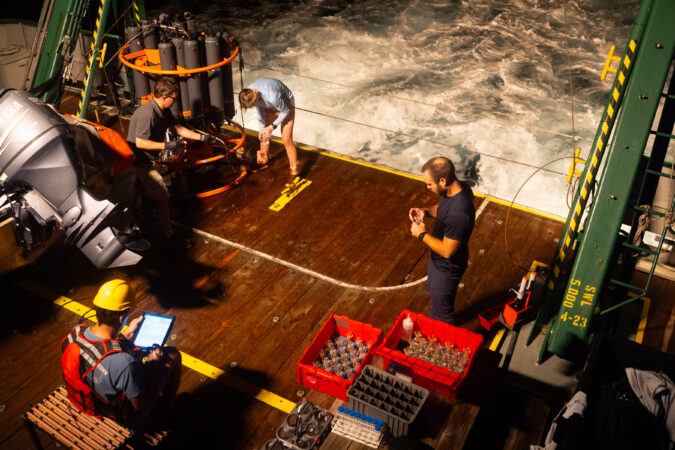
    From the rear deck of the University of Miami’s research boat, he guided the vessel’s winch to lower a cage containing 14 long, gray tubes, collectively weighing about 1,000 pounds, hundreds of meters deep into the Atlantic Ocean, to record the temperature, salinity and density of the water. But after running smoothly for the first two-thirds of the trip, the sensors now suddenly stopped transmitting data.

    There was no time for a hiccup. With urgency mounting, Smith signaled to bring the cage to the surface.

    At sea, there is no helpline to call for a broken instrument at this hour (or any hour). If the team couldn’t fix it, they would need to make a 12-hour slog back to Miami through the fast-moving Florida Current — the precise subject they were trying to measure.

    For 43 years, scientists have been studying the strength of the water flow between Florida and the Bahamas to learn what drives its changes over time. The information could help scientists answer a pressing question: Is the Florida Current, one of the world’s fastest ocean currents, slowing down? If so, it could indicate weakening of the larger circulation system in the Atlantic Ocean — what scientists call the Atlantic Meridional Overturning Circulation (AMOC) — which could be disastrous.

    Even Hollywood has imagined the harm that could result from a collapse of this system of currents, which acts like a conveyor belt as it transports water, nutrients, and heat through the Atlantic.

    While scientists doubt the scenario sketched out in the 2004 movie The Day After Tomorrow, in which the AMOC’s failure prompts a calamitous ice age across the Northern Hemisphere, researchers say rain patterns could change or fail in Southeast Asia and parts of Africa, disease may spread to new populations, and temperatures would probably drop across Western Europe. Iceland has even declared that the risk of such a collapse is a national security threat.

    But climate scientists are at odds over how soon, or whether, the circulation system may weaken. Researchers largely agree that the AMOC may weaken over this century as the world warms, but they differ on whether the system is already slowing down.

    Direct observations of the AMOC’s and the Florida Current’s flow, velocity, temperature and salinity could help clarify this. The Florida Current, which helps shuttle water north, is a key component in calculating the system’s strength.

    Traveling between Miami and the Bahamas, a crew from the University of Miami and the National Oceanic and Atmospheric Administration homed in on the Florida Current, the world’s longest nearly continuously observed ocean current. Over 36 sleep-deprived hours, six researchers and seven crew members traversed the ocean, dove underwater, and collected gigabytes of measurements. These expeditions gather data that generations of scientists can use to better understand the state of our oceans — and humanity’s future.

    Tyler Christian, a marine scientist, takes a photo of a waterspout during a research trip to collect data on the Florida Current.

    The AMOC debate

    For more than four decades, scientists have almost continuously measured water flow across the Florida Current, largely with the help of a decommissioned AT&T telecommunications cable running from West Palm Beach to Grand Bahama Island.

    The telephone line wasn’t intended for ocean research, but NOAA scientists noted that it picked up tiny voltages induced by seawater flowing across the Florida Straits, which changed depending on the current’s flow. Using direct measurements of the waterway from research cruises, scientists can convert the voltages into the volume of water carried each second through the strait.

    In 2005, British oceanographer Harry Bryden tapped these cable measurements and the limited available ship measurements in a seminal paper that suggested a possible slowdown in the AMOC between 1957 and 2004. Using data across the Atlantic Basin today, scientists have found that the AMOC varies, daily and seasonally, yet it also appears to have experienced a slight weakening over the past two decades.

    But is it on a long-term decline because of human-induced planetary warming? Debatable.

    At about 4 a.m., oceanographer Denis Volkov, right, checks in on Jay Hooper, who helps the team with data management

    The Florida Current is one of the main forces that make up the western boundary of the AMOC. The warm Florida waters feed into the mighty Gulf Stream, which merges with the warm North Atlantic Current headed toward Europe. As the current reaches the Arctic, air temperatures cool the water, which becomes denser. The water sinks and moves south toward the equator, where it is again warmed by the sun and returns north.

    “The role of the AMOC in the climate is it carries a huge amount of heat from the equator towards the poles,” said Denis Volkov, who is a co-principal investigator of NOAA’s Western Boundary Time Series project along with Smith.

    But scientists say a warming world is throwing off this balance. As Arctic ice melts, freshwater enters the North Atlantic — making the ocean water less dense, so it is less likely to sink. As a result, scientists propose that it cannot power the ocean conveyor belt as well, so less salty, warm water is getting transported northward.

    A major shift in the Atlantic Ocean’s circulation could create severe drought in some areas and damaging floods in others. Sea level could rise by a foot or more along the U.S. East Coast if it collapsed.

    Scientists have typically used data that indirectly hints at the current’s movement — such as sea surface or air temperature — to reconstruct the oceans in models and track whether the overall system is weakening, but they have reached mixed conclusions.

    For instance, a 2018 study plugged sea surface temperatures into computer models to show that the AMOC is weakening. Then, a paper released last January reported no evidence of weakening over the past 60 years after examining data on heat exchanges between the air and the ocean called air-sea fluxes.

    The dive boat takes scientists to a site to collect data on the Florida Current.

    Volkov and his colleagues are helping approach the puzzle with observations. In 2024, they reassessed the cable data from the Florida Current, adjusting for changes from Earth’s geomagnetic field. First, they found that the current had remained stable over the past four decades. Then, they updated calculations of the AMOC in this region, which has been monitored for only 20 years or so, with the corrected data and found that the AMOC wasn’t weakening as much as previously calculated at this latitude.

    “But there is a caveat that observational data is very short,” said Volkov. He said scientists would need another 20 years of AMOC observations to determine if the small decline is a robust feature and not part of natural variability.

    And the AMOC can still weaken even if the Florida Current remains strong, he said, since it is the sum of currents across the basin. But long-term changes in the Florida Current can serve as an indicator of trouble for the rest of the system.

    One snag, said Volkov: The serendipitous cable that provided data for more than 40 years malfunctioned in 2023 — perhaps broke. Until it’s fixed, researchers are ramping up their diving operations to recover data from underwater acoustic barometers on the ocean floor.

    Volkov, left, and Smith watch as a sampling instrument drops into the water.

    The expedition

    When the research vessel departed from the university’s dock around 4 a.m. on Sept. 3, the sun and most of the science staff were down for the night. A few shipmates gazed at the illuminated cityscapes from the stern deck, next to the diesel engine’s deep rumble. After traversing rocking waves, the crew reached scenic Bahamian waters eight hours later.

    The green F.G. Walton Smith, 96 feet long, and its crew make this overnight trip about six times a year, traveling 93 nautical miles diagonally from Miami toward the Little Bahama Bank. From there, they go west and collect data at nine sites from the boat and dive underwater at two others.

    The team’s goal is to determine the amount of water flowing north through the Florida Current per second through a series of underwater instruments, from the boat and from satellites. They also collect temperature, salinity, density and velocity data; velocity and temperature, for example, can be combined to calculate the amount of heat transported across an area.

    Chomiak, left, and Zach Barton, a technician and engineer, return from diving to the seafloor to place a data-collection instrument.

    At the first dive site, a remora — a long, torpedo-shaped suckerfish — circled the two scuba divers less than a mile from the boat. The slender fish is known for a unique fin on its head that suctions itself to sharks, whales, and turtles to feed off their detritus. And for a quick moment, it latched onto Leah Chomiak’s head. And her thigh.

    Chomiak focused on the barometer in front of her. Her bulky gloves made it harder to use a screwdriver 50 feet below the Bahamian surface. She and her fellow diver held onto the long tubes that had been recording data every five minutes for the previous two months, since the last time divers brought the instruments to the surface and downloaded the data.

    “Now we decided to service them more frequently, because, at the moment, this is the only source of data for our Florida Current transport estimates,” Volkov said. The scientists can use the pressure data to help calculate the amount of water flowing through the area.

    Next, the ship arrived at the first of nine hydrographic stations and lowered a cage of sensors known as a CTD-rosette sampler (CTD stands for conductivity, temperature and depth, although it measures many more properties). Researchers can use the temperature and salt concentrations of a particular mass of water to infer where it came from and how it reaches other parts of the world.

    Christian takes a quick nap in the galley as the vessel travels back to Miami.

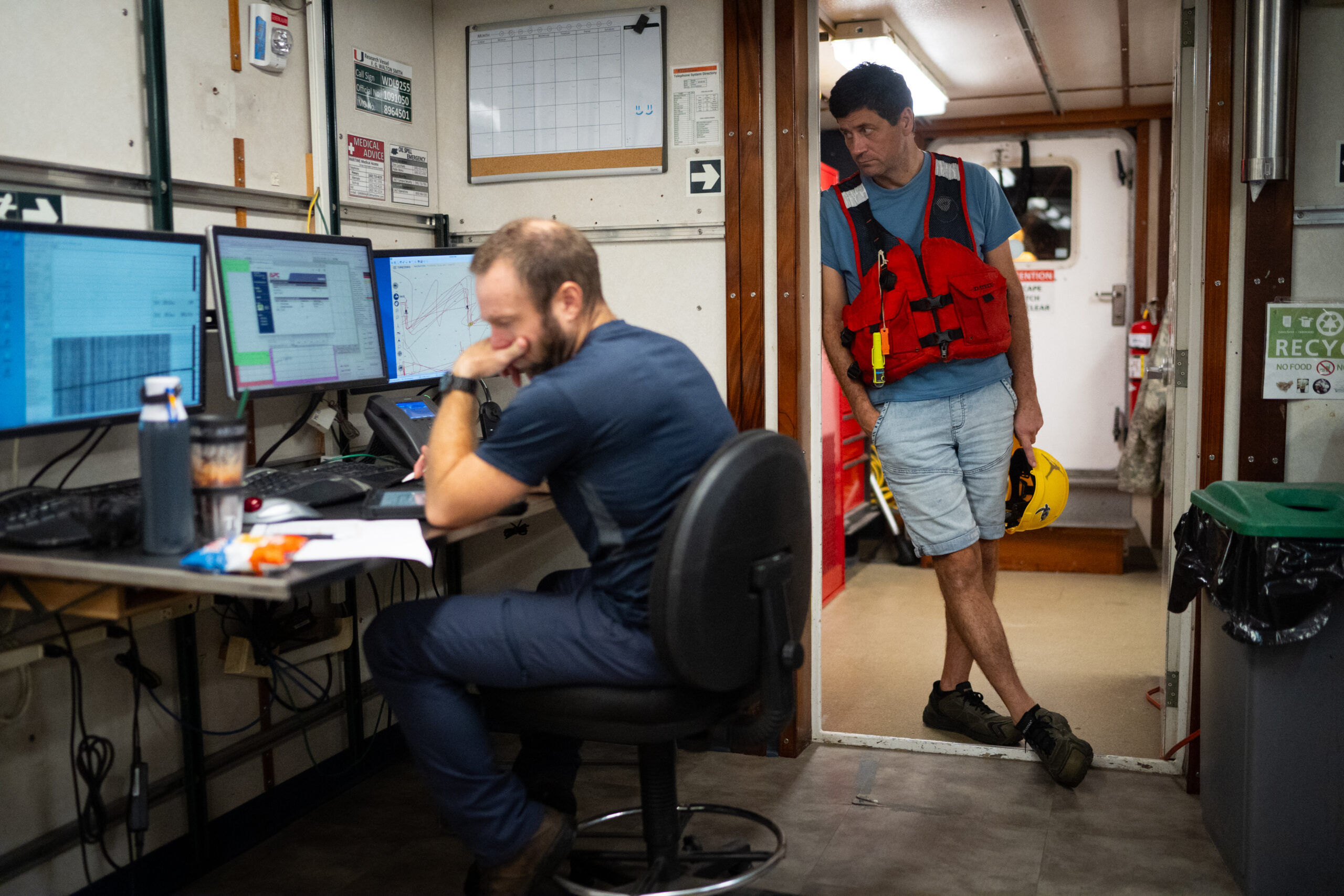
    Jay Hooper, who has been on these trips for 10 years and helps with data management, sat at the ship’s computer station.

    “Ready whenever you are,” he said into his headset.

    From the top deck, the captain lowered the rosette into the water, dropping 60 meters each minute. As the instruments approached the bottom at 486 meters, Hooper said to slow down.

    Lines of various colors — representing salinity, temperature, and density — squiggled down on Hooper’s computer screen as the sensors dropped. Temperature decreased and density increased as the instruments descended. Seventeen minutes later, the rosette was brought back onto the boat.

    After hours of gathering data, Hooper and Smith hit a snag at the seventh station. The rosette now wasn’t sending any information to the computer. Was it human error? Did the instrument break?

    The two tried different solutions as the other scientists slept. Then they replaced the sensors’ cable, and as they lowered the rosette, data filled the computer screen.

    The boat stopped for the last dive near the Florida coast to retrieve the second set of underwater acoustic barometers. But the water was so cloudy, thick and green that the divers couldn’t see their hands, so they decided they would try on the next trip.

    Captain John Cramer pilots the vessel back to the university.

    For the next 12 hours, the boat fought against the Florida Current to take the crew home. Some aboard mustered up energy to sing “Happy Birthday” to one of the crew members.

    The next morning, Smith and his colleagues processed the data to upload to NOAA’s Atlantic Oceanographic & Meteorological Laboratory website. There were no notes about a cable malfunction, encounters with remoras or sleep deprivation.

    The Excel spreadsheet had a single note for each station it recorded: “Profile looks good; use these data.”

  • New DHS memo outlines plan to detain refugees for further vetting

    New DHS memo outlines plan to detain refugees for further vetting

    The Department of Homeland Security issued a memo Wednesday stating that federal immigration agents should arrest refugees who have not yet obtained a green card and detain them indefinitely for rescreening — a policy shift that upends decades of protections and puts tens of thousands of people who entered during the Biden administration at risk.

    The new policy rescinds a 2010 memo that said failing to apply for status as a lawful permanent resident within a year of living in the United States is not a basis for detaining refugees who entered the country legally. Two Trump administration officials wrote in the new directive that the previous guidance was incomplete and that the law requires DHS to detain and subject those refugees to a new set of interviews while in detention.

    The memo appeared in a court filing one day before a scheduled hearing in Minnesota federal court, where a judge temporarily blocked U.S. Immigration and Customs Enforcement in late January from detaining 5,600 refugees in the state after several organizations sued. Immigration officers arrested dozens of resettled people from countries including Somalia, Ecuador, and Venezuela for further questioning as part of an enforcement surge dubbed Operation PARRIS that the Trump administration has said was aimed at combating fraud. Immigration lawyers say many were quickly transported to Texas detention centers and later released without their identity documents.

    The International Refugee Assistance Project, one of the lead counsels for the plaintiffs in the lawsuit, is asking a judge to declare the new refugee detention policy unlawful to prevent more refugees in Minnesota from being arrested.

    “I am concerned that the Feb. 18 memo and the indiscriminate detention of refugees in Minnesota are the opening salvos in an attack on refugees resettled all over the United States,” said Laurie Ball Cooper, the organization’s vice president for U.S. legal programs.

    Refugee resettlement groups across the country see the Minnesota operation as a precursor to an expected shift in refugee policy that could undermine the nation’s half-century-old promise to offer safe harbor to the world’s most persecuted.

    “This memo, drafted in secret and without coordination with agencies working directly with refugees, represents an unprecedented and unnecessary breach of trust,” said Beth Oppenheim, chief executive of HIAS, one of the oldest refugee agencies in the country and the world. “We have both a moral and a legal obligation to demand that DHS immediately rescind this action.”

    A spokesperson for U.S. Citizenship and Immigration Services said the memo directs agencies to implement the plain language of “long established immigration law.”

    “This is not novel or discretionary; it is a clear requirement in law,” the spokesperson said in a statement. “The alternative would be to allow fugitive aliens to run rampant through our country with zero oversight. We refuse to let that happen.”

    Refugees, unless charged with crimes, are not fugitives, and are invited to resettle legally in the U.S. after being vetted abroad.

    President Donald Trump suspended all refugee admissions on his first day in office, including those involving people who had already been approved to come to the U.S. His administration later reopened the program to white South Africans, who he said face race-based persecution in their home country, though they had rarely qualified before for refugee status in the U.S. or any other country.

    More than 200,000 refugees entered the U.S. during the Biden administration and most had waited years to be admitted, according to federal data. Some of those new arrivals have already received green cards, but advocates estimate about 100,000 refugees have not and could be subject to detention under the new policy. Most entered assuming they were protected the moment they stepped on U.S. soil, according to refugee experts and attorneys. Refugees are permitted to apply to become permanent residents after one year of physical presence in the country after their arrival date.

    But the Trump administration is recasting refugee status as conditional instead of permanent — a major change in how refugees have historically been regarded. The memo said refugees who haven’t adjusted their status must endure a second round of “congressionally mandated” vetting to screen for public safety, fraud, and national security risks.

    “This requires DHS to take the affirmative actions of locating, arresting, and taking the alien into custody,” states the memo, signed by acting ICE director Todd M. Lyons and U.S. Citizenship and Immigration Services Director Joseph Edlow.

    DHS based its policy on a section of the Immigration and Nationality Act that says refugees who don’t apply for a green card after a year must return to DHS “custody.” It voids previous guidance indicating that a failure to adjust was not a “proper basis” for removal or detention and if any unadjusted refugee was arrested, they must be released within 48 hours.

    There are many reasons, advocates said, for why a refugee might not apply at the one-year mark, including confusion about the process, language barriers, lost mail from changing addresses, and difficulty navigating the system.

    But returning to DHS “custody” has never meant arrest and unlimited detention, attorneys said in court filings. The historical practice for USCIS was to issue notices for appointments or letters urging compliance, according to court documents in the pending lawsuit.

    Ball Cooper said Congress does not demand revetting as part of the adjustment of status. The law requires the federal government to “inspect” or ask specific questions after the one-year mark, such as whether the person has been physically present in the U.S. throughout that time or whether they have already obtained lawful status through a different channel.

    “None of that requires interrogating a refugee about their original claim, which they’ve already proven to the U.S. government,” Ball Cooper said.

    The Trump administration also halted green-card processing months ago for scores of countries from which refugees originate, making it impossible to satisfy the requirement.

    What has traditionally been treated as a paperwork issue is now a detention issue under the new guidance. Advocates call that a major escalation in the Trump administration’s targeting of legal immigrants. Changing how the law is enforced for refugees who had begun rebuilding their lives under a different set of assumptions is unfair and disproportionately punitive, said Shawn VanDiver, a U.S. Navy veteran who founded the nonprofit organization AfghanEvac.

    “It seems like they are just trying to find new and different ways to put grandma in jail,” said VanDiver. “You don’t invite people into the United States under one set of rules and start moving the goalposts after they arrive.”

    ICE arrested about 100 refugees, some of whom were children, before Minnesota District Judge John Tunheim issued a temporary restraining order in response to the International Refugee Assistance Project’s lawsuit. Dozens were flown to Texas to be asked the same questions they faced during screening overseas, according to attorneys who were present during the interviews. Several of those cases involved refugees with pending green-card applications. There are no confirmed reports of DHS terminating an individual’s refugee status as a result of the operation.

    Former ICE director Sarah Saldaña, who led the agency during President Barack Obama’s administration, said she could not recall a time when immigration officers had arrested refugees for failing to apply on time for a green card. She said this and other actions by the Trump administration signal that “they want to close the door on what has been the country’s welcoming nature when it comes to refugees.”

    The DHS memo cited statistics from an unpublished review from USCIS’s Fraud Detection and National Security Directorate that found insufficient vetting and some public safety concerns in regard to 31,000 recently admitted refugees from the Western Hemisphere. However, it’s unclear where the data came from or what conclusions the internal report reached about “known failures” in screening people from other parts of the world.

    Vetting refugees from specific parts of the world, such as conflict zones, can be challenging, experts said. But the layers of screening, hours of interviews and the fact that would-be refugees can be denied at every step in the process — including the moment they arrive at a U.S. airport — have created a high bar of scrutiny for anyone seeking refugee status. Refugees convicted of aggravated felonies can lose their status and be deported, but studies have repeatedly found — as they have with all immigrants — that refugees commit crimes at far lower rates than native-born citizens.

    Meredith L.B. Owen, senior director of policy and advocacy at Refugee Council USA, said the memo directly threatens the very purpose of why the U.S. brings in refugees. Advocates expect a coming ruling from the Board of Immigration Appeals to set up the legal mechanism for the Trump administration’s broader push to deport thousands of recently admitted refugees. That could ultimately lead to refugees being sent back to the places from which they were fleeing war or political persecution, thus putting their lives in danger.

    That scenario, known as refoulement, violates international law, said Owen, whose group represents all of the national resettlement agencies that provide assistance to refugees upon their arrival to the U.S.

    “This administration stops at nothing to terrorize day after day after day refugee communities in Minnesota and to make sure refugee communities across the country are fearful and bracing themselves for what’s to come,” she said.

  • Trump appears ready to attack Iran as U.S. strike force takes shape

    Trump appears ready to attack Iran as U.S. strike force takes shape

    The Trump administration appears ready to launch an extended military assault on Iran, current and former U.S. officials said, as the Pentagon amasses an immense strike force in the Middle East despite the risks of U.S. combat fatalities and American ensnarement in an extended war.

    The arsenal, under assembly for weeks, is awaiting the arrival of the aircraft carrier USS Gerald R. Ford and its accompanying warships, officials familiar with the matter said, after military leaders last week extended their deployment and ordered the ships to the region from the Caribbean Sea. The vessels were approaching the Strait of Gibraltar on Thursday, making an attack possible within days, said these people, whom like others spoke on the condition of anonymity to discuss sensitive military planning.

    President Donald Trump, speaking Thursday morning at an event in Washington, was ambiguous about what he might do. “Maybe we’re going to make a deal. Maybe not,” he said at the inaugural meeting of his Board of Peace. “You’re going to be finding out over the next, maybe, 10 days.”

    The administration wants it known, officials said, that they are building combat power in the region. The president also has publicly raised the possibility of toppling Iran’s supreme leader, Ayatollah Ali Khamenei, a longtime U.S. adversary, suggesting last week that it would be “the best thing that could happen,” if Iran ends up with new leaders.

    Still, it remains unclear whether Trump has approved military action, people familiar with the matter said. One consideration, some noted, is the ongoing Winter Olympics, which conclude Sunday in Italy.

    The United States, backed by ally Israel, would have an “overwhelming advantage” militarily over Iran, said Daniel B. Shapiro, a former U.S. ambassador to Israel and senior Pentagon official during the Biden administration. The warships in or nearing the Middle East join a sprawling array of combat power already in position, including dozens of fighter jets, air-defense capabilities, and other weapons.

    But a major conflict with Iran poses grave risks, Shapiro said, including ballistic missiles capable of killing U.S. troops in the region, a network of proxy forces across the Middle East that could quickly turn any attack into a far wider and deadlier war, and the potential for significant disruption to maritime shipping and the global oil market.

    “They’ll definitely take terrible damage from combined U.S.-Israeli strikes,” said Shapiro, a distinguished fellow at the Atlantic Council, referring to Iran. “But that doesn’t mean it ends quickly, or clean — and they do have some ability to impose some costs in the other direction.”

    The military buildup coincides with recent meetings between U.S. and Iranian officials aimed at negotiating changes to Tehran’s nuclear program. White House press secretary Karoline Leavitt told reporters this week that the two sides had “made a little bit of progress” but were still “very far apart on some issues.” Iranian officials, she added, are “expected to come back to us with some more detail in the next couple of weeks.” It is unclear if Trump is willing to wait that long.

    Regional diplomats initially thought that the Trump administration’s military pressure on Iran was meant to push Tehran to offer greater concessions in those negotiations, according to a European diplomat briefed on the Iran talks. But after the most recent talks concluded Tuesday, diplomats now believe that Iran is not prepared to budge from its “core positions,” including its right to enrich uranium.

    “The Iranians were planning to drown them in technicalities and delay substance,” the diplomat said. “While a more traditional approach would have built on the dialogue, … Trump does not have the patience.”

    The U.S. military buildup initially was reassuring to some officials in the region, according to this diplomat, but the indications that the Trump administration is preparing for an extended conflict have become deeply concerning.

    “Some actors may have favored targeted strikes to add pressure on Iran,” said the diplomat, referring to officials from Saudi Arabia and the United Arab Emirates. “But an extended conflict will be bloody and it could bring more countries, either deliberately or by miscalculation, into the war.”

    Secretary of State Marco Rubio plans to travel to Israel on Feb. 28 to meet with Israeli Prime Minister Benjamin Netanyahu, a State Department official said. The trip would be aimed at keeping Netanyahu abreast of the status of U.S.-Iran negotiations, the official said, but it does not preclude the Pentagon from launching strikes first. In summer, the U.S. struck Iran’s nuclear facilities even as the president’s top diplomats had diplomatic meetings with Iranian counterparts on the books.

    Netanyahu is eager for the United States to launch a major attack on Iran, and in a speech Sunday he put forward his own conditions for any U.S. agreement with Tehran. Any deal must ban all enrichment of uranium and dismantle “the equipment and the infrastructure that allows you to enrich in the first place,” Netanyahu told the annual conference of Presidents of Major American Jewish Organizations. It should also require that all enriched uranium leave Iran, restrict Iran’s ballistic missile program and impose sustained inspections of Iran’s civilian nuclear program, he said.

    Middle East experts have said Iran is unlikely to agree to all of Israel’s demands and it views them as a breach of Tehran’s ability to defend itself.

    Khamenei in recent days has resisted signing a deal, arguing in social media posts that Tehran has the right to produce nuclear power and the range of its missile arsenal should not be limited. He also has taunted U.S. officials.

    “The Americans constantly say that they’ve sent a warship toward Iran,” he said in one message Tuesday. “Of course, a warship is a dangerous piece of military hardware. However, more dangerous than that warship is the weapon that can send that warship to the bottom of the sea.”

    An extended assault against Iran could mark the most significant action in decades against the longtime U.S. adversary. For years, Iran has sponsored and facilitated attacks on U.S. troops across the region, U.S. officials broadly agree.

    Trump began pondering new strikes against Iran in January, after he pledged to rescue anti-government protesters there following a wave of executions. The president tabled military action, in part because U.S. defense officials warned it would be difficult to manage Iranian counterattacks while a relatively limited number of U.S. forces were in the region, people familiar with the matter said.

    The administration has since surged U.S. weaponry, including another aircraft carrier, the USS Abraham Lincoln, that was diverted from the South China Sea. Numerous Navy destroyers, scores of fighter jets, and other war planes also have been deployed, including advanced F-35s with the ability to evade radar.

    A review of flight-tracking data in recent days has shown a fleet of tanker planes also relocating to Europe and the Middle East, and many fighter jets repositioned at Muwaffaq Al Salti Air Base in Jordan. Other U.S. military aircraft appear to have relocated to or transited through Vrazhdebna Air Base in Bulgaria, data show.

    The military buildup signals the Trump administration is “prepared for something much more extended than a one-day cycle” of strikes, said Dana Stroul, a former senior Pentagon official during the Biden administration who is now with the Washington Institute.

    An extended conflict would mark a sea change from Trump’s recent military forays, including the January U.S. Special Operations raid to capture Venezuelan President Nicolás Maduro in Caracas, a weekslong bombing campaign last spring against Houthi rebels in Yemen, and the surgical strikes last year against Iran’s nuclear facilities. In each of those cases, Trump authorized significant military action that was significant in scope but limited in duration, declared victory afterward and pivoted to other issues.

    Trump has criticized previous U.S. administrations for allowing the United States to become entrapped in lengthy military interventions in the Middle East that killed thousands of U.S. troops and dominated Pentagon resources.

    A lack of calamities during those previous operations has made it easy to overlook the potential pitfalls of future missions, said Jason Dempsey, a retired Army officer who studies the use of military force for the Center for a New American Security. They include lethal attacks against U.S. troops, aircraft collisions, or U.S. pilots being forced to parachute or crash behind enemy lines.

    “Military operations look quick and easy — right until they are not,” Dempsey said. “What we did in Venezuela was such a unique operation, and a one-off. And even that — I’m not sure it will turn out fine.”

  • Silicon Valley is building a shadow power grid for data centers across the U.S.

    Silicon Valley is building a shadow power grid for data centers across the U.S.

    The GW Ranch project approved on 8,000 windswept acres of West Texas will look like many of the other data centers that have sprung up across the country to support Silicon Valley’s ambitions for artificial intelligence. Dozens of airplane-hangar-size warehouses packed with computing hardware will consume more power than all of Chicago.

    But it’s missing one standard feature: The mammoth project, recently green-lit by state environmental regulators, won’t need new power lines to deliver the electricity that it guzzles. GW Ranch will be walled off from the power grid and generate its own electricity from natural gas and solar plants installed on site.

    GW Ranch is set to become part of a shadow power grid emerging across the country with potentially far-reaching consequences for the U.S. electricity system and environment.

    After the rapid growth of data centers triggered pushback from politicians, utilities, and local residents over the pressures they place on the grid, tech companies are now building their own fleet of private power plants, mostly fueled by natural gas.

    Dozens of sprawling off-grid data center projects are planned across Texas, New Mexico, Pennsylvania, Wyoming, Utah, Ohio, and Tennessee, according to a review of regulatory filings, permits, earnings call transcripts, and other documents by the energy industry research firm Cleanview. Several are already under construction.

    Companies rushing to develop the facilities include Meta, ChatGPT-maker OpenAI, business software provider Oracle, and oil giant Chevron. (The Washington Post has a content partnership with OpenAI.)

    The off-grid projects already approved by state energy and environmental regulators could power all of New York City several times over, a vast new energy infrastructure that will bring huge new industrial facilities to communities across the country and increase U.S. emissions of carbon dioxide and other air pollutants. A handful of states have passed laws to encourage off-grid data centers by loosening rules around who can build power plants and where they can be located.

    The projects are sparking alarm from El Paso to Davis, West Virginia, from residents unhappy to learn that gas plants large enough to fuel major cities are set to sprout in places they were never expected.

    “This came out of nowhere,” said Amy Margolies, a resident fighting an off-grid data center planned near Davis, in one of West Virginia’s major tourism corridors. The project was permitted to operate a gas plant large enough to generate roughly equivalent power to that used by every home in the state. It is being propelled by a 2025 state law that eased approvals for off-grid data centers.

    “They removed local control completely for this speculative gold rush,” Margolies said. “Everything is shrouded in secrecy, and the public is removed from the process.”

    The idea of taking data centers off-grid is the latest in a line of provocative strategies adopted by the tech industry in its pursuit of more electricity that also includes reviving old nuclear plants, backing long-shot fusion energy schemes, and planning to plunk down hundreds of compact nuclear power plants in communities across the U.S. But while these approaches are fossil fuel-free, most of the sector’s immediate investments will be in gas power, driving up the planet-warming emissions the companies long promised to take a lead in curbing.

    Billions of dollars are now being invested in power plants for off-grid data centers, even though key engineering challenges have not been solved, according to veteran energy developers.

    Most of the projects rely on natural gas because the variable output of solar and wind is difficult to manage without the grid as backup. But the most efficient gas turbines are back-ordered for years, forcing developers to use more wasteful and polluting equipment.

    “It is catastrophic for climate goals,” said Michael Thomas, founder of Cleanview, which has identified 47 behind-the-meter projects nationwide.

    Others warn that off-grid projects could struggle to keep the lights on. Gas plants typically spend a third or more of the year down for maintenance, but data centers generally operate around the clock. “I get that cost is no object for these companies and they just want to get online,” said Jigar Shah, an energy entrepreneur who helped manage federal energy investments for the Biden administration. “But they have not figured out even with unlimited funds how to make these plants run with 24/7 reliability.”

    Shah said the projects could also drive up prices for customers who still use the power grid, as developers outbid utilities for equipment and leave other ratepayers to bear the costs of maintenance for older energy infrastructure. “This whole thing feels like a fairy tale concocted on the back of a napkin,” he said.

    Developers of the projects have said they can use backup generators or gas plants to keep data centers operating without interruption. President Donald Trump and White House officials have argued that loosening regulations that gave utilities a monopoly over power generation will make electricity more abundant and protect ordinary consumers.

    “President Trump’s vision really since the beginning of the administration is … ‘Let the AI companies become power companies. Let them stand up their own power generation as they built side by side with these new data centers,’” said David Sacks, Trump’s AI and crypto czar, during a podcast interview at the World Economic Forum meeting in Davos, Switzerland, last month. “We get this infrastructure, [and] residential rates don’t go up.”

    Silicon Valley’s build-out of AI infrastructure is “too onerous for the power grid to take on,” said Kevin Pratt, chief operating officer of Pacifico Energy, the energy developer building GW Ranch in Texas. “We were hearing, ‘We want you to build these projects, but the utility can’t give us the power we need. What can you do?’”

    The off-grid strategy appears to have worked for Elon Musk. In 2024, his company xAI got a Memphis data center up and running in months — instead of the more typical years — in part by largely sidestepping the grid and powering the facility with dozens of portable gas generators.

    Last month, the Environmental Protection Agency ruled the setup illegally breached emissions rules, and required the company to get permits. But tech industry officials say xAI had put rivals on notice that unless companies found work-arounds to lengthy wait times for power grid hookups, they risked being left behind.

    The fallout is now reverberating in places like Tucker County, W.Va. Residents learned through a legal notice in the community newspaper the Parsons Advocate that developer Fundamental Data was seeking to build a massive, off-grid data center with a large gas plant on a ridgeline near Davis.

    The state law promoting such projects strips local officials of their usual authority to vet and approve new developments if these proposals are related to data center campuses using off-grid power. Fundamental Data received a state environmental permit for the gas plant over the loud objections of residents and officials in surrounding communities.

    The company declined to say how many gas turbines it plans to use or what kind they will be. It would not comment on whether the data center would be for AI development, crypto mining, or something else.

    “As designed, it is intended to operate independently and does not rely on ratepayer-funded infrastructure or impact existing residential customers,” Fundamental Data said in a statement.

    The project is one of at least three large off-grid data center developments that builders are pursuing in West Virginia under its 2025 law. One of the others, the Monarch Compute Campus in Mason County, will initially use gas to generate enough electricity to power 1.5 million homes, plans say, and later quadruple its output. That would see the site generate and consume several times the total electricity consumption of West Virginia residents.

    The major tech companies that will tap this shadow grid are mostly keeping their names off the projects while developers go through the messy process of permitting, overcoming community opposition and construction.

    Meta is one exception. Through a subsidiary, it is working with natural gas colossus Williams on a project called Socrates in New Albany, Ohio, that will install a pair of off-grid gas power plants that will each sprawl across 20 acres. Williams says it will be operational this year.

    The social media giant has another off-grid project in El Paso, Texas, where it is working with the local utility to create a large gas generating facility by linking together 813 modest generators. Local officials and activists have protested the plan, alleging that Meta won lucrative city and county incentives after leaving the impression its data center campus would be powered by clean energy.

    Meta’s local partner, El Paso Electric, wrote in regulatory filings first reported on by the Texas Tribune that using solar panels and battery storage “would require thousands of acres adjacent to the Data Center site which are not available.”

    Meta said that the fossil fuel power used in El Paso will be paired with purchases of renewable energy. “As with all of our data centers, including dozens of renewable projects throughout Texas, we work to add energy to the grid and match our data center’s electricity use with 100% clean, and renewable energy,” company spokesman Ryan Daniels said in an email.

    Oracle and OpenAI are also developing off-grid power plants for their data centers. Construction is underway at their Stargate Project Jupiter campus in New Mexico, which will be powered by massive natural gas systems.

    OpenAI chief executive Sam Altman is an investor in aerospace firm Boom Supersonic, which has refashioned a jet engine design to power off-grid data centers. The first batch will go to developer Crusoe, which is building one of the world’s largest data center campuses in Wyoming.

    Despite the immense capital invested and shovels in the ground, the AI industry’s off-grid plans do not compute for some veterans of big energy projects.

    Developers are “trying to rush to market with a bunch of clankety old stuff that was headed to the scrapyard, or with dozens to hundreds of small generating units strung together,” said Aaron Zubaty, CEO of California-based Eolian, which builds large energy installations.

    Those untested designs will inevitably develop maintenance problems that cause cost overruns, malfunctioning equipment and unanticipated outages, Zubaty said. He predicted that spending on the projects may be more likely to pay off by creating pressure on utility companies to accommodate more data centers on the grid.

    “If you are a utility, this can’t be your future,” he said. “You can’t have your biggest customers never need you again.”

  • Why it’s becoming so expensive to buy a car in America

    Why it’s becoming so expensive to buy a car in America

    It can be a shock shopping for a new car these days.

    The pandemic shortages are over. Dealer lots are stocked. Customers can find the colors and options they want.

    But prices have never been higher — and the auto loans bigger and longer than ever to make it pencil out.

    The average sticker price for a new car or truck now sits above $50,000 — about 30% more than in 2019. Even with incentives and specials, the out-the-door price reached above $50,000 for the first time in September and stood at $49,191 in January — a record for the typically sluggish sales month, according to Cox Automotive.

    That’s helped push the average monthly payment to buy a new vehicle to an all-time high of a little over $800, according to J.D. Power.

    Some customers go further. About 1 in 5 new auto loans have monthly payments of at least $1,000, S&P Global said, projecting that share could double by year’s end.

    “We are approaching a threshold that a lot people don’t want to go over,” said Patrick Manzi, chief economist at the National Automobile Dealers Association.

    The auto industry is increasingly worried how much more consumers can take. Signs of stress are growing. Severely delinquent auto loan rates have soared to levels last seen during the pandemic shutdown. Affordability was a buzzword at the 2026 North American Dealers Association conference in Las Vegas earlier this month. And there is growing talk about the need for automakers to offer more budget-friendly vehicles, especially when little relief is to be found in the used-car market, with average prices of about $25,000.

    “There is no doubt that affordability is front of mind,” said Mike Manley, chief executive of AutoNation, one of the nation’s largest auto retailers, speaking to analysts on an earnings call earlier this month.

    The question that the industry is asking, said Tyson Jominy, senior vice president at J.D. Power for automaker data and insights: “Is there a breaking point where you just push prices past what the average consumer can afford?”

    Sales remain strong, for now. Automakers are coming off their best year since the pandemic, selling 16.2 million vehicles in the United States.

    But sales are projected to slump to 16 million this year, according to NADA.

    One big change is that carmakers have largely abandoned entry-level vehicles in recent years.

    The last car with an asking price under $20,000 — the subcompact Nissan Versa, at $17,390 — ended production in December. Other affordable subcompacts have disappeared in the last couple of years, such as the Mitsubishi Mirage, Kia Rio, Hyundai Accent, and Chevrolet Spark.

    “Americans just don’t want them,” said Jessica Caldwell, head of insights at Edmunds, the car-buying research company.

    They want SUVs and crossovers.

    A decade ago, the American market was about evenly split between cars and light trucks. Today, the light truck category — which includes SUVs — makes up about 8 in 10 of sales. Crossover SUVs, such as the Honda CR-V, account for nearly half of vehicles sold.

    Under $30,000 “is the new threshold for affordability,” said Manzi of NADA.

    That reality surprises many consumers, who might buy a new car every six to eight years.

    “It’s not something you shop for every day and so you come back a few years later and get real sticker shock,” said Erin Keating, executive analyst at Cox Automotive.

    It’s a common complaint, said Caldwell.

    “That’s what we hear from so many consumers,” she said. “People don’t like it. They’re not happy with how much cars costs.”

    Affordability was cited as the biggest obstacle for people who planned to buy a car in the near future, according to a survey recently released from credit reporting agency TransUnion.

    Automakers have managed to pay less attention to the entry-level market because luxury vehicles, with higher profit margins, continue to sell.

    The U.S. economy has seen a widening divide between the fortunes of its top earners and everyone else, creating the so-called K-shaped economy. And cars are no exception.

    At end of last year, vehicles priced over $70,000 were staying about the same amount of time on dealer lots as cars under $70,000. And buyers with household incomes above $150,000 accounted for 29% of all car purchases, up from 18% in 2020.

    “Wealthier customers are driving this,” Manzi said.

    New car buyers are also getting older, another sign of rising costs.

    Nearly half of all new car registrations last year came from people 55 and older, according to S&P Global data.

    A buyer’s average age was 51, according to J.D. Power. It was 50 before the pandemic.

    Twenty-five years ago, the average buyer was a little over 43 years old.

    Meanwhile, the other end of the car-buying market appears to be struggling.

    The average auto loan now runs for 68.8 months — more than five years.

    A growing share of auto loans now go for 84 months or longer. These seven-year loans made up 11.7% of the market last year, nearly double the share in 2019, according to J.D. Power.

    “We’ve already pushed things pretty far,” Jominy said. “How much further can they go?”

    Bad auto loans are becoming more common. The share of auto loans that were 90 days past due, known as severely delinquent, reached 8.6% early last year — levels last seen briefly in 2020 and then after the 2008-2009 financial meltdown, according to Federal Reserve Bank of Philadelphia data. The growth in bad loans is from borrowers with low credit scores.

    “That’s that K-shaped economy. That’s kind of the reality,” Manzi said. “Wages haven’t kept up.”

    Vehicle prices have surged even though carmakers have been absorbing most of the cost of President Donald Trump’s tariffs, auto analysts said. It’s unclear how much longer they can do that.

    “At some point we’ll have to see tariff price increases,” Caldwell said.

    U.S. automakers also need to tackle affordability if they hope to keep out ultra-low-cost Chinese car manufacturers, said Keating of Cox Automotive.

    Auto analysts didn’t think the United States would welcome these foreign carmakers anytime soon. But Canada recently relaxed its tariff rules for Chinese electric vehicles.

    U.S. automakers are slowly starting to pay attention to pricing.

    Chevrolet has been touting its Trax crossover, which starts at $21,700. Car and Driver recently named the 2026 Trax its Best Crossover SUV.

    “It shows that it can be done,” Jominy said.

    The Ford Maverick pickup — which looks like a baby version of the Ford Ranger — starts at $28,145. And Ford announced earlier this month that it planned to offer several more vehicles under $40,000 by 2030.

    Honda also is evaluating its lineup.

    “With average new car prices hitting record highs across the industry, cost is a growing concern, and we want the Honda and Acura brands to continue to be recognized for delivering incredible value to our customers,” said Lance Woelfer, sales vice president for American Honda.

    No one expects a return of the $20,000 car. Instead, carmakers appear to be pinning their hopes on small SUVs.

    “That’s the new front door to the industry,” Tominy said.