The American Medical Association and a leading public health research group focused on vaccines are teaming up to create a system to review vaccine safety and effectiveness, mirroring a role long played by the Centers for Disease Control and Prevention.
The groups, which will operate independently from the federal government, say their work is needed because the CDC’s vaccine review process has “effectively collapsed.” The parallel effort will initially focus on reviewing immunizations for influenza, COVID-19 and respiratory syncytial virus, or RSV, ahead of the coming fall respiratory season.
The groups will not be making vaccine recommendations but will provide the evidence reviews to state health officials, clinicians, and others making vaccine decisions.
The nation’s largest physician organization and the Vaccine Integrity Project at the University of Minnesota will convene leading medical professional societies, public health groups, and healthcare organizations to “ensure a deliberative, evidence-driven approach to produce the data necessary to understand the risks and benefits of vaccine policy decisions for all populations — the approach traditionally used by the federal government,” according to a joint statement announcing the effort Tuesday.
The involvement of the AMA is significant because the doctors group has traditionally focused on issues such as physician reimbursement, billing practices and the economics of medical practice — not on broad public health evidence reviews. Its decision to help stand up a parallel vaccine review process reflects how seriously medical leaders view the breakdown of confidence in the federal government’s vaccine system under Health Secretary Robert F. Kennedy Jr.
“This signals a really important foray for them to come into this space,” said Jeanne Marrazzo, chief executive of the Infectious Diseases Society of America and the former director of the National Institute of Allergy and Infectious Diseases. “It shows the considerable concern around where we are going with evidence-based recommendations.”
For decades, the CDC’s outside panel of vaccine experts — the Advisory Committee on Immunization Practices — set the standards for which vaccines the agency should recommend and who should get them. Even though the recommendations were guidance, not law, physicians, school systems, health insurers and others broadly adopted them. The vaccine panel, in coordination with CDC staff, conducted extensive data reviews of benefits and risks, and held exhaustive discussions during its public meetings before voting to make new vaccine recommendations or change existing ones.
But Kennedy fired all 17 members of the vaccine panel in June and replaced them with a handpicked group that included several vaccine skeptics. The Department of Health and Human Services has also disallowed several doctors groups that had long provided input from participating in the panel’s work groups, the teams that do the detailed analysis for the full committee.
Since then, the panel has made recommendations that have been strongly criticized by public health and medical experts, including voting in December to drop the long-standing recommendation that all newborns be given the hepatitis B vaccine.
Andrew Nixon, an HHS spokesman, said the “claim that ACIP’s evidence-based process has collapsed is categorically false. ACIP continues to remain the nation’s advisory body for vaccine recommendations driven by gold standard science.” He added, “While outside organizations continue to conduct their own analyses and confuse the American people, those efforts do not replace or supersede the federal process that guides vaccine policy in the United States.”
The new effort comes after the acting CDC director, a top deputy to Kennedy, took the unprecedented step of reducing the number of vaccines that the United States routinely recommends for every child. Leading public health experts and medical organizations raised alarms, saying the shift, which bypassed vaccine experts at CDC and its vaccine advisory panel, could weaken protections against preventable deadly disease.
“Everything that has been done since the new ACIP has all been about ideology and not based on science,” said Michael Osterholm, director of the University of Minnesota’s Center for d Research and Policy, which established the Vaccine Integrity Project last year.
Osterholm said the new initiative is an attempt to fill “a huge black hole in public health and medical practice.”
“It is our duty as healthcare professionals to work across medicine, science, and public health to make sure the U.S. has a transparent, evidence-based process by which vaccine recommendations are made,” said Sandra Adamson Fryhofer, an AMA trustee and the organization’s liaison to the CDC vaccine panel. “Together, we are committed to ensuring the American public has clear, evidence-based guidance that inspires confidence when making important vaccination decisions.”
The Vaccine Integrity Project published an evidence review and convened panels that looked at scientific studies on COVID-19, influenza, and RSV vaccines in 2025, and is conducting a review of the HPV vaccine.
The number of Americans who anticipate they will have “high-quality lives” in five years’ time has dropped to a nearly two-decade low, according to a poll released Tuesday.
Around 6 in 10 people surveyed said they expected their lives would be significantly better in the future than today. That is about nine percentage points lower than during the height of the COVID-19 pandemic, according to Gallup, which began measuring Americans’ sense of optimism in 2008.
“I think that’s disconcerting, and says a lot about the mood of the American public today,” said Dan Witters, the research director for Gallup’s National Health and Well-Being Index.
American optimism is down across the board by 3.5 percentage points since 2024, and Hispanic adults have had the greatest drop in optimism in the past year, from about 69% to roughly 63%, according to Gallup. (The new figures are based on four quarterly surveys conducted throughout 2025 involving 22,125 respondents, and the poll’s margin of error is plus or minus half a percentage point. The margin is higher — plus or minus two percentage points — for divisions of race and political party.)
Gallup has used two questions to gauge the national mood as part of its National Health and Well-Being Index. Its poll asked around 22,000adult respondents to rank their current life — and where they imagine their lives will be in five years’ time — on a scale of 1 to 10.
Both ratings have slumped over the past five years across a pandemic,affordability issues, turbulent national politics, and global conflicts. The steep drop in optimism in 2025 suggests some Americans think their lives will worsen still, Witters said.
In the past year, around 62% of American adults ranked their current life at a 7 or higher, and around 59 percent anticipated their life in five years’ time would rank at an 8 or higher, according to Gallup.
The Gallup poll did not ask respondents to give reasons for their answers, but Witters said the recent slump in optimism began as high inflation rates staggered American consumers in 2021 and 2022, during the Biden administration.
“Even as the pandemic was kind of receding, those affordability issues, which of course linger on in not insignificant ways to this day, I think, had a lot to do with it,” Witters said.
The downturn has persisted after the reelection of Donald Trump. Democrats feel a lot worse about their future, reporting a 7.6 percentage-point drop in ratings of their future lives from 2024, while independents’ future ratings dipped by 1.5 percentage points. Republicans’ future life ratings increased by 0.9 percentage points.
It is common for optimism among partisans to swing after a new party wins the White House, but changes among Democrats and Republicans largely offset each other in 2021, after when Joe Biden was elected president, Witters said. That was not the case in 2025.
Black and Hispanic adults reported some of the largest declines in optimism in recent years. Witters said the trend suggests that minority groups have been hit hardest by affordability issues.
That Hispanic adults reported the steepest drop in optimism in 2025 — coupled with the partisan divide in optimism — could suggest Trump’s policies are partly to blame, Witters said. Latino voters swung against the Republican Party in November’s special elections, a break Democrats claim is a repudiation of the Trump administration’s aggressive immigration enforcement campaign.
Can American morale recover? Witters said Gallup’s polling is “highly sensitive to changes that are going on in the world” and has seen the country emerge from other periods of pessimism.
“There’s no reason to think that that can’t happen again,” Witters said. “It’s just a bit of a trough right now.”
As President Donald Trump calls for sweeping changes to election law — including saying that Republicans should “take over the voting” — Republicans in Congress are planning to vote this week on the SAVE America Act, which would make massive changes to how Americans vote ahead of November’s midterms.
They want to require all Americans to prove they are citizens when registering to vote, and to show an ID when voting in person or by mail, as well as make mail voting more difficult.
Trump and Republicans say this would make voters feel more confident there’s no fraud in federal elections. “We need elections where people aren’t able to cheat,” Trump told NBC News. “And we’re gonna do that. I’m gonna do that. I’m gonna get it done.”
But there’s no evidence of widespread election fraud. There is evidence, say some nonpartisan elections experts, that this bill could disenfranchise millions of eligible voters by requiring new voters to provide documents that tens of millions of U.S. citizens lack immediate access to.
The nonpartisan Campaign Legal Center asserts the bill “is harmful to our democracy and a threat to the freedom to vote for all Americans. … Its extreme documentation requirements would actually amount to one of the harshest voter suppression laws nationwide.”
Here’s how the SAVE Act could dramatically change elections and its chance of becoming law.
3 major changes
1. You’d have to provide a proof of citizenship to register to vote:Millions of Americans register to vote every year, and they are already required to verify they are citizens when they do. Under this bill, they’d have to prove it.
For example, those who change states, or are newly eligible to vote would have to provide proof of their citizenship, like a passport, a military ID submitted with proof of place of birth, or — when submitted alongside other documents — a birth certificate.Newly married voters who change their last name would have to reregister to vote with all of these documents — plus provide proof as to why their current name doesn’t match their birth certificate.
But about half of Americans don’t have passports, and not all Americans have a copy of their birth certificate.
“Our research shows that more than 21 million Americans lack ready access to those documents,” writes the nonpartisan Brennan Center for Justice.
Even some Republican election experts have questioned whether all this documentation is necessary.
“The premise of the SAVE Act is we need to ensure there are processes that confirm citizenship,” says Matt Germer, director of the governance program at the R Street Institute, a conservative think tank. “But I think much of the burden of citizenship verification should be on the government, which holds much of this data in the first place.”
2. It requires IDs to vote nationwide: Strong majorities of Americans, including Democrats, support voters presenting a photo ID to cast ballots.
Only government (state, tribal, or federal) IDs would be accepted.
3. It would probably make voting by mail more difficult:Mail-in voting is popular and safe, say election experts. Almost all states offer some form of it. Trump has voted by mail, and Republicans certainly use it too.
But this bill would put strict restrictions on who can vote by mail without providing valid identification. Some disabled voters and active duty troops would be exempt from the new rules.
Some Republican election officials have expressed concern this takes away from states’ constitutional right to run their own elections how they best see fit. Mail-in voting first became popular among rural conservatives in Western states.
“When I was in office,” former Kentucky secretary of state Trey Grayson said in a recent interview, “the number one principle of election administration was that the states run elections and Congress should be minimally involved. On the Republican side, we really believed that. It was really, really important.”
Democrats adamantly oppose
The bill could pass the Republican-controlled House this week, but in the Senate, Democrats plan to block the legislation by filibustering it.
“It’s Jim Crow 2.0,” Senate Minority Leader Charles E. Schumer (D., N.Y.) told MS NOW recently. “What they’re trying to do here is the same thing that was done in the South for decades to prevent people of color from voting.”
This isn’t the first time Republicans have tried to pass some version of the bill, and Trump has been increasingly vocal about election reform. Some of his ideas appear blatantly unconstitutional. But that hasn’t stopped the president from arguing for them.
Three leading social media companies have agreed to undergo independent assessments of how effectively they protect the mental health of teenage users, submitting to a battery of tests announced Tuesday by a coalition of advocacy organizations.
The platforms will be graded on whether they mandate breaks and provide options to turn off endless scrolling, among a host of other measures of their safety policies and transparency commitments. Companies that reviewers rate highly will receive a blue shield badge, while those that fair poorly will be branded as not able to block harmful content. Meta — which operates Facebook and Instagram — TikTok and Snap are first three companies to sign up for the process.
“I hope that by having this new set of standards and ratings it does improve teens’ mental health,” said Dan Reidenberg, managing director of the National Council for Suicide Prevention, who oversaw the development of the standards. “At the same time, I also really hope that it changes the technology companies: that it really helps shape how they design and they build and they implement their tools.”
Teenagers represent a coveted demographic for social media sites and the new standards come as the tech industry faces increasing pressure to better protect young users.
A wave of lawsuits alleges that leading firms have engineered their platforms to be addictive. Congress is weighing a suite of bills designed to protect children’s safety online. And state lawmakers have sought to impose age limits on social apps.
But those efforts have borne little fruit. Some legal experts argue teens and their families may face difficulty in court cases proving the connection between social media use and their struggles. Officials in Washington, meanwhile, have been unable to agree on how to regulate the industry and laws passed by the states have run into First Amendment challenges.
The voluntary standards represent an alternative approach. Reidenberg said in an interview that the ratings are not a substitute for legislation but will be a helpful way for teenagers and parents to decide how to engage with particular apps. The project is backed by the Mental Health Coalition, an advocacy group founded by fashion designer Kenneth Cole.
Cole said in a statement that the standards “recognize that technology and social media now play a central role in mental health — especially for young people — and they offer a clear path toward digital spaces that better support well-being.”
There is still no scientific consensus on whether social media is on the whole harmful for children and teenagers. While some research has found that the heaviest users have worse mental health, studies have also found that young people who are not online can also struggle. But teenagers themselves have reported becoming more uneasy about the time they spend online, with girls in particular telling pollsters at the Pew Research Center in 2024 that apps were affecting their self-confidence, sleep patterns, and overall mental health.
Reidenberg said it’s clear that in some cases young people’s time online becomes problematic. He said the system was developed without funding from the tech industry, but companies will have to volunteer to participate.
Antigone Davis, Meta’s global head of safety, said the standards will “provide the public with a meaningful way to evaluate platform protections and hold companies accountable.” TikTok’s American arm said it looked forward to the ratings process. Snap called the Mental Health Coalition’s work “truly impactful.”
Organizers compared the process to how Hollywood assigns age ratings to movies or the government assesses the safety of new cars. Companies will submit internal polices and designs for review by outside experts who will develop their ratings. In all, the companies’ performance will be measured in about two dozen areas covering their policies, app design, internal oversight, user education, and content.
Many of the standards specifically target users’ exposure to content about suicide and self harm. But one also targets the sheer length of time that some people spend scrolling, crediting platforms for offering either voluntary or mandatory “take-a-break” features.
The standards are being launched at an event in Washington on Tuesday. Sen. Mark R. Warner (D., Va.) said in a statement that he welcomed the standards but they weren’t a substitute for regulatory action.
“Congress has a responsibility to put lasting, enforceable guardrails in place so that every platform is held accountable to the young people and families who use them,” he added.
President Donald Trump has threatened to block the opening of a bridge between Michigan and Ontario, claiming Canada is trying to “take advantage of America” and calling for compensation in the latest flash point in the simmering tensions between the United States and its northern neighbor.
The Gordie Howe International Bridge — a six-lane bridge between Detroit and Windsor, Ontario, that has cost about $4.7 billion to build — has been under construction since 2018 and is due to open early this year, according to the organization behind it.
On Monday, Trump said he “will not allow” it to open in a post on Truth Social, saying Canada had treated the U.S. “very unfairly for decades” and that the U.S. would not benefit from the project.
“I will not allow this bridge to open until the United States is fully compensated for everything we have given them, and also, importantly, Canada treats the United States with the Fairness and Respect that we deserve,” he said. It was unclear how Trump would be able to delay or block the project from opening.
“We will start negotiations, IMMEDIATELY. With all that we have given them, we should own, perhaps, at least one half of this asset,” he said, adding that the revenue generated from the project “will be astronomical.”
The bridge, named after Canadian ice hockey legend Gordie Howe, who played for the Detroit Red Wings, has been labeled a “once-in-a-generation undertaking” by the Windsor-Detroit Bridge Authority, the Canadian government entity responsible for delivering it. It is set to have U.S. and Canadian entry ports and an interchange connecting to Michigan’s road network.
The bridge is financed by the Canadian government but is publicly owned by the governments of Canada and Michigan, with terms outlined in a 2012 Crossing Agreement. The agreement stated all iron and steel used in the project must be produced in the U.S. or Canada.
Canada will recoup the costs of funding the bridge from toll revenue, the Canadian government said in 2022.
Candace Laing, president and CEO of the Canadian Chamber of Commerce, said regardless of whether Trump’s threat is real or an attempt at creating uncertainty, “blocking or barricading bridges is a self-defeating move.”
“The path forward isn’t deconstructing established trade corridors, it’s actually building bridges,” she said in an emailed statement.
The complaint is the latest in a string of blows he has leveled at Canada and Prime Minister Mark Carney, rupturing the traditionally close relationship between the two allies.
Last month, Trump threatened to decertify and impose tariffs on Canadian-built aircraft in a move that sparked fears of wide ramifications for U.S. air travel. He also traded barbs with the Carney on the world stage at the World Economic Forum in Davos, and later revoked his invitation for Canada to join the Board of Peace, an entity that Trump has claimed will resolve global conflicts.
The latest comments mark a sharp contrast to Trump’s previous support for the project. In a February 2017 statement with then-Canadian Prime Minister Justin Trudeau, Trump highlighted the closeness of the two countries and praised the bridge as a “vital economic link.”
The Gordie Howe International Bridge is set to absorb traffic from the nearby Ambassador Bridge between Detroit and Windsor, which is owned by Detroit’s Moroun family and responsible for about a quarter of all trade between the U.S. and Canada. The owners have appealed to Trump to stop construction of the new bridge and sued the Canadian government for approving it, claiming it will infringe on their right to collect revenue.
Windsor Mayor Drew Dilkens told the Canadian Broadcasting Corporation that Trump’s post was “insane,” noting that U.S. steel was used in construction on the Michigan side of the bridge.
“I really can’t believe what I’m reading,” Dilkens said. “The faster we can get to the midterms and hopefully see a change, the better for all of us.”
He also mocked Trump’s suggestion — made in the social media post without any supporting evidence — that if Canada makes a trade deal with China, China would “terminate” Canadian ice hockey and eliminate the Stanley Cup.
“Thankfully the bridge was named after Gordie Howe before China terminates hockey and eliminates the Stanley Cup!” Dilkens quipped on X.
U.S. Sen. Elissa Slotkin (D., Mich.) said Trump’s threats to tank the bridge project meant he was “punishing Michiganders for a trade war he started.”
“The only reason Canada is on the verge of a trade deal with China is because President Trump has kicked them in the teeth for a year,” she wrote in a post on X.
“The President’s agenda for personal retribution should not come before what’s best for us. Canada is our friend — not our enemy. And I will do everything in my power to get this critical project back on track.”
The Canadian government, the Windsor-Detroit Bridge Authority and the White House did not immediately respond to requests for comment early Tuesday.
Republicans looking to the White House to lead in the face of the party’s dimming prospects for November’s midterms are facing a crucial hang-up: the president.
The party’s flagship campaign committee and super PACs have no indication of how President Donald Trump will deploy his $300 million-plus war chest because he has not approved a spending plan. Republican donors are funding expensive Senate primaries in Texas and Georgia because Trump has not cleared the field with his endorsement, or, in the case of Louisiana, endorsed a challenger to the incumbent Republican.
People who have spoken with Trump about these obstacles said he at times can sound detached and noncommittal about his plans for spending and endorsements. One person close to the White House said some days the president seems not to care. Having already been impeached twice and indicted four times, Trump is less afraid of being impeached again than he is determined not to let a Democratic-controlled House halt his policy agenda, a White House official said. The official and others spoke to the Washington Post on the condition of anonymity to detail private conversations.
But a White House official said Trump is excited to get more engaged in midterm strategyand looking forward to increasing his travel this month, including a campaign-style event outside of Washington this week. An Oval Office meeting to go over a handful of House endorsements Wednesday night turned into a five-hour gabfest on the midterms, according to two people present. Trump said he wants to defy the tendency of the president’s party losing seats in Congressin the midterms, one of the people said.
“We’ll spend whatever it takes,” the person recalled Trump saying. “Go get it done.”
The president’s political team, led by White House adviser James Blair, campaign strategist Chris LaCivita, and pollster Tony Fabrizio, met in Palm Beach, Fla., on Friday to review research from every competitive race in both chambers and develop estimates for what Republicans will have to spend to win. The team also briefed a retreat of the Senate Republicans’ campaign arm on Saturday.
For much of last year, the White House was an island of optimism. Trump’s team would argue that Republicans were better positioned than at the same point in his first term, based on data such as the president’s approval rating, the generic ballot, and voter registration.
Democrats, however, don’t need a 2018-size blue wave to win the House, where Republicans hold the narrowest possible majority and are defending 14 seats rated as toss-ups by the Cook Political Report. Democrats are defending four toss-up seats, and Cook shifted 18 seats in their favor in January.
Republicans are anxiously awaiting a clear picture of the Trump team’s plans as the president’s sagging approval ratings and Democratic overperformances in special elections have darkened the GOP’s outlook for the midterms. Most Republicans are not ready to criticize Trump in public. But privately, there is rising frustration with an apparent lack of urgency from Trump and his staff, according to people who spoke to the Post.
“Every time I talk to him on the phone, he says, ‘How’s the race going?’ and then he cites polls back to me so I know he’s following it closely,” Sen. John Cornyn (R., Texas) said, noting that Fabrizio is also his pollster and that LaCivita is a consultant to the super PAC supporting his reelection.
Still, Trump’s endorsement has eluded Cornyn. “There’s only one person in the world who’s going to make that decision, and we can’t wait,” the senator said.
Cornyn’s primary in Texas next month is dominating Republican anxieties on the Senate side since national strategists see his toughest challenger, state Attorney General Ken Paxton, as weaker in the general election, according to a memo from the National Republican Campaign Committee obtained by the Post. Holding the Senate seat for the GOP with Paxton as the nominee would cost an additional $100 million in a state where effective advertising costs $8 million a week, according to people involved in the race.
“Texas cannot be taken for granted,” the memo said, presenting internal polling that puts Cornyn ahead of the Democratic candidates and Paxton behind them. Either Republican would face a competitive general election, the survey showed, with Texas state Rep. James Talarico running stronger than U.S. Rep. Jasmine Crockett on the Democratic side.
An online survey released Monday that was conducted between Jan. 20 and 31 by the Hobby School of Public Affairs at the University of Houston found Paxton leading Cornyn 38% to 31%, with Rep. Wesley Hunt at 17%. On the Democratic side, Crockett led Talarico 47% to 39%.
In a presentation to the Republican Senate caucus on Tuesday, National Republican Senatorial Committee Chair Tim Scott of South Carolina said a recent Fox News poll giving Democrats a six-point advantage in House races would put all nine Senate battlegrounds up for grabs, according to two people present. He also noted that Democratic candidates are raising more money for competitive races such as those in Georgia, North Carolina, and Ohio.
Senate Republicans were heartened Feb. 1 when Trump endorsed John E. Sununu in the Republican primary for Senate in New Hampshire, after extensive lobbying by Senate Majority Leader John Thune (R., S.D.). Sununu has criticized Trump in the past but was leading in polls, and national Republicans saw him as the strongest candidate to flip the seat being vacated by a retiring Democrat, Jeanne Shaheen.
But lobbying for Trump to endorse Cornyn has stalled as the incumbent has not established a clear polling lead — even after allies have poured $50 million into ads supporting Cornyn. Trump treasures his endorsement as definitive in primaries — and it often is, in part because he resists backing underdogs.
Early voting opens Feb. 17 for the March 3 primary. If no one wins a majority, the top two candidates will compete ina runoff on May 26.
Trump renewed hopes that he would wade into the race by telling reporters Feb. 1, “I’m giving it a very serious look.” The day before, a Democrat won a special election in a state Senate district that Trump won by 17 points in 2024.
“I’ve had many conversations about why I think that makes the most sense to get behind John Cornyn,” Thune told reporters last week. “I don’t have any inside knowledge of when or what that might look like or when it might happen.”
Trump might clear the field with an endorsement in Georgia to challenge Democrat Jon Ossoff, the person close to the White House said. The Republican primary includes Reps. Buddy Carter and Mike Collins, as well as former football coach Derek Dooley, who is backed by Gov, Brian Kemp. That race, though, is not considered as much a priority for Senate leaders as Texas is.
Senate Republicans, including Thune, have been frustrated by Trump’s treatment of Senate incumbents, according to two people familiar with the tensions. Sen. Thom Tillis of North Carolina declined to run for reelection in the battleground state after feuding with Trump over Medicaid cuts in the president’s 2025 tax cuts and spendingpackage. Last month, Trump recruited and endorsed a challenger to Sen. Bill Cassidy in Louisiana — which the White House official said was the result of Cassidy’s vote five years ago to convict Trump in the Senate impeachment trial of inciting the Jan. 6, 2021, riot at the Capitol.
“I do think it’s a real problem when Senate Leadership Fund is on record supporting Cornyn and Cassidy, and President Trump is either silent or in opposition,” Tillis said, referring to the main super PAC supporting Senate Republicans. “We’re literally going to have Republican-on-Republican money being spent, and that makes no sense leading up to a general [election] where we’re going to have headwinds.”
On the House side, the White House’s push to protect the House majority using redrawn congressional maps in Texas, North Carolina, and Missouri appears poised to net zero seats because of Democratic counteractions in California, Maryland, and Virginia. The latter two still face legislative or judicial hurdles.
The White House still expects to pick up Republican seats from a new map in Florida, after Gov. Ron DeSantis (R) last month announced a state legislative special session in April. DeSantis said he wanted to wait until then in the hopes of a new Supreme Court ruling that could reshape as many as 19 House districts across the South by further weakening the Voting Rights Act of 1965.
Trump has noted that the stakes of the midterms include, for him personally, the likelihood of being investigated or even impeached by a Democratic-controlled House. His first administration uniformly disregarded oversight requests and litigated subpoenas until after his term. Now some advisers expect that the administration can stonewall congressional oversight and that Democratic focus on investigating Trump could backfire on them leading up to the 2028 presidential election.
Republicans still hold an overall advantage in fundraising. The House GOP campaign arm, which historically struggles to attract donors in uphill midterms, outraised its Democratic counterpart in 2025. The Democratic National Committee has more debt than cash, while the Republican National Committee has $95 million in the bank.
Trump’s main super PAC, MAGA Inc., finished 2025 with a $304 million stockpile. But the PAC, led by LaCivita and Fabrizio, has been mum with allies about its spending plans. The person close to the White House said the president is likely to approve spending in multiple waves, and may reserve funds to maintain his political kingmaker role in future elections and for legal fees.
“Thanks to President Trump’s leadership, MAGA Inc. will have the resources to help candidates who support President Trump’s America First agenda of securing our border, keeping our streets safe, supercharging our economy, and making life more affordable for all Americans,” PAC spokesperson Alex Pfeiffer said.
While lawmakers await details on what assistance they can expect from the super PAC, Trump’s team noted it was the largest outside spender in the Dec. 2 special election to retaina House seat in Tennessee.
“President Trump and his team were all in for me. I wouldn’t have won without them,” said Rep. Matt Van Epps, who won by 8.8 points in a district Trump carried by 22 points in 2024. “I know they’ll do the same for the entire America First team in this year’s midterm.”
The White House said itis actively scheduling multiple trips for the president in battleground states and districts in the coming weeks and months that will include local lawmakers. The White House has also encouraged cabinet secretaries to minimize foreign trips and focus solely on domestic travel this year, encouraging officials to seek guidance on prioritizing battleground districts. White House officials are also helping to book cabinet members on local media in target areas.
Since Thanksgiving, Trump has visited the battleground districts of Reps. Rob Bresnahan (R., Pa.) and Don Davis (R., N.C.), as well as Detroit (home to a Senate and governor’s race) and Iowa (home to a Senate race and two target House races). Vice President JD Vance visited battleground House districts held by Ryan Mackenzie (R., Pa.) and Marcy Kaptur (D., Ohio). Medicare administrator Mehmet Oz visited the districts of Rep. Michael Lawler (R., N.Y.) and Brian Fitzpatrick (R., Pa.).
The White House provided statements from Lawler, North Carolina U.S. Senate candidate Michael Whatley, Sen. Jon Husted of Ohio, Sen. Dan Sullivan of Alaska, and RNC adviser Danielle Alvarez praising Trump and his staff for their support.
“It is only February, and there is time for more, but I’m glad to have very strong support from the President and his administration,” Husted said.
As the Trump administration seeks to sweep away obstacles to developingartificial intelligence, the president’s team has brought its zeal for the new technology to the federal government itself.
Orders came down from the White House budget office in April urgingevery corner of the government to deploy AI. “The Federal Government will no longer impose unnecessary bureaucratic restrictions on the use of innovative American AI in the Executive Branch,” the White House said in a statement announcing the push.
Officials across the government answered the call, according to a Washington Post analysis of more than two dozen recent agency disclosures on AI use. On top of automating rote tasks,government agencies have launched hundreds of artificial intelligence projects in the past year, many of them taking on central and sensitive roles in law enforcement, immigration, and healthcare.
The Department of Homeland Security hasadopted new, more sophisticated facial recognition tools. The FBI has purchased novel systems to sift through reams of images and text to generate leads for investigators. And the Department of Veterans Affairs is developing an AI program to predict whether a veteran is likely to attempt suicide.
Revoking — even scorning — the Biden administration’s caution, the White House has directed government departments to cut through any red tape that might slow the adoption of AI. “Simply put, we need to ‘Build, Baby, Build!’” the Trump administration’s AI action plan says.
Federal agencies are doing just that: The 29 that had posted data last week listed 2,987 active uses for AI by the end of 2025, up from 1,684 the year before. The disclosures are required by the budget office and provide basic details about each use of AI. Hundreds of those uses were marked as “high impact,” meaning they are being used as the main basis for making significant decisions or have implications for people’s rights or their safety, according to federal standards.
The White House argues the technology is a way to make the government vastly more efficient, though it’s impossible to tell from the disclosures how well used any of the thousands of tools are.
The practical value of many of these tools remains uncertain. The public, meanwhile, remains deeply skeptical of the technology.
The administration’s focus on speed may come at the expense of ensuring the tools are being used safely, said Suresh Venkatasubramanian, a Brown University computer science professor. AI could spit out erroneous information, leading officials to make bad decisions, or a facial recognition tool could lead to someone being wrongfully placed on a watch list, he said. Venkatasubramanian, who worked on AI safety in the Biden administration, argued that officials previously placed a greater emphasis on oversight and managing risks.
“It’s not the use case itself that raises the question, it’s do you have the guardrails in place to use what can be very noisy and powerful tools in the right way,” he said. “Any particular use case — even the most innocuous sounding ones — could backfire.”
The White House Office of Management and Budget, which is overseeing the government’s AI rollout, did not respond to a request for comment. Its April memo directs agency leaders to ensure “that rapid AI innovation is not achieved at the expense of the American people or any violations of their trust.”
Turbocharged law enforcement
As the administration has dramatically ramped up its deportation efforts, DHS has increasingly turned to advanced technology to turbocharge its work. The department’s disclosures reveal a suite of facial recognition tools deployed in the past year and another system to help identify people to deport. In all, 151 AI use cases mention either “immigration” or “border” or were filed by immigration and customs agencies.
Immigration and Customs Enforcement, which is part of DHS, reported adding new facial recognition functions, including the Mobile Fortify app, which is used to scan individuals’ faces in the field. It also disclosed its use of an unspecified system to identify “vulnerable populations,” which the agency defined as including “unaccompanied minors who have crossed the border.”
ICE also said it began in June using a new generative AI system from the defense contractor Palantir that trawls through handwritten records such as rap sheets and warrants, to automatically extract addresses to aid Enforcement and Removal Operations, the agency’s deportation division. The AI-poweredsystem, called Enhanced Leads Identification and Targeting for Enforcement (ELITE), is not supposed to serve as a “primary basis for enforcement actions,” the agency said. Officers manually review the data and make decisions, it added.
Another Palantir system helps quickly review ICE’s tip line, summarizing and categorizing each tip, whatever language it is submitted in.
“Employing various forms of technology in support of investigations and law enforcement activities aids in the arrest of criminal gang members, child sex offenders, murderers, drug dealers, identity thieves and more, all while respecting civil liberties and privacy interests,” DHS previously said in a statement.
The Justice Department disclosed multiple tools designed to generate leads for investigators, including a facial recognition system at the FBI and another to prioritize tips coming into bureau offices around the country. But many of the department’s descriptions are vague: The output of one FBI tool is described merely as “text.”
Valerie Wirtschafter, a fellow at the Washington-based think tankBrookings, said a lack of detail in some agency disclosures makes it difficult to fully judge some of their more sensitive uses of AI.
The Justice Department and Palantir did not respond to requests for comment.
A Veterans Affairs boom
The Department of Veterans Affairs listed more high-impact uses of AI than any other agency, disclosing 174 such tools either in development or operation to revamp how it provides healthcare and benefits. The department said it is developing AI helpers to prepare patients for surgery, use computer vision to more precisely measure wounds, and identify potential suicide risks that human clinicians might have missed.
Another system is designed to help veterans claim their benefits. “This project harnesses the power of artificial intelligence to analyze vast amounts of data, providing personalized recommendations and streamlined access to a wide array of veteran benefits,” the department said in its disclosure.
Pete Kasperowicz, a VA spokesperson, said those four systems “are still being assessed for their viability and have not been tested or deployed.” He said the department uses AI only as a “support tool,” leaving final healthcare and benefits decisions to agency staff.
Chris Macinkowicz, an official at Veterans of Foreign Wars, a service group, said that while VA’s use of AI promises to help the agency serve millions of veterans more efficiently, it needs to be carefully overseen.
“Our experience has shown that, although AI can be a valuable tool, it is not infallible,” Macinkowicz said in an email. “Human judgment is essential to ensure accuracy, fairness, and accountability in decisions that have a direct and lasting impact on veterans and their families.”
The Department of Health and Human Services disclosed an additional 89 projects connected to medical care. They include using AI to oversee clinical trials and to track the availability of vaccines. The department did not respond to a request for comment.
Chatbots
Many government uses are similar to those available to the general public. Agencies operate at least 180 chatbots designed to not only help federal employees complete mundane tasks such as scheduling travel and IT help,but also support themin more sensitive work like understanding labyrinthine internal rule books. Several agencies are using similar tools to help with writing federal rules and deciding how to award contracts.
In a year that saw hundreds of thousands of federal employees laid off or take buyouts under cuts engineered by the Trump administration, a Defense Department official described at a conference last month how one team was able to use AI to still get a mandatory report finished despite losing the help of a team of about 20 contractors.
“There’s four people, and guess what?” said Jake Glassman, a senior Pentagon technology official. “They generated the report, and I would dare anyone to see any type of difference on that.”
National security
The Pentagon is exempt from the disclosure process, but other government records show how it is aggressively accelerating its AI experimentation. Defense Secretary Pete Hegseth ordered officials to avoid being hamstrung by undue concerns of risks in a memo issued last month. Future AI contracts with vendors must allow for “any lawful use,” he wrote, without further usage constraints.
“We must eliminate blockers to data sharing,” the memo said. “… We must approach risk tradeoffs … and other subjective questions as if we were at war.” The Pentagon told vendors in recent weeks that it is seeking to acquire cutting-edge “agentic” AI systems that exhibit “decision-making capabilities” and “humanlike agency” for its elite Special Operations forces. One potential use for such systems is to weigh various “constraints” that govern when units can initiate or continue combat and the riskof killing or injuring civilians.
“These constraints overlap and sometimes include conflicting guidance,” the department said in a request for industry input, adding that the AI agents should understand how certain constraints have priority over others.
The request said the tools are expected to adapt and learn in real time, though they will be prohibited from “online” learning in contexts such as “kinetic fires” — the use of live ammunition — “since it may lead to undesired behavior.”
The Defense Department did not respond to a request for comment.
Science and research
Government scientists are experimenting with using AI to solve problems in hundreds of niche areas, including eight related to whales and dolphins. Some at the National Oceanic and Atmospheric Administration are working on “Automated whale blow detections” — part of a population-tracking effort. (Some of these biologists are having fun, titling one project “Artificial Fintelligence: Automating photo-ID of dolphins in the Pacific Islands.”) Some 49 other projects use AI to evaluate satellite and aerial imagery to detect ice seals, track invasive species, estimate soybean yields, and locate cooling towers that might be vectors for the spread of Legionnaires’ disease.
NOAA did not respond to a request for comment.
Federal archivists have also turned to AI to help make the nation’s history more accessible.
Jim Byron, a senior adviser at the National Archives and Records Administration, said the agency launched an AI-powered tool last month to let the public search through newly digitized records. They include documents related to the assassinations of President John F. Kennedy and Martin Luther King Jr., as well as the disappearance of pioneering aviator Amelia Earhart.
Byron said in a statement that the agency plans to build on its work, calling the tool a “giant leap into the present.”
President Donald Trump plans to keepDemocrats out of a traditionally bipartisan White House gathering of governorstypically held as part of the National Governors Association’s annual Washington summit, the organization said.
According to the governors’ offices, the president also revoked invitations sent to Maryland Gov. Wes Moore (D), the NGA’s vice chair; and Colorado Gov. Jared Polis (D) to attend a second White House event scheduled to occur around the summit: a dinner for governors.
“This week, I learned that I was uninvited to this year’s National Governors Association dinner — a decades-long annual tradition meant to bring governors from both parties together to build bonds and celebrate a shared service to our citizens with the President of the United States,” Moore said in a statement Sunday. “… It’s hard not to see this decision as another example of blatant disrespect and a snub to the spirit of bipartisan federal-state partnership.”
Moore told CNN’s State of the Union on Sunday that he was confused by the White House’s decision, saying that, just a few weeks ago, he led a bipartisan group of governors who met with the president as Trump signed a memorandum on bringing down energy costs.
Moore also said on CNN that it was “not lost” on him that he is the only Black governor of a state.
“I find that to be particularly painful, considering the fact that the president is trying to exclude me from an organization that not only my peers have asked me to help to lead, but then also a place where I know I belong in,” he said. “I’m never in a room because of someone’s benevolence nor kindness. I’m not in a room because of a social experiment. I’m in the room because I belong there and the room was incomplete until I got there.”
Spokespeople for Polis, as well as representatives of the Democratic Governors Association, did not immediately respond to a request for comment.
While Moore and Polis were excluded from the dinner with Trump, some Democrats remained invited to the gathering.
The White House did not explain why Democratic governors were not invited to the meeting with Trump, and a spokesperson did not respond to a request to provide a list of Democrats who were invited to the dinner.
Trump has frequently clashed with Moore and Polis, and his decision comes after months of conflict between the federal government and Democratic governors.
Moore has condemned the president’s threat to deploy the National Guard to Baltimore and defund Maryland’s efforts to replace the fallen Key Bridge. Trump has also repeatedly claimed that Baltimore is “crime ridden” despite the fact that the city is experiencing its lowest homicide rate in 50 years.
Polis and Trump have repeatedly feuded over Tina Peters, a former county clerk in Colorado who was convicted in state courton felony charges related to efforts to overturn the 2020 presidential election. Polis has defended the conviction and refused the White House’s request to transfer Peters to a federal prison. Because of this, in December, Trump in a Truth Social post called Polis a “scumbag” and said he should “rot in Hell.”
The NGA’s Washington meetings are expected to take place Feb. 19 to 21. The organization said Friday that the White House meeting will no longer be part of the association’s official schedule.
In a statement Friday, Brandon Tatum, the interim CEO of the NGA, said that the “bipartisan White House governors meeting is an important tradition, and we are disappointed in the administration’s decision to make it a partisan occasion this year.”
“To disinvite individual governors to the White House sessions undermines an important opportunity for federal-state collaboration,” Tatum said. “At this moment in our nation’s history, it is critical that institutions continue to stand for unity, dignity and constructive engagement.”
On Tuesday, Rep. Andrew R. Garbarino (R., N.Y.) plans to lead what is likely to be the most contentious and closely watched hearing of his short tenure as a House committee chairperson. The focus is the Trump administration’s surge in immigration enforcement in Minnesota and elsewhere that has included the shooting deaths of two people in Minneapolis by federal authorities.
The Homeland Security Committee hearing, which follows public blowback against the administration’s actions, is notable for a Republican-led House that has scaled back oversight hearings since President Donald Trump returned to office. It will be led by a chairperson who also stands out — both for his rapid ascent into the ranks of House leaders and for his reputation as a moderate willing to break with his party on high-profile issues.
Garbarino, 41, faces the challenge of leading the interrogation of top immigration officials at the peril of angering the White House over Trump’s marquee policy of immigration — at a time when polls suggest a majority of voters disapprove of the president’s handling of it. Those scheduled to testify Tuesday include leaders at U.S. Immigration and Customs Enforcement, Customs and Border Protection, and Citizenship and Immigration Services.
Former member of Congress Peter T. King, a Republican who represented the same district as Garbarino for 28 years, said it will be a difficult balancing act for the third-term lawmaker, who ascended to chairperson of the Homeland Security Committee in July.
“He’s going to run the risk of Democrats saying he’s stonewalling, and he’s protecting ICE,” King said, while some Republicans on the committee are going to say “you can’t give an inch” in defending the administration.
Garbarino’s temperament suits him well for what’s ahead, King said.
“He has a good style,” King said, adding that Garbarino doesn’t get rattled easily. “He’s not going to be hitting somebody with the gavel.”
Garbarino, in an interview, said he doesn’t see his job Tuesday as protecting the administration.
“One of our roles is congressional oversight,” he said. “It’s not my job at this hearing to tout any accomplishments.”
During the hearing, Garbarino, who practiced law before joining Congress, said he plans to ask questions about the training of immigration agents and their use of force, among other topics.
Garbarino’s independent streak has at times put him at odds with his party as he sided with Democrats on some consequential votes.
He supported legislation in 2022 that codified same-sex and interracial marriage. The previous year, he was one of only eight House Republicans to support a bill with new background check requirements for firearm transfers. The same year, he was one of 13 House Republicans to vote for President Joe Biden’s infrastructure bill. The latter move prompted then-Rep. Marjorie Taylor Greene (R., Ga.) to post Garbarino’s telephone number on social media in retaliation.
And yet, Garbarino has vaulted past most rank-and-file House Republicans to land key committee assignments.
Besides chairing Homeland Security, he sits on the coveted House Steering Committee that is responsible for doling out committee roles, and he also serves on the Financial Services and the Ethics committees. The latter often deals with controversies. During Garbarino’s tenure on Ethics, the panel voted in 2024 to release its report on former member of Congress Matt Gaetz (R., Fla.) that concluded Gaetz regularly paid for sex and possessed illegal drugs, charges Gaetz consistently denied.
Ahead of Tuesday’s hearing, some of Garbarino’s more right-wing colleagues have expressed skepticism about how he’ll handle a high-profile examination of the Trump administration’s immigration agenda.
“I think we need to have strong conservative leadership on that issue in the House,” Rep. Michael Cloud (R., Texas) said. When asked if he doubts whether Garbarino fits that description, Cloud responded: “We’ll see.”
Similar doubts surfaced at the start of Garbarino’s tenure as Homeland chairperson. Rep. Clay Higgins (R., La.) resigned from the committee after losing a bid to lead it to Garbarino.
“I would have been disagreeing with probably 90% of the positions that he takes,” Higgins said. “So the best thing for me to do as a joyful warrior was to withdraw from that position that was going to be fraught with disagreement, and I would have essentially derailed the chairman.”
Garbarino was recommended by the steering committee in July over two other lawmakers as well: Reps. Michael Guest (R., Miss.) and Carlos A. Gimenez (R., Fla.).
During his tenure in Congress, Garbarino has accomplished a feat that few have in the GOP conference: winning the favor of both former speaker Kevin McCarthy (R., Calif.) and the current speaker, Mike Johnson (R., La.), who helped Garbarino land a seat on the Ethics Committee. His shared first-floor Capitol hideaway is another signal of his close ties to leadership — a perk extended to a select few in the conference.
“Part of my personality is being able to bring people together, you know, get things done, break down barriers, and part of that is … I do it through humor,” Garbarino said.
For the most part, Garbarino, who represents Long Island’s South Shore, has won the respect of members of the New York delegation and fellow committee members, including those who represent red districts hundreds of miles from his home state.
“In many ways, he’s very low-profile. From a public perspective, he doesn’t do a lot of press releases or social media or fanfare, but he has great relationships, and he’s utilized those relationships to deliver for New York,” Rep. Nicole Malliotakis (R, N.Y.) said, adding that she considers Garbarino a “professional schmoozer.”
Rep. Brad Knott (R., N.C.), a freshman on Homeland Security, said Garbarino “embraces every positive stereotype of a New Yorker: He’s loud, he’s brash, he’s hilarious, he’s off the cuff.”
King attributed Garbarino’s rapid rise in the House to his affable nature and described him as being a “straight shooter.”
“People don’t worry about him knifing them in the back, agreeing to one thing and then saying another or doing something else or criticizing something that he really supported,” King said.
King also led Republicans on the Homeland Security Committee, serving from 2005 to 2013 as chairperson and ranking Republican when the focus was more on counterterrorism in response to the Sept. 11, 2001, attacks — the events that led to the committee’s creation.
The committee has since evolved, pivoting from counterterrorism to its current focus on immigration and border security. Given that, Garbarino faces another balancing act of guiding the committee’s priorities. Just recently, he shepherded the latest fix to the 9/11 healthcare program in a fraught spending package that passed after a temporary government shutdown.
Tuesday’s hearing is long overdue, according to Garbarino’s Democratic counterpart, who said he’s been pushing for an oversight hearing on the Department of Homeland Security since Trump took office in January 2025.
Rep. Bennie G. Thompson (Miss.), the panel’s ranking Democrat, said Garbarino “understands that part of our role is oversight,” adding that Mark Green (R., Tenn.), who led the panel until his resignation from Congress last summer, was not willing to convene a hearing focused on ICE.
“He understands that part of our role is oversight based on our jurisdiction, so we’ve been able to get a commitment to have a specific hearing on ICE, which we couldn’t get Green to do,” Thompson said.
Garbarino acknowledged some of the challenges that come with the hearing, which is expected to be confrontational and emotional. He pledged he will “keep order” and ensure every member adheres to the committee’s five-minute rule for questioning.
“I’m not the Hulk, where all of a sudden I’ll turn angry,” he said.
SUVA, Fiji — The methamphetamine drop-offs to a squatter settlement here followed a routine.
Once a week, according to residents, a black Dodge truck with tinted windows pulled up to a tent on the edge of the community, a dense maze of tiny shacks connected by muddy paths, slick from the persistent summer rain. A man stepped out, swapped drugs for cash with his local contact, and drove off. Dealers repacked the white crystals into tiny zip-top bags, no bigger than a child’s pinkie, before doling them out for about $22 each.
The settlement does not have plumbing or formal electricity. Even food is scarce. But the drugs were everywhere, according to community workers and one former user who lives here, a 17-year-old boy. Given that almost all his friends were on meth, he said, getting addicted was “only a matter of time.”
For years, law enforcement partners and the United Nations had warned Fiji that international criminal syndicates were exploiting its geography as a South Pacific island, using it as a transshipment point for drugs originating in Southeast Asia and Latin America and destined for New Zealand, Australia, and North America.
Those drugs — principally methamphetamines — have seeped into Fiji itself, devastating families and scarring this small society. Community workers say they have seen users as young as 10.
Compounding the problem is how meth is used in Fiji: injected, rather than smoked, snorted or taken orally, according to interviews with current and former methamphetamine users and an assessment of drug use in Fiji’s capital, Suva, commissioned by the World Health Organization and U.N. Development Program (UNDP). Poor education around drugs and a deeply ingrained communal culture have meant that needles are routinely shared among users, who lack knowledge of or ignore safe sex practices — igniting an HIV public health crisis, health workers said in interviews.
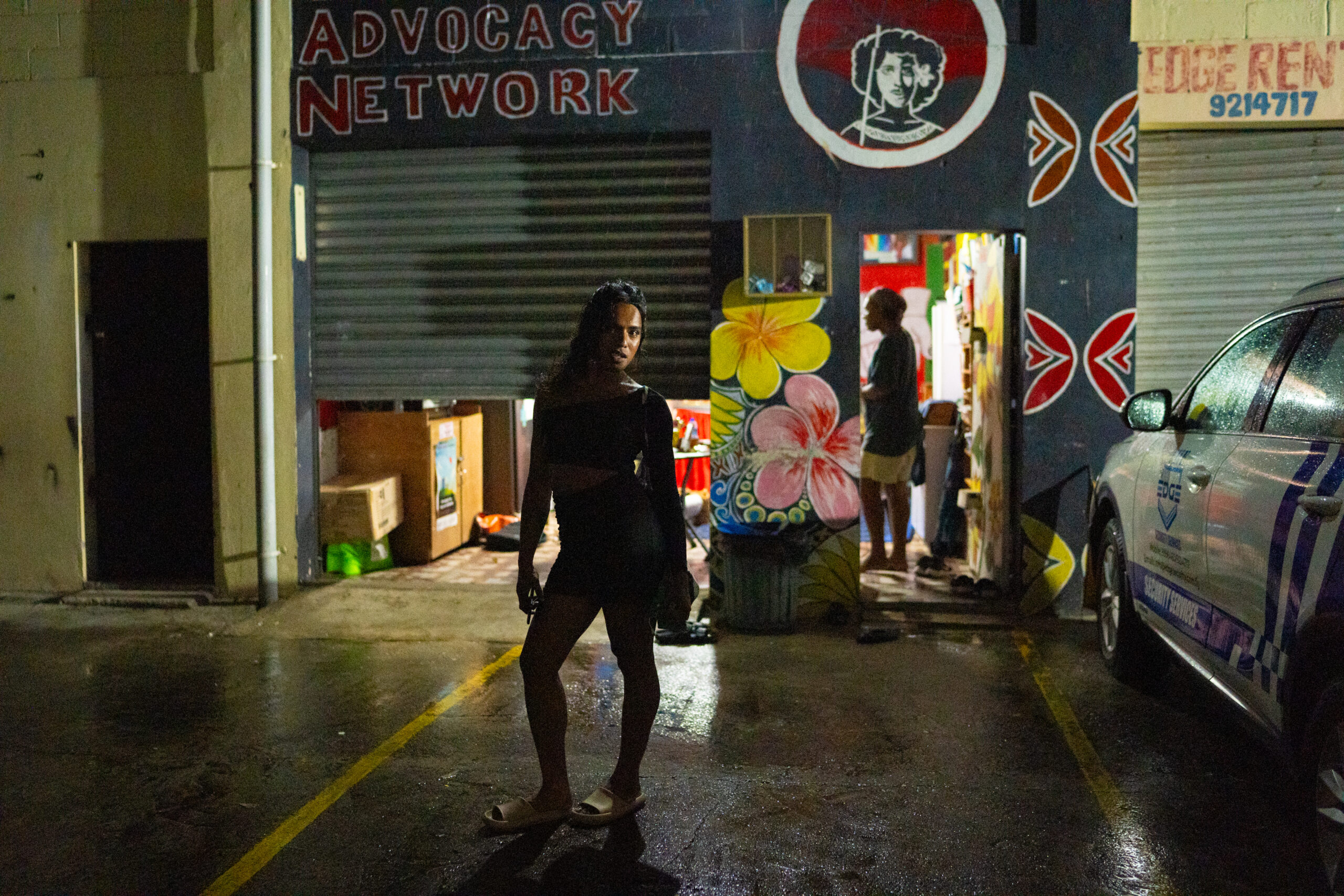
A sex worker waits outside the Survival Advocacy Network, a safe haven for the LGBTQ+ and sex worker community in Fiji that in recent years has also served injecting drug users and provides free HIV testing.
Fiji — a tourist destination known for its exclusive resorts, pristine waters, and white-sand beaches — now has one of the fastest-growing rates of HIV infection in the world, overburdening its donor-dependent public health system. More than 1,583 new HIV infections were recorded in 2024 in a country with a population of less than 1 million — the highest ever in Fiji’s history, and a 500% increase from 2018.
That number, according to preliminary assessments from the Joint U.N. Program on HIV/AIDS (UNAIDS) and Fiji’s Health Ministry, is expected to double again this year to more than 3,000. And public health officials believe the true number of those infected is closer to double that, as many exposed Fijians have not yet been tested, especially on more remote islands.
Conditions here “were a recipe for an explosive epidemic,” said Jason Mitchell, who leads the Fijian government’s HIV task force. “We have a long way to go … before we see the end of this.”
A majority of these new cases have been recorded among young people between ages 15 and 34, while a growing number of mothers are passing the infection on to their babies, according to local health statistics; half of the new infections are linked to drug use.
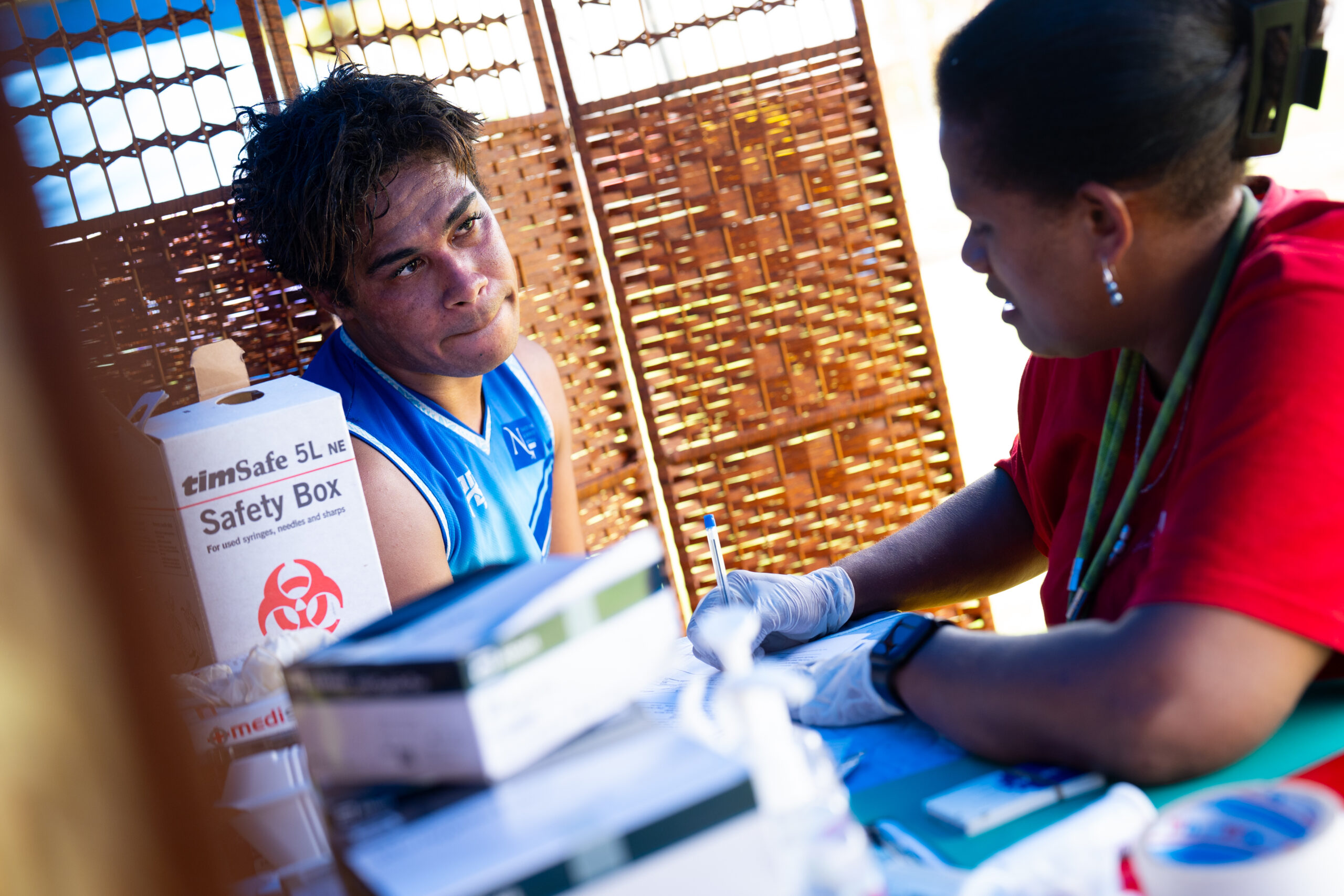
The Reproductive and Family Health Association of Fiji (RFHAF) gives free HIV tests at a sporting event. Isoa Fou, 26, wasn’t ashamed to be getting a test and feels concerned about what’s going on in the country.
Experts in both public health and transnational crime believe that Fiji is the starkest example of a phenomenon that is taking hold across the Pacific region: Rising HIV infections track drug shipment routes across islands that are smaller, more isolated and have significantly less testing for the virus, including in Tonga, Samoa, and the Solomon Islands.
Those islands “all have the early signs that Fiji had in 2019,” said Renata Ram, UNAIDS’ country director in Fiji. Ram raised alarm bells of an impending HIV crisis in a 2022 article, warning that risky behaviors commonplace in Fiji were spreading to other parts of the Pacific.
Law enforcement officials, customs agencies, U.N. officials and others who investigate drug syndicates believe that the groups operating in and around Fiji are working with each other, bringing together Chinese triads, Mexican cartels, Australian biker gangs, and other syndicates with connections as far away as Nigeria.
Criminal organizations are targeting our region “because they understand our enforcement limitations to monitor across vast maritime territories using traditional enforcement methods,” said the Oceania Customs Organization Secretariat, a 24-member association that helps coordinate customs and border enforcement for Pacific nations, in a response to questions from the Washington Post. “We’re witnessing unprecedented coordination between drug cartels, organized criminal groups and regional networks.”
That cooperation presents a huge challenge and has “thrown traditional narcotics work out the window,” according to one U.S. law enforcement official who, like others, spoke on the condition of anonymity to discuss counternarcotics operations. Criminal organizations from different countries, rather than violently seeking to secure turf, are working together in Fiji, law enforcement officials say, much like a diversified multinational corporation.
“Those guys are going to make deals along the chain, even though they technically would be looked at as adversaries,” the U.S. law enforcement official said, “because at the end of the day they are going to do what it takes to succeed.”
At the same time, international law enforcement agencies have been reticent to share intelligence with their Fijian counterparts, prosecutors said, because of allegations that drug syndicates have infiltrated the police and other agencies.
In December, leaked chats on Viber, a messaging app commonly used in Fiji, allegedly showed police officers texting with traffickers about moving drugs. Seven senior officers are now under investigation in connection with that case, according to Fiji’s Ministry of Policing. Between January 2023 and October of last year, before the Viber investigation, 27 police officers were charged with drug-related offenses, the ministry said.
John Rabuku, Fiji’s deputy director of public prosecutions, who last year secured convictions up to life in prison in connection with the Pacific’s largest-ever drug bust, acknowledged in an interview that these were only “middle-level people … involved in the logistics.” Even at trial, he said, prosecutors were unable to show the drugs came from a particular group. The syndicate had brought in 4.1 metric tons (about 4.5 U.S. tons) of methamphetamine worth over a billion dollars into Nadi, Fiji’s main tourist area, on a yacht in December 2023.
“No one would give us that information,” Rabuku said. “The offshore intelligence community … just didn’t want to tell us.”
Guests wait outside a nightclub in Suva in December.
White money
Joseph was a singer in a reggae band, performing for tourists at beach bars, when a contact he knew approached him about selling marijuana. The 47-year-old, who spoke on the condition that only his first name be used because of security concerns and ongoing criminal cases against him, started dealing, mostly selling locally grown product to foreigners.
A few years before the COVID pandemic, he and others said, meth started hitting the streets, first as a party drug for tourists and wealthy Fijians. The drugs, according to the U.N. Office on Drugs and Crime (UNODC) and law enforcement officials, were from shipments transiting to Australia and New Zealand, where meth is growing in demand and exceptionally lucrative, selling for 18 times what it retails for in the United States, according to law enforcement officials and other experts on the drug trade.
When COVID-19 hit, putting a freeze on tourist arrivals and complicating the transport of drugs in and out of Fiji, traffickers started paying runners in the drug itself — “white money,” as it is called on the streets. Joseph and experts on organized crime said dealers started selling meth locally to turn their pay into cash.
“That payment in kind became the origin of the domestic market,” said Virginia Comolli, head of the Pacific program at the Geneva-based Global Initiative Against Transnational Organized Crime. There was so much that dealers “didn’t know how to price it,” she said, while users themselves had no idea how addictive the drug could be.
As supply exploded and prices fell, meth quickly spread among the urban poor, sex workers and other marginalized communities.
“It was the ‘in thing’ for us,” said Rochelle Naulunimagiti, a 37-year-old transgender sex worker and activist. “All the girls were on it.”
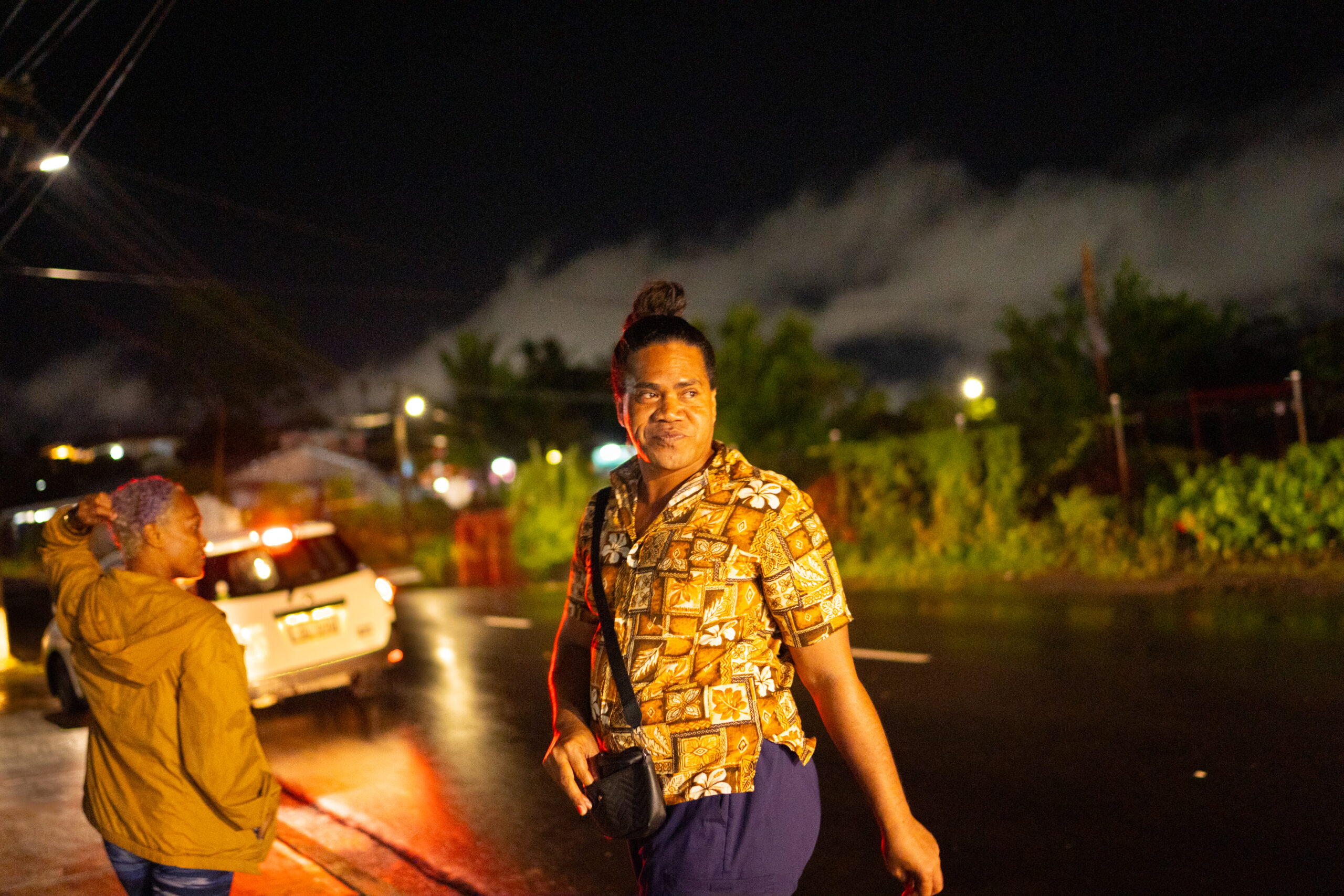
Rochelle Naulunimagiti, 37, a trans sex worker and community activist, shared a needle with a friend one night when she was desperate to get high, amid an especially tough period in her life. A few months later, she tested positive for HIV, a diagnosis that initially crippled her.
In Fiji, just as a single cigarette is often shared among a group of smokers and as the traditional psychoactive drink, kava, is passed around in a single cup, needles too were shared, community workers and users said.
Friends would sit and inject in a group, using shared bottle caps or other mixing paraphernalia to dissolve the crystals into an injectable liquid. Often, just one person — called the “doctor” — would be in charge of administering the drug, injecting the others, users and community workers said. In rare cases, addicts injected themselves with the blood of a person who was already high to get a residual hit. But the high was never as strong. On one evening, reporters from the Post observed a user injecting “raw,” as it is called here: using their own blood, instead of water, to dilute the crystals, and then injecting the mixture back into their veins.
Ben Morrison, who co-founded Inspire Pacific, which runs a camp for boys who are grappling with drugs and violence, said about 30% of those in the cohort are HIV-positive, most through needle-sharing.
For them, “HIV is like, what’s that? OK, I got a sickness, but look at my life. I don’t have a dad, I don’t have a home, I don’t eat on a daily basis,” Morrison said. “So what’s another diagnosis from a doctor to me?”
Sometimes, though, the risks were clear to users. Naulunimagiti knew better, she said. But one night in 2023, grappling with depression, she said she “really needed that feeling.” She took a needle from a friend and injected herself. Several months later, she tested positive for HIV.
“I was a leader in the community,” Naulunimagiti said through tears. “I thought, what would people think of me?”
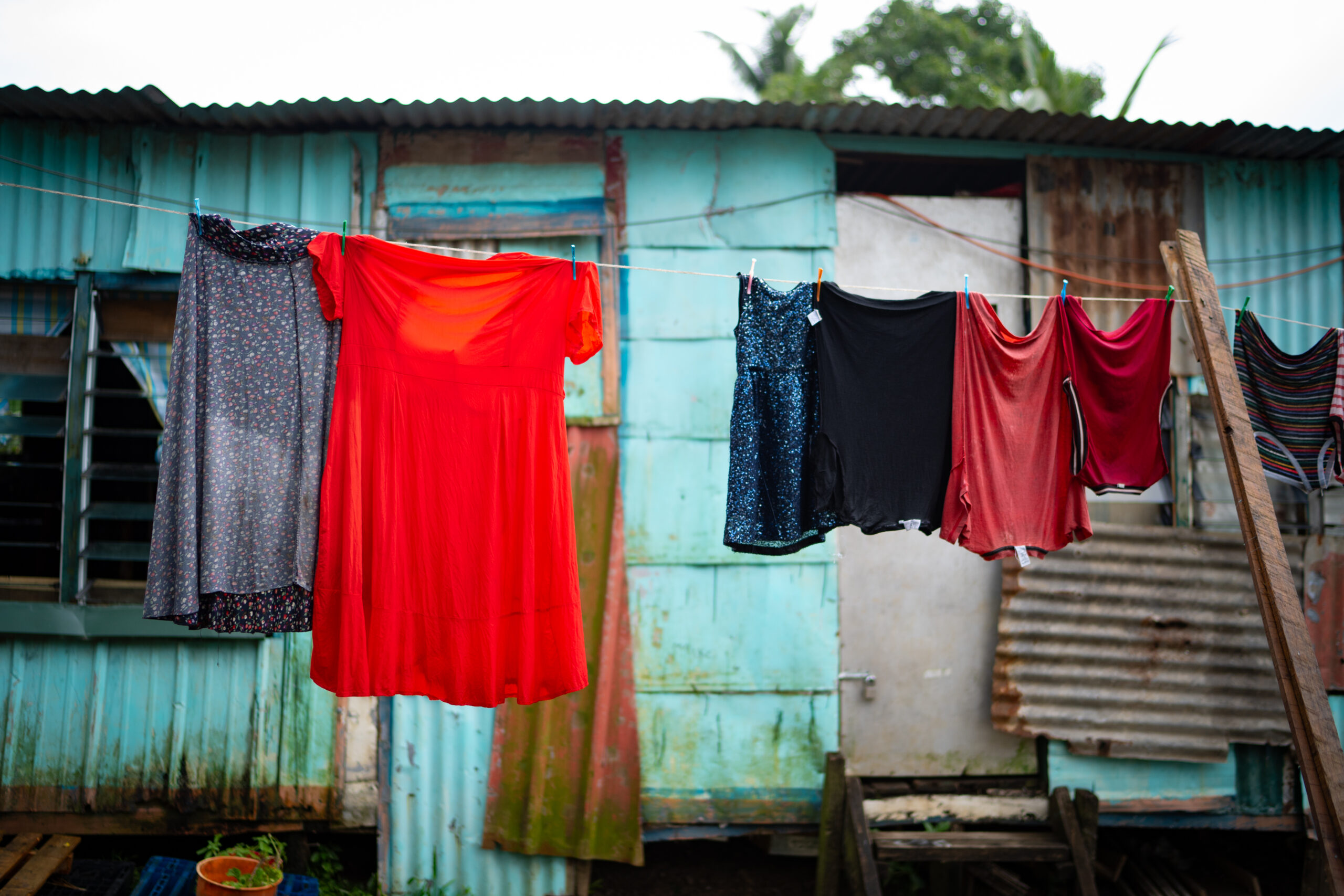
Laundry hangs on a line in an urban squatter community in Suva.
Culture of silence
Mark Shaheel Lal, a 24-year-old student, was walking through the streets of Suva one afternoon when a driver rolled down his window and shouted, “he has AIDS!” before speeding off. It wasn’t the first time, he said. Just a few months earlier, someone pointed at him and called out, “HIV.”
Just weeks before Fiji’s government officially announced there was an HIV outbreak in the country, Lal, a gay man who is not a drug user, came out as HIV-positive. In a nation where a culture of silence still exists around the diagnosis, Lal’s declaration made him a face of the epidemic, as well as a source of information for many HIV-positive Fijians. Through his Facebook page, Living Positive Fiji, Lal has counseled more than 100 newly diagnosed HIV patients over the past year, helping them navigate their diagnosis.
Mark Shaheel Lal, 24, came out as a HIV-positive in 2024, hoping to break the “culture of silence” around the diagnosis.
“I know how I felt when I got that note,” Lal said. “I thought my world was ending. It even came to a point where I thought I should take my own life because I was going to die anyway.”
Some who have reached out to him have been hesitant to get treatment, believing that since they are not showing any signs of sickness, the diagnosis must be incorrect. Advances in antiretroviral therapy mean HIV is no longer the death sentence it once was — but only if detected early and if someone is receiving treatment. Fiji’s public health officials are also pushing for Pre-Exposure Prophylaxis (PReP) medication for high-risk groups, which can prevent people from contracting HIV altogether.
Of the more than 120 people who died of HIV-related causes in Fiji in 2024, more than half found out their status the same year, according to data from the Health Ministry, long after their immune system had already been fatally compromised.
Lal holds his HIV medication pills.
Accessing critical medication has also not always been straightforward. At one point in late 2024, Lal and Naulunimagiti said, there were no antiretroviral pills in the country. There was also a shortage of specimen bottles for further testing, which Lal raised money for and then donated to the local reproductive health clinic.
In recent months, both Australia and New Zealand have pledged millions to Fiji’s effort to get the HIV epidemic under control. The Fijian government was separately in discussions with the U.S. Agency for International Development (USAID) for additional funding and the U.S. Centers for Disease Control and Prevention (CDC) for help investigating the origins of the epidemic and the specific strain of HIV the country was dealing with, according to people familiar with the conversations. Both discussions did not progress under the Trump administration, which took office soon after Fiji declared its epidemic. USAID had just reopened its regional mission in Fiji in late 2023 after more than a decade.
A spokesperson for the CDC, in response to questions from the Post, referred queries to the Department of Health and Human Services, which referred the Post on to the State Department. The U.S. Embassy in Suva did not respond to a request for comment.
Ships in the waters off Fiji.
New year, new bust
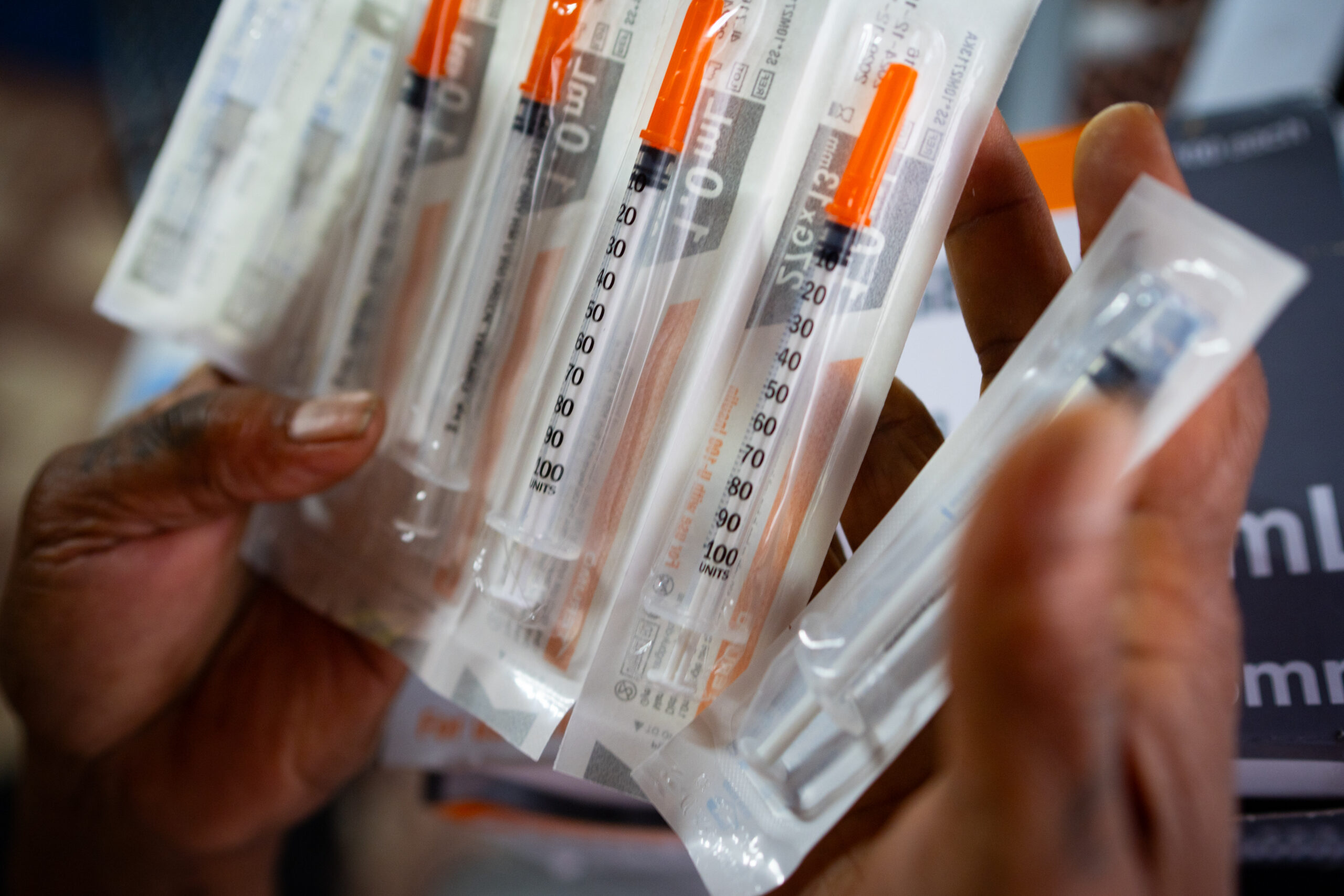
On a recent afternoon in Fiji, a community worker sitting in a taxi rolled down the window, stuck out their hand and brandished a handful of new syringes, still wrapped in sterile packaging, to a group of zombielike men, scar tissue marking their forearms, sitting outside an alcohol store.
It took them a minute to register that the syringes were free handouts. They rushed to the car, grabbed the syringes and asked for more.
Needles have now become almost as valuable as the drug itself, as awareness of safe injecting practices grows in the country. Providing needles remains illegal, however. Participants in the WHO- and UNDP-commissioned assessment on drug use said they “without exception … reported difficulties accessing sterile needles and syringes for injection,” particularly in pharmacies, which are reluctant to give them out without a prescription.
“Carrying the syringes sometimes feels just as risky as carrying weed or dope,” Joseph said.
Needles have become almost as valuable in Fiji as meth itself, as awareness of safe injecting practices grows in the country.
A needle and syringe program, where sterile needles are distributed free with no questions asked, is in the pipeline and likely to be implemented later this year after cabinet approval. The WHO, in its assessment, identified it as one of the highest priorities for Fiji.
Meanwhile, the drugs keep coming. On Jan. 16, Fijian police raided a vessel off a wharf in the northwest of the country and found more than 2 metric tons of cocaine, packed in over 100 sacks. Prosecutors have charged six — four Ecuadoran nationals and two locals — in connection with the trafficking case. The drugs, prosecutors said, came in through semisubmersible vessels known as “narco subs.” Also so far this year, two senior police officers, who have since been suspended, were charged with illegally importing and possessing meth.
“A culture of participation” in the drug trade has “seeped into our police force, our institutions and our society,” said Rabuku, the deputy public prosecutor, undeterred even by recent life sentences. As long as that does not change, he added, Fiji will “always remain a transit point for drugs.”