Category: Washington Post

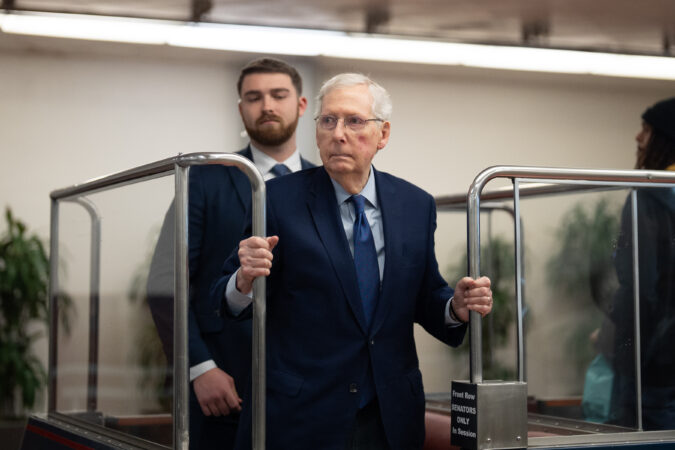
  • Mitch McConnell is taking a beating in the race to replace him

    Mitch McConnell is taking a beating in the race to replace him

    One Republican candidate to succeed Sen. Mitch McConnell introduced himself with an ad that shows a cardboard cutout of the longtime Senate majority leader in the trash.

    Allies for a rival hit back with ads that noted the first candidate gave McConnell money.

    And Daniel Cameron, the former Kentucky attorney general once considered a McConnell protégé, is now keeping his distance.

    “I’m my own man,” Cameron said in an interview, later suggesting McConnell donors prefer one of his opponents.

    The Senate primary to replace 83-year-old McConnell shows how profoundly the GOP base in his home state has soured on one of the most powerful and significant political figures in Kentucky history. McConnell drew low approval ratings for years but fended off challengers by flexing his raw clout and ability to deliver for his state.

    While he at times expressed frustration or anger with President Donald Trump, McConnell used his political muscle to cement much of the president’s first-term legacy, including a 6-3 conservative majority on the Supreme Court that has helped pave the way for an even more disruptive second term.

    But many in the MAGA movement still view him as the embodiment of the GOP establishment that sought to hold Trump back. Three former interns for McConnell have distanced themselves while running to succeed him, pitching themselves as “America First” Republicans in Trump’s mold.

    Cameron says voters don’t want a candidate who is “just bashing an old man” — a rebuke of his opponent Nate Morris, a businessman backed by national MAGA stars whose vociferous attacks on McConnell have alienated some Republicans in the state. Many operatives argued his initial assault went too far.

    Still, it’s clear that ambitious Republicans have diverged from the towering conservative figure, who is set to retire next year after four decades in Congress.

    “This is a fight for the future of the Republican Party … Donald Trump’s Republican Party,” said Morris, a friend of Vice President JD Vance, in an interview. “And certainly, if you’re with Mitch McConnell, you’re not part of that future.”

    Terry Carmack, McConnell’s chief of staff, said the senator has secured more than $65 billion in extra federal funding for Kentucky over his career — for military bases, hospitals, law enforcement and more — and added that the state “deserves a Senator who will fill those shoes.”

    “As Kentucky’s longest-serving Senator and the nation’s longest-serving Senate leader, Senator McConnell’s job stayed the same: ensuring Kentucky always punched above its weight,” Carmack said in a statement.

    The primary is effectively a three-way race between Morris, Cameron and Rep. Andy Barr, who touts that he was the Kentucky chairman of Trump’s 2024 campaign. Whoever wins the May 19 GOP contest is likely to represent the solidly red state.

    The fact that all three have ties to McConnell reflects how much in Kentucky GOP politics traces back to the senator. The state Republican Party headquarters bears his name, and he has helped many other GOP officeholders over the years.

    “I challenge anybody who takes this seat to do what he’s done,” said Frank Amaro, the GOP vice chair for Kentucky’s 1st Congressional District.

    The campaign jabs at McConnell have been frustrating to many who have worked with him over the years and say he deserves respect, pointing to his hardball tactics that pushed the courts nationwide to the right and the money he has steered toward Kentucky. The state got nearly $2.6 billion in extra federal funding this fiscal year, according to McConnell’s office.

    “You don’t have to like someone for them to be your go-to to deliver results,” said Iris Wilbur Glick, a former political director for McConnell who called candidates’ positioning on the senator “very disappointing.”

    But many Republicans are critical — especially of his relationship with Trump. Trump has repeatedly attacked him. McConnell held Trump “practically and morally responsible” for the mob that stormed the U.S. Capitol on Jan. 6, 2021, though his vote against impeachment helped enable Trump’s comeback.

    After Trump won in 2024 and McConnell stepped down as majority leader, he opposed some of Trump’s most controversial Cabinet picks — casting the only GOP vote against Robert F. Kennedy Jr. for secretary of health and human services.

    A December Economist-YouGov poll found that 21 percent of Republicans nationally had a favorable view of McConnell, while 55 percent had an unfavorable view. In interviews, Kentucky voters often knew little about the Senate race or the candidates — but knew they didn’t like McConnell.

    “I want him out of there,” said Julie Jackson, a 56-year-old Republican.

    Cameron, who once worked as McConnell’s legal counsel and rose in politics with his mentorship, launched his Senate campaign last year with an attempt to separate himself. Days after announcing, he put out a video rebuking McConnell for opposing Trump’s Cabinet picks.

    “What we saw from Mitch McConnell in voting against Pete Hegseth, Tulsi Gabbard and RFK was just flat-out wrong,” Cameron said in the video. “You should expect a senator from Kentucky to vote for those nominees to advance the America First agenda.”

    A year later, one of Cameron’s biggest challenges is raising money — a struggle some Republicans in the state attribute in part to his break with McConnell.

    “Daniel Cameron relied heavily on his connections to McConnell-world in his previous races for fundraising, and that’s simply not an avenue that’s available to him for this race, and it shows in his fundraising reports,” said Tres Watson, a Republican strategist in Kentucky.

    Cameron notes that some McConnell donors have backed Barr — who leads the pack on fundraising. Attack ads on Barr from a group affiliated with the conservative Club for Growth featured old footage of Barr calling McConnell a “mentor.”

    Barr has kept his distance from McConnell, too, however, tying himself to Trump.

    “Thank you for giving me a chance to work with this president to make America great again,” he said to close his speech at recent GOP dinner. His team declined an interview request.

    Trump has stayed out of the Senate race and often avoids weighing in on primaries absent a personal grudge or clear polling leader. But prominent Trump allies have lined up behind Morris, the businessman and friend of Vance. Morris said the vice president called him last year encouraging him to jump into the Senate race, saying that “we’re going to need somebody in that seat that’s not going to stab our president in the back.” Vance allies work on Morris’s campaign and a supportive super PAC.

    Charlie Kirk, the late conservative activist, endorsed Morris before he was killed in September. Morris “is not going to be beholden to the McConnell machine,” said Andrew Kolvet, a spokesman for Kirk’s group Turning Point, who called McConnell a “relic.”

    Elon Musk, the billionaire tech CEO who has become a major force in GOP politics, rocked the primary by putting $10 million behind Morris this year after a meeting where he came away impressed in part by Morris’s anti-McConnell message, according to a person familiar with the matter who spoke on the condition of anonymity to discuss private conversations.

    “[McConnell] has had a stranglehold on Kentucky for 40 years, and it is not the easiest thing to challenge the McConnell mafia right here in the Bluegrass State,” Morris said last month on the podcast of Trump’s eldest son, Donald Trump Jr. — where he also launched his campaign. “But we’ve done it and we’ve gone straight for the jugular of Mitch and his cronies.”

    The message hasn’t always gone over well. Morris was roundly booed last year at an annual Kentucky political picnic where the former garbage company CEO declared he would “trash Mitch McConnell’s legacy.”

    “A lot has changed in politics, but you still have to introduce yourself, and he started out just attacking people,” said Adam Koenig, a former GOP state lawmaker.

    Morris dialed back his attacks at a recent event in northern Kentucky, mentioning McConnell only in passing. But he made his antipathy clear.

    “We cannot go back to what we’ve had the last 40 years,” he said.

  • First major protests since capture of Maduro test Venezuela’s new leader

    First major protests since capture of Maduro test Venezuela’s new leader

    CARACAS, Venezuela — Hundreds of protesters took to the streets in Venezuela’s capital and across the country last week for Youth Day, asserting their right to demonstrate and calling for acting president Delcy Rodríguez to release political prisoners.

    Thursday’s rallies, which proceeded peacefully, were seen as a test for the new government — the first major show of opposition in the streets since the U.S. capture Jan. 3 of President Nicolás Maduro, and since security forces made thousands of arrests in a large-scale crackdown on dissent in 2024, after Maduro claimed victory in an election that evidence shows he lost.

    “We are not afraid anymore,” Zahid Reyes, 19, a student leader at the Central University of Venezuela in Caracas, said as he was getting ready to join a campus rally. “Venezuela has changed.”

    “Amnesty now,” read banners at campus entrances.

    An air of excitement prevailed, among the hundreds of students looking to give new voice to an opposition that faced increasingly harsh repression in recent years. Police and security forces cordoned off the area.

    Miguel Angel Suarez, also from the Central University of Venezuela, said he was proud of students for claiming their right to protest. After Jan. 3, an opportunity opened, he said. “The fight will continue until we are heard.”

    Venezuelan lawmakers are debating a mass amnesty of political prisoners, under pressure from the United States. Hundreds have been released since U.S. forces seized Maduro in a surprise raid that left at least 32 people dead — in what Venezuela’s government condemned as an illegal attack — and brought him to New York to face narco-terrorism charges, but an even larger share remain behind bars.

    “I am filled with hope,” said Aryeliz Villegas, 22, a student at the university. “Whenever the country breaks down, the youth rise up.”

    The demonstrations come as U.S. and Venezuelan relations are undergoing a fundamental change: President Donald Trump has forged ahead with plans to work with the authoritarian, socialist government of Maduro’s successor, Rodríguez, to open the country’s oil sector to the U.S. — while keeping at arm’s length the opposition, including Nobel laureate María Corina Machado, the key opposition leader in exile.

    Many young activists say Maduro’s ouster feels like a fundamental shift, even if the opposition remains far from power. Andrea Isea, 33, a law student at the university, said the events of recent months have given her a new sense of purpose in her chosen profession. “I used to think about why I was going to all this trouble to study law in this country, but after January 3rd, I can see that there can be a future here for us students,” she said.

    In downtown Caracas, Maduro loyalists held their own Youth Day celebration, with government support, calling for his return. Demonstrators said he had been kidnapped and remained the rightful president. Music from the Puerto Rican artist Bad Bunny blared from speakers, as organized groups — many of them teenagers in school uniforms — danced, drummed, and marched under a warm sun.

    Rodolfo Machado, 24, a city official focused on youth employment, said he thought Venezuela should continue “fighting against Westernism,” and that the U.S. exploits South America. “Delcy Rodríguez carries Nicolás Maduro’s mandate because she is a person who is prepared to continue fighting,” he said.

  • Trump claims victory on affordability as public anxieties persist

    Trump claims victory on affordability as public anxieties persist

    The White House is declaring victory on turning around the economy, after months of aides’ urging the president to find a more empathetic tone on Americans’ financial struggles.

    But public attitudes about the economy have not risen to match the record-breaking stock market and expectations-beating inflation and jobs report, defining the challenge for the president’s party in November’s midterms. Most Americans say the economy is on the wrong track and disapprove of Trump’s handling of it, recent surveys show.

    The gap between macroeconomic indicators and public sentiment echoes the dynamic that encumbered Trump’s predecessor, which the current president is similarly hoping to overcome through direct appeals to voters.

    “I think we have the greatest economy actually ever in history,” Trump said in an interview with Fox Business’s Larry Kudlow that aired on Tuesday. “I guess I have to sell that because we should win in a landslide.”

    Since the fall, advisers sensitive to the persistent pinch of higher prices urged Trump to modulate his tone on the economy by acknowledging the pain, blaming the conditions on former President Joe Biden, and highlighting his efforts to tame inflation. White House spokespeople and surrogates proved more faithful to that message than the president himself, who largely continued to insist that the economy was great and he deserved more credit.

    Trump’s preference has now prevailed thanks to a record-high stock market, surprisingly strong January job numbers, and easing prices for gas, groceries, and housing.

    “President Trump is absolutely right to celebrate inflation finally cooling and real wages finally growing for everyday American workers,” White House spokesperson Kush Desai said.

    “While Biden downplayed and ignored this reality, President Trump has been focused on ending the Biden economic disaster since Day One with policies that work. That’s why inflation has cooled, real wages are up, and GDP growth has far surpassed expectations.”

    The Dow Jones Industrial Average closed at about 50,000 points for the first time on Tuesday, and the S&P 500 is also trading at all-time highs. The economy added 130,000 jobs in January, more than double economists’ forecast. A gallon of gas averaged $2.94 on Wednesday, the lowest for this time of year since 2021, according to AAA. And inflation in January dropped to a low last seen in May, before Trump raised tariffs.

    “We’re hitting all-time-high stock numbers,” Trump said Friday in a speech to troops at Fort Bragg in North Carolina. “All I know is forget about the stock market, forget about Wall Street, your 401(k)s are doing very well. I don’t have to ask you, ‘Is anybody doing poorly with their 401(k)?’ If they were, you’re a pretty bad investor.”

    But the positive signs are unevenly felt, and skew toward the wealthy. About 40% of adults in the U.S. do not have a 401(k) or any other retirement savings account, according to a 2025 Gallup survey. Consumer sentiment among people without stock holdings remained near its lowest level since at least 2018, and the overall average was about 20% lower than in January 2025, according to the University of Michigan’s benchmark survey.

    Desai said the stock market highs reflect pro-business policies that are driving investment and will create jobs and increase wages. Most business spending and stock market increases are driven by investments in artificial intelligence by tech companies such as Microsoft, Google, Amazon, and Meta. The data centers they’re building demand electricity and produce fewer jobs than traditional factories, and some members of Trump’s coalition, such as Tucker Carlson, argue that AI will reduce American jobs in the future.

    Fifty-nine percent of Americans disapprove of Trump’s handling of their cost of living, 43% strongly, according to a Reuters-Ipsos poll conducted Jan. 23-25. He performed better on employment and jobs, though half of respondents still disapproved. The survey found only 28% of Americans said the economy is on the right track.

    White House officials also pointed to a four-year low in median national rents and a four-year high in the Intercontinental Exchange’s measure of mortgage affordability. But those measures offer only a partial snapshot. To return to pre-pandemic affordability levels, household incomes would need to rise more than 15% while home prices remain flat, the exchange reported this month. Grocery prices remain volatile, with some falling and others rising — a mix that has made day-to-day food costs uneven for consumers.

    “I brought prices way down,” Trump said in response to a question from the Washington Post last week. “You don’t hear it anymore — when I first came in, the Democrats were screaming ‘affordability.’”

    Mark Mitchell, the head pollster at the conservative Rasmussen Reports, has been critical of the Trump administration’s emphasis on a surging stock market while young Americans are experiencing difficult job and housing markets. “Let them eat S&P,” he wrote repeatedly on X in response to videos of Trump and top administration officials touting stock performance.

    White House officials acknowledged that voters are hard to persuade about their own personal financial circumstances. Since the start of the administration, economic advisers regularly met to focus on policy actions that would deliver benefits Americans would feel in time for the midterms, one of the officials said. The White House was determined to adopt tax cuts earlier than in Trump’s first term to ensure refunds would begin reaching households in 2026.

    The White House is also counting on more momentum, including interest rate cuts from Trump’s new pick to chair the Federal Reserve, Kevin Warsh, and cheaper prescription drugs available through government-negotiated deals on a website called TrumpRx. The website currently lists 43 medications. Desai said the administration is working to add more pharmaceuticals from companies with existing deals and through negotiations with other drugmakers.

    “There’s reason for some hope” now for Republicans in Congress, said Gregg Keller, a GOP strategist working for a super PAC supporting Texas Attorney General Ken Paxton in the state’s Senate race. “If the economy rolls this year and if voters give Trump and Republicans credit for it, that bodes well [for] us avoiding a drubbing in the elections.”

    Voters say Trump’s economy is better than Biden’s, but they want to hear more about what the administration is doing to ease everyday costs of living, according to Mitch Brown, a partner at the Republican polling firm Cygnal. Only 30% of voters can handle an unexpected expense of $1,000 or more, heightening their anxiety, Brown said.

    “President Trump knows this and his administration is working to not only address these concerns with policy, but getting the rest of the GOP to hit this message hard that we have done great work but will continue to fight hard to lower costs in the midterms,” Brown said. “Democrats don’t hold a majority of voters’ trust on a single issue, so the opportunity to keep the majority is well within the GOP’s grasp.”

    Whit Ayres, a longtime Republican consultant specializing in polling, said while people with “substantial resources invested in the stock market” are satisfied with a surging Dow, the data suggest “most Americans are still not happy” with progress on inflation and the strength of the economy.

    “Presidents who’ve done a good job capturing the sentiments of the American people are those who articulate a message that is consistent with what most people feel,” Ayres said. “Bill Clinton was probably the best of anyone at that, but it’s very difficult to persuade Americans to believe something they’re not feeling in their daily lives.”

    House Republicans need Trump to use the full weight of his presidency to make the case that his administration has brought down the cost of living, said longtime GOP strategist Ron Bonjean.

    “House Republicans are entering a really dangerous phase. They have to defy history. They need everything,” he said. “They need a president who has the loudest megaphone in the country’s history.”

  • South Koreans are shunning dangerous shipbuilding jobs envied by Trump

    South Koreans are shunning dangerous shipbuilding jobs envied by Trump

    South Korea has promised to help “Make American Shipbuilding Great Again,” pitching its world-leading shipyards to President Donald Trump as a model to revive U.S. manufacturing and create desirable blue-collar jobs. But in reality, the sector is reliant on low-paid migrants and plagued by a high accident rate. Shipbuilding is among the country’s most dangerous industries, killing dozens of people each year, prompting more South Korean workers to shun those jobs — a growing problem for Lee Jae Myung, the nation’s leader.

    “If we bring in foreign workers on around 2.2 million won ($1,500) a month to fill shipyard jobs, we have to ask what happens to domestic employment, and whether that truly helps the long-term development of the industry,” Lee said at a cabinet meeting Tuesday.

    At first glance, the country’s shipyards are formidable: fast, cheap, and relentlessly efficient. Seoul made the industry an integral part of a $350 billion trade agreement with the U.S., and has also sought to leverage it into contracts for military vessels and permission to build nuclear-powered submarines. Yet a closer look reveals a more complicated picture. South Korea’s occupational fatality rate is almost 4 deaths per 100,000 workers, vs. an OECD average of roughly 3, according to International Labour Organization data compiled by Bloomberg. Risks are especially acute in shipbuilding, where the fatality rate in 2024 was more than four times the national average, government data showed.

    South Korean President Lee Jae Myung (center) and Pennsylvania Gov. Josh Shapiro (left) visited the Hanwha Philly Shipyard in August 2025 in Philadelphia. The event marked the christening of the NSMV State of Maine and highlighted growing industrial and strategic cooperation between South Korea and the United States.

    The safety record helps explain why many skilled Korean workers have deserted the yards. To keep up production as big orders roll in, shipbuilders have turned to foreign workers, often using layers of subcontracting to keep costs low.

    As of April 2025, more than 23,000 migrant workers hold the main work visas used in South Korea’s shipyards, industry data shows. The government has repeatedly eased strict quotas, now allowing foreigners to make up as much as 30% of the workforce in certain skilled shipbuilding roles — one of the highest rates of any sector. The data point to a central contradiction: The productivity Washington admires is sustained by jobs many Koreans no longer take, filled instead by workers with far fewer options to refuse them. This sits uneasily with Seoul’s $150 billion pledge to support a revival of U.S. shipbuilding and U.S. manufacturing jobs.

    Modern servitude

    “What worries me most is that we’re exporting a shipbuilding model whose reality is barely sustainable at home,” said Kim Hyunjoo, head of the Ulsan Migrant Center. “If this industry is being kept afloat by highly constrained foreign labor, it’s hard to see how that model can simply be transplanted to the U.S., where regulations and scrutiny are far stricter.”

    Aslam Hassan, a migrant worker from Sri Lanka, was injured while working at a shipyard in Ulsan, South Korea. “When you look closely at migrant worker visas, it feels like they were designed to create a kind of modern servitude.”

    Three years ago, while working at a shipyard in Ulsan, a sudden blast from a high-pressure spray machine knocked Sri Lankan worker Aslam Hassan to the ground, shattering his protective gear and shooting toxic paint into both eyes.

    “As I fell, I thought, ‘So this is how I die, without even seeing my baby,’” said Hassan, who was working as a subcontractor at the time. His vision never fully recovered.

    His experience reflects the dangerous conditions that underpin South Korea’s shipbuilding efficiency. Government data show nonaffiliated workers, including subcontracted and dispatched labor, make up about 63% of shipbuilding employment, far above the economy-wide average of roughly 16%.

    “When you look closely at migrant worker visas, it feels like they were designed to create a kind of modern servitude,” said Hassan, who now works for an auto parts company after his injury. “During the contract period, we can’t move even in unfair conditions.”

    Safety rules are enforced more strictly during regular shifts for directly employed workers, one migrant worker told Bloomberg News, asking not to be identified as he’s not authorized to speak publicly. More hazardous tasks are often pushed to subcontractors, who are called in early, late, or overnight, when oversight is looser.

    Demand is growing as the industry enjoys a new boom that puts further strains on its workforce. Fresh orders last year reached nearly $36 billion for HD Korea Shipbuilding & Offshore Engineering Co., Hanwha Ocean Co., and Samsung Heavy Industries Co., accounting for about 20% of global new ship orders by volume, according to SK Securities.

    Shipbuilding ties have also bolstered Seoul’s security goals. President Lee has received Trump’s conditional approval to pursue nuclear-powered submarines, a long-standing ambition. But the growing strategic role has raised the stakes.

    Tensions have also become more acute in recent weeks, with Trump warning that the U.S. could again raise tariffs on South Korean goods, citing frustration over what he sees as slow or uneven follow-through on trade commitments. The threat has pushed senior officials back to Washington to explain delays and reassert Seoul’s promises.

    Further straining ties is South Korea’s probe into a massive data breach at Coupang Inc., the Seattle-headquartered e-commerce firm known as the “Amazon of South Korea.” Vice President JD Vance has framed Seoul’s actions as an assault on the U.S. tech sector.

    With the trade deal still very much up in the air, shipbuilding — as one of the highest-profile deliverables — is under the microscope. And any failure to deliver what has been promised could derail the entire agreement.

    Ignoring rights

    The sector’s heavy reliance on migrant workers on restrictive contracts is also likely to pose problems in any wholesale export of the model stateside, experts say. South Korea is painfully aware of Trump’s anti-immigrant drive after Hyundai and LG workers were detained in a massive Immigration and Customs Enforcement sweep at a battery plant in Georgia last year, just weeks after Lee first met Trump.

    Sri Lankan welder Manoj Wijesekara paid a broker to secure a skilled-worker visa and a job at HD Hyundai Heavy Industries Co. When the pay turned out to be far lower than expected, Wijesekara resigned — only to discover that his visa effectively tied him to HD Hyundai, leaving him unemployed and at risk of deportation.

    In the shipyards, many South Korean companies rely on a visa regime that binds overseas workers to a single employer, limiting their ability to change jobs, experts say. Sri Lankan welder Manoj Wijesekara paid a broker about 20 million won to secure a skilled-worker visa and a job at HD Hyundai Heavy Industries Co., hoping the move would allow him to support his two children.

    When the pay turned out to be far lower than expected, Wijesekara resigned — only to discover that his visa effectively tied him to HD Hyundai, leaving him unemployed and at risk of deportation. He says the company misled him. The company says he resigned of his own accord. The dispute is pending before South Korea’s National Labor Relations Commission.

    “I am terrified to speak out for fear of being deported,” said Wijesekara, who missed his mother’s funeral in November but said he was determined to hold his former employer to account. “People tell me it’s foolish to fight a company this big.”

    But this broken labor model doesn’t just hurt migrant workers, said Kim Doona of Korean Lawyers for Public Interest and Human Rights, if it continues “it will hurt Korean shipbuilders.”

    “Ignoring labor rights in an industry built on high-skilled work ultimately weakens global competitiveness,” she said. “Once companies fall short of international human rights standards and domestic labor laws, that risk can weigh on exports.”

  • LaMonte McLemore, 90, 5th Dimension singer and Jet photographer, has died

    LaMonte McLemore, 90, 5th Dimension singer and Jet photographer, has died

    Touring the world with the 5th Dimension, LaMonte McLemore liked to say he had a microphone in one hand and his camera in the other.

    Mr. McLemore, who died Feb. 3 at age 90, was best known as a founding member of the 5th Dimension, the genre-blending vocal group behind cheery, chart-topping hits like 1969’s “Aquarius/Let the Sunshine In,” a medley from the rock musical Hair. In an era of political violence and racial unrest, he and his fellow singers honed a fizzy style they called “champagne soul,” reaching a post-hippie audience — “This is the dawning of the Age of Aquarius,” they sang — while fusing jazz, pop, and R&B.

    Between 1967 and 1973, the group won six Grammy Awards, landed 20 songs on the Top 40 of the Billboard Hot 100, and performed in Las Vegas with Frank Sinatra and at the White House for President Richard M. Nixon. Mr. McLemore was a key part of that run, singing bass on hits like “One Less Bell to Answer” and “(Last Night) I Didn’t Get to Sleep at All,” in addition to serving as an occasional emcee, introducing his bandmates onstage by their zodiac sign.

    He was the only Virgo of the bunch.

    “LaMonte would be the first to tell you he may not have been our group’s strongest lead singer,” his former bandmates Marilyn McCoo and Billy Davis Jr. said in a statement. Yet it was Mr. McLemore “who brought us all together,” they said, adding that it was also Mr. McLemore who helped keep the group whole for 10 years, persuading the singers to postpone solo careers that ultimately led the original lineup to split apart in 1975.

    “Every time you hear a 5th Dimension harmony, every time you hear an Original 5th Dimension melody, pause and give thanks for our beloved friend,” McCoo and Davis said. “Without his grace, the egos of everyone else might have kept that dream from ever coming true.”

    Mr. McLemore, a onetime medical photographer for the Navy, toured with the 5th Dimension even as he pursued his other vocation, photography. He took pictures of fellow musicians including Marvin Gaye and Stevie Wonder; contributed to Harper’s Bazaar, where he was said to be the first Black photographer the magazine ever hired; and freelanced for publications including Ebony, Playboy, and People.

    For more than four decades, his photos were also a mainstay of Jet magazine, which once reached more than 1 million print subscribers each week. Mr. McLemore photographed more than 500 women — most of them nonprofessional models — for the publication’s “Beauty of the Week” feature, a reader favorite designed to showcase Black style and beauty from around the world.

    “LaMonte had a good eye. He was a sure shot,” said Sylvia Flanagan, a former Jet senior editor who worked with Mr. McLemore for 35 years. “And I knew that if LaMonte was shooting it, it was going to be perfect.”

    That was partly because Mr. McLemore was able to put his subjects at ease, Flanagan said. It was also because Mr. McLemore knew the assignment: “If a person was more voluptuous on the top, not so much on the bottom, LaMonte would put them in water. Because that magnifies everything.”

    Jet’s “Beauty of the Week” subjects were everyday women — college students, nurses, postal workers — confidently posing in a swimsuit or stockings. A brief caption identified them by name, noting their profession and hobbies along with their measurements.

    “They looked like someone whom you might catch a glimpse of at the Jersey Shore one day,” Jennifer Wilson wrote in the New Yorker in 2024, in an essay that praised the column for having “democratized the thirst trap.” “’Hey, did I see you in Jet?’ was a pickup line someone once tried on my aunt.”

    According to Flanagan, some of Mr. McLemore’s subjects were women he encountered while on tour with the 5th Dimension. Others were more personal: Mr. McLemore photographed his daughter, Ciara McLemore, 23 years after he photographed her mother, Lisa Starnes, wearing the same leopard-print swimsuit.

    Many of his Jet photographs were collected in a 2024 book, Black Is Beautiful, which he prepared with Washington gallerist Chris Murray. Artist Mickalene Thomas, who cited Mr. McLemore as an inspiration, wrote in an introductory essay that the pictures “served as a radical depiction of the Black female body as both effortlessly beautiful and exceedingly powerful.” Mr. McLemore’s images also “provided a much-needed space for Black women to see themselves represented as desirable,” she wrote.

    “To me, women are the miracle of life,” Mr. McLemore told Ebony in a 1989 interview. “As mysterious as they are, I got tired of trying to figure out the mystery. It’s better enjoyed than understood.”

    ‘A rare mixture’

    The first of four children, Herman LaMonte McLemore was born in St. Louis on Sept. 17, 1935. His first love was baseball, although he sang doo-wop ever since he was a boy, harmonizing on street corners with friends.

    When Mr. McLemore was 5, his father, a janitor and sometime musician, left the family. He was raised by his mother and maternal grandmother, who taught him a lesson that Mr. McLemore adopted as his motto: “We are only in this world to help one another.”

    After graduating from high school, Mr. McLemore enlisted in the Navy, buying his first 35 mm camera while stationed in Alaska. He went on to play minor league baseball, pitching in the Los Angeles Dodgers’ farm system before breaking his arm in a car crash, he said.

    In the offseason, he took pictures, working as a freelance photographer whenever he could. His assignments took him to the Miss Bronze California beauty pageant, where he photographed two contestants, McCoo and Florence LaRue, who became founding members of the 5th Dimension.

    Formed in 1965, the group was originally known as the Versatiles, and also included two of Mr. McLemore’s friends from St. Louis, Billy Davis Jr. and Ron “Sweets” Townson.

    “I pulled them together as friends,” Mr. McLemore told the Stuart News of Florida in 2004. “Ron happened to sing opera, Billy sang rock and roll, me and Marilyn were singing jazz and Florence was singing pop. It was just a rare mixture, but it blended.”

    The group had success almost immediately, scoring their first Top 40 hit with a cover of the Mamas & the Papas’ “Go Where You Wanna Go.” Later in 1967, they released their first million-selling record, “Up — Up and Away,” written by Jimmy Webb, a rising songwriter and pianist who backed them in the studio. The song’s title, usually rendered with a comma instead of a dash, became a national catchphrase, and the group went on to find repeated success with Webb and songwriter Laura Nyro, who crafted their hits “Stoned Soul Picnic” and “Wedding Bell Blues,” which went to No. 1.

    Their music resonated even behind the Iron Curtain. When the 5th Dimension embarked on a State Department cultural tour in 1973, performing in Eastern Europe and Turkey, they stopped to chat with admiring fans at embassies and elementary schools. “A lot of soul in Czechoslovakia,” Mr. McLemore observed on his return.

    His death — at his home in Henderson, Nev., a few years after suffering a stroke — was confirmed by Murray and by Robert-Allan Arno, who co-wrote Mr. McLemore’s memoir, From Hobo Flats to the 5th Dimension.

    In addition to his daughter, Ciara, survivors include his wife, the former Mieko Tone, whom he married in 1995; a son, Darin; a sister; and three grandchildren.

    Mr. McLemore and the 5th Dimension received renewed attention in 2021, when they were featured in Summer of Soul (… Or, When the Revolution Could Not Be Televised), Questlove’s Oscar-winning documentary about the 1969 Harlem Cultural Festival.

    Intended to promote Black pride and unity, the concert series featured acts including Nina Simone and Sly & the Family Stone. The 5th Dimension headlined the series’s first weekend, though, as the film noted, the singers had a mixed reputation among Black audiences. Hearing echoes of pop and folk rock acts like the Mamas & the Papas, some listeners mistakenly assumed that Mr. McLemore and his bandmates were white.

    Ebony magazine summed up the confusion in a 1967 cover story headlined, “The Fifth Dimension: White sound in a black group.”

    “Black people, when we first started … they didn’t understand what we were doing at all,” Mr. McLemore told an interviewer in 2017. He and his fellow singers were put off — “We said, ‘How can you color a sound? This is our sound. And it’s different and we ain’t gonna change it’” — but were gratified when the mood began to shift, just as the group notched its first No. 1 hit with “Aquarius.”

    “All of a sudden,” he said, “all the Black people came up and said, ‘We were with y’all all along!’”

  • Rubio says U.S., Europe ‘belong together,’ despite rifts over Trump policies

    Rubio says U.S., Europe ‘belong together,’ despite rifts over Trump policies

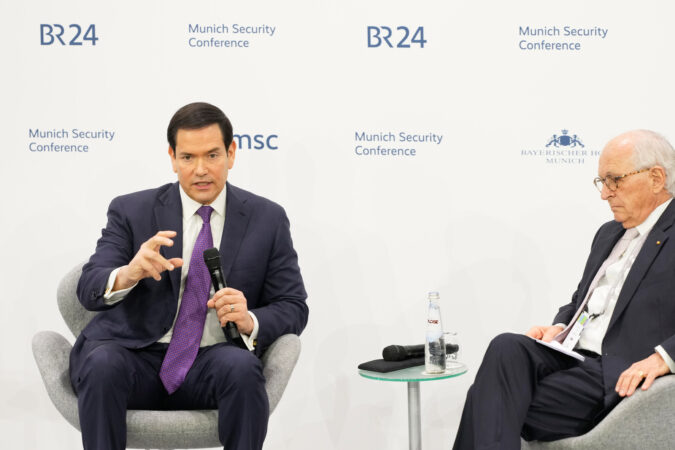
    MUNICH — Secretary of State Marco Rubio declared that the United States and Europe “belong together” in a speech Saturday aimed at unifying the Western alliance, while condemning hallmarks of globalization, open borders, unfettered free trade, “deindustrialization,” and mass migration.

    Rubio’s message, in a keynote address at the annual Munich Security Conference, received applause from a demoralized audience of European leaders who are deeply distressed about divisions with the United States stoked by President Donald Trump’s punitive tariffs, territorial ambitions for Greenland, and disagreements over how to end Russia’s war in Ukraine.

    “We are bound to one another by the deepest bonds that nations could share, forged by centuries of shared history, Christian faith, culture, heritage, language, ancestry, and the sacrifices our forefathers made together,” Rubio said.

    But even as he appealed to those ties, Rubio promoted several Trump administration positions that are deeply controversial among the United States’ closest traditional allies. He showed disdain for policies to reduce carbon emissions, staunchly criticized the United Nations — which many in Europe view as critical to protecting smaller states’ sovereignty — and lauded unilateral U.S. military action in Latin America and the Middle East.

    “On the most pressing matters before us, [the U.N.] has no answers and has played virtually no role,” Rubio said.

    Compared, however, to Vice President JD Vance’s blistering speech in Munich last year, which left the audience stunned by his seeming contempt for Europe, Rubio’s appeal to strengthen the alliance was received as more constructive.

    “Our home may be in the Western Hemisphere, but we will always be a child of Europe,” Rubio said.

    The moderator of the event, Wolfgang Ischinger, called the remarks a “sigh of relief” and a message of “reassurance” and “partnership.”

    Europe’s top leaders descended on the Bavarian capital this weekend, proclaiming the need to overhaul the relationship with the U.S. that has spurred economic prosperity and guaranteed security since World War II.

    European leaders promised to chart their own course and forge a version of the Western alliance in which they depend less on the United States.

    “In today’s fractured world, Europe must become more independent — there is no other choice,” European Commission President Ursula von der Leyen said in a speech early Saturday, to applause.

    As European and American politicians issue post-mortems for the world order in Munich, officials from each side of the Atlantic said it was high time for Europe to pay its own way for security. On that point, European and U.S. leaders appeared in sync.

    For the Europeans, the call to take charge of the continent’s defense is about more than addressing U.S. demands: It could also provide the ability to stand up to Washington and an administration with which they concede they do not share some interests.

    Rubio’s remarks about Europe were softer than Vance’s criticism of the suppression of far-right parties — and, in his characterization, free speech — or Trump’s threats to seize Greenland from NATO ally Denmark.

    But European leaders know well that a crisis with the administration could still erupt on an array of issues, including Greenland, negotiations with Russia over Ukraine, and regulation of hate speech and Big Tech.

    The leaders of Europe’s political and economic powerhouses, France and Germany, stressed that a more powerful Europe could shield itself from the whims of Washington and Moscow, and they delivered a stern rebuke of Trump’s foreign policy gyrations including on trade and climate.

    French President Emmanuel Macron, speaking at the conference Friday night, said Europe had been unjustly “vilified” as a continent of unfettered immigration and repression — an apparent reference to Vance’s speech and to a recent U.S. National Security Strategy that said Europe was facing “civilizational erasure.”

    “Everyone should take their cue from us, instead of criticizing us or trying to divide us,” Macron said. He called for “derisking vis-à-vis all the big powers,” not just in defense, but also in the economy and technology.

    “Europe is rearming, but we must now go beyond,” he added. “Europe has to learn to become a geopolitical power.”

    German Chancellor Friedrich Merz, in his welcoming remarks on Friday, said: “The culture wars of MAGA in the U.S. are not ours.”

    Merz also said that the U.S. claim to global leadership was being “challenged” in an era of great power rivalry, including rising Chinese influence, and he warned that Washington will need allies.

    “Even the United States will not be powerful enough to go it alone,” he said. “Dear friends, being a part of NATO is not only Europe’s competitive advantage. It is also the United States’ competitive advantage.”

    British Prime Minister Keir Starmer said that “we shouldn’t get in the warm bath of complacency. He said the U.K. must reforge closer ties with Europe to help the continent “stand on our own two feet” in its own defense, and said there needs to be investment that “moves us from overdependence to interdependence.”

    Hanno Pevkur, the defense minister of EU and NATO member Estonia, said it was “quite a bold statement to say that America is ‘a child of Europe’.”

    “It was a good speech, needed here today, but that doesn’t mean that we can rest on pillows now,” he told The Associated Press. “So still a lot of work has to be done.”

    A meeting on Greenland

    Rubio didn’t mention Greenland. After last month’s escalation over Trump’s designs on the Arctic island, the U.S., Denmark, and Greenland started technical talks on an Arctic security deal.

    The Secretary of State met briefly in Munich on Friday with the Danish and Greenlandic leaders, a meeting Danish Prime Minister Mette Frederiksen described as constructive.

    But Frederiksen suggested Saturday that although the dispute has cooled, she remains wary. Asked whether the crisis has passed, she replied: “No, unfortunately not. I think the desire from the U.S. president is exactly the same. He is very serious about this theme.”

    Asked whether she can put a price on Greenland, she responded “of course not,” adding that “we have to respect sovereign states … and we have to respect people’s right for self-determination. And the Greenlandic people have been very clear, they don’t want to become Americans.”

  • CIA, Pentagon investigated secret ‘Havana syndrome’ device in Norway

    CIA, Pentagon investigated secret ‘Havana syndrome’ device in Norway

    Working in strict secrecy, a government scientist in Norway built a machine capable of emitting powerful pulses of microwave energy and, in an effort to prove such devices are harmless to humans, in 2024 tested it on himself. He suffered neurological symptoms similar to those of “Havana syndrome,” the unexplained malady that has struck hundreds of U.S. spies and diplomats around the world.

    The bizarre story, described by four people familiar with the events, is the latest wrinkle in the decadelong quest to find the causes of Havana syndrome, whose sufferers experience long-lasting effects including cognitive challenges, dizziness, and nausea. The U.S. government calls the events Anomalous Health Incidents.

    The secret test in Norway has not been previously reported. The Norwegian government told the CIA about the results, two of the people said, prompting at least two visits in 2024 to Norway by Pentagon and White House officials.

    Those aware of the test say it does not prove AHIs are the work of a foreign adversary wielding a secret weapon similar to the prototype tested in Norway. One of them noted that the effects suffered by the Norwegian researcher, whose identity was not disclosed by the people familiar, were not the same as in a “classic” AHI case. All spoke on the condition of anonymity because of the subject’s sensitivity.

    But the events bolstered the case of those who argue that “pulsed-energy devices” — machines that deliver powerful beams of electromagnetic energy such as microwaves in short bursts can affect human biology and are probably being developed by U.S. adversaries.

    “I think there’s compelling evidence that we should be concerned about the ability to build a directed-energy weapon that can cause a variety of risk to humans,” said Paul Friedrichs, a retired military surgeon and Air Force general who oversaw biological threats on the White House National Security Council under President Joe Biden. Friedrichs declined to comment on the Norway experiment.

    The Trump administration took office promising to pursue the AHI issue aggressively. But there has been little apparent movement. A review ordered by Director of National Intelligence Tulsi Gabbard is expected to focus mostly on the Biden administration’s handling of the issue, and its release has been delayed, people familiar with the issue said.

    In a separate development that has become public in recent weeks, the U.S. government covertly purchased at the end of the Biden administration a different foreign-made device that produces pulsed radio waves and which some experts suspect could be linked to AHI incidents, according to two people familiar with the matter.

    The device is being tested by the Defense Department. It has some Russian-origin components, but the U.S. government still has not determined conclusively who built it, said one of the people.

    The U.S. acquisition of the device was first reported last month by independent journalist Sasha Ingber and CNN, which said it had been purchased for millions of dollars by Homeland Security Investigations, part of the Department of Homeland Security.

    The device that the scientist constructed in Norway was not identical to the one that the U.S. government covertly acquired, one of the people familiar with the events said. The Norwegian device was built based on “classified information,” suggesting it was derived from blueprints or other materials stolen from a foreign government, this person said.

    At about the same time the U.S. became aware of the two pulsed-energy machines, two spy agencies altered their previous judgment and concluded that some of the incidents involving AHIs could be the work of a foreign adversary, delivering that verdict in an updated U.S. intelligence assessment issued in January 2025 during the Biden administration’s final weeks.

    “New reporting,” the assessment said, led the two agencies “to shift their assessments about whether a foreign actor has a capability that could cause biological effects consistent with some of the symptoms reported as possible AHIs.”

    One was the National Security Agency, which intercepts and decodes foreign electronic communications, several people familiar with the issue said. The other, said two of those people, was the National Ground Intelligence Center, a U.S. Army intelligence agency in Charlottesville that produces intelligence on foreign adversaries’ scientific, technical, and military capabilities.

    The majority of U.S. intelligence agencies, including the CIA and four others, said they continued to judge it “very unlikely” that the attacks were the result of a foreign adversary or that a foreign actor had developed a novel weapon. In conversations intercepted by U.S. spy agencies, American adversaries were heard expressing their own surprise at the AHI incidents and denying involvement, U.S. officials have said.

    The CIA declined to comment on the Norwegian test or how it impacted the agency’s analysis. Norway’s embassy in Washington did not respond to a request for comment.

    Some former officials and AHI victims have pointed to Russia as the prime suspect in the AHI incidents because of its decades of work in directed-energy devices. So far, no conclusive proof has publicly emerged, and Moscow has denied involvement.

    Taken together, the two known directed-energy devices along with other research appear to have prompted a reconsideration by some of the causes of Havana syndrome, so named because of the mysterious 2016 outbreak of symptoms reported by personnel at the U.S. Embassy in Havana.

    In subsequent years, U.S. personnel reported hundreds of cases globally, in China, Eastern Europe, and elsewhere. A top aide to then-CIA Director William J. Burns reported symptoms while traveling in India in 2021.

    At a conference in Philadelphia earlier this month, retired Air Force Lt. Col. Chris Schlagheck, at times his voice breaking, said he was hit five times in 2020 in his home in Northern Virginia, where a Russian family lived across the street. It was not until last year that a doctor told him his symptoms were the same as those reported from Havana a decade earlier.

    Much about the Norway test remains obscured by its highly classified nature. People familiar with the events declined to identify the scientist or the Norwegian government agency he worked for.

    The results were all the more shocking because the Norwegian researcher had earned a reputation as a leading opponent of the theory that directed-energy weapons can cause the type of symptoms associated with AHIs, those familiar with the events said. Trying to dramatically prove his point, with himself as a human guinea pig, he achieved the opposite.

    “I don’t know what possessed him to go and do this,” one of the people said. “He was a bit of an eccentric.”

    A delegation of Pentagon officials traveled to Norway in 2024 to examine the device. In December of that year, a group of intelligence and White House officials also went to Norway to discuss the issue, those familiar with the events said.

    In January 2022, the CIA produced an interim assessment that concluded a foreign country was probably not behind Havana syndrome. It emerged weeks before a major panel of government and nongovernment experts produced a report commissioned by the director of national intelligence and deputy CIA director that came to a markedly different conclusion.

    That panel concluded in February 2022 that pulsed electromagnetic energy, particularly in the radio-frequency range, ‘’plausibly explains the core characteristics of reported AHIs,” although it acknowledged many unknowns. “Information gaps exist,” it reported.

    The conclusion marked the first time a report issued publicly by the U.S. government acknowledged that the symptoms could be caused by human-made, external events.

    The IC Experts Panel, as it was known, interviewed several people who had suffered accidental exposure to electromagnetic energy, said David Relman, a Stanford University microbiologist who chaired the panel.

    But the CIA interim assessment overshadowed the expert panel’s report. Then, in March 2023, the full intelligence community issued an assessment that unanimously concluded that it was unlikely that a foreign adversary was behind the incidents. “There is no credible evidence that a foreign adversary has a weapon or (intelligence) collection device that is causing AHIs,” the unclassified version of their report said, citing secret intelligence data and open-source information about foreign weapons and research programs.

    U.S. intelligence agencies “essentially ignored” the experts panel’s work, Relman told the conference in Philadelphia. The agencies, particularly the CIA, “had developed a very firm set of conclusions, world view that caused them I think to become dug in,” he said.

    By late 2024, senior White House officials in the Biden administration had come to question the absolutist position taken by U.S. intelligence agencies in their 2023 assessment.

    There were some officials, including within the intelligence community, who insisted that “there was nothing here” — that every reported case could be explained by some environmental or medical factor, said one person familiar with the administration’s views.

    The more “responsible” view, the person said, was to admit “we don’t know the answers” and that it was “plausible that pulsed electromagnetic energy could account for some subset of cases.”

    After the November 2024 election, White House officials who were working on an AHI brief for the incoming Trump administration invited several victims to a meeting to offer their input. The officials also wanted to reassure the victims that they realized the intelligence community assessment called into question the very real health issues they experienced and what caused them.

    At one point, an official turned to the victims who were gathered in the Situation Room and said, “We believe you.” The White House wasn’t yet certain it was a foreign actor but believed it was plausible that the symptoms had been caused by external factors, said the person familiar with the administration’s views.

    Marc Polymeropoulos, a former CIA officer and AHI victim who attended the unclassified meeting, said, “It was clear to the victims, but also unsaid, that new information had come into the NSC that had caused them to make such a statement.”

  • At 82, he’s as fit as a 20-year-old. His body holds clues to healthy aging.

    At 82, he’s as fit as a 20-year-old. His body holds clues to healthy aging.

    As a model of successful aging, you can’t beat 82-year-old Juan López García.

    Really, you can’t beat him.

    Sixteen years ago, at age 66, López García first tried running a mile. He’d recently retired after spending his entire working life as a car mechanic in Toledo, Spain. In all those years, he’d never trained as an athlete or exercised much at all.

    He couldn’t finish that first mile. He could barely start it.

    Now, at age 82, López García is the world record holder in the 80-to-84 age group for the 50-kilometer (31-mile) ultramarathon. In 2024, he also won the world marathon championship for his age group, with a time of 3:39:10, setting a European record in the process.

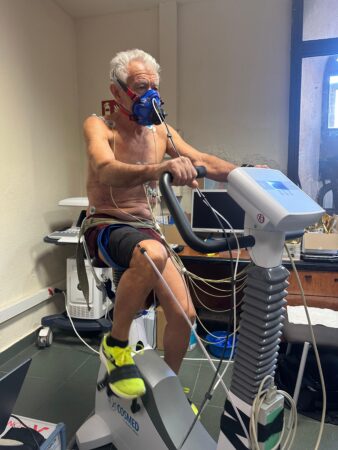
    His outsize success caught the attention of a group of European scientists who study aging. They invited López García to their lab for extensive testing. Their findings, published in January in Frontiers in Physiology, are, at once, revealing and “inspiring,” said Julian Alcazar, an exercise scientist at the University of Castilla-La Mancha in Spain and a co-author of the study.

    The researchers found that López García has the highest aerobic fitness recorded in an octogenarian, matching that of healthy 20-to-30-year-old men. His muscles also absorb and use oxygen unusually well. But in other ways, his biology, biomechanics, and training seem relatively ordinary.

    Taken as a whole, López García’s physiology and performance in his 80s may help upend some common assumptions about what’s possible and normal as we age, the researchers concluded, including whether it’s ever too late for the rest of us to tackle that first mile.

    What sets older athletes apart?

    “There are still many questions about the trajectory of aging,” said Simone Porcelli, an exercise physiologist at the University of Pavia in Italy and senior author of the study.

    To help answer them, he and colleagues in Italy and Spain recently began collaborating on a major research project about whether growing old necessarily involves steep, inevitable declines in muscle, speed, strength, and agency.

    That interest led them, unsurprisingly, to older, elite athletes, whose trajectory of aging can seem almost otherworldly. Deep into their 70s, 80s, and even 90s, these men and women typically preserve or even add to their fitness and strength, and they rarely develop serious illnesses. Most appear younger than their birth years.

    What sets them apart, the researchers wondered? Is it training, genetics, luck? How do their bodies differ from those of their peers, and what lessons can we take from their daily routines?

    An unusual athlete

    Enter López García, a man whose aging has been both ordinary and exceptional. Physically unprepossessing at about 5-foot-2 and 130 pounds, he once spent several weeks walking 500 miles of the Camino de Santiago pilgrimage route in France and Spain. But otherwise, exercise had always been, at best, an afterthought for him. Then, at 66, he tried running and slowly, stubbornly upped his mileage until, at 70, he began to compete, starting with the 800 meters, then longer distances and, eventually, ultras.

    The older he got, the longer and faster he ran.

    “That’s not,” Alcazar said, pausing for words, “ … usual.”

    Intrigued, Alcazar and his Italian colleagues set up López García on a treadmill and a stationary bicycle at their lab and tested his endurance capacity, running economy, fuel usage, power, muscle oxygen uptake, and other measures of how his body responds to high-speed exercise. They also asked about his training and nutrition.

    The greatest fitness ever measured

    Some of the numbers proved eye-popping.

    López García’s VO2 max, the standard gauge of aerobic fitness, was the highest the researchers had seen in someone in their 80s. A measure of how much oxygen the body takes in and delivers to muscles, VO2 max usually declines by about 10% each decade after middle age. But his almost certainly had been rising after he reached his mid-60s and began to train and is similar to someone a quarter his age.

    His muscles also were better able than those of most older — or younger — people to absorb and use that oxygen, allowing López García to run for long periods at a fast, steady pace. He averaged a 9:14 mile during his record-setting ultramarathon. He also produced considerable power during each stride.

    But he didn’t have an especially high lactate threshold or running economy, both of which contribute to endurance and speed. His were good, similar to those of competitive athletes in their 60s, but not spectacular, suggesting he still has room to improve as a runner.

    How he eats and runs

    Even López García was startled by his prowess. His only thought when he started to train, he said, “was to run a little to maintain my health, never to reach the level I have reached today.”

    Now, he runs about 40 miles a week when he’s not readying for a competition and almost double that mileage in the buildup to a race. Most of his workouts are long and moderately taxing. But a few times a week, he does intervals of various lengths, sprinting at near or past race pace for a brief spurt, slowing and then sprinting again. (He has a professional coach guiding his workouts.)

    He also weight-trains a few times a week, mostly at home, primarily with body weight exercises, and eats a “totally normal” Mediterranean-style diet, he said.

    ‘It’s never too late’

    The big question with López García’s or any older athlete’s successful aging is whether the rest of us can replicate it. Or is he somehow unique, gifted with an ideal mix of genes and background unavailable to most people?

    Alcazar suspects it’s both. López García was fortunate to have reached age 66 without serious illnesses or disabilities, Alcazar said, despite being sedentary, which might have been, in large part, because of his genetics, as well as lifestyle.

    But Alcazar and his colleagues also believe López García’s successful aging is not just aspirational but achievable by most of us. “Not so long ago, it wasn’t really seen as possible or a positive for older people to do much exercise,” Alcazar said. López García shows otherwise. “It is not only possible. It should be recommended,” Alcazar said.

    Begin slowly, if you are older and new to exercise, López García said, as he did. “Start by walking fast and then maybe start running, which is very beneficial,” he said.

    “It’s never too late,” Porcelli said. He and the other scientists are continuing to study López García and other aging athletes, as well as more sedentary older people, to understand the molecular and functional differences between them. The researchers expect to publish more studies soon.

    In the meantime, López García’s example is already a lodestar for the researchers. “I’m 35,” Alcazar said. “I’m thinking about how to age well. Having seen him, of course I exercise.”

    For his part, López García has no plans to slow down. “When I think about the number 80,” he said, “I remember my grandparents. At this age, they were like little old people. Today, I do not feel old.”

  • Some of the most coveted jobs in America aren’t safe anymore

    Some of the most coveted jobs in America aren’t safe anymore

    After years of working as a recruiter, Justin Kirkwood landed in tech, eventually becoming a technical project manager for a vendor inside Meta’s Seattle campus. He had clawed his way into the industry with an associate’s degree, getting to work with some of the brightest people in tech in a role he thought was secure.

    But his perception shifted when the social media giant laid off 11,000 employees in one day in 2022, his first year working there. When he got his pink slip last month, he says grief set in, then denial and anger. He half-jokingly entertained the idea that he might become a cobbler or hot dog vendor.

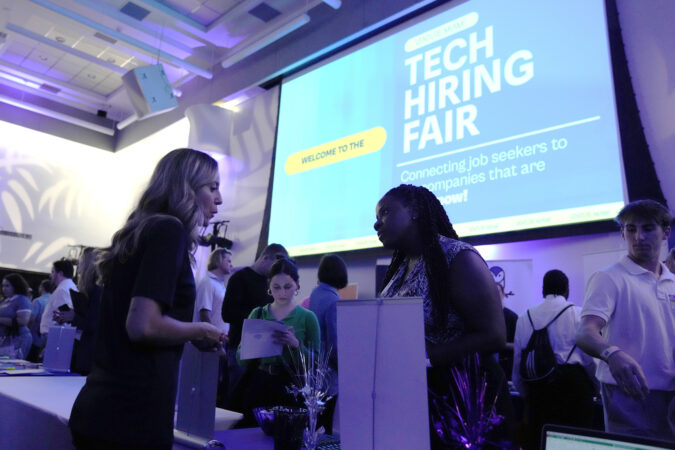
    The tech industry, once viewed as prestigious and safe, has become tumultuous, with some economists even warning of a looming recession in jobs. While tech companies continue to invest billions of dollars into AI, they’re slashing jobs while touting AI-forward strategies and leaner organizations. People who pursued careers in the tech industry expected big salaries, job security, and an abundance of opportunity that would take them to retirement. But now, as tech companies continue to shed jobs, workers are shifting their expectations even with an AI boom.

    “My perception of [tech] as the most viable path to job stability has definitely waned,” Kirkwood, 47, said. “Is a constant soul-crushing ambient anxiety a stage of grief?”

    The layoffs continued to trickle in. In January Amazon announced that it cut 16,000 roles — in addition to 14,000 cuts it announced in October — as it aims to reduce bureaucracy and get rid of some layers of management. (Amazon founder Jeff Bezos owns the Washington Post.) Pinterest also announced layoffs, stating it would cut 15% of staff in pursuit of its “AI-forward strategy.” Meta cut more than 1,000 workers earlier this year while Microsoft announced that it was slashing 15,000 jobs last year.

    Meta CEO Mark Zuckerberg said on an earnings call recently that AI would “dramatically change the way that we work” this year, as Meta invests in AI tools to help workers be more productive, noting that it would be need to “flatten” teams. Amazon CEO Andy Jassy had warned employees in June that cuts were coming, attributing the reductions to efficiencies created by the company’s use of AI.

    The layoffs come as the U.S. economy shows signs of growth. The Federal Reserve opted to hold interest rates steady in January noting that “economic activity has been expanding at a solid pace” and the unemployment rate shows “signs of stabilization.” The unemployment rate is near historic lows at 4.3% but the labor market has largely been frozen, leaving those who are employed “clinging to their jobs,” said Diane Swonk, chief economist at KPMG.

    Unlike the dot-com boom of the 90s, the AI boom is not creating a major influx of new jobs because AI brings the promise of efficiency, she said. Meanwhile, tech companies are feeling financial pressure as they continue their costly build-out of data centers to support their AI ambitions.

    “Over time, AI could be a productivity miracle … but in the near term we have to deal with the transition cost,” she said.

    Amazon says AI is not the reason behind the reductions but rather to drive speed and ownership for invention and collaboration. Microsoft has said that even as it cuts, it’s continuing to hire and invest in strategic areas, though it did not provide specifics. Meta declined to comment.

    Daniel Keum, an associate professor at Columbia Business School who researches labor market policy said the massive cuts in the tech industry are likely driven by a mix of restructuring around AI as well as the winding down of projects that companies pursued while rapidly expanding during the height of the pandemic.

    “Everybody is realizing the need to be quicker and more agile,” he said. “You can do things a lot faster now.”

    No more job security

    Tech workers who’ve been in the industry for decades say the current period feels like a moment of transformation — one that’s reduced job security.

    Six years ago, the thought of Amazon making massive cuts was unthinkable, said Fintan Palmer, a former Amazon senior software engineer who got his layoff notice in October. But in the past few years, tech companies have become less of a “safe harbor,” often hurting junior employees the most as they don’t have the network or skills to easily move on, he said.

    “It’s both a really exciting and really scary time to be in tech,” said Palmer, who added that he’s felt like he’s spent the past six weeks working harder than in the past six months to solidify a new job through networking. “I’m excited to see where it goes, but I’m nervous there will be damage done to people’s lives and the industry.”

    The tough job market is forcing workers across industries to spend long periods unemployed. People spent an average of 24.4 weeks unemployed in December, up from 19.5 in December 2022, according to data from the Bureau of Labor Statistics. As a result, workers, even in tech, are having to tweak their job search strategies.

    Brian Morales was laid off last fall from an information technology managerial post at the Kroger supermarket chain. The 55-year-old lamented what felt like his inability to break through AI screening of job applications — until he started to tactically use AI to outgun the filters.

    Morales went through AI certification programs to brush up his resume and is using ChatGPT to tailor outreach messages to potential employers. He says he’s getting more traction now but is feeling the pressure to land a job to support his wife and three children.

    “It’s a lot of work compared to when I was last looking for a new role,” he said. “It’s very, very different.”

    Steven Stark, a 32-year-old data scientist in Ann Arbor, Mich., who recently lost his job for the second time in a year, said that he’s had to hone his LinkedIn strategies to try to catch the eye of potential employers. He’s spent years relentlessly posting on the professional networking site to build a following, which he says translates into more people now seeing his job-hunting posts.

    While another job search feels a little exciting, it’s also odd. “Most days blend together and feel the same now,” Stark said.

    For younger people entering the industry, the challenges in landing a job appear even more pronounced.

    A frustrating job search has made 24-year-old Frank Uribe-Medina wonder why he gravitated to technology work in the first place. Uribe-Medina’s employer told people after Christmas that it’s relocating jobs from the Los Angeles area to Virginia. Since then, he’s applied to nearly 150 openings without landing an interview.

    Uribe-Medina taught himself software development and put himself through a degree program following advice that if he learned to code, he’d always have a job.

    “Well, I’m looking for a job,” he said. “It feels like a big lie.”

    For those still employed, the mood isn’t much different, with many worrying about when the ax will hit them as layoffs continue.

    “It’s tense,” said a program manager at Microsoft, who spoke on the condition of anonymity for fear of professional retribution. “I’m doing everything I can to avoid the pink slip with very little confidence that I can. I feel like so much of this is out of my hands.”

    Internally, leaders are overhyping the capabilities and efficiencies of AI as they cut head counts and leave remaining staff to pick up the slack, he said. Meanwhile, they’re raising the bar on expectations. People are less likely to take bold stances, “terrified” of taking big risks and cautious about voicing concerns, especially as they relate to the use of AI, he said.

    “The concern is if you say anything negative about AI, it’s death for your career,” he said.

    Microsoft declined to comment on the AI initiatives.

    Meta workers are also turning to Blind, an app that gives users with a company email access to a private and anonymous message board, to speculate about the company’s future workforce. In one message entitled “Mark wants to flatten teams,” a worker wrote “it’s been very clear in the earnings call that there may be massacres soon,” according to copies of the messages viewed by the Washington Post. Another commented that “managers will all be asked to become [individual contributors]. Anyone who can’t perform as an IC will be let go.”

    Meta declined to comment on the posts.

    The Microsoft worker said he gets inundated by inquiries from jobseekers, often young people trying to make their way in or industry veterans who lost their jobs. But he’s no longer convinced the tech industry is a safe place to build a career.

    Kirkwood says while the job hunt has been “brutal,” he’s landed a few interviews after applying to more than 100 jobs. But he expects to have contingency plans the next time around.

    “I won’t take employment for granted anymore,” he said. “You have to keep multiple irons in the fire at this point because you never know when the carpet will get pulled out from under you.”

  • Transfer of ISIS suspects concludes as Trump pursues Syria exit

    Transfer of ISIS suspects concludes as Trump pursues Syria exit

    The U.S. military has completed the transfer of thousands of suspected Islamic State fighters to the Iraqi government, setting the stage for the expected withdrawal of many — perhaps even all — American troops from Syria within months despite concerns about the Syrian government’s ability to prevent a resurgence of the group, officials familiar with the issue said.

    The movement of 5,700 detainees, underway for weeks, was completed Thursday night with a flight from northeastern Syria to Iraq, U.S. military officials said in a statement. The effort signals a forthcoming end to a yearslong mission overseen by the U.S.-backed Syrian Democratic Forces (SDF), a Kurdish militia group that had managed the detention facilities in territory it controlled in northeastern Syria.

    The transfer began Jan. 21 as U.S. troops teamed with SDF and Iraqi counterparts to move the detainees using aircraft and armed ground convoys. It marks one of the most significant developments in years for the remnants of the Islamic State, the militant group whose bloody campaign across Syria and Iraq resulted in a multinational military intervention beginning in 2014. A smaller number of Syrians, fewer than 2,000, are expected to remain in Syria in the SDF-run detention centers until they are turned over to the Syrian government.

    Many of the detainees who have been transferred are expected to be held at the Al-Karkh prison, an Iraqi facility near Baghdad International Airport, said U.S. officials, who like some others spoke on the condition of anonymity to discuss sensitive military operations. It was once called Camp Cropper and used by the U.S. military to house detainees during the Iraq War. Iraq’s supreme judicial council said Friday that about 3,000 Syrians are among the detainees transferred.

    In a statement, the White House said Trump is committed to a Syria that is “stable, unified and at peace with itself and its neighbors.” That requires Syria not being a base for terrorism or to pose a threat in the region and beyond, it says.

    The United States is monitoring the situation in Syria and working with all sides, the statement says, to ensure that “ISIS detainees remain in detention,” including an organized transition of other detention centers in Syria to Syrian government control.

    The shift underscores a major shift in U.S. policy toward Syria, as President Donald Trump, who has aligned himself with Syrian President Ahmed al-Sharaa, seeks to extricate the roughly 1,000 American troops who have remained there functioning as a backstop to prevent a resurgence by the Islamic State.

    A report by the Director of National Intelligence last year said that the Islamic State will attempt to “reconstitute its attack capabilities,” including plotting against the West, and free prisoners to rebuild its ranks. Three U.S. troops were ambushed and killed by a suspected Islamic State member in Syria in December, prompting Trump to approve retaliatory airstrikes days later.

    Sharaa, a former al-Qaeda militant who broke with the group in 2016, has sought to unify his country since his forces forced the December 2024 ouster of Syrian President Bashar Assad, a dictator whose 24-year rule was marked by mass atrocities and a civil war that killed hundreds of thousands of people. The Islamic State has repeatedly attempted to assassinate Sharaa over the last year, according to a United Nations report released this week.

    One step in the withdrawal occurred Wednesday, as U.S. troops at the Tanf garrison in the southeastern part of Syria turned control over to Sharaa’s forces. Adm. Brad Cooper, the top officer overseeing U.S. operations in the region, said in a statement that U.S. forces retain the ability to respond to any threats posed by the Islamic State in the region.

    Other bases could be transferred to Sharaa’s forces in coming days or weeks as conditions warrant, two officials familiar with the issue said. Doing so could allow Trump to fully end the U.S. mission there, a goal since his first administration that consistently collided with challenges posed by Syria’s fractured state.

    Trump has downplayed Sharaa’s past as a jihadist, telling reporters in January that the Syrian leader was “working very hard.” He’s characterized him as a “tough guy” with a “pretty tough resumé.”

    “You’re not gonna put a choir boy in there and get the job done,” Trump said at the time.

    Still, U.S. officials said, Washington had privately delivered warnings to their Iraqi counterparts about Sharaa’s ability to ensure security over the ISIS detention camps. One senior U.S. official said in an interview with the Washington Post that the Trump administration had told Baghdad in the fall that it was “entirely likely” that if Sharaa’s government took control of the alleged terrorism suspects, they could be freed or break loose at some point and attack Iraq again.

    Sharaa could not be reached for comment.

    Iraqi officials acknowledged then that there was cause for concern, the senior U.S. official said. But those anxieties accelerated last month, as Sharaa’s forces pressed forward with an armed offensive into SDF-held territory, forcing the group to abandon two major facilities, the Shaddadi prison and al-Hol camp, allowing about 200 detainees to escape on Jan. 19.

    The detainees were considered “low-level” fighters, and dozens were later recaptured, U.S. officials said. But the episode triggered alarm in Washington and Baghdad and prompted numerous phone calls from senior U.S. officials to Sharaa, officials said, including at least one by Cooper on Jan. 21 and one by Trump on Jan. 27, these people said.

    Abdulkarim Omar, a representative with the SDF’s civilian government, called the moves of Sharaa’s forces in the region “aggression.” The Kurdish people, he said, “became victims of international arrangements concluded over their heads” and have seen “international silence.”

    Cooper also made a visit to northeastern Syria on Jan. 22, as his team attempted to ensure that Sharaa’s forces and the SDF adhered to a ceasefire as the detainees were transferred from Syria to Iraq, according to a U.S. military statement at the time.

    “It definitely could have gone completely sideways, to be completely honest with you,” a senior U.S. official told the Post, noting that U.S. soldiers remained in the region as tensions were high between the SDF and Sharaa’s fighters.

    Trump acknowledged calling Sharaa, saying his team had “solved a tremendous problem in conjunction with Syria and saved many lives.” He did not elaborate.

    The undertaking has triggered mixed feelings in the region, even as officials there appear to cooperate with U.S. desires.

    Hussein Allawi, an Iraqi security adviser, said his government is urging other governments to take back ISIS suspects from their countries so that Iraq is not overwhelmed. Iraq, he said is “totally capable” of handling the issue, but will face infrastructure challenges.

    Jiwan Soz, a Kurdish researcher, said that “despite the interference of the Americans” in the dispute between the SDF and Sharaa’s fighters, the Syrian president “cannot control the situation.” The armed groups Al-Sharaa relies on have a variety of tribal affiliations and allegiances, he said, and armed skirmishes have continued.

    “There are huge challenges there, and I don’t believe al-Sharaa can succeed,” he said.

    Nawar Rahawie, a Syrian official, said the ceasefire is fragile and will require persuasion. Tribal fighters who aligned with both the SDF and the Syrian government have kept their fighters out of the fray, he said, and Sharaa has “a certain level of control over the tribes and fighters.”

    He added that people of all kinds were “harmed by the Assad regime,” and credited Sharaa’s government for offering a new way. Syrian officials are investigating “crimes and murder” that have emerged, and will seek accountability, he said.

    James Jeffrey, a former U.S. ambassador who focused on Syria during the first Trump administration, told the House Foreign Affairs Committee this week that he is “wary” of Sharaa, but has watched him push Iranian influence away from Syria and combat Islamic State fighters who remain — both core U.S. goals.

    U.S. troops in Syria have worked with both the SDF and Sharaa’s forces in recent months, Jeffrey said, and Washington will have a better understanding of what occurs in the region the longer they remain.