Category: Washington Post

  • ICE plans to spend $38.3 billion turning warehouses into detention centers

    ICE plans to spend $38.3 billion turning warehouses into detention centers

    U.S. Immigration and Customs Enforcement expects to spend $38.3 billion on its plan to acquire warehouses across the country and retrofit them into immigrant detention centers that can hold tens of thousands of immigrants, according to documents the agency provided to New Hampshire’s governor and published on the state’s website Thursday.

    ICE plans to buy and convert 16 buildings across the country to serve as regional processing centers, each holding 1,000 to 1,500 immigrant detainees at a time, according to one of the documents, an overview of the detention plan. Another eight large-scale detention centers will hold 7,000 to 10,000 detainees at a time, and serve as “the primary locations” for international removals.

    Detainees would spend an average of three to seven days at the processing sites before being transported to the larger facilities, where they would be held about 60 days before being deported, according to the document. The additional detention space is necessary, the document states, due to ICE’s hiring of more agents and an expected surge in arrests.

    The documents offer the most complete picture to date of the Trump administration’s plan to overhaul immigrant detention using buildings that were originally designed for industrial purposes — an expansive effort aimed at boosting ICE’s ability to arrest more immigrants and deport them faster. Rather than moving people around the country to any detention center with available beds, the new system of warehouses is designed to funnel them into a series of large-scale holding centers where they will await deportation, ICE documents show.

    They also demonstrate the scale and resources the Trump administration has devoted to building a mass deportation network. The plan’s $38 billion budget is more than the total annual spending for 22 states, according to state budget data.

    The Washington Post first reported on an earlier, draft solicitation document in December. Warehouses in Berks and Schuylkill Counties would be converted into detention centers as part of the plan.

    ICE has offered little information about the effort, prompting concern from state and local officials who have cited several logistical and humanitarian concerns of building large-scale detention centers in their regions.

    New Hampshire Gov. Kelly Ayotte said in a news release that the Department of Homeland Security shared the documents for the first time with her office on Thursday. Her statement appeared to contradict a claim made by Todd M. Lyons, ICE’s acting director, who testified at a Senate hearing earlier that day that DHS officials had previously spoken to the governor about the project and provided “an economic impact summary” to her.

    A spokeswoman for DHS did not immediately respond to an email seeking comment. The ICE document says all new facilities will need to comply with federal detention standards and provide for the “safe and humane civil detention of aliens.”

    In recent weeks, ICE has spent more than $690 million acquiring at least eight industrial buildings in Maryland, Arizona, Georgia, Texas, Pennsylvania, and Michigan, according to real estate deeds and internal ICE records reviewed by the Post. The agency has confirmed its interest in at least four additional buildings in Georgia, New Hampshire, New York, and New Jersey, according to statements made by local officials in those places.

    The government plans to hire contractors to carry out extensive renovations, turning vacant shells into holding facilities featuring lobbies, recreational space, dormitories, courtroom spaces, and cafeterias. At a building ICE plans to acquire in Merrimack, N.H., the agency expects to spend $158 million retrofitting the facility, according to an ICE economic impact assessment Ayotte posted to her website.

    It’s not clear which companies will be hired to renovate and operate the new facilities. George Zoley, the founder and executive chairman of ICE detention contractor Geo Group, said on a quarterly earnings call with Wall Street analysts Thursday that his company wants to be supportive of the new initiative, but cautioned that renovating warehouses would be “more complicated than you may think.”

    Geo Group once converted a warehouse into a holding center for 500 people about 30 years ago — nothing like the enormous size of the facilities being proposed now, Zoley said. “The operational implications of how you manage such a facility, particularly a large-scale facility, is going to be concerning,” Zoley said.

    The Post previously reported that some warehouses are expected to accept detainees as soon as April. ICE appears to have given multiple deadlines for when it expects the centers to be operational, according to the overview document. The agency will “fully implement a new detention model” by Sept. 30 and will “activate” all facilities by Nov. 30.

    Manchester Ink Link, a local news outlet, reported earlier on some of the details in the Manchester documents.

    Details of the expensive warehouse renovation effort have come to light as Democratic lawmakers in Washington have blocked bills to fund DHS in an attempt to force lawmakers to include new restrictions on federal immigration agents. Though the federal government was hurtling toward a partial shutdown beginning this weekend, the closures would not impact ICE’s funding because Republicans sent the agency tens of billions of dollars last year — including a historic $45 billion for immigrant detention.

    In several of the towns targeted for the project, local officials have said their water and sewer infrastructure would not be sufficient for a new facility holding thousands of people. For example, in Social Circle, Ga., a town with a population of 5,000, the town is permitted to pump up to 1 million gallons of water per day, and for much of the year, its peak usage is already above 800,000 gallons, according to data the city’s manager shared with the Post.

    In the project overview document, ICE says it reviewed the water supply at all of the proposed buildings, and found that “the capacities currently at the sites are sufficient to support the new facilities.” However, at the larger sites, the document said, “additional infrastructure” would be needed to support wastewater systems, and “numerous solutions” will be implemented. The document did not providing any more details.

    Federally owned real estate is often exempt from local permitting and zoning rules, but elected officials in some of the locations have pressed DHS to adhere to these requirements anyway. The detention plan overview states that the department will comply with the National Environmental Policy Act, federal law that requires environmental review of federal real estate projects before they can be built.

    DHS is pitching the New Hampshire project as “a major economic investment” that will help create 1,252 jobs during renovations and 265 jobs each year of operation, according to the economic impact document. The department said it expects to spend $146 million on the first three years of the facility’s operation.

    The analysis for New Hampshire contained what appeared to be a copy-and-paste error in describing “ripple effects to the Oklahoma economy.” ICE’s plans to buy a warehouse in Oklahoma City were scrapped last month, after the building’s owner decided not to sell.

    At least two other proposed deals — in Kansas City, Mo., and in Virginia — have also fallen through.

    These cancellations have revealed how the agency has pursued the projects. The owner of the Kansas City warehouse, a firm called Platform Ventures, said Thursday that it had begun negotiating a deal to sell its warehouse after being approached by a “third-party private enterprise” that it did not name.

    Platform Ventures said it learned DHS was the buyer only once the deal got closer. When the public also learned about the buyer, the city council quickly passed a five-year ban on all new nonmunicipal detention facilities. The company said Thursday that it exited negotiations because it said “the terms no longer met our fiduciary requirements for a timely closing.”

    The federal government also plans to take ownership of 10 existing detention centers where ICE currently operates in buildings owned by private contractors or local governments, the overview document said, without providing more detail.

    These facilities, combined with the new warehouses, would accommodate a total of 92,600 detainees at a time, the documents said.
  • DOJ’s targeting of Trump critics ramps up with attempt to indict lawmakers

    DOJ’s targeting of Trump critics ramps up with attempt to indict lawmakers

    The Justice Department’s efforts to prosecute President Donald Trump’s critics entered a new phase this week, when federal prosecutors failed to indict six Democratic lawmakers who recorded a video reminding military service members of their duty to refuse illegal orders.

    Department lawyers, under pressure from the president, previously targeted several of Trump’s most outspoken foes, including former FBI director James B. Comey and New York Attorney General Letitia James. Both faced since-dismissed charges last year over alleged conduct unrelated to their political views.

    But the case federal prosecutors put before a grand jury Tuesday — seeking to charge Sens. Mark Kelly (D., Ariz.), Elissa Slotkin (D., Mich.) and four others over their 90-second video message — marked the first time the department has directly sought to classify critical speech from prominent Trump detractors as a crime.

    The other lawmakers who participated in the video included Reps. Jason Crow, a former Army ranger from Colorado, and Maggie Goodlander, a Navy veteran from New Hampshire, as well as Chrissy Houlahan, a former Air Force officer, and Chris Deluzio, a former Navy officer, both from Pennsylvania.

    Grand jurors roundly rejected the effort, the Washington Post reported. But legal observers and the lawmakers at the center of the probe have argued in the days since that the panel’s decision is almost beside the point.

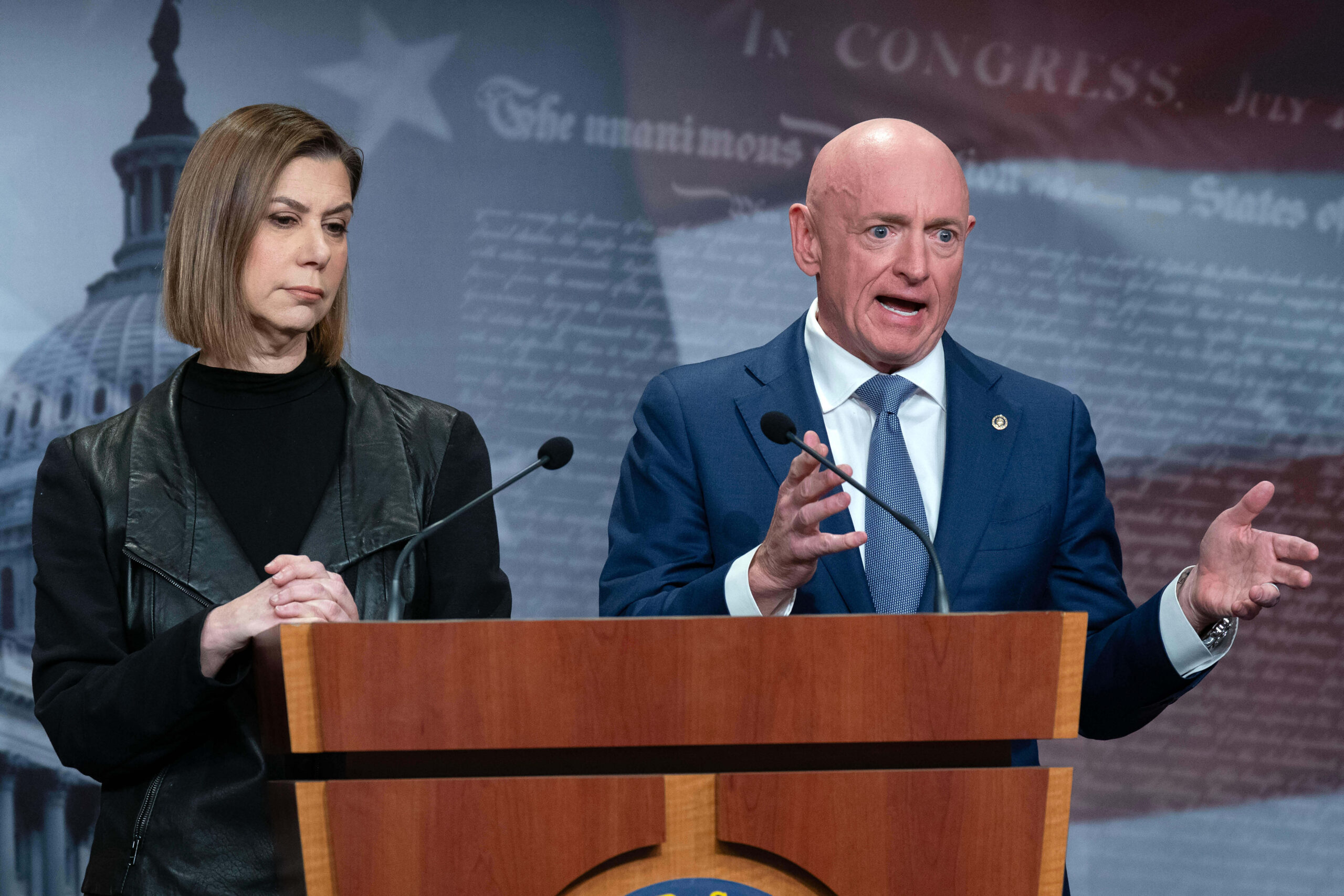
    Rep. Elissa Slotkin (D., Mich.) and Sen. Mark Kelly (D., Ariz.) speak during a news conference Wednesday on Capitol Hill.

    “This is not a good news story,” Kelly, a retired Navy captain and astronaut, told reporters during a news conference this week. “This is a story about how Donald Trump and his cronies are trying to break our system to silence anyone who lawfully speaks out against them.”

    The attempt to charge the lawmakers represents an evolution of the campaign that began last year with cases against James and Comey, said Brendan Nyhan, a professor of government at Dartmouth College.

    “Prosecuting people for speech criticizing the president is in some ways even more dangerous,” Nyhan said, “especially given these are legislators acting in their public role and especially given that they were calling for the military and national security state to follow the law.”

    Still, some Trump allies in Congress, including House Speaker Mike Johnson (R., La.), defended the administration’s efforts. He told reporters that Slotkin, Kelly, and the others “probably should be indicted.”

    “Any time you’re obstructing law enforcement and getting in the way of these sensitive operations, it’s a very serious thing, and it probably is a crime,” he said.

    The Justice Department’s criminal investigation into the lawmakers began after the video organized by Slotkin, a former CIA analyst, was posted online in November. In it, she and the others, all of whom served in the military or with intelligence agencies, reminded service members of their duty, spelled out in the Uniform Code of Military Justice, to resist unlawful directives.

    “This administration is pitting our uniformed military and intelligence community professionals against American citizens,” the lawmakers said. “Our laws are clear. You can refuse illegal orders.”

    The video did not single out any specific Trump administration policies. But Slotkin and Kelly, both of whom serve on the Senate Armed Services Committee, have sharply criticized the president for military strikes he authorized on alleged drug trafficking boats in the Caribbean Sea and Pacific Ocean and his decision to deploy the National Guard to cities run by Democratic officials.

    Their video drew an immediate reaction from Trump, who demanded on social media that the lawmakers face prosecution for sedition and suggested they should even, perhaps, be punished with execution.

    “SEDITIOUS BEHAVIOR, punishable by DEATH!” Trump wrote in one social media post soon after the video was posted. He said in another: “IT WAS SEDITION AT THE HIGHEST LEVEL, AND SEDITION IS A MAJOR CRIME.”

    Rep. Chrissy Houlahan, a former Air Force officer and a Democrat who represents Chester County, was one of six lawmakers targeted over a 90-second video message.

    The messages echoed another Trump post from last year in which he, in a missive addressed to “Pam,” an apparent reference to Attorney General Pam Bondi, insisted the Justice Department move swiftly to prosecute Comey, James, and others.

    “We can’t delay any longer, it’s killing our reputation and credibility,” he wrote then, adding, “JUSTICE MUST BE SERVED, NOW!!!”

    Within months, James was indicted on counts of mortgage fraud, while Comey was charged with lying to Congress. Both denied the accusations and their cases were later dismissed by a federal judge over technical issues with the appointment of the prosecutor who had charged them.

    Slotkin, Kelly, and the other lawmakers have maintained they did nothing wrong — even as top administration officials have accused them of using the video to encourage service members to take actions tantamount to mutiny.

    Earlier this month, four of the lawmakers in the video disclosed that they had been approached by FBI agents and declined to give voluntary interviews to prosecutors.

    “It was clearly, when our lawyers sat down with them, just about checking a box and doing what the president wanted them to do,” Slotkin said Wednesday. “Their heart wasn’t even in it.”

    It is not clear whether the FBI took other steps to investigate. But on Tuesday, prosecutors under the supervision of D.C.’s U.S. Attorney Jeanine Pirro, a former Fox News host and staunch Trump ally, presented a case against the lawmakers to the grand jury.

    Two political appointees led that presentation, according to two people familiar with the matter who spoke on the condition of anonymity to describe sealed court proceedings.

    The prosecutors — Steven Vandervelden, a former colleague of Pirro’s in the district attorney’s office in Westchester, New York, and Carlton Davis, a former staffer for House Oversight Committee Chairman Rep. James Comer (R., Ky.) — sought to charge the lawmakers with a felony crime that makes it illegal to “interfere with, impair, or influence the loyalty, morale, or discipline of the military or naval forces of the United States,” the people said.

    But when it came time to vote, none of the grand jurors agreed there was sufficient probable cause to charge any of the lawmakers with a crime, one of the people familiar said.

    Spokespeople for the Justice Department and for Pirro have declined to comment on the matter in the days since. Amid that silence, the effort has drawn an impassioned response from Capitol Hill.

    “The fact that they failed to incarcerate a United States senator should not obviate our outrage,” Sen. Brian Schatz (D., Hawaii) said during a heated session Wednesday in which Democratic senators implored their Republican colleagues to openly condemn the Justice Department’s actions. Senate Democrats held a special caucus meeting Thursday morning to further discuss the situation.

    “They tried to incarcerate two of us,” Schatz said. “I am not entirely sure the United States Senate can survive this if we do not have Republicans standing up.”

    Sen. Thom Tillis (North Carolina) has emerged as one of the few Republicans to publicly rebuke the department. He described the failed attempt to prosecute as exactly the type of weaponization of the justice system that the Trump administration has said it is fighting against.

    “Political lawfare is not normal, not acceptable, and needs to stop,” Tillis wrote in a post to X.

    At their news conference Wednesday, Kelly told reporters that he and Slotkin learned about the attempt to indict them Tuesday through media reports.

    “If things had gone a different way, we’d be preparing for arrest,” Slotkin said.

    Since then, lawyers for several of the targeted lawmakers have sent letters to Pirro and Bondi seeking assurances that the investigation is over and that prosecutors will not seek to indict them again. They’ve also instructed the department to retain all records of the investigation threatening potential legal action for violating the lawmakers’ free-speech rights.

    In a separate suit filed by Kelly, a federal judge Thursday halted Defense Department efforts to formally censure the senator over his video remarks, saying the effort to do so “trampled on Senator Kelly’s First Amendment freedoms and threatened the constitutional liberties of millions of military retirees.”

    “The intimidation was the point — to get other people beyond us to think twice about speaking out,” Slotkin said Wednesday. “But the real question is if the president can do this to us — sitting senators — who else can he do it to?”

  • U.S. spending millions to send migrants to third countries, report says

    U.S. spending millions to send migrants to third countries, report says

    The Trump administration spent more than $40 million last year to send hundreds of migrants to at least two-dozen countries that are not their own, a tactic Senate Democrats described in a report Friday as a costly strategy aimed at sowing fear and intimidation in the president’s mass deportation campaign.

    The 30-page analysis from the minority members of the Senate Foreign Relations Committee accuses the administration of entering into opaque financial agreements with foreign governments — including some with poor records on corruption and human rights — to rapidly expand a program for “third country” removals that once had been reserved for exceptional circumstances.

    Its authors contend that the State Department has failed to conduct sufficient oversight to ensure that payments to those countries are not being misspent and that migrants transferred to their custody are not being abused or mistreated.

    The administration “has expanded and institutionalized a system in which the United States urges or coerces countries to accept migrants who are not their citizens, often through arrangements that are costly, inefficient and poorly monitored,” Sen. Jeanne Shaheen of New Hampshire, the top Democrat on the committee, wrote in a letter to colleagues. “Deporting migrants to countries they have no connection to … has become a routine instrument of diplomacy.”

    Administration officials have said they have no choice but to partner with foreign governments that are willing to accept undocumented immigrants whose native nations are not willing to take them back. In most cases, the migrants have criminal records, authorities said, though public records have shown that some have not been convicted of crimes in the United States.

    The report from Senate Democrats, which provides the most comprehensive look at the administration’s third-country removal program, found that the U.S. government has sent migrants to two-dozen third countries. The analysis focused primarily on five nations — El Salvador, Equatorial Guinea, Rwanda, Eswatini, and Palau — with which the Trump administration has entered into direct financial payments totaling $32 million, a committee member involved in the report said. The person spoke on the condition of anonymity to discuss the analysis ahead of its release.

    Under those agreements, U.S. authorities sent about 250 Venezuelan migrants to a maximum-security prison in El Salvador last spring, while 29 migrants have been deported to Equatorial Guinea, 15 to Eswatini, and seven to Rwanda, the report said. None has been sent to Palau.

    The report also estimated that the administration has spent more than $7 million in costs related to deportation flights to 10 of the third countries.

    “Millions of taxpayer dollars are being spent without meaningful oversight or accountability,” Shaheen wrote in her letter. “And speed and deterrence are being prioritized over due process and respect for human rights.”

    Tommy Pigott, a State Department spokesman, said the report shows the “unprecedented” work the administration has undertaken in its first year to enforce immigration laws.

    “Astonishingly, some in Congress still want to go back to a time just 14 months ago when cartels had free rein to poison Americans and our border was open,” Pigott said in a statement. “Make no mistake, President Trump has brought Biden’s era of mass illegal immigration to an end, and we are all safer for it.”

    The third-country strategy has provoked public blowback and legal challenges that have slowed the administration’s efforts and, in some instances, forced it to change course.

    Last spring, President Donald Trump invoked the Alien Enemies Act, a rarely used law targeting enemy combatants, which provided the administration’s legal rationale to send the Venezuelan migrants to El Salvador. Administration officials accused many of being members of the Tren de Aragua transnational gang, though some of their families and attorneys disputed that contention.

    The men were later transferred from El Salvador to Venezuela under a prisoner swap. On Thursday, a federal judge in Washington ruled that the administration must bring some of the Venezuelan deportees back to the United States as they pursue legal challenges to their removals.

    “It is worth emphasizing that this situation would never have arisen had the Government simply afforded Plaintiffs their constitutional rights before initially deporting them,” Chief U.S. District Judge James E. Boasberg wrote in his ruling.

    The analysis from the Senate Foreign Relations Committee minority was put together over a period of more than eight months, based on conversations with foreign government and U.S. government officials, attorneys for deportees and immigrant rights organizations, according to the committee staffer.

    The staffer said the goal of the report is to highlight the costs of the administration’s approach at a time when Democrats are concerned that the U.S. government is “entering a new phase” of speeding up the number of third-country agreements, along with the pace of deportations.

    The report faults the administration for pursuing its deportation policies at the expense of other U.S. interests, including promoting human rights and punishing corrupt foreign regimes.

    The authors said the Trump administration’s payment of $7.5 million to Equatorial Guinea to accept immigrants was more than the amount of foreign assistance the United States provided to that country in the previous eight years. They cited a 2025 State Department report on human trafficking that cited U.S. concerns about “corruption and official complicity in trafficking crimes” in that country.

    The report also said the Trump administration was moving hastily to carry out third-country removals without trying to negotiate with the home countries of some deportees. In one case, a man initially deported to Eswatini was later sent to his home nation of Jamaica, where government officials said they had never told the United States that they were unwilling to accept him.

    “As a result, the Trump Administration has, in some cases, paid twice for migrants’ travel — once to remove them to a third country and then again to fly them to their home country,” the report says.

  • White House fires new U.S. attorney in N.Y. within hours of his appointment

    White House fires new U.S. attorney in N.Y. within hours of his appointment

    Federal judges in Albany, N.Y., appointed a new U.S. attorney on Wednesday, exercising a rarely invoked legal authority to appoint top prosecutors in regions without a Senate-confirmed nominee.

    Their choice lasted less than five hours on the job.

    Donald T. Kinsella, a 79-year-old former prosecutor and registered Republican, was summarily fired via an email from the White House later that evening, Justice Department officials said.

    The move underscored a growing point of tension between the Trump administration and courts in parts of the country where the president’s controversial picks for U.S. attorney have been unable to win Senate support.

    Kinsella’s swift termination also sent a signal to judges in several other federal court districts, including the Eastern District of Virginia, who have recently announced plans to make similar replacements of Trump-installed prosecutors whose appointments have been deemed invalid by the courts.

    “Judges don’t pick U.S. Attorneys, @POTUS does,” Deputy Attorney General Todd Blanche, said in a social media post late Wednesday. “See Article II of our Constitution. You are fired, Donald Kinsella.”

    Kinsella did not immediately respond to requests for comment Wednesday morning. And it was not immediately clear whether federal judges in Albany had any recourse to counter the White House’s decision.

    When administration officials similarly fired a new U.S. attorney whom federal judges in New Jersey appointed in July to replace Alina Habba, President Donald Trump’s former personal lawyer and pick for the position there, there was little formal response from the courts.

    Typically, U.S. attorneys, who wield broad prosecutorial discretion to pursue civil and criminal matters in their districts, are nominated by the president and confirmed or rejected in a Senate vote. But federal law empowers judges to name acting U.S. attorneys when there is no lawfully serving appointee or Senate-confirmed presidential pick serving in the role.

    Before his appointment Wednesday, Kinsella had most recently worked as a senior counsel to Albany-based law firm Whiteman Osterman & Hanna. He had served a previous stint in the U.S. attorney’s office in Albany from 1989 to 2002.

    The judges named him to lead the office as a replacement for John A. Sarcone III — a Trump loyalist whom the Justice Department appointed to serve in the position on an interim basis in March.

    Before his appointment, Sarcone had never worked as a prosecutor and most recently had served as a regional administrator for the General Services Administration.

    His tenure as interim U.S. attorney has been marked by a series of controversies, including an incident in June in which he announced a knife-wielding undocumented immigrant from El Salvador had tried to kill him outside an Albany hotel.

    Surveillance footage later showed the man did not come close to Sarcone with his weapon, and charges brought by a local prosecutor were downgraded from attempted murder to a misdemeanor.

    Sarcone had also launched an investigation over the summer into New York Attorney General Letitia James (D), probing whether her office had violated Trump’s civil rights when it secured a multimillion-dollar fraud judgment against him and his real estate empire in 2024.

    As part of a legal challenge from James, a federal judge ruled in January that Sarcone had been serving unlawfully in his position for months well beyond the 120-day limit federal law places on interim U.S. attorney picks.

    But like other interim U.S. attorney picks by Trump who have faced similar disqualification rulings in Los Angeles, Nevada, New Mexico and Alexandria, Va., Sarcone refused to immediately vacate the job. He continues leading the office.

    Until recently, judges in districts like Sarcone’s have been reticent to exercise their authority to appoint prosecutors counter to the Trump administration’s wishes.

    Last month, though, the chief federal judge in the Eastern District of Virginia announced the courts there would be accepting applications for a U.S. attorney to replace Lindsey Halligan, another former Trump lawyer named interim U.S. attorney only to be later disqualified by the courts. She left her post in January.

    The judges in Virginia have not yet named a replacement.

    Federal judges in Seattle have similarly been soliciting applications to potentially appoint a new acting U.S. attorney there, after the term of the Trump administration’s interim pick expired this month.

  • Ukrainian athlete barred from Olympic skeleton event over helmet images

    Ukrainian athlete barred from Olympic skeleton event over helmet images

    MILAN — A Ukrainian skeleton athlete was barred from competing at the Winter Olympics just hours before his race Thursday after he refused to remove a helmet honoring compatriots killed in Russia’s invasion of Ukraine. It is the latest twist in a controversy that has cast a shadow over the opening days of these Games.

    Vladyslav Heraskevych was removed from the starting list for the men’s skeleton event after the jury of the International Bobsleigh and Skeleton Federation ruled that the helmet he intended to wear violated the Olympic Charter and the International Olympic Committee’s Guidelines on Athlete Expression.

    His removal came after an early morning meeting with IOC President Kirsty Coventry that an IOC spokesman described as “respectful,” in which Coventry tried to find a way for Heraskevych to compete wearing a different helmet, but he refused.

    Heraskevych has appealed his disqualification to the Court of Arbitration for Sport, arguing that he violated no Olympic rules and was denied the same treatment afforded to other athletes.

    The men’s skeleton event began Thursday morning in Cortina d’Ampezzo without Heraskevych. Two qualifying heats were run Thursday in the men’s skeleton event. Heraskevych is arguing he should either be allowed back into the semifinal Friday or be allowed to do a run by himself, supervised by race officials. CAS, which has an ad hoc division at the Games, has 24 hours to rule, but Heraskevych would need a quick ruling.

    Later Thursday, Ukrainian President Volodymyr Zelensky awarded the Order of Freedom to Heraskevych. The decree said the award is for “selfless service to the Ukrainian people, civic courage, and patriotism in defending the ideals of freedom and democratic values.”

    “I never wanted a scandal with the IOC, and I did not create one,” Heraskevych said in Ukrainian in a social media video. “The IOC created it through its interpretation of the rules, which many consider discriminatory. While the IOC’s actions made it possible to speak loudly about Ukrainian athletes who were killed, the very existence of the scandal diverts a huge amount of attention away from the competition itself and from the athletes taking part in it. That is why I, once again, propose bringing this scandal to an end.”

    Ukraine’s Vladyslav Heraskevych takes part in the skeleton men’s training session at Cortina Sliding Centre during the Milano Cortina 2026 Winter Olympic Games in Cortina d’Ampezzo on February 11, 2026.

    The IOC had been wrestling with the matter for several days. The Olympic governing body said under long-standing Olympic rules, athletes are prohibited from making political demonstrations on the field of play or during medal ceremonies. In recent days, IOC officials worked repeatedly with Heraskevych and Ukrainian team officials to come up with a compromise. He was allowed to wear the helmet during training runs and the IOC first suggested he wear a black armband, eventually offering him a chance to wear the helmet after he finished his competition run as well as carry it through the post-event interview area known as the mixed zone.

    “We dearly wanted him to compete,” IOC spokesman Mark Adams said in a Thursday morning news conference in Milan. “It would have sent a very powerful message. We were happy to provide him with a number of occasions to express his grief.”

    The IOC originally said Heraskevych would be stripped of his accreditation, meaning he would likely be forced to leave the Games, but after Coventry appealed to the IOC’s disciplinary commission, she announced he will be allowed to remain at the Olympics.

    Athlete protests have long been a thorny issue for the IOC, whose officials have wrestled for years with trying to balance the right for athletes to speak about controversial causes while also maintaining the neutrality the organization feels it must have to be fair to all countries. It tries to stamp out any indication of protest in actual competition.

    “Sport without rules cannot function,” Adams said. “If we have no rules, we have no sport.”

    Russia’s 2022 full-scale invasion of Ukraine has been particularly challenging for the IOC. The organization moved quickly to push global sports federations to suspend Russian teams from competitions, then barred the Russian Olympic Committee over Russia’s attempts to claim athletes in seized Ukrainian territories as Russian. In the Paris 2024 Games and in Milan Cortina, the IOC is allowing a handful of Russian athletes to compete as what it calls individual neutral athletes, forbidding them to show support for Russia’s aggression in Ukraine and prohibiting them from wearing Russian colors or displaying Russian flags.

    The IOC’s hard line against Russia has appeared to soften in recent months, and many in the Olympic world expect the IOC to find a way to bring Russia back before the 2028 Los Angeles Olympics. The IOC’s slight warming toward Russia has alarmed Ukrainians, however.

    Heraskevych said he plans to appeal his disqualification to the Court of Arbitration for Sport, arguing that he violated no Olympic rules and was denied the same treatment afforded to other athletes. CAS, which has an ad hoc division at the Games, had not registered a complaint before Thursday’s qualifying runs.

    “I still believe we did not break any rules and had every right to compete wearing that helmet, on equal terms with other athletes who did similar things earlier at these Olympic Games,” Heraskevych said Thursday in comments to Ukrainian public broadcaster Suspilne Sport.

    Heraskevych challenged IOC claims that the helmet with the faces of the deceased athletes is a political statement.

    “The helmet itself carries no political message,” Heraskevych said. “I believe I had the full right to compete in it.”

    He expressed “serious doubts” about Coventry’s commitment to Ukraine and balked at the idea of wearing the helmet before and after the race.

    “I believe I deserve the same rights as athletes in other sports from other countries,” Heraskevych said. “For some reason, I was not granted those rights.”

    His father and coach, Mykhailo Heraskevych, said Coventry argued during their meeting that displaying images of athletes killed by Russia could “create chaos” within the Olympic movement and interfere with celebration of the Games.

    “It felt like bargaining,” Mykhailo Heraskevych said. “That is unacceptable, because the memory of Ukrainian heroes is not for sale, and never will be.”

    He added that the origins of the Olympic Games lie in honoring fallen warriors. “Our helmet emphasized the very foundation of the Olympic tradition,” he said. “It is painful that the IOC — and its president, herself an Olympic champion — appear to have forgotten that history.”

    “Vlad was in peak condition. Based on recent training results, he would have been competing in the medal zone,” he said. “That opportunity was taken away. But more importantly, the IOC attempted to erase the memory of Ukrainian heroes.”

    He argued that the disqualification extended beyond the athlete.

    “The IOC did not disqualify Vladyslav — it disqualified Ukraine,” he said, citing support from Ukraine’s president, parliament, sports ministry, national Olympic committee and frontline soldiers. “This is the disqualification of democracy in favor of private interests,” he added, alleging there was pressure from Russia.

    “Sport shouldn’t mean amnesia, and the Olympic movement should help stop wars, not play into the hands of aggressors,” Zelensky said in a message on X. “Unfortunately, the decision of the International Olympic Committee to disqualify Ukrainian skeleton racer Vladyslav Heraskevych says otherwise. This is certainly not about the principles of Olympism, which are founded on fairness and the support of peace.”

    Late Thursday morning, Coventry spoke to reporters near the competition venue and repeated what other IOC officials had said — pulling Heraskevych from the event was not about protecting Russia or silencing Ukrainian athletes.

    “No one — especially me — is disagreeing with the messaging,” she said. “The messaging is a powerful message. It’s a message of remembrance. It’s a message of memory.”

  • What science says we’ve been getting wrong about exercise

    What science says we’ve been getting wrong about exercise

    Every year, I climb to the top of Everest. It’s no big deal. I take it one step at a time, 80,000 steps per year.

    By the time Dec. 31 arrives, I calculated, I have ascended at least seven vertical miles, carrying loads roughly equal to the weight of three pickup trucks, mostly composed of laundry, groceries, and small children.

    You see, I live on the top floor of a duplex.

    Public health messaging has convinced us that the only way to work out is “exercising.” Yet, for most of human history, of course, living was exercise. Humans got most — if not all — of the physical activity needed to stay healthy through natural movement in their daily lives.

    After a half-century asking us to exercise more, doctors and physiologists say we have been thinking about it wrong. U.S. and World Health Organization guidelines no longer specify a minimum duration of moderate or vigorous aerobic activity.

    Movement-tracking studies show even tiny, regular bursts of effort — as short as 30 seconds — can capture many of the health benefits of the gym. Climbing two to three flights of stairs a few times per day could change your life. Experts call it VILPA, or vigorous intermittent lifestyle physical activity.

    “The message now is that all activity counts,” said Martin Gibala, a professor and former chair of the kinesiology department at McMaster University in Canada. And perhaps nothing’s better than stairs.

    Here’s how to take your first step toward living to 100.

    Staircase athletes

    In the world’s “Blue Zones” — Sardinia, Italy; Okinawa, Japan; Nicoya Peninsula, Costa Rica; Ikaria, Greece; Loma Linda, California — a disproportionate number of people live to be 100 and beyond. Scientists aren’t certain why, but they’ve proposed several reasons, including diet, genetics, social connection, purpose, and daily physical activity, especially on hills and stairs.

    The villagers of Sardinia, a rugged part of Italy, stand out. A typical octogenarian engages in daily physical activity equivalent to climbing many flights of stairs. When researchers looked at what was behind Sardinians’ extraordinary longevity, three factors — terrain slope, distance to workplace, and working as a shepherd (who often climb more than 1,000 feet per day) — were most strongly correlated with longer lives. In some regions, the global pattern of men dying earlier than women was virtually absent.

    Since we can’t all move to Sardinia, as beautiful as it is, we can just stop avoiding gravity instead.

    From a topological perspective, modern life has leveled what’s healthy about Blue Zones, replacing them with a “frictionless” landscape of elevators, cars, instant delivery, and sedentary jobs. Just about a quarter of U.S. adults meet the modest targets for aerobic activity.

    Yet our stairs remain. And if you’re looking to maximize the benefits of short bouts of exercise, “stair climbing is the clear winner,” said Emmanuel Stamatakis, a professor of physical activity and population health at the University of Sydney.

    That’s because of what stairs, and hill climbing generally, force your body to do. With each step, you must momentarily balance your entire body weight on one leg. As you ascend — an exquisite feat of neurological coordination — you’re constantly lifting at least 100 pounds into the air, boosting your heart rate and cardiovascular fitness. On the way down, bracing against the pull of gravity, you build bone density and muscle strength, especially in your quadriceps, hamstrings, glutes, calves, adductors, and core muscles.

    Over the past decade, studies have shown the potency of going up and down stairs each day to boost your health. It doesn’t take much. Just taking the stairs daily is associated with lower body weight and cutting the risk of stroke and heart disease — the leading (and largely preventable) cause of death globally. While it may not burn many calories (most exercise doesn’t), it does appear to extend your health span. Leg power — a measure of explosive muscle strength — was a stronger predictor of brain aging than any lifestyle factors measured in a 2015 study in the journal Gerontology.

    Subsequent studies put a finer point on it: Just nine to 10 brief bouts of vigorous activity per day — averaging 30 to 45 seconds each — lowered the risk of dying by about 40% in nonexercisers, according to a 2022 study in Britain. Benefits increased as people exercised longer, but most of the risk reduction occurred during the first few minutes of daily activity.

    Anyone who has ever prepared for a race will be familiar with the question: What are you training for? At some point, I realized what I’m really training for — whether I acknowledge it or not — is the life I want to lead when I’m older.

    If the goal is live independently and get out of a chair unassisted, something has to change for many Americans.

    The belief that your daily routine isn’t exercise is a good place to start. The truth is that we don’t have “exercise” guidelines, Gibala said. We have physical activity guidelines. That doesn’t distinguish between the gym, dancing, or using your home stairs.

    “Exercise doesn’t need to be this special thing you do in this special place after you change into special clothes,” Gibala said. “It can be part of everyday life.”

    How little activity can you do?

    Four minutes daily. Essentially, a few flights of stairs at a vigorous pace. That’s the effort Stamatakis found delivered significant health benefits in that 2022 study of British nonexercisers.

    “We saw benefits from the first minute,” Stamatakis said.

    For Americans, the effect is even more dramatic: a 44% drop in deaths, according to a peer-reviewed paper recently accepted for publication.

    “We showed for the first time that vigorous intensity, even if it’s done as part of the day-to-day routine, not in a planned and structured manner, works miracles,” Stamatakis said. “The key principle here is start with one, two minutes a day. The focus should be on making sure that it’s something that you can incorporate into your daily routine. Then you can start thinking about increasing the dose.”

    Intensity is the most important factor. You won’t break a sweat in a brief burst, but you do need to feel it. A highly conditioned athlete might need to sprint to reach vigorous territory. But many people need only to take the stairs. Use your breathing as a guide, Stamatakis said: If you can sing, it’s light intensity. If you can speak but not sing, you’re entering moderate exertion. If you can’t hold a conversation, it’s vigorous.

    The biggest benefits come from moderate to vigorous movement. One minute of incidental vigorous activity prevents premature deaths, heart attacks or strokes as well as about three minutes of moderate activity or 35 to 49 minutes of light activity. Other studies show an even wider gap for reducing the risk of developing Type 2 diabetes: One minute of vigorous activity is roughly as effective as about 1½ hours of light activity.

    If you rarely climb stairs, or it’s not safe to climb unassisted, then check with your doctor before starting any activity regimen.

    How to do it

    Home. Office. Subway. A step platform in your living room. All stairs work at every fitness level.

    But they work best with someone else. That’s a lesson from Blue Zones: Social connection is probably essential to our health. You can’t “stair-climb” out of a solitary, stressful, junk-food-filled lifestyle on your own. Try a few sessions with a coach, friend, or social fitness app to stick to your routine.

    If you want to know where your fitness level stands (or lies sprawled on the couch), the best gauge of cardiorespiratory fitness is VO2 max, a measure of how much oxygen your body can consume during intense exercise. You can test this in a lab, use a stopwatch or health app, or estimate it with an online calculator.

    The most important thing? Start moving, said Gibala, who recommends beginning with at least 30 seconds of continuous climbing or one minute of ascending and descending. “It doesn’t matter what you are starting from, you’re still going to see benefits,” he said.

    After that, it’s just one step at a time. I made a calculator through which you can estimate your annual ascents — and decide how many Everests you want to climb.

    Upward.

  • Trump allows Democratic governors to White House meeting after initial snub

    Trump allows Democratic governors to White House meeting after initial snub

    President Donald Trump has backed down from his decision to exclude Democratic governors from an annual White House meeting that has long been bipartisan, according to the National Governors Association.

    For decades, the White House meeting between the president and governors — held around the NGA’s annual winter gathering in Washington — has included Republican and Democratic governors. That nearly changed last week when Trump did not extend an invitation to Democrats, sparking concern among governors. After telling Democratic governors Friday that they would not be invited to the meeting, the bipartisan NGA said the meeting would no longer be part of the organization’s official schedule for the gathering.

    On Wednesday, however, Oklahoma Gov. Kevin Stitt (R), the NGA chairman, told governors that Trump would be inviting all governors to the White House on Feb. 20 for the NGA’s business breakfast.

    “He was very clear in his communications with me that this is a National Governors Association’s event, and he looks forward to hosting you and hearing from governors across the country,” Stitt wrote to the governors. “President Trump said this was always his intention, and we have addressed the misunderstanding in scheduling.”

    Governors from all states are expected to gather in Washington for their conference from Feb. 19 to 21.

    And while all governors are now being invited to the White House, not all Democrats were invited to a separate dinner there scheduled to be held around the NGA gathering. Maryland Gov. Wes Moore and Colorado Gov. Jared Polis, both Democrats, said in recent days that their invitations to the dinner had been rescinded. The other 16 Democratic governors remained on the guest list but decided Tuesday that they would not attend unless all 18 of them were invited.

    Trump said on social media Wednesday that the situation over the White House meeting invitations had been a misunderstanding — and he blamed it on Stitt, whom he referred to as a “Republican In Name Only.” Stitt “incorrectly stated my position on the very exclusive Governors Annual Dinner and Meeting at the White House,” Trump wrote, and said that invitations were sent “to ALL Governors, other than two, who I feel are not worthy of being there.”

    Trump emphasized that Polis and Moore had not been invited to the dinner, slinging baseless accusations against them, but he noted that he did invite some Democratic governors that he has repeatedly sparred with, including Illinois Gov. JB Pritzker and California Gov. Gavin Newsom.

    “Stitt got it WRONG!” Trump wrote. “I look forward to seeing the Republican Governors, and some of the Democrats Governors who were worthy of being invited.”

    White House press secretary Karoline Leavitt had defended Trump’s decision to exclude the Democrats from the meeting only a day earlier. “The president has the discretion to invite whomever he wants to the White House,” she told reporters.

    NGA CEO Brandon Tatum said in a statement that the organization was “pleased the president will welcome governors from all 55 states and territories to the White House.”

    “The bipartisan White House governors meeting is a valued tradition and an important opportunity to build bridges and hold constructive conversations,” Tatum said. “The NGA looks forward to continued collaboration between governors and the White House.”

    The Democratic Governors Association did not immediately respond to a request for comment on the meeting and dinner.

  • She bounced a $25 check in 2014. ICE tried to deport her.

    She bounced a $25 check in 2014. ICE tried to deport her.

    One evening last summer, Donna Hughes-Brown was handcuffed and led into a filthy holding cell somewhere in Kentucky, where insects crawled out of a drain and feces streaked the walls.

    The Missouri grandmother’s life had taken an unrecognizable turn days earlier, when federal agents pulled her off an arriving flight at Chicago’s O’Hare International Airport, arrested her and told her she would be deported.

    Her crime? Writing two bad checks, for a combined total of less than $75, more than a decade earlier.

    Hughes-Brown, a lawful permanent resident of the United States since she was a child, would go on to spend 143 days — nearly five months — in detention. She was only released at the end of last year after an immigration judge granted an application to stop her removal. Her story underscores just how far the Trump administration is willing to go in its quest to boost deportations, extending its dragnet to people who are legally present in the country with minor offenses from years earlier.

    For those swept up in the expanding deportation drive, it is also increasingly difficult to win release, resulting in lengthy detentions such as the one Hughes-Brown experienced. In November, the number of people released from Immigration and Customs Enforcement detention into the U.S. fell about 70 percent from a year earlier, according to a recent report from the American Immigration Council.

    When asked about Hughes-Brown, Tricia McLaughlin, assistant secretary at the Department of Homeland Security, defended her agency’s handling of the case. A conviction for passing bad checks does “not make for an upstanding lawful permanent resident,” McLaughlin said in an email. A spokesperson for ICE did not respond to a request for comment.

    Hughes-Brown, 59, is an Irish citizen and green-card holder who immigrated to the U.S. with her parents in 1978. Before last year, she never imagined she would become a target of the administration’s clampdown on immigration, she said, and she believed that everyone should come to the country legally, like she did.

    Now back home in small-town Missouri, Hughes-Brown said she thinks constantly of the women she left behind in detention: Jeimy, a 25-year-old from Guatemala who is married to an American citizen; Grace, a woman from Venezuela with a congenital heart condition; Beata, a Polish green-card holder with two convictions for minor retail theft more than a decade ago, her story an echo of Hughes-Brown’s.

    “It was the intent for this to happen to so many people,” Hughes-Brown said. “It doesn’t really matter how you got here, the end result is the same.”

    A $25 mistake

    Hughes-Brown’s ordeal began last July, when she made her first overseas trip in almost a decade. Her aunt had died, so Donna and her husband, Jim Brown, traveled to Ireland, gathering with family at a lighthouse overlooking an estuary as they spread her aunt’s ashes.

    At the airport in Dublin, Donna and Jim precleared U.S. Customs and Immigration. Officers pulled Donna aside and asked questions about her travel history. Then they let her proceed to her flight, she said.

    As the plane was approaching Chicago’s O’Hare airport, the flight attendant announced that all passengers would be required to show their passports as they exited. That’s odd, Donna thought. Exiting the plane, she saw armed officers waiting on the jet bridge. They were there for her.

    After a night in a cell at O’Hare, Donna received paperwork explaining why she had been apprehended. She was flummoxed. Back in 2015, she pleaded guilty to passing a bad check the previous year, a misdemeanor. The check was for $25, court records show, and made out to Krazy Korner, a gas station, and convenience store.

    She was living paycheck to paycheck and didn’t realize the check would bounce, Donna says. After it did, court records show, she paid restitution of $80 plus court fees of $117 and served a year of probation. She stabilized her finances, building a career as a home health care aide. She was certain that chapter was closed.

    The government also cited a separate 2012 misdemeanor conviction for passing a bad check. Records from that case are not available to the public because the case was either dismissed or expunged, a county official in Missouri said. Donna barely remembered it; she believes it was for less than $50 at a grocery store.

    While lawful permanent residents have considerably more protection from deportation than visa holders, the government can seek to deport green-card holders for certain nonviolent offenses. One such situation: crimes of “moral turpitude,” which include offenses with an intent to steal or defraud.

    But the government has an “immense amount of discretion” in deciding whether to exercise such powers and whether to detain someone, said César Cuauhtémoc García Hernández, a law professor and immigration expert at Ohio State University. In the past, he said, he would have expected DHS to exercise its discretion favorably in Donna’s case, given her “half a century in the United States with only one or two extremely minor hiccups.”

    To assert that passing a bad check more than a decade ago “makes you unworthy of living in the U.S. — that’s a policy decision,” García Hernández said. What’s more, detaining someone for months is “neither easy nor cheap.”

    The average cost to house an ICE detainee per day was $187, according to the most recent figures available. At that rate, detaining Hughes-Brown cost taxpayers about $27,000.

    ‘Hell from both sides’

    In early August, Donna and several other detainees were handcuffed and loaded into a van for the six-hour drive from Illinois to Campbell County Detention Center, a local jail in Kentucky that also houses ICE detainees. Four hundred miles from home, she lived in a pod with dozens of other women, she says, sleeping on metal bunks with only a thin mat and toilets that were clogged for days.

    One of the women was Beata Siemionkowicz, a lawful permanent resident from outside of Chicago who has lived in the U.S. since 1995. Federal agents arrested her at her daughter’s house in August, her lawyer, George Gomez, said, and told her they were launching deportation proceedings. The reason: two misdemeanor cases for retail theft in 2005 and 2011.

    Meanwhile, Donna’s husband, Jim, was doing everything he could think of to get her released. They’d met online and married seven years before, building a life in Cyrene, a tiny town south of Bowling Green, where they keep three horses and are active in their church. After Hurricane Helene, they twice filled a 30-foot horse trailer with supplies and drove it to North Carolina to help disaster victims.

    A combat veteran turned CT technologist, Jim describes himself as a conservative Christian and voted for Trump in 2024. He’s not against immigration: He grew up around migrant workers in Texas, hard-working people who paid taxes into the system.

    When Donna was detained, Jim wrote to every member of Missouri’s congressional delegation. He struck out, but then help came from an unexpected place: Rep. Seth Magaziner, a Democrat who represents Rhode Island. Magaziner brought Jim to Washington to speak at a panel on Trump’s immigration crackdown. At the event, Jim was asked why he had voted for Trump. He paused. “Because I was an idiot,” he answered.

    The partisan backlash has been swift, he said. Longtime friends in the ruby-red county where the couple lives have turned their back on him because he criticized Trump. Meanwhile, more liberal neighbors have said his wife’s ordeal is a fitting consequence of his vote.

    “My family and I have got hell from both sides,” Jim said.

    In December, Magaziner also asked Homeland Security Secretary Kristi L. Noem about Donna’s case during a hearing on Capitol Hill. “The Trump Administration claimed it would target the ‘worst of the worst,’ but no one understands how false that promise was more than Jim and Donna Brown,” Magaziner said in a statement.

    As the months rolled by, Donna spent two stints in an isolation cell, where the only book allowed was the Bible and she was permitted an hour outside every other day. Her requests to be released on bond were rejected by an immigration judge. But on Dec. 18, after a hearing during which family members talked about how devastating her deportation would be, the judge granted her application to cancel removal proceedings. DHS declined to appeal the decision.

    Still, Donna doesn’t intend to take chances. Her passport and green card were finally returned to her last week after the Irish consulate intervened. “I’m not even getting close to the border,” she said.

    These days, she senses an awkwardness with some friends. They’re sorry for what happened to her but still support the administration’s efforts. That’s their right, she says, and she’s not interested in cutting people off because they disagree with her.

    But she does want to talk to them. About how helpless she felt in her darkest moments in detention – labeled a criminal, locked away and unsure if she would ever return to her life in Missouri. She’s determined to fight for the women she met there.

    “I’m going to keep on keepin’ on,” Donna said. “Because it is not right. It is not right.”

  • IRS improperly disclosed confidential immigrant tax data to DHS

    IRS improperly disclosed confidential immigrant tax data to DHS

    The Internal Revenue Service improperly shared confidential tax information of thousands of individuals with immigration enforcement officials, according to three people familiar with the situation, appearing to breach a legal firewall intended to protect taxpayer data.

    The erroneous disclosure was only recently discovered, the people said. The IRS is working with officials from the Treasury Department, Justice Department, and Department of Homeland Security on the administration’s response.

    The IRS confirmed the Washington Post’s reporting in a court filing Wednesday afternoon. Dottie Romo, the tax agency’s chief risk and control officer, wrote in a sworn declaration that the IRS provided confidential taxpayer information even when DHS officials could not provide sufficient data to positively identify a specific individual.

    But in a controversial decision, Treasury, which oversees the IRS, in April agreed to provide DHS with the names and addresses of individuals the Trump administration believed to be in the country illegally, pursuant to DHS requests.

    Federal courts have since blocked the data-sharing arrangement, holding that it violates taxpayers’ rights, though the government appealed those rulings.

    Before the agreement was struck down, DHS requested the addresses of 1.2 million individuals from the IRS. The tax agency responded with data on 47,000 individuals, according to court records.

    When the IRS shared the addresses with DHS, it also inadvertently disclosed private information for thousands of taxpayers erroneously, a mistake only recently discovered, said the people familiar, who spoke on the condition of anonymity for fear of retribution.

    Romo, in her declaration, did not state when the IRS learned of its error. She said the agency notified DHS on Jan. 23, to begin taking steps to “prevent the disclosure or dissemination, and to ensure appropriate disposal, of any data provided to ICE by IRS based on incomplete or insufficient address information.”

    She declined to state if the IRS would inform people whose data was illegally disclosed to immigration officials, and said DHS and ICE had agreed to “not inspect, view, use, copy, distribute, rely on, or otherwise act on any return information that has been obtained from or disclosed by IRS” because of the pending litigation.

    The affected individuals could be entitled to financial compensation for each time their information was improperly shared. And government officials can personally face stiff civil and criminal penalties for sharing confidential tax information.

    Charles Littlejohn, an IRS contractor, pleaded guilty in 2023 to leaking the tax returns of President Donald Trump and other wealthy individuals.

    Littlejohn was sentenced to five years in prison. Trump in January sued the IRS for $10 billion in damages related to the Littlejohn leak.

    In a statement, a DHS spokesperson said that under the data-sharing agreement, “the government is finally doing what it should have all along.”

    “Information sharing across agencies is essential to identify who is in our country, including violent criminals, determine what public safety and terror threats may exist so we can neutralize them, scrub these individuals from voter rolls, and identify what public benefits these aliens are using at taxpayer expense,” the spokesperson said.

    There is little evidence that undocumented immigrants have attempted to participate in U.S. elections, nor is there a link between undocumented immigrants and higher levels of crime.

    “With the IRS information specifically, DHS plans to focus on enforcing long-neglected criminal laws that apply to illegal aliens,” the DHS spokesperson said.

    Treasury and Justice Department spokespeople declined to comment, citing agency policies not to comment on active litigation. The Office of the Deputy Attorney General is monitoring the ongoing litigation, but the office is not making any decisions on the matter, according to a person familiar with the matter who was not authorized to comment publicly.

    When the IRS began conversations with DHS over data sharing shortly after Trump returned to the White House, senior IRS employees warned administration officials that the program was likely illegal and could sweep up misidentified people, the Post has reported.

    During early meetings on the project, one agency staffer asked immigration authorities how many people with the same name may live in the same state, according to one of the people, illustrating how easy it would be for the Trump administration to inadvertently breach taxpayers’ privacy, including those who are not targets of immigration investigations.

    The IRS’s privacy department was largely sidelined from the talks, two of the people said, and its IT department took over implementing the data sharing. That team had largely been taken over by officials from Trump’s U.S. DOGE Service, the White House’s “efficiency” office charged with shrinking the federal government.

    Treasury officials justified the data-sharing agreement by arguing immigration enforcement was pursuing individuals who had violated criminal statutes, though immigration violations are generally civil, not criminal.

    Under the arrangement, DHS would provide the IRS with the name and address of a taxpayer. The IRS would then cross-reference that information with its confidential databases and confirm the taxpayers’ last known address.

    Immigration officials said the procedure was necessary because DHS lacked reliable information to locate individuals the Trump administration wanted to detain and deport, according to numerous IRS and DHS officials, who spoke on the condition of anonymity because they were not authorized to publicly discuss the matter.

    “This allegedly unauthorized viewing involves personal information that taxpayers provided to the IRS pursuant to a promise that the IRS would prioritize keeping the information confidential,” Judge Colleen Kollar-Kotelly of the U.S. District Court for the District of Columbia wrote in a November order. “A reasonable taxpayer would likely find it highly offensive to discover that the IRS now intends to share that information permissively because it has replaced its promise of confidentiality with a policy of disclosure.”

  • FBI cited debunked claims to obtain warrant for Fulton County vote records, documents show

    FBI cited debunked claims to obtain warrant for Fulton County vote records, documents show

    The FBI relied heavily on previously debunked claims of widespread election irregularities in Georgia as it persuaded a federal judge last month to sign off on plans to seize scores of 2020 voting records from the state’s most populous county, court documents unsealed Tuesday show.

    In a pair of Jan. 28 search warrant affidavits, authorities said they were seeking evidence that would determine whether “deficiencies” in the vote tabulation in Fulton County, home to Atlanta, were the result of intentional wrongdoing that could constitute a crime.

    But many of the irregularities they raised — including claims of duplicate ballots and missing ballot images — have been previously explained by county officials as the types of routine errors that frequently occur, are typically corrected in the moment, and are not significant enough to sway the outcome of an election. Independent reviews have backed up that conclusion.

    The affidavits cited previously aired theories from several prominent election deniers whose names were redacted in the documents unsealed Tuesday but whose descriptions align with publicly known details about those who advanced conspiracy theories about the election.

    The documents also revealed that the FBI’s investigation was prompted by a referral from former Trump campaign lawyer and prominent election denier Kurt Olsen, who was recently appointed to a White House position tasked with monitoring election integrity.

    “Some of those allegations have been disproven while some of those allegations have been substantiated, including through admissions by Fulton County,” FBI Special Agent Hugh Raymond Evans wrote in the affidavits, which sought court authorization to search the county’s primary election warehouse and the office of the county’s clerk of courts.

    He added, “If these deficiencies were the result of intentional action, it would be a violation of federal law,” whether or not any of them were significant enough to affect the outcome of the race.

    Evans’s affidavits were made public Tuesday after Fulton County officials and a coalition of news outlets, including The Washington Post, urged a federal judge to release the typically sealed court filing. The Justice Department did not oppose the request.

    The assertions laid out in the 23-page documents are likely to stoke alarm among county officials and democracy advocates who have condemned the investigation as an attempt by the Justice Department to substantiate Trump’s long-held grievances about his 2020 election loss to Joe Biden.

    Multiple audits, nearly a dozen court rulings and former Trump attorney general William P. Barr have found no evidence of widespread fraud sufficient enough to affect the outcome of the race in Georgia.

    More broadly, Trump’s critics have raised concerns that the criminal probe of Fulton County officials could pose a threat to state-level control of voting and the future of independent elections.

    Dozens of agents descended on Fulton County’s election warehouse last month and spent several hours combing through the county’s records under supervision from FBI Deputy Director Andrew Bailey. They left with more than 700 boxes of material, including all physical ballots from the 2020 race.

    A copy of the search warrant, previously obtained by The Post, revealed that the search was part of a criminal inquiry into possible violations of two federal laws: one requiring officials to retain voting records and the other criminalizing efforts to defraud voters through denying them an impartially conducted election.

    But until the public release Tuesday of the affidavit underlying the warrant, the exact focus of the investigation — and the evidence agents cited to persuade a judge to sign off on the search — was unknown.

    Federal authorities did not have to prove any claims laid out as the basis for the warrant. They were required only to demonstrate a substantial likelihood that a crime occurred and that evidence of that crime could be found at the two locations they sought to search.

    U.S. Magistrate Judge Catherine M. Salinas in Atlanta found the Justice Department had met that threshold and signed off on the warrant Jan. 28 — just hours before agents arrived at the warehouse.

    Since the search, FBI Director Kash Patel has waved off concern expressed by Trump’s critics over the bureau’s investigation, describing the search as “just like one we would do anywhere else.”

    “We did the same thing there we do in any criminal case or investigation,” Patel told Fox News in an interview last week. “We collected evidence, we presented that evidence to a federal magistrate judge, who made a finding of probable cause.”

    Fulton County officials have urged a different federal judge — Trump appointee J.P. Boulee — to order the return of all material seized by the FBI.

    “Claims that the 2020 election results were fraudulent or otherwise invalid have been exhaustively reviewed and, without exception, refuted,” Fulton County Attorney Y. Soo Jo wrote in a recent filing. “Eleven different post-election lawsuits, challenging various aspects of Georgia’s election process, failed to demonstrate fraud.”

    Boulee has yet to rule on that request.

    — — –

    Aaron Schaffer and Mark Berman contributed to this report.