Category: Washington Post

  • Why changes in a Florida ocean current could wreak havoc worldwide

    Why changes in a Florida ocean current could wreak havoc worldwide

    STRAITS OF FLORIDA — At 2 a.m., oceanographer Ryan Smith was headed into his 12th hour of work with little sleep when trouble started.

    From the rear deck of the University of Miami’s research boat, he guided the vessel’s winch to lower a cage containing 14 long, gray tubes, collectively weighing about 1,000 pounds, hundreds of meters deep into the Atlantic Ocean, to record the temperature, salinity and density of the water. But after running smoothly for the first two-thirds of the trip, the sensors now suddenly stopped transmitting data.

    There was no time for a hiccup. With urgency mounting, Smith signaled to bring the cage to the surface.

    At sea, there is no helpline to call for a broken instrument at this hour (or any hour). If the team couldn’t fix it, they would need to make a 12-hour slog back to Miami through the fast-moving Florida Current — the precise subject they were trying to measure.

    For 43 years, scientists have been studying the strength of the water flow between Florida and the Bahamas to learn what drives its changes over time. The information could help scientists answer a pressing question: Is the Florida Current, one of the world’s fastest ocean currents, slowing down? If so, it could indicate weakening of the larger circulation system in the Atlantic Ocean — what scientists call the Atlantic Meridional Overturning Circulation (AMOC) — which could be disastrous.

    Even Hollywood has imagined the harm that could result from a collapse of this system of currents, which acts like a conveyor belt as it transports water, nutrients, and heat through the Atlantic.

    While scientists doubt the scenario sketched out in the 2004 movie The Day After Tomorrow, in which the AMOC’s failure prompts a calamitous ice age across the Northern Hemisphere, researchers say rain patterns could change or fail in Southeast Asia and parts of Africa, disease may spread to new populations, and temperatures would probably drop across Western Europe. Iceland has even declared that the risk of such a collapse is a national security threat.

    But climate scientists are at odds over how soon, or whether, the circulation system may weaken. Researchers largely agree that the AMOC may weaken over this century as the world warms, but they differ on whether the system is already slowing down.

    Direct observations of the AMOC’s and the Florida Current’s flow, velocity, temperature and salinity could help clarify this. The Florida Current, which helps shuttle water north, is a key component in calculating the system’s strength.

    Traveling between Miami and the Bahamas, a crew from the University of Miami and the National Oceanic and Atmospheric Administration homed in on the Florida Current, the world’s longest nearly continuously observed ocean current. Over 36 sleep-deprived hours, six researchers and seven crew members traversed the ocean, dove underwater, and collected gigabytes of measurements. These expeditions gather data that generations of scientists can use to better understand the state of our oceans — and humanity’s future.

    Tyler Christian, a marine scientist, takes a photo of a waterspout during a research trip to collect data on the Florida Current.

    The AMOC debate

    For more than four decades, scientists have almost continuously measured water flow across the Florida Current, largely with the help of a decommissioned AT&T telecommunications cable running from West Palm Beach to Grand Bahama Island.

    The telephone line wasn’t intended for ocean research, but NOAA scientists noted that it picked up tiny voltages induced by seawater flowing across the Florida Straits, which changed depending on the current’s flow. Using direct measurements of the waterway from research cruises, scientists can convert the voltages into the volume of water carried each second through the strait.

    In 2005, British oceanographer Harry Bryden tapped these cable measurements and the limited available ship measurements in a seminal paper that suggested a possible slowdown in the AMOC between 1957 and 2004. Using data across the Atlantic Basin today, scientists have found that the AMOC varies, daily and seasonally, yet it also appears to have experienced a slight weakening over the past two decades.

    But is it on a long-term decline because of human-induced planetary warming? Debatable.
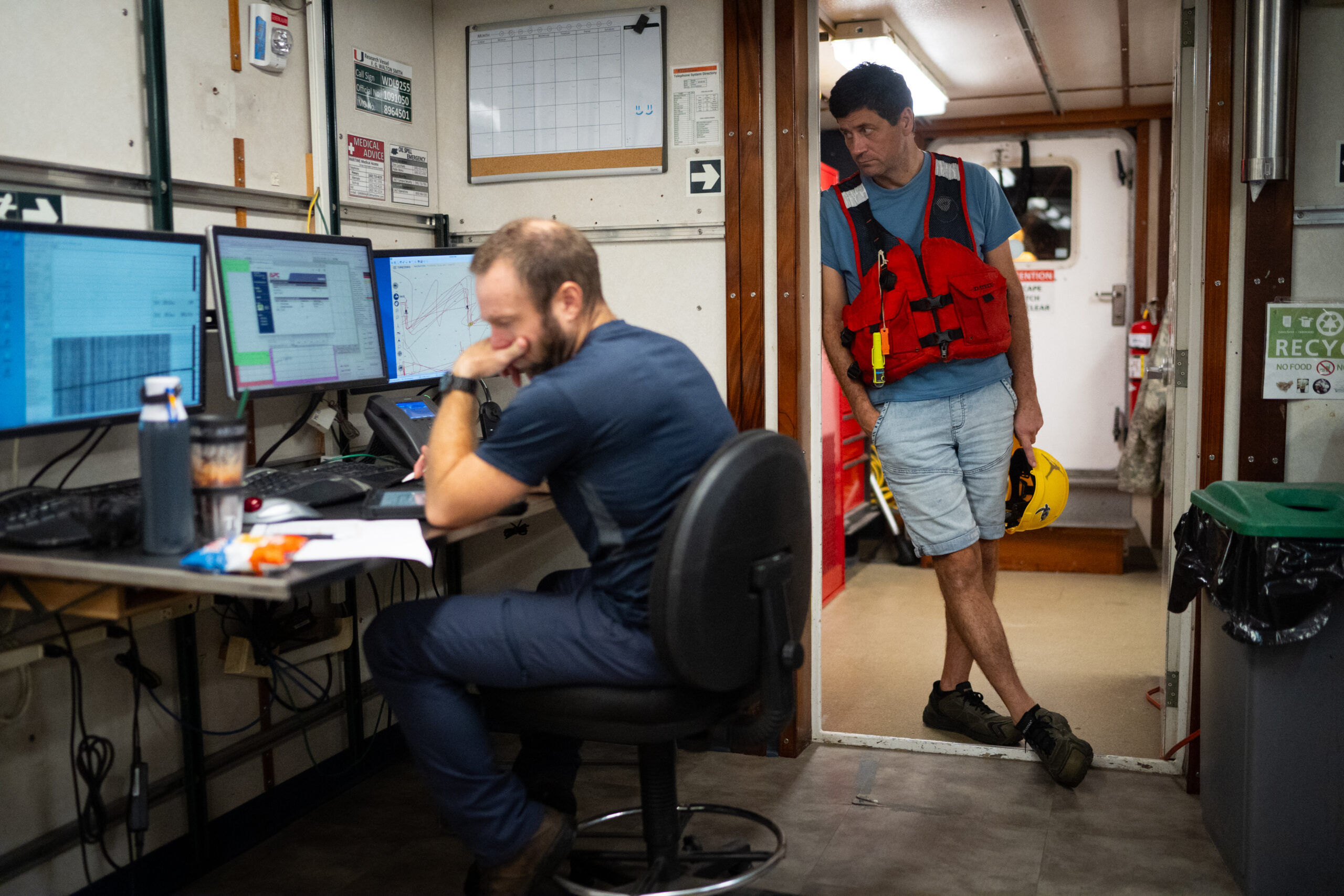
    At about 4 a.m., oceanographer Denis Volkov, right, checks in on Jay Hooper, who helps the team with data management

    The Florida Current is one of the main forces that make up the western boundary of the AMOC. The warm Florida waters feed into the mighty Gulf Stream, which merges with the warm North Atlantic Current headed toward Europe. As the current reaches the Arctic, air temperatures cool the water, which becomes denser. The water sinks and moves south toward the equator, where it is again warmed by the sun and returns north.

    “The role of the AMOC in the climate is it carries a huge amount of heat from the equator towards the poles,” said Denis Volkov, who is a co-principal investigator of NOAA’s Western Boundary Time Series project along with Smith.

    But scientists say a warming world is throwing off this balance. As Arctic ice melts, freshwater enters the North Atlantic — making the ocean water less dense, so it is less likely to sink. As a result, scientists propose that it cannot power the ocean conveyor belt as well, so less salty, warm water is getting transported northward.

    A major shift in the Atlantic Ocean’s circulation could create severe drought in some areas and damaging floods in others. Sea level could rise by a foot or more along the U.S. East Coast if it collapsed.

    Scientists have typically used data that indirectly hints at the current’s movement — such as sea surface or air temperature — to reconstruct the oceans in models and track whether the overall system is weakening, but they have reached mixed conclusions.

    For instance, a 2018 study plugged sea surface temperatures into computer models to show that the AMOC is weakening. Then, a paper released last January reported no evidence of weakening over the past 60 years after examining data on heat exchanges between the air and the ocean called air-sea fluxes.
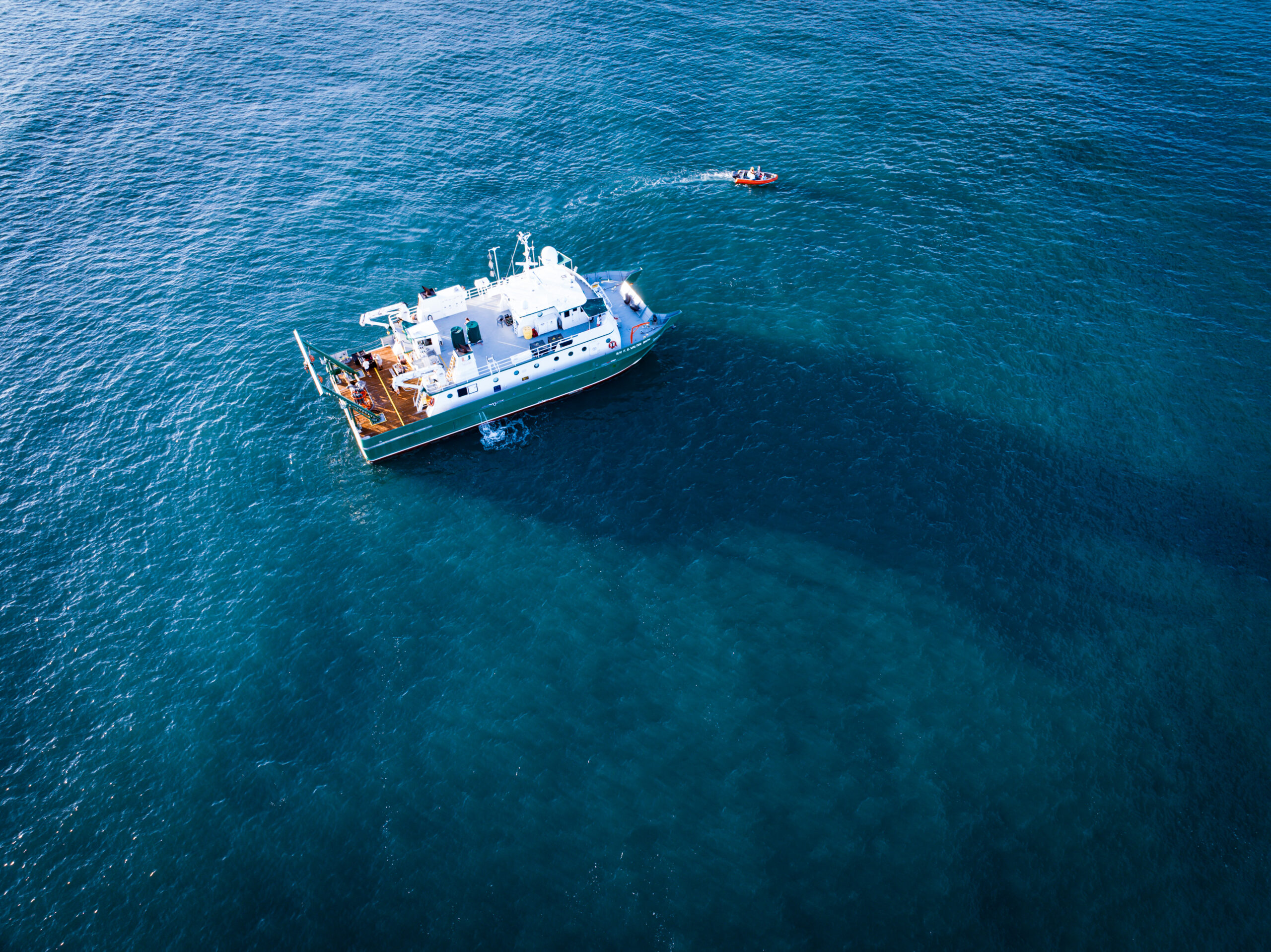
    The dive boat takes scientists to a site to collect data on the Florida Current.

    Volkov and his colleagues are helping approach the puzzle with observations. In 2024, they reassessed the cable data from the Florida Current, adjusting for changes from Earth’s geomagnetic field. First, they found that the current had remained stable over the past four decades. Then, they updated calculations of the AMOC in this region, which has been monitored for only 20 years or so, with the corrected data and found that the AMOC wasn’t weakening as much as previously calculated at this latitude.

    “But there is a caveat that observational data is very short,” said Volkov. He said scientists would need another 20 years of AMOC observations to determine if the small decline is a robust feature and not part of natural variability.

    And the AMOC can still weaken even if the Florida Current remains strong, he said, since it is the sum of currents across the basin. But long-term changes in the Florida Current can serve as an indicator of trouble for the rest of the system.

    One snag, said Volkov: The serendipitous cable that provided data for more than 40 years malfunctioned in 2023 — perhaps broke. Until it’s fixed, researchers are ramping up their diving operations to recover data from underwater acoustic barometers on the ocean floor.
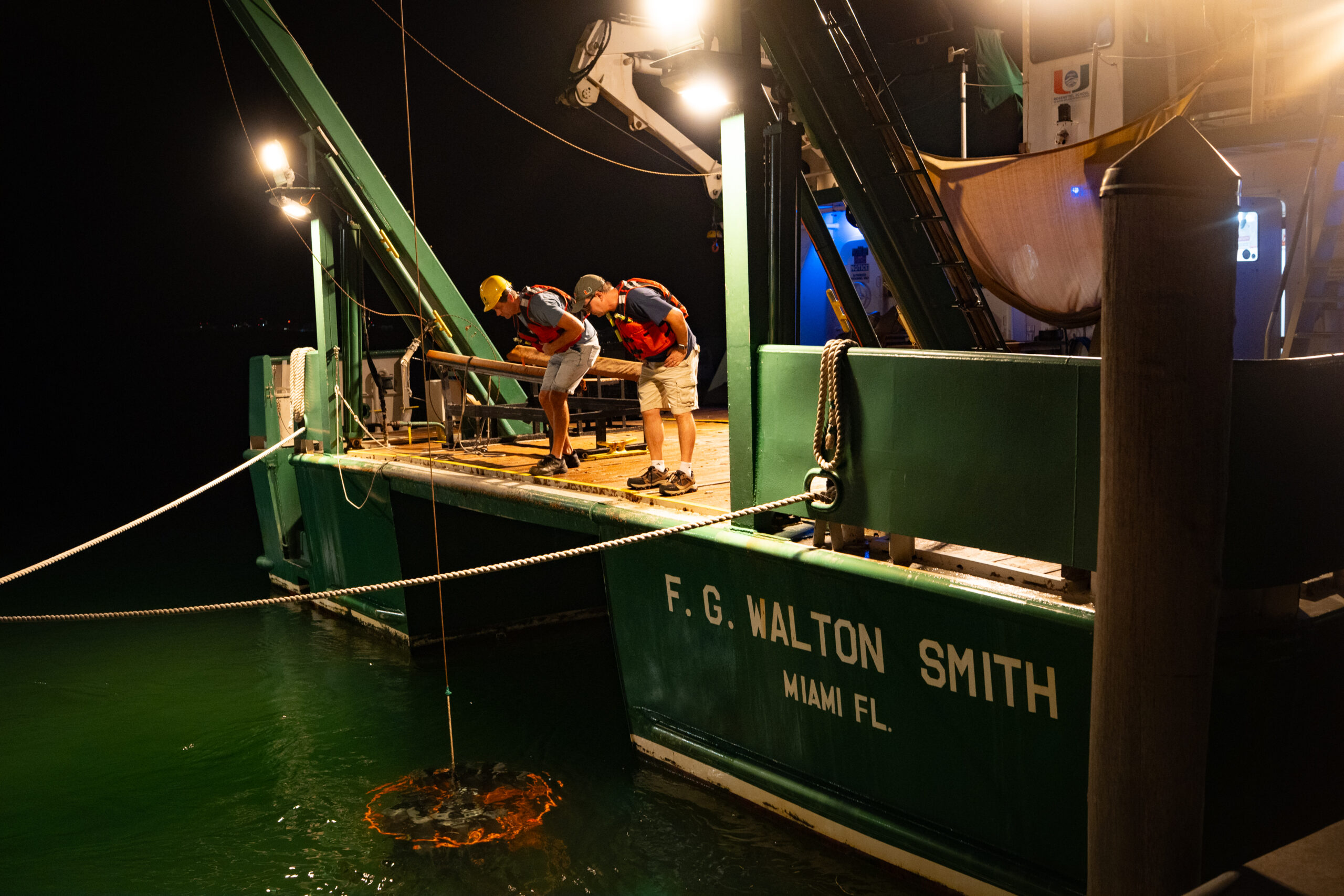
    Volkov, left, and Smith watch as a sampling instrument drops into the water.

    The expedition

    When the research vessel departed from the university’s dock around 4 a.m. on Sept. 3, the sun and most of the science staff were down for the night. A few shipmates gazed at the illuminated cityscapes from the stern deck, next to the diesel engine’s deep rumble. After traversing rocking waves, the crew reached scenic Bahamian waters eight hours later.

    The green F.G. Walton Smith, 96 feet long, and its crew make this overnight trip about six times a year, traveling 93 nautical miles diagonally from Miami toward the Little Bahama Bank. From there, they go west and collect data at nine sites from the boat and dive underwater at two others.

    The team’s goal is to determine the amount of water flowing north through the Florida Current per second through a series of underwater instruments, from the boat and from satellites. They also collect temperature, salinity, density and velocity data; velocity and temperature, for example, can be combined to calculate the amount of heat transported across an area.

    Chomiak, left, and Zach Barton, a technician and engineer, return from diving to the seafloor to place a data-collection instrument.

    At the first dive site, a remora — a long, torpedo-shaped suckerfish — circled the two scuba divers less than a mile from the boat. The slender fish is known for a unique fin on its head that suctions itself to sharks, whales, and turtles to feed off their detritus. And for a quick moment, it latched onto Leah Chomiak’s head. And her thigh.

    Chomiak focused on the barometer in front of her. Her bulky gloves made it harder to use a screwdriver 50 feet below the Bahamian surface. She and her fellow diver held onto the long tubes that had been recording data every five minutes for the previous two months, since the last time divers brought the instruments to the surface and downloaded the data.

    “Now we decided to service them more frequently, because, at the moment, this is the only source of data for our Florida Current transport estimates,” Volkov said. The scientists can use the pressure data to help calculate the amount of water flowing through the area.

    Next, the ship arrived at the first of nine hydrographic stations and lowered a cage of sensors known as a CTD-rosette sampler (CTD stands for conductivity, temperature and depth, although it measures many more properties). Researchers can use the temperature and salt concentrations of a particular mass of water to infer where it came from and how it reaches other parts of the world.
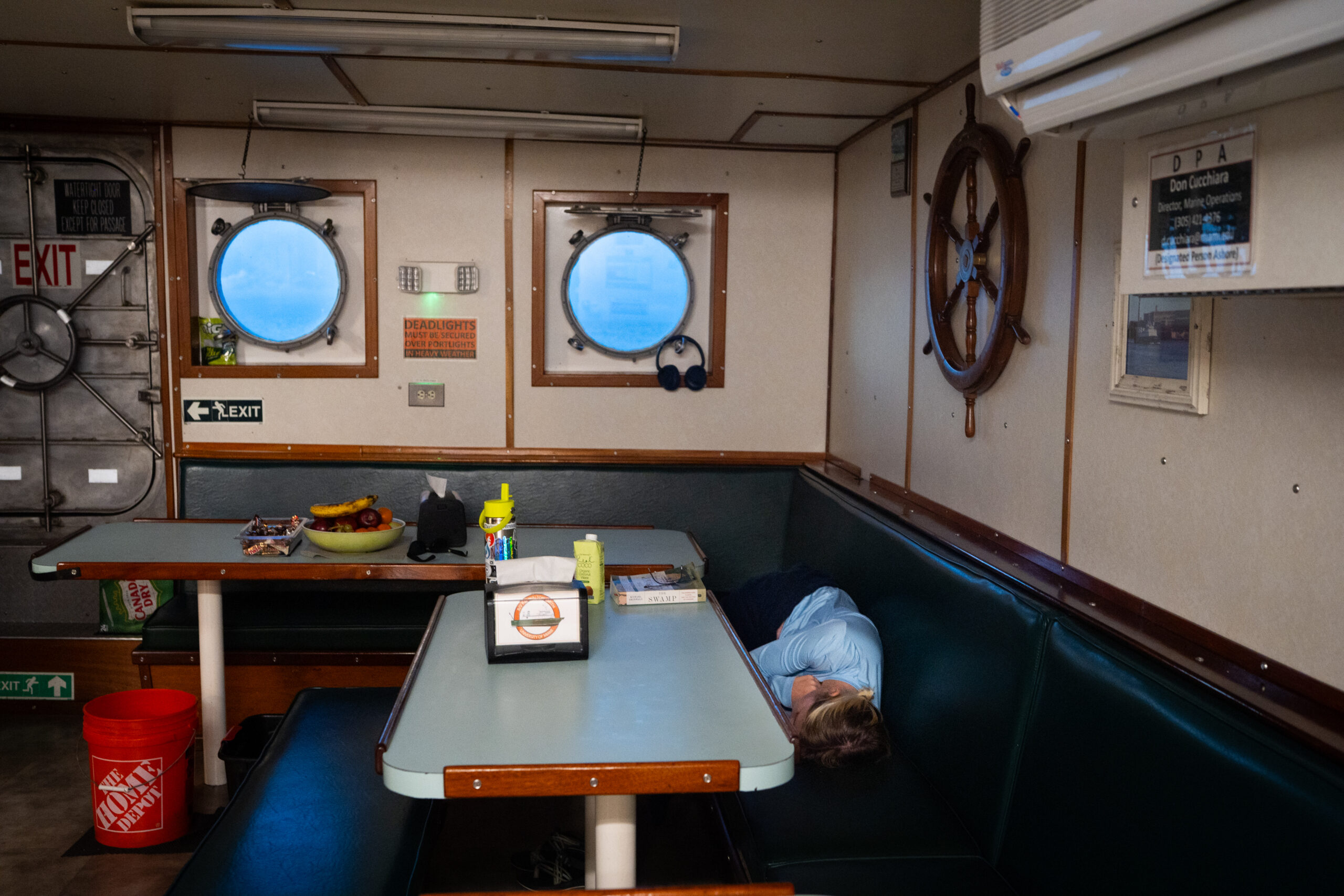
    Christian takes a quick nap in the galley as the vessel travels back to Miami.

    Jay Hooper, who has been on these trips for 10 years and helps with data management, sat at the ship’s computer station.

    “Ready whenever you are,” he said into his headset.

    From the top deck, the captain lowered the rosette into the water, dropping 60 meters each minute. As the instruments approached the bottom at 486 meters, Hooper said to slow down.

    Lines of various colors — representing salinity, temperature, and density — squiggled down on Hooper’s computer screen as the sensors dropped. Temperature decreased and density increased as the instruments descended. Seventeen minutes later, the rosette was brought back onto the boat.

    After hours of gathering data, Hooper and Smith hit a snag at the seventh station. The rosette now wasn’t sending any information to the computer. Was it human error? Did the instrument break?

    The two tried different solutions as the other scientists slept. Then they replaced the sensors’ cable, and as they lowered the rosette, data filled the computer screen.

    The boat stopped for the last dive near the Florida coast to retrieve the second set of underwater acoustic barometers. But the water was so cloudy, thick and green that the divers couldn’t see their hands, so they decided they would try on the next trip.

    Captain John Cramer pilots the vessel back to the university.

    For the next 12 hours, the boat fought against the Florida Current to take the crew home. Some aboard mustered up energy to sing “Happy Birthday” to one of the crew members.

    The next morning, Smith and his colleagues processed the data to upload to NOAA’s Atlantic Oceanographic & Meteorological Laboratory website. There were no notes about a cable malfunction, encounters with remoras or sleep deprivation.

    The Excel spreadsheet had a single note for each station it recorded: “Profile looks good; use these data.”

  • New DHS memo outlines plan to detain refugees for further vetting

    New DHS memo outlines plan to detain refugees for further vetting

    The Department of Homeland Security issued a memo Wednesday stating that federal immigration agents should arrest refugees who have not yet obtained a green card and detain them indefinitely for rescreening — a policy shift that upends decades of protections and puts tens of thousands of people who entered during the Biden administration at risk.

    The new policy rescinds a 2010 memo that said failing to apply for status as a lawful permanent resident within a year of living in the United States is not a basis for detaining refugees who entered the country legally. Two Trump administration officials wrote in the new directive that the previous guidance was incomplete and that the law requires DHS to detain and subject those refugees to a new set of interviews while in detention.

    The memo appeared in a court filing one day before a scheduled hearing in Minnesota federal court, where a judge temporarily blocked U.S. Immigration and Customs Enforcement in late January from detaining 5,600 refugees in the state after several organizations sued. Immigration officers arrested dozens of resettled people from countries including Somalia, Ecuador, and Venezuela for further questioning as part of an enforcement surge dubbed Operation PARRIS that the Trump administration has said was aimed at combating fraud. Immigration lawyers say many were quickly transported to Texas detention centers and later released without their identity documents.

    The International Refugee Assistance Project, one of the lead counsels for the plaintiffs in the lawsuit, is asking a judge to declare the new refugee detention policy unlawful to prevent more refugees in Minnesota from being arrested.

    “I am concerned that the Feb. 18 memo and the indiscriminate detention of refugees in Minnesota are the opening salvos in an attack on refugees resettled all over the United States,” said Laurie Ball Cooper, the organization’s vice president for U.S. legal programs.

    Refugee resettlement groups across the country see the Minnesota operation as a precursor to an expected shift in refugee policy that could undermine the nation’s half-century-old promise to offer safe harbor to the world’s most persecuted.

    “This memo, drafted in secret and without coordination with agencies working directly with refugees, represents an unprecedented and unnecessary breach of trust,” said Beth Oppenheim, chief executive of HIAS, one of the oldest refugee agencies in the country and the world. “We have both a moral and a legal obligation to demand that DHS immediately rescind this action.”

    A spokesperson for U.S. Citizenship and Immigration Services said the memo directs agencies to implement the plain language of “long established immigration law.”

    “This is not novel or discretionary; it is a clear requirement in law,” the spokesperson said in a statement. “The alternative would be to allow fugitive aliens to run rampant through our country with zero oversight. We refuse to let that happen.”

    Refugees, unless charged with crimes, are not fugitives, and are invited to resettle legally in the U.S. after being vetted abroad.

    President Donald Trump suspended all refugee admissions on his first day in office, including those involving people who had already been approved to come to the U.S. His administration later reopened the program to white South Africans, who he said face race-based persecution in their home country, though they had rarely qualified before for refugee status in the U.S. or any other country.

    More than 200,000 refugees entered the U.S. during the Biden administration and most had waited years to be admitted, according to federal data. Some of those new arrivals have already received green cards, but advocates estimate about 100,000 refugees have not and could be subject to detention under the new policy. Most entered assuming they were protected the moment they stepped on U.S. soil, according to refugee experts and attorneys. Refugees are permitted to apply to become permanent residents after one year of physical presence in the country after their arrival date.

    But the Trump administration is recasting refugee status as conditional instead of permanent — a major change in how refugees have historically been regarded. The memo said refugees who haven’t adjusted their status must endure a second round of “congressionally mandated” vetting to screen for public safety, fraud, and national security risks.

    “This requires DHS to take the affirmative actions of locating, arresting, and taking the alien into custody,” states the memo, signed by acting ICE director Todd M. Lyons and U.S. Citizenship and Immigration Services Director Joseph Edlow.

    DHS based its policy on a section of the Immigration and Nationality Act that says refugees who don’t apply for a green card after a year must return to DHS “custody.” It voids previous guidance indicating that a failure to adjust was not a “proper basis” for removal or detention and if any unadjusted refugee was arrested, they must be released within 48 hours.

    There are many reasons, advocates said, for why a refugee might not apply at the one-year mark, including confusion about the process, language barriers, lost mail from changing addresses, and difficulty navigating the system.

    But returning to DHS “custody” has never meant arrest and unlimited detention, attorneys said in court filings. The historical practice for USCIS was to issue notices for appointments or letters urging compliance, according to court documents in the pending lawsuit.

    Ball Cooper said Congress does not demand revetting as part of the adjustment of status. The law requires the federal government to “inspect” or ask specific questions after the one-year mark, such as whether the person has been physically present in the U.S. throughout that time or whether they have already obtained lawful status through a different channel.

    “None of that requires interrogating a refugee about their original claim, which they’ve already proven to the U.S. government,” Ball Cooper said.

    The Trump administration also halted green-card processing months ago for scores of countries from which refugees originate, making it impossible to satisfy the requirement.

    What has traditionally been treated as a paperwork issue is now a detention issue under the new guidance. Advocates call that a major escalation in the Trump administration’s targeting of legal immigrants. Changing how the law is enforced for refugees who had begun rebuilding their lives under a different set of assumptions is unfair and disproportionately punitive, said Shawn VanDiver, a U.S. Navy veteran who founded the nonprofit organization AfghanEvac.

    “It seems like they are just trying to find new and different ways to put grandma in jail,” said VanDiver. “You don’t invite people into the United States under one set of rules and start moving the goalposts after they arrive.”

    ICE arrested about 100 refugees, some of whom were children, before Minnesota District Judge John Tunheim issued a temporary restraining order in response to the International Refugee Assistance Project’s lawsuit. Dozens were flown to Texas to be asked the same questions they faced during screening overseas, according to attorneys who were present during the interviews. Several of those cases involved refugees with pending green-card applications. There are no confirmed reports of DHS terminating an individual’s refugee status as a result of the operation.

    Former ICE director Sarah Saldaña, who led the agency during President Barack Obama’s administration, said she could not recall a time when immigration officers had arrested refugees for failing to apply on time for a green card. She said this and other actions by the Trump administration signal that “they want to close the door on what has been the country’s welcoming nature when it comes to refugees.”

    The DHS memo cited statistics from an unpublished review from USCIS’s Fraud Detection and National Security Directorate that found insufficient vetting and some public safety concerns in regard to 31,000 recently admitted refugees from the Western Hemisphere. However, it’s unclear where the data came from or what conclusions the internal report reached about “known failures” in screening people from other parts of the world.

    Vetting refugees from specific parts of the world, such as conflict zones, can be challenging, experts said. But the layers of screening, hours of interviews and the fact that would-be refugees can be denied at every step in the process — including the moment they arrive at a U.S. airport — have created a high bar of scrutiny for anyone seeking refugee status. Refugees convicted of aggravated felonies can lose their status and be deported, but studies have repeatedly found — as they have with all immigrants — that refugees commit crimes at far lower rates than native-born citizens.

    Meredith L.B. Owen, senior director of policy and advocacy at Refugee Council USA, said the memo directly threatens the very purpose of why the U.S. brings in refugees. Advocates expect a coming ruling from the Board of Immigration Appeals to set up the legal mechanism for the Trump administration’s broader push to deport thousands of recently admitted refugees. That could ultimately lead to refugees being sent back to the places from which they were fleeing war or political persecution, thus putting their lives in danger.

    That scenario, known as refoulement, violates international law, said Owen, whose group represents all of the national resettlement agencies that provide assistance to refugees upon their arrival to the U.S.

    “This administration stops at nothing to terrorize day after day after day refugee communities in Minnesota and to make sure refugee communities across the country are fearful and bracing themselves for what’s to come,” she said.

  • Trump appears ready to attack Iran as U.S. strike force takes shape

    Trump appears ready to attack Iran as U.S. strike force takes shape

    The Trump administration appears ready to launch an extended military assault on Iran, current and former U.S. officials said, as the Pentagon amasses an immense strike force in the Middle East despite the risks of U.S. combat fatalities and American ensnarement in an extended war.

    The arsenal, under assembly for weeks, is awaiting the arrival of the aircraft carrier USS Gerald R. Ford and its accompanying warships, officials familiar with the matter said, after military leaders last week extended their deployment and ordered the ships to the region from the Caribbean Sea. The vessels were approaching the Strait of Gibraltar on Thursday, making an attack possible within days, said these people, whom like others spoke on the condition of anonymity to discuss sensitive military planning.

    President Donald Trump, speaking Thursday morning at an event in Washington, was ambiguous about what he might do. “Maybe we’re going to make a deal. Maybe not,” he said at the inaugural meeting of his Board of Peace. “You’re going to be finding out over the next, maybe, 10 days.”

    The administration wants it known, officials said, that they are building combat power in the region. The president also has publicly raised the possibility of toppling Iran’s supreme leader, Ayatollah Ali Khamenei, a longtime U.S. adversary, suggesting last week that it would be “the best thing that could happen,” if Iran ends up with new leaders.

    Still, it remains unclear whether Trump has approved military action, people familiar with the matter said. One consideration, some noted, is the ongoing Winter Olympics, which conclude Sunday in Italy.

    The United States, backed by ally Israel, would have an “overwhelming advantage” militarily over Iran, said Daniel B. Shapiro, a former U.S. ambassador to Israel and senior Pentagon official during the Biden administration. The warships in or nearing the Middle East join a sprawling array of combat power already in position, including dozens of fighter jets, air-defense capabilities, and other weapons.

    But a major conflict with Iran poses grave risks, Shapiro said, including ballistic missiles capable of killing U.S. troops in the region, a network of proxy forces across the Middle East that could quickly turn any attack into a far wider and deadlier war, and the potential for significant disruption to maritime shipping and the global oil market.

    “They’ll definitely take terrible damage from combined U.S.-Israeli strikes,” said Shapiro, a distinguished fellow at the Atlantic Council, referring to Iran. “But that doesn’t mean it ends quickly, or clean — and they do have some ability to impose some costs in the other direction.”

    The military buildup coincides with recent meetings between U.S. and Iranian officials aimed at negotiating changes to Tehran’s nuclear program. White House press secretary Karoline Leavitt told reporters this week that the two sides had “made a little bit of progress” but were still “very far apart on some issues.” Iranian officials, she added, are “expected to come back to us with some more detail in the next couple of weeks.” It is unclear if Trump is willing to wait that long.

    Regional diplomats initially thought that the Trump administration’s military pressure on Iran was meant to push Tehran to offer greater concessions in those negotiations, according to a European diplomat briefed on the Iran talks. But after the most recent talks concluded Tuesday, diplomats now believe that Iran is not prepared to budge from its “core positions,” including its right to enrich uranium.

    “The Iranians were planning to drown them in technicalities and delay substance,” the diplomat said. “While a more traditional approach would have built on the dialogue, … Trump does not have the patience.”

    The U.S. military buildup initially was reassuring to some officials in the region, according to this diplomat, but the indications that the Trump administration is preparing for an extended conflict have become deeply concerning.

    “Some actors may have favored targeted strikes to add pressure on Iran,” said the diplomat, referring to officials from Saudi Arabia and the United Arab Emirates. “But an extended conflict will be bloody and it could bring more countries, either deliberately or by miscalculation, into the war.”

    Secretary of State Marco Rubio plans to travel to Israel on Feb. 28 to meet with Israeli Prime Minister Benjamin Netanyahu, a State Department official said. The trip would be aimed at keeping Netanyahu abreast of the status of U.S.-Iran negotiations, the official said, but it does not preclude the Pentagon from launching strikes first. In summer, the U.S. struck Iran’s nuclear facilities even as the president’s top diplomats had diplomatic meetings with Iranian counterparts on the books.

    Netanyahu is eager for the United States to launch a major attack on Iran, and in a speech Sunday he put forward his own conditions for any U.S. agreement with Tehran. Any deal must ban all enrichment of uranium and dismantle “the equipment and the infrastructure that allows you to enrich in the first place,” Netanyahu told the annual conference of Presidents of Major American Jewish Organizations. It should also require that all enriched uranium leave Iran, restrict Iran’s ballistic missile program and impose sustained inspections of Iran’s civilian nuclear program, he said.

    Middle East experts have said Iran is unlikely to agree to all of Israel’s demands and it views them as a breach of Tehran’s ability to defend itself.

    Khamenei in recent days has resisted signing a deal, arguing in social media posts that Tehran has the right to produce nuclear power and the range of its missile arsenal should not be limited. He also has taunted U.S. officials.

    “The Americans constantly say that they’ve sent a warship toward Iran,” he said in one message Tuesday. “Of course, a warship is a dangerous piece of military hardware. However, more dangerous than that warship is the weapon that can send that warship to the bottom of the sea.”

    An extended assault against Iran could mark the most significant action in decades against the longtime U.S. adversary. For years, Iran has sponsored and facilitated attacks on U.S. troops across the region, U.S. officials broadly agree.

    Trump began pondering new strikes against Iran in January, after he pledged to rescue anti-government protesters there following a wave of executions. The president tabled military action, in part because U.S. defense officials warned it would be difficult to manage Iranian counterattacks while a relatively limited number of U.S. forces were in the region, people familiar with the matter said.

    The administration has since surged U.S. weaponry, including another aircraft carrier, the USS Abraham Lincoln, that was diverted from the South China Sea. Numerous Navy destroyers, scores of fighter jets, and other war planes also have been deployed, including advanced F-35s with the ability to evade radar.

    A review of flight-tracking data in recent days has shown a fleet of tanker planes also relocating to Europe and the Middle East, and many fighter jets repositioned at Muwaffaq Al Salti Air Base in Jordan. Other U.S. military aircraft appear to have relocated to or transited through Vrazhdebna Air Base in Bulgaria, data show.

    The military buildup signals the Trump administration is “prepared for something much more extended than a one-day cycle” of strikes, said Dana Stroul, a former senior Pentagon official during the Biden administration who is now with the Washington Institute.

    An extended conflict would mark a sea change from Trump’s recent military forays, including the January U.S. Special Operations raid to capture Venezuelan President Nicolás Maduro in Caracas, a weekslong bombing campaign last spring against Houthi rebels in Yemen, and the surgical strikes last year against Iran’s nuclear facilities. In each of those cases, Trump authorized significant military action that was significant in scope but limited in duration, declared victory afterward and pivoted to other issues.

    Trump has criticized previous U.S. administrations for allowing the United States to become entrapped in lengthy military interventions in the Middle East that killed thousands of U.S. troops and dominated Pentagon resources.

    A lack of calamities during those previous operations has made it easy to overlook the potential pitfalls of future missions, said Jason Dempsey, a retired Army officer who studies the use of military force for the Center for a New American Security. They include lethal attacks against U.S. troops, aircraft collisions, or U.S. pilots being forced to parachute or crash behind enemy lines.

    “Military operations look quick and easy — right until they are not,” Dempsey said. “What we did in Venezuela was such a unique operation, and a one-off. And even that — I’m not sure it will turn out fine.”

  • Silicon Valley is building a shadow power grid for data centers across the U.S.

    Silicon Valley is building a shadow power grid for data centers across the U.S.

    The GW Ranch project approved on 8,000 windswept acres of West Texas will look like many of the other data centers that have sprung up across the country to support Silicon Valley’s ambitions for artificial intelligence. Dozens of airplane-hangar-size warehouses packed with computing hardware will consume more power than all of Chicago.

    But it’s missing one standard feature: The mammoth project, recently green-lit by state environmental regulators, won’t need new power lines to deliver the electricity that it guzzles. GW Ranch will be walled off from the power grid and generate its own electricity from natural gas and solar plants installed on site.

    GW Ranch is set to become part of a shadow power grid emerging across the country with potentially far-reaching consequences for the U.S. electricity system and environment.

    After the rapid growth of data centers triggered pushback from politicians, utilities, and local residents over the pressures they place on the grid, tech companies are now building their own fleet of private power plants, mostly fueled by natural gas.

    Dozens of sprawling off-grid data center projects are planned across Texas, New Mexico, Pennsylvania, Wyoming, Utah, Ohio, and Tennessee, according to a review of regulatory filings, permits, earnings call transcripts, and other documents by the energy industry research firm Cleanview. Several are already under construction.

    Companies rushing to develop the facilities include Meta, ChatGPT-maker OpenAI, business software provider Oracle, and oil giant Chevron. (The Washington Post has a content partnership with OpenAI.)

    The off-grid projects already approved by state energy and environmental regulators could power all of New York City several times over, a vast new energy infrastructure that will bring huge new industrial facilities to communities across the country and increase U.S. emissions of carbon dioxide and other air pollutants. A handful of states have passed laws to encourage off-grid data centers by loosening rules around who can build power plants and where they can be located.

    The projects are sparking alarm from El Paso to Davis, West Virginia, from residents unhappy to learn that gas plants large enough to fuel major cities are set to sprout in places they were never expected.

    “This came out of nowhere,” said Amy Margolies, a resident fighting an off-grid data center planned near Davis, in one of West Virginia’s major tourism corridors. The project was permitted to operate a gas plant large enough to generate roughly equivalent power to that used by every home in the state. It is being propelled by a 2025 state law that eased approvals for off-grid data centers.

    “They removed local control completely for this speculative gold rush,” Margolies said. “Everything is shrouded in secrecy, and the public is removed from the process.”

    The idea of taking data centers off-grid is the latest in a line of provocative strategies adopted by the tech industry in its pursuit of more electricity that also includes reviving old nuclear plants, backing long-shot fusion energy schemes, and planning to plunk down hundreds of compact nuclear power plants in communities across the U.S. But while these approaches are fossil fuel-free, most of the sector’s immediate investments will be in gas power, driving up the planet-warming emissions the companies long promised to take a lead in curbing.

    Billions of dollars are now being invested in power plants for off-grid data centers, even though key engineering challenges have not been solved, according to veteran energy developers.

    Most of the projects rely on natural gas because the variable output of solar and wind is difficult to manage without the grid as backup. But the most efficient gas turbines are back-ordered for years, forcing developers to use more wasteful and polluting equipment.

    “It is catastrophic for climate goals,” said Michael Thomas, founder of Cleanview, which has identified 47 behind-the-meter projects nationwide.

    Others warn that off-grid projects could struggle to keep the lights on. Gas plants typically spend a third or more of the year down for maintenance, but data centers generally operate around the clock. “I get that cost is no object for these companies and they just want to get online,” said Jigar Shah, an energy entrepreneur who helped manage federal energy investments for the Biden administration. “But they have not figured out even with unlimited funds how to make these plants run with 24/7 reliability.”

    Shah said the projects could also drive up prices for customers who still use the power grid, as developers outbid utilities for equipment and leave other ratepayers to bear the costs of maintenance for older energy infrastructure. “This whole thing feels like a fairy tale concocted on the back of a napkin,” he said.

    Developers of the projects have said they can use backup generators or gas plants to keep data centers operating without interruption. President Donald Trump and White House officials have argued that loosening regulations that gave utilities a monopoly over power generation will make electricity more abundant and protect ordinary consumers.

    “President Trump’s vision really since the beginning of the administration is … ‘Let the AI companies become power companies. Let them stand up their own power generation as they built side by side with these new data centers,’” said David Sacks, Trump’s AI and crypto czar, during a podcast interview at the World Economic Forum meeting in Davos, Switzerland, last month. “We get this infrastructure, [and] residential rates don’t go up.”

    Silicon Valley’s build-out of AI infrastructure is “too onerous for the power grid to take on,” said Kevin Pratt, chief operating officer of Pacifico Energy, the energy developer building GW Ranch in Texas. “We were hearing, ‘We want you to build these projects, but the utility can’t give us the power we need. What can you do?’”

    The off-grid strategy appears to have worked for Elon Musk. In 2024, his company xAI got a Memphis data center up and running in months — instead of the more typical years — in part by largely sidestepping the grid and powering the facility with dozens of portable gas generators.

    Last month, the Environmental Protection Agency ruled the setup illegally breached emissions rules, and required the company to get permits. But tech industry officials say xAI had put rivals on notice that unless companies found work-arounds to lengthy wait times for power grid hookups, they risked being left behind.

    The fallout is now reverberating in places like Tucker County, W.Va. Residents learned through a legal notice in the community newspaper the Parsons Advocate that developer Fundamental Data was seeking to build a massive, off-grid data center with a large gas plant on a ridgeline near Davis.

    The state law promoting such projects strips local officials of their usual authority to vet and approve new developments if these proposals are related to data center campuses using off-grid power. Fundamental Data received a state environmental permit for the gas plant over the loud objections of residents and officials in surrounding communities.

    The company declined to say how many gas turbines it plans to use or what kind they will be. It would not comment on whether the data center would be for AI development, crypto mining, or something else.

    “As designed, it is intended to operate independently and does not rely on ratepayer-funded infrastructure or impact existing residential customers,” Fundamental Data said in a statement.

    The project is one of at least three large off-grid data center developments that builders are pursuing in West Virginia under its 2025 law. One of the others, the Monarch Compute Campus in Mason County, will initially use gas to generate enough electricity to power 1.5 million homes, plans say, and later quadruple its output. That would see the site generate and consume several times the total electricity consumption of West Virginia residents.

    The major tech companies that will tap this shadow grid are mostly keeping their names off the projects while developers go through the messy process of permitting, overcoming community opposition and construction.

    Meta is one exception. Through a subsidiary, it is working with natural gas colossus Williams on a project called Socrates in New Albany, Ohio, that will install a pair of off-grid gas power plants that will each sprawl across 20 acres. Williams says it will be operational this year.

    The social media giant has another off-grid project in El Paso, Texas, where it is working with the local utility to create a large gas generating facility by linking together 813 modest generators. Local officials and activists have protested the plan, alleging that Meta won lucrative city and county incentives after leaving the impression its data center campus would be powered by clean energy.

    Meta’s local partner, El Paso Electric, wrote in regulatory filings first reported on by the Texas Tribune that using solar panels and battery storage “would require thousands of acres adjacent to the Data Center site which are not available.”

    Meta said that the fossil fuel power used in El Paso will be paired with purchases of renewable energy. “As with all of our data centers, including dozens of renewable projects throughout Texas, we work to add energy to the grid and match our data center’s electricity use with 100% clean, and renewable energy,” company spokesman Ryan Daniels said in an email.

    Oracle and OpenAI are also developing off-grid power plants for their data centers. Construction is underway at their Stargate Project Jupiter campus in New Mexico, which will be powered by massive natural gas systems.

    OpenAI chief executive Sam Altman is an investor in aerospace firm Boom Supersonic, which has refashioned a jet engine design to power off-grid data centers. The first batch will go to developer Crusoe, which is building one of the world’s largest data center campuses in Wyoming.

    Despite the immense capital invested and shovels in the ground, the AI industry’s off-grid plans do not compute for some veterans of big energy projects.

    Developers are “trying to rush to market with a bunch of clankety old stuff that was headed to the scrapyard, or with dozens to hundreds of small generating units strung together,” said Aaron Zubaty, CEO of California-based Eolian, which builds large energy installations.

    Those untested designs will inevitably develop maintenance problems that cause cost overruns, malfunctioning equipment and unanticipated outages, Zubaty said. He predicted that spending on the projects may be more likely to pay off by creating pressure on utility companies to accommodate more data centers on the grid.

    “If you are a utility, this can’t be your future,” he said. “You can’t have your biggest customers never need you again.”

  • Why it’s becoming so expensive to buy a car in America

    Why it’s becoming so expensive to buy a car in America

    It can be a shock shopping for a new car these days.

    The pandemic shortages are over. Dealer lots are stocked. Customers can find the colors and options they want.

    But prices have never been higher — and the auto loans bigger and longer than ever to make it pencil out.

    The average sticker price for a new car or truck now sits above $50,000 — about 30% more than in 2019. Even with incentives and specials, the out-the-door price reached above $50,000 for the first time in September and stood at $49,191 in January — a record for the typically sluggish sales month, according to Cox Automotive.

    That’s helped push the average monthly payment to buy a new vehicle to an all-time high of a little over $800, according to J.D. Power.

    Some customers go further. About 1 in 5 new auto loans have monthly payments of at least $1,000, S&P Global said, projecting that share could double by year’s end.

    “We are approaching a threshold that a lot people don’t want to go over,” said Patrick Manzi, chief economist at the National Automobile Dealers Association.

    The auto industry is increasingly worried how much more consumers can take. Signs of stress are growing. Severely delinquent auto loan rates have soared to levels last seen during the pandemic shutdown. Affordability was a buzzword at the 2026 North American Dealers Association conference in Las Vegas earlier this month. And there is growing talk about the need for automakers to offer more budget-friendly vehicles, especially when little relief is to be found in the used-car market, with average prices of about $25,000.

    “There is no doubt that affordability is front of mind,” said Mike Manley, chief executive of AutoNation, one of the nation’s largest auto retailers, speaking to analysts on an earnings call earlier this month.

    The question that the industry is asking, said Tyson Jominy, senior vice president at J.D. Power for automaker data and insights: “Is there a breaking point where you just push prices past what the average consumer can afford?”

    Sales remain strong, for now. Automakers are coming off their best year since the pandemic, selling 16.2 million vehicles in the United States.

    But sales are projected to slump to 16 million this year, according to NADA.

    One big change is that carmakers have largely abandoned entry-level vehicles in recent years.

    The last car with an asking price under $20,000 — the subcompact Nissan Versa, at $17,390 — ended production in December. Other affordable subcompacts have disappeared in the last couple of years, such as the Mitsubishi Mirage, Kia Rio, Hyundai Accent, and Chevrolet Spark.

    “Americans just don’t want them,” said Jessica Caldwell, head of insights at Edmunds, the car-buying research company.

    They want SUVs and crossovers.

    A decade ago, the American market was about evenly split between cars and light trucks. Today, the light truck category — which includes SUVs — makes up about 8 in 10 of sales. Crossover SUVs, such as the Honda CR-V, account for nearly half of vehicles sold.

    Under $30,000 “is the new threshold for affordability,” said Manzi of NADA.

    That reality surprises many consumers, who might buy a new car every six to eight years.

    “It’s not something you shop for every day and so you come back a few years later and get real sticker shock,” said Erin Keating, executive analyst at Cox Automotive.

    It’s a common complaint, said Caldwell.

    “That’s what we hear from so many consumers,” she said. “People don’t like it. They’re not happy with how much cars costs.”

    Affordability was cited as the biggest obstacle for people who planned to buy a car in the near future, according to a survey recently released from credit reporting agency TransUnion.

    Automakers have managed to pay less attention to the entry-level market because luxury vehicles, with higher profit margins, continue to sell.

    The U.S. economy has seen a widening divide between the fortunes of its top earners and everyone else, creating the so-called K-shaped economy. And cars are no exception.

    At end of last year, vehicles priced over $70,000 were staying about the same amount of time on dealer lots as cars under $70,000. And buyers with household incomes above $150,000 accounted for 29% of all car purchases, up from 18% in 2020.

    “Wealthier customers are driving this,” Manzi said.

    New car buyers are also getting older, another sign of rising costs.

    Nearly half of all new car registrations last year came from people 55 and older, according to S&P Global data.

    A buyer’s average age was 51, according to J.D. Power. It was 50 before the pandemic.

    Twenty-five years ago, the average buyer was a little over 43 years old.

    Meanwhile, the other end of the car-buying market appears to be struggling.

    The average auto loan now runs for 68.8 months — more than five years.

    A growing share of auto loans now go for 84 months or longer. These seven-year loans made up 11.7% of the market last year, nearly double the share in 2019, according to J.D. Power.

    “We’ve already pushed things pretty far,” Jominy said. “How much further can they go?”

    Bad auto loans are becoming more common. The share of auto loans that were 90 days past due, known as severely delinquent, reached 8.6% early last year — levels last seen briefly in 2020 and then after the 2008-2009 financial meltdown, according to Federal Reserve Bank of Philadelphia data. The growth in bad loans is from borrowers with low credit scores.

    “That’s that K-shaped economy. That’s kind of the reality,” Manzi said. “Wages haven’t kept up.”

    Vehicle prices have surged even though carmakers have been absorbing most of the cost of President Donald Trump’s tariffs, auto analysts said. It’s unclear how much longer they can do that.

    “At some point we’ll have to see tariff price increases,” Caldwell said.

    U.S. automakers also need to tackle affordability if they hope to keep out ultra-low-cost Chinese car manufacturers, said Keating of Cox Automotive.

    Auto analysts didn’t think the United States would welcome these foreign carmakers anytime soon. But Canada recently relaxed its tariff rules for Chinese electric vehicles.

    U.S. automakers are slowly starting to pay attention to pricing.

    Chevrolet has been touting its Trax crossover, which starts at $21,700. Car and Driver recently named the 2026 Trax its Best Crossover SUV.

    “It shows that it can be done,” Jominy said.

    The Ford Maverick pickup — which looks like a baby version of the Ford Ranger — starts at $28,145. And Ford announced earlier this month that it planned to offer several more vehicles under $40,000 by 2030.

    Honda also is evaluating its lineup.

    “With average new car prices hitting record highs across the industry, cost is a growing concern, and we want the Honda and Acura brands to continue to be recognized for delivering incredible value to our customers,” said Lance Woelfer, sales vice president for American Honda.

    No one expects a return of the $20,000 car. Instead, carmakers appear to be pinning their hopes on small SUVs.

    “That’s the new front door to the industry,” Tominy said.

  • Should your therapy session be outdoors? More therapists are trying it.

    Should your therapy session be outdoors? More therapists are trying it.

    Jennifer Udler has been a practicing therapist for 25 years. A little over a decade ago, she started training for a marathon, running with a group near her home in Montgomery County, Maryland.

    “I noticed that people were more comfortable, less inhibited, opening up and talking during our group training runs,” Udler said. “And I started to wonder if there was a way to do a practice where people are moving.”

    Udler sees children and adolescents as well as adults, and she suspected that her younger clients especially might feel more comfortable talking while walking on a nature trail rather than sitting in a therapist’s office. She decided to try it with one of her young clients with his mom’s permission.

    “We met at a park, and we walked around, and he was a different kid,” Udler said. “He was running around, and he was showing me stuff in nature. And he talked.” She said they made more progress in one session outside than they had in two years meeting in her office.

    “That was in the snow in February,” she added. “So I was like, it’s only going to get better.”

    Udler started reading more about outdoor therapy, which is also known as walk-and-talk or nature-informed therapy. At that time she couldn’t find any formal training or certification programs, but she did learn that other therapists had tried it and found many of the same benefits she had.

    “You’ve got the movement, you’ve got nature, which is extremely grounding and stabilizing for people, and you have the co-regulation, walking side-by-side,” Udler said. For her younger clients or anyone uncomfortable with therapy, it also helped to be walking while talking about difficult topics because they didn’t always have to make eye contact with her.

    She wrote her own informed consent for her clients, establishing the additional risks of outdoor therapy and how confidentiality would work in a public park. She started a practice called Positive Strides, specializing in walk-and-talk therapy sessions outdoors in nature.

    “As I did the work and saw different types of people with different kinds of mental health issues, I realized how amazing it is,” Udler said.

    Trading the couch for the great outdoors

    In March of 2020, when many therapists moved their practices online, a smaller number brought their practices outside. The benefits were not felt only by the clients. Nature acts as a sort of “buffer against burnout,” said Heidi Schreiber-Pan, the executive director and founder of the Center for Nature Informed Therapy, where she trains clinicians in how to bring their practices outdoors.

    “What we’re hearing from people is that they can see more clients when they have outdoor sessions or nature-informed sessions,” Schreiber-Pan said.

    The American Psychological Association put out new guidelines this past fall for how clinicians can implement walk-and-talk therapy into their practice.

    The number of therapists working outside is still small. Shreiber-Pan believes that’s in part because therapists don’t realize that nature is all around us. One of the first questions she asks in her trainings is: When you think of nature, what comes to mind?

    “They talk about, like, these beautiful national parks or the mountains or the ocean,” Shreiber-Pan said. “And where is your therapy office? Not there.” She said that part of the training is helping practitioners recognize that nature is all around us — even in a city park.

    Miki Moskowitz is a clinical psychologist who practices in a primary care setting, which means she sometimes sees a patient only a couple of times.

    “We’re trying to make a difference, even in one single session,” she said.

    For Moskowitz, practicing outside has improved her own mental health and increased her capacity, but she also sees the immediate impact for her patients.

    “What I’ve seen that’s so encouraging is that sometimes just that first session we go for the walk, and patients are, like: ‘Wow, I didn’t know this trail was here. This is so beautiful. This feels so great. This is totally something I can do on my own,’” Moskowitz said. “That is so much more powerful than if we’re sitting in my office, which has no windows, just talking about the idea of going outside.”

    The brain benefits of getting outside — even when it’s freezing

    When Marc Berman was doing research at the University of Michigan, he helped devise a study to look at the brain benefits of time in nature. Participants did a challenging task testing their memory and attention, and then they were sent on a walk either through downtown Ann Arbor or in the area arboretum. Those who walked in nature showed a 20% improvement in their short-term memory, while those who walked in an urban environment did not.

    Berman and his colleagues did this experiment in June and January. In the winter, the nature walk was less enjoyable — but just as beneficial.

    “That was pretty cool because it suggested that you didn’t have to enjoy the nature walk to get these cognitive benefits. There was something deeper going on,” Berman said.

    One explanation for why nature is so good for our brains is called the attention restoration theory. The idea is that our ability to pay attention is finite, and spending time in nature can replenish our capacity. Nature is also “softly fascinating” — it captures our attention without overwhelming our senses.

    “I can kind of mind-wander and think about other things when I’m looking at a waterfall,” Berman said. “I can’t really mind-wander or think about other things when I’m in Times Square.”

    Berman is now a psychology professor at the University of Chicago and author of the new book Nature and the Mind: The Science of How Nature Improves Cognitive, Physical, and Social Well-Being.

    How to make the most of time outdoors

    Whether or not you are in therapy, your brain can benefit from a dose of nature, especially during the colder months when many of us are inclined to stay indoors. Here are some science-backed tips for how to get the benefits.

    • Nature can be found anywhere. You just have to look for it. Research has shown that noticing nature and paying attention to it can have positive effects even in an urban environment. Psychologists recommend noting the bird song you hear on the walk to your car, looking at the leaves on the trees and the clouds in the sky, and just taking a moment to appreciate nature’s beauty — even if it’s just a small plant poking through the sidewalk.
    • You don’t have to like it. Nature can be an acquired taste, especially when it’s cold. But you don’t have to be a backpacker or love camping to benefit from time outside. Berman and others have found in their research that we get the brain benefits whether or not we enjoy a walk in the woods.
    • Try a mindfulness exercise. Many people struggle to sit still and meditate, despite its benefits — but Moskowitz said that mindfulness practices can come more easily outside. “Just look up at the treetops and notice what you see, notice what you hear,” Moskowitz said. “Look for something that’s moving, and watch the branches sway in the breeze. Look at something close up, or look at something far away. You’re doing a mindfulness practice, and you’re tuning into your senses, and you are focusing your attention, but it’s not hard work.”
    • Bring nature inside. If you aren’t able to get outside as often as you would like, you can still get some of the benefits. Put a plant in your office — even a fake one — or look at pictures of beautiful landscapes. Listen to bird songs at your desk. “It’s not as strong as the real thing, but you can get benefits from the simulated nature,” Berman said.
    • Embrace the winter. When it’s cold and snowy outside, our impulse is to stay inside. But less time outside can contribute to seasonal depression. Schreiber-Pan recommends following the Scandinavian practices of “friluftsliv” — or “open-air living,” getting outside no matter the weather — and hygge, or embracing the cozy indoors when you come back in. “The happiest people on this planet are the Scandinavians,” Schreiber-Pan said. “They also have the longest winters.”
  • FDA reverses course and will review Moderna’s mRNA-based flu shot

    FDA reverses course and will review Moderna’s mRNA-based flu shot

    The Food and Drug Administration has reversed course and agreed to review Moderna’s application for the first mRNA-based flu vaccine under a revised approach, company and federal officials said Wednesday.

    Last week, Vinay Prasad, the agency’s top vaccine regulator, declined to review the vaccine, a rare move that shocked the company and that public health experts saw as the latest example of the Trump administration’s hostility toward immunization. Federal health officials argued that Moderna lacked an “adequate and well-controlled” study and should have used a high dose flu shot for adults 65 and older in a large clinical trial.

    The company met with the FDA and proposed seeking full approval for the vaccine for adults 50 to 64 years of age and accelerated approval for adults 65 and older, along with a requirement to further study the vaccine in older adults, according to Moderna.

    “We appreciate the FDA’s engagement in a constructive Type A meeting and its agreement to advance our application for review,” Moderna CEO Stéphane Bancel said in a statement. “Pending FDA approval, we look forward to making our flu vaccine available later this year so that America’s seniors have access to a new option to protect themselves against flu.”

    The target date for completing the review and making a decision is Aug. 5, according to Moderna. If approved, the vaccine could be on the market for the next flu season.

    The Department of Health and Human Services confirmed it held a formal meeting with Moderna, and it had accepted the company’s new approach.

    “FDA will maintain its high standards during review and potential licensure stages as it does with all products,” Andrew Nixon, an HHS spokesman, said in a statement.

    FDA Commissioner Marty Makary personally sought a quick resolution but was not involved in the regulatory decision for the new approach, according to a person familiar with the matter who spoke on the condition of anonymity to share private details.

    Katalin Karikó and her Penn colleague Drew Weissman won the 2023 Nobel Prize in medicine for their messenger RNA research, which paved the way for COVID-19 vaccines that are credited with saving millions of lives.

    MRNA vaccines are faster to develop than traditional vaccines. Medical experts hope such technology could help vaccine makers respond more rapidly to changes in the flu strain. Flu vaccines are updated annually, and their effectiveness varies every season depending on the quality of the match.

    But Health Secretary Robert F. Kennedy Jr. and other health officials in the Trump administration have criticized the use of the technology for respiratory virus immunization and have pulled federal funding for mRNA research, including for flu vaccines.

    Vaccine experts had raised concerns over Prasad’s initial decision to refuse to review the vaccine, saying that shifting guidance from the FDA could deter future investments in pricey clinical trials. For the Moderna vaccine, Blackstone, a private equity company, invested $750 million into conducting a large-scale clinical trial and potential licensure of the vaccine.

    Companies conduct clinical trials in consultation with the FDA. According to Moderna, the FDA in April 2024 told the company that its trial design for the mRNA flu vaccine compared with a standard flu shot was “acceptable.” The FDA recommended comparing the mRNA flu vaccine against a higher-dose flu shot for those 65 and older, but the recommendation was not binding.

    Moderna conducted two late-stage trials — one of the final steps before seeking approval of its mRNA flu vaccine — enrolling more than 43,000 adults ages 50 or older. In one trial, more than 40,000 participants received either a dose of the experimental mRNA flu vaccine or a standard dose of an existing flu shot. In a smaller trial, participants received a dose of the mRNA vaccine, a standard shot or a high-dose influenza shot recommended for adults 65 and older.

    The administration had defended the decision to decline to review the shot. In a statement last week, Nixon said that “Moderna exposed participants aged 65 and over to increased risk of severe illness by giving them a substandard of care against the recommendation of FDA career scientists.”

    In an interview last week, Moderna president Stephen Hoge said the company was “surprised” and “confused” by the refusal. He said the agency had not identified any issues around the safety or efficacy of its product.

    At an event Tuesday held by the major industry lobby organization PhRMA, Makary said the company was given “pretty clear guidance.”

    “The application was reviewed, and that letter, in my mind, is part of a conversation where you’ll see a dialogue between the company and the agency,” he said.

  • Trump officials limit FEMA travel to disaster areas amid funding lapse, emails show

    Trump officials limit FEMA travel to disaster areas amid funding lapse, emails show

    The Department of Homeland Security has halted almost all travel amid the ongoing standoff over its funding, restricting the ability of hundreds of Federal Emergency Management Agency staff members to move in and out of disaster-affected areas, according to emails and documents obtained by the Washington Post.

    Much of the department ran out of money over the weekend after negotiations stalled between the White House and Democratic lawmakers over restrictions on federal immigration enforcement. It is normal for the department to stop employees from traveling across the country for various assignments, such as trainings, during a funding lapse, 10 current and former FEMA officials said. But it is unusual for a government shutdown to impede ongoing disaster recovery efforts, the officials explained, saying it further reflects sweeping policies instituted under Homeland Security Secretary Kristi L. Noem.

    Typically, FEMA staffers who work on disasters are able to travel to and from ongoing recovery projects regardless of DHS funding issues. And a current veteran officials said that disaster travel is always allowed because it is mission-critical.

    In a statement, DHS criticized Democratic lawmakers over the stalled funding negotiations and said the department and FEMA are coordinating closely to “ensure effective disaster response under these circumstances.”

    “During a funding lapse, FEMA prioritizes life safety and property protection. FEMA continues mission-essential operations for active disasters, including immediate response and critical survivor assistance,” FEMA spokesperson Daniel Llargués said in the statement. “While some non-essential activities will be paused or scaled back, FEMA remains committed to supporting communities and responding to incidents like Hurricane Helene.”

    Congressional Democrats have demanded new restrictions on federal immigration agents after federal personnel killed Alex Pretti and another U.S. citizen, Renée Good, in Minneapolis in January.

    On Tuesday night, DHS sent out an email ordering a stop to all travel, including for disaster-related work, sparking confusion across FEMA as teams continue to respond to 14 ongoing disaster declarations as a result of brutal winter storms that hit parts of the country last month. In another message obtained by the Post, a FEMA official said that “ALL travel stopped” and noted that 360 people who were slated to go to trainings and other assignments had to stand down. People who were supposed to deploy could begin some work virtually, but DHS now had to sign off on their in-person assignment, the message said.

    The next morning, officials within DHS and FEMA had to scramble and negotiate guidance for how disaster-specific workers could continue to travel, according to an official familiar with the situation.

    “In most cases, FEMA’s ability to deploy staff to active disaster response and recovery operations is not impacted by a DHS funding lapse,” said former FEMA administrator Deanne Criswell. “Those personnel are funded through the Stafford Act’s Disaster Relief Fund, which is specifically designed to ensure continuity of operations during emergencies. If DHS experiences a shutdown, FEMA employees supported by the Disaster Relief Fund should still be able to travel and carry out response missions.”

    Emails and documents obtained by the Post show that FEMA officials must submit a justification to DHS headquarters explaining why a staffer needs to travel during the funding lapse, including employees who are paid through the Disaster Relief Fund. Officials also have to state whether the travel is “mission essential,” meaning it involves the “safety of human life or protection of property.”

    “DHS imposing restrictions on FEMA’s ability to deploy our response/recovery workforce slows us down and limits our ability to respond quickly and effectively to the needs of impacted states and communities,” said one official in a region still cleaning up from the heavy onslaught of sleet and snow.

    According to one email sent Tuesday night, agency staff members currently deployed in another region that was hit particularly hard can continue assisting communities. But those who were slated to travel to these locations after Thursday can no longer do so. Employees who were on a rotation — perhaps home for a week to see family or go to the doctor — are not able to return to their job under the order.

    These rotations are critical to disaster work because they enable people who have been working nonstop to take a break and then come back to their work. FEMA is also required to relieve employees who have been working too long in a state where they do not live.

    In the email, FEMA staff members who had not yet begun their deployments or returns from rotation were directed to cancel their travel and notify their point of contact to “receive updated reporting instructions.”

    “Additional agencywide information will be forthcoming,” it read.

    The snag with some FEMA employees being unable to travel for disaster work, take breaks or relieve their colleagues adds to the beleaguered agency’s long list of operational issues since President Donald Trump took office for a second time and his appointees implemented significant changes in how the agency functions.

    The travel pause has also halted some of FEMA’s other critical work, such as leading exercises and assessments for emergency plans and procedures at nuclear facilities, and flood-mapping meetings with communities, according to an email obtained by the Post and an agency official familiar with the situation. That “will delay flood map updates, which directly impacts people waiting on new maps for any number of reasons,” the official said.

    As the winter storms barreled in last month, Noem, who has been spearheading many of FEMA’s staffing reductions and reforms, was particularly hands-on, embedding at the agency’s headquarters, hosting a call with governors to show her support and holding news conferences with FEMA staff members in front of maps laying out where the weather would hit.

    DHS also made a big push to pre-position teams, millions of ready-made meals and liters of water, blankets, and hundreds of generators in several states that were expected to be slammed.

    That’s why instituting travel restrictions when staffers are still working on these storm responses is even more frustrating, several current employees said.

    “They are just trying to make it hurt, and the only people they are hurting are survivors and FEMA employees,” one veteran official said. “They just pull new rules out every day.”

  • White House taps Jay Bhattacharya, CDC critic, to lead agency for now

    White House taps Jay Bhattacharya, CDC critic, to lead agency for now

    Jay Bhattacharya, a top Trump administration health official and an outspoken critic of the Centers for Disease Control and Prevention’s response to the coronavirus pandemic, will lead the CDC on an acting basis, according to four people who spoke on the condition of anonymity to describe personnel moves.

    Bhattacharya, who will continue his role as director of the National Institutes of Health, replaces Jim O’Neill, who had served as the CDC’s acting director. O’Neill, who had also served as the deputy secretary of the Department of Health and Human Services, will be nominated to run the National Science Foundation after he declined a potential ambassadorship to the Organization for Economic Cooperation and Development, two of the people said.

    The installation of Bhattacharya at the CDC is the latest move by the White House and Health Secretary Robert F. Kennedy Jr. to shake up HHS’s leadership team ahead of the midterms, as the Trump administration seeks to stabilize a department rattled by internal fights and controversial messages.

    The New York Times first reported that Bhattacharya would serve as the acting head of CDC, which is charged with protecting Americans from health threats and issues recommendations on vaccines and other public health matters. Trump officials have said they are planning to find a full-time CDC director, a post that requires Senate confirmation. Susan Monarez, who was confirmed as CDC director in July, was ousted less than a month later after clashing with Kennedy over his plans to change vaccine policies.

    Bhattacharya, a Stanford University physician and economist, rose to prominence during the pandemic by arguing that the government’s response to the outbreak was too harsh, a stance that put him at odds with public health leaders who said his proposals would imperil the most vulnerable Americans. He co-wrote the Great Barrington Declaration, which was published in October 2020 and called for an end to coronavirus shutdowns. The declaration drew rebukes from government officials — a clash that ultimately boosted his profile and helped draw the support of Kennedy, a fellow critic of the government’s pandemic response.

    “The CDC peddled pseudo science in the middle of a pandemic,” Bhattacharya wrote on X in 2024, criticizing agency leaders’ past claim that widespread masking could end the coronavirus outbreak.

    As CDC’s acting head, Bhattacharya is poised to oversee the agency’s vaccine recommendations, which have emerged as a political flash point as Kennedy has worked to roll them back over the objections of public health leaders. A KFF poll published this month found that 47% of U.S. adults now trust CDC for reliable information on vaccines, down from 85% in early 2020.

    Bhattacharya has said he supports vaccination for childhood diseases.

    “I think the best way to address the measles epidemic in this country is by vaccinating your children for measles,” Bhattacharya said at a Senate hearing this month.

    Bhattacharya and other NIH leaders in January also published a commentary in the journal Nature Medicine that criticized the public health response to the pandemic led by other agencies.

    “Many of the recommended policies, including lockdowns, social distancing, school closures, masking, and vaccine mandates, lacked robust confirmatory evidence and remain the subject of debate regarding their overall benefits and unintended consequences,” they wrote. “Where enforced, vaccine mandates contributed to decreased public confidence in routine voluntary immunizations.”

  • Ousted South Korean president faces death penalty in insurrection case

    Ousted South Korean president faces death penalty in insurrection case

    SEOUL — A South Korean court is set to issue its verdict Thursday in the insurrection case against the country’s impeached president, who declared martial law in an alleged power grab in late 2024, and now faces the death penalty or life imprisonment if convicted.

    The impeached president, Yoon Suk Yeol, has been on trial for his failed attempt to install a military-led government in the democratic country late one night in December 2024. Yoon is charged with numerous crimes, including organizing an insurrection — which under South Korean criminal law carries possible sentences of life imprisonment, with or without labor, or death.

    Prosecutors have requested the death sentence.

    The case marks a pivotal moment in South Korea’s relatively young democratic history, which dates to 1987 after a democratic uprising toppled a brutal military-led government under Chun Doo-hwan. Chun was sentenced to death in 1996 after being convicted on similar insurrection charges for seizing power during a coup in 1979. On appeal, the sentence was commuted to life imprisonment, and he was later pardoned.

    Yoon’s conviction would uphold the rule of law and reaffirm the nation’s democratic system and principles, democracy advocates and experts say.

    “The conviction of an ex-president demonstrates that no one is above the law,” said Andrew Yeo, a senior fellow at Brookings Institution’s Center for Asia Policy Studies in Washington, adding: “The conviction of Yoon through the judicial process reflects South Korea’s democratic resilience.”

    If convicted, Yoon, too, ultimately could be spared execution.

    South Korea has not carried out an execution since 1997 and is widely regarded as a country where, for all practical purposes, the death penalty is banned.

    A death sentence for Yoon, nonetheless, would be highly symbolic as delivering accountability for a head of state who went rogue and attempted to use military force to halt operations of the legislature, seize control of the National Election Commission and arrest political opponents.

    “In practical terms, a death sentence would almost certainly remain symbolic, but the symbolism would be immense,” said Hannah Kim, a political scientist at Sogang University in Seoul. “It would reflect a judicial judgment that a ‘palace coup’ led by the constitutional guardian of the state is not just political misconduct, but a direct attack on constitutional sovereignty and the democratic order.”

    A lesser sentence of life in prison would still convey the seriousness of Yoon’s actions but would reflect “a degree of pragmatism among the justices,” Yeo said, especially in a deeply polarized country still reeling from the fallout of the declaration of martial law.

    Jeong Hye-won (center) and other protesters celebrate on April 4, 2025, in Seoul after the removal of Yoon from power by South Korea’s Constitutional Court.

    Two top aides to Yoon have been convicted on charges related to the decree of martial law. Former Prime Minister Han Duck-soo was sentenced last month to 23 years in prison for his role. Han is appealing the ruling. And former Interior Minister Lee Sang-min last week was sentenced to seven years in prison. He is also appealing the ruling, according to national media reports.

    In both cases, the court deemed the declaration of martial law an act of insurrection, which legal experts said was a key determination that could seal Yoon’s conviction Thursday.

    Yoon is facing eight separate trials stemming from his decree, but the insurrection case to be decided Thursday is the most consequential. Last month, a Seoul court sentenced him to five years in prison for abuse of power, obstruction of justice and falsifying documents, meaning Yoon will not go free even if acquitted.

    For many South Koreans, Yoon’s insurrection trial may feel familiar.

    Yoon is expected to stand in Courtroom 417 of the Seoul Central District Court, the same room where Chun, wearing a light blue prison jumpsuit, was sentenced to death nearly 30 years ago.

    During their sentencing request last month, prosecutors argued Yoon deserved the harshest possible penalty, citing the need to stop “history from repeating itself.” They referred to Chun’s case and South Korea’s authoritarian past.

    Yoon has denied all charges and contends that martial law was a legitimate exercise of the president’s emergency powers. Yoon has said that he declared martial law to confront the opposition-controlled National Assembly, which he said was paralyzing his administration through repeated efforts to impeach top officials. He has denied that the brief deployment of troops to the National Assembly was an act of insurrection.

    Yoon’s late-night decree on Dec. 3, 2024, made in a televised address, prompted thousands of protesters to mass outside the National Assembly and demand a return to democratic governance.

    As soldiers and police surrounded the National Assembly complex, lawmakers scaled the walls to bypass them. In defiance of the decree’s ban on political activity, they voted to reverse Yoon’s decision. And despite a gag order on the press, reporters from traditional and independent media alike flooded the scene and delivered live reports.

    Yoon lifted his order six hours later, but the incident shocked and outraged the nation — now a thriving democracy where political protests and marches of all stripes are a weekly occurrence — and it spurred South Korea’s most harrowing political crisis in decades.

    Yoon was impeached with his presidential powers suspended less than two weeks later, and ultimately removed from office.

    Yoon, formerly the nation’s top prosecutor, was a divisive president during his more than 2½ years in power. Rather than seeking to unify the deeply divided nation, Yoon instead appealed to his conservative base, exacerbating polarization and often deadlocking with opposition lawmakers.

    South Korean presidents are often disgraced. Nearly every president since South Korea’s democratization has become embroiled in scandals involving corruption, bribery, embezzlement, or abuse of power.

    Yoon’s downfall, however, stands apart even by South Korean standards, as the first democratically elected president to impose martial law and the first sitting president to face a criminal investigation.