Category: Washington Post

  • Judge Cannon orders secrecy for report on Trump classified-documents case

    Judge Cannon orders secrecy for report on Trump classified-documents case

    A federal judge in Florida blocked public release of special counsel Jack Smith’s extensive report on the classified-documents case against President Donald Trump — a resounding victory for Trump’s efforts to block public viewing of what probably would be damaging details about his retention of classified materials after he left the White House in 2021.

    The decision Monday morning from U.S. District Judge Aileen M. Cannon resulted from litigation that has dragged on for more than a year in her courtroom. Cannon ruled that releasing the special counsel report could violate grand jury secrecy rules and could result in impugning the presumption of innocence for Trump and his co-defendants in a case that did not result in guilty verdicts.

    The ruling can be appealed. Although Trump and the Justice Department both opposed the public release of the report, First Amendment advocacy groups and media outlets pushed in Cannon’s court for release.

    Smith charged Trump in 2023 with 40 counts of illegally retaining classified defense information and obstructing government efforts to retrieve the materials. Two of Trump’s personal aides were charged with obstruction alongside him.

    Cannon dismissed those charges in a decision that broke with legal precedent, ruling that Smith was unlawfully appointed and therefore had no authority to bring charges. Her decision did not touch on the merits of the case, which Trump aides at the time believed was the strongest of the criminal cases against Trump that were brought during the Biden administration.

    Smith appealed the ruling but dropped the appeal after Trump won the 2024 presidential election, citing federal regulations that say a sitting president cannot be prosecuted.

    In her Monday ruling, Cannon lambasted Smith for compiling the report even though she dismissed the charges in 2024. Using the discovery in the case to complete the report amounted to circumventing her ruling, she said.

    In the final days before Trump took office, Smith submitted the final report to then-Attorney General Merrick Garland. Garland did not push to release it because, at the time, an appeal of Cannon’s dismissal order was still pending as the Justice Department tried to resurrect the case against Trump’s two co-defendants.

    “To say this chronology represents, at a minimum, a concerning breach of the spirit of the Dismissal Order is an understatement, if not an outright violation of it,” Cannon wrote.

    “The Court need not countenance this brazen stratagem or effectively perpetuate the Special Counsel’s breach of this Court’s own order,” she continued.

    Garland made public the first volume of Smith’s report, which detailed the case that prosecutors built against Trump over his alleged attempts to obstruct the 2020 election results. For 137 pages, Smith detailed the incriminating evidence he says he collected against Trump over his two-year investigation and said he was confident that he had ample evidence to obtain a conviction in court.

    That case also never made it to trial, with the Justice Department asking a judge to dismiss it in the final weeks before Trump took office for his second term.

    The second volume of the special counsel report was expected to similarly detail the incriminating evidence Smith collected against Trump and reveal what would have been the special counsel’s strategy at court.

    Prosecutors already said that some of the documents found in the FBI search of Mar-a-Lago, Trump’s Florida home and private club, contained information about top-secret U.S. operations so closely guarded that many senior national security officials were kept in the dark about them.

    Trump and his attorneys first asked Cannon to block the release of the report before he was inaugurated for his second term. Cannon temporarily blocked the release on Jan. 7, 2025 — about two weeks before Trump took office.

    Once Trump regained the presidency, the Justice Department said it opposed releasing the report. Trump, in his personal capacity, also filed requests in Cannon’s court to block the release.

    Smith has testified to Congress in recent months about his cases against Trump. He has said that he is limited in what he can reveal, in part because of Cannon’s prohibition on releasing the report.

    It is common practice for special counsels to release reports even if their investigations do not result in guilty verdicts.

    Special counsel Robert K. Hur, for example, released a report in 2024 detailing his investigation into whether President Joe Biden unlawfully retained classified materials after his vice presidency. The damaging report explained why Hur opted against charging Biden.

    Cannon attempted to differentiate the release of Smith’s report from other cases, saying that there was no precedent for releasing a report in a case in which the charges have been dismissed and the defendants maintain their innocence.

    Trump’s request to dismiss the case on the grounds that Smith was unlawfully appointed was considered a long shot when he filed it, and Cannon’s ruling was unexpected and unusual.

    “The Court strains to find a situation in which a former special counsel has released a report after initiating criminal charges that did not result in a finding of guilt, at least not in a situation like this one, where the defendants contested the charges from the outset and still proclaim their innocence,” Cannon wrote.
  • After a deadly raid, an AI power struggle erupts at the Pentagon

    After a deadly raid, an AI power struggle erupts at the Pentagon

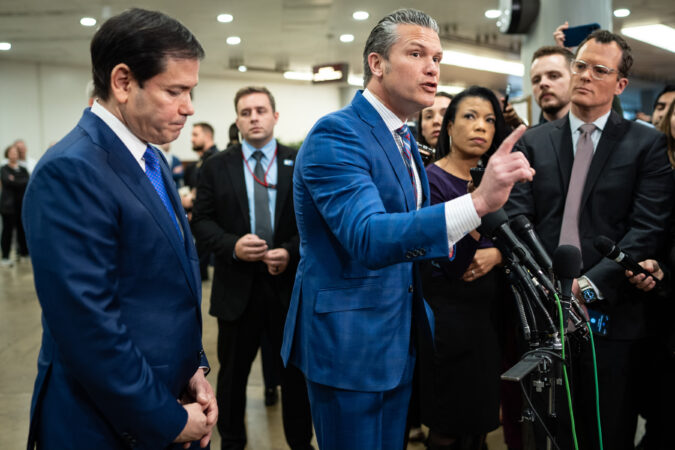
    One of the nation’s leading artificial intelligence firms is negotiating whether it can continue to work with the military, according to people familiar with the discussions, after Pentagon officials called their once-close relationship into question in the wake of January’s raid to capture Venezuelan leader Nicolás Maduro.

    Anthropic’s Claude model is one of a handful of leading AI systems that the Pentagon is using to rapidly build its capabilities in cyberwarfare, improve the performance of its autonomous weapons systems, and increase the efficiency of its personnel.

    Defense Secretary Pete Hegseth’s team has insisted in recent weeks that the military must have the freedom to use the powerful tools as it sees fit. Officials say other leading AI firms have gone along with the demand. ChatGPT maker OpenAI, Google, and Elon Musk’s xAI have agreed to allow the Pentagon to use their systems for “all lawful purposes” on unclassified networks, a Defense official said, and are working on agreements for classified networks. (The Washington Post has a content partnership with OpenAI.)

    The companies did not respond to requests for comment.

    But Anthropic — which has sought to position itself as the most safety-minded of the companies — has corporate principles that may keep it from giving the Pentagon carte blanche. Unlike many traditional weapons, powerful AI systems can be deployed in many ways not foreseen by their designers, and the dispute has raised questions about who should have the final say over their use by the military. While Anthropic has not said exactly what its qualms are with the Pentagon’s demands, its chief executive has recently warned of the dangers of autonomous weapons and AI-powered mass surveillance.

    In a statement to the Washington Post, Anthropic said it is “committed to using frontier AI in support of U.S. national security.”

    “Claude is used for a wide variety of intelligence-related use cases across the government, including the [Defense Department], in line with our Usage Policy,” Anthropic said. “We are having productive conversations, in good faith, with [the Defense Department] on how to continue that work and get these complex issues right.”

    Until recent weeks Anthropic had been in an enviable position, with a $200 million contract and its technology uniquely approved for use within the Pentagon’s classified networks. That quickly began to change, Trump administration officials say, following Anthropic’s response to its recent use by the Pentagon in the Maduro operation.

    Technology developed by defense firm Palantir and Anthropic’s Claude were used in preparation for the Jan. 3 raid, according a person familiar with the assault, who spoke on the condition of anonymity to share confidential details about the operation. During the raid, scores of Maduro’s security guards and Venezuelan service members were killed.

    After the attack, a senior defense official said, an executive from Anthropic discussed the raid with an executive at Palantir, asking whether Anthropic’s tools had been used. The Palantir executive relayed the question to the Defense Department, saying it implied that Anthropic might have disapproved of how Claude had been used, the official said. That prompted department leaders to call into doubt whether the company could be fully relied on.

    “They expressed concern over the Maduro raid, which is a huge problem for the department,” one administration official said.

    However, Anthropic said it had not discussed any specific operations with the Defense Department nor “discussed this with, or expressed concerns to, any industry partners outside of routine discussions on strictly technical matters.”

    The dispute appears to run deeper than any questions over the attack on Venezuela. Hegseth sees AI dominance as a must-have capability and his directives have pressed the military to move fast to embrace the technology. In January, he said that “speed wins” in an AI-driven future, and he has ordered the Pentagon to unblock data for AI to train, while pushing the department to move from “campaign planning to kill chain execution.”

    “We must approach risk tradeoffs, ‘equities,’ and other subjective questions as if we were at war,” Hegseth wrote in the January 2026 directive.

    Just over two weeks after Hegseth’s directive came down, Dario Amodei, Anthropic’s co-founder and chief executive, published an essay sketching a potential dystopia in which AI empowers a new generation of unstoppable weapons and surveillance tools.

    “We should worry about them in the hands of autocracies, but also worry that because they are so powerful, with so little accountability, there is a greatly increased risk of democratic governments turning them against their own people to seize power,” Amodei wrote about swarms of AI-enabled drones.

    Such weaponry is likely still many years away, but failing to reach an agreement could quickly have far-reaching consequences for the company.

    The Pentagon has suggested that it could be branded a “supply chain risk,” something that would not only impact Anthropic, but any firm that uses the company’s AI. The designation has typically been aimed at Chinese and Russian companies.

    “We may require that all our vendors and contractors certify that they don’t use any Anthropic model,” a defense official told the Post.

    In the past, firms have been able to have riders in their contracts with the Pentagon indemnifying them from liability if their technology is used in an unlawful way and allowing them to bind the government to only use the technology for lawful purposes.

    But it may be unreasonable for firms contracting with the Pentagon to try to set limitations on how their rapidly evolving technology can be applied, said Frank Kendall, who served as Air Force secretary during the Biden administration and oversaw its development of a fleet of autonomous warplanes.

    “The military’s function is the application of violence, and if you’re going to give anything to the Defense Department, it’s likely going to be used to help kill people,” Kendall said.

    The administration has held that its actions — which also include U.S. strikes on alleged drug boats in the Caribbean, its deployment of active duty troops on U.S. soil, and its decision to use lethal force in Minneapolis, killing two U.S. citizens — have been lawful. But the Trump administration has also fired many of the independent military and Justice Department lawyers who would have had the ability to challenge the legality of those usages.

    “If you’re worried about this administration doing unlawful things, you should just not work with them,” Kendall said.

    The Pentagon has been integrating AI into some of its weapons systems for years but never at the speed at which it is now. That’s partly driven by its competition with China and evolving threats like hypersonic missiles — where a human’s reaction time can be inadequate.

    But there’s also been an emphasis on making sure AI’s unpredictable learning could be fenced in.

    At Edwards Air Force Base in 2024, the Air Force flew its first AI fighter jet in dogfights — and the jet, an F-16 that carried the AI in a computer in the back, was already besting elite test pilots by shaving milliseconds off turns and maneuvers. Even then, there was a human in the loop, a test pilot inside the jet who could disengage the AI as needed — and the AI itself was kept in a system that was not connected to any networks. As the Air Force moved forward withe the AI, it said making sure the data it learned on was clean was the priority, to avoid security risks.

    In 2023, the Biden administration instructed the Pentagon that any AI use in systems would require levels of review, anti-tamper mechanisms, and safeguards to ensure that humans would retain the decision on use of force.

    That policy is still in force but will be reviewed as needed, the administration official told the Post.

  • After Epstein revelations, Europe vows accountability while U.S. holds back

    After Epstein revelations, Europe vows accountability while U.S. holds back

    As the U.S. Justice Department demurs from new inquiries linked to the Epstein files, the approach by European authorities stands in stark contrast. On the other side of the Atlantic, governments are promising to hold the wealthy, powerful, and politically connected to account.

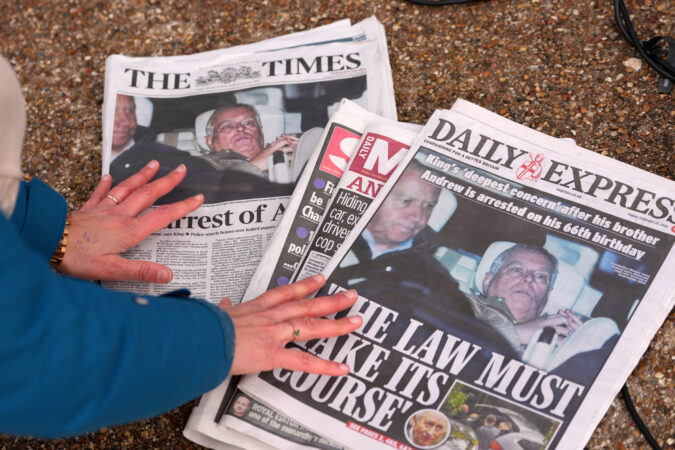
    Under public scrutiny, officials in Britain, France, Norway, and beyond have opened a flurry of investigations and independent commissions to look into evidence of potential crimes in more than 3 million files related to convicted sex offender Jeffrey Epstein that were released last month by congressional order. In three weeks, the revelations have prompted resignations, raids, and other legal actions, none more notable than the detention Thursday of Andrew Mountbatten-Windsor, the younger brother of King Charles III, on suspicion of misconduct in office.

    “Nobody is above the law,” British Prime Minister Keir Starmer said on television shortly before the arrest.

    Starmer delivered that statement even as the tide of accountability knocked at the door of 10 Downing Street. Communications made public in the files showed that Peter Mandelson, a former British ambassador to the United States selected by Starmer, maintained closer ties to Epstein than previously disclosed. Those revelations sparked a flurry of calls for Starmer’s resignation — including from within his own Labour Party.

    The fallout in Britain comes as a former Norwegian prime minister, a former French minister, and other prominent figures on the continent face new investigations in what is fast shaping up to be a European exercise in accountability.

    As the Trump administration has portrayed Europe as in decline, some observers see the European response as evidence of the relative robustness of the rule of law in the continent’s democracies, compared with the concentration of power in Trump’s America.

    “In Norway and across Europe, the instinct has been transparency and formal investigations,” said Julie E. Stuestøl, a member of Norway’s parliament who serves on its justice committee. “In the U.S., it looks more like containment.”

    She added, “The contrast is striking.”

    Senior Democratic lawmakers in Washington are comparing the broad legal action across the Atlantic to the muted response in the United States.

    “The DOJ’s handling of the Epstein files is a travesty,” Sen. Charles E. Schumer (D., N.Y.) said in a post on X. “The White House press secretary says, ‘We are moving on.’ But, in France, the Paris prosecutor’s office just opened two investigations based on new leads from the released files. And in Britain, former prince Andrew has been arrested over ties to Epstein. When will there be justice in America?”

    Some analysts point out that the Epstein case has roiled the United States for years while the impact in Europe has been more of a slow burn that ignited with the release of the latest files.

    “One interpretation is that accountability still means something more in Europe than in America,” said Nathalie Tocci, director of the Rome-based Institute for International Affairs. “A less generous interpretation is that it is a newer shock in Europe than in the U.S.”

    The disclosures shook the country “to its core,” said Stuestøl, the Norwegian lawmaker whose party advocated for an independent commission. “People are tired of elites protecting elites behind closed doors,” which has made objections to the proposal untenable, she said.

    Epstein pleaded guilty in 2008 to two charges of soliciting prostitution, including one involving a minor. He was arrested on federal sex trafficking charges in 2019 and died in federal custody later that year. His death was ruled a suicide. Judges and lawmakers say that over decades, Epstein abused, trafficked and molested scores of girls, many of whom have come forward in court and in other public forums.

    Some prominent figures in the United States have resigned from their jobs or lost business after the documents revealed their relationships with Epstein, but none is known to have faced criminal charges. In Washington, efforts to hold people accountable for their involvement with Epstein have at times also fallen along partisan lines.

    President Donald Trump in November called on the Justice Department to examine the relationships between Epstein and several prominent Democrats, including former President Bill Clinton. Attorney General Pam Bondi tapped federal prosecutors in Manhattan to take on the job, but the Justice Department has not announced charges related to the inquiry.

    “I can’t talk about any investigations, but I will say the following, which is that in July, the Department of Justice said that we had reviewed the files, the Epstein files, and there was nothing in there that allowed us to prosecute anybody,” Deputy Attorney General Todd Blanche said in an interview with CNN’s Dana Bash earlier this month. “The entire world can look at and see if we got it wrong.”

    British authorities have not detailed the allegations against Mountbatten-Windsor, formerly known as Prince Andrew, whom police released Thursday night after officials searched two addresses in Norfolk and Berkshire. The new Epstein documents include photographs that appear to show Mountbatten-Windsor, who has denied any wrongdoing, crouched over a woman on a floor. They also indicate that he provided confidential government materials to Epstein at a time when the former prince was representing Britain as a trade envoy. The actions came months after he was stripped of his royal titles as a result of his ties to Epstein.

    The British government is considering whether to introduce legislation that would remove Mountbatten-Windsor from the line of royal succession “regardless of the outcome of the police investigation,” the BBC reported Saturday, citing Defense Minister Luke Pollard. Mountbatten-Windsor is eighth in line to the throne.

    Following the arrest, King Charles III issued a statement assuring the British public that the “the law must take its course” in the investigation of his brother.

    “There is a great irony that in the year we are celebrating the 250th anniversary of the birth of the American republic, the British monarchy is one that gives us a lesson in democracy,” said Dominique Moisi, a senior analyst of international affairs for the Institut Montaigne, a Paris-based think tank.

    Norwegian Prime Minister Jonas Gahr Støre said he supports investigating the links between prominent Norwegians and Epstein. Like other European leaders, Støre is under pressure to respond to voter outrage over the documents, which have implicated a global network of celebrities and politicians.

    “I think it has been quite shocking for people to get this insight into this world and the connection between people with power. And how it has affected people without power, who have been abused and subjected to assault,” Støre told Norwegian public broadcaster NRK.

    Earlier this month, former Norwegian prime minister Thorbjørn Jagland was charged with aggravated corruption over Epstein links. Police have searched residences of Jagland, who formerly chaired the Norwegian Nobel Committee. Authorities also said they are investigating whether Jagland received gifts, travel, or loans tied to his positions, including as head of the Council of Europe, the continent’s highest human rights watchdog.

    The moves against him came as it emerged that he had planned visits to Epstein’s homes in Paris and New York, and that Epstein had visited Jagland’s residence in Strasbourg, France. Jagland, who has denied criminal liability and said he would cooperate with authorities, could face up to 10 years in prison.

    Also this month, Norwegian diplomat Mona Juul resigned in the face of corruption charges after Norwegian media reported that Epstein left her children millions of dollars in his will. Authorities are looking into Epstein’s links to Juul and her husband, who played a role in back-channel talks between Israeli and Palestinian negotiators that led to the Oslo accords. Juul has denied criminal liability.

    Scandal hit the country’s stoic monarchy, too: Documents revealed that Norwegian Crown Princess Mette-Marit had stayed at an Epstein property in Palm Beach, Fla., and exchanged scores of messages with the disgraced financier. Her name appears repeatedly in the files, including after Epstein’s 2008 conviction for soliciting sex from a minor. The crown princess has expressed “deep regret” over her connection to Epstein.

    Authorities in Latvia and Lithuania opened investigations into the possible trafficking of young women and girls by Epstein. In Slovakia, the documents brought down Miroslav Lajčák, the prime minister’s national security adviser, who resigned over email exchanges with Epstein.

    In France, Paris prosecutor Laure Beccuau announced two new investigations related to the Epstein files, one focused on sex trafficking and the other on financial crimes. French authorities were already looking into former French culture minister Jack Lang and his daughter over allegations of tax fraud and receiving money from Epstein. That inquiry followed an investigation by French news outlet Mediapart, which detailed close ties to Epstein.

    Beccuau is calling for yet-unknown victims of Epstein to come forward.

  • Supreme Court put the brakes on Trump, after Congress helped him step on the gas

    Supreme Court put the brakes on Trump, after Congress helped him step on the gas

    The Supreme Court delivered a stinging rebuke Friday to President Donald Trump’s favorite instrument of economic and foreign policy power, by rejecting his claim that his presidential emergency authority allows him to unilaterally impose sweeping tariffs.

    Trump’s assertion that the 1977 International Emergency Economic Powers Act allowed him to put tariffs in place without any action by Congress was unprecedented, as are some of his other declarations of emergencies where there is no evidence they exist.

    Among the avalanche of executive orders he signed on his first day in office was one “declaring a national energy emergency” at a time of record U.S. oil and gas production and the lowest gasoline prices in years. Another emergency declaration deemed there to be an “invasion” and “widespread chaos” taking place on the southern border, even as Border Patrol statistics were showing the number of illegal crossings had dropped sharply and were lower than they had been at the end of Trump’s first term.

    But while Trump has far outpaced his modern predecessors when it comes to emergency declarations, presidents of both parties have used them in dubious ways to eliminate obstacles to their political agendas.

    President Joe Biden claimed the COVID-19 pandemic allowed him to cancel $400 billion in student debt, citing authority under the 2003 Heroes Act. That law allowed the education secretary to rewrite rules that apply to student loans during times of war or national emergencies but was meant to help military personnel serving in Iraq and Afghanistan. (The Supreme Court blocked Biden’s directive.)

    Congress shares a significant portion of the blame for presidential overreach, given that it has granted the chief executive no fewer than 150 statutory powers that become available upon the declaration of a national emergency, according to a tally by New York University Law School’s Brennan Center for Justice. Those emergency powers stretch across and beyond actions involving health and the environment, troop deployments, seizure of private property, even the dumping of infectious medical waste in ocean waters.

    Although it has always been recognized that the nation’s chief executives need flexibility to act in times of crisis, members of both parties have long been concerned that presidents can abuse their emergency powers.

    In 1976, Congress passed the National Emergencies Act, setting up more formalized procedures governing how presidents exercise them, including setting a renewable one-year expiration date for emergency actions.

    Presidents since then have made 91 emergency declarations under the act, more than half of which are still in effect. One of them — imposing economic sanctions on Iran — dates to the Carter administration.

    The law also specified that Congress could nullify an emergency declaration by passing a resolution in each chamber on a simple majority vote that would go into effect without the president’s signature.

    But the Supreme Court ruled that such resolutions were unconstitutional with its 1983 decision in INS v. Chadha. Congress, meanwhile, became lax even in exercising its enforcement and oversight authority that remained, said Elizabeth Goitein, senior director of the Brennan Center’s liberty and national security program.

    However, the legislative branch is not without other tools for reining in emergency actions, including cutting off funding or exercising more diligent oversight of them. Neither of which the Republican Congress has shown much inclination to do since Trump took office.

    “We have had decades of legislative fecklessness,” said Georgetown University law professor Stephen I. Vladeck. “Things have run totally off the rails in the last 13 months.” With Congress supine before Trump, “what you see is the increased proliferation of executive-judicial confrontation,” he added.

    Still, there have been stirrings of alarm in Congress at some of the emergency actions Trump has taken. Both the House and the Senate have voted to overturn his tariffs on Canada, although not by veto-proof majorities.

    During Trump’s first term, conservative Sen. Mike Lee (R., Utah) introduced what he called the Article One Act, after the section of the Constitution that sets out the role of the legislative branch. His bill would automatically end presidential emergency declarations unless Congress voted to extend the emergency.

    “If Congress is troubled by recent emergency declarations made pursuant to the National Emergencies Act, they only have themselves to blame,” Lee said in a statement when he introduced the bill. “If we don’t want our president acting like a king we need to start taking back the legislative powers that allow him to do so.”

    The bill, which he has subsequently reintroduced, has won bipartisan support.

    Rep. Chip Roy (R., Texas), who sponsored a companion measure in the House, said Friday that the Supreme Court decision on tariffs will not be enough to solve the problems that have arisen over presidential assertions of executive power.

    “The fact is, Congress is the one who made the mess out of all of this,” Roy said in an interview with Newsmax. “Congress needs to clean it up.”

  • Rich world’s growing civil unrest has an insurance sting

    Rich world’s growing civil unrest has an insurance sting

    A category of insurance risk that hardly existed a little over a decade ago has morphed into a meaningful source of losses for the industry.

    Claims tied to SRCC — strikes, riots, and civil commotion — are emerging as a growing headache for insurers as episodes of unrest increasingly lead to the destruction of property in Western democracies. Howden Re estimates that insured losses related to SRCC soared from negligible levels in 2013 to more than $8 billion between 2020 and 2024.

    SRCC losses are prone to huge swings between years, with single events often changing the landscape significantly. After relatively few claims globally in 2025, Howden Re told Bloomberg it’s now expecting the United States to see a clear increase in SRCC losses this year.

    “We live in a time of heightened risk,” said David Flandro, head of industry analysis and strategic advisory at Howden Re. And the flare-ups making news headlines in the U.S. are “clearly indicative of a broader trend,” he said.

    Civil unrest is on the rise globally, a development that has coincided with a measurable increase in levels of inequality and polarization in some of the world’s richest countries. In most Western nations, for example, the majority of citizens no longer expect to see any growth in generational wealth, according to the Pew Research Center.

    Rising political division is adding to SRCC risks in both Europe and the U.S., according to Verisk Maplecroft. However, the sharpest increase in protest sizes is taking place in the U.S., Verisk said in December.

    When it comes to ranking countries with the greatest SRCC risk, the U.S. is the No. 1 Western democracy and sits at No. 5 overall, putting it ahead of Pakistan, Bangladesh, and India, according to first-quarter data provided by Verisk Maplecroft. France ranks seventh. SRCC models take into account not just the risk of unrest, but also the cost of replacing property that’s damaged.

    “It’s fair to say that the SRCC risk landscape has fundamentally changed,” said Torbjorn Soltvedt, associate director of political violence at Verisk.

    For a long time, insurers have offered protection against SRCC at no extra cost. However, elevated risk environments mean this is becoming less common and property insurers have begun excluding or restricting coverage for SRCC from their policies, according to Cara Brown, deputy head of terrorism and political violence at insurer Chubb.

    SRCC coverage is generally bolted on to other insurance policies, though there’s evidence that the rise in such risks is prompting companies to start seeking specific cover. At the same time, Howden Re said already back in 2023 that insurers were starting to charge “significant additional premiums” for SRCC coverage, with retail assets among the most affected.

    Over two-thirds of multinational corporations already use political risk modeling tools, a trend Howden Re says is rising. And in 2024, Lloyd’s of London — the 338-year-old insurance market — assigned SRCC risk its own code. In 2025, Verisk released its first SRCC catastrophe model, focused on the U.S. market.

    Reinsurer Swiss Re says it received only a “couple dozen SRCC claims in the early 2000s and that number gradually increased into the hundreds. We have continued to see a couple hundred per year in recent years,” which is “indicative of the market trend.”

    A changing U.S.

    In the U.S., several data-tracking services show that the number of political protests is on the rise. Meanwhile, perceptions of the U.S. are changing, says Stephen M. Davis, senior fellow at Harvard Law School’s program on corporate governance and cofounder of the United Nations’ Principles for Responsible Investment.

    Viewing the U.S. as a “safe haven is a thing of the past,” he said. That’s because there’s a “policy volatility that now exists,” which can be seen “internally as well as externally.”

    It’s a sentiment that’s been playing out in markets, as some institutional investors in Europe look for ways to reduce their exposure to the U.S.

    For insurers, calculating reliable loss risks is proving hard to model, and Soltvedt notes that protests don’t always lead to property damage. For example in Minnesota, where Immigration and Customs Enforcement officers killed two U.S. citizens, protesters have conducted themselves in a way that’s resulted in “limited direct impacts on commercial property or private property so far,” he said.

    The Trump administration is now retreating from its immigration-enforcement blitz in Minnesota, pulling back after more than two months of operations.

    But given the overall pace of growth in SRCC, the probability that a single event might result in more than $5 billion of losses can no longer be ignored, according to Verisk Maplecroft. In some areas, SRCC loss risks may even exceed those brought on by natural catastrophes, it said.

    SRCC as a standalone insurance product “used to be a very niche, small class of business,” said Srdjan Todorovic, head of political violence and hostile environment solutions at Allianz Commercial. But a number of big events in recent years “hit the industry pretty badly and sobered up the market.”

  • Trump aides struggle with how to spend $500 billion more on military

    Trump aides struggle with how to spend $500 billion more on military

    Trump administration officials have struggled to figure out how to increase U.S. military spending by a whopping $500 billion in their forthcoming budget, slowing the overall White House spending plan, four people familiar with the matter said.

    President Donald Trump last month agreed to a roughly 50% funding boost sought by Pete Hegseth, the defense secretary, in the White House’s annual budget proposal. The idea ran into internal criticism from several other officials, including White House budget chief Russell Vought, who warned about its potential impact on the widening federal deficit, said the people, who spoke on the condition of anonymity to reflect internal deliberations.

    Since Trump agreed to the higher number, White House aides and defense officials have run into logistical challenges surrounding where to put the money, because the amount is so large, the people said. The White House is more than two weeks behind its statutory deadline to send its budget proposal to Congress, in part because it is unclear how precisely to spend the additional $500 billion, according to the people familiar with the matter.

    Senior Pentagon officials have consulted with former senior defense officials as they grapple with the challenge, said one person familiar with the matter. Part of the discussion centers on how much emphasis should go into buying weapons the military already uses versus investing in high-end technologies, such as artificial intelligence, that the Pentagon envisions as part of its future.

    The roughly $900 billion defense budget approved last year was the largest in U.S. history. While other nations have also increased their military spending, the United States already spends more on defense than the next nine countries combined, according to 2023 data from the Peter G. Peterson Foundation, a nonpartisan think tank.

    “I’m not surprised they’re having difficulty doing that,” said G. William Hoagland, senior vice president at the Bipartisan Policy Center, a nonpartisan think tank. “That’s an awful lot of money in one year.”

    Spokespeople for the White House and the Defense Department declined to comment.

    Trump, Hegseth, and many congressional Republicans have defended the proposed increase in the military budget as necessary to pay for an array of new priorities and confront foreign adversaries. Hegseth has said that the money would be spent “wisely” and that the larger budget would send “a message to the world.”

    The forthcoming White House budget for fiscal 2027 will spell out the administration’s proposed spending levels across the government. It requires congressional approval to be enacted and faces long odds.

    “This will allow us to build the ‘Dream Military’ that we have long been entitled to and, more importantly, that will keep us SAFE and SECURE, regardless of foe,” Trump said in a Truth Social post this month confirming his support for the $1.5 trillion budget number.

    The Pentagon has been grappling with how to rapidly replenish expensive munitions that it has relied on heavily, including Tomahawk cruise missiles, Patriot missile-defense interceptors, and ship-launched munitions known as Standard Missile-6s, or SM-6s.

    It also is wrestling with how to upgrade its Cold War-era nuclear weapons program with expensive next-generation systems like the B-21 bomber and the Columbia-class submarine. The aircraft, with an estimated cost of about $700 million each, is expected to replace the Air Force’s fleet of B-1 and B-2 bombers. The Columbia-class submarines are expected to cost at least $9 billion each.

    Hegseth, upon taking office, directed each military service to look for budget reductions of 8%; the money could then be invested in other Pentagon priorities better aligned with Trump’s agenda. Hegseth bristled at the suggestion that such reprogramming should be considered cuts, saying he would be “reorienting” about $50 billion in defense spending that the Biden administration had planned.

    More recently, Hegseth has called for “supercharging” the U.S. industrial base, seeking to speed up how quickly the military can field new weapons and other capabilities, in part by not relying as heavily on traditional defense contractors.

    With such a significant jump in spending planned, it now appears that the Pentagon budget is detached from a new national defense strategy that Hegseth’s team released in January, said Mark Cancian, a retired Marine Corps colonel and senior adviser with the Center for Strategic and International Studies. That strategy calls for the Pentagon to focus first on defense in the Western Hemisphere, with less emphasis on Europe, Africa, and the Middle East.

    It’s a “head-scratcher” that the Pentagon wants to spend so much money while also cutting back in those areas, Cancian said.

    “If you’ve got a 50% budget increase, you don’t have to do any of that,” he said. “You’d be talking about all the new places you’d be making investments.”

    The federal deficit, or the gap between what the government spent and what it collected in tax revenue, was $1.8 trillion last year. That number was down from the surges of red ink during the COVID years but up significantly from the standard deficit before the pandemic.

    Vought, a deficit hawk, has long called for reducing federal spending while also supporting Trump’s general goal of rebuilding the American military. He was instrumental in securing additional funding for the military last year in the GOP’s tax bill, which bypassed the typical bipartisan process for setting military spending.

    The increase in military spending alone would amount to one of the biggest federal programs. One Democratic plan to expand Medicare to cover dental, vision, and hearing benefits would cost $350 billion over the next decade, by comparison. If Congress were to spend an additional $500 billion every year on the military, the cost would be $5 trillion over the next decade. It is unclear if the Trump administration’s proposal is for an additional $500 billion just for next year, or $500 billion each year for a decade.

    “I’m sure there are very difficult conversations happening right now. Obviously, it would have a huge impact,” said Charles Kieffer, who spent several decades across administrations in the White House Office of Management and Budget and working for Democrats on the Senate Appropriations Committee. “A 50% increase requires a completely different formulation for your priorities.”

    Some experts in military spending panned the proposed increase as likely to increase fraud and waste. Julia Gledhill, a research analyst for the national security reform program at the nonpartisan Stimson Center, pointed to failed audits at the Pentagon and a lack of clear guardrails on much of the new military spending approved last year in the GOP’s One Big Beautiful Bill, which she said has been used like a “slush fund.”

    “We don’t know what we’re already spending money on. We don’t have details on how the Pentagon is using its trillion-dollar budget,” Gledhill said. “How are you supposed to make educated, informed decisions about the military budget if you don’t know where it’s already going?”

  • Big Tech is taking on more debt than ever to fund its AI aspirations

    Big Tech is taking on more debt than ever to fund its AI aspirations

    Big Tech is taking on record levels of debt, marking a new chapter in the artificial intelligence boom as names such as Oracle, Alphabet, and Meta pour big money into massive data centers and the energy systems needed to run them.

    Technology companies issued a record $108.7 billion in corporate bonds in the last three months of 2025, according to data from Moody’s Analytics. That’s the largest total for any quarter and roughly double that of the previous three months. And the trend is extending into 2026: Some $15.5 billion in bonds were issued in the first two weeks of the year alone.

    For now, investors are assuaged by the eye-popping cash flow numbers from major tech companies. In the past 20 years, Big Tech companies including Google, Microsoft, Meta, Amazon, and Apple have built what are arguably the most profitable business models in history. In the third quarter, Google brought in just over $100 billion, with a margin of over 30%. All five are trillion-dollar companies, as are such AI darlings as Nvidia, Broadcom, and TSMC.

    But some economists and business analysts say the massive new bonds are spreading risk throughout the economy, with hundreds of billions being spent on a technology whose profit-making potential is not yet clear.

    “It’s a lot of debt, and a lot of it all of a sudden,” said Mark Zandi, chief economist for Moody’s. When companies are funding risky ventures with debt “it does put the broader financial system at risk. If the financial system is at risk, then the broader economy is.”

    A bond is a form of debt that companies or governments can use to raise large sums of money, typically from investment banks or private-equity firms, to be paid back with interest. They historically have been used to fund major infrastructure projects such as power plants, natural gas drilling operations, or offshore wind farms — projects with large up-front costs that are expected to generate revenue for many years. Once issued, a bond can be bought, sold, or packaged into other debt products, which can end up in the portfolios of unrelated investments such as pension funds.

    Automakers, utilities, and other mainstays of heavy industry have historically been the biggest issuers of corporate bonds, Moody’s data shows. Analysts note that in past technology build-outs, such as the rise and rapid investment in internet-based companies in the 1990s, companies didn’t have to spend nearly as much on infrastructure.

    That has now changed, given the unprecedented energy demands of running and training AI algorithms. While tech companies took on more debt, adjusting for inflation, in 2021 than in 2025 — with a total of $296.6 billion in 2025 dollars issued that year — interest rates were significantly lower at the time. That made financing debt cheaper.

    “The technology industry has gone from being an also-ran in terms of corporate debt, to becoming the largest player of investment-grade corporate debt, out of nowhere, compared to two years ago,” said venture capitalist Paul Kedrosky.

    Because training and running AI algorithms take up much more computing power and energy than previous forms of technology, staying ahead in the AI race costs billions. Google, Microsoft, Amazon, and Meta indicated in company announcements that they planned to collectively spend well over $300 billion on AI data centers in 2025 alone.

    If they continue to spend at that rate, they may have to take on even more debt.

    “If these companies are so profitable, why are they using debt?” Kedrosky said. “It gives you a sense of the scale of what’s going on.”

    Amazon spokesperson Amy Diaz said the proceeds from Amazon’s bond issuance in November are being used to support business investments, capital expenditures, and repayment of earlier debt, adding that the company regularly evaluates its operating plan to make financing decisions. (Amazon founder Jeff Bezos owns the Washington Post.)

    Representatives from Alphabet, Meta, and Oracle either declined to comment or did not answer questions. An Apple spokesperson referred to the company’s SEC filing, which states that proceeds from the bond issuance would be used for “general corporate purposes” including stock buybacks and unspecified capital expenditure, among other uses.

    Among large tech companies, Meta used the most debt to fund its data center build-out in 2025, according to Moody’s. The social media company has invested deeply in AI in a race to become the leading AI assistant for companies and everyday people, putting it in a tight race with Microsoft, Apple, and Alphabet.

    Mark Mahaney, who has covered tech companies for more than two decades and is now managing director at the investment bank Evercore ISI, views the bonds as part of a strategy by tech firms to raise money without degrading their stock price. Bond offerings are a sign that management is “confident or cocky” about their future, as they’ve taken on debt that requires steady cash flow to pay down, Mahaney said.

    Also loading up on debt is Oracle, which issued some $25.75 billion in bonds last year as it seeks to become the AI computing power provider of choice. In September it disclosed a $300 billion deal with OpenAI, prompting an immediate 36% spike in its stock price that briefly made founder Larry Ellison the richest man in the world. (The Post has a content partnership with OpenAI.)

    But in the ensuing weeks investors became uncomfortable with Oracle’s debt. Citi analyst Daniel Sorid told CNBC in December that there was something “inherently uncomfortable” about the “enormous” amount of capital Oracle will require.

    The stock has declined about half from its Sept. 10 peak. Bondholder Ohio Carpenters’ Pension Plan recently sued Oracle and several investment banks, alleging that Oracle failed to disclose how much debt it needs.

    “The sheer scale of new debt issuance has forced investors to reassess whether the economics of relentless AI [spending] are truly sustainable,” said Thomas Urano, chief investment officer at Sage Advisory in Austin.

    Urano added that many of the companies getting AI-driven investment are part of the infrastructure that enables today’s AI chatbots and other applications, which cannot be immediately monetized.

    “This creates a paradox: The strategic case for AI is compelling, but the revenue model is still evolving,” Urano said.

    At least one firm has raised the prospect of getting government support to build out more data centers. OpenAI’s chief financial officer, Sarah Friar, said in November that it will require “innovation” on the finance side, with government providing a “backstop” or “guarantee.” Her comments triggered backlash from politicians and tech critics, who questioned whether taxpayers should take on some of these private companies’ risk. Friar and CEO Sam Altman both later clarified that they weren’t seeking federal guarantees for OpenAI data centers specifically, although Altman did say in a lengthy social media post that a government-funded “strategic national reserve of computing power” would make sense.

    The Trump administration has gone all in on AI, pushing aside concerns within the MAGA movement and seeking to sweep away regulations that it says hamper innovation. But neighbors of the vast warehouses of computer chips that form the technology’s backbone — including in conservative states — have objected to how the facilities sap power from the grid, guzzle water to stay cool, and secure tax breaks from local governments. President Donald Trump has recalibrated his approach, pushing tech companies to fund their own power.

    “Historically, when we’ve had major bubbles they’ve tended to be about real estate, or technology, or government policy,” Kedrosky said. “This is the first bubble in history that combines all of these things.”

  • Trump banner on Justice Dept. building draws authoritarian comparisons

    Trump banner on Justice Dept. building draws authoritarian comparisons

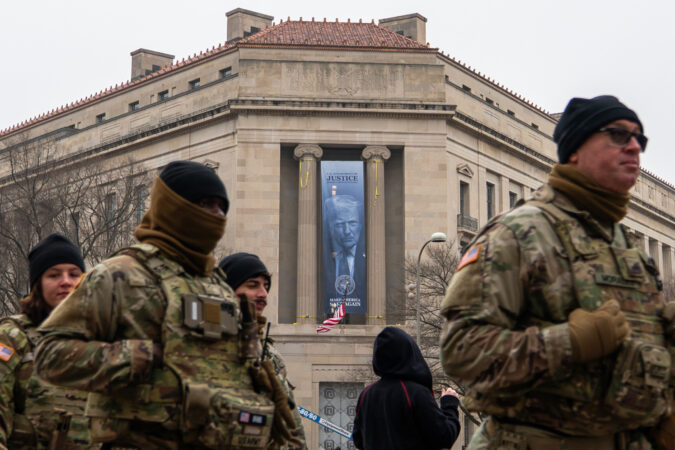
    A new banner hanging along the facade of the Justice Department’s headquarters in Washington is sparking criticism from Democrats and a former FBI director, who suggest that it exemplifies President Donald Trump’s encroachment on the agency, which has long prided itself on being independent from the White House.

    The tall banner displays a portrait of Trump, cast in a dark blue hue, staring down at tourists, commuters and cars along Washington’s bustling Pennsylvania Avenue. “MAKE AMERICA SAFE AGAIN,” reads the banner, which is emblazoned with the Justice Department’s seal.

    A Justice Department spokesperson said the banner was hung in commemoration of the United States’ Semiquincentennial, writing in a statement: “We are proud at this Department of Justice to celebrate 250 years of our great country and our historic work to make America safe again at President Trump’s direction.”

    Similar banners have appeared recently on other government buildings in Washington. But Democrats said that the decision to install one at the Justice Department symbolizes the influence Trump has wielded over the agency during his second term and that the display is comparable to the imagery deployed by authoritarian regimes.

    “The irony of a twice-impeached, convicted felon putting his own picture on the wall of the Department of Justice,” Sen. Ben Ray Luján of New Mexico wrote on X. “President Trump is weaponizing the DOJ as his own personal law firm.”

    Rep. Mike Quigley of Illinois shared an image of the banner online and wrote: “POTUS is putting his face on the Justice Department. … This is not the work of an independent and impartial justice system.”

    “Ok Kim Jong Un,” Rep. Jim McGovern of Massachusetts wrote.

    A pair of similar banners hung at the U.S. Department of Agriculture showed Trump and Abraham Lincoln’s portraits emblazoned with the phrase: “Growing America Since 1862.” (A government purchase order for the pair of banners at USDA showed they cost $16,400.) And banners hung on the Labor Department’s building featured portraits of Trump and Theodore Roosevelt that read, “American workers first.”

    The addition to the Justice Department building follows a pattern of norm-breaking efforts that critics say amount to Trump using the agency as a personal cudgel against his political enemies.

    In a speech delivered inside the building last year, Trump declared himself the nation’s “chief law enforcement officer.” Attorney General Pam Bondi rarely misses an opportunity to praise the president and credit him with the department’s success, including at a contentious congressional oversight hearing last week in which she repeatedly described him “the greatest president in American history.”

    To Trump’s critics, the banner is also striking given his status as a felon. He was found guilty in 2024 in a New York state case on 34 counts of falsifying business records to conceal a hush money payment to an adult-film actress.

    Less than two years ago, Justice Department prosecutors had been pursuing two federal cases against him led by former special counsel Jack Smith. One focused on efforts to overturn the 2020 election, while the other related to Trump’s handling of classified documents.

    Trump is continuing to appeal his state court conviction in New York. A Georgia criminal case against Trump related to efforts to change the 2020 election result was dismissed last year.

    The two federal cases were also dismissed. One ended because of issues with Smith’s appointment. The other Smith withdrew after Trump’s 2024 election victory, in line with long-standing Justice Department policies preventing prosecution of a sitting president.

    Trump and his Justice Department appointees have contended that the prosecutions arose out of a Biden-era weaponization of the justice system to punish political foes.

    Since his return to the White House, Trump has ordered several prosecutions of political rivals on social media. Federal prosecutors brought charges against former FBI Director James B. Comey and New York Attorney General Letitia James last year — both of whom Trump had demanded Bondi move swiftly to prosecute. Those cases were later thrown out over issues with the appointment of the U.S. attorney selected to oversee them.

    Comey, in a social media post Thursday, called the installation of the banner outside the Justice Department headquarters “sickening.”

    “But they forgot to cover the inscription on the Pennsylvania Avenue side: ‘WHERE LAW ENDS TYRANNY BEGINS,’” he wrote.

    The banner is hardly the first time the Trump administration has been accused of adopting aesthetics and deploying imagery typically associated with imperialism or authoritarianism since his return to office last year.

    The administration, for example, roiled the art world when the Department of Homeland Security used images of Americana paintings to bolster support for Trump’s large-scale deportation campaign.

    There was also a massive military parade in Washington last year, which ran against an American tradition of avoiding public displays of martial strength more common in authoritarian regimes. The president is also planning a giant triumphal arch across from the Lincoln Memorial, which could dwarf the size of that and other monuments.

  • What the Supreme Court throwing out Trump’s tariffs means for you

    What the Supreme Court throwing out Trump’s tariffs means for you

    The Supreme Court ruled Friday that most of President Donald Trump’s widespread tariffs put in place last year are invalid — but that doesn’t mean shoppers will suddenly see prices drop.

    The high court ruled that Trump overstepped his authority by relying on a decades-old emergency law to impose tariffs on goods from nearly every country.

    Now, the fate of the tariffs is uncertain. Trump indicated at a news conference Friday that he would not back off from his prominent economic policy and would impose tariffs using other laws.

    Here’s what the ruling means for American consumers and what happens next.

    Does this mean all tariffs are off?

    No. The Supreme Court’s ruling applies to the tariffs Trump imposed under the International Emergency Economic Powers Act (IEEPA). That includes the country-specific tariffs such as a 15% levy on goods from European Union countries or a 20% tariff on imports from Vietnam.

    That includes most of the tariffs Trump put into place last year, but not all of them. Sector-specific tariffs, such as duties on steel, aluminum, and autos will remain in place.

    What does this mean for prices?

    Tariffs contributed to rising prices throughout the past year, though not as significantly as some analysts had initially feared. Still, the Yale Budget Lab estimates that the average household would lose about $1,800 because of the cost of tariffs in the short term.

    Federal Reserve Chair Jerome H. Powell said in December that tariff price increases caused much of the overshoot in inflation, which has remained stubbornly higher than the Fed’s target rate of 2%.

    But even with IEEPA tariffs gone, consumers are unlikely to see much immediate relief in their shopping bills.

    “Generally, prices don’t go down once they’ve gone up,” said Joe Feldman, senior managing director and retail analyst at Telsey Advisory Group. “We might see a little bit of relief.”

    Companies may be wary to reduce prices when so much uncertainty remains about the future of tariffs.

    For months last year, many companies stocked up on imports in anticipation of tariffs. That gave them a cushion before they had to raise prices to make up for the increased cost of goods. That advance inventory started running out for many late last year, but it’s possible that throwing out the IEEPA tariffs will prevent future price increases that would have otherwise taken place.

    Will I get any rebates?

    Probably not. For the most part, tariffs are paid by importing companies during a Customs and Border Protection process. Individual consumers eventually see some of those fees in the form of cost increases but do not pay tariffs directly.

    It’s unlikely that individual businesses will refund customers for price increases.

    Trump said several times last year that he planned to use the tariff revenue, which was about $200 billion as of mid-December, to give stimulus checks to Americans. But there are many challenges inherent in that plan, including that tariff funds go to the Treasury and must be allocated by Congress before they are used.

    Will businesses get refunds from tariff payments?

    Maybe. There’s already a process in place for importers to adjust and dispute the duties they’ve paid at the border, and it’s possible that companies will use that system to appeal the fees they’ve paid over the past several months.

    But the government has yet to say if or how refunds would work or how long they might take to reach companies. The Supreme Court did not address what to do about refunds.

    At a news conference shortly after the decision was announced, Trump criticized the Supreme Court for not addressing the refund issue.

    “I guess it has to get litigated for the next two years,” he said.

    Businesses are preparing for a potential refund process, and some had already started petitioning CBP for refunds even before the court ruled, in the hopes of getting put in the front of the line.

    Costco, one of the nation’s largest retailers, sued customs officials in late November, saying separate legal action was needed to guarantee its refund rights.

    What does this mean for the future of tariffs?

    Trump is unlikely to simply dismiss the idea of tariffs because of the legal setback. Members of the Trump administration have already discussed other avenues to impose levies. After the Supreme Court oral arguments, Trump told reporters his team would “develop a ‘game two’ plan.”

    There are more traditional — albeit slower — ways to put tariffs in place, such as the sector-specific tariffs on steel, aluminum, and copper. Those are generally proceeded by a government investigation and are more specific than the countrywide tariffs Trump imposed last year.

    Trump said Friday after the decision that the government would use a separate law, Section 122, to implement a 10% global tariff. That law allows tariffs to be imposed for 150 days.

    He also said he would impose “several” new tariffs under Section 301, which applies to unfair trade practices.

    One way Trump might proceed would be to use a different law to temporarily put in place tariffs of up to 15% for about five months, said Patrick Childress, an international trade attorney at Holland & Knight in D.C. and a former assistant general counsel at the Office of the U.S. Trade Representative. During that time, the Trump administration could conduct investigations using a separate law to potentially put in place country-specific tariffs.

    “This is the path I think the administration is most likely to take because it gives them speed. They have flexibility to raise tariffs up or down, and they result in country-specific tariffs much like the IEEPA tariffs,” Childress said.

    If that’s how the White House ultimately tackles tariffs, it could mean that not much changes at all for consumers.

  • U.S. amasses biggest force since 2003 as Trump pushes Iran on deal

    U.S. amasses biggest force since 2003 as Trump pushes Iran on deal

    The U.S. military is stationing a vast array of forces in the Middle East, including two aircraft carriers, fighter jets and refueling tankers, with President Donald Trump saying that Iran had 10 to 15 days at most to strike a deal over its nuclear program.

    “We’re either going to get a deal, or it’s going to be unfortunate for them,” Trump told reporters Thursday aboard Air Force One. On a deadline, Trump said he thought 10 to 15 days was “pretty much” the “maximum” he would allow for negotiations to continue.

    “I would think that would be enough time,” he said.

    The deployment is unlike anything the U.S. has done since 2003, when it amassed forces before the invasion of Iraq. It dwarfs the military buildup that Trump ordered off the coast of Venezuela in the weeks before he ousted President Nicolas Maduro.

    While the U.S. isn’t likely to deploy ground troops, the buildup suggests Trump is giving himself discretion to launch a sustained campaign lasting many days, in cooperation with Israel. While discussions have focused on a sustained campaign far more sweeping than the overnight strikes the U.S. launched against Iran’s nuclear program last June, the president is also weighing a limited early strike designed to drive Tehran to the negotiating table, the Wall Street Journal reported Thursday.

    “Maybe we’re going to make a deal,” Trump said in a speech on Thursday morning. “You’re going to be finding out over the next probably 10 days.”

    Heightened geopolitical worries over U.S.-Iran tensions sent stocks lower and extended a surge in oil, with Brent crude, the global benchmark, rising above $71 a barrel on Thursday.

    The open question is whether Iran can possibly satisfy Trump’s demands and whether, by positioning so much military hardware to the region, Trump may feel compelled to use it rather than backing down.

    Tracking site FlightRadar24’s data shows a surge of flight activity by U.S. military transport, aerial tankers, surveillance aircraft and drones to bases in Qatar, Jordan, Crete and Spain.

    The aircraft, whose transponders make them visible over land to the tracking site, include KC-46 and KC-135 air-to-air refuelers and C-130J cargo planes used to move troops and heavy equipment.

    It also includes E-3 Sentry jets equipped with airborne warning and control system radar, which provide “all-altitude and all-weather surveillance” of potential battle zones, as well as RQ-4 Global Hawk surveillance drones.

    The weapons at Trump’s disposal are formidable. The USS Abraham Lincoln aircraft carrier is accompanied by three Arleigh Burke-class guided-missile destroyers, which can carry Tomahawk missiles. The carrier’s air wing includes F-35C fighter jets.

    The USS Gerald R. Ford, the most expensive U.S. warship ever built, at $13 billion, is accompanied by guided missile destroyers, and its associated air wing includes F/A-18E and F/A-18F Super Hornets, E-2D airborne early warning aircraft, as well as MH-60S and MH-60R Seahawk helicopters and C-2A Greyhounds.

    The two carriers provide “more options, and would enable us to conduct operations on a more sustained basis – if it comes to that,” said Michael Eisenstadt, director of military studies for the Washington Institute for Near East Policy. He said the buildup “signals to the Iranians the need to be more flexible in negotiations.”

    Trump met with his son-in-law, Jared Kushner, and special envoy, Steve Witkoff, on Wednesday for an update on the negotiations with Iran. Officials met in the Situation Room on Wednesday to discuss possible action and were told to expect that all U.S. military forces deployed to the region would be in place by mid-March, according to a U.S. official.

    A major strike against Iran – where leaders are anxious about regime stability following widespread unrest – risks entangling the U.S. in its third war of choice in the Middle East since 1991, against a more formidable adversary than the U.S. has faced in decades.

    Trump’s use of the military in his second term has been characterized by short and successful engagements with minimal harm to American troops, including the bombing of Iranian nuclear targets in June, attacking alleged drug-trafficking boats and the raid that extracted Maduro in early January.

    But if fresh strikes on Iran prompt a wider conflagration, the president could face considerable public pressure. Trump spoke against U.S. engagement in foreign wars on the campaign trail, but has gone on to bomb Iran, Tehran-backed Houthi militants in Yemen and militants in Syria.

    “With Iran’s air defenses largely neutralized by previous U.S. and Israeli strikes, the U.S. strike fighters would operate largely with impunity over Iranian airspace,” said Bryan Clark, a defense analyst for the Hudson Institute and a former Navy strategy officer. “There is always the risk of downed pilots, but I think the bigger risk is to ships. The same cruise and ballistic missiles the Iranians gave to the Houthis could be turned against U.S. ships in the Persian Gulf, Arabian Sea and Red Sea.”

    Thousands of U.S. servicemembers in the region are also within range of Iranian ballistic missiles, and regime officials have vowed to respond with full force to a U.S. strike.

    Beyond attacks on U.S. military assets, Iran could try to close the Strait of Hormuz, the narrow waterway between Oman and Iran traversed by 25% of maritime oil traffic.

    The U.S. strikes in June 2025 focused on three sites associated with Iran’s nuclear program, but a more ambitious effort to topple the regime in Tehran could involve attacks on sites associated with the Islamic Revolutionary Guard Corps and potentially senior leadership including Supreme Leader Ayatollah Ali Khamenei.

    But Iran might be able to withstand such decapitation attempts.

    “Israel already killed the top leaders of the IRGC in its opening strikes in the June war and Iran was able to reconstitute and respond within 24 hours,” said Jamal Abdi, president of the U.S.-based National Iranian American Council. “They’ve now planned for these possibilities in future wars and so now may be even more resilient if senior leaders are killed.”

    White House press secretary Karoline Leavitt said Wednesday that Iran was expected to offer a response to the negotiations within “the next couple of weeks,” but did not preclude the possibility of military action before that. “The president will continue to watch how this plays out,” she said.