Category: Washington Post

  • Jeff Galloway, Olympic runner who inspired ‘Jeffing’ technique, has died at 80

    Jeff Galloway, Olympic runner who inspired ‘Jeffing’ technique, has died at 80

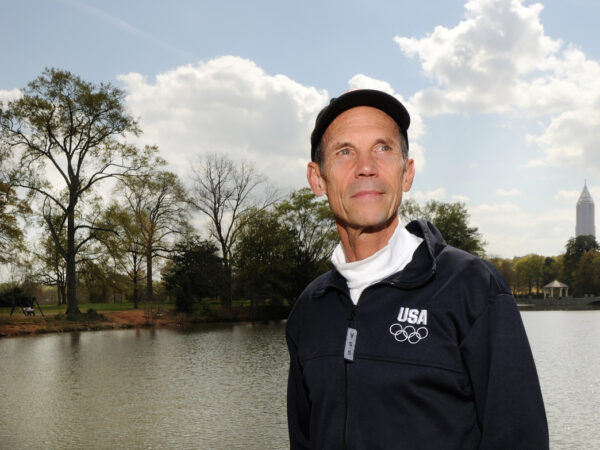
    Jeff Galloway, an Olympic distance runner who inspired hundreds of thousands of Americans to exercise by extolling the virtues of taking walking breaks during races — or “Jeffing,” as adherents called his signature method — died Feb. 25 in Pensacola, Fla. He was 80.

    Mr. Galloway died in a hospital after suffering a stroke, his son Westin Galloway told the Washington Post.

    Mr. Galloway described himself as an average runner as a teen who enrolled in his first marathon in Atlanta “because of the size of the trophy” and, by persistence more than talent, ascended to the U.S. Olympic team. For the 1972 Olympics in Munich, he qualified for the 10,000-meter race and was an alternate for the marathon. The next year, he set a U.S. record in the 10-mile road race.

    Despite reaching the peaks of his grueling discipline, Mr. Galloway became most widely known for a training program with an everyman philosophy that spoke to reluctant runners and preached, of all things, walking.

    Mr. Galloway began pioneering what he called a “Run Walk Run” technique — taking breaks to walk during training runs and even races — in the 1970s as he taught running to beginners. He championed the method as a way to reduce injury, control fatigue and, most importantly, motivate newcomers to “get off of the couch and run.”

    Legions of new runners did just that. Mr. Galloway’s philosophy, espoused in books and an online training program, has reached more than a million people, his organization has said, and changed how athletes approach distance running.

    Mr. Galloway had “the ability to empower runners, or people that didn’t even see themselves as runners,” his son Westin said, “giving them the space to be the athlete or the person that they never thought they could be through the benefits of exercise.”

    John Franks Galloway was born in Raleigh, N.C., on July 12, 1945. His father was an educator and a sailor in the Navy; his mother worked at a private school in Atlanta that his father founded.

    Mr. Galloway, who grew up in Atlanta, was not initially a prodigious running talent. He enrolled in a track conditioning program in eighth grade because his school required sports participation each quarter and the track coach was rumored to be the most lenient of the sports instructors, he wrote on his website.

    “I can identify with the struggles of sedentary, overweight adults and kids, for I was one,” Mr. Galloway wrote.

    Two months of running through forest trails got him hooked. Mr. Galloway qualified for the state high school championships in Georgia his senior year, then attended Wesleyan University, where he studied history and was an all-American runner.

    Mr. Galloway served for three years in the Navy after college, a tour that sent him to Vietnam. Upon returning to the United States in 1970, he enrolled in graduate school at Florida State University with the goal of qualifying for the upcoming Olympics.

    Even after years of training, it felt like a long shot, Mr. Galloway wrote. On a 90-degree summer day at the 1972 national championship in Seattle, he squeaked onto the 10,000-meter Olympic team in a close race — perhaps because he took it slow.

    “Many of the runners had started too fast, and I did not,” Mr. Galloway recalled on his website. “I found myself catching up to the stragglers, passing one, then another.”

    As a fitness boom took hold in the U.S. after the Munich Olympics, Mr. Galloway founded a running store, Phidippides, opened vacation fitness camps, and wrote several books about running. “Jeffing,” or “the Galloway method,” became his most famous innovation.

    At running clinics across the country, Mr. Galloway promoted his framework. Giving runners permission to take walking breaks while training encouraged beginners, he said, and the staggered runs could help even veteran marathoners improve their times. His charm and relentless focus on reaching novice runners set him apart from other instructors, Westin Galloway said.

    “A lot of coaches were very focused on faster times and pushing people’s bodies to do the best that they could,” he said. “And he kind of looked at it from the other perspective of, running has an amazing way of changing a person’s life, and if he could get more people out there doing it, the world would be a better place.”

    Mr. Galloway remained a fixture of the running community and continued to run and help organize races as he grew older. At 70, he ran the Marine Corps Marathon in Arlington in honor of a Marine killed in the 2015 Chattanooga, Tenn., shooting at a Navy operations center. He returned to running after suffering a heart attack in 2021 that kept him hospital-bound for almost a month.

    In the months before his death, Mr. Galloway had been fixated on run-walking another race at the age of 80. He had planned to run the Honolulu Marathon in December but fell and broke his kneecap. That didn’t discourage him, either, he told the New York Times in December.

    “Doing another marathon, to me, feels like the strongest goal I’ve ever had in my life,” Mr. Galloway said to the Times.

    Mr. Galloway is survived by his wife, Barb, 72; his sons Westin and Brennan; and six grandchildren. They are all runners, and Westin manages Mr. Galloway’s organization that continues to share his training program with runners around the world.

    “Jeffing” has recently seen a renewed surge of interest, Westin Galloway said, as more people have taken up running since the coronavirus pandemic. Asked whether the influx of new adherents made Mr. Galloway proud, Westin demurred.

    “He was happy talking to a single individual,” Westin said. “He didn’t care about numbers. He didn’t care about getting on the news or having big stories published about him. He cared about helping one person at a time.”
  • What is ‘Jeffing’? This walk-run technique can help you get in shape.

    What is ‘Jeffing’? This walk-run technique can help you get in shape.

    If you’ve ever watched a race, you may have seen some runners whiz by, others resolutely jog forward — and a sizable group slow down to a walking pace, sometimes just a few minutes after passing the start line.

    No, they don’t need your cheers to “just keep going!” Rather, it’s likely those walk breaks are calculated. It’s all part of a time-honored technique known as “Jeffing,” and runners have been using it for decades in training runs and in major races like the New York City Marathon.

    While this method is pretty well known among runners, it’s not only for those looking for personal records. Rather, it can be a great way for people to add a little oomph to their walking workouts and gain even more health-promoting benefits. Here’s everything you need to know.

    What is ‘Jeffing’?

    Simply put, Jeffing is a technique that intersperses walk breaks with running bouts to help ward off fatigue and boost endurance. This type of cardio, or aerobic, workout goes by many different names in the running community — run-walk, run-walk-run, the Galloway method, and, of course, Jeffing.

    The last two are nods to Olympian Jeff Galloway, who began using this method in 1973 while instructing a beginner running class at a university. (Galloway himself has no particular preference for which term is used. “I’m honored to be a verb,” he said.)

    Galloway ran weekly with the 22 students in the program, who naturally divided into three pace groups based on their abilities. “Whenever anybody started huffing and puffing in any group, I would have everybody walk.” Galloway said.

    All of the participants stuck with the program for the entire 10 weeks, and all were able to complete their final goal: finishing either a 5K or 10K race. The walk breaks, Galloway believed, played a vital role in that.

    In this earliest iteration of Jeffing, there was no set timing on when to start walking and for how long to do so. But after further refining, it soon became clear to Galloway that the important part is to slot in walking breaks before you feel gassed.

    “Because you’re taking those walk breaks from the beginning, before you’re tired, before you need them, it feels great,” said Chris Twiggs, the chief training officer of Galloway Training. “It really does feel like you’re cheating because you’re pushing the fatigue toward the end.” When Twiggs used the method for the first time at the 1995 Walt Disney World Marathon, he ended up with about a 15-minute personal record.

    The 30-30 method — a 30-second run and 30-second walk — is one of the most popular ways to approach Jeffing, said Galloway. However, if a 30-second run is too challenging, you can scale it back: Twiggs often has walkers start with a 10-second run, 50-second walk, and then adjust from there.

    “There’s an almost unlimited way to go about it,” said Kate Baird, a certified running coach and exercise physiologist at the Hospital for Special Surgery. That’s part of what makes it so beginner-friendly.

    What are the benefits of the run-walk method?

    First and foremost, run-walk is a type of aerobic workout that helps improve heart health, said Neel Chokshi, the medical director of the Sports Cardiology and Fitness Program at Penn Medicine. Consider it “interval training-lite,” he said. “The benefits of run-walk mirror general interval training in terms of the gains that people can get.” Specifically, alternating between high- and low-intensity efforts allows you to push hard when it’s time.

    Over time, your heart will adapt to those repeated exposures to higher intensities, Chokshi said. Adaptations include being able to pump more blood with each heartbeat, a reduction in resting heart rate, and increased blood flow through the arteries.

    Interval training also improves your VO2 max, or how efficiently your body uses oxygen during exercise. This results in better endurance and is also linked to longevity, said Chokshi.

    Another great thing about Jeffing is that you can get all of these heart-health benefits while reducing the amount of high-impact stress you’re putting on your muscles, tendons, and ligaments. When Galloway first tried this method in the university’s beginner running course, a huge takeaway was that not one participant got injured during the program. That’s big, since beginner runners are at higher risk — they get injured at more than twice the rate as more experienced ones, according to a 2019 study out of the Netherlands.

    Finally, you can’t ignore the mental benefits. If you want to scale up your cardio workouts but are daunted by the idea of running nonstop, Jeffing is a great way to overcome that mental hurdle, said Chokshi. Knowing you will have walk breaks coming can help you build the confidence that you can complete your workout — and finish it strong, said Twiggs.

    Here’s how to try the run-walk method yourself

    While there’s no set way to use the method, there are a few things you should keep in mind to make the most of it.

    1. Get the right shoes

    Because running brings a higher impact than walking, proper gear becomes even more important, said Twiggs. You might need more cushioning than a walking shoe, or some kind of motion control if your foot rolls inward or outward with each stride, he said. A running specialty store can help you pick out a pair that works for your anatomy and biomechanics.

    2. Start small

    While folks use run-walk in multihour marathons and training runs, these workouts don’t need to be nearly as long — and they shouldn’t be if you’re a beginner. Anywhere from 10 to 30 minutes is a great starting place, said Baird. Once you’re more comfortable with it, you can shoot for 30 to 45 minutes, Twiggs said.

    3. Warm up your body

    Getting your blood flowing before a workout can loosen up your muscles and gradually increase your heart rate, Chokshi said. You want to do a general, full-body warmup, since running includes pretty much every muscle in your body, including those in your lower body, upper body, and core. Moves like hamstring sweeps, lunges with thoracic rotation, and cat-cows are solid choices.

    4. Choose your intervals

    The 30-second run, 30-second walk tends to be the most popular utilization of the program, but “there’s no perfect run-walk ratio that everyone should be aspiring to,” said Twiggs. If you feel like you can’t catch your breath when running for 30 seconds, you can shorten that segment. If you feel strong, you can bump it up to 40 seconds, 60 seconds, or even a few minutes and see how your body reacts.

    5. Slow down

    Your run effort shouldn’t be a heart-pumping sprint — you want to keep it more moderate so you have the energy to do it all over again during your next interval. “A really good gauge is if you can carry on a conversation,” Twiggs said.

    6. Make time for recovery

    Even if you feel great after a workout, you shouldn’t do it every day. “Take one to two days between those workouts when it’s new,” Baird said. If you feel sore or tight in one particular spot, that might be your cue to give that area some extra attention during your warmup or next strength-training workout.

    7. Don’t consider it a means to an end

    The more you run-walk, the more you may want to play with your intervals, gradually increasing your run efforts as you gain more endurance. But it’s important to remember that you don’t have to use this method to reach a continuous running goal if that’s not what you want, said Galloway. You can stick with run-walk and still reap the benefits of running.

  • Vance: ‘No chance’ U.S. will be in drawn-out war in Middle East

    Vance: ‘No chance’ U.S. will be in drawn-out war in Middle East

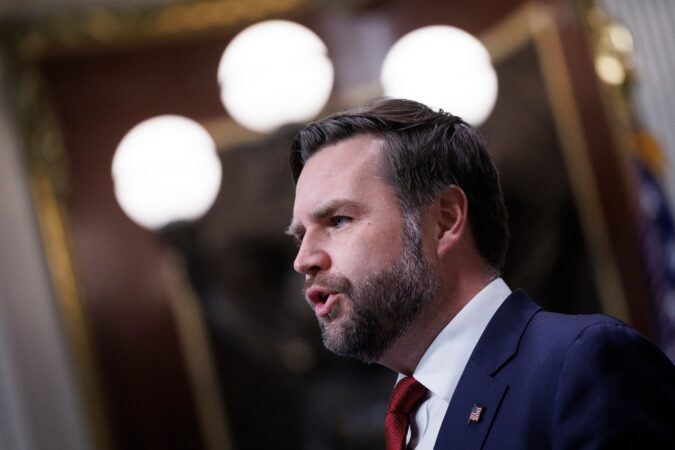
    ABOARD AIR FORCE TWO — Vice President JD Vance said Thursday that while military strikes against Iran remain under consideration by President Donald Trump, there is “no chance” that such strikes would result in the United States becoming involved in a yearslong, drawn-out war.

    Speaking with the Washington Post on Thursday, Vance said he does not know what Trump will decide to do about Iran, describing possibilities that include military strikes “to ensure Iran isn’t going to get a nuclear weapon,” or solving “the problem diplomatically.”

    But if Trump proceeds with another round of strikes on Iran — which some U.S. officials have suggested could be more comprehensive than the bombing of nuclear sites in June — Vance said confidently that it would not turn into the kind of conflict the vice president has harshly criticized.

    “The idea that we’re going to be in a Middle Eastern war for years with no end in sight — there is no chance that will happen,” he told the Post in an interview as he returned to Washington from an event in Wisconsin, effectively pushing back against predictions by some foreign policy experts that there would be no easy out if America got involved in a bigger conflict with Iran.

    Vance noted that last year’s operation in Iran and the January capture of Venezuelan President Nicolás Maduro were “very clearly defined.”

    Vance, a 41-year-old Marine veteran who served in the Iraq War, once said from the Senate floor that he had been “lied to” about the reasons for the United States’ involvement there. He said Thursday that he still sees himself as a “skeptic of foreign military interventions,” a description he believes continues to apply to Trump.

    “I think we all prefer the diplomatic option,” Vance said. “But it really depends on what the Iranians do and what they say.”

    Talks between the United States and Iran continued Thursday in Geneva amid a large-scale buildup of U.S. forces around Iran, though no resolution was reached, and mediators said the negotiations would continue next week.

    Trump has openly acknowledged that he is interested in bringing about regime change to topple Iran’s supreme leader, Ayatollah Ali Khamenei, telling reporters this month that it “would be the best thing that could happen.” The current presence of U.S. military forces in the region is among the largest in more than two decades, since before the Iraq War began in 2003.

    Asked whether, in his days as a commentator and senator offering criticisms of the Iraq War, he could have foreseen being attached to a presidency interested in bringing about a foreign regime change, the vice president chuckled.

    “Well, I mean, look. Life has all kinds of crazy twists and turns,” Vance said. “But I think Donald Trump is an ‘America First’ president, and he pursues policies that work for the American people.

    “I do think we have to avoid repeating the mistakes of the past. I also think that we have to avoid overlearning the lessons of the past. Just because one president screwed up a military conflict doesn’t mean we can never engage in military conflict again. We’ve got to be careful about it, but I think the president is being careful.”

    Prominent commentators within the conservative movement have spent months publicly quarreling over U.S. involvement in the Middle East, including debating what America’s attitude should be toward Israel.

    A growing number of conservatives — particularly young people — have soured on continued military support for the U.S. ally. Traditional conservatives have excoriated some of those voices, meanwhile, fueling a debate on the right about not only foreign policy but antisemitism as well.

    Vance has advocated for Israel-skeptical voices to be heard in the intraparty debate — a conversation that has upset Republican dogma of recent decades — while maintaining that he sees the nation as a strategic ally.

    The divide was apparent last week when former Fox News host Tucker Carlson, who now has his own podcast and frequently criticizes fellow conservatives’ deference to Israel, interviewed Mike Huckabee, the U.S. ambassador to Israel.

    Carlson, who has been a close ally of Vance, and Huckabee, a high-profile U.S. diplomat, have each found themselves in hot water for statements made during the filmed discussion. Huckabee said it would “be fine” if Israel took over other Middle Eastern countries whose land is referenced in Scripture, and Carlson suggested genetic testing to determine the true descendants of Abraham.

    Vance, an active peruser of X, said he had not yet watched the entire interview but had “seen a couple of clips here and there.” Despite calls from some pro-Israel conservative activists and even two Republican members of Congress for the White House to condemn Carlson, who visited the White House on Monday, Vance described the interview as a positive development.

    “I guess my takeaway is it’s a really good conversation that’s going to be necessary for the right, not just for the next couple years but for long into the future,” he said.

    What he has always liked about the political right — “even the people that I find annoying on our side” — is that “there is a real exchange of ideas,” Vance said.

    “And if you think of the Trump coalition in 2024 — and the way that I put it is, you had Joe Rogan, Mark Levin, Sean Hannity, Tucker Carlson, and JD Vance and a coalition of people … but to do that, you have to be willing to tolerate debate and disagreement,” he said. “And I just think that it’s a good thing.”

  • U.S., Iran wrap round of talks as Trump weighs diplomacy against strikes

    U.S., Iran wrap round of talks as Trump weighs diplomacy against strikes

    U.S. and Iranian officials completed a round of nuclear negotiations Thursday in Geneva in the shadow of a large-scale U.S. military buildup around Iran. The sides made “significant progress” and agreed to meet next week to discuss technical details in Vienna, said Oman’s foreign minister, the mediator of the talks.

    The apparent plan to continue negotiations, after three rounds in recent weeks, could indicate that President Donald Trump remains open to diplomacy, at least for now. A senior Iranian official, speaking on the condition of anonymity to share details from the closed-door talks, said that the meetings were “serious,” but that the negotiations “still have miles to go” to resolve differences. The Trump administration has yet to weigh in on how the talks went or what is next and did not respond to a request for comment.

    To avert conflict, negotiators will have to find an off-ramp that Iran might accept while also giving the Trump administration the chance to claim a win.

    In statements reported midway through talks by Iran’s state-backed media, Iranian Foreign Ministry spokesman Esmaeil Baqaei expressed hope that by the afternoon, following a pause for each side to consult with capitals, they would focus on what Iran considers the two main issues — restraints on its nuclear program and the lifting of U.S. sanctions.

    The talks may have been “the most serious round of negotiations with the Trump administration ever,” said Ali Vaez, an Iran expert with the International Crisis Group, a Brussels-based think tank. He said he had spoken with the negotiating teams on both sides Thursday.

    “They are the most decisive, because everybody understands what’s at stake and what the price of failure would be,” and if continued over days, “… I think one could be hopeful that maybe they could reach an understanding,” Vaez said.

    The U.S. military has shifted scores of aircraft to bases in Europe and the Middle East since a round of talks ended last week without a breakthrough, amid an intermittent drumbeat of threats from Trump that began in response to Tehran’s violent crackdown on protesters last month. The U.S. military presence, assembled under a president who campaigned on stopping wars and criticized the era of U.S. military intervention in the Middle East, is among the largest in the region in more than two decades, since the U.S. invasion of Iraq in 2003.

    Governments in the region and some of Washington’s closest allies have expressed concerns over what could result. At the same time, U.S. military officials have warned that any direct conflict with Iran would be lengthy and could dangerously deplete already-low U.S. weapons stocks.

    White House envoy Steve Witkoff and Trump’s son-in-law Jared Kushner arrived early Thursday in Geneva, where they were also scheduled to meet with representatives from Ukraine and Russia in hopes of reviving apparently stalled negotiations over an end to that war.

    Iran has said that its focus is on statements by Trump that it can never have a nuclear weapon and must take verifiable steps to that end, in exchange for the rollback of sanctions that have hobbled its economy.

    U.S. officials, including Secretary of State Marco Rubio, have voiced a range of demands — many of them backed by Israel — including an end to Iran’s support for armed groups in the region and curtailment of its ballistic missile program.

    Rubio, Witkoff, and others on the U.S. side have pushed for Iran, which international inspectors say has amassed hundreds of pounds of near-weapons-grade, highly enriched uranium, to surrender that material and accept a ban on future enrichment.

    Iranian negotiators have insisted on their right to enrichment under the Nuclear Non-Proliferation Treaty. “There is no doubt that the United States is interested in addressing nonnuclear issues as well,” Vaez said. “I think the [U.S.] president believes that if he is to sell a deal it also has to address missiles and Iran’s regional activities.”

    “But it is also clear that on those issues a substantive solution might not necessarily be available,” he said. Vaez suggested that a deal on nonnuclear issues might be struck that is “more symbolic than substantive. But it would definitely not amount to the kind of capitulation that the U.S. was hoping it would be able to achieve with heightened pressure on Iran.”

    Iranian Foreign Minister Abbas Araghchi, who headed the Iranian delegation, delivered via his Omani counterpart, Badr al-Busaidi, a new proposal that included “token” nuclear enrichment for medical purposes and other research, according to two people familiar with the proposal, who spoke on the condition of anonymity about closed-door diplomacy.

    The Iranian offer includes a pause on most enrichment for three to five years, during which time Iran would be allowed to maintain 1.5% enrichment for medical purposes at a Tehran research reactor, said one of the people with knowledge of the offer, speaking on the condition of anonymity to share sensitive details. After the pause, a “normal” level of enrichment would be handled by a regional consortium.

    But Iran might be open to locking, under supervision of international inspectors, the sites of vast underground centrifuges and storage sites for enriched uranium that Trump has said were “obliterated” by U.S. and Israeli bombing last summer, the person with knowledge of the offer said.

    The senior Iranian official said after the talks that dismantling Iran’s nuclear sites remained a red line for Tehran and that Iran would not agree to ship enriched uranium out of the country.

    Rafael Mariano Grossi — the director general of the International Atomic Energy Agency that has inspected Iran’s program on the ground since the 2015 nuclear deal signed under the Obama administration, from which Trump withdrew during his first term — also attended the Thursday’s talks.

    Iran has amassed an amount of highly enriched uranium beyond levels needed for most nonmilitary use, although it has said repeatedly it has no intention of producing a nuclear weapon. Grossi said this month there is no evidence of an active plan to build a bomb.

    In the annual State of the Union address, Trump said on Tuesday that he preferred a diplomatic solution, while adding he would “never allow” Iran to have a nuclear weapon: “Can’t let that happen.”

    Ali Shamkhani, an adviser to Iran’s supreme leader, said Thursday that an agreement was “within reach” if the talks stick to Iran’s pledge not to build a nuclear weapon. He said Iran’s foreign minister has “sufficient support and authority” to come to a deal in the negotiations.

    “There is no doubt that the United States is interested in addressing non-nuclear issues as well,” Vaez said. With significant Republican congressional opposition to any deal at all, “I think the [U.S.] president believes that if he is to sell a deal it also has to address missiles and Iran’s regional activities.

    “But it is also clear that on those issues a substantive solution might not necessarily be available,” he said.

  • Journalists slain at record level in 2025, majority by Israel, watchdog says

    Journalists slain at record level in 2025, majority by Israel, watchdog says

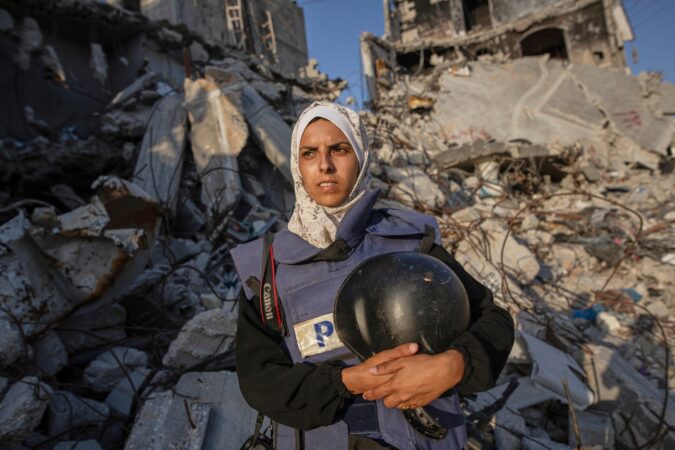
    Last year was the deadliest on record for journalists. For the third year in a row, Israel killed more journalists and media workers than any other country amid the war in Gaza, according to a report released Wednesday by the Committee to Protect Journalists.

    The report found an increase in the use of drones to kill journalists, with 39 documented cases: 28 by Israel’s military in Gaza, five by the paramilitary Rapid Support Forces in Sudan, and four by Russia in Ukraine. The CPJ documented just two drone killings in 2023.

    Of the 129 journalists killed around the world in 2025, the Israeli military was responsible for 86, about two-thirds of the deaths, the CPJ found. The death toll is the highest since the New York-based press freedom group started tracking the killing of journalists in 1992.

    The Israel Defense Forces “strongly rejects the claims” presented in the report, the IDF said in a statement to the Washington Post on Wednesday.

    “The IDF does not intentionally harm journalists or their family members, and on the contrary, operates solely against military targets, in accordance with international law, and employs all possible measures to mitigate harm to civilians, including journalists,” the statement said. “Any claim of intentional harm to civilians — including family members of journalists due to their professional activity, is completely false.”

    The second-highest number of killings occurred in Sudan, where nine journalists were killed. Mexico was third with six deaths, followed by Russia with four and the Philippines with three. The Russia tally includes Ukrainian journalists killed by Russian forces in Ukraine.

    The Israel-Gaza war is the deadliest conflict on record for journalists, according to the CPJ, with 252 killed as of early January. The CPJ determined that 249 of them were killed by Israel, 209 of whom were Palestinians in Gaza. Hamas killed two Israeli journalists in its Oct. 7, 2023, cross-border attack on Israel.

    Israel’s offensive in Gaza has killed more than 70,000, the majority of them women and children, according to the Gaza Health Ministry, following the Hamas attack on Israel that killed about 1,200 people Oct. 7, 2023. In the wake of a fragile Israel-Hamas ceasefire brokered by President Donald Trump in October, Israeli strikes in Gaza have continued.

    “Attacks on the media are a leading indicator of attacks on other freedoms, and much more needs to be done to prevent these killings and punish the perpetrators,” CPJ chief executive Jodie Ginsberg said in a statement. “We are all at risk when journalists are killed for reporting the news.”

    After an Israeli strike on Nasser hospital in Gaza in August killed journalists Mariam Dagga, Hussam al-Masri, Mohammed Salama, Moaz Abu Taha, and Ahmed Abu Aziz — who were all working with prominent news outlets — and prompted calls for accountability from rights groups, the IDF said in a statement that it “regrets any harm to uninvolved individuals and does not target journalists as such.”

    Israeli Prime Minister Benjamin Netanyahu said that the attack was a “tragic mishap.”

    Israel’s strikes on Gaza meant Palestinian journalists were covering the same bombardments they were trying to survive. In 2023, 77 journalists were killed in the Israel-Gaza war, 72 of whom were Palestinians killed in Israeli strikes. In 2024, Israel killed 82 journalists in Gaza and three in Lebanon, per the CPJ.

    Last year, 52 of the 86 journalists killed by Israel were Palestinians in Gaza. The 2025 tally also includes journalists killed by Israel in Iran and Yemen. Meanwhile, one Palestinian journalist was killed by a Palestinian armed group in Gaza in October, by the CPJ’s count.

    There have been no credible investigations by Israel of these killings since the Israel-Gaza war began with the Hamas attack on Oct. 7, 2023, said Sara Qudah, the CPJ’s Middle East and North Africa regional director.

    Israel said it opened an inquiry into the strikes on Nasser hospital. It also said it was reviewing a 2023 Israeli attack in Lebanon that killed a Reuters journalist and injured other reporters, including an American, but U.S. lawmakers said in December that Israel has not held the perpetrators accountable.

    “Impunity is becoming a pattern and a norm,” Qudah told the Post. “Israel is able to target and kill journalists with full impunity, with no investigation and no accountability.”

    Israel has levied claims, without providing substantial evidence, that some of the journalists it killed were legitimate targets due to accusations that they were working with Hamas, which their outlets have denied. Some journalists were killed in the course of their lives in a war zone, with no sign of targeting. The press freedom group said Israel was undertaking the most “deliberate effort to kill and silence journalists that CPJ has ever documented.”

    Qudah said she hoped the International Criminal Court would investigate the killings. “Those who killed these journalists and those who ordered the killings of these journalists should be held accountable and prosecuted,” she said.

    The CPJ includes the killing of a journalist in the index if evidence such as interviews with witnesses or verified footage shows they were killed in the line of work — either accidentally in a conflict zone or on a dangerous assignment, or deliberately because of their reporting. The press freedom group determined that 47 of the journalists killed last year were deliberately killed for their work. Under international humanitarian law, journalists are considered civilians and should not be targeted.

    The index includes reporters who gather the news and media workers such as interpreters, drivers, and fixers.

    The killing of journalists in Mexico and the Philippines underscores systemic safety risks facing reporters in both countries, according to the CPJ: At least one journalist has been killed in Mexico every year for the past decade.

    But more than 75% of all journalists slain in 2025 were killed in conflict settings, including Gaza, along with Sudan and Ukraine.

    Killings have continued into 2026. In January, the Israeli military struck and killed three journalists, including a CBS News contributor, as they traveled in their car south of Gaza City, rescue officials and local reporters told the Post last month.

    The IDF said in a statement that its troops had identified “several suspects who operated a drone affiliated with Hamas in the central Gaza Strip, in a manner that posed a threat to their safety.” The statement did not clarify how the IDF drew the connection to Hamas, or whether it had identified the targets as journalists.

  • Trump, seeking executive power over elections, is urged to declare emergency

    Trump, seeking executive power over elections, is urged to declare emergency

    Pro-Trump activists who say they are in coordination with the White House are circulating a 17-page draft executive order that claims China interfered in the 2020 election as a basis to declare a national emergency that would unlock extraordinary presidential power over voting.

    President Donald Trump has repeatedly previewed a plan to mandate voter ID and ban mail ballots in November’s midterm elections, and the activists expect their draft will figure into Trump’s promised executive order on the issue. The White House declined to elaborate on Trump’s plans.

    “Under the Constitution, it’s the legislatures and states that really control how a state conducts its elections, and the president doesn’t have any power to do that,” said Peter Ticktin, a Florida lawyer who is advocating for the draft executive order. Ticktin attended the New York Military Academy with Trump and was part of his legal team that filed an unsuccessful 2022 lawsuit accusing Democrats of conspiring to damage him with allegations that his 2016 campaign colluded with Russia.

    “But here we have a situation where the president is aware that there are foreign interests that are interfering in our election processes,” Ticktin went on. “That causes a national emergency where the president has to be able to deal with it.”

    The emergency would empower the president to ban mail ballots and voting machines as the vectors of foreign interference, Ticktin argued.

    The idea of claiming emergency executive powers based on allegations of foreign interference attaches new significance to the administration’s actions to reinvestigate the 2020 election. Trump has never accepted defeat, while never finding evidence of widespread fraud. Director of National Intelligence Tulsi Gabbard is leading a review of election security that officials said focuses on foreign influence.

    A 2021 intelligence review concluded that China considered efforts to influence the election but did not go through with them.

    Ticktin said he’s had “certain coordination” with White House officials but declined to specify, citing safety concerns. But his input has successfully led to a presidential action before. Ticktin represents Tina Peters, a former Colorado county clerk imprisoned on state charges arising from breaking into voting equipment, whom Trump said he pardoned in December. (The presidential pardon did not free Peters from her nine-year prison term because the president has no power over state crimes.)

    A White House official said the staff is regularly in communication with a variety of outside advocates who want to share their policy ideas with the president, but any speculation about his actions or announcements is just speculation.

    “I have searched the depths of Legal Arguments not yet articulated or vetted on this subject, and will be presenting an irrefutable one in the very near future,” Trump said on social media Feb. 13. “I will be presenting them shortly, in the form of an Executive Order,” he added the same day.

    Trump is pressuring Republicans to pass legislation to require proof of citizenship for voter registration and ID to cast ballots. The measure, called the Save America Act, passed the House but faces obstacles in the Senate, where Republican leaders have rejected Trump’s demand to change the chamber’s rules to move the legislation forward.

    “President Trump is committed to ensuring that Americans have full confidence in the administration of elections, and that includes totally accurate and up-to-date voter rolls free of errors and unlawfully registered non-citizen voters,” White House spokeswoman Abigail Jackson said. “The President has urged Congress to pass the SAVE Act and other legislative proposals that would establish a uniform standard of photo ID for voting, prohibit no-excuse mail-in voting, and end the practice of ballot harvesting.”

    Trump has said that if the bill fails, he will act unilaterally to impose the changes for the midterms. What that executive order could look like and the draft circulating among activists have not been previously reported.

    An early version of the proposed draft, obtained by the Washington Post, cites a 2018 executive order that declared an emergency to impose sanctions on foreign entities targeting election infrastructure. President Joe Biden repeatedly extended that emergency, and in 2024, the Treasury Department used the order to place Iranian and Russian entities under sanctions.

    “There is now clear and compelling evidence from court cases and forensic analysis that these threats have not been mitigated but instead have intensified,” reads the proposed draft, dated April 2025. “This constitutes an unusual and extraordinary threat to the national security and foreign policy of the United States.”

    Last June, Senate Judiciary Committee Chairman Chuck Grassley (R., Iowa) released FBI records showing an initial tip alleging a Chinese effort to produce fraudulent driver’s licenses for mail ballots. Suspicions of Chinese ballots spurred the hunt for bamboo fibers in Arizona ballots during a Republican-led audit in 2021, which reaffirmed Joe Biden’s victory in the state.

    Gabbard recently was present when the FBI searched a warehouse in Fulton County, Georgia, to seize ballots from the 2020 election there. The affidavit submitted to obtain the search warrant, however, did not allege foreign interference. Her office also examined voting machines used in Puerto Rico looking for cybersecurity vulnerabilities, in coordination with the FBI and the Departments of Justice and Homeland Security, according to a spokesperson for the Office of the Director of National Intelligence. That inquiry was first reported by Reuters.

    “The stage is largely being set by the revelations coming out of foreign powers being involved in influencing the 2020 election,” said Jerome Corsi, who circulated the draft executive order in July. Corsi helped spread the “birtherism” smear against Barack Obama and a conspiracy theory involving slain Democratic staffer Seth Rich, for which he later apologized. Special counsel Robert S. Mueller III investigated Corsi as a possible link between WikiLeaks and Roger Stone during the 2016 campaign, which Corsi denied.

    “If there was a provable foreign intrusion, that would be a national security emergency and the order could be issued under his powers as commander in chief,” Corsi added.

    Sen. Mark R. Warner of Virginia, the top Democrat on the Senate Intelligence Committee, said there is no national emergency.

    “We’ve been raising the alarm for weeks about President Trump’s attacks on our elections and now we’re seeing reports that outline how they may be planning to do it,” Warner said in a statement in response to this article. “This is a plot to interfere with the will of voters and undermine both the rule of law and public confidence in our elections.”

    The measures listed in the 2025 draft of the proposed executive order include requiring hand-marked and hand-counted paper ballots, requiring voters to register anew for the 2026 midterms with proof of citizenship, and restricting mail ballots to limited circumstances. The draft also proposes authorizing the Justice Department, U.S. Citizen and Immigration Services, the Social Security Administration, and the Postal Service to have a role in identifying ineligible voters.

    The draft cites emergency authority from laws including the National Emergencies Act of 1976, the Federal Information Security Modernization Act of 2014 and the Defense Production Act of 1950.

    Article I, Section 4 of the Constitution assigns power to regulate elections to state legislatures and Congress, with no role for the president. A presidential emergency on elections has never been tested in court.

    Trump also signed an executive order last March to require proof of citizenship on voter registration forms and withhold funding from states accepting mail ballots after Election Day. Courts in five cases blocked parts of the order, with three of them pending appeal and another awaiting a ruling, according to a litigation tracker compiled by the legal website Just Security.

    “The conduct of our elections is not for any president to decide. And it must never be manipulated to serve a political agenda,” the League of Women Voters, which brought one of the lawsuits against the 2025 order, said in a statement. “We will challenge any executive action that suppresses voters, undermines free and fair elections, or violates the constitutional framework that protects our democracy.”

    A Washington Post-ABC News-Ipsos poll this month found 54% of American adults, and 55% of independents, oppose Trump’s stated desire for the federal government to take over election administration and vote-counting in certain states. Twenty-three percent of adults said they supported it, and the same proportion said they had no opinion.

  • Voice of America is covering Iran’s protests, but not its best-known dissident

    Voice of America is covering Iran’s protests, but not its best-known dissident

    When Sahar Tahvili, a professor at a Swedish university, sat for an interview with Voice of America’s Persian service on Jan. 9, she discussed the security concerns for Iranian viewers using Starlink satellites to circumvent the government’s internet blackouts.

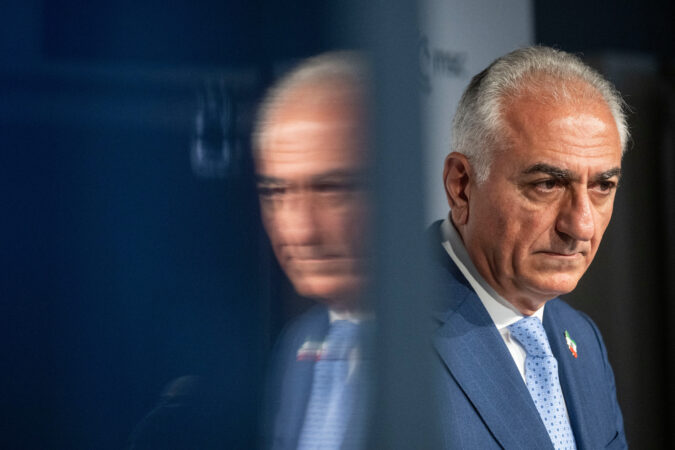
    But it was a greeting at the start of the interview that crossed a line with the company’s top brass. She thanked the network for having her before invoking the name of Reza Pahlavi, the son of Iran’s deposed shah: “Let me first pass my greetings to our compatriots in Iran, a nation that, by standing on the right side of history and by responding in the millions to Crown Prince Reza Pahlavi’s call, is shaping historic days for the freedom of our country.”

    Later that day, Tahvili received a phone call from the VOA producer who arranged her interview, complaining that she had violated Voice of America’s new policy barring mentions of Pahlavi’s name — which she said she didn’t know about.

    “He called me in a very angry way and said, ‘Why did you mention his name?’” Tahvili, adjunct associate professor of AI industrial systems at Sweden’s Mälardalen University, said in an interview. “No one is allowed to mention Pahlavi’s name.” Because she had mentioned him, Tahvili said she was told her interview, which aired live, would not be reposted to social media and she would no longer be welcome on the network.

    Critics including Tahvili allege that since the mass protests broke out in the final days of last year, the U.S. government has systematically censored the best-known Iranian opposition figure by banning his name from its broadcasts. They also claim that, in the process, U.S. Agency for Global Media Deputy CEO Kari Lake and the new head of the Persian service, Ali Javanmardi, have exerted control over a government broadcaster that’s long been editorially independent of the U.S. government.

    In a January interview with Reuters, President Donald Trump questioned whether Pahlavi has enough support to take over in Iran, but said “that would be fine with me” if he wins over the majority of Iranians. “He seems very nice, but I don’t know how he’d play within his own country,” Trump said.

    In the same interview, he remained noncommittal about efforts to pressure regime change in Iran either, saying, “Whether or not it falls or not, it’s going to be an interesting period of time.”

    The push to excise Pahlavi’s name was first reported by the Hill.

    Lake and Javanmardi, a former VOA contractor recently brought in to run the Persian service, have defended their new rules, saying that they are simply clamping down on an effort by VOA employees eager to see one opposition group prevail over another at a time when Iran’s regime under Ayatollah Ali Khamenei is on shaky ground. They say it applies to all opposition leaders, not just Pahlavi.

    “We are not in the business of selecting Iran’s political leadership,” Lake said in a statement. “That decision belongs solely to Iran’s 93 million citizens, who have a right to self-determination. Right now, the story should be about them, not the numerous opposition groups outside Iran. Elevating external opposition figures over voices inside the country risks externalizing the conflict in ways that would only benefit the cruel regime and undermine protesters on the ground.”

    In a separate statement, Lake called Javanmardi “a respected and fearless journalist” with deep experience reporting on Iran and the region. “His commitment is to journalistic responsibility, truth, and ensuring coverage that aligns with American policy interests and centers the voices of the Iranian people in support of their right to freedom and self-determination.”

    The spokesperson did not make Javanmardi available for an interview.

    Javanmardi has voiced opinions, however, about Pahlavi on-air, saying in a recent VOA appearance, “The United States government is not going to replace a dictator inside Iran with another totalitarian one who has threatened all his opponents even before coming to power with death and elimination.” In recent months he has also described other media as engaging in “propaganda engineering” and “artificial magnification” of issues in Iran.

    Javanmardi has also called out Iranians for not participating in the recent protests. “We should all participate in identifying the mercenaries who did not join the people and are involved in suppressing the people,” he said in one broadcast. “Let’s participate so that they do not have immunity, both inside and outside Iran.”

    Under Lake, Voice of America has undergone massive staff cuts. The broadcaster, first set up in 1942 to counter Nazi propaganda abroad, suspended most of its programming after Trump issued an executive order in March. Then, Lake cut hundreds of contractors and placed hundreds of full-time staffers on paid administration leave. A federal judge blocked Lake from firing the employees and instructed the agency to uphold its statutory obligations for broadcasting. As a result, Lake brought back broadcasting in a few languages mandated by law, including Farsi.

    In January, Congress rejected requests from Lake and the White House to zero out the agency’s budget, approving a $653 million budget. Lake said she was “disappointed” at the move.

    VOA’s Persian service, once among its largest divisions, has maintained a skeleton crew since this summer, when Lake briefly ordered staff back and called for some broadcasts amid escalating military tensions between Iran and Israel. Many of those recalled staffers were put back on administrative leave when the conflict simmered.

    But when popular uprising broke out in late December, Lake once again ramped up its staffing, bringing back a few dozen employees and contractors.

    She also tapped Javanmardi, who years earlier worked as a VOA correspondent based in Irbil, Iraq, to lead the charge. He quickly became a divisive figure among staffers and viewers because of his close control over broadcasts. So far, more than 58,000 people signed a Change.org petition to have him removed, saying, “Ali Javanmardi’s biased approach silences the Iranian struggle and betrays the trust of those who depend on honest journalism.”

    In an email, a U.S. Agency for Global Media spokesman defended the new policy regarding opposition figures. “Mr. Reza Pahlavi himself, as well as the leaders of other political groups, have been invited to speak on the Voice of America,” he said.

    Despite the invitation, Pahlavi has not appeared on the network. Pahlavi did not respond to a request for comment.

    Several VOA staffers working on the broadcasts, who spoke on the condition of anonymity out of fear of retaliation, said that Javanmardi appeared to target Pahlavi. The staffers said he personally approves all guests before they appear on air and has instructed staff not to book anyone who sympathizes or promotes Pahlavi.

    “He completely censors his name, his activity and everything,” one staffer said, noting that Javanmardi has refused to play audio of protesters in Iran shouting Pahlavi’s name. “All the people chanting in Iran — nothing. He censors everything.”

    Holly Dagres, a senior fellow at the Washington Institute who writes a Substack newsletter called “The Iranist,” said that many Iranians have indeed chanted Pahlavi’s name during the protests. “While this may seem surprising to outside observers, nostalgia for the pre-1979 era has grown in recent years,” she said. “Many Iranians — particularly Gen Zers who weren’t alive during that period — perceive life before the revolution as a better time.”

    She added that omitting this detail “erases a key element of the uprising — including the motivations of some of the protesters who have risked, and in some cases lost, their lives in the name of freedom.”

    Another staffer said that no pro-Pahlavi content can appear on the network. “If anything ever has been published or broadcast, it’s because we missed it,” the staffer said.

    Another employee said that the approach has hampered reporting, such as when Sen. Lindsey Graham (R., S.C.) met with Pahlavi and Javanmardi instructed the staff not to cover it.

    However, one VOA staffer defended the policy, saying that without it, the service and the United States could be labeled having interfered in Iran’s internal affairs.

    And Arash Azizi, a lecturer at Yale University who writes about Iran for different publications, also said he is “at least partially favorable” to VOA’s approach because Pahlavi leads “one political faction” of the opposition.

    “No country in the world should recognize Mr. Pahlavi as the leader of the Iranian opposition because he has absolutely no legitimacy for that position,” Azizi said. “I think it’s good for VOA to have effectively pulled the brake and say, look, you’re nobody’s leader. You can’t just appoint yourself the leader and then expect us to treat you as one.”

    Navid Mohebbi, a former political prisoner in Iran now advising the National Union for Democracy in Iran (NUFDI), which supports Pahlavi, said in a statement that VOA is effectively the “only major Persian-language diaspora outlet” that has avoided covering Pahlavi’s calls for demonstrations in Iran and protesters shouting pro-Pahlavi slogans.

    “This level of censorship is striking, particularly when even Iranian regime media and outlets hostile to the United States acknowledged the existence of these slogans,” he said.

    For Tahvili, who grew up watching VOA in Iran, the experience of being banned from the network was painful.

    “For us, for my generation, we grew up with the Voice of America,” she said. “It was the only channel, the only Persian-language news source that we had at that time. Freedom of speech. Professional journalism. It really hurts to see how it changed from that to this.”

  • Trump floats new retirement benefit for 54 million workers

    Trump floats new retirement benefit for 54 million workers

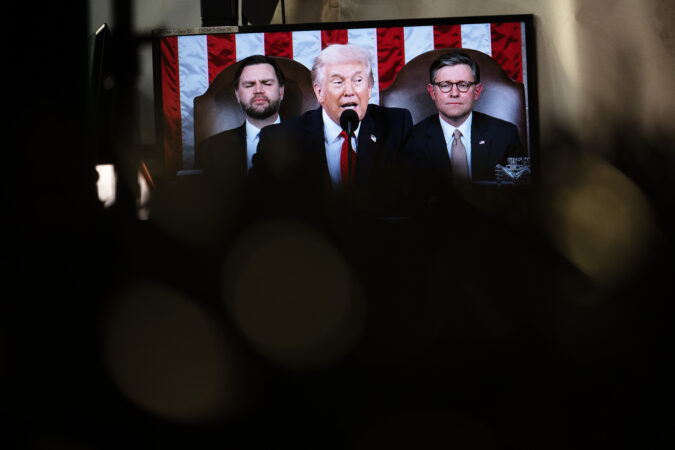
    President Donald Trump, in his State of the Union address Tuesday night, suggested a major new retirement benefit for tens of millions of American workers, embracing an economic policy that proponents say could bolster the federal retirement safety net.

    Speaking to congressional lawmakers, Trump pledged to extend to private-sector workers the same type of retirement plan already available to federal employees. He also said the government would kick in up to $1,000 per year to their accounts, presumably in matching benefits. Roughly 54 million workers in the private sector have no workplace retirement benefits and do not benefit from stock market gains, according to research cited by the Economic Innovation Group, a Washington-based think tank, as part of what some experts have termed a “retirement crisis” in America.

    “Half of all of working Americans still do not have access to a retirement plan with matching contributions from an employer,” Trump said. “To remedy this gross disparity, I’m announcing that next year, my administration will give these often forgotten American workers — great people, the people that built our country — access to the same type of retirement plan offered to every federal worker. We will match your contribution with up to $1,000 each year.”

    The announcement was celebrated by Trump supporters as a major new economic policy heading into the 2026 midterm elections, but critics pointed out some problems with Trump’s pledges, and are skeptical it will substantially boost savings for working-class Americans.

    The most obvious challenge is that it’s not clear how much Trump can do on his own. Under existing authorities, the administration can create portable retirement accounts — modeled on the Thrift Savings Plan used by federal employees — and make them available to workers who currently lack a workplace plan. But the government cannot compel employers or workers to automatically enroll, nor can it unilaterally appropriate funds to provide a universal $1,000 match to all eligible workers.

    Instead, the administration can facilitate take-up of a benefit that already exists. The bipartisan Secure 2.0 bill, signed by President Joe Biden in 2022, created a “Saver’s Match” — a federal contribution of up to $1,000 annually for qualifying workers who put $2,000 in an eligible retirement account. One problem has been that many eligible workers have had nowhere to put their contributions. Trump’s executive action could create additional account infrastructure, but eligibility would still be constrained. Only workers who make less than $25,000 per year, or roughly $41,000 for couples, are eligible.

    More impactful would be if Trump’s comments spur congressional action. A White House official suggested that the administration will support bipartisan legislation to automatically enroll eligible workers in federal accounts, provide the $1,000 federal match for low- and moderate-income workers, and make those accounts portable across jobs. One bill is backed by a coalition that spans Charles Schwab, AARP, DoorDash, and Uber.

    White House economist Kevin Hassett has backed a similar kind of approach. Of the more than $200 billion in annual income tax expenditures related to retirement savings, less than 1% flows to workers in the bottom income quintile, according to the Economic Innovation Group. This would move some of those benefits down the income distribution.

    “Since we’ve had the 401(k) system this has always been the problem: A huge share of the workforce has not been participating and doesn’t have access to these benefits. Closing that gap is a big first step,” said John Lettieri, cofounder of the Economic Innovation Group. “It’s a long-run exercise to get people into the market, engaged in long-term savings and investment behavior with matching benefits. That’s a proven way of building wealth over time, including for low-income savers.”

    That said, there are reasons to doubt that even the legislation being debated in Congress would do much to increase retirement security for low-income workers. Low-income Americans often do not have enough to live on already, much less an extra $2,000 per year to put into retirement accounts, said Matt Bruenig, founder of the People’s Policy Project, a left-leaning think tank.

    The Survey of Consumer Finances suggests that fewer than 12% of people who earn below $43,000 save for retirement.

    “Almost no low-income people have retirement accounts. This is not because they are disallowed from having them,” Bruenig said. “It’s because they can barely pay their bills. Nothing in the president’s plan changes that.”

  • Surgeon general nominee Casey Means grilled on vaccines, pesticides in hearing

    Surgeon general nominee Casey Means grilled on vaccines, pesticides in hearing

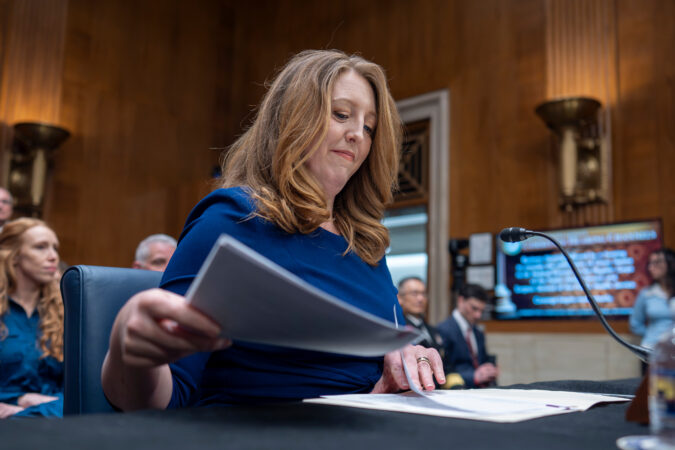
    After over a year without a surgeon general, the Senate Health Committee is grilling Casey Means on vaccinations, her business entanglements, and past comments on pesticides, as they weigh whether she should serve as the nation’s top doctor.

    Means wrote the book considered the bible of the Make America Healthy Again movement with her brother, Calley Means, a Trump administration official. As surgeon general, she could amplify many of her messages around healthy eating and exercise, although she has faced criticism for some of her ties to wellness products.

    Means is drawing fire and praise from both sides of the aisle, reflecting the MAHA coalition’s crosscutting appeal. Her messages on food found favor with both sides, while Democrats and the panel’s GOP chair probed her views on vaccinations and a Republican senator raised questions on how her stance on pesticides could impact American farmers.

    Means highlighted the nation’s chronic illness rates and a path to how she hopes to change them in her opening remarks.

    “Public health leaders must address the evidence-based, modifiable drivers of chronic diseases which include ultra-processed foods, industrial chemical exposure, lack of physical activity, chronic stress and loneliness, and overmedicalization,” Means said. “As surgeon general, I would call on every American and the Public Health Service to join in a great national healing — one that halts preventable chronic disease, makes healthy living the easiest choice, honors the body’s connection to the environment, and puts America back on the road towards wholeness and health.”

    Her initial confirmation hearing was delayed after she gave birth in the fall. This hearing is also a referendum on the controversial moves of her political patron, Health Secretary Robert F. Kennedy Jr., who has overhauled federal vaccine guidelines and upended the public health system. Means, like Kennedy, has publicly questioned the number of vaccines included in the childhood vaccine schedule, as well as the hepatitis B shot. Public health experts say the vaccine schedule is safe and effective.

    Vaccine questions

    At the beginning of the hearing, Chairman Bill Cassidy (R., La.) cautioned that as the nation’s top doctor, Means would have a responsibility to fight back against the vaccine skepticism rising across the country “at a time when so many, for whatever reason, sow distrust and confusion.”

    Sen. Bernie Sanders (Ind., Vt.), the panel’s ranking minority-party member, went further, accusing Trump and Kennedy of spreading misinformation on vaccines and pleading with Means to take a stand against them.

    Cassidy later peppered Means with questions around immunizations, pointing to children who have died of vaccine-preventable disease. Means emphasized that while she supports vaccines, she believes parents and patients must speak to their physicians. She also refused to explicitly say vaccines do not cause autism when pressed, instead saying that no stones should be left unturned in the search for the causes of autism. As health secretary, Kennedy instructed the Centers for Disease Control and Prevention to remove from its website the long-settled scientific conclusion that vaccines do not cause autism.

    In his questioning, Sanders started by pointing out the overlap between his and Means’s interest in fighting against ultra-processed food, before pivoting to further press Means on the scientific community’s determination that vaccines don’t cause autism.

    “Anti-vaccine rhetoric has never been a part of my message,” Means said, adding that the nation should study when children are getting many medications.

    Business ties and pesticides

    A Washington Post examination last year found that Means had made over half a million dollars from partnerships with companies that her financial forms described as selling “diagnostic testing,” “herbal remedies and wellness products,” and “teas, supplements, and elixirs” from 2024 into the summer of 2025, according to her financial disclosures. Legal and advertising experts told the Post last fall that they were concerned about whether Means clearly disclosed her ties to some brands.

    Sen. Tammy Baldwin (D., Wis.) grilled Means on some of her connections to wellness products: “It seems to me that you’ve spent your career sort of making money off the flaws” in the healthcare system.

    Sen. Chris Murphy (D., Conn.) said he was concerned that Means was in “willful violation” of Federal Trade Commission rules, recommending products without telling followers she was sponsored by such products.

    Means pushed back on the allegations and said she “would rectify that immediately” if it has inadvertently happened.

    “I take conflicts of interest incredibly seriously,” Means said.

    While many Republicans spoke highly of Means’s approach to improving American diets and fighting chronic disease, some others did not hold back in their questioning of her past remarks on psilocybin, pesticides, and other items.

    Pesticides are a hot-button issue among the MAHA movement after Trump issued an executive order protecting a key ingredient in a weed killer.

    She wrote in a newsletter sent in 2024: “How can we help bring a pesticide-free world to fruition? It starts with each of us prioritizing eating organic food as much as possible and standing firmly against buying or serving food sprayed with pesticides.”

    Sen. Jon Husted (R., Ohio) stressed that he has heard questions from Ohio farmers about her comments on pesticides, calling them critical for the food supply and farmers’ stability.

    Means called her thoughts on pesticides a core belief that was important to understand the impact pesticides could be having on Americans’ bodies, but noted she understood change could not happen overnight to destabilize the farming ecosystem.

    Means also got in a testy exchange with Sen. Patty Murray (D., Wash.) over birth control, with Means stressing that it’s important to highlight the possible risks including stroke for women. Means has a history of disparaging birth control, which has been under fire from wellness and right-wing influencers.

    Bucking the medical mainstream

    Secretary Kennedy has championed Means’s nomination.

    “She has an extraordinary capacity to communicate to the American public. That is the function of the surgeon general,” Kennedy said at an event Monday, saying Means would be a medical and “moral” authority for the public and he hoped she would be confirmed very soon.Means’ credentials — attending Stanford for her undergraduate education and medical school, racking up academic honors, writing scientific papers and working on research at top institutions — came up in the hearing.

    Means left her medical residency over seven years ago and has encouraged Americans to ask questions of their doctors — positions Kennedy has said led to her nomination.

    Means, a physician, has a medical license in Oregon that she voluntarily placed in inactive status, according to the state medical board, which means she cannot practice medicine in Oregon as of the beginning of 2024. Sen. Andy Kim (D., N.J.) raised concerns about Means’s medical license. Means pushed back on him by noting she practiced medicine and sees her background as “a feature, it’s not a bug.

    MAHA supporters have lauded her for challenging the medical mainstream.

    Public health experts have raised questions about some of her advice. In her book Good Energy, Means writes that “the ability to prevent and reverse” a variety of ailments, including infertility and Alzheimer’s, “is under your control and simpler than you think.”

    Medical experts have said that while there is significant evidence that diet and exercise can lower the risk of some chronic conditions and slow the progression of diseases, Means overstates the science when she says it can reverse many of them.

  • As invasion enters fifth year, the children of Ukraine learn to fight back

    As invasion enters fifth year, the children of Ukraine learn to fight back

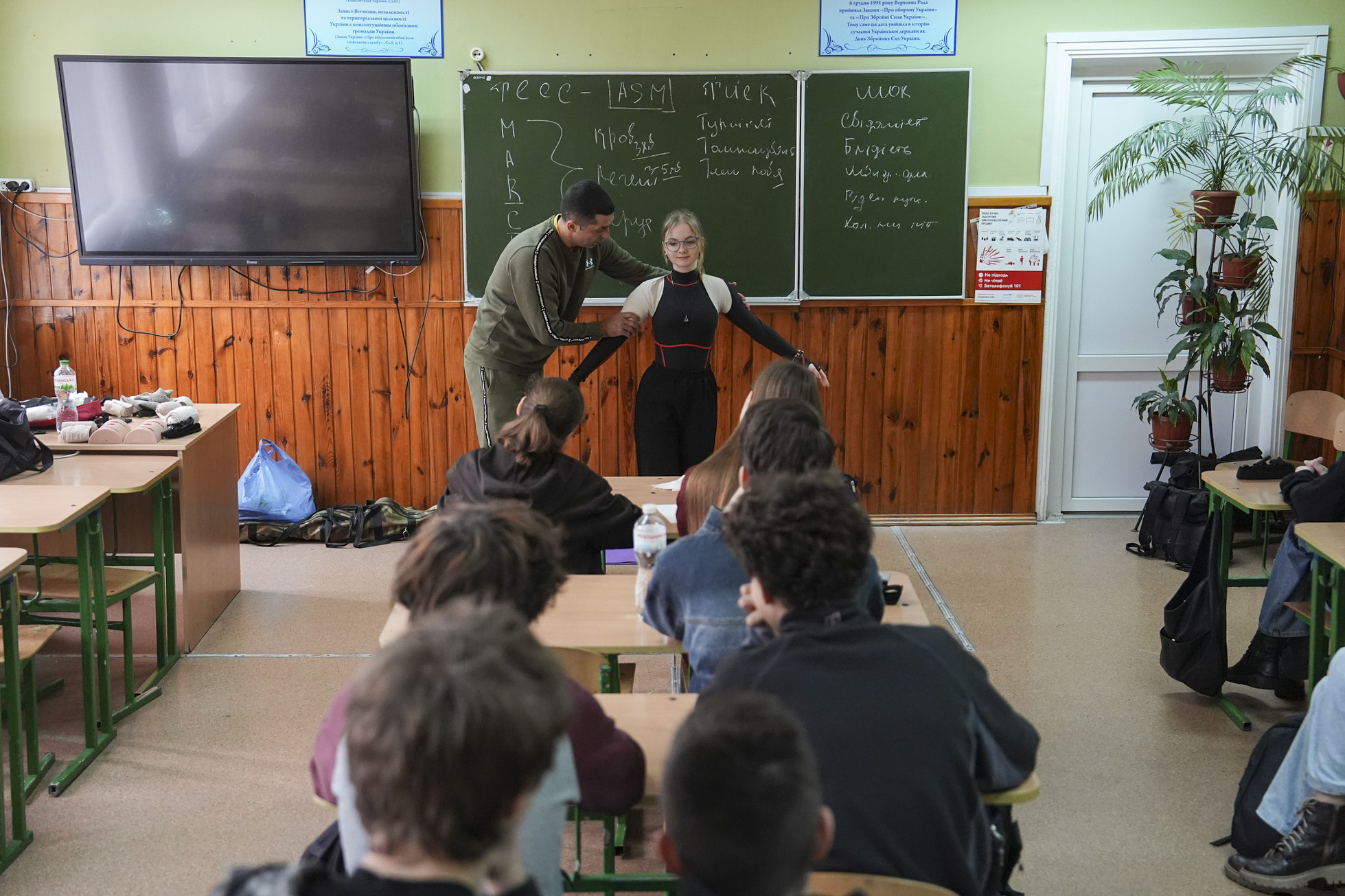
    BUCHA, Ukraine — From her wooden schoolroom seat, Katya, 15, carefully eyes the assault rifles laid across the desks up front.

    Her mind flashes to the Russian checkpoint four years ago.

    She is crammed in the back of a neighbor’s car clutching her aunt’s cat as fear rises to her throat. Russian soldiers are pressed up against the car window, seething with anger, fingers on the triggers of their black guns.

    The teacher’s voice snaps her back to the present.

    “God willing, none of you will ever need the knowledge you gain here, not even once. But if, God forbid, it happens that you do need it — that you cross paths with these situations — it’s better that you know what needs to be done at any given moment,” he says. “Understood?”

    Katya nods. She looks again at the training guns. She isn’t scared anymore. Scared is for 11-year-old Katya in the back seat of that car. Scared is for the little girl trembling in the basement, whose mother covered her with her body while Russian war planes circled overhead.

    If Russian troops ever return to Bucha, Katya doesn’t want to be scared. She intends to be ready.

    The teacher asks for volunteers to try loading a rifle. Katya’s hand shoots up.

    As Russia’s full-scale invasion entered its fifth year Tuesday, Ukrainians were yearning for peace but also readying a new generation of defenders — a somber recognition that the Kremlin is still bombing civilians every night and pushing maximalist demands at the negotiating table. The war could go on for years, and even if a ceasefire is achieved, the Russian threat will live next door.

    Katya and her classmates have come of age during wartime.

    Denys Kovalenko shows how to apply bandages on Varvara Koval, 15.

    In 2022, as tweens, they survived Russian occupation, made harrowing escapes from the front lines, and returned to find the bloodstained suburb of Bucha forever changed by the Russian massacre that unfolded on its streets in the first weeks of the war.

    Now 15 and 16, they are still too young to enlist to fight but old enough to understand they soon may be called upon to join their parents and older siblings in protecting their country from a nuclear-armed neighbor intent on denying them an independent future.

    While the United States escalates pressure on Kyiv to agree to a negotiated settlement, Ukraine is insisting on ironclad security guarantees — while preparing society to defend itself long term. That includes intensifying efforts to train its children on wartime readiness.

    In classrooms across Ukraine, more than 385,000 teenagers are enrolled in a revamped, mandatory course on handling weapons, battlefield tactics, emergency medicine, mine safety, radio communication, and how to respond to attacks on energy infrastructure.

    The course, called Protecting Ukraine, replaced a decades-old program that taught high-schoolers some basic weapons awareness but was largely a relic of the Soviet era that also involved dry lectures on military hierarchy and learning to march.

    That curriculum was developed long before school hallways were adorned with photos of students and teachers killed by Russia, before air alerts sent children scrambling into basements, before sandbags lined school windows to protect them from blasts or classes were held in subways.

    Ukraine’s Education Ministry invested $2.3 million in training teachers on the Protecting Ukraine program last year. “Our task was to form a defense mentality,” Education Minister Oksen Lisovyi said. “The need appeared, first of all of course, because of the military confrontation, terrorist threats and because Russia systematically terrorizes the civilian population.”

    Students learn “how to protect one’s self, how to protect those who are close to you, how the Ukrainian army works, which role you could find for yourself if you’d choose to take that path,” Lisovyi said. “But first of all, of course, it’s about the preparation of the civilian population.”

    Marina Kyziminska, 16, works with an assault rifle during class.

    Rifles, tourniquets, and CPR

    Most students in Katya’s classroom were in or near Bucha when Russian forces rampaged the Kyiv region in 2022, executing civilians before retreating from their failed campaign to seize the capital.

    When the instructor tells the students just how quickly a green, or safe, zone can turn red, they know exactly what he means.

    Katya shivered in a basement, replaying the happiest moments of her life as explosions shook her neighborhood.

    Zhenya walked miles along the railway tracks to reach Ukrainian-controlled territory as Russian warplanes circled overhead.

    A shell struck the eighth floor of Kyrylo’s apartment building but didn’t explode.

    Vasylisa remembers fleeing her hometown in the eastern Donetsk region as a toddler, only to resettle outside Kyiv and watch the sky turn red as streets burned in 2022.

    The instructor runs through the basics of trauma medicine: different kinds of tourniquets, how to put pressure on a major wound. He describes types of land mines, explains why radios are still used in an age of phones. He asks for volunteers for a CPR lesson. Katya and Vasylisa step to the front of the room. They giggle as Vasylisa lies down and Katya tips her chin back, opens her mouth, checking for obstruction.

    Zhenya Grebelna (left) Varvara, Katya and Ria Shapirko learn how to use a tourniquet.

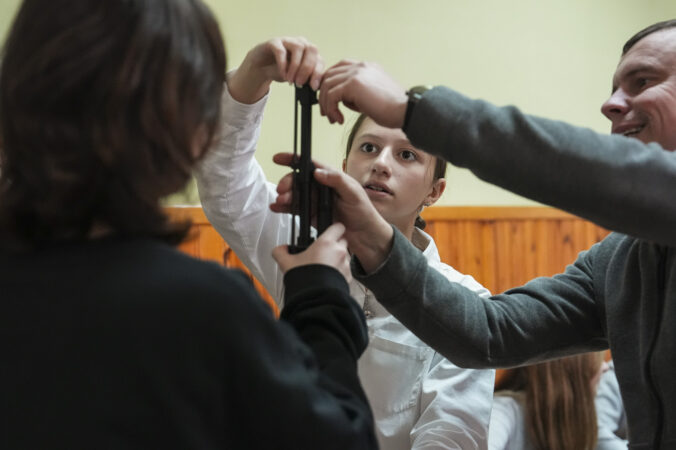
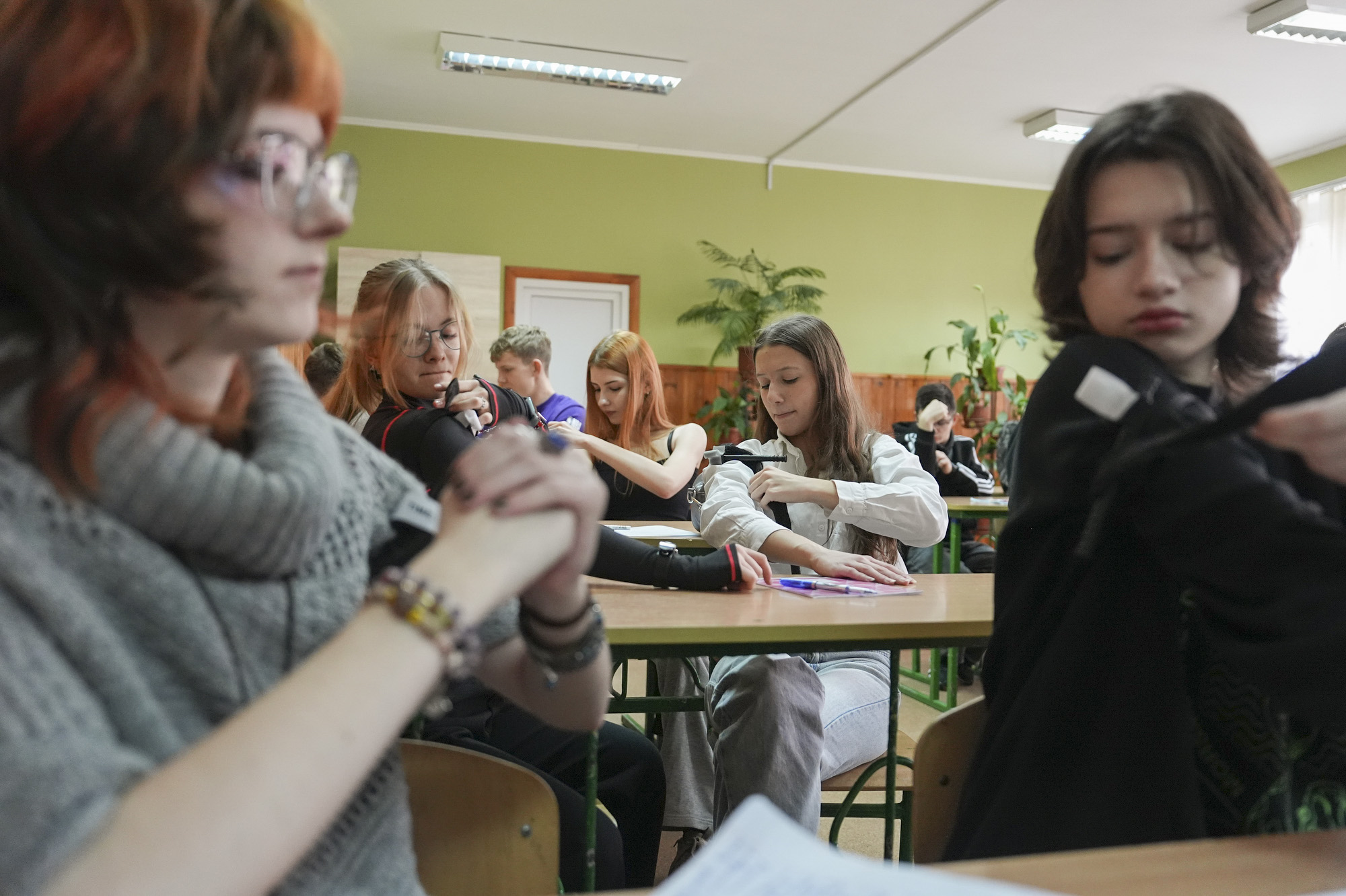
    The students tie tourniquets to one another’s arms and practice twisting until they’re so tight they hurt. They remind each other to write down the time. They know that a tourniquet left on too long can lead to amputation.

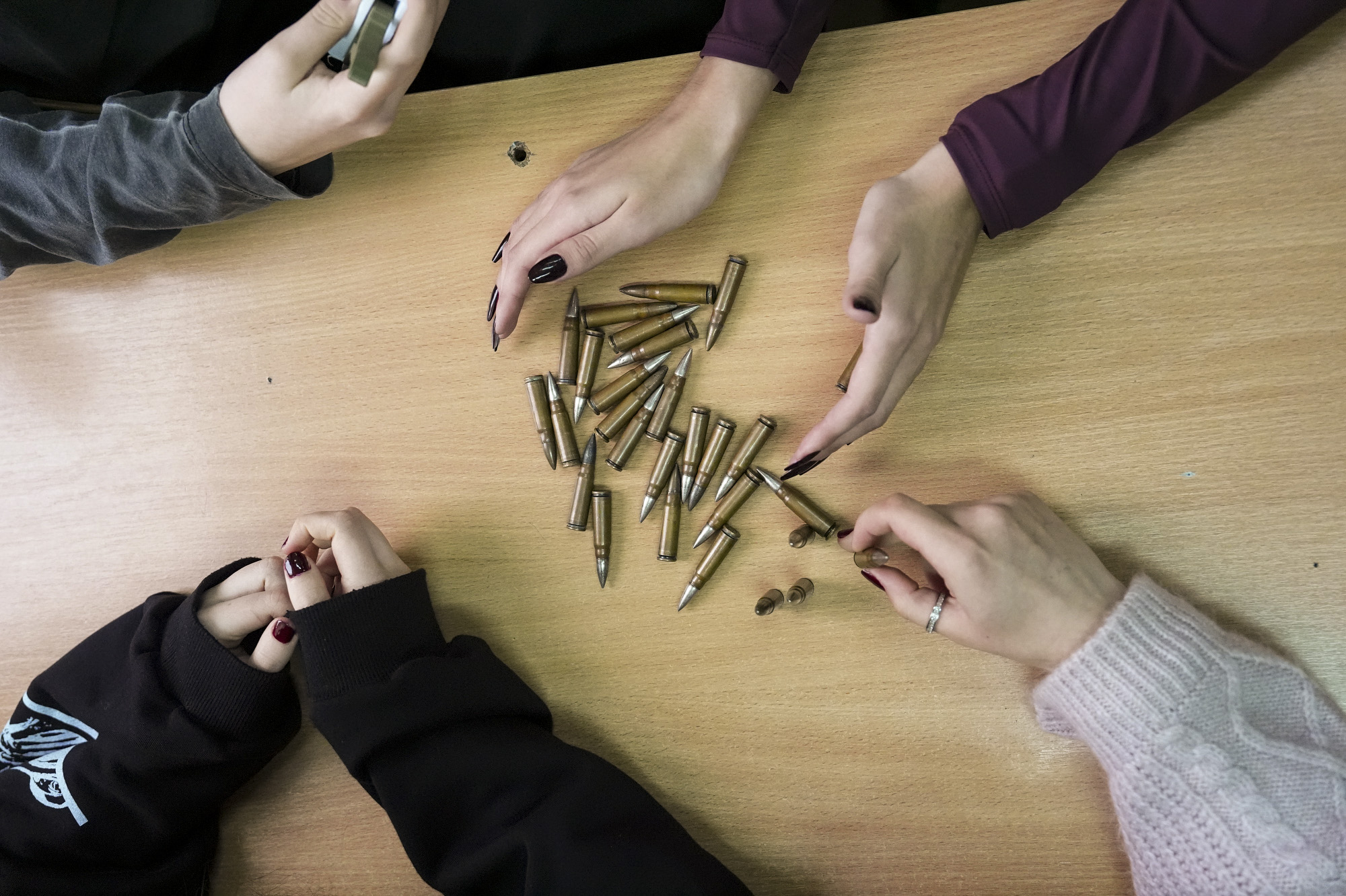
    When they go to load rifles, Katya is confident. She shows the other girls how it’s done while a group of boys plays with their phones in the back. Other students race to see who can load bullets into a magazine fastest.

    “I’m going to be dreaming about this already,” Katya says. Her friend Ria chimes in: “Like this, Katya: You wake up and we’re assembling a rifle on your bed!” The girls laugh. Their friend Varvara Koval takes a turn. Katya corrects her approach, takes the magazine and attaches it herself.

    Bullets used in the weapons training.

    The girls know that in schools in Russia, children their age are learning the same techniques. They know those kids are being taught that Ukraine is the aggressor, that Russia is liberating their territory by destroying it. They know that boys just a few years older than their classmates are being fitted for uniforms, crossing the border, killing Ukrainians and dying on Ukrainian land.

    “While they are being taught how to properly plant mines, we are being taught how not to step on them,” Katya says of how she pictures Russian students. In a better world, she acknowledged, it would not be normal to load an assault rifle at school or tie a tourniquet on your friend’s arm.

    “If no one were attacking our territory, or if Russia followed all the rules and conventions of conducting war, maybe we wouldn’t be learning this,” she adds. “But since they are striking civilian children just like us, we have to know all of this.”

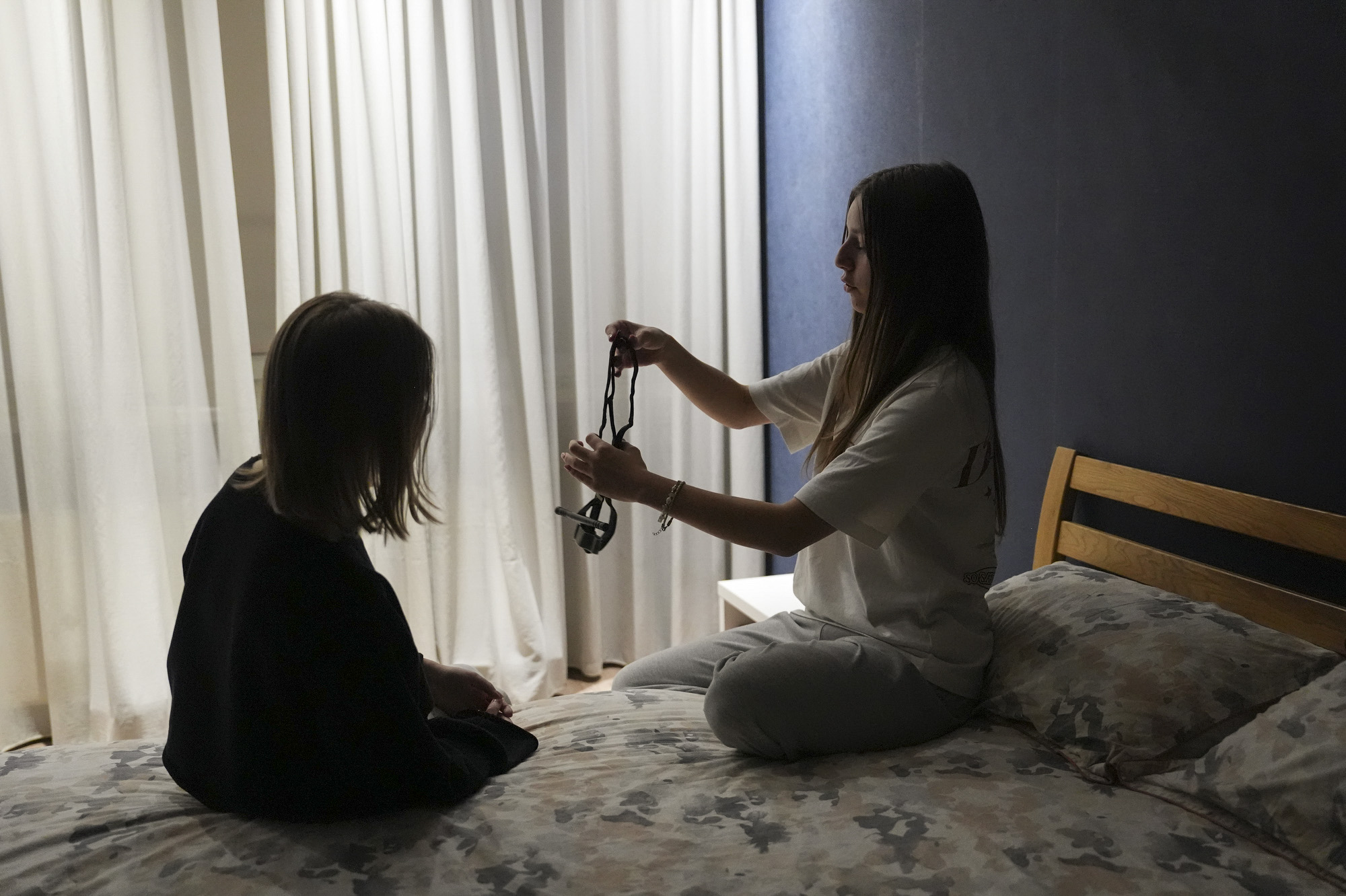
    Vasylisa shows younger sister Stasia how to apply a tourniquet at home.

    Lost childhood

    Katya grew up in this school. Her mom is a teacher here. She knows Bucha like the back of her hand. Vasylisa was never supposed to be here. Born in the eastern Donetsk region, she always dreamed of graduating from the same school as her father. War pushed her family out in 2014. They moved again and again, eventually settling in Irpin, just outside Kyiv.

    On Feb. 23, 2022, as Russian forces massed on Ukraine’s borders, Vasylisa’s dad told her and her younger sister, Stasia, to prepare for the worst. Stasia, who was 9, burst out laughing.

    The next morning, Russia invaded. Little information trickled in through their unstable internet connection, and what did was terrible: executions. Whole families shot as they tried to flee. Just across the field from them, they could hear a Ukrainian machine gun picking off Russian troops.

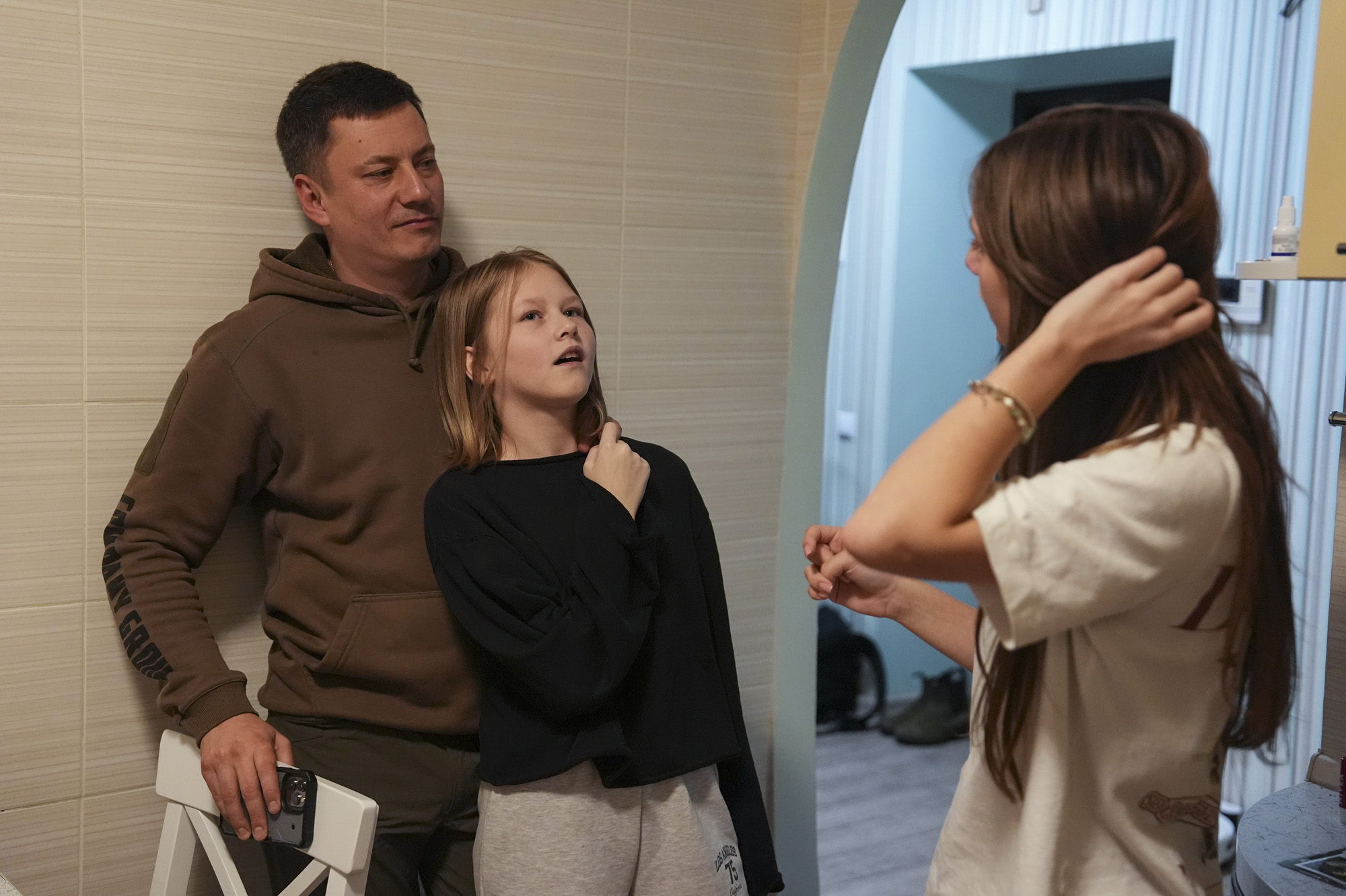
    Bohdana Kolesnikova, right, with daughters Vasylisa and Stasia at home.

    In early March, they fled, packing their dog, guinea pig and several neighbors into their car. The girls thought they were taking a so-called “green corridor” — a safe path toward Kyiv. Their parents knew no such route existed. The trip was a dangerous leap of faith.

    Everything seemed to be on fire. They passed the mayor of Irpin hanging out of a car, a rifle in his hands. They eventually made it west, where their dad was quickly drafted to the military. The girls and their mom were stunned.

    Back then, Vasylisa thought of the military almost as an extracurricular activity — something to do after school or work. “And now he was taken away, and there was a war,” she said. “I was afraid that … well, I was afraid for Dad. I was crying, talking to him, and he was trying to calm me down, but that only made me cry more.”

    Eventually, the family settled into a new rhythm. They returned to the Kyiv region and moved to Bucha, where their dad is now based. Not everything Vasylisa is learning about war in school is new. Her dad taught her and Stasia some field medicine and asked them to always carry tourniquets when they go out. Last summer, they attended a camp where they practiced shooting.

    Stasia, at 12, can already assemble and disassemble an AK M-479 in less than a minute.

    “I get really upset when I realize that my teenage years are just slipping away like this and passing,” Vasylisa said through tears. “I’m now looking at my sister, who is 12 — the age I was then. And when I realize that she already feels kind of grown up, it makes me sad that I lost some years.”

    Their dad has seen Russia’s war come to his family home twice. His daughters, he said, might still be children. But in an emergency, they should be ready to act as adults.

    Vasylisa and Stasia with their dad.

    Sounds of war

    At school, the military lesson ends in the early afternoon. The class disperses, and the students zip up their backpacks, push past the younger kids through the hallways. Vasylisa goes to an English class. The other girls gather on the steps outside.

    The first stop after school is the grocery store for cookies, candies, and tea. Varvara’s mom isn’t home from work yet, but she agreed the girls can hang out at their apartment so long as Varvara runs upstairs first to clean.

    They kick their shoes off at the door and rush for the kitchen. They boil water. They crowd around the table. They hear an air raid siren and ignore it. They move to Varvara’s room, sit on her bed and floor. They don’t talk about guns or drones or soldiers or war. They talk about boys and girls and crushes and relationships.

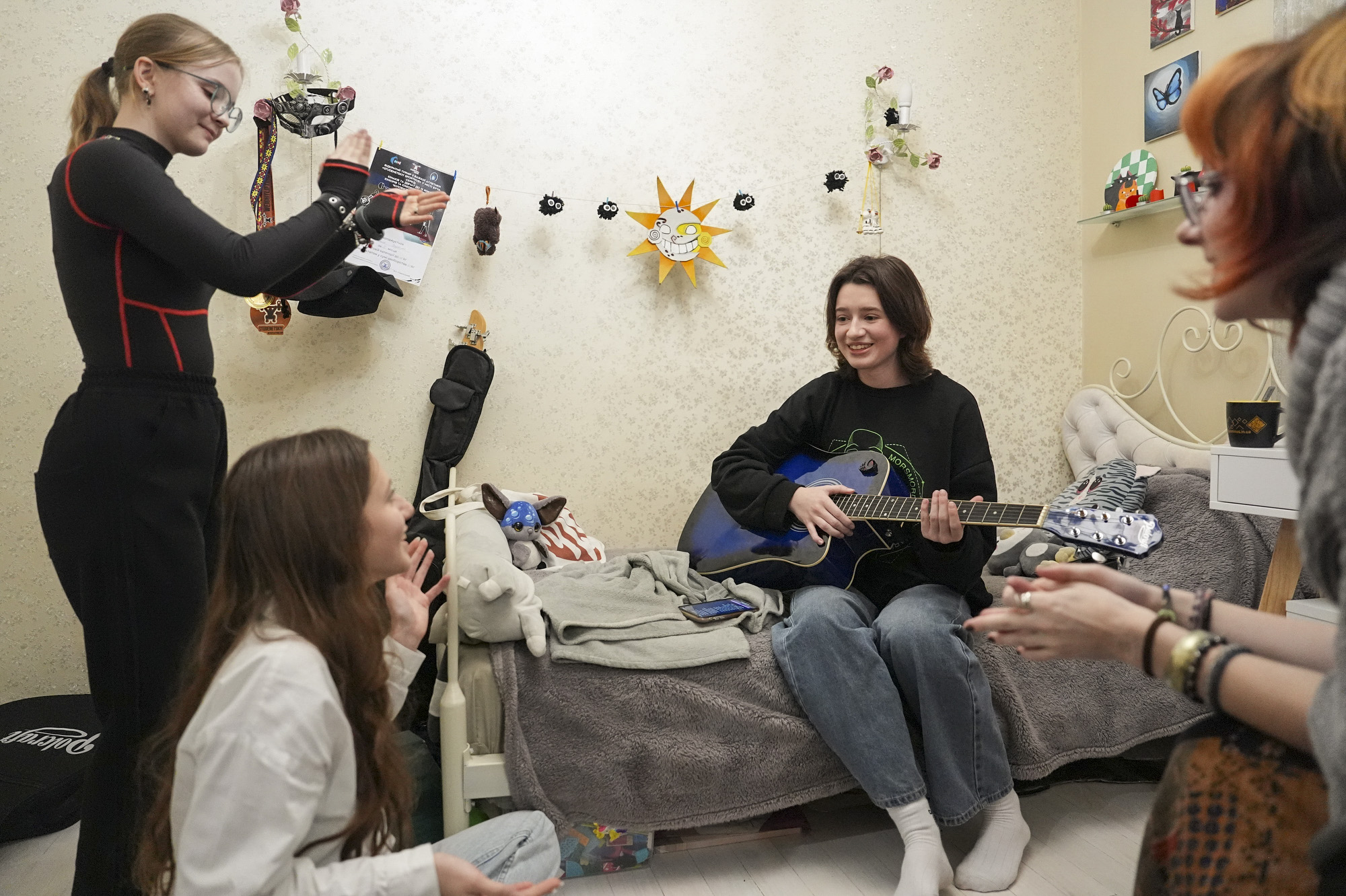
    The girls in Varvara’s room.

    They laugh at Varvara’s cat, Masha. Eventually, Ria picks up Varvara’s blue acoustic guitar and starts to strum. The girls quiet down. She begins to sing. They all join in.

    When the song ends, they cheer and rush to hug her.

    The air alert has stopped. For this moment, safe in Varvara’s room, they are just teenagers. They are young and happy and free. They could almost be anywhere.

    But later that night, the sirens blare again. Russian missiles and drones soar overhead and crash into apartments and houses and a hospital and energy infrastructure. Four people are killed. Several children are wounded. Varvara moves from her bed to sleep on a bean bag in the hall. The girls all hope to survive another night, and meet in school again tomorrow.