Category: Washington Post

  • Push from Saudis, Israel helped move Trump to attack Iran

    Push from Saudis, Israel helped move Trump to attack Iran

    President Donald Trump launched Saturday’s wide-ranging attack on Iran after a weekslong lobbying effort by an unusual pair of U.S. allies in the Middle East — Israel and Saudi Arabia — according to four people familiar with the matter, as Israeli and U.S. forces teamed to topple Iranian Supreme Leader Ali Khamenei after nearly four decades in power.

    Saudi Crown Prince Mohammed bin Salman made multiple private phone calls to Trump over the past month advocating a U.S. attack, despite his public support for a diplomatic solution, the four people said. Israeli Prime Minister Benjamin Netanyahu, meanwhile, continued his long-running public campaign for U.S. strikes against what he views as an existential enemy of his country.

    The combined effort helped lead Trump to order a massive aerial campaign against Iran’s leadership and military, which in its initial hour led to the death of Khamenei and several other senior Iranian officials.

    The attack came despite U.S. intelligence assessments that Iran’s forces were unlikely to pose an immediate threat to the U.S. mainland within the next decade. Saturday’s attack on Iran was a break from decades of U.S. decision-making to hold back from a full-scale effort to depose the regime of a country of more than 90 million people. It also marked a stark shift from Trump’s own previous military forays, which until now have been far narrower in scope.

    Now Trump will bear the risk of the bet he has placed: that a major military operation conducted from the air can achieve political goals on the ground.

    “No president was willing to do what I am willing to do tonight,” Trump told Iranians in a video address posted as U.S. bombs rained down on targets across Iran. “Now you have a president who is giving you what you want, so let’s see how you respond.”

    The Saudi push for an attack came as presidential envoy Steve Witkoff and Trump’s son-in-law Jared Kushner pursued negotiations with Iranian leaders over the country’s nuclear and missile programs.

    In this photo released by the Oman’s Foreign Ministry, Steve Witkoff, White House special envoy, centre, shakes hands with Oman’s Foreign Minister Sayyid Badr Albusaidi as Jared Kushner, left, looks on during their meeting prior to Iran and the U.S. negotiations, in Muscat, Oman, Friday, Feb. 6, 2026. (Oman Foreign Ministry via AP)

    As those talks proceeded, Riyadh issued a statement, following a phone call between the crown prince and Iranian President Masoud Pezeshkian, that Mohammed would not allow Saudi airspace or territory to be used in an attack on Iran.

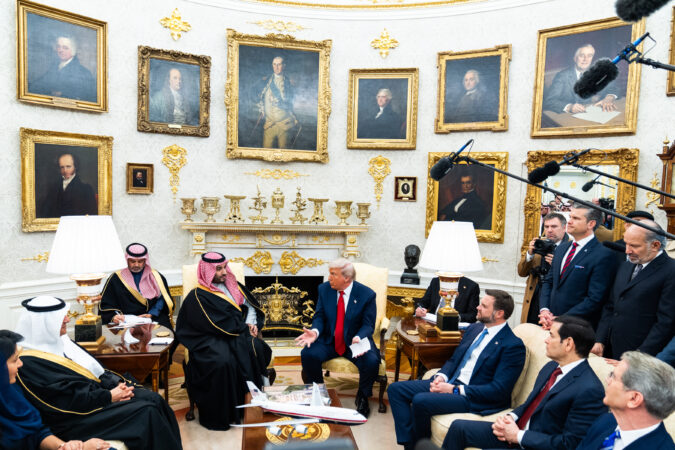
    In his discussions with U.S. officials, however, the Saudi leader warned that Iran would come away stronger and more dangerous if the United States did not strike now, after amassing the largest military presence in the Middle East since the 2003 invasion of Iraq, said the people, who, like others, spoke on the condition of anonymity to discuss the sensitive situation.

    Mohammed’s position was reinforced by his brother, Saudi Defense Minister Khalid bin Salman, who held closed-door meetings with U.S. officials in Washington in January and warned about the downsides of not attacking, the people said.

    The Saudi leader’s complicated position probably reflected his desire to avoid Iranian retaliation against his country’s vulnerable oil infrastructure, weighed against his view of Tehran as Riyadh’s ultimate foe in the region, said those familiar with his thinking. Iran, dominated by Shiite Muslims, and Saudi Arabia, led by Sunnis, have long had an intense rivalry that has generated proxy wars in the region.

    Following the initial U.S. attack on Saturday, Iran did retaliate against Saudi Arabia. Riyadh issued a furious statement condemning the attack and calling on the international community to “take all necessary and decisive measures” to confront Iran.

    The Saudi Embassy did not respond to a request for comment.

    Witkoff and Kushner had their final contacts with Iranian officials in Geneva on Thursday, their third high-level encounter since early February. They walked away believing that Tehran was playing games with them about its need for nuclear enrichment, according to a senior Trump administration official.

    “It was very clear that the intent for them was to preserve their ability to do enrichment so that, over time, they could use it for a nuclear bomb,” the official said.

    By Friday afternoon, when Trump arrived in Corpus Christi, Texas, for a campaign rally ahead of Tuesday primaries there, the president’s frustration — and his rhetoric — was escalating. He repeatedly declared himself “not happy” with Iranian negotiators.

    “I’ve got a lot of things going on now,” he told the crowd toward the end of a rambling speech ostensibly focused on energy policy. “We have a big decision to make, you know that. Not easy, not easy. We have a very big decision to make.”

    Later, he flew to Palm Beach for the weekend, where he mingled with supporters at his Mar-a-Lago resort Friday evening, looking tired but otherwise in good sprits before exiting to his private quarters to record a speech he would give announcing the attack, according to one person who was there and interacted with him.

    The decision to launch the attack was in some ways foretold by the massive buildup of U.S. forces over the past two months. But there was little in Trump’s record to suggest that he would embrace a war of choice in the Middle East with the goal of regime change.

    In explaining his decision, Trump on Saturday reached all the way back to Iran’s 1979 revolution. He described the U.S. attacks as payback for decades of conflict with Iran. He cited the 52 Americans held hostage for more than a year after the 1979 takeover of the American Embassy in Tehran; the deaths of 241 U.S. service members in 1983 bombing of their barracks in Beirut by Iran-backed Hezbollah during a Lebanese civil war; and the 2000 attack on the USS Cole, a naval destroyer docked in a Yemen, which Trump said Iran “probably” was involved in, although the United States has long attributed the suicide bombing to al-Qaeda.

    Earlier Saturday, Trump said that the United States had faced “imminent threats from the Iranian regime.” Tehran was continuing to work toward producing a nuclear weapon and development of “long-range missiles that … could soon reach the American homeland.”
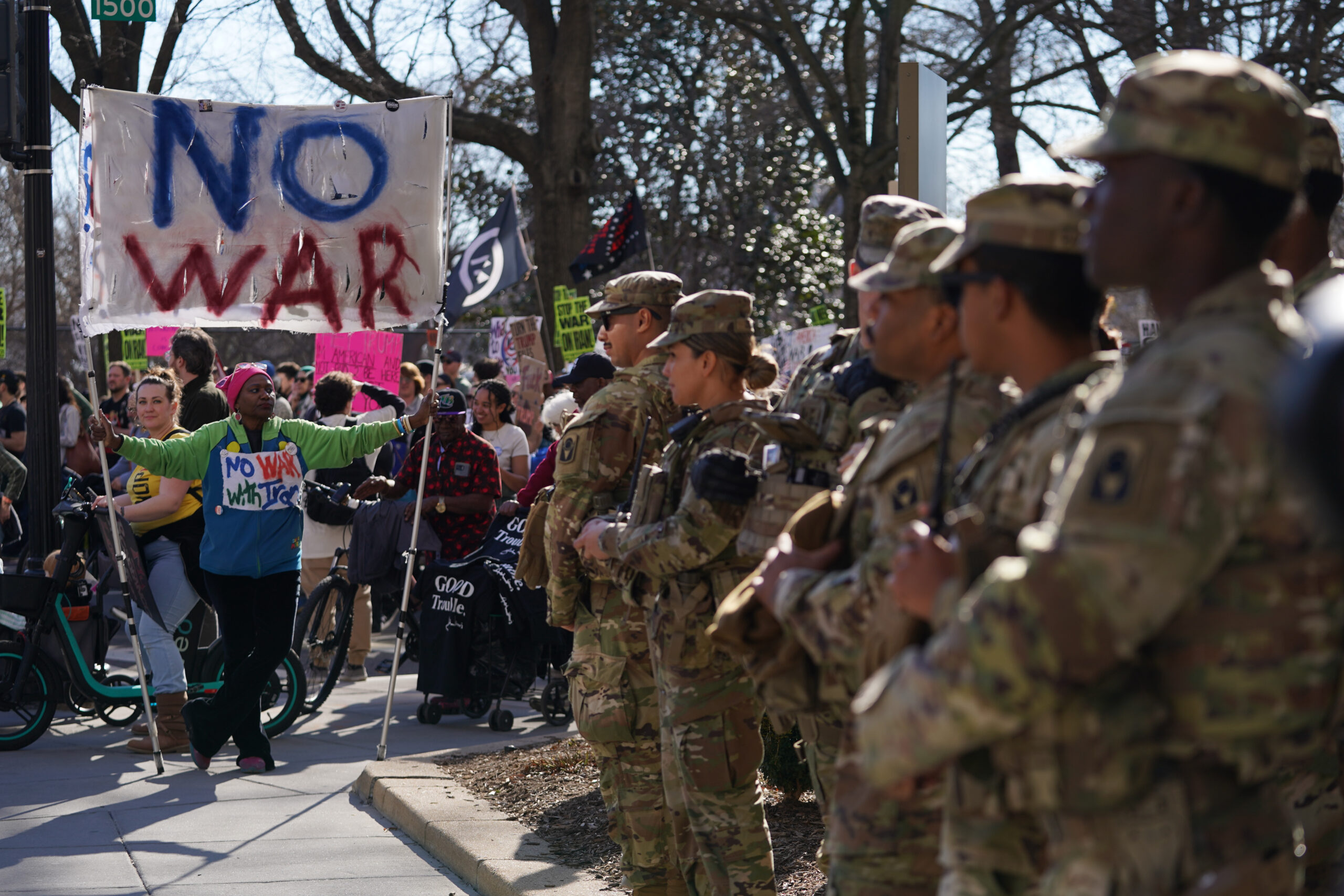
    National Guard members watch as people protest near the White House against U.S. and Israeli strikes on Iran, Saturday, Feb. 28, 2026 in Washington. (AP Photo/Allison Robbert)

    Both of those assertions have been challenged. Trump himself has vehemently maintained that the U.S. “obliterated” Iran’s nuclear program with airstrikes this past summer. The International Atomic Energy Agency has said there is no evidence Iran has restarted its uranium enrichment program following those strikes or that it has an active bomb-building plan. In an assessment last year, the U.S. Defense Intelligence Agency cited no indication that Iran was embarking on development of an intercontinental ballistic missile. If it decided to do so, the DIA said, it would take a decade to produce.

    Trump directed anti-government Iranians to “take over” their government, but his call included no details. He declared that those within Iran’s extensive military and security infrastructure would be given “complete immunity” but provided no explanation how or by whom that would be done.

    During both his first and second terms, Trump has said consistently there would be no American boots on the ground in military operations that he launched. Since taking office again, while launching air and missile attacks on seven countries — Nigeria, Syria, Yemen, Somalia, Venezuela, Iraq and Iran — he largely has kept that promise.

    But it remains unclear whether aircraft and missile strikes can achieve his ever-expanding goals — among them new, U.S.-friendly regimes in Iran and Venezuela; an end to Iran-backed militant operations in Yemen; and the defeat of Islamic terrorist operations in Nigeria and Somalia.

    “History is not kind to efforts to fundamentally alter and restructure the internal politics of a country using the air power alone,” said Aaron David Miller, a former U.S. diplomat who worked on Middle East issues for both Republican and Democratic administrations.

    “This is very much Trumpian, in the sense that he’s tried to split the difference between getting bogged down in an interminable conflict which will undermine the American economy and cost Americans their lives, on one hand, and yet bringing to bear the power of the American military in a sort of roll-the-dice operation,” Miller said.

    Months of planning for the 2003 U.S. toppling of Iraqi leader Saddam Hussein included thousands of invading American forces that remained there for nearly a decade and a large cadre of civilian U.S. officials on the ground to organize a new government.

    Top Trump officials — some of whom have been sharp critics of the Iraq effort and other U.S. forays into the Middle East — have insisted in recent days that this time will be different.
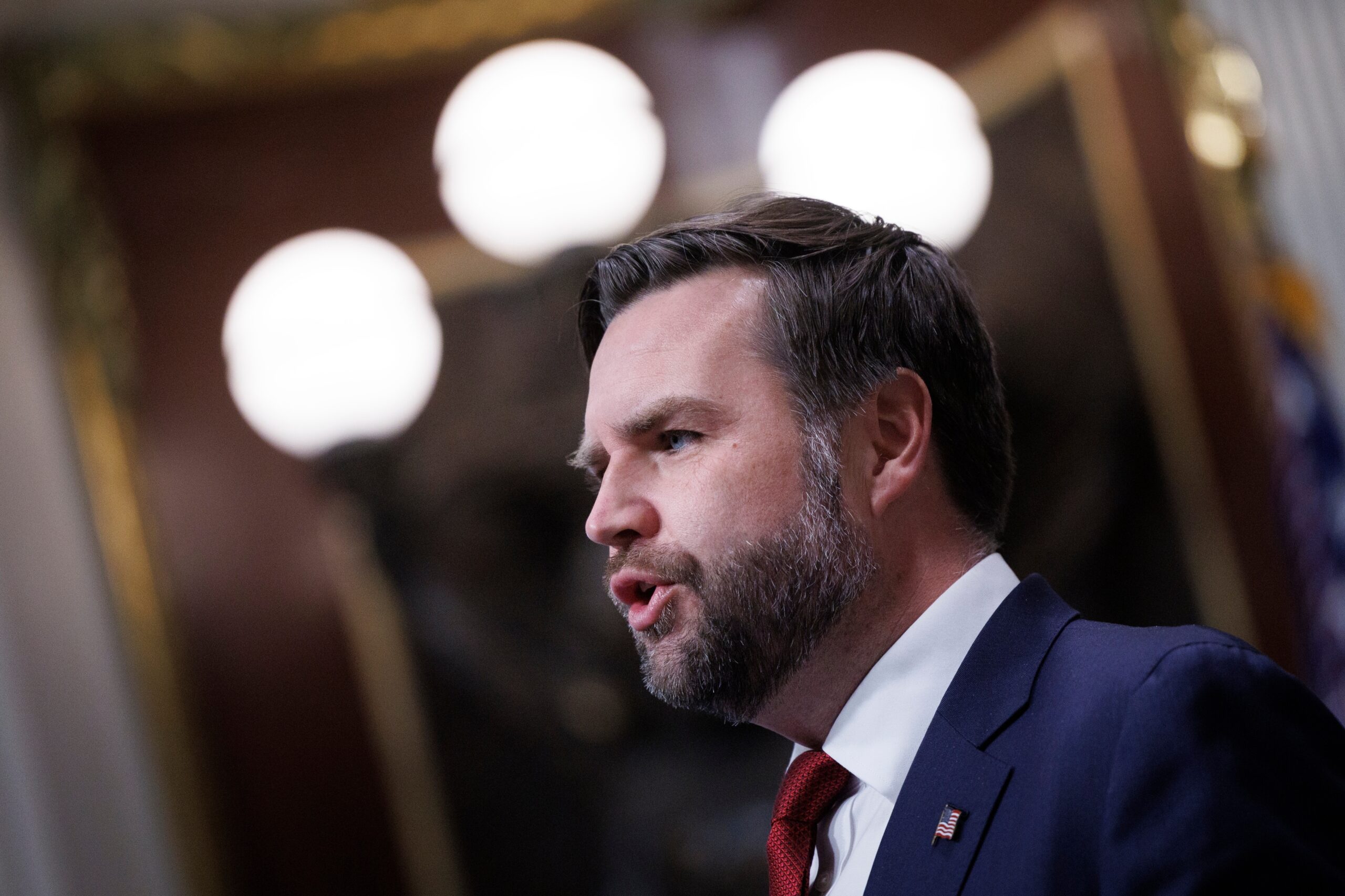
    Vice President JD Vance speaks during a news conference in the Old Eisenhower Executive Office Building on the White House campus Wednesday, Feb. 25, 2026, in Washington. (AP Photo/Tom Brenner)

    Vice President JD Vance on Thursday told the Washington Post that he still considers himself a “skeptic” of foreign military interventions — a description he said still applied to Trump, too. He said there was “no chance” any military operation by the U.S. in Iran would lead to a drawn-out war involving the Trump administration.

    Vance on Saturday watched the military operation from the Situation Room at the White House, while dialed into a conference line that connected him to the president and his national security team, who were tracking Iran from Mar-a-Lago, according to a person with knowledge of the events. Vance was joined at the White House by Tulsi Gabbard, the director of national intelligence, who has long campaigned against war with Iran. Energy Secretary Chris Wright and Treasury Secretary Scott Bessent were in the Situation Room too, the person said.

    Apart from Trump’s Saturday’s statements once the attack already started, the president has devoted little time to publicly justifying or explaining war with Iran, a break from previous practice of U.S. leaders.

    Democrats on Saturday pushed Trump to explain his case to the American people.

    “What was the imminent threat to America?” said Sen. Mark R. Warner (D., Va.), the senior Democrat on the Senate Intelligence Committee, in an interview. “I don’t know the answer.”

    Warner, who participated in a classified briefing on Tuesday with Secretary of State Marco Rubio and CIA Director John Ratcliffe, said that senior lawmakers were given a “fair description of options” the administration was considering, but that he saw no threat that “would literally be worthy of putting our troops in harm’s way.”

    In the briefing on Tuesday for the Gang of Eight, which consists of the leaders of the House, the Senate and each chamber’s intelligence committees, Secretary of State Marco Rubio indicated to lawmakers that the mission’s timing and goals were shaped by the fact that Israel was going to attack with or without the United States, according to a person familiar with the administration’s outreach to lawmakers.

    “So the only debate that seemed to be remaining was whether the U.S. would launch in concert with Israel or if the U.S. would wait until Iran retaliated on U.S. military targets in the region and then engage,” the person said.

    Now the question is what comes next.

    For now, Trump says that he hopes that in the face of the death of Khamenei, Iran’s security forces and police “will peacefully merge with the Iranian Patriots, and work together as a unit to bring back the Country to the Greatness it deserves.” In January, those security forces killed thousands of Iranian protesters.

    He vowed that “the heavy and pinpoint bombing, however, will continue, uninterrupted throughout the week or, as long as necessary to achieve our objective of PEACE THROUGHOUT THE MIDDLE EAST AND, INDEED, THE WORLD!”


  • Employers to job seekers: Your AI resumé isn’t fooling anyone

    Employers to job seekers: Your AI resumé isn’t fooling anyone

    As part of a job search, outsourcing and offshoring company Oceans asked candidates to make a video answering one question: What is your most controversial personal conviction about the workplace? The company received more than 300 responses and most of them were eerily similar.

    “It was abundantly clear it was [artificial intelligence],” Matt Wallaert, Oceans’ chief experience officer, said of the repeated answers, which also followed the same structure. It was like “you did the laziest possible … you failed the basic task of sharing your personal beliefs.”

    The situation left Wallaert and the hiring team bewildered on how to evaluate the candidates, as even some of the most qualified blended together.

    Job seekers are turning to AI to help them land jobs more quickly in a tough labor market. With a plethora of AI tools, some employers may be screening applicants’ resumés, deprioritizing them as candidates. Employers say that’s having an unintended consequence: Many applications are looking and sounding the same. AI has complicated the process for both employers and job seekers leaving both sides at odds over how to get what they want.

    It’s easy to spot when candidates over-rely on AI, some employers said. Oftentimes, executive summaries will look eerily similar to each other, odd phrases that people wouldn’t normally use in conversation creep into descriptions, fancy vocabulary appears, and someone with entry-level experience uses language that indicates they are much more senior, they added.

    It’s worse when they use auto-apply AI tools, which will find jobs, fill out applications, and submit resumés on the candidate’s behalf, some employers said. Those tend to misinterpret some of the application questions and fill in the wrong information in inappropriate spots. If these applications were evaluated alone, employers say they’d have a harder time identifying AI usage. But when hundreds of applications all have the same issue, they said, AI’s role in it becomes obvious.

    Joseph Eitner, chief human resources officer for New York-based investment firm Eaton Capital Management, said he has no issue with candidates turning to AI to add some keywords, clean up their grammar, or even help them think through a question on the application. But ultimately, he said, candidates should do the writing themselves, express their own ideas and personalities, and take the time to manually submit their applications.

    “If that’s how you apply and how you work, I don’t want to hire you,” he said. AI auto-apply services are “snake oil. It’s a disservice to yourself and to the people you’re applying to.”

    Not all employers rely heavily on AI to screen applicants, according to Ron Sharon, chief information security officer in Denver at financial advisory firm PTMA Financial Solutions, and some only use it to help them prioritize people with the necessary experience. Sharon said he uses an AI tool that assigns percentages to candidates based on their qualifications. Anyone who hits a 75% or above will be considered for the job, he said, but AI never automatically rejects a candidate.

    “I use AI as a tool to help me augment what I do,” he said. “Job seekers should use it to help them augment what they do. They shouldn’t use AI for the complete process.”

    But some job seekers say the ways that employers started using the technology to rank candidates prompted them to adopt it.

    Stephen Harris, a 37-year-old in San Antonio who’s seeking a job as a tech support specialist, said he’ll stop using AI to write his resumé once recruiters stop using AI to evaluate it.

    “You’re saying, ‘You shouldn’t be doing this’ when I know a good chunk of them do this,” Harris said.

    Employers are often focusing too hard on finding the perfect candidate and losing some of the most adaptable ones in the process, he said. And while he still tries to stand out by sending his resumé via mail, he says using AI to quickly tailor his resumé makes it easier to be among some of the earlier applicants.

    Job seekers say one of the benefits of AI is it can help people make ideas flow better, punch up their words, and fill in blanks they may struggle with. But some employers say they’d much rather see the person as they are.

    Prateek Singh, founder and CEO of the start-up LearnApp in New Delhi, said that when candidates use AI for their applications, it doesn’t allow him to evaluate what excites them about the job and what they’re less interested in. In their cover letters, candidates are asking him to “chat over coffee,” a phrase he said isn’t common in India.

    “This is the best time for you to stand out based on all of your flaws and eccentricity,” he said. “If 100 applicants come to us with AI, and you are authentic, you stand out.”

    The advice rings true to applicants such as Sneha Sharma, who said that when she stopped using AI for her resumé, she started to gain more traction in her job search.

    In the course of about six months she had applied to up to 300 jobs, using AI tools such as ChatGPT and some that helped her find leads. She briefly tried an AI application that auto-applied to jobs for her but gave up on that in a couple weeks. But she couldn’t land any interviews.

    After taking a break, she adopted a new approach: She stopped using AI, built a couple of resumés from scratch, adding a little personality such as including details about her move to the United States, and cold calling and emailing recruiters. Within two weeks she landed seven interviews, and in less than two months, she had a job.

    “Don’t be blinded by the internet and that ChatGPT will do everything,” she said. “Use your brain, keep changing and experimenting.”

    Wallaert, the Oceans executive, said the company planned to reach back out to qualified candidates who used AI to tell them to try again. The company also plans on updating the application’s instructions to ask that candidates not use AI for their video response. Wallaert has faith that eventually the problem will solve itself, but in the meantime, he feels badly for candidates who may lose out because of relying too much on AI.

    “This gap will close over time but at what cost?” he said. “That’s the bummer.”

  • Juan Valdez, 88, the last Marine to leave Vietnam, has died

    Juan Valdez, 88, the last Marine to leave Vietnam, has died

    Standing on the U.S. Embassy roof as tanks rumbled toward Saigon and gunfire rang out below, Juan Valdez wondered if he and his fellow Marines might have actually been forgotten.

    Working through the night, as a mob of desperate people pressed against the compound’s gates and spilled over its walls, he had helped evacuate nearly 2,100 Americans and Vietnamese fleeing the collapse of South Vietnam. But after Ambassador Graham Martin was airlifted to safety with the embassy’s American flag, the helicopter evacuation had been canceled — the result of a misunderstanding, as air staff didn’t realize a group of Marines was still waiting to be picked up.

    A call for help went out. And Master Sgt. Valdez waited for what “seemed like an eternity” for the last helicopter to arrive.

    When it landed, he nearly didn’t make it on board. After telling his 10 fellow Marines to get on, and waiting to ensure they boarded safely, he slipped as he stepped onto the ramp. The helicopter began to take off as one of the Marines, Mike Sullivan, did a head count. They were one man short.

    “I remember looking at the ramp, and two hands were over the top of it,” Sullivan recalled in Last Days in Vietnam, an Oscar-nominated 2014 documentary. Master Sgt. Valdez was yanked on board as the chopper departed.

    It was 7:58 a.m. on April 30, 1975, just a few hours before the North Vietnamese burst through the gates of the presidential palace, hoisted a Viet Cong flag, and celebrated the end of a war that had lasted 20 years, costing the lives of more than 58,000 Americans and untold Vietnamese.

    Master Sgt. Valdez, the last Marine to leave Vietnam, was 88 when he died Feb. 15 in Tucson, Ariz., where he was living. To the leathernecks who served under him, it was only fitting that he was the last of their unit to depart Saigon.

    “He was a model leader, always looking after his troops,” said one of those Marines, Doug Potratz. “When I went to his house 40 years after the fall of Saigon, he had all our individual ID pictures on the mantel of his fireplace. He never forgot us.”

    “In some ways he was like a dad to us,” said Dave Norman, one of the 11 Marines on the last helicopter out of Saigon. “But in other ways he was like a principal. If you screwed up, you didn’t want to be in the principal’s office.”

    Mr. Valdez spent 32 years in the Marine Corps, retiring in 1987 as a master gunnery sergeant. Even then, he remained intimately involved with the Corps, working as a civilian in the housing office of Camp Pendleton, the primary Marine base on the West Coast.

    “He was always a Marine, taking care of Marines,” Potratz said.

    During his first tour in Vietnam, from 1965 to 1967, Mr. Valdez served as a platoon sergeant in an amphibious assault vehicle unit. He returned to the country in September 1974 as the top noncommissioned officer — affectionately known as “Top” — in the embassy’s Marine security guard detachment, with a commander, Maj. James Kean, who was based out of Hong Kong before being summoned to Saigon.

    Following the departure of American combat troops in 1973, the embassy Marines were among the last U.S. service members in Vietnam. “We were there to protect American lives, as well as American property. It was just a day-to-day job,” Mr. Valdez said.

    As the North Vietnamese advanced toward the capital, he and Kean played a critical role evacuating Americans and their allies. More than 50,000 people were flown out of Tan Son Nhut Air Base before rocket and artillery fire made the flights unsafe. Some 7,000 others were then airlifted as part of Operation Frequent Wind, the final stage of the evacuation, which the U.S. military later called the largest helicopter evacuation in history.

    At the embassy, helicopters landed every 10 minutes on the roof or in the parking lot, where Marines chopped down a tamarind tree to expand the makeshift landing zone.

    The operation got underway on April 29, 1975, after two of the detachment’s young Marines, Darwin Judge and Charles McMahon, were killed in a predawn rocket attack at Tan Son Nhut. Later that day, Armed Forces Radio delivered a not-so-secret signal to indicate that the airlift was on.

    “The temperature in Saigon is 105 degrees and rising,” an announcer intoned. Then the station played the holiday song “White Christmas.”

    Master Sgt. Valdez and Kean “didn’t pull any punches,” Potratz said in a phone interview. “They got us in the conference room after Judge and McMahon were killed. They said, ‘There are almost 100,000 North Vietnamese surrounding the city. We don’t know if they’re going to evacuate us or not. But if we die, we die like Marines.’ That kind of stuck to us. After that, we stuck together and did the best we could.”

    As thousands of people rushed to the embassy, Master Sgt. Valdez and other Marines guarded the perimeter. He later recalled lifting people over the gates, helping them inside the compound before realizing there wouldn’t be enough helicopters to evacuate everyone.

    “Please, at least take my children out,” he was told by parents. “I’ll stay, but take my little girl now.”

    Those who were allowed into the compound were searched for weapons — guns were thrown into the embassy pool — before being escorted to a helicopter.

    According to Kean’s after-action report, some 10,000 people eventually breached the embassy gates. Master Sgt. Valdez and the remaining Marines prepared to be evacuated while locking down the elevators and barricading doors, using fire extinguishers and other equipment to block off the rooftop.

    For many, images of the chaotic withdrawal came to symbolize the futility of a war that should never have been prolonged, let alone started.

    Mr. Valdez said that the departure was painfully resonant in 2021, when the U.S. withdrawal from Afghanistan ended in chaos and bloodshed. As he saw it, the U.S. had repeated some of the same mistakes in both wars.

    “We spent so much money, so many weapons, and so many Marine and Army deaths, and for what?” he asked in an interview with Noticias Telemundo. “For what?”

    Juan Jose Valdez was born in San Antonio, Texas, on Aug. 19, 1937. His father was a landscaper, and his mother was a homemaker from Mexico. He enlisted in the Marines in 1955, at age 17.

    Mr. Valdez died of pneumonia, said his sons Anthony and Michael Valdez. In addition to his children, survivors include a brother; two sisters; a grandson; and three great-granddaughters.

    Late in life, Mr. Valdez participated in frequent reunions with his Vietnam detachment, including in a 2015 trip to Saigon — now Ho Chi Minh City — where a plaque was dedicated to McMahon and Judge, the last Americans killed in action on the ground in Vietnam. The unit’s surviving members had reconnected in 2000, when they traveled to Judge’s Iowa hometown for a memorial service honoring their fallen comrades.

    “For a period I went through survivor guilt,” Mr. Valdez said in prepared remarks for the service. “Why wasn’t it me instead. Why did I, who had been in country longer, and had already served a previous tour in Vietnam, lived and these two men died. There were, and still are, no easy answers.”

    But “more than anything else,” he added, “we need one another now. Each of us grieves, and when we grieve together, the healing begins.”

  • Musk asked Epstein for ‘the wildest party,’ but now he claims to stand up for victims

    Musk asked Epstein for ‘the wildest party,’ but now he claims to stand up for victims

    During an explosive feud with President Donald Trump last spring, Elon Musk reached for the nuclear button. “Time to drop the really big bomb,” he wrote on X in June, “@realDonaldTrump is in the Epstein Files.”

    “The truth will come out,” the Tesla CEO added. He later deleted the posts and reconciled with Trump. In the months since, Musk has issued a steady drum beat of X posts calling for the arrest or prosecution of people linked to Jeffrey Epstein, a convicted sex offender who cultivated relationships with powerful figures in tech, finance, and politics.

    But when the Justice Department released what it said were millions of pages of documents last month from its investigation of the deceased financier, Musk featured prominently in the files.

    The entrepreneur had repeated email exchanges with Epstein, as did Kimbal Musk, his brother and fellow Tesla board member, the documents show. Elon Musk’s messages included inquiries about parties. Musk and Epstein also discussed arranging to meet on Epstein’s island and their assistants arranged a visit for the two at the entrepreneur’s rocket maker, SpaceX. On Christmas Day in 2012, Musk wrote to Epstein and asked: “Do you have any parties planned?” He added that “I’ve been working to the edge of sanity” and wanted to “let loose.”

    The revelations have thrust Musk in the awkward position of trying to cast himself as a stalwart defender of Epstein’s victims while also defending his own interactions with the convicted sex offender. Epstein pleaded guilty in 2008 to two charges of soliciting prostitution, including one involving a minor. He was arrested on federal sex trafficking charges in 2019 and died in federal custody later that year. Judges and lawmakers say that he abused, trafficked, and molested scores of girls over decades.

    In recent weeks, Musk has taken aim in online posts at other political and business figures over their alleged interactions with Epstein — including LinkedIn co-founder Reid Hoffman, former Trump chief strategist Stephen K. Bannon, and billionaire Les Wexner.

    “The big difference between you and me, Reid, is that you went and I did not,” Musk said in a post on X directed at Hoffman in early February, referring to Epstein’s island, adding later, “UNLIKE YOU, I came to my senses and declined to go.” Hoffman has acknowledged visiting Epstein’s island, as part of work to help the Massachusetts Institute of Technology “fundraise from Epstein,” and said that he regretted ever interacting with the sex offender.

    Wexner told Congress this month that he had been “duped” by Epstein and was not aware of his crimes. Bannon did not respond to a request for comment. Musk has refrained from making further allegations against Trump and stayed silent about the Justice Department files linking administration figures to Epstein, including Commerce Secretary Howard Lutnick, who told Congress this month that he once took his family to lunch on Epstein’s island but “did not have any relationship with him.”

    Musk has written on X that he “REFUSED” to visit Epstein’s island, even as the documents show him appearing to seek a visit. “When should we head to your island on the 2nd?” Musk asked Epstein on Christmas Day in 2013, in an apparent reference to a visit for the following January, the documents show.

    Musk and his brother, Kimbal Musk, did not respond to requests for comment for this story. Appearing in the documents released by the Justice Department does not indicate wrongdoing.

    At times, Musk’s attempts to focus on his preferred narrative about Epstein have backfired. Earlier this month, the billionaire reshared an X post from Mohamad Safa, executive director of the human rights group Patriotic Vision. “As someone works in human rights, I’ve never seen anything like the Epstein files in my 15-year career,” Safa wrote. “I don’t understand how we’re not having a global revolution right now.”

    After Musk distributed that message to his around 235 million followers on X, Safa responded to point out that the billionaire was overlooking something.

    “Elon, you’ve got it wrong,” Safa wrote. “It’s a revolution against every person in the Epstein files.”

    Safa told the Washington Post that the Tesla CEO was wrongly trying to lump himself in with the human rights community demanding accountability in relation to Epstein.

    “Elon bought Twitter to mislead the public on global issues, and he is now using it to mislead about his connection to Jeffrey Epstein,” Safa said.

    After the release of the latest trove of files raised new questions about the extent of Musk’s contact with Epstein over the years, Musk issued a late-night statement on X last month in a 1:50 a.m. Eastern reply to a user known as “DogeDesigner.”

    “No one pushed harder than me to have the Epstein files released and I’m glad that has finally happened,” Musk wrote. “I had very little correspondence with Epstein and declined repeated invitations to go to his island or fly on his ‘Lolita Express’,” he said, referring to Epstein’s airplane, “but was well aware that some email correspondence with him could be misinterpreted and used by detractors to smear my name.”

    Musk added, “I don’t care about that, but what I do care about is that we at least attempt to prosecute those who committed serious crimes with Epstein, especially regarding heinous exploitation of underage girls.”

    The Justice Department files reviewed by the Post, including dozens that refer to Musk or his brother Kimbal, paint a vastly different picture of Epstein’s relationship with the Tesla CEO.

    “What day/night will be the wildest party on your island?” Elon Musk asked Epstein in an email from November 2012, as he sought to plan a visit accompanied by actor Talulah Riley — Musk’s ex-wife — the files show. A month later, he wrote to Epstein again about partying.

    “Do you have any parties planned?” he asked. “I’ve been working to the edge of sanity this year and so, once my kids head home after Christmas, I really want to hit the party scene in St Barts or elsewhere and let loose.”

    Musk added, “The invitation is much appreciated, but a peaceful island experience is the opposite of what I’m looking for.”

    The newly released correspondence appears to show the entrepreneur interacting and making plans with Epstein over a period of more than a year that took place several years after Epstein pleaded guilty in 2008.

    In 2013, Musk and Epstein’s assistants planned a visit for the disgraced financier to SpaceX, Musk’s rocket building company. The visit included a scheduled lunch for Musk and Epstein. Epstein was scheduled to travel with three female assistants — one South African and two Russian — whose passports were vetted by SpaceX, a government contractor, for security clearance reasons, according to the emails. While the visit took place as planned, according to the emails, it was not immediately clear whether the two men met for lunch.

    Musk has said he blocked and ultimately “ghosted” Epstein.

    The files also show that Kimbal Musk corresponded with Epstein about an apparent romantic partner whom another person warned him not to mistreat. “Jeffrey: Message received wide and clear. ;)” Kimbal Musk replied, in a message on which he copied Epstein.

    Years later, Epstein wrote in an email: “I gave another girl to kimball and he is thrilled.”

    Kimbal Musk said in a statement that Epstein did not introduce him to his romantic partner at the time of the earlier emails, and that she was an adult.

    “In 2012 I started dating a woman who was 30 years old,” Kimbal Musk posted on X. “I met her through a friend. Epstein did not introduce us. My only meeting with that demon was in his New York office during the day. I never met with him again and I never went to his island.”

    He added that Epstein subscribed to a newsletter of his, leading his email address to appear in searches of the Epstein files numerous times.

    “My heart goes out to the many victims of Jeffrey Epstein, as it does for all who have suffered any kind of sexual abuse or harassment,” Kimbal Musk said.

    Soon after the Justice Department’s release of files last month, the nonprofit organization behind Burning Man, a massive cultural festival held annually in the Nevada desert, announced that Kimbal Musk was no longer on its board of directors. That decision was made by Kimbal Musk “based on other commitments and priorities” and came “well before” the revelations, the organization said.

    Elon Musk, meanwhile, continues to face an uphill battle to convince skeptics that his support for Epstein victims is genuine.

    Scott Berkowitz, president and founder of RAINN, a nonprofit organization aimed at ending sexual violence, said he did not know what is in Musk’s heart, but said one way the entrepreneur could effect change for victims of sexual abuse would be by reining in the Grok chatbot offered by his company xAI, which recently came under fire for allowing the creation of nonconsensual sexualized images of real people.

    “RAINN is working to make the country safer from sexual violence. If Elon Musk wants to be a part of that and to use his influence to make life safer, there’s a long list of ways that he could be part of the solution,” Berkowitz said. “Partner with us to make Grok the model for AI safety and ensure it never creates another nonconsensual image, whether child or adult.”

    On X, many have lobbed criticism at Musk over his messaging on the Epstein files, seeing it as an effort to reframe the narrative around his involvement.

    Given “Elon Musk’s involvement with Epstein and his lies about it, it feels dirty to use this platform, which increasingly feels like his own propaganda machine and PR agency” Fred Lambert, the editor in chief of Electrek, an electric vehicle-focused publication, said in an X post last week.

    Safa, of Patriotic Vision, said he is not convinced by Musk’s sudden interest in accountability. “He should be investigated like any other individual whose name has been mentioned, regardless of social, political, or financial status,” Safa said, adding, “Why did he wait until now to speak out?”

  • Pentagon assault on Anthropic sends shockwaves across Silicon Valley

    Pentagon assault on Anthropic sends shockwaves across Silicon Valley

    The Trump administration’s declaration that AI company Anthropic would be cut off from all government contracts shook the tech industry late Friday, hardening political and cultural battle lines across Silicon Valley over military use of artificial intelligence.

    President Donald Trump ordered government agencies to “immediately cease” using Anthropic’s technology, in a post on Truth Social on Friday, and Defense Secretary Pete Hegseth labeled the company a “supply chain risk to national security” in his own post on X, after the company refused to allow its technology to be used for domestic surveillance and autonomous weapons.

    The Trump administration’s assault on Anthropic appeared to put the company on course to lose billions of dollars of potential revenue, although the startup said in a blog post late Friday that it would challenge Hegseth’s designation in court.

    The firm’s conversational assistant, Claude, is being deployed or tested in at least five government agencies, including the Pentagon, the Department of Health and Human Services, the Department of Homeland Security, and the Department of Energy, according to recent disclosures of AI use mandated by law and an executive order.

    Friday’s aggressive moves by the Trump administration put all of Silicon Valley on notice that tech companies seeking Pentagon contracts risk massive political and business fallout if they don’t back administration policies and cede control of how their technology is used. Rivals of Anthropic including Elon Musk and other tech allies of Trump seized on the conflict to pledge that their own companies would not question Pentagon policies, positioning themselves as loyal patriots.

    Conflict has bubbled between Anthropic and the Trump administration since last year. The company leveraged its relationship with investor Amazon to become the first company to be integrated into classified systems.

    But Anthropic, co-founded in 2021 by CEO Dario Amodei, his sister Daniela, and other former employees of ChatGPT-maker OpenAI, also rankled tech allies of Trump by positioning itself as more safety conscious than other AI developers. (Amazon founder Jeff Bezos owns the Washington Post, which has a content partnership with OpenAI.)

    In the fall, Trump’s AI and crypto czar David Sacks accused Anthropic of attempting to manipulate the government with “fearmongering” about AI technology. Around the same time, Semafor reported that Anthropic displeased the White House by raising ethical objections to how the administration wanted to use its technology, including for surveillance.

    Those tensions flared into an unprecedented public fight between the Pentagon and the tech company this week. Frantic talks between the two sides continued right up until Hegseth’s announcement late Friday that he was declaring Anthropic a risk to national security, according to an X post from Emil Michael, the Pentagon’s technology chief, and a person familiar with the talks.

    Michael was on the phone with Anthropic, suggesting that the company agree to allow analysis of some bulk data on Americans, at the same moment Hegseth said in his X post that Anthropic had been designated a supply chain risk, according to the person, who spoke on the condition of anonymity to discuss the talks.

    Anthropic said in a statement responding to Hegseth on Friday that it would legally challenge his declaration against the company, suggesting that the dispute is far from over. Experts said that Anthropic had strong legal grounds for a challenge.

    A company can only be designated a supply chain risk through a legal process, said Steven Feldstein, a senior fellow at the Carnegie Endowment for International Peace who researches the use of AI in war. “It isn’t legally sufficient to simply proclaim or label [a supply chain risk] and have this be the final word,” he said. “It’s a major overreach.”

    Jessica Tillipman, an associate dean at George Washington University’s law school, said Anthropic could probably make a strong argument in court that it had been unfairly targeted. “This is on incredibly shaky ground,” she said of Hegseth’s declaration on Friday. “I don’t think you have seen a case for more politicized use.”

    Hegseth’s post also asserted that all companies that do business with the U.S. military are now prohibited from doing any commercial activity with Anthropic. Although the legal basis for that sweeping ban was unclear, it could have disastrous consequences for Anthropic, which has received billions of dollars in investment from partners like Amazon, Microsoft, and Nvidia that also supply the military. The companies didn’t respond to requests for comment.

    Should the Pentagon prevail, the U.S. military will need to adapt fast. Claude is deeply integrated into the Maven Smart System, an AI tool built with the technology company Palantir that runs on Amazon’s cloud. It provides troops with a unified picture of intelligence streaming in from multiple sensors, said retired Air Force Lt. Gen. Jack Shanahan, who served as the first director of the Pentagon’s Joint Artificial Intelligence Center and is now an adjunct senior fellow at the Center for a New American Security, a think tank.

    After the U.S. seizure of Venezuelan strongman Nicolás Maduro, an image circulated that showed Claude operating alongside Maven during the operation, Shanahan said, which prompted Anthropic officials to ask Palantir questions about its use in the operation.

    Claude is the “single most widely deployed AI system in the U.S. military,” Shanahan said. He added that it wouldn’t make sense to try to extract the AI tool from all of the Defense Department systems it helps, just as service members are getting skilled with the technology.

    In Silicon Valley, debate raged Friday over whether Anthropic should be celebrated for taking a stand, criticized as unpatriotic, or scoffed at for being strategically naive.

    Right-leaning leaders such as Palmer Luckey, founder of the defense startup Anduril, and investor Keith Rabois posted in support of the military’s decision. Anthropic employees cheered its moves in online posts, and hundreds of employees of Google and OpenAI signed a public letter backing the company’s stance.

    Anthropic’s rivals were poised and at the ready to take advantage of its blunders.

    OpenAI chief executive Sam Altman wrote in a memo to all staff late on Thursday that he had been negotiating with the Pentagon, according to a copy reviewed by the Post. The memo was first reported by the Wall Street Journal.

    Altman wrote that the dispute between Anthropic and the Pentagon had become “an issue for the whole industry,” and that the spat was not about the use of AI but about “control.” The country, he said, “absolutely needs help with AI for defense if we want to continue to enjoy peace and prosperity.”

    But Altman added that he was seeking a deal with the Defense Department that would find middle ground. It would see OpenAI agree to cover any use except those that are “unlawful or unsuited to cloud deployments, such as domestic surveillance and autonomous offensive weapons,” he wrote. And he said the company could deploy technical safeguards and personnel “to partner with the government to ensure things are working correctly.”

    Late on Friday, Altman wrote in a post on X that he had reached such an agreement with the Defense Department to deploy OpenAI’s technology in classified U.S. networks.

    “Two of our most important safety principles are prohibitions on domestic mass surveillance and human responsibility for the use of force, including for autonomous weapon systems,” Altman wrote. The Pentagon “agrees with these principles, reflects them in law and policy, and we put them into our agreement.”

    Jeremy Lewin, under secretary of state for foreign assistance, humanitarian affairs, and religious freedom, wrote in a post on X that the new OpenAI deal permitted the Pentagon the freedom of “all lawful use” of AI that it had sought from Anthropic. The agreement represented “a compromise that Anthropic was offered, and rejected,” he wrote.

    Musk, whose company xAI was certified to work with classified military systems this week, also stepped into the fray. “Anthropic hates Western civilization,” he wrote in a post Friday on his social network X. Musk and xAI did not respond to requests for comment.

    Lewin held up the billionaire as showing a better way for AI firms to engage with the government.

    “Elon and xAI have already agreed to the ‘all lawful uses’ principle — meaning that he’s already agreed not to shut off U.S. systems for nonlegal prudential discretionary reasons,” Lewin, a former staffer for Musk’s government efficiency initiative, the U.S. DOGE Service, wrote on X. “So there’s your difference. Anthropic wants to add additional conditions — Elon has agreed to promise he won’t pull the plug for our systems.”

  • Trump: ‘Freedom’ for Iran is goal of ‘major military operation’

    Trump: ‘Freedom’ for Iran is goal of ‘major military operation’

    President Donald Trump told The Washington Post early Saturday that his main concern is “freedom” for the Iranian people as the U.S. launched military strikes in the country.

    A U.S. official said a multiday operation against Iran began at about 1 a.m. Eastern time with a salvo of ship-launched Tomahawk cruise missiles and air-launched munitions from U.S. Air Force and Navy jets.

    Iran quickly launched counterstrikes in response to the attack, which the Trump administration has named “Operation Epic Fury.” Multiple U.S. military bases were targeted by Iran, the official said, including the support facility for its 5th Fleet ships in Bahrain, according to the country’s state-run news service.

    While the operations are ongoing, no U.S. service members have been injured, the official said, who spoke on the condition of anonymity to provide details that had not yet been publicly announced. Israel said it also launched attacks on Iran on Saturday.

    “All I want is freedom for the people,” Trump said in a brief phone interview shortly after 4 a.m., when asked what he hopes his legacy will be as a result of the military action and a push for regime change in Iran.

    “I want a safe nation, and that’s what we’re going to have,” the president said, his first reportable remarks since announcing “major combat operations” in a video message around 2:30 a.m.

    Trump spoke from Mar-a-Lago, his home in Palm Beach, Fla., where he arrived Friday night just hours before the military strikes began. He spoke to the Post as television news played in the background.

    Despite his previous criticism of U.S. involvement in Middle Eastern wars particularly American lives lost during efforts to topple and install new regimes — Trump on Saturday made the case for the United States helping to bring about regime change in the country. In the video address, Trump urged Iranians once the strikes cease to “take over your government,” telling them “this will be probably your only chance for generations.”

    Trump also conceded that U.S. troops were putting their lives at risk in this effort.

    “The lives of courageous American heroes may be lost and we may have casualties,” Trump said in his taped remarks. “That often happens in war. But we’re doing this, not for now. We’re doing this for the future, and it is a noble mission.”

    Less than a year ago, while visiting the Middle East, Trump decried the “so-called nation builders” who “wrecked far more nations than they built.”

    “And the interventionalists were intervening in complex societies that they did not even understand,” Trump said in May at an investment conference in Riyadh, the capital of Saudi Arabia.

    Now, the president is portraying himself as the one willing to assume substantial risk to save the Iranian people, urging them to “seize control” of their “destiny” with U.S. help.

    “No president was willing to do what I am willing to do tonight,” Trump declared in the eight-minute video, which he said was filmed shortly after the attacks began in the early hours Saturday. He stood behind a lectern, wearing a white “USA” ball cap.

    “Now you have a president who is giving you what you want, so let’s see how you respond,” he said, speaking to the Iranian people. “America is backing you with overwhelming strength and devastating force.”

    Trump’s case to the American people for taking the country to war with Iran has never been urgently articulated.

    While the president said the objective of the strikes is to “defend the American people by eliminating imminent threats from the Iranian regime,” in his video about the attacks, Trump accused Iran of a litany of sins: from working to build a nuclear weapon to roadside bombs to a campaign of “mass terror” he said the regime has carried out against the U.S. “for 47 years.”

    Trump invoked the 1979 hostage crisis, in which 66 Americans were taken hostage at the U.S. Embassy in Tehran, and the 1983 bombing of U.S. Marine barracks in Beirut, in which 241 Americans were killed. He said Iran was “probably involved” in the al-Qaeda attack on the USS Cole in 2000 in Yemen.

    “I built and rebuilt our military in my first administration,” Trump said, “and there is no military on Earth even close to its power, strength or sophistication.”

    While speaking to the Post, the president did not take additional questions about the scope of ongoing operations or the potential for U.S. troop involvement on the ground. On Thursday, Vice President JD Vance said in an interview with the Post that any operation Trump initiates in Iran would not result in the U.S. becoming involved in a drawn-out war.

    “The idea that we’re going to be in a Middle Eastern war for years with no end in sight – there is no chance that will happen,” Vance said.

    Foreign policy experts have warned that, unlike the limited strikes the U.S. launched against Iranian nuclear sites in June, a wider conflict with Tehran could embroil Washington for years.

    Trump’s views on U.S. intervention in the Middle East have evolved over time, with the president initially expressing support for the Iraq War at its outset more than two decades ago, before months later calling it a “terrible mistake.”

    He built his political brand as an “America First” president opposed to adventures overseas, decrying the Iraq War during his 2016 campaign and in 2024 pledging a “stop to the endless wars and a return to peace in the Middle East.”

    “We defeated [Islamic State] in record time, but we had no wars,” Trump said in his November 2024 election night victory speech, referring to his first term. “They said, he will start a war. I’m not going to start a war. I’m going to stop wars.”

  • Want to lose weight? Here’s why exercise probably won’t help. | Expert Opinion

    Q: I exercise most days, but the number on the scale never moves. What’s even the point?

    A: Exercise is not very effective for weight loss, but it’s incredibly beneficial for your physical and mental health.

    As a sports medicine physician, I spend my days treating injuries, studying human performance, and helping my patients move. I prescribe exercise for health and believe deeply in its power. The evidence is overwhelming: Exercise lowers cardiovascular risk, improves blood sugar control, strengthens bones, preserves cognitive function, and reduces the risk of depression, cancer, and early death.

    But there is one area where exercise consistently falls short: weight loss.

    A patient in her 50s recently came to me frustrated. She walked most days, strength trained twice a week, and followed a careful diet. Yet her weight barely budged. She asked me a question that I often hear: “What is the point of exercise if the scale doesn’t move?”

    The irony was that almost everything important about her health was improving. The problem was that she had been conditioned to focus on the wrong number.

    Why exercise doesn’t work for weight loss

    In a culture that treats the gym as a calorie-burning machine, many people expect exercise to shrink their waistline. When it doesn’t, frustration follows. The truth is that our expectations are misguided. Large studies show that exercise alone usually produces modest weight loss, often just a few pounds over six months. That’s because your body will “correct” for the extra activity by increasing your appetite or by lowering the calories burned for other bodily functions.

    In a 2024 randomized trial involving middle-aged adults who were overweight, participants assigned to regular exercise without changing their diet improved fitness and metabolic markers but lost little weight.

    As we age, the challenge grows. Resting metabolism slows and the body becomes more efficient at conserving energy. Various factors influence this, including age-related sarcopenia, or muscle loss with aging. We have to exercise for longer or more intensely — to the point it may become unrealistic — to achieve a calorie deficit substantial enough for weight loss.

    That does not mean exercise fails. It succeeds brilliantly. We have simply been asking it to do the wrong job.

    Proven health benefits of exercise

    Exercise shines when it comes to metabolic health. It improves insulin sensitivity and reduces visceral fat, the type of body fat that lies deep in the abdomen and is linked to heart disease and Type 2 diabetes. These benefits often occur even when body weight stays the same. Recent research shows that short bursts of movement built into daily life, “exercise snacks,” lead to significant reductions in disease risk, even in small doses.

    Exercise makes people healthier even when it does not make them thinner. In fact, people who are fit tend to live longer than those who are not in shape, no matter what their body weights are.

    This distinction is important in the age of GLP-1 medications and other weight loss drugs. For many, these treatments make losing weight easier than ever. They have changed the weight-loss equation for thousands of my patients. But weight loss alone is not health.

    Rapid, medication-driven weight loss can carry hidden costs, including loss of muscle. Muscle is central to mobility, glucose control, and healthy longevity. Losing muscle while getting lighter may improve the scale but leaves people less resilient.

    That is why my advice often surprises patients. I would rather see someone mildly overweight and physically active than thin and inactive. The former usually has better fitness, stronger bones, more muscle, and greater protection against disease. The latter may look healthy but often carries hidden risks.

    If the goal is long-term health, prioritize movement and muscle, not weight alone. Walk more. Lift weights. Climb stairs. Carry groceries. Build strength into daily life. Use exercise as a tool for healthy longevity, not as a stand-alone vehicle for weight loss.

    For decades, we have equated thinness with health. It is time to change that. Consistent movement may or may not change your weight, but it always improves health. That is the outcome that truly matters.

    Jordan D. Metzl, MD, is a sports medicine physician at Hospital for Special Surgery in New York. His newest book, “PUSH: Unlock the Science of Fitness Motivation to Embrace Health and Longevity,” explores the topics of fitness motivation and muscle maintenance for healthy longevity.

  • Moms’ group says they had to ‘step in’ to help search for Nancy Guthrie

    Moms’ group says they had to ‘step in’ to help search for Nancy Guthrie

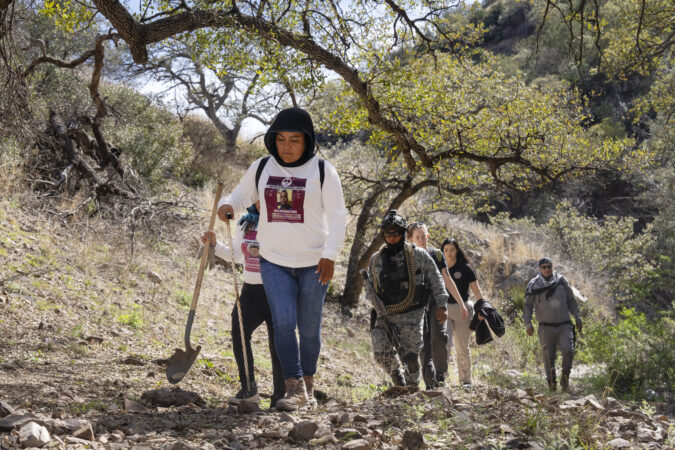
    NOGALES, Mexico — Lidia Hernandez has been searching for her son, lost to drug violence in Mexico, for seven years. But she spent this week scouring rocky dirt for clues in the disappearance of a far more well-known crime victim — Nancy Guthrie.

    On Sunday, Hernandez posted fliers on the mailbox at Guthrie’s home in the Catalina Foothills north of Tucson. On Wednesday, she led a group of other “Searching Mothers” in prayer across the border in Mexico as they tried to find out whether Guthrie had been taken there. On Thursday, she returned to Guthrie’s neighborhood once again.

    Hernandez said her group, the Searching Mothers of Sonora, feels authorities aren’t doing enough to find Guthrie, the 84-year-old mother of “Today” anchor Savannah Guthrie who was reported missing on Feb. 1.

    It’s a common refrain for the mothers, who have used pickaxes and shovels to locate hundreds of bodies of victims of drug and gang violence in Mexico themselves over the years, decrying government inaction all the while.

    “They’re not looking for her!” Hernandez, 66, a retired food service worker from Nogales, Arizona, said. “So we have to step in.”

    Lidia Hernandez leads the Searching Mothers of Sonora in prayer during their search for Nancy Guthrie on Wednesday in Nogales, Mexico.

    As the investigation entered its fourth week, unauthorized search parties have exacerbated the chaos surrounding the high-profile case, which has gripped the nation and attracted media, true-crime streamers and curiosity seekers to the area around Guthrie’s spacious home.

    The Pima County Sheriff’s Department has tried to calm the situation, asking in a statement Saturday that volunteer searchers back off and let the investigators do their jobs. On Thursday they instituted new parking restrictions around the house.

    “We appreciate their concern, and we all want to find Nancy, but this work is best left to professionals,” the sheriff’s office said on a post on X.

    Despite the sheriff’s office admonitions, the informal search parties have continued, including members of the United Cajun Navy — a volunteer group that normally responds to hurricanes — arriving in town midweek with sniffer dogs and drones. The sheriff’s office referred additional questions about the new searchers back to its Saturday post.

    The Searching Mothers hike through Nogales, Mexico, during their search.

    This week, the pace of the investigation appeared to slow, as investigators await the results of a complicated DNA test that could take weeks, authorities have said. Separately, ABC News reported that the FBI was downscaling its operations in Tucson and moving agents back to Phoenix. But thousands of citizens continue to call in tips to the FBI — more than 23,000 so far, authorities said. The Guthrie family this week offered a $1 million private award for information about their mother’s whereabouts.

    “We still believe in a miracle,” Savannah Guthrie said in an Instagram video.

    Amateur sleuths — especially those analyzing clues in web forums — have proliferated in recent years and sometimes do more harm than good, experts say. In the Guthrie case, for example, some have continued to speculate online that the Guthrie family could be involved, despite the fact that Pima County Sheriff Chris Nanos cleared them as suspects.

    Tricia Arrington Griffith, who manages the web forum for true-crime buffs called Websleuths, attributes the intense interest in the case to Savannah Guthrie’s fame and the possibility that her mother could still be alive.

    “Time of the essence,” she said. “You tell people somebody out there is in trouble and with a bad guy and might die? People will move heaven and earth to try and help.”

    On Wednesday, Hernandez and the Searching Mothers traveled on a dirt road, deep with ruts about an hour south of Guthrie’s home, to a remote area with cacti and mesquite trees near the U.S.-Mexico border. The border wall, a rust-colored ribbon, unspooled in the northern distance over the dun-colored landscape.

    Hernandez led the group in prayer before they hoisted shovels and metal rods and began combing the earth, looking for disturbed ground, which might indicate a burial. If they saw a telltale disturbance, they began immediately driving metal rods deep into the ground and pulling them back, sniffing the ends for the smell of a decomposing corpse.

    The Searching Mothers inspect a backpack found in a canyon commonly used by border crossers.

    For Hernandez, the grim work has been a boon, a constructive activity she has embraced in the pain and uncertainty she has lived with since her son, Jorge, 28, disappeared in Nogales on Nov. 4, 2019. Like the other mothers, she wears a white T-shirt with a purple logo and photo of her son above the word “DISAPPEARED.”

    When Nancy Guthrie vanished, she felt an immediate affinity for the Guthrie family, she said.

    “It was pain, and sadness, the same feeling that the mothers go through — every day, every week, every year,” she said. “The pain is permanent.”

    The Searching Mothers had received an anonymous tip, the group’s leader, Ceci Patricia Flores Armenta, said, pointing them to this area — a swath of forested land crisscrossed with narrow pathways used by migrants and drug traffickers.

    “They told us, ‘If they wanted to take her across to Mexico, this would have been the best way to take her,’” she said.

    She brushed off criticism from authorities that the volunteer searchers are at risk of hampering the investigation.

    “The [police] are not searching underground — they’re doing investigations, they’re waiting for someone to hand her over alive, or she’s in a place where they won’t be able to find her,” Flores said. “If we managed to find her, with our technology — which is only a shovel and a bar — I think they’d end up embarrassed.”

    She continued: “They say we’re violating the investigation, but what investigation? They’ve had a month and they haven’t been able to resolve the case. And so they must let the mothers participate.”

    Investigators for Mexico’s lead criminal agency do not believe Guthrie has been taken across the border, according to Agent Alberto Osona Guerrero, who was at the scene of mothers’ search Wednesday.

    “The truth is, it’s very difficult to transport a person against their will and cross them into Mexico,” Osona Guerrero said. The mothers might find a body, he said, but likely not the one they’re looking for.

    Flores founded the group in 2019 to search for the tens of thousands of missing — more than 130,000 according to the government’s last count — victims of drug cartels and gang violence who are left in shallow graves or burned. She has two sons who have been kidnapped, and despite her public pressure, authorities have given her no indication of their whereabouts.

    The mothers don’t try to find the perpetrators of crimes, instead focusing on reuniting families or providing closure when they find remains, which they call “treasures.” They’ve had some success. Volunteer mother groups in Flores’s home state of Sonora have found five missing people just this year, according to the state’s commission on missing people.

    In 2024, Flores and other mothers searching outside Mexico City found a clandestine dumping ground filled with human remains, and was criticized by a local prosecutor for disturbing evidence, according to an Associated Press account of the discovery. Her response? Do your job.

    On Wednesday near the border, Flores and other volunteers found a spent shell casing on the ground. Flores directed them where to dig.

    “Here, this is where they would have fallen,” she said, as the volunteers began swinging pickaxes, the sound of metal hitting rock resonating through the small grove of trees. But after digging for an hour, they found nothing.

    Ceci Patricia Flores Armenta, founder of the Searching Mothers of Sonora, smells the dirt for any sign of a decomposing corpse.

    Other searchers, including Yolanda Veronica Paredes, a local resident who also lost her son in a kidnapping, followed a stream bed deep into the hills, toting their shovels. They passed a small lake, the bleached ribs of a dead cow, a shrine to the Virgin Mary and the detritus of wanderers along the narrow path — a sock, an empty Pall Mall package, a discarded bottle of orange soda.

    They reached a trash pile in the woods and began to dig. Soon, Paredes pulled up a clump of earth and sniffed deeply.

    “I smell something dead!” she said. She and the other searchers began digging and pulled up more trash, including a fraying windbreaker. But eventually they reached a point that required stronger tools than what they had brought with them. They conferred and decided to return the following day — with a pickax.

    As the search wrapped up for the day, Fernandez said she would continue looking for Guthrie as long as her disappearance remains unsolved. But she said her hope in finding her alive was waning and believed her spirit had left the earth.

    “She is not there,” Fernandez said sadly.

  • ‘Our heroes are dying.’ Why Jesse Jackson’s death leaves a void.

    ‘Our heroes are dying.’ Why Jesse Jackson’s death leaves a void.

    In the early-morning hours after the Rev. Jesse Jackson died on Feb. 17, his family called another prominent pastor for prayer and solace. “A mighty lion has passed,” Bishop William Barber recalled the family saying.

    “I’ve been thinking about that imagery,” said Barber, who leads Repairers of the Breach, an organization that aims to bring moral and religious language to causes such as safeguarding voting rights and alleviating poverty. “Because lions, they protect the pride, but they also expand the territory of the pride.” And Jackson expanded the notion of civil rights in America, he said: from the Black community to the full spectrum of people seeking justice.

    Thousands are expected to pay respects Friday as Jackson’s remains lie in repose at Rainbow/PUSH headquarters in Chicago, following the decision by House Speaker Mike Johnson (R., La.) to decline to allow Jackson to lie in honor at the U.S. Capitol.

    Jackson’s death at age 84 comes at a perilous time for the civil rights crusade he helped lead for decades. Most of his iconic contemporaries are gone as President Donald Trump attacks their hard-fought principles, declaring war on diversity, equity, and inclusion initiatives while the foundational achievement of the civil rights movement, the 1965 Voting Rights Act, may be on the verge of being overturned by the U.S. Supreme Court.

    “Our heroes are dying, and the question has to be asked: Who comes next or what comes next?” said author and political commentator Bakari Sellers. “This new era of regression, this new era of Trumpism, has shown clearly that … our new leaders [are] not able to meet the moment.”

    It’s a major test of the movement in a fragmented landscape of social media and political division with no clear successor generation to rally a response. The wellspring that produced leaders such as Jackson and the Rev. Dr. Martin Luther King Jr. — the Black church — no longer plays the same role. Institutional religion doesn’t have the authority or power it once did in the United States, experts said, and the religious right for decades has been more loudly — and successfully — merging its view of Christianity and politics.

    “The Black church isn’t as important as it was. It’s harder to have a figure come out of that tradition and command the power and respect that Jesse Jackson did,” said Claflin University historian Robert Greene II. “It’s hard to imagine someone today being able to enter the political realm already seen as a moral authority.”

    If there is to be a robust defense of civil rights, many believe it will come from Jackson’s legacy of expansion — using the Voting Rights Act to get more people of color into voting booths and into elected office; broadening the definition of civil rights to include all marginalized communities, such as LGBTQ people and people with disabilities, in a common cause; and pushing beyond political rights to economic rights.

    In some ways, the fact that there is no obvious individual to take the mantle is part of Jackson’s legacy, say civil rights activists, elected leaders and scholars. He advocated for leaders at all levels of government and activism carrying out different parts of the mission.

    “We have democratized leadership in the civil rights movement and spread it throughout the country,” Virginia lawmaker Don Scott said.

    Scott said his own life found a new purpose when he was a college sophomore in 1984 and met Jackson, who was running for president. Forty years later, Scott became the first Black person elected speaker of the Virginia House of Delegates.

    “That’s the legacy of Jesse Jackson — he empowered a whole lot of folks to lift up their voice,” Scott said.

    Bryan Stevenson, a lawyer and founder of the Equal Justice Initiative, said it’s important to remember the historical arc of the civil rights movement. After the Civil War, Black men had a brief moment when they were able to participate in democracy. Then Jim Crow swooped in and disenfranchised Black voters in the South for more than half of the 20th century.

    During that time, without access to elected office, Black Americans looked elsewhere for leadership and resistance. Black churches filled that void, giving rise to the civil rights movement, Stevenson said, exemplified by King and other figures — such as Claudette Colvin, John Lewis and Fannie Lou Hamer — who blended the tone of the pulpit with politics.

    The Rev. Al Sharpton speaks on the final day of the 2024 Democratic National Convention in Chicago.

    Younger generations of pastors — including those from more conservative traditions — were “inspired to be not just pastors but prophets as well,” said Tyler Burns, a Florida pastor and director of the Witness, a multimedia organization aimed at elevating the voices of Black Christians.

    Today there are some figures who echo Jackson in their focus on combining Black Christianity and politics to serve the disenfranchised, including U.S. Sen. Raphael G. Warnock (D., Ga.) and Barber, a North Carolina organizer who founded the Center for Public Theology & Public Policy at Yale University.

    But Jackson was one of a kind, said Jemar Tisby, a historian, writer, and podcaster on race and religion. He represented “the longer Black freedom struggle,” Tisby said, and harnessed a blend of charisma, ambition, and eloquence to an unusual moment of political opportunity.

    The Voting Rights Act of 1965, and Jackson’s immediate recognition of the door that it opened, “radically changed the opportunity for Black leadership,” Stevenson said. Jackson was particularly effective at voter registration, preaching the power of politics.

    “It’s a different landscape today as a result,” Stevenson said.

    The Supreme Court has already weakened much of the 1965 Voting Rights Act and will rule on whether to strike down its last major pillar in the coming months. The court could further limit the use of race in drawing legislative maps, which would most likely lead to a decline in the number of minorities holding public office.

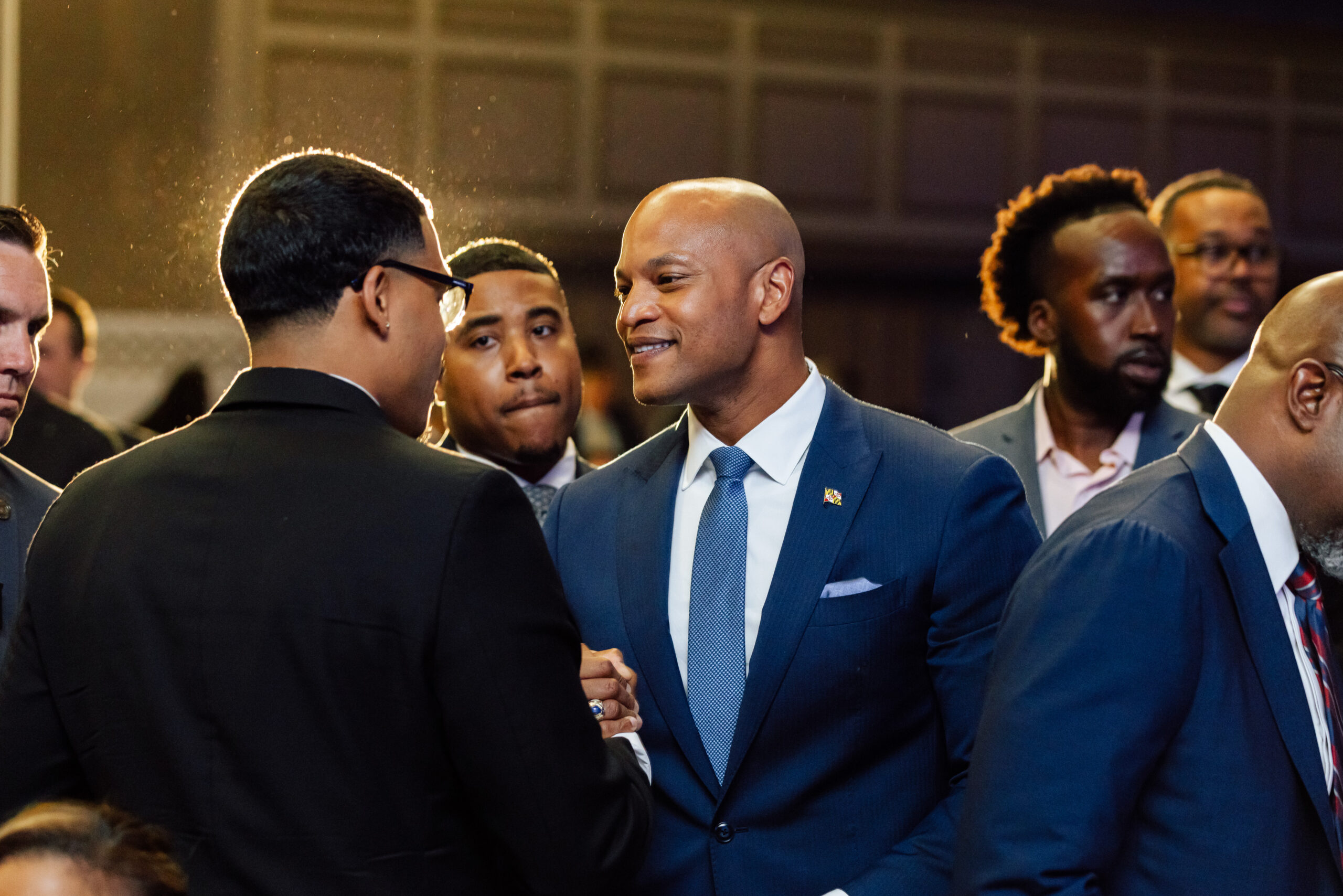
    Maryland Gov. Wes Moore, the state’s first Black governor and among only three African Americans ever elected governor of any state, said that “an attack on the VRA is in many ways an attack on decades of progress.”

    Maryland Gov. Wes Moore speaks with supporters at a Democratic Party gala in Baltimore last June.

    Jackson’s pivot after the passage of the law, which helped Black officials win congressional and legislative seats, spurred the movement’s success, Moore said. “He was able to make the transition from demanding change to saying, ‘I want to be one of the people to help make it,’ right? Because he understood that part of the power of the civil rights movement was the fact that they were able to get into rooms.”

    The Brennan Center for Justice at the NYU School of Law has tracked efforts to roll back access to the ballot box around the country, including states imposing voter ID laws, making registration more difficult, and aggressively purging voter rolls. Those actions are part of what Georgia politician Stacey Abrams calls “the exercise of diminishing democracy … [and] a wholesale attack on the pluralism of America.”

    Abrams, a former Georgia state lawmaker and gubernatorial candidate, said Jackson’s legacy is key to fighting back. His Rainbow/PUSH Coalition framed the fight for civil rights broadly, as “how do we make America meet its obligations to all its people,” Abrams said.

    That not only brought more marginalized groups into the struggle, she said, but it expanded the idea of civil rights beyond the political realm. “Now that we had voting rights and civil rights, we also had to have access to economic rights,” Abrams said.

    For all the years Jackson carried on his fight, “the through line was always that he worked to bring more people into the process … [so that] as many people as possible believe they have the right to participate,” she said.

    Former Richmond Mayor Levar Stoney — who, until term-limited out of office in 2025, was part of a new generation of young Black mayors around the country — said the effectiveness of Jackson’s work can be seen in state and local offices in the South, where minorities and women have made huge strides in representation.

    The phenomenon cuts across generations, Stoney said, pointing out that in Virginia, 82-year-old L. Louise Lucas is the first Black woman to serve as president pro tempore of the state Senate; Scott, 60, is the first Black speaker; and Jay Jones, 36, is the first Black person elected as the state’s attorney general.

    Apart from President Barack Obama, Stoney said, “I can’t foresee us ever looking to one singular leader.” He added, “There’s a collective of leaders now, [and] we expect to be represented by someone who looks like us.”

    What might be lost, though, is the unifying emotional resonance of a figure such as Jackson. One element that gets overlooked, Sellers said, is that Jackson, King, and other leaders of the day “were more patriotic than most.”

    They were able to “look at this country and call out its failures, call out its broken promises, and then try to reimagine her for what she should look like, which is an inclusive society built in the image of us all.”

    Jackson was able to lend that stature to others, which is what several remembered this week in the lead-up to his memorial services.

    Stevenson said he regularly conferred with Jackson in creating the National Memorial for Peace and Justice in Montgomery, Ala., which recognizes more than 4,000 African Americans lynched during the Jim Crow era. At the dedication for an affiliated memorial in 2024, Jackson had traveled to the ceremony but by then was using a wheelchair and had difficulty communicating. As Stevenson spoke before the crowd, he looked out and saw Jackson, who held his fingers in the shape of a heart.

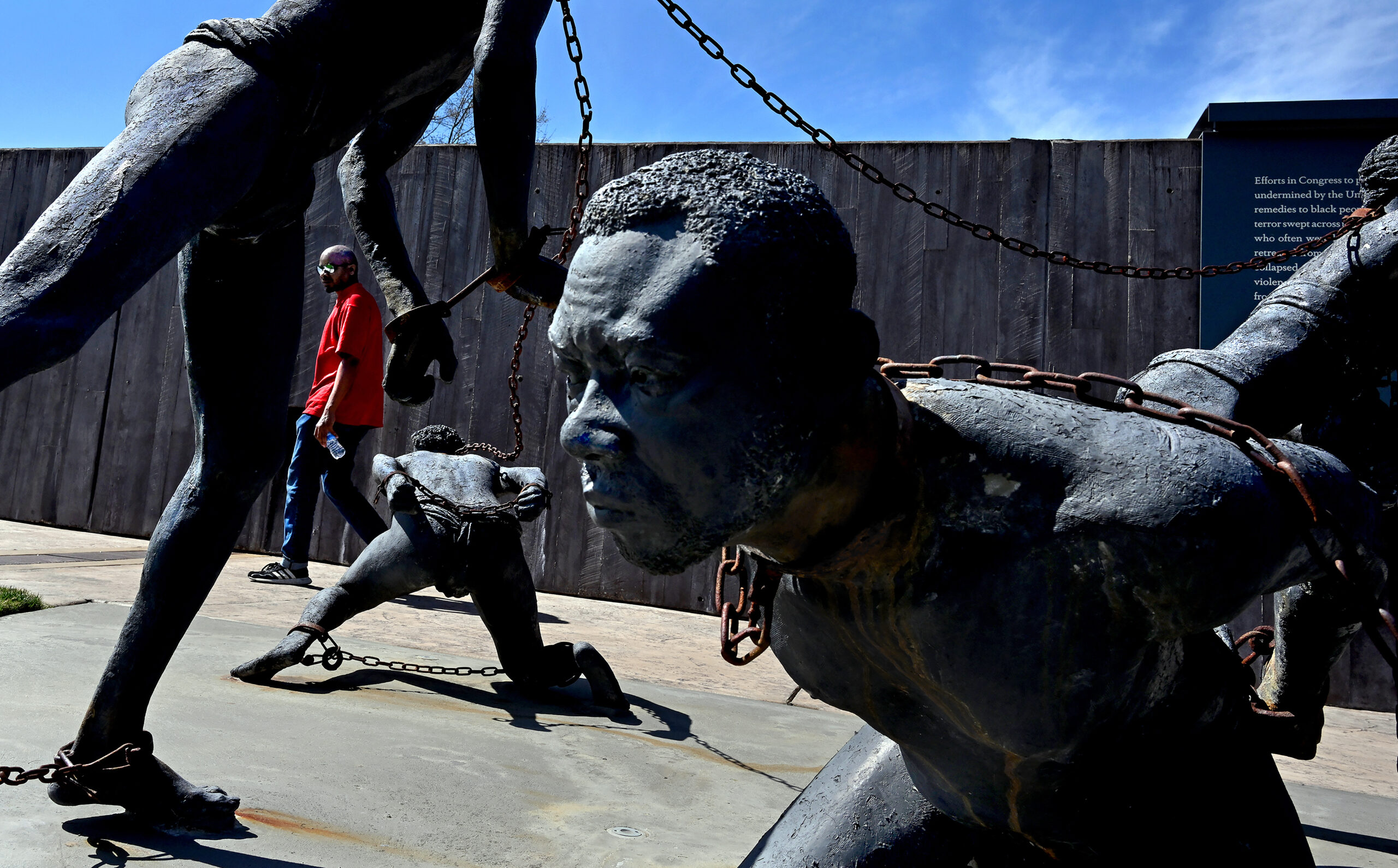
    A work by Ghanaian artist Kwame Akoto-Bamfo depicting enslaved people in bondage is on display at the National Memorial for Peace and Justice in Montgomery, Ala.

    “It was so moving to me,” Stevenson said. “And I told him, you know, you had me almost in tears.”

    Abrams recalled the night in 2018 when it became clear that she had narrowly lost the election for Georgia governor. Jackson was on hand as she prepared to concede before supporters, and some of her staff tried to get him to move into a VIP area backstage. He refused.

    “He said: ‘I want to be here when she comes downstairs. I know what [defeat] feels like, and I need her to know that the work she’s done continues and she should still be proud,’” Abrams said.

    Barber said he intends to honor Jackson’s legacy by convening a group in the coming weeks to study his speech at the 1988 Democratic convention — when his performance in the primaries brought him closer to the presidential nomination than anyone thought possible — to galvanize a new voter movement.

    In the speech, Jackson called for unity to “keep hope alive,” and said he cherished America not as a uniform blanket but as a quilt.

    “My prayer and hope,” Barber said, “is that we’re working toward that end and bringing folk together. And that the dying of Jesse will not cause us to just say, ‘Woe is us’ and ‘Oh, just look at what he did.’ Because commemoration is not how you remember people like him. You remember people like him by engagement. By recommitting yourselves.”

  • The hypothetical nuclear attack that escalated the Pentagon’s showdown with Anthropic

    The hypothetical nuclear attack that escalated the Pentagon’s showdown with Anthropic

    As a standoff between artificial intelligence firm Anthropic and the Pentagon deepened this week, the two sides offered starkly different accounts of a key discussion about a hypothetical nuclear strike against the United States, revealing the intensity of their showdown over the American military’s potential use of lethal autonomous weapons.

    A defense official said the Pentagon’s technology chief whittled the debate down to a life-and-death nuclear scenario at a meeting last month: If an intercontinental ballistic missile was launched at the United States, could the military use Anthropic’s Claude AI system to help shoot it down?

    It’s the kind of situation where technological might and speed could be critical to detection and counterstrike, with the time to make a decision measured in minutes and seconds. Anthropic chief executive Dario Amodei’s answer rankled the Pentagon, according to the official, who characterized the CEO’s reply as: You could call us and we’d work it out.

    An Anthropic spokesperson denied Amodei gave that response, calling the account “patently false,” and saying the company has agreed to allow Claude to be used for missile defense. But officials have cited this and another incident involving Claude’s use in the capture of Venezuelan leader Nicolás Maduro as flashpoints in a spiraling standoff between the company and the Pentagon in recent days. The meeting was previously reported by Semafor.

    A face-to-face meeting Tuesday between Amodei and Defense Secretary Pete Hegseth escalated the situation, the Washington Post reported. The two sides are now careening toward a defining power struggle over whether the U.S. government should have the freedom to spy on or kill humans using the potent new technology, based in part on extreme hypotheticals and games of telephone.

    The Pentagon had given Anthropic until 5:01 p.m. Friday to drop its objections to using Claude in relation to autonomous weapons and mass surveillance of U.S. citizens. If not, officials had said they may use government authority to force Anthropic to hand over the technology anyway — while also blacklisting the company from future defense work.

    Sean Parnell, the Pentagon’s chief spokesman, said in an X post Thursday that the department had no interest in conducting mass domestic surveillance nor deploying autonomous weapons, but wanted to use AI for “all lawful purposes.”

    “This is a simple, common-sense request that will prevent Anthropic from jeopardizing critical military operations and potentially putting our warfighters at risk,” Parnell said.

    Amodei said in a statement late Thursday that his company was ready to continue working with the Pentagon, but would not change its stance. Current AI systems are not reliable enough to power robotic weaponry without putting troops and civilians alike at risk, he said, and existing laws on domestic surveillance do not account for the sweeping potential of AI snooping tools.

    “In a narrow set of cases, we believe AI can undermine, rather than defend, democratic values,” Amodei said in his first public comments on the battle. “Two such use cases have never been included in our contracts with the Department of War, and we believe they should not be included now.”

    Anthropic did not expect to end up in a fight with Pentagon leaders when it became the first major AI lab to strike a deal to work on classified U.S. military networks in late 2024. But the dispute highlights how the startup, founded in 2021 by safety-minded refugees from ChatGPT-maker OpenAI, has struggled to deftly navigate Washington in the second Trump administration. (The Washington Post has a content partnership with OpenAI.)

    Anthropic recently added a former deputy chief of staff to President Donald Trump to its board and explored taking investment from a fund led by Donald Trump Jr., according to people familiar with the pitch. Yet its leaders have also repeatedly clashed with the White House in public.

    In a coruscating post on X in October, David Sacks, Trump’s top AI adviser, accused the company of “fear-mongering” and pursuing “regulatory capture” in an attempt to bend the government to its will. Anthropic leaders have criticized one of the administration’s key AI policies in recent weeks, even as the dispute with the Pentagon was brewing.

    “There’s the subtext of Anthropic not being aligned with the MAGA agenda,” said Steven Feldstein, a senior fellow at the Carnegie Endowment, who researches the use of AI in war. “This is as much of a political fight as a military use issue.”

    Experts say the outcome of the clash could shape the trajectory of the burgeoning relationship between the AI industry and the U.S. military, potentially signaling to other leading firms that the cost of doing business with the Pentagon could be losing control of their innovations.

    Unlike a gun or a jet engine, the uses that AI might find on future battlefields keep changing. The U.S. already pushes autonomy into its weapons and AI-enabled systems are a part of almost every drone, ship, or aircraft under production or envisioned in the future force. The Trump administration is embarking upon a vast expansion of the military’s use of AI.

    But leading figures in the development of the technology have long had ethical and legal concerns about giving AI the power to make life-and-death decisions or turbocharging surveillance.

    Emil Michael, a former Uber executive who is now undersecretary of defense for research and engineering, has taken the lead in the discussions with Anthropic. He has argued the government and not individual tech firms should have the final say in how the technology is used, according to a person familiar with the discussions, who spoke on the condition of anonymity to describe internal deliberations. Michael did not respond to a request for comment.

    To the Pentagon that means having a policy permitting what Parnell called “all lawful purposes.” Amodei has held firm that Anthropic has red lines around autonomous weapons and surveillance, a stance that has won support from his employees and could serve as a recruiting tool for idealistic engineers as the company heads toward an expected initial public offering.

    Late Thursday, Michael accused Amodei of having a “God-complex” in a post on X. “He wants nothing more than to try to personally control the US Military and is OK putting our nation’s safety at risk,” Michael wrote.

    The escalating dispute has baffled people who study how the military uses AI.

    Dean Ball, a former Trump administration AI adviser, said he hoped the two sides could still find a way to step back from the brink. “The solution to that problem is to cancel the contract,” Ball said. “Going on a jihad against Anthropic is whole other layer of escalation.”

    Leapfrogging off Amazon

    Anthropic owes its head start at the Pentagon in part to a partnership the intelligence community forged with Amazon in 2013, which paved the way for classified material to be handled in Amazon’s cloud. Over the course of the next several years, the tech giant built out secure computing infrastructure for the intelligence community, beating out rivals for coveted contracts to house classified and top secret data.

    In 2023 and 2024, Amazon invested billions into Anthropic. The relationship greased the AI start-up’s path into the military’s closely guarded systems, according to a person familiar with the relationship, who spoke on the condition of anonymity to describe it. Amazon declined to comment. (Amazon founder Jeff Bezos owns the Post.)

    Anthropic also found an ally in software analytics firm and longtime defense contractors Palantir, which in 2024 teamed up with the AI firm and Amazon to offer Claude on its systems used by military and spy agencies. Anthropic said the partnership would boost the military’s ability to process huge amounts of data and make good decisions, saying it was proud to take on the work.

    Anthropic has “first mover status and their product is good,” said another person familiar with the military’s work with AI companies, who spoke on the condition of anonymity to describe sensitive issues relating to national security.

    Since Claude’s deployment with the Pentagon, Anthropic said Thursday, its technology has been put to use analyzing intelligence, planning operations and in cyberwarfare. The company has deepened its work with the government since Trump returned to office and pushed federal agencies to rapidly scale up their use of AI. In July it signed a $200 million contract with the Defense Department and made a deal the following month to provide its system to civilian agencies for a dollar apiece.

    But the company’s advantage has eroded as competitors like Google, OpenAI and xAI make deals of their own with the Pentagon. Officials say the other leading firms have agreed to its “all lawful purposes” policy for unclassified work, and that xAI has also signed a deal for classified systems. The three companies did not respond to requests for comment.

    Anthropic has differed from its rivals in simultaneously courting the administration for contracts while opposing it in other areas of policy.

    When the White House was pushing an executive order that would preempt restrictive state-level AI laws this winter, Anthropic was promoting a safety-oriented AI bill in California.

    Amodei has also criticized the Trump administration’s drive to allow exports of American AI chips to China. On the sidelines of the World Economic Forum in Davos, Switzerland last month, Amodei compared the policy to “selling nuclear weapons to North Korea.” After meeting with Amodei this month on Capitol Hill, Sen. Elizabeth Warren (D., Mass.) said she would introduce legislation to sharply limit any exports.

    Anthropic has also hired several former Biden administration officials.

    “The administration just wants everyone to bend the knee and [Amodei] won’t,” said an investor who works on defense technology, who spoke on the condition of anonymity to avoid getting into conflicts with any of the parties.

    In the past year, Anthropic has made moves that could smooth its relationship with the Trump administration. The company ramped up its lobbying in Washington, spending $3.1 million and bringing on a former senior aide to Secretary of State Marco Rubio, according to disclosures compiled by transparency group Open Secrets. It announced this month that it was adding Chris Liddell to its board, a former tech executive who served in the first Trump White House.

    The company also recently explored an investment from the Trump-allied venture capital firm 1789 Capital for funding, but was turned down, according to two people familiar with the pitch, who spoke on the condition of anonymity to describe private business discussions. Donald Trump Jr. is a partner at the firm, alongside Chris Buskirk, an ally of Vice President JD Vance.

    ‘Once and for all’

    Insiders in the world of defense technology argue that the current fight between the Pentagon and Anthropic appears to be more philosophical than technical, and that the administration had already soured on the AI company — even as rank-and-file military personnel were finding its services increasingly useful.

    “The administration and the Republicans are looking for ways to get rid of Anthropic once and for all,” the person familiar with the military’s work with AI companies said. The Pentagon clash could provide an opportunity to carry that through. In January, Hegseth issued a directive for the military to embrace AI as though the country were at war.

    The U.S. has committed to some guardrails on autonomous weaponry. France, the United Kingdom, China, and the U.S. all previously said they would require a human to be involved in all decisions to deploy nuclear weapons. In a statement to the Post, the Pentagon said the Trump administration intends to maintain that pledge.

    “It remains the Department’s policy that there is a human in the loop on all decisions on whether to employ nuclear weapons,” a senior defense official said. “There is no policy under consideration to put this decision in the hands of AI.”

    But that still leaves room for AI to influence decisions on targets and speed of response. In a recent nuclear war game at King’s College London, many leading language models including versions of ChatGPT, Claude and Google’s Gemini all quickly favored launching warheads. That could influence a human’s decision to fire, said Paul Dean, vice president of the global nuclear program at the nonprofit Nuclear Threat Initiative.

    “It’s not simply ensuring that there’s a human being in the decision-making loop,” Dean said. “The question is, to what extent will AI impact that human decision-making?”

    Neither side in this week’s faceoff knows for certain what AI’s use in war will ultimately look like, but both seem unwilling to trust in the other’s future decisions.

    “The Pentagon does not trust that Anthropic will be a reliable vendor, and Anthropic worries about misuse of its technology,” said Michael C. Horowitz, a director at the University of Pennsylvania who oversaw AI weapons policy during the Biden administration.

    Because Claude is already in use across the Defense Department, exiling Anthropic and switching to a rival could prove costly. Although Defense officials have suggested they could use the Defense Production Act to force the AI company to share its systems, experts are split on whether the law could be applied.

    Doing so would send a chilling message to the AI firms the Pentagon hopes to lean on that they may risk of having their own innovations seized if the government sees something it wants.

    That would cross a troubling line, said Katie Sweeten, a former liaison for the Justice Department to the Pentagon, and a partner at Scale LLP. “This is a literal nuclear option which I think rightfully companies should be very concerned about.