Category: Washington Post

  • How a DHS shooting of a third U.S. citizen went unnoticed for months

    How a DHS shooting of a third U.S. citizen went unnoticed for months

    After the Texas Ranger knocked on her door and delivered the numbing news, Rachel Reyes realized she hadn’t thought to ask who shot her son. She figured it had been another Ranger that killed Ruben Ray Martinez, 23, after he allegedly failed to comply with a law enforcement officer’s orders.

    But a week later, Reyes read an article from a local news outlet in South Padre Island that confused her. The police in that small, South Texas beach community were saying there had been an officer-involved shooting and a man was dead, but a separate, unnamed agency was responsible. Reyes called the Ranger who notified her and was now investigating the shooting: Who shot Ruben?

    A Department of Homeland Security agent assigned to immigration enforcement was responsible, the Ranger said.

    Reyes didn’t go public, instead deciding to await the results of the investigation by the Rangers, who are part of the Texas Department of Public Safety.

    The March 15, 2025, killing of Martinez, a U.S. citizen, drew almost no public attention, even as protests erupted over the January shooting deaths of two U.S. citizens in Minneapolis — Renée Good, a mother of three, and Alex Pretti, an ICU nurse. South Padre Island Police put out a news release on Martinez but did not identify the agency responsible for his death. A two-sentence police report described Martinez striking a federal agent with his vehicle but did not mention the shooting that allegedly happened a moment later.

    Texas officials, citing their ongoing investigation, declined to release footage of the incident. DHS did not publicly acknowledge that one of its agents had fatally shot Martinez until last month, when a lawsuit over a year-old public records request unearthed an internal narrative of the shooting by a Homeland Security Investigations agent. The request by American Oversight, a nonprofit government watchdog group, sought internal emails from the agency containing a variety of phrases and words, including “use of force.”

    Martinez is now the first known American citizen shot to death by federal immigration agents during President Donald Trump’s second term.

    Some Texas lawmakers are expressing alarm at the lack of transparency, demanding a public hearing and immediate release of all body-camera footage and other records. They have also raised concerns about conflicting information between DHS’s account of the shooting and a witness statement describing what happened.

    “When government uses its most serious power, the power to take a life, the facts cannot remain hidden,” said State Rep. Ray Lopez, a Democrat whose district includes the city of San Antonio, where Reyes lives. “A young Texan lost his life, and the public was left without full clarity for nearly a year. That is not about politics. It is about trust.”

    Michael Sierra-Arévalo, an associate professor at the University of Texas who studies policing and use of force, said DHS’s failure to promptly disclose the shooting to the public fits a pattern during the Trump administration, in which officials have at times taken extraordinary measures to defend and shield immigration officers who use deadly force from scrutiny.

    “This was very much known to local authorities. What they were burying was that it happened with this particular agency,” Sierra-Arévalo said. “The ability for federal law enforcement to not be subject to the same sort of oversight that local law enforcement experiences when they’re involved in these incidents in collaboration with local police underscores the danger of federal police operating with practically unchecked power.”

    Many states, including Texas, have passed laws requiring police departments to report shootings to oversight agencies, but there is no federal statute mandating a similar protocol.

    A spokesperson for U.S. Immigration and Customs Enforcement, which includes Homeland Security Investigations, said the department’s policy requires that agents report every use-of-force incident. They are then reviewed “in accordance with agency policy, procedure, and guidelines.” Shootings, the spokesperson said, are first examined by “an appropriate law enforcement agency” and then ICE conducts an internal review.

    A DHS spokesperson declined to explain why the shooting of Martinez was not publicly acknowledged by the department for 11 months. The agency documents released through the records request state that Martinez’s car struck an agent and lifted him onto the hood of Martinez’s vehicle. In a statement that followed that disclosure, a DHS spokesperson said Martinez “intentionally ran over” the agent and that another agent shot and killed him.

    Those words shocked Reyes — they seemed disconnected from the young man she raised, from the story Martinez’s friend and a witness to the shooting told her, and from the narrative the Ranger shared in her living room in San Antonio, several hours after the killing. He said Martinez had tapped an officer with his car and was shot multiple times in response. No one was injured, Reyes said the Ranger told her.

    The Texas Department of Public Safety did not respond to requests for comment on Reyes’s recollection of the Ranger’s account.

    Reyes, a 48-year-old mother of three and a nurse for a medical insurance company, said she voted for Trump in 2024 and “doesn’t have a strong position” on immigration enforcement. But she does not like how officials have handled her son’s death.

    “I don’t really have anything negative to say about Trump. He wasn’t the one who pulled the trigger — it was the department. How they’re handling it is irresponsible.”

    Conflicting narratives

    When she first learned of Martinez’s death, Reyes assumed her son had been in a car accident.

    “Ruben was really nice,” Reyes said, “and he didn’t have enemies or make enemies or get in fights, so I would never in my wildest dreams imagine that someone would want to hurt him.”

    He’d left the house at 2 p.m. without telling his mother where he was going. He’d just turned 23, and later, she realized, had likely kept his plans from her because she wouldn’t have approved of him celebrating his birthday in South Padre Island, which has a reputation for rowdy nighttime partying during spring break.

    Joshua Orta, a friend who was in the passenger seat when Martinez was killed, later told Reyes they’d gone to a bar. Driving to their next destination, they approached the scene of a traffic accident where first responders including the South Padre Police and Homeland Security agents were directing traffic. A Ranger saw an open container of alcohol in the vehicle, Orta said. The Ranger questioned the men about it, but ultimately told them to move along.

    But other officers began shouting, Orta said. Reyes said the Ranger told her that Martinez failed to follow instructions from the officers to stop his car, the car “tapped” an officer and another officer opened fire, killing Martinez.

    Reyes asked if the officer was OK. The officer was “shaken up” but not injured, the Ranger said, according to Reyes.

    Orta, in a written statement provided to lawyers for Reyes, disagreed with that account: “I was present, and I state clearly and without hesitation that Ruben did not hit anyone,” Orta wrote. “The trooper seemed to be trying to get in front of the car, like he wasn’t moving out of the way when we tried to turn around and leave like the police officer told us to do.”

    The DHS narrative paints a different picture.

    Officers and agents commanded Martinez to exit the vehicle, according to the documents released via FOIA, and Martinez “accelerated forward, striking a HSI special agent who wound up on the hood of the vehicle.” Then an agent shot Martinez through his driver’s side window.

    Martinez was transported to Valley Regional Medical Center in Brownsville, Texas, and pronounced dead, according to the documents.

    “The special agent who was struck was taken to a hospital for treatment of a knee injury and was later released,” the internal DHS report states.

    Orta had been planning to participate in the family’s legal fight for transparency and civil compensation, lawyers for Martinez’s mother said, but was killed in February in an unrelated, fiery vehicle crash in San Antonio.

    Reyes said the description of her son, paired with DHS statements following the shooting, have been difficult to stomach without seeing the evidence for herself.

    “I was told there’s no injuries and that someone was tapped. That’s completely different from being told a human was ran over,” Reyes said. “That’s upsetting. It’s hurtful and inappropriate.”

    ‘A pattern’

    For answers, and evidence, Reyes first reached out to the South Padre Island Police Department. They pointed her to the Texas Department of Public Safety, who turned her back to the Ranger handling the investigation, who said he couldn’t share any more information.

    “I was just going in circles,” Reyes said. “I just didn’t know anything because I didn’t know what I could do. I felt like I was kind of helpless. I decided to just trust the process and wait to hear from him.”

    Then a life insurance claim through Martinez’s employer was denied, citing the government’s claim that Martinez injured an officer. Reyes eventually retained a team of attorneys to investigate the case. They have been filling records requests and exploring potential civil actions against DHS.

    Meanwhile, Reyes has been watching DHS’s actions in other cities around the country and wondering if her son’s death is not part of a pattern. Trump administration officials quickly labeled Good and Pretti “domestic terrorists” before investigations were conducted. Witness videos analyzed by the Washington Post conflict with official statements regarding both incidents.

    “I thought that was callous and awful to call that woman a domestic terrorist because obviously that’s not what she was doing,” Reyes said, referring to Good. “You start to see things in a different light. There’s a pattern here of them using these statements to characterize these people, and to justify their agents’ actions, and I think that’s awful.”

    Reyes said she’s prepared to fight for accountability if the same is true for her son.

    On Feb. 25, days after news organizations broke news that a HSI agent was responsible for the killing, the Cameron County district attorney convened a grand jury to consider whether to press charges against the agent who fired at Martinez.

    The grand jury, shown video of the incident that has not yet been made public, declined to indict the agent. The Texas Department of Public Safety, which has declined to release video of the incident while the investigation is ongoing, said that its investigation is now complete and the department is completing “proper redactions” before releasing the video.

    Reyes said she won’t watch it. She plans to have people she trusts explain what happened. If video shows the government’s claims to be true, she said, “then I’ll have to live with that. I just want to know.”

    Martinez’s wake was standing room only, Reyes said. An uncle gave his eulogy, drawing from Corinthians a passage that resonated with his mother: “To be absent from the body is to be present with the Lord.”

    She considered burying his body, but opted instead to bring Martinez home, “where it’s safe,” she said. She had Martinez cremated and first set the urn on the dresser in his bedroom, then she brought him to a living room shelf to sit beside a framed picture of him smiling at her birthday dinner two years ago. Martinez never liked to hang out in his room, she said. He preferred to be with his family.

  • Federal commission delays vote on Trump’s White House ballroom project

    Federal commission delays vote on Trump’s White House ballroom project

    A federal planning commission on Thursday delayed a vote on President Donald Trump’s planned White House ballroom until next month, citing “significant public input,” including tens of thousands of comments — nearly all of them critical of the project.

    The National Capital Planning Commission had planned to review the proposal and vote on it — the final procedural hurdle for an effort to dramatically remake one of the most revered symbols of American power and democracy.

    But partway into the meeting, commission Chair Will Scharf said that he expects public comment to last five to nine hours, with over 100 people signed up to testify, which will likely require the board to recess Thursday evening and resume Friday morning. The commission will discuss and vote on the project at its April 2 meeting, he said.

    Ahead of Thursday’s hearing, the agency received more than 35,000 comments about the project, according to a Washington Post analysis of submissions posted on the commission’s website. The “vast majority” came from those who oppose the plan, commission staff said. The Washington Post found that more than 97% of comments were critical of the president’s plans. (The Post used artificial intelligence to classify the submissions and measured its accuracy against a hand-checked sample.)

    The delayed vote is a snag in Trump’s push to rush the project through the approval process so construction can be completed before the end of his second term. Securing approval at the commission’s next meeting, however, could keep the project on schedule; the White House has said it plans to begin aboveground construction as soon as next month.

    The commission’s endorsement would be the last bureaucratic obstacle in the Trump administration’s push to secure approval for the $400 million ballroom from two federal committees charged by Congress with reviewing the designs of major construction projects in Washington. Late last year, the White House laid out a strategy to complete the process within nine weeks, a plan that’s now been pushed to just over three months.

    Historic preservationists have sued to stop the project, and a federal judge is considering their challenge, which alleges that Trump is unlawfully pursuing a project that requires express authorization from Congress.

    Last week, the National Capital Planning Commission’s executive director, Marcel Acosta, recommended that the 12-member panel approve the project. In an 11-page report published Friday, Acosta said the proposed structure will provide presidents with a larger permanent event space while protecting “the historic integrity and cultural landscape of the White House.”

    Acosta’s assessment contrasts sharply with the public response. Tens of thousands of comments criticized what opponents described as a rushed approval process, insufficient public input and a design that would overshadow the main White House building.

    The president has made the building a priority of his second term, and he returns to it often in public remarks and social media posts. He clashed with the project’s previous lead architect about the size of the addition.

    Trump has made strategic moves to secure its success, including reshaping the membership of the two federal bodies that must sign off on the project: the National Capital Planning Commission and the Commission of Fine Arts. Last month, the Commission of Fine Arts, which now includes Trump’s 26-year-old executive assistant, voted unanimously to approve the project. Chair Rodney Mims Cook Jr. called it a “desperately needed” and “very beautiful structure,” whose design he credited to Trump.

    The National Capital Planning Commission is led by Will Scharf, the White House staff secretary and Trump’s former personal lawyer, whom the president appointed in July. The commission includes a pair of other White House officials, James Blair and Stuart Levenbach. It also has nine seats apportioned to sitting cabinet secretaries and other officials who have a role in overseeing Washington, although senior officials and lawmakers usually send a representative in lieu of attending themselves.

    Although federal design commissions have traditionally acted as a constraint on government construction projects — often holding extended deliberations that last for years — Trump has pressed to move the project along swiftly so it can wrap before his term concludes.

    Last year, the president ordered the rapid demolition of the East Wing annex without first seeking authorization from Congress or the review committees. Trump’s plan for a new ballroom building on the site that matches the “height and scale” of the main White House has advanced despite objections from a federal judge, architecture experts and historic preservationists, who argue that the structure would be too big, dwarfing a centuries-old American symbol.

    White House officials want the commission to approve in one fell swoop the ballroom building’s preliminary and final plans, which the body normally takes up individually at separate meetings, giving agency planners time to incorporate commission feedback before resubmitting updated plans. For example, the planning commission approved a new White House perimeter fence in three steps over seven months, starting with a conceptual design in July 2016 and ending with final plans in February 2017.

    Last week, Trump scored another victory on the ballroom front. U.S. District Judge Richard J. Leon ruled that construction on the project could proceed, citing procedural problems with a lawsuit challenging the president’s ability to unilaterally build the structure. The National Trust for Historic Preservation, a congressionally chartered organization that advocates for protecting historic sites, amended and refiled its complaint Sunday, three days after Leon’s ruling.

    Trump has repeatedly defended the project’s $400 million price tag, saying it is a benefit to taxpayers that the project will be paid for with private donations.

    “I built many a ballroom. I believe it’s going to be the most beautiful ballroom anywhere in the world,” Trump said Monday at a ceremony in which he awarded the Medal of Honor to three Army soldiers.

    Democrats and government watchdog organizations have raised concerns about those donors, which include major corporations such as Amazon, Google, and Palantir — companies that together have billions of dollars in federal contracts. Critics have questioned whether donors could receive special access or other benefits in return. (Amazon founder Jeff Bezos owns the Washington Post.) Some Democrats say improvements to the White House complex may be warranted but contend that the ballroom should be far smaller and subject to congressional oversight to ensure transparency.

    Polls have found that most Americans oppose the project. Twenty-five percent of respondents said they supported tearing down the East Wing to build the ballroom, compared with 58% who opposed doing so, according to an Economist/YouGov poll conducted last month.

  • Trump’s Iran conflict cuts the world off from a crucial energy source

    Trump’s Iran conflict cuts the world off from a crucial energy source

    Countries across Europe and Asia are facing a potential energy crisis after an Iranian drone strike shut down Qatar’s exports of liquefied natural gas this week, cutting off nations from India to Italy from a crucial energy source and potentially increasing costs for key industries in the United States.

    Qatar is a linchpin of a global energy system built on LNG, a fossil fuel less polluting than coal that many countries have embraced because it is easy to ship and store, and was sourced from generally stable countries.

    Now consumers and businesses from Seoul to Islamabad to Brussels may face steeply higher energy costs, after an Iranian drone struck Qatar’s largest gas liquefaction plant in Ras Laffan, south of Doha on Monday. The strike was part of attacks by Iran on energy infrastructure in Qatar and fellow U.S. ally Saudi Arabia.

    Qatar Energy, which produces and exports LNG, said in a statement Monday that it “ceased production” at the facility. On Wednesday, it announced it would not be able to honor export contracts.

    It is unclear how long it will take Qatar Energy to repair the plant. Analysts say returning to full production would take another two weeks after repairs are complete.

    Shipping any gas Qatar produces is another challenge, as vessel traffic through the region is halted by Iran’s attacks on tankers in the Strait of Hormuz. There are 1,000 ships idled, according to the Lloyd’s Market Association, half of them holding oil or gas. The shipping industry is trying to work out an arrangement with the U.S. government for military escorts, which President Donald Trump says will be offered.

    Countries around the world are scrambling to figure out how to backfill the abrupt halt of LNG shipments from Qatar, which accounts for one-fifth of the world’s supply. Asian spot LNG prices surged nearly 40% in the past couple of days, and a key index of future LNG prices in Europe jumped 70% since Friday.

    Analysts warn the natural gas crunch is likely to have more severe and far-reaching economic impacts than the Iran conflict’s disruption to oil markets, even if abundant gas supplies in the U.S. shield American consumers from short-term price spikes.

    “Oil is exported from practically every country in that region,” said Pavel Molchanov, an investment strategy analyst at Raymond James. “LNG more or less comes from one country there: Qatar.”

    The sudden shutoff of Qatari LNG is expected to quickly hit nations across Asia and Europe that depend on Qatari gas, with domestic energy bills likely to spike and factories at risk of shutting down.

    Some countries will likely bring mothballed coal plants back online, analysts predicted, a costly reversal that could also massively increase carbon emissions and other air pollution.

    The Business Standard, a Bangladeshi newspaper, reported Tuesday that officials at the country’s energy ministry had ordered an increase in power generation from coal. Taiwan is examining similar options, according to Argus, a firm that tracks global energy markets. Prices of Asian coal futures jumped sharply this week.

    “The first response would likely be to seek out LNG supply from other regions,” Zhi Xin Chong, head of Asia Gas Research at S&P Global Energy, said in an email.

    But producers like the U.S., Australia, and Malaysia have little extra to spare, causing prices for what is available to soar. Chong said if the fuel proves “too expensive and difficult to procure, markets like Japan, South Korea, Taiwan, India and Southeast Asia will likely pivot to coal where possible.”

    Some of the countries most dependent on Qatar for energy are also among the least able to pay the premium for emergency replacements. In some cases the economic fallout is expected to cascade back to the U.S. due to how LNG underpins other industrial sectors.

    In India, the second-largest importer of Qatari LNG, gas supplies to industrial users are being cut, according to local media reports, leading ceramics manufacturers in that country to pause operations. Utilities in Pakistan, which is even more reliant on Qatar, are also starting to cut their deliveries of gas to industrial clients, Bloomberg News reported.

    In both countries, the constraints are leading to cutbacks in fertilizer production, as natural gas is the key ingredient for making urea, the world’s most widely used nitrogen fertilizer. Molchanov said prices for urea have increased 25% since the U.S. and Israel attacked Iran.

    “That is a big deal for the agricultural sector around the world — including the United States,” he said, warning it “will potentially translate into higher food costs in the near term.”

    The global reshuffling to replace energy from Qatari LNG threatens to take a toll on the planet. Japan is currently using only about two-thirds of its 53 gigawatts of coal capacity, according to Chong. Should that country choose to tap into that capacity, millions of tons of additional carbon pollution could be released into the atmosphere within months. China has significantly more unused coal power it could tap into.

    Rachel Ziemba, an adjunct fellow at the Center for a New American Security, said as nations reassess their dependence on LNG imports some of the backsliding to coal power could become permanent.

    “This will reinforce the push to generate power domestically,” she said. “It could mean more use of coal.” That could include European countries such as Germany and Poland, which are still burning coal and produce the fuel domestically.

    The LNG shock may also drive extra investment into renewable energy. Some of the countries best prepared to ride out disruption to Qatari exports are those that have added the most clean energy to their power grids, Ziemba said.

    China, which in recent years has installed more solar and wind power than the rest of the world combined in a drive for energy independence, is well positioned to weather a gas shortage.

    France may also be able to absorb energy price shocks because of its large nuclear power capacity. And much of Europe increased its investment in solar and wind after the 2022 energy crisis on the continent precipitated by Russia’s invasion of Ukraine.

    Gas makes up just 16% of Europe’s energy mix — a sharp decrease since 2020 — and renewables now provide 47% of its power.

    “This is an example of how Europe’s climate policy supports energy security,” Molchanov of Raymond James said. “Any wind farm, any solar installation in Europe is less natural gas they have to import.”

    “Europe is the only major economy in the world using less natural gas today than they did a decade ago,” he said. It “has accelerated its diversification strategy to reduce dependence on natural gas no matter where it comes from — whether Russia, the U.S., or Qatar.”

    While Qatar’s export freeze triggers stress around the world, American gas producers are likely to benefit.

    The U.S. became the world’s largest LNG exporter in 2023. Its export terminals are currently running near maximum capacity, limiting how much additional volume the U.S. can provide to replace Qatari supplies.

    But the industry may find its commercial and political prospects are now favorable to expand. “This is going to set off another LNG project boom,” said Ira Joseph, a scholar at Columbia University’s Center on Global Energy Policy. “Not just in the U.S. but elsewhere.”

    But he added that there may also be a new drive by countries and industries around the world to reduce dependence on LNG. “The push for using more natural gas was that it is very reliable,” Joseph said. “But in the last four years you had the largest exporter in the world — Russia — cut off its pipelines. And now, the second-largest has cut off its shipments. It raises the question of how much one wants to rely on gas imports in an energy mix.”

  • ‘MAGA is Trump’: President fires back at right-wing mutiny over Iran

    ‘MAGA is Trump’: President fires back at right-wing mutiny over Iran

    As President Donald Trump directs military strikes on Iran, he is also fighting online attacks at home from some of the loudest voices in his MAGA political movement.

    “This is Israel’s war. This is not the United States’ war,” former Fox News host Tucker Carlson said Tuesday on his weekly political podcast.

    “No one should have to die for a foreign country,” Megyn Kelly, another former Fox News host with a massive online following, said on her podcast Monday.

    Daily Wire podcaster Matt Walsh beseeched fellow conservatives on Monday to stop supporting Trump’s military campaign. “I can’t take the gaslighting, guys. I really can’t,” he wrote on X.

    MAGA critics of Trump’s new military conflict say they are struggling to reconcile it with his “America First” principles and long record of criticizing costly and protracted American military interventions. The president has said operations against Iran could go on for four to five weeks, or longer.

    “I think to them it feels legitimately like a betrayal on a fundamental tenet of Trumpism,” said Matthew Dallek, a professor at George Washington University’s Graduate School of Political Management.

    Trump has dismissed the idea that his critics could speak for the Make America Great Again movement: “MAGA is Trump,” he said in an interview with independent journalist Rachael Bade on Monday.

    Online infighting is common in political movements, but Dallek said the degree of open dissent among conservatives over Iran suggested it could be a “breaking point” for some of Trump’s most influential supporters. Carlson, Kelly, and Walsh together list more than 13 million subscribers among them on YouTube, with millions more on X and other platforms.

    Trump claimed that he alone spoke for MAGA after Bade asked him about the rebellion in the ranks of his supporters, according to a post she published late Monday. “MAGA wants to see our country thrive and be safe. And MAGA loves what I’m doing — every aspect of it,” he said.

    White House spokesperson Olivia Wales echoed the president’s comments in a statement to the Washington Post. “President Trump is MAGA and MAGA is President Trump,” she wrote in an email. “With Operation Epic Fury, President Trump is putting America first, eliminating the threat to our people, and securing our Nation and world for generations to come,” she added.

    Trump has made opposition to foreign military intervention a cornerstone of his political platform since he first sought the presidency. In the 2016 Republican primary, he called the Iraq War “a big, fat mistake” as he sought to tie rival Jeb Bush to his brother George W. Bush’s unpopular legacy. Running against Democrat Kamala Harris in 2024, Trump called himself “the candidate of peace,” and said in his election night victory speech: “I’m not going to start a war.”

    Stephen K. Bannon, Trump’s chief strategist for part of his first term in office, warned that turnaround could become a political problem for the president. He criticized the Iran operations after a guest on his War Room podcast over the weekend suggested the conflict could be “a hard slog.”

    “I’m just going to be brutally frank,” Bannon said. “That was not pitched in the 2024 campaign. It just wasn’t. We’re going to bleed support.”

    Whitney Phillips, a professor of information politics at the University of Oregon, said the president was severely testing his supporters’ loyalty.

    “Trump has put these people in such an impossible position,” she said. “He’s not asking them to bend a little — he’s asking them to entirely reconfigure themselves into a new kind of balloon animal.”

    Walsh, who has long urged Trump to take a hard line on immigration, transgender people, and diversity policies, is among the MAGA influencers refusing to reconfigure.

    He criticized the administration’s “confused” messaging on the justification for the Iran operation in an X post on Monday that drew a lengthy response from Trump’s press secretary, Karoline Leavitt. Her X post listed what she called the “clear objectives” of Trump’s military campaign.

    Instead of Walsh and others falling in line, an online fracas ensued. Some X users mused that Walsh might be fired by Daily Wire founder Ben Shapiro, who had opened his own podcast on Sunday by lauding the operation that killed Ayatollah Ali Khamenei. Shapiro did not respond to a request for comment. Walsh stepped up his online campaign against Trump’s strategy, taking aim at his fellow Trump supporters.

    “Conservatives are now running around saying ‘Iran has been waging war on us for 47 years,’” Walsh posted Monday on X. “Okay, then why didn’t any of you call for an attack on Iran at any point until now? … You and I both know that almost every conservative influencer in the business was opposed to war with Iran until just now.”

    Laura Loomer, a right-wing influencer who has described herself as “Trump’s loyalty enforcer,” has used her own online platform to attack critics of the war and sought to enlist Trump in hitting back at them. She posted on X that she had spoken to Trump and congratulated him, but also told him about the criticism he was receiving from Carlson, Kelly, Rep. Thomas Massie (R., Ky.) and former Rep. Marjorie Taylor Greene (R., Ga.) — a group she lumped in with “communist Democrats.”

    “I’m so glad I was able to speak to President Trump after the strikes on Iran and show him what the Woke Reich, including Tucker, Megyn, and Marjorie Traitor Greene have been saying about him,” Loomer added Tuesday. “He was not happy when I showed him, but he told me he is focused on winning and they aren’t.”

    Conservative figures opposing the war appear to be in the minority despite the attention their criticism has generated.

    An analysis by the Post of about 5,000 online posts, podcasts, and newsletters from 79 conservative politicians and commentators since the Iran conflict began last weekend showed that most supported the operation, but that more than a dozen criticized it at least some of the time. Only a few were staunchly opposed to Trump’s new military intervention in Iran.

    While Trump returned to office amid a wave of online loyalty from leading conservative voices, experts in political communication said that in just a few days the Iran attacks had begun to test the limits of his influence.

    A.J. Bauer, a professor of journalism at the University of Alabama, said the pushback has gained traction in part because the administration has struggled to articulate a clear message on Iran for the right to rally around. That has left conservative influencers to chart their own course based on their personal beliefs, their loyalty to Trump, and their assessment of the risk that the conflict becomes unpopular with MAGA voters.

    A flash poll conducted by the Post over the weekend found that Americans oppose Trump ordering airstrikes on Iran by 52% to 39%; 9% said they were unsure.

    Sam Rosenfeld, a professor of political science at Colgate University, said the influencer backlash over Iran also speaks to wider problems emerging for Trump. His approval rating was 39% ahead of last month’s State of the Union address.

    There is an “emerging sense that Trump’s centrality to right-wing politics has an endpoint in the not-so-distant future,” Rosenfeld said. “That all serves to loosen Trump’s symbolic grip on the right’s discourse.”

  • What Democrats need to do to flip Texas, and how Republicans can hang on

    What Democrats need to do to flip Texas, and how Republicans can hang on

    Texas primary voters of both parties voted with cool heads Tuesday, rejecting candidates who appealed to their parties’ bases with more inflammatory styles that could have proved riskier in a general election.

    But challenges remain for Democrat James Talarico — who won the primary outright on a unifying message of reaching out to all Texans — and for Republican Sen. John Cornyn, who nosed ahead of firebrand Attorney General Ken Paxton but now faces a punishing May 26 runoff against him.

    Democrats face an uphill battle to flip a Senate seat in the red state no matter what happens in the runoff, as they mount their long-shot bid to retake the Senate in November. The chamber is currently controlled by Republicans, 53-47, and Democrats would have to flip several deep-red states like Texas to regain control.

    The next few months will determine how well-positioned Texas Democrats are to regain a Senate seat that has eluded them for more than 30 years, as the party hopes unusually high voter enthusiasm and weariness with President Donald Trump could fuel their comeback. Talarico in the coming months must work to unite the party by attracting Black voters who strongly backed his opponent, all while fending off coming attacks from the right painting him as a radical.

    And Cornyn’s political survival may depend on the actions of someone who is notoriously hard to predict or corral — Trump. The president said Wednesday that he would soon endorse one candidate and that the other should quit the race. If he does not get Trump’s endorsement, Cornyn may struggle to clear the runoff, and either way the next few months will be a divisive slugfest between two Republicans with large megaphones.

    “We are not going to go quietly, and we are not going to let you buy the seat,” Paxton said at his election-night party in Dallas, referencing the tens of millions of dollars Cornyn and his allies poured into the race.

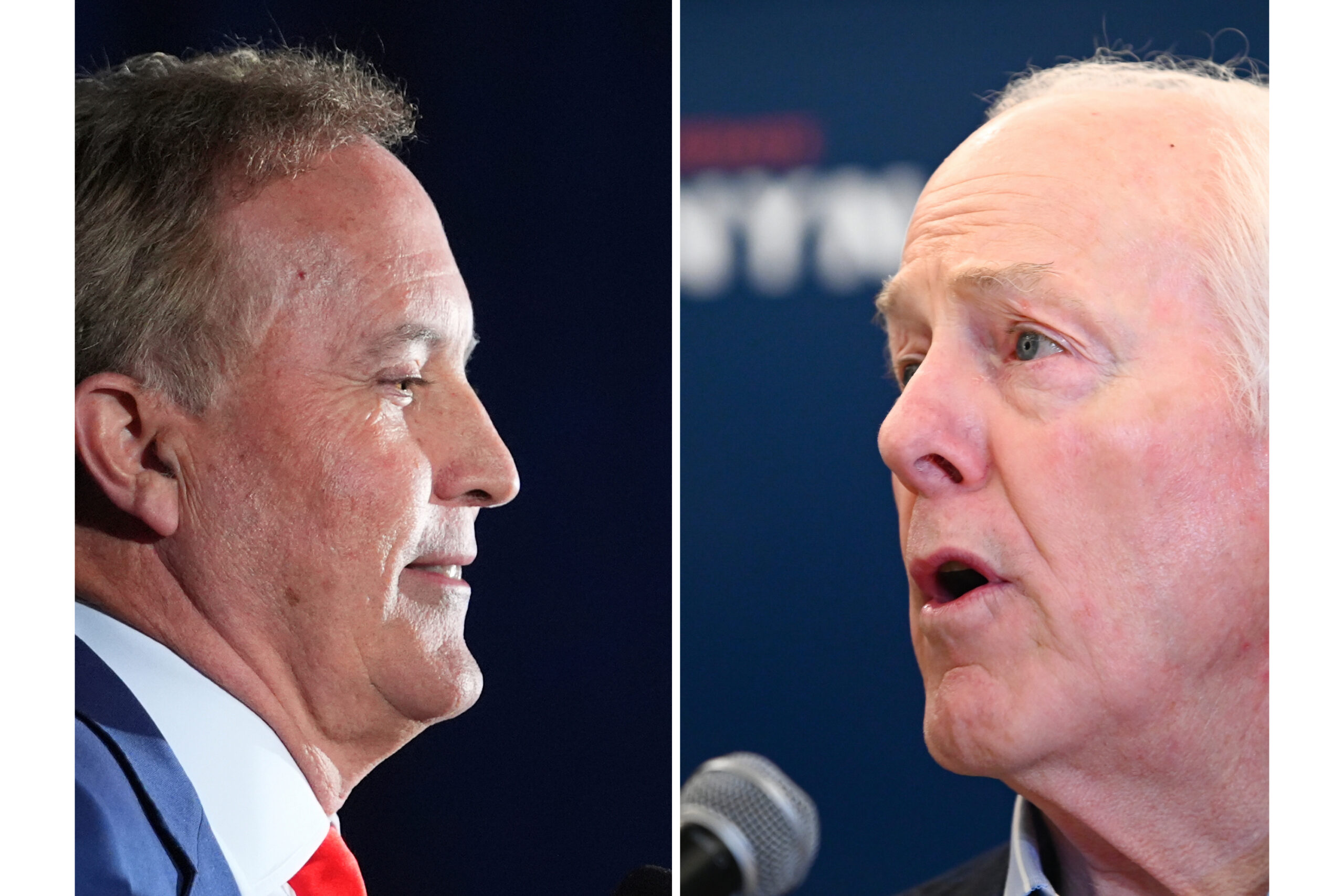
    FILE – This photo combination shows Texas Attorney General Ken Paxton, left, in Dallas and Sen. John Cornyn, R-Texas, in Austin, Texas, both on March 3, 2026. (AP Photo/Julio Cortez, Jack Myer)

    Cornyn, a fourth-term senator who is widely considered to be a stronger general-election candidate than the scandal-plagued Paxton, fell short of the 50% mark that would have avoided a runoff. Paxton was impeached by the GOP-controlled Texas House in May 2023 on charges of bribery but was acquitted by the Senate.

    Cornyn warned Paxton that “judgment” was coming for him. “I refuse to allow a flawed, self-centered, and shameless candidate like Ken Paxton to risk everything we’ve worked so hard to build,” he told reporters.

    The bitter intra-Republican warfare marked a stark contrast to the Democratic side of the ledger, where Rep. Jasmine Crockett set aside her earlier attacks on Talarico — and a legal challenge she filed Tuesday after voters were turned away from polling places in her Dallas district — and urged Democrats to come together Wednesday.

    “Texas is primed to turn blue and we must remain united because this is bigger than any one person,” Crockett wrote in a social media post.

    Talarico also urged unity, telling his supporters Tuesday, “The stakes in Texas are too high for division.”

    Mudslinging in the final weeks of the race may have caused some damage that Talarico will need to repair ahead of November, however. Crockett called the argument that Talarico was more electable than her a “dog whistle” and slammed him for not condemning ads run by a super PAC that supported him as “straight-up racist.” (Talarico does not control the super PAC, and the group denied darkening Crockett’s skin in an ad.)

    Crockett ran strong with the state’s Black voters, while Talarico appeared to run away with the Latino vote in the state. He beat Crockett by 30 percentage points or more in 21 counties that are more than 75% Latino. In counties that were 20% or more Black, Crockett won by 25 percentage points.

    Nancy Zdunkewicz, a Texas Democratic pollster, said she believed that much of the Crockett-Talarico tensions played out online rather than on the campaign trail and that the primary electorate was not divided.

    “She has conceded graciously, and I don’t want to overstate any damage done simply because of the social media dialogue, which was unnoticed by voters,” she said.

    Former Vice President Kamala Harris, who backed Crockett in the final days of the race, urged voters to unify. “I congratulate James Talarico for his win, and the inspiring campaign he continues to build,” she said in a statement. “I offer him my full support in the months ahead.”

    Republicans have a while to go before they can start their postprimary healing process, a delay that could dampen enthusiasm in November. It is also unclear whether Republicans will continue to vote with their heads instead of their hearts in May by backing Cornyn. Runoffs tend to feature a smaller, more intense group of voters compared with regular primaries, which could benefit Paxton. And it remains an open question whether Trump will support Cornyn, a nod that could put him over the top.

    Political analysts also do not know if the roughly 13% of Republicans who voted for GOP Rep. Wesley Hunt, who failed to make the runoff, will show up again in May and, if so, which candidate they would favor.

    Cornyn’s allies have warned the president that should Paxton be their nominee, the party would have to spend $200 million to get him over the finish line — a haul that would take away from other competitive Senate races Republicans are defending in Maine, North Carolina, and Ohio. Paxton historically has not been a strong fundraiser, and Democrats have nominated Talarico, whom they see as a stronger candidate than Crockett in the general election and who may take more resources to beat.

    Cornyn has Trump-connected allies on his side as they make this pitch, including Trump’s former campaign manager Chris LaCivita, who is running his super PAC, and Trump pollster Tony Fabrizio.

    Republicans in the state are sounding the alarm about record-breaking primary turnout for Democrats, which they see as a signifier of high enthusiasm going into November. Ross Hunt, a Republican pollster, called the turnout “a code red alert for Texas Republicans” in an analysis he published earlier this week. He predicted Democrats have added more than 480,000 voters to their turnout in the fall.

    “Republicans will need to do everything right this fall: we will need to select the best nominees for the General Election, maximize GOP turnout, practice intense message discipline, and have a clear-eyed and dispassionate understanding of where the new front line of defense stands after March 3rd,” he wrote.

  • Rep. Gonzales faces ethics investigation over allegations of affair with aide

    Rep. Gonzales faces ethics investigation over allegations of affair with aide

    The House Ethics Committee will investigate allegations that Rep. Tony Gonzales (R., Texas) had an affair with a former staff member who later died after setting herself on fire, the committee said Wednesday, ensuring that the scandal that has dogged Gonzales through his bitter primary race will continue to factor heavily as he heads into a runoff.

    An investigative subcommittee will look into allegations Gonzales “engaged in sexual misconduct towards an individual employed in his congressional office” and “discriminated unfairly by dispensing special favors or privileges,” Rep. Michael Guest (R., Miss.), chair of the Ethics Committee, wrote in a letter Wednesday.

    Under House rules, lawmakers are not permitted to engage in sexual relationships with staff.

    Gonzales, a married father of six, has been accused of having an improper relationship with a then-aide, Regina Ann Santos-Aviles, who died in September after lighting herself on fire in her backyard. Her death was ruled a suicide.

    Since then, the former aide’s estranged husband has shared text messages that showed Gonzales pressing Santos-Aviles for a “sexy pic” and asking her about her favorite sex position. Santos-Aviles pushed back against the lawmaker, writing, “This is going too far boss,” at one point in the May 2024 conversation.

    Gonzales recently declined to say whether the messages are authentic.

    Gonzales has denied any wrongdoing or improper relationship with Santos-Aviles, and he adamantly refused calls to resign from Congress or to end his reelection bid — several of which came from his Republican colleagues.

    Representatives for Gonzales’ office did not immediately respond to requests for comment Wednesday.

    House Speaker Mike Johnson (R., La.), who is holding onto a razor-thin majority in the House, has called the accusations against Gonzales “very serious” but not called on Gonzales to step aside, saying the issue would “play out” in his reelection bid.

    Gonzales on Tuesday fell short of the majority vote required to avoid a runoff. Now he will face off against the other top finisher in the GOP primary, Brandon Herrera, a YouTuber with a gun business who calls himself “the AK Guy.” Herrera maintained a narrow lead Wednesday morning with most of the votes counted.

    The Office of Congressional Conduct, a nonpartisan office governed by a board of private citizens, had begun looking into allegations against Gonzales in November, according to the San Antonio Express-News, and it was required to refer the matter to the House Ethics Committee by Wednesday for either further review or dismissal.

    Under House rules, the Ethics Committee has up to 90 days to release the OCC’s report — unless it creates an investigative subcommittee, as it has this time, in which case it still must release the OCC’s findings within a year. Members of the investigative subcommittee have not been selected yet, Guest said Wednesday, suggesting findings of the investigation will not be made public very soon. There is no timeline for Ethics Committee investigations, which can take months.

    Rep. Nancy Mace (R., S.C.), one of the GOP lawmakers who has called on Gonzales to resign, introduced a resolution last week that would compel the Ethics Committee to release, within 60 days of adoption, all reports related to sexual harassment violations involving lawmakers, their staff members, or lobbyists.

    “I mean, literally, [Santos-Aviles] killed herself in the most heinous way,” Mace told Fox News on Tuesday, referring to the Gonzales allegations that she said had motivated her to introduce the bill. “She literally lit herself on fire and died, and we’re just going to sit here and say, ‘Let the process play out’? No.”

    Voters do not always punish scandals, and this was apparent Tuesday night in other Texas primary races. Rep. Henry Cuellar (D., Texas) handily defeated a primary challenger, despite being charged in 2024 with bribery, money laundering, and conspiracy and being pardoned by President Donald Trump last year.

    Texas State Attorney General Ken Paxton, who faced a lengthy impeachment trial and a very public divorce in which his wife accused him of adultery, nevertheless will head into a runoff against Sen. John Cornyn (R., Texas) for his seat after neither captured a majority of the vote Tuesday.

  • Top defense officials push back on concerns about U.S. munitions shortage

    Top defense officials push back on concerns about U.S. munitions shortage

    The Pentagon is rapidly burning through its stocks of precision weapons less than a week into the massive campaign of airstrikes against Iran, while also expending sophisticated air defense missiles at a rate that puts the U.S. military potentially “days away” from having to prioritize which targets to intercept, according to three people familiar with the matter.

    The scope of “Operation Epic Fury,” which U.S. Central Command’s Adm. Brad Cooper says has hit more than 2,000 targets so far, is forcing U.S. military commanders to make difficult calculations about how quickly their Iranian adversaries will burn through their own munitions — even as President Donald Trump says the war may last four to five weeks.

    Top Pentagon leaders dedicated considerable time at a news briefing Wednesday morning to addressing worries the military is reaching too deeply into its inventory at the cost of readiness. “We have sufficient precision munitions for the task at hand, both on the offense and defense,” said Gen. Dan Caine, chairman of the Joint Chiefs of Staff, without offering specifics or numbers.

    The United States will rely on its larger stores of less-sophisticated weapons as Iranian defenses are degraded in the coming days, allowing American forces to get closer for their attacks, he said.

    “The hardest hits are yet to come from the U.S. military,” Secretary of State Marco Rubio told reporters Monday before a classified briefing with select lawmakers.

    In retaliation, Iran has launched thousands of one-way attack drones and hundreds of missiles at an array of U.S. military installations and civilian targets across the region, including in Bahrain, Kuwait, Iraq, Israel, and the United Arab Emirates. At least six U.S. troops were killed in a drone attack in Kuwait, and U.S. Embassies in Riyadh, Saudi Arabia, and Kuwait City have come under Iranian fire.

    So far, the U.S. military has expended hundreds of its most sophisticated munitions, including Patriot and Terminal High Altitude Area Defense (THAAD) interceptors — considered the world’s premier missile defense systems — and Tomahawk cruise missiles aimed at Iranian leaders and ballistic missile sites, four people familiar with Pentagon assessments said, speaking on the condition of anonymity to discuss the highly sensitive numbers.

    Late Monday night, Trump posted on social media that the U.S. inventories of “medium and upper medium grade” munitions are “virtually unlimited” and could sustain the pace of attacks in Iran indefinitely. He also wrote that weapons at “the highest end” are in “good supply, but are not where we want to be.”

    A spokesperson with U.S. Central Command, which oversees operations in the Middle East, referred questions to the Pentagon.

    A Pentagon spokesperson, Sean Parnell, said in a statement Tuesday that the military “has everything it needs to execute any mission at any time and place of the President’s choosing and on any timeline.” Trump and Defense Secretary Pete Hegseth, Parnell added, “have made restoring American military dominance their top priority from day one, and American dominance has been proved again and again following every major military operation under this administration.”

    Behnam Ben Taleblu, who tracks Tehran’s weapons programs at the Foundation for Defense of Democracies, a think tank, said Iran had more than 2,000 ballistic missiles before the conflict began and “many more-fold” drones.

    “It is very apparent it has learned lessons from the 12-day war” in June and is trying to use its weaponry more efficiently, Taleblu said.

    Iran, he said, is targeting the United States’ Persian Gulf allies with low-cost drones to terrorize and exhaust limited air defenses, while focusing its ballistic missile attacks on Israel.

    “Iran is firing smaller volleys of missiles, signaling an interest in preserving their stocks while still testing and attriting Israel’s air and missile defenses,” Taleblu said. “The goal over time is to make Israel focus its dwindling interceptor stocks on defending smaller patches of terrain.”

    “Iran is conscious of missile math, perhaps more so than ever before,” he said.

    For the U.S., the trends underscore the urgency of an “effective defanging operation” that aggressively destroys Iran’s missile caches and infrastructure, he added.

    The rate at which the U.S. military is expending its most sophisticated munitions has slowed since the first day of the conflict, in which Iran fired many of its highest-end weapons, a U.S. official said, noting that the pace has not fallen “dramatically.”

    In the days since, the U.S. and Israel have established air superiority, allowing fighter jets to soon fly closer to targets and use less expensive munitions such as precision-guided glide bombs, the official said, speaking on the condition of anonymity to describe ongoing operations.

    Hegseth said Wednesday that the Pentagon would increasingly rely on massive GPS-guided gravity bombs, “of which we have a nearly unlimited stockpile,” and that the military would “no longer need” to dip into its inventory of more sophisticated weapons.

    “Iran cannot outlast us,” Hegseth said.

    U.S. munitions stocks have been depleted by years of trade-offs in the defense budget, aid to countries such as Ukraine, and more recently the Trump administration’s vast use of the military to carry out its foreign policy. After little more than a year in office, Trump has launched attacks in seven countries — Iraq, Iran, Nigeria, Somalia, Syria, Venezuela, and Yemen — and fired dozens of missiles in more than 40 strikes on alleged drug traffickers at sea around Latin America.

    “When you combine the amount of munitions that we have spent over the last year attacking the Houthis, the amount of munitions that are spent on … the seven different military conflicts the president has put America into, our munitions are low,” Sen. Mark Warner of Virginia, the ranking Democrat on the Senate Intelligence Committee, said after attending the briefing with Rubio and other top Trump officials Monday.

    The Washington Post previously reported that Caine warned Trump ahead of the operation that an extended campaign posed acute risks for the U.S. military, including a drain on its limited stores of precision weapons, according to multiple people familiar with the discussions.

    Following classified briefings before each chamber of Congress on Tuesday, Sen. Andy Kim (D., N.J.) said he asked Caine about the number of munitions the U.S. has depleted compared with Iran. The general, Kim said, did not provide specifics but was not “raising alarms himself” while speaking with lawmakers.

    Still, the scarcity could intensify a long-term problem for America’s ability to deter a conflict with China, particularly around the self-governing island of Taiwan, where Beijing has hosted increasingly complex and aggressive military drills in recent years.

    Two of the people familiar with the U.S. inventories said that an extended conflict in the Middle East could require drawing down munitions stocks in the Indo-Pacific region. A separate U.S. official, speaking on the condition of anonymity to describe the sensitive state of munitions, said that inventories were so thin that a lengthy campaign against Iran would not leave enough munitions for other threats, especially China.

    The first U.S. official said that senior U.S. military leaders around the world are making decisions now about where to reallocate munitions, based on assessments of how far they can dip into stockpiles.

    Warner and House Speaker Mike Johnson (R., La.) said that the operation will almost certainly require Congress to pass supplemental money for the Defense Department to replace stocks spent during the attack, though the specific dollar figure would depend on the length of the ongoing campaign in Iran.

    Sen. Chris Coons of Delaware, the top Democrat on the Senate Appropriations defense subcommittee, has asked the administration to provide the cost of munitions expended in the war, and said he expects the supplemental funding request to be “in the billions” of dollars.

  • Bettors wagered $54 million on Khamenei’s death. Now they’re not getting paid.

    Bettors wagered $54 million on Khamenei’s death. Now they’re not getting paid.

    When he learned last weekend about the killing of Iran’s Ayatollah Ali Khamenei, the Israeli American business executive in New York was excited to cash in.

    On the prediction-market site Kalshi, the executive — who spoke on the condition of anonymity due to concern over what his friends would think — had placed two bets, totaling $3,460, that Khamenei would be “out as Supreme Leader” by March or April 1. His Kalshi app placed green check marks next to his bets, indicating he had won payouts worth more than $63,000.

    Minutes later, however, Kalshi froze the $54 million trade for everyone who bet on that scenario, saying the site does not allow transactions “directly tied to death.” The change triggered an online uproar, as Kalshi users flooded social media to argue the site had unfairly robbed them of winning bets.

    “I was booking my trip to Courchevel,” the French Alps ski resort, he said jokingly to the Washington Post. “Then they changed the rules … and everybody got screwed.”

    The outrage has intensified scrutiny into the explosive rise of prediction markets, which run like traditional sportsbooks but allow people to gamble on elections, international affairs, and real-world events.

    Supporters of Kalshi and its biggest competitor, Polymarket, have defended the sites as game-like platforms for following and perhaps profiting off the news. But critics like Sen. Chris Murphy (D., Conn.) have said they are creating a more “dystopian world” by helping people gamble on life-and-death crises and military assaults in a way that could incentivize political violence.

    “This is American commercial immorality on steroids,” Murphy said in an interview. “Once events that involve good and evil simply become a financial product, I don’t know how right and wrong matters any longer. … People shouldn’t be rooting for people to die because they placed a bet.”

    Kalshi heavily promoted the trade to bettors on its home page and app and in push notifications before Khamenei’s death was publicized. Kalshi also tweeted the morning of the strike that the odds “Khamenei is out as Supreme Leader have surged to 68%,” along with a disclaimer that Kalshi did not broker trades that “settle on death.” In a follow-up, the company said the post was “grammatically ambiguous” and offered to reimburse traders’ lost value.

    Murphy said in an interview he is drafting legislation that would broadly ban prediction-market trades related to government actions, saying they could corrupt public decision-making by allowing military or government officials to profit off secret information.

    Polymarket said in August that the president’s eldest son, Donald Trump Jr., had joined its advisory board, and a handful of recent bets on the administration’s moves have sparked public accusations of insider trading.

    The analytics firm Bubblemaps said it found six “suspected insiders” on Polymarket that had made $1.2 million by betting that the U.S. would hit Iran by Feb. 28, the date that Operation Epic Fury began. All of the accounts were made last month and bet exclusively on Iran-strike timing; some of the bets were made within hours of the first explosions in Tehran. One account bet $60,000 and won $560,000.

    Murphy said in an online post that the trades indicated “people around Trump are profiting off war and death.” Davis Ingle, a White House spokesperson, said on Monday that “the only special interest guiding the Trump administration’s decision-making is the best interest of the American people.”

    Polymarket did not respond to questions about whether it knew or would help investigate whether the account holders had internal knowledge of the military campaign. Donald Trump Jr. did not respond to requests for comment.

    A similar debate played out in January when an anonymous Polymarket trader won roughly $400,000 after successfully predicting, within a few hours, the timing of Venezuelan President Nicolás Maduro’s capture. The Defense Department said then that it prohibited personnel from using classified information for personal gain.

    In the case of Khamenei, Kalshi has argued that the trade, known as an “event contract,” was not specifically a bet on his demise. The company’s chief executive, Tarek Mansour, said on X that long-standing rules ban people “from profiting from death” but that he believed the trade was still “important because leadership changes in Iran have major impact on the world order,” including on oil prices and geopolitical relations.

    “It’s always possible for a ruler to step down or transition power without death, even in autocracies. It just happened in Venezuela,” Mansour said.

    Furious Kalshi bettors have since flooded social media to argue that the site’s rules were muddled and that they believed they would be paid out upon his death. In one video, the cryptocurrency-content creator Gabriel Haines mocked Kalshi by saying, “We meant a peaceful transition or riding off on a unicorn to kiss [Israeli Prime Minister Benjamin] Netanyahu on a cheek.”

    Some users have vowed to close their Kalshi accounts and take their money elsewhere, with one posting, “You owe me $2,500+ & you owe many innocent, casual traders millions more.”

    Amanda Fischer, a former chief of staff at the Securities and Exchange Commission who now works as a policy director at the financial advocacy group Better Markets, said the trade offered a “really good mini-model of just how problematic this business is.”

    “How is an 86-year-old theocratic leader supposed to lose his power other than through death?” Fischer said. “All of the Kalshi users who placed bets on this believed they were voting on a death market, and many are very angry at how Kalshi broke the trades.”

    Lawmakers have worried that allowing death-related trades could offer fatal incentives; an assassin, for instance, could plan and then profit off the date of a victim’s death. “There’s a reason we don’t let people take fire insurance policies out on [other people’s homes] — because it would incent arson,” Fischer said.

    The Commodity Futures Trading Commission, which regulates prediction markets, bans any bets that involve or reference terrorism, assassination, or war, and six Democratic senators sent a letter last month voicing concern about any bet that “resolves upon or closely correlates to an individual’s death.”

    Dustin Gouker, a gaming-industry consultant and the publisher of Event Horizon, a newsletter about prediction markets, said Kalshi could have a financial incentive to keep the rules vague. It could have specified that the bet would pay out only in the case of a peaceful regime change, but that might have reduced bettors’ interest — and the ensuing fees Kalshi earns from every transaction.

    “They could have easily made the title ‘by way other than death,’ but that’s obviously not as exciting to trade, and that’s why they didn’t do it,” Gouker said.

    Kalshi has sought to quiet the firestorm by reimbursing any bets, fees, or losses from the trade, which Mansour said led the company to incur “a substantial loss to make users whole.” A person familiar with Kalshi discussions, who spoke on the condition of anonymity to detail internal deliberations, said the payments have cost the company roughly $2.2 million.

    Mansour said that the company did not change the trade rules after the incident but that a disclaimer on the listing noting the company’s “death carveout” exception has been overly confusing and will be revised for future bets. Some bettors have pointed out that, after former President Jimmy Carter died, the company paid users who had bet that Carter would not attend President Donald Trump’s inauguration.

    For some in the industry, the episode has triggered a moment of self-reflection. Aaron Courtney, the cofounder of market-tracking firm Kalshinomics, said in an online essay that war-related trades are “simultaneously one of the most important and most uncomfortable things prediction markets have produced” and have raised big questions. “Is it morally acceptable to profit from correctly predicting that bombs will fall on people?” he asked.

    Polymarket, however, has trumpeted its war-related bets, saying in a note that prediction markets’ ability to create forecasts for world affairs is “particularly invaluable in gut-wrenching times like today” and can give people “the answers they needed in ways TV news and X could not.”

    While Kalshi is regulated in the United States, Polymarket operates under different trade rules overseas, and its users have bet more than $500 million on trades related to the timing of American strikes against Iran, according to platform data. Unlike Kalshi, Polymarket has not frozen trades for bettors wagering that Khamenei would be “out as Supreme Leader” by the end of this month; its trading volume now stands at more than $61 million.

    On the first morning of the assault, Polymarket posted a meme image of a man with five screens laying out bets about Khamenei’s ouster and the caption, “Can’t right now babe, I’m monitoring the situation.”

    But Polymarket now faces its own questions around potential insider trading. Murphy said in an interview on Monday that he was horrified by the “corrupt and immoral” trades, adding, “It doesn’t smell right to people that these markets are rigged and people inside know the answers … making thousands off whether we send their kids to war.”

    Emily Austin, a conservative influencer and sports podcaster who has promoted Polymarket online, said she had friends and siblings who were upset about lost winnings on Kalshi’s Khamenei bet. Despite the scandal, however, she said her love of prediction-market betting remains as strong as ever. She said she sees the bets as a “social community” and a way to keep in touch with friends.

    “I’ve been a huge sports bettor since I was allowed to legally bet, but I never thought you’d be able to bet on world leaders being out,” she said. “And if I’m being totally honest, I find it so fun.”

  • Commerce Secretary Lutnick to appear before House panel investigating Epstein

    Commerce Secretary Lutnick to appear before House panel investigating Epstein

    Commerce Secretary Howard Lutnick, a former Manhattan neighbor of Jeffrey Epstein, has agreed to voluntarily testify before the House Oversight Committee as part of its investigation into the convicted sex offender, the panel’s chairman announced Tuesday.

    Lutnick has faced growing bipartisan pressure to testify about his ties to Epstein following the Justice Department’s release of a tranche of documents that suggested Lutnick maintained contact with Epstein years after claiming to have distanced himself from him.

    “Secretary Lutnick has proactively agreed to appear voluntarily before the House Committee on Oversight and Government Reform,” Rep. James Comer (R., Ky.), the committee’s chairman, said in a statement. “I commend his demonstrated commitment to transparency and appreciate his willingness to engage with the Committee. I look forward to his testimony.”

    Lutnick’s connection to Epstein also has caused controversy at Haverford College, where president Wendy Raymond is considering convening a committee that would review whether the mega donor’s name should remain on the campus library.

    Lutnick will soon become the latest participant in a series of high-profile interviews conducted by the committee for its Epstein probe — the most recent of which included former President Bill Clinton and former Secretary of State Hillary Clinton. They took part in a pair of contentious, closed-door depositions in New York last week.

    The Department of Commerce did not immediately respond to a request for comment about Lutnick’s interview.

    “I look forward to appearing before the committee. I have done nothing wrong and I want to set the record straight,” Lutnick said in a statement to Axios, which first reported his planned appearance.

    Testifying before Congress last month, the commerce secretary said he recalled meeting with Epstein three times over the course of 14 years. Lutnick also said he and his family had lunch with Epstein on his Caribbean island in 2012 — after previously claiming that he and his wife had distanced themselves from Epstein around 2005.

    The exchanges made public by the Justice Department show that Lutnick, a former chairman of the financial services firm Cantor Fitzgerald, and Epstein kept communicating years after Epstein pleaded guilty to two charges of soliciting prostitution, including one involving a minor, and was sentenced to 13 months in jail.

    Their last known exchange in the Justice Department documents came in 2018, when Lutnick reached out to Epstein about the Frick Collection, a museum near their neighboring homes, planning construction.

    “Are you aware as to them building to block our park views,” Lutnick wrote in an email that his assistant forwarded to Epstein, “What should we do about it? Time is of the essence.” Lutnick also urged Epstein to involve a lawyer, to which Epstein replied, “Will do.”

    The following year, Epstein was arrested on federal sex trafficking charges and later died in federal custody. His death was ruled a suicide.

    Some lawmakers, including Rep. Robert Garcia of California — the top Democrat on the House Oversight Committee — as well as Rep. Thomas Massie (R., Ky.), have called for Lutnick to step down over his connection to Epstein. But President Donald Trump last week signaled he remained confident in Lutnick.

    “Howard would go in and do whatever he has to say,” Trump told reporters on Friday about possible Epstein testimony. “He’s a very innocent guy. He’s doing a good job.”

    The Oversight Committee has already scheduled depositions for Darren Indyke and Richard Kahn, the co-executors of Epstein’s estate, this month. And Rep. Anna Paulina Luna (R., Fla.) has said she plans to ask the committee to bring in “some of the [Epstein] co-conspirators that were given lesser sentences that were known to have trafficked young girls.”

    Garcia told the Washington Post that if Democrats retake the House in November and become the majority next year, they will “absolutely” pursue an interview with Trump regarding Epstein. “There’s a long list of subpoenas that we will be engaged in,” Garcia added.

  • Who leads Iran now? An uncertain path to new supreme leader after Khamenei’s death.

    Who leads Iran now? An uncertain path to new supreme leader after Khamenei’s death.

    Iran announced the first step in a succession process that remains opaque and fraught with uncertainty Sunday after the government confirmed the killing of Supreme Leader Ayatollah Ali Khamenei in U.S. and Israeli attacks.

    What comes next is uncertain. Iran’s constitution calls for an assembly of experts to choose the next supreme leader, but that may not be possible in wartime. And with so many of the country’s top leadership reportedly targeted in the U.S. and Israeli strikes, it is unclear who remains among the country’s power brokers and those considered candidates to replace Khamenei.

    “The martyrdom of the Supreme Leader at the hands of Israel and the criminal America was a great disaster for our country,” said Iranian President Masoud Pezeshkian in an address to the nation Sunday, his first since the conflict erupted.

    An interim leadership council assumed its duties and began leading the country, Pezeshkian said. “With the power of God, we will continue the path of the Imam, the path of the dear leader, and the path of all those who seek justice in the world with power,” he said.

    Long anticipated, the succession of Iran’s 86-year-old supreme leader was always expected to bring with it a degree of regime instability. But now, that will likely be magnified, with various rivals and factions jockeying for wartime power amid vastly diminished popularity and perhaps support among Iran’s military establishment.

    Iran has only held one other supreme leader succession, that which brought Khamenei to power in 1989 after the death of Ayatollah Ruhollah Khomeini, the founder of the Islamic Republic. Though the process is outlined in the country’s constitution and the Iranian system has had years to prepare, experts caution that a smooth process is nearly impossible.

    “Irrespective of what the guidelines say and what the politics may have been, it was always going to be improvisational,” said Suzanne Maloney, a vice president at the Brookings Institution who has advised both Democratic and Republican administrations on Iran policy.

    “Under the circumstances of an existential conflict, the succession process is going to be very much dictated by the context of the moment,” Maloney said. In the near term, she expects Iran to keep the temporary council in place.

    The supreme leader is both the head of state in Iran and a religious figure, believed to be a representative of God by his Shiite followers. Khamenei served in the position for 37 years, during which time he greatly expanded the power and scope of rule over the democratically elected civilian government. As supreme leader, Khamenei had the last say on all matters in the country, but often only arrived at decisions after a lengthy consultative process.

    Iran’s former president, Ebrahim Raisi, had long been considered the next in line to Khamenei. But after Raisi’s death in a 2024 helicopter accident, the question of succession has remained open, creating a kind of power vacuum. Several names have been considered front-runners, but most lack a significant public profile.

    One of the top contenders on the interim council appointed Sunday is Ayatollah Alireza Arafi, who has deep ties to the Iranian system and security establishment. He is a member of the guardian council and the assembly of experts, the body that chooses the next supreme leader.

    After Raisi’s death, one of Khamenei’s sons, Mojtaba, was widely expected to be the favored successor, but Khamenei was reportedly against the idea of transferring the position along hereditary lines. Others in Iran feared such a move would echo the very ruling system — the shahs of the Pahlavi dynasty — that the Islamic republic under Khomeini toppled in 1979.

    It’s unclear how many figures from Khamenei’s inner circle were killed alongside him or elsewhere during U.S. and Israeli strikes. The status of his son Mojtaba remains unclear, but state media confirmed Khamenei’s son-in-law and daughter-in-law were killed Saturday.

    “The structure of the Islamic Revolution has been designed in such a way that after the martyrdom of any commander, at any rank or level, qualified and capable individuals immediately replace them,” read a report Saturday from the state-run Fars News Agency.

    As long as the war continues, the succession process could remain a secondary concern to Iran’s remaining leadership, according to Alex Vatanka, an Iran analyst with the Middle East Institute.

    “The succession process is not key in the short term because they’re going to try and fight on. Firing off missiles does not require a supreme leader,” he said. But if Iran’s regime survives war with the United States and Israel, the supreme leader’s role could be critical to holding the system together in a weakened state.

    Already this year, Iran faced massive nationwide protests that began in response to economic grievances but quickly morphed into thundering calls for an end to the regime. The protests plunged the country into crisis and Iran’s leadership chose to respond to the unrest with overwhelming violence, killing thousands of people in a matter of days.

    In the aftermath of the protests, many Iranians reached by the Washington Post described deep, simmering anger toward their government. And some said they were eagerly anticipating a U.S. attack as President Donald Trump threatened Iran with an expanding military buildup over the past month.

    Celebrations broke out in Tehran and other parts of the country after news of Khamenei’s death Saturday night. Amid the ongoing near-total internet blackout it was impossible to determine how widespread the celebrations were. But Iranians reached inside the country by the Post reported that security forces were deployed Saturday night to break up the revelers.

    When Trump announced the initial waves of U.S. and Israeli attacks against Iran he issued a direct call to the Iranian people.

    “Bombs will be dropping everywhere. When we are finished, take over your government. It will be yours to take,” Trump said. “This will be probably your only chance for generations.”

    Prominent members of Iran’s opposition are hoping Khamenei’s death will build momentum for protests and demonstrations. Reza Pahlavi, the son of Iran’s deposed shah and a prominent opposition exile, has repeatedly called on Iranians to rise up against the regime. After Khamenei’s death he issued a renewed call to the country’s security forces to defect.

    “Any attempt by the remnants of the regime to appoint a successor to Khamenei is doomed to fail from the outset,” he wrote. Though he has lived in exile for most of his life, Pahlavi is Iran’s most prominent opposition leader, and in recent mass protests inside the country Iranians chanted for his return.

    “To the military, law enforcement, and security forces: any effort to preserve a collapsing regime will fail,” he said in a social media post.