Category: Washington Post

  • Justice Dept. reverses course and seeks to defend orders targeting law firms

    Justice Dept. reverses course and seeks to defend orders targeting law firms

    The Trump administration said Tuesday that it still wanted to defend President Donald Trump’s executive orders sanctioning several law firms, abruptly reversing course from its position a day earlier.

    Judges last year blocked Trump’s orders aimed at the firms, which had hired his perceived foes or took on cases he disliked. The Justice Department was appealing those rulings and trying to restore the orders, which demanded that the firms lose access to government contracts and buildings.

    On Monday evening, the agency said in a filing that it wanted to abandon the appeals, essentially admitting defeat. The law firms hailed that decision, with one saying the administration “capitulated.”

    But in a startling turnaround less than 24 hours later, the administration wrote in a brief filing in the U.S. Court of Appeals for the D.C. Circuit that it was seeking to withdraw its motion from a day earlier.

    The Justice Department did not explain in the filing why it was backpedaling, stating only that it was its prerogative to keep appealing and adding that the court had not yet granted its request to dismiss the case. The White House declined to comment, referring questions to the Justice Department. A spokeswoman for the agency also declined to comment.

    The four law firms involved — WilmerHale, Jenner & Block, Perkins Coie and Susman Godfrey — had all filed lawsuits challenging Trump’s sanctions, saying they could devastate their businesses.

    Judges sided with all four firms last year, issuing often scathing rulings that rebuked the president’s orders as retaliatory and unconstitutional.

    “The order shouts through a bullhorn: If you take on causes disfavored by President Trump, you will be punished!” U.S. District Judge Richard J. Leon, who was appointed by President George W. Bush, wrote while blocking sanctions for WilmerHale.

    The administration has repeatedly defended the orders as lawful and criticized judges who ruled against them. In court papers and during hearings, the Justice Department has said the orders were not meant as punishment and suggested that the firms’ lawsuits infringed on Trump’s speech.

    The government’s contradictory filings this week came ahead of a looming deadline in its appeals. The Justice Department’s opening brief in the case is due Friday, while the firms have briefs due in late March.

    The firms criticized Trump’s executive orders and his administration’s reversal alike on Tuesday. The Justice Department “offered no explanation to either the parties or the court for its reversal,” Perkins Coie said in a statement.

    “Yesterday evening, the Administration told the Court that it gave up and wouldn’t even try to defend its unconstitutional executive orders,” Susman Godfrey said in a statement. “Today, it reversed course. Regardless, Susman Godfrey will defend itself and the rule of law — without equivocation.”

    In its filing on Tuesday, the Justice Department said the administration contacted attorneys for the firms and that they all opposed the move.

    The filing included a statement attributed to the firms that said they “oppose the government’s unexplained request to withdraw yesterday’s voluntary dismissal, to which all parties had agreed. Under no circumstances should the government’s unexplained about-face provide a basis for an extension of its brief.”

    The New York Times first reported Tuesday that the government would try to continue defending the executive orders.

    While the firms involved in the appeals had fought Trump’s orders, other legal practices instead sought to avoid such battles. Nine firms struck deals with him to lift or avoid similar penalties, leading to intense upheaval and outrage across the legal industry.

    The first firm to strike an agreement, Paul Weiss, pledged $40 million in pro bono work on issues that included assisting veterans. Eight more firms, including some of the country’s wealthiest, struck deals for increasingly large amounts as well, with combined pledges of pro bono work reaching nearly $1 billion.

    These deals sent shock waves across the legal industry. The firms that reached the agreements defended them as needed to keep their businesses afloat, and their leaders vowed that the deals would not change their work.

    But many attorneys were deeply skeptical of these pledges, expressing outrage internally as well as publicly. Lawyers at some firms resigned in protest following deals with Trump, while others left places that made deals and joined offices that were fighting his executive orders.

  • White House offers shifting rationales for war with Iran

    White House offers shifting rationales for war with Iran

    As an expanding Middle East war entered its fourth day, the Trump administration gave shifting rationales for its decision to attack Iran, even as U.S. officials with access to intelligence reports said they saw no sign the country had posed an imminent threat to the United States.

    President Donald Trump and his top national security aides, defending a conflict that has tepid public backing and is incurring escalating risks, emphasized Iran’s arsenal of ballistic missiles rather than its nuclear program as the principal threat. But they provided different descriptions of the danger.

    At his first public event since the attack began, Trump on Monday never mentioned a key part of his original rationale for the war: deposing Iran’s theocratic regime.

    Instead, he emphasized that Iran would “soon” have missiles that could hit targets inside the United States.

    What Trump had outlined over the weekend as an effort to devastate Tehran’s rulers so that the Iranian people could take over was, by Monday, “not a so-called regime change war,” in the words of Defense Secretary Pete Hegseth.

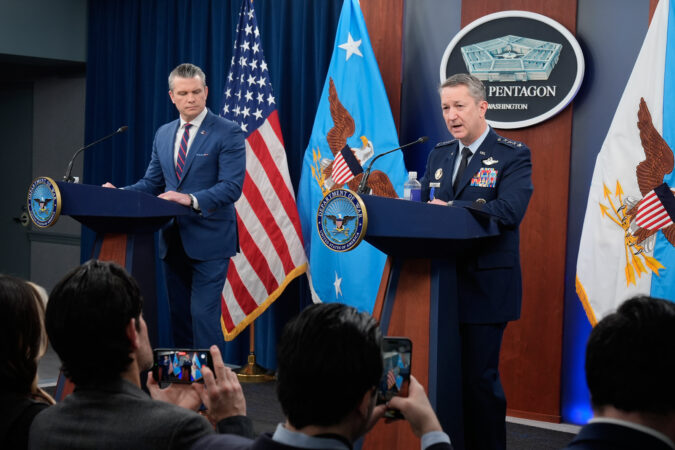
    Hegseth told reporters at the Pentagon that the Islamic Republic was building sophisticated missiles and other conventional weapons to shield its plans for a nuclear bomb. “Iran had a conventional gun to our head as they tried to lie their way to a nuclear bomb,” he said.

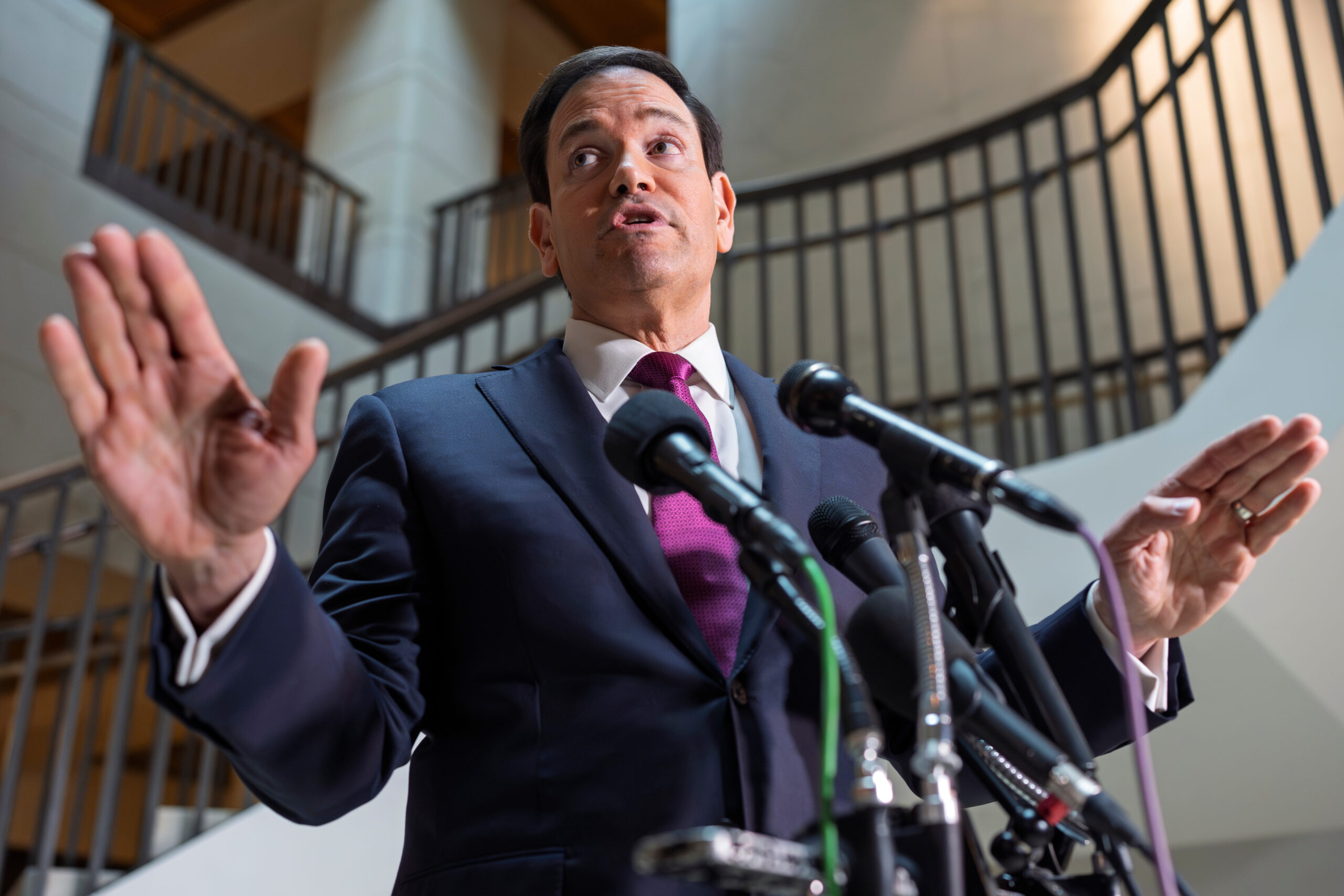
    Secretary of State Marco Rubio offered a third line of reasoning. The United States, he said, knew Israel was going to strike Iran, which would lead to counterattacks against U.S. forces and potential casualties, and decided to strike first to minimize the risk.

    Secretary of State Marco Rubio speaks to reporters as he arrives for an intelligence briefing with top lawmakers on Iran, at the Capitol in Washington, Monday, March 2, 2026. (AP Photo/J. Scott Applewhite)

    Iran’s voluminous missile arsenal, which was thinned by U.S.-Israeli strikes last June but still considered dangerous, consists mostly of short-range missiles threatening U.S. bases and allies in the Middle East. Over the last two years, Iran has fired those missiles in response to attacks on its territory or interests, but not preemptively.

    As for an intercontinental ballistic missile capable of directly reaching the United States, the Pentagon’s Defense Intelligence Agency reported last year that Iran could have that weapon by 2035 “should Tehran decide to pursue the capability.”

    Meanwhile, more than three days into the conflict and after more than a thousand airstrikes, U.S. and Israeli weapons so far have largely left Iran’s main nuclear installations untouched, suggesting those sites — significantly damaged last June — are not currently seen as a priority threat.

    The White House’s shifting public goals for the war, and questions about the intelligence behind them, have contributed to a lack of clarity about when Trump might declare an end to the largest military operation since the 2003 invasion of Iraq.

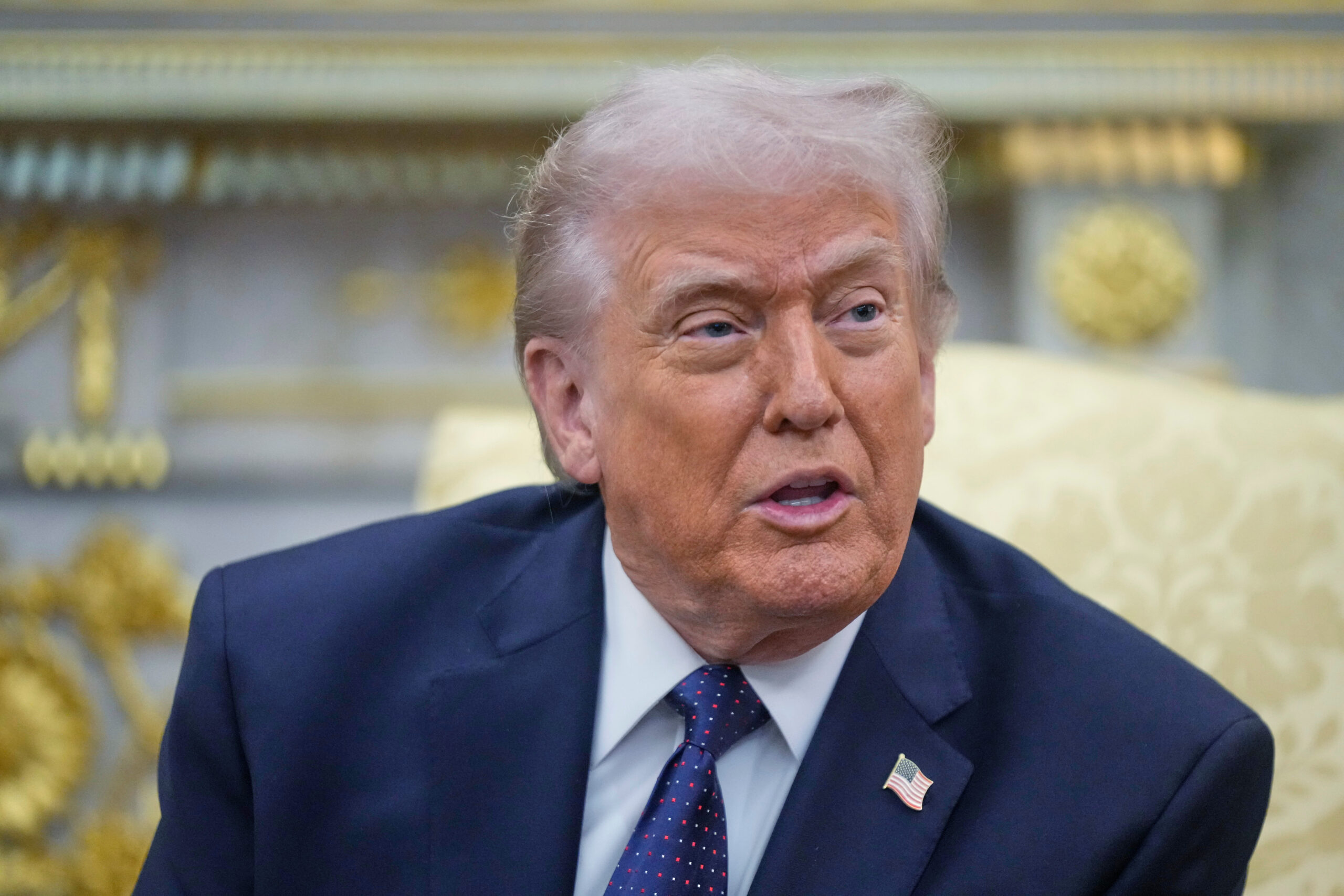
    As the war widened across the Middle East, Trump said operations against Iran could go on for four to five weeks, or longer. In an interview with the New York Post, the president said he would not rule out sending in U.S. ground troops, but added that they are “probably” not needed.

    President Donald Trump speaks during a meeting with German Chancellor Friedrich Merz in the Oval Office at the White House, Tuesday, March 3, 2026, in Washington. (AP Photo/Mark Schiefelbein)

    Republican lawmakers have largely backed Trump’s decision to strike Iran, citing its long record of terrorism against the United States and its allies, and its nuclear ambitions.

    But Rubio’s decision to pin the justification for the attack on Israel angered prominent MAGA commentators and conservative pundits, who said an operation of this magnitude should be done squarely in the interests of the United States.

    “My own feeling is no one should have to die for a foreign country. I don’t think those four service members died for the United States,” said Trump advocate and podcast host Megyn Kelly, referring to the first four acknowledged U.S. deaths in the war, a toll that later rose to six. “I think they died for Iran or for Israel.”

    In a social media post Monday night, Iranian Foreign Minister Abbas Araghchi piled on. “Mr. Rubio admitted what we all knew: U.S. has entered a war of choice on behalf of Israel. There was never any so-called Iranian ‘threat,’” he wrote.

    This week, the House and Senate are poised to vote on measures that would attempt to halt further military attacks in Iran without lawmakers’ approval, as Democrats frame the conflict as an “illegal war” launched without a clear rationale or an authorization from Congress.

    A Washington Post flash poll found that 52% of Americans oppose the strikes “strongly” or “somewhat,” while 39% support them.

    Even as the administration’s public case for war shifted, several U.S. officials with access to classified intelligence assessments said there was no information before the strikes began indicating Iran has made sudden, worrisome progress in its missile or nuclear programs.

    “There was no imminent threat to the United States of America by the Iranians. There was a threat to Israel,” Sen. Mark Warner (D., Va.), the vice chair of the Senate Intelligence Committee, told reporters Monday.

    Others said Iran’s weakness, amid severe economic problems and protests that challenged the regime, provided an opportunity to strike.

    A former U.S. intelligence official said American spy agencies were concerned by the speed with which Iran reconstituted its missile program after the 12-day war in June. “If you wait a year from now, maybe the regime will have stabilized, the missile program will be more populated and federated,” said the former official, who spoke before the strikes began and requested anonymity to discuss a sensitive subject.

    With Trump a potentially lame duck president in a year’s time, “Right now is the sweet spot,” he said.

    Multiple legal experts argued that none of the administration’s public explanations for the attacks appeared to constitute a legitimate rationale to enter into such a major conflict, especially without authorization from Congress.

    “Having a weapons capacity is not the same thing as presenting an imminent threat of an armed attack,” said Tess Bridgeman, a former senior lawyer on the National Security Council during the Obama administration.

    The first days of U.S. and Israeli airstrikes appeared focused on decapitating Iran’s leadership and blunting its ability to retaliate by destroying missile infrastructure and disrupting its military command network.

    Rafael Grossi, head of the International Atomic Energy Agency, said Monday that the U.N. nuclear watchdog agency has seen no “major military activity targeting the nuclear facilities” in Iran since the U.S.-Israeli attacks began early Saturday. That assessment, he said, is based on information from Iran as well as multiple satellite images, including those provided “by the U.S. and others.”

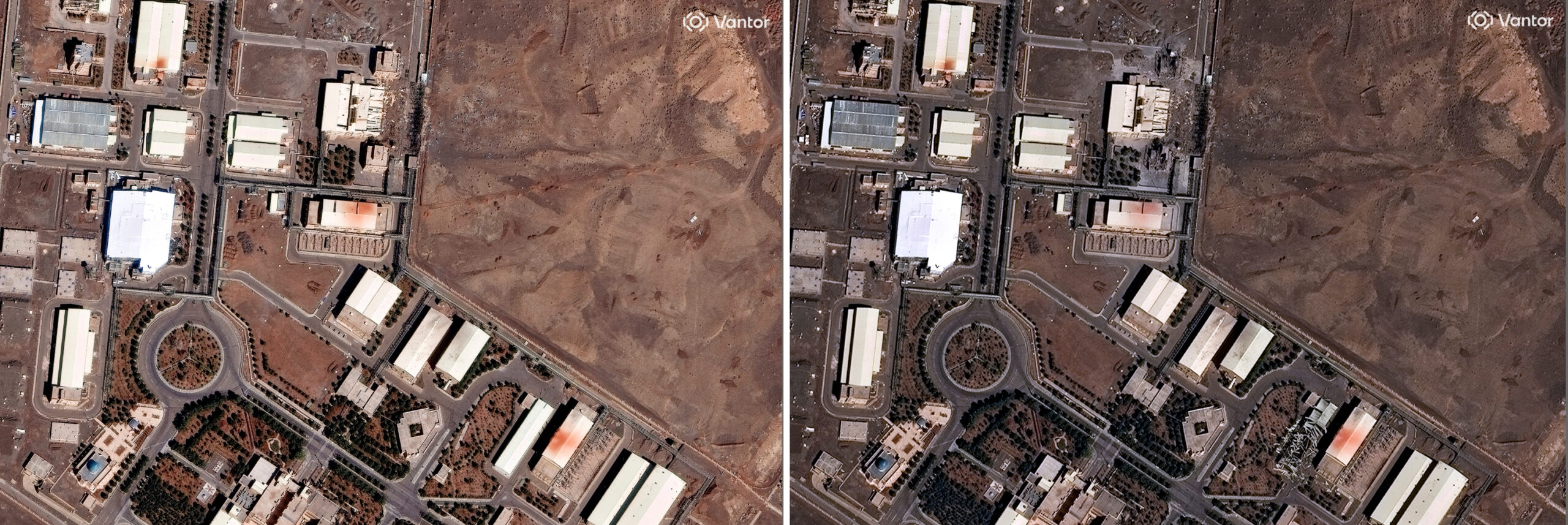
    Grossi’s assessment came as Tehran charged there was an attack on its Natanz enrichment facility and as Israel warned civilians to evacuate areas around Isfahan, a major center of Iran’s nuclear program.

    In this combo from satellite images provided by Vantor shows is a view of Natanz nuclear facility on March 1, 2026, left, and with damage on March 2, 2026 in Iran. (Satellite image ©2026 Vantor via AP)

    Satellite imagery of Natanz captured Monday showed damage to three buildings on the site, damage that Grossi indicated was fairly minor. Vehicle and personnel entrances to underground portions of the facility where centrifuges are kept appear to have been hit, according to the imagery.

    The United States and Israel have long accused Iran of seeking to build a nuclear weapon under the cover of enriching uranium for civilian purposes. Last year’s strikes targeting Iran’s uranium enrichment facilities and other sites significantly delayed the program, U.S., Israeli, and IAEA officials said. Trump and Hegseth said Iran’s nuclear ambitions had been “obliterated.”

    The Defense Intelligence Agency in a report produced before those strikes assessed that since 2019, in the wake of Trump leaving a nuclear deal with Iran that limited its nuclear program, the Islamic Republic had boosted uranium enrichment and expanded its stockpiles to the point that the time required to produce sufficient weapons-grade uranium for a first nuclear device had fallen to “probably less than one week.”

    The actual time to produce a weapon ranged from two to four months, the agency estimated, according to people familiar with the assessments who spoke on the condition of anonymity because of the matter’s sensitivity.

    The June strikes targeted Iran’s main enrichment plants at Natanz and Fordow. But the Iranians had been manufacturing centrifuge cascades long before the strikes and likely were storing them at other locations, the people said. “So their ability to do a breakout may or may not have been dependent at all” on the sites that were bombed, one person said.

    Post-strike, the DIA and other U.S. intelligence agencies determined that the time Iran now needed to produce enough weapons-grade uranium to build a warhead in extremis — without rebuilding the damaged sites — had lengthened to between four and eight months, people familiar with the matter said.

    Uncertainties about Iran’s nuclear program are heightened by the fact that IAEA inspectors left the country last July and haven’t returned.

    “The return of the IAEA inspectors will be further delayed as a result of the renewed conflict, and without effective IAEA monitoring, the whereabouts and security of Iran’s highly enriched uranium will now become even more uncertain,” said Daryl Kimball, executive director of the Arms Control Association think tank.

    In the meantime, Kimball said, “There hasn’t been any sign that Iran is rebuilding anything.”

  • Inside the Clintons’ depositions on Epstein and Maxwell

    Inside the Clintons’ depositions on Epstein and Maxwell

    The Republican-led House Oversight and Government Reform Committee released videos Monday of the closed-door depositions of former President Bill Clinton and former Secretary of State Hillary Clinton, part of its investigation into convicted sex offender Jeffrey Epstein.

    Bill Clinton appeared before the committee on Friday, marking the first time a former president had been compelled to testify before Congress under a subpoena. During his lengthy deposition, the former president sought to distance himself from Epstein, saying he had no knowledge of Epstein’s crimes and stopped associating with him years before his first guilty plea, in 2008.

    “There was nothing that I saw when I was around him that made me realize that he was trafficking women,” Clinton told the committee. “I saw nothing, and I did nothing wrong.”

    In her hours-long deposition Thursday, Hillary Clinton said she had no recollection of ever meeting Epstein and had known Epstein associate Ghislaine Maxwell only “casually, as an acquaintance.” Hillary Clinton derided the deposition as “political theater” and sharply questioned why she was being deposed.

    House Republicans have issued subpoenas to several people — mostly Democrats — mentioned in the millions of files related to the federal government’s Epstein investigation that have been released by the Justice Department.

    They have not called in President Donald Trump, who had a long-standing friendship with Epstein. The president has said that he knew Epstein socially in Palm Beach, Fla., and that they had a falling out in the mid-2000s. Trump has maintained that he did not know about Epstein’s criminal behavior.

    Here are some of the highlights of the depositions:

    Bill Clinton says Larry Summers connected him with Epstein

    In his deposition, Bill Clinton said his former treasury secretary Larry Summers, then the president of Harvard University, first recommended that he strike up an acquaintance with Jeffrey Epstein.

    As Clinton recalled, Summers — who recently resigned his positions at Harvard because of his association with Epstein — called Clinton shortly after he left office, in late 2001 or early 2002, when Clinton was setting up a charitable foundation.

    Summers told him of “a man named Jeffrey Epstein” who had made a multimillion-dollar contribution to brain research, Clinton said, and described Epstein as an “information-hungry person” who owned a “massive airplane” and “wanted to spend some time talking to me about economics and politics.”

    Clinton said he saw the plane as an economical means of doing international travel for his foundation.

    After taking about a half-dozen trips aboard Epstein’s jet over a couple of years, Clinton said, he quit doing so because his foundation had launched and he had offers of transportation from people he knew better.

    Clinton said he considered Epstein “an interesting man, but I didn’t think he was really interested in what I was doing.”

    Clinton told the committee that he first learned of Epstein’s crimes “in 2008, when he was prosecuted. There was nothing that I saw when I was around him that made me realize that he was trafficking women.”

    At another point, he told the committee, “I don’t believe any law enforcement agency has ever asked me [about Epstein], and I don’t know enough to volunteer anything.”

    Hillary Clinton says she ‘knew nothing about’ Epstein

    Hillary Clinton repeatedly testified that she did not know Epstein. She characterized him as not being on her “radar,” but was told in preparation for the deposition that she and Epstein both attended an event at the White House that was put on by the White House Historical Association.

    “I have no recollection, in any way, of ever having any conversation at the White House or in any other place or on any kind of device of any sort. I knew nothing about him,” Hillary Clinton said when asked if she had any communication with Epstein.

    She testified that she knew Maxwell “casually” as someone who dated an acquaintance of hers — Ted Waitt, a software developer.

    Waitt, Clinton said, brought Maxwell as a guest to the wedding of the Clintons’ daughter, Chelsea, in 2010.

    Clinton said that she did not consider Maxwell a friend and that her daughter would have been “friendlier” with Maxwell, but that she “had no idea” how often they interacted.

    Clinton declined to characterize the relationship between Maxwell and Bill Clinton.

    “He’ll have to answer that,” she said when asked if Bill Clinton and Maxwell were friends.

    Bill Clinton reacts to hot tub photo during Asia trip

    Bill Clinton was shown a photo of himself in a hot tub that was among the Epstein files and that has generated much attention.

    He recalled that it was taken while he was in Brunei at the end of a long leg of one of his Asia trips.

    He and his party, including Epstein, were guests at a hotel owned by the sultan of Brunei, with whom Clinton had established a warm relationship while he was president, and spent time in the hot tub and pool, which were located on the same floor as some of their suites.

    “I swam around. I sat in the hot tub for five minutes or whatever it was. I got up and went to bed,” Clinton said.

    Bill Clinton denies having visited Epstein’s island

    A Democrat on the committee, Rep. Melanie Stansbury of New Mexico, grilled Bill Clinton on reports that he had been on Epstein’s island.

    Clinton repeatedly denied he had ever visited the island. He also denied a report, cited by Stansbury, that he had visited Epstein’s home while he was president.

    Bill Clinton says he’s not been in touch with Maxwell for a decade

    Bill Clinton said his first recollection of meeting Maxwell was on his first flight aboard Epstein’s plane, when she was working for the financier.

    Clinton’s relationship with her “lasted longer and was more extensive than my relationship with Mr. Epstein,” he said, because she started “going with” Waitt, the tech billionaire, who became a major donor to the Clinton Foundation.

    Clinton said that, by his recollection, he has not been in contact with her for a decade or more.

    He said he did not learn about her participation in Epstein’s sexual abuse of minor girls until “the first evidence against her came out in 2019.”

    Hillary Clinton’s deposition was paused after photos were shared

    Nearly 80 minutes into the deposition, Hillary Clinton’s lawyer interrupted Republican questioning, saying pictures of the former secretary of state testifying had been posted online.

    The attorney argued that the pictures, which had been shared by Rep. Lauren Boebert (R., Colo.), violated the committee’s rules — and noted that the Clintons had repeatedly asked that the depositions be held in public.

    Visibly frustrated, Hillary Clinton told Republicans that if they were going to be sharing pictures of the interview, she was “done.”

    “You can hold me in contempt from now until the cows come home. This is just typical behavior,” she said. “We all are abiding by the same rules.”

    The hearing was then paused. When the interview resumed, Rep. James Comer (R., Ky.), the committee’s chairman, said he advised Republicans that no pictures or videos of the deposition could be released.

    The Clintons were accompanied by trusted lawyers

    The Clintons were accompanied by two lawyers who for decades have been among the most trusted and protective allies in their orbit.

    David Kendall is the Clintons’ longtime personal attorney, and Cheryl Mills was deputy White House counsel during Bill Clinton’s presidency and chief of staff to Hillary Clinton at the State Department. Both are known for their discretion and were part of the legal team that defended Bill Clinton in his 1999 Senate impeachment trial, in which he was acquitted.

  • HBO Max and Paramount+ to merge into one streaming service

    HBO Max and Paramount+ to merge into one streaming service

    Paramount Skydance will combine Paramount+ and HBO Max into one streaming service, David Ellison, the company’s CEO, said on a Monday call with investors.

    “As we said, we do plan to put the two services together, which today gives us a little over 200 million direct-to-consumer subscribers,” Ellison said. “We think that really positions us to compete with the leaders in the space.”

    The announcement comes days after Paramount Skydance agreed to buy Warner Bros. Discovery, HBO’s parent company, following Netflix’s decision to walk away from its own deal amid pressure — and a higher bid — from Paramount.

    Ellison added that Paramount didn’t want to make changes to the HBO brand. “Our viewpoint is HBO should stay HBO,” Ellison said, noting that his favorite HBO product is Game of Thrones. If Justice Department regulators allow the deal to go through, it would place recent HBO Max hits, such as The Pitt and A Knight of the Seven Kingdoms, alongside Paramount offerings including South Park and Yellowstone.

    “They built a phenomenal brand,” he said. “They are a leader in the space, and we just want them to continue doing more of it.”

    Ellison is the son of Oracle cofounder and Trump ally Larry Ellison. His firm, Skydance, bought Paramount over the summer, putting CBS, Paramount Pictures, and more until his control. The $8 billion deal was approved by the Trump administration following a lengthy review and several concessions.

    The deal to buy Warner Bros., valued at about $110 billion, will almost surely attract regulatory scrutiny from the Justice Department because — without divestments — it places major swaths of the film, television, and news industries under one roof: Warner Bros. and Paramount studios, HBO Max and Paramount+, and CBS and CNN would all have the same parent company. Ellison expressed confidence on the call that the deal wouldn’t face hurdles with regulators.

    The streaming environment has already become more consolidated in recent years. Hulu, once a joint venture by several media companies, has been fully owned by Disney since 2025. While the company expects to combine Disney+ and Hulu, for now it offers streaming bundles to customers who want to subscribe to both, and another with ESPN+, too.

  • Iran strikes spark accusations of bad-faith diplomatic negotiations

    Iran strikes spark accusations of bad-faith diplomatic negotiations

    The talks were not going well, but there were signs that they would continue. The top U.S. diplomat was due to travel to the Middle East on Monday and negotiating teams were due to meet again in Geneva for a fourth round of discussions later in the week.

    “We’ll see what happens. We’re talking later,” President Donald Trump told reporters Friday, adding that he was “not happy” with the way Iran was approaching negotiations over the fate of its nuclear program amid his repeated threats to attack unless his demands were met.

    Hours later, U.S. and Israeli forces launched widespread strikes across Iran, killing much of the country’s political and military leadership. The assault has sparked multiple rounds of retaliation from Iran and threatened to plunge the region into chaos.

    Although U.S. officials say that the talks were in good faith, critics of the Trump administration call the abrupt shift to war duplicitous, if not deceitful. Iranian Foreign Minister Abbas Araghchi, who had led the Iranian delegation, told ABC News on Sunday that the United States had “attacked us in the middle of negotiation.”

    The White House declined to comment for this article. The State Department did not respond to a request for comment.

    Oman’s foreign minister, who had been mediating the talks in Geneva, also appeared shocked at the abrupt turn away from diplomacy.

    Badr Albusaidi had traveled to Washington on Friday in what he saw as a “last-ditch” effort to forestall war, according to two people familiar with his plans. The foreign minister had hoped to make his case directly with Trump and Secretary of State Marco Rubio, according to these people, who like some others spoke on the condition of anonymity to discuss the matter with the news media.

    He instead met with Vice President JD Vance as Trump and Rubio were already on their way to Mar-a-Lago, the president’s Florida estate, from which they oversaw the start of Operation Epic Fury overnight Saturday.

    “I am dismayed. Active and serious negotiations have yet again been undermined,” Albusaidi wrote on social media after the strikes, adding later that the “sooner talks are resumed the better it is for everyone.”

    During his second administration, Trump has sought to combine his self-proclaimed status as a dealmaker with an overt willingness to use military force to get what he wants. His critics have called it a 21st-century version of gunboat diplomacy — an imperial-era form of foreign policy based on military force — while experts have been left to guess whether the efforts at negotiation are genuine or simply an attempt to disarm and deflect.

    The talks with Iran appeared to be “a ruse,” said Brett Bruen, a former State Department official who served on the National Security Council during Barack Obama’s presidency, adding that the current administration will eventually struggle to continue using such tactics as it is becoming “increasingly hard for foreign leaders to take Trump at his word.”

    “This may work in real estate where one side wants to sell and another wants to buy,” Bruen said, but in diplomatic and trade negotiations, there almost certainly would be a “reluctance to make real concessions” moving forward on the part of anyone engaging with the U.S.

    Trump, for his part, has said he hopes to return to negotiations with whatever is left of Iran’s leadership. U.S. officials, meanwhile, have said that their talks were aimed at reaching a genuine compromise and that the decision to strike was made only at the last minute.

    A senior administration official told reporters Saturday that the Iranian negotiators were well aware that the U.S. was moving large amounts of military hardware into the region and willing to use it.

    “We communicated to them that this was something that would occur if we did not see real progress on a real deal very quickly,” the senior official said.

    Rubio’s since-canceled trip to Israel this week, disclosed publicly weeks ago and widely seen as an attempt to brief Israeli Prime Minister Benjamin Netanyahu ahead of any military action, was formally nixed Saturday after the strikes began.

    Although the last round of talks in Geneva — where negotiators Steve Witkoff and Jared Kushner had been meeting with Iranians — were described as productive by the Omani mediators and a next round had been scheduled for this coming Friday, there is now no indication they will come to pass.

    In June, a similar situation arose when Witkoff was due to hold talks with Iranian counterparts in Oman. Days before the meeting was to occur, Israel carried out attacks on several Iranian military leaders, and Witkoff did not attend.

    Aaron David Miller, a former State Department diplomat who has advised Republican and Democratic administrations on the Middle East, said that Trump must have known there would not be another round of talks last summer but that he “continued to create the fiction” there would be.

    It kept Iranian leaders off guard, Miller said, which “allowed the Israelis to engage in their decapitation strategy.” The U.S. later joined the assault, striking at Iranian nuclear sites and leaving them “totally obliterated,” in Trump’s words.

    Araghchi, the Iranian foreign minister, told ABC News on Sunday that it had been “a very bitter experience for us.”

    The Trump administration also had made intermittent attempts at talks with Venezuelan President Nicolás Maduro before embarking on a stunning military operation in January that resulted in his arrest and the regime he once led cowed into obedience.

    The U.S. had amassed a huge military presence off the coast of Venezuela before the Jan. 3 raid to capture Maduro. But soon tensions with Iran were growing, sparked largely by Tehran’s bloody crackdown on anti-government demonstrations.

    Trump had pledged to intervene, urging protesters to stay in the streets and promising that “HELP IS ON THE WAY.” Around that time, the administration moved some military assets in the Caribbean Sea into the Middle East.

    Trump wrote on social media Jan. 28 that “a massive Armada is heading to Iran.” By that time, the protests had largely fizzled after a brutal response from government forces left thousands dead, according to independent estimates.

    Iran and the U.S. resumed talks, meeting several times in recent weeks. The last meeting, on Thursday, lasted hours. The Omani foreign minister, Albusaidi, described the outcome as positive, telling CBS News that a deal was “within our reach, if we just allow diplomacy the space it needs to get there.”

    Nate Swanson, a former State Department official who worked on negotiations with Iran last year, said that he did not believe the recent talks were a feint and that a deal was simply “never close to coming together,” which he said was “due to mismatched objectives and approaches.”

    Iranians were expecting to negotiate within the confines of a 2015 nuclear deal reached under the Obama administration, Swanson said, but the Trump administration had the “exact opposite expectation” and wanted something different and “better” to justify Trump’s withdrawal from that deal during his first presidency.

    Iran’s supreme leader, Ayatollah Ali Khamenei, had grown more obstinate after the June strikes on Iran, Swanson added, giving his negotiators even less room to reach a deal than they previously had.

    Briefing reporters Saturday, the senior administration official appeared to confirm this, stating that the U.S. negotiators had told the Iranians that they would need to stop enriching uranium and that in return, the United States would give them “free nuclear fuel forever.” The Iranians rejected this proposal, the official said.

    Another senior administration official said that the U.S. negotiators’ proposals were being “met with games, tricks, stalling tactics,” and that they had briefed Trump on this. “Obviously he weighed the different options,” this official said.

    Two people familiar with the talks said the Iranians had tried to appeal to Trump’s business sense by promising commercial investment between the two nations, including the purchase of commercial airplanes.

    Behnam Ben Taleblu, senior director of the Iran program at the hawkish Foundation for Defense of Democracies think tank, said it appeared that Trump had expected Iran to act like a “supplicant” and was too impatient to try to get results through negotiations.

    “The president’s patience for diplomacy is just like his patience for military confrontations: He wants things to be short, sharp, and decisive,” Ben Taleblu said.

    Miller cited Witkoff and Kushner, Trump’s personal friend and son-in-law, respectively. Both men primarily had experience in the business world rather than diplomacy before entering the administration, but they had been tasked not only with the Iran talks but also with shepherding negotiations between Russia and Ukraine, plus Israel and Hamas.

    “How is it possible that these two guys can manage three of the most complicated conflicts in the international system successfully?” he said. “The answer to the question is: They’re not.”

  • Trump tests a new approach in Iran: Regime change without owning the fight

    Trump tests a new approach in Iran: Regime change without owning the fight

    President George W. Bush used a solemn address from the Cabinet Room to tell Americans that Iraqi leader Saddam Hussein had been captured. President Barack Obama spoke to cameras when he announced that Osama bin Laden had been killed.

    After President Donald Trump’s attack on Iran killed its supreme leader on Saturday, he used a different messaging strategy — a written post on Truth Social.

    Trump has taken an approach to selling U.S. citizens on military action in Iran that sharply contrasts with his predecessors: He devoted three minutes of his 108-minute State of the Union address to the issue, spoke to Americans through social media posts and a pair of videos recorded at Mar-a-Lago but made no public appearances over the weekend since a Friday rally in Corpus Christi, Texas.

    The strategy might afford him flexibility in the coming days and weeks to avoid what former Secretary of State Colin Powell told Bush was the Pottery Barn rule — if you break it, you own it.

    From the outset, Trump has been careful to declare limits around the U.S. attack, saying he wanted to overthrow the current regime, but telling Iranians it was up to them to seize the opportunity to write their country’s next chapter. His communication strategy has reinforced those limits by creating a bit of distance — at least in imagery — between the president and the fighting.

    At the same time, however, Trump has adopted expansive rhetoric about the reasoning for his intervention that recalled the justifications used for earlier U.S. forays into the Middle East.

    “They have waged war against civilization itself,” Trump said in a six-minute video posted to Truth Social on Sunday in which he left the precise goals of the attack flexible.

    “We’re undertaking this massive operation not merely to ensure security for our own time and place, but for our children and their children, just as our ancestors have done for us many, many years ago. This is the duty and the burden of a free people.”

    It was his first on-camera acknowledgment of Supreme Leader Ayatollah Ali Khamenei’s death nearly 24 hours after he made his first written post about it.

    “I call upon all Iranian patriots who yearn for freedom to seize this moment to be brave,” Trump said. “I made a promise to you, and I fulfilled that promise. The rest will be up to you, but we’ll be there to help.”

    Middle East experts said Trump’s strategy could end up politically successful, pairing an airstrike-only approach with a flexible definition of what would constitute victory.

    “We have escalation dominance in Iran. We control the pace, the focus, the intensity of military conflict,” said Aaron David Miller, who advised Democratic and Republican administrations on Middle East issues. “We can escalate when we want, and we can presumably prevent Iranians from escalating, and so we can own Iran without the Pottery Barn rule going into effect. That’s what makes this so Trumpian.”

    Richard Haass, who was the director of policy planning at Powell’s State Department in the lead-up to the 2003 Iraq War, said Trump was “calling for regime change, but is not assuming the responsibility for it.”

    “It gives him an off-ramp, not having to see it through. So if it happens, he gets credit for it, if it doesn’t happen, he doesn’t get the blame for it,” said Haass, who is president emeritus of the Council on Foreign Relations.

    Still, there may be political risks to Trump’s sweeping rhetoric if the situation deteriorates, especially if the number of dead U.S. troops rises. So far in the operation, three have been killed and five injured, the U.S. Central Command announced Sunday. Another death was announced Monday.

    “Sadly there will likely be more before it ends. That’s the way it is,” Trump said in his Sunday video.

    White House officials say they owe nothing to past communications practice and that the president’s videos and written statements on Truth Social have reached a vast audience.

    If Trump had pursued a strategy similar to Bush’s approach to Iraq, in which he laid out an extensive argument for war, “the Ayatollah [Khamenei] would probably still be alive, because we would have been spending weeks and months leading up to this tipping off our adversaries, which would not have led to the killing of the Ayatollah yesterday,” White House press secretary Karoline Leavitt said.

    “Operational secrecy and security is the number one priority for the president,” she said.

    In addition to leaving the objectives flexible, the administration has also been vague about its justification for the attack, including in classified briefings for members of Congress.

    During a closed-door briefing with congressional staff Sunday, some aides said the administration provided no intelligence on an imminent or preemptive threat posed by Iran, according to people in the room who spoke on the condition of anonymity to discuss a classified briefing.

    When asked directly about potential threats, one briefer said Iran was prepared to retaliate against the United States, but such warnings fall short of the traditional tests for a legal basis to launch a preemptive attack on a country or decapitate its political and military leadership.

    U.S. officials told reporters on Saturday that Iran’s ballistic missile program posed a threat. International law would not typically support a military assault based on a country’s maintaining a conventional weapons program of that nature.

    Trump may have been more restrained in the lead-up to Saturday’s attack because he was giving more space for negotiations than Bush had offered Iraq, even as the U.S. military presence in the Middle East ramped up in recent weeks to the largest massing of force since the 2003 Iraq invasion.

    But for a president who rose to power in part on the shoulders of supporters who were weary of decades of U.S. wars in the Middle East, there may be political risk in launching major foreign actions and not bringing his supporters along. Last week, a Washington Post-ABC News-Ipsos poll found that among Trump voters, 46% supported the prospect of the president’s using the U.S. military to force changes in other countries while 22% were opposed and 30% had no opinion.

    White House officials have taken a far more restrained approach this year than last toward how they highlight the president’s foreign policy-related engagements. In 2025, he had a foreign leader in the Oval Office almost every week, ushering in reporters and taking questions in impromptu news conferences that highlighted his central role on the world stage. But since the beginning of the year, that practice has stopped, as the White House tried to steer closer toward a domestic agenda that would highlight positive aspects of the president’s economic record.

    Leavitt said the president put out the initial announcement about Khamenei’s death in the form of a written statement because he “was very busy yesterday in the situation room all day, monitoring it all night, and he was on the phone with our allies around the world and talking to other countries. And so the most effective way for him to get that message out yesterday was by a Truth [Social post], and obviously it was a statement heard around the world.”

    Trump’s Sunday video address offered a more traditional approach to Khamenei, embracing the victory on camera.

    “This wretched and vile man had the blood of hundreds and even thousands of Americans on his hands,” Trump said. “All over Iran, the voices of the Iranian people could be heard cheering and celebrating in the streets when his death was announced.”

    Administration officials make television appearances on Sunday morning shows nearly every week, but none made the rounds this time. A senior White House official said that wasn’t an effort to distance the administration from the fighting, but rather a measure of their need to monitor military operations from the Situation Room and from the president’s side at Mar-a-Lago. The official spoke on the condition of anonymity to discuss sensitive internal strategy.

    Rather than put administration officials in front of the cameras, the White House coordinated a message with congressional Republicans to speak on the shows, offering Secretary of State Marco Rubio on Saturday evening to brief them.

    “I thought the president’s eight-minute video yesterday was outstanding,” Sen. Tom Cotton (R., Ark.) told CBS’s Face the Nation on Sunday. “It laid out Iran’s 47-year campaign of terror and revolutionary violence against the United States and our people and really, the civilized world. I’m sure the president will speak more in the coming days, will have briefings to Congress.”

    Classified briefings to Congress are planned for Tuesday.

    Some supporters of tough action against Tehran said that it may take time to judge the final outcome of the military action — longer than the actual time frame of the bombing.

    “The question is going to be whether it’s good policy, and that will turn in part on American casualties,” said Elliott Abrams, who worked on Iran issues during the first Trump administration and on foreign policy in the Reagan and George W. Bush administrations.

    But, he said, “I caution critics that if this war ends in a week and the regime is still in place, it’s really too soon to say it failed. … If the regime falls in six months or 10 months or next year, everyone will have to acknowledge that this war brought it a lot closer and in retrospect, it will have been a great success, because I think getting rid of that regime will really change the Middle East.”

  • Sanders pitches $4.4 trillion tax on billionaires, in 2028 marker

    Sanders pitches $4.4 trillion tax on billionaires, in 2028 marker

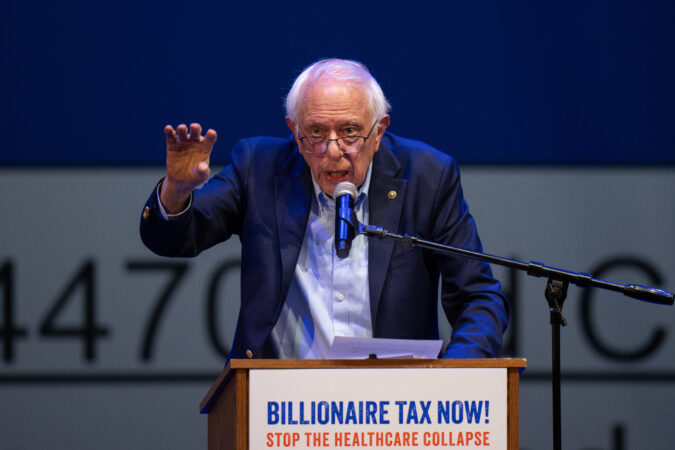
    Sen. Bernie Sanders (I., Vt.) on Monday was set to unveil new legislation that would raise $4.4 trillion in taxes from America’s roughly 1,000 billionaires, aiming to roughly halve their fortunes.

    The plan is a nonstarter in the current Republican-controlled Congress, but could become a litmus test for candidates in the 2028 Democratic presidential primary, much like Sanders’s Medicare-for-all plan was during the 2020 presidential cycle.

    Sanders’s new legislation, which expands on his prior efforts, calls for an annual 5% wealth tax on America’s billionaires. Revenue from the tax would be redirected to social spending programs, including $3,000 cash payments for Americans earning less than $150,000 per year, a $60,000 minimum salary for every public school teacher, and an expansion of Medicare to cover dental, vision, and hearing care, among other measures.

    While Sanders, 84, is not expected to run for president for a third consecutive time, the proposal could prove divisive among Democrats who do run. California Gov. Gavin Newsom, widely viewed as a top Democratic presidential candidate, has objected to a billionaire tax currently being proposed in his state. Sanders’ proposal is being introduced in the House by Rep. Ro Khanna (D., Calif.), a co-chair of Sanders’s 2020 presidential campaign who supports California’s proposed billionaire tax — and who has been testing the waters of his own presidential bid.

    “This is Senator Sanders’ defining vision for our age,” Khanna said. “It is the most ambitious and transformative legislation for our times to tackle inequality in the New Gilded Age.”

    The legislation comes amid a substantial increase in billionaire wealth during the first year of Trump’s presidency, driven by strong stock market gains. The total wealth of America’s billionaires rose last year by roughly 20%, according to Americans for Tax Fairness, a left-leaning organization. Billionaires’ political influence has risen along with their economic clout.

    Sanders argues that the measure is an essentially conservative compromise that would leave most billionaires’ fortunes intact. Tesla CEO Elon Musk’s holdings, according to estimates from Sanders’ office, would go from $833 billion to $792 billion. Meta CEO Mark Zuckerberg’s would go from $220 billion to $209 billion. Amazon founder Jeff Bezos’ would shrink from $218 billion to $207 billion. (Bezos also owns the Washington Post.)

    The amount of revenue raised would be substantial, however, and in addition to the aforementioned initiatives, would be used to provide home healthcare to seniors and people with disabilities through Medicaid. It would also reverse the GOP’s Medicaid cuts. The $3,000 checks would apply per person for households earning under $150,000, which would amount to $12,000 for a family of four.

    Sanders’ revenue estimates were provided by Emmanuel Saez and Gabriel Zucman, two economics professors at the University of California at Berkeley. The economists assume a 10% rate of “tax evasion/avoidance,” and argue that the existing “exit tax” for renouncing American citizenship would make doing so unattractive for the targeted billionaires.

    The plan is unlikely to be backed by any Republicans, but its support even among Democrats, who have a range of opinions about taxing billionaires, remains unclear. During the party’s last contested presidential primary in 2020, several leading candidates embraced far-reaching ideas to restructure the American economy with new levies on the rich and major new spending programs. Those ideas fizzled in Congress under former President Joe Biden, who supported many of them but failed to persuade Sen. Joe Manchin III, then a Democrat from West Virginia, to go along with even a small fraction of what Sanders and many other Democrats called for.

    The defeat of Biden’s ambitious “Build Back Better” agenda — which included many of the ideas Sanders is now attempting to revive — paved the way for passage of a smaller bill focused on climate and energy subsidies, after which Democrats lost control of both Congress and the White House.

    Since then, the party’s policy agenda has been mostly up for grabs. Democrats appear largely unified on reversing the more than $1 trillion in cuts to Medicaid and food stamps approved by Trump and congressional Republicans as part of last year’s One Big Beautiful Bill. But the party’s priorities beyond that appear unclear. Sanders’ proposal attempts to provide one potential blueprint.

    Newsom has been a prominent advocate for a different approach. The governor has warned that the wealth tax currently being pushed in California would hurt his state, driving companies to flee and suppressing the innovation that has helped make Silicon Valley among the richest regions in the world.

    “This will be defeated — there’s no question in my mind,” Newsom said last month of the billionaire tax. “I’ll do what I have to do to protect the state.”

    Other Democrats who are cautious about raising taxes on billionaires believe the party moved too far to the left during the 2020 Democratic presidential primary, alienating potential business allies and driving them into the Republican camp.

    Sanders and Khanna have taken the other side of that debate, and last month Sanders held an event with Khanna in California at which both called for passage of the measure.

    “The billionaire class no longer sees itself as part of American society,” Sanders said in Los Angeles last month. “They see themselves as something separate and apart, like the oligarchs of the 18th century, the kings and the queens and the czars, they believe they have the divine right to rule and are no longer subject to democratic governance.”

  • National Park Service database flags hundreds of items that might ‘disparage’ America

    National Park Service database flags hundreds of items that might ‘disparage’ America

    At the Emmett Till and Mamie Till-Mobley National Monument in Mississippi, staff members asked the Trump administration to review an entire exhibit on the Black teen’s brutal 1955 killing by white men and his mother’s decision to publicize it — though the park’s staff warned that its removal would leave the site “completely devoid of interpretation.”

    At Arches National Park in Utah, park managers wondered whether a sign about the damage that graffiti and invasive species leave on the iconic red rock landscape violates a Trump directive to focus solely on America’s natural beauty.

    In Philadelphia, displays at a house where George Washington once lived that presented the history of people enslaved by him were taken down, only to have a federal judge order their restoration.

    And at Harpers Ferry National Historical Park in West Virginia, staff members have asked federal officials to decide whether a document that describes an abolitionist’s murder by a mob might “denigrate the murderers.”

    These displays and materials are among several hundred that managers have flagged at hundreds of national park locations since last summer in response to administration orders to scrub sites of “partisan ideology,” descriptions that “disparage” Americans, or materials that stray from a focus on the nation’s “beauty, abundance, or grandeur.” The submissions were compiled in an internal government database and reviewed by the Washington Post, which confirmed its authenticity with current federal employees.

    The database does not make clear which of the plaques, maps, films, and books ultimately will be removed or recast by the Interior Department, though some have already been axed. But the submissions provide a sweeping portrait of the scope of President Donald Trump’s bid to reconsider how national park sites address the historic legacy of racism and sexism, LGBTQ+ rights, climate change, and pollution — or whether to acknowledge them at all.

    A group describing itself as “civil servants on the front lines” posted the database on two public websites Monday, saying in an attached note that it did so to show Americans how the administration is “trying to use your public lands to erase history and undermine science.”

    Asked for comment, the Interior Department issued a statement Monday saying that the “draft, deliberative internal documents” in the database “are not a representation of final action taken.” The statement, from spokesperson Charlotte Taylor, asserted that the documents were “edited before being inappropriately and illegally released to the media in ways that misrepresented the status of this effort.”

    The department did not respond to questions about the status or process for the reviews, nor about specific examples in the submissions.

    The tone and content of the materials described and submitted to Interior by park managers vary widely, reflecting a mix of careful attempts to obey administration orders, confusion about what might violate them, and, at times, apparent skepticism about the entire endeavor.

    Staff members identified a brochure at Cape Hatteras National Seashore, in North Carolina, for “possible disparaging of a prominent American” because it mentions that aviator and onetime Smithsonian Institution secretary Samuel Langley failed to achieve flight. A park staffer at Glen Canyon National Recreation Area in Arizona asks for clarification about whether displays on California condors’ return from the brink of extinction disparage hunters “or tell a success ??”

    Several submissions ask for reviews of book covers, book chapters, and entire books on sale at gift shops, including Incidents in the Life of a Slave Girl, an autobiography by abolitionist Harriet Jacobs.

    “They are mostly on slavery and the black experience in Washington DC as well as a few on Lincoln’s assassination,” wrote a park official at Ford’s Theatre National Historic Site. “Not sure they all disparage historical figures, but they do cover dark periods in American history.”

    Another inquiry came from the Thomas Jefferson Memorial in Washington, where employees shared a list of books on the third president. “I am not sure if they really disparage Thomas Jefferson, but they do aknowledge [sic] that he had children with Sally Hemings,” the inquiry notes.

    Bill Wade, executive director of the Association of National Park Rangers, said the breadth of the submissions revealed the many hours of work that Trump’s order imposed on already overextended park employees, who “probably should’ve been doing other things most of us believe would be more important.”

    The exercise, Wade added, runs counter to the reasons many National Park Service employees gravitated toward their work in the first place. “Park rangers everywhere, and all park employees for that matter, have been passionate about telling true stories about history, and about science,” said Wade, a former superintendent of Shenandoah National Park in Virginia. “It’s a real affront to the values that rangers have.”

    Others have embraced Trump’s effort, including Sen. Jim Banks (R., Ind.), who last summer wrote to top officials at Interior and the Park Service over concerns about “woke” projects he said appeared to violate the president’s order.

    “The President’s executive order rightfully opposes a decades-long effort by our institutions to usurp American history with an ideology-based narrative that casts America’s founding and history in a negative light,” Banks wrote at the time.

    In nearly a year since Trump’s order, National Park sites have responded by removing exhibits that address slavery and the challenges overcome by minority and marginalized groups, as well as signs about the science of climate change.

    But there also has been sustained pushback.

    Last month, a federal judge in Pennsylvania ordered the Trump administration to restore displays that discussed slavery at a site in Philadelphia where Washington lived as president.

    U.S. District Judge Cynthia M. Rufe of the Eastern District of Pennsylvania compared the displays’ removal earlier this year to the mind control employed by the government in George Orwell’s novel 1984.

    Rufe’s ruling — issued on Presidents Day — granted an immediate injunction, requiring the reinstallation of 34 educational panels removed in January by the Park Service from a site at Independence National Historical Park in Philadelphia.

    Two weeks ago, a coalition of scientific, preservation, and historical groups sued the Trump administration over changes that already have been made, arguing that the removal of information about civil rights, climate change, and other topics at multiple national parks amounts to illegal censorship.

    That lawsuit, filed in a federal court in Massachusetts, argues that Interior officials ignored well-established principles and legal requirements when seeking to overhaul information presented at national parks.

    Democratic members of Congress have also sharply criticized the effort, which they describe as a bid to whitewash the American story. “It is absurd that any president would go down this road of trying to retrofit history and culture in their own image instead of getting actual historians to tell us these stories,” said Rep. Jared Huffman of California, the ranking Democrat on the House Natural Resources Committee.

    The hundreds of submissions reviewed by the Post run the gamut, from signs and exhibits about slavery and the civil rights movement, to how the effects of climate change already are altering American landscapes, to how the nation remembers Indigenous people who inhabited lands long before there was a United States.

    Not every park flagged materials that needed reviewing under the executive order. The documents review by the Post show that at many locations, officials logged a simple entry: “Nothing to report.”

    It is clear that as government workers across hundreds of national parks and other historical sites scoured thousands of signs, read through publications, and surveyed countless educational films, they struggled with what exactly might violate Trump’s order not to “inappropriately disparage Americans past or living.”

    At Cape Hatteras, staff members asked whether information on the effect of light pollution on turtles might be “disparaging against park users.” The park also pointed out a Junior Ranger booklet’s mention of female pirates in the 17th and 18th centuries dressing like men to hide among ship crews. “Please review for appropriateness,” the park’s staff asked.

    But many of the submissions involve weightier topics in the nation’s history.

    At Cane River Creole National Historical Park in Louisiana, park staff members flagged a planned exhibit about the history of the train depot that is used as the site’s visitor center. The depot was still segregated when it ended rail service in 1965, and the exhibit relied on extensive consultation and oral history collection with Black community members, according to a former park employee who worked on the project.

    “For the community, it means for the first time having that story being told in an honest way — and actually just being told,” said the former employee, who was laid off from the Park Service last year.

    It is now unclear whether the exhibit will be installed.

    At Harpers Ferry, site of abolitionist John Brown’s raid in 1859, an employee singled out a document that describes how a “mob murders” an abolitionist. “Does this denigrate the murderers?” the employee wrote. “We can reword to: ‘Abolitionist editor Elijah Lovejoy is murdered for his views.’”

    A Civil War battlefield driving tour map was also flagged for its inclusion of direct quotes about the cause of the war from secession documents and Alexander Stephens, vice president of the Confederacy. The quotes cite slavery as the cause. “True, but is this considered cherry picking and denigrating southerners?” the park’s staff wrote.

    Those quotes were used to provide context and avoid downplaying the role of slavery in the Confederate rebellion, according to a former Harpers Ferry media specialist who inserted them.

    Changing the documents and the map would amount to “pulling us back into a position of supporting white supremacy and supporting the ‘Lost Cause’ narrative and erasing the importance of African American history,” said the specialist, who retired last year and spoke on the condition of anonymity for fear of retaliation.

    Along the Selma to Montgomery National Historic Trail, staffers highlighted signs and literature that discuss segregation in the South and how “non-violent civil rights demonstrators” crossing the Edmund Pettus Bridge on “Bloody Sunday” in 1965 “were attacked” by armed officers.

    “While these statements are historically accurate and supported by firsthand accounts,” staffers noted in the submissions, “they may be perceived as disparaging by individuals who are less familiar with the history of the Civil Rights Movement.”

    Amid the numerous materials submitted for review at Arlington House, the Robert E. Lee Memorial, just across the Potomac River from the District, was a line in a Junior Ranger book that reads, “In 1829, Robert E. Lee promised to serve in the Army and protect the United States. In 1861, he broke his promise and fought for slavery.”

    Staffers at Arches National Park raised questions about a sign devoted to the effects of human-caused climate change already visible in the park. “The park seeks guidance on whether this entire panel is within the scope of Secretary’s Order 3431 and should be covered or removed,” the submission reads.

    In other places, it appears that park officials are wrestling with whether entire exhibits — or even entire sites — somehow conflict with Trump’s order to “focus on the greatness of the achievements and progress of the American people.”

    At the Mississippi site commemorating Till, the very place deals with one of the grimmest examples of racial violence in the United States.

    Without this exhibit to share the difficult Till story, the new NPS site would be almost completely devoid of interpretation,” an employee notes in an inquiry shared with the Post. “The exhibit emphasizes ‘progress of the American people’ toward a better future.”

    Wade said he was encouraged by the ruling that ordered the Trump administration to restore displays that discussed slavery at the site in Philadelphia. Wade’s group was also among the plaintiffs in the recently filed lawsuit seeking to halt the administration’s changes and deletions at national parks, saying they amount to censorship.

    But if such legal avenues ultimately fail, Wade said, he suspects the push to alter the telling of history at many sites will continue.

    “The impact is that the visitors are just not going to get true, accurate stories,” he said. “I just think the public ought to be really concerned about that.”

    In some places, such as the preserved home of civil rights activist Medgar Evers or the Manzanar National Historic Site in California, where the U.S. government once incarcerated Japanese Americans during World War II, the entire site exists to commemorate painful moments in the nation’s history.

    “If you take away the stories, you take away the purpose of the park itself,” Wade said.
  • U.S. troops killed amid Iranian counterattack, fueling air defense fears

    U.S. troops killed amid Iranian counterattack, fueling air defense fears

    Three U.S. troops were killed and five others seriously wounded amid ongoing hostilities with Iran, military officials said Sunday, the first known American casualties in a campaign that has quickly heightened concerns about the Pentagon’s ability to protect its personnel.

    An unspecified number of troops also sustained “minor shrapnel injuries and concussions” and are in the process of returning to duty, according to a statement from U.S. Central Command, which oversees operations in the region.

    The three slain Americans were part of a sustainment unit in Kuwait, two U.S. officials told The Washington Post. One of the officials said the three troops served in the Army. The military’s official statement on the deaths did not specify where the service members were killed, a deviation from the Defense Department’s traditional notification procedures when announcing U.S. combat fatalities.

    The secrecy underscored how fraught the situation has become for service members deployed in the Middle East as Iran attacked U.S. facilities and interests in a half-dozen countries following the death Saturday of its supreme leader, Ayatollah Ali Khamenei.

    Spokespeople for the Pentagon and Central Command declined to comment for this article.

    The three fatalities – in its statement, Central Command referred to the fallen troops as “killed in action” – return the United States to a familiar footing in the Middle East, where successive U.S. administrations prosecuted costly, devastating wars over the 20 years that followed 9/11. In announcing the start of Operation Epic Fury overnight Saturday, President Donald Trump acknowledged the possibility that American lives may be lost, saying, “That often happens in war.”

    In a video statement released by the White House on Sunday, the president praised the three troops who “made the ultimate sacrifice for our nation” and said that “sadly, there will likely be more before it ends.” He told the Daily Mail that the campaign could last for four weeks.

    Numerous U.S. facilities throughout the region have come under attack since U.S. and Israeli forces began attacking targets in Iran – a mission, Trump has said, that is intended to topple the theocratic government in Tehran and destroy its military capabilities.

    Central Command said Sunday that U.S. forces have destroyed more than 1,000 targets so far, including naval ships and submarines, missile sites, communications links and the command and control centers for the Iranian Revolutionary Guard.

    The astonishing figure after less than two days of military operations reflected what one U.S. official described as a “very aggressive” effort to knock out as many of Iran’s capabilities to launch missiles and drones as quickly as possible. Like others, this person spoke on the condition of anonymity because they are not authorized to speak to the news media.

    Still, overnight, military officials in U.S. operations centers tracked “dozens and dozens” of missiles and attack drones launched by Iran throughout the night, said another person familiar with the situation.

    “Iran is in full retaliation,” this person said.

    The vast number of retaliatory attacks – and the array of sites being targeted, including nonmilitary sites in Arab nations across the Middle East – is concerning after so much of the regime’s top leadership was killed, this person continued. Officials are worried about the command and control of those weapons, the person added.

    Inside the Pentagon, and among some members of the Trump administration, there was deepening concern Sunday that the Iran conflict could spiral out of control, said people familiar with the situation.

    “The mood here is intense and paranoid,” one person said.

    There is anxiety among senior leaders that the fighting will extend for weeks, further stressing limited U.S. air defense stockpiles, people familiar with the situation said.

    “There is concern about this lasting more than a few days,” said another person. “I don’t think people have fully absorbed yet, like, what that has done with stockpiles,” they added, noting that it often takes two or three air defense interceptors to ensure that an incoming missile is stopped.

    The House Armed Services Committee’s top Democrat, Rep. Adam Smith (Washington) said this operation will force the U.S. to further expend munitions supplies that are already strained.

    “At this point, it’s on. It’s not like we can say: ‘Hey, Iran, we’re out of missile defense systems now so we’re going to pause for a moment. Is that okay?’ It will stretch our ability to defend everything that we need to defend,” Smith said, characterizing U.S. resources as “stretched thin.”

    As The Post reported last week, the president’s senior military adviser, Joint Chiefs Chairman Gen. Dan Caine, warned the White House that munitions shortfalls and a lack of broad military support from other U.S. allies would add considerable risk to any operation in Iran and to the U.S. personnel put in harm’s way.

    The U.S. has a vast amount of firepower in the region, including nine destroyers capable of shooting down missiles. But videos circulating online show that one of the other major threats U.S. troops face is from Iran’s fleet of Shahed drones, which fly slow and low, and are not optimal targets for U.S. air defenses.

    Trump has said in multiple social posts since the operation began that he is committed to a long-term military operation against Iran. Unlike the precision operation in June targeting Iran’s nuclear program, the president has said U.S. “heavy and pinpoint bombing” would continue for days, uninterrupted, “to achieve our objective of peace” throughout the Middle East.

    The descriptions of shrapnel and concussions noted in Central Command’s statement Sunday point to missiles or drones, which produce blast injuries. While U.S. and regional allies have intercepted much of the incoming fire, some attacks have broken through, including numerous salvos that blasted a U.S. naval base in Bahrain.

    In 2024, three U.S. soldiers were killed and others wounded in a drone attack on their base in Jordan. Commanders and personnel failed to properly detect and intercept an Iranian-made drone that smashed into the troops’ living quarters. Investigators later found senior leaders denied a request to position an air defense system there.

    Noah Robertson and Laura Meckler contributed to this report.

  • Trump’s attack on Iran risks alienating war-weary supporters

    Trump’s attack on Iran risks alienating war-weary supporters

    PALM BEACH, Fla. – President Donald Trump’s major attack on Iran has rattled parts of the coalition that twice delivered him the White House, a fracture that could spell trouble for a divided GOP as the midterm elections approach.

    The strikes, which killed Iran’s supreme leader, followed a visible buildup of U.S. forces in the Middle East. But Trump’s decision to carry them out nonetheless surprised some of his supporters, who had expected the self-described anti-interventionist president to stop short of a direct attack.

    Nineteen-year-old Cooper Jacks said his phone lit up Saturday with messages from fellow Republicans in “disbelief” at the U.S. attack on Iran — a reaction that reflected not just surprise at Trump’s decision, but anxiety about what a new conflict could demand of younger Americans.

    “We often have politicians that are way past the age to be able to fight these wars being all ready to say, yeah, go fight it, and then that burden falls on my generation,” said Jacks, an officer with the Walker County Republican Party in Georgia.

    For some voters, Trump’s decision marked a clear break from the isolationist posture that once defined his political appeal. While the more hawkish wing heralded the opening salvo, others in the party accused Trump of betraying the populist ideology that propelled him to power. In interviews and on social media, many Trump supporters — both prominent conservatives and rank-and-file voters — were careful to withhold final judgment until seeing whether the president could swiftly end the conflict he started. Others reaffirmed their support for Trump.

    Ultimately, the Iran strike poses a test of how much war Trump’s coalition will tolerate from a president who promised to end them — particularly if a prolonged fight brings economic pain to everyday Americans.

    “The base is solid with President Trump, and they want him to succeed,” said John McLaughlin, a longtime Trump pollster. “It’s about national security and stopping Iran, a terrorist state, from getting nuclear weapons and killing any more Americans.”

    The political stakes of the military action are heightened by the approaching midterm elections, when the party of a sitting president often faces stiff headwinds. Polls show Trump’s approval ratings are at 39%, the lowest since the Jan. 6, 2021, attack on the U.S. Capitol. Republicans are worried they could lose control of Congress.

    Beyond the immediate electoral math, the Iran strike has also sharpened a longer-running debate inside the party over what a post-Trump identity might look like — and which faction of a divided GOP will ultimately dominate.

    Blake Neff, the producer of The Charlie Kirk Show, wrote on X that right-leaning friends were messaging him in dismay about Iran:

    “This is extremely depressing.”

    “Never voting in a national election again.”

    Neff warned: “If this war is a swift, easy, and decisive victory, most of them will get over it. But if the war is anything else, there will be a lot of anger.”

    Trump told Axios on Saturday that he had several “off-ramps” to the conflict. But in a Truth Social post later that afternoon, he said the bombing “will continue, uninterrupted throughout the week or, as long as necessary to achieve our objective of PEACE THROUGHOUT THE MIDDLE EAST AND, INDEED, THE WORLD!”

    Hours later, he warned of further escalation.

    “Iran just stated that they are going to hit very hard today, harder than they have ever hit before,” he wrote on Truth Social. “THEY BETTER NOT DO THAT, HOWEVER, BECAUSE IF THEY DO, WE WILL HIT THEM WITH A FORCE THAT HAS NEVER BEEN SEEN BEFORE!”

    Last week, a Washington Post-ABC News-Ipsos poll found that 46% of Trump voters supported Trump using the U.S. military to force changes in other countries, while 22% opposed this and 30% had no opinion.

    Trump won his first term by attacking the foreign policy of former President George W. Bush and calling the U.S. war in Iraq a “big fat mistake.” He clinched a second term promising to expel “the warmongers” from government and warning that his Democratic opponent, Vice President Kamala Harris, would get the U.S. entangled in another costly conflict abroad. He told supporters he could end the war in Ukraine in 24 hours.

    “I will stop the chaos in the Middle East,” Trump told the crowd at his final rally before the 2024 election in Grand Rapids, Michigan. “I will prevent World War III.”

    On the campaign trail, he also stressed that Iran must not get a nuclear weapon.

    Trump has repeatedly cast himself in his second term as the peacemaker the world needs, claiming credit for ending or averting conflicts abroad and arguing that his leadership will accomplish what traditional international institutions, such as the United Nations, have not.

    He swept into office under the banner of “America First” isolationism but has adopted a muscular foreign policy approach, “peace through strength.” He bombed nuclear sites in Iran in the summer, toppled Venezuelan President Nicolás Maduro in January, and now has unleashed a barrage in the Middle East that he said is aimed at regime change.

    MAGA allies long skeptical of foreign intervention have so far largely stuck by the president, even as many questioned his evolution. Trump officials cast the strikes on Iran last summer as a limited intervention meant to take out a nuclear threat — and pushback within his coalition faded as the conflict ended without morphing into a broader war.

    But each conflict has threatened more entanglement abroad than the last, testing the movement’s tolerance.

    “Trump, who is very news-cycle savvy, is addicted to the glamour and the attention that foreign interventions engender him and his administration, even though they are not making him more popular,” Curt Mills, executive director of American Conservative, a right-wing magazine that is skeptical of neoconservative foreign policy, said in an interview Saturday with the Washington Post.

    Natalie Winters, a co-host for Stephen K. Bannon’s podcast War Room, criticized the Trump administration for failing to adequately justify the strikes.

    “The messaging, much like the Epstein files, is all over the place. I would think they would know their base better,” she told the Post. “Some of his donors are probably happy so congratulations to them.”

    Meanwhile, many of Trump’s most loyal supporters have echoed his “peace through strength” arguments. Nearly 6 in 10 Trump voters who identified with the MAGA movement supported using the U.S. military to force changes in other countries, compared with fewer than 3 in 10 who didn’t support MAGA, the Washington Post-ABC News-Ipsos poll found.

    “I changed my view on MAGA a little bit. In order for us to be what we once were, we’ve got to support the rest of the world,” said Robert Pratt, 70, a veteran who self-identifies as part of the MAGA movement. “We’ve got to protect our allies, and I think MAGA is now a part of that. It’s not just about us.”

    Pratt said his feelings could change if the conflict in Iran lasts for too long; he doesn’t want a repeat of the war in Iraq.

    “My concept of war is a lot like Trump’s is: If you’re going to do it, do it and get it over with,” he said. “I don’t want stuff where we get mixed up in some conflict that goes on for years and years.”

    On Saturday, as Trump continued to direct attacks in Iran, Jacks saw on social media an old tweet from Vice President JD Vance urging the U.S. to learn from the failures of its war in Iraq. His former congressional representative, Marjorie Taylor Greene, a Trump ally turned critic, accused the president of abandoning his “America First” movement and campaign promises to stay out of far-flung conflicts.

    “Now, America is going to be force fed and gas lighted all the ‘noble’ reasons the American ‘Peace’ President and Pro-Peace administration had to go to war once again this year, after being in power for only a year,” Greene wrote in a blistering post on X. “Head-spinning, but maga.”

    Then Jacks read in the news that Iran’s supreme leader, Ayatollah Ali Khamenei, was killed — a major blow against an oppressive regime, he thought.

    The U.S. strike could be a big success, he said — “if we’re not entering a long-term military conflict that’s going to result in the deaths of Americans that don’t really want to fight it.”