The Trump administration is restricting cities from using road safety grants for automated cameras that enforce speed limits or other traffic laws, part of a shift away from safety measures that might slow or otherwise inconvenience car travel.
The letters to city officials went out in December, saying that “for consistency with Administration priorities,” traffic cameras outside of school or work zones will not get approval under the Safe Streets and Roads for All program. The program was created by the 2021 infrastructure law and funds projects aimed at eliminating traffic deaths.
“This Administration will not allow critical safety dollars to subsidize the purchase of speed cameras so governments can pursue unfair revenue schemes,” U.S. Department of Transportation spokesperson Nathaniel Sizemore said in a statement.
Proposals to extend sidewalk curbs farther into a roadway are also barred, although the number of exceptions is greater: transit stops, roundabouts, school zones, on-street parking, and curb extensions that don’t take away lanes of traffic, according to the letters from the U.S. Department of Transportation. As with other administration grants, the language also says any “equity analysis” is disqualifying.
The cities had been awarded grants but did not yet have a signed agreement with the White House for their implementation. Until that happens, funds can be clawed back. The Trump administration has previously said grants that include “reducing lane capacity for vehicles” with bike lanes or pedestrian infrastructure are “hostile” to cars and “counter to DOT’s priority of preserving or increasing roadway capacity for motor vehicles.”
Transportation Secretary Sean P. Duffy has signaled his enthusiasm for driving in various ways. He has tried to stop congestion pricing in New York, has encouraged Americans to take road trips, and on Friday announced plans to host an IndyCar street race around the capital in August, saying, “Freedom doesn’t ring, it revs!”
Alex Engel, a spokesperson for the National Association of City Transportation Officials, a nonprofit coalition, said the change is an unwarranted restriction on “proven, lifesaving tools,” and that “limiting speed and red-light enforcement to construction and school zones leaves many of the most dangerous city streets unaddressed.”
Research indicates that speed, red-light, and stop sign cameras are effective at reducing crashes and fatalities and popular with the public. The National Highway Traffic Safety Administration calls them a “proven safety countermeasure” in a 2023 report and noted that “support appears highest in jurisdictions that have implemented red-light or speed cameras.”
Advocates say merely cutting federal funding is unlikely to slow the growth of camera programs because they generally pay for themselves with fines.
“I don’t see it as a huge barrier, given that that’s not usually where the funding comes from,” said Leah Shahum, who leads a Vision Zero Network that offers support to cities and counties trying to end road deaths. “It’s still consequential for those that have applied, and I would worry a little bit that it may send a message, that in some places it would slow enthusiasm.”
In-person traffic enforcement has collapsed across the country in the past six years, and more communities are turning to cameras to fill the gap. But there are vocal opponents who argue that it isn’t fair to enforce traffic laws without the discretion of a human officer and that cameras are used to fine people for speed limits that are too low.
Last month, Politico reported that the administration suggested stripping funding for the District of Columbia unless the city eliminates its many traffic cameras. D.C. Mayor Muriel E. Bowser (D) pushed back, saying doing so “would endanger people in our community” and “mean cuts to everyday services.” Cameras bring in more than $100 million a year through ticket revenue.
Several House Republicans are adamantly opposed to traffic cameras and have pushed for legislation banning them both in D.C. and nationwide. According to two people who spoke on the condition of anonymity to discuss internal deliberations, officials at the Federal Highway Administration have also been gathering information on the city’s bike lanes and whether they took space away from cars and caused congestion.
President Donald Trump said Sunday that he plans to close the Kennedy Center for roughly two years for the facilityto undergo construction. The proposal comes amid a series of cancellations and internal upheaval since he took over the arts institution and presidential memorial nearly a year ago and remade it in his name and image.
“I have determined that The Trump Kennedy Center, if temporarily closed for Construction, Revitalization, and Complete Rebuilding, can be, without question, the finest Performing Arts Facility of its kind, anywhere in the World,” Trump wrote in a post on Truth Social. “In other words, if we don’t close, the quality of Construction will not be nearly as good, and the time to completion, because of interruptions with Audiences from the many Events using the Facility, will be much longer.”
Under Trump’s proposal, which he said is subject to board approval, the Kennedy Center could close on July 4, coinciding with America’s 250th anniversary, with construction beginning immediately.
“Financing is completed, and fully in place!,” Trump wrote. “This important decision, based on input from many Highly Respected Experts, will take a tired, broken, and dilapidated Center … and turn it into a World Class Bastion of Arts, Music, and Entertainment, far better than it has ever been before.”
Kennedy Center President Richard Grenell confirmed the plans in a Sunday evening email to staff obtained by the Washington Post. “We will have more information about staffing and operational changes in the coming days,” he wrote.
In a post on X, Grenell cited the $257 million designated “for capital repair, restoration, maintenance backlog, and security structures” through the One Big Beautiful Bill last year.
“It desperately needs this renovation and temporarily closing the Center just makes sense … ,” Grenell wrote. “It also means we will be finished faster.”
The center has already made some physical changes under the new leadership, adding Trump’s name to the building’s facade, despite legal concerns, and painting the outside columns white. Portraits of the first and second couples now hang in the center’s Hall of Nations, and the exterior is sometimes lit up in red, white and blue.
It was not immediately clear what the closure would mean for annual events held at the center such as the Mark Twain Prize for American Humor or the Kennedy Center Honors.
The Kennedy Center did not immediately respond to requests for comment. AWhite House official referred the Washington Post to Trump’s post.
Three current staffers, who spoke to the Post on the condition of anonymity for fear of reprisal, said they had not been previously notified of any plans to close the center, though some had long speculated a shutdown was possible.
“Once again, Donald Trump has acted with a total disregard for Congress,” said Rep. Joyce Beatty (D., Ohio) who had sued the Trump administration in December in her capacity as an ex officio trustee to stop the name change. “The Kennedy Center is congressionally funded, and Congress should have been consulted about any decision to shut down its operations or make major renovations, especially for two years,” she said in a statement.
The center’s board in December voted to add the president’s name to the arts venue and presidential memorial — its sign now reads “The Donald J. Trump and The John F. Kennedy Memorial Center for the Performing Arts” — prompting a fresh wave of cancellations and tumult.
Members of the Kennedy family responded to the news of the closure. Jack Schlossberg, John F. Kennedy’s grandson, wrote on X that while Trump can take over the institution, his grandfather’s legacy will endure. “JFK is kept alive by us now rising up to remove Donald Trump, bring him to justice, and restore the freedoms generations fought for,” he said.
Joe Kennedy III, Robert F. Kennedy’s grandson and a former Democratic congressman for Massachusetts, called the decision “painful,” saying that the center was built by and for the people as a shared point of connection.
“Do not be distracted from what this Administration is actually trying to erase: our connection, our community, and our commitment to the rights of all,” he wrote on X.
Rep. Brendan Boyle (D., Pa.) condemned the move, saying on X that “Trump is desecrating our national performing arts center.” Sen. Andy Kim (D., N.J.) pointed to Trump’s bad bet in the late 1980s on what was the world’s largest casino-hotel complex in his state. “We can’t let him do to the Kennedy Center what he did to Atlantic City,” he said in a tweet.
Most recently, the Washington National Opera announced Jan. 9 it would move out of its longtime home, citing changes to the center’s business model and support.
The Kennedy Center said it ended the relationship, but a person speaking on the condition of anonymity because they were not authorized to represent either party told the Post that it was “definitely a WNO decision” spurred by the board’s vote.
U.S. lawand customs generally bar memorializing living figures. The statute establishing the center designates it as the John F. Kennedy Center for the Performing Arts and requires the board to “assure” that “no additional memorials or plaques in the nature of memorials shall be designated or installed in the public areas” of the building. The law does allowplaques and inscriptions recognizing major donations.
Months before the renaming vote, the center’s board changed its bylaws to ensure only members appointed by the president had voting powers, the Post previously reported. The center said it was following long-standing practice.
Democratic lawmakers have introduced legislation and a lawsuit to reverse the addition of Trump’s name.
One of the groups behind the litigation is Democracy Defenders Action. In a statement Sunday, co-founder Norm Eisen questioned the motivations behind the center’s closure, which he said would inflict further damage. “We will be considering all legal remedies to address this new and concerning development,” he said.
Since remaking the board of trustees and becoming chairperson of the Kennedy Center last February, Trump has frequently said the building was in poor shape. The Kennedy Center is “in tremendous disrepair, as is a lot of the rest of our country,” Trump told reporters in March. “Most of it, because of bad management. This is a shame, what I’ve watched and witnessed.”
Trump and his new leadership have claimed that the center has broken elevators, was infested with rats, and that the concrete in the parking garage was crumbling.
They also repeatedly accused the previous leadership of financial mismanagement, declining requests from the Post to substantiate the claims. Former leaders denied the accusations. (Senate Democrats are themselves investigating the Kennedy Center, accusing Grenell of “self-dealing, favoritism, and waste,” which he has denied.)
Grenell has said the center will rely on “common-sense programming,” meaning popular programming that breaks even. In the past year, sales of subscription packages and tickets have fallen dramatically. Empty seats became a common sight at the center.
Dozens of artists and productions, including composer Philip Glass, soprano Renée Fleming, acclaimed banjoist Béla Fleck, and Wicked composer Stephen Schwartz, have canceled upcoming events.
Meanwhile, almost every head of programming has resigned or been dismissed. Ben Folds and Fleming quit their roles as artistic advisers earlier last year. Last week, Kevin Couch, the center’s senior vice president of artistic programming, resigned less than two weeks after his hiring was announced.
A crypto company run by President Donald Trump’s family members sold a large stake to investors tied to the United Arab Emirates just days before Trump’s inauguration, linking a Trump family business to a prominent memberof the UAE’s governing elite.
The investment, worth a reported $500 million, gave Emirati-backed investors a 49% stake in World Liberty Financial, a crypto company that counts all three of Trump’s sons as cofounders and is also closely tied with Steve Witkoff, a longtime Trump ally who is among his most prominent advisers.
Sheikh Tahnoon bin Zayed al-Nahyan, the UAE’s national security adviser and a member of the royal family, was involved in the purchase, according to an arrangement first reported by the Wall Street Journal.
David Wachsman, a spokesperson for World Liberty Financial, defended the parameters of the agreement.
“We made the deal in question because we strongly believe that it was what was best for our company as we continue to grow,” he said. “The idea that, when raising capital, a privately held American company should be held to some unique standard that no other similar company would be held is both ridiculous and un-American.”
Wachsman said Trump and Witkoff had no role in the deal and also have not been involved in the company since taking office. White House officials stressed that he turned his businesses over to his children.
“President Trump only acts in the best interests of the American public — which is why they overwhelmingly reelected him to this office, despite years of lies and false accusations against him and his businesses from the fake news media,” Anna Kelly, a White House spokesperson, said in a statement. “President Trump’s assets are in a trust managed by his children. There are no conflicts of interest.”
Sheikh Tahnoon, a senior member of the Emirati royal family, oversees a powerful investment empire and chairs both the country’s sovereign wealth fund and G42, the UAE’s artificial intelligence powerhouse. A brother of the president of the United Arab Emirates, he serves as the government’s national security adviser and is known as the “spy sheikh.”
For years, Sheikh Tahnoon has served as a key foreign policy intermediary with the United States. When the UAE announced $1.4 trillion in investment in the United States, it was Sheikh Tahnoon who met with Trump at the White House last year to deliver the news.
Several months after the investment in World Liberty Financial, the UAE was granted access to advanced chips made in the United States that can help power artificial intelligence. The Trump administration scrapped rules imposed under President Joe Biden, paving the way for G42 to purchase advanced American-made chips.
Critics have long raised questions about potential conflicts stemming from Trump’s extensive financial interests, including whether he could benefit as a private citizen from decisions made while in public office.
A person close to Witkoff, speaking on the condition of anonymity because of the sensitivity of the matter, said he was not involved in G42negotiations but was briefed on them in his role as special envoy to the Middle East.
Sen. Elizabeth Warren (Mass.), the top Democrat on the Senate Banking Committee, called on several top Trump administration officials, including Witkoff, to testify before Congress about whether they have profited from the deal.
“This is corruption, plain and simple,” she said, pointing to the administration’s decision to approve sales of sensitive AI chips to the UAE.
“Congress needs to grow a spine and put a stop to Trump’s crypto corruption,” she added.
The White House on Sundaydenied any connection between the UAE investment in the company Trump’s family helps run and the administration’s decision to approve sales of advanced chips.
“The President has no involvement in business deals that would implicate his constitutional responsibilities,” David Warrington, the White House counsel, said in a statement. “President Trump performs his constitutional duties in an ethically sound manner and to suggest so otherwise is either ill-informed or malicious.”
Warrington said Witkoff complies with government ethics rules and does not participate in any official matters that could affect his financial interests. The person close to Witkoff said that his children run World Liberty Financial and that he “has nothing to do with it.”
World Liberty Financial was launched in 2024, with Trump explaining that he had come to support cryptocurrency after conversations with his sons. “Barron knows so much about this,” he said of his youngest son. The company lists Trump’s three sons among the co-founders, as well as two of Witkoff’s sons. Trump and Witkoff are each listed as “co-founder emeritus,” a designation reflecting that they stepped away after Trump returned to the White House.
The business has become one of the most lucrative parts of the president’s portfolio. The financial disclosure forms he filed last year list an income of $57.3 million from token sales, among his largest single sources of revenue.
Wachsman, the spokesperson for World Liberty Financial, said, “Any claim that this deal had anything to do with the Administration’s actions on chips is 100% false.
“As a private business, we operate by the same rules and regulations as any other company in our space, do not want or receive any special treatment, and reject the fact-free suggestions to the contrary,” he said.
President Donald Trump has said the “only thing” he worries about is losing Republican control of Congress in the November elections. The latest campaign finance filings show he’s built an unprecedented war chest to help keep that from happening.
Trump’s political committees and the Republican National Committee amassed $483 million through the end of December, according to documents filed with the Federal Election Commission. That’s nearly triple the $167 million collectively held by the Democratic National Committee and its Senate and House party committees and super PACs.
The haul comes from tapping Trump’s wealthiest donors with events like “MAGA Inc. dinners” at his Florida and New Jersey resorts as well as relentless appeals via text and email to small-dollar contributors who constitute the Make America Great Again base.
Since returning to the White House, MAGA Inc. has gotten eight-figure contributions from pipeline billionaire Kelcy Warren and his company Energy Transfer LP; quant trader Jeff Yass; OpenAI co-founder Greg Brockman; and Crypto.com exchange operator Foris DAX Inc. In total, MAGA Inc. alone has raked in $313 million since Trump’s 2024 election victory.
Targeting the other end of the donor spectrum, Trump’s Never Surrender leadership PAC recently asked potential contributors to make a “small, sustaining contribution so we can complete the MAGA agenda.” It asked for as little as $33.
Whether all that financial armor is enough to buck history – incumbent presidents almost always lose ground in midterms – isn’t so clear, and Trump knows it.
“Even presidents, whether it’s Republican or Democrat, when they win, it doesn’t make any difference – they seem to lose the midterms,” Trump said in a Jan. 27 interview on Fox News. “So, that’s the only thing I worry about.”
Only twice since 1938 has the party in control of the White House gained House seats in a midterm election. During Trump’s first presidency, in 2018, Republicans lost 40 seats. In the two midterms that took place during Barack Obama’s presidency, in 2010 and 2014, Republicans netted 63 seats and 13 seats, respectively.
– – –
Growing Frustration
This year, momentum and history seem to be on the Democrats’ side – they only need to swing a handful of seats to take control of the House.
Working in their favor, national polls show a majority of voters disapprove of Trump’s handling of the economy, as well as growing frustration with the administration’s approach to deportations and foreign policy. Parts of the coalition that swept him back to office – including independents and young voters as well as Black and Hispanic males – are fraying.
That handicap for Republicans has been evident in elections over the past three months in which Democrats have outperformed expectations, in part by tapping into voter frustration over cost-of-living concerns.
“House Republicans are running scared,” said Viet Shelton, a spokesman for the Democratic Congressional Campaign Committee. He added that “with better candidates, a better message, and the public souring on Republicans, Democrats are poised to take back the majority.”
Reflecting the shifting mood, the non-partisan Cook Political Report last month moved 18 House races toward Democrats, bringing the number of seats considered solidly blue to 189, compared to 186 for Republicans. A party needs 218 seats to win the majority.
In the latest example of the headwinds Republicans face, this past weekend in Texas a Democratic candidate for a state Senate seat, Taylor Rehmet, defeated a Republican in a district Trump won in 2024 by 17 percentage points over Kamala Harris.
As the GOP’s fund raiser-in-chief, Trump isn’t waiting until November to put his cash to work. The president intends to use the money he’s amassed to play the role of kingmaker in the midterms, according to people familiar with the strategy.
That involves doling out money to loyalists, or chosen candidates in competitive primaries or congressional races and punishing lawmakers who’ve crossed him over the past year on everything from the passage of his signature tax bill to the release of the Epstein files.
Trump allies also expect to tap their stockpile for specific districts in the final two months in the states and races where it’s most needed, flooding the zone to try to ensure victory.
“MAGA Inc. will have the resources to help candidates who support President Trump’s America First agenda,” Alex Pfeiffer, a spokesperson for the super-PAC, said.
MAGA Inc. has already intervened in one election: it spent $1.7 million backing Tennessee Republican Matt Van Epps in a special election to fill a vacant House seat. Van Epps won by about 9 points – but that margin was narrower than the cushion of more than 21 points his Republican predecessor enjoyed in 2024.
Privately, many Trump allies are resigned to the idea the party could lose control of the House. Trump has warned he could be impeached for a third time if that happens, and his signaled he thinks his party’s lawmakers would be to blame.
House Speaker Mike Johnson, a perennial optimist in his public remarks, said on Sunday that he remains “very bullish on the midterms” and cited the party’s fund-raising prowess as one reason.
“We’re going to have a war chest to run on,” Johnson said on Fox News Sunday. “I think we’re going to defy history.”
Trump says his first year as president shows he deserves reelection. Pressed in Iowa last week about why voters may perennially pick the opposition party in midterms, Trump mused about the electorate wanting “fences” or “guardrails” on presidents.
But, he quickly added, “I don’t need guardrails. I don’t want guardrails.”
Democrats narrowed Republicans’ U.S. House majority and flipped a state Senate seat on conservative terrain in a pair of Saturday special election runoffs in Texas with national implications.
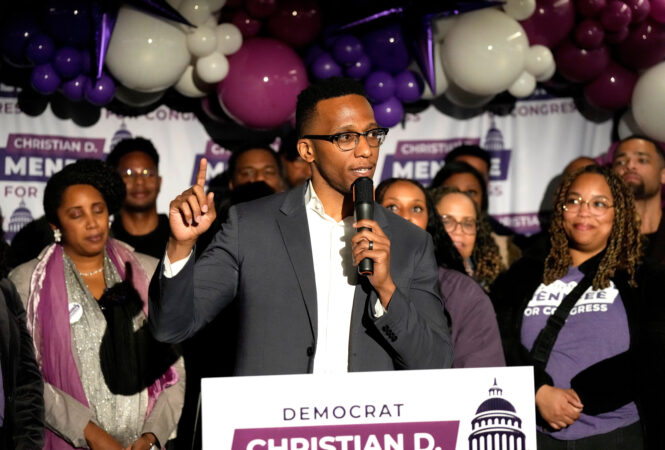
Democrat Christian Menefee won the special election runoff Saturday for Texas’ 18th Congressional District, paring House Republicans’ slim advantage by securing a long-vacant seat in a heavily Democratic area. In a second election runoff in Tarrant County, which includes Fort Worth, Democrats won a notable upset, with Taylor Rehmet defeating Republican Leigh Wambsganss in a district where President Donald Trump won by 17 points in 2024.
In special elections and other local races over the past year, Democrats have largely outperformed Republicans. National Democratic leaders have pointed to the results, including Rehmet’s win, along with sweeping victories in last fall’s elections, as reasons for optimism headed into this fall’s midterms. Democrats are hoping in November to capitalize on anger at Trump’s agenda. Republicans will try to defy recent political trends and hold on to their control of Congress.
The House majority is the marquee prize in the November midterms. Republicans have been clinging to a narrow edge in the chamber, at times complicating their agenda. Because the competition in the Texas House race was down to two Democrats, the effect on the balance of power has been long anticipated. Special elections coming later this year to fill vacancies in Georgia, New Jersey, and California could further alter the partisan breakdown of the chamber.
Menefee defeated fellow Democrat Amanda Edwards, the Associated Press reported, winning a Houston-area district briefly held by Democrat Sylvester Turner before his death in March. When Menefee is sworn in, Democrats will have 214 House seats. Republicans hold 218, giving House Speaker Mike Johnson (R., La.) a razor-thin margin. To pass legislation, Johnson can lose only one Republican vote if all members are present and otherwise vote along party lines.
In Texas, the midterms are set to be contested under a new House map backed by Trump that state GOP leaders enacted last year. Both Menefee, a former Harris County attorney, and Edwards, an attorney and former Houston City Council member, will immediately move to an unusual intraparty contest in a newly redrawn district against longtime Rep. Al Green (D). Texas will hold its primaries on March 3.
Residents of Texas’ 18th District are now set to have representation in the House through the end of Turner’s term after nearly a year of vacancy. For months, Texas Democrats had accused Gov. Greg Abbott (R) of deliberately delaying the special election to fill the vacant seat to help Republicans maintain a slim majority. Abbott blamed Harris County for election administration issues, saying he had to schedule the election for late last year to give officials there time to prepare.
The 18th District, which covers much of central Harris County, has a predominantly Black and Latino population. The district has been a Democratic stronghold for decades and has been represented by civil rights leaders such as Sheila Jackson Lee and Barbara Jordan.
Throughout his campaign, Menefee touted himself as a fighter with a record of suing the Trump administration, focusing heavily on healthcare, voting rights, and federal funding to the district.
Saturday’s runoff took place because no candidate won a majority of the vote in the November special election. Menefee was the top vote getter then, with roughly 29%, while Edwards finished second with roughly 26%.
The state Senate special election was to replace Republican Kelly Hancock, who became the state’s acting comptroller. With most of the vote in Saturday’s election tallied, Rehmet was ahead by more than 14 percentage points.
Rehmet, an Air Force veteran and union leader, won nearly 48% of the vote in the November special election to face Wambsganss in the runoff. Wambsganss is an executive at Patriot Mobile, which describes itself as “America’s only Christian conservative wireless provider.”
Rehmet’s victory is largely symbolic because candidates will have to run for the seat again in November, before the Texas legislature begins its next session in January 2027.
But strategists and analysts look at special elections as one barometer for measuring the national political mood and voter attitudes. Democrats have tended to do better than Republicans in special elections and other lower-profile races in recent years, while the GOP was successful in 2024 with Trump at the top of the ballot.
“Senator-elect Rehmet ran an exceptional campaign focused on solutions to the issues that families care most about, from the rising cost of groceries and utilities to the healthcare crisis,” DNC Chairperson Ken Martin said in a statement, adding that this win is “a warning sign to Republicans across the country.”
SAN ANTONIO — The 5-year-old boy, in a blue knit bunny hat and Spider-Man backpack, was returning from preschool when immigration officers detained him late last month in Minneapolis. A few days later, officers there took custody of a 2-year-old girl after breaking her family’s car window.
Liam Conejo Ramos and Chloe Renata Tipan Villacis, along with their fathers, were flown to a family immigration detention center in Dilley, Texas, an hour south of San Antonio, where detainees face long lines for basic supplies and inadequate medical care, according to people who have been housed there. They are among an escalating number of children swept up in the Trump administration’s enforcement dragnet, which has drawn mounting public outrage over its aggressive tactics and increasingly indiscriminate ramifications.
The U.S. government does not provide direct information about children in immigration custody. But federal data on family detention, and independent analyses of child detentions, suggest immigration authorities are increasingly ensnaring the youngest and most vulnerable lives in President Donald Trump’s effort to deport massive numbers of undocumented immigrants.
“There are other options, regardless of what you believe about immigrants, but you do not have to put children in detention,” said Dianne Garcia, a pastor at a San Antonio church that serves an immigrant population. She said authorities are trying to instill fear in families so they choose to leave the country voluntarily.
On Saturday, a federal judge agreed that Liam should not be in federal custody. U.S. District Judge Fred Biery ordered him and his father released and lambasted the Trump administration’s “ill-conceived and incompetently-implemented government pursuit of daily deportation quotas, apparently even if it requires traumatizing children.”
By Sunday morning, Liam and his father, Adrian Alexander Conejo Arias, had been released and flown home to Minnesota.
But the numbers of those held are rising quickly. Over the past four months, the average number of people, including children and adults, held each month in family detention has nearly tripled, from 425 in October to 1,304 in January, according to Department of Homeland Security data.
An independent analysis by the Marshall Project, a nonprofit news organization, concluded that at least 3,800 minors under 18, including 20 infants, were detained in 2025. And ProPublica found that Immigration and Customs Enforcement last year sent approximately 600 children arrested inside the country to federal shelters built to house minors detained at the border. That is more than the entire number of children detained in federal shelters during the four years of the Biden administration.
Advocates and attorneys contend that hundreds more youth have been affected in cases where authorities have separated families, which are not comprehensively tracked. Those include instances in which parents have been deported but their children remain in the United States in government custody.
Over decades, the federal government has relied on a patchwork of laws, court rulings, and policies meant to ensure that minors are held in the least restrictive setting possible and released as quickly and safely as possible. Trump aides have instead prioritized his deportation goals and treated children as collateral damage, said Wendy Young, president of the immigrant rights group Kids in Need of Defense.
“In this past year, we’ve seen a lot of [the protections] dismantled and transformed again into a system that’s really more punitive and aligned with law enforcement goals than it is with child protection,” Young said.
DHS did not respond directly to questions from the Washington Post asking about the number of children in federal detention and the conditions described by some migrants and their attorneys. In an email, assistant secretary Tricia McLaughlin said the Dilley facility has been retrofitted for families and provides for their safety, security, and medical needs.
“All detainees are provided with 3 meals a day, clean water, clothing, bedding, showers, soap, and toiletries,” she said.
Authorities do not separate families, McLaughlin said, as parents are asked if they want to be removed with their children or have them placed with someone the parent designates. In the cases of Liam and Chloe, authorities said they took custody because relatives abandoned or refused to take them. Chloe, like Liam, has been released, returned to her mother in Minneapolis, after the Trump administration belatedly complied with another judge’s order.
For years, most children in federal custody were those detained at the U.S.-Mexico border. As the administration succeeded in dramatically reducing border crossings, it has ramped up enforcement inside the country and detained more families who have lived here for years — including those whose children attend U.S. schools. Some families were awaiting immigration court decisions on their appeals to remain in the country when they were detained, lawyers said.
The impact is “just really, really damaging and catastrophic because of how sudden and swift and violent it is,” said Zain Lakhani, director of migrant rights and justice at the Women’s Refugee Commission, “and because it’s targeting a population that is just not prepared for this.”
Family shelters closed, then reopened
The South Texas Family Detention Center in Dilley, opened by the Obama administration in 2014 with a capacity of 2,400 detainees, ceased operations during President Joe Biden’s tenure. The Trump administration reopened the facility after authorities began detaining families in spring of last year.
A second facility, in Karnes City, Texas, has been used to temporarily hold families but has primarily detained single adults in recent months, according to DHS detention data and attorneys representing people in both facilities.
The administration is moving to purchase and convert up to 23 industrial warehouses into large-scale detention centers, and authorities indicated in a draft document reviewed by the Post that some will include family housing.
The federal government has long struggled to comply with legal requirements for families and unaccompanied children. Many who are detained at the border seek asylum protections, and a federal court settlement does not permit minors to be held for longer than 20 days.
Families are buffeted by political winds, with their conditions shifting depending on the administration, said Elissa Steglich, a clinical professor at the University of Texas School of Law.
“Family detention has always been more a political device to make a statement about either border policy or the asylum system writ large,” she said.
Amid a border crisis in 2014, the Obama administration scrambled to hold tens of thousands of unaccompanied minors at crowded facilities on military bases, warehouses, and chain-link enclosures. A public backlash prompted federal officials to move to other methods, including releasing the families and using electronic monitoring.
In his first administration, Trump implemented a zero-tolerance policy in which authorities separated thousands of children from their family members when they arrived at the border and prosecuted parents in an effort to deter more migration. But the administration reversed course amid public outrage.
The Biden administration closed three of the family detention centers. As the number of migrants crossing the border soared after the COVID-19 pandemic, however, children and families were huddled into cramped tent facilities or housed in hotels at or near the border. The vast majority were released into the United States pending their immigration court proceedings.
In his second term, Trump has pushed to deport a record number of migrants, and authorities ramped up efforts to arrest families in the spring in Texas after they reported for immigration court hearings or mandatory check-ins at ICE offices. A few months later, immigration advocates said, the administration began detaining families in San Antonio and other major cities.
The population at the detention facility in Dilley swelled. Immigration lawyers have said children have been held well beyond the 20-day legal threshold established in 1997 under a legal settlement known as the Flores agreement. Many children have been detained at routine immigration check-ins, immigration lawyers said.
Longing for home
Most of what is known about the day-to-day conditions inside the federal detention center comes from accounts provided by those who have been held there. In interviews with the Post, migrants and their attorneys described a facility that includes a chapel, library, commissary, infirmary, and pharmacy.
There are also recreational spaces and a school where children can watch educational videos, said Edward, an immigrant from Colombia who, like others who provided firsthand accounts, spoke on the condition that only their first names be used out of fear of reprisals from the government. He and his two sons, ages 11 and 10, spent 47 days in the facility after being detained during an ICE check-in in December.
He said the living spaces consist of several corridors labeled by color and animal names and reserved for different kinds of families: the brown bear hall for two parents with their children; the yellow frog hall for single mothers and young children; and the green turtle hall for single fathers and sons.
Edward, who has an active asylum case, said he slept in a room with 12 bunk beds where the lights stayed on and the tap water tasted like chlorine.
Two immigration judges held hearings for asylum-seekers to accelerate their proceedings, but they often did not result in a conclusion to their cases. Every Monday, ICE agents reviewed cases with detainees, pressuring them to sign deportation papers, according to recently released detainees.
Some said they were told that if they refused, the could end up being sent to another country where they had never been.
“I kept telling them I wasn’t interested,” Edward said.
His sons had been rehearsing for roles in a Christmas play at their San Antonio-area church and a folkloric dance at school, he said, but instead they spent the holiday lining up for roll calls in the detention center.
Edward’s lawyer was preparing to challenge his detention in court, but authorities released him and his sons without explanation in January.
Aury, 25, who also was released in January with her three young children, said she remains in shock over their 50 days in detention. They applied for asylum after entering the country in 2023 and were living in an apartment in San Antonio, as the kids attended school and Aury awaited a resolution to her immigration case.
“I love my Texas home. Why are they doing this to me?” Aury’s 10-year-old daughter wrote in letters she placed on her mother’s bunk. Authorities offered families a $5,000 payment to sign a voluntary deportation form, Aury said.
“They wanted us to believe none of us will ever leave that place,” she said.
Attorney Eric Lee said he saw children all over the facility during a recent visit, some as young as 3 or 4. “What is happening in these detention centers is worse than anybody thinks,” he said. One of his clients, who is 9, drew a picture with crayons of the house she dreams of returning to one day.
In recent weeks, federal officials have released hundreds of families to a border shelter to make space at the Dilley facility for new arrivals from Minnesota, immigration lawyers said.
Kristin Etter, an attorney for some of the new families, recently met with an Ecuadorian mother and her 11-year-old daughter who were arrested in Minneapolis while on their way to school. The fourth-grader spends most of her time in the Dilley facility without opportunities for intellectual stimulation, Etter said.
“We are not talking about jailing criminals or jailing public safety threats,” she said. “It’s cruelty.”
Yuli, an asylum-seeker from Venezuela, said she got close to agreeing to leave the country after being held in mid-November with her 3-year-old son. She described inadequate medical care for herself and her toddler, who suffered diarrhea, and for the other detainees, who had to wait hours for treatment, even for serious illnesses.
She and her son were released in mid-January after her attorney sued the government in federal court. Yuli now wears an ankle monitor, and ICE conducts visits to her home.
“There is a better way,” she said. “This was inhumane.”
House Speaker Mike Johnson (R., La.) said Sunday that he is “confident” he will have enough support from Republicans in the House conference to end the partial government shutdown by Tuesday.
In an interview with NBC News’ Meet the Press, Johnson said the House will vote to reopen the government “at least by Tuesday.”
“We have a logistical challenge of getting everyone in town, and because of the conversation I had with Hakeem Jeffries, I know that we’ve got to pass a rule and probably do this mostly on our own,” Johnson said, referring to the minority leader as he looked to blame Democrats for the second shutdown of President Donald Trump’s second administration, which began early Saturday.
After the Trump administration’s aggressive immigration enforcement operation in Minneapolis left two U.S. citizens dead, Democrats have said they would not advance government funding measures unless changes were made to a funding bill for the agencies driving the Trump administration’s immigration policies, including the Department of Homeland Security. The department houses U.S. Customs and Border Protection, Immigration and Customs Enforcement, and the Federal Emergency Management Agency.
On Friday, Congress missed a midnight deadline to approve six new spending bills because the Senate changed DHS funding measures after the House passed them. The Senate, however, quickly approved a bipartisan agreement backed by Trump to pass five major appropriations bills and a temporary two-week funding extension for DHS to buy time for additional policy negotiations.
Over the weekend, Johnson remained adamant that the House will move quickly to pass those measures when it returns to Washington on Monday, despite frustrations from conservative members of the Republican caucus and skepticism from House Democrats.
“We’ll have a lot of conversations to have with individual Republican members over the next 24 hours or so. We’ll get all this done by Tuesday,” Johnson said on Fox News Sunday. “I don’t understand why anybody would have a problem with this, though. Remember, these bills are bills that have already been passed.”
Johnson will need nearly all of the House GOP majority to pass the bills if Democrats refuse to support DHS funding. The speaker said he believed he could get the backing of his members, emphasizing that Trump “is leading this” and that it “is his play call to do it this way.”
The president, Johnson added, “has already conceded that he wants to turn down the volume” in the immigration enforcement operations, a change punctuated by his decision to send border czar Tom Homan to Minneapolis last week to take control of the situation.
Johnson said the Trump administration has acknowledged to Senate Minority Leader Charles E. Schumer (D., N.Y.) that some of the changes and processes that Democrats are demanding “are fine with them,” including a requirement for ICE agents to wear body cameras.
Johnson, however, said that while some of the proposed DHS revamps are “obviously reasonable,” he doesn’t think House Republicans will support Democrats’ demands that federal agents remove their masks and wear an ID while conducting immigration operations.
“There’s a lot of details in this, we could get deep in the weeds, but we will do that over the next two weeks,” he said on Meet the Press.
House Democrats have not committed to supporting the bipartisan agreement struck in the Senate, although they plan to support the other five funding bills. Jeffries (D., N.Y.) told ABC News’ This Week that Democrats would meet Sunday afternoon to discuss “what we believe is the best path.”
“What is clear is that the Department of Homeland Security needs to be dramatically reformed,” Jeffries said. “Body cameras should be mandatory. Masks should come off. Judicial warrants should absolutely be required consistent with the Constitution, in our view, before DHS agents or ICE agents are breaking into the homes of the American people or ripping people out of their cars.”
When asked if he believes the administration will enforce the changes if they pass, Jeffries said that this is “an untrustworthy administration” but that the American people are strongly rejecting the violent immigration enforcement actions they’ve seen out of Minneapolis.
Conservator Angela Paola is lying on her back under the 16-ton gunboat, picking debris from between its nearly 250-year-old planks. She is wearing blue surgical gloves, grimy white coveralls, and a half-face respirator.
Dust floats in the beam of her headlamp, and the light reveals bits of the original oakum and pitch used to seal the bottom of the Philadelphia before it was sunk in battle by the British in 1776.
As she pokes a tool between the planks, clumps of hardened sediment fall on her. “It’s dirty,” she says. “But it is really satisfying work. And it’s really exciting to see it slowly start to show itself through all the mud and the years.”
Texas A&M University research assistant Marissa Agerton works on the project to preserve the gunboat Philadelphia at the Smithsonian National Museum of American History in Washington on Jan. 13.
The Philadelphia is the country’s oldest surviving intact warship, according to the Smithsonian Institution. It was launched on July 30, 1776, a few weeks after the Declaration of Independence was adopted. And as the nation prepares for its 250th birthday this summer, experts are grooming the old vessel for its place in the celebration.
“It’s one of the most important objects — movable objects — of the Revolution, flat out,” Anthea M. Hartig, director of the Smithsonian’s National Museum of American History, said in an interview at the museum this month.
The gnarled boat has survived battle, sinking, the elements, wood-eating bacteria, rodents, misguided attempts at preservation, tourists, and almost 250 years in the country it helped found.
It’s “one in a million,” Paola, the conservator from Texas A&M University, said through her respirator last week.
The 53-foot-long boat, hastily built of green oak, was sunk by British cannon on Oct. 11, 1776 at the Battle of Valcour Island, on Lake Champlain. But historians say the small fleet it was part of helped thwart British plans to invade the colonies from the north, and furthered the cause of independence.
The boat, powered by oars and sails, spent 159 years sitting upright in 60 feet of water at the bottom of the lake until it was raised in 1935. It then became a tourist attraction: admission 50 cents, according to an old advertising poster, and was carried from place to place on a barge.
After almost 30 years, it came to Washington in 1961 as one of the early arrivals at what was then the National Museum of History and Technology. It was hoisted inside while the building was still under construction and has been there ever since.
Since July, the museum has had the Philadelphia partially cordoned off in a special conservation lab on the third floor of the East Wing.
There, experts from the Smithsonian and Texas A&M are working with vacuums, brushes and dental tools to give it a state-of-the art cleaning and look for lost artifacts in areas they said have never been probed before. Visitors can watch the work through a large viewing window.
A portion of the Philadelphia.
The vessel rests in a huge cradle. Arrayed around it are its lower mast, rudder, two anchors, three big cast-iron guns, gun carriages, swivel guns, and the 24-pound British cannon ball that helped sink it.
The Philadelphia’s biggest weapon was an 8-foot-long, 3,800-pound cannon made in Sweden. It sat on a wooden rail at the front of the boat and fired a 12-pound iron ball. The gun still had a projectile in its mouth when it was discovered.
The boat was raised on Aug. 9, 1935 by history enthusiast and salvage engineer Lorenzo F. Hagglund and yachtsman J. Ruppert Schalk. When it came up, it contained a trove of more than 700 artifacts, according to John R. Bratten’s 2002 book, The Gondola Philadelphia & the Battle of Lake Champlain.
It also had a handful of human bones.
According to salvage reports, “there were a couple of arm bones … some teeth and a partial skull that were found on board the boat itself,” said Jennifer L. Jones, director of the museum’s Philadelphia gunboat preservation project.
“We know there were a lot of injuries,” she said in an interview at the museum this month.
Angela Paola goes through debris as she works on the Philadelphia.
The Oct. 11 battle was a daylong shootout with both sides firing iron cannon balls that could sink a ship or tear off a limb.
Less than two years after the start of the Revolutionary War, the British had been planning an attack from Canada south along the lake between New York and Vermont to try to split the colonies.
They quickly assembled a fleet of about two dozen vessels near the lake in Canada for the task.
The Americans countered, building and gathering a fleet of 16 vessels, including the flat-bottom Philadelphia and seven others like it, said Peter D. Fix, of Texas A&M, the lead conservator on the gunboat preservation project.
The two sides met in a narrow channel of the lake between the New York shore and Valcour Island, about five miles south of Plattsburgh, N.Y.
“It was a very bloody battle,” Jones said.
From the American hospital ship, “Enterprise,” crewman Jahiel Stewart wrote in his journal: “The battel was verryey hot [and] the Cannon balls & grape Shot flew verrey thick.”
“I believe we had a great many [killed] … Doctors Cut off great many legs and arm and … Seven men [were thrown] overbord that died with their wounds while I was abord,” he wrote.
Each side suffered about 60 men killed and wounded, Bratten wrote.
Jones said it is possible the limbs found on the ship had been amputated. Their whereabouts are unknown, she said.
The Philadelphia was commanded by a young Pennsylvania army officer, Benjamin Rue. He had 43 men from many walks of life under him.
“We have a wretched, motley crew in the fleet,” American Gen. Benedict Arnold wrote before the battle. “The refuse of every regiment, and the seamen, few of them, ever wet with salt water.”
Texas A&M University research assistant Alyssa Carpenter works on the Philadelphia this month in D.C.
Arnold, who commanded the patriot fleet, later deserted the American cause and went to fight for the British in 1780. He died in England in 1801. One of the crewmen on the Philadelphia, Joseph Bettys, also switched sides. He was later captured and hanged.
The Oct. 11 battle was a stalemate. The British withdrew; the Americans, bottled up in the channel, escaped that night. But two days later, the British force tracked down the Americans and destroyed most of their fleet.
Only a handful of American ships survived the fight. The Philadelphia was not one of them.
The ship is now “heavily degraded,” said Fix, the lead conservator,
The hull still bears three holes made by British cannon balls. A wooden cross piece near where the mast stood is charred, probably from the ship’s brick fireplace. The hull planks have lost about three-quarters of an inch in thickness to bacteria, Fix said.
Care of the boat “is a huge undertaking, of which the conservation is one part,” he said. “The conservation, the preservation, is kind of the avenue to learn all this other extra stuff, which has been great.”
“Our main task, as we were assigned, was ‘let’s make sure we make it last for another 250 years,’ ” he said.
Back under the vessel recently, conservator Paola put chunks of fallen debris in an orange bucket, to be sifted for artifacts later. She said it was amazing that the Philadelphia had survived.
“She lasted,” she said. “We’re really lucky.”
Texas A&M University research assistants Alyssa Carpenter, Marissa Agerton, and Angela Paola work on the gunboat Philadelphia, preparing it for the United States’ 250th birthday celebration this summer.
Or carrying a salon’s worth of hair products through airport security?
Cruise ships used to be about sailing and the sea. If you wanted to rent a room, you went to a hotel. People wore hard pants on planes.
Those were such quaint times.
The past quarter-century has been a whirlwind of change. In the world of travel alone,there have been innovations and inventions, sobering tragedies and surprising trends.
Smartphones and other technological advances have completely altered how we move around the world and communicate with one another. New experiences have opened up for more diverse populations and in places once accessible only to penguins and extreme explorers.
In 2026, we can’t imagine traveling like it was 1999.
As we enter Q2 of the 21st century, our staff discussed the biggest moments and advances that took place between 2000 and 2025. Then we asked industry stalwarts for theirs. The list of 25 is a reminder that the business of travel takes us to places that we couldn’t imagine — and then makes them a given.
1. Smartphones put maps in our hands
In the old days, there was paper. Drivers referred to road atlases or marked routes on giant maps. Tourists explored new cities with walking routes laid out in guidebooks. Later, we printed out turn-by-turn directions from MapQuest.
Smartphones equipped with Google Maps gave us a new way to get around the world, on foot or by bike, car, or public transportation.
“All of a sudden, it’s there at your fingertips,” said Samantha Brown, host of Places to Love on PBS. “It’s like this whole world becomes opened to you.”
2. Everyone sees your vacations
Social media has forever altered travel — for better and for worse. It has widened the audience for your vacation photos from a slideshow party to everyone you’ve ever friended on Facebook.
With one click, you can keep tabs on a travel fling for the rest of your digital days. (Weird!) It has allowed us to learn about pockets of the globe we’d never find otherwise and has given a voice to the often-overlooked, such as disenfranchised locals and behind-the-scenes industry workers.
On the darker side, social media has fueled overtourism, FOMO, and trip envy. Influencers disrupt peaceful natural wonders. Viral posts cause long lines and traffic jams, and travel selfies have led to countless — and sometimes fatal — accidents. (Don’t get us started on AI travel influencers.)
3. The demise of customer service
Flight’s canceled? Wrong charge on your rental car bill? Good luck dialing zero: The age of the helpful human operator is over.
Talking to a human to solve your hotel, airline, cruise, or vacation package problem has become Kafkaesque. Unless you’re traveling at the luxury level, the decline of front-desk workers and customer service centers in favor of artificial intelligence “solutions”is now ubiquitous — and often infuriating.
4. Cruises become floating theme parks
When the world’s largest cruise ship debuted in 2009, it visited some islands, but many people considered the behemoth Oasis of the Seas a destination of its own: The ship held 5,400 passengers at two to a room.
Megaships have gotten even bigger since — Icon of the Seas and Star of the Seas are now the world’s largest — and operators battle for onboard thrills. You can ride a roller-coaster around the top of some Carnival Cruise Line ships, simulate skydiving on Royal Caribbean, or navigate a go-kart on Norwegian. And yes, there are still pools and buffets if you’re old-school like that.
5. The ‘bucket list’ gives us a new framework
In the 2007 film The Bucket List, two men diagnosed with terminal cancer set off for an around-the-world trip to have as many adventures as possible before they “kick the bucket”: Visit the Taj Mahal. Go skydiving. Eat fine food in France. View wildlife on an African safari.
Before long, travelers and marketers turned “bucket list” into an adjective, applying the termto destinations, festivals, and natural phenomena. Travel became a checklist item in a new way — for better or for worse. (See: No. 6)
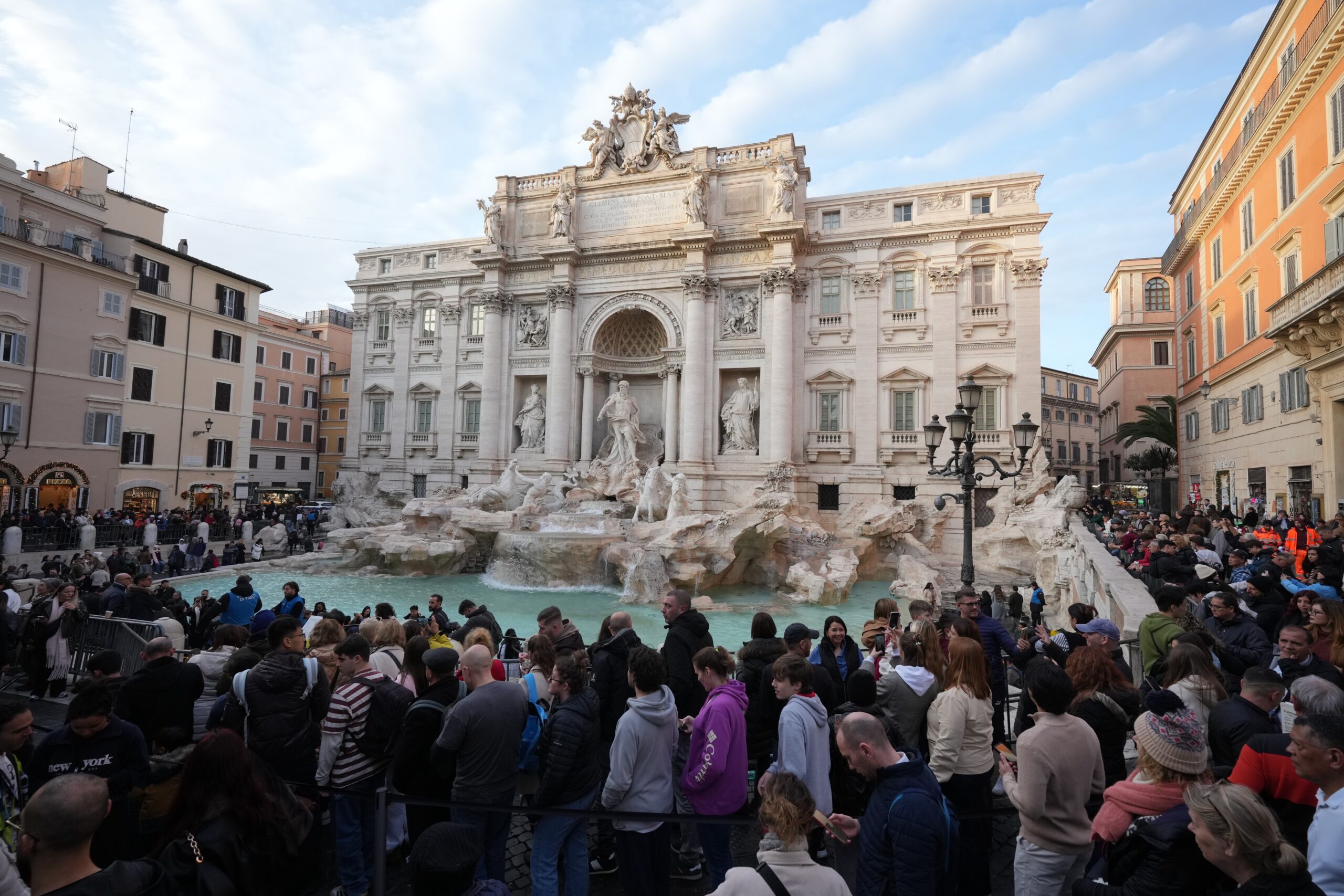
Visitors admire Rome’s Trevi Fountain, Friday, Dec. 19, 2025. Tourists are now being charged a fee to visit the fountain.
6. Overtourism clogs Europe’s icons
Europe has long had a popularity problem, but it has accelerated over the past 25 years. Blame it on social media or blame it on Hollywood, but these days, “everybody goes to the same places at peak times,” said guidebook author and tour company owner Rick Steves, “and it’s just insanity.” Travelers flock to Amalfi to get the same aesthetic beach-umbrella photos; they clog the streets of Santorini at sunset; they’re using up all the water in Sicily. Overtourism has become so untenable in European hot spots that authorities are now charging entrance fees for the Trevi Fountain and banning Airbnbs in Barcelona.
7. You can pay to skip the line
Hate waiting in line? Join the club. Have extra money to burn? Skip right on past the club through airport security and onto your plane, or through the throngs and onto your favorite theme-park ride.
TSA PreCheck, Global Entry, and Clear reduce airport waits for qualifying travelers willing to pay more. Some airlines offer priority boarding for a fee. At Disney parks, visitors who shell out extra cash can use “Lightning Lanes” to bypass lines.
The budget-minded among us can only wave and wait.
8. 9/11 creates the security state
Tragedy struck in 2001, and the airport experience has never been the same. The creation of the Transportation Security Administration and heightened security checkpoints — body scanners, X-ray machines, pat-downs, bomb-sniffing dogs — marked the end of regular-size liquids, foot modesty, and emotional send-offs at gates.
9. Your house is my hotel
Somewhere between the 2008 launch of AirBed & Breakfast and the global proliferation of Airbnb, short-term rentals transformed from a frugal traveler’s way to meet locals to rule-happy hosts’ way to get their linens washed before housekeeping arrives.
Like ride-hailing for car owners, short-term rentals gave anyone who owned property the ability to enter the hospitality business, creating new revenue streams — and new headaches for destinations with overtourism concerns and housing crises. Today, Airbnb’s market value is just a few billion shy of Marriott.
However, some bohemian networks (Couchsurfing, TrustedHousesitters, Reddit groups for apartment swaps) keep the dream of bed-bartering alive.
This image released by Focus Features shows Anthony Bourdain in Morgan Neville’s documentary “Roadrunner.”
10. Anthony Bourdain becomes the world’s travel host
In 1999, a brasserie chef gets published in the New Yorker, and all of his dreams come true. That article turns into a book. That book turns into another book, and then multiple TV series. “Bourdain” becomes bigger than life.
No television host before or since has connected with audiences the same way. Tall, devious, and handsome, Bourdain disarmed viewers with swagger and snark, then endeared himself to them with earnestness and humanity. He lauded haute cuisine and holes-in-the-wall with equal reverence. Behind the gross-out jokes and knife-sharp takes, there was a champion of the working stiff, a keen observer of history, a self-conscious artist with a deep love for writing and filmmaking.
He was a caricature in cowboy boots, a never-ending stomach, the collective id for everyone who dreams of going everywhere. He made us feel like we knew him. We didn’t.
11. Airlines abandon the middle class
Carriers once welcomed regular Joes and Janes with reasonable fares that included a seat roomy enough for their limbs. Carry-on bags, seat selection, and food and beverage service were on the house.
Then ultra-low-cost airlines — looking at you, Spirit and Frontier — upended the social order with a la carte pricing for nearly every amenity and transaction. The major carriers, meanwhile, adopted the unbundling model, turning the cabin into a real-life version of Downton Abbey.
12. COVID takes the workcation mainstream
The coronavirus pandemic sent many of us home. When we got tired of our own walls, we realized we could work from anywhere. It turned out that we liked the change of scenery.
Enter Zooms from the beach house, workdays wrapped up in time for sunset walks, and notes typed up from a sidewalk cafe. Some of us were brazen enough to take a “quiet vacation.”
Return-to-office mandates might be on the rise, but workcation habits will probably stick around, creating a new perk (or pain) for employers.
13. Points people gamify rewards
Gone are the days of mileage runs to nowhere and cashing in rewards for flights. Today’s Jedi masters of points and miles open new credit cards (those signing bonuses!) and charge all of their restaurant meals, groceries, travel reservations, and dog grooming appointments on high-yield cards, such as the Chase Sapphire Preferred or Capital One Venture X.
You can find these winners gloating in the airport lounge or in their premium seats at a World Cup match.
14. Anybody can explore Antarctica
Antarctic explorers don’t need Endurance — just several thousand dollars, seasickness patches, and a bathing suit for the polar plungeaboard an expedition cruise from Argentina.
15. The rise of the layover trip
Once considered dreaded pit stops, layovers have emerged as destinations unto themselves. Airlines such as Icelandair, Turkish Airlines, and Qatar Airways now pitch their hubs as a side trip or bonus adventure.
For the same ticket price, travelers can sample the local cuisine, soak up some culture, and sleep horizontally before returning to the airport and resuming their regularly scheduled vacation.
16. In-flight WiFi ends the age of unplugging
The airplane used to be one of our last sanctuaries from the connected world. A flight — or a cruise or a hike or a trip aboard — once offered a break from texts, emails, and conference calls. But thanks to advancements in technology, the untethered era is over.
Today, multiple airlines offer “fast, free” in-flight WiFi, and satellite internet makes it possible to work everywhere, whether on a yacht or in a yurt.
17. Hotel brands multiply like rabbits
We knew what we were getting into with a Courtyard by Marriott, a Hilton Garden Inn, or a Motel 6. But then came the hotel brand explosion: Your destination might offer an Aloft, a Spark, a Motto, or a Moxy.
You might wonder, Aren’t those just nouns? No, they’re part of hotel companies’ ever-growing ambition to get more heads into their beds.
18. Airlines tell passengers: BYO screen
Once upon a time, airlines put on a movie for the whole plane to watch from dangling monitors or, on a long-haul flight, a big, boxy TV screen. The in-flight entertainment situation got more glamorous when airlines began installing screens in seat backs in the late ’80s.
It was a luxurious shift, one that led to the discovery of a new societal phenomenon: the absolute pleasure of watching someone else’s airplane movie. But in the past decade, we’ve started seeing those screens disappear. Airlines claim they’re following passenger behavior: If we’re more likely to watch reruns of Lost on our personal devices than engage with seat-back screens, why keep investing in them?
19. Boeing tests our faith in air travel
Back-to-back crashes of Boeing 737 Max jets in 2018 and 2019 killed 346 people, shaking travelers’ confidence in the company while triggering the temporary grounding of the jet and years of scrutiny. Investigators pointed to flaws in a flight-control software system.
In 2024, a door panel missing key bolts broke off from a Max jet midflight, leading to new questions about the plane manufacturer’s safety culture. The company agreed to plead guilty to fraud later that year in a criminal case connected to the crashes, but instead reached a non-prosecution agreement with the Justice Department last year.
20. Athleisure takes over
The hordes of people flying, cruising, and sightseeing in yoga pants, moisture-wicking tops, sweatpants, and tracksuits are not part of a fitness flash mob. They’re today’s comfy travelers.
As millennials became the generation of leggings, the world followed suit. Some see this as a decline in civility, but travelers aren’t sweating it.
21. Southwest sells out
Southwest Airlines was always proud of standing out.
It didn’t do boarding like other carriers, didn’t slice up its cabins to charge more for the fancy front. It kept offering two (two!) free checked bags long after its competitors were raking in the cash for luggage.
But under pressure from investors, Southwest announced that it would shed its quirks and start acting like every other airline. Farewell, seating scrum. We miss you, free bags.
22. YouTube replaces travel TV
Turn on the Travel Channel, and you’re more likely to catch an episode of Ghost Adventures than your typical hosted travelogue. That sort of content has been democratized by social media.
Now, when travelers need information and inspiration for an upcoming trip, they’re turning to DIY creators on YouTube and TikTok. It’s where they’ll find (sometimes) realistic reviews alongside expert insights from the pros, no monthly subscription fee necessary.
23. Tripadvisor trumps guidebooks
Since Tripadvisor launched in February 2000, it has racked up more than a billion reviews, travel tips, photos, comments, and forum threads, making it one of the most abundant travel resources on the internet. (One of its most reviewed destinations? Pastéis de Belém in Lisbon, Portugal, famous for its egg tarts.)
The website and tour marketplace has been criticized for driving travelers to tourist traps, but it has also provided essential information to travelers since its founding. It’s one of the many crowdsourced platforms — like Yelp, Google Maps, and Reddit — that have turned guidebooks from must-have resources to old-fashioned extras.
24. More accessibility for people with disabilities
Innovations such as lightweight power chairs, adaptive adventure gear, sensory rooms, and navigational devices have cracked open the world for travelers with disabilities.
Travel is slowly becoming more inclusive as destinations, hotels, the transportation industry, parks, and attractions invest in accessible features for their tours, trails, and guest rooms.
25. Climate change
Where some see an existential threat, the travel industry sees an opportunity. Tourists are traveling to see “dying glaciers.” In Venice, Steves, the guidebook author, recently went on a walking tour with the theme “indicators of climate change.”
“This is something that really is taking its toll on Europe and impacting the way people travel,” Steves said.
Every year, Steves’s tour company takes tens of thousands of travelers to Europe, and every year, he notices that extreme weather is increasing. Now, as his company plans guided trips, it must factor in the potential for wildfires in Greece, heat waves in London, and sudden storms in Germany.
The White House stands about 70 feet tall. The Lincoln Memorial, roughly 100 feet. The triumphal arch President Donald Trump wants to build would eclipse both if he gets his wish.
Trump has grown attached to the idea of a 250-foot-tall structure overlooking the Potomac River, according to two people who spoke on the condition of anonymity to describe his comments, a scale that has alarmed some architectural experts who initially supported the idea of an arch but expected a far smaller one.
The planned Independence Arch is intended to commemorate the United States’ 250th anniversary. Built to Trump’s specifications, it would transform a small plot of land between the Lincoln Memorial and Arlington National Cemetery into a dominant new monument, reshaping the relationship between the two memorials and obstructing pedestrians’ views.
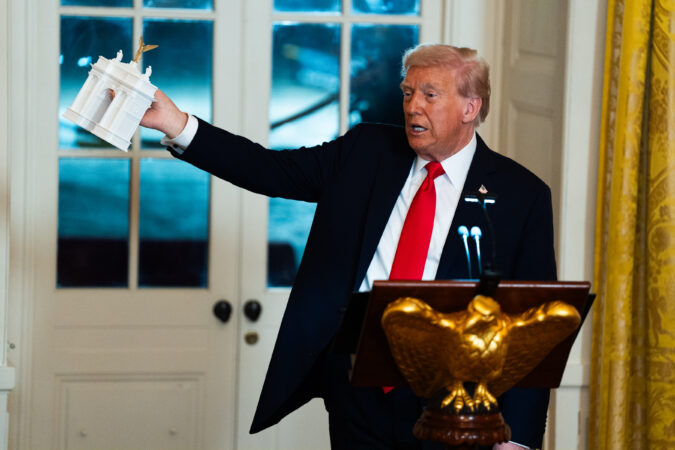
Trump has considered smaller versions of the arch, including 165-foot-high and 123-foot-high designs he shared at a dinner last year. But he has favored the largest option, arguing that its sheer size would impress visitors to Washington, and that “250 for 250” makes the most sense, the people said.
Architectural experts counter that the size of the monument — installed in the center of a traffic circle — would distort the intent of the surrounding memorials.
“I don’t think an arch that large belongs there,” said Catesby Leigh, an art critic who conceived of a more modest, temporary arch in a 2024 essay — an idea that his allies championed and brought to the White House. His allies also passed along Leigh’s recommendation of an architect, Nicolas Leo Charbonneau, who has been retained by the White House to work on the project.
Charbonneau did not respond to requests for comment.
Asked about the arch’s height, the White House on Saturday referred to the president’s previous comments.
“The one that people know mostly is the Arc de Triomphe in Paris, France. And we’re going to top it by, I think, a lot,” Trump said at a White House Christmas reception in December.
The Arc de Triomphe — already one of the world’s largest triumphal arches — measures 164 feet.
Trump also told Politico in December that he hoped to begin construction of the arch within two months, a timeline that appears unlikely given that White House officials have yet to make the final plans public or submit them to federal review panels. Memorial Circle, the plot of land that the president has eyed, is controlled by the National Park Service.
The White House reiterated the president’s desire to have an iconic monument.
The arch will become “one of the most iconic landmarks not only in Washington, D.C., but throughout the world,” spokesperson Davis Ingle said in a statement sent to the Washington Post after this article’s publication. “President Trump’s bold vision will be imprinted upon the fabric of America and be felt by generations to come.”
Washington does not have a triumphal arch, making it unusual among major cities that have built arches to commemorate wars and celebrate milestones, and some historians and civic leaders have long argued that such a monument is needed.
Rodney Mims Cook Jr., an Atlanta-based developer and president of the National Monuments Foundation, proposed a peace arch to Washington leaders in 2000 before the plans were withdrawn in the wake of the Sept. 11, 2001, terrorist attacks. Cook later built a monumental arch in Atlanta, the Millennium Gate Museum, intended to celebrate Georgia’s history.
Trump this month appointed Cook to the Commission of Fine Arts, a federal panel that would be set to review and approve the design of new monuments in Washington — including the president’s potential arch.
Trump on Jan. 23 also posted images on his Truth Social platform with no comment that depict three versions of a large triumphal arch, including one option with gold gilding — a hallmark of Trump’s construction projects. Asked about the president’s post, White House officials said that the arch design continues to be refined. The White House also said the plan to put a large Lady Liberty statue atop the arch, which was included in previous concepts presented by Trump and Charbonneau but not in the president’s Truth Social post, has not been abandoned.
City planners have eyed the land around what is now Memorial Circle for more than a century. A 1901-1902 report overseen by the Senate Park Commission, which laid the groundwork to construct the National Mall and beautify much of the city’s core, appears to envision some sort of structure in the circle, drawings show. Architect William Kendall in 1928 also presented plans to the Commission of Fine Arts to construct a memorial there.
Local historians and architectural experts have said that a large arch could change the relationship between several historic sites, including Arlington Memorial Bridge itself, which was intended as a bridge between North and South in the wake of the Civil War,and memorials for Lincoln and Confederate Gen. Robert E. Lee.
“It’s a very somber corridor,” said John Haigh, the chairperson of Benedictine College’s architecture program, who visited Memorial Circle with his students last year to consider the arch project. “We discussed the gravity of putting an arch there,” particularly one intended to be triumphal.
The structure as planned could obstruct views of Arlington House, the former Lee estate that sits on a hillside in Arlington National Cemetery.
“I would be very concerned about the scale,” said Calder Loth, a retired senior architectural historian for the Virginia Department of Historic Resources, warning that a 250-foot-high arch could alter pedestrians’ views as they approach Arlington National Cemetery from Washington. “It would make Arlington House just look like a dollhouse — or you couldn’t see it all, with the arch blocking the view.”
They also cautioned that, barring major changes to the circle, it could be difficult for pedestrians to visit a potential monument there, given the busy motor traffic.
Loth also invoked the vantage point from Arlington National Cemetery, where visitors often look across the river toward the Lincoln Memorial and the capital beyond — a view he said the proposed arch would reshape.
“How does it impact the panorama of Washington?” Loth said, invoking a question that he said should guide designers of monuments. “What is supposed to be doing the speaking?”
Leigh initially proposed a 60-foot arch that could pop up as a temporary structure to mark America’s 250th. Trump instead wants a permanent arch, more than four times larger, funded with leftover private donations to his White House ballroom project,which he has said could cost about $400 million. Publicly identified donors to the ballroom project, such as Amazon, Google, and Lockheed Martin, collectively have billions of dollars in contracts before the administration. (Amazon founder Jeff Bezos owns the Washington Post.)
Any construction plan for the arch would probably need to go through several review panels and potentially require the sign-off of Congress, given laws around constructing monuments in Washington.
Trump’s interest in enlarging the arch mirrors his desire to expand the White House ballroom, which last year sparked clashes with James McCrery II, the architect initially tapped for the project. Shalom Baranes, the architect now leading that work, told federal review panels this month that White House officials have halted plans to make the ballroom even larger.
Leigh suggested a compromise location that could allow Trump his large monument without imposing on other structures.
“If you’re going to build an arch that big, you should build it in another part of town and one possible site that comes to mind is Barney Circle,” Leigh said, referencing a site in Southeast Washington next to Congressional Cemetery, overlooking the Anacostia River. “There’s nothing around it competing with it.”