Category: Washington Post

  • Corporation for Public Broadcasting, gutted of federal funds, votes to dissolve

    Corporation for Public Broadcasting, gutted of federal funds, votes to dissolve

    The Corporation for Public Broadcasting’s board of directors voted to dissolve the organization, officials announced Monday, ending the 58-year-old agency that distributed federal funds to NPR, PBS and more than 1,500 local public radio and television stations.,

    The move formalizes the shutdown that began this summer after Republicans in Congress rescinded $1.1 billion in funding at President Donald Trump’s behest. At the heart of the campaign was a long-standing conservative critique that public media outfits produce news that is liberal, biased, and should not be funded by taxpayer dollars.

    CPB leaders said they chose dissolution over maintaining a dormant organization that could become manipulated by new stewards acting without public media’s best interest at heart.

    “CPB’s final act would be to protect the integrity of the public media system and the democratic values by dissolving, rather than allowing the organization to remain defunded and vulnerable to additional attacks,” said Patricia Harrison, CPB’s president and chief executive.

    Ruby Calvert, chair of CPB’s board, called the defunding “devastating” but expressed hope that “a new Congress will address public media’s role in our country because it is critical to our children’s education, our history, culture, and democracy to do so.”

    Created by Congress through the Public Broadcasting Act of 1967, CPB served as a middleman between taxpayers and public media, distributing most of its appropriations directly to local stations. The funding was particularly crucial for small and rural stations, which relied on federal dollars for a significant share of their budgets. The organization also negotiated music rights and procured technical infrastructure on behalf of stations — functions that now have no clear successor.

    CPB said it would complete distribution of its remaining funds and support the American Archive of Public Broadcasting in digitizing and preserving historical content. The organization’s own archives, dating to its 1967 founding, will be maintained in partnership with the University of Maryland.

    The organization’s closure caps months of turmoil for the public media system. In April, CPB sued the Trump administration after the president attempted to fire three of its board members, arguing it was not a government agency subject to presidential authority. In May, Trump signed an executive order instructing CPB to halt all funding to NPR and PBS, calling them “biased media.” NPR and PBS sued, arguing the order amounted to unconstitutional viewpoint discrimination.

    In September, after Congress passed its rescission bill, CPB announced it would redirect $57.9 million in satellite funding away from NPR to Public Media Infrastructure, a newly formed nonprofit backed by other public radio organizations, including PRX and American Public Media.

    In response, NPR sued its longtime ally CPB, arguing the move improperly allocated funds meant for NPR and violated the Public Broadcasting Act and was made under pressure from the Trump White House — a claim CPB disputed. The parties settled in November, with NPR receiving nearly $36 million for its satellite system. NPR also said it would waive fees derived from public radio stations for accessing its satellite services for the next two years.

    PBS has had staff cuts and NPR has reportedly made budget cuts. But for local stations that relied on CPB for a large share of their budgets, the federal funding cuts have been devastating.

    Major foundations, including Knight, MacArthur and Ford, have pledged tens of millions of dollars in emergency funding to keep the most vulnerable stations afloat, but some are already considering dropping national programming or shutting down entirely.

    NJ PBS, New Jersey’s public television network, announced in September that it may close next year, while Arkansas Public Television dropped its PBS affiliation — just as several public radio stations have dropped their NPR affiliation — showing that federal defunding has destabilized a system scrambling for answers.

    NPR, PBS, and the White House did not respond to requests for comment.

  • U.S. to promise Ukraine support to counter new Russian attacks

    U.S. to promise Ukraine support to counter new Russian attacks

    PARIS — Ukraine’s allies said Tuesday they had agreed to provide the country with multilayered international defense guarantees as part of a proposal to end Russia’s nearly 4-year-old invasion of its neighbor.

    At a key meeting in Paris, leaders from European countries and Canada, as well as U.S. representatives and top officials from the European Union and NATO, said they would provide Kyiv’s front-line forces with equipment and training and back them up with air, land and sea support to deter any future Russian attack.

    The size of the supporting forces was not made public, and many of the plan’s details remain unclear.

    U.K. Prime Minister Keir Starmer said the meeting made “excellent progress” but cautioned that “the hardest yards are still ahead,” noting that Russian attacks on Ukraine continue.

    He said allies will participate in U.S.-led monitoring and verification of any ceasefire, support the long-term provision of armaments for Ukraine’s defense, and work toward binding commitments to support Ukraine in the case of any future attack by Russia.

    There was no immediate comment from officials in Russia on Tuesday, which was the eve of Orthodox Christmas.

    Moscow has revealed few details of its stance in the U.S.-led peace negotiations. Officials have reaffirmed Russia’s demands and have insisted there can be no ceasefire until a comprehensive settlement is agreed. Russian President Vladimir Putin has ruled out any deployment of troops from NATO countries on Ukrainian soil.

    Starmer added that there can only be peace if Russia compromises, and “Putin is not showing that he is ready for peace.”

    In the event of a ceasefire, he said the U.K. and France “will establish military hubs across Ukraine and build protected facilities for weapons and military equipment to support Ukraine’s defensive needs.”

    Ukrainian President Volodymyr Zelensky said progress was made in the talks, although commitments need to be ratified by each country so that they can be put in place after any settlement.

    “We determined what countries are ready to take leadership in the elements of security guarantees on the ground, in the air, and at sea, and in restoration,” Zelensky told a news conference in Paris. “We determined what forces are needed. We determined, how these forces will be operated and at what levels of command.”

    He said details of how monitoring will work remain to be determined, as do the size and financing of the Ukrainian army.

    U.S. envoy Steve Witkoff said U.S. “strongly stands behind” security guarantees

    French President Emmanuel Macron said the security statement endorsed by Ukraine’s allies is a “significant step” toward ending Russia’s invasion.

    A joint statement said the allies also agreed to continue long-term military assistance and armament to Ukraine’s armed forces, which “will remain the first line of defense and deterrence” after any peace deal is signed.

    The allies still must finalize “binding commitments” setting out what they will do to support Ukraine.

    Prospects for progress at the meeting had been uncertain as the Trump administration’s focus is shifting to Venezuela, while U.S. suggestions of a Greenland takeover caused tension with Europe, and Moscow shows no signs of compromise.

    The countries dubbed the “coalition of the willing have been exploring for months how to deter any future Russian aggression should it agree to stop fighting Ukraine.

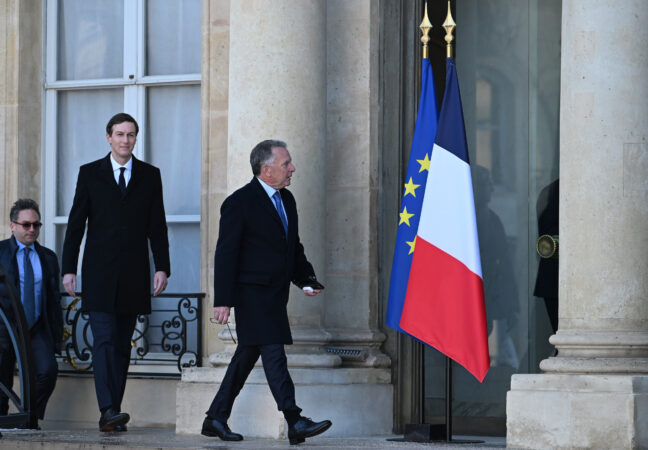
    Macron’s office said an unprecedented number of officials attended in person, with 35 participants including 27 heads of state and government. Witkoff and Trump’s son-in-law Jared Kushner, met with Macron at the Elysee presidential palace for preparatory talks ahead of the gathering.

    A series of meetings on the summit’s sidelines illustrated the intensity of the diplomatic effort and the complexity of its moving parts.

    Zelensky met with Macron ahead of the summit. French, British, and Ukrainian military chiefs also met, with NATO’s top commander, U.S. Gen. Alexus G. Grynkewich, participating in talks that France’s army chief said focused on implementing security guarantees. Army chiefs from other coalition nations joined by video.

    Macron’s office said the U.S. delegation was initially set to be led by Secretary of State Marco Rubio, but he changed his plans after the U.S. military intervention in Venezuela.

    Tension rises over Greenland comments

    Trump on Sunday renewed his call for the U.S. to take control of Greenland, a strategic, mineral-rich Arctic island.

    The leaders of France, Germany, Italy, Poland, Spain, and the U.K. on Tuesday joined Danish Prime Minister Mette Frederiksen in defending Greenland’s sovereignty in the wake of Trump’s comments about the self-governing territory of the kingdom of Denmark.

    But the continent also needs U.S. military might to back up Ukrainian security guarantees and ward off Russia’s territorial ambitions. That could require a delicate diplomatic balancing act in Paris.

    Participants are seeking concrete outcomes on five key priorities once fighting ends: ways to monitor a ceasefire; support for Ukraine’s armed forces; deployment of a multinational force on land, at sea and in the air; commitments in case of more Russian aggression; and long-term defense cooperation with Ukraine.

    But whether that’s still achievable Tuesday isn’t so clear now, after the U.S. military operation targeting Maduro in Venezuela.

    Ukraine seeks firm guarantees from Washington of military and other support seen as crucial to securing similar commitments from other allies. Kyiv has been wary of any ceasefire that it fears could provide time for Russia to regroup and attack again.

    Important details unfinalized

    Zelensky said during the weekend that potential European troop deployments still face hurdles, important details have not been finalized, and “not everyone is ready” to commit forces.

    He noted that many countries would need approval from lawmakers even if leaders agreed on military support for Ukraine. But he recognized that support could come in forms other than troops, such as “through weapons, technologies, and intelligence.”

    Zelensky said deployments in Ukraine by Britain and France, Western Europe’s only nuclear-armed nations, would be “essential.”

    “Speaking frankly as president, even the very existence of the coalition depends on whether certain countries are ready to step up their presence,” he said. “If they are not ready at all, then it is not really a ‘coalition of the willing.’”

    In fighting Tuesday, Ukraine’s Security Service (SBU) carried out drone strikes on a military arsenal and an oil depot deep inside Russia, according to a security official who was not authorized to comment publicly and thus spoke on condition of anonymity.

    The long-range drones hit the arsenal in Russia’s Kostroma region, triggering explosions that lasted for hours and forced the evacuation of nearby settlements, the official said. The site was described as a key logistics hub supplying ammunition in western and central Russia.

    In a separate strike, SBU drones hit an oil depot in Russia’s Lipetsk region, causing a huge fire, the official said.

  • Democrats look primed to win the House, but a wave might be harder

    Democrats look primed to win the House, but a wave might be harder

    Democrats are celebrating signs that the tide is turning their way for the 2026 midterms. But translating dissatisfaction with President Donald Trump into an electoral tsunami, or even a wave election, will be much harder to achieve than in years past.

    History, polling, a narrow Republican majority, a string of off-year victories, and voter anxiety over the economy favor the Democrats, who lead in support for control of Congress by five percentage points in a Post average of November and December national polls.

    It’s unclear what effect the Trump administration’s recent intervention in Venezuela will have, if any, and will probably depend on how deeply the U.S. involves itself in running that country’s affairs. Democrats hope it further splits Trump’s MAGA coalition.

    But the battlefield in the House is smaller than ever, according to political analysts, experts, and operatives, meaning Democrats will need to compete in districts that Trump won by large margins to pick up a significant number of seats.

    Of the 39 seats Democrats are competing for, 28 are in districts that Trump won by five or more percentage points.

    A gerrymandering spree instigated by Trump has narrowed the number of truly competitive seats, furthering a trend that was already underway in recent elections as the nation has become more polarized. That has not affected the race for the Senate, which Republicans are favored to hold.

    Just 36 races in this year’s election are rated competitive by the Cook Political Report, compared with 49 races at the same point in the 2018 cycle. Half of the seats rated competitive by Cook this year are already held by Democrats, leaving the party even less room to gain ground.

    “Democrats will have a very narrow but viable path to the majority. That’s a different scenario than 2006 or 2018, when Democrats put a ton of Republican-held seats in play,” said David Wasserman, senior editor and elections analyst at the Cook Political Report. “There’s so little elasticity in U.S. House elections these days compared to prior eras.”

    Democrats won 40 House seats in the “blue wave” of 2018 during Trump’s first term, easily erasing the Republicans’ then 23-seat governing margin.

    The good news for Democrats this year: They need only three seats to regain control of the House.

    That is achievable, but 2018-sized “waves” are harder now given increasingly partisan maps and a more divided electorate that has become more rigidly partisan, according to Wasserman and other analysts.

    Party leaders, however, argue they are well positioned to compete in heavily Trump districts. Trump’s 2024 victory was powered by a historic realignment of the electorate that upended decades of traditional coalitions. He made inroads with Latinos, young voters, first-time voters, and middle- and lower-income households. Democrats say they can unwind many of those gains with a slate of less traditional, and in some cases less partisan, candidates.

    One of them is Paige Cognetti, the mayor of Scranton, Pa., who won her current seat by running as an independent in a campaign called “Paige Against the Machine.” Even though Trump won her district by about eight percentage points, voters are open to her because they still cannot afford basic necessities like housing and groceries and are not “bleeding Democrats or hardcore Republicans,” she said in an interview. She noted that Gov. Josh Shapiro (D) won the same district by eight percentage points in 2022.

    Cognetti is challenging Rep. Rob Bresnahan (R., Pa.), who has faced scrutiny for stock trades while he was in Congress after campaigning on a ban on stock trading for members of Congress.

    “This is the exact type of public corruption and cynical behavior that people here really, really loathe,” Cognetti said. “Government should work and people want to see it at their local level and federal level, too.”

    Bresnahan supported an effort last year that would restrict members of Congress from trading stocks and has said lawmakers should not profit off the information that they have. Bresnahan’s stocks are in an institutionally managed fund that is run by financial advisers, spokesperson Hannah Pope said.

    In a statement, Bresnahan’s campaign attacked Cognetti’s record as mayor and as “a former Goldman Sachs banker who made the richest Americans even richer.”

    Democrats have coalesced around a midterm message focused on the cost of living and healthcare, hammering Republicans for passing a $4 trillion budget bill that includes steep cuts to Medicaid and food stamps. They have also highlighted Republicans’ failure to extend pandemic-era Obamacare subsidies that expired Dec. 31 that will drive up premiums for millions of Americans this year.

    Democratic Party leaders have been energized by off-year and special elections in which Democrats performed above expectations. In a Tennessee special election last month in a district Trump won by 22 points, Republican Matt Van Epps won by about nine percentage points.

    Some Republicans have urged the party to focus more on affordability, rather than solely focusing on issues such as crime or immigration that played a significant role in their 2024 sweep. Trump kicked off a tour last month in Pennsylvania to focus on Americans’ struggles with rising prices, but veered off-script, mocking the word “affordability,” touting the stock market, and disparaging Somalia.

    Republicans say they also have a slate of strong candidates in the country’s most competitive districts, including Kevin Lincoln, a former mayor and pastor running against incumbent Adam Gray (D., Calif.) in a central California district, and Eric Flores, a Republican army veteran and lawyer challenging Rep. Vicente Gonzalez (D., Texas) in Texas’s 34th Congressional District, near the state’s southern Gulf Coast and the border with Mexico.

    Mike Marinella, spokesperson for the National Republican Campaign Committee, agreed the battlefield is smaller than in past midterm elections. But he said Republicans hold the advantage, pointing to about a dozen Democratic incumbents who are fending off challenges in districts that Trump won narrowly.

    “Fundamentally, we have the upper hand just by looking at the pure numbers, and Democrats are certainly on defense in a lot more districts than we are,” Marinella said.

    Rep. Suzan DelBene (D., Wash.), chairperson of the Democratic Congressional Campaign Committee, said in an interview that many candidates competing in Trump districts are closely connected to their communities and “independent-minded.”

    “Authenticity matters a ton because you’re talking to folks across the political spectrum,” DelBene said.

    Democrats believe they have effectively neutralized Republican efforts to pick up additional seats through gerrymandering in Texas, Ohio, and North Carolina by gaining seats of their own in California and Utah. The Indiana Senate rejected a partisan gerrymander last month, and Democrats are still exploring whether they could pick up seats in Virginia, Illinois, and Maryland. Wasserman said the post-gerrymandering landscape remains “pretty equitable to both parties.”

    As Trump’s approval ratings fall — 39% of voters approve of the job he is doing, according to a Washington Post average of polls in early December — Democrats are working to wipe out some of the gains he made with voter groups that are traditionally aligned with them.

    In South Texas, Tejano music star Bobby Pulido is competing in one of the new districts Republicans drew to try to maintain the House majority.

    Key to Trump’s victory in Texas’ 15th District, which includes the Rio Grande Valley, was an unprecedented rightward swing among Latino voters. Pulido has broad name recognition in the Southwest and in Mexico in large part because of his 1995 debut single “Desvelado.” Trump’s immigration crackdown is devastating tourism and the rest of the economy in South Texas, Pulido said, creating an opening among those who supported him.

    “These immigration raids are hurting a lot of these small business owners or builders where their workforce they’ve had for years is no longer either there or afraid to go to work,” Pulido said in an interview. “I understand that a lot of Democrats don’t want to get labeled open borders. I’m sure as heck not open borders. … But due in large part to the immigration policies this administration has taken, we need to fix it.”

    There are still myriad questions about where the final map for 2026 will end up. In addition to ongoing gerrymandering efforts by both parties, the Supreme Court is expected to decide whether to strike down the last major pillar of the Voting Rights Act, a provision that has bolstered the power of minority voters and candidates for more than 50 years.

    If the court issues a ruling early enough and sides with Louisiana and the Trump administration — which has argued that race played too large a role in the decision to create a second Black-majority congressional district in the state — some states might scramble to redraw their maps and add Republican seats.

    Chris Warshaw, professor of political science at the McCourt School of Public Policy at Georgetown University, said it’s not clear how aggressively Republican states will respond, if at all, if the Supreme Court strikes down Section 2 of the Voting Rights Act. Even if Republican states try to redraw their maps, he said, Democrats have shown they are willing to respond.

    But the cost of last year’s redistricting fights is the health of American democracy, particularly as the country had previously made progress toward less partisan maps, he said.

    “The unwinding of that progress is really sad, and there’s no reason to think this genie is going to go back into the bottle,” Warshaw said.

  • Trump revives an old vision of American power, with global implications

    Trump revives an old vision of American power, with global implications

    The nighttime raid that ousted Venezuelan President Nicolás Maduro this weekend was the most dramatic demonstration of President Donald Trump’s vow to focus U.S. might on the Americas, as the White House re-creates a stance toward the Western Hemisphere that more resembles its 19th century empire-building era than the laissez-faire attitude of recent generations.

    Trump and his top allies suggested that the Venezuelan operation could be the start of efforts to remake the region, warning the governments of Cuba and Colombia that they might be next. Trump and some backers have also brought up Mexico as a potential target, and they are reviving talk of attempting to acquire Greenland, a Danish territory.

    After announcing Maduro’s capture, Trump boasted of the “Donroe Doctrine,” a twist on the strategy articulated by President James Monroe in 1823 that European powers should stop interfering in the Western Hemisphere. The national security strategy released by the White House in December noted a “Trump Corollary” to the Monroe Doctrine that promised “to protect our homeland and our access to key geographies throughout the region.”

    The effort carries significant risks. Washington could get pulled into the nation-building invasions that Trump has long sworn to avoid if the Venezuelan military or people are unwilling to go along with his plans. It also makes it harder for the United States to argue to Russia and China that they should steer clear of their neighbors. And it may reshape global affairs more broadly, as smaller nations that were long dependent on Washington’s guarantees for global trade and stability hedge their bets by building ties elsewhere.

    Backers of Trump’s strategy downplay the drawbacks and say a narrower focus on U.S. regional interests is long overdue.

    “The goal of the policy is to see changes in Venezuela that are beneficial to the United States first and foremost, because that’s who we work for, but also, we believe, beneficial for the people of Venezuela, who have suffered tremendously,” Secretary of State Marco Rubio told NBC’s Meet the Press on Sunday, a day after Trump said U.S. forces were ready to reinvade Venezuela if Maduro’s de facto successor, Delcy Rodríguez, did not comply with his wishes.

    Rubio — the son of Cuban immigrants to the United States — has long backed efforts to oust Venezuela’s leaders, who have presided over a decline in their country’s economy, ignored election results, and built ties to U.S. adversaries including Russia and China. Deposing Venezuela’s government would probably weaken the Communist leaders of Cuba as well, since they have long depended on Caracas for energy and other economic support.

    “This emphasis on the Western Hemisphere should not come as a surprise to anybody. It matters more to American security than any other part of the world,” said Nick Solheim, chief executive of American Moment, a group that backs Trump’s policies and trains junior staffers.

    But he said advocates of a more robust focus on the Western Hemisphere were not saying Washington should abandon global affairs entirely.

    “It’s making sure that our neighbors are not doing anything that is, that would adversely affect the United States, and then focused on our greatest geopolitical challenge right now, which is China,” he said. “That is not a retreat from the world of foreign policy. It is an accurate prioritization of what actually matters the most, what poses the biggest threats to the United States.”

    The move against Venezuela drew criticism from both the center and the right, as some influential “America First” advocates said that military conflicts and expanded foreign opportunities for U.S. oil companies weren’t why voters backed Trump.

    “This is the same Washington playbook that we are so sick and tired of that doesn’t serve the American people, but actually serves the big corporations, the banks, and the oil executives,” Marjorie Taylor Greene, a longtime Trump ally who is retiring from Congress after breaking with the president, said on NBC’s Meet the Press on Sunday. “We don’t consider Venezuela our neighborhood. Our neighborhood is right here in the 50 United States, not in the Southern Hemisphere.”

    Washington has a long history of efforts to back friendly leaders in Latin America, including at times intervening with force to do so. But it has not done so directly since the 1991 end of the Cold War, and Venezuela — with 30 million residents and a territory double the size of Iraq’s — is an especially large nation to take on.

    “I understand how we got here, but there’s been no forethought to the difficulties of the plan or the ideas that they seem to have adopted as the way ahead, and there definitely is no plan to the level of detail that’s required,” said Jennifer Kavanagh, a senior fellow at Defense Priorities, a think tank that advocates a more limited role for the U.S. military in the world.

    She said she wasn’t sure that China and Russia would be emboldened by Trump’s actions, since they already appear to feel unconstrained toward their neighbors. But she noted that Trump appears to be cautious about tangling with militaries that can inflict serious damage on the United States.

    “This sort of spectacular operation is very consistent. He likes to hit adversaries that can’t hit back, whether it’s small drug-smuggling boats, or Iran with no air defenses, or Venezuela, which is also weak,” she said. “And to me, that explains the more accommodating approach to Russia and China, in the sense that his view of military power is kind of go big or go home. But that model doesn’t work against Russia and China.”

    Some of Trump’s former advisers warn that the world the president is building may turn out to be more dangerous than the era of the 1990s and 2000s, when the United States was the preeminent global power and backed a broad effort to strip barriers to trade.

    “It just seems to be back to the 18th and 19th centuries,” said Fiona Hill, an expert at the Brookings Institution who was Trump’s top Russia adviser in his first term. “If you’ve bought into the idea of competition among the great powers and that Russia is another great power that’s inevitably going to dominate in its region, just as China is in its region, then this is the logical conclusion from this.”

    Hill said countries that have deep, allied ties to the United States but are threatened by Trump may seek to protect themselves by building trade and security relationships elsewhere, a move that will ultimately weaken Washington, not strengthen it.

    The raid has sparked fears elsewhere that Trump could act on other threats toward U.S. neighbors, which have included demands to take over the Panama Canal, to turn Canada into the 51st state, to annex Greenland, and to overthrow Cuba’s government.

    Trump on Sunday said he didn’t plan action against Havana, but offered tough language nevertheless.

    “I think it’s just going to fall. I don’t think we need any action,” he told reporters on Air Force One. “You ever watch a fight, they go down for the count, and Cuba looks like it’s going down.”

    He was sharper toward Greenland.

    “We need Greenland from a national security situation,” Trump said. “It’s so strategic. Right now, Greenland is covered with Russian and Chinese ships all over the place. … Denmark is not going to be able to do it.” On Saturday, an influential former White House aide, Katie Miller, posted on social media an image of Greenland with the U.S. flag superimposed on top of it.

    The president’s repeated statements about Greenland drew a sharp response earlier Sunday from Danish Prime Minister Mette Frederiksen. “I have to say this very directly to the United States: It makes absolutely no sense to talk about the need for the United States to take over Greenland,” she said.

    In a statement, she said Denmark is a U.S. military ally and that the United States has extensive access to Greenland.

    “I would therefore strongly urge the United States to stop the threats against a historically close ally and against another country and another people who have said very clearly that they are not for sale,” she said.

  • Who is Delcy Rodriguez, Venezuela‘s new leader?

    Who is Delcy Rodriguez, Venezuela‘s new leader?

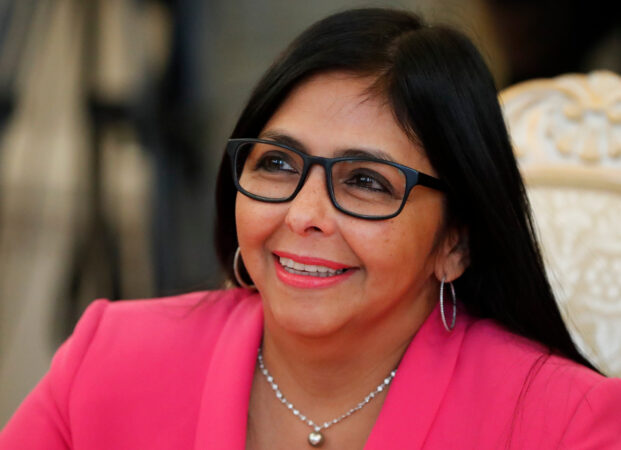
    Venezuela’s vice president, Delcy Rodríguez, has taken over as acting leader in the wake of a U.S. raid that deposed President Nicolás Maduro over the weekend.

    Rodríguez, 56, is a veteran politician, lawyer, and diplomat who had served as Maduro’s vice president since 2018. She has deep family ties to leftist politics in Venezuela, though she was generally viewed as more pragmatic than other members of Maduro’s government. While Rodríguez played a key role in overhauling Venezuela’s economic policy, developing close ties with the business community, she has also been accused of corruption and human rights abuses as part of Maduro’s inner circle.

    Venezuela’s Supreme Court ordered Rodríguez late Saturday to assume the presidency in Maduro’s absence, a position she would hold on an interim basis. On Sunday, Defense Minister Vladimir Padrino López also recognized Rodríguez as acting president, saying in televised remarks that the nation’s forces must be unified in “the mission of confronting imperial aggression.”

    Rodríguez’s first public comments came Saturday when, in an address to the nation, she denounced the U.S. operation to take Maduro and said he is the country’s only president.

    But in a Sunday night statement, Rodríguez offered a more conciliatory message, calling for “peaceful coexistence.”

    “President Donald Trump, our peoples and our region deserve peace and dialogue, not war,” Rodríguez said. “This has always been President Nicolás Maduro’s message, and it is the message of all of Venezuela right now.”

    Earlier, Trump suggested Rodríguez was willing to work with the United States, which he said would “run” Venezuela. But on Sunday, he threatened the vice president in an interview with the Atlantic, saying that “if she doesn’t do what’s right, she is going to pay a very big price, probably bigger than Maduro.”

    On Monday, lawmakers aligned with the ruling party, including Maduro’s son, gathered in the capital, Caracas, to follow through with a scheduled swearing-in ceremony of the National Assembly for a term that will last until 2031.

    Rodríguez was sworn in as interim president by her brother, Jorge Rodríguez, who was reelected as speaker.

    “I come with sorrow for the suffering inflicted upon the Venezuelan people following an illegitimate military aggression against our homeland,” she said with her right hand up.

    Here’s what we know about the interim Venezuelan leader.

    Who is Delcy Rodríguez?

    Rodríguez is a Caracas native and was born in the Venezuelan capital in 1969.

    She was 7 years old when her father, leftist political leader and guerrilla fighter Jorge Antonio Rodríguez, was killed while under interrogation by counterintelligence agents for his alleged role in the abduction of an American executive in Caracas.

    His death left an indelible mark on Rodríguez and her brother, Jorge Rodríguez Gómez, 60, who is president of Venezuela’s National Assembly, according to a 2020 profile in Vanity Fair España.

    After growing up in a deeply socialist family and hearing tales about their father, the siblings embarked on lifelong political careers, embedding themselves in the country’s leftist politics and serving in key roles under Venezuela’s former firebrand president and socialist icon, Hugo Chávez, and his handpicked successor, Maduro.

    Rodríguez, who often wears black-rimmed glasses and bright-colored fabrics, was educated in Caracas, Paris, and London, studying law at the Central University of Venezuela, where she later worked as a professor. She started her professional career as a labor lawyer and joined the Chávez administration in 2003.

    What political role has Rodríguez played in government?

    Rodríguez’s political resumé stretches back over two decades, during which she held positions that led her to the upper echelons of power.

    She started in the office of the general coordinator for the vice president in 2003, moving then to the Ministry of Energy and Mines, where she served as director of international affairs.

    Later, she became minister of presidential affairs under Chávez in 2006.

    She was a fierce defender of Chávez’s Bolivarian Revolution — named after 19th century Venezuelan revolutionary Simón Bolívar — which envisioned social and political reforms that would lift millions out of poverty and build a Latin America free of U.S. influence.

    “She has defended Venezuelan sovereignty, peace and independence like a tiger,” Maduro said of Rodríguez in 2017.

    But even as Chávez sought to fund social welfare programs, he let the country’s strategic petroleum reserves dwindle and made authoritarian moves that stifled the press and gutted the nation’s stable of experts.

    After Chavez died in 2013, Maduro elevated Rodríguez to minister of popular power for communication and information — and appointed her as his top diplomat and foreign minister the next year.

    When the price of oil plummeted in 2014, it set off economic chaos in Venezuela, characterized by severe food shortages, runaway inflation and an exodus from the country.

    On the heels of that collapse, in 2018, Rodríguez became Maduro’s vice president (while serving later as finance minister and minister of oil). A few months afterward, the U.S. placed sanctions on Rodríguez, her brother and other members of Maduro’s inner circle, accusing them of corruption and human rights abuses.

    “The revolution is our revenge for the death of our father and his executioners,” Rodríguez said in an interview that year with Venezuelan journalist José Vicente Rangel.

    What’s next for Rodríguez?

    With her broad portfolio, Rodríguez sought to implement economic changes while maintaining state control over key sectors and continuing to prioritize social spending.

    She has been viewed generally as more pragmatic and willing to oversee a limited opening of Venezuela’s economy than hard-line government officials, including the defense and interior ministers.

    Trump said Saturday that Rodríguez had spoken to Secretary of State Marco Rubio. “She said, ‘We’ll do whatever you need,’” he added. “I think she was quite gracious,” Trump said. “But she really doesn’t have a choice.”

    In some of her first actions as acting president, Rodríguez announced the creation of two commissions in a statement published by Communications Minister Freddy Ñáñez. The first is a high-level panel dedicated to the release of Maduro and his wife, Cilia Flores. The second will focus on guaranteeing and consolidating “food sovereignty and supply projects” in Venezuela, the statement said.

    Rodríguez also visited people who were injured in the U.S. attacks that deposed Maduro, according to the statement, referring to them as “brave and heroic young people who stood up to defend our sovereignty and the integrity of our President, Nicolás Maduro Moros.”

    Rodríguez and her brother are seen as modernizers who want a semiopen country and economy and warmer relations with the broader world, Tulane University sociologist David Smilde said.

    The siblings, however, “don’t have guns,” said Phil Gunson, a senior analyst for the Andes region with the International Crisis Group. And even with Delcy Rodríguez as interim president, the interior and defense ministers could still hold most of the power, given their control of the military and security forces.

    “If it comes to a fight, they’re left hanging because they don’t have anyone to back them,” Gunson said. “What I suspect is going to happen is, she will occupy the presidency, but the powers will be the defense and interior ministers, and that’s not good.”

    Information from the Associated Press was used in this report.

  • U.S. overhauls childhood vaccine schedule, recommends fewer shots

    U.S. overhauls childhood vaccine schedule, recommends fewer shots

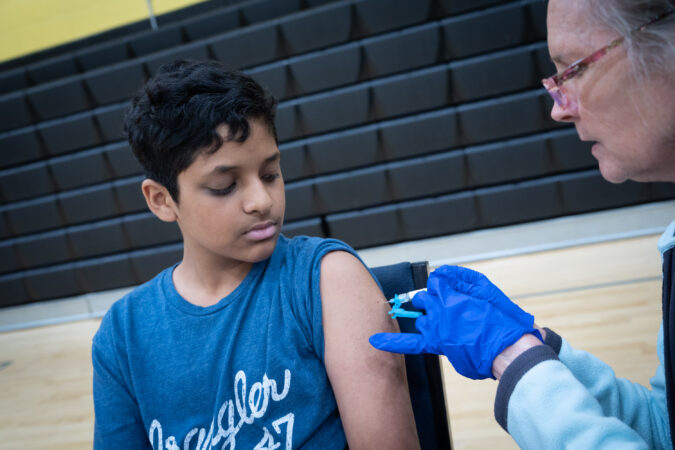
    The Trump administration is overhauling the list of routine shots recommended for all babies and children in the United States, bypassing the government’s typical process for recommending vaccines and delivering on Health Secretary Robert F. Kennedy Jr.’s longstanding goals to upend the nation’s pediatric vaccine schedule.

    Effective immediately, the Centers for Disease Control and Prevention will no longer recommend every child receive vaccines for rotavirus, influenza, meningococcal disease, respiratory syncytial virus (RSV), hepatitis A and hepatitis B, according to materials released Monday by the Department of Health and Human Services. Instead, smaller groups of children and babies should get those vaccines only if they are at high risk or if a doctor recommends it.

    Administration health officials said they were aligning U.S. recommendations more closely with vaccine schedules in other countries, citing decreased public confidence in vaccinations, especially following the COVID-19 pandemic.

    “We are aligning the U.S. childhood vaccine schedule with international consensus while strengthening transparency and informed consent,” Kennedy said in a news release. “This decision protects children, respects families, and rebuilds trust in public health.”

    Children could still receive vaccines that are no longer broadly recommended by the federal government and insurers would still have to pay for them, officials said. Officials said coverage in private plans, Medicare, Medicaid and the Children’s Health Insurance Program wouldn’t be affected by the new recommendations.

    Officials are dividing vaccines into three categories. The first category includes vaccines recommended for all children, such as to protect against measles and polio and whooping cough.

    The second category encompasses vaccines recommended for certain high-risk groups or populations, such as RSV, hepatitis A, hepatitis B and meningitis. The third category includes vaccines that can be given under a designation known as “shared clinical decision-making” that allows children to get the shots after families consult with their healthcare providers. Officials said they didn’t undergo a fresh assessment of who is considered high risk.

    The new set of recommendations align the U.S. more closely with Denmark’s schedule, something administration officials had previously suggested.

    Two of the vaccinations – for influenza and rotavirus – should only be given when a doctor recommends it, under the new CDC guidance. The CDC already shifted to this model for coronavirus vaccines in the fall.

  • Secret Service plans unprecedented staff surge with anxious eye on 2028

    Secret Service plans unprecedented staff surge with anxious eye on 2028

    The Secret Service has launched one of the most ambitious hiring efforts in its history, seeking to bring on thousands of agents and officers to ease strain on its overstretched workforce and prepare for multiple major events in 2028, including the presidential election and the Olympics.

    Service leaders say they want to hire 4,000 new employees by 2028 — a surge that law enforcement experts say has no clear precedent and reflects mounting concerns about staff burnout, a loss of experienced agents, and a relentless operational tempo. The added staff would make up for expected retirements and increase the size of the agency by about 20%, to more than 10,000 for the first time.

    Under a plan led by Deputy Director Matthew Quinn, the service aims to expand its special agent ranks from about 3,500 to about 5,000. Officials also want to add hundreds of officers to the Uniformed Division, for a total of about 2,000, and hire additional support staff. The figures have not been previously reported.

    The agency faces serious obstacles, however, including a shortage of qualified candidates; competition with other law enforcement agencies, especially in immigration enforcement; and bottlenecks in hiring and training, according to former service officials.

    A previous attempt to reach 10,000 employees over a roughly 10-year period ending in 2025 failed as the agency struggled with leadership turnover and disruptions from the coronavirus pandemic, among other issues. The service fell far short of recruitment and retention goals despite offering some of the biggest financial incentives of any federal law enforcement agency.

    “Our mindset is, we aren’t going to pay our way out of this,” said Quinn, a longtime Secret Service official who returned to the agency in May after several years in the private sector. “We can’t create enough incentives to negate the fact that we’re working our people very, very hard.”

    Quinn said he and Secret Service Director Sean Curran, the former head of President Donald Trump’s protective detail, have set out to make hiring a top priority, second only to protection. Senior administration officials have backed them, he said.

    “The protective mission has expanded,” he said. “Our numbers are low to meet those needs. We have to achieve what we said we were going to do 10 years ago. We’ve got to achieve it now.”

    Agency officials want to improve the quality of life in the service by shortening hours and reducing time on the road for officers and agents, many of whom spend months each year traveling on protective assignments.

    A larger staff could also allow the Secret Service to lean less on other law enforcement agencies for help securing high-profile events, giving it tighter control over venues. Poor communication with other agencies played a major role in the service’s most publicized failure in recent years, the attempted assassination of Trump in 2024 at a campaign rally in Butler, Pa.

    Some former officials questioned whether the service can achieve its goal.

    “They are going to have to eliminate all the management and red-tape barriers,” said Janet Napolitano, a former secretary of the Department of Homeland Security, the service’s parent agency. “They have to be able to swiftly recruit, maintain quality, and train that number of new agents. They’re going to have to turn headquarters into a hiring machine.”

    In 2024, Napolitano helped lead a bipartisan investigation of the Secret Service failures that led up the Butler assassination attempt, the first time a president or former president had been fired upon since 1981.

    Others said even more modest hiring targets could be a stretch on such a short timeline. Getting hired and trained for a job in the Secret Service is a long, strenuous, and heavily bureaucratic process, even by federal government standards. It involves multiple rounds of interviews, an intensive background check, and a notoriously tough polygraph test that officials say screens out some otherwise strong candidates.

    All of those steps place heavy demands on already understaffed field offices, according to a former Secret Service executive familiar with the process, who like others spoke on the condition of anonymity due to concerns about retaliation. The former executive said it was difficult to see how the agency could clear those hurdles while significantly expanding the workforce.

    “I hope they have success in getting those numbers as much as anybody, but it’s not realistic,” said another former senior official, who retired recently. “There’s no part of law enforcement that’s not struggling to hire.”

    Service leaders are adamant that they are not lowering standards to meet their goals.

    Some service officials had floated the possibility of curtailing or suspending the investigative portion of agent training, focusing only on the protective portion of the service’s mission, according to people familiar with the discussions. But Quinn said that was out of the question. “Investigations are the lifeblood of this organization,” he said.

    Instead, officials say, they have found ways to speed the process.

    In November, the service held the first of what officials expect to be multiple accelerated hiring events in which candidates complete assessments over several days, including a physical fitness test, a security interview, and a full polygraph.

    Historically, those assessments have taken months, according to Delisa Hall, the Secret Service’s chief human capital officer. About 350 candidates out of nearly 800 who attended the first event advanced to the next phase, she said.

    “It’s becoming evident that this may be our new normal to push applicants through,” she said.

    Agency officials say they have compressed the timeline for a job offer down to less than a year from the previous 18 months or more and hope to cut the timeline by roughly another four months. The long wait in the past has led some candidates to withdraw or take positions with other agencies that moved more quickly.

    Hall said the agency is recruiting from the military, college athletes, and law enforcement, and it’s staying more engaged with applicants to keep from losing people along the way.

    Getting new hires trained and field-ready on time could also present challenges as the Secret Service races to staff up.

    Officials say the service has secured 42 classes at the federal government’s main training center for law enforcement agents in Glynco, Ga., for the 2026 fiscal year. All the service’s new agents and officers must undergo basic criminal investigator training at the facility, known as FLETC, for about three months alongside recruits from other agencies.

    The campus is expected to remain packed for the foreseeable future with recruits from Immigration and Customs Enforcement and other immigration agencies hired as part of the Trump administration’s crackdown. Secret Service leaders say they have not had to compete for space. But several former officials said they worry the service’s recruits could take a back seat to training for ICE or the Border Patrol, both of which are hiring aggressively.

    The pressure on the agency will only mount as 2028 approaches. Some in the Secret Service have privately referred to the year as “Armageddon” because of the extraordinary security demands posed by the election and other major gatherings, including the Los Angeles Olympics, the first Summer Games in the United States since Atlanta in 1996.

    The workforce carrying out the mission could look dramatically different from the last election cycle. Many experienced agents have departed for other agencies or jobs in the private sector in recent years. Others from a large cohort hired in the years surrounding the Sept. 11, 2001, terrorist attacks may not stay for another breakneck campaign.

    “About a third of the workforce will be retirement-eligible before the start of 2028,” said Derek Mayer, a former deputy special agent in charge of the Secret Service’s Chicago field office. “That’s definitely a cause for concern. There were periods during hiring freezes in the 2010s when we didn’t hire anyone. When that happens, it does hurt, but it hurts five or 10 years later.”

    With Trump term-limited, both major parties are expected to have competitive primaries, raising the number of people the service will have to protect. The eventual nominees, their running mates and their spouses will receive full-time Secret Service details.

    The agency is also tasked with coordinating protection around the 2028 Summer Olympics and Paralympics, scheduled during the last two weeks of July and the last two weeks of August, respectively.

    “No matter what, I don’t care how successful we are,” Quinn said, “it’s still going to be a rough summer.”

  • In Venezuela raid, the specter of U.S. regime change returns to Latin America

    In Venezuela raid, the specter of U.S. regime change returns to Latin America

    The United States will “run” Venezuela — a country of 30 million people spread over hundreds of thousands of square miles — for the foreseeable future, President Donald Trump said Saturday just hours after the shocking, early morning U.S. military assault that captured its head of state and left Latin America and much of the rest of the world reeling.

    “We’re going to stay until … the proper transition takes place,” Trump said in a Florida news conference that glanced past details of how exactly that would be done.

    Two side benefits, he indicated, were that hundreds of thousands of Venezuelans who had fled to the United States would now go home and that the U.S. would now be able to take over the Venezuelan oil industry.

    On social media, Trump posted a photograph of shackled and blindfolded Venezuelan President Nicolás Maduro aboard the amphibious assault ship USS Iwo Jima. Maduro and his wife, both under U.S. indictment for drug trafficking and corruption, were snatched from a safe house by U.S. Special Operations forces in what senior administration officials insisted was not regime change but a law enforcement operation for which the military provided security.

    The Maduros, officials said, were read their rights by an FBI official on the ground before being whisked away in a helicopter. Asked if U.S. forces were prepared to kill Maduro if he resisted, Trump said, “It could have happened.”

    Trump made no distinction between law enforcement and overthrow, seeming to exult in what he called a “spectacular” operation, the likes of which had not been seen “since World War II … one of the most stunning, effective, and powerful displays of American military might and competence in American history.”

    “American dominance in the Western Hemisphere will never be questioned again,” Trump said. “Under the Trump administration we are reasserting American power in a very powerful way in our home region.”

    Asked who would run Venezuela, Trump said, “largely the people behind me,” pointing to Secretary of State Marco Rubio and Defense Secretary Pete Hegseth. “They’re going to be a team that’s working with Venezuela to make sure it’s working right,” he said.

    The vagueness of what happens next recalls the 2003 U.S. takeover of Iraq after the invasion ousting Saddam Hussein. Trump initially supported the Iraq operation, before saying he was against it as it stretched into a yearslong battle with disaffected Iraqis, gave rise to the Islamic State, and left thousands of American troops dead before the formal U.S. withdrawal in 2011.

    Trump made no commitment to María Corina Machado, the leader of the Venezuelan opposition and Nobel Peace Prize laureate, or to Edmundo González, whom the United States and others recognized as the legitimate president after an election last year that Maduro was widely believed to have stolen. Rubio, he said, had spoken by phone with Venezuelan Vice President Delcy Rodríguez, who “said ‘we’ll do whatever you need.’ I think she was quite gracious.”

    Trump said Rodríguez had been sworn in as interim president, although she told Venezuela’s state television Saturday night that “There is only one president here, and his name is Nicolás Maduro.”

    The 20th century was marked with numerous U.S. military interventions and occupations in Central America and the Caribbean, but Saturday’s assault on Venezuela was Washington’s first direct and openly acknowledged military strike in history against a South American government. A strategic gamble with an unpredictable outcome in a deeply divided region, it dramatically alters the security dynamic across the continent.

    In a flash, to both American foe and ally alike, the strikes have made the threat of U.S. military power indisputably real.

    “This is one of the most dramatic moments in modern South America history,” said Oliver Stuenkel, an analyst of international affairs at the Brazilian university, the Getulio Vargas Foundation. “The United States now represents the biggest security threat for the simple fact that it just militarily attacked a South American country with an unclear rationale.”

    Others were more direct. “For most Latin Americans, it’s insulting,” said a senior South American diplomat who spoke on the condition of anonymity so as not to draw Trump’s ire to his own country.

    “Of course we understand that the might of the United States is that it can intervene in any Latin American countries in any way they want,” the diplomat said. “But this will lead to complete destruction of any kind of international law, and to a growing antipathy toward the United States” throughout the Western Hemisphere.

    By Saturday morning, reaction to the strikes was already breaking along ideological lines in a region deeply polarized over security, crime, and corruption. Many on the right cheered the intervention, calling the removal of the self-described socialist Latin American strongman an advancement for liberty and a blow against drug trafficking.

    Argentine President Javier Milei, whose government has received a $20 billion currency swap from the United States to stabilize his country’s troubled economy, lauded the strikes. So did Ecuadorian President Daniel Noboa Azin, who has allied himself with Trump and offered to reopen a U.S. air base closed by one of his predecessors.

    “For all narco-Chavista criminals, your time has come,” Noboa wrote on social media, referring to Maduro’s predecessor, Hugo Chávez. “Your structure will end up falling across the entire continent.”

    Those on the left decried what they called an illegal act of military aggression. Few came directly to the defense of Maduro, who had been left increasingly isolated as his authoritarian and illiberal practices have bankrupted Venezuela, unleashed a refugee crisis, and given drug traffickers increasingly free rein. But they said the unilateral strikes and his removal set a new and dangerous precedent for the region.

    “The bombing of Venezuelan territory and the capture of its president crosses an unacceptable line,” Brazilian President Luiz Inácio Lula da Silva said. “The action recalls the worst moments of interference in Latin American and Caribbean politics and threatens the regional preservation as a zone of peace.”

    Some analysts, however, said it would be a mistake to interpret the strikes as the continuation of U.S. military actions in other Latin American nations, whether the CIA-sponsored overthrow of Guatemala’s government in 1954, the 1983 U.S. invasion of Grenada, or the 1989 capture of Panama leader Manuel Antonio Noriega following a 25,000-troop invasion.

    “This is not going to be a unified Latin American rejection of the action, like you may have seen in the ‘60s or the ‘70s,” when interventions were often influenced by the Cold War, said Eric Farnsworth, a senior associate at the Center for Strategic and International Studies think tank. “This is happening in a divided region, where nobody wanted this to happen, but where many recognized that there was no alternative to this unless you were ready to live with Maduro forever.”

    Several governments and leaders in the region already have an affinity with the Trump administration — ties the White House has sought to expand and exploit over the past year.

    The Trump administration has solidified relations with El Salvador’s president, Nayib Bukele, who accepted millions of dollars to imprison U.S. deportees and whom Trump called a “great friend” and “one hell of a president.” It has promised new trade and security cooperation with Ecuador and Paraguay, whose leaders are also Trump admirers. And it threw an economic lifeline to Milei, whom U.S. Treasury Secretary Scott Bessent called a “beacon” for South America.

    But few disagreed over the significance of the strikes. For decades, the United States has focused its military might elsewhere, in theaters much further away. The attacks have returned Washington to a policy of unabashed interventionism in the region.

    “The reaction in the rest of Latin America will be mixed between euphoria, anger, and fear,” said Brian Winter, an analyst with the Americas Society and Council of the Americas.

    Those in the region who condemn the strikes — most notably Lula, Mexican President Claudia Sheinbaum and Colombian President Gustavo Petro — will have to watch their backs. While Trump last year had what he called a productive meeting with Lula, he repeated at the news conference an earlier warning that Petro, whose country is a major producer of cocaine, had better “watch his ass.”

    In the case of Mexico, “the fact of the matter is that large swaths of the country are under the control of narco-terror organizations,” a senior administration official said, speaking on the condition of anonymity under rules imposed by the White House.

    “This is not a president that just talks,” the official said. “He will take action eventually. … I think the president always retains the option to take action against threats to our national security.’’

    While Petro has called Trump a “murderer” for U.S. military strikes against alleged drug boats in the Caribbean and eastern Pacific, it’s unlikely that either Lula or Sheinbaum will want to risk a lengthy diplomatic dispute with the White House, said Matias Spektor, a Brazilian political scientist at the Getulio Vargas Foundation.

    Referring to Cuba, which has depended on Venezuela for energy supplies and economic and security backing, Rubio said at the news conference Saturday, “If I lived in Havana now and I was in the government, I’d be concerned.” Venezuelan oil, he said, would not be allowed to go there.

    Since he began ratcheting up public threats against Maduro last summer, Trump has offered an evolving list of charges to justify his removal through exile or force, from allowing China, Russia, and Iran to gain a toehold in the hemisphere, to illegal U.S. immigrants that he charged Maduro had released from Venezuelan prisons and “insane asylums,” while asserting Venezuelan “terrorist” drug gangs were engaged in “armed conflict” with the United States.

    Most recently, he has charged that Venezuela “stole” oil and land belonging to the United States when it, like many other countries, nationalized its petroleum resources decades ago.

    In his news conference, Trump said he now plans to take back those assets. Asked how long he planned to run Venezuela, Trump said, “I’d like to do it quickly, but it takes a period of time.”

  • Rubio takes on most challenging role yet: Viceroy of Venezuela

    Rubio takes on most challenging role yet: Viceroy of Venezuela

    Marco Rubio has held many titles during Donald Trump’s presidency. He may have just acquired his most challenging one yet: Viceroy of Venezuela.

    The secretary of state, national security adviser, acting archivist, and administrator of the now-defunct U.S. Agency for International Development was central to masterminding the ouster of Venezuelan President Nicolás Maduro on Saturday, officials familiar with the planning said.

    But with no immediate successor to govern the country of roughly 29 million, Trump is leaning on Rubio to help “run” Venezuela, divvy up its oil assets and usher in a new government, a fraught and daunting task for someone with so many other responsibilities.

    On Sunday news shows, Rubio appeared to back off Trump’s assertions that the U.S. was running Venezuela, insisting instead that Washington will use control of the South American country’s oil industry to force policy changes: “We expect that it’s going to lead to results here.”

    “We’re hopeful, hopeful, that it does positive results for the people for Venezuela,” Rubio told ABC’s This Week. “But, ultimately, most importantly, in the national interest of the United States.”

    Asked about Trump suggesting that Rubio would be among the U.S. officials helping to run Venezuela, Rubio offered no details but said, “I’m obviously very intricately involved in the policy” going forward.

    He said of Venezuela’s interim leader, former vice president Delcy Rodríguez: “We don’t believe this regime in place is legitimate” because the country never held free and fair elections.

    “The task in front of him is stupefying,” said a senior U.S. official, noting the dizzying array of policy decisions related to energy, elections, sanctions, and security that await. This person, like others interviewed for this article, spoke on the condition of anonymity to respond freely.

    The moment marks the realization of a long-held goal for Rubio, who has voiced his criticisms of Maduro and desire for change in Venezuela for well over a decade. Those who have worked closely with Rubio, whose parents left Cuba several years before the Communist takeover in 1959, say the issues of the region are close to his heart.

    “Marco’s parents’ experience … is hardwired in him,” said Cesar Conda, a Republican strategist who worked as the former senator’s chief of staff between 2011 and 2014.

    U.S. officials say Rubio will play an outsize role in guiding U.S. policy as the Trump administration attempts to stabilize Venezuela.

    His Spanish proficiency and familiarity with Latin American leaders and the Venezuelan opposition make him a natural point man for Trump, said another senior U.S. official. But this person emphasized that the administration will need to appoint a full-time envoy to assist Rubio given the vast scope of decisions and responsibilities inherent in such a task.

    Trump, speaking to reporters after the operation, was vague when addressing questions about whether his administration is capable of running the Latin American country, saying “the people that are standing right behind me” will do so for a “period of time.”

    The president hailed Rubio’s initial talks with Maduro’s vice president, Rodríguez.

    “He just had a conversation with her, and she’s essentially willing to do what we think is necessary to make Venezuela great again,” Trump said. Shortly after his comments, Rodríguez contradicted Trump’s plans for her country, saying Venezuela “will never return to being the colony of another empire.”

    The U.S. capture of the sweat-pant-clad Maduro not only fulfills a long-held goal of Rubio’s but also represents a bureaucratic victory for him in an administration that includes ardent skeptics of regime change, in particular Vice President JD Vance.

    “Many people were skeptical that some kind of extraction operation could be carried out without a hitch,” said Geoff Ramsey, a nonresident senior fellow at the Atlantic Council. “He will see this as a resounding success for his foreign policy strategy.”

    Justin Logan, director of defense and foreign policy studies at the Cato Institute, said that while the removal of Maduro alone was unlikely to satisfy political exiles, it could help the Trump administration avoid an Iraq- or Afghanistan-style quagmire that hurts Republicans at the next election.

    “The only way it’s a mass political issue is if it gets bigger and costlier,” said Logan. “As long as the blood and treasure costs are this low, you can pretty much do whatever you want.”

    Besides navigating the treacherous minefield of nation-building that lies ahead, Rubio will also have to rebuild trust among U.S. lawmakers, many of whom have accused him of lying to Congress when he said the Trump administration would seek congressional approval before taking military action against Venezuela.

    “Secretaries Rubio and [Pete] Hegseth looked every Senator in the eye a few weeks ago and said this wasn’t about regime change. I didn’t trust them then and we see now that they blatantly lied to Congress,” said Sen. Andy Kim (D., N.J.).

    In an interview with the Washington Post, Rubio denied that he lied and said he promised to get congressional approval only if the United States “was going to conduct military strikes for military purposes.”

    “This was not that. This was a law enforcement operation,” Rubio said, referring to the indictment against Maduro in the Southern District of New York on drug charges.

    When pressed that U.S. forces bombing Venezuela, seizing its leader, and claiming to “run” the country would be widely interpreted as a military operation, Rubio did not relent, saying “the mission last night was in support of the Department of Justice.”

    The argument failed to move some experts. Jennifer Kavanagh, director of military analysis at Defense Priorities, said that the law enforcement justification was a “convenient” excuse for the administration’s decision not to notify Congress.

    The operation to capture Maduro “was extremely massive and complex,” Kavanagh added. “It doesn’t sound like a law enforcement operation to me.”

    Before joining the State Department, Rubio had long indicated that he supported using U.S. military force to oust Maduro, suggesting in a Spanish language interview in 2018 that there was a “strong argument” that the United States should do so.

    The next year, during renewed tension with Maduro, Rubio posted photographs to social media of deposed foreign leaders, including Libya’s Moammar Gaddafi shortly before he was executed by rebel forces in 2011.

    Though Trump had entertained the idea of talks with Maduro early last year, including those brokered in the early part of his term by envoy Richard Grenell that saw several detained U.S. citizens released, people close to the administration say that his instincts largely aligned with Rubio’s harder approach.

    “Rubio and the president are working hand in glove on this,” and the two of them “were really running this thing,” said one individual close to the Trump administration who has known Rubio for many years.

    During a news conference on Saturday, Rubio implied that Cuba could face similar U.S. military action. “If I lived in Havana, and I was in the government, I’d be concerned, at least a little bit,” he said in response to a reporter’s question.

    Though former officials and analysts said they wouldn’t expect imminent military action against Cuba, it was likely that economic pressure would increase with Maduro removed from Venezuela.

    “I presume that one of the first demands that we would have as the United States with whoever is running things in Venezuela is that any support for Cuba will stop on the theory that that will then destabilize that regime and lead to a better outcome,” said Kevin Whitaker, who served as U.S. ambassador to Colombia during the first Trump administration.

    Exactly who is running things in Venezuela now is uncertain. Some Latin America experts said that the United States was probably underestimating the challenge of governing Venezuela with a small U.S. footprint.

    “Credible estimates of the number of boots on the ground required range from tens of thousands to well into the hundreds of thousands,” said Adam Isacson, a scholar at the Washington Office on Latin America. “In Panama in 1989, the occupying force was 27,000, and Venezuela is 12 times the size and 6.5 times the population — with a much broader array of armed and criminal groups.”

    “So it is reasonable to expect the 15,000 troops currently deployed in the region to multiply by a factor of well over five, at the most conservative estimate,” Isacson added.

    By leaving Maduro’s vice president, Rodríguez, in place, the Trump administration may be trying to avoid a situation like the one in Iraq, where the government and military were almost completely purged, because that was a “catastrophe,” said Whitaker.

    A former Senate staffer who remains in touch with Rubio said that they did not think U.S. officials would be performing a formal occupation like Paul Bremer and the Coalition Provisional Authority had done in Iraq.

    “We’re going to tell them: ‘Hey, this is what you have to do in order for there not to be another strike,’” said the former staffer. “That’s what [Trump] sees as running the country.”

    John Feeley, a former senior State Department official and ambassador to Panama who worked on Latin America for decades, said it appears the administration is hoping initially to exercise influence over Venezuela through Rodríguez, whom he described as an “ideological communist” who was at “the heart of chavismo.”

    So far, Feeley said if Rodríguez is engaging behind the scenes, “she’s negotiating with Trump to save her skin.” And it’s unclear to what extent she can sway the rest of the military and political leadership.

    “The Trump administration’s hope is that after witnessing the events of today, all of those Venezuelan military leaders will be too scared to do anything other than follow Delcy’s orders,” he said. “But without boots on the ground, this is just noise.”

    Feeley said he’s been stunned by “the precision and professionalism” of what the public has been told about the military operation in Venezuela. But, he said, that “stands in stark contrast to the uncertainty and lack of clarity that we heard from the president and Secretary Rubio about the future of how Venezuela is going to be run.”

    Information from the Associated Press was used in this story.
  • The big obstacles to Trump’s plan for a Venezuelan oil windfall

    The big obstacles to Trump’s plan for a Venezuelan oil windfall

    There’s a familiar ring to President Donald Trump’s plan to send U.S. energy giants to Venezuela to use the wealth generated from rekindling long-stalled oil production to stabilize that country and cement American energy dominance: Similar ambitions accompanied the U.S. invasion of Iraq in 2003.

    The quick riches promised did not materialize there, as firms grappled with years of political turmoil and security threats, struggled to negotiate workable contract terms and confronted vexing infrastructure inadequacies. Venezuela may not be any easier, industry analysts warn.

    “One of the clear lessons from Iraq — and it is not unique to Iraq — is that you need to have stability and be able to assess risk before you can start production,” said Kevin Book, managing director at ClearView Energy Partners, a research firm. Until then, he said, companies may not be enthusiastic about making the billions of dollars in investments required in Venezuela.

    It’s unclear which firms Trump was referencing at a news conference Saturday morning, when he said: “We’re going to have our very large United States oil companies, the biggest anywhere in the world, go and spend billions of dollars to fix the badly broken infrastructure, the oil infrastructure.”

    Chevron, which operates there now, declined to comment on plans.

    ExxonMobil and ConocoPhillips exited the country and saw their assets seized after refusing to meet the terms of Venezuela’s government nearly two decades ago. ExxonMobil did not respond to requests for comment.

    “It would be premature to speculate on any future business activities or investments,” ConocoPhillips spokesperson Dennis Nuss said in an email.

    But the appeal is clear. Venezuela has one of the biggest oil reserves in the world, estimated at 300 billion barrels.

    “Every major oil company in the world and some of the smaller ones will look closely at this because there are very few places on Earth where you could increase production so much,” said Francisco Monaldi, director of the Latin American Energy Program at Rice University. “But first you need political stability and clarity.”

    He said restoring peak oil production there would cost up to $100 billion and take about a decade. And that is assuming there is enough political stability for companies to operate unencumbered during that entire period.

    There are other obstacles. The oil in Venezuela is a heavy form of crude that is more difficult to process and carries a heavier carbon footprint than oil pumped elsewhere. Venezuela’s power grid is on the brink, creating an uncertain outlook for oil production, which requires massive amounts of energy. Also, Russian and Chinese firms partnered with Venezuela after U.S. companies left the nation, complicating the reestablishment of U.S. firms.

    Returning to Venezuela has hardly been a central talking point of U.S. oil companies.

    In this era of relatively low oil prices and uncertainty about how robust future demand will be amid an on-again, off-again global energy transition from fossil fuels, firms are anxious about reinvesting tens of billions of dollars more in pumping in Venezuela absent assurances that their investments would be secure for at least a decade, according to industry analysts.

    Trump’s removal of Venezuela’s leader and plan to put the U.S. in charge of the country for now does not ensure that, despite his sweeping promises.

    “We built Venezuela’s oil industry with American talent, drive, and skill, and the socialist regime stole it from us,” Trump said. “The oil companies are going to go in. They’re going to spend money there that we’re going to take back the oil that, frankly, we should have taken back a long time ago. A lot of money is coming out of the ground. We’re going to get reimbursed for all of that. We’re going to get reimbursed for everything that we spend.”

    Today, the nation’s oil production is a fraction of what it could be and its infrastructure is badly frayed because of domestic turmoil, the departure of foreign oil companies, and related international sanctions. The nation is pumping a mere 1 million barrels of oil per day, less than 1% of global output. That is also less than a third of its peak production under the Hugo Chávez regime and a quarter of what experts say it is capable of generating.

    That oil has largely been purchased by China.

    The only American company operating in Venezuela is Chevron, with its production constrained by considerable Venezuelan government restrictions.

    “Chevron remains focused on the safety and wellbeing of our employees, as well as the integrity of our assets,” said a statement from Bill Turenne, a company spokesman. “We continue to operate in full compliance with all relevant laws and regulations.”

    While acknowledging that firms have reason to be reticent, Monaldi, of Rice University, pointed to forecasts showing Venezuelan oil could be crucial to meet rising global demand over the next decade.

    But none of that can happen overnight.

    “Oil companies do not operate in a vacuum and we are years from significant volume increase,” said Pedro Burelli, a critic of Venezuelan President Nicolás Maduro now living in the United States, and a former board member of the Venezuelan state oil company. “Regulations and contracts matter, as U.S. oil companies are publicly traded companies with shareholders who will demand rational investment decisions.”

    Oil companies have even been reluctant to increase their rig counts here, despite Trump’s repeated calls for more drilling, amid demand uncertainty and dropping market prices. U.S. oil production soared during the Biden administration, but the pace of growth has slowed since Trump returned to office, with some forecasts predicting declines this year.

    Book said oil companies will be looking to sign contracts that they are confident will be honored for the long term, and there is no government in Venezuela that right now can honor such a contract.

    “Before you make all these big investments and start running operations, you also need a stable country with reliable electricity, functioning ports, and an available workforce,” he said. “A lot of factors go into pulling this off.”

    Trump may have further complicated the outlook for U.S. oil firms returning to Venezuela by declaring that he does not believe the popular opposition leader there, María Corina Machado, commands the respect to run the country immediately following Maduro’s ouster.

    Machado has been a vocal proponent of helping U.S. firms re-establish operations in Venezuela. One of her energy advisers, Evanan Romero, a former Venezuelan oil executive and government minister, stressed in an interview that if the oil firms wish to return, “we will welcome them.”

    “They will make money, Venezuela will make money,” he said.