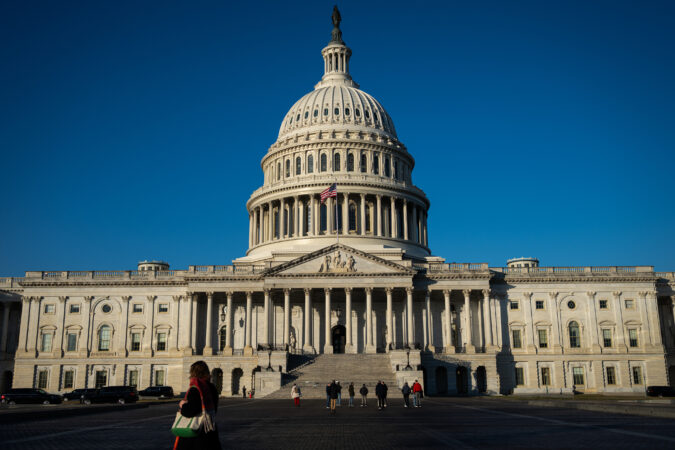
The Republican-controlled Congress has been very good to most of corporate America this year. Foremost among the boons is a $4 trillion tax-cut package that extended and added generous breaks for businesses large and small.
But it hasn’t been all good news for U.S. companies, and some industries have benefited more than others. The legislative branch’s acquiescence to Donald Trump’s sharp tariff increases raised input costs across the economy and provoked retaliatory moves against U.S. farm exports.
The healthcare sector, renewable energy companies, and Las Vegas’ casinos have taken legislative hits while chipmakers, drug companies, and private equity fended off potentially costly congressional interventions.
Here are this year’s winners and losers.
Winners
Nvidia
America’s most valuable company beat back influential Republican China hawks’ efforts to insert provisions in legislation aimed at ensuring U.S. companies get first dibs on Nvidia’s products. Chief executive officer Jensen Huang’s visits to Congress and the White House also helped pave the way for Trump administration actions easing export restrictions so the company could sell advanced chips to Chinese customers.
Private equity
The struggle to preserve a tax break cherished by private equity proved to be one of the rare instances this year when congressional Republicans stood up to Trump, rebuffing the president’s early demands to raise taxes on carried interest. The provision would have eliminated a lower income tax rate for a key portion of private equity executives’ compensation. PE firms worked to squelch the change in tandem with venture capital and real estate partnerships, whose executives and dealmakers also benefit. Better yet, private equity also won an expanded interest expensing tax break.
Oil and gas
Energy companies secured a tax break worth more than $1 billion for oil and gas producers in the Trump tax package. The provision allows businesses subject to a 15% corporate alternative minimum tax to deduct certain drilling costs when calculating their taxable income. Companies including ConocoPhillips Co., Ovintiv Inc., and Civitas Resources Inc. lobbied in favor of it.
Crypto
Digital-assets companies achieved a breakthrough with the passage of a light-touch regulatory law for dollar-pegged stablecoins, clearing the way for broader use of the technology in everyday finance. An industry drive for a broader rewrite of securities and commodities laws to set up favorable regulation of crypto assets is moving closer to the finish line. A $263 million campaign war chest the crypto industry has amassed in super-PACs is sure to help.
Pharma
Drug companies mostly succeeded in blocking legislative efforts to control their soaring prices. While Trump talked up requiring massive price cuts from pharmaceutical companies, Republican leaders on Capitol Hill made no moves to codify such a policy. Still, the Senate’s confirmation of Health and Human Services Secretary Robert Kennedy Jr. empowered a foe of vaccine makers.
Tech giants
Technology giants have stymied public pressure for federal legislation to regulate social media and other tech products amid rising concern over harm to children. Even so, the industry so far hasn’t been able to secure a federal law blocking state regulation of artificial intelligence. The Trump administration stepped in with an executive order to override state AI regulations, though that faces legal challenges.
Financial planners
The wealth management industry came out ahead when Senate Republican leader John Thune’s campaign to add a repeal of the estate tax to Trump’s tax law foundered. The tax overhaul kept in place the complex loopholes that the rich employ financial planners to navigate on their behalf.
Defense and aerospace
The defense industry thwarted efforts by Elon Musk’s DOGE team to cut military spending and scored big increases in the Pentagon budget. Trump’s massive tax and spending package included $150 billion in new defense spending. A defense policy bill Congress just passed came in $8 billion above the White House request. Notable beneficiaries include Anduril Industries Inc., Palantir Technologies Inc., and Boeing Co. with the new F-47 fighter. A provision to allow the Pentagon to repair weapons systems without paying contractors to do so was defeated.
Domestic car dealers
Car dealers won a tax break for loan interest on purchases of new U.S.-built automobiles.
Large corporations
The $4 trillion Trump tax cut bill extended a bevy of 2017 tax breaks that had expired. Manufacturers won bonus depreciation for the cost of production upgrades and a research and development tax break. Attempts to pay for these by scaling back the corporate state and local tax deduction and to increase the stock buyback tax were beaten back by a heavy lobbying effort.
Small businesses
The 2017 law that allowed pass-through businesses to deduct up to 20% of their qualified business income from their taxable income was permanently extended.
Losers
Hospitals
A $50 billion bailout for rural hospitals included in Trump’s tax cut plan won’t offset the loss of funding from Medicaid cuts in the law. Millions of Americans will lose health insurance in the coming years, according to forecasts, leading to a surge in uncompensated care in emergency rooms.
Health insurers
Big insurers are in line to lose millions of customers with the expiration of enhanced Obamacare premium tax credits at the end of December. Fewer healthy people signing up for policies also could further harm insurers’ bottom lines. While a bipartisan group of moderates in both parties are trying to renew the credits in January, they face an uphill battle against Republican congressional leaders, who oppose the effort.
Green energy
The Trump tax bill ended Joe Biden’s signature tax credits for solar, wind, and other renewable energy sources, and curtailed the $7,500 consumer electric vehicle tax credit for cars made by such companies as Tesla Inc., Rivian Automotive Inc., and General Motors Co. Renewable energy companies Sunnova Energy International Inc., Solar Mosaic Inc., and Pine Gate Renewables LLC all filed for bankruptcy protection this year in part due to the ending of tax incentives.
Banks
Crypto bros’ gain is bankers’ loss as the stablecoin legislation Congress passed this year threatens the banking sector’s long and profitable dominance of the payments system. Still, bankers’ congressional allies blocked votes on credit card competition legislation, which would cut into the nearly $190 billion in swipe fees retailers pay annually to banks, Visa Inc., and Mastercard Inc. Congress also repealed a Biden-era regulation limiting bank overdraft fees.
Casinos
Under the tax bill, professional gamblers would only be able to deduct 90% of their losses against their winnings, leading to a situation where they could still owe income tax if they break even over a year or lose money overall. Major casino companies are pushing to repeal the provision, fearing a drop-off in business from their best customers.
Airlines
Airlines lost hundreds of millions of dollars in ticket revenue during the longest government shutdown in history as the Trump administration moved to curtail flights during the congressional impasse. Delta Air Lines Inc. alone estimated it took a $200 million hit from the shutdown.
Importers
Retailers and other importers stung by Trump’s tariffs got little help from lawmakers this year, as Republicans largely sat back while the president claimed broad authority to rewrite the world’s trading order. House Speaker Mike Johnson, a close Trump ally, has so far managed to delay a looming floor fight over the legality of the tariffs until at least the end of January.
WASHINGTON — Over the past two years, a little-known aide to President Donald Trump has become one of the GOP’s most influential content creators, filming him dancing on a tarmac in Malaysia, serving French Fries at McDonald’s on the campaign trail, and greeting small children in the Oval Office.
Margo Martin, a 30-year-old who gets as close to the president as his Secret Service detail, is the quiet engine of a social media operation that has transformed presidential communications.
Armed with an iPhone camera, she gives what feels like a behind-the-scenes glimpse of the president and the most potent element that spurs online engagement: a sense of authenticity.
Martin’s raw material is then processed by a sprawling network of better-known right-wing influencers who use that content for memes, podcast clips, and shows that go viral, reinforcing Trump’s bond with his most ardent supporters and maintaining his status as a ubiquitous pop culture figure for everyone else.
During Trump’s trip to Asia in the fall, vertical videos and photos captured by Martin were viewed nearly 50 million times on her X account and more than 222 million times on the @TeamTrump Instagram and TikTok, not to mention the millions of views on reposts from Trump supporters who cribbed the content and shared it themselves.
It’s curated, of course. You won’t see images of Trump dozing off in a Cabinet meeting or the bruise on his hand that are often promoted bythe left. But even Democrats who view Martin’s efforts as propaganda concede their effectiveness.
“The more you see something, the more you think it’s true,” said Sammy Kanter, a Democratic content creator and new media consultant.
“The more volume of content that they put out there that favors the image that they want out there, and the more that’s in people’s feeds, and the more they see it, the more they’re going to think it’s reality or question less what their reality is versus what they’re being told,” Kanter said.
Martin, who declined an interview request, served as a press assistant in the first administration and then moved to Palm Beach, Fla., to continue working with Trump after he left office. A recording she made of Trump’s book interviews became part of special counsel Jack Smith’s investigation into the president’s handling of classified documents. (She was subpoenaed to testify before a federal grand jury.)
All of that — plus a low-key personality that is rare in Trump’s world of brash advisers — has bonded her to the president, who at a campaign rally called her “the most beautiful photographer in the world.”
“She has the trust of the president,” White House press secretary Karoline Leavitt said in an interview, noting the proximity of her desk, just outside the Oval Office. “So she’s able to really see the inner workings of his every day and share that with the American public.”
Compared with the flashy and controversial memes and edits often shared by other Trump and White House accounts, Martin’s content on X is understated, a collection of mostly vertical photos and videos optimized for audiences scrolling on their phones.
Captions usually include a brief description, a quote and pronouncements like “MUST WATCH!” or “THE PEOPLE’S PRESIDENT!” She’s a frequent user of the red heart, American flag, fire, and laughing emojis.
The basic approach is ideal for creators looking to make their own content, because the clips are free and ready to clip, unlike professional news videos that often require a licensing fee to news services such as Getty Images or the Associated Press.
“It really is about arming your base with the resources that they need,” said Parker Butler, who directed the team that ran the @KamalaHQ accounts for Kamala Harris’s 2024 presidential campaign.
The stream of material is “so helpful for us to discuss what the administration is doing,” said Link Lauren, a conservative political influencer who also served as a senior adviser for Robert F. Kennedy Jr.’s presidential campaign.
You’d be hard-pressed to find a Republican influencer or politico who hasn’t reposted one of Martin’s videos or photos. A Washington Post analysis of social media posts found that more than 300 high-profile right-wing influencers and politicians have mentioned Martin since the inauguration, sharing her posts thousands of times.
Her posts have been shared more than 10 times in that time period by Elon Musk, the Republican National Committee, and Fox News.
Leavitt credits Martin with fueling news cycles and prime-time Fox News packages, making her a key cog in a media operation that has increasingly pushed aside traditional adversarial news gathering.
Other allies credit Martin with building relationships among online supporters to further boost the White House message, which gives Martin an influence well beyond her 337,000 followers on her official X account.
“She’s undoubtedly one of the most influential creators right now, and she is maybe the first ever White House influencer,” said Alex Bruesewitz, a senior adviser to a Trump-affiliated political action committee and architect of the Trump 2024 campaign’s online strategy.
“Her content reaches the masses in a way that I don’t think anybody in the administration — in any administration — has done before,” Bruesewitz said.
Not all of Martin’s work appears on her official account. She posts more personal content on Instagram, where she presents as a cross between a travel influencer and a presidential sidekick. Photo dumps and reels include shots of her sitting across from the president on Air Force One and behind the scenes on foreign trips, but are interspersed with gym content, concert videos, and clips of her being an aunt.
That approach reflects the broader social media strategy the Trump campaign and Republican operatives embraced during the 2024 campaign, blending politics with other topics to reach lower-propensity voters.
“She’s kind of combining this lifestyle aesthetic with girl boss energy, and almost like a travel influencer,” said Azza Cohen, who served as Harris’ official White House videographer and director of video.
She pointed to a reel on Martin’s account of Trump’s August summit with Russian President Vladimir Putin in Alaska as an example of “whitewashing and sanitizing.”
The video is edited to look “like any other travel influencer,” she said, even as the content features high-level shots of the president on the plane, the military flyover, their handshake, and the Russian and American flags.
“Visually, it’s very effective because it’s normalizing Putin and it’s normalizing the sort of friendship between the president of the United States and the dictator who commits horrific human rights abuses,” she said.
Trump officials disagree, calling Martin’s work an example of transparency at the highest levels.
“I couldn’t think of anything less curated than an unedited filter video on an iPhone that is literally just simply posted and shared with the world in real time,” Leavitt said.
Daycare operators say the Trump administration’s restrictions on federal childcare funding unfairly punish them over a conservative activist’s fraud allegations against Minnesota centers that are undercut by state records anddisputed by some of the owners.
YouTuber Nick Shirley recently went to nine federally subsidized daycare centers in Minneapolis, many operated by Somali Americans.
In a 42-minute video of his visits that went viral last week, he claimed that thecenters weren’t caring for any children because none could be seen entering or exiting the buildings.
In response, the U.S. Department of Health and Human Services cut off funds to the centers until they undergo extensive auditing and announced stricter verification measures nationwide for childcare funds.
Minnesotastate regulators visited the centers within the past 10 months and saw children, according to state officials and records,undermining claims that they are fraudulent businesses.
One daycare manager told theWashington Post thatsecurity camera footage showed Shirley visiting her facility when it was closed. Another daycare director said staff didn’t open the door in part because they assumed that Shirley and six or seven men with him, some masked, were from Immigration and Customs Enforcement — which launched an operation in early December focused on Somali immigrants in the Minneapolis area.
Ahmed Hasan, director of ABC Learning Center, said the YouTuber showed up at the front entrance around noon on Dec. 16. During the winter, most parents use the back entrance and Shirley stayed no more than a few minutes, he said.
“There were kids here all the time,” Hasansaid. “I was also here.”
Hasan said his daycare serves about 56 children, most from low-income East African families. It was last visited by a state regulator on Nov. 7. Since the video went viral, people have flooded his center’s phones with harassing calls, threatening to have him arrested or call ICE, he said.
Ayan Jama, manager at Mini Childcare Center, said that herdaycare has also received threatening phone calls, including a bomb threat, and that people have attempted to break in.
She said Shirley visited in the morning before her center opened after noon. Its typical hours are 12:30 to 9:30 p.m. to serve mostly Somali children after school while their parents work in the afternoons and evenings, she said.
“Why not come during operating hours?” she said. “This is a targeted attack on our community.”
Jama, whose business was last visited by a regulator on June 11, said she won’t be able to keep her doors open if federal funds, which account for 90% of her revenue, aren’t restored.
Of the seven other daycare centers featured in Shirley’s video, five didn’t return requests for comment on Wednesday, the mailbox was full for a sixth, and multiple calls to a seventh resulted in a busy signal.
Minnesota Attorney General Keith Ellison, a Democrat, said the Trump administration is threatening funding for childcare services “apparently all on the basis of one video on social media.”
“To say I am outraged is an understatement,” Ellison said in a statement Wednesday.
The scrutiny on the nine daycare centers in Shirley’s video has nationwide implications because all daycare centers will have to submit more documentation to HHS before receiving childcare funds.
The new guidelines, while still unclear, mirror “defend the spend” requirements that briefly went into effect in April before they were stopped, child welfare policy analysts said. For a few weeks, states seeking to draw down money to reimburse daycares were asked to upload additional details on why the payments were justified.
That effort significantly delayed payments to providers, said Stephanie Schmit, director of childcare and early education at nonpartisan Center for Law and Social Policy.
If the new documentation requirements are the same or more onerous, providers that are chronically underfunded will struggle to keep their doors open, she said.
“We already know that childcare providers don’t have a lot of additional time to do things like this,” Schmit said.
HHS said federal childcare dollars, which help familieswith low incomes pay for care, will be frozen to the centers under suspicion until they release extensive documents, including attendance records, inspection reports, and complaints.
HHS spokesman Andrew Nixon said the agency has “a clear duty to verify the proper use of taxpayer funds.”
“The documentation process exists to rule out fraud and confirm that funds are supporting legitimate child care providers,” he said in a statement. “Any provider operating should be prepared to demonstrate compliance.”
Clare Sanford, a government relations chair for the Minnesota Child Care Association, which represents more than 300 centers across the state, called the viral video misleading.
For example, daycare centers often lock their front doors for safety reasons, and it is not unusual for employees to not answer a door if they are caring for children and not expecting a visitor, she said.
If an employee opens a door, children might not be visible because daycare centers keep them in classrooms, away from entrances, she said.
Shirley did not return requests for comment Wednesday evening.
The action comes amid state and federal fraud investigations of 14 Minnesota-run safety net programs, including for child nutrition, housing, and autism assistance.
President Donald Trump, Republican lawmakers, and conservative activists and media outlets have cited the involvement of Somali Americans to blast the immigrant group. Trump said in a Cabinet meeting last month that he doesn’t want Somali immigrants in the United States and referred to them as “garbage.”
Around threedozenpeople gathered Wednesday at the Minnesota Capitol to express opposition to the childcare funding restrictions, holding signs that said “No child care, no workforce” and “Fund care not fear.”
“Let’s be honest about how we really got here: Our president decided he doesn’t like the Somali community and he wants to destroy them,” said Amanda Schillinger, a Minnesota childcare provider, to a loud chorus of boos.
Minnesota Gov. Tim Walz, a Democrat, tweeted Tuesday that Trump was “politicizing the issue to defund programs that help Minnesotans.”
State Rep. Carlie Kotyza-Witthuhn, a Democrat who is cochair of the House Children and Families Finance and Policy Committee, said thestate has been actively working for years to put safeguards in place against fraud.
“It’s incredibly frustrating to me that Donald Trump and the Republicans want to use this as a political vehicle to cut funding to our state,” she said.
Eight of the daycare centers depicted in Shirley’s video have received multiple violations by state regulators. ABC Learning Center was cited for deficiencies, which Hasansaid were corrected and described as common among daycares, such as not having food menus with proper nutritional requirements and not having an individual care plan for a child with a known allergy.
The ninth center in Shirley’s video — Super Kids Daycare Center — had its license activated Oct. 1 and shares the same address as another daycare center whose license expired that same day and previously received violations.
The Minnesota Department of Children, Youth and Families did not return requests for comment after the Trump administration announced its funding freeze.
Chad Hanson remembers a time, not so long ago, when driving on a bridge across Florida’s Apalachicola Bay meant witnessing an astounding sight.
“You’d see just boats lined up along the reefs and spread out,” he said of the hundreds of oyster fisherman that used to harvest fromroughly 10,000 acres of the bay, about 75 miles southwest of Tallahassee.
For generations, those boats helped fuel the local economy and provided 90% of the oysters harvested in Florida, as well as about 10% of the nation’s wild caught oysters.
“Pretty much the whole community, in one way or another, was involved with the oyster industry,” said Hanson, a science and policy officer for the Pew Charitable Trusts who works on conservation issues around the Southeast.
Now, more than a decade after the once-iconic industry began to fade — and five years after harvesting was shuttered completely — Apalachicola’s storied oyster beds have opened once more, on the first day of 2026.
In 2013, the fishery entered a precipitous decline, the result of pressures such as excessive drought, overharvesting, the loss of reef material and long-running water disputes along the rivers that feed the bay— a reflection of stressors that have affected oyster populations across the Gulf of Mexico and beyond.
By 2020, Florida had imposed a five-year oyster harvesting ban, in an effort to try to jump-start an ecological recovery.
When harvesting in Apalachicola begins anew, it won’t be anything like the glory days just yet, with a truncated season, fewer permits available to access fewer acres and catches strictly monitored and limited.
But for folks such as Shannon Hartsfield, a fourth-generation Franklin County fisherman, it’s something.
“How can I put it?” Hartsfield, 56, said on a recent afternoon. “It’s a step forward, but it’s not going to be enough to say you can make a living in the bay.”
The decision to reopen the bay
In the fall, Florida’s Fish and Wildlife Commission voted unanimously to reopen Apalachicola Bay to oyster harvesting on Jan. 1 — a decision that drew swift praise from Gov. Ron DeSantis, a Republican.
“Apalachicola’s oyster industry has been the cornerstone of Florida’s seafood economy for generations. No place knows oysters better than Apalachicola,” DeSantis said at the time.
“I look forward to continuing to invest in restoration activities that support the long-term restoration of Apalachicola Bay and the communities that rely on it,” DeSantis said.
The approval came with a series of restrictions. To begin with, the state will allow only a two-month season, ending on Feb. 28. If all goes well, officials plan to reopen future seasons beginning in October.
For now, the state considers only about 500 acres suitable for harvesting, and commercial crews who qualify for a permit will be allowed to fish Monday through Friday along four small, designated reefs.
Each permit holder also will be limited to a certain number of bags from each reef. A bag is equal to two 5-gallon buckets, one 10-gallon bucket, or 60 pounds of oysters.
No one is pretending that such modest limits are enough to bring back oystering jobs that have been lost over the years, or to immediately make harvesting a sustainable line of work again in Apalachicola, where some oystermen have sold their boats and many have had to seek other kinds of work.
“I just don’t know how it’s going to be,” said Hartsfield, who said he quit harvesting oysters in 2013 but has helped academic researchers with their ongoing search for solutions. “We have a drop in the bucket compared to what we used to have.”
Merely reaching the point of being able to temporarily reopen Apalachicola Bay to harvesting took years of work and significant funding.
Numerous small-scale restoration efforts have unfolded during the years of closure, but the largest effort came in 2024, whenthe state’s fish and wildlife commission constructed 77 acres of new reef on degraded oyster habitat, the agency said.
State officials have set a long-term goal to restore 2,000 acres of oyster reefs in the bay by 2032 — still a fraction of what once existed, but far more than its recent lows.
The state also hopes to reestablish an oyster fishery with a long-term “cultch” program, in which oyster shells or other material are added back onto reefs to create an ideal habitat for baby oysters to attach and grow.
Such a program “is necessary component of any sustainable oyster fishery,” state wildlife officials wrote in a recent presentation.
“The success of oyster recovery in Apalachicola Bay, which includes a viable oyster fishery, depends on continued restoration and reef maintenance,” the agency wrote, estimating that such efforts will require an annual budget between $30 million and $55 million.
A budget proposal rolled out by DeSantis in December seeks $30 million in funding to expedite the state’s efforts to restore oyster habitats, including $25 million in Apalachicola Bay. But even if that amount ultimately is approved, restoring resilience in the estuary will take time.
“I’ll be frank,” said Hanson, who also serves on the board of the Partnership for a Resilient Apalachicola Bay. “Oyster restoration and habitat rebuilding is on the order not of years, but decades.”
Stress on the industry across the region
The pressures facing Florida’s once-renowned oyster industry are not unique. Other oyster populations around the Gulf of Mexico have faced declines in recent years for a litany of reasons, including habitat loss, pollution, and damage from storms.
Recently, Alabama announced that the state would close all public water bottoms oyster harvesting on Dec. 23 after one of the worst harvests in years.
State conservation officials said in a statement that surveys of reefs “suggest Alabama’s oyster populations have faced multiple stressors in recent years which have led to a population decline.”
Those threats extend across much of the Gulf Coast — and far beyond — said Tom Wheatley, a conservation project director for Pew. “It’s a global issue,” he said.
Indeed, researchers have estimated that as much as 85% of oyster reefs have been lost. Those losses matter not only because of the fishing industry they support, but also because of the habitat they provide for other marine life and the critical role they play in improving water quality and helping buffer the impacts of storm surges and waves.
Hanson said so much work remains in Apalachicola Bay before its beloved reefs resembled anything from decades ago. But he sees the reopening of the harvest season as a small step to a potentially brighter future.
“Hopefully, this is the beginning of a success story,” he said.
Hartsfield, like others who come from generations of oyster families, shares that hope. He said he plans to be back out on the water come January, and so does his 78-year-old father.
But he also knows how delicate the situation remains. How if another drought hits hard, or salinity levels aren’t just right, or other threats deepen, “It could go right back to where it was” when officials closed the bay in 2020.
“Right now, for the next few years, we will just be waiting to see what happens,” he said. “It’s very fragile.”
One woman moved back across the country to care for her grandmother, giving up her dreams of sunshine and palm trees. A young mother, overwhelmed caring for two children and her ailing grandmother, finally asked family to help her juggle. Andanother woman assumed financial responsibility for her grandmotherafter her home fell into foreclosure.
All three women belong to whatagingexperts call America’s unseen workforce — the 48 million family caregivers who provide unpaid support that allows millions of adults who are older, ill, or disabled to remain at home. It is a group that is expected to shoulder even more responsibility as the population ages and conditions such as dementia, cancer, and heart disease continue to rise. Within the already stretched community of caregiving, they belong to a group that is even more overlooked and undercounted: grandchildren.
Research shows unpaid caregiving is valued at more than $1 trillion, said Nicole Jorwic, chief program officer at the nonprofit Caring Across Generations.
“Right now, families filling in the gaps is the only option for a lot of people whether they’re grandchildren or not,” said Jorwic, who is in her 40s andhelpingcare for three grandparents in their 90s.
Research suggests race and ethnicity may be the “strongest predictors” of who becomes young adult caregivers, with about a third of caregivers in Asian, Black, or Latino families being 18 to 34 years old. And family caregivers generally are more likely to be women.
Caring for an aging family member is already an emotional, financial, and physical gantlet. Add to that the inexperience of youth, and some aging researchers say the challenges for grandchildren who are caregivers become even harder to navigate.
What this looks like in real life — the exhaustion, the sacrifice, the sense of purpose — comes through in the stories of three women shouldering the weight, not simply out of necessity but also devotion.
A caregiver who built an online community
The average caregiver is 51 years old. But five years ago, Elaine Goncalves stepped into the role at 28. She hadn’t imagined becoming hergrandmother’s caregiver. Elaine’shigh-paying tech job had just allowed her to relocate to San Diego.
Her grandmother, AdelaideGoncalves, was 90 and living in Massachusetts with one of her daughters and a different grandchild, barely able to manage the stairs of her third-floor home. Before Elaineleftfor California, she tried in vain to relocate her grandmother, askingall six of Adelaide’s surviving children for help. Elaine’s parents, unsure if their work schedules would accommodate the need, agreed with her plan, and her grandmother did, too — until it was time to go.
“Other family members were telling her not to,” Elaine said.
When the pandemic hit, Elaine was forced to return home. The way she made peace with the move was by finding a way to care for her grandmother. She kept the plan quiet, afraid relatives would talk her grandmother out of it again, and mindful of how it might look for a granddaughter to take on a role traditionally expected of a daughter in her Cape Verdean family. When someone in the house got COVID, no one objected to Adelaide relocating.
The first two years were “pretty humbling,” Elaine said. “I experienced crazy things like walking in my bathroom andit was covered in poop,” she said. “I basically went from ‘She’s so sweet!’ to praying — literally — every day for patience.”
The experience also made Elainerealize she owed her aunt an apology for judging the care she had provided and the frustration her aunt expressed in taking on a formidable task.
What the family didn’t know then was that Adelaide had dementia. Elainesaid guilt set in. A caseworker who called unexpectedly to schedule her grandmother’s annual physical helped secure the diagnosis, she said, and connected Elaine with “resources I needed but didn’t know were available.” Home health aides now feed, bathe, and change her grandmother, who goes to an adult day program daily.
In 2020 and 2025, about 18% of family caregivers ages 18 to 49 were caring for their grandparents, according to reports by AARP and the National Alliance for Caregiving. But researchers say it’s hard to know exactly how many young people provide care because the term “caregiver” can be defined in so many ways and national surveys count differently.
Researchers say that many young people aren’t identified because unlike Elaine, they’re not the primary caregiver, but rather pitching in as part of a family network.
“Most of them are disrupting parts of their life to engage in something they may not be counted as doing,” said Karen Fingerman, a professor at the University of Texas at Austin and director of the Texas Aging and Longevity Consortium.
Last year, Adelaide’s heart briefly stopped, a scare that led to hospice care.
“Emotionally, this has been a roller-coaster ride,” Elaine said. “Balancing the family dynamics and their help — or lack thereof — and their opinions and the emotions of her being hospitalized and me thinking she’s dying” forced tough family conversations.
Elainedecided to reflect on her experiences a few months ago, and wound up sharing the lessons online, inadvertently buildinga community through the social media series. It has drawn 1.6 million views, thousands of comments and shares, and more messages than she can keep up with — and she had posted only 11 of the 15 lessons.
“I didn’t know there were other people my age dealing with this,” she said.
A caregiver who had to give up care
Ramona Reynolds didn’t go away to college, opting instead to stay home and care for the grandmother who raised her. They hadnever spent more than a weekend apart, including after the 38-year-old got married and started having children. But eventually her 86-year-old grandmother’s health deteriorated beyond Reynolds’s capacity to provide care.
“That was a hard pill to swallow,” she said of sending her grandmother, Thelma McDonald, to live with her aunt.
For years, Reynolds watched dementia transform the woman who once commanded so much respect in their Brooklyn neighborhood that boys on the block carried her groceries upstairs unasked.
Reynolds was in her 20s when her grandmother was first diagnosed with dementia. A friend noticed that her grandmother was repeating herself. A few years later, one of her great-uncles did, too.Even though McDonald has four living children and a host of brothers and sisters, Reynolds never thought to ask them for help.
For years, things were manageable. Then, Reynolds got pregnant with her second child, and the family decided to relocate to Georgia for more space. As they prepared to move, Reynold’s family stayed with her in-laws and was to become a paid family caregiver. What she didn’t know was that moving someone with dementia out of a familiar environment can worsen their symptoms.
“So, when we moved here, I’m like, ‘Oh my god. Why is it so much harder?’” she recalled of her grandmother, who worked as a paid caregiver after emigrating from Jamaica. Reynolds was chasing after a toddler, trying to make sure her son — who is autistic, has ADHD, andin virtual school – stayed on task, all while also caring for her grandmother. “We did everything for her. Cooking, bills, dealing with doctors, social workers, program directors, all that stuff.”
Being a caregiver can be draining mentally, physically, and emotionally, experts say. What ultimately drives caregiver burnout and makes the role heavy is the lack of support, recognition, and resources, and the isolation, more so than the work itself, said Melinda S. Kavanaugh, a professor at the University of Wisconsin-Milwaukee whose research focuses on children and young adult caregivers.
“You can only do something on your own without any support for so long before you break,” she said, noting that older caregivers “might be able to last a little bit longer” because they have life experience to draw on.
Reynolds knew something had to give as her grandmother’s condition progressed and McDonald began unlocking doors trying to leave. She called a family meeting and asked for help. Her aunt stepped in, taking over her grandmother’s care.
“It’s a hard balance,” Reynolds said. “On the one hand, I would be nothing without this woman. But on the other, now I have my own family, and these babies deserve a mother that’s whole, that is not filled with anxiety and grief and a little bit of resentment, too.”
A caregiver shouldering financial responsibilities
Sharita Payton, 45, stepped in to help her sister care for their grandmother about two years ago, when several crises hit at once. Their grandfather died, their grandmother became more forgetful, maintaining the house became unaffordable, and her sister was facing personal struggles.
Payton’s mother was unable to take on the responsibility full time because she’s caring for a husband who has had multiple strokes. Neither could her grandmother’s other children, for different reasons: One is in jail, another struggles with addiction issues, and the third lives far from the family in South Carolina.
“There’s a lot of different nuances involved,” she said. “To look around and see that after everything they have given, there’s really no one that’s available to pour back into her when she needs it. That’s been really hard to navigate. I just had to step up.”
So, on and off for the past two years, Payton’s husband would drive her 89-year-old grandmother, Geneva Madison, between their house in Massachusetts and her mother’s house in Connecticut.Payton became hergrandmother’s power of attorney, took over her finances, and began setting aside money for when a move was needed. That move came several months ago when she set her grandmother and sister up in a new apartment.
Caregiving can be financially stressful for families because close to three-quarters of costs are out of pocket, said Sue Peschin, president and CEOof the Alliance for Aging Research. Often families don’t realize this “until they’re up against it,” she said, noting that people tend to think Medicare covers long-term care and it doesn’t.
Part of the misconception is how “we think about retirement in the United States,” Peschin said. “Oftentimes the thinking is, ‘How do we want to live as fully functional human beings?’” But not what happens after a health crisis.
Payton, who owns a hair salon, isn’t certain her grandmother will stay in Connecticut for good. She keeps a close watch in case she needs to bring Madison back to Massachusetts. She talks about the need for more resources often with clients who find themselves in similar situations. “A lot of us are navigating these new things for the first time, and we don’t even know what to do or how to do it,” Payton said. “We just put more on our plate than I think we need to.”
Still, she said, “it’s kind of like a no-brainer. That’s my grandmother.” As a mother of five, Payton said she tries to involve her children in her grandmother’s care in small ways, teaching them to “treasure her because this is something that is not the norm, having your great-grandmother in your presence.”
The Social Security Administration — the sprawling federal agency that delivers retirement, disability, and survivor benefits to 74 million Americans — began the second Trump administration with a hostile takeover.
It ended the year in turmoil. A diminished workforce has struggled to respond to up to six million pending cases in its processing centers and 12 million transactions in its field offices — record backlogs that have delayed basic services to millions of customers, according to internal agency documents and dozens of interviews.
Long-strained customer services at Social Security have become worse by many key measures since President Donald Trump began his second term, agency data and interviews show, as thousands of employees were fired or quit and hasty policy changes and reassignments leftinexperienced staff to handle the aftermath.
Exaggerated claims of fraud, for example, have led to new roadblocks for elderly beneficiaries, disabled people, and legal immigrants, who are now required to complete sometransactions in person or online rather than by phone. Even so, the number of calls to the agency for the year hit93 million as of late September — a six-year high, data show.
The troubled disability benefits system is also deteriorating after some improvement, with 66% of disability appointments scheduled within 28 days as of December — down from nearly 90% earlier in the year, data show.
One notable exception is phone service, which improved in the second half of the yearbut is still subpar. Average hold times peaked at about 2½ hours in March, but dropped starting in July as employees were diverted from field office duties to fix what had become a public relations crisis. Average wait times for callbacks remain an hour or longer, however, while new delays have emerged elsewhere in the system, internal data show.
“It was not good before, don’t get me wrong, but the cracks are more than beginning to show,” said John Pfannenstein, a claims specialist outside Seattle and president of Local 3937 of the American Federationof Government Employees, which represents most Social Security employees. “It is a great amount of stress on our employees that remain on the job, who haven’t jumped ship.”
Commissioner Frank Bisignano has authorized millions of dollars in overtime pay to employees in a race to clear the bottlenecks, which worsened dramatically after nearly 7,000 employees — 12% of the workforce — were squeezed out early in the year. The agency said it has made improvements: It reduced the processing center backlog by one million cases this fall, cut pending disability claims by a third and kept the website live 24-7 after a series of outages earlier this year.
The current crisis follows years of disinvestment by Congress and acting leadership, despite a surge in baby boomer retirements. Bisignano promised faster service and a leaner workforce with a digital identity that he says willautomate simple retirement claims and other operations.
Frank Bisignano, President Donald Trump’s nominee for commissioner of the Social Security Administration, arrives for his confirmation hearing in March.
“In the coming year, we will continue our digital-first approach to further enhance customer service by introducing new service features and functionality across each of our service channels to better meet the needs of the more than 330 million Americans with Social Security numbers,” the commissioner said in a statement to the Washington Post.
But responsiveness and trust in the agency have suffered, according to current and former officials and public polling.
This account of the crisis at Social Security is based on internal documents and interviews with41 current and former employees, advocates and customers, many of whom spoke on the condition of anonymity to speak candidly about their concerns.
Social Security officials declined to make Bisignano available for an interview, though he did respond to written questions.
Three days before Christmas, Brian Morrissey, 65, arrived at the field office in Silver Spring, Md., for an appointment to apply for Medicare. He had tried the “MySSA” website, “but navigating it was just really hard,” he said. Morrissey owns a home improvement business, he said.
“If they can make the process easier online, great, but right now it is not well designed,” he said. So his wife waited 30 minutes on hold to schedule a face-to-face appointment for him.
Aime Ledoux Tchameni, an immigrant from Cameroon, waited in line at the Silver Spring office to get an appointment time to fix his last name from being listed as his first name — a mistake that occurred when he came to the U.S. two years ago. He has a provisional driver’s license from Maryland and needs to clear up his name with Social Security by mid-January, he said. But his appointment is not until Feb. 9.
“This is really going to cause me problems, because I need my driver’s license to get to work,” Tchameni said in French. “I don’t understand why I have to wait so long.”
‘I flipped the switch’
The table was set in February by Elon Musk and his Department of Government Efficiency, or DOGE, which installed a loyal, mid-level data analyst with no management experience to lead the $15.4 billion agency.
That former analyst, Leland Dudek, insists that he saved Social Security from a worse fate under Musk’s cost-cutting team. “I flipped the switch,” he said in a recent interview, referring to his disruptive four-month tenure as acting commissioner. “The casualty of that is a smaller SSA, an SSA that is being, for the first time, subject to the whims of being a political organization, which it was never intended to be.”
Regional offices abruptly disappeared in a rushed reorganization. New policies to fight fraud were rolled out only to be canceled or changed, prompting confused customers to jam the phones and the website, which crashed repeatedly. Daily operations in some respects became an endless game of whack-a-mole as employees were pulled from one department to another.
Along the way, Social Security also became ground zero in the administration’s quest to gather Americans’ personal data — largely in service of its mass deportation campaign.
The chaos quickly became a political cudgel, as Democrats saw an opening to defend one of the country’s most popular entitlement programs. Senate Democrats, led by Sen. Elizabeth Warren of Massachusetts, set up a “war room,” holding rallies with former commissioners in both parties and issuing demands for more resources to keep the Trump administration on the defensive.
“We’ve kept up the pressure and held Donald Trump, Elon Musk and Frank Bisignano accountable for the chaos they’ve caused,” Warren said in an interview.
Many critics note that Bisignano, a Wall Street veteran who became commissioner in May, now wears a second hat as CEO of the Internal Revenue Service —another massive portfolio with a multibillion-dollar budget.
In a statement, Bisignano said his shared leadership of Social Security and the IRS “will drive a better outcome for the American public.” He saidhe envisions “a Social Security Administration that is easier to access, faster to respond, and better prepared to meet the challenges facing Americans.”
Bisignano also said he is working to improve morale and “have the right level of staffing to operate at peak efficiency and deliver best-in-class customer service to the American people.”
‘Work piles up’
By the time Bisignano was confirmed by the Senate, Social Security had been led by three acting commissioners in six months. He pledged to stabilize the upheaval.
But he confronted immediate challenges. Dudek had reassigned 2,000 employees in administrative, analytical and technical roles to jobs dealing with the public. Many accepted the switch under threat of firing if they refused. Some began working the phones. But the national toll-free number was still in crisis, so another 1,000 staffers were assigned to the phones in July. The employees were thrown in with minimal training, multiple employees said — and found themselves unable to answer much beyond basic questions. The phone staff was told to keep calls under seven minutes in what became a push for volume over quality, employees said.
Although officials have publicly claimed that wait times have improved to single digits in some cases, those numbers do not account for the time it takes for customers to be called back, according to internal metrics obtained by the Post.
An audit published by the Social Security Inspector General’s Office on Dec. 22 confirmed that millions of callers requesting callbacks were counted as zero-minute waits by the agency. The review concluded that the metrics themselves were accurate, however, and showed that customer service overall has improved.
Jenn Jones, AARP’s vice president of financial security, said the improved phone service numbers were “encouraging” but that “more work needs to be done.”
“Wait times for callbacks remain over an hour, and more than a quarter of callers are not being served — by getting disconnected or never receiving a callback, for instance,” Jones said in a statement.
Public outcry and pushback from congressional Democrats derailed the planned closure of dozens of field offices that DOGEhad said were no longer needed.
Leland Dudek, former acting commissioner of the Social Security Administration, in November.
Meanwhile, Dudek’s workforce cuts led field offices to shed 9% of their employees by spring due to early retirement and deferred resignation offers. Overtime was restricted and hiring was frozen,even as customer visits continued to climb.
Shortly after taking office, Bisignano’s field operations chief, Andy Sriubas, wrote in an email to the staff that field offices “are, and will always remain, our front line — our face in the community and the primary point of in-person contact.”
In the near term, though, the front line staff were overwhelmed. Attrition was geographically uneven, with some offices losing a quarter of their employees to early retirement offers just as foot traffic grew, according to a staffing analysis by the AFGE’s research partner, the Strategic Organizing Center. The groupcalculated that there were about 4,000 beneficiaries for every field office employee in August of this year.
In several states that ratio is worse, the group found. Wyoming’s field offices, for example, have just 18 employees — or one for every 7,429 beneficiaries.
The shortages have created temporary office closures in many rural areas, some for days or months at a time. The office in Havre, Mont., has been closed for months, with the nearest one almost two hours away in Butte.
Today a majority of Social Security staffers who accepted reassignmentshave not been fully or properly trained, according to several employees with direct knowledge of the initiative. Instruction is often truncated so the staff can respond to customers. Officials said they provide training based on the employee’s level of experience and review the reassigned employees’ work.
“They offered minimal training and basically threw them in to sink or swim,” one veteran employee said of their transferred colleagues.
Training on the phone system and complicated claims and benefit programs lasted four hours for some reassigned workers when it should have taken six months, another employee said. As a result, some customers still can’t get basic questions answered or are given inaccurate information,according to a half-dozen staffers who answer the phones or work closely with employees who do.
The increased workload, hiring freeze and departures have made it harder for the staff to complete their daily tasks, said Jordan Harwell, a Butte, Mont., field office employee who is president of AFGE Local 4012. The staff used to find time between calls to process pay stubs, take in new disability applications and schedule appointments, but now “that work piles up,” he said.
DOGE officials, citing fraud concerns, also required direct deposit changes to be done in person or online — but getting online now calls for new identity verification measures that do not come easily to many elderly or disabled customers. Immigrants approved for green cards to work in the U.S. are now required to get Social Security cards in person under a Trump anti-fraud policy, producing a flood of new field office visits.
In one Indiana field office, one employee said she drags herself to work every day, dreading what will come next. Although she was hired as a claims specialist, she and her colleagues are being told to prioritize answering the phones, which never stop ringing now that her office is taking calls for both Indiana and parts of Illinois due to reorganizations and reductions.
That means she is forced to let other work pile up: calls from people asking about decisions in their cases, claims filed online and anyone who tries to submit forms to Social Security — like proof of marriage — through snail mail.
As the backlogs keep building, she is taking calls from 25 or so people every day, already knowing that she won’t be able to help five or six of them. These are elderly people, often poor or bedridden, who have no way to comply with the change requiring that direct deposit actions take place in person or online. Usually they’re calling because something has happened to their bank accounts and they need to alter their financial information. But they can’t access a computer, the employee said, and driving is out of the question.
She received a call this month from a 75-year-old man who suffered a massive stroke that left him unable to drive. He’d also had to switch banks and, as a result, hadn’t received Social Security checks for the last two or three months.
“I had to sit there on the phone and tell this guy, ‘You have to find someone to come in … or, do you have a relative with a computer who can help you or something like that?’” she recalled. “He was just like, ‘No, no, no.’”
She ended that call by telling the man to call his bank, hoping they might be able to help when her agency, hampered by administration policies, no longer could.
‘Everybody started laughing’
As the staff races to answer the phones, other tasks are backing up, including Medicare applications, disability claims that require initial vetting by field offices and other transactions that cannot be solved in one conversation. Any case falling in that category is redirected to a processing center, where the backlogs have been building all year.
These back-office operations, located across the country, often handle labor-intensive, highly complex cases that do not call for automated resolution. Among the tasks are issuing checks, including for back pay, to disabled people whose denial of benefits was reversed by an administrative law judge.
As Congress kept funding flat for Social Security over many years, the processing operations fell way behind, requiring headquarters employees to help handle the volume. But it was never as bad as it got this fall.
Many disability payments now takethree to six months to process when they used to take weeks, advocates and employees said.
At the start of September, one benefits authorizer in a processing center was called into an all-staff meeting with her colleagues, she said. There, management explained that the backlog at the time — six million cases — was unacceptable and that everyone would have to work overtime in an attempt to drive it down to two million by Christmas.
“When they told us that, everybody started laughing,” she said. “Because there is just absolutely no way to get it down in that short period of time.”
Still, she and her colleagues have been hustling, she said, processing cases as fast as they can, even as they can see their haste sometimes causes errors. No time to fix them, she has decided: Best to just keep moving.
The Social Security Administration has said it expects to pay $367 million less on payroll this fiscal year than the year before.
Meanwhile, another staffer, who answers phones at a national call center, said she has changed what she says to customers when she realizes their claim can’t be finished in one conversation and must be referred to a payment center.
“I’m supposed to reassure people it’s being worked on,” she said. “But now I avoid giving people a firm date they can expect it to be done by.”
Just before Thanksgiving, Bisignano said that starting next year, he hopes to slash field office visits by half. More than 31 millionpeople visited field offices in the last fiscal year — or tried to. Critics say the change will dismantle the fail-safe for those who cannot use computers, no matter how imperfect.
At the same time, in recent weeks, hundreds of employees who transferred to customer service operations have been recalled to the roles they were originally hired to fill. Others have been reassigned to a new “digital engagement” office.
Social Security has told Congress it plans to put more resources toward IT, with an expected increase of $591 million this fiscal year compared to fiscal 2025, according to the agency’s budget justification. The agency also expects to pay $367 million less on payroll than it did the year before.
Social Security also plans to roll out a new program that will allow customers to book phone appointments with field offices throughout the country, no matter where they live, according to two people familiar with the plans.
The goal is to reduce the number of field office visits, though one field office employee said the change will probably lead to a greater workload for staff keeping up with queries from customers outside their area.
“They’ve created problems and now they are trying to fix problems they created,” the worker said.
During Christmas week, the grind continued for most front line staff. After Trump signed an executive order last week closing most federal offices on Christmas Eve and Friday, Bisignano told his staff that field offices, teleservice centers, processing centers and more operations would remain open.
“In order to balance the needs of the public and our workforce, we will solicit interest from employees who would like to work on Wednesday and Friday,” he wrote.
Amid rising concerns about the health of the nation’s democracy, Chief Justice John G. Roberts Jr. expressed faith Wednesday that the nation’s founding charters and key principles are proving resilient.
Quoting President Calvin Coolidge, the Supreme Court’s leader wrote in a year-end report that as the nation approaches its 250th anniversary, the rule of law remains alive and well.
“Amid all the clash of conflicting interests, amid all the welter of partisan politics, every American can turn for solace and consolation to the Declaration of Independence and the Constitution of the United States with the assurance and confidence that those two great charters of freedom and justice remain firm and unshaken,” Roberts quoted Coolidge as saying.
He added in his own words: “True then; true now.”
The comments came in Roberts’s annual report on the state of the judiciary, which largely sidestepped contemporary controversies and events at a moment of political upheaval. Many of those concerns have revolved around President Donald Trump’s push to expand executive authority and wield power that critics say belongs to other branches of the government.
Instead of those issues, Roberts wrote mostly about history — the drafting of the Declaration of Independence and Constitution, the ideas that inspired the documents and the nation’s struggles to fulfill the charters’ ideals.
Roberts urged judges to remain true to that legal bedrock.
“Those of us in the Third Branch must continue to decide the cases before us according to our oath, doing equal right to the poor and to the rich, and performing all of our duties faithfully and impartially under the Constitution and laws of the United States,” Roberts wrote.
Roberts made no mention of topics that have animated others in the judiciary and legal observers over the last year: threats against judges, the Trump administration’s alleged defiance of court orders or critiques by lower-court judges of how the Supreme Court has ruled on its emergency docket.
Roberts did decry threats against judges in last year’s annual report and pushed back on President Donald Trump’s calls to impeach a federal judge who ruled against him. In March,Roberts issued a rare statement saying that “impeachment is not an appropriate response to disagreement concerning a judicial decision.”
In November, Congress boosted funding for security at the Supreme Court, but it did not extend additional money for the protection of lower-court judges.
Threats against federal judges spiked in the months after Trump began his second term in January. Through the current fiscal year, which started Oct. 1, the U.S. Marshals Service has investigated 133 threats against federal judges, according to agency statistics.
Trump and his allies have sharply criticized rulings against the president’s policies and called for the removal of some judges. Dozens of judges who have ruled against Trump have received unsolicited pizza deliveries at their homes. Threats against judges have also come from the left.
Roberts’s report comes as the Supreme Court takes up a series of high-profile cases involving key tests of Trump’s agenda. In November, the justices appeared skeptical that Trump’s sweeping tariffs were legal. Earlier this month, the justices seemed ready to allow Trump greater authority to fire the heads of independent agencies without cause.
Next month, the justices will hear arguments over whether the president can dismiss Federal Reserve governor Lisa Cook, which would allow the president to reshape the Fed and its vast powers over the economy.
Decisions in all three cases are expected by the summer.
It’s my annual tradition to take stock of big themes in technology, with a focus on positive developments for you in the past year. Here is the tally of the mostly good, but occasionally crummy, year in technology for 2025.
AI that’s useful and less creepy
I love the motto of Gabriel Weinberg, the CEO of web search and browser company DuckDuckGo: AI should be “useful, private, and optional.”
DuckDuckGo lets you access chatbots including ChatGPT but insists that the AI companies can’t access your data. (The Washington Post has a content partnership with ChatGPT owner OpenAI.)
You can turn off AI features in DuckDuckGo, too. I’m hoping that DuckDuckGo inspires more AI kill switches across the internet.
I’m declaring DuckDuckGo the best technology company of 2025. Even if you never use its products, DuckDuckGo shows that people and companies can challenge the Silicon Valley conventional wisdom that AI is inevitable, inescapable, and insatiable.
I’m also curious about the just announced encrypted chatbot from Moxie Marlinspike.
I haven’t tried it yet, but Marlinspike helped create the gold standard encryption that’s used by the Signal app, WhatsApp, Meta Messenger, and Google’s texting app for Android phones. If he can likewise establish a usable, private chatbot standard, that’s a boon for you.
And I never thought I’d say this, but I’m a convert to AI search technologies for questions and research that don’t work in standard web searches.
I asked ChatGPT recently for the Stephen King novel featuring a character that carves into the skin of another. (“It.”) I used Google’s AI Mode to poke into technology stock returns since the 2010s. It wasn’t perfect but it was useful to guide more intensive research.
Using AI search tools isn’t life changing. And AI still has the same problems. It risks draining precious resources, preying on vulnerable minds, wiping out jobs, or choking your favorite websites.
The worst technology of 2025 is a no brainer: AI “agents,” the chatbots or AI browsers that promised you could just tell AI what to do — order groceries or find the best mattress. Outside a handful of tasks such as software coding, agents are an overhyped mess.
It became glaring this year that many Americans mistrust, reject, or feel pessimistic about AI even as we use the technology more. That’s not a contradiction. It’s a warning sign.
The companies that make AI, and those of us who use it, must focus on judicious deployment of AI. We can insist that AI be useful, private, optional, and open about its shortcomings. And we must be clear-eyed about when AI is the wrong tool for the job.
A technology that beat inflation and got cheaper
Government inflation figures show that prices of wireless phone service have fallen this year. It shows that corporate warfare can actually help you.
Mobile phone carriers are increasingly fighting one another for customers. That has showered many people with steeply discounted new smartphones. There’s also a flourishing market for alternative mobile service providers that can save you loads of money.
The bad news: You can probably expect price increases in 2026 for laptops and some other electronics. Blame AI.
Gen Z protests and government workers showed technology’s empowering promise
In the United States, federal government workers who were stunned by the tumultuous start to the second Trump administration swarmed to Signal and Reddit to discuss what was happening, buck each other up, and share their experiences.
And in countries such as Nepal and Indonesia, young people disappointed in their political leaders used apps such as TikTok, Discord, and WhatsApp to spread memes, organize protests, and even appoint new political leaders.
These twin movements felt like an echo of the Arab Spring. Those early 2010s uprisings helped cement the idea that people could harness social media to unite against entrenched power.
As with the Arab Spring, 2025’s technology-aided movements might not bring lasting change. But they did remind us of technology’s promise to empower the little guys.
Saving the most important for last
The most important technology of 2025 is:
YouTube. It’s the place to understand where our culture, technology, and media are headed.
Google-owned YouTube remains America’s most popular social media service among adults and teens. It tops Facebook, TikTok, and Instagram by a country mile.
Americans also spend more time watching YouTube on TV than anything else. Netflix is a distant second, according to Nielsen.
YouTube has spawned news and entertainment empires that couldn’t have existed before, including MrBeast and Ms. Rachel. It’s also increasingly the home for big events such as football games and the Oscars. That combination has grabbed your time, advertisers’ dollars, and cultural influence away from traditional Hollywood and media gatekeepers.
That makes YouTube the most consequential technology in our lives and — with apologies to Netflix and the Ellison family — the most disruptive force in media and entertainment.
Runner-up: Smartphones. There will more attempts in 2026 at AI-dedicated smart glasses and other gadgets intended to displace the smartphone as the primary computer for billions of people. But it may be that the killer AI device is still the smartphone.
U.S. Immigration and Customs Enforcement officials are planning to spend $100 million over a one-year period to recruit gun-rights supporters and military enthusiasts through online influencers and a geo-targeted advertising campaign, part of what the agency called a “wartime recruitment” strategy it said was critical to hiring thousands of new deportation officers nationwide, according to an internal document reviewed by the Washington Post.
The spending would help President Donald Trump’s mass-deportation agenda dominate media networks and recruitment channels, including through ads targeting people who have attended UFC fights, listened to patriotic podcasts, or shown an interest in guns and tactical gear, according to a 30-page document distributed among officials in this summer detailing ICE’s “surge hiring marketing strategy.”
The Department of Homeland Security has spoken publicly about its fast-tracked effort to significantly increase ICE’s workforce by hiring more than 10,000 new employees, a surge promoted on social media with calls for recruits willing to perform their “sacred duty” and “defend the homeland” by repelling “foreign invaders.” The agency currently employs more than 20,000 people, according to ICE’s website.
But the document, reported here for the first time, reveals new details about the vast scale of the recruitment effort and its unconventional strategy to “flood the market” with millions of dollars in spending for Snapchat ads, influencers and live streamers on Rumble, a video platform popular with conservatives. Under the strategy, ICE would also use an ad-industry technique known as “geofencing” to send ads to the phone web browsers and social media feeds of anyone who set foot near military bases, NASCAR races, college campuses, or gun and trade shows.
The document was also distributed among ICE officials in the days after the agency published a request for bids seeking contractors who could use “precise audience targeting, performance media management, and results-driven creative strategies” to “accelerate the achievement of [its] recruiting goals.” The language in the published bid closely mirrored language in the strategy document. That same month, DHS awarded two marketing firms nearly $40 million to support ICE’s public affairs office “recruitment campaign,” according to federal awards data.
It’s unclear how much of the spending and strategy have been carried out. But the plans outlined in the document have coincided with a rush of recruitment ads online seeking Americans who will “answer the call to serve.”
The rapid-recruitment approach is unlike anything ICE has ever pursued, said Sarah Saldaña, a director of ICE during the Obama administration, who recalled the agency filling its open positions through local police departments and sheriff’s offices with appeals to officers’ interests in federal public-safety work.
She said she worries that the speed with which ICE is racing to bring on new hires — coupled with the ad campaign’s framing of the jobs as part of a war — will raise the risk that the agency could attract untrained recruits eager for all-out combat.
The appeal to law enforcement should not be “the quicker we get out there and run over people, the better off this country will be,” she said. “That mentality you’re fostering tends to inculcate in people a certain aggressiveness that may not be necessary in 85 percent of what you do.”
ICE deferred comment toTricia McLaughlin, a DHS spokeswoman, who did not dispute a detailed list of claims and financial figures sent by the Post andsaid she was “thrilled to see the Washington Post highlight … [the] wildly successful ICE recruitment campaign, which isunder budget and ahead of schedule.”
The agency, she said, has received more than 220,000 job applications in five months and has issued more than 18,000 tentative job offers. More than 85% of the new hires had experience in law enforcement, she added.
Tricia McLaughlin, spokeswoman for the Department of Homeland Security, is flanked by Madison Sheahan, second in command at ICE, and Todd Lyons, acting ICE director, at a May 21 news conference in Washington.
Congress this summer tripled ICE’s enforcement and deportation budget to about $30 billion by passing the One Big Beautiful Bill Act, helping to start a hiring spree that officials have said would be necessary to carry out the Trump administration’s promise of the biggest mass deportation in American history. Officials set a goal of 1 million deportations within the first year of Trump’s term.
To bolster its recruiting, the agency has removed its age limits for applicants and offered signing bonuses of up to $50,000. A job listing on a federal hiring board said the salaries for many deportation officers could range from $50,000 to $90,000 a year.
Recruitment ads have proliferated across TV, radio, print and podcasts directing viewers to an ICE hiring website that portrays immigration as an existential threat. “America has been invaded by criminals and predators,” reads the website, which includes an image of Uncle Sam. “We need YOU to get them out.”
On social media, administration accounts have mixed immigration raid footage with memes from action movies and video games to portray ICE’s mission as a fight against the “enemies … at the gates.” “Want to deport illegals with your absolute boys?” one post says. “Are you going to cowboy up or just lay there and bleed?” says another.
A U.S. Immigration and Customs Enforcement agent is seen in Park Ridge, Ill., on Sept. 19.
But to reach ICE’s “rapid hiring” goal of about 14,000 new Enforcement and Removal Operations officers, Homeland Security Investigations agents, ICE lawyers and support staff, the strategy document also calls for deploying more finely targeted digital advertising tools that can home in on viewers’ interests and lifestyles.
ICE recruitment ads, the plan said, would be shown to people with an interest in “military and veterans’ affairs,” “physical training,” or “conservative news and politics” and would target people whose lifestyles are “patriotic” or “conservative-leaning.”
The strategy said to target listeners of conservative radio shows, country music and podcasts related to patriotism, men’s interests and true crime, as well as any accounts that resemble users with an interest in “conservative thought leaders, gun rights organizations [and] tactical gear brands,” the document said.
To further attract recruits, the strategy called for spending at least $8 million on deals with online influencers whose followers are largely Gen Z and millennials and who were in the “military families,” “fitness,” and “tactical/lifestyle enthusiast communities.”
The document did not name specific influencers but said it would focus on “former agents, veterans and pro-ICE creators” who would be expected to host live streams, attend events and post short- and long-form videos and other content to Facebook, Instagram, Rumble, X and YouTube. Blogs, Substack newsletters, and Threads accounts would also be targeted for more “niche communities,” the document said.
The objective, it said, is to build trust through “authentic peer-to-peer messaging” and to “normalize and humanize careers at ICE through storytelling and lived experiences.” The document said it expected more than 5,000 applicants would come through the influencer program, costing ICE about $1,500 per application.
ICE has run ads on Google, LinkedIn, Instagram and Facebook, targeting the latter to military veterans and “entry-level job” seekers, according to the companies’ ad libraries, which share public data on the platforms’ ad campaigns. Millions more in advertising was slated for delivery to gaming consoles, connected TV devices and streaming services such as ESPN, Fox News and Paramount+, as well as across newspapers, billboards and box trucks, the strategy document said.
Listeners on Spotify have heard ICE ads calling on recruits to “fulfill your mission,” leading to hundreds of complaints on the music service’s message board. One NASCAR viewer who saw the ads on live streams said in a Reddit post that they changed the channel, and separately told the Post that they had “never felt such distaste for our government airing such ads.”
Natalia Banulescu-Bogdan, a deputy director at the Migration Policy Institute, a nonpartisan Washington think tank, said ICE’s ads harked back to World War I recruitment posters by using symbols like Uncle Sam.
The war rhetoric is in line with the Trump administration’s broader efforts to push mass deportations as critical to American security and immigration officials’ work as heroic, she said. But the ads also allow ICE to gloss over the “messy realities of immigration enforcement,” including “the public backlash, the legal pushback and the very real operational constraints.”
“We’ve never seen immigration agencies kind of strip down the policy debates to this level of raw imagery and symbolism,” she added.
The strategy document features on the cover ICE’s second-in-command, Madison Sheahan, who worked as an aide to DHS Secretary Kristi L. Noem when she was governor of South Dakota. In the photo, Sheahan, 28, wears a “police” vest and an ICE badge under the words “Defend the Homeland.”
The document called for spending “$100 million within one year” as part of an “aggressive” recruitment program that would “saturate digital and traditional media” and prioritize “speed, scale, and conversion at every level.”
Public ad-tracking figures from Google and Meta show ICE’s digital ad spending so far is a fraction of the strategy’s proposed budget for their platforms. McLaughlin, the DHS spokeswoman, did not respond to questions about how much money had been spent already or whether the strategy had changed.
Beyond demographic targeting, the strategy document also identified New York, Los Angeles, Minneapolis, Chicago, and Boston as “key locations” for finding recruits. The cities have been the targets of intense ICE sweeps and major anti-deportation protests over the last year.
The largest local recruitment target, seeking up to 1,000 removal officers, is slated for the New Orleans field office. The state of Louisiana has one of the country’s biggest immigrant detention populations, second only to Texas, and the New Orleans field office manages all nine detention facilities in the state.
ICE has hosted hiring events around the country, including at a Texas job fair earlier this year, during which a former mixed martial arts fighter told the Post he was eager to “work with these guys that are going to arrest you, slam your face on the pavement and send you home.”
But the strategy has also called for boosting recruitment at major gatherings and sporting events, including a booth at the NASCAR Cook Out Southern 500 in South Carolina in August; a “gym-based recruitment” event with “influencer-style content” at the UFC Fight Night in Las Vegas in November; and a planned sponsorship devoted to “patriotism, strength [and] grit” at the National Finals Rodeo this month in Las Vegas.
DHS did not say whether all the events proposed in the strategy were carried out, but their ads did accompany several of the events on TV. “ICE commercial during the UFC event tonight?! How gross,” one X user said in October. ICE also posted a bid in November seeking a firm to “identify suitable event locations” for “recruitment and outreach events.”
The recruitment ads run separately from other large-scale DHS campaigns that celebrate Trump’s immigration agenda and urge undocumented immigrants to leave the U.S. DHS has awarded more than $200 million in contracts this year to People Who Think and Safe America Media, two marketing firms linked to Republican political consultants, federal contracting records show. Representatives from the firms did not respond to requests for comment.
Those efforts, too, have relied on ad-targeting techniques more commonly used by corporate marketing campaigns. The ad library for Meta, which runs Facebook and Instagram, shows that DHS has spent more than $1 million on “self-deportation” ads in the last 90 days targeted to people interested in “Latin music,” “Spanish as a second language,” and “Mexican cuisine.”
On a message board for the music streaming service Pandora, some users were furious about the ads they called “fearmongering … propaganda.” One user, who said she is a U.S. citizen who likes listening to reggaeton, said she had been overwhelmed by DHS commercials “implying I am an undocumented immigrant and instructing me to ‘go home’” that played in “nearly every other ad slot I hear.”
ICE’s ads have drawn criticism from some Democrats, who have called them overly inflammatory. The Senate Judiciary Committee, led by Sen. Dick Durbin (D., Ill.), said in October that ICE’s “polarizing recruitment ads” would “only attract MAGA radicals.”
And some of the platforms on which the ads have run have expressed their own reservations. Earlier this month, a transit operator in Long Beach, Calif., removed ICE recruitment ads from its buses and apologized for the “uncertainty and fear” they may have caused, as was first reported by the Long Beach Watchdog, a local news source.
Americus Reed, a marketing professor at the University of Pennsylvania’s Wharton School, said the ICE strategy reminded him of the “Army of One” campaign that the military once used to build up recruits as mighty warfighters critical to safeguarding the American way of life.
“They’re aiming for that sweet spot of people who’ve got something to prove, who want to have that power, under the guise of patriotism,” he said.
The Kennedy Center adopted bylaws earlier this year that limited voting to presidentially appointed trustees, a move that preceded a unanimous decision this month by board members installed by President Donald Trump to add his name to the center.
The current bylaws, obtained by the Washington Post, were revised in May to specify that board members designated by Congress — known as ex officio members — could not vote or count toward a quorum. Legal experts say the move may conflict with the institution’s charter.
Trump took over the Kennedy Center in February, purging its board of members he had not appointed. The months that followed saw struggling ticket sales and programming changes that began to align the arts complex with the Trump administration’s broader cultural aims, culminating with the annual Kennedy Center Honors hosted by the president.
Days later, on Dec. 18, the board voted to add the president’s name to the institution, and within 24 hours it was on the website and the building itself: “The Donald J. Trump and The John F. Kennedy Memorial Center for the Performing Arts.”
Several artists have announced cancellations at the center as the unprecedented move drew public scrutiny and backlash. Democratic lawmakers and legal experts said it was illegal for the board to alter the name of the living memorial to Kennedy that Congress established. Democrats also claimed that one ex officio member, Rep. Joyce Beatty (D., Ohio), was muted when she attempted to speak out during the Dec. 18 vote.
Roma Daravi, the center’s vice president of public relations, told the Post that ex officio members have never voted.
“The bylaws were revised to reflect this longstanding precedent and everyone received the technical changes both before the meeting and after revisions,” Daravi wrote in an email to the Post. “Some members (including ex officio) attended in person, others by phone, and no concerns were voiced, no one objected, and the bylaws passed unanimously.”
The Kennedy Center lists 34 presidentially appointed board members, including Trump himself as chair, and 23 ex officio seats. The center’s president, Richard Grenell, is also an officer of the board.
The federal law that established the Kennedy Center designates specific government and federal positions — including the librarian of Congress; the mayor of Washington, D.C.; the secretary of the Smithsonian Institution; and the majority and minority leaders of the Senate — to serve as ex officio members.
The law identifies them as part of the board of trustees, which it directs to maintain and administer the facility as a living memorial. But it does not distinguish between voting and nonvoting members, which has been a point of ambiguity in the days following the vote to rename the Kennedy Center.
The center’s original bylaws didn’t distinguish voting powers, either. But its most recent tax filings list 59 “voting members” of its governing body — a total that includes both general and ex officio members.
A former Kennedy Center staffer with knowledge of board proceedings, who spoke on the condition of anonymity out of fear of retribution, told the Post that ex officio members were “always included in debate and discussion” during their tenure, but the person did not recall a time when those members’ votes were counted.
“Theoretically they could vote, but our practice was not to have them vote or count toward quorum,” the person said, noting they were not aware of the new leadership’s practices at the center.
For this report, the Post reached out to all ex officio members with questions about their voting authority and any known changes to it. Some told the Post or other outlets that they understood their current role to be nonvoting, though none addressed whether they were aware of any prior changes to that status.
“Like a lot of things, this seems to be in dispute,” said one person with knowledge of board proceedings, who spoke on the condition of anonymity because they were not authorized to speak on the matter.
Senate Majority Leader John Thune (R., S.D.) told a reporter Dec. 18: “I don’t have a vote. I don’t know enough about it.”
Sen. Sheldon Whitehouse (D., R.I.) told the Post that he became an ex officio member this year after he became the lead Democrat on the Senate Committee on Environment and Public Works — another ex officio seat designated by Congress — but was not invited to board meetings until his committee began investigating the Kennedy Center last month.
Whitehouse said the statute “makes no distinction between ex officio and presidentially appointed Trustees when it comes to members’ rights and responsibilities on the board, including voting,” and he accused the Trump-appointed board of attempting to “illegally change the bylaws to silence dissent.”
A spokesperson for the Smithsonian Institution said that Secretary Lonnie G. Bunch III does not vote or attend the meetings. It was unclear whether he had since assuming his role in 2019, but it is not uncommon for high officials serving on influential Washington boards to attend by proxy or not at all.
Copies of the Kennedy Center’s May and September board meeting minutes, obtained by the Post, showed that many ex officio members were absent or sent a staffer in their place.
Beatty, who sued the Kennedy Center’s board of trustees Dec. 22 to stop it from adding Trump’s name to the institution, declined to comment for this story. But her lawsuit argues the center’s statute makes her a “a full voting member.”
Sen. Chris Van Hollen (D., Md.) leaves a protest of the Kennedy Center name change in Washington on Dec. 20.
Sen. Chris Van Hollen (D., Md.), who is listed as an ex officio member on the Kennedy Center’s website, said he is no longer part of the board. “I was on the Kennedy Center board … in the last Congress,” he told the Post. “So their website is not caught up because I was told when Democrats lost control of the Senate and the Republicans became the majority that I fell off.” (The charter calls for three additional Senate members appointed by the president of the Senate and three House members appointed by the speaker to serve in ex officio seats.)
Many in high-ranking roles, including Secretary of State Marco Rubio, Health Secretary Robert F. Kennedy Jr. and Senate Minority Leader Charles E. Schumer (D., N.Y.), did not respond to requests for comment.
The offices of D.C. Mayor Muriel E. Bowser and the acting librarian of Congress, Robert Newlen, declined to comment.
Other changes from the May revision state that the general trustees “serve at the pleasure of the President.” (Previously, that language appeared in the bylaws and the federal statute only in reference to the Advisory Committee on the Arts, a separate body that makes recommendations to the board.)
They also added language about the ability of officers to make certain appointments, including stating that the chair may appoint the center’s president to act as chief executive.
The vote by the Kennedy Center’s board to add Trump’s name to the institution marked the most overt effort to date by the president and his allies to remold the storied performing arts center in his image.
In the days since his name was added to the building, several lawmakers have vowed to fight the change.
During a rally outside the Kennedy Center on Dec. 20, Van Hollen said he and his colleagues would work to “reverse” the move when Congress returns to session in January. “The day we get back, we can put an amendment on the … Interior appropriations bill to reverse this outrage,” he told the crowd.
Beatty’s lawsuit, filed in the U.S. District Court for the District of Columbia, claimed that the vote exceeded its statutory authority and requested that a judge declare it to be void.
“Because Congress named the center by statute, changing the Kennedy Center’s name requires an act of Congress,” the lawsuit says, adding that “Congress intended the Center to be a living memorial to President Kennedy — and a crown jewel of the arts for all Americans, irrespective of party.”
President Donald Trump, shown attending a showing of “Les Misérables” in June, has made himself a marquee element of the Kennedy Center.
Last week, Rep. April McClain Delaney (D., Md.) introduced legislation to remove Trump’s name.
Rep. Chellie Pingree of Maine, the top Democrat on the Appropriations subcommittee that oversees the Kennedy Center, along with more than 70 lawmakers in Congress, called for Trump to reverse the renaming effort and remove his name from the building immediately.
“No board vote nor social media post has the legal authority to change the name without an act of Congress,” the members wrote.
“We’ll be working to block this disgraceful renaming effort at every possible opportunity and restore the Kennedy Center’s rightful place as our nation’s cultural center without the burden of vanity projects or political influence,” they wrote.
Roger Colinvaux, a law professor at Catholic University, said his read of the statue establishing the center was “not quite as demonstrative” as Beatty’s, but “I’d argue that the statute does not differentiate among types of trustees in terms of powers and obligations, which would include voting.”
Colinvaux added that “basic governance principles” “do not allow for the ‘muting’ of members” of an entity’s governing body, which is a “deliberative body.”
Phil Hackney, a law professor at the University of Pittsburgh and a specialist in nonprofit tax-exempt organizations, said it’s worth noting “how ex officio trustees have traditionally operated” at both the Kennedy Center and the Smithsonian, of which the Kennedy Center is technically a bureau. He said that a court would also need to consider whether trustees are supposed to be able to remove ex officio members’ powers by amending bylaws.
That said, the statute says the trustees “have the usual powers,” and “it still strikes me, under what I see so far, that it is reasonable to believe that ex officio trustees might have the right to vote,” he said.
Ellen Aprill, senior scholar at UCLA School of Law, who has written about the Kennedy Center’s legal status, said even if the bylaws limit voting to general board members appointed by the president, “I believe there is a strong argument that such a bylaw provision violates the Kennedy Center’s charter.”
Aprill stressed that the charter includes a variety of public servants, and both majority and minority members of Congress in the Kennedy Center’s governance. “Clearly the intent of the charter provisions was to entrust Kennedy Center guidance to a broad group, not just those appointed by the president,” she said.
Still, the Kennedy Center’s relatively ambiguous legal status as a public-private entity “makes it difficult to predict how a judge faced with the issues in the case beyond standing would decide,” she said, noting the situation “is likely to give any judge a great deal of freedom in making any decision.”