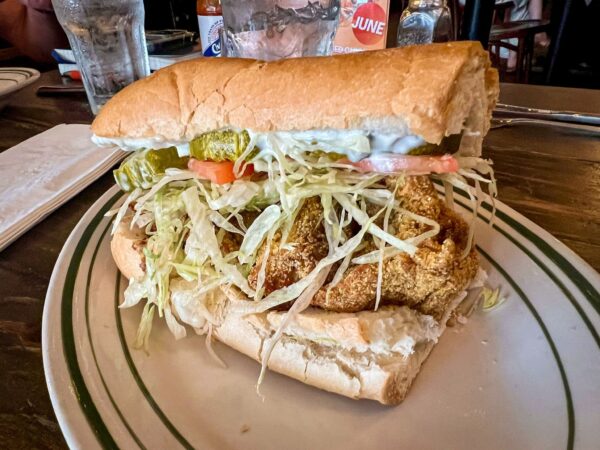
The good times roll at Khyber Pass Pub in Old City, where the menu of New Orleans-style comfort food includes a hearty share of vegan items. The chicken-style po’ boy, for example, delivers crispy, thinly breaded seitan while keeping the classic New Orleans formula intact. Served on a crackly Leidenheimer roll, it’s dressed with shredded lettuce, tomato, pickles, vegan mayo, and Creole mustard, delivering a satisfying mix of crunch, tang, and subtle heat. It’s a convincing plant-based rendition that feels like a true po’ boy, not a compromise. Khyber Pass Pub, 56 S. Second St., 215-238-5888, khyberpasspub.com
— Michael Klein
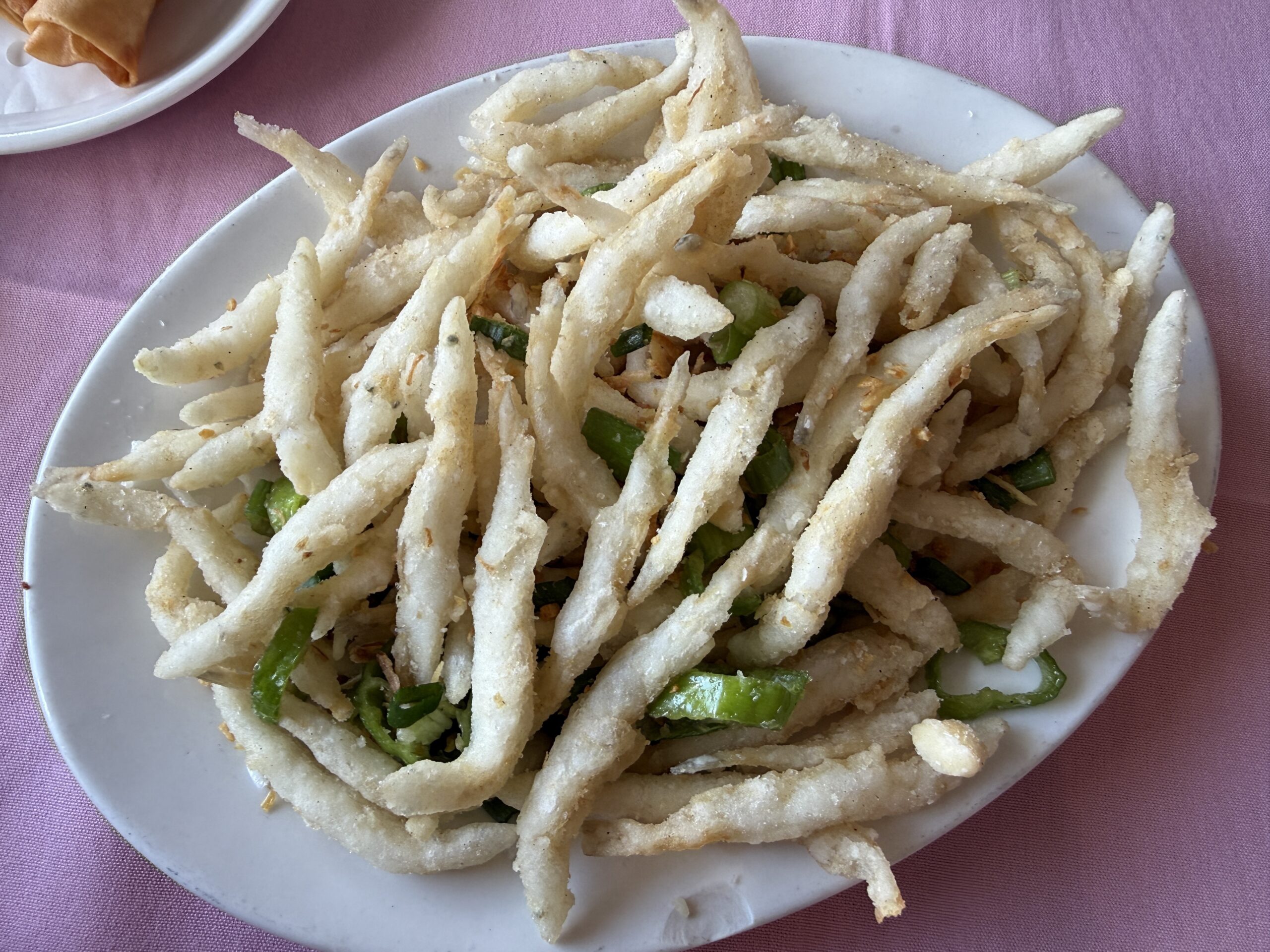
Fried silverfish — a Cantonese delicacy that’s pretty similar to a French Fry — at Grand Palace, 600 Washington Ave. #3B.
Fried Silverfish at Grand Palace
Weekend dim sum at Grand Palace in South Philly’s Little Saigon is a party where the whole family (second cousins and all) is invited, so the party-sized portions of Cantonese delicacies deserve special attention. The rice-flour-battered and fried silverfish (also known as noodlefish or whitebait) are generously sized and hopelessly addictive. More delicious than any French fry — though similarly salty, crunchy, and thin — the tiny fish are lightly funky and just barely scented with jalapeños and scallions. I haven’t stopped thinking about them since. Grand Palace Restaurant, 600 Washington Ave. #3B, 215-645-0079, grandpalacechineserestaurant.com
— Kiki Aranita
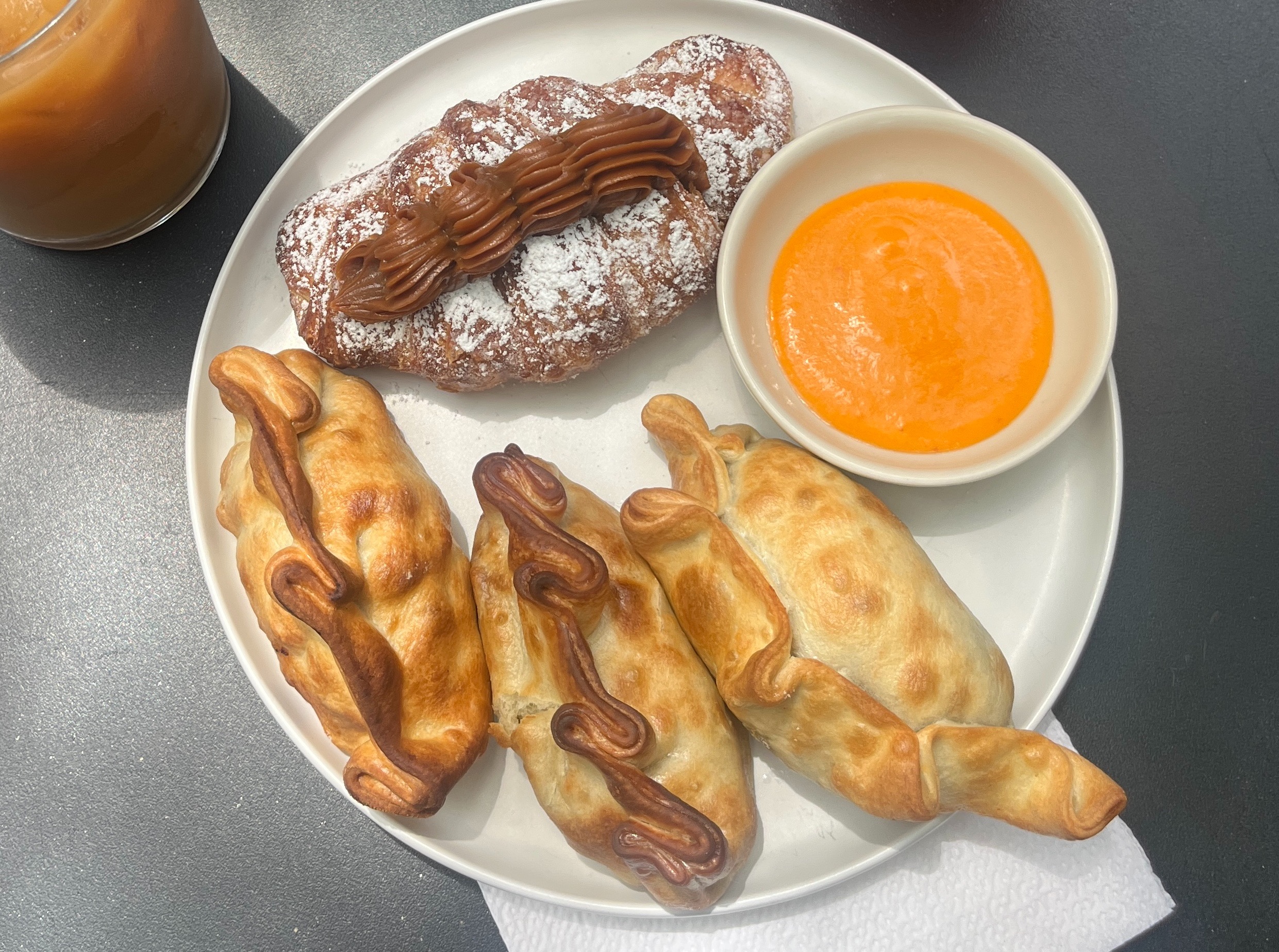
An array of empanadas and a dulce de leche medialuna at Jezabel’s in West Philadelphia.
Empanadas and a dulce de leche medialuna at Jezabel’s
Empanadas are the main attraction at Jezabel Careaga’s eponymous West Philly cafe, where the open-concept kitchen feeds into a dining room that allows customers to watch bakers knead, shape, and pack the dough tight with fillings. The lineup is special, but simple: a stewed chicken empanada lightly seasoned with aji dulce; a vegetarian version stuffed with leeks and gooey white cheese; and a vegan version packed with a summery lentil and corn salad. Careaga’s empanadas are baked — not fried — and so light that it’s easy to snack on several in one sitting.
Even more excellent are the cafe’s medialunas, an Argentinian pastry that sits somewhere between brioche and a croissant. The dulce de leche version is ultra-decadent, its butter crescent-shaped layers peeling apart to reveal a core of caramel cream. When Careaga returns to Fitler Square with a second location — likely opening this fall, I’m told — it’ll still be empanadas and medialunas galaore. Thank goodness. Jezabel’s, 206-208 S. 45th St., 215-554-7380, jezabelsphl.com
Last summer, at a win-now moment in their competitive cycle, the Phillies addressed two holes in the roster with one-stop shopping at the trade deadline.
Sort of.
Priority No. 1 felt familiar. Despite trading for a reliever at other recent deadlines, the Phillies’ playoff runs in 2023 and ’24 were torpedoed by the bullpen. So, they went in search of a lockdown late-inning anchor.
But they had another obvious shortcoming: a righty-hitting outfielder to platoon in left field or, better yet, stop the revolving door in center.
For weeks, Dave Dombrowski and his front office made calls and put out feelers. But gridlock in the wild-card standings — think of the Schuylkill Expressway at rush hour — led to market fluidity until a few days before the July 31 deadline.
After fence-sitting amid ownership uncertainty, the Twins finally decided to break up their roster. On the eve of the deadline, the Phillies landed Jhoan Duran for two top-100 prospects (pitcher Mick Abel and teenage catcher Eduardo Tait), a steep price for a closer, albeit a star who came with two full seasons of club control.
Harrison Bader’s name came up in the Duran talks, a source with knowledge of the conversations said, but the Twins kept the center fielder out of the deal as they orchestrated an everything-must-go bonanza in which they wound up unloading 11 major league players. The next day, Bader went to the Phillies for two minor leaguers.
Two trades. One-stop shopping.
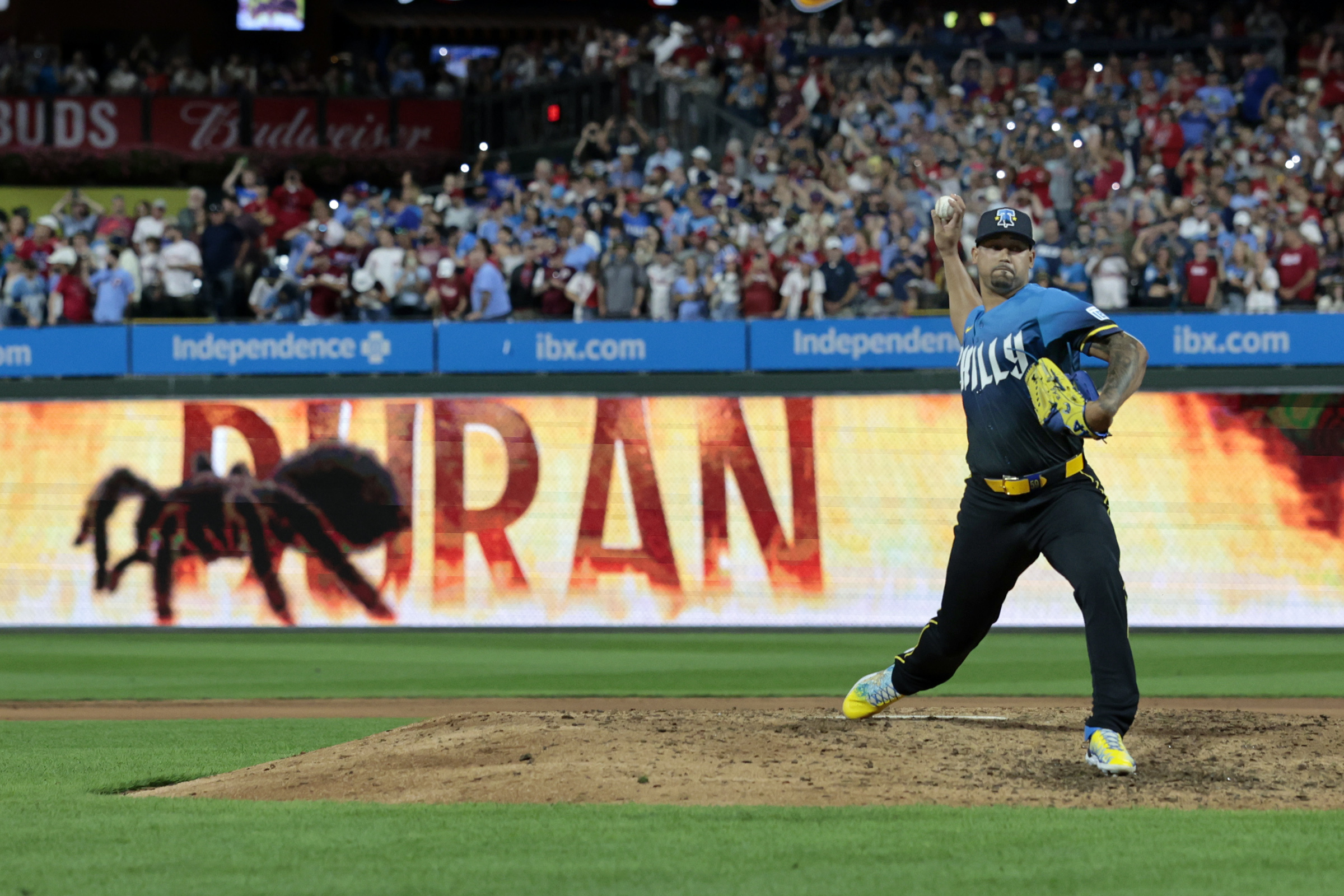
Jhoan Duran has locked down the ninth inning for the Phillies since he was acquired at the trade deadline last year.
Eleven months later — still in win-now mode, and back on a 90-win pace at the mathematical midpoint of the season after a 9-19 start that cost manager Rob Thomson his job — the Phillies again have multiple needs. The top priority is up for debate, even among some in the organization, but in some order:
Right-handed hitter
Back-end starting pitcher
Late-inning bridge to Duran
And with the trade deadline a little more than five weeks away — jot it down: Aug. 3, 6 p.m. — it’s worth wondering if they can one-stop shop once again.
Before we explore a few potential trade partners, a few caveats:
1. Across the sport, right-handed hitters had a .703 OPS through Thursday, which would be the third-lowest mark since 1991. Righty-hitting outfielders had a .709 OPS, tied for the second-lowest in the last 70 years. And two of the best, Mike Trout and Byron Buxton, have no-trade clauses and no interest in waiving them.
2. That said, the easiest place for the Phillies to add a right-handed bat is in the outfield … unless they move Bryce Harper back to right field and open first base (or third, if they shift Alec Bohm to first). Harper recently reiterated that he’d be open to it “for the right player.”
Dombrowski, on the other hand …
“We haven’t talked to him about it, and I really don’t contemplate it because I really like the way he goes about his business at first base,” he said recently. “I look at him as being our first baseman.”
The Phillies plan to keep Bryce Harper at first base, president of baseball operations Dave Dombrowski reiterated recently.
3. Over the last few years, the Phillies traded Abel, Tait, and fellow prospects Hendry Mendez, Starlyn Caba, William Bergolla Jr., George Klassen, Sam Aldegheri, Hao-Yu Lee, Mickey Moniak, Ben Brown, Logan O’Hoppe, and TJ Rumfield, among others. The teams hasn’t been burned, but it has drained the farm system.
Andrew Painter (starting Sunday in triple A), Justin Crawford (graduated to the majors), and Aidan Miller (injured) were largely untouchable in previous talks. If that’s still the case, the best chips in a top-heavy system are right-hander Gage Wood, infielder Aroon Escobar, outfielder Dante Nori, and 17-year-old outfielder Francisco Renteria, off to a flying start in the Dominican Summer League.
It begs the question of whether the Phillies have the prospect capital to fill each of their needs.
“We feel good where our system’s at,” general manager Preston Mattingly said recently on Phillies Extra, The Inquirer’s baseball podcast. “We’re not concerned about a lack of assets in the minor leagues. A lot of times you see that top-100 [prospects] list. That’s not necessarily what teams internally talk about, and those are not the players they ask about.”
4. Remember that Schuylkill-style traffic jam in the standings last July? Well, entering the weekend, 24 teams were in a playoff spot or no more than five games out. Only four American League teams — four! — were even above .500.
Given the dearth of obvious sellers, one league source predicted that contenders may have to trade with each other. Think of the 2024 deadline, when the Phillies got outfielder Austin Hays in a buyer-to-buyer swap with the Orioles.
5. Oh, and did we mention there’s a work stoppage looming in December? The owners and players are at odds over, well, everything. And regardless of whether the owners get their salary cap, the sport’s economic system will change in ways that front offices can’t possibly anticipate as they maneuver at the deadline.
Got all that? Amid that backdrop, here’s a look at three teams that might match up with the Phillies on one or more of their needs.
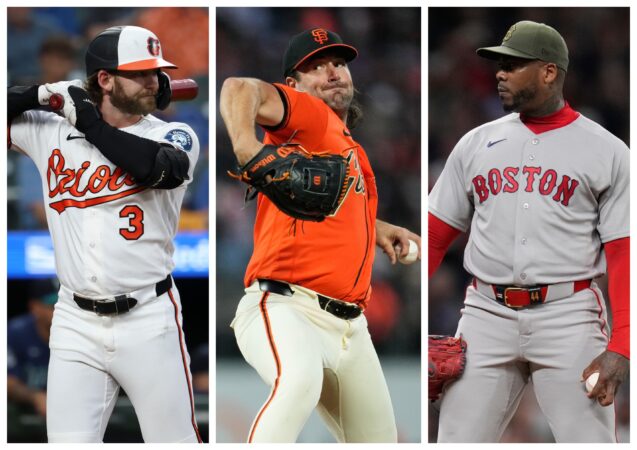
Despite not hitting for as much power as usual, Orioles outfielder Taylor Ward is reaching base at a .389 clip entering the weekend.
Baltimore Orioles
Here’s all you need to know about the state of play in the AL: The Orioles haven’t been over .500 since April 14, but were only 1½ games out of a wild-card spot entering the weekend.
No wonder a white flag isn’t flying over Camden Yards.
The next two weeks may determine which trade-deadline lane the Orioles choose. They play 12 of 15 games before the All-Star break at home, where they were 22-19 with a plus-13 run differential going into the weekend.
And if they’re still undecided on a path as the deadline approaches, the Phillies will visit Baltimore on July 31.
Ward, 32, was popular in trade rumors for years with the Angels before finally getting dealt to the Orioles in the offseason. He entered the weekend with only five homers after averaging 24 in the last four seasons, but appears to have traded power for on-base ability, reaching at a .389 clip.
(Phillies right-handed hitters had combined for a .269 on-base percentage, last in the majors.)
Ward would fit atop the order ahead of Kyle Schwarber and Harper, enabling interim manager Don Mattingly to finally slide Trea Turner down. Or the Phillies could put Ward in the cleanup spot behind Harper and work on restoring his fly-ball and barrel rates to his career levels.
As a free agent after the season, Ward probably won’t come at a high acquisition cost. But the Orioles would get a better return if they package him with rental starter Trevor Rogers or controllable relievers Yennier Cano or Rico Garcia.
Potential trade: Ward and Cano for Nori and right-hander Ramon Marquez.
Giants lefty Robbie Ray has allowed one earned run or fewer in four of his last five starts.
San Francisco Giants
Two years ago, the Phillies raced to a big lead en route to an NL East title. But they went 33-33 after the All-Star break and lost their momentum in part because they lacked a competent No. 5 starter.
Dombrowski regretted not getting one at the deadline.
“I’ll take the responsibility,” he said after a divisional-round knockout. “When you look at the fifth spot that we had, that was not a good spot at all for us the last two months of the season.”
Maybe it will inform how Dombrowski acts now, with Painter back in triple A and a hole at the back of the rotation. But teams don’t use five starters in the postseason. So, unless the Phillies can upgrade from Aaron Nola, or even Jesús Luzardo, they won’t want to give up an asset.
In that case, the rental market is an option. And the Giants’ Robbie Ray is a classic rental. The 34-year-old lefty will be a free agent after the season. He has pitched well lately, too, allowing one earned run or fewer in four of his last five starts.
In lieu of what the Giants really want to do — offload unwieldy long-term contracts for Matt Chapman, Willy Adames, and Rafael Devers — they almost certainly will move Ray.
If the Phillies take on the $12.5 million that Ray is owed through the end of the season, the return would be minimal. But the Giants can get a better prospect by including, say, controllable outfielder Heliot Ramos, who is nearing a return from a quadriceps strain.
Potential trade: Ray and Ramos for outfielder Gabriel Rincones Jr. and righty Jean Cabrera.
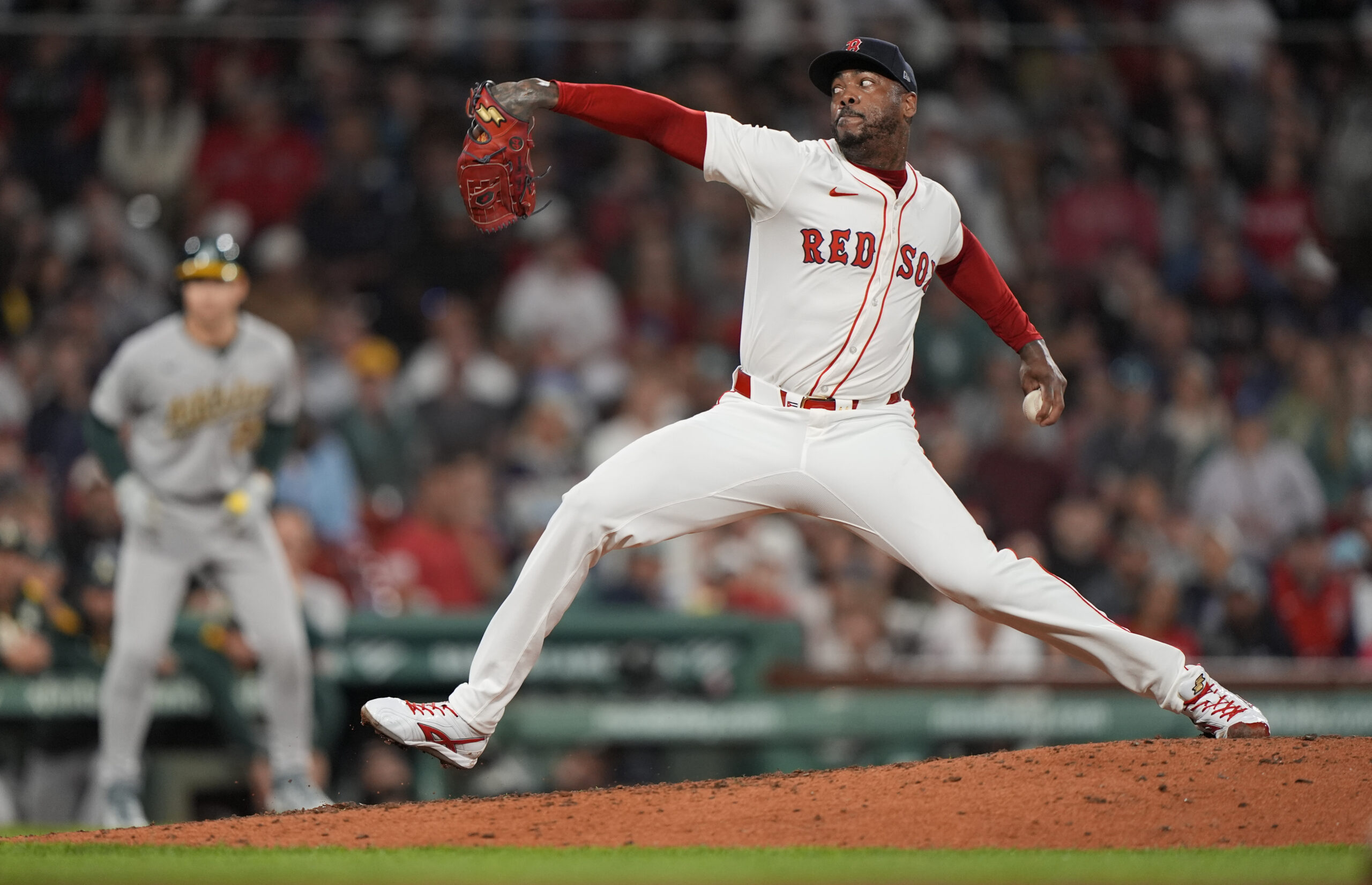
Aroldis Chapman has a 1.41 and 46 saves for the Red Sox over the last two seasons.
Boston Red Sox
When the Red Sox finally accept reality and go into sell mode, they will have players who are in demand.
Atop the list: fire-breathing closer Aroldis Chapman.
Even at age 38, Chapman is lighting up radar guns and overpowering hitters. Entering the weekend, these were his numbers in two years with the Red Sox: 1.39 ERA, 47-for-50 in save chances, 114 strikeouts, 25 walks in 84 innings. His fastball still averages 97.4 mph.
Chapman has 382 career saves, 10th on the all-time list. With the Phillies, he would supplant José Alvarado as the high-leverage lefty and set up for Duran. He has filled a setup role before, notably in 2023 for the World Series-winning Rangers.
Two years ago, the Phillies acquired walk-year closer Carlos Estévez from the Angels for two pitching prospects (Klassen and Aldegheri). The Sox will likely seek a similar haul for Chapman, a free agent at season’s end.
They will have a harder time maximizing the value for outfielder Jarren Duran. Although he’s under team control through 2028, the 29-year-old’s production has dropped off since his All-Star season in 2024.
Duran is a left-handed hitter, not an ideal fit for the Phillies. But given the lack of righty-hitting outfield options, he’s worth considering as a buy-low candidate.
Potential trade: Chapman and Duran for Escobar, Marquez, and righty Matthew Fisher.
When Ghana closes out its final group stage match of the World Cup in Philadelphia against Croatia on Saturday (5 p.m., FS1) it’ll mark the West African nation’s first return to the region since it became a piece of Philly soccer lore 14 years prior on a rainy night in Chester.
Fresh off a run to the semifinals in the African Cup of Nations in 2012, Ghana booked a trip to America to take on Chile in an exhibition match at Subaru Park, which at the time was known as PPL Park. The match, scheduled in February, already had a chill to it, but it was amplified by a driving rain that didn’t let up the entire game.
The first half saw Ghana head into the locker rooms at halftime up, 1-0, after a goal by young midfielder Richard Mpong gave the tiny but loud Ghanaian support plenty to cheer about.
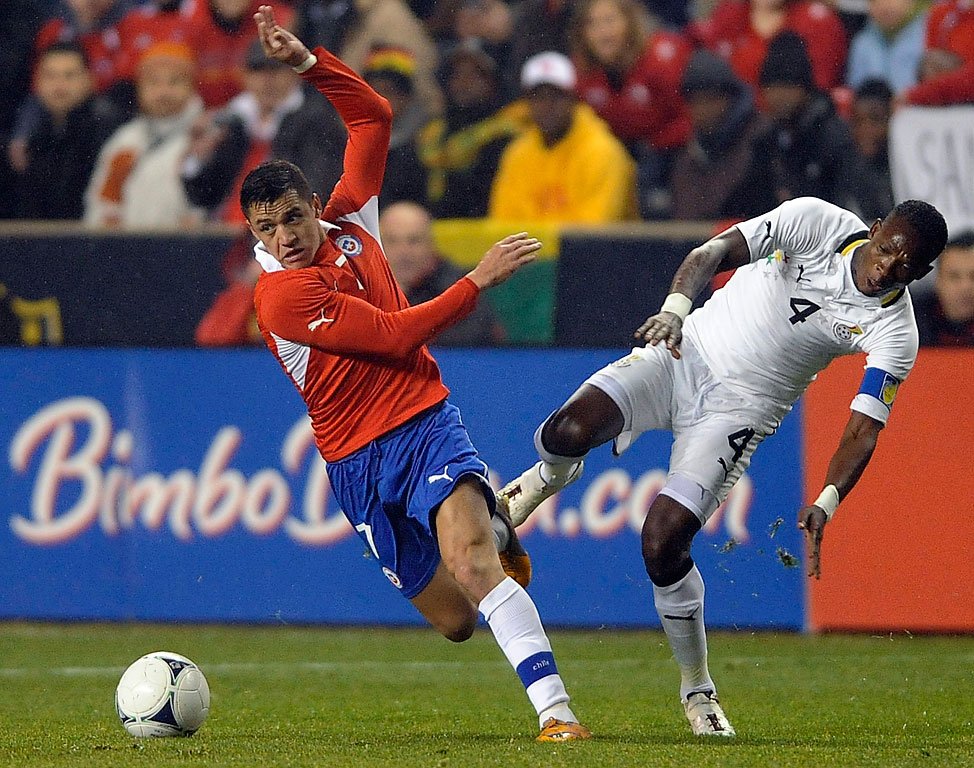
Former Chile and European club star Alexis Sanchez collides with Ghana’s John Pantsil during a 2012 friendly at Subaru Park (then names PPL Park) in Chester.
Typically, a soccer halftime lasts 10-15 minutes. But this time during a pouring rain, fans were treated to a mini-concert by a Ghanaian hip-hop group and virtual games on the stadium’s video board.
But then 20 minutes passed, then 30. Fans were made to believe that it was due to the rain that the match was delayed. But what transpired in Ghana’s locker room had nothing to do with Mother Nature.
It had everything to do with the match promoter failing to make it rain an alleged $125,000 to Ghana’s team. A sum that doesn’t seem like much when you consider that if the amount went only to the 18 Ghanaian players who made the trip, it was less than $6,950 per player.
However, according to the official (and a few unsubstantiated reports), the team was adamant that if the game’s promoter didn’t pay the full amount of their appearance, the team had planned not to return to finish the match.
A high-ranking stadium official who chose to remain anonymous confirmed to the Inquirer that there was a definite “tense situation” going on in the locker rooms, and while they were in the arena that night it was unclear that the issue involved an unpaid Ghana team until much later.
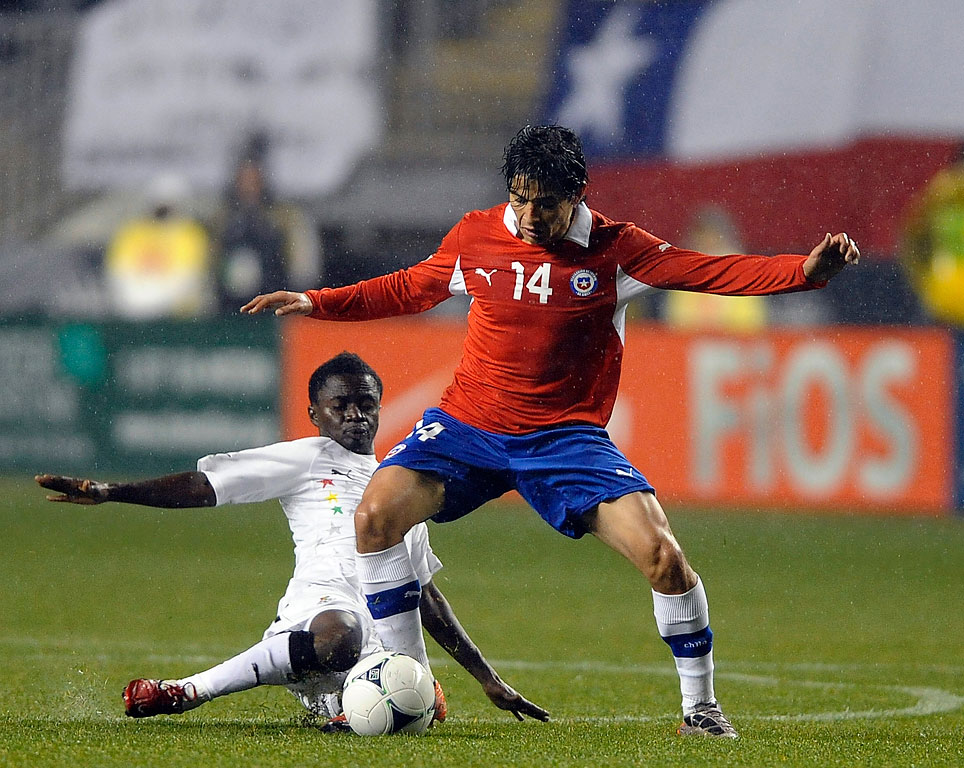
Chile’s Matias Fernandez (center) and Ghana’s Richard Mpong, seen battling for the ball here, were the two goal scorers on the night for their respective clubs.
Coincidentally, according to a 2012 report from Modern Ghana, the match was moved to PPL Park because the promoter failed to secure a venue in New Jersey, due to the “high costs” of the venue.
“There was definitely some type of dispute, and it definitely was some type of issue with the promoter,” the official recalled. “The second half didn’t get underway for some time, and I don’t think fans knew what was going on, but it was heated in the locker room for sure.”
The official, who has firsthand insight into the proceedings of how these matches are typically set up, explained that there are promoters who arrange these international matches and will arrange a sort of half-now, half-later deal with smaller-level international clubs, using the proceeds from the match to close out the deal.
Plenty of pro-Ghana fans stayed through a driving rain that swept across a chilly February night in Chester in 2012 when Ghana played Chile in a friendly.
“Look, I don’t know the ins and outs of this particular night, and it was so long ago, but I do recall it being a very sketchy scenario,” he said. “A lot of times, they’ll look to use the arena, promote the two nations but then ask for like 1,000 consignment tickets, thinking that if they can hand out a handful of free tickets, they’ll recoup out of the arrangement what people might spend in the stadium.”
They added that there are a handful of promoters who handle friendlies today in the same manner. It doesn’t affect the venue, who offers a going rate to rent the facility and its amenities for the match, and once that’s paid, the rest falls on the promoter to turn a profit as they see fit.
“But yeah, there was some type of financial dispute where I think the Ghanaian Federation, the [team’s] manager or somebody felt like they weren’t compensated enough in advance of the game and to them, that was like the last straw,” he said. “It was like, ‘Okay, screw it. We’re not coming out.’”
Eventually, after a halftime delay that lasted over an hour, Ghana did emerge and play the second half. It would end up finishing the match with a 1-1 draw after a goal by Chilean Matias Fernandez would even the score off of a penalty kick in the 75th minute.
On Saturday, Ghana will return with a 26-man roster featuring none of the players or manager who were on that roster in 2012. The game is in a much bigger arena and the stakes are higher as a win will secure Ghana a chance to move to the knockout rounds out of Group L and depending on how scorelines from other games shake out, could even see the nation win the group.
Ghana has yet to lose a match in this World Cup, defeating Panama in its opener, 1-0, followed by a thrilling scoreless draw against group favorites, England on Tuesday.
I am in an HOA. We are all in one group chat and are friendly to one another. One of the women in our chat, who is very nice in person, uses the chat to complain, almost weekly.
She thinks the kids are too loud playing outside on a Saturday afternoon. She says one of us put our trash out 20 minutes before we’re technically allowed to. She says one of us closes our front door so hard that it shakes the whole building. She constantly asks for us to get her Amazon packages and if we say we’re not home she says, “ANYONE ELSE?” Yes, in caps.
So yeah, we don’t like her. We’ve tried! So there are some ideas floating around, the main one being: Do we mute that group chat and start a new one without her? Or do we just tell her what the deal is?
Kiki Aranita, Food & Dining Reporter
100% mute that chat and start a new one.
Elizabeth Wellington, Features Columnist
I agree with Kiki.
But, we are trying to be helpful here and it’s a horrible thing when someone ignores the group chat. Have you established any ground rules in the chat? If not, maybe it’s time?
Kiki Aranita
Yeah, was this a chat established for getting packages for one another?
Elizabeth Wellington
I think at the very least you send a message out that starts with “No complaining.”
My apartment complex had a similar group chat on WhatsApp. After a month, I opted out. I’d rather not be in the know then hear about all of these people’s incremental problems.
Kiki Aranita
I’m not in an HOA but I live on a block where I know my neighbors and we’re all super active in grabbing one another’s packages and super appreciative of one another.
That said, we don’t complain in our group chats. Complaints are for friend group chats, not neighbor group chats.
Elizabeth Wellington
There are ways to keep people informed and, in this world, we need to be informed.
So my suggestion in drawing up ground rules is: no complaining. Informing is not complaining.
Kiki Aranita
Create a mini version of a neighborhood Facebook group, which has established ground rules, and is actively monitored by admins.
By the way — that last question of “do we tell her what the deal is?” I would not do this.
Elizabeth Wellington
I might though. People need to know when they are getting on your last nerves.
Maybe she doesn’t know how annoying she is. Maybe telling her is the first step.
Kiki Aranita
I’m not scared of confrontation in general, but I think confrontation like this can make it difficult to live with someone in such close proximity.
Elizabeth Wellington
You don’t have to curse her out, just a gentle nudge… “Like, girl… some of your group chat messages have been off-putting. We try not to complain. We are solutions oriented.”
Kiki, should we come up with a list of ground rules to help these folks out?
Kiki Aranita
First, no shouting/all caps.
Elizabeth Wellington
No making fun of people. No cursing. No complaining about things, especially other people. No gossip.
Kiki Aranita
Establish a motto like “to support and inform.”
I also like the idea of multiple group chats for neighbors (because I have them). They’re like slack channels. One is just for packages. Another one of my friends also has multiple group chats. Unfortunately, one of them is “the rat chat” — it only deals with rats.
Elizabeth Wellington
It’s fine if neighbors want to splinter off to talk about other things like packages and other such things, but the HOA group chat should be accessible to everyone in the HOA and it should have guidelines and rules.
You may not like old girl, but she lives there too.
Next week, Philadelphia will begin a centuries-long stint as the host of a time capsule that is not meant to be unearthed for a quarter of a millennium.
Set to be buried on July Fourth at Independence National Historical Park, the time capsule comes to the city as part of the celebrations surrounding the United States’ Semiquincentennial. After its burial, it is not slated to be seen again until 2276.
Known officially as “America’s Time Capsule,” it features items from every U.S. state and territory, as well as contributions from the three branches of government. Its creation was led by America250, a national, nonpartisan organization that Congress placed in charge of the 250th birthday celebrations.
Weighing in at 900 pounds, the time capsule — a massive cylinder emblazoned with an “America250” logo on its side — was sealed shut last week at a ceremony in Gaithersburg, Md. Its unveiling 250 years from now is intended to show future generations “the care, pride, and optimism with which Americans marked our 250th anniversary,” said America250 chair Rosie Rios in a statement.
Inside the capsule, which is constructed of stainless steel, archival contents sit organized largely in small boxes, with paper documents in a separate compartment. Many states submitted hundreds of letters, postcards, posters, poems, and other printed material for inclusion.
America250 has posted a detailed list of all the items included in the time capsule. Pennsylvania, for example, contributed a letter from Gov. Josh Shapiro, as well as an archival booklet. New Jersey, meanwhile, ponied up a stainless steel plate inscribed with a greeting for the time capsule’s future openers. And Delaware sent in a set of a dozen notecards from residents detailing their thoughts on what the state means to them.
There were some guidelines on what states could submit, as items that could degrade or rust were not allowed. Maryland, as a result, was not able to submit Old Bay seasoning, the Associated Press reported.
Some items were innovative. A “molecular data storage device” from the Library of Congress was included, and it contains synthetic DNA encoded with copies of several items from the library’s collection — including a draft of the Declaration of Independence, handwritten lyrics for “The Star-Spangled Banner,” and a 3-D rendering of President Abraham Lincoln’s hand, America250 said.
Items were sealed inside at 35% relative humidity to make sure they did not dry out or disintegrate, as well as to keep them from decaying due to moisture issues. The capsule is slated to be buried 10 feet below ground, which should keep it from being damaged by swings in temperature or storms.
“Philadelphia would have to be six feet underwater in order for this time capsule to even possibly take on water,” Michael Berilla, director of fabrication technology at the National Institute of Standards and Technology, told the AP. ”And if Philly is six feet underwater, you’ve got way bigger problems in the world.”
“For those who have the privilege to work here in the Capitol, you get a sense that you are just one chapter in a long history book,” Austin said. “The U.S. Capitol is a symbol of that history. In fact, it is the symbol of that American history.”
This is not the first time capsule project undertaken by the United States. In 1976, President Gerald Ford opened a “Century Safe” that had been created a century before, and the country that year created a Bicentennial capsule that is to be opened in 2076.
The time capsule set to be buried in Philadelphia on July Fourth, meanwhile, will be marked with a capstone that includes information about its contents and creation. Additional details about the time capsule’s burial were still forthcoming Friday, according to the America250 website.
This article contains information from the Associated Press.
ATLANTIC CITY — The Flyers traded down from No. 21 to No. 27 with the hope that the guy they wanted would still be on the board. They sweated a little, but in the end, they got their guy and two extra picks to boot.
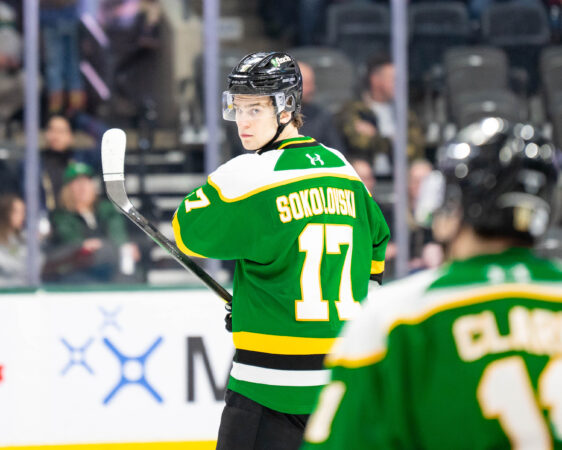
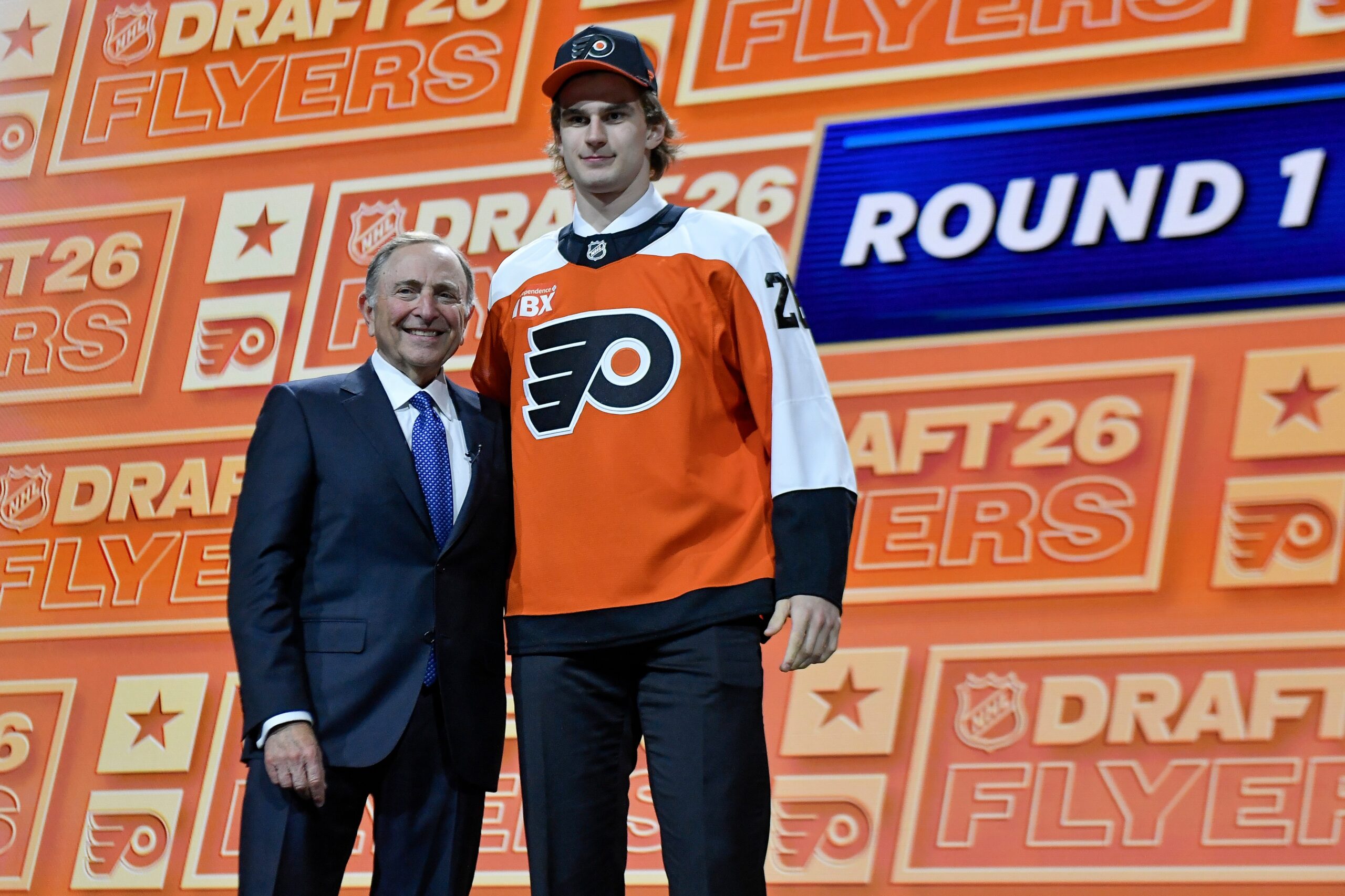
With the 27th pick in the first round of the 2026 NHL draft, the Flyers selected Maksim Sokolovskii, left-shot giant from London of the Ontario Hockey League, to bolster the blue line.
Although he is not expected to play in the NHL any time soon — he will head back to the Knights in September and is committed to the University of Maine for the following season — it’s never too early to hand out a grade to Flyers general manager Danny Brière and his staff.
Grade: B
It was no secret that the Flyers were long interested in Sokolovskii. Since the NHL scouting combine in early June, the word on the street was that the Flyers were higher than the consensus on the 6-foot-7¼, 240-pound, mean, physical defenseman who skates well for his size.
Did they pass on flashier guys like two-way center Jack Hextall, dynamic defensemen Ryan Lin, whom San Jose took at 21, Tommy Bleyl, and Xavier Villeneuve? Yes, and that could come back to haunt them like drafting Jett Luchanko over Zeev Buium and Konsta Helenius two years ago.
But Sokolovskii was always their guy, especially once Ilia Morozov was taken at No. 20, which is why they moved back. And even before that, several media outlets had the Flyers taking the defenseman at No. 21, including The Inquirer in our final mock draft.
There is a lot to like about Sokolowskii. According to Mike Taylor, his former coach at the Atlantic Hockey Academy, “he skates like he’s 5-foot-8.″ Taylor also mentioned how a college hockey skating coach they brought in could not believe how good Sokolowskii’s edgework was for his size.
As The Athletic’s NHL draft and prospects reporter Scott Wheeler told The Inquirer, “When you’re huge, and you can skate, that’s often all that you need for NHL scouts to sort of perk up and start to pay attention.”
And the Flyers paid attention — a lot of that is because he was in London, which Brière called after drafting Sokolovskii: “One of the better organizations in the CHL. They seem to be able to build winners.”
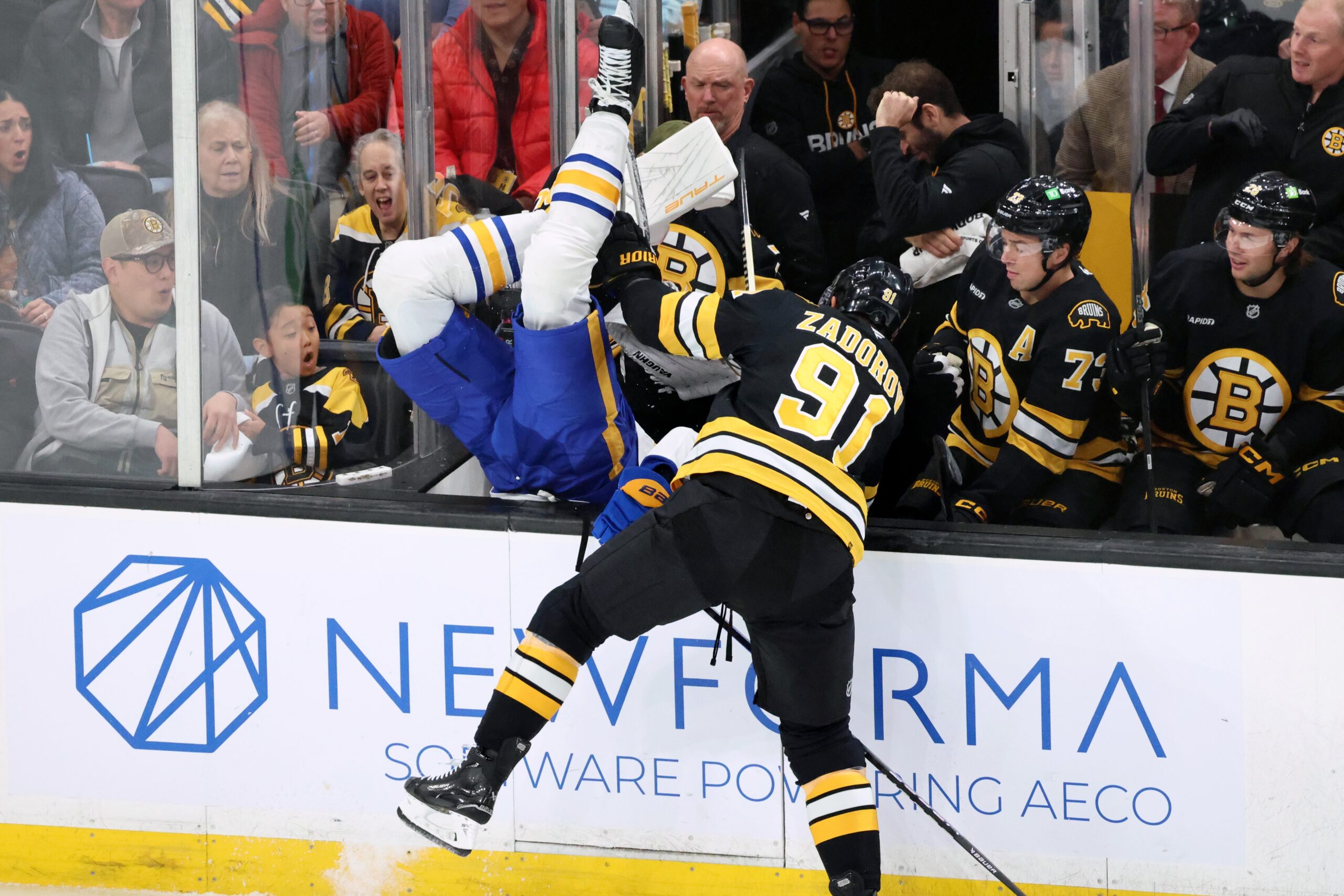
Sokolovskii, who was born in Kazakhstan and grew up in Russia, brings meanness and physicality, and considers himself a shut-down defenseman who likes to hit. Daily Faceoff’s Jeff Marek called him the hardest hitter in the draft class. Some have even compared his physicality and nastiness to that of fellow 6-7 blueliner Nikita Zadorov of the Boston Bruins.
Boston Bruins defenseman Nikita Zadorov is a common comp for Flyers draft pick Maksim Sokolovskii.
“The compete level is something that, in a lot of cases, you have, or you don’t,” Brière said. “It’s really tough to bring that out of someone who doesn’t have it. You watch him, it’s a natural thing. He loves to go after a guy. He likes to disturb, and on top of his size, it makes for a very impressive player on the ice. Someone that you don’t like facing or playing against.”
And part of that competitiveness is just his desire to get better. There is a lot of upside to Sokolovskii, and many have noted how much his game improved as the season went on in London. His switch to the OHL was not an easy one — he was even a healthy scratch at times — but by the end of the season, he was on the third pair and even played second-pair minutes at times. And while he wants to work more on his footwork, next season, Sokolovskii told The Inquirer at the combine that he wants to be more of a leader, too.
“The one thing that really stood out was the progression that he showed throughout the season,” Brière said. “When we saw him early in the season, we thought this could be a late pick for us, and then it seemed every month he just kept getting better and better, and figuring out the game more and more.”
Organizationally, the pick helped fill some depth on the left side, so add a check mark for that. Travis Sanheim, Cam York, Nick Seeler, and the newly acquired Simon Benoît, who can play on the right side too, are at the NHL level. Ty Murchison, 23, Jackson Edward, 22, and Hunter McDonald, 24, are in the system on the left side. But that’s it. Oliver Bonk, another London guy, Spencer Gill, Carter Amico, and Luke Vlooswyk are all righties.
Now, there are, of course, some question marks.
“I think that would be Sam Morin part two,” FloHockey draft and prospect analyst Chris Peters said on Flyers Gameday Central about taking him at No. 21. They didn’t do that, but then he said this.
Maksim Sokolovskii, right, stands with NHL commissioner Gary Bettman, left, after being drafted by the Flyers with the 27th pick in the draft.
“I watched him in the playoffs a lot, and that’s where I think a lot of this late buzz is coming from, is that he was a really good shutdown guy for London in the postseason. And he was playing a physical, mean brand of hockey, the kind of hockey that helps you win in the playoffs. … [But] he’s too one-dimensional defensively. The skating, it isn’t good enough for me to say, like it’s good for his size, but like it’s not good enough, I don’t think.
“He has boom-bust potential, too, because he’s got this massive frame. He has incredible reach. I think he thinks the game decently well, I think he thinks the game defensively pretty solidly. I think he’s got good enough mobility defensively. And so I think he’s going to play [in the NHL]. The question is, where does he go?”
So, does he need to refine his defensive game more? Absolutely. Does he need to develop his offensive game? Of course — he had only eight points in 44 games for the Knights. But one intriguing factor is that he scored 34 goals and 84 points in 65 games for Atlantic Coast two years ago, albeit against lesser competition.
And Taylor brought up something interesting.
“He always was trying to be offensive with us. His deficiencies with us were the defensive side of the puck, where it was his strength in London,” he recalled.
“I knew he could play that way. I knew he would adjust, because I knew how good he was of a player. I just knew that he was taking chances and doing things with us that he wouldn’t do at the next level, because the hockey allowed it, [that] level of play.”
With Taylor, he went out for shootouts and even got time on the power play, notably at the net-front — imagine a 6-7 player screening the goalie? So maybe Sokolovskii was just focusing on the defensive end as an OHL rookie, and the offense has room to reawaken a bit?
After all, when you ask him who his comparables are, he’ll tell you Zadorov, Logan Stanley of the Buffalo Sabres, and Tampa Bay’s Victor Hedman, who boasts a Norris Trophy and 811 points in 1,164 career NHL games.
There’s definitely some boom-or-bust volatility with Sokolovskii, but the Flyers hope they have added a massive defenseman who plays playoff-style hockey, can kill plays defensively, and strike fear into opponents with his physicality.
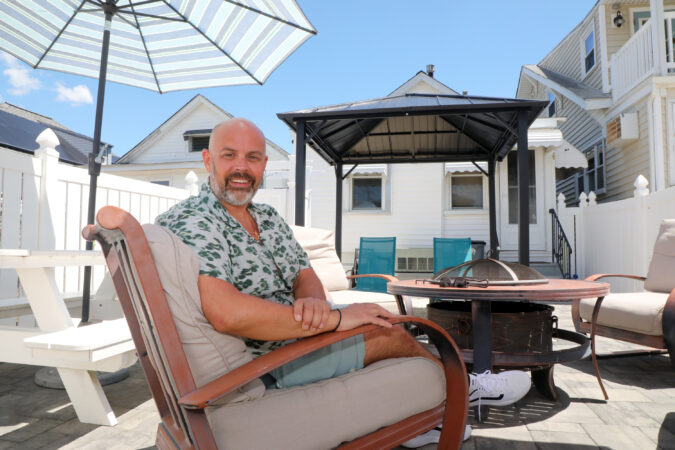
The house: An 800-square-foot two-bedroom, 1½-bath bungalow built in 1930 in Wildwood.
The price: Listed for $444,000; purchased for $441,000.
The agent: Marion Rowland, ReMax Surfside.
The ask: Wilson lives in Venice Beach, Calif., but grew up in Wildwood and Atlantic County and missed the East Coast. When he was a toddler, the family lived at the Regency in North Wildwood, where his parents were the offseason managers. “It was around the time The Shining came out, and my aunt used to tease them about living there with my sister and me when the whole of Wildwood was shut down!“ he said.
Wildwood was in his DNA for good. His dream was to buy a second home in Wildwood, a place with some old Shore charm, where he and the family could gather and revive traditions.
The search: Wilson’s aunt is a localreal estate agent in Wildwood, and they “combed the market for months,”he said.
He put in an offer on a renovated triplex in Wildwood Crest toward summer’s end in 2024 but was outbid. “It got 12 other offers above the asking price,”Wilsonsaid. “They were asking $575[000] I was willing to pay them $600,000.”
After a day of house hunting in September 2024, the two sat down for lunch at theDogtooth Bar & Grill. “We saw a listing two blocks away pop up,” he said. “We drove over to the house and started the process.”
The appeal: As soon as he walked in the house, Wilson said he thought, “I know what I need to make this good.”
The house checked a lot of boxes for him: charm, old-school bungalow feel, close to the ocean.
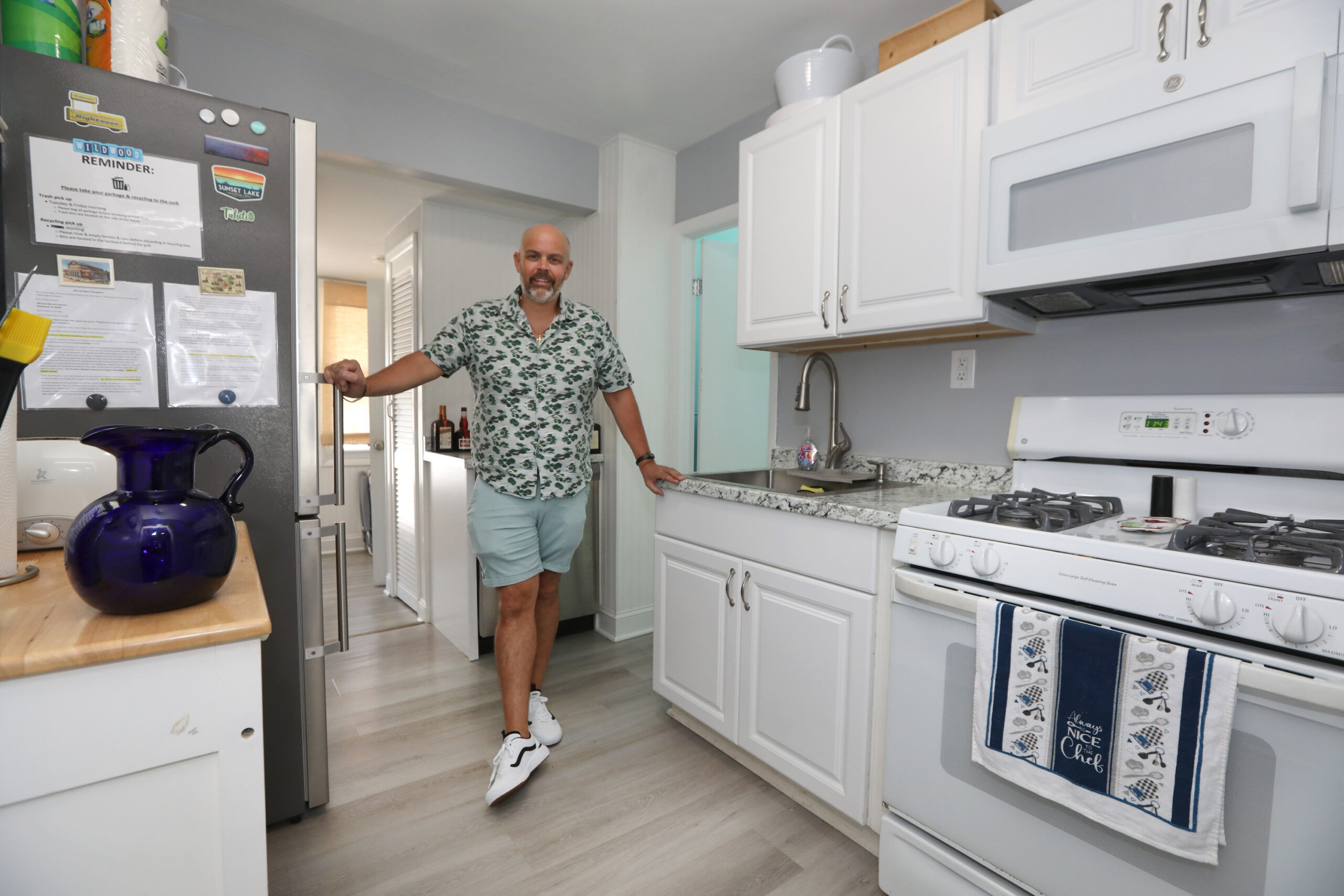
Jacob Wilson added a dishwasher to the kitchen along with other improvements at his home in Wildwood.
“My mom’s been a Realtor in the area for 40 years,” he said. “She has a 1900 Victorian. I’ve always admired the work my parents did on that home. My cousin had a Craftsman bungalow. It reminds me of houses here in Venice.”
Both Wilson and his aunt appreciated being able to buy an original property in Wildwood and not tear it down.
“I have deep ties to Wildwood,” he said. “I really didn’t want to do that.”
A house across from his was recently torn down and a triplex built in its place. Plus, his house has a backyard.
“That just doesn’t exist anymore,” he said. “In the offseason, I can hear the waves from my backyard.”
The deal: Wilson said he put in an offer for the asking price and beat two other offers. “The house sold in three days,” he said. The inspection revealed some termite damage, and the seller reduced the price by $3,000, he said.
“The work to remedy the problem was estimated to be over $10,000,” he said, “and it cost me around $15,000 altogether with foundation work and pest treatment.”
Because of the competitive environment, he said, “I took the $3,000 reduction to make the sale happen.”
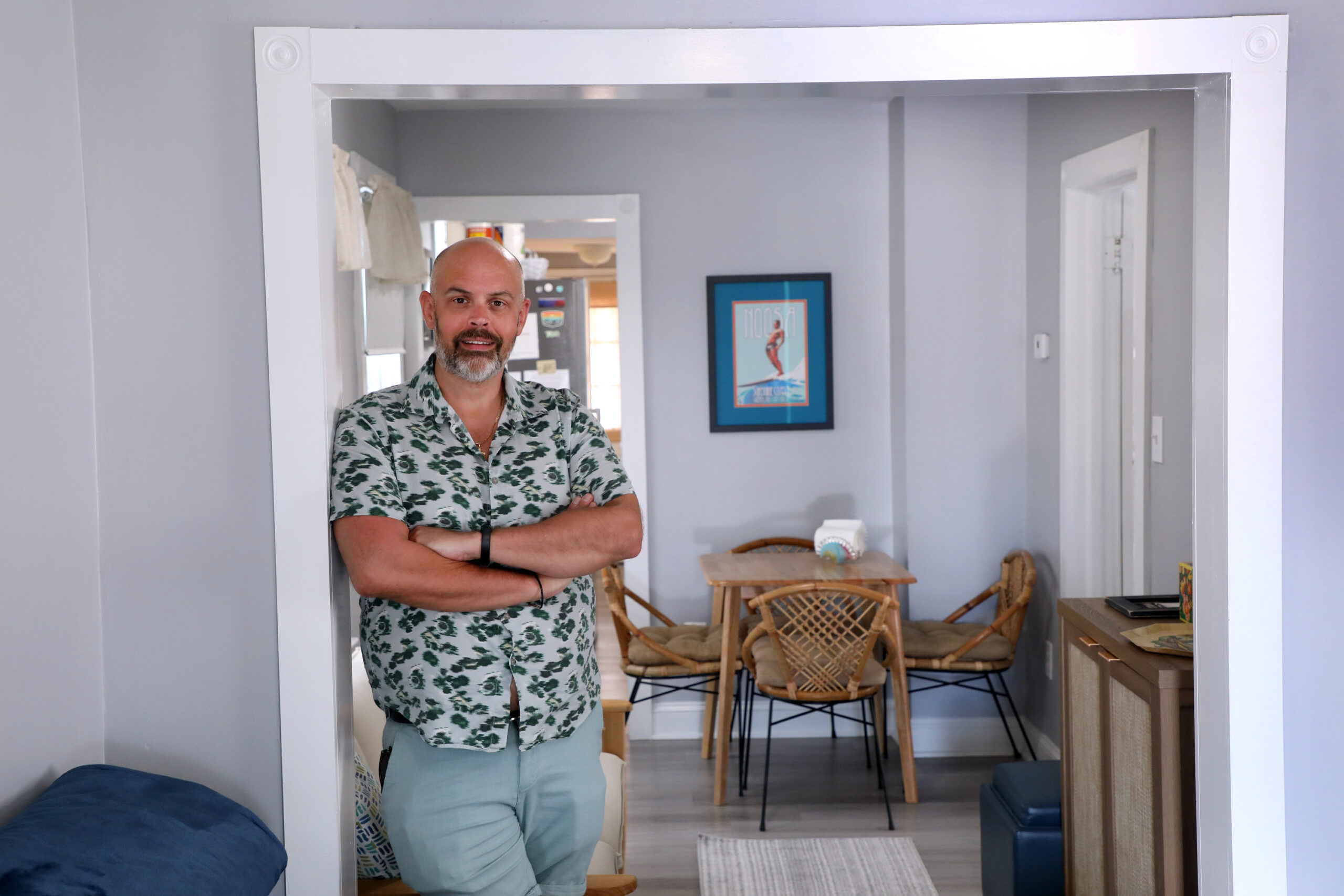
Jacob Wilson wanted his Wildwood property to feel “like a modern beach house” and was happy that the previous owners had redone the floors with light gray planks.
His aunt was proud of him for buying and preserving a house in Wildwood, he said, the place where two of his grandparents were born.
The money: Wilson did it in a traditional way: 20% down payment, a mortgage with the local Ocean First Bank. “Kudos to Ocean First,” he said. “They don’t sell the mortgage.” His mortgage rate was 7%, higher due to its being an investment property, he said.
Using the property part of the summer as a weekly rental and a longer-term winter rental covers his mortgage, he said. “I don’t really have too many out-of-pocket expenses,” he said. “Taxes are $4,000 a year. Utility bills a few hundred a month.”
The move: There were some changes. He liked the way the former owners used gray plank boards to replace the original parquet wood that made it “more like a modern beach house.”
But, Wilsonsaid, “some things inside were a little too country.”
“I wanted to make it more beachy,” he said. There was shelving in the doorways that he got rid of, and some closets that inexplicably had the doors removed and curtains put up. Luckily, he found the original doors in the attic and put them back on. He replaced the door knobs and repainted the entire interior.
“The big thing that showed up was termite damage,” he said. “I had to do a lot of foundation work when I bought the place.” He replaced the old insulation with spray insulation, he said, and installed a dishwasher and new refrigerator.
“A lot of things like that to make it look sharp,” he said.
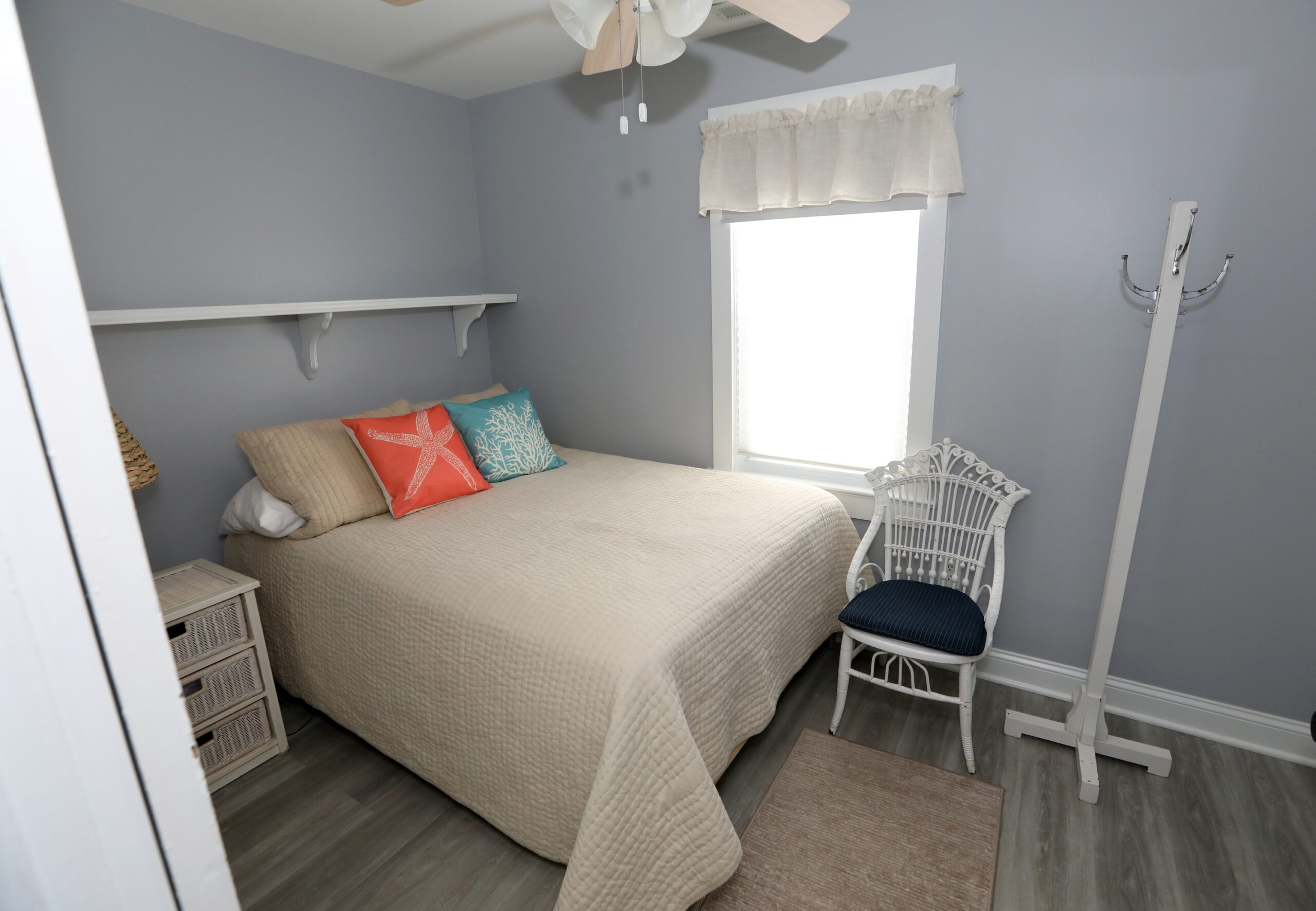
A cozy bedroom in the Wildwood bungalow.
Life after close: This will be his second summer using the Wildwood bungalow. He’s spending a month there over June and July and expecting a stream of visitors to revive old family traditions. He plans to block out more time for himself in the shoulder seasons.
“It’s all kind of like nostalgia for me because we spent so much time there as a kid,” he said.
“I had a lot of strong feelings about going back,” he said. “As an adult, I appreciate it more.”
About six months after he bought the house, “Someone called me and asked if I was interested in selling it,” he said. No way.
“Keeping it long term is my goal,” he said. “I feel like I made a good investment choice. No regrets.”
Did you recently buy a home in the Philadelphia area or South Jersey? Share the story of how you did it. Email Inquirer real estate reporters at properties@inquirer.com.
Eleven long, skinny bodies of water comprise New York’s Finger Lakes, a wine region and resort destination for two centuries. Collectively they cover a wide swath of northern New York, with the easternmost and westernmost lakes over 90 miles apart.
Since it takes more than four hours to get here from Philly, this itinerary focuses on just one finger, Cayuga Lake, at the southern end of which sits the Ivy League town of Ithaca, home to Cornell University. The trip also detours to Seneca Lake next door for some exciting natural wines.
Expect waterfalls, eagle-spotting, ice cream, and plenty of outdoors. Start the car.
Check into the Inn at Gothic Eves (10 out of 10, no notes on the dramatic name), located 15 minutes from downtown Ithaca on the western shore of Cayuga Lake. Divided between two buildings linked by a two-acre landscaped patio, the resort’s eight suites take their names from the lakes they sit between — Cayuga and Seneca — and various grape varietals and wine regions. There’s a cozy spa with rock-walled treatment rooms and two hot tubs, nightly s’mores by the firepit, and epic breakfasts with house-made jams and locally sourced bacon.
📍 112 E. Main St., Trumansburg, N.Y. 14886
Hike: Cascadilla Gorge Trail
The barrier between downtown Ithaca and nature is barely there. The head of the Cascadilla Gorge Trail begins right off a residential neighborhood, tucked between a church and dentist’s office. This 1.3-mile trail, stewarded by Cornell since 1909, connects downtown with the university’s Botanical Gardens and travels through ancient bedrock ravines and past six waterfalls.
📍 Cascadilla Gorge Trail, Ithaca, N.Y. 14850
Snack: Mama Said Hand Pies
On Press Bay Alley, a pedestrian micro-mall built from a row of former storage units, Mama Said Hand Pies (another 10 out of 10 name) folds fillings like spiced peaches and Oaxaca cheese with mushrooms into flaky half-moon pastries. Drop in for a snack, and, if you’re lucky, some live music. As if you need another reason to like the place, a member of a recent bluegrass quintet can be seen on Mama’s Instagram performing in a Phillies shirt.
📍 118 W. Green St., Ithaca, N.Y. 14850
Sip: Osmote
About 30 minutes west of Ithaca, near the shores of Seneca Lake, a simple wooden pavilion overlooks the water. This is where Osmote hosts picturesque tastings of its low-intervention wines. Four pours cost just $20 and may include bottles like the fizzy Cayuga White pét-nat or Marquette, whose tasting notes include “crunchy blackberry” and “cherry Pop-Tart.” The wines are made with locally sourced grapes while Osmote’s own vineyards, planted in 2024, mature.
📍 3879 Marcia Ln., Burdett, N.Y. 14818
Paddle: Paddle-N-More
On summer Saturday nights, about an hour before sunset, single and tandem kayaks launch from Myers Park, on the east shore of Cayuga Lake. Join the two-hour guided eco-themed trip by Paddle-N-More, a popular outfitter with locations all around the lake. They provide the gear and the expertise, you provide the manpower (not that much) to cruise along the lakeshore, spotting bald eagles and herons.
A national pioneer of vegetarian cooking and the local-organic movement, Moosewood Restaurant opened in 1972 and, impressively, continues to this day. While the restaurant is no longer worker-owned — Danica Wilcox, daughter of one of the founding members, took over in 2022 — the ethos that earned Moosewood three James Beard Awards and inspired a shelf full of cookbooks remains intact. Order the New York cheeseboard, oyster mushroom scampi, and, for dessert, the famous fudge brownie that Wilcox’s mother once baked for the restaurant.
Conveniently situated in the same building as Moosewood, Cayuga Lake Creamery is how you should end an Ithaca evening. This location opened in 2020 — the flagship, dating to 2004, is further up the lake in Interlake — and gives Cornell’s famous Dairy Bar a run for its money. Twenty to 30 house-made flavors rotate through the case, including tiramisu, Seneca Salt Caramel, and dark cherry sorbet dosed with Finger Lakes merlot.
Summer is here, and there’s no better way to cool off than at Philly’s water features. We’ll show you a photo of a pool or splash park, you drop a pin where you think it was taken. Closer to the location results in a better score. Good luck!
Round #39
Question 1
Where is this lifeguard?
Loading…
ClickTap on map to guess the location in the photo
ClickTap again to change your guess and hit submit when you're happy
You will be scored at the end. The closer to the location the better the score
Olivia Sandom / Staff Photographer
Pretty good/Not bad/Way off! Your guess was from the location.Spot on! Your guess was exactly at the location. Here's also where a random selection of Inquirer readers guessed.
Lifeguard Khadijah Davis watches over swimmers at Kelly Pool in West Fairmount Park on June 25, 2019. Located behind the Please Touch Museum, Kelly Pool is an Olympic-sized swimming pool and was the first pool to open this year on June 12 as part of Philadelphia's pool-opening schedule.
Quiz continues after ad
Question 2
Where is this spray feature?
Loading…
Allie Ippolito / Freelance
Pretty good/Not bad/Way off! Your guess was from the location.Spot on! Your guess was exactly at the location. Here's also where a random selection of Inquirer readers guessed.
A child runs across the splash pad at Love Park on July 28, 2023. According to Philadelphia Parks & Recreation, Philly has more than 90 spray features to help residents cool down.
Quiz continues after ad
Question 3
Where is this pool and mural?
Loading…
Heather Khalifa / Staff Photographer
Pretty good/Not bad/Way off! Your guess was from the location.Spot on! Your guess was exactly at the location. Here's also where a random selection of Inquirer readers guessed.
Ford Pool and Recreation Center, located at 6th Street and Snyder Avenue in South Philadelphia, features A Step Ahead, a mural by Kein Nguyen that was completed in 2008. More than 250 people participated in painting the mural, according to Mural Arts Philadelphia.
Your Score
ARank
🏊♀️Amazing work. A *stroke *of genius!
BRank
🤿Good stuff. That went swimmingly!
CRank
🌊C is a passing grade, you’re making some waves.
DRank
🛶 D isn’t great. You were barely afloat.
FRank
🛟 We don’t want to say you failed, but buoy oh buoy.
You beat % of other Inquirer readers.
We’ll be back next Saturday for another round of Citywide Quest.
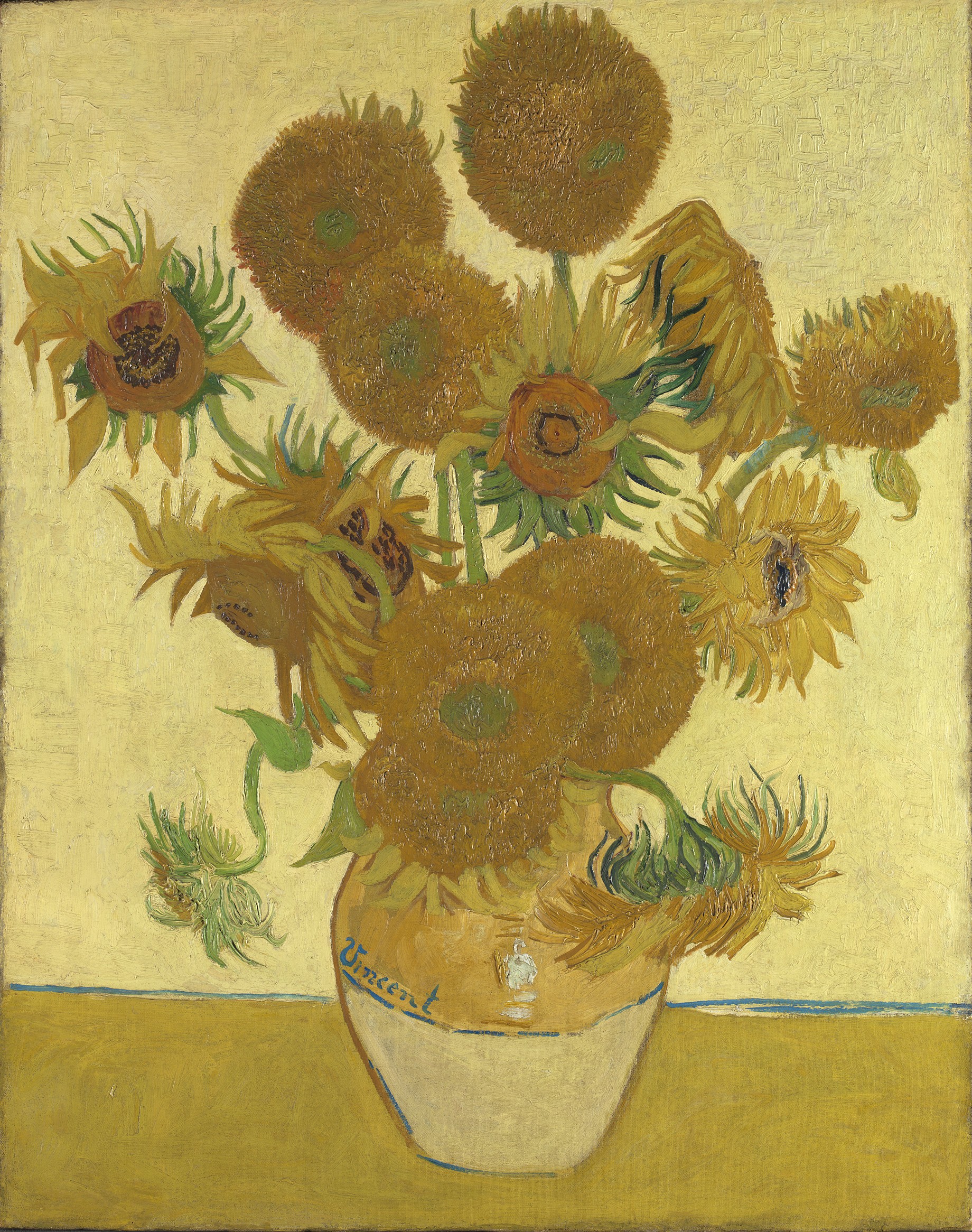
There’s a rare reunion at the Philadelphia Museum of Art this year: Two of Vincent van Gogh’s famous sunflower paintings are on view side by side. Only five large-scale paintings comprise his Sunflowers series, scattered over three continents. But now, Philadelphia gets a chance to see two together.
For the first time in its history, Sunflowers (1888), from the collection of London’s National Gallery, has traveled across the Atlantic for its United States premiere alongside the PMA’s own Sunflowers (1889). The London artwork shows the sunflowers on a pale yellow background while Philadelphia’s features a soft blue; both exemplify the artist’s desire to create what he described as “a symphony of blue and yellow.”
It’s a historic display of signature works by a world-famous artist who sadly never achieved critical acclaim during his lifetime. But, all of that aside, these are simply two marvelous paintings to see.
“Sunflowers” (1888), Vincent van Gogh. Courtauld Fund, The National Gallery.
Their charm isn’t solely in the pretty subject matter; it’s all about the texture. Thick globs of paint in various shades of yellow give the appearance of a not-quite-settled image, enchanting the viewer with dynamic motion that can only be experienced up close. Each bloom has its own stylistic personality as the paint takes on an almost sculptural presence. Both paintings create a mesmerizing display — pictures truly don’t do it justice.
“Van Gogh’s Sunflowers: A Symphony in Blue and Yellow” is on view through Oct. 11 at the Philadelphia Museum of Art, 2600 Benjamin Franklin Pkwy, Philadelphia, 215-763-8100 or philamuseum.org.
— Rosa Cartagena
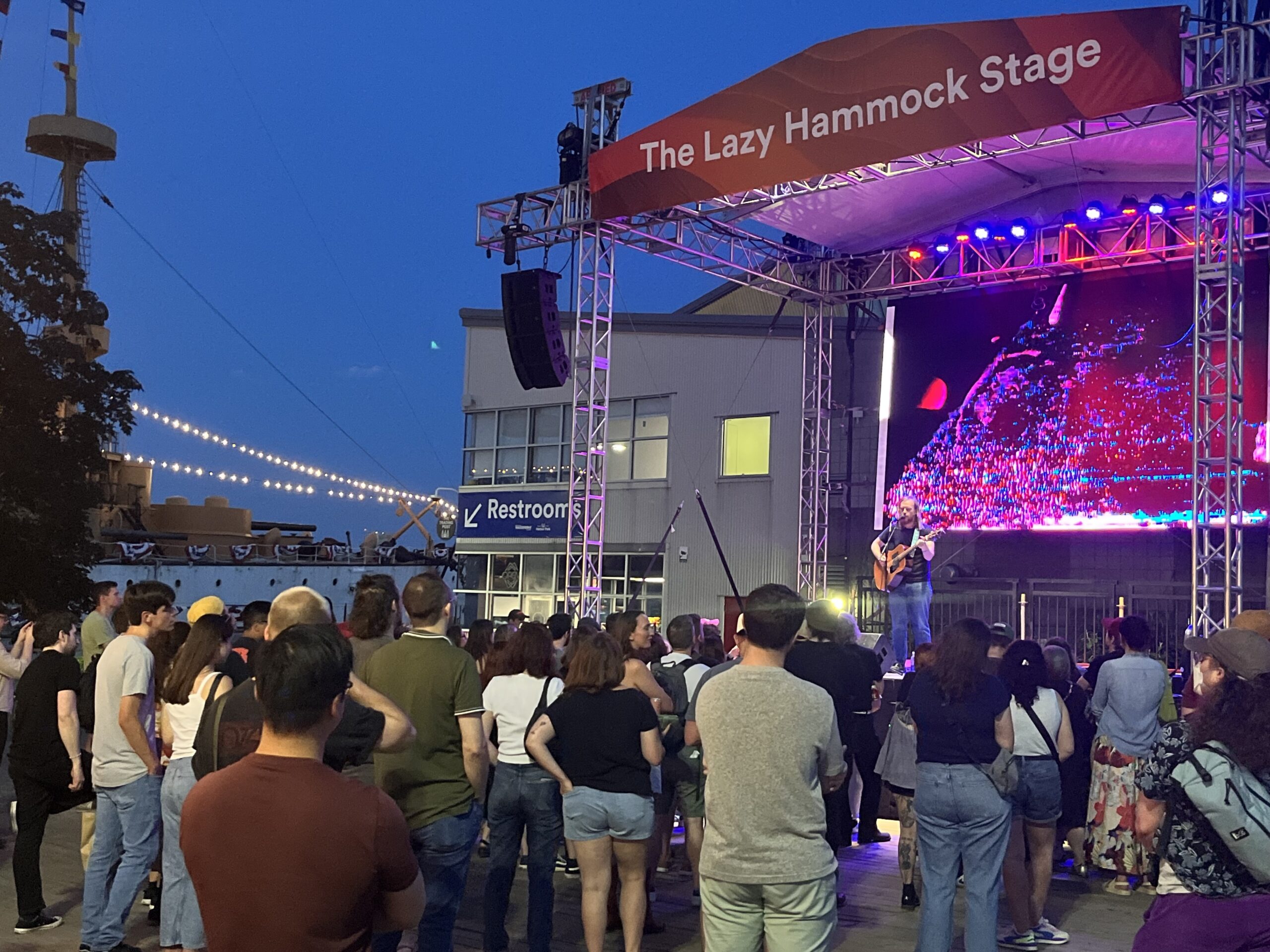
Kevin Devine performs at Spruce Street Harbor Park on June 25, 2026.
Kevin Devine at Spruce Street Harbor Park
Some of the best shows of the summer can be enjoyed for free, from a picnic table, with a Tecate in hand.
On Thursday night, I attended Kevin Devine’s free show at Spruce Street Harbor Park, where he was joined by openers Shannen Moser and Abi Reimold. It was the first of Devine’s short two-weekend tour through non-traditional spaces across the Northeast, including mostly house shows and an arcade.
For about an hour, Devine played — just him and his acoustic guitar — a stretch of old and new songs from his repertoire that dates back over two decades. Currently, Devine’s 11th LP is in the works. It will have distinct Philly ties, being recorded at Will Yip’s Memory Music Studios and produced by Steph Marziano, one of Hayley Williams’ longtime collaborators who cut her teeth in Philly’s music scene.
But back to Thursday night’s show. It was one of an impressive series of free shows at Spruce Street Harbor Park programmed by 4333 Collective.
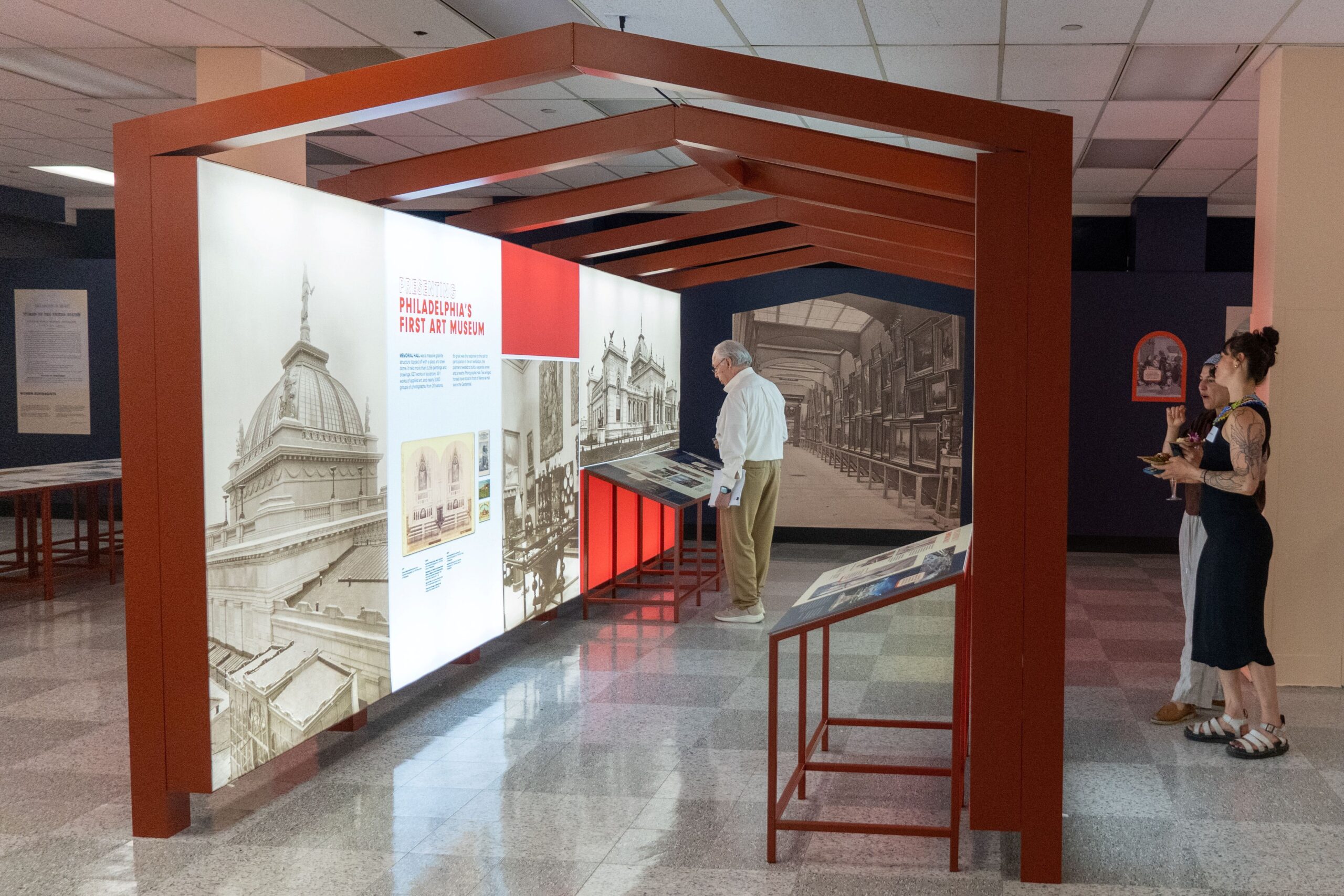
An exhibit on Memorial Hall at “Revist: 1876,” a recreation of the Centennial Exhibition at the Fairmount Park Grounds in 1876. Before Memorial Hall was turned into the Please Touch Museum, it was the first site of the Philadelphia Museum of Art.
The first telephone, at the Lits Building
Before the Please Touch Museum was the go-to hangout spot for our city’s adventurous toddlers, it housed the first Philadelphia Museum of Art.
The 70,000-square-foot Beaux Arts building was originally built to showcase the work of late-19th-century American artists — including Philadelphia’s own Thomas Eakins — for the Centennial Exposition of 1876.
The history of Memorial Hall is told in one of four pavilions featured in “Revisit 1876,” the 8,000-square-foot exhibition located in the ground floor of the Lits Building, produced by the nonprofit arm of the Center City District Foundation.
The exhibit aims to connect present-day Philly with the innovations that were introduced at the fair 150 years ago, said Paul Levy, the foundation’s executive director.
And they do a pretty good job.
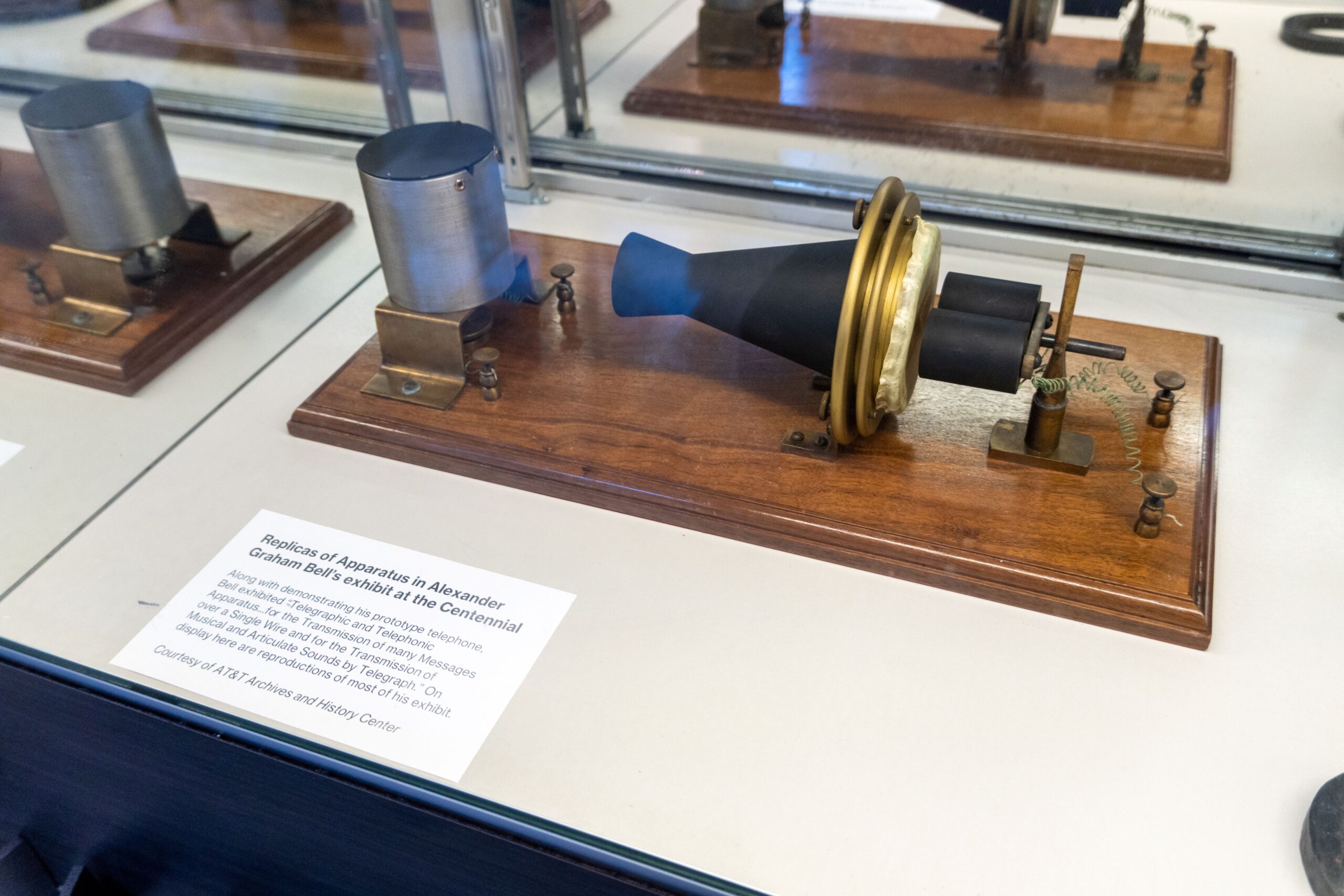
A replica of Alexander Bell’s first telephone that was shown for the first time for the 1876 Centennial Exhibition in Fairmount Park. The replica is on exhibit at “Revisit: 1876” in the Lits Building, 701 Market St. Entrance is on Eighth Street.
Silhouettes of women in corseted dresses and twirling umbrellas and dandy men in top hats greet visitors. Behind the sales counter is the replica of the first telephone that Alexander Graham Bell brought to the Centennial. Also behind the glass counter is a 3-foot terra-cotta model of the Statue of Liberty made by the original sculptor Frédéric Auguste Bartholdi.
There is even Centennial merch, including puzzles and wallets, all in pristine condition.
My favorite part is the flyover video from Independence Hall to Memorial Hall. It’s layered with historic photos connecting 2026 to 1876. In other words, the 2026 flyover includes our majestic City Hall. In 1876, it was an active construction site. (Construction started in 1871 and wasn’t finished until 1901.)
In addition to Memorial Hall, there are exhibits on Machinery Hall, Horticultural Hall, and the Main Building. A special section spotlights how the former enslaved abolitionist Frederick Douglass was prevented from speaking at the event and how Ben Franklin’s great-granddaughter Elizabeth Duane Gillespie fought to have women included.
“Revisit 1876” is open through December. The Lits Building is at 701 Market St. (Entrance is on the Eighth Street side). Admission is free.