If you’re in Philly or headed to Philly over the course of the six scheduled FIFA World Cup matches from June 14 to July 4, you’re in for a treat.
And we’re not even talking about the football, fútbol, fussball, voetbal, or soccer as we know it here, we’re referring to being in the nation’s birthplace on the year of its 250th anniversary.
Philadelphia is scheduled to be “on and poppin’,” as the kids say, with a host of special events over the two glorious weeks Philly joins 16 other cities to host the largest edition of the FIFA World Cup in history.
Just how poppin’? For starters, the World Cup isn’t the only major sporting event coming through our region. Later this year, the area will host golf’s PGA Championship (May 14-17) and Major League Baseball’s All-Star weekend and the events that surround it from July 10-14.
But with a host of other events, happenings, places, and parties set for what’s expected to be quite the summer, consider this your guide to the city and what to do in addition to watching the world’s largest sporting event come through the City of Brotherly Love.
What to know about Philly
Our fair town is considered the birthplace of the United States, where the laws that govern this nation were signed and, for a while, was the nation’s capital. That changed on Nov. 17, 1800, when Washington was designated as the new capital.
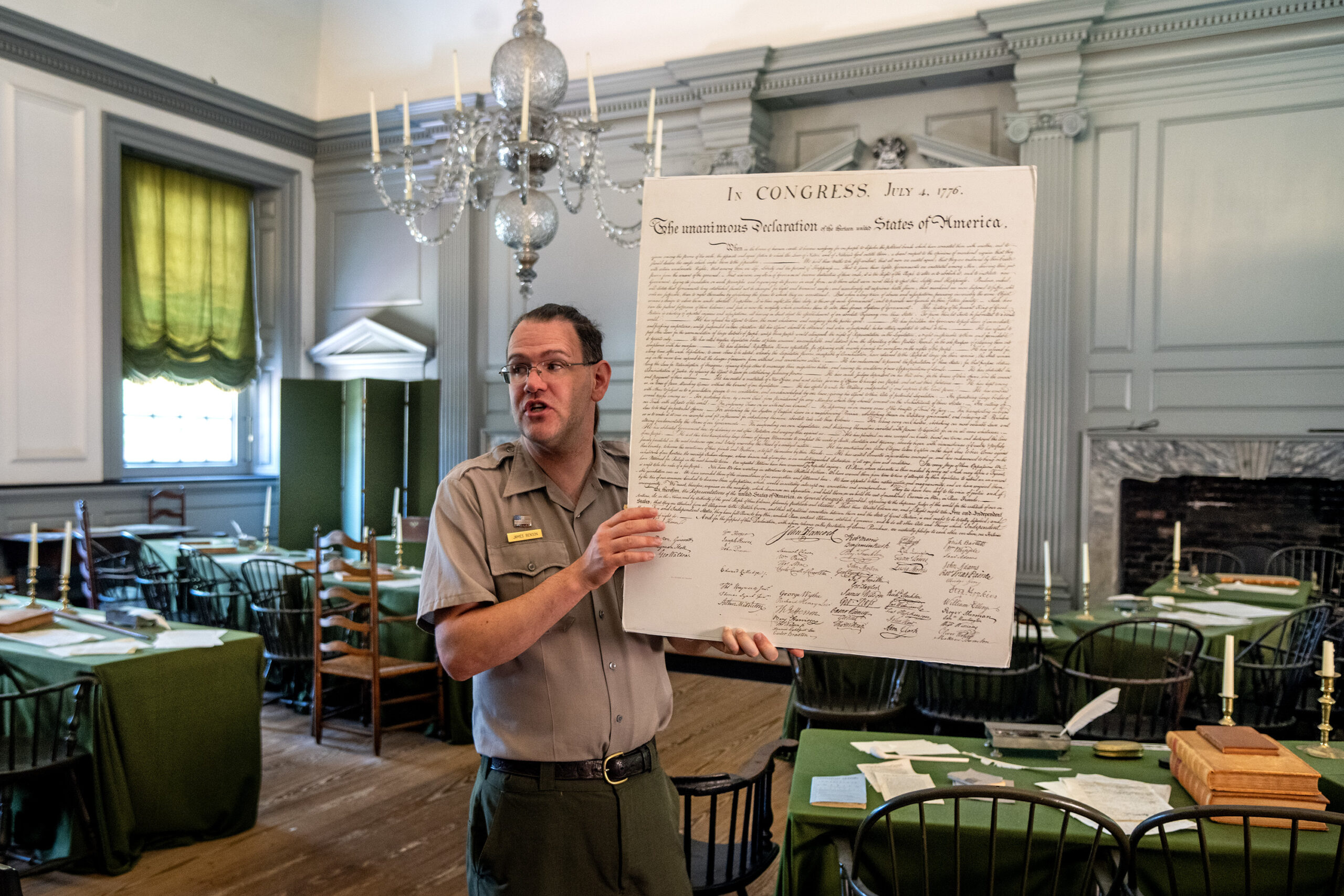
National Park Service ranger James Benson uses an enlarged copy of the Declaration of Independence while talking to visitors in the Assembly Room – where both the Declaration and the U.S. Constitution were signed – on the first floor of Independence Hall.
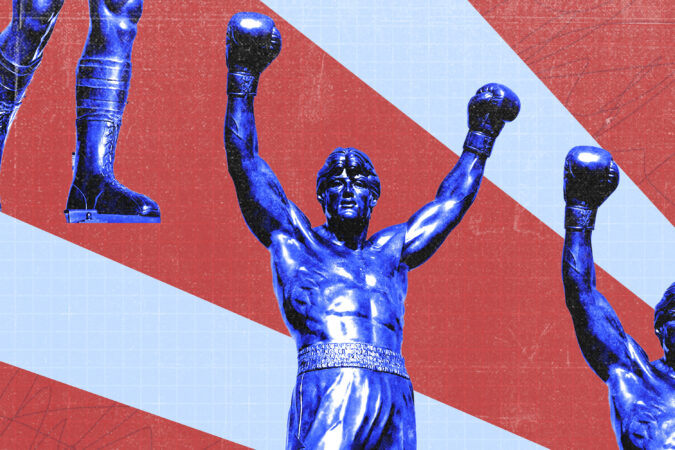
There are a host of iconic sites, but if you’re here for the first or want to explore, we offer a look at the best things to do around the city in addition to climbing the steps of the Art Museum, taking a picture at the foot of the Rocky statue or finding the best cheesesteak in town, the latter of which varies depending on who you ask and which neighborhood you’re in.
Oh, and our food scene is one of the best in the world. Hands down.
Here’s what’s great about Philly. We have a few diagonal arterials, but the Philly metro runs on a grid, with two major highways, I-76 (east-west) and I-95 (north-south), that can get you anywhere you want to go if you’re traveling by car.
If we’re talking about matchdays and getting down to Philadelphia Stadium — which, outside of the World Cup, is Lincoln Financial Field, the home of the city’s beloved NFL franchise, the Philadelphia Eagles — then SEPTA, the city’s public transportation system, is your best bet.
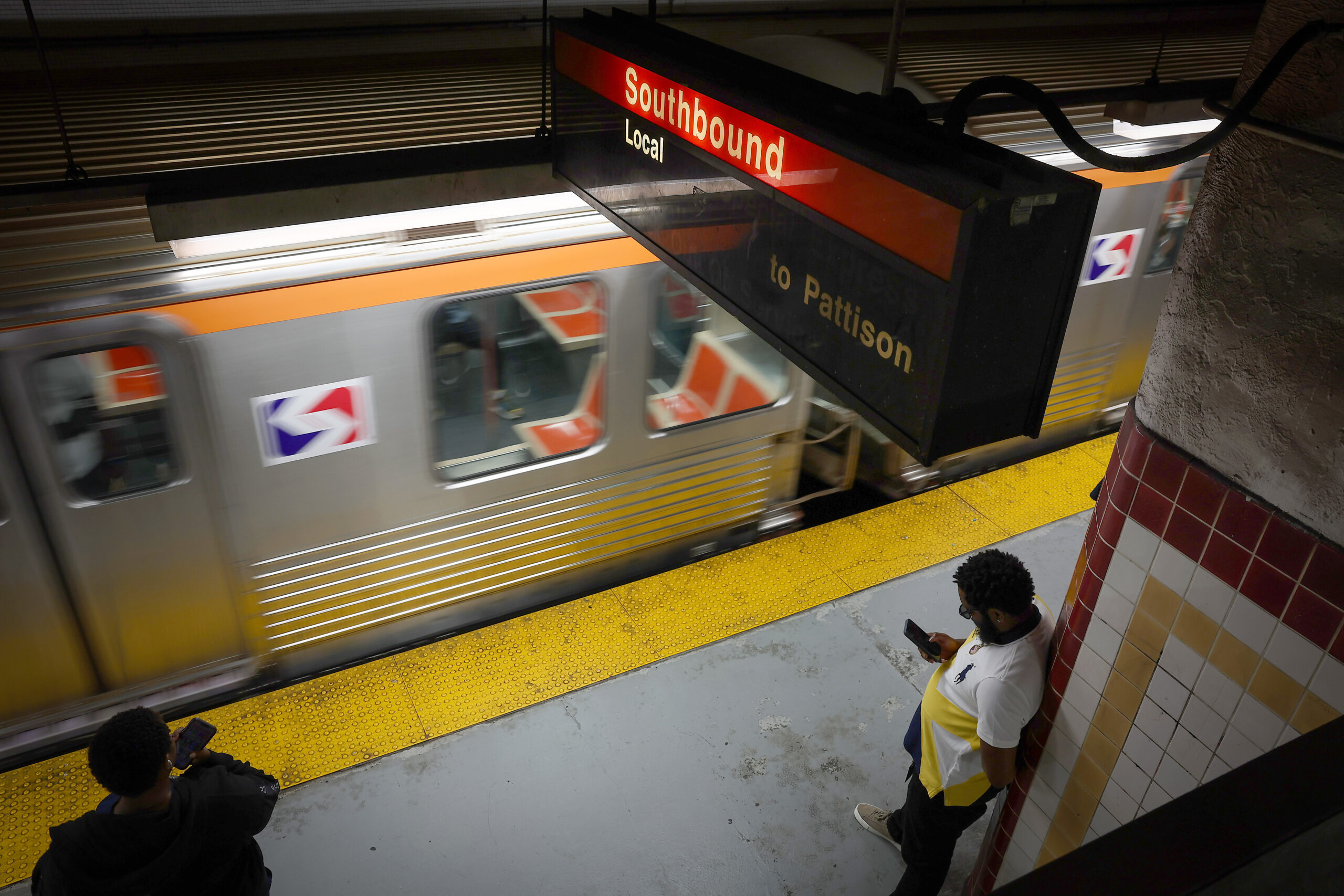
SEPTA’s Broad Street Line train is a direct path from the city to the stadium on game day.
Don’t feel like figuring out all the schedules? Taxis or ride shares via Uber or Lyft also are quick and convenient options.
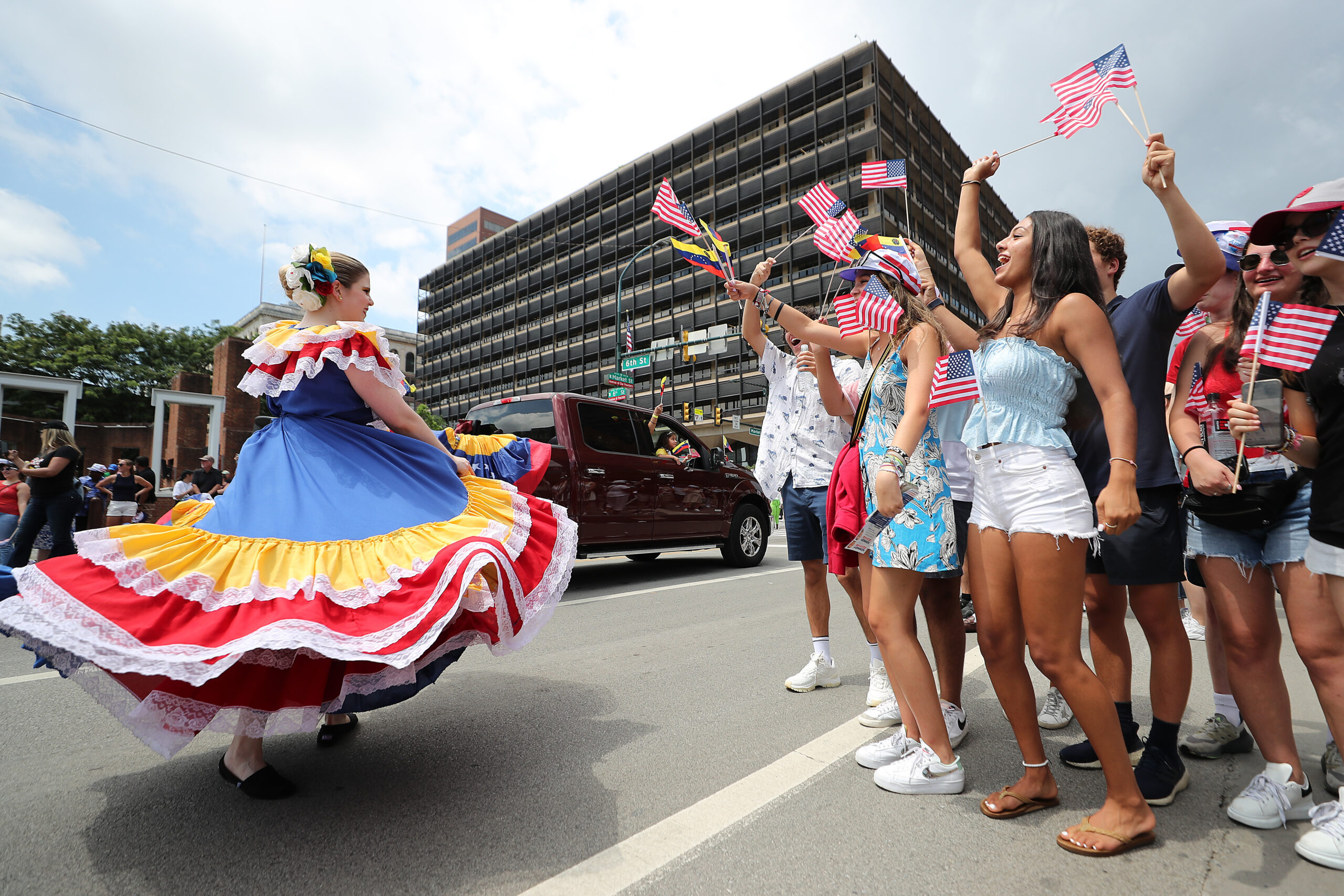
Spectators dance in the street as a Venezuelan dancers perform during the Wawa Welcome America Salute to Independence Day Parade in Philadelphia.
Other events coming to Philly
Here’s a highlight of just a few big events interspersed over the course of the three weeks the city will host World Cup group stage matches and the round of 16 match on July 4.
Wawa Welcome America: Philly’s annual celebration that features everything from free food, block parties, a concert, and, of course, fireworks. Oh, and it’s all free to attend. What does all that look like? Here’s what you can expect. 🗓️ June 19-July 4
What Now 2026: A five-week-long arts festival featuring works from a number of Philly artists across music, film, and, of course, art. 🗓️ May 27-July 4
America 250 at Penn: As part of a host of events, the University of Pennsylvania has an exhibit focusing on France, Haiti, and their touchpoints in our city. For any French or Haitian fans coming to town for those games who consider themselves history buffs, this might be worth checking out. 🗓️ Feb. 26-Sept. 4
What other events are on the schedule ahead this year? Take a look.
Where to watch the World Cup
Don’t have a ticket? All good.
In addition to the free FIFA Fan Festival coming to the historic grounds of Lemon Hill Mansion, Philly has a host of bars and restaurants that already serve as soccer hubs across the city. Last summer, we offered a list of the best 11 spots ahead of the FIFA Club World Cup, and we can confirm that these will be the go-to places again ahead of this summer’s edition.
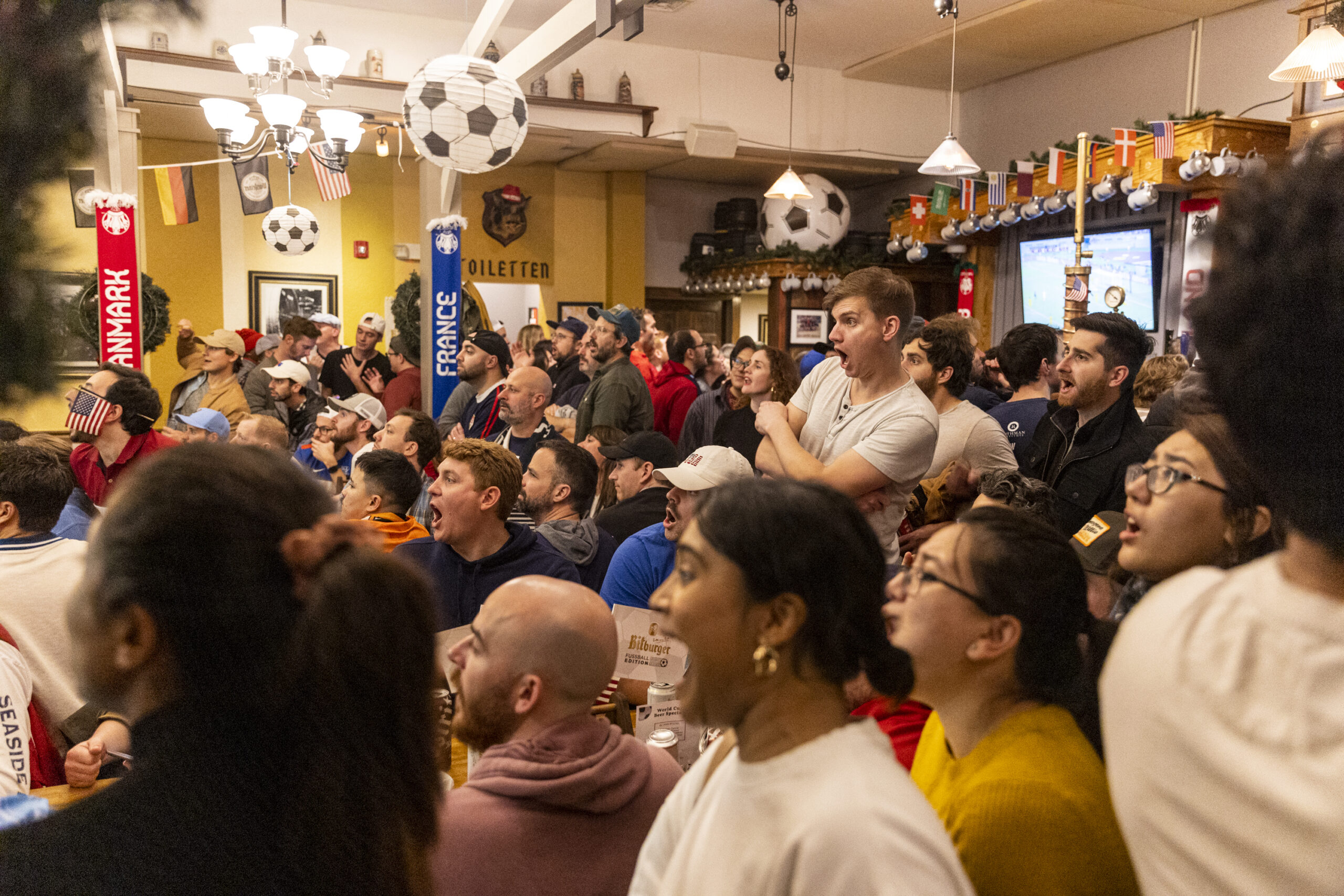
You’ll certainly find a soccer crowd at Brauhaus Schmitz, which was packed during the last World Cup.
We’re hearing that local host city organizers, Philadelphia Soccer 2026, in addition to the hometown Major League Soccer team, the Philadelphia Union, also are planning watch parties across the city.
Did you know …
That the first event at Lincoln Financial Field, er, sorry, “Philadelphia Stadium,” was a preseason friendly between European club giants Manchester United and Barcelona in 2003? One could say that Philly was built for soccer.
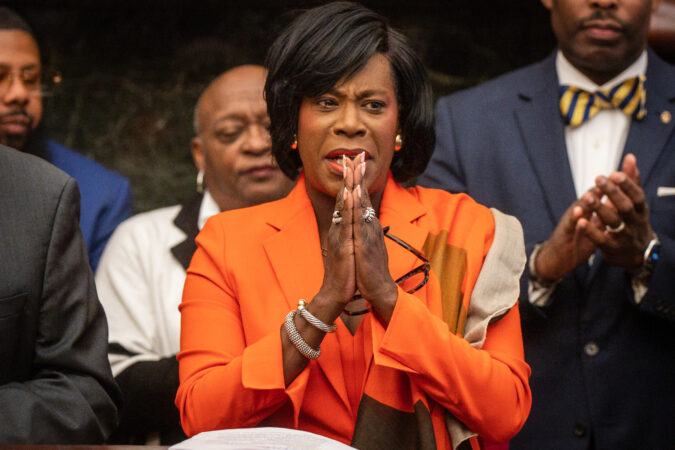
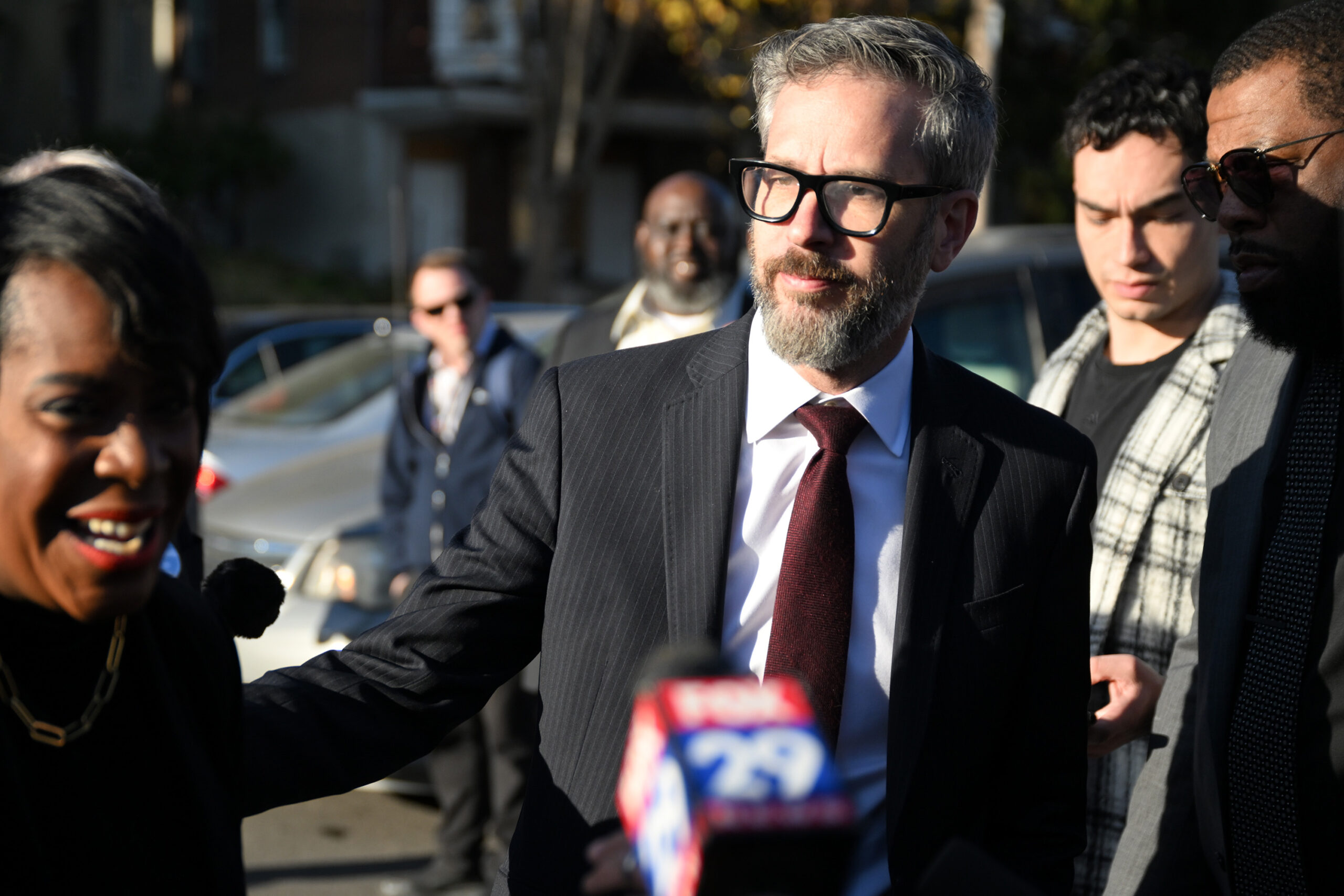
Mayor Cherelle L. Parker’s campaign raised almost $1.7 million last year despite her not facing reelection until 2027, according to a new campaign finance report.
That is the most any Philadelphia mayor has raised during their second year in office since at least the early 2000s, when the city’s current ethics and campaign finance rules took effect, according to Parker’s campaign. She is also the only mayor in that time frame to avoid a dip in fundraising after her first year in office, when many donors shell out to support the city’s new leader.
“The Mayor has strong support from across the City and the region,” Aren Platt, the executive director of the mayor’s campaign committee, People for Parker, said in a written statement. “These numbers equate to people investing in her vision as Mayor for the City and supporting the work that she is doing.”
Her campaign also spent $812,000 in 2025, a huge sum for a nonelection year. Parker entered 2026 with nearly $1.6 million in the bank — a significant haul two years out from a municipal election cycle. (For context, Parker’s campaign in 2023 raised almost $3.4 million, and spent just over $3.2 million en route to winning the mayor’s race.)
State law gives politicians wide latitude in how they spend their campaign donations beyond traditional election expenses like buying TV ads and printing fliers.
Parker’s campaign expenditures last year included airfare to Colorado for a mayoral roundtable at the Aspen Institute, and almost $20,000 to cover costs for a constituent’s funeral.
Parker’s hefty off-year fundraising is reflective of the increasingly constant and professionalized world of political fundraising in Philadelphia. Local politicians no longer wait until challengers emerge to press donors for cash or host major fundraisers.
“Philadelphia elections keep getting more expensive, so now all the candidates have professional fundraisers, which means the frequency of their events and calls has risen dramatically as well,” said John Hawkins, a City Hall lobbyist.
City Council President Kenyatta Johnson, for instance, last year raised about $960,000 and entered 2026 with more than $1.1 million in the bank. Johnson, who, like Parker, will not face reelection until 2027, said he raises money in off years so that he can support other Council members and fund community programs.
“I am blessed to support 16 other hardworking members of Council,” he said Friday. “I always support different community initiatives that come before me, individuals always seeking support for a variety of different initiatives.”
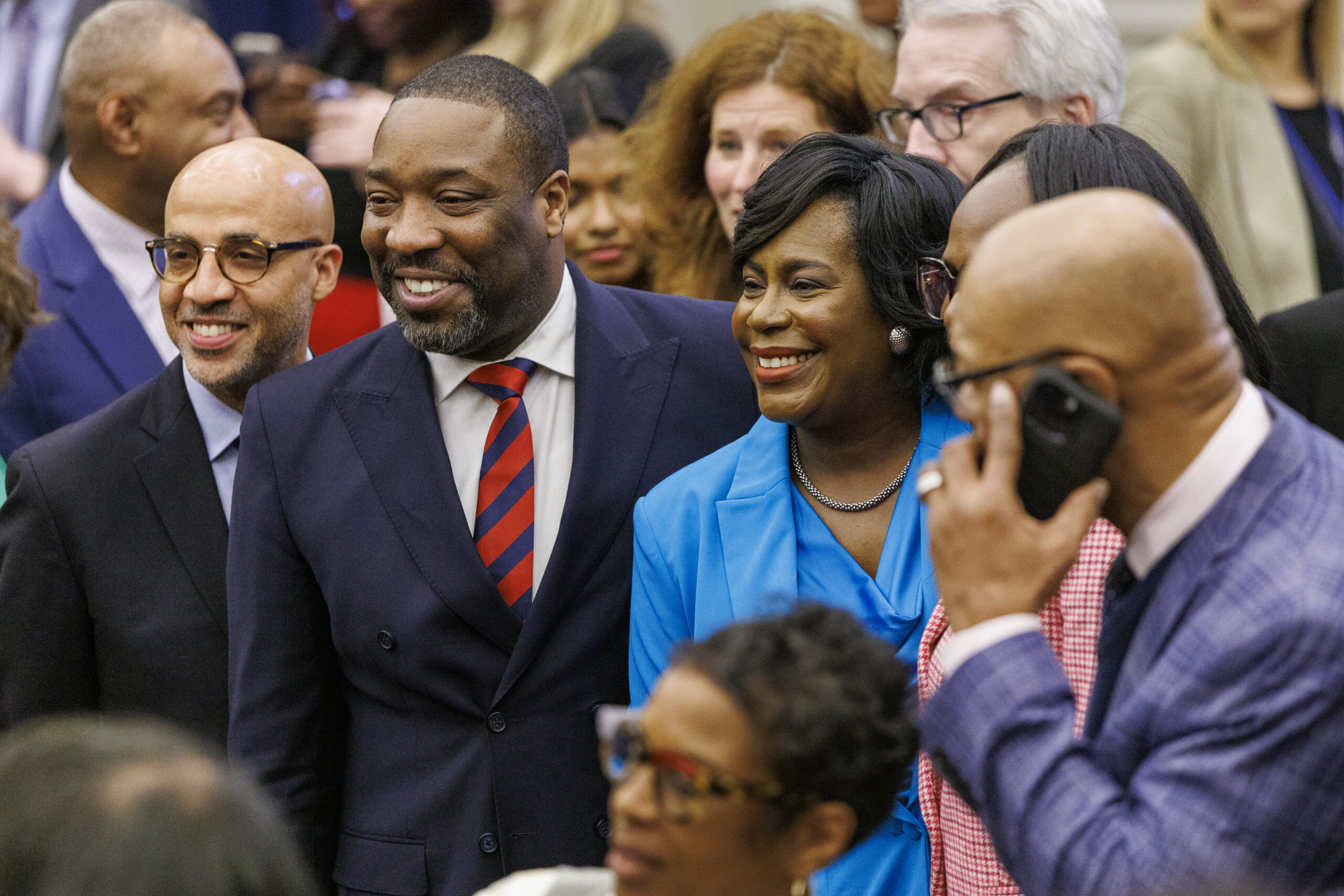
Philadelphia Mayor Cherelle L. Parker stands beside Council President Kenyatta Johnson (left) after she finisher her budget address to City Council, City Hall, Thursday, March 13, 2025.
Johnson, a close ally of the mayor, is also seen as a potential contender in the race to succeed Parker, which would happen in 2031 if she wins reelection. Racking up money between now and then could allow him to enter the race in a strong financial position.
“My focus is being the best City Council president that I can be,” Johnson said when asked if he was considering the city’s top job.
Using the rules to their advantage
Philadelphia’s campaign finance laws rules limit contributions to $3,700 per calendar year from individual donors, and cap political committees and businesses allowed to make political donations at contributions of $14,800 per year.
That means incumbents can collect the maximum amount from donors in each of the four years in their terms before running for reelection. That is not possible in federal elections, where contribution limits apply to the entire election cycle.
The city’s rules give incumbents a potential advantage over new candidates, who typically have the opportunity to raise money over only one or two calendar years after they enter a race.
Incumbents do not always maximize that opportunity. But Parker last year set a new standard.
She is also among the growing number of Philly elected officials taking advantage of a rule that allows politicians to accept donations larger than the city’s contribution limits if they do not spend the excess money on electioneering activities, such as buying ads or paying canvassers to knock on doors.
The electricians union, the politically active Local 98 of the International Brotherhood of Electrical Workers, for instance, gave $50,000 to Parker’s campaign in 2025. At most $14,800 of that can be spent on persuading city voters to support Parker during her next campaign. The remaining $35,200 will be deposited into a separate bank account known as a Segregated Pre-candidacy Excess Contribution, or SPEC, account.
While SPEC accounts are nothing new, more Philly elected officials are using them. In addition to Parker, at least a half dozen Council members, including Johnson, now have SPEC accounts, said Shane Creamer, executive director of the Philadelphia Board of Ethics.
“We haven’t seen this in the lead-up to past elections, certainly not in this number,” Creamer said, adding that the trend shows that politicians are being conscientious about the city’s rules. “I think it suggests that, fundraising aside, there’s an effort to comply with the contribution limits.”
How Parker raises money
Parker hosts major fundraising events, such her annual birthday party, which last September took place at the Live! Casino & Hotel. She also calls donors to ask for contributions, and her supporters sometimes host smaller fundraisers to collect money for her campaign.
Labor unions gave more than $330,000 to Parker last year, campaign finance reports show. That includes $50,000 from the electricians union, $64,800 from the Carpenters union, and $45,000 from the Laborers District Council.
Organized labor — especially the Philadelphia Building and Construction Trades Council, the Carpenters union, and Local 32BJ of the Service Employees International Union — fueled Parker’s victory in the 2023 mayor’s race.
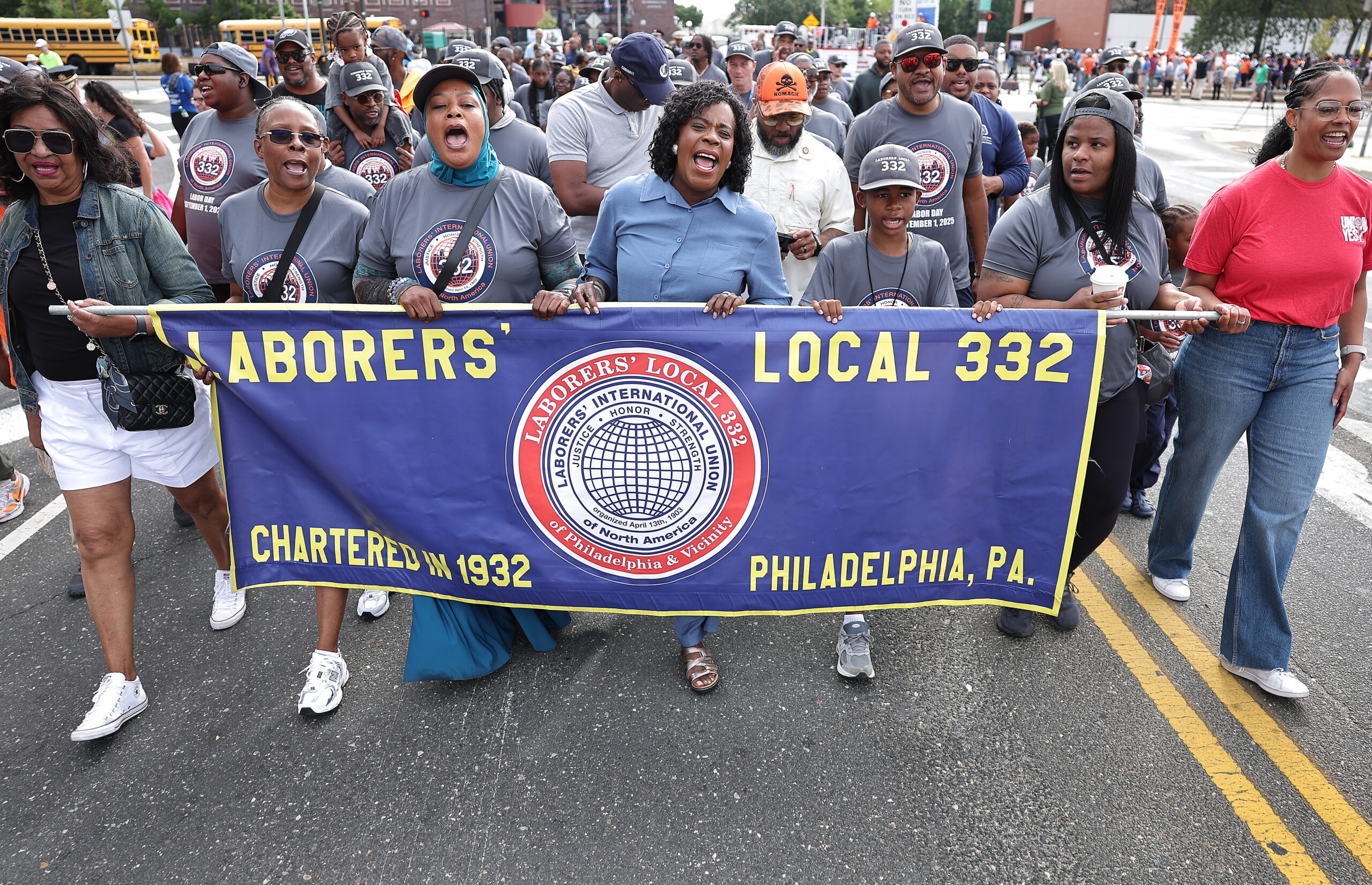
Mayor Cherelle L. Parker (center) joins the chant as she marches with Local 332 during the annual Tri-State Labor Day Parade in Philadelphia on Monday, Sept. 1, 2025.
“We’re very aligned on policy, and if you look at her campaign promises, she is doing fairly well. She’s made some progress on all of them,” said Brown, who serves on the mayor’s business roundtable and an advisory panel providing input on the city’s efforts to revitalize Market East. “I’m invested in the city, and I want to see a functional, good mayor who can lay out a vision and get things done.”
Corporate interests also donated heavily to Parker in 2025. Her campaign contributions from law firms last year included $10,000 from Ballard Spahr, $11,000 from Duane Morris, $5,000 from Buchanan Ingersoll, and $11,000 from Cozen O’Connor. She also received $5,000 from Comcast, $1,000 from Independence Blue Cross, and $4,700 from the Chamber of Commerce for Greater Philadelphia.
Wealthy individuals shelled out big bucks, too. Investor Richard Vague gave $16,000; developer Carl Dranoff contributed $15,000; former Aramark CEO Joseph Neubauer gave $30,000; and Firstrust Bank executive chair Richard J. Green gave $15,000.
How Parker spends campaign money
Although campaign donors may imagine their contributions pay for yard signs and radio spots, the money also often covers strategy meetings held at expensive restaurants, gifts for constituents, and costs related to officeholders’ public duties.
Elected officials are prohibited from using political donations for personal expenses. But beyond that, the rules for spending campaign cash are famously lax and rarely enforced.
Parker’s expenditures on the recently filed reports included a $1,200 tab at Vernick Fish, and 14 more modest purchases from Shanghai Gourmet in Chinatown, totaling $424.
In addition to the Aspen Institute roundtable, Parker’s campaign helped her pay for trips to Miami for a tour of wellness and homeless centers that are part of the Florida judicial system, to Martha’s Vineyard, Mass., for a Black Economic Alliance gathering, to Puerto Rico for a National League of Cities event, and to Harvard University’s Bloomberg Center for Cities.
Aren Platt (right) executive director of Mayor Cherelle L. Parker’s political committee is with her after a Kamala Harris campaign event in Germantown Nov. 3, 2024. Platt was senior campaign adviser in Parker’s run for mayor, and served briefly as deputy mayor before leaving her administration.
The campaign paid $112,000 in consulting fees for ALP Impact Strategies, Platt’s firm; and $30,000 to 215 Bears, the private security company owned by Shawntee Willis, whom Parker has hired as a special assistant in the mayor’s office and who works closely with her police detail.
It also paid $158,563.73 to Rittenhouse Political Partners, the fundraising firm founded by well-known political consultant Aubrey Montgomery and used by Parker, Johnson, and five other members of Council who saw large fundraising hauls last year.
Rittenhouse’s clients include some of the most aggressive off-year fundraisers in Philly politics and some of the most prominent adopters of SPEC accounts.
Montgomery declined to comment.
Staff writer Anna Orso contributed to this article.
Marketed as a ticket to deeper sleep, the soft hum of pink noise has become part of millions’ nightly routines.
However, its use may come at the cost of sleep quality, a University of Pennsylvania study suggests.
Published this month in the medical journal Sleep, the study found that the presence of pink noise at night reduced REM sleep — the stagewhen most vivid dreams occur and memory, emotional regulation, and learning are supported. This was based on a sample size of 25 healthy adults assessed over seven days in a sleep lab.
To Mathias Basner, a Penn professor of psychiatry and lead author on the study, it’s evidence that background noise may not be risk-free.
“The negative consequences of the pink noise far outweigh the positive ones that we saw,” he said.
Pink noise vs. white noise
Pink noise is what’s called a “broadband noise,” meaning sounds made up of a wide range of frequencies. The most well-known example of this, white noise, is considered the sound equivalent of the color white, which contains all colors combined.
Pink, brown, and other colored noises differ based on the frequencies they boost.
Pink noise, for example, emphasizes lower frequencies — making it sound similar to steady rainfall or ocean waves. It’s often used for sleep, although uses for focus and tinnitus have also been reported.
These types of background noise can mask unwanted sounds — an appealing quality in an increasingly noisy world.
Since the first white noise machine for sleep was released in the 1960s, hundreds of variations have spawned. Today, 10-hour videos of pink noise, which is often preferred over white noise for sleep due to its softer sound,pick up millions of views on YouTube.
“So many people are using it, and it’s really indiscriminate use,” Basner said.
Putting pink noise to the test
Having studied the effects of noise his whole career, Basner was surprised to learn several years ago that some people used it as a sleep aid.
That led him down a rabbit hole of research, where he found dozens of studies assessing the effects of broadband noise on sleep. However, most of them were considered to be low quality — sample sizes were small and the assessments were usually subjective.
“We don’t know whether it’s working, whether it’s harmful or not,” he said.
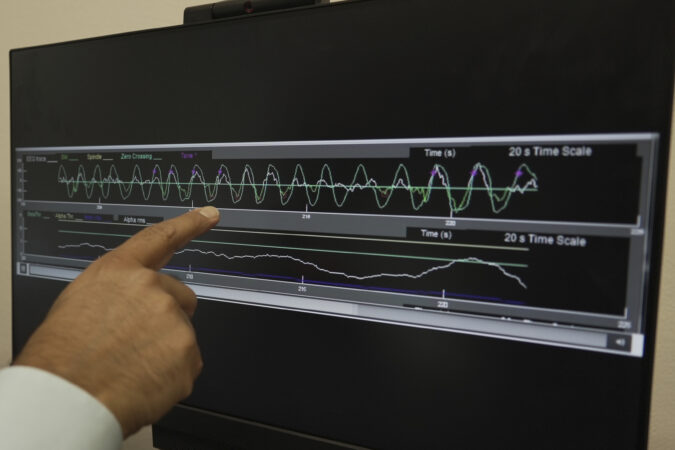
He designed his study to occur in the hypercontrolled environment of a sleep lab at the Hospital of the University of Pennsylvania,where participants were measured using polysomnography, a test that looks at brain waves, eye movements, and muscle tone.
This allowed his team to differentiate sleep stages and figure out what was happening biologically as participants were exposed to a variety of conditions: no noise, environmental noise, pink noise, pink noise and environmental noise combined, or environmental noise with ear plugs.
Each night, the 25 participants, comprised of 18 women and seven men,were given an eight-hour window to sleep. (Lights were out at 11 p.m. and back on at 7 a.m.)
His team found that environmental noise — which ranged from the sound of a helicopter to a sonic boom — led to a 23.4-minute decrease in stage 3 sleep. This so-called deep sleep phase where recovery occurs is important for physical repair and immune function, as well as memory.
And while pink noise didn’t affect deep sleep, it was associated with an average decrease of 18.6 minutes in REM sleep.
“REM sleep is extremely important for a lot of things like memory consolidation, emotion regulation, brain plasticity, and neurodevelopment,” Basner said.
Though the study didn’t look at children, he cautioned that babies spend around half of their time sleeping in REM, compared to a quarter in adults.
Based on his findings, he would discourage parents from using broadband noise machines in the bedrooms of newborns.
For adults who don’t want to forgo the noise, he would recommend using the lowest volume and setting a timer so it eventually turns off.
However, the best option would be to use foam ear plugs, he said. When paired with environmental noise in the study, they were able to block out noise and recover 72% of the deep sleep time that had been lost — although they did start losing effectiveness at higher noise levels, around 65 decibels.
“You didn’t get the REM sleep reduction because they didn’t play anything back,” Basner said.
A limitation of the study is that it had a relatively small sample size comprised of younger, healthy people without sleep disorders or hearing loss. It also only looked at the short-term effects of pink noise, and was conducted in a lab setting, versus the participants’ homes.
In the future, Basner hopes to study the long-term effects of pink noise on sleep, as well as test other types of broadband noise.
“We need to do the proper research to make sure that it is actually, at least, not harmful,” he said.
MAGA Republican Speaker of the House Mike Johnson, an attorney, practiced constitutional law before getting elected as a congressman from Louisiana. Constitutional law! And yet he doesn’t seem to give a flip about the U.S. Constitution.
The Fourth Amendment says, “The right of the people to be secure in their persons, houses, papers, and effects, against unreasonable searches and seizures, shall not be violated, and no Warrants shall issue, but upon probable cause, supported by Oath or affirmation, and particularly describing the place to be searched, and the persons or things to be seized.” Johnson says: “[I]f someone is, you know, they’re going to be apprehended, and they run behind a closed door and lock the door, I mean, what is Immigration and Customs Enforcement supposed to do at that point? ‘Oh, gee whiz, a locked door.’” Yes, exactly. U.S. Immigration and Customs Enforcement is supposed to say, ‘Oh, gee whiz, a locked door,’ not kick in the door, and get a signed judicial warrant for a legal search by describing the place to be searched and the person sought. It’s that simple. Please read the Constitution, people, and every day, after each new outrage, ask yourself: Is this constitutional?
Ann Burruss,Newark, Del.
. . .
The Trump administration’s deportation policies are a disgrace. U.S. Department of Homeland Security Secretary Kristi Noem said that 70% of those detained have criminal records, ranging from speeding tickets to murder. The real figure, according to her own agency’s statistics, is about 47%. Legal immigrants, those going to court hearings about their status, those with Temporary Protected Status, and U.S. citizens who are Black or brown, are now targets for detention and deportation. The U.S. Supreme Court has ruled that racial profiling is acceptable in these cases. Rather than targeted efforts to identify the worst of the worst, Stephen Miller has given agents quotas of 3,000 a day to be met. The result is indiscriminate roundups. And these agents are using brutal force, not asking for ID, pushing people to the ground, brutalizing them, and — in the case of Renee Good and Alex Pretti — killing them because they dared to protest. If you protest, you may be detained, beaten, or shot, as well. Donald Trump’s claims that he is de-escalating are lies. Warehouses are now being bought to house detainees in poor conditions without legal representation, which will become incubators for the spread of disease. There has already been a measles outbreak at a U.S. Immigration and Customs Enforcement detention facility in Texas. Protesting against these un-American policies is one of the most effective ways of fighting for the soul of our nation.
George Magakis Jr.,Norristown
. . .
As a practicing attorney for more than 50 years, I have read with great trepidation the stories about U.S. Immigration and Customs Enforcement’s crackdown on illegal immigration. It often appears to be an end run around the basic Fourth Amendment protections against unreasonable searches and seizures, which I presumed applied to all people. Agents drag people out of cars and homes without search warrants that traditionally require judicial review and approval. They are then often quickly deported to foreign countries, occasionally not even their country of origin. Apparently, ICE is permitted to operate outside the traditional constitutional guarantees the rest of us enjoy.
Now, I am astonished to read a more clandestine effort to subvert our First Amendment protections of free speech via administrative subpoenas. Are we throwing away our Constitution in the insane quest to rid a country of immigrants — a group that includes myself — of recent immigrants from developing countries? As Ben Franklin said years ago, this is a republic, if we can keep it. It’s time to speak up and stop this madness.
Angus Love,Narberth
Join the conversation: Send letters to letters@inquirer.com. Limit length to 150 words and include home address and day and evening phone number. Letters run in The Inquirer six days a week on the editorial pages and online.
OK, Eagles fans, Super Bowl LX is over. Let’s move on, shall we?
It’s never too soon to start thinking about the NFL draft (April 23-25), and rest assured that the Eagles are way past knee-deep in their preparations.
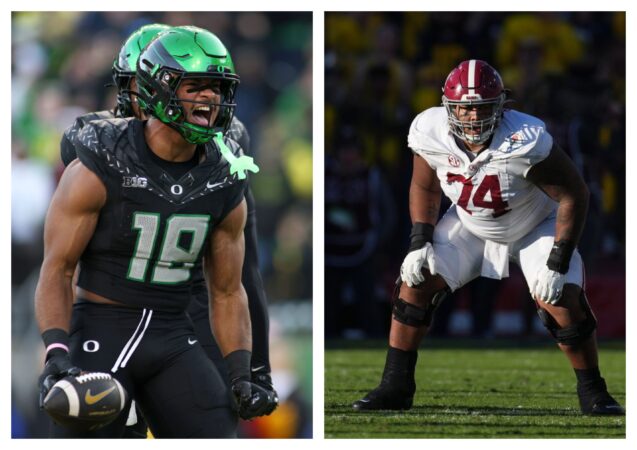
The Birds will need plenty as they restock their roster, and in Devin Jackson’s first mock NFL draft, he sees them going for a tight end in the first round.
Our Jeff McLane was at the Super Bowl and these were among his takeaways from the week in Santa Clara, Calif.:
Drew Lock, the Seahawks’ backup quarterback, recalls a game when Sean Mannion helped Lock and Seattle beat the Eagles. Mannion, of course, is now the Eagles’ offensive coordinator.
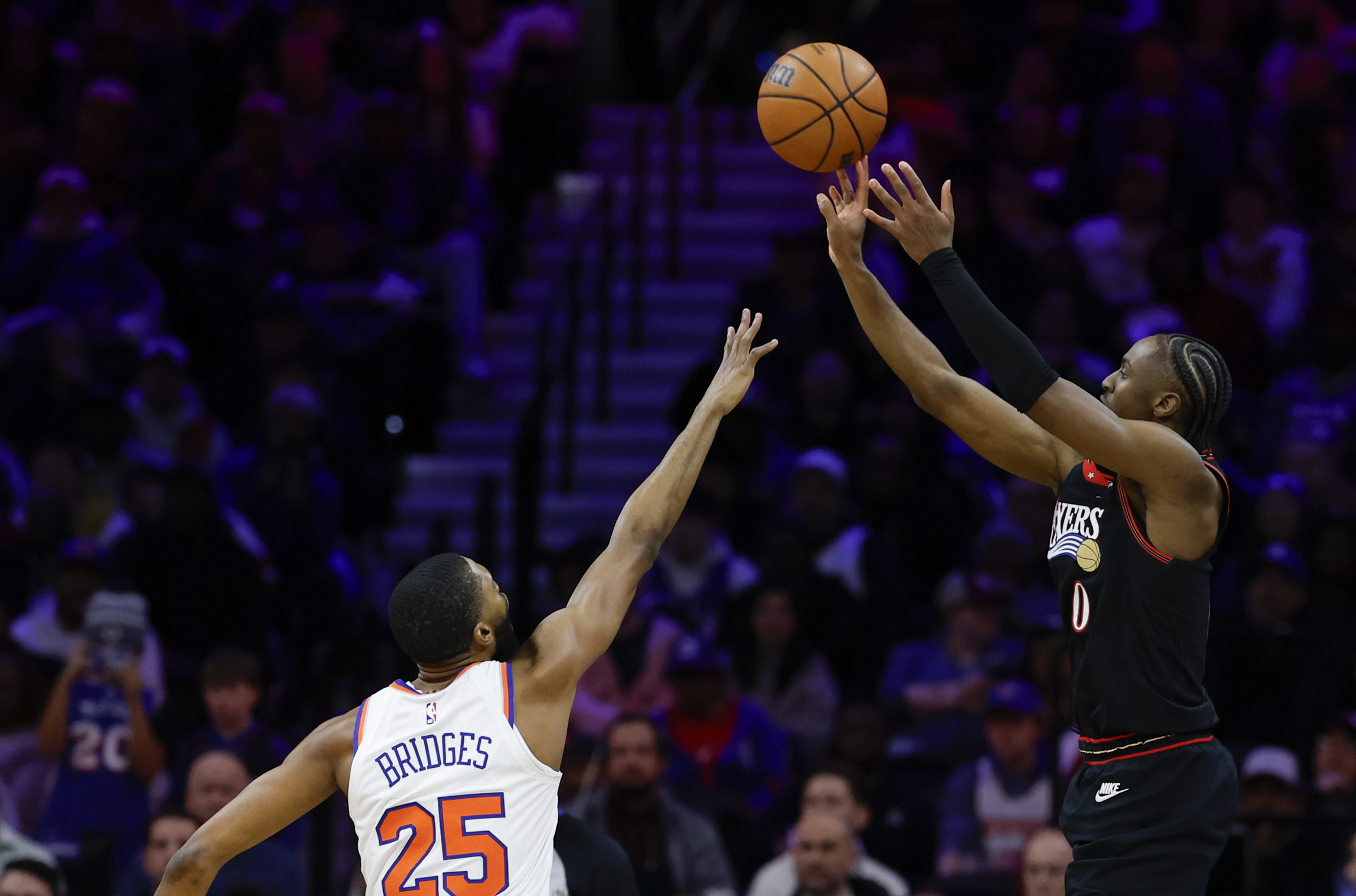
Sixers guard Tyrese Maxey shoots as Mikal Bridges of the Knicks guards him on Jan. 24.
Tyrese Maxey will start for the first time in the NBA All-Star Game this Sunday and he’ll be busy on Saturday night as well. Maxey will compete in the three-point contest during All-Star Weekend, the league announced. In the midst of a breakout season as the Sixers’ top scorer, the point guard is connecting on 38.2% of his three-pointers this season.
Maxey could use some help handling the ball these days with the departures of Jared McCain and Eric Gordon and the suspension of Paul George. It turns out that forward Trendon Watford is starting to fill that role.
Daryl Morey might not be done fine-tuning the team’s roster this season. The president of basketball operations’ next step is the buyout market, where a former “glue guy” for Nick Nurse could fit the bill.
Flyers defenseman Rasmus Ristolainen is finally back with the team this season after a series of elbow surgeries.
Rasmus Ristolainen is grateful to be playing again for the Flyers after injury setbacks cost him large parts of the last two seasons and some of this one. The defenseman is especially grateful now to be playing for Finland at the Winter Olympics.
“Means a lot. I haven’t had the chance to play the last couple of Olympics, so [it] means even more,” he says. “And then, obviously, think about all the players who wore the jersey and when you watched them play when you were a kid. So that means a lot.”
Phillies prospect Dante Nori will represent Italy in the WBC.
Several Phillies will have more on their plate than just spring training when Clearwater, Fla., welcomes them back this week. The World Baseball Classic is returning, with pool play scheduled to begin on March 5-10, the quarterfinals on March 13, and the semifinals and finals on March 15-17. Here are the Phillies who’ll be playing in the WBC, including some of their prospects.
U.S. skier Lindsey Vonn is transported to a helicopter after she crashed during an Alpine downhill race at the Olympics.
American skier Lindsey Vonn was in stable condition following surgery on a broken leg Sunday after she crashed during the Alpine skiing downhill at the Winter Olympics. Vonn, skiing with a torn ACL she ruptured last month, lost control near the start of the race and crashed after clipping a flag on the course.
The Olympic schedule includes speedskating, featuring American Brittany Bowe, a 37-year-old who was a college basketball player. Here’s today’s Olympic TV schedule.
Sports snapshot
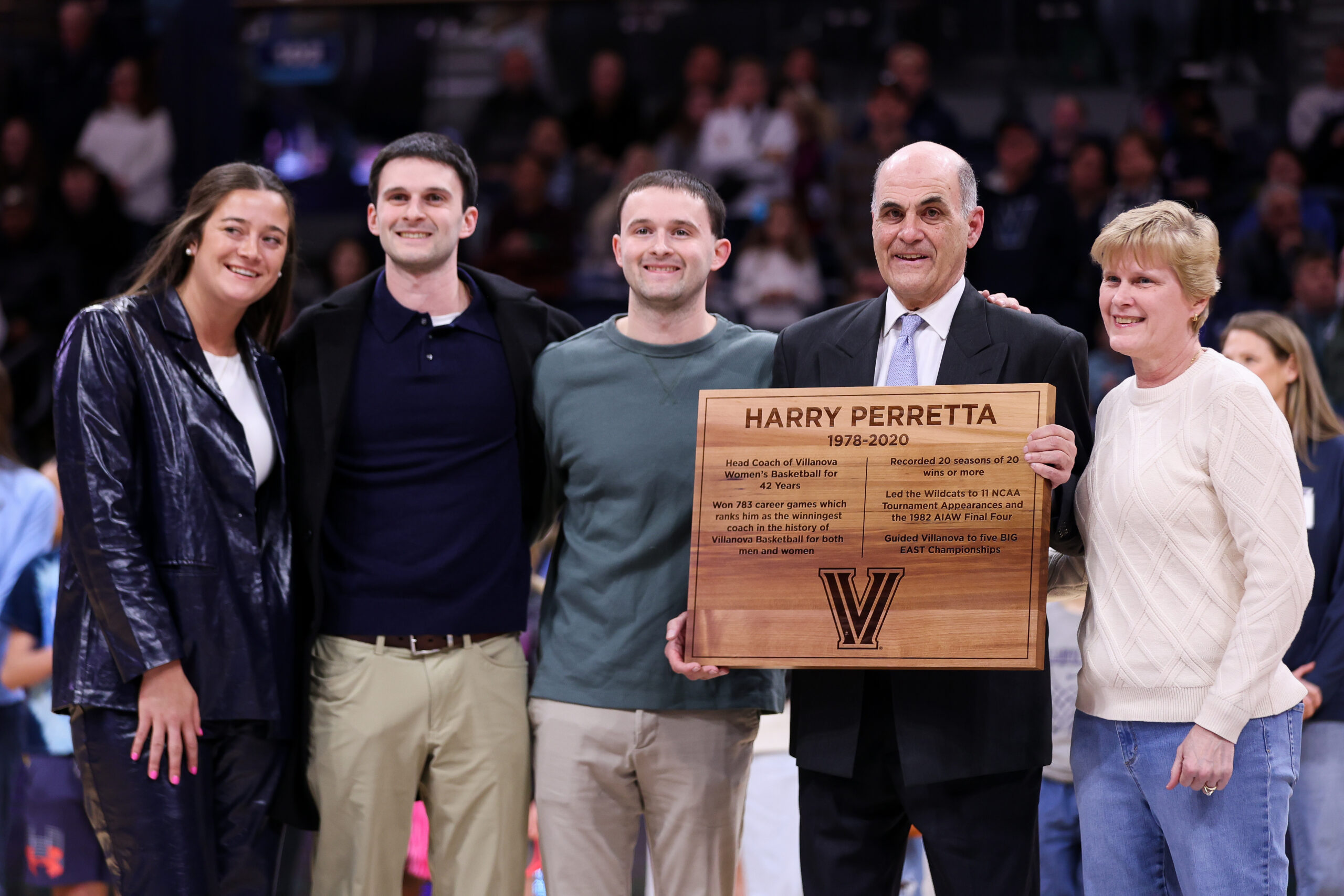
Former Villanova women’s coach Harry Perretta holds a plaque commemorating his time at the school.
Take a bow: Villanova honored longtime women’s basketball coach, Harry Perretta, during its victory over Georgetown.
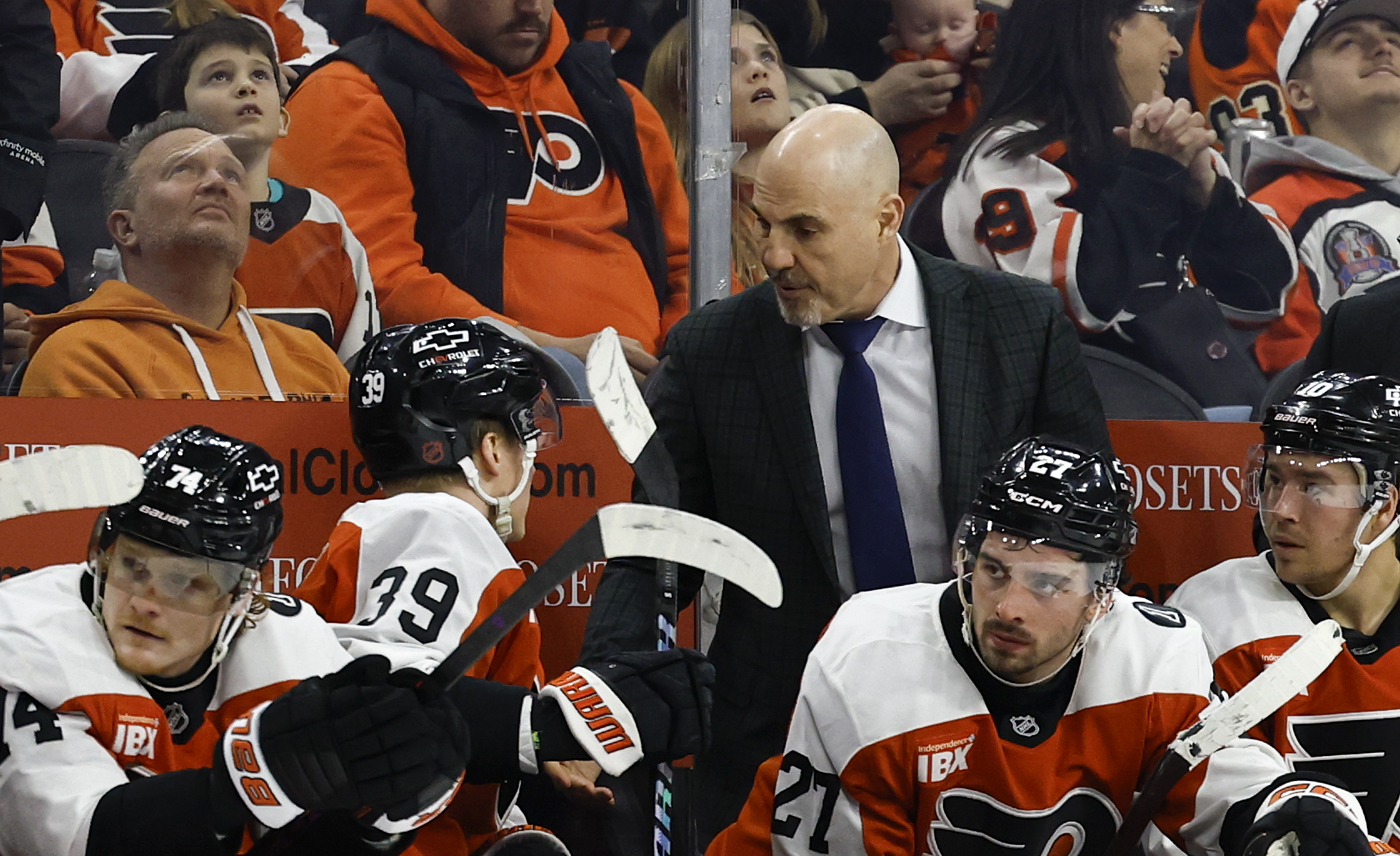
Flyers coach Rick Tocchet talks to right wing Matvei Michkov during Thursday’s game against the Ottawa Senators.
The Matvei Michkov issue has been fascinating and revealing. Everyone acknowledges that, after his often-impressive rookie season, he came into training camp out of shape. That reality has precipitated a months-long discussion about how he has played, when he has played, how much he has played, and whether coach Rick Tocchet might be mishandling him and sabotaging Michkov’s career before the kid has a chance to become the star the Flyers and their fans hope he will be.
It’s safe to say that within at least a portion of the Flyers’ fan base, a measure of paranoia has arisen when it comes to Michkov and the organization’s handling of him.More from Mike Sielski
From Marcus Hayes:
Last week, with the trade deadline looming, Joel Embiid made a public plea to the 76ers’ front office. He begged them to ignore the luxury tax for once, and to get him the help he needs for what has turned into an unlikely impending playoff run.
Embiid’s wishes made sense. Embiid’s wishes were not granted. Daryl Morey’s message to Embiid: Trust the process.More from Marcus Hayes.
We compiled today’s newsletter using reporting from Jeff McLane, Devin Jackson, Lochlahn March, Scott Lauber, Mike Sielski, Marcus Hayes, Gina Mizell, Keith Pompey, Jackie Spiegel, Rob Tornoe, Katie Lewis, Sean McKeown, and Ryan Mack.
By submitting your written, visual, and/or audio contributions, you agree to The Inquirer’s Terms of Use, including the grant of rights in Section 10.
The warmest thought we can have during one of the most chilling winters of our lives: Phillies pitchers and catchers report on Wednesday. I’ll see you in Tuesday’s newsletter. — Jim
DEAR ABBY: My husband developed an addiction to slot machines, but I didn’t realize it. He would leave the house in the early morning before I woke up. Abby, he gambled away every single asset we had accumulated during our 58 years of marriage — somewhere around $600,000! I found out after he asked his grown children for “grocery money.”
We are now bankrupt and must rely on our son, who offered to bail us out if he could be the trustee of our land, home, everything. He takes our monthly pensions and gives us a tiny allowance when we beg for something, but we are so poor we can’t see a movie, eat out or go anywhere, including to visit our other kids.
I’m extremely depressed that nothing can solve this problem for the rest of my life. I’d find another job teaching, but I’m in my 80s and have limited mobility. At least I’m still in my home. I realize this is a dead-end street, but it helps to vent. Can you comment?
— LOST IT ALL IN TEXAS
DEAR LOST IT: Is your son giving you such a tiny allowance because that is what your finances dictate, or is he trying to punish his father for getting into the predicament in which you find yourselves? Talk to your son and explain that the little money he doles out does not allow you to go anywhere, eat out or even see a movie, and see if you, his mother, can convince him to relent so you are not being punished for something you had no part in.
** ** **
DEAR ABBY: I disagree with your response to “Dutiful Daughter in Alabama” (Nov. 10), who put a camera in her 80-year-old mom’s den in case of a fall and overheard Mom make negative comments about her. Installing a camera in someone’s home without their consent is disgusting and wrong, legally and morally. The elderly, in addition to the rest of the population, have a right to privacy in their own homes.
If “Dutiful Daughter” was really concerned about her mother falling, she should have considered a medical alert device, which would have notified family and summoned medical help the moment she fell. This is the safer, legal and common-sense solution.
It sounds like “Dutiful” had other undisclosed reasons for installing a camera. Why did she listen to a conversation that was clearly private? How would she know if her mother fell in another room of the house? If her mother was talking on the phone or visiting with her son, it should have been clear that she was OK and no additional spying was required.
After reading this letter, if children think it is OK to invade their parents’ privacy without their consent, I’m happier than ever to be child-free.
— ANNE P. IN MINNESOTA
DEAR ANNE: To put it mildly, you are not the only reader who disagreed with my answer to that letter. I confess, I didn’t consider the privacy issues that were ignored. Mea culpa.
ARIES (March 21-April 19). Today, you’ll gravitate toward people who nudge you forward, inspire you to work harder and catalyze your becoming. They might not be the nicest or easiest to be around, but that’s not what matters now because you’re in a phase of growth, not comfort.
TAURUS (April 20-May 20). It’s simple emotional math today: Positive emotions give you energy, and negative emotions drain energy. You can’t choose your feelings, but you can put yourself in the mindset and environment most conducive to feeling good.
GEMINI (May 21-June 21). You’re thinking a lot about how to make your daily life work better, and one solution keeps coming to mind. In theory, it could work. The only way to tell is to apply it. Test your idea in tiny, low-risk ways first.
CANCER (June 22-July 22). Some challenges unravel slowly if you tease them apart, strand by strand. Today’s are better approached as the landscaper does, snipping, cutting and mowing right through. Keep moving until it’s beautiful.
LEO (July 23-Aug. 22). There are seasons when it’s best to say yes to every invite, opportunity and offer, and there are times like now when more discretion is called for. You’ve paid your dues and can hold out for your specific preferences and vision.
VIRGO (Aug. 23-Sept. 22). Countless similar moments blur together, but when something brings up a feeling in you, a memory is born, too. Someone who is emotionally available can turn ordinary moments into a vivid experience. Their access to feeling invites your own.
LIBRA (Sept. 23-Oct. 23). Your social intuition will serve you well. You’ll sense when someone is telling the truth and when they aren’t. You can build on what’s real. It’s safe to leave the rest alone. Falsehoods tend to collapse under their own weight.
SCORPIO (Oct. 24-Nov. 21). It’s a strong balance: feeling liberated from the need to own more, yet still committed to tending what’s already yours. The care you put into your things today saves you time and money later. Bonus: Someone is watching with respect.
SAGITTARIUS (Nov. 22-Dec. 21). Someone has you guarding your heart. But how do you protect something as invisible and volatile as a feeling? Today, it may be impossible to stay ahead of it. But if you agree to feel whatever comes up, it’s you who will be ahead.
CAPRICORN (Dec. 22-Jan. 19). Everyone knows you’re responsible, but it would actually be irresponsible to carry everything at once. Know your limits. A pause strengthens the foundation you’ve built. Even small rests renew your energy and focus.
AQUARIUS (Jan. 20-Feb. 18). People get in sync with your ideas, feelings and rhythms. It’s as though there’s a drum line following you around, adding power, excitement and a steady beat that you and everyone around you can move to.
PISCES (Feb. 19-March 20). People don’t have to be “on” to be accepted by you. They sense it, and this unspoken permission to relax and be themselves somehow still inspires people to impress you. It’s funny how comfort rouses vitality and excitement.
TODAY’SBIRTHDAY (Feb. 9). The theme of your year: love shows up. Consistently, yet sometimes surprisingly, in forms you recognize and new ones you learn, even some you invent in a beautiful co-creation. Whether familiar or friendly, passionate or sweet, giving yourself over to relationships will be a pleasure. More highlights: the freedom to plan further ahead than before and opportunities to teach, guide or profit from what comes easily to you. Cancer and Pisces adore you. Your lucky numbers are: 3, 14, 26, 35 and 41.
SANTA CLARA, Calif. — Defense won this championship.
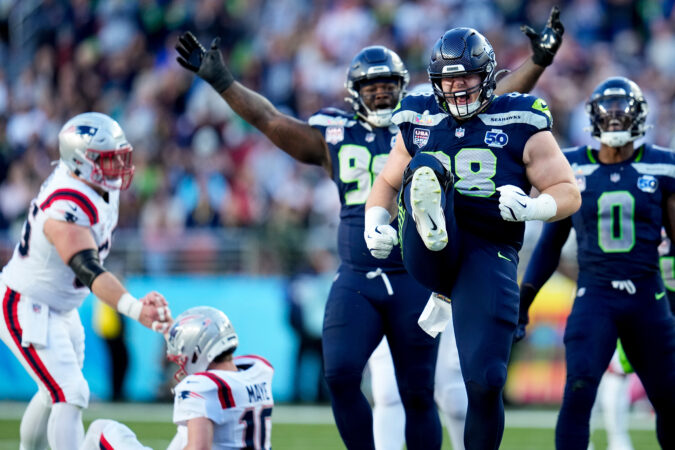
Devon Witherspoon, Derick Hall, Byron Murphy and the rest of Mike Macdonald’s ferocious unit pummeled Drake Maye, and the Seattle Seahawks beat the New England Patriots 29-13 on Sunday to win the franchise’s second Super Bowl.
Sam Darnold threw a touchdown pass to AJ Barner, Kenneth Walker III ran for 135 yards and Jason Myers made all five of his field-goal tries.
Uchenna Nwosu punctuated a punishing defensive performance by snagging Maye’s pass in the air after Witherspoon hit his arm and ran it back 45 yards for a pick-6.
Seattle’s “Dark Side” defense helped Darnold become the first quarterback in the 2018 draft class to win a Super Bowl, ahead of Josh Allen, Baker Mayfield and Lamar Jackson.
Labeled a bust, dumped by two teams and considered expendable by two others, Darnold proved his doubters wrong while helping the Seahawks go 17-3.
After leading the NFL with 20 turnovers in the regular season, Darnold didn’t have any in three playoff games. He wasn’t particularly sharp against a solid Patriots defense but protected the ball and made enough plays, finishing 19 of 38 for 202 yards.
The Seahawks sacked Maye six times, including two apiece by Hall and Murphy. Hall’s strip-sack late in the third quarter set up a short field and Darnold connected with Barner on 16-yard scoring toss to make it 19-0.
Julian Love’s interception set up another field goal that made it 22-7 with 5:35 left.
The Patriots (17-4) punted on the first eight drives, excluding a kneel-down to end the first half.
The first half of the final game of the NFL season was a low-scoring, nearly lifeless affair, but once Benito Antonio Martinez Ocasio appeared for his much ballyhooed and endlessly analyzed halftime show, Levi’s Stadium came brilliantly to life.
The Latin trap rapper and charismatic entertainer promised that the Benito Bowl would be a proud celebration of his native Puerto Rico, and boy was it ever!
Dressed in white with a football tucked under his arm, Bad Bunny — who became the first-ever Spanish-language Grammy album of the year winner last Sunday — kept up his February winning streak.
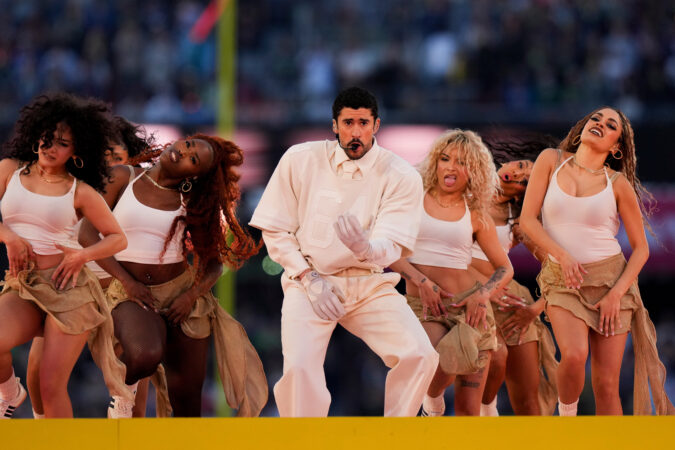
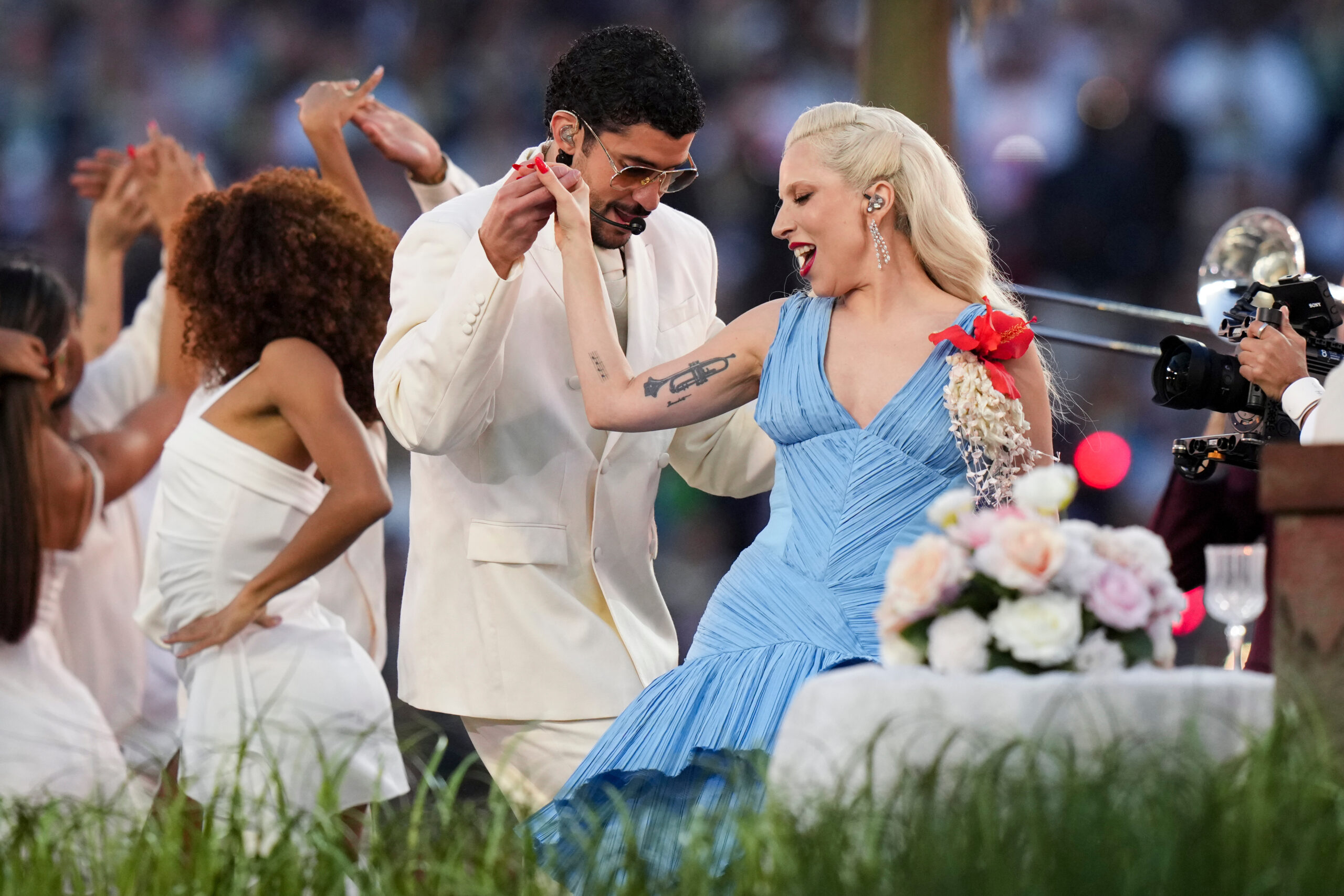
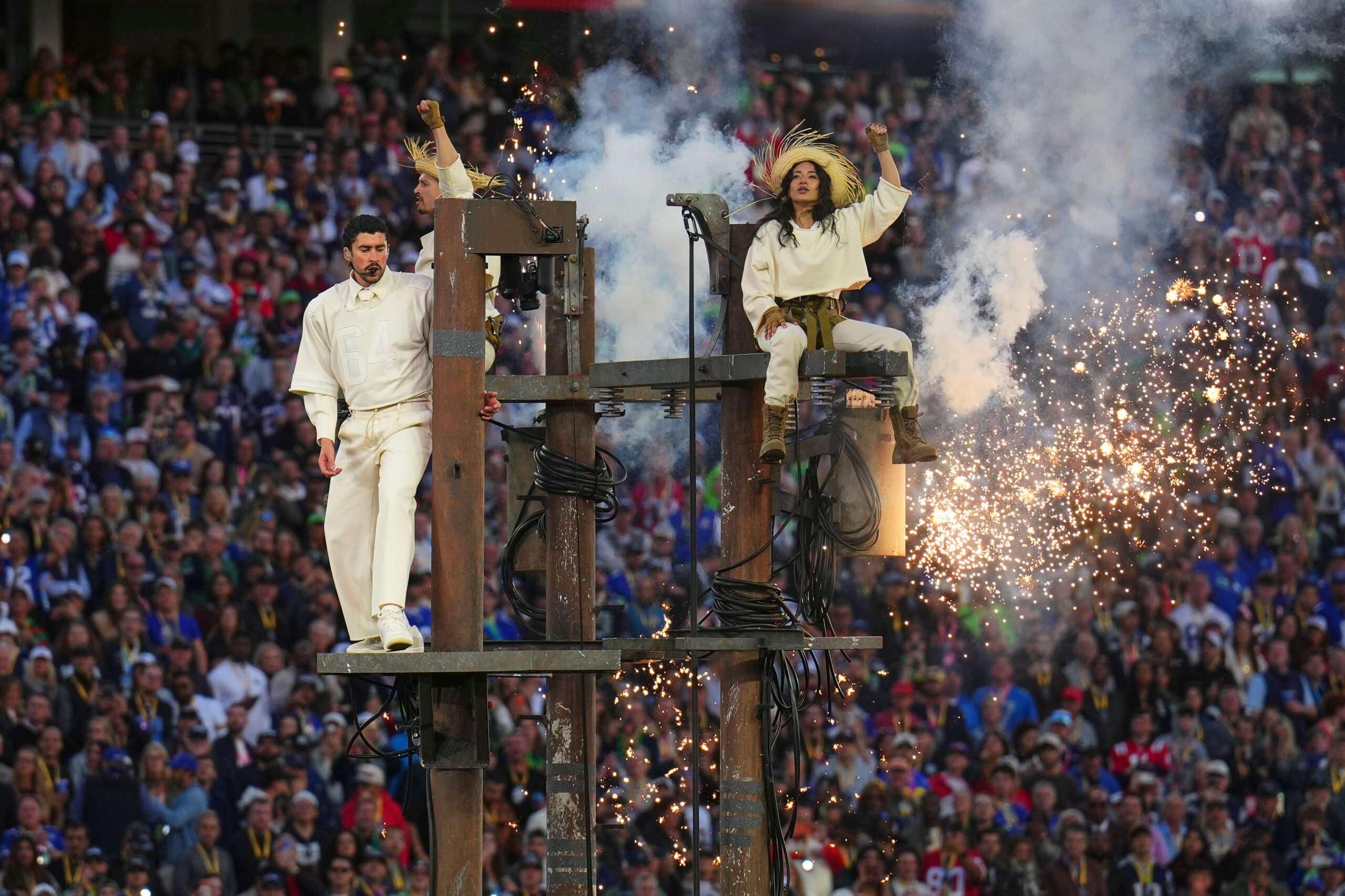
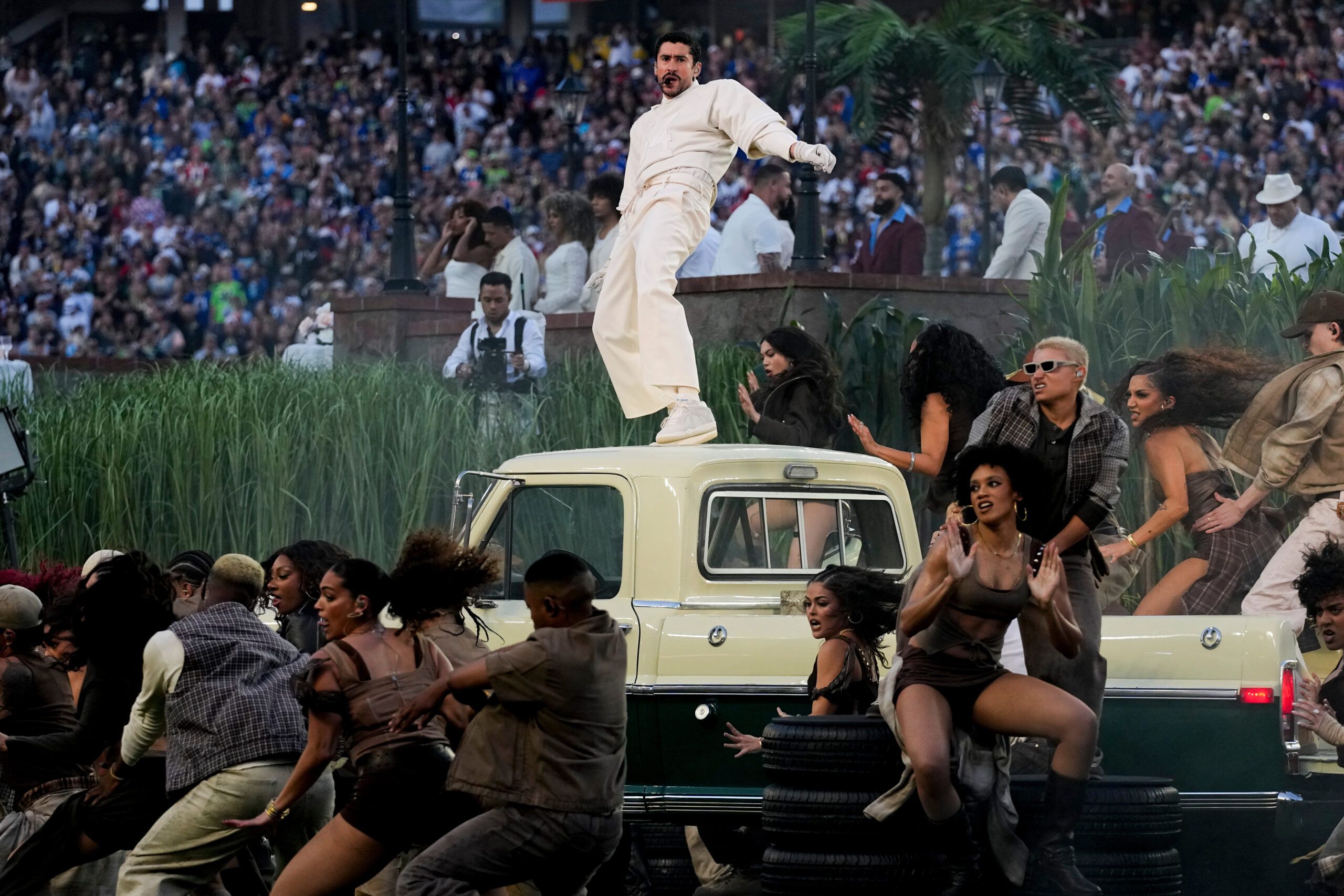
His dazzlingly choreographed performance transformed the field into sugarcane fields (actual people dressed as sugarcane plants) with a casita at the center that Bad Bunny danced on top of, before dramatically falling through the roof. An allegedly real wedding was officiated, and Bad Bunny crowd-surfed, carried the Puerto Rican flag, stopped at coco frio and taco stands, said hello to a pair of sparring boxers, paid tribute to reggaeton stars Daddy Yankee and Don Omar, and packed in portions of 12 songs in just under 13 minutes.
Bad Bunny and Lady Gaga perform during halftime of the NFL Super Bowl 60 football game between the New England Patriots and the Seattle Seahawks, Sunday, Feb. 8, 2026, in Santa Clara, Calif. (AP Photo/Lynne Sladky)
The big-name guest performers — the source of much speculation and wagering beforehand — turned out to be Lady Gaga, who sang her hit “Die With a Smile” wearing a traditional Puerto Rican dress complete with a brooch that looked like the national flower, the flor de maga. Then followed a salsa version of “Monaco” and a surprise appearance by Ricky Martin, the “Livin’ La Vida Loca” Puerto Rican crossover star whose success preceded Bad Bunny’s by a generation.
With Bad Bunny, Martin sang “Lo Que Le Pasó a Hawaii,” a powerful protest anthem warning people of Puerto Rico so they don’t suffer the same fate as Hawaii.
Fleeting cameo appearances were made by many others — Cardi B., Karol G., Pedro Pascal, Jessica Alba, Alix Earle, and Young Miko among them. Not to mention a cast of what seemed like hundreds of dancers and bit players.
But the focus was on the artist and global cultural powerhouse who brought together the community in Levi’s Stadium, and the ones watching on TV and phone screens around the world.
Bad Bunny performs during halftime of the NFL Super Bowl 60 football game between the New England Patriots and the Seattle Seahawks, Sunday, Feb. 8, 2026, in Santa Clara, Calif. (AP Photo/Mark J. Terrill)
The NFL — and Jay-Z’s Roc Nation, which booked the show — was savvy to bring in the most widely streamed musician in the world to attract a youthful, international audience. That, while resisting pressure from the Trump administration and conservative critics who argued that Bad Bunny — an American citizen — was somehow an “un-American choice” to headline the most red, white, and blue sporting event of the year.
As promised, Bad Bunny rapped only in Spanish, so viewers like me who don’t speak the language, were somewhat clueless. But it wasn’t so hard to get the gist of communal solidarity, though. To make it plain for the gringos, a giant video screen spelled out in English the words Bad Bunny used in his Grammy acceptance speech last week: “The only thing more powerful than hate is love,” underscoring the common humanity of immigrants fighting for freedom and respect.
Bad Bunny, left, performs during halftime of the NFL Super Bowl 60 football game between the New England Patriots and the Seattle Seahawks, Sunday, Feb. 8, 2026, in Santa Clara, Calif. (AP Photo/Godofredo A. Vásquez)
While remaining in constant motion, Bad Bunny addressed the crowd in words that translate as: “You’re listening to music from Puerto Rico, from the neighborhoods, from the slums.”
“The reason I’m here,” the former grocery store bagger said, “is because I never stopped believing in myself.”
To the bomba beat of “El Apagon,” Bad Bunny stood atop a utility pole that rose above the faux sugarcane and palm trees. He rapped about the power failures that have plagued the island and which he has insistently called attention to since Hurricane Maria in 2017.
And in that same song — in Spanish — he put into words an ecstatic celebration of his people and Spanish-language culture that joyfully countered the criticism that his being named Super Bowl halftime headliner initiated.
“Now,” he exulted, with scores of dancers aligned behind him, “everybody wants to be Latino.”
Bad Bunny performs during halftime of the NFL Super Bowl 60 football game between the New England Patriots and the Seattle Seahawks, Sunday, Feb. 8, 2026, in Santa Clara, Calif. (AP Photo/Lynne Sladky)
He did, however, say three words in English: “God bless America” before listing the nations that make up the continent, starting with Chile, Argentina, and Uruguay, and ending, of course, with Puerto Rico.
The stadium-sized pop-punk band Green Day, led by Billie Joe Armstrong who hails from Berkeley, Calif., qualifies as a local band for the Super Bowl being played in Santa Clara, Calif. The band played a fast-paced four-song medley before the game.
Green Day has a long history of speaking out against President Donald Trump. Trump, in return, said he is “anti-them” when asked about the Super Bowl entertainment by the New York Post in January.
At the Super Bowl, however, Armstrong did not sing out in protest. With drummer Tre Cool and bassist Mike Dint, Armstrong banged out condensed versions of hits “Good Riddance (Time of Your Life),” “Holiday,” and “Boulevard of Broken Dreams,” before getting to the finale of “American Idiot,” the title song to their 2004 album.
Usually when the band gets to the song’s lyric “I’m not part of a redneck agenda,” Armstrong sings “I’m not part of a MAGA agenda,” and at times, he has tweaked it to target Elon Musk.
On Sunday, however, that verse was left out of the song. Instead of a protest, it became a celebration of the big game, with several former Super Bowl MVP players, including Tom Brady, San Francisco 49er local heroes Joe Montana, Jerry Rice, and Steve Young, and the Eagles’ Jalen Hurts, joining the band at the front of the stage.
Following Green Day — and after actor Chris Pratt introduced the Seahawks and Jon Bon Jovi did the same for the Patriots — Brandi Carlile sang “America the Beautiful.”
The Washington state native accompanied herself on acoustic guitar and was joined by Sista Strings, the sibling duo of Chauntee (violin) and Monique Ross (cello). It was an understated and effective version by the country and rock singer, who opens her “Human” tour in Philadelphia at the Xfinity Mobile Arena on Tuesday.
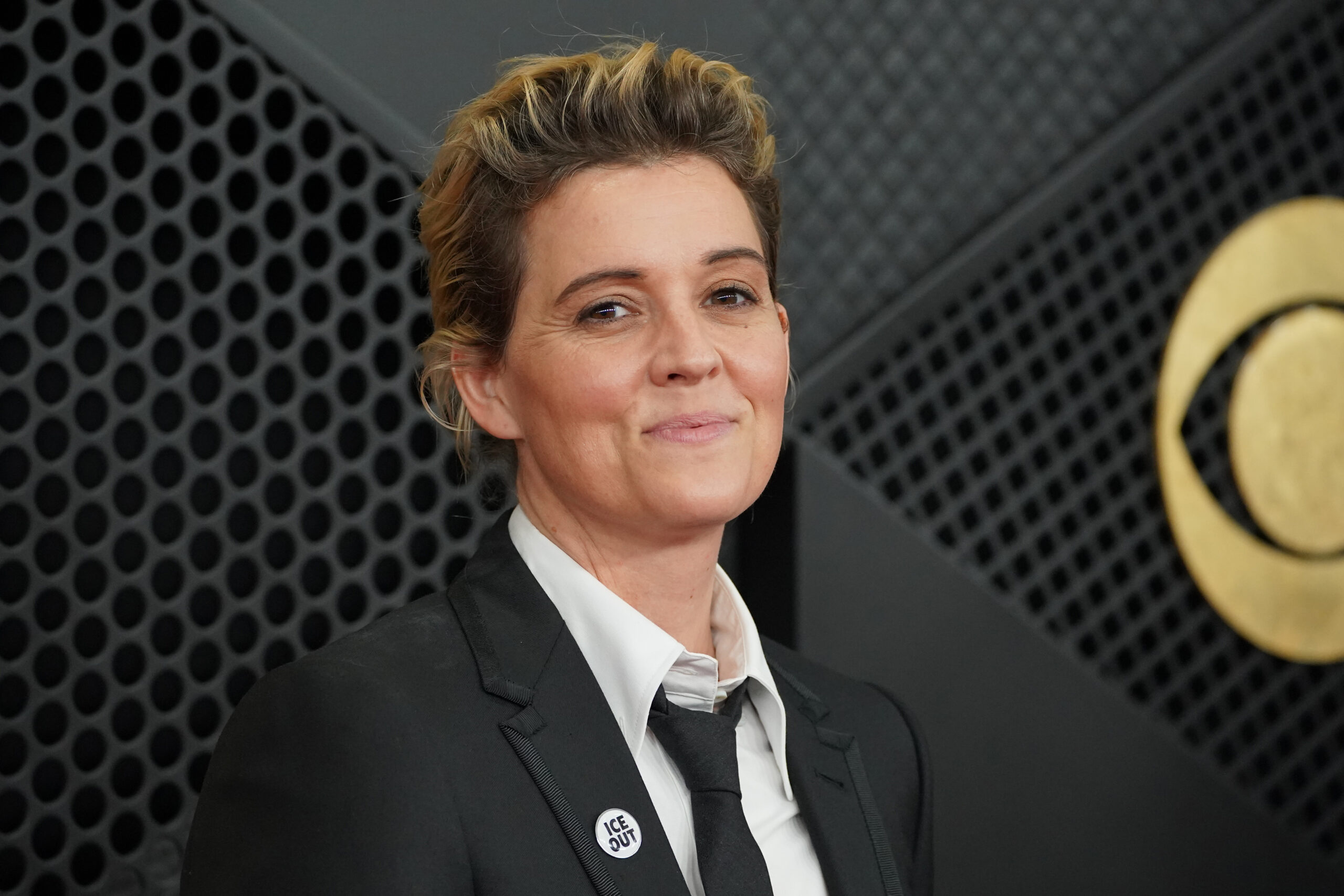
Brandi Carlile arrives at the 68th annual Grammy Awards on Sunday, Feb. 1, 2026, in Los Angeles. (Photo by Jordan Strauss/Invision/AP)
Earlier in the week at Super Bowl press event, Carlile spoke about being chosen to sing the song. “This is a song about a country, a beautiful country, that ebbs and flows in terms of hope,” she said. “And it’s a work in progress. And the song believes we can get there, and I believe we can get there.”
Central Jersey songwriter and pop star Charlie Puth followed Carlile with a blue-eyed soul version of “The Star-Spangled Banner,” joined by a choir for vocal support. Puth’s approach was low-key and perfectly respectable, and not likely to be the subject of much Monday morning water cooler conversation on a night when Bad Bunny took center stage.
Singer-songwriter Coco Jones got the pregame music started with a version of “Lift Every Voice and Sing,” the song that’s come to be known as the “Black national anthem.” Written first as a poem by James Weldon Johnson in 1900, it was then set to music by his brother John Rosamond Johnson. Jones delivered a powerful, emotionally direct version, joined by a string octet.
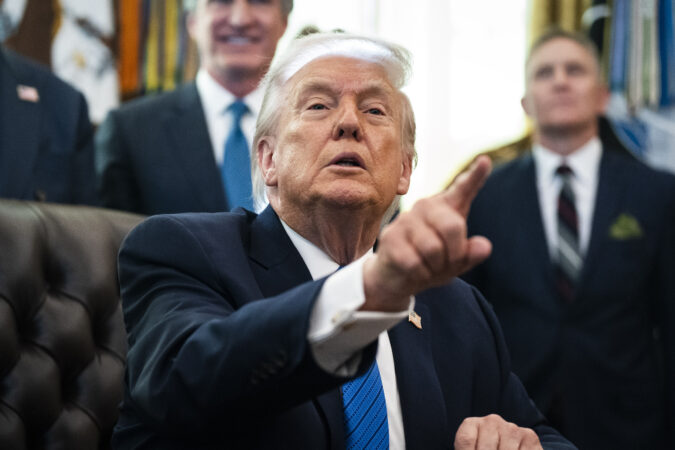
President Donald Trump plans to keepDemocrats out of a traditionally bipartisan White House gathering of governorstypically held as part of the National Governors Association’s annual Washington summit, the organization said.
According to the governors’ offices, the president also revoked invitations sent to Maryland Gov. Wes Moore (D), the NGA’s vice chair; and Colorado Gov. Jared Polis (D) to attend a second White House event scheduled to occur around the summit: a dinner for governors.
“This week, I learned that I was uninvited to this year’s National Governors Association dinner — a decades-long annual tradition meant to bring governors from both parties together to build bonds and celebrate a shared service to our citizens with the President of the United States,” Moore said in a statement Sunday. “… It’s hard not to see this decision as another example of blatant disrespect and a snub to the spirit of bipartisan federal-state partnership.”
Moore told CNN’s State of the Union on Sunday that he was confused by the White House’s decision, saying that, just a few weeks ago, he led a bipartisan group of governors who met with the president as Trump signed a memorandum on bringing down energy costs.
Moore also said on CNN that it was “not lost” on him that he is the only Black governor of a state.
“I find that to be particularly painful, considering the fact that the president is trying to exclude me from an organization that not only my peers have asked me to help to lead, but then also a place where I know I belong in,” he said. “I’m never in a room because of someone’s benevolence nor kindness. I’m not in a room because of a social experiment. I’m in the room because I belong there and the room was incomplete until I got there.”
Spokespeople for Polis, as well as representatives of the Democratic Governors Association, did not immediately respond to a request for comment.
While Moore and Polis were excluded from the dinner with Trump, some Democrats remained invited to the gathering.
The White House did not explain why Democratic governors were not invited to the meeting with Trump, and a spokesperson did not respond to a request to provide a list of Democrats who were invited to the dinner.
Trump has frequently clashed with Moore and Polis, and his decision comes after months of conflict between the federal government and Democratic governors.
Moore has condemned the president’s threat to deploy the National Guard to Baltimore and defund Maryland’s efforts to replace the fallen Key Bridge. Trump has also repeatedly claimed that Baltimore is “crime ridden” despite the fact that the city is experiencing its lowest homicide rate in 50 years.
Polis and Trump have repeatedly feuded over Tina Peters, a former county clerk in Colorado who was convicted in state courton felony charges related to efforts to overturn the 2020 presidential election. Polis has defended the conviction and refused the White House’s request to transfer Peters to a federal prison. Because of this, in December, Trump in a Truth Social post called Polis a “scumbag” and said he should “rot in Hell.”
The NGA’s Washington meetings are expected to take place Feb. 19 to 21. The organization said Friday that the White House meeting will no longer be part of the association’s official schedule.
In a statement Friday, Brandon Tatum, the interim CEO of the NGA, said that the “bipartisan White House governors meeting is an important tradition, and we are disappointed in the administration’s decision to make it a partisan occasion this year.”
“To disinvite individual governors to the White House sessions undermines an important opportunity for federal-state collaboration,” Tatum said. “At this moment in our nation’s history, it is critical that institutions continue to stand for unity, dignity and constructive engagement.”