Blog

  • Some GOP-led states seek to bring back death penalty for child rape convictions

    Some GOP-led states seek to bring back death penalty for child rape convictions

    MONTGOMERY, Ala. — The state of Alabama has joined a growing number of Republican-led states seeking to revive the death penalty for child rape, a sentence outlawed by the U.S. Supreme Court in 2008.

    Alabama approved legislation Thursday to add rape and sexual torture of a child under 12 to the narrow list of crimes that could draw a death sentence.

    The Supreme Court in 2008 ruled that such sentences were not a “proportional punishment” and would violate the Eighth Amendment’s ban on cruel and unusual punishment.

    Republican Rep. Matt Simpson, a former prosecutor who is sponsoring the legislation, said getting the Supreme Court to revisit the constitutionality issue will require getting a test case to the high court. He hopes that will happen if enough states pass similar legislation.

    “This is the worst of the worst crime. It deserves the worst of the worst punishments,” Simpson said.

    Five states — Florida, Tennessee, Idaho, Arkansas, and Oklahoma — have passed similar bills in the last three years and at least five more have proposed bills, according to the Death Penalty Information Center, which tracks the use of capital punishment across the United States.

    Florida Attorney General James Uthmeier in November announced the intent to seek a death sentence for a man indicted on charges of multiple counts of capital sexual battery on a child under 12.

    While the Alabama bill passed with widespread support, some lawmakers emphasized that capital punishment for child rape is unconstitutional and taxpayers would have to foot the bill for any court challenge.

    Robin M. Maher, executive director of the Death Penalty Information Center, said there are concerns that such laws could cause children harm instead of protecting them.

    Writing for the majority opinion in 2008, Justice Anthony Kennedy wrote that the prospect of a death sentence for the perpetrator might discourage reporting by victims or “may remove a strong incentive for the rapist not to kill the victim.”

    “The court recognized that these statutes do more harm to children than help them. They actually place them in grave danger of being killed,” Maher said.

    The Alabama Senate on Thursday voted 33-1 for the bill. Alabama Gov. Kay Ivey said she will sign the bill into law because,” we have to do everything we can to protect Alabama’s children.”

    While the bill is currently unconstitutional, Republican Sen. April Weaver likened it to state abortion bans that were considered unconstitutional until the U.S. Supreme Court in 2022 overturned Roe v. Wade and again allowed states to prohibit abortion. The Alabama legislation won approval after a headline-making case of an alleged child sex trafficking ring in Bibb County. Prosecutors said at least 10 children, some as young as 3, were subjected to rape and torture in an underground bunker.

    “I believe there’s a special place in hell for people who do this to our children, and today, we’re one step closer to having a special place for them in Alabama, and that’s on death row,” said Weaver, who represents Bibb County.

  • Philly federal judges are growing frustrated with ICE policy to detain most undocumented immigrants

    Philly federal judges are growing frustrated with ICE policy to detain most undocumented immigrants

    Federal judges in Philadelphia have been unusually outspoken in recent weeks about what they call the “illegal” policy by ICE of mandating detention for nearly all undocumented immigrants — and have been sharply critical of the “unsound” arguments by government attorneys seeking to justify the approach.

    U.S. District Judge Harvey Bartle III has overturned the government’s attempts to detain people in six cases over the last two months, writing in one opinion that Immigration and Customs Enforcement “continues to act contrary to law, to spend taxpayer money needlessly, and to waste the scarce resources of the judiciary.”

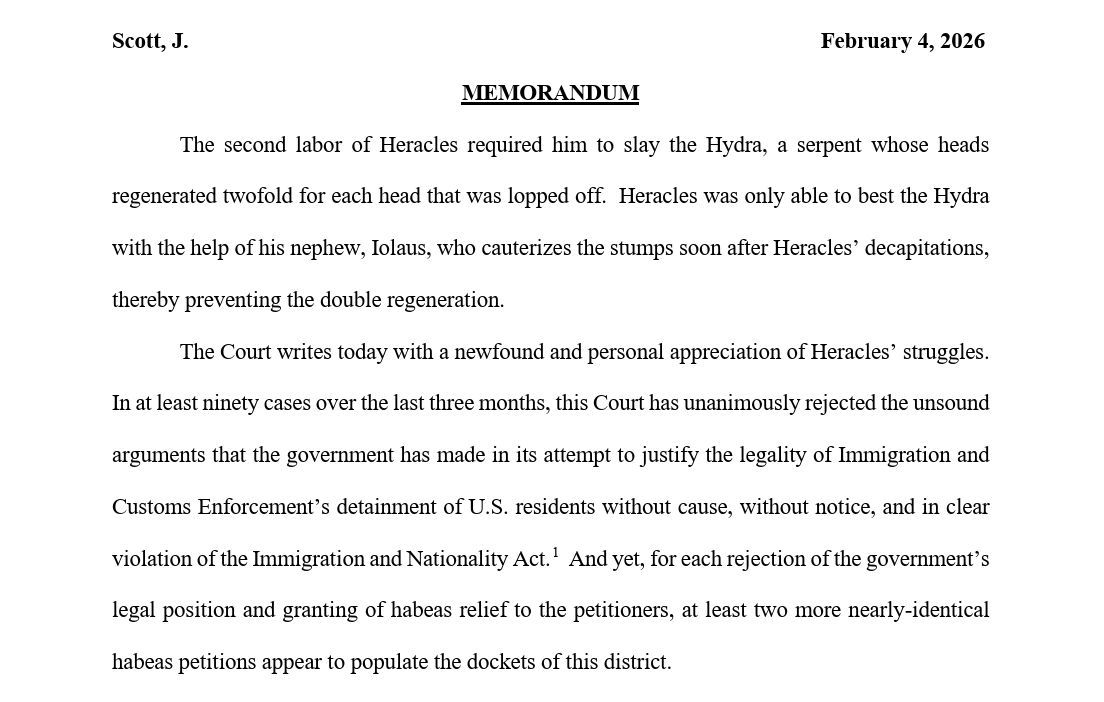
    And U.S. District Judge Kai N. Scott became the latest jurist to equate the ongoing legal battle with the government to Greek mythology, saying she and her colleagues on the bench have been squaring off with the Justice Department in a manner similar to Heracles’ confrontation with Hydra, the serpentlike monster that grew two heads every time one was chopped off.

    Although the region’s federal judges have “unanimously rejected” the government’s attempts to rationalize ICE detention of immigrants “without cause, without notice, and in clear violation” of federal law, Scott wrote, the government has continued to detain people in the same fashion day after day. And after each rejection, she wrote, “at least two more nearly identical” petitions seeking relief pop up on the court’s docket.

    “The Court writes today with a newfound and personal appreciation of Heracles’ struggles,” she said.

    District Judge Kai N. Scott’s Feb. 4, 2026 memo granting another habeas petition filed by an immigrant, and expressing frustration with the federal government’s arguments.

    The judicial rebukes come as immigration authorities have continued sweeping the nation to fulfill President Donald Trump’s promise of mass deportations. The number of detained immigrants has exploded — as has the number of court petitions from people seeking immediate release, which are known as habeas petitions.

    The enlarged legal workload has put a corresponding strain on the nation’s U.S. attorney’s offices, which typically defend ICE’s actions in federal court. Prosecutors from the New Jersey U.S. Attorney’s Office, for example, requested an extension in January to handle part of a class-action suit in order to deal with a surge in immigration release petitions.

    “This Office continues to handle an unprecedented volume of emergent immigration habeas petitions, which we continue to prioritize because of the liberty interests at issue,” the letter said.

    And in Minnesota this week, a federal prosecutor said she wished the judge would hold her in contempt so she could get some sleep in jail. Julie Le seemed exasperated when the judge pressed her on why the government had been ignoring his release orders.

    “What do you want me to do? The system sucks. This job sucks,” Le said, according to a court transcript.

    Le was subsequently fired.

    The issue at the center of each incident involves ICE’s mandatory detention policy. The policy was rolled out over the summer, and it requires that nearly all undocumented immigrants be held in custody as their cases wind through the country’s backlogged and complex immigration system.

    That upended decades of government practice, which typically allowed people who entered the country illegally, but who were otherwise law-abiding, to at least receive a bond hearing and determine if they could remain in the community as their cases moved forward.

    Jeanne Ottoson with Cooper River Indivisible attends an Immigrant rights groups rally outside the Third Circuit Court of Appeals to defend the New Jersey state ban on immigration-detention contracts on May 1, 2025.

    Some of those detained as a result of the policy have filed habeas petitions, arguing that their detention violates the Constitution. And in the Eastern District of Pennsylvania, Philadelphia’s federal court, judges have granted challenges to the policy at a near-universal rate.

    Still, those decisions have been made on a case-by-case basis, with relief extended only to one petitioner at a time. The U.S. Court of Appeals for the Fifth Circuit, which is based in New Orleans and is considered one of the country’s most conservative jurisdictions, heard a broader challenge to the policy. A divided 2-1 court ruled Friday that ICE can detain undocumented immigrants the agency is seeking to deport, even those who have been in the country for years.

    The ruling covers only federal courts in Louisiana, Mississippi, and Texas, and many legal experts expects the matter to ultimately end up before the U.S. Supreme Court.

    In Philadelphia, Scott’s expression of frustration came this week in response to the release petition of Franklin Leonidas Once Chillogallo. The 24-year-old from Ecuador came to the United States in 2020, lives with his partner and his 6-month-old twin daughters in Upper Darby, and works as a construction worker. He has no criminal history.

    After ICE arrested Once Chillogallo outside his home on Jan. 13, he was held in the Philadelphia Federal Detention Center without the opportunity for an immigration judge to review his case.

    Just as happened in the previous 90 cases, Scott rejected the argument that Once Chillogallo, an immigrant who has been in the country for years, was subject to the same bond rules as those who were caught entering without permission. The judge ordered Once Chillogallo’s release, which took place the following day, according to the court docket.

    Inside the federal courthouse Thursday, judges held three hearings on arcane legal questions surrounding habeas petitions.

    Dozens of other habeas petitions remain pending, court records show. In many that were recently decided, judges used terse or brusque language to point out that the government’s interpretation of the law has been repeatedly rejected.

    “Across the board, there is frustration. There is frustration from attorneys. There is frustration from the judges,” said Kimberly Tomczak, an immigration attorney who represented Once Chillogallo. “Nothing seems to be changing on the immigration side in response to the flood of habeas grants across the nation.”

  • U.S. announces $6M in aid for Cuba as island’s leader accuses it of imposing an ‘energy blockade’

    U.S. announces $6M in aid for Cuba as island’s leader accuses it of imposing an ‘energy blockade’

    SAN JUAN, Puerto Rico — The U.S. government on Thursday announced an additional $6 million in aid for Cuba as the island’s crisis deepens and tensions escalate between the two countries, with Cuba’s president accusing the U.S. of an “energy blockade.”

    The aid is largely meant for those living in Cuba’s eastern region, which Hurricane Melissa slammed into late last year. The supplies include rice, beans, pasta, cans of tuna and solar lamps that will be delivered by the Catholic Church and Caritas, said U.S. Department of State Senior Official Jeremy Lewin.

    He warned that officials with the U.S. embassy in Cuba will be out in the field “making sure that the regime does not take the assistance, divert it, try to politicize it.”

    The U.S. previously sent $3 million in disaster relief to Cuban people affected by Melissa.

    Lewin rejected that a halt in oil shipments from Venezuela — after the U.S. attacked the South American country and arrested its then leader — is responsible for the humanitarian situation in Cuba.

    He said that for years, the island has “hoarded all of the resources for the few senile old men that run the country, for their henchmen, for the security apparatus” as he accused Cuba of “meddling abroad,” including “colonizing Venezuela.”

    “So that’s what they’re spending their time and attention on,” said Lewin, who noted that his mother was born in Havana.

    “Why can’t they get food? It’s not because we’re not letting illicit Venezuelan oil continue to make Raúl Castro rich,” he added, referring to the former Cuban president. “It’s because the government can’t put food on the shelves. They have billions of dollars, but they don’t use it to buy food for ordinary Cubans.”

    Lewin spoke hours after Cuban President Miguel Díaz-Canel held a rare, invite-only press conference in which he fielded questions from a select group of reporters. The Associated Press was not invited.

    Díaz-Canel said that there was a “psychological war” against Cuba as he described a recent threat by U.S. President Donald Trump to impose tariffs on any country that sells or provides oil to Cuba as “an energy blockade.”

    He said such actions affect transportation, hospitals, schools, tourism and the production of food. In addition to severe blackouts, Cuban officials note that U.S. sanctions, which increased under Trump’s second term, cost the country more than $7.5 billion between March 2024 and February 2025.

    “I know we are going to live through difficult times. But we will overcome them together, with creative resilience,” Díaz-Canel said in a two-hour speech in which he answered questions from a handful of reporters.

    He noted that Cuba has not received oil shipments since the U.S. began its “naval blockade” on Venezuela in December.

    “Therefore, we have problems with fuel availability to guarantee not only electric generation, but also basic activities,” he said.

    Díaz-Canel promised that in a week, he would share details regarding the island’s current situation and how the government will confront it.

    “There’s a lot of fear,” he said. “I know people say, ‘Sacrifice, again?’ Well, if we don’t sacrifice, and if we don’t resist, what are we going to do? Are we going to give up?”

    Lewin said that if the Cuban government comes to its senses and is willing to allow the U.S. to provide more support, that there might be more announcements.

    “They should be focused on providing for their people, not making these blustery statements,” Lewin said. “He can talk a big game, but again, any government, its first responsibility is always to provide for its people.”

    In his speech, Díaz-Canel said his government is open to dialogue with the United States under certain conditions, including respect for Cuba’s sovereignty and “without addressing sensitive issues that could be perceived as interference in our internal affairs.”

    “Cubans do not hate the American people,” Díaz-Canel said. “We are not a threat to the United States.”

    ___

    Follow AP’s Latin America coverage at https://apnews.com/hub/latin-america

  • Minneapolis man is charged with threatening and cyberstalking ICE officers

    Minneapolis man is charged with threatening and cyberstalking ICE officers

    MINNEAPOLIS — A Minneapolis man was arrested Thursday on charges of cyberstalking and threatening to kill or assault Immigration and Customs Enforcement officers involved in the crackdown in Minnesota.

    Federal prosecutors said in a statement that Kyle Wagner, 37, of Minneapolis, was charged by complaint, and that a decision to seek an indictment, which is necessary to take the case to trial, would be made soon.

    Court records in Detroit, where the case was filed, did not list an attorney who could speak on Wagner’s behalf. The complaint was filed on Tuesday and unsealed Thursday.

    Attorney General Pam Bondi alleged in a statement that Wagner doxed and threatened law enforcement officers, claimed an affiliation with antifa and “encouraged bloodshed in the streets.”

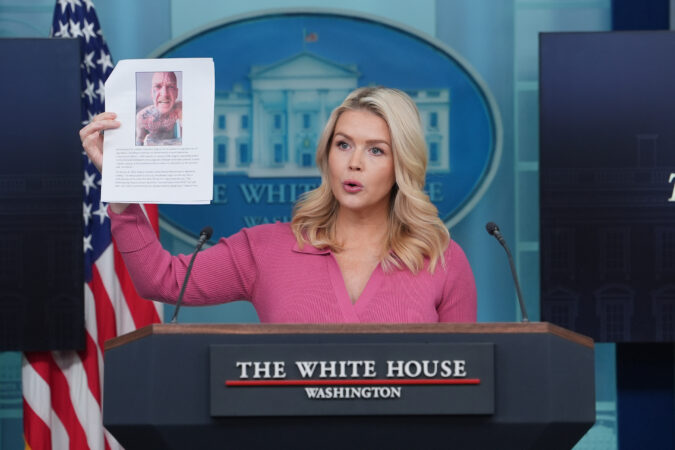
    And at the White House on Thursday, press secretary Karoline Leavitt held up Weber’s photo at the daily briefing and said such conduct by “left-wing agitators” won’t go unpunished.

    “And if people are illegally obstructing our federal law enforcement operations, if they are targeting, doxing, harassing and vilifying ICE agents, they are going to be held accountable like this individual here who, again, is a self-proclaimed member of antifa. He is a domestic terrorist, and he will be held accountable in the United States,” Leavitt told reporters.

    President Donald Trump announced in September that he would designate antifa a “major terrorist organization.” Antifa, short for “anti-fascists,” is an umbrella term for far-left-leaning militant groups and is not a singular entity. It consists of groups that resist fascists and neo-Nazis, especially at demonstrations.

    When Trump administration border czar Tom Homan announced Wednesday that about 700 federal officers deployed to Minnesota would be withdrawn immediately, he said a larger pullout would occur only after there’s more cooperation and protesters stop interfering with federal personnel.

    According to prosecutors, Wagner repeatedly posted on Facebook and Instagram encouraging his followers to “forcibly confront, assault, impede, oppose, and resist federal officers” whom he referred to as the “gestapo” and “murderers.”

    The complaint alleges Wagner posted a video last month that directly threatened ICE officers with an obscenity-laden rant. “I’ve already bled for this city, I’ve already fought for this city, this is nothing new, we’re ready this time,” he said, concluding that he was “coming for” ICE.

    The complaint further alleges that Wagner advocated for physical confrontation in another post, stating: “Anywhere we have an opportunity to get our hands on them, we need to put our hands on them.”

    It also details how Wagner used his Instagram account to dox a person identified only as a “pro-ICE individual” by publishing a phone number, birth month and year, and address in the Detroit suburb of Oak Park, Mich. The complaint says Wagner later admitted that he doxed the victim’s parents’ house.

    Federal prosecutors didn’t immediately respond to a request for comment on why the case was filed in Michigan instead of Minnesota. The alleged doxing was the only Michigan connection listed in the complaint.

    The U.S. Attorney’s office in Minnesota has been hit by the resignations of several prosecutors in recent weeks amid frustrations with the surge and its handling of the shooting deaths of two people by government officers. One lawyer, who told a judge that her job “sucks,” was removed from her post.

    Trump’s chief federal prosecutor for Minnesota, Dan Rosen, told a federal appeals court in a recent filing that his office is facing a “flood of new litigation” and is struggling to keep up just with immigration cases, while his division that handles civil cases is down 50%.

    Rosen wrote that his office has canceled other civil enforcement work “and is operating in a reactive mode.” He also said his attorneys are “appearing daily for hearings on contempt motions. The Court is setting deadlines within hours, including weekends and holidays. Paralegals are continuously working overtime. Lawyers are continuously working overtime.”

  • Eagles tackle Jordan Mailata reacts to Jeff Stoutland’s departure: ‘I’ve been crying about it.’

    Eagles tackle Jordan Mailata reacts to Jeff Stoutland’s departure: ‘I’ve been crying about it.’

    SAN FRANCISCO — Eagles star tackle Jordan Mailata spent the past eight seasons developing a relationship with Jeff Stoutland that went beyond football.

    So, while Mailata expressed professional disappointment in Stoutland’s decision to depart the Eagles, announced Wednesday, he said he also understood the 63-year-old coach’s choice.

    “As selfish as it is for me to want him there, I think it’s about time for him,” Mailata told The Inquirer on Thursday from Super Bowl LX Radio Row. “I knew it was probably closer to the end maybe. I thought I had a couple more years with him. I think age, I think the time he spends away from his family is a factor. And now he’s going to become a grandparent. … I think he’ll want to be around for that.”

    Stoutland is the only offensive line coach Mailata has played under since entering the NFL in 2018. Mailata, a native of New South Wales, Australia, entered the NFL via the International Player Pathway Program, and with very little previous exposure to football. Stoutland scouted him from the program before the Eagles made him a seventh-round pick in 2018, then developed Mailata into one of the league’s top offensive tackles.

    Mailata was named a second-team All-Pro in 2024, the same season a run-first Eagles offense bulldozed its way to a Super Bowl title.

    “I’ve been crying about it to be honest. Guy’s like my father,” Mailata said. “It hit me hard. And now I’m just kind of glad the Super Bowl week is keeping me busy so I can deal with that when I get home when I have the time to myself. Yeah, it’s hard. It got me.”

    Mailata will have to adjust to a new position coach amid changes to the Eagles offensive staff. Offensive coordinator Sean Mannion, pass game coordinator Josh Grizzard, and run game coordinator Ryan Mahaffey are among the new faces that have been named to Nick Sirianni’s staff.

    Asked about the expected changes to the Eagles offense, Mailata said, “I don’t know, I’ll be honest. I’m excited for the challenge. I just don’t know what we’re walking into because it’s uncharted territory for me, man. I’ve had the same coach for the last eight years, but I welcome it. It’s a challenge that we have to learn a new playbook, but this is the NFL, man, this is what we do.”

  • As West goes after Russia’s oil fleet, Moscow fears for its war funding

    As West goes after Russia’s oil fleet, Moscow fears for its war funding

    Europe is tightening the net on Russian oil being shipped through its waters, squeezing Moscow’s ability to fund its war even as officials and business executives in Russia fear the window is narrowing to reach a peace deal before the economy deteriorates.

    The European Union is considering imposing an outright maritime ban on services needed to ship Russian oil, such as insurance and transportation, as part of a new sanctions package marking four years of Russia’s war.

    The ban would significantly ratchet up the sanctions imposed on Russian oil, replacing the current oil price cap system, and comes as 14 European nations — including Britain, France, and Germany — warned last week they could intercept the shadowy fleet of tankers Russia created to help it evade sanctions operating in breach of international maritime law.

    Russian oil revenue plummeted by 50 percent in January compared with the same month the previous year after tough new sanctions imposed by the U.S. Treasury on Russian oil majors Rosneft and Lukoil in October. The penalties forced Moscow to accept ever-steeper discounts of more than $20 per barrel for its oil. Combined with India’s apparent agreement to halt Russian oil purchases in favor of increased imports from the United States and potentially Venezuela, the measures threaten to further strain the resources Moscow needs to fuel its war machine, risking crisis as nonpayments grow across the economy.

    Inspired by the seizure last month by U.S. forces of the Marinera tanker after a weeks-long pursuit despite a Russian submarine escort, the French navy briefly captured another suspected Russian shadow fleet tanker, the Grinch, which had been traveling from the Russian Arctic port of Murmansk across the Mediterranean carrying 730,000 barrels of oil under the flag of Comoros.

    French President Emmanuel Macron said the vessel was subject to international sanctions and suspected of flying a false flag.

    After Russia launched its full-scale invasion of Ukraine in February 2022, the Kremlin used intermediaries to buy up aging tankers and created what became known as the shadow fleet, to lessen its dependency on Western shipping services and reduce sanctions risks. Instead of being insured through Western companies, these tankers often receive insurance from Russia, backed by the country’s central bank, and sail under the flags of less stringent jurisdictions such as Sierra Leone and Cameroon, to conceal the origin of the oil.

    If enforced, the proposed measures could impact nearly a half of Russia’s oil exports, or about 3.5 million barrels per day, which head through European waters via the Baltic and Black seas, with crude shipments mostly bound for refineries in India, China, and Turkey.

    It’s not yet clear if the proposed EU maritime services ban, which requires a unanimous vote by member states, will be passed. But with the risk on the shadow vessels increasing from interceptions as well as attacks by Ukrainian drones, the costs are rising for shipments through Europe.

    “Russian oil exports are highly sensitive to disruptions in shipping. It is an Achilles’ heel,” said Janis Kluge, an economist at Germany’s Institute for International and Security Affairs. “If I were in Russia’s shoes, I would be very worried about the developments both with regards to a stricter policy against the shadow fleet and the Ukrainian drone attacks against tankers. Because both create significant risks. It is critical for Russia to have these shipping lanes open for its oil, or it will really run into big trouble.”

    A Russian academic close to senior Moscow diplomats said any European ban on maritime services for Russian oil and any further interceptions of shadow fleet tankers were “serious threats for Russia.”

    “This is a threat not just for the economy, but also it’s a political question about whether Russia can allow such actions without losing its political reputation,” the academic said.

    Even without the further risk to oil exports, Russian finance officials have been writing with increasing urgency to President Vladimir Putin to warn of a potential crisis by the summer, according to a person in contact with these officials and who spoke on the condition of anonymity because of the sensitivity of the subject.

    The officials have warned falling revenue means the budget deficit is only set to grow without further tax hikes while pressure is mounting on the Russian banking system due to high interest rates and a corporate borrowing spree to fund the war.

    One Moscow business executive said the crisis could hit in “three or four months” as signs appear that real inflation is spiraling far beyond the officially declared 6 percent despite interest rates being held at a high 16 percent. Signs of growing strain in the economy are the biggest numbers of closures of restaurants in Moscow since the pandemic and the forced layoffs of thousands of workers as costs grow, the executive said, also on the condition of anonymity.

    But there is little sign that Putin is set to change his calculus and step back from the Kremlin’s maximalist war demands. Last week, Foreign Minister Sergei Lavrov dismissed the Western security guarantees Ukraine says it needs for any deal, calling instead for an end to the regime in Kyiv.

    “We have no understanding about when the war will end,” the business executive added.

    The growing economic pressures are nevertheless weighing on Moscow as it seeks to keep the Trump administration on its side during negotiations to end the war. “If Trump comes to the conclusion that Russia is sabotaging the negotiation process then it’s possible there could be new sanctions including on the energy sector, and this is a serious challenge for Russia,” the Russian academic said.

    If anything, Russia is only growing more vulnerable to economic pressure, said Craig Kennedy, a former vice president at Bank of America Merrill Lynch now at Harvard University.

    “Oil revenues are sliding, credit is overextended. And Moscow knows things are only likely to get worse in 2026,” he said.

    Not all of Russia’s oil is under sanction, and Western companies can ship this oil as long as it is sold under the price cap first imposed by the European Union in December 2022. The EU had hesitated over imposing a full ban over fears it could cause a counterproductive oil price spike.

    But when the U.S. sanctioned Russia’s two biggest oil majors, Rosneft and Lukoil, in October last year, it sharply increased the share of Russia’s total oil output under U.S. sanctions to 80 percent. Moscow became even more reliant on its shadow fleet to transport its oil through the Baltic and Black seas to refineries in India, Turkey, and China.

    “The amount of unsanctioned oil now produced in Russia is a lot lower,” Kennedy said. “If shipping compliance gets tightened, it could put even more pressure on Russian export revenue.”

    Ukraine has also been stepping up its own efforts to target the shadow fleet, further increasing the risks and costs of shipping Russian oil. Since late November its forces have attacked at least nine Russia-linked tankers, deploying naval and aerial drones, as well as mines.

    European officials will likely still face a game of cat and mouse in targeting the illicit Russian oil. Already since the U.S. imposed sanctions on Rosneft and Lukoil, two mysterious new intermediary companies — Redwood Global Supply FZE LLC and Alghaf Marine DMCC — emerged out of nowhere to become major exporters of Russian oil, according to data from Kpler, a global commodities intelligence firm, compiled by the Kyiv School of Economics.

    Redwood sold 757,000 barrels per day in December, and Alghaf sold 174,000 barrels per day after trading zero amounts of oil previously, according to the data. “What we observed is that volumes traded by these new companies skyrocketed,” said Borys Dodonov, head of the Center for Energy and Climate Studies at the Kyiv School of Economics.

    European governments also argue that many of the Russian shadow fleet vessels flying flags of convenience from nations such as Cameroon and Sierra Leone are not compliant with international maritime safety standards, while those that sail under more than one flag during a voyage — as the Marinera did — can be treated as “stateless” under international maritime law allowing them to be boarded and searched.

    Amid the crackdown, Russia could be forced to register more of its shadow fleet under Russian flags, making them easier targets for sanctions, analysts said, especially if they are de-registered by other flag states.

    Any such move however could also increase the possibility of conflict over attempts to board Russian-flagged vessels with Moscow seeking to intimidate Europe out of taking any action. Russia’s Maritime Board, overseen by hawkish former Security Council chief Nikolai Patrushev, warned late last month that measures would be taken to protect Russian shipping interests against actions by “unfriendly states.”

    “It’s a question of whether these actions will be taken by the Europeans by themselves without the participation of the U.S.,” the Russian academic said. “Then there could be some measures in response like protection by a military convoy.”

  • A Michigan man who set fire to a Bensalem house to target his ex’s new boyfriend is sentenced to 20 to 40 years in prison

    A Michigan man who set fire to a Bensalem house to target his ex’s new boyfriend is sentenced to 20 to 40 years in prison

    A Michigan man who drove across the country to set fire to a Bensalem family’s home in a targeted attack on a romantic rival was sentenced Thursday to 20 to 40 years in prison.

    Harrison Jones, 22, pleaded no contest to six counts of attempted murder and two counts of animal cruelty for the killing of the family’s two dogs, which perished in the blaze. He also pleaded guilty to a slew of related crimes in connection with the February 2025 incident.

    Bucks County prosecutors said Jones drove more than 700 miles from his native Rockford, Mich., that winter to set the blaze at the home of Alex Zalenski, a man Jones’ ex-girlfriend and high school sweetheart had recently begun a long-distance relationship with.

    Zalenski, along with his father, mother, sister, and grandparents, was sleeping when Jones broke in and set off an incendiary device in the living room and kitchen around 5 a.m. Their dogs, Jett and Trey, barked, waking up the family, who all managed to escape.

    Members of the Zalenski family suffered non-life-threatening burns and injuries, though in court they recounted traumatic memories that they said would not soon heal.

    Alex Zalenski’s sister, Ava, recalled being awakened to the sound of yelling and heavy smoke clouding her room, choking her airways.

    “My dad told me to get down to breathe,” she said. “At age 20, I was ready to accept death.”

    The family had just minutes to escape the blaze, which consumed the property and left them without a home.

    Andrew Zalenski, the father of Alex and Ava Zalenski, recalled telling them to crawl on the floor to avoid inhaling smoke.

    He forced them out of a window before going to look for his wife, Stacy, he said, but could not find her and fled.

    It was challenging to describe the feeling of watching your home ablaze “believing your wife is burning to death inside,” he tearfully recounted.

    Stacy Zalenski had been trying, unsuccessfully, to save the dogs. The woman, who is battling breast and lung cancer, ultimately jumped from a second-floor window to survive.

    Andrew Zalenski suffered from severe smoke inhalation and was put in an induced coma in the hospital, he said.

    Meanwhile, Alex Zalenski — the young man whose relationship with Jones’ ex had enraged the Michigan man — said the attack “shredded any normalcy I had.”

    He had to withdraw from college after the incident, he said, and has since had trouble sleeping.

    “It felt as if my entire world had been set ablaze,” he told the court.

    Jones, wearing a yellow prison jumpsuit and shoulder-length hair, showed little emotion during the Zalenski family’s remarks.

    Given the opportunity to speak, however, Jones took full responsibility for the crime.

    “I need to take accountability,” Jones said, his voice breaking. “I’m guilty — I’ve done what I’ve done.”

    Jones’ family, including his father, mother, sister, stepfather, stepmother, and stepbrother, were in the gallery behind him.

    Jones’ attorney, Paul Lang, said Jones had no previous criminal record and had suffered physical abuse growing up. To cope, he had turned to abusing Xanax and marijuana, Lang said.

    Jones, for his part, alluded to being under the influence of drugs during the attack.

    In addition to sentencing Jones to decades in prison, Bucks County Court Judge Matthew D. Weintraub ordered him to pay more than $500,000 in restitution to the Zalenski family.

    Weintraub told the Zalenskis that the trauma of the attack had clearly bonded their family.

    Addressing Jones, the judge said he believed the young man had attempted to “effectuate maximum damage” that day.

  • Camden firefighter dies after falling into Delaware River and getting trapped under ice

    Camden firefighter dies after falling into Delaware River and getting trapped under ice

    A Camden firefighter died Thursday after getting trapped under ice and water in the Delaware River, according to the Camden mayor’s office.

    The Professional Fire Fighters Association of New Jersey on thursday night identified the fallen first responder as Howard Bennett.

    The firefighter was doing regular maintenance on a department fireboat near Wiggins Marina around 11:30 a.m. when he fell into the water and got stuck under the ice. He was trapped for about 30 minutes, Fire Department Chief Jesse Flax said at a news conference.

    Bennett was removed from the water, given medical attention, taken to Cooper University Hospital, and declared dead.

    “I do not have enough words that I can even say that could tell you how this is hurting all of us,” Flax said.

    Camden Mayor Victor G. Carstarphen thanked the fallen firefighter for the sacrifices he made to serve the city.

    “He wasn’t just a public servant,” Carstarphen said. “He was a husband. He was a brother, a father, that committed his adult life to serving and protecting and being there for our residents in the city.”

    Pete Perez, the president of Local 788, a union that represents Camden firefighters, described Bennett as particularly skilled in boating.

    “He was our guy for when it came to the boat stuff,” Perez said.

    “I’m devastated to the core,” Perez added. “For first responders — police and fire — training, routine things, can be inherently dangerous and today, unfortunately, we learned that.”

    Mathew Caliente, president of the Professional Fire Fighters Association of New Jersey, said in a statement:

    “We are devastated by the loss of Brother Bennett who dedicated his life to protecting the residents of Camden. Our hearts, our prayers, and our full support are with his family, his friends, and the members of Camden City Firefighters Local 788 and Camden Fire Officers Local 2578 during this unimaginably difficult time.”

  • Russia says it regrets expiration of last nuclear arms treaty but Trump says he wants a new pact

    Russia says it regrets expiration of last nuclear arms treaty but Trump says he wants a new pact

    MOSCOW — The Kremlin said Thursday it regretted the expiration of the last remaining nuclear arms pact between Russia and the United States, while President Donald Trump declared he was against keeping its limits and wants a better deal.

    The pact’s termination left no caps on the two largest atomic arsenals for the first time in more than a half-century, fueling fears of an unconstrained nuclear arms race

    Russian President Vladimir Putin last year declared his readiness to stick to the treaty’s limits for another year if Washington followed suit, but Trump has ignored the offer and argued that he wants China to be a part of a new pact — something Beijing has rebuffed.

    “Rather than extend ‘NEW START’ (A badly negotiated deal by the United States that, aside from everything else, is being grossly violated), we should have our Nuclear Experts work on a new, improved, and modernized Treaty that can last long into the future,” Trump posted on his Truth Social network.

    Putin discussed the pact’s expiration with Chinese leader Xi Jinping on Wednesday, noting the U.S. failure to respond to his proposal to extend its limits and saying that Russia “will act in a balanced and responsible manner based on thorough analysis of the security situation,” Kremlin adviser Yuri Ushakov said.

    Kremlin spokesman Dmitry Peskov said Moscow views the treaty’s expiration Thursday “negatively” and regrets it. He said Russia will maintain its “responsible, thorough approach to stability when it comes to nuclear weapons,” adding that “of course, it will be guided primarily by its national interests.”

    Peskov emphasized that “if we receive constructive responses, we will certainly conduct a dialogue.”

    With the end of the treaty, Moscow “remains ready to take decisive military-technical measures to counter potential additional threats to the national security,” the Russian Foreign Ministry said.

    “At the same time, our country remains open to seeking political-diplomatic ways to comprehensively stabilize the strategic situation on the basis of equal and mutually beneficial dialogue solutions, if the appropriate conditions for such cooperation are shaped,” it said in a statement issued late Wednesday.

    Even as New START expires, the U.S. and Russia agreed Thursday to reestablish high-level, military-to-military dialogue following a meeting between senior officials from both sides in Abu Dhabi, the U.S. military command in Europe said. The link was suspended in 2021 as relations between Moscow and Washington grew increasingly strained before Russia sent troops into Ukraine in February 2022.

    Details of the pact

    New START, signed in 2010 by then-President Barack Obama and his Russian counterpart, Dmitry Medvedev, restricted each side to no more than 1,550 nuclear warheads on no more than 700 missiles and bombers — deployed and ready for use. It was originally supposed to expire in 2021 but was extended for five more years.

    The pact envisioned sweeping on-site inspections to verify compliance, although they stopped in 2020 because of the COVID-19 pandemic and never resumed.

    In February 2023, Putin suspended Moscow’s participation, saying Russia couldn’t allow U.S. inspections of its nuclear sites at a time when Washington and its NATO allies have openly declared Moscow’s defeat in Ukraine as their goal. At the same time, the Kremlin emphasized it wasn’t withdrawing from the pact altogether, pledging to respect its caps on nuclear weapons.

    In offering in September to abide by New START’s limits for a year to buy time for both sides to negotiate a successor agreement, Putin said the treaty’s expiration would be destabilizing and could fuel nuclear proliferation.

    New START was the last remaining pact in a long series of agreements between Moscow and Washington to limit their nuclear arsenals, starting with the SALT I in 1972.

    Trump wants China in a pact

    Trump has indicated he would like to keep limits on nuclear weapons but wants to involve China in a potential new treaty.

    “I actually feel strongly that if we’re going to do it, I think China should be a member of the extension,” Trump told The New York Times last month. “China should be a part of the agreement.”

    In his first term, Trump tried and failed to push for a three-way nuclear pact involving China. Beijing has balked at any restrictions on its smaller but growing nuclear arsenal, while urging the U.S. to resume nuclear talks with Russia.

    “China’s nuclear forces are not at all on the same scale as those of the U.S. and Russia, and thus China will not participate in nuclear disarmament negotiations at the current stage,” Foreign Ministry spokesperson Lin Jian said Thursday.

    He said China regrets the expiration of New START, calls on the U.S. to resume nuclear dialogue with Russia soon, and respond positively to Moscow’s suggestion that the two sides continue observing the core limits of the treaty for now.

    Peskov reaffirmed Thursday that Moscow respects Beijing’s position. He and other Russian officials have repeatedly argued that any attempt to negotiate a broader nuclear pact instead of a U.S.-Russian deal should also involve nuclear arsenals of NATO members France and the U.K.

    Arms control advocates bemoaned the end of New START and warned of the imminent threat of a new arms race.

    “If the Trump administration continues to stiff-arm nuclear arms control diplomacy with Russia and decides to increase the number of nuclear weapons in the U.S. deployed strategic arsenal, it will only lead Russia to follow suit and encourage China to accelerate its ongoing strategic buildup in an attempt to maintain a strategic nuclear retaliatory strike capability vis-a-vis the United States,” said Daryl Kimball, executive director of the Arms Control Association in Washington. “Such a scenario could lead to a years-long, dangerous three-way nuclear arms buildup.”

  • Homeland Security shutdown grows more likely as Republicans rebuff Democratic demands for ICE

    Homeland Security shutdown grows more likely as Republicans rebuff Democratic demands for ICE

    WASHINGTON — Senate Majority Leader John Thune said Thursday that demands made by Democrats for new restrictions on federal immigration officers are “unrealistic” and warned that the Department of Homeland Security will shut down next week if they do not work with Republicans and the White House.

    Democrats say they will not vote for a DHS spending bill when funding runs out unless there are changes at U.S. Immigration and Customs Enforcement and other federal law enforcement agencies in the wake of the fatal shootings of two protesters in Minneapolis last month.

    The Democratic leaders, Sen. Chuck Schumer and Rep. Hakeem Jeffries, released an expanded list of 10 detailed proposals on Wednesday night for restraining President Donald Trump’s aggressive campaign of immigration enforcement. Among the demands are a requirement for judicial warrants, better identification of DHS officers, new use of force standards and a stop to racial profiling.

    Thune (R., S.D.) said most of the demands are “very unrealistic and unserious” and he called on Democrats to negotiate.

    “This is not a blank check situation where Republicans just do agree to a list of Democrat demands,” he said. “The only way to get reforms to ICE is to agree to a bill.”

    Schumer (D., N.Y.) said he is “astounded to hear” Republicans say his party’s proposals were political or unworkable.

    “It’s about people’s basic rights, it’s about people’s safety,” Schumer said. If Republicans do not like the ideas, he said, “they need to explain why.”

    As the two parties traded blame, a DHS shutdown appeared increasingly likely, starting Feb. 14. As of now, Thune said, “we aren’t anywhere close to having any sort of an agreement.”

    In addition to ICE and U.S. Customs and Border Protection, the homeland security bill includes funding for the Federal Emergency Management Agency and the Transportation Security Administration. If DHS shuts down, Thune said, “there’s a very good chance we could see more travel problems” similar to the 43-day government closure last year.

    As of now, Thune said, “we aren’t anywhere close to having any sort of an agreement.”

    In addition to ICE and U.S. Customs and Border Protection, the homeland security bill includes funding for the Federal Emergency Management Agency and the Transportation Security Administration. If DHS shuts down, Thune said, “there’s a very good chance we could see more travel problems” similar to the 43-day government closure last year.

    Democratic demands

    Schumer and Jeffries (D., N.Y.) have made several demands, including no masks for officers, judicial warrants and better federal coordination with local authorities. The list they released Wednesday added several new items, including a stricter use of force policy, legal safeguards at detention centers and a prohibition on tracking protesters with body-worn cameras.

    Democrats say Congress should end indiscriminate arrests, “improve warrant procedures and standards,” ensure the law is clear that officers cannot enter private property without a judicial warrant and require that before a person can be detained, it’s verified that the person is not a U.S. citizen.

    They also want an end to racial profiling, saying DHS officers should be prohibited from stopping, questioning or searching people “based on an individual’s presence at certain locations, their job, their spoken language and accent or their race and ethnicity.”

    For officers conducting immigration enforcement, Democrats say that in addition to officers taking off their masks and showing identification, DHS should regulate and standardize uniforms and equipment to bring them in line with other law enforcement agencies.

    Republican pushback

    Schumer called it a “gut check moment for Congress” as the immigration enforcement operations have rocked Minneapolis and other U.S. cities. But Republicans were dismissive.

    Wyoming’s John Barrasso, the No. 2 Republican senator, said the demands are “radical and extreme” and a “far-left wish list.”

    Sen. Katie Britt (R., Ala.), who is helping lead negotiations, said it was “a ridiculous Christmas list of demands.”

    “This is NOT negotiating in good faith, and it’s NOT what the American people want,” said Britt. “They continue to play politics to their radical base at the expense of the safety of Americans.”

    Down to the last funding bill

    Congress is trying to renegotiate the DHS spending bill after Trump last week agreed to a Democratic request that it be separated from a larger spending measure and extended at current levels for two weeks while the two parties negotiate. But with nearly a week gone, a shutdown is becoming increasingly likely.

    Thune has encouraged Democrats and the White House to talk. It is unclear whether they are or whether Democrats would be willing to back down on any of their demands.

    Some Republicans have demands of their own, including adding legislation that would require proof of citizenship before Americans register to vote and restrictions on cities that they say do not do enough to crack down on illegal immigration.

    Sen. Chris Murphy (D., Conn.) said it is up to Republicans to ensure the government does shut down because they are in charge.

    “The American people want this abuse to stop,” Murphy said.

    Some look to limit shutdown pain

    Other lawmakers are searching for options to prevent another partial shutdown.

    One idea being floated is to essentially fund some of the other agencies within DHS — the Coast Guard, airport operations under TSA and disaster assistance from FEMA.

    “Why not take that off the table?” said Republican Sen. Thom Tillis of North Carolina, whose state is in need of FEMA funds from recent disasters.

    “If it doesn’t look like they can get it done,” he said about the immigration enforcement overhaul, “I really think they should look at a la carte funding of agencies.”

    That would mean essentially cutting ICE loose by allowing it to go without its routine federal funding because the agency already has such a robust budget from Trump’s tax and spending cut bill from last year.

    ICE is expected to receive about $10 billion in the annual appropriations bill, a fraction of the $175 billion-plus for homeland security for the administration’s mass deportation agenda.