James R. Ludlow Elementary School in North Philadelphia educates a substantial population of special-education students.
And the learning environment for those studentswould be upturned bythe schooldistrict’s recommendation to close Ludlow after next school year, teachers say.
“For our children in special education, that consistency isn’t a luxury, but a requirement for them to learn. If we relocate our students, we aren’t just changing their school address; we’re breaking their routines and undoing their progress,” Vanessa Martin, an autistic support teacher in kindergarten through second grade at Ludlow, said at a community meeting last month with school district officials.
“This building isn’t just a facility. It’s the one predictable place where our students feel safe and supported every single day,” she said.
The district says Ludlow was slated for closure because of an “unsatisfactory” building quality score, a lack of appropriate space for programming, and only utilizing 47% of its capacity. Ludlow has 237 students enrolled across general and special education, of whom 75% are Black and 20% are Hispanic.
The K-8 schoolwill celebrate its 100th anniversary in what could be its final school year of operation. The district, which has proposed closing 18 schools, plans to convey the building at 550 Master St. to the city so it could be converted into affordable housing or used for job creation. Ludlow students would be reassigned to one of three schools: Paul L. Dunbar School, Spring Garden School, and Gen. Philip Kearny School.
‘Severing a lifeline’
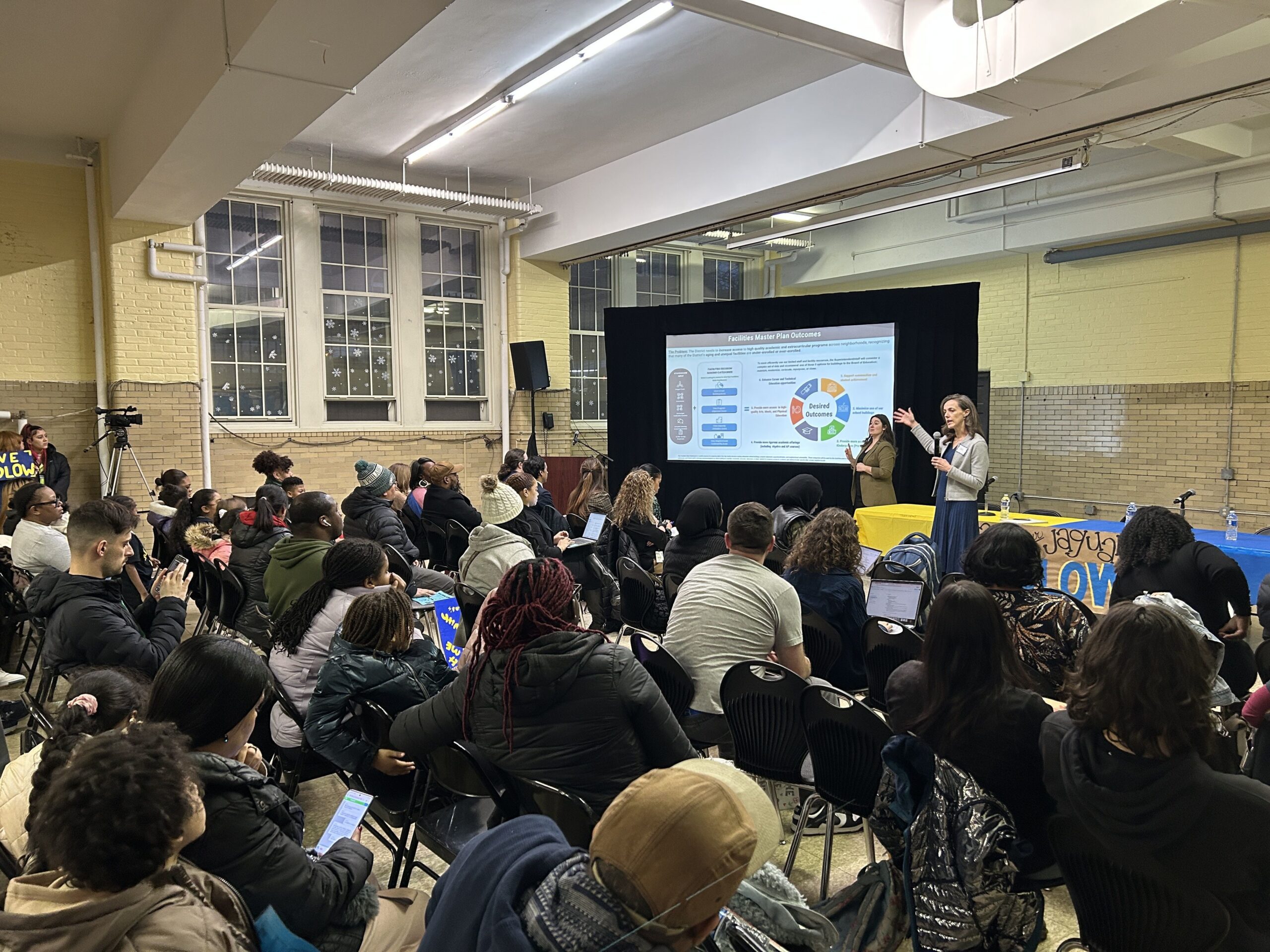
The Ludlow community is strong and connected, and about a hundred people packed the school’s cafeteria for the community meeting on a recentThursday evening to show their support for the school and fight against the district’s plan.
District officials present their plan for closing Ludlow at the February community meeting.
“I felt very angry. I felt upset. I felt like they were taking something away that was a part of me,” said Deilyhanix Vazquez, a Ludlow eighth-grade student who has attended the school since kindergarten. She said her teachers “feel like home,” and she had been planning to continue visiting the school even after she graduates.
“I’m worried that the students will have to travel far just to get an education. Something they have to do on the daily starts to feel like a burden,” said Savannah Lindsay, another Ludlow eighth grader.
Another young studentbroke down into tears as she spoke into the microphone, sayingshe had planned to attend Ludlow for “my whole life.”
If the plan goes forward, she said, she may have to split up from her friends as they get assigned to one of three different schools.
“I don’t want to leave them,” she said, as others inthe room clapped and cheered her on.
Should Ludlow close, the neighborhood and the wider school district would lose a valuable special-education resource andhub. Its offerings include autistic and other learning support for all grades, and emotional support for grades three through eight.
Ludlow often receives student referrals from other schools and catchments across the district, staff members said,including from the schools that would take in Ludlow students in the closure plan. It can feel like the district dumps its most difficult students on Ludlow, Martin said, but those children are accepted and become like family.
District officials have said that in addition to closing buildings that are not operating at full capacity, another goal is focusing on K-8 schools over middle schools to reduce transitions. That goal especially doesn’t square with the plan to close Ludlow, critics said.
“Ludlow is an exceptional school that works. By moving forward with this proposal, the district would be doing more than just closing Ludlow’s doors — it would be severing a lifeline and dismantling a support system that children and families depend on for their stability,” Martin said.
Affordable for whom?
Community members questioned the plan to turn Ludlow into affordable housing. They doubted whether those units would actually be affordable for the people living in the neighborhood, where the annual median household income is about $58,000.
The area sits next to Fishtown and Olde Kensington, where gentrification has made living more expensive for longtime residents.
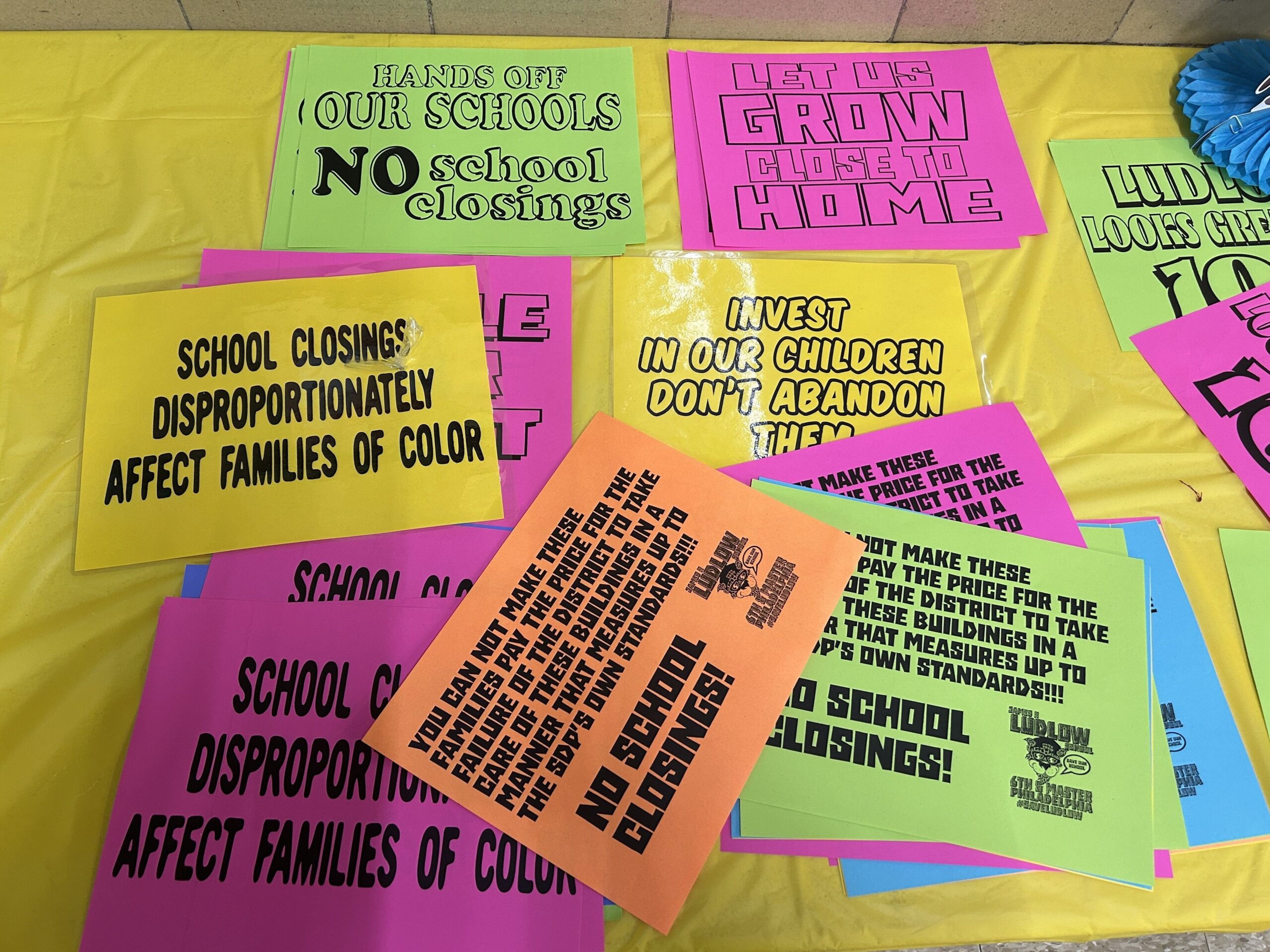
Various signs protesting the closure of James R. Ludlow School, available at a community meeting with district officials in February.
Ludlow community memberssaid they did not want or need more housing. They wished the district would instead invest in the building for learning purposes, and said the district had let it fall into its poor condition.
“It’s money before our kids,” said Valerie Johnson, known better as Valerie Brown, a beloved former Ludlow staff member who worked at the school for more than30 years.
While housing may bring new residents and investment to the neighborhood, the loss of Ludlow could drive some to leave, one mother said.
“I stay in this neighborhood because of Ludlow,” said Darlene Abner, a mother of six whose children have attended the school, including a kindergartner enrolled this school year.
Abner herself was born in the neighborhood, and she said shedoes not want her children to attend any school but Ludlow.
She wears a nearly full face-covering niqab, and credited the school and its teachersfor never letting that be a barrier to building a relationship with herand caring for her children.
Since the dawn of modern computing, there has been speculation that technology would someday outpace humanity’s ability to control it. Yet, for all those concerns, technology kept advancing, and such a scenario often felt far away. At least until artificial intelligence came onto the scene.
Now, the Trump administration is using AI to assist the war in Iran, and Defense Secretary Pete Hegseth has demanded that tech companies agree to collaborate with the military without guardrails. Swarms of autonomous killer drones are within reach, and President Donald Trump wants to control them without restriction.
What could possibly go wrong?
Last week, Hegseth unilaterally terminated the Pentagon’s partnership with Anthropic, the creator of Claude, considered the most highly regarded AI system available. The government asked for unfettered use of Claude, including for mass domestic surveillance, or to create weapons that kill without human input. CEO Dario Amodei refused.
The Trump-anointed secretary of war responded by designating Anthropic as a supply-chain risk to national security. A move that would ban all defense contractors from using Anthropic products. In effect, Hegseth is trying to force an American company to do work it did not agree to take on; work that can potentially be used to violate the law and Americans’ constitutional rights.
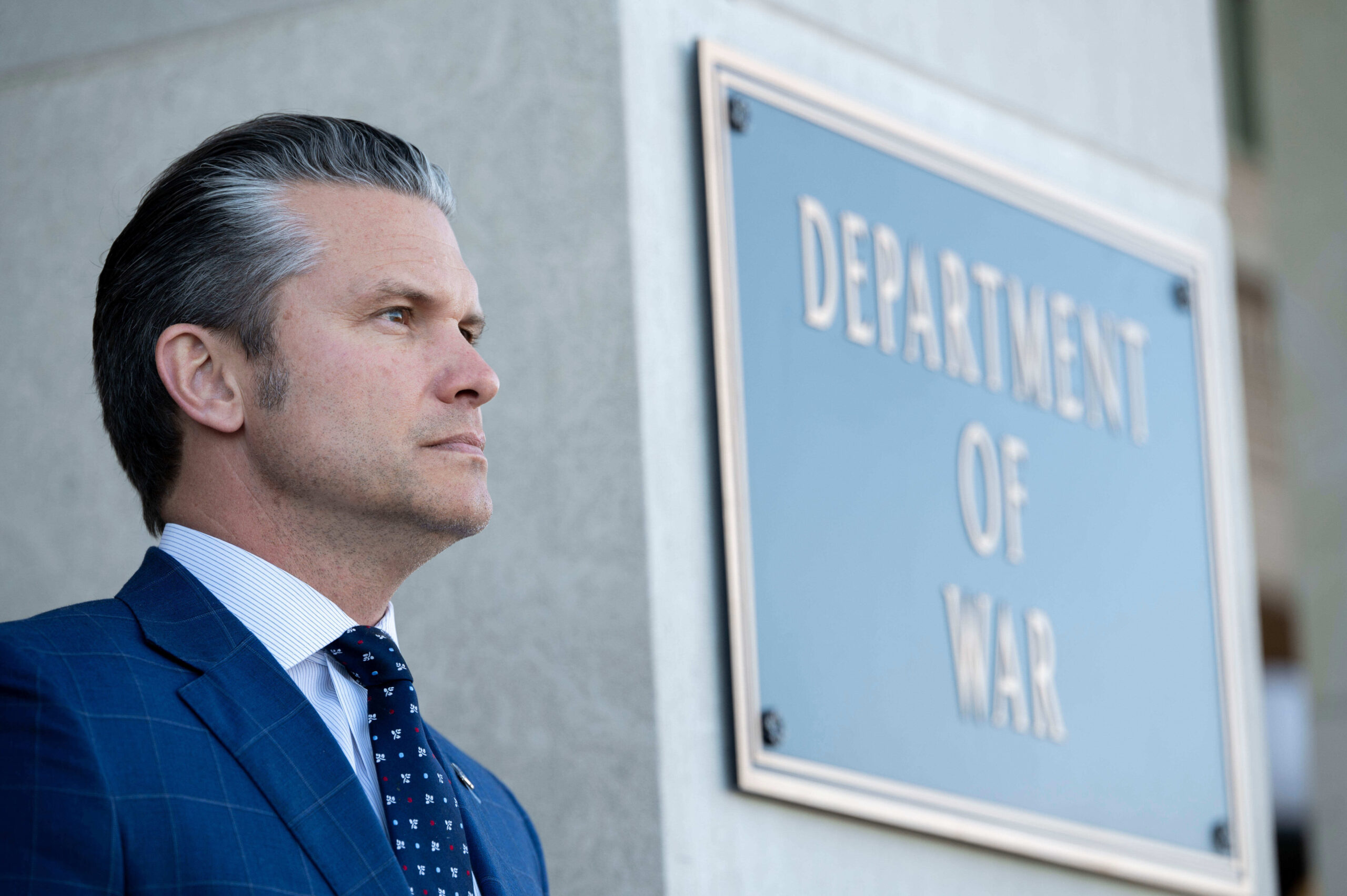
Defense Secretary Pete Hegseth stands outside the Pentagon during a welcome ceremony for the Japanese defense minister in January.
The move comes not long after public acknowledgment that the military used Claude to help plan the capture of Venezuelan President Nicolás Maduro. The AI technology is also being used in the bombing campaign against Iran. One of the stated uses is “target identification.” During U.S. and Israeli strikes against Iran, an elementary school that neighbors an Iranian naval base was struck, resulting in the deaths of dozens of children. While the U.S. has yet to confirm responsibility, the incident is a clear sign to exercise caution, not to forgeahead recklessly.
Anthropic has benefited from the clash with the administration, as many people who oppose the president’s policies look to reward anyone who stands up against Trump. Claude overtook competitor ChatGPT for the first time in user downloads, hitting No. 1 on Apple’s App Store. But Anthropic is no clear-cut hero.
In a statement, the company rightly underlined that “mass domestic surveillance of Americans constitutes a violation of fundamental rights.” But it also said it was willing to help the Pentagon in the future. It just doesn’t believe that today’s AI systems “are reliable enough to be used in fully autonomous weapons.”
Meanwhile, the United States is hardly the only country likely to develop the capacity to deploy autonomous lethal weapons. China’s leading AI firm, DeepSeek, is working with the People’s Liberation Army to create its own autonomous battle systems. Under Hegseth’s punitive order, DeepSeek is now treated more favorably than Anthropic.
Anthropic CEO Dario Amodei.
Like nuclear weapons, artificial intelligence has become the subject of an international arms race. Both have the power to cause unprecedented death and destruction. Nations have reason to fear being left behind, and it may be too late to close Pandora’s box.
The debate is one of many around the growth of artificial intelligence. Americans are as concerned about the potential for job losses through creative destruction, the proliferation of data centers, and the potential for a less human future as they are excited about the possibility of widespread self-driving cars. Newsrooms, college campuses, and businesses are all grappling with how to use AI technology ethically and productively.
It is time for more lawmakers to join this complicated conversation.
Instead of leaving matters to a negotiation between Hegseth and a tech CEO, Congress should issue legally binding guidelines for the use of artificial intelligence in war — including restrictions on mass surveillance and autonomous weapons. Congress could also debate the usage of AI in other areas, like healthcare and education.
At the same time, even the best AI assistants can still hallucinate facts and make mistakes. That’s embarrassing when it happens on a term paper or a court filing; it can be deadly on the battlefield.
Above all, human control over lethal weapons is essential. Echoing the nuclear proliferation treaties that benefited humanity in the 20th century, the United States should lead the way in assembling a broad coalition of powerful nations that agree to ban fully autonomous weapons.
In the meantime, Trump and Hegseth’s decision to spurn Anthropic points the way toward a 21st-century disaster.
Think you know your news? There’s only one way to find out. Welcome back to our weekly News Quiz — a quick way to see if your reading habits are sinking in and to put your local news knowledge to the test.
Question 1 of 10
It’s back! ABC’s Abbott Elementary, Quinta Brunson’s mockumentary featuring a fictional West Philly school, has been renewed again. How many seasons will that make?
CorrectIncorrect. XX% of other readers got this question right.
School will be in session for a sixth year at Abbott. ABC announced the renewal on the same day the show debuted its fifth season.
Question 2 of 10
Sixers center Andre Drummond announced a new partnership with this athletic wear company, as an investor and creative director:
CorrectIncorrect. XX% of other readers got this question right.
Drummond announced this week he was joining Stria Sports, a Chicago-based sneaker and apparel brand. Stria Sports is also the official performance shoe for the Harlem Globetrotters’ 100th season. For Drummond, the opportunity to be hands-on in the process of creating signature shoes and building up the brand was a key part of joining the company.
story continues after advertisement
Question 3 of 10
The owner of this Philly-rooted company said his product is “recession resistant” in an interview with The Inquirer this week. What is he selling?
CorrectIncorrect. XX% of other readers got this question right.
George Ball, 74, who owns Burpee Seeds, sold packets of his produce seeds at the Flower Show this week. Burpee has been rooted in the Philadelphia area since its founding by W. Atlee Burpee in 1876. Now, more than a century later, having once teetered on the brink, it’s again thriving and positioned for the future with seed, plant, and product sales in big box stores and online.
Question 4 of 10
Chef Nana Araba Wilmot’s career has taken her everywhere from top-tier French restaurants in New York City to dinner parties in Accra, Ghana. Now, the Cherry Hill-raised chef is taking her culinary skills to the TV screen. She’ll be in the latest season of this culinary show:
CorrectIncorrect. XX% of other readers got this question right.
Wilmot will compete on the 23rd season of Top Chef. She’s the owner of a private catering company and Love That I Knead, a traveling supper club grounded in Ghanaian cuisine. Her love for cooking was forged in her childhood home in Cherry Hill, where her parents and grandmother brought the flavors of their native Ghana into the house, and in kitchens in Philadelphia and New York City, where she learned the craft of restaurant cooking.
Question 5 of 10
Delaware native Aubrey Plaza is working on a new series for Prime about:
CorrectIncorrect. XX% of other readers got this question right.
Kevin, a comedy written and executive produced by Plaza, will follow a cat named Kevin who leaves his humans after their unexpected breakup and moves into a pet rescue in Astoria, Queens. He joins a “chaotic band of misfit animals,” who help him figure out what he “truly wants out of life,” according to the series logline.
Subscribe to The Philadelphia Inquirer
Our reporting is directly supported by reader subscriptions. If you want more journalism like this story, please subscribe today.
Philadelphians ran to social media Wednesday morning to report that the Benjamin Franklin Parkway’s iconic country flags were gone. What happened to them?
CorrectIncorrect. XX% of other readers got this question right.
Manna Bakery — a farmers market favorite for its Levantine and Palestinian baked goods — is due to open by early April. It will take over the former spot of this bakery:
CorrectIncorrect. XX% of other readers got this question right.
Saif Manna, who started baking treats out of his Temple dorm, is taking over Essen Bakery’s shuttered Kensington location. Manna acquired Essen’s equipment and said he only needs to do light work on the space.
Question 8 of 10
Fishtown resident Niall Paredes posts flyers across town with fun facts about this topic:
CorrectIncorrect. XX% of other readers got this question right.
Fishtown fish facts, this series of more than a hundred posters across the area, was never an endeavor to turn a profit or rally support for a cause like some similar lamppost literature. It was just a modest attempt to make his neighbors smile, said 32-year-old Paredes, the brain behind the piscine production.
Question 9 of 10
Longtime Fox 29 sports director Tom Sredenschek retired last week after 40 years at the station. He was first hired by former sports talker:
CorrectIncorrect. XX% of other readers got this question right.
Howard Eskin, best known for his decades at 94.1 WIP, was hired by Channel 29 (as it was known in the pre-Fox days) in 1986 to launch their 10 p.m. newscast. Eskin hired Sredenschek to be his first producer.
Question 10 of 10
Metropolitan Bakery — one of the city’s foundational bread bakeries — is closing its Rittenhouse shop’s doors. But the bread will live on. The business has sold to Pete Merzbacher of Merzbacher’s. What item is Merzbacher’s best known for?
CorrectIncorrect. XX% of other readers got this question right.
The Philly muffin, a squared-off English muffin made with toasted cornmeal, is Merzbacher's flagship product.
Your Results
You have skipped .
You scored XX out of 10.
The average reader scored XX out of 10
Seems like you’ve been skimming more than reading there, buddy. There’s always next week.
You’ve read some articles (or made some educated guesses) but we wouldn’t come to you first for our local news recaps. Better luck next week!
Do you work here? You’re a local news stan with the latest updates on Philly happenings. Your friends definitely ask you for summaries on what’s going on and it shows.
In the last presidential election, this lifelong conservative voted for Kamala Harris, not because I supported her positions on matters foreign or domestic, but because I believed her opponent was seriously deranged and would lead us into war. Now, little more than a year into the second Trump administration, here we are at war. If people wonder how the dictators of the 20th century gained power, they need only look at our 2024 presidential election. How could an allegedly sane, reasonable, and informed electorate have put such a lunatic into the most powerful position on earth?
Up until now, the United States had been an example to the world on how to manage power. We tried to show our neighbors that our primary focus was avoiding conflict, even though we had the power to bend the world to our will. Avoiding conflict is what rational, thinking, 21st-century people do.
But now we kidnap and murder foreign leaders and commence hostilities that could lead to a world war — all while members of Congress sit on their hindquarters twiddling their thumbs. What do these kinds of actions tell our neighbors around the world?
Mike Egan,Plymouth Meeting
This is us?
After seeing our nation’s leadership — from Donald Trump to Pete Hegseth to the entire Republican Party — I can’t stop asking myself: Is this what our country has become?
This administration — including its GOP enablers in Congress and Democratic Sen. John Fetterman — has endorsed the outright murder of people in other countries. They try to justify the bombing of children in elementary schools in Iran. They pay lip service to diplomacy. They ignore international law. Is this what our country has become?
This is certainly not what I believe or want, and I don’t think most Americans want it, either. We need to do something about this. It’s time for regime change of our own through safe and secure elections, which we’ve demonstrated we can execute with the systems we have in place.
In the meantime, contact your senators and call your representatives and tell them this has to stop. That this is not who we are as a country. We cannot sit back and do nothing. It’s time to act.
Jeffrey Plaut,Elkins Park
Needless sacrifice
President Bone Spurs initiated a war in Iran without consulting Congress, leaving our young soldiers solely at the mercy of his erratic behavior. We have already seen at least a half dozen service members killed. Donald Trump coldly states that some soldiers will die. How dare he diminish the ultimate sacrifice made by our troops when he wasn’t even willing to serve? His Iranian adventure is illegal and immoral. My heart breaks for the families who’ve lost their young sons and daughters — and those who still might before this unnecessary war is over.
Barbara Schwartz,Lafayette Hill
See something?
The phrase, “If you see something, say something,” was popularized after the 9/11 attacks. For 25 years, the U.S. Department of Homeland Security (DHS), the police, the FBI, and the transportation authorities told us, “If we see something, say something.” In 1943, Anne Frank wrote: “Terrible things are happening outside … poor helpless people are being dragged out of their homes. Families are torn apart; men, women and children are separated. Children come home from school to find that their parents have disappeared.” But then, as now, government officials, community leaders, and everyday citizens choose to look away, mumble in weak protest, or collaborate.
We have seen horrific videos of DHS actions. To find out what happened to someone taken by U.S. Immigration and Customs Enforcement, we are told to use the ICE Online Detainee Locator System and enter their name, country of birth, and birth date, or alien registration number. How can we know this about someone taken at the Wawa or Home Depot? In all these hundreds of thousands of ICE arrests, has anyone been picked up by ICE impersonators and kidnapped, raped, or trafficked? When we see masked, unidentifiable, gun-toting people stuffing someone in an unmarked vehicle, should we call the police? Is it time to consider that immigrants might be the first target? Martin Niemöller, originally a Nazi supporter, was imprisoned in Nazi concentration camps from 1938 to 1945. After the war, he explained his complicity in his poem, “First They Came.” “First when they came for the Socialists. I did not speak out, because I was not a Socialist.” And he ended, “Then they came for me — and there was nobody left to speak for me.”
Lynn Strauss, West Chester
Lifesaving aid
The administration is currently considering a plan to end all humanitarian aid to seven African nations: Burkina Faso, Cameroon, Malawi, Mali, Niger, Somalia, and Zimbabwe. These programs survived the initial U.S. Agency for International Development (USAID) cuts due to the fact that they were judged to be lifesaving by the administration’s standards. An internal State Department email states that these cuts are happening because “there is no strong nexus between the humanitarian response and U.S. national interests.”
Foreign assistance accounts for less than 1% of the federal budget, but is critical for meeting the most basic survival needs of people in danger of starving to death. A former senior State Department official, who left the administration in the fall, said, “If we don’t deliver this, people die immediately.” Cutting off aid also presents serious national security risks. When humanitarian support vanishes, terrorist groups rush to fill the vacuum — distributing food to bolster their local legitimacy.
The members of Pennsylvania’s congressional delegation should ask State Department officials to provide a more detailed explanation of these potential aid cuts and clarify their impact on U.S. national interests in these countries.
Jackson Duncan,Philadelphia
False choices
A recent op-ed touting the virtues of school choice was yet another example of the conservative mindset transparently attempting to convince us that they alone know what’s best for the schoolchildren of Pennsylvania. This current iteration of feigned concern is prompted by the recent announcement of pending public school closures in Philly.
Not surprisingly, the authors of the opinion piece are the president and CEO of the ultraright Commonwealth Foundation, along with one of the group’s distinguished fellows. While lamely using the proposed closures to energize their agenda, the truth behind all the artificial hand-wringing is simply economic. They want more, if not all, taxpayer education dollars to go to private hands.
They innocuously incorporate the value and necessity of expanding cyber schools into the mix. While these schools are a needed venue for students with challenges attending brick-and-mortar buildings, they are also a windfall for the operators: minimal start-up costs, limited overhead, and so on. Think of the fortunes being made with virtual casino gambling on a phone.
Cyber schools should not be expanded, but used as a last resort — all children need in-person learning, where they gain the ability to interact with other kids and teachers and pick up valuable life skills.
So let’s not succumb to the hackneyed statistics that charter and cyber school students achieve higher test scores — that is overwhelmingly a result of the reality that those schools can (and do) cherry-pick their students.
When the uber-wealthy and their conservative think tank messengers tell us they know what’s best for your children, ask yourself why they are so “concerned.”
J. Savage,Philadelphia
Full disclosure
I agree with the quote used by Andrew Lewis and David Hardy in their recent op-ed describing participation in the Education Freedom Tax Credit (EFTC) as a “no-brainer” — because no intelligent politician should allow such a program into their state.
There are some parents who do want a different school option from the one in their neighborhood, but educational tax credits and vouchers are not the answer, because these programs offer little or no obligation to the public about how successful they are in providing a proper education. Those programs and their advocates may claim families don’t need the type of hard data that can be found on public education websites because they can rely on recommendations from participating families. But isn’t that the type of approach that bankrupted those businesses and households that relied on unresearched endorsements about Bernard L. Madoff Investment Securities LLC?
If Messrs. Lewis and Hardy are truly interested in school choice, then families should be provided with the full information needed to make the right decisions for their children. Otherwise, there is not much of a difference between school choice and any other form of gambling.
Barbara McDowell Dowdall,Philadelphia
Join the conversation: Send letters to letters@inquirer.com. Limit length to 150 words and include home address and day and evening phone number. Letters run in The Inquirer six days a week on the editorial pages and online.
DEAR ABBY: My son took out a couple of education loans, which I cosigned when he was starting college 10 years ago. A couple of years ago, I found out (from someone else) that he never finished college. When I confronted him, he mentioned that he “intends” to finish college and is working toward it. He did not mention how many credits he has completed, what made him quit or why he didn’t consult me before dropping out. Shortly after that conversation, he stopped talking to or visiting me for a different reason. We haven’t seen each other in two years.
Recently, I received a notice from a debt collector regarding the loan. I tried to contact my son to figure out what he plans to do about the payments, but to no avail. He has always had terrible money habits. Until he stopped talking to me, he relied on me to rescue him whenever he got into money trouble. I had to pay off another of his education loans when he started defaulting a few years back.
Because of all of this, he owes me a significant amount of money. I am at an age where it is important that I build a retirement fund. If I have to pay off this loan, it will put a big dent into my savings. A few people have recommended I take legal action against him. I am, however, reluctant to do so for fear of severing my relationship with him forever. Is there a less aggressive way to have him take accountability for this loan?
— MOM ON THE HOOK
DEAR MOM: Face it, Mom. The son you have bailed out repeatedly is a deadbeat. He is avoiding you because he has no intention of paying back the money for which you so caringly cosigned 10 years ago. Contact an attorney and see what your options may be. Doing that is not aggressive or punitive. It may give you a road map to pull yourself out of this hole.
** ** **
DEAR ABBY: I recently saw a TV commercial in which a family of four was sitting at a table in a restaurant. The two kids were watching their parents text on their phones instead of socializing with each other and making pleasant conversation. It made me furious. Why? I was taught that it’s disrespectful not to give people your exclusive, undivided attention and that there is a time and a place for everything. I think it’s one of the reasons why so many people today lack appropriate social skills. Do you agree?
— PRESENT IN RHODE ISLAND
DEAR PRESENT: I agree with you 100%. What you saw in that commercial was a textbook example of lazy parenting. You cannot teach young people communication skills without modeling them. This has been a subject of concern for educators and behavioral specialists for at least 30 years. The result has been two generations of adults who have trouble making eye contact when trying to relate with others.
ARIES (March 21-April 19). People will be drawn in by your easygoing ways. You don’t rush the moment or push an agenda. You accept life’s tempo and become part of the music. That relaxed presence gives others room to dance.
TAURUS (April 20-May 20). Today you show how well you know yourself. Good style doesn’t require reinvention. You simply stand by your choices. You know what you like to say, how you like to dress and how you regard others. Your consistency is a form of confidence.
GEMINI (May 21-June 21). You’re less interested in being impressive and more interested in being effective, honest and rested. This change rearranges your priorities naturally, without drama, and frees up energy.
CANCER (June 22-July 22). Today goes better when you trust your first read of situations. You’re seeing things clearly right now, without overthinking. Act on what you notice early, and the rest of the day organizes itself around that clarity.
LEO (July 23-Aug. 22). You love people who can tell you something you don’t know, bring you a new vision of the world and make you curious. Your friends do that, and so will new people coming into your realm this season.
VIRGO (Aug. 23-Sept. 22). Someone will ask for help on a project. You may realize your own tasks are still waiting. Still, you’re generous and inclined to lend a hand anyway. Helping others makes your own work feel lighter and strangely satisfying.
LIBRA (Sept. 23-Oct. 23). You follow through, respond thoughtfully and don’t create unnecessary messes. That reliability builds trust. It sticks long-term. Someone notices how dependable you are, even if they haven’t said it.
SCORPIO (Oct. 24-Nov. 21). Most of the things you want can’t happen overnight or all at once. Planning makes you feel better about what you can control. You’ll bring order to your world with a plan that will keep getting revised and refined as you go.
SAGITTARIUS (Nov. 22-Dec. 21). It’s impossible to produce purely good or purely bad outcomes, so do your best and keep going. Most of what you’re doing is working ‚and that’s something to celebrate in motion. You’ll check off a dozen more items on your list before the week is over.
CAPRICORN (Dec. 22-Jan. 19). There’s no such thing as one investment that always pays you back. Sometimes you must give your best energy to yourself, sometimes you give to the needy, sometimes you invest in the strong. Every day you reassess — an ongoing learning exercise.
AQUARIUS (Jan. 20-Feb. 18). There are many ways to get to a result. Intention makes a difference. Motive has its own vibration. It’s not just what is accomplished that matters, but why. It will be important in how the plot unfolds today. Investigate.
PISCES (Feb. 19-March 20). Your talents will shine. Because you take chances, your work feels alive rather than merely correct. You’re vulnerable and authentic. Your efforts to be real, even when reality doesn’t feel so pretty, will strike a chord in others.
TODAY’S BIRTHDAY (March 6). It’s your Year of the Composer. You organize and orchestrate, and life sings back to you in soaring movements, your soul sailing on what you’ve made happen. More highlights: Three sales give you the money you need to make a dream project happen. You’ll accept a responsibility that opens your world. You’ll discover new ways to relate to and lead people, which expands a role. Aries and Virgo adore you. Your lucky numbers are: 3, 5, 26, 1 and 40.
La Salle advanced to the Atlantic 10 quarterfinals with a 59-51 win over St. Louis in the second round of the conference tournament on Thursday at the Henrico Sports & Events Center in Glen Allen, Va.
The sixth-seeded Explorers (18-12, 10-8 A-10) were led Ashleigh Connor’s 16 points.
La Salle won its 18th game of the season, the best win total for Mountain MacGillivray in his eight seasons as head coach. It is the most wins for an Explorers team since 2006-07, when La Salle finished 19-11.
La Salle has won six of its last seven games and will make its first appearance in an A-10 quarterfinal since 2021 when the Explorers face third-seeded Richmond on Friday night.
— Atlantic 10 Women's Basketball (@A10WBB) March 6, 2026
Aryss Macktoon scored 15 points and pulled down 14 rebounds. The redshirt sophomore guard was recently named the A-10 Defensive Player of the Year.
Alyssa Koerkenmeier led St. Louis with 18 points. Koerkenmeier, the A-10 Rookie of the Year, also grabbed 12 rebounds and blocked five shots.
La Salle’s Aryss Macktoon (center) finished with 15 points and 14 rebounds against St. Louis on Thursday night.
What we saw
La Salle never trailed, but its lead stayed within a few possessions for much of the first half. An extended 12-2 Explorer run over the final 6 minutes, 16 seconds of the second quarter pushed La Salle’s lead to 10 at halftime.
Macktoon scored eight points in the second quarter, including a turnaround mid-range jumper before halftime.
— Atlantic 10 Women's Basketball (@A10WBB) March 6, 2026
Both offenses sputtered in the third quarter. St. Louis was held scoreless for a 6:43 stretch but still outscored La Salle by three in the frame. The Explorers had a 42-35 advantage entering the fourth.
Despite going scoreless from the field over the final 2:57 of the game La Salle held on for the win.
La Salle led by as many as 10 points in the fourth, but the Billikens trimmed the Explorers’ lead to four with 1:13 remaining.
With a chance to make it a one-possession game, St. Louis’ Alexia Nelson drove into the lane against Macktoon, but her shot was blocked by a rotating Amiya Moses to keep La Salle’s lead at four with 22 seconds to go.
Up next
No. 6 La Salle will face No. 3 Richmond in the A-10 quarterfinals on Friday (7:30 p.m., CNBC).
There were two things hanging over the Flyers at Xfinity Mobile Arena on Thursday night: the impending NHL trade deadline and extending their winning streak.
But as the minutes continued to tick off until Friday’s 3 p.m. deadline, the Flyers’ inability to win four straight kept on going with a 3-0 loss to the Utah Mammoth.
It is the third time this season the Flyers have been shut out, and it’s been more than two years since the Flyers strung together a four-game winning streak. The last ended with a 5-3 win against the Arizona Coyotes, who are now the Mammoth, on Feb. 12, 2024.
From the drop of the puck on Thursday, it was a lackadaisical effort by the Flyers that saw them muster just 44 shot attempts and 16 shots on goal, tying the season low set on Feb. 5 in a 2-1 overtime loss to the Ottawa Senators. It is the 10th time this season that they have not put at least 20 shots on goal.
“I think we’ve got to simplify our game, go to the net hard, drive to the net hard, get some bodies there, bring pucks to the net,” captain Sean Couturier said. “It almost feels like we’re trying to play on the outside and find a backdoor tap-in, which is hard to do in this league.
“I think if we simplify things, eventually things will open up. But I think we’re too content on playing a little bit on the outside at times.”
In the first period, the Flyers had four shots on goal, despite having a power-play opportunity.
“I think the first 10 [minutes] kind of dictated [play]. We were soft; execution was tough,” said coach Rick Tocchet, who also said the Flyers didn’t push back.
Added defenseman Rasmus Ristolainen: “I feel like at times we might have got a little bit outworked and outbattled, and I think that’s where we should start every game, and obviously we didn’t do that enough tonight.”
To be fair, Utah also had only four shots in the first period, but in the second, the Mammoth broke through on two of their 14 shots.
Lou Nolan didn’t even have time to announce the penalty before Nick Schmaltz found the back of the net to give Utah a 1-0 lead less than two minutes into the frame. Eight seconds after Noah Cates was called for holding the stick, Dylan Guenther curled off the boards and into the high slot before going against the grain to Schmaltz on the goal line for the shot.
“Just didn’t play hard enough tonight,” defenseman Travis Sanheim said. “They’re a tough team to play against. They battle hard, hard on the walls, and make it tough on you. And we weren’t willing to play that style so hard to win when you don’t dig in and win those battles.”
Less than seven minutes later, it was 2-0 on a goal by Clayton Keller, who just helped the United States win gold at the Winter Olympics.
Off a faceoff, Sanheim got the puck from Matvei Michkov, who took his spot at the left point and carried the puck down and around the net, trying a wrap-around. The puck slid off his stick, and while he tried to regroup, he eventually lost the puck to Guenther.
Utah’s speedy forward chipped the puck around Ristolainen, and as Sanheim backchecked and tried to cut off Guenther, Keller split through a hole with Michkov too far over.
“What do you want me to say?” Tocchet retorted when asked about the play.
“Yeah, I tried to make a play at the net,” Sanheim said. “And then as it came up, Risto goes to step up on, I think it was on Guenther, and I saw that we had an F3, so I thought I could play Guenther on the wall. Obviously misread it with Mich, and obviously don’t want to give up a breakaway at that time of the game.”
Michael Carcone added an empty-netter for Utah in the third period.
Now the question is, who will be here after the trade deadline at 3 p.m. on Friday?
Flyers defenseman Rasmus Ristolainen has been a hot name in trade deadline rumors.
Ristolainen, whose name is swirling as someone more than likely getting traded, suited up and skated more than 22 minutes in his 800th NHL game.
“I can’t really control that,” Ristolainen said. “So I just try to come in every day, and obviously [Friday], we’ll see what happens.”
Did the pending trade deadline impact the team?
“Hard to say, maybe for some guys, I guess,” Sanheim said. “But we’re in the thick of it and just trying to win every hockey game and take it day by day and deal with it as it comes.”
Breakaways
Forward Travis Konecny missed his second straight game with an upper-body injury, and defenseman Nick Seeler, who sustained a lower-body injury in Monday’s game against the Toronto Maple Leafs, did not play. … On Thursday, the Flyers signed forward Garrett Wilson to an NHL contract to finish the 2025-26 season. A member of Lehigh Valley of the American Hockey League since 2019, a team source has also confirmed the captain inked a new AHL contract for next season. Wilson, a native of Barrie, Ontario, has 16 points (four goals, 12 assists) in 51 games this season and leads the team in penalty minutes (99), which enters Thursday tied for 11th overall in the AHL. Wilson, who turns 35 on March 16, has played 751 AHL games for San Antonio, Portland, Wilkes-Barre/Scranton, Toronto, and Lehigh Valley. He is Lehigh Valley’s all-time leader in games played (338) and ranks fourth in goals (62) and points (148). A rugged 6-foot-3, 218-pound winger, Wilson was drafted in the fourth round of the 2009 NHL draft by the Florida Panthers and has 84 regular-season and 10 playoff games at the NHL level. His last NHL game was a playoff game on April 16, 2019, for the Pittsburgh Penguins.
Up next
On Saturday, the Flyers will be in Pittsburgh taking on the Penguins (5:30 p.m., NBCSP).
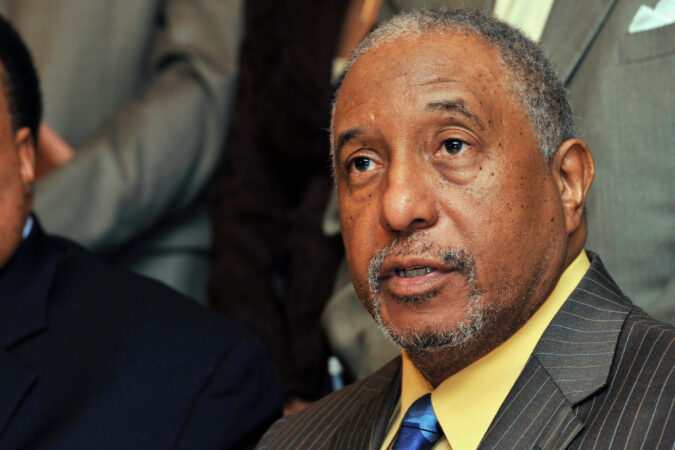
NASHVILLE — Bernard LaFayette, the advance man who did the risky groundwork for the voter registration campaign in Selma, Ala., that culminated in the passage of the Voting Rights Act of 1965, has died.
Bernard LaFayette, III, said his father died Thursday morning of a heart attack. He was 85.
On March 7, 1965, the beating of future congressman John Lewis and voting rights marchers on Selma’s Edmund Pettus Bridge led the evening news, shocking the nation’s conscience and pushing Congress to act. But two years before “Bloody Sunday,” it was Mr. LaFayette who quietly set the stage for Selma and the advances in voting rights that would follow.
Mr. LaFayette was one of a delegation of Nashville students who in 1960 had helped found the Student Nonviolent Coordinating Committee, which organized desegregation and voting rights campaigns across the South. SNCC crossed Selma off its map after some initial scouting determined “the white folks were too mean and the Black folks were too scared,” Mr. LaFayette said.
But he insisted on trying anyway. Named director of the Alabama Voter Registration Campaign in 1963, Mr. LaFayette moved to the town and, with his former wife Colia Liddell, gradually built the leadership capacity of the local people, convincing them change was possible and creating momentum that could not be stopped. He described this work in a 2013 memoir, In Peace and Freedom: My Journey in Selma.
The many dangers Mr. LaFayette faced included an assassination attempt on the same night Medgar Evers was murdered in Mississippi, in what the FBI said was a conspiracy to kill civil rights workers. Mr. LaFayette was beaten outside his home before his assailant pointed a gun at him. His calls for help brought out a neighbor with a rifle. Mr. LaFayette found himself standing between the two men, asking his neighbor not to shoot.
Mr. LaFayette said he felt “an extraordinary sense of internal strength instead of fear” at that moment. Rather than fight back, he looked his attacker in the eyes. Nonviolence is a fight “to win that person over, a struggle of the human spirit,” he wrote.
He also acknowledged that his neighbor’s gun may have been what saved his life.
Mr. LaFayette was already working on a new project in Chicago by the time his work in Selma came to fruition in 1965. He had planned to join the Selma-to-Montgomery march on day two, so he missed Bloody Sunday when the march was stopped by tear gas and club-wielding state troopers before it even got out of Selma.
“I felt helpless at a distance,” he wrote. “I was stricken with grief, concerned that so many people in my beloved community were hurt, possibly killed.”
But he shifted quickly, rounding up people in Chicago and arranging transport to Alabama for a second attempt. They set off two weeks later on what had become a victory march: President Lyndon Johnson had introduced the Voting Rights Act to Congress.
Inspired by his grandmother
Mr. LaFayette grew up in Tampa, Fla., where he recalled trying to board a trolley with his grandmother when he was 7 years old. Black passengers had to pay at the front, then walk to the back to climb on. But the conductor began to pull away before they could board, and his grandmother fell. He was too little to help.
“I felt like a sword cut me in half, and I vowed I would do something about this problem one day,” he wrote in his memoir.
It was his grandmother who decided he was destined to become a preacher. She arranged for him to attend Nashville’s American Baptist Theological Seminary (now American Baptist College), where he roomed with Lewis, and both helped lead the nonviolent civil disobedience campaign that led to Nashville becoming the first major Southern city to desegregate its downtown accommodations.
President Barack Obama spoke about the roommates in a eulogy after Lewis died in 2020, recalling how they integrated a Greyhound bus while riding home for Christmas break (Lewis to Troy, Ala., and LaFayette to Tampa, Fla.) just weeks after the Supreme Court banned segregation in interstate travel in 1960.
The two sat up front and refused to move, angering the driver, who stormed off at every stop, all through the night.
“Imagine the courage of these two people … to challenge an entire infrastructure of oppression,” Obama said. “Nobody was there to protect them. There were no camera crews to record events.”
Mr. LaFayette has said they didn’t fully realize the impact of all this work at the time.
“We lived through this, but this was our daily lives,” he told the Associated Press in a 2021 interview. “When you think about it, we weren’t trying to make history or trying to rewrite history. We were responding to the problems of the particular time.”
Freedom Rides of 1961
In 1961, Mr. LaFayette dropped out of college in the middle of final exams to join an official Freedom Ride, one of many that sought to force Southern authorities to comply with the court’s ruling. He was beaten in Montgomery, Ala., and arrested in Jackson, Miss., becoming one of more than 300 Freedom Riders sent to Parchman Prison.
Mr. LaFayette later trained Black youth to become leaders in the Chicago Freedom Movement and helped organize tenant unions.
“The tenant protections we have today are really a direct outcome of that work in Chicago,” said Mary Lou Finley, a professor emeritus at Antioch University Seattle who worked with Mr. LaFayette in Chicago in the 1960s.
And when he learned that one of his secretaries had two children sickened by lead — a huge problem that was not well understood at the time — Mr. Lafayette organized high school students to screen toddlers for lead poisoning by collecting urine samples, and prodded Chicago to help develop the nation’s first mass screening for lead poisoning, Finley said.
“Bernard has always worked quietly behind the scenes,” said Finley, who later collaborated with Mr. LaFayette on nonviolence training. “He has avoided the spotlight. In some ways, I think he felt like he could do more if he were doing it quietly.”
Mr. LaFayette also worked alongside Andrew Young and the Southern Christian Leadership Conference to prepare for the Rev. Dr. Martin Luther King Jr.’s ill-fated Northern campaign. Several of King’s marches were attacked by white mobs, but Mr. LaFayette and Young challenged the notion that the Chicago movement was a failure.
Young noted in a 2021 interview that in Chicago they were trying to organize a population 20 times larger than Birmingham’s, while pursuing a range of difficult issues, from neighborhood integration to the quality of schools and jobs. “In each one of those we made progress,” Young said.
By 1968, Mr. LaFayette was the national coordinator of the King’s Poor People’s Campaign and was with King at the Lorraine Motel on the morning of his assassination. King’s last words to him were about the need to institutionalize and internationalize the nonviolence movement. Mr. LaFayette made this his life’s mission.
After King died, Mr. LaFayette returned to American Baptist to complete his bachelor’s degree and then earned a master’s and doctorate from Harvard University. Mr. LaFayette later served as director of Peace and Justice in Latin America; chairperson of the Consortium on Peace Research, Education and Development; director of the Center for Nonviolence and Peace Studies at the University of Rhode Island; distinguished senior scholar-in-residence at the Candler School of Theology, Emory University, Atlanta; and minister of the Westminster Presbyterian Church in Tuskegee, Ala., among other positions.
“Bernard did work in Latin America. He did nonviolence workshops in South Africa with the African National Congress. He went to Nigeria when the civil war was happening there,” Young said. “Bernard literally went everywhere he was invited as sort of a global prophet of nonviolence.”
In his memoir, Mr. LaFayette wrote that the ever-present threat of death during those early years of organizing taught him that the value of life “lies not in longevity, but in what people do to give it significance.”
DUBAI, United Arab Emirates — President Donald Trump said Thursday he should be involved in choosing Iran’s next supreme leader as the U.S. and Israel hammered the country for a sixth day. Iran kept up retaliatory attacks on Israel, American bases, and countries around the region.
Trump ruled out Mojtaba Khamenei, a front-runner to replace his father, Ayatollah Ali Khamenei, who was killed in the opening strikes of the war. Trump’s comments to the American news website Axios were likely to renew questions about whether the U.S. and Israel seek the overthrow of the Islamic Republic or just a change in its policies, as the conflict has appeared increasingly open-ended.
The war has escalated each day, affecting an additional 14 countries across the Middle East and beyond. On Thursday, Azerbaijan accused Iran of drone attacks, which Tehran denied. Iran said the U.S. would “bitterly regret” torpedoing an Iranian warship near Sri Lanka a day earlier.
Israel issued a mass evacuation warning for Beirut’s southern suburbs as the fighting escalated with Iran-allied Hezbollah militants. U.N. peacekeepers reported ground combat in southern Lebanon as more Israeli troops crossed the border.
Iran’s attacks have targeted their Arab neighbors, disrupted oil supplies, and snarled global air travel. The war has killed at least 1,230 people in Iran, more than 120 in Lebanon and around a dozen in Israel, according to officials in those countries. Six U.S. troops have been killed.
Trump’s decision to strike Iran won enough support from Republican lawmakers in the U.S. House on Thursday to defeat a resolution to halt the bombardment. The Senate voted down a similar measure a day earlier.
Trump again urges Iranians to ‘take back’ their country
In brief remarks at the White House, Trump again urged the Iranian people to “help take back your country.” This time he promised the U.S. would grant them “immunity” amid the war and ongoing dangers under the current Iranian regime.
“So you’ll be perfectly safe with total immunity,” Trump said, without giving any details about what that meant. “Or you’ll face absolutely guaranteed death.”
In the Axios interview, Trump derided the 56-year-old Mojtaba Khamenei, who has never been elected or appointed to a government position, as “a lightweight.”
“We want someone that will bring harmony and peace to Iran,” Trump said.
“I have to be involved in the appointment, like with Delcy in Venezuela,” Trump said, referring to the acting president in the South American country. Delcy Rodríguez took power in January after a U.S. military operation captured Nicolás Maduro and whisked him to the U.S. to face federal drug conspiracy charges.
Israel’s defense minister, Israel Katz, said this week that Iran’s next supreme leader — if he continues to threaten Israel, the U.S. and others — “will be a target for elimination.”
Iran remains defiant
Iran is not engaged in any direct or indirect communication with the United States to bring an end to the widening war, Iran’s ambassador to Egypt told the Associated Press on Thursday. Ambassador Mojtaba Ferdousi Pour said comments by Trump that Iran wants to negotiate aren’t true.
He blamed a lack trust after the U.S. twice attacked Iran amid negotiations of a possible nuclear deal.
“There will be no trust in Trump,” Ferdousi Pour said.
Meanwhile, Iranian Foreign Minister Abbas Araghchi accused the U.S. Navy of committing “an atrocity at sea” for sinking the Iranian frigate IRIS Dena in the Indian Ocean, killing at least 87 people. He said on social media the U.S. “will come to bitterly regret” its action.
The Iranian ship was returning from an exercise hosted by the Indian navy that the U.S. also joined. Sri Lankan authorities said 32 crew members were rescued. Araghchi said it had been carrying “almost 130” crew.
An Iranian cleric later called on state television for the shedding of both Israeli and “Trump’s blood.”
The statement from Ayatollah Abdollah Javadi Amoli represented a rare call for violence by an ayatollah, one of Shiite Islam’s highest clerical ranks. There are dozens in Iran.
Sri Lanka said more than 200 sailors aboard another Iranian warship near its coast were being escorted to a naval base outside the capital, Colombo. The ship will be taken to a Sri Lankan port, said Sri Lankan President Anura Kumara Dissanayake.
The war keeps expanding
Adm. Brad Cooper, head of U.S. Central Command, said Thursday that U.S. forces have sunk more than 30 of Iran’s ships, including “an Iranian drone carrier ship roughly the size of a World War II aircraft carrier.”
“And as we speak, it’s on fire,” Cooper said.
The Israeli military carried out a wave of strikes on Iran’s ballistic missile launch sites, and its top general said that 80% of Iran’s air defenses and 60% of its missile launchers had been destroyed.
Still, Lt. Gen. Eyal Zamir said: “The threat has not yet been removed.”
Gulf countries also reported coming under fire. The U.S. State Department announced it was closing the U.S. Embassy in Kuwait, which activated air defense systems in response to incoming missiles.
Iran has fired waves of missiles and drones at American-allied Kuwait, where a drone strike Sunday killed six American soldiers.
In the United Arab Emirates, a drone was shot down near the Al Dhafra Air Base, which hosts U.S. forces. Shrapnel fell to the ground, authorities said, and six people were wounded.
Qatar evacuated residents near the U.S. Embassy in Doha as a temporary precaution and later reported a missile attack. Saudi Arabia said it destroyed a drone in a province bordering Jordan.
Bahrain said an Iranian missile hit a state-run oil refinery Thursday, sparking a fire that was extinguished. It said there were no reports of casualties.
Azerbaijan’s President Ilham Aliyev accused Iran of carrying out “a groundless act of terror and aggression” after a drone crashed Thursday near an airport. Another drone fell near a school. Authorities said four airport workers were wounded.
Iran denied it launched drones toward Azerbaijan. Iran has also repeatedly denied targeting oil infrastructure and other civilian targets, even as its missiles and drones have hit such sites.
Cars sit in traffic on a highway Thursday as residents flee Israeli airstrikes in Dahiyeh, Beirut’s southern suburbs.
Israel issues evacuation warning for Beirut suburbs
Israel struck Beirut’s southern suburbs Thursday evening after urging residents to “save your lives and evacuate your homes immediately.” Two hospitals evacuated patients and staff.
The Lebanese health ministry said the death toll has risen to 123 since the resurgence of hostilities between Israel and Hezbollah, which struck Israel in the opening days of the war.
A spokesperson for the U.N. peacekeeping force in southern Lebanon, Tilak Pokharel, said Thursday that peacekeepers had seen and heard clashes, including ground combat, in southern Lebanon as more Israeli forces have moved across the border.