Blog

  • Chester County’s former CEO says an ‘administrative decision’ to allow access to sports betting sites led to his sudden exit from the job

    Chester County’s former CEO says an ‘administrative decision’ to allow access to sports betting sites led to his sudden exit from the job

    Chester County’s former chief executive officer said his departure this week stemmed from an “administrative decision” he made more than a year ago, which allowed county staff to access online sports betting and fantasy sports websites.

    David Byerman, who was the county’s top administrative official for just over a year until his departure Monday, said in a phone call Thursday that Commissioner Josh Maxwell informed him that he had overstepped when he approved an employee’s request to allow access to fantasy sports and regulated online gaming sites on the county Wi-Fi. Byerman acknowledged that he made the decision after being told website access issues were previously under the commissioners’ purview.

    Byerman argued that by creating a new CEO role — moving away from the traditional county structure of a county administrator and two deputies — the county increased his responsibilities and authority, and this “was likely a situation where I felt I had the authority to make that decision,” he said. Though Byerman said he did not recall the email exchange with the employee, he said he had no reason to doubt it happened.

    “Did I occasionally update my fantasy baseball team and put bets on the Sixers and Eagles using the county’s Wi-Fi? Yes, that is true, but it’s also true that I regularly ate lunch at my desk. It’s also true that I regularly worked verifiably 60-hour-plus weeks in this job,” Byerman said. “And I believe I represent the county professionally and persuasively with external constituencies. I take the role extremely seriously. I take my work extremely seriously.”

    A spokesperson for the county on Thursday declined to respond to Byerman’s comments. In a weekly community newsletter, the county’s commissioners publicly acknowledged Byerman’s departure.

    “Mr. Byerman, whose lifetime career of public service includes impactful roles across the country, is a hard-working executive who focused on improving innovation and communication in county government,” they wrote. “We wish him well in his future endeavors.”

    Byerman said he had a “profound appreciation” for the commissioners and the county staff.

    Byerman was appointed to the role in 2024, as the commissioners restructured their administrative leadership structure. He was the first to take the title of “CEO” in the county, which came with increased responsibilities, including terminating employees, something previously left to the commissioners, he said.

    In his role, Byerman oversaw the county’s 2,600 employees and a roughly $730 million annual budget.

    He moved to the county from Kentucky, where he had served as the director of the state’s legislative research commission. He had previously worked as secretary of the Nevada Senate. But the county CEO job was a return to Pennsylvania for Byerman, who was the chairman of the Chester County Democratic Committee in the 1990s (a fact he said he disclosed to the commissioners during his interview, as his role was nonpartisan).

    Earlier this week, the commissioners announced to county staff that they had appointed a new county administrator, former deputy county administrator Erik Walschburger, to fill Byerman’s role. They rounded out the rest of a three-person leadership team by adding Chester County Prison warden Howard Holland as an acting deputy county administrator for operations to work alongside Megan Moser, whom the county hired last year.

    During his tenure, Byerman said, he improved internal communications and addressed policy concerns, including the establishment of a research partnership with Temple University to focus on housing within the county and the creation of a working group on immigration enforcement. The county has also spent months responding to a series of election errors, the most significant of which forced more than 12,000 voters to cast provisional ballots in the November election. Residents have said it rattled their trust.

    Byerman said he had previously been given “very good” and “excellent” performance reviews from the commissioners, and found it “surprising and disappointing that they opted to move directly to remove me because of this infraction.” He said it was the only reason he was given.

    “I think it’s especially important for public servants to demonstrate professionalism, accountability, and respect for the people we serve, and I always work to hit that standard,” he said. “I want the taxpayers who paid my salary to know that I worked my tail off for them, and I’m incredibly proud of the work that we did.”

    This suburban content is produced with support from the Leslie Miller and Richard Worley Foundation and The Lenfest Institute for Journalism. Editorial content is created independently of the project donors. Gifts to support The Inquirer’s high-impact journalism can be made at inquirer.com/donate. A list of Lenfest Institute donors can be found at lenfestinstitute.org/supporters.


  • William Way will demolish its historic LGBT Community Center and construct a building with affordable apartments

    William Way will demolish its historic LGBT Community Center and construct a building with affordable apartments

    After months of varying reports about the future of the William Way LGBT Community Center’s headquarters in Philadelphia, a firm plan is finally emerging.

    The 176-year-old building at 1315 Spruce St. will be torn down and replaced with a new headquarters, which will include up to 42 new affordable apartments for seniors, according to the development team.

    The existing four-story, 14,000-square-foot building is expected to be replaced by a six-story structure. The apartments would be on the top four floors and William Way’s community center on the bottom two.

    The idea is to give the storied organization more space, while providing housing for people who might not otherwise be able to live in Philadelphia’s historic Gayborhood.

    “We want to make sure that people are given the opportunity to live in all areas of the city, including areas like Washington Square West that have a lot of higher income folks,” said Dan Anders, a vice chair of Dr. Magnus Hirschfeld Fund (DMH Fund), a group that also developed the celebrated John C. Anderson apartments, half a block away.

    The DMH Fund is partnering with HELPDevCo, an affordable-housing builder. William Way Center referred all questions about the proposed building to those two groups.

    The William Way Center is not likely to demolish the building in the immediate future, as the project will need funding from the federal Low Income Housing Tax Credit, which will not disperse funds again until late this year. The community center is currently still open.

    The property is within the recently designated Washington Square West historic district, which was overturned in court last week. The timing of the announcement was coincidental, however. Plans have been in the works for months.

    The facade of the William Way LGBT Community Center, located at 1315 Spruce St.

    William Way purchased 1315 Spruce St. in 1996, and over the last 10 years, the LGBTQ community has been trying to raise money to stabilize and redevelop the historic headquarters.

    Last June, the group announced that even after a fundraising drive, $3.5 million was still required for “immediate repairs.”

    Swathes of the building are currently unusable, although the structure is not imminently dangerous. There are holes in the floor of some rooms, roof leaks, and standing water often fills the basement.

    “It sounds like a really good plan,” said Councilmember Mark Squilla, who represents the area. “The building is in really, really bad shape. It’s been hard to maintain. The reason why it hasn’t been fixed is because the cost to fix it has been astronomical.”

    In late November, William Way announced that it would shutter the building and disperse its operation to other locations, raising concerns about clients maintaining access to services.

    But a week later, the community center said it planned to rehabilitate the historic building and would return to the existing structure.

    “We know that there are questions regarding the future of the building and acknowledge that messaging has been confusing,” William Way board chairs Laura Ryan and Dave Huting said in a January email to supporters. “We understand the frustration and will be sharing more information soon.

    Last week Philadelphia Gay News reported that William Way would be demolishing its building and moving forward with a comprehensive redevelopment.

    The announcement occurred at a gala for the publication’s 50th anniversary, with Gov. Josh Shapiro and Mayor Cherelle L. Parker in attendance and expressing support for the proposal.

    “I strongly support the restoration of the William Way Community Center, as an essential part of the LGBTQ+ community in Philadelphia,” said Mayor Parker in a statement, “and will commit resources through our H.O.M.E. initiative to support this vital project.”

    Historic preservation advocates have expressed concern and sadness over the proposed demolition.

    “We are alarmed by the news that the historic William Way building would be demolished in the recently announced plans for the future of the real estate,” said Paul Steinke, head of the Preservation Alliance. “We hope they will be willing to incorporate historic preservation into their plans.”

    Steinke served on William Way’s board for six years and helped lead a pre-pandemic fundraising drive to replace the windows and HVAC system and conduct other repairs. (In the end, that plan did not move forward.)

    Steinke said he has reached out to William Way for more information on its proposal. He also hopes that the city will appeal the ruling against the Washington Square West historic district.

    “I understand the frustration of some folks that the building will be demolished, but it’s in such a state that it’s not feasible to renovate it,” Anders said.

    “It is a sad reality, but that’s where we are. We will honor the tradition of that location and the William Way Center and build a building that celebrates our community and that everyone can be proud of,” he said.

    The Washington Square West Civic Association declined to comment on William Way’s plans.

    The property is in one of Philadelphia’s most flexible zoning categories, so land use regulations will not pose a barrier to the community center’s proposal.

    The prominent mural on the side of William Way’s building is crumbling. Anders said the new structure would be designed to advertise the community center’s mission.

    “The artist herself acknowledged that the mural was never intended to be permanent,” Anders said. “What we want to do when we’re designing the building is very clearly communicate with passersby and the community itself that something LGBT is going on inside, and to celebrate that.”

  • House narrowly rejects Iran war powers resolution in early test of Trump’s strategy

    House narrowly rejects Iran war powers resolution in early test of Trump’s strategy

    WASHINGTON — The House narrowly rejected a war powers resolution Thursday to halt President Donald Trump’s attacks on Iran, an early sign of unease in Congress over the rapidly widening conflict that is reordering U.S. priorities at home and abroad.

    It’s the second vote in as many days, after the Senate defeated a similar measure along party lines. Lawmakers are confronting the sudden reality of representing wary Americans in wartime and all that entails — with lives lost, dollars spent, and alliances tested by a president’s unilateral decision to go to war with Iran.

    While the tally in the House, 212-219, was expected to be tight, the outcome provided a clarifying snapshot of political support for, and opposition to, the U.S.-Israel military operation and Trump’s rationale for bypassing Congress, which alone has the power to declare war. At the Capitol, the conflict has quickly carried echoes of the long wars in Afghanistan and Iraq, and many Sept. 11-era veterans now serve in Congress.

    “Donald Trump is not a king, and if he believes the war with Iran is in our national interest, then he must come to Congress and make the case,” said Rep. Gregory Meeks, the top Democrat on the House Foreign Affairs Committee.

    The House also approved a separate measure affirming that Iran is the largest state sponsor of terrorism.

    Republicans largely back Trump, and most Democrats oppose the war

    Trump’s Republican Party, which narrowly controls the House and Senate, largely sees the conflict with Iran not as the start of a new war, but the end of a government that has long menaced the West. The operation has killed Iran’s Supreme Leader Ayatollah Ali Khamenei, which some view as an opportunity for regime change, though others warn of a chaotic power vacuum.

    Republican Rep. Brian Mast of Florida, chairman of the House Foreign Affairs Committee, publicly thanked Trump for taking action against Iran, saying the president is using his own constitutional authority to defend the U.S. against the “imminent threat” the country posed.

    Mast, an Army veteran who worked as a bomb disposal expert in Afghanistan, said the war powers resolution was effectively asking “that the president do nothing.”

    For Democrats, Trump’s attack on Iran, influenced by Israeli Prime Minister Benjamin Netanyahu, is a war of choice that is testing the balance of powers in the Constitution.

    “The framers weren’t fooling around,” said Rep. Jamie Raskin (D., Md.), arguing that the Constitution is clear that only Congress can decide matters of war. “It’s up to us.”

    While views in Congress are largely falling along party lines, there are crossover coalitions. The war powers resolution, if signed into law, would have immediately halted Trump’s ability to conduct the war unless Congress approved the military action. The president would likely veto it.

    Trump officials provide shifting rationale for war

    After launching a surprise attack against Iran on Saturday, Trump has scrambled to win support for a conflict that Americans of all political persuasions were already wary of entering. Trump administration officials spent hours behind closed doors on Capitol Hill this week trying to reassure lawmakers that they have the situation under control.

    Six U.S. military members were killed over the weekend in a drone strike in Kuwait, and Trump has said more Americans could die. Thousands of Americans abroad have scrambled for flights, many lighting up phone lines at congressional offices as they sought help trying to flee the Middle East.

    Trump said Thursday he must be involved in choosing Iran’s new leader. Yet House Speaker Mike Johnson (R., La.) said this week that America has enough problems at home and is not about to be in the “nation-building business.”

    Defense Secretary Pete Hegseth said that the war could extend eight weeks, twice as long as the president first estimated. Trump has left open the possibility of sending U.S. troops into what has largely been a bombing campaign by air. More than 1,230 people in Iran have died.

    The administration said the goal is to destroy Iran’s ballistic missiles that it believes are shielding its nuclear program. It has also said Israel was ready to act, and American bases would face retaliation if the U.S. did not strike Iran first. On Wednesday, the U.S. said it torpedoed an Iranian warship near Sri Lanka.

    “This administration can’t even give us a straight answer of as to why we launched this preemptive war,” said Rep. Thomas Massie, the Republican from Kentucky, an outlier in his party.

    Massie and Rep. Ro Khanna (D., Calif.), who had teamed up to force the release the Jeffrey Epstein files, also pushed the war powers resolution to the floor, past objections from Johnson’s GOP leadership. Another Republican, Rep. Warren Davidson of Ohio, a former Army Ranger, was also expected to back the war powers resolution.

    Johnson has warned that it would be “dangerous” to limit the president’s authority while the U.S. military is already in conflict.

    “Congress must stand with the president to finally close, once and for all, this dark chapter of history,” Rep. Michael McCaul (R., Texas) said.

    Rep. Yassamin Ansari (D., Ariz.) said that as the daughter of Iranian immigrants who fled their homeland, she celebrates Khamenei’s death. But she warned that a democratic transition for the people of Iran never seems to a priority for Trump and his officials who briefed lawmakers.

    “War carries profound and deadly consequences for our troops, for the American people and for the entire world,” she said. “It’s the most serious decision that a nation can make and the American people deserve debate, transparency and accountability before that decision is made.”

    Other Democrats have proposed an alternative resolution that would allow the president to continue the war for 30 days before he must seek congressional approval. It is not expected yet for a vote.

    Senators sit in their desks for solemn vote

    In the Senate, Republican leaders have successfully, though narrowly, defeated a series of war powers resolutions pertaining to several other conflicts during Trump’s second term. This one, however, was different.

    Underscoring the gravity of the moment Wednesday, Democratic senators filled the chamber and sat at their desks as the voting got underway.

    Senate Democratic leader Chuck Schumer of New York said before the vote that every senator will pick a side. “Do you stand with the American people who are exhausted with forever wars in the Middle East or stand with Donald Trump and Pete Hegseth as they bumble us headfirst into another war?”

    Sen. John Barrasso, second in Senate Republican leadership, said “Democrats would rather obstruct Donald Trump than obliterate Iran’s national nuclear program.”

    The legislation failed on a 47-53 tally mostly along party lines, with Sen. Rand Paul (R., Ky.) in favor and Sen. John Fetterman (D., Pa.) against it.

  • Crews in Cuba rush to repair a damaged power plant to ease a blackout

    Crews in Cuba rush to repair a damaged power plant to ease a blackout

    HAVANA — Swaths of Cuba remained without power on Thursday nearly a day after a huge blackout hit the western part of the island in the latest outage blamed on a fragile electric grid and a lack of fuel.

    Crews worked overnight to repair a broken boiler at one of Cuba’s largest thermoelectric plants, but officials have warned that it could take three to four days for power to be fully restored.

    State media reported that nearly 660,000 customers in Havana, or 77%, had power, as well as 43 hospitals and 10 water supply stations. However, officials warned of low power generation and said some circuits that crews had reconnected were kicked offline again.

    Millions still remained without power, including Miguel Leyva, 65, who lives with his mother and brother, both of whom are ill.

    “I have no words to describe what I’m going through: the heat, the mosquitoes and no electricity. The food could spoil,” he said. “I’m aware of all the problems that exist, but listen, it’s been more than 24 hours now.”

    Cuba’s Ministry of Energy and Mines wrote on X that the electrical system is operating “in a limited capacity, prioritizing basic services, primarily health and water supply.”

    State media reported that two power plants are offline because of a lack of petroleum.

    Government officials said Wednesday afternoon that crews have located the crack in the boiler drum that led to the outage. They said it will take 12 hours to cool that area so crews can enter the furnace and start repairing it. Work already is underway to fix a pipe that also is damaged, officials added.

    Sonia Vázquez, 61, said the blackout didn’t stop her from selling coffee to passersby daily, saying she prepared it with gas at 5 a.m. under a rechargeable lamp.

    “I didn’t sleep last night. Too many mosquitoes,” said Vázquez, who lives with her grandson.

    Meanwhile, 57-year-old cafe owner José Ignacio Dorta, said that some of his frozen food has spoiled.

    “We’ve looked for ways to prevent further spoilage. We’re working on it. We hope nothing else will spoil,” he said.

    Cuba has long struggled with an aging electric grid and intermittent fuel supplies, but the crisis has deepened in recent months.

    Key oil shipments from Venezuela were halted after the United States attacked the South American country in early January. Then later that month, President Donald Trump warned that he would impose tariffs on any country that sells or supplies oil to Cuba.

    On Thursday, Trump suggested a deal may be imminent with Cuba but that he’s focusing on Iran in the meantime.

    Referring to a co-owner of Inter Miami being originally from Cuba, Trump said, “You’re gonna go back” and added, “That’s going to be a great day, right?”

    Without providing details, Trump said, “We’re going to celebrate that separately. I just want to wait a couple of weeks. I want him to wait a couple of weeks. But we’ll be together again soon, I suspect, celebrating what’s going on in Cuba.”

    He added of the island’s government, “They want to make a deal so badly. You have no idea.”

    Then, referring to Marco Rubio, the president said the secretary of state wants to work on Cuba but is cautious to do so during the war in Iran.

    “You’re next one’s going to be — we want to do that special — Cuba,” Trump said. “He’s waiting. But he says, “Let’s get this one finished first.’ We could do them all at the same time. But bad things happen. If you watch countries over the years, you do them all too fast, bad things happen.”

    Trump didn’t clarify his meaning, but the comments followed his from last week, when he raised that the prospect of a “friendly takeover” of Cuba might be possible without elaborating.

    Wednesday’s outage is the second one to hit western Cuba in three months.

    The outage in early December lasted nearly 12 hours. Officials said that a fault in a transmission line linking two power plants caused an overload and led to the collapse of the energy system’s western sector.

    Some of Cuba’s thermoelectric plants have been operating for more than three decades and receive little maintenance because of high costs. U.S. sanctions also have prevented the government from buying new equipment and specialized parts, officials say.

  • Penn tuition, fees, and room and board will exceed $94,000 for 2026-27

    Penn tuition, fees, and room and board will exceed $94,000 for 2026-27

    The full cost to attend the University of Pennsylvania next school year will exceed $94,000 under a resolution approved by the school’s budget and finance committee Thursday.

    The 3.8% increase in overall costs for the 2026-27 academic year is slightly more than last year, when costs rose 3.7%, but slightly less than the year before that, which was a 3.9% increase. Overall, the tab will rise from $91,112 to $94,582 for 2026-27.

    The costs include tuition of $65,670, fees of $8,308, room charge of $13,644, and $6,960 for meals.

    “People ask me when are we going to break through the $100,000 barrier,” Trevor Lewis, vice president of budget and management analysis, told board members. “Probably in FY28 or 29.”

    Lewis said Penn also will increase its undergraduate financial-aid budget 3.8%, to $347 million. Penn guarantees full tuition scholarships for students from families with incomes of $200,000 or less with typical assets and covers full attendance costs for students from families earning $75,000 or less. Of the university’s approximate 10,000 students, 46% receive need-based aid.

    Tuition for graduate and professional students will be set by the individual schools, the university said.

  • John Fetterman is already backing Donald Trump’s pick to replace Kristi Noem as DHS secretary

    John Fetterman is already backing Donald Trump’s pick to replace Kristi Noem as DHS secretary

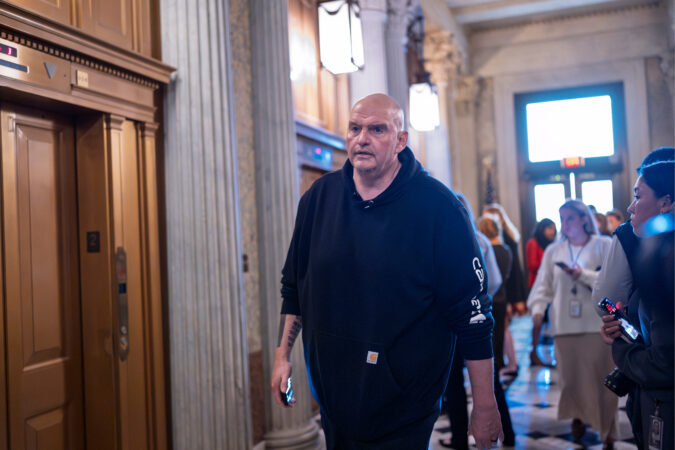
    U.S. Sen. John Fetterman promised to back President Donald Trump’s pick to succeed Kristi Noem within minutes of her abrupt firing as secretary of homeland security.

    Trump has tapped U.S. Sen. Markwayne Mullin (R., Okla.) to lead the Department of Homeland Security, which oversees Immigration and Customs Enforcement, the Border Patrol, and the two agencies’ increasingly unpopular operations in carrying out Trump’s deportation agenda.

    Mullin’s nomination must be confirmed by the Senate.

    “I’m not sure how many fellow Democrats will vote to support our colleague [Sen. Mullin] as the next DHS Secretary, but I am AYE,” Fetterman said in a post on X, which also noted his membership on the committee that oversees the department.

    Mullin and Fetterman (D., Pa.) were both elected to the Senate in 2022. The Oklahoma Republican had served in the U.S. House for a decade before joining the upper chamber. Mullin told reporters he had already received a text message from Fetterman after Trump’s announcement.

    “You guys know John and I are friends. … We’re going to try to earn everybody’s vote,” Mullin said when asked whether other Democrats would vote for him.

    The sudden change in leadership at DHS follows growing outrage over ICE’s tactics and questions about Noem’s leadership, both of which escalated nationally after federal agents shot and killed U.S. citizens Renee Nicole Good and Alex Pretti in January in Minneapolis.

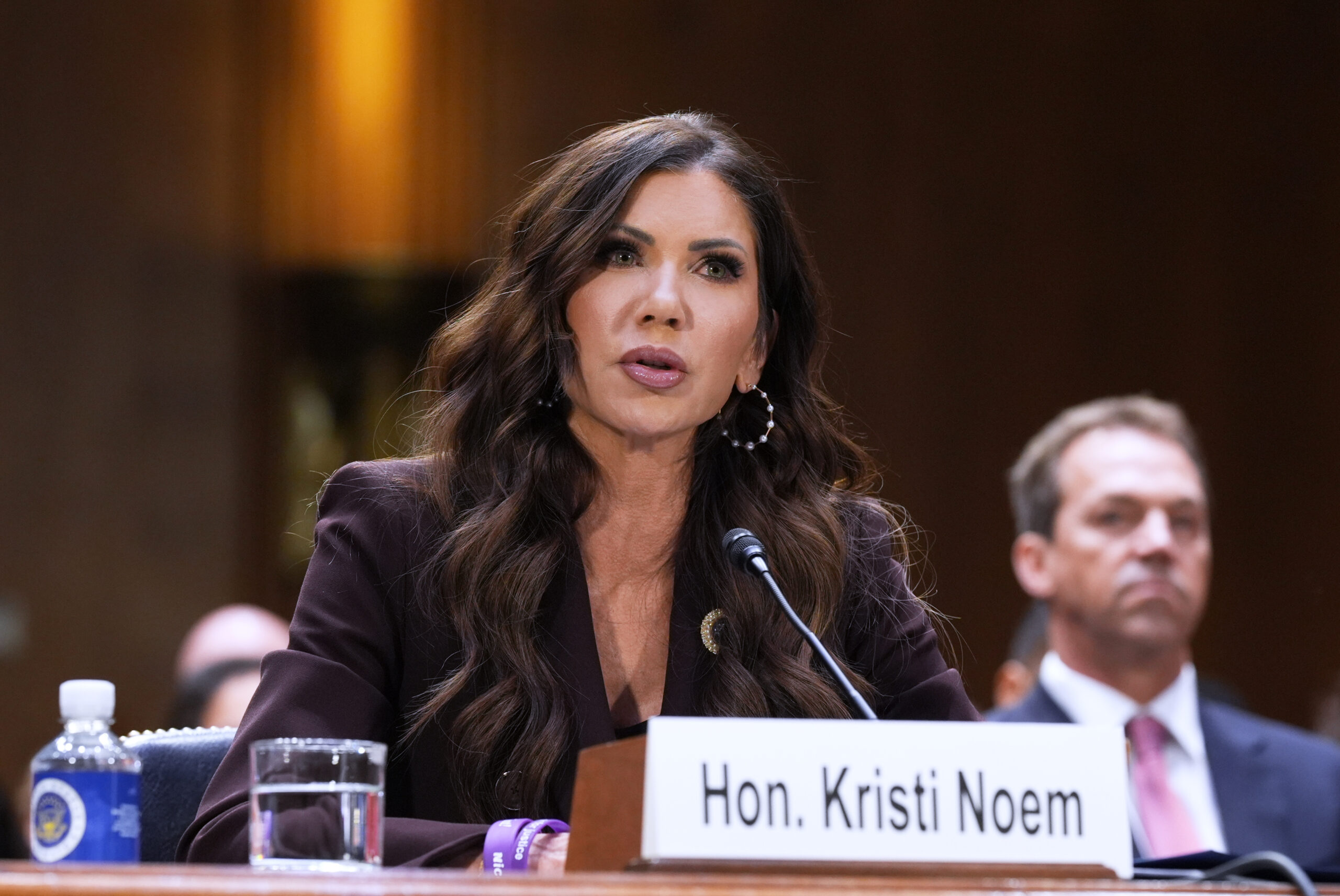
    Homeland Security Secretary Kristi Noem appears for an oversight hearing before the Senate Judiciary Committee, at the Capitol in Washington, March 3, 2026.

    Immigration has gone from one of Trump’s strongest polling issues to a potential drag on his party in the forthcoming midterms. More than half of Pennsylvania voters disapprove of ICE’s enforcement methods, according to a poll from Franklin and Marshall College released Thursday.

    Fetterman and other senators who had voted for Noem’s confirmation called for her to be fired after Pretti’s killing. She also faced criticism from both sides of the aisle at a recent oversight hearing before the Senate that examined a controversial $220 million ad campaign she approved, among other topics.

    “Americans have died,“ Fetterman said in a direct plea to Trump in January. ”She is betraying DHS’s core mission and trashing your border security legacy.”

    U.S. Sen. Dave McCormick (R., Pa.) said on Thursday that he supports Mullin’s nomination.

    It is unclear whether other Democratic senators will give the green light to Mullin’s nomination, but many on Thursday were quick to celebrate Noem’s departure as she transitions into a newly created role in the Trump administration called “the Special Envoy for the Shield of the Americas.”

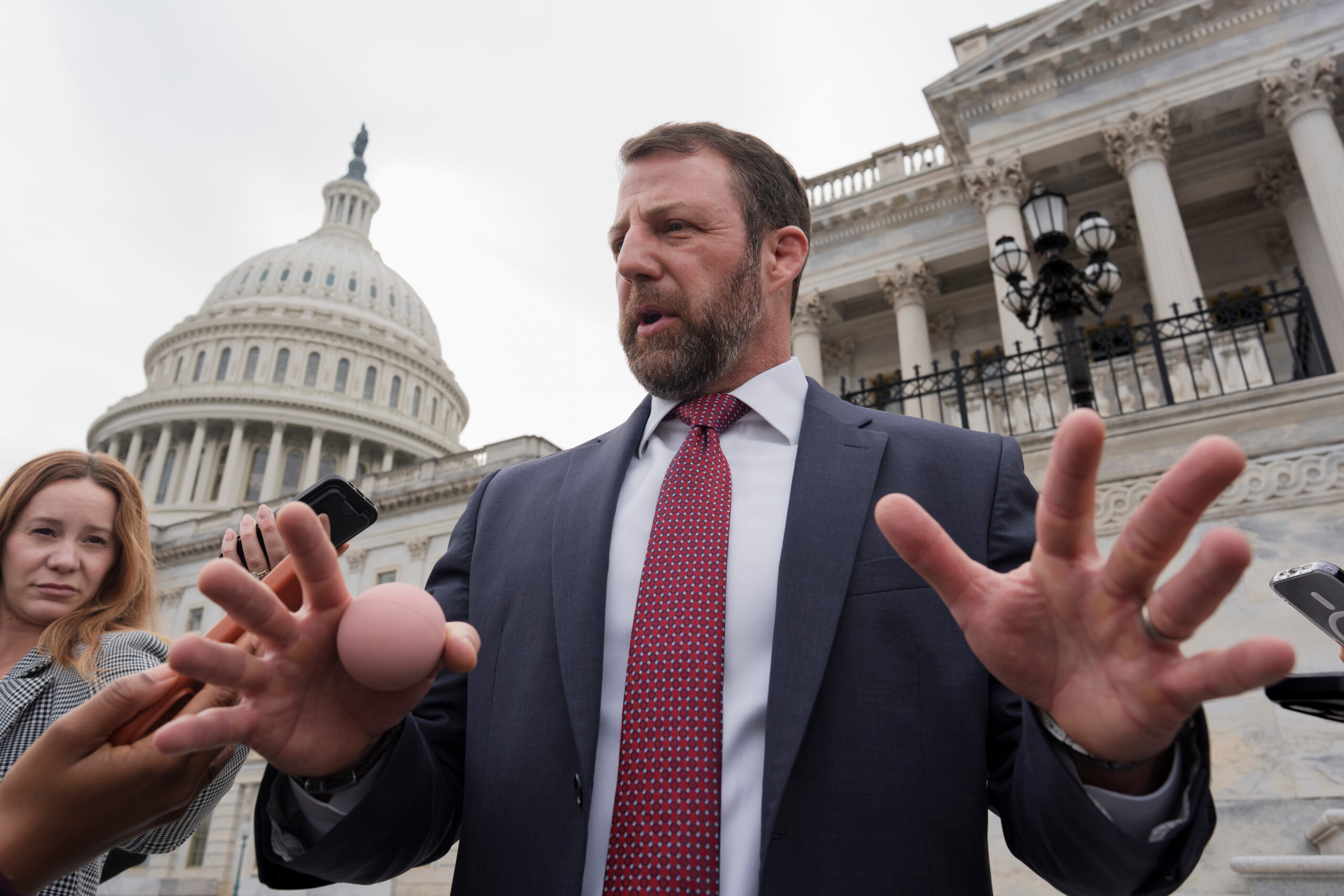
    Sen. Markwayne Mullin, R-Okla., speaks with reporters on the steps at the Capitol in Washington, Thursday, March 5, 2026.

    U.S. Sen. Andy Kim (D., N.J.), who also voted for Noem’s confirmation in January 2025 before calling for her to be fired a year later, said Thursday on X that her firing “Will be the most popular decision of [Trump’s] presidency.”

    But he cautioned that Noem’s termination is “only the start of getting rid of the deep rot of corruption in the Trump administration,” and that other officials, including Trump adviser Stephen Miller and Tom Homan, the border czar, should be held accountable for immigration agents’ conduct.

    The leadership change comes as Pennsylvania and New Jersey officials are pushing back on DHS’s plans to convert warehouses in the states into detention centers.

    Kim and U.S. Sen. Cory Booker (D., N.J.) have offered legislation to prohibit such moves and Gov. Josh Shapiro has floated possible legal action over DHS’s purchase of two warehouses in Pennsylvania.

    Democratic House members from the region echoed Kim’s sentiment that more change is needed than just the leadership of the department.

    Lawmakers are still debating future funding for DHS, with Democrats demanding reforms to immigration enforcement before they will approve more money for the department.

    “Change the lousy policies, not just the person,” U.S. Rep. Dwight Evans (D., Philadelphia) wrote on X.

    “We still need real accountability at DHS, including meaningful reforms to ICE so agents are not terrorizing Americans,” U.S. Rep. Brendan Boyle (D., Philadelphia) said on X.

    Boyle criticized Fetterman for immediately pledging to support Mullin, saying in another post that the Pennsylvania senator is “Trump’s favorite Democrat for a good reason.“

    U.S. Rep. Chrissy Houlahan (D., Chester) congratulated Trump in a statement Thursday for “taking this long overdue action” in firing Noem.

    “I sincerely hope Mr. Mullin or whomever is eventually confirmed will be prepared to reform ICE and to work with the Congress to rein in its most destructive practices,” she said.

    U.S. Rep. Ryan Mackenzie (R., Lehigh), who represents a key swing district, said he looks forward to “seeing a greater emphasis on transparency” under Mullin.

    He stopped short of criticizing Noem and said in the last year DHS “made critical progress towards securing the border once and for all.”

    One of the reforms Democrats have called for is a prohibition on ICE agents wearing masks. U.S. Rep. Brian Fitzpatrick (R., Bucks), a former FBI agent, is one of the few Republicans supporting that proposal as a way to restore trust with the agency.

    His office underlined that a new leader should focus on rebuilding the department’s reputation with the American people.

    “The Department of Homeland Security carries one of the most important missions in government — protecting the American people. That mission requires the public’s trust, and Congressman Fitzpatrick believes a leadership change was needed to help restore confidence in the department,” Fitzpatrick spokesperson Casey-Lee Waldron said in a statement.

    “He hopes Senator Mullin will work to rebuild that trust and strengthen DHS moving forward.”

  • Trump allies expand role in planning America’s 250th anniversary

    Trump allies expand role in planning America’s 250th anniversary

    Two groups — one with the imprimatur of Congress, the other with President Donald Trump’s blessing — are jockeying to host celebrations marking America’s 250th anniversary, sparking confusion, muddled messages, and new scrutiny from Democrats who ask why the Trump-aligned group is receiving federal money.

    America250, led by a bipartisan board created by Congress a decade ago to mark the nation’s Semiquincentennial, has overseen events such as the Army’s 250th anniversary last year. It has also issued grants to state commissions and sponsored initiatives such as a float in this year’s Rose Parade.

    Freedom 250, a public-private partnership launched by the White House in December, has emerged as the more publicized and prolific group, with a flurry of high-profile announcements, including some from the Oval Office.

    “Freedom Trucks,” six customized semitrucks backed by $10 million in federal funds and with educational content crafted by conservative educators, have begun crisscrossing red states. A “Freedom Plane” took flight from Washington this week, beginning a National Archives-led nationwide tour in which the Boeing 737 will ferry an original engraving of the Declaration of Independence and other historic documents. The group is also planning a national prayer event on the National Mall, an IndyCar race around D.C., and a UFC fight hosted outside the White House on Trump’s birthday. The organization is led by Keith Krach, who served in the first Trump administration.

    Both groups are drawing on private funds for their programming, with sponsors such as Exiger, Oracle, and Palantir contributing to both organizations. The groups are also set to share in $150 million appropriated by Congress last year and managed by the Interior Department.

    The rapid rise of Freedom 250, with its Trump-tailored programming, has unnerved some liberals and watchdog organizations, who question whether it is wrongly tapping into funds intended for nationwide anniversary celebrations and promising access to the president at a price. Twelve Senate Democrats on Tuesday pressed the Interior Department to provide a “clear accounting” of money routed to Freedom 250, in a letter sent to the Trump administration and shared with the Washington Post.

    “The Trump administration’s latest venture, Freedom 250, continues to raise serious and troubling questions about whether access to the president or official government events is for sale to the highest bidders,” Sen. Adam Schiff (D., Calif.), who led the letter, said in a statement to the Post. “And if the administration is commingling taxpayer dollars with other funds in an unaccountable private entity run by the president’s allies, it is an open invitation for corruption. We need answers.”

    Public Citizen, a consumer advocacy organization, also has called for congressional investigations, citing a recent New York Times report that donors to Freedom 250 were offered access to Trump if they gave $1 million or more.

    Freedom 250 spokeswoman Rachel Reisner referred questions about its federal funding to the Interior Department. Trump “is deeply grateful for the support of his donors, but unlike the politicians of the past, he can’t be bought,” she said in a statement.

    She added that the organization has reached out to all 50 governors and partnered with a range of organizations, including PragerU and MyAmerica2026.

    “As we approach this historic milestone in our nation’s founding, we will not be deterred by any partisan outrage or political theater,” Reisner said.

    The Trump administration also has touted its approach, and Trump has repeatedly celebrated that he will be the president to oversee the nation’s 250th anniversary — an idea he embraced on the campaign trail.

    Asked about its plans to distribute the $150 million provided by Congress and what share would go toward Freedom 250, the Interior Department declined to comment.

    “The Department of the Interior looks forward to celebrating Freedom 250 and saluting 250 years of American greatness alongside President Donald J. Trump — the most iconic and accomplished President in the history of our great nation,” the department said in a statement.

    America250 and Freedom 250 have publicly touted their shared commitment to the nation’s Semiquincentennial.

    Rosie Rios, the Democrat leading America 250, has repeatedly praised her counterparts in interviews and statements, saying that Freedom 250 will focus on Washington-area events while her group tackles nationwide programming.

    The bipartisan commission “has taken every possible step” to support the Trump administration’s activities, the group said in its report to Congress in January.

    But the tensions between the organizations have grown, according to five people who spoke on the condition of anonymity to describe private conversations. Freedom 250 officials have bristled at the pace of America250’s work and output, and argued that the bipartisan group has been overly bureaucratic and politically correct. They also argue that America250 — which has received more than $100 million in federal funding since 2019 — has little to show for those contributions.

    In comparison, one person familiar with the matter said, Freedom 250 drew on $3 million in federal funds last year to quickly produce a New Year’s Eve light display on the Washington Monument.

    America250 said in a statement that it continues to actively collaborate with the White House task force, Freedom 250 and the full executive branch to plan the celebrations.

    The group has been running a nationwide contest for students to submit perspectives on what America means to them and has been to eight states so far with a storytelling program on identity, service, community, and personal legacy.

    Meanwhile, America250 officials and allies have questioned whether the Trump-backed group is too focused on activities that please the president and say the group threatens to siphon money that could be used for nationwide activities. America250 has received $25 million of the $150 million apportioned by Congress last year for anniversary activities, according to a person familiar with its finances.

    The friction between the groups reached a breaking point in the planning for the Army’s 250th birthday last summer — a military parade in Washington that coincided with Trump’s birthday, said one person familiar with the plans. America250 wanted the celebration to focus on the military, not the president. Freedom 250 wanted Trump, as the commander in chief, to be front and center, the person said.

    Some programming has shifted between the two groups. America250 originally applied for and received a grant from the Institute of Museum and Library Services for the Freedom Trucks, mobile museums inspired by the American Freedom Train that crisscrossed the country from 1975-1976. The institute is a federal agency that provides financial support for museums and libraries. The $10 million grant was later voluntarily transferred to Freedom 250, according to an official of the agency.

    “These mobile museums, which tell the incredible story of our nation’s founding, will be a cherished memory for an entire generation,” Keith Sonderling, a Trump appointee who leads the museum and library agency, said in a statement.

    Marissa Streit, chief executive of PragerU, a conservative media organization, said her company volunteered to produce all video and educational content for the Freedom Trucks after White House officials came up with the vision and worked with Hillsdale College to develop the displays.

    Streit insisted that despite the uniformly conservative credentials of the people involved, the exhibits showed a balanced view of history.

    “I believe we need to teach and talk about both the negative things that have happened in our country as well as the positive,” she said.

    The tensions are a departure from the approach taken during the bicentennial under President Gerald Ford, who sought to make sure the celebrations did not raise questions of impropriety in the wake of the Watergate scandal, said Richard Painter, the chief White House ethics lawyer in the George W. Bush administration.

    “The one thing our taxpayer funds should not be used for is politicizing the 250th anniversary of the founding of the country,” said Painter, co-author of The U.S. Presidency: Power, Responsibility, and Accountability. “One of the things [the founders] were most afraid of is faction and political parties destroying our democracy. The celebrations here shouldn’t be owned by one political party or another.”

  • Swarthmore’s borough manager has been terminated after just six months on the job

    Swarthmore’s borough manager has been terminated after just six months on the job

    Swarthmore Borough manager Sean Halbom has been terminated from the office after just six months, the latest in a string of short employment stints he has held in recent years.

    The borough council voted unanimously on the termination Monday, though Council President Jill Bennett Gaieski declined to give a reason for the decision in a phone call with The Inquirer.

    Halbom did not respond to phone or email messages left on Thursday.

    Halbom was placed on an administrative leave of absence on Feb. 17, first reported by the Swarthmorean.

    He began in the borough manager role in September after holding several roles in Montgomery County, including most recently in Upper Frederick Township, where he was township manager for less than a year, according to his LinkedIn profile. Halbom resigned from his position in Upper Frederick in June 2025.

    Prior to the job in Upper Frederick, Halbom was an interim human resources director in Bucks County for two months and township manager for Worcester Township for a year and a half. Halbom’s employment in Worcester Township was terminated by its board of supervisors in April 2024.

    He was also the director of veterans affairs for Montgomery County for six years, from 2012 to 2018, his LinkedIn profile shows.

    Halbom succeeded William Webb, who left the Swarthmore manager role in September to become an assistant county administrator in Isle of Wight County, Va.

    Halbom’s leave came around the same time as another personnel shake-up in the small borough. On Feb. 18, Scott Schumacher vacated his position as a longtime Swarthmore Public Library employee and children’s librarian.

    Swarthmore Public Library board president Elizabeth Brown said Schumacher’s departure was unrelated to Halbom’s termination.

    The Swarthmore council on Monday also named David Unkovic as interim borough manager. He “came highly recommended” by Upper Providence Township, where he previously served as interim township manager, Gaieski said.

    Before retiring as a practicing lawyer, Unkovic spent a decade at McNees Wallace & Nurick, a Harrisburg-based law firm with multiple offices, including in Radnor. He also briefly served as the state receiver for the City of Harrisburg in 2012.

    The Swarthmore council has already begun the search for a permanent borough manager, Gaieski said, and hopes one will be in place as early as June 1.

    The search will take “until we find the right person,” Gaieski added. “We have a really good interim in place. We will do what we need to do to find the right person.”

    This suburban content is produced with support from the Leslie Miller and Richard Worley Foundation and The Lenfest Institute for Journalism. Editorial content is created independently of the project donors. Gifts to support The Inquirer’s high-impact journalism can be made at inquirer.com/donate. A list of Lenfest Institute donors can be found at lenfestinstitute.org/supporters.
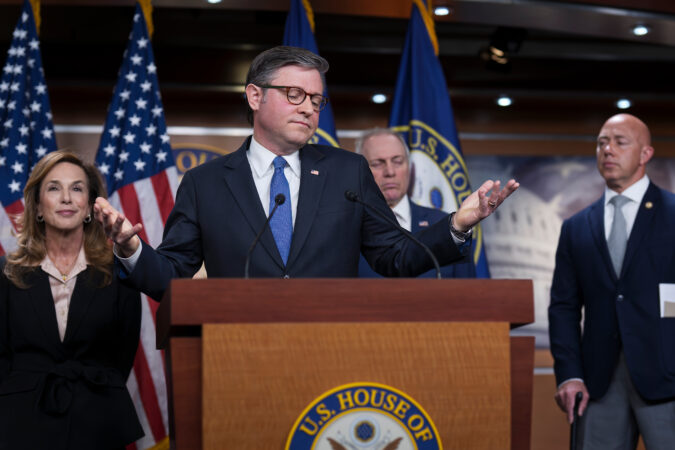
  • Trump says he’s replacing Homeland Security Secretary Noem with GOP Sen. Markwayne Mullin

    Trump says he’s replacing Homeland Security Secretary Noem with GOP Sen. Markwayne Mullin

    WASHINGTON — President Donald Trump on Thursday fired his embattled Homeland Security Secretary Kristi Noem, after mounting criticism over her leadership of the department, including the handling of the administration’s immigration crackdown and disaster response.

    Trump, who said he would nominate Oklahoma Republican Sen. Markwayne Mullin in her place, made the announcement on social media after Noem faced a two-day grilling on Capitol Hill this week from GOP members as well as Democrats.

    Noem’s departure marks a stunning turnaround for a close ally to the president who was tasked with steering his centerpiece policy of mass deportations. But she appeared to increasingly become a liability for Trump, with questions arising over her spending at her department and over her conduct in the aftermath of the shooting deaths of two protesters in Minneapolis earlier this year.

    Trump said Noem “has served us well, and has had numerous and spectacular results (especially on the Border!).” He said he was making her a “Special Envoy for The Shield of the Americas,” a new security initiative that he said would focus on the Western Hemisphere.

    Noem, who appeared at a law enforcement event in Nashville, moments after Trump’s announcement, did not address her ouster there. She read from prepared remarks and was not asked by attendees about the development.

    Later, in a social media post, she thanked Trump for the new appointment and touted her accomplishments as secretary.

    “We have made historic accomplishments at the Department of Homeland Security to make America safe again,” she wrote.

    White House press secretary Karoline Leavitt said the administration will work with the GOP-led Senate to get Mullin, whom she called “extraordinarily qualified,” confirmed to lead DHS “as soon as possible.”

    The administration’s immigration crackdown faced criticism, especially in Minnesota

    Noem is the first cabinet secretary to leave during Trump’s second term. Her tenure looked increasingly short-lived after hearings in Congress this week where she faced rare but blistering criticism from Republican lawmakers. One particular point of scrutiny was a $220 million ad campaign featuring Noem that encouraged people in the country illegally to leave voluntarily.

    Noem told lawmakers that Trump was aware of the campaign in advance, but Trump disputed that in an interview Thursday with Reuters, saying he did not sign off on the ad campaign.

    Noem has faced waves of criticism as she’s overseen Trump’s immigration crackdown, especially since the shooting deaths of the two protesters in Minneapolis at the hands of immigration enforcement officers. In the immediate aftermath of the deaths of Renee Good and Alex Pretti, Noem portrayed both of them as aggressors, contradicting widely viewed videos and descriptions of their deaths from bystanders. She declined to apologize for her description over two days of congressional testimony.

    The former South Dakota governor was also criticized over the way her department has spent billions of dollars allocated to it by Congress.

    Her department, DHS, has been at the center of a funding battle in Congress over immigration enforcement tactics and has been shut down for 20 days, although many of the employees are continuing to work, often without pay.

    Even before Noem’s appearance before key congressional committees this week, Republican lawmakers had been anticipating the secretary’s eventual ouster, particularly after her handling of the immigration enforcement crackdown in Minneapolis.

    As they tried to end the ongoing Homeland Security shutdown, Senate Republicans had noted privately to Democratic senators that Noem was likely on her way out and that that should prompt Democrats to move forward with agreeing to fund the department again, according to two people familiar with the discussions.

    Democrats did not see that as an actual concession by Republicans, considering Noem was becoming a political liability for the GOP, said the people, who spoke on condition of anonymity to discuss private negotiations.

    Aside from immigration, Noem also faced criticism — including from Republicans — over the pace of emergency funding approved through the Federal Emergency Management Agency and for the Trump administration’s response to disasters.

    Critics welcomed Noem’s departure. Minneapolis Mayor Jacob Frey wrote “good riddance” on social media, a sentiment echoed by Senate Democratic Leader Chuck Schumer.

    Some immigration activists questioned whether her departure would change the execution of an immigration agenda that they fundamentally disagree with.

    “This is not accountability, just a reshuffling of the enablers of the agenda of President Trump,” said Vanessa Cárdenas, executive director of America’s Voice, an advocacy group. She said Noem’s tenure was “marked by cruelty.”

    Gregory Bovino, a Border Patrol official who was elevated under Noem’s watch to lead immigration crackdowns in cities including Los Angeles, Chicago and Minneapolis, was one of the few who applauded Noem’s tenure.

    “She is the best Secretary I ever worked for, period. The others weren’t even close. Noem is the ultimate patriot,” Bovino told the Associated Press.

    Sen. Markwayne Mullin (center) arrives at Philadelphia International Airport to attend the NCAA Division 1 men’s wrestling championships at the Wells Fargo Center on March 22, 2025.

    DHS leadership changes come at a pivotal time

    Mullin would need to be confirmed by the Senate, but under a federal law governing executive branch vacancies, he would be allowed to serve as an acting Homeland Security secretary as long as his nomination is formally pending.

    Voting in the Senate just after Trump’s announcement, Mullin said he has “no idea” how quickly his nomination will move.

    “The president and I are good friends. So we look forward to working closer with the White House, and obviously I’m gonna be over there a lot more,” he said.

    Mullin would take over the third-largest department in government that has responsibility for carrying out Trump’s hard-line immigration agenda. And he would assume the role at a pivotal time for that agenda.

    Immigration enforcement during the first year of Trump’s administration was largely defined by high-profile, made-for-social-media operations with flashy names, often led by Bovino, who reported directly to Noem. Noem herself often went out on those operations, riding along with officers when they went out to make arrests.

    But those high-profile operations in places like Los Angeles, Chicago and Minneapolis often led to clashes with activists and protesters that were captured on video and drove opposition to the president’s immigration agenda.

    That culminated with the shooting deaths in Minneapolis after which Trump shuffled leadership of the operation. The number of officers there was drawn down shortly after.

  • U.S. and Mideast countries seek Kyiv’s drone expertise as Russia-Ukraine talks put on ice

    U.S. and Mideast countries seek Kyiv’s drone expertise as Russia-Ukraine talks put on ice

    KYIV, Ukraine — The United States and its allies in the Middle East are seeking Ukraine’s expertise in countering Iran’s Shahed drones, according to Ukrainian President Volodymyr Zelensky.

    Various countries, including the United States, have approached Ukraine for help in defending against the Iranian drones, Zelensky said late Wednesday. He said he has spoken in recent days with the leaders of the United Arab Emirates, Qatar, Bahrain, Jordan, and Kuwait about possible cooperation.

    Russia has fired tens of thousands of Shaheds at Ukraine since it invaded its neighbor just over four years ago, launching a swarm of more than 800 drones and decoys in its biggest nighttime barrage. Iran has responded to joint U.S.-Israeli strikes by launching the same type of drones at countries in the Middle East.

    Ukrainian assistance in countering Iranian drones will be provided only if it does not weaken Ukraine’s own defenses, and if it adds leverage to Kyiv’s diplomatic efforts to stop the Russian invasion, according to the Ukrainian leader.

    “We help to defend from war those who help us, Ukraine, bring a just end to the war” with Russia, Zelensky said. Later Thursday, Zelensky said he had received a U.S. request for support to defend against the drones in the Middle East and had given the order for equipment to be provided along with Ukrainian experts without providing further details.

    “Ukraine helps partners who help our security and the protection of our people’s lives,” he added in a social media post.

    Trump, in an interview Thursday with Reuters, said, “Certainly I’ll take, you know, any assistance from any country.”

    Ukraine has battle-tested drone defenses

    Ukraine has pioneered the development of cut-price drone killers that cost as little as $1,000, rewriting the air defense rule book and making other countries take notice.

    European countries got a wake-up call last September on the changed nature of air defense when Poland scrambled multimillion-dollar military assets, including F-35 and F-16 fighter jets and Black Hawk helicopters, in response to airspace violations by cheap drones.

    Ukrainian manufacturers have developed low-cost interceptor drones specifically designed to hunt and destroy Shaheds, and its rapidly expanding drone industry is producing excess capacity.

    Zelensky announced earlier this year that Ukraine would begin exporting the battle-tested systems.

    The European Union’s top diplomat, Kaja Kallas, said before chairing a meeting of EU and Gulf foreign ministers via video link Thursday that the talks would look at how Ukraine’s experience can help countries counter Iranian drones.

    Middle East war delays Russia-Ukraine talks

    The Iran war, now in its sixth day, has drawn international attention away from Europe’s biggest conflict since World War II, and forced the postponement of a new round of U.S.-brokered talks between Russia and Ukraine planned for this week, Zelensky said.

    Western governments and analysts say the Russia-Ukraine war has killed hundreds of thousands of people, while there is no sign that yearlong U.S.-led peace efforts will stop the fighting any time soon.

    “Right now, because of the situation around Iran, there are not yet the necessary signals for a trilateral meeting,” Zelensky said. “But as soon as the security situation and the overall political context allow us to resume that trilateral diplomatic work, it will be done.”

    Zelensky thanked the United States for the return from Russia on Thursday of 200 Ukrainian prisoners of war. Russia’s Defense Ministry also said it received the same number of prisoners from Ukraine and thanked the U.S. and United Arab Emirates for mediating.

    Prisoner swaps have been one of the few tangible results of the talks. Vladimir Medinsky, a Russian negotiator, said on social media that a total of 500 prisoners from each side would be exchanged between Thursday and Friday.

    Oleksandr Merezhko, the head of Ukraine’s parliamentary foreign affairs committee, said Russian President Vladimir Putin is trying to drag out the negotiations so that he can press on with Russia’s invasion while escaping further U.S. sanctions.

    He urged the U.S. administration to look at the Russia-Ukraine war and the war in the Middle East as linked.

    “In reality, Russia and Iran are close allies that act in concert — Iran supplies weapons and Russia helps Iran develop its defense industry. These are interconnected conflicts,” Merezhko told the Associated Press.

    Ukraine’s army has recently pushed back Russian forces at some points along the roughly 750-mile front line, according to the Institute for the Study of War.

    Localized Ukrainian counterattacks liberated more territory than Ukrainian forces lost in the last two weeks of February, the Washington-based think tank said this week, estimating the recovered land at about 100 square miles since Jan. 1.