Blog

  • Trump says he’s replacing Homeland Security Secretary Noem with GOP Sen. Markwayne Mullin

    Trump says he’s replacing Homeland Security Secretary Noem with GOP Sen. Markwayne Mullin

    WASHINGTON — President Donald Trump on Thursday fired his embattled Homeland Security Secretary Kristi Noem, after mounting criticism over her leadership of the department, including the handling of the administration’s immigration crackdown and disaster response.

    Trump, who said he would nominate Oklahoma Republican Sen. Markwayne Mullin in her place, made the announcement on social media after Noem faced a two-day grilling on Capitol Hill this week from GOP members as well as Democrats.

    Noem’s departure marks a stunning turnaround for a close ally to the president who was tasked with steering his centerpiece policy of mass deportations. But she appeared to increasingly become a liability for Trump, with questions arising over her spending at her department and over her conduct in the aftermath of the shooting deaths of two protesters in Minneapolis earlier this year.

    Trump said Noem “has served us well, and has had numerous and spectacular results (especially on the Border!).” He said he was making her a “Special Envoy for The Shield of the Americas,” a new security initiative that he said would focus on the Western Hemisphere.

    Noem, who appeared at a law enforcement event in Nashville, moments after Trump’s announcement, did not address her ouster there. She read from prepared remarks and was not asked by attendees about the development.

    Later, in a social media post, she thanked Trump for the new appointment and touted her accomplishments as secretary.

    “We have made historic accomplishments at the Department of Homeland Security to make America safe again,” she wrote.

    White House press secretary Karoline Leavitt said the administration will work with the GOP-led Senate to get Mullin, whom she called “extraordinarily qualified,” confirmed to lead DHS “as soon as possible.”

    The administration’s immigration crackdown faced criticism, especially in Minnesota

    Noem is the first cabinet secretary to leave during Trump’s second term. Her tenure looked increasingly short-lived after hearings in Congress this week where she faced rare but blistering criticism from Republican lawmakers. One particular point of scrutiny was a $220 million ad campaign featuring Noem that encouraged people in the country illegally to leave voluntarily.

    Noem told lawmakers that Trump was aware of the campaign in advance, but Trump disputed that in an interview Thursday with Reuters, saying he did not sign off on the ad campaign.

    Noem has faced waves of criticism as she’s overseen Trump’s immigration crackdown, especially since the shooting deaths of the two protesters in Minneapolis at the hands of immigration enforcement officers. In the immediate aftermath of the deaths of Renee Good and Alex Pretti, Noem portrayed both of them as aggressors, contradicting widely viewed videos and descriptions of their deaths from bystanders. She declined to apologize for her description over two days of congressional testimony.

    The former South Dakota governor was also criticized over the way her department has spent billions of dollars allocated to it by Congress.

    Her department, DHS, has been at the center of a funding battle in Congress over immigration enforcement tactics and has been shut down for 20 days, although many of the employees are continuing to work, often without pay.

    Even before Noem’s appearance before key congressional committees this week, Republican lawmakers had been anticipating the secretary’s eventual ouster, particularly after her handling of the immigration enforcement crackdown in Minneapolis.

    As they tried to end the ongoing Homeland Security shutdown, Senate Republicans had noted privately to Democratic senators that Noem was likely on her way out and that that should prompt Democrats to move forward with agreeing to fund the department again, according to two people familiar with the discussions.

    Democrats did not see that as an actual concession by Republicans, considering Noem was becoming a political liability for the GOP, said the people, who spoke on condition of anonymity to discuss private negotiations.

    Aside from immigration, Noem also faced criticism — including from Republicans — over the pace of emergency funding approved through the Federal Emergency Management Agency and for the Trump administration’s response to disasters.

    Critics welcomed Noem’s departure. Minneapolis Mayor Jacob Frey wrote “good riddance” on social media, a sentiment echoed by Senate Democratic Leader Chuck Schumer.

    Some immigration activists questioned whether her departure would change the execution of an immigration agenda that they fundamentally disagree with.

    “This is not accountability, just a reshuffling of the enablers of the agenda of President Trump,” said Vanessa Cárdenas, executive director of America’s Voice, an advocacy group. She said Noem’s tenure was “marked by cruelty.”

    Gregory Bovino, a Border Patrol official who was elevated under Noem’s watch to lead immigration crackdowns in cities including Los Angeles, Chicago and Minneapolis, was one of the few who applauded Noem’s tenure.

    “She is the best Secretary I ever worked for, period. The others weren’t even close. Noem is the ultimate patriot,” Bovino told the Associated Press.
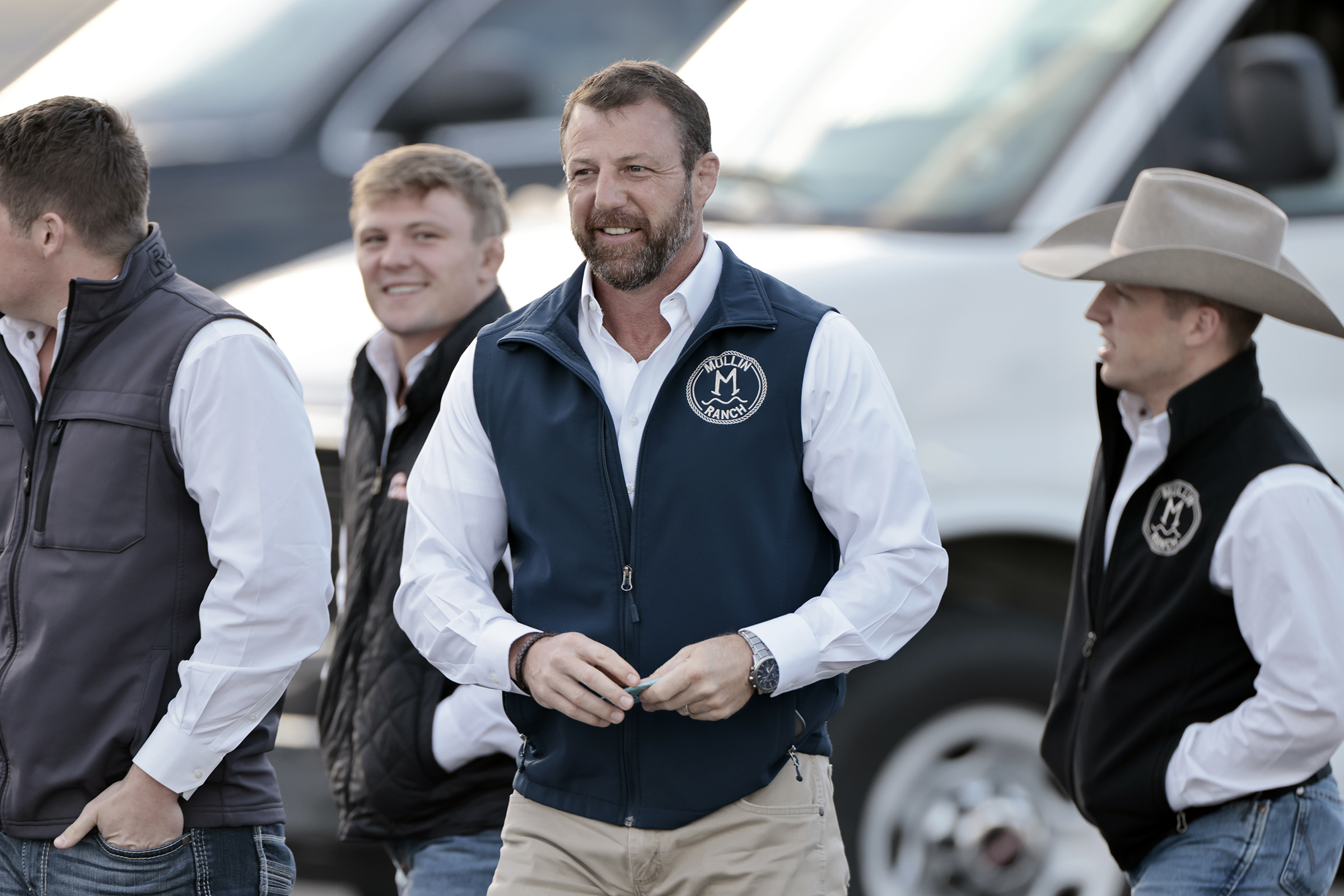
    Sen. Markwayne Mullin (center) arrives at Philadelphia International Airport to attend the NCAA Division 1 men’s wrestling championships at the Wells Fargo Center on March 22, 2025.

    DHS leadership changes come at a pivotal time

    Mullin would need to be confirmed by the Senate, but under a federal law governing executive branch vacancies, he would be allowed to serve as an acting Homeland Security secretary as long as his nomination is formally pending.

    Voting in the Senate just after Trump’s announcement, Mullin said he has “no idea” how quickly his nomination will move.

    “The president and I are good friends. So we look forward to working closer with the White House, and obviously I’m gonna be over there a lot more,” he said.

    Mullin would take over the third-largest department in government that has responsibility for carrying out Trump’s hard-line immigration agenda. And he would assume the role at a pivotal time for that agenda.

    Immigration enforcement during the first year of Trump’s administration was largely defined by high-profile, made-for-social-media operations with flashy names, often led by Bovino, who reported directly to Noem. Noem herself often went out on those operations, riding along with officers when they went out to make arrests.

    But those high-profile operations in places like Los Angeles, Chicago and Minneapolis often led to clashes with activists and protesters that were captured on video and drove opposition to the president’s immigration agenda.

    That culminated with the shooting deaths in Minneapolis after which Trump shuffled leadership of the operation. The number of officers there was drawn down shortly after.


  • U.S. and Mideast countries seek Kyiv’s drone expertise as Russia-Ukraine talks put on ice

    U.S. and Mideast countries seek Kyiv’s drone expertise as Russia-Ukraine talks put on ice

    KYIV, Ukraine — The United States and its allies in the Middle East are seeking Ukraine’s expertise in countering Iran’s Shahed drones, according to Ukrainian President Volodymyr Zelensky.

    Various countries, including the United States, have approached Ukraine for help in defending against the Iranian drones, Zelensky said late Wednesday. He said he has spoken in recent days with the leaders of the United Arab Emirates, Qatar, Bahrain, Jordan, and Kuwait about possible cooperation.

    Russia has fired tens of thousands of Shaheds at Ukraine since it invaded its neighbor just over four years ago, launching a swarm of more than 800 drones and decoys in its biggest nighttime barrage. Iran has responded to joint U.S.-Israeli strikes by launching the same type of drones at countries in the Middle East.

    Ukrainian assistance in countering Iranian drones will be provided only if it does not weaken Ukraine’s own defenses, and if it adds leverage to Kyiv’s diplomatic efforts to stop the Russian invasion, according to the Ukrainian leader.

    “We help to defend from war those who help us, Ukraine, bring a just end to the war” with Russia, Zelensky said. Later Thursday, Zelensky said he had received a U.S. request for support to defend against the drones in the Middle East and had given the order for equipment to be provided along with Ukrainian experts without providing further details.

    “Ukraine helps partners who help our security and the protection of our people’s lives,” he added in a social media post.

    Trump, in an interview Thursday with Reuters, said, “Certainly I’ll take, you know, any assistance from any country.”

    Ukraine has battle-tested drone defenses

    Ukraine has pioneered the development of cut-price drone killers that cost as little as $1,000, rewriting the air defense rule book and making other countries take notice.

    European countries got a wake-up call last September on the changed nature of air defense when Poland scrambled multimillion-dollar military assets, including F-35 and F-16 fighter jets and Black Hawk helicopters, in response to airspace violations by cheap drones.

    Ukrainian manufacturers have developed low-cost interceptor drones specifically designed to hunt and destroy Shaheds, and its rapidly expanding drone industry is producing excess capacity.

    Zelensky announced earlier this year that Ukraine would begin exporting the battle-tested systems.

    The European Union’s top diplomat, Kaja Kallas, said before chairing a meeting of EU and Gulf foreign ministers via video link Thursday that the talks would look at how Ukraine’s experience can help countries counter Iranian drones.

    Middle East war delays Russia-Ukraine talks

    The Iran war, now in its sixth day, has drawn international attention away from Europe’s biggest conflict since World War II, and forced the postponement of a new round of U.S.-brokered talks between Russia and Ukraine planned for this week, Zelensky said.

    Western governments and analysts say the Russia-Ukraine war has killed hundreds of thousands of people, while there is no sign that yearlong U.S.-led peace efforts will stop the fighting any time soon.

    “Right now, because of the situation around Iran, there are not yet the necessary signals for a trilateral meeting,” Zelensky said. “But as soon as the security situation and the overall political context allow us to resume that trilateral diplomatic work, it will be done.”

    Zelensky thanked the United States for the return from Russia on Thursday of 200 Ukrainian prisoners of war. Russia’s Defense Ministry also said it received the same number of prisoners from Ukraine and thanked the U.S. and United Arab Emirates for mediating.

    Prisoner swaps have been one of the few tangible results of the talks. Vladimir Medinsky, a Russian negotiator, said on social media that a total of 500 prisoners from each side would be exchanged between Thursday and Friday.

    Oleksandr Merezhko, the head of Ukraine’s parliamentary foreign affairs committee, said Russian President Vladimir Putin is trying to drag out the negotiations so that he can press on with Russia’s invasion while escaping further U.S. sanctions.

    He urged the U.S. administration to look at the Russia-Ukraine war and the war in the Middle East as linked.

    “In reality, Russia and Iran are close allies that act in concert — Iran supplies weapons and Russia helps Iran develop its defense industry. These are interconnected conflicts,” Merezhko told the Associated Press.

    Ukraine’s army has recently pushed back Russian forces at some points along the roughly 750-mile front line, according to the Institute for the Study of War.

    Localized Ukrainian counterattacks liberated more territory than Ukrainian forces lost in the last two weeks of February, the Washington-based think tank said this week, estimating the recovered land at about 100 square miles since Jan. 1.

  • Immigrant living in Philadelphia illegally voted in 2024 federal election, authorities say

    Immigrant living in Philadelphia illegally voted in 2024 federal election, authorities say

    An undocumented West African immigrant who federal authorities say has been living in Philadelphia for more than two decades cast a ballot in the 2024 federal election — and may have voted in at least six other elections, federal authorities said.

    Mahady Sacko was charged with fraudulent voting, according to the affidavit of probable cause for his arrest. If convicted, he could face up to five years in federal prison.

    Investigators said Sacko registered to vote in 2005, affirming on the registration form that he was a U.S. citizen. According to the affidavit, he went on to vote in five federal general elections and two primary elections over the next two decades.

    Prosecutors charged him only with casting a ballot in the 2024 election.

    Sacko had been ordered deported to Mauritania, in Northwest Africa, by an immigration judge in 2000, the affidavit said. But federal authorities never carried out the order because Sacko did not have a valid Mauritanian passport. Instead, immigration officials placed him under supervision, requiring him to regularly report to Immigration and Customs Enforcement.

    The charges against him come amid political attention on allegations that people who are not U.S. citizens are voting rampantly in American elections — a frequent talking point among conservative politicians and commentators. President Donald Trump has pushed federal officials to amp up efforts to prosecute undocumented immigrants who vote.

    But election experts and government investigations have consistently found that such cases are rare. Studies examining tens of millions of ballots have identified only a handful of suspected instances of such voting — a fraction of a percent of votes cast, according to research by the Brennan Center for Justice.

    Only U.S. citizens may vote in federal elections. Voters must attest to their citizenship when registering, and falsely claiming citizenship can lead to criminal prosecution and deportation.

    Voting records show that Sacko registered as a Democrat, though the affidavit does not specify which candidates he supported in the elections in which investigators say he voted.

    A spokesperson for the U.S. Attorney’s Office said Sacko had been released on bail after an initial appearance on Thursday. She did not provide the bail amount.

  • Woman hit in face by foul ball at Little League Classic field is suing MLB, Williamsport, and the Crosscutters

    Woman hit in face by foul ball at Little League Classic field is suing MLB, Williamsport, and the Crosscutters

    Every summer, Williamsport, Pa., becomes the epicenter of youth baseball as the Little League World Series hosts its annual tournament.

    And since 2017, Major League Baseball has brought in two teams to play an August regular-season game at Historic Bowman Field, giving Little Leaguers a chance to take in major league action just five miles from the Little League complex.

    But in addition to making memories for Little League ballplayers, the home of the Little League Classic has also been a hazard to fans, a new lawsuit says.

    Deborah Barbella, of Livingston, N.J., attended Bowman Field for a Penn College of Technology baseball game on May 2. She sat behind the first base dugout when a foul ball hit her in her face, breaking her jaw, nose, and eye socket, according to the complaint, which was filed Monday in the Lycoming County Court of Common Pleas.

    The suit accuses MLB, the Williamsport Crosscutters, and the city of Williamsport of carelessness and recklessness leading to the injury.

    MLB and the Crosscutters did not immediately return requests for comments regarding the lawsuit. Williamsport Mayor Derek Slaughter declined to comment on the lawsuit.

    The Crosscutters, one of six teams in the MLB Draft League, have used Bowman Field as their home stadium since 1994. The team was the class A short-season affiliate of the Phillies from 2007 until the MLB restructured its minor leagues in 2021.

    However, the injury at the center of the suit did not take place during a Crosscutters game. Barbella was struck by a foul ball during the second game of a United East Conference playoff doubleheader between Cairn University and Penn College, which used Bowman Field as its home stadium until 2026.

    Bowman Field, which opened in 1926, is owned by Williamsport and leased to MLB to host its Little League Classic games.

    Barbella was struck because Bowman Field did not comply with a 2022 dictate that all minor league baseball stadiums install protective netting that extends from foul pole to foul pole by opening day 2025, the suit says.

    The Seattle Mariners played the New York Mets in last year’s Little League Classic at Bowman Field.

    The netting at Bowman should have been extended even before to comply with major league rules because it hosts games between MLB teams, the suit says, such as the Little League Classic.

    But when Barbella attended a game at Bowman, the suit says, only those sitting behind home plate were covered by a netting canopy. The net in front of Barbella was lower and stopped at the end of the dugout.

    “Our goal is to achieve justice for a woman whose life was permanently altered by an allegedly foreseeable and preventable incident, and to hold the League and the stadium accountable for their delay,” John Morgan, founder of Morgan & Morgan law firm representing Barbella, said in a statement.

    Williamsport officials discussed the netting problem in a Feb. 13, 2025, city council meeting, according to the complaint. Council approved a contract with a construction company for the netting that day, saying the project needed to be done “very quickly,” but the work never started. The city reopened its bid for netting installation in March 2025 but couldn’t find a company that would agree to take on the project with opening day as a deadline, the suit says.

    The city decided to install a temporary netting system to allow more time for the permanent netting’s installation.

    “Despite being aware that the netting at Bowman Field needed to be changed prior to opening day in 2025, the Defendants failed to make any changes to the netting system at Bowman Field,” the suit says.

    With the exception of the 2020 season, the Little League Classic has brought a regular-season MLB game to Williamsport to open the final week of the Little League World Series since 2017. This year’s edition of the game will feature the Milwaukee Brewers and Atlanta Braves on Sunday, Aug. 23.

    The Phillies have played in two Little League Classic games. They lost, 8-2, to the Mets in the second annual Little League Classic in 2018 and lost, 4-3, to the Nationals in the game’s 2023 edition.

    When the Phillies took the field for the Classic in 2018, it was the first time the team had played at Bowman Field since it suffered a 5-1 loss to the club’s class A-affiliate, the Williamsport Grays, in an exhibition game on July 31, 1962.

  • Iran’s regime maintains its grip, despite devastating losses

    Iran’s regime maintains its grip, despite devastating losses

    The U.S. and Israeli air campaign against Iran has decimated the highest ranks of political and military leadership, destroyed critical military command-and-control infrastructure and fighting capability, and damaged civilian buildings across the country.

    In Tehran, the expanding conflict appears to be frustrating the succession process after Supreme Leader Ayatollah Ali Khamenei was killed. Khamenei’s funeral was postponed after the group charged with choosing his successor was targeted by Israeli strikes. Following that attack, Iranian state media announced that voting for the next supreme leader would be conducted remotely.

    But so far, some six days into a war that has now touched 12 countries across the Middle East, major military operations have not threatened the Iranian regime’s grip on power, according to European and Arab officials briefed on assessments of the regime’s standing since the conflict began.

    Iran, the officials say, was prepared for this conflict. The command structures built to survive a decapitation strike appear to remain substantially intact, allowing Iranian retaliatory strikes against Israel, Qatar, and Bahrain to begin within hours of the initial attacks. And inside the country since the conflict started, Iranians have reported a heavier security presence in city streets, with Basij paramilitary forces patrolling on motorbikes.

    “Iran’s senior leaders are dead; the so-called governing council that might have selected a successor, dead, missing or cowering in bunkers, too terrified to even occupy the same room,” Defense Secretary Pete Hegseth said in a briefing Wednesday touting successes as he outlined how operations would expand.

    President Donald Trump said Tuesday that the strikes killed “most of the people” the United States favored to replace the recently killed regime members.

    But despite the intensity of the strikes and the broad nature of the destruction, so far there are no reports of significant defections within regime ranks or of popular uprisings, according to European and Arab assessments described to the Washington Post by officials from those countries. U.S. intelligence also saw no signs of uprisings or defections in the first days of the campaign, according to a person familiar with the situation who spoke on the condition on anonymity to describe an ongoing operation.

    “There’s not a single sign of anything in the system breaking or defecting. Nothing. Zero,” said a senior European official, speaking on the condition of anonymity to describe government briefings on the latest assessments of the strength of the Iranian regime. “The control is complete,” he said. The official said he was aware of reports of regime security forces failing to show up for duty, but believed that could be because of orders to no longer congregate in compounds and barracks, for fear of being targeted.

    The officials said Iran’s military and political command has proved durable because of the “layered system” the regime built to withstand a crisis, decentralizing leadership by appointing multiple individuals to immediately replace any key figure who might be killed.

    After Iranian Defense Minister Aziz Nasirzadeh was killed in strikes Saturday, Majid Ebnelreza was appointed as the caretaker minister on Monday by Iranian President Masoud Pezeshkian, who himself was rumored to have been targeted in the attack’s initial waves. Since then, media reports have speculated that Ebnelreza was killed in subsequent attacks, but Iranian state media has not responded to the allegations.

    In the lead-up to the conflict, a senior Arab official said, U.S. allies in the Persian Gulf thought that Iran would be more vulnerable to outside military pressure and that the potential killing of the supreme leader would be an early turning point, triggering a mass mobilization against the regime.

    “We were looking for the demonstrations in the streets, but we were surprised by their unity,” he said, speaking on the condition of anonymity to describe sensitive internal planning.

    In January, as the regime buckled under massive anti-government protests across the country and responded with a brutal crackdown, many of Iran’s neighbors assessed a deep weakness within the political and security leadership structures.

    But amid an unrelenting bombing campaign, the governance structure has largely stayed intact and continues to exert unilateral control, surprising seasoned Iran watchers in the region. The European and the Arab officials both cautioned that the Iranian regime remains opaque and regime collapse can be almost impossible to anticipate from the outside.

    Information on the impact of the U.S. and Israeli attacks against Iran is sporadic. The country is under a near-total internet blackout. But initial visual analysis by the Washington Post has revealed extensive damage to military targets, government buildings, and internal security structures. Israel has also recently claimed strikes targeting Iran’s clerical establishment.

    In total, U.S. Central Command says, more than 2,000 targets were hit inside Iran in the space of over four days. The Israel Defense Forces said its planes have dropped more than 4,000 munitions on Iran since Saturday.

    “Undoubtably, Iran has been considerably weakened,” said Gregory Brew, an Iran analyst with the Eurasia Group. Considering Iran’s military losses alone, the United States and Israel destroyed most of the country’s navy, a significant portion of its missile stockpile and its means of producing more missiles, he said.

    “They’re blowing up a lot of buildings, but most of these buildings are probably empty. They’re annihilating the physical edifice of the Islamic republic,” Brew said.

    Meanwhile, Iran’s police force and the Basij have continued to function, according to Iranians inside the country, said the European official. Brew said that’s because these forces don’t operate heavy weaponry and can quickly disperse from buildings easily targeted from the air and then reemerge once the fighting ceases.

    After the 12-day war in June, Iran structured its armed forces in anticipation of further decapitation strikes. Iranian Foreign Minister Abbas Araghchi appeared to reference the reorganization in an interview with Al Jazeera on Sunday, in which he described Iranian military units as “isolated” and acting on “general instructions given to them in advance.”

    It is unclear how long Iran will be able to hold out in the face of U.S. and Israeli attacks. Earlier this week, the tempo of Iranian retaliation dropped, suggesting that Iran is running low on munitions or is unable to access buried stockpiles. However, Thursday saw heavy bursts of Iranian retaliatory attacks against Bahrain, Qatar, and the United Arab Emirates. As the conflict progresses and Iran’s armed forces are forced to adapt and draft new plans, the country’s leadership losses could become more serious.

    But Iranian officials have signaled that they are prepared for a long fight against militarily superior adversaries. Tehran believes that the only way it can prevail is if it can outlast the United States and Israel, according to a second European official briefed on assessments of Iranian regime strength since the outset of the war.

    “They understand that they will not be able to defeat the most powerful army in the world, but with asymmetric warfare they can try to inject as much damage as possible, to make the U.S. seek de-escalation,” he said. This is why Iran has prioritized retaliation against Persian Gulf nations and countries that could begin to pressure the United States to seek an off-ramp, the official said.

    The official said Iran has wagered that its system and its people are more capable of enduring prolonged hardship than those of the Persian Gulf and the United States, but he cautioned that the longer the conflict lasts, the more deadly it is likely to become on all sides.

    “This regime is built to last, and they aren’t going to go quietly,” he said.

  • Phillies’ Jesús Luzardo pleased with his velocity in five-strikeout start

    Phillies’ Jesús Luzardo pleased with his velocity in five-strikeout start

    CLEARWATER, Fla. — Jesús Luzardo made his first start of the spring on Thursday. He did not disappoint. The Phillies left-hander recorded five strikeouts with two hits in three scoreless innings in a 6-2 win over the Boston Red Sox.

    Luzardo needed only 38 pitches for his Grapefruit League debut. His velocity ticked up a bit — he hit 98 and 97 mph a few times on his four-seam fastball and his sinker — while his sweeper averaged 87.2 mph.

    “Maybe a little bit of adrenaline, getting back out there for my first spring start,” Luzardo said. “But just health. I feel good. Worked hard this offseason to really prepare for this year. Body is in a good spot.

    “So I’m glad to see the velocity coming, nice and easy, without having to overthrow.”

    Luzardo said he took it easy earlier in the offseason, which was different from previous winters. He thinks giving his body a little break might have helped him.

    “Normally I would start getting after it pretty early,” he said. “The season went a little long last year, so kind of started slow and progressively built up to the work that I wanted to.”

    Who stood out

    Otto Kemp went 2-for-3 with two hard-hit doubles. Leading into Thursday’s game, he only had two hits over his previous 16 at-bats.

    “He’s swung the bat pretty good the last few times out,” manager Rob Thomson said. “It’s good to see. One of the games in Fort Myers [on Sunday and Monday], he’s going to play third base, and then he’s going to play left field.

    “So, we’re going to move him around a little bit, but concentrate most on left field. But yeah, he’s been really having good at-bats.”

    On the mound

    Chase Shugart, who pitched the fifth inning and recorded the first out of the sixth, made a strong impression. The 29-year-old righty, who was traded from the Pirates to the Phillies in January, pitched 1⅓ innings, allowing no hits or runs, with two strikeouts.

    “Really good,” Thomson said. “He throws strikes. He attacks. Fastball is mid-90s at times. Cutter is really good, the curveball is good. And he competes. He’s not afraid. He trusts his stuff.”

    Quotable

    “Tremendous,” Thomson said of Luzardo’s outing. “Velocity was up. Think he touched 98. Got ahead, pounded the zone. First-pitch strikes were great. All of his pitches were working.

    “Changeup is really improving, there’s some swing and miss to it, there’s some bottom to it. Everything about him was good.”

    On deck

    The Phillies will play the Pirates in Bradenton, Fla., on Friday at 1:05 p.m. The audio of the game will be livestreamed on MLB.com.

  • Body found on Central Bucks West practice field, school officials say

    Body found on Central Bucks West practice field, school officials say

    A corpse was discovered on a Central Bucks West High School practice field on Wednesday night, school officials said.

    Police discovered the body on Pettine Field, near the edge of the Doylestown school’s campus, the officials said.

    Officials did not provide information about the identity, gender, or age of the deceased. Police did not immediately respond to a request for comment.

    A spokesperson for the Bucks County District Attorney’s Office said the office had not been assigned to investigate the death as of Thursday afternoon, and that it did not appear to be the result of foul play.

    The person who was found dead was homeless, the spokesperson said.

    Interim Superintendent Charles Malone and principal Lyndell Davis said in a joint statement that there was no threat to the safety of students or staff.

    The school campus is secure and police are investigating, their statement said.

  • Trump calls on Kurds to aid U.S. effort in Iran, offers support

    Trump calls on Kurds to aid U.S. effort in Iran, offers support

    The Trump administration, bracing for more U.S. casualties and considering whether to put troops on the ground in Iran, has begun reaching out to Tehran’s domestic opposition as potential allies to foment an uprising against the regime.

    In calls this week to Kurdish minority leaders in Iran and neighboring Iraq, President Donald Trump offered “extensive U.S. aircover” and other backing for anti-regime Iranian Kurds to take over portions of western Iran, according to multiple people familiar with the effort.

    “The American request to the Iraqi Kurds is to open the way and not obstruct” Iranian Kurdish groups mobilizing in Iraq, “while also providing logistical support,” said a senior official of the Patriotic Union of Kurdistan, one of two major political parties that govern Iraq’s semiautonomous Kurdish region.

    “Trump was clear in his call” Sunday to PUK leader Bafel Talabani. “He told us the Kurds must choose a side in this battle — either with America and Israel or with Iran,” said the official, one of several Kurdish and U.S. officials who discussed sensitive matters on the condition of anonymity.

    A senior official of the Kurdish Democratic Party, the other major Iraqi party whose leader, Masoud Barzani, was also called by Trump, confirmed that account, but said that “it’s not about who has more active armed militias” ready to move into Iran, “it’s about who has more support from inside.”

    Trump also spoke Tuesday with Mustafa Hijri, head of the oldest Iranian Kurdish opposition party, the Democratic Party of Iranian Kurdistan (PDKI), whose organization declined requests for comment. PDKI is part of a coalition of six anti-regime Iranian Kurdish parties that last week announced its formation in a declaration from Iraqi Kurdistan. In a statement Wednesday, the party urged “all [Iranian] soldiers and personnel … especially in Kurdistan” to abandon their bases and withdraw their support from “the regime’s armed and repressive forces.”

    The Iraqi Kurds, who have long provided refuge for their Iranian brethren on the condition they do not plot against Tehran, risk destroying a tenuous peace they have maintained with the Iranian regime if the U.S. and Israeli war efforts do not succeed.

    Far more organized and powerful than the Kurds in Iran, they now have control over their own region and its economy despite long-standing internal conflicts and difficulties with the Shiite-dominated Iraqi government in Baghdad.

    Like their Iraqi brethren, the Iranian Kurds have in the past focused on regional autonomy rather than secession or regime change.

    Representatives of several parties in the Iranian Kurdish coalition denied rapidly spreading rumors late Wednesday that they had begun an invasion from Iraq. Those reports sparked what Iranian state media said was a “preemptive” strike that had destroyed targets in Iraq’s Kurdish region. On Thursday, Peshawa Hawramani, spokesman for Iraq’s Kurdish Regional Government, said the KRG “are not part of any campaign to expand the war and tensions in the region.”

    In a statement later Thursday, the Iraq-based Iranian Kurdish coalition reported ongoing attacks on its political “bases and headquarters” and a number of deaths. Calling the regime’s missile and drone strikes “a sign of the weakness and deep fear,” the statement said the coalition “will strengthen our resolve to continue the fight for the overthrow of the Islamic Republic and the liberation of Kurdistan.”

    Trump has publicly called for anti-regime Iranians to rise up and take over their government, but has also suggested the possibility that cooperative elements of the existing regime could stay in place once its leadership is wiped out, a resolution similar to that the U.S. imposed on Venezuela after capturing its leader, Nicolás Maduro.

    Asked about reports that the CIA would provide weapons to Iranian Kurdish groups, White House spokeswoman Karoline Leavitt told reporters Wednesday that Trump “did speak to Kurdish leaders with respect to our base that we have in northern Iraq. But … any report suggesting that the president has agreed to any such plan is false and should not be written.”

    The CIA declined to comment. The White House did not respond to questions about contacts with other Iranian opposition groups, including the Baluchi minority or the exiled group Mujahideen-e Khalq (MEK).

    A U.S. official cautioned that the extent of Kurdish cooperation with the U.S. remains to be seen, given Washington’s long history of enlisting their aid in various conflicts and then abandoning them.

    “Could there be some opportunities to work together and our interests to be aligned, and do some things? Absolutely,” the U.S. official said. But the Kurds on both sides of the Iraq-Iran border are likely to wait to see “which way the wind is blowing” in the ongoing war, he said, adding that U.S. cooperation with them is “not totally cut and dry.”

    The Kurds, in Iran numbering about 10 million across five western provinces, are also among the largest minorities in Iraq, Syria, and parts of Turkey. In each of those countries, they have fought politically and sometimes physically — often with U.S. support when it coincided with American objectives — against systematic marginalization and for the right to self-determination.

    But they have just as often felt abandoned by Washington. Most recently, the U.S. lifted its support from the Syrian Democratic Forces, a Kurdish group that had been America’s long-standing partner in countering the Islamic State in Syria as the Trump administration moved to partner instead with the new regime in Damascus.

    Despite now joining political forces in coalition, the main Iranian Kurdish opposition groups have often been at odds among themselves — and with other opponents of the ruling regime in Tehran — raising questions about whether they would cooperate in forming a new government.

    Only one in the alphabet soup of Iranian Kurdish groups — the PJAK, the Kurdistan Free Life Party — is believed to be significantly armed, largely through a relationship with the militant Kurdish Workers Party (PKK) based in Kurdish-majority regions of southeastern Turkey and northern Syria and Iraq.

    “The challenge here is that the Iranian Kurdish fighters are limited in number and unlikely to receive broader support in non-Kurdish areas” of Iran, said Victoria Taylor, director at the Atlantic Council’s Middle East program and a former deputy assistant secretary of state for Iraq and Iran. “It seems like a recipe for ethnic discord.”

    “The Iranian Kurds face a sort of entrapment,” said Gareth Stansfield, a professor of Middle East politics at the University of Exeter in Britain. “Just intimating that the Iranian Kurdish parties have received American support and are thinking about being the foot soldiers in Iran brings the attention of the IRGC [Islamic Revolutionary Guard Corps] onto western Kurdistan … a…sets them up to be a massive target of the regime.”

    A U.S. decision to arm the Iranian Kurdish groups may not sit well with Turkey. After four decades of conflict with the Turkish government, the outlawed PKK agreed last year to disarm and is in the midst of a peace process with Ankara.

    During the first five days of the conflict, it is Israel that has done most to prepare the ground inside Iran for a Kurdish uprising. In addition to killing leadership targets in Tehran, Israeli airstrikes have extensively targeted regime police and IRGC facilities in the western part of the country, while U.S. strikes have concentrated on missile launchers, airfields, warships, and other targets primarily in the south.

    The Israelis have been “very systematically bombing military positions in Iranian Kurdistan … where they have done enormous damage to Iranian military capability,” said Henri Barkey, a Kurdish expert at the Council on Foreign Relations, who added that “this is clearly a very deliberate strategy” on the part of Israel.

    “It’s also true that in the latest demonstrations” when anti-regime protests broke out across Iran in January, “the regime was very, very brutal in Kurdish areas,” Barkey said. “There is also that part of it — people really wanting to take revenge.”

    In its Wednesday statement, the PJAK urged Kurds inside Iran to “be ready to face the consequences of the war and the policies of the Islamic Republic” and to “stay away from the regime’s military and security centers.”

    For their part, Iraqi Kurds who have had their own up-and-down relationship with Washington, may question “the strength of U.S. support” for their Iranian brethren and be reluctant to provide support to an offensive that would risk Iranian retaliation, Taylor said.

    Iraqi Kurdish leaders last year signed an agreement with Tehran promising to safeguard their part of the Iran-Iraq border against outside incursions. In a statement issued last week after the Iraq-based Iranian Kurdish groups announced their coalition, the KRG in semiautonomous northeastern Iraq said it would not allow its territory to be used as a “base for aggression against a neighbor.”

    Both Talabani and KRG President Nechirvan Barzani also received calls Wednesday from Iranian Foreign Minister Abbas Araghchi. Talabani “emphasized the importance of finding peaceful solutions to the issues and returning to dialogue to maintain stability in the Middle East, stating that all PUK efforts are within this framework,” a statement from his office said.

    Araghchi, the statement said, thanked Talabani “for his role and influence in maintaining stability in Iraq and the Kurdistan Region” and “expressed respect for the PUK’s peaceful position in the region.”

    Barzani’s office said both he and Araghchi “emphasized the protection of border security, in a manner that prevents any attempt to undermine the stability of the region and further complicate the situation.”

    As the Iraqi Kurds struggle with whether to become directly involved in the expanding Iran war, their choices may become more limited. Strikes launched from both Iran and its proxy militias inside Iraq have targeted their capital city, Irbil, apparently to discourage support for the Iranian opposition.

    “We are in a very delicate position,” the PUK official said. “If this [Iranian Kurd] ground offensive fails, we do not know what Iran’s reaction against the Kurdistan region of Iraq would be. At the same time, we cannot simply reject Trump’s request — especially when he personally calls and asks for it.”

  • St. Joe’s leans on its defense to roll past Duquesne, advances to Atlantic 10 quarterfinals

    St. Joe’s leans on its defense to roll past Duquesne, advances to Atlantic 10 quarterfinals

    Despite St. Joseph’s ending the regular season with consecutive losses, it did not waver against Duquesne in the second round of the Atlantic 10 tournament.

    The Hawks built a 14-point first-quarter lead on Thursday and, after seeing that lead whittled to six at halftime, turned up their defense to hold the Dukes scoreless for the first 4 minutes, 43 seconds of the third quarter.

    That defense allowed St. Joe’s to push its lead back to double figures to secure a 66-45 win over Duquesne (12-19, 4-14) and earn a spot in the A-10 quarterfinals.

    The Hawks (20-10, 10-8) will face fourth-seeded Davidson in the quarterfinals on Friday (1:30 p.m., USA app).

    Statistical leaders

    Guard Gabby Casey missed the Hawks’ regular-season finale with an ankle injury but returned to the lineup on Thursday. She showed no signs of rust and finished with 16 points on 6-of-11 shooting. Guard Jill Jekot delivered a strong all-around performance with nine points and a team-high 11 rebounds. Forward Faith Stinson and guard Aleah Snead each chipped in 10 points.

    St. Joe’s guard Jill Jekot made 3 of 4 shots from deep on Thursday.

    The Hawks were red-hot from downtown, shooting 10-for-23 on three-pointers, which is the first time they made double-digit threes since Jan. 24 against Duquesne. St. Joe’s held the Dukes to 30.8% shooting from the field and forced 20 turnovers.

    What we saw

    St. Joe’s jumped out to an 8-2 lead behind a pair of three-pointers from Casey and Jekot. The Dukes tried to battle back, but the Hawks kept the offensive intensity high. Casey and Snead hit another pair of threes to spearhead a 10-0 run midway through the first quarter.

    The Hawks made five three-pointers in the first five minutes and held a 21-7 lead. However, their luck from downtown faded, which allowed Duquesne to hang around. The Dukes entered the second quarter trailing, 25-14. They used a 6-0 run in the final two minutes of the first half to head to the locker room down, 34-28.

    Defense dominated the first half of the third quarter as both teams struggled to make shots. Amid Duquesne’s drought, St. Joe’s connected on five of its last seven shots in the third quarter.

    The Hawks entered the fourth quarter with a 53-35 advantage and never allowed the Dukes to mount a real comeback as they extended their lead to as many as 23 points.

    Game-changing play

    St. Joe’s led, 43-31, with over four minutes remaining in the third quarter and was looking to put the game out of reach. Jekot stepped up to deliver the basket the Hawks were looking for with a three-pointer that pushed their lead to 15 with 3:33 left in the period.

    Then with 18 seconds left in the third, Casey dealt the Dukes’ comeback hopes another blow when she got free for a three and nailed it to give the Hawks an 18-point advantage, their largest of the game to that point.

  • Homeland Security funding bill falters again in Senate as Republicans warn of Iran risk

    Homeland Security funding bill falters again in Senate as Republicans warn of Iran risk

    WASHINGTON — Republicans invoked the war in Iran and the prospect of retaliatory terrorist attacks as they made another unsuccessful effort Thursday to pass a bill funding the Department of Homeland Security.

    Democrats are insisting on changes to immigration enforcement operations as part of the measure and blocked it from advancing. The procedural vote was 51-45, falling well short of the 60 that Republicans needed to proceed with the measure. While the House will also take up the bill Thursday, that outcome will be more about putting lawmakers on the record about where they stand.

    In the end, a bipartisan compromise will have to be reached to end a DHS shutdown that began Feb. 14.

    The funding bill first passed the House back in January, but it has gone nowhere in the Senate as Democrats seek new restraints on immigration enforcement tactics following the killing of ICU nurse Alex Pretti by Border Patrol officers in Minneapolis.

    Republicans have called on Democrats to reconsider their vote in the wake of the conflict in Iran.

    Sen. John Barrasso, the No. 2 Republican in the Senate, said Democrats would bear responsibility for the next cyberattack that is missed or the next “lone wolf terrorist” who attacks in the U.S.

    “Blood will be on their hands,” Barrasso said on the Senate floor. “Because we don’t have a functioning Department of Homeland Security that is funded with people on the ground in every position receiving their paychecks.”

    It did not appear the GOP’s strategy had changed the position of Democratic lawmakers, though. They said they are prepared to fund most of the agencies at the department, just not Immigration and Customs Enforcement or Customs and Border Protection.

    “It’s the same lousy, rotten bill that does not put any guardrails or constraints on ICE or CBP after federal agents shot American citizens in the street,” Rep. Jim McGovern (D., Mass.) said.

    Moments before the vote, senators were getting word that President Donald Trump had just fired DHS Secretary Kristi Noem. The news did not change Democrats’ resolve to force operational changes within the department through the spending bill.

    “Good riddance,” said Senate Democratic leader Chuck Schumer. “But the problems at ICE transcend any one individual.”

    Workers are beginning to miss part of their paychecks

    Following the longest federal shutdown in the country’s history last year, Congress has completed work on 11 of this year’s 12 appropriations bills. Only the bill for Homeland Security remains outstanding.

    Republicans said the timing couldn’t be worse for a Homeland Security shutdown. While a large majority of the department’s employees are considered essential and continue to work, many will not receive a full paycheck this week.

    “Like Democrats’ first shutdown a few months ago, this shutdown is causing a lot of financial stress, uncertainty, and pain for hardworking Americans,” Senate Majority Leader John Thune said. “It’s also making it harder for those working to keep America safe.”

    Republicans said the prospect of an increase in unscheduled absences by the Transportation Security Administration’s agents could lead to longer wait times at the nation’s airports. Meanwhile, the Cybersecurity and Infrastructure Security Agency has canceled various assessments to determine vulnerabilities to critical infrastructure. And training for first responders conducted through the Federal Emergency Management Agency was canceled.

    Democrats are seeking several changes at the department that include prohibiting ICE enforcement operations at sensitive locations like schools and churches, allowing independent investigations into alleged wrongdoing, requiring warrants to be signed by judges before federal agents can forcibly enter private homes or other nonpublic spaces without consent, and requiring agents to wear identification and remove their masks.

    Republicans note that the bill does include a bipartisan provision directing more resources for de-escalation training and $20 million to outfit immigration enforcement agents with body-worn cameras.

    Little to show from negotiations

    The White House and congressional Democrats don’t appear to have made significant progress in recent weeks in resolving their differences after trading several offers.

    “Look, we’re still far apart, but we’re negotiating and exchanging paper back and forth,” Schumer said.

    The size of the divide appeared significant during Thursday’s debate on the Senate floor.

    Alabama Sen. Katie Britt said that through their actions, Democrats were “still the party of open borders, they are still the party of defund the police, now actually more than ever.”

    She and other Republicans also cited last weekend’s mass shooting in Austin, Texas, as an example of the dangerous threat environment that’s facing Americans following the attack on Iran.

    “We know this couldn’t come at a more dangerous time.,” Britt said.

    Sen. Patty Murray, the top Democrat on the Senate Appropriations Committee, said that Democrats were simply working to make sure federal immigration officials follow the same standards as other law enforcement officers.

    “We are not asking for the moon. We are asking for basic steps to protect Americans’ constitutional rights and their safety,” Murray said.