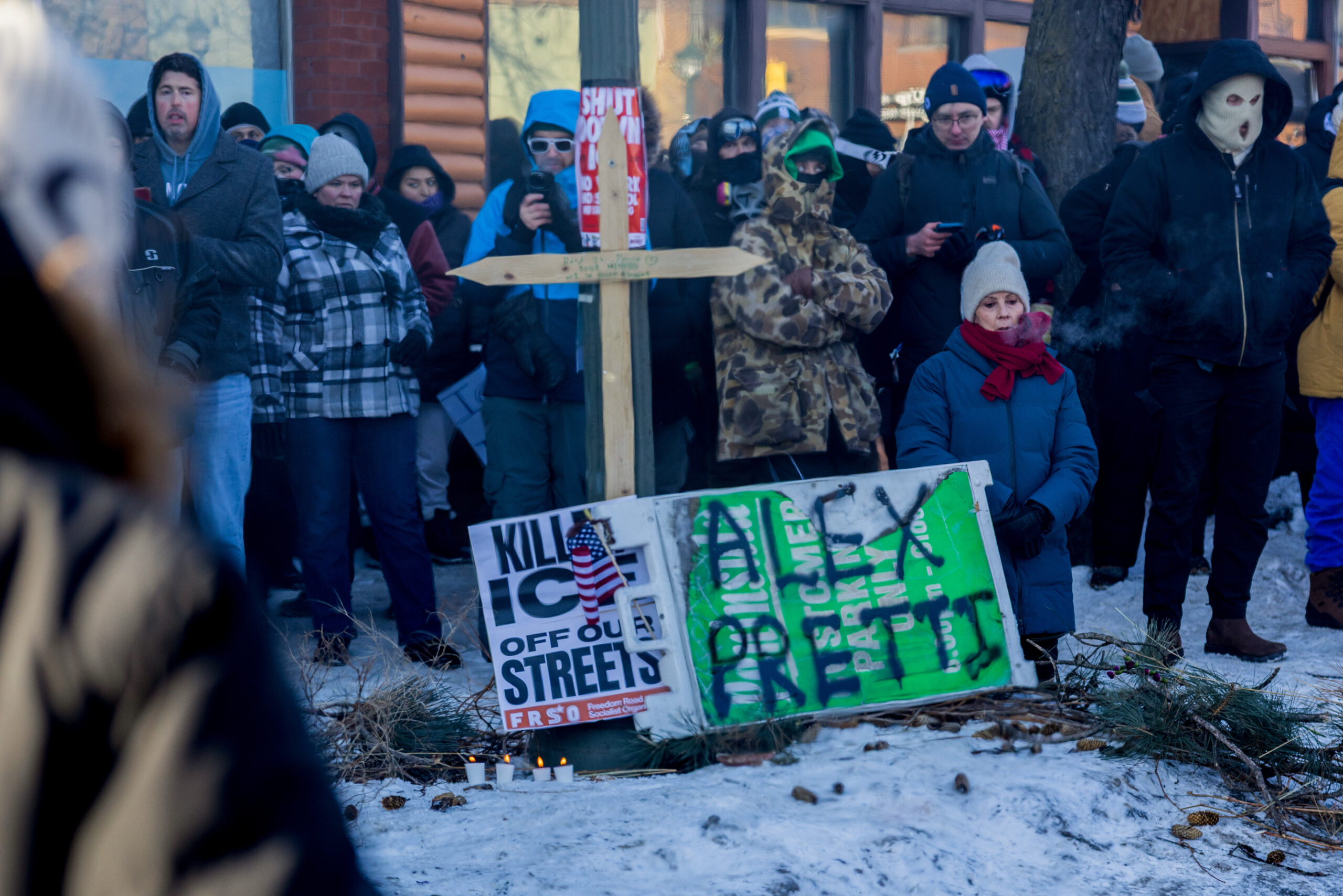
Prominent Republicans and gun rights advocates helped elicit a White House turnabout this week after bristling over the administration’s characterization of Alex Pretti, the second person killed this month by a federal officer in Minneapolis, as responsible for his own death because he lawfully possessed a weapon.
The death produced no clear shifts in U.S. gun politics or policies, even as President Donald Trump shuffles the lieutenants in charge of his militarized immigration crackdown. But important voices in Trump’s coalition have called for a thorough investigation of Pretti’s death while also criticizing inconsistencies in some Republicans’ Second Amendment stances.
If the dynamic persists, it could give Republicans problems as Trump heads into a midterm election year with voters already growing skeptical of his overall immigration approach. The concern is acute enough that Trump’s top spokeswoman sought Monday to reassert his brand as a staunch gun rights supporter.
“The president supports the Second Amendment rights of law-abiding American citizens, absolutely,” White House press secretary Karoline Leavitt told reporters.
Leavitt qualified that “when you are bearing arms and confronted by law enforcement, you are raising … the risk of force being used against you.”
Videos contradict early statements from administration
That still marked a retreat from the administration’s previous messages about the shooting of Pretti. It came the same day the president dispatched border czar Tom Homan to Minnesota, seemingly elevating him over Homeland Security Secretary Kristi Noem and Border Patrol chief Greg Bovino, who had been in charge in Minneapolis.
Within hours of Pretti’s death on Saturday, Bovino suggested Pretti “wanted to … massacre law enforcement,” and Noem said Pretti was “brandishing” a weapon and acted “violently” toward officers.
“I don’t know of any peaceful protester that shows up with a gun and ammunition rather than a sign,” Noem said.
White House deputy chief of staff Stephen Miller, an architect of Trump’s mass deportation effort, went further on X, declaring Pretti “an assassin.”
Bystander videos contradicted each claim, instead showing Pretti holding a cellphone and helping a woman who had been pepper sprayed by a federal officer. Within seconds, Pretti was sprayed, too, and taken to the ground by multiple officers. No video disclosed thus far has shown him unholstering his concealed weapon -– which he had a Minnesota permit to carry. It appeared that one officer took Pretti’s gun and walked away with it just before shots began.
As multiple videos went viral online and on television, Vice President JD Vance reposted Miller’s assessment, while Trump shared an alleged photo of “the gunman’s gun, loaded (with two additional full magazines!).”
On Tuesday, Trump was asked if he agreed with Miller’s comment describing Pretti as an “assassin” and answered “no.” But he added that protesters “can’t have guns” and said he wants the death investigated.
“You can’t walk in with guns, you just can’t,” Trump told reporters on the White House lawn before departing for a trip to Iowa.
The National Rifle Association, which has backed Trump three times, released a statement that began by casting blame on Minnesota Democrats it accused of stoking protests. But the group lashed out after a federal prosecutor in California said on X that, “If you approach law enforcement with a gun, there is a high likelihood they will be legally justified in shooting you.”
That analysis, the NRA said, is “dangerous and wrong.”
FBI Director Kash Patel magnified the blowback Sunday on Fox News’ “Sunday Morning Futures With Maria Bartiromo.” No one, Patel said, can “bring a firearm, loaded, with multiple magazines to any sort of protest that you want. It’s that simple.”
Erich Pratt, vice president of Gun Owners of America, was incredulous.
“I have attended protest rallies while armed, and no one got injured,” he said on CNN.
Conservative officials around the country made the same connection between the First and Second amendments.
“Showing up at a protest is very American. Showing up with a weapon is very American,” state Rep. Jeremy Faison, who leads the GOP caucus in Tennessee, said on X.
Trump’s first-term vice president, Mike Pence, called for “full and transparent investigation of this officer involved shooting.”
A different response from the past
Liberals, conservatives and nonpartisan experts noted how the administration’s response differed from past conservative positions involving protests and weapons.
Multiple Trump supporters were found to have weapons during the Jan. 6, 2021, attack on the U.S. Capitol. Trump issued blanket pardons to all of them.
Republicans were critical in 2020 when Mark and Patricia McCloskey had to pay fines after pointing guns at protesters who marched through their St. Louis neighborhood after the police killing of George Floyd in Minneapolis. And then there’s Kyle Rittenhouse, a counter-protester acquitted after fatally shooting two men and injuring another in Kenosha, Wisconsin, during the post-Floyd protests.
“You remember Kyle Rittenhouse and how he was made a hero on the right,” Trey Gowdy, a Republican former congressman and attorney for Trump during one of his first-term impeachments. “Alex Pretti’s firearm was being lawfully carried. … He never brandished it.”
Adam Winkler, a UCLA law professor who has studied the history of the gun debate, said the fallout “shows how tribal we’ve become.” Republicans spent years talking about the Second Amendment as a means to fight government tyranny, he said.
“The moment someone who’s thought to be from the left, they abandon that principled stance,” Winkler said.
Meanwhile, Democrats who have criticized open and concealed carry laws for years, Winkler added, are not amplifying that position after Pretti’s death.
Uncertain effects in an election year
The blowback against the administration from core Trump supporters comes as Republicans are trying to protect their threadbare majority in the U.S. House and face several competitive Senate races.
Perhaps reflecting the stakes, GOP staff and campaign aides were reticent Monday to talk about the issue at all.
The House Republican campaign chairman, Rep. Richard Hudson of North Carolina, is sponsoring the GOP’s most significant gun legislation of this congressional term, a proposal to make state concealed-carry permits reciprocal across all states.
The bill cleared the House Judiciary Committee last fall. Asked Monday whether Pretti’s death and the Minneapolis protests might affect debate, an aide to Speaker Mike Johnson did not offer any update on the bill’s prospects.
Gun rights advocates have notched many legislative victories in Republican-controlled statehouses in recent decades, from rolling back gun-free zones around schools and churches to expanding gun possession rights in schools, on university campuses and in other public spaces.
William Sack, legal director of the Second Amendment Foundation, said he was surprised and disappointed by the administration’s initial statements following the Pretti shooting. Trump’s vacillating, he said, is “very likely to cost them dearly with the core of a constituency they count on.”
The federal commission seeking personal contact information for faculty and staff at the University of Pennsylvania has accused the school of engaging in an “intensive and relentless public relations campaign” to avoid complying with the subpoena.
The U.S. Equal Employment Opportunity Commission, in a court filing Monday, defended its subpoena seeking potential witnesses and victims of antisemitism at the university and said therequest is not unusual forsuch investigations. The commission is seekingemployees’ names, home addresses, phone numbers, and email addresses to further an investigation it began in 2023 over the school’s treatment of Jewish faculty and other employees regarding antisemitism complaints following Hamas’ attack on Israel.
The commission’s request has spurred a backlash from student and faculty groups, including Penn’s chapter of the American Association of University Professors and the Penn Faculty Alliance to Combat Antisemitism, arguing that the information should not be turned over. Penn has refused to provide the information, prompting the EEOC to file the lawsuit in November.
Penn’s response to the lawsuit, along with filings by other groups,“forecast highly speculative and deeply nefarious outcomes should the EEOC’s subpoena be enforced,” the commission said. “This dark prognosticating has been predictably (and immediately) reported in national, local, and campus outlets.”
The university, in a filing earlier this month, said the commission’s request was “disconcerting” and “unnecessary” and could pose a threat to employees.
“The EEOC insists that Penn produce this information without the consent — and indeed, over the objections — of the employees impacted while entirely disregarding the frightening and well-documented history of governmental entities that undertook efforts to identify and assemble information regarding persons of Jewish ancestry,” the university wrote in its filing.
The commission argued in response that Penn’s assertion of potential danger to employees is “untethered from both the law and the reality of these proceedings.”
“The EEOC seeks only to investigate allegations of serious, widespread antisemitic harassment in Respondent’s workplace,” the commission argued.
The commission, the group said, is only seeking information on faculty and staff “who complained of antisemitic harassment, who belonged to Jewish affinity organizations, or who worked in the Jewish Studies Program.” They could have knowledge of potential problems, the commission said.
Penn can provide the contact information without listing the employees’ organizational affiliations, the commission said.
Penn did not immediately comment on the latest EEOC filing.
Penn has said it provided over 900 pages of materials to the commission and offered to send notices to all employees about the EEOC’s request to hear of antisemitism concerns with the commission’s contact information, so they could reach out themselves if interested in participating.
But the commission called that offer “unworkable” and said it “would undermine the integrity of the agency’s investigation.”
“Messages from EEOC to employees filtered through an employer always risk creating confusion, fear, and mistrust among recipients,” the commission said.
That path could increase the possibility of retaliation against employees for cooperating with the investigation, the commission argued.
The university has challenged the validity of the EEOC’s charge, asserting that the commission has not identified a “single allegedly unlawful employment practice or incident involving employees.” It also “does not refer to any employee complaint the agency has received, any allegation made by or concerning employees, or any specific workplace incident(s) contemplated by the EEOC,” the university said.
While EEOC complaints typically come from those who allege they were aggrieved, this one was launched by EEOC Commissioner Andrea Lucas, now chair of the body, on Dec. 8, 2023, two months after Hamas’ attack on Israel that led to unrest on college campuses, including Penn’s, and charges of antisemitism. It was also just three days after Penn’s then-president, Liz Magill, had testified before a Republican-led congressional committee on the school’s handling of antisemitism complaints; the testimony drew a bipartisan backlash and led to Magill’s resignation days later.
Lucas, according to the EEOC complaint, made the charge in Penn’s case because of “probable reluctance of Jewish faculty and staff to complain of harassing environment due to fear of hostility and potential violence directed against them.“
The commission in its filing Monday said its practice is within itsregulations.
“This charge alleges a time frame, an unlawful employment practice (hostile work environment), the individuals potentially affected by that alleged unlawful employment practice (Jewish employees), and the publicly available sources,” the commission said.
The commission also criticized Penn’s concerns about potential leaks of employees’ contact information through the EEOC, noting the data breach that occurred at Penn last year, exposing employees’ information.
“Its concerns about the security of EEOC’s IT systems are disingenuous,” the commission said.
In the month since Philadelphia Councilmember Jeffery Young introduced a bill banning residential development around the former Hahnemann University Hospital, 824 apartments have been permitted in the area.
The latest zoning permits include 163 units at 1501-11 Race St., which were issued Monday. Brandywine Realty Trust purchased the former Bellet Building office tower in 2021 for $9.7 million.
Brandywine did not immediately respond to a request for comment. It is not clear whether Brandywine is seeking to develop the apartments or to just secure permits to preserve the option for a future buyer.
Last week, zoning permits were issued for 300 units at 300-304 N. Broad St., known as Martinelli Park, the last piece of the former Hahnemann Hospital site that has yet to be sold. The last bid for the site came from the HOW Group, which offered $5.5 million and planned multifamily housing there. But the sale did not go through.
Attempts to reach Hahnemann’s representatives were unsuccessful. It is likely the permits are being secured to preserve the property’s value.
A City Council Rules Committee hearing on Young’s bill is scheduled for Feb. 3.
The rush for permits began on Dec. 24, two weeks after Young introduced his bill, when the Dwight City Group received a zoning permit for 222-48 N. Broad St. to builda 361-unit apartment building.
When “an overlay is placed like this … even though we have our zoning permit already from one of the buildings, the message that it sends is that this area is closed for business,” Judah Angster, CEO of Dwight City Group, said at a January meeting of the Philadelphia Planning Commission.
He said the project now includes 90,000 square feet for commercial use, which would be dedicated to local small businesses.
Why does Young want to ban housing?
Young’s bill would create a new zoning overlay covering the area “bounded by the north side of Race Street, the east side of North 16th Street, the south side of Callowhill Street, and the west side of North Broad Street.”
This covers the former Hahnemann campus, which included seven medical buildings, a parking garage, and some surface lots. The hospital dated to the 19th century and had been operating from this location for 90 years before its bankruptcy.
A handful of other buildings are in the proposed overlay as well, including a PHA apartment building and a homeless shelter.
What once was the Hahnemann campus sprawls over nearly six acres, centered on Broad Street along the Vine Street Expressway, comprising seven medical buildings, a parking garage, and surface lots.
Young said that he wanted to ban new homes from the site to preserve job opportunities in the city, hopefully prompting the reuse of the site for office, medical, or educational use.
At the Planning Commission meeting, the bill was largely discussed as Young’s effort to force developers to meet with him over their plans. The Hahnemann site is zoned with Philadelphia’s most flexible land use rules, which means that under normal circumstances, residential conversions would not require neighborhood meetings or political approvals.
“I look forward to continuing dialogue that brings community stakeholders to the table for this important section of Center City,” Young said in an email Tuesday.
Dwight Group has said that it is having productive conversations with Young.
The legislation is considered by some legal experts as a blatant use of spot zoning, when a change in land use rules is targeted to a limited geography. Such legislation is often introduced to help or hurt a particular project.
“In my time as a zoning lawyer for 27 years, I don’t think I’ve seen a greater example of illegal spot zoning,” Matt McClure, head of law firm Ballard Spahr’s land use practice and a lawyer for developer Dwight City, said the January meeting. “It is targeted at a particular property, targeted around a certain transaction that was talked about. It’s just illegal.”
Hahnemann University Hospital has been closed for more than six years, and attempts to preserve medical and educational uses in its former buildings so far have faltered. Most are still vacant.
Is this actually an honest-to-goodness turning point in the war for the soul of America? Monday night, the deny-everything-admit-nothing Trump regime surprised observers by revealing that violence-provoking Border Patrol commander Greg Bovino has been sent home from Minneapolis and may even be retiring. That’s a giant win for the power of everyday people resisting, but turning around the battleship of tyranny will still take much more work.
Corporate America may pay a steep price for its cowardly ICE neutrality
Protesters gather Friday at Target’s corporate headquarters in Minneapolis.
One of the many remarkable and lasting ideas the Rev. Dr. Martin Luther King Jr. placed into the national conversation was the concept of something he called “negative peace.”
Although the phrase began appearing in the writings of the civil rights leader in the late 1950s, King made the idea famous in his 1963 “Letter From Birmingham Jail,” where he was locked up for fighting segregation in Alabama’s largest city. He was annoyed by a letter from eight local white clergymen, titled a “Call for Unity,” that begged King to end a civil disobedience crusade for racial integration and seek progress through negotiations and the courts.
When an aide smuggled the newspaper into King’s cell, he began furiously scribbling his response in the margins of the ad before writing more on any scrap of paper he could find. His key passage argues that the white moderate was a greater threat to Black freedom than the KKK, because he was someone “more devoted to ‘order’ than to justice; who prefers a negative peace which is the absence of tension to a positive peace which is the presence of justice,” and who wants African Americans to wait for a “more convenient season.”
Flash-forward 63 years, and the grand pooh-bahs of U.S. capitalism have learned nothing from this. On Sunday, 60 major corporations based in Minnesota — feeling caught in the crossfire of the federal immigration raids tearing apart Greater Minneapolis and the growing resistance movement — issued a cowardly and pathetic call for a negative peace to reduce the tensions.
The open letter that was released through the Minnesota Chamber of Commerce was signed by the CEOs or equivalents of almost every major Gopher State brand that you could think of — including Target, 3M, General Mills, Hormel, UnitedHealth (yes, that UnitedHealth), and all five major sports franchises. Some of these firms are beginning to see real economic fallout from the U.S. Immigration and Customs Enforcement raids and protest activities, which have kept some frightened Black and brown workers at home and triggered a large general strike last Friday.
The letter reads little differently from the Birmingham ministers’ “Call for Unity.”
“With yesterday’s tragic news” — a vague, bloodless reference to the 10 shots fired by federal officers into a 37-year-old intensive care nurse named Alex Pretti — “we are calling for an immediate deescalation of tensions and for state, local and federal officials to work together to find real solutions,” the letter states. It notes that Minnesota business leaders have been in touch with Gov. Tim Walz, the Donald Trump White House, and others in pleading for what it hopes would be a solution to the state’s crisis.
Pretti is never mentioned in the letter. Neither is Renee Nicole Good, the 37-year-old mother of three who was gunned down behind the wheel of her family SUV by an ICE agent as she attempted to drive away from a confrontation. In fact, ICE is never mentioned, nor are the federal agency’s most outrageous tactics, such as the seizure of a 5-year-old boy as “bait” to detain him and his father, or dragging a barely dressed Hmong refugee who is a U.S. citizen out of his home in frigid weather.
The entire letter is remarkable not for what it says — since it says very little beyond praying this whole mess somehow goes away so they can go back to making money without thinking about such dreadful things — than for what it doesn’t say.
There is no condemnation of the murders of two U.S. citizens who did nothing beyond legally monitoring the federal officers and their activities while on public streets. There is no condemnation of the ICE tactics in seizing hardworking migrants with no criminal records who are the backbone of the Minnesota community. There is nothing about what MLK would have called “positive peace” — a desire for real justice.
That’s probably because positive peace requires bold choices and displays of real courage — qualities that modern corporate America seems to have misplaced in a giant warehouse somewhere.
Exhibit A would have to be Target, the large national retailer that, with its hundreds of stores and its name slapped on the NBA’s Timberwolves’ arena, is now to many Americans the corporate face of Minnesota. Under pressure from demonstrators, including more than 100 clergy who protested outside Target’s Minneapolis headquarters on Friday, the retailer still said nothing — before the tepid group letter — about the ongoing ICE raids, or why agents have been allowed to stage operations in its parking lots and even inside stores.
There’s a bleak history here. In 2020, Minnesota became the epicenter of the fight for racial justice when the Minneapolis police murder of George Floyd was captured on video. That time, the state’s CEOs not only expressed moral outrage but pledged to spend heavily on diversity initiatives. Five years later, the local news site Racket reported many of these firms had backtracked, and that barely a third of the pledged $550 million had been spent.
This time, the business leaders just want the “tension” to disappear. That’s not so easy. Just ask Target. Its early 2025 move to end its diversity initiatives as Trump took office sparked calls from Black leaders for a boycott that has cut into store traffic and lowered Target’s stock price. It seems that moral surrender actually does have a price.
Also on Sunday, the team chaplain for the Timberwolves — ironically, one of the teams that signed onto the corporate letter — issued a personal statement with loud echoes of the “Letter from Birmingham Jail,” calling out any churches that had prayed that morning for peace and unity but not for justice.
“Peace is what the powerful ask for when they don’t want to be interrupted,” Matt Moberg wrote in a short piece that went viral on social media, adding, “Unity that refuses to name violence is just loyalty to the ones holding the weapons.”
This wouldn’t be the first time corporate America misread the room. Sunday’s statement suggested a continued deer-in-the-headlights reaction from the shock of Trump’s return to office — even as the CEOs ignore not just the power of the Target boycotts but the recent success of economic justice campaigns against firms from Disney to Avelo Airlines, not to mention the solidarity that drove the Minneapolis general strike.
Already, there is growing talk of a national general strike or expanded boycotts by millions of citizens who are also consumers, and who are both furious over the Good and Pretti murders and now flabbergasted by the corporate cone of silence. America’s business leaders don’t understand that cowardice has a steep cost attached.
Yo, do this!
There’s no better writer about the long fight for social justice in America than historian Heather Ann Thompson. Her searing 2016 book about the 1971 Attica prison uprising — Blood in the Water — won a well-deserved Pulitzer Prize, and locals were thrilled when it was reported that the next book from Thompson, who taught for a while at Temple, would be on the 1985 MOVE bombing. Instead, she has taken a detour. Her Fear and Fury: The Reagan Eighties, the Bernie Goetz Shootings, and the Rebirth of White Rage is out today. I just downloaded the audiobook, and cannot wait to listen.
It’s Academy Award season, and so — hopelessly snowed in on Sunday — I took a family break from football (!) to rent a movie … from 2009. Given my obsession with 1960s rock and roll radio, it’s weird that I’d never seen Pirate Radio, a fictional homage to the U.K.’s government-defying offshore radio stations of the British Invasion era that stars the late Philip Seymour Hoffman. The plot can be muddled at times, but it’s maybe the best movie soundtrack ever!
Ask me anything
Question: Why do Dem Leaders want to save ICE, when nobody really else does? What’s the motivation? — @keynesaddiction.bsky.social via Bluesky
Answer: I wonder this, too. Both ICE and the current crew at U.S. Customs and Border Protection have been simmering for far too long in a toxic, unredeemable culture that cannot be reformed. What’s more, the shocking abuses on display in Minnesota and two killings have now convinced a plurality of U.S. voters that ICE should be abolished. Still, I can understand the Democrats’ bind, since at the moment the party has no other political leverage beyond the ability to block most Senate legislation with the filibuster. It might be best to push hard for as much as can be done in 2026, while running in the midterms on a platform of abolishing ICE when they gain power on Capitol Hill.
What you’re saying about …
LOL — remember that whole Greenland thing? It feels like that was five years ago, but some of you had some good responses on dealing with Trump’s bluster about an American takeover, even if things have temporarily cooled down. Tom Desmond said the Europeans “need to quit pretending that they can ‘manage’ him through flattery and soft words. Instead, they need to apply threats — i.e., whatever tariffs he imposes on Europe over Greenland they will return against the U.S. three-fold.” Jo Parker said Congress needs to reassert its powers over tariffs and declaring war, but “With the spineless [Dave] McCormick and [John] Fetterman representing us, I’m not sanguine that such actions will take place, however.”
📮 This week’s question: Things are coming to a head in Congress over funding for ICE and the U.S. Department of Homeland Security. Should Democrats make a deal for ICE reforms, such as unmasking and requiring arrest warrants, or must they push for bigger concessions, or even abolishing ICE? Please email me your answer and put the exact phrase “ICE funding” in the subject line.
Backstory on the day (a) Fetterman spoke out
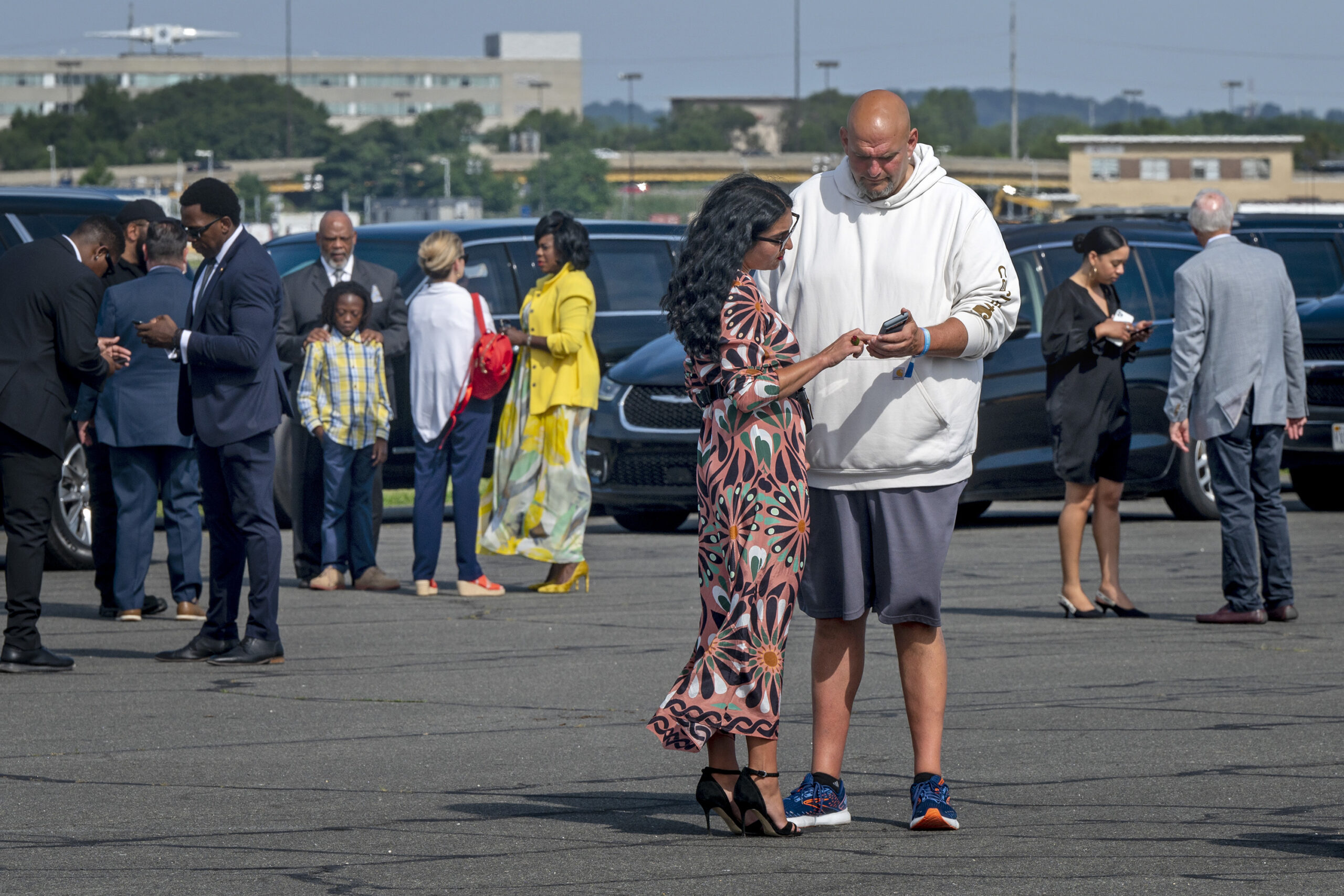
U.S. Sen. John Fetterman and his wife, Gisele Barreto Fetterman, await the arrival of President Joe Biden at Philadelphia International Airport in July 2024.
I must confess that keeping up with the downward spiral of Pennsylvania’s Democratic Sen. John Fetterman since he took office in 2023 can get tiresome. At first, Fetterman’s rightward tack seemed largely a function of his zealous support for Israel, which caused him to wave off allegations of war crimes by Benjamin Netanyahu’s right-wing government. Soon, others pointed to his health woes — hospitalizations for a stroke and depression, among other things — as he endorsed more and more Trump-flavored ideas.
Amid mounting outrage over Trump’s aggressive immigration raids, Fetterman made some comments that had his growing legion of critics wonder if the senator’s real heart issue was whether he had one. “ICE performs an important job for our country,” the Democrat posted on X last July, adding that any calls to abolish the agency were “inappropriate and outrageous.” Even after the Jan. 7 ICE killing of Renee Nicole Good in Minneapolis, Fetterman’s middle-of-the-road stance was this: “Secure the border. Deport all the criminals. Stop targeting the hardworking migrants in our nation.” In the immediate aftermath of Saturday’s killing of Alex Pretti by federal agents, even Pennsylvania’s GOP Sen. Dave McCormick had called for a congressional investigation before Fetterman said anything.
On Sunday night, though, Fetterman issued a heartfelt and moving statement. Well, a Fetterman did.
“For more than a decade, I lived undocumented in the US,” the senator’s wife, Gisele Barreto Fetterman, a native of Brazil, posted on X. “Every day carried the same uncertainty and fear lived in my body — a tight chest, shallow breaths, racing heart. What I thought was my private, chronic dread has now become a shared national wound. This now-daily violence is not ‘law and order.’ It is terror inflicted on people who contribute, love, and build their lives here. It’s devastatingly cruel and unAmerican.” Her post ended with an emoji of a broken heart.
Sen. Fetterman finally issued a statement nearly a day later. He called for “an immediate end” to the ICE operations in Minnesota, adding, “It has become an ungovernable and dangerous urban theatre for civilians and law enforcement that is incompatible with the American spirit.” But Fetterman still disappointed critics of Trump’s immigration policy, insisting that while he wants ICE reforms, he still supports the embattled agency, and won’t join other Democrats in shutting down the federal government if those reforms aren’t happening.
Pennsylvanians thought they were getting a progressive voice and a moral leader when they elected Fetterman in 2022. It feels now like we elected the wrong Fetterman.
What I wrote on this date in 2010
It was only 16 years ago, but at the dawn of the 2010s, there was still a robust conversation about how to save the traditional journalism outlets— especially newspapers — that had flourished in the 20th century. On Jan. 27, 2010, I criticized an idea coming from Apple that a new kind of $1,000 iPad, nicknamed “the Jesus tablet,” would fix everything. I wrote: “To survive, we need to change our whole worldview — finding ways to encourage more dialogue with readers and more community involvement so that local readers feel they have a stake in this thing. And we also need to do a better job at the thing we claim to be already good at — real journalism that makes a difference.”
On the national beat, there’s no bigger story than the fallout from the inhumanity of the Trump regime’s mass deportation policies. In my Sunday column, I looked at the other way people are dying in ICE’s reign of terror: inside the growing network of squalid and overcrowded jails and detention camps. The death rate in these facilities so far in 2026 is already 10 times higher than it was in the last year of the Biden administration. Over the weekend, I quickly shifted gears and turned a planned column about faith leaders in Minneapolis and an America yearning for morality into a lament over the shocking ICE murder of a 37-year-old observer, Alex Pretti. The contrast between good and evil in America has never been more stark.
The many tentacles of the mass deportation story stretch well beyond Minneapolis and other hot spots like Maine, including stepped-up ICE enforcement activity here in Philadelphia since Trump returned to office. The Inquirer’s veteran immigration reporter, Jeff Gammage, has drilled deeply into the human stories on the front lines here. Written with colleague Michelle Myers, this week’s installment was both poignant and infuriating. A local family of four is returning to Bolivia after the dad — the prime caregiver for his 5-year-old son, being treated at Children’s Hospital of Philadelphia for brain cancer — has stopped fighting his deportation after five months in ICE detention. As his family prepares to leave, the child’s future in a South American country with substandard medical care is highly uncertain. Old-school beat reporting like this is what local community journalism is all about. You support this vital work when you subscribe to The Inquirer.
By submitting your written, visual, and/or audio contributions, you agree to The Inquirer’s Terms of Use, including the grant of rights in Section 10.
LOS ANGELES — The Trump administration has not shied away from sharing AI-generated imagery online, embracing cartoonlike visuals and memes and promoting them on official White House channels.
But an edited — and realistic — image of civil rights attorney Nekima Levy Armstrong in tears after being arrested is raising new alarms about how the administration is blurring the lines between what is real and what is fake.
Homeland Security Secretary Kristi Noem’s account posted the original image from Levy Armstrong’s arrest before the official White House account posted an altered image that showed her crying. The doctored picture is part of a deluge of AI-edited imagery that has been shared across the political spectrum since the fatal shootings of Renee Good and Alex Pretti by U.S. Border Patrol officers in Minneapolis
However, the White House’s use of artificial intelligence has troubled misinformation experts who fear the spreading of AI-generated or edited images erodes public perception of the truth and sows distrust.
In response to criticism of the edited image of Levy Armstrong, White House officials doubled down on the post, with deputy communications director Kaelan Dorr writing on X that the “memes will continue.” White House Deputy Press Secretary Abigail Jackson also shared a post mocking the criticism.
David Rand, a professor of information science at Cornell University, says calling the altered image a meme “certainly seems like an attempt to cast it as a joke or humorous post, like their prior cartoons. This presumably aims to shield them from criticism for posting manipulated media.” He said the purpose of sharing the altered arrest image seems “much more ambiguous” than the cartoonish images the administration has shared in the past.
Memes have always carried layered messages that are funny or informative to people who understand them, but indecipherable to outsiders. AI-enhanced or edited imagery is just the latest tool the White House uses to engage the segment of Trump’s base that spends a lot of time online, said Zach Henry, a Republican communications consultant who founded Total Virality, an influencer marketing firm.
“People who are terminally online will see it and instantly recognize it as a meme,” he said. “Your grandparents may see it and not understand the meme, but because it looks real, it leads them to ask their kids or grandkids about it.”
All the better if it prompts a fierce reaction, which helps it go viral, said Henry, who generally praised the work of the White House’s social media team.
The creation and dissemination of altered images, especially when they are shared by credible sources, “crystallizes an idea of what’s happening, instead of showing what is actually happening,” said Michael A. Spikes, a professor at Northwestern University and news media literacy researcher.
“The government should be a place where you can trust the information, where you can say it’s accurate, because they have a responsibility to do so,” he said. ”By sharing this kind of content, and creating this kind of content … it is eroding the trust — even though I’m always kind of skeptical of the term trust — but the trust we should have in our federal government to give us accurate, verified information. It’s a real loss, and it really worries me a lot.”
Spikes said he already sees the “institutional crises” around distrust in news organizations and higher education, and feels this behavior from official channels inflames those issues.
Ramesh Srinivasan, a professor at UCLA and the host of the Utopias podcast, said many people are now questioning where they can turn to for “trustable information.” “AI systems are only going to exacerbate, amplify and accelerate these problems of an absence of trust, an absence of even understanding what might be considered reality or truth or evidence,” he said.
Srinivasan said he feels the White House and other officials sharing AI-generated content not only invites everyday people to continue to post similar content but also grants permission to others who are in positions of credibility and power, like policymakers, to share unlabeled synthetic content. He added that given that social media platforms tend to “algorithmically privilege” extreme and conspiratorial content — which AI generation tools can create with ease — “we’ve got a big, big set of challenges on our hands.”
An influx of AI-generated videos related to Immigration and Customs Enforcement action, protests and interactions with citizens has already been proliferating on social media. After Renee Good was shot by an ICE officer while she was in her car, several AI-generated videos began circulating of women driving away from ICE officers who told them to stop. There are also many fabricated videos circulating of immigration raids and of people confronting ICE officers, often yelling at them or throwing food in their faces.
Jeremy Carrasco, a content creator who specializes in media literacy and debunking viral AI videos, said the bulk of these videos are likely coming from accounts that are “engagement farming,” or looking to capitalize on clicks by generating content with popular keywords and search terms like ICE. But he also said the videos are getting views from people who oppose ICE and DHS and could be watching them as “fan fiction,” or engaging in “wishful thinking,” hoping that they’re seeing real pushback against the organizations and their officers.
Still, Carrasco also believes that most viewers can’t tell if what they’re watching is fake, and questions whether they would know “what’s real or not when it actually matters, like when the stakes are a lot higher.”
Even when there are blatant signs of AI generation, like street signs with gibberish on them or other obvious errors, only in the “best-case scenario” would a viewer be savvy enough or be paying enough attention to register the use of AI.
This issue is, of course, not limited to news surrounding immigration enforcement and protests. Fabricated and misrepresented images following the capture of deposed Venezuelan leader Nicolás Maduro exploded online earlier this month. Experts, including Carrasco, think the spread of AI-generated political content will only become more commonplace.
Carrasco believes that the widespread implementation of a watermarking system that embeds information about the origin of a piece of media into its metadata layer could be a step toward a solution. The Coalition for Content Provenance and Authenticity has developed such a system, but Carrasco doesn’t think that will become extensively adopted for at least another year.
“It’s going to be an issue forever now,” he said. I don’t think people understand how bad this is.”
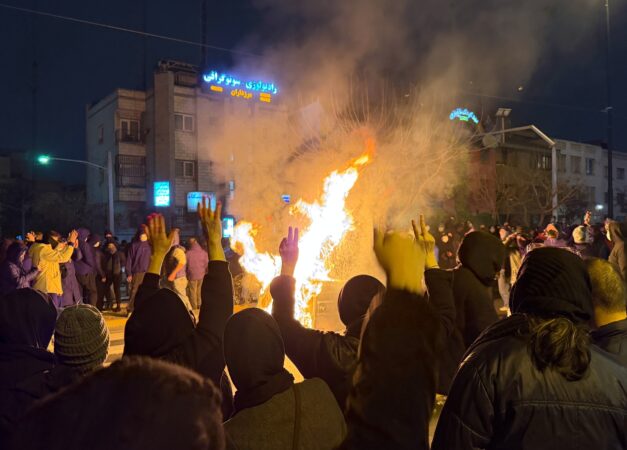
DUBAI, United Arab Emirates — Iran’s bloody crackdown on nationwide protests has killed at least 6,159 people while many others still are feared dead, activists said Tuesday, as a U.S. aircraft carrier group arrived in the Middle East to lead any American military response to the crisis. Iran’s currency, the rial, meanwhile fell to a record low of 1.5 million to $1.
The arrival of the USS Abraham Lincoln aircraft carrier and guided missile destroyers accompanying it provide the U.S. the ability to strike Iran, particularly as Gulf Arab states have signaled they want to stay out of any attack despite hosting American military personnel.
Two Iranian-backed militias in the Mideast have signaled their willingness to launch new attacks, likely trying to back Iran after U.S. President Donald Trump threatened military action over the killing of peaceful protesters or Tehran launching mass executions in the wake of the demonstrations.
Iran has repeatedly threatened to drag the entire Mideast into a war, though its air defenses and military are still reeling after the June war launched by Israel against the country. But the pressure on its economy may spark new unrest as everyday goods slowly go out of reach of its people — particularly if Trump chooses to attack.
Ambrey, a private security firm, issued a notice Tuesday saying it assessed that the U.S. “has positioned sufficient military capability to conduct kinetic operations against Iran while maintaining the ability to defend itself and regional allies from reciprocal action.”
“Supporting or avenging Iranian protesters in punitive strikes is assessed as insufficient justification for sustained military conflict,” Ambrey wrote. “However, alternative objectives, such as the degradation of Iranian military capabilities, may increase the likelihood of limited U.S. intervention.”
Activists offer new death toll
Tuesday’s new figures came from the U.S.-based Human Rights Activists News Agency, which has been accurate in multiple rounds of unrest in Iran. The group verifies each death with a network of activists on the ground in Iran.
It said the 6,159 dead included at least 5,804 protesters, 214 government-affiliated forces, 92 children and 49 civilians who weren’t demonstrating. The crackdown has seen over 41,800 arrests, it added.
The Associated Press has been unable to independently assess the death toll given authorities cutting off the internet and disrupting calls into the Islamic Republic.
Iran’s government has put the death toll at a far lower 3,117, saying 2,427 were civilians and security forces, and labeled the rest “terrorists.” In the past, Iran’s theocracy has undercounted or not reported fatalities from unrest.
That death toll exceeds that of any other round of protest or unrest there in decades, and recalls the chaos surrounding Iran’s 1979 Islamic Revolution.
The protests in Iran began on Dec. 28, sparked by the fall of the Iranian currency, the rial, and quickly spread across the country. They were met by a violent crackdown by Iran’s theocracy, the scale of which is only starting to become clear as the country has faced more than two weeks of internet blackout — the most comprehensive in its history.
Iran’s U.N. ambassador told a U.N. Security Council meeting late Monday that Trump’s repeated threats to use military force against the country “are neither ambiguous nor misinterpreted.” Amir Saeid Iravani also repeated allegations that the U.S. leader incited violence by “armed terrorist groups” supported by the United States and Israel, but gave no evidence to support his claims.
Iranian state media has tried to accuse forces abroad for the protests as the theocracy remains broadly unable to address the country’s ailing economy, which is still squeezed by international sanctions, particularly over its nuclear program.
On Tuesday, exchange shops offered the record-low rial-to-dollar rate in Tehran. Traders declined to speak publicly on the matter, with several responding angrily to the situation.
Already, Iran has vastly limited its subsidized currency rates to cut down on corruption. It also has offered the equivalent of $7 a month to most people in the country to cover rising costs. However, Iran’s people have seen the rial fall from a rate of 32,000 to $1 just a decade ago — which has devoured the value of their savings.
Some Iranian-backed militias suggest willingness to fight
Iran projected its power across the Mideast through the “Axis of Resistance,” a network of proxy militant groups in Gaza, Lebanon, Yemen, Syria and Iraq, and other places. It was also seen as a defensive buffer, intended to keep conflict away from Iranian borders. But it has collapsed after Israel targeted Hamas, Hezbollah in Lebanon and others during the Gaza war. Meanwhile, rebels in 2024 overthrew Syria’s Bashar Assad after a yearslong, bloody war in which Iran backed his rule.
Yemen’s Houthi rebels, backed by Iran, have repeatedly warned they could resume fire if needed on shipping in the Red Sea, releasing old footage of a previous attack Monday. Ahmad “Abu Hussein” al-Hamidawi, the leader of Iraq’s Kataib Hezbollah militia, warned “the enemies that the war on the (Islamic) Republic will not be a picnic; rather, you will taste the bitterest forms of death, and nothing will remain of you in our region.”
The Lebanese militant group Hezbollah, one of Iran’s staunchest allies, refused to say how it planned to react in the case of a possible attack.
“During the past two months, several parties have asked me a clear and frank question: If Israel and America go to war against Iran, will Hezbollah intervene or not?” Hezbollah leader Sheikh Naim Kassem said in a video address.
He said the group is preparing for “possible aggression and is determined to defend” against it. But as to how it would act, he said, “these details will be determined by the battle and we will determine them according to the interests that are present.”
ORLANDO, Fla. — President Donald Trump’s crackdown on immigration contributed to a year-to-year drop in the nation’s growth rate as the U.S. population reached nearly 342 million people in 2025, according to population estimates released Tuesday by the U.S. Census Bureau.
The 0.5% growth rate for 2025 was a sharp drop from 2024’s almost 1% growth rate, which was the highest in two decades and was fueled by immigration. The 2024 estimates put the U.S. population at 340 million people.
Immigration increased by almost 1.3 million people last year, compared with 2024’s increase of almost 2.8 million people. If trends continue, the annual gain from immigrants by mid-2026 will drop to only 321,000 people, according to the Census Bureau, whose estimates do not distinguish between legal and illegal immigration.
In the past 125 years, the lowest growth rate was in 2021, during the height of the coronavirus pandemic, when the U.S. population grew by just 0.16%, or 522,000 people and immigration increased by just 376,000 people because of travel restrictions into the U.S. Before that, the lowest growth rate was just under 0.5% in 1919 at the height of the Spanish flu.
Births outnumbered deaths last year by 519,000 people. While higher than the pandemic-era low at the beginning of the decade, the natural increase was dramatically smaller than in the 2000s, when it ranged between 1.6 million and 1.9 million people.
Lower immigration stunts growth in many states
The immigration drop dented growth in several states that traditionally have been immigrant magnets.
California had a net population loss of 9,500 people in 2025, a stark change from the previous year, when it gained 232,000 residents, even though roughly the same number of Californians already living in the state moved out in both years. The difference was immigration since the number of net immigrants who moved into the state dropped from 361,000 people in 2024 to 109,000 in 2025.
Florida had year-to-year drops in both immigrants and people moving in from other states. The Sunshine State, which has become more expensive in recent years from surging property values and higher home insurance costs, had only 22,000 domestic migrants in 2025, compared with 64,000 people in 2024, and the net number of immigrants dropped from more than 411,000 people to 178,000 people.
New York added only 1,008 people in 2025, mostly because the state’s net migration from immigrants dropped from 207,000 people to 95,600 people.
South Carolina, Idaho, and North Carolina had the highest year-over-year growth rates, ranging from 1.3% to 1.5%. Texas, Florida, and North Carolina added the most people in pure numbers. California, Hawaii, New Mexico, Vermont, and West Virginia had population declines.
The South, which has been the powerhouse of growth in the 2020s, continued to add more people than any other region, but the numbers dropped from 1.7 million people in 2024 to 1.1 million in 2025.
“Many of these states are going to show even smaller growth when we get to next year,” Brookings demographer William Frey said Tuesday.
The effects of Trump’s immigration crackdown
Tuesday’s data release comes as researchers have been trying to determine the effects of the second Trump administration’s immigration crackdown after the Republican president returned to the White House in January 2025. Trump made a surge of migrants at the southern border a central issue in his winning 2024 presidential campaign.
The numbers made public Tuesday reflect change from July 2024 to July 2025, covering the end of President Joe Biden’s Democratic administration and the first half of Trump’s first year back in office.
The figures capture a period that reflects the beginning of enforcement surges in Los Angeles and Portland, Ore., but do not capture the impact on immigration after the Trump administration’s crackdowns began in Chicago; New Orleans; Memphis, Tennessee; and Minneapolis, Minn..
The 2025 numbers were a jarring divergence from 2024, when net international migration accounted for 84% of the nation’s 3.3 million-person increase from the year before. The jump in immigration two years ago was partly because of a new method of counting that added people who were admitted for humanitarian reasons.
“They do reflect recent trends we have seen in out-migration, where the numbers of people coming in is down and the numbers going out is up,” Eric Jensen, a senior research scientist at the Census Bureau, said last week.
How the population estimates are calculated
Unlike the once-a-decade census, which determines how many congressional seats and Electoral College votes each state gets, as well as the distribution of $2.8 trillion in annual government funding, the population estimates are calculated from government records and internal Census Bureau data.
The release of the 2025 population estimates was delayed by the federal government shutdown last fall and comes at a challenging time for the Census Bureau and other U.S. statistical agencies. The bureau, which is the largest statistical agency in the U.S., lost about 15% of its workforce last year due to buyouts and layoffs that were part of cost-cutting efforts by the White House and its Department of Government Efficiency.
Other recent actions by the Trump administration, such as the firing of Erika McEntarfer as Bureau of Labor Statistics commissioner, have raised concerns about political meddling at U.S. statistical agencies. But Frey said the bureau’s staffers appear to have been “doing this work as usual without interference.”
“So I have no reason to doubt the numbers that come out,” Frey said.
LONDON — Paul Thomas Anderson’s politically charged action thriller “One Battle After Another” leads the race for the British Academy Film Awards, securing 14 nominations Tuesday including acting nods for five of its cast.
Ryan Coogler’s blues-steeped vampire epic “Sinners” is close behind with 13 nominations for Britain’s equivalent of the Oscars, while Chloé Zhao’s Shakespearean family tragedy “Hamnet” and Josh Safdie’s ping-pong odyssey “Marty Supreme” have 11 apiece.
Guillermo del Toro’s reimagining of “Frankenstein” and Norwegian family drama ”Sentimental Value” each got eight nominations, rounding out a six-pack of leading contenders for both the British and Hollywood Academy Awards.
The best film nominees are “One Battle After Another,” “Hamnet,” “Marty Supreme,” “Sinners” and “Sentimental Value.”
BAFTA Chief Executive Jane Millichip said the nominations recognized “films like ‘One Battle After Another,’ ‘Sinners,’ tackling really big societal issues — the moral ambiguity of activism, Black identity,” alongside films exploring “the most intimate side of family relationships.”
“They’re all doing it in quite different ways: Strong flavors, really bold storytelling,” she said.
Best leading actor contenders are Robert Aramayo for playing a man with Tourette’s syndrome in biographical drama “I Swear,” Timothée Chalamet for “Marty Supreme,” Leonardo DiCaprio for “One Battle After Another,” Ethan Hawke for Broadway biopic “Blue Moon,” Michael B. Jordan for “Sinners” and Jesse Plemons for “Bugonia.”
The leading actress category includes awards-season favorite Jessie Buckley for her performance as Agnes Hathaway, wife of William Shakespeare, in “Hamnet.” She’s up against Rose Byrne for “If I Had Legs I’d Kick You,” Kate Hudson for “Song Sung Blue,” Chase Infiniti for “One Battle After Another,” Renate Reinsve for “Sentimental Value” and Emma Stone for dystopian tragicomedy “Bugonia.”
“One Battle” actors Teyana Taylor, Benicio del Toro and Sean Penn are all nominated for supporting performances.
The Associated Press was recognized in the best documentary category with a nomination for Mstyslav Chernov’s harrowing Ukraine war portrait “2000 Meters to Andriivka,” co-produced by the AP and PBS Frontline.
The winners will be announced at a Feb. 22 ceremony in London hosted by actor Alan Cumming. The U.K. prizes — officially called the EE BAFTA Film Awards — often provide clues about who will triumph at Hollywood’s Academy Awards, held this year on March 15.
This year, unusually, Oscar nominations were announced first, with “Sinners” securing a record 16 nominations, followed by 13 for “One Battle After Another.”
The British academy has recognized several performers overlooked by the Oscars, including supporting actor nominees Paul Mescal for “Hamnet” and Odessa A’zion for “Marty Supreme.”
The BAFTAs also have a distinctly British accent, with a separate category of best British film. Its 10 nominees include “The Ballad of Wallis Island,” “Pillion,” “I Swear” and “Bridget Jones: Mad About the Boy.”
Most BAFTA winners are chosen by 8,500 members of the U.K. academy of industry professionals, with one – the Rising Star Award – selected by public vote from a shortlist of nominees. This year’s rising star contenders are Infiniti, Aramayo, “Sinners” star Miles Caton and British actors Archie Madekwe and Posy Sterling.
Like other major movie awards, Britain’s film academy has introduced changes in recent years to increase diversity. In 2020, no women were nominated as best director for the seventh year running, and all 20 nominees in the lead and supporting performer categories were white. The voting process was changed to add a longlist round before the final nominees are selected.
Zhao is the only female nominee in the best director category, alongside Anderson, Safdie, Cooger, Yorgos Lanthimos for “Bugonia” and Joachim Trier for “Sentimental Value.” Across all categories including documentaries and shorts, 25% of the directing nominees are women.
Milton Williams, Jason Peters, and more Philly connections to Super Bowl LX
While the Eagles’ playoff run has long concluded, Philadelphians may notice a number of familiar faces on each team competing on Super Bowl Sunday.
From former Eagles players and coaches to Philly-area natives, both teams feature local connections. Here are the names and faces that may ring a bell when they pop up on TV …
New England Patriots wide receiver Mack Hollins (13) celebrates with teammates after scoring a touchdown against the Carolina Panthers during the second half of an NFL football game, Sunday, Sept. 28, 2025, in Foxborough, Mass. (AP Photo/Steven Senne)
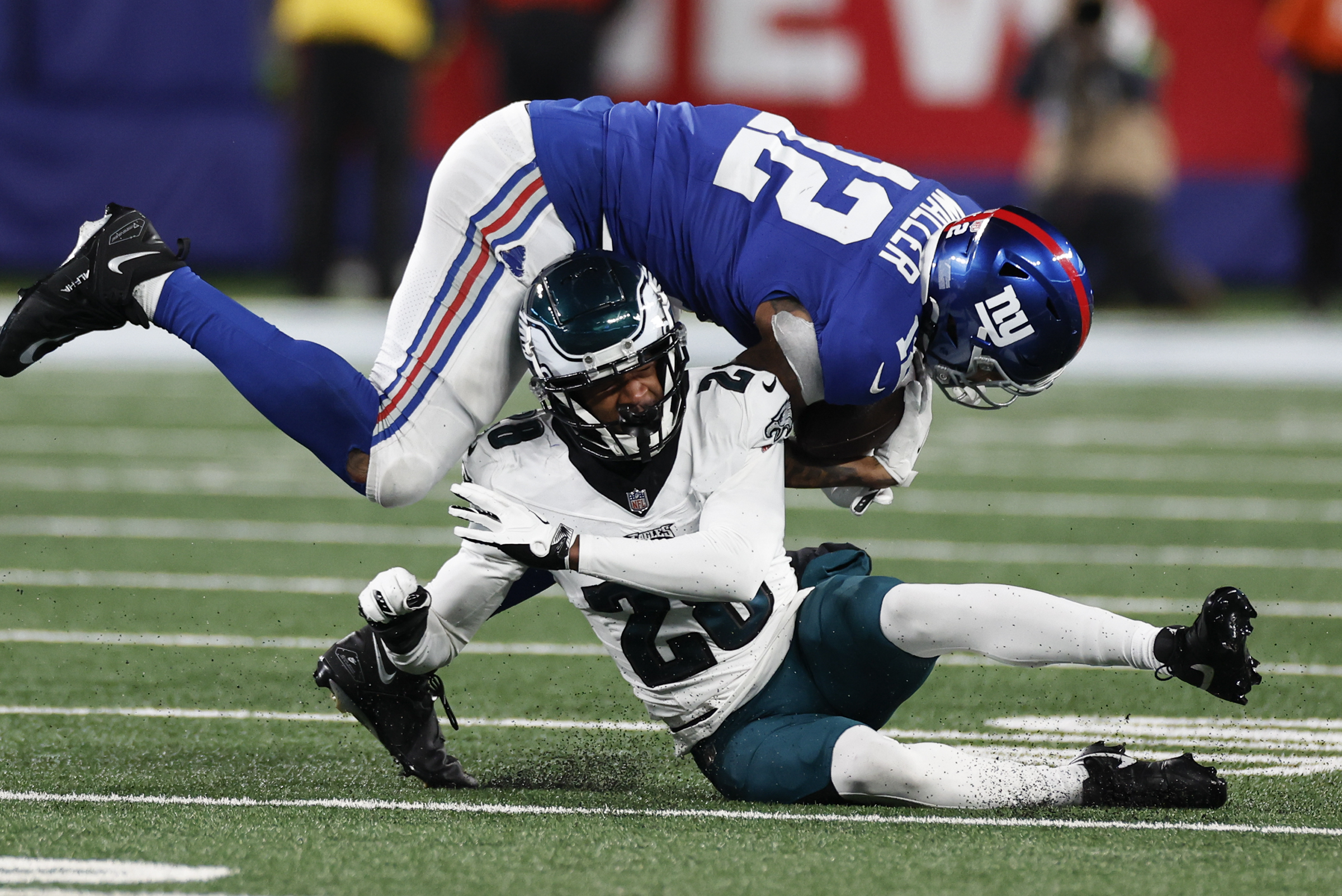
Seahawks cornerback Josh Jobe
Eagles cornerback Josh Jobe stops New York Giants tight end Darren Waller at MetLife Stadium in East Rutherford, NJ on Sunday, January 7, 2024.
Josh Jobe spent two seasons with the Eagles from 2022 to 2023 and appeared in 28 games, primarily on special teams. The 2022 undrafted free agent out of Alabama served as a depth cornerback behind Darius Slay and James Bradberry.
He got buried on the Eagles depth chart and was released at the end of training camp in 2024. Jobe, now 27, signed with the Seahawks two days later and earned a starting job this season in Mike Macdonald’s defense.
Seattle Seahawks cornerback Josh Jobe, left, celebrates after stopping a pass intended for Los Angeles Rams wide receiver Puka Nacua during the second half of an NFL football game Sunday, Nov. 16, 2025, in Inglewood, Calif. (AP Photo/Katie Chin)
Seahawks long snapper Chris Stoll
Penn State place kicker Jordan Stout (98) celebrates with Chris Stoll (91) after kicking a 50-yard field goal in the fourth quarter of their NCAA college football game in State College, Pa., on Saturday, Oct. 2, 2021. Penn State defeated Indiana 24-0. (AP Photo/Barry Reeger)
Chris Stoll (left) spent six years at Penn State from 2017 to 2022 and played in 48 games. In 2022, he won the Patrick Mannelly Award, given to the nation’s top long snapper. Stoll signed with Seattle as an undrafted free agent in 2023.
Seahawks assistant head coach Leslie Frazier
Seattle Seahawks assistant head coach Leslie Frazier looks on after practice during the NFL football team’s training camp Saturday, July 26, 2025, in Renton, Wash.
Leslie Frazier has been the Seahawks’ assistant head coach since 2024, serving as a mentor to first-time coach Mike Macdonald. Frazier, 66, was the head coach of the Vikings from 2010 to 2013 and has had multiple defensive coordinator jobs.
But the veteran coach got his NFL coaching start with the Eagles as the defensive backs coach from 1999 to 2002 under defensive coordinator Jim Johnson. Among the players Frazier coached with the Eagles were Brian Dawkins and Troy Vincent.
Cincinnati Bengals’ new defensive coordinator Leslie Frazier, former defensive backs coach for the Philadelphia Eagles, answers questions during a news conference Tuesday, Jan. 21, 2003, in Cincinnati. (AP Photo/David Kohl)
Seahawks running game specialist Justin Outten
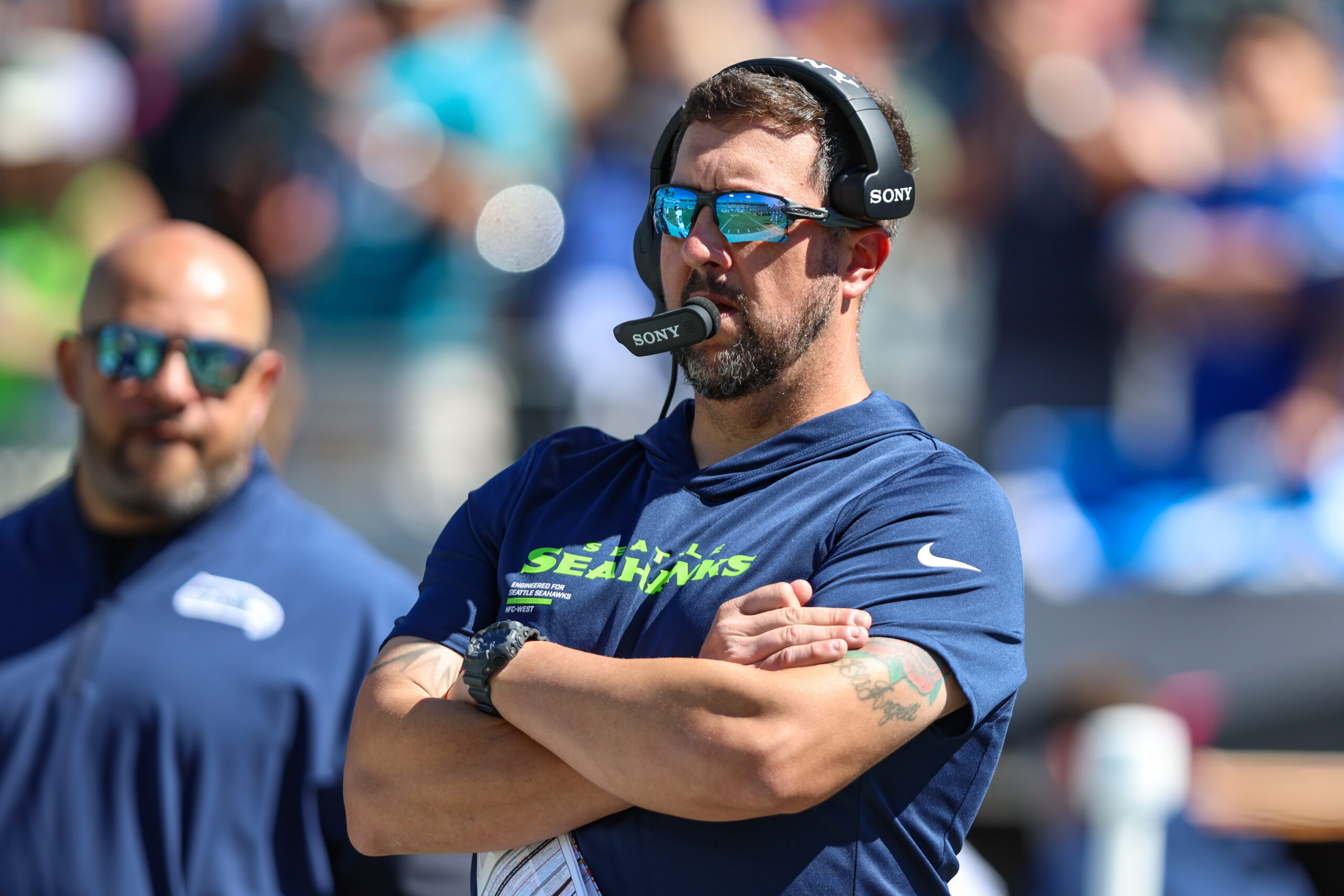
Seattle Seahawks run game specialist/assistant offensive line coach Justin Outten walks the sideline before an NFL football game against the Jacksonville Jaguars, Sunday, Oct. 12, 2025, in Jacksonville, Fla. The Seahawks defeated the Jaguars 20-12.
Justin Outten, 42, is in his first year as the Seahawks’ running game specialist and assistant offensive line coach. He hails from Doylestown and graduated in 2002 from Central Bucks West, where he won a state championship as a sophomore.
Seahawks ‘veteran mentor’ Jason Peters
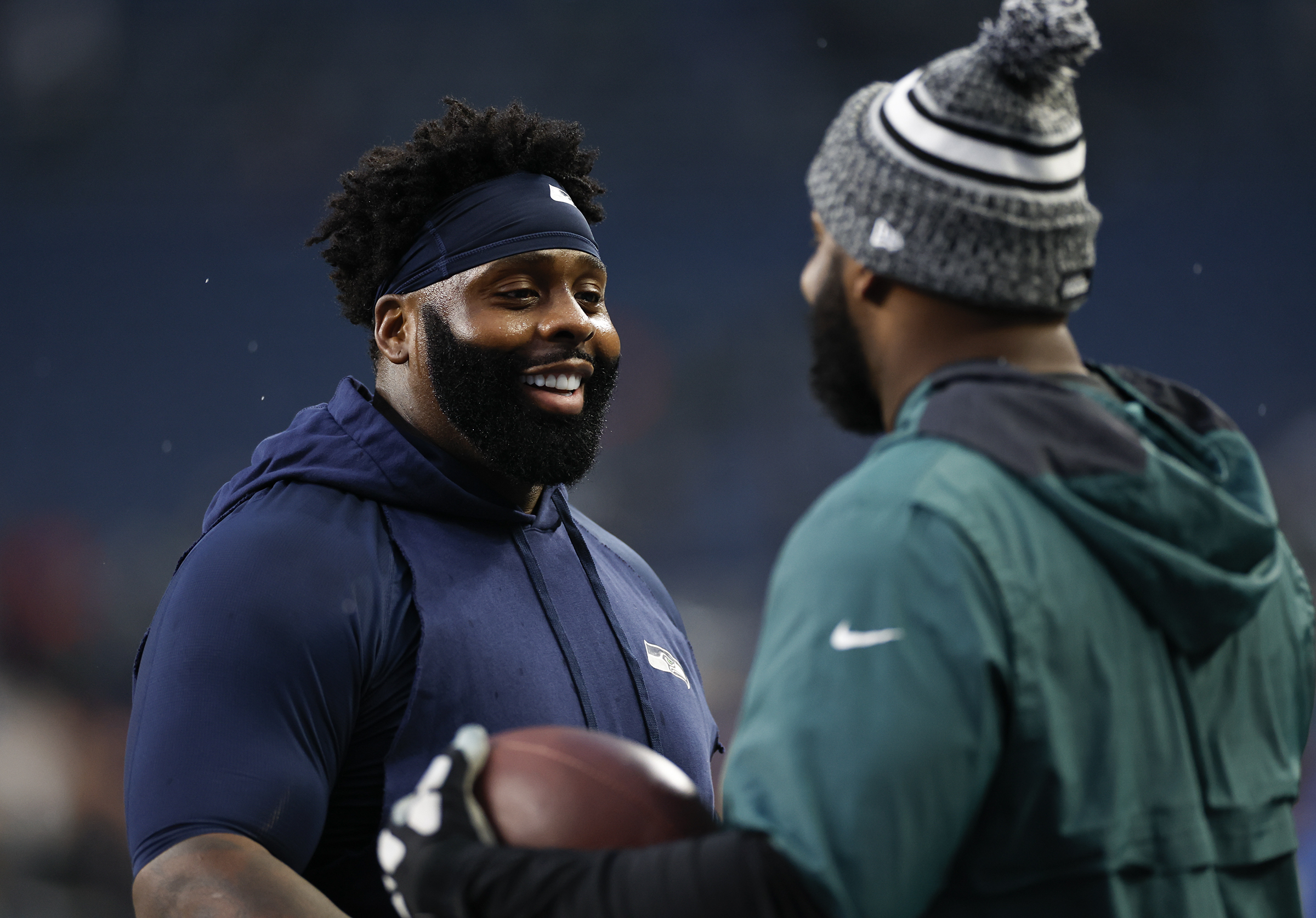
Former Eagles and current Seattle Seahawks offensive tackle Jason Peters meets with Eagles defensive tackle Fletcher Cox during warm ups before the Eagles play the Seattle Seahawks at Lumen Field in Seattle on Monday, December 18, 2023.
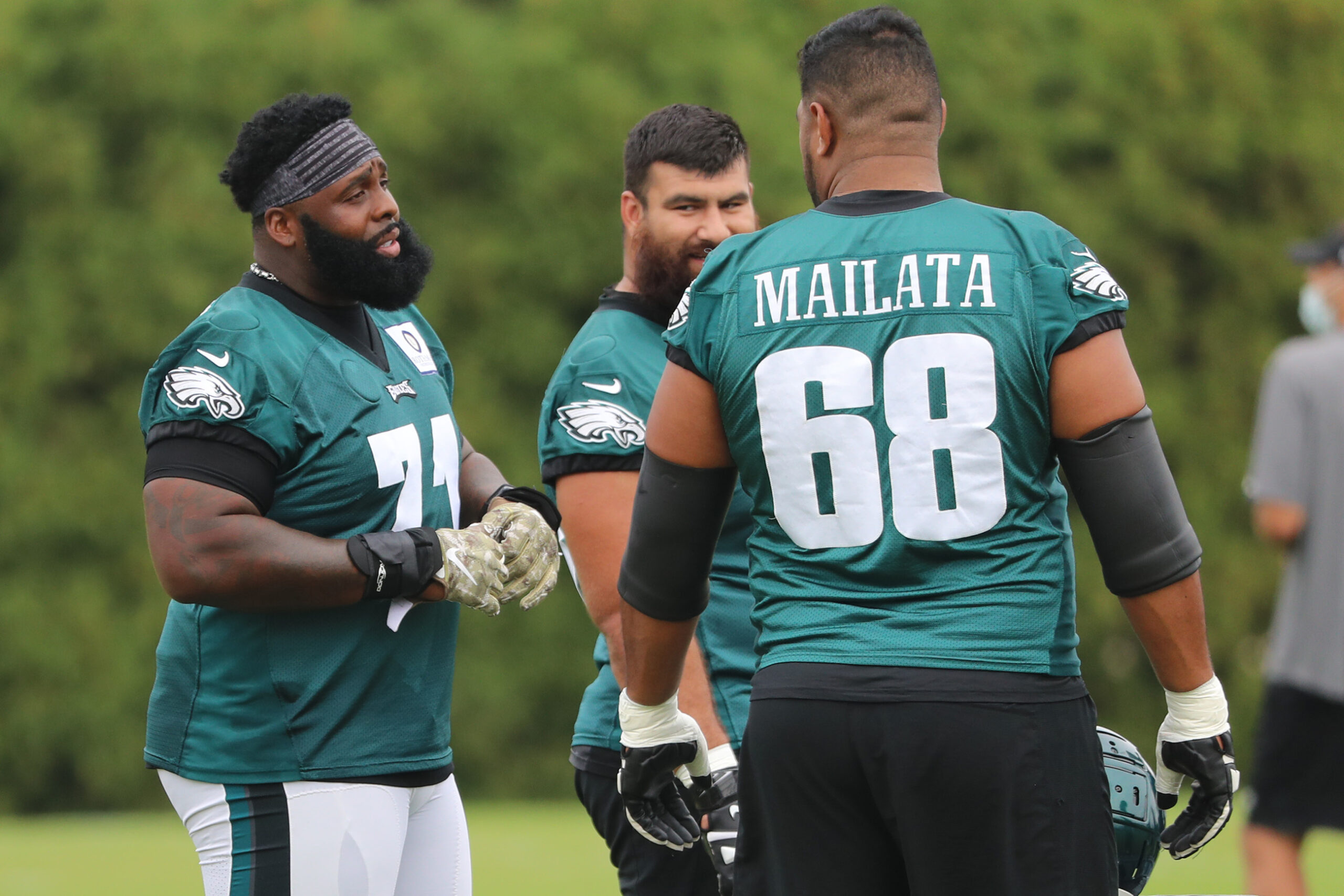
Jason Peters, the two-time All-Pro Eagles left tackle, was hired by the Seahawks front office last offseason to serve in what the organization called a “veteran mentor” role after a 19-year NFL playing career.
Peters was the oldest active NFL player (41) when he signed to Seattle’s practice squad in 2023. He was promoted to the active roster in November, and the following season, he re-signed to the practice squad to cap off his playing career. Peters spent 11 years with the Eagles (2009-2020), earning a Super Bowl ring in 2018.
Eagles offensive guard Jason Peters (left) talks to Eagles offensive tackle Jordan Mailata (right) at the Philadelphia Eagles football practice at the NovaCare Complex in Philadelphia, Pa. on September 17, 2020. The Eagles are preparing to play the Los Angeles Rams on Sunday.
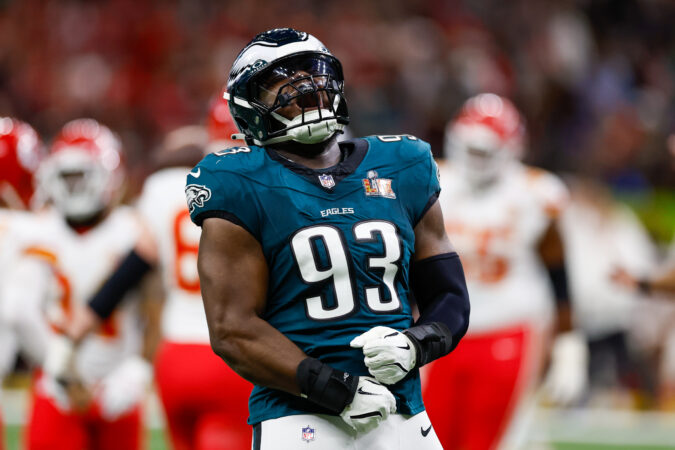
Patriots defensive tackle Milton Williams
Milton Williams, (93), Defensive tackle, speaks to press after practice at the Novacare Complex in Philadelphia, Pa., on Tuesday, July 30, 2024.
Milton Williams spent the first four years of his career with the Eagles, the team that drafted him out of Louisiana Tech in 2021. He had a breakout year in 2024, amassing a career-best five sacks and starring in the Birds’ Super Bowl win.
He signed a four-year, $104 million contract with the Patriots in free agency, making him the second-highest-paid interior defensive lineman on an average annual basis ($26 million per year). Williams, 26, missed five games late this season with an ankle injury, but returned in time for the playoffs and has made his mark.
New England Patriots defensive end Milton Williams (97), linebacker Christian Elliss (53) and linebacker Robert Spillane (14) celebrate Williams’ sack of Los Angeles Chargers quarterback Justin Herbert (10) in the second half of an NFL wild-card playoff football game in Foxborough, Mass., Sunday, Jan. 11, 2026. (AP Photo/Charles Krupa)
Patriots wide receiver Mack Hollins
Eagles wide receiver Mack Hollins stretches on the turf at Lambeau Field during warmups prior to the game against the Packers on Thursday September 26, 2019.
Mack Hollins also began his career with the Eagles, selected in the fourth round of the 2017 draft out of North Carolina. He was a member of the Eagles team that beat the Patriots in the Super Bowl that season.
Since that year, the 32-year-old Hollins has been a member of four teams and joined the Patriots on a two-year deal this season. Hollins, who came off injured reserve to lead New England with 52 yards in the AFC championship, had 550 yards and two touchdowns in 2025, the second-best receiving total of his career.
New England Patriots wide receiver Mack Hollins, top, catches a pass over Buffalo Bills cornerback Tre’Davious White (27) during the first half of an NFL football game in Foxborough, Mass., Sunday, Dec. 14, 2025. (AP Photo/Robert F. Bukaty)
Patriots linebacker Christian Elliss
Philadelphia Eagles defensive tackle Noah Elliss celebrates after tackling Cleveland Browns running back Demetric Felton Jr. in an NFL preseason football game against the Browns at Lincoln Financial Field, Thursday, Aug. 17, 2023, in Philadelphia.
Christian Elliss spent nearly three seasons with the Eagles from 2021 to 2023. He served in a depth role, even in 2023 on a struggling defense under Sean Desai, and he appeared in 19 total games, primarily on special teams.
The Eagles waived Elliss in December 2023 after signing Shaquille Leonard, and the Patriots claimed him. Elliss, 27, started 13 games this season (and played 15 games total) and ranked second on the Patriots with 94 tackles.
New England Patriots linebacker Christian Elliss celebrates after recovering a fumble by Los Angeles Chargers quarterback Justin Herbert in the second half of an NFL wild-card playoff football game in Foxborough, Mass., Sunday, Jan. 11, 2026. (AP Photo/Charles Krupa)
Patriots defensive tackle Christian Barmore
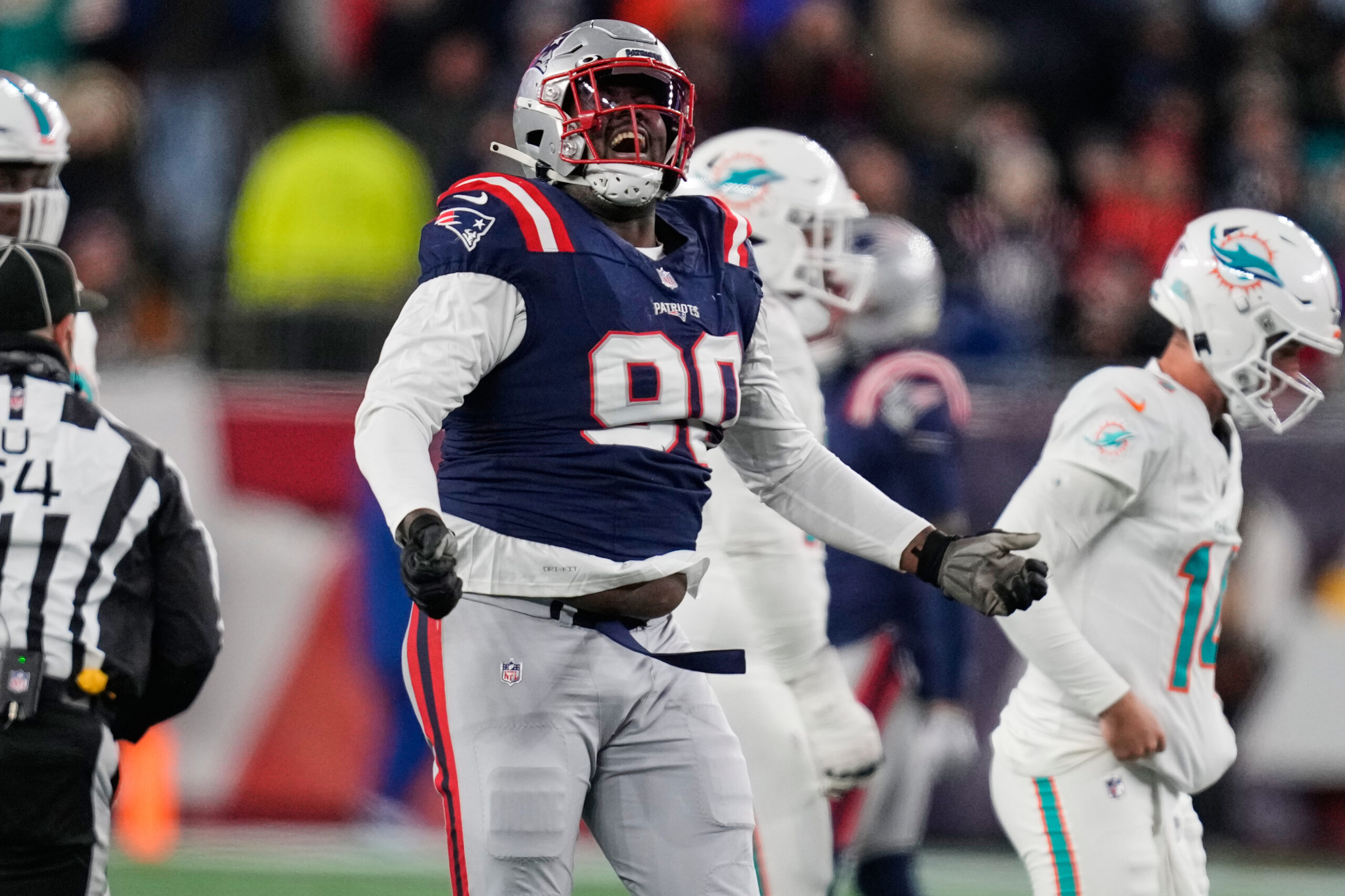
New England Patriots defensive tackle Christian Barmore (90) during an NFL football game, Sunday, Jan. 4, 2026, in Foxborough, Mass.
Christian Barmore grew up in Philly, starting in high school at Lincoln before transferring to Neumann Goretti. The 26-year-old was the Patriots’ second-round pick in 2021 and became a full-time starter this season, recording two sacks.
Patriots offensive tackle Caedan Wallace
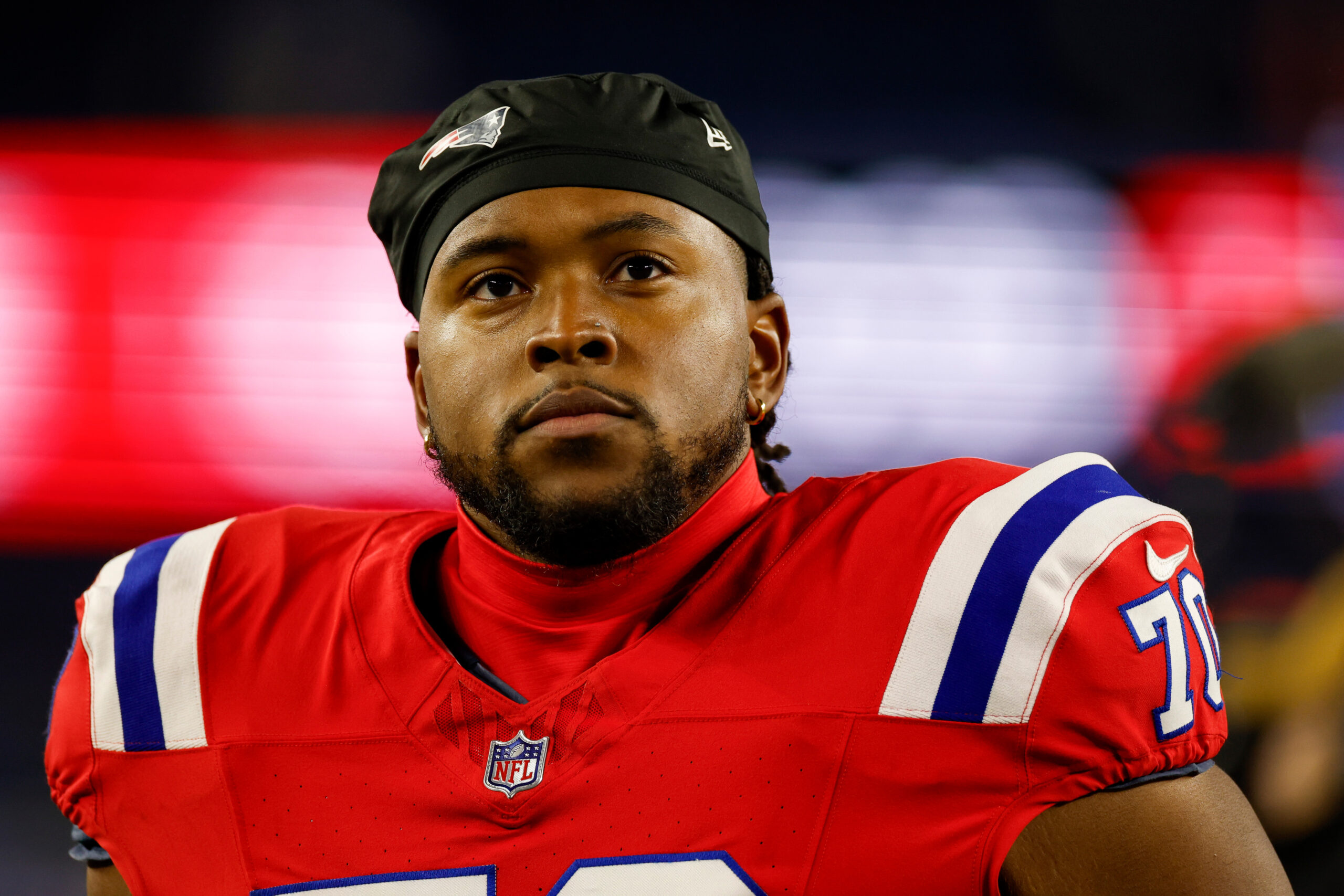
New England Patriots offensive tackle Caedan Wallace (70) reacts after defeating the New York Giants in an NFL football game, Monday, Dec. 1, 2025, in Foxborough, Mass.
Caedan Wallace hails from Robbinsville, N.J., and won three straight prep state championships at the Hun School. Wallace, 25, played for Penn State and in 2024 was drafted by New England, where he has served in a depth role.
Philadelphia lawmakers are set to consider legislation that would make it harder for ICE to operate in the city, including limiting information sharing, restricting activity on city-owned property, and prohibiting agents from concealing their identities.
Among the package of bills set to be introduced Thursday is an ordinance that effectively makes permanent Philadelphia’s status as a so-called “sanctuary city” by barring city officials from holding undocumented immigrants at ICE’s request without a court order. Another bans discrimination based on immigration status.
Two City Council members are expected to introduce the legislation as U.S. Immigration and Customs Enforcement is facing mounting national scrutiny over its tactics in Minneapolis, where federal agents fatally shot two U.S. citizens this month.
Councilmembers Rue Landau, a Democrat, and Kendra Brooks, of the progressive Working Families Party, said in an interview that the violence in Minneapolis hardened their resolve to introduce legislation to protect a population that includes an estimated 76,000 undocumented immigrants in Philadelphia.
“It’s been very disheartening and frightening to watch ICE act with such lawlessness,” Landau said. “When they rise to the level of killing innocent civilians, unprecedented murders … this is absolutely the time to stand up and act.”
The package of a half-dozen bills is the most significant legislative effort that Council has undertaken to strengthen protections for immigrants since President Donald Trump took office last year on a promise to carry out a mass deportation campaign nationwide.
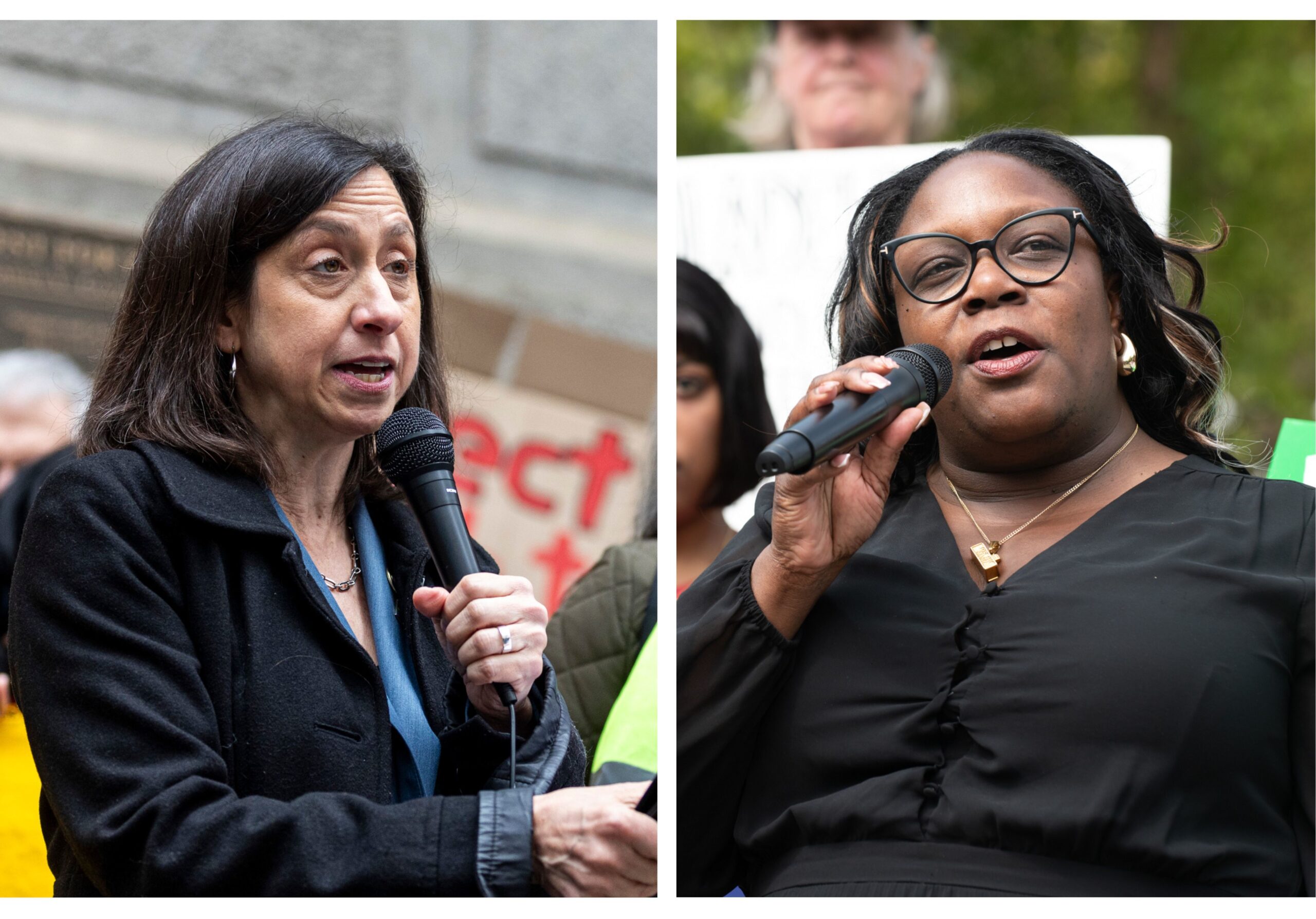
Left: City Councilmember Rue Landau. Right: City Councilmember Kendra Brooks. Landau and Brooks are introducing legislation this week to make it harder for ICE to operate in Philadelphia, including by limiting city cooperation with the agency.
ICE spokespeople did not immediately reply to a request for comment.
Jasmine Rivera, executive director of the Pennsylvania Immigration Coalition, said it’s not the job nor the jurisdiction of the city to enforce federal law.
The goal of the legislation, Rivera said, is ensuring that “not a single dime and single second of our local resources is being spent collaborating with agencies that are executing people.”
Now, the mayor could be forced to take a side. If City Council passes Landau and Brooks’ legislation this spring, Parker could either sign the bills into law, veto them, or take no action and allow them to lapse into law without her signature. She has never vetoed a bill.
Joe Grace, a spokesperson for Parker, declined to comment on the legislation.
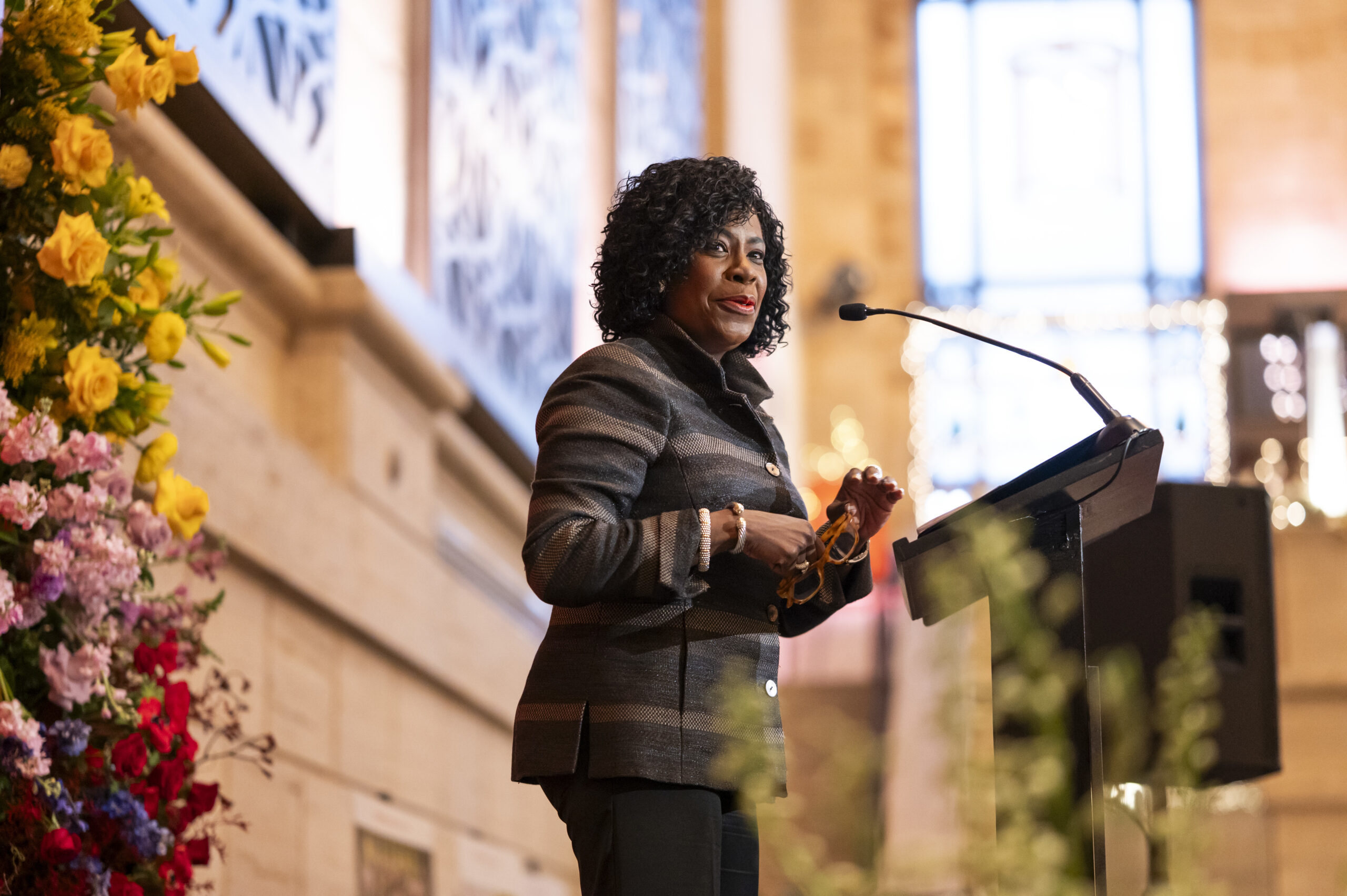
Mayor Cherelle L. Parker speaks at a news conference earlier this month. It is unclear how she will act on upcoming legislation related to ICE operations in Philadelphia.
It’s unclear what fate the ICE legislation could meet in Council. The 17-member body has just one Republican, but Parker holds influence with many of the Democrats in the chamber.
City Council President Kenyatta Johnson, a Democrat who controls the flow of legislation, has not taken a position on the package proposed by Landau and Brooks.
But he said in a statement that “Philadelphia has long positioned itself as a welcoming city that values the contributions of immigrants and strives to protect their rights and safety.”
“I have deep concerns about federal ICE actions directed by President Donald Trump’s administration that sow fear and anxiety in immigrant communities,” Johnson said, “underscoring the belief that enforcement practices should be lawful, humane, and not undermine trust in public safety.”
Making sanctuary status the law
Border Patrol and ICE are both federal immigration agencies, which are legally allowed to operate in public places and subject to federal rules and regulations. Some cities and states —not including Pennsylvania and New Jersey — actively cooperate with ICE through written agreements.
Since 2016, Philadelphia has operated under an executive order signed by former Mayor Jim Kenney, which prohibits city jails from honoring ICE “detainer requests,” in which federal agents ask the city to hold undocumented immigrants in jail for longer than they would have otherwise been in custody to facilitate their arrest by federal authorities.
Undocumented immigrants are not shielded from federal immigration enforcement, nor from being arrested and charged by local police for local offenses.
Some refer to the noncooperation arrangement as “sanctuary.” As the term “sanctuary cities” has become politically toxic, some local officials — including in Philadelphia — have backed away from it, instead declaring their jurisdictions to be “welcoming cities.”
Parker administration officials have said several times over the last year that Philadelphia remains a “welcoming city.”
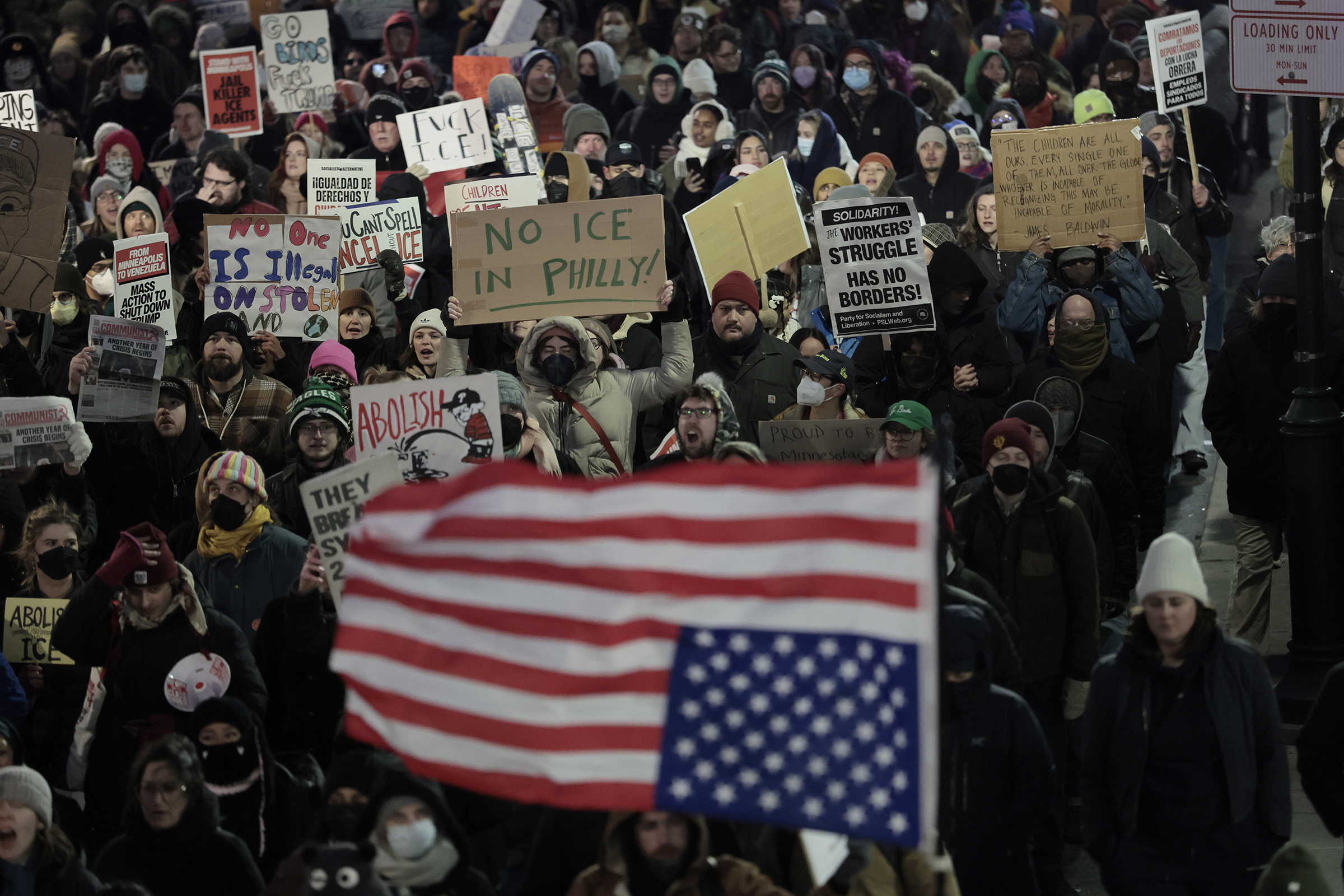
Protesters march up Eighth Street, toward the immigration offices, during the Philly stands with Minneapolis Ice Out For Good protest at Philadelphia’s City Hall on Jan. 23.
But advocates for immigrants have said they want an ironclad city policy that can’t be rescinded by a mayor.
Landau and Brooks’ legislation would be that, codifying the executive order into law and adding new prohibitions on information sharing. The package includes legislation to:
Strengthen restrictions on city workers, including banning local police from carrying out federal immigration enforcement and prohibiting city workers from assisting in enforcement operations.
Prohibiting law enforcement officers from concealing their identities, including by wearing masks or covering up badges with identifying information.
Banning ICE from staging raids on city-owned property and designated community spaces such as schools, parks, libraries, and homeless shelters. (It would not apply to the Criminal Justice Center, where ICE has had a presence. The courthouse is overseen by both city and state agencies.)
Prohibiting city agencies and contractors from providing ICE access to data sets to assist in immigration enforcement.
Restricting city employees from inquiring about individuals’ immigration status unless required by a court order, or state or federal law.
Peter Pedemonti, co-director of New Sanctuary Movement of Philadelphia, an advocacy organization that partnered with the Council members to craft the package of bills, compared ICE to an octopus that has multiple arms reaching into different facets of American life.
The proposed legislation, he said, is a means to bind a few of those arms.
“The whole world can see the violence and brutality,” Pedemonti said. “This is a moment where all of us need to stand up, and Philadelphia can stand up and speak out loud and clear that we don’t want ICE here to pull our families apart, the families that make Philadelphia Philadelphia.”
An impending showdown that Parker hoped to avoid
Homeland Security officials claim that sanctuary jurisdictions protect criminal, undocumented immigrants from facing consequences while putting U.S. citizens and law enforcement officers in peril.
Last year, the Trump administration named Philadelphia as among the jurisdictions impeding federal immigration enforcement. The White House has said the federal government will cut off funding to sanctuary cities by Feb. 1.
Some of Parker’s supporters say the mayor’s conflict-averse strategy has spared Philadelphia as other cities such as Washington, New York, Los Angeles, Chicago, and Minneapolis have seen National Guard troops or waves of ICE agents arrive in force.
Residents near the scene of a shooting by a federal law enforcement agent in Minneapolis on Saturday.
Critics, including the backers of the new legislation, have for months pressed Parker to take a stronger stand.
Brooks said she “would love to have the support of the administration.”
“This should be something that we should be working collaboratively on,” she said. “Philadelphia residents are demanding us do something as elected officials, and this is our time to lead.”
But Parker has not been eager to speak about Philadelphia’s immigration policies.
For example, the city is refusing to release a September letter it sent to the U.S. Department of Justice regarding its immigration-related policies, even after the Pennsylvania Office of Open Records ruled its reasoning for keeping the document secret was invalid. The Inquirer has requested a copy of the letter under the state Right-to-Know Law.
The new Council legislation and the increasing tension over Trump’s deportation push may force Parker to take a clearer position.
Notably, the city sued the federal government last week over its removal of exhibits related to slavery from the President’s House at Independence National Historical Park, potentially signaling a new willingness by Parker to push back against the White House.
But even then, Parker declined to take a jab at Trump.
“In moments like this,” she said last week, “it requires that I be the leader that I need to be for our city, and I can’t allow my pride, ego, or emotions to dictate what my actions will be.”