Blog

  • Iron Hill Brewery could be revived in some locations as judge OKs trademark acquisition

    Iron Hill Brewery could be revived in some locations as judge OKs trademark acquisition

    Iron Hill Brewery may get a second life.

    Four months after the chain closed nearly 20 locations and filed for bankruptcy, a federal judge has approved the acquisition of Iron Hill’s trademark and intellectual property in conjunction with the transfer of five restaurant leases, including one in Philadelphia, according to court documents filed over the weekend.

    The shuttered brewpubs in Center City, Huntingdon Valley, Hershey, Lancaster, and Wilmington are set to be taken over by new tenants, each of which is referred to as “IHB” in the documents. Earlier this month, these tenants registered as business corporations under “IHB” and the name of each location, according to state records in Pennsylvania and Delaware.

    Judge Jerrold N. Poslusny Jr. also approved a written agreement that allowed for “Rightlane LLC” to assume Iron Hill Brewery’s trademark and intellectual property, according to the same filing in U.S. Bankruptcy Court in New Jersey.

    A view from the outside looking in on a closed Iron Hill Brewery.

    Jeff Crivello, the former CEO of Famous Dave’s BBQ, was originally set to buy the assets of these five Iron Hill locations, along with those of five others that he has since sold.

    On Monday, Crivello confirmed that the assets of his five remaining Iron Hills, along with the brand’s trademark and intellectual property, had been acquired by a buyer called Right Lane.

    There are several companies that go by the name Rightlane or Right Lane. Attempts to reach representatives of the Right Lane that was involved in the Iron Hill deal were unsuccessful.

    The deal could revive some prime real estate in the Philadelphia region. In Center City, the 8,500-square-foot restaurant was meant to help revitalize the troubled Market East. In Wilmington, Iron Hill had renovated its 10,000-square-foot restaurant on the waterfront.

    In December, Crivello had hinted at the possibility of an Iron Hill resurrection, saying, “We’re working with a couple buyers that want to reopen [closed breweries] as Iron Hill.”

    Iron Hill Brewery, which was founded in Newark, Del., developed a loyal following over its nearly 30 years in business. Fellow business owners and brewers considered it a pioneer in the local craft beer scene and a restaurant that helped put suburban downtowns like West Chester and Media on the map. Customers said they loved its family-friendly atmosphere.

    In more recent years, Iron Hill opened a production facility in Exton, started canning its beers, and unveiled new locations in Philadelphia, South Carolina, and Georgia. This expansion occurred against the backdrop of the coronavirus pandemic and a nationwide decline in consumers’ thirst for beer and other alcohol.

    For Iron Hill, it did not prove a winning strategy. By the time the chain filed for liquidation bankruptcy this fall, it owed more than $20 million to creditors and had about $125,000 in the bank.

    Since then, massive shells of former breweries have sat vacant throughout the region. As the case made its way through bankruptcy court, landlords were delayed in their searches for new tenants.

    Many locations still remain empty, with no word on what might fill the spaces. But in some spots, there are signs of life.

    The company that owns P.J. Whelihan’s may be moving into the former Iron Hill in Newtown, Bucks County.

    Last month, PJW Opco LLC, which is registered at the headquarters of PJW Restaurant Group, was approved to take over a lease for an 8,000-square-foot closed Iron Hill in the Village at Newtown shopping center.

    In South Carolina, Crivello has sold the assets of the former Iron Hills in Columbia and Greenville to Virginia-based Three Notch’d Brewing Co.

    This story has been updated to reflect additional information about Right Lane.
  • Geoffrey Mason, 85, TV producer of 1972 Munich Olympics hostage crisis

    Geoffrey Mason, 85, TV producer of 1972 Munich Olympics hostage crisis

    Geoffrey Mason, who had a five-decade career in sports television and was best known as the coordinating producer for ABC’s coverage of the 1972 Munich Olympic Games hostage crisis, has died. He was 85.

    ESPN said Mr. Mason died Sunday in Naples, Fla. He died of natural causes, according to his family.

    “Geoff was a giant visionary in television, never seeking credit. He preferred leading and mentoring teams, connecting people to projects, and was devoted to people and recovery of all sorts. He was a great teacher and mentor to everyone who came in his orbit,” former ESPN President Steve Bornstein said.

    Over the course of his career, Mr. Mason worked on eight Olympics. As a young producer on Sept. 5, 1972, he was in the control room in Munich, Germany, when the Palestinian militant group Black September stormed the Olympic village and took Israeli Olympic team members hostage.

    ABC provided continuous coverage for 22 hours, culminating in a failed rescue attempt in which six Israeli coaches and five athletes died. Jim McKay broke the news with, “They’re all gone.”

    Mr. Mason was a consultant on the script and every aspect of production for the 2024 feature film September 5, which recreates what it was like in the ABC control room that day. The international broadcast center in Munich was 100 yards away from where the hostage crisis was taking place in the Olympic village.

    The movie recreates the moment when West German police stormed the control room and pointed guns at Mr. Mason’s face. This happened because one of ABC’s cameras was showing a tactical squad taking position on the roof above the hostages. Mr. Mason ended up cutting off the camera’s feed.

    It is estimated that nearly 900 million people worldwide at some point viewed ABC’s coverage.

    “Geoff told me that day there was no chance to think. Their singular goal was to stay on the air to keep the story going, to do their job as sports broadcasters,” said John Magaro, who played Mr. Mason, in 2025. “Once the clock starts ticking, there’s no chance to think.”

    Mr. Mason’s career was largely spent with ABC and ESPN, but he also worked for NBC, Fox, NFL Network, and other television entities. He began as a production associate at ABC Sports in 1967, working on Wide World of Sports and the 1968 Winter and Summer Olympics. Over the years, he earned 24 Emmy Awards and was inducted into the Sports Broadcasting Hall of Fame in 2010.

    He also worked on Super Bowl 25, Monday Night Football, the World Series, horse racing’s Triple Crown, the Indianapolis 500, and the FIFA Men’s and Women’s World Cup tournaments.

    He is also known for his coverage of the 1986-87 America’s Cup from Fremantle, Australia.

    “Geoff Mason was a friend and a colleague who had a storied career, touching just about every corner of the sports television industry,” said Bob Iger, CEO of the Walt Disney Company, which owns ABC and ESPN. “He had a passion for the business, which was evidenced in his prodigious work ethic and the constant love and enthusiasm he exhibited on everything he worked on.”

    Mr. Mason was selected by Jim Valvano as a founding board member of the V Foundation for Cancer Research and was a longtime board member of the Hazelden Betty Ford Foundation. He delivered a eulogy during Betty Ford’s funeral in 2011.

    “Geoffrey was a force of nature in our industry for six decades, but more important is all the help he gave to so many people through his association with the Betty Ford Center. He changed so many lives personally and professionally,” said former CBS Sports chairperson Sean McManus, who worked with Mr. Mason at both ABC and NBC.

    Mr. Mason was a veteran of the U.S. Navy and graduated from Duke University with a bachelor of arts degree in sociology in 1963. Survivors include wife Chris, son Geoff Jr., and brother David.

  • Minnesota GOP gubernatorial candidate Chris Madel drops out, faults Trump immigration policy

    Minnesota GOP gubernatorial candidate Chris Madel drops out, faults Trump immigration policy

    MADISON, Wis. — A lawyer for the immigration officer who shot and killed Renee Good dropped out of the Minnesota governor’s race Monday, breaking with many fellow Republicans and calling President Donald Trump’s immigration operation in the state an “unmitigated disaster.”

    Chris Madel’s surprise move comes amid growing calls from Republicans to investigate federal immigration tactics in Minnesota after a U.S. Border Patrol agent fatally shot Alex Pretti in Minneapolis on Saturday.

    Madel went a step further than most Republicans in his video, saying that while he supports the goal of deporting “the worst of the worst” from Minnesota, he thinks the Trump administration’s immigration enforcement operation in the Twin Cities has gone too far.

    “I cannot support the national Republicans’ stated retribution on the citizens of our state,” Madel said. “Nor can I count myself a member of a party that would do so.”

    Madel said that U.S. citizens, “particularly those of color, live in fear.”

    “United States citizens are carrying papers to prove their citizenship,” Madel said. ”That’s wrong.”

    Madel said he personally had heard from local Asian and Hispanic law enforcement officers who had been pulled over by ICE.

    “I have read about and I have spoken to help countless United States citizens who have been detained in Minnesota due to the color of their skin,” Madel said.

    He also said it was unconstitutional and wrong for federal officers to “raid homes” using a civil warrant, rather than one issued by a judge.

    Madel was among a large group of candidates seeking to replace Democratic Gov. Tim Walz, who dropped his reelection bid earlier this month. Other Republican candidates include MyPillow founder and chief executive Mike Lindell, an election denier who is close to Trump; Minnesota House Speaker Lisa Demuth; Scott Jensen, a former state senator who was the party’s 2022 gubernatorial candidate; and state Rep. Kristin Robbins.

    Democratic U.S. Sen. Amy Klobuchar has filed paperwork to run, but has yet to publicly launch a campaign to succeed Walz.

    Madel, in his Monday video posted on the social platform X, described himself as a “pragmatist,” and said national Republicans “have made it nearly impossible for a Republican to win a statewide election in Minnesota.”

    Madel did not immediately return a text message seeking comment.

    Madel, 59, was a political newcomer making his first run for public office. He got into the race on Dec. 1.

    Madel brought 30 years of experience as an attorney to the race, including cases taking on corporate corruption. Madel also defended law enforcement officers, including the 2024 case of a Minnesota state trooper who fatally shot a Black man after a traffic stop. Prosecutors dropped charges against Trooper Ryan Londregan in the killing of Ricky Cobb II, saying the case would have been difficult to prove.

    Madel often referenced that victory in his brief campaign for governor, including in his video dropping out.

    Republicans were expecting the race for governor to be focused on Walz, who at the time was seeking a third term amid questions about how his administration handled welfare fraud. But the race shifted dramatically on Jan. 5 when Walz dropped out.

    That same week, the Trump administration sent thousands of federal officers to Minnesota. ICE agent Jonathan Ross shot and killed Good in Minneapolis two days later on Jan. 7.

    Madel agreed to offer pro bono legal advice to Ross, although no criminal charges or civil lawsuits have been filed. Madel said he was honored to help Ross, particularly during a gubernatorial campaign.

    “Justice requires excellent legal representation,” Madel said.

    Madel announced his decision ending his candidacy two days after a Border Patrol officer shot and killed Pretti on Saturday in Minneapolis.

  • New evidence shows how discrimination shortens lives in Black communities

    New evidence shows how discrimination shortens lives in Black communities

    Nearly half of the mortality gap between Black and white adults can be traced to the cumulative toll of a lifetime of stress and heightened inflammation, a new study published Monday shows.

    The study, published in JAMA Network Open, bolsters the body of evidence showing that chronic stress takes a biological toll that shortens lives.

    “It’s important to be empirically demonstrated,” said Ryan Bogdan, the study’s senior author and a professor of psychological and brain sciences at Washington University in St. Louis. Researchers tracked the prevalence of two proteins linked to inflammation in the body and tied it to enduring discrimination and related social challenges. The measurement captures more comprehensively “the aftermath” of stressful events, he said.

    Researchers analyzed the proteins in the blood in more than 1,500 Black and white adults who were part of an aging study in the St. Louis area spanning 17 years. They found that decades of stress — childhood adversity, trauma, discrimination, and economic hardship — were associated with higher levels of inflammation later in life, which correlated with earlier death.

    Epidemiologists say the two biomarkers — C-reactive protein and interleukin-6 — tend to linger in the blood after the body’s fight-or-flight system has been repeatedly triggered, allowing them to capture what’s accumulated over time.

    The study, which was largely driven by Washington University in St. Louis graduate student Isaiah Spears, supports the “weathering hypothesis,” which posits that biological wear and tear is caused by striving to overcome hardships in an unequal society.

    Over the course of the study, 25% of Black participants died compared with about 12% of white participants, the study found, meaning Black participants were more likely to die at younger ages. Researchers found that 49.3% of this gap was explained by stress and inflammation.

    A likely undercount

    Arline T. Geronimus, a professor and population health equity researcher at the University of Michigan who began conceptualizing the weathering hypothesis 40 years ago and was not involved in this study, said the data likely represents an undercount. Study participants, on average, were in their late 50s when the study began and were then followed into their 70s and 80s.

    “The most-weathered have already died,” Geronimus said, noting that age span 35 to 60 is “the hardest, most stressful period of life for marginalized groups.”

    She added that another limitation of the study was that the researchers used the “neon lights” of stress events, capturing major traumas or overt discrimination, while overlooking a quieter and important aspect of weathering — the daily stress of resilience. That includes microaggressions, or routine slights, and code-switching, the constant effort to adjust speech or behavior to fit into predominantly white workplaces. Over time, she said, suppressing anger or frustration to avoid reinforcing stereotypes can take a real physiological toll.

    “It’s not just about trauma or severe deprivation, but kind of everyday fists in the face,” she said. It’s a limitation the study acknowledged.

    Black Americans have among the shortest life spans in the United States with a life expectancy of 74 years in 2023, according to federal figures. White Americans live longer on average, but still fewer years than Asian Americans, who have the highest life expectancy — about 85 years, federal data shows.

    Linda Sprague Martinez, a professor and health equity researcher who was not involved in the study, said people tend to misunderstand the type of stress that weathers a body and the interventions needed for relief.

    “Stress management class is not going to solve this problem,” said Sprague Martinez, who runs the Health Disparities Institute at UConn Health in Connecticut. She called the new study’s core finding, that nearly 50% of the mortality gap is linked to stress, “striking.”

    “This is important evidence that continues to contribute to what we know about the fact that racism drives racial inequities,” she said.

    She added that this type of research has been targeted for elimination by the Trump administration because it is associated with diversity, equity, and inclusion, or DEI.

    “There are people who’d be happy if we stopped doing our work, but no,” she said. “We still have to keep doing the work.”

    Health equity experts said the paper is unlikely to influence policy, in part because it does not pinpoint specific forms of structural racism — such as redlining, police violence, income inequality, school segregation, or historical racial terror such as lynching and cross-burning — that drive health disparities.

    “Concentrated poverty, the wealth gap, homeownership — they didn’t talk about any of these and how it affects folks who are aging,” said Derek M. Griffith, university professor of health equity and population health at the University of Pennsylvania’s nursing and medical schools, who was not involved in the study.

    The field of health equity has found collectively that analyzing biomarkers that signal inflammation is one accurate way of measuring the effects of stress on the body.

    “The fact that they’ve found a big relationship with that combination of those measures is novel,” he said. “The fact that they found that relationship, is not.”

  • Columbia taps University of Wisconsin chancellor to lead school after 2 years of turmoil

    Columbia taps University of Wisconsin chancellor to lead school after 2 years of turmoil

    NEW YORK — Columbia University has named Jennifer Mnookin, the chancellor of the University of Wisconsin-Madison, as its next president as it tries to move forward from two years of turmoil that included campus protests over the Israel-Hamas war and President Donald Trump’s subsequent campaign to squelch student activism and force changes at the Ivy League school.

    Mnookin’s appointment was announced Sunday night. She will assume her new post on July 1, becoming Columbia’s fifth leader in the past four years.

    The Trump administration took aim at Columbia shortly after he took office last year, making it his first target in what became a broader campaign to influence how elite U.S. universities dealt with protests, which students they admitted, and what they taught in classrooms.

    Immigration enforcement agents imprisoned some Columbia students who had participated in pro-Palestinian protests in 2024. The administration canceled $400 million in research grants at the school and its affiliated hospital system in the name of combating antisemitism on campus, and threatened to withhold billions of dollars more in government support.

    Ultimately, Columbia reached a deal with the administration to pay more than $220 million to restore the research funds. It also agreed to overhaul the university’s student disciplinary process and apply a contentious, federally endorsed definition of antisemitism not only to teaching but to a disciplinary committee that has been investigating students critical of Israel.

    Mnookin’s predecessor, Nemat Shafik, resigned in August 2024 following scrutiny of her handling of the protests and campus divisions. The university named Katrina Armstrong, the chief executive of its medical school, but she resigned last March, days after Columba agreed to the settlement. The board of trustees then appointed their co-chair, Claire Shipman, as acting president while they searched for a permanent leader.

    Mnookin, 58, previously served as the dean of the University of California, Los Angeles School of Law before being named to her current post at the University of Wisconsin-Madison in August 2022. She received her bachelor’s degree from Harvard University, her law degree from Yale Law School, and her doctorate in history and social study of science and technology from Massachusetts Institute of Technology.

  • Investigators will detail causes of midair collision over Washington, D.C., and recommend changes

    Investigators will detail causes of midair collision over Washington, D.C., and recommend changes

    So many things went wrong last Jan. 29 to contribute to the deadliest plane crash on American soil since 2001 that the National Transportation Safety Board isn’t likely to identify a single cause of the collision between an airliner and an Army helicopter near Washington, D.C., that killed 67 people at its hearing Tuesday.

    Instead, their investigators will detail what they found that played a role in the crash, and the board will recommend changes to help prevent a similar tragedy. Last week, the Federal Aviation Administration already took the temporary restrictions it imposed after the crash and made them permanent to ensure planes and helicopters won’t share the same airspace again around Reagan National Airport.

    Family members of victims hope those suggestions won’t be ignored the same way many past NTSB recommendations have been. Tim Lilley, whose son Sam was the first officer on the American Airlines plane, said he hopes officials in Congress and the administration will make changes now instead of waiting until another disaster.

    “Instead of writing aviation regulation in blood, let’s start writing it in data,” said Lilley, who is a pilot himself and earlier in his career flew Black Hawk helicopters in the Washington area. “Because all the data was there to show this accident was going to happen. This accident was completely preventable.”

    Over the past year, the NTSB has already highlighted a number of the factors that contributed to the crash including a poorly designed helicopter route past Reagan Airport, the fact that the Black Hawk was flying 78 feet higher than it should have been, the warnings that the FAA ignored in the years beforehand, and the Army’s move to turn off a key system that would have broadcast the helicopter’s location more clearly.

    The D.C. plane crash was the first in a number of high-profile crashes and close calls throughout 2025 that alarmed the public, but the total number of crashes last year was actually the lowest since the COVID-19 pandemic hit in 2020 with 1,405 crashes nationwide.

    Experts say flying remains the safest way to travel because of all the overlapping layers of precautions built into the system, but too many of those safety measures failed at the same time last Jan. 29.

    Here is some of what we have learned about the crash:

    Helicopter route didn’t ensure enough separation

    The route along the Potomac River the Black Hawk was following that night allowed for helicopters and planes to come within 75 feet of each other when a plane was landing on the airport’s secondary runway that typically handles less than 5% of the flights landing at Reagan. And that distance was only ensured when the helicopter stuck to flying along the bank of the river, but the official route didn’t require that.

    Normally, air traffic controllers work to keep aircraft at least 500 feet apart to keep them safe, so the scant separation on Route 4 posed what NTSB chairperson Jennifer Homendy called “an intolerable risk to flight safety.”

    The controllers at Reagan also had been in the habit of asking pilots to watch out for other aircraft themselves and maintain visual separation as they tried to squeeze in more planes to land on what the Metropolitan Washington Airport Authority has called the busiest runway in the country. The FAA halted that practice after the crash.

    That night a controller twice asked the helicopter pilots whether they had the jet in sight, and the pilots said they did and asked for visual separation approval so they could use their own eyes to maintain distance. But at the investigative hearings last summer, board members questioned how well the crew could spot the plane while wearing night vision goggles and whether the pilots were even looking in the right spot.

    The Black Hawk was flying too high

    The American Airlines plane flying from Wichita, Kan., collided with the helicopter 278 feet above the river, but the Black Hawk was never supposed to fly above 200 feet as it passed by the airport, according to the official route.

    Before investigators revealed how high the helicopter was flying, Tim Lilley was asking tough questions about it at some of the first meetings NTSB officials had with the families. His background as a pilot gave him detailed knowledge of the issues.

    “We had a moral mandate because we had such an in-depth insight into what happened. We didn’t want to become advocates, but we could not shirk the responsibility,” said Lilley, who started meeting with top lawmakers in Congress, Transportation Secretary Sean Duffy, and Army officials not long after the crash to push for changes.

    The NTSB has said the Black Hawk pilots may not have realized how high the helicopter was because the barometric altimeter they were relying on was reading 80 to 100 feet lower than the altitude registered by the flight data recorder.

    Investigators tested out the altimeters of three other Black Hawks of the same model from the same Army unit and found similar discrepancies.

    Past warnings and alarming data were ignored

    FAA controllers were warning about the risks all the helicopter traffic around Reagan airport created at least since 2022.

    And the NTSB found there had been 85 near misses between planes and helicopters around the airport in the three years before the crash along with more than 15,000 close proximity events. Pilots reported collision alarms going off in their cockpits at least once a month.

    Officials refused to add a warning to helicopter charts urging pilots to the crash that killed her cousin Peter Livingston and his wife, Donna, and two young daughters, Everly and Alydia, who were both promising figure skaters.

    “It became very quickly clear that this crash should never have happened,” Feres said. “And as someone who is not particularly familiar with aviation and how our aviation system works, we were just hearing things over and over again that I think really, really shocked people, really surprised people.”

  • Reports: Former Phillies outfielder Harrison Bader agrees to deal with Giants

    Reports: Former Phillies outfielder Harrison Bader agrees to deal with Giants

    Harrison Bader reached an agreement with the Giants on a two-year, $20.5 million contract, according to multiple reports on Monday.

    The center fielder posted a career year offensively in 2025, slashing .277/.347/.449 over 146 games. The Phillies acquired Bader from the Twins at the trade deadline to bolster their outfield, in exchange for two prospects, outfielder Hendry Mendez and right-handed pitcher Geremy Villoria.

    Bader, 31, was immediately a popular member of the Phillies clubhouse in the second half of the season, with several of his teammates adopting his catchphrases and signature crop top. He suffered a groin strain while running the bases during Game 1 of the National League Division Series and was limited to pinch-hitting in Games 2 and 4.

    He declined his end of his $10 million mutual option following the season, becoming a free agent.

    Following Bader’s departure, the Phillies’ outfield is set to look quite different on opening day. Max Kepler remains unsigned after receiving an 80-game suspension for testing positive for a performance-enhancing drug, and president of baseball operations Dave Dombrowski has said the club plans to find a “change of scenery” for right fielder Nick Castellanos.

    The Phillies signed Adolis García to a one-year, $10 million contract, and they expect to give top outfield prospect Justin Crawford the opportunity to earn the starting center fielder job in 2026. Crawford was extended a non-roster invite to major league spring training on Friday.

  • Pennsylvania officials vote for land deal widely opposed by Limerick residents

    Pennsylvania officials vote for land deal widely opposed by Limerick residents

    A split Pennsylvania Game Commission has voted in favor of a developer’s land swap widely opposed by Limerick Township residents who fear it could pave the way for a large data center.

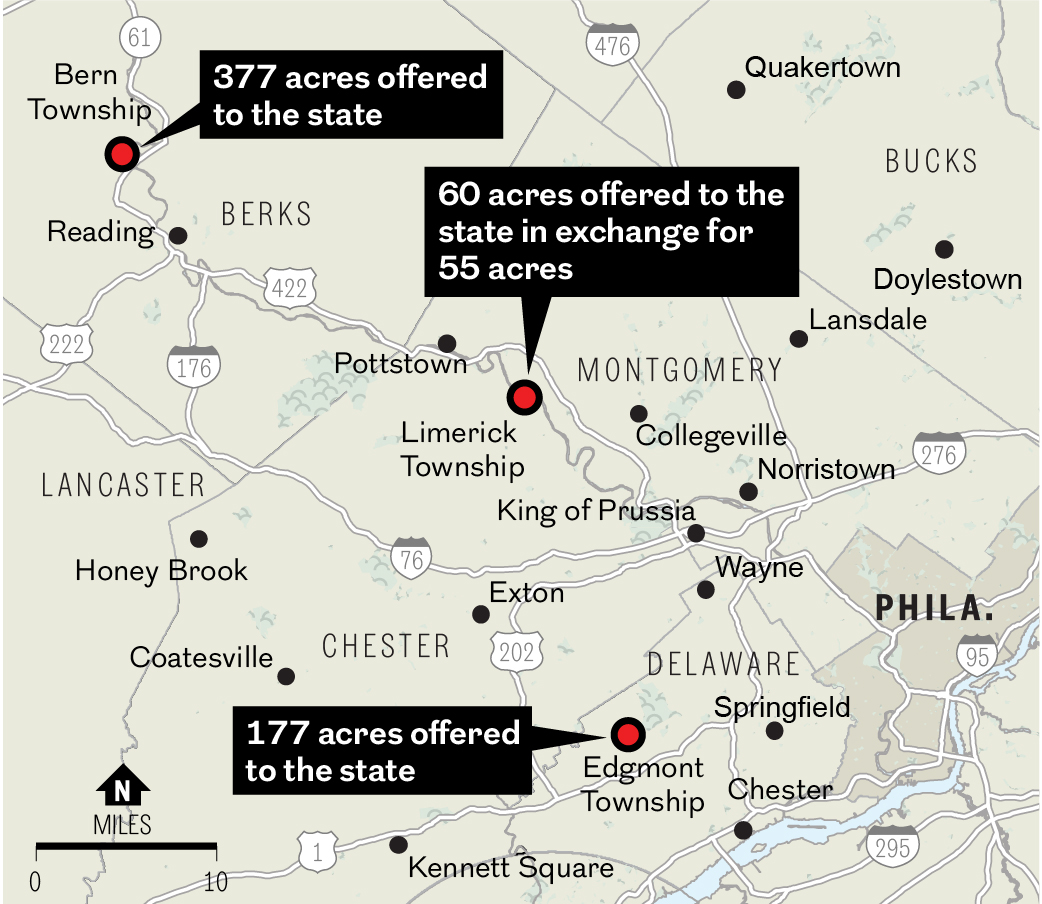
    The commission voted 6-3 on Saturday in favor of a contract with developer Limerick Town Center LLC that would yield the state 559 new acres across three counties. The swap would include what would become Delaware County’s first state game land.

    As part of the land trade, Limerick Town Center LLC would get 55 acres of state Game Land 234 in Limerick, Montgomery County. The land is adjacent to an industrial site the developer already owns and that’s currently proposed for warehousing.

    Limerick Town Center LLC has not said what it plans for the new land. A representative of the company could not be reached for comment.

    In return, however, Limerick Town Center LLC would give the state 60 acres in Limerick it owns immediately to the south of the existing game land, next to the Schuylkill.

    Steve Hacker, who lives near Game Land 234 and opposes the swap, called it “a great deal for other townships who will gain all that land … but it comes with a pretty heavy price.”

    Commissioners made their decision after listening to the public, who were also split over the deal.

    Revised land swap map new

    For and against the swap

    In general, residents who live in or near Limerick mostly opposed the swap, saying it would destroy a game land teeming with wildlife and a popular spot for hunting.

    Many are wary of what Limerick Town Center LLC wants to do with the 55 acres it would gain, fearing it’s part of a broader plan for a large data center. Although the developer has not proposed building a data center, the idea has been widely circulated on social media, including in posts by State Sen. Katie Muth. Data centers are used to handle the massive amounts of computing needed for artificial intelligence.

    The land they’ll be getting in return, residents said, is in a flood plain and has been clear-cut. In addition, those opposing the contract believes it sets a precedent of letting developers use leverage to get what they want.

    Limerick officials sent a letter to the commission last week in opposition to the swap.

    But hunters who live outside of Montgomery County, as well as some commissioners, spoke in favor of the deal. They said it would provide the state hundreds of acres of new hunting grounds at no cost.

    As part of the deal, Limerick Town Center LLC will give 377 acres in Bern Township, Berks County, to the state. And the company would give the state 177 acres in Edgmont Township in what would become the first state game land in Delaware County.

    The commissioners

    Stanley Knick, president of the Game Commission, who is from Northeastern Pennsylvania, voted against the contract, as did Commissioner Robert Schwalm of Bethlehem.

    Commissioner Todd Pride, of Cochranville, Chester County, voted in favor of the contract. Pride said there is, “a lot of information being passed around that was not correct.”

    He said Limerick Town Center LLC’s current proposal was “clearly going to have an impact on our existing game lands if we do nothing.”

    Now, he said, the commission, “would be swapping 55 acres to get 60″ acres in Limerick while “protecting that area along the Schuylkill.”

    “So we’re not losing,” Pride said.

    He estimated the overall gain of acreage to the state at $20 million.

    ‘Simply irreplaceable’

    However, Fred Ebert, owner of Ebert Engineering in Montgomery County, speaking as a member of the public, said the current location of state Game Land 234 “is simply irreplaceable.”

    He said the new land the state would get in Limerick is surrounded by a railroad and consists mainly of wetlands. The only access, he said, is existing farmland.

    State Game Land 234, he said, was entrusted by the former Pennhurst State School and Hospital before it shut down.

    “This exchange places a target on all in all game lands for development,” Ebert said. “It provides developers with a game plan and a path to seek out desirable land.”

    One East Vincent Township, Chester County, woman who did not identify herself, told the commission she lives across the Schuylkill from the Limerick swap site.

    She said so many residents have come forward with stories about how they walk the game land with their children, “showing them what wildlife is still around.”

    “If this heavy industry gets to switch out this property, that’s not going to be there for them any longer,” she said.

    But Steve Tricarico, a member of the Bern Township planning commission, sees the 377 acres of conserved space his municipality is gaining as a win given the development pressure in Berks County.

    “This land would offer new opportunities for outdoor activities and public enjoyment,” Tricarico said.

  • Sixers sign Charles Bassey, send him to NBA G League

    Sixers sign Charles Bassey, send him to NBA G League

    The 76ers assigned Charles Bassey to the Delaware Blue Coats on Monday, hours after announcing they signed him to a 10-day contract.

    This is Bassey’s second stint with the Sixers (24-20). The team initially selected the 6-foot-11 center with the 53rd pick in the 2021 draft out of Western Kentucky. He appeared in 23 NBA games as a rookie, averaging 3.0 points on 63.8% shooting along with 2.7 rebounds, 0.7 blocks, and 7.3 minutes.

    However, Bassey became expendable when the Sixers added reserve center Montrezl Harrell to the roster in September 2022. The Nigerian player was waived on Oct. 13, 2022.

    He has averaged 4.3 points and 4.3 rebounds across 115 NBA games with the Sixers, San Antonio Spurs, and Memphis Grizzlies.

    Charles Bassey (28) has played 115 NBA games with the Sixers, San Antonio Spurs, and Memphis Grizzlies.

    Bassey’s rejoining the Sixers enables two-way contract players Dominick Barlow and Jabari Walker to continue playing in NBA games. The Sixers would have run out of available games for players on two-way deals since they had fewer than 15 players signed to standard NBA contracts. Bassey’s signing brings the number up to 15.

    Before his signing, Bassey played for the Santa Cruz Warriors, the NBA G League affiliate of the Golden State Warriors.

    He is averaging 18.7 points, 11.2 rebounds, and 2.4 blocks with Santa Cruz.

    This is the second time Bassey received a 10-day contract this season. He had one with the Grizzlies on Oct. 27.

  • NATO chief wishes ‘good luck’ to those who think Europe can defend itself without U.S. help

    NATO chief wishes ‘good luck’ to those who think Europe can defend itself without U.S. help

    BRUSSELS — NATO Secretary-General Mark Rutte insisted on Monday that Europe is incapable of defending itself without U.S. military support and would have to more than double current military spending targets to be able to do so.

    “If anyone thinks here … that the European Union or Europe as a whole can defend itself without the U.S., keep on dreaming. You can’t,” Rutte told EU lawmakers in Brussels. Europe and the United States “need each other,” he said.

    Tensions are festering within NATO over U.S. President Donald Trump’s renewed threats in recent weeks to annex Greenland, which is a semiautonomous territory of NATO ally Denmark.

    Trump also said that he was slapping new tariffs on Greenland’s European backers, but later dropped his threats after a “framework” for a deal over the mineral-rich island was reached, with Rutte’s help. Few details of the agreement have emerged.

    The 32-nation military organization is bound together by a mutual defense clause, Article 5 of NATO’s founding Washington treaty, which commits every country to come to the defense of an ally whose territory is under threat.

    At NATO’s summit in The Hague in July, European allies — with the exception of Spain — plus Canada agreed to Trump’s demand that they invest the same percentage of their economic output on defense as the United States within a decade.

    They pledged to spend 3.5% of gross domestic product on core defense, and a further 1.5% on security-related infrastructure — a total of 5% of GDP — by 2035.

    “If you really want to go it alone,” Rutte said, “forget that you can ever get there with 5%. It will be 10%. You have to build up your own nuclear capability. That costs billions and billions of euros.”

    France has led calls for Europe to build its “strategic autonomy,” and support for its stance has grown since the Trump administration warned last year that its security priorities lie elsewhere and that the Europeans would have to fend for themselves.

    Rutte told the lawmakers that without the United States, Europe “would lose the ultimate guarantor of our freedom, which is the U.S. nuclear umbrella. So, hey, good luck!”