Six of eight nonprofit health systems in Southeastern Pennsylvania and northern Delaware posted improved financial results for the six months that ended Dec. 31 compared to the year before. Still,half of them had operating losses, according to financial data reported last month to bond investors.
Jefferson Health and Temple University Health System reported results that were worse than the same period last year.
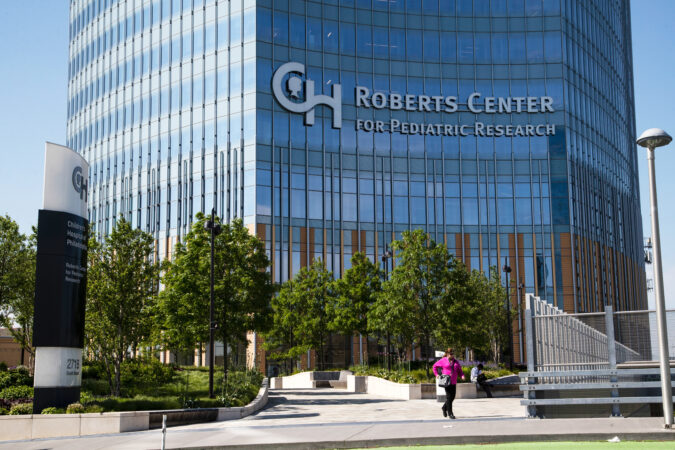
Children’s Hospital of Philadelphia remained the region’s most profitable health system, with a 6.2% operating margin, up from 5.2% the year before. CHOP posted $2.7 billion in total revenue in the last six months of 2025, up from $2.4 billion the year before.
Nonprofit health systems in South Jersey, such as Cooper, Inspira, and Virtua, do not report comparable financial results until they file their annual audited financials statements in the spring.
Here’s a summary:
Jefferson Health: Jefferson had an operating loss of $201 million in the six months that ended Dec. 31, compared to a $55 million loss the year before. The $201 million loss included a $64.7 million restructuring charge related to severance for 600 to 700 people laid off in October and other changes designed to improve efficiency in the 32-hospital system that stretches from South Jersey to Scranton, Jefferson said.
University of Pennsylvania Health System: Penn had an operating profit of $189 million in the first six months of fiscal 2026, up from $117 million in the same period a year ago. Operating income increased, even after Penn put $43 million into reserves for medical malpractice claims. Two years ago, Penn had recorded charges totaling $90 million for the same purpose.
ChristianaCare: ChristianaCare, Delaware’s largest health system, posted a $37 million operating gain, up from $33 million in the first six months of fiscal 2025. The health system’s revenue rose 9% to $1.75 billion, helped in part by its expansion into Pennsylvania. ChristianaCare took over five of Crozer Health’s freestanding outpatient locations in Delaware County.
Temple University Health System: Temple had a $50.5 million operating loss in the six months that ended Dec. 31. In the same period the year before, Temple reported a $13.5 million operating gain. The nonprofit attributed some of the losses to costs related to the opening of Temple Women & Families Hospital in September.
Main Line Health: Main Line had an $8.7 million operating profit in the six months that ended Dec. 31. Main Line’s swing from an $8.9 million loss in the same period of 2024 benefited from a change in accounting for depreciation that reduced expenses. Without that change, Main Line would have had another loss.
Redeemer Health: Redeemer reported an operating loss of $14.7 million, compared to a loss of $19.5 million the year before. The improvement happened even though the health system in Philadelphia’s northern suburbs increased revenue by just 1.2%, to $227 million.
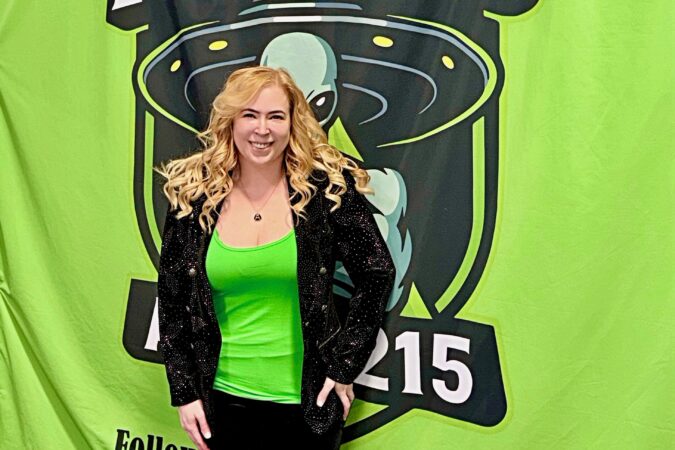
Lauren Barone has been in love with everything martial arts since she was a child, whether that meant practicing tae kwon do and studying old Royce Gracie matches, or just watching the Ninja Turtles. So it shouldn’t come as a surprise that the 40-year-old now is now a part of the Professional Grappling Federation, the world’s only team-based jiujitsu league.
She is also the first female owner in an otherwise all-male league.
“It’s really wonderful to be the first female owner,” said Barone, an Arkansas native. “I’m kind of paving my own path and figuring it out as I go. And I embrace that role because there are things that I want to do.”
Barone will oversee the latest pro sports franchise to represent the city, the Philadelphia Phenoms, who kick off their first PGF season on Wednesday. And when it was time to pick a new city for the league’s expansion, Barone knew Philly was the perfect place for a jiujitsu team.
“I have a great deal of respect for the wonderful city of Philadelphia and some of the most amazing sports fans come from the area,” Barone said. “It’s got a wonderful sports scene. I’ve been to events in Philly, like WrestleMania, and it’s quite a different sports scene. The fan energy was amazing and I was like, wow, these fans are unmatched. So, that’s something that really hit home for me.”
The PGF is entering its ninth season, and the Phenoms will open their inaugural campaign against the Las Vegas Kings this week. The entire regular season, which wraps up in April, will be held in Las Vegas, with matches streaming on the PGF YouTube channel each Wednesday.
The playoffs consist of the top eight individual scorers competing in a single-elimination bracket. To prepare for the competition, the Phenoms will practice out of Olivo’s Las Vegas gym, Potential Jiu Jitsu.
“When they step onto those mats, it’s going to be business,” Barone said. “They are going to be seeking wins. We are looking for a championship.”
Before deciding the take ownership of a team, Barone, who now resides in the Philadelphia area, was already fully involved in the sport. She and her husband, Joe, were fans of the PGF, streaming matches on YouTube every week. And, about three years ago, they began their own jiujitsu journey, training out of Finishers MMA in Reading.
“I wanted to do it for weight loss and self-defense, and we just haven’t looked back,” Barone said. “We train together very often. I probably competed 10 times last year, and had my share of wins and losses. But, it’s all growth at the end of the day, and it’s truly rewarding how something that started out as a hobby turned into a career for me.”
The Philadelphia Phenoms will make their season nine debut on March 4.
The Phenoms, who have an alien-themed logo with an “Area 215″ tagline, will compete against three other franchises this season: the Las Vegas Kings, Alabama Twisters, and Colorado Wolverines. Following its latest expansion, the league hopes to continue to grow to 16 teams.
“Once we opened the doors to team ownership, the floodgates opened — the [Las Vegas] Kings were first, then the Philadelphia Phenoms, followed by the Alabama Twisters, with more already in negotiations,” Zoltan Bathory, co-owner of the Professional Grappling Federation, said in a release. “At this pace, we anticipate expanding to 8-12 teams in the coming months, which puts us firmly on track toward the 16-team national league we originally envisioned.”
There are currently 28 athletes in the league across the four franchises. Ahead of the upcoming season, the Phenoms drafted seven fighters to their roster: Andrew Kochel, Derek Rayfield, Shawn Melanson, Kyle Chambers, Noah McCully, Armin Bruni, and Derrick Adkins.
They’ll compete in 75 matches across the five-week regular season in a submission-only, team-based format with six-minute matches. The winner of each match is based on a point system, with different point values for different moves and bonus points for getting your opponent to submit in under 60 seconds.
“I think these athletes are going to mesh really well together because we have leg-lock athletes, pressure passers, we have all different styles of jiujitsu coming together here,” Barone said. “That was something I really wanted, and I think we accomplished that.”
The team will be coached by PGF veteran Kris Olivo (15-5-8), who has been referred to as “the most interesting man in the PGF” for his charismatic energy and flashy wardrobe.
“Last season, when I purchased my franchise, I had sat in on a couple of the PGF matches and noticed Kris Olivo,” Barone said. “Just a really cool, unique personality. The leopard king. And I was like, wow … He exhibits a specific kind of charisma in person and he has a super high jiujitsu IQ. He’s a black belt, was killing it in PGF. I think he has what it takes to be our coach.”
The start of March doesn’t just mean the annual return of basketball madness. It also means that a new league year — and NFL free agency — is just around the corner. In other words, it’s about to be “Howie SZN.”
Some of the team’s biggest questions are on offense, where the Eagles will have first-year coordinator Sean Mannion running a new scheme. But the changes on the roster are just beginning. So how many new faces can you expect? And who might they be? A lot depends on what happens with A.J. Brown and Goedert.
Phillies third baseman Alec Bohm throws a ball to a fan during Sunday’s game against the Yankees
“The only person who takes more underserved blame than manager Rob Thomson for the shortcomings of the Phillies quarter-billion dollar lineup is Alec Bohm,” writes columnist Marcus Hayes.
Bohm was the third overall pick in the 2018 draft, and is labeled a semi-bust by many fans. And while he’s not the next Chase Utley, Jimmy Rollins, or Ryan Howard, as Hayes points out, he’s also not Domonic Brown or Maikel Franco. And he’s not to blame for the Phillies’ struggles behind Bryce Harper.
Next: The Phillies didn’t play Monday, but they’ll be back at it on Tuesday when they visit the Tampa Bay Rays. Alan Rangel is scheduled to make the start.
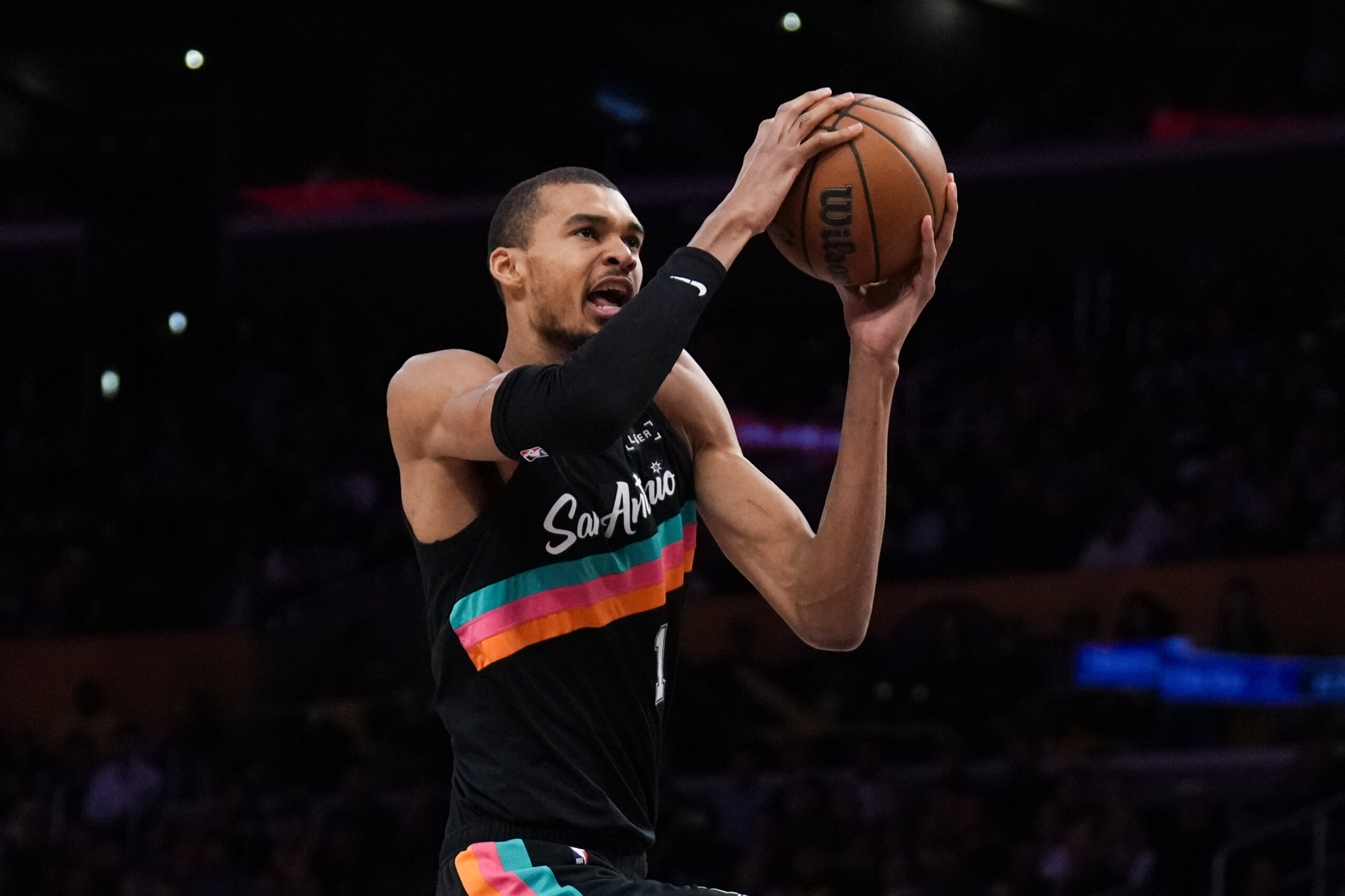
The Sixers host Victor Wembanyama and the San Antonio Spurs on Tuesday night.
After learning that a right oblique strain will sideline Joel Embiid through at least Wednesday, Andre Drummond told Gina Mizell that he wanted to “wrap him in a bubble sheet and give him a hug, man.”
“I just feel like he can’t get a break,” Drummond added.
Embiid’s importance to the team was magnified in Sunday night’s loss in Boston where the Sixers allowed a career-best 27 points, 17 rebounds, and three blocks to Neemias Queta, who is not exactly regarded as a dominant interior force. The Sixers were blasted in the rebounding category, 59-37, including surrendering 19 offensive boards that Boston turned into 30 second-chance points.
And those harrowing numbers come one game before tonight’s home matchup against 7-foot-4 NBA MVP contender Victor Wembanyama and the 43-17 San Antonio Spurs. So what are the short-handed Sixers to do?
Next: The Embiid-less Sixers host the Spurs (NBC/NBCSP, 8 p.m.) and Utah Jazz (NBCSP, 7 p.m.) in a back-to-back this week at the Xfinity Mobile Arena.
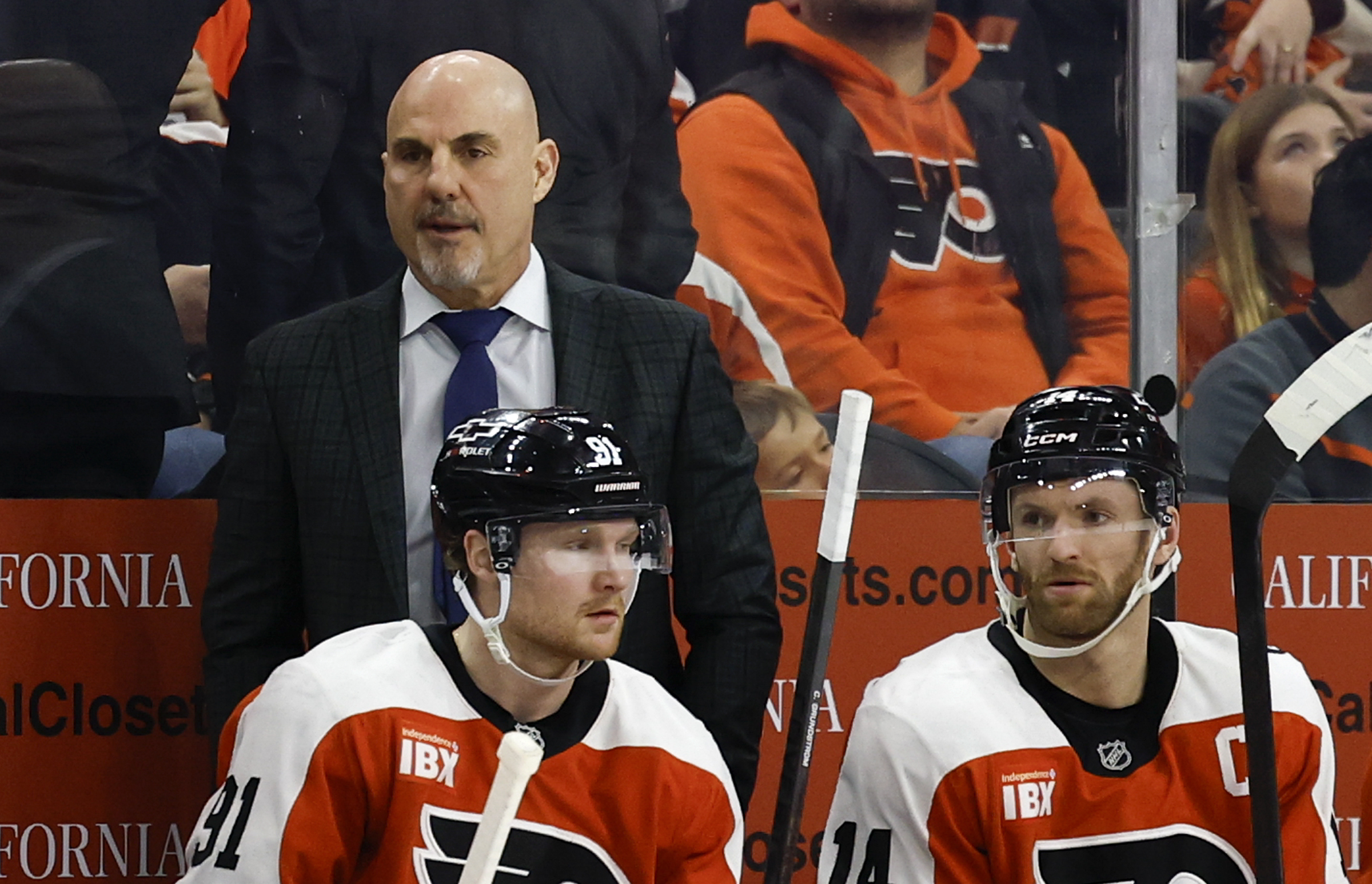
Flyers head coach Rick Tocchet made some changes to his defense over the Olympic break.
When Rick Tocchet came to Philly, he brought his box-and-one defensive structure. During training camp, he called it “a very aggressive zone” defense where he wanted his players to double and triple up when they could to keep the puck on the outside. It worked. Until it didn’t.
The Flyers were one of the best defensive teams leading up to the holiday break — and then one of the worst over the next month-plus. So, with time off over the Olympic break, Tocchet and his staff went to work revamping their defensive structure. So far, it’s paying off, but Tocchet believes they’ll see even more payoff “in the long run.”
The revamped defensive structure seemed to work as the Flyers picked up their third straight win in a 3-2 shutout victory at the Maple Leafs. It was their first shutout win since the end of November.
Next: The Flyers will be back on home ice Thursday when they host the Utah Mammoth in South Philly (NBCSP, 7 p.m.).
On this date: Mlkvy lights it up
Bill Mlkvy’s average of 29.2 points in 1950-51 still stands as a Temple single-season record
It’s a week for high-scorers. Monday was the 64th anniversary of Wilt Chamberlain’s 100-point game, but Tuesday marks another former Philly great’s highest-scoring night. On March 3, 1951, former Temple star Bill Mlkvy, also known as “The Owl Without a Vowel,” scored 73 points — including 54 straight — in a win over Wilkes College.
Mlkvy, who died in December 2024 and reached the rank of major in the United States Army, was a first-round pick of the Philadelphia Warriors in 1952, and played one season with the team before opting to return to dental school.
Eagles wide receiver A.J. Brown has been the subject of trade rumors all offseason.
“The best way to get yourself into trouble at the NFL draft is to focus on immediate needs over expected future value,” David Murphy wrote in Monday’s column.
But this year, the draft looks like its strengths could align with the Eagles’ needs — especially if Brown is on his way out.
“If the mock drafts are to be trusted, the Eagles could have their choice of at least three potential difference-makers at No. 23 and perhaps a second if they can move up in the second round. Last year, I was beating the drum for Missouri receiver Luther Burden III, who ended up going No. 39 to the Bears. This year’s trio is even better,” Murphy adds.
Here’s a look at that trio of pass-catchers, who are drawing comparisons being made to Vernon Davis, Antonio Brown/Stefon Diggs, and Deebo Samuel.
🧠 Trivia time
Speaking of receivers in the NFL draft …
The Eagles drafted first-round wideouts in back-to-back years in 2020 (Jalen Reagor) and 2021 (DeVonta Smith). Prior to that, who was the last receiver they drafted in the first round?
A) Jeremy Maclin
B) Jordan Matthews
C) JJ Arcega-Whiteside
D) Nelson Agholor
We compiled today’s newsletter using reporting from Devin Jackson, Jeff Neiburg, Jeff McLane, Olivia Reiner, Alex Coffey, Scott Lauber, Marcus Hayes, Gina Mizell, Jackie Spiegel, and David Murphy.
By submitting your written, visual, and/or audio contributions, you agree to The Inquirer’s Terms of Use, including the grant of rights in Section 10.
Thanks for reading. Bella will be back in your inbox for Wednesday’s newsletter. — Matt
Reginald Streater, president of the Philadelphia Board of Education, opened his testimony before City Council last month by introducing himself as “Reggie from Germantown,” a graduate of two district schools that no longer exist. Germantown High and Leeds Middle both closed. He knows what it means to lose a building. He’s also voting to close 20 more.
The conflict playing out in Philadelphia isn’t only about schools. It’s about the fact that the school district and City Council have different responsibilities for the same places, and the new facilities plan brings that conflict into sharp focus.
On Jan. 22, Superintendent Tony B. Watlington Sr. released a facilities master plan proposing to close 20 schools, colocate six, and modernize 159 others. On Feb. 26, he presented an amended final plan to the Board of Education, which was updated from 20 school closures to 18. Russell Conwell Middle School and Motivation High School were removed from the closure list.
The district has lost 15,000 students in a decade, carries 300 buildings, many of them 75 years and older, and runs some schools with more than 1,000 empty seats, while others are overcrowded. Concentrating students means Advanced Placement courses in every high school, algebra for every eighth grader, and real career and technical pathways. The current spread of half-empty buildings makes all of that impossible to deliver consistently or fairly.
The facilities plan is doing exactly what it was designed to do. The trouble is that everything it was not designed to do.
A Philadelphia neighborhood school isn’t just one institution. It’s four, sharing an address. There’s the instructional platform: courses, teachers, schedules, the district’s domain. There’s the civic anchor: the building that signals to a neighborhood that its children count, and they belong. There’s the distribution node: where meals are served, where social workers operate, and where there is, most days, someone watching. And there’s the pathway to the future: where a counselor knows a family by name, where a student learns there’s a college or a trade or a life beyond the block.
In places like Kensington, schools have absorbed those responsibilities over time.
When that school building closes, all of those other things close with it. Some of those functions were formal educational programs. Others accumulated because families had nowhere else to go for them. The school became the place where paperwork was explained, problems were addressed and solved, and someone always knew which door to knock on next.
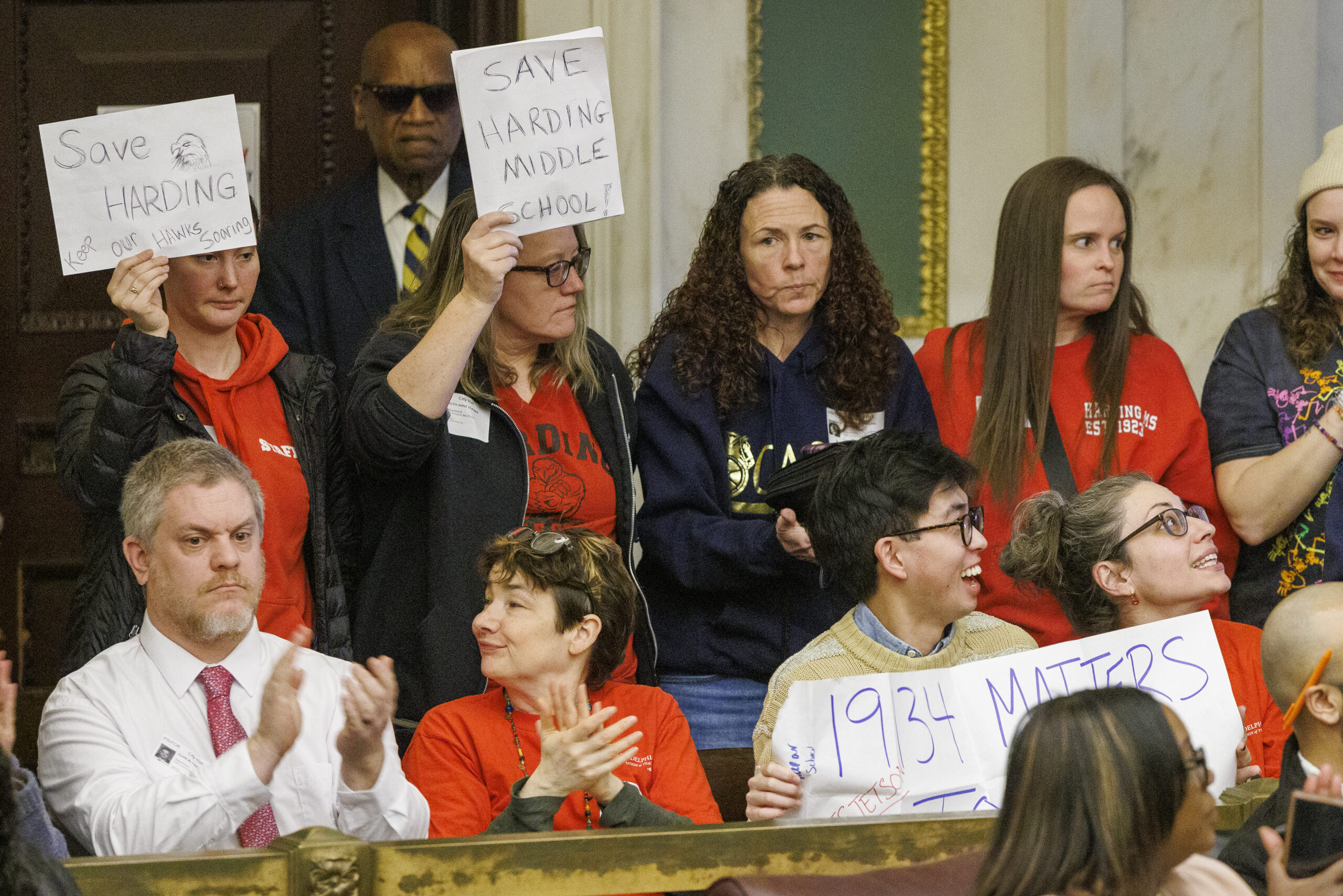
Supporters of Harding Middle School protest at a City Council hearing with school board members earlier this month.
Residents and families filled the chamber. Parents stood along the walls long after seats ran out, some holding infants, others carrying school backpacks. The hearing lasted hours.
The debate sounded like a disagreement about the plan, but it was really a disagreement about who is responsible for what the plan leaves behind.
What closes with a school building is not limited to instruction. Council’s budget is the instrument for the functions the facilities plan does not govern: housing investment, community infrastructure, colocated services, and neighborhood anchors that exist independent of school enrollment.
The district held 47 public listening sessions and surveyed more than 13,000 people before releasing this plan. The fight at City Hall last month wasn’t because communities weren’t heard. It’s because what they described was a loss that the facilities plan was never designed to address. That’s not a failure of process. It’s a mismatch of jurisdiction.
The district’s plan answers an educational question. What replaces the neighborhood functions housed in those buildings is a civic one.
That answer does not sit with the school district.
Amanda Soskin is a Philadelphia resident and consultant who writes about neighborhoods and civic infrastructure at Neighborhood Fundamentals.
The announcement that the Philadelphia School District will close additional schools because of budget shortfalls is devastating, but sadly not surprising.
When schools close, students who have already faced instability pay the highest price. Parents scramble to rearrange transportation and childcare. Children lose trusted teachers and friendships. Communities lose institutions that once anchored them. Families deserve more than reassignment letters and uncertainty. They deserve meaningful options.
Two solutions are within reach: Lifeline Scholarships for Pennsylvania and the federal program, the Educational Choice for Children Act (ECCA). These programs would allow funding to follow Pennsylvania students to schools that meet their needs. These scholarships would give parents — not bureaucracies — the ability to choose a safe, effective learning environment, whether that is a public charter school, private school, faith-based school, or specialized program tailored to a child’s needs.
Students get off the bus at Laura W. Waring elementary school in Spring Garden last month. The school is set to close in 2027.
Gov. Josh Shapiro has the opportunity to act, and he needs to opt in now. By supporting Lifeline Scholarships and opting Pennsylvania into federal education choice programs like ECCA, the state could help families immediately. These are education dollars intended for children. Allowing them to follow students would give parents real leverage and real hope.
Other states are already moving forward. In Texas and Florida, tens of thousands of families are applying for scholarships that open doors to schools better suited to their children. Reports from Texas show more than 80,000 applications from families seeking alternatives. These parents are not abandoning public education; they are seeking opportunity where it exists.
Critics argue that school choice harms public schools. But forcing families to remain in schools that are unsafe or chronically underperforming harms children. Choice introduces accountability. When families have options, schools must improve to keep students. Competition can spark innovation, encourage responsiveness, and reward excellence.
This is not about politics or ideology. It is about fairness.
Every parent wants the same basic things: a safe school, strong teachers, and a chance for their child to succeed. For too many Philadelphia families, those expectations remain unmet. School closures make that reality even more urgent. Lifeline Scholarships and federal education choice programs like ECCA could offer stability in a time of upheaval.
Philadelphia parents and community leaders should make their voices heard. Contact your legislators. Write to Gov. Shapiro. Ask Pennsylvania to adopt policies that put students first and give families the freedom to choose schools that work for their children.
Our children cannot wait another decade for incremental change. When schools close, families need solutions — not promises. These solutions are already working for families in many states across the country; why not in Pennsylvania?
The eastern sky is aglow with dawn streaks of orange when the cry of a whistle sounds outside of ICE headquarters in Philadelphia.
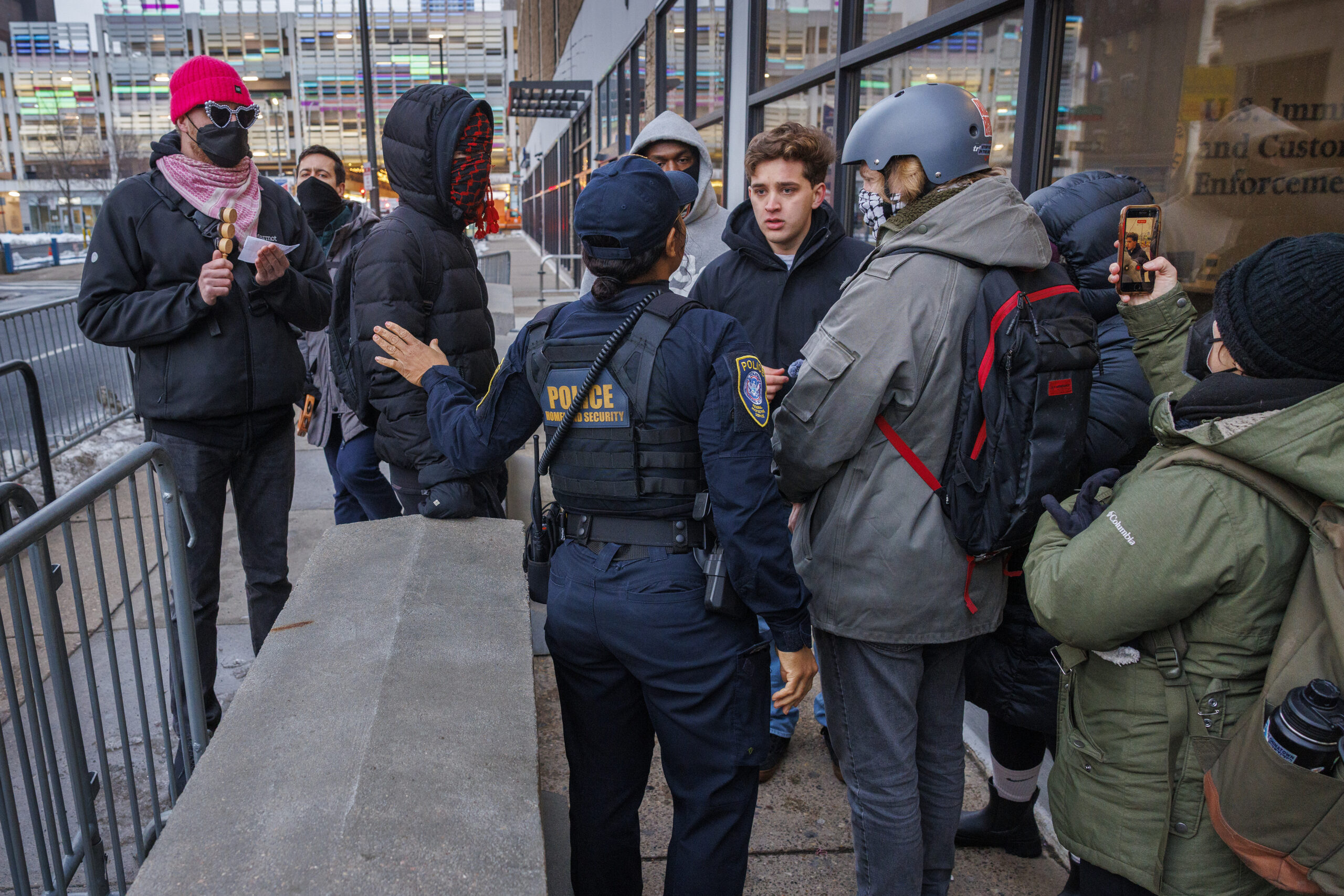
The noise pierces amid an improvised orchestra of protest, as chanting demonstrators shake tambourines, rattle jingle sticks, and beat drums ― one person banged on a kitchen colander ― to create a clamor that makes it challenging to concentrate.
That’s part of the goal of the weekly “Noise Demo” organized by No ICE Philly to raise awareness among morning commuters but also to try to disrupt the work of Immigration and Customs Enforcement agents at the Eighth and Cherry Street office.
“We’re interrupting them,” said a protest leader who asked to be identified only as a member of No ICE Philly out of fear of repercussion from the government.
For advocacy groups here and across the county, the whistle has become both a tool and symbol of the anti-ICE movement.
On the streets, it’s the means to alert neighbors and warn immigrants when ICE arrives on the block, and to try to distract and confuse officers who may already be operating in an unfamiliar neighborhood.
A blast from a standard pea whistle can carry half a mile, and the sound from a specialized emergency whistle can travel a mile or more, depending on conditions.
ICE officials in Philadelphia said last week they had nothing to add on the noise demonstrations or on the use of whistles, beyond what the agency had already said: “Your whistles won’t stop or hinder ICE from arresting criminal illegal alien sex abusers, murderers, gang members, and more,” the agency told Minnesota protesters on social media.
In November, President Donald Trump issued a ban ― so far blocked by the courts ― on creating “loud or unusual noises” at federal facilities in the U.S. That hasn’t slowed No ICE Philly, which gathers to make noise on Mondays, though the snowfall pushed a recent action to Thursday.
“Maybe,” said activist Huston West, who blasted a steady beat on his whistle as ICE officers arrived at work on Thursday, “it makes them think about their life choices.”
A man who tried to confront demonstrators is engaged by a Homeland Security officer during a No Ice Philly “Noise Demo” outside the U.S. Immigration and Customs Enforcement office at 114 N. Eighth Street in Center City.
Why have whistles become so popular among immigration protesters?
Many reasons.
Whistles are light, portable, reliable ― and cheap, about 20 cents each when bought in bulk. They don’t need batteries or recharging, have no buttons or controls. Everyone knows how to make it work.
To him, protesters’ use of whistles carries symbolism, summoning images of referees calling penalties during sports events. Maybe the activists are saying ICE has broken the rules or needs to stop.
“Like throwing a penalty flag,” he said, “against ICE agents who they deem are acting unlawfully.”
The whistle ranks among the oldest human inventions, the first ones crafted from bone, wood, or clay, used for hunting, signaling, and religious rites.
Englishman Joseph Hudson is considered the inventor of the modern pea whistle ― the tiny ball in the air chamber produces the trill ― in the 1880s. He created the Metropolitan Police whistle for British bobbies and the Acme Thunderer for soccer referees, who to that point had waved handkerchiefs to signal fouls.
Today, hundreds of thousands of whistles have been distributed to ICE protesters around the country ― more than 150,000 sent from Chicago alone, according to the Chicago Sun-Times.
In Minneapolis, activists have used 3D printers to crank out supplies. In Philadelphia, whistles have been given out by the handful at organizing meetings. Temple Beth Zion-Beth Israel ordered 300 whistles for distribution, so neighbors can quickly signal that ICE is present and warn immigrants to seek safety.
The interior lobby of U.S. Immigration and Customs Enforcement at 114 N. Eighth St. in Center City.
The Trump administration wants to ban loud noises outside federal facilities, a move widely seen as an effort to halt protests at ICE offices. A federal judge in Oregon temporarily blocked the restrictions, saying they said could violate the First Amendment by criminalizing free speech.
But even among pro-immigration activists, not everyone sees whistles as consistently beneficial.
Some think the noise adds to the confusion at the scenes of ICE arrests, increasing fear and anxiety among families during what are already tense and sometimes violent encounters.
New Sanctuary Movement of Philadelphia, a major advocacy organization, has begun talking to other groups about finding alternatives to whistles, said co-director Blanca Pacheco.
Yes, she said, it’s important that arrests not be permitted to be carried out in silence. But “what is the kind of noise that people can come up with that is supportive, instead of adding to the trauma?”
Not all in immigrant communities understand the purpose of the whistles, she said. And for those who have survived war or torture the noise can be triggering.
One option may be that people could shout, “ICE is here!” Perhaps two or three people on a block could be designated to blow whistles, rather than everyone at once. Even singing could work, she said.
“I think that Chicago and Minnesota and other places that have used the whistles had to come up with tactics and strategy very quickly,” said Pacheco, who noted Philadelphia is not in that position. “We can learn from other places what has worked and what has not. I think whistles can be used in some scenarios, not all the scenarios.”
Outside the ICE office on Thursday, two ICE agents heading into the building jawed with demonstrators who yelled at them to quit their jobs. Whistle calls and drum beats continued on, toward an 8 a.m. conclusion.
“ICE operates from the very early morning into early afternoon,” said the demonstration leader who declined to give his name. “We just want to make sure that we’re here when they’re here.”
A week from now, the NFL’s new league year begins, the free-agency frenzy kicks off, and rosters for the 2026 NFL season will start taking shape.
For the Eagles, a crucial offseason is underway. They moved on from offensive coordinator Kevin Patullo after the offense took a big step back in 2025, and replaced him with first-year coordinator Sean Mannion, who will bring a new scheme to an offense in need of a jolt.
The Eagles have 20 total pending free agents and a few holes to fill, but, as of now, only have around $14 million in cap space, according to Over the Cap, before making any moves to clear room.
How will they approach free agency? What new faces could be coming to town?
Let’s start our two-part free agency preview with a position-by-position look at the offense.
Will A.J. Brown stay or will he go? The answer to that question could have a domino effect for the whole offense.
Wide receivers
Why start here? Well, it’s the obvious place to start, because the entire offseason approach sort of revolves around what happens with A.J. Brown.
With or without Brown, though, the Eagles need reinforcements at wide receiver. They’re losing Jahan Dotson in free agency and need a WR3 (or WR2, depending on Brown). It’s a position the Eagles likely will add talent to during the draft, but there are options in free agency, too.
Romeo Doubs surpassed 700 yards for the first time in his career this past season.
Romeo Doubs: The fit is obvious. Doubs, who turns 26 next month, was with Mannion in Green Bay, where last season he caught 55 passes for 724 yards and six touchdowns. He’s a good route runner who has produced in each of his first four NFL seasons since the Packers drafted him 132nd overall out of Nevada in 2022. It is not a loaded class, which means Doubs could be pricier than he normally would be.
Deebo Samuel: Perhaps his beef with the Eagles could be squashed. Samuel is 30 now and the burst that made him a big-name receiver with the stats to back it up seems to come and go. Will Samuel’s market be too rich for the Eagles? It’s hard to imagine given his age, but he did still rack up 72 catches for 727 yards and five touchdowns with Washington last season.
Christian Kirk: Kirk, 29, is due for a pay cut after injuries led to a decline in his statistical output with Jacksonville and Houston over the past two seasons. With the Texans, Kirk was surrounded by talent and that limited his production, too. But with Nico Collins out for the playoffs, Kirk broke out in a playoff win over Pittsburgh, catching eight of nine targets for 144 yards and a touchdown. He caught another touchdown the next week in a loss to New England. Could Kirk be available a little bit cheaper on a one-year deal? The Eagles may want to find out.
Other names to watch: Jalen Nailor, Kendrick Bourne, Van Jefferson
The Eagles are returning all five starters for the 2026 season along the offensive line, but it also may be the most important offseason for roster building at the position in quite some time.
And it’s all happening without longtime position coach Jeff Stoutland in the fold.
Lane Johnson and Landon Dickerson weighed retirement until recently. Cam Jurgens flew to Colombia to treat his ailing back. Tyler Steen’s long-term viability at right guard is up for debate.
There’s a lot to address. Let’s start with Johnson, whose eventual replacement most likely will come via the draft. Don’t be surprised to see the Eagles take a tackle with their first pick. But they also need a swing tackle with Fred Johnson as a free agent. There are two second-year tackles on the roster in Cameron Williams and Myles Hinton, but Johnson’s ability to get through a full season isn’t a lock, so the Eagles need contingency plans.
They are relatively thin on the interior, more so than at tackle. Long-term replacements for Dickerson and potentially elsewhere are more likely to come via the draft, but the Eagles will need to mine the free-agency market.
Could Evan Neal be an O-line reclamation project for the Eagles?
Evan Neal: Neal fits the Eagles’ playbook. No, not Mannion’s playbook. Neal, 25, is a first-round pick (seventh overall in 2022) who has been a bust and even changed positions from tackle to guard. He’s 6-foot-7 and 340 pounds. Hello, Mekhi Becton? Stoutland isn’t around to have the same kind of makeover, but Neal will be a pretty cheap flier.
Isaac Seumalo: Another guard, Seumalo, an Eagle from 2016-22, is a 32-year-old who made the Pro Bowl in 2024 with the Steelers. Unlike Neal, Seumalo isn’t a project. He’s a player you sign to start over Steen and be in the building for Dickerson insurance.
Alijah Vera-Tucker: Vera-Tucker has been really solid for the Jets, but he’s coming off a torn triceps that wiped out his 2025 season and could be available on a one-year, prove-it deal. The 14th overall pick in the 2021 draft would push Steen in camp and could earn the starting job while giving the Eagles more plug-and-play depth than they have right now.
Trey Pipkins III: It’s time to put a tackle on this list. Pipkins wasn’t great with the Chargers in 2025, but he’s started a lot of games in seven seasons and could be an option for a reliable swing tackle behind the Eagles’ starters.
Welcome to the biggest area of need for the Eagles, due respect to Jaheim Bell, Cam Latu, and E.J. Jenkins, the three tight ends on the roster.
Dallas Goedert is a free agent after coming back last season on a restructured deal and scoring more touchdowns (11) than he had in the previous three seasons combined (8). But while he was a major red-zone weapon running routes, Goedert’s blocking took a step back. Grant Calcaterra, the Eagles’ sixth-round pick in 2022, is also a free agent and is best used as a receiver. The Eagles certainly need to add a pass catcher or two at this spot, but the scheme they’re turning to will also require much better blocking.
The Eagles probably will draft a tight end, but they need to add in free agency as well. They seem likely to be priced out of the top of the market — think Kyle Pitts, David Njoku — in what is a relatively weak free-agent class.
Will Dallas Goedert parlay a big scoring year into a bigger deal elsewhere?
Goedert: What will Goedert command on the open market? How will teams view his 11 touchdown receptions after he finally got through a season mostly healthy? He’s still just 31 years old and thinks some of his best football is ahead of him. If the number isn’t too high, the Eagles could bring him back.
Isaiah Likely: It’s unclear what Likely’s market is going to be in free agency. The soon-to-be-26-year-old has been playing in Mark Andrews’ shadow in Baltimore, and has probably benefited from having talented pass catchers around him. But Likely has shown flashes, and the Eagles could get in the mix for him. A weak class, though, means he could fetch more than some teams are willing to spend.
Jake Tonges: Tonges is limited in his catching abilities, but he’s an elite blocking tight end that the Eagles could certainly value as TE2 or TE3. Tonges, who turns 27 in July, has been with the 49ers since 2023 and knows how to block up outside zone concepts.
Tyler Higbee: Higbee recently turned 33 and has played just 13 games over the last two seasons. He would add an experienced red-zone target to the offense, but most importantly Higbee is a solid blocker in the run and pass game.
Charlie Kolar: Kolar’s running mate in Baltimore, Likely, is the better and more expensive option on the free-agent market. But Kolar, 27, is one of the better blocking tight ends in the league.
This position, like receiver, also has a trade possibility that could impact how the Eagles address it in free agency.
That depends on whether Tanner McKee fetches a draft pick that makes him worth offloading. The Eagles value the backup quarterback spot, and behind Jalen Hurts, McKee is the only quarterback under contract for 2026. The Eagles probably will take another quarterback on Day 3 at the draft, but they could add to the group in free agency, too, especially for another camp body. Last year, they drafted Kyle McCord in the sixth round and were later forced to part with draft compensation to bring in Sam Howell in the QB3 spot.
Will Sam Howell (14) stay in the QB room in 2026?
Howell: Keep the band together? Howell is a free agent and still has much more NFL playing experience than McKee. He didn’t see the field for the Eagles last season, but they could do worse than bringing him back to the room.
Trey Lance: The No. 3 overall pick in the 2021 draft is still just 25 years old and was with his third NFL team this season when he backed up the Chargers’ Justin Herbert. Lance spent his first two seasons with the 49ers in the Kyle Shanahan offense, from which the Eagles likely will install elements during the offseason. Can’t hurt to have a player in the building with some experience hearing calls from the man himself.
Clayton Tune: Another one for the translator category. Tune, a fifth-round pick by Arizona in 2023, was on Green Bay’s practice squad last season and could help Hurts and Co. transition into the Mannion offense and terminology.
Workplace discrimination guidelines have been changing under President Donald Trump’s administration.
The Equal Employment Opportunity Commission has been rolling back Biden-era guidelines — particularly with regard to Diversity, Equity and Inclusion (DEI) policies. But avoiding discriminatory practices remains a top concern among employers, both when hiring and terminating employees.
Taking several important steps can ensure that your business is not on the wrong side of a discrimination claim.
Write job descriptions thoughtfully
Avoiding claims of discrimination can be mostly accomplished by focusing on job descriptions, said Claude Schoenberg, a labor attorney based in Bala Cynwyd.
Schoenberg says that a good job description fully lays out what’s required of an employee to adequately perform their job. “It becomes your Bible and it takes a lot of the subjectivity out of the conversation,” he said.
It is clear about the physical nature of the work such as moving large boxes, lifting heavy items, operating equipment, or working outdoors in all kinds of weather. A good job description details every single required job function, so if any of these functions are not being completed, the employer has the right to take action.
“If you have employees for whom there is no job description, then develop one. It’s a critical document and it cannot be vague,” Schoenberg said. “If you don’t have that job description, then you are vulnerable to claims alleging things that you may not have said or done.”
Some jobs make this tricky, Schoenberg warns, such as roles that require wearing a specific type of clothing at work, or positions that are only open to one gender (such as a male attendant in a men’s locker room).
“You should always have an attorney review your job descriptions before using them,” he said. “And there should be a very detailed job description for every single employee at your company, from hourly workers to your top managers and executives.”
But job descriptions do not broadly protect employers from any kind of discrimination claim, said Christina M. Reger, a labor attorney at Loutel Law in Newtown.
“They’re helpful in things like disability accommodation disputes, but not as a catch-all defense against all age, gender, and race claims,” she said.
Update company policies and train managers
Anti-discrimination rules should be a “critical part of every company’s handbook,” Reger said, and must be communicated to employees regularly. She recommends ongoing training for managers so they can identify any potential issues.
“Policies should be living and broad without listing specific protected classes one-by-one, which would help avoid constant updates and prevent misunderstandings when language changes,” she said.
To help enforce these rules, Reger also recommends having a clear complaint procedure and an external source for complaints. This could include an outside attorney with a dedicated email or phone line for complaints, or a third-party human resources consultant.
“Many small employers get burned because the complaint path is not credible,” she said. “You want complaints going to an external source, not directly to the EEOC.”
How has EEOC guidance on discrimination changed?
The EEOC’s new policies are pushing back against corporate DEI practices that became mainstream in recent years. Instead, the EEOC is encouraging employers not to discriminate based on factors such as skin color, religion, and sexual orientation. The agency now says all employees should be treated equally regardless of these factors and hiring practices should reflect the same.
The change in policy can be confusing, but Schoenberg reminds his clients that when it comes to discrimination in the workplace, the EEOC only sets guidelines. Depending on the political environment, the EEOC has been known to flip-flop. But court rulings are binding.
“The EEOC’s own regulations do not have the force of law,” he said. “Employers should focus on actual statutes and court interpretation — not the administration’s latest guidance.”
Before terminating an employee, Reger suggests the employer do a “retaliation/discrimination risk check.” This involves running through a checklist of documentation — recent complaints, leave, accommodation requests, protected status signals — and documenting the legitimate reason for termination.
Employers should “also strongly consider severance pay if it can help reduce the risk of a lawsuit,” she said.
Schoenberg advises companies to get Employment Practices Liability Insurance (EPLI) as a “backstop.” Most general liability policies don’t cover employment practices, he said, and employers should not assume that they’re covered if a discrimination lawsuit is filed against them.
All of this points toward treating employment as a life cycle from hiring to termination.
“The more you document that life cycle, the better off the employer is,” said Schoenberg.
No matter what folks in Boston tell you, Philadelphia is America’s most historic big city. So why is architectural preservation increasingly under attack here, especially as Philadelphia gets ready for its star turn in the nation’s 250th birthday celebrations?
The movement to protect Philadelphia’s rich and varied architectural heritage was thrown into disarray Feb. 26 when a Court of Common Pleas judge invalidated the historic district created in 2024 to protect Washington Square West, a neighborhood that includes both Colonial-era masterpieces and nationally important infill buildings from the 1960s urban renewal period.
Judge Christopher R. Hall’s decision primarily focused on procedural issues and could be reversed if it’s appealed. Yet it is just one of several existential threats facing the preservation regimen that has guided the city for the last 40 years.
His decision is likely to encourage a group of developers who are challenging the Spruce Hill historic district, which also was created in 2024. It could similarly embolden Councilmember Mark Squilla, a former preservation champion who once created a controversial zoning carve-out to protect a one-story supermarket in Society Hill. Having jumped on the anti-preservation bandwagon, he’s now pushing legislation that many believe would gut the powers of the Historical Commission.
While the issues driving each of these challenges vary, it’s no accident that they’re happening at a time when people are increasingly concerned about rising housing costs. For years, pro-development activists have argued that there is a link between the city’s historic preservation laws and the scarcity of affordable housing. By adding an extra layer of regulation, they contend, those laws restrict where people can build, limit new construction, and raise maintenance costs for homeowners.
There’s no doubt that the city’s preservation laws require owners of historic properties to go through an extra step in the approval process. That takes time and can sometimes add to the cost of a project.
Yet it seems odd that pro-development activists have cast historic preservation as the main villain when so many factors influence the city’s housing supply: zoning regulations, interest rates, availability of labor, cost of construction materials. President Donald Trump’s tariffs alone sent the price of lumber soaring in the last year.
In an effort to put things in perspective, the nonprofit Preservation Alliance recently commissioned an economic analysis to explore its impact on housing prices. The report made two interesting observations: Apartments in older buildings rent for less than those in new ones. And protecting those older buildings actually helps maintain a supply of “naturally occurring affordable housing.”
The study, prepared by the Washington-based Place Economics, also examined claims that historic districts are enclaves for the wealthy and exclude renters. Data show the opposite: Historic districts continue to gain new residents long after they been designated. In fact, between 2010 and 2020, the population of Philadelphia’s historic districts grew almost five times as fast as the city as a whole, which suggests new housing is being built despite the additional oversight.
Not all that construction takes the form of new buildings, however. Even in the best of economic times, erecting a new apartment building in Philadelphia is far more expensive than fixing up an old one. As a result, the city has come to rely on older buildings to provide new housing. Without them, Philadelphia would be a much less affordable place.
In the past, the city’s obsolete offices and factories were the main targets for housing conversion. Those buildings are relatively easy to adapt because they have large, rectangular footprints.
But what about smaller, more irregularly shaped historic buildings? Are the city’s preservation and zoning laws flexible enough to allow more density in old townhouses, which, after all, constitute the bulk of Philadelphia building stock?
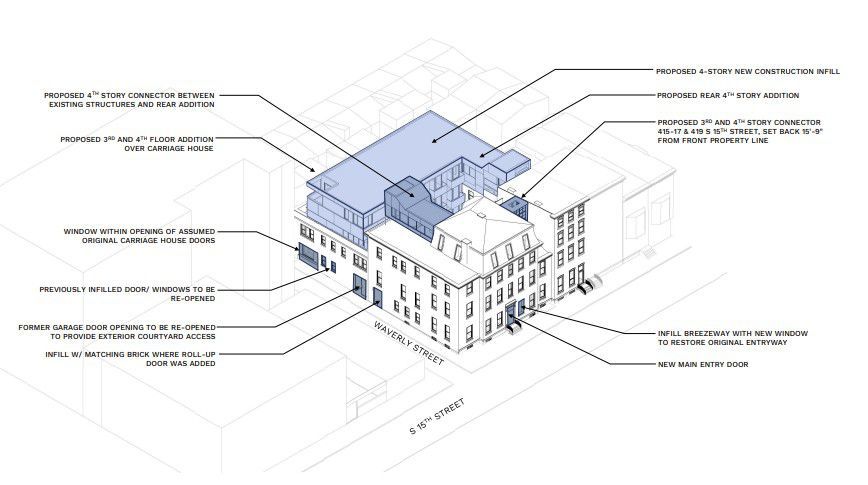
This sprawling complex of 19th-century buildings at 15th and Waverly Streets is being converted to a 32-unit apartment building by Lo Design for developer Keith Alliotts. By installing a penthouse level over the former stable (rear left), the architects will be able to improve the interior circulation and increase the density.
Converting townhouses into apartments
To understand the role those buildings can play in the great Yimby-Nimby debates, I reached out to Lea and Evan Litvin, who run Lo Design, an award-winning firm that has its offices in the Rittenhouse-Fitler historic district. Lo Design started out doing single-family homes for developers, but lately they’ve taken on commissions to turn large townhouses into apartments.
Small conversions are more labor-intensive than erecting a new townhouse on an empty site, but they allow the Litvins to do work that aligns with their architectural ideals. The conversions create more housing for less money, using fewer natural resources. “Saving an old building is the most sustainable form of construction,” Evan explained.
Since Philadelphia’s historic townhouses were never meant for multiple tenants, and often have awkward layouts, the Litvins have developed architectural tricks to make them function as apartment buildings. Sometimes that means attaching a new wing on the back. In other cases, they’ve built freestanding structures in backyards.
Their current project at 15th and Waverly Streets used a little of everything to transform a historic Greek Revival mansion into a 32-unit building.
The brick building began its life in 1860 as a private home, complete with a stable. At some point, someone popped on a mansard roof to create a fourth story and added wings on the sides. Then, in the early 20th century, the mansion, stable, and a neighboring townhouse were fused into a single building that served as offices for what was then known as the Society to Protect Children from Cruelty.
For the project’s developer, Keith Alliotts, the building’s main attraction was its size — 26,000 square feet, significantly larger than a typical townhouse, which might be 6,000 square feet. He also liked that the location, a few steps from the former University of the Arts’ Hamilton Hall, felt like part of the Rittenhouse Square neighborhood.
Yet the challenges of transforming the awkward amalgamation into a coherent, multifamily residence soon became clear. None of the floors in the different buildings lined up. The U-shaped footprint complicated the flow through the building. The interior was a mashup of Victorian and post-modern details. On top of everything else, the project would need a zoning variance and approval from the Historical Commission.
Lo Design plans to create an internal courtyard at the center of a new residential building at 15th and Waverly. The project will turn a group of historic 19th-century buildings into a 32-unit apartment building.
Getting those permits turned out to be the easy part, the Litvins said. Because the complex had been empty for years and was starting to deteriorate, the neighborhood enthusiastically embraced the idea of using it for apartments.
From the start, the Litvins knew they would have to expand the already sprawling complex to ensure the apartment layouts weren’t too eccentric. Fortunately, there was a large yard behind the house where they could add a new wing to turn the U into an O. They decided to install a large penthouse on top of the stable and insert several connecting passages to improve the interior circulation.
This diagram shows how LoDesign plans to turn an awkward amalgamation of 19th century buildings at 15th and Waverly Streets into a coherent, multifamily building with 32 apartments. The portions in blue will be added during construction.
While reusing these buildings was no easy feat, the project is a good example of “gentle density.” The neighborhood gets more rental housing, yet the look of the 19th-century mansion remains substantially the same.
By comparison, the first collaboration between the Litvins and Alliotts was a breeze. Alliotts had spent most of his career developing single-family housing in North Jersey before “discovering” Philadelphia during the pandemic. Coming from such a pricey environment, he said, “I was really taken aback by the city’s affordability.” After studying the market here, he fell for an early 20th-century brownstone on the 2000 block of West Girard Avenue in Francisville.
The townhouse could have been torn down
Despite the house’s impressive architecture, it wasn’t listed on the city’s historic register. That meant Alliotts could have demolished the building for something new, an approach taken by several other developers on that once-elegant stretch of Girard Avenue.
Alliotts liked the house too much to destroy it. And since the site was unusually deep, he knew he could fit the equivalent of a second house in the yard. But rather than build another stand-alone house, he asked the Litvins to fit a 12-unit condo building in the same space. Alliotts envisioned the condos — now called The Francis — as starter homes, so he wanted to keep the prices below $300,000 for a two-bedroom unit.
Still, 12 units is a lot of density, even for a generous townhouse yard that was 200 by 31 feet. By making a donation to the city’s Housing Trust Fund, Alliotts was able to get a zoning bonus that allowed him to raise the structure’s height to 45 feet, enough for a fourth story.
To avoid jamming the new, metal-clad building against the old brownstone, the Litvins decided to push the condos toward Cambridge Street, which was once a service street lined with carriage houses. That gave the architects space to create a landscaped courtyard between the two buildings.
Lo Design was able to create nine apartments in the Spring Garden neighborhood by replacing a small garage with a three-unit apartment building in the garden of an early 20th-century townhouse at 2313 Green St. The project’s density was the result of a compromise with neighbors and the Philadelphia Historical Commission.
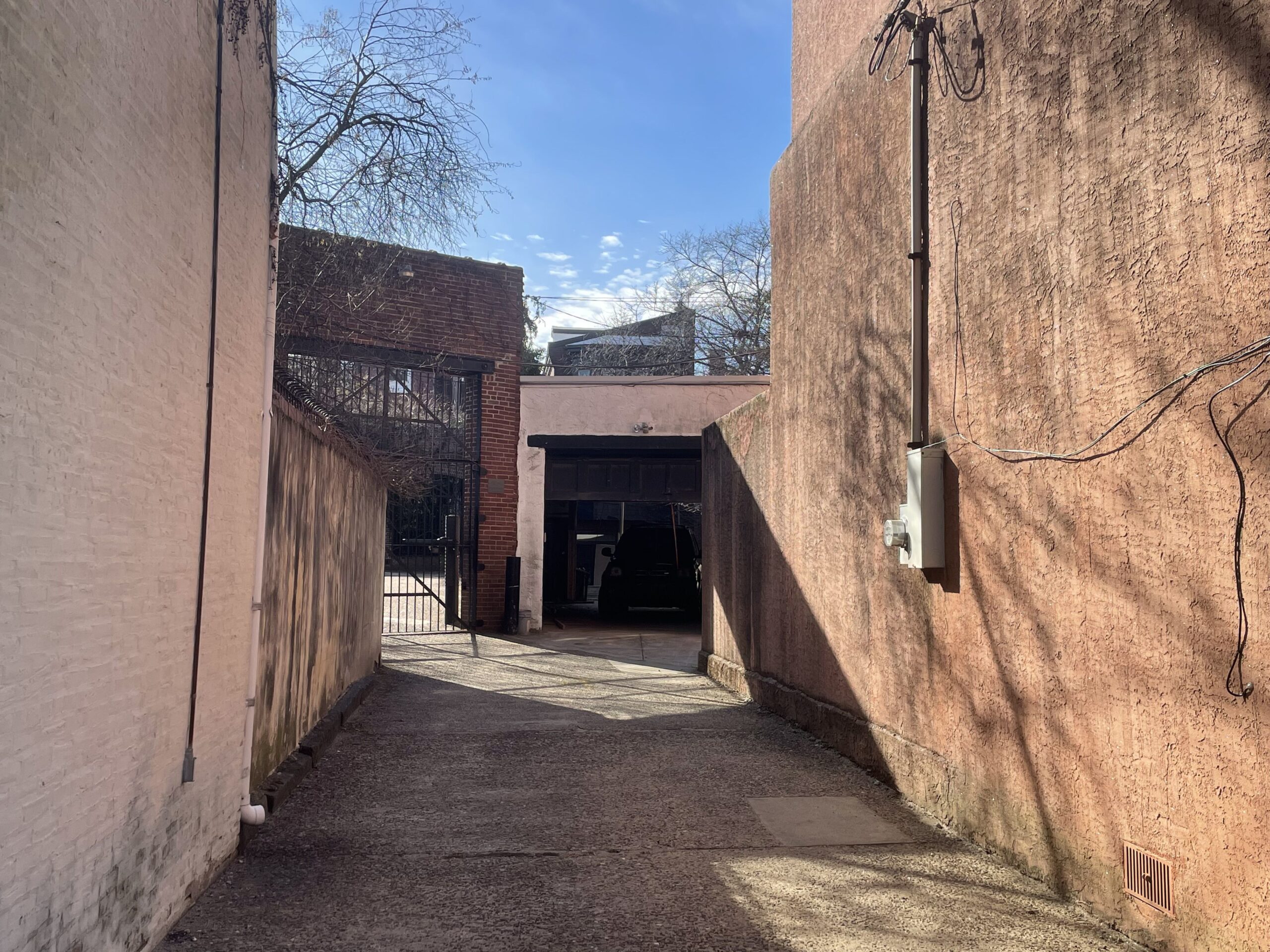
After the success of the Francis, the Litvins had hoped to replicate the model for a new project at 2313 Green St. in the Spring Garden neighborhood. The main house there had already been divided into five apartments, but the site at 238 feet was even deeper than the Girard Avenue property. They proposed a five-unit stand-alone building in the garden, accessed from alley off Wallace Street.
But this time the Historical Commission and neighbors rejected the proposal.
So, the Litvins reduced the size of the building and turned it into a carriage-house-sized structure with three units. They offset the loss of units by adding a sixth apartment to the main house for a total of nine units.
The garage on the right will be replaced by a three-unit building that is part of the redevelopment of 2313 Green St. It will be accessed through an alley off Wallace Street in the Spring Garden neighborhood.
Some preservation opponents may see the outcome as an example of the nickel-and-diming that occurs when developers attempt to add density to historic properties.
But the fact that a former single-family house will soon accommodate nine apartments reveals the untapped density in Philadelphia’s historic buildings. These conversions prove more housing can be created without sacrificing the city’s heritage.
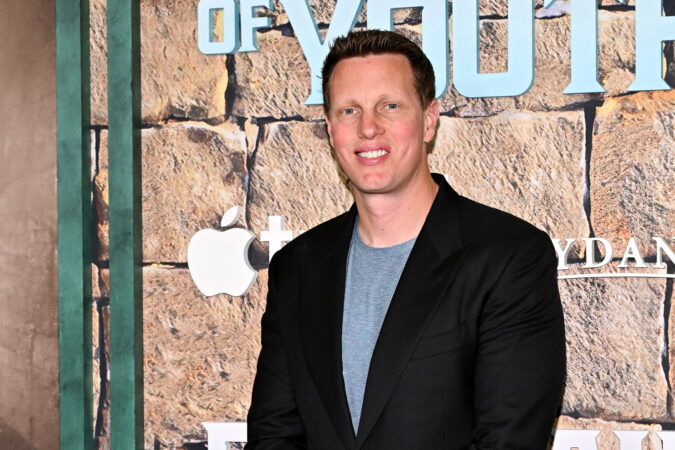
Paramount Skydancewill combine Paramount+ and HBO Max into one streaming service, David Ellison, the company’s CEO, said on a Monday call with investors.
“As we said, we do plan to put the two services together, which today gives us a little over 200 million direct-to-consumer subscribers,” Ellison said. “We think that really positions us to compete with the leaders in the space.”
The announcement comes days after Paramount Skydance agreed to buy Warner Bros. Discovery, HBO’s parent company, following Netflix’s decision to walk away from its own deal amid pressure — and a higher bid — from Paramount.
Ellison added that Paramount didn’t want tomake changes to the HBO brand. “Our viewpoint is HBO should stay HBO,” Ellison said, noting that his favorite HBO product is Game of Thrones. If Justice Department regulators allow the deal to go through, it would place recent HBO Max hits, such as The Pitt and A Knight of the Seven Kingdoms, alongside Paramount offerings including South Park and Yellowstone.
“They built a phenomenal brand,” he said. “They are a leader in the space, and we just want them to continue doing more of it.”
Ellison is the son of Oracle cofounder and Trump ally Larry Ellison. His firm, Skydance, bought Paramount over the summer, putting CBS, Paramount Pictures, and more until his control. The $8 billion deal was approved by the Trump administration following a lengthy review and several concessions.
The deal to buy Warner Bros., valued at about $110 billion, will almost surely attract regulatory scrutiny from the Justice Department because — without divestments — it places major swaths of the film, television, and news industries under one roof: Warner Bros. and Paramount studios, HBO Max and Paramount+, and CBS and CNN would all have the same parent company. Ellison expressed confidence on the call that the deal wouldn’t face hurdles with regulators.
The streaming environment has already become more consolidated in recent years. Hulu, once a joint venture by several media companies, has been fully owned by Disney since 2025. While the company expects to combine Disney+ and Hulu, for now it offers streaming bundles to customers who want to subscribe to both, and another with ESPN+, too.