Blog

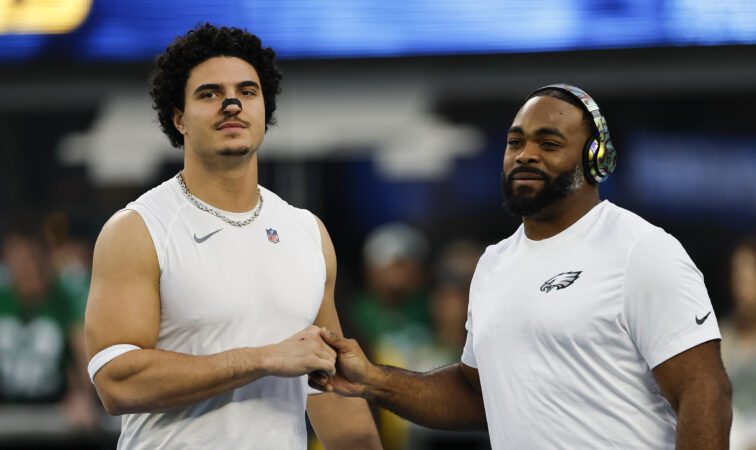
  • Howie Roseman addresses Jaelan Phillips, Brandon Graham, and other potential free agents ahead of the combine

    Howie Roseman addresses Jaelan Phillips, Brandon Graham, and other potential free agents ahead of the combine

    INDIANAPOLIS — Howie Roseman opened his session with Eagles reporters last week in Philadelphia ahead of the NFL scouting combine by laying out a basic blueprint for building a championship-caliber roster: Draft well, re-sign your best homegrown talent, add here and there in free agency, and hopefully rinse and repeat.

    But in setting those parameters, Roseman was also managing expectations for how the Eagles will approach their 19 unrestricted free agents, those who will reach the market next month, and how the general manager will navigate a tightening salary cap after years of pushing cash into future years.

    On Tuesday at the combine, Roseman was asked about specific players whose contracts are up, and some still under contract who aren’t guaranteed to return next season — not that the GM would ever promise that any player will be back (see: wide receiver A.J. Brown).

    Roseman, conversely, didn’t rule out the return of anyone he was asked about, even though he made clear last week that the Eagles will have to say goodbye to many of their free agents, a group that includes some starters they drafted.

    Edge rusher Jaelan Phillips would seem to be a priority signing, even if he’s projected to be one of the more sought-after free-agent commodities when the new league year opens on March 11. The Eagles had Phillips for only two-plus months but praised his work.

    “You certainly see his fit with Coach [Vic] Fangio in our defense, which a lot of times when you’re talking about free agency is a big part of free agency,” Roseman said. “How is this guy gonna fit into our defense? So you see that there, you’ve been with the guy. He’s got tremendous character, tremendous work ethic.

    “And then all the things that you’re doing, you’re trying to balance the other factors that go along with that to try to come down with a value.”

    In other words, the Eagles will negotiate, but they might be willing to only go so far. If they can’t bring the 26-year-old Phillips back, they may need to find other avenues at the position. Nolan Smith Jr., Jalyx Hunt, and Jose Ramirez, who signed a futures contract after the season, are the only Eagles edge rushers currently under contract.

    “We usually take seven or eight guys to camp. We only have three on the roster right now,” Roseman said. “So definitely think we’ll have to address it. It’s a priority position for us.”

    Aside from Phillips, Josh Uche, Azeez Ojulari, Ogbo Okoronkwo, and Brandon Graham are all slated to become free agents. Roseman didn’t rule out welcoming back the 37-year-old Graham, who came out of retirement in early November, for an unprecedented 17th season in midnight green.

    “Brandon Graham is always welcome in Philadelphia,” Roseman said. “Obviously, when I think about what he’s done for us as a player, as a person, and then last year, even when he came back in, the versatility that he showed, coming in in the end of the year and reducing inside and playing defensive tackle, just an all-time Eagles great, future Eagles Hall of Famer.”

    Dallas Goedert led the Eagles in touchdowns but might have played his last game with the team.

    Roseman speaks on Goedert, Blankenship, other free agents, extension candidates

    Roseman had the following to say about the Eagles’ three other free agents who started last season:

    On tight end Dallas Goedert:

    “Tremendous player and person for the Philadelphia Eagles. Really glad we were able to figure it out and bring him back to Philadelphia this year and for the season and [be] tremendously productive for us. Just a huge asset for our offense to have him on our football team. Again, we got to put the whole puzzle together. To sit here — we got a lot of other free agents, too — and say, ‘Hey, we’re definitely going to get this guy back …’ When we get this late, obviously, the market dictates a lot of that, as well. But we’ll certainly sit down with his agent here over the next couple of days and have a conversation.”

    Goedert isn’t the Eagles’ only free agent tight end. Grant Calcaterra and Kyle Granson will be unrestricted in a few weeks. Roseman said last week he needed to do a better job of evaluating the position in prioritizing hybrids who can also block. He has a chance to remake the position, with new offensive coordinator Sean Mannion expected to implement the Kyle Shanahan-Sean McVay scheme.

    On safety Reed Blankenship and linebacker Nakobe Dean:

    “Really proud of Reed, undrafted free agent, and played in two Super Bowls, four years, four playoff appearances. Was a captain this year for our team, tremendous player, tremendous person.”

    Roseman wasn’t asked directly about linebacker Nakobe Dean, but when the topic of 2025 first-rounder Jihaad Campbell stepping back into a starting role was brought up, he brought up Dean.

    “Obviously, we have a free agent at that position, a guy that we drafted, a guy that we think is a really good player, and unbelievable character,” Roseman said. “And so, all those decisions here [will be] made in the next couple of weeks.”

    Still, it seems unlikely that Dean will be back. Blankenship’s future in Philly seems more dependent upon his leaguewide value or whether the Eagles can afford Phillips.

    On potential contract extensions across the defensive line:

    The Eagles also have three defensive players available for extensions three years into their rookie deals: defensive tackles Jalen Carter and Moro Ojomo along with linebacker Nolan Smith Jr.

    The Eagles picked up the fifth-year option for defensive tackle Jordan Davis last offseason rather than extend him, and their gamble paid off after he took a jump in Year 4. Davis may be the most likely of the quartert to have his contract reworked this offseason.

    “That’s another guy, obviously, that you draft, you develop, tremendous character and continues to get better,” Roseman said. “That’s a group of a lot of players that we have, that we have tremendous confidence in, and the puzzle is trying to keep as many of them together as we possibly can.”

    Howie Roseman expressed confidence in up-and-down kicker Jake Elliott.

    On Jake Elliott:

    Kicker Jake Elliott is under contract for three more seasons, but he has become increasingly inconsistent after having a career year in 2023. Elliott has been under 80% in field goal efficiency the last two years. Roseman gave him a strong endorsement, however.

    “Jake has been a tremendous kicker for us since we got him off practice squad in Cincinnati in 2017,” Roseman said. “Tremendously clutch. Have a lot of confidence in him as a player, as a kicker, as a person, captain on our team, and continue to believe in him as our place kicker.”

    At cornerback, the Eagles have two of the best at their respective positions: outside corner Quinyon Mitchell and nickel corner Cooper DeJean. The third spot was unsettled until veteran Adoree’ Jackson settled into the spot in the second half of the season.

    But he is also a free agent and the Eagles are unlikely to spend with Mitchell and DeJean likely to warrant big extensions next offseason.

    “When you look at Q and Coop leading that group — two All-Pro players, guys who we want to be part of Philadelphia Eagles for a long time,” Roseman said. “Coop, he can play anything. He can play outside corner, he can play nickel, he could play at an All-Pro level anywhere. So having him gives you some flexibility.

    “And so, we’ll go into the offseason looking to add to that position. Adoree’ did a really nice job for us last year and got better throughout the course of the year. … He’s a free agent and we’ll just kind of see how the offseason plays out.”


  • Teens arrested in Quakertown ICE protest charged with aggravated assault

    Teens arrested in Quakertown ICE protest charged with aggravated assault

    Five teenagers arrested during a protest in Quakertown last week face charges of aggravated assault and related crimes after a judge ruled Tuesday that prosecutors had presented sufficient evidence for the case against them to proceed, according to sources.

    The teenagers had been held since Friday, when they were taken into custody after a scuffle with Quakertown police officers — including the department’s chief, Scott McElree.

    Officials have released few details about the arrests, but two people with knowledge of the case who asked not to be identified to discuss an ongoing investigation confirmed the charges. The police department and the district attorney’s office have declined to disclose the teens’ names, ages, or charges they face.

    After the more than three-hour hearing in Doylestown, which was closed to the public, prosecutors left the courtroom without answering questions. The teenagers’ parents, speaking through intermediaries, also declined to comment Tuesday.

    But Ettore Angelo, a lawyer representing one of the teenagers, said his 15-year-old client had been released to her parents and placed on house arrest. He said she faces an aggravated assault charge — a felony offense that, if sustained in juvenile court, can carry a penalty of up to five years in a detention facility.

    The teenagers who were arrested had been taking part in a protest of Immigration and Customs Enforcement that began at Quakertown Community High School and moved off campus to Front Street. Witnesses have said that a confrontation erupted there, in front of Sunday’s Deli and Restaurant.

    Students at Quakertown Community High School took part in a protest of Immigration and Customs Enforcement that began at the school and moved off campus to Front Street.

    McElree, the police chief, who was dressed in plain clothes, grabbed a teenage boy and placed a teenage girl in a chokehold, they said, prompting other students to intervene and a larger scuffle to break out.

    Angelo said the central allegation against his client is that she struck McElree during the melee, an accusation she denies. He contended that students reacted in confusion and fear when a man rushed into the crowd.

    He said McElree “put himself smack in the middle and created a melee” when he charged up to the teenagers while out of uniform and without announcing who he was. “I think he owes the community and these teenagers an apology,” the lawyer said.

    He added that, in his view, some of the teenagers had acted instinctively to protect one another.

    Speaking by phone Tuesday afternoon, a 17-year-old girl who participated in the protest but was not among those arrested described what she said had been a peaceful demonstration even as counterprotesters drove past in vehicles, honking and shouting.

    The teen, who asked not to be identified for fear of retaliation, said teenagers were gathered on the sidewalk and speaking with a uniformed officer when a man pushed through the crowd and “barged onto the sidewalk.”

    The man — whom she later learned was McElree — grabbed a teenage boy by the back of the neck, she said. “All the kids thought he was a counter protester,” she said. “So everyone started to protect their friends.”

    The girl said she saw McElree throw one student to the ground and place another in a chokehold. At least three students were injured, she said — one with a broken nose and another who required stitches to his chin. McElree, too, was injured, she said, and left the scene bleeding from his head.

    She recorded portions of the confrontation and shared the videos with The Inquirer.

    “It was really scary, because it was a group of kids versus this really angry man,” the teen said, adding that it took what felt like several minutes for uniformed officers to step in. “It was the kids doing what the police should have.”

    The girl said she did not realize that the man at the center of the fight was the police chief until she returned home and showed the footage to her father, who recognized McElree.

    Manuel Gamiz, a spokesman for the district attorney’s office, said Monday that the investigation remains ongoing and that no additional information was available.

    Police initially said an adult had also been arrested during the confrontation. But the district attorney’s office later said no adults had been charged in the melee.

    Outside the courthouse and along the hallway leading to the courtroom of Denise M. Bowman, more than two dozen community members gathered in quiet support Tuesday. Some held handmade signs: “We support Quakertown students” and “Keep families together.”

    Among them was Lolly Hopwood, 47, of Doylestown, who held a poster reading, “We stand with you.” She said she and others wanted to counter what she described as harsh online criticism directed at the families.

    “There’s a lot of negativity online right now that the parents are seeing,” Ms. Hopwood said. “We wanted to show them the community is really here for them.”

    On Monday night, the episode had spilled into borough politics. At a Quakertown council meeting, several residents called for the teenagers’ release and demanded the resignation of McElree, who also serves as the borough manager. After the public session, the council met privately with its attorney. As of Tuesday morning, it was unclear whether any action would be taken against the chief.

    Members of the borough council and the borough’s attorney, Peter Nelson, did not respond to requests for comment on Tuesday.

    A GoFundMe campaign created to help cover the teenagers’ legal expenses had raised more than $41,000 by Tuesday afternoon. The funds will be divided evenly among the five families, said Heidi Roux, director of immigrant justice at the Welcome Project PA, which organized the drive.

  • Hegseth warns Anthropic to let the military use the company’s AI tech as it sees fit, AP source says

    Hegseth warns Anthropic to let the military use the company’s AI tech as it sees fit, AP source says

    WASHINGTON — Defense Secretary Pete Hegseth gave Anthropic’s CEO a Friday deadline to open the company’s artificial intelligence technology for unrestricted military use or risk losing its government contract, according to a person familiar with their meeting Tuesday.

    Anthropic makes the chatbot Claude and is the last of its peers to not supply its technology to a new U.S. military internal network. CEO Dario Amodei repeatedly has made clear his ethical concerns about unchecked government use of AI, including the dangers of fully autonomous armed drones and of AI-assisted mass surveillance that could track dissent.

    Defense officials warned they could designate Anthropic a supply chain risk or use the Defense Production Act to essentially give the military more authority to use its products even if it doesn’t approve of how they are used, according to the person familiar with the meeting and a senior Pentagon official, who both were not authorized to comment publicly and spoke on condition of anonymity.

    The development, which was reported earlier by Axios, underscores the debate over AI’s role in national security and concerns about how the technology could be used in high-stakes situations involving lethal force, sensitive information, or government surveillance. It also comes as Hegseth has vowed to root out what he calls a “woke culture” in the armed forces.

    “A powerful AI looking across billions of conversations from millions of people could gauge public sentiment, detect pockets of disloyalty forming, and stamp them out before they grow,” Amodei wrote in an essay last month.

    The person familiar called the tone of the meeting cordial but said Amodei didn’t budge on two areas he has established as lines Anthropic won’t cross — fully autonomous military targeting operations and domestic surveillance of U.S. citizens.

    The Pentagon objects to Anthropic’s ethical restrictions because military operations need tools that don’t come with built-in limitations, the senior Pentagon official said. The official argued that the Pentagon has only issued lawful orders and stressed that using Anthropic’s tools legally would be the military’s responsibility.

    Anthropic will no longer be the only AI company approved for classified military networks

    The Pentagon announced last summer that it was awarding defense contracts to four AI companies — Anthropic, Google, OpenAI, and Elon Musk’s xAI. Each contract is worth up to $200 million.

    Anthropic was the first AI company to get approved for classified military networks, where it works with partners like Palantir. Musk’s xAI company, which operates the Grok chatbot, says Grok also is ready to be used in classified settings, according to the senior Pentagon official.

    The official noted that the other AI companies were “close” to that milestone. SpaceX, Musk’s space flight company that recently merged with xAI, didn’t immediately return a request for comment Tuesday.

    Hegseth said in a January speech at SpaceX in South Texas that he was shrugging off any AI models “that won’t allow you to fight wars.”

    Hegseth said his vision for military AI systems means that they operate “without ideological constraints that limit lawful military applications,” before adding that the Pentagon’s “AI will not be woke.”

    The defense secretary said that Grok would join the secure but unclassified Pentagon AI network, called GenAI.mil. The announcement came days after Grok — which is embedded into X, the social media network owned by Musk — drew global scrutiny for generating highly sexualized deepfake images of people without their consent.

    OpenAI announced in early February that it, too, would join GenAI.mil, enabling service members to use a custom version of ChatGPT for unclassified tasks.

    Anthropic calls itself more safety-minded

    Anthropic said in a statement after Tuesday’s meeting that it “continued good-faith conversations about our usage policy to ensure Anthropic can continue to support the government’s national security mission in line with what our models can reliably and responsibly do.”

    Anthropic has long pitched itself as the more responsible and safety-minded of the leading AI companies, ever since its founders quit OpenAI to form the startup in 2021.

    The uncertainty with the Pentagon is putting those intentions to the test, according to Owen Daniels, associate director of analysis and fellow at Georgetown University’s Center for Security and Emerging Technology.

    “Anthropic’s peers, including Meta, Google, and xAI, have been willing to comply with the department’s policy on using models for all lawful applications,” Daniels said. “So the company’s bargaining power here is limited, and it risks losing influence in the department’s push to adopt AI.”

    In the AI craze that followed the release of ChatGPT, Anthropic closely aligned with President Joe Biden’s Democratic administration in volunteering to subject its AI systems to third-party scrutiny to guard against national security risks.

    Amodei, the CEO, has warned of AI’s potentially catastrophic dangers while rejecting the label that he’s an AI “doomer.” He argued in the January essay that “we are considerably closer to real danger in 2026 than we were in 2023″ but that those risks should be managed in a “realistic, pragmatic manner.”

    Anthropic has been at odds with the Trump administration

    This would not be the first time Anthropic’s advocacy for stricter AI safeguards has put it at odds with President Donald Trump’s administration. Anthropic needled chipmaker Nvidia publicly, criticizing Trump’s proposals to loosen export controls to enable some AI computer chips to be sold in China. The AI company, however, remains a close partner with Nvidia.

    Trump’s Republican administration and Anthropic also have been on opposite sides of a lobbying push to regulate AI in U.S. states.

    Trump’s top AI adviser, David Sacks, accused Anthropic in October of “running a sophisticated regulatory capture strategy based on fear-mongering.”

    Sacks was responding on X to Anthropic cofounder Jack Clark, writing about his attempt to balance technological optimism with “appropriate fear” about the steady march toward more capable AI systems.

    Anthropic hired a number of ex-Biden officials soon after Trump’s return to the White House, but it’s also tried to signal a bipartisan approach. The company recently added Chris Liddell, a former White House official from Trump’s first term, to its board of directors.

    The Pentagon’s “breakneck” adoption of AI shows the need for greater AI oversight or regulation by Congress, particularly if AI is being used to surveil Americans, said Amos Toh, senior counsel at the Brennan Center’s Liberty and National Security Program at New York University.

    “The law is not keeping up with how quickly the technology is evolving,” Toh wrote in a post on Bluesky. “But that doesn’t mean DoD has a blank check.”

  • As invasion enters fifth year, the children of Ukraine learn to fight back

    As invasion enters fifth year, the children of Ukraine learn to fight back

    BUCHA, Ukraine — From her wooden schoolroom seat, Katya, 15, carefully eyes the assault rifles laid across the desks up front.

    Her mind flashes to the Russian checkpoint four years ago.

    She is crammed in the back of a neighbor’s car clutching her aunt’s cat as fear rises to her throat. Russian soldiers are pressed up against the car window, seething with anger, fingers on the triggers of their black guns.

    The teacher’s voice snaps her back to the present.

    “God willing, none of you will ever need the knowledge you gain here, not even once. But if, God forbid, it happens that you do need it — that you cross paths with these situations — it’s better that you know what needs to be done at any given moment,” he says. “Understood?”

    Katya nods. She looks again at the training guns. She isn’t scared anymore. Scared is for 11-year-old Katya in the back seat of that car. Scared is for the little girl trembling in the basement, whose mother covered her with her body while Russian war planes circled overhead.

    If Russian troops ever return to Bucha, Katya doesn’t want to be scared. She intends to be ready.

    The teacher asks for volunteers to try loading a rifle. Katya’s hand shoots up.

    As Russia’s full-scale invasion entered its fifth year Tuesday, Ukrainians were yearning for peace but also readying a new generation of defenders — a somber recognition that the Kremlin is still bombing civilians every night and pushing maximalist demands at the negotiating table. The war could go on for years, and even if a ceasefire is achieved, the Russian threat will live next door.

    Katya and her classmates have come of age during wartime.

    Denys Kovalenko shows how to apply bandages on Varvara Koval, 15.

    In 2022, as tweens, they survived Russian occupation, made harrowing escapes from the front lines, and returned to find the bloodstained suburb of Bucha forever changed by the Russian massacre that unfolded on its streets in the first weeks of the war.

    Now 15 and 16, they are still too young to enlist to fight but old enough to understand they soon may be called upon to join their parents and older siblings in protecting their country from a nuclear-armed neighbor intent on denying them an independent future.

    While the United States escalates pressure on Kyiv to agree to a negotiated settlement, Ukraine is insisting on ironclad security guarantees — while preparing society to defend itself long term. That includes intensifying efforts to train its children on wartime readiness.

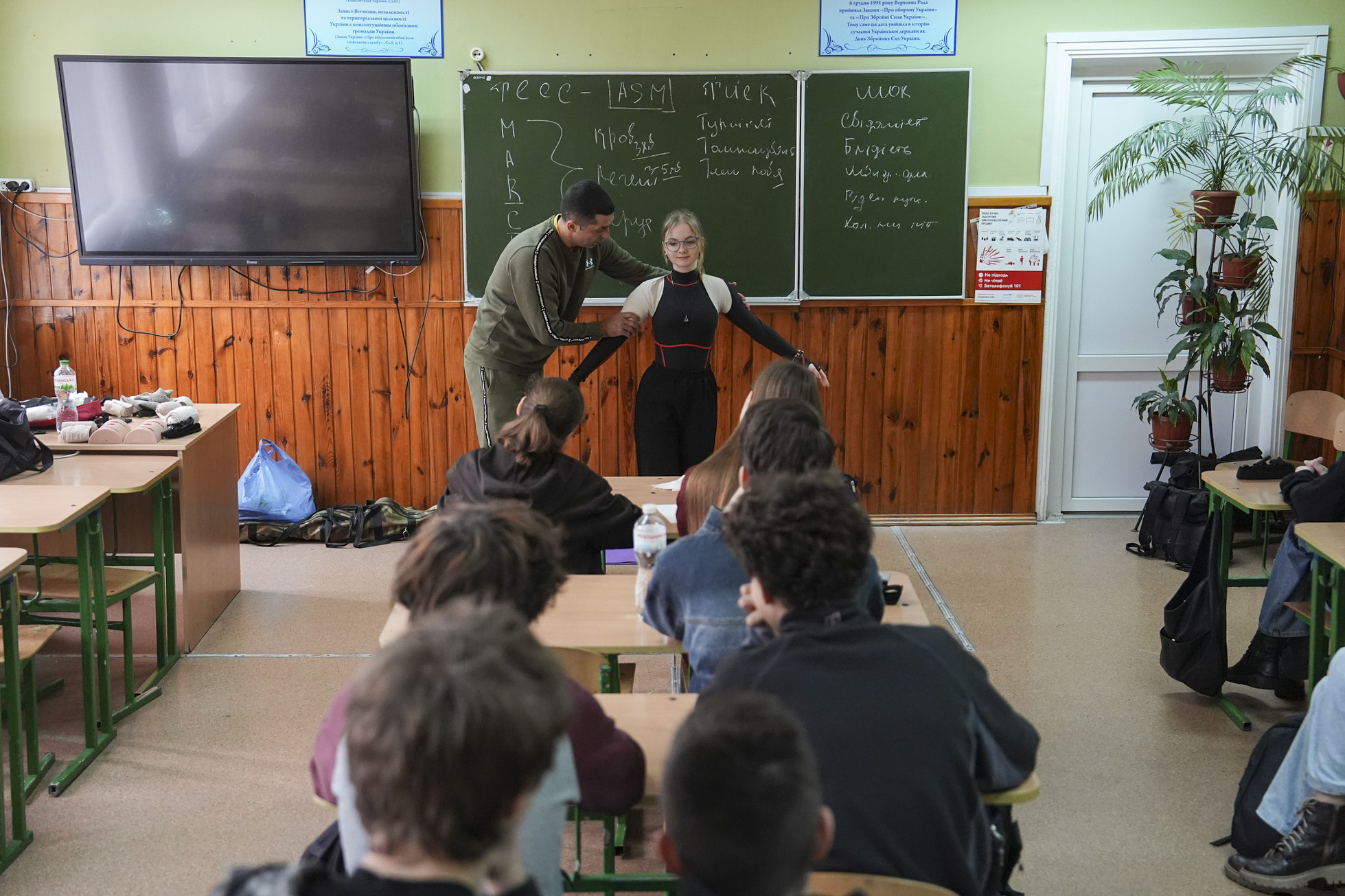
    In classrooms across Ukraine, more than 385,000 teenagers are enrolled in a revamped, mandatory course on handling weapons, battlefield tactics, emergency medicine, mine safety, radio communication, and how to respond to attacks on energy infrastructure.

    The course, called Protecting Ukraine, replaced a decades-old program that taught high-schoolers some basic weapons awareness but was largely a relic of the Soviet era that also involved dry lectures on military hierarchy and learning to march.

    That curriculum was developed long before school hallways were adorned with photos of students and teachers killed by Russia, before air alerts sent children scrambling into basements, before sandbags lined school windows to protect them from blasts or classes were held in subways.

    Ukraine’s Education Ministry invested $2.3 million in training teachers on the Protecting Ukraine program last year. “Our task was to form a defense mentality,” Education Minister Oksen Lisovyi said. “The need appeared, first of all of course, because of the military confrontation, terrorist threats and because Russia systematically terrorizes the civilian population.”

    Students learn “how to protect one’s self, how to protect those who are close to you, how the Ukrainian army works, which role you could find for yourself if you’d choose to take that path,” Lisovyi said. “But first of all, of course, it’s about the preparation of the civilian population.”

    Marina Kyziminska, 16, works with an assault rifle during class.

    Rifles, tourniquets, and CPR

    Most students in Katya’s classroom were in or near Bucha when Russian forces rampaged the Kyiv region in 2022, executing civilians before retreating from their failed campaign to seize the capital.

    When the instructor tells the students just how quickly a green, or safe, zone can turn red, they know exactly what he means.

    Katya shivered in a basement, replaying the happiest moments of her life as explosions shook her neighborhood.

    Zhenya walked miles along the railway tracks to reach Ukrainian-controlled territory as Russian warplanes circled overhead.

    A shell struck the eighth floor of Kyrylo’s apartment building but didn’t explode.

    Vasylisa remembers fleeing her hometown in the eastern Donetsk region as a toddler, only to resettle outside Kyiv and watch the sky turn red as streets burned in 2022.

    The instructor runs through the basics of trauma medicine: different kinds of tourniquets, how to put pressure on a major wound. He describes types of land mines, explains why radios are still used in an age of phones. He asks for volunteers for a CPR lesson. Katya and Vasylisa step to the front of the room. They giggle as Vasylisa lies down and Katya tips her chin back, opens her mouth, checking for obstruction.

    Zhenya Grebelna (left) Varvara, Katya and Ria Shapirko learn how to use a tourniquet.

    The students tie tourniquets to one another’s arms and practice twisting until they’re so tight they hurt. They remind each other to write down the time. They know that a tourniquet left on too long can lead to amputation.

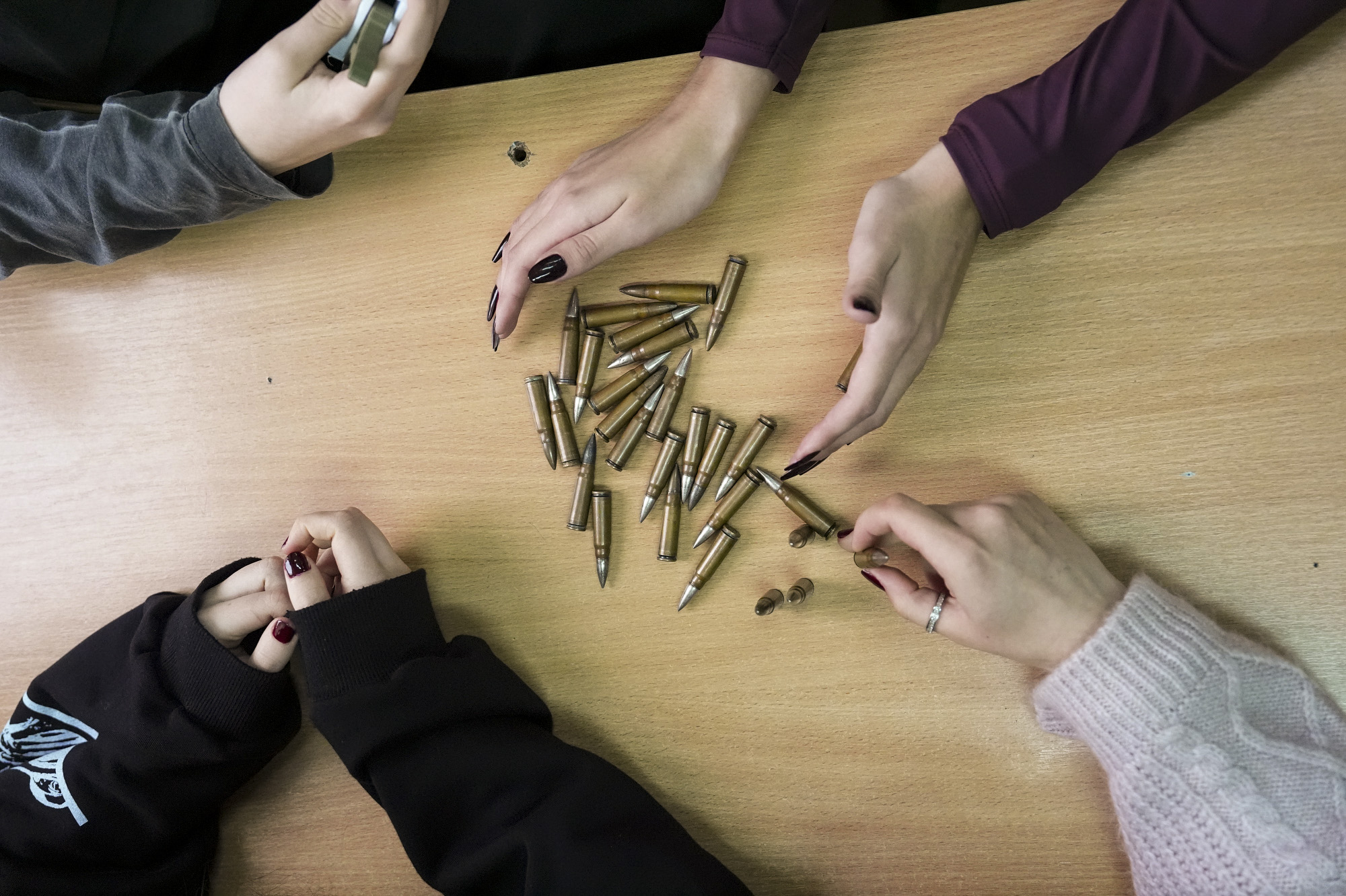
    When they go to load rifles, Katya is confident. She shows the other girls how it’s done while a group of boys plays with their phones in the back. Other students race to see who can load bullets into a magazine fastest.

    “I’m going to be dreaming about this already,” Katya says. Her friend Ria chimes in: “Like this, Katya: You wake up and we’re assembling a rifle on your bed!” The girls laugh. Their friend Varvara Koval takes a turn. Katya corrects her approach, takes the magazine and attaches it herself.

    Bullets used in the weapons training.

    The girls know that in schools in Russia, children their age are learning the same techniques. They know those kids are being taught that Ukraine is the aggressor, that Russia is liberating their territory by destroying it. They know that boys just a few years older than their classmates are being fitted for uniforms, crossing the border, killing Ukrainians and dying on Ukrainian land.

    “While they are being taught how to properly plant mines, we are being taught how not to step on them,” Katya says of how she pictures Russian students. In a better world, she acknowledged, it would not be normal to load an assault rifle at school or tie a tourniquet on your friend’s arm.

    “If no one were attacking our territory, or if Russia followed all the rules and conventions of conducting war, maybe we wouldn’t be learning this,” she adds. “But since they are striking civilian children just like us, we have to know all of this.”

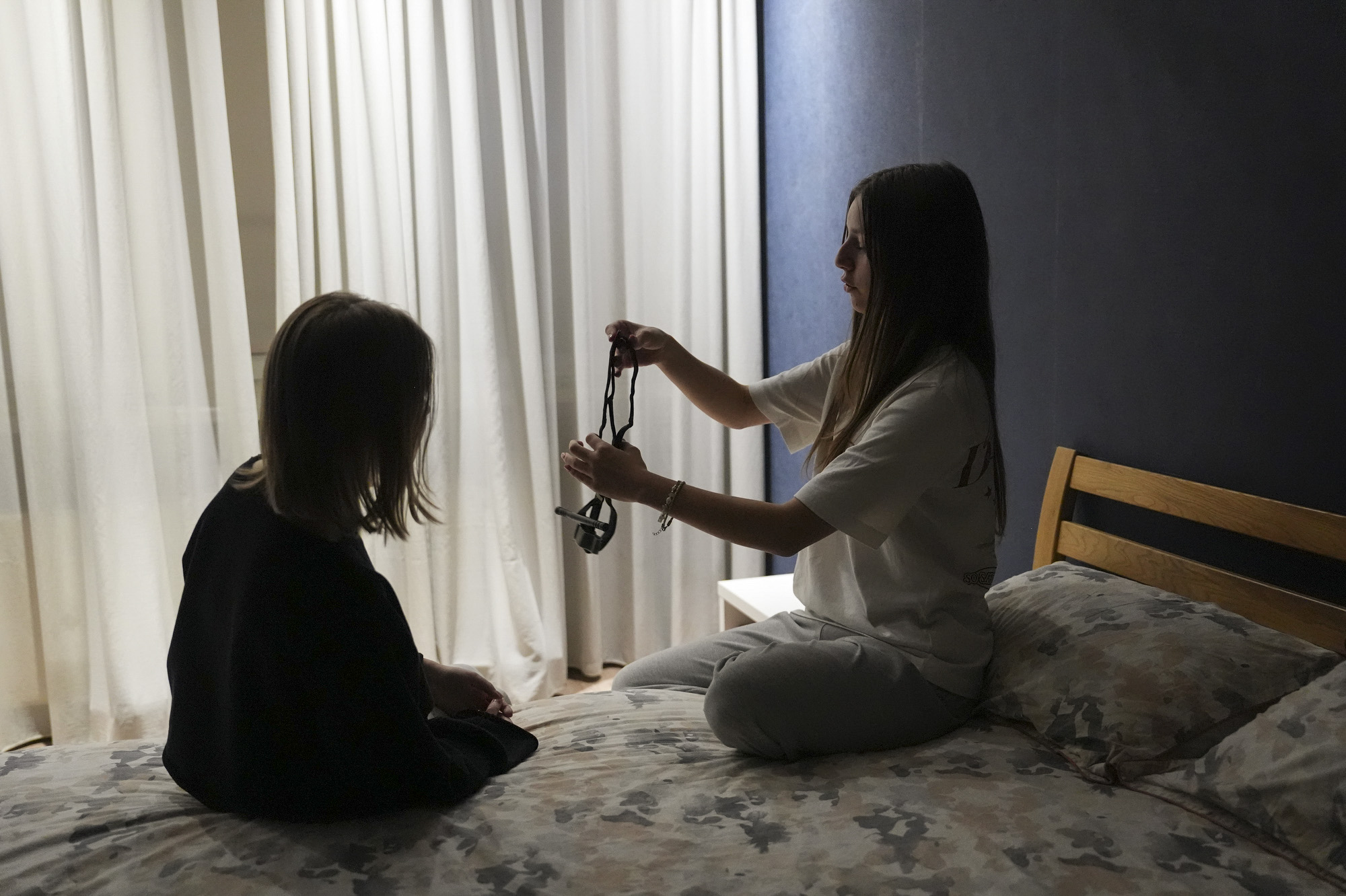
    Vasylisa shows younger sister Stasia how to apply a tourniquet at home.

    Lost childhood

    Katya grew up in this school. Her mom is a teacher here. She knows Bucha like the back of her hand. Vasylisa was never supposed to be here. Born in the eastern Donetsk region, she always dreamed of graduating from the same school as her father. War pushed her family out in 2014. They moved again and again, eventually settling in Irpin, just outside Kyiv.

    On Feb. 23, 2022, as Russian forces massed on Ukraine’s borders, Vasylisa’s dad told her and her younger sister, Stasia, to prepare for the worst. Stasia, who was 9, burst out laughing.

    The next morning, Russia invaded. Little information trickled in through their unstable internet connection, and what did was terrible: executions. Whole families shot as they tried to flee. Just across the field from them, they could hear a Ukrainian machine gun picking off Russian troops.

    Bohdana Kolesnikova, right, with daughters Vasylisa and Stasia at home.

    In early March, they fled, packing their dog, guinea pig and several neighbors into their car. The girls thought they were taking a so-called “green corridor” — a safe path toward Kyiv. Their parents knew no such route existed. The trip was a dangerous leap of faith.

    Everything seemed to be on fire. They passed the mayor of Irpin hanging out of a car, a rifle in his hands. They eventually made it west, where their dad was quickly drafted to the military. The girls and their mom were stunned.

    Back then, Vasylisa thought of the military almost as an extracurricular activity — something to do after school or work. “And now he was taken away, and there was a war,” she said. “I was afraid that … well, I was afraid for Dad. I was crying, talking to him, and he was trying to calm me down, but that only made me cry more.”

    Eventually, the family settled into a new rhythm. They returned to the Kyiv region and moved to Bucha, where their dad is now based. Not everything Vasylisa is learning about war in school is new. Her dad taught her and Stasia some field medicine and asked them to always carry tourniquets when they go out. Last summer, they attended a camp where they practiced shooting.

    Stasia, at 12, can already assemble and disassemble an AK M-479 in less than a minute.

    “I get really upset when I realize that my teenage years are just slipping away like this and passing,” Vasylisa said through tears. “I’m now looking at my sister, who is 12 — the age I was then. And when I realize that she already feels kind of grown up, it makes me sad that I lost some years.”

    Their dad has seen Russia’s war come to his family home twice. His daughters, he said, might still be children. But in an emergency, they should be ready to act as adults.

    Vasylisa and Stasia with their dad.

    Sounds of war

    At school, the military lesson ends in the early afternoon. The class disperses, and the students zip up their backpacks, push past the younger kids through the hallways. Vasylisa goes to an English class. The other girls gather on the steps outside.

    The first stop after school is the grocery store for cookies, candies, and tea. Varvara’s mom isn’t home from work yet, but she agreed the girls can hang out at their apartment so long as Varvara runs upstairs first to clean.

    They kick their shoes off at the door and rush for the kitchen. They boil water. They crowd around the table. They hear an air raid siren and ignore it. They move to Varvara’s room, sit on her bed and floor. They don’t talk about guns or drones or soldiers or war. They talk about boys and girls and crushes and relationships.

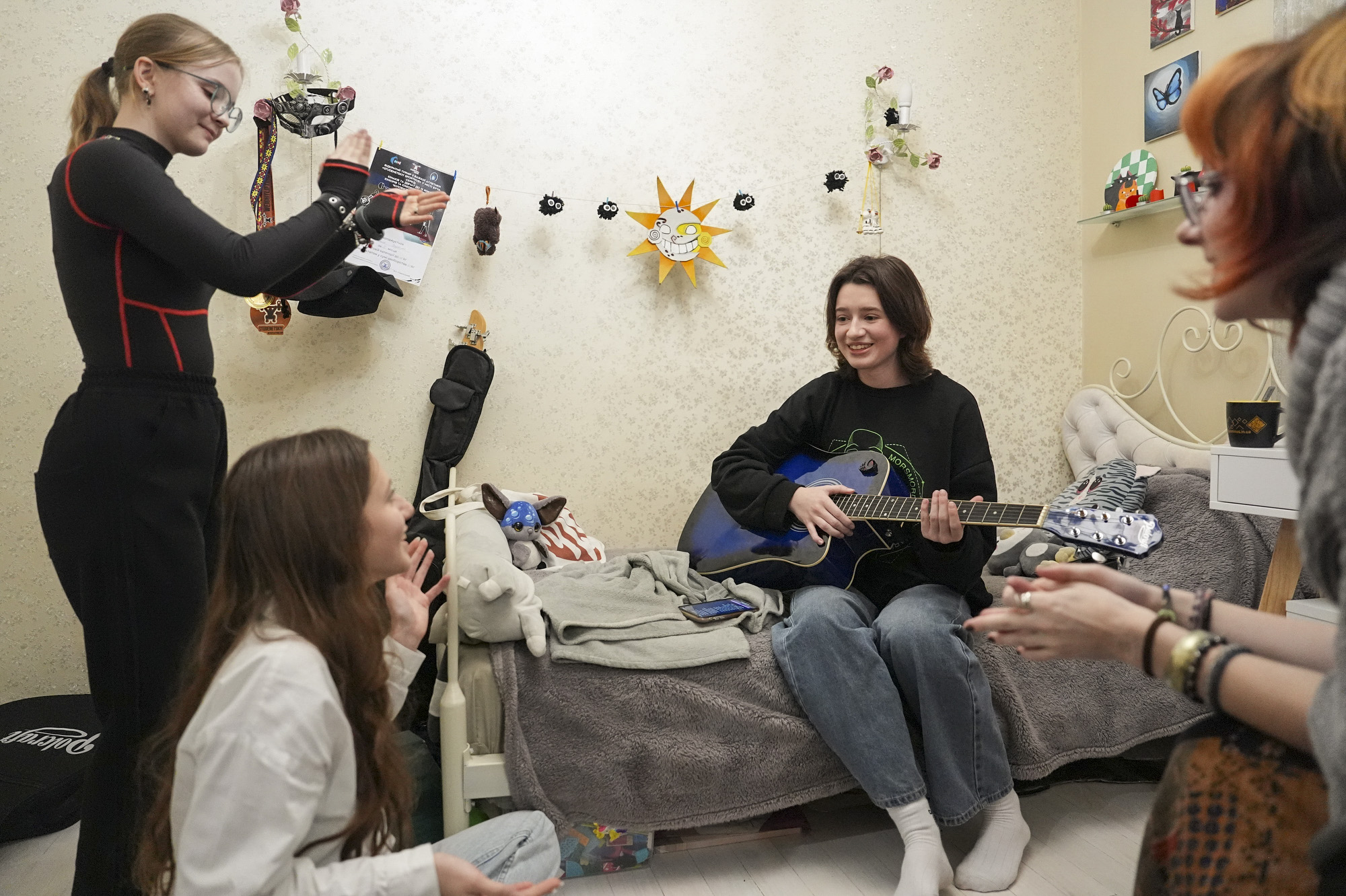
    The girls in Varvara’s room.

    They laugh at Varvara’s cat, Masha. Eventually, Ria picks up Varvara’s blue acoustic guitar and starts to strum. The girls quiet down. She begins to sing. They all join in.

    When the song ends, they cheer and rush to hug her.

    The air alert has stopped. For this moment, safe in Varvara’s room, they are just teenagers. They are young and happy and free. They could almost be anywhere.

    But later that night, the sirens blare again. Russian missiles and drones soar overhead and crash into apartments and houses and a hospital and energy infrastructure. Four people are killed. Several children are wounded. Varvara moves from her bed to sleep on a bean bag in the hall. The girls all hope to survive another night, and meet in school again tomorrow.

  • I’m an oncologist. Here’s what the science says about cancer and supplements. | Expert Opinion

    I’m an oncologist. Here’s what the science says about cancer and supplements. | Expert Opinion

    I specialize in treating people who are immunocompromised from leukemia or other cancers affecting the cells of the bone marrow. Recently, I was reviewing the medications one of my patients was taking when she showed me a photo of a pill bottle with a label indicating that the contents included antioxidants.

    “It’s to help boost my immune system,” she explained. “I want to make sure it’s safe to take with my other medicines.”

    It is estimated that 64 to 81% of people with a cancer diagnosis use dietary supplements. Almost half take them without telling their healthcare providers — so I was grateful my patient asked me about hers. Among people without cancer, approximately 50% report taking supplements, many of which purport to help prevent cancer.

    But do they? Here’s what we know about cancer and supplements.

    Are dietary supplements safe? And how well do they work?

    Unlike prescription medications and over-the-counter drugs, dietary supplements are not well regulated by the FDA. Supplement manufacturers who introduce new ingredients do have to submit a premarket safety notification that the supplement “will reasonably be expected to be safe” when used as the product label suggests. However, the FDA can only take action against a supplement manufacturer if safety concerns are raised after it has been marketed. There is no requirement, though, for efficacy — so unless a dietary supplement is tested in a clinical trial, we really don’t know if it works.

    The FDA does not approve the label on a dietary supplement either, but if a claim is made about how the supplement affects the structure or function of the human body (such as “calcium builds stronger bones”), the manufacturer must notify the FDA and include a disclaimer that the FDA has not evaluated that claim.

    Supplement manufacturers also need to comply with good manufacturing practices (known as GMP, these are strict requirements that ensure food, drugs, and cosmetics are made according to safe, quality standards), and the FDA can inspect manufacturing facilities. Despite this, products with deceptive claims and false labels can end up on shelves. For example, in 2015 the New York State Attorney General’s office found that four out of five herbal supplements sold at four national retailers did not contain any of the herbs mentioned on their labels. The products were often made from little more than cheap fillers like powdered rice, asparagus, and houseplants. It ordered them to halt sales of those supplements thereafter.

    Can dietary supplements help prevent cancer?

    As a general statement, when dietary supplements have been studied rigorously in clinical trials, they have not been shown to prevent cancer.

    For example, epidemiological and laboratory studies conducted decades ago initially suggested that taking antioxidants such as beta-carotene could help stave off cancer. Yet, randomized trials enrolling thousands of people, in which approximately half the subjects received dietary supplementation and half received placebo, failed to show that beta-carotene prevents skin cancer recurrence in people with a previous skin cancer, or has any effect on overall cancer rates.

    Other research has also failed to show that beta-carotene or other antioxidants, such as vitamin C or vitamin E, prevent colorectal adenomas (polyps that can lead to cancer); that those supplements, selenium, or vitamin A prevent gastrointestinal cancers; or that beta-carotene or vitamin A prevent lung cancer.

    Dietary supplements were not helpful in analyses that separated men from women, either. In one study of over 8,000 women, vitamin C and E did not lower overall cancer rates, and in a study of over 36,000 women enrolled in the Women’s Health Initiative, vitamin D or calcium supplementation had no effect on rates of colorectal cancer or on overall cancer rates. Similarly, vitamin E and selenium did not prevent the development of prostate cancer in a study that included over 35,000 healthy men, nor in a study of men with precancerous findings in the prostate.

    Can dietary supplements increase cancer risk?

    Most dietary supplements are not harmful. Some, however, should be taken with caution, especially in certain populations of people.

    In a follow-up analysis of the 35,000 healthy men treated with selenium and/or vitamin E — the study designed to prevent cancer — men taking vitamin E actually had a 17% higher risk of developing prostate cancer than men taking a placebo. Similarly, beta-carotene, which did not do a great job in preventing cancer, was found in one analysis to increase the risk of lung cancer and stomach cancer, particularly among smokers.

    Another study, which assigned people to receive folate supplementation or placebo to prevent colon polyps, found that folate was not effective. However, the men who received folate were over 2.5 times as likely to develop prostate cancer compared to those receiving placebo.

    Without question, anyone at risk for developing these types of cancers should avoid taking these dietary supplements. But what about people, like my patient, who already have cancer?

    In one study of over 1,100 women with breast cancer who were receiving chemotherapy, those who took antioxidant dietary supplements before and during treatment had a higher risk of cancer recurrence — though taking a multivitamin had no effect. One possible explanation is that antioxidants may counter some of the cancer-fighting effects of chemotherapy. Dietary supplements can also alter how the body processes chemotherapy, which can theoretically reduce the medication’s efficacy or worsen its side effects.

    There’s a lot we still don’t know about the potential benefits or risks of taking dietary supplements, which are not regulated by the FDA. At the very least, tell your doctor about any nonprescription vitamins or supplements you’re taking, so they can make sure they aren’t harming you or interfering with the treatments they do prescribe you.

    Mikkael A. Sekeres, MD, MS, is the chief of the division of hematology and professor of medicine at the Sylvester Comprehensive Cancer Center, University of Miami. He is author of the books “When Blood Breaks Down: Life Lessons from Leukemia” and “Drugs and the FDA: Safety, Efficacy, and the Public’s Trust.”

  • Nick Sirianni talks up DeVonta Smith’s role in changing scheme: ‘Excited about what he’ll look like in this new offense’

    Nick Sirianni talks up DeVonta Smith’s role in changing scheme: ‘Excited about what he’ll look like in this new offense’

    INDIANAPOLIS — A.J. Brown and his future in Philadelphia may be dominating the offseason news cycle, but don’t forget about the other star Eagles receiver under contract in 2026.

    Come training camp, all eyes will be on DeVonta Smith and his role in the new-look Eagles offense under offensive coordinator Sean Mannion, regardless of whether Brown is back on the team. Despite a relatively down year for the offense as a whole, Smith continued to impress last season, eclipsing 1,000 receiving yards for the third time in his career.

    Five seasons into his tenure with the Eagles, does Smith have the potential to take it up another notch in a Mannion-led, Shanahan/McVay-style offense in 2026? Nick Sirianni said Tuesday at his annual news conference at the NFL scouting combine that Smith has not yet reached his ceiling.

    “Oh, no,” Sirianni said. “No, I think he continually gets better. I think you saw him have a great year this year. And even when a guy appears not to have as good a year, you’re always looking at it like, ‘Is his arrow on the rise? Is his arrow on the fall?’ And even if a guy doesn’t have his best year, he still can be on the rise. Well, I think we saw DeVonta have a great year, and I think you just continue to see him play better and better.

    “And I think that’s a tribute to who he is. Guys that are tough, that love football, that are smart football players and they’re talented, have a tendency to reach their ceiling, God willing. And I think that’s what you’re seeing. You’re seeing him continue to get better. You’re seeing him continue to do these things and make plays only that he can make on the football field. And so I just think you continue to see him on the rise and excited about what he’ll look like in this new offense that we’ll have.”

    Could that role expand in 2026? Smith led the Eagles in receiving yards in 2025, accumulating 5 more than Brown. But he was targeted 113 times, eight fewer times than Brown. Smith had 77 receptions in 2025, the third-lowest total of his career.

    “Getting DeVonta Smith the ball and getting him targets is always going to be important, as long as he’s an Eagle, to the success of our football team,” Sirianni said. “And so it’s just the way the season goes, the way the flow of a game goes. It’s important that he’s seeing targets every game, because he does good things when he gets those things. So I don’t ever want to say, ‘Hey, this is the number. He needs to have this many targets’. He needs to be able to affect the game each game and that number can change each game, each year based off of that.”

    Saquon Barkley struggled at times to find running lanes in 2025. Will changes to O-line techniques yield better results?

    Barkley on the rebound?

    As Sirianni expressed on Friday, the running game is poised to make a significant shift in philosophy under Mannion. The Shanahan/McVay offense typically features a wide-zone blocking scheme that requires a different technique from the offensive linemen than the scheme they had grown accustomed to under Jeff Stoutland.

    Time will tell how the new scheme impacts Barkley’s output on the ground. The running back, now 29, posted historic numbers in 2024 (2,005 rushing yards), only to take a step back last season. Barkley wasn’t his prolific self in Year 2 with the Eagles, although he still eclipsed the 1,000-yard mark for the fifth time in his career (1,140).

    While Barkley won’t take the field with the offense until the spring, Sirianni expressed a sense of confidence in the All-Pro running back and his ability to adapt to the new system.

    “My experience with great football players is, you come in and you’re like, ‘Hey, Saquon, we’re going to run inside zone.’ He’s going to be really good at it. ‘Hey, we’re going to run gap schemes.’ He’s going to be really good at it. ‘Hey, we’re going to run wide zone.’ He’s going to be really good at it. ‘Hey, we’re going to run the option.’ He’s going to be really good at it. ‘Hey, we’re going to split you out wide.’ He’s just a great football player. And so guys that are great football players can fit into a lot of different offenses.

    “And Saquon, regardless of the scheme, I think you saw that in some of the things that we’ve done, he’s been highly productive in many of the schemes, whether it’s gap schemes, whether it’s inside zones, whether it’s pin-and-pulls, whether it’s toss-cracks, every one of these things, I’m picturing him breaking a big run off on that. And so that’s a common theme with good football players. They can fit into a lot of different schemes. So I believe he’ll be exceptional at that.”

  • Mexican cartel clashes fuel worries in lead-up to FIFA World Cup

    Mexican cartel clashes fuel worries in lead-up to FIFA World Cup

    GUADALAJARA, Mexico — Hugo Alejandro Pérez was in his house a few miles from the Mexican stadium that is slated to host FIFA World Cup games when gunfire and explosions erupted just outside his door.

    The 53-year-old restaurant owner was already skeptical about his city, Guadalajara, hosting the international sporting event.

    He saw a government that failed to fix basic things, like water service to his home, along with cartel violence in the surrounding state of Jalisco and shook his head. The surge of bloodshed this week following the Mexican military’s killing of the country’s most powerful cartel boss offered more confirmation of his doubts.

    “I don’t think they should host the World Cup here,” Peréz said. “We have so many problems, and they want to invest in the World Cup? With all the violence, it’s not a good idea.”

    Peréz joined other people Tuesday in questioning Guadalajara’s capacity to be a host city for the summer soccer competition, even as the Mexican government vowed that the international event — hosted jointly by Mexico, the United States and Canada — will not be affected.

    President offers ‘every guarantee’ for World Cup

    President Claudia Sheinbaum was asked at her daily news briefing what guarantees there are that World Cup matches will be held in Jalisco. “Every guarantee,” she said, adding that there was “no risk” for fans coming to the tournament.

    Jalisco Gov. Jesús Pablo Lemus said he had spoken with local FIFA officials, who have “absolutely no intention of removing any venues from Mexico. The three venues remain completely unchanged.”

    The same day, the Portuguese soccer federation said it was “closely monitoring the delicate situation” in Mexico.” Its national team was scheduled to play Mexico’s team in a friendly on March 28 at the newly renovated Azteca Stadium in Mexico City, which is scheduled to host the opening World Cup match on June 11.

    Jalisco, in western Mexico, was already facing scrutiny. The state has been plagued by some of the starkest examples of cartel violence in recent years, including the discovery of a cartel killing site at a ranch last March and a crisis of disappearances.

    The state, with Guadalajara as its capital, is the central hub for the Jalisco New Generation Cartel, whose leader Nemesio Oseguera Cervantes, or “El Mencho,” was killed Sunday in a capture attempt by the military.

    The operation and waves of violence killed 70 people. Cartel gunmen set fire to cars to block streets in states across the country, namely Jalisco, and fought with Mexican forces into Monday as the government said the conflict was under control.

    The death of Oseguera Cervantes came as Mexico’s government has stepped up its offensive against cartels in an effort to meet demands by U.S. President Donald Trump to crack down on criminal groups. The cartel, also known as CJNG, is one of the fastest-growing criminal networks in Mexico.

    The White House confirmed that the U.S. provided intelligence support to capture the cartel leader and applauded Mexico’s army for taking down a man who was one of the most wanted criminals in both countries.

    Drug lord’s death could lead to more violence

    Peréz, the restaurant owner, also commended Sheinbaum’s efforts to go after cartels, saying the government has taken cartel violence more seriously than her predecessors. At the same time, he said, local authorities in Jalisco have fallen short in protecting civilians.

    The root concern for many is that the death of “El Mencho” could pave the way for more violence. Killing capos, in what’s become known as the “kingpin strategy,” has been criticized by Sheinbaum herself because it can often spark internal conflict between cartel factions and push rival cartels to make territorial grabs.

    Vanda Felbab-Brown, an academic at the Brookings Institution, said she doesn’t see more acts of “revenge” by the cartel as likely, but the future remains uncertain, especially after leading figures in both CJNG and the Sinaloa Cartel have been knocked out in recent years.

    “If there is no clear line of succession (in CJNG), we might see a lot of fighting within the cartel, its breakup, and there are a lot of scenarios,” she said.

    On Sunday, when firefights broke out between the cartel and soldiers, and gunmen began to burn a car just feet in front of Peréz’s house, he let people on the street scramble inside his home to seek cover. The fighting raged for an hour.

    Now he says he doesn’t see the point of holding the games, adding that he doubts any of the money from the games will trickle down to businesses in working-class neighborhoods like his, even if they are just a 10-minute drive from the stadium. Similar tensions have simmered in Mexico City.

    The World Cup is expected to be a $3 billion economic engine in Mexico, according to the Mexican Soccer Federation.

    “It doesn’t help us residents at all, honestly. They should move it to Monterrey or Mexico City. But right now here, we’re not convinced,” he said. “Things aren’t in good enough shape for foreigners to be coming to Jalisco for an event like this.”

    On Monday, some foreign tourists trapped in the violence in the city of Puerto Vallarta took to social media to warn of the violence, with a few remarking that they didn’t plan to return.

    Hope of snapping back to normal

    Despite that, Guadalajara was snapping back to its normal rhythm Tuesday. Many businesses opened their doors for the first time in two days, and streets were packed with traffic.

    Workers were busy fixing up the exterior of the soccer stadium that will host World Cup matches. Cyclists zipped around outside the stadium, and parents played with children in parks.

    Heavily armed police officers and National Guard members roamed the city, a sign for some that the government had the situation under control.

    Juan Carlos Pila, a 55-year-old taxi driver, rolled his eyes at the reports of violence after spending two days waiting with his family for things to calm down. He said social media and local news outlets were overplaying the extent of the violence.

    “People should come, man. Everyone is welcome,” he said.

    Others, like Maria Dolores Aguirre, simply hoped for the best. Aguirre runs a small corner story in the cobblestoned tourist town of Tapalpa tucked away in Jalisco’s mountains, where Mexico’s military killed “El Mencho.”

    Aguirre’s family business of over 50 years depends on the flow of tourists to the normally sleepy town. Now she worries bloodshed will deal a blow to her livelihood and change towns like hers.

    “It’s going to affect us. It’s collateral damage,” Aguirre said. “The government is going to have to have a lot of security. … The entire world just saw what happened and, of course, people are going to think twice about coming.”

  • The Phillies finally have a ‘true closer’ in Jhoan Duran, and that solidifies the rest of the bullpen

    The Phillies finally have a ‘true closer’ in Jhoan Duran, and that solidifies the rest of the bullpen

    CLEARWATER, Fla. — After Jhoan Duran finished his throwing program in the BayCare Ballpark outfield, he didn’t head straight for the mound, where he was scheduled to throw live batting practice.

    First, he stopped by the empty bullpen.

    Duran wanted to reenact the jog he will make every time he comes in to close games for the Phillies this season, to help get in the right head space for facing hitters the first time all spring.

    “That’s what I do in the game,” Duran said. “So I wanted to go in live, too.”

    It was shortly before noon on a clear Florida day, so Duran wasn’t accompanied by his traditional light show, flames, or crawling spiders on the video board. But it didn’t really matter, because Duran got the results he was looking for on the mound with the 17 pitches he threw.

    “I feel good,” he said. “My command is there. I feel it’s there. My breaking ball pitches are moving good. So that’s good.”

    The last time Duran had jogged from bullpen to mound, in Game 4 of the National League Division Series, things had not gone so according to plan.

    “I feel good,” Jhoan Duran said. “My command is there.”

    With the Phillies protecting a 1-0 lead over the Dodgers, manager Rob Thomson called on his closer with two runners on in the seventh inning. He intentionally walked Shohei Ohtani to load the bases for the more advantageous right-on-right matchup against Mookie Betts. But Duran issued his first career bases-loaded walk after Betts held off on an elevated fastball, which tied the game.

    After the Phillies were eliminated in extra innings, Duran said he didn’t dwell on the walk or the game at all over the winter. He has learned to have a short memory.

    “I don’t think about it too much,” he said. “Because that’s the past. I learned in the minor leagues, if you throw one inning and you do it bad, the next day, you think about that, you don’t throw good that day. So if I do it bad, I forget. I’m ready for the next day. That’s me.”

    With 2025 in the rearview, Duran said the number of outings he has each spring can vary, and will depend on how he feels. He doesn’t have the added complication that some of his teammates have, of factoring in preparation for the World Baseball Classic, which will start pool play in less than two weeks.

    He was asked to pitch for the Dominican Republic but opted not to participate. He wanted to focus on being ready for the regular season instead.

    When he does make that jog for the first time with the lights, it will also mark the Phillies’ first time starting a season with a bona fide closer under Thomson. And having a dedicated ninth-inning pitcher will also impact how the manager deploys the rest of the bullpen this year.

    Thomson is leaning toward having designated roles for his other high-leverage arms, rather than just piecing things together based on matchups. Lefty José Alvarado and righty Brad Keller are both potential setup men for Duran.

    “When you have a true closer like Duran, that’s the way you should set it up,” Thomson said. “And especially when we have the type of arms that we have. But again, if you give a guy a fifth- or sixth-inning role, and the seventh- and eighth-inning guys aren’t available, well, they’re going to have to pitch in the seventh or eighth.”

    In any case, Thomson likes his options.

    “I think it’s probably the best group of arms we’ve had here since I’ve been here,” he said.

    Keller signed a two-year, $22 million deal with the Phillies this winter after a breakout season as a Cubs reliever last year. He and Duran coincided in the Diamondbacks organization as minor leaguers between 2015 and 2018. At the time, they were also both starters.

    Now their careers have taken them to the back end of the Phillies’ bullpen.

    “I think that’s what makes a fun bullpen, right?” Keller said on a recent episode of Phillies Extra, the Inquirer’s baseball interview show. “All different backgrounds, all different personalities, and just all come together, just be a bunch of grinders and a bunch of dogs down there. That’s kind of the mentality that a bullpen takes over. And it’s so fun getting to know these guys and watching.”

    Duran is excited for the unit that is shaping up. Also in the group are returning lefty Tanner Banks and righty Orion Kerkering, plus newcomer Jonathan Bowlan, a righty acquired from the Royals in exchange for Matt Strahm. There are several contenders in camp for the final two spots, including Rule 5 pick Zach McCambley and sidearmer Kyle Backhus.

    “We talk a lot together, we practice together, too, more and more times,” Duran said. “And it’s great, these guys in the bullpen; great arms, great talent. We have everything in the bullpen.”

  • Light snow may top the black ice in the Philly region Wednesday as storm recovery continues

    Light snow may top the black ice in the Philly region Wednesday as storm recovery continues

    At this point, the prospect of a barely measurable snow Wednesday morning may seem like so much drizzle in the ocean.

    However, given that a coating of snow could cover another harvest of stealth black ice in the morning as the snow melt refreezes overnight, motorists and pedestrians might want to exercise a measure of caution.

    The forecasts are calling for a half-inch to maybe an inch in the Philly area.

    While potentially hazardous, this won’t upstage what happened earlier in the week, when totals of 20 inches or more were common in South Jersey and southeastern Bucks County, and on Tuesday the aftermath recovery was proceeding.

    For the record, the official total at Philadelphia International Airport was 14 inches. Of that, 7.5 inches fell on Monday, setting a record for the date. It was No. 16 on the all-time snowstorm list, and the first time in 33 years that a foot or more had fallen so late in the season.

    The seasonal total now stands at 30 inches, one of the snowier years in the 142-year period of record.

    The post-storm issues included contending with scores of downed trees throughout the region. A fallen tree in Radnor Township, Delaware County, still was affecting service on the Norristown High Speed Line.

    Service still was still suspended on the Cynwyd Regional Rail line, SEPTA said, and other lines were operating with delays.

    Airport operations were getting back to normal, said spokesperson Heather Redfern, flights having resumed Monday afternoon.

    As for schools, they were opting for a variety of options from virtual learning (Philadelphia) to two-hour delays (Cherry Hill, Moorestown), to party’s over, get here on time (Upper Darby).

    This may be the week of black ice in Philly

    Invisible and insidious black ice, a dangerous slipping hazard, in all likelihood will be present through the workweek as the snow melt picks up speed during the day, with highs in the 40s, and temperatures falling below freezing at night.

    More light snow, rain, or a snow-and-rain mix is possible Thursday into Thursday night, the weather service said. But odds are the immediate Philly area will see mostly rain, said Eric Hoeflich, a weather service meteorologist in Mount Holly.

    After a modest warmup on a dry weekend, some computer models were hinting at more snow early next week as a storm moves east, but “not all the guidance is showing a significant system,” the weather service said in its afternoon discussion. “It’s definitely on our radar,” the agency said, but it doesn’t “appear to have potential for a ‘major’ event.”

    In short, anything rivaling the Sunday-Monday storm would be, at the very least, unlikely.

    Hoeflich said he spent 30 hours in the Mount Holly office, not leaving until 2 p.m. Monday. He said that the weather service provided air mattresses for him and other staffers and that his colleagues came armed with soft pretzels.

    Sarah Johnson, the warning coordination meteorologist, brought pizza. Evidently carbs are a sine qua non of storm forecasting.

    Said Hoeflich, “We certainly didn’t go hungry.”

  • North Coventry residents and leaders reject data center plan — before it was even formally submitted

    North Coventry residents and leaders reject data center plan — before it was even formally submitted

    The developer of a “boutique data center” will look elsewhere after public outcry and a preemptive board of supervisors vote showed no appetite for the facility in North Coventry Township.

    The data center, informally proposed by Envision Land Use, would have been situated adjacent to Route 100 at 299 W. Schuylkill Road, in an industrial lot sitting near a Peco utility substation and a residential development.

    But swift and early public discontent — and the township’s leadership— stopped the data center before a formal application was even submitted to the Chester County municipality.

    The township’s board of supervisors voted, 3-2, on Monday that they would reject a proposal for the site eyed by Envision Land Use, said Erica Batdorf, the township’s manager. It was the first data center to be proposed in North Coventry.

    The board’s chair did not immediately respond to a request seeking comment.

    Though the developer could still formally submit its plans, it will scrap them for the municipality, said Envision Land Use’s Reiss Rosenthal.

    “[With] this much public pushback, we just thought at this time it didn’t make sense to try to go forward with this,” he said.

    On Monday, the crowd of roughly 100 residents booed when the supervisors discussed pushing back the vote to a subsequent meeting, Rosenthal said.

    The vote follows a growing public pushback of data centers in the region, particularly in Chester County. Last week, East Vincent’s planning commission told the township’s board of supervisors that it should reject a massive data center project there after months of tense public meetings. A proposed project in East Whiteland also saw backlash from residents last month after it sought to expand the footprint of its project.

    Though roughly 38% of Pennsylvanians support data centers being built in the commonwealth, residents are less likely to support data centers in their own backyards, according to a December survey, even as Democratic Gov. Josh Shapiro seeks to entice such projects to Pennsylvania by cutting some regulations.

    There are more than 150 data centers in Pennsylvania and New Jersey.

    Data centers are buildings or campuses that handle cloud-storage and computing needs of massive corporations, like Amazon, Google, Microsoft, or Meta.

    And though those kinds of corporations are looking at setting up shop in Pennsylvania, at about 17 acres the North Coventry project would have been smaller than its proposed counterparts in other pockets of Chester County, the developer said. These smaller centers have been around for longer than the ones making recent headlines, Rosenthal said.

    The proposed site would have been a 120,000 square-foot three-story building, making it relatively small compared with the sprawling plans in East Vincent and East Whiteland, which would both exceed a million square feet.

    Plans for the site say that it would have preserved and added trees and that its proximity to the Peco station would have required minimal additional power supply.

    The proposed project would have been within the township’s residential zoning district that has an industrial overlay. It would have had six full-time employees.

    “We were kind of surprised that this ended in a vote already,” Rosenthal said. “We thought it was possibly going to be a little bit more down the line, after we were able to meet with the neighbors as well as show our hands on what we were actually planning on doing.”