Blog

  • Daniel Segal, longtime Philadelphia attorney and community activist, has died at 79

    Daniel Segal, longtime Philadelphia attorney and community activist, has died at 79

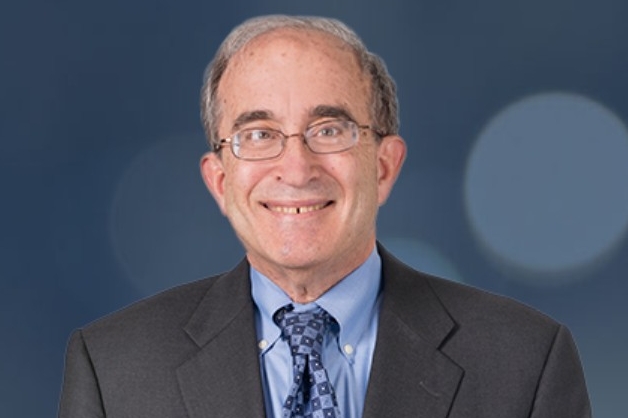
    Daniel Segal, 79, of Philadelphia, cofounder and shareholder of the Hangley Aronchick Segal Pudlin & Schiller law firm, adjunct law professor at the University of Pennsylvania, former cochair of the Philadelphia Soviet Jewry Council, onetime board president at the Juvenile Law Center, mentor, and “mischievous mensch,” died Thursday, Jan. 8, of stomach cancer at his home.

    Born and reared in Washington, Mr. Segal moved to Philadelphia in 1976 to teach at what is now Penn Carey Law School. He went into private law practice in 1979, became cochair of a litigation department in 1993, and joined with colleagues in 1994 to establish Hangley Aronchick Segal & Pudlin.

    For more than 40 years, until his recent retirement, Mr. Segal handled all kinds of cases for all kinds of clients, including The Inquirer. He was an expert in juvenile law, defamation, the First Amendment, professional ethics, education, civil rights, and other legal issues.

    He was president of the board at the Juvenile Law Center and worked pro bono for years, beginning in 2009, to help represent more than 2,400 juvenile victims and win millions of dollars in settlements in what is known as the Luzerne County “kids-for-cash” case. In that case, two judges were convicted of taking kickbacks for illegally sending juveniles to two private for-profit detention facilities.

    “This is one of the worst judicial scandals in history,” Mr. Segal told The Inquirer in 2009. “The people you’re stepping on are the true, true little guys.”

    Mr. Segal was honored in 2010 by the Philadelphia Bar Foundation.

    Among his other notable cases are a 1985 workplace racial discrimination dispute, a 1990 libel case against The Inquirer, and a 2000 trial about the city taxing outdoor advertisers. “Dan Segal was a living testament to professional excellence,” said Mark Aronchick, his law partner and longtime friend.

    Law partner and friend John Summers said: “He was a great teacher and mentor.” Marsha Levick, cofounder of the Juvenile Law Center, said: “He was a brilliant, steady partner who made us smarter and kept us laughing.”

    Mr. Segal clerked for Chief Judge David Bazelon in the U.S. Court of Appeals for the District of Columbia Circuit in 1974 and for Supreme Court Associate Justice Thurgood Marshall in 1975. He was active with the Philadelphia Bar Association, Philadelphia Common Pleas Court, and the Penn Law School American Inn of Court.

    He wrote articles for legal journals and letters to the editor of The Inquirer and Daily News. He spoke at panels and conferences, earned honors from legal organizations and trade publications, and was named the Thomas A. O’Boyle adjunct professor of law at Penn in 1992.
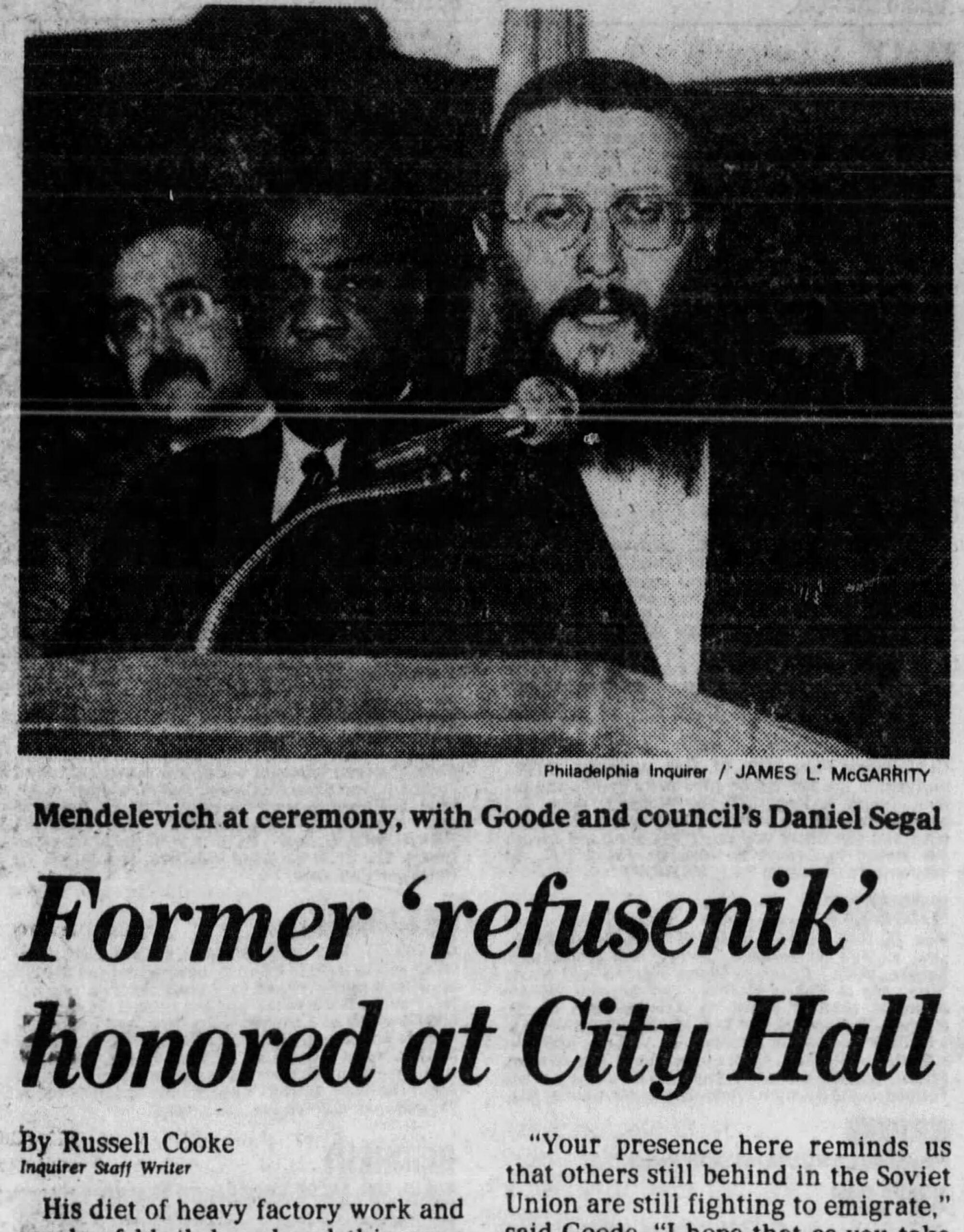
    This story and photo features Mr. Segal (left) and appeared in The Inquirer in 1984.

    The son of a rabbi, Mr. Segal was cochair of the Soviet Jewry Council in the 1980s, and he organized rallies and marches for social justice and human rights. He traveled to Israel often and to the old Soviet Union several times to secretly support Jews not permitted by government officials to immigrate to Israel.

    “We are persuaded that the Soviet Jews are pawns in the Soviet-American relationship,” he told The Inquirer in 1985.

    He served as president of the board of directors at what is now Jack M. Barrack Hebrew Academy and held leadership roles with the Jewish Community Relations Council, the New Israel Fund, Mazon: A Jewish Response to Hunger, and other organizations.

    Colleagues at the New Israel Fund praised his “characteristic kindness” and “gentle and sparkling humor” in an online tribute. They said: “He was everyone’s favorite board member.”

    Mr. Segal and his wife, Sheila, married in 1968.

    Mr. Segal enjoyed pranks and funny jokes, even at work, and neighbors called him Silly Dan. His son Josh said: “His warmth, humor, and humility meant that he could connect with just about anyone.” A friend said he was a “mischievous mensch.”

    He earned his law degree in 1973 and was executive editor of the Law Review at Harvard University Law School. He earned a bachelor’s degree in politics and economics at Yale University in 1968 and a master’s degree in international relations from the London School of Economics in 1969.

    He taught elementary school for a year in Washington and spent another year in Europe before moving to Philadelphia. “He taught us just how important it is to stand up for what is right,” his son Eli said, “and to do so not only with conviction but with humility and kindness, and without a thought of getting personal credit.”

    Daniel Segal was born July 4, 1946. He started dating Sheila Feinstein in ninth grade, and they married after college in 1968. They had sons Josh and Eli, and lived in Center City and Lower Merion before moving to Fairmount in 2018.

    Mr. Segal’s sons said: “Our dad showed us that relationships are the heart of a life well-lived by nurturing lifelong friendships.”

    Mr. Segal loved chocolate and ice cream. He recovered from a traumatic brain injury 20 years ago, and he and his wife traveled to Iceland, Peru, Vietnam, Europe, Japan, and elsewhere.

    He doted on his family and friends, and he and his wife rented vacation places every summer to bring his sons and their families together. “Neither of us were surprised that our dad always made our kids feel so loved,” his son Eli said. “Because that was just how he made us feel.”

    In addition to his wife and sons, Mr. Segal is survived by six grandchildren, a sister, a brother, and other relatives.

    Services were held Sunday, Jan. 11.

    Donations in his name may be made to the New Israel Fund, 1320 19th St. N.W., Suite 1400, Washington, D.C. 20036; and Mazon: A Jewish Response to Hunger, Box 6095, Albert Lea, Minn. 56007.


    Mr. Segal’s sons said: “He was always there for us and made clear that he always would be for as long as he could.”
  • Syrian military, Kurdish-led forces announce new truce after guards leave camp housing IS families

    Syrian military, Kurdish-led forces announce new truce after guards leave camp housing IS families

    RAQQA, Syria — Guards from the Kurdish-led Syrian Democratic Forces abandoned a camp Tuesday in northeast Syria housing thousands of people linked to the Islamic State group, and the Syrian military said that allowed detainees to escape.

    Hours later, the Syrian government and the SDF announced a new four-day truce after a previous ceasefire broke down. The two sides have been clashing for two weeks, amid a breakdown in negotiations over a deal to merge their forces together.

    The al-Hol camp houses mainly women and children who are relatives of IS members. Thousands of accused IS militants are separately housed in prisons in northeast Syria.

    Syria’s interior ministry accused the SDF of allowing the release of “a number of detainees from the ISIS militant [group] along with their families.” The AP could not independently confirm if detainees had escaped from the camps or how many.

    The SDF subsequently confirmed that its guards had withdrawn from the camp, but did not say whether any detainees escaped. The group blamed “international indifference toward the issue of the [IS] terrorist organization and the failure of the international community to assume its responsibilities in addressing this serious matter.”

    It said its forces had redeployed in other areas “that are facing increasing risks and threats” from government forces.

    An official with the U.S. military’s Central Command who spoke on condition of anonymity because they were not authorized to speak publicly said, “We are aware of the reports and are closely monitoring the situation.”

    The SDF and the government also traded blame over the escape Monday of IS members from a prison in the northeastern town of Shaddadeh.

    The Syrian defense ministry in a statement said it is prepared to take over al-Hol camp and the prisons and accused the SDF of using them as “bargaining chips.”

    Al-Hol holds tens of thousands of detainees

    At its peak in 2019, some 73,000 people were living at al-Hol camp. Since then the number has declined with some countries repatriating their citizens.

    Sheikhmous Ahmad, a Kurdish official overseeing camps for displaced in northeastern Syria, told the Associated Press that the al-Hol’s current population is about 24,000, about 14,500 of whom are Syrians and nearly 3,000 Iraqis.

    He added that about 6,500 from other nationalities are held in a highly secured section of the camp, many of whom are die-hard IS supporters who came from around the world to join the extremist group.

    Government and SDF trade blame over prison break

    Earlier Tuesday, Syria’s interior ministry said that 120 IS members had escaped Monday from the prison in Shaddadeh, amid clashes between government forces and the SDF. Security forces recaptured 81 of them, the statement said.

    Also Tuesday, the SDF accused “Damascus-affiliated factions” of cutting off water supplies to the al-Aqtan prison near the city of Raqqa, which it called a “blatant violation of humanitarian standards.”

    The SDF, the main U.S.-backed force that fought IS in Syria, controls more than a dozen prisons in the northeast where some 9,000 IS members have been held for years without trial.

    IS was defeated in Iraq in 2017 and in Syria two years later, but the group’s sleeper cells still carry out deadly attacks in both countries.

    Under a deal announced Sunday, government forces were to take over control of the prisons from the SDF, but the transfer did not go smoothly.

    New ceasefire deal announced

    The Syrian military announced Tuesday evening a new four-day ceasefire. The SDF confirmed the deal and said “it will not initiate any military action unless our forces are subjected to attacks.”

    Elham Ahmad, a senior official with the Kurdish-led local administration in northeast Syria, told journalists Tuesday that an earlier ceasefire had fallen apart after SDF leader Mazloum Abdi requested a five-day grace period to implement the conditions and Syrian Interim President Ahmad al-Sharaa refused.

    She blamed the government for violating the agreement but called for a return to dialogue.

    In response to a journalist’s question regarding whether the SDF had requested help from Israel — which previously intervened in clashes between government forces and groups from the Druze religious minority last year — Ahmad said “certain figures” from Israel had communicated with the SDF. She added that the SDF is ready to accept support from any source available.

    A statement from al-Sharaa’s office said that government forces will not enter Kurdish-majority areas until plans are agreed upon for their “peaceful integration” and that Kurdish villages will be patrolled by “local security forces drawn from the residents of the area.”

    It said Abdi will put forward nominees from the SDF for the posts of deputy defense minister, governor of al-Hassakeh province, representatives in the parliament, and for other positions in Syrian state institutions.

    SDF officials have expressed disappointment that the U.S. did not intervene on their behalf. The group was long the main U.S. partner in Syria in the fight against IS, but that has changed as the Trump administration has developed closer ties with al-Sharaa’s government.

    U.S. envoy to Syria Tom Barrack in a statement Tuesday urged the SDF to move forward with integration into the new Syrian government and army and appeared to warn the Kurdish-led force that no help would be coming from Washington if it continued fighting.

    He said SDF’s role as the primary anti-IS force “has largely expired, as Damascus is now both willing and positioned to take over security responsibilities” and that “recent developments show the U.S. actively facilitating this transition, rather than prolonging a separate SDF role.”

    Since toppling Bashar Assad in December 2024, Syria’s new leaders have struggled to assert full authority over the war-torn country. An agreement was reached in March that would merge the SDF with Damascus, but it didn’t gain traction.

    Earlier this month, clashes broke out in the city of Aleppo, followed by the government offensive that seized control of Deir el-Zour and Raqqa provinces, critical areas under the SDF that include oil and gas fields, river dams along the Euphrates and border crossings.

    Al-Sharaa postponed a planned trip to Germany Tuesday amid the ongoing tensions.

  • Tyrese Maxey is getting his first signature shoe from New Balance later this year

    Tyrese Maxey is getting his first signature shoe from New Balance later this year

    Two months ago, 76ers guard Tyrese Maxey joined Indiana Pacers guard Tyrese Haliburton in a live group chat during a Thunder-Lakers game. When the 25-year-old was asked about the possibility of getting his own signature shoe, Maxey responded: “One can only hope and pray.”

    Those prayers have been answered.

    Maxey will be getting his own signature shoe, set to debut later in 2026, New Balance confirmed. ESPN was the first to report Maxey’s new shoe.

    The news comes just a day after the six-year pro was named a starter for this year’s NBA All-Star game, earning his second career All-Star selection.

    Getting his own signature shoe from New Balance is the latest example of Maxey’s rising star power — following in the footsteps of teammate Joel Embiid, who debuted his own signature shoe with Skechers in December.

    “We’re so excited that Tyrese was named an All-Star starter and to get to share this moment with him,” said Naveen Lokesh, head of global sports marketing for basketball at New Balance. “He represents everything we value at New Balance — hard work, authenticity, and confidence — so working together to bring his first signature shoe to life is a natural step in celebrating who he is and where his journey is headed.”

    Maxey first signed a shoe deal with New Balance in 2023, joining Kawhi Leonard, Jamal Murray, and Zach LaVine. During the 2023-24 season, which saw him earn the NBA Most Improved Player Award and his first All-Star nod, Maxey appeared on a New Balance billboard in Indianapolis during All-Star Weekend. As the brand’s roster of athletes expands, Maxey has also been involved in New Balance’s “We Got Now” ad campaign alongside stars from other sports including Shohei Ohtani and Coco Gauff.

    Two years after signing with the brand, it took another step forward in its partnership. New Balance presented the Tyrese Maxey Hero Pack — a collection that included a basketball shoe (New Balance Hesi Low v2) and a lifestyle shoe (New Balance 1906R) inspired by Maxey’s love of comic books.

    There hasn’t yet been any information made available on when Maxey’s shoe will release and what it will look like, so stay tuned.

  • Josh Shapiro’s new book: Why Trump told him he shouldn’t be president, disagreements over COVID-19 closures, and more

    Josh Shapiro’s new book: Why Trump told him he shouldn’t be president, disagreements over COVID-19 closures, and more

    “Hey, Josh, it’s Donald Trump.”

    It was the start of a voicemail from the president to Pennsylvania Gov. Josh Shapiro, received one week after a man firebombed the governor’s residence in Harrisburg in an attempt to kill Shapiro while his family slept inside on the first night of Passover.

    Shapiro hadn’t recognized the number Trump was calling from, and at first didn’t answer.

    When Shapiro called back, Trump offered well wishes to the governor’s family, his usual braggadocio, and some advice: he shouldn’t want to be president, Shapiro recalls in his new memoir, set to be released later this month.

    The book, Where We Keep the Light, which comes out on Jan. 27, has attracted a flood of attention as it signals Shapiro’s potential presidential aspirations and also serves as a retort to the unflattering portrayal of the governor in former Vice President Kamala Harris’ recent memoir.

    In the 257-page book, Shapiro details his early life in Montgomery County, his two decades in elected office, his connection to his faith, and his pragmatic leadership approach.

    And for the political observers who have watched Shapiro’s rise: He delves into his brief consideration of whether he should run for president after Joe Biden dropped out of the race in 2024, the whirlwind experience of being vetted to be Harris’ running mate, and the unfair scrutiny he felt he faced during that process.

    Here are six takeaways from Shapiro’s forthcoming memoir, obtained by The Inquirer.

    Trump to Shapiro: ‘He cautioned that I shouldn’t want to be president’

    When Shapiro, 52, returned Trump’s call in April 2025, he received the president’s support and some unprompted compliments from Trump, he writes.

    “[Trump] said he liked the way I talked to people and approached problems,” Shapiro retells, as Trump went through the list of potential 2028 Democratic Party presidential candidates. “He cautioned that I shouldn’t want to be president, given how dangerous it had become to hold the office now.”

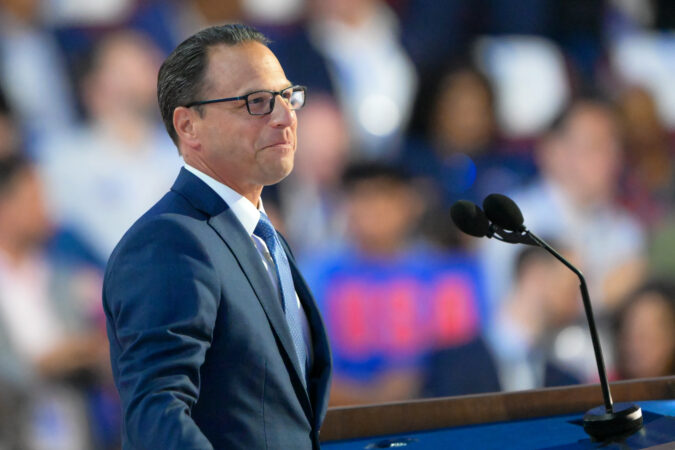
    Gov. Josh Shapiro speaks during a news conference, in Butler, Pa., Sunday, July 14, 2024, following an assassination attempt on President Donald Trump.

    (It is unclear whether Shapiro tried to call Trump after he experienced his own assassination attempt in Butler, Pa., the previous summer, though Shapiro publicly vehemently denounced the violence.)

    Throughout the book, Shapiro details his approach to Trump. He picks his battles to be ones he is sure he will win, he writes, and is sympathetic to the struggles that led some voters to support Trump.

    He’s proud of his disagreements with fellow Dems

    Shapiro sells himself as a pragmatist and writes proudly of the times in which he has disagreed with his party or changed his positions.

    For example, he recalls being asked by Harris’ vetting team about his past comments criticizing Democrats in federal, state, and local offices for how they handled COVID-19 closures. He stood by his criticism of former Gov. Tom Wolf at the time over business and school closures, and of the mask and vaccine mandates implemented by the Biden administration, he writes.

    “I respectfully pushed back, asking if they believed that we had gotten everything right, to which they generally agreed that we had not,” Shapiro writes about his conversation with Harris’ vetting team. “I just had been willing to say the quiet part out loud, even if it wasn’t easy or popular or toeing the line to do so.”

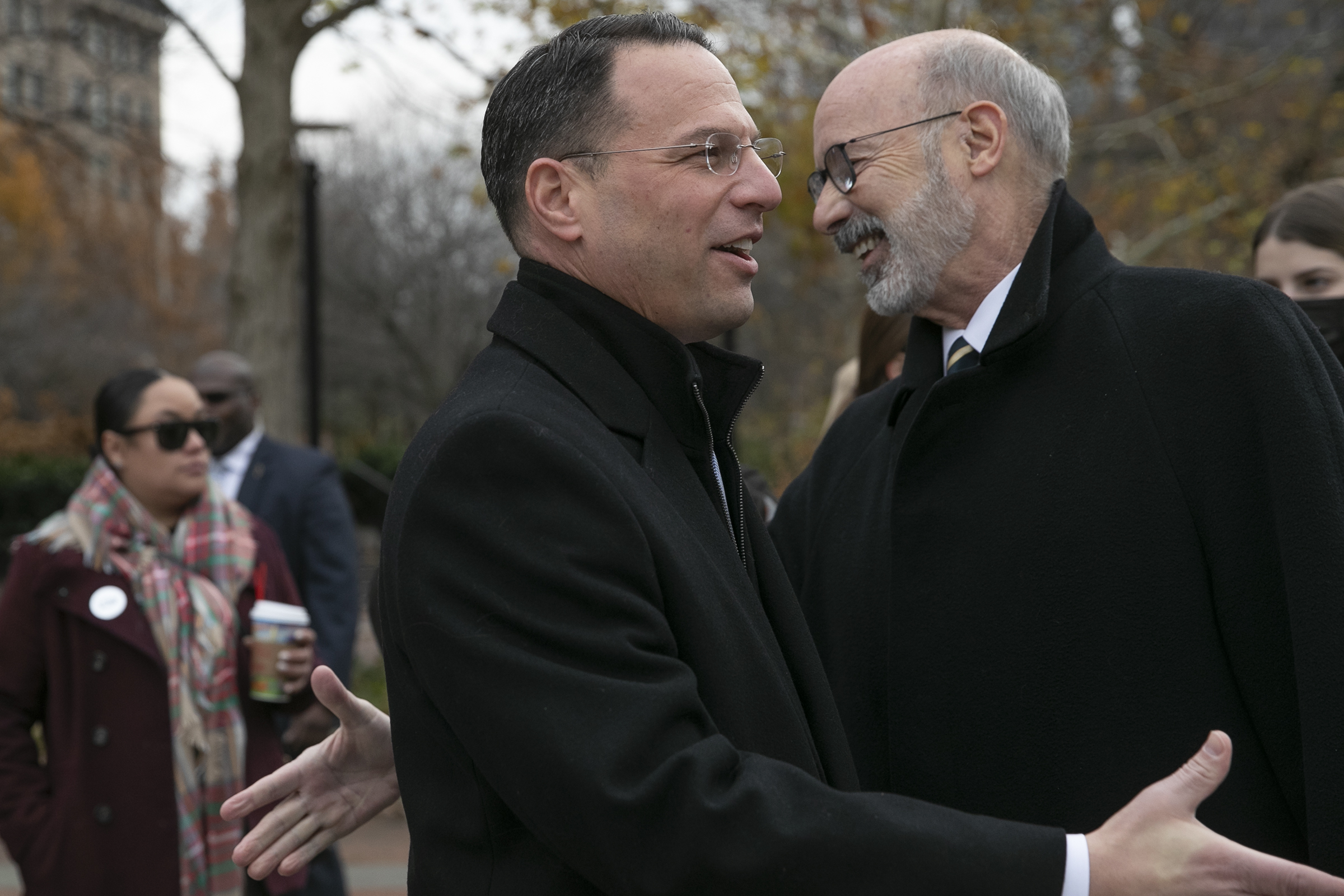
    Then-Attorney General Josh Shapiro and Then-Gov. Tom Wolf both go in for handshakes before the start of a press conference on the harmful effects of anti-abortion policies at 5th and Market in Philadelphia on Thursday, Dec. 9, 2021.

    He also writes about his journey to change his position on the death penalty over the years. In the days after the Tree of Life synagogue massacre in Pittsburgh, in which 11 Jewish people were killed while worshipping, he had initially supported the death penalty for the suspect. Since then, his views have evolved and he no longer supports capital punishment and called on the legislature to end the practice.

    Lori Shapiro is behind most of her husband’s good ideas

    Lori Shapiro, 53, mostly avoids her husband’s frequent appearances in the limelight.

    The former Clinton administration official works mostly behind the scenes, except on a few issues important to her, including those relating to people with intellectual disabilities and ensuring girls have access to menstrual products in schools.

    But in his book, Shapiro writes that his wife has challenged him as she has supported his political rise, pushing him to question what he really wants, do the right thing, or even help him shape his messaging to voters. She discouraged him from running for U.S. Senate in 2016 after top Democrats approached him, which led him to run for attorney general instead. She was also his first call when Biden dropped out and he briefly considered whether he should run for president, and his voice of reason during the veepstakes.

    Josh Shapiro and his wife Lori leave the state Capitol in Harrisburg Tuesday, Jan. 17 2023, on his way to the stage to be sworn in as the 48th Governor of Pennsylvania.

    The couple started dating in high school, before breaking up during college when they went to different universities in New York — he attended the University of Rochester, while she went to Colgate University. Shapiro writes that he quickly realized he missed her, and wrote her a letter in an effort to win her back.

    “So I cracked my knuckles, and wrote my heart out. I was Shakespeare composing a sonnet. I was Taylor Swift before Taylor Swift. I was Lloyd Dobler in Say Anything, in a trench coat with the boom box over my head,” Shapiro writes. “I was getting the girl back.”

    This earned Shapiro the title of “Mr. Lori” from her hall mates at Colgate. He did not win her back until years later, when the two reconnected in Washington after college, and quickly became engaged. The two married and had four children together, who each make frequent appearances throughout the book.

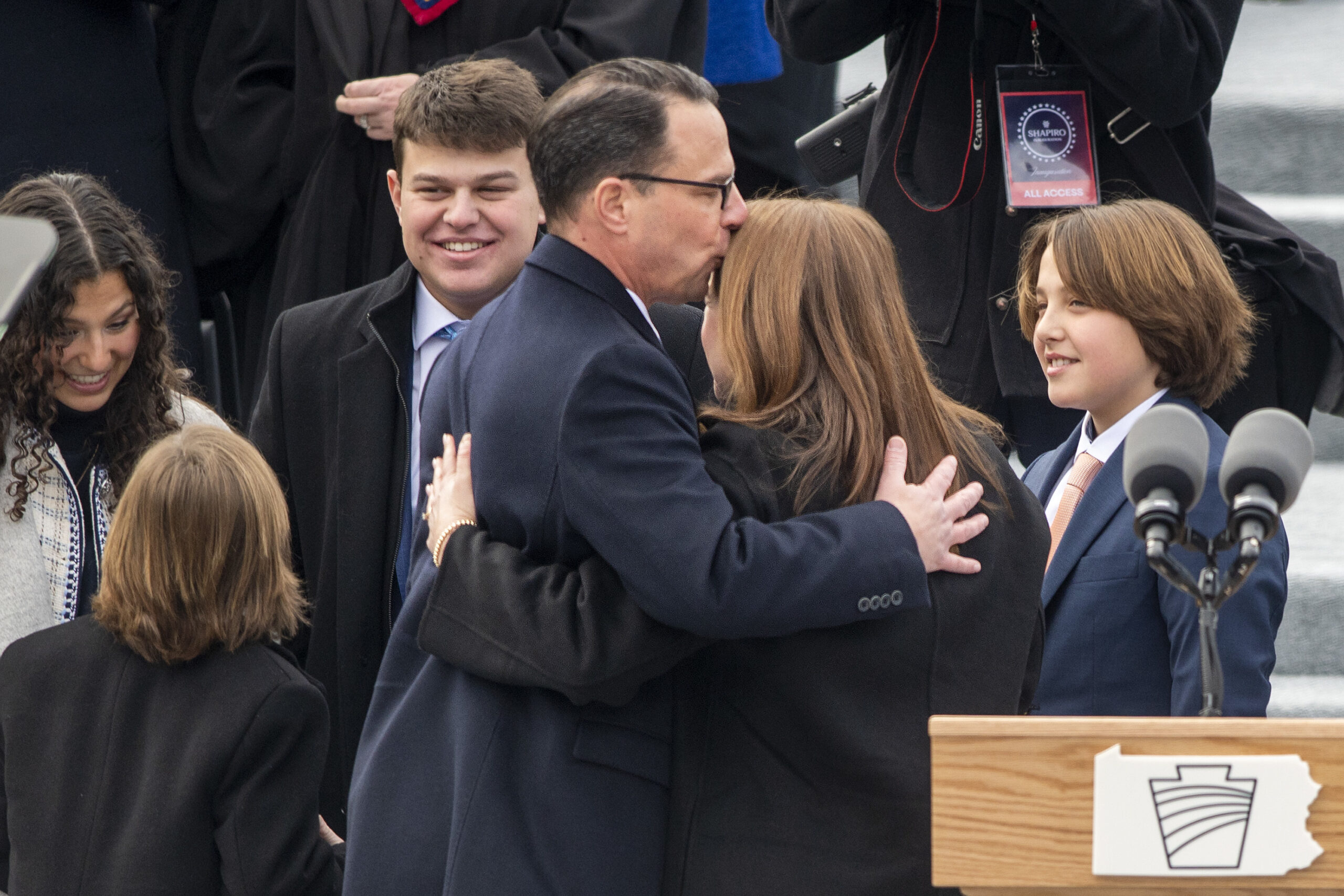
    Surrounded by his four children, Gov. Josh Shapiro kisses his wife Lori after his is sworn in as the 48th Governor of Pennsylvania during inauguration ceremonies at the state Capitol in Harrisburg Tuesday, Jan. 17 2023.

    Shapiro grapples with an early career move that kicked off his reputation as disloyal

    Shapiro is not without regret for how some of his career moves and ambitions affected the people who helped him get where he is today, he writes.

    Shapiro got his start in politics on the Hill under then-U.S. Rep. Joe Hoeffel, a Montgomery County Democrat. He quickly worked his way up to be Hoeffel’s chief of staff before returning to Abington Township to run for state representative.

    But when Shapiro was done with frequent trips to Harrisburg and ready for his next rung on the ladder, Hoeffel was in the way. Shapiro had a plan to run for county commissioner and flip the board for the first time in more than 150 years — making Montco the first Philadelphia collar county to swing into Democratic control. Now all of the Philly suburban counties are controlled by Democrats, and Shapiro is credited for starting the trend. But Hoeffel was not a part of that calculation.

    Shapiro writes that Hoeffel was “struggling politically.” He says he told him he would not run against him, but he also would not run with him.

    “I knew that I couldn’t win with him, and I knew that it wasn’t the right thing for the party or the county, even if we could somehow eke out the victory,” Shapiro writes.

    Hoeffel eventually decided not to run, and was quoted in The Inquirer in 2017 as saying that loyalty is not Shapiro’s “strong suit,” comments he has since stood by, in addition to praising Shapiro for his successes ever since.

    “I’d hear about [Hoeffel] talking to the press or to people behind my back about how he thought I lacked loyalty, that I was someone who needed to be watched,” Shapiro writes. “It felt terrible, and of course, I never intended to hurt him in any way and I would never have run against him. I wanted the Democrats to have a shot, and I knew that I could get it done.”

    Shapiro initially said antisemitism didn’t play into Kamala Harris’ running mate decision. Now he has more to say

    In the days after Harris passed over Shapiro to be her running mate in favor of Minnesota Gov. Tim Walz, Shapiro said “antisemitism had no impact” on her decision.

    Now, Shapiro questions whether he was unfairly scrutinized by Harris’ vetting team as the only Jewish person being considered as a finalist, including a moment when a top member of Harris’ camp asked him if he had “ever been an agent of the Israeli government.”

    “I wondered whether these questions were being posed to just me — the only Jewish guy in the running — or if everyone who had not held a federal office was being grilled about Israel in the same way,” he writes.

    Vice President Kamala Harris visits Little Thai Market at Reading Terminal Market with Gov. Josh Shapiro after she spoke at the APIA Vote Presidential Town Hall at the Pennsylvania Convention Center in Philadelphia, Pa., on Saturday, July 13, 2024. The photo was taken eight days before President Joe Biden’s decision to exit the race.

    He details his broader concerns with how he was treated during the process, including some perceived insults about his family’s lack of wealth or Lori Shapiro’s appearance.

    Since Shapiro’s book was leaked to the media over the weekend, sources close to Walz confirmed to ABC News that the Minnesota governor was also asked whether he was an agent of a foreign government, due to his multiple trips to China.

    Shapiro, for his part, has written about his time in Israel, including a high school program in which he completed service projects on a farm, on a fishery at a kibbutz, and at an Israeli army base. He once described himself in his college student newspaper as a “past volunteer in the Israeli army” — a characterization that circulated widely after it was reported by The Inquirer during the veepstakes.

    The missing character: Mike Vereb

    There is one person who had been influential during Shapiro’s many years of public service who is not mentioned once in the book: Mike Vereb.

    Vereb, a former top aide to Shapiro, left the governor’s office shortly into his term after he was accused of sexual harassment of a female employee. The state paid the female employee $295,000 in a settlement over the claim.

    Vereb had been along for the ride for Shapiro’s time in the state House as a fellow state representative from Montgomery County (though he was a Republican), as a top liaison to him in the attorney general’s office, and eventually a member of his cabinet in the governor’s office until his resignation in 2023.

  • Researchers find Antarctic penguin breeding is heating up sooner, and that’s a problem

    Researchers find Antarctic penguin breeding is heating up sooner, and that’s a problem

    WASHINGTON — Warming temperatures are forcing Antarctic penguins to breed earlier and that’s a big problem for two of the cute tuxedoed species that face extinction by the end of the century, a study said.

    With temperatures in the breeding ground increasing 5.4 degrees Fahrenheit (3 degrees Celsius) from 2012 to 2022, three different penguin species are beginning their reproductive process about two weeks earlier than the decade before, according to a study in Tuesday’s Journal of Animal Ecology. And that sets up potential food problems for young chicks.

    “Penguins are changing the time at which they’re breeding at a record speed, faster than any other vertebrate,” said lead author Ignacio Juarez Martinez, a biologist at Oxford University in the United Kingdom. “And this is important because the time at which you breed needs to coincide with the time with most resources in the environment and this is mostly food for your chicks so they have enough to grow.’’

    For some perspective, scientists have studied changes in the life cycle of great tits, a European bird. They found a similar two-week change, but that took 75 years as opposed to just 10 years for these three penguin species, said study co-author Fiona Suttle, another Oxford biologist.

    Researchers used remote control cameras to photograph penguins breeding in dozens of colonies from 2011 to 2021. They say it was the fastest shift in timing of life cycles for any backboned animals that they have seen. The three species are all brush-tailed, so named because their tails drag on the ice: the cartoon-eye Adelie, the black-striped chinstrap and the fast-swimming gentoo.

    Warming creates penguin winners, losers

    Suttle said climate change is creating winners and losers among these three penguin species and it happens at a time in the penguin life cycle where food and the competition for it are critical in survival.

    The Adelie and chinstrap penguins are specialists, eating mainly krill. The gentoo have a more varied diet. They used to breed at different times, so there were no overlaps and no competition. But the gentoos’ breeding has moved earlier faster than the other two species and now there’s overlap. That’s a problem because gentoos, which don’t migrate as far as the other two species, are more aggressive in finding food and establishing nesting areas, Martinez and Suttle said.

    Suttle said she has gone back in October and November to the same colony areas where she used to see Adelies in previous years only to find their nests replaced by gentoos. And the data backs up the changes her eyes saw, she said.

    “Chinstraps are declining globally,” Martinez said. “Models show that they might get extinct before the end of the century at this rate. Adelies are doing very poorly in the Antarctic Peninsula and it’s very likely that they go extinct from the Antarctic Peninsula before the end of the century.”

    Early bird dining causes problems

    Martinez theorized that the warming western Antarctic — the second-fasting heating place on Earth behind only the Arctic North Atlantic — means less sea ice. Less sea ice means more spores coming out earlier in the Antarctic spring and then “you have this incredible bloom of phytoplankton,” which is the basis of the food chain that eventually leads to penguins, he said. And it’s happening earlier each year.

    Not only do the chinstraps and Adelies have more competition for food from gentoos because of the warming and changes in plankton and krill, but the changes have brought more commercial fishing that comes earlier and that further shortens the supply for the penguins, Suttle said.

    This shift in breeding timing “is an interesting signal of change and now it’s important to continuing observing these penguin populations to see if these changes have negative impacts on their populations,” said Michelle LaRue, a professor of Antarctic marine science at the University of Canterbury in New Zealand. She was not part of the Oxford study.

    People’s penguin love helps science

    With millions of photos — taken every hour by 77 cameras for 10 years — scientists enlisted everyday people to help tag breeding activity using the Penguin Watch website.

    “We’ve had over 9 million of our images annotated via Penguin Watch,” Suttle said. “A lot of that does come down to the fact that people just love penguins so much. They’re very cute. They’re on all the Christmas cards. People say, ‘Oh, they look like little waiters in tuxedos.’”

    “The Adelies, I think their personality goes along with it as well,” Suttle said, saying there’s “perhaps a kind of cheekiness about them — and this very cartoonlike eye that does look like it’s just been drawn on.”

  • As promised, Mikie Sherrill immediately declares state of emergency on utility bills in N.J.: ‘Just the beginning’

    As promised, Mikie Sherrill immediately declares state of emergency on utility bills in N.J.: ‘Just the beginning’

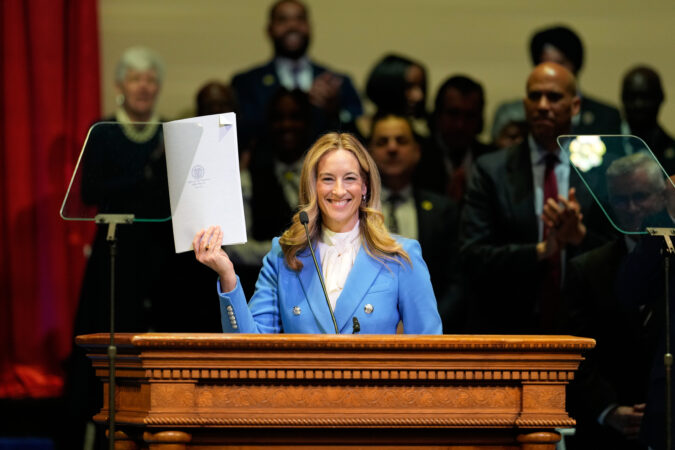
    New Jersey Gov. Mikie Sherrill was so excited to fulfill her promise of declaring a state of emergency on utility bills on her first day in office, she did it before finishing her inauguration speech.

    “I’ve heard you, New Jersey — we are facing an affordability crisis, and you want costs to come down,” she said during her speech that followed her swearing-in. “And you want that to begin today.”

    Sherrill, a Democrat, signed two executive orders on stage in front of roughly 2,000 people before she wrapped up her inaugural address at the New Jersey Performing Arts Center in Newark on Tuesday.

    The first freezes utility rates in New Jersey, which she is able to do by directing the state Board of Public Utilities to provide credits to bill payers for increases. The board made a similar move over the summer under former Gov. Phil Murphy after significant bill increases. Those credits were funded with money from clean energy programs.

    The public utilities board, known as the BPU, is a regulatory authority that oversees private utility companies in New Jersey and works on clean energy programs in the state. It is funded in part through a charge on utility bills.

    BPU President Christine Guhl-Sadovy said in a statement that the board “looks forward to supporting the governor’s agenda to lower utility costs for New Jersey ratepayers while encouraging the development of new energy resources here in the Garden State.”

    Sherrill also directed the public utilities board to consider pausing or modifying the schedule for proceedings in which utility companies seek rate increases — as much as the law allows — and called for a study into modernizing the current electricity distribution business model. She also called for the board to revise the Clean Energy Program for the upcoming FY 2026 budget.

    Sherrill also signed an executive order on stage to increase power generation in the state as part of her effort to lower costs.

    “This is just the beginning,” she said on stage.

    “Not of my speech, of my work,” she joked.

    Her second order rolls out efforts to make it easier and faster for companies to generate power in the state, particularly via solar and battery sources. She directs state agencies to pursue permitting reforms that can help speed up processes to get new energy sources up and running as part of this order.

    She also calls on the New Jersey Department of Environmental Protection to expedite permitting processes for existing gas plants to expand capacity, run more efficiently, and reduce emissions.

    In another request of the public utilities board, she asks officials to require electric utility companies to report on how much energy data centers request to assess “ghost loads,” which are forecasts for how much energy large projects may require. These predictions impact how much energy the regional grid operator PJM anticipates needing to handle, which can increase prices.

    Sherrill has blamed PJM for high utility costs, and the regional grid operator has argued that it has simply responded to supply and demand issues as energy usage has drastically increased in recent years in part to the increasing demand for artificial intelligence.

    The order also creates a Nuclear Power Task Force to support nuclear power generation.

    “I heard the people of New Jersey loud and clear – these rate hikes are unacceptable – and as your governor, I will not stop fighting to lower costs and make New Jersey a more affordable place to live, work, and raise a family,” Sherrill said in a statement.

  • Does Tyrese Maxey ‘hate’ VJ Edgecombe? The Sixers stars have a little fun with a heated moment.

    Does Tyrese Maxey ‘hate’ VJ Edgecombe? The Sixers stars have a little fun with a heated moment.

    After the 76ers beat Indiana on Monday night, VJ Edgecombe wanted to get something on the record in his postgame interview with Tyrese Maxey.

    “For the record, man, we do not hate each other,” Edgecombe said.

    “I hate you. Don’t talk to me ever again, and go in the locker room,” Maxey joked in response.

    Online speculation about whether Maxey and Edgecombe liked each other started after a defensive miscommunication in the first quarter of Friday’s loss to Cleveland led to an open Donovan Mitchell three. Maxey and Edgecombe were caught on the bench having what appeared to be a heated conversation after the play.

    But on Monday, after Maxey was named an All-Star starter, Edgecombe was the first person to reach out to him — telling reporters he set a 2 p.m. alarm just to make sure he found out right away whether Maxey had been named a starter so he could congratulate him.

    Edgecombe woke up Maxey from his pregame nap trying to call him.

    “I’m like, why is he calling me?” Maxey said pregame. “And I answer, and he’s screaming and showing me the TV. And I’m like, ‘OK.’ We chopped it up a little bit.”

    And postgame, the two Sixers guards were having fun after the 113-104 win over the Pacers.

  • Russia batters Ukraine’s power grid again as officials seek momentum in U.S.-led peace talks

    Russia batters Ukraine’s power grid again as officials seek momentum in U.S.-led peace talks

    KYIV, Ukraine — Russia bombarded Ukraine with more than 300 drones and ballistic and cruise missiles in its latest nighttime attack on the Ukrainian power grid, President Volodymyr Zelensky said Tuesday, as Moscow gives no public sign that it’s willing to end the invasion of its neighbor anytime soon.

    The attack knocked out heating to more than 5,600 apartment buildings in the capital, Kyiv Mayor Vitali Klitschko said. Nearly 80% of the affected buildings had recently had their heating supply restored after a major Russian barrage on Jan. 9 that plunged thousands of people into a dayslong blackout, he said.

    Ukraine is enduring one of its coldest winters for years, with temperatures in Kyiv falling to minus 4 Fahrenheit. At the same time, Russia has escalated its aerial attacks on the electricity supply, aiming to deny Ukrainians heat and running water and wear down their resistance almost four years after Moscow launched its full-scale invasion on Feb. 24, 2022.

    Meanwhile, Ukrainian officials are trying to keep up the momentum of U.S.-led peace talks. A Ukrainian negotiating team arrived in the United States on Saturday. Their main task was to convey how the relentless Russian strikes are undermining diplomacy, according to Zelensky.

    The Ukrainian leader said last week that the delegation would also try to finalize with U.S. officials documents for a proposed peace settlement that relate to postwar security guarantees and economic recovery. If American officials approve the proposals, the U.S. and Ukraine could sign the documents at the World Economic Forum in Davos, Switzerland, this week, he said.

    Kremlin spokesman Dmitry Peskov said Tuesday that presidential envoy Kirill Dmitriev plans to meet with some American representatives at Davos.

    He refused to name the officials Dmitriev would meet with, but media reports said they would include U.S. envoy Steve Witkoff and U.S. President Donald Trump’s son-in-law, Jared Kushner.

    Attacks described as ‘cruel’

    Ukrainian Foreign Minister Andrii Sybiha said his country needs urgent assistance and additional sanctions on Russia to make Moscow change course.

    Russian President Vladimir Putin’s “barbaric strike this morning is a wake-up call to world leaders gathering in Davos,” Sybiha said on X.

    U.N. Human Rights Chief Volker Türk said that he was outraged by the repeated large-scale attacks on Ukraine’s energy infrastructure, which especially affect children, older people, and those with disabilities.

    The strikes “can only be described as cruel,” he said in Geneva. “They must stop. Targeting civilians and civilian infrastructure is a clear breach of the rules of warfare.”

    Several electrical substations providing power vital for nuclear safety in Ukraine were affected, said Rafael Mariano Grossi, director-general of the International Atomic Energy Agency.

    Air defense systems are expensive

    Ukraine’s air force command said that 27 missiles and 315 drones were shot down or jammed, while five missiles and 24 drones hit 11 locations.

    The Russian Defense Ministry claimed that its forces targeted Ukrainian military and industrial installations as well as energy and transport infrastructure used by the Ukrainian armed forces.

    The constant attacks have stretched Ukraine’s air defenses and, according to Zelensky, some systems recently ran out of ammunition before a new shipment arrived.

    The fight is also expensive: the air defense ammunition that Ukraine used against the Russian missiles overnight cost about 80 million euros ($93 million), Zelensky said.

    Ukrainian air defenses are adopting a new approach, with the appointment of a new deputy air force commander, Pavlo Yelizarov, according to Zelensky.

    “This system will be transformed,” he said late Monday, without providing details.

    Ukraine relies on sophisticated air defense systems produced by Western countries, especially the U.S., to thwart Russia’s missile and drone attacks.

  • Who’s a Jew? The government should never ask.

    Who’s a Jew? The government should never ask.

    I’m Jewish, and like most other Jews I know, I often wonder who else is. When I meet someone at a party, or see a new face on TV, I think: yes or no? It’s a game, and it’s all in good fun.

    But when the government does it, it isn’t. It’s a dagger at our hearts.

    That’s why so many people at the University of Pennsylvania — where I teach — are up in arms about the Trump administration’s effort to compel the university to identify Jewish students and employees. It’s part of an investigation of antisemitism on campus by the Equal Employment Opportunity Commission, which issued a subpoena demanding the names and contact information of members of Jewish-related student groups, staffers at the school’s Jewish studies program, and anyone who had filed an antisemitism complaint.

    Fortunately, Penn said no. The EEOC sued the university back in November for refusing to comply with the subpoena. And last week, several groups at Penn filed their own motion in the case. “Compiling and turning over to the government ‘lists of Jews’ conjures a terrifying history,” they wrote.

    Indeed, it does. Going back to the Middle Ages, state officials have tried to establish who is Jewish. And it never ends well.

    In 1215, Pope Innocent III decreed that Jews must wear markers at all times that made them distinguishable from Christians. Two years later, in England, King Henry III ordered male Jews to wear a badge on the front of their outer garments.

    In England, the badge was shaped like the tablets upon which Moses — according to the Old Testament — received the Ten Commandments. In France, it was a circle of red or yellow felt. Hungarian Jews had to wear red capes. And in German-speaking parts of Europe, Jews were required wear a cone-shaped Judenhut, or “Jew’s Hat.”

    The goal of these rules wasn’t simply to identify Jews; it was to segregate, humiliate, and persecute them. Jews wearing badges were mocked by children and attacked by bandits. Badge laws also led to extortion: To receive exemptions from the laws, Jews had to pay large sums to the state.

    In the so-called Jewish Emancipation era of the 18th and 19th centuries, when Jews finally received citizenship in the nations where they lived, badge laws disappeared. But they returned with a vengeance in the 1930s and 1940s, when the Nazis required Jews in Germany and the territories it conquered to wear yellow stars.

    That helped facilitate their deportation and murder in concentration camps, where a new set of markers developed. Jews who were also political prisoners wore a red triangle, superimposed on a yellow one; gay Jews were identified by the pink triangle, which was later adopted by LGBTQ+ activists as a symbol of pride.

    And Jewish camp prisoners often received tattooed numbers on their arms. Again, that was a way to degrade Jews as well as to identify them.

    “My number is A-10572. That is what I was, they did not call us by our names,” recalled Holocaust survivor Lilly Ebert, whose TikTok video about the Auschwitz death camp went viral in 2021. “We were no longer humans. We were only a number, and we were treated like numbers.”

    Since then, every state effort to count or list Jews has reflected disdain for them. Convinced that Jews at the Bureau of Labor Statistics were altering employment statistics to undermine him, President Richard Nixon ordered aides to find out how many BLS workers were Jewish. “The government is full of Jews,” Nixon fulminated in a taped 1971 White House conversation. “Most Jews are disloyal … You can’t trust the bastards. They turn on you.”

    An aide scrutinized the BLS employees’ names — never a perfect way to figure who is Jewish — and concluded that 13 of 35 fit the “demographic criterion that was discussed,” as he delicately reported. Less than two months later, two Jewish senior officials were removed from their posts and demoted to less visible positions in the agency. That was “the last recorded act of official antisemitism by the United States government,” as political commentator Tim Noah wrote.

    Forcing Penn to cough up a list of Jews would be the next one. It doesn’t matter that it comes as part of a Trump administration investigation of antisemitism. Frankly, I doubt a president who welcomed Holocaust denier Nick Fuentes to his home for dinner — and who still refuses to criticize him — cares very much about the safety of Jews on campus.

    But even if he does, that’s no reason to count them. When the government does that, it isn’t fun anymore. It’s game over.

    Jonathan Zimmerman teaches education and history at the University of Pennsylvania. He is the author of “Whose America?: Culture Wars in the Public Schools.”

  • Rittenhouse Hotel to get a new, multimillion-dollar steakhouse

    Rittenhouse Hotel to get a new, multimillion-dollar steakhouse

    Major changes are coming to the Rittenhouse Hotel on Rittenhouse Square, as the Italian restaurant Scarpetta will leave the bilevel space next weekend after nearly a decade to set the stage for a posh new steakhouse called the Ruxton, from Baltimore-based Atlas Restaurant Group.

    Alex Smith, Atlas’ president and chief executive, told The Inquirer that the Ruxton, a sibling of the location in Baltimore’s Harbor East, would open in spring 2027. This will be the second Philadelphia restaurant for Atlas, which opened the high-end Loch Bar at Broad and Spruce Streets in fall 2023.

    A rendering of the second-floor dining room of the Ruxton at Rittenhouse Hotel.

    But before renovations for the Ruxton begin, the Rittenhouse space will host a residency from up-and-coming chef RJ Smith, 21, who launched Ocho Supper Club last year in his Drexel University apartment to showcase Afro-Caribbean cuisine through a fine-dining lens.

    RJ Smith, no relation to Atlas’ president, said he has scheduled the first seating for his eight-course tasting menus for Feb. 1 and plans to offer them through July 26; the schedule has not been formally set but includes Valentine’s Day.

    RJ Smith, culinary student and executive chef of Ocho Supper Club.

    Scarpetta, owned by LDV Hospitality, has set its final service for Jan. 31. Scarpetta opened in 2016, filling the space previously occupied by Smith & Wollensky, also a steakhouse. Lacroix, the Rittenhouse Hotel’s signature restaurant, is unaffected by the changes.

    Construction is expected to start in late summer for the Ruxton, whose deal has been in the works for nearly a year. Alex Smith said the Ruxton will occupy more space at the Rittenhouse — allowing for a total of 220 seats, vs. Scarpetta’s 120.

    The Ruxton, offering Rittenhouse Square views from its second floor, will have three private dining rooms and a 50-seat outdoor space on the deck. The restaurant’s entrance will be moved next to the hotel lobby, and there will also be an interior entrance through the hotel lobby.

    Designer Patrick Sutton is channeling inspiration from the Jazz Age, with highlights including velvet upholstery, walnut wood millwork, and custom Murano-style glass chandeliers. Corporate chef Aaron Taylor will oversee the steak and seafood menu.

    The Philadelphia location will be Atlas’ third Ruxton location; the second is due to open this fall in National Harbor in Maryland, outside of Washington, D.C.

    “We love Philly,” Smith told The Inquirer, adding that Loch Bar’s numbers are strong. “It’s a great town. In some ways, it reminds me of Baltimore — just much bigger. And we’re planning on doing more in Philadelphia.” He said developer Carl Dranoff, his partner at Loch Bar, would be involved in the Ruxton.

    Cole Hernandez, a Rittenhouse Hotel spokesperson, said that the Scarpetta space, in the short term, would also be used by Lacroix chef Eric Leveillee to host groups, do cooking and mixology classes, and other programming.

    In addition, the hotel’s Library Bar continues to rework its cocktails in collaboration with James Beard Award winner Danny Childs. A fresh drinks menu will launch in February.

    “Where we’re ultimately heading is a broader shift across the property,” Hernandez said. “The Philadelphia dining scene is changing — it’s more vibrant, more interesting, and less formal and stuffy. We’re evolving our concepts to be more relevant to today’s diner.

    At Lacroix, service standards have been modified to allow for more approachable, 90-minute dinners and “more dynamic and social” brunches that include à la carte options.