As sanitation crews finish clearing the 14 inches of snow that blanketed Philadelphia during this week’s near-blizzard, more workers can now be diverted back to trash pickup.
Trash and recycling collections will resume Wednesday on a two-day delayed schedule, meaning households with Monday pickups will get their trash collected Wednesday. Tuesday trash pickups will be on Thursday, Wednesday pickups on Friday, Thursday pickups on Saturday, and households with Friday pickups will have trash collected on Sunday.
Due to the modified schedule, there will be no second trash collection for neighborhoods that regularly receive it, and no collections in rear driveways for the rest of the week. With significant snow accumulation, the Streets Department said the measures would help mitigate the risk of sanitation trucks getting stuck in snow.
Expect collection delays as crews navigate through the snow and ice, and inaccessible streets may experience additional delays of trash pick up, according to the Streets Department.
Residents who cannot wait for delayed trash collection or do not receive collections due to unplowed streets can use one of the six sanitation convenience centers. Open Monday through Saturday, from 8 a.m. to 6 p.m., residents can drop off trash and recycling at these locations.
Sanitation convenience centers in Philadelphia
Northeast Philadelphia: 8401 State Rd., zip code 19136
Northwest Philadelphia: 320 Domino Ln., zip code 19128
Port Richmond: 3901 Delaware Ave., zip code 19137
Southwest Philadelphia: 3033 S 63rd St., zip code 19153
Strawberry Mansion: 2601 W Glenwood Ave., zip code 19121
West Philadelphia: 5100 Grays Ave., zip code 19143
Does Donald Trump have to ruin everything? The answer is obviously yes, but this one was heartbreaking. Sunday’s overtime thriller over Canada, which gave U.S. men’s hockey its first gold medal since this senior citizen was a college junior, was a howl of joy in what’s been a dire year for America. But then (taxpayer-)Ka$h Patel showed up to party, and soon Trump was on the phone, egging on the boys with misogynistic trash talk about their gold medal compatriots, the women’s hockey team. Now the men are invited to Trump’s State of the Union address, the women “had other plans,” and I almost wish our Canadian friends had won the game.
How Indiana University won a football crown and lost the plot
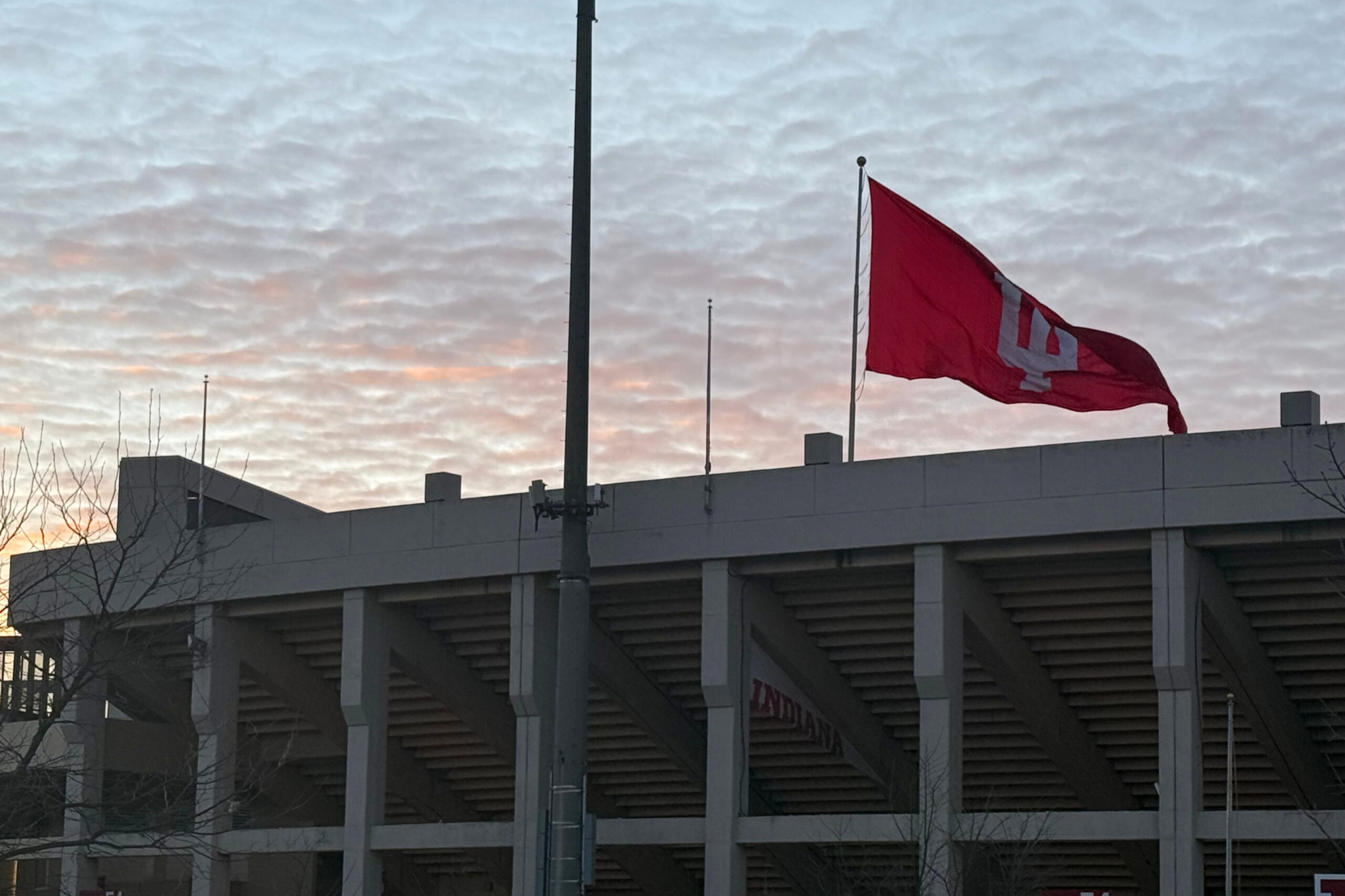
Indiana University’s victory flag flies over Memorial Stadium in January in Bloomington, Ind.
Even in a state where the sports miracles, from Rudy and The Knute Rockne Story to Hoosiers, are so big they tend to make it to Hollywood, there’s never been a feel-good script quite like Indiana University — with the most losses in college football history until this season, when it went 16-0 and won the national championship.
“The energy is just absolutely insane,” Katie Shin, a recent Indiana alumna, told the Athletic as thousands of fans went wild on the Bloomington campus that night, saluting Heisman Trophy quarterback Fernando Mendoza and their unsmiling genius head coach Curt Cignetti. “The whole state is just rallying around IU.”
But there’s a huge irony for anyone who’s a big fan of America’s colleges for more than just what happens on the gridiron. In the same season Indiana was slowly climbing to the top of the football polls, the flagship public university was also ranked dead last in the nation.
For something arguably more important: free speech.
The Foundation for Individual Rights and Expression (FIRE), the national campus speech group based here in Philadelphia, last fall ranked IU 255th on its 2026 ranking of universities over freedom of expression — the lowest-rated public institution in America, and only higher than the controversy-wracked private sister schools, Columbia University and Barnard College.
Interestingly, the FIRE low-ranking came after a slew of campus controversies in which the silenced speakers or protesters were all over the map ideologically — a canceled Jewish speaker and a shout down of right-wing speakers, but also draconian moves against pro-Palestinian protesters, including harsh penalties for a 2024 encampment. Last month, a federal court ruled that IU’s punishments of the Gaza campers and its anti-protest policies were unconstitutional.
FIRE’s lambasting of IU’s free speech transgressions was reported upon last Sept. 9 in the student paper, the Indiana Daily Student. The following month, school administrators ousted the faculty adviser to the IDS and told the student journalists they could no longer print the paper, and that news could only be published online. The university’s insistence that this was purely an economic move was a surprise to the ex-adviser, who sued and said he was fired “after he refused to censor the students’ work.”
It ought to go without saying that curbing the free exchange of ideas is antithetical to the most sacred values of American higher education. But the free speech mess at IU is but one controversy at an iconic heartland university that has become a poster child for the moral crisis of U.S. universities, even as it celebrates football glory.
Clearly, the leadership at IU — and this includes its board of trustees, with three new conservative, pro-MAGA members that GOP Gov. Mike Braun named in June under a law that also allowed him to boot three trustees elected by IU’s alumni — is eager to keep its pigskin prowess as the main thing America knows about the university.
The school just signed its field general, Cignetti, to a contract extension that will pay him $13.2 million a year through 2033, making him one of the three highest-paid coaches in the nation. But his new deal flabbergasted a growing number of critics, who note the big raise came as IU — just days after the new conservative trustees were named — either eliminated or made deep cuts in nearly 250 academic programs such as French, art history, geography, and East Asian studies.
Meanwhile, Cignetti isn’t the only high-profile figure at IU to see a big raise. Also this weekend, the trustees gave Whitten a $100,000 pay hike, to an even $1 million a year — citing her willingness to work with industry.
At least 250 IU alums, joined by current faculty and students, have signed on so far to an open letter and donation freeze demanding that, instead, Whitten step down. They also want the university to restore both its diversity programs and robust free speech protections, as well as the reinstatement of the three alumni trustee positions. But they are swimming against a red tide of conservatism that’s polluted the public college universe in Indiana.
Cross-state public rival Purdue University is reeling from a recent report in its hometown newspaper that the school, under pressure from conservative lawmakers, has informally banned the admission of international students from China and a slew of other countries. Students and faculty have complained of an unwritten “soft ban” on many overseas applicants, although Purdue has denied that such a policy exists.
Meanwhile, the regional campus of IU Indianapolis caused a stir and triggered a protest when it abruptly canceled the 57-year tradition of an annual Rev. Dr. Martin Luther King Jr. dinner — a move that was undertaken not long after the school removed campus signs that read “Black Lives Matter” and “Discrimination has no place here.”
Indiana is hardly alone. The 2025-26 academic year has been marked by similar outrages against unfettered speech and racial inclusion, especially in the most pro-Trump red states. To cite just one of many examples, the University of Texas System just adopted a new policy aimed at limiting discussion of “controversial topics” in the classroom. Isn’t that the whole point of the college experience?
The erosion of freedom at the American university has happened gradually and then suddenly, and it needs to be getting a lot more attention. That’s hard when the president is sending aircraft carriers to threaten Iran, imposing steep taxes for no reason, and generally acting and talking like the mad king he is.
Yet, nothing is more important for MAGA’s authoritarian project than what is happening at Indiana University and other college campuses right now. As I wrote in my 2022 book, After the Ivory Tower Falls, higher ed is the fulcrum of America’s political divide, now more than ever.
Every tactic — murdering the humanities and the social sciences, making campuses more white, ensuring our future elites aren’t exposed to “controversial topics” while entertaining them with the beer and circuses (a phrase, ironically, coined by an IU English professor) of big-time football — is another step toward MAGA’s strategic goal of an American electorate that cannot think critically.
The fight for the soul of Indiana University is the fight for the soul of the United States, and it’s not what’s happening inside Memorial Stadium against Ohio State or Michigan.
“We know that IU alums are smart enough to celebrate the success of the Football Hoosiers and condemn what Pamela Whitten is doing to degrade the prestige of our degrees,” the university dissidents write in their open letter. “Please help us take a stand against the debasement of our university and restore the glory of old IU.”
Yo, do this!
You might have noticed that the late Jeffrey Epstein and his randy U.K. royal pal, the artist formerly known as Prince Andrew, have been in the news a lot lately. But did you know there’s an excellent 2024 Netflix movie called Scoop about the drama behind the disastrous 2019 BBC interview that started the long downfall of Andrew Mountbatten-Windsor, now arrested and under a British police investigation? I watched Scoop over the weekend, and it’s both an entertaining and highly relevant journalism thriller.
Since this space is devoted to my weird entertainment choices, and not what normal people are doing, I have to share that I’ve been escaping today’s banality of evil with a deep dive into the musical world of … mass murderer Charles Manson. My all-time favorite podcast, Andrew Hickey’s A History of Rock Music in 500 Songs, did a remarkable four-parter a couple of years ago about Manson and his shockingly close ties to the Beach Boys (and others like, sigh, Neil Young) that resulted in the murder mastermind’s uncredited cowriting of their 1968 song, “Never Learn Not to Love.” There’s also a compelling detour into the life of Black music pioneer Huddie “Lead Belly” Ledbetter, and a book recommendation that sounds equally incredible: Bring Judgment Day: Reclaiming Lead Belly’s Truth from Jim Crow’s Lies by Sheila Curran Bernard.
Ask me anything
Question: Update us on what is and what should be happening in Quakertown [please]. — @marco2751.bsky.social via Bluesky
Answer: Thanks for this, Marco, because if readers aren’t up to speed on what’s been happening in Quakertown, an exurb nearly an hour’s drive north of Philadelphia, then they need to learn. Quick version: A peaceful Friday walkout by Quakertown High School students protesting U.S. Immigration and Customs Enforcement raids turned shockingly violent, highlighted by a grown man placing a teen girl in what appeared on video to be a dangerous choke hold. It turned out this man was the Quakertown police chief and interim borough manager, Scott McElree. Adding insult to injury, five students were arrested and spent the entire weekend in jail before they could see a judge. What should be done? Quakertown can’t fire McElree quickly enough. The right to peacefully assemble and protest the government is the heart of the First Amendment, and what makes America a democracy. A police chief who can’t honor the U.S. Constitution should not have a job.
What you’re saying about …
Last week’s take-a-step-back-from-the-madness question about who is the greatest living American (inspired by the passing of the Rev. Jesse Jackson) didn’t get a large response, but brought some compelling arguments. Two men were named twice: Pope Leo XIV, the Villanova alum who has shone as an advocate for immigrants and for peace on the world’s stage since last summer, and Sen. Bernie Sanders, who has never wavered in fighting for progressive values. Other suggestions included Bob Dylan, Edward Snowden, Barack Obama, and — in a show of respect for science under siege — the health experts Anthony Fauci and Peter Hotez, who, wrote Pat Eisenberg, “is trying to improve the health of Americans despite all the things the Trump administration is doing to ruin our health.”
📮 This week’s question: I’m hopefully going to be writing soon about the scourge of prediction markets like Kalshi, and more broadly, the problem of sports betting. Should these forms of gambling be banned, or at least more strictly regulated? Please email me your answer and put the exact phrase “Betting bans” in the subject line.
Backstory on what pundits don’t get about ‘28
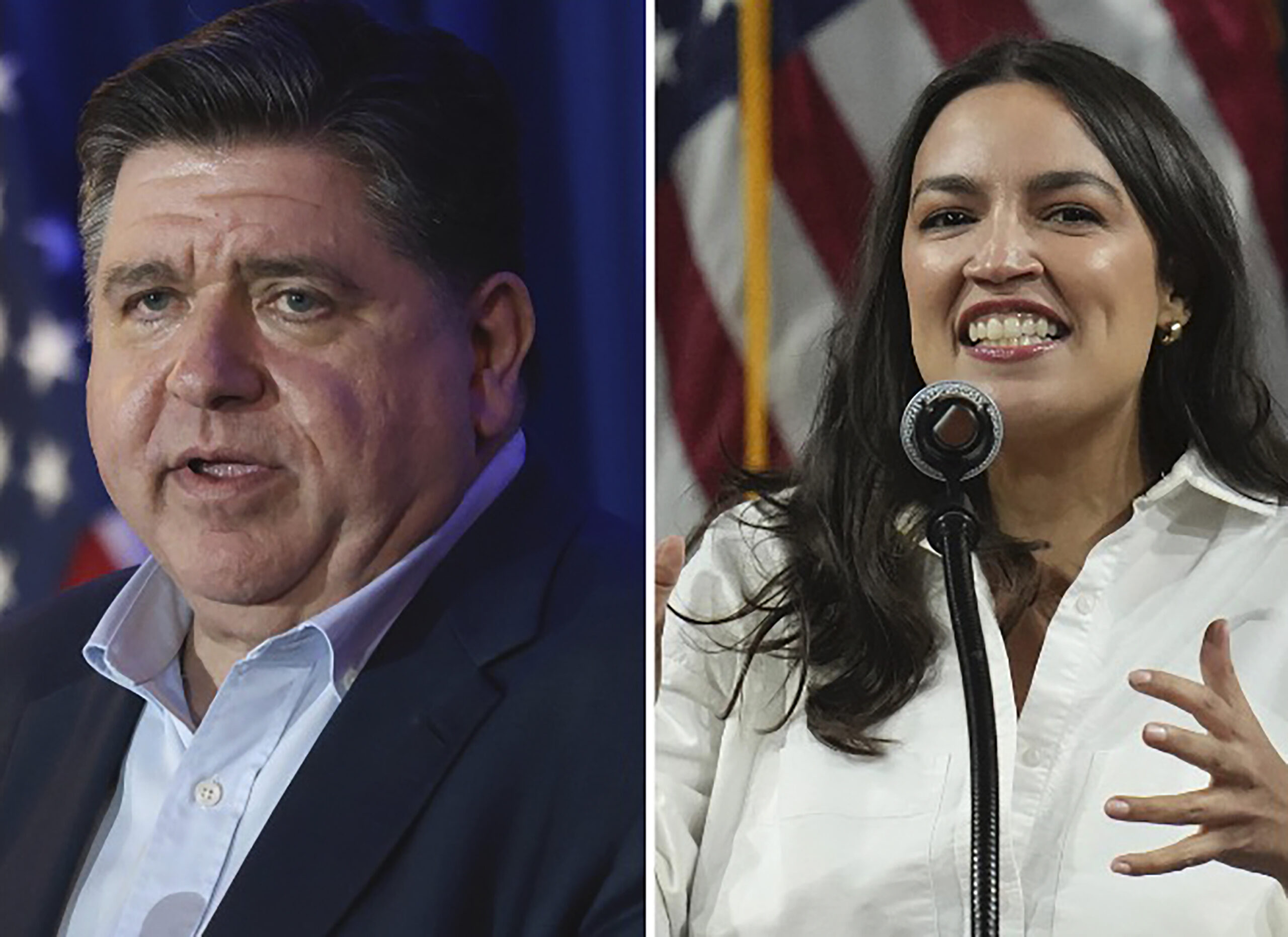
This photo combo shows Illinois Gov. JB Pritzker, left, speaking during the McIntyre-Shaheen 100 Club Dinner, April 27, 2025, in Manchester, N.H., and U.S. Rep. Alexandria Ocasio-Cortez (D., N.Y.) speaking during a “Fighting Oligarchy” tour event at Arizona State University, March 20, 2025, in Tempe, Ariz.
Get 13 Democratic and left-leaning independent voters together in the same chat — as the New York Times did with a recent focus group, the latest in its running series — and you’d surely hear some harsh words about Donald Trump and the GOP. But ask them what they think about the Democratic Party, and you might want to cover your ears.
“Spineless.” “More complacent than I thought they would be.” “Paralyzed.” “Afraid.” “Incompetent.” “I guess suffocated, or given up …” “Sold out.” I’m not leaving out the positive responses, because there weren’t any. You also won’t be surprised that these 13 Democratic or aligned voters — very diverse across racial, class, and age lines — want more radical leaders who will take the party, and hopefully the nation, in a bold new direction. There was positive buzz for the likes of new New York Mayor Zohran Mamdani and Texas Rep. Jasmine Crockett — anyone with fresh ideas and a willingness to mix it up with Trump. Said a 36-year-old independent woman from Washington state: “I still don’t agree with everything she’s doing, but Alexandria Ocasio-Cortez is a well-known name and seems to be fighting against Trump.”
I thought a lot about the Times’ focus group last week as I heard or read two veteran pundits try, at this relatively early date, to handicap the 2028 presidential race. Mark Halperin (who’s somehow still around despite this) went on POTUS radio with Michael Smerconish to defend his picks: He included ex-Chicago mayor Rahm Emanuel, a center-right figure who is passionately hated by any real Democrat I’ve ever spoken with, and also overrated Kamala Harris (floating on the fumes of her name ID), as well as his No. 1 pick, California Gov. Gavin Newsom, with Pennsylvania Gov. Josh Shapiro at No. 2. He said he included AOC and upgraded Illinois Gov. JB Pritzker only because his “sources” told him to — because his sources understand the Democrats while the clueless Halperin does not.
Ditto Nate Silver, who has magically reappeared in the Times, which first made him a star in 2012. Although Silver did place AOC in second, behind Newsom, he also — much like Halperin — uprated tired conventional wisdom candidates like Shapiro (No. 6) and Michigan Gov. Gretchen Whitmer (No. 4, despite being invisible recently), and grossly downrated progressive favorites like Pritzker (14) and Connecticut Sen. Chris Murphy (18), as well as more interesting and unorthodox names like Arizona Sen. Mark Kelly (12) and Kentucky Gov. Andy Beshear (15). He sees Newsom as the darling of “Resistance Libs,” the Trump-hating MS Now watchers who controversially get tagged as heavily “wine moms.” Said Silver of Newsom: “They want a fighter. And Newsom plays expertly into that.”
True, but I expect Newsom’s standing among Democratic primary voters will crumble once voters learn more about his ties to Silicon Valley billionaires, or his verbal sellouts of the transgender community, or his “meh” popularity among the Californians who know him best. Readers of this newsletter were unanimous earlier this month in not wanting Shapiro to run. I’m not going to do a numerical ranking, but I would place Pritzker, who’s made all the right moves against Trump without Newsom’s train car of baggage, and AOC, who’s making all the right enemies, including the worst Beltway journalists, as my top two. I’ve covered presidential races since 1984, and I’ve learned the only thing that matters two years out is to listen to the people. The pundits know nothing right now.
What I wrote on this date in 2019
It’s impossible to top this anniversary: The day I appeared in the Epstein files. In February 2019, with the walls closing in, Epstein’s close adviser and quasi-journalist friend, Michael Wolff, wanted to make sure he saw my Feb. 24, 2019, column about elite male impunity that mentioned him and two billionaires in his orbit: Donald Trump and New England Patriots owner Robert Kraft. What did Epstein read, assuming he clicked on it? I wrote that “this isn’t really ‘a sex scandal.’ The real scandal here is the gross imbalance of power involving women who were held in a form of human bondage to serve as objects of gratification for powerful men intoxicated by their belief they can get away with anything.”
I took a short break from the relentless anti-Trump, anti-ICE beat last week to write about the other threat to the American way of life: artificial intelligence. Rapid advances in AI technology make it clear that robots and chatbots and the like are going to upend the economy — most importantly, the job market — sooner rather than later. Can wary voters find politicians who are willing to regulate AI and its threats to employment, education, and the environment, or will pols continue to prefer Silicon Valley’s campaign donations? Over the weekend, I highlighted the recently leaked ICE blueprint for an American concentration camp in Georgia, and what that document tells us about the moral depravity of mass deportation.
In a city as large and as history-bound as Philadelphia, all big stories are inevitably local. That was never truer than at the Winter Olympics in northern Italy, especially for the most-watched event on these shores: the U.S. men’s hockey’s thrilling overtime victory over Canada. The on-ice celebration blended with copious tears as Team USA teammates went into the stands and skated back with Johnny Jr. and Noa Gaudreau, the young children of late South Jersey NHL hockey icon Johnny Gaudreau. Their dad and their uncle Matty were killed by an alleged drunk driver while cycling on a South Jersey road in August 2024, as Gaudreau was training to hopefully make this Olympic squad. The players centered the Gaudreau family and his No. 13 jersey during the gold-medal celebration, and The Inquirer’s Alex Coffey captured the whole emotional story — one you won’t read anywhere else. “This is a history book [moment] that there will be a movie about,“ sister Katie Gaudreau told Coffey. ”And in that movie, Noa and Johnny will be on the ice.” You get the big, moving stories like this, and allow us to keep covering them, when you subscribe to The Inquirer.
By submitting your written, visual, and/or audio contributions, you agree to The Inquirer’s Terms of Use, including the grant of rights in Section 10.
Posts online beckoned urban explorers to creep through a century-old West Goshen home that has sat empty and deteriorating for more than two decades. Police have frequented the property — responding to sounds of gunshots, or finding the doors open, but halting their searches, worried the floor might collapse.
The once-impressive three-story fieldstone house, with its private bridge and stonemason barn, has become something of an “attractive nuisance,” as a court document says, and a safety threat as it deteriorates.
After the township intervened, the future of the privately owned property at 905 Westtown Rd. is now in the hands of a judge, who will weigh whether the property can be restored or if it ought to be demolished.
But a group of residents fear losing the house, even in its much-diminished state, and have launched an effort to save the property. The hope is to halt possible development and instead turn it into a heritage center that wouldeducate visitors on Chester County’s Quaker history and its roots to the Underground Railroad.
It’s one example of a broader push and pull in Chester County, where residents want to preserve open space and history, and hold off development. But with privately owned land, especially land that is not protected for being historic, municipal officials can only do so much.
“It’s a beautiful place. When you spend some time there, it’s like a window through time,” said Stephen Lyons, who is leading the preservation group Save Forsythe Farm, an unofficial name for the property derived from John Forsythe, who lived from 1754 to 1840, eventually owning the land and helping establish Westtown School.
“It has a spirit of beauty,” he said.
After sitting vacant for 20 years, the house has rotted from the inside
The home was built more than a century ago — a structural engineer’s report puts it at 1900, a datestone on the property indicates 1818, and others suggest it may be older.
The property, purchased by Joseph Kravitz in 2003, has descended into disrepair in the last two decades. Kravitz was found to have violated property maintenance codes in recent years. The property went into foreclosure and was listed for sheriff’s sale several times.
But in September, with the property still owned by Kravitz, West Goshen officials submitted a 350-page petition to Chester County Court seeking conservatorship, arguing the house was neglected and in need of substantial rehabilitation.
A judge approved the petition in November and appointed BDP Impact Real Estate as the conservator, which was tasked with creating a plan for abatement. Its final report will be heard in court on March 16, and the judge will determine what path should be followed. To retain ownership, Kravitz can reimburse the conservator and pay a fee, township officials said.
Kravitz did not respond tophone calls or an email seeking comment.
Under the conservatorship, a fence was placed to fend off explorers, and a structural engineer was brought in to assess the structures on the property. The engineer would not go beyond the front door of the house, out of fear of falling through the floor.
But without going inside, the engineer found significant interior deterioration from a leaking roof, according to the report. Plaster, which once covered the ceilings, had rotted, fallen, and created mounds on the floor, revealing the skeletal wooden beams. The gutters have been disconnected, with water saturating the soil near the foundation. Cracks were seen on some windows.
An in-ground swimming pool had “substantial” algae growth. A pool equipment shed was distorted. And a masonry barn structure was “in a state of impending collapse.”
A single-lane bridge, allowing access from Westtown Road across a creek, is “not suitable for permanent use without repair or reconstruction.”
When township solicitor Carl Ewald visited the property with the structural engineer in November, he mistook the swimming pool for a murky patch of grass.
“It’s a very unfortunate situation, because I was able to find online pictures of this property from 20-some years ago, when it last went up for sale, and it was a really nice property back then,” he said.
Along with an estimated $171,730 to install a temporary bridge to ferry equipment to the property, it would cost roughly $121,600 to demolish the main house, the conservator estimated.
The estimatedcost of rehabilitation was much higher: $1.2 million. Under that plan, the masonry walls would have to be stabilized and retained, and the interior fully gutted.
It is unclear whether that is feasible and where the money would come from, Ewald said.
“The court will be looking at that and determining whether that’s something that could be done, or whether demolition is the only real option,” he said.
He thinks people might not realize how far gone the property is.
“It’s unbelievable how fast water penetration into a structure really damages it, and how a house like this that stood for many years and, in 20 years, was really reduced to a shell,” Ewald said.
The ability to ‘synthesize all these histories’
With such a difficult path ahead, why not let the property go?
For residents, it represents the region’s deep historical ties, and it offers the potential for preserving open space.
Lyons grew up one mile away from the area. After living in New York as a musician and actor, he returnedduring the height of the COVID-19 pandemic to care for his parents, and Lyons became immersed in learning about the history of West Goshen, and the abolitionist and Quaker histories entrenched in the community.
The goal for Save Forsythe Farm would be to create an open space that connects to the nearby Barker Park. In the group’s vision, the home would become a historic site that teaches about abolition, Black history, civil rights history, Quaker history, and more.
“Forsythe Farm has a tremendous potential to synthesize all these histories and our connection to land and also First Nations people as well,” Lyons said.
But this experience has prompted a proposed ordinance to address how demolition by neglect is handled amid private property rights, which the township’s board of supervisors and historic commission are set to discuss Thursday.
Still, the hope is to keep the house from being demolished, said BrittanySchugsta,vice chair of the Save Forsythe Farm group. Her family once tried to buy the property, but ended up in East Goshen.
“When I lived in West Goshen … it felt much more convenient. There was all the shopping hubs and all of those kind of places around, but it lacked that richness of history,” she said.
If the owner does not reimburse the conservator, the property would be sold by the court to the highest bidder, Ewald said. The money would pay off the liens, debts, and the conservatorship. Any money left over would go to Kravitz.
The township could buy the property, if officials are willing to spend a couple of million dollars “at minimum,” Ewald said. But it is not yet clear how much the property would cost, or if officials would want to purchase it.
The house is something of a symbol of the past, said Bill Aaronson. He can see 905 Westtown from his front porch on Bob-O-Link Lane,where he has lived since the 1980s. He watched the home sell. He didn’t think much about it, until his son took a stroll and saw how much it had declined.
And then he heard what it could become: a development.
Speaking at a historical commission meeting last year, Kravitz said he envisioned several draftsman-style houses, called “Forsythe’s Homes” or “Barkerville.”
(Though Kravitz has discussed his intentions previously, township officials said no plans had been submitted or were under review.)
The concept prompted Aaronson to become more involved with Save Forsythe Farm.
“The house itself is an extraordinary presence, and it symbolizes what the history here was, more than a plaque ever would,” Aaronson said.
You won’t find chef Joey Baldino flexing tweezers with microgreens or dotting plates with fluid gels at the Bomb Bomb Bar and Grill.
That’s because Baldino, who also owns the popular Palizzi Social Club near 12th and Reed and Collingswood’s Zeppoli, occupies a unique place in Philadelphia’s pantheon of chefs as the preservationist-in-chief for the classic-but-fading flavors of Italian South Philly.
Baldino has managed one of the trickiest tasks possible — to retainthe essential character of a down-to-earth neighborhood bar while also making it his own, giving more depth to the seafood and drinks, and infusing it with sustainable new appeal for newcomers and longstanding regulars alike.
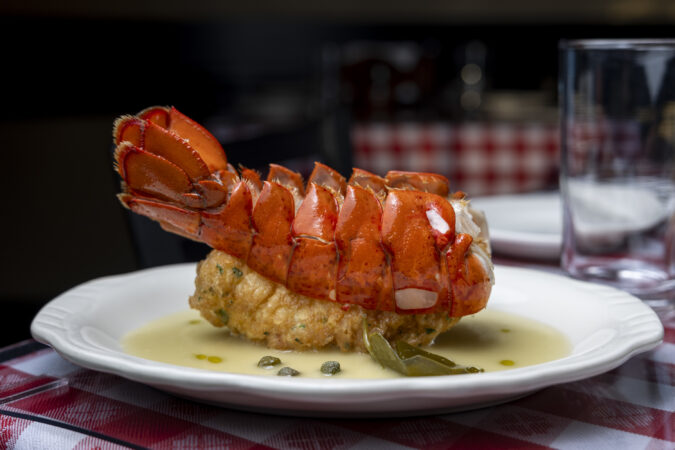
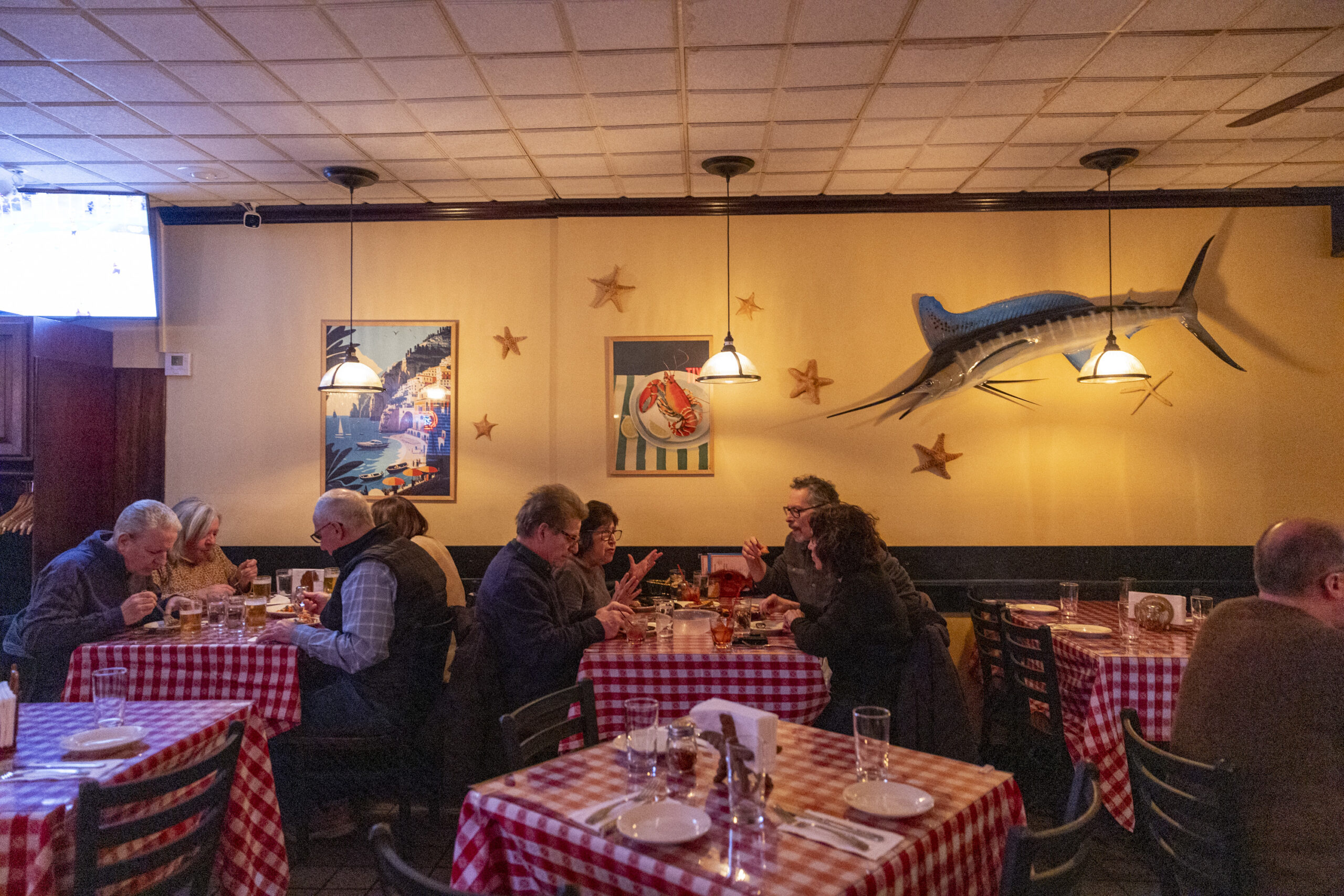
At the Bomb Bomb, where the tiny back dining room is draped with red-checked tablecloths, a plastic marlin hangs on the wall, and Louis Prima tunes fill the air (along with Nina Simone, the Ramones, and vintage Herb Alpert brass), this humble son of East Passyunk is at his best in summoning his ancestors with, among other things, one of the best “mussels red” I’ve ever had. A shot of Calabrian chile paste and white wine give his fra diavolo sauce an irresistibly zesty ba-da-boom. His reinterpration of a venerable standby like lobster francese is even more proof of his golden old-soul touch: He infuses the meat with the zing of Goodfellas-style thin-shaved garlic before crisping it inside a delicate egg-wash crust, then floating it atop a lemony puddle of butter sauce laced with the briny crunch of caper leaves beneath the bright orange lid of its shell.
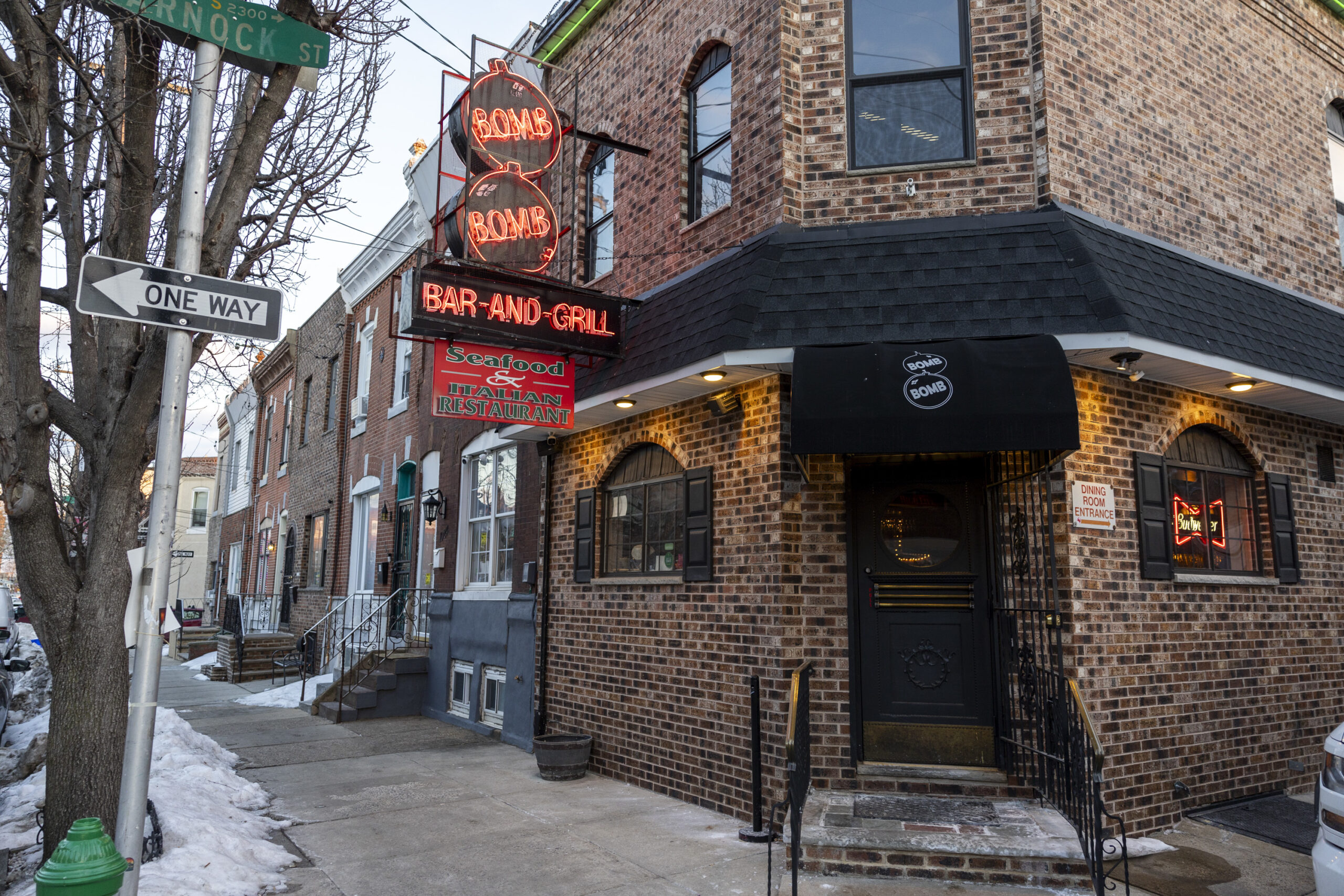
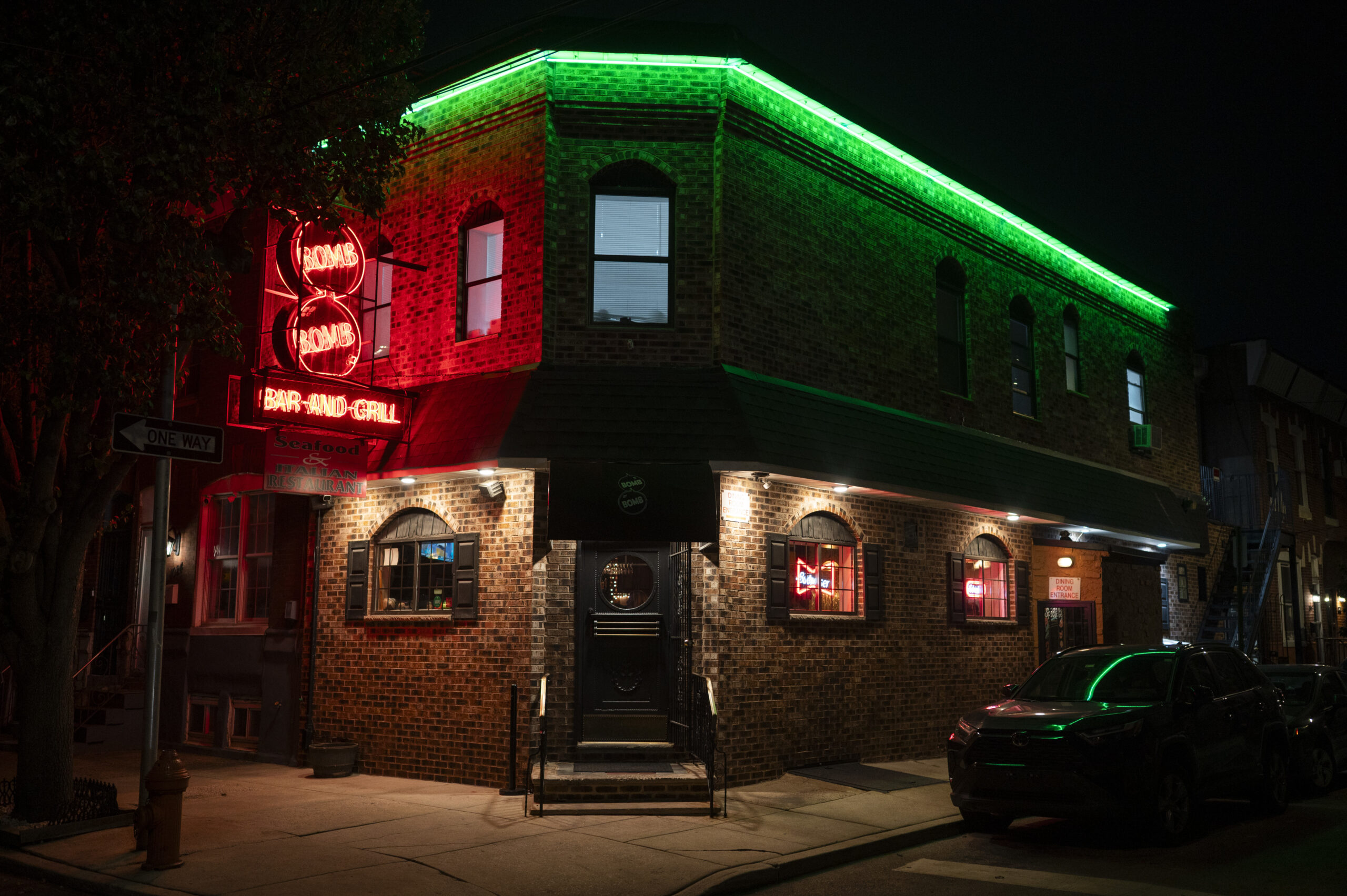
The outside of Bomb Bomb Bar in Philadelphia, Pa., on Thursday, Feb. 12, 2026. .Joey Baldino has managed to retain the character of a down-to-earth neighborhood bar while also making it his own.
“It’s time to bib up now!’” says longtime Bomb Bomb server Linda DeCero, sidling up behind us to tie on the disposable plastic bibs for our seafood feast to come, a plump and meaty steamed Dungeness crab for two scented with juniper, orange, and bay beside a votive-warmed basin of drawn butter.
As one of several options for the prix fixe menu here, it’s a different kind of crustacean indulgence than the homey spaghetti with crab gravy the Bomb Bomb was originally known for. That was when it was owned by the Barbato family, which not only gave this storied corner taproom its name (a nod to a pair of 1936 firebombings allegedly committed by a jealous competitor), but also kept it rolling with baked ribs and “That’s Amore” kitsch for 73 years until it was sold to Baldino in early 2025.
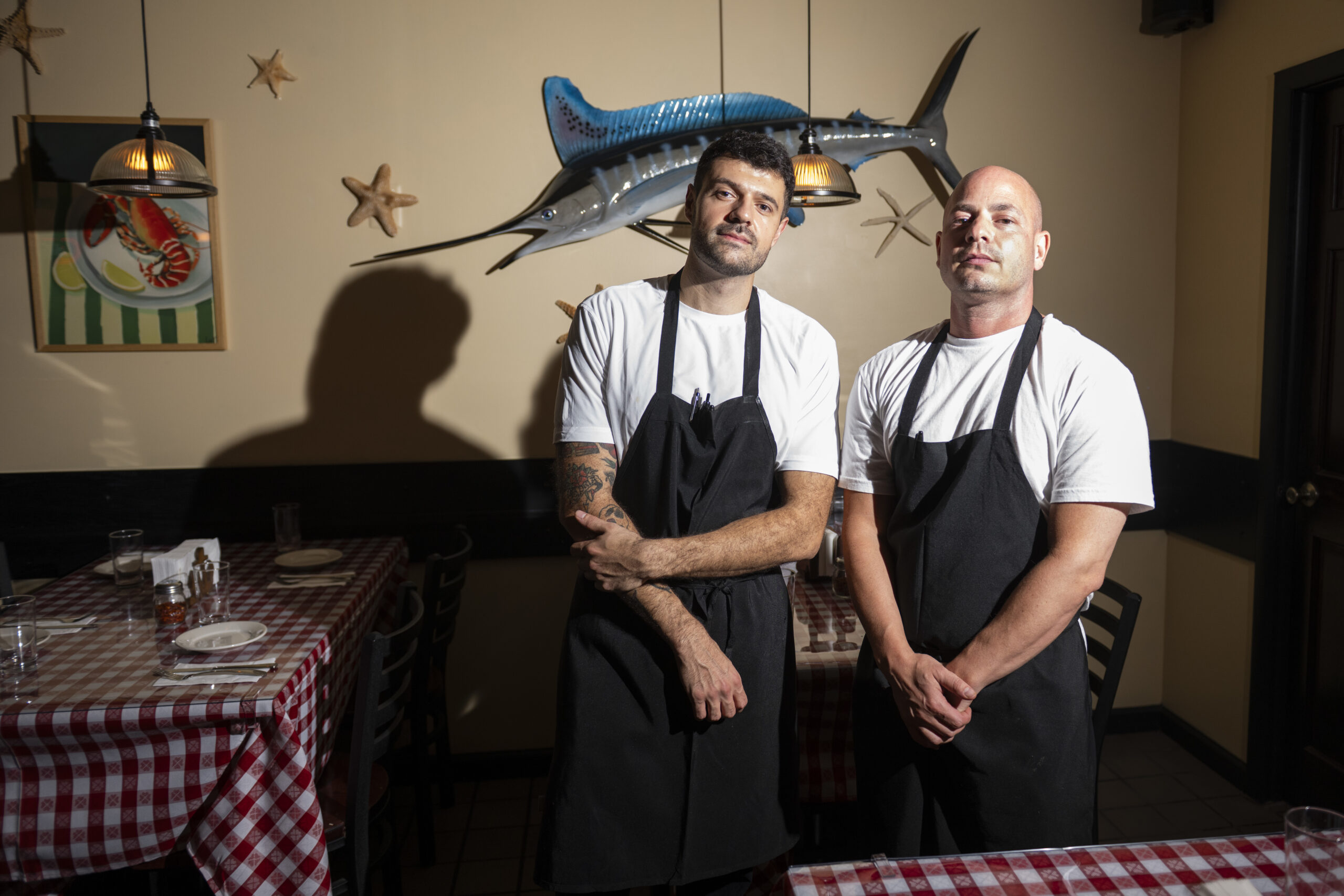
The steamed Dungeness crab for two is one of the highlights of the Italian seafood menu at Bomb Bomb Bar.Bomb Bomb Bar chefs Max Hachey (left) and Joey Baldino in the South Philadelphia landmark during a friends and family dinner on Sept. 29, 2025.
Baldino, who took nine months to open his lightly renovated version of the bar, has managed the transition with aplomb. Just ask the two cheerful sisters at the table beside us, who came from South Jersey to toast their late father’s birthday with a celebratory dinner and sundae at his longtime favorite tavern: “He’d love what they’ve done to the place!” one told me as we waited outside in the rain for our rides after the meal.
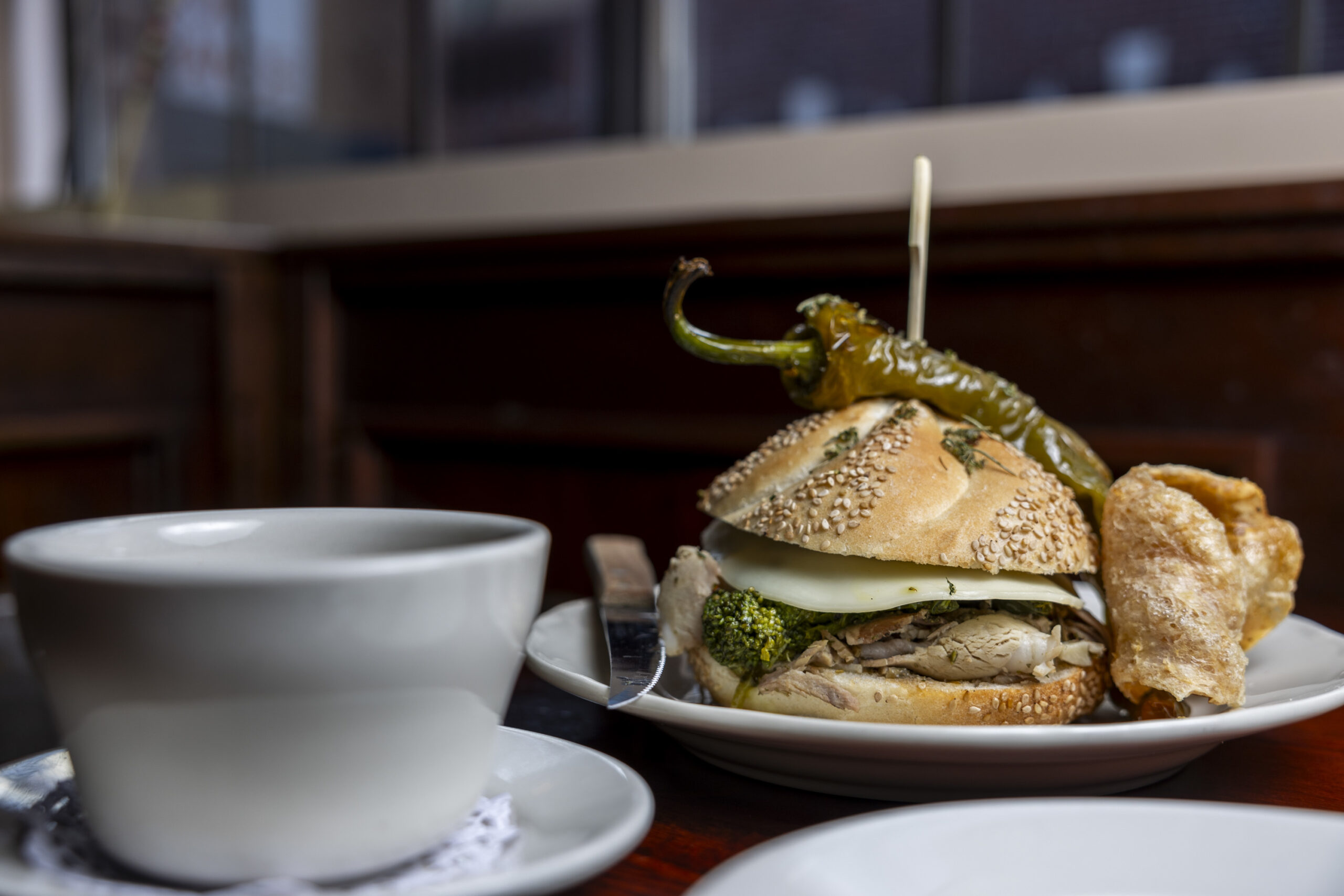
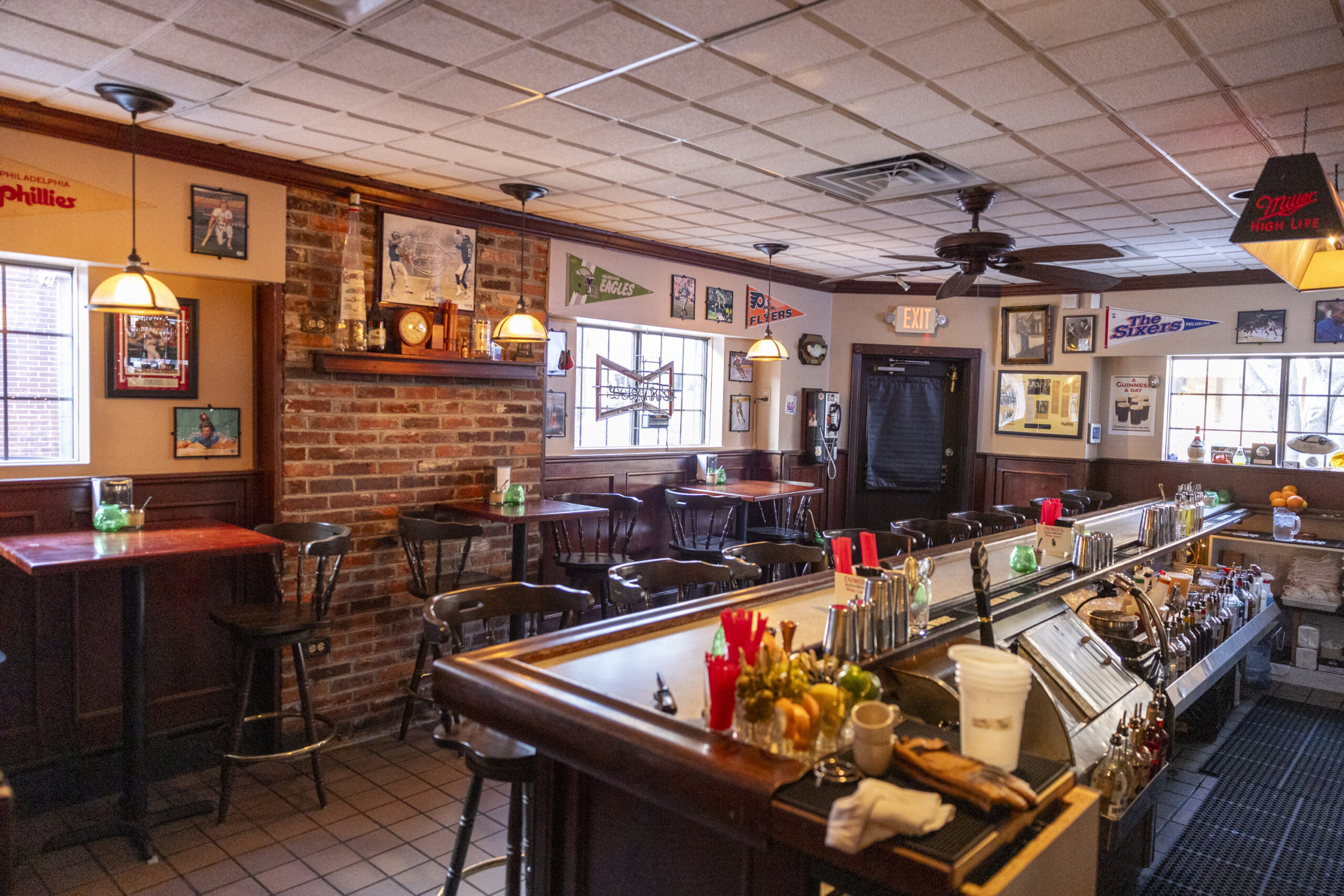
Baldino, 47, is uniquely suited for the task, having grown up eating steamed crabs out of a wooden bowl at his grandfather Al Mazza’s very similar bar at 12th and Reed — part of a generation of Italian bars like Strolli’s and South Philly Bar & Grill that have almost all now disappeared. He’s kept the Bomb Bomb’sclassic format of the neighborhood corner tappie intact, with room for 16 walk-ins in the small barroom up front, where you can nibble on sublimely juicy roast pork sandwiches and sip Vespers spiked with peperoncini brine while the Flyers skate across TVs behind the bar.
Meanwhile, the intimate 26-seat rear dining room, accessed through the onetime “Ladies Entrance,” is a boisterous reservation-only hideaway for three seatings nightly of a prix fixe seafood menu meant to evoke the Christmas Eve dinners of Baldino’s youth.
The pork sandwich with long hots at the Bomb Bomb Bar.The inside bar area of Bomb Bomb Bar in Philadelphia, Pa., on Thursday, Feb. 12, 2026. .
At $62 a person — with a choice of five sharing dishes for two people or six items for four people plus a pasta and a side — the price is fair considering the quality and quantity of the cooking. There are plenty of options for add-ons, specials, and drinks to turn dinner here into a splurge.
The antipasto for $18 is one add-on you probably shouldn’t miss for its bounty of house-pickled veggies, salumi, and cheese. And if the bagna cauda special is on offer, that’s another worthy vegetable-centric starter culled from Baldino’s daily shopping rounds through the Italian Market — grilled eggplants and zucchini, blanched cabbage rolls, and imported chicory shoots. They are perfect for dipping in a warm crock of buttery anchovy-garlic cream while your table sips through its first round of cocktail classics with Italian twists.
There’s a Bloody Mary sparked with Calabrian chilies and shredded provolone, a frozen Roman Coke spiked with amaro, a prickly pear riff on a margarita, and a crispy house pilsner made for the Bomb Bomb by Human Robot. I lean more into the affordable Italian wines when it comes to the heart of the prix fixe menu; a fizzy dry Lambrusco, the peachy almond notes of a Grechetto, and some light-hearted reds (a juicy Nebbiolo for $14) won’t overwhelm the seafood.
As for the food itself, you almost can’t lose — unless you have an aversion to an occasional excessive use of breadcrumbs on standbys like the shrimp oreganata or bacony clams casino. I preferred the cockles in brothier “clams white” form, steamed in Carlo Rossi Chablis (the official jug wine of South Philly) over a bowl of toast to finish last, having soaked in all that garlicky juice. The Bomb Bomb’s shrimp cocktail is also exceptionally flavorful from a gentle poach in a white wine court bouillon perfumed with orange and thyme.
The fried calamari at the Bomb Bomb Bar in Philadelphia, Pa., on Thursday, Feb. 12, 2026. .
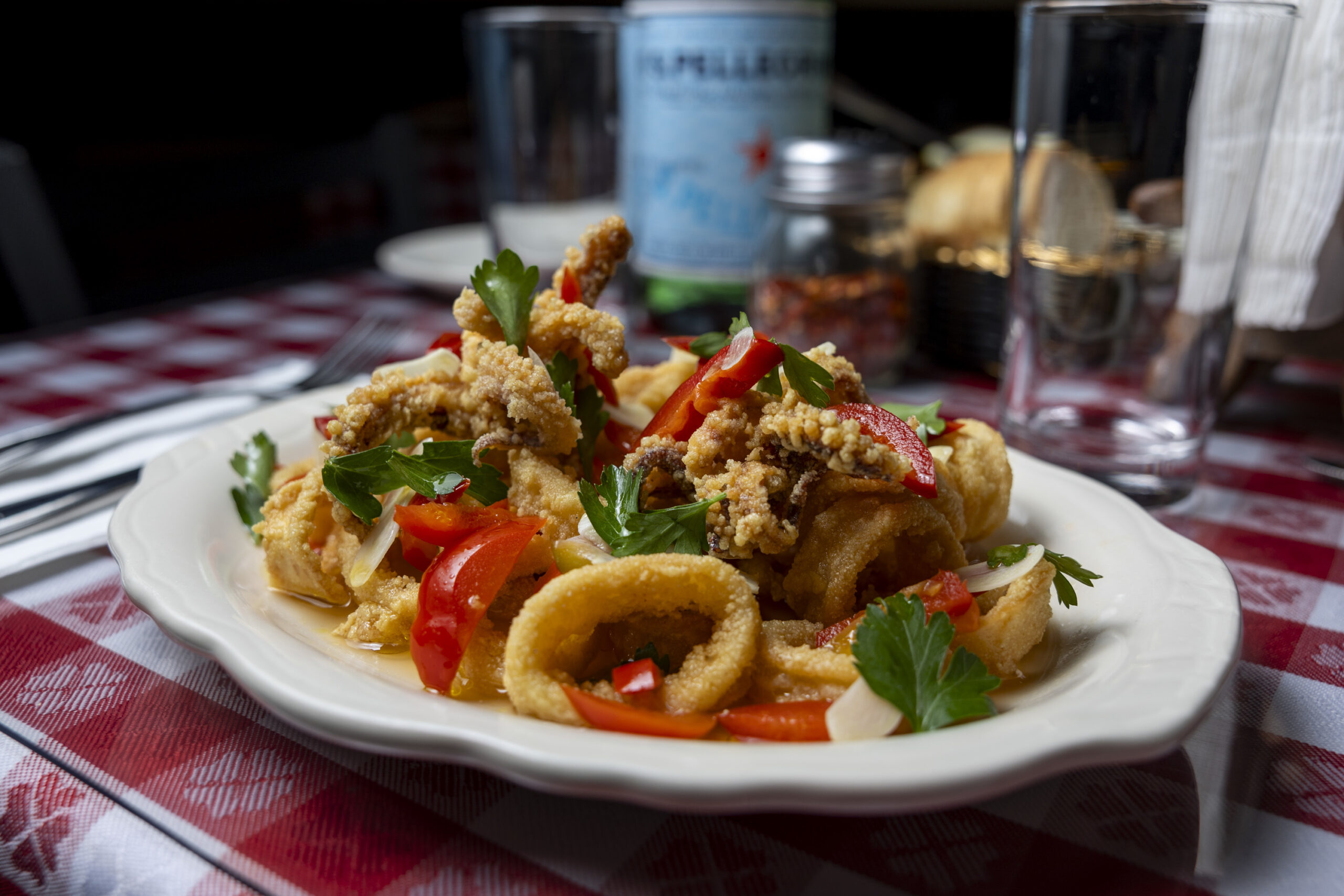
The fried calamari (also available on the limited tavern menu, like the shrimp cocktail) are the epitome of a bar classic done right, tenderized in cream before they’re crisped in seasoned semolina and tossed in a spicy confetti of red and green cherry peppers. But if you want to taste a deep cut from the Baldino family’s Seven Fishes repertoire, Mom’s stuffed calamari — the toothpick-sealed squid tubes stuffed with ground tentacles and Parmesan breadcrumbs that become incredibly tender after a two-hour simmer in tomato sauce — will absolutely take you there.
The stuffed squid is something of an homage to the Barbatos, who made a different version of the recipe. Similarly, Baldino’s baked St. Louis-cut spare ribs, exclusive to the bar menu, are a slightly cheffier, orange-scented riff on a popular mainstay during the family’s tenure. I appreciated both menu items for the continuity they offered between the two owners.
Two other luxurious seafood dishes shouldn’t be ignored. The baked crab cakes created by chef Max Hachey (last at Friday Saturday Sunday) were a celebration of sweet meat bound up with onion cream, roasted garlic aioli, and crushed crackers — easily one of my new favorites in the city. And the lobster-and-shells genre has also been taken to a clever new level here, inspired by the flavors of a stromboli: Al dente pasta cradles butter-poached lobster in a blush sauce enriched with melted mozz and zingy ground pepperoni.
Crab cakes at the Bomb Bomb, the classic Italian seafood joint revived by chef-owner Joey Baldino in deep South Philly.The carbonara at the Bomb Bomb Bar in Philadelphia, Pa., on Thursday, Feb. 12, 2026. .
As a testament to Baldino’s confident grasp of the South Philly Italian canon, he feels no need to resort to any red-gravy meatball clichés on the pasta side of the menu. His carbonara is the stuff of creamy noodle dreams, its egg-and-bacon glaze still frothy even though it’s blended with three kinds of cheese, including an alpine twinge of toma. The black ink spaghetti is a dark-horse noodle champ — quite literally, because its simple, garlicky shine of aglio-e-olio sauce is turned jet black with sepia ink. And Baldino’s Italian tuna pasta might be the most overlooked gem of them all, a comforting yet elegant deconstruction of tuna noodle casserole.
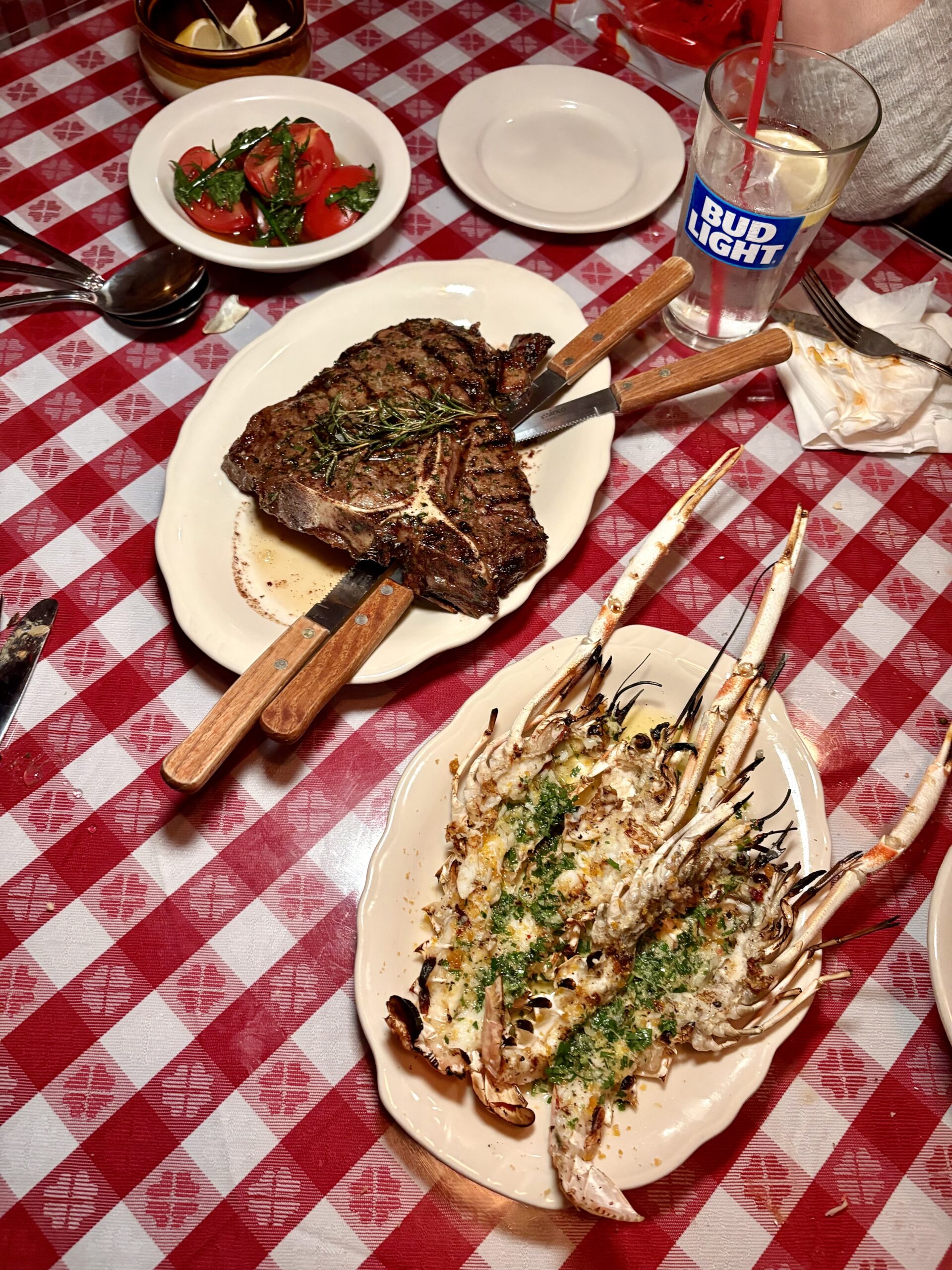
There are always other off-menu treats lingering in back to keep the dinner intriguing, like grilled langostini glistening with bottarga butter in a fragrant nod to the Sicilian flavors of Zeppoli. The frequent special of garlicky T-bone steak basted with olive oil-soaked rosemary branches is so good, I wonder if there’s a retro Italian chophouse lingering in Baldino’s future, too.
Keeping the Bomb Bomb’s distinctive red-neon sign glowing bright over the corner of Warnock and Wolf Streets, now beckoning to an enthusiastic new generation, is more than enough of an achievement. So order yourself a vanilla ice cream sundae drizzled with house chocolate sauce, brown-butter caramel, and a fried banana — a sweet tribute to a long gone shake shop that Baldino also loved — and lift a toast to the ancestors. Italian South Philly’s culinary preservationist-in-chief has scored once again.
A porterhouse steak and grilled langostini with bottarga butter are two notable recent specials at the Bomb Bomb Bar & Grill.
Dinner seatings in rear dining room by reservation only Thursday through Monday, at 5, 7, and 9 p.m. Bar is open to walk-ins only Thursday through Monday, 5 p.m.-1 a.m. Lunch served Saturday and Sunday, noon-3 p.m.
Not wheelchair accessible. There are two steps at the front entrance and bathrooms are not accessible.
Gluten-free pasta is available and much of the menu can be modified to be gluten-free, including the antipasto, lobster francese, streamed seafood, and ribs.
Menu highlights: clams casino; crab cake, lobster francese; shrimp oreganata; mussels fra diavolo; fried calamari; lobster and shells; Dungeness crab; spaghetti alla carbonara; herbed tomatoes; porterhouse special. Bar menu: porchetta sandwich; shrimp agrodolce; vanilla sundae.
Drinks: The full bar showcases simple but booze-forward cocktails with a zesty Italian twist, like the Vesper spiked with peperoncini brine and a Bloody Mary sparked with Calabrian chilies, frozen drinks such as the bubbly limoncello Scroppino.
The exterior of Bomb Bomb Bar in South Philadelphia on Monday, Sept. 29, 2025.
WASHINGTON — The Supreme Court’s stunning rebuke of President Donald Trump’s most sweeping tariffs means he can’t conjure up new import taxes on a whim anymore.
But the justices’ ruling on Friday is nonetheless unlikely to ease the uncertainty over Trump’s trade policy that has paralyzed businesses over the past year. “It’s only gotten more complicated for everybody,” said trade lawyer Ryan Majerus, partner at King & Spalding and a former U.S. trade official.
Vexing questions remain: How will the president use other laws to reconstruct the tariffs the Supreme Court knocked down, and will those attempts withstand legal challenges? What does the decision mean for the trade deals Trump strong-armed other countries into accepting, using his now-defunct tariffs as leverage? Can importers collect refunds for the tariffs they paid last year, and if so, how?
Then there’s Trump’s own unpredictability. Even though he had weeks to prepare for an unfavorable Supreme Court ruling, his response was still chaotic: On Friday, he said he’d use other legal authority to impose 10% levies on imports from other countries. Saturday, he ratcheted it up to 15%.
Normally, lower tariffs arising from the Supreme Court’s decision might be expected to give the economy a little lift. But “any benefit you would get from that is more than offset to a modest negative from the uncertainty front,” said Mike Skordeles, head of U.S. economics at Truist, a bank.
Gone for good are the sweeping tariffs Trump justified under the 1977 International Emergency Economic Powers Act (IEEPA), mainly to combat America’s persistent trade deficits. But that doesn’t mean the president can’t invoke other laws to rebuild much of his tariff wall around the U.S. economy.
“Tariff revenues will be unchanged this year and will be unchanged in the future,” Treasury Secretary Scott Bessent said in a Fox News interview Sunday.
Trump reached for a stop-gap option immediately after his defeat Friday at the Supreme Court: Section 122 of the Trade Act of 1974 allows the president to impose tariffs of up to 15% for up to 150 days. But any extension beyond 150 days must be approved by a Congress likely to balk at passing a tax increase as November’s midterm elections loom.
Section 122 has never been invoked before, and some critics say the president can’t use it as a stand-in for the IEEPA tariffs to combat the trade deficit.
Bryan Riley of National Taxpayers Union, for example, argues that Section 122 is meant to give the president a tool to fight what it calls “fundamental international payments problems,’’ not the trade deficit.
The provision arose from the financial crises that emerged in the 1960s and 1970s when the U.S. dollar was tied to gold. Other countries were dumping dollars in exchange for gold at a set rate, putting alarming downward pressure on the dollar. But the U.S. currency is no longer linked to gold, so Section 122 has been “effectively rendered obsolete,’’ Riley wrote in a commentary.
“Given the amount of money at issue for U.S. businesses, it is not hard to imagine a new wave of litigation attacking Section 122, and again seeking refunds of Section 122 duties collected,” said trade lawyer Dave Townsend, a partner at Dorsey & Whitney.
A sturdier alternative is Section 301 of the same 1974 trade act, which gives the United States a handy cudgel with which to smack countries it accuses of engaging in “unjustifiable,” “unreasonable” or “discriminatory” trade practices. In a statement Friday, in fact, U.S. Trade Representative Jamieson Greer said the administration was launching a series of 301 investigations after the loss at the Supreme Court.
Trump invoked Section 301 in his first term to impose sweeping tariffs on Chinese imports in a dispute over the sharp-elbowed tactics that Beijing was using to challenge America’s technological dominance. Those tariffs were upheld in court and kept by the Biden administration.
“We’re eight years in, and those China tariffs are still here,” King & Spalding’s Majerus said. “They’re sticky tariffs.’’
Confusion surrounds Trump’s trade deals
The Supreme Court’s decision also raises questions about the lopsided trade agreements Trump negotiated last year, using the threat of potentially unlimited IEEPA tariffs to squeeze concessions out of U.S. trading partners from the European Union to Japan.
Will countries try to back out of their commitments, now that the IEEPA tariff threat is gone?
The European Union’s trade deal with Trump is already on hold amid confusion following the Supreme Court’s ruling — and Trump’s decision to respond to it with the 15% Section 122 global tariff.
European lawmakers on Monday delayed a vote on ratifying the pact to seek clarification. They are worried that Trump’s new import tax will stack on top of the “most favored nation’’ tariffs the United States charges under pre-existing World Trade Organization rules — and lift U.S. tariffs on EU imports above the 15% the Europeans had agreed to last year.
“A deal is a deal,” said commission spokesman Olof Gill. “So now we are simply saying to the US, it is up to you to clearly show to us what path you are taking to honor the agreement.”
Then there’s the United Kingdom, which had reached a deal with Trump last year for 10% tariffs on its exports to the United States. Will they really go to 15%?
Still, trade analysts largely expect U.S. trade partners to stick by the deals they reached with Trump last year. For one thing, the United States could wallop them with hefty Section 301 tariffs, which are potentially unlimited, for violating trade agreements.
“They’re going to pretty leery of rocking the boat on their deals,” Majerus said. “Violations of trade agreements can be a basis for taking 301 action. So you could see Section 301 become an enforcement mechanism’’ for the United States.
“We are confident that all trade agreements negotiated by President Trump will remain in effect,’’ U.S. Trade Representative Greer said in his statement.
A messy refund process
In its ruling, the Supreme Court didn’t bother to say what would happen to all the money collected from the IEEPA tariffs, $133 billion as of mid-December. It left the messy issue of refunds to importers — but likely not to consumers — to lower courts and the Customs and Border Protection agency, which collects import taxes. But they’re likely to be overwhelmed — hundreds of companies are already lined up to get their money back — and the refunds could take months or years to be paid.
“The whole thing’s going to be a mess,’’ Majerus said.
It’s possible that Congress will order Customs to take an “easy ‘one-click’ approach to refunds,’’ wrote strategists Thierry Wizman and Gareth Berry at the investment bank Macquarie. Otherwise, they warned, the Trump administration could “make the refund process as burdensome as possible, requiring every importer to file stacks of paperwork, if not file a lawsuit, to get its money back. That would be costly for businesses.”
The Milan Cortina Olympics averaged 23.5 million viewers in the United States, making them the most-watched Winter Games since 2014 with a 96% larger audience than the Beijing Games four years ago.
NBCUniversal said the average includes combined audiences on NBC, Peacock, CNBC, USA Network and other digital platforms. It covered the live afternoon (2-5 p.m. EST) and prime-time (8-11 p.m. EST/PST) windows.
The figures are based on Nielsen’s Big Data + Panel ratings (through Feb. 19), Nielsen’s early figures for the final three days (Feb. 20-22) and digital data from Adobe Analytics.
Viewership numbers for the United States’ 2-1 overtime victory over Canada in men’s hockey on Sunday morning were not expected until Tuesday. The Canadian Broadcasting Corporation said on Monday that 8.7 million were watching in Canada when Jack Hughes scored the golden goal in overtime. The celebration that followed included American players carrying the jersey (and eventually the children) of late South Jersey hockey star Johnny Gaudreau, who was killed along with his brother by an alleged drunk driver while biking near their family home in Salem County.
“I feel in so many ways that these Winter Olympics exceeded our expectations. We were reminded that the Olympics are the most exciting, unpredictable and biggest stage in sports,” said Molly Solomon, the executive producer of NBC’s Olympics coverage. “And what I think came together in Italy was that the settings were stunningly beautiful, the access we had to the athletes and their lives was unprecedented. And then you take the technology, the first-person view drones, the audio, and it took the audience inside the stories in fresh, meaningful ways.
“And Team USA, I mean, the results, you’ve seen the numbers for the medals and things. America wants to see how their team’s performing, and it’s the best performance in an overseas Olympics. Everything lived up to the billing, and some of the superstars had riveting, dramatic performances. Not all of them gold, but that’s the Olympics, right?”
Dylan Larkin (21) holds Johnny, the son of the Johnny Gaudreau while posing with teammates after Team USA beat Canada in overtime to claim its first men’s hockey gold medal since 1980.
NBC broadcast the Super Bowl, the Olympics, and the NBA All-Star Game in February, the first time a network had all three in one month. It also premiered “Sunday Night Basketball” on Feb. 1.
According to Nielsen, 215.6 million U.S. viewers tuned in for at least one of those events. Audience reach numbers have been higher under Nielsen’s new rating system since the minimum viewing requirement was reduced from 5 to 3 minutes.
Super Bowl 60 averaged 125.6 million viewers across NBC, Peacock, and Telemundo, the second-most-watched program in U.S. history. The All-Star Game had its highest audience in 15 years, averaging 8.8 million, and the Lakers-Knicks game on Feb. 1 averaged 4.5 million.
“I have to say it’s probably better than we expected. This doesn’t happen through luck or happenstance. This happens through just really good planning and then execution across the month. So really happy overall and I don’t think it could have gone better, honestly,” NBC Sports President Rick Cordella said.
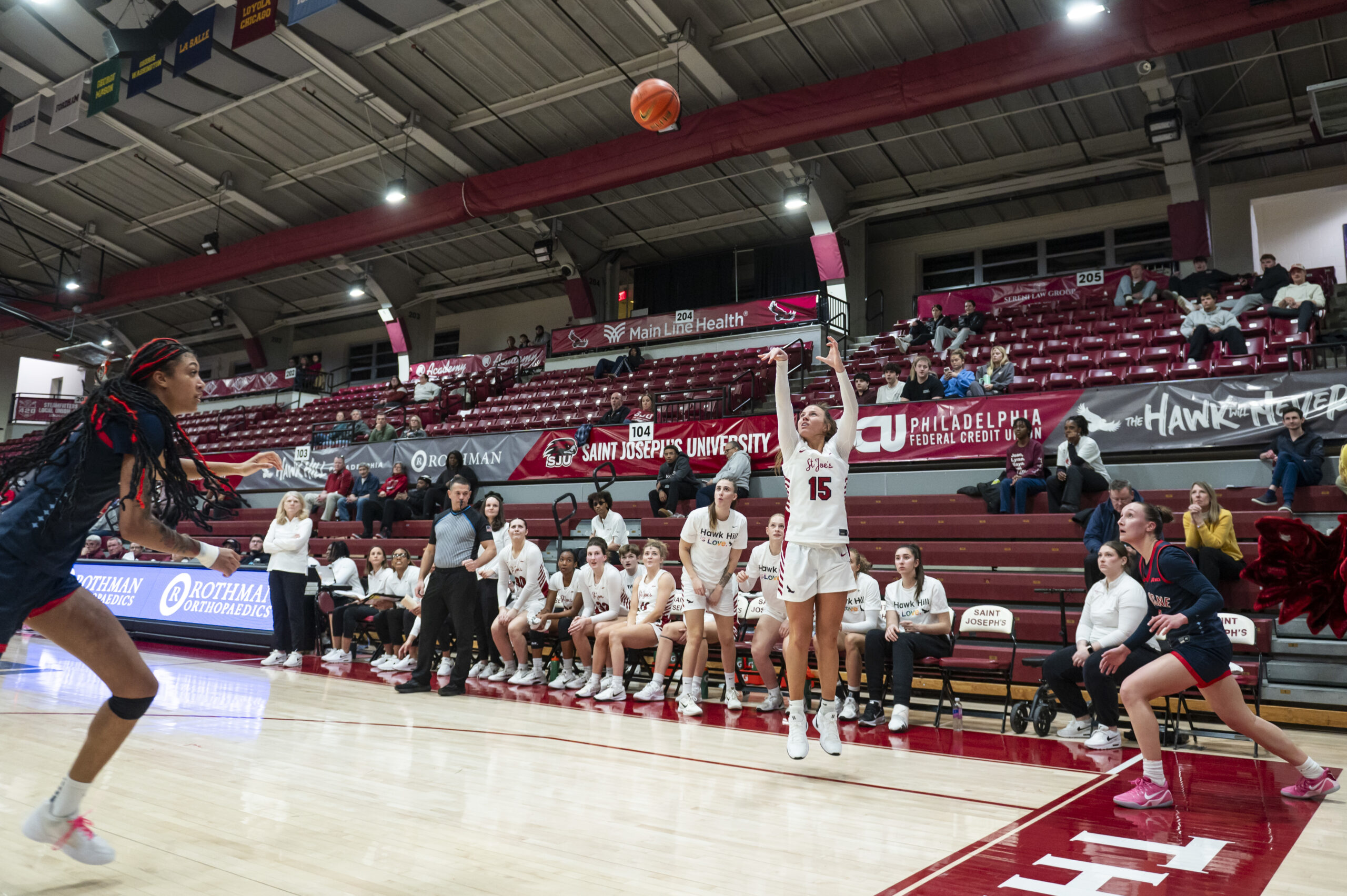
When St. Joseph’s coach Cindy Griffin recruited Gabby Casey out of Lansdale Catholic High, she compared Casey to Susan (Moran) Lavin, who scored 2,340 points, the most by any men’s or women’s basketball player for the Hawks, from 1998 to 2002.
Casey set the scoring record for the boys’ and girls’ teams at Lansdale Catholic, and her natural scoring knack intrigued Griffin. The Hawks’ culture drew the 5-foot-9 guard, who joined St. Joe’s during the 2023-24 season.
Her role gradually increased each year, and now as a junior, Casey has St. Joe’s fighting for a top-four seed and double bye in the Atlantic 10 tournament. She leads the Hawks in points, rebounds, and steals and prides herself on being a well-rounded player and leader for her teammates.
“I felt that over the summer I had to put in a lot of extra work and come in more confident than I ever had before because I knew I was going to have a much bigger role,” Casey said. “I knew I was going to score in order for us to win, and that has really been the fun part for me. Scoring and then getting to lead the girls is so easy.”
Casey played sparingly off the bench as a freshman, averaging 13.2 minutes. Last season, she was elevated into the starting lineup but was a secondary scorer, averaging 7.7 points. The Quakertown native has been an example for her teammates.
“That used to be the natural progression,” Griffin said. “Kids stay, and they reap the benefits of their work, and when it’s their time, it’s going to be their time. I think Gabby is a great example of that, just staying the course and being where her feet are. She loves being around our team and our culture, and being able to step into that leadership role is really nice to see.”
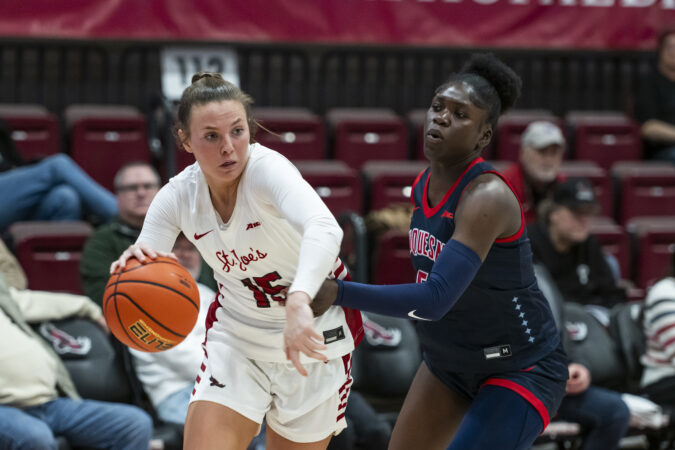
Gabby Casey (center), shown last Wednesday against Duquesne, has made 62 three-pointers this season.
Casey has embraced leading a St. Joe’s team that lost a lot of experience from last season’s team, which won 24 games. In Griffin’s eyes, Casey has carried on the lessons that she learned from past team leaders.
She has filled the leadership role seamlessly, guiding the Hawks to a 19-9 record with one regular-season game, at home against third-place Richmond (2 p.m., ESPN+) remaining.
“[I try to] bring consistency in just showing up every day with the same mindset and same goals,” Casey said. “Then also creating an environment where everyone feels welcomed and feels like this is a place they want to be every day.”
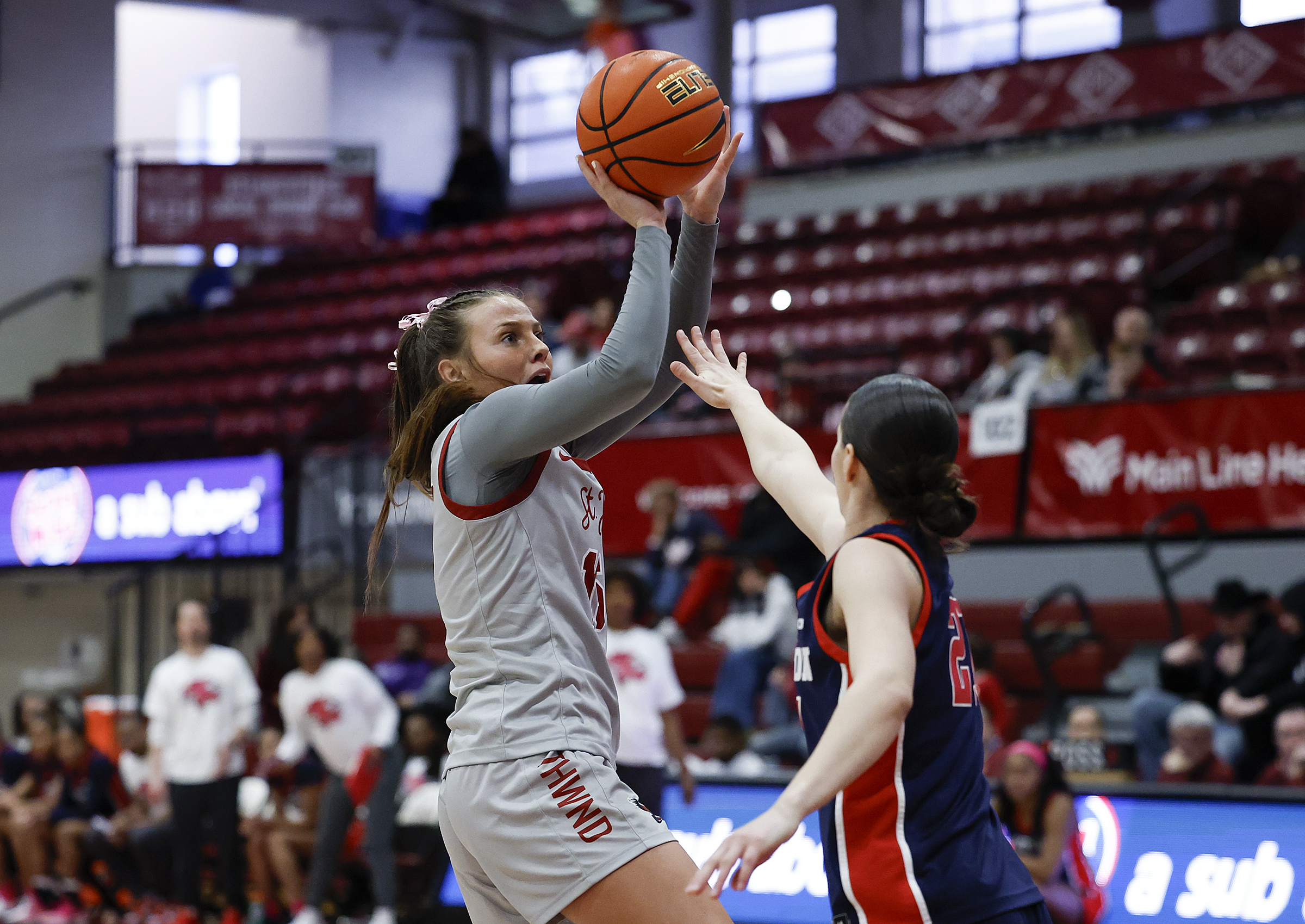
Casey always possessed the ability to score, which was evident from her high school days, and has put it on full display this season. She is averaging 16.0 points, good for third in the A-10, while shooting 48% from the field.
Her favorite way to score is a turnaround jumper, but she also can get to her spots in the midrange for pull-up jumpers. Casey also is a threat from three and leads the team with 62 triples.
However, her on-court impact goes beyond scoring. She is St. Joe’s top rebounder with 6.4 per game, tied for second in assists (3.1), and is first in steals (1.6). When Casey is struggling to score, she still finds ways to help her team compete.
“She’s multidimensional. It’s not just about scoring, it’s how she impacts the game,” Griffin said. “I go back to her freshman year, when we beat Villanova on our home court, and the trajectory of the game changed when Gabby came in and got a couple of steals. It changed the game, and that’s her impact. She’s gritty, tough, and competitive.”
St. Joe’s guard Gabby Casey (left) is averaging 16.3 points this season.
Now, Casey aims to lead St. Joe’s to success in the conference tournament.
“These practices are going to be key to dialing in on the little things that we have to fix throughout the rest of the year,” Casey said. “We have to really focus on the little details that will give us the edge because A-10 play is going to be hard.”
A 36-story apartment tower planned for 1341 S. Christopher Columbus Blvd. in South Philadelphia has secured a $150 million senior construction loan, New York-based developer Brevet Capital announcedTuesday.
The financing from Mexico City-based Banco Inbursa is an important step for the 620-unit tower project, which is expected to break ground in the first quarter of 2027.
Construction on the project Brevet Capital calls “Wharton Piers” is anticipated to last two years, finishing in the first quarter of 2029.
At a meeting of the Pennsport Civic Association in October, Brevet Capital representatives said that the company hoped to develop two further residential towers on the site, which sits between the Delaware River and the neighborhood. Future high-rises may be taller than the 380-foot tower financed byBanco Inbursa.
“Wharton Piers represents the first phase of a larger master plan that has the potential to support significant additional development over time,” said Mei-Li da Silva Vint, head of Brevet’s real assets group, in a statement.
Brevet declined to comment on what proportion of the project’s total cost would be covered by the loan.
This development site has a long history of ambitiousbut ultimately unrealized proposals, which makes the construction loana noteworthy sign of Brevet’s intent.
In 2023, New York-based Silverstein planned a two-tower project. Before theCOVID-19 pandemic, Maryland-based developer Jeffery Kozero’s K4 Associates presented a 2,000-unit project spanning 10towers. The K4 plan, in particular, was met with skepticism by neighborhood groups and urban planners.
“We’re happy to see a meaningful development of this property in a way that seems to respect the collective vision for the waterfront,” Patrick Fitzmaurice, president of the Pennsport Civic Association, said of the Brevet Capital project.
In exchange for building taller and denser than the land’s zoning allows, Brevet will pay into the city’s housing trust fund — which supports affordable development — and will repair and maintain the Delaware River Trail down to Reed Street.
Conditions along the bike and pedestrian trail have deteriorated below Washington Avenue, with cracked pavement and unkempt weeds. People have also been camping along the path, and moving between the patchwork of properties owned by different entities to avoid sweeps by the city.
“Our focus is on executing this initial phase to a high standard while creating a vibrant, publicly accessible waterfront,” da Silva Vint’s statement reads.
Most of the current tower proposal’s apartments will be on the smaller side, with half of them one-bedroom units and a further 35% being studios.
For parking, 187 spaces will be locatedon the third through fifth floors, with space for a further 100 vehicles on a neighboring surface lot.
A rendering that includes the other two towers Brevet has also proposed for the site.
When the project was presented to the Pennsport Civic Association in October, neighbors called for more parking. But the developer’s representatives noted that many new apartment towers don’t have full garages.
The project will also include 15,000 square feet of amenity space on the fifth floor, including a pool, and a mix of commercial and office space on the ground floor.
A neighboring one-story building will be built with the project, featuring an additional 20,650 square feet of retail space. Brevet representatives told the civic association that the smaller building would serve as a “place holder” for a future tower.
“Closing this financing is an important milestone for the development of Wharton Piers and reflects continued momentum behind a project that we believe will be transformational for Philadelphia’s waterfront,” said Douglas Monticciolo, CEO and founder of Brevet Capital, in a statement.
Brevet Capital has built real estate projects in major markets of Florida, Texas, and California. Wharton Piers would be its firstdevelopment in Philadelphia.
For years, Cathleen “Cat” Brown, a Philadelphia obstetrician and gynecologist, would listen to patients complaining of hot flashes, brain fog, and painful sex and prescribe estrogen as a safe option for easingtheir menopausal symptoms.
But when the women read the drug label and pharmacy package insert, they’d recoil at a “black box” warning, Brown said. The bold, black-bordered alert warned women that estrogen may put them at higher risk of breast cancer, cardiovascular disease, stroke, and dementia.
“It was making liars out of doctors,” Brown said.“It frankly scared the crap out of patients, and it really caused distrust between the patients and the providers.”
Newer scientific research shows that the benefits of hormone replacement therapy, or HRT, far outweigh the risks for most women, experts say, particularly those who are younger than 60 or within 10 years of menopause.
More recent evidence also suggests that estrogen can reduce the risk of breast cancer, cardiovascular disease, Alzheimer’s, bone fractures, and cognitive decline, extending women’s lives by about 10 years.
In November, FDA Commissioner Martin Makary announced that the agency was taking steps to remove the black box warning on hormone treatments for women.
“We are going to stop the fear machine steering women away from this life-changing, even life-saving treatment,” Makary said at a news conference.
Brown, an ob-gyn at Jefferson Abington Hospital, said the FDA’s reversal will lead tomore medical schools teaching doctors how to treat menopause and provide women with more access to hormone therapies.
“It’s causing kind of a tidal wave in the medical community,” Brown said. “It was a relief to see the FDA catching up with the science.”
The Inquirer spoke with Brown, who also serves as the medical director for a national menopause telehealth provider calledWinona, about the FDA’s shift on HRT and what that means for aging women. This conversation has been edited for length and clarity.
What prompted the FDA warning on estrogen treatments?
The black box warning was one of the aftereffects of the whole Women’s Health Initiative study released in 2002. They basically published the results before they really had a chance to have it peer-reviewed and really analyze the data, and it went all over the news, and suddenly there was this widespread panic. Doctors across America got scared. Patients got scared, and everyone was taken off their HRT.
Why was the 2002 study misleading?
In that study, they were giving HRT to much older women, like in their late 60s, who weren’t great candidates to start it. They were also using different forms of HRT than we’re using now, so a lot of more synthetic hormones. The most popular one back then was Premarin, which came from a pregnant mare’s urine, so horse estrogens.
We were also giving these women higher doses of hormones, and it was causing more medical problems.
What has changed since?
Now we really lean toward giving you bioidentical hormones, like the same compounds that your ovaries were making on their own. It’s much safer. Our body processes it better, and we’re able to use lower doses to have the same effectiveness than those old synthetic hormones that they had to do at higher doses before. We also learned from that study that there’s a magic window — the safest time to initiate hormone replacement therapy is within 10 years of a woman going through menopause.
What led to the FDA’s reversal?
So the FDA held an expert panel last July. They invited all these experts on hormone therapy to speak and basically give their justification for why that black box warning needs to be removed. It’s really been a disservice to women, because all the women who were taken off HRT ended up with bad osteoporosis, weak bones, and more medical problems from the loss of estrogen from their bodies.
They also talked about the fact that we should not have this black box warning on estrogen products, especially estrogen vaginal cream, which is so safe that it really could be over the counter. For women in nursing homes, a little bit of vaginal estrogen could have prevented recurrent urinary tract infections. So many women die of urinary sepsis and bacteremia that has come from a UTI. Topical vaginal products also significantly improve sex life for women.
What is HRT?
We’re actually starting to call it hormone therapy, because we’re not trying to replace your levels back to what you were making on your own in your 20s or 30s. It’s about giving you enough dosage of hormone to give you the health benefits and mitigate bothersome symptoms and help women with that menopausal transition.
When we are aging, within our 40s and into our 50s, we lose estrogen at a dramatic rate. We also have testosterone in our bodies as women and that drops, too. That fluctuation of hormones causes this whole litany of symptoms, like hot flashes, night sweats, brain fog, joint pain, dry skin, brittle hair, hair loss, so many things.
Estrogen is a powerhouse hormone that keeps all the tissues in our body healthy.
Why is this a win for women’s health?
More women are demanding better and not wanting to go gently into old age and suffer anymore. This is also pushing more medical education institutions to start infusing menopause into the curriculum.Women’s health has never been in the forefront.
It’s always been something we do secretly and quietly, which I think is kind of a parallel to the gender disparities in the world, like once we’re done childbearing and we’re no longer in our fertile peak, it’s like we’re less important to the world, and nobody wants to focus on it. This is causing a trend where more women are going to get educated and more doctors are going to start learning.
Nick Sirianni praises new Cowboys defensive coordinator Christian Parker
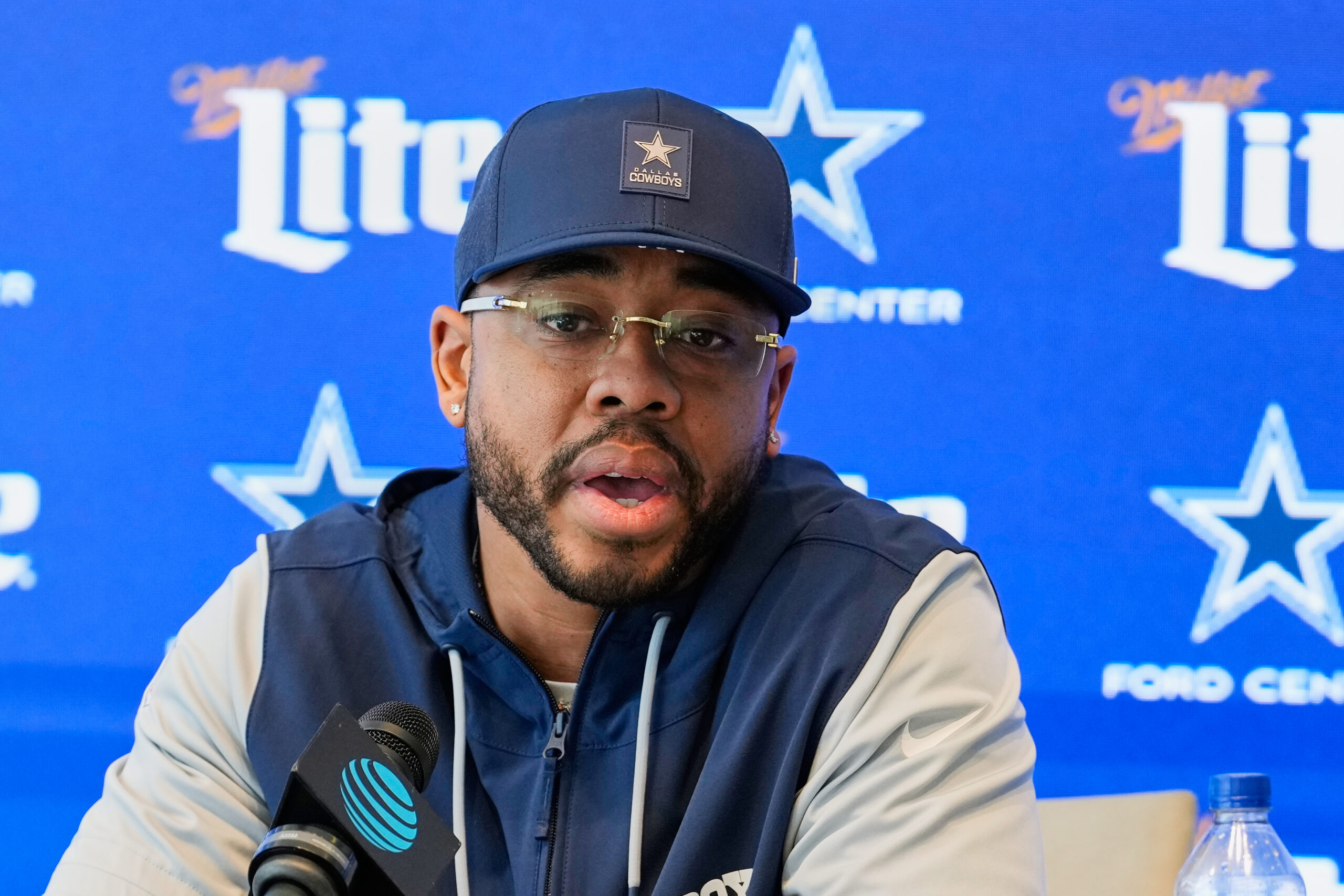
Christian Parker during a news conference last week with the Cowboys.
Former Eagles defensive assistant coach Christian Parker reportedly beat out eight other contenders to land the Dallas Cowboys’ vacant defensive coordinator position.
“Every impression we had with CP just left us wanting more,” Cowboys head coach Brian Schottenheimer told reporters at a news conference last week. “The conviction that he has, but curious, his calm demeanor, just the way he carries himself, is awesome … It became very clear he was the guy for the job.”
Speaking to reporters at the NFL scouting combine Tuesday, Eagles head coach Nick Sirianni called Parker “a phenomenal football coach,” crediting him with “a lot” of the team’s player development success.
“I think the world of him and wish him the best,” Sirianni said, “with the exception of two games each year.”
Howie Roseman: Brandon Graham ‘always welcome in Philadelphia’
Brandon Graham un-retired to play for the Eagles last season.
Eagles GM Howie Roseman praised veteran defender Brandon Graham, who unretired to rejoin the Birds for a 16th season.
But Roseman didn’t say whether Graham, 37, would be back with the squad this season.
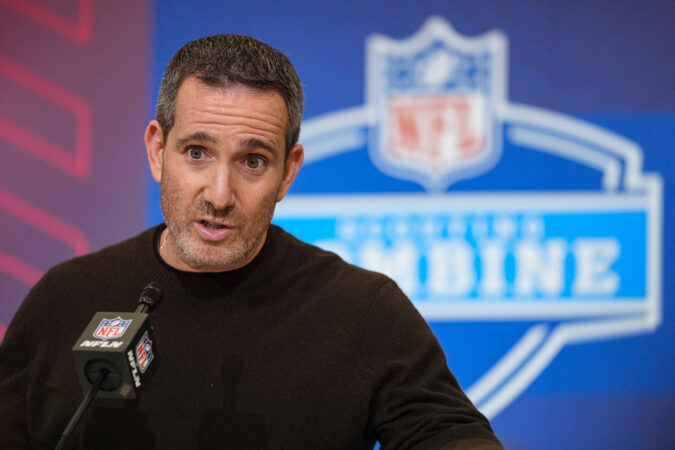
“Brandon Graham is always welcome in Philadelphia, obviously,” Roseman told reporters at the NFL Scouting Combine Tuesday. “When I think about what he’s done for us as a player, as a person, and then last year when he came back, the versatility he showed … future Eagles Hall of Famer.”
Eagles head coach Nick Sirianni shared Roseman’s sentiment when asked about Graham at the combine Tuesday.
“I’m not going to say it’s a ridiculous question, but of course, you want guys back like that,” Sirianni said.
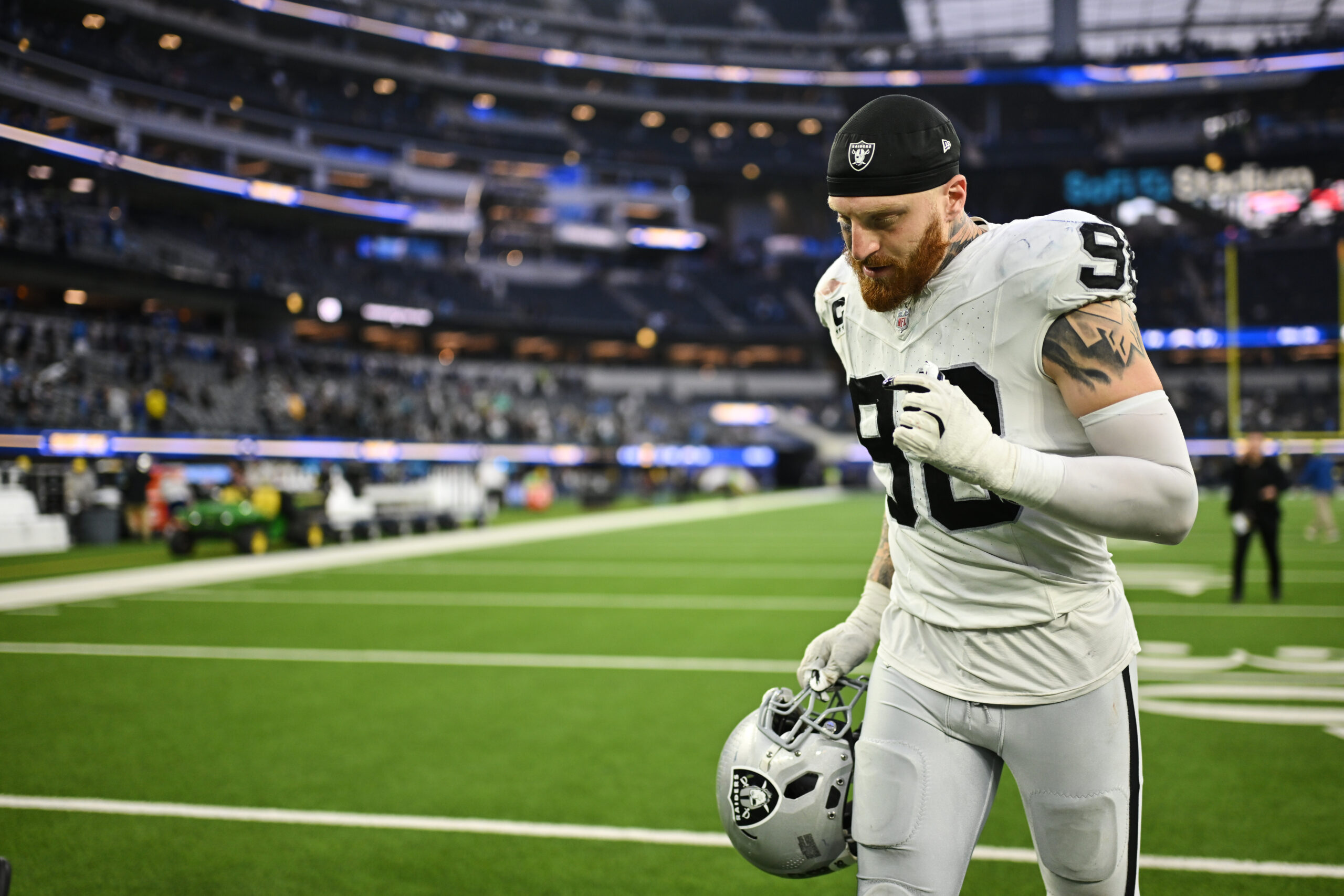
Maxx Crosby said he loved playing in the hostile environment of Lincoln Financial Field.
The Las Vegas Raiders are planning to keep star edge rusher Maxx Crosby despite the trade talk around the five-time Pro Bowl pick, general manager John Spytek said Tuesday.
“Maxx is an elite player. I’ve been very upfront from the start since I got here, that we’re in the business of having really good players on the team, and we need a lot more of them,” Spytek said at the NFL scouting combine in Indianapolis.
Crosby has been rehabilitating from left knee surgery he underwent three days after the regular season ended, as speculation about his status has persisted following an NFL-worst 3-14 record for the Raiders and the firing of coach Pete Carroll after just one year on the job.
Crosby said earlier this month he doesn’t want out and that the unsubstantiated reports suggesting he does make him laugh. His future with the club that drafted him in the fourth round out of Eastern Michigan in 2019 became a subject when he was placed on injured reserve with two games left against his wish, preferring to play out the season. Crosby, who has 69½ sacks in seven years, had a career-high 28 tackles for loss in 2025.
— Associated Press
// Pinned
// Timestamp 02/24/26 2:33pm
Watch: Nick Sirianni, Howie Roseman speak at the NFL scouting combine
// Timestamp 02/24/26 2:03pm
New UFL rules include a four-point field goal and Tush Push ban
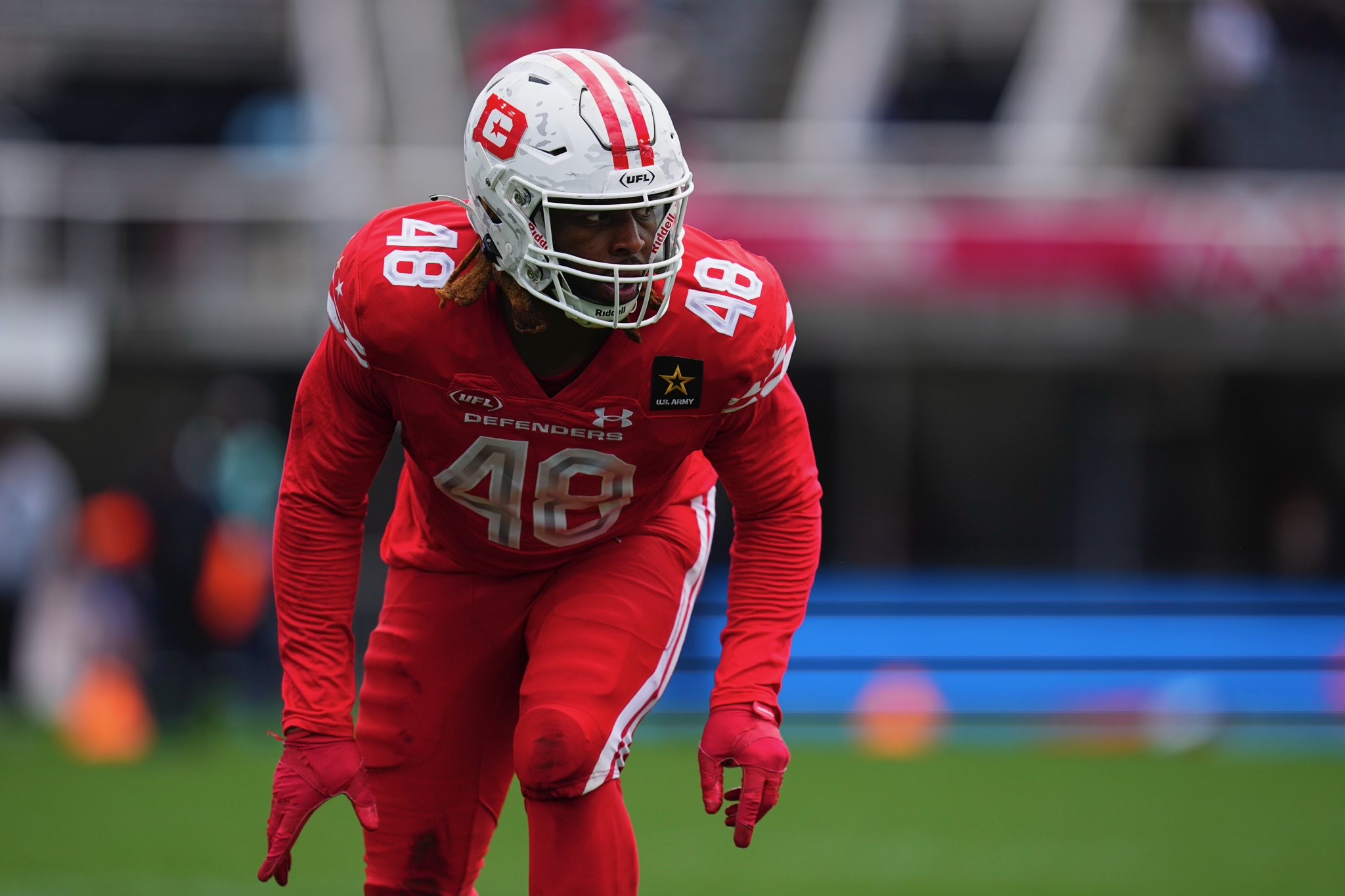
Andre Mintze, a Philly native and former Imhotep standout, plays for the DC Defenders.
While all eyes are on the NFL scouting combine, don’t forget about the United Football League.
In case you’d forgotten, the upstart, eight-team spring football league is the re-branded result of a merger between the XFL and USFL in 2023.
Ahead of its third season, the UFL announced some interesting new rules Tuesday, including a ban of the Tush Push, something the NFL hasn’t been able to get through.
It doesn’t look like this will be the year, either. NFL competition committee co-chairman Rich McKay said on ESPN Sunday he’s not anticipating any challenges to the Tush Bush this offseason.
“There’s no team proposal that I’ve seen from it,” McKay said. “So, I wouldn’t envision it. But you never know.”
Here is a full rundown of the UFL’s new rules. Their season begins March 27, and will feature three new teams — the Columbus Aviators, Louisville Kings, and Orlando Storm.
Four-point field goal: Any successful field goal from 60 yards or farther will now be worth four points. Regular fields goals will remain three points.
No punting rule: Punts will no longer be allowed from anyone inside an opponent’s 50-yard-line. The only exception is with less than two minutes remaining before halftime or the end of the game.
Elimination of the Tush Push: No more pushing quarterbacks from behind in the UFL.
New overtime rules: Teams will have three alternating attempts to score from the five-yard line. If the score remains tied, teams will continue to alternate attempts until a winner is determined.
‘He’s going to be a huge asset’: Dolphins head coach praises Kevin Patullo
Former Eagles offensive coordinator Kevin Patullo.
Following a Zoom interview with Kevin Patullo, new Dolphins head coach Jeff Hafley was so impressed he knew he wanted to bring the former Eagles offensive coordinator down to Miami.
Speaking to reporters Tuesday at the NFL scouting combine, Hafley said Patullo’s knowledge goes beyond just the offense and extends to “game management” and “situational football”
“I got off the Zoom and I said to [Dolphins offensive coordinator Bobby Slowik], ‘We’ve got to try and hire this guy,’” Hafley said. “He had other opportunities and other options.”
The Dolphins indeed landed Patullo, whose brief tenure with the Eagles saw both the passing and running game regress. The Eagles’ offense finished the season ranked No. 19 in scoring and No. 24 in yards, down from No. 7 and No. 8 in those respective categories in 2024.
How long will the scouting combine remain in Indianapolis?
Lucas Oil Stadium in Indianapolis will host the NFL scouting combine through 2028.
That’s the perennial question.
Indianapolis, which has hosted the combine since 1987, will continue as the event’s home through at least 2028, the NFL announced last month.
Despite other cities placing bids to host the event, the NFL has continued to stick with the combine’s roots. The league has also placed the desires of scouts and coaches — who enjoy the convenience of the Circle City’s downtown setup — over expanding the combine into a TV event the way the league has done with the NFL draft.
“For more than three decades, Indy has proven to be the best host city, efficiently moving prospects, team owners, coaching staff, medical personnel, and national media seamlessly through the city,” Colts Chief Operating Officer Pete Ward said in a statement.
How does this year’s draft class stack up with the Eagles’ needs?
The NFL world is descending on Indianapolis again this week for the NFL scouting combine.
This week, 319 college football prospects will descend on Indianapolis for the annual NFL scouting combine, where they will be tested physically, mentally, and medically, interviewed by NFL front office personnel, and will speak with hundreds of media members.
This latest step in the 2026 NFL draft process allows teams to home in on the next crop of players who will fill their franchises. All 32 teams will have 45 “formal interviews,” which last just under 20 minutes, can include watching film or any questions teams want to ask a prospect, and typically take place in the Lucas Oil Stadium suites.
The first direct touch point with prospects happened at last month’s Shrine and Senior Bowl games. NFL teams will utilize this next piece of the puzzle to identify which prospects match their team needs.
Here is how we’re ranking the combine position groups from strongest to weakest. Click through to read how they could help the Eagles address some roster needs:
‘We’ll continue to move on’: What’s next after Jeff Stoutland’s surprising exit?
Jeff Stoutland announced his departure from the Eagles earlier this month.
Two months after the Eagles hired Jeff Stoutland, they drafted Lane Johnson with the fourth overall pick in the 2013 NFL draft. Howie Roseman had his cornerstone offensive lineman, one whom Stoutland helped develop into a future Hall of Fame right tackle.
Stoutland was in the room with — and in the ear of — Roseman in the years that followed, even after the coach who hired Stoutland, Chip Kelly, left town. Stoutland survived 13 seasons and three coaching staffs in large part because he was arguably the best offensive line coach in football, but he also shared similar philosophies with Roseman.
“In 13 years, I probably couldn’t get on one hand our disagreements,” Roseman said during a session with Eagles beat writers on Friday, a few weeks after Stoutland announced his departure from the Eagles. “We looked at offensive line play very similarly.”
The offensive line, which took a step back in 2025 thanks to multiple injuries, has quickly gone from a position of strength and certainty to one that may soon need to be overhauled. The Eagles have been due to draft and develop Johnson’s eventual replacement, but now they may have big holes in the interior sooner than they anticipated.
It’s a crucial offseason for Roseman to address multiple spots on the depth chart, not just the offensive line, and retooling the offensive front now comes without the help of Stoutland.
“I probably could have 50 stories on our draft process and how we went through them,” Roseman said. “I miss him. … We’ll continue to move on. I feel like we have a really good group of people here. I feel confident in our ability to evaluate, but at the same time understanding how important he was to the process of adding good players and then developing those good players.”
Falcons GM Ian Cunningham told 92.9 The Game in Atlanta that the team plans to release Kirk Cousins on the first day of the league year, Wednesday, March 11.
Ertz, 35, turned around his career as a reliable target for Jayden Daniels, but the tight end’s contract with the Commanders is up this season. It remains unclear whether he’ll remain in Washington or become a free agent.
The Birds have marketing rights in Brazil and played there two seasons ago, but the NFL generally avoids scheduling divisional matchups in international games (though it’s already bucking that trend with 49ers-Rams in Australia, plus the Chiefs have played the Chargers, an AFC West foe, twice on foreign soil).
There’s also London, but even though the Birds are scheduled to play a road game against the Jaguars, it seems unlikely the NFL would want to waste the ratings potential of the Eagles on a game with a 9:30 a.m. Philly kickoff.
Nick Sirianni, Howie Roseman to speak more ahead of NFL scouting combine
Howie Roseman (left) and Nick Sirianni will speak to reporters Tuesday.
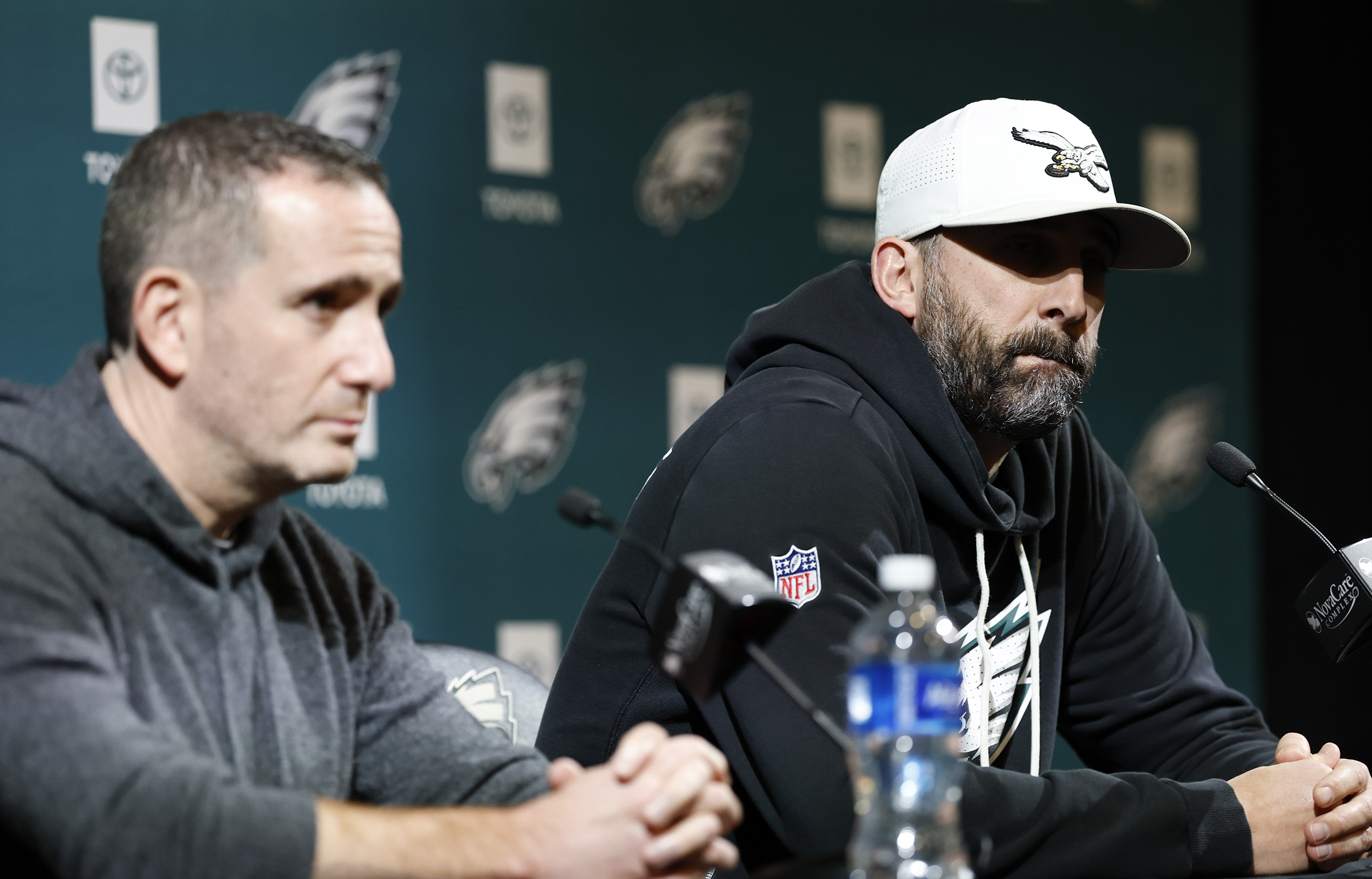
Eagles head coach Nick Sirianni and general manager Howie Roseman will speak to reporters Tuesday afternoon ahead of the scouting combine.
Roseman is slated to take the podium at 2:45 p.m., followed by Sirianni at 3 p.m.
While most of the focus will likely be on whom the Eagles might take in the upcoming NFL draft, Sirianni and Roseman will undoubtedly face questions about a host of issues, including the future of A.J. Brown.
Sirianni and Roseman spoke to Eagles reporters Friday. Here’s what they learned.
Sean Mannion will be calling plays for the first time under intense scrutiny in Philadelphia.
Nick Sirianni sat perched back in a chair with his feet up in UGG slippers. The Eagles coach looked as relaxed as he has in over a year, and certainly since a tumultuous 2025 season ended with him having to oust consigliere Kevin Patullo as offensive coordinator last month.
Sirianni met with reporters at the newly named Jefferson Health Training Complex on the Friday before the NFL combine. He and general manager Howie Roseman normally answer questions with locals in Indianapolis before they hit the combine podium. But with so much change already — and more to come — the Eagles opted for the more familiar setting of their draft room to address pertinent matters about the team.
Sirianni and the more upright Roseman spoke separately, each for around 40 minutes. They tackled subjects ranging from wide receiver A.J. Brown’s uncertain future to longtime offensive line coach Jeff Stoutland’s departure. But a significant portion of their availability — especially the coach’s — was spent on new offensive coordinator Sean Mannion.
Why did Sirianni hire the inexperienced former Packers quarterbacks coach? Why was the search drawn out? How much did wanting the Shanahan-McVay offense factor into the decision? What did Sirianni like about the scheme? How much autonomy will Mannion have? How will quarterback Jalen Hurts and other returning players adapt to the new system? And how will the changes affect evaluations of Brown and future Eagles?
Sirianni was light on details — how could he not be with so many unknowns — but he and Roseman did provide enough information to allow for informed perspective on Mannion, the new scheme and what could be an inflection point for the coach, his quarterback, and the Eagles overall.
Here are 10 takeaways about the offense from Friday’s interviews:
Four players the Eagles could be watching at the NFL Scouting Combine
Will the Eagles be in position to fill a need with Oregon tight end Kenyon Sadiq (left) or Alabama offensive lineman Kadyn Proctor?
When evaluating NFL prospects, a player’s past performance is often the best predictor of future performance. The same can be said for the act of scouting itself.
Howie Roseman, who began serving as Eagles general manager in 2010, has an extensive draft history that can be used to project his future prospect preferences. Roseman has had personnel control during 15 draft cycles, not including 2015 when Chip Kelly was in charge of those decisions. Those 15 draft classes offer windows into Roseman’s valued traits and abilities at each position.
For years, the Eagles’ player personnel department has been gathering information about the 2026 draft class. At the scouting combine next week, Roseman and his staff will continue to learn about the scores of NFL hopefuls and determine their prospective fit within the organization.
What can the Eagles’ draft history tell us about the questions they will seek to answer about some of the top prospects at three positions of need next week?
Offensive line
Kadyn Proctor, Alabama: The 6-7, 366-pound tackle stands out for his movement skills at his hulking size. Proctor has the skill set to line up at guard, too, giving the Eagles another interior option with Lane Johnson returning for a 14th season.
Max Iheanachor, Arizona State: The 6-6, 330-pound tackle is a rawer prospect than Proctor, beginning his football career in junior college only five years ago. Iheanachor has the requisite size and quickness at the position, though, and he could continue to improve his draft stock with eye-catching numbers at the combine.
Tight end
Kenyon Sadiq, Oregon: The 20-year-old is the consensus top tight end in this year’s draft class who could come off the board within the Eagles’ range (potentially earlier) at No. 23 overall. His speed and athleticism are his strengths, and excels at making plays with the ball in his hands, which could be a benefit to the Eagles in the screen game.
Cornerback
Avieon Terrell, Clemson: The 5-11, 180-pound cornerback is relatively undersized at the position, but regardless of his size, Terrell has solidified himself among the top cornerbacks in this year’s draft class with his smart instincts and competitive spirit. He also has inside-outside versatility if the Eagles ever decide to move Cooper DeJean outside full-time. If Terrell tests well at the combine, he could get his foot in the door of the late first round.
NFL salary cap getting another big increase. Here’s where the Eagles stand.
The Eagles will have to make a decision on pending free agent Dallas Goedert.
The NFL salary cap just keeps going up and up.
The 2026 NFL salary cap is projected to land somewhere between $301.2 million and $305.7 million per team, a big jump from last season. At a minimum, it’s an increase of $22 million compared to 2025’s cap of $279.2 million, offering Howie Roseman and the Eagles some much-needed breathing room.
The Eagles have 21 pending free agents, including tight end Dallas Goedert, safety Reed Blankenship, linebacker Nakobe Dean, and edge rusher Jaelan Phillips.
“As for which players the Eagles will prioritize, it’s not hard to imagine them wanting to rework something with Goedert before they look elsewhere for a tight end,” Eagles beat writers Olivia Reiner and Jeff Neiburg wrote last month. Phillips will be at or near the top of the priority list, too. The Eagles are thin at edge rusher and could use an impact player like Phillips at the top of the depth chart to pair with Jalyx Hunt and Nolan Smith.
Princely Umanmielen (left) and Bradyn Swinson at last year’s NFL scouting combine.
Tomorrow’s potential draft picks will be on display this week in Indianapolis as the NFL scouting combine gets underway.
What once was a scouting event held far away from television cameras has morphed into one of the NFL’s tentpoles, drawing multiple days of live coverage on the NFL Network.
Compensatory picks have not yet been finalized, but the Eagles know where they’ll be picking in the first three rounds.
Currently, the Eagles have five total picks in the draft, which is slated to begin April 23 in Pittsburgh.
The Birds are also expected to receive three compensatory picks, awarded for high-profile free agency losses that include Milton Williams (Patriots), Josh Sweat (Cardinals), and Mekhi Becton (Chargers).
Over the Cap projects the Eagles will land one third-round pick (for Williams), one fourth-round pick (for Sweat), and one fifth-round pick (for Becton).