Blog

  • Small businesses, don’t expect tariff relief anytime soon | Expert Opinion

    Small businesses, don’t expect tariff relief anytime soon | Expert Opinion

    The U.S. Supreme Court dealt a blow to President Donald Trump’s tariff plan last week. But if you’re a small-business owner who’s been affected by tariffs, don’t get too excited.

    This fight is far from over. And so is the uncertainty. Even when courts push back, presidents retain enormous tariff authority — and small businesses should assume continued volatility.

    The president had imposed tariffs on a number of countries under the International Emergency Economic Powers Act (IEEPA), which authorizes him to “declare a national emergency and regulate or block commercial and financial transactions with foreign nations deemed an unusual, extraordinary threat to U.S. national security, foreign policy, or the economy.”

    The Supreme Court upheld previous lower court rulings that said he exceeded his authority to do so. But President Trump has vowed to continue the fight. He’s far from finished.

    For starters, he’s able to raise tariffs under the 1930 Smoot-Hawley Act. This law allows the U.S. to impose tariffs (up to 50%) on imports from countries that “discriminate” against U.S. goods through unfair duties, taxes, or regulations. It requires an investigation and a time-limit but it pretty much leaves the entire decision up to the president.

    The problem for President Trump is that imposing tariffs under Smoot-Hawley requires Congressional approval which is far from guaranteed, even though his party holds slim majorities in both the House and Senate, given the pushback he’s received from other Republicans on his past tariff actions.

    The president can also take advantage of Section 122 of the Trade Act of 1974. This legislation gives “balance-of-payments” authority to the executive office and allows him to impose a 15% tariff on countries as he chooses. He used this authority last week to raise the global tariff the U.S. charges to other countries from 10% to the maximum 15%. Unfortunately for him, there’s a 150-day limit to this tariff, unless Congress approves an extension which is, as mentioned previously, far from assured.

    Finally, the president can invoke Section 232 of the Trade Expansion Act of 1962, along with Section 301 of the Trade Act of 1974. Both allow the president to impose tariffs on selected sectors and industries. These laws were behind the tariff increases enacted by the Biden Administration in 2024 on steel, aluminum, semiconductors, electric vehicles, critical minerals, and solar cells. To play this card, investigations are required along with public comment, but once those rules are satisfied the executive office has a lot of flexibility.

    All of these are strategies that the president could use. And — as he’s proven — he’ll fight anyone in court who challenges him, a process that could easily extend beyond his current administration.

    It’s why Secretary Treasury Scott Bessent told CNBC in December that the Trump administration would be able to replicate tariffs even if it loses at the Supreme Court. As recently as Friday, Bessent said, “The overall tariffs, at the end of the day, will be unchanged.”

    So what do to? The smartest small businesses aren’t waiting for Washington. They’re restructuring supply chains now. You can do the same.

    Investigate bonded warehouses and free trade zones where you can bring your goods tariff-free and defer their impact until you ship product out of the warehouse, hopefully at a future time when rates are lower or there’s more clarity.

    Use organizations like the World Trade Center Association and tools like the Make Onshoring Great Again portal to find alternate suppliers and products, both domestic and foreign.

    Selectively pass down price increases based on individual customer profitability analysis, rather than broadly.

    Lean into technology in an effort to increase the productivity of your workers in order to better control or even reduce overheads.

    Try to do more assembly and manufacturing here in the U.S. All of these moves are what my smartest clients are doing in order to mitigate the uncertainty.

    Can you expect a refund? Don’t hold your breath. Refunds need to come from the importer/exporter of record, which is generally the company that handled the transaction at the port. Most of these companies I know are not structured to apply for refunds on such a scale, even if there was a process in place (which there isn’t).

    The Supreme Court has “remanded this back down to the lower courts to decide if refunds will be issued and without knowing for certain, many believe that the refunds will not be issued retroactively,” Lori Mullins of Rogers & Brown, a customs brokerage firm in Charleston, told CNBC on Friday. “For importers hoping for refunds the answer is yes, we have a ruling but we do not have a ruling on if any refunds will be granted. That will be handled by a lower court at a future date/time.”

    The Trump administration is wiping their hands clean of orchestrating a tariff refund, saying, effectively that it’s not up to them, it’s up to the lower court. In his dissent, Justice Brett Kavanaugh noted the ruling lacked any refund guidance, and he stated that the refund process may be a “mess.”

    Lawsuits already filed by larger corporations will take years to sort out. Smaller companies — lacking resources — will have a much bigger hill to climb, if that hill even exists. If you’re expecting a retroactive refund, you’re planning on a hope strategy — not a business strategy.

    Whether you agree with the president’s tariff strategy or not is beside the point. What matters is this: Tariff policy has become a tool of both trade and politics.

    That means volatility is now structural, not temporary. Which means the impact of tariffs on your small business isn’t going to change anytime soon.

    Uncertainty? That much is certain.

  • Snowstorms in Philly may not be consistent, but these Philly snowstorm traditions are

    Snowstorms in Philly may not be consistent, but these Philly snowstorm traditions are

    Snow isn’t a constant in Philadelphia but after two big storms dumped on us just weeks apart this year, it’s clear some things remain predictably consistent during a snowstorm in Philly, no matter the year.

    While all hail hasn’t broken loose yet, we have fallen right back into our classic winter storm habits, some of which aren’t snow great. So put on your parka, pull up your boots, and come traipsing through our winter tropes with me, because if there’s one thing that certainly isn’t predictable during a snowstorm it’s SEPTA.

    Acting like the Philadelphia Museum of Art is Vail

    A snow boarder goes down the steps of the Philadelphia Museum of Art.

    I love that people sled and snowboard down the steps of the Philadelphia Museum of Art after a snowstorm like it was a ski resort. It’s one of those traditions that gives Philly such a wonderful, joyous sense of place, but, like many of our beloved traditions, it is also a highly dangerous activity.

    There is no ground beneath the snow here, just pointy stone steps that could leave your face looking like a Picasso painting if you hit them the wrong way. Even if you manage to stay upright the entire way down, it’s a bumpier ride than Philly’s pothole-plagued streets (which are certainly going to get worse after this storm).

    A sledder wipes out while sledding down the Philadelphia Museum of Art steps.

    The substance

    Throughout a snowstorm and for five minutes immediately following one, Philadelphia looks absolutely stunning. But after those five minutes are up, things get real gross, real quick. The snow turns into lakes of slush and large, gray mountains of immovable ice, making the city look like a dumpster site on Hoth for the next five weeks.

    It reminds me of that movie The Substance with Demi Moore, except the substance for Philly is snow. It makes the city beautiful for a short time, but in the end, it just turns it into a bigger mess than it was to begin with.

    A pedestrian walks past a large pile of snow and ice along the Benjamin Franklin Parkway this year.

    Doggone dirty

    Among the many reasons the snow gets so gross so quickly here is because some dog owners are under the impression that the laws of polite society freeze when the temperature does. Just because your dog left its pile on a pile of snow does not mean you don’t have to pick it up.

    Trash spotted in the snow in Philadelphia. Photographed, but not pictured (as a courtesy to you), was also a pile of dog poo.

    Then there are the really terrible, lazy owners who kick snow over their dog’s piles in an attempt to cover it up, thus leaving a nasty surprise for unsuspecting pedestrians. While all dogs may go to heaven, there’s a special circle of hell for those folks.

    Snowstalgia

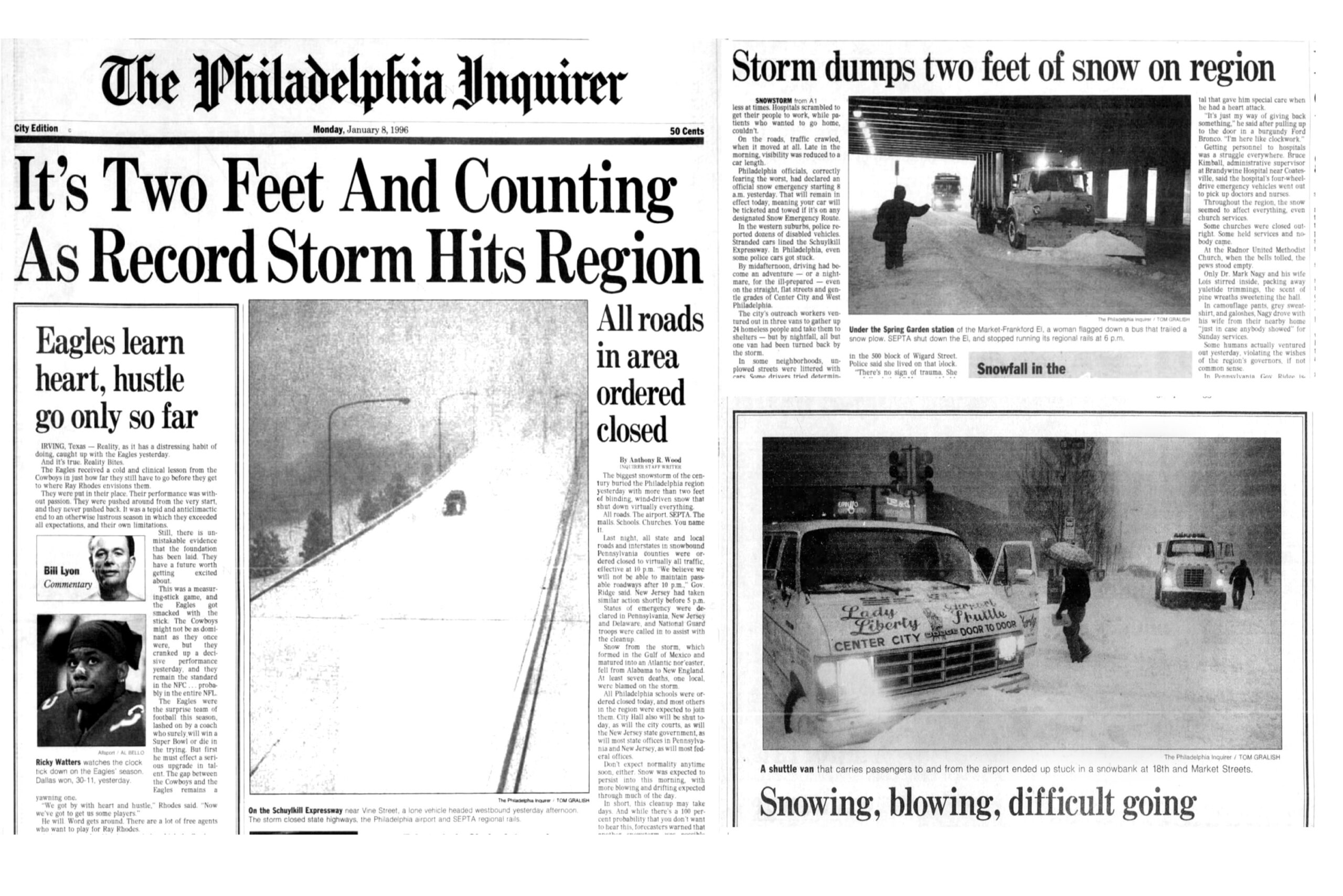
    No matter how much snow is predicted or falls during a storm, it will inevitably be compared to the Blizzard of ‘96 by at least three people you speak you to, or three times by at least one person you speak to.

    The Blizzard of ‘96 is pretty much our Beetlejuice, you have to say it three times or it doesn’t snow around here.

    Front page and inside photos from The Philadelphia Inquirer. January 8, 1996. The Blizzard of 1996, or “Storm of the Century,” a severe nor’easter that was Philadelphia’s largest-ever snowfall of 30.7 inches Jan. 6-8, 1996.

    Work or Wawa

    There are two types of people who travel out in Philly during a storm: those who are going to work and those who are going to Wawa.

    There’s absolutely no rational reason someone has to go on a Wawa run during a snowstorm — especially since everyone waited an hour in line at the Acme for milk and bread two days before it hit — yet there they always are, sometimes in flip-flops, just picking up a cup of coffee like it’s something they can’t get at home.

    The flagship Wawa store near Independence Hall.

    I’m sure some folks go just in the hopes of being interviewed by the 6ABC reporter who’s doing live shots from the Wawa parking lot, and some do it just to get out of the house while their kids are at home. Whatever the reason, if you’re one of those people, be nice to the Wawa workers who risked their lives to go to work so you had somewhere to go.

    Savesies

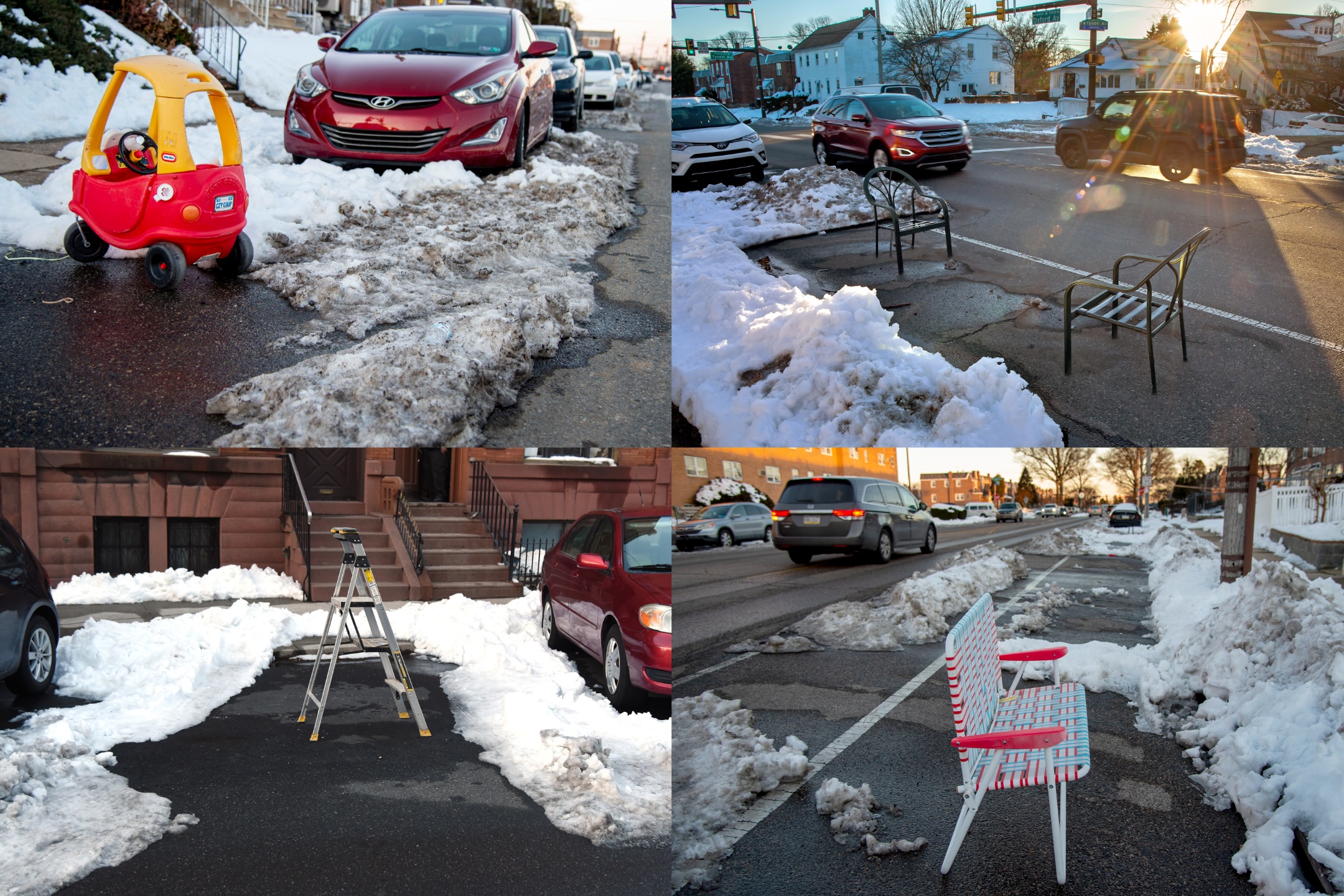
    Few things will pit neighbor-against-neighbor in this city quite like savesies, the longstanding Philly practice of using an orange cone, folding chair, or any other inanimate object to save a parking space you’ve shoveled out.

    Collage of savesies, a long-held parking tradition across Philadelphia.

    Folks are either firmly for or against the tradition, but no matter which camp they land in, few are bold enough to mess around and find out by parking in a saved space, lest they become the recipient of a strongly-worded letter on their windshield, a knock at their door, or whatever curse has plagued the Flyers since 1976.

    Shorts shovelers

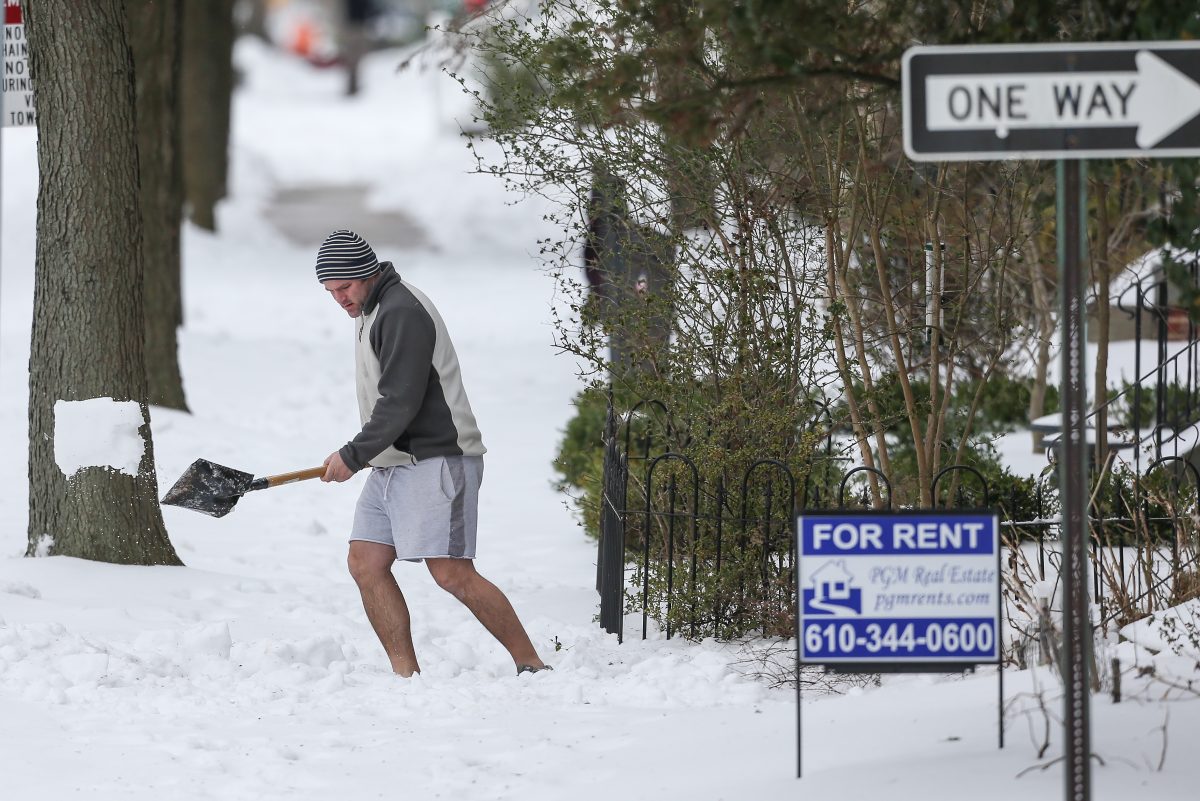
    Shoveling in shorts is a long-standing tradition practiced by men in the Philadelphia region.

    It could be 3 degrees out with a windshear of negative 10 and eight inches of snow on the ground and you will still see some dude out shoveling in shorts and an Eagles hoodie. In Delco, you will see several.

    Do these men get hot flashes in their legs? Is their calf hair luxuriously thick? Did someone cut off the bottom half of all their pants? Inquirer minds (mainly mine) want to know!

    Greetings from sunny Florida

    During a snowstorm, someone you know will inevitable post a picture of themselves in Florida, where they snowbird in the winter or are visiting for Phillies spring training. The caption will say something like “Sorry to miss out on the storm!” or “Sending my friends in Philly sunny vibes from Florida!”

    Philadelphia Phillies Trea Turner and Bryce Harper enter the field during the first full-squad workout of spring training Feb. 16, 2026, at BayCare Ballpark in Clearwater, Fla.

    These are bold-faced lies. They are not sorry and they are not sending you anything but a hard time. Just rest assured in the knowledge that no matter what, you are in the greatest city in the world and they are still in Florida.

  • Stacy Garrity will be a guest at Trump’s SOTU address. Here’s who else from Pa. will (and won’t) be there.

    Stacy Garrity will be a guest at Trump’s SOTU address. Here’s who else from Pa. will (and won’t) be there.

    Pennsylvania Republican gubernatorial candidate and state Treasurer Stacy Garrity is to be among the guests filling the U.S. House’s gallery Tuesday night when President Donald Trump delivers the first State of the Union address of his second term.

    Her presence at the primetime speech underlines her alignment with Trump on the national stage as she pursues her challenge against popular Democratic incumbent Gov. Josh Shapiro, widely seen as a potential contender for the White House in 2028.

    A campaign spokesperson said Garrity will attend the address in her official capacity as state treasurer rather than as a candidate, but the Republican lawmaker bringing her to the event specifically cited her campaign for governor when he announced her as his guest.

    “I am pleased to announce that the next governor of Pennsylvania Stacy Garrity will be my guest at the coming State of the Union,” U.S. Rep. Glenn ‘GT’ Thompson, who represents the 15th District, said earlier this month at a gathering of Pennsylvania Republicans in Harrisburg.

    Steven Chizmar, a spokesperson for the Pennsylvania Treasury Department, said that Garrity was in Washington for the National Association of State Treasurers through Tuesday and that her attendance at the speech will come as part of this previously scheduled trip.

    “This opportunity will allow her to gain valuable insights into national issues that could impact Pennsylvanians and the services provided by the Pennsylvania Treasury Department,” Chizmar said. “Attending the State of the Union is an honor rooted in more than two centuries of American tradition and Stacy Garrity is proud to be able to attend the president’s address.”

    Garrity’s trip to Washington comes just days after Shapiro was among the Democratic governors to meet with Trump at the White House for the National Governors Association’s annual conference — though he skipped the black-tie dinner after Trump’s attacks on colleagues.

    Garrity is a longtime Trump supporter who has voiced support for Pennsylvanians to cooperate with ICE agents and previously claimed that Trump won the 2020 election.

    Trump endorsed Garrity at the end of January, saying, “Stacy is a true America First patriot who has been with me from the beginning.”

    Garrity was reelected as treasurer during the 2024 red wave in Pennsylvania when all state row offices were won by Republicans, as Trump carried Pennsylvania with more votes than any statewide Republican candidate in history .

    But now a little over a year into his second term, Trump’s approval rating is sinking. According to a new Washington Post-ABC-Ipsos poll, 60% of Americans said they disapprove of how Trump is handling the presidency. This is a potential liability for Garrity and other Pennsylvania Republicans on the ballot this year.

    The Pennsylvania Democratic Party seized on Garrity’s planned appearance at the State of the Union. Party chair Eugene DePasquale said during a news briefing Monday that Garrity will be “cheerleading” Trump’s “damaging” policies and specifically tied Garrity to rising healthcare costs.

    Democrats boycott or bring guests to send a message

    Healthcare costs will likely be a key point of Democratic messaging against Trump on Tuesday night, following a national spike in insurance premiums when enhanced tax credits for the Affordable Care Act expired at the start of the year.

    U.S. Rep. Madeleine Dean, who represents the 4th District, which is primarily Montgomery County, is to bring Lisa Boone Bogacki, a physical therapist and affordable healthcare advocate from Berks County.

    Bogacki‘s husband, Gary, died from a sudden cardiac event in 2009 and Bogacki’s family came to rely on the Affordable Care Act and Social Security survivor benefits.

    “Prior to the ACA, I paid over $20,000 annually for insurance coverage, and this was where the majority of the kids’ survivor’s benefits was spent,” Bogacki said in a news release from Dean’s office. “The ACA finally made insurance premiums affordable for us. This year, my premiums have drastically increased, following the new cuts made to the program.”

    U.S. Rep. Chris Deluzio, who represents the 17h District in Western Pennsylania, also focused on health care messaging with his announced guest, Jonathan Akanowicz, an independent pharmacist from Hampton Township.

    Akanowicz has been working to lower prescription drug costs and save community pharmacies by campaigning against pharmacy benefit managers.

    Addressing another contentious issue, Trump’s immigration agenda, U.S. Sen. Lisa Blunt Rochester of Delaware plans to bring Maria Mesias-Tatnall, director of outreach and immigration assistance at the Delaware Department of Justice.

    Some Democrats are choosing to express their disapproval in other ways.

    U.S. Rep. Summer Lee, of the 12th District in Pittsburgh and surrounding area, plans to attend the progressive-led “People’s State of the Union” in Washington instead of Trump’s speech, her office said.

    She is to deliver the Working Families Party’s response to Trump, according to the progressive organization.

    U.S. Rep. Mary Gay Scanlon of the 5th District mostly in Delaware County, is also scheduled to attend the “People’s State of the Union” event, organized by progressive groups MeidasTouch and MoveOn, her office confirmed.

    After he boycotted Trump’s joint address to Congress last year, U.S. Rep. Dwight Evans of the 3rd District in Philadelphia will not attend Trump’s address Tuesday night. In his place, Evans — who is retiring — has designated Carolyn Hill, a Philadelphia grandmother who is impacted by Trump’s cuts to SNAP, an honorary guest.

    Republican lawmakers from the region

    U.S. Sen. Dave McCormick of Pennsylvania will be hosting hosted Jason Zugai, vice president of United Steelworkers Local 2227, as his guest after Japanese company Nippon Steel finalized a buyout of U.S. Steel in June. McCormick played a key role in persuading Trump to back the deal after his initial public opposition.

    U.S. Rep. Ryan Mackenzie of the 7th District, which is north of Philadelphia will to bring Sarah Arndt, the lead teacher at PathStone Carbon County Head Start, where she has worked for the past 13 years. Funding for her program was in jeopardy last fall amid the lengthy government shutdown and state budget impasse.

    And Sheryl Klein, a senior at Council Rock High School South in Bucks County, will to be the guest of U.S. Rep. Brian Fitzpatrick of the 1st District. Klein founded and leads the high school’s Women’s Empowerment Club.

    “That is the kind of civic engagement we should be encouraging across this country at every level: unifying, positive, and rooted in service to something greater than ourselves,” Fitzpatrick said.

    Fitzpatrick and Mackenzie represent key swing districts, which both parties are targeting in the fall.

  • Philadelphia is one of the most popular destinations for apartment hunters so far this year

    Philadelphia is one of the most popular destinations for apartment hunters so far this year

    Philadelphia is one of the most popular major cities among renters searching for apartments ahead of this year’s peak rental season.

    The city ranks in the top 10 most popular out of the 150 largest U.S. cities, according to an analysis of millions of apartment searches by the nationwide apartment search platform RentCafe.

    To rank cities at the start of the year, the platform measured page views for apartment listings, saved searches, listings that were marked as favorites, and the availability of units.

    Rental activity is typically more dormant in the winter months before it heats up with the weather and peaks in the summer. “Looking out your window today, you can see a major reason why,” said Doug Ressler, manager of business intelligence at Yardi Matrix, a sister division of RentCafe.

    Philadelphia came in at No. 8 in RentCafe’s ranking of in-demand rental markets in early 2026. The city often ranks high for popularity among renters because of its size, access to job hubs, and affordability compared to New York and other major East Coast cities.

    RentCafe found that a majority of the interest in Philadelphia apartments comes from people already living in the city.

    But out-of-town renters also want to move here. The majority of these apartment hunters searched from New York, followed by Boston and Washington. Renters in Atlanta, Los Angeles, and Houston also were interested in Philadelphia rentals.

    Philadelphia fell three spots from last year in RentCafe’s ranking, because the number of saved apartment searches dropped, Ressler said. That’s partly because an apartment construction boom in the city has created many available units. So apartment hunters can more easily find homes and don’t need to save as many searches.

    window.addEventListener(“message”,function(a){if(void 0!==a.data[“datawrapper-height”]){var e=document.querySelectorAll(“iframe”);for(var t in a.data[“datawrapper-height”])for(var r,i=0;r=e[i];i++)if(r.contentWindow===a.source){var d=a.data[“datawrapper-height”][t]+”px”;r.style.height=d}}});

    Beyond Philadelphia

    Midwestern and Southern cities dominated RentCafe’s rankings, with 11 of the 30 most in-demand cities located in the Midwest. Cincinnati took the No. 1 spot, followed by Atlanta and Minneapolis.

    Washington and Baltimore rounded out the top-five list.

    In top-ranked Cincinnati, RentCafe said renter interest was driven by people wanting to move from expensive areas along the coast to a midsized city that still offers a strong job market and positions in healthcare, manufacturing, and finance. Cincinnati also has become more appealing because of recent revitalization of downtown neighborhoods and the riverfront along the Ohio River.

    Renter interest in El Paso, Texas, has grown the most out of the 150 large cities that RentCafe analyzed. The city climbed 115 spots to rank No. 28 this year.

  • The Flower Show must go on: Crews start setting up for Philly Flower Show despite snow and years of weather curses

    The Flower Show must go on: Crews start setting up for Philly Flower Show despite snow and years of weather curses

    Inside a large exhibition room at the Pennsylvania Convention Center on Monday morning, where workers are setting up next week’s Philadelphia Flower Show, one could be fooled into believing that spring has somehow arrived early in Philly.

    The scent of mulch permeates every corner, tendrils of pink and red flowers are delicately laid over massive tree trunks, a mobile hanging from the ceiling dangles dozens of iridescent butterfly cutouts over the floor, and bright green shrubbery dots the halls.

    It seems as if Punxsutawney Phil maybe got it wrong this time.

    But one thing gives it away: the gaping open loading dock door ushering in a channel of 35-degree air that slices through the center of the exhibition hall. Clusters of snowflakes billow in toward a mint-colored wooden fence and a tree house.

    For the organizers of the Philadelphia Flower Show, an annual week and a half-long event that features dozens of horticultural exhibits, the 14-inch snow dump over the weekend was less than ideal, said Seth Pearsoll, the show’s creative director and vice president with the Pennsylvania Horticultural Society. But it wasn’t a surprise.

    “We have been watching the weather for weeks on end,” Pearsoll said. “You just got to stay on top of it.”

    The show, which opens to the general public on Saturday —the Horticultural Society members preview is Friday — and ends March 8, is typically held in the late winter/early spring. That’s led to some historically dicey weather.

    A 1993 blizzard forced the show to close early. Meteorologists predicted huge snowfalls in 2001 and 2013 as well. And, in 2018, a nor’easter hit the city on the opening night of the show. When the show was held outside during the years of the COVID-19 pandemic, it was shuttered or postponed for short stretches because of inclement weather.

    Despite the weather challenges the show, which has been running for nearly 200 years, is typically held at this time of year partly due to tradition. The show dates to an era long before the internet when the event was designed to present the season’s products to florists, landscapers, farmers, and others in the horticultural industry so they could place their orders in time for spring planting.

    “After that it was just part of the DNA of the show,” Pearsoll said.

    The show brings in a quarter million visitors each year, he said, and requires meticulous planning and constant pivoting.

    The original schedule for Monday included a 7 a.m. load-in time, he said, but his team later pushed that to noon to ensure that all the trucks could get to the facility safely. Many of the plant deliveries for Monday were moved to Tuesday or Wednesday, by which time the team hopes roads will be clearer.

    Trucks won’t just be contending with the weather in Philly but across the country as the event is getting shipments in from Minnesota, Florida, and New York, among other states.

    Most of the plants themselves are protected in climate-controlled trucks.

    “I think, for me, having been a part of outdoor shows, having worked a million flower shows, weather is always a thing,” Pearsoll said. “So I’ve really come to see it as just another one of those planning variables in the event industry.”

    The way he views it, the snowy, slushy, frigid weather outside enhances the magic of walking through rows of plants that have, through “sorcery,” as he calls it, been manipulated into blooming out of season.

    “It’s this crazy thing, right?” he said. “It mean it’s science. It’s art.”

    The Philadelphia Flower show is scheduled for Saturday through March 8 (with a Horticultural Society members preview on Friday) at the Pennsylvania Convention Center, 11th and Arch Streets. Hours: 10 a.m. to 8 p.m., except until 6 p.m. on March 8. Admission varies depending on person’s age and day and time of entrance. Information: phsonline.org or 215-988-8800.

  • Philly school officials want to close Lankenau High and give it to the city. A 1970s legal agreement may snarl that deal.

    Philly school officials want to close Lankenau High and give it to the city. A 1970s legal agreement may snarl that deal.

    Could a 1973 legal agreement help save Lankenau High?

    The Schuylkill Center for Environmental Education hopes so.

    The Philadelphia School District has proposed closing Lankenau, the city’s environmental science magnet school, and giving it to the city to help further Mayor Cherelle L. Parker’s affordable-housing goals, or for job creation.

    But the Schuylkill Center, Lankenau’s neighbor, believes it’s prohibited from doing so, and just notified Superintendent Tony B. Watlington Sr.

    The Schuylkill Center “holds a right to repurchase the property in the event that it is transferred or conveyed or used for any purpose other than school purposes, pursuant to a restriction in the October 4, 1973 deed by which [the Schuylkill Center] conveyed the property to the Lankenau School,” a lawyer for the environmental center wrote in a letter sent to the district Monday.

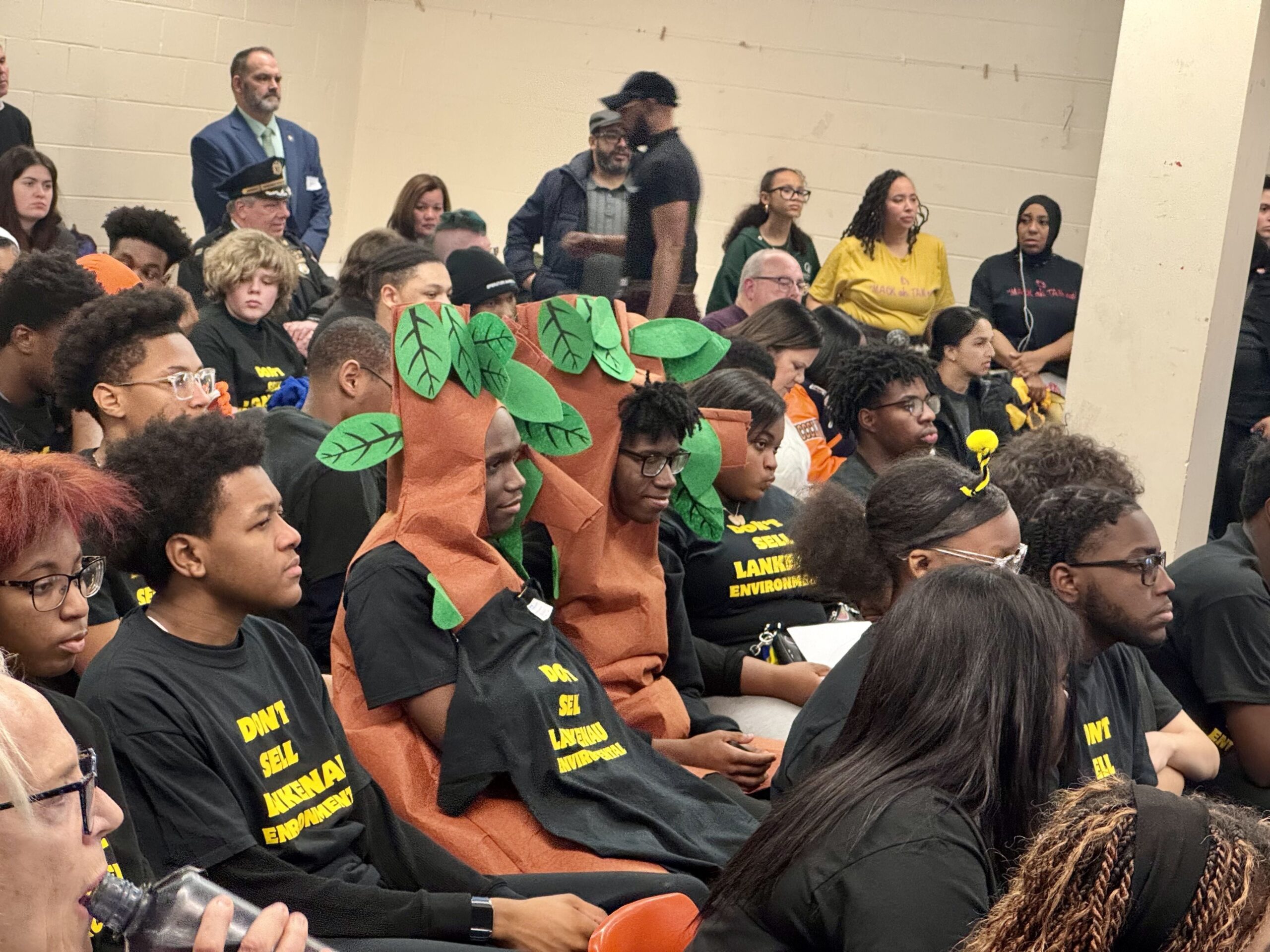
    Students, staff, and community members who support Lankenau High School – including some dressed as trees – packed a recent community meeting at the school about its proposed closure.

    If the district is “considering a sale of the property or using the property for any purposes other than continued use as a school, this letter serves as written notice of [the Schuylkill Center’s] right to repurchase,” lawyer Sean T. O’Neill wrote to Watlington, “The school district must provide [the Schuylkill Center] with reasonable advance notice of any potential conveyance or change in use and allow [the Schuylkill Center] the opportunity to exercise its right to repurchase.”

    The center, which touts itself as “one of the first urban environmental education centers in the country,” was founded in 1965. It has trails and a visitors’ center and runs educational programs and a wildlife clinic.

    District officials had no immediate comment.

    Lankenau’s history

    Lankenau sits amid 400 wooded acres adjacent to the Schuylkill Center. The 17-acre parcel Lankenau High now sits on was originally the site of the private Lankenau School for Girls; after that school closed, the Philadelphia School District purchased the land.

    What is now Lankenau High was first a program of Saul High and then Germantown High, but in 2005, it became a standalone school as part of then-CEO Paul Vallas’ small schools initiative.

    Since then, Lankenau has soared as a diverse, hands-on magnet with a 100% graduation rate in a location like no other.

    News that Lankenau landed on the district’s closure list infuriated students, parents, community members, and elected officials, who have mounted a robust campaign to fight plans to shut the school and relocate it as an honors program inside Roxborough High.

    Teachers, students, and community members from Lankenau High School rally outside a Philadelphia school board meeting in January.

    They’re particularly alarmed that Lankenau’s small size, used to justify its closing, came as enrollment shrank after the school system ordered changes to its special-admissions policy.

    The Schuylkill Center’s first priority is for Lankenau to remain as it is, said Erin Mooney, executive director of the 60-year-old organization, which now partners closely with Lankenau.

    “We are in opposition to Lankenau’s closing,” said Mooney, “but should something change with Lankenau, we want to ensure that the site continues to be used to teach people about nature.”

    Mooney, who has been public in the Schuylkill Center’s support for the school, discovered the language giving the Schuylkill Center right of first refusal if the property ever ceases being a school in the 1973 agreement.

    Watlington is scheduled to present his sweeping facilities plan — which as of January included 20 closures, six co-locations and 159 modernizations — at a school board meeting Thursday.

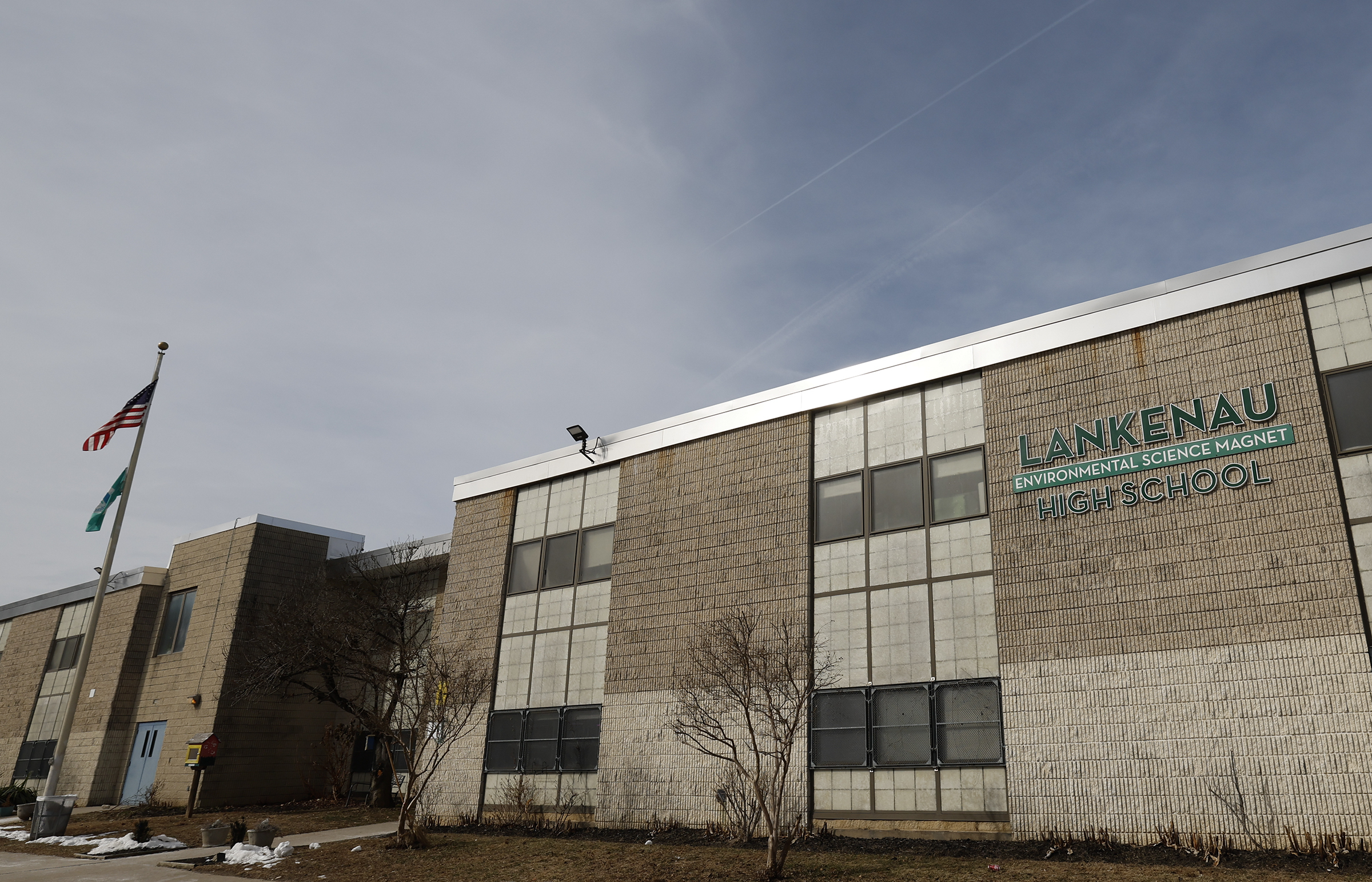
    The Lankenau Environmental Science Magnet High School in Roxborough on Saturday, January 24, 2026.

    But the superintendent has said what he presents to the board may include some tweaks to his initial recommendations.

    Mooney hopes the information the Schuylkill’s lawyers sent Monday helps Lankenau come off the closing list.

    “We want Lankenau to stay,” she said, “and I wanted the school board to have this information as part of its decision-making.”

    Watlington’s recommendations are just that; the school board has ultimate say. It has not given a date for the final vote on school closings, but said no vote will happen Thursday.

  • There’s no room in the union for Trump’s chaotic imperial presidency | Editorial

    There’s no room in the union for Trump’s chaotic imperial presidency | Editorial

    As America prepares to celebrate its 250th anniversary, the state of the union is in turmoil.

    In little more than a year in office, President Donald Trump has assailed the country’s institutions, upset the constitutional system of checks and balances, flouted the law, undermined democracy at home and abroad, and ignored the rising cost of living for ordinary people while lining his family’s pockets.

    Under Trump — at the whims of his unelected billionaire buddy, Elon Musk — senseless funding cuts have gutted U.S. medical research, led to thousands of federal employees losing their jobs, and more than 800,000 lives lost due to discontinued foreign aid.

    The president’s chaotic mass deportation efforts have a body count — including two citizens — as the nation’s streets are overrun by heavily armed, masked federal agents who routinely use excessive force with little accountability. Meanwhile, the government continues to protect the rich and powerful listed in the Jeffrey Epstein files, perhaps hoping to redact away their sins.

    Much to Trump’s displeasure, the American people are paying attention.

    When the president addresses Congress on Tuesday at the annual State of the Union address, he will do so with a 60% disapproval rating, according to a Washington Post-ABC News-Ipsos poll. Those abysmal numbers echo those seen after the Jan. 6, 2021, assault on the U.S. Capitol by Trump followers.

    The reproach has been hard-earned by the president, who has squandered away the goodwill of voters after his undeniable 2024 election victory.

    Rather than focusing on the kitchen-table issues that won him a return trip to the White House, Trump has ramped up the cruelty of his anti-immigrant policies and ignored the economic pressures many people face.

    Instead of presiding over cooling inflation, the president’s obsession with tariffs cost American families an extra $1,000 last year. In place of policies that would make owning a home more affordable and bring down the cost of rent, Trump said he wants to keep housing prices high. Contrary to what the administration wants people to believe, mass deportations don’t create jobs; they stunt economic growth.

    The tax cuts promised in Trump’s signature piece of legislation, the One Big Beautiful Bill Act, mostly benefited the very wealthy. The law allots billions to hire U.S. Immigration and Customs Enforcement agents and build vast detention facilities on the back of steep cuts to Medicaid and food assistance.

    That people are roundly pushing back against the president’s upside-down priorities and abuses of power seems to have restored some conservative leaders’ resolve.

    The same U.S. Supreme Court that, in 2024, gave the president absolute immunity ruled last week that Trump’s tariffs exceeded the power of the presidency. In December, the justices also blocked Trump’s deployment of the National Guard to Chicago, and have been skeptical in arguments regarding the president’s authority to fire a member of the Federal Reserve Board.

    In Congress, a handful of Republicans have also rejected Trump’s wishes, denouncing his administration’s refusal to release the Epstein files and the president’s ill-conceived tariffs on Canada. GOP lawmakers have so successfully abandoned their authority to Trump that even these limited developments are heartening.

    When it comes to the president, perhaps the legislative branch should pay heed to the judicial.

    In the same court decision that denied Trump his tariff authority, Justice Neil Gorsuch, who is part of the conservative majority, laid it out clearly.

    “Yes, legislating can be hard and take time. And, yes, it can be tempting to bypass Congress when some pressing problem arises,” the Trump appointee wrote in his concurrence. “But the deliberative nature of the legislative process was the whole point of its design. Through that process, the Nation can tap the combined wisdom of the people’s elected representatives, not just that of one faction or man.”

    The American people and the courts are speaking. If the state of the union is to ever recover, Congress must listen.

  • Towed by the PPA, frustrated with SEPTA, he took an electric scooter onto Lincoln Drive

    Towed by the PPA, frustrated with SEPTA, he took an electric scooter onto Lincoln Drive

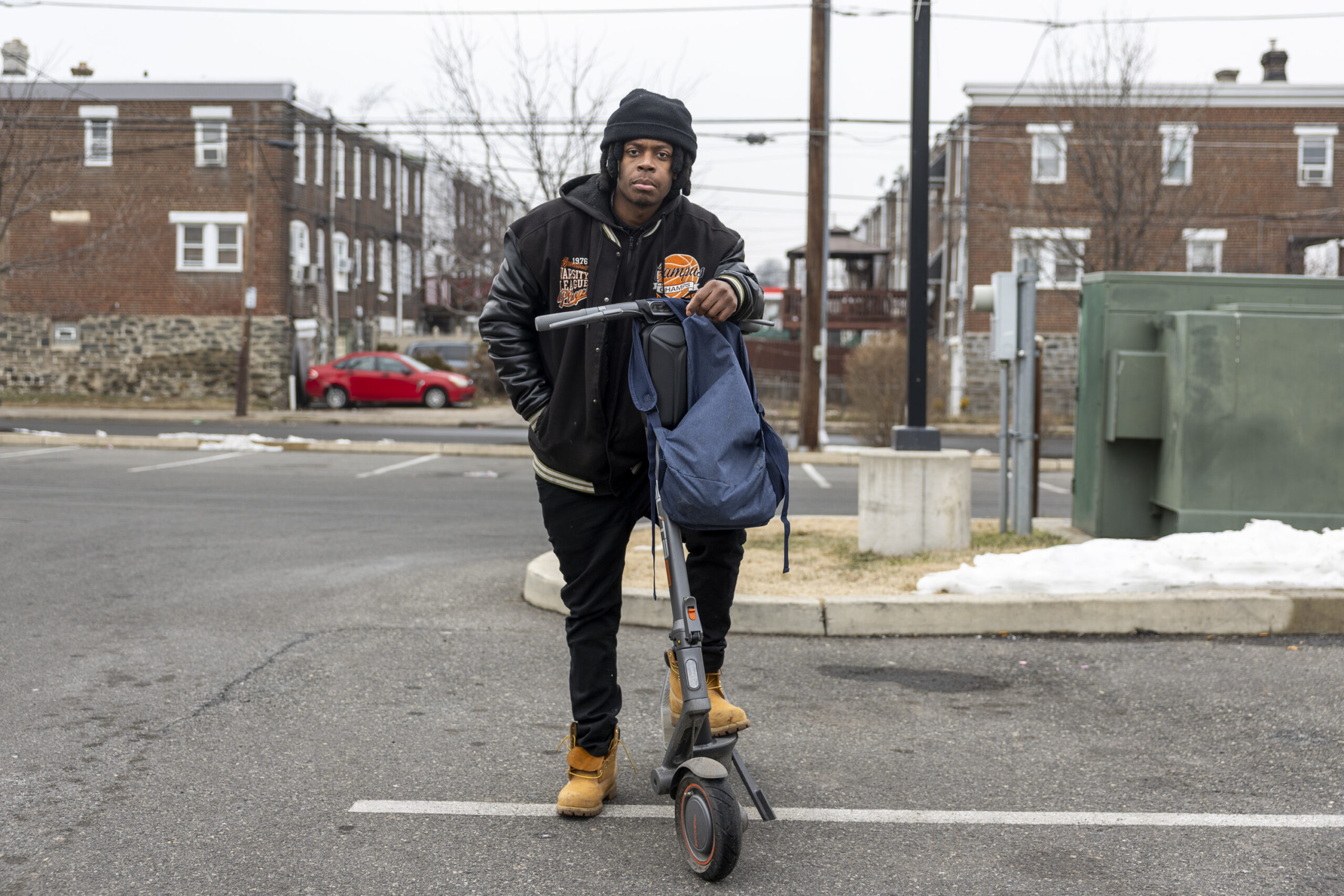
    Saladine Sherrod was in a jam. The 34-year-old handyman from North Philly needed to get to a job in Roxborough, but he didn’t have a car. He says the PPA had towed it the night before. “I was on top of the snow,” Sherrod said. “There weren’t any lines of demarcation.”

    And speaking of the winter storm, it was still wreaking havoc on SEPTA. “It was detour after detour after detour,” Sherrod said about the bus routes that day. It had been two weeks since it snowed, but cold weather had kept the city encased in snow and ice, and a brutal wind chill had plunged temperatures to historic lows. Sherrod said bus operators were unavailable as a result. “Employees were calling off because of the weather or some craziness like that.”

    He would have to take three buses to get to his job and three more to get home. That would cost almost $18. He only had $40 to get through the rest of the week, and several more jobs lined up. Plus, “with the way the weather was,” he said, “I’d be sitting outside for hours.”

    So Sherrod came up with a different plan. He found a shop that would finance an electric scooter for $40 down and set off toward Roxborough, following the “via bike” route on Google Maps. Having moved to Philadelphia from the Bronx in 2022, Sherrod still wasn’t all that familiar with the city. He knew his part of town, near Broad and Logan, but Germantown was a mystery. Still, he zipped along its side streets on his newly purchased Yaddea Elite Prime without much concern for his safety.

    Saladine Sherrod, 34, of North Philadelphia, Pa., poses for a photo with his electric scooter in Philadelphia, Pa., on Wednesday, Feb. 18, 2026.

    It wasn’t until Google Maps ushered him out of the neighborhood and pointed him toward a busy intersection in a dense, wooded area that his anxiety spiked. He could see he was meant to reach a bike path dotting the four-lane road he was about to turn onto, but it was closed because of the snow. He had no choice but to take the “via car” route. As he turned, the road narrowed. Vehicles flew past him. Unbeknown to Sherrod, he was now on one of Philadelphia’s most dangerous streets: Lincoln Drive.

    Car accidents occur almost every day on Lincoln Drive, a treacherous, shoulderless state road that winds along the perimeter of Wissahickon Valley Park. Drivers regularly take its hairpin curves at nearly twice the posted speed limit of 25 mph. Since 2019, five people have died driving on it. Fed-up residents who live nearby have long pushed for additional safety measures. In September 2023, the city’s Streets Department added speed tables along one of the most dangerous stretches to force drivers to slow down.

    But that mid-February afternoon, they still appeared to be speeding to Sherrod. “It looked like a NASCAR rally,” he said. Sherrod had never driven on Lincoln Drive, but he immediately sensed he was in a precarious situation. He maneuvered as far to the right as he could and focused on the snaking road ahead. He tried to ignore how cold he was. “My hands were numb,” he said. “My legs were dead. If I moved them, it felt like a bunch of needles were poking me.”

    He wasn’t wearing a helmet. He was scared, he said, but he had a job to get to. “It was one of those scares that, because you have the responsibility, it’s almost OK,” Sherrod said. “Like, ‘I heard that there are alligators in this lake, but I’ve got to get to the other side.’”

    What Sherrod saw as commitment, though, others saw as recklessness. He remembers one driver shouting at him “out of concern.” Sherrod let them know he was OK with a nod, and they drove off. But unbeknown to Sherrod, the driver had filmed him and uploaded the video to Instagram. “WHO MANS IS THIS??? Only in Philly electric scooter seen driving on Lincoln Drive,” the caption read.

    The clip was already pinballing across local feeds when Sherrod finally escaped Lincoln Drive via Henry Avenue and arrived at work. A few hours later, he finished building furniture for his customer, and they paid for an Uber so he would not have to ride the scooter home in the freezing cold. By then, the video had spread across Philly.

    Still, it would take a few days to reach Sherrod. He only saw it when a friend reached out to show it to him, wanting to know what happened to his car. Sherrod was stunned. But the commenters seemed to understand his circumstances. “That’s probably his only transportation to work,” read a typical comment. “He not tryna get fired cuz SEPTA on bulls—,” read another.

    Sherrod seized the moment and reposted the clip. In follow-up videos, he criticized the PPA and SEPTA and hawked T-shirts he made to commemorate his ride.

    He’s only made $50 so far, but it’s not his only income stream. In addition to his handyman work, he recently picked up a part-time job as a cashier at the Dollar Store. He hopes to be back behind the wheel soon. For now, he is still riding the scooter to work. “It’s all working itself out,” Sherrod said. “Slowly, but surely.”

  • From trade bait to untouchables, here’s where the Flyers roster stands heading into the deadline

    From trade bait to untouchables, here’s where the Flyers roster stands heading into the deadline

    Let the wheelin’ and dealin’ commence.

    The NHL trade freeze thawed at 11:59 p.m. on Sunday, and general managers have until 3 p.m. on March 6 to decide if their team is a buyer or a seller.

    Flyers president Keith Jones and general manager Danny Brière have long said “the players will decide” which route they take during the team’s rebuild, but Brière expects this deadline to be a quiet one.

    That doesn’t mean trades won’t happen between now and the buzzer, as the Flyers still have five games to sway brass one way or the other.

    We broke the Flyers’ roster into five categories, ranging from the players most likely to be traded to those who are considered untouchable.

    Which Flyers are trade bait?

    Two seasons ago, pending unrestricted free agent defenseman Sean Walker was widely expected to be on his way out, and he was eventually dealt to the Colorado Avalanche in a package that included a 2025 first-round pick. Last season, after years of speculation, glue guy Scott Laughton was shipped north to Toronto for Nikita Grebenkin and a 2027 first-round pick.

    But for the first time in Brière’s tenure, no player is a slam dunk to be traded.

    Rasmus Ristolainen, D: If the Flyers trade anyone, all signs point to the 31-year-old Ristolainen. There are several appealing aspects regarding the 6-foot-4, 208-pound blueliner for playoff-bound teams. Finally healthy, the Finn is coming off an impressive performance at the 2026 Milan Cortina Olympics, where he showcased a physical, two-way game while posting three assists, a plus-9 rating, and earning a bronze medal. A more tantalizing tidbit is that he wouldn’t be a one-and-done rental; Ristolainen has term, with one more year at a relatively cheap $5.1 million. Various reports on Monday indicate that there will be suitors.

    Emil Andrae, D: In the last month, a question has arisen: Where does Andrae actually fit? Limited in stature but not in heart and drive, the 24-year-old Swede is an exciting puck-mover but also prone to miscues. Scratched the last five games before the Olympic break, it’s not clear whether the Flyers are looking to move him, but a change of scenery might suit all involved..

    Flyers defenseman Emil Andrae seems like a player who is a little stuck. Could the Flyers opt for a change-of-scenery trade?

    Carl Grundström, LW/RW: Acquired in early October in the deal that sent Ryan Ellis’ contract west, Grundström has brought speed, quickness, and a great shot to the Flyers’ fourth line. As assistant coach Todd Reirden said on Sunday: “He’s been such a good add for our team this year. Been able to help us in a number of different ways, whether it’s penalty kill or sliding up and down anywhere from the fourth line to the second line.” If the Flyers are selling, could he recoup a mid-round draft pick?

    Nic Deslauriers, LW: The veteran will be an unrestricted free agent this summer and recently told The Inquirer that he thinks he has another year or two in him. A good locker room guy, he has the playoff intangibles of being a hard-working forward who plays the body with authority and can patrol the ice. Brière is known to do right by veteran players — i.e., Erik Johnson and Scott Laughton — so maybe it’s Deslauriers turn.

    Noah Juulsen, D: Someone coach Rick Tocchet knew from his days in Vancouver, the blueliner is a capable depth defenseman that might provide depth for a contender.

    Which Flyers could be in play for the right price?

    Owen Tippett, LW/RW, and Bobby Brink, RW: It’s unlikely — for the moment — but the Flyers are going to need to start making space for young wingers like Porter Martone. And while the Flyers assuredly wouldn’t want to subtract either player from their lineup, Tippett and Brink are players other teams might want. Tippett, who has a 10-team no-trade list beginning on July 1, has officially become the guy everyone expected, using his speed, skill, and physicality to become a true power forward. Small in stature, Brink is a two-way player who has built a solid foundation to his game and can slide into any system.

    With a glut of wingers, could the Flyers look to move Owen Tippett in a package for a center or a defenseman.

    Noah Cates, C/LW: This one has an even lower probability, but Stanley Cup teams are always looking for third-line centers who play a checking role while also chipping in offensively. Cates has shown he can shut down the game’s best, and contenders assuredly wouldn’t mind adding someone as fundamentally sound as the Minnesotan.

    Sam Ersson, G: Inconsistent is a good word to describe Ersson, who has had stretches of brilliance but also long stretches of struggle — notably the latter this season. Could the Flyers trade the pending restricted free agent? Anything is possible, especially with the decision of whether or not to extend him a qualifying offer on the horizon. But as of today, the young goalies in the system aren’t ready for the leap to the NHL, so it’s foreseeable that he’s sticking around for now at least.

    Garnet Hathaway, RW: Although he has struggled this year to put the puck in the net and has been a healthy scratch for nine games, Hathaway has intangibles that playoff-bound teams want at the deadline — like penalty killing ability and a gritty, edgy game that gets under opponents’ skin. That formula helped the Florida Panthers win back-to-back Cups and is why Hathaway been moved to contenders at previous deadlines.

    Nick Seeler, D: There’s been a bit of a buzz around the hard-nosed blueliner in the press box from visiting scouts. A solid defenseman who blocks shots and provides physicality, Seeler could be the perfect depth guy for a team heading for a deep playoff run. The only thing is, he would have to waive his no-trade clause, which does expire on July 1.

    Which Flyers are unlikely to be traded?

    Sean Couturier, C: The Flyers captain has a no-movement clause and a likely unmovable cap hit of $7.75 million for the next four years. With a cheaper and short-term contract he might be enticing to a playoff team as the 33-year-old center’s analytics are still solid, and what he does in the faceoff circle could change the course of a game. But the contract is probably a nonstarter for most teams.

    Jamie Drysdale and Cam York, D: Teams need guys like Drysdale and York to round out their defense, as both are young with offensive upside and solid defensive games. York has a team-friendly contract at $5.15 million for the next five years, while Drysdale is a restricted free agent. While there might be interest, the Flyers need both players to hit on their potential.

    Christian Dvorak, C: Inked to a shiny new deal, the Flyers are less inclined to trade a guy they just promised four years to. But, if they were to do it, they need to do it now, as Dvorak received a no-trade clause the first two seasons and a modified no-trade the last two that kicks in on July 1.

    Flyers center Christian Dvorak is presumably off the market now after signing a five-year extension in January.

    Nikita Grebenkin, LW: A key part of the swap for Laughton at the last trade deadline, the Flyers like what the young Russian brings. A gritty but skilled winger, Grebenkin is a work in progress; however, the upside and potential could be too good to part with this soon.

    Which Flyers would only get traded for a star or massive haul?

    Tyson Foerster, LW/RW: Since Foerster, 24, went down with a likely season-ending injury in December — a yellow non-contact jersey has been in his locker during the Olympic break — it’s become more evident just how important the Canadian is to the roster. Prior to his injury, Foerster seemed to be trending close to “untouchable” given his goal scoring and defensive acumen.

    Denver Barkey, LW: Expected to be in the minors this season, Barkey was recalled in late December and has been not just a revelation but a reminder that not every guy needs to “marinate.” The Flyers do not want to lose the 20-year-old rookie and his high hockey IQ, but he could be a key part of a larger deal to land that center or top-pair defenseman the team covets.

    Who on the Flyers is untouchable?

    Matvei Michkov, RW: Brière on Feb. 3: “One thing I can tell you, first of all, is: Matvei Michkov is not going anywhere. Let’s make that clear. OK. Matvei is going to be here for a long time.” Despite a difficult season, Michkov remains one of the most important pieces to the Flyers’ rebuild.

    involved. He

    Trevor Zegras, C/LW: It took the Flyers some patience to get Zegras, 24, from the Anaheim Ducks, and they are not partying with him now. The only question is how much the restricted free agent, who has 20 goals and 49 points in 56 games as a Flyer, will make when he inks his new contract.

    The Flyers have long coveted an offensive game-breaker like Trevor Zegras. Now, they have to pay the restricted free agent.

    Travis Sanheim, D: Coming off an impressive silver-medal-winning twirl with Hockey Canada, Sanheim is among the team’s untouchables right now. The blueliner has a unique combination of size and skating ability, which he just showcased on the international stage. Sanheim, who turns 30 next month, also has a full no-trade clause through the 2026-27 season, and a modified 12-team clause for the remaining four years of his deal.

    Travis Konecny, RW: Currently in Year 1 of an eight-year extension signed two summers ago, with a no-movement clause through 2031, Konecny has become not only the team’s top scorer but a leader. Before the Olympic break, it felt like the soon-to-be-29-year-old strapped the Flyers to his back and tried to will them to victory — on a bruised and battered body, no less. The time off has helped the winger recoup, and he is on pace to achieve yet another career year.

    Dan Vladař, G: The goalie needed someone to believe in him and give him the chance to carry the workload. He has paid the Flyers back two-fold with a top-20 save percentage and the 10th-best goals-against average in the NHL. He has an eight-team no-trade clause, but there is no doubt the netminder is sticking around given the Flyers’ checkered history between the pipes.

  • Food companies simply can’t get enough of the word ‘simply’

    Food companies simply can’t get enough of the word ‘simply’

    Food companies are trying to keep it simple.

    Simply was the hottest word at an annual packaged-food and staples conference in Orlando last week. It’s become the preferred label for a new wave of products containing fewer, more natural ingredients — from beverages to peanut butter.

    Kraft Heinz Co. is putting a spotlight on its Simply line of ketchup that uses cane sugar instead of high-fructose corn syrup. Coca-Cola Co. now has Simply Pop, a prebiotic soda line with no added sugar, which was added last year to its existing Simply line of fruit juices and drinks. And PepsiCo Inc., which is in the midst of overhauling its snacks and lowering prices, has expanded its own Simply line of products that has no artificial colors or flavors.

    PepsiCo has expanded its own Simply line of products that has no artificial colors or flavors, such as Simply NKD Doritos and Cheetos, made by Frito-Lay, a division of PepsiCo.

    While simply has long been a popular marketing term in the industry, it’s making a resurgence as companies look to navigate pressure from Washington, which blames processed foods for health problems including obesity and diabetes, and a growing number of consumers who are scrutinizing ingredient lists. An added bonus: Companies can often charge more for “clean label” products.

    PepsiCo is updating its packaging to emphasize “simple ingredients based on nature,” chief executive Ramon Laguarta said last week at the Consumer Analyst Group of New York conference. The company updated its Lay’s brand last year and added a “naked” line of Doritos and Cheetos to its Simply portfolio without any artificial colors or flavors. It’s also revamping its Tostitos line of corn chips.

    “We’re changing the image. We’re making it more natural,” Laguarta said.

    Simply is also playing a key role at Kraft Heinz, as the maker of Jell-0 and Lunchables discards a previous plan to split up the company and instead looks to revitalize its brands. It’s starting with ketchup.

    “We’re just really getting started with this Simply platform and this organic platform that I think shows really great promise,” Kraft Heinz chief executive officer Steve Cahillane said Thursday in Orlando. But he noted that Kraft Heinz doesn’t plan to reformulate its entire portfolio.

    “Some consumers are willing to pay for that increased cost that comes with Simply and some are not,” he said.

    The meaning of “simply” has evolved for food companies over time, prompting the need for rebranding in some cases.

    JM Smucker Co. decided to create a new Jif Simply line of peanut butter, which has a shorter list of ingredients. It’s phasing out an earlier iteration, called Simply Jif, that had lower levels of sodium and sugar than regular Jif but still contained ingredients like fully hydrogenated vegetable oils.

    Smucker CEO Mark Smucker said the new Jif Simply is a “very basic formula that obviously is responding to consumer trends.”

    The new peanut butter still has lower sodium and sugar, and comes in three formulations: unsweetened, sweetened, and crunchy. It’s made from roasted peanuts, palm oil, salt, and sugar in the sweetened version.

    The new Jif Simply line “has already received strong retailer acceptance,” he said.