Blog

  • Pennsylvania leaders want to avoid another lengthy state budget impasse. But with a $4.3 billion budget shortfall on the horizon, can they?

    Pennsylvania leaders want to avoid another lengthy state budget impasse. But with a $4.3 billion budget shortfall on the horizon, can they?

    HARRISBURG — Pennsylvania’s top leaders want to avoid another ugly, monthslong budget standoff, showing resolve this year to begin negotiations much sooner in hopes of approving a spending deal by their June 30 deadline.

    But that doesn’t change the state’s financial predicaments: Pennsylvania is again on track to spend more than it brings in this fiscal year. Gov. Josh Shapiro has pitched spending at least $4.3 billion more than the state is projected to raise in revenue next fiscal year, part of his $53.2 billion budget proposal.

    Shapiro, who is up for reelection this year and is a rumored 2028 presidential contender, has struggled in budget negotiations since taking office to deliver on his national image as a moderate Democrat willing to work across the aisle while leading the state with a GOP-controlled Senate and narrow Democratic House majority.

    And after last year — when lawmakers couldn’t agree on a state budget deal for months, leading to a bitter impasse and negotiations stretching into November while schools and counties went unfunded — the governor is trying a new strategy.

    Shortly after unveiling his budget proposal to lawmakers last month, Shapiro called top legislative leaders in for a meeting in his office to discuss their spending priorities. Last year, the initial negotiation conversation took place just before the June budget deadline, taking months to arrive at an agreement. House Majority Leader Matt Bradford (D., Montgomery), Senate Majority Leader Joe Pittman (R., Indiana), House Minority Leader Jesse Topper (R., Bedford), and Senate Minority Leader Jay Costa (D., Allegheny) accepted Shapiro’s invitation.

    Rosie Lapowsky, a spokesperson for Shapiro, said in a statement that the early conversation was intended to “ensure they remain timely, constructive, and focused on results.”

    A $4.3 billion budget shortfall — and disagreement over how to fix it

    Both Pittman and Bradford, who control their chambers and are top architects to any final budget deal in closed-door negotiations with Shapiro, said the first talks were a good first step in opening negotiations much sooner than last year. But they acknowledged the tough fiscal realities facing the state, and disagreed on how to address them.

    “It just simply spends too much money. We can’t continue the spending trajectory,” Pittman said of Shapiro’s $53.2 billion budget proposal. “It’s only going to cause us to have conversations, as the Independent Fiscal Office pointed out about massive, broad-base tax increases.”

    The Independent Fiscal Office was created by the state legislature in 2010 and is required to produce revenue projections for current and future years. An IFO report this month found that the budget deficit could top $6 billion this year, and hit $8 billion by 2028-29, likely requiring broad tax increases to fill the gap.

    “Assuming he’s reelected, if he’s reelected, I can’t imagine he’s going to be wanting to deal with budgets in 2027 and 2028 that are going to have to call for broad-based tax increases,” added Pittman, who has endorsed Shapiro’s likely GOP gubernatorial challenger, State Treasurer Stacy Garrity.
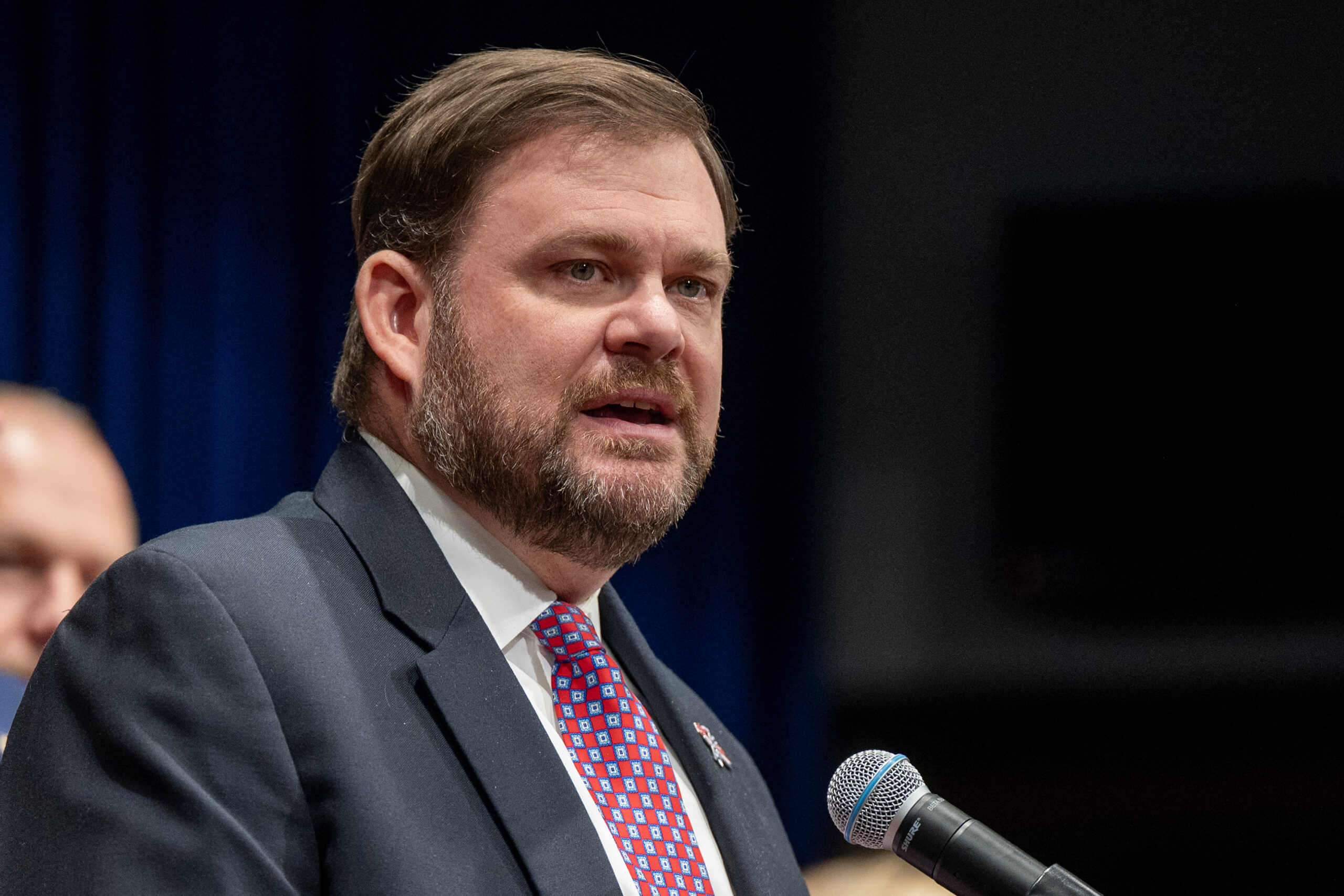
    State Senate Majority Leader Joe Pittman (R., Indiana) during a Feb. 3 news conference at the Capitol in Harrisburg.

    Meanwhile, Bradford, a Democrat, believes the state should focus on the long game in addressing Pennsylvania’s budget shortfall, citing the state’s efforts to recruit new businesses and pass tax cuts to encourage economic growth, as well as Shapiro’s renewed push to create new revenue streams like the taxation and regulation of recreational marijuana and the slot-machine look-alikes know as skill games.

    Pennsylvania’s declining population has “put a lot of stress on our budget books,” Bradford said.

    “The best thing we can do is continue to grow this economy,” Bradford added.
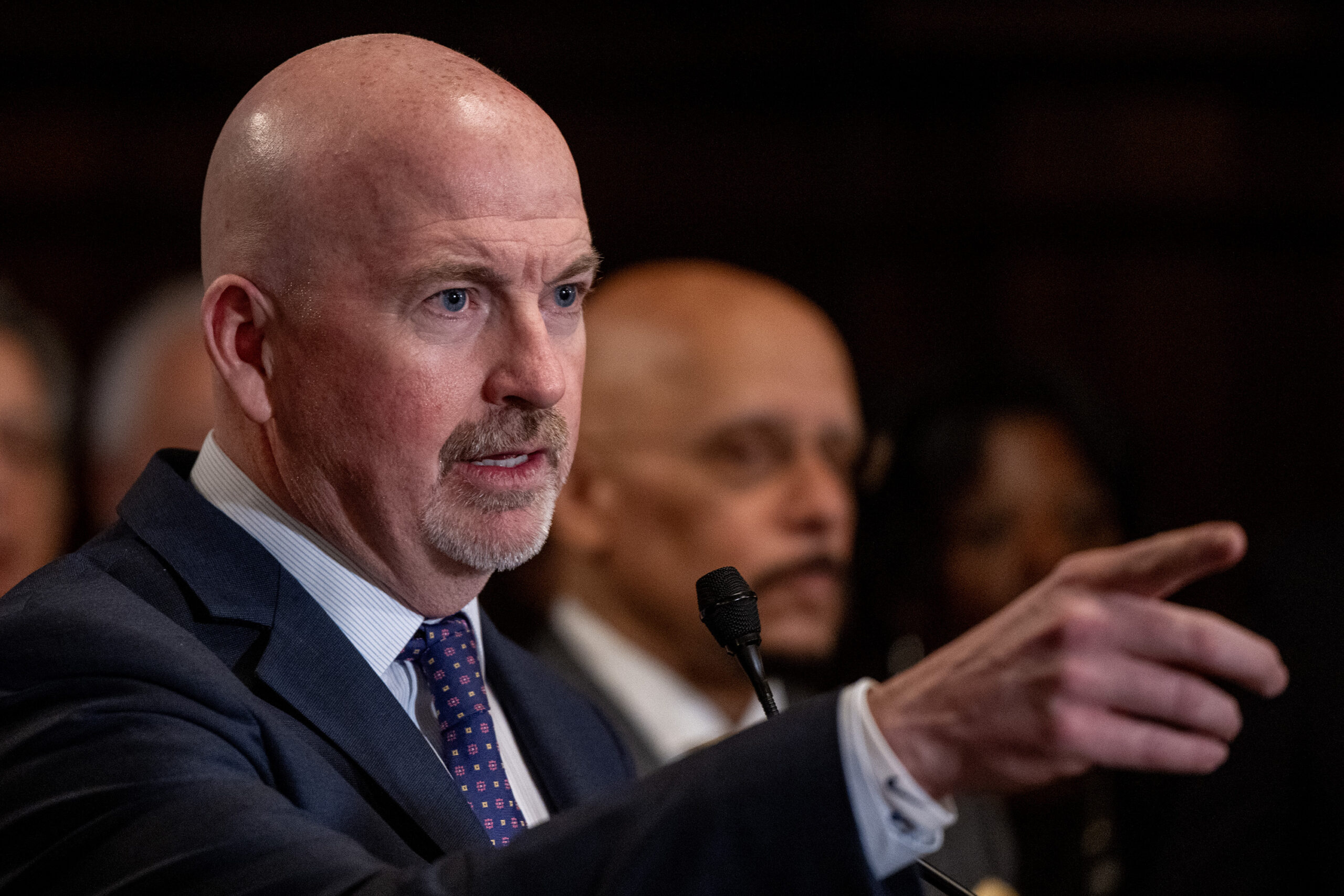
    State Rep. Matt Bradford (D., Montgomery County) during a Feb. 3 news conference at the Capitol in Harrisburg.

    Even without increasing its spending over the 2025-26 fiscal year — an impossible feat due to growing Medicaid obligations — Pennsylvania would still be poised to spend $1.2 billion more than it is expected to bring in next fiscal year.

    To avoid raising taxes this year, leaders will need to raise new revenues and tap into its more than $7 billion in reserves. Republican leaders want to avoid tapping into the state’s Rainy Day Fund until an emergency arises, citing the state’s lackluster revenue projections in future years. However, it’s unclear what government programs or agencies they’d like to cut.

    Just as he did last year to no avail, Shapiro this month again proposed regulating and taxing recreational marijuana and skill games as a way to help fill the state’s budget shortfall. This time, however, his projections on how much revenue could be made has increased dramatically since last year, without changing much of the scope of the proposals.

    For example, last year he pitched a 20% tax on the sale of legal marijuana that he estimated would bring in $535.6 million in its first year. This year, he projected the same idea, but instead projected a marijuana tax would bring in $729.4 million in its initial year — a 36% increase. A Shapiro administration official said earlier this month that the projected increase is due to more interest from marijuana companies that want to do business in Pennsylvania.
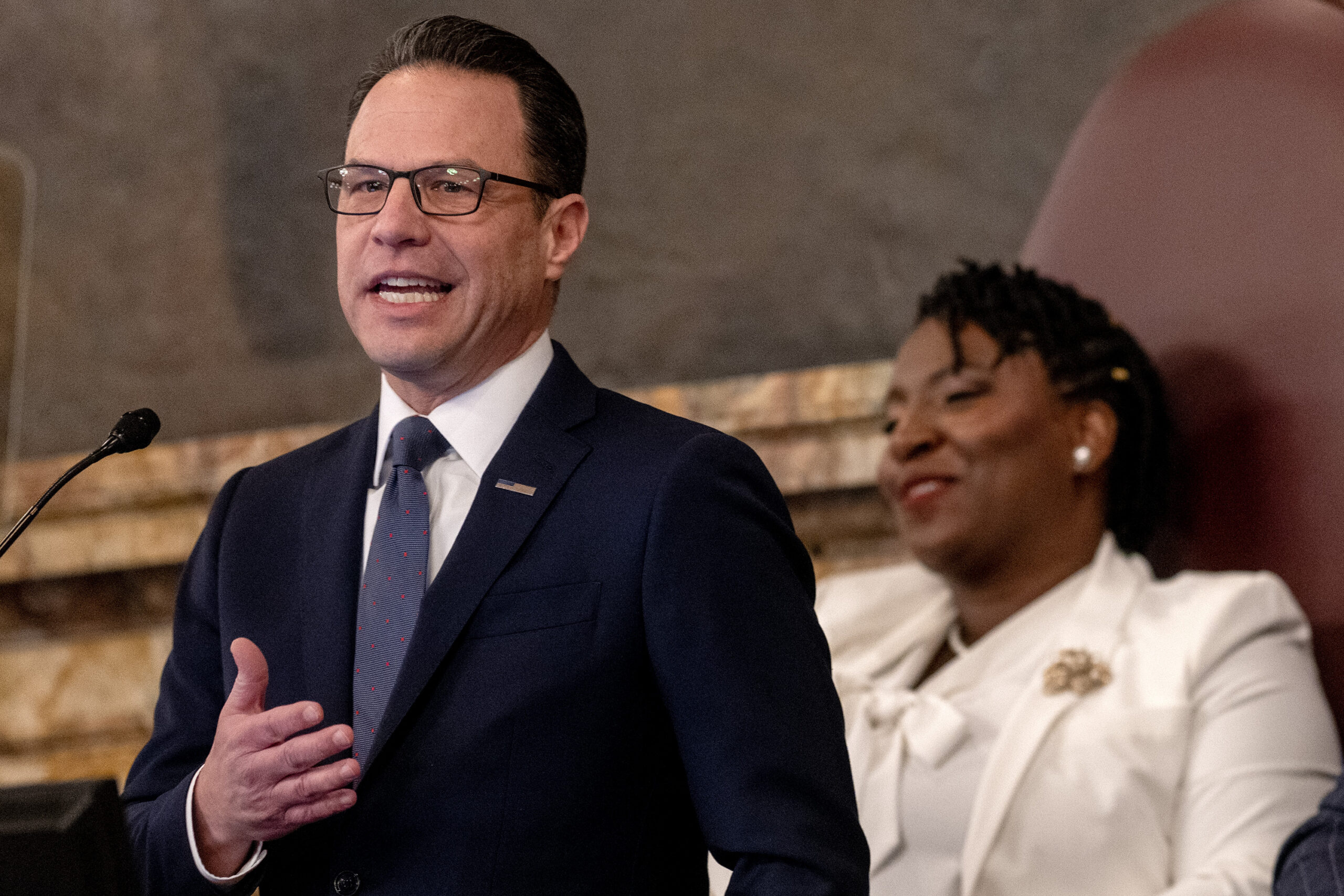
    Gov. Josh Shapiro makes his annual budget proposal in the state House chamber on Feb. 3. House Speaker Joanna McClinton is seated behind him.

    State revenues are $362 million higher than expected so far this fiscal year, according to the IFO, offering some hope that the state may continue to grow its economy to fill some of the budget hole.

    Lapowsky, Shapiro’s spokesperson, said in a statement that Shapiro’s budget pitch shows “that government can be a force for good in people’s lives when leaders come together and put Pennsylvanians first.”

    Election year optimism and a preview of the fights to come

    Legislators on the powerful Senate and House appropriations committees, led by House Appropriations Chair Jordan Harris (D., Philadelphia) and Senate Appropriations Chair Scott Martin (R., Lancaster) will individually begin analyzing Shapiro’s budget proposal line-by-line in public hearings this week. Both committees were scheduled to begin their budget hearings on Monday, but were rescheduled to begin on Tuesday afternoon and Wednesday morning for the Senate and House, respectively, due to a snowstorm that blanketed the Philadelphia area.

    The weekslong series of hearings examine the budget needs for each state government agency and row office, as well as the spending from the previous year. Secretaries and elected officials from each office come before the committee to answer questions about their proposed spending.
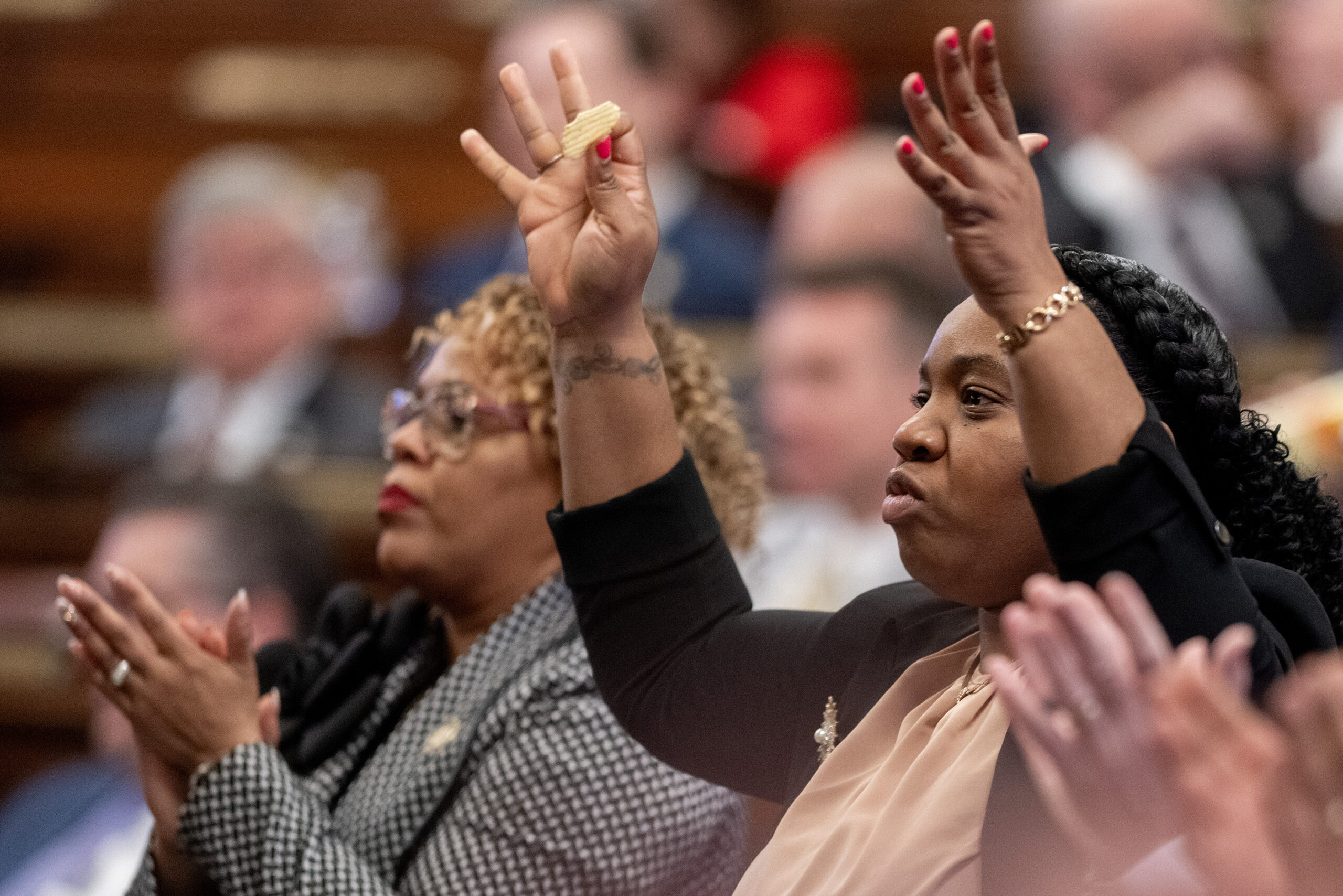
    State Reps. Johanny Cepeda-Freyitz (left), a Berks County Democrat, and Carol Kazeem (D., Delaware) in the state House chamber Feb. 3 during Gov. Josh Shapiro’s annual budget proposal.

    Pittman said Senate Republicans are likely to zero in on Shapiro’s $1 billion proposed bonding initiative for a range of infrastructure projects relating to energy, housing, local governments, and schools that he largely billed as “a major investment in building new housing.” They’ll also likely question why the Department of Corrections is seeking a $150 million funding increase, after the closure of two state prisons last year.

    GOP members of the Senate committee will also likely question top officials in the Pennsylvania State Police and the Department of General Services over spending for security upgrades at Shapiro’s personal residence following an arson attack last year on the governor’s mansion in Harrisburg, and a mail vendor’s failure to deliver a month’s worth of state mail to residents.
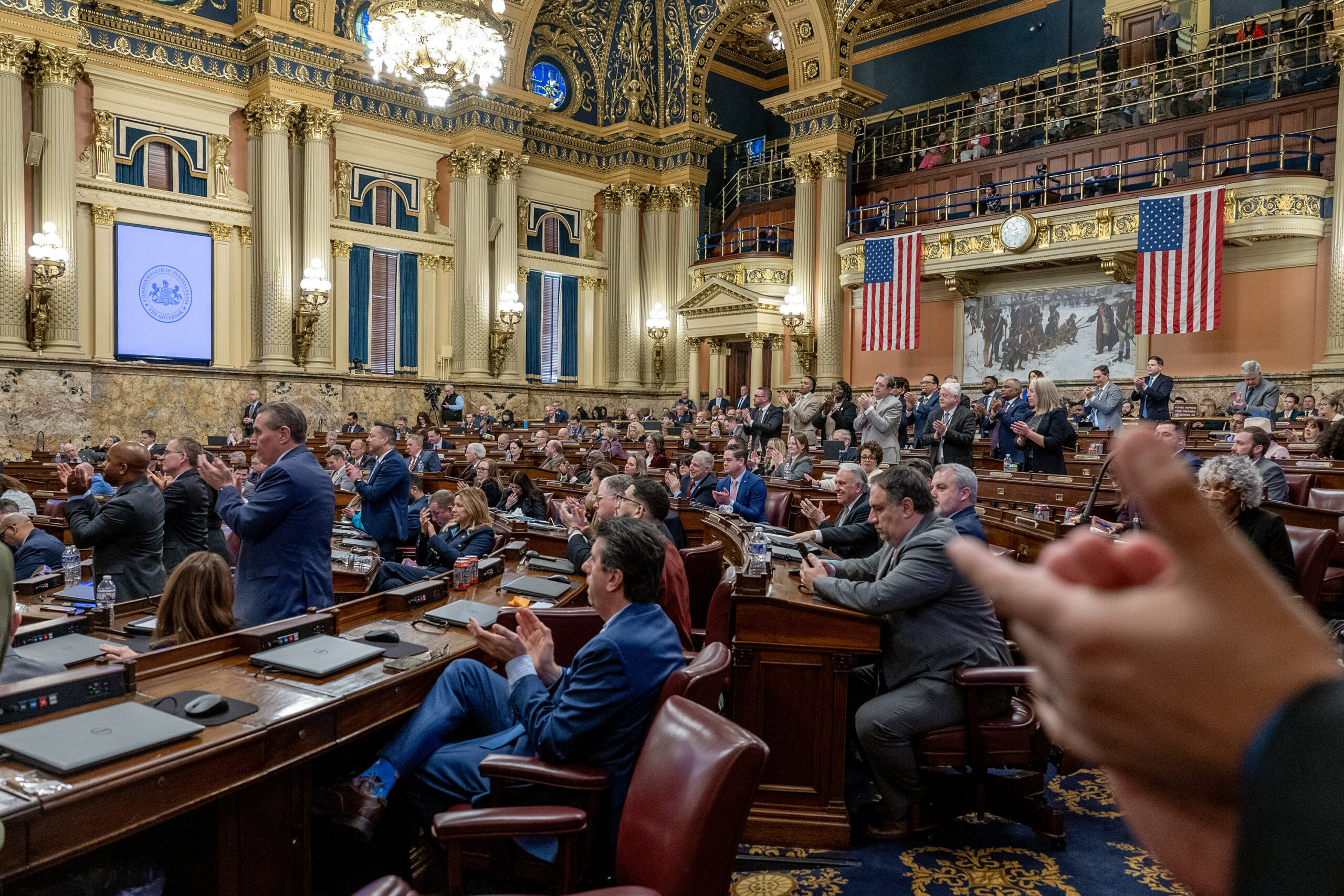
    The state House chamber as Gov. Josh Shapiro makes his annual budget proposal Feb. 3 in Harrisburg.

    House Democrats, meanwhile, are likely to bring attention to the successes of the Working Pennsylvanians Tax Credit and additional increases to public education under the state’s new adequacy formula, Bradford said.

    “We’ve got real accomplishments and a real opportunity to prioritize funding education, affordability, and build on what we’ve done,” Bradford said.

    Unlike the last round of budget negotiations, mass transit funding for SEPTA and other transit agencies is unlikely to be a roadblock this year, as lawmakers have until next year to find a long-term funding solution.

    Despite the inevitable disagreements ahead, there is some cause for optimism heading into another year of Pennsylvania state budget negotiations: Midterm election years often produce much less contentious budget battles, as lawmakers are motivated to reach an agreement and bring home their accomplishments to their districts as they campaign for reelection in November.

    Both Bradford and Pittman expressed hope that the election year may bring an increased willingness among all parties to finish an on-time budget.

    But, “divided government creates all kinds of twists and turns,” Pittman added. “I certainly can’t predict what’s coming ahead here.”


  • Philly schools will remain virtual on Tuesday; other Pa. and N.J. districts are a mixed bag

    Philly schools will remain virtual on Tuesday; other Pa. and N.J. districts are a mixed bag

    School districts around the region made varying calls for how they’re handling classes Tuesday as the region continues to dig out from the massive snowstorm that dumped more than a foot of snow in many places — with some closed altogether, others fully open, and others open, but delayed.

    The Philadelphia School District opted for another day of virtual instruction.

    Superintendent Tony B. Watlington Sr. has said the nation’s eighth-largest school system favors in-person instruction, but places student and staff safety as its highest priority.

    In Upper Darby, Delaware County, Superintendent Dan McGarry made the call to bring students in on time.

    “The district transportation team and facilities team have been working hard all day to clear snow from our facilities for in-person instruction,” McGarry wrote in a message to families and staff. “We have been in communication with the township as well, and I want to thank them for their hard work getting roads clear for school tomorrow.”

    Districts including Council Rock and Pennridge, both in Bucks County, called two hour delays.

    In Montgomery County, Cheltenham and Lower Merion schools both announced a two-hour delay.

    “Buses are expected to arrive at bus stops two hours after their normal pickup times; however, please be patient as snow and ice on some streets may cause additional delays,” Lower Merion spokesperson Amy Buckman said in a message to families Monday evening.

    Cherry Hill and Moorestown, in Camden County, will also hold classes with a two-hour delay.

    Renewed debate over virtual instruction in New Jersey

    And while some Pennsylvania districts pivot to virtual instruction when significant snow falls, that’s not possible in New Jersey, where state law prevents it.

    A handful of New Jersey districts opted for total closures. Lenape Regional, Evesham, and Medford schools, all in Burlington County, cancelled classes altogether.

    Winslow schools in Camden County will remain closed Tuesday for a second consecutive day, said interim Superintendent Mark Pease. The district was shut down for three days during the last storm.

    Pease said the district would use two days from its spring in April to make up the missed days. The break will be cut to three days, he said.

    “If we get another storm, we will be extending the school year,” Pease said. “Let’s hope this is it for the winter.”

    The snow storm renewed calls among some New Jersey educators to the state to allow virtual and hybrid instruction to avoid closing schools due to inclement weather.

    In a social media post, Camden Education Association President Pam Clark said she was asking Gov. Mikie Shirrell to revisit the virtual option for traditional public schools. She used the hashtag “not fair.”

    New Jersey allowed virtual and hybrid instruction when the pandemic shut down schools.

    However, state law now strictly limits remote learning, according to the state Department of Education. Districts must meet a state requirement of 180 days.

    School districts may seek approval for virtual learning for school closures lasting more than three consecutive days because of a declared state of emergency or a declared public health emergency.

    There has been pushback against virtual learning because of concerns about learning loss suffered during the pandemic. There also are concerns that some schools don’t have enough Chromebooks or devices for students to log on.

    Timothy Purnell, executive director of the New Jersey School Boards Association, said districts should have the flexibility to pivot when circumstances warrant such as a snow day.

    Districts have invested in technology and training to successfully implement virtual instruction, he said.

    “Limiting virtual instruction days exclusively to public health emergencies is yesterday’s logic,“ Purnell said in a statement.

  • Coast Guard investigating swastika drawn in men’s bathroom at Cape May facility

    Coast Guard investigating swastika drawn in men’s bathroom at Cape May facility

    The U.S. Coast Guard is investigating an incident in which a swastika was reportedly drawn on a bathroom wall at the Coast Guard’s training center in Cape May.

    “Following discovery of a hate symbol drawn on a bathroom wall in a building at Training Center Cape May, the Coast Guard immediately referred the matter to the Coast Guard Investigative Service for investigation — consistent with longstanding Coast Guard policy. This hate symbol was immediately removed,” a spokesperson for the service branch said in an email Monday.

    The Washington Post first reported on Monday that the hate symbol — which the Coast Guard did not specify —was a hand-drawn swastika that was discovered Thursday evening in the men’s bathroom.

    Adm. Kevin Lunday, the Coast Guard commandant, was informed about the incident on Saturday, the Post reported.

    “The Commandant immediately traveled to Training Center Cape May and held a mandatory All Hands with the nearly 900 recruits and staff to address the incident directly, reinforce the Coast Guard’s strong standards and policies, and reaffirm the Service’s dedication to accountability through our core values,” the Coast Guard spokesperson said.

    In a statement, Lunday declared: “Anyone who adheres to or advances hate or extremist ideology — get out. Leave. You don’t belong in the United States Coast Guard and we reject you.”

    Lunday added: “We will not allow anyone to put a stain of hate on our United States Coast Guard. We will not be defined by the cowardly acts, but instead be defined by our unwavering response and our resolve to defeat them.”

    The spokesperson said that the Coast Guard is “committed to maintaining a workplace that is safe, professional, and respectful for every member of our workforce. Any behavior that undermines these standards will be addressed swiftly and seriously.”

    Late last year, the Post reported that the Coast Guard had planned to downgrade swastikas and nooses in its workplace harassment manual as being “potentially divisive” rather than hate symbols.

    In December, Lunday announced that the revisions were “completely removed” from the policy manual and that swastikas and nooses would still be considered overt hate symbols, the Post reported.

  • Former ICE instructor says agency has slashed training for new officers

    Former ICE instructor says agency has slashed training for new officers

    A former instructor for U.S. Immigration and Customs Enforcement on Monday accused the agency of dramatically slashing training standards for new officers and lying to Congress about it as the Trump administration seeks to rapidly expand its mass deportation operation.

    Ryan Schwank, who resigned from his job at an ICE academy in Georgia last week, told congressional Democrats at a hearing that the agency eliminated 240 hours of “vital classes” from a mandatory 580-hour training program, including instruction about the legal boundaries for the use of force, how to safely handle firearms, and the proper way to detain and arrest immigrants.

    “Law enforcement is a deadly serious biz. It is not a place for shortcuts,” Schwank said. “Deficient training can and will get people killed. … ICE is lying to Congress and the American people about the steps it is taking to ensure that 12,000 officers can faithfully uphold the Constitution and perform their jobs.”

    Ahead of the hearing, Schwank provided a joint panel of House and Senate Democrats copies of internal ICE documents that he said shows the extent of the cuts.

    Schwank’s testimony comes two weeks after acting ICE director Todd M. Lyons testified in front of separate House and Senate committees amid growing public outrage over the aggressive tactics of ICE and other federal immigration officers. Two U.S. citizens were fatally shot by federal officers in Minneapolis last month.

    During his testimony in the House on Feb. 10, Lyons responded to questions about the agency’s training program by saying it has not reduced the “meat of the training” but has sought to reduce the time it takes to get officers into the field. He said training used to take place five days a week for eight hours a day but has been changed to six days a week for 12 hours per day.

    In a statement Monday, the Department of Homeland Security said ICE recruits receive 56 days of training before beginning their assignments, along with an average of 28 additional days of “on-the-job-training.” DHS said recruits are receiving the same total hours of training as they always have.

    “No training hours have been cut. Our officers receive extensive firearm training, are taught de-escalation tactics, and receive Fourth and Fifth Amendment comprehensive instruction,” said Lauren Bis, a spokesperson for the department.

    Schwank said that among the classes eliminated were 16 hours of firearms training. He also said that a two-hour class on the rights of protesters was shortened into 10 minutes of discussion during a lecture on “the concept of seizure.”

    Schwank was separately asked to review an internal memo, signed by Lyons, that said ICE officers are authorized to use administrative warrants, approved by senior ICE officials, to enter private residences. That marked a shift from the federal government’s long-standing position that officers must obtain judicial warrants signed by federal judges.

    Schwank said he was instructed to train the recruits on the policy but was told he could not talk about the information publicly or even take notes after reading the memo. The Washington Post and other news outlets reported on the memo last month.

    “ICE is teaching cadets to violate the Constitution and attempting to cloak it in secrecy by demanding I lie about it,” he said.

  • The detective who helped advise ‘Mare of Easttown’ is suing Chester County over discrimination

    The detective who helped advise ‘Mare of Easttown’ is suing Chester County over discrimination

    A former Chester County detective — who served as a technical adviser for the HBO crime drama Mare of Easttown — is suing her former employer and supervisor in federal court over alleged sex discrimination.

    Christine Bleiler, who became Kate Winslet’s “go-to person” on developing her Emmy-winning performance as titular character Mare Sheehan, says she was subjected to a “prolonged pattern of hostile, discriminatory, and demeaning treatment based on her sex,” according to a complaint filed this month in the Eastern District of Pennsylvania.

    And though an internal investigation “corroborated” that she was being harassed, according to the suit, the county failed to remedy the harassment to which she was subjected.

    In addition to Chester County, the lawsuit names as a defendant Thomas Goggin, who was Bleiler’s supervisor from 2021 to 2023. Bleiler resigned in September.

    A spokesperson for the county declined to comment on ongoing litigation. An attorney for Goggin, who now serves as police chief in West Pikeland Township, did not immediately respond to a message seeking comment.

    Bleiler, who worked as a police officer for nearly a dozen years in Oxford Borough before beginning as a Chester County detective in 2015, began working under Goggin in February 2021. He accused her of talking too much, yelled at her repeatedly over how she handled suspects or on differences in opinion, demeaned and condescended to her, and told her “she ‘better not’ tell anyone that he was a problem,” according to the complaint.

    In August 2023, Bleiler brought the complaints to the detective division’s leadership, prompting an internal investigation that ultimately corroborated her claims, the suit says. Goggin was suspended for two weeks and was demoted, according to the complaint.

    Bleiler was worried about working near Goggin once he returned from his suspension, the suit says, fearing that he might retaliate. She was instructed by the department’s leadership to “bury her head in her work” and “move on from this.” Though she began reporting to a new supervisor, working in proximity to Goggin “caused her significant discomfort, anxiety and distress over potential retaliation and continued harassment,” the complaint says.

    Bleiler is asking a judge to declare that the county and Goggin’s actions violated federal and state antidiscrimination laws. It asks the court to grant her compensation for past and future lost earnings, earning capacity, and benefits, which the complaint argues Bleiler lost due to the “discriminatory and retaliatory conduct.”

    “The conduct of defendants, as set forth above, was severe or pervasive enough to make a reasonable person believe that the conditions of employment had been altered and that the working environment was hostile or abusive, and in fact made plaintiff believe that her working environment was hostile and abusive because of her sex and her complaint of sex discrimination,” the complaint states.

    While a detective for the county, in 2019 Bleiler served as a technical adviser for HBO’s Mare of Easttown, taking phone calls from Winslet morning and night to discuss upcoming scenes or to answer questions. At one point, Winslet visited her at the Justice Center in West Chester.

    “She insisted,” Bleiler told The Inquirer in 2021. “I told my lieutenant at that time, he couldn’t believe it. He said, ‘All right, she’s your responsibility. Get her in and get her out, keep it quiet.’”

  • Armed man shot and killed at Mar-a-Lago was never interested in politics or guns, cousin says

    Armed man shot and killed at Mar-a-Lago was never interested in politics or guns, cousin says

    CAMERON, N.C. — The 21-year-old North Carolina man who entered a gate at President Donald Trump’s Mar-a-Lago resort with a shotgun before he was shot and killed worked as a golf course groundskeeper and liked to sketch.

    Austin Tucker Martin rarely, if ever, talked about politics, seemed afraid of guns, and came from a family of Trump supporters, according to Braeden Fields, a cousin who said the two grew up together.

    “I wouldn’t believe he would do something like this. It’s mind-blowing,” Fields said. “He wouldn’t even hurt an ant. He doesn’t even know how to use a gun.”

    Martin walked up to the secure perimeter at Mar-a-Lago early Sunday and went through a gate when it opened for employees to leave, a U.S. Secret Service spokesperson said Monday. Martin dropped a gas can and raised a shotgun at two Secret Service agents and a Palm Beach County sheriff’s deputy, who then opened fire “to neutralize the threat,” said Sheriff Ric Bradshaw.

    Trump, who often spends weekends at the Palm Beach, Fla., resort, was at the White House at the time.

    Investigators have not identified a motive. Trump faced two assassination attempts during the 2024 campaign, including one just a few miles from Mar-a-Lago when a man was spotted aiming a rifle through shrubbery while Trump was golfing.

    Following Sunday’s incident, Secret Service spokesperson Anthony Guglielmi said investigators believe Martin bought his shotgun while driving to Florida. Authorities said his family had recently reported him missing.

    Martin was from central North Carolina, where guns and hunting are a part of life, his cousin said. But whenever they’d go hunting or target shooting, Martin would never pick up a gun, Fields told the Associated Press on Sunday.

    He lived with his mother in a modest modular house down a rutted sandy road near the town of Cameron. No one answered the door Monday, and the large police presence from the day before was gone.

    Martin’s sister was just 21 when she was killed in a car accident in 2023, and he has an older brother who’s in the military, Fields said.

    For the past three years, Martin worked as a groundskeeper at Pine Needles Lodge & Golf Club.

    “It’s tragic. I feel for his family,” said Kelly Miller, president of the course in nearby Southern Pines. “It’s just unfortunate what transpired. It was totally unexpected.”

    Martin last year started a business to sell pen drawings he made, according to state records. A website matching the company name features illustrations of golf courses, buildings, and ancient Roman architecture.

    Politics didn’t seem to be among his interests, his cousin said

    “We are big Trump supporters, all of us. Everybody,” Fields said, but his cousin was “real quiet, never really talked about anything.”

  • ‘Don’t take the easy way out.’ A.J. Brown’s plea to struggling NFL players reveals compassion, maturity.

    ‘Don’t take the easy way out.’ A.J. Brown’s plea to struggling NFL players reveals compassion, maturity.

    In the wake of the untimely deaths of three young players, A.J. Brown on Monday posted a 9-minute, 8-second testimonial on Instagram encouraging NFL athletes struggling with mental health issues to seek counseling and God rather than taking their own lives. It was poignant and it was beautiful.

    It was a revealing glimpse into how Brown deals with his own demons. It also was an example of how the exceptional culture in the Eagles’ locker room emboldens this sort of leadership in the most important of ways.

    “Don’t take the easy way out,” Brown said. “I once thought that was the way. I was 23 years old and I thought the same thing.”

    Brown spoke two days after Vikings receiver Rondale Moore, 25, was found in his garage dead of a suspected self-inflicted gunshot wound. Moore had seen his last two NFL seasons ruined by preseason injuries. It was the third such incident in just 10 months.

    In November, Cowboys defensive end Marshawn Kneeland, 24, also was suspected of taking his own life with a gun after a high-speed chase and crash.

    Similarly, in April, LSU receiver and NFL prospect Kyren Lacy, also 24, shot and killed himself after a high-speed chase two days before his criminal trial in an unrelated incident.

    Tragedy upon tragedy upon tragedy compelled Brown to speak out.

    “Don’t end it like that, bro,” he begged. “Don’t end it like that.”

    Advocacy

    This wasn’t the first time Brown has spoken about his own struggles, but it is the most intense and impassioned message he has delivered.

    He recorded Monday’s message on his phone while sitting in his parked car. Most of it centered on Brown’s reliance on his Christian faith, but Brown also stressed the role that counseling performs in people whose worlds seem to be closing in.

    “Go talk to [God], first and foremost, before you even go talk to a therapist. But go talk to a therapist,” Brown said. “Reach out to your loved ones. Go talk to somebody, bro. Get it off your chest. You’re not too tough to talk to someone.”

    Much has been made of Brown’s unconventional behavior in his four seasons with the Eagles. He often has been publicly critical of the Eagles offense both in media availabilities and on social media. He has sparred with head coach Nick Sirianni during games. He continually hints in public that he would like to be traded, and a report last month said he submitted a trade request three times during the 2025 season. Brown also has boycotted the media twice in the last two seasons.

    Suicide is suspected in the death of Vikings wide receiver Rondale Moore on Saturday.

    Among the reasons the Eagles are patient with Brown, and among the reasons the media squawks so little about his boycotts, are Brown’s mental health struggles. He is afforded a larger measure of grace from teammates, coaches, administrators, and the press than athletes who struggle less.

    This grace begins with Sirianni, whose inclusive, empathetic management style built on the foundation laid by Doug Pederson. One of the reasons Eagles owner Jeffrey Lurie hired Pederson in 2016 was Pederson’s “emotional intelligence,” which created an environment of understanding and acceptance unmatched by any locker room in the NFL. This environment, Lurie says, helped the Eagles reach three Super Bowls and win two.

    Evidence?

    In 2017, Pederson’s second season, Eagles guard Brandon Brooks opened up about treating his debilitating anxieties with therapy and medication, taboo subjects in the world’s most testosterone-charged league. The Eagles won their first Super Bowl after that season.

    In 2021, Sirianni’s first season, Eagles right tackle Lane Johnson, who’d helped Brooks deal with his issues, missed three games dealing with his own mental health issues. The Eagles went to the Super Bowl after the 2022 season and won it after the 2024 season.

    Johnson was, by far, the team’s best player in that span.

    Brown was not far behind. That’s because, in part, the Eagles accepted him for him.

    For instance, When Brown was caught on camera reading a self-help book on the sideline during a playoff game after the 2024 season, Sirianni told a local radio station, “Some guys pray in between, some guys meditate in between. A.J. reads in between.”

    Sirianni also said, “A.J. Brown, is a great, great, great person.”

    That’s generally the consensus in the Eagles’ organization: Brown might be a diva, and he occasionally might be insubordinate, but his heart is always in the right place.

    That was never more evident than in Monday’s post.

    His own experience

    The mission statement of the A.J. Brown Foundation reads, in part, “Our vision is to cultivate a generation of resilient and confident young individuals.”

    “I take pride in my mental health,” Brown said Monday. “Something I practice each and every day.”

    Brown then offered what might be a glimpse into his own struggle and the methods he uses to cope.

    “Stay in that fight,” Brown said. “Be strong. Do whatever you need to do. Get on your phone. Record videos of yourself talking to yourself. Say affirmations around the crib. Sticky notes. … Talk in third-person to yourself.”

    Don’t worry about it if people think you’re strange:

    “Let them call you crazy.”

    With so many voices eager for attention, and with so much non-credible disparagement targeted at you, just accept your failures and ignore the critics as best you can:

    “I want you to understand, in the NFL community, things aren’t always going to go your way. You may not get everything that you desire. Sometimes this game is not friendly. People are going to say nasty things about you. Call you this call you that. …

    “But none of those things, in that moment, define you. You just have to understand that this is just a short moment in your life that’s just going to go, just like that,” he said, and snapped his fingers to illustrate.

    Eagles wide receiver A.J. Brown celebrating a first-down catch against the Commanders on Dec. 20.

    Frustration is constant; satisfaction, unattainable:

    “I understand what it feels like when you’re trying to take care of your family. None of that stuff is fulfilling. The only thing that’s fulfilling in this world is our Lord and savior, Jesus Christ.”

    Even now, Brown clearly struggles with issues. He said he focuses on his family, especially his two young children, when the darkness begins to descend, and looks within.

    “Nobody cares about you, bro. Especially as a man. You have to do what makes you happy,” Brown said. “I don’t care what they call you. I don’t care whatever … whatever you think you failed at. … Whenever you have a negative thought, say 10 positive things about yourself.”

    Just hold on, get help, and have faith in something.

    God. Yourself. Anything.

    “That sun is gonna shine,” Brown said. “It ain’t gonna stay rainy forever, bro.”

  • Andrew Painter is ready, three years later than he expected. And maybe that’s a ‘blessing in disguise.’

    Andrew Painter is ready, three years later than he expected. And maybe that’s a ‘blessing in disguise.’

    CLEARWATER, Fla. — Before he reported to his first major league spring training camp in 2023, Andrew Painter met with his agent.

    “Ideally,” Scott Boras said, “I would love it if you didn’t throw your first pitch in the big leagues until you’re 22.”

    Sure thing, Painter thought. One problem: He was 19, and the Phillies were dangling a spot in the season-opening starting rotation.

    “I remember looking at him like, ‘All right, what do you want me to do?’” Painter recalled Monday. “I was 19, I’m coming in, hoping to break in, so I’m sitting there like, ‘You want me to put some weight on? What do you want me to do?’”

    Three years later, Painter finds the whole thing to be oddly prophetic. Because if, as expected, the 6-foot-7 righty breaks camp with the Phillies, he will be 22 — a few days shy of his 23rd birthday on April 10 — when he makes his major league debut.

    Just as Boras hoped, albeit for much different reasons.

    Boras’s concern in 2023 stemmed from a belief, rooted in his experience with other clients, that most pitchers don’t physically mature until their early 20s. To prove his point, he rattles off a list of pitchers who debuted at 19 or 20 and flamed out by 29 or 30.

    Phillies pitcher Andrew Painter is two years removed from Tommy John elbow surgery.

    Fernando Valenzuela. Bret Saberhagen. Steve Avery. Kerry Wood. Félix Hernández. Madison Bumgarner.

    But after being crowned by Baseball America as the sport’s best minor league pitcher in 2022, with a chance to be the first teenager to start a game for the Phillies since Mark Davis in 1980, Painter put his foot on the gas in the spring of 2023. In his first Grapefruit League start, he touched 99 mph in the first inning against then-Twins star Carlos Correa and uncorked a cutter that he’d only recently started throwing.

    And he tore a ligament in his right elbow.

    You know the rest. Doctors recommended rest and rehab, but Painter couldn’t avoid surgery. He didn’t pitch competitively for two seasons. Upon returning last year — amid expectations that he might reach the majors by “July-ish,” as Dave Dombrowski outlined — he struggled with wayward fastball command and didn’t get out of triple A.

    So here he was Monday, a fully formed 22-year-old pitcher with his top-prospect shine only slightly dulled, facing the meat of the Phillies’ order — Kyle Schwarber, J.T. Realmuto, Bryson Stott, Bryce Harper, Alec Bohm, and Brandon Marsh — in live batting practice in preparation for his first Grapefruit League start later in the week or this weekend.

    “Overall I thought his stuff was really good,” Schwarber said. “I thought the fastball had some life. Definitely had its good profile that it should have. The thing that’s going to really help him out is having his fastball and knowing where he’s going to put it. Right?”

    Did anything look different from three springs ago, before the elbow injury, when Schwarber memorably took Painter deep in the direction of U.S. 19 traffic beyond the right-field fence on a back field at the Carpenter Complex?

    “It’s a good question,” Schwarber said. “He’s getting a feel for things and making adjustments with his arm angle. I think you’re going to see a really good version of him.”

    Painter’s arm angle dropped throughout last season. Maybe it was the toll of pitching 118 innings after a two-year absence. Maybe it was something else. He said he wasn’t overly aware of it. Besides, his focus was getting through the season healthy.

    But the Phillies believe the lower arm slot affected his ability to spot his fastball consistently. And triple-A hitters teed off, batting .329 and slugging .585 against Painter’s four-seamer.

    “In the season it’s kind of hard to keep up with that stuff, and you don’t want to mess with it in season,” Painter said. “It’s something you kind of just go back and look and you’re aware of it, but you really dial it in in the offseason.”

    When Painter went home to South Florida and resumed his offseason training at Cressey Sports Performance, he set out to raise his arm slot again. The first few weeks of spring training have been reinforcing those habits.

    Painter has made other tweaks, including the grip on his changeup. He developed blisters early last season in triple A and wasn’t able to throw the changeup as often as he wanted. It’s probably his best offspeed pitch. He also throws a hard slider, sweeper, and curveball.

    “The changeup is a big thing,” Painter said. “The changeup was really good for me last year. Kind of bringing back the sweeper. Last year I was searching for a sweeper, and that was where the arm started to drop. So, I’m getting back to the one I threw pre-TJ [Tommy John surgery].

    “Just being able to come in here and do my thing, without having to worry about pitch count or anything like that, just going out there and pitch, it’s nice.”

    Pitchers often say everything is crisper and sharper in the second year after Tommy John surgery. The Phillies are hoping that will be the case for Painter.

    Phillies pitcher Andrew Painter finishes warming up with a football during a spring training workout in Clearwater, Fla.

    But maybe Painter will benefit from finally graduating to the majors. Because team officials were salivating three years ago over the possibility that he would crack the rotation and thought for sure he would pitch in the majors last year.

    The opportunity exists for him now while Zack Wheeler is coming back from a complicated surgery to relieve pressure on a vein that was compressed between his collarbone and rib cage. The Phillies want Painter to earn a spot, but they won’t have anyone else to fall in line behind Cristopher Sánchez, Jesús Luzardo, Aaron Nola, and Taijuan Walker.

    Painter’s time is now. At last. At age 22, just as Boras hoped.

    “I didn’t know what to make of it at the time,” Painter said. “It was weird. But guys when they’re 19, you go out there, it’s almost like your body’s not ready. It can’t handle that load. So, yeah, I do think maybe this was all kind of a blessing in disguise.”

    Extra bases

    Orion Kerkering, slowed by a strained right hamstring, is targeting the end of the week to throw a bullpen session. … The Phillies will face the Marlins at 1:10 p.m. Tuesday in Jupiter, Fla., before returning to Clearwater on Wednesday to face the Tigers.

  • Biden, aides project optimism in cancer fight, but some close friends worry

    Biden, aides project optimism in cancer fight, but some close friends worry

    Longtime friends and allies of Joe Biden say they are worried about the toll an aggressive form of prostate cancer is taking on the former president and his health. But Biden and his aides say he is doing well, making progress on ongoing projects, and maintaining public appearances.

    Biden has been encouraged as he has gone through treatment and aides said the former president is doing as well as they could hope nearly a year after he announced his metastatic prostate cancer diagnosis. He is continuing to work on his memoir and build out his foundation and presidential library, attending board dinners and meetings. He was spotted last week on an Amtrak train from Washington to Delaware, where he took pictures with passengers.

    Biden’s public engagements since leaving office last January have been fairly limited. He attended Tatiana Schlossberg’s funeral in January, traveled with his family to St. Croix during the holidays, and has been seen on flights, planes, at Mass, and at restaurants. He is expected to visit South Carolina this month and deliver remarks at an event to mark the sixth anniversary of his victory in that state’s primary, which set the stage for his 2020 presidential win.

    Four people close to Biden who have spoken with him in recent months, who spoke on the condition of anonymity to discuss sensitive details, said there have been no updates from the president on his condition. But the people, including two former Biden officials and an elected Democrat, said he has at times appeared more fatigued in private interactions over the past several weeks, a source of worry that they have attributed to the strain of cancer and its treatment.

    A fifth person said Biden is staying active and engaged, and remains “encouraged and positive about his prognosis given his positive response to treatment.”

    Biden’s personal office declined to comment for this story.

    Biden, 83, announced last May that he was diagnosed with Stage 4 prostate cancer that had metastasized to the bone. The cancer is characterized by a Gleason score of 9, meaning it is an aggressive cancer that is more likely to spread quickly. (The scale ranges from 6 to 10.) At the time, Biden’s office said the cancer was responding to hormone therapy, “which allows for effective management.”

    Biden rang the ceremonial bell at Penn Medicine Radiation Oncology in Philadelphia on Oct. 20 after completing a course of radiation therapy. He also underwent surgery in September to remove skin cancer lesions on his head.

    Medical experts said metastatic prostate cancer is incurable — and most commonly spreads to the bones, as it has for Biden — though an array of advancements in recent years has made it possible to manage it effectively. That means patients can live with the cancer for years and end up dying of something else entirely, said Judd Moul, professor of urology at the Duke Cancer Institute at Duke University.

    Without knowing additional details about Biden’s health and treatment, experts said his prognosis could vary widely. Biden’s office has not shared additional details that would indicate the degree to which the cancer has spread or how Biden responded to radiation last year. Oncologists said some men with advanced prostate cancer can live many years with effective treatment while others deteriorate rapidly.

    The elements of Biden’s diagnosis that are publicly known — including his Gleason score and the fact that the cancer was Stage 4 and had already spread at the time of diagnosis — indicate he is facing a serious and advanced form of the disease, one that typically requires ongoing treatment and close monitoring.

    “Bone metastasis is the most common place prostate cancer spreads, but the degree is important and how it’s found,” Moul said. “The degree of spread or amount of spread is just as important as the fact there’s spread.”

    Moul added: “There are a lot of men with advanced prostate cancer who can live many, many years. It’s unfair to all of our patients to paint a pessimistic picture for everyone because there are a lot of patients, even with metastatic cancer, who die of something else.”

    The five-year survival rate for metastatic prostate cancer is 34% to 38%, according to the American Cancer Society, which notes that advancements in treatments have significantly improved outcomes.

    It is also common for metastatic prostate cancer to spread to the spine, said Gerald Denis, Shipley prostate cancer research professor at Boston University Chobanian & Avedisian School of Medicine. Doctors especially want to avoid a weakening of the bones, Denis said, noting that such weakening in the spine can lead to fractures. He said there are “highly effective end of life medications to reduce pain.”

    “If the spine has been degraded by the tumor metastasis, it’s entirely possible to break your back simply by getting out of bed the wrong way,” Denis said, noting he does not know any of the specifics of Biden’s case. “This is a very painful and difficult stage of the terminal illness. … I am very sad for him and his family.”

    Biden’s cancer diagnosis has raised uncomfortable questions for Democrats, who for months were embroiled in a debate over whether Biden’s decision to seek reelection paved the way for Trump’s return to office. Most have been loath to relitigate that controversy in recent months, focused instead on winning control of the House in this year’s midterms and picking up Senate seats.

    Biden’s diagnosis has forced the party to privately grapple with what would have happened had he served a second term and then received his diagnosis just months in. That in part has fueled a broader discussion about when Democratic leaders and lawmakers should step aside, a debate that is playing out in some key primary races and some older lawmakers’ decisions to seek another term.

    Several allies of the former president said they are saddened at the way Biden’s post-presidency has unfolded. Trump has attacked him relentlessly, fellow Democrats have not wanted to defend him because of lingering anger and resentment over the 2024 election, and he has been battling an aggressive form of cancer.

    Biden has faced a post-presidency with little modern precedent. He is the oldest president to leave office, giving him limited time to shape his legacy outside of his four-year term. And Trump — who has faced similar questions about his age, physical health, and mental acuity — has remained fixated on his predecessor since returning to office last year, insulting him almost daily and repeating the false claim that he won the 2020 election.

    “I think Joe Biden is the worst thing that ever happened to old people,” Trump said in an interview with the New York Times last month.

    Barbara Perry, a presidential scholar at the University of Virginia’s Miller Center, said presidents who leave office on negative terms — whether they lost reelection or were unpopular — are often able to rehabilitate their image in their post-presidential years.

    Jimmy Carter, another one-term Democrat who some referred to as a “failed president,” is often held up as the person with the most successful post-presidency. But while Carter’s work on housing and global poverty helped enhance his reputation, it did not alter perceptions among many about his time in office. Carter spent nearly two years in hospice after battling metastatic melanoma.

    “We don’t know how long President Biden will have to correct for the ways things ended, which by all accounts was not a positive for him,” Perry said. “The other element of this in political and historical terms is what’s happening to him now raises questions about what was happening to him in the White House with his health.”

  • Police in Britain arrest former ambassador Mandelson in probe into Epstein ties

    Police in Britain arrest former ambassador Mandelson in probe into Epstein ties

    LONDON — British police on Monday arrested Peter Mandelson, a former U.K. ambassador to the United States, in a misconduct probe stemming from his ties to the late Jeffrey Epstein. It came days after a friendship with Epstein landed the former Prince Andrew in police custody.

    Both men are suspected of improperly passing U.K. government information to the disgraced U.S. financier, and the high-profile British arrests are some of the most dramatic fallout from the trove of more than 3 million pages of Epstein-related documents released last month by the U.S. Justice Department.

    London’s Metropolitan Police force said “officers have arrested a 72-year-old man on suspicion of misconduct in public office” at an address in north London. He was taken to a police station for questioning.

    The man was not named, in keeping with British police practice, but the suspect in the case previously was identified as the former diplomat, who is 72. Mandelson was filmed being led from his London home to a car by plainclothes officers on Monday afternoon.

    Under U.K. law, police can hold a suspect without charge for up to 24 hours. This can be extended to a maximum of 96 hours. Mandelson could be charged, released unconditionally, or released while investigations continue.

    Claims of leaked government information

    Police are investigating Mandelson over claims he passed sensitive government information to Epstein a decade and a half ago. He does not face allegations of sexual misconduct.

    His arrest came four days after Andrew Mountbatten-Windsor, the former Prince Andrew, was arrested in a separate case on suspicion of a similar offense related to his friendship with Epstein. Andrew was released after 11 hours in custody while the police investigation continues.

    Mandelson served in senior government roles under previous Labour governments and was U.K. ambassador to Washington until Prime Minister Keir Starmer fired him in September after emails were published showing that he maintained a friendship with Epstein after the financier’s 2008 conviction for sex offenses involving a minor.

    The files released in January contained more explosive revelations about Mandelson’s ties to Epstein, whom he once called “my best pal.”

    Messages suggest that Mandelson passed on sensitive — and potentially market-moving — government information to Epstein in 2009, when Mandelson was a senior minister in the British government. That includes an internal government report discussing ways the U.K. could raise money after the 2008 global financial crisis, including by selling off government assets. Mandelson also appears to have told Epstein he would lobby other members of the government to reduce a tax on bankers’ bonuses.

    British police launched a criminal probe earlier this month and searched Mandelson’s two houses in London and western England.

    The decision to appoint Mandelson nearly cost Starmer his job earlier this month, as questions swirled around his judgment about someone who has flirted with controversy during a decades-long political career.

    Though he acknowledged he made a mistake and apologized to victims of Epstein, Starmer’s position remains precarious. His future may rest on the release of files connected to Mandelson’s appointment. The government has pledged to begin releasing those documents in early March, though the timeline may be complicated by his arrest.

    Mandelson a contentious figure

    Mandelson has been a major, if contentious, figure in the center-left Labour Party for decades. He is a skilled — critics say ruthless — political operator whose mastery of political intrigue earned him the nickname “Prince of Darkness.”

    The grandson of former Labour Cabinet minister Herbert Morrison, he was an architect of the party’s return to power in 1997 as centrist, modernizing “New Labour” under Prime Minister Tony Blair.

    Mandelson served in senior government posts under Blair between 1997 and 2001, and under Prime Minister Gordon Brown from 2008 to 2010. In between, he was the European Union’s trade commissioner. Brown has been particularly angered by the revelations and has been helping police with their inquiries.

    Mandelson twice had to resign from government during the Blair administration over allegations of financial or ethical impropriety, acknowledging mistakes but denying wrongdoing.

    He later returned to government and was back on the political front line when Starmer named him ambassador to Washington at the start of U.S. President Donald Trump’s second term. Mandelson’s trade expertise and comfort around the ultra-rich were considered major assets. He helped secure a trade deal in May that spared Britain some of the tariffs Trump has imposed on countries around the world.

    The status of the deal is now up in the air after Trump announced a new set of global tariffs in the wake of a U.S. Supreme Court decision quashing his previous import tax order.

    Earlier this month Mandelson resigned from the House of Lords, Parliament’s upper chamber, to which he was appointed for life in 2008. But he still has the title — Lord Mandelson — that went with it.