Blog

  • Death toll in Spanish train collision rises to 40 as authorities fear more bodies could be found

    Death toll in Spanish train collision rises to 40 as authorities fear more bodies could be found

    ADAMUZ, Spain — Regional Spanish officials said Monday that at least 40 people are confirmed dead in a high-speed rail collision the previous night in the country’s south when the tail end of a train jumped the track, causing another train speeding past in the opposite direction to derail.

    Juanma Moreno, the president of Andalusia, the southern Spanish region where the accident happened, confirmed the new death toll in an afternoon press conference. Efforts to recover the bodies from the two wrecked train cars continued, he added.

    The impact tossed the second train’s lead carriages off the track, sending them plummeting down a 4-meter (13-foot) slope. Some bodies were found hundreds of meters (feet) from the crash site, Moreno said earlier in the day, describing the wreckage as a “mass of twisted metal” with bodies likely still to be found inside.

    Authorities are also focusing on attending hundreds of distraught family members and have asked for them to provide DNA samples to help identify victims.

    The crash took place Sunday at 7:45 p.m. when the tail end of a train carrying 289 passengers on the route from Malaga to the capital, Madrid, went off the rails. It slammed into an incoming train traveling from Madrid to Huelva, another southern Spanish city, according to rail operator Adif.

    The head of the second train, which was carrying nearly 200 passengers, took the brunt of the impact, Spanish Transport Minister Óscar Puente said. That collision knocked its first two carriages off the track. Puente said that it appeared the largest number of the deaths occurred in those carriages.

    Authorities said all the survivors had been rescued in the early morning.

    Three days of mourning for a nation in shock

    The accident shook a nation which leads Europe in high-speed train mileage and takes pride in a network that is considered at the cutting edge of rail transport.

    Spanish Prime Minister Pedro Sánchez declared three days of national mourning for the victims of the crash.

    “Today is a day of pain for all of Spain,” Sánchez said on a visit to Adamuz, a village near the accident site, where many locals helped emergency services handle the influx of distraught and hurt passengers overnight.

    Twisted metal after a violent impact

    Moreno, the regional leader, said Monday morning that emergency services were still searching for bodies.

    “Here at ground zero, when you look at this mass of twisted iron, you see the violence of the impact,” Moreno said. “The impact was so incredibly violent that we have found bodies hundreds of meters away.”

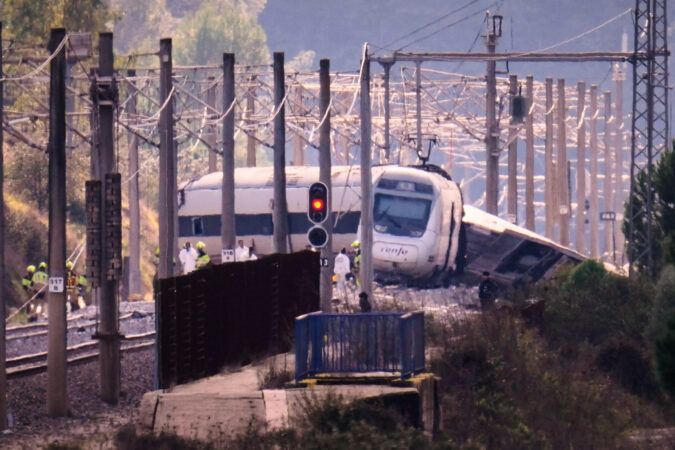
    Video released by the Civil Guard showed the worst-hit carriages shredded open, train seats cast on the gravel packing under the tracks. One carriage lay on its side, bent around a large concrete pillar, with debris scattered around the area.

    Passengers reported climbing out of smashed windows, with some using emergency hammers to break the glass.

    Andalusia’s regional emergency services said 41 people remained hospitalized, 12 of whom were in intensive care units. Another 81 passengers were discharged by late Monday afternoon, authorities said.

    Train services Monday between Madrid and cities in Andalusia were canceled, causing large disruptions. Spanish airline Iberia added flights to Seville and another two to Malaga to help stranded travelers. Some bus companies also reinforced their services in the south.

    Officials call accident ‘strange’

    Transport Minister Puente early Monday said the cause of the crash was unknown.

    He called it “a truly strange” incident because it happened on a flat stretch of track that had been renovated in May. He also said the train that jumped the track was less than 4 years old. That train belonged to the Italian-owned company Iryo, while the second train was part of Spain’s public train company, Renfe.

    According to Puente, the back part of the first train derailed and crashed into the head of the other train. An investigation into the cause could take a month, he said.

    The Spanish Union of Railway Drivers told The Associated Press that in August, it sent a letter asking Spain’s national railway operator to investigate flaws on train lines across the country and to reduce speeds at certain points until the tracks were fully repaired. Those recommendations were made for high-speed train lines, including the one where Sunday’s accident took place, the union said.

    Álvaro Fernández, the president of Renfe, told Spanish public radio RNE that both trains were well under the speed limit of 250 kph (155 mph); one was going 205 kph (127 mph), the other 210 kph (130 mph). He also said that “human error could be ruled out.”

    The incident “must be related to the moving equipment of Iryo or the infrastructure,” he said.

    Iryo issued a statement on Monday saying that its train was manufactured in 2022 and passed its latest safety check on Jan. 15.

    Identifying the victims

    The Civil Guard opened an office in Cordoba, the nearest city to the crash, as well as Madrid, Malaga, Huelva and Seville for family members of the missing to seek help and leave DNA samples.

    “There were moments when we had to remove the dead to get to the living,” Francisco Carmona, firefighter chief of Cordoba, told Onda Cero radio.

    A sports center in Adamuz, a town in the province of Cordoba, about 370 kilometers (about 230 miles) south of Madrid, was turned into a makeshift hospital. The Spanish Red Cross set up a help center offering assistance to emergency services and people seeking information.

    “The scene was horrific. It was terrible,” Adamuz Mayor Rafael Moreno told AP and other reporters. “People asking and begging for help. Those leaving the wreckage. Images that will always stay in my mind.”

    One passenger had been treated in a local hospital along with her sister before she returned to Adamuz with hopes of finding her lost dog. She was limping and had a small bandage on her cheek, as seen by an AP reporter.

    First deadly accident for Spain’s high-speed trains

    Spain has spent decades investing heavily in high-speed trains and currently has the largest rail network in Europe for trains moving over 250 kph (155 mph), with more than 3,900 kilometers (2,400 miles) of track, according to the International Union of Railways.

    The network is a popular, competitively priced and safe mode of transport. Renfe said more than 25 million passengers took one of its high-speed trains in 2024.

    Iryo became the first private competitor in high-speed to Renfe in Spain in 2022.

    Sunday’s accident was the first with deaths on a high-speed train since Spain’s high-speed rail network opened its first line in 1992.

    Spain’s worst train accident this century occurred in 2013, when 80 people died after a train derailed in the country’s northwest. An investigation concluded the train was traveling 179 kph (111 mph) on a stretch with an 80 kph (50 mph) speed limit when it left the tracks. That stretch of track was not high speed.

  • Death toll in Spanish train collision rises to 40 as authorities fear more bodies could be found

    Death toll in Spanish train collision rises to 40 as authorities fear more bodies could be found

    ADAMUZ, Spain — Regional Spanish officials said Monday that at least 40 people are confirmed dead in a high-speed rail collision the previous night in the country’s south when the tail end of a train jumped the track, causing another train speeding past in the opposite direction to derail.

    Juanma Moreno, the president of Andalusia, the southern Spanish region where the accident happened, confirmed the new death toll in an afternoon news conference. Efforts to recover the bodies from the two wrecked train cars continued, he added.

    The impact tossed the second train’s lead carriages off the track, sending them plummeting down a 13-foot slope. Some bodies were found hundreds of feet from the crash site, Moreno said earlier in the day, describing the wreckage as a “mass of twisted metal” with bodies likely still to be found inside.

    Authorities are also focusing on attending hundreds of distraught family members and have asked for them to provide DNA samples to help identify victims.

    The crash took place Sunday at 7:45 p.m. when the tail end of a train carrying 289 passengers on the route from Malaga to the capital, Madrid, went off the rails. It slammed into an incoming train traveling from Madrid to Huelva, another southern Spanish city, according to rail operator Adif.

    The head of the second train, which was carrying nearly 200 passengers, took the brunt of the impact, Spanish Transport Minister Óscar Puente said. That collision knocked its first two carriages off the track. Puente said that it appeared the largest number of the deaths occurred in those carriages.

    Authorities said all the survivors had been rescued in the early morning.

    Three days of mourning for a nation in shock

    The accident shook a nation which leads Europe in high-speed train mileage and takes pride in a network that is considered at the cutting edge of rail transport.

    Spanish Prime Minister Pedro Sánchez declared three days of national mourning for the victims of the crash.

    “Today is a day of pain for all of Spain,” Sánchez said on a visit to Adamuz, a village near the accident site, where many locals helped emergency services handle the influx of distraught and hurt passengers overnight.

    Twisted metal after a violent impact

    Moreno, the regional leader, said Monday morning that emergency services were still searching for bodies.

    “Here at ground zero, when you look at this mass of twisted iron, you see the violence of the impact,” Moreno said. “The impact was so incredibly violent that we have found bodies hundreds of meters away.”

    Video released by the Civil Guard showed the worst-hit carriages shredded open, train seats cast on the gravel packing under the tracks. One carriage lay on its side, bent around a large concrete pillar, with debris scattered around the area.

    Passengers reported climbing out of smashed windows, with some using emergency hammers to break the glass.

    Andalusia’s regional emergency services said 41 people remained hospitalized, 12 of whom were in intensive care units. Another 81 passengers were discharged by late Monday afternoon, authorities said.

    Train services Monday between Madrid and cities in Andalusia were canceled, causing large disruptions. Spanish airline Iberia added flights to Seville and another two to Malaga to help stranded travelers. Some bus companies also reinforced their services in the south.

    Officials call accident ‘strange’

    Transport Minister Puente early Monday said the cause of the crash was unknown.

    He called it “a truly strange” incident because it happened on a flat stretch of track that had been renovated in May. He also said the train that jumped the track was less than 4 years old. That train belonged to the Italian-owned company Iryo, while the second train was part of Spain’s public train company, Renfe.

    According to Puente, the back part of the first train derailed and crashed into the head of the other train. An investigation into the cause could take a month, he said.

    The Spanish Union of Railway Drivers told the Associated Press that in August, it sent a letter asking Spain’s national railway operator to investigate flaws on train lines across the country and to reduce speeds at certain points until the tracks were fully repaired. Those recommendations were made for high-speed train lines, including the one where Sunday’s accident took place, the union said.

    Álvaro Fernández, the president of Renfe, told Spanish public radio RNE that both trains were well under the speed limit of 155 mph; one was going 127 mph, the other 130 mph. He also said that “human error could be ruled out.”

    The incident “must be related to the moving equipment of Iryo or the infrastructure,” he said.

    Iryo issued a statement on Monday saying that its train was manufactured in 2022 and passed its latest safety check on Jan. 15.

    Identifying the victims

    The Civil Guard opened an office in Cordoba, the nearest city to the crash, as well as offices in Madrid, Malaga, Huelva, and Seville for family members of the missing to seek help and leave DNA samples.

    “There were moments when we had to remove the dead to get to the living,” Francisco Carmona, firefighter chief of Cordoba, told Onda Cero radio.

    A sports center in Adamuz, a town in the province of Cordoba, about 230 miles south of Madrid, was turned into a makeshift hospital. The Spanish Red Cross set up a help center offering assistance to emergency services and people seeking information.

    “The scene was horrific. It was terrible,” Adamuz Mayor Rafael Moreno told AP and other reporters. “People asking and begging for help. Those leaving the wreckage. Images that will always stay in my mind.”

    One passenger had been treated in a local hospital along with her sister before she returned to Adamuz with hopes of finding her lost dog. She was limping and had a small bandage on her cheek, as seen by an AP reporter.

    First deadly accident for Spain’s high-speed trains

    Spain has spent decades investing heavily in high-speed trains and currently has the largest rail network in Europe for trains moving over 155 mph, with more than 2,400 miles of track, according to the International Union of Railways.

    The network is a popular, competitively priced and safe mode of transport. Renfe said more than 25 million passengers took one of its high-speed trains in 2024.

    Iryo became the first private competitor in high-speed to Renfe in Spain in 2022.

    Sunday’s accident was the first with deaths on a high-speed train since Spain’s high-speed rail network opened its first line in 1992.

    Spain’s worst train accident this century occurred in 2013, when 80 people died after a train derailed in the country’s northwest. An investigation concluded the train was traveling 111 mph on a stretch with a 50 mph speed limit when it left the tracks. That stretch of track was not high speed.

  • Sixers’ Tyrese Maxey named starter in NBA All-Star Game

    Sixers’ Tyrese Maxey named starter in NBA All-Star Game

    When Tyrese Maxey first learned he could become an NBA All-Star Game starter, the 76ers point guard said it would be cool.

    He talked about watching Joel Embiid start in an All-Star Game and how much he enjoyed watching his teammate’s experience.

    “So if I’m blessed with the opportunity, I definitely won’t take it for granted,” Maxey said on Dec. 29.

    The opportunity has become a reality.

    Maxey learned Monday that he was named an Eastern Conference starter for the 2026 NBA All-Star Game.

    The starters were announced shortly after 2 p.m. on NBC/Peacock before the tipoff of the nationally televised game between the Oklahoma City Thunder and Cleveland Cavaliers. The All-Star reserves, selected by the league’s coaches, will be announced at a later date. The game will be played on Feb. 15 at the Intuit Dome in Inglewood, Calif.

    “I’m very thankful for it, blessed,” Maxey said before Monday’s game against the Indiana Pacers at Xfinity Mobile Arena. “I appreciate everybody who voted for me, the people who believed in me. I’m thankful for my teammates, this organization for allowing me to kind of lead them and try to be a better version of a franchise and organization they were last year.”

    Usually taking his pregame nap at 2 p.m., Maxey was asleep when the All-Star Game starters were revealed. But he could hear his ringer going off while teammate VJ Edgecombe tried to call him multiple times.

    “I’m like, why is he calling me?” he said. “And I answer, and he’s screaming and showing me the TV. And I’m like, ‘OK.’ We chopped it up a little bit. I was thankful for that. Then my mom called me, and then I said, ‘Listen, I’m going back to sleep. I have work tonight.’

    “But I’m thankful, man. I’m just thankful that my support system and everybody who is around me, and my very thankful for that.”

    Maxey becomes the first Sixers guard selected to start an All-Star Game since Hall of Famer Allen Iverson in 2010. Iverson, however, did not play because his daughter, Messiah, was ill. The last time the Sixers had a player voted to start in the event was Embiid in 2024. He didn’t play because of a torn meniscus in his left knee.

    Maxey made his first All-Star team that season as a reserve. But after missing the cut last season, he’ll be a two-time All-Star.

    Fans accounted for 50% of the vote to determine the 10 starters. A media panel and NBA players each accounted for 25% of the vote. This season, All-Stars are selected regardless of position.

    Tyrese Maxey is lifted up by Adem Bona after the Sixers beat the Golden State Warriors on Dec. 4.

    Denver Nuggets center and three-time MVP Nikola Jokić and Milwaukee Bucks forward and two-time MVP Giannis Antetokounmpo are the leading vote-getters in their respective conferences.

    The starters from the Eastern Conference are Maxey, Antetokounmpo, New York Knicks point guard and former Villanova standout Jalen Brunson, Detroit Pistons point guard Cade Cunningham, and Boston Celtics small forward Jaylen Brown.

    “I guess you could say it’s one of the goals for sure, but my main goal is for us to win,” Maxey said of being a starter. “The rest of that will come. I feel like if I’m healthy and we can win games and stay afloat and try to get to a playoff spot and do something special there, all of the accolades and all that stuff will appear.”

    For the Western Conference, the starters are Jokić, Los Angeles Lakers point guard Luka Dončić, Golden State Warriors point guard Stephen Curry, Oklahoma City Thunder point guard Shai Gilgeous-Alexander, and San Antonio Spurs center Victor Wembanyama.

    Maxey finished second in the fan voting among Eastern Conference players. He was third in the media voting and fifth in the player voting.

    The sixth-year veteran’s 2,941,622 fan votes were the most by an American player.

    “Thanks, fellow Americans,” Maxey said upon hearing the news. “I appreciate y’all. That’s love. I appreciate y’all.”

    The Texas native said he’s “blessed” to earn that type of popularity.

    “I have great teammates, great organization that believes in me,” Maxey said. “I just give grace to God every single morning to be able to at least wake up and do what I love every single day. And I just work extremely hard to be in this position.”

    Under a new format, the All-Star Game will feature a U.S. vs. World competition, consisting of two teams of U.S. players and one team of international players in a round-robin tournament featuring four 12-minute games.

    It’s not surprising that Maxey was voted an All-Star starter.

    He entered Monday third in the league in scoring (30.3 points per game), tied for third in steals (1.9), and 15th in assists (6.7). He’s also fourth in made three-pointers (139), and has scored at least 30 points in 19 of 38 games.

    “Look at his stats and what he’s been doing the whole season,” teammate Quentin Grimes said. “From Game 1 to Game 41 today, he’s been probably a top-three player in the league right now. So just seeing him go out every night has been really fun to go out there and watch.”

    Maxey’s season highlight came Nov. 20 when he scored a career-high 54 points, to go with nine assists, five rebounds, three steals, and three blocks in a 123-114 overtime victory over the Bucks. He joined Hall of Famer Wilt Chamberlain (March 18, 1968) as the only players in franchise history to produce at least 50 points and nine assists in a game.

  • As Trump goes to Davos, the world faces a ‘new reality’

    As Trump goes to Davos, the world faces a ‘new reality’

    DAVOS, Switzerland — In some ways, the scene in this picturesque Swiss resort town in late January is as ever. The tall evergreen forest below the Jakobshorn peak is crowned with fresh snow. The small airfield up in the mountains is packed with private jets. Phalanxes of black vans and SUVs crawl through icy streets. Beyond an elaborate security cordon, pavilions representing many of the world’s most influential tech companies, industries, and sovereign wealth funds populate storefronts, awaiting the foot traffic of the global elite who descend on this corner of the Alps every year.

    Behind it all, though, there’s a profound shift. President Donald Trump is leading one of the largest U.S. delegations ever to attend the World Economic Forum’s annual meeting, where he is set to deliver an address Wednesday, at a moment when his administration seems in open conflict with the paradigms that have long defined (and have come to be caricatured by) these conclaves in Davos. His trade wars on U.S. allies and adversaries alike are unraveling webs of globalization championed here for decades. And his constant use of coercion in his foreign policy cuts against Davos’ ethos of comity and cooperation.

    Trump’s speech will come days after he began threatening to impose fresh tariffs on European partners for their unwillingness to oblige his assertions that the United States must annex Greenland. He lashed out in anger at Danish and broader European obstruction over the weekend, guaranteeing that the Arctic territory would dominate conversation in Davos.

    “We stand ready to engage in a dialogue based on the principles of sovereignty and territorial integrity,” read a joint statement from European countries facing U.S. tariffs over Greenland. “Tariff threats undermine transatlantic relations and risk a dangerous downward spiral.”

    Trump’s extraordinary capture earlier this month of Venezuelan President Nicolás Maduro seemed to set new precedents, underscoring the White House’s view that the Western Hemisphere ought to be a U.S. sphere of influence. A slew of prominent foreign policy thinkers see Trump ushering in a global order where “might makes right.”

    “Gunboat diplomacy is back with a vengeance,” Comfort Ero, head of the International Crisis Group, a think tank, recently said. “What do you do when international law becomes international niceties?”

    The response from Davos seems more cautious and calibrated than it might have been in the past. For more than a decade, the organizers of the World Economic Forum have warned about disruptions to the international order — of fractures, crises and dysfunction that can only be solved with collective global effort. This year’s vaguer and more humble theme — “a spirit of dialogue” — may have been chosen in anticipation of the Trump-shaped wrecking ball swinging toward the forum.

    “There’s a robust consensus that the world economy is entering some kind of new reality,” Mirek Dusek, a WEF managing director responsible for the annual event’s programming and business, told me. “Our role is really to be helpful as an organization, and in this moment bring protagonists together.”

    At least to that end, Davos can deliver. The forum’s organizers are touting record participation, with some 65 heads of state or government in attendance, alongside dozens more finance and foreign ministers, as well as close to 2,000 prominent CEOs and business leaders. They convene at a time, as the international advocacy group Oxfam notes in its latest report, when billionaire wealth grew by some $2.5 trillion over the past year — a figure greater than the total wealth possessed by the bottom half of humanity (more than 4 billion people).

    With Trump’s shadow over Davos, there’ll be little consensus over tackling inequality or perhaps any other shared global challenges. The WEF’s annual Global Risks report, which surveys more than 1,000 geopolitical and economic experts from around the world, pointed to “geoeconomic confrontation” as the prime source of short-term concern. The WEF’s latest iteration of the Global Cooperation Barometer, an index using dozens of metrics to chart how the world is getting along, declared that “multilateralism is indeed waning.”

    That zeitgeist is being driven, in part, by Trump’s political project. “Trump’s central strategic insight has always been that America is better prepared than any other country to thrive in a cutthroat arena,” wrote Hal Brands, a senior fellow at the American Enterprise Institute, a conservative Washington think tank. “If Washington no longer wishes to sustain the liberal order, or just can’t afford to uphold it against growing challenges, perhaps it makes sense to seize the largest share of the loot.”

    But the conveners in Davos don’t want pessimism to prevail. “Cooperation is like water, if it sees it’s being blocked it finds a way,” Borge Brende, a former Norwegian politician and WEF president and CEO, said during a briefing call with journalists earlier this month.

    The world isn’t standing pat in the face of Trumpist disruption. Clear signals were sent in recent days by Canadian Prime Minister Mark Carney, who acknowledged the shifting “new world order” on a trip to China where his government reset a long-troubled relationship while touting a “new strategic partnership.” Ottawa’s overtures would not have happened without a year of hostility from Washington, including Trump’s statements urging Canada to become the 51st U.S. state.

    “The global trading system is undergoing a fundamental change,” reducing “the effectiveness of multilateral institutions on which trading partners such as Canada and China have greatly relied,” Carney told reporters in Beijing, gesturing to the deterioration of the rules-based order and the weakening of international institutions. “This is happening fast. It’s large. It’s a rupture.”

    Separately, after a quarter-century of negotiations, four South American countries sealed a free-trade agreement with the European Union. “This is the power of partnership and openness. This is the power of friendship and understanding between peoples and regions across oceans,” European Commission President Ursula von der Leyen said alongside Brazilian President Luiz Inácio Lula da Silva in Rio de Janeiro on Friday. “And this is how we create real prosperity — prosperity that is shared. Because, we agree, that international trade is not a zero-sum game.”

    The new alignments that are emerging place Trump’s America in a conspicuous light. “The United States will remain the most economically and militarily powerful country in the world for several more years,” wrote international relations theorist Amitav Acharya, in an essay for Foreign Policy. “But it will be absent from, if not actively hostile toward, the existing international order.”

    Acharya labeled this “unique configuration” shaped by U.S. antagonism as “the world minus one.”

  • Trump ties Greenland takeover bid to Nobel Prize in text to Norway leader

    Trump ties Greenland takeover bid to Nobel Prize in text to Norway leader

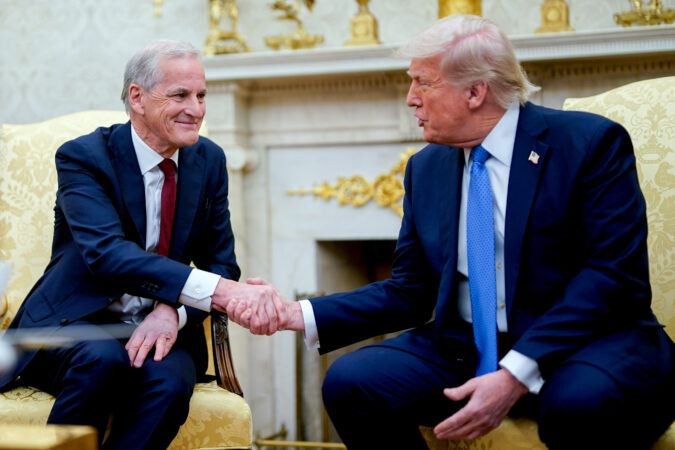
    BRUSSELS — In a message to Norway’s prime minister, President Donald Trump linked his insistence on taking over Greenland to his grievance over not receiving the Nobel Peace Prize — adding a new twist to Trump’s stoking of a trade war that is shaking the trans-Atlantic alliance.

    In the weekend text to Norwegian Prime Minister Jonas Gahr Store, Trump wrote that he no longer needed to “think purely of Peace” after he didn’t win the peace prize last year — an award that the president has openly coveted and that is bestowed by the Nobel Committee in Norway.

    Trump then questioned the “ownership” of Greenland by Denmark, a NATO ally, and repeated his ambition for the U.S. to take “complete and total control” of the autonomous Danish territory.

    The White House confirmed the authenticity of the message, with White House deputy press secretary Anna Kelly saying that Trump “is confident Greenlanders would be better served if protected by the United States from modern threats in the Arctic region.”

    Store confirmed Trump’s leaked message in a statement Monday. He said Trump was responding to a text that Store had sent on behalf of Norway and Finland, conveying opposition to U.S. tariffs against European nations rejecting the takeover of Greenland. “We pointed to the need to de-escalate and proposed a telephone conversation,” Store said.

    The attempt to defuse tensions seems not to have worked. Trump’s reply came shortly after.

    “Considering your Country decided not to give me the Nobel Peace Prize for having stopped 8 Wars PLUS, I no longer feel an obligation to think purely of Peace, although it will always be predominant, but can now think about what is good and proper for the United States of America,” Trump wrote in the text, which was first reported by PBS.

    Store said he made his support for Greenland and Denmark clear, and that he has repeatedly explained to Trump that it is up to the Nobel Committee, not the Norwegian government, to award the annual peace prize.

    On Monday, Treasury Secretary Scott Bessent sought to reframe the narrative. “It’s a complete canard to think President Trump’s action on Greenland is due to” not receiving the Nobel Prize, he told reporters on the sidelines of the World Economic Forum annual meeting in Davos, Switzerland.

    European retaliation, he added, would be “very unwise.”

    Trump’s bid to buy or seize Greenland — effectively a demand to grab a NATO ally’s territory against its will — and to unleash a trade war with European leaders who disapprove, has sparked the greatest trans-Atlantic crisis in generations.

    U.K. Prime Minister Keir Starmer said Monday that it would be “completely wrong” for Trump to slap tariffs on European nations in his push for Greenland — even as Starmer sought to preserve the relationship with the United States which is vital to European security.

    The British leader’s comments added to mounting European pushback. French President Emmanuel Macron has likened Trump’s declaration to a form of “intimidation,” and Swedish Prime Minister Ulf Kristersson described it as blackmail. Even Italian Prime Minister Giorgia Meloni, a Trump ally, called it a “mistake.”

    In remarks to reporters on Monday, Starmer denounced economic coercion against allies as the wrong approach to resolving disagreements. He described tariffs as harmful to British workers and businesses. “A trade war over Greenland is no one’s interest,” Starmer said, calling for discussions between Greenland, Europe, and the United States.

    Still, he declined to say whether he would support calls within the European Union, of which the U.K. is no longer a member, for retaliation against Washington.

    Trump has said controlling Greenland is necessary for national security reasons — a point disputed by allies and some members of Congress who rebutted the president’s claim that the Arctic territory faces imminent security risks from Russia and China. Trump’s unwillingness, so far, to back down risks driving a deeper wedge in the Western alliance or, some fear, causing an irreparable break.

    After months of trying to keep Trump onside, European policymakers are weighing options to retaliate. The continent’s top leaders still stress they would much rather avoid an escalation, but Trump’s threats are fueling a growing chorus of calls from lawmakers and politicians for European leaders to stand up for the continent and fire back.

    “Appeasement has failed,” wrote Javi López, a lawmaker from Spain and vice president of the European Parliament. “Europe can only protect its sovereignty (from Ukraine to Greenland) by reducing dependencies, strengthening its deterrence, and using without limits its most powerful tool: access to the world’s largest single market.”

    If diplomatic efforts fail, the E.U.’s arsenal of trade tools includes imposing tariffs on a list of more than $100 billion worth of American goods, which EU officials prepared last year but suspended to sign a trade deal with Trump.

    Another option would be triggering an instrument often dubbed the bloc’s trade “bazooka,” which would allow for targeting American services in Europe — a major profit center for U.S. tech giants.

    European Union leaders have warned that Russia stands to benefit from the rift at NATO. On Monday, the Kremlin spokesperson, Dmitry Peskov, appeared to stir the pot by telling reporters that by taking action on Greenland, Trump stood to make history one way or another.

    Peskov said there was “a lot of disturbing information” recently and that he would not comment about “our plans regarding Denmark and Greenland.”

    Aside from “whether this is good or bad, whether it complies with international law or not,” he added, “there are international experts who believe that by resolving the issue of Greenland’s accession, Trump will go down in history, not only in U.S. history, but also in world history. It is difficult to disagree with these experts.”

    Russia, preoccupied with its war in Ukraine, has largely stood by while Trump ordered military strikes on Venezuela and seized Moscow’s longtime ally President Nicolás Maduro. That has left Russian President Vladimir Putin’s credibility on the world stage diminished as Trump flexes his muscles among friends and foes alike.

    Ambassadors of the E.U.’s 27 nations debated the possibility of retaliation against Washington during a closed-door meeting in Brussels on Sunday, although there was a broad preference to try to de-escalate — as they have done after Trump’s previous rounds of tariffs.

    European leaders are headed to the World Economic Forum in Davos this week, hoping that face-to-face meetings with Trump will talk him down from the intensifying confrontation. The president has declared the new tariffs on eight countries would start Feb. 1 unless they acquiesce to his plan to acquire Greenland.

    Those European nations — Britain, Denmark, France, Finland, Germany, the Netherlands, Norway, and Sweden — recently sent troops to Greenland in small numbers for joint exercises with the Danish military. European leaders cast the deployment as a sign of NATO’s commitment to protecting the Arctic in response to Trump’s warnings that Arctic security was at risk.

    Because the EU operates as a single trading bloc, the imposition of tariffs on some of its 27 nations could affect all of them, European officials said.

    Leaders of Denmark and Greenland have said repeatedly that they welcome deeper U.S. economic and security involvement, but that the vast island territory — which Trump covets for its strategic Arctic location and natural resources — is not for sale.

    “Blackmail between friends is obviously unacceptable,” French Finance Minister Roland Lescure said in Berlin on Monday. If the U.S. tariff threats come to fruition, Lescure added, “we Europeans must remain united and coordinated in our response and, above all, be prepared to make full use of the European Union’s instruments.”

    France has pushed for Europe to take a harder line against Trump, while many of its EU neighbors preferred restraint. On Monday, however, German Finance Minister Lars Klingbeil echoed the sentiment, saying the EU should consider using the “toolbox for responding to economic blackmail.”

  • Valentino Garavani, an Italian fashion designer known for his signature shade of red, has died at 93

    Valentino Garavani, an Italian fashion designer known for his signature shade of red, has died at 93

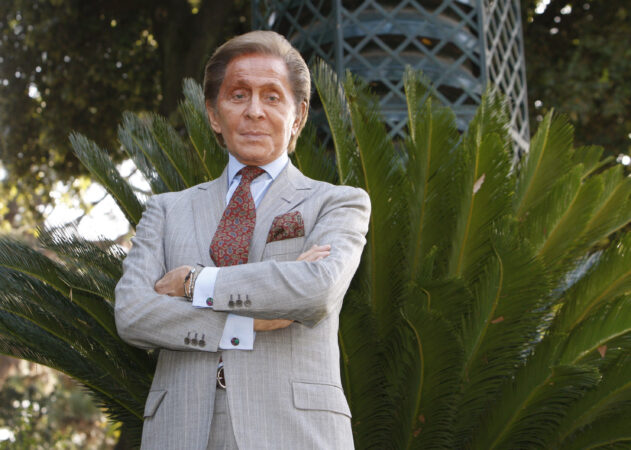
    ROME — Valentino Garavani, the jet-set Italian designer whose high-glamour gowns — often in his trademark shade of “Valentino red” — were fashion show staples for nearly half a century, has died at home in Rome, his foundation announced Monday. He was 93.

    “Valentino Garavani was not only a constant guide and inspiration for all of us, but a true source of light, creativity and vision,″ the foundation said in a statement posted on social media.

    His body will repose at the foundation’s headquarters in Rome on Wednesday and Thursday. The funeral will be held Friday at the Basilica Santa Maria degli Angeli e dei Martiri in Rome’s Piazza della Repubblica.

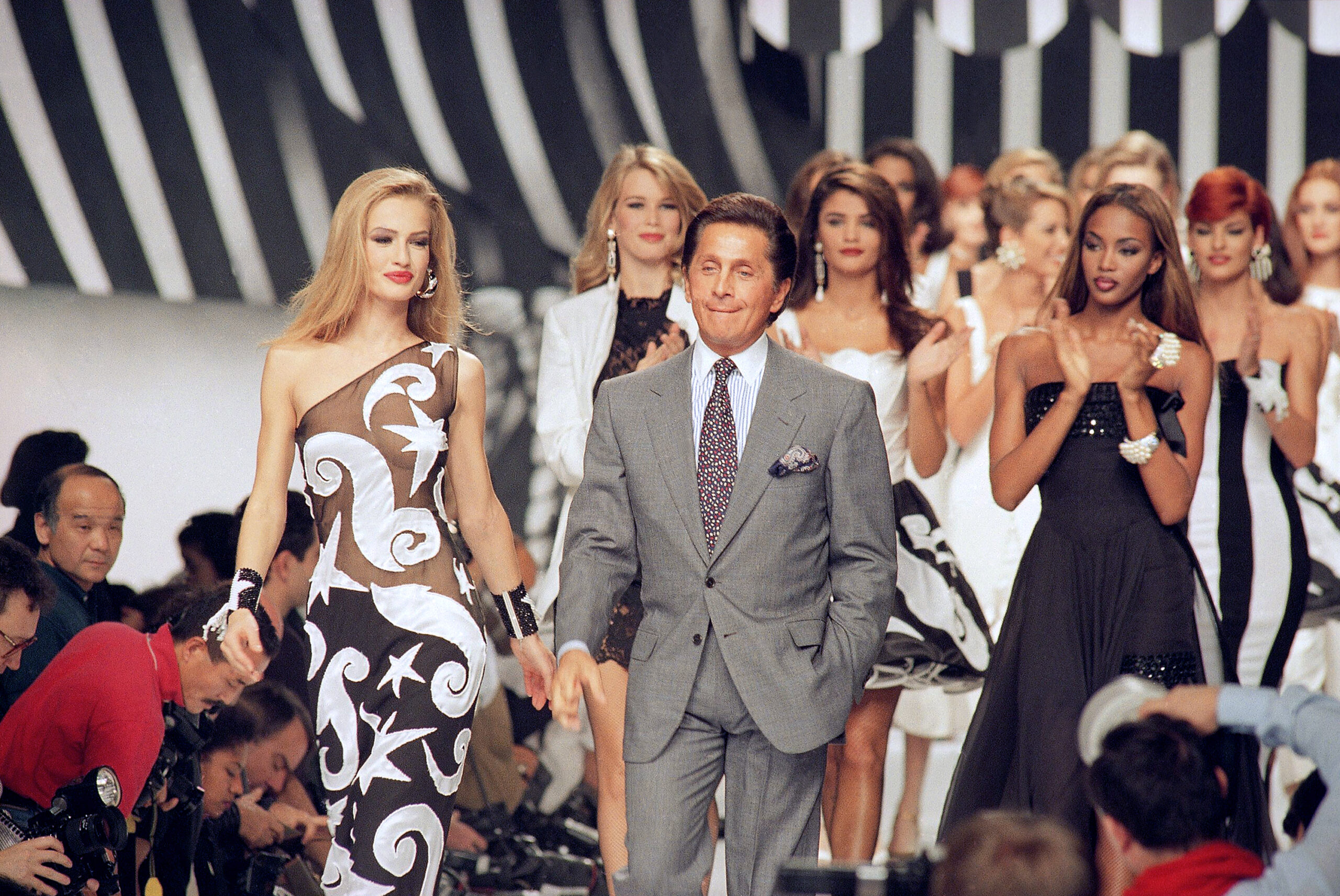
    Italian fashion designer Valentino Garavani walks the catwalk with his models after a fashion show on October 20, 1991 in Paris, France.

    Universally known by his first name, Valentino was adored by generations of royals, first ladies and movie stars, from Jackie Kennedy Onassis to Julia Roberts and Queen Rania of Jordan, who swore the designer always made them look and feel their best.

    “I know what women want,” he once remarked. “They want to be beautiful.”

    Never one for edginess or statement dressing, Valentino made precious few fashion faux-pas throughout his nearly half-century-long career, which stretched from his early days in Rome in the 1960s through to his retirement in 2008.

    His fail-safe designs made Valentino the king of the red carpet, the go-to man for A-listers’ awards ceremony needs. His sumptuous gowns have graced countless Academy Awards, notably in 2001, when Roberts wore a vintage black and white column to accept her best actress statue. Cate Blanchett also wore Valentino — a one-shouldered number in butter-yellow silk — when she won the Oscar for best supporting actress in 2004.

    Valentino was also behind the long-sleeved lace dress Jacqueline Kennedy wore for her wedding to Greek shipping magnate Aristotle Onassis in 1968. Kennedy and Valentino were close friends for decades, and for a spell the one-time U.S. first lady wore almost exclusively Valentino.

    He was also close to Diana, Princess of Wales, who often donned his sumptuous gowns.

    Models flank Italian fashion designer Valentino Garavani in Rome, Italy, at the end of the fashion show for his spring-summer collection on Jan. 20, 1971.

    Beyond his signature orange-tinged shade of red, other Valentino trademarks included bows, ruffles, lace and embroidery; in short, feminine, flirty embellishments that added to the dresses’ beauty and hence to that of the wearers.

    Perpetually tanned and always impeccably dressed, Valentino shared the lifestyle of his jet-set patrons. In addition to his 152-foot (46-meter) yacht and an art collection including works by Picasso and Miro, the couturier owned a 17th-century chateau near Paris with a garden said to boast more than a million roses.

    Valentino and his longtime partner Giancarlo Giammetti flitted among their homes — which also included places in New York, London, Rome, Capri and Gstaad, Switzerland — traveling with their pack of pugs. The pair regularly received A-list friends and patrons, including Madonna and Gwyneth Paltrow.

    “When I see somebody and unfortunately she’s relaxed and running around in jogging trousers and without any makeup … I feel very sorry,” the designer told RTL television in a 2007 interview. “For me, woman is like a beautiful, beautiful flower bouquet. She has always to be sensational, always to please, always to be perfect, always to please the husband, the lover, everybody. Because we are born to show ourselves always at our best.”

    Valentino was born into a well-off family in the northern Italian town of Voghera on May 11, 1932. He said it was his childhood love of cinema that set him down the fashion path.

    “I was crazy for silver screen, I was crazy for beauty, to see all those movie stars being sensation, well dressed, being always perfect,” he explained in the 2007 television interview.

    After studying fashion in Milan and Paris, he spent much of the 1950s working for established Paris-based designer Jean Desses and later Guy Laroche before striking out on his own. He founded the house of Valentino on Rome’s Via Condotti in 1959.

    From the beginning, Giammetti was by his side, handling the business aspect while Valentino used his natural charm to build a client base among the world’s rich and fabulous.

    After some early financial setbacks — Valentino’s tastes were always lavish, and the company spent with abandon — the brand took off.

    Early fans included Italian screen sirens Gina Lollobrigida and Sophia Loren, as well as Hollywood stars Elizabeth Taylor and Audrey Hepburn. Legendary American Vogue editor-in-chief Diana Vreeland also took the young designer under her wing.

    Over the years, Valentino’s empire expanded as the designer added ready-to-wear, menswear and accessories lines to his stable. Valentino and Giammetti sold the label to an Italian holding company for an estimated $300 million in 1998. Valentino would remain in a design role for another decade.

    In 2007, the couturier feted his 45th anniversary in fashion with a 3-day-long blowout in Rome, capped with a grand ball in the Villa Borghese gallery.

    Valentino retired in 2008 and was briefly replaced by fellow Italian Alessandra Facchinetti, who had stepped into Tom Ford’s shoes at Gucci before being sacked after two seasons.

    Facchinetti’s tenure at Valentino proved equally short. As early as her first show for the label, rumors swirled that she was already on her way out, and just about one year after she was hired, Facchinetti was indeed replaced by two longtime accessories designers at the brand, Maria Grazia Chiuri and Pier Paolo Piccioli.

    Chiuri left to helm Dior in 2016, and Piccioli continued to lead the house through a golden period that drew on the launch of the Rockstud pump with Chiuri and his own signature color, a shade of fuchsia called Pink PP. He left the house in 2024, later joining Balenciaga, and has been replaced by Alessandro Michele, who revived Gucci’s stars with romantic, genderless styles.

    Valentino is owned by Qatar’s Mayhoola, which controls a 70% stake, and the French luxury conglomerate Kering, which owns 30% with an option to take full control in 2028 or 2029. Richard Bellini was named CEO last September.

    Valentino has been the subject of several retrospectives, including one at the Musee des Arts Decoratifs, which is housed in a wing of Paris’ Louvre Museum. He was also the subject of a hit 2008 documentary, “Valentino: The Last Emperor,” that chronicled the end of his career in fashion.

    In 2011, Valentino and Giammetti launched what they called a “virtual museum,” a free desktop application that allows viewers to feast their eyes on about 300 of the designer’s iconic pieces.

  • Trump tied his stance on Greenland to not getting the Nobel Peace Prize, European officials said

    Trump tied his stance on Greenland to not getting the Nobel Peace Prize, European officials said

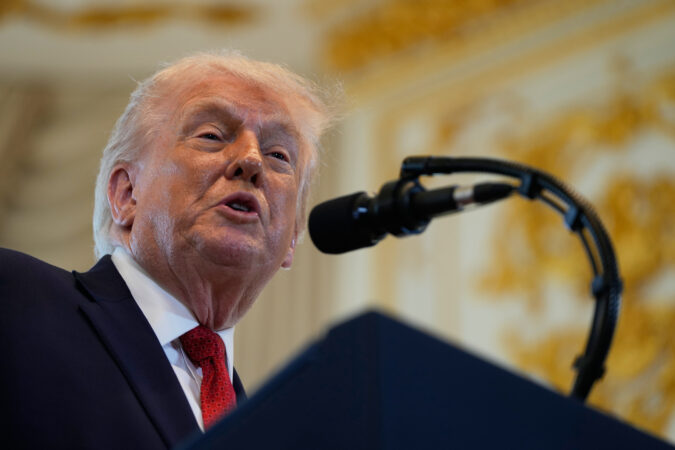
    U.S. President Donald Trump linked his aggressive stance on Greenland to last year’s decision not to award him the Nobel Peace Prize, telling Norway’s prime minister that he no longer felt “an obligation to think purely of Peace,” in a text message released on Monday.

    Trump’s message to Jonas Gahr Støre appears to ratchet up a standoff between Washington and its closest allies over his threats to take over Greenland, a self-governing territory of NATO member Denmark. On Saturday, Trump announced a 10% import tax starting in February on goods from eight nations that have rallied around Denmark and Greenland, including Norway.

    Those countries issued a forceful rebuke.

    The White House has not ruled taking control of the strategic Arctic island by force. Asked whether Trump could invade Greenland, Danish Foreign Minister Lars Løkke Rasmussen said on Monday that “you can’t leave anything out until the president himself has decided to leave anything out.”

    Rasmussen, speaking to reporters following a meeting with his British counterpart Yvette Cooper in London, encouraged Washington to instead discuss solutions.

    British Prime Minister Keir Starmer also sought to de-escalate tensions on Monday. “I think this can be resolved and should be resolved through calm discussion,” he said, adding that he did not believe military action would occur.

    In a sign of how tensions have increased in recent days, thousands of Greenlanders marched over the weekend in protest of any effort to take over their island. Greenland Prime Minister Jens-Frederik Nielsen said in a Facebook post Monday that the tariff threats would not change their stance.

    “We will not be pressured,” he wrote.

    Meanwhile, Naaja Nathanielsen, Greenland’s minister for business, minerals, energy, justice and equality, told The Associated Press that she was moved by the quick response of allies to the tariff threat and said it showed that countries realize “this is about more than Greenland.”

    “I think a lot of countries are afraid that if they let Greenland go, what would be next?”

    Trump cites Nobel as escalation in text to Norwegian leader

    Trump’s Sunday message to Gahr Støre, released by the Norwegian government, read in part: “Considering your Country decided not to give me the Nobel Peace Prize for having stopped 8 Wars PLUS, I no longer feel an obligation to think purely of Peace, although it will always be predominant, but can now think about what is good and proper for the United States of America.”

    It concluded: “The World is not secure unless we have Complete and Total Control of Greenland.”

    The Norwegian leader said Trump’s message was a reply to an earlier missive sent on behalf of himself and Finnish President Alexander Stubb, in which they conveyed their opposition to the tariff announcement, pointed to a need to de-escalate, and proposed a telephone conversation among the three leaders.

    “Norway’s position on Greenland is clear. Greenland is a part of the Kingdom of Denmark, and Norway fully supports the Kingdom of Denmark on this matter,” the Norwegian leader said in a statement. “As regards the Nobel Peace Prize, I have clearly explained, including to President Trump what is well known, the prize is awarded by an independent Nobel Committee and not the Norwegian Government.”

    The Norwegian Nobel Committee is an independent body whose five members are appointed by the Norwegian Parliament.

    U.S. Treasury Secretary Scott Bessent defended the president’s approach in Greenland during a brief Q&A with reporters in Davos, Switzerland, which is hosting the World Economic Forum meeting this week.

    “I think it’s a complete canard that the president would be doing this because of the Nobel,” Bessent said, immediately after saying he did not “know anything about the president’s letter to Norway.”

    Bessent insisted Trump “is looking at Greenland as a strategic asset for the United States,” adding that “we are not going to outsource our hemispheric security to anyone else.”

    Trump has openly coveted the peace prize, which the committee awarded to Venezuelan opposition leader María Corina Machado last year. Last week, Machado presented her Nobel medal to Trump, who said he planned to keep it, though the committee said the prize can’t be revoked, transferred or shared with others.

    Starmer says a trade war is in no one’s interest

    In his latest threat of tariffs, Trump indicated they would be retaliation for last week’s deployment of symbolic numbers of troops from the European countries to Greenland — though he also suggested that he was using the tariffs as leverage to negotiate with Denmark.

    European governments said that the troops traveled to the island to assess Arctic security, part of a response to Trump’s own concerns about interference from Russia and China.

    Starmer on Monday called Trump’s threat of tariffs “completely wrong” and said that a trade war is in no one’s interest.

    He added that “being pragmatic does not mean being passive and partnership does not mean abandoning principles.”

    Six of the eight countries targeted are part of the 27-member European Union, which operates as a single economic zone in terms of trade. European Council President Antonio Costa said Sunday that the bloc’s leaders expressed “readiness to defend ourselves against any form of coercion.” He announced a summit for Thursday evening.

    Starmer indicated that Britain, which is not part of the EU, is not planning to consider retaliatory tariffs.

    “My focus is on making sure we don’t get to that stage,” he said.

    Denmark’s defense minister and Greenland’s foreign minister are expected to meet NATO Secretary-General Mark Rutte in Brussels on Monday, a meeting that was planned before the latest escalation.

  • Sean McDermott’s firing could make Eagles’ pursuit of Mike McDaniel, Brian Daboll for OC much harder

    Sean McDermott’s firing could make Eagles’ pursuit of Mike McDaniel, Brian Daboll for OC much harder

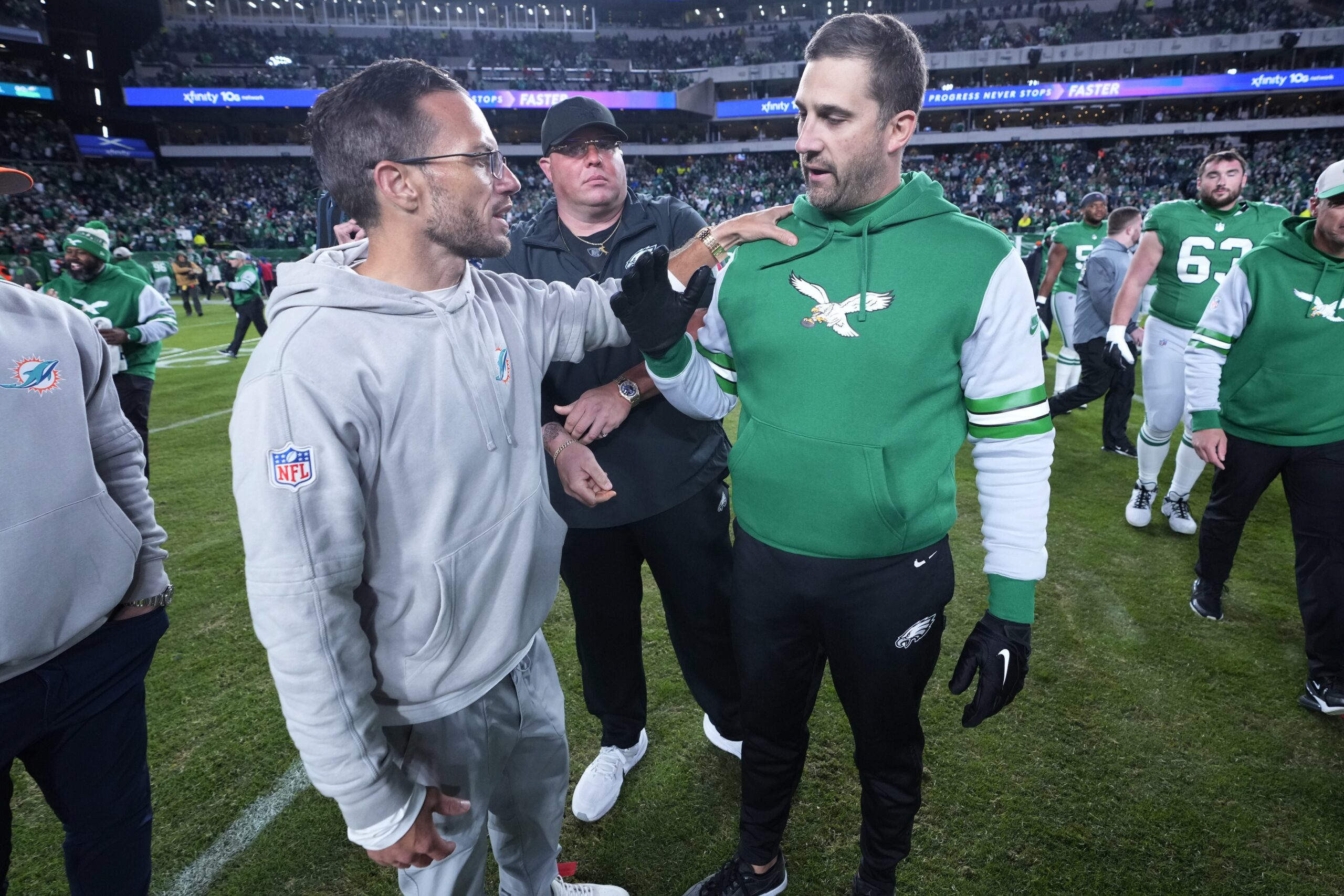
    In the past week, the Eagles have made it known to sources around the league that hiring former Miami Dolphins head coach Mike McDaniel as their new offensive coordinator is their No. 1 offseason priority. That includes fired New York Giants coach Brian Daboll, who is expected to interview for the position this week. Virtually no amount of money, literally no amount of autonomy, and no fear of conflict would deter the team from signing McDaniel, a respected offensive innovator.

    McDaniel and Eagles defensive coordinator Vic Fangio endured a rocky year together in 2023, when Fangio worked for McDaniel as his defensive coordinator in Miami, and their split, while couched as a mutual parting of the ways, was not without acrimony.

    At any rate, league sources indicate that even though Fangio’s work the last two seasons has been integral and possibly unmatched around the league, if the Eagles were somehow able to hire McDaniel, they would not be deterred by any possible discomfort from Fangio.

    Of course, the actual hiring of McDaniel in Philadelphia would be an unexpected coup for the Birds. Right now, he’s a hotter commodity than Venezuelan oil.

    He got even hotter Monday morning.

    The Bills fired head coach Sean McDermott on Monday. McDaniel is sure to be a candidate for that job. So will Daboll, who worked with superstar quarterback Josh Allen as the Bills’ offensive coordinator from 2018-21. And McDermott immediately becomes the top head coaching candidate in the league.

    There’s also a chance McDermott blocks McDaniel from a head coaching position, which pushes him back into the OC market, to the Eagles’ benefit.

    The merry-go-round ever swirls.

    Stay tuned.

    One thing is certain: McDermott’s firing immediately makes the Eagles’ quest for their top two candidates much less likely to succeed.

    McDaniel already has interviewed for head coaching vacancies in Tennessee, Baltimore, and Cleveland, was scheduled to interview in Las Vegas on Monday, and is expected to be interviewed a second time by the Browns this week. He interviewed with Atlanta, too, but the Falcons have already hired Kevin Stefanski, whom the Browns just fired.

    A report last week indicated that McDaniel would consider taking one of the premier offensive coordinator positions in favor of a bad situation as a head coach.

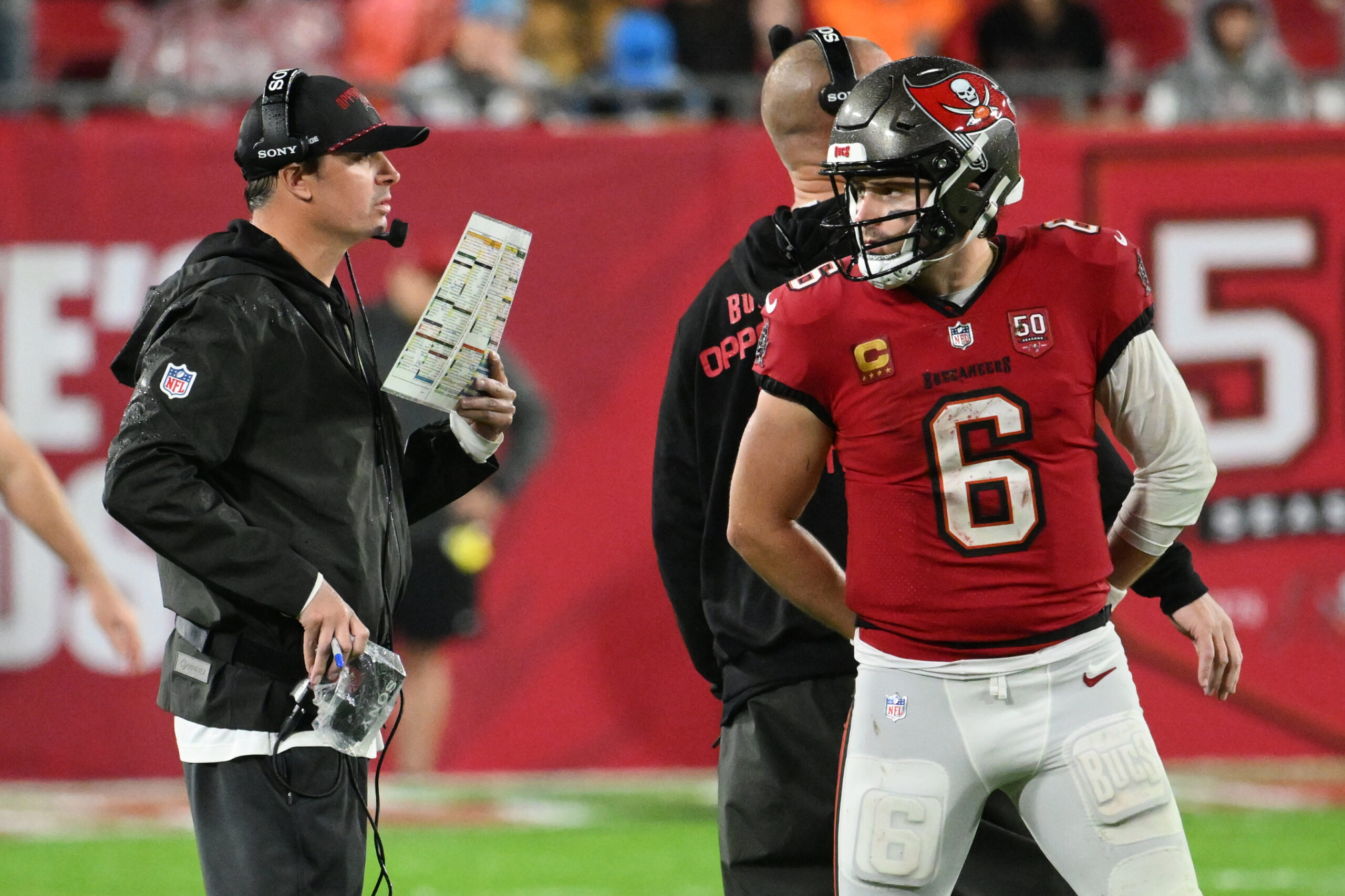
    To that end, McDaniel has interviewed with the Detroit Lions and Tampa Bay Buccaneers. The former is reportedly closing in on a deal with Arizona’s Drew Petzing. The latter offers a head coach in Todd Bowles whose future beyond next season is unsure, and the Bucs are as fervent pursuers of McDaniel as the Eagles.

    After he leaves Las Vegas — or, if he leaves Las Vegas, which owns the No. 1 overall pick and would be an enticing rebuild — McDaniel is expected to interview for the Los Angeles Chargers’ vacant OC job. There, McDaniel would coach Justin Herbert, who, like Lamar Jackson in Baltimore and Allen in Buffalo, is a more enticing option than the QBs on the other teams.

    And yes, that includes Jalen Hurts.

    However, in Philadelphia, McDaniel would have the best offensive roster of any of the other stops. That is, unless you believe: right tackle Lane Johnson is too old, left guard Landon Dickerson never will be healthy, Hurts will never develop past his current skill set, and A.J. Brown and Saquon Barkley, both 28, have lost a step.

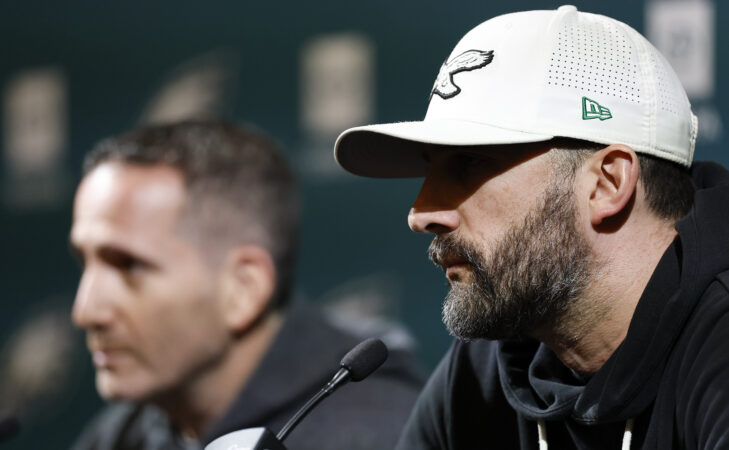
    Nick Sirianni (right) and the Eagles reportedly have not yet convinced Mike McDaniel to interview for the offensive coordinator position.

    League sources say the Eagles have not yet convinced McDaniel to interview, which offers a glimpse into how he considers the Philly job. That said, don’t expect money to be an obstacle. Sources say that, for McDaniel, the position could be worth as much as the $6 million annual salary the Raiders gave Chip Kelly, who then was fired just 11 games into 2025, his first of three seasons under contract. At the end of the season head coach Pete Carroll also was fired, which created the current vacancy.

    The Eagles have already interviewed former Falcons OC Zac Robinson, Indianapolis Colts OC Jim Bob Cooter (who does not call plays and therefore can leave), and former Eagles backup QB Mike Kafka, who was Daboll’s offensive coordinator with the Giants. They are expected to interview fired Bucs OC Josh Grizzard on Monday, and have expressed interest in Dolphins passing game coordinator Bobby Slowik, fired Washington Commanders OC Kliff Kingsbury, and former Ole Miss OC Charlie Weis Jr., who was scheduled to follow Lane Kiffin to LSU.

    They’re wise to cast their net wide, because, as of Monday morning, it looked like no amount of money or power will be enough to land their two biggest fish.

  • Who are the Eagles looking at for their next offensive coordinator? Here are some of the candidates.

    Who are the Eagles looking at for their next offensive coordinator? Here are some of the candidates.

    The search for the next offensive coordinator is underway and, as expected, the Eagles are casting a wide net.

    Nick Sirianni said that the next coordinator needs to help the Eagles “evolve.”

    From experienced offensive minds and play-callers to young and up-and-coming offensive coaches, the Eagles are looking at candidates from various backgrounds. They have so far been linked to at least eight names.

    Let’s take a look at the coaches the Eagles could be looking at, according to reports. (Names are listed in alphabetical order.)

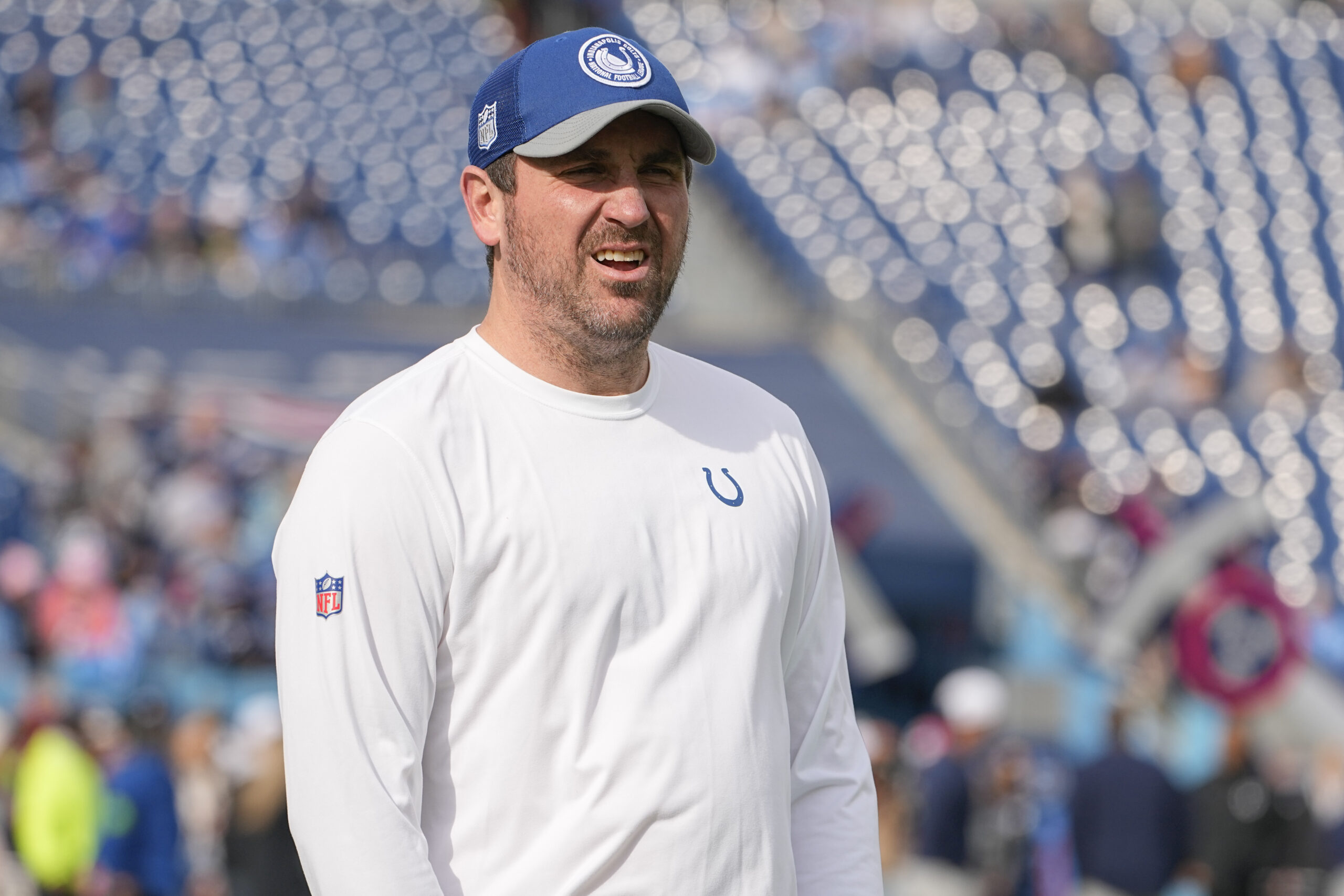
    Indianapolis Colts offensive coordinator Jim Bob Cooter has a connection to Eagles coach Nick Sirianni.

    Jim Bob Cooter

    Cooter was a consultant when Sirianni first got the Eagles job in 2021 and has been Shane Steichen’s offensive coordinator in Indianapolis since 2023. The Eagles, according to Sports Illustrated, interviewed Cooter on Friday after the team requested permission to interview him.

    Cooter does not call plays for the Colts, which is why this would not technically be a lateral move to the Eagles.

    The Colts revived Daniel Jones’ NFL career before he suffered a season-ending injury this season. While he didn’t call plays, Cooter helped oversee what was one of the best offenses in the NFL before Jones got hurt.

    Cooter, 41, was Doug Pederson’s passing game coordinator in Jacksonville during the 2022 season. He previously worked under Adam Gase with the New York Jets as the team’s running backs coach and before that worked under Jim Caldwell and Matt Patricia with the Detroit Lions. Sirianni and Cooter also worked together with the Kansas City Chiefs in 2012 under Romeo Crennel. Sirianni was the wide receivers coach that season while Cooter was an offensive quality control coach.

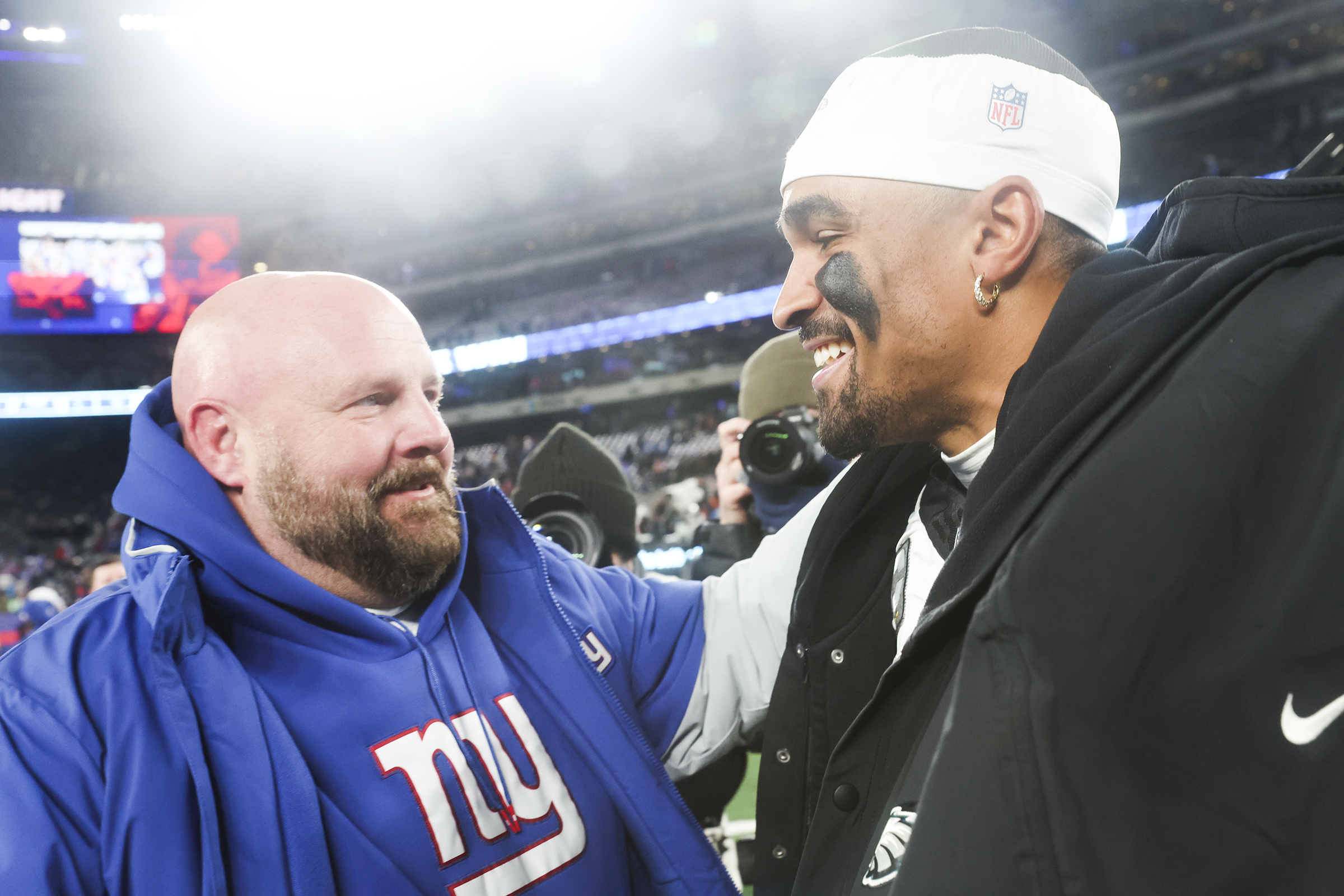
    Eagles quarterback Jalen Hurts has familiarity with former Giants head coach Brian Daboll.

    Brian Daboll

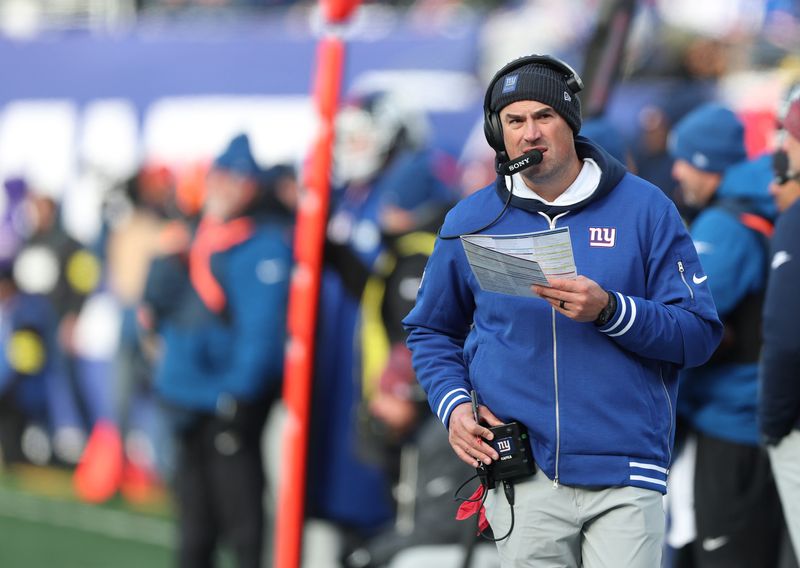
    ESPN reported Sunday that the Eagles are expected to interview Daboll, who most recently was the head coach of the New York Giants before he was fired in November.

    Daboll was also on that 2012 Kansas City staff with Sirianni and Cooter. He was the boss as offensive coordinator. Daboll, 50, worked with Jalen Hurts at Alabama, so there is plenty of familiarity with the coach and quarterback in Philadelphia.

    That said, Daboll is also in the market for head coaching jobs, and an interesting one opened Monday morning when the Buffalo Bills fired Sean McDermott. Daboll was born in Canada and grew up in suburban Buffalo. He was the team’s offensive coordinator during the rise of Josh Allen before leaving to lead the Giants.

    Daboll is one of the more experienced offensive coordinators on the market. His offenses have been up and down over the years, but when he led the Cleveland Browns, Miami Dolphins, and Chiefs more than a decade ago, he wasn’t working with stellar quarterback talent. His best success was with Allen, who is sort of a unicorn. Could he help Hurts turn the Eagles offense around?

    Bucs offensive coordinator Josh Grizzard worked closely with quarterback Baker Mayfield (6) this season.

    Josh Grizzard

    The Eagles, according to NFL insider Jordan Schultz, plan to interview Grizzard, who was just let go by the Tampa Bay Buccaneers. Grizzard, 35, was the offensive coordinator for one season after joining the Bucs in 2024 as a passing game coordinator.

    Before Tampa Bay, Grizzard worked with Mike McDaniel in Miami and was with the Dolphins during stints with Gase and Brian Flores, too.

    Grizzard has been a fast riser. He played at Yale and was a student coach there, too. He was hired to David Cutcliffe’s staff at Duke as a 23-year-old and was there for four seasons as a graduate assistant and then a quality control coach before leaving for the NFL.

    This past season was Grizzard’s first calling plays, and he oversaw a steep drop-off in Tampa after former coordinator Liam Coen departed for the Jacksonville Jaguars. The Bucs, however, dealt with multiple key injuries.

    Mike Kafka was the Giants’ interim coach and knows the Eagles well.

    Mike Kafka

    The Eagles, according to ESPN, have already interviewed Kafka, who was Daboll’s coordinator in New York before taking over as interim head coach.

    Kafka, 38, is a familiar name around here, having spent two seasons as a backup quarterback after the Eagles selected him in the fourth round of the 2010 draft.

    Kafka bounced around to seven teams in six seasons before embarking on his coaching career at his alma mater, Northwestern, as a graduate assistant in 2016. He joined Andy Reid’s Chiefs coaching staff in 2017 as a quality control coach and then was Patrick Mahomes’ first position coach as a full-time starter in 2018. Mahomes’ career high in touchdowns (50) came that season, and Kafka was his quarterbacks coach through the 2021 campaign when Kafka left to become Daboll’s offensive coordinator.

    The Giants, obviously, did not have a ton of offensive success under the Daboll-Kafka regime. Kafka called plays before Daboll stripped him of those duties in 2024. But Daboll gave that responsibility back to Kafka this past season. The Giants were 13th in yards per game in 2025, up from 30th in 2024. The Jaxson Dart effect.

    Mike McDaniel (left) is a popular pick to become Nick Sirianni’s offensive coordinator but could also be in the running for another head coaching job.

    Mike McDaniel

    The Eagles’ link to McDaniel is a loose one, with ESPN’s Jeff Darlington replying “yes” to a person on X when asked if McDaniel would get an interview with the Eagles. But it’s worth including him as a candidate.

    McDaniel, of course, was fired by the Dolphins after it initially appeared as if he’d return for a fifth season.

    The 42-year-old went 35-33 as Dolphins head coach. Before that, McDaniel spent 11 seasons working under 49ers coach Kyle Shanahan, who is well respected as an offensive mind. McDaniel was San Francisco’s offensive coordinator in 2021 and helped lead the 49ers to the NFC title game.

    His titles before that under Shanahan were running game coordinator, offensive assistant, and wide receivers coach. McDaniel could help revive an Eagles running game that stalled behind a weakened offensive line in 2025.

    He is also a popular head coaching candidate.

    Zac Robinson helped guide Michael Penix Jr. and Kirk Cousins while with Atlanta.

    Zac Robinson

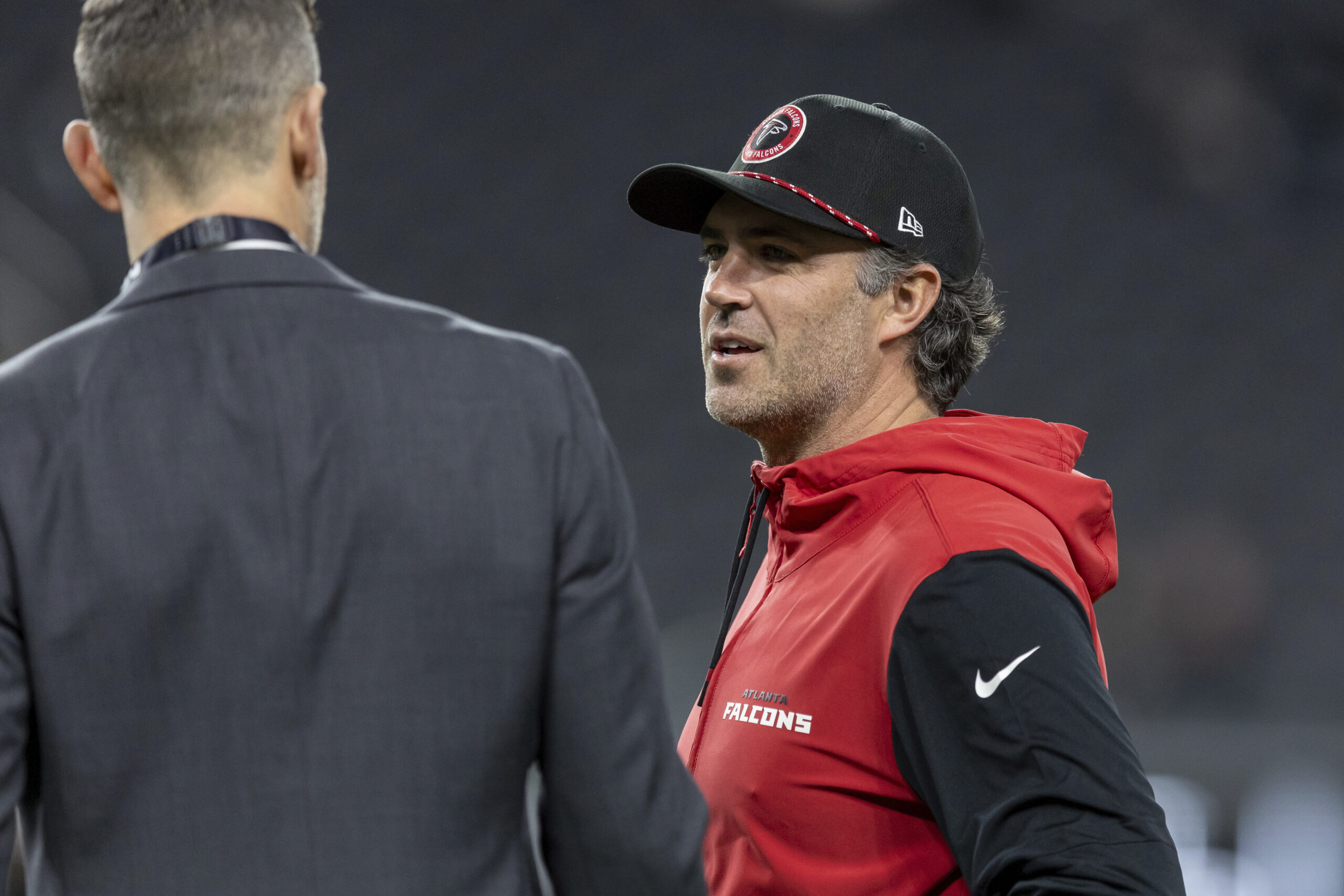
    The Eagles interviewed Robinson on Friday, according to ESPN. They are among at least three teams who have interviewed Robinson for an OC job, joining the Bucs and Lions.

    Robinson, 39, was Atlanta’s offensive coordinator for two seasons. The Falcons had a lot of success on offense in 2024 but took a step back in 2025 as quarterback Michael Penix struggled in his second NFL season (first as a starter).

    Robinson, a former quarterback, was a seventh-round pick by New England in 2010 and was in the league for four seasons as a backup or practice squad player. In addition to the Patriots, he spent time with the Seattle Seahawks, Lions, and Cincinnati Bengals.

    Robinson then became an independent coach and trainer of quarterbacks and was a senior analyst at Pro Football Focus before Sean McVay hired him in 2019. Robinson eventually became the Rams’ passing game coordinator and quarterbacks coach in 2022.

    Bobby Slowik had initial success as the Texans’ offensive coordinator but was fired by DeMeco Ryans after the 2024 season.

    Bobby Slowik

    The Eagles, according to ESPN, requested to interview Slowik, Miami’s senior passing game coordinator.

    Slowik, 38, is another branch on the Shanahan tree. He worked with the Shanahans in Washington from 2011 to 2013 and then, like Robinson, was a PFF analyst. Kyle Shanahan then hired Slowik in 2017 as a defensive quality control coach.

    Slowik, the son of Bob Slowik, a longtime NFL coach, jumped to the offensive side of the ball in San Francisco in 2019. He was the passing game coordinator for the 2022 season before Houston hired him to be its offensive coordinator in 2023. He was with the Texans during C.J. Stroud’s impressive rookie season but oversaw a decline in 2024 that led to his firing.

    Slowik then joined his pal McDaniel in Miami for the 2025 season.

    Ole Miss offensive coordinator Charlie Weis Jr. is a wild-card candidate in the Eagles’ OC search.

    Charlie Weis Jr.

    As with McDaniel, the connection from Weis to the Eagles is a loose one right now. The Eagles, according to the New York Daily News, “poked around” on Weis, the 32-year-old son of longtime coach Charlie Weis.

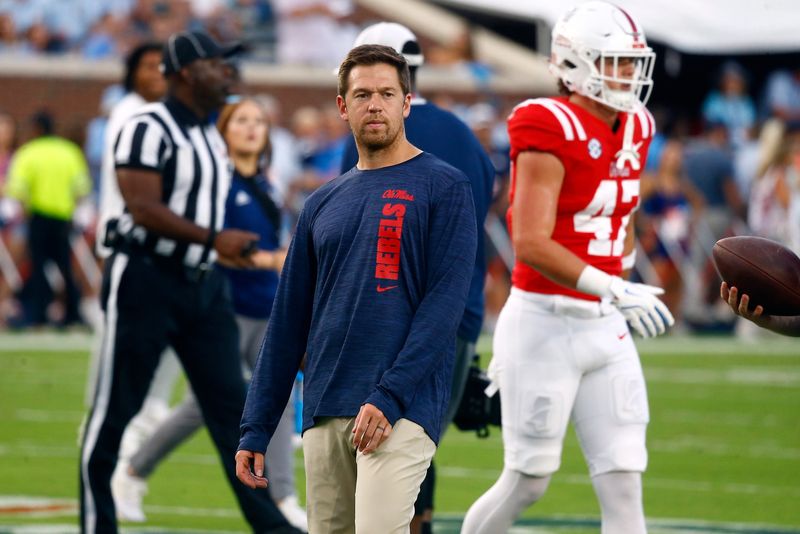
    Weis was just 28 when Lane Kiffin hired him to lead Ole Miss’ offense after the 2021 season. In four seasons at Ole Miss, Weis helped lead one of the best offenses in college football. The Rebels were second in yards per game in each of the last two seasons.

    Weis is slated to join Kiffin at LSU.

  • Philly area measures weekend snowfall totals as winter’s coldest weather moves in

    Philly area measures weekend snowfall totals as winter’s coldest weather moves in

    Sunday’s snowfall might have been the best winter weather has to offer: Just enough to enchant, without back-knotting amounts to shovel.

    Totals varied throughout the Philadelphia region, with a high of 4.9 inches in East Rockhill Township, Bucks County, to less than an inch at Philadelphia International Airport.

    The official National Weather Service observation for the region in Mount Holly, Burlington County, was 3.6 inches.

    Snowfalls were reported over 24 hours by National Weather Service employees, trained spotters, weather stations, automated systems, and the public. They do not include Saturday’s snow.

    Snow covered the trail leading down to Forbidden Drive from North Jannette Street on Monday.

    Overall, the weekend was good news for skiers. Stroudsburg in Monroe County in the Poconos received 4.2 more inches of powder that resorts didn’t have to make.

    Weisenberg Township in Lehigh County received 4.8 inches.

    Areas farthest east of the city, including the Shore region, received the least amount of snow. Atlantic City International Airport reported only a dusting.

    window.addEventListener(“message”,function(a){if(void 0!==a.data[“datawrapper-height”]){var e=document.querySelectorAll(“iframe”);for(var t in a.data[“datawrapper-height”])for(var r,i=0;r=e[i];i++)if(r.contentWindow===a.source){var d=a.data[“datawrapper-height”][t]+”px”;r.style.height=d}}});

    But with most homeowners and businesses likely to be shoveled out by Monday night, forecasters warn that the coldest weather of the winter so far is on the way — along with bitter wind chills, according to Joe DeSilva, a meteorologist with the National Weather Service in Mount Holly.

    “For this week, it’s going to be mostly cold,” DeSilva said. “Especially tonight [Monday] and tomorrow night we’ll have wind chills mainly in the single digits. Tonight we’ll have windchills around zero to 5 degrees above zero.”

    In fact, the Weather Service says windchills could even dip to minus-15 degrees Monday night into Tuesday morning northwest of the I-95 corridor.

    The Weather Service has issued a cold weather advisory as a result.

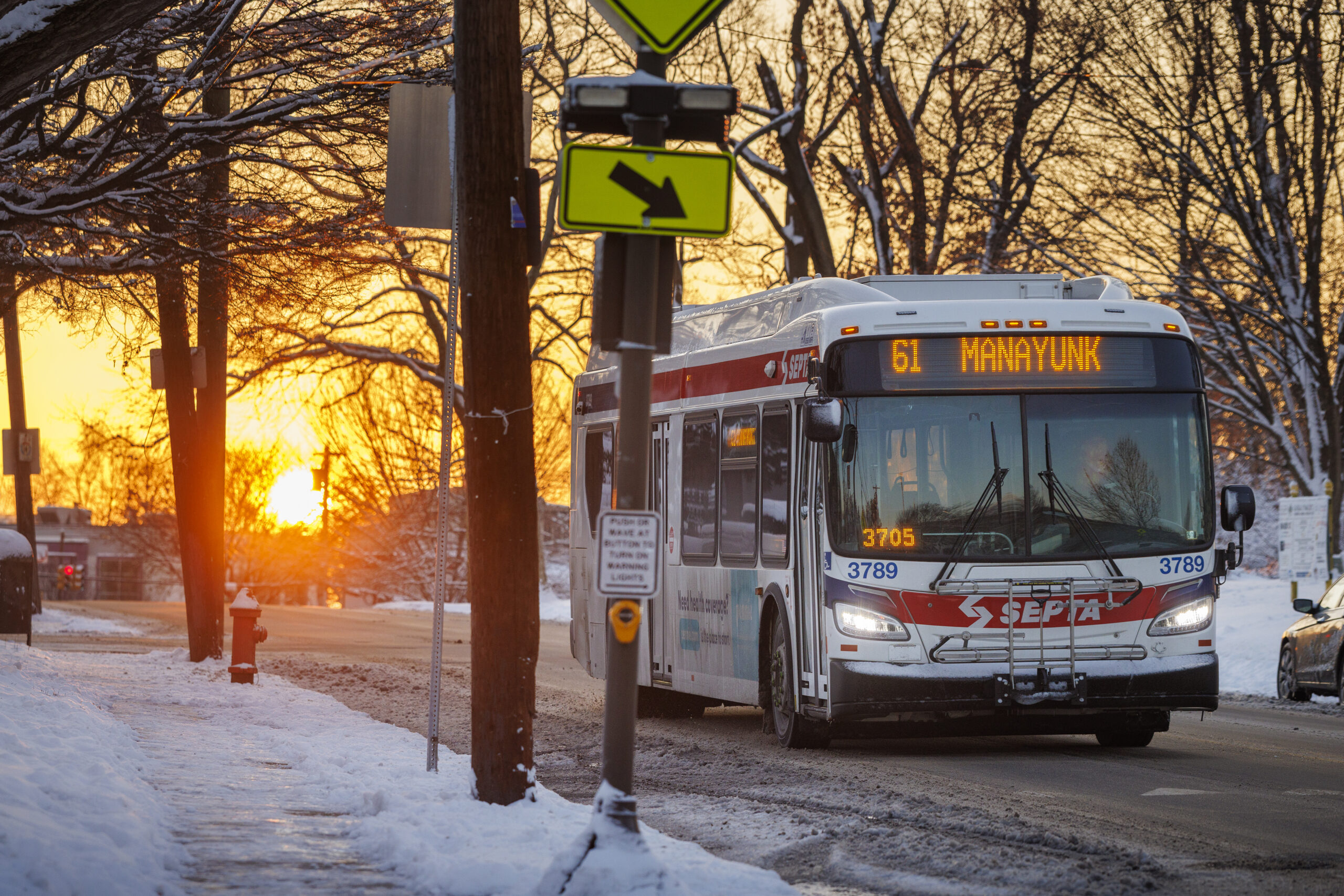
    A route 61 SEPTA bus heads up Ridge Avenue in Roxborough on Monday.

    DeSilva said the jet stream is due to dip south — like a big door swinging open to let in all the frosty air from the Arctic and northern Canada.

    “Once that passes tonight,” DeSilva said, “the cold air will start pouring in.”

    After the sunny and mid-30s of Monday afternoon, temperatures were to dip Monday night to around 15 with 10 to 15 m.p.h. winds.

    Then the cold settles in, with a high of only 23 on Tuesday with a low of 10.

    Some relief comes on Wednesday with a forecast high of 36 and overnight lows of 28.

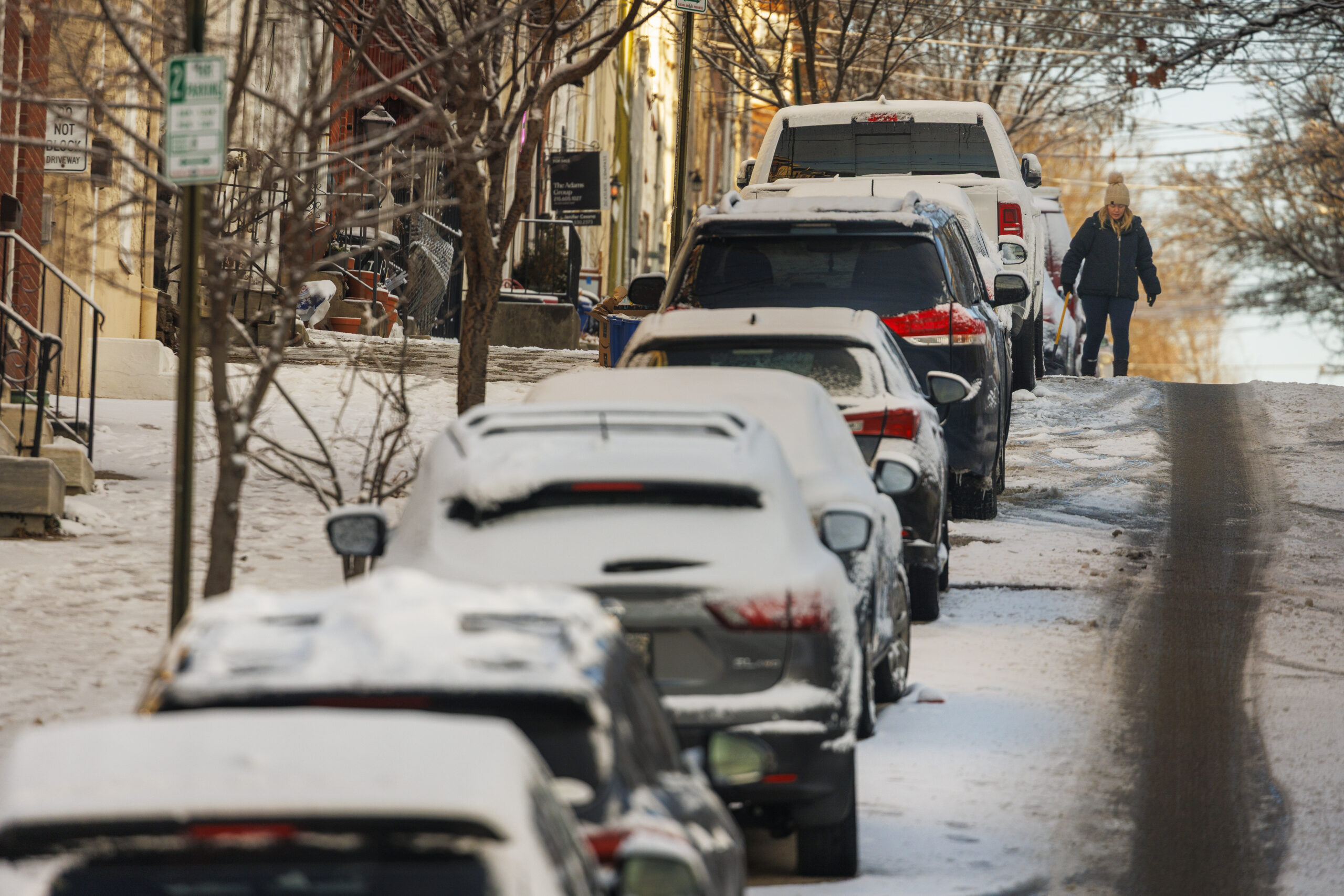
    A woman clears a car along Calumet Street in the East Falls section of Philadelphia on Monday before driving away.

    Thursday, however, looks like a return to more normal temperatures with a mostly sunny day and a high of 43.

    Unfortunately, bracing cold returns for the weekend, with a forecast low of 13 overnight Friday night and a low of 8 overnight Saturday.