Blog

  • Netanyahu says the announced start of Gaza ceasefire’s next phase is a ‘declarative move’

    Netanyahu says the announced start of Gaza ceasefire’s next phase is a ‘declarative move’

    DEIR AL-BALAH, Gaza Strip — Israeli strikes in central Gaza on Thursday killed eight people, including three women, a day after the U.S. announced that the fragile ceasefire would advance to its second phase.

    Israeli Prime Minister Benjamin Netanyahu called the ceasefire announcement largely symbolic, raising questions about how its more challenging elements will be carried out.

    Speaking with the parents of the last Israeli hostage whose remains are still in Gaza, Netanyahu late Wednesday said the governing committee of Palestinians announced as part of the second phase was merely a “declarative move,” rather than the sign of progress described by U.S. envoy Steve Witkoff.

    Israeli police officer Ran Gvili’s parents had earlier pressed Netanyahu not to advance the ceasefire until their son’s remains were returned, Israel’s Hostage and Missing Families Forum said Wednesday.

    Netanyahu told Gvili’s parents that his return remained a top priority.

    The announcement of the ceasefire’s second phase marked a significant step forward but left many questions unanswered.

    Those include the makeup of a proposed, apolitical governing committee of Palestinian experts and an international “Board of Peace.”

    The committee’s composition was coordinated with Israel, said an Israeli official speaking on the condition of anonymity.

    Questions also include the timing of deployment of international forces and the reopening of Gaza’s southern Rafah border crossing, as well as concrete details about disarming Hamas and rebuilding Gaza.

    In an interview on Wednesday with the West Bank-based Radio Basma, Ali Shaath, the engineer and former Palestinian Authority official slated to head the committee, said he anticipated reconstruction and recovery to take roughly three years. He said it would start with immediate needs like shelter.

    “If I bring bulldozers, and push the rubble into the sea, and make new islands (in the sea), new land, it is a win for Gaza and (we) get rid of the rubble,” Shaath, a Gaza native, said.

    Progress announced but hardship endures

    Palestinians in Gaza who spoke to The Associated Press questioned what moving into phase two would actually change on the ground, pointing to ongoing bloodshed and challenges securing basic necessities.

    More than 450 people have been killed since Israel and Hamas agreed to halt fighting in October, Gaza’s Health Ministry said Thursday.

    Six people were killed Thursday in two strikes, according to Al-Aqsa Martyrs Hospital. The first strike killed two men, while three women and a man were killed in the second strike. Israeli military officials did not immediately respond to a message seeking comment on the strikes.

    Separately, the military said that it had killed someone Thursday who had approached troops near the so-called Yellow Line — which divides the Israeli-held part of Gaza from the rest — and posed an imminent threat.

    “We see on the ground that the war has not stopped, the bloodshed has not stopped, and our suffering in the tents has not ended,” said Samed Abu Rawagh, a man displaced to southern Gaza from Jabaliya.

    The casualties since the October ceasefire, which UNICEF said include more than 100 children, are among the 71,441 Palestinians killed since the start of Israel’s offensive, according to the ministry, which does not say how many were fighters or civilians.

    The ministry is part of the Hamas-run government and staffed by medical professionals. The U.N. and independent experts consider it the most reliable source on war casualties. Israel disputes its figures but has not provided its own.

    Hamza Abu Shahab, a man from eastern Khan Younis in southern Gaza, said he was waiting for tangible changes, such as easier access to food, fuel and medical care, rather than promises.

    “We were happy with this news, but we ask God that it is not just empty words,” he told the AP in Khan Younis. “We need this news to be real, because in the second phase we will be able to return to our homes and our areas … God willing, it won’t just be empty promises.”

    Gaza’s population of more than 2 million people has struggled to keep cold weather and storms at bay while facing shortages of humanitarian aid and a lack of more substantial temporary housing, which is badly needed during the winter months.

    This is the third winter since the war between Israel and Hamas started on Oct. 7, 2023, when militants stormed into southern Israel and killed around 1,200 people and abducted 251 others.

    Challenges lie ahead

    The second phase of the ceasefire will confront thornier issues than the first, including disarming Hamas and transitioning to a new governance structure after nearly two decades of the group’s rule in the strip.

    The U.N. has estimated reconstruction will cost over $50 billion. This process is expected to take years and little money has been pledged so far.

    Hamas has said it will dissolve its existing government to make way for the committee announced as part of the ceasefire’s second phase. But it has not made clear what will happen to its military arm or the scores of Hamas-affiliated civil servants and the civilian police.

    Bassem Naim, a member of the group’s political bureau, said Thursday that Hamas welcomed the announcement of the committee as a step toward establishing an independent Palestinian state, but did not elaborate on the issues in question. He said on X that “the ball is now in the court” of the United States and international mediators to allow it to operate.

    Israel has insisted Hamas must lay down its weapons, while the groups’ leaders have rejected calls to surrender despite two years of war, saying Palestinians have “the right to resist.”


  • Nick Sirianni’s forceful vote of confidence from Howie Roseman, and some A.J. Brown trade talk highlight Eagles news conference

    Nick Sirianni’s forceful vote of confidence from Howie Roseman, and some A.J. Brown trade talk highlight Eagles news conference

    There isn’t a whole lot of literal truth you can glean in most press conference settings. That’s especially true in the NFL, where the shield on the logo carries more than a little metaphorical weight. They are messaging platforms, not intelligence briefings. It can be frustrating. It can also be instructive, in certain moments.

    Take Howie Roseman, for instance. On Thursday afternoon, the Eagles general manager was sitting next to Nick Sirianni listening to the head coach wind down an answer to a question about the team’s search for a new offensive coordinator. As soon as Sirianni finished speaking, several reporters began talking over each other to ask the next question. But Roseman had something he wanted to add, and jumped in.

    “I’ve got a lot of things I could say about coach and the job that he’s done here,” the general manager said. “I’m incredibly proud of him. He’s shown that when we bring people in he’s open to doing whatever’s best for this football team. That’s all he cares about is winning. When he’s brought in people he’s given them the flexibility to put their own spin on things. Obviously I sit here and I feel incredibly grateful that I’m working with someone who as a head coach is elite at being a head coach, elite at building a connection with our team, elite about talking about fundamentals, game management, situational awareness, bringing the team together, holding people accountable, and when you’re looking for a head coach those are really the job descriptions.”

    The strongest votes of confidence are usually the unsolicited ones. It would be hard to interpret Roseman’s statement as anything else. Two years ago, the Eagles did Sirianni a disservice with the way they handled the fallout from their late-season collapse and one-and-done showing in the 2023 playoffs. From their decision to wait nine days to announce that Sirianni would return amid rampant speculation that his job was in jeopardy, to their external hunt for an offensive coordinator, the Eagles left the impression that the coach was being Office Spaced out of power. Not only was it an indignity, it led to an offseason full of distractions that easily could have metastasized during the Eagles’ 2-2 start to the 2024 season.

    This time, Roseman made it a point to eliminate any doubt. As he should have. The Eagles are about to embark on an offensive coordinator search that could see them bring in any of a number of big name former head coaches who have their own schemes and, potentially, their own assistant coaches. During Thursday’s press conference, there were several questions about the level of autonomy the new offensive coordinator will have, including the one that prompted Roseman’s unsolicited amicus brief. If the Eagles felt like a clarification of the record was in order, now was the time to provide it.

    It speaks volumes that Roseman took advantage of the opportunity, and that he did it forcefully. A coach needs all the political capital he can get, especially a coach who suffers from perception problems. Sirianni has brought some of those on himself with his occasional emotional regulation issues on the sidelines. But it was always a silly and unrealistic narrative to suggest he was the NFL coaching equivalent of a guy who stayed at a Holiday Inn Express last night. It was also willfully ignorant in a league where John Harbaugh and Mike Tomlin had been two of the most successful coaches of the modern era.

    Howie Roseman and Nick Sirianni are charged with finding answers after the team fell short of its Super Bowl goal.

    As for the exact nature of the Eagles coaching search, and their offseason personnel strategy, you’ll have to rely on your own deductive reasoning. There was little in the way of concrete answers from either Roseman or Sirianni regarding their vision for the Eagles offense.

    Roseman said the Eagles won’t necessarily be targeting an OC who they think could remain with the team for an extended period of time.

    “It’s a great compliment when guys get head coaching jobs from here because it means that we’re having success,” he said.

    Sirianni was noncommittal when asked about his role — and his current assistants’ roles — in the future offense. Which is common sense. If the Eagles hire Mike McDaniel, in whom they reportedly have some interest, they will clearly hire him to be Mike McDaniel the same way they hired Vic Fangio to be Vic Fangio. That said, in most cases, game-planning and play-calling is a far more collaborative process than a lot of people seem to think. The Eagles have always valued that collaborative spirit, especially in the wake of the Chip Kelly era.

    “I know that I want to be the head football coach and I think that’s what the team needs,” Sirianni said. “Everything that I’m doing isn’t because it’s what I want to do, it’s because it’s what’s best for the football team and I think it’s best for the football team when I’m the head football coach.“

    Speaking of reading between the lines, I’ll leave it to you, dear reader, to evaluate Roseman’s comments when asked about the possibility of trading star wideout A.J. Brown.

    “It’s hard to find great players in the NFL and A.J.’s a great player,” Roseman said. “That’s what we’re going out and looking for, when we go out in free agency and the draft, is trying to find great players who love football and he’s that guy. So that would be my answer.”

    I would qualify that wording as “careful” rather than explicit and definitive. But I do think it points to a general truth about the situation. It wouldn’t make a whole lot of sense for the Eagles to trade Brown unless they can somehow do it in a way where they replace him with an equal or better talent. The cost savings and draft pick return almost certainly won’t be enough to legitimize the move on that front. But if they can reap some sort of asset in a deal and also use the $7 million or so they’d clear with a post-June 1 move to add some other pass-catcher, it could make sense. But those are my words, not Roseman’s.

  • Dilys E. Blum, senior curator emeritus at the Philadelphia Art Museum, has died at 78

    Dilys E. Blum, senior curator emeritus at the Philadelphia Art Museum, has died at 78

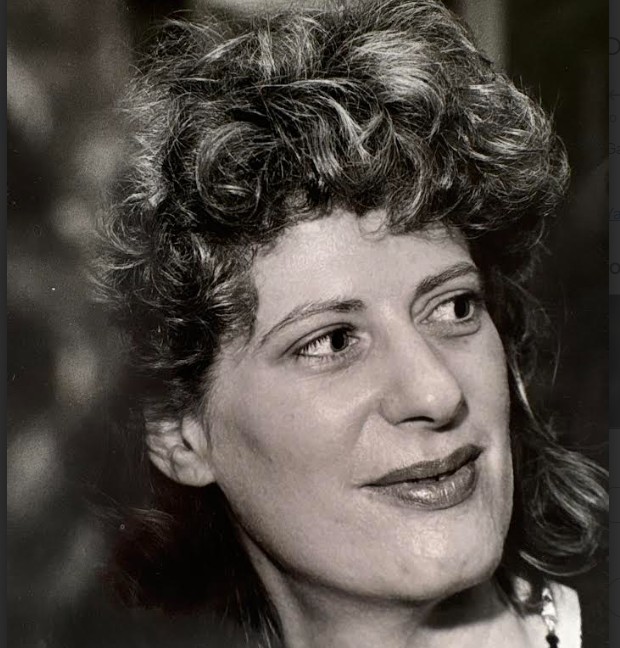
    Dilys E. Blum, 78, of Philadelphia, senior curator emeritus of costume and textiles at the Philadelphia Art Museum, author, lecturer, mentor, and world traveler, died Saturday, Dec. 27, of complications from cancer at Thomas Jefferson University Hospital.

    For 38 years, from 1987 to her retirement in 2025, Ms. Blum served as the museum’s curator of costume and textiles. In that role, she organized the museum’s vast treasure trove of textile artifacts, traveled the world to research noted fashion designers and eclectic collections, and created more than 40 memorable exhibitions about Renaissance velvets, contemporary fashion, Asian textiles, carpets, African American quilts, and dozens of other curios.

    Among her most popular presentations were 1997’s “Best Dressed: 250 Years of Style,” 2011’s “Roberto Capucci: Art into Fashion,” and 2025’s “Boom: Art and Design in the 1940s.” She organized two displays simultaneously in 2007, and The Inquirer said: “One exhibit is elegant, one’s eccentric, both are impressive.”

    She was cited as the world’s foremost authority on avant-garde Italian fashion designer Elsa Schiaparelli, and her 2003 exhibition “Shocking! The Art and Fashion of Elsa Schiaparelli” drew 83,000 visitors. Francesco Pastore, the heritage and cultural projects manager at the House of Schiaparelli in Paris, said: “Her remarkable research, her generosity in sharing knowledge, and her contribution to fashion studies have deeply enriched our field.”

    Ms. Blum (right) and colleague Monica Brown tend to a museum exhibit in 2011.

    In a recent tribute, former museum colleagues marveled at her “technical expertise and cultural insight,” and credited her for reinvigorating the once-neglected textiles collection. Daniel Weiss, director and chief executive officer of the museum, said: “She transformed this museum’s costume and textiles department into a program respected around the world.”

    She told The Inquirer in 1990: “We wanted to remind them that we were here.”

    Before Philadelphia, Ms. Blum was a textile conservator at the Chicago Conservation Center and the Brooklyn Museum, and senior assistant keeper of the costume and textile department at the Museum of London. She earned a bachelor’s degree in art history at Connecticut College and studied afterward at the University of Manchester in England and the Courtauld Institute of Art at the University of London.

    “She was fearless in her pursuit of perfection in her work,” said her sister Galen. Her sister Sydney said: “She was dedicated to her craft and scholarship.”

    Ms. Blum (left) was close to her sisters Sydney (center) and Galen.

    An avid reader and writer, Ms. Blum wrote and cowrote several books about textiles and designers, and 2021’s Patrick Kelly: Runway of Love, coauthored with former colleague Laura L. Camerlengo, earned a 2023 honorable mention publication award from the Costume Society of America. She also wrote essays for exhibition catalogs, served on editorial boards for journals, lectured around the world, and was active with the International Council of Museums, the Association of Art Museum Curators, and other groups.

    In 2025, to celebrate Ms. Blum’s retirement, Camerlengo praised her “deep knowledge, creative vision, and contagious passion for the field.” She said: “Dilys is one of the most influential figures in the world of fashion and textile arts.”

    Ms. Blum’s work and fashion viewpoints were featured often in The Inquirer. In 1997, she said: “People don’t dress up anymore.” In 1999, she said: “I think we’ve lost the joy in dressing. There’s this trend away from clutter in dress and decorating. It’s pared down to the point of visual boredom.”

    In 2001, she said it was easy to differentiate between New Yorkers and Philadelphians. “New Yorkers,” she said, “will invariably be wearing the accessory of the moment, a pashmina shawl, a Kate Spade bag, a Prada loafer.”

    Ms. Blum left “an enduring legacy woven through the art museum and the generations of scholars and visitors who now see costumes and textiles as central to the story of art,” former museum colleagues said.

    Dilys Ellen Blum was born July 11, 1947, in Ames, Iowa. She and her parents moved to Hamilton, N.Y., when she was 1, and the family traveled with her father, an economics professor at Colgate University, on teaching sabbaticals abroad. When she was 12, Ms. Blum spent a year with her parents and sisters living in Norway and touring Europe in a Volkswagen Beetle.

    Her mother was an artist and seamstress, and she and Ms. Blum spent many nights poring over clothes patterns on their dining room table. She enjoyed reading murder mysteries and traveling the world in search of new museum-worthy artifacts.

    She lived in South Philadelphia, was diagnosed with cancer three years ago, and talked often with her sisters on the telephone. “I admired her seriousness and humility,” Sydney said. Galen said: “From my perspective, I was in awe of her.”

    In addition to her sisters, Ms. Blum is survived by a niece, Juniper, and other relatives.

    A memorial service is to be held later.

    Former museum colleagues said Ms. Blum’s writing “consistently amplified the makers and wearers of extraordinary objects, and their intertwined relationships.”
  • After backlash, an Allentown GOP senator stands by the expletive he used to describe Philly

    After backlash, an Allentown GOP senator stands by the expletive he used to describe Philly

    A Pennsylvania Republican state senator doubled down Thursday on remarks denigrating Philadelphia, despite backlash from prominent Philly Democrats.

    “Philadelphia wouldn’t be such a shithole” if District Attorney Larry Krasner prosecuted more crimes, State Sen. Jarrett Coleman, a Republican from Allentown, told Fox News on Wednesday.

    Asked to elaborate Thursday, Coleman cited Philadelphia’s crime rates, which are higher than the national average.

    “My statement stands. The people of Philadelphia deserve better,” Coleman said in a written statement.

    He was met with condemnation from Democrats who defended the city, which last year recorded its lowest number homicides in more than half a century.

    “Now just imagine the outcry if I, a Democrat from an urban area, said exactly the same thing about a rural area?” U.S. Rep. Brendan Boyle, a Philadelphia Democrat, posted to X Thursday morning. “But I wouldn’t because I believe all in our society are of equal worth and deserve our respect.”

    Coleman’s comments came in a broader piece in which he threatened to use a Senate committee he chairs to push back against Krasner and Philadelphia Sheriff Rochelle Bilal if they interfered with President Donald Trump’s administration’s immigration enforcement.

    Last week Krasner and Bilal promised to prosecute any U.S. Immigration and Customs Enforcement agents who committed crimes in the city. Bilal’s comments, made after an ICE agent fatally shot Renee Nicole Good in Minneapolis, went viral and earned the ire of Trump-aligned social media accounts and public officials across the country.

    Coleman criticized the Philadelphia officials Wednesday, narrowing in on Krasner, a progressive who has been a frequent target of Republican ire since he was first elected in 2017.

    His comments were reminiscent of Trump’s notorious remarks in his first term when he was reported to have used the same term to describe some countries in Africa, the Caribbean, and Central America during a meeting. Trump confirmed his use of the term nearly eight years later during a recent visit to Pennsylvania, where he recounted it a cheering crowd in Mount Pocono.

    State Sen. Tony Williams, a Democrat from Philadelphia, echoed Boyle’s criticism and demanded an apology from Coleman, arguing the senator’s comments had degraded not just Philly but the country.

    “He should unfortunately be ashamed of the manner in which he described Philadelphia,” Williams said.

    “I have that part in me as well, I just don’t think it’s productive in these times to add fuel to the fire of stupidity,” he added.

    State Sen. Nikil Saval, a Philadelphia Democrat, said he would be happy to give Coleman a tour of Philly, which he described as “safe, connected, vibrant.”

    “The biggest threat to the safety of Philadelphians is the chronic underfunding perpetuated by Pennsylvania Senate Republicans,” he said.

  • ⭐ MLK Day, Restaurant Week deals, and new Mummers band competition|Things to do

    ⭐ MLK Day, Restaurant Week deals, and new Mummers band competition|Things to do

    I’ll be candid. The Eagles’ loss to the San Francisco 49ers was a sting to my winter plans. I looked forward to the crazed tailgates outside the Linc and the wave of excitement each tush-push touchdown generated among our rabid fanbase.

    We were all hoping for a back-to-back Super Bowl run, even when the glaring holes in our offense signaled something far different. Unfortunately, we’ll have to see how things shake up next season. But that doesn’t mean our winter plans should be in the gutter. There are still plenty of things to do this weekend (and beyond) to mend our broken hearts and fill our typical Eagles Sundays.

    Along with Martin Luther King Jr. celebrations throughout the city, restaurant week specials will be in full swing, plus the return of a Wilma Theater favorite, a toast to Ben Franklin’s 320th birthday, and more.

    Read below to see what’s in store this week and beyond.

    — Earl Hopkins (@earlhopkins_, Email me at thingstodo@inquirer.com)

    If someone forwarded you this email, sign up for free here.

    Sporting a face that sums up the magnetism of mummery Robbie Reid (top), a member of the Froggy Carr comic club, pauses for a moment along the parade route yesterday. At left, the Fralinger String Band performs during the competition judging – it won – at City Hall. And at right, Mayor Nutter appears to be doing a version of the mummers’ strut as he kicks off the string band division yesterday with the Greater Overbrook String Band leading off.

    Mummers string band competition will duke it out at the Linc

    Thirty to 60 mph winds led to a postponement of the Mummers’ string band competition, and put a momentary damper on what was otherwise an extraordinary New Year’s Day. But the string bands may have gotten an even sweeter prize out of the ordeal, according to my colleague Henry Savage.

    The judged string band competition will now take place at 2 p.m. on Jan. 31 at the Linc, parade officials announced last week. The annual competition is still open to the public, with tickets available on Ticketmaster for $12 to $25. It will also be broadcast on WFMZ-TV.

    The best things to do this week

    ⭐ Celebrate MLK: Celebrate civil rights icon, and my dear fraternity brother, Dr. Martin Luther King Jr., at the African American Museum in Philadelphia starting Saturday. AAMP’s “Celebrating MLK 2026: Radical Peace and Public Memory” offers a screening of Selma, art-making, gallery talks, and other family-friendly activity through Jan 19.

    🎉 Ben’s Birthday Bash: Stop by the Franklin Institute to celebrate Ben Franklin’s 320th birthday. The birthday bash for the founding father will be packed with games, music, and a few surprises. Visitors can even hear the song “Happy Birthday” being played on one of Franklin’s own inventions: the glass harmonica.

    🦸🏼‍♂️ Unleash your inner superhero: The Bingo Verifying Divas will step out donning superhero ensembles for Superhero Smash GayBINGO at the Congregation Rodeph Shalom. The crew will bring its typical brand of entertainment and laugh-out-loud comedy, plus some prizes between each round.

    🔍 A watchful eye on this famed detective: For theater-lovers and inquiring minds, Sherlock Holmes: The Great Detective, directed by Bill Van Horn, now runs through Feb. 15 at Walnut Street Theatre.

    📅 My calendar picks this week: Trestle Night Fever Happy Hour Dance Party and Tramp Stamp: Trashy 2000s Party at Kung Fu Necktie.

    Pig Iron Theatre Company’s ‘Poor Judge’ premieres at the 2024 Fringe Festival, running Sept. 11-22 at the Wilma Theater.

    The thing of the week: ‘Poor Judge’ is back

    The brainchild of beloved performer Dito Von Reigersberg (aka Martha Graham Cracker) is now back on stage.

    Pig Iron Theatre Company’s Poor Judge, a story of love, Hollywood ambition, and the darkness of the American success story, returns to Wilma Theater for the first time since its debut two years ago.

    The show, brought to life by the music of Aimee Mann, is running through Jan. 25. Tickets are available at wilmatheater.org.

    Winter fun this week and beyond

    🎭 Final curtain call: Catch the Tony Award-winning musical Suffs, a story chronicling women’s struggles for the right to vote, at the Academy of Music before it closes on Jan. 18.

    🍜 Restaurant Week in Center City: Center City District Restaurant Week returns with a bevy of prix-fixe dinner menus, ranging from $45-$60 at select restaurants, plus two-course lunches for $20 at other nearby eateries. Visit the official website for the full list of participants.

    🥘 Bucks County bites: New Hope and Lambertville join forces for a PA-NJ-style restaurant week through Jan. 25, which includes two dozen restaurants along both sides of the Delaware River.

    🍻 Philly Flurry in Fairmount: Small business in Fairmount, Brewerytown, Francisville, and Spring Garden are offering limited-time promos and discounts on drafts, cocktails, ice cream pints, and food orders through Feb. 1. Here’s a full list of participants.

    Staffer picks

    Pop music critic Dan DeLuca lists the top concerts this weekend and a few holiday pop-up jams happening this month.

    🎸 Thursday: Singer and guitarist Bill Kirchen, best known for their 1972 hit “Hot Rod Lincoln, stops at Sellersville Theater on Thursday. He will perform one set with his band Commander Cody and His Lost Planet Airmen, and another set with his Bob Dylan tribute band.

    🎤 Friday: Long-time soul balladeer Peabo Bryson is on tour, 35 years since his Grammy-winning duet with Celine Dion on the title song for 1991’s Beauty and the Beast. He will be at City Winery on Friday.

    🎤 Saturday: Chuck D and Flavor Flav will be joined by fellow hip-hop legends and R&B acts on Saturday at the Jim Whelan Boardwalk Hall in Atlantic City. Other veteran performers include Montel Jordan of “This Is How We Do It” fame, KRS-One, Sugarhill Gang, Philly’s Schoolly D, and the Furious Five – minus the group’s leader Grandmaster Flash.

    Thanks for sticking with me for another newsletter entry. As I said at the top of the year, some amazing things are happening in 2026, even if our Birds came up short in the playoffs. I’ll do my best to capture the highlights. so tay tuned for more.

    – Earl Hopkins

    Courtesy of Giphy.com
  • Press freedom advocates worry that raid on Washington Post journalist’s home will chill reporting

    Press freedom advocates worry that raid on Washington Post journalist’s home will chill reporting

    If the byproduct of a raid on a Washington Post journalist’s home is to deter probing reporting of government action, the Trump administration could hardly have chosen a more compelling target.

    Hannah Natanson, nicknamed the “federal government whisperer” at the Post for her reporting on President Donald Trump’s changes to the federal workforce, had a phone, two laptops, and a Garmin watch seized in the Wednesday search of her Virginia home, the newspaper said.

    A warrant for the raid said it was connected to an investigation into a government contractor accused of illegally retaining classified government materials, said Matt Murray, the Post’s executive editor, in an email to his staff. The Post was told that Natanson and the newspaper are not targets of the investigation, he said.

    In a meeting Thursday, Murray told staff members that “the best thing to do when people are trying to intimidate you is not be intimidated — and that’s what we did yesterday.”

    The Reporters Committee for Freedom of the Press said Thursday it has asked the U.S. District Court in Virginia to unseal the affidavit justifying the search of Natanson’s home.

    Attorney General Pam Bondi said that the search was done at the request of the Defense Department and that the journalist was “obtaining and reporting classified and illegally leaked information from a Pentagon contractor.”

    “If the attorney general can describe the justification for searching a reporter’s home on social media, it is difficult to see what harm could result from unsealing the justification that the Justice Department offered to this court,” the Reporters Committee said in its application.

    Government raids to homes of journalists highly unusual

    Jameel Jaffer, executive director of the Knight First Amendment Institute at Columbia University, has been working on press freedom issues for a decade and said a government raid on a journalist’s home is so unusual he couldn’t remember the last time it happened. He said it can’t help but have a chilling effect on journalism.

    “I strongly suspect that the search is meant to deter not just that reporter but other reporters from pursuing stories that are reliant on government whistleblowers,” Jaffer said. “And it’s also meant to deter whistleblowers.”

    In a first-person piece published by the Post on Christmas Eve, Natanson wrote about how she was inundated with tips when she posted her contact information last February on a forum where government employees were discussing the impact of Trump administration changes to the federal workforce.

    She was contacted by 1,169 people on Signal, she wrote. The Post was notably aggressive last year in covering what was going on in federal agencies, and many came as a result of tips she received — and was still getting. “The stories came fast, the tips even faster,” she wrote.

    Natanson acknowledged the work took a heavy toll, noting one disturbing note she received from a woman she was unable to contact. “One day, a woman wrote to me on Signal, asking me not to respond,” she wrote. “She lived alone, she messaged, and planned to die that weekend. Before she did, she wanted at least one person to understand: Trump had unraveled the government, and with it, her life.”

    Natanson did not return messages from the Associated Press. Murray said that “this extraordinary, aggressive action is deeply concerning and raises profound questions and concern around the constitutional protections for our work.”

    The action “signals a growing assault on independent reporting and undermines the First Amendment,” said Tim Richardson, journalism and disinformation program director at the advocacy group PEN America. Like Jaffer, he believes it is intended to intimidate.

    Sean Spicer, Trump’s press secretary at the beginning of his first term, said the concerns are premature. If it turns out that Natanson did nothing wrong, then questions about whether the raid was an overreach are legitimate, said Spicer, host of the political news show The Huddle on streaming services.

    “If Hannah did something wrong, then it should have a chilling effect,” he said.

    A law passed in 1917 makes it illegal for journalists to possess classified information, Jaffer said. But there are still questions about whether that law conflicts with First Amendment protections for journalists. It was not enforced, for example, when The New York Times published a secret government report on U.S. involvement in Vietnam in 1971.

    “It’s the government’s prerogative to pursue leakers of classified material,” the Post said in an editorial. “Yet journalists have First Amendment rights to gather and publish such secrets, and the Post also has a history of fighting for those freedoms.”

    Not the first action taken against the press

    The raid was made in context of a series of actions taken against the media during the Trump administration, including lawsuits against The New York Times and the BBC. Most legacy news organizations no longer report from stations at the Pentagon after they refused to sign on new rules restricting their reporting set by Defense Secretary Pete Hegseth. Funding for public broadcasting has been choked off due to Trump’s belief that its news coverage leaned left.

    Some news outlets have also taken steps to be more aligned with the administration, Jaffer said, citing CBS News since its corporate ownership changed last summer. The Washington Post has shifted its historically liberal opinion pages to the right under owner Jeff Bezos.

    The Justice Department over the years has developed, and revised, internal guidelines governing how it will respond to news media leaks. In April, Bondi issued new guidelines saying prosecutors would again have the authority to use subpoenas, court orders and search warrants to hunt for government officials who make “unauthorized disclosures” to journalists.

    The moves rescinded a policy from President Joe Biden’s Democratic administration that protected journalists from having their phone records secretly seized during leak investigations.

    “Leaking classified information puts America’s national security and the safety of our military heroes in serious jeopardy,” White House press secretary Karoline Leavitt said in a post on X. “President Trump has zero tolerance for it and will continue to aggressively crack down on these illegal acts moving forward.”

    The warrant says the search was related to an investigation into a system engineer and information technology specialist for a government contractor in Maryland who authorities allege took home classified materials, the Post reported.

    The worker, Aurelio Perez-Lugones, is accused of printing classified and sensitive reports at work, and some were found at his Maryland home, according to court papers. He was arrested last week on a charge of unauthorized removal and retention of classified documents.

    Perez-Lugones made a brief appearance in a Baltimore courtroom on Thursday. His attorney said they weren’t prepared to proceed with a hearing to determine whether he should remain jailed until a trial.

  • Trump announces outlines of healthcare plan he wants Congress to consider

    Trump announces outlines of healthcare plan he wants Congress to consider

    WASHINGTON — President Donald Trump on Thursday announced the outlines of a healthcare plan he wants Congress to take up as Republicans have faced increasing pressure to address rising health costs after lawmakers let subsidies expire.

    The cornerstone is his proposal to send money directly to Americans for health savings accounts so they can handle insurance and health costs as they see fit. Democrats have rejected the idea as a paltry substitute for the tax credits that had helped lower monthly premiums for many people.

    “The government is going to pay the money directly to you,” Trump said in a taped video the White House released to announce the plan. “It goes to you and then you take the money and buy your own healthcare.”

    Trump’s plan also focuses on lowering drug prices and requiring insurers to be more upfront with the public about costs, revenues, rejected claims and wait times for care.

    Trump has long been dogged by his lack of a comprehensive healthcare plan as he and Republicans have sought to unwind former President Barack Obama’s signature legislation, the Affordable Care Act. Trump was thwarted during his first term in trying to repeal and replace the law.

    When he ran for president in 2024, Trump said he had only “concepts of a plan” to address healthcare. His new proposal, short on many specifics, appeared to be the concepts of a plan.

    Mehmet Oz, administrator of the Centers for Medicare and Medicaid Services, described it to reporters on a telephone briefing as a “framework that we believe will help Congress create legislation.”

    It was not immediately clear if any lawmakers in Congress were working to introduce the Republican president’s plan. A White House official who was not authorized to speak publicly and described some details on condition of anonymity said the administration had been discussing the proposal with allies in Congress, but was unable to name any lawmakers who were working to address the plan.

    Few specifics on health savings accounts

    The White House did not offer any details about how much money it envisioned being sent to consumers to shop for insurance, or whether the money would be available to all “Obamacare” enrollees or just those with lower-tier bronze and catastrophic plans.

    The idea mirrors one floated among Republican senators last year. Democrats largely rejected it, saying the accounts would not be enough to cover costs for most consumers. Currently, such accounts are used disproportionately by the wealthiest Americans, who have more income to fund them and a bigger incentive to lower their tax rate.

    White House press secretary Karoline Leavitt was asked at her briefing Thursday whether the president could guarantee that under his plan, people would be able to cover their health costs. She did not directly answer, but said, “If this plan is put in place, every single American who has health care in the United States will see lower costs as a result.”

    Enhanced tax credits that helped reduce the cost of insurance for the vast majority of Affordable Care Act enrollees expired at the end of 2025 even though Democrats had forced a 43-day government shutdown over the issue.

    Sen. Bernie Moreno (R., Ohio) has been leading a bipartisan group of 12 senators trying to devise a compromise that would extend those subsidies for two years while adding new limits on who can receive them. That proposal would create the option, in the second year, of a health savings account that Trump and Republicans prefer.

    The White House official denied that Trump was closing the door completely on those bipartisan negotiations, and said the White House preferred to send money directly to consumers.

    Plan follows massive cuts to health programs

    Trump’s plan comes months after the Republicans’ big tax and spending bill last year cut more than $1 trillion over a decade in federal healthcare and food assistance, largely by imposing work requirements on those receiving aid and shifting certain federal costs to the states.

    Democrats have blasted those cuts as devastating for vulnerable people who rely on programs such as Medicaid for their healthcare. The GOP bill included an infusion of $50 billion over five years for rural health programs, an amount experts have said is inadequate to fill the gap in funding.

    The White House said Trump’s new proposal will seek to bring down premiums by fully funding cost-sharing reductions, or CSRs, a type of financial help that insurers give to low-income ACA enrollees on silver-level, or mid-tier plans.

    From 2014 until 2017, the federal government reimbursed insurance companies for CSRs. In 2017, the first Trump administration stopped making those payments. To make up for the lost money, insurance companies raised premiums for silver-level plans. That ended up increasing the financial assistance many enrollees got to help them pay for premiums.

    As a result, health analysts say that while restoring money for CSRs would likely bring down silver-level premiums, as Trump says, it could have the unwelcome ripple effect of increasing many people’s net premiums on bronze and gold plans.

    Lowering drug prices is a priority

    Oz said Trump’s plans also seeks to have certain medications made available over the counter instead of by prescription if they are deemed safe enough. He mentioned higher-dose nonsteroidal anti-inflammatory drugs and peptic ulcer drugs as two examples.

    It was unclear whether the White House is asking Congress to take steps to make more prescription drugs available over the counter. For decades, the Food and Drug Administration has had the ability to do that.

    The heartburn drug Prilosec, as well as numerous allergy medications, are among those the FDA has approved for over-the-counter sales. The FDA only approves such changes if studies show patients can safely take the drug after reading the package labeling. Companies must apply for the switch.

    The White House said Trump’s plan would also codify his efforts to lower drug prices by tying prices to the lowest price paid by other countries.

    Trump has already struck deals with a number of drugmakers to get them to lower the prices. As part of that, the drugmakers have agreed to sell pharmacy-ready medicines directly to consumers who can shop online at the White House’s website for selling drugs directly to consumers, TrumpRx.gov.

    TrumpRx did not yet have any drugs listed on Thursday. Oz said drugs will be available on the website at the end of the month.

  • Court ruling jeopardizes freedom for pro-Palestinian activist Mahmoud Khalil

    Court ruling jeopardizes freedom for pro-Palestinian activist Mahmoud Khalil

    A federal appeals panel on Thursday reversed a lower court decision that released former Columbia University graduate student Mahmoud Khalil from an immigration jail, bringing the government one step closer to detaining and ultimately deporting the Palestinian activist.

    The three-judge panel of the Third U.S. Circuit Court of Appeals in Philadelphia didn’t decide the key issue in Khalil’s case: whether the Trump administration’s effort to throw Khalil out of the U.S. over his campus activism and criticism of Israel is unconstitutional.

    But in its 2-1 decision, the panel ruled a federal judge in New Jersey didn’t have jurisdiction to decide the matter at this time. Federal law requires the case to fully move through the immigration courts first, before Khalil can challenge the decision, they wrote.

    “That scheme ensures that petitioners get just one bite at the apple — not zero or two,” the panel wrote. “But it also means that some petitioners, like Khalil, will have to wait to seek relief for allegedly unlawful government conduct.”

    The law bars Khalil, 31, “from attacking his detention and removal in a habeas petition,” the panel added.

    Ruling won’t result in immediate detention

    It was not clear whether the government would seek to detain Khalil, a legal permanent resident, again while his legal challenges continue.

    Thursday’s decision marked a major win for the Trump administration’s sweeping campaign to detain and deport noncitizens who joined protests against Israel.

    Tricia McLaughlin, a Homeland Security Department spokesperson, called the ruling “a vindication of the rule of law.”

    In a statement, she said the department will “work to enforce his lawful removal order” and encouraged Khalil to “self-deport now before he is arrested, deported, and never given a chance to return.”

    In a statement distributed by the American Civil Liberties Union, Khalil said the appeals ruling was “deeply disappointing, but it does not break our resolve.”

    He added: “The door may have been opened for potential re-detainment down the line, but it has not closed our commitment to Palestine and to justice and accountability. I will continue to fight, through every legal avenue and with every ounce of determination, until my rights, and the rights of others like me, are fully protected.”

    Baher Azmy, one of Khalil’s lawyers, with the Center for Constitutional Rights, said the ruling was “contrary to rulings of other federal courts.” He noted the panel’s finding concerned a “hypertechnical jurisdictional matter,” rather than the legality of the Trump administration’s policy.

    “Our legal options are by no means concluded, and we will fight with every available avenue,” he added, saying Khalil would remain free pending the full resolution of all appeals, which could take months or longer.

    The ACLU said the Trump administration cannot lawfully re-detain Khalil until the order takes formal effect, which won’t happen while he can still immediately appeal.

    Khalil has multiple options to appeal

    Khalil’s lawyers can request the active judges on the Third Circuit hear an appeal, or they can go to the U.S. Supreme Court.

    An outspoken leader of the pro-Palestinian movement at Columbia, Khalil was arrested on March 8, 2025. He then spent three months detained in a Louisiana immigration jail, missing the birth of his firstborn.

    Federal officials have accused Khalil of leading activities “aligned to Hamas,” though they have not presented evidence to support the claim and have not accused him of criminal conduct. They have also accused Khalil, 30, of failing to disclose information on his green card application.

    The government has justified the arrest under a seldom-used statute that allows for the expulsion of noncitizens whose beliefs are deemed to pose a threat to U.S. foreign policy interests.

    In June, a federal judge in New Jersey ruled that justification would likely be declared unconstitutional and ordered Khalil released.

    President Donald Trump’s administration appealed that ruling, arguing the deportation decision should fall to an immigration judge, rather than a federal court.

    Khalil has dismissed the allegations as “baseless and ridiculous,” framing his arrest and detention as a “direct consequence of exercising my right to free speech as I advocated for a free Palestine and an end to the genocide in Gaza.”

    Dissenting judge says Khalil has right to fight detention

    Judge Arianna Freeman dissented Thursday, writing that her colleagues were holding Khalil to the wrong legal standard. Khalil, she wrote, is raising “now-or-never claims” that can be handled at the district court level. He does not have a final order of removal, which would permit a challenge in an appellate court, she wrote.

    Both judges who ruled against Khalil, Thomas Hardiman and Stephanos Bibas, were Republican appointees. President George W. Bush appointed Hardiman to the Third Circuit, while Trump appointed Bibas. President Joe Biden, a Democrat, appointed Freeman.

    The majority opinion noted Freeman worried the ruling would leave Khalil with no remedy for unconstitutional immigration detention, even if he later can appeal.

    “But our legal system routinely forces petitioners — even those with meritorious claims — to wait to raise their arguments, the judges wrote. “To be sure, the immigration judge’s order of removal is not yet final; the Board has not affirmed her ruling and has held the parties’ briefing deadlines in abeyance pending this opinion. But if the Board ultimately affirms, Khalil can get meaningful review.”

    The decision comes as an appeals board in the immigration court system weighs a previous order that found Khalil could be deported. His attorneys have argued that the federal order should take precedence.

    That judge has suggested Khalil could be deported to Algeria, where he maintains citizenship through a distant relative, or Syria, where he was born in a refugee camp to a Palestinian family.

    His attorneys have said he faces mortal danger if forced to return to either country.

  • Jewish students and faculty at Penn ask that their names not be turned over in federal antisemitism investigation

    Jewish students and faculty at Penn ask that their names not be turned over in federal antisemitism investigation

    Several groups at the University of Pennsylvania representing Jewish students, faculty, and staff are seeking to protect their names and personal information from being turned over to the U.S. Equal Employment Opportunity Commission, which is suing Penn for the data.

    The EEOC filed suit in November after the Ivy League university refused to comply with a subpoena seeking information for an investigation it began in 2023 over the school’s treatment of Jewish faculty and other employees regarding antisemitism complaints.

    In its quest to find people potentially affected, the commission demanded a list of employees in Penn’s Jewish Studies Program, a list of all clubs, groups, organizations, and recreation groups related to the Jewish religion — including points of contact and a roster of members — and names of employees who lodged antisemitism complaints.

    In a legal filing in federal court this week, several groups argued that their personal information should be kept private.

    “In effect, these requests would require Penn to create and turn over a centralized registry of Jewish students, faculty, and staff — a profoundly invasive and dangerous demand that intrudes deeply into the freedoms of association, religion, speech, and privacy enshrined in the First Amendment,“ the groups charged in the filing.

    The motion was filed on behalf of the American Academy of Jewish Research — the oldest organization of Jewish studies scholars in North America — Penn Carey Law School’s Jewish Law Students Association, the national and Penn chapters of the American Association of University Professors, and the Penn Association of Senior and Emeritus Faculty. All the groups include Jewish students, faculty, and staff whose information could be affected, according to lawyers involved in filing the motion.

    No matter the EEOC’s motives, “creating a list of Jews in an era where data security is questionable, against the backdrop of rising antisemitism … and white supremacy, is terrifying,“ Amanda Shanor, a Penn associate professor of legal studies and business ethics and one of the lawyers who filed the motion, said in an interview.

    The groups argued that providing the personal information to the commission could harm future membership.

    “The prospect that the subpoena or a similar future subpoena could be enforced will chill the Jewish community members’ willingness to join and participate in these organizations for years to come,” the filing said.

    And while Penn has resisted compliance, the groups worry that could change if President Donald Trump’s administration applies financial or other pressure, according to the filing.

    Penn last summer entered into an agreement with the Trump administration over transgender athletes after $175 million in federal funding was paused. Penn agreed to apologize to members of its women’s swim team who were “disadvantaged” by transgender swimmer Lia Thomas’ participation on the team in the 2021-22 season and remove Thomas’ records, giving them instead to swimmers who held the next-best times. The school also agreed to abide by Title IX — the civil rights law that prohibits sexual harassment and discrimination — “as interpreted by the Department of Education” in regard to athletics and state that all its practices, policies, and procedures in women’s athletics will comply with it.

    Lawyers for the groups in the EEOC case pointed to that settlement in their filing.

    “The proposed intervenors cannot leave their rights to chance and must be permitted to protect their rights,” lawyers for the groups said in their filing this week.

    Shanor said while Penn “has been very firm on this in a way that I am very struck by and impressed with,” it is important for the faculty and students to “assert those interests directly and explain to the court from the people who actually would be harmed by this why this is unconstitutional.”

    Steven Weitzman, a professor of religious studies at Penn, said he got involved in part because the EEOC was seeking the names of faculty and staff who participated in confidential listening sessions as part of Penn’s task force on antisemitism.

    “We promised the participants it would be confidential,” said Weitzman, who, as a member of the task force, helped set up the listening sessions.

    Penn provided notes from the sessions, but not participants’ identities, he said.

    As part of the Jewish studies program, his information also would have been vulnerable to the EEOC’s demand. He said even though Penn did not provide the information, the commission somehow got his personal cell number and called last week. He does not intend to call back, he said.

    Asking the university to compile a list of Jewish faculty and staff is wrong, he said.

    “Even if their motives are perfectly benign, they can’t guarantee they will always control that information, and it’s setting a dangerous precedent,” he said.

    Penn declined to comment on the groups’ filing, but in a statement in November, the school said it had cooperated extensively with the EEOC, including providing more than 100 documents and over 900 pages.

    But the private university refused to disclose the personal information.

    “Violating their privacy and trust is antithetical to ensuring Penn’s Jewish community feels protected and safe,” Penn said.

    Penn provided information on employees who complained and agreed to be contacted, the school said, and offered to reach out to employees and make them aware of the EEOC’s request to speak with them.

    The original complaint was launched by EEOC Commissioner Andrea Lucas, now chair of the body, on Dec. 8, 2023, two months after Hamas’ attack on Israel that led to unrest on college campuses, including Penn, and charges of antisemitism. It was also just three days after Penn’s then-president, Liz Magill, had testified before a Republican-led congressional committee on the school’s handling of antisemitism complaints; the testimony drew a bipartisan backlash and led to Magill’s resignation days later.

    Lucas, whom Trump appointed chair last year, also brought similar antisemitism charges against Columbia University that resulted in the school paying $21 million for “a class settlement fund.”

    EEOC complaints typically come from those who allege they were aggrieved. Lucas, according to the complaint, made the charge in Penn’s case because of the “probable reluctance of Jewish faculty and staff to complain of harassing environment due to fear of hostility and potential violence directed against them.“

    The EEOC’s investigation ensued after Lucas’ complaint to the commission’s Philadelphia office that alleged Penn was subjecting Jewish faculty, staff, and other employees, including students, “to an unlawful hostile work environment based on national origin, religion, and/or race.”

    The allegation, the complaint said, is based on news reports, public statements made by the university and its leadership, letters from university donors, board members, alumni, and others. It also cited complaints filed against Penn in federal court and with the U.S. Department of Education over antisemitism allegations and testimony before a congressional committee.

    “Penn has worked diligently to combat antisemitism and protect Jewish life on campus,” Penn said in its November statement about the EEOC lawsuit.

  • Judicial district says decisions on ICE presence at Philly courthouse are the sheriff’s ‘sole responsibility’

    Judicial district says decisions on ICE presence at Philly courthouse are the sheriff’s ‘sole responsibility’

    The judicial district that oversees the Philadelphia court system says that the authority for managing ICE’s controversial presence at the Criminal Justice Center rests on Sheriff Rochelle Bilal and that decisions around that are her “sole responsibility.”

    That follows a Wednesday morning news conference where the sheriff joined local elected and community leaders who suggested that court officials or legislators needed to address the ongoing turmoil around courthouse immigration arrests. They called for meetings with court leaders to discuss how to set guardrails on ICE activity.

    The First Judicial District responded with a statement late Wednesday:

    “The First Judicial District is always willing to discuss matters of mutual concern with our justice partners, but managing security in court buildings ― which includes managing ICE’s presence ― is the sole responsibility of the sheriff. These decisions are the sheriff’s to make.”

    The Philadelphia Sheriff’s Office responded Thursday that it was “ready to execute all lawful judicial orders.”

    “To be clear,” its statement said, “security inside court facilities is the responsibility of the Sheriff’s Office. … Areas outside of court facilities are public spaces, where individuals retain their First Amendment rights, including the right to assemble and protest. Those areas are not under the operational control of the Sheriff’s Office.”

    The sheriff’s office added that it is committed to maintaining order and safety while upholding the rights of all who enter, and that it remains open to dialogue to ensure “clarity, coordination, and public safety.”

    The sheriff has said her office does not cooperate with ICE, does not assist in ICE operations, and does not share information with the agency. She has not directly addressed whether she believes she has authority to bar ICE agents from the property.

    Her supporters have defended the sheriff by insisting that she does not have that power, that she could only carry out orders issued by a judge or legislature.

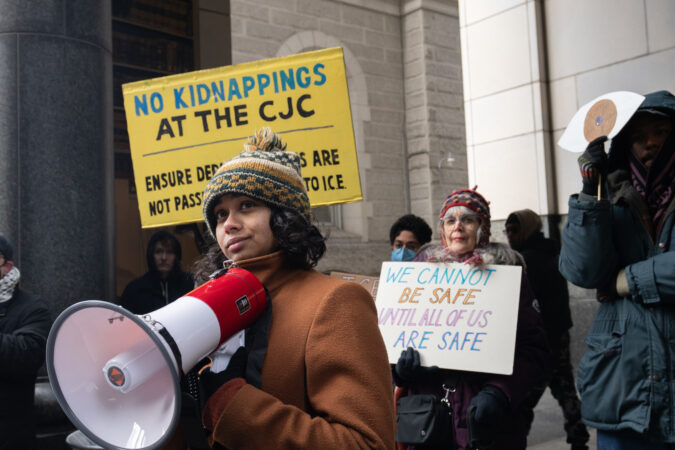
    Meanwhile, the presence of ICE in and around the Criminal Justice Center has provoked demonstrations and controversy, with activists charging that the sheriff has allowed ICE to turn the property into a “hunting ground” for immigrants.

    U.S. Immigration and Customs Enforcement officials did not reply to a request for comment on Thursday.

    The group No ICE Philly has castigated the sheriff, saying that by not barring ICE — as judges and lawmakers in some other jurisdictions have done — she has helped enable the arrest of 114 immigrants who were trailed from the courthouse and arrested on the sidewalk.

    That group and others say ICE agents have been allowed to essentially hang out at the Center City courthouse, waiting in the lobby or scouring the hallways, then making arrests outside.

    Many people who go to the courthouse are not criminal defendants ― they are witnesses, victims, family members, and others in diversionary programs. But they have been targeted and arrested by ICE, immigration attorneys and government officials say, causing witnesses and victims to stay away from court and damaging the administration of justice in Philadelphia.

    Aniqa Raihan, a No ICE Philly organizer who has helped lead courthouse protests, said she was not encouraged by the First Judicial District’s statement.

    “We already know that Sheriff Bilal is not doing all she can to protect people at the courthouse,” she said Thursday. “However, the First Judicial District is not powerless. The court can make its own policy, like the court in Chicago did, barring civil arrests on and around the courthouse. … What we’re seeing is a lot of blame-shifting and finger-pointing from our leaders at a time when we desperately need teamwork.”

    The issue around ICE access is complicated by the fact that courthouses are public buildings, generally open to everyone. And sidewalks outside the buildings are generally considered public property.

    Last week the sheriff garnered national headlines ― and condemnation ― for calling ICE “fake, wannabe law enforcement” and for sending a blunt warning to agency officers.

    “If any [ICE agents] want to come in this city and commit a crime, you will not be able to hide,” Bilal said in viral remarks. “You don’t want this smoke, ’cause we will bring it to you. … The criminal in the White House would not be able to keep you from going to jail.”

    On Wednesday, at the news conference at the Salt and Light Church in Southwest Philadelphia, Bilal said her office follows the law and would obey judicial orders and legislative statutes around courthouse security.

    District Attorney Larry Krasner ― whose office led the event, and who reiterated his pledge to prosecute ICE agents who commit crimes ― said victims and witnesses are not showing up for cases due to fear of ICE.

    About half a dozen elected officials and community leaders gathered, with some calling for ICE to get out of Philadelphia.

    They asked for the court system to establish rules and protections for immigrants seeking to attend proceedings at the Criminal Justice Center, and for state court administrators to meet with the district attorney, the sheriff, the chief public defender, City Council members, and others.

    Krasner said Thursday that his office and the other parties “look forward to meeting with the leadership of the courts to discuss lawfully regulating ICE activity in and around the Criminal Justice Center. We will be corresponding with the courts to schedule monthly meetings immediately.”

    At the same time, “we will continue to do all we can to prioritize safety and justice for victims, witnesses, and families who are navigating the criminal justice system,” he said. “Unlawful and unnecessary ICE activity in and around the CJC is deeply traumatizing to those who are already navigating pain and unfortunate circumstances.”