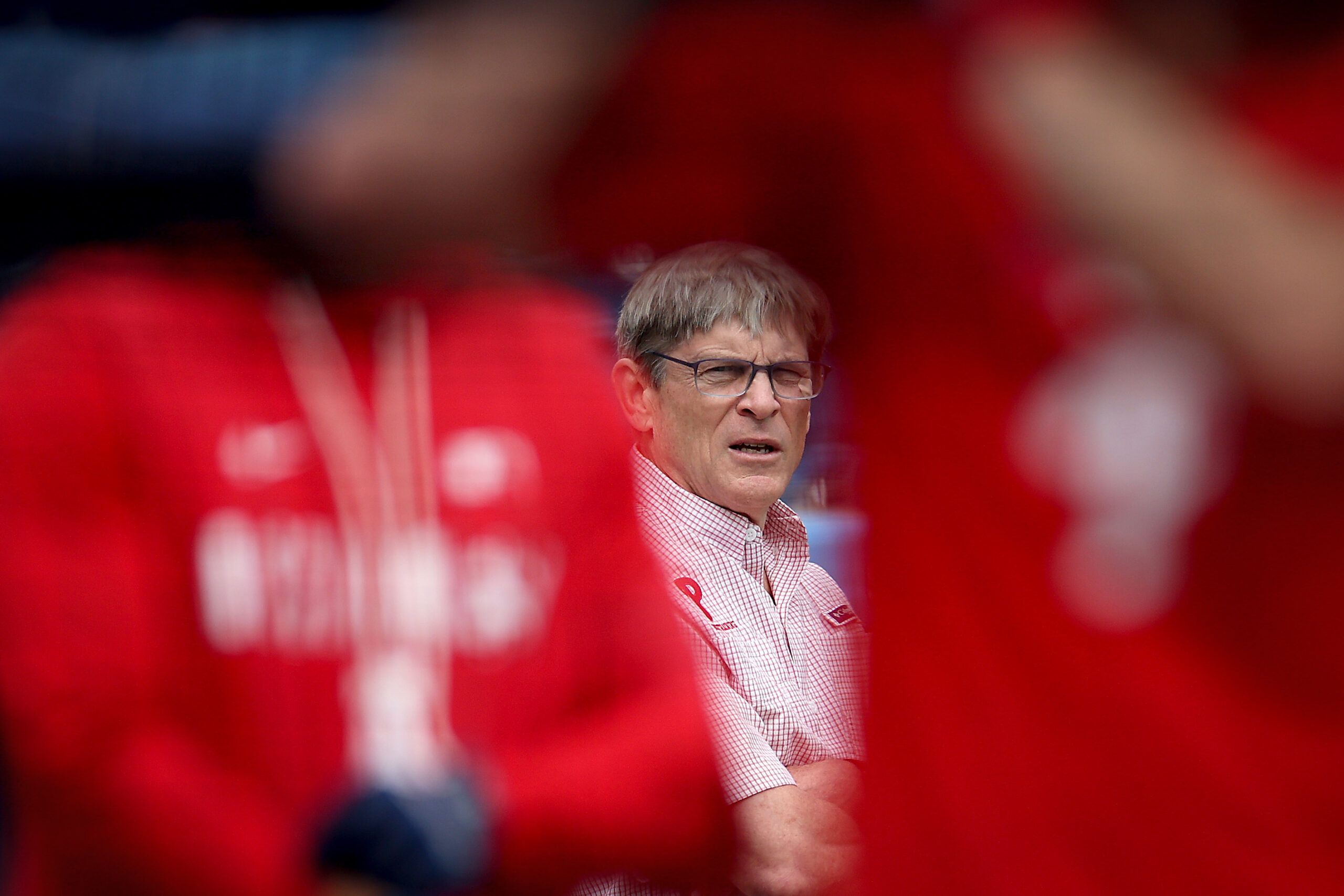
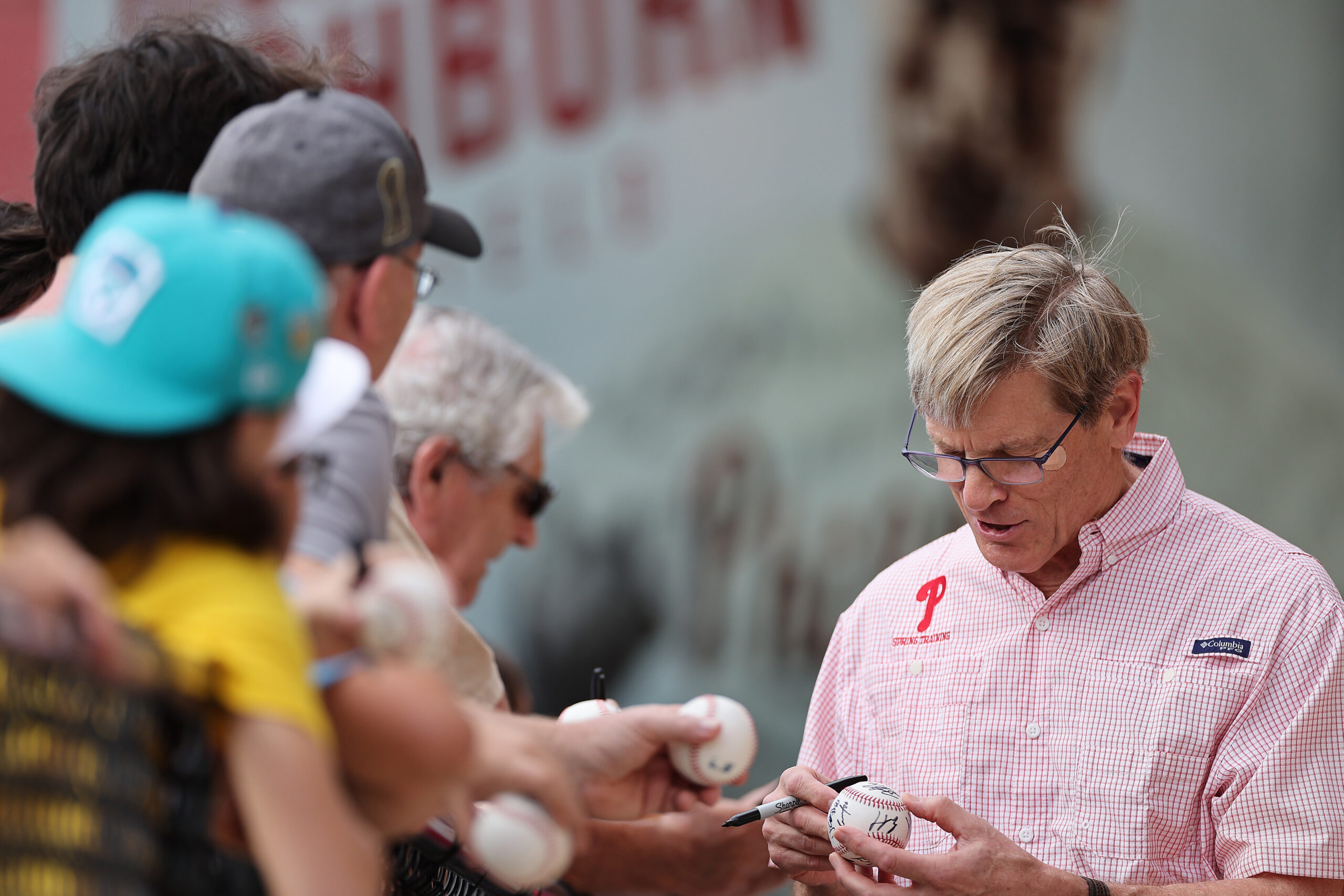
CLEARWATER, Fla. — From his third-floor office overlooking the Phillies’ spring-training ballpark, John Middleton can see clear sky for miles.
Never mind the creeping storm clouds.
“We’re way too far away from it,” Middleton said Friday. “I don’t know when in the next nine months, or whenever the heck it is, we’ll have a clearer sense of the landscape. But we sure as heck don’t have it now.”
So, why worry? Yes, baseball is barreling toward a labor battle that is expected to get nasty. The particulars: Many owners want a salary cap, similar to the NFL, NBA, and NHL; players have historically opposed all limits on wages. The collective bargaining agreement will expire Dec. 1, and a lockout seems inevitable, with the possibility that it could eat into next season.
But that’s 283 days away. There are 162 regular-season games from here to there, with an All-Star Game to host in July. And it will be another expensive season for Middleton and his ownership partners.
Last year, the Phillies’ luxury-tax payroll totaled $314.3 million, fourth-highest in the sport after the Dodgers, Mets, and Yankees. The Phillies paid a club-record $56.1 million in taxes and are bracing for a similar bill at the end of this year.
“Higher,” Middleton said.
Indeed, the projected payroll is $317 million. It will be the fifth consecutive season that the Phillies have gone into luxury-tax territory and the second year in a row they cleared the highest threshold ($304 million for 2026), which carries a 110% tax rate. Middleton said they’ve also budgeted $80 million in local revenue (tickets, concessions, media deals, etc.) for revenue sharing.
John Middleton and the Phillies missed out on signing Bo Bichette this offseason.
“Do the math,” he said. “You’re pushing $140 million in spending essentially [for] being taxed. If I had $140 million back, could I have a higher payroll? Yes. But that’s not happening, so I don’t think about that fantasy. But it’s a lot of money. It really is.”
It’s also life among the big spenders in baseball’s current economic system. Middleton doesn’t sit on the owners’ labor policy committee, which is headed by the Rockies’ Dick Monfort and includes the Yankees’ Hal Steinbrenner, and said he’s restricted by the National Labor Relations Act from speaking publicly about negotiations with the players’ union that are set to begin in late March.
But in a wide-ranging conversation with The Inquirer, Middleton said the Phillies’ offseason spending wasn’t impacted by the looming labor uncertainty. If anything, it was business as usual.
They re-signed Kyle Schwarber and J.T. Realmuto and added reliever Brad Keller and right fielder Adolis García. They were ready to make a seven-year, $200 million offer to free-agent infielder Bo Bichette, who signed a short-term (three years), higher-annual-salary ($42 million per year) deal with the Mets.
In all, the Phillies spent $227 million on free agents, then paid $19.2 million for Nick Castellanos to play elsewhere.
“Any time you get to the end of a collective bargaining agreement, you just never know what the next one’s going to look like,” Middleton said. “And the rules have changed [over the years]. So, you could make decisions in the year or two preceding a new CBA that you look back and you say, ‘Hmm, had I known this was going to be the new CBA with this new rule, I maybe would’ve done something different.’
“I just think the problem, if you give that too much weight, you don’t do things that you should be doing in today’s world with today’s sets of rules to win today. So, I would say we were aware of it, we talked about it, but it didn’t change any of the decisions that we made.”
Because Middleton is chasing that (dang) World Series trophy. It’s been 18 years since the Phillies won it. They went on an unexpected ride to Game 6 of the World Series in 2022 but haven’t won a postseason series since ‘23. They’re 2-8 in their last 10 postseason games.
Owner John Middleton wasn’t angry about the Phillies’ exit in the NLDS last season against the Dodgers.
Middleton, 70, has the sensibilities of a lifelong fan who grew up watching Dick Allen in the 1960s and the competitiveness of a former collegiate wrestler. He was disappointed after last year’s exit in the divisional round. But unlike the previous October, he wasn’t angry.
The Phillies went toe-to-toe with the vaunted Dodgers, holding them to 13 runs and a .199 batting average in four games. Their three losses came by a total of four runs. And don’t even get Middleton started on umpire Mark Wegner’s missed strike call on a 2-2 pitch to the Dodgers’ Alex Call with one out in the seventh inning of Game 4. Call walked on the next pitch and scored the tying run. Wegner later admitted that he got it wrong.
“Assuming he made the correct call, all of a sudden that’s a strike, [Call is] out, [the run] never scores, we win the game, we go to Game 5 two days later in Philadelphia,” Middleton said. “I’m not telling you we would have beaten the Dodgers because they beat us twice at home. But the Dodgers didn’t want to play us in Game 5 in Philadelphia. There’s not a chance in the world that they were looking forward to that prospect.”
Middleton acknowledges that the Dodgers, owned by Guggenheim Partners, have inherent financial advantages that only Steve Cohen, the billionaire hedge-fund manager who owns the Mets, can match.
The Phillies have won more regular-season games in each of the last four seasons. Attendance to Citizens Bank Park has risen from 2.23 million fans in 2022 to 3 million in 2023, 3.36 million in ‘24, and 3.37 million last season.
But in 2024, Middleton also added three new investors to the Phillies’ ownership group. At the time, he said it would “allow us to pursue our strategic growth opportunities and long-term goals.”
“Look, when Hal Steinbrenner publicly says the Yankees can’t do what the Dodgers are doing — and the Yankees for decades have been the team that can do pretty much whatever it wants — that’s telling,“ Middleton said. ”[The Dodgers] are smart, competent people, which makes them fierce competitors. And the fact that they’ve got some financial clout, particularly clout that other teams can’t match, it makes them even tougher competitors.
“But the division series that we lost was the first time in three years, I think, that we lost a series to them. We were 5-1 against the Dodgers in series prior to that. So, it’s not like we haven’t beaten the Dodgers consistently.”
Middleton touched on other subjects, with answers lightly edited for brevity and clarity:
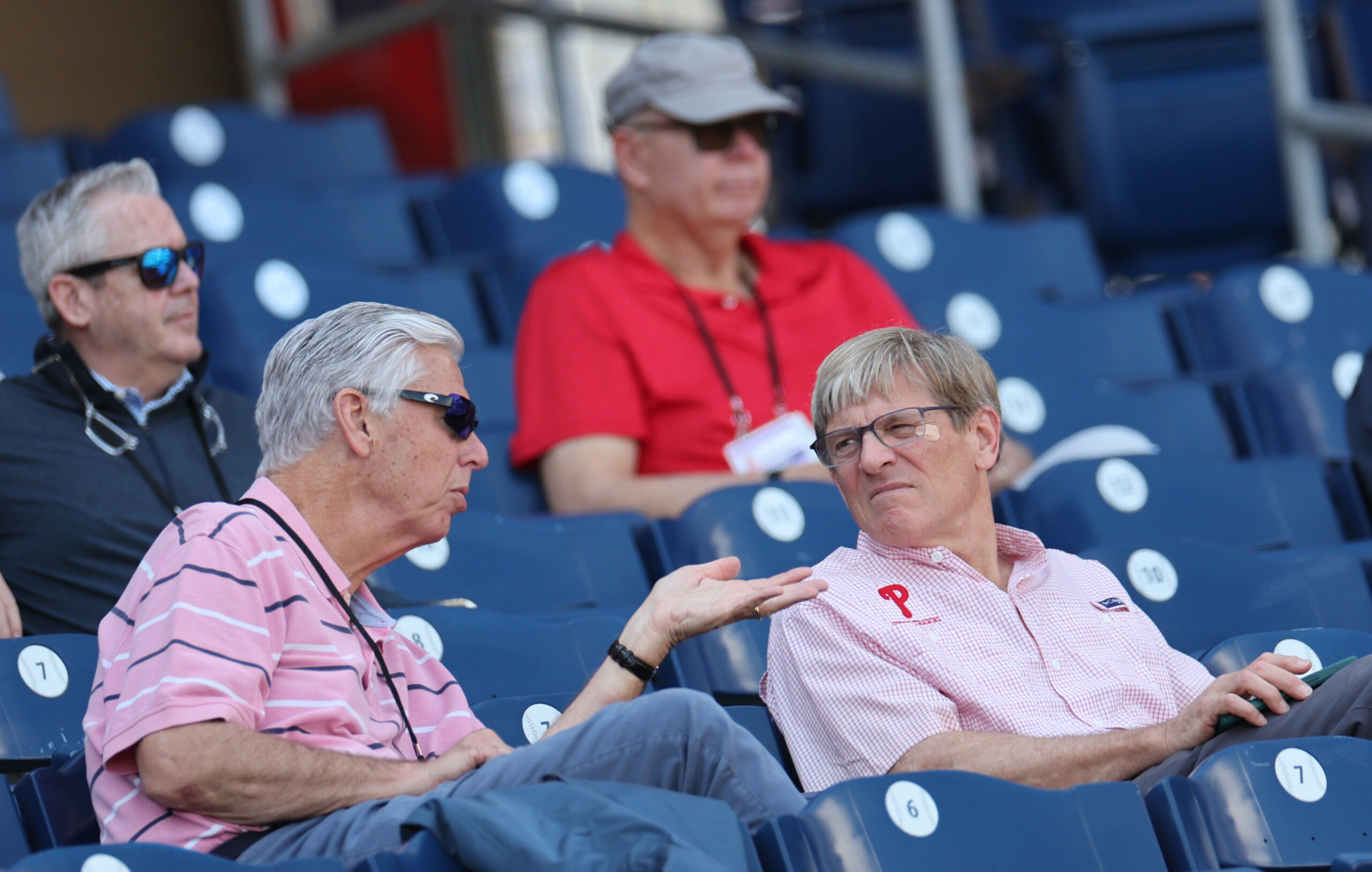
Phillies owner John Middleton (right) says president of baseball operations Dave Dombrowski (left) and Bryce Harper hashed out their differences recently.
Q: What was your perspective on Dave Dombrowski’s comments about whether Bryce Harper is still elite and the baseless rumors that followed about possibly trading him?
A: I just kind of chuckled to myself like, ‘Well, I guess they know something that I don’t know.’ The good news is Dave and Rob [Thomson] and Bryce talked it through after the last set of comments that Bryce made down here, and they’ve agreed that everything’s fine. I’m happy that they’ve reached that point, and I’m comfortable, confident that everything’s behind us now.
Q: You have a close relationship with Bryce. Did you personally call him to make sure everything was OK?
A: Nah. I’ve talked to Bryce over the years about other issues. But in Dave, you’re talking about one of the truly historically great GMs in the history of baseball. People in my position should not undermine their GMs and their head coaches, their managers. And when you have the background and the track record that Dave does, it’s particularly important that you understand your limitations [as an owner].
There have been times when Dave and I are talking about something, and he’ll look at me and say, ‘I’d like you to talk to the player.’ If he thought I needed to talk to Bryce, he would have been the first person to raise his hand and say, ‘John, it would be helpful if you talked to Bryce.’ He didn’t do it. Because Dave asked me to do it, I spent most of a day in Kyle Schwarber’s living room, at his kitchen table, because Dave said it would be helpful. And I talked to J.T. I’ll do whatever I need to do to be helpful, but I’m not going to force myself into a situation where I’m not needed.
Q: What’s your reaction to the narrative that the Phillies are “running it back” again with the same core that keeps falling short in October?
A: I understand the frustration. I will also tell you I do talk to a lot of fans, and there are clearly fans who voice the issue that you did. But I would tell you most of the fans understand. They look at it and they say, ‘OK, I get it. You were a missed call away from probably winning Game 4 and going on to Game 5.’ Not everybody’s going to acknowledge that. But it’s also not like we didn’t try. First of all, we re-signed Kyle. We could have let him go like the Mets, let [Edwin] Díaz go or [Pete] Alonso go. We re-signed J.T. We tried to sign Bichette. We actually thought we had a deal. At 11 o’clock that night, we had a deal, in our opinion. Not finalized. And the Mets did nothing that we wouldn’t have done and haven’t done, so I don’t blame the Mets. But you went to bed at 11 o’clock thinking we had a deal, and I woke up at 8 o’clock worried we didn’t have a deal, and two hours later, I knew we didn’t have a deal. So, it’s not like we didn’t try. We did try to tweak the team.
But go back to that [Phillies] team in ’76, ’77, ’78, they missed the World Series three years running. They go out and sign Pete Rose after the ’78 season. They promptly finish fourth in ’79 with theoretically a better team, and they ran it back in ’80. Now, that doesn’t mean we’re going to win the World Series in ’26 because the ’80 Phillies won the World Series after four tries. But you certainly don’t blow up teams. And it’s hard with a team that was good as that team was and our job is to improve it. You can look at certain places and say, ‘Well, you can improve it here or you can improve it there,’ but that means you have to go out and find the better player and bring that player in. Look, we tried to do that with Bichette. So, I get the frustration. I’m frustrated. I mean, Dave’s frustrated. Rob’s frustrated. A lot of the players are frustrated.
Going back to the Dodgers series, our players executed. You look at ’23 and ’24, even ’22 frankly a little bit, I think there were execution problems in those three years. I don’t feel that way about ’25.
Q: The Phillies have had a top-five payroll now for five years. Could you have ever envisioned a $317 million payroll?
A: So, the answer is yes. And I’d say yes because I think we have such a spectacular fan base. I trust the fan base. I have confidence in the fan base that, if we put the right team on the field, they’ll respond. And that doesn’t always happen. There’s plenty of examples in not just baseball, but other professional sports where there’s a team that’s really, really good and the fans yawn. And I knew that was never going to happen in Philadelphia. New York’s clearly a bigger market than Philadelphia, and they have higher prices than Philadelphia, so their seats sell for more, their hot dogs sell for more, their suites sell for more. But I always thought we could get reasonably close to them from a revenue standpoint, and then hopefully outcompete them. And look, I still feel that way.
Q: What has the ramp-up for the All-Star Game been like? How hectic are the next few months going to be?
A: I think we and MLB are better organized that I wouldn’t say it’s hectic. But there are a lot of details you have to get from the planning stage and the early conversation stage to a final decision and getting that decision implemented. And we’re kind of down that path so that we’ve kind of made final decisions on most everything. But now we’ve got to implement them, and that’s a whole other set of challenges. So, yeah, it’s nerve-wracking. I’m excited. I’m looking forward to it. I think of it like my daughter’s wedding. I’m excited, I’m looking forward to it, and I know I’ll be really happy the day after when I wake up and it’s done.
We’ll show you a photo taken in the Philly-area, you drop a pin where you think it was taken. Closer to the location results in a better score. This week is all about Lunar New Year of the Horse! Good luck!
Round #21
Question 1
Where is this lion grazing?
Loading…
ClickTap on map to guess the location in the photo
ClickTap again to change your guess and hit submit when you're happy
You will be scored at the end. The closer to the location the better the score
Margo Reed / Staff Photographer
Pretty good/Not bad/Way off! Your guess was from the location.Spot on! Your guess was exactly at the location. Here's also where a random selection of Inquirer readers guessed.
The lion dance, most often performed by two dancers in a single costume, is a traditional Chinese ceremonial dance performed during festive occasions such as Lunar New Year. The dance, along with firecrackers and fireworks that are set off during the celebrations, is thought to bring prosperity and ward off malevolent spirits.
Quiz continues after ad
Question 2
Another lion! Where’s this one?
Loading…
Jessica Griffin / Staff Photographer
Pretty good/Not bad/Way off! Your guess was from the location.Spot on! Your guess was exactly at the location. Here's also where a random selection of Inquirer readers guessed.
These lion dancers were performing outside Bo De Temple, a Vietnamese Buddhist temple at 13th and Washington that is a center of Vietnamese life in South Philadelphia. Lunar New Year is celebrated by many East and Southeast Asian cultures, including but not limited to the Chinese, Vietnamese, and Korean communities across Philadelphia.
Quiz continues after ad
Question 3
Not a lion but a horse! Where is it?
Loading…
Steven M. Falk / Staff Photographer
Pretty good/Not bad/Way off! Your guess was from the location.Spot on! Your guess was exactly at the location. Here's also where a random selection of Inquirer readers guessed.
It’s the Year of the Horse, after all! The Chinese zodiac follows a 12-year cycle based on the lunar calendar, with each year represented by a different animal. This horse is Freeway, who lives at the Fletcher Street Urban Riding Club in Strawberry Mansion. Freeway made news two years ago when he escaped his residence and ended up galloping down I-95.
Your Score
ARank
🧨 A crackling job! A result worth celebrating.
BRank
🧧 B is a job well done. An auspicious start of the year.
CRank
🐎 C is a passing, stable grade, but you could do better.
DRank
🐴 D isn’t great, best saddle up to do better next time!
FRank
We don’t want to say you failed, but you were definitely horsing around.
You beat % of other Inquirer readers.
We’ll be back next Saturday for another round of Citywide Quest.
Almost 250 years ago, George Washington created America’s first mass immunization mandate, relying on science to protect public health.
Oh, how times have changed.
Back then, smallpox had just helped end the Continental Army’s invasion of Canada. Despite making it all the way to Quebec, thousands of soldiers contracted the disease. Washington feared the same would happen to his own troops, fresh from their surprise victories at Trenton and Princeton. As Washington wrote at the time, “Necessity not only authorizes but seems to require the measure, for should the disorder infect the Army, in the natural way, and rage with its usual Virulence, we should have more to dread from it, than from the sword of the enemy.”
The inoculation methods of Washington’s time were crude. No genuine vaccine existed. Instead, scabs or pus were taken from someone infected with smallpox and then placed into scratches or small wounds. Another option was to inhale it. Either way, those who experienced variolation inevitably developed fevers, rashes, and other symptoms of smallpox. At least 1% of those who received it died. Still, without his tough choice, the Continental Army might have failed entirely, and America with it.
These days, safe vaccines are available for diseases that ravaged our ancestors. Forms of influenza, hepatitis, chickenpox, polio, rubella, mumps, measles, and many other diseases can now be prevented. The smallpox virus that Washington dreaded has been eradicated.
The quality and availability of vaccines are a modern miracle, one that all humanity should be proud of.
Yet, according to data from the Centers for Disease Control and Prevention, vaccination rates for measles in the U.S. are declining, and the number of cases is climbing. More and more parents are opting against vaccination for their children, which gives these diseases room to spread.
Pennsylvania, New Jersey, and Delaware have all slipped below the 95% vaccination rate the CDC says is necessary to keep measles outbreaks at bay. Despite being nearly eliminated in 2000, rates have reached their highest levels in decades.
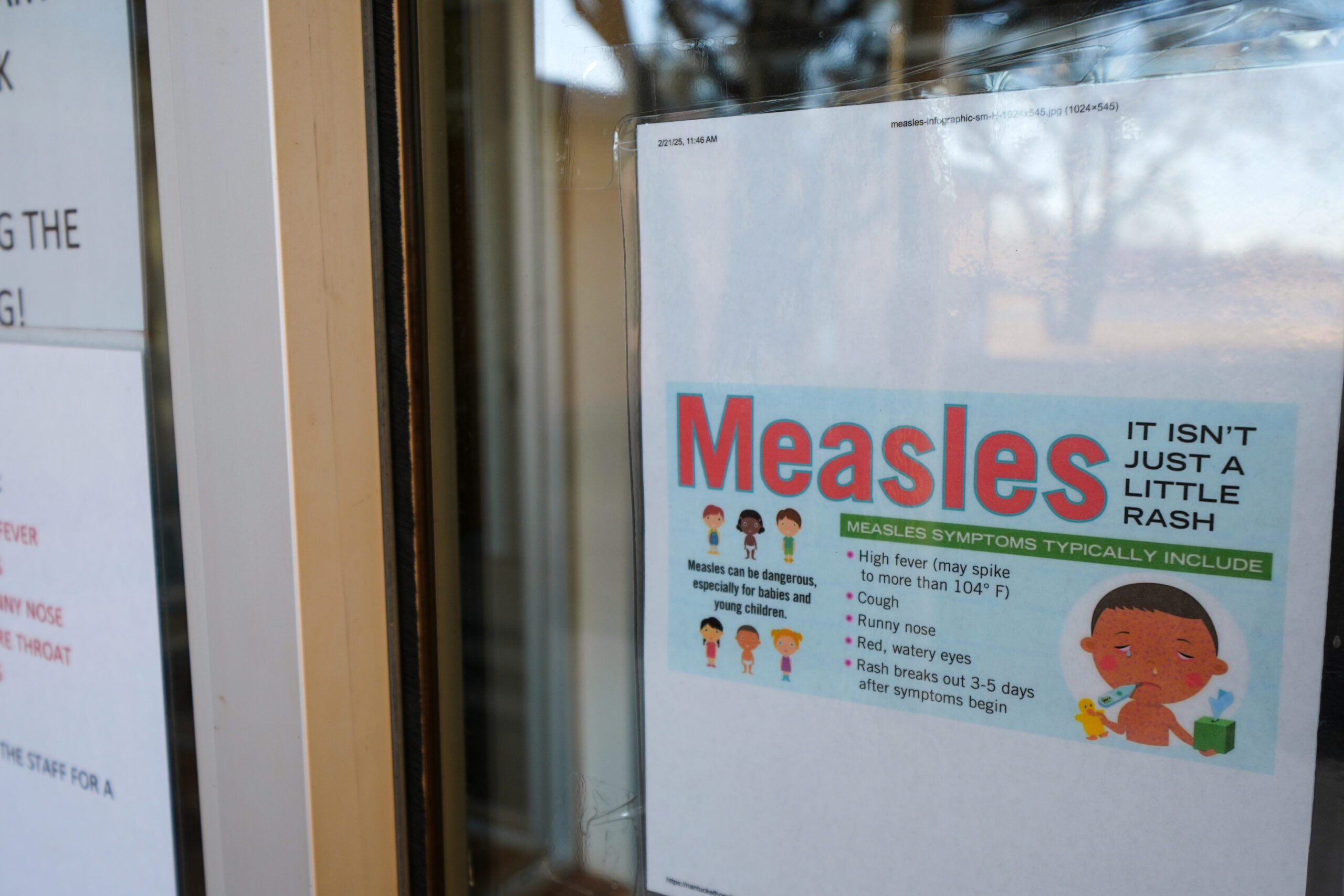
A sign is seen outside a clinic with the South Plains Public Health District in February 2025, in Brownfield, Texas.
According to CDC data, more than 90% of infections occur in people who are either unvaccinated or have unknown inoculation status. Given this group makes up less than 10% of the overall population, that’s a staggering concentration of sickness. It also isn’t a surprise — the vaccines work.
Parents offer a range of justifications for refusing vaccinations. Some cite religious faiths that discourage inoculation. Others feel that the schedule of shots is too concentrated. A number of them mention debunked fears of shots “causing autism.”
In some cases, existing health issues may lead to medical professionals advising against vaccination. (These children rely on what scientists call herd immunity for protection, and are endangered by rising rates of voluntary refusal.)
It doesn’t help matters that Health and Human Services Secretary Robert F. Kennedy Jr. is a leading skeptic of both vaccines and modern medicine. Kennedy has strong opinions about public health based on no formal medical training.
This is the kind of privileged ignorance that can only thrive in a post-vaccine world, where mass immunization has dramatically changed life for the better.
In 1900, 30% of all U.S. deaths occurred in children under the age of 5. In 1915, the infant mortality rate was 100 out of every 1,000 live births. As late as 1952, a polio outbreak killed more than 3,000 people.
Unfortunately, rising vaccine refusal rates may bring some of this suffering back. While city health officials urge calm in the wake of a possible exposure at Philadelphia International Airport earlier this month, these events will only increase as vaccination rates continue to fall. So will unnecessary deaths among children.
Instead of turning back the clock, our leaders and parents must learn from Washington’s example. Necessity requires that we vaccinate our children.
Nestled in the foothills of the Blue Ridge Mountains, Charlottesville is ready for spring. The season there comes a little earlier than ours — cherry blossoms popping, birds trilling — so those planning a March getaway should consider the Virginian city, where the weather is often mild enough to spend serious time outside. Rails and walking paths wind like shoelaces through downtown and into the surrounding countryside. As a university town, C’ville is also packed with arts, music, shopping and dining, and Thomas Jefferson’s Monticello estate sits just on the outskirts of town, high on a hill.
The first stop in town, Ace Biscuit BBQ, announces you’ve arrived in the South. The redbrick building, on the literal other side of the tracks from downtown, opens at 7 a.m. with hot, fresh, crumbly biscuits. Get with butter and jam, sausage gravy, or as bookends to a serious breakfast sandwich with smoked brisket, an over-easy egg, caramelized onions, and cheddar.
📍 600 Concord Ave., Charlottesville, Va. 22903
Stay: Graduate Charlottesville
Charlottesville is a college town, with the University of Virginia’s idyllic and historic campus right downtown. Lean into it and stay at the Graduate, a newer property from the collegiate-themed brand under the Hilton umbrella. Opened in 2015, the hotel is still super fresh, with a game room, scenic rooftop, and rooms dressed in soothing blue walls, Cavalier-print curtains, and bolster pillows embroidered with “Wah-hoo-wa,” the university’s sports cheer.
A short walk from the Graduate, Charlottesville’s pedestrian Downtown Mall offers a solid orientation to the city’s commercial core. Visit shops like C’Ville Arts, a co-op gallery representing over 50 Virginia artists, or catch a show at the historic Paramount Theater, which opened in 1931, closed in 1974, and reopened after a $17-million restoration in 2004. When the biscuit craving returns, hit Miller’s Downtown for lunch. It’s famous for the Charlottesville Nasty chicken biscuit, but the pimento-cheese BLT is the actual move.
📍 E. Main St., between Second Street NW and Ninth Street NE, Charlottesville, Va.
Whether you think history is a snooze or can quote Hamilton from memory — “Thomas Jefferson’s coming home!”— Monticello is must-visit. Set on 2,500 bucolic acres, the estate features multiple exhibits inside, outside, and even beneath the mansion, with thoughtful attention paid to the enslaved people who worked Jefferson’s plantation, including Sally Hemings, with whom he fathered six children.
Beyond the landscaped gardens of Monticello proper, the fairytale woods and meadows of the estate beg for exploring. The Saunders-Monticello Trail is an easy lift for all activity levels, with a maximum five-percent incline and two miles of wheelchair-accessible paved paths and boardwalks winding through forest and over ravines. Stop at Carter Overlook for panoramic views of Charlottesville and the Blue Ridge Mountains.
📍 Parking: 503 Thomas Jefferson Pkwy., Charlottesville, Va. 22902
Drink: Blenheim Vineyards
Dave Matthews Band got its start in Charlottesville, gigging at Miller’s on the mall and other stages around town. Though the singer now lives in Seattle, he maintains a strong connection to Virginia. One touchpoint is his winery, Blenheim Vineyards, situated on 32 acres of rolling chartreuse hills stitched with sauvignon blanc, chardonnay, and albarino vines. Giant windows in the wood-clad A-frame frame the landscape during guided tastings of five wines (just $25). Consider this your pre-dinner drinks.
Back downtown, Smyrna’s oysters with ramp mignonette, hamachi crudo with anise-compressed melon, and manti dumplings dabbed with garlic yogurt earned chef Tarik Sengul a semifinalist nod from the James Beard Foundation this year. You’ll have to wait till April to find out if he advances to the finalist round of the awards — making right now an ideal time to check this sharp Aegean restaurant out for yourself.
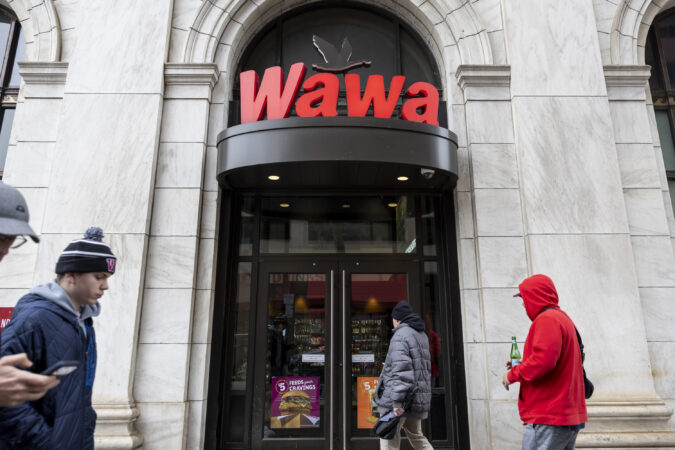
Wawa customers have been able to order roasted chicken on sandwiches, salads, burritos, and more since summer 2024. Hoagie-loving Philadelphians may scroll past the high-protein option on Wawa’s trademarked built-to-order screens, while others tap its icon instinctively in their rush to order lunch.
Wawa CEO Chris Gheysens said he sees the chicken breast differently.
From idea to inception, “that was a labor of love for quite a long time,” Gheysens said in a recent interview. “It’s 37 grams of protein, something consumers are really looking for today.”
And, he added, “it’s still highly customizable, which our customers love doing at Wawa.”
To Gheysens, the menu addition shows how the Delaware County-based company responds to consumer demand. Just as it did decades ago when Philly-area store managers began brewing coffee for customers on the go, and in 1996, when Wawa executives decided to start selling gasoline.
Even now, with nearly 1,200 stores in 13 states and Washington, D.C., Wawa is still listening to consumer feedback, Gheysens said. And despite expanding as far away as Florida and Kentucky, the CEO said, the convenience-store giant remains especially in tune with its hometown fans.
“For a lot of people, it’s their daily routine,” said Gheysens, a South Jersey native. “It becomes a part of their neighborhood. It’s a relationship that’s built on consistency, on trust” — and on getting customers out the door in five minutes or less, depending on the time of day.
(function() { var l = function() { new pym.Parent( ‘wawa-stats__graphic’, ‘https://media.inquirer.com/storage/inquirer/ai2html/wawa-stats/index.html’); }; if(typeof(pym) === ‘undefined’) { var h = document.getElementsByTagName(‘head’)[0], s = document.createElement(‘script’); s.type = ‘text/javascript’; s.src = ‘https://pym.nprapps.org/pym.v1.min.js’; s.onload = l; h.appendChild(s); } else { l(); } })();
Customers say they are drawn to the homegrown chain for its convenience, consistency, quality, and wide-ranging menu of grab-and-go and made-to-order items (even though some miss the old Wawa delis where lunch meat was sliced on the spot).
In Runnemede, 78-year-old Barbara MacCahery said she goes to her local Wawa at least a couple of times a week — “sometimes for breakfast, sometimes for a sandwich, a lot of times for coffee.”
In MacCahery’s mind, she said, the chain has proven itself time and time again for decades: “It’s very rare that you’ll have a bad experience.”
Wawa’s ‘secret sauce’ for success
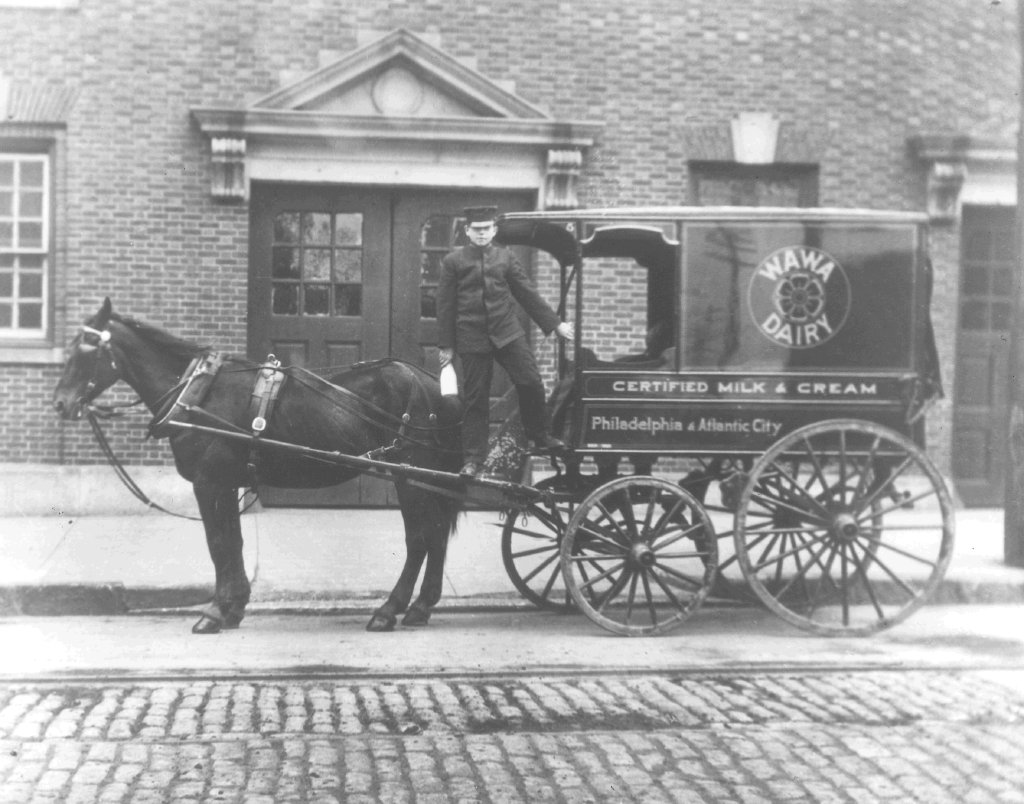
More than 100 years ago, Wawa started out as a dairy, delivering milk to Philadelphia-area households.
Wawa has set a national standard for success in the convenience-store industry, said Z. John Zhang, a marketing professor at the Wharton School of the University of Pennsylvania.
“It really is some kind of a secret sauce,” said Zhang, who studies retail management. “For many people, Wawa has become a destination store,” one that combines “speed, customization, and perceived high quality” with near-constant availability — many Wawa stores are open 24/7.
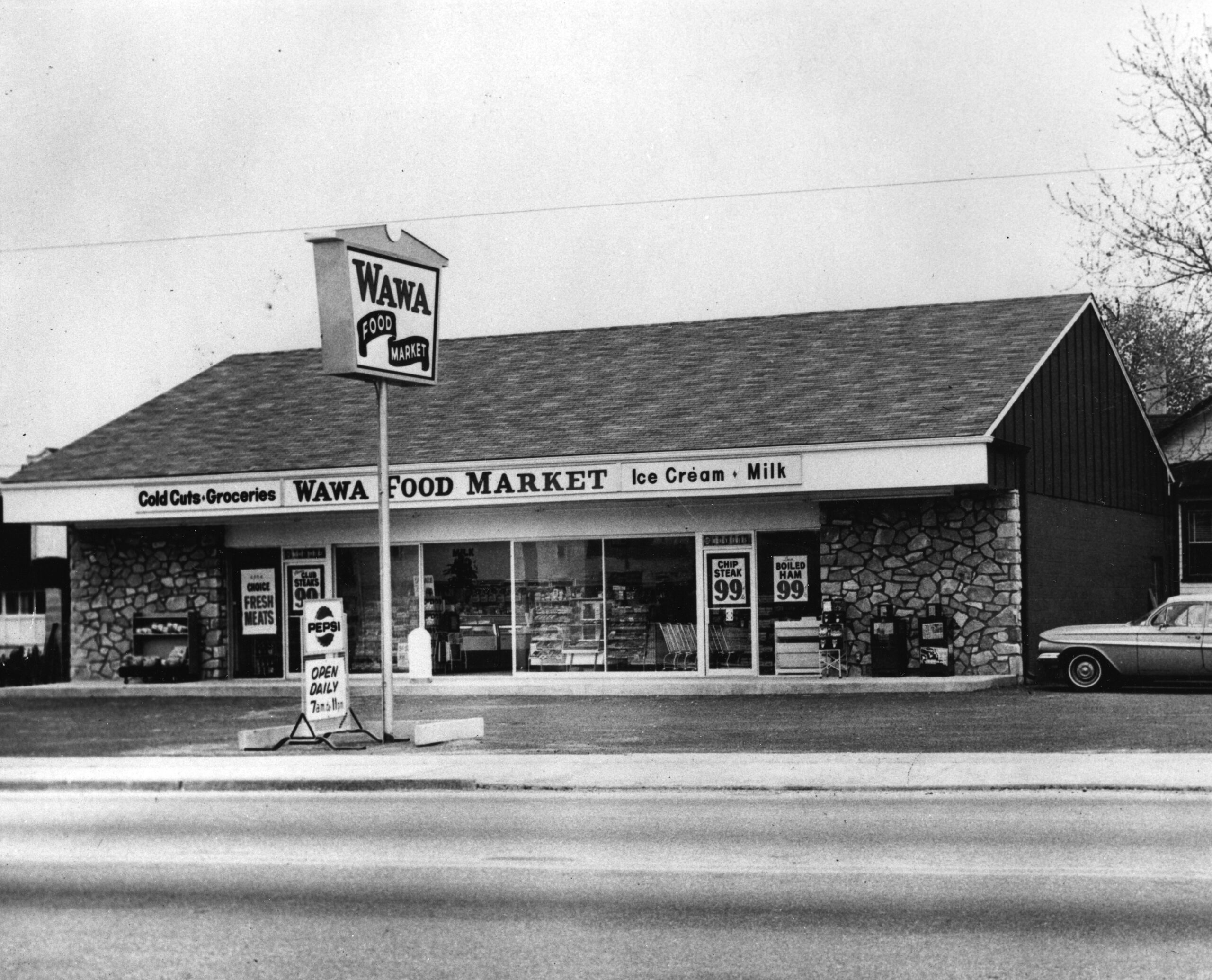
The company got its start as a dairy, delivering milk to Philly-area households. In 1964, it opened its first store in Folsom. Soon, the family-owned company expanded into New Jersey and Delaware, and established a reputation for quality and speed, with slogans like “People on the Go — Go to Wawa Food Markets.”
Wawa’s first convenience store opened in Folsom, Delaware County in 1964.
Wawa is privately held, owned in part by workers who get a percentage of their earnings contributed to an employee stock-ownership plan. Zhang said this program likely leads to more-invested employees who provide better customer service.
Because Wawa is not public, it is not required to disclose its finances, and company executives declined to discuss them.
But by many appearances, Wawa seems to be doing well: Over the last decade, the company has increased its store count by about 65% and doubled its workforce to about 50,000 associates.
Philly-area Wawas are often crowded, too, which is key to making money in the convenience-store industry.
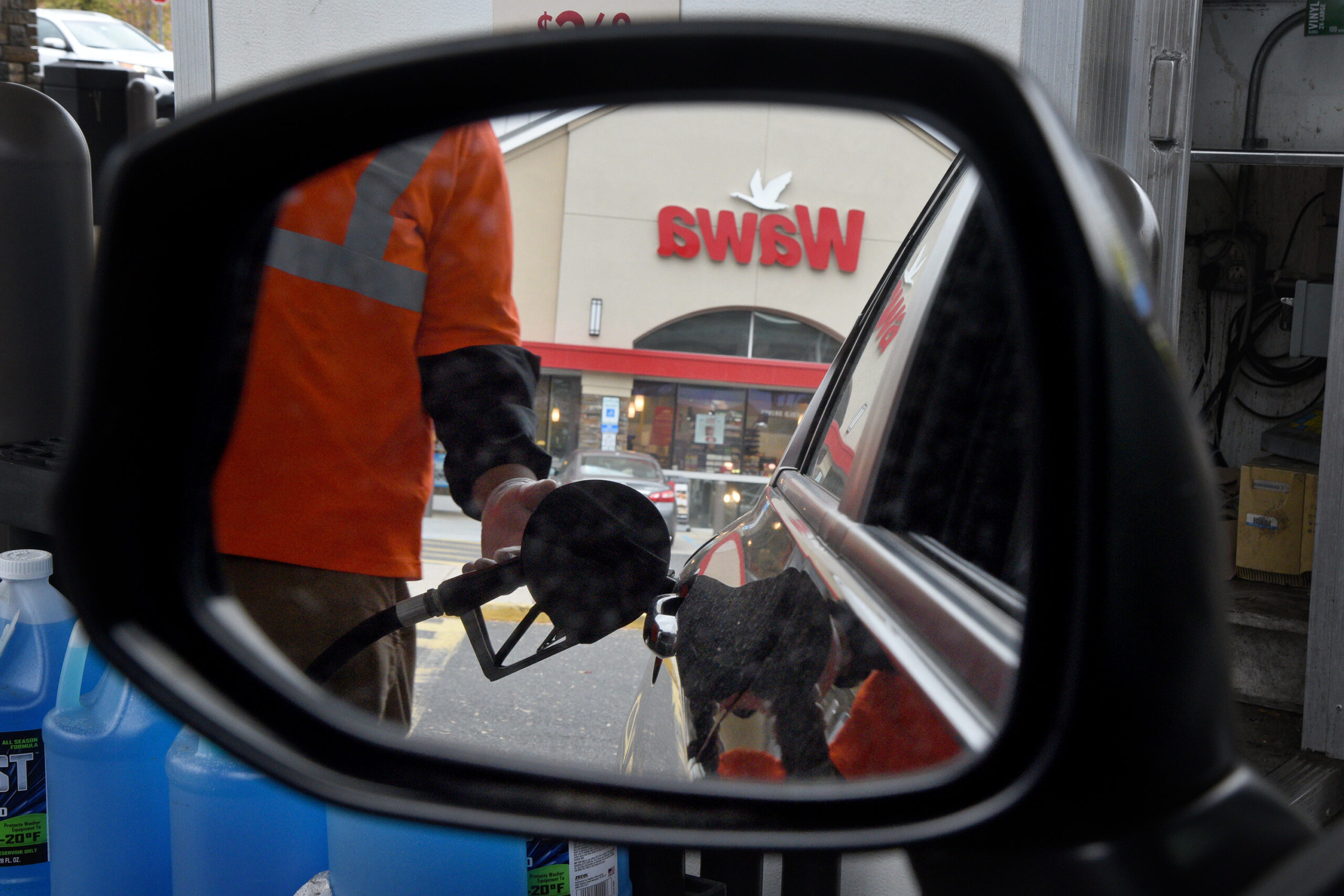
A gas attendant fills up a customer’s tank at a Wawa in Pennsauken in 2020.
“We think it’s high-impulse, but 80% of all people who walk into a convenience store pretty much know what they want,” said Zelinski, who consults with retailers. (He declined to discuss specific companies and said he has never worked for Wawa.)
Successful operators have encouraged customers to spend more by adding seating and improving their food service, Zelinski said. And stores with better food see higher profit margins.
“Once you have somebody that’s addicted to your food service program, they’re more likely to come back to your store vs. a competing store,” he said.
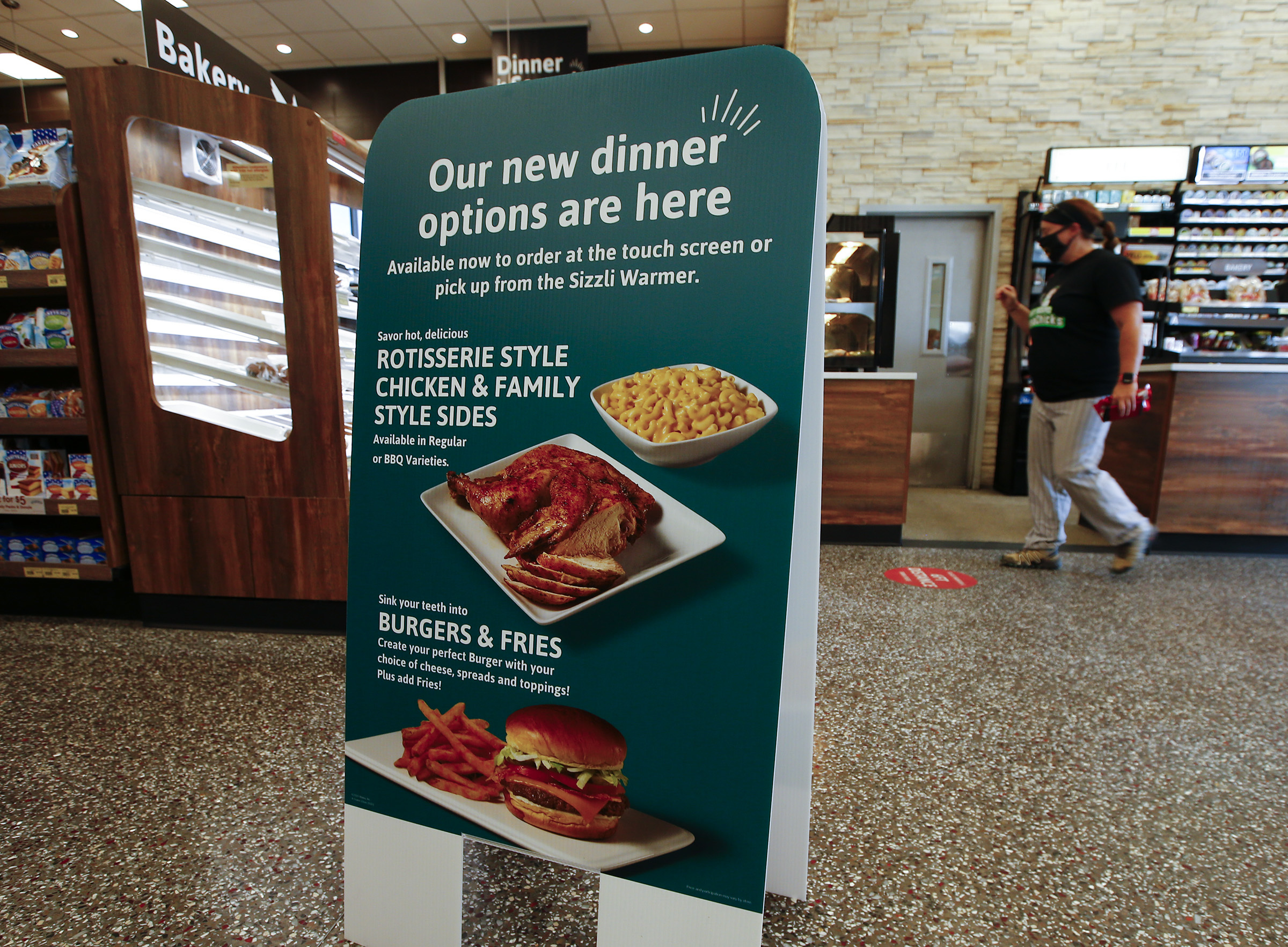
In 2020, Wawa debuted new menu offerings, including hamburgers, pot roast, rotisserie chicken, pasta alfredo, and kids meals, at a tasting in Media.
Wawa has certainly gotten people hooked on their coffee, hoagies, and ever-expanding menu, Zhang said. Options added in recent years include pizza, wraps, protein-packed “power meals,” limited-edition coffee flavors, and smoothies “boosted” with protein, vitamins, and minerals.
This older Wawa in Cherry Hill closed in 2024. The township has six remaining Wawas.
Despite Wawa’s best efforts, not all stores thrive, Gheysens said. But “luckily for us, we’re still in growth mode, and don’t have to worry about closures in a broad way.”
Gheysens said he sees room for more Wawas in the Philadelphia market — even as convenience-store competitors like Maryland-based Royal Farms and Altoona-based Sheetz have opened new stores in the region.
Wawa executives want “to make sure that we are the number-one convenience store in the area, that’s important to us,” Gheysens said. “These are our hometown counties.”
What keeps Philly-area consumers going to Wawa
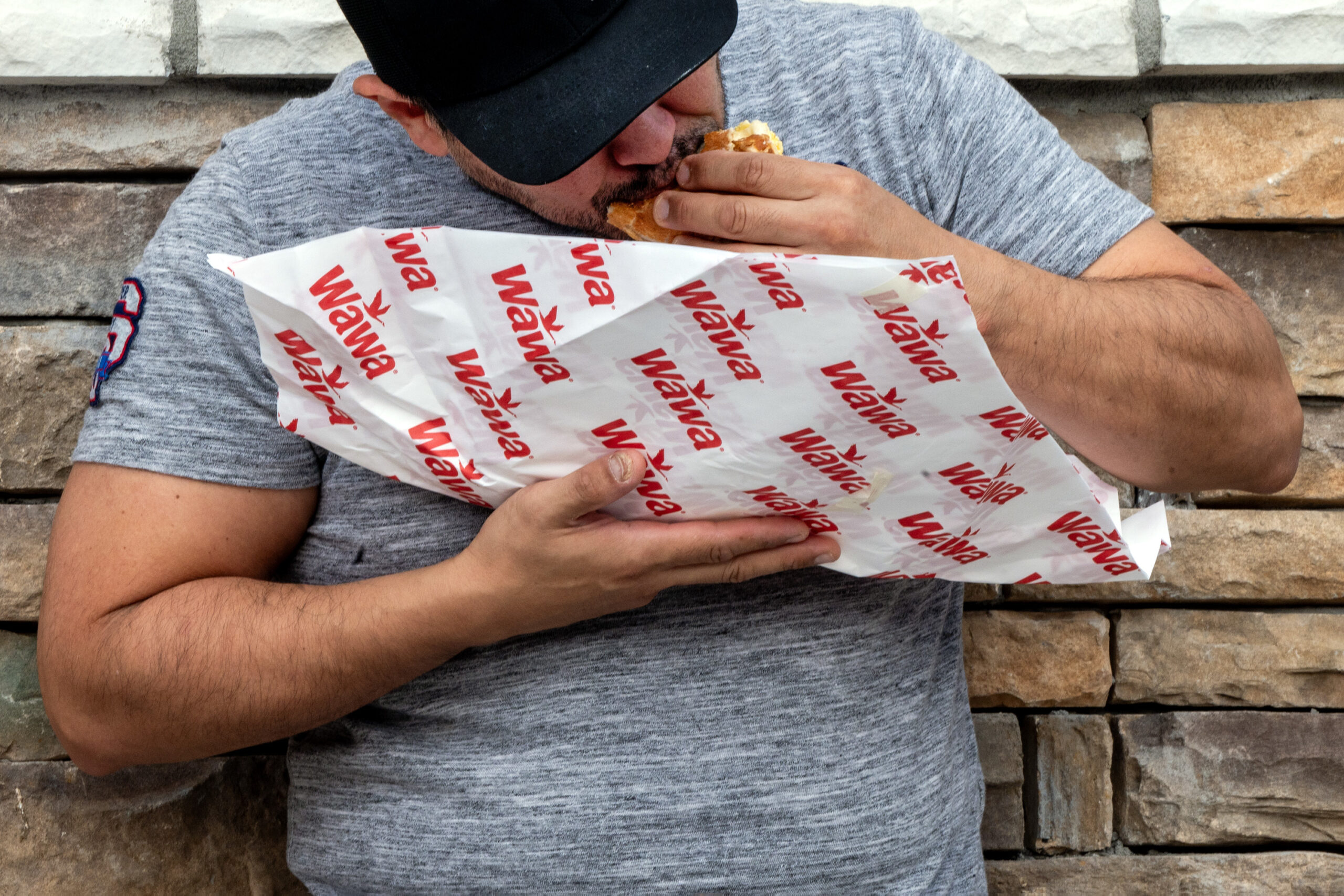
A Wawa customer eats a breakfast Sizzli during the 2024 grand opening of the company’s first central Pennsylvania store.
Many Philly-area consumers grew up alongside Wawa.
In interviews with nearly a dozen of them, some were quick to reminisce about early memories of their local stores, such as the distinct smell of coffee and deli meat or the excitement of a Wawa run with high school friends. Others bemoan what has changed with the company’s expansion, including more congested parking lots.
Most have a quick answer when asked what their Wawa order is.
Rick Gunter, 45, of Royersford, misses the Wawa of his youth. Back in the day, he said, the Wawa hoagies “hit different,” with lunch meat fresh off the slicer.
Contrary to some customers’ beliefs, most stores still bake Amoroso rolls — a custom recipe made exclusively for Wawa — fresh in store multiple times a day, Gheysens said. As for the deli meat, the CEO said that was another decision rooted in customer preference.
When customers have participated in blind tests of the pre-sliced meat Wawa uses today against a fresh-sliced alternative, “they can’t tell the difference,” Gheysens said. “They would choose our pre-sliced meats, because of what we’ve done in terms of quality and the supply chain and the ability to deliver them at such a pace.”
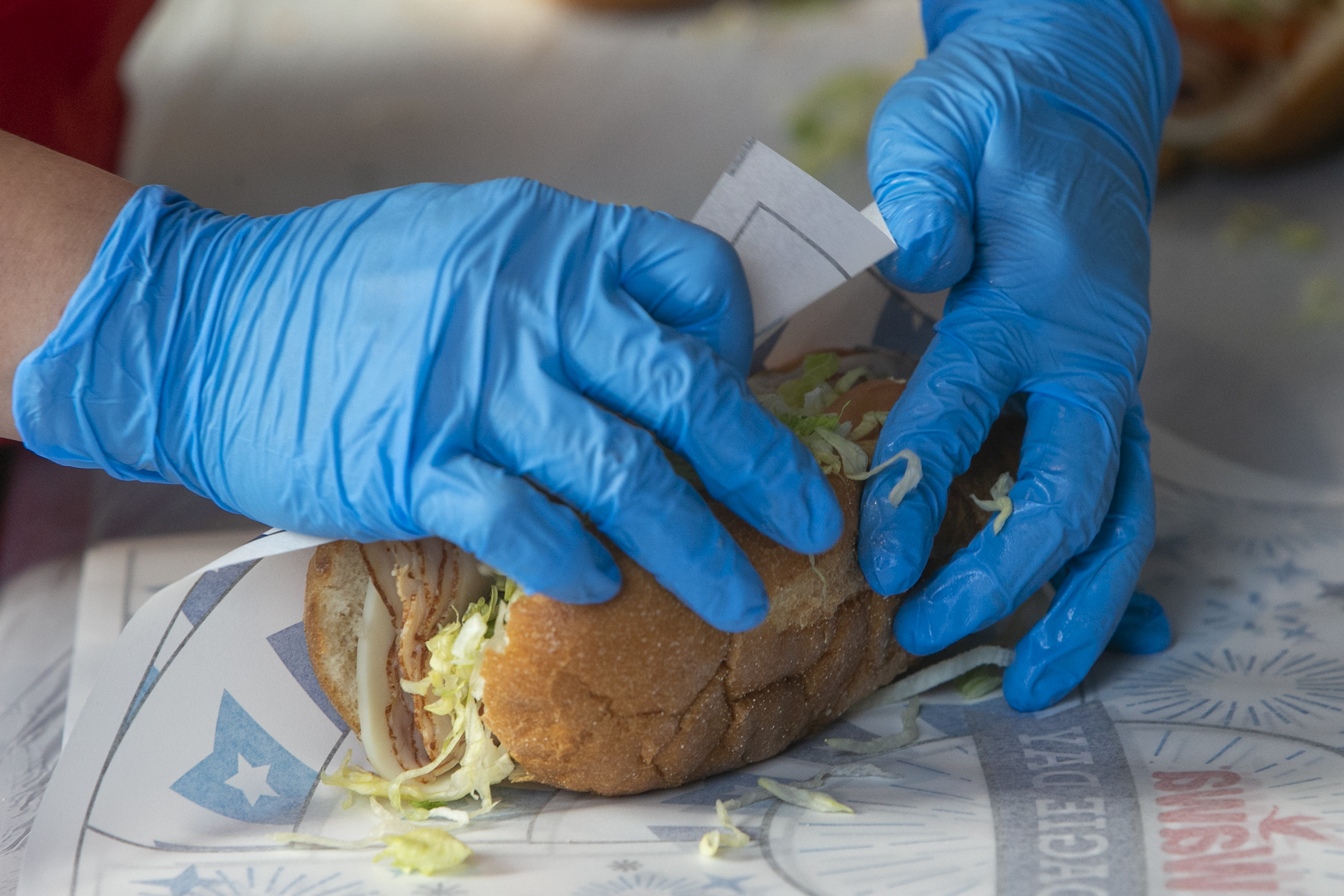
A sandwich maker at Wawa wraps a hoagie with turkey, provolone, tomato, and lettuce in this 2020 file photo.
Some customers disagree.
“It was way better when it was kind of also a deli. Now they try to make everything for everybody,” said Bill Morgan, 79, of East Coventry Township. “I’m within five miles of three Wawas, but I rarely eat their food. Only under extreme duress.”
Morgan acknowledged he must be in the minority, given how crowded Wawas are at lunchtime. And despite his distaste for much of their food, he said he still gets gas there and loves their coffee. And he can’t help but admire their business model.
Mike Nardi turned 41 a few weeks ago, and considering he arrived on Villanova‘s campus as an 18-year-old freshman in 2003, played under Jay Wright for four seasons, then joined Wright’s staff in 2015 after seven years playing professionally overseas and remained on the bench through the end of last season, Villanova basketball was basically all Nardi knew for most of his adult life.
He was there in the nascent days of Wright’s dynasty as a player and was back on the bench in time to enjoy the two national championships he laid the groundwork for.
Xfinity Mobile Arena has been the site of many memories. Villanova fans still recite Sean McDonough’s “Nardi for three and the lead” call during an ESPN Big Monday broadcast on Feb. 13, 2006, with reverence. Nardi, who had missed the previous two games with tonsillitis, drilled a transition three-pointer from the right wing in front of the Villanova bench during a 22-4 run that erased a 12-point deficit and gave fourth-ranked Villanova its first win over No. 1 UConn in three years.
A year earlier, the building was where Villanova, during a freshman season that saw Nardi make the All-Big East rookie team, announced its arrival on the national stage with a blowout victory over second-ranked Kansas.
Nardi is returning to that building Saturday night. It’s the latest installment of the Villanova-UConn rivalry (5:30 p.m., FOX). But Nardi will be on the visitor’s bench, and he’d like nothing more than to prevent Villanova from getting its best win of the season over his fifth-ranked Huskies.
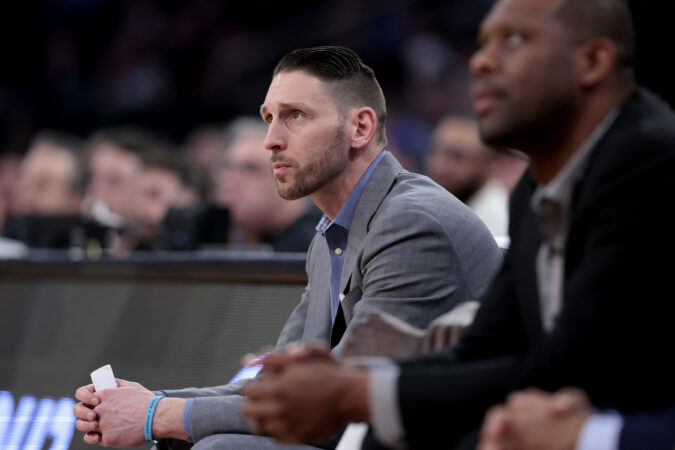
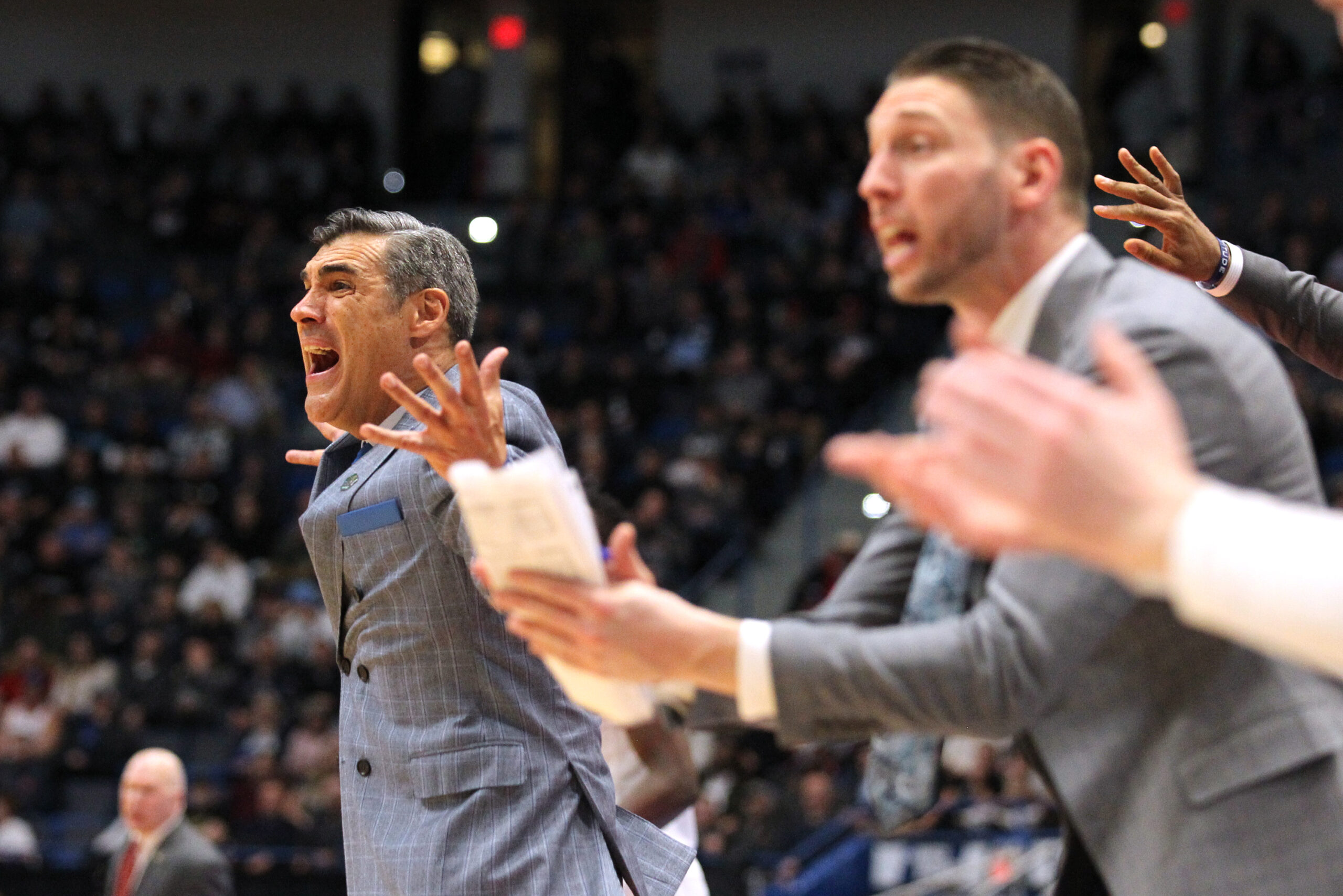
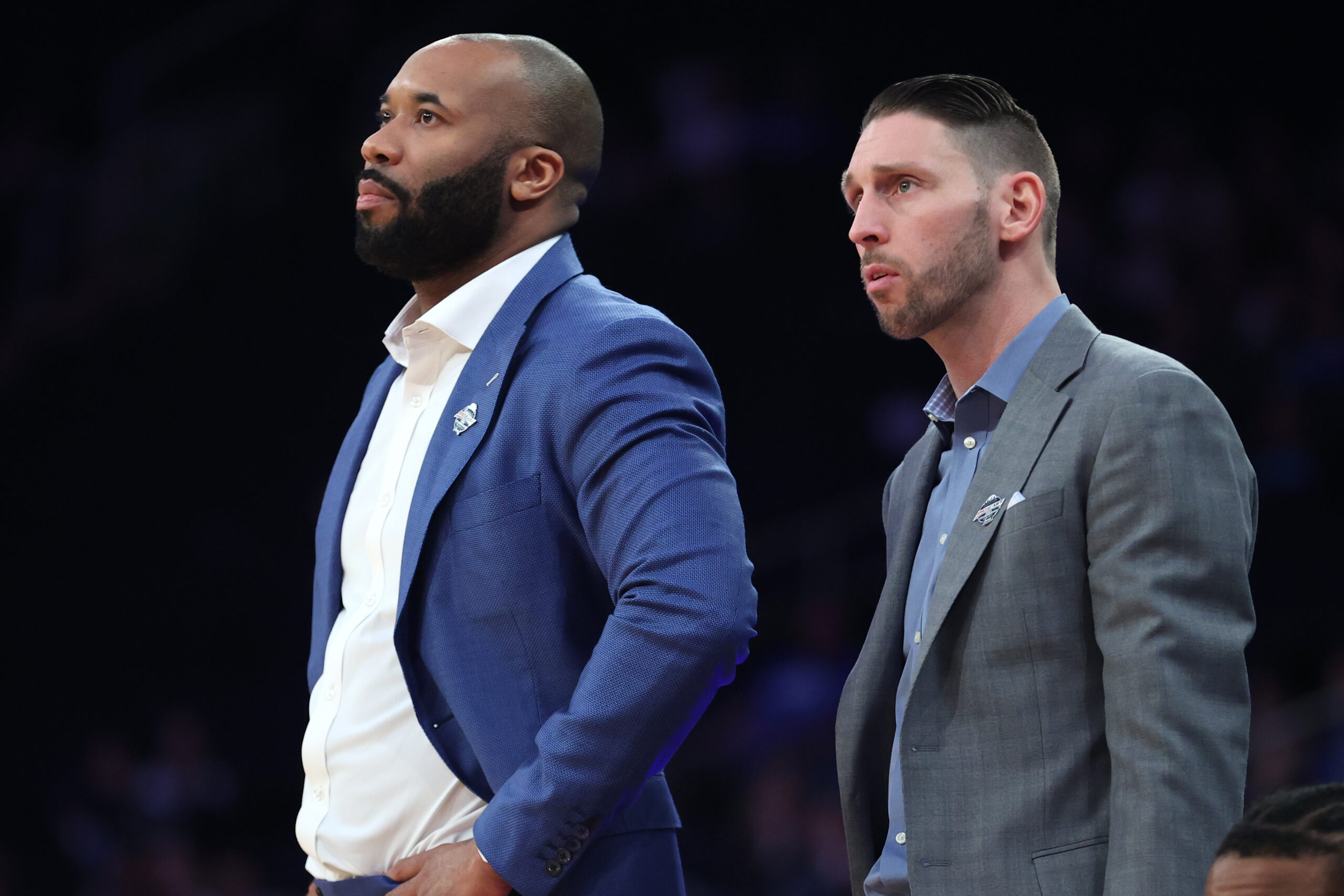
Mike Nardi joined Jay Wright’s staff in 2015.
“I had a great experience, but the emotions for me now are, ‘Hey, it’s competition,’” said Nardi, who was hired by Dan Hurley to be an assistant coach after Villanova brought in Kevin Willard last year. “I’m competing and I’m at a place where we want to win. The emotions and all of that, I’ve never been a guy to get caught up in that kind of stuff. There’s a task at hand and we want to go there and get a win and that’s the most important thing.”
Nardi already got some of those feelings, if there were any to begin with, out of the way during Villanova’s trip to Connecticut in January. He caught up with Ashley Howard, JayVaughn Pinkston, and Nick DePersia, the only holdovers from Kyle Neptune’s staff; longtime radio voice Whitey Rigsby; athletic director Eric Roedl; and longtime sports information director Mike Sheridan. Then it was all business. Villanova was Nardi’s scouting assignment for each of the matchups this season. He exchanged his pleasantries, said his hellos, and then he helped coach a UConn overtime victory.
“I was sad to see it end, but I landed in a place where, again, it’s like the standard of college basketball,” Nardi said. “I’m working for another Hall of Fame coach, a guy who has won at every level. For me, it’s a great learning experience because I played at Villanova, I coached at Villanova, and besides going overseas and seeing different systems and playing for other coaches, I really haven’t had a chance to branch out and see a different system and learn the game a different way.”
If it were up to Nardi, this story probably wouldn’t be written. He returned a reporter’s call Friday in part, he said, out of respect for Villanova. He doesn’t want Saturday night to be about anything more than UConn trying to go on the road against a good team in a tough environment and get a win in its pursuit of a Big East regular season title.
“I don’t want to make this about me,” he said. “It’s really not Mike Nardi and coming back to Villanova. This is about UConn and Villanova. That’s what’s most important to me.”
Former Villanova coach Kyle Neptune (left) and assistant coach Mike Nardi shown during the Big East tournament at Madison Square Garden last March.
It didn’t take very long to get over being on the other side of the rivalry despite all his history with it. The good and the bad. He made that crucial three to earn his first win over UConn in 2006, then watched the meaningful portion of the 2024-25 season end at the hands of Hurley in the Big East tournament, only to have his friend, Neptune, fired a few days later.
Nardi respects winning, he said, and respects excellence. He always viewed Connecticut in that light, from Jim Calhoun’s teams to Hurley’s. It was a good landing spot for him for basketball reasons and because Hurley, he said, respected everything Nardi was about, from playing for St. Patrick High School in New Jersey against Hurley’s father’s St. Anthony, to playing and coaching in the rivalry.
Nardi wasn’t asked to stay by Willard, he said, and never expected to be.
“I never felt slighted. I never felt a certain way,” Nardi said. “I kind of knew there was a slim chance of me being asked to stay. And that was OK. I didn’t take that the wrong way. I think I’m good at what I do. I think I could’ve been an asset, but I never ever looked at it like this is messed up, why aren’t you keeping me? That’s not how this works.”
Hurley, meanwhile, thought Nardi could be an asset in Connecticut. The Huskies are 24-3 after a Wednesday night home loss to Creighton, and they’re pursuing a third national title in four seasons. Villanova, meanwhile, is 21-5, 12-3 in the Big East, and in line to snap a three-season NCAA Tournament drought.
Nardi was happy, he said, that Willard got the job. He wanted the school to hire someone who cared about the program, and Willard fits that description. Part of him is happy to see Villanova back in the mix, but he’s not watching Villanova games in his free time with his old No. 12 jersey draped over his shoulders.
“It’s good to see them doing well,” Nardi said. “It’s obviously good for the league. I think that’s a big piece of it. But I’d be lying to you if I said I was rooting for them. I don’t root for anybody else in the league. I’m rooting for UConn and that’s it.”
Big Tech is taking on record levels of debt, marking a new chapter in the artificial intelligence boom as names such as Oracle, Alphabet, and Meta pour big money into massive data centers and the energy systems needed to run them.
Technology companies issued a record $108.7 billion in corporate bonds in the last three months of 2025, according to data from Moody’s Analytics. That’s the largest total for any quarter and roughly double that of the previous three months.And the trend is extending into 2026:Some $15.5 billion in bonds were issued in the first two weeks of the year alone.
For now, investors are assuaged by the eye-popping cash flow numbers from major tech companies. In the past 20 years, Big Tech companies including Google, Microsoft, Meta, Amazon, and Apple have built what are arguably the most profitable business models in history. In the third quarter, Google brought in just over $100 billion, with a margin of over 30%. All five are trillion-dollar companies, as are such AI darlings as Nvidia, Broadcom, and TSMC.
But some economists and business analysts say the massive new bonds are spreading risk throughout the economy, with hundreds of billions being spent on a technology whose profit-making potential is not yet clear.
“It’s a lot of debt, and a lot of it all of a sudden,” said Mark Zandi, chief economist for Moody’s. When companies are funding risky ventures with debt “it does put the broader financial system at risk. If the financial system is at risk, then the broader economy is.”
A bond is a form of debt that companies or governments can use to raise large sums of money, typically from investment banks or private-equity firms, to be paid back with interest. They historically have been used to fund major infrastructure projects such as power plants, natural gas drilling operations, or offshore wind farms — projects with large up-front costs that are expected to generate revenue for many years. Once issued, a bond can be bought, sold, or packaged into other debt products, which can end up in the portfolios of unrelated investments such as pension funds.
Automakers, utilities, and other mainstays of heavy industry have historically been the biggest issuers of corporate bonds, Moody’s data shows. Analysts note that in past technology build-outs, such as the rise and rapid investment in internet-based companies in the 1990s, companies didn’t have to spend nearly as much on infrastructure.
That hasnow changed, given the unprecedented energy demands of running and training AI algorithms. While tech companies took on more debt, adjusting for inflation, in 2021 than in 2025 — with a total of $296.6 billion in 2025 dollars issued that year — interest rates were significantly lower at the time. That made financing debt cheaper.
“The technology industry has gone from being an also-ran in terms of corporate debt, to becoming the largest player of investment-grade corporate debt, out of nowhere, compared to two years ago,” said venture capitalist Paul Kedrosky.
Because training and running AI algorithms take up much more computing power and energy than previous forms of technology, staying ahead in the AI race costs billions. Google, Microsoft, Amazon, and Meta indicated in company announcements that they planned to collectively spendwell over $300billion on AI data centers in 2025 alone.
If they continue to spend at that rate, they may have to take on even more debt.
“If these companies are so profitable, why are they using debt?” Kedrosky said. “It gives you a sense of the scale of what’s going on.”
Amazon spokesperson Amy Diaz said the proceeds from Amazon’s bond issuance in November are being used to support business investments, capital expenditures, and repayment of earlier debt, adding that the company regularly evaluates its operating plan to make financing decisions. (Amazon founder Jeff Bezos owns the Washington Post.)
Representatives from Alphabet, Meta, andOracle either declined to comment or did not answer questions. An Apple spokesperson referred to the company’s SEC filing, which states that proceeds from the bond issuance would be used for “general corporate purposes” including stock buybacks and unspecified capital expenditure, among other uses.
Among large tech companies, Meta used the most debt to fund its data center build-out in 2025, according to Moody’s. The social media company has invested deeply in AI in a race to become the leading AI assistant for companies and everyday people, putting it in a tight race with Microsoft, Apple, and Alphabet.
Mark Mahaney, who has covered tech companies for more than two decades and is now managing director at the investment bank Evercore ISI, views the bonds as part of a strategy by tech firms to raise money without degrading their stock price. Bond offerings are a sign that management is “confident or cocky” about their future, as they’ve taken on debt that requires steady cash flow to pay down, Mahaney said.
Also loading up on debt is Oracle, which issued some $25.75 billion in bonds last year as it seeks to become the AI computing power provider of choice. In September it disclosed a $300 billion deal with OpenAI, prompting an immediate 36% spike in its stock price that briefly made founder Larry Ellison the richest man in the world. (The Post has a content partnership with OpenAI.)
But in the ensuing weeks investors became uncomfortable with Oracle’s debt.Citi analyst Daniel Sorid told CNBC in December that there was something “inherently uncomfortable” about the “enormous” amount of capital Oracle will require.
The stock has declined about half from its Sept. 10 peak. Bondholder Ohio Carpenters’ Pension Plan recently sued Oracle and several investment banks, alleging that Oracle failed to disclose how much debt it needs.
“The sheer scale of new debt issuance has forced investors to reassess whether the economics of relentless AI [spending] are truly sustainable,” said Thomas Urano, chief investment officer at Sage Advisory in Austin.
Urano added that many of the companies getting AI-driven investment are part of the infrastructure that enables today’s AI chatbots and other applications, which cannot be immediately monetized.
“This creates a paradox: The strategic case for AI is compelling, but the revenue model is still evolving,” Urano said.
At least one firm has raised the prospect of getting government support to build out more data centers. OpenAI’s chief financial officer, Sarah Friar,said in November that it will require “innovation” on the finance side, with government providing a “backstop” or “guarantee.” Her comments triggered backlash from politicians and tech critics, who questioned whether taxpayers should take on some of these private companies’ risk. Friar and CEO Sam Altman both later clarified that they weren’t seeking federal guarantees for OpenAI data centers specifically, although Altman did say in a lengthy social media post that a government-funded “strategic national reserve of computing power” would make sense.
The Trump administration has gone all in on AI, pushing aside concerns within the MAGA movement and seeking to sweep away regulations that it says hamper innovation. But neighbors of the vast warehouses of computer chips that form the technology’s backbone — including in conservative states — have objected to how the facilities sap power from the grid, guzzle water to stay cool, and secure tax breaks from local governments. President Donald Trump has recalibrated his approach, pushing tech companies to fund their own power.
“Historically, when we’ve had major bubbles they’ve tended to be about real estate, or technology, or government policy,” Kedrosky said. “This is the first bubble in history that combines all of these things.”
Country-style spinach pie at Madis Coffee Roasters
I’ve been devoted to spanakopita since growing up in Metro Detroit, where Greektown was among my favorite downtown haunts. Philadelphia has great spinach pies, too, from Zorba’s Tavern in Fairmount to Stina near West Passyunk. But lately, I’ve become obsessed with the big round pans of spanikopita served at Madis Coffee Roasters, the fast growing local trio of modern cafes owned by the Navorsidis family. Their coffee is also excellent, by the way, including a well-balanced “Four Seasons” blend that’s become a regular in my house rotation of morning brews, as well as quality pour-overs of single-origin beans.
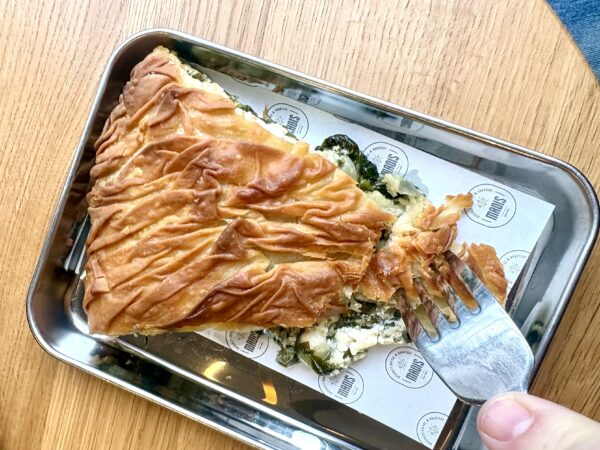
But the spanakopita the cafes import from Greece is one of the main reasons I frequently stop at Madis’ spacious Curtis Center location beside Independence Hall for breakfast before heading into The Inquirer newsroom nearby. Unlike the vast majority of spinach pies made in the U.S., which feature ultra-flaky and delicate phyllo, these big round pies made by Rodoula in Athens are encased in crispy waves of thicker phyllo sheets that are typical of the more rustic country style, especially when shaped into rounds.
An imported round spinach pie made by Rodoula in Athens, this one stuffed with extra feta, is warmed to a crisp and served at Madis Coffee Roasters locations across Philadelphia.
I give credit to Madis for warming it correctly, since I’ve had other versions of the same pie elsewhere (at a local gyro chain) where the same pastry was hastily underbaked and chewy. At its toasty, tawny prime, a crusty wedge of this pie shatters beneath fork and knife around a luxuriously soft filling of spinach, leeks, and extra cheese — a particularly creamy blend of tangy sheep and goat’s milk feta. Straight from Athens to the cradle of Liberty, it’s the spanakopita breakfast of champs. Madis Coffee Roasters, 601 Walnut St., 3527 Lancaster Ave., 1441 Chestnut St.; madiscoffee.com
— Craig LaBan
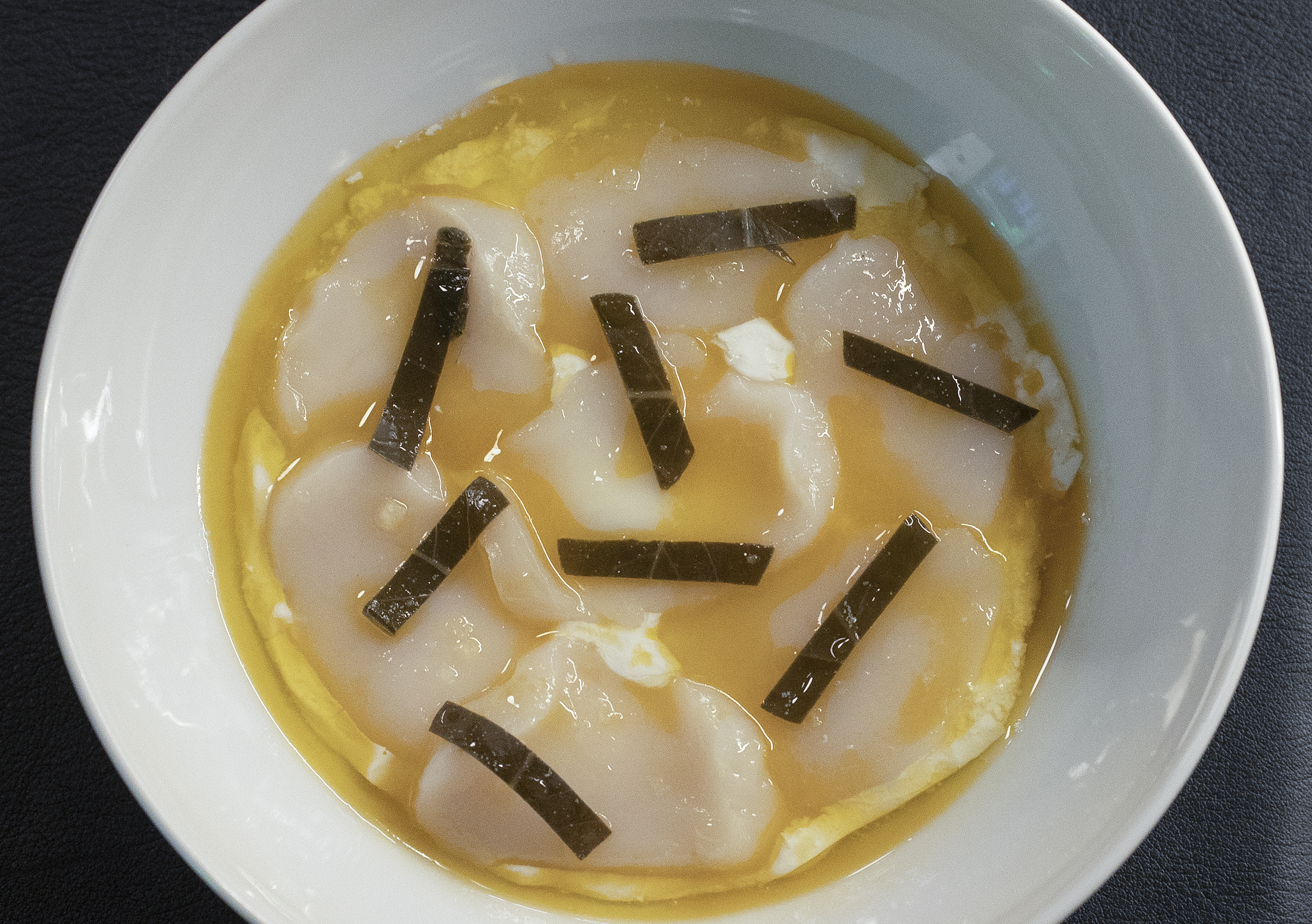
The sea scallop crudo and burrata served at Emilia, the Italian restaurant from Greg Vernick, in Kensington on Friday, January 23, 2026.
Scallops and burrata at Emilia
When Greg Vernick and Meredith Medoway were previewing the menu at Emilia, their new Italian restaurant in Kensington, they seemed proud of a dish pairing scallops and burrata in a caper vinaigrette. “That surprises people at first because of the similar textures,” Vernick said. Oh, it’s a surprise, all right. What it lacks in crunch it more than makes up for in lusciousness. The kitchen thinly slices day-boat sea scallops from Viking Village in Barnegat Light, N.J., and fans them over a puddle of burrata cheese and a vinaigrette made of capers and Calabrian chili oil. Sea salt goes on top. And here’s a tip to get the most of it: Your Emilia meal will start with house-made focaccia, Italian breadsticks, and a slice of Mighty Bread’s sesame ciabatta. Put aside some ciabatta. After you finish the scallop, you’ll use it for mop-up duty. Emilia, 2406 Frankford Ave., 267-541-2360, emiliaphilly.com
— Michael Klein
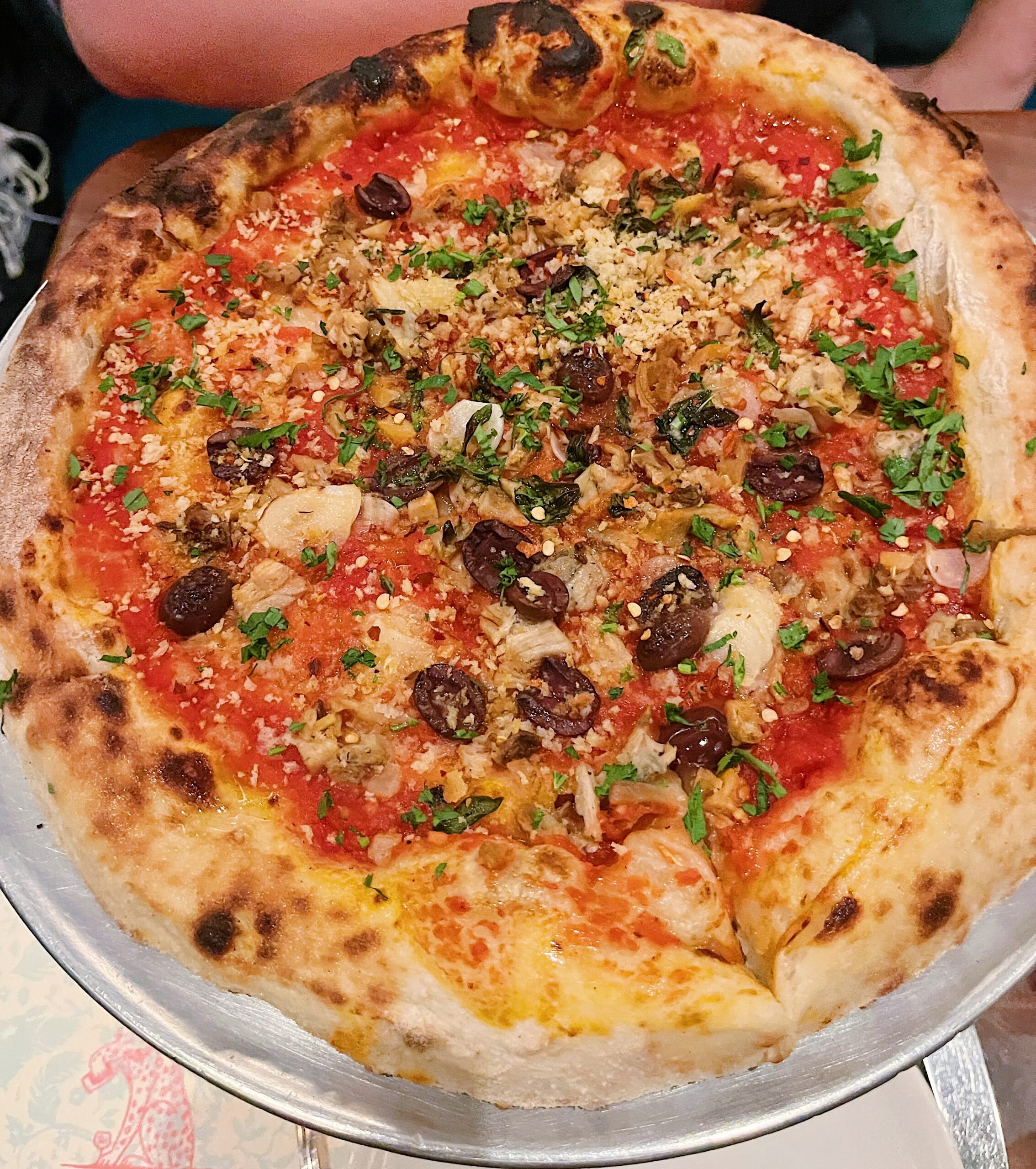
The Clam Posillipo pizza from Wilder.
Clam Posillipo pizza at Wilder
To me, Valentine’s Day has always been about celebrating the things I already love about my life — my partner, my cat, and all the restaurants I depend on for date-night specialness — so I rarely want to go some place I’ve never tried before for the holiday. That changed this year when my partner and I went to Wilder for the first time and tried a pizza so good it has converted us to wannabe regulars.
Wilder’s clam Posillipo pizza is a take on the classic Italian American dish (and Frank Sinatra favorite) wherein littleneck clams are steamed in a light, garlicky tomato sauce. For the pizza version, Wilder sprinkles briny Taggiasca olives, breadcrumbs, and parsley atop a vibrant tomato sauce. The clams’ contribution wasn’t fishy — they created an experience more like eating a pie by the beach in the summer: fresh and a little salty, with a delectably doughy crust. Wilder, 2009 Sansom St., 215-309-2149, wilderphilly.com
— Beatrice Forman
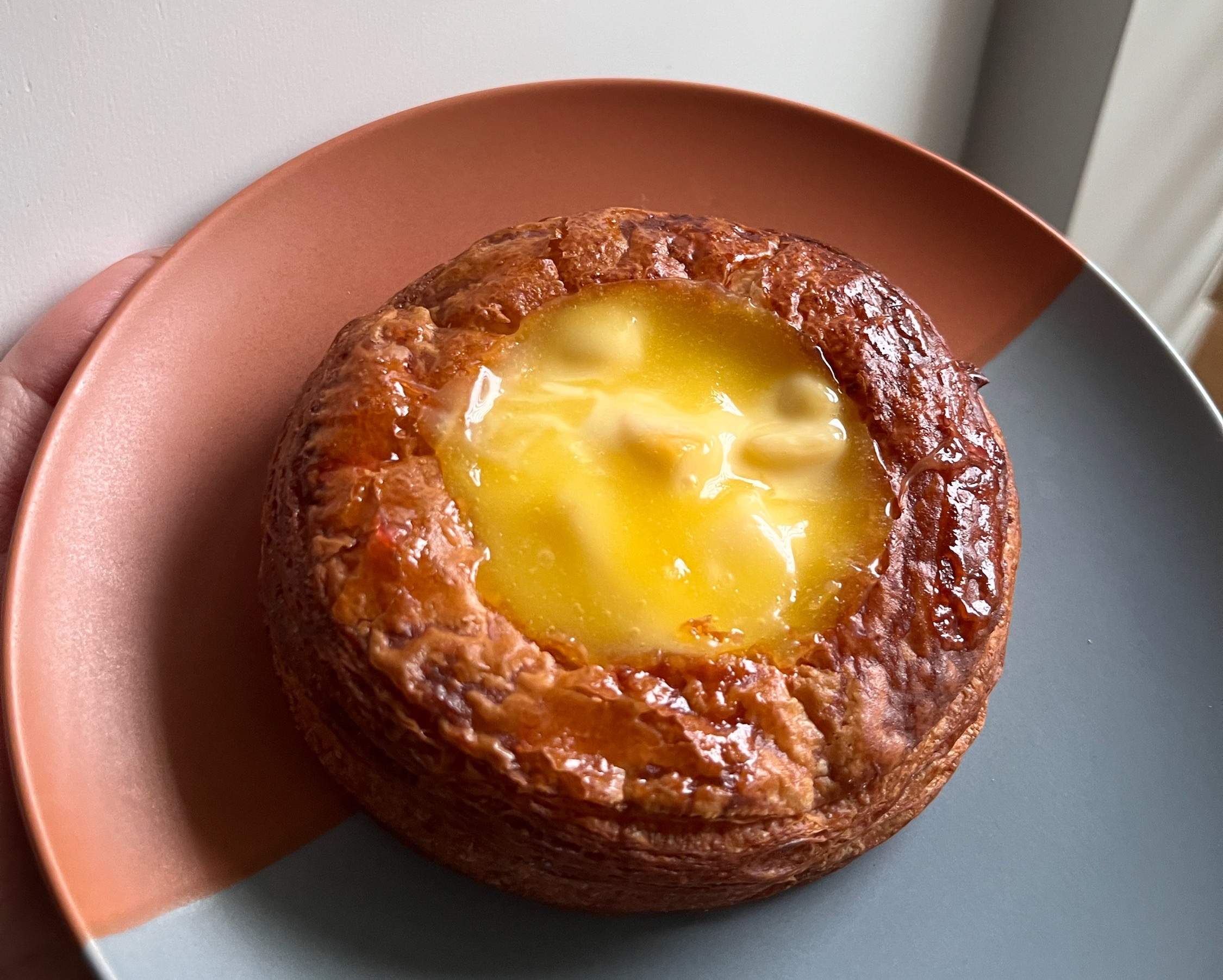
A mango calamansi danish from the Sir/Mom Tour pop-up at Small Oven Pastry Shop.
Mango calamansi danish from the Sir/Mom Tour pop-up at Small Oven Pastry Shop
It’s still gray and cold out, but a limited-time pastry offering helped me briefly forget. As part of their “Sir/Mom Tour,” chef Mike Strauss of Sidecar Bar & Grille (and formerly Mike’s BBQ) and his wife, Eylonah Mae Strauss, staged a Point Breeze kitchen takeover last week, sharing their love of Filipino cuisine with a slate of specials served at chef Chad Durkin’s Porco’s Porchetteria/Small Oven Pastry Shop and Breezy’s Deli. I went specifically for the mango and calamansi danish — a burst of citrus and sunshine that sold out both days. The silky yellow custard encrusted in golden flaky pastry with small bites of fruit laced throughout made for a gorgeous pick-me-up. I hope we see another collab soon, but given the Strausses live in the Philippines — where they run Sugaree Gelato Bakery Cafe in Bacolod — I expect a long wait. Small Oven Pastry Shop, 2204 Washington Ave., 215-545-2939, smallovenpastryshop.com.
To explain his journey from Ukraine to Huntingdon Valley in Montgomery County, Ukraine army veteran Illia Haiduk first must explain one of the worst days of his life.
On Nov. 3, 2023, Haiduk and about 70 other Ukrainian soldiers were at an outdoor awards ceremony in Zaporizhzhia, near the war’s front line. After an enemy drone spotted the gathering, the Russians launched an Iskander-M ballistic missile.
“You hear nothing,” Haiduk said. “It just hits immediately.”
Haiduk awoke on the ground. To his left, people were moving. To his right was “a mess, fire, and smoke.”
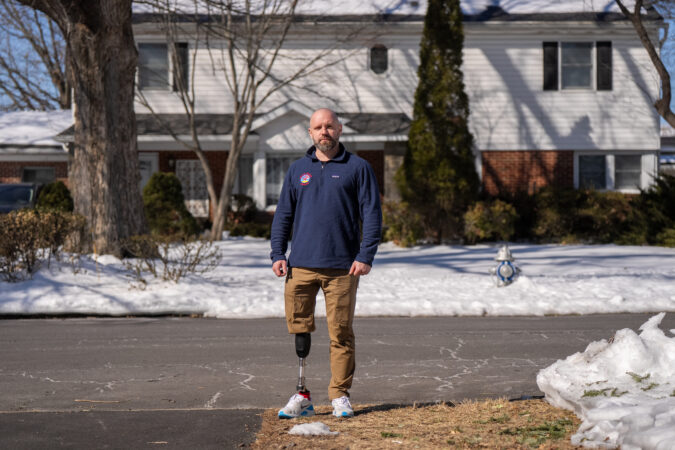
He tried to get up. That was when he realized shrapnel had mangled his lower right leg.
Haiduk belted a tourniquet around his thigh and tried to crawl to another soldier from his unit, the 128th Mountain Division. “I wanted to get to him. And there was this hole in his chest. Nothing could save him. He was the same age as me,” the 35-year-old said.
The attack killed at least 19 soldiers and wounded dozens more, according to news reports.
Haiduk’s injury sent him on a long path of healing that ultimately brought him to the Philadelphia area. But more than two years later, the attack is just one incident in a war that has claimed an estimated 2 million lives.
Vladislaw Romanenko (left) and Ilia Haiduk in a community-living home where veterans of the war in Ukraine support each other through their medical journeys, in Philadelphia, Feb. 13, 2026.
Four years after Russia invaded Ukraine, the war’s effects can be found throughout the region, among refugees and veterans seeking support services and the advocates helping them. Many are concerned about the future.
“In 2022, support and donations poured, but every year they become smaller and smaller,” said Roman Vengrenyuk of Philadelphia, who helps run the Revived Soldiers Ukraine program that brought Haiduk to the U.S. “A lot of nonprofits closed.”
Vengrenyuk said he has no expectation that the war will end this year. The Trump administration has failed to provide Ukraine with the weapons it needs to win, he said. Meanwhile, the bloodshed has left 60,000 Ukrainians in need of amputations, overwhelming hospitals in Ukraine and Europe.
Though it has gotten harder to get attention for their cause, an alliance of healthcare providers, nonprofits, and advocates across Philadelphia has continued to help wounded veterans and refugees. And for that, Vengrenyuk said, he is grateful.
“The Philadelphia community of doctors really stepped in,” Vengrenyuk said.
Life after war
After recovering from his injury, Haiduk went home and attempted to return to civilian life, but he felt depressed. That changed, however, in 2025, when he traveled to Canada to compete in the Invictus Winter Games, a multisport event for disabled veterans. He won a bronze medal in the skeleton race, and he found purpose and fellowship with others who had similar experiences.
“We can talk really freely, because we know that this man will understand me,” Haiduk said of his fellow veterans.
Vladyslaw Romanenko at a community-living home where veterans of the war in Ukraine support each other through their medical journeys, in Philadelphia, Feb. 13, 2026.
Later that year,Revived Soldiers Ukraine sent Haiduk to Orlando , where he received a prosthetic lower leg.
Haiduk got more involved with the Florida-based nonprofit. He has since helped numerous disabled veterans who were routed to the Philadelphia region for medical care.
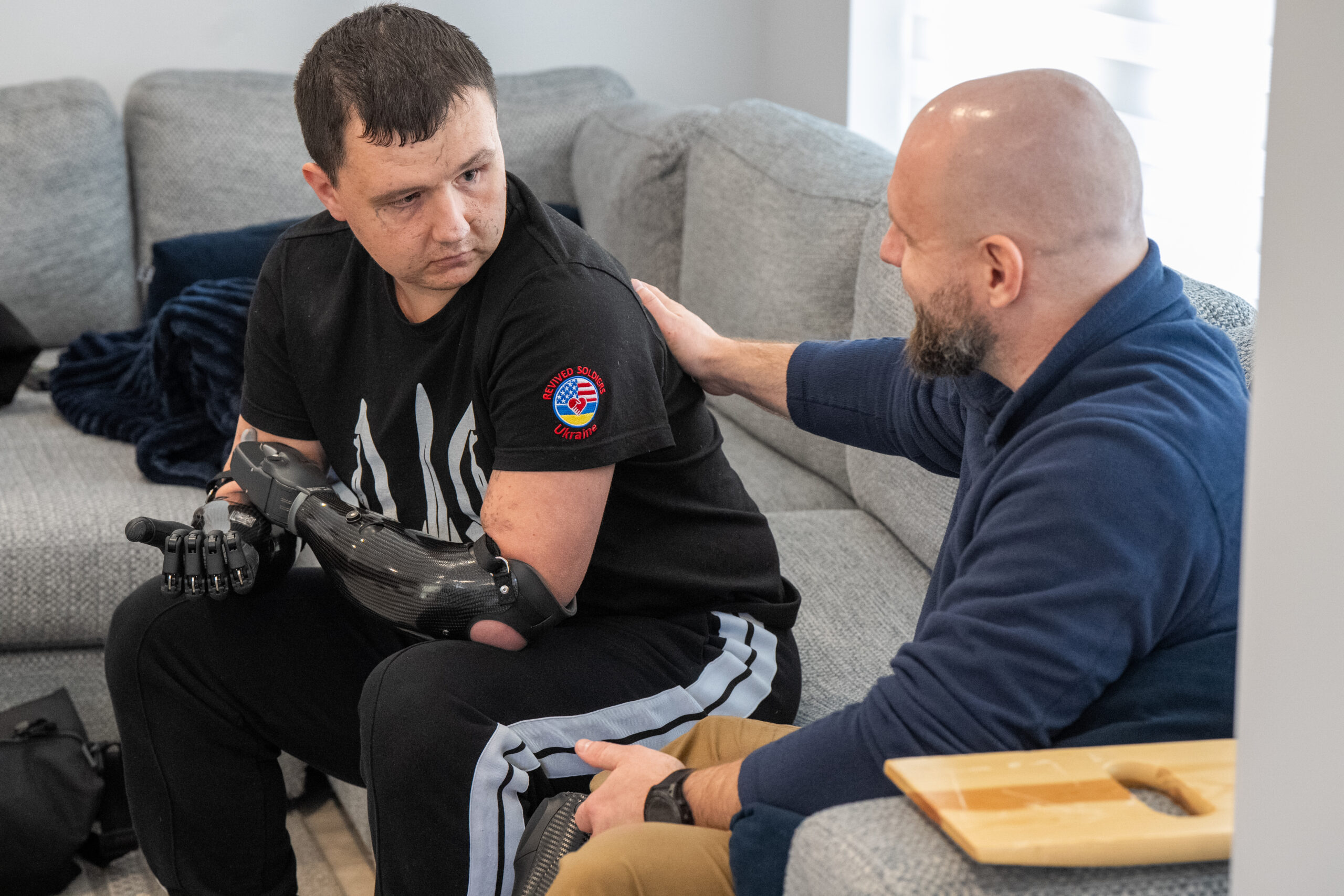
One is 30-year-old Vladyslav Romanenko, a former engineering student from Kharkiv who joined the army in 2022 and lost his lower arms in a drone strike last May. Romanenko is one of six Ukrainian war veterans living together at two homes in Huntingdon Valley.
Revived Soldiers Ukraine flew Romanenko and his partner to Philadelphia. At Wills Eye Hospital, a Ukrainian-speaking doctor, Michael Klufas, helped to restore vision in his right eye. Then, Prosthetic Innovations in Eddystone, Delaware County, outfitted him with bionic arms. “I’m very grateful to the Ukrainian and American doctors,” Romanenko said in Ukrainian, as Haiduk translated.
Oleksii Kondratenko at a community-living home where veterans of the war in Ukraine support each other through their medical journeys, in Philadelphia, Feb. 13, 2026.
Haiduk said Romanenko’s story is typical of the soldiers he works with: men from a wide range of professions and ages, who signed up to save their people. “I would never have joined the army, but because the war started, it was my responsibility to join, for my country,” Romanenko said.
Haiduk said people in the U.S., and most of the world, support the Ukrainian cause of “democracy and humanity.” However, more pressure needs to be put on Russia, he said.
“There is support, but it isn’t enough support to end this war,” Haiduk said.
Paying to stay in the U.S.
As an American-born Ukrainian whose parents were displaced after World War II, 71-year-old Mary Kalyna said, she considers it her mission to help those in “the Ukrainian diaspora.” The fluent Ukrainian speaker from Mount Airy said the situation has gotten worse for Ukrainian refugees since last year.
“Even though Ukraine is not in the news as much, I believe people still support Ukraine,” Kalyna said. “The problem is our government has changed. Now we have a government that is less supportive of Ukraine.”
The Konoshchuk family has lunch Sunday, Feb. 15, 2026. The family, from Ukraine, lives in Delaware County.
She criticized President Donald Trump for welcoming Russian President Vladimir Putin and holding peace talks where Ukraine was expected to cede land to Russia.
To her, Trump administration policy is working against local efforts from churches and communities that have embraced Ukrainians.
“There are many, many screws being tightened,” Kalyna said.
She provided an example: Due to one provision in Trump’s “OneBig Beautiful Bill,” thousands of Ukrainians who previously had been invited to the U.S. through the federal United for Ukraine program have to pay $1,000 per family member to maintain their humanitarian parole status.
On a Sunday afternoon at an apartment in Norwood, Delaware County, Kalyna met with one family who received such a notice at the end of December. Yurii Konoshchuk, 43, explained that he and his wife and four children came to the U.S. in May 2023. His 9-year-old daughter, Milana, has leukemia and is receiving treatment at Children’s Hospital of Philadelphia.
“We don’t have any safe place in Ukraine,” Konoshchuk said. “It is so important for us to be here. We thank God that we’re in Philadelphia.”
Though Konoshchuk works full-time at the Barry Callebaut chocolate factory in Eddystone, and has a supportive community at the nearby Living Hope Ukrainian Baptist Church, money has been tight. Then, he got a bill from the federal government to pay $6,000 or risk his familybeing deported.
As Kalyna prayed with the family and shared in the Sunday dinner they had prepared, she was brought to tears when asked about the money. Kalyna said that after people in the Northwest Regional Refugee and Immigrant Network sent out emails, they raised $6,000 within a few hours.
“People really want to give,” she said. “They understand.”
Milana Konoshchuk smiles for a portrait between her parents, Yurii (left) and Anna on Sunday, Feb. 15, 2026. Refugees from Ukraine, the Konoshchuks are living in Delaware County while their daughter receives medical treatment for leukemia at CHOP.
At the dinner table, the Konoshchuk family recounted their journey. Katie Konoshchuk, 14, remembered going weeks without school, and having to evacuate to the schoolbasement during air raids. Each child had to carry a flashlight. Her 13-year-old sister, Ohli, said they used to hope that if the bombs came, they would come on a day they had to take a test.
“People adjust to the situation that they’re in,” their mother, Anna Konoshchuk, said.
Yurii Konoshchuk said he saw missiles flying so low overhead that he could read the words written on them. “It’s good then, because you think it will not fall on you, but you don’t know about next time, and you don’t know who it did fall on.”
One of the missiles struck an electric power station less than a mile away, he said, and over the winter of 2022-23, it was a regular occurrence to rush from their home to the air-raid shelter in a city without light.
“We never in the city saw such bright stars,” he said. “It was beautiful on the heaven, but not on the earth.”
Yurii Konoshchuk struggled to predict what will happen next. “We are thankful, first to God, and to American nation, to give us the possibility of treatment here,” he said.
When they came to the U.S., Anna Konoshchuk said, she told her children life would be better, more peaceful. “But we’re treating it as an experience,” she said. “We don’t know how long America will allow us to stay. We’re being flexible.”
ARIES (March 21-April 19). If what they’re doing doesn’t sound fun to you, you don’t have to force it. Being intentional about your free time might mean trying something new or meeting different people. What were you doing the last time you had a blast?
TAURUS (April 20-May 20). An interesting question: Who am I around this person? Let the answer factor into your decisions about where to take this relationship, if you should take it anywhere at all. Liking a person is far less important than liking yourself when you’re around them.
GEMINI (May 21-June 21). Sometimes you wonder if you’re getting enough joy in life, and if you have to wonder, the answer is no. No, you’re not. Pleasure, relaxation, attention, novelty and the like are not luxurious or optional; they are essential to your health and vitality.
CANCER (June 22-July 22). You’re not always the exquisitely protected crab. Today you’re the snail, only half-protected by shell, at home while exploring, touching and touched, feeling and felt, sticky, not stuck. Steady, even while falling in love.
LEO (July 23-Aug. 22). Though you’re as empathetic as they come, today you won’t be able to judge others’ emotional experience by their immediate reaction. People won’t express their feelings in typical ways. Being aware of that allows you to respond with understanding instead of frustration.
VIRGO (Aug. 23-Sept. 22). New locations open to you and you aim to go as a traveler and not a tourist, experiencing what is, not the front that’s presented to newcomers in exchange for top dollar. Take the same approach to new relationships, and you’re golden.
LIBRA (Sept. 23-Oct. 23). Today’s work is very important. There are rewards for doing it and consequences for not doing it. But you still always put people first and you’ll never be sorry for that order of prioritization.
SCORPIO (Oct. 24-Nov. 21). What seems convenient could be a trap instead of a solution. Poke around. What other options are there? The well-known route might be the slowest way to get there, as too many travelers created traffic jams.
SAGITTARIUS (Nov. 22-Dec. 21). Your body moves in rhythm with your moods and mirrors your personality. Today, it speaks louder than words, revealing what you wish to express — or hide. What surprising self-knowledge!
CAPRICORN (Dec. 22-Jan. 19). You and the stranger next to you have something in common. Say hello, and you’ll discover it fast. Don’t? You’ll still feel that mysterious, unspoken connection, like you’re part of the same secret club.
AQUARIUS (Jan. 20-Feb. 18). You’re popular today, but you’re made well aware that you can’t always choose who wants your attention. You can, however, choose who gets it. Go where it’s peaceful and people aren’t trying to demand, steal or hoard your focus.
PISCES (Feb. 19-March 20). You’re not just going to succeed. You’re going to succeed like YOU. You’ll make it look so good and fun that others will imitate, trying to capture your style, which of course is impossible and flattering, too. Expect and enjoy your copycats.
TODAY’S BIRTHDAY (Feb. 21). Step into your Year of Feathered Friends, when connections and companionship send your spirit flying, flocked by kindred, and headed toward shared good fortune. Relationships, ideas, and collaborations soar to heights previously unimaginable. More highlights: You celebrate and bank on a personal achievement, family thrives in your support, and there are spontaneous entertainments and luxuries. Capricorn and Gemini adore you. Your lucky numbers are: 13, 5, 20, 12 and 33.