Arthur Waskow, 92, of Philadelphia, longtime social activist, pioneering Jewish scholar and rabbi, founder of the Shalom Center for public prophetic action, religion teacher, mentor, and prolific author, died Monday, Oct. 20, of chronic respiratory failure at his home in Mount Airy.
A longtime expert in Judaism, prophetic justice, and peaceful civil disobedience, Rabbi Waskow was so disturbed by the 1968 assassination of the Rev. Dr. Martin Luther King Jr. and the social unrest that followed that he protested, wrote about, and lectured around the country on what he called the “overwhelming crisis” of whether humanity will “build a decent society or will poison or burn it empty.”
For more than five decades, starting in Washington and then in Philadelphia, he connected contemporary social issues with Jewish traditions and championed prophetic justice regarding peace, nuclear disarmament, feminism, LGBTQ rights, same-sex marriage, environmental sustainability, and interfaith collaboration. “He consistently held that Judaism is not meant to stand above and apart from ordinary life, but rather to guide our actions in this life,” Rabbi Jill Jacobs said in a tribute.
Colleagues at the Shalom Center said he dramatically “fused social justice with traditional Jewish themes and spirituality.” Jacobs praised his “legacy of non-violent protest, his prophetic writing, and his courageous leadership.”
He established the Shalom Center for prophetic Judaism in Philadelphia in 1983, cofounded the Alliance for Jewish Renewal in 1993, and helped establish the National Havurah Committee, T’ruah: the Rabbinic Call for Human Rights, and other organizations. “He’s one of the most important figures to merge spirituality and politics since the 1960s,” Rabbi Tsvi Blanchard told The Inquirer in 2001. He “transcends categories and, as a result, he’s always crossing boundaries, but for good.”
Strategic action with compassion was usually his favorite tactic. He called his many disagreements with Jewish orthodoxy “a continuous loving debate” and told The Inquirer in 1970: “Jews have a radical role and mission to join with other communities to remake American society.” In 1993, he said: “In our generation, the people of the earth at last have to learn to share the great round earth or risk ruining it.”
He worked closely on social projects with Sister Mary Scullion of Project HOME, Rabbi Leonard Gordon of the Germantown Jewish Centre, and Imam Abdul-Halim Hassan of the Masjidullah Community Center Mosque. His embrace of the Jewish Renewal movement drew critics, but he never wavered in his support.
“There’s an unpredictability to him, a drama to him, a charisma to him,” Rabbi Gordon said in 2001. “That is who he is and has to be in challenging the community. We would lose too much without it.”
Rabbi Waskow celebrated the 50th anniversary of his Freedom Seder in 2019.
Rabbi Waskow was arrested dozens of times for peacefully protesting about segregation, immigration, and other issues. He wrote so many books he lost track of how many were published. “It’s either 19 or 20,” he told The Inquirer in 2007. “My wife said it’s the same number as the times I’ve been arrested.” He never retired.
He wrote and organized the first Freedom Seder in 1969 to recognize contemporary liberation efforts as well as the Exodus of the ancient Israelites. He was invited to President Clinton’s Middle East peace ceremony at the White House in 1993 and appeared in a TV ad in 2004 that denounced prisoner abuse in Iraq. “He found joy in reimagining Jewish holidays and prayers in ways that spoke to contemporary issues,” his family said in a tribute.
He came to Philadelphia from Washington in 1982 as a new faculty member at the Reconstructionist Rabbinical College and went on to teach religion at Swarthmore, Temple, Drew University in New Jersey, Vassar College in New York, and the Hebrew Union College-Jewish Institute of Religion in New York.
He wrote articles and op-eds for The Inquirer, Daily News, and other publications, and authored more than 25 books on all kinds of topics. His 1978 book Godwrestling and 1982’s Seasons of Our Joy are religious classics. In 1993, he wrote Becoming Brotherswith his younger brother, Howard.
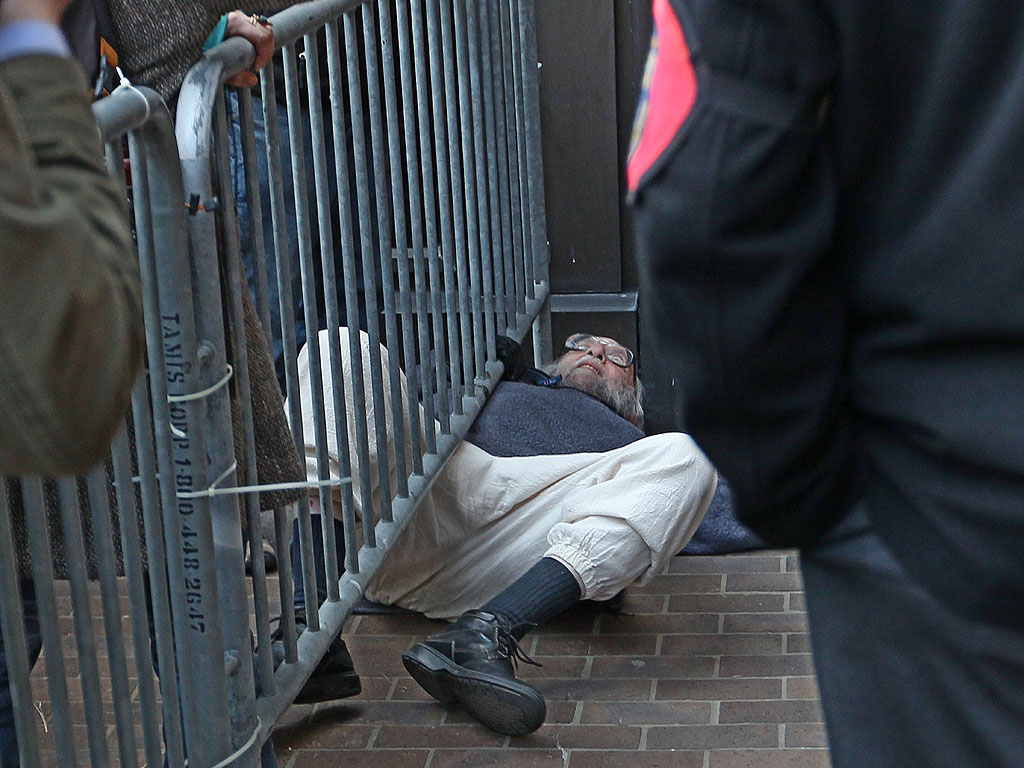
Rabbi Waskow crawls under a barricade so he could get arrested at a protest in 2014.
Rabbi Waskow won many awards and was recognized for his leadership and lifetime achievements by the Jewish Peace Fellowship, Neighborhood Interfaith Movement, and other groups. Newsweek named him one of the fifty most influential American rabbis in 2007.
Recently, he focused on describing God in traditional ways with modern insights. “Watching your kids begin to parent feels like there is a spiral to life,” he said in 2001.
Arthur Irwin Waskow was born Oct. 12, 1933, in Baltimore. He was always an avid writer and reader, especially science fiction, and fascinated by words.
His father was a high school history teacher, and, with his help, Rabbi Waskow won a newspaper history contest that paid part of his college tuition. He earned a bachelor’s degree in history from Johns Hopkins University in 1954 and a doctorate in American history from the University of Wisconsin in 1963.
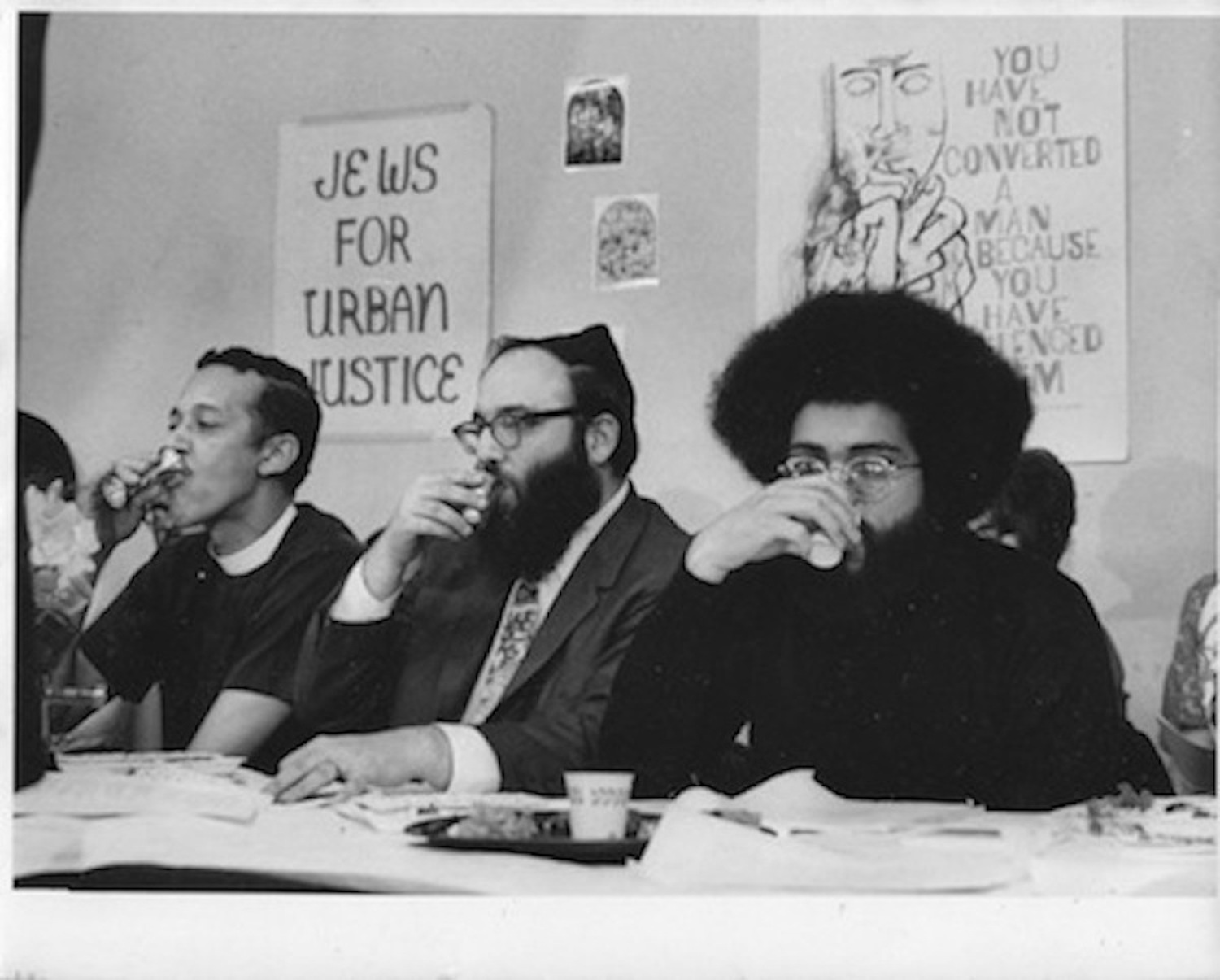
Rabbi Waskow (center) celebrates the first Freedom Seder in 1969.
He protested against the Vietnam War and other hot topics in the 1960s, and worked in Washington after college as an aide to U.S Rep. Robert Kastenmeier, and a fellow at the Institute for Policy Studies.
He married Irene Elkin, and they had a son, David, and a daughter, Shoshana. After a divorce, he met Rabbi Phyllis Berman at a conference, and they married in 1986, and both adopted the middle name Ocean.
Over the last 18 months, even though he couldn’t see, Rabbi Waskow wrote two more books. “He was very determined in the fullest sense of that,” his son said. His daughter said: “He was passionate about what he was passionate about.”
His wife said: “He was playful, brilliant, creative, and fierce. He was generous in every way.”
In addition to his wife, children, and former wife, Rabbi Waskow is survived by five grandchildren and other relatives. His brother died earlier.
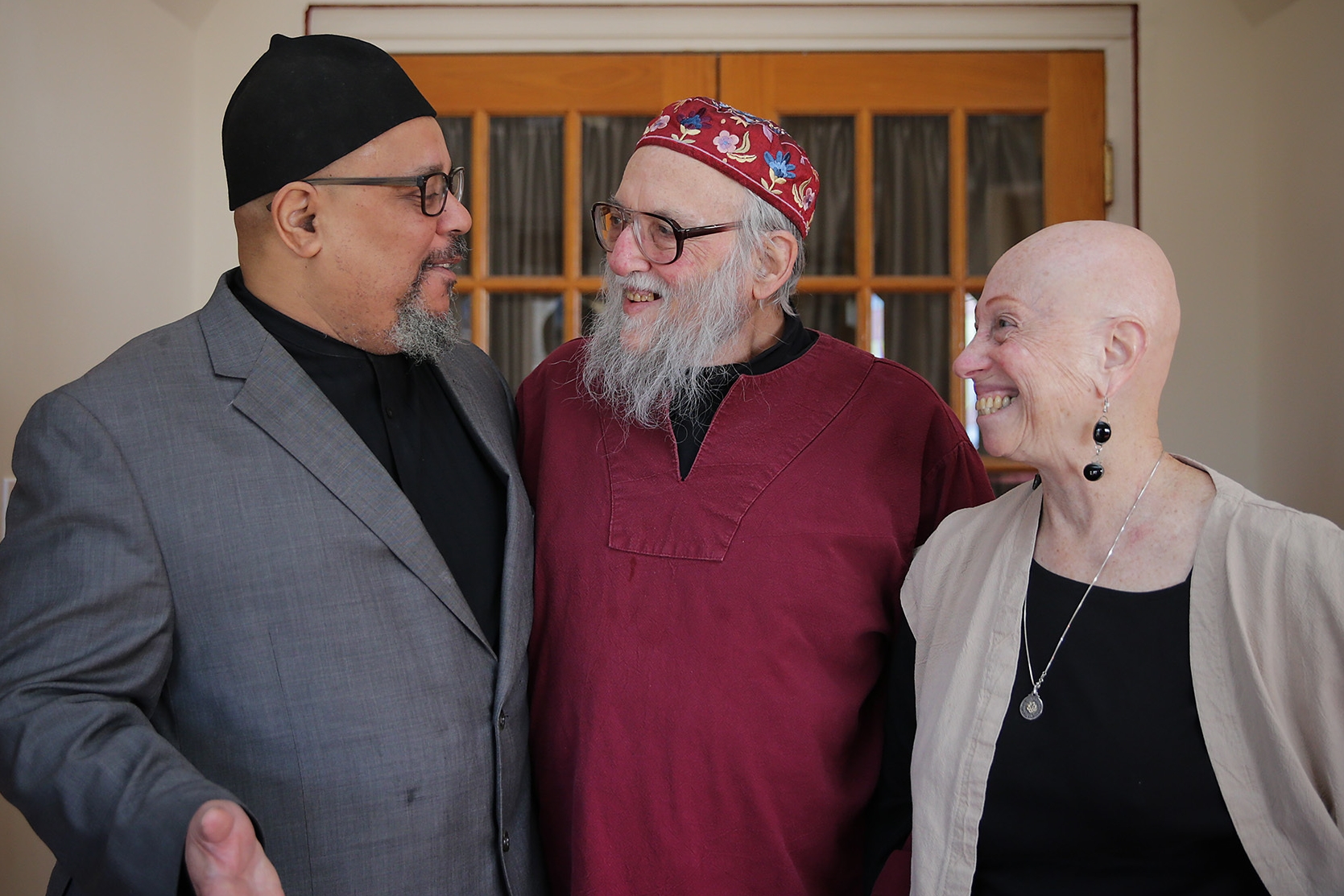
Rabbi Waskow (center) talks with his wife, Phyllis, and Imam Abdul-Halim Hassan in 2019.
Services were held on Oct. 22.
Donations in his name may be made to the legacy fund at the Shalom Center, 6711 Lincoln Dr., Philadelphia, Pa. 19119.
Women filled more of the top leadership positions at large public companies in the Philadelphia area in fiscal year 2024 than they did the previous year. But workplace parity remains to be achieved.
“We’re showing measurable but slow progress,” said Meghan Pierce, president and CEO of the Forum of Executive Women, which this week released its annual report measuring women in CEO positions and on corporate boards. “As we look at this data year to year, we are definitely discouraged by how slow progress is.”
The Forum counted women in leadership positions in fiscal 2024 across the region’s largest 100 public companies by revenue, using data from U.S. Security and Exchange Commission filings.
Pierce says the forum is using its platform to highlight some factors holding women back in the workforce, such as the lack of paid family leave in Pennsylvania and lack of pay transparency. These are “structural issues that might prevent someone from getting to where they deserve to be,” she said.
Who are the region’s female CEOs?
Still, the number of women CEOs in the Philadelphia area more than doubled last year, from four in 2023 to nine last year.
Mojdeh Poul of Integra LifeSciences Holdings Corp.
Suzanne Foster of AdaptHealth Corp.
Natalia Shuman of Mistras Group Inc.,
Nicholle Taylor of Artesian Resources Corp.
Carole Ben-Maimon, of Larimar Therapeutics, was included on the list last year and remains CEO of that company, but Larimar is no longer among the top 100 local public companies by revenue.
Getting more women in to CEO roles, Pierce said, will require “making long-term investments in women and putting them in the pipeline for those top jobs.”
More female board members
On the boards of 100 Philly-area businesses in 2024, women occupied 15 more seats than the previous year, bringing women’s representation on boards up to 30%.
Despite that progress, six companies still have no women on their boards, an increase from three last year.That number has not increased since 2013.
“We have to call that out,” said Pierce. “A company with no women on their boards is troubling for us.”
In 2013, 35 of the 100 companies didn’t have women on their boards.
window.addEventListener(“message”,function(a){if(void 0!==a.data[“datawrapper-height”]){var e=document.querySelectorAll(“iframe”);for(var t in a.data[“datawrapper-height”])for(var r,i=0;r=e[i];i++)if(r.contentWindow===a.source){var d=a.data[“datawrapper-height”][t]+”px”;r.style.height=d}}});
A “troubling” decline in DEI reporting
This year’s report noted that fewer area companies had chosen to report their DEI policies, racial and ethnic makeup of their boards, and/or of their workforce. In 2023, 87% of the region’s top 100 companies had shared at least some of this information, but that dropped to 62% a year later.
Pierce said this is “troubling.” She said she expects that number to continue dropping amid President Donald Trump’s curtailing of DEI efforts, “just given the environment that we’re operating in — but maybe I’ll be pleasantly surprised.”
A recent Gallup and Bentley University report also indicates that fewer people believe DEI should be a top business priority. This year, 69% of people thought DEI was “extremely or somewhat important for businesses to promote,” down from 74% in 2024, the report said.
Editor’s note: A previous version of this story contained a percentage that could not be verified. It has been removed.
Ocean City Council on Thursday night declared a local emergency over beach erosion, and urged state and federal officials to help.
The resolution comes after the community suffered severe erosion during two recent storms. Hurricane Erin in August and a nor’easter in October battered the city’s beaches, scouring out cliffs of sand.
“This could be a tool to help our legislators who are fighting to fund a U.S. Army Corps of Engineers beach replenishment project,” Mayor Jay Gillian explained.
Gillian said city officials spoke with Republican U.S. Rep. Jeff Van Drew and shared ideas to deal with the erosion. This year marked the first year since 1996 that Congress approved zero federal dollars for beach projects in New Jersey.
A New Jersey Department of Environmental Protection (DEP) assessment of the damage from the October nor’easter found that the city experienced erosion between 1st and 11th streets, with new dune scarping or loss in that entire stretch.
Some of the scarping — vertical sandy cliffs caused by storms —exceeded five feet in height.
High waves caused additional damage under the boardwalk at 5th and 6th Streets, according to the DEP.
“Ocean City is currently experiencing critical and accelerating beach erosion, including significant dune loss, destruction of protective berms, and threats to both public and private property,” the resolution states, “placing the city in an emergency state of vulnerability ahead of the winter storm season.”
The resolution said beach width and height had already been compromised before the storms.
Further, it said, the city “lacks the financial resources to independently implement large-scale beach replenishment, dune restoration, or long-term protective measures, and requires urgent and immediate assistance and funding,” from state and federal sources.
Officials say Army Corps replenishment efforts have already been delayed without any clear timeline to continue.
The resolution was sent to Gov. Phil Murphy, and multiple U.S. and state legislators, as well as multiple county, state, and federal departments.
“Ocean City stands ready to work collaboratively with all levels of government to protect the lives, homes, economy, and natural resources of its residents,” the resolution states, “and requests that this growing crisis be met with the urgency and seriousness it warrants.”
Ocean City is not alone in having felt the wrath of the storms without any funding help in site. The continued federal shutdown has only resulted in more delays in seeking money.
Coming after Hurricane Erin, the October nor’easter erased sand and seriously compromised dune systems, the DEP said in its preliminary assessment of the storm.
“Moderate to major erosion” was reported on Long Beach Island and from Strathmere to Cape May, and “moderate to minor” erosion from Brigantine through Ocean City, according to that assessment.
Although Erin stayed well offshore when it struck in August, the winds and waves it generated caused at least minor erosion on 85% of all Jersey beaches, according to the department’s analysis.
That included “moderate” sand losses in Avalon, Ocean City, Strathmere, and North Wildwood.
Contributing to the sand losses resulting from the nor’easter was the fact that the beaches already had endured consecutive days of onshore winds on four occasions since Aug. 18.
As Christina Smith-Sylve watched last Sunday’s game Eagles against the Minnesota Vikings in the U.S. Bank Stadium stands, her seat might as well have been made out of pins and needles with the way nerves pricked her skin.
That sensation intensified when she saw three Vikings defenders tackle her 6-foot, 170-pound son, DeVonta Smith, on a 16-yard reception down the right sideline in the second quarter.
Dallas Goedert even seemed to clamor for a defenseless receiver penalty against Blake Cashman after the play. The inside linebacker’s rally to Smith came after Byron Murphy already had stopped the small-but-stubborn receiver’s forward progress.
Smith-Sylve felt those pins and needles again when the 26-year-old receiver absorbed a hit from Harrison Smith on a 19-yard cross over the middle of the field. But after both plays, Smith popped up with the ball in his hands as if he had been grazed by a butterfly and not tackled by men who likely can bicep curl his body weight.
“It’s hard seeing him,” Smith-Sylve said. “It’s rough. But I know he’s tough. He’s small in stature, but he plays big.”
Jahan Dotson is used to Smith’s toughness by now, two seasons into his Eagles tenure. In theory, Dotson is one of the players responsible for assuming Smith’s or A.J. Brown’s spot on the field if either star receiver gets banged up or needs a moment to recuperate on the sideline.
It usually plays out the same way every time, according to Dotson. After the hit over the middle against the Vikings, Smith came to the sideline, hands on his hips, trying to catch his breath. He insisted to wide receivers coach Aaron Moorehead that he could go back into the game, refusing to miss a play.
“He’s not the biggest guy,” Dotson said. “He takes the biggest hits. And he pops back up like he’s the biggest guy.”
Smith was one of the biggest reasons the Eagles snapped their two-game losing streak, too, leading the team with a career-high 183 yards and a touchdown on nine receptions in that game. His 79-yard touchdown catch came on a play he had advocated for at halftime, eager to exploit the Vikings’ decision to bring a safety into the box when the Eagles were under center in their jumbo package.
Eagles wide receiver DeVonta Smith celebrates his third-quarter touchdown against Minnesota on Oct. 19.
“It was a great feeling seeing that little thing run down there to the end zone, man,” said left tackle Jordan Mailata. “It was beautiful.”
Everyone is a little thing compared to Mailata, who is 6-foot-8 and 365 pounds. Still, Smith’s big plays are putting him on pace for a career-best 1,224 receiving yards. With big plays often come big hits from bigger defenders, especially at Smith’s second-percentile weight among draft-eligible wide receivers in 2021, when he was picked 10th overall.
How does Smith bounce back up, regardless of his smaller stature? He claims he knows no other way to operate.
“If I can walk, I’ll be all right,” Smith said.
He “hopped right up”
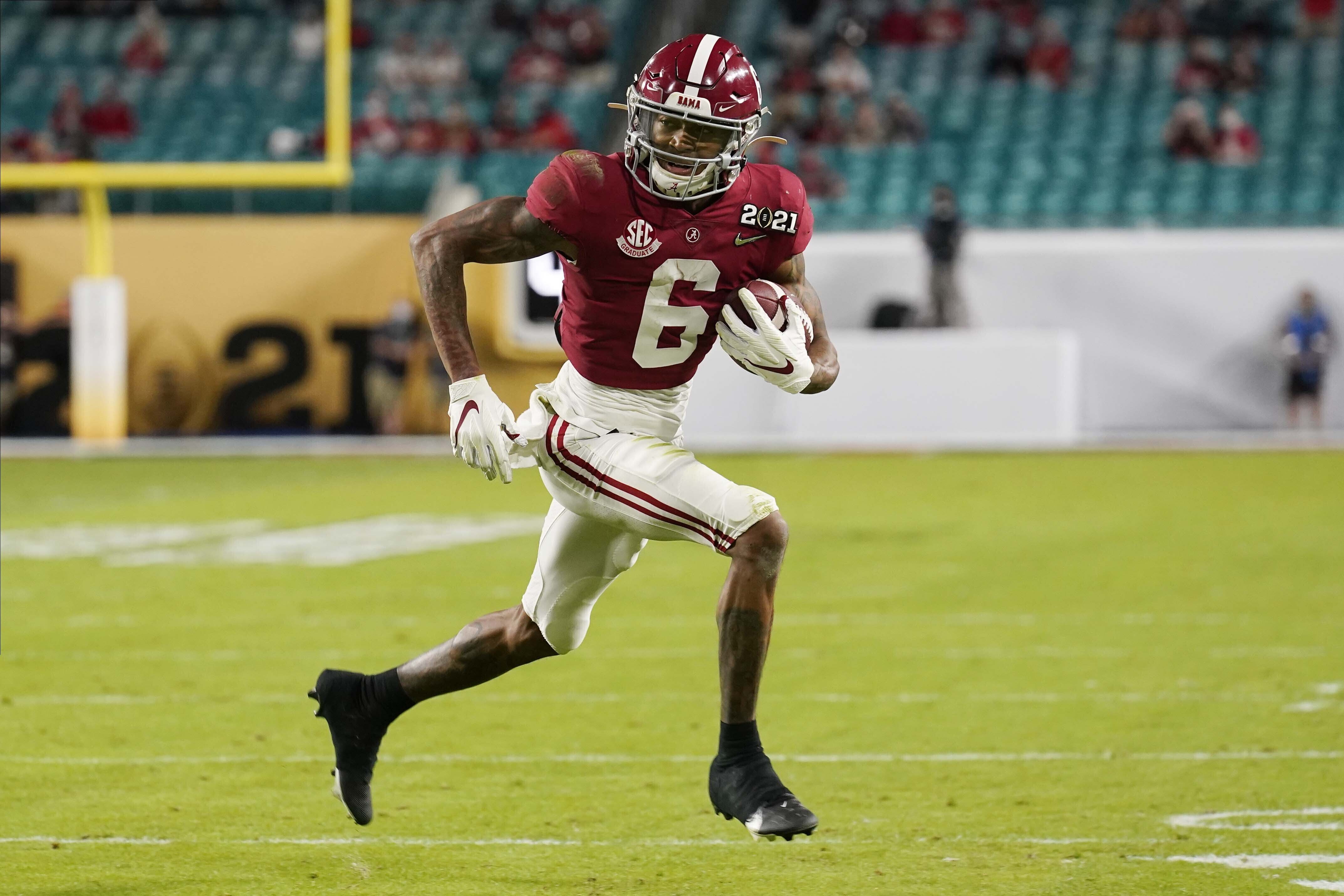
Much to the chagrin of Smith-Sylve, Smith began playing little league football and basketball when he was 5 years old in his hometown of Amite City, La. She was particularly scared for her undersized son in his football pursuits. But all of his friends in their small town, with a population just over 4,000, were participating, and he wanted to play with them.
“I couldn’t crush his spirit,” Smith-Sylve said.
So she acquiesced. He quelled her fears, though, because even though “Tay” often was the smallest player on the field, he typically was the toughest.
He continued to cultivate his toughness at Butler Town Park, which is across the street from their home. Smith would hang around his older, bigger cousins and their friends, trying to join their basketball and football games. They allowed it, but they didn’t go easy on him. They roughed him up, Smith-Sylve said. As a result, Smith became well-acquainted with the surface of the basketball court.
“Plenty of times, I’d done hit that concrete,” Smith said.
Those scrapes and bruises formed calluses on Smith’s mental toughness. He applied that mindset to the football field at Amite High Magnet School as a freshman on the football team, where coach Alden Foster already knew plenty about Smith.
After all, Amite is a tiny town, and the football community is even tinier. Smith-Sylve is Foster’s cousin. His brother coached Smith in little league football. Foster’s nephew, Elijah Walker, was Smith’s teammate from little league through high school. Another cousin of Smith-Sylve’s, Dwayne Davis, was Foster’s defensive coordinator at Amite.
Football games practically were family reunions. So Foster had plenty of intel on his small-but-mighty receiver. He quickly found out that he still was learning how to read defensive coverages, too.
During Smith’s freshman year, Amite scrimmaged against Edna Karr, a perennial football powerhouse in New Orleans. Smith was running a route over the middle and didn’t remember to settle in the zone. A 6-foot-4, 250-pound defensive end — who went on to play for LSU, Foster said — dropped into coverage in the area.
Eagles wide receiver Devonta Smith was 122 pounds as a freshman for the Amite High Magnet School football team.
“[Smith] ran across, and the quarterback threw it,” Foster said. “Oh, man. He knocked him out. That little sucker was 122 pounds then and hopped right up.”
Smith put the hit behind him. Later in the scrimmage, when the teams were working on goal-line situations, “that little freshman scored a touchdown against them people,” Foster said. The next year, Amite and Edna Karr played each other. Smith, then a sophomore, used that hit as ammo, fueling him to a three-touchdown performance, according to Foster.
“He said, ‘Coach, I got to get my revenge,’” Foster said.
“You’re not a quitter”
Despite his toughness, one hard fall in his sophomore year almost took Smith out of football for good.
On Thursdays, Foster sought to conclude their walk-throughs on a good play. The quarterback targeted Smith to end the practice, but he overthrew his receiver slightly.
Smith, ever the competitor, dove for the ball. He came down hard on the field. This time, he didn’t pop up.
Foster took Smith to the hospital, where Smith-Sylve met them. They learned that Smith broke his clavicle, which ended his season.
“The first thing he said: ‘That’s it for football. I quit. I’m not playing. I quit,’” Foster said.
Smith was a multisport athlete at the time, competing in track and field and basketball. Smith’s father, Kelvin Dickerson, was adamant that his son had a future in basketball. The injury nearly led to Smith dedicating himself to basketball, which both of his parents played.
Foster wasn’t having it. Smith had too much upside to waste as a football player. Smith was a good basketball player, Foster said, but he was different in football. Dickerson eventually came around to Foster’s pleas and had a conversation with Smith.
“‘You wanted to play football,’” Smith-Sylve said of Dickerson’s message to their son. “‘That’s what happens. That’s a part of the game. You tough. You’ll be all right. You know what you’ve got to do next time.’ I think both of them, just talking to him and letting him know, ‘You’re not a quitter. That’s one hit of many. So let’s just go.’”
That injury changed the way Smith approached the game, according to his family. He became more serious about hitting the weight room. Moorehead, the Eagles’ wide receivers coach, got to witness that work ethic in person when he traveled to Amite on a recruiting trip while serving in the same role for Texas A&M.
Nick Saban took a chance on an undersized DeVonta Smith, and he finished his Alabama career with two national championships and a Heisman Trophy.
The small weight room tucked beneath the football stadium looked like it hadn’t been updated in 25 to 30 years at the time, Moorehead said. Rust tarnished the weights. The air inside mimicked the sticky Louisiana heat outside, causing the 145-pound Smith and his teammates to drip with sweat. But Moorehead never heard a complaint.
“That was just what they knew,” Moorehead said. “They didn’t know anything else. Didn’t care. Just trying to get better.”
Smith grew stronger, but he didn’t bulk up with ease. Zephaniah Powell, Amite’s football coach beginning in Smith’s junior year, said his build was genetic. Powell claimed Smith looks just like his father, with a “thin build, not that big of a frame. But long arms, long legs, kind of put together like an antelope.”
His lack of size had nothing to do with his appetite. Foster would host seafood boils complete with crawfish and turkey necks in the yard. He said Smith loved to come by and eat with his cousins. But it didn’t seem to matter that Smith enjoyed seafood boils with his family or ate tablespoons of peanut butter to cram in extra calories, Foster explained.
“His DNA wouldn’t let him gain a whole lot of weight,” Foster said. “But you can’t measure his heart.”
Proving people wrong
Moorehead once questioned how Smith would fare in the SEC. He wasn’t the only one.
Some coaches at college football recruiting camps looked at the undersized receiver skeptically, Foster said. But he liked taking kids to Alabama’s camps because Nick Saban didn’t care how big they were. If they could play, Saban would give them a chance.
One Heisman Trophy and two national championship titles later, the chance Saban took on Smith paid dividends.
“All he’s done is prove people wrong,” Moorehead said.
That includes Jalen Hurts, his quarterback at Alabama for two seasons.
“I remember times asking, ‘Hey, man, how much [do] you weigh?’” Hurts said. “And I stopped asking him that as the years have gone on, because that’s no indication of what type of player he is. He’s a hell of a player, and he’s been making some big-time plays.”
The grittiness Smith once exhibited as a kid at Butler Town Park is still evident in his game in the NFL. In fact, Eagles coach Nick Sirianni could rattle off the specific plays over the past five seasons in which Smith exemplified the toughness that Sirianni so often preaches to the team.
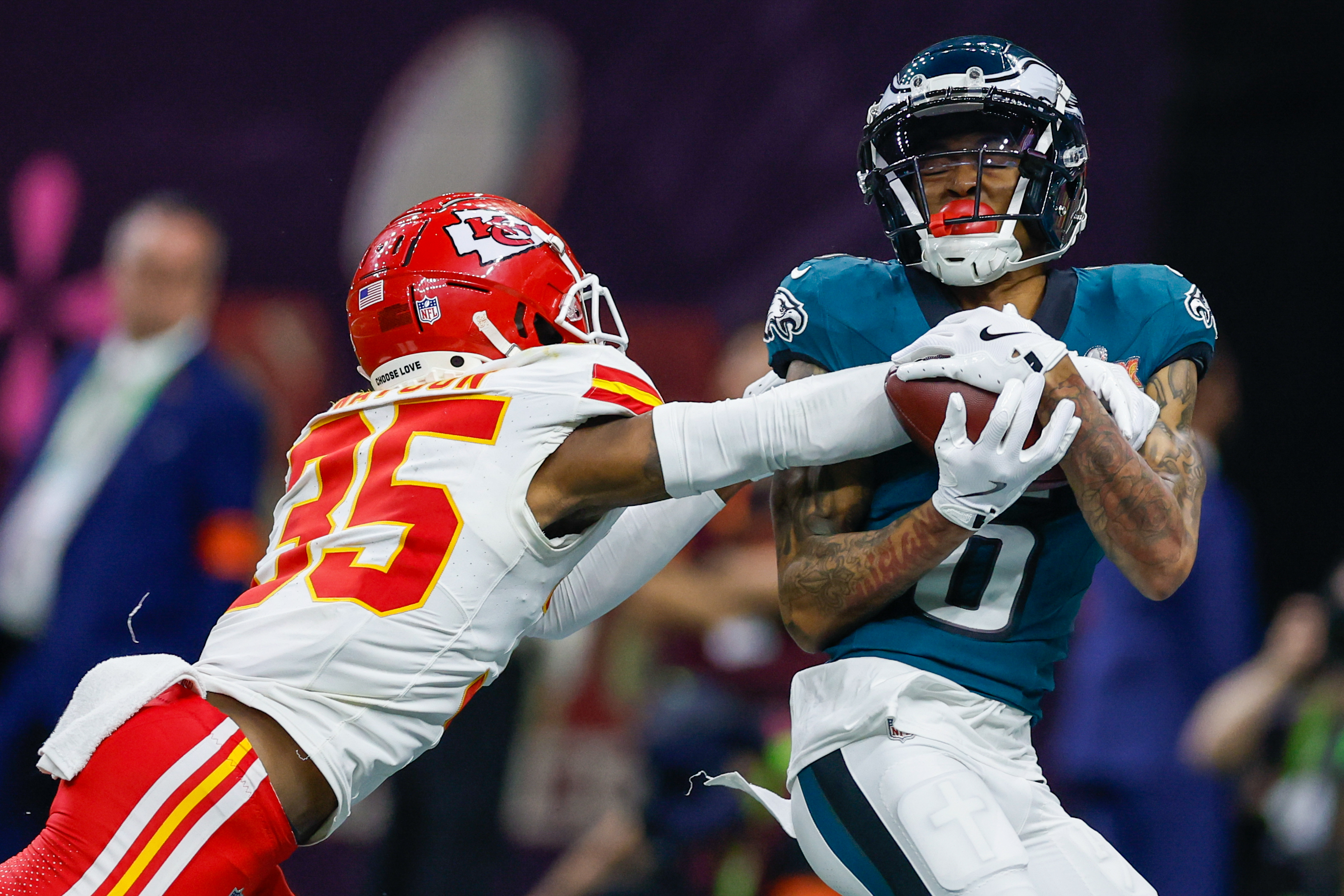
There was the third-down play Smith made in Super Bowl LVII on a shallow crossing route, when Kansas City Chiefs safety Justin Reid sent him flying out of bounds.
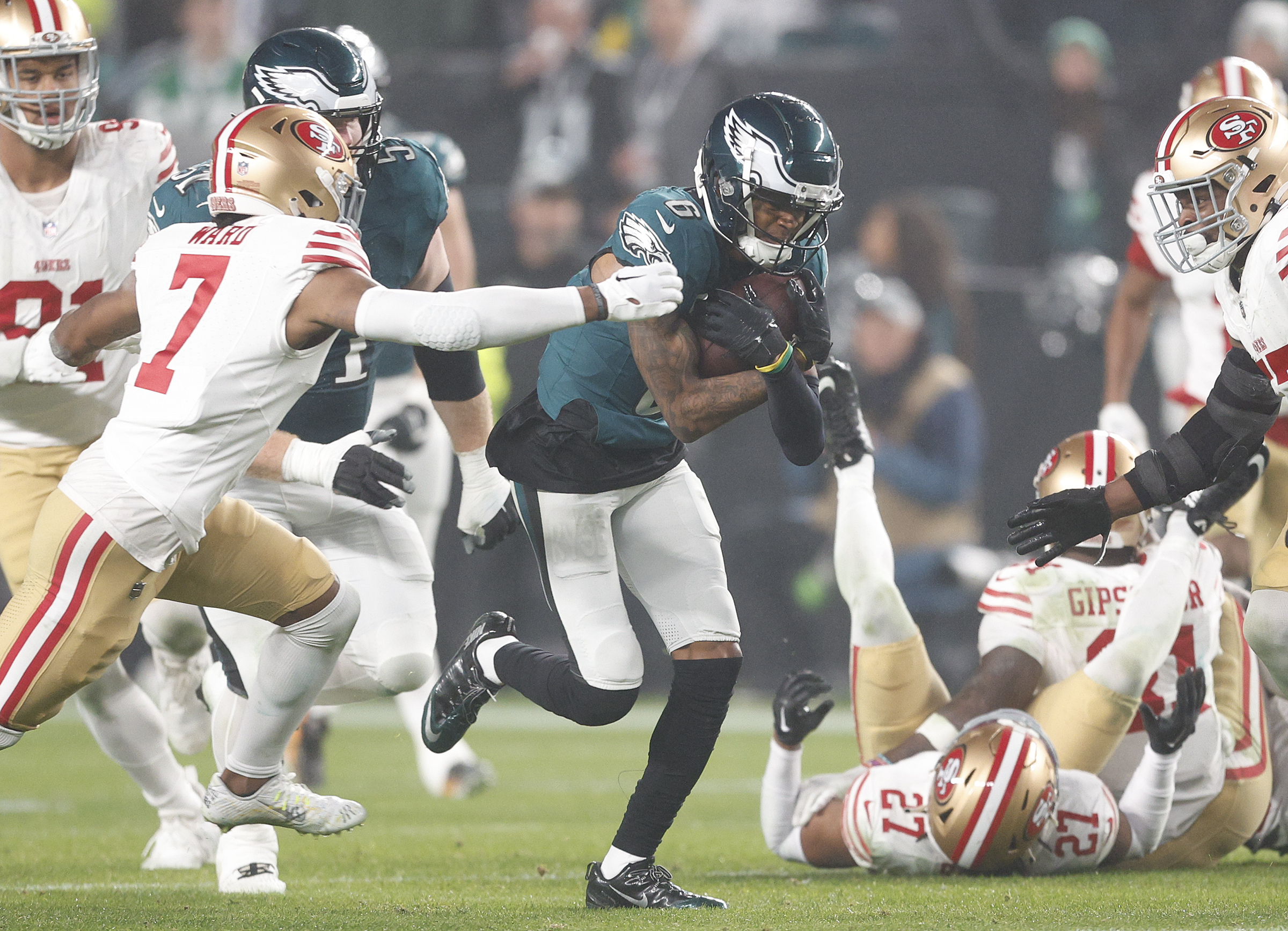
Nick Sirianni recalled a DeVonta Smith screen gain of 21 yards against the 49ers in 2023 as a display of the receiver’s toughness.
There was the 2022 win over the Arizona Cardinals, in which Smith caught a screen pass from Hurts then immediately took a hard hit from Murphy, a member of the Cardinals at the time.
There was the third-and-19 play against the San Francisco 49ers in 2023 when Smith caught a screen pass and broke three tackles before picking up 21 yards after the catch.
In true Smith fashion, he just kept going.
“We didn’t win that game, but it brought life to everybody,” Sirianni said. “I think that that’s what a big play can do, that’s what a great assist from a teammate can do, and that’s what great toughness shown on tape can do, because those are the things we talk about all the time that can just bring that energy to a football team.”
Perhaps no play in Smith’s NFL career can amount to the energy generated by his 46-yard touchdown in Super Bowl LIX, which has since been referred to as “The Dagger.” But Moorehead had been hesitant about the Eagles calling that play. Smith had been nursing a hamstring injury that week, and he was worried about the health of his receiver.
Moorehead said he asked Smith four times before that play if he was sure he wanted to run it, deep route and all. Smith, playing in front of his loved ones at Caesars Superdome in New Orleans, had no hesitation.
“He finally looked at me and he said, ‘If you don’t get the F out of my face, I’m running this route,’” Moorehead said.
Smith wasn’t finished.
“‘They’re going to have to drag me off this field [in] the Super Bowl,’” Moorehead recalled Smith saying. “And he meant it. He was home. He wanted to win in that stadium. He wanted to play in front of his family and friends and score a touchdown in the Super Bowl and play well. And he did.”
Eagles wide receiver DeVonta Smith touchdown catch in the third quarter of Super Bowl LIX is now known as “The Dagger.”
NFL rules have evolved to better protect receivers. John Lynch and Ronnie Lott aren’t patrolling the middle of the field anymore. But receivers still get hit hard on occasion, a fate Smith seems to have accepted, according to Moorehead.
The receivers coach surmised that those hits energize Smith, too. Smith-Sylve has a different feeling, but she wards off those pins and needles when she remembers the 5-year-old who pleaded with her to let him play little league football.
“I know that’s what he loves to do,” Smith-Sylve said. “He has a love for the game. He’s small in stature. But he plays big, and he’s going to give it 100%.
When it’s getting chilly out, I want spaghetti, red sauce, and something fried — with no frills. At Villa di Roma, I ordered the eggplant parmesan and that’s exactly what I got: four crisp breaded discs smothered in mozzarella, served over spaghetti and house-made marinara. Behind me two women shared four martinis as they dug into their pasta. No matter what you order, the vibes of Villa di Roma (one of the picks in The Inquirer’s inaugural edition of The 76), are simply perfect, white tablecloths, drop ceilings, warm service, and all. It feels like a restaurant full of regulars, and I’m ready to become one. Villa di Roma, 934 S. Ninth Street, Philadelphia, PA 19147, 215-592-1295, villadiroma.com
— Zoe Greenberg
A grilled corzetti pasta coin cradles a slice of American wagyu beef and Cooper Sharp foam at Vetri Cucina, where this mini-cheesesteak bite was featured on Vetri’s monthly pasta omakase tasting.
Grilled corzetti pasta with wagyu and Cooper Sharp foam at Vetri Cucina
There’s a new wagyu cheesesteak in town unlike any other, and it has redefined the possibilities of the fancy steak genre in one unforgettable bite.
This creation was just one of 15 incredible courses at Marc Vetri’s monthly “pasta omakase,” a chef’s-counter feast reserved for six lucky people inspired by the small-bite tasting meals of Japan, where Vetri operates a restaurant in Kyoto. Instead of sushi, though, Vetri’s meal centers around creative pasta whimsies: tagliolini with uni and caviar in sake butter, or a culurgione made with carob dough wrapped around duck confit and duck X.O. in an intensely reduced sauce brightened with citrus — essentially duck à l’orange as a dumpling.
Each dish was a jewel of craft and surprise, and a reminder why Vetri remains one of America’s undisputed pasta kings. But he’s also a Philly guy through and through, so one of the most unexpected highlights was reserved for the end of the meal when a small coal-fired grill was brought out. Vetri flashed some stamped pasta coins known as corzetti over the flames. Then came sheer slices of ultra-rich wagyu beef, which he seared and layered atop the pasta with a roasted onion and foamy flourish of aerated Cooper Sharp cheese.
Cinched together with a toothpick, I popped it into my mouth like a mini-taco made of pasta. The familiar flavors of Philly’s favorite street food unfolded with uncommon richness, but also a delicate touch that rendered every element vivid and clear.
Of course, who knows when this wonder will appear again? Vetri’s omakases have remained a scratch pad lab for the chef to experiment with new ideas. The menus are ever-changing and, at $300-plus a person, they’re a major splurge. The corzetti cheesesteak bites received such a rousing response, however, Vetri is considering adding them as an amuse-bouche to the regular menu at Vetri, or perhaps some future event. Vetri Cucina, 1312 Spruce St., 215-732-3478, vetricucina.com
— Craig LaBan
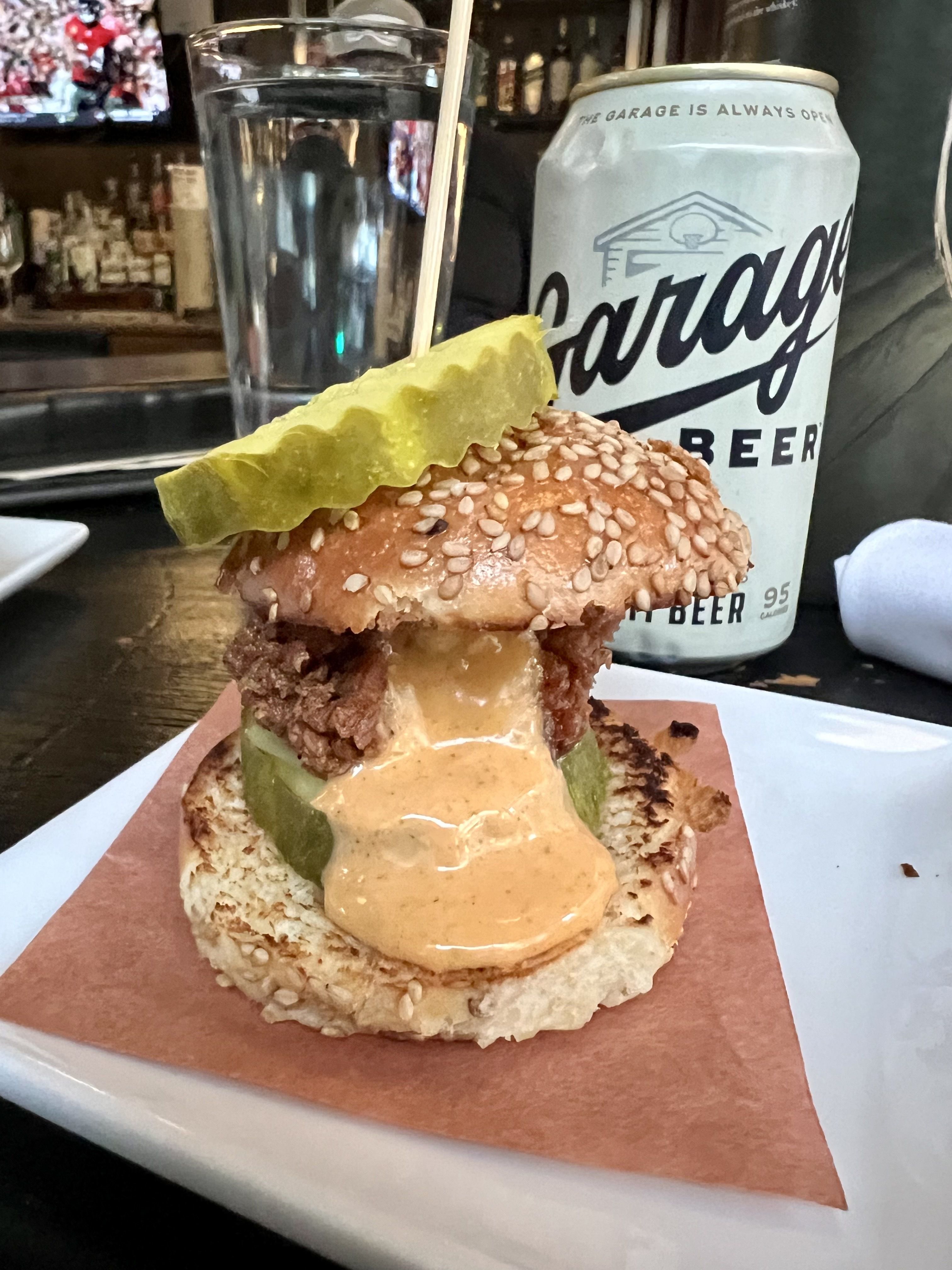
Chicken slider on the happy hour menu at Village Whiskey, 118 S. 20th St.
Hot ’n’ spicy chicken slider at Village Whiskey
Everybody knows you go to Village Whiskey for the burger — if not the regulation Village, then the signature Whiskey King with blue cheese, maple-bourbon glazed onions, applewood bacon, and seared foie gras. But when it’s happy hour and you just need a little somethin’ to balance a shot or a beer, you can’t beat the hot ’n’ spicy chicken slider, still $5. It’s a cute little chunk of brined and fried chicken thigh, atop a thick dill pickle chip, doused in “buffalo aioli,” and sandwiched between a wee toasted sesame bun. A toothpick spears a second pickle chip and holds the sandwich together. Hot ’n’ spicy? Not really, but it hits the spot and is gone in three bites, plus a chomp or two for the second pickle chip. Village Whiskey, 118 S. 20th St., 215-665-1088, villagewhiskey.com. Available only at happy hour, 4 to 6 p.m. daily.
— Michael Klein
Carbon Copy vanilla soft serve swirled with blood orange olive oil and sea salt.
Blood orange olive oil-topped soft serve at Carbon Copy
As much as I miss the sticker-laden grime of Dock Street’s former West Philly location, there’s a lot to love at the taproom that took its place — say, the in-house beer and wine, the fried artichokes with horseradish sour cream dip, Wednesday night quizzo.
On a recent visit, I kept it simple by ordering the always-sublime pepperoni pizza (shoutout to that wood-burning oven) and a dry Cayuga white. The standout, though, was dessert: vanilla soft serve swirled with blood orange-infused olive oil and sea salt. This airy vegan treat cleanses the palate after a heavy meal of bread, cheese, and red sauce. It isn’t too sweet, but the blood orange brings its own juicy flavor kick. Just be prepared for the occasional too-salty spoonful.
Note: If you’re feeling more nostalgic than Italian, consider the adorable baseball hat sundae, topped with whipped cream and sprinkles. Carbon Copy, 701 S. 50th St., carboncopyphilly.com
In his first term, Donald Trump appointed four judges to the Philadelphia-based U.S. Court of Appeals for the Third Circuit — flipping the court’s ideological balance firmly to the right.
The 14-member court, which hears appeals from Pennsylvania, New Jersey, and Delaware, routinely handles disputes of national importance.
President Joe Biden had a chance to tip the balance back.
His nominee, Adeel Mangi, would have become the first Muslim American to serve on any federal appellate court. But facing bad-faith Republican attacks and tepid Democratic support, Mangi’s nomination was left to die on the Senate floor.
That failure, and Trump’s return to power, cleared the way for the rapid installation of two MAGA loyalists, Emil Bove and Jennifer Mascott, cementing an 8-6 conservative majority.
Less than a year into his second term, Trump has finished what he started in his first. His MAGA makeover of the Third Circuit is complete — and the people of Pennsylvania, New Jersey, and Delaware, and perhaps the country as a whole, will be living with its consequences for decades to come.
Emil Bove: The hatchet man
Trump’s first pick for the Third Circuit is also his most dangerous: Emil Bove.
Bove, the president’s former criminal defense attorney, lacks the culture war credentials required of nearly every other Trump judicial nominee. He never sued the Biden administration, or opposed same-sex marriage, or defended a state abortion ban. But he has one quality in spades: loyalty to Donald Trump.
Once installed in the U.S. Department of Justice, Bove wasted little time proving to Trump that he would do whatever it took to advance Trump’s agenda.
Donald Trump, flanked by attorneys Todd Blanche and Emil Bove (right), at his criminal trial in Manhattan in 2024.
He fired the federal prosecutors and FBI agents who pursued cases against the Jan. 6, 2021, insurrectionists. He clumsily sought to dismiss charges against New York City Mayor Eric Adams to coerce him to aid Trump’s immigration crackdown. And, according to multiple credible whistleblower allegations, Bove told other DOJ lawyers that if courts tried to stop the administration’s deportations, they should tell “the courts ‘fuck you.’”
Now that Bove is on the Third Circuit — he was confirmed in July by a razor-thin 50-49 vote — he is moving with similar speed to show Trump he’s still on his side.
This week, in what appears to be Bove’s first vote as a circuit judge, he joined four other Trump appointees dissenting from the full court’s decision to deny the request of various Republican organizations to rehear the case holding Pennsylvania’s date requirement for mail-in ballots unconstitutional.
Of course, there never should have been a vacancy for Bove to fill.
Back in November 2023, President Biden nominated Mangi to the seat Bove now holds. Mangi had all the sterling credentials you’d expect from an appellate court nominee — degrees from Oxford and Harvard Law, and a long career at a white-shoe law firm.
But all Republicans could see was that he was Muslim, and they pulled out every Islamophobic trick in their very big book to disingenuously paint him as some antisemitic radical.
And what’s worse, some Senate Democrats fell for it, sinking Mangi’s nomination and handing this critical vacancy to Trump.
Jennifer Mascott: Am MAGA, will travel
Over the summer, Trump also nominated Catholic University law professor Jennifer Mascott to a second Third Circuit vacancy in Delaware.
Mascott’s résumé is dripping with connections to Trump and the MAGA legal movement. She clerked for then-D.C. Circuit Judge Brett Kavanaugh (one of Trump’s appointees to the Supreme Court) and Justice Clarence Thomas (one of Trump’s favorite justices).
Before joining Catholic Law last year, she taught at George Mason’s Antonin Scalia Law School, one of the most conservative in the country.
In the first Trump administration, she worked in Trump’s Justice Department and helped with Justice Amy Coney Barrett’s last-minute confirmation.
This time, she went to work directly for Trump as senior counselor to the president in the White House Counsel’s Office.
What Mascott lacks, however, is any genuine connection to Delaware.
She lives in Maryland and works in Washington, D.C. She is not admitted to the Delaware Bar, and she has little, if any, experience with Delaware’s sophisticated corporate law regime.
But Mascott admitted in her Senate Judiciary Committee questionnaire that she made clear to Trump that she was willing to take any judgeship in which he “would be interested in having [her] serve,” historical tradition and judicial propriety be damned.
Even the timing of her confirmation reeks of political gamesmanship.
Mascott leapfrogged a half dozen other judicial nominees so she could join the Third Circuit in time to participate, and potentially cast the deciding vote, in a major Second Amendment case about New Jersey’s assault weapons ban.
With Bove and Mascott now seated, the Third Circuit may become the venue of choice for Trump’s allies looking to legitimize his most extreme policies, as right-wing litigants know they’ll find sympathetic ears in Philadelphia.
What was once a court known for its independence and moderation could soon become a proving ground for Trump’s legal movement — a place where loyalty trumps the law.
The only question left is how long it will take before the rest of the country starts feeling the consequences of the Third Circuit’s new MAGA majority.
John P. Collins Jr. is an associate professor at George Washington University Law School, where he researches and writes about federal judicial nominations.
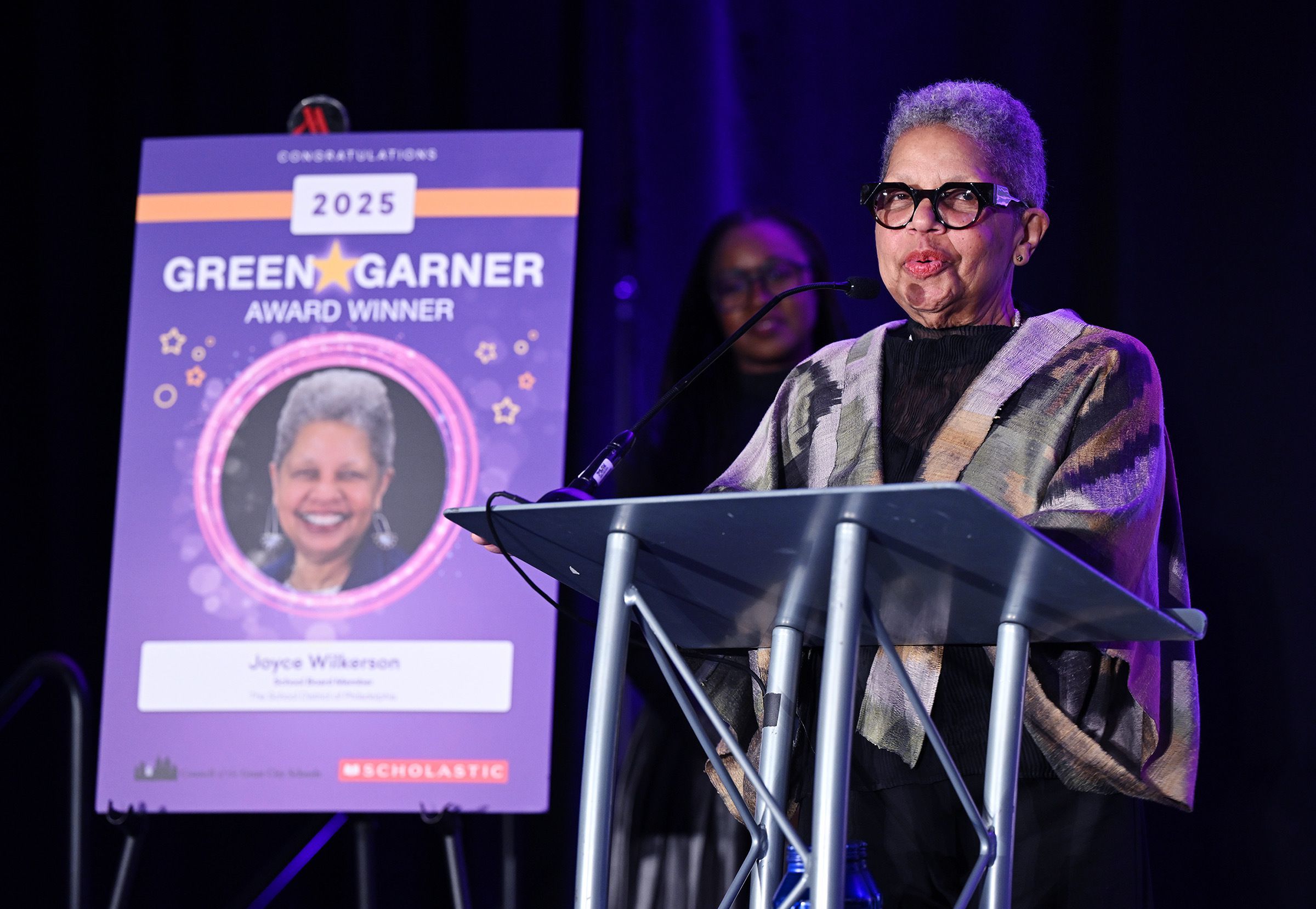
Joyce Wilkerson, Philadelphia’s longest-serving school board member, was named 2025 Urban Educator of the Year on Thursday night.
The Council of Great City Schools — in town for its annual conference — selected Wilkerson for “the nation’s highest honor in urban education leadership.” The award is presented in alternate years to either an outstanding school superintendent or school board member from 81 of the largest urban public-school systems in the country.
The prize comes at a curious time for Wilkerson — when her very membership on the school board has been legally questioned, after a public battle with some members of City Council on her re-appointment by Mayor Cherelle L. Parker to the board.
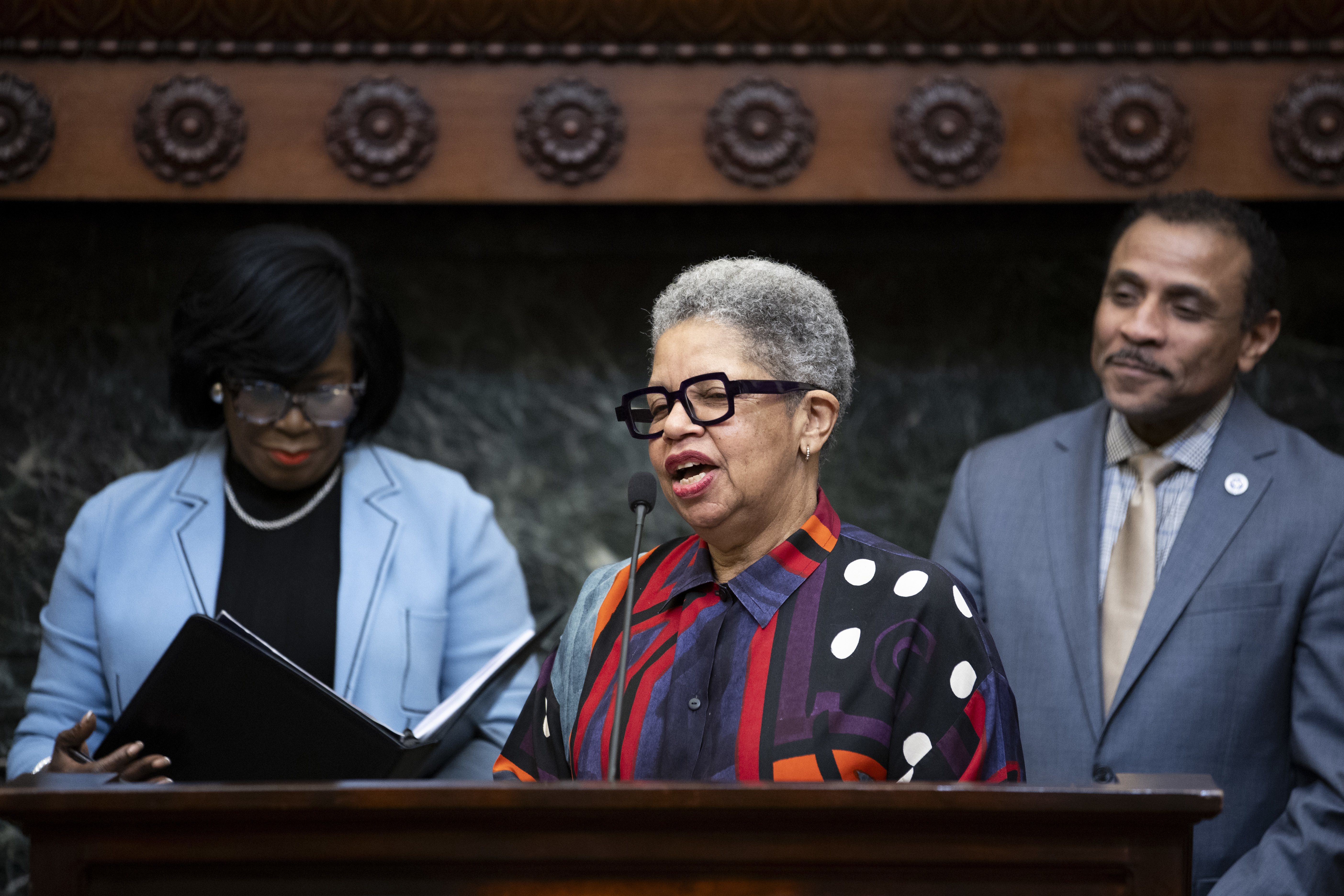
Flanked by Mayor Cherelle L. Parker, left, and Superintendent Tony Watlington, right, Joyce Wilkerson, center, speaks during the announcement of the School District of Philadelphia Board of Education nominees at City Hall last year.
Wilkerson is not an educator by profession — she’s a lawyer who served as former Mayor John Street’s chief of staff. But she was named to the former School Reform Commission in 2016 andbecame the inaugural school board president in 2018, when the district returned to local control after nearly two decades of state oversight.
Wilkerson, who also serves as a Council for Great City Schools board member, was hailed by the organization for steady leadership that helped end the Philadelphia School District’s state takeover, and for work that led the board to refocus its efforts on student outcomes. Ray Hart, who leads the Council, called those efforts “a national model.”
Wilkerson, Hart said in a statement, “has reshaped the educational landscape in Philadelphia through her unwavering advocacy for students, along with her commitment to equity and excellence. Wilkerson’s dedication to strengthening public education has made her one of the most effective school board members in the nation.”
As part of the prize, Wilkerson receives a $10,000 college scholarship to award to a district student.
Joyce Wilkerson, Philadelphia’s longest-serving school board member, received the 2025 Urban Educator of the Year award from the Council of Great City Schools, a national organization whose annual conference is being held in Philadelphia this year.
The People for People case — which came after the board voted to nonrenew the school’s charter over academic concerns — is still pending.
It stems from a 2024 public fight over Wilkerson’s reappointment to the board. Several key Council members, including Council President Kenyatta Johnson and education committee chair Isaiah Thomas, took issue with Wilkerson.
Her stance on charters in particular — no new charters were approved during Wilkerson’s school board presidency — rankled some on City Council.
Council ultimately approved eight of Parker’s nine nominees, but did not act on Wilkerson’s candidacy. The mayor, though, did an end run, asking Wilkerson to serve on the board — essentially filling the seat Council denied her — until she named a successor.
Parker ‘s administration argues the city charter allows Wilkerson to fully serve as a board member until her replacement is named, and it’s clear that the mayor is in no hurry to pick someone to replace her.
The Parker administration, when the People for People suit was filed, said Wilkerson remains a full school board member, and said she still has the mayor’s support.
Bob Yantorno, a Republican candidate for a seat on the Upper Darby Township Council, is facing scrutiny over material he posted three years ago that Democrats have decried as racist.
Yantorno, 65, is a former commanding officer of the Narberth Police Department,a former paramedic, and a veteran of other law enforcement agencies. He’s running in the township’s 3rd District.
Yantorno denies that anything he has ever posted was motivated by racism andsaid his social media comments reflected his outrage over incidents of violence.
The controversy stems from posts Yantorno made in 2022 on Twitter, now known as X, in response to crime news stories from Fox 29 that involved Black suspects.
“Take him out back n bullet in occipital section,” Yantorno wrote about a suspect from Drexel Hill charged with two homicides.
“Arrest convict bury,” Yantorno wrote in response to a booking photo of a Camden man accused of rape.
In a 2022 reply to an Upper Darby Police Department statement about a rash of thefts from automobiles, Yantorno wrote under four photos of young men in hoodies walking near cars but not stealing anything, “Common denominator?”
The race of the men was not obvious from the photos posted by the department.
Democrat Noah Fields, 25, who is running for one of two at-large council seats, neither of which Yantorno is seeking, condemned Yantorno in an interview for what he said was “shocking” and “hateful” speech, as well as “violent rhetoric.”
Fields said that “racism has no place in Upper Darby.” He added that “this guy is calling for the execution of people without due process. The violent rhetoric we’re hearing on the national level is trickling down to local politics.”
State Rep. Heather Boyd (D., Delaware), who represents Upper Darby, said the posts were “really upsetting, offensive, and disappointing.”
She added, “We don’t want anyone in a position of influence to not consider people’s right to due process and the rule of law.”
Asked about the posts in an interview Wednesday, Yantorno initiallysaid he was unaware of their existence.
“I have no idea what you’re talking about. What Democrats are saying is slanderous. People put stuff out there about me that’s not true,” Yantorno said. “All I can tell you that in the Narberth Police Department, my reputation was stellar.”
Yantorno said he didn’t know how posts with his name, photo, and personal details got onto X.His page says he joined the platform in 2022 and features a profile photo of him in police uniform.
He bristled at being called racist. He added, “I would never put a picture of somebody of any color and disparage them because of their race.”
Yantorno said that personal experience has made him sensitive to race bias. He said that when he and his first wife, whom he identified as a woman of color, moved into a house in Stonehurst, an Upper Darby neighborhood, someone stuck a cross in their lawn.
It was, Yantorno said, a symbol of hatred aimed at his then-wife.
Similarly, he said, when he was a police officer in Yeadon, he and hisformer wife “fell in love” with a house they wanted to buy, but had to back out of the deal because their real estate agent said if they moved in, “someone would burn down the house and the real estate office.”
Yantorno added without being asked: “You will never see anything from me online using the N-word. That’s not how I roll, brother.”
A statement emailed Thursday by the Upper Darby Republican Campaign Committee included remarks attributed to Yantorno that differed from his original explanation.
In the new statement, Yantorno no longer said he was unaware of the posts. Instead, he said, “those comments reflected my frustration and anger over the senseless violence in our community and had nothing to do with race.” He added that “claims of racism are offensive and absurd.”
A GOP committee statement, which was not attributed to a specific person, emphasized Yantorno’s commitment to public service and said that he does not deserve a “fabricated inference that has no basis in reality.”
Jeff Jones, an Upper Darby real estate developer who has been a Republican candidate for the council in the past, defended Yantorno.
“I read the tweets. They were comments made by a gentleman 35 years in law environment who’s seen criminals and victims at their worst, and the frustration came through in those tweets,” said Jones, who is Black.
Melissa DiNofia-Bozzone, Yantorno’s Democratic opponent for the 3rd District seat, declined to comment on the posts, saying, “I’m focused on running a positive campaign.”
Friends describe Yantorno, a veteran, as a gregarious person with a desire to help his community.
In 2020, he biked across the United States to raise money for families of slain police officers. He also did the ride, he said, for the family of Daniel Faulkner, the Philadelphia police officer who was killed in 1981. Mumia Abu-Jamal received the death penalty for the shooting, which was later reduced to a life sentence without parole.
Yantorno is also the author of a 1995 crime novel set in Philadelphia called Brutal Mercies. According to the publishing company, Trafford, the story opens with “a horrific act of mutilation” in Overbrook that “leaves the police asking, ‘Why?’”
Staff writers Katie Bernard and Ryan W. Briggs contributed to this article.
A police sergeant in New Jersey has been accused of failing to properly respond to a reported shooting that led to the deaths of a veterinarian and her volunteer firefighter boyfriend, both allegedly killed by a New Jersey State Police trooper, prosecutors announced Thursday.
Lauren Semanchik, 33, of Pittstown, and Tyler Webb, 29, of Forked River, were found dead the afternoon of Aug. 2 at her home on Upper Kingtown Road in Franklin Township, the Hunterdon County Prosecutor’s Office said.
The night before, a dispatcher notified Franklin Township Police Sgt. Kevin Bollaro about a report of gunshots and screaming on Upper Kingtown Road.
Instead of responding directly to the scene, Bollaro went first to an ATM to conduct a transaction, the prosecutor’s office alleged.
While at the ATM, Bollaro was told by a dispatcher about a second report of gunshots and screaming, the prosecutor’s office alleged. Bollaro then proceeded to the location of the first call, allegedly without activating his lights and siren.
Around five minutes after the second call, a third call reporting gunshots and screaming was made to police and relayed to Bollaro, who ultimately met with the first caller but not the second and third callers, the prosecutor’s office said.
Approximately 17 minutes passed from the time of the first dispatch to Bollaro to when he arrived to meet with the first caller, the prosecutor’s office said. Bollaro also allegedly failed to turn on his bodycam while he met that caller.
After leaving the area, Bollaro immediately drove to Duke’s Pizzeria & Restaurant in Pittstown, where he remained for around 50 minutes, the prosecutor’s office said.
Bollaro later went to Pittstown Inn, a restaurant, and remained there for nearly an hour engaging socially with patrons, the prosecutor’s office alleged.
Bollaro then spent five hours — from around 11:27 p.m. until 4:33 a.m. — at a local cemetery, during which no law enforcement activity was recorded by him, the prosecutor’s office alleged.
Bollaro then allegedly submitted a false report about what he did that night.
The next day, as detectives were investigating the deaths of Semanchik and Webb, authorities learned that Ricardo Jorge Santos, a lieutenant with the New Jersey State Police and Semanchik’s ex-boyfriend, was found dead inside a white 2008 Mercedes SUV in Johnson Park in Piscataway, Middlesex County, the prosecutor’s office said.
Santos sustained a self-inflicted gunshot wound, which the Middlesex County Medical Examiner’s Office preliminarily determined to be a suicide, the prosecutor’s office said. A semiautomatic handgun was found inside the Mercedes.
The New York Times and other news outlets reported that Santos had previously served as a supervisor on the New Jersey governor’s protection detail.
Charles J. Sciarra, an attorney representing the Franklin Township police sergeant, said in a statement Friday morning that “nothing Kevin Bollaro did or did not do that day impacted or could have stopped that tragedy in any way.”
Sciarra said that “the evidence will show that there were delays in these 911 calls being made and dispatched,” and that “he canvassed the area thoroughly. Sgt. Kevin Bollaro has faithfully served that community for nearly 25 years [and] is not guilty of anything related to this horrendous killing. This prosecution is unfortunate.”
David Mazie, an attorney representing the families of Semanchik and Webb, said in an emailed statement Thursday evening that the families “are shocked at Sgt. Bollaro’s egregious conduct as charged by the Hunterdon County Prosecutor. We believe this to be the tip of the iceberg of the many failures by the local and state police which will be uncovered and which led to the murders of Lauren and Tyler.”
Bollaro was charged with second-degree official misconduct “for knowingly refraining from performing his police duties with purpose to obtain a personal benefit,” and disorderly persons tampering with public records or information for knowingly making false entries in his police report, the prosecutor’s office said.
Bollaro was charged on a complaint-summons and is scheduled to make his first court appearance on Nov. 5.
The prosecutor’s office previously said that Semanchik had been in a relationship with Santos that ended around September 2024, but “Semanchik alleged that Santos engaged in continued harassing and controlling behavior.”
At some point, Semanchik installed a video surveillance recording system in her vehicle, which detectives accessed and reviewed.
Video evidence showed Semanchik’s vehicle leaving the Long Valley Animal Hospital, where she worked, around 5:25 p.m. on Aug. 1 and a white 2008 Mercedes SUV was seen leaving a parking space and closely following Semanchik to her home on Upper Kingtown Road until she turned into her driveway shortly before 6 p.m., the prosecutor’s office said.
“At approximately 6:11 p.m., while Semanchik’s vehicle is parked, an individual is seen surreptitiously walking through the wooded area along the driveway leading up to the residence. And at approximately 6:45 p.m., Webb’s vehicle arrives at the residence and parks next to Semanchik’s vehicle,” the prosecutor’s office said.
Detectives said the white 2008 Mercedes SUV that followed Semanchik was the same vehicle in which Santos was found dead in Piscataway.
At a news conference in August, Mazie said Semanchik went to the Franklin Township Police Department to report her ex-boyfriend’s behavior but was told no one was available to talk to her. She was given a phone number to call, which she did, Mazie said. No one called back.
Mazie said that Semanchik’s vehicle was damaged, apparently with a key, while she was at work in May 2025. Semanchik reported the incident to the Washington Township Police Department in Morris County and to a female trooper who worked with Santos, Mazie said.
Mazie said a report from the Washington Township police indicated that Santos was contacted and denied damaging her vehicle. He was advised to avoid contact with Semanchik, Mazie said.
Mazie said he plans to sue both the New Jersey State Police and the Franklin Township Police Department for failing to act against Santos.
Alec Bohm returned from the injured list last month and got eight hits in three games, giving rise to a theory: If Bohm stayed hot, maybe the star hitter who precedes him in the Phillies’ batting order would see more strikes.
Harper knew how that sounded, so he made clear that he meant no disrespect to Bohm. But his point remained. Harper faced a lower rate of pitches in the zone (43%) than any hitter in baseball this season (minimum 150 pitches), so the notion that any Phillies lineup protection short of peak Mike Schmidt would affect how he was pitched ranked somewhere between wishful thinking and delusion.
It has been this way for most of Harper’s life. He recalls being 11 years old and competing in travel tournaments in which the opposing coach would point to him and direct pitchers not to give him anything to hit. In 2016, the Cubs walked him 13 times, four intentionally, in 19 plate appearances over four games at Wrigley Field.
Quite simply, teams game-plan against Harper specifically.
“When we go into a series, we circle guys’ names, too,” Harper said earlier in the season. “It happens that way.”
Even so, there was something different about this season. When Harper did get pitches in the zone, he didn’t do as much damage. As such, he didn’t produce his typical numbers.
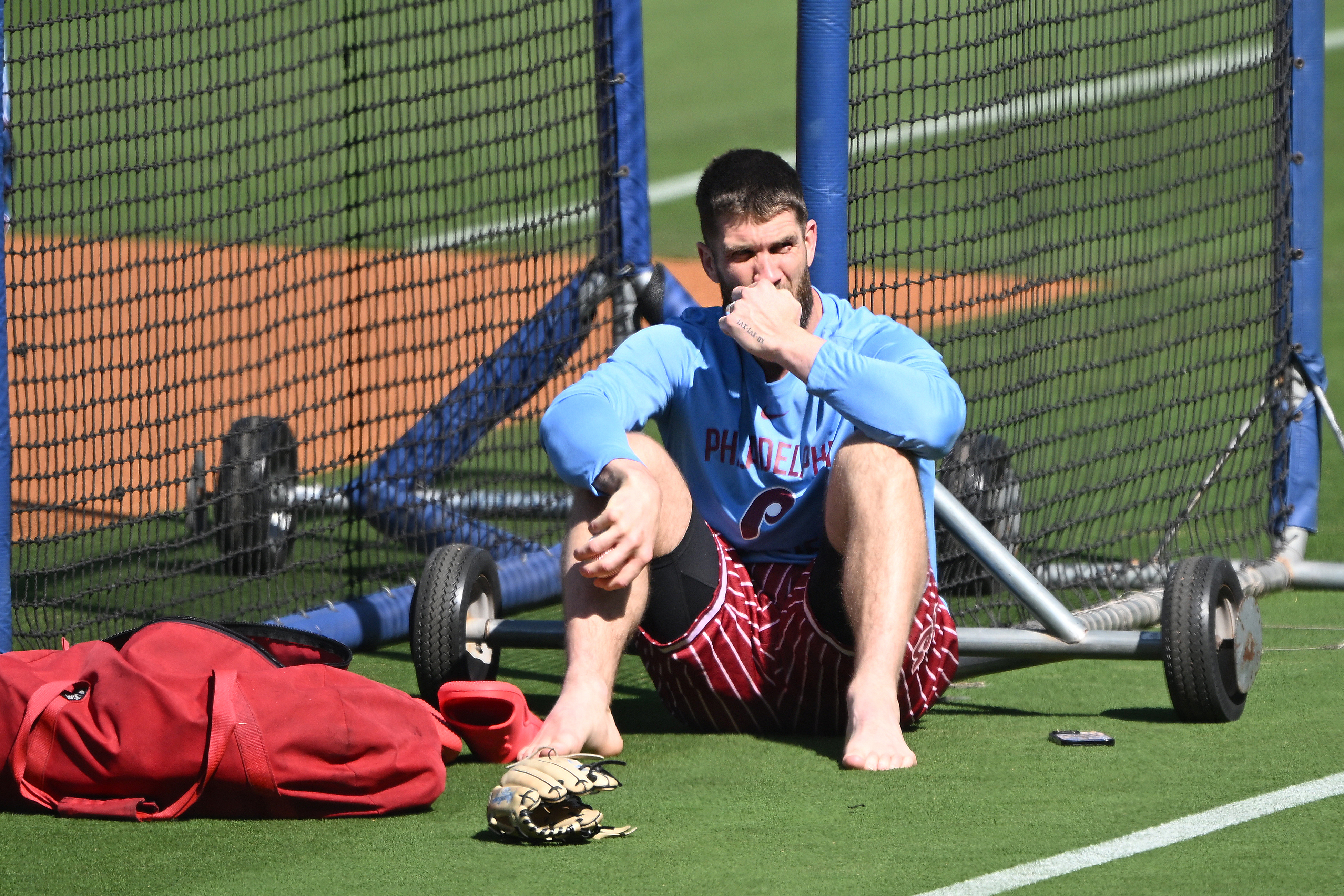
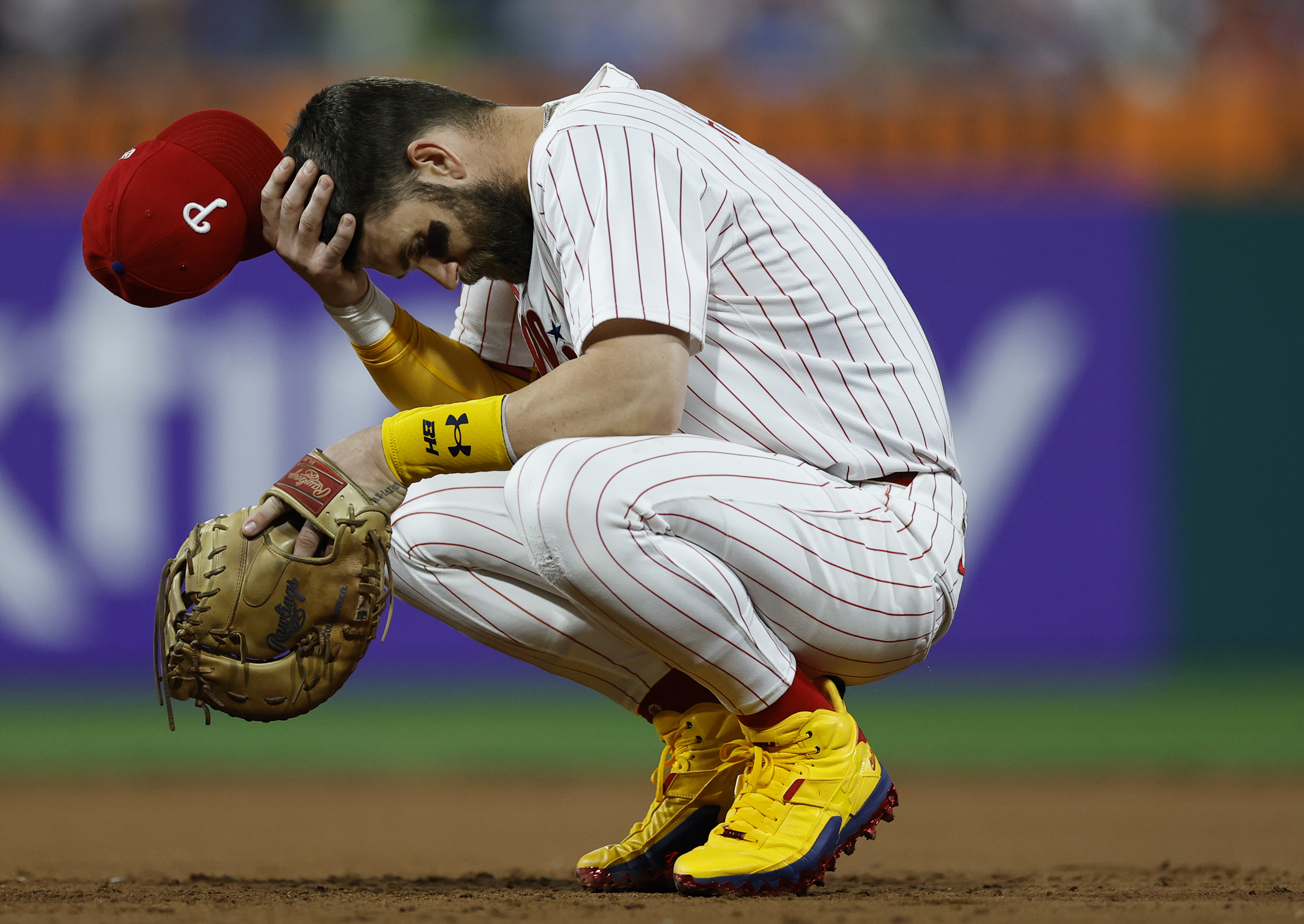
Phillies first baseman Bryce Harper saw a lower rate of pitches in the strike zone (43%) than any hitter in baseball this season.
Harper reached base at a .357 clip, his lowest mark since 2014. He slugged .487 with an .844 OPS, his worst totals since 2016. He mashed 27 home runs, despite missing a month with an inflamed right wrist. Although he outproduced the league average by 29%, based on OPS+, he has been 42% better than average over his career.
So, upon being asked at his end-of-the-season news conference on Oct. 16 — coincidentally, Harper’s 33rd birthday — if the Phillies believe this was a down year and not the start of a downturn for the face of the franchise, president of baseball operations Dave Dombrowski offered an eyebrow-raising answer.
“He’s still an All-Star-caliber player,” he said. “He didn’t have an elite season like he has had in the past. And I guess we only find out if he becomes elite [again] or he continues to be good. If you look around the league, Freddie Freeman, he’s a really good player, right? Is he elite like he was before? Probably not to the same extent. Freddie is a tremendous player, and that, to me, is Bryce.
“Can he rise to the next level again? I don’t really know that answer. He’s the one that will dictate that more than anything else.
“I don’t think he’s content with the year that he had. And, again, it wasn’t a bad year. But when you think of Bryce Harper, you think of elite, right? You think of one of the top-10 players in baseball, and I don’t think [this season] fit into that category. But again, a very good player. I’ve seen guys at his age — again, he’s not old — that level off. Or I’ve seen guys rise again.”
Maybe we just aren’t accustomed to that level of candor from a high-ranking executive, especially at a news conference. Or maybe Dombrowski calculated that challenging a future Hall of Famer to be better would have the effect of poking a grizzly.
Regardless, it sparked conversation — even idle speculation about Harper’s future with six years and $153.25 million left on his contract and no-trade rights based on more than 10 years of major-league service, more than five with the Phillies.
“I’ve been reading that, ‘Oh, the Phillies may trade Bryce Harper.’ That couldn’t be further from the truth,” Dombrowski said the other day on Foul Territory TV. “We love him, think he’s a great player. He’s a very important part of our team.
“When I think of Bryce Harper, it’s a compliment. Because the reality is, there are eight to 10 players in the game of baseball every year when they’re not, let’s say, in the MVP consideration for whatever reason — sometimes it can be an injury factor; sometimes they just have a bad year — it’s not an elite year for them.
“I’ve seen him have better years. I look for him to have better years.”
Especially if the Phillies give him more help.
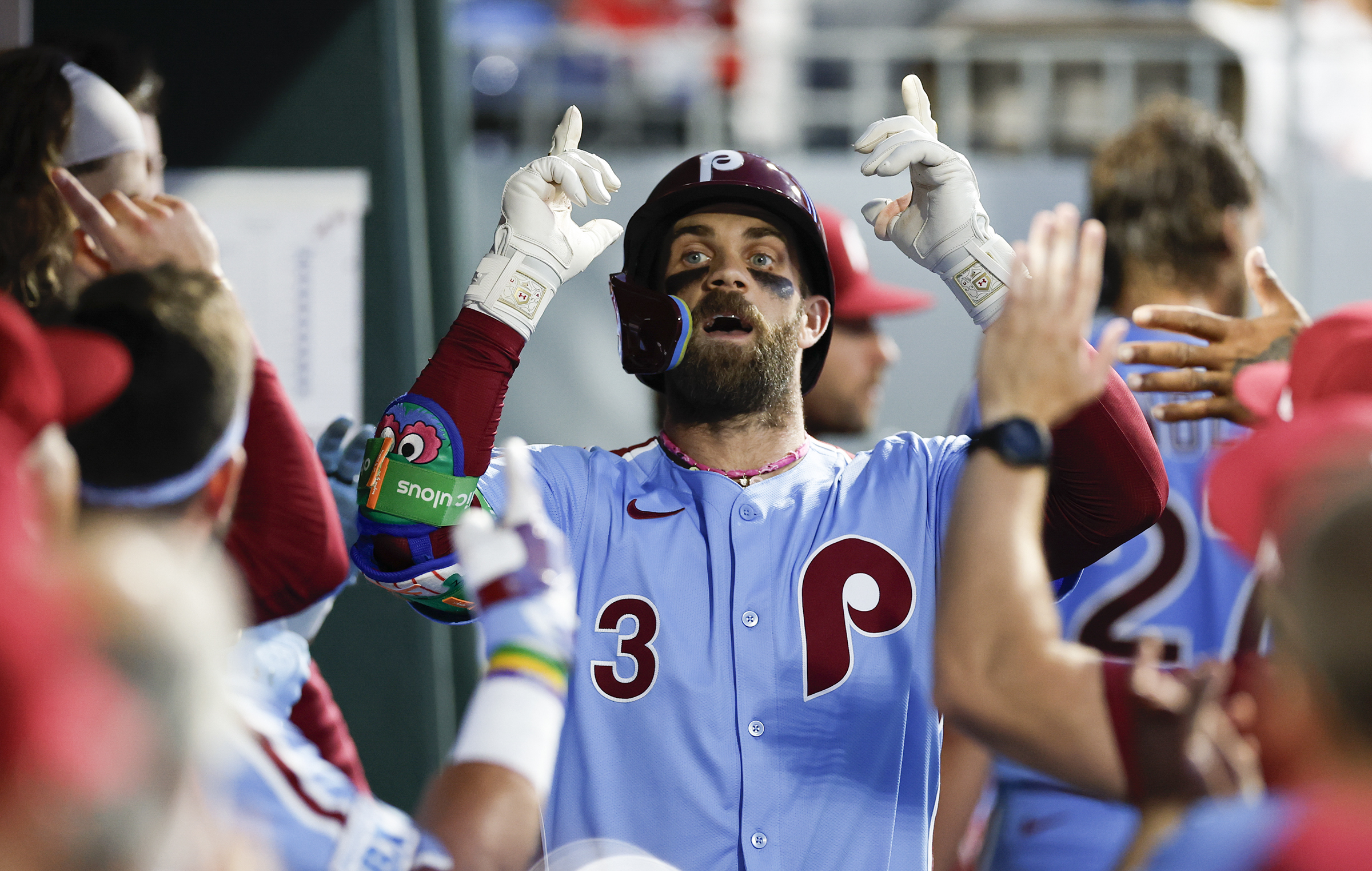
Bryce Harper hit 27 homers this season, despite missing one month with an inflamed right wrist.
Missing the mistakes
Let there be no doubt about Harper’s state of mind in the aftermath of the Phillies’ second consecutive divisional-round knockout.
“I want [a championship] more than probably a lot of people,” he said. “I want to hold that trophy. On a personal level, I’m going to work my butt off this offseason again and get ready for next year and hopefully take another swing at it and see what we can do.”
But who will follow Harper in the batting order?
It was a topic of conversation early this season. Harper got walked intentionally twice with runners in scoring position on April 11 in Atlanta, prompting Rob Thomson to tweak the lineup the next day. Rather than keeping a struggling Bohm — or fellow right-handed hitters J.T. Realmuto or Nick Castellanos — behind Harper, the manager moved Kyle Schwarber into that spot.
“Just trying to protect Harper the best we can,” Thomson said.
Schwarber should have represented Secret Service-level lineup protection. He batted behind Harper for 42 consecutive games and hit 12 homers in that span.
And yet Harper didn’t see many more pitches in the zone.
“It’s actually gotten worse, which is crazy,” Harper told The Inquirer in May during a series in Cleveland. “Just got to try to hone in as much as possible and hit the mistakes. That’s one thing where [Barry] Bonds was so good at. You get the mistakes and let the other ones go.”
Usually, it’s a trademark of Harper’s, too.
Through six seasons with the Phillies (2019 to 2024), he saw only 42.6% of pitches in the zone, tied for second-lowest rate among 293 players who faced at least 500 pitches, according to Statcast. But he punished those strikes, slugging .680, fifth-best behind Aaron Judge (.763), Shohei Ohtani (.710), Yordan Alvarez (.695), and Mike Trout (.695).
Kyle Schwarber (right) batted behind Bryce Harper early in the season before the Phillies got away from that alignment.
This year, with opponents still coming after him in the zone only 43% of the time, Harper’s slugging percentage on those pitches fell to .591. His weighted on-base average slipped, too, from .424 to .378.
Reasons for the drop-off weren’t clear. Harper’s average bat speed wasn’t diminished (74.2 mph vs. 74.0 mph in 2024). His average exit velocity (91.3 mph) and hard-hit rate (47.5%) were consistent with the last two seasons (91.5 mph, 47.5%).
There was a notable difference in how teams attacked Harper. He faced fewer fastballs (46.7%) and more breaking pitches — curveballs and sliders (41.3%) — than ever before. By comparison, the breakdown last season was 52.9% fastballs and 32.3% breaking stuff.
Why the change?
“Because I’m not hitting them,” Harper said. “Like, don’t try to fix what’s not broken, right?”
Indeed, Harper slugged .438 against curveballs and sliders, down from .458 in 2024, .466 in 2023, and .495 in 2022.
At least Harper didn’t overreact by swinging at many more pitches out of the zone. His chase rate ticked up to 35.6%, according to Statcast, but wasn’t far off his 33.4% mark from each of the previous two seasons. He walked in 12.1% of his plate appearances, nearly identical to his 12% mark from 2024.
But as the Phillies seek explanations for Harper’s subpar season, they can start by tracing why he didn’t crush as many pitches — of any variety — in the zone as usual.
Bryce Harper is a two-time Gold Glove finalist at first base. The Phillies haven’t discussed moving him back to the outfield.
Better protection
Maybe it would’ve helped if Thomson stuck with Schwarber behind Harper.
Instead, Schwarber moved into the No. 2 hole while Harper was sidelined in June and stayed there en route to joining Ryan Howard in the pantheon of Phillies’ 50-homer hitters. Once Harper came back, he most often was followed in the order by Realmuto (41 games), Bohm (18), and Castellanos (13).
Harper was the Phillies’ primary No. 3 hitter (117 games); Phillies cleanup hitters combined to rank 20th in slugging (.408) and OPS (.720).
Scott Boras, Harper’s agent, didn’t respond to messages in recent days. But he told MLB.com that the best way for the Phillies to restore Harper’s elite performance is to “give Bryce Harper more pitches to hit.”
Translation: Upgrade the lineup protection.
Maybe it’s as simple as re-signing Schwarber and sticking him in the cleanup spot. Maybe the Phillies can add even more slug by putting the $24.5 million that will come off the books with the departures of Max Kepler, Jordan Romano, and David Robertson into an offer for, say, Alex Bregman, then swapping Bohm for Angels outfielder Taylor Ward.
But unless 2006 Ryan Howard comes out of retirement, history suggests that Harper will continue to see fewer pitches in the zone than almost any hitter in baseball.
He needs to get back to crushing them.
“I think he’s highly motivated to have the best season of his career next year,” Thomson said. “He hasn’t told me this, but that type of person — and I’ve seen it before — they’ve had bad years, they’ll go like gangbusters during the offseason to get better because they want to get back to where they normally are at. I think that’s just Harp’s mindset. I think that’s what he’s going to do.”