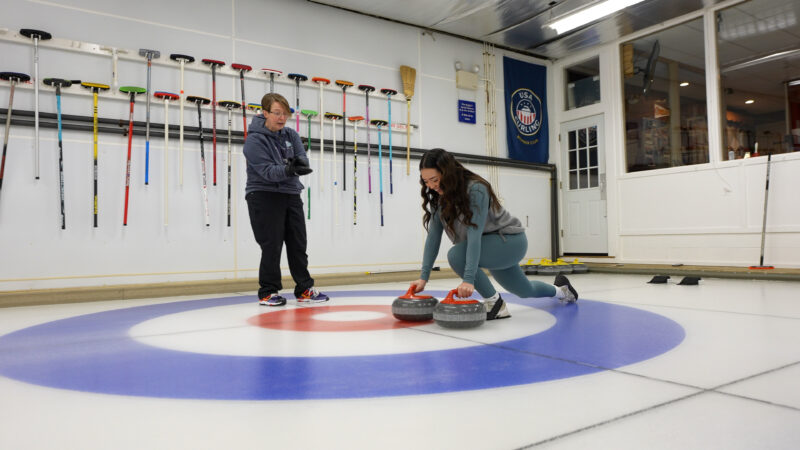
When your social media algorithm starts feeding you videos of Snoop Dogg, and Jason and Kylie Kelce learning how to curl, it must be time for the Winter Olympics.
Curling, which officially became an Olympic sport in 1998, has already kicked off with mixed doubles, in which Team USA claimed a silver medal, its first ever medal in the event.
Men’s curling started on Wednesday and women’s curling on Thursday — featuring a local athlete: Marple Newtown High School graduate Taylor Anderson-Heide.
Ahead of the Milan Olympic Games, similar to the Kelces and Snoop Dogg, I had the opportunity to get some hands-on training. Here’s a look about the training that goes into the sport, my own experience on the ice, and some local places to play.
Do you really train for curling?
Curling can look effortless on television, but looks can be deceiving.
Daniel Laufer, 19, a freshman at Thomas Jefferson University from Richboro, Bucks County, who has been curling for 12 years, had the opportunity to compete on this year’s Olympics ice at the Cortina Olympic Stadium in Italy during last year’s World Junior Curling Championships as a member of Team USA.
“That was a really great experience,” Laufer said. “[The ice] was really good. Obviously, not as good as it is for the Olympics. They were still figuring out the facilities and figuring out the rocks. We had a really good experience with that venue.”
This year, Laufer again will be competing in the World Junior Curling Championships, just outside Copenhagen, Denmark, from Feb. 24 through March 3. Ahead of the event, he’s been training, working on his strength and cardio.
“I usually try to lift four to five times a week and do a significant amount of cardio,” Laufer said. “When I was training specifically for Worlds last season, I had like three months where I was practicing five days a week. Practices are like two hours long. I probably throw 50 to 60 rocks every practice.
“That’s what a higher level training regiment looks like. But, it looks different for everybody.”
How hard is curling?
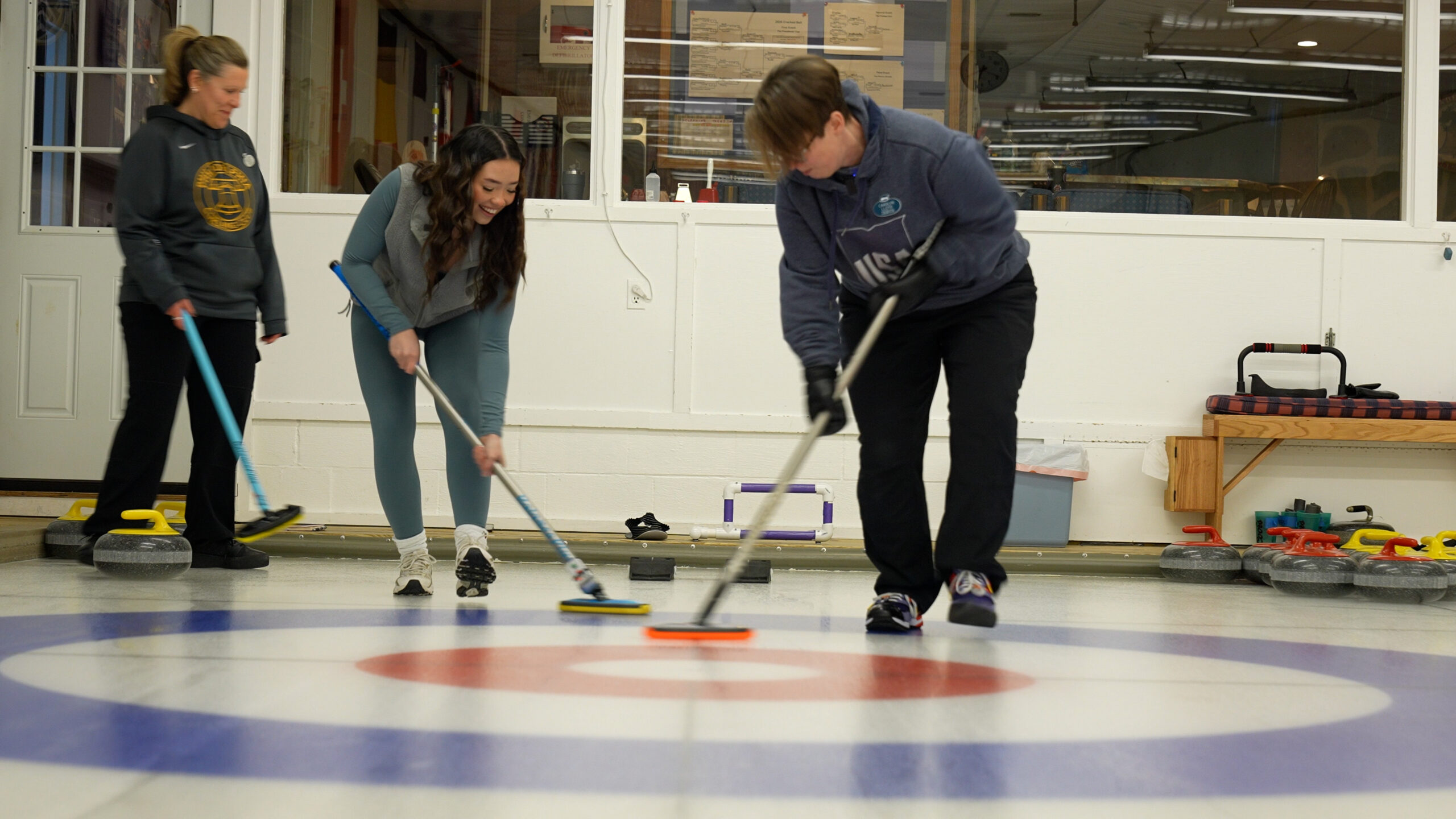
Not everyone trains like Laufer, especially amateurs. So how difficult is curling for the average person? I recently had the opportunity to get a hands-on experience at the Philadelphia Curling Club in Paoli with Carolyn Lloyd, a member for 20 years.
“I love exposing people to something that’s so special,” said Lloyd, who lives in Collegeville. “People don’t realize just how special it is. It’s different from a lot of sports, certainly in its culture. This sport captures my whole heart.”
Before this I had never stepped foot on ice — other than the sheet that covered my driveway for two recent weeks. So, I knew this was going to be a bit of a challenge, but Lloyd was more than up to the task of teaching me.
When it came to delivering the stone, I watched a number of YouTube videos ahead of time. So, of course, I felt like a pro walking in — I didn’t even need special shoes, just some attachments. But once I actually stepped onto the ice, with a gripper covering one shoe and a slider covering the other, I felt like a baby deer trying to walk for the first time.
Walking on the ice was hard enough. Now, imagine having to get into a squat position and push off the hack — a rubber block embedded into the ice — with one leg and balance on the other while holding a deep lunge and bracing your core.
Then you have to aim, release, and spin a 42-pound granite stone. Easy? Trust me, it’s not like they make it look on TV.
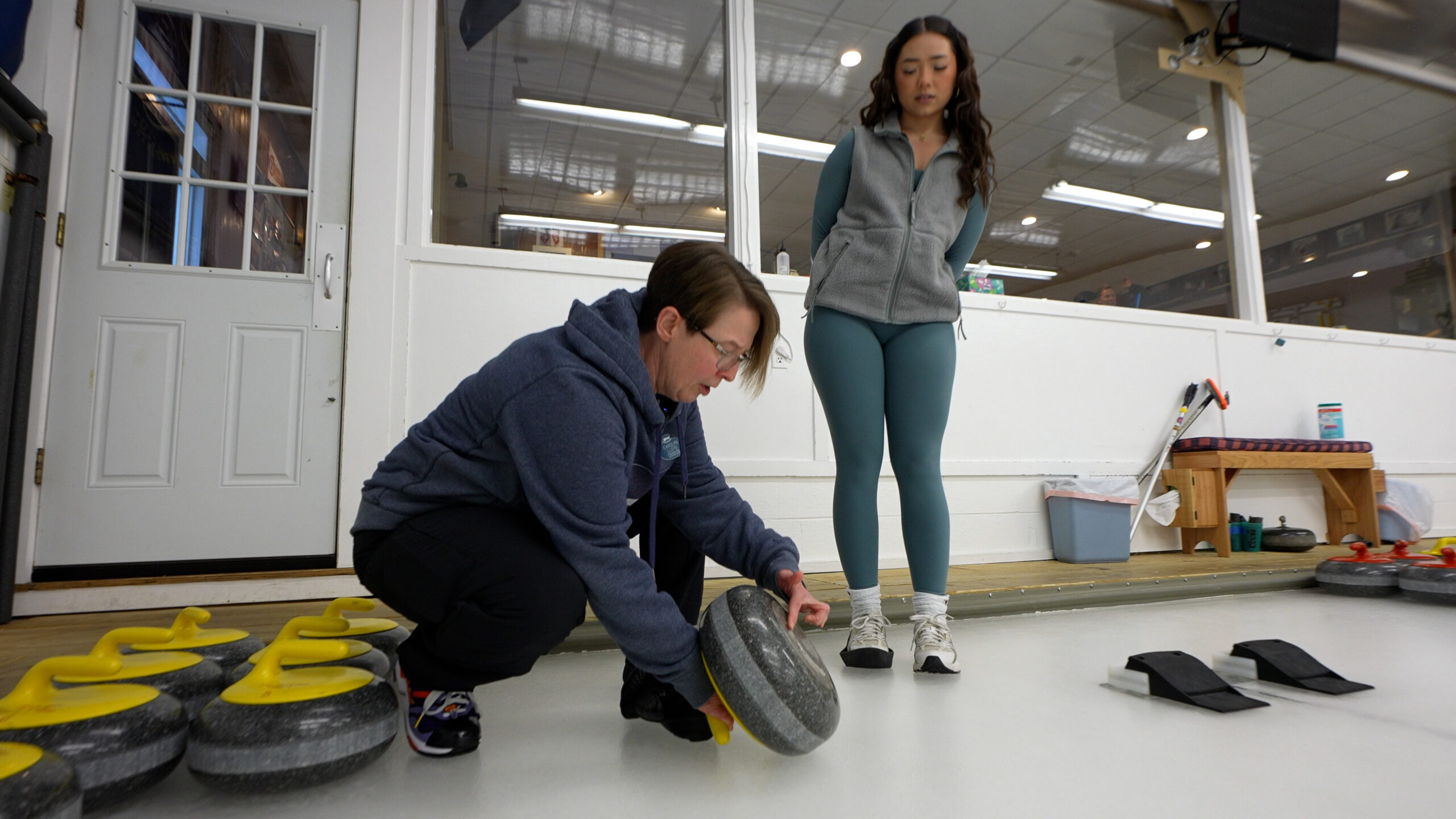
It took me a few tries before I was even mentally prepared to push off with enough strength to move myself a few feet. But, once you get over the fear of falling onto the ice, you start to actually enjoy yourself and can focus on the next step — getting the stone to the house — which I did, eventually.
And all of this was only learning how to deliver the stone. Sweeping was a whole other issue. By the time I was ready to try sweeping, I had much more confidence walking on the ice, so that’s a plus. But now I had to run on it.
Afterward, I felt like I had done a full body workout. The amount of core, lower-body, and arm strength needed for curling is substantial and was certainly a surprise.
The one part of the sport I didn’t get a chance to take part in was the social aspect. It’s a game that’s big on camaraderie, including the post-round tradition of “broomstacking,” when the winning team buys the losing team a drink. But, hey, I was on the clock.
Where can I try curling in the Philly area?
If you want to give curling — and its rules and traditions — a try, there are a couple of local clubs where you can learn.
The Philadelphia Curling Club was started in 1957 but didn’t move to its current location until 1965. Since then they have grown, gaining over 200 members.
“This building was built for curling,” Lloyd said. “We bought the land. We built the club. And to this day, what you see here is a lot of the club members’ efforts. Most of the work that we do is not things that other people come in and do for us.”
The club offers a junior program on the weekends where kids can start as early as 5 years old.
“It’s something that anyone can pick up,” Lloyd said. “The game has adaptations for people who have different types of ability needs. You can learn very quickly, and then you can refine that skill for the rest of your life.”
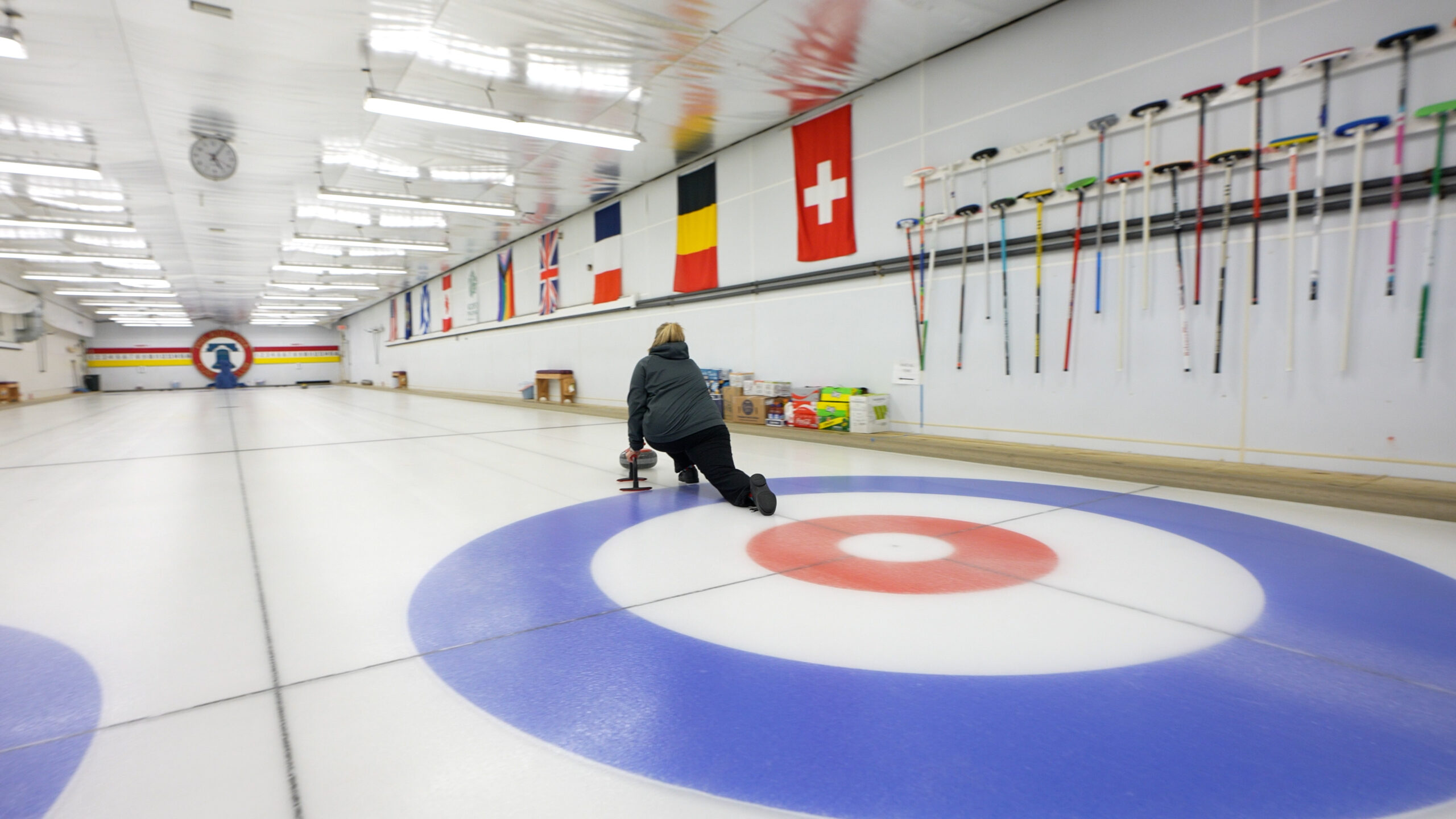
There’s also the Bucks County Curling Club, located on York Road in Warminster, that was formed in 2010. The four-sheet club also has over 200 members and plays year-round.
Although it’s usually once every four years when the world tunes in to watch curling on TV, there is plenty of curling content that Laufer wants fans to know about.
“We have a ton of events,” he said. “There’s the Grand Slam of Curling events, which are our biggest tour events. There’s the World Championships, the European Championships. There’s a lot of events to watch, a lot of events that U.S. teams play in.”
But first, the Olympics.
Leave a Reply