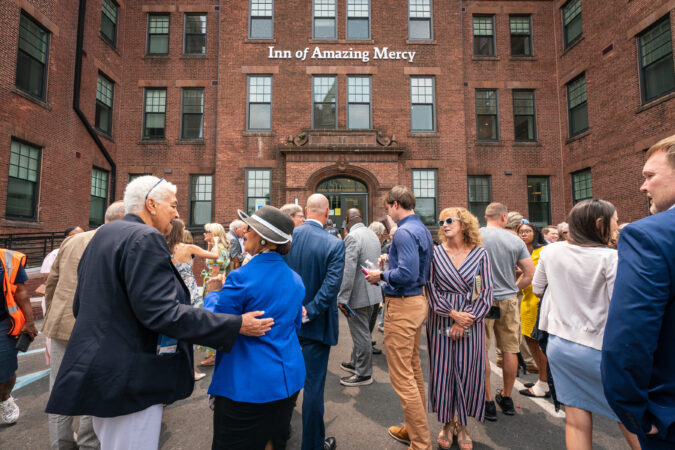
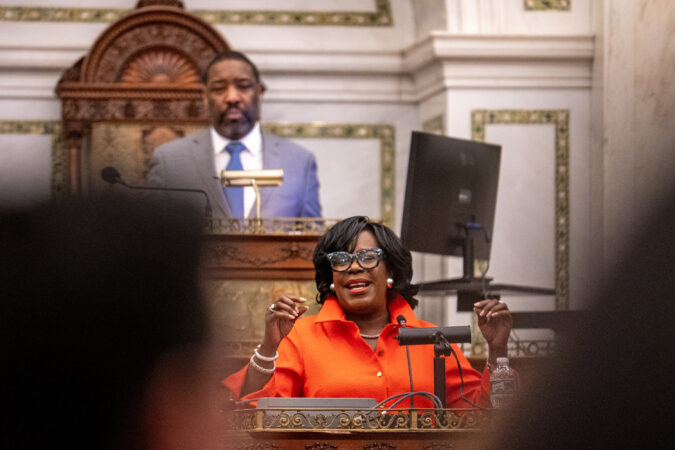
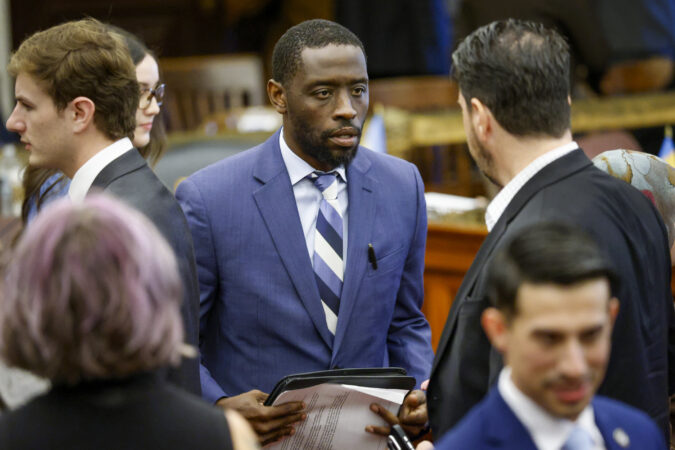
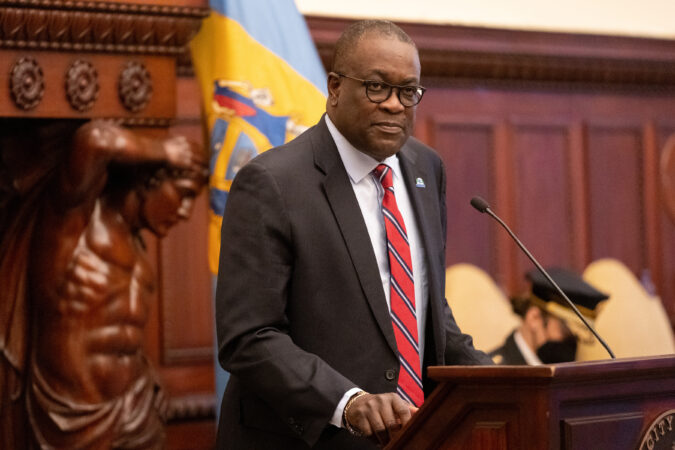
Mayor Cherelle L. Parker has appointed nonprofit founder and Democratic ward leader Anton K. Moore as the city’s director of public engagement and neighborhood affairs.
Moore, who founded the South Philadelphia-based group Unity in the Community, effectively replaces Hassan Freeman, who was fired from the Parker administration about two months ago following a verbal altercation outside City Hall with City Councilmember Isaiah Thomas that the lawmaker described as “negative and disturbing.”
Freeman, who worked under Chief Deputy Mayor Sinceré Harris, was director of neighborhood and community engagement. Parker said she renamed the role to reflect added responsibilities while appointing Moore, whose work will now fall under Chief of Staff Tiffany W. Thurman’s portfolio.
The Office of Public Engagement and Neighborhood Affairs will manage the city’s 10 Neighborhood Community Action Centers, which are meant to be “neighborhood City Halls” where residents can access services closer to home. The centers are a major part of Parker’s efforts to follow through on her campaign promise to create a city government “residents can see, touch, and feel,” and there is one in each Council district.
Moore, the Democratic leader of the 48th Ward in South Philadelphia, has strong political connections, and his nonprofit work has been praised by numerous elected officials.
“This is the piece of the puzzle that we needed,” Parker said Monday at a City Hall news conference, before addressing Moore: “You now have an opportunity to do what you did in South Philly but you’ve got to do it all over the city.”
Moore’s salary is $195,000, according to the mayor’s office.
“We’re going to work, we’re going to have fun, and we’re going to deliver the services that the city of Philadelphia deserves,” Moore said.
Police Commissioner Kevin J. Bethel said he has worked with Moore, 39, on youth employment and engagement efforts and leaned on him as an “adviser of my process to help me understand what is going on in the streets.”
“There is nobody better connected to our community. There is nobody better trained to take on this task,” said Bethel, who later added he would “go through a wall for this kid.”
Founded in 2008, Unity in the Community provides a variety of services, including connecting residents with housing aid and students with scholarships, and its parent organization is Soul Food CDC. The group has partnered with 76ers player Joel Embiid to give residents Giant gift certificates and former teammateBen Simmons, now with the Los Angeles Clippers, to provide Christmas gifts to children.
The group also received $417,900 from a city anti-violence grant program founded during the surge in shootings and homicides that followed the onset of the coronavirus pandemic.
In a report about poor oversight of that program, The Inquirer in 2023 reported that Unity in the Community received about 60% more in funds than the $258,000 the group had applied for. The paper also found that a staffer for the Urban Affairs Coalition, which administered the grant program, raised questions about management of Unity in the Community’s project, expanding a youth carpentry training program in South Philadelphia.
The staffer wrote in a 2022 email he was “very concerned” about accounting issues, including $75,000 in funding for which the organization had not submitted invoices. Moore said in 2023 he would work to fix the paperwork errors and defended the group’s work.
His application for the anti-violence grant was supported by Thomas and State Sen. Anthony Williams (D., Philadelphia), an indication of Moore’s support among Philadelphia’s political class.
Council recently named a block in South Philly in his honor. He was appointed by former Gov. Tom Wolf to the Pennsylvania Commission on African American Affairs. At Monday’s news conference, Ryan Boyer, a Parker ally who leads the politically powerful Philadelphia Building & Construction Trades Council, heaped praise on Moore and joked that he “will be a great director of whatever the mayor called it.”
Parker’s chief of staff, Tiffany W. Thurman, praised Moore as “someone whose heart beats with the rhythm of our streets in every neighborhood.”
“Your mandate from the mayor is very clear: You are now the direct link between our administration and our neighborhoods,” Thurman said at the news conference.
Freeman’s dismissal followed a September incident in which he allegedly confronted Thomas at the lawmaker’s parking spot. In an email Thomas sent administration officials that was obtained by The Inquirer, Thomas wrote Freeman “spoke to me in a disrespectful manner, a hostile tone, and addressing me outside my name and title.”
Freeman did not immediately respond to a request for comment.
Parker declined to comment on the ordeal, except to say “some personnel adjustments were made.”
“I’m not looking back on anything associated with yesterday,” Parker said in an interview. “I’m thinking about how we are going to keep moving Philadelphia forward.”
Staff writer Ryan W. Briggs contributed to this article.
Philadelphia stands to lose tens of millions of dollars in federal funds intended to fight homelessness under a plan issued by the Trump administrationthat advocates say could significantly disrupt permanent housing programs and return formerly homeless people to the streets.
TheU.S. Department of Housing and Urban Development releasedthe plan earlier this month,saying it would “restore accountability” and promote “self-sufficiency” in people by addressing the “root causes of homelessness, including illicit drugs and mental illness.”
Nationwide, advocates say, the HUD plan could displace 170,000 people by cutting two-thirds of the aid designated for permanent housing.
The number of individuals in Philadelphia at risk of losing stable housing hasn’t been tallied because the city’s Office of Homeless Services (OHS) is still reviewing the plan’s impact, said Cheryl Hill, the agency’s executive director.
Overall, there are 2,330 units of permanent housing, many of them financed by $47 million the city received from HUD last year, according to city officials.
A preliminary analysis by HopePHL, a local anti-homelessness nonprofit, estimates around 1,200 housing units with households of various sizes would lose federal aid and no longer be accessible to current residents, all of whom are eligible for the aid because they live with a physical or mental disability.
HUD plans to funnel most of the funding for permanent housing into short-term housing programs with requirements for work and addiction treatment. The agency also said that it’s increasing overall homelessness funding throughout the United States, from $3.6 billion in 2024 to $3.9 billion.
“This new plan is disastrous for homelessness in Philadelphia,” said Eric Tars, the senior policy director of the National Homelessness Law Center, who lives and works in Philadelphia. “The biggest immediate harm would be that those who were once homeless but are now successfully living in apartments will be forced out of their homes.”
Other critics say the policy is based on a failed model that strips away civil liberties and doesn’t address what scholars and people who run anti-homelessness agencies say is the main reason Americans are homeless: the dearth of affordable housing.
“We have broad concerns about what we’re seeing,” said Candice Player, vice president of Advocacy, Public Policy and Street Outreach for Project HOME, the leading anti-homelessness nonprofit in Philadelphia. “We are all in a very difficult position here.”
Amal Bass, executive director of the Homeless Advocacy Project, which provides legal services to those experiencing homelessness, agreed, saying the city is “bracing for homelessness to increase in Philadelphia as a result of these policy choices.”
The need to house thousands of people suddenly made homeless would force cities, counties, and states to spend money they may not have, according to a statement from the National Alliance to End Homelessness.
Asked for comment, a HUD spokesperson sent a statement saying the agency seeks to reform “failed policies,” and refutes claims that the changes will result in increased homelessness.
HUD hopes that current permanent housing shift to transitional housing will include “robust wraparound support services for mental health and addiction to promote self-sufficiency.”
The agency added that it wants to encourage the “12,000 religious organizations in Pennsylvania to apply for funding to help those experiencing homelessness.”
New restrictions on ‘gender ideology extremism’
The federal government funds local governments to address homelessness throughso-called Continuums of Care (CoC), local planning bodies that coordinate housing and other services. In Philadelphia, the CoC is staffed by the city’s Office of Homeless Services, and governed by an 18-member board, including homeless and housing service providers, and physical and behavioral health entities.
In its plan, HUD will require the local planning bodies to compete for funding, and will attach ideological preconditions that could affect how much money a community like Philadelphia receives.
For example, the new HUD plan “cracks down on DEI,” essentially penalizinga local boardfor following diversity, equity, and inclusion guidelines. HUD would also limit funding to organizationsthat support “gender ideology extremism“ — programs that “use a definition of sex other than as binary in humans.” And HUD will consider whetherthe localjurisdiction“prohibits public camping or loitering,” an anti-encampment mandate that advocates such as the Legal Defense Fund say criminalizes homelessness.
Funding for programs that keep people in permanent housing could be cut off as early as January, according to HUD documents.
Philly an early adopter of Housing First
The new HUD policy dovetails with the views of President Donald Trump, who signed an executive order in July that sought to make it easier to confine unhoused people in mental institutions against their will.
Trump has also said he wants municipalities to make urban camping illegal, helping to clear homeless encampments from streets and parks. He’s expressed a preference for moving people who are homeless from municipalities to “tent cities.”
Planners in Utah are working toward creating such a facility known as an “accountability center” that would confine people who are experiencing homelessness and force them to be treated for drug addiction or behavioral health issues.
HUD’s new direction is a repudiation of Housing First, which gives people permanent housing and offers services without making them stay in shelter and mandating treatment for drug abuse or behavioral health issues. Philadelphia was an early adopter and was the first U.S. city to use it specifically for people with opioid disorders, according to Project HOME, which was cofounded by Sister Mary Scullion, an early proponent of Housing First.
Time and again it’s been proven that “offering, rather than requiring, services to help those who are homeless, has greater effect,” said Michele Mangan, director of Compliance and Evaluation at Bethesda Project, which provides shelter, housing, and case management services to individuals experiencing homelessness in Philadelphia.
The administration’s move toward transitional housing and required treatment hasn’t worked before, according to Dennis Culhane, a social policy professor at the University of Pennsylvania who’s an expert in homelessness and assisted housing.
The people most in need of help couldn’t comply with clean and sober requirements and were evicted, he said.
“It’s a misguided approach that blames the victim and fails to address the lack of affordable housing,” Culhane said. On the other hand, Housing First has had an 85% success rate in helping to lead people out of homelessness, Culhane said.
He added that he “distrusts the administration’s motivation. It just wants people out of sight and moved into fantastical facilities with tents and alleged care because they’re seen as a nuisance.”
Ultimately, said Gwen Bailey, HopePHL’s vice president of programs, it’s not clear whether the Trump administration “thinks it’s doing the right thing. I don’t know their data.
“But in Philadelphia right now, today, I see all kinds of people facing frightening situations.”
Staff writer Sean Collins Walsh contributed to this article.
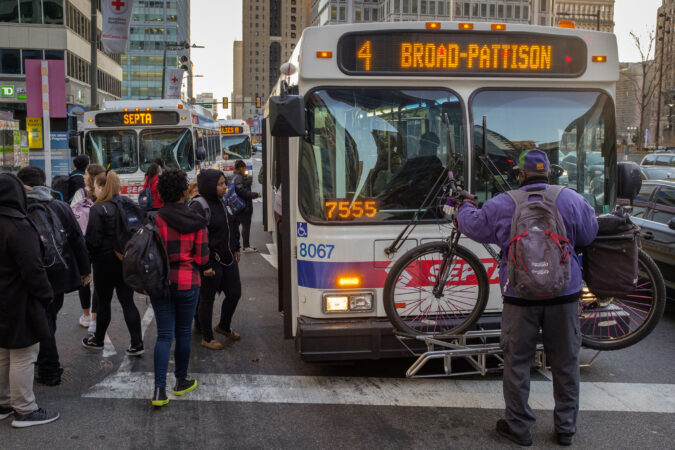
SEPTA’s21.5% increase in transit fares and service cuts fell hardest on disadvantaged Philadelphians this year, showing an urgent need to make the city’s Zero Fare program permanent, CityCouncilmember Nicolas O’Rourke argues.
He touted his proposal to dedicate 0.5% of the city budget each year to pay for the initiative that provides free SEPTA passes to people living in poverty.
O’Rourke’s proposedTransit Access Fund would be written into the City Charter “so it can’t be yanked away at a moment’s notice when somebody wants to shift something around in the budget,” hetold about 150 people in a town hall at the Friends Center on Cherry Street.
O’Rourke, Democratic State Sen. NikilSaval, and the advocacy group Transit Forward Philadelphia called the meeting to push for affordable public transportation and ways to sustainably fund SEPTA after Harrisburg’s failure to provide new state money for mass transit agencies.
A broad coalition and patience are needed in Pennsylvania, Saval said. ” Every major political win comes from months, years, sometimes decades, of work,” he said.
“We pushed back hard,” said O’Rourke, a member of the Working Families Party. “People with the least income are paying a larger share of their money just to get around. That’s upside down.”
Funding is not guaranteed after June 30, when the current budget expires, however.
If enacted, a Transit Access Fund would generate an estimated $34 million in the 2026-2027 fiscal year, O’Rourke’s office calculates.
That would generateenough money — between $20 million to $25 million, according to managers of the Zero Fare program —to give free SEPTA passes to 60,000 Philadelphians at or below the federal poverty standard.
O’Rourke and his staff also are considering usingthe remaining $10 million to $14 million for matching grants to help businesses, landlords and housing developments to join the SEPTA Key Advantage program, which provides subsidized transit passes.
People living at or below the federal poverty standard are eligible for the Zero FareSEPTA passes. For 2025, that is $15,650 for an individual and $32,150 for a family of four.
Philadelphia’s poverty rate was 19.7% in 2024, the latest figure available, according to the U.S. Census.
“When we’re made to feel like we’re on opposite sides of the fight, our numbers become smaller and we focus on the wrong targets,” said Saval.
“It’s not the person in Schuylkill County frustrated about potholes and road conditions that’s to blame for lack of transit funding” he said. “That person deserves to get safely where they need to go, too.”
Activists rallied outside the Philadelphia Criminal Justice Center on Thursday to press their assertion that ICE has been allowed to turn the courthouse into “a hunting ground” for immigrants.
The noon demonstration crystalized months of contention between activists and lawyers who say the courthouse must be a place to seek and render justice ― not to target immigrants ― and federal authorities who insist that making arrests there is legal, safe, and sane.
No ICE Philly, the rally organizer, says agents have been enabled to essentially hang out at the Center City courthouse, waiting in the lobby or scouring the hallways, then making arrests on the sidewalks outside, a pattern they say has been repeated dozens of times since President Donald Trump took office in January.
“ICE is kidnapping immigrants who are obeying the law and coming to court,” said Ashen Harper, a college student who helped lead the demonstration, which targeted Sheriff Rochelle Bilal. “She is capitulating and cooperating with ICE.”
Many people who go to the courthouse, the group noted, are not criminal defendants ― they are witnesses, crime victims, family members, people dealing with alleged offenses like shoplifting or trespassing, and others who are already in diversionary programs.
Organizers said ICE has arrested about 90 people outside the courthouse since January, a dramatic increase over the previous year. And they pledged to return on Dec. 4 ― lugging a podium for Bilal so that, organizers said, she can explain changes she intends to make, including barring ICE.
The sheriff did not immediately reply to a request for comment Thursday.
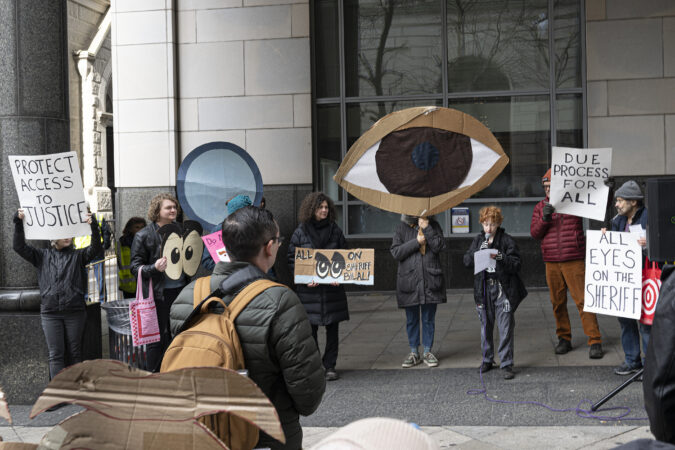
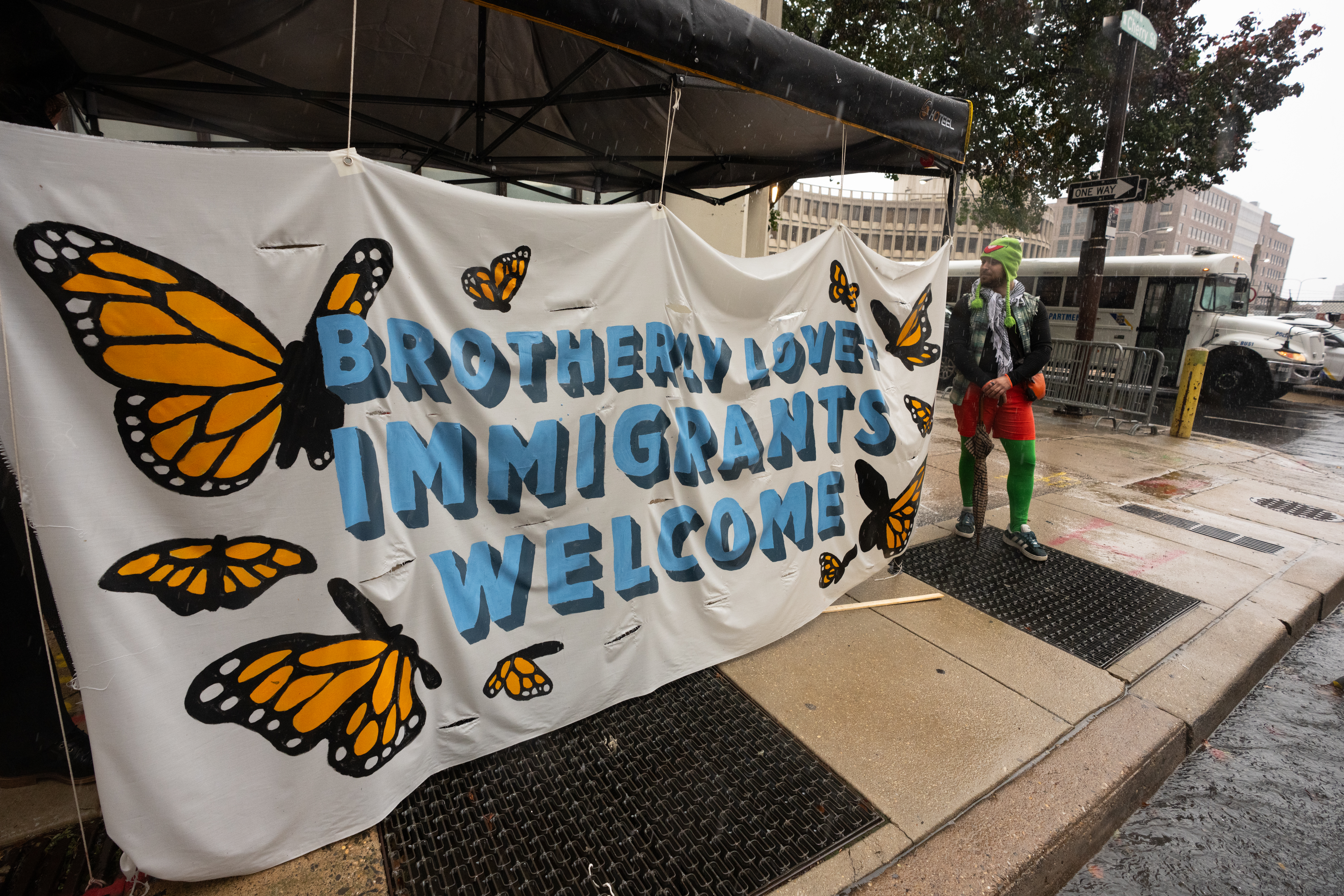
Members of No ICE Philly rally outside the Criminal Justice Center on Thursday, calling on the sheriff to cut off Immigration and Customs Enforcement access to the building.
“We want to put the sheriff on notice that we’re watching,” said Aniqa Raihan, a No ICE Philly organizer. “We want to raise awareness of the fact … that ICE is using the courthouse as a hunting ground.”
As word of plans for the demonstration spread, Bilal issued a statement aimed at “addressing public concerns” around ICE activity.
“Let me be very clear: the Philadelphia Sheriff’s Office does not partner with ICE,” the sheriff said. “Our deputies do not assist ICE, share information, or participate in immigration enforcement.”
Deputies verify the credentials of ICE agents entering the courthouse ― and those agents are not permitted to make arrests in courtrooms or anywhere else inside, she said.
Raihan and other advocates say that is no protection. ICE agents linger in the lobby, they said, then follow their target outside and quickly make the arrest.
A police department spokesperson said at the time that the Spanish-speaking officer offered to walk with the man to help translate, but did not detain him. The Defender Association of Philadelphia and others questioned how the incident squared with the city’s sanctuary policies.
U.S. Immigration and Customs Enforcement officials in Philadelphia did not reply to a request for comment.
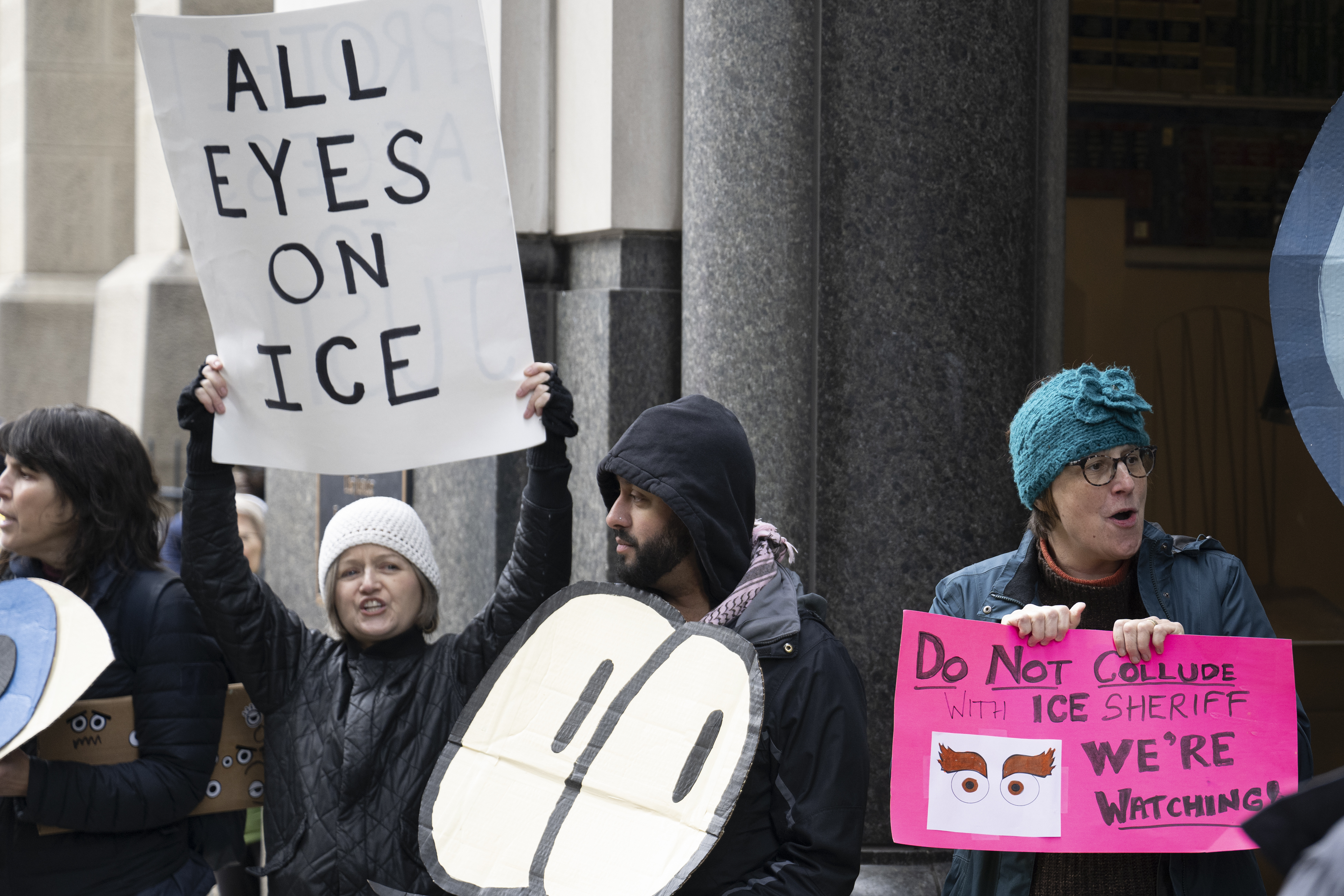
On Thursday, about 40 demonstrators gathered outside the courthouse, chanting and singing under the watchful eye of city police officers and sheriff’s deputies. No ICE agents were visible. Protesters carried signs to indicate that they, too, were watching, raising colorful cardboard eyeballs, eyeglasses, and magnifiers.
Lenore Ramos, the community defense organizer with the Juntos advocacy group, called on the sheriff and city government officials to protect immigrants at the courthouse. Proclaiming Philadelphia a welcoming city, she said, is not just a slogan ― it’s a promise, one that local government must fulfill.
“The city is not standing behind our immigrant communities,” Ramos said. “It is walking all over them.”
In an interview earlier this week, Whitney Viets, an immigration counsel at the Defender Association, said ICE agents are at the courthouse almost every day, and arrests occur there almost daily.
The government does not publicly release data detailing where most immigration arrests occur, but Viets estimated that dozens of arrests have taken place at the courthouse since the start of the year. Masked plainclothes agents are seen outside the building, in the lobby, in courtrooms, and in hallways, she said.
“Agents are effectively doing enforcement in the courthouse, through identification,” she said.
She explained that agents may identify a person they are seeking in or near a courtroom, then either follow them outside or alert other agents who are already waiting on the sidewalk.
It is unclear where ICE is obtaining information on who will be at the courthouse on any particular day, although some details about ongoing criminal cases are available in public records.One result of ICE enforcement, she said, is people are afraid to come to court.
“This is about whether our justice system operates effectively,” Viets said. “The actions of ICE have gotten brazen. … What we need at this time is public engagement against this activity.”
No ICE Philly decried “kidnappings” by the agency and demanded the sheriff “protect everyone inside and outside the courthouse,” including “immigrants targeted by ICE as well as citizens observing and documenting ICE arrests.”
The Philadelphia Sheriff’s Office is in charge of courthouse security. However, Bilal said in her statement, her office has no authority to intervene in lawful activities that are conducted off the property.
“Inside the courthouse, everyone’s rights and safety are protected equally under the law,” she said. “We are law enforcement professionals who follow the law.”
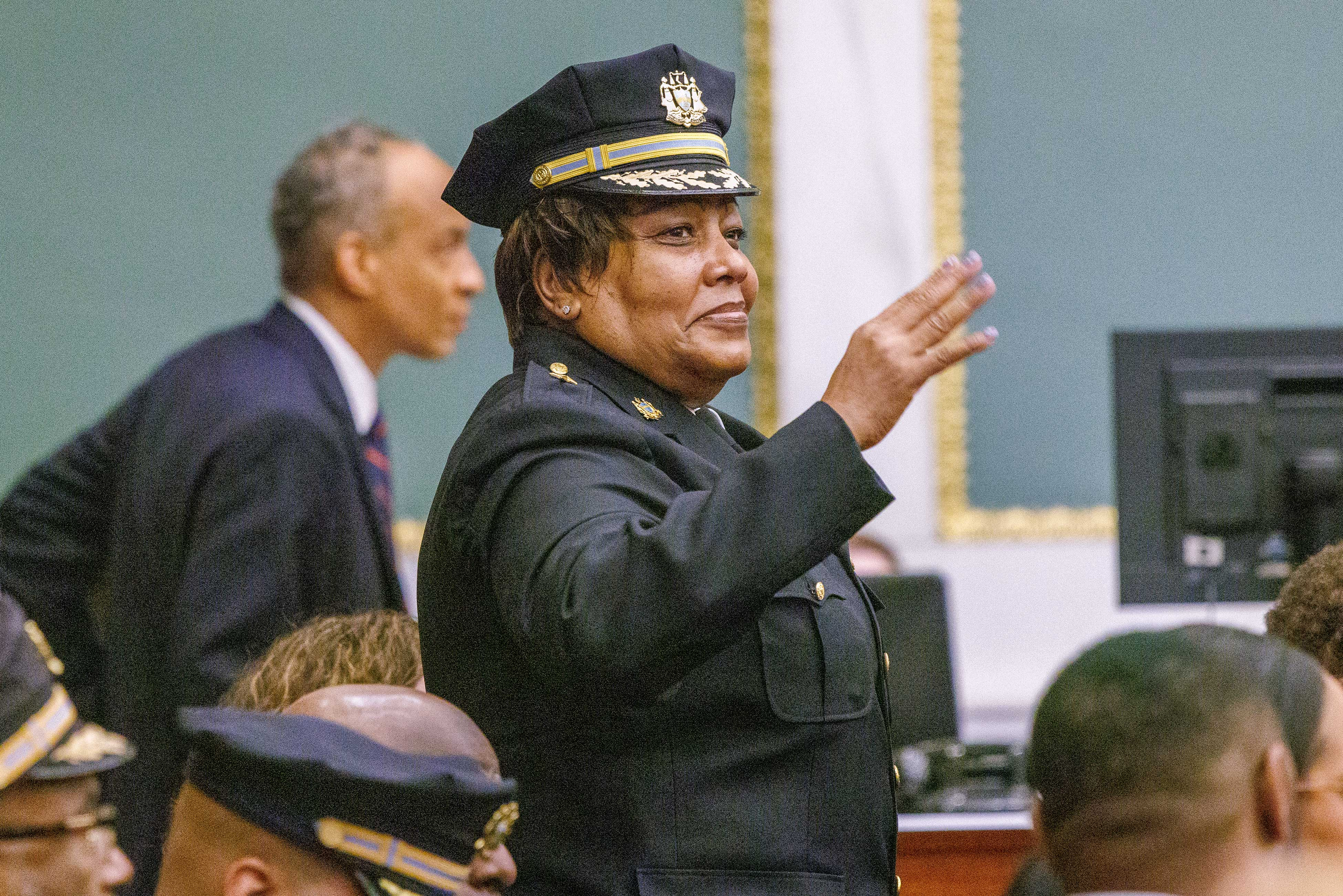
Philadelphia Sheriff Rochelle Bilal stands to be recognized at City Hall in March.
In Philadelphia and places around the country, courthouses have become disputed locales as the Trump administration pursues ever-more-aggressive arrest and deportation policies.
Under President Joe Biden, limits were set on what ICE could do at courthouses. Agents were permitted to take action at or near a courthouse only if it involved a threat to national security, an imminent risk of death or violence, the pursuit of someone who threatened the public safety, or a risk of destruction of evidence.
Even then, advocacy groups accused ICE of violating the policy by arresting people who were only short distances from courthouses.
The Biden restrictions on ICE vanished the day after Trump took office.
The new guidance said agents could conduct enforcement actions in or near courthouses ― period. The only conditions were that agents must have credible information that their target would be present at a specific location and that the local jurisdiction had not passed laws barring such enforcement.
The guidance said that, to the extent practicable, ICE action should take place in nonpublic areas of the courthouse and be done in collaboration with court security staff. Officers should generally avoid making arrests in or near family or small-claims courts.
The Department of Homeland Security said that the Biden administration had “thwarted law enforcement” from doing its job, that arresting immigrants in courthouses is safer for agents and the public because those being sought have passed through metal detectors and security checkpoints.
“The ability of law enforcement to make arrests of criminal illegal aliens in courthouses is common sense,” Assistant Secretary Tricia McLaughlin said earlier this year. “It conserves valuable law enforcement resources because they already know where a target will be.”
Philadelphia city officials have said repeatedly that they do not cooperate with ICE, and that the sanctuary city policies created under former Mayor Jim Kenney remain in place under Mayor Cherelle L. Parker.
Protesters Elias Siegelman, right, with No Ice Philly, who also works with the groups Indivisible, Jewish Voice for Peace, and Progressive Victory, outside the ICE office, in Philadelphia on Oct. 30.
Nationally, 10 months into the Trump administration, some Democratic jurisdictions are acting to tighten ICE access at courthouses.
In Connecticut this month, state lawmakers passed a bill to bar most civil immigration arrests at courthouses, unless federal authorities have obtained a signed judicial warrant in advance.
The Senate bill, already approved by the House, also bans law enforcement officers from wearing face coverings in court, Connecticut Public Radio reported. Democratic Gov. Ned Lamont is expected to sign the measure.
Last month in Chicago, which has faced weeks of controversial immigration enforcement, the top Cook County judge barred ICE from arresting people at courthouses. That came as federal agents stationed themselves outside courthouses, drawing crowds of protesters, CBS News reported.
On Monday, a federal judge dismissed a Trump administration challenge to a New York law that barred the immigration arrests of people going into and out of courthouses. New York passed the Protect Our Courts Act in 2020, during Trump’s first term, a law the administration said had imposed unconstitutional restrictions on enforcement, the Hill reported.
The Thursday rally marked the third recent protest by No ICE Philly, which seeks to stop agency activity in the city. The organization’s Halloween Eve demonstration outside the ICE office erupted into physical confrontations with police, with several people pushed to the ground and four arrested.
The arrests came after some demonstrators attempted to stop ICE vehicles from leaving the facility at Eighth and Cherry Streets.
No ICE Philly organizers said Thursday that they will continue to scrutinize ICE activity at the courthouse.
“There are people watching. We have eyes on this,” Raihan said, adding that ICE is “allowed to hang in the lobby, sometimes in the courtrooms.”
“Somehow they seem to know when somebody vulnerable is in the courthouse. … We’re concerned with how they’re finding out that information.”
Philadelphia-based independent contractors and others who are self-employed could soon become exempt from paying certain business taxes as part of a measure aimed at easing tax burdens on small businesses.
City Councilmember Mike Driscoll, a Democrat who represents parts of Northeast Philadelphia, introduced legislation Thursday to carve out entrepreneurs, sole proprietorships, and businesses that have only one employee from having to pay the city’s business income and receipts tax, commonly known as BIRT.
Also on Thursday, members floated legislation to address the rising cost of water bills and introduced a bill to make it easier for restaurants to secure outdoor dining permits.
What was the meeting’s highlight?
Relief for the small(est) businesses: The bill is likely to find support in Council, where lawmakers have been searching for ways to provide relief to small businesses after earlier this year eliminating a popular tax break that allowed companies to exclude their first $100,000 in income from business taxes in Philadelphia.
That exemption effectively meant that thousands of small businesses did not have to pay the tax. However, Mayor Cherelle L. Parker’s administration in June successfully moved to eliminate the exemption, saying the city was likely to lose a court battle over the matter.
The change came after a medical device manufacturer sued the city, saying the exemption violated state law, which includes a “uniformity” clause that prohibits municipalities from creating different classes of taxpayers.
Now, thousands of businesses newly have to pay the BIRT beginning with 2025 tax bills that are due in April. If Driscoll’s measure is adopted, it would begin in the 2026 tax year, meaning that eligible business owners would see the exemption when paying taxes due in April 2027.
He said the legislation addresses concerns from small businesses that the impending tax bills will be financially unsustainable for them.
“A $50,000 business should not face a $3,200 tax hike,” Driscoll said. “That is not policy. That is displacement.”
Driscoll said that the city’s law department approved his legislation and that he is confident it does not violate the uniformity clause.
What else happened this week?
Making water more affordable: Council will consider a package of legislation to address rising water bills. Councilmember Jamie Gauthier of West Philadelphia introduced three measures:
A bill that expands eligibility for payment assistance programs to people who earn up to 300% of the federal poverty level. (This year, the FPL is $32,150 for a family of four.) There is currently a tiered assistance structure for people who earn up to 250%.
A bill requiring that the city reduce a resident’s water bill if it rose because of a water meter failure that lasted more than a year.
A resolution to hold hearings on whether lawmakers can expand assistance programs to renters. The Philadelphia Water Department does not allow bills to be in renters’ names.
A spokesperson for Gauthier said the package of legislation has 10 cosponsors — a majority of Council — making it likely to pass.
Parker opposes incineration ban: A Council committee on Monday advanced a bill to ban the city from incinerating trash, over the objections of Parker’s administration.
Currently, the city sends about two-thirds of the trash it collects to landfills and one-third to a waste-to-energy incinerator in Chester operated by Reworld, formerly known as Covanta.
Both of those contracts expire June 30, and Gauthier wants to prohibit the Parker administration from signing a new deal.
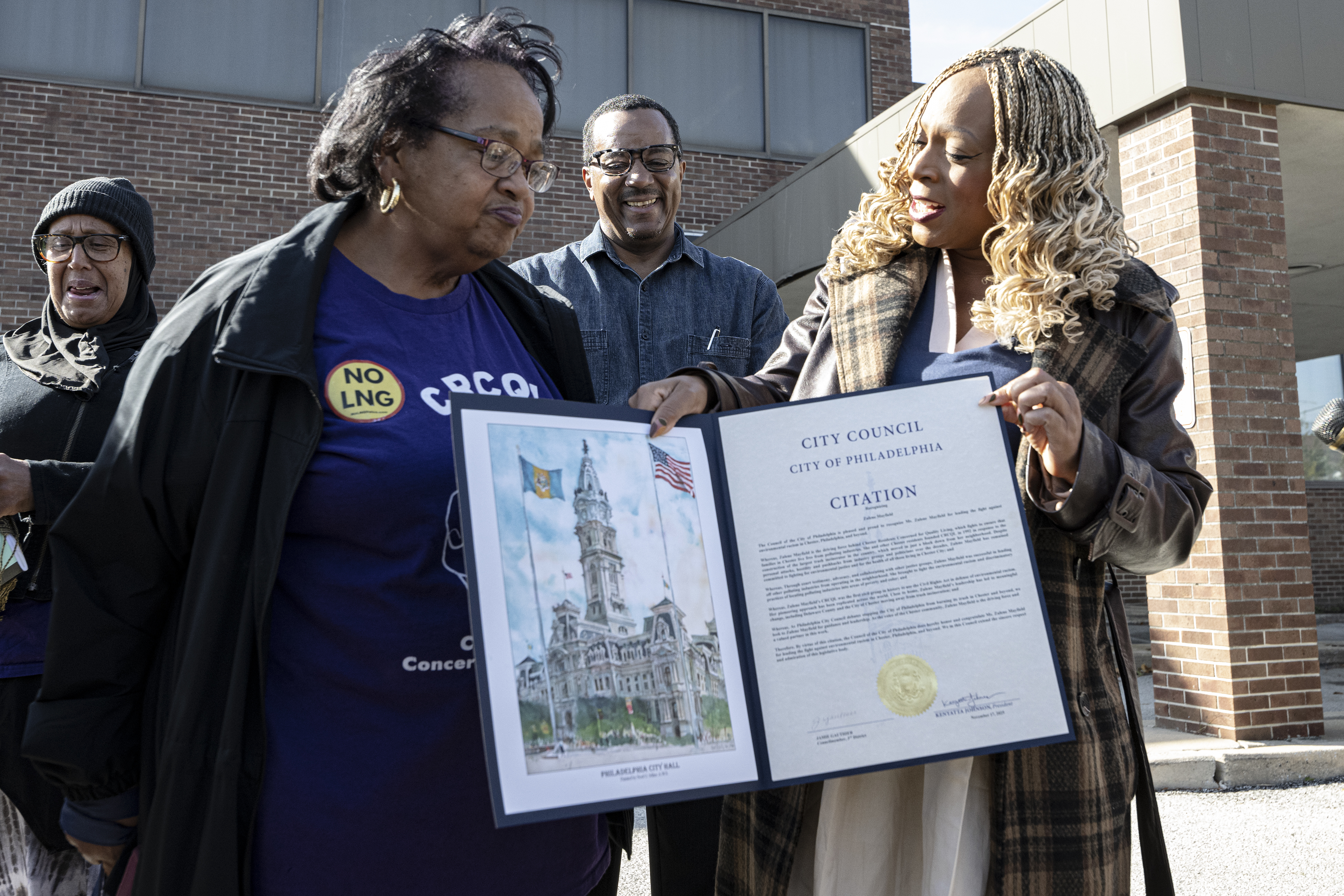
Chester resident Zulene Mayfield, left, Philadelphia Councilmember Jamie Gauthier, right, and Chester Mayor Stefan Roots meet to discuss Gauthier’s “Stop Trashing Our Air Act,” which would ban the city from incinerating waste, during a visit with lawmakers and staff in Chester, Pa., on Friday, Nov. 7, 2025.
On Monday, Chester officials pleaded with Philly to end its relationship with the facility, saying it contributes to high rates of illness.
Reworld defended its record, saying it exceeds government regulations.
Carlton Williams, who leads the Philadelphia Office of Clean and Green Initiatives, asked lawmakers to hold off approving a ban on incineration to allow the city time to study the issue.
But the committee approved the measure, sending it to the full Council for a vote as early as Dec. 4.
The outdoor dining area at Booker’s Restaurant and Bar at 5021 Baltimore Ave. in 2021.
Councilmember Rue Landau, who represents the city at-large, said it can take more than a year and a half for restaurants to get licensed if they are not in areas around Center City and a handful of commercial corridors in other neighbors.
Beyond those locations, restaurants must get their district Council person to sponsor zoning legislation, which can take months.
Landau introduced legislation Thursday to expand the “by-right” areas where sidewalk cafes can exist without special zoning. Where the areas are expanded to will be up to district Council members.
Quote of the week
Danny Garcia trains for an upcoming fight in August 2024.
All in the family: Council members on Thursday honored boxer Danny Garcia, a North Philly native and an illustrious fighter who is retiring from the sport. He appeared in Council chambers to thank members and tell the city how much he loves it back.
Staff writers Jake Blumgart and Beatrice Forman contributed to this article.
The ACLU’s Pennsylvania chapter slammed Philadelphia Mayor Cherelle L. Parker’s administration for invoking the organization’s name during a news conference this week, saying the group was not involved in what its leaders described as the mayor’s “DEI rollback.”
In a blistering statement issued late Wednesday, the ACLU-PA said Parker’s use of the organization’s name during a news conference announcing controversial changes to the city’s contracting policies created “the impression that the city’s decisions were vetted by our constitutional experts and aligned with our values.”
That was not the case, the group said.
“ACLU-PA was not consulted nor involved,” the statement said. “We welcome genuine collaboration with city leadership on policies that advance justice, liberty, and equity, especially for historically marginalized communities. Until such a partnership occurs, we ask that the administration refrain from using our name as a buzzword seal of approval.”
The Parker administration pushed back, with City Solicitor Renee Garcia saying Thursday that officials “were clear” that the administration consulted with an attorney who worked for the city’s outside counsel and who later went to work for the ACLU.
“We didn’t give ‘impressions,’” Garcia said, “we just gave the facts.”
Still, the civil rights group’s distancing from Parker was the latest criticism the mayor faced over her decision to eliminate a decades-old program that aimed to direct a significant portion of the city’s contracting dollars to firms owned by people of color, women, and people with disabilities.
Parker and her administration said the decision was made to align city policies with shifting legal precedent that has threatened affirmative action-style government programs. But critics have said the city preemptively conceded to the conservative legal movement that has sought to dismantle diversity, equity, and inclusion programs across the country.
In announcing her decision to make the city’s procurement policies race- and gender-neutral, Parker did not say that her administration worked directly with the ACLU in crafting its policy shift, nor did she mention the organization’s Pennsylvania chapter.
But Parker and members of her administration invoked the group’s name during the Tuesday news conference as they described the timeline of events that led up to the city’s decision to quietly change its policies this fall before announcing them publicly.
Mayor Cherelle L. Parker with city solicitor Renee Garcia (right) at City Hall Feb. 5, 2024.
Garcia said that the administration consulted in June with constitutional law experts, including Carmen Iguina González, who was at the time a Washington-based attorney at Hecker Fink, a law firm. Iguina González is a former clerk to Supreme Court Justice Sonia Sotomayor, considered one of the most liberal jurists on the high court.
About three months after the meeting with city officials, Iguina González became the deputy director for immigration detention at the ACLU’s National Prison Project.
During Tuesday’s news conference, Vanessa Garrett Harley, a deputy mayor and a top aide to Parker, cited the meeting with Iguina González in response to critics who have called the administration’s policy shift “conservative.”
She said Iguina González counseled the city to strike race- and gender-based diversity goals from its contracting policies.
“People [are] saying, ‘Oh, it was a conservative move. It was a conservative way of looking at the law,’” Garrett Harley said. “She had clerked for Justice Sotomayor. She’s currently at the ACLU. So this was not somebody who would have had a conservative mindset.”
Garrett Harley continued: “If we’ve got people on all sides… saying, ‘You have no other choice,’ then we’ve got to pivot and do what we have to do to protect the fiscal responsibility of the City of Philadelphia.”
Vanessa Garrett Harley, a deputy mayor, speaks during a press conference in June.
Later in the news conference, Parker also mentioned the ACLU, saying she was glad the city sought outside an outside opinion from Iguina González.
“I remember that meeting clearly,” Parker said. “And again — although she’s not with the firm, she made the transition and she’s now with the ACLU — I believe in her.”
This week was not the first time the ACLU has been at odds with Parker, a centrist Democrat who ran for mayor in 2023 on a tough-on-crime platform.
And once Parker took office last year, Pennsylvania ACLU leaders expressed opposition to parts of her plan to address the open-air drug market in Kensington, including the so-called wellness court, a fast-track court for people accused of minor drug-related offenses.
Gloria Cartagena Hart vividly remembers the scenes and sounds of her Kensington block just three years ago: The streets filled with trash. The sidewalks lined with dozens of people openly using drugs. Nightly pops of gunfire from dealers competing for turf, and the haunting screams that followed.
It was 2022, in the heart of one of the most notorious drug markets and poorest zip codes in America.
But Cartagena Hart, a longtime resident at Somerset and Jasper Streets, now says the neighborhood is experiencing something she once believed might never come.
“I see some progress,” she said.
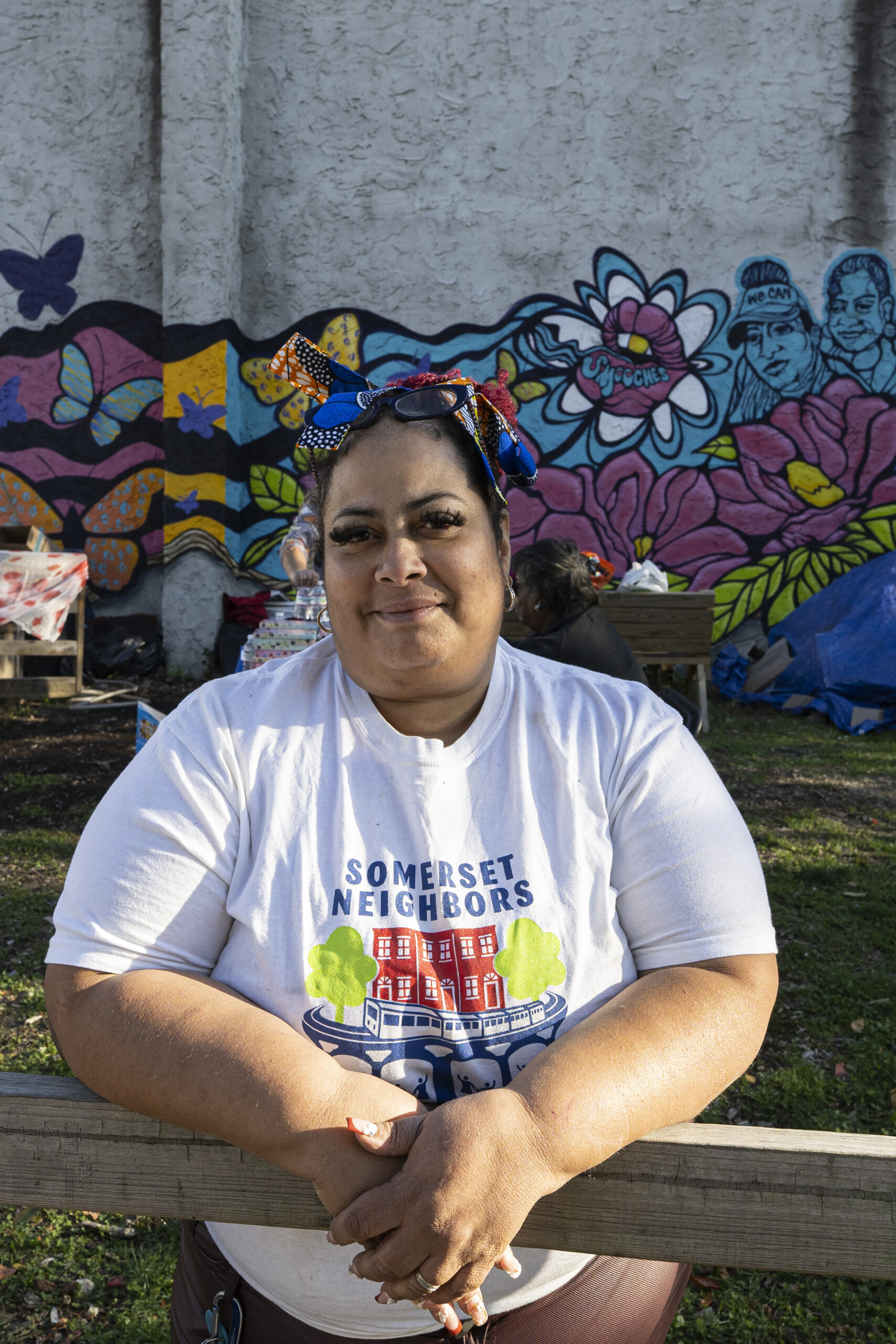
Gloria Cartagena Hart is a community organizer in Kensington who said she will never stop fighting for resources to stabilize the area.
For the first time in decades, under the renewed efforts of Mayor Cherelle L. Parker’s administration, some residents and city officials alike agree that many of Kensington’s most chronic challenges have been improving — albeit slowly.
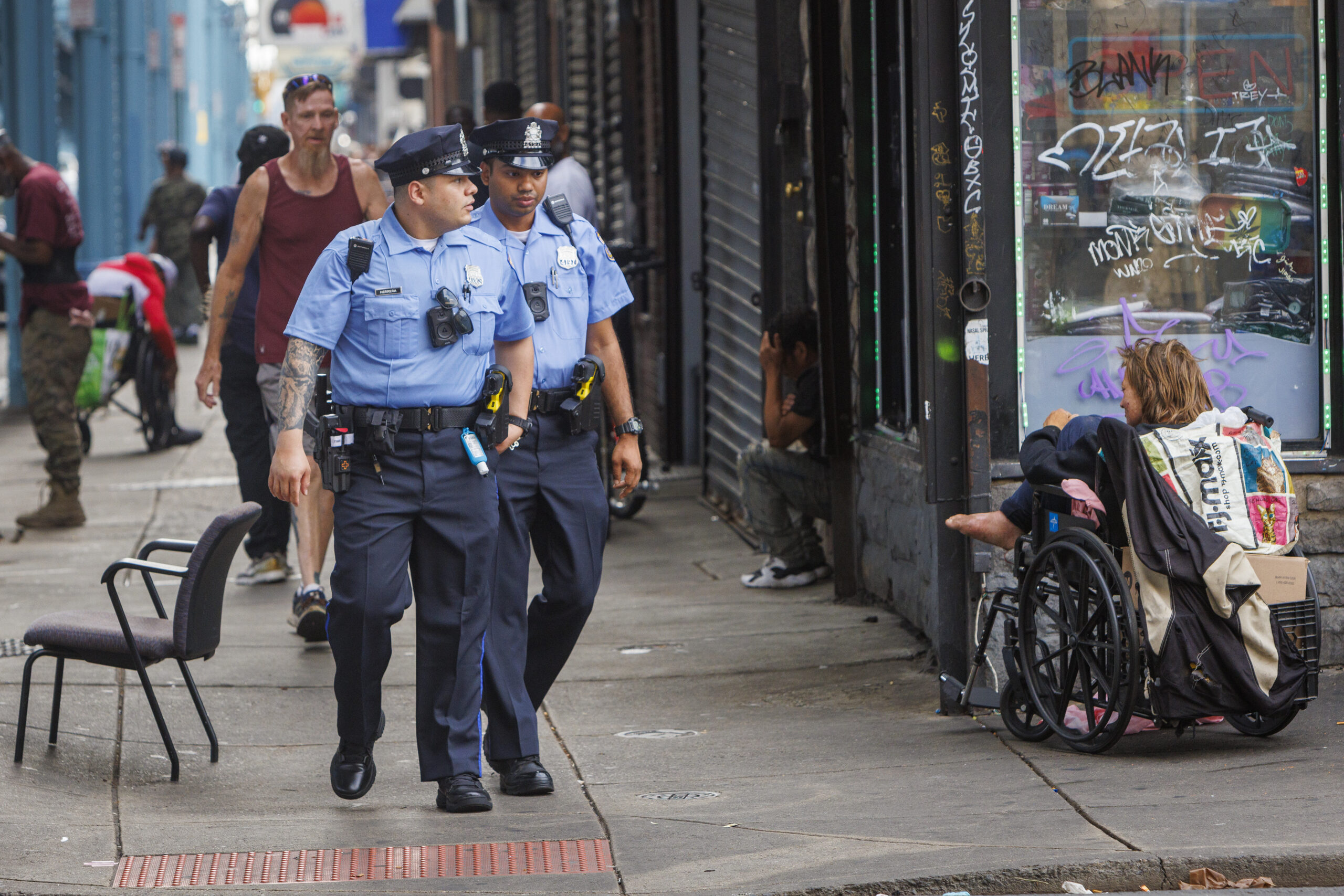
Fewer dealers dot the corners. Three times as many police officers patrol the neighborhood, disrupting their business. Half as many people are living on the streets compared with last year, police said. Some residents say quality-of-life issues — trash pickup, abandoned car removals, 311 calls — are being addressed more quickly.
And gun violence — long a byproduct of the drug economy and fragmented crews fighting for turf — is at its lowest level in a generation.
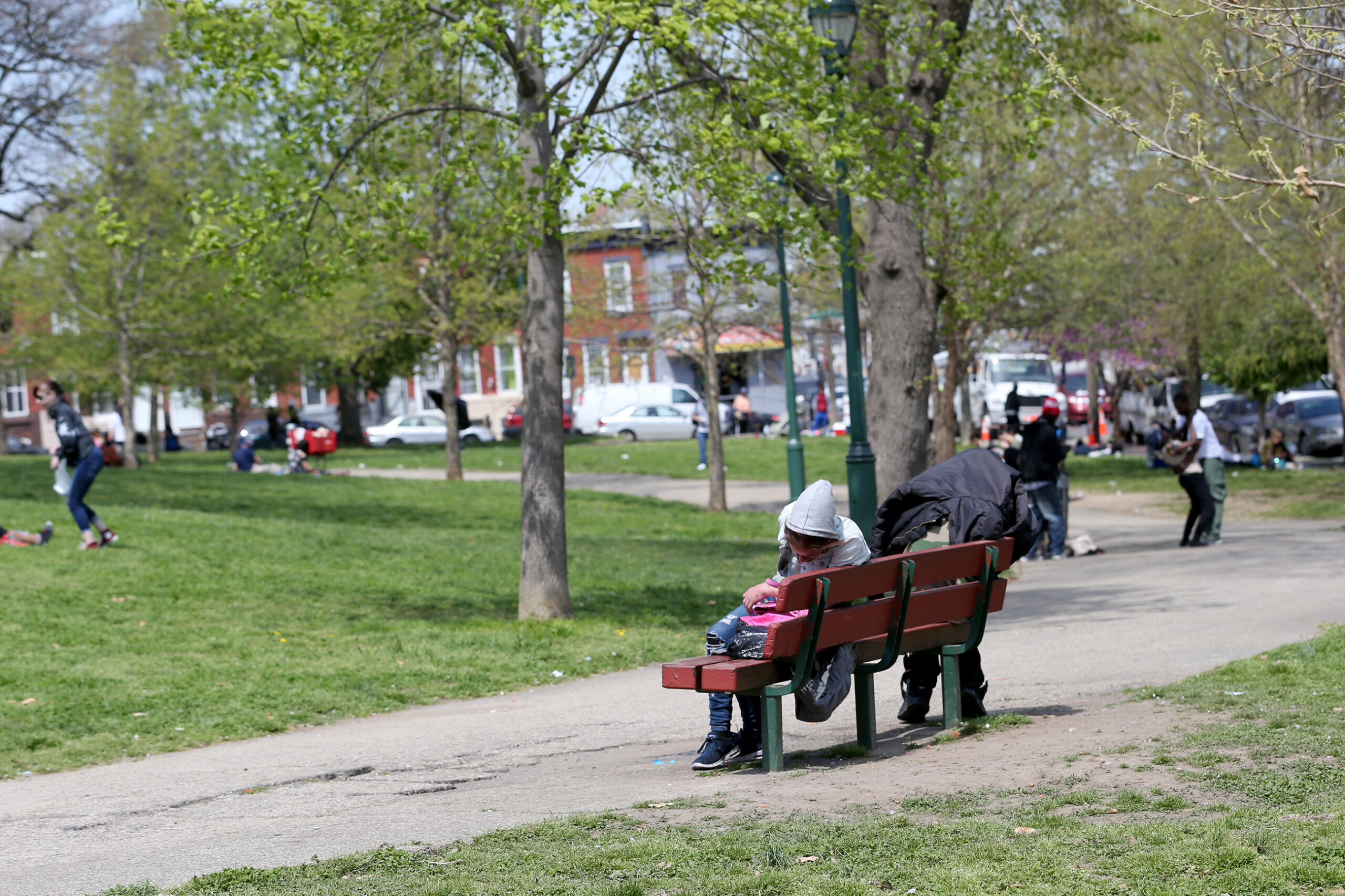
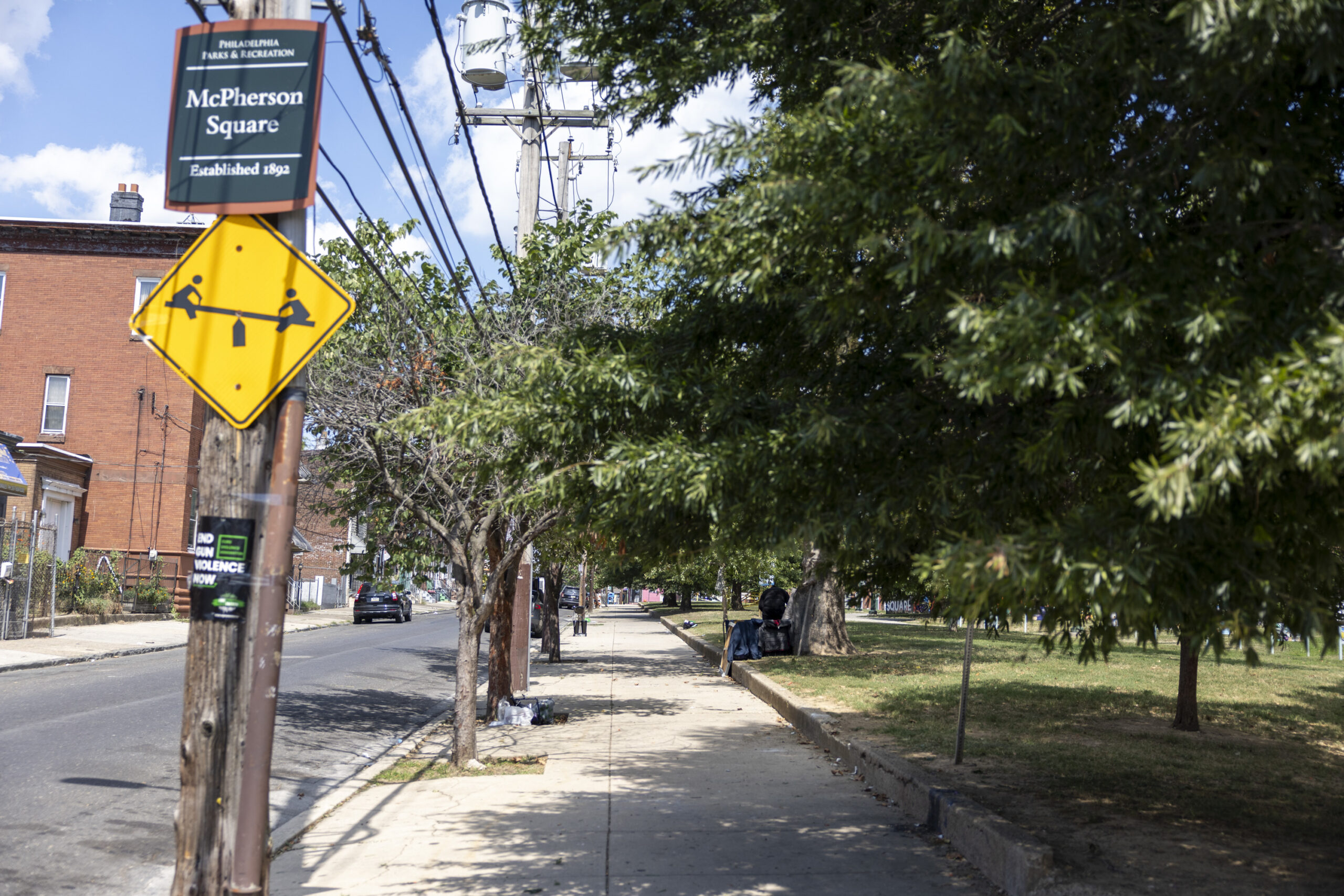
For years, McPherson Square was typically filled with people openly using drugs, as seen in this photo from April 2021. Residents could not let their children visit the park safely.This year, McPherson Square is a different scene. There are often a few people sitting along the edges, but police regularly sweep the park and ask people to leave.
City agencies and healthcare groups say they have also worked to get drug users into treatment more quickly, and have started building a network of care that they hope will keep fewer people from returning to the streets. Riverview Wellness Village, Parker’s new $100 million recovery and treatment facility, now houses about 200 people.
“Neighbors [are] telling me how many more people are sitting on their steps, how many more children are riding their bikes, how many more people may walk the commercial corridor,” Parker said this week. “To me, that’s progress. … We weren’t going to close our eyes and ignore it and walk around like it didn’t exist, or just contain it in one area.”
She’s committed to long-term change there, she said.
More dealers show up to give out free samples of drugs — and free pizza slices to go with them — in an effort to win over customers in a more competitive market, she said. She is constantly asking people to stay off her steps.
Deputy Police Commissioner Pedro Rosario sees the ongoing challenges.
“Am I where I want to be? No. Nowhere close to it,” said Rosario, who oversees the policing strategies in Kensington. “But ‘moving in the right direction’ is not giving us enough credit.”
Deputy Commissioner Pedro Rosario walks through the mini police station on Allegheny Avenue.
Improvements in Kensington, he said, may always be limited by the depths of the drug crisis and economy.
“It’s never gonna be as good as everyone wants it to be,” he said, but “it’s like the first time we’re all kind of rowing in the right direction.”
Some harm-reduction groups said the progress is surface level, and criticized the city for pushing homeless people into other areas where they are harder to reach: Harrowgate, Center City, the SEPTA stops at Broad and Snyder, Erie Avenue, and 69th Street.
“They’ve made it more difficult for people to be visibly homeless,” Sarah Laurel, who heads the harm reduction organization Savage Sisters in Kensington, said of the city’s efforts. “But have they actually resolved the dire need of community members who are unhoused?”
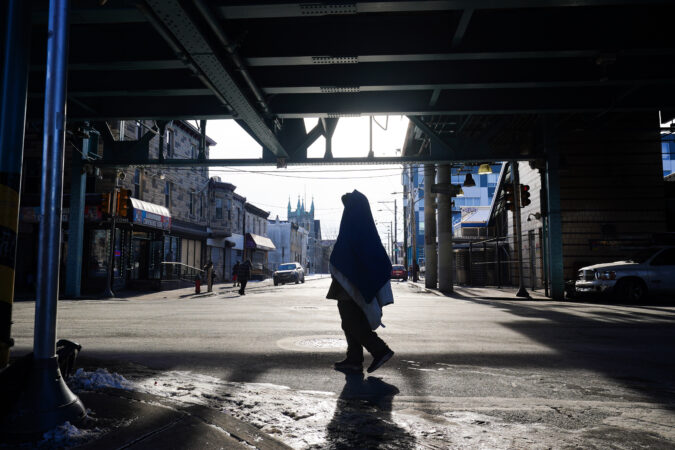
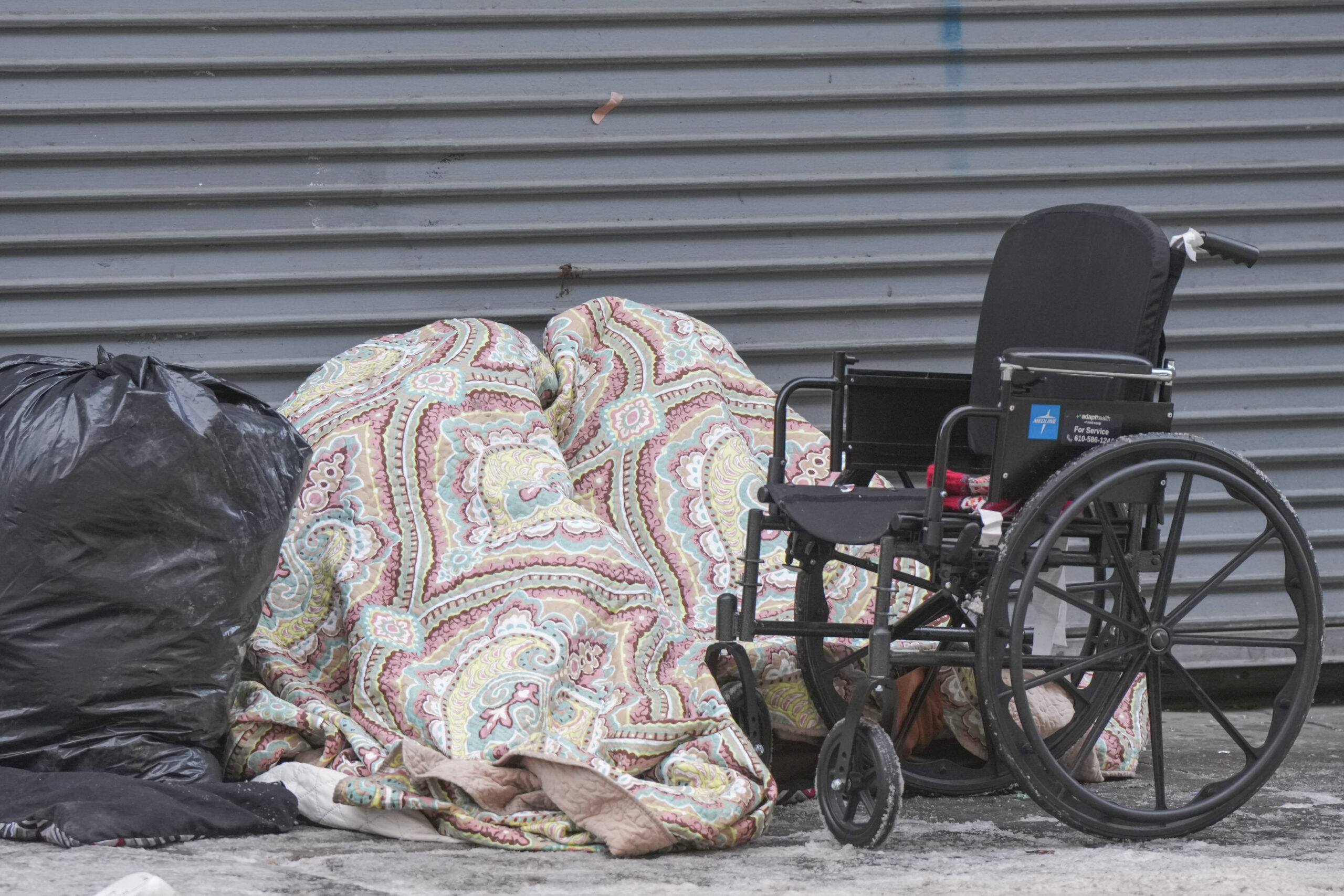
People experiencing homelessness and addiction sleep under blankets on Kensington Avenue in January.
Still, one woman in her 30s, who has come to Kensington on and off since she was 16, acknowledged the neighborhood is no longer the “free-for-all” it was at the height of the pandemic.
“It has changed,” she said, clutching a crack pipe on a quiet block away from police. “You can still get high on the street, you just can’t get caught doing it.”
And that, Rosario said, is progress.
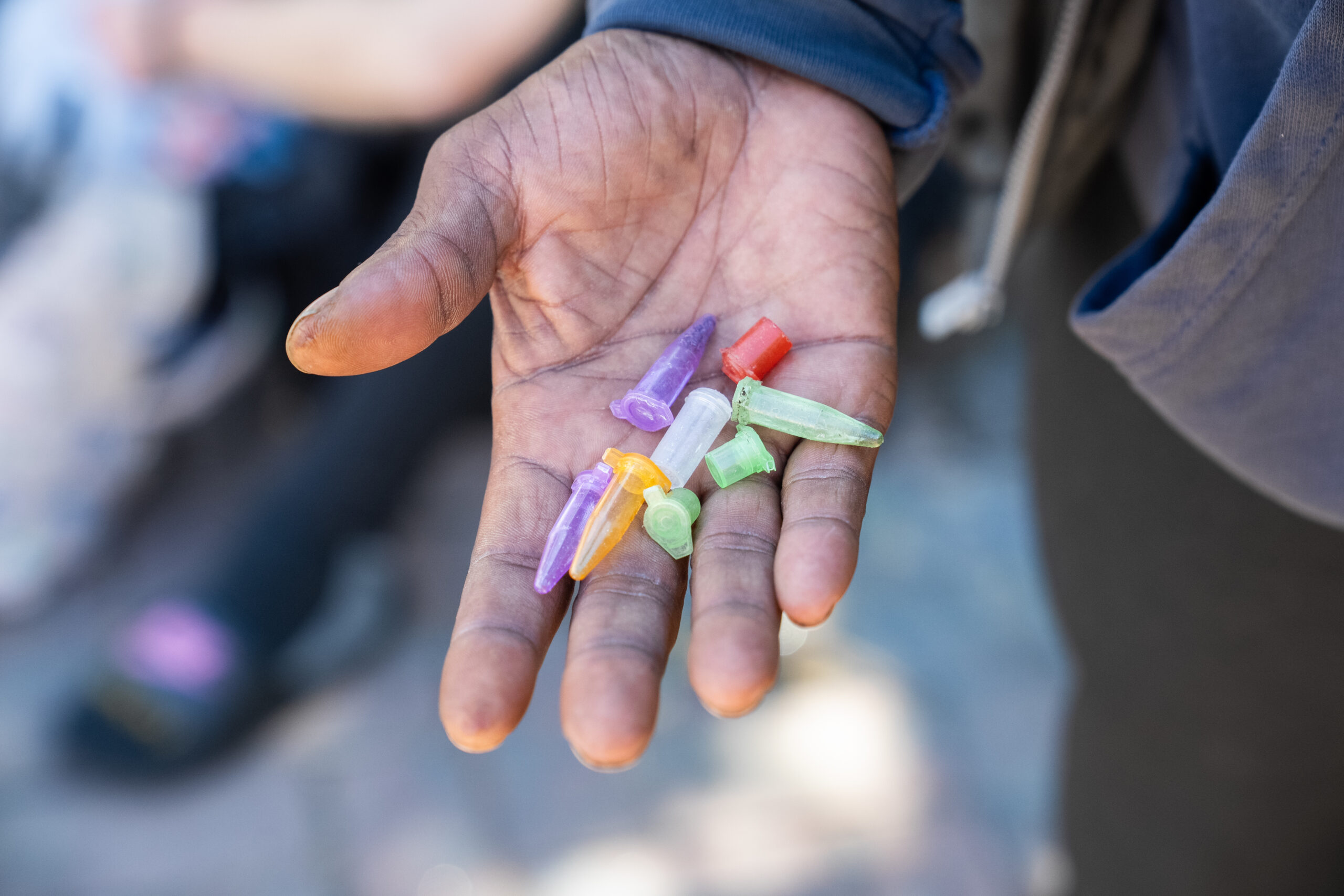
A man who sells drugs holds a collection of empty vials that typically hold meth, crack, and other illicit substances.
A drug ‘flea market’
Rosario has been a police officer in Kensington for 24 years, and saw how the neighborhood became what he calls “the flea market” of the city’s billion-dollar drug economy.
There have always been drug organizations that run specific blocks there — crews from Weymouth, Jasper, and Rosehill Streets, each with its own product, stamp, and employees to sell it.
But in the last five years, he said, blocks have been “leased out.” Someone in New York City or the Dominican Republic will often “own” a block, Rosario said, and rent it out to a local dealer to use for a week to make a stack of money and move on. Dealers even started using drug users to sell in the last few years, he said, because they are less obvious to police, can be paid less, and are seen as “expendable.”
That structure makes it challenging for police to identify and arrest the people in charge, he said. If a lower-level dealer is arrested — or killed — the top distributors can easily find a replacement.
Philadelphia police officers have a shut down the 3100 block of Weymouth Street after federal agents raided the block and arrested 30 people last month.
And the dealers are fearless, he said. Just before the police department was set to open a mini station near F Street and Allegheny Avenue in November 2020, the building was firebombed, he said. He suspects it was dealers attempting to prevent a growing police presence. (The department has since opened a station at 1952 Allegheny Ave.)
Deputy Commissioner Pedro Rosario faces the challenge of overseeing the policing one of Philadelphia’s poorest and most challenging neighborhoods. He sees progress so far.
When Parker tapped Rosario to lead the police department’s plans in the neighborhood, his first order of business was to reduce the violence so that city workers felt safe enough to go into the neighborhood.
Last summer, the department assigned about 75 rookie cops to buttress existing patrols in the neighborhood, and it has continued to send in more officers. There are now three times as many police patrolling the main drag along Kensington Avenue as there were in 2021 — most of them on foot.
Rosario says the expanded police presence has contributed to a historic decline in violence.
(function() {
var l2 = function() {
new pym.Parent(‘kensington_2025’,
‘https://media.inquirer.com/storage/inquirer/projects/innovation/arcgis_iframe/kensington_2025.html’);
};
if (typeof(pym) === ‘undefined’) {
var h = document.getElementsByTagName(‘head’)[0],
s = document.createElement(‘script’);
s.type = ‘text/javascript’;
s.src = ‘https://pym.nprapps.org/pym.v1.min.js’;
s.onload = l2;
h.appendChild(s);
} else {
l2();
}
})();
While shootings citywide are down about 55% compared to three years ago, they have fallen even more in Kensington.
Through the second week of November, 46 people had been shot in the 24th Police District — an 82% drop from 2022, when, during the same time period, 259 people were shot. And there are half as many shooting victims as there were a decade ago.
“I cannot emphasize how important that is to resetting the norms in that community,” said Adam Geer‚ the city’s chief public safety director. “That is 82% less families dealing with the trauma. That is 82% less gunshots heard ringing in the night.”
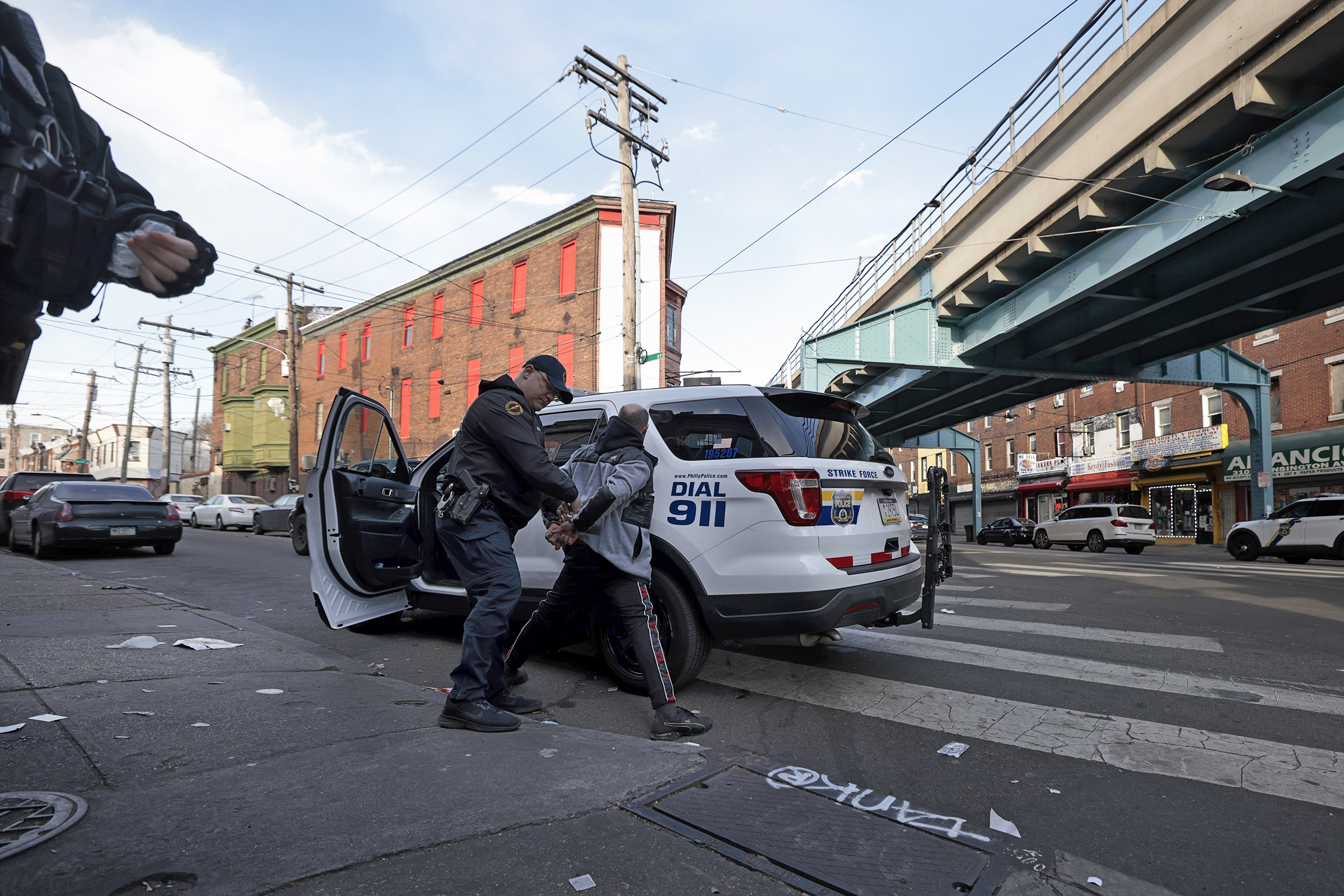
Philadelphia police take a man into custody at Kensington Avenue and G Street on March 20, 2024. Police searched the man and said they found small plastic bags containing what was believed to be illegal drugs (top left).
Through Nov. 15, arrests for drug dealing in the neighborhood were up 23% since Parker came into office. Still, overall, the city is on pace to see the fewest number of drug-related arrests in at least 15 years, city data show, and as law enforcement largely focuses in Kensington, arrests for selling drugs in other parts of the city are down about 34% compared with the 23 months before Parker was elected mayor.
Geer said the city is still in the beginning phases of its efforts. Illicit drug sales will likely always persist, he said, “but what we are really, really going after is the open, blatant, in the air using drugs and selling drugs toxic to this community.”
Rosario also said that reducing the area’s homeless population — by disbanding encampments and generally “being as disruptive as possible” — was critical to reducing the strain on the area’s services and residents, and lessening the open-air drug use and dealing.
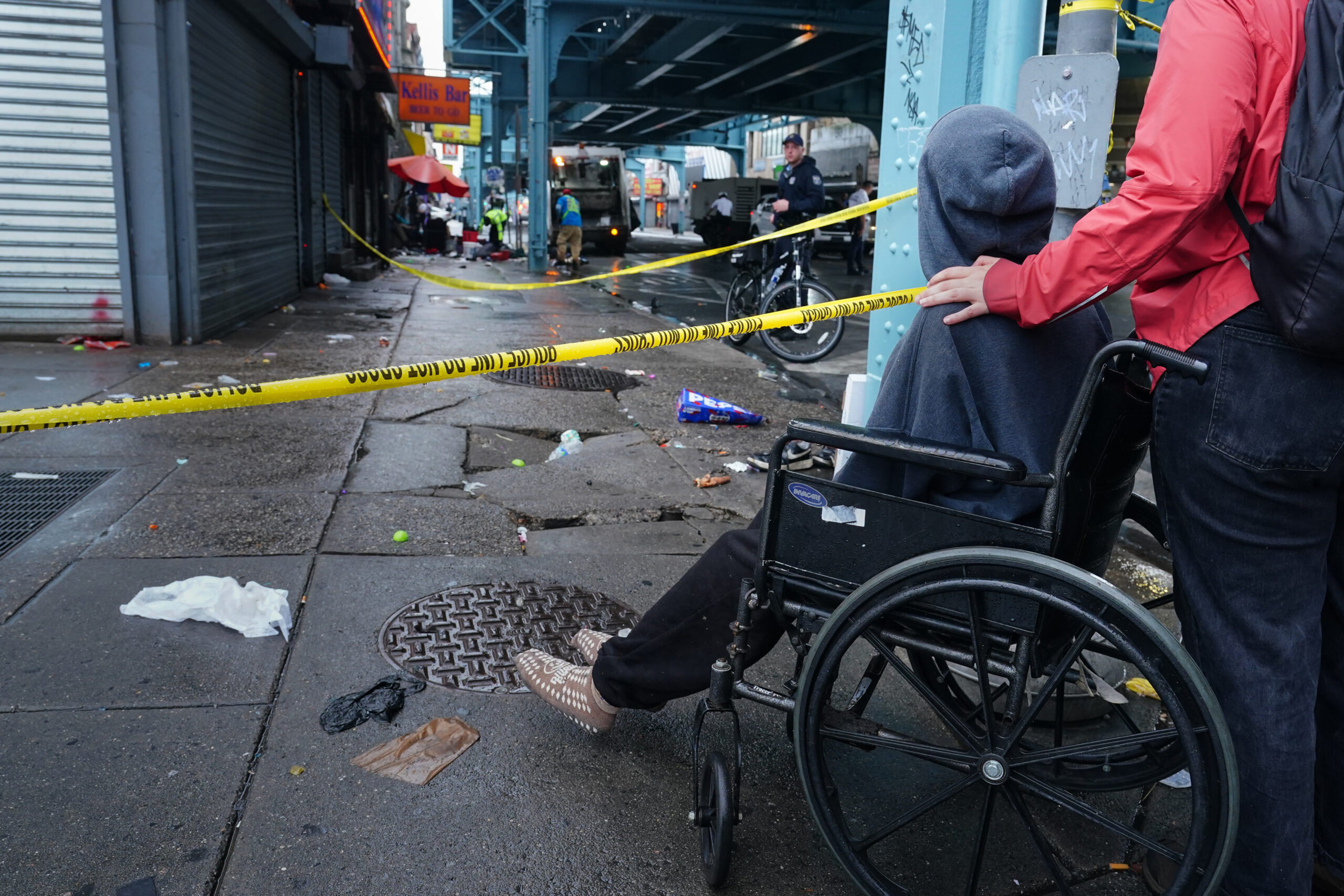
A woman in a wheelchair looks down Kensington Avenue after police cleared a large encampment in May 2024.
It has worked. Last September, there were about 750 people living on the streets in the area, according to a weekly count by police. During the same time this year, there were about 400.
But homelessness in the city generally has not improved, city data show.
There are actually about 400 more people experiencing homelessness this year than last, according to data from the Office of Homeless Services. Police and care providers believe some have simply moved to other neighborhoods to avoid the police presence.
Rosario acknowledged the dispersal, but said Kensington didn’t deserve to bear the burden of those crowds alone.
Because shutting down the drug market in Kensington, he said, “is like trying to stop a wave” at the beach.
“You can disperse it,” he said. “Maybe you can reengineer to kind of push it to a different direction.”
But you can’t stop it.
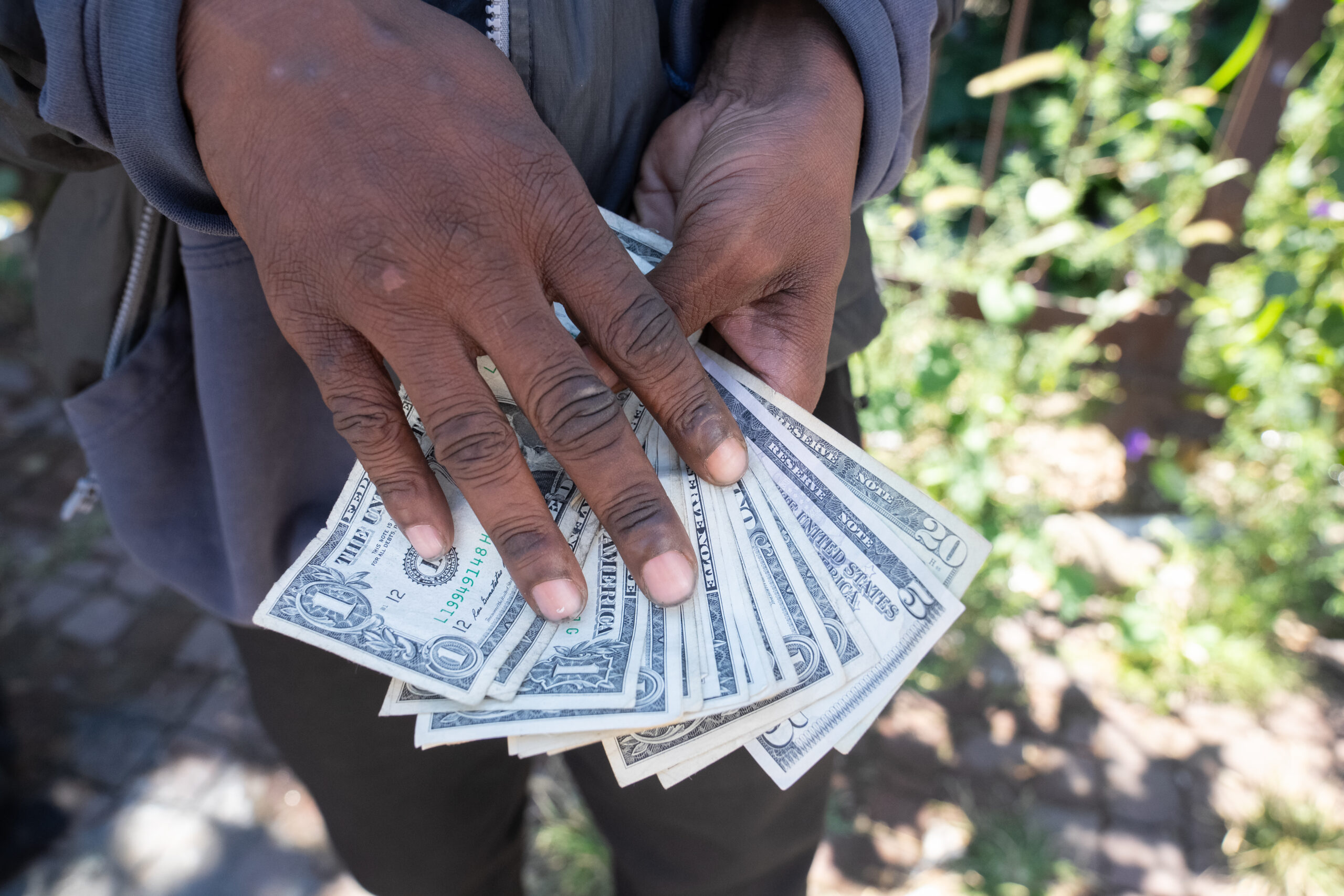
A man fans out the cash he has made on a recent day selling drugs. It’s not much — in part, he said, because there are fewer people in Kensington buying from him.
The view from the streets
One drug dealer can see the shift — and feel it in his wallet.
The 47-year-old man, who asked not to be identified because he sells illegal drugs, said he came to Kensington from New York in 2012 after serving time in prison for robbery. He’s been in the drug trade since he was 12, he said, taught by his parents, who hustled in the Bronx.
Today, he spends his days and nights on a quiet, trash-strewn corner, smoking K2 and selling crack, meth, and dope — whatever the man in the maroon Crown Victoria drops off that day.
During the pandemic, he said, business was booming. When he worked the overnight shift on Jasper Street, he said, he made at least $1,500 a week. Today, with more police on the corners and fewer customers on the streets, he’s lucky to clear $400.
A 28-year-old dealer along Kensington Avenue scoffed at the police enforcement. Where does the city expect the drug economy to go if not here? he asked. The drug trade is a constant, a viable employer with a stable customer base, and it has to go somewhere.
“They can’t put a cop on every f― block,” said the man, who asked not to be identified to discuss illegal activity.
A woman smokes crack on a quiet street in Kensington.
A few streets over, a 36-year-old man who smokes fentanyl and crack said that, a year or two ago, there would be five or six dealers on the corner of Jasper Street and Hart Lane.
Now, he said, there’s one.
“It’s harder to get drugs,” he said.
As police have cracked down on retail theft — once an easy way for people in addiction to make quick cash by reselling the items — it’s also gotten harder to fuel his habit, he said. He usually gambles online on his phone to scrape together a few extra dollars, he said, getting paid through CashApp, which some dealers use to accept payment now.
Many people in addiction said life overall is harder in Kensington — police clear away their tents, shoo them out of parks, and remove the often-stolen grocery carts used to carry belongings. It makes them feel subhuman, said one 36-year-old woman who has struggled with addiction since she was 13.
“We just want to be safe and warm,” she said.
But the biggest fear on the block these days, people said, is the withdrawal.
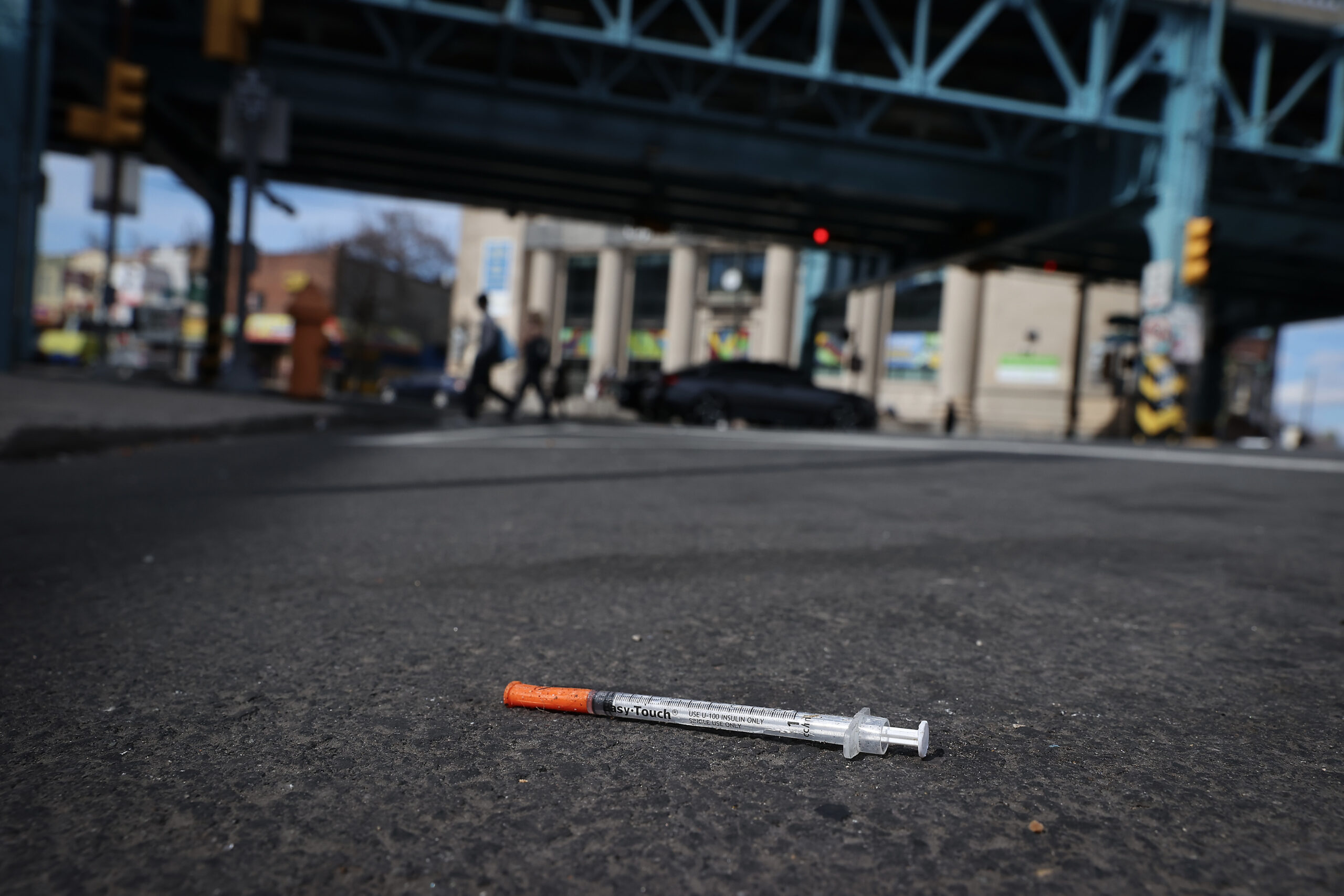
A used hypodermic needle rests on Allegheny Avenue at Kensington Avenue on March 17, 2024.
The withdrawal symptoms, which can begin within two hours, are so intense they can send people into cardiac arrest. Only hospitals can offer the most effective treatments for medetomidine withdrawal, and more people are ending up in intensive care units.
Dave Malloy, director of mobile services for Merakey, one of the city’s main addiction treatment providers, said the city has made strides in streamlining access to treatment in the last two years.
Evaluations that once required a daylong wait at a hospital can now happen in the field through mobile units like Malloy’s, getting people to rehab within hours. Doctors can also start patients on medications like Suboxone or methadone, to lessen their withdrawal symptoms, in as little as 45 minutes.
Malloy said that treatment providers, hospitals, police, and city agencies are working together better than they have in years.
“There was a realization that everybody had been siloed,” he said.
Only about 6% of the city’s homeless people who accepted help fromoutreach workers went to drug treatment and detox centers in recent years, according to city data — a statistic that, as of February, had not improved under Parker’s tenure.
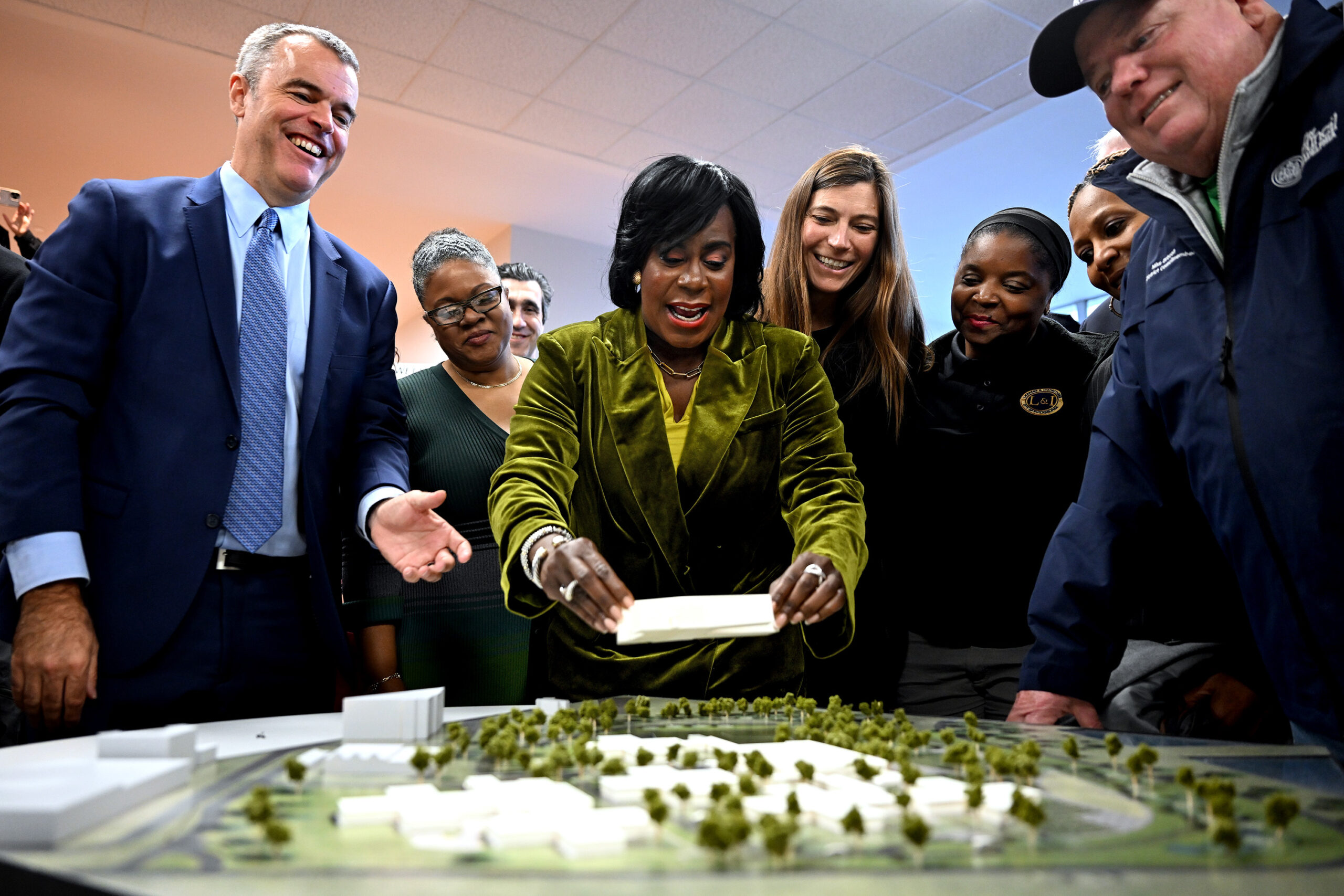
Mayor Cherelle L. Parker places a new block on the scale model of the Riverview Wellness Village Wednesday during the January unveiling of Philadelphia’s new city-operated drug treatment facility. At left is Managing Director Adam Thiel.
The city said it has also expanded the number of beds available for people in recovery by 66% through the opening of the Riverside Wellness Village, where people can live for up to a year after completing 30 days of inpatient drug treatment. Once construction is complete, the facility will house over 600 people.
Another 180 people are living in a shelter at 21st Street and Girard Avenue, which the city expanded last spring.
And the Neighborhood Wellness Court — a fast-track diversion program where people in addiction who are arrested for low-level offenses are brought before a judge the same day, in hopes of getting them into treatment more quickly — is growing.
In the first three months of the court, which Parker’s team launched in January and runs one day per week, only two of the approximately 50 people who had come through completed the program. Most who opted to go to rehab immediately left and absconded from follow-up hearings. At one point, operations were so disjointed that court leadership threatened to shut it down.
But Parker is committed to the court’s success and wants it to operate five days a week. The city recently hired a new director to oversee the court, and is in the process of hiring 14 additional staff members to provide better follow-up care.
Still, through early September, of the 187 people who had come through the court, only 10 completed the program and saw their criminal cases expunged, according to city data.
And while most people still do not come to court, the city said that it expects the situation will improve with the additional hires, and that there is success in the 130 people who have accepted some form of service through the court, even if they weren’t ready to enter recovery.
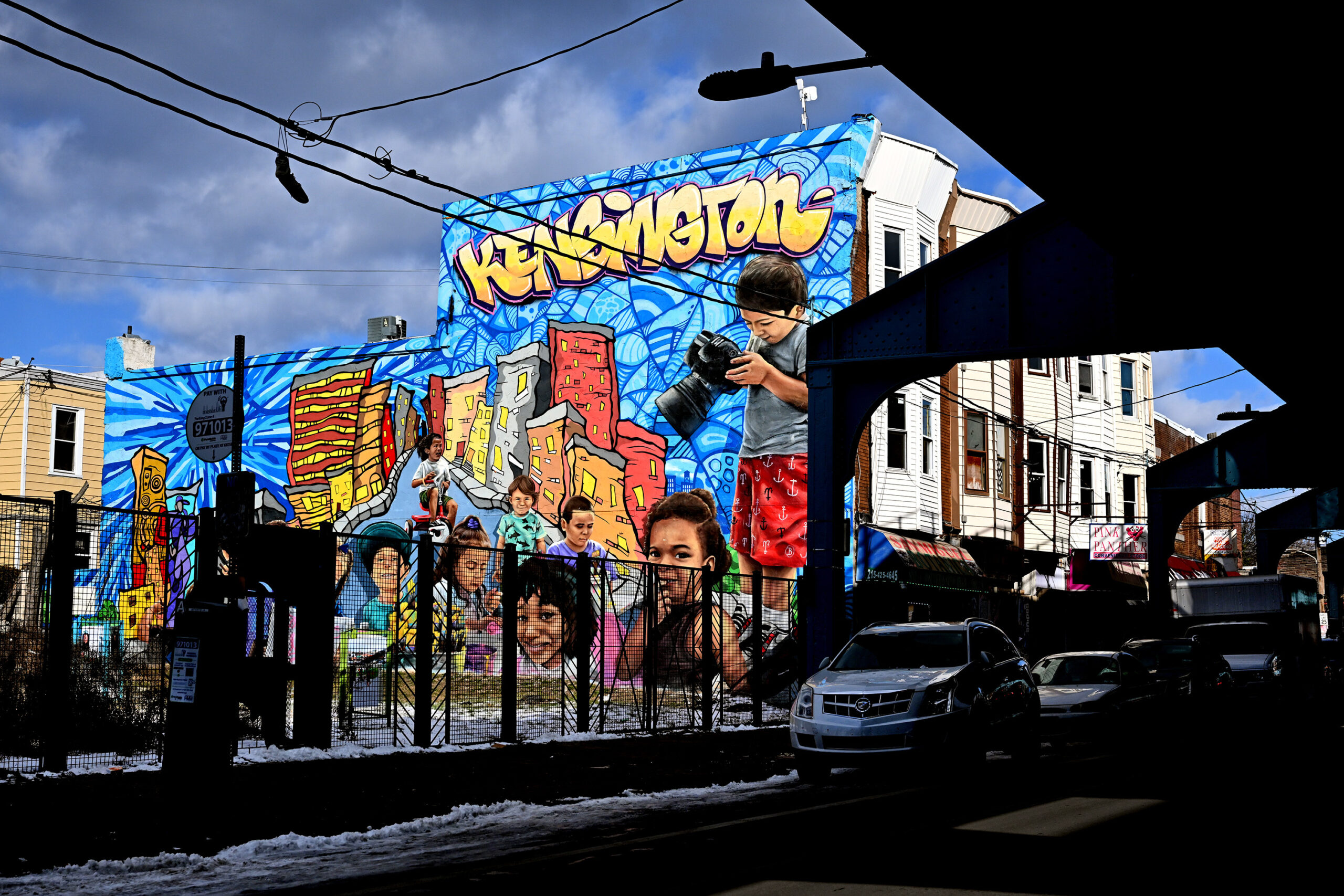
The “Lots of Lots of Love” mural by artist J.C. Zerbe is on the 3200 block of Kensington Avenue.
‘Kensington is love’
The increased police enforcement has sent more people in addiction to jail, and several people have died in police custody after they overdosed or had medical emergencies while going through withdrawal.
And not all residents feel the progress, or see the increased police presence as a good thing.
Theresa Grone, 41, who lives next to McPherson Square Park, said she and her children still cannot sit outside without someone in addiction asking them if they have free drug samples or clean syringes.
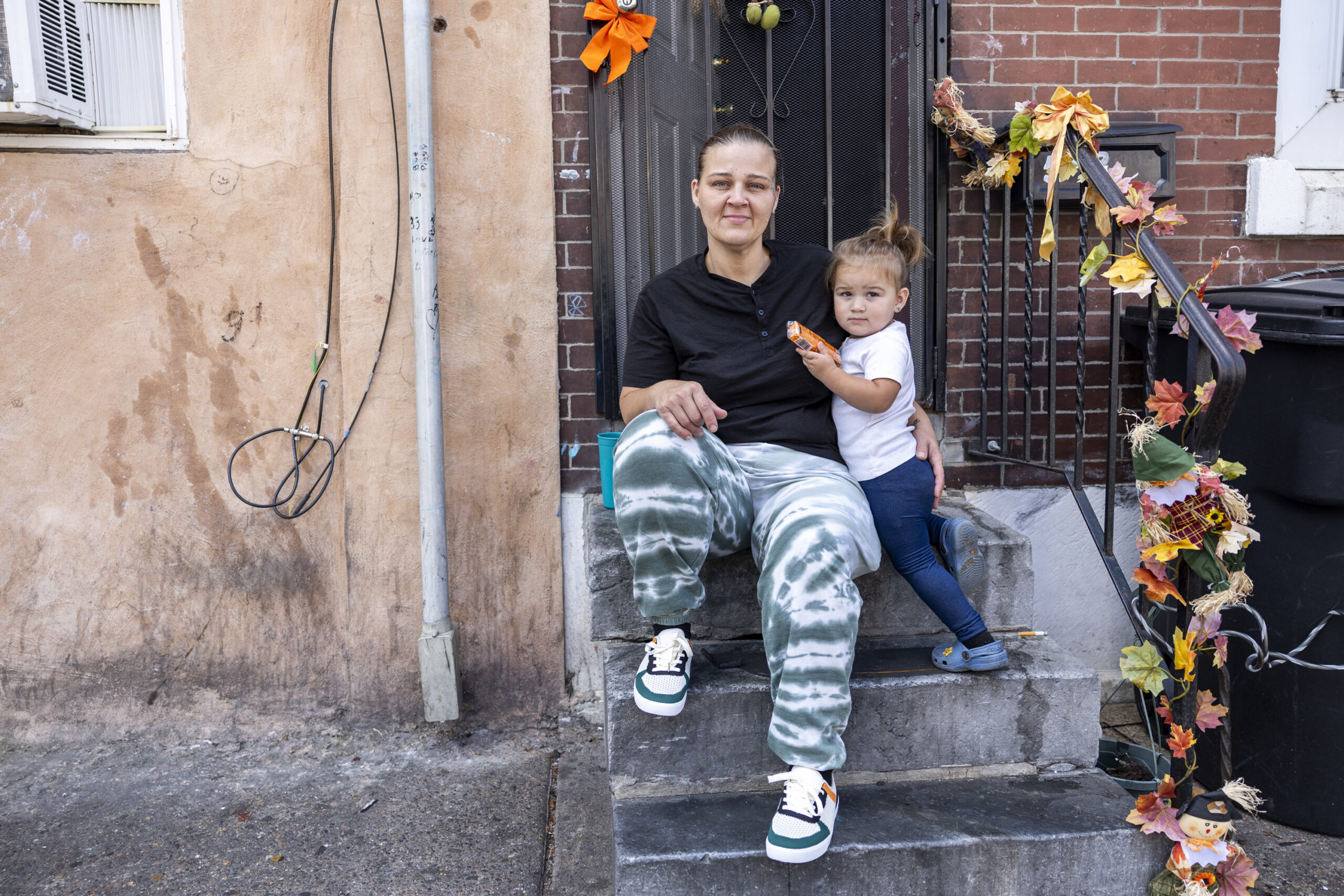
Theresa Grone, 41, and her daughter Abagail, 2, live near McPherson Square Park in Kensington.
And, she said, the police in the neighborhood have gotten more aggressive and harass people who aren’t doing anything wrong. Drug dealers and users still dominate the block.
“They’re not in the places they used to be, but they’re still there,” she said — on side streets, in abandoned houses, moving to corners as soon as the police leave.
She feels like the city is expanding resources for people in addiction more than for families like hers — a group of eight people renting a rowhouse in disrepair who want to move but can’t afford to.
But other residents, like Cartagena Hart, hope to never leave.
She said she has always seen the beauty and strength of Kensington, even at its lowest — the neighbors who care for each other’s children and feed the homeless, the police officers who will show up as soon as she texts them for help.
“Kensington,” she said, “is love to me.”
And she’s proud, she said, that her advocacy and that of her neighbors has helped city leaders finally invest in helping them.
Staff writers John Duchneskie, Max Marin, Anna Orso, Dylan Purcell, Sean Walsh, and Aubrey Whelan contributed to this article.
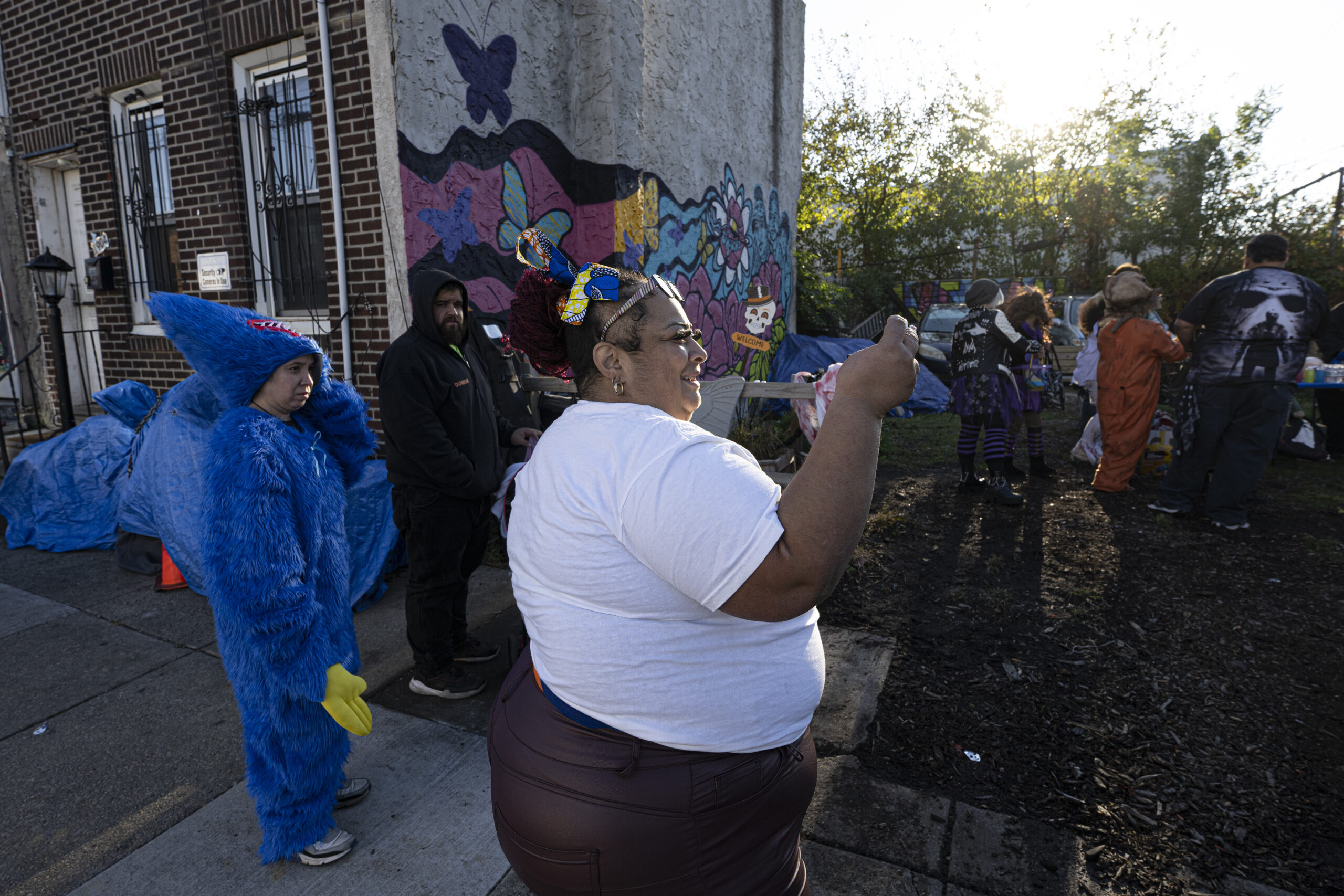
Gloria Cartagena Hart interacts with neighbors during a Halloween party and giveaway that she organized at the Butterfly Garden in Philadelphia’s Kensington neighborhood.
City Council this week again delayed a key piece of legislation that needs to pass before the Parker administration can sell hundreds of millions of dollars in city bonds, the primary source of funds for the myriad housing programs being created or expanded through the mayor’s Housing Opportunities Made Easy initiative, or H.O.M.E.
The delay comes as lawmakers negotiate to amend the legislation — a resolution setting the first-year budget for H.O.M.E. — to increase spending levels beyond the currently proposed $195 million and to lower income eligibility thresholds for some programs, prioritizing poorer residents.
The most recent setback came this week, when Council President Kenyatta Johnson canceled a Monday hearing to advance the resolution and declined to reschedule it before Thursday’s regular Council meeting, when the administration said the proposal would need to receive final approval for the first $400 million round of bonds to be sold in 2025. (The city plans to sell a second and final $400 million tranche of bonds in 2027.)
The administration sent Johnson’s office an initial draft of the resolution in July, but the Council president has repeatedly delayed advancing the measure throughout the fall.
“It is critically important to get the first-year spending plan right because what is agreed upon in the first year will influence all future spending for the H.O.M.E. program,” Johnson said in a statement explaining the cancellation of Monday’s hearing. “It is also essential that the final legislation include spending priorities important to City Councilmembers.”
Parker is known as a hard-line negotiator who rarely cedes ground, and Johnson’s delays might be meant to send the signal that if she doesn’t bend on Council’s demands, he won’t meet her timelines.
The saga marks a rare moment of discord between Parker and Johnson, who have worked hand in glove on most issues since both took office in January 2024 — including the passage of the initial package of legislation related to H.O.M.E. last spring.
At left is Council president Kenyatta Johnson speaking with Philadelphia Mayor Cherelle L. Parker before start of her press conference regarding her first budget in Philadelphia City Hall on Thursday, June 6, 2024.
In a hearing last week, Johnson appeared to side with lawmakers, led by Housing Committee Chair Jamie Gauthier, who were pushing for the administration to lower income thresholds for some H.O.M.E. programs, saying the city should prioritize the neediest Philadelphians.
Parker has proposed expanding income eligibility requirements in some cases so that the programs can also be accessible to middle-class residents, saying she does not want to pit “the have-nots vs. the have-a-littles.”
‘Pit one against the other’
Even with the bonds delayed until next year, the mayor does not appear to have given up the fight to maintain her vision for the housing initiative. At an unrelated Council hearing on the school district on Tuesday, Parker brought up the H.O.M.E. initiative unprompted.
She then called out four Council members who have middle-class constituencies that are likely to benefit from increased income thresholds for housing programs: Curtis Jones Jr., whose district includes Roxborough and Overbook; Anthony Phillips, who represents East Mount Airy and West Oak Lane; Mike Driscoll, of the Lower Northeast; and Katherine Gilmore Richardson, who represents the city at large but is a Democratic ward leader for Wynnefield.
“I am unapologetic about making sure that constituents represented by you … should not be left out of any investment that we make in the city of Philadelphia,” Parker said. “Every community can be lifted up with the work that we are doing, so I won’t let us pit one against the other.”
The remarks, however, effectively pitted members with poorer constituencies against those with middle-class bases. Johnson represents Southwest Philadelphia and the western half of South Philly; Gauthier’s district covers much of West Philadelphia.
Despite the dustup, it remains unlikely that a lasting fissure has emerged in Parker and Johnson’s relationship, given that they still share many policy priorities and can benefit each other politically.
“Council President Kenyatta Johnson and I have an amazing working relationship,” Parker, a former Council member, said in an interview Monday. “Council has a right to do its due diligence. If I hadn’t been there, if I wasn’t a former staffer in there, maybe it would be foreign [to me]. No. We’re going through the process, and I have to trust the process.”
Additionally, Johnson standing up for Council members’ concerns over the H.O.M.E. budget may help shield him from questions about whether he is overly compliant with the mayor’s agenda.
“Both branches of government remain committed to ensuring the H.O.M.E. program is implemented transparently, equitably, and in a way that maximizes benefits to Philadelphia residents,” Johnson said in his statement. “Taking extra time to finalize these critical elements will result in a stronger, more effective program.”
Tracking progress
The administration is not waiting for the H.O.M.E. bonds to be sold to start notching wins for Parker’s 30,000 housing units goal. The city’s Philly Stat 360 website has already begun tallying units built and preserved during her tenure.
To be sure, some of the mayor’s strategies for the H.O.M.E. initiative do not require bond money. For instance, Parker has led a shake-up of the Land Bank, which she hopes will accelerate the redevelopment of unoccupied city-owned parcels into housing, and she won Council approval last spring for zoning changes meant to streamline building.
But the potential infusion of $800 million is undoubtedly the centerpiece of the initiative. The money will help launch programs like Parker’s One Philly Mortgage, which aims to provide 30-year fixed-rate loans to qualified homebuyers, and will buttress existing ones like the Basic Systems Repair Program, which has been credited with preventing the displacement of low-income residents who end up moving if they cannot afford needed home repairs.
“It’s never been done in the history of our city, and we do that together in partnership with each other, and that’s what we’re working to do right now,” Parker said.
Staff writers Jake Blumgart, Kristen A. Graham, and Anna Orso contributed to this article.
Philadelphia City Council is attempting once again to change city law to allow members to keep their jobs while running for higher office, an effort that has already failed three times in the last 20 years.
Maybe the fourth time’s really the charm?
This attempt is a little bit different. A Council committee on Wednesday advanced legislation to change the 70-year-old resign-to-run rule that requires city officeholders to leave their jobs while campaigning for another office.
But the legislation — which must be approved by a majority of voters through a ballot question — doesn’t repeal the rule entirely. It merely narrows it to allow members to keep their seats if they are seeking state or federal office, such as seats in Congress or the state General Assembly.
Under the new proposal, Philadelphia’s resign-to-run rule would remain in place for members seeking a city office, like mayor or district attorney.
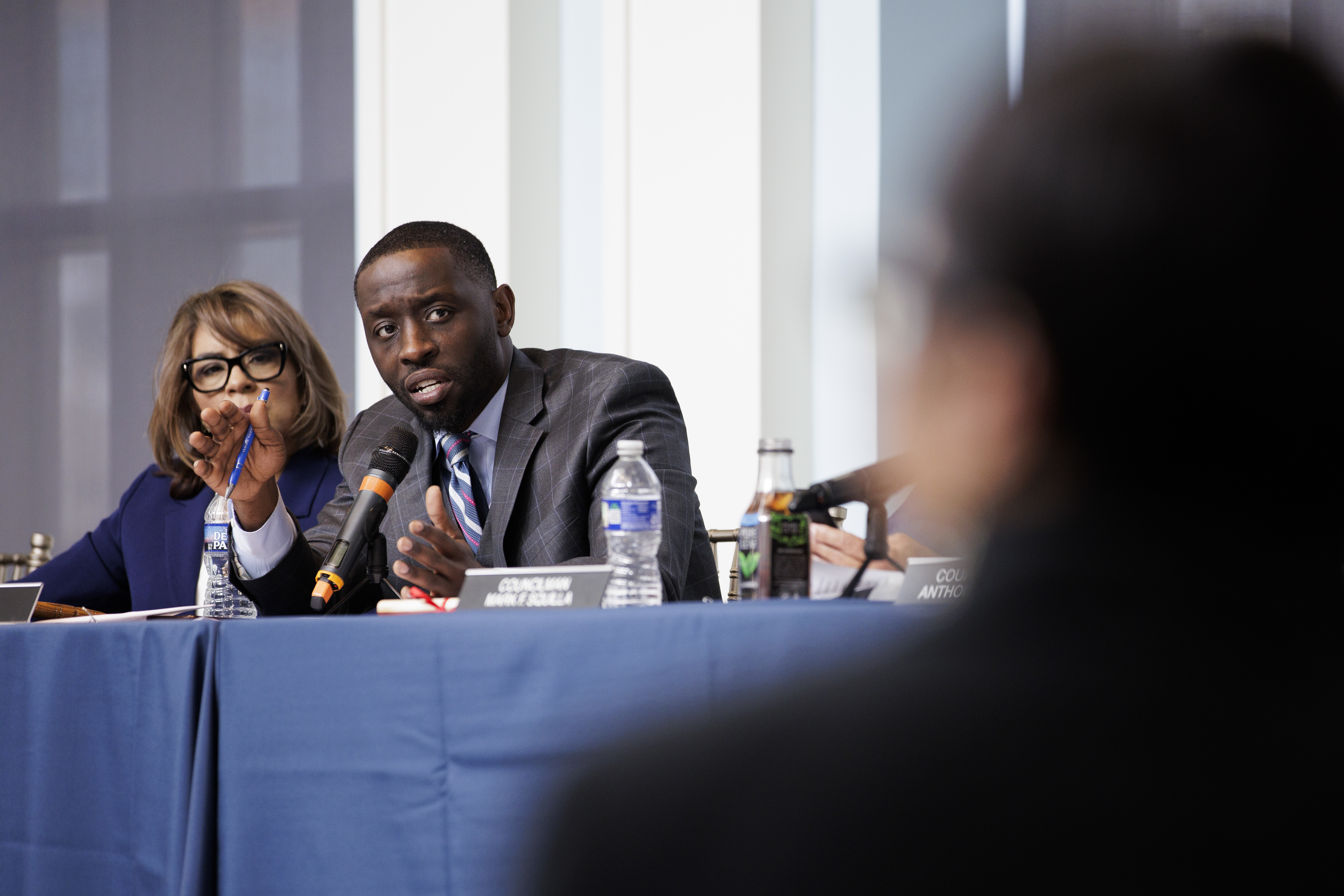
That distinction makes the rule change more likely to become reality, said Councilmember Isaiah Thomas, who sponsored the legislation even though voters rejected attempts to eliminate the rule in 2007 and 2014.
More than a year ago, Thomas proposed that the city try again to eliminate the rule entirely. But this week, he amended his proposal to apply only to those seeking state or federal office, calling that a compromise.
“I personally think that you should be able to run for mayor and keep your seat in City Council,” Thomas said. “But that’s not what the majority of people who I’ve talked to feel. And I don’t think that this should be about how I feel. It should be about what’s best for the city.”
A necessary measure or a barrier to entry?
Thomas, a Democrat in his second term who represents the city at-large, is one of several Council members rumored to have aspirations for higher office. But there is not currently an obvious seat for him or his colleagues to seek.
Thomas said he is not currently interested in serving in Washington — he has two young children — but said he has some “amazing colleagues” who may want to run for Congress in the future.
Councilmember Isaiah Thomas speaks during a City Council Committee on Legislative Oversight hearing held at the Museum of the American Revolution in April.
The resign-to-run rule has been codified in the Home Rule Charter since 1951 when the charter was established. Proponents have long said that public servants should not be influencing policy while campaigning for another office.
But others contend that the rule — which applies to Council members, row office holders, and members of the mayor’s administration — creates an unnecessary barrier for people who want to run for higher office but can’t financially withstand giving up their salary.
The rule also recently led to a handful of lawmaker vacancies. In 2022, six of City Council’s 17 members — including now-Mayor Cherelle L. Parker — resigned to run for mayor, at times making it complicated for the city’s legislative body to govern.
Ethics questions emerge
Multiple ethics officers said they oppose the change as it’s currently proposed. Jordana Greenwald, general counsel for the city’s Board of Ethics, said the board was not involved in drafting the rule change, and has a handful of “technical” concerns about its implementation.
“What we don’t want is for this to be passed and then it to become something where there are unintended problems or pitfalls for people who choose to take advantage,” Greenwald said.
Thomas said there is “plenty of time” to address the board’s concerns before passage. He is hopeful the legislation can be passed in time for a question to appear on the 2026 primary election ballot in May.
But Lauren Cristella, CEO of the good-government group Committee of Seventy, questioned the urgency and said Council should give the Board of Ethics time to do its “due diligence.”
While the Committee of Seventy has supported past attempts to repeal resign-to-run, Cristella said she does not understand the purpose of a carveout for members seeking state or federal office.
And she said any repeal should be paired with a three-term limit for Council members, who are currently not term limited.
“Philadelphians deserve comprehensive, not piecemeal, reform here,” she said.
Several Council members said they support Thomas’ legislation, pointing out that state and federal lawmakers do not need to resign from their jobs to seek higher office.
“It’s an issue of consistency across the board,” said Councilmember Cindy Bass, a Democrat who represents parts of North and Northwest Philadelphia. “It’s crazy when everyone’s doing something different.”
The Philadelphia Housing Authority (PHA) is planning sweeping layoffs that will affect almost 300 of the agency’s 1,200 employees, beginning in January 2026.
The cutbacks are the result of dramatic changes in how PHA, which provides affordable housing to thousands of families across the city, does maintenance and repair work. Instead of directly employing union electricians, carpenters, and other workers, beginning next year, the agency will contract out for those jobs as needed.
“This is a housing program, it is not a jobs program,” said Kelvin Jeremiah, the president and CEO of PHA, in an interview.
“Do I use the resources that we have to protect residents, to advance the availability of affordable housing to the families that are most in need? Or do I use those limited resources to fund positions that I don’t need?” Jeremiah said.
There are 620 members of the Philadelphia Building and Construction Trades Council employed full-time by the agency as maintenance staff. Jeremiah estimates that by almost halving that number PHA will see a cost savings of $24 million annually.
The agency said it currently costs $15,500 to maintain a single unit of traditional public housing annually, due to the agency’s complex work rules, which require many different union workers to make repairs. Most other multifamily providers have dramatically lower per-unit maintenance costs.
“PHA has engaged the unions throughout this process and can proceed with this policy decision without additional approvals,” an agency spokesperson said in an emailed statement.
Although in-house building trades workers will constitute the majority of lost jobs, other positions will also be affected, including 33 managerial roles in PHA headquarters. Overall, PHA’s workforce will shrink by about 20%.
“We are going to talk and try to offer some alternatives, but this is an issue of price sensitivity and we have to understand, given the new environment, that there are less funds to do the same mission with,” said Ryan Boyer, business manager for the Philadelphia Building and Construction Trades Council, whose unions represent many of the affected workers.
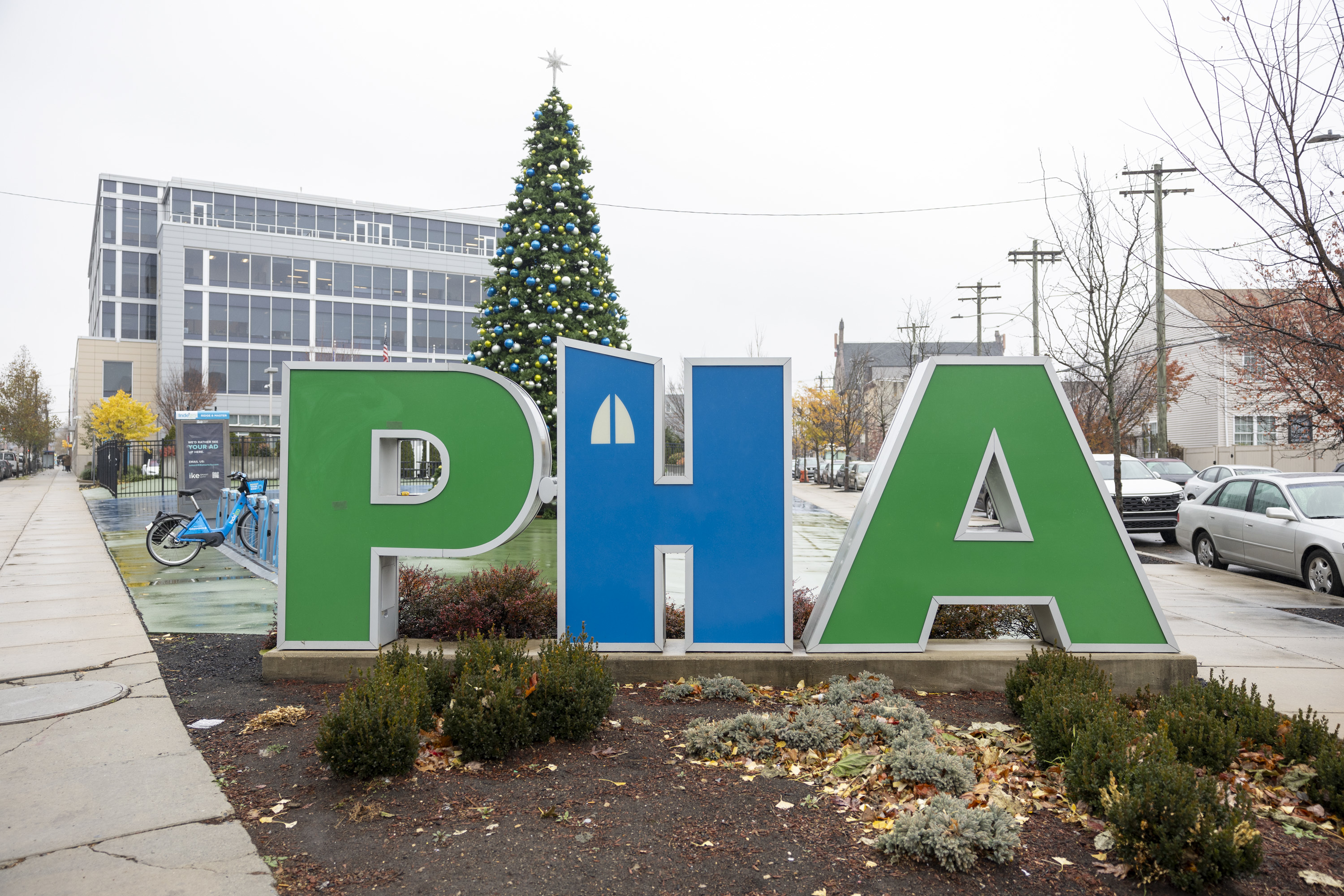
The Philadelphia Housing Authority Headquarters is planning sweeping layoffs that will affect almost 300 of the agency’s 1,200 employees, beginning in January 2026 in Philadelphia, on Wednesday, Nov. 19, 2025.
More with less?
The cutbacks come amid an aggressive $6.3 billion plan unveiled earlier this year, through which the agency hopes to expand its housing portfolio by 7,000 units while rehabbing the 13,000 units it already owns.
Jeremiah said that the staff reduction should not be seen as PHA doing more with less, and that it will not limit the agency’s ability to execute his planned expansion.
“We will not be doing less than what we’re doing now, but we have been doing too little with too much,” Jeremiah said. He said other market-rate and affordable housing multifamily operators are able to do unit repairs for far less than what PHA pays.
“My colleagues have all been doing this at substantially less cost,” Jeremiah said. “The only difference between us is that they have an operating model that does not require six different trades to do a single thing.”
Kelvin A. Jeremiah, PHA President & Chief Executive Officer, at PHA headquarters, in Philadelphia, May 21, 2025.
Because PHA’s layoffs will affect hundreds of members of Philadelphia’s influential building trades unions,Jeremiah said, he has been negotiating with Boyer on the work-rule changes.
“My reaction is one of disappointment. However, we remain partners with PHA and we will still build most of the stuff on the capital side,” Boyer said. “I don’t want it to be lost that when they build stuff, they will still be members of the Philadelphia building trades working, and there will still be members doing maintenance work.”
Jeremiah said maintenance technicians, laborers, and painters will be the only trades that remain directly employed with the agency after the work-rule changes go into effect.
The electricians union, IBEW Local 98, said it is still studying PHA’s new policy.
PHA will also still work with the trades for discrete repair and maintenance jobs within the agency’s housing portfolio but will no longer directly employ as many workers full-time, Jeremiah said.
The Trump effect?
PHA’s layoffs, and its expansion plan, are unfolding during a period of uncertaintynationwide for affordable housing policies and organizations like PHA.
Nearly all of PHA’s funding — 93% — comes from the federal government, according to the agency.
“If Congress and the administration coughs, it impacts us,” Jeremiah said. “If there is a reduction [in funding], it impacts us.”
Jeremiah said he is seeking to operate within the mandates set by Trump’s administration while continuing to support PHA’s tenant base and plans.
“Subsidizing employment … is just not the way to go at a time when we’re looking at less funding on the horizon,” Jeremiah said. “Where am I to get the funds not only to do more developments, acquire more, and preserve what we have at the same time[that] we have a workforce that is, quite frankly, I will dare to use the word bloated?”
Waves of layoffs
Despite the layoffs, Jeremiah believes the agency will still be a rich source of jobs for the building trades unions as the $6.3 billion plan unfolds. He points to an analysis of PHA’s 10-year plan byeconomic consulting firm Econsult Solutions, which said it would create 4,900 jobsannually in the city.
The first round of 260 job losses will hit in mid-January 2026, although Jeremiah says 93 of those workers will be retained in new positions as maintenance aides, laborers, and painters. A further 116-position reduction will occur next summer.
A vice president of development, Greg Hampson, also recently left PHA, although the agency declined to comment on that case. Jeremiah said that several vice president and director-level positions will be among the coming layoffs.
The last major round of layoffs at PHA was in 2016, when 14% of the staff was cut. Those positions were mostly administrative roles.
Editor’s note: A previous version of this story misstated the number of employees impacted.