Tag: Delaware County

  • Measles detected in two more counties in Pennsylvania as health department recommends early vaccination

    Measles detected in two more counties in Pennsylvania as health department recommends early vaccination

    Pennsylvania health officials have now detected measles cases in York and Northumberland Counties as cases in Lancaster County, the center of an ongoing outbreak, continued to rise.

    And the state health department is now recommending early measles vaccinations for infants beginning at 6 months in affected areas in an effort to protect them against the spread of the highly contagious disease, which is particularly risky for young children. The same precautions should be taken by families with infants traveling to these areas.

    Six Pennsylvania counties have now seen measles cases since an outbreak was first confirmed in Lebanon County in April. In all, the state has reported 81 measles cases across eight counties in 2026, more than five times the cases reported in 2025.

    (function() {
    var l2 = function() {
    new pym.Parent(‘HE_MEASLES.html’,
    ‘https://media.inquirer.com/storage/inquirer/projects/innovation/arcgis_iframe/HE_MEASLES.html’);
    };
    if (typeof(pym) === ‘undefined’) {
    var h = document.getElementsByTagName(‘head’)[0],
    s = document.createElement(‘script’);
    s.type = ‘text/javascript’;
    s.src = ‘https://pym.nprapps.org/pym.v1.min.js’;
    s.onload = l2;
    h.appendChild(s);
    } else {
    l2();
    }
    })();

    State health officials said it was too early to tell how the latest cases in York and Northumberland Counties are connected to others in the region, but that contact tracing investigations are continuing. All cases were among people who had not received at least two doses of the measles, mumps, and rubella (MMR) or whose vaccination status was unclear.

    As of Wednesday, six cases had been confirmed in Northumberland County, to the north of Dauphin County, and one case had been detected in York County, along Lancaster’s western border.

    Lebanon County has reported 20 cases and Dauphin and Berks Counties have reported two cases each.

    Lancaster County has seen 38 cases of measles since late April, with health officials confirming seven cases in the last two weeks. The area was at the center of a prior measles outbreak in January, when state health officials confirmed eight cases in Lancaster County and an additional four between Chester and Montgomery Counties.

    Vaccination rates among kindergarteners have decreased across Pennsylvania in recent years, and some counties affected in the current outbreak have particularly low rates, including Lancaster, where about 88.5% of kindergarten students are vaccinated. Health experts say that 95% of a community must be vaccinated to prevent the spread of the disease.
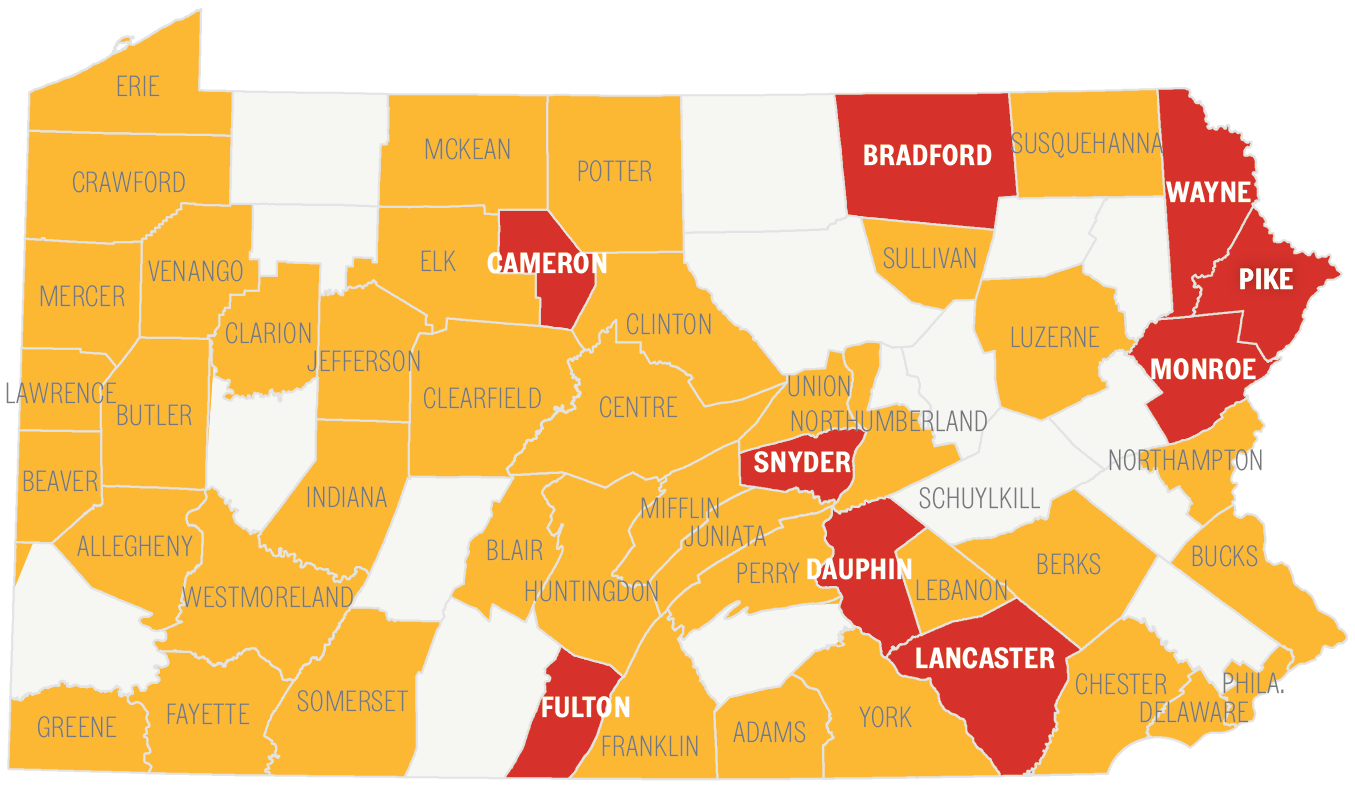
    A map showing vaccination rates in kindergarteners for the 2024-2025 school year. Counties in yellow have vaccination rates between 95% and 90%. Counties in red have vaccination rates below 90%. To halt the spread of measles, at least 95% of a community must be vaccinated against the disease.

    Health officials have been conducting contact tracing to detect as many cases as possible. In the current outbreak, they have twice warned Lancaster residents that they could have been exposed to measles.

    Shoppers and employees at a local Kohl’s were potentially exposed to the virus over four days after a staffer tested positive in late May, LancasterOnline reported. And a person with measles visited the Lancaster County Courthouse on June 3.

    But doctors in Lancaster County say they fear some measles cases are going unreported, either because patients don’t understand the importance of tracking measles cases or because they fear repercussions.

    No cases have been confirmed in the Philadelphia region during this outbreak. But Delaware County health officials said last week that they had detected measles in two wastewater samples, indicating that someone with measles had used a bathroom connected to the county’s public water supply. It was unclear if that person lived in the county or was passing through.

    Early vaccination recommended

    On Wednesday, a statewide health alert urged physicians to accelerate vaccination schedules to protect children against measles. Officials had said they were considering the measure earlier this month as cases continued to rise.

    Measles can infect nine in 10 unvaccinated people who are exposed to it, and can linger in the air for up to two hours and incubate in patients for three weeks. The disease typically presents with a fever and a rash but can cause brain inflammation and pneumonia in serious cases.

    Typically, children receive the first of two MMR vaccines at 1 year old, then a second between 4 and 6 years old.

    But children as young as 6 months can receive an additional “dose zero” to protect them from the disease amid an outbreak. In its alert, the state health department said parents should vaccinate infants between 6 and 11 months with the “dose zero” if they live in affected areas or if they’re planning to travel there.

    Those children should then receive additional MMR doses at 12 to 15 months and 4 to 6 years.

    This “dose zero” is less effective than doses given at 1 year old, officials cautioned. But it’s 58% effective against measles when given at 6 to 8 months, and 83% effective when administered at 9 to 11 months.

    “Early MMR vaccination is safe and provides modest protection when measles is spreading,” officials wrote in the alert.

    Children older than 12 months who haven’t been vaccinated should get an MMR dose immediately, and a second 28 days later, health officials said. Unvaccinated adults, or those without evidence of immunity, should also get two MMR doses.

    And anyone who has received one dose of the MMR vaccine in the past should get a second at least 28 days after their first, officials said.

    Usually, children who received a first dose at around 12 months wait to get their second dose until they’re 4 to 6 years old. But in an outbreak situation, those children should get their second doses early — at least 28 days after their first shot.

    Adults born before 1957 are typically considered immune, but healthcare workers in that age group who don’t have lab evidence of immunity or prior infection should consider getting vaccinated, state officials said.

    Adults who received an inactivated measles vaccine between 1963 and 1967 are considered unvaccinated during an outbreak, and should also get two doses of the current MMR vaccine.

    Pregnant people, people with severely weakened immune systems, and people who have a history of experiencing severe allergic reactions, like anaphylaxis, to a vaccine ingredient or to a previous dose of MMR cannot receive the vaccine.
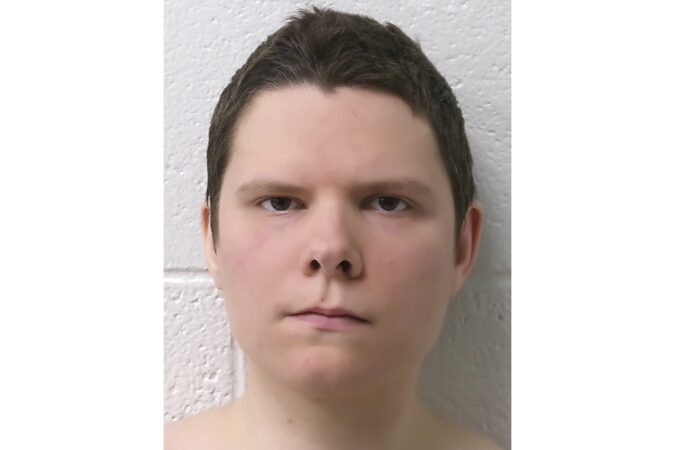

  • A former Delco woman tied to the Zizians extremist group has been charged with her parents’ killing

    A former Delco woman tied to the Zizians extremist group has been charged with her parents’ killing

    A former Delaware County woman tied to an extremist group known as the Zizians has been charged with killing her parents, execution-style, inside their Chester Heights home in December 2022.

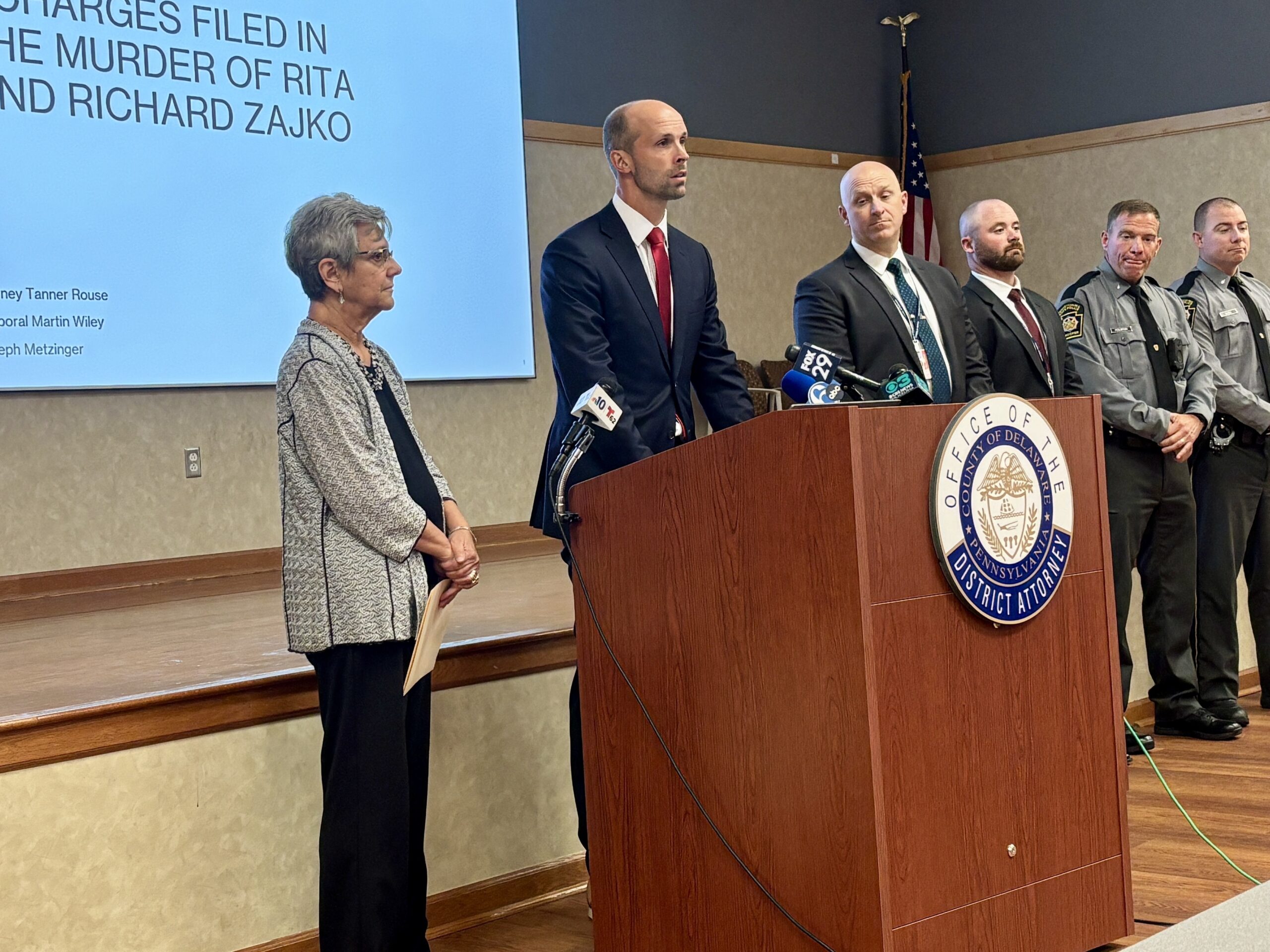
    Michelle Zajko, 33, has long been a person of interest in the slayings of her parents, Richard and Rita Zajko. After years of investigation, Delaware County District Attorney Tanner Rouse filed first-degree murder charges Wednesday and accused her of shooting the couple on her 30th birthday.

    New information obtained in the last few months, including ballistics evidence and an extensive download of text messages and other data from Zajko’s cell phone, allowed prosecutors to piece together the case against her, according to the affidavit of probable cause for her arrest.

    Rouse, in announcing the charges Wednesday, said he believes that while Zajko planned and carried out the killings, she likely did not act alone. The investigation is continuing, he said.

    Building the case against her, he said, took years of skilled and disciplined police work as investigators interviewed dozens of people and connected threads of information in several states.

    “I want to emphasize — I cannot stress this enough — this is just about as exhaustive of an investigation that I’ve been a part of in my 16 years as an attorney,” Rouse said. “We don’t have a smoking gun. It is piece after piece after piece of evidence that has been collected painstakingly over many years.”

    Investigators say Zajko, an alumna of Cardinal O’Hara High School and Cabrini University, drove to her childhood home on Highland Circle in Chester Heights with a plan to kill her parents. She shot them both in the head, leaving their bodies for police to find days later, after a concerned friend reported they had missed an appointment to care for Rita Zajko’s elderly mother.

    The motive for the killings remains unclear.

    Rita and Richard Zajko, seen here in a 1993 family portrait.

    Zajko told friends she had a difficult relationship with her mother, and accused her of years of emotional abuse. In online writings, Zajko said her mother criticized her constantly, arguing with her over religion and her desire to be vegan.

    That strained relationship was detailed in the final text messages Zajko sent her father days before authorities say she killed him, according to the affidavit.

    “Every time I interact with mom in a nonsuperficial way she spends the time insulting a life she knows nothing about, makes assumptions that imdoing nothing, etc,” Zajko wrote, the document said. “Its uncalled for. I don’t want to speak to someone who treats me like that.”

    But Rita Zajko, just nine hours before she was killed, attempted to reconcile with her daughter, sending her a happy birthday text and apologizing for whatever she had done to alienate her, according to the affidavit.

    On Wednesday, Rosanne Zajko, the wife of Richard Zajko’s brother, stood alongside the prosecutor as he announced the charges against her niece. Losing her brother- and sister-in-law, she said, was “like the lights going out of our lives.”

    “We don’t know yet if the trial will begin to heal the void in our lives and the ache in our hearts,” she said. “But we do know that the detectives, the DA’s office, and we, the family, have done everything possible to achieve justice for Rick and Rita.”

    Delaware County District Attorney Tanner Rouse announces murder charges Wednesday against Michelle Zajko. Zajko’s aunt, Rosanne (left) spoke briefly about the impact the killings has had on her family.

    Michelle Zajko, for her part, has said she had been unjustly accused.

    In a sprawling, handwritten letter sent to The Inquirer and other news outlets last year, Zajko insisted she did not kill her parents. Rosanne Zajko said Michelle Zajko told her at the couple’s funeral in January 2023 that she had not killed her parents, but said she knew who did. She would not name the killer, her aunt said.

    “I’m viscerally reminded of the witch hunts, of the Satanic Panic, of the mob that burned Joan of Arc at the stake, and of the mob that ripped apart Hippolyta,” Michelle Zajko said in the letter, written in a jail cell in Maryland, where she is awaiting trial on trespassing, gun, and drug charges. “The papers are lying. … I did not murder my parents.”

    Sources familiar with the investigation say it is possible that, as an only child, Zajko may have expected to inherit her parents’ substantial estate. The value of the estate has not been made public, but the sources, who spoke on the condition of anonymity to discuss an ongoing case, say it is worth several million dollars.

    A person close to Zajko said she had contacted an attorney in the weeks after her parents were killed to discuss how she could access her parents’ estate.

    Zajko remains in custody in western Maryland with two other members of the Zizians, including the cultlike group’s leader, Jack “Ziz” LaSota, who identifies as female.

    They were arrested in February 2025 while trying to illegally camp on a swath of private property in a secluded mountain town. Police said they were armed with multiple guns and carrying military tactical gear, as well as LSD.

    Zajko is also charged with illegally supplying the guns used by other members of the Zizians in a fatal shootout with a U.S. Border Patrol agent weeks before her arrest in Maryland.

    In her letter from jail, Zajko said she and her friends were innocent of all criminal charges they face. She said they were being targeted by other members of the Bay Area tech community seeking to discredit them.

    Members of the Zizians — a group whose philosophy encourages making decisions through reason and logic, rather than emotion — are connected to six killings across the country, authorities say. Prosecutors have denounced the group as extremists and accused them of using violence when their worldview is challenged.

    For years, the deaths of Richard and Rita Zajko remained the only ones tied to the Zizians that remained unsolved.

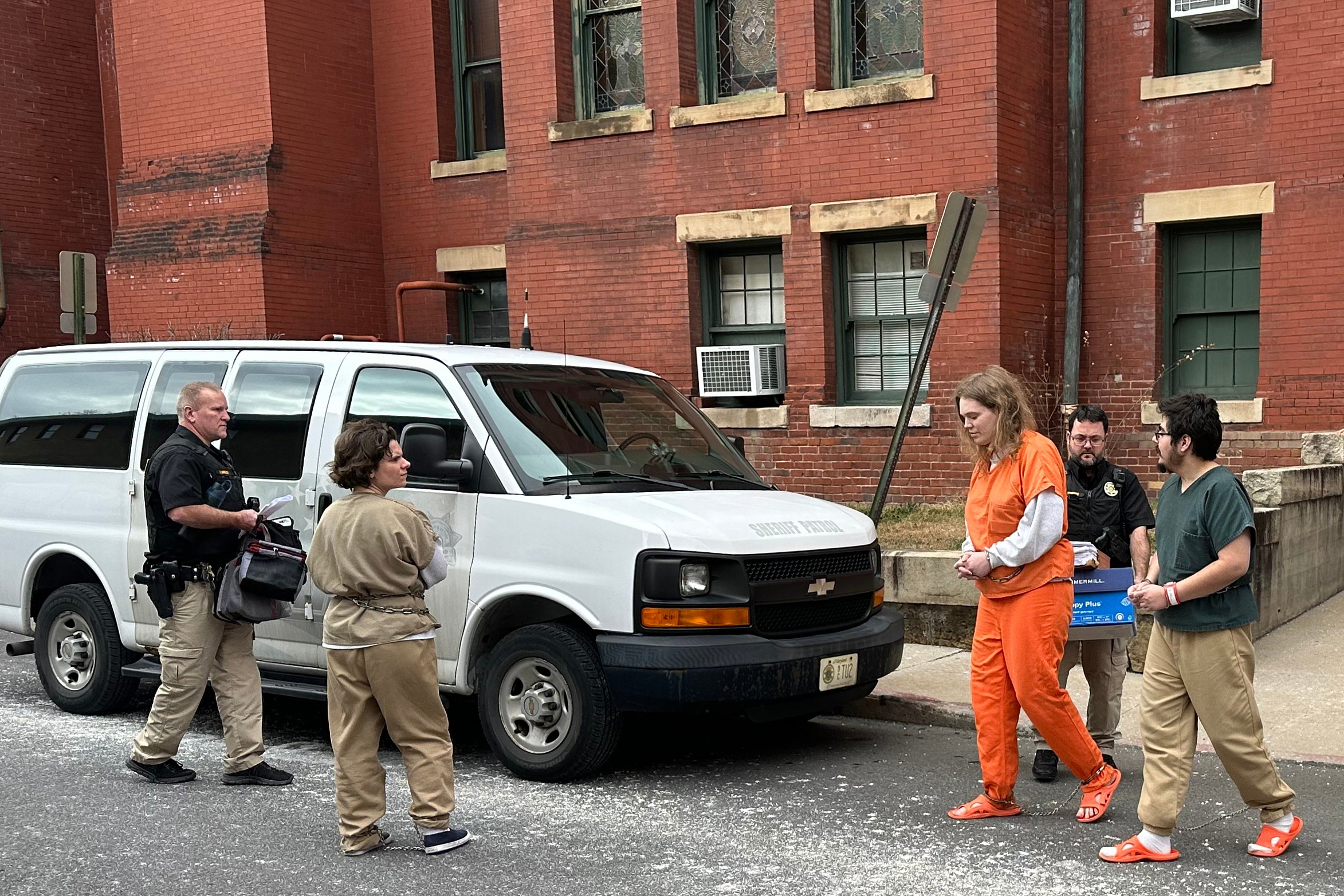
    Deputies escort Michelle Zajko, left, Daniel Blank, right, and Jack LaSota, in orange, from the Allegany County Courthouse in Cumberland, Md. in January.

    Almost immediately after the killings, investigators in Delaware County learned that Zajko had been at her parents’ home on the night they were shot — a neighbor’s Ring security camera recorded someone screaming “Mom!” shortly before police believe the fatal shots were fired.

    The couple were found in their daughter’s childhood bedroom, which had remained virtually unchanged since she had moved out of the house decades earlier, the affidavit said.

    The gun used to kill the couple was the same caliber as, and a similar model to, one Zajko had purchased in Vermont weeks earlier, investigators said. She was labeled a person of interest in the case as a consequence. But authorities said there was not enough evidence to prove she had committed the crime.

    That changed this week, prosecutors said.

    When investigators spoke with Zajko at her home in Vermont after her parents’ killings, she showed them a different type of ammunition from the kind found at the Chester Heights home, the affidavit said. However, while serving a subsequent search warrant there, detectives found cartridges that were an exact match — and that they said Zajko had hidden from them.

    Initially, forensic investigators said they were unable to determine if the shell casings found near Rita and Richard Zajko’s bodies had been fired from their daughter’s gun. But late last fall, other casings found near trees behind Michelle Zajko’s home in Vermont, which she had used for target practice, had been fired by the same gun that killed her parents, authorities said.

    Another crucial piece of evidence, investigators said, was a list found on Zajko’s cell phone titled “There are so many things we f— up” that detailed missteps, including not taking shell casings from the homicide scene, according to the affidavit.

    The murder charges mark an unexpected turn for Zajko, whom friends and loved ones described as an ambitious, accomplished young woman with a keen interest in science. In her early 20s, Zajko pursued a career in bioinformatics and conducted research at Children’s Hospital of Philadelphia with colleagues from the University of Pennsylvania.

    At the same time, Zajko became immersed in the Zizian movement through online message boards, and met some of the group’s members while interning with NASA in California.

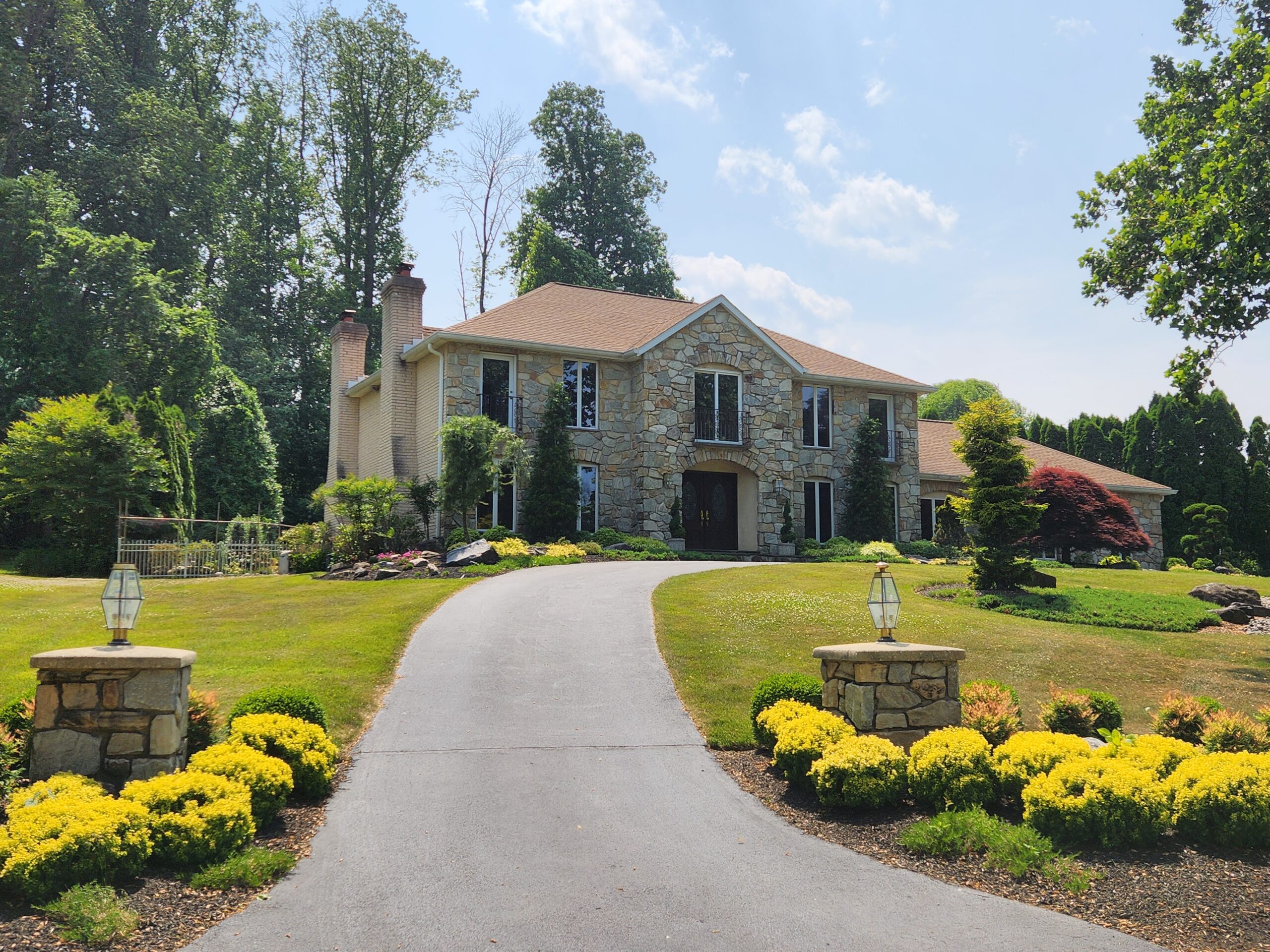
    The Chester Heights, Delaware County home where Richard and Rita Zajko were murdered on New Years Eve 2022.

    In 2021, partly in reaction to the COVID-19 pandemic, Zajko abandoned her scientific research and moved to rural Vermont, where she lived with other Zizians and grew close to LaSota, the group’s leader.

    Zajko, in her prison letter, said that she rejects the characterization of LaSota as her “leader” and that the group does not refer to themselves as Zizians. Instead, she said that she and LaSota are close friends, and that she loves LaSota “infinitely more than I could ever express.”

    Investigators now believe that Zajko, LaSota, and Daniel Blank, another Zizian, traveled to Chester Heights together on the day Zajko’s parents were killed, and intentionally left their cell phones in Vermont to prevent authorities from tracking their movements, according to the affidavit.

    The three made that trip a second time weeks later, in January 2023, so Zajko could attend her parents’ funeral in Marple Township. Pennsylvania State Police troopers investigating her parents’ killings briefly detained Zajko and Blank at a hotel where they were staying in Chester.

    LaSota, however, refused to answer the troopers’ questions, was charged with obstruction of justice, and remained in custody in Delaware County for months before being released on unsecured bail.

    LaSota did not show up for subsequent hearings, and a bench warrant for her arrest was still active when Maryland State Police took her into custody last year alongside Zajko and Blank.

    Their criminal trial on the trespassing, gun, and drug charges is scheduled to begin in October in Maryland.

    As Zajko awaits trial in both cases, Rouse, the prosecutor, said her crimes “go beyond comprehension and circumstance.”

    “This is a child who killed her parents, who walked into her childhood home, took her mother to her childhood playroom, and executed her,” Rouse said. “There aren’t words or emotions that can capture it.”

  • A Delco judge denied a motion to dismiss trespassing charges in Swarthmore protest case

    A Delco judge denied a motion to dismiss trespassing charges in Swarthmore protest case

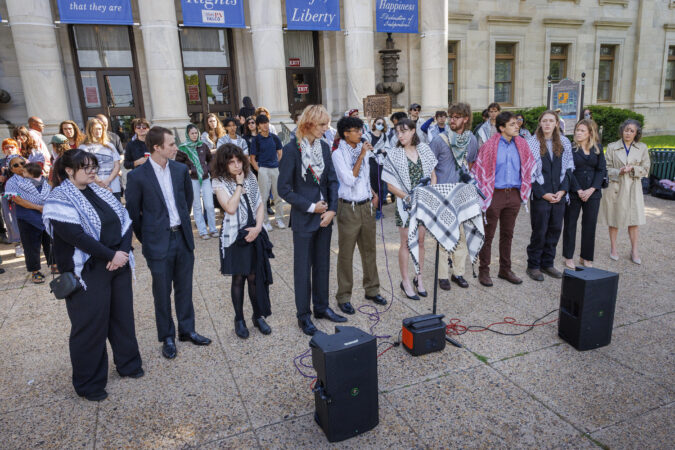
    A Delaware County judge on Monday denied a motion to dismiss criminal charges filed against nine people for refusing to leave a pro-Palestinian encampment on Swarthmore College’s campus last spring, setting the stage for a trial next week.

    Judge Dominic Pileggi ruled that prosecutors had presented sufficient evidence for the case to proceed to trial and allow a jury to decide whether the so-called Swarthmore 9 had trespassed.

    The group was arrested and briefly detained outside the college’s Trotter Hall in May 2025 when officers from surrounding police departments dismantled their encampment protesting the war in Gaza and Swarthmore’s IT contract with Cisco, a company that does business with the Israeli government.

    Of the nine people arrested, only one, Jace Boland, is a student at the college. Another, Brendan Cook, is a former student who was suspended for participating in an earlier protest in 2024, but the rest are not affiliated with Swarthmore, according to school officials.

    Members of the group — Boland, Cook, Jonathan Britt, Mara Helen Cahill, Daria C. Dressler, Thomas Falcone, Colin Buckley Malcarney, Riley J. McManus, and Andrew Thomas — have all been charged with trespassing, a third-degree misdemeanor.

    District Attorney Tanner Rouse has said his office offered each member of the group a plea deal that would see those charges reduced to summary offenses, similar to traffic citations, that could be resolved by paying a fine.

    The group has refused, saying pleading guilty would set a precedent on how colleges across the country could curtail students’ protest rights.

    During Monday’s hearing, the group’s attorney, Marni Jo Snyder, argued that Swarthmore and county prosecutors violated the protestors’ constitutional rights by arresting them.

    She noted that Swarthmore changed its policy allowing protests on its campus to explicitly outlaw encampments after a similar, monthlong demonstration in the same location in 2024.

    Policing a specific type of expressive speech, she said, is illegal.

    “The policy is wrong, the repeated orders to leave are wrong,” she said. “These are improper responses to constitutionally protected speech.”

    Snyder said that, though Swarthmore’s campus is private property, administrators have allowed previous demonstrations to be held there, as well as other quasi-private events. The arrests in this case, she said, showed that prosecutors were specifically targeting demonstrators protesting the war in Gaza.

    Samantha Door, who represented the district attorney’s office at the hearing, disputed that, saying the protestors’ conduct, and not the purpose of the encampment, was the reason criminal charges were filed.

    Swarthmore issued multiple warnings to the group to disperse over the course of three days, Door said, including one final warning 10 minutes before the encampment was dismantled.

    Other protestors who left the encampment and continued to chant and hold protest signs were not arrested, she said.

    Also, Door said administrators raised concerns about public safety, since many of the protestors wore masks and refused to identify themselves, vandalized campus property with graffiti, and used pallets and other materials to create barricades around the encampment.

    The trial in the case is scheduled to begin with jury selection on June 30.

  • 150 years, 2 world wars, 32 mayors, and 28 presidents later, a store still thrives in a bankrupt city

    150 years, 2 world wars, 32 mayors, and 28 presidents later, a store still thrives in a bankrupt city

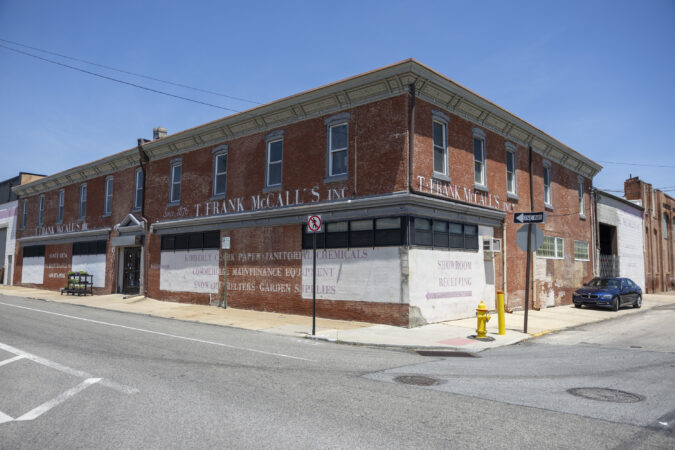
    Humans still answer the phones. The business is family-owned and run by women. But perhaps the most remarkable aspect of T. Frank McCall’s is the reality that the store is still there, next to the railroad tracks in the Delaware County riverfront city of Chester, where it has been since 1876.

    It has somehow survived through the administrations of 28 presidents, 32 governors, and 32 mayors; two world wars; the Great Depression; and the collapse of Chester’s economy that has climaxed with a rare municipal bankruptcy, By the time the Philadelphia Phillies played their first game in 1883, McCall’s had been in business for seven years at Sixth and Madison Streets.

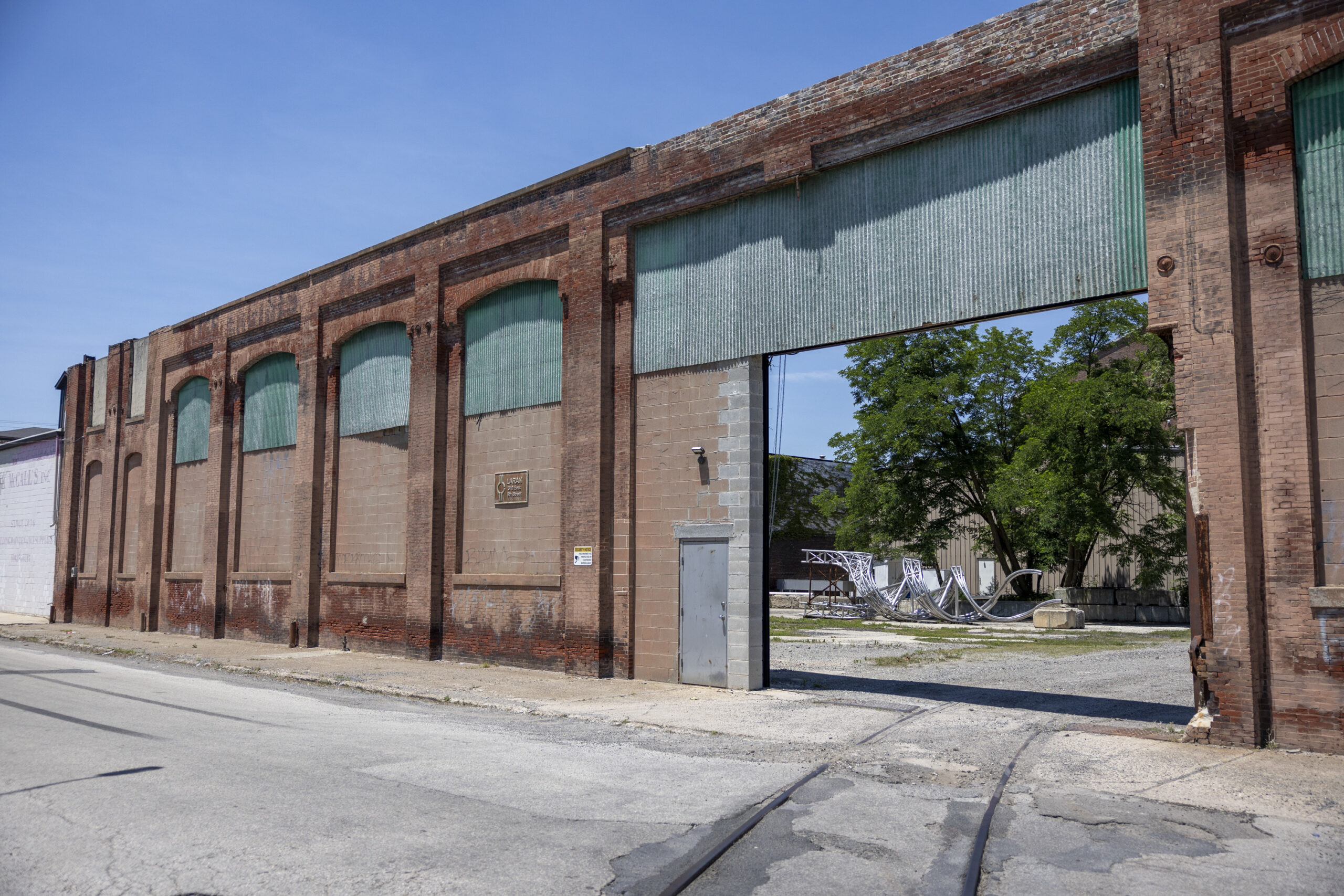
    The building has retained the faint odors of the company’s seed-and-grain roots. But these days the houses that had lined the streets are long gone. The nearest neighbor is a remnant of a factory that once was part of the city’s industrial might. The store’s owners are bemused by the unused bicycle lane on the other side of Madison Street, and the superfluous parking restrictions.

    The remnants of an abandoned factory building sit next to McCall’s.

    McCall’s sells janitorial and cleaning supplies, but rather than a traditional “jan/san” business, it is more like a hybrid wholesale general store. That its website features a snowfall image is fitting: It made a killing selling ice-melters this winter to SEPTA, Philadelphia, and other customers.

    The assortment evidently continues to work; McCall’s generates about $10 million in annual revenue, said owner Lisa Witomski, whose father bought the company from the family of the original owners in 1957 in a decade when businesses were pulling out of Chester.

    What explains the staying power?

    In part, Witomski said, McCall’s sells things people have to have. “Nobody really wants to buy janitorial supplies, but if you have customers or employees, you need them.”

    Staying in the one location in Chester, even though only a tiny percentage of the revenue comes from in-store sales, has been an asset, Witomski said. Customers know where to find them, and the company owns the 50,000-square-foot facility outright; the mortgage was paid off in 1880.

    The county estimates the property’s value at about $850,000, and the company contributes about $17,000 annually to the city and the Chester-Upland School District in property taxes. It also pays a 6% sales tax to the city, and the 16 employees pay earned-income levies. The size of the workforce has not changed much through the years.

    Most of the building’s space, which includes a former stable for the horses that delivered the company’s goods in the wayback when Chester was transforming from a rural outpost to an industrial power, is devoted to warehousing. About 95% of the company’s business is shipped on McCall’s trucks, Witomski said, and the location has outstanding road access, close to I-95 and the Blue Route.

    When customers call during business hours, “a human being always answers the phone,” she said. “People are shocked when you say, ‘Hello,’ and they’re waiting for ‘press 1.’”

    Being a family business that has resisted corporate takeover has given McCall’s an edge with customers, said Witomski, who recalled playing hide-and-seek among the store’s galvanized trash cans as a kid.

    “Unlike almost all our competition, we haven’t sold out.”

    The original McCalls

    George McCall started his feed-and-grain business in 1876, when Chester’s population was growing rapidly. He eventually turned over the keys to his son Thomas, who later passed on the business to his sons under the name T. Frank McCall.

    A breakthrough came in the 1880s when nearby Scott Paper — on the Chester riverfront, the company that is believed to have been the first to market toilet paper on a roll and disposable paper towels — hired McCall’s as its distributor. (The plant now bears the Kimberly-Clark name, but the Scott brand name survives.)

    Along with Scott products, through the years it would sell and distribute a wide variety of janitorial and other products while remaining in the seed-and-grain business.

    The McCalls would run the company for 80 years.

    McCall’s today

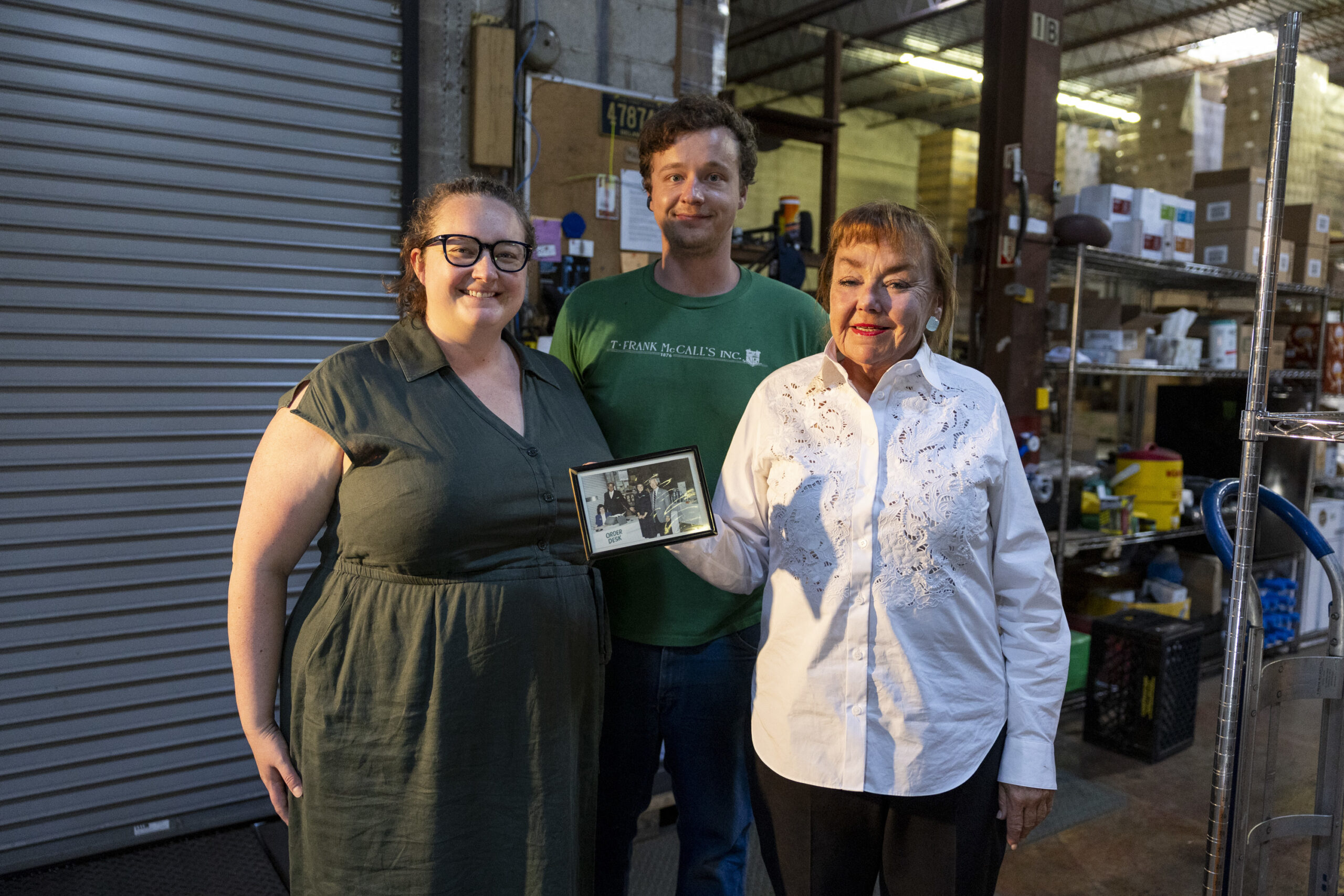
    Owner Lisa Witomski (right) with her niece Lisa Claire, McCall’s office manager, and nephew Chas Wiley, warehouse manager, inside the store.

    They sold the company in 1957 at a time when Chester was entering a postwar decline: In the 1950s, the number of apparel and general merchandise stores in the city fell from 68 to 19, according to Chester Planning Commission documents.

    Brothers Edward and Charles Witomski purchased the business on the advice of a member of the legendary Pew family, founders of the Sun Oil empire. The brothers had owned a bar in Essington and were looking for an enterprise that would be more family-friendly, Lisa Witomski said.

    Like the McCalls, they continued the tradition of selling and distributing a wide variety of products, including paints and even baby chicks at Easter time. Eventually the business was passed on to Charles Witomski’s daughters, Marcie and Lisa, the company president. Marcie Witomski’s daughter, Lisa Claire, is the office manager; Marcie’s son Chas Wiley manages the warehouse.

    In recent years their regular customers have included casinos throughout the region that have needs for paper and enzyme cleaning products. (Gamblers have been known to make a mess.)

    And ice melter has been a source of considerable cold cash — this winter in particular.

    “It was a doozy,” Claire said. It wasn’t just the 30 inches of snow, but the subsequent Arctic freezes that locked in the snow-and-ice coverage. The result was the sale of mass quantities of calcium chloride melter.

    On occasion, a motorist along Madison Street, which is part of Route 320, stopped in to buy some melter, Lisa Witomski said, but the store never was heavily trafficked even when the neighborhood was well-occupied in the 1950s and ’60s.

    Save for a few incidents — one person tried to walk off with a lawn mower, another tried to make off with a 100-pound barrel that he couldn’t carry — crime has not been an issue, Lisa Witomski said, even when the city went through a period a decade ago when it had the nation’s highest per capita homicide rate.

    “We are not exactly in a populated area,” she said.

    Cars parked in front of the store these days are anomalies. “We think the two-hour parking is very funny,” she said.

    Said Michelle Cubler, the purchasing manager, “We’ve never seen them actually ticket on this street.”

  • ‘Two Delco-heads,’ Matt Freese and Auston Trusty, helped the USMNT make World Cup history

    ‘Two Delco-heads,’ Matt Freese and Auston Trusty, helped the USMNT make World Cup history

    SEATTLE — At the final whistle of the U.S. men’s soccer team’s 2-0 win over Australia on Friday, Auston Trusty walked over to Matt Freese to offer a big hug.

    They didn’t know that a photographer from the Associated Press was standing nearby to capture the moment. But soon enough, everyone found out.

    Yes, Delco was very much mentioned on the world’s biggest stage.

    “He came over to me and said, ‘Two Delco-heads just had a shutout in the World Cup together. That’s fate,’” the Wayne-born Freese said after his shutout in net. “And I laughed and I said, ‘Yeah, who would have thought?’”

    Perhaps Jim Curtin, or other coaches across the Union ranks who worked with the duo over the years. But not too many people beyond Chester, or Wayne in those days, since that was YSC Academy’s first home.

    “It’s obviously such a cool thing to have known him for so long, and I knew him outside of the soccer world too,” Freese said of Trusty. “We were just friends. So it’s incredible.”

    That wasn’t the only karmic coincidence of the day. Trusty made his World Cup debut in front of not just his wife, daughter, in-laws and cousins, but also two of his first youth soccer coaches with the old Nether United club in Nether Providence, Delaware County: Tor Hotham and John Waraksa.

    Like so many people around American soccer, they circled this day in this soccer-mad city and decided they had to be there. The reward was beyond measure.

    “To have them fly here, not knowing if I’m going to play or not, to come here and be here for this game where I actually make my World Cup debut, it’s just all meant to be,” Trusty said.

    The Media native beamed with pride again when he reflected on finally reaching this moment at age 27, 11 years after going to an under-17 World Cup with Christian Pulisic, Tyler Adams, Alejandro Zendejas, and Haji Wright.

    “When you’re a little kid, dreaming about the stadiums you play in and the atmospheres and everything involved, to play in a home turf World Cup, get minutes, it’s a dream come true,” Trusty said.

    Freese had his family in attendance too, plus his girlfriend’s family, and old friends from high school at Episcopal Academy. He shouted out one of the closest, Michael Hinkley, a soccer teammate back then who went on to play basketball at Dickinson.

    Matt Freese (left) clearing the ball in front ofAustralia’s Mo Touré during the first half.

    “Obviously incredible support,” Freese said. “It means a lot to play in front of them, and play in front of everyone in this country.”

    That support fueled the U.S. team all day, with the stands full and roaring well before kickoff. Trusty said the atmosphere “gives you chills,” especially when the crowd sang The Star-Spangled Banner over the orchestral rendition on the speakers.

    “The atmosphere is one of those things you dream of,” Freese said. “I’ve heard ‘the 12th man’ is what they call the crowd here. It was definitely a 12th man for us — I think it was a 12th, 13th, 14th, 15th man for us today.”

    But things were getting dicey when Trusty and Joe Scally entered the game in the 80th minute as defensive reinforcements. Australia was gaining momentum even though it hadn’t scored, and an already physical game was getting even more fractious.

    Auston Trusty (left) tussling with Australia’s Cristian Volpato.

    It got especially chippy in the last few minutes, but those two and the rest of the Americans kept their heads and finished the job. They did so at both ends, ensuring Australia didn’t score while also keeping a foot on the gas pedal in attack.

    “Just keep the pressure up,” Trusty said. “They weren’t really pressing too much, they kind of had like a halfway-block [formation], and obviously in a back five [defensively], they want pressure on them. So just continue the press that we had and the movement we had, and really just keep momentum.”

    Mission accomplished on all counts. Not only did the U.S. men qualify for the knockout rounds before the group stage finale against Turkey, but the program has two wins in one World Cup group stage for the first time since the inaugural tournament in 1930. And thanks to Turkey’s loss at the end of the night, the U.S. clinched first place with a game to spare.

    “We came into the tournament wanting to make a statement,” Freese said. “The first part of that’s done, but, you know, there’s a lot more statements we want to make.”

  • MaryJane Hackney, longtime first grade teacher and diehard Phillies fan, has died at 80

    MaryJane Hackney, longtime first grade teacher and diehard Phillies fan, has died at 80

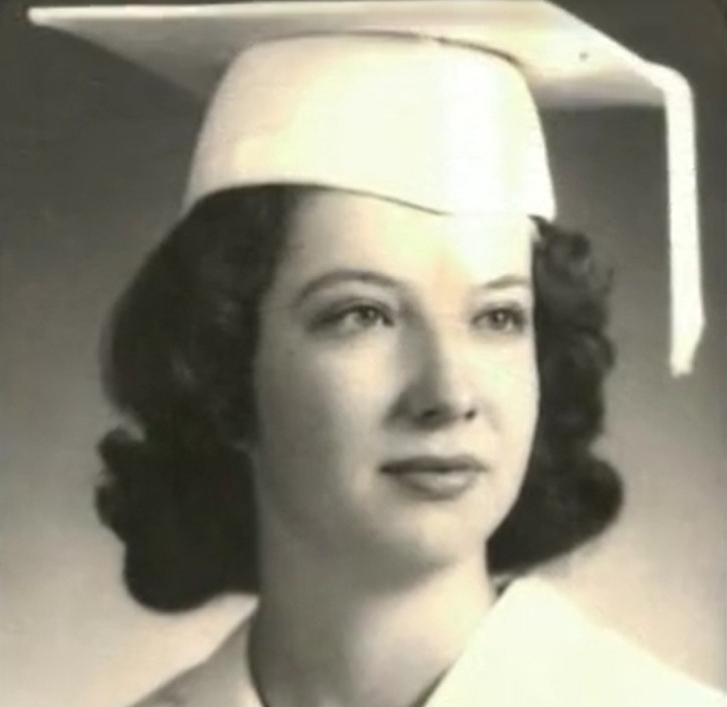
    MaryJane Hackney, 80, of Gloucester Township, longtime first grade teacher at Loring-Flemming Elementary School, singer, theater devotee, and diehard Phillies fan, died Sunday, May 3, of Alzheimer’s disease at the Residence at Voorhees Senior Living Center.

    Inspired by her own favorite grade school teacher, Mrs. Hackney knew early in life that she wanted to be a teacher, too. She earned a bachelor’s degree in education, taught elementary school students in Pennsylvania for a few years, and spent nearly three decades, from 1981 to her retirement in 2010, working with thousands of first graders at Loring-Flemming in Gloucester Township.

    “She loved the energy first graders have,” said her husband and caregiver, David. “She taught fourth, fifth, and sixth grades at first. But after going to first grade, she said she would never go back.”

    Mrs. Hackney was so influential at school and at Loring-Flemming for so long that she taught children of her former students. Until a few years ago, she was routinely greeted around town by 40-year-olds who said: “Do you remember me?” Often, she did.

    “MaryJane was a force to be reckoned with,” a former colleague said in an online tribute. “When I arrived at Loring-Flemming with only one year of teaching experience, she took me under her wing and taught me so many important lessons about life and education.”

    Mrs. Hackney especially enjoyed teaching her students to read, and she told her husband that “one of her greatest joys was seeing the excitement of young children when they realized they could read.” The father of one of her former students told David Hackney recently that his son became an avid reader — and the father had to buy many books — thanks to Mrs. Hackney’s tutelage.

    “She was a constant source of good books and brought all of her best reads for us to share,” a former teaching colleague said in a tribute. “Everyone drifted to her classroom for support, information, or just to have a good laugh.”

    Affable, innovative, and energetic, Mrs. Hackney participated in projects for the local and state education associations, and raised funds to buy new school equipment. She was a champion of new early education programs and a popular guest on the local Emmy Award-winning public TV program “Classroom Close-up, NJ.”

    Mrs. Hackney stands with her Grade 1 students at Loring-Flemming during the 1962-63 school year.

    She was funny and witty, a former colleague said, “and her ability to know what was going on in our school, district, county, and state was incredible.” Before Loring-Flemming, Mrs. Hackney taught for a few years at a Lutheran elementary school in Delaware County and Ralph Waldo Emerson Elementary School in Bucks County.

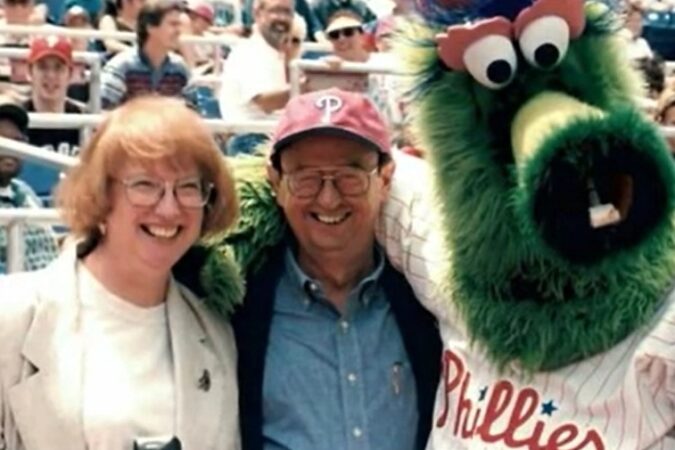
    Outside the classroom, Mrs. Hackney enjoyed singing, the theater, and the Phillies. She sang alto in choirs in high school and college, and attended nearly every performance of the Arden Theatre Co. in Philadelphia from 1996 until recently. Her husband worked several jobs over the years, and her absolute favorite, he said, was the one that had company tickets to Phillies games.

    “She even met the players,” he said.

    MaryJane Pierce was born June 22, 1945, in Abington. She grew up in Croydon, was so smart that she skipped third grade, and graduated from Delhaas High School in 1962.

    Mrs. Hackney studied education and American history in college.

    She studied education and American history at what is now Concordia University Chicago in Illinois, and later enjoyed traveling to historic sites with her husband. She knew David Hackney from high school, and they got serious during a double date to celebrate her 21st birthday in 1966.

    Eight weeks later, they got engaged. They married in 1967 during the famous Glassboro Summit Conference, had a daughter, Jennifer, and lived in Drexel Hill and Havertown before moving to Gloucester Township in 1974.

    Mrs. Hackney liked histories and mysteries, and was longtime friends with local author Lisa Scottoline. She knew the words to Elvis Presley songs, doted on her daughter and grandson, Joshua, and visited relatives in Ireland several times after retiring.

    She moved to the Residence at Voorhees a year ago. “I will forever remember her lessons, her delicious brownies, and helping hand that was used not just for her students but for the entire faculty and staff,” a former colleague said.

    Mrs. Hackney smiles with her daughter, Jennifer.

    Her husband said: “She was fascinated by people, curious about people. And if you started talking about teaching, she could go on for hours.”

    In addition to her husband, daughter, and grandson, Mrs. Hackney is survived by a sister, Deborah, and other relatives.

    Services were held earlier.

    Donations in her name may be made to the Alzheimer’s Association, 399 Market St., No. 250, Philadelphia, Pa. 19106.

    Mrs. Hackney doted on her grandson, Joshua.
  • There’s now a ‘Club America’ at Great Valley High School. Turning Point USA says interest grew after Charlie Kirk’s assassination.

    Making his pitch to the Great Valley school board, Jed Lu said he and fellow students seeking to bring slain conservative activist Charlie Kirk’s Turning Point USA organization into their high school weren’t racists or extremists.

    “We simply have a different perspective,” Lu told the board at a late February meeting.

    The Chester County district is one of the latest in the Philadelphia area to approve a Club America chapter — the high school offshoot of Kirk’s group. The organization seeks to mobilize “anti-woke warriors” and has rapidly been adding new local chapters since his assassination in September, provoking debate around right-wing influence in public schools.

    Nationally, chapters have nearly tripled — from 1,200 prior to Kirk’s death, to more than 3,300, according to Turning Point officials. Governors in Republican-led states like Arkansas and Nebraska are partnering with Turning Point to expand clubs throughout their states.

    In eastern Pennsylvania, there were 11 Club America chapters at the end of last school year. Now, “we’re currently approaching 40,” said Nick Cocca, Turning Point’s enterprise director.

    The group’s expansion might be overstated in the Philadelphia region. Seven area high schools listed by Turning Point on its website or Instagram graphics as having Club America chapters said they didn’t have clubs.

    Souderton Area High School, for instance, appears on Turning Point’s map, but doesn’t have a club. The school’s assistant principal, Matthew Haines, said “a student made an inquiry” in September about starting a chapter, but never applied to do so.

    In some schools, like Springfield High School in Delaware County, “we have a few students who started running an after-school student pilot a few months back,” said principal Monica Conlin, but the district doesn’t officially recognize the club. Conlin said new clubs must complete a three-year pilot before gaining district approval.

    Still, the organization has gained traction. In addition to Great Valley, Penncrest High School in Rose Tree Media School District lists Club America among its student clubs; district officials and staff didn’t respond to requests for comment.

    Turning Point says it also has a Club America chapter at Pennsbury High School, and an Instagram account for “Club America at Pennsbury” invited students to a Feb. 25 meeting to discuss the State of the Union and “participate in prayer for law enforcement and our nation.” District officials didn’t respond to requests for comment.

    ‘An outpouring of support’ after Kirk’s death

    A spokesperson for Turning Point couldn’t explain the discrepancy between its list and schools that say they don’t have any Club America chapters.

    The organization was also unable to provide a local student willing to be interviewed.

    Cocca said Turning Point “saw an outpouring of support and outreach from young people across the country” in the wake of Kirk’s Sept. 10 assassination. To support its growth, the organization is hiring more field representatives to work with high school students, Cocca said.

    People hold posters of Charlie Kirk during a Turning Point USA rally at Utah State University, as a part of the organization’s push to memorialize Kirk in Logan, Utah, in September.

    Turning Point, which began as an organization advocating for conservative views on college campuses, had previously been expanding its presence in high schools. (A Turning Point chapter launched years ago at Pennridge High School in Upper Bucks County, for example.)

    Turning Point last July renamed its high school operation Club America. “We wanted a brand that spoke specifically to them,” Cocca said. He said that “when Charlie was alive, he used to say ‘I want a Club America chapter in every high school in America.’”

    The expansion has spurred conflict. Critics have highlighted Kirk’s controversial statements, including referring to the Rev. Dr. Martin Luther King, Jr. as “an awful person” and calling the passage of the 1964 Civil Rights Act a “mistake.”

    Kirk also promoted the so-called “great replacement theory,” framing non-white immigration as a plot to replace white populations.

    “This club is an easy way to incorporate hate and discrimination within our high school. This should not be normalized,” a Change.org petition launched in January against a proposed Club America chapter at West Chester East High School read. An update to the petition later declared that Turning Point “was shut down at West Chester East.”

    Molly Schwemler, a district spokesperson, said that earlier this year, some students expressed interest in starting a Club America chapter.

    But “after discussing the process and need for sponsorship from a teacher with school administration,” students “instead decided to organize independently outside of the school,” Schwemler said. (On its website, Turning Point lists West Chester East as having a chapter.)

    In an Instagram post, the club said it decided to operate independently “because people can’t be mature, open minded or respectful at our school.”

    Activism hubs and kits

    In addition to identifying a teacher adviser, students looking to form clubs often have to supply information to administrators like their purpose, planned activities, and funding needs.

    Schools have little discretion to reject a new club, based on the federal Equal Access Act and First Amendment, said Jeffrey Sultanik, a solicitor for numerous Philadelphia-area districts.

    Districts need “to be viewpoint-neutral,” Sultanik said, noting that “once you open up the door to clubs coming in,” administrators can’t pick and choose which to permit.

    In its handbook for Club America chapters, Turning Point calls it “imperative that every chapter works to become officially recognized by the school,” offering students help if schools deny them.

    Students can form an “activism hub” outside of school for a specific geographic area “as a last resort,” the handbook says.

    In Downingtown — where Turning Point says there is an activism hub — a school district spokesperson said the district has not sponsored any clubs “related to religious or political groups in recent history.” (Some other area schools have official political clubs: Penncrest High School, for instance, lists Penncrest Democrats of America.)

    Turning Point says its Club America chapters are nonpartisan and don’t support specific candidates.

    But the group’s ideology is clear from materials it supplies to student members. Presentations available in Turning Point’s “Activism Library” for students to use have titles including “Taxes Are Shady,” “Socialism Kinda Sus,” and “Big Gov Scares.”

    “Why are those on the left not proud to be Americans?” a presentation titled “Always Love America” asks.

    Kids can order “Activism Kits” from Turning Point with posters and stickers. A “2A” kit features slogans like “Gun rights are women’s rights” and “Guns are the greatest equalizer.”

    Cocca said Turning Point provides students “anything they may need, to promote what they want to promote, and what they want to make their club about” — whether that’s registering students to vote, or learning about the Constitution, he said.

    “Ultimately, it’s up to the students to use those resources the way they want to use them,” he said.

    Opposition to Club America groups

    Critics accuse Turning Point of trying to indoctrinate high schoolers.

    “They are grooming at the high school level, and college level, for a generational change,” said Sherry Lawrence, a parent in Great Valley who opposed the district’s new Club America chapter. “All the red flags are there for people who don’t subscribe to this brand of conservatism, or this brand of Christianity.”

    Lawrence questioned whether adults were driving some efforts to organize Club America chapters.

    In an October Facebook post in a Turning Point Pennsylvania Action group, George Sabo, then a GOP candidate for township supervisor in East Whiteland, said his daughter was starting a chapter at Great Valley High School. “We had discussed it over the summer but pulled the trigger after Charlie’s assassination,” Sabo wrote.

    In a brief phone interview, Sabo said it was his daughter’s idea to start the chapter.

    “My daughter and family, who believe in the Bible, and believe God is king, value those properties and want to see that brought more into the school district,” Sabo said.

    He said that while there had been pushback from other kids, “there’s some support from other kids, too.”

    Great Valley school board members during a meeting at Great Valley High School in Malvern in 2024.

    The Great Valley board approved the club 7-0 at its February meeting.

    At the board meeting, Lu, the club president, said he and the three other club officers had initiated its formation.

    While the club has a “conservative viewpoint,” Lu said, “our purpose is civic debate and civil discussion.” He added that the club is motivated by “the Christian value of love and compassion.”

    The club hopes to be an “impactful addition to Great Valley High School,” Lu said.

  • Delco is one of only five counties in the Mid-Atlantic where the typical home is affordable for the typical buyer

    Delco is one of only five counties in the Mid-Atlantic where the typical home is affordable for the typical buyer

    If you made the typical income in your community, could you afford to buy the typical home for sale there?

    Across the Mid-Atlantic, “the answer is a resounding no in most places,” said Lisa Sturtevant, chief economist at the multiple listing service Bright MLS.

    But in a region where buying a home can be challenging, Delaware County stands out.

    It was the only county in the Philadelphia region where a household making the median income could afford to buy a median-priced home for sale at the end of last year, according to an analysis by Bright MLS. In Delaware County, the median asking price of homes in the last quarter of 2025 was $289,450, and the median household income was about $89,500.

    Bright MLS calculated affordability based on a homebuyer’s ability to qualify to purchase a median-priced home, assuming a 10% down payment with the average interest rate for a 30-year, fixed-rate mortgage and average payments for property taxes and insurance.

    Of the roughly 90 counties in the company’s service area across Pennsylvania, New Jersey, Delaware, Maryland, Virginia, West Virginia, and the nation’s capital, Delaware County was one of only five counties where the median-priced home was affordable for a household making the median income in the last quarter of 2025. The city of Baltimore also made the affordable list.

    Sturtevant said everyone knows housing affordability is a challenge, but “when you see the data so starkly like this, it really brings the point home.”

    window.addEventListener(“message”,function(a){if(void 0!==a.data[“datawrapper-height”]){var e=document.querySelectorAll(“iframe”);for(var t in a.data[“datawrapper-height”])for(var r,i=0;r=e[i];i++)if(r.contentWindow===a.source){var d=a.data[“datawrapper-height”][t]+”px”;r.style.height=d}}});

    Across the Mid-Atlantic, median home prices are up 35% since 2020. The five counties that are most affordable are generally places with lower costs of living where the housing stock is older, she said.

    Michael Maerten, a real estate agent on the board of directors for Tri-County Suburban Realtors, which represents members in Chester, Delaware, and Montgomery Counties, said Delaware County’s dense housing and smaller homes also help keep costs down.

    He’s seen homebuyers in Chester and Montgomery Counties have a harder time affording homes. He said he’s working with a homebuyer who was originally focused on the area around Abington Township in Montgomery County and is now looking in the Haverford Township area of Delaware County where they can get what they want with the money they have.

    In addition to affordability, homebuyers are choosing Delaware County because of the culture, pride, and family ties, said Maerten, an agent with Keller Williams Real Estate based in Blue Bell.

    “The running joke about Delaware County is people don’t leave,” he said.

    But Delaware County’s spot on Bright MLS’ affordable list doesn’t mean households aren’t struggling to afford homes. It’s still challenging for many people, Sturtevant said.

    First-time homebuyers in particular have it rough. Bright MLS found that across the about 90 counties it tracks, renters are effectively priced out of becoming homeowners. There is no county where a renter who makes the median income could afford to buy a starter home.

    “That’s crazy to me,” Sturtevant said.

    window.addEventListener(“message”,function(a){if(void 0!==a.data[“datawrapper-height”]){var e=document.querySelectorAll(“iframe”);for(var t in a.data[“datawrapper-height”])for(var r,i=0;r=e[i];i++)if(r.contentWindow===a.source){var d=a.data[“datawrapper-height”][t]+”px”;r.style.height=d}}});

    Bright MLS defines starter homes as those priced at the 35th percentile, meaning 35% of homes are priced below that level and 65% are priced above.

    Sturtevant said high construction costs have made building starter homes more difficult. At the same time, homeowners are holding onto smaller, more affordable homes instead of selling for a larger home because of elevated mortgage interest rates and uncertainty in the economy. So first-time buyers have fewer options and more competition.

    Still, Maerten said a “good percentage” of his buyers are purchasing for the first time.

    “They’re going through their struggles of making offers and competing in the suburbs,” he said.

    Maerten said that in his experience, homebuyers know exactly where they want to purchase and are more likely to save money until they can buy where they want rather than buying in an area just because it’s more affordable.

    First-time buyers often don’t know about the resources that are available to help them become homeowners, he said. Those include down payment assistance and programs that can lower up-front costs and mortgage rates.

    Real estate agents and housing counselors can work with aspiring homeowners to get them ready to purchase.

  • Original mid-century features and colorful vintage design in Delco

    Original mid-century features and colorful vintage design in Delco

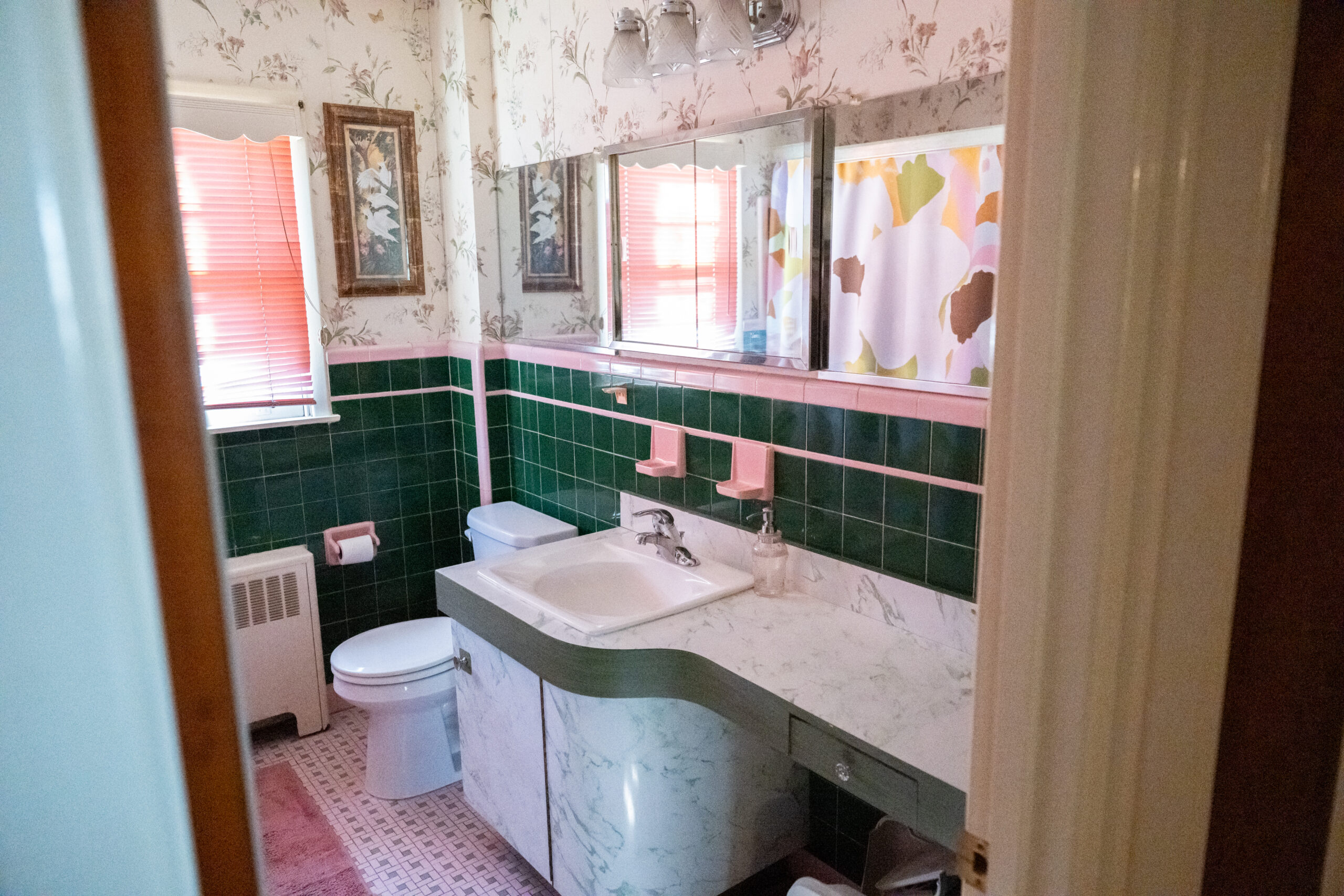
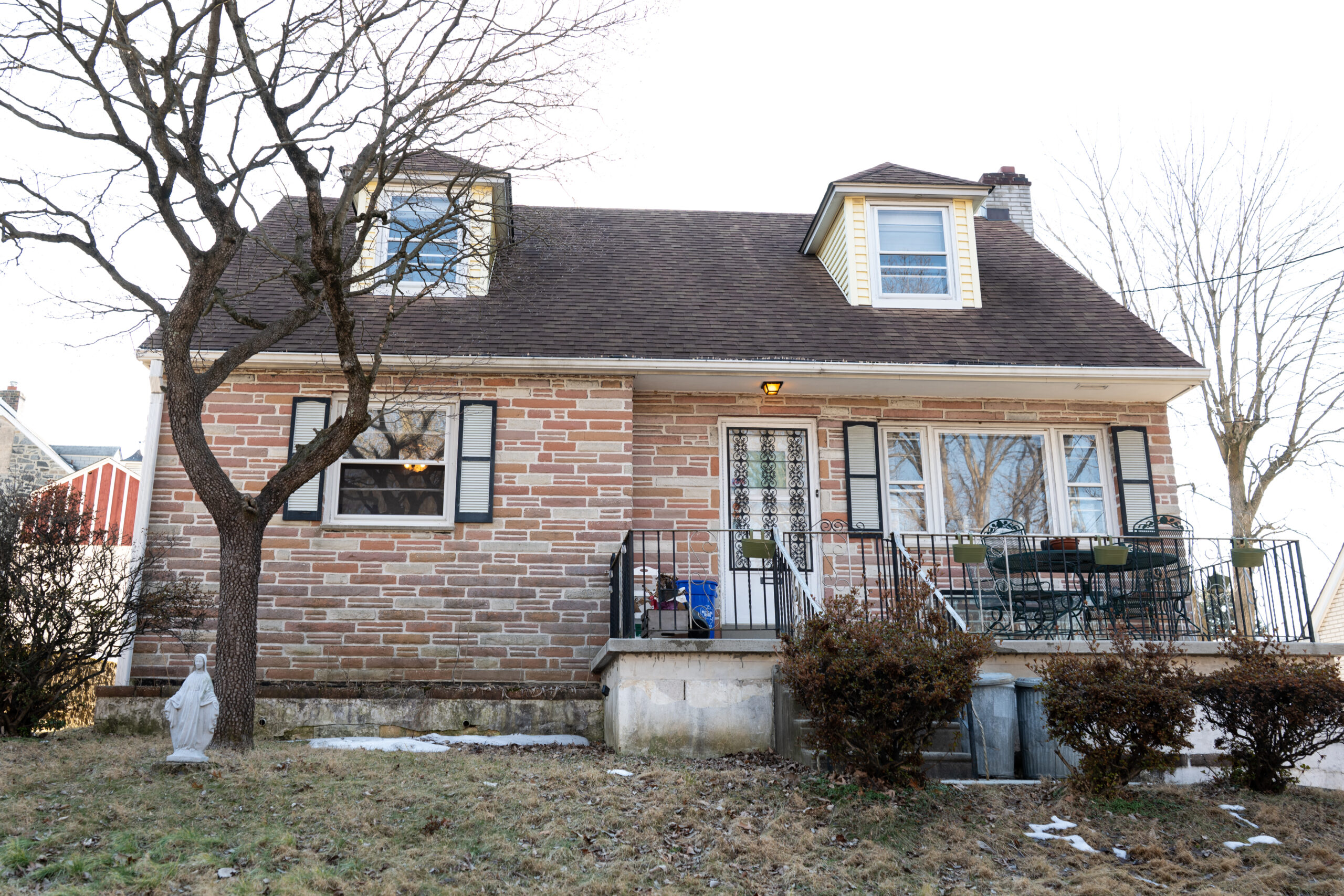
    It may have been the pink and green bathroom that sold Genevieve DeChellis on the mid-century, 1,450-square-foot, five-bedroom brick house in Clifton Heights in early 2024. Or perhaps the colorful lighting above the basement bar sealed the deal.

    She and her fiancé, Jesse Blankschen, had been on the hunt for a house for a while, but nothing felt quite right.

    “We didn’t fully know what we wanted, but we knew what we didn’t want,” DeChellis recalled. “No millennial gray, or millennial beige, or a house without any sign of life.”

    When they spotted the Zillow listing for this home, they instantly knew it was the one. The house not only was filled with color, but it had only been lived in by just one owner who had built the house for his family. It was evident he took great care of the house.

    “The fact that I have a pink and green bathroom feels like a cosmic design,” DeChellis said. “There is so much beautiful tile work in homes and so often it just gets torn out. It’s so happy and I love those two colors together.”

    The pink and green tiled bathroom was one of the features that drew DeChellis to the house.
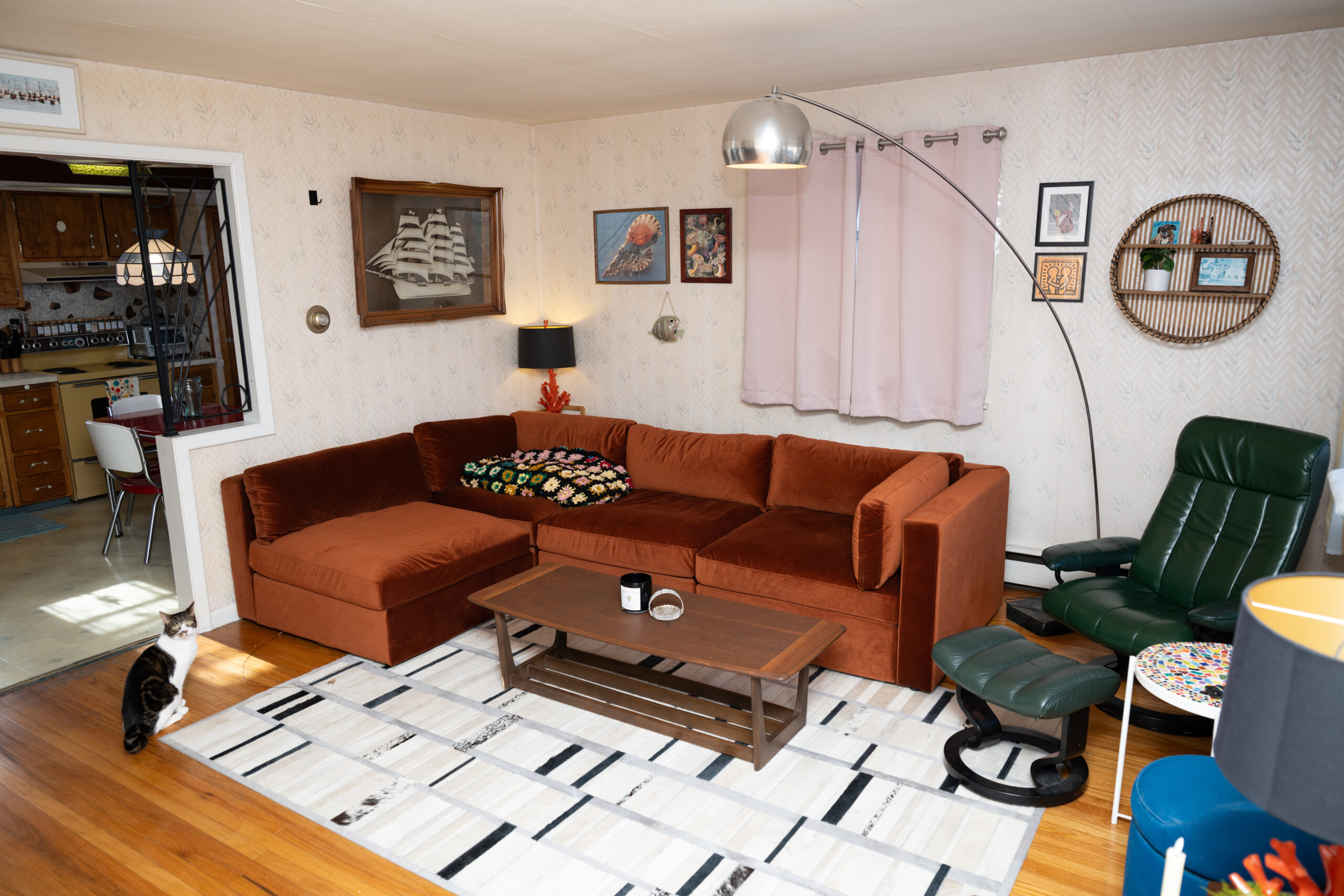
    The living room’s orange velvet sectional draws the eye, surrounded by secondhand, vintage, and mid-century decor.

    The couple is putting their own personal stamp on the house through aesthetic changes. They’ve been replacing the original wallpaper with fresh paint and thrifting unique items to fill meaningful spaces.

    At the same time, they are preserving the integrity of the home — “those pink and green tiles aren’t going anywhere,” DeChellis insisted.

    She and Blankschen are avid thrifters, and some of their favorite finds come from the Dust Shuttle, an online antiques auctioneer. They’ve snagged unusual art, funky lamps in the shape of a fish and an ice cream cone, and an array of furniture.

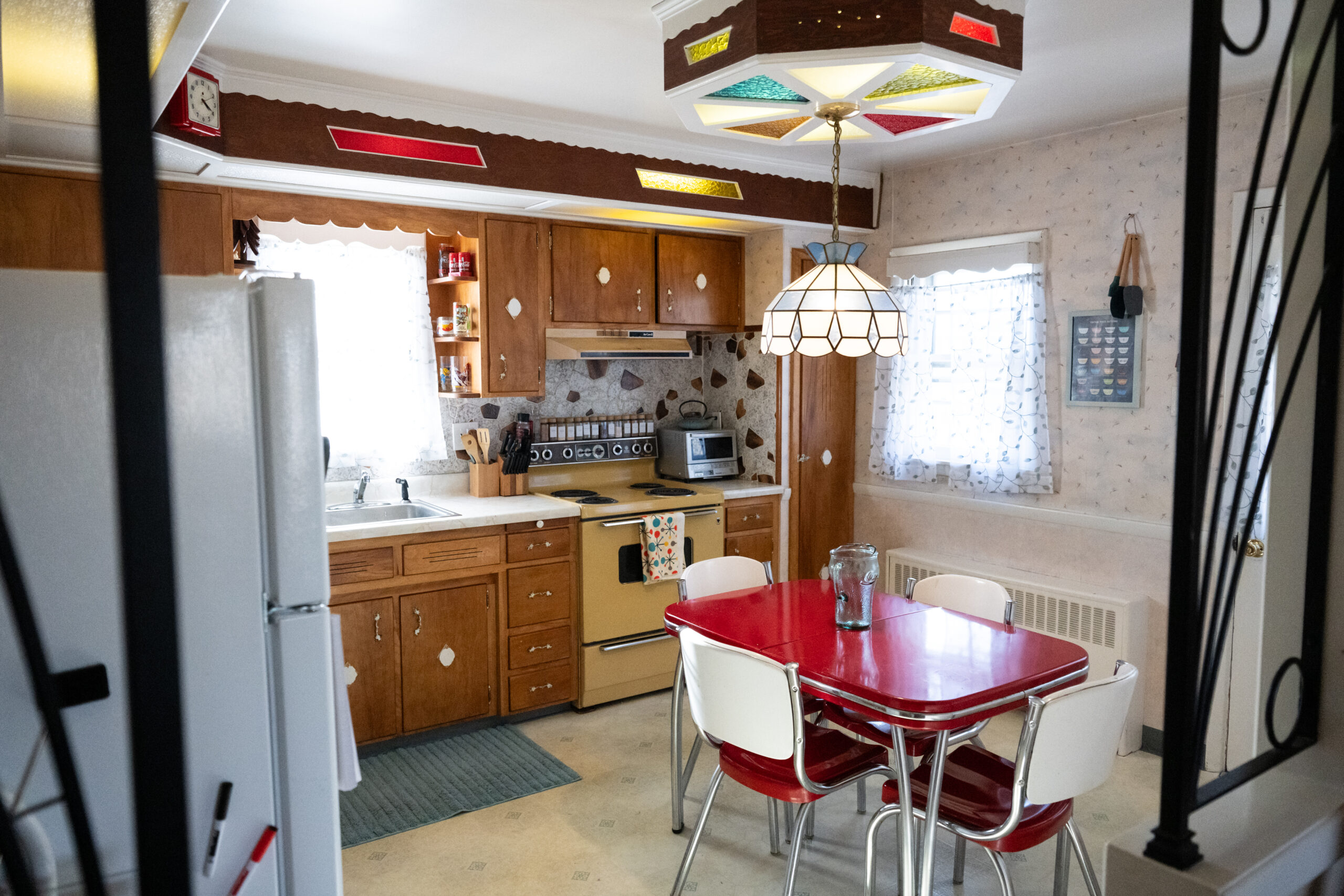
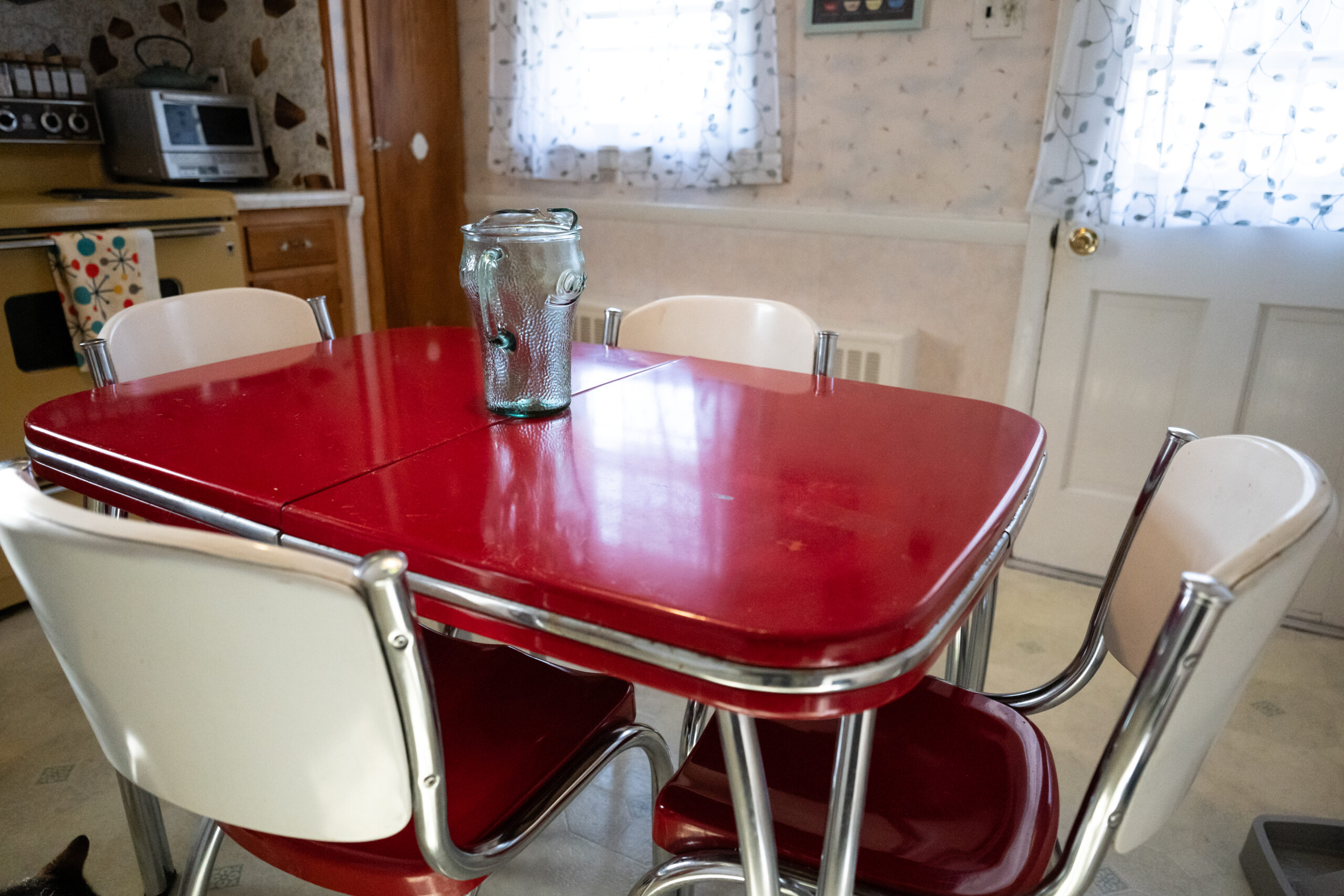
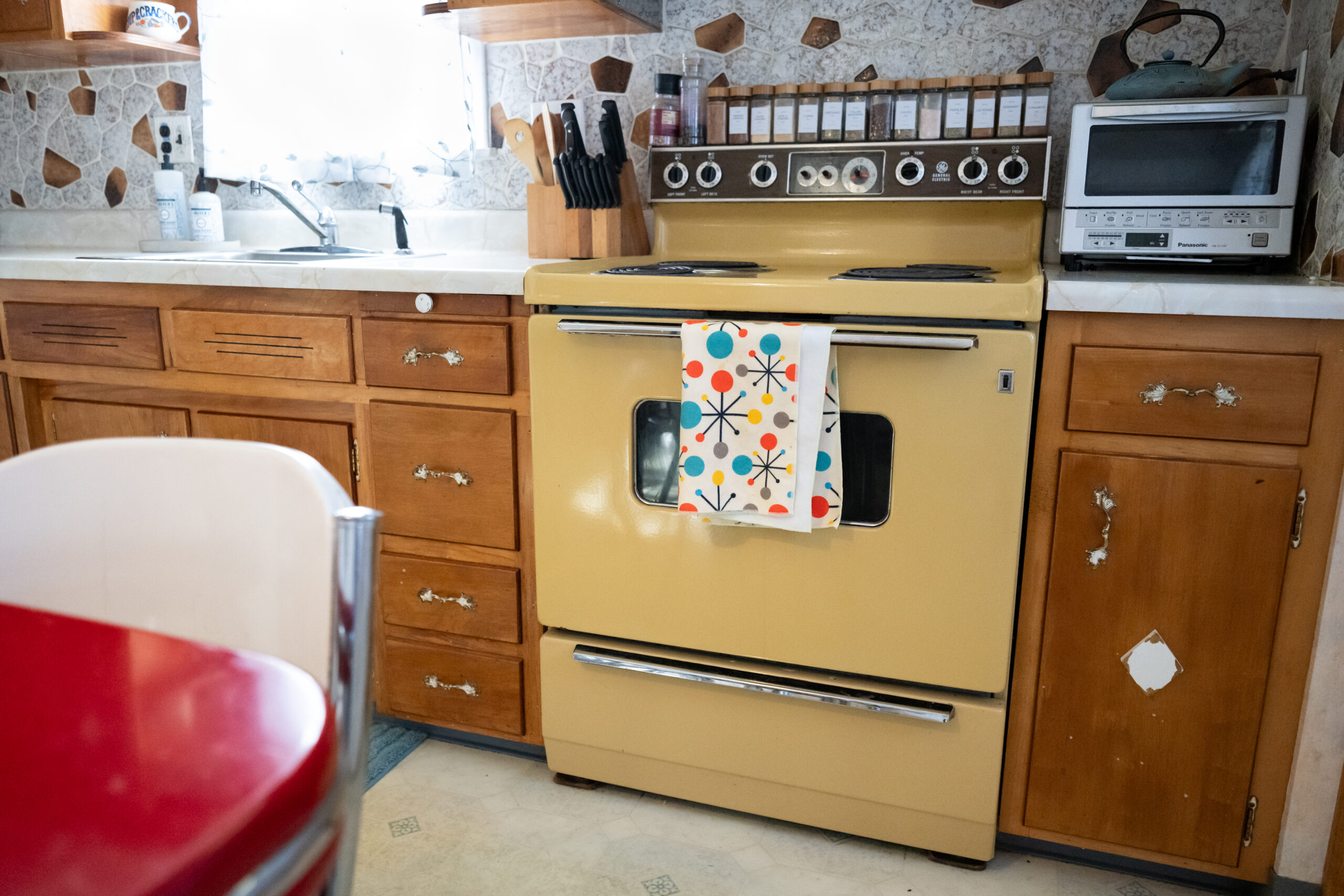
    The mid-century kitchen features a yellow GE oven, a stained-glass ceiling soffit light, and a stained-glass pendant light. A red metal table à la 1950s diner is surrounded by red and white vinyl chairs, a Facebook Marketplace purchase.

    The kitchen features soffit lighting and a pendant lamp in stained glass.
    The table and chairs in the kitchen were secondhand finds.
    The mustard-yellow oven is not equipped with modern features.

    “I messaged my mother about how to clean the oven and she said to turn on the self-cleaning function,” DeChellis recalled. “I said, ‘Mother, this is not a 21st-century oven.’”

    The living room contains a comfortable velvet orange-brown sectional couch. That’s where the couple, who plan to marry in May, relax and watch TV. The bookshelf is home to some of their funky thrift finds, including the fish lamp.

    The cozy basement is perfect for movie nights where friends gather to watch films from a projector, displayed onto a screen. Guests lounge on the blue couch with attached Formica end tables or in the pair of vintage wire Mexican Acapulco chairs — one orange and one green. The couple found the chairs at the Elephant’s Trunk Flea Market in Connecticut, and managed to squeeze them into their car for the ride home.

    “They are very comfortable, which is kind of surprising,” DeChellis said.

    The basement, where the couple enjoy movie nights with friends.

    The vintage wooden bar, with a faux stone facade and Formica top, set under colorful stained-glass lighting, evokes a scene from Mad Men. The bar is home to the vanilla ice cream lamp that stands about two feet tall, a very special thrifting find. She first spotted a similar one years ago, then again at a friend’s house.

    “I thought it was a sign” that such a distinctive lamp crossed her path twice, recalled DeChellis. “A few weeks later I found it at a thrift store. Somewhere out there a chocolate one and strawberry one are waiting for me.”

    DeChellis finds beauty in the rich histories of the pieces she thrifts. They lived a life making someone else happy, and now it’s her turn.

    The ice cream lamp sits on the bar in the basement.
    The Mexican Acapulco chairs, in orange and green, are surprisingly comfortable, DeChellis said.
    A whale lamp in the dining room.
    Decor on the landing of the stairwell.

    “We’ve always loved to thrift and antique and have found a lot of meaning and purpose in older things,” DeChellis said.

    The couple also enjoy their outdoor spaces, which include the front porch and enclosed backyard. DeChellis’s first experiment with a small cut flower garden was an initial success.

    “We grew pink and orange zinnias and put them in a fish vase that we got from the Dust Shuttle Auction,” she said.

    The couple has a table on their front porch, where they peacefully take in the neighborhood surroundings.

    Their front porch is a peaceful respite where they look out at the woods and playground surrounding their home.

    “I love living in Delaware County,” DeChellis said. “It’s a very tight-knit community where everyone is looking out for their neighbors. Getting to start our lives here and have this be our first home felt really special.”

    Is your house a Haven? Nominate your home by email (and send some digital photographs) at properties@inquirer.com.

  • Swarthmore’s borough manager has been terminated after just six months on the job

    Swarthmore’s borough manager has been terminated after just six months on the job

    Swarthmore Borough manager Sean Halbom has been terminated from the office after just six months, the latest in a string of short employment stints he has held in recent years.

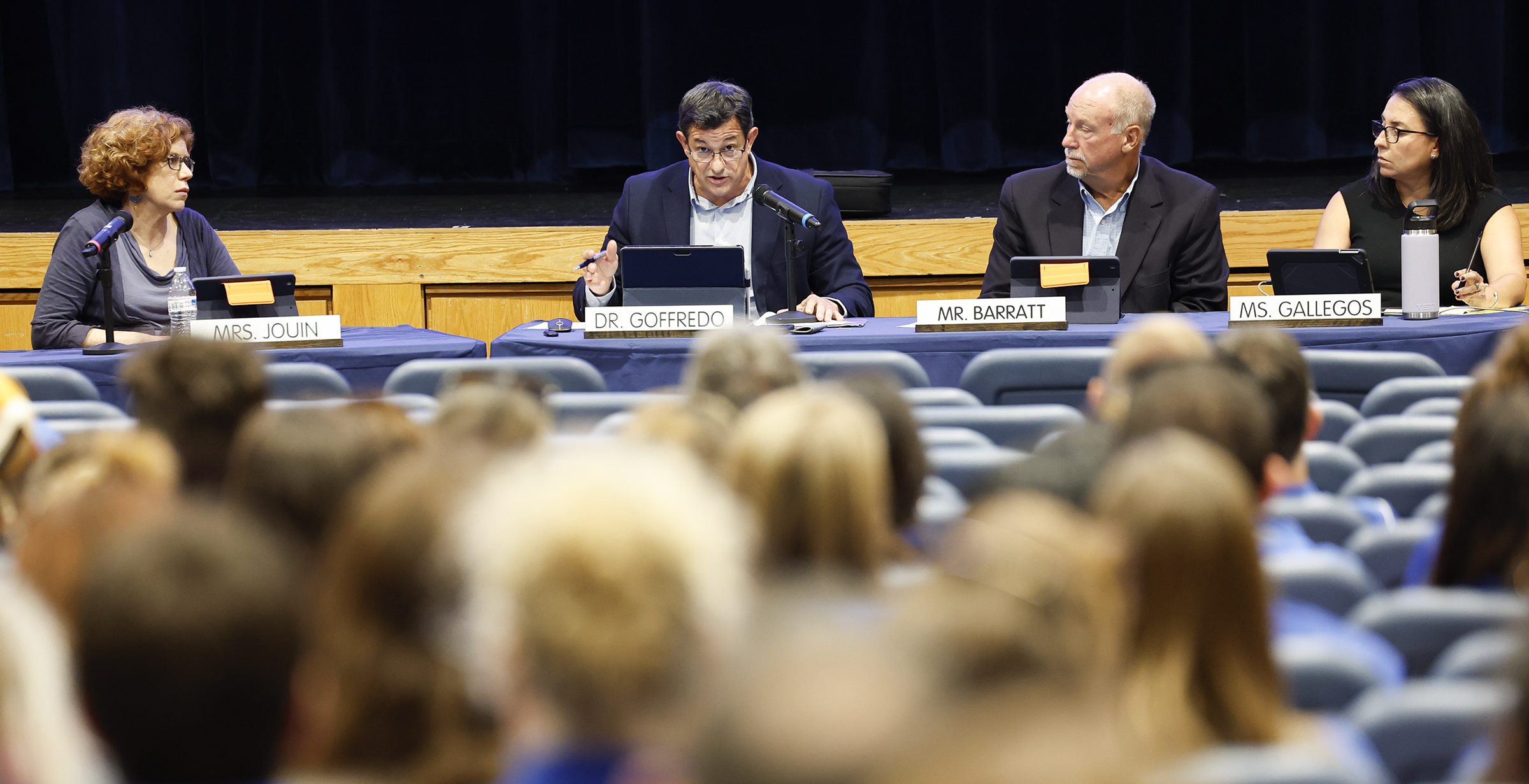
    The borough council voted unanimously on the termination Monday, though Council President Jill Bennett Gaieski declined to give a reason for the decision in a phone call with The Inquirer.

    Halbom did not respond to phone or email messages left on Thursday.

    Halbom was placed on an administrative leave of absence on Feb. 17, first reported by the Swarthmorean.

    He began in the borough manager role in September after holding several roles in Montgomery County, including most recently in Upper Frederick Township, where he was township manager for less than a year, according to his LinkedIn profile. Halbom resigned from his position in Upper Frederick in June 2025.

    Prior to the job in Upper Frederick, Halbom was an interim human resources director in Bucks County for two months and township manager for Worcester Township for a year and a half. Halbom’s employment in Worcester Township was terminated by its board of supervisors in April 2024.

    He was also the director of veterans affairs for Montgomery County for six years, from 2012 to 2018, his LinkedIn profile shows.

    Halbom succeeded William Webb, who left the Swarthmore manager role in September to become an assistant county administrator in Isle of Wight County, Va.

    Halbom’s leave came around the same time as another personnel shake-up in the small borough. On Feb. 18, Scott Schumacher vacated his position as a longtime Swarthmore Public Library employee and children’s librarian.

    Swarthmore Public Library board president Elizabeth Brown said Schumacher’s departure was unrelated to Halbom’s termination.

    The Swarthmore council on Monday also named David Unkovic as interim borough manager. He “came highly recommended” by Upper Providence Township, where he previously served as interim township manager, Gaieski said.

    Before retiring as a practicing lawyer, Unkovic spent a decade at McNees Wallace & Nurick, a Harrisburg-based law firm with multiple offices, including in Radnor. He also briefly served as the state receiver for the City of Harrisburg in 2012.

    The Swarthmore council has already begun the search for a permanent borough manager, Gaieski said, and hopes one will be in place as early as June 1.

    The search will take “until we find the right person,” Gaieski added. “We have a really good interim in place. We will do what we need to do to find the right person.”

    This suburban content is produced with support from the Leslie Miller and Richard Worley Foundation and The Lenfest Institute for Journalism. Editorial content is created independently of the project donors. Gifts to support The Inquirer’s high-impact journalism can be made at inquirer.com/donate. A list of Lenfest Institute donors can be found at lenfestinstitute.org/supporters.