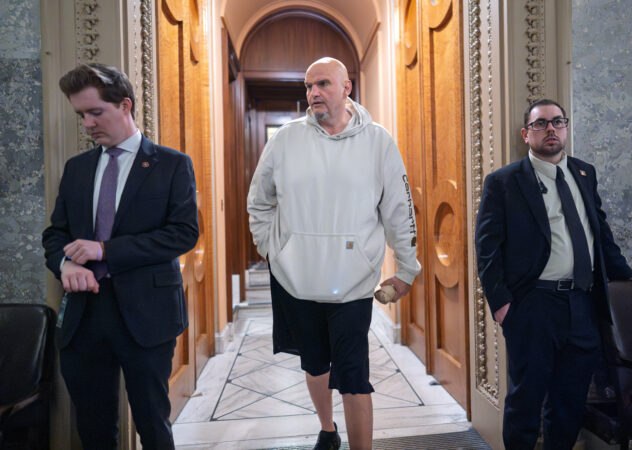
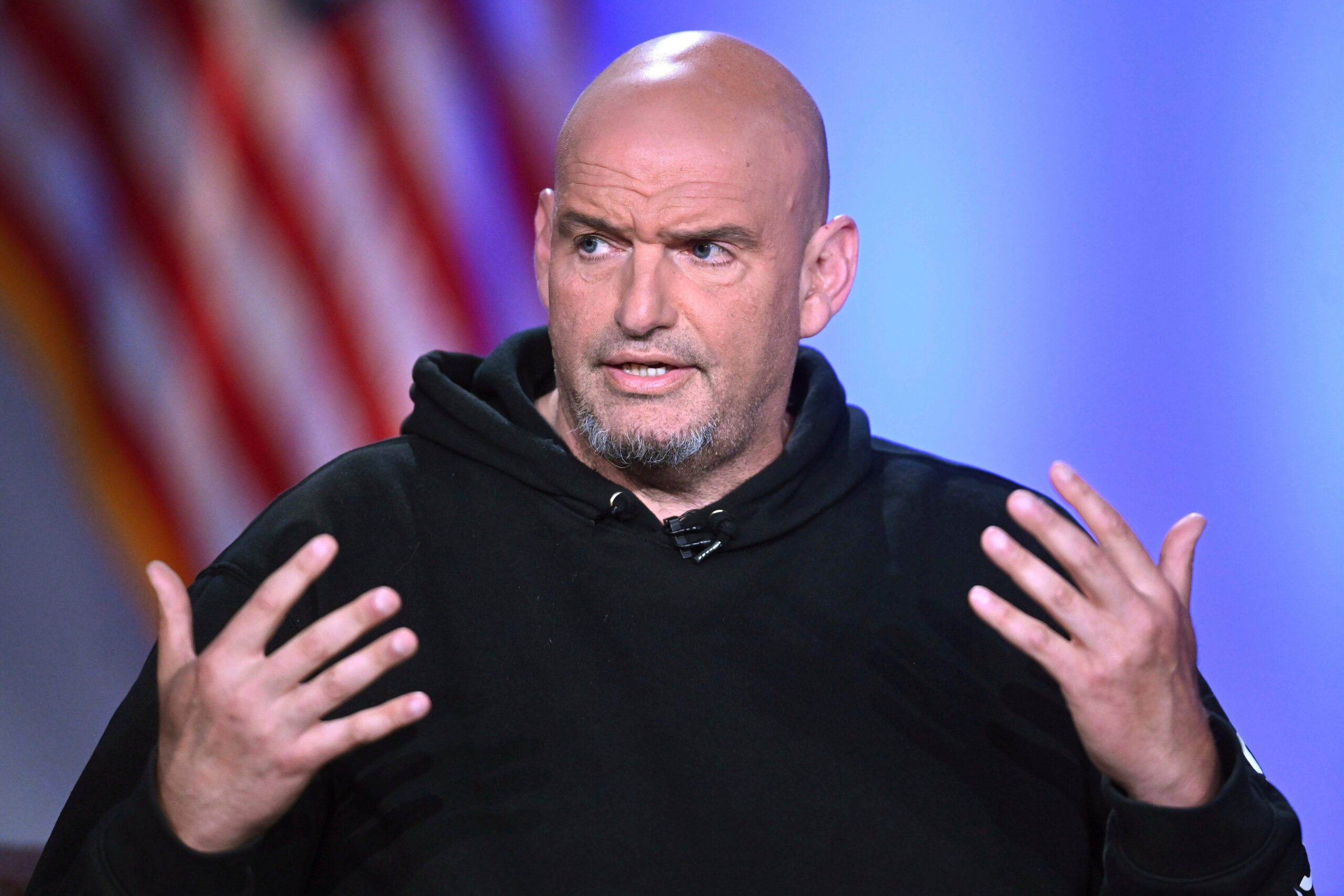
U.S. Sen. John Fetterman said Sunday that he expects the Department of Homeland Security to shut down Friday as negotiations over immigration enforcement have stalled, an outcome that could impact air travel and emergency response across the nation.
“I absolutely would expect that it’s going to shut down,” the Pennsylvania Democrat said during an interview on Fox News’Sunday Morning Futureswith Maria Bartiromo.
Funding for DHS is scheduled to lapse Friday, a deadline that lawmakers set after separating the agency’s funding from other parts of the federal budget and approving a two-week extension to continue talks.
At the center of the impasse is Democrats’ insistence on overhauling federal immigration enforcement. The party’s leaders drafted a list of 10 policies they want Republicans to agree to in exchange for their support in funding DHS, which includes U.S. Immigration and Customs Enforcement.
Among Democrats’ demands are banning immigration enforcement agents from wearing masks and requiring DHS officers to obtain a warrant signed by a judge before entering a home.
House Minority Leader Hakeem Jeffries (D., N.Y.) said Sunday during an interview on CNN’s State of the Union that “at this point” he was not willing to accept a deal that didn’t include President Donald Trump’s administration implementing Democrats’ full list of ICE changes.
“We know that ICE is completely and totally out of control,” Jeffries said. “They’ve gone way too far, and the American people want them reined in.”
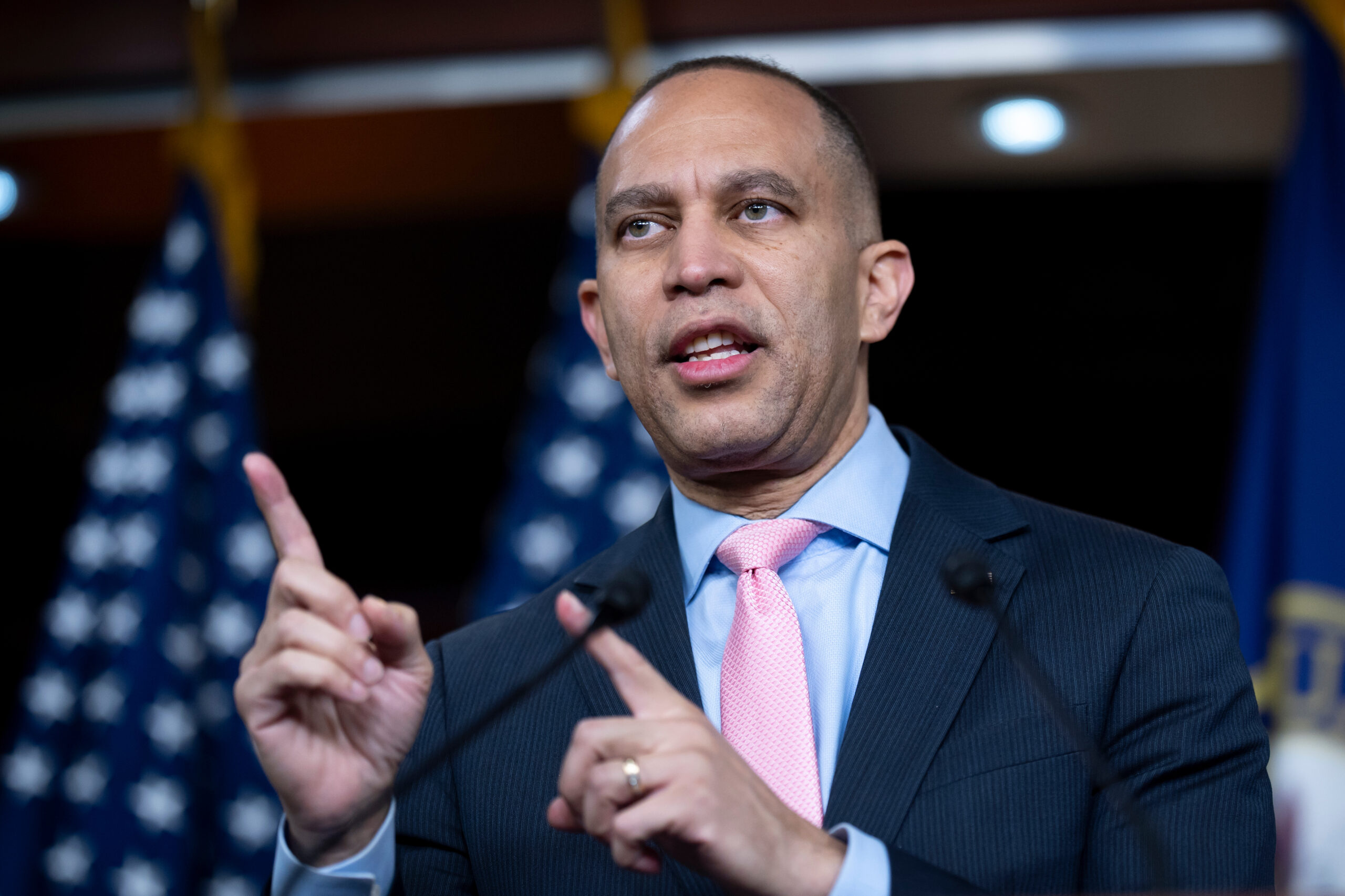
House Minority Leader Hakeem Jeffries (D., N.Y.) speaks to reporters about Venezuela, the ICE shooting in Minneapolis, and affordability ahead of a vote in the House to extend the Obamacare subsidies for three years at the Capitol on Jan. 8. (AP Photo/J. Scott Applewhite)
“We, the Democrats, we provided 10 kinds of basic things, and then the Republicans pushed back quickly saying, ‘That’s a Christmas wish list,’ and that they’re nonstarters,” Fetterman, a member of the Senate Homeland Security Committee, said. “I truly don’t know what specifically are the Democrats’ red lines that it has to be — certainly not going to get all 10.”
Fetterman generally opposes any measure that would shut down the government and has been the only Senate Democrat to vote for some Republican budget proposals. He added that he is concerned about federal workers, including TSA agents, not being paid amid a funding lapse.
“Every American deserves to be paid for the work that they’ve done,” he said. “That’s real lives, and they’re not wealthy if they’re TSA folks. They’re allowing us to fly safe here in America, and that’s part of that conversation now, too.”
Some yarn shops around Philadelphia are running low on skeins of red wool, as local knitters and crocheters turn out scads of “Melt the ICE” caps in solidarity with protesters in Minnesota.
The hats don’t feature a patch or logo that says “Melt the ICE.” In fact, they carry no written message at all. What they offer is a deep scarlet hue, a dangling tassel, and a connection to an earlier, dangerous time, when a different people in another land sought to silently signal their unity.
“The hat is really a symbol and reminder,” said knitter Laura McNamara of Kensington, who is making two caps for friends. “People are looking for a sense of community.”
She refused her friends’ offers of payment, asking instead that they not let their involvement start and end with a hat ― but find a means to stand up for civil rights in some specific way.
The original hat was a kind of conical stocking cap, known as a nisselue, worn in Norway during the 1940s as a sign of resistance to the Nazi occupation. The Germans eventually caught on to the symbolism and banned the caps.
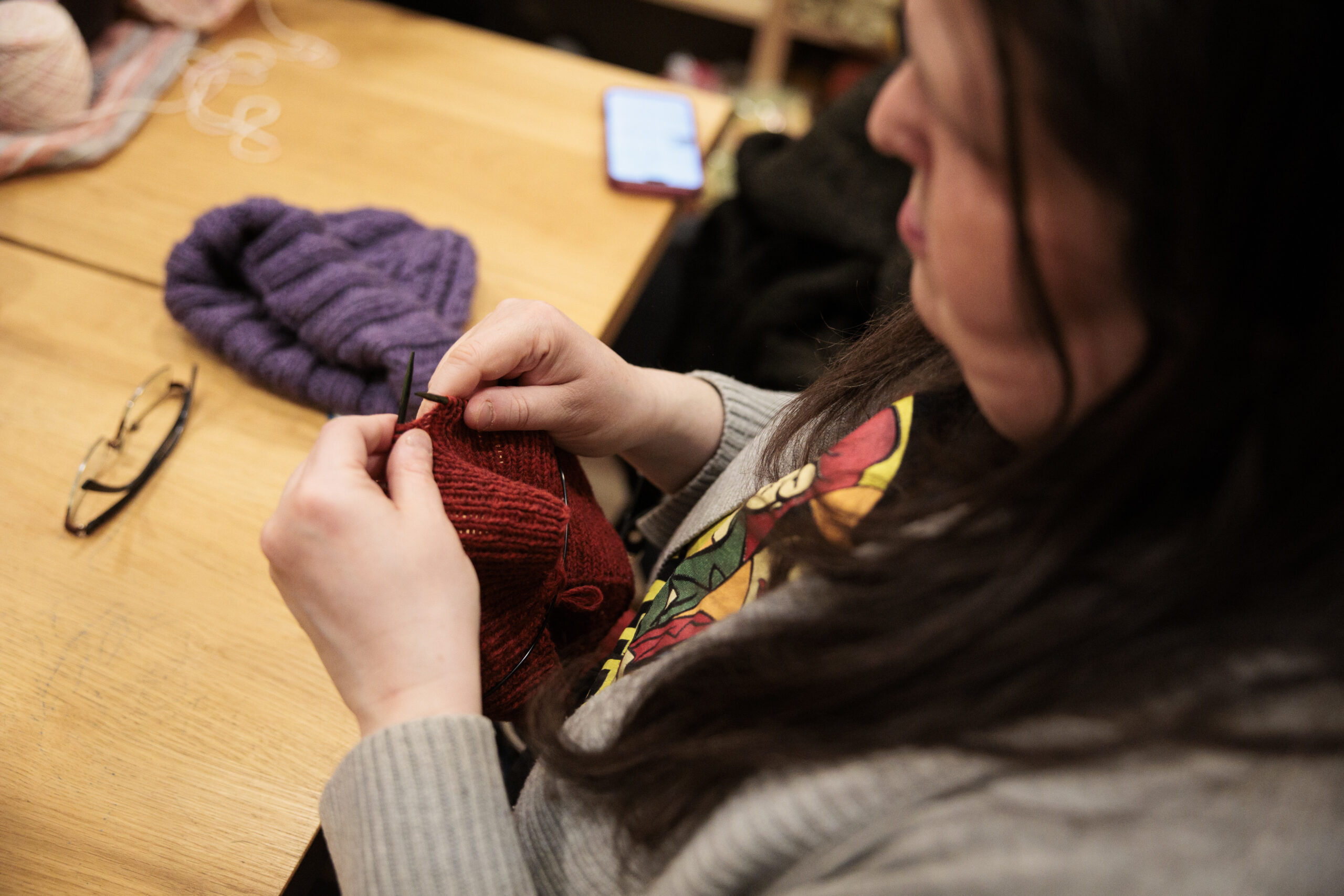
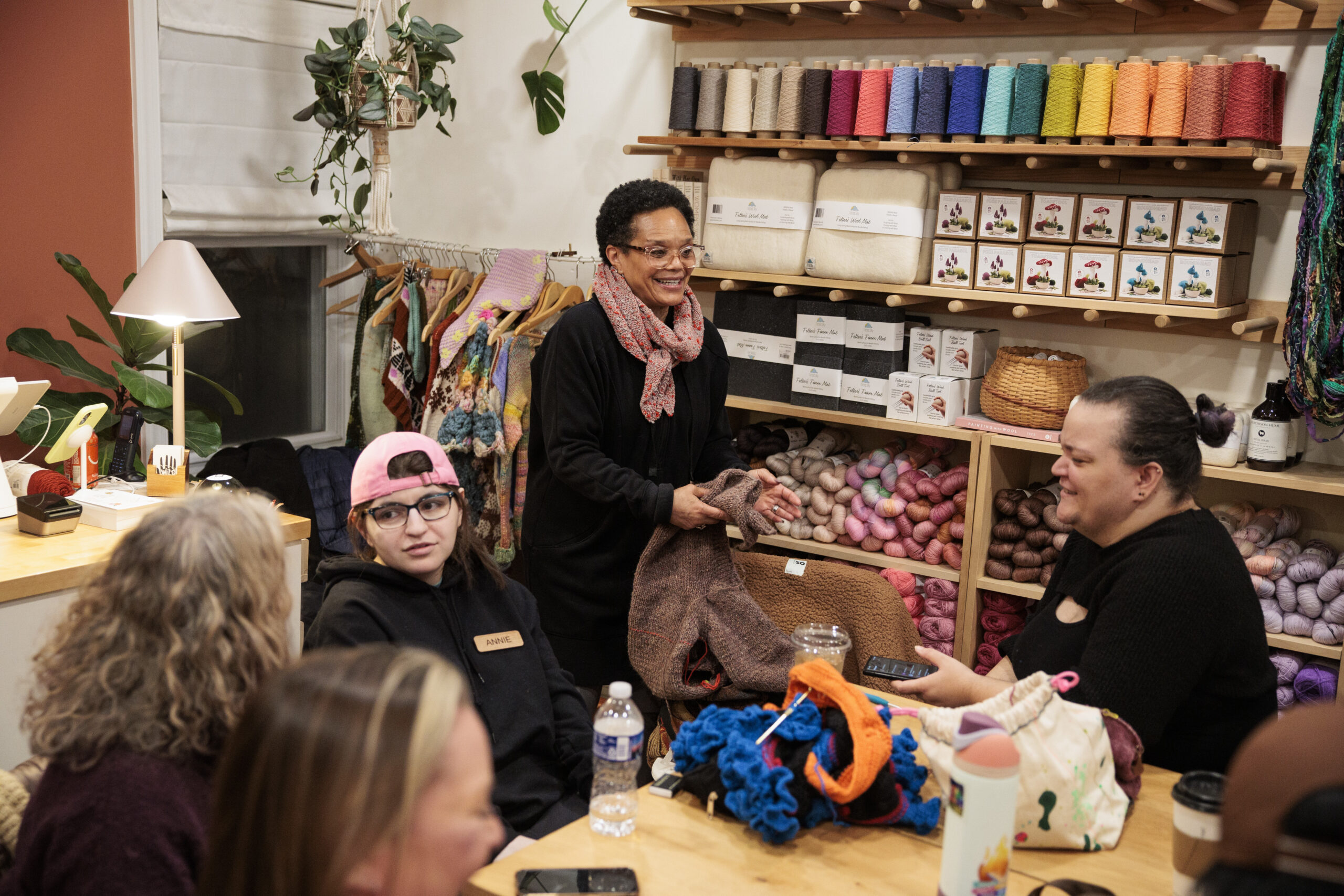
Amanda Bryman works on a red wool hat known as a “Melt the ICE” hat, during Fiber Folk Night at Wild Hand yarn shop in Philadelphia on Wednesday.
Now the new version that originated in a suburban Minneapolis yarn shop is spreading across the country. The hats signal opposition to U.S. Immigration and Customs Enforcement, which surged thousands of agents into Minneapolis, and sadness and anger over the deaths of Minnesotans and U.S. citizens Renee Good and Alex Pretti, who were shot to death by federal agents.
Today, comparisons of ICE agents to Nazis have become both frequent and contentious in American politics, with even some Democrats, including Gov. Josh Shapiro, who is Jewish, rejecting that equivalence as wrong and unacceptable.
ICE officials did not respond to a request for comment.
This is not the first time that the Philadelphia region’s craftivist movement, as it is known, has brought its knitting needles and crochet hooks to bear.
On the eve of Donald Trump’s first inauguration, artisans here turned out scores of cat-eared headgear known as pussy hats, a feline symbol of protest worn at the Women’s March on Washington. The hats aimed to tweak the then-president-elect over his comment about grabbing women by their genitals.
The Melt the ICE caps carry some controversy within the fiber community, as it calls itself. There have been online complaints that it’s easy to tug a red cap over one’s ears, but unless that is accompanied by action it holds no more significance than clicking a “Like” button on Facebook.
“It is just preening,” one person wrote in an internet forum.
Another said that “if your resistance is only this hat, then you have not actually accomplished anything except make a hat.”
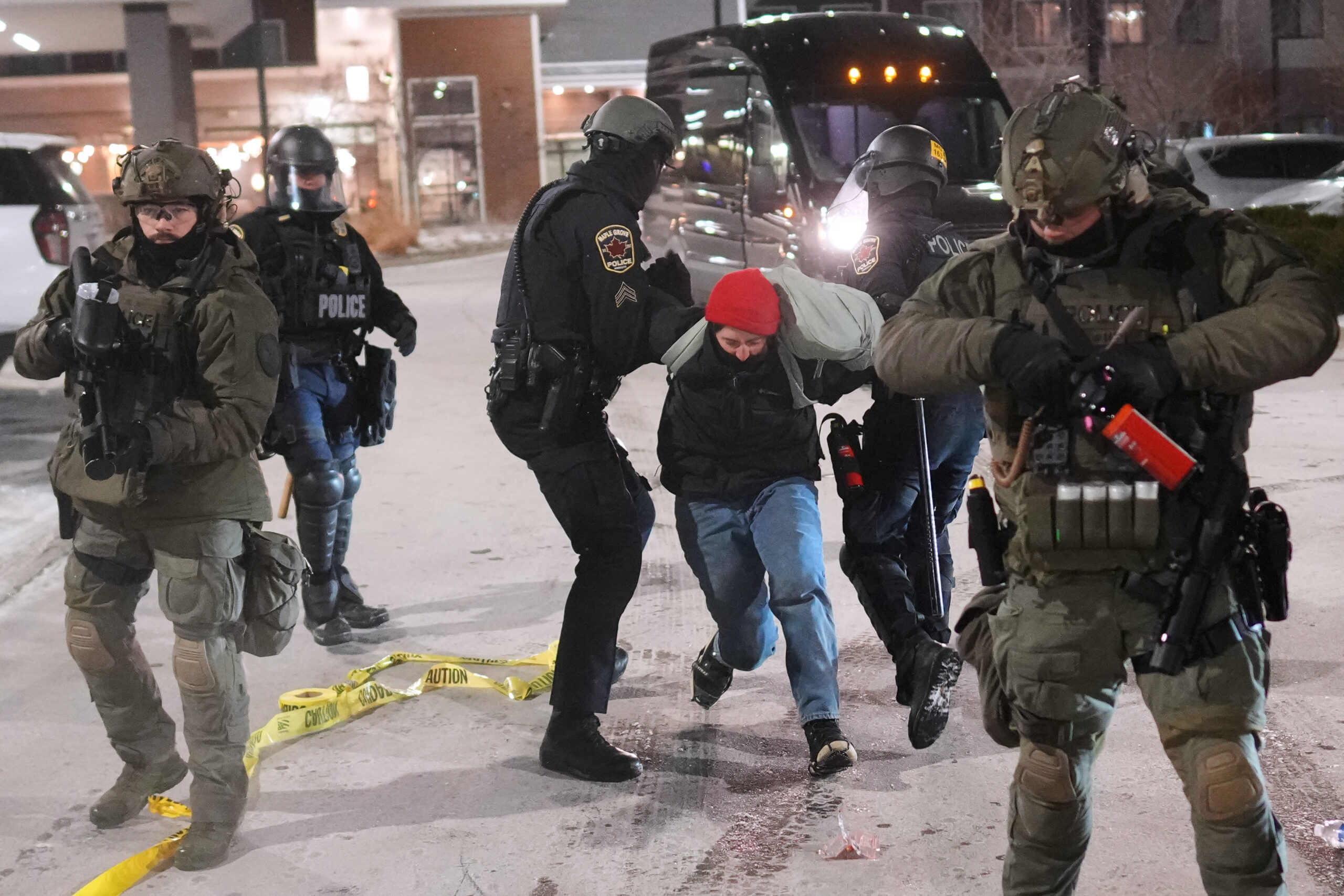
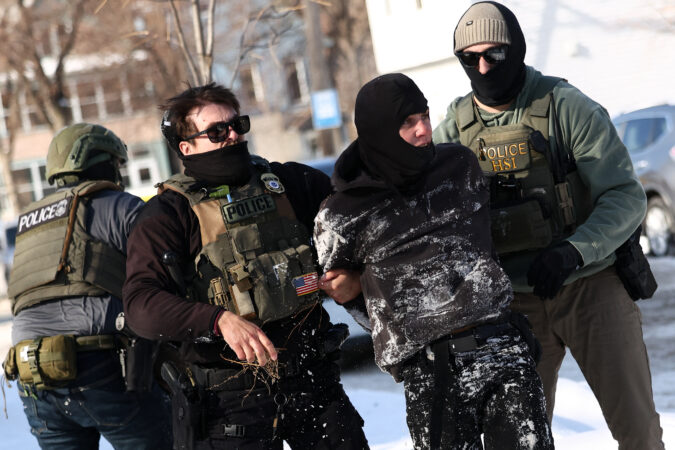
Law enforcement officers detain a demonstrator during a protest outside SpringHill Suites and Residence Inn by Marriott hotels on Jan. 26 in Maple Grove, Minn.
Liz Sytsma, owner of Wild Hand in West Mount Airy, has heard the criticism.
But “the people in our community who are participating in making the hats, this is one of many things they are doing,” she said. That includes taking part in protests, calling elected leaders, and giving money to causes they support.
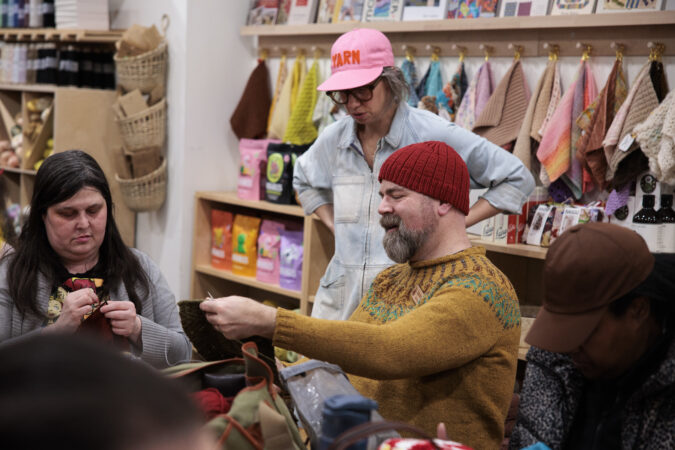
On Wednesday, more than a dozen people gathered at Wild Hand for the weekly Fiber Folk Night, where crafters gather to knit, crochet, and chat ― and, now, to work on hats.
Damon Davison traveled from Audubon, Camden County, having developed his own hat pattern, with sale proceeds to go to the activist group Juntos in South Philadelphia.
He wants to show solidarity with people “who are expressing resistance to what has been happening in Minneapolis, but also what’s happening here in Philly,” he said. “The idea is to make it a little bit more local.”
The shop has seen a rush on red, sought by about 70% of customers whose purchases have depleted stocks during the last couple of weeks.
“We’re really low,” said store manager Yolanda Booker, who plans to knit and donate a hat. “I want to do whatever small part I can do to help out.”
A single hat can take two or three days to make, though the best and fastest knitters can complete one in a couple of hours.
Store Manager Yolanda Booker, standing, laughs with attendees during Fiber Folk Night at Wild Hand yarn shop in Philadelphia on Wednesday.
In West Mount Airy, Kelbourne Woolens closed its physical doors during the national “ICE Out” strike in late January and donated its onlineprofits of $4,000 to Asian Americans United, Juntos, and New Sanctuary Movement of Philadelphia, said team member Bailey Spiteri. She estimated the store has sold enough red yarn to retailers to make 500 or 600 hats.
At Stitch Central in Glenside, customers donated $1,000 during the strike and the store matched it, with the $2,000 going to Nationalities Service Center in Philadelphia.
“Sometimes people are skeptical. How does wearing a hat or even making a hat make a difference?” asked Allison Covey of Drunken Knit Wits, a local knitting and crocheting organization. “But look at the donations. It does make a difference.”
Veteran knitter Neeta McColloch of Elkins Park thinks the same. She has ordered enough yarn to make eight hats. And she is curious to see how the phenomenon will develop.
“This is probably bigger than I think,” she said. “Knitters tend to be the type of people who in my experience have a strong moral compass. If they can combine something they love to do with something in which they can make a statement, that’s important to them.”
The late Maya Angelou had a saying that goes, “When people show you who they are, believe them the first time.”
She’s gone now, but that was some really good advice.
I am reminded of the late author’s wisdom after watching and rewatching a blatantly racist video that President Donald Trump posted on Thursday on Truth Social. It includes AI-generated imagery depicting former President Barack Obama and his wife as dancing primates.
I am so disgusted.
Anything to make the Obamas look bad. I wish I could share a photo of it with this column, but it’s too offensive. I’d tell you to go see his Truth Social account and look it up yourself, but I learned while writing this column that he has taken it down.
Trump’s boorishness is no surprise. He has been showing us who he is and what MAGA is about since even before he came down that escalator at Trump Tower in 2015 and called Mexicans rapists and drug dealers.
So it’s entirely fitting that night he would reshare a video repeating false claims about the 2020 presidential election, which he lost, that includes vile imagery about the 44th president.
For many of 44’s supporters, the Obamas represented America at its best. And no matter where one stands politically, it would be hard to argue that Obama himself ever succumbed to the kind of impulsivity, rudeness, and disrespect we regularly see these days out of 1600 Pennsylvania Ave.
But Trump is a petty, vindictive man whose obsession with the Obamas goes way back. It began in 2011, when Trump deliberately started a campaign of lies about Obama, claiming he wasn’t born in America and therefore ineligible to occupy the Oval Office.
Some pundits argue that Trump’s Obama envy helped fuel his own run for the presidency. And now that he is in the White House for a second term, you’d think he’d be over it. But judging from the way he keeps disparaging Obama, he’s not.
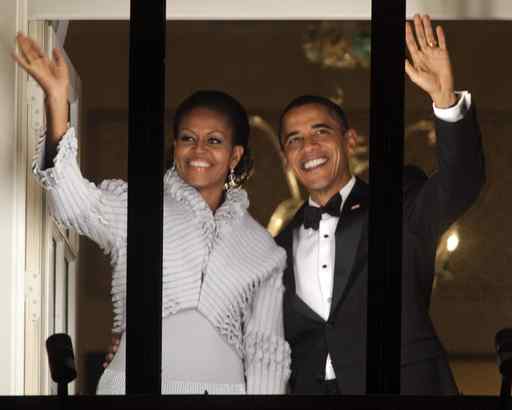
President Barack and Michelle Obama wave to the crowd from a balcony at the Grand Hotel in Oslo, Norway, after he accepted the Nobel Peace Prize at the city hall in 2009.
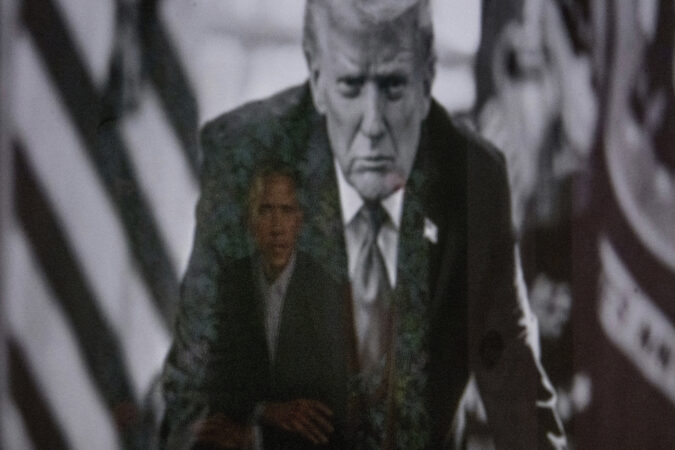
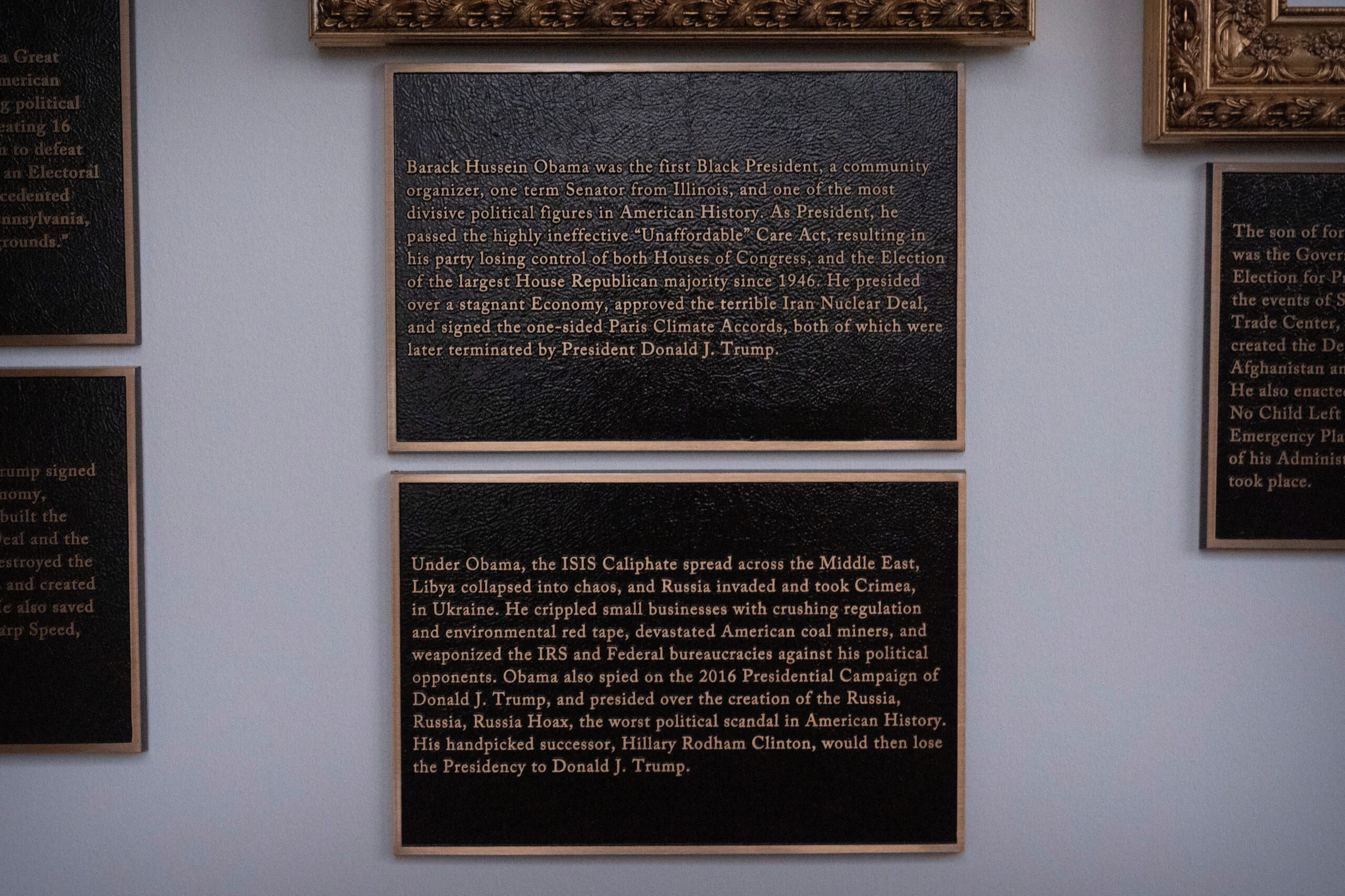
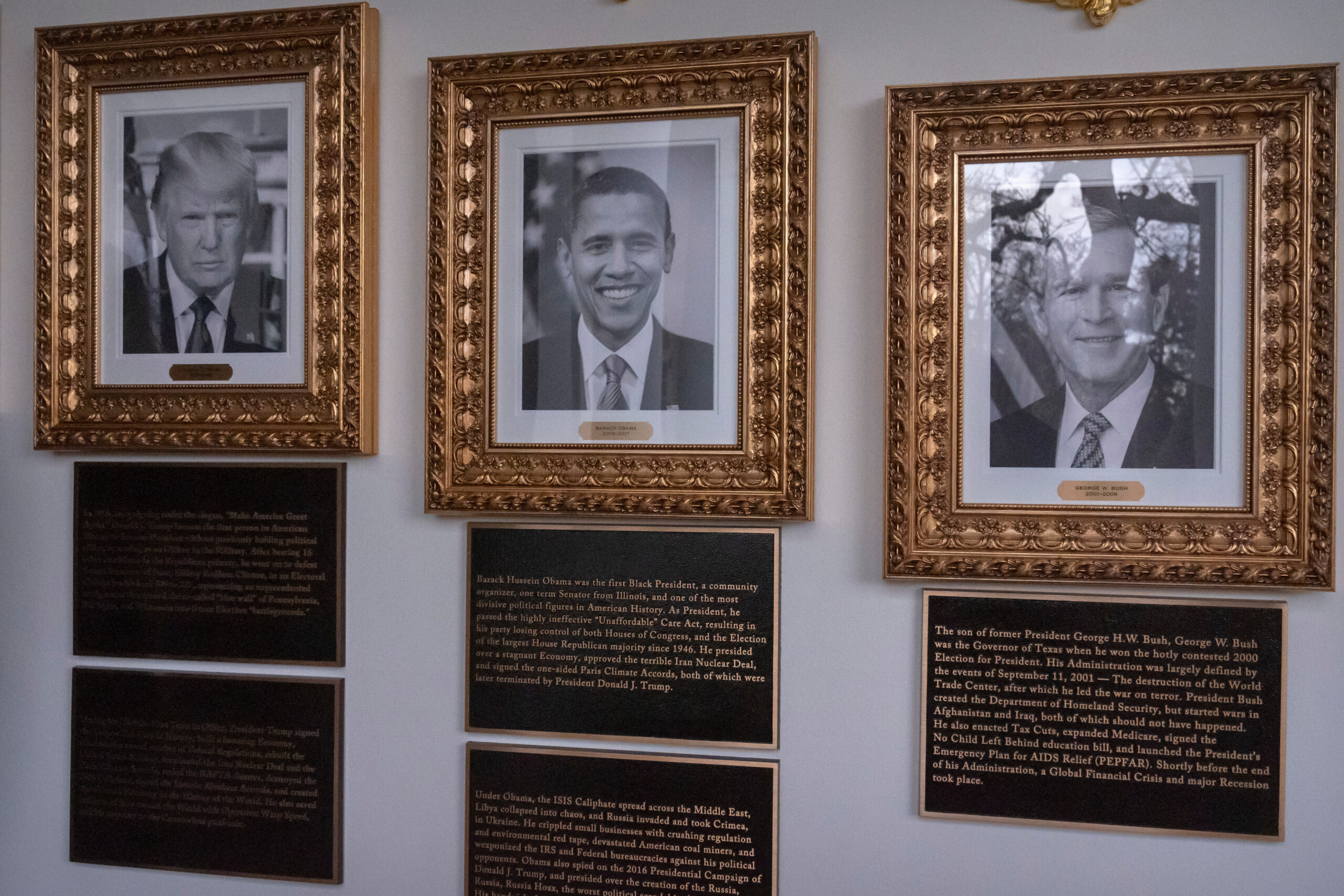
Trump also ordered the installation of plaques under the photos of his presidential predecessors, and used the one under Obama’s to bash his legacy, calling him “one of the most divisive political figures in American history” and making other false claims.
Plaques of explanatory text are seen beneath a framed portrait of former President Barack Obama on the Presidential Walk of Fame on the Colonnade of the White House, Wednesday, Dec. 17, 2025, in Washington. Portraits of President Donald Trump and former Presidents Barack Obama and George W. Bush with plaques of text below are seen on the Presidential Walk of Fame on the Colonnade of the White House, Wednesday, Dec. 17, 2025, in Washington.
White House press secretary Karoline Leavitt tried to walk Trump’s post back, writing, “This is from an internet meme video depicting President Trump as the King of the Jungle and Democrats as characters from the Lion King.”
She added via text, “Please stop the fake outrage and report on something today that actually matters to the American public.”
There’s nothing fake about our outrage. We see Trump. We know what he’s doing by pulling out that old racist trope. Even Black Trump supporters like Sen. Tim Scott (R., S.C.) see this for what it is. “Praying it was fake because it’s the most racist thing I’ve seen out of this White House. The President should remove it,” Scott wrote on social media.
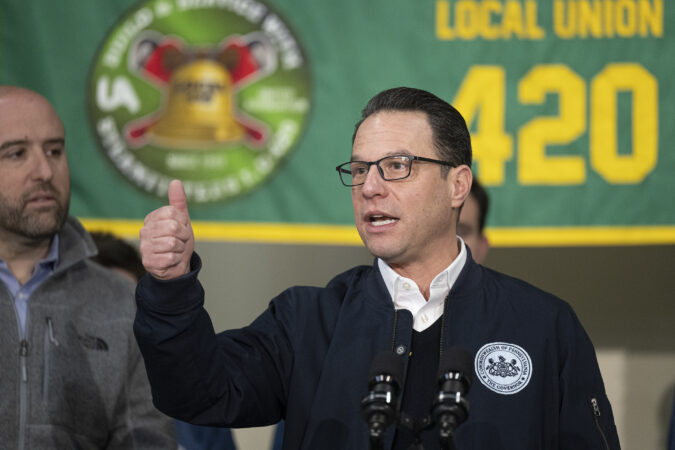
Gov. Josh Shapiro blasted U.S. Immigration and Customs Enforcement (ICE) Friday for buyinga Berks County warehouse that may be used to detain people.
“I’m strongly opposed to the purchase,” Shapiro said after speaking at an event at the Steamfitters Local 420 in Northeast Philadelphia.
Shapiro said the facility is “not what we need anywhere in Pennsylvania,” adding that he was not alerted ahead of time of ICE’s $87 million acquisition of the warehouse on 64 acres in Upper Bern Township.
“The secretive way the federal government went about this undermines trust,” Shapiro said.
Shapiro has grown increasingly vocal in his criticism of ICE and President Donald Trump in recent weeks as he’s toured the East Coast promoting his new memoir. In addition to voicing his opposition to the warehouse, Shapiro criticized Trump for sharing a racist video attacking former President Barack Obama and former first lady Michelle Obama.
The Democratic governor, who is widely seen as a contender for the White House in 2028, is in the midst of a reelection campaign against Trump-endorsed Republican Stacy Garrity, who has urged cooperation with ICE.
He said the commonwealth is exploring “what legal options we may have to stop” the ICE procurement, but he acknowledged “those options are very slim, given that the federal government is the purchaser.”
Shapiro told this audience of union workers and apprentices that the Berks County building would be better used for economic development.
At the same event, Shapiro announced a new $3 million Redevelopment Assistance Capital Program (RACP) grant to expand the Steamfitters Local Union 420 Training Center, which he said would help “train the next generation of workers.”
Shapiro criticizes Trump over racist anti-Obama video
Duringthe union hall event, Shapiro also leveled criticism at the Trump administration for sharing on social media a racist video depicting Obama, the first Black president, and his wife, as apes.
When asked for a reaction, Shapiro said, “I actually agree with [Republican] Sen. Tim Scott of South Carolina that it’s racist.”
Scott, the only Black Republican in the Senate, called the video “the most racist thing I’ve seen out of this White House,” after Trump shared it to his Truth Social account Thursday evening.
Shapiro said thatTrump “seems to always find a lower and lower common denominator. We’re not going to get sucked down into the depths that this president seems to reach for each day.”
Trump took down the video early Friday afternoon.
The governor also strongly chided Trump for recently saying the federal government should be in charge of elections.
Specifically, Trump named Philadelphia, along with Detroit and Atlanta, as cities where the federal government should step in to run elections. The predominantly Black cities are in swing states and have long been targeted with Trump’s false claims of voter fraud.
“The president of the United States doesn’t run our elections,” said Shapiro. “County officials run our elections, Republican and Democrat alike.”
“We’re not going to have interference from the White House,” added the governor, who served as attorney general when Trump tried to overturn Pennsylvania’s election results in 2020.
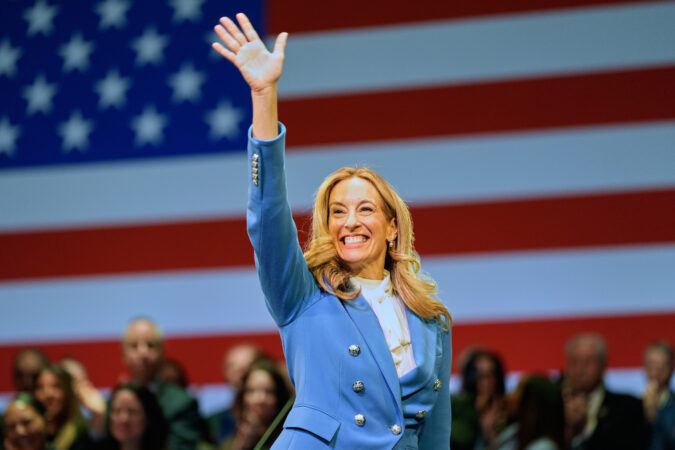
The Democratic primary to replace N.J. Gov. Mikie Sherrill in Congress remains too close to call as of Friday afternoon, but the early results already signal a major breakthrough for progressives in the state.
Analilia Mejia, a progressive who’s worked for U.S.Sen. Bernie Sanders and the Working Families Party, led former U.S. Rep. Tom Malinowski byless than 1 percentage point, with more than 91% of votes tabulatedin the crowded primary.
Some outlets, including Decision Desk, called the race for Malinowski, who dominated mail ballots, Thursday night before issuing retractions as Mejia gained ground. The Democratic National Committee had even issued a premature congratulations to the former House member before Mejia took the lead.
(function () {window.addEventListener(‘message’, function (e) { var message = e.data; var els = document.querySelectorAll(‘iframe[src*=”‘ + message.id + ‘”]’); els.forEach(function(el) { el.style.height = message.height + ‘px’; }); }, false); })();
Sherrill represented North Jersey’s 11th CongressionalDistrict, which includes parts of Essex, Morris, and Passaic Counties, and stepped down after being elected governor. A field of 13 Democrats competedin the special election for the open seat from various factions of the Democratic Party.
Only two broke through as serious contenders, and they represent two sides of the New Jersey Democratic Party: the establishment and progressives.
Democrats were so invested in the race, turnout exceeded the 2024 primary for the seat, which signals the high level of motivation for Democratic voters going into this year’s midterms.
Sherrill stayed neutral in the race
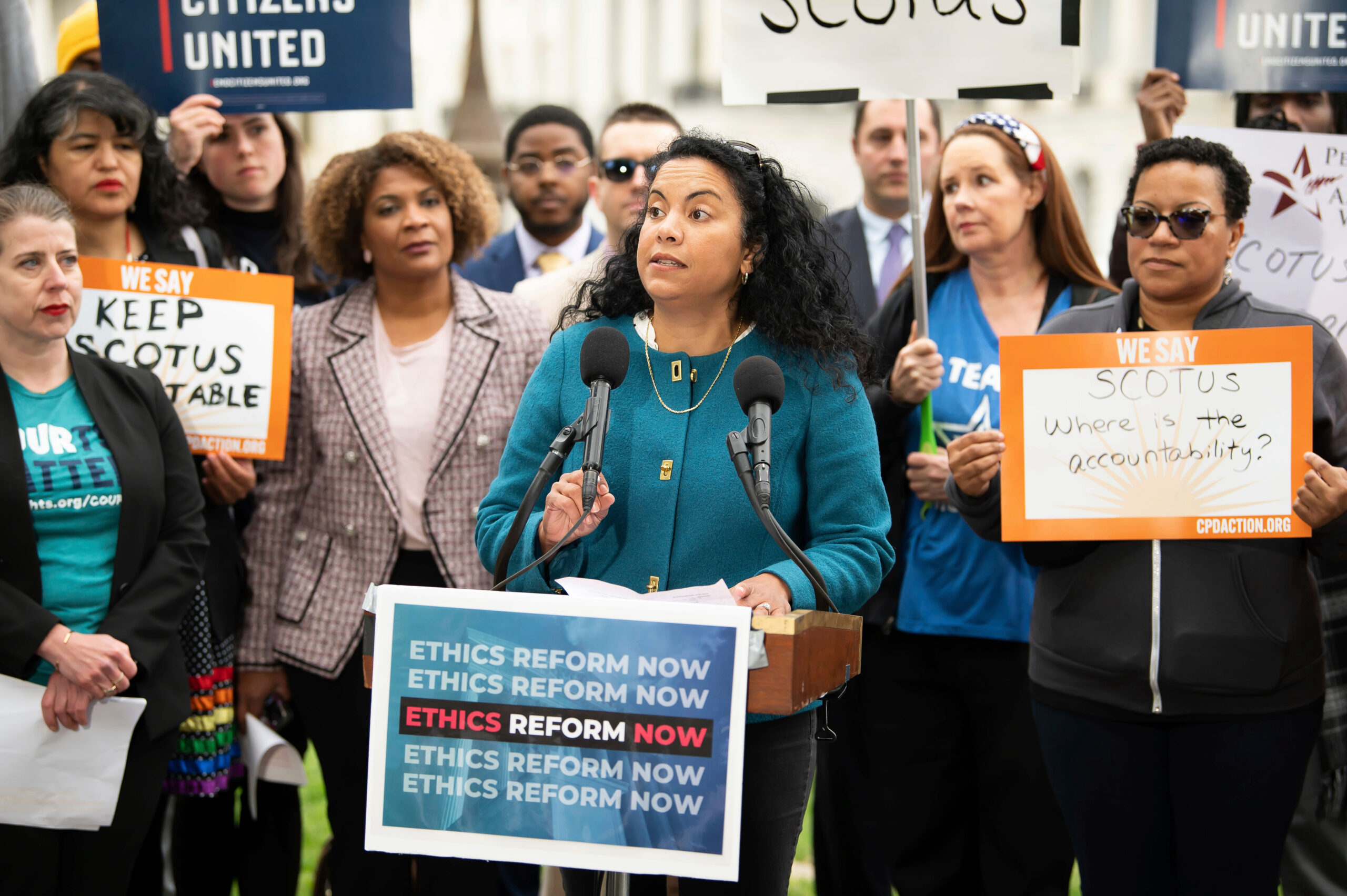
Analilia Mejia, center, speaks during a rally calling for SCOTUS ethics reform, May 2, 2023, in Washington.
Analilia Mejia is supported by national progressives like AOC
Mejia, 48, is the daughter of Colombian and Dominican immigrants. She has called to “abolish ICE” and spoke in both English and Spanish at a news conference Friday.
The progressive candidate has most recently worked as the co-executive director of Popular Democracy, a network of organizations across the country that call for “transformational change for Black, brown and low-income communities,” according to its website. She worked as the national political director for Sanders’ 2020 presidential campaign, the state director of the New Jersey Working Families Party, and as a union organizer before launching her bid for the seat.
Mejia was endorsed by national progressives, including Sanders (I., Vt.), U.S. Rep. Alexandria Ocasio-Cortez (D., N.Y.) and U.S. Sen. Elizabeth Warren (D., Mass.). She also had the backing of Newark Mayor Ras Baraka, whose progressive campaign landed him in second place behind Sherrill in the six-way gubernatorial primary last year.
Mejia leaned into her underdog status Thursday night when addressing supporters, noting the race had been called for her opponent before she took the lead.
“Here’s the bottom line,” she said. “We know that our movement, this party, this moment, calls on every one of us to be big and bold and brave. And that is what we are about.”
She later declared: “I think we’ll listen to some Bad Bunny!”
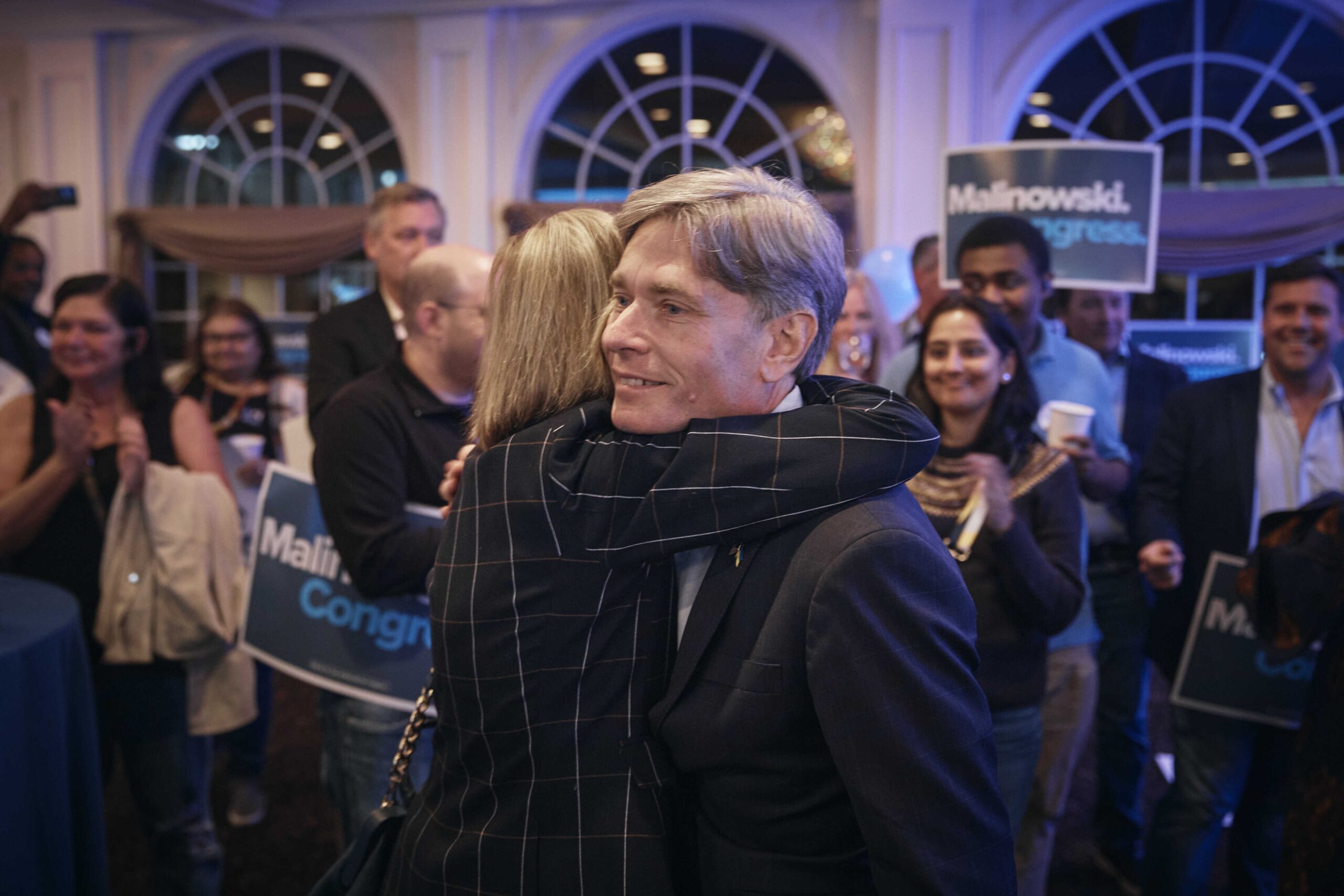
Democratic Rep. Tom Malinowski, center right, arrives during his election night party in Garwood, N.J., Tuesday, Nov. 8, 2022.
Tom Malinowski was backed by the local party apparatus
Malinowski, 60, started as a freshman House Democrat alongside Sherrill in 2019 before losing his seat to Republican U.S. Rep. Thomas Kean Jr. in the 2022 election afterhe faced pushback for undisclosed stock trading and his area was redistricted to be less favorable to Democrats.
His former district is right next to the 11th District and encompasses parts of Union, Somerset, Morris, and Sussex Counties, and all of Hunterdon and Warren Counties.
He recently chaired the Hunterdon County Democratic Committee and previously worked as former President Barack Obama’s assistant secretary of state for democracy and human rights.
The Essex and Passaic County parties backed other candidates who were far behind Malinowski and Mejia.
DNC Chair Ken Martin said in the premature Thursday night statement that Malinowski has “the experience to serve New Jersey once again.”
AIPAC’s involvement in the race backfired
Malinowski faced attacks from a super PAC funded by American Israel Public Affairs Committee (AIPAC), a pro-Israel national lobbying group, even though the group supported him in the past, The New York Times and other outlets reported.
Those attacks likely pulled support away from Malinowski, who is far less critical of Israel than Mejia.
Mejia called AIPAC’s tactics against Malinowski “disgusting” in a news conference on Friday and said it underscores her broader concerns about money in politics.
“Big money can actually silence voters … In many ways, I’m glad that NJ-11 voters got to see the terrible tactics so that we could reject it in the future,” she said.
The district, which used to be Republican, is now viewed as safely blue
Sherrill flipped the 11th congressional district blue as a first-time candidate in 2018, defeating Republican Assemblymember Jay Webber after the GOP incumbent retired. The incumbent, former U.S. Rep. Rodney Frelinghuysen had held the seat since 1995. The district went from leaning Republican to leaning Democratic when its lines were redrawn in 2022.
Sherrill won her last general election race for her House seat with 56.5% of the vote in 2024.
The nonpartisan Cook Political Report rates the district as solidly Democratic. Former Vice President Kamala Harris won the district decisively by nearly 9 points in 2024, but it still swung to the right from Biden’s 2020 victory in the district by almost 17 points, according to Cook data.
Joe Hathaway, the former mayor of Randolph in Morris County, was unopposed in the Republican primary.
Hathaway, 38, said in a video on social media Thursday that the election brings an opportunity for “a new generation of leadership …one focused more on the hard work than the headlines.”
He is a former aide to former Republican Gov. Christopher J. Christie and has worked in various roles in the private sector, and has branded himself as a “workhorse” throughout his campaign.
Hathaway and the winner of the Democratic primary will face off on Thursday, April 16, less than two months before the regular primary election on June 2 for the midterms.
When will the race be called, and will there be a recount?
It’s unclear when the race will be called by The Associated Press (which The Inquirer relies on for election results), but it may not be this week.
Mail ballots that were postmarked by Election Day on Thursday and received by the county Board of Election by next Wednesday can be counted in New Jersey.
Provisional ballots in the state cannot be officially counted until after the eligible mail ballots are received to ensure the voter has not voted by mail. These ballots are used in specific situations, such as when a person registered to vote moves within the county without updating their address.
Voters also have until the following Tuesday, Feb. 17, to cure a ballot flagged by election officials. This happens when there is a potential issue with a voter’s signature, which can happen when someone forgets to sign their ballot or whose signature has changed over time. The voter then has to verify their identity for their ballot to be counted.
As for a recount, New Jersey doesn’t have an automatic recount system, so a candidate would have to request one and cover the expenses. The candidate would receive a refund if the result changed.
One of the lasting images of President Donald Trump’s mass deportation campaign will be the masks worn by federal immigration agents.
The widespread use of facial coverings by U.S. Immigration and Customs Enforcement officers is among the suite of tactics — agents dressed in plainclothes, wearing little identification, jumping out of unmarked cars to grab people off the street — that have fueled immigration advocates’ use of terms like “kidnappings” and “abductions.”
Now Philadelphia lawmakers appear poised to pass legislation that would ban all officers operating in the city — including local police — from concealing their identitiesby wearing masks or conducting enforcement from unmarked cars.
The question is whether the city can make that rule stick.
Legal hurdles loom for municipalities and states attempting to regulate federal law enforcement. Local jurisdictions are generally prohibited from interfering with basic federal functions, and Trump administration officials say state- and city-level bans violate the constitutional provision that says federal law reigns supreme.
There are also practical concerns about enforcement. Violating the mask ban would be a civil infraction, meaning local police would be tasked with citing other law enforcement officers for covering their faces.
“No doubt this will be challenged,” said Stanley Brand, a distinguished fellow at Penn State Dickinson Law. “This ordinance will be a protracted and complicated legal slog.”
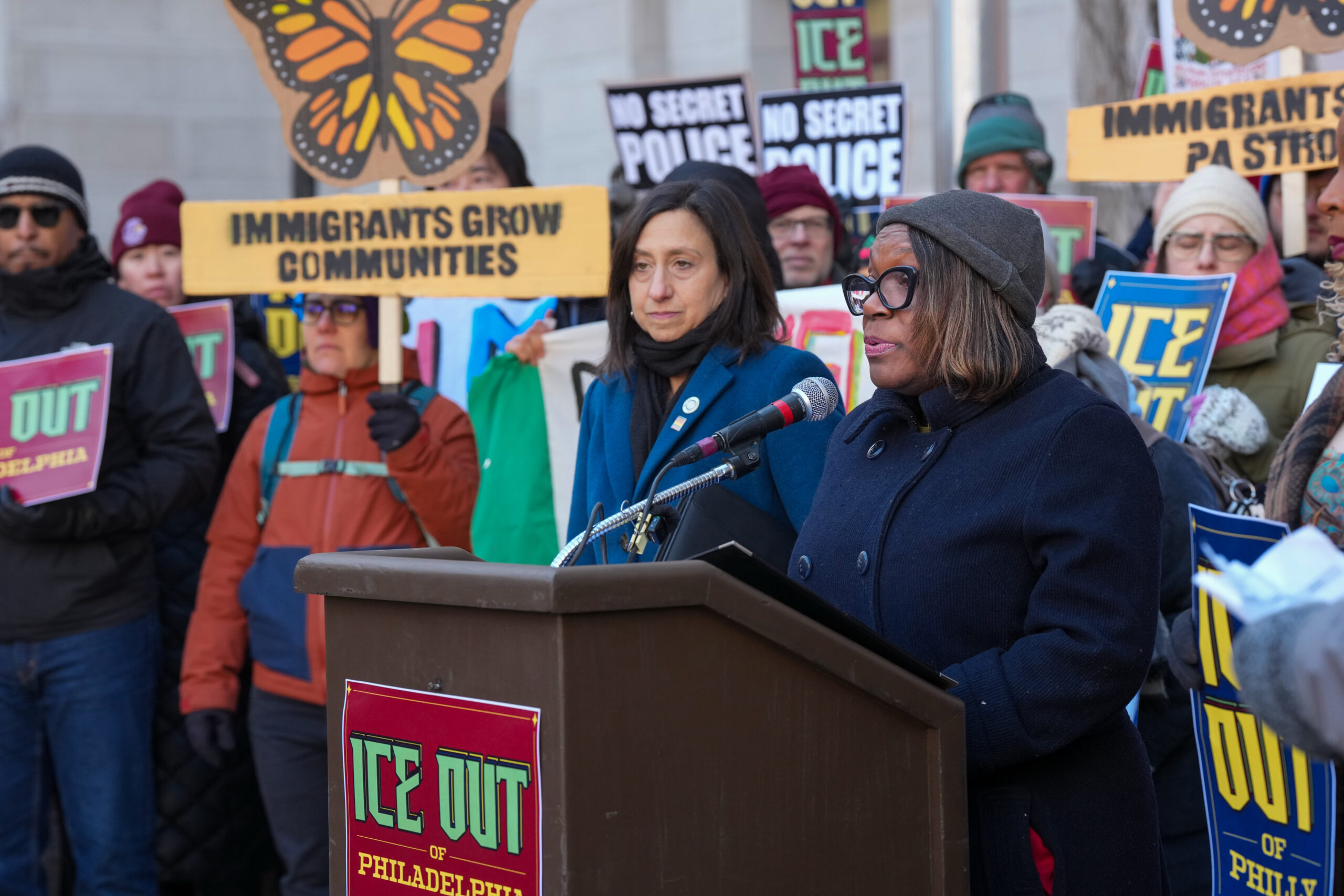
Councilmember Kendra Brooks speaks during a news conference at City Hall to announce a package of bills aimed at pushing back against ICE enforcement on Jan. 27.
Advocates for immigrants say that unmasking ICE agents is a safety issue, and that officers rarely identify themselves when asked, despite being required to carry badges.
Mask use can also spur impersonators, they say. At least four people in Philadelphia have been arrested for impersonating ICE officers in the last year.
“You see these people in your community with guns and vests and masks,” said Desi Bernette, a leader of MILPA, the Movement of Immigrant Leaders in Pennsylvania. “It’s very scary, and it’s not normal.”
Democrats in jurisdictions across America, including Congress and the Pennsylvania General Assembly, have introduced legislation to ban ICE agents from concealing their faces. California is the furthest along in implementing a mask prohibition, and a judge is currently weighing a challenge filed by the Trump administration.
Senate Democrats negotiating a budget deal in Washington have asked for a nationwide ban on ICE agents wearing masks in exchange for their votes to fund the Department of Homeland Security.
And polling shows getting rid of masks is popular. A recent Pew Research Center survey found that 61% of Americans believe federal agents should not wear face coverings to conceal their identities while on duty.
ICE officials say agents should have the freedom to conceal their faces while operating in a hyperpartisan political environment.
Last year, ICE head Todd Lyons told CBS News that he was not a proponent of agents wearing masks, though he would allow it. Some officers, he said, have had private information published online, leading to death threats against them and their families.
“They could target [agents’] families,” Fetterman said in an interview on Fox News, “and they are organizing these people to put their names out there.”
Sen. John Fetterman, D-Pa., participates in a debate on June 2, 2025, in Boston.
The Council authors of the Philadelphia bills say they are responding to constituents who are intimidated by ICE’s tactics, and they believe their legislation can withstand a legal challenge.
“Our goal is to make sure that our folks feel safe here in the city,” said City Councilmember Kendra Brooks. “We are here to protect Philadelphians, and if that means we eventually need to go to court, that’s what would need to happen.”
The constitutional limits on unmasking ICE
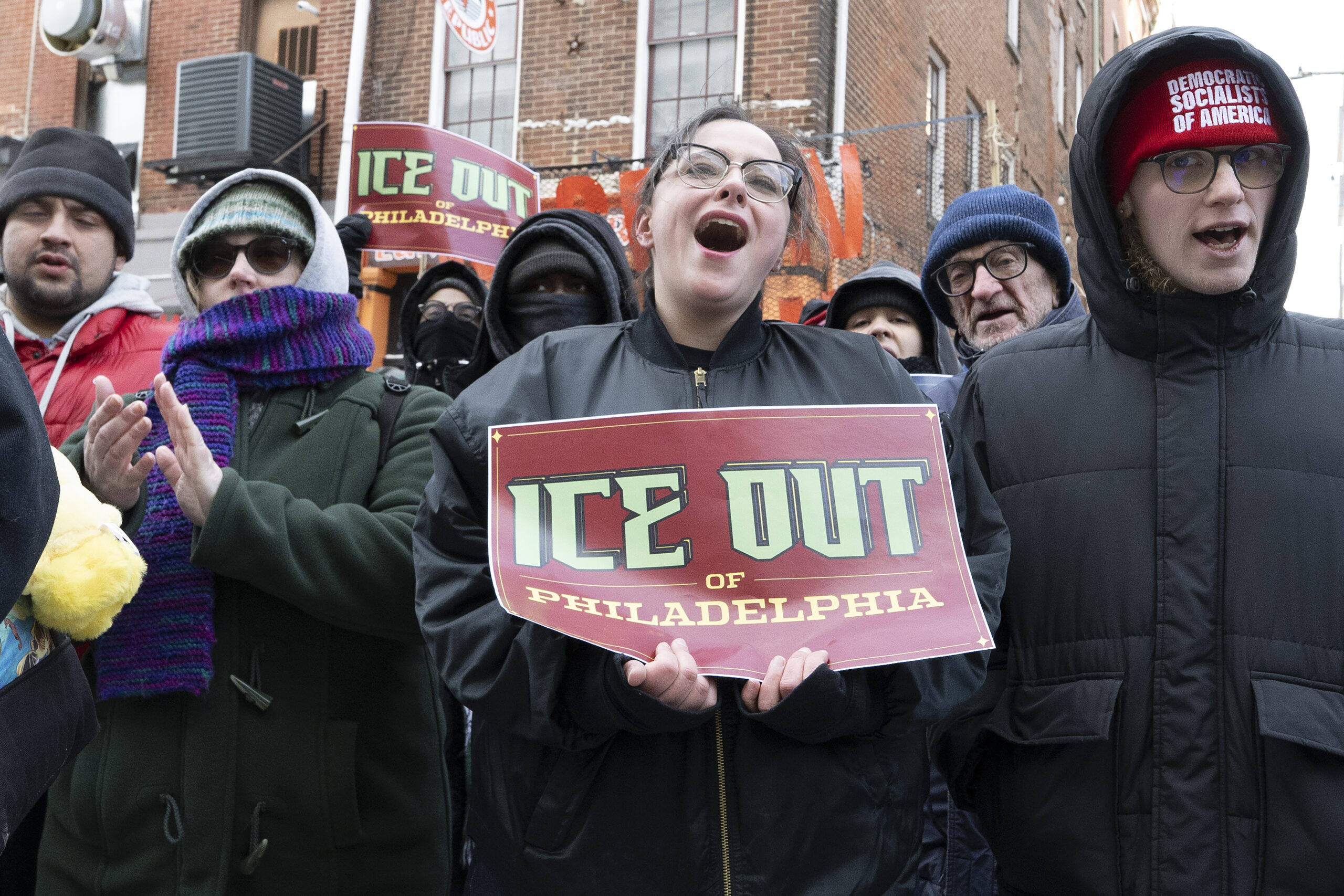
The bill introduced last week by Brooks and Councilmember Rue Landau is part of a package of seven pieces of legislation aimed at limiting how ICE operates in Philadelphia. The proposals would bar Philadelphia employees from sharing information with ICE and ban the agency from using city property to stage raids.
Fifteen of Council’s 17 members signed on to the package of legislation, meaning a version of it is likely to become law. Passing a bill in City Council requires nine votes, and overriding a mayoral veto takes 12. Mayor Cherelle L. Parker has said her team is reviewing the legislation, which can still be amended before it becomes law.
Anti-ICE activists demonstrate outside U.S. Sen. John Fetterman’s Philadelphia office, Jan. 27, calling for an end to federal immigration enforcement policies.
One of the two members who did not cosponsor the package was Councilmember Mike Driscoll, a Democrat who represents parts of Lower Northeast Philadelphia. He indicated that he had concerns about whether the “ICE Out” legislation would hold up in court.
Brooks said Council members worked with attorneys to ensure the legislation is “within our scope as legislators for this city to make sure that we protect our folks against these federal attacks.”
Brand, of Dickinson Law, said the legislation is a classic example of a conflict between two constitutional pillars: the clause that says federal law is supreme, and the 10th Amendment, which gives states powers that are not delegated to the federal government.
He said there is precedent that the states — or, in this case, cities — cannot interfere with laws enacted by Congress, such as immigration matters.
“If I were betting, I would bet on the federal government,” Brand said.
But there is a gray area, he said, and that includes the fact that no law — or even regulation — says federal law enforcement agents must wear masks.
Kermit Roosevelt, a law professor at the University of Pennsylvania who is an expert on the Constitution and conflict of laws, said if there is no agency policy, that is “free space” for states and cities to regulate.
Roosevelt said Brooks’ legislation steers clear of other constitutional concerns because it applies to all police officers, not just federal agents.
“If they were trying to regulate only federal agents, the question would be, ‘Why aren’t you doing that to your own police officers?’” he said. “If you single out the federal government, it looks more like you’re trying to interfere with what the federal government is doing.”
Applying the law to local police
Experts say part of the backlash to ICE agents covering their faces is because Americans are not used to it. Local police, sheriff’s deputies, and state troopers all work largely without hiding their faces.
“Seeing law enforcement actions happening with federal agents in masks, that’s extremely jarring,” said Cris Ramon, an immigration consultant based in Washington. “Why are you operating outside of the boundaries of what every other law enforcement agency is doing?”
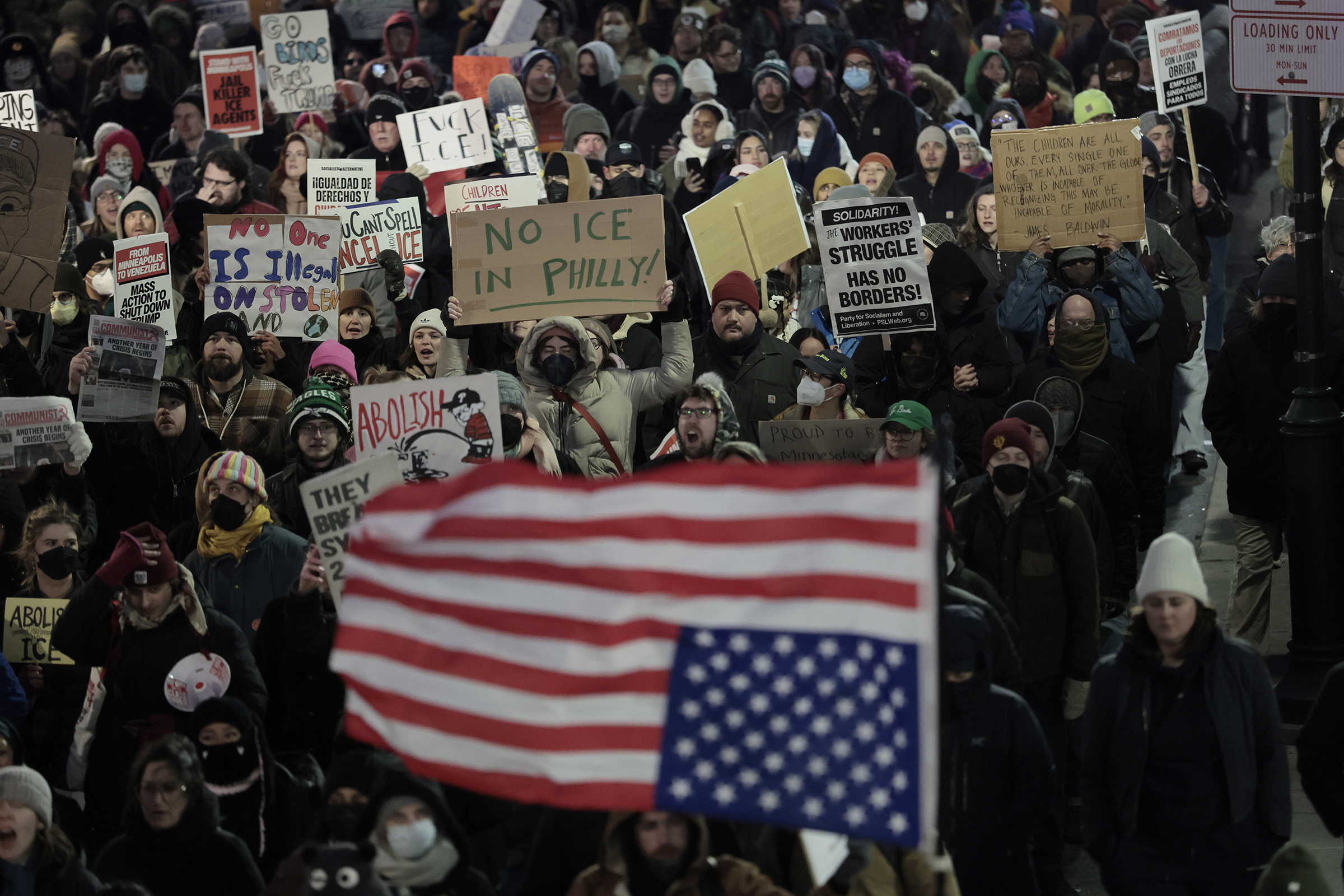
Protesters march up Eighth Street, toward the immigration offices, during the Philly stands with Minneapolis Ice Out For Good protest at Philadelphia City Hall on Jan. 23.
The Council legislation includes exceptions for officers wearing medical-grade masks, using protective equipment, or working undercover. It also allows facial coverings for religious purposes.
However, the federal government could still raise First Amendment concerns, said Shaakirrah R. Sanders, an associate dean at Penn State Dickinson Law.
The administration, she said, could argue that the city is only trying to regulate law enforcement officers and claim that would be discriminatory.
Sanders said defending the legislation could be “very costly” and the city should consider alternatives that fall more squarely within its authority. She pointed to efforts like New Jersey Gov. Mikie Sherrill’s announcement that the state would create a database for residents to upload videos of ICE interacting with the public.
“It looks like the city wants to wield big legislative power,” Sanders said. “My alternative is more in the grassroots work, where you are the first ear for your citizens, not the regulator of the federal government.”
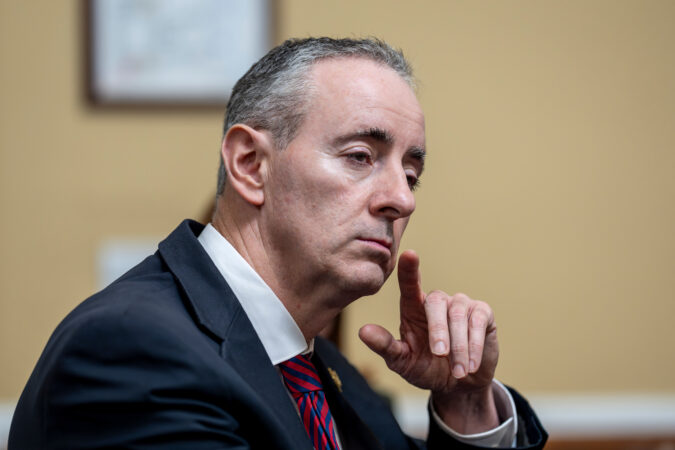
U.S. Rep. Brian Fitzpatrick has more cash on hand than any other GOP incumbent in a swing district nationwide as the party prepares for a tough election.
The Bucks County lawmakerraised about $4.3 million in the most recent cycle, more than any other House candidate in the state and the 21st most of all the candidates running for the 435-member House in 2026. He ended 2024 with nearly $4.4 million when removing debt and had more than $7.3 million cash on hand as of Dec. 31. That haul makes him the best-funded of the 16 candidates on the National Republican Congressional Committee’s Patriots program, a group of vulnerable incumbents in key swing districts, according to Federal Election Commission data.
“Brian Fitzpatrick has years of electoral success under his belt and will continue to be unbeatable in Bucks County because Pennsylvanians know he’ll always put them first in Washington … this race was over before it began,” NRCC spokesperson Reilly Richardson said in a statement.
But Fitzpatrick’s district is one of four in Pennsylvania that could determine the control of the U.S. House and has long been coveted by Democrats because of its purple electorate. It is one of nine GOP-held districts in the country that former Vice President Kamala Harris won in 2024.
Bob Harvie, a Democrat who chairs the Bucks County commissioners, has emerged as the front-runner to face Fitzpatrick in the 2026 election.
Harvie, who would need to win the May primary to face Fitzpatrick,raised nearly $930,000 last year and has more than $400,000 cash on hand. He surpassed $1 million after getting $100,000 in the first few weeks of the year, according to his campaign.
“Based on the outpouring of support we are receiving, it’s clear voters agree and are fired up to be a part of this campaign,” Harvie said Wednesday in a news release about his fundraising.
Harvie made history flipping the Bucks County board six years ago, has strong name recognition in the district, and has the backing of national Democrats. But Fitzpatrick ended the year with nearly 20 times more cash on hand.
Fitzpatrick received more money from each of New York and Florida than from in-state donors in 2025, according to FEC data. Harvie received the vast majority of his money from Pennsylvania.
Fitzpatrick could be less vulnerable than other swing-state Republicans
He recently joined Democrats and two other swing-district Republicans in the state to vote to extend Affordable Care Act subsidies, which Republicans quashed. Fitzpatrick criticized House Speaker Mike Johnson (R., La.) and called some of his Republican colleagues “intellectually dishonest.” But Democrats have argued that Fitzpatrick has not been critical enough of the president, whom he often avoids naming when challenging his policies.
Jim Worthington, a GOP mega-donor in Pennsylvania and owner of the Newtown Athletic Club, said that Fitzpatrick’s approach makes him “the perfect representative for a purple county.”
“Everybody that’s moderate and people that are independents, they love him because he votes to what best represents his constituents, and by the way, sometimes he takes some votes that make me cringe a little bit, but I understand why he does it,” Worthington said.
Heather Roberts, a spokesperson for Fitzpatrick’s campaign, attributed the incumbent’s fundraising success to his ability to break the partisan mold.
“Strong fundraising follows strong leadership — and Congressman Fitzpatrick has built a broad coalition of Republicans, Democrats, and Independents who are rejecting the extremes and backing two-party, patriotic, common-sense solutions,” Roberts said in a statement.
Fitzpatrick “is no maverick and no John McCain — he is a doormat for Trump’s worst instincts and a greenlight for D.C. Republicans’ dangerous agenda that is hurting our community,” Harvie said Wednesday in a statement to The Inquirer.
“Pennsylvanians deserve a Congressman who will stand up to Trump and actually do something to lower prices — but Fitzpatrick is weak and caves to his own party when it matters most,” said Eli Cousin, a spokesperson for the Democratic Congressional Campaign Committee, in a statement.
Harvie has less cash on hand than the other Democratic front-runners in the state’s swing districts.
Janelle Stelson, a second-time challenger to Perry, ended 2025 with about $1.5 million cash on hand. Scranton Mayor Paige Cognetti, who is challenging Bresnahan, ended the year with a little more than $800,000 cash on hand. Former federal prosecutor Ryan Croswell, Mackenzie’s Democratic challenger with the most cash, has $612,000 for the Lehigh Valley race.
Does name recognition make Harvie a ‘formidable’ challenger?
Harvie’s campaign is confident that he can cash in on name recognition, having won two countywide commissioner races in the last seven years that could help raise his profile among voters in the 1st Congressional District, which includes all of Bucks County and a sliver of Montgomery County.
Provided he wins the primary, Harvie would be the first Democratic challenger to Fitzpatrick’s seat who has held countywide elected office.
But will that help Harvie’s chances?
“The starting point that Bob Harvie has with his name ID as a commissioner is just a much better starting point,” said Brittany Crampsie, a Democratic consultant in Pennsylvania, noting that he would not need to spend as much money introducing himself to voters in an expensive Philadelphia-area media market.
“He has a lot of advantages going into this race, not the least of which is his name ID, but he would be probably the most formidable matchup we’ve seen against Fitzpatrick in his tenure,” she added.
“Maybe,” GOP consultant Christopher Nicholas said as to whether Harvie has valuable name recognition, adding that “among hardcore Democrats his name ID is decent because they’re hardcore Democrats.”
“But if you stood out on the streets of Tullytown or Riegelsville or Dublin and said, ‘Who are your county commissioners?’,” residents may be unfamiliar, Nicholas said.
As of October 2025, 43% of respondents to an internal Harvie campaign survey conducted by Public Policy Polling could identify Harvie, with 26% giving him a favorable rating and 17% an unfavorable. That poll had the commissioner and Fitzpatrick tied at 41%.
This article has been updated to include a comment from Fitzpatrick’s campaign received after publication.
The race to fill Philadelphia’s open congressional seat is the marquee election in the city this year, but with less than four months left until primary election day, it has yet to attract much money from political action committees or donors outside the region.
Most of the campaign thus far has been funded by big checks from individual donors, and several of the top contenders to represent Pennsylvania’s 3rd Congressional District — the most Democratic in the nation — have raised most of their money from people who live in Pennsylvania.
That’s according to an Inquirer analysis of recently filed campaign finance reports that break down contributions to each candidate between October and December.
The filings, coupled with previous financial reports, provide a snapshot of who is contributing to each Democrat’s campaign heading into the election year, and how capable each contender is of powering their operations and advertising.
While money is not the only factor in a political campaign, fundraising prowess can be used as a predictor of viability, and it can persuade other donors to contribute. Ten candidates announced they are running for the seat held by retiring U.S. Rep. Dwight Evans, but it’s likely that not all of them will make it onto the May 19 primary election ballot.
However, the two physicians in the contest, Ala Stanford and David Oxman, have each dedicated six-figure loans to their own campaigns, and progressive State Rep. Chris Rabb is expected to draw donations from left-leaning groups.
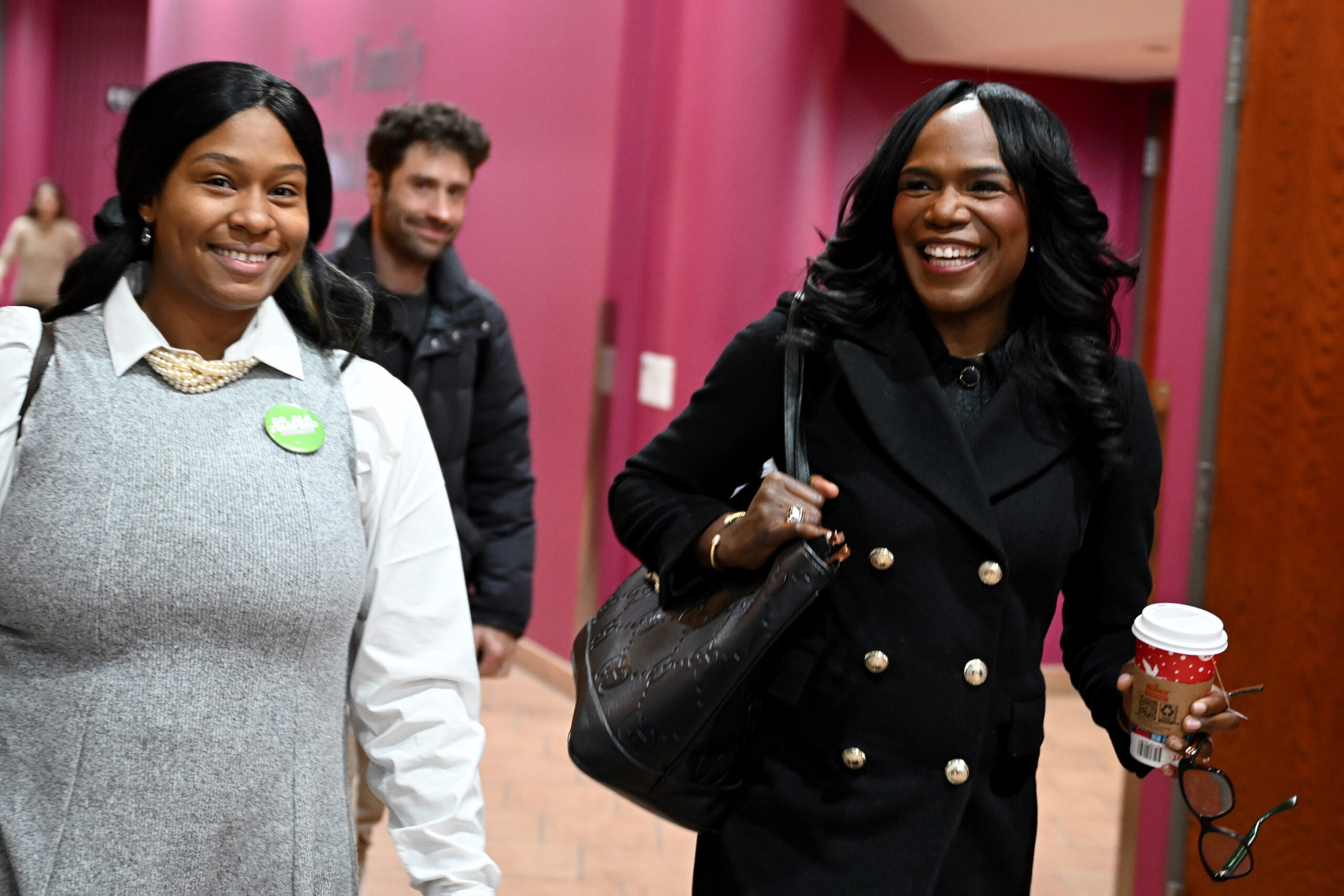
Physician Ala Stanford (right) arrives at a forum hosted by the 9th Ward Democratic Committee Dec. 4, 2025. She is a Democratic candidate running to represent Philadelphia’s Third Congressional District.
Interest from outside Philly will also likely rise as the primary election draws near.
If national political figures weigh in on the race, they can lean on their vast networks of donors across the country to keep their preferred candidates’ campaigns afloat.
And deep-pocketed special-interest groups with their eyes on influencing Congress may seek to sway the race in its final months.
Not much PAC money — yet
Under decades-old campaign finance law, corporations cannot give directly to candidates for federal office. But their executives, board members, and employees can fund PACs that are used as vehicles to prop up their supported candidates.
As the role of money in politics has drawn scrutiny over the years, so has the reliance on so-called corporate PACs. That is especially true among some Democrats who see accepting money from them as a litmus test of their working-class bona fides.
Rabb has hammered the issue in public forums and debates. He says he has never accepted corporate PAC money since his first run for office in 2015, and has repeatedly called on the other contenders to refuse corporate PAC funding.
None of the candidates for the 3rd District has thus far leaned on corporate PAC money, according to the campaign finance reports.
window.addEventListener(“message”,function(a){if(void 0!==a.data[“datawrapper-height”]){var e=document.querySelectorAll(“iframe”);for(var t in a.data[“datawrapper-height”])for(var r,i=0;r=e[i];i++)if(r.contentWindow===a.source){var d=a.data[“datawrapper-height”][t]+”px”;r.style.height=d}}});
However, PACs associated with labor unions have gotten involved.
Street raised about $40,000 in the last period from PACs associated with labor groups. He is backed by the deep-pocketed Philadelphia Building and Construction Trades Council, an umbrella organization of unions that endorsed him last fall.
In the past, the trades have also funded super PACs, outside spending groups that can raise unlimited amounts of money but must follow strict rules largely barring them from coordinating directly with the campaigns they support.
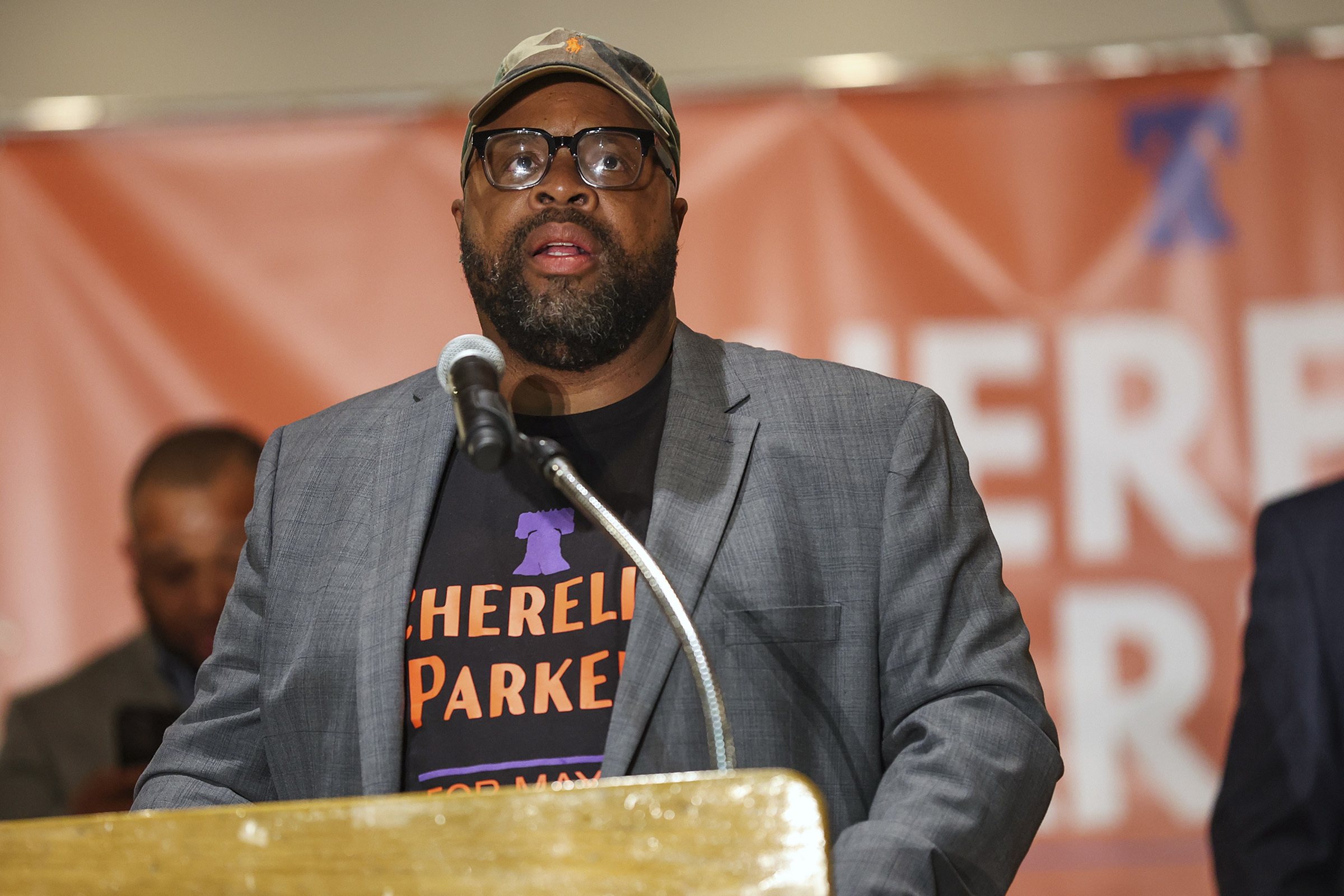
Ryan Boyer, head of the Philadelphia Building & Construction Trades Council, was one of the first to speak at Cherelle Parker’s election night party at the Sheet Metal Workers Local 19 on Nov. 7, 2023.
But no such super PAC has materialized so far, according to campaign finance reports. Rather, the bigger financial factor in this race — at least through the end of last year — was candidates lending money to their own campaigns. Stanford put up $250,000 on Dec. 31, the last day of the reporting period. And Oxman has lent his campaign $175,000.
Small vs. big-dollar donors
While the candidates relied largely on donations from individuals, the size of the checks they brought in varied. Under campaign finance limits, individuals can give up to $3,500 to a candidate per election.
The average contribution to State Rep. Morgan Cephas since she announced her campaign was $596 — about half of Street’s and Rabb’s average contributions. Individual donors gave the most to Stanford, on average, with the average contribution to her campaign totaling $1,737.
That analysis includes only donors who contributed more than $200 through the course of the year. Campaigns are required to itemize only contributions above that threshold.
State Rep. Chris Rabb at a forum hosted by the 9th Ward Democratic Committee Dec. 4, 2025. He is a Democratic candidate running to represent Philadelphia’s Third Congressional District.
Small donations, or contributions under $200, have made up a tiny fraction of the money brought in by the top contenders so far, according to the latest filings. About 11.5% of the money Rabb raised was from small-dollar donors. Such contributions made up less than 5% of all funding for Stanford, Oxman, and Street.
The one outlier was Pablo Iván McConnie-Saad, an ex-Treasury Department official under former President Joe Biden. His campaign has been somewhat low-profile so far; however, small-dollar contributions made up a quarter of his total of $119,000 raised.
His campaign said in a statement that the filings are evidence that his run is “entirely people powered.”
Stanford’s campaign manager, Janée Taft-Mack, noted that the pediatric surgeon has been campaigning for a shorter amount of time than several of her opponents. She announced her campaign in October, several months after Street and Rabb.
Taft-Mack added that the range of donors “underscores a coalition that crosses income levels, neighborhoods, and communities.”
Where the money came from
While every candidate vying for Evans’ seat has touted grassroots support, it appears that Cephas and Street raised the most money from donors who live in Philadelphia.
About half of the individual donors who gave more than $200 to Street and Cephas are city residents. Both candidates have also raised the most money from donors living in Pennsylvania.
window.addEventListener(“message”,function(a){if(void 0!==a.data[“datawrapper-height”]){var e=document.querySelectorAll(“iframe”);for(var t in a.data[“datawrapper-height”])for(var r,i=0;r=e[i];i++)if(r.contentWindow===a.source){var d=a.data[“datawrapper-height”][t]+”px”;r.style.height=d}}});
Street, who formerly led the state Democratic Party and has connections to donors across Pennsylvania, raised 81% of his individual contributions, or about $488,000, from in-state residents. For Cephas, the share was 78%,or about $162,000.
Anthony Campisi, a spokesperson for Street, said the latest finance report “highlights the entire point of our campaign.”
“Sharif is running to represent Philadelphians from across an incredibly diverse district,” he said, “and is building the coalition needed to both win and effectively serve in Congress.”
Cephas’ campaign manager, Salvatore Colleluori, said her fundraising within the city shows she has a “broad base of support, especially in Philadelphia.”
“She has been a champion for Philadelphia in the state House, and people know that,” he said. “They want to support that work.”
Rabb, a progressive who has support from left-leaning organizations and activists outside the region, had among the lowest share of contributions from Philly-based donors, according to The Inquirer’s analysis.
He said in a statement that when small-dollar donations are accounted for, he believes he will have “more Philly donations than any of the establishment candidates.”
Rabb said he will soon be rolling out endorsements from progressive organizations “that will significantly grow our donor base.”
Staff writer Sean Collins Walsh contributed to this article.
A Democratic campaign manager was charged Monday in Chester County with filing fraudulent nomination petitions in the 2024 primary for auditor general, including the forged signature of a Chester County judge, authorities said.
Mariel Kornblith-Martin, 40, of Philadelphia, is accused of filing the false nomination petitions when serving as campaign manager for Mark Pinsley, the Lehigh County controller, as he sought to secure a place on the competitive Democratic primary ballot.
Petitions for Pinsley’s campaign included the names of people who said they had not signed them, including Chester County Judge Alita Rovito, Coatesville City Council members Carmen Green and Khadija Al-Amin, and West Goshen Township Supervisor Nate Wolman, The Inquirer reported.
Rovito reported the forgery to the Chester County District Attorney’s Office at the time, saying the signature was not hers and she did not sign nominating petitions for any candidate, “as to do so would be a violation of judicial ethics,” according to charging documents.
Rovito, a Democrat, told The Inquirer at the time that “the use of my name and signature is concerning to me due [to] the potential implications on my role as a member of the independent judiciary.”
Alita Rovito, a Chester County judge, poses for a portrait in West Chester, Pa. in 2020.
In the criminal complaint filed against Kornblith-Martin, the Chester County District Attorney’s Office alleges that she gave three college students “stacks of pages containing signatures of supporters” and asked them to sign the required sworn declaration at the bottom of each page. Among the charges filed against Kornblith-Martin was solicitation to false swearing.
Prosecutors say she paid the students, who are not named in the charging documents, $50 on at least three occasions to sign the petitions.
“That’s disgraceful,” former U.S. Rep. Bob Brady, the chair of the Philadelphia Democratic Party, said of the charges against Kornblith-Martin. “She’s not one of our favorites.”
The three college students were all working part-time on several campaigns run by Kornblith-Martin, according to the complaint.
The students were previously identified by The Inquirer as paid volunteers attending Temple University.
Kornblith-Martin described herself to investigators as a “political operative” in Philadelphia with 13 years of experience who had worked on 16 campaigns, according to the criminal complaint. She previously served in Philadelphia’s 39th Democratic Ward, but resigned last year, according to its ward leader, Traffic Court Judge Michael Sullivan.
Kornblith-Martin did not respond to requests for comment on Wednesday or Thursday.
She turned herself in on Wednesday and has been released on bail, which was set at $50,000.
Kornblith-Martin said in 2024 that the campaign was conducting an “internal investigation” when asked about the alleged fraudulent signatures.
Pinsley told The Inquirer on Wednesday evening his campaign “reviewed what was brought to our attention but did not have enough verified information to reach independent conclusions” when concerns were raised.
“Petition drives can involve invalid or questionable signatures for many reasons, and we were not in a position to determine intent,” he added in a text message. “I was not personally involved in the signature collection, and I believe the legal process is the appropriate place for the facts to be established. If anyone knowingly falsified signatures, that would be wrong and should carry consequences.”
Pinsley said he has “not been involved” with Kornblith-Martin since his auditor general campaign and does “not know the facts of this situation.” Pinsley is now running in the crowded Democratic primary to challenge Republican U.S. Rep. Ryan Mackenzie in the Lehigh Valley.
Pinsley’s campaign was not the only one with signatures that came under scrutiny.
King, an entrepreneur who still has political aspirations, told The Inquirer the incident had disillusioned him about the two-party system and inspired him to reapply to law school.
“When ballot access becomes a game of shortcuts and challenges, democracy loses before voters ever enter the booth,” he said.
The February 2024 revelation that Pinsley’s campaign may have submitted fraudulent petitions shook up the race for a little-known office responsible for conducting audits to ensure that state money is spent properly.
Pinsley failed to secure the Democratic nomination over State Rep. Malcolm Kenyatta, who ultimately lost to incumbent Republican Auditor General Tim DeFoor as the GOP swept the state’s row officesin the general election.
Kenyatta did not formally challenge Pinsley’s nominating petitions to remove him from the ballot during the primary. Reached Wednesday, Kenyatta said in a statement: “Fraud occurring within any stage of our electoral process is a direct assault on our democracy.”
“The charges brought today are a first step in the legal process but accountability must not end here: the buck always stops with the candidate,” added Kenyatta, the vice chair of the Democratic National Committee.
Investigators found at least nine pages of alleged forgeries of Chester County voters, according to the complaint.
To get on the ballot in Pennsylvania for a statewide row office like auditor general, a candidate must submit 1,000 signatures, including at least 100 from at least five counties.
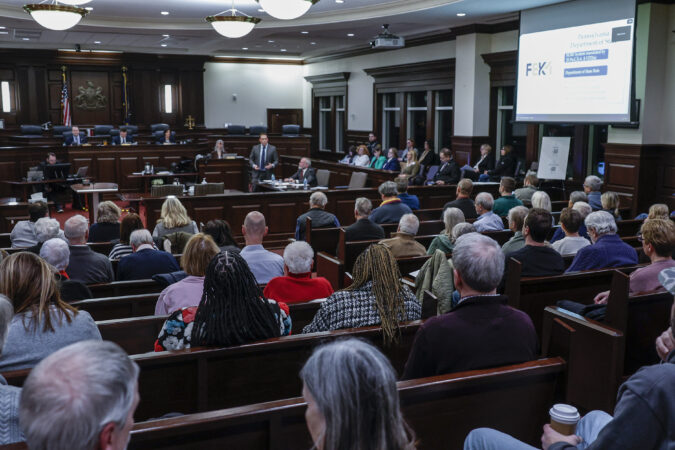
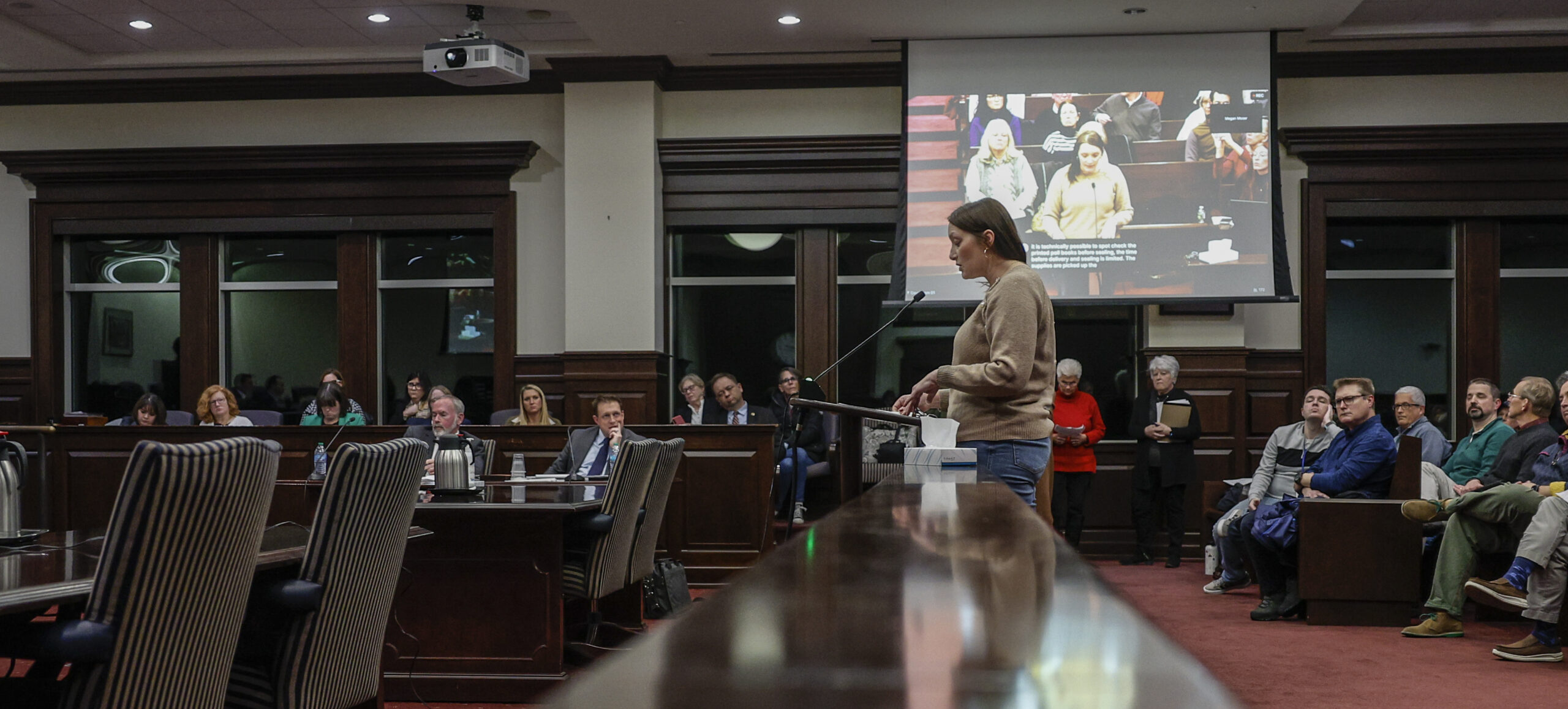
Tuesday’s public meeting was the first time community members — and the county commissioners themselves — were able to respond to an independent firm’s investigation and report, which found that insufficient training, poor oversight, and staffing challenges in the county’s elections office forced more than 12,000 voters to cast provisional ballots in the general election. The poll book error occurred as the 25-person department has faced unusually high turnover in recent years, and as the director faces allegations of fostering a toxic workplace.
“This is the first step, this is not the last step … to rebuilding trust with the public and improving elections in a way that ensures this never happens again,” Josh Maxwell, chairman of the county commissioners, told the attendees.
The 24-page report, prepared by West Chester law firm Fleck, Eckert, Klein & McGarry LLC and published last month, found that two employees mistakenly included only registered Democrats and Republicans when using the statewide voter roll to create the poll book, omitting more than 75,000 registered independent and unaffiliated voters from the rolls.
The employees, inexperienced and never formally trained, lacked direct supervision, the report said. No one in the county’s department checked the books until a poll worker noticed the omissions before polls opened on Election Day.
There was no evidence of malfeasance, the report said. County officials said previously that everyone who wanted to vote could cast a ballot, despite the issue.
Still, the error rocked Election Day in the county, with officialsscrambling to print supplemental poll books and poll workers staying late to address the challenges. Republican Commissioner Eric Roe broke with his Democratic peers by voting against the certification of the election results in December, saying his conscience would not allow it.
Community members said Tuesday the error further eroded trust in voting security.
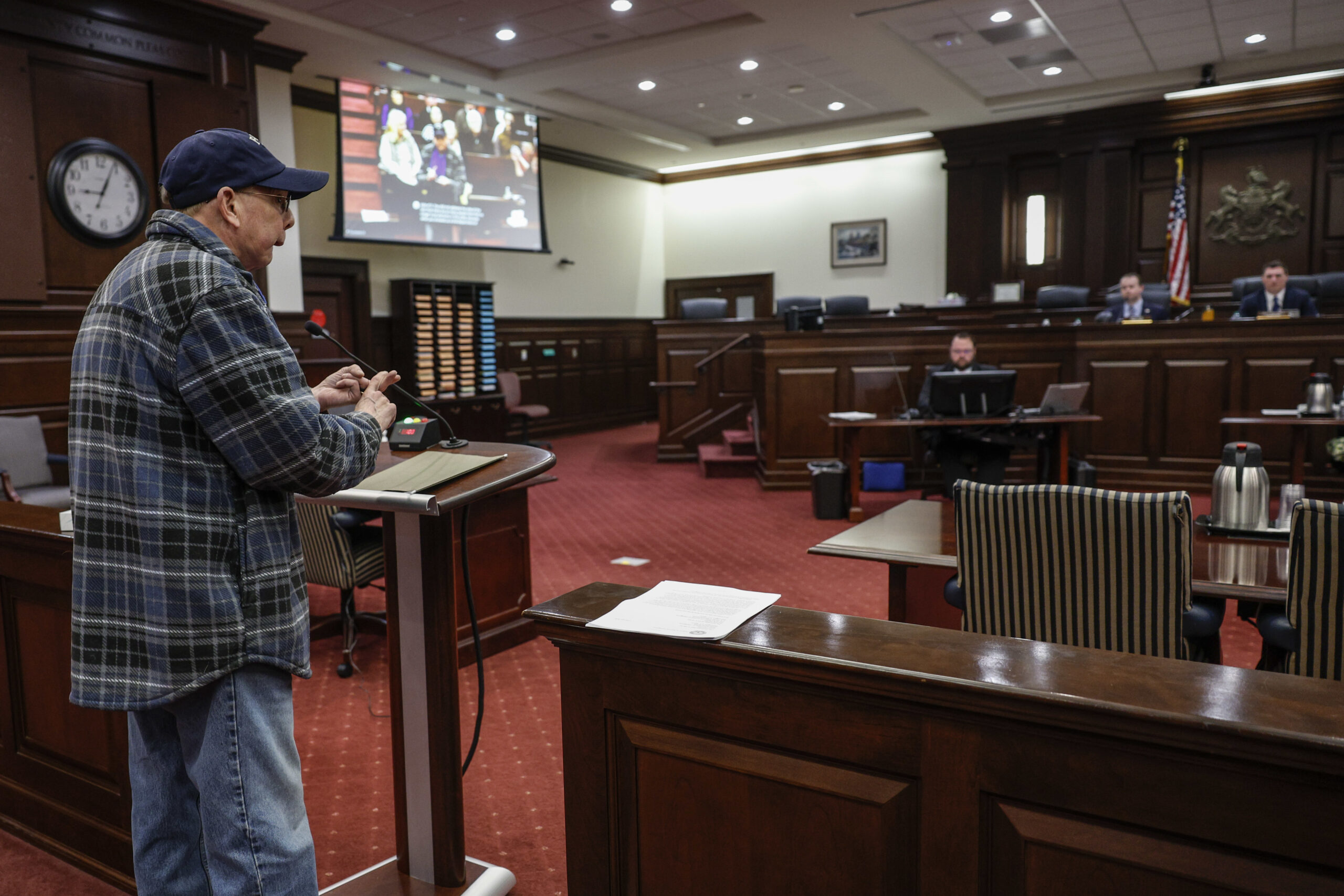
John Luther addresses the Chester County Commissioners as they hold a public meeting to discuss the errors they had in the pole books during the November election. West Chester. Tuesday, February 3, 2026
“How many voters were disenfranchised and did not vote?” resident John Luther asked the commissioners. “That is the most important thing. You guys can fix all the rest, but you can’t fix what you messed up in the front.”
Kadida Kenner — who leads the New Pennsylvania Project, an organization dedicated to voter registration — said she rushed on Election Day to West Chester University, where the organization had helped students register to vote, to make sure they were not disenfranchised.
“I see the impact of this mistake, this opportunity for change and growth,” she said. “The events of Election Day really did not help our efforts to be able to overcome feelings of individuals, as it relates to the electoral process, here in the commonwealth and across the country.”
The report recommended more than a dozen changes for the county to prevent future errors, including improved training, reviewing processes and policies, and evaluating staff levels and pay. The county rolled out a plan to address the recommendations and intends to make monthly reports on its progress, saying some recommendations would be in place ahead of May’s primary.
“Everyone in this room knows that a grievous error was made, and everyone is upset about it,” resident Marian Schneider said. “We can stop the browbeating and focus on the path forward.”
The report stopped short of recommending personnel changes. Maxwell said the commissioners would not discuss personnel actions.
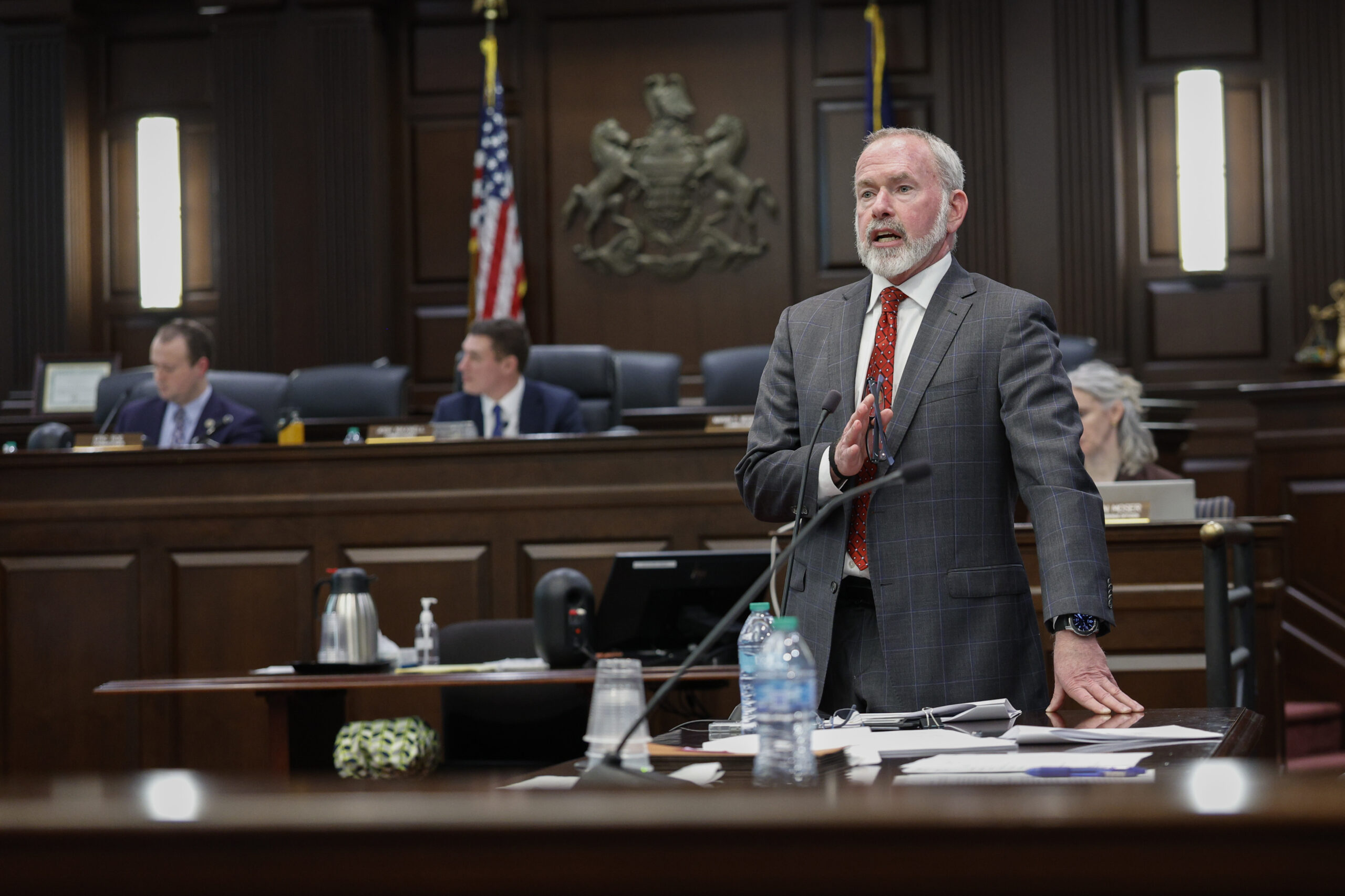
Attorney Sigmund Fleck addresses the Chester County Commissioners as they hold a public meeting to discuss the errors they had in the pole books during the November election. West Chester. Tuesday, February 3, 2026
“Bottom line, this appears to be a human error — clicking the wrong box,” said Sigmund Fleck, one of the attorneys who oversaw the report.
Residents worried that those errors were symptoms of a deeper problem, and that the report’s scope did not fully address issues within voter services.
“Yes, human error is a factor here,” Elizabeth Sieb told the commissioners. “This goes far beyond that. Mistakes of this magnitude require consequences.”
Fleck pointed to larger issues with the state’s election system that culminated in the error, such as tight turnaround times for publishing the poll books, lack of statewide training, and a fairly old-school online voting roll system.
Elizabeth Sieb addresses the Chester county commissioners as they hold a public meeting to discuss the errors they had in the pole books during the November election. West Chester. Tuesday, February 3, 2026
But other counties deal with those same complications, some community members argued. November’s error came after the county omitted the office of the prothonotary on the ballot in May’s primary. The report found that errorwas due to the county solicitor’s office misinterpreting state law.
“Sixty-seven counties face the same exact issues, except for one: management,” said Nathan Prospero Fox, a former voter services employee.
Roe acknowledged the anger directed at county staff, but said: “The truth is, the buck doesn’t stop with staff. It stops with us.”
“I am so sorry,” he continued. “This is not the end; there’s still time for accountability and improvement.”
This suburban content is produced with support from the Leslie Miller and Richard Worley Foundation and The Lenfest Institute for Journalism. Editorial content is created independently of the project donors. Gifts to support The Inquirer’s high-impact journalism can be made at inquirer.com/donate. A list of Lenfest Institute donors can be found at lenfestinstitute.org/supporters.