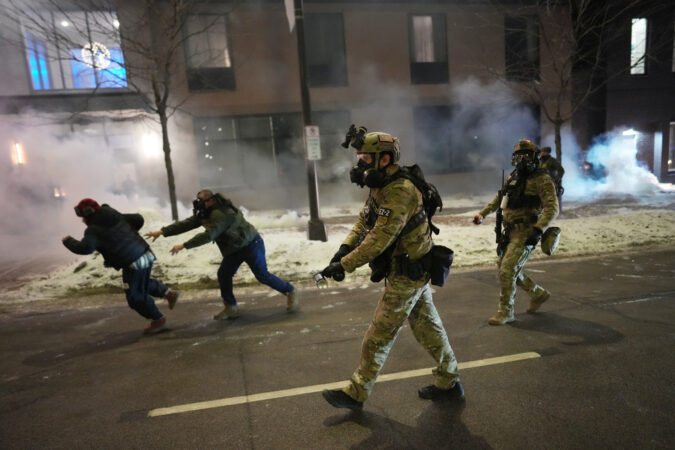
Sen. John Fetterman on Tuesday urged President Donald Trump “to immediately fire” Homeland Security Secretary Kristi Noem after federal agents killed two citizens in Minneapolis this month during an immigration enforcement operation.
“Americans have died,” Fetterman (D., Pa.) said in a statement. “She is betraying DHS’s core mission and trashing your border security legacy.”
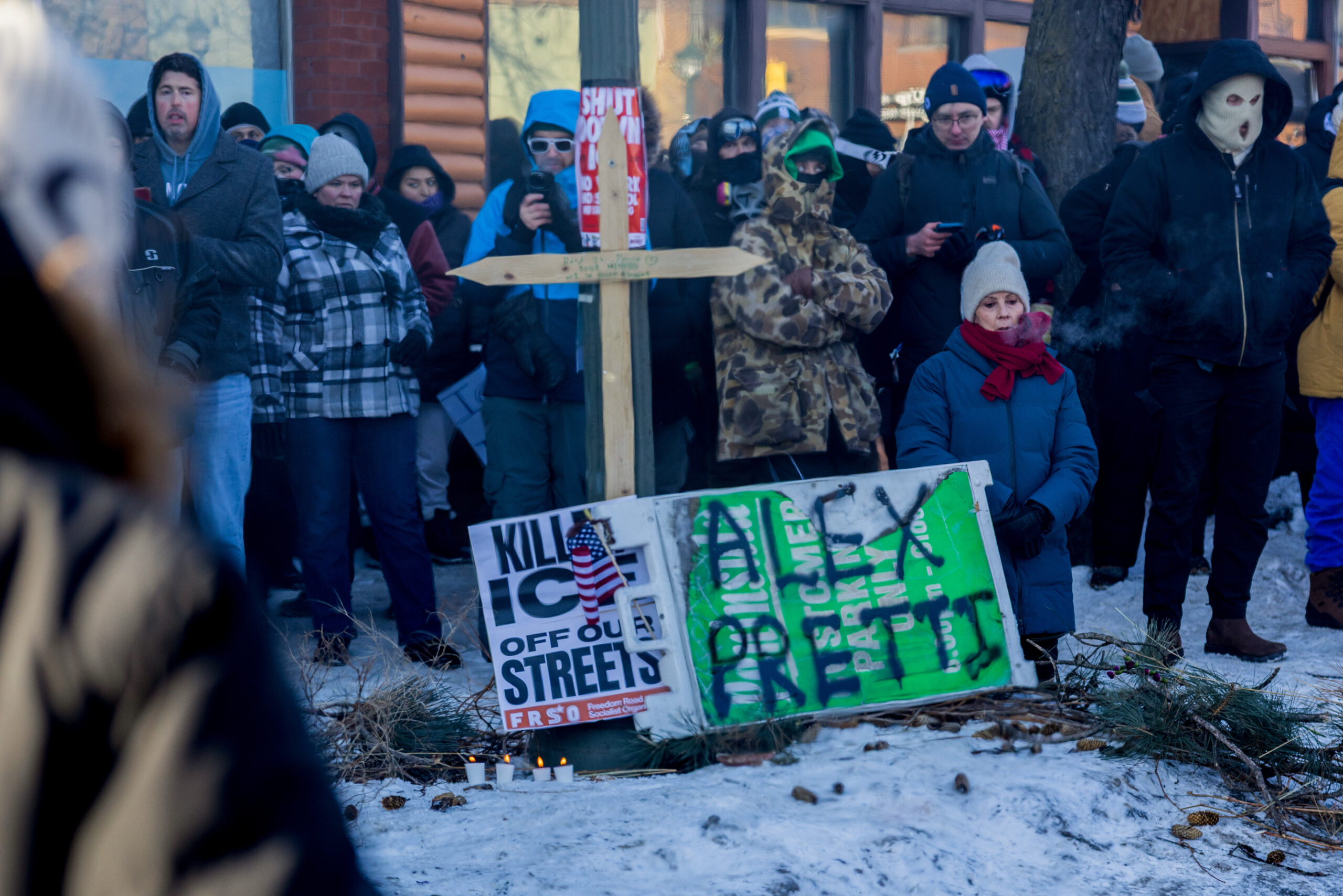
The senator’s call for Noem’s firing comes after federal agents killed two Americans during the Minneapolis operation. On Saturday, a Border Patrol agent shot and killed Alex Pretti, an intensive care nurse at a VA hospital. An ICE agent shot and killed Renee Nicole Good, a 37-year-old poet and mother, on Jan. 7.
Fetterman referenced Noem’s predecessor, Alejandro Mayorkas, who served under former President Joe Biden and faced impeachment by the Republican-led House in 2024 amid a backlash over increased border crossings under Biden.
Sen. Andy Kim (D., N.J.), who also voted for Noem, joined the growing chorus of Democrats calling for Noem to step down on Tuesday. The South Jersey lawmaker has previously called the vote a mistake.
Fetterman’s plea to fire Noem comes a day after he called for the withdrawal of federal agents from Minneapolis. And it comes as the U.S. Senate is poised to vote this week on funding for the Department of Homeland Security, which oversees both ICE and the Border Patrol.
Senate Minority Leader Chuck Schumer said Democrats would vote against it, which could trigger a partial federal government shutdown.
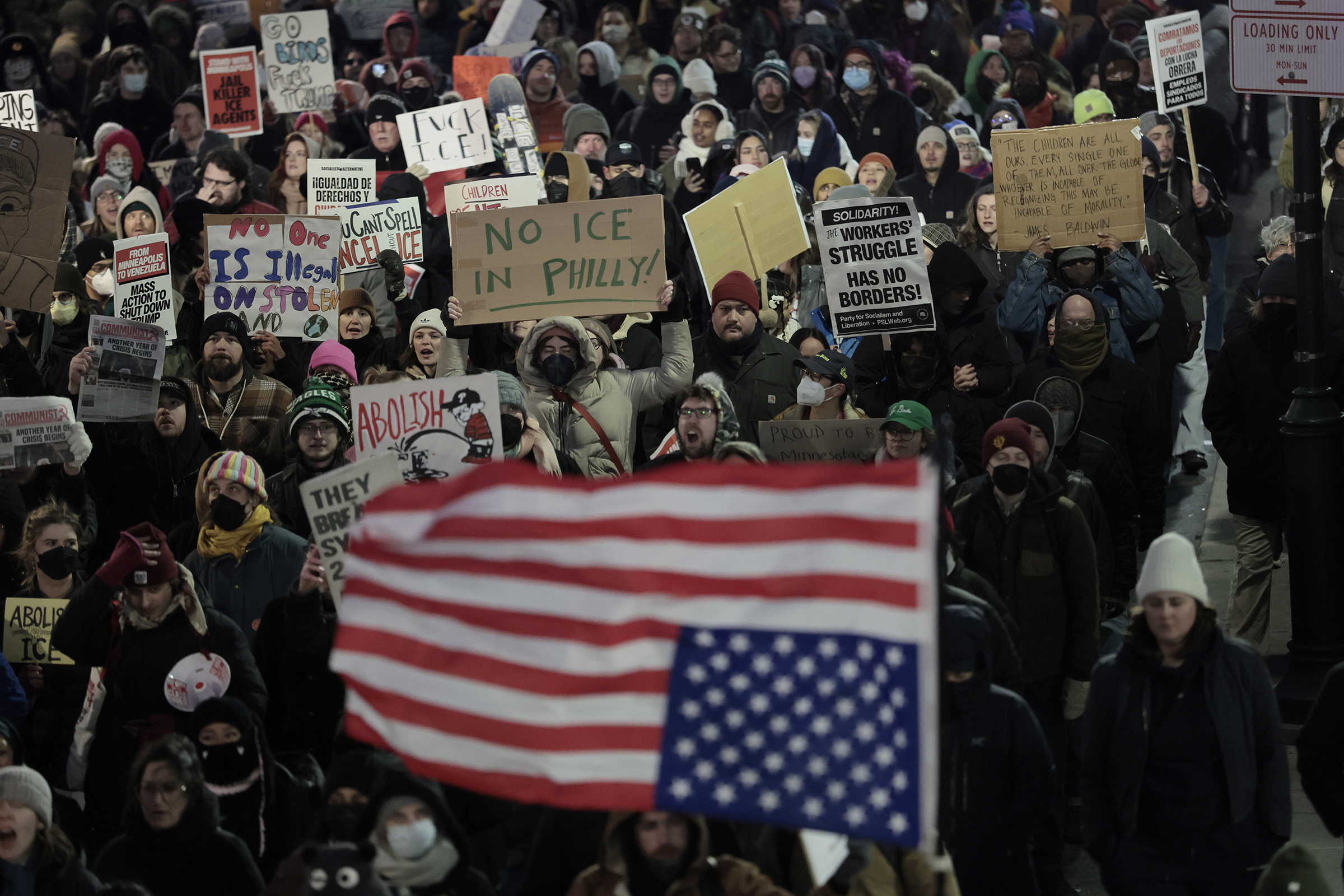
About 150 protesters gathered outside Fetterman’s office in Philadelphia in the snow on Tuesday to urge him to join the effort, but the senator said on Monday that he will never vote to shut down the government. He also argued that doing so would not pull the $178 billion dedicated to DHS through the One Big Beautiful Bill Act, which he did not support.
“I would like him to listen and actually represent us, because that’s his job,” said James Pierson, 42, an Exton resident attending the demonstration.
Fetterman suggested pulling the DHS bill from the package of bills under consideration by the Senate this week rather than another shutdown vote.
“I reject the calls to defund or abolish ICE,” he said. “I strongly disagree with many strategies and practices ICE deployed in Minneapolis, and believe that must change.”
Prominent Republicans and gun rights advocates helped elicit a White House turnabout this week after bristling over the administration’s characterization of Alex Pretti, the second person killed this month by a federal officer in Minneapolis, as responsible for his own death because he lawfully possessed a weapon.
The death produced no clear shifts in U.S. gun politics or policies, even as President Donald Trump shuffles the lieutenants in charge of his militarized immigration crackdown. But important voices in Trump’s coalition have called for a thorough investigation of Pretti’s death while also criticizing inconsistencies in some Republicans’ Second Amendment stances.
If the dynamic persists, it could give Republicans problems as Trump heads into a midterm election year with voters already growing skeptical of his overall immigration approach. The concern is acute enough that Trump’s top spokeswoman sought Monday to reassert his brand as a staunch gun rights supporter.
“The president supports the Second Amendment rights of law-abiding American citizens, absolutely,” White House press secretary Karoline Leavitt told reporters.
Leavitt qualified that “when you are bearing arms and confronted by law enforcement, you are raising … the risk of force being used against you.”
Videos contradict early statements from administration
That still marked a retreat from the administration’s previous messages about the shooting of Pretti. It came the same day the president dispatched border czar Tom Homan to Minnesota, seemingly elevating him over Homeland Security Secretary Kristi Noem and Border Patrol chief Greg Bovino, who had been in charge in Minneapolis.
Within hours of Pretti’s death on Saturday, Bovino suggested Pretti “wanted to … massacre law enforcement,” and Noem said Pretti was “brandishing” a weapon and acted “violently” toward officers.
“I don’t know of any peaceful protester that shows up with a gun and ammunition rather than a sign,” Noem said.
White House deputy chief of staff Stephen Miller, an architect of Trump’s mass deportation effort, went further on X, declaring Pretti “an assassin.”
Bystander videos contradicted each claim, instead showing Pretti holding a cellphone and helping a woman who had been pepper sprayed by a federal officer. Within seconds, Pretti was sprayed, too, and taken to the ground by multiple officers. No video disclosed thus far has shown him unholstering his concealed weapon -– which he had a Minnesota permit to carry. It appeared that one officer took Pretti’s gun and walked away with it just before shots began.
As multiple videos went viral online and on television, Vice President JD Vance reposted Miller’s assessment, while Trump shared an alleged photo of “the gunman’s gun, loaded (with two additional full magazines!).”
On Tuesday, Trump was asked if he agreed with Miller’s comment describing Pretti as an “assassin” and answered “no.” But he added that protesters “can’t have guns” and said he wants the death investigated.
“You can’t walk in with guns, you just can’t,” Trump told reporters on the White House lawn before departing for a trip to Iowa.
The National Rifle Association, which has backed Trump three times, released a statement that began by casting blame on Minnesota Democrats it accused of stoking protests. But the group lashed out after a federal prosecutor in California said on X that, “If you approach law enforcement with a gun, there is a high likelihood they will be legally justified in shooting you.”
That analysis, the NRA said, is “dangerous and wrong.”
FBI Director Kash Patel magnified the blowback Sunday on Fox News’ “Sunday Morning Futures With Maria Bartiromo.” No one, Patel said, can “bring a firearm, loaded, with multiple magazines to any sort of protest that you want. It’s that simple.”
Erich Pratt, vice president of Gun Owners of America, was incredulous.
“I have attended protest rallies while armed, and no one got injured,” he said on CNN.
Conservative officials around the country made the same connection between the First and Second amendments.
“Showing up at a protest is very American. Showing up with a weapon is very American,” state Rep. Jeremy Faison, who leads the GOP caucus in Tennessee, said on X.
Trump’s first-term vice president, Mike Pence, called for “full and transparent investigation of this officer involved shooting.”
A different response from the past
Liberals, conservatives and nonpartisan experts noted how the administration’s response differed from past conservative positions involving protests and weapons.
Multiple Trump supporters were found to have weapons during the Jan. 6, 2021, attack on the U.S. Capitol. Trump issued blanket pardons to all of them.
Republicans were critical in 2020 when Mark and Patricia McCloskey had to pay fines after pointing guns at protesters who marched through their St. Louis neighborhood after the police killing of George Floyd in Minneapolis. And then there’s Kyle Rittenhouse, a counter-protester acquitted after fatally shooting two men and injuring another in Kenosha, Wisconsin, during the post-Floyd protests.
“You remember Kyle Rittenhouse and how he was made a hero on the right,” Trey Gowdy, a Republican former congressman and attorney for Trump during one of his first-term impeachments. “Alex Pretti’s firearm was being lawfully carried. … He never brandished it.”
Adam Winkler, a UCLA law professor who has studied the history of the gun debate, said the fallout “shows how tribal we’ve become.” Republicans spent years talking about the Second Amendment as a means to fight government tyranny, he said.
“The moment someone who’s thought to be from the left, they abandon that principled stance,” Winkler said.
Meanwhile, Democrats who have criticized open and concealed carry laws for years, Winkler added, are not amplifying that position after Pretti’s death.
Uncertain effects in an election year
The blowback against the administration from core Trump supporters comes as Republicans are trying to protect their threadbare majority in the U.S. House and face several competitive Senate races.
Perhaps reflecting the stakes, GOP staff and campaign aides were reticent Monday to talk about the issue at all.
The House Republican campaign chairman, Rep. Richard Hudson of North Carolina, is sponsoring the GOP’s most significant gun legislation of this congressional term, a proposal to make state concealed-carry permits reciprocal across all states.
The bill cleared the House Judiciary Committee last fall. Asked Monday whether Pretti’s death and the Minneapolis protests might affect debate, an aide to Speaker Mike Johnson did not offer any update on the bill’s prospects.
Gun rights advocates have notched many legislative victories in Republican-controlled statehouses in recent decades, from rolling back gun-free zones around schools and churches to expanding gun possession rights in schools, on university campuses and in other public spaces.
William Sack, legal director of the Second Amendment Foundation, said he was surprised and disappointed by the administration’s initial statements following the Pretti shooting. Trump’s vacillating, he said, is “very likely to cost them dearly with the core of a constituency they count on.”
Is this actually an honest-to-goodness turning point in the war for the soul of America? Monday night, the deny-everything-admit-nothing Trump regime surprised observers by revealing that violence-provoking Border Patrol commander Greg Bovino has been sent home from Minneapolis and may even be retiring. That’s a giant win for the power of everyday people resisting, but turning around the battleship of tyranny will still take much more work.
Corporate America may pay a steep price for its cowardly ICE neutrality
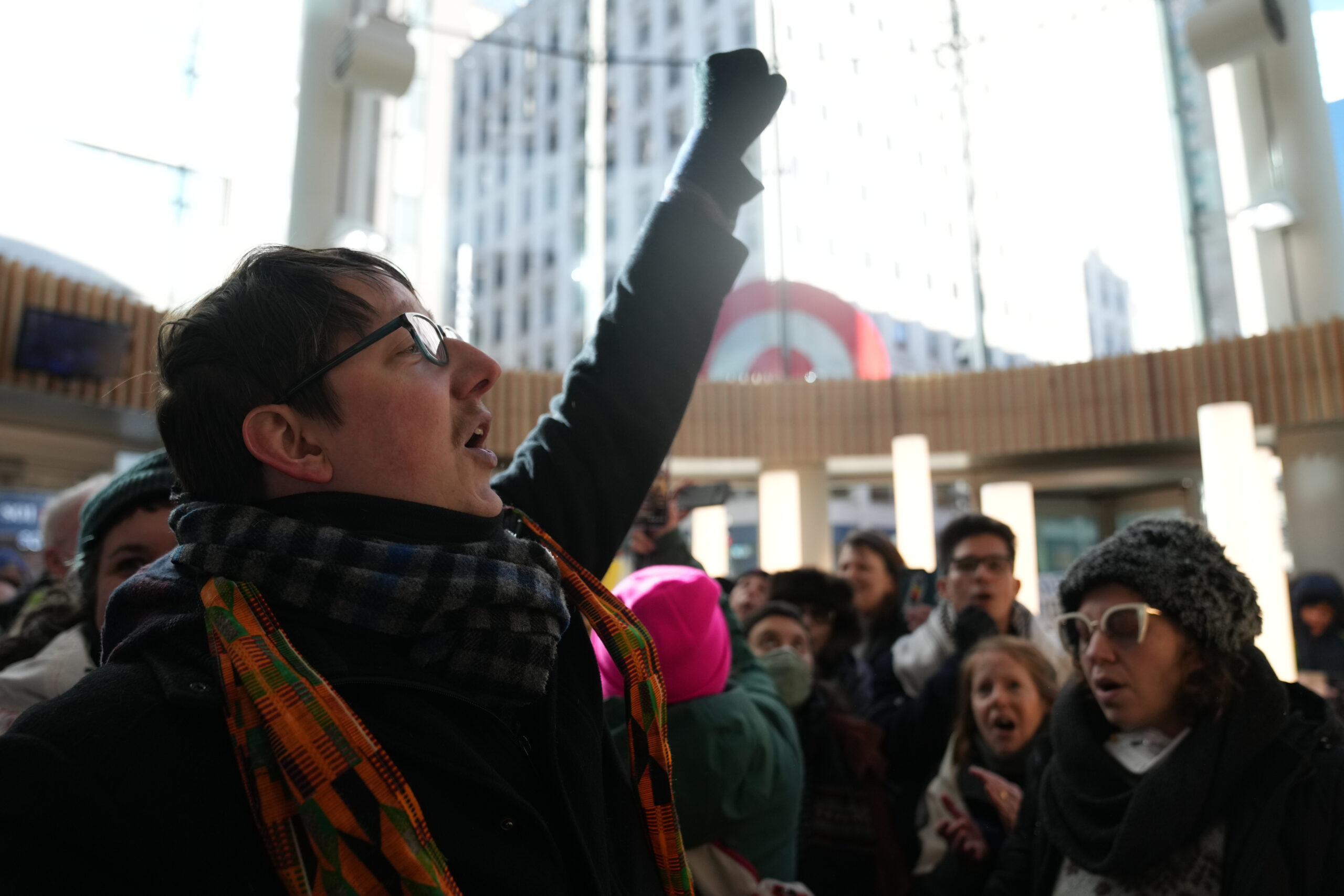
Protesters gather Friday at Target’s corporate headquarters in Minneapolis.
One of the many remarkable and lasting ideas the Rev. Dr. Martin Luther King Jr. placed into the national conversation was the concept of something he called “negative peace.”
Although the phrase began appearing in the writings of the civil rights leader in the late 1950s, King made the idea famous in his 1963 “Letter From Birmingham Jail,” where he was locked up for fighting segregation in Alabama’s largest city. He was annoyed by a letter from eight local white clergymen, titled a “Call for Unity,” that begged King to end a civil disobedience crusade for racial integration and seek progress through negotiations and the courts.
When an aide smuggled the newspaper into King’s cell, he began furiously scribbling his response in the margins of the ad before writing more on any scrap of paper he could find. His key passage argues that the white moderate was a greater threat to Black freedom than the KKK, because he was someone “more devoted to ‘order’ than to justice; who prefers a negative peace which is the absence of tension to a positive peace which is the presence of justice,” and who wants African Americans to wait for a “more convenient season.”
Flash-forward 63 years, and the grand pooh-bahs of U.S. capitalism have learned nothing from this. On Sunday, 60 major corporations based in Minnesota — feeling caught in the crossfire of the federal immigration raids tearing apart Greater Minneapolis and the growing resistance movement — issued a cowardly and pathetic call for a negative peace to reduce the tensions.
The open letter that was released through the Minnesota Chamber of Commerce was signed by the CEOs or equivalents of almost every major Gopher State brand that you could think of — including Target, 3M, General Mills, Hormel, UnitedHealth (yes, that UnitedHealth), and all five major sports franchises. Some of these firms are beginning to see real economic fallout from the U.S. Immigration and Customs Enforcement raids and protest activities, which have kept some frightened Black and brown workers at home and triggered a large general strike last Friday.
The letter reads little differently from the Birmingham ministers’ “Call for Unity.”
“With yesterday’s tragic news” — a vague, bloodless reference to the 10 shots fired by federal officers into a 37-year-old intensive care nurse named Alex Pretti — “we are calling for an immediate deescalation of tensions and for state, local and federal officials to work together to find real solutions,” the letter states. It notes that Minnesota business leaders have been in touch with Gov. Tim Walz, the Donald Trump White House, and others in pleading for what it hopes would be a solution to the state’s crisis.
Pretti is never mentioned in the letter. Neither is Renee Nicole Good, the 37-year-old mother of three who was gunned down behind the wheel of her family SUV by an ICE agent as she attempted to drive away from a confrontation. In fact, ICE is never mentioned, nor are the federal agency’s most outrageous tactics, such as the seizure of a 5-year-old boy as “bait” to detain him and his father, or dragging a barely dressed Hmong refugee who is a U.S. citizen out of his home in frigid weather.
The entire letter is remarkable not for what it says — since it says very little beyond praying this whole mess somehow goes away so they can go back to making money without thinking about such dreadful things — than for what it doesn’t say.
There is no condemnation of the murders of two U.S. citizens who did nothing beyond legally monitoring the federal officers and their activities while on public streets. There is no condemnation of the ICE tactics in seizing hardworking migrants with no criminal records who are the backbone of the Minnesota community. There is nothing about what MLK would have called “positive peace” — a desire for real justice.
That’s probably because positive peace requires bold choices and displays of real courage — qualities that modern corporate America seems to have misplaced in a giant warehouse somewhere.
Exhibit A would have to be Target, the large national retailer that, with its hundreds of stores and its name slapped on the NBA’s Timberwolves’ arena, is now to many Americans the corporate face of Minnesota. Under pressure from demonstrators, including more than 100 clergy who protested outside Target’s Minneapolis headquarters on Friday, the retailer still said nothing — before the tepid group letter — about the ongoing ICE raids, or why agents have been allowed to stage operations in its parking lots and even inside stores.
There’s a bleak history here. In 2020, Minnesota became the epicenter of the fight for racial justice when the Minneapolis police murder of George Floyd was captured on video. That time, the state’s CEOs not only expressed moral outrage but pledged to spend heavily on diversity initiatives. Five years later, the local news site Racket reported many of these firms had backtracked, and that barely a third of the pledged $550 million had been spent.
This time, the business leaders just want the “tension” to disappear. That’s not so easy. Just ask Target. Its early 2025 move to end its diversity initiatives as Trump took office sparked calls from Black leaders for a boycott that has cut into store traffic and lowered Target’s stock price. It seems that moral surrender actually does have a price.
Also on Sunday, the team chaplain for the Timberwolves — ironically, one of the teams that signed onto the corporate letter — issued a personal statement with loud echoes of the “Letter from Birmingham Jail,” calling out any churches that had prayed that morning for peace and unity but not for justice.
“Peace is what the powerful ask for when they don’t want to be interrupted,” Matt Moberg wrote in a short piece that went viral on social media, adding, “Unity that refuses to name violence is just loyalty to the ones holding the weapons.”
This wouldn’t be the first time corporate America misread the room. Sunday’s statement suggested a continued deer-in-the-headlights reaction from the shock of Trump’s return to office — even as the CEOs ignore not just the power of the Target boycotts but the recent success of economic justice campaigns against firms from Disney to Avelo Airlines, not to mention the solidarity that drove the Minneapolis general strike.
Already, there is growing talk of a national general strike or expanded boycotts by millions of citizens who are also consumers, and who are both furious over the Good and Pretti murders and now flabbergasted by the corporate cone of silence. America’s business leaders don’t understand that cowardice has a steep cost attached.
Yo, do this!
There’s no better writer about the long fight for social justice in America than historian Heather Ann Thompson. Her searing 2016 book about the 1971 Attica prison uprising — Blood in the Water — won a well-deserved Pulitzer Prize, and locals were thrilled when it was reported that the next book from Thompson, who taught for a while at Temple, would be on the 1985 MOVE bombing. Instead, she has taken a detour. Her Fear and Fury: The Reagan Eighties, the Bernie Goetz Shootings, and the Rebirth of White Rage is out today. I just downloaded the audiobook, and cannot wait to listen.
It’s Academy Award season, and so — hopelessly snowed in on Sunday — I took a family break from football (!) to rent a movie … from 2009. Given my obsession with 1960s rock and roll radio, it’s weird that I’d never seen Pirate Radio, a fictional homage to the U.K.’s government-defying offshore radio stations of the British Invasion era that stars the late Philip Seymour Hoffman. The plot can be muddled at times, but it’s maybe the best movie soundtrack ever!
Ask me anything
Question: Why do Dem Leaders want to save ICE, when nobody really else does? What’s the motivation? — @keynesaddiction.bsky.social via Bluesky
Answer: I wonder this, too. Both ICE and the current crew at U.S. Customs and Border Protection have been simmering for far too long in a toxic, unredeemable culture that cannot be reformed. What’s more, the shocking abuses on display in Minnesota and two killings have now convinced a plurality of U.S. voters that ICE should be abolished. Still, I can understand the Democrats’ bind, since at the moment the party has no other political leverage beyond the ability to block most Senate legislation with the filibuster. It might be best to push hard for as much as can be done in 2026, while running in the midterms on a platform of abolishing ICE when they gain power on Capitol Hill.
What you’re saying about …
LOL — remember that whole Greenland thing? It feels like that was five years ago, but some of you had some good responses on dealing with Trump’s bluster about an American takeover, even if things have temporarily cooled down. Tom Desmond said the Europeans “need to quit pretending that they can ‘manage’ him through flattery and soft words. Instead, they need to apply threats — i.e., whatever tariffs he imposes on Europe over Greenland they will return against the U.S. three-fold.” Jo Parker said Congress needs to reassert its powers over tariffs and declaring war, but “With the spineless [Dave] McCormick and [John] Fetterman representing us, I’m not sanguine that such actions will take place, however.”
📮 This week’s question: Things are coming to a head in Congress over funding for ICE and the U.S. Department of Homeland Security. Should Democrats make a deal for ICE reforms, such as unmasking and requiring arrest warrants, or must they push for bigger concessions, or even abolishing ICE? Please email me your answer and put the exact phrase “ICE funding” in the subject line.
Backstory on the day (a) Fetterman spoke out
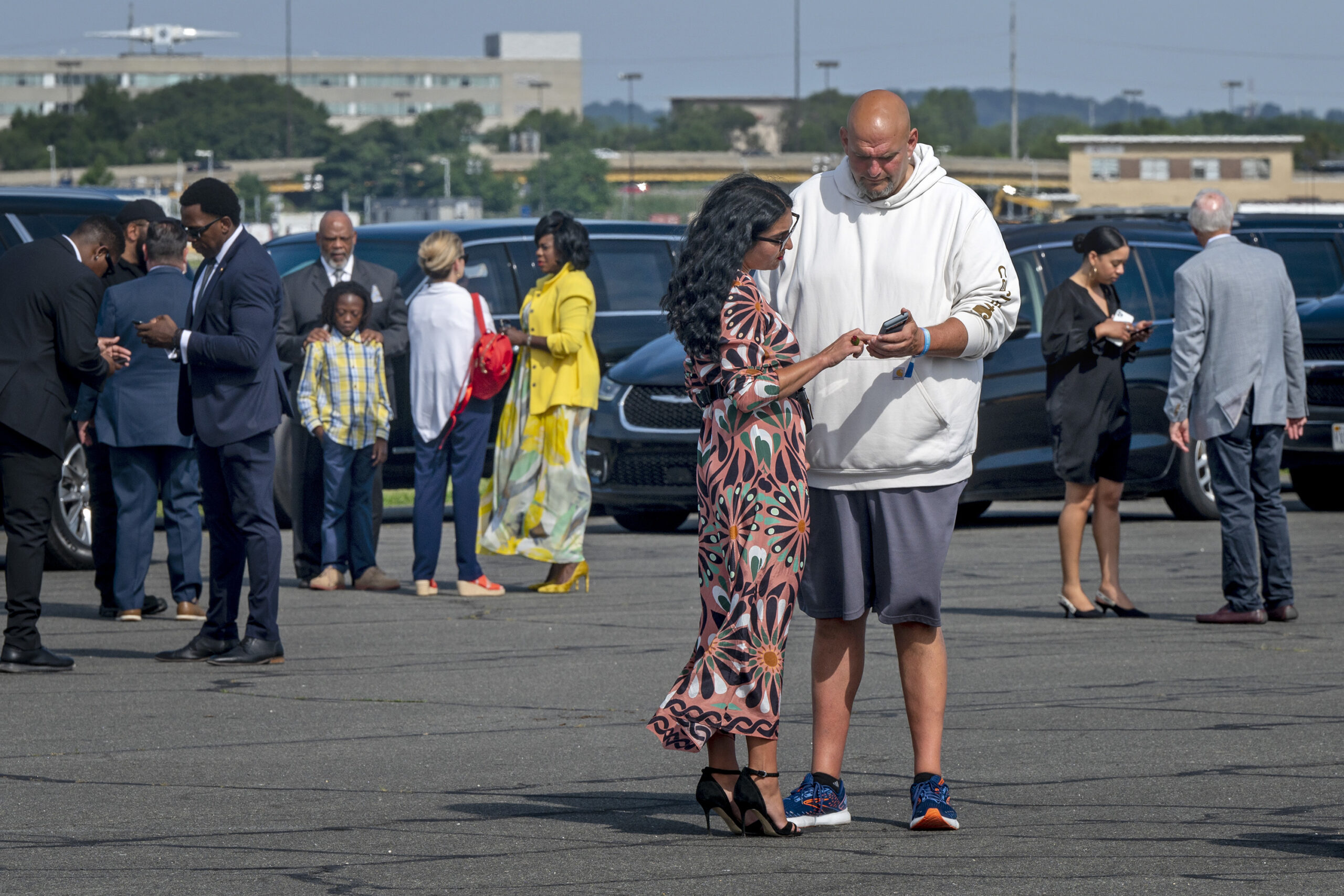
U.S. Sen. John Fetterman and his wife, Gisele Barreto Fetterman, await the arrival of President Joe Biden at Philadelphia International Airport in July 2024.
I must confess that keeping up with the downward spiral of Pennsylvania’s Democratic Sen. John Fetterman since he took office in 2023 can get tiresome. At first, Fetterman’s rightward tack seemed largely a function of his zealous support for Israel, which caused him to wave off allegations of war crimes by Benjamin Netanyahu’s right-wing government. Soon, others pointed to his health woes — hospitalizations for a stroke and depression, among other things — as he endorsed more and more Trump-flavored ideas.
Amid mounting outrage over Trump’s aggressive immigration raids, Fetterman made some comments that had his growing legion of critics wonder if the senator’s real heart issue was whether he had one. “ICE performs an important job for our country,” the Democrat posted on X last July, adding that any calls to abolish the agency were “inappropriate and outrageous.” Even after the Jan. 7 ICE killing of Renee Nicole Good in Minneapolis, Fetterman’s middle-of-the-road stance was this: “Secure the border. Deport all the criminals. Stop targeting the hardworking migrants in our nation.” In the immediate aftermath of Saturday’s killing of Alex Pretti by federal agents, even Pennsylvania’s GOP Sen. Dave McCormick had called for a congressional investigation before Fetterman said anything.
On Sunday night, though, Fetterman issued a heartfelt and moving statement. Well, a Fetterman did.
“For more than a decade, I lived undocumented in the US,” the senator’s wife, Gisele Barreto Fetterman, a native of Brazil, posted on X. “Every day carried the same uncertainty and fear lived in my body — a tight chest, shallow breaths, racing heart. What I thought was my private, chronic dread has now become a shared national wound. This now-daily violence is not ‘law and order.’ It is terror inflicted on people who contribute, love, and build their lives here. It’s devastatingly cruel and unAmerican.” Her post ended with an emoji of a broken heart.
Sen. Fetterman finally issued a statement nearly a day later. He called for “an immediate end” to the ICE operations in Minnesota, adding, “It has become an ungovernable and dangerous urban theatre for civilians and law enforcement that is incompatible with the American spirit.” But Fetterman still disappointed critics of Trump’s immigration policy, insisting that while he wants ICE reforms, he still supports the embattled agency, and won’t join other Democrats in shutting down the federal government if those reforms aren’t happening.
Pennsylvanians thought they were getting a progressive voice and a moral leader when they elected Fetterman in 2022. It feels now like we elected the wrong Fetterman.
What I wrote on this date in 2010
It was only 16 years ago, but at the dawn of the 2010s, there was still a robust conversation about how to save the traditional journalism outlets— especially newspapers — that had flourished in the 20th century. On Jan. 27, 2010, I criticized an idea coming from Apple that a new kind of $1,000 iPad, nicknamed “the Jesus tablet,” would fix everything. I wrote: “To survive, we need to change our whole worldview — finding ways to encourage more dialogue with readers and more community involvement so that local readers feel they have a stake in this thing. And we also need to do a better job at the thing we claim to be already good at — real journalism that makes a difference.”
On the national beat, there’s no bigger story than the fallout from the inhumanity of the Trump regime’s mass deportation policies. In my Sunday column, I looked at the other way people are dying in ICE’s reign of terror: inside the growing network of squalid and overcrowded jails and detention camps. The death rate in these facilities so far in 2026 is already 10 times higher than it was in the last year of the Biden administration. Over the weekend, I quickly shifted gears and turned a planned column about faith leaders in Minneapolis and an America yearning for morality into a lament over the shocking ICE murder of a 37-year-old observer, Alex Pretti. The contrast between good and evil in America has never been more stark.
The many tentacles of the mass deportation story stretch well beyond Minneapolis and other hot spots like Maine, including stepped-up ICE enforcement activity here in Philadelphia since Trump returned to office. The Inquirer’s veteran immigration reporter, Jeff Gammage, has drilled deeply into the human stories on the front lines here. Written with colleague Michelle Myers, this week’s installment was both poignant and infuriating. A local family of four is returning to Bolivia after the dad — the prime caregiver for his 5-year-old son, being treated at Children’s Hospital of Philadelphia for brain cancer — has stopped fighting his deportation after five months in ICE detention. As his family prepares to leave, the child’s future in a South American country with substandard medical care is highly uncertain. Old-school beat reporting like this is what local community journalism is all about. You support this vital work when you subscribe to The Inquirer.
By submitting your written, visual, and/or audio contributions, you agree to The Inquirer’s Terms of Use, including the grant of rights in Section 10.
LOS ANGELES — The Trump administration has not shied away from sharing AI-generated imagery online, embracing cartoonlike visuals and memes and promoting them on official White House channels.
But an edited — and realistic — image of civil rights attorney Nekima Levy Armstrong in tears after being arrested is raising new alarms about how the administration is blurring the lines between what is real and what is fake.
Homeland Security Secretary Kristi Noem’s account posted the original image from Levy Armstrong’s arrest before the official White House account posted an altered image that showed her crying. The doctored picture is part of a deluge of AI-edited imagery that has been shared across the political spectrum since the fatal shootings of Renee Good and Alex Pretti by U.S. Border Patrol officers in Minneapolis
However, the White House’s use of artificial intelligence has troubled misinformation experts who fear the spreading of AI-generated or edited images erodes public perception of the truth and sows distrust.
In response to criticism of the edited image of Levy Armstrong, White House officials doubled down on the post, with deputy communications director Kaelan Dorr writing on X that the “memes will continue.” White House Deputy Press Secretary Abigail Jackson also shared a post mocking the criticism.
David Rand, a professor of information science at Cornell University, says calling the altered image a meme “certainly seems like an attempt to cast it as a joke or humorous post, like their prior cartoons. This presumably aims to shield them from criticism for posting manipulated media.” He said the purpose of sharing the altered arrest image seems “much more ambiguous” than the cartoonish images the administration has shared in the past.
Memes have always carried layered messages that are funny or informative to people who understand them, but indecipherable to outsiders. AI-enhanced or edited imagery is just the latest tool the White House uses to engage the segment of Trump’s base that spends a lot of time online, said Zach Henry, a Republican communications consultant who founded Total Virality, an influencer marketing firm.
“People who are terminally online will see it and instantly recognize it as a meme,” he said. “Your grandparents may see it and not understand the meme, but because it looks real, it leads them to ask their kids or grandkids about it.”
All the better if it prompts a fierce reaction, which helps it go viral, said Henry, who generally praised the work of the White House’s social media team.
The creation and dissemination of altered images, especially when they are shared by credible sources, “crystallizes an idea of what’s happening, instead of showing what is actually happening,” said Michael A. Spikes, a professor at Northwestern University and news media literacy researcher.
“The government should be a place where you can trust the information, where you can say it’s accurate, because they have a responsibility to do so,” he said. ”By sharing this kind of content, and creating this kind of content … it is eroding the trust — even though I’m always kind of skeptical of the term trust — but the trust we should have in our federal government to give us accurate, verified information. It’s a real loss, and it really worries me a lot.”
Spikes said he already sees the “institutional crises” around distrust in news organizations and higher education, and feels this behavior from official channels inflames those issues.
Ramesh Srinivasan, a professor at UCLA and the host of the Utopias podcast, said many people are now questioning where they can turn to for “trustable information.” “AI systems are only going to exacerbate, amplify and accelerate these problems of an absence of trust, an absence of even understanding what might be considered reality or truth or evidence,” he said.
Srinivasan said he feels the White House and other officials sharing AI-generated content not only invites everyday people to continue to post similar content but also grants permission to others who are in positions of credibility and power, like policymakers, to share unlabeled synthetic content. He added that given that social media platforms tend to “algorithmically privilege” extreme and conspiratorial content — which AI generation tools can create with ease — “we’ve got a big, big set of challenges on our hands.”
An influx of AI-generated videos related to Immigration and Customs Enforcement action, protests and interactions with citizens has already been proliferating on social media. After Renee Good was shot by an ICE officer while she was in her car, several AI-generated videos began circulating of women driving away from ICE officers who told them to stop. There are also many fabricated videos circulating of immigration raids and of people confronting ICE officers, often yelling at them or throwing food in their faces.
Jeremy Carrasco, a content creator who specializes in media literacy and debunking viral AI videos, said the bulk of these videos are likely coming from accounts that are “engagement farming,” or looking to capitalize on clicks by generating content with popular keywords and search terms like ICE. But he also said the videos are getting views from people who oppose ICE and DHS and could be watching them as “fan fiction,” or engaging in “wishful thinking,” hoping that they’re seeing real pushback against the organizations and their officers.
Still, Carrasco also believes that most viewers can’t tell if what they’re watching is fake, and questions whether they would know “what’s real or not when it actually matters, like when the stakes are a lot higher.”
Even when there are blatant signs of AI generation, like street signs with gibberish on them or other obvious errors, only in the “best-case scenario” would a viewer be savvy enough or be paying enough attention to register the use of AI.
This issue is, of course, not limited to news surrounding immigration enforcement and protests. Fabricated and misrepresented images following the capture of deposed Venezuelan leader Nicolás Maduro exploded online earlier this month. Experts, including Carrasco, think the spread of AI-generated political content will only become more commonplace.
Carrasco believes that the widespread implementation of a watermarking system that embeds information about the origin of a piece of media into its metadata layer could be a step toward a solution. The Coalition for Content Provenance and Authenticity has developed such a system, but Carrasco doesn’t think that will become extensively adopted for at least another year.
“It’s going to be an issue forever now,” he said. I don’t think people understand how bad this is.”
DUBAI, United Arab Emirates — Iran’s bloody crackdown on nationwide protests has killed at least 6,159 people while many others still are feared dead, activists said Tuesday, as a U.S. aircraft carrier group arrived in the Middle East to lead any American military response to the crisis. Iran’s currency, the rial, meanwhile fell to a record low of 1.5 million to $1.
The arrival of the USS Abraham Lincoln aircraft carrier and guided missile destroyers accompanying it provide the U.S. the ability to strike Iran, particularly as Gulf Arab states have signaled they want to stay out of any attack despite hosting American military personnel.
Two Iranian-backed militias in the Mideast have signaled their willingness to launch new attacks, likely trying to back Iran after U.S. President Donald Trump threatened military action over the killing of peaceful protesters or Tehran launching mass executions in the wake of the demonstrations.
Iran has repeatedly threatened to drag the entire Mideast into a war, though its air defenses and military are still reeling after the June war launched by Israel against the country. But the pressure on its economy may spark new unrest as everyday goods slowly go out of reach of its people — particularly if Trump chooses to attack.
Ambrey, a private security firm, issued a notice Tuesday saying it assessed that the U.S. “has positioned sufficient military capability to conduct kinetic operations against Iran while maintaining the ability to defend itself and regional allies from reciprocal action.”
“Supporting or avenging Iranian protesters in punitive strikes is assessed as insufficient justification for sustained military conflict,” Ambrey wrote. “However, alternative objectives, such as the degradation of Iranian military capabilities, may increase the likelihood of limited U.S. intervention.”
Activists offer new death toll
Tuesday’s new figures came from the U.S.-based Human Rights Activists News Agency, which has been accurate in multiple rounds of unrest in Iran. The group verifies each death with a network of activists on the ground in Iran.
It said the 6,159 dead included at least 5,804 protesters, 214 government-affiliated forces, 92 children and 49 civilians who weren’t demonstrating. The crackdown has seen over 41,800 arrests, it added.
The Associated Press has been unable to independently assess the death toll given authorities cutting off the internet and disrupting calls into the Islamic Republic.
Iran’s government has put the death toll at a far lower 3,117, saying 2,427 were civilians and security forces, and labeled the rest “terrorists.” In the past, Iran’s theocracy has undercounted or not reported fatalities from unrest.
That death toll exceeds that of any other round of protest or unrest there in decades, and recalls the chaos surrounding Iran’s 1979 Islamic Revolution.
The protests in Iran began on Dec. 28, sparked by the fall of the Iranian currency, the rial, and quickly spread across the country. They were met by a violent crackdown by Iran’s theocracy, the scale of which is only starting to become clear as the country has faced more than two weeks of internet blackout — the most comprehensive in its history.
Iran’s U.N. ambassador told a U.N. Security Council meeting late Monday that Trump’s repeated threats to use military force against the country “are neither ambiguous nor misinterpreted.” Amir Saeid Iravani also repeated allegations that the U.S. leader incited violence by “armed terrorist groups” supported by the United States and Israel, but gave no evidence to support his claims.
Iranian state media has tried to accuse forces abroad for the protests as the theocracy remains broadly unable to address the country’s ailing economy, which is still squeezed by international sanctions, particularly over its nuclear program.
On Tuesday, exchange shops offered the record-low rial-to-dollar rate in Tehran. Traders declined to speak publicly on the matter, with several responding angrily to the situation.
Already, Iran has vastly limited its subsidized currency rates to cut down on corruption. It also has offered the equivalent of $7 a month to most people in the country to cover rising costs. However, Iran’s people have seen the rial fall from a rate of 32,000 to $1 just a decade ago — which has devoured the value of their savings.
Some Iranian-backed militias suggest willingness to fight
Iran projected its power across the Mideast through the “Axis of Resistance,” a network of proxy militant groups in Gaza, Lebanon, Yemen, Syria and Iraq, and other places. It was also seen as a defensive buffer, intended to keep conflict away from Iranian borders. But it has collapsed after Israel targeted Hamas, Hezbollah in Lebanon and others during the Gaza war. Meanwhile, rebels in 2024 overthrew Syria’s Bashar Assad after a yearslong, bloody war in which Iran backed his rule.
Yemen’s Houthi rebels, backed by Iran, have repeatedly warned they could resume fire if needed on shipping in the Red Sea, releasing old footage of a previous attack Monday. Ahmad “Abu Hussein” al-Hamidawi, the leader of Iraq’s Kataib Hezbollah militia, warned “the enemies that the war on the (Islamic) Republic will not be a picnic; rather, you will taste the bitterest forms of death, and nothing will remain of you in our region.”
The Lebanese militant group Hezbollah, one of Iran’s staunchest allies, refused to say how it planned to react in the case of a possible attack.
“During the past two months, several parties have asked me a clear and frank question: If Israel and America go to war against Iran, will Hezbollah intervene or not?” Hezbollah leader Sheikh Naim Kassem said in a video address.
He said the group is preparing for “possible aggression and is determined to defend” against it. But as to how it would act, he said, “these details will be determined by the battle and we will determine them according to the interests that are present.”
ORLANDO, Fla. — President Donald Trump’s crackdown on immigration contributed to a year-to-year drop in the nation’s growth rate as the U.S. population reached nearly 342 million people in 2025, according to population estimates released Tuesday by the U.S. Census Bureau.
The 0.5% growth rate for 2025 was a sharp drop from 2024’s almost 1% growth rate, which was the highest in two decades and was fueled by immigration. The 2024 estimates put the U.S. population at 340 million people.
Immigration increased by almost 1.3 million people last year, compared with 2024’s increase of almost 2.8 million people. If trends continue, the annual gain from immigrants by mid-2026 will drop to only 321,000 people, according to the Census Bureau, whose estimates do not distinguish between legal and illegal immigration.
In the past 125 years, the lowest growth rate was in 2021, during the height of the coronavirus pandemic, when the U.S. population grew by just 0.16%, or 522,000 people and immigration increased by just 376,000 people because of travel restrictions into the U.S. Before that, the lowest growth rate was just under 0.5% in 1919 at the height of the Spanish flu.
Births outnumbered deaths last year by 519,000 people. While higher than the pandemic-era low at the beginning of the decade, the natural increase was dramatically smaller than in the 2000s, when it ranged between 1.6 million and 1.9 million people.
Lower immigration stunts growth in many states
The immigration drop dented growth in several states that traditionally have been immigrant magnets.
California had a net population loss of 9,500 people in 2025, a stark change from the previous year, when it gained 232,000 residents, even though roughly the same number of Californians already living in the state moved out in both years. The difference was immigration since the number of net immigrants who moved into the state dropped from 361,000 people in 2024 to 109,000 in 2025.
Florida had year-to-year drops in both immigrants and people moving in from other states. The Sunshine State, which has become more expensive in recent years from surging property values and higher home insurance costs, had only 22,000 domestic migrants in 2025, compared with 64,000 people in 2024, and the net number of immigrants dropped from more than 411,000 people to 178,000 people.
New York added only 1,008 people in 2025, mostly because the state’s net migration from immigrants dropped from 207,000 people to 95,600 people.
South Carolina, Idaho, and North Carolina had the highest year-over-year growth rates, ranging from 1.3% to 1.5%. Texas, Florida, and North Carolina added the most people in pure numbers. California, Hawaii, New Mexico, Vermont, and West Virginia had population declines.
The South, which has been the powerhouse of growth in the 2020s, continued to add more people than any other region, but the numbers dropped from 1.7 million people in 2024 to 1.1 million in 2025.
“Many of these states are going to show even smaller growth when we get to next year,” Brookings demographer William Frey said Tuesday.
The effects of Trump’s immigration crackdown
Tuesday’s data release comes as researchers have been trying to determine the effects of the second Trump administration’s immigration crackdown after the Republican president returned to the White House in January 2025. Trump made a surge of migrants at the southern border a central issue in his winning 2024 presidential campaign.
The numbers made public Tuesday reflect change from July 2024 to July 2025, covering the end of President Joe Biden’s Democratic administration and the first half of Trump’s first year back in office.
The figures capture a period that reflects the beginning of enforcement surges in Los Angeles and Portland, Ore., but do not capture the impact on immigration after the Trump administration’s crackdowns began in Chicago; New Orleans; Memphis, Tennessee; and Minneapolis, Minn..
The 2025 numbers were a jarring divergence from 2024, when net international migration accounted for 84% of the nation’s 3.3 million-person increase from the year before. The jump in immigration two years ago was partly because of a new method of counting that added people who were admitted for humanitarian reasons.
“They do reflect recent trends we have seen in out-migration, where the numbers of people coming in is down and the numbers going out is up,” Eric Jensen, a senior research scientist at the Census Bureau, said last week.
How the population estimates are calculated
Unlike the once-a-decade census, which determines how many congressional seats and Electoral College votes each state gets, as well as the distribution of $2.8 trillion in annual government funding, the population estimates are calculated from government records and internal Census Bureau data.
The release of the 2025 population estimates was delayed by the federal government shutdown last fall and comes at a challenging time for the Census Bureau and other U.S. statistical agencies. The bureau, which is the largest statistical agency in the U.S., lost about 15% of its workforce last year due to buyouts and layoffs that were part of cost-cutting efforts by the White House and its Department of Government Efficiency.
Other recent actions by the Trump administration, such as the firing of Erika McEntarfer as Bureau of Labor Statistics commissioner, have raised concerns about political meddling at U.S. statistical agencies. But Frey said the bureau’s staffers appear to have been “doing this work as usual without interference.”
“So I have no reason to doubt the numbers that come out,” Frey said.
Philadelphia lawmakers are set to consider legislation that would make it harder for ICE to operate in the city, including limiting information sharing, restricting activity on city-owned property, and prohibiting agents from concealing their identities.
Among the package of bills set to be introduced Thursday is an ordinance that effectively makes permanent Philadelphia’s status as a so-called “sanctuary city” by barring city officials from holding undocumented immigrants at ICE’s request without a court order. Another bans discrimination based on immigration status.
Two City Council members are expected to introduce the legislation as U.S. Immigration and Customs Enforcement is facing mounting national scrutiny over its tactics in Minneapolis, where federal agents fatally shot two U.S. citizens this month.
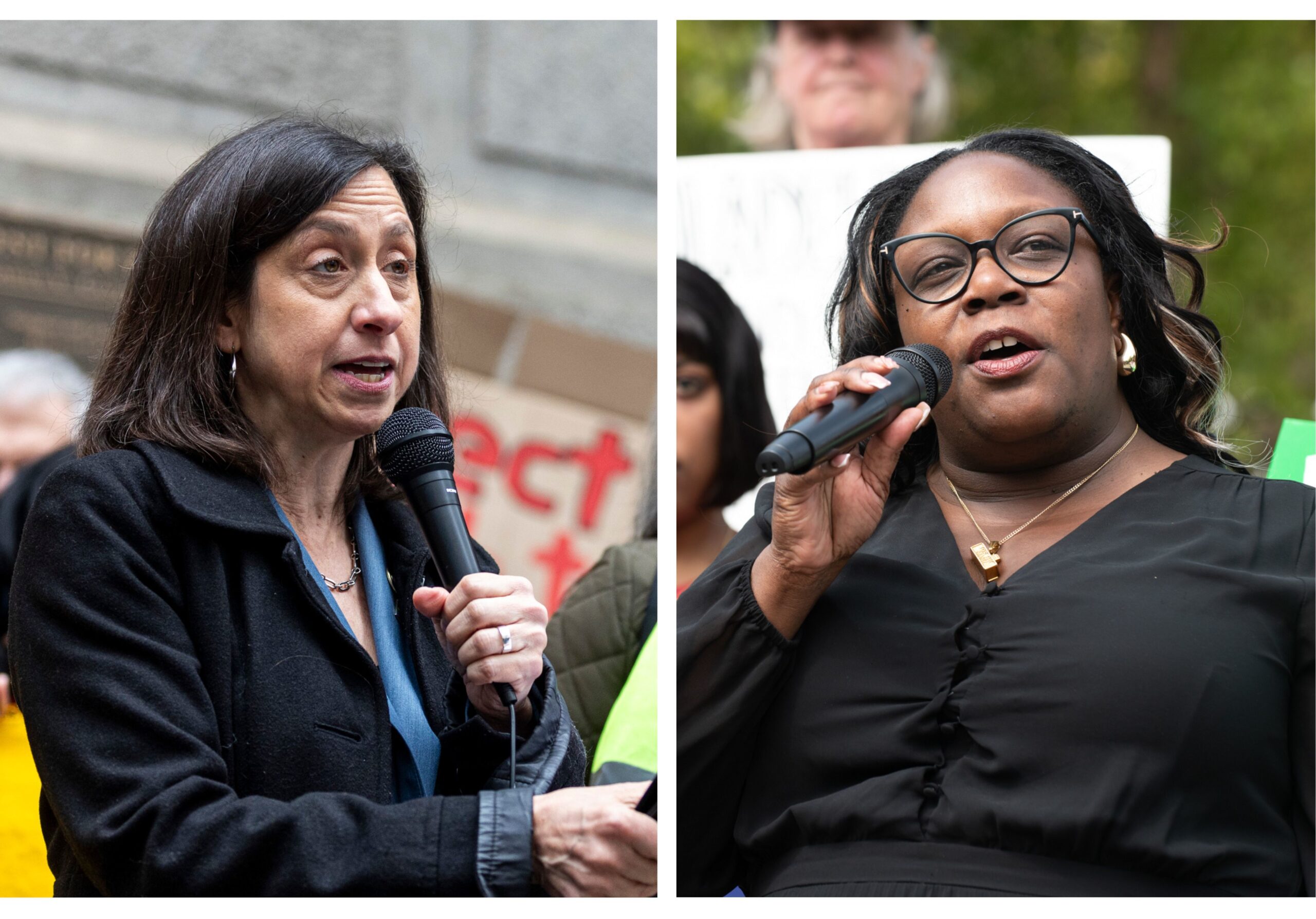
Councilmembers Rue Landau, a Democrat, and Kendra Brooks, of the progressive Working Families Party, said in an interview that the violence in Minneapolis hardened their resolve to introduce legislation to protect a population that includes an estimated 76,000 undocumented immigrants in Philadelphia.
“It’s been very disheartening and frightening to watch ICE act with such lawlessness,” Landau said. “When they rise to the level of killing innocent civilians, unprecedented murders … this is absolutely the time to stand up and act.”
The package of a half-dozen bills is the most significant legislative effort that Council has undertaken to strengthen protections for immigrants since President Donald Trump took office last year on a promise to carry out a mass deportation campaign nationwide.
Left: City Councilmember Rue Landau. Right: City Councilmember Kendra Brooks. Landau and Brooks are introducing legislation this week to make it harder for ICE to operate in Philadelphia, including by limiting city cooperation with the agency.
ICE spokespeople did not immediately reply to a request for comment.
Jasmine Rivera, executive director of the Pennsylvania Immigration Coalition, said it’s not the job nor the jurisdiction of the city to enforce federal law.
The goal of the legislation, Rivera said, is ensuring that “not a single dime and single second of our local resources is being spent collaborating with agencies that are executing people.”
Now, the mayor could be forced to take a side. If City Council passes Landau and Brooks’ legislation this spring, Parker could either sign the bills into law, veto them, or take no action and allow them to lapse into law without her signature. She has never vetoed a bill.
Joe Grace, a spokesperson for Parker, declined to comment on the legislation.
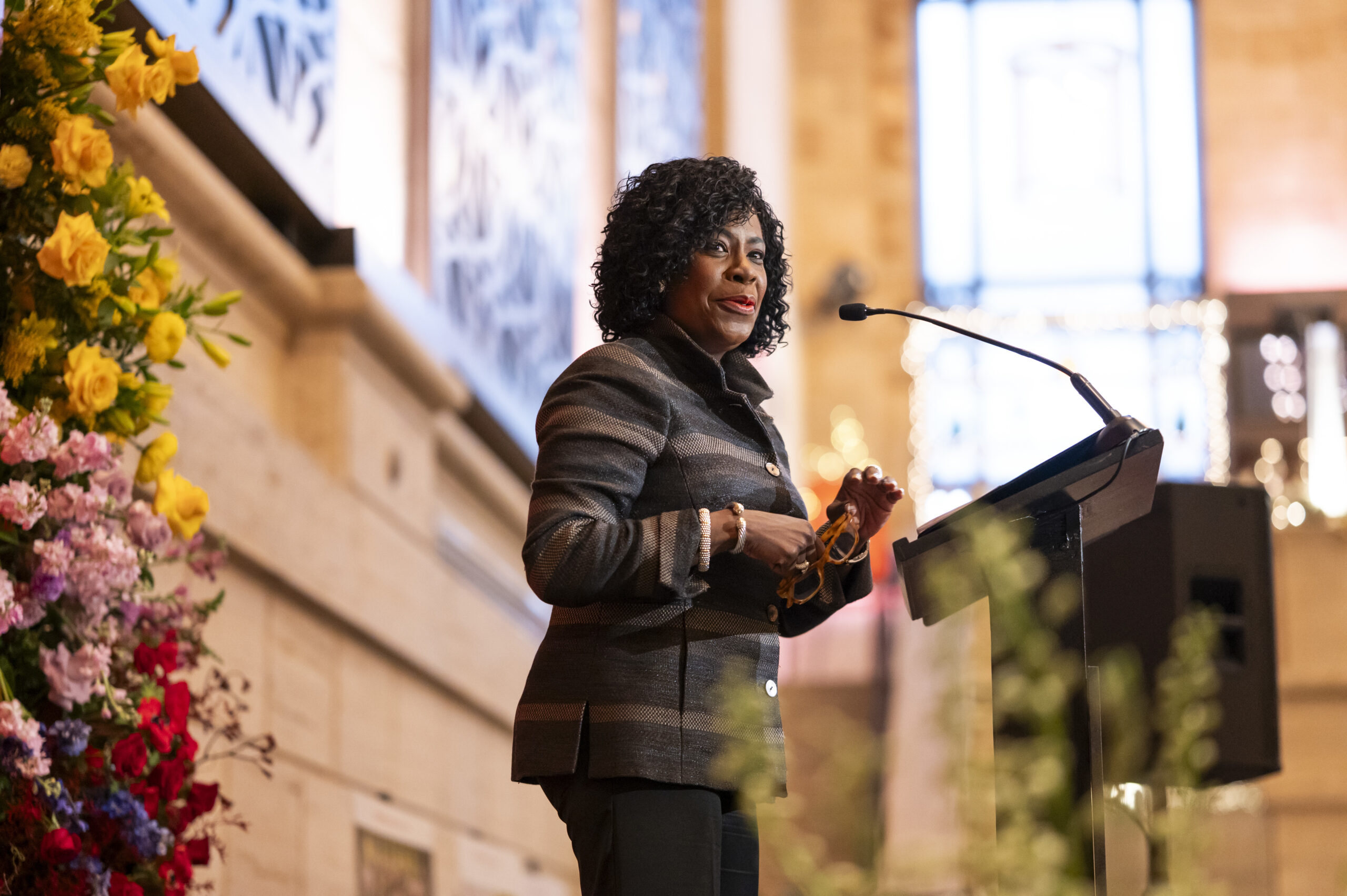
Mayor Cherelle L. Parker speaks at a news conference earlier this month. It is unclear how she will act on upcoming legislation related to ICE operations in Philadelphia.
It’s unclear what fate the ICE legislation could meet in Council. The 17-member body has just one Republican, but Parker holds influence with many of the Democrats in the chamber.
City Council President Kenyatta Johnson, a Democrat who controls the flow of legislation, has not taken a position on the package proposed by Landau and Brooks.
But he said in a statement that “Philadelphia has long positioned itself as a welcoming city that values the contributions of immigrants and strives to protect their rights and safety.”
“I have deep concerns about federal ICE actions directed by President Donald Trump’s administration that sow fear and anxiety in immigrant communities,” Johnson said, “underscoring the belief that enforcement practices should be lawful, humane, and not undermine trust in public safety.”
Making sanctuary status the law
Border Patrol and ICE are both federal immigration agencies, which are legally allowed to operate in public places and subject to federal rules and regulations. Some cities and states —not including Pennsylvania and New Jersey — actively cooperate with ICE through written agreements.
Since 2016, Philadelphia has operated under an executive order signed by former Mayor Jim Kenney, which prohibits city jails from honoring ICE “detainer requests,” in which federal agents ask the city to hold undocumented immigrants in jail for longer than they would have otherwise been in custody to facilitate their arrest by federal authorities.
Undocumented immigrants are not shielded from federal immigration enforcement, nor from being arrested and charged by local police for local offenses.
Some refer to the noncooperation arrangement as “sanctuary.” As the term “sanctuary cities” has become politically toxic, some local officials — including in Philadelphia — have backed away from it, instead declaring their jurisdictions to be “welcoming cities.”
Parker administration officials have said several times over the last year that Philadelphia remains a “welcoming city.”
Protesters march up Eighth Street, toward the immigration offices, during the Philly stands with Minneapolis Ice Out For Good protest at Philadelphia’s City Hall on Jan. 23.
But advocates for immigrants have said they want an ironclad city policy that can’t be rescinded by a mayor.
Landau and Brooks’ legislation would be that, codifying the executive order into law and adding new prohibitions on information sharing. The package includes legislation to:
Strengthen restrictions on city workers, including banning local police from carrying out federal immigration enforcement and prohibiting city workers from assisting in enforcement operations.
Prohibiting law enforcement officers from concealing their identities, including by wearing masks or covering up badges with identifying information.
Banning ICE from staging raids on city-owned property and designated community spaces such as schools, parks, libraries, and homeless shelters. (It would not apply to the Criminal Justice Center, where ICE has had a presence. The courthouse is overseen by both city and state agencies.)
Prohibiting city agencies and contractors from providing ICE access to data sets to assist in immigration enforcement.
Restricting city employees from inquiring about individuals’ immigration status unless required by a court order, or state or federal law.
Peter Pedemonti, co-director of New Sanctuary Movement of Philadelphia, an advocacy organization that partnered with the Council members to craft the package of bills, compared ICE to an octopus that has multiple arms reaching into different facets of American life.
The proposed legislation, he said, is a means to bind a few of those arms.
“The whole world can see the violence and brutality,” Pedemonti said. “This is a moment where all of us need to stand up, and Philadelphia can stand up and speak out loud and clear that we don’t want ICE here to pull our families apart, the families that make Philadelphia Philadelphia.”
An impending showdown that Parker hoped to avoid
Homeland Security officials claim that sanctuary jurisdictions protect criminal, undocumented immigrants from facing consequences while putting U.S. citizens and law enforcement officers in peril.
Last year, the Trump administration named Philadelphia as among the jurisdictions impeding federal immigration enforcement. The White House has said the federal government will cut off funding to sanctuary cities by Feb. 1.
Some of Parker’s supporters say the mayor’s conflict-averse strategy has spared Philadelphia as other cities such as Washington, New York, Los Angeles, Chicago, and Minneapolis have seen National Guard troops or waves of ICE agents arrive in force.
Residents near the scene of a shooting by a federal law enforcement agent in Minneapolis on Saturday.
Critics, including the backers of the new legislation, have for months pressed Parker to take a stronger stand.
Brooks said she “would love to have the support of the administration.”
“This should be something that we should be working collaboratively on,” she said. “Philadelphia residents are demanding us do something as elected officials, and this is our time to lead.”
But Parker has not been eager to speak about Philadelphia’s immigration policies.
For example, the city is refusing to release a September letter it sent to the U.S. Department of Justice regarding its immigration-related policies, even after the Pennsylvania Office of Open Records ruled its reasoning for keeping the document secret was invalid. The Inquirer has requested a copy of the letter under the state Right-to-Know Law.
The new Council legislation and the increasing tension over Trump’s deportation push may force Parker to take a clearer position.
Notably, the city sued the federal government last week over its removal of exhibits related to slavery from the President’s House at Independence National Historical Park, potentially signaling a new willingness by Parker to push back against the White House.
But even then, Parker declined to take a jab at Trump.
“In moments like this,” she said last week, “it requires that I be the leader that I need to be for our city, and I can’t allow my pride, ego, or emotions to dictate what my actions will be.”
On Thursdays at 7 a.m., Laura Carlson is by the iconic granite and bronze sculpture of an open book on University of Delaware’s Mentor’s Circle.
As the new university president, she invites faculty, staff, students and community members to join her there and run a five-kilometer loop through campus. Typically 10 to 20 people show.
“Rain or shine, we run down to the track on South Campus, loop the track and come back,” said Carlson, 60, who began the treks as interim president last summer and is continuing them in her permanent role, which started earlier this month.
University of Delaware president Laura Carlson (right) goes on one of her Prez Runs in Mobile, Ala., where the Blue Hens won a bowl game, defeating Louisiana-Lafayette 20-13 on Dec. 17, 2025.
The “Prez Run” is just one way the psychology scholar — who plans to run her 15th Boston Marathon in April — is building relationships on campus, with alumni and with the community and state. She also runs with alumni, employees, and students during events in other cities.
“I’ve heard that the alumni association is going to put it on their bucket list of 10 things to do before you graduate,” she said.
Carlson, a Dartmouth alumna who got her doctorate in cognitive psychology from the University of Illinois Urbana-Champaign, is focused on strengthening relationships with state and local governments and internally with faculty. Finding new revenue streams to plug holes from terminated federal grants and recruiting students in new national markets also are on her list.
The Massachusetts native previously served as provost for three years, having come to Delaware after 28 years as a faculty member and administrator at the University of Notre Dame in Indiana. She’s the first internal candidate to get the presidential appointment in about 50 years.
She follows Dennis Assanis, who resigned in June and is now chancellor of the University of California at Santa Barbara.
Laura Carlson, president of the University of Delaware
Carlson is visiting classes each semester, including elementary organic chemistry and mechanical engineering.
“I want to make sure I don’t feel distant from the rhythm of the academic year,” she said. “Anything we value, we should put attention on it.”
When building a team, she asks participants to pick their top 10 values, such as family, world peace, humor, and authenticity, and rank them. Her top value is always purpose.
University of Delaware president Laura Carlson talks to fellow runners during one of her Prez Runs in Mobile, Ala., where the football team won a bowl game.
“I want to live a life of purpose,” she said.
Partnering with state and local government
She’s attempting to change the way the partnership with the state is viewed.
“We lead with what does the state need from us, as opposed to what do we need from the state,” she said.
Southern Delaware, where the university has a campus in Lewes and Georgetown, has housing, healthcare, education and workforce development needs, and the university can help, Carlson said.
She said she can envisiona public-private partnership for new housing in Lewes, she said,or a classroom building with event space for the community.
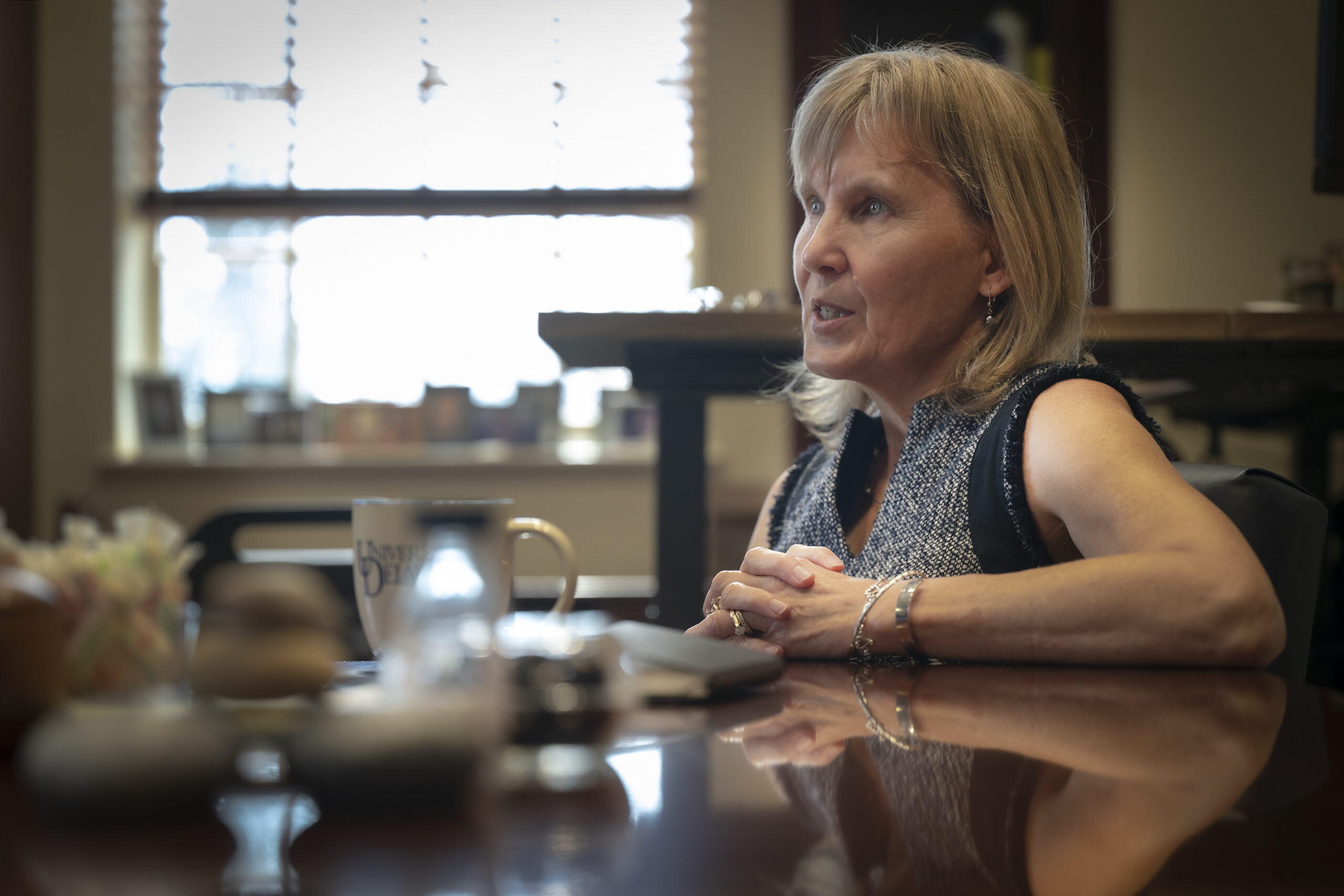
Laura Carlson, president of the University of Delaware, discusses her priorities.
“If we are a university for the whole state, we need to show up in the whole state, and we need to be responsive to the needs across the state,” she said.
She’s also looking at the possibility of more residential space for the main campus in Newark — possibly a “sophomore village” — through a public-private partnership. The university has about 7,100 residential beds in Newark.
“That would take some of the pressure off the city,” she said, noting the tight rental market, and adding that parents and students may prefer on-campus housing options.
She also wants to help Delaware Gov. Matt Meyer with his plan to bring medical education to the state. Delaware remains one of few states without a medical school. The idea is not to build one from scratch but to partner with an existing medical university, she said.
“We’ve been in conversations with Thomas Jefferson” in Philadelphia, which has a nonexclusive memorandum of understanding with the state to explore a partnership, she said. “What we offer is the classrooms, the lab space, and so on to do kind of the first part of that medical school type of training.”
Dealing with the federal government could be more challenging. The university has lost 41 grants worth $33.9 million since President Donald Trump took office last year. Those span engineering, biological sciences, arts, and sustainability, she said, and impact 117 graduate students and 27 postdoctoral students.
In total, $1.1 million in salaries and $2.1 million in stipends have been lost, though the university has been working to find other funding through foundations and industry, she said. No one has lost their job, she said.
“I’ve been really working hard on … kind of strengthening those relationships with our business community,” she said.
The school also has experienced a 19% decline in international graduate students following Trump’s pause on student visas and other policies, and the school lowered its doctoral admissions by 19.5% last year amid concerns over federal funding. What will happen with doctoral admissions this year is unclear.
“Each college is sort of looking strategically program by program and trying to figure out what is the right size for their doctoral programs,” she said. “If they’re compressing their number of students coming in, it’s because they’re trying to prioritize funding for their existing students.”
The school’s overall enrollment of more than 24,000 rose last fall and applications are up 10%, she said. But as another drop in high school graduates begins this year, the university has found success in new recruiting areas such as Colorado and Wake Forest, N.C., where the football team played as part of the school’s entry into Conference USA, she said.
“We’ve been very strategic about putting marketing in there, convening alumni and really using that as a way to establish ourselves more nationally,” she said.
Biden Institute — and a conservative counterpart
She said the university is on course to build Biden Hall, an academic building named for former President Joe Biden, a Delaware native. It will house the school’s Biden School of Public Policy and Administration and the Biden Institute on government theory and practice. The design phase likely will begin this spring.
Fundraising is also continuing for Siegfried Hall, which will include the Institute for Free Leadership and Enterprise. The donors, Robert L. Siegfried Jr., a certified public accountant and his wife, Kathleen Marie (Horgan) Siegfried, have said they wanted to bring a “conservative” vision and offer a balance to the Biden Institute.
Carlson said she doesn’t view the halls as conservative and liberal, but rather places where ideas can be vetted. She noted the Biden Institute is nonpartisan.
“Siegfried is a think tank on conservative economics, but part of that building will be also to sort of question the limits of those policies,” she said. “That’s what we do in any discipline.”
Personal life
Here are a few fun facts about Carlson, whose husband, Robert West, is a professor of psychological and brain sciences at the university.
Last book read: Chris Whitaker’s All the Colors of the Dark.
Favorite band or musical group: Bruce Springsteen.
Favorite food: Indian. Greek.
Favorite vacation spot: “I spend so little time at my house. Some of my best days on break are if you don’t even get out of your pajamas.”
“It has become an ungovernable and dangerous urban theatre for civilians and law enforcement that is incompatible with the American spirit,” Fetterman said in a statement Monday.
The senator’s comments come two days after a federal agent shot and killed Alex Pretti, an intensive care nurse at a VA hospital, on Saturday amid the Trump administration’s immigration crackdown in Minneapolis. An ICE agent shot and killed Renee Nicole Good, a 37-year-old poet and mother, on Jan. 7, provoking protests nationwide.
But Fetterman stopped short of backing other Democrats’ calls to shut down the government if ICE does not withdraw from the city. The U.S. Senate is poised to vote on funding for the Department of Homeland Security, which oversees both ICE and the Border Patrol.
Sen. Dave McCormick (R, Pa.) called for a “full investigation into the tragedy in Minneapolis” on Sunday evening, joining a number of Republicans in voicing concern about the escalating tensions in the wake of President Donald Trump’s immigration enforcement crackdown.
“We need all the facts,” McCormick said in a post on X Sunday, adding that, “We must enforce our laws in a way that protects the public while maintaining its trust. This gives our law enforcement officers the best chance to succeed in their difficult mission.”
Fetterman ‘wants a conversation’ about DHS funding
Fetterman said that both Pretti and Good should “still be alive.” And noted that he believes in a secure border while also believing “there needs to be a path to citizenship for those hardworking families who are here.”
Some Democrats said they would vote against DHS funding in light of Saturday’s shooting, unless restrictions on immigration enforcement were put in place. This could potentially trigger a federal shutdown for the second time in four months.
Fetterman said he will never vote for a shutdown. However, he does support having a “conversation on the DHS appropriations bill and stripping it from” the overall government funding package.
“A vote to shut our government down will not defund ICE,” Fetterman said, noting the agency received nearly $180 billion in Trump’s One Big Beautiful Bill Act, which he opposed.
“I reject the calls to defund or abolish ICE. I strongly disagree with many strategies and practices ICE deployed in Minneapolis, and believe that must change,” Fetterman said.
“We must find a way forward and I remain committed to being a voice of reason and common sense,” he added.
The senator’s public comments followed a Sunday evening social media post from his wife, Gisele Barreto Fetterman, who was formerly living undocumented in the U.S. for more than a decade after emigrating from Brazil.
“Every day carried the same uncertainty and fear lived in my body — a tight chest, shallow breaths, racing heart,” she said in a post on X. “What I thought was my private, chronic dread has now become a shared national wound. This now-daily violence is not ‘law and order.’ It is terror inflicted on people who contribute, love, and build their lives here. It’s devastatingly cruel and unAmerican.”
Other Democrats in the region plan to block the funding package without changes.
Sen. Lisa Blunt Rochester (D, Del.) said in a statement that ICE and federal agents’ actions are “shameful and disturbing.” She called for an end to ICE’s presence in Minnesota, a full investigation into Pretti’s death, and said that she would not be voting for DHS funding.
“I refuse to support this current package of funding bills as federal agents shoot Americans in the street,” she said.
McCormick siding with the NRA
McCormick is one of several Republicans who have voiced concern over violent incidents involving immigration enforcement, without denouncing ICE or Border Patrol. The National Rifle Association, the country’s top gun lobby which has deep ties to the GOP, has called for an investigation.
“Responsible public voices should be awaiting a full investigation, not making generalizations and demonizing law-abiding citizens,” the group said in response to a post on X from the first assistant U.S. attorney for the Central District of California, who said: “If you approach law enforcement with a gun, there is a high likelihood they will be legally justified in shooting you. Don’t do it!”
McCormick said in his statement Sunday that he agreed with the NRA’s statement, which preceded his own, and others in calling for the investigation of Pretti’s killing.
McCormick qualified his statement on Sundayby maintaining his support for federal immigration enforcement and accusing Minnesota politicians of exacerbating tensions.
It’s the second time in two days that McCormick spoke out on a highly controversial move by the Trump administration. On Saturday, McCormick said he disagreedwith the National Park Service’s decision to dismantle exhibits about slavery at the President’s House at Independence National Historical Park.
MINNEAPOLIS — President Donald Trump softened his tone Monday on the immigration crackdown in Minnesota, touting productive conversations with the governor and Minneapolis mayor as he sent the border czar to take charge of much of the enforcement effort. Some federal agents were expected to leave as soon as today.
Minneapolis Mayor Jacob Frey said he spoke by phone with Trump, who praised the discussion and declared that “lots of progress is being made.” Frey said he asked Trump in a phone call to end the immigration enforcement surge and that Trump agreed the present situation cannot continue.
The mayor said some agents would soon leave and that he would keep pushing for others involved in Operation Metro Surge to go.
Among those who are expected to depart was senior Border Patrol commander Greg Bovino, a person familiar with the matter told the Associated Press. The person was not authorized to publicly discuss details of the operation and spoke to AP on condition of anonymity.
Bovino has been at the center of the administration’s aggressive enforcement surge in cities nationwide. His departure marks a significant public shift in federal law enforcement posture amid mounting outrage over the fatal shooting of 37-year-old ICU nurse Alex Pretti by Border Patrol agents.
Bovino’s leadership of highly visible federal crackdowns, including operations that sparked mass demonstrations in Los Angeles, Chicago, Charlotte, and Minneapolis, has drawn fierce criticism from local officials, civil rights advocates, and congressional Democrats.
Criticism has increased around Bovino in the last few days after his public defense of the Pretti shooting and disputed claims about the confrontation that led to his death.
The border czar, Tom Homan, will take charge of Immigration and Customs Enforcement operations in Minnesota.
Judge hears arguments on crackdown
A federal judge heard arguments Monday over Minnesota’s challenge to the Trump administration’s immigration enforcement crackdown, posing skeptical questions to both sides about the effort that has led to two fatal shootings by federal officers.
U.S. District Judge Katherine Menendez is considering whether to grant requests by the state and the cities of Minneapolis and St. Paul to temporarily halt the immigration operation. She said the case was a priority, though she issued no immediate ruling.
Menendez questioned the government’s motivation behind the crackdown and expressed skepticism about a letter recently sent by Attorney General Pam Bondi to Minnesota Gov. Tim Walz. The letter asked the state to give the federal government access to voter rolls, to turn over state Medicaid and food assistance records, and to repeal sanctuary policies.
“I mean, is there no limit to what the executive can do under the guise of enforcing immigration law?” Menendez asked. She noted that the federal requests are the subject of litigation.
Lawyers for the state and the Twin Cities argued that the situation on the street is so dire as to require the court to halt the federal government’s enforcement actions.
“If this is not stopped right here, right now, I don’t think anybody who is seriously looking at this problem can have much faith in how our republic is going to go in the future,” Minnesota Assistant Attorney General Brian Carter said.
Brantley Mayers, counsel to the Justice Department’s assistant attorney general, said the government’s goal is to enforce federal law. Mayers said one lawful action should not be used to discredit another lawful action.
“I don’t see how the fact that we’re also doing additional things that we are allowed to do, that the Constitution has vested us with doing, would in any way negate another piece of the same operation, the same surge,” Mayers said.
Menendez questioned where the line was between violating the Constitution and the executive’s power to enforce the law. She also asked whether she was being asked to decide between state and federal policies.
“That begins to feel very much like I am deciding which policy approach is best,” she said.
At one point, while discussing the prospect of federal officers entering residences without a warrant, the judge expressed reluctance to decide issues not yet raised in a lawsuit before her.
“I can’t be the global keeper of all things here. Like, presumably that will be litigated,” she said to the state’s attorney.
In other developments, Trump said he had a “very good” call with Gov. Tim Walz about the latest shooting and that they are now on a “similar wavelength.” It was an abrupt shift from Trump, who frequently derides Walz for his actions on immigration issues in Minnesota.
Trump also said he would send border czar Tom Homan to Minnesota. The president’s statement comes after Homeland Security Secretary Kristi Noem and Bovino, who has become the public face of the crackdown, answered questions at news conferences over the weekend about Pretti’s shooting. Trump posted on social media that Homan will report directly to him.
Since the original court filing, the state and cities have substantially added to their request in an effort to restore the conditions that existed before the administration launched Operation Metro Surge on Dec. 1.
The lawsuit asks the judge to order a reduction in the number of federal law enforcement officers and agents in Minnesota back to the level before the surge and to limit the scope of the enforcement operation.
Justice Department attorneys have called the lawsuit “legally frivolous” and said Minnesota “wants a veto over federal law enforcement.” They asked the judge to reject the request or to at least stay her order pending an anticipated appeal.
Democratic Minnesota Attorney General Keith Ellison said Sunday that the lawsuit is needed because of “the unprecedented nature of this surge. It is a novel abuse of the Constitution that we’re looking at right now. No one can remember a time when we’ve seen something like this.”
During a briefing on Monday, White House press secretary Karoline Leavitt said that a trio of “active investigations” and internal probes of the shooting were underway by federal agencies.
Leavitt said that the Department of Homeland Security and the FBI were investigating the shooting and that U.S. Customs and Border Protection was “conducting their own internal review.”
Leavitt said at the briefing that she has not heard Trump commit to release body camera footage from federal immigration officers involved in the shooting and killing of Alex Pretti.
Leavitt later said that the administration is talking with members of Congress about requirements to have federal immigration officers wear body cameras.
Leavitt said the shooting and killing of Pretti by a federal immigration officer “occurred as a result of a deliberate and hostile resistance by Democrat leaders in Minnesota.”
Walz, Minneapolis Mayor Jacob Frey, and other elected Democrats “were spreading lies about federal law enforcement officers,” Leavitt said at the White House briefing.
Other state implications
The case has implications for other states that have been or could become targets of ramped-up federal immigration enforcement operations. Attorneys general from 19 states plus the District of Columbia, led by California, filed a friend-of-the-court brief supporting Minnesota.
“If left unchecked, the federal government will no doubt be emboldened to continue its unlawful conduct in Minnesota and to repeat it elsewhere,” the attorneys general wrote.
Menendez ruled in a separate case on Jan. 16 that federal officers in Minnesota cannot detain or tear gas peaceful protesters who are not obstructing authorities, including people who follow and observe agents.
An appeals court temporarily suspended that ruling three days before Saturday’s shooting. But the plaintiffs in that case, represented by the American Civil Liberties Union of Minnesota, asked the appeals court late Saturday for an emergency order lifting the stay in light of Pretti’s killing.
The Justice Department argued in a reply filed Sunday that the stay should remain in place, calling the injunction unworkable and overly broad.
In yet another case, a different federal judge, Eric Tostrud, issued an order late Saturday blocking the Trump administration from “destroying or altering evidence” related to Saturday’s shooting. Ellison and Hennepin County Attorney Mary Moriarty asked for the order to try to preserve evidence collected by federal officials that state authorities have not yet been able to inspect.
A hearing in that case was scheduled for Monday afternoon in federal court in St. Paul.
“The fact that anyone would ever think that an agent of the federal government might even think about doing such a thing was completely unforeseeable only a few weeks ago,” Ellison told reporters. “But now, this is what we have to do.”