Tag: Donald Trump

  • We’re executing people with impunity. Why are so many of us OK with this?

    We’re executing people with impunity. Why are so many of us OK with this?

    The only thing more shocking than Donald Trump having dozens of people killed on his word — no trial, no jury, just execution — is that more than 70% of voters seem to be fine with this. Even when broken down by political identification, 89% of GOP supporters, 67% of independents, and 56% of Democrats are all right with the U.S. military blowing up civilians.

    Well, maybe.

    The polling that produced those stomach-turning results comes from a Harvard CAPS/Harris Poll released earlier this month, with a headline takeaway that most voters support Trump’s strikes on boats smuggling drugs.

    As the administration escalates its attack on alleged smugglers in international waters, this wide approval is bad news for anyone who cares about (in alphabetical order) human rights, international law, and the Ten Commandments.

    However, I am counting on something I usually rail against — how uninformed most people are — to optimistically dismiss these poll numbers as a bad question about an abhorrent policy.

    You see, the question in the poll was, “Do you support or oppose the U.S. destroying boats bringing drugs into the United States from South America?” Asked in that manner, I wouldn’t be surprised if a lot of people were torn between answering “Absolutely!” or “Totally!” After all, who wouldn’t want to stop dangerous drugs from coming into the country?

    Of course, the way that question should have been asked is, Do you support or oppose the U.S. destroying boats nowhere near the United States and killing their crew under the mere suspicion they are traveling with drugs?

    I hope the answer to that question would have been “Hell no!” or, as U.S. Sen. Rand Paul more elegantly put it when speaking on Fox Business recently, “You cannot have a policy where you just allege that someone is guilty of something, and then kill them.”

    Unlike the voters who were presented with an anodyne version of the president’s actions, the Republican senator from Kentucky knows the deadly reality. At least 42 people have been killed across 10 reported strikes on boats as of Friday; eight bombings occurred in the Caribbean, and two in the Pacific.

    The administration’s legal rationale seems to be that the drug cartels (allegedly) running these boats are designated foreign terrorist organizations, and represent a clear and present danger to the American people, and must be dealt with accordingly. Or, as the president so chillingly put it at a news conference Thursday: “I think we’re just going to kill people that are bringing drugs into our country. OK? We’re gonna kill them. They’re gonna be, like, dead.”

    Like, yikes.

    A combination image shows screen captures from a video posted on the White House X account in September depicting what President Donald Trump said was a strike on a Venezuelan drug cartel vessel.

    Where do you start? A motorboat that (maybe) is carrying drugs 1,000 miles from a U.S. coastline is hardly an imminent threat, and most of the strikes have involved Venezuelan vessels, a country that plays a very small role in drugs that reach the U.S.

    Even if these are drug runners, trafficking is not a capital crime. And let’s say that it was, you must prove a crime has been committed before you pass sentence, yet all we have to go by are the administration’s claims. Forgive me for doubting, but this is the same bunch who sent hundreds of immigrants to a Salvadoran torture prison, saying they were the “worst of the worst,” only for it to come out that their only sin was having the wrong kind of tattoos.

    For Trump’s supporters, didn’t the president run on keeping us out of foreign entanglements, on America no longer being the world’s policeman? Because this sounds a lot like a police officer who’s way out of his jurisdiction deciding to shoot someone for loitering.

    If there were any doubts about the real motives of Trump’s strikes, consider the fate of two survivors of the U.S. attack on Oct. 16. If you think these two men were detained, questioned, and booked for processing as dangerous members of a foreign terrorist organization who merit death on sight, then you will be sadly disappointed to hear they were released.

    Responsible members of Congress have tried to rein in the administration’s blatant lawlessness.

    An Oct. 18 resolution to block the U.S. military from engaging in hostilities with “any non-state organization engaged in the promotion, trafficking, and distribution of illegal drugs and other related activities” without congressional authorization was voted down in the Senate.

    While most Republican senators went on the record with allowing the president to freely continue killing, U.S. Sens. Paul and Lisa Murkowski of Alaska voted their conscience. On the Democratic side, Pennsylvania’s own John Fetterman, we must assume, also voted his when joining the GOP majority.

    Folks like Fetterman have no excuse. They know what the administration is doing and condone it. My hope is that as more people learn the details of what’s happening, as voters pay attention to what is being done in our name, they will respond accordingly.

    The only principled reaction to what Trump is doing should be revulsion.

  • ‘Baghdad Pete’ tries to prevent fact-based press from covering dire changes to U.S. security doctrine

    ‘Baghdad Pete’ tries to prevent fact-based press from covering dire changes to U.S. security doctrine

    Perhaps we should start calling the Pentagon’s secretary of war “Baghdad Pete.”

    Defense Secretary Pete Hegseth is trying to block the Pentagon press corps from using any information not explicitly authorized by his staff, even if it is unclassified. Shades of “Baghdad Bob,” the infamous Saddam Hussein mouthpiece who delivered the regime line daily to the international press when I was covering the 1991 Gulf War.

    The Hegseth policy even requires an official to accompany accredited journalists visiting Pentagon areas where they were formerly allowed to walk freely. Reminds me of our assigned “minders” in Baghdad, whose job was to bar us from learning anything the regime didn’t want us to know.

    Hats off to nearly all the Pentagon press corps — including conservative outlets such as Fox News, Newsmax, the Washington Times, and the Daily Caller — who refused to forfeit their First Amendment rights by signing on to the new rules. They thereby lost their accreditation and their access to enter the building. Even more outrageous, they have been replaced with far-right outlets and slander-mongers known for promoting election denial, fake news, Russian propaganda, and deluded conspiracy theories.

    Baghdad Pete is striving not only to stop accurate news coverage of the use or abuse of U.S. military operations. In his effort to tightly control Pentagon news, he has also decreed that Pentagon officials can’t interact with members of Congress without prior approval.

    Much (though not all) of the news he is trying to hide is already self-evident, and so damaging to U.S. security that he won’t be able to plug future leaks.

    Politico and the Washington Post have already published important details on President Donald Trump’s upcoming National Security Strategy, which will assign America’s top priority to “protecting” the U.S. homeland and the Western Hemisphere. This means making war on “the enemy within” in U.S. cities, as well as on immigration and drug cartels. As if those threats overshadow our fraught competition with China, and the very real threat from Russia.

    The theatrical U.S. military attacks on alleged drug smugglers in small boats off Venezuela and in the Pacific off Colombia – which could easily be stopped by the U.S. Coast Guard – are clearly illegal.

    But even more obvious, while this showy policy of killing a few unknown civilians at sea may be great for the White House video feed, it does nothing to combat America’s drug problem or drub the cartels.

    U.S. citizens are dying in enormous numbers from fentanyl, which is neither produced in nor smuggled in from Venezuela or Colombia (most comes in via Mexico, made from Chinese precursors).

    Indeed, Colombia has been one of Washington’s closest partners for decades in combating narcotics trafficking, and the U.S. strikes have infuriated Colombian President Gustavo Petro. Yet, Trump has now cut off all aid to Colombia and labeled Petro an “illegal drug leader.”

    As for Venezuela, the Pentagon has assembled a force of 10,000 in the Caribbean off its coast for a supposed anti-terrorism mission, which many Latin American experts believe is really aimed at fomenting regime change in Caracas. Despite Trump’s dismal failure in his first term to oust Venezuelan leader Nicolás Maduro, he is apparently trying again.

    This upside-down set of priorities has reportedly upset top U.S. military officials.

    It is hardly surprising, then, that Hegseth just announced that Adm. Alvin Holsey, a 37-year veteran, will quit his job as head of U.S. Southern Command — where he oversees all operations in Central and South America. (Could the fact that the highly qualified Holsey is African American have accelerated Baghdad Pete’s effort to get rid of him two years early?)

    Thus, there is plenty of news for the now-banned Pentagon press to ferret out for the U.S. public, not just about why the armada was dispatched, but why Trump and Hegseth want to prioritize Latin America and drugs.

    We know Trump has a thing about the Monroe Doctrine, the 1823 message to Congress by President James Monroe that warned off any other would-be colonizers from interfering in Latin America. Some wags now call it the “Donroe Doctrine.”

    Trump has interpreted the doctrine to mean the United States’ sphere of influence should extend over Northern, Central and South America, while often seeming to concede Europe to Russia’s sphere of influence, and Asia to China’s.

    In other words, a Big Man theory of politics expanding Monroe’s intended meaning, which presumes Trump, Vladimir Putin, and Xi Jinping can split up the world.

    However, 2025 is not 1823, and a Donroe Doctrine doesn’t fit the world we live in. Some Latin American countries, such as Brazil, have become major forces in their own right. China, with its large-scale investments in Latin America, and helped by Trump’s tariff policies, is already an ever more powerful presence on the continent.

    I see Trump’s Caribbean action as a distraction from his failures in handling China and Russia, as Putin and Xi run rings around him. It is far easier for Trump to carry out performative war off the South American coast — bang-bang on unknown boatmen about which he and Hegseth can chest thump — than to confront the real threats that endanger our country. (And he can still pretend he will tariff Xi into subservience when they meet in Seoul, South Korea, this week.)

    Let me give just one example of how the boat bombs serve as a distraction. This week, they have obscured the president’s latest failure with his all-carrots approach to Putin, who stiffed him yet again on a ceasefire in Ukraine.

    True, Trump has finally, after months of threats, imposed new sanctions on two big Russian oil producers. But if you read the text of the new sanctions, you will see he let Putin off the hook once more.

    The new sanctions — which will not even take effect for four weeks — are levied against any U.S. firms or individuals who deal with Rosneft or Lukoil. But as the indefatigable Phillips P. O’Brien pointed out in his Substack, the U.S. does almost no business with either firm. And secondary sanctions against foreign individuals or companies who keep dealing with the named firms will not be automatically applied.

    Indeed, the real issue is whether the president will try to squeeze China and India to halt their enormous purchases of Russian oil. Despite Trump’s claims, full Indian adherence isn’t likely, and forget about China.

    And POTUS has already admitted he hopes the new sanctions will be short-lived.

    If Trump had really wanted to pressure Putin, he would have sold Kyiv long-range Tomahawk missiles. But that would have been a hard choice, and might have disturbed some of his disciples.

    Better to focus on Caribbean boom-boom and change U.S. security doctrine to fight a war against “enemies at home” and supposed threats from drug lords. And to prohibit the Pentagon press from interviewing disaffected military or civilians who would explain how this doctrine endangers the United States.

  • Penn releases letter rejecting Trump compact

    Penn releases letter rejecting Trump compact

    The University of Pennsylvania on Friday afternoon released the letter that President J. Larry Jameson sent to the U.S. Department of Education last week, explaining why the school rejected the compact proposed by President Donald Trump’s administration.

    Several other schools, including the Massachusetts Institute of Technology, Dartmouth College, and Brown University, already have released their letters rejecting the compact.

    “Our university policies and practices are already aligned with many of the core principles of the Compact…” Jameson wrote. But “we find that significant portions of the Compact and its overarching framing would undermine Penn’s ability to advance our mission and the nation’s interests.”

    The “Compact for Academic Excellence in Higher Education” was the latest attempt by the Trump administration to force changes in the way universities operate as the president tries to reshape higher education to match his vision. It offered colleges that sign preferential consideration for federal funding. It’s still not clear what penalty, if any, Penn — which receives about $1 billion annually in federal funding — will face for not signing.

    “Institutions of higher education are free to develop models and values other than [those in the compact], if the institution elects to forego federal benefits,” the compact states.

    Penn last week declined to release its letter, but Jameson in a message to the campus community Friday afternoon said “in the spirit of transparency” he would share it. He said he’d received many requests for its release.

    The university has not had further discussions with the government since rejecting the compact, Jameson said, noting “we believe there remains opportunity to advance the long-standing relationship between American higher education and the federal government which has greatly benefited our community, nation and world.”

    But he also was clear that Penn’s greatest partnership is with the public.

    “America’s great universities already have a compact with the American people,” he said. “It is built on the open exchange of ideas, merit-based selection and achievement, and freedom of inquiry to yield knowledge. It affirms that knowledge should serve the public good, that education should remain a ladder of opportunity, and that discovery should make life better, richer, and freer.”

    Jameson highlighted seven areas where he said Penn and the compact appear to be in alignment and five areas that pose concerns.

    Areas of agreement include hiring and promotion standards and “merit based admissions” that comply with the law, including the 2023 U.S. Supreme Court decision that banned the use of race-based admission, Jameson said. The university also has reinstituted a standardized test score requirement for admission; Penn like many others had paused the requirement during the pandemic. And, its undergraduate student body is 13% international, Jameson said. That’s under the 15% mark that the compact would require.

    Penn also is in compliance with federal foreign gift regulations and has “viewpoint-neutral rules” governing protests and expression, he said.

    The university last year adopted an “institutional neutrality” policy, which states that the school will no longer make statements about world events unless they have a direct effect on Penn’s operations; the compact calls for schools to adhere to institutional neutrality.

    While the university hasn’t agreed to freezing tuition for five years as the compact asks, the school has taken steps to make education more affordable, Jameson said, noting that its aid is all grants and no loans and is need based. Nearly half its students receive aid, he said.

    And, Jameson said, Penn officials “share concerns about grade inflation and believe there may be an opportunity to engage the higher education community to seek a broader solution.”

    But Penn objects to federal funding being meted out based on signing a compact, Jameson said.

    “Research and our nation are better served by competition that rewards promise and performance,” he said. “Penn seeks no special consideration beyond fair and merit-based funding.”

    The compact fails to promise or even mention academic freedom, which is “the bedrock of our national system of higher education,” Jameson said. It seeks to protect conservative thought alone, he said.

    “One-sided conditions conflict with the viewpoint diversity and freedom of expression that are central to how universities contribute to democracy and to society,” Jameson wrote.

    He also objected to the compact mandating free tuition to students in the “hard sciences.”

    “We celebrate the sciences,” Jameson wrote. “However, we focus our financial aid efforts on those who cannot afford to pay, ensuring that a Penn education is accessible to those who are offered admission.”

    Jameson also called out the compact’s financial penalties for failing to comply “based on subjective standards and undefined processes.” That could endanger teaching and research, he said.

    “Universities must be accountable for their actions,” he wrote. “We believe that existing laws and policies suffice to achieve compliance and accountability.”

    Many groups on campus had spoken out against the compact and were watching closely, given that the university had struck an agreement with the Education Department in July over the participation of a transgender athlete on the women’s swim team.

    Penn’s announcement that it would reject the compact brought praise from local and state officials, including Democratic Gov. Josh Shapiro.

  • FBI Director Kash Patel came to Philly to talk about an investigation targeting a Kensington drug gang

    FBI Director Kash Patel came to Philly to talk about an investigation targeting a Kensington drug gang

    FBI Director Kash Patel visited Philadelphia Friday to announce the results of a large-scale investigation into a Kensington-based drug gang — the latest demonstration of how President Donald Trump’s administration is seeking to highlight what it’s called a nationwide crackdown against suspected drug dealers.

    The target of the investigation — which spanned several years — was a gang that had long run a 24-hour open-air drug market on the 3100 block of Weymouth Street, according to court documents. The group was sophisticated, the documents said, with dozens of members working specific schedules, performing specific roles — such as block owner, street dealer, or lookout — and seeking to control territory with the threat of violence.

    Members dealt drugs including fentanyl, heroin, cocaine, and crack, the documents said, and oversaw “one of the most prolific drug blocks in the city.” They also controlled parts of other nearby streets in a neighborhood where single corners have historically been able to generate tens of millions of dollars per year in drug sales.

    Prosecutors indicted 33 people in all, court records show, including Jose Antonio Morales Nieves and Ramon Roman-Montanez, whom they described as two of the group’s leaders. Most defendants were charged with conspiracy to distribute controlled substances or other drug-related crimes.

    Moralez Nieves “owned” the 3100 block of Weymouth, prosecutors said, and let dealers sell there by paying him “rent.” Roman-Montanez, meanwhile, organized street-level operations — developing schedules, doling out roles, and managing profits.

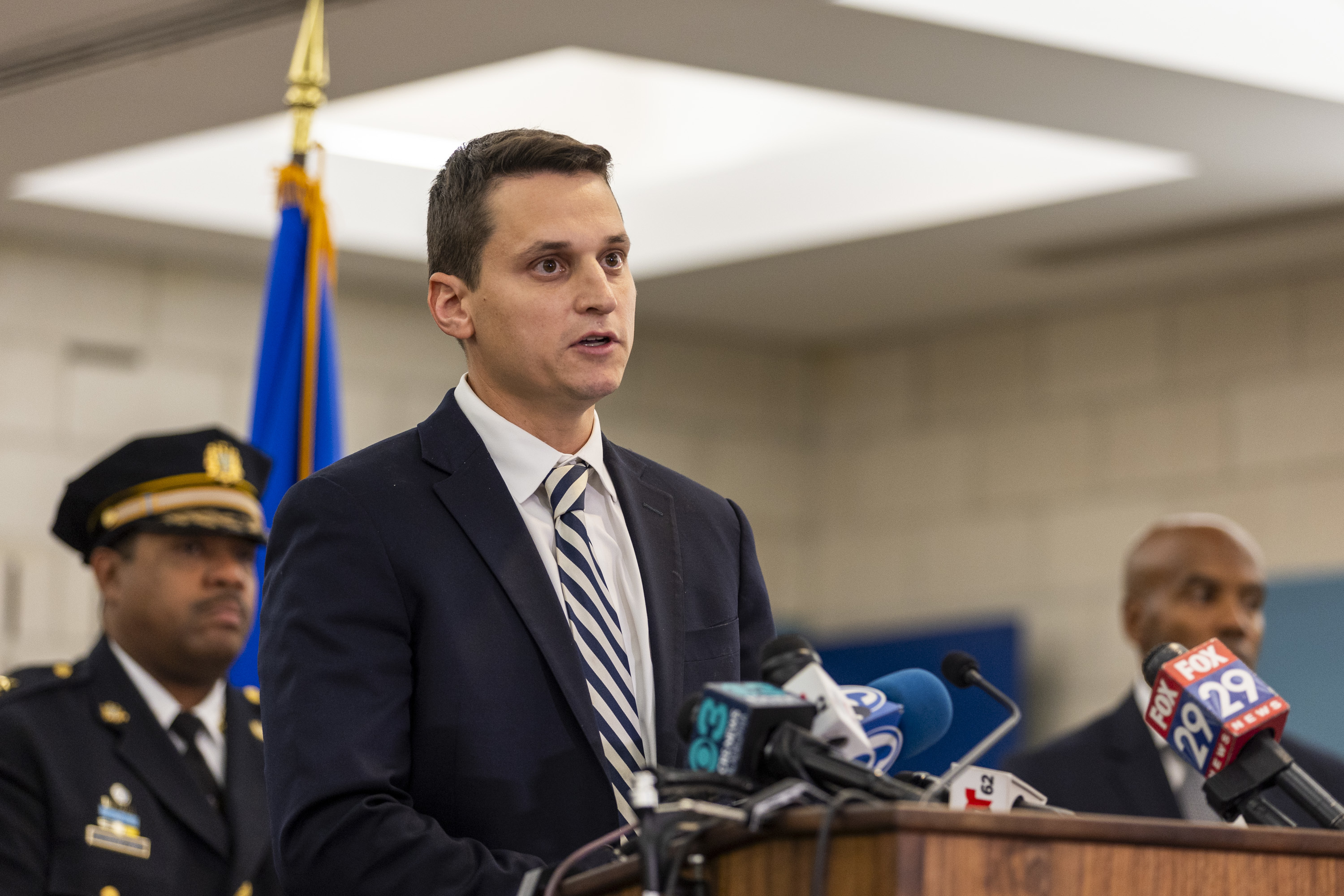
    U.S. Attorney David Metcalf said the investigation into the Weymouth Street group would effectively eliminate it.

    U.S. Attorney David Metcalf said more defendants were indicted in this case than any other federal prosecution in the Philadelphia region in a quarter-century.

    And although prosecutors did not estimate how much money the group made during its decade-long run on the block — and none of its members were officially charged with committing acts of violence — Metcalf said the arrests nonetheless “annihilated” a gang that had terrorized a long-suffering part of Kensington.

    Patel said the effort was emblematic of how law enforcement — both local and federal — can work together to address chronic issues including drug dealing and gun violence.

    “Everyone in America should be looking at this takedown,” Patel said “This takedown is how you safeguard American cities from coast to coast.”

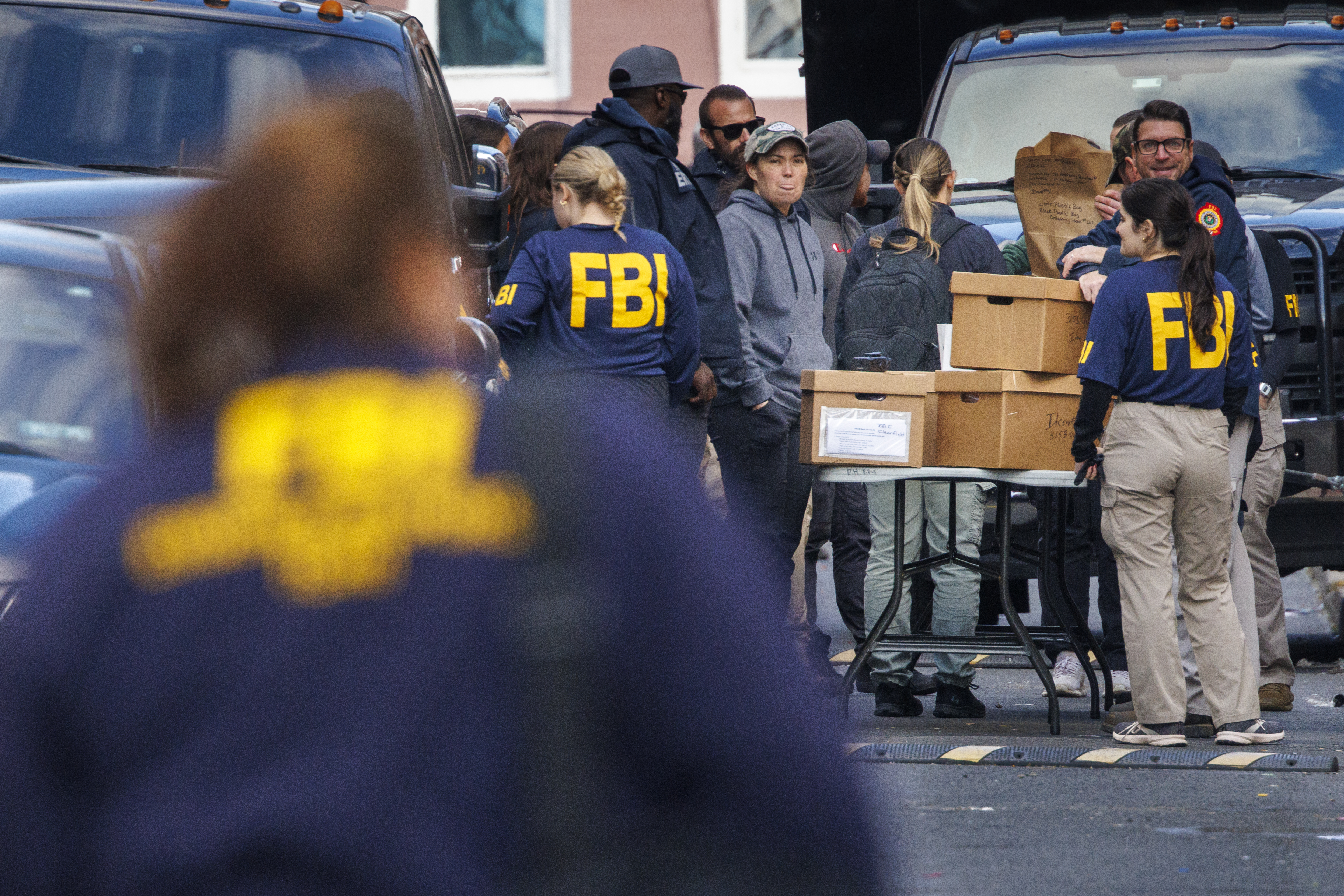
    Law enforcement and FBI at Weymouth Street between Clearfield and Allegheny Avenue on Friday, October 24, 2025.

    FBI agents and Philadelphia police officers conducted a series of raids in Kensington early Friday morning in support of the initiative. Wayne Jacobs, the FBI’s top official in Philadelphia, said agents served 11 search warrants, and that 30 of the 33 defendants were in custody as of Friday afternoon.

    Philadelphia Police Commissioner Kevin Bethel said he was proud that the arrests might help bring “safety, dignity and peace” to Kensington — a neighborhood that Mayor Cherelle L. Parker’s administration has sought to prioritize throughout her two years in office, nearly tripling the police force in the neighborhood.

    While officials acknowledged that the investigation began several years ago, the results nonetheless came as Trump and some of his top cabinet officials — including Patel, Attorney General Pam Bondi, and Defense Secretary Pete Hegseth — have sought in recent weeks to promote what they’ve cast as a concerted effort to address crime across the country, particularly involving suspected drug traffickers.

    Some of the Trump administration’s initiatives have been relatively conventional, such as Friday’s raids in Philadelphia and other recent takedowns in cities such as Milwaukee and Pittsburgh.

    Trump and Patel have also touted the FBI’s arrest numbers this year, saying they are “working non-stop to make America safe again.”

    Dan Bongino, one of Patel’s top deputies at the FBI, said Friday that the Philadelphia arrests were part of that mission, writing on social media: “When President Trump told us to ‘go get em,’ he wasn’t kidding. And neither were we.”

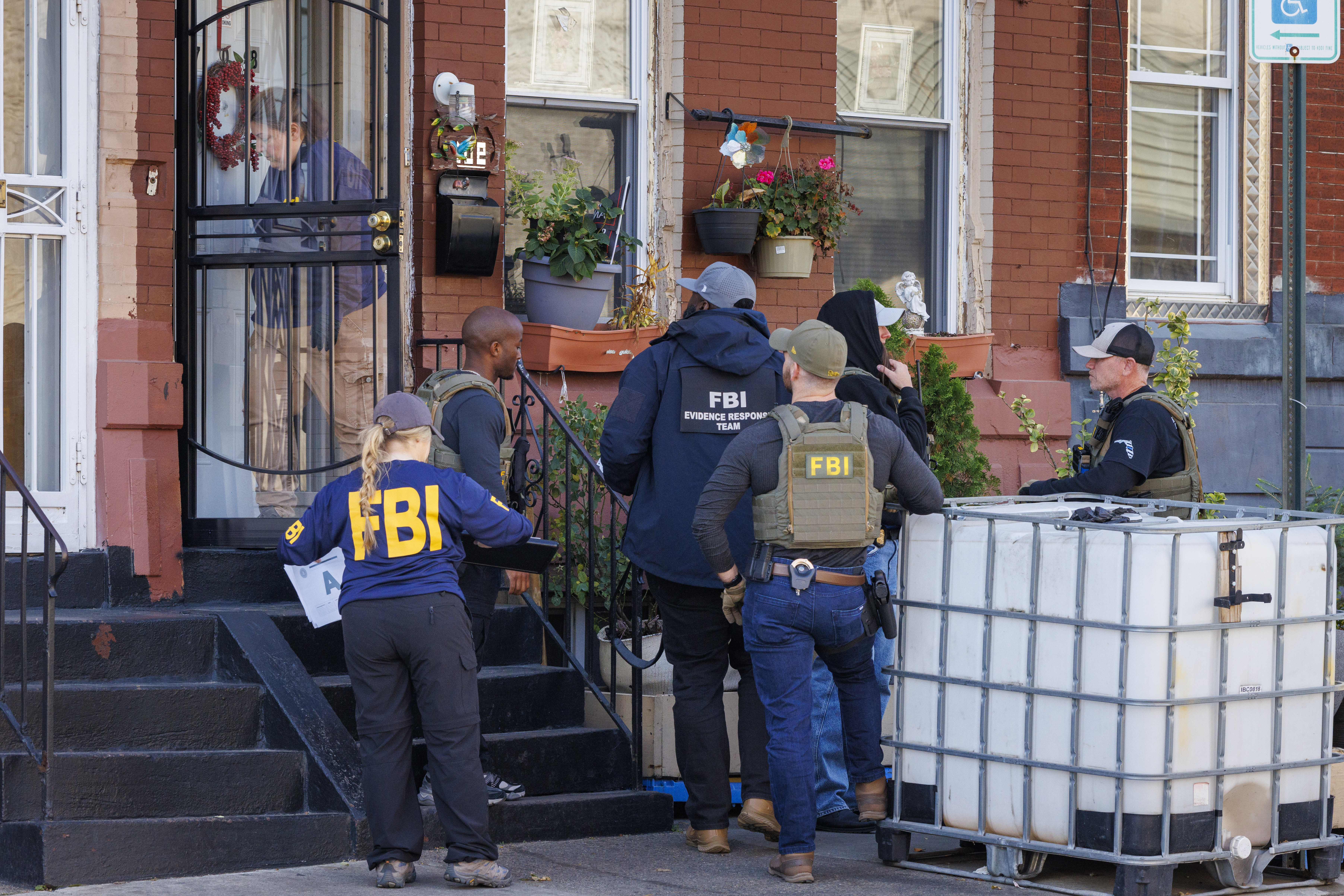
    FBI agents were on the 700 block of East Clearfield near Weymouth Street on Friday morning.

    Still, other aspects of the campaign have been highly controversial, including Trump seeking to deploy federal troops to cities such as Chicago and Portland in response to what he’s called widespread unrest or clashes between protesters and U.S. Immigration and Customs Enforcement agents. Local officials have described Trump’s efforts as unnecessary and challenged them in court.

    Trump also moved to effectively federalize law enforcement in Washington, D.C., an effort that local officials called a “baseless power grab” in a lawsuit.

    And international tensions have started to rise over the military’s continued bombing of alleged drug-carrying boats in the Caribbean Sea and Pacific Ocean — strikes that have killed dozens of people and raised questions about whether the tactic is legal.

    Around Weymouth Street on Friday, SWAT units had dispersed by noon. Residents by then had gathered in the street along the narrow block, where some rowhouse doors were left ajar and several neighbors peered curiously from upper windows.

    Victor Ramirez, who has lived near Weymouth Street for 20 years, said police activity has become more common in the area in recent months.

    “It’s a different story almost every day,” Ramirez said outside his home.

    Ramirez said increased law enforcement activity has frightened his neighbors. He said most are “good people” who work to feed their families. Still, Ramirez said he feels more safe with the increased attention to crime in the neighborhood.

    The FBI raid Friday morning felt like a significant escalation, he said. Ramirez was surprised to see agents armed with assault rifles hopping out of armored cars and making arrests.

    The raid came on the day of a fall block party on Allegheny Avenue, which stretched between F and G Streets and intersected with neighboring Weymouth Street. The event is popular with local children, Ramirez said, and he hoped it would bring positive energy to a block that experienced an unusual morning.

  • Women hold 9 CEO positions at Philadelphia’s top 100 public companies

    Women hold 9 CEO positions at Philadelphia’s top 100 public companies

    Women filled more of the top leadership positions at large public companies in the Philadelphia area in fiscal year 2024 than they did the previous year. But workplace parity remains to be achieved.

    “We’re showing measurable but slow progress,” said Meghan Pierce, president and CEO of the Forum of Executive Women, which this week released its annual report measuring women in CEO positions and on corporate boards. “As we look at this data year to year, we are definitely discouraged by how slow progress is.”

    The Forum counted women in leadership positions in fiscal 2024 across the region’s largest 100 public companies by revenue, using data from U.S. Security and Exchange Commission filings.

    Pierce says the forum is using its platform to highlight some factors holding women back in the workforce, such as the lack of paid family leave in Pennsylvania and lack of pay transparency. These are “structural issues that might prevent someone from getting to where they deserve to be,” she said.

    Who are the region’s female CEOs?

    Still, the number of women CEOs in the Philadelphia area more than doubled last year, from four in 2023 to nine last year.

    Three were on the list last year:

    • Ellen Cooper at Lincoln National Corp.
    • Denise Dignam at Chemours Co.
    • Susan Hardwick of American Water Works Co.

    Hardwick, however, recently retired and was succeeded by John Griffith.

    The newcomers are:

    • Lori Koch of DuPont de Nemours Inc.
    • Winnie Park of Five Below
    • Mojdeh Poul of Integra LifeSciences Holdings Corp.
    • Suzanne Foster of AdaptHealth Corp.
    • Natalia Shuman of Mistras Group Inc.,
    • Nicholle Taylor of Artesian Resources Corp.

    Carole Ben-Maimon, of Larimar Therapeutics, was included on the list last year and remains CEO of that company, but Larimar is no longer among the top 100 local public companies by revenue.

    Getting more women in to CEO roles, Pierce said, will require “making long-term investments in women and putting them in the pipeline for those top jobs.”

    More female board members

    On the boards of 100 Philly-area businesses in 2024, women occupied 15 more seats than the previous year, bringing women’s representation on boards up to 30%.

    Despite that progress, six companies still have no women on their boards, an increase from three last year. That number has not increased since 2013.

    “We have to call that out,” said Pierce. “A company with no women on their boards is troubling for us.”

    In 2013, 35 of the 100 companies didn’t have women on their boards.

    window.addEventListener(“message”,function(a){if(void 0!==a.data[“datawrapper-height”]){var e=document.querySelectorAll(“iframe”);for(var t in a.data[“datawrapper-height”])for(var r,i=0;r=e[i];i++)if(r.contentWindow===a.source){var d=a.data[“datawrapper-height”][t]+”px”;r.style.height=d}}});

    A “troubling” decline in DEI reporting

    This year’s report noted that fewer area companies had chosen to report their DEI policies, racial and ethnic makeup of their boards, and/or of their workforce. In 2023, 87% of the region’s top 100 companies had shared at least some of this information, but that dropped to 62% a year later.

    Pierce said this is “troubling.” She said she expects that number to continue dropping amid President Donald Trump’s curtailing of DEI efforts, “just given the environment that we’re operating in — but maybe I’ll be pleasantly surprised.”

    The Trump administration has called for the end of federal DEI programs, and offered universities greater access to federal funding if they agreed to make certain changes, including removing gender and ethnicity from admissions decisions.

    A recent Gallup and Bentley University report also indicates that fewer people believe DEI should be a top business priority. This year, 69% of people thought DEI was “extremely or somewhat important for businesses to promote,” down from 74% in 2024, the report said.

    Editor’s note: A previous version of this story contained a percentage that could not be verified. It has been removed.

  • Trump’s MAGA makeover of the Third Circuit is complete

    Trump’s MAGA makeover of the Third Circuit is complete

    In his first term, Donald Trump appointed four judges to the Philadelphia-based U.S. Court of Appeals for the Third Circuit — flipping the court’s ideological balance firmly to the right.

    The 14-member court, which hears appeals from Pennsylvania, New Jersey, and Delaware, routinely handles disputes of national importance.

    This past summer, it struck down Pennsylvania’s mail-in ballot dating rule, and just last week, it heard arguments over New Jersey’s long-standing assault rifle ban, potentially teeing up the issue for U.S. Supreme Court review.

    President Joe Biden had a chance to tip the balance back.

    His nominee, Adeel Mangi, would have become the first Muslim American to serve on any federal appellate court. But facing bad-faith Republican attacks and tepid Democratic support, Mangi’s nomination was left to die on the Senate floor.

    That failure, and Trump’s return to power, cleared the way for the rapid installation of two MAGA loyalists, Emil Bove and Jennifer Mascott, cementing an 8-6 conservative majority.

    Less than a year into his second term, Trump has finished what he started in his first. His MAGA makeover of the Third Circuit is complete — and the people of Pennsylvania, New Jersey, and Delaware, and perhaps the country as a whole, will be living with its consequences for decades to come.

    Emil Bove: The hatchet man

    Trump’s first pick for the Third Circuit is also his most dangerous: Emil Bove.

    Bove, the president’s former criminal defense attorney, lacks the culture war credentials required of nearly every other Trump judicial nominee. He never sued the Biden administration, or opposed same-sex marriage, or defended a state abortion ban. But he has one quality in spades: loyalty to Donald Trump.

    Once installed in the U.S. Department of Justice, Bove wasted little time proving to Trump that he would do whatever it took to advance Trump’s agenda.

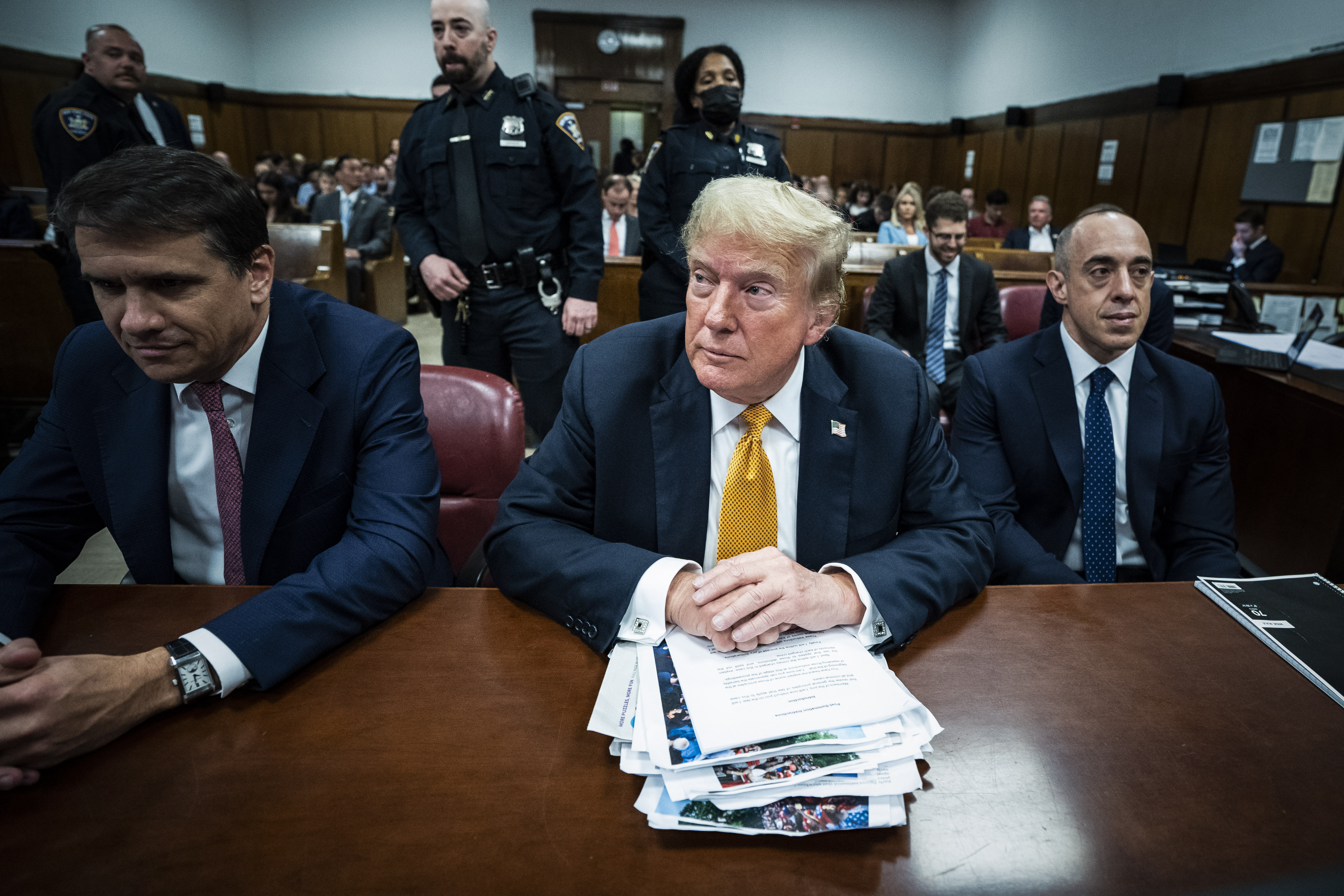
    Donald Trump, flanked by attorneys Todd Blanche and Emil Bove (right), at his criminal trial in Manhattan in 2024.

    He fired the federal prosecutors and FBI agents who pursued cases against the Jan. 6, 2021, insurrectionists. He clumsily sought to dismiss charges against New York City Mayor Eric Adams to coerce him to aid Trump’s immigration crackdown. And, according to multiple credible whistleblower allegations, Bove told other DOJ lawyers that if courts tried to stop the administration’s deportations, they should tell “the courts ‘fuck you.’”

    Now that Bove is on the Third Circuit — he was confirmed in July by a razor-thin 50-49 vote — he is moving with similar speed to show Trump he’s still on his side.

    This week, in what appears to be Bove’s first vote as a circuit judge, he joined four other Trump appointees dissenting from the full court’s decision to deny the request of various Republican organizations to rehear the case holding Pennsylvania’s date requirement for mail-in ballots unconstitutional.

    Of course, there never should have been a vacancy for Bove to fill.

    Back in November 2023, President Biden nominated Mangi to the seat Bove now holds. Mangi had all the sterling credentials you’d expect from an appellate court nominee — degrees from Oxford and Harvard Law, and a long career at a white-shoe law firm.

    But all Republicans could see was that he was Muslim, and they pulled out every Islamophobic trick in their very big book to disingenuously paint him as some antisemitic radical.

    And what’s worse, some Senate Democrats fell for it, sinking Mangi’s nomination and handing this critical vacancy to Trump.

    Jennifer Mascott: Am MAGA, will travel

    Over the summer, Trump also nominated Catholic University law professor Jennifer Mascott to a second Third Circuit vacancy in Delaware.

    Mascott’s résumé is dripping with connections to Trump and the MAGA legal movement. She clerked for then-D.C. Circuit Judge Brett Kavanaugh (one of Trump’s appointees to the Supreme Court) and Justice Clarence Thomas (one of Trump’s favorite justices).

    Before joining Catholic Law last year, she taught at George Mason’s Antonin Scalia Law School, one of the most conservative in the country.

    In the first Trump administration, she worked in Trump’s Justice Department and helped with Justice Amy Coney Barrett’s last-minute confirmation.

    This time, she went to work directly for Trump as senior counselor to the president in the White House Counsel’s Office.

    What Mascott lacks, however, is any genuine connection to Delaware.

    She lives in Maryland and works in Washington, D.C. She is not admitted to the Delaware Bar, and she has little, if any, experience with Delaware’s sophisticated corporate law regime.

    But Mascott admitted in her Senate Judiciary Committee questionnaire that she made clear to Trump that she was willing to take any judgeship in which he “would be interested in having [her] serve,” historical tradition and judicial propriety be damned.

    Even the timing of her confirmation reeks of political gamesmanship.

    Mascott leapfrogged a half dozen other judicial nominees so she could join the Third Circuit in time to participate, and potentially cast the deciding vote, in a major Second Amendment case about New Jersey’s assault weapons ban.

    With Bove and Mascott now seated, the Third Circuit may become the venue of choice for Trump’s allies looking to legitimize his most extreme policies, as right-wing litigants know they’ll find sympathetic ears in Philadelphia.

    What was once a court known for its independence and moderation could soon become a proving ground for Trump’s legal movement — a place where loyalty trumps the law.

    The only question left is how long it will take before the rest of the country starts feeling the consequences of the Third Circuit’s new MAGA majority.

    John P. Collins Jr. is an associate professor at George Washington University Law School, where he researches and writes about federal judicial nominations.

  • Vance criticizes Israel’s parliament vote on West Bank annexation, says the move was an ‘insult’

    Vance criticizes Israel’s parliament vote on West Bank annexation, says the move was an ‘insult’

    JERUSALEM — U.S. Vice President JD Vance criticized on Thursday a symbolic vote in Israel’s parliament the previous day about annexing the occupied West Bank, saying it amounted to an “insult” and went against the Trump administration policies.

    Hard-liners in the Israeli parliament had narrowly passed a preliminary vote in support of annexing parts of the West Bank — an apparent attempt to embarrass Prime Minister Benjamin Netanyahu while Vance was still in the country.

    The bill, which required only a simple majority of lawmakers present in the house on Wednesday, passed with a 25-24 vote. But it was unlikely to pass multiple rounds of voting to become law or win a majority in the 120-seat parliament. Netanyahu, who is opposed to it, also has tools to delay or defeat it.

    Before departing Israel, Vance also unveiled new details about U.S. plans for Gaza, saying he expected reconstruction to begin soon in some “Hamas-free” areas of the territory. But he warned that rebuilding the territory after a devastating two-year war could take years.

    “The hope is to rebuild Rafah over the next two to three years and theoretically you could have half a million people live (there),” he said, speaking of the strip’s southernmost city.

    That would account for about a quarter of Gaza’s population of roughly 2 million, 90% of whom were displaced from their homes during the war. Out of every 10 buildings that stood in Gaza prewar, eight are either damaged or flattened. An estimated cost of rebuilding Gaza is about $53 billion, according to the World Bank, the U.N. and the European Union.

    Vance says the vote was an ‘insult’

    The Israeli parliament’s vote has stirred widespread condemnation, with over a dozen countries — including Egypt, Qatar and Saudi Arabia — rebuking it in a joint statement that called all Israeli settlements in the West Bank a violation of international law.

    Netanyahu’s office said in a statement that the “vote on annexation was a deliberate political provocation by the opposition to sow discord.”

    Netanyahu is struggling to stave off early elections as cracks grow more apparent between factions in Israel’s right-wing parties, some of whom were upset over the ceasefire and the security sacrifices it required of Israel.

    Vance said that if the Knesset’s vote was a “political stunt, then it is a very stupid political stunt.”

    “I personally take some insult to it,” Vance said. “The policy of the Trump administration is that the West Bank will not be annexed by Israel.”

    The deputy Palestinian ambassador to the United Nations, Majed Bamya, told the U.N. Security Council on Thursday that Palestinians “appreciate the clear message” the Trump administration has sent in opposition to annexation.

    While many members of Netanyahu’s coalition, including his Likud Party, support annexation, they have backed off those calls since U.S. President Donald Trump said last month that he opposes such a move.

    The Palestinians seek the West Bank and the Gaza Strip, captured by Israel in the 1967 Mideast war, for a future independent state. Israeli annexation of the West Bank would all but bury hopes for a two-state solution between Israel and the Palestinians — the outcome supported by most of the world.

    Analysts like Amichai Cohen, a senior fellow at the Israel Democracy Institute, say that a “de-facto annexation of very large parts” of the West Bank is already underway, referring to the growing number of Israelis living in settlements in the Palestinian territory — even without any law supporting annexation.

    Intense U.S. push toward peace

    Earlier this week, Vance announced the opening of a civilian military coordination center in southern Israel where some 200 U.S. troops are working alongside the Israeli military and delegations from other countries planning the stabilization and reconstruction of Gaza.

    The United States is seeking support from other allies, especially Gulf Arab nations, to create an international stabilization force to be deployed to Gaza and train a Palestinian force.

    “We’d like to see Palestinian police forces in Gaza that are not Hamas and that are going to do a good job, but those still have to be trained and equipped,” U.S. Secretary of State Marco Rubio said ahead of his trip to Israel.

    Rubio, who was meeting with Netanyahu on Thursday evening, has also criticized Israeli far-right lawmakers’ effort to push for the annexation of the West Bank.

    Israeli media referred to the nonstop parade of American officials visiting to ensure Israel holds up its side of the fragile ceasefire as “Bibi-sitting.” The term, utilizing Netanyahu’s nickname of Bibi, refers to an old campaign ad when Netanyahu positioned himself as the “Bibi-sitter” whom voters could trust with their kids.

    Gaza’s dire need for medical care and aid

    In the first medical evacuation since the ceasefire began on Oct. 10, the head of the World Health Organization said Thursday the group has evacuated 41 critical patients and 145 companions out of the Gaza Strip.

    In a statement posted to X, Tedros Adhanom Ghebreyesus called on nations to show solidarity and help some 15,000 patients who are still waiting for approval to receive medical care outside Gaza.

    His calls were echoed by an official with the U.N. Population Fund who on Wednesday described the “sheer devastation” that he witnessed on his most recent travel to Gaza, saying that there is no such thing as a “normal birth in Gaza now.”

    Andrew Saberton, an executive director at UNFPA, told reporters how difficult the agency’s work has become due to the lack of functioning or even standing health care facilities.

    Another major challenge since the ceasefire began has been getting enough aid into Gaza — and distributed — to the meet the huge demand.

    “We expected Gaza to be flooded with aid the moment the ceasefire began. But that’s not what we’re seeing,” said Bushra Khalidi, who oversees the Palestinian territories division at Oxfam, a nonprofit focused on global poverty.

    More crossings into Gaza need to be opened in order to allow in more trucks, said Antoine Renard, head of the World Food Program in the Palestinian territories.

    “With only two crossings that are open, you are facing clearly congestion,” he said.

    The WFP has 36 distribution centers operating in Gaza, and aims to increase that to 145. Since Oct 11, the U.N. tracking system has recorded 949 aid trucks that were offloaded in Gaza.

  • Trump backs off planned surge of federal agents into San Francisco after talking to the mayor

    Trump backs off planned surge of federal agents into San Francisco after talking to the mayor

    ALAMEDA, Calif. — President Donald Trump said Thursday that he’s backing off a planned surge of federal agents into San Francisco to quell crime after speaking to the mayor and several prominent business leaders who said they’re working hard to clean up the city.

    Trump had been threatening to send the National Guard to San Francisco, a move Mayor Daniel Lurie and Gov. Gavin Newsom said was unnecessary because crime is on the decline. Separately, U.S. Customs and Border Protection agents began arriving at a Coast Guard base in the region earlier Thursday for a possible ramp up of immigration enforcement, a move that drew several hundred protesters.

    It was not clear if the president was canceling a National Guard deployment or calling off immigration enforcement by CBP agents. At his news conference, Lurie said he could not clarify and could only repeat what the president had told him. Lurie said Homeland Security Secretary Kristi Noem “reaffirmed” Trump’s commitment on Thursday morning. DHS oversees CBP agents as well as U.S. Immigration and Customs Enforcement.

    “The Federal Government was preparing to ‘surge’ San Francisco, California, on Saturday, but friends of mine who live in the area called last night to ask me not to go forward with the surge,” Trump posted on social media. “I spoke to Mayor Lurie last night and he asked, very nicely, that I give him a chance to see if he can turn it around.”

    Specifically, Trump said he heard from Salesforce CEO Mark Benioff and Nvidia CEO Jensen Huang. He said the federal government could handle crime better than city leaders, and he indicated he could still send agents in the future.

    At an afternoon news conference, Lurie said he welcomes the city’s “continued partnership” with the Drug Enforcement Agency and other federal authorities to get illegal narcotics off the streets and contribute to San Francisco’s falling crime rates.

    “But having the military and militarized immigration enforcement in our city will hinder our recovery,” the mayor said. Trump’s assertions of out-of-control crime in the city of roughly 830,000 have baffled local and state leaders, who point to statistics showing that many crimes are at record lows.

    Newsom’s office said on X: “Trump has finally, for once, listened to reason — and heard what we have been saying from the beginning. The Bay Area is a shining example of what makes California so special, and any attempt to erode our progress would damage the work we’ve done.”

    Protesters assembled just after dawn at Coast Guard Island in Alameda, California, where CBP agents were arriving before Trump made his remarks. Several hundred people stood outside the facility, with many singing hymns and carrying signs saying, “Protect our neighbors” and “No ICE or troops in the Bay.”

    Police used at least one flash-bang grenade to clear a handful of demonstrators from the entrance as CBP vehicles drove onto the base. Organizers urged protesters to remain peaceful, as a line of Coast Guard officers in helmets watched from just outside the entrance.

    Protester Gala King participated in an interfaith vigil against the federal crackdown and in support of immigrants.

    “The Bay Area is a beautiful place full of diversity, and we are here to protect that,” King said. “Our faith traditions, our interfaith traditions, call on us to stand on the side of justice, to stand on the side of those that are most marginalized, that are most targeted right now.”

    Coast Guard Island is an artificial island formed in 1913, and the Coast Guard first established a base there in 1926. The island is owned by the federal government and is not open to the general public, so escorts or specific government ID cards are required for visitors. The Coast Guard is part of the Department of Homeland Security.

    Trump has deployed the Guard to Washington, D.C., and Memphis, Tennessee, to help fight what he says is rampant crime. Los Angeles was the first city where Trump deployed the Guard, arguing it was necessary to protect federal buildings and agents as protesters fought back against immigration arrests.

    He has also said they are needed in Chicago and Portland, Oregon. Lawsuits from Democratic officials in both cities have so far blocked troops from going onto city streets.

  • Trump pardons Binance founder Changpeng Zhao, high-profile cryptocurrency figure

    Trump pardons Binance founder Changpeng Zhao, high-profile cryptocurrency figure

    WASHINGTON — President Donald Trump has pardoned Binance founder Changpeng Zhao, who created the world’s largest cryptocurrency exchange and served prison time for failing to stop criminals from using the platform to move money connected to child sex abuse, drug trafficking and terrorism.

    The pardon caps a monthslong effort by Zhao, a billionaire commonly known as CZ in the crypto world and one of the biggest names in the industry. He and Binance have been key supporters of some of the Trump family’s crypto enterprises.

    “Deeply grateful for today’s pardon and to President Trump for upholding America’s commitment to fairness, innovation, and justice,” Zhao said on social media Thursday.

    Zhao served four months in prison after reaching a deal with the Justice Department to plead guilty to charges of enabling money laundering at Binance. But, in explaining the pardon, Trump said of Zhao, “He was recommended by a lot of people.”

    “A lot of people say that he wasn’t guilty of anything,” Trump said. “He served four months in jail and they say that he was not guilty of anything.”

    The president added that he didn’t believe he’d ever met Zhao personally, but had “been told” he “had a lot of support, and they said that what he did is not even a crime.” He said Zhao had been “persecuted by the Biden administration.”

    “I gave him a pardon at the request of a lot of very good people,” Trump said.

    It’s the latest move by a president who has flexed his executive power to bestow clemency on political allies, prominent public figures and others convicted of crimes.

    White House press secretary Karoline Leavitt announced the pardon in a statement and later told reporters in a briefing that the White House counsel’s office “thoroughly reviewed” the request. She said the administration of Democratic President Joe Biden pursued “an egregious oversentencing” in the case, was “very hostile to the cryptocurrency industry” and Trump “wants to correct this overreach.”

    The crypto industry has also long complained it was subject to a “regulation by enforcement” ethos under the Biden administration.

    Trump’s pardon of Zhao fits into a broad pattern of his taking a hands-off approach to an industry that spent heavily to help him win the election in 2024. His administration has dropped several enforcement actions against crypto companies that began during Biden’s term and disbanded the crypto-related enforcement team at the Justice Department.

    Former federal prosecutor Mark Bini said Zhao went to prison for what “sounds like a regulatory offense, or at worst its kissing cousin.”

    “So this pardon, while it involves the biggest name in crypto, is not very surprising,” said Bini, a white collar defense lawyer who handles crypto issues at Reed Smith.

    Zhao was released from prison last year after being sentenced for violating the Bank Secrecy Act. He was the first person ever sentenced to prison time for such violations of that law, which requires U.S. financial institutions to know who their customers are, to monitor transactions and to file reports of suspicious activity. Prosecutors said no one had ever violated the regulations to the extent Zhao did.

    The judge in the case said he was troubled by Zhao’s decision to ignore U.S. banking requirements that would have slowed the company’s explosive growth.

    “Better to ask for forgiveness than permission,” was what Zhao told his employees about the company’s approach to U.S. law, prosecutors said. Binance allowed more than 1.5 million virtual currency trades, totaling nearly $900 million, that violated U.S. sanctions, including ones involving Hamas’ al-Qassam Brigades, al-Qaida and Iran, prosecutors said.

    “I failed here,” Zhao told the court last year during sentencing. “I deeply regret my failure, and I am sorry.”

    Zhao had a remarkable path to becoming a crypto billionaire. He grew up in rural China and his family immigrated to Canada after the 1989 Tiananmen Square massacre. As a teenager, he worked at a McDonald’s and became enamored with the tech industry in college. He founded Binance in 2017.

    In addition to taking pro-crypto enforcement and regulatory positions, the president and his family have plunged headfirst into making money in crypto.

    A stablecoin launched by World Liberty Financial, a crypto project founded by Trump and sons Donald Jr. and Eric, received early support and credibility thanks to an investment fund in the United Arab Emirates using $2 billion worth of World Liberty’s stablecoin to purchase a stake in Binance. Stablecoins are a type of cryptocurrency that are typically tied to the value of the U.S. dollar.

    A separate World Liberty Finance token saw a huge spike in price on Thursday shortly after news of the pardon was made public, with gains that far outpaced any other major cryptocurrency, according to data from CoinMarketCap.

    Zhao said earlier this year that his lawyers had requested a pardon.

    It is not immediately clear what impact Trump’s pardon of Zhao may have on operations at Binance and Binance.US, a separate arm of the main exchange offering more limited trading options to U.S. residents.

  • From autism to beards, the Trump regime wages war on ‘the different’

    From autism to beards, the Trump regime wages war on ‘the different’

    Donald Trump had the nation’s somber attention last month as he delivered the Arizona football stadium eulogy for assassinated right-wing provocateur Charlie Kirk, and — as the 47th president is wont to do — took an unexpected detour to promise a scientific breakthrough for a condition his regime has called a national tragedy.

    “I think you’re going to find it to be amazing,” Trump said of a pending White House announcement. “I think we found an answer to autism.” With typical bravado, he suggested that a total end to a neurodevelopment order was at hand, that “we’re not going to let it happen anymore.”

    What was actually announced in the coming days — a debunked claim that autism is linked to pregnant women taking the pain reliever Tylenol, as well as a suggestion of a connection to circumcisionwas attacked by many experts as a gross misreading of the existing scientific data, and nothing like the breakthrough that Trump had promised in Glendale.

    But what was even more telling was the reaction from families or adults who’ve been living for years with a diagnosis of neurodivergence, who aren’t realistically asking for a “cure” — especially not one cloaked in alleged quackery — but simply a more compassionate approach from a government they feel is stigmatizing a community that wants support.

    They don’t see life on the autism spectrum — a mix of communication and emotional struggles with passionate interests and insight, varying greatly from person to person — as a disease, but as a difference, to be better understood and nurtured.

    In this photo provided by Ana Fiero, Kelly Sue Milano holds her 6-year-old son, who is on the autism spectrum, at an outdoor party in Irvine, Calif., on Monday.

    “My daughter’s an amazing person that contributes to society and contributes to our family, and she’s not a crisis,” Jenny Shank of St. Louis told the local NPR affiliate. She said that what the autism community really needs from the government “is awareness, acceptance and opportunities in our communities, and funding for schools for help to meet their maximum potential.”

    Studies have shown higher rates of autism — more than 3% of 8-year-olds, according to recent research by the Centers for Disease Control and Prevention — than was once believed. But experts theorize this may be more from greater awareness than the conspiracy theories around Tylenol or vaccines that are an obsession with Trump’s contrarian U.S. Department of Health and Human Services secretary, Robert F. Kennedy Jr.

    RFK Jr. has said that “autism destroys families,” while Trump has called it “a horrible, horrible crisis,” but statements like those have deeply dismayed many of the households for which the Trump regime seems to want a gold star for trying to help. Ashley Kline, whose 5-year-old son has been diagnosed with autism, told the Washington Post, “I don’t want it to get to a point where inclusion is just thrown out the window, and people start insisting that the best thing for autistic children and adults is to be hidden behind walls once again.”

    The Trump regime’s misguided obsession with faulty research in seeking a magic bullet “cure” for autism has been portrayed as one more example of science under siege in America, and it is that. But it’s also a window into something deeper, and arguably even more disturbing.

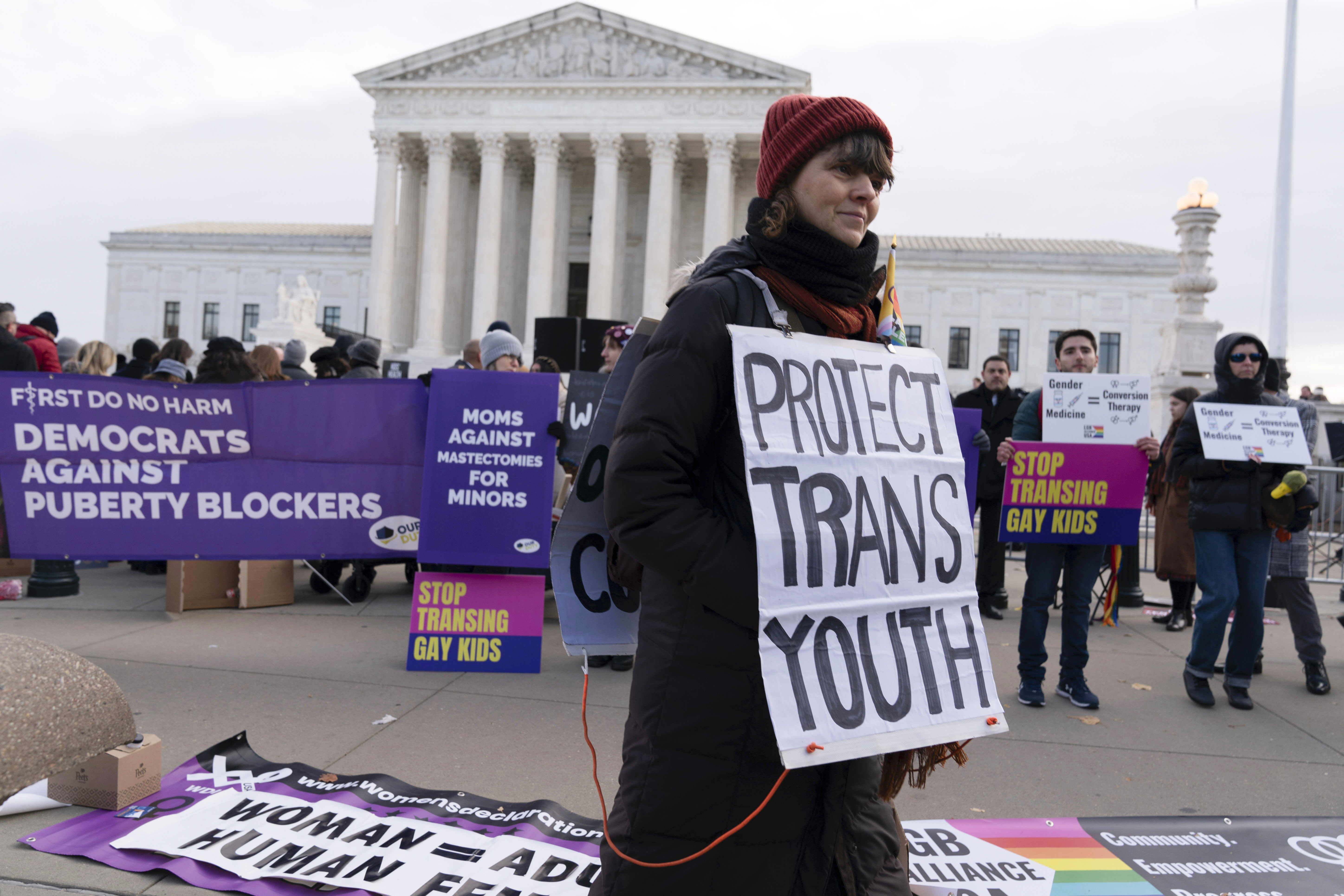
    Whether it’s an autism community it pretends to be helping or the transgender community it openly seeks to destroy, our authoritarian government is waging war to flatten any differences, to make America great again with a forced monochrome lens.

    Protesters for and against gender-affirming care for transgender minors demonstrate outside the U.S. Supreme Court Building in December.

    You see it almost every day with Trump and his MAGA administration. Often it’s big and obvious, like the president’s Day One executive order that targeted America’s nearly three million transgender people by declaring the government would only recognize two unchangeable sexes, male and female, and end any policies that aided the transgender community.

    But Trump’s war on the different also permeates the smaller stuff, like his “Secretary of War” Pete Hegseth’s much-ballyhooed and much-ridiculed “warrior ethos” lecture to 800 appalled-looking generals and admirals. Hegseth included in his vision a mandate that would ban soldiers with facial hair, declaring “no beardos,” and adding, “The age of rampant and ridiculous shaving profiles is done.”

    Hegseth also declared an end to “fat” generals and overweight troops (apparently the Texas National Guard didn’t get the memo), and, OK, maybe that’s required for certain types of combat soldiers. But the broader message from the Pentagon is clear: that the new regime wants a sea of troops who look alike. Beardless, slimmed down, and, evidently — given the ouster of so many women and Black top commanders — as white and male as possible in 2025 America.

    I think we vastly underrate how central this contempt for anyone who looks or acts differently from an idealized pre-1960 vision of America is to the entire fascist enterprise that we have too kindly branded “Trumpism.”

    The idea of a new type of personal freedom — a quest for individual fulfillment, aided by post-World War II prosperity, shattering the artificial constraints of conformity — was birthed in a New Left philosophy spelled out in texts like 1962’s “Port Huron Statement.”

    This outlook, rooted in the upheavals of the 1960s and ‘70s, is celebrated by many as the birth of everything from the LGBTQ+ rights movement, to efforts to replace stigma with empathy and treatment for conditions such as mental illness, to “letting your freak flag fly” by growing long hair or a beard. And this is also the thing that a reactionary far-right — deeply insecure and desperate for a cocoon of white privileged patriarchy — has ceaselessly sought to destroy for 60 years.

    While Trump himself has relished one aspect of 1960s freedom — the sexual revolution, as he once called the threat of STDs “my personal Vietnam” — in his political reinvention, he has recoiled at many others, wanting even a return to the Willowbrook-style warehousing of the mentally ill. As president, he is the perfect point man for the right’s revanchist project — clearly believing in the worst kinds of debunked eugenics theory.

    A classic example occurred the other day in the Oval Office with a rant that belonged to 1925’s The Great Gatsby and its racist millionaire Tom Buchanan, and not 100 years later. Trump bemoaned his bad relationship with Boston’s Asian American mayor, Michelle Wu, despite her “reasonable IQ,” in contrast with his war with Chicago’s “low IQ” leader, Brandon Johnson. The Windy City mayor happens to be Black, just like almost every other figure — like Reps. Maxine Waters or Jasmine Crockett — branded “low IQ” in the most thinly disguised racism possible.

    Trump’s 21st-century eugenics — from ending diversity programs in colleges or the workplace to the obsession with finding the pill or shot or whatever that has made some kids “not normal” — is the unifying force of his dictatorship. It’s why what was sold to 2024’s voters as an effort to remove undocumented criminals from America turned out to be members of a masked secret police force chasing hardworking family men across the Home Depot parking lot because they have brown skin or speak Spanish.

    You know. Different.

    True, Trump’s rage toward immigrants or programs aimed to recruit more Black and brown kids into colleges was no secret, but what’s been more surprising has been the broader sense of hostility toward any government program that offers aid and empathy to those born with real challenges. Few predicted that Trump would seek to decimate the special education office in the U.S. Department of Education, or work more broadly to undermine the rights of the disabled.

    You may have noticed that some of these slashed federal programs would help children diagnosed with autism. But putting these children on a path toward happier and more fulfilling lives isn’t the goal of the Trump-RFK Jr. focus on autism, but rather making sure the next generation conforms to their constricted definition of normal.

    We need to understand Trump’s war on the different because we need to defeat it. Boomers of my generation were born into the world of stigmatization and conformity that Trump wants to bring back, erasing the liberation movements that have been the victory of our lifetime. Sure, I want the next president to care about affordable healthcare and lowering egg prices, but America also needs leaders who will celebrate and defend our fundamental human right simply to be different.