Sunday is the first day of February, which means March is right around the corner, which means it is officially no longer too early to think about the NCAA Tournament.
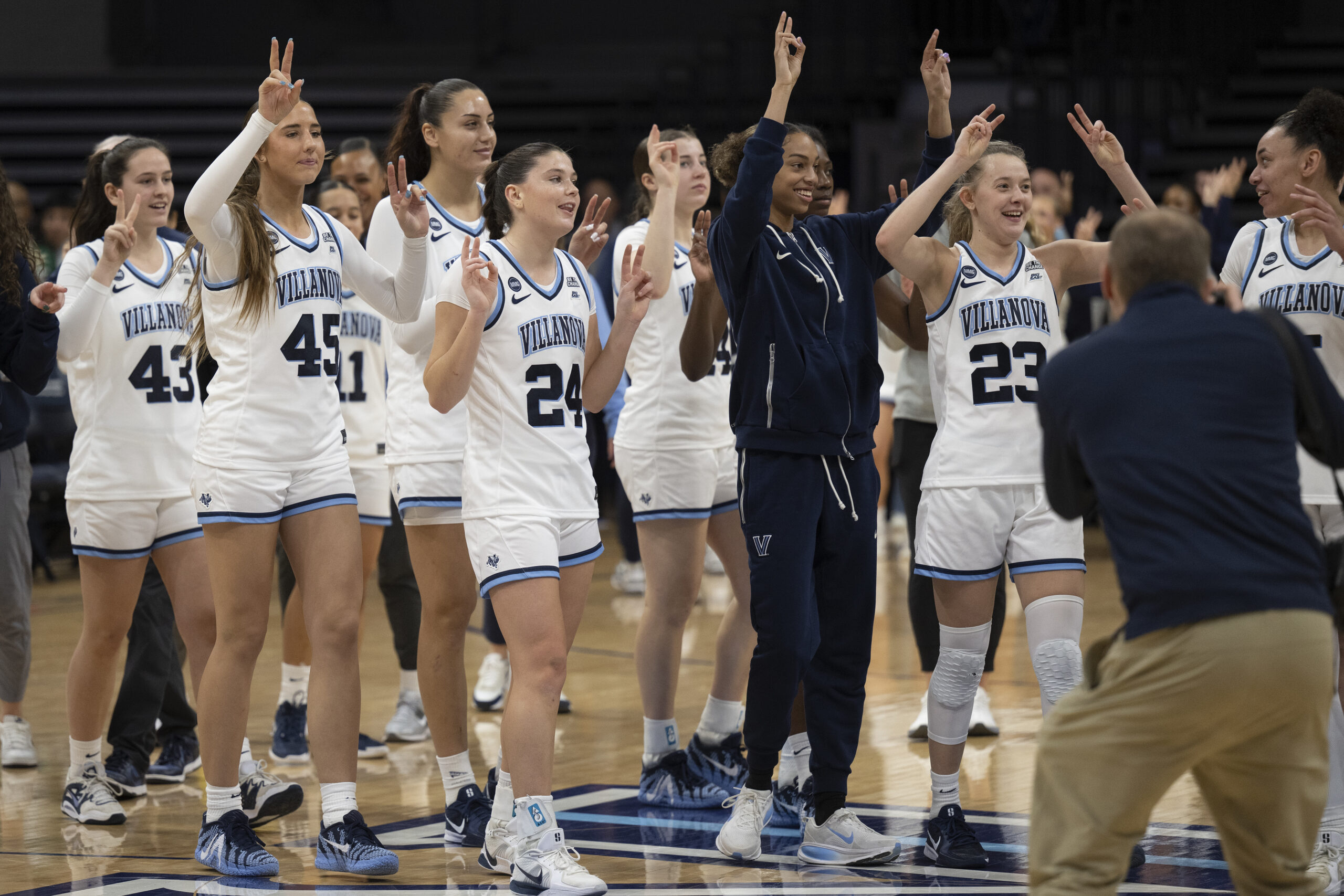
Villanova is 20 games through its 31-game schedule, and nine games through its 20-game Big East slate. The Wildcats, who host Providence on campus Friday night, are 15-5 overall and 6-3 in their conference matchups in the first season of the Kevin Willard era.
School administration moved on from Kyle Neptune last March after a third consecutive season ended without an invitation to the NCAA Tournament. Villanova officials believe the school should field a basketball team that perennially is in the at-large bid conversation, and three consecutive seasons without meaningful basketball was not acceptable.
Right now, it’s hard to believe the drought could stretch to four.
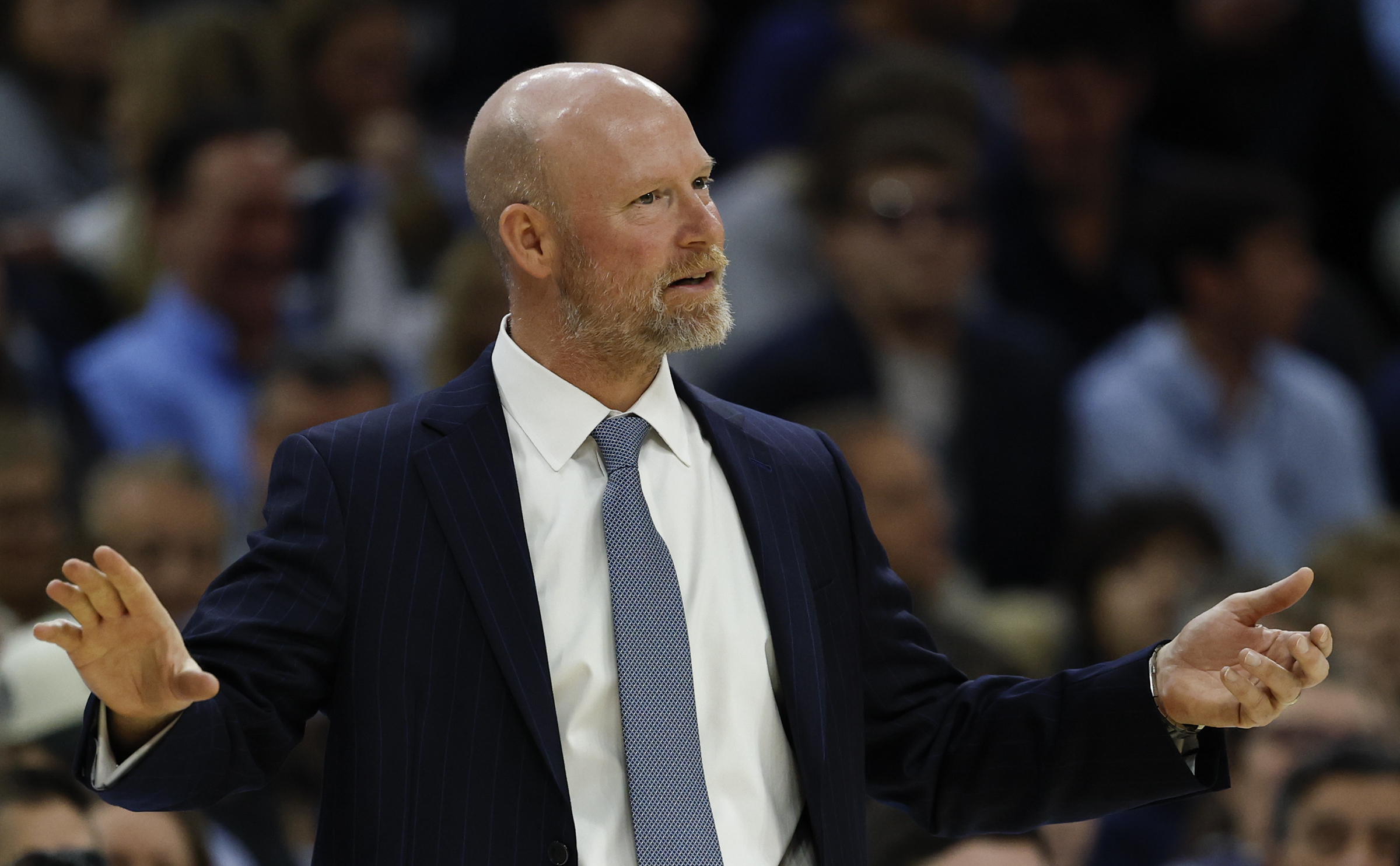
Villanova coach Kevin Willard is on pace to get the Wildcats back to the tourney.
The Wildcats aren’t yet a lock, but it’s looking pretty safe for their fans to preemptively look into taking a PTO day or two for the third week of March.
What are the numbers saying? We went to ESPN’s bracket guru himself, Joe Lunardi, for some help.
‘A very long leash’
Saturday’s loss to No. 2 UConn in Hartford, Conn., was an “insurance policy” kind of game, Lunardi said. Villanova declined coverage. The Wildcats let an upset opportunity slip away in an overtime loss, but the result, Lunardi said, was a “wash.” Villanova was a double-digit underdog and lost by eight.
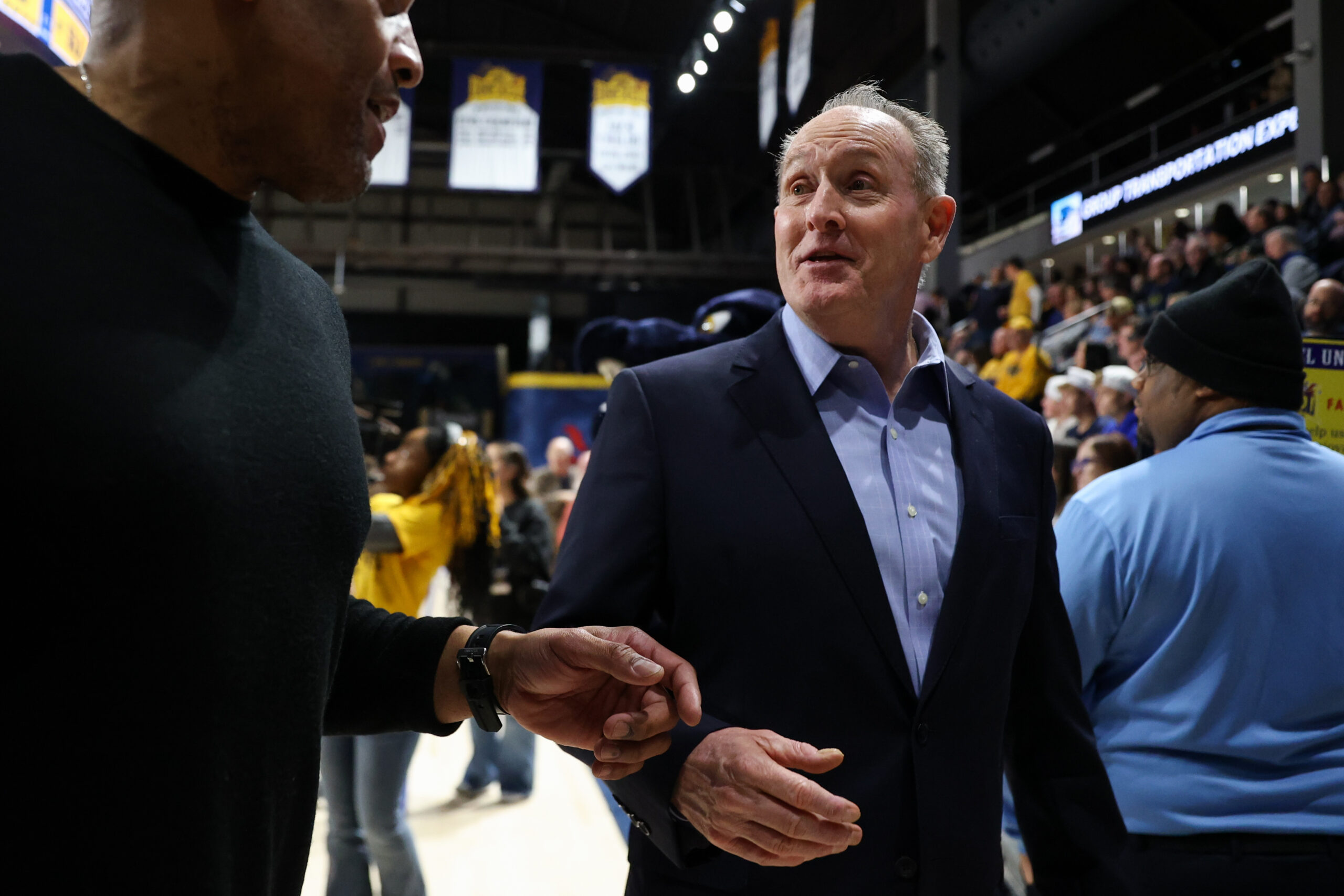
“It didn’t hurt, and it didn’t help,” said Lunardi, who had the Wildcats as a No. 7 seed in his latest bracket projection released Tuesday morning.
The metrics support that notion. Villanova barely budged in the NCAA’s NET rankings, where it was ranked 34th as of Wednesday afternoon, and at KenPom (27).
What has to happen to stay on the right path?
“All they really need to do is win games they’re favored, and they can even afford to lose [a few] of those,” Lunardi said. “If they go 6-5, they’re going to make it.”
That’s some leeway.
“That’s a very long leash given the fact that, frankly, the league is good but not great,” Lunardi said.
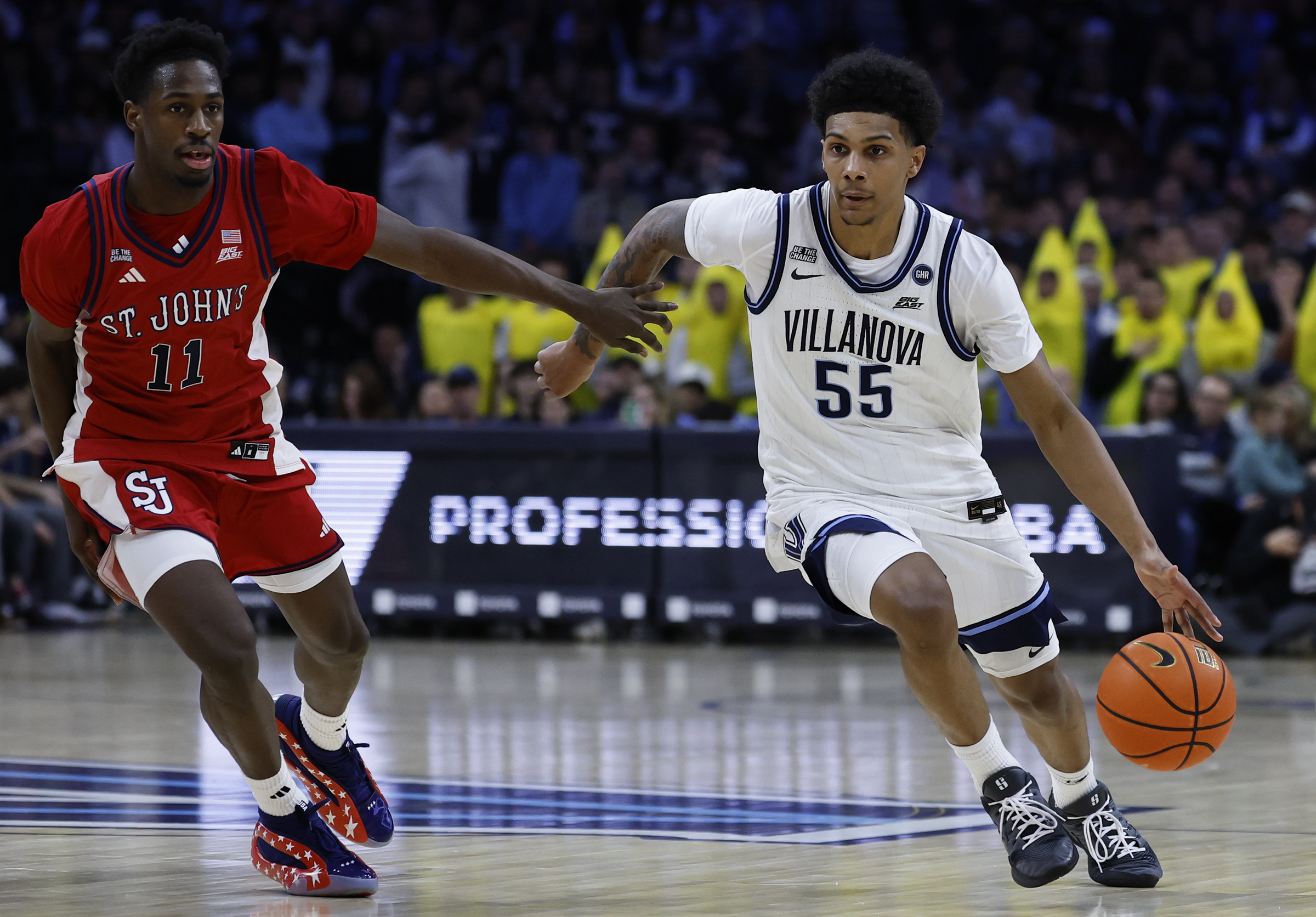
Guard Acaden Lewis is among those who could land the Wildcats back in the dance.
As things stand right now, Villanova likely would be favored in at least eight of its final 11 contests. Take care of six or seven of those, and there’s no need for a marquee win over UConn or St. John’s.
While 6-5 the rest of the way probably would be a disappointment, Lunardi projects that a final record of 21-10 gets Villanova “at worst” a No. 10 seed. The Wildcats’ ceiling, meanwhile, is “probably a five,” Lunardi said.
So, don’t count on the NCAA rewarding the Wildcats with a “home” game at Xfinity Mobile Arena to start the tournament.
Asked to put the resumé in perspective, Lunardi said: “I would describe it as a resumé of a regular good Jay Wright team, meaning a mid-single-digit seed, not a Final Four team. Everything has to go right to make the second weekend.”
That’s probably a result any rational person in ’Nova Nation would have signed up for nine months ago.
It also seems pretty accurate. Villanova is 15-5 because it mostly has taken care of business against teams it is supposed to beat. The nonconference schedule started with a loss to nationally ranked BYU, but then came seven consecutive games against teams well outside the KenPom top 100, including three dominant Big 5 wins.
The Wildcats were then blown out by Michigan before traveling to Wisconsin to beat the Badgers in overtime, which was followed up with a road victory over Seton Hall to begin conference play. At the time, those were pretty good wins. Only the Wisconsin game has aged well.
As of Tuesday morning, Seton Hall was Lunardi’s first team outside the field of 68 after a four-game losing streak.
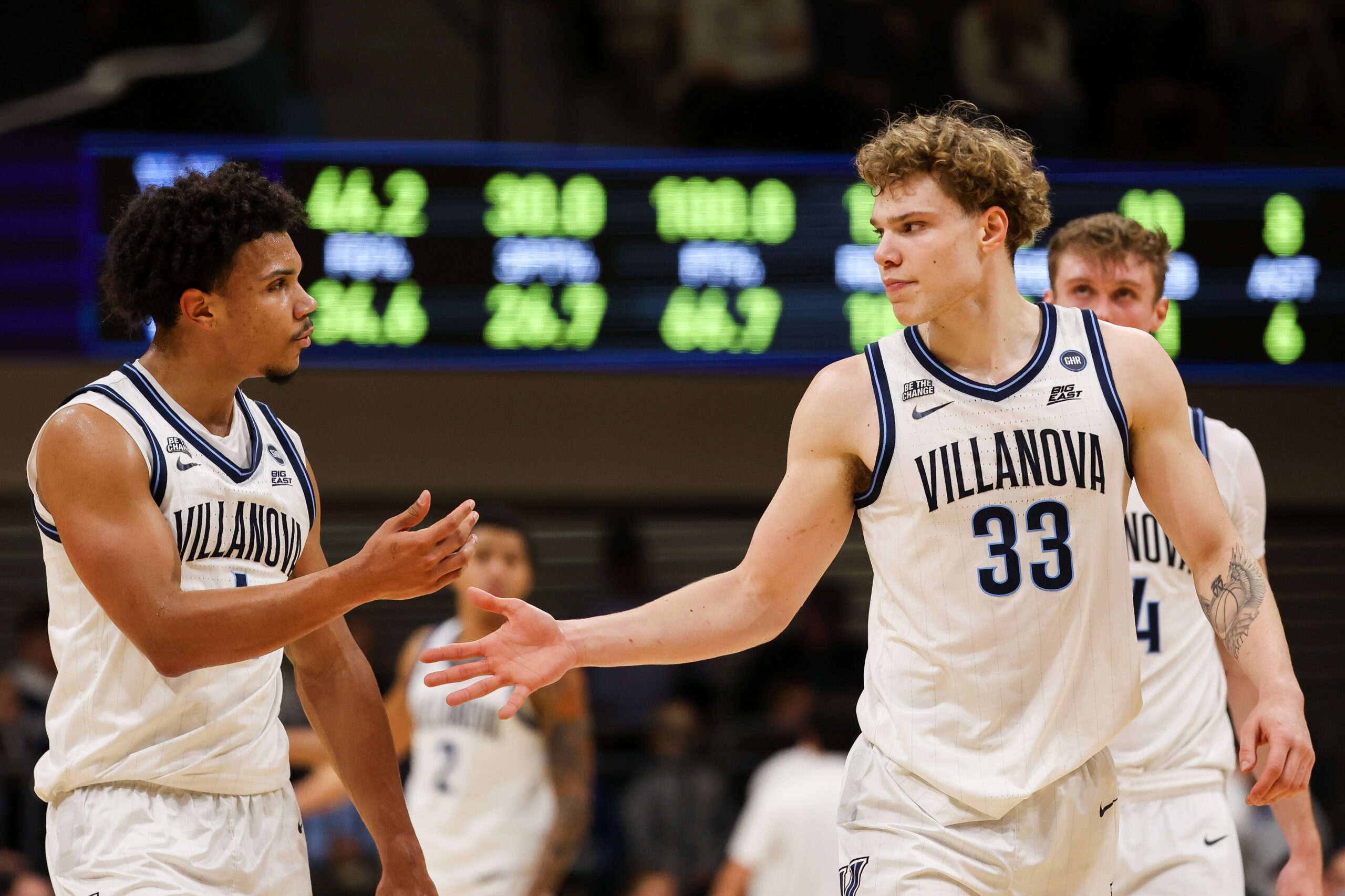
Forward Matt Hodge and guard Tyler Perkins have Villanova in good shape despite a near-miss against UConn on Saturday.
It is a Villanova resumé without a signature win, and it might not need one. Why?
“They don’t have the dreaded bad loss,” Lunardi said.
Last year’s resumé had losses to Columbia, St. Joseph’s, and a down Virginia team. The year before featured losses to St. Joe’s, Penn, and Drexel. This year’s biggest blip currently is against a Creighton team that still is on the NCAA Tournament bubble.
Show me the math
Lunardi says his projections are pretty conservative and include some emphasis on past similar resumés. Right now, Villanova has more than an 80% chance of making the NCAA Tournament, according to Lunardi’s projections.
On the more extreme side, the TourneyCast projections at Bart Torvik’s analytics site have Villanova at 96% to make the dance. Torvik’s numbers are based on thousands of simulations playing out the rest of the season.
“It’s too early to make anybody a lock,” Lunardi said.
But it’s getting closer to that time.
If there was anything to worry about right now for Villanova fans, it should be health. The Wildcats are a key injury or two — even minor ailments — from scrambling a bit. They don’t have a reliable backup center, for example. Their depth has taken a hit elsewhere, too.
But those worries are hypothetical. Then again, all of this is.
What about the rest of the Big 5?
Villanova is the only one of the six Big 5 schools with an at-large path to the men’s NCAA Tournament. The others would need to win their respective conference tournaments. Of the bunch, only Temple (5-2) and St. Joe’s (5-3) entered Wednesday with a winning conference record.
Villanova celebrates after a win over Xavier on Jan. 8.
On the women’s side
Similar story. Villanova (16-5, 9-3) was projected as a No. 10 seed on the right side of the NCAA Tournament bubble with an at-large bid in the latest ESPN women’s bracketology. No other team has an at-large path, and only Drexel (4-3) had a winning conference record entering Wednesday.
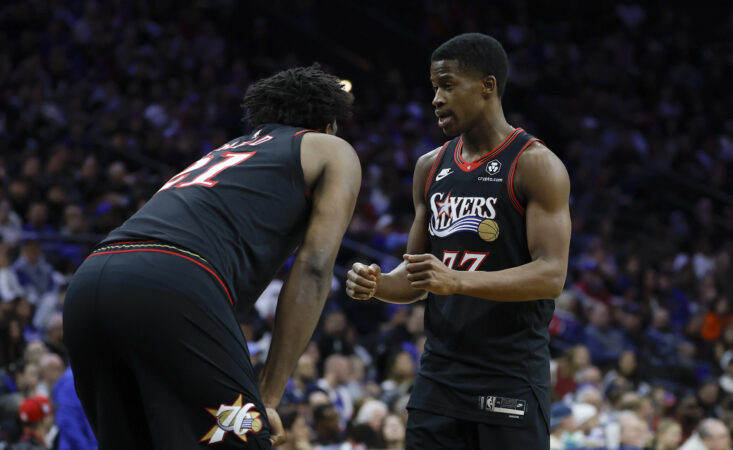
As John Buck watched the final seconds of the Dec. 4 matchup between the 76ers and Golden State Warriors, he was unsurprised by how VJ Edgecombe reacted to teammate Tyrese Maxey’s deep fadeaway jumper with 2.5 seconds remaining.
Edgecombe instantly sensed where the ball might be if the shot fell short, Buck said, then “slithered” into that space, elevated, and grabbed the partially blocked attempt to convert a game-winning putback.
“How many guards just stand there and watch the ball get shot and hope it goes in?” said Buck, who coached Edgecombe at Long Island Lutheran High School in Brookville, N.Y. “VJ was moving into the spot where it may have missed.”
Yes, Edgecombe’s athleticism is electric. Yes, the rookie’s three-point shooting has been a pleasant surprise. But perhaps what Sixers coach Nick Nurse and teammates have raved most about Edgecombe so far is his beyond-his-years basketball IQ.
That natural feel helped put Edgecombe in position to be one of the NBA’s top rookies — on Monday night he was named to the Rising Stars roster for All-Star Weekend — along with an immediate starter for a Sixers team in the thick of the Eastern Conference playoff picture, and a player already with a knack for clutch fourth-quarter moments on both ends of the floor. When asked recently about this aspect of his game, Edgecombe agreed it has “played a lot” into his early NBA success.
“If you watch the game,” Edgecombe told The Inquirer at his locker last week, “you understand the game, understand the flow of the game, the importance of possessions, I rely on my IQ a lot. That’s the most [important part] of the game, the mental part.
“I just try to make sure I’m locked in mentally, to make certain plays and be decisive.”
So what are the origins of such a trait? Matter-of-factly, Edgecombe says, “I watch so much basketball.”
As a child in Bimini, the Bahamas, he initially spent the bulk of his free time playing the sport on dirt courts and makeshift hoops outside. But once his mother bought him a tablet as a middle schooler, YouTube became an endless supply of player highlights and archived games. He could utilize his already “really good memory” while transitioning from watching for entertainment to studying. He even discovered some of Maxey’s film from his time playing for South Garland High School in the Dallas suburbs.
“He didn’t believe me,” Edgecombe said, explaining how he told Maxey after they became Sixers teammates. “And I had to literally tell him my basketball knowledge.”
When Edgecombe moved to the United States and eventually joined Long Island Lutheran’s nationally ranked program, he received access to online scouting reports with full games or clips from opponents. While Buck said he needed to “beg” some players to spend time reviewing that film while walking down the aisle during bus rides to games, Edgecombe’s commitment to that preparation was “elite.”
That gave Edgecombe the confidence to make suggestions about defensive coverages or individual assignments during timeouts, Buck said. And to better leverage his supreme physical gifts.
Buck witnessed it on blocks, when Edgecombe could pin the ball on the glass because he beat the shooter to the spot. Or in his timing on offensive rebounds. Or whenever he got into a shooting rhythm because he picked the correct moments to fire away, later prompting Buck to chuckle when NBA scouts called to ask about his three-point potential as a professional. The early returns vindicate that reaction, with Edgecombe entering Monday 12-of-22 on “clutch” NBA three-pointers, including an overtime game-winner at Memphis in late December.
“There are players who are extremely athletic,” Buck told The Inquirer by phone earlier this month, “but you don’t see it in the flow of a game, or you see it rarely. … With [Edgecombe], it would show up in so many ways.”
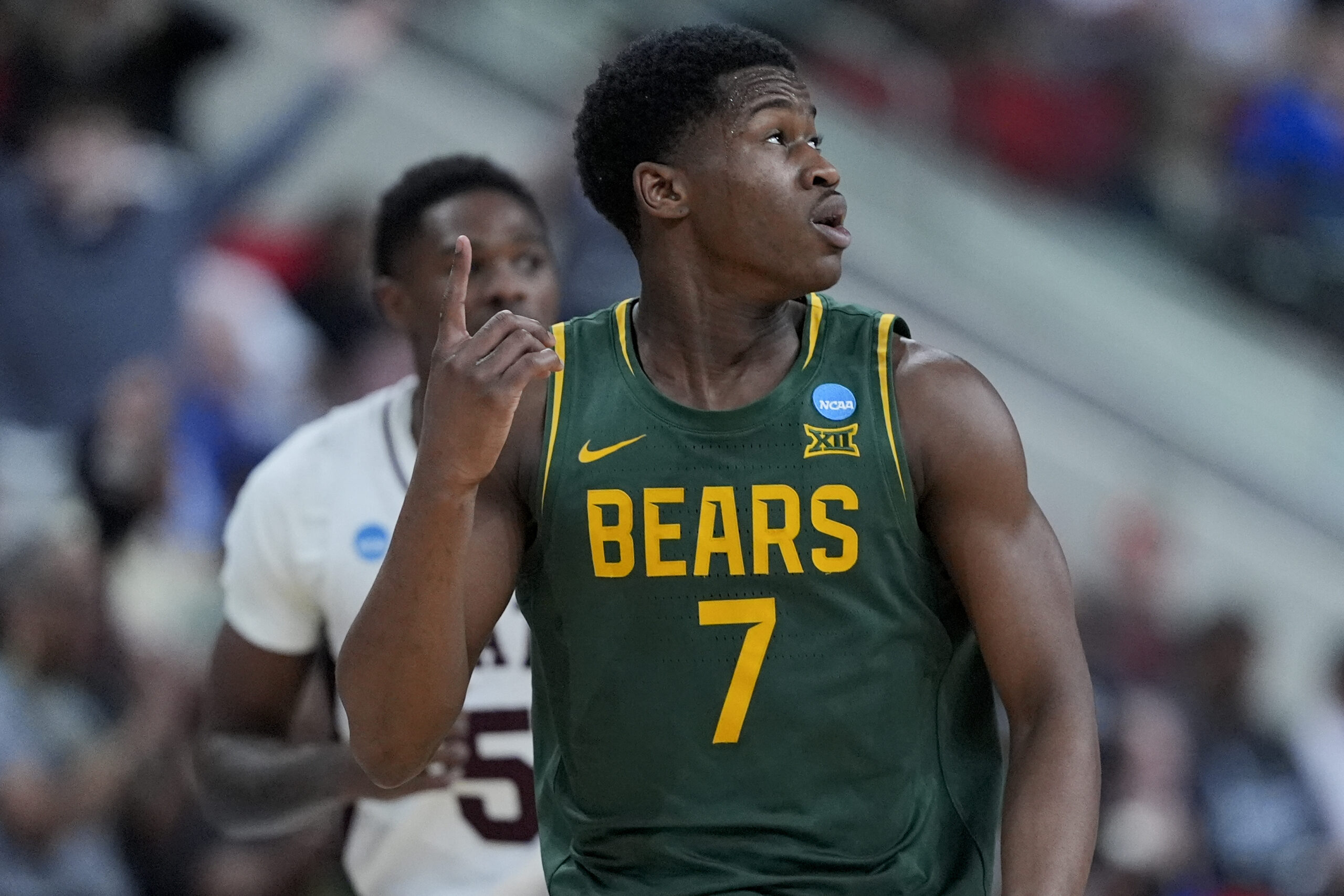
Guard VJ Edgecombe spent one season with Baylor before becoming the No. 3 pick in the 2025 NBA draft.
Another coach who valued Edgecombe’s IQ: Baylor’s Scott Drew.
During Edgecombe’s lone college season, Drew recognized his “boldness” to speak up during practices, “wisdom” to be accurate with his question or suggestion, and “heart” to keep it centered on the team. Most freshmen in his program, Drew added, only learn one position that first season. Edgecombe could play every spot but center, offering the Bears flexibility to use him as a lead ballhandler or as a power forward in four-guard lineups.
“It allows a coach to have an opportunity to steal a couple baskets by putting in new plays [and] doing things that are harder to guard,” Drew said last week. “And in one-, two-, three-possession games, if you have enough of those plays, you win a lot of those games.”
When Edgecombe first arrived in Philly, Nurse also asked himself, “How did he get like this?”
Nurse quickly recognized Edgecombe had already “absorbed a lot of basketball — and, probably, a little bit obsessively” because of his interest in the game’s history. That is not as common as an outsider might think for a player born in 2005, but was apparent to Nurse when Edgecombe marveled while walking into Chicago’s United Center for the first time.
Edgecombe’s inquisitive nature during practices also has continued at the NBA level. While still building out schemes throughout the first half of the season, Nurse said, Edgecombe could already identify future wrinkles. Edgecombe said he typically first goes to a teammate to clarify if such additions are possible, then to coaches to get their point of view.
“I just want to make sure my team is in the best possible [situation],” said Edgecombe, who entered Monday averaging 15.6 points, 5.3 rebounds, 4.2 assists, and 1.5 steals.
Added Nurse: “I answer them a lot with, ‘We’re getting to that.’ … Then you kind of quickly explain, ‘Yeah, we can do that, and here’s what happens. That’ll be coming when we need it — and when we see it and when we can polish and can put it in.’”
On the court, that IQ has translated to Edgecombe immediately taking on some ballhandling responsibilities — and committing only two combined turnovers when Maxey missed two games with an illness. Veteran forward Paul George has been most impressed with Edgecombe’s defensive savvy, recognizing when to make sharp rotations or well-timed playmaking risks. Edgecombe’s feel also shows up in how he spaces the floor on offense, clocks when a teammate has not gotten a shot recently, and balances when to be aggressive with the ball in his hands or facilitate.
“He could be a guy that just takes off,” Nurse added, “and jumps in the air and figures it out three or four seconds later. But he doesn’t do that. He makes pretty good basketball plays.”
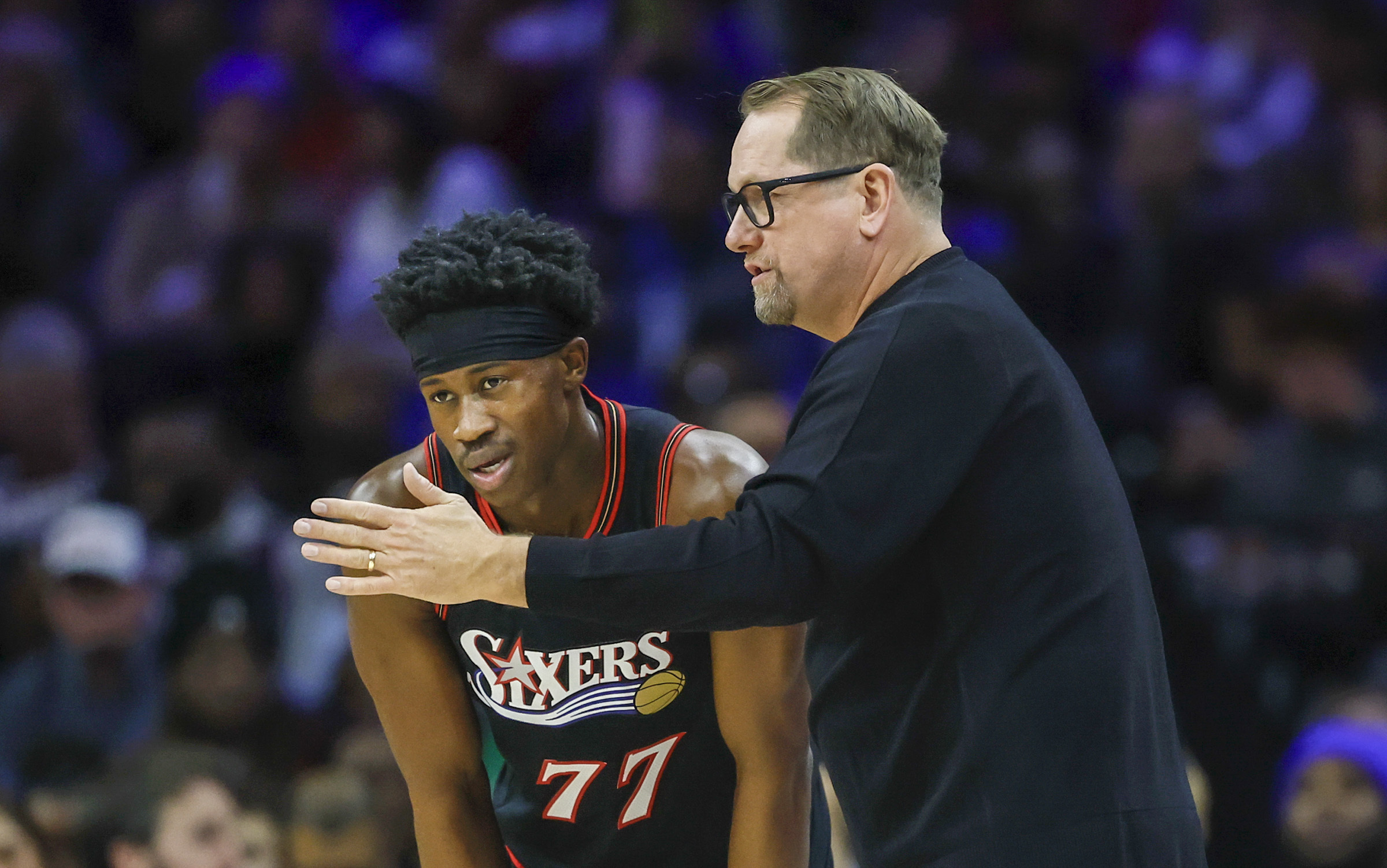
Sixers coach Nick Nurse has been impressed by guard VJ Edgecombe’s ability to absorb information.
That is why Nurse has reiterated that he still wants more out of Edgecombe, even as the Sixers’ roster has returned to full strength. Following a Jan. 16 loss to the Cleveland Cavaliers, Maxey told Edgecombe in the locker room that taking only five shots “is not going to cut it for us.” Nurse also has shown Edgecombe film examples of more opportunities to attack the rim or create space for a pull-up jumper.
“He’s just a little too unselfish for me,” Nurse said. “I know that sounds funny, but we need him to use those gifts a little bit more. … I’m like, ‘That was a great move. You only did it once last night. I need like eight of those.’”
Edgecombe acknowledged last week that he is “still learning” but does feel the game slowing down. And he flashed that knack during Saturday’s loss to the New York Knicks. In less than five seconds of the game’s final minute, he buried a three-pointer, forced a jump ball on a tie-up with Jalen Brunson, made two free throws after being fouled to cut the Sixers’ deficit to three points — and nearly drew an off-ball foul on Brunson before the ensuing inbounds pass, but that call was overturned on a coach’s challenge.
Buck is not exactly shocked that such high-IQ play is fueling Edgecombe’s rookie season. He saw it in that heads-up putback against Golden State. And in a game-winning three-pointer in Memphis.
And, behind the scenes, when Edgecombe paid an impromptu visit to a Long Island Lutheran practice just before his rookie season began.
“We’re running a set, and he kind of waves me over,” Buck recalled. “And he’s like, ‘Hey, Coach. I think the spacing for this guy right here should be a little bit different to maximize the play.’ That’s just not normal for a 19-, 20-year-old guy to be coming to practice, not just kind of chilling or being there to be there. But kind of saying, ‘Hey, let me look at this. I think there’s a way to improve that.’”
Now, Edgecombe is applying that as an NBA rookie, to a degree drawing raves from his coach and teammates.
“He’s not out there looking lost or forcing anything,” George said. “He kind of just lets the game come to him. And that right there makes the greats, greats. …
“The game just evolves around them, and that’s kind of what he has.”
Drexel hired Bill Herrion as men’s basketball coach in 1991. Replacing longtime head coach Eddie Burke, who led the Dragons to their first NCAA Tournament appearance in 1986, Herrion took the program to three more NCAA tourneys, and Malik Rose was a big reason.
Drexel assistant Walt Fuller recommended that Herrion recruit the overlooked center from Overbrook High, and Rose caught the first-year Drexel coach’s attention at the All-Star Labor Classic between the best players in the Public and Catholic Leagues.
It was enough to give Rose a scholarship.
“Coach Herrion saw something in me that nobody else really did,” said Rose, 51. “None of the Big 5 coaches thought they saw it. None of the other coaches in the region or the area saw it.”
Former Drexel coach Bill Herrion during the game between the Dragons and the Northeastern Huskies at the Daskalakis Athletic Center.
With the 6-foot-7 center as the program’s premier player, Herrion’s Dragons made the NCAA Tournament from 1994 to 1996. In its third and final appearance, Drexel upset Memphis as a No. 12 seed. Rose scored 21 points in what is still the only NCAA win in program history.
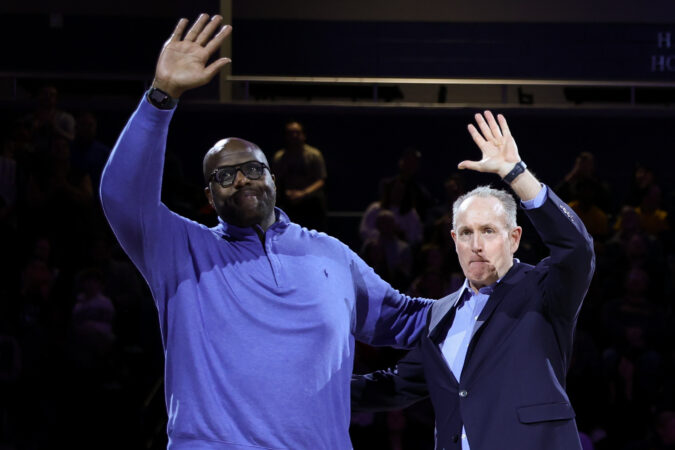
On Saturday, the Dragons welcomed Rose and Herrion into Drexel Athletics Hall of Fame during an 83-78 victory against Northeastern.
“It’s a very special and humbling event for me,” said Rose, Drexel’s all-time leading rebounder with 1,514. “It means a lot to me — probably more than any other sports memory I’ve had in my career.”
Added Herrion: “I’m very honored, very privileged for the recognition. But, I always go back to this. These things only happen as a coach if you’re very, very fortunate to have really good players.”
A lot of those players were in attendance Saturday. After Herrion and Rose made their way to center court, shaking hands with Drexel athletic director Maisha Kelly and university president Antonio Merlo, players from the ’90s tournament teams joined them.
Malik Rose and Bill Herrion were inducted into the Drexel Athletics Hall of Fame today pic.twitter.com/8GbwpGxhfE
“One of the reasons for this taking so long is because I never really wanted to do it,” Rose said. “I don’t really like a lot of this type stuff, but I spoke with Coach Herrion and Maisha the AD — she was really working hard. They were able to get a lot of my former teammates there. … That’s what really hit me. I was like, ‘Man, I get a chance to spend some time with the knuckleheads I rode the bus and the planes with.’”
The Charlotte Hornets drafted Rose in the second round in 1996, 44th overall, but he spent only one season in Charlotte before signing as a free agent with San Antonio. Rose was a valued role player for two championship teams in eight seasons with Spurs. After that, he played five years for the New York Knicks and a lone season in Oklahoma City. After a stint in broadcasting and multiple executive roles, Rose is now the head of basketball operations for the NBA G League.
Through all these stops, his Philadelphia roots have stuck around.
“When I was in the NBA, I think we had [around] 21 players from Philly that came up in the Philly [area] leagues: myself, Alvin Williams, Cuttino Mobley, Kobe [Bryant], Aaron McKie, Rasheed Wallace. … We all grew up playing together, from high school to the Pizza Hut three-on-three leagues up at King of Prussia to the hardwood courts of the NBA. We still have that brotherhood today.”
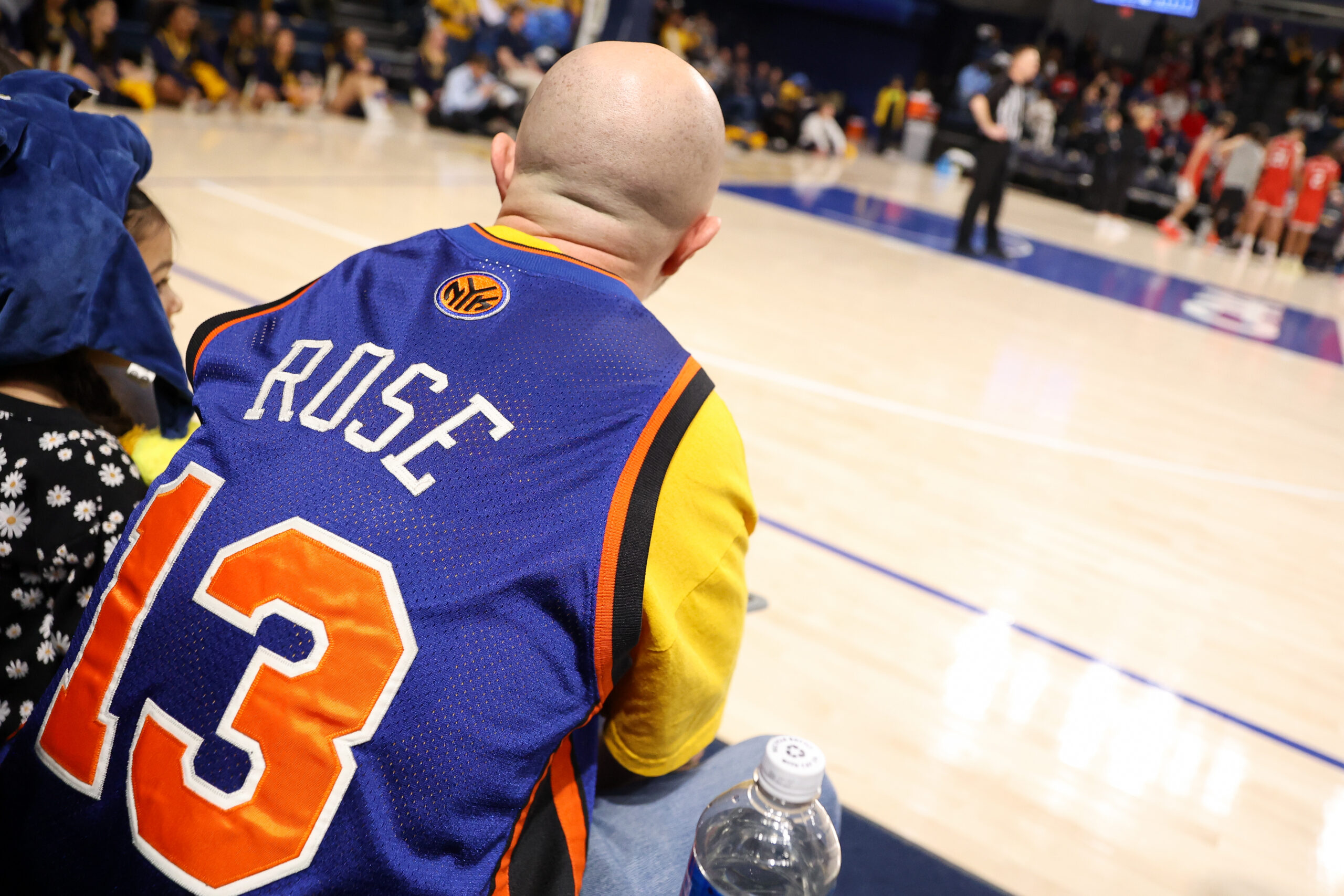
Bill Martin, a Drexel 2006 graduate and season ticket holder from North Jersey, wearing his jersey from Malik Rose’s time with the Knicks.
Herrion left Drexel after eight seasons. He coached for six years at East Carolina and 18 at New Hampshire. With the Wildcats, he garnered a program-high 227 victories. Herrion, who is now an assistant at Stonehill in Massachusetts, has the most wins in America East Conference history. His career record as a head coach is 464-472.
“The remainder of my head coaching career would not even have been possible if it wasn’t for those eight years at Drexel,” Herrion said. “The great thing about it was doing it in Philadelphia, which is such a great college basketball city. All the Big Five coaches I became friendly with. We finally gained unbelievable respect in the city.”
Now a member of the Big 5, Drexel no longer needs to vie for respect from the other programs. That is still not the biggest change from Herrion and Rose’s time with the Dragons, though. The average NIL budget for a mid-major program, like Drexel, is over $291,000.
“When I talk to some of my teammates, we remember over Christmas break that we were allowed to get $21 a day. It was like seven bucks a meal,” Rose said. “That’s all we could get each day over Christmas break, and we loved it. We were thankful for it. Times have definitely changed.”
Behind 22 points from Josh Reed, the current Dragons captured a bit of the energy from the NCAA Tournament teams that routinely packed Drexel’s gym. Afterward, Rose got his wish to spend some more time with his old teammates. The Dragons of the past celebrated a conference win with the team’s present players in the locker room.
HARTFORD, Conn. — Devin Askew drove into the paint with Villanova trailing Connecticut by just one point inside two minutes to play. The defense collapsed, so Askew kicked the ball to the wing and into the waiting hands of … Kevin Willard.
The Villanova coach pounded the basketball onto the court with two hands. One of Villanova’s 11 turnovers came at an inopportune time.
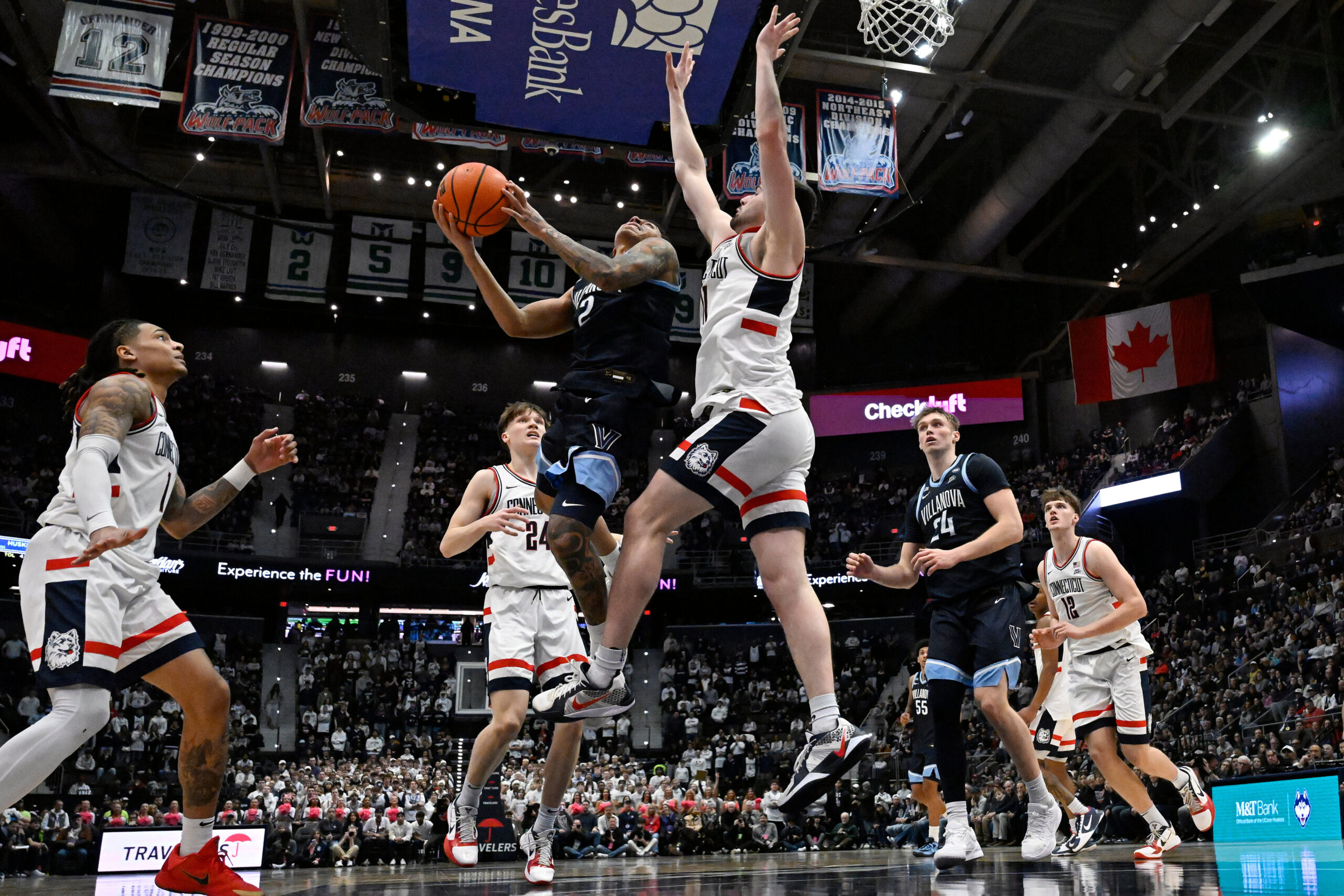
The Wildcats later had a lead with less than a minute on the clock, and they still did take the second-ranked team in the country to overtime, but Askew’s turnover was one of many little moments that didn’t go Villanova’s way in a 75-67 loss at PeoplesBank Arena.
Where to start? There was Acaden Lewis’ out-of-control drive down two in overtime with just over a minute to go. Back in regulation, Bryce Lindsay missed an open runner in the paint shortly after the Askew turnover. Then Villanova’s leading scorer, who was held to three points and didn’t make any of his eight attempts, had a three-point attempt blocked in a tie game with less than 30 seconds to play.
Villanova started overtime with a Tyler Perkins three-pointer, then got the ball back when Perkins drew a charging foul. But instead of building on the lead, Lindsay had his pocket picked by Silas Demary Jr., leading to a runout dunk from Tarris Reed Jr. Perkins’ triple, 12 seconds into overtime, was Villanova’s only made basket of the extra session.
Villanova guard Bryce Lindsay shoots as UConn forward Alex Karaban defends on Saturday.
“It just hurts,” said Villanova senior big man Duke Brennan, who struggled last week with the size and physicality of St. John’s but battled back in a big way Saturday. He had 16 points and 14 rebounds and, perhaps most importantly, made eight of his nine free-throw attempts in 40 minutes. “We fought until the end. That’s a great team over there.”
To be sure, there were things Villanova did well enough to win. You don’t take the No. 2 team in the country to overtime without doing things correctly. The Wildcats had answers for a lot of UConn’s offensive action. They held Alex Karaban, who averages nearly 14 points, off the scoreboard for the first 30 minutes (though he did finish with 17 points).
Perkins had 16 points and 10 rebounds and continued to be the physical and experienced guard presence Villanova needs. Askew, too, continued his strong stretch of games with 13 points, four rebounds, and three assists before he fouled out in overtime. Matt Hodge followed up consecutive games being held to four points or less with 12 points on 4-for-6 shooting from three-point range, including a corner three that gave Villanova a 61-59 lead with just over a minute to go.
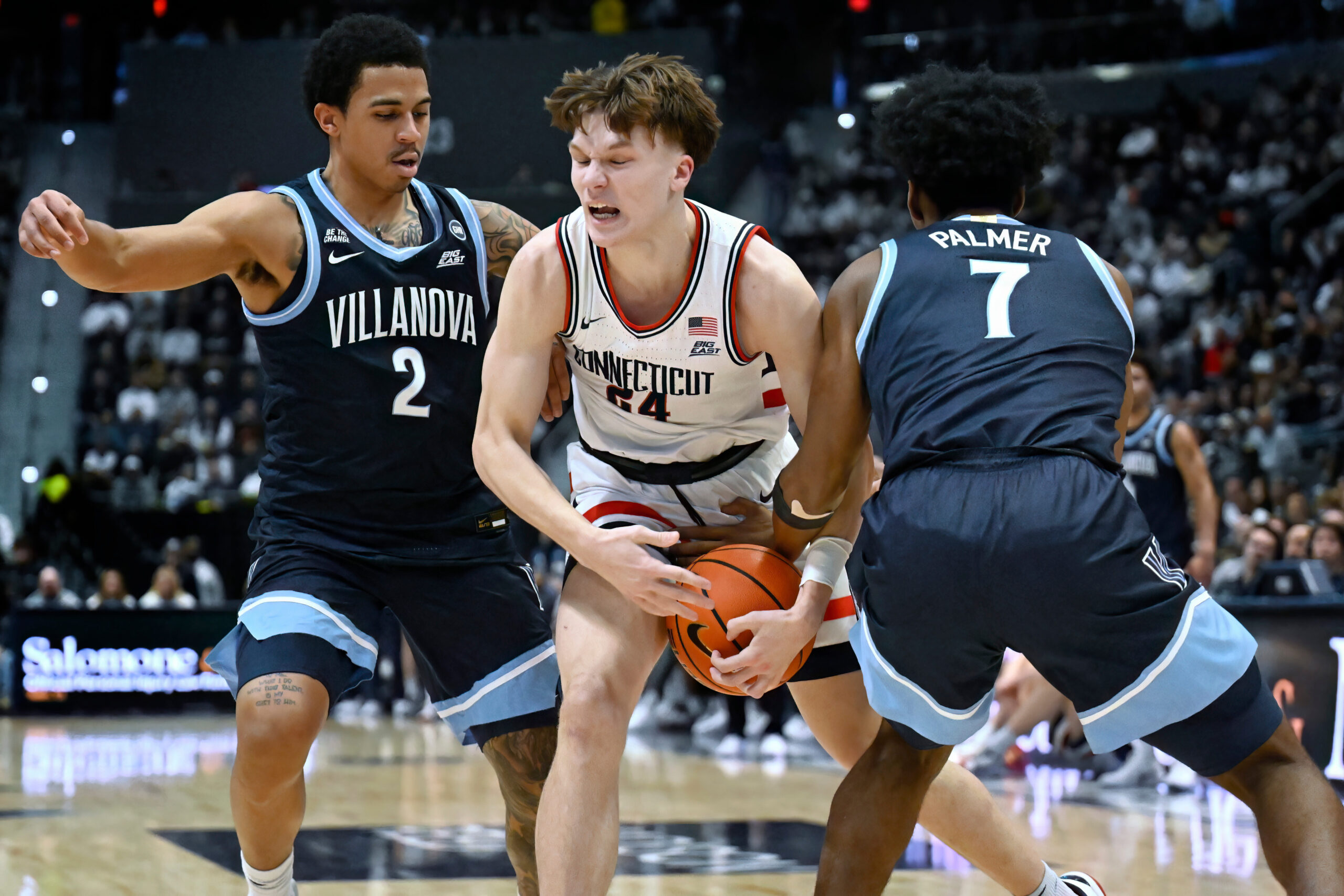
UConn guard Braylon Mullins is guarded by Villanova guards Bryce Lindsay (2) and Malachi Palmer (7) on Saturday.
But then came another costly error. Demary missed a driving layup, and Villanova couldn’t secure a rebound, allowing Reed to tip in the tying basket.
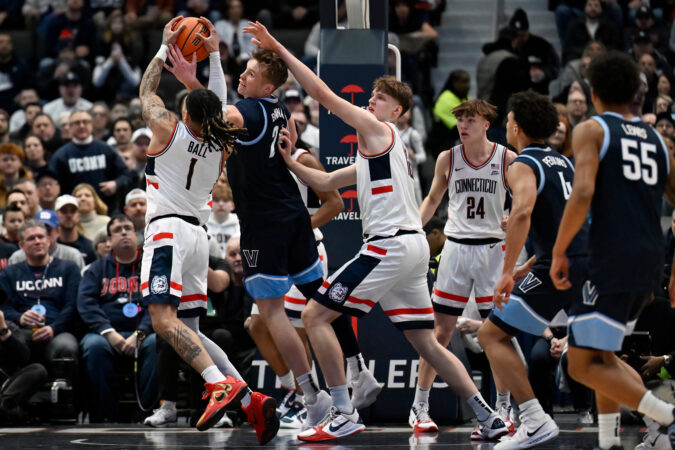
In the end, UConn made the plays when it mattered. Solo Ball, who led all scorers with 24 points, hit arguably the game’s biggest shot, a three-pointer with two minutes left in overtime that turned a one-point Villanova lead into a two-point deficit.
It is hard for Villanova to win when Lindsay doesn’t make a shot and Lewis goes 1-for-13 from the field. Yet, it nearly happened anyway.
“We’re a young team,” Willard said. “Guys were trying to make plays. We got to the rim. We didn’t finish at the rim, and I thought we had some opportunities at the rim.”
Villanova made 5 of 15 layup attempts.
“We’re still going down and playing high-level defense,” Willard said. “If we can continue to build on that, then we’ll get out in transition and get some easier buckets.”
It was the closing minutes that Willard said he needed to “get better at.” Lewis was seemingly benched for a large stretch of the second half. Brennan was in foul trouble. The Wildcats are a team without much depth.
“I got to put the right lineups out there at times and I’m learning a lot about certain guys and what to do,” Willard said. “At the end of the day, we don’t do a free throw box out, and we don’t get a huge rebound when we’re up four with about six minutes to go. … Sometimes to get there on the road you got to make sure you finish possessions, and I thought there was three or four times where we didn’t finish possessions with rebounds.”
An encouraging game nonetheless?
“No,” Willard replied. “I don’t like losing. We should have won that game.”
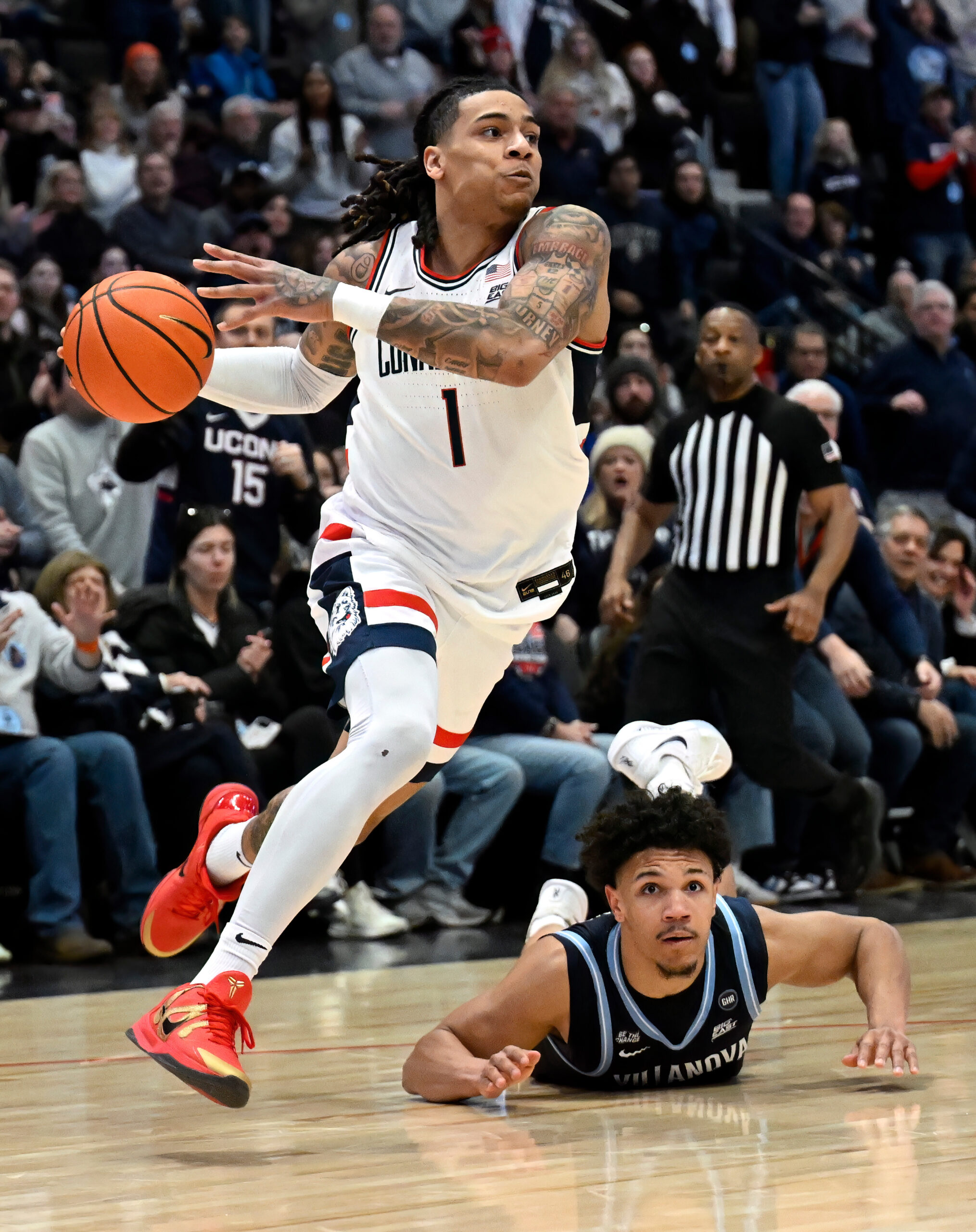
UConn guard Solo Ball, who led all scorers with 24 points, dribbles around Villanova guard Tyler Perkins on Saturday.
The reality for Villanova is Saturday’s loss is one that won’t necessarily hurt. A road upset helps a lot more than an eight-point overtime loss stings as far as the meaningful metrics go. The Wildcats are 15-5 overall and 6-3 in Big East play. They started the day rated 25th at KenPom and were still there by late Saturday afternoon. They have rest ahead before a Friday home game vs. Providence, and plenty of winnable games on the calendar as they continue to hunt for an at-large bid to the NCAA Tournament.
Plus, two more shots at the conference’s elite. On consecutive Saturdays, Villanova took St. John’s and Connecticut to the brink.
“The good thing about conference is you play every team twice,” Brennan said. “We get another shot at those dudes. St. John’s we felt like we didn’t play good at all, all throughout our program. This game we felt like we really battled.
“It feels like it got away and we felt like we were there the whole game. There are certain little things that come down at the end of the game where it can flip one way. It wasn’t on our side tonight.”
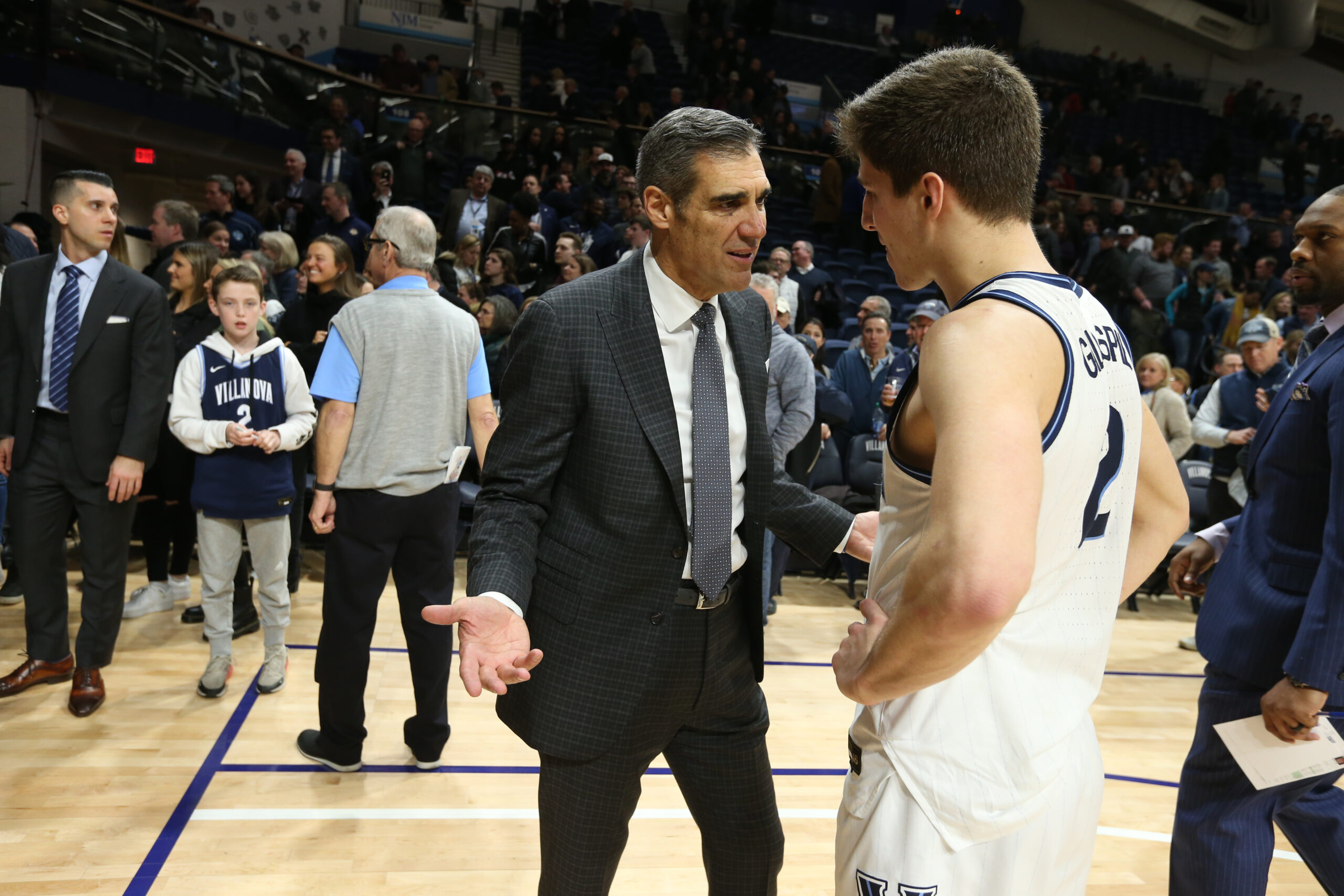
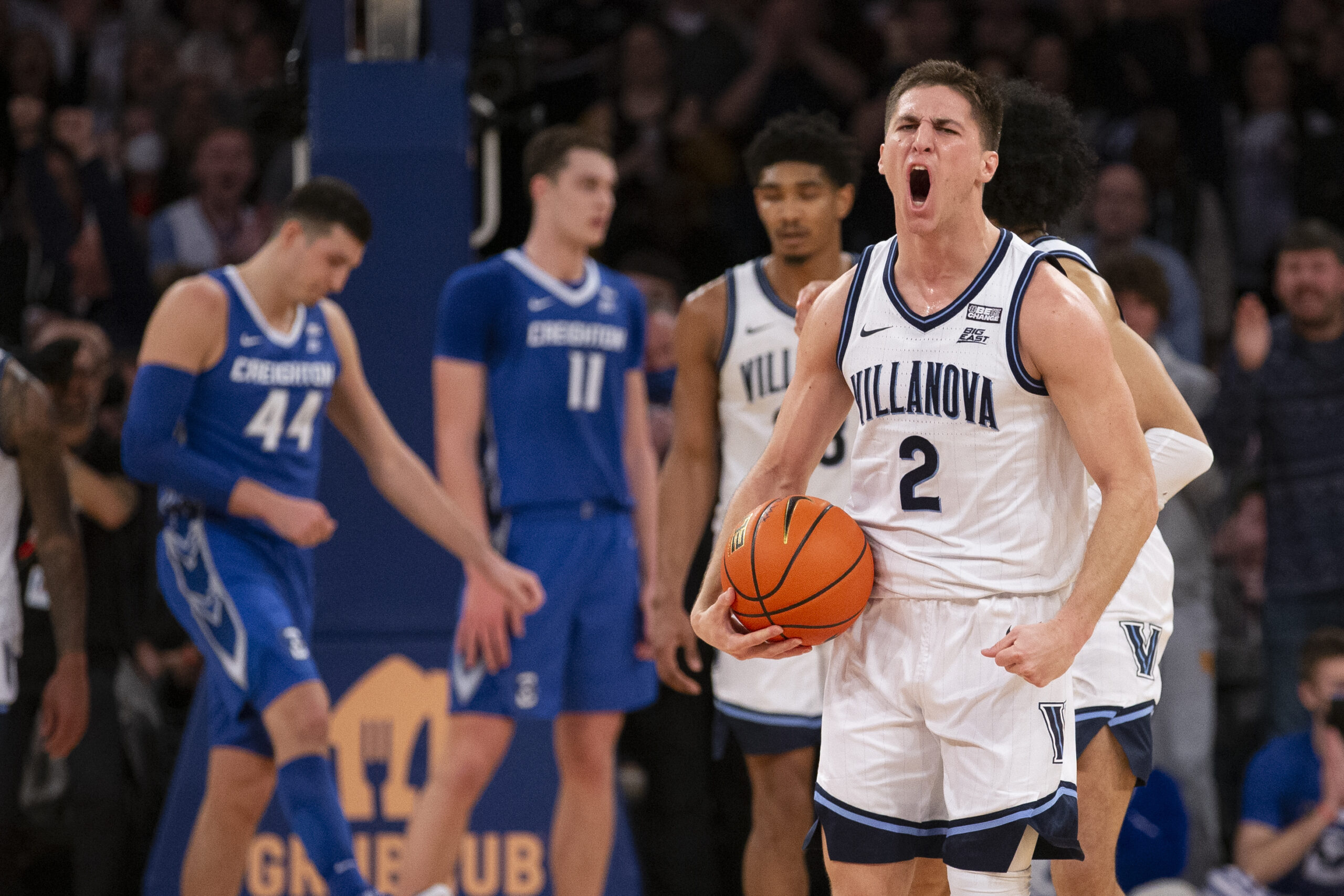
Jay Wright saw enough of Collin Gillespie a few nights before to invite him to Villanova on a Monday in January 2017 and offer him a scholarship. But this was hardly a courtship. Wright told Gillespie that he would redshirt his freshman season, maybe play as a junior, and then have a complementary role as a fifth-year senior.
“I thought he would get his master’s degree and be a great coach one day,” Wright said. “I was thinking ‘I would love to have this guy on my staff.’”
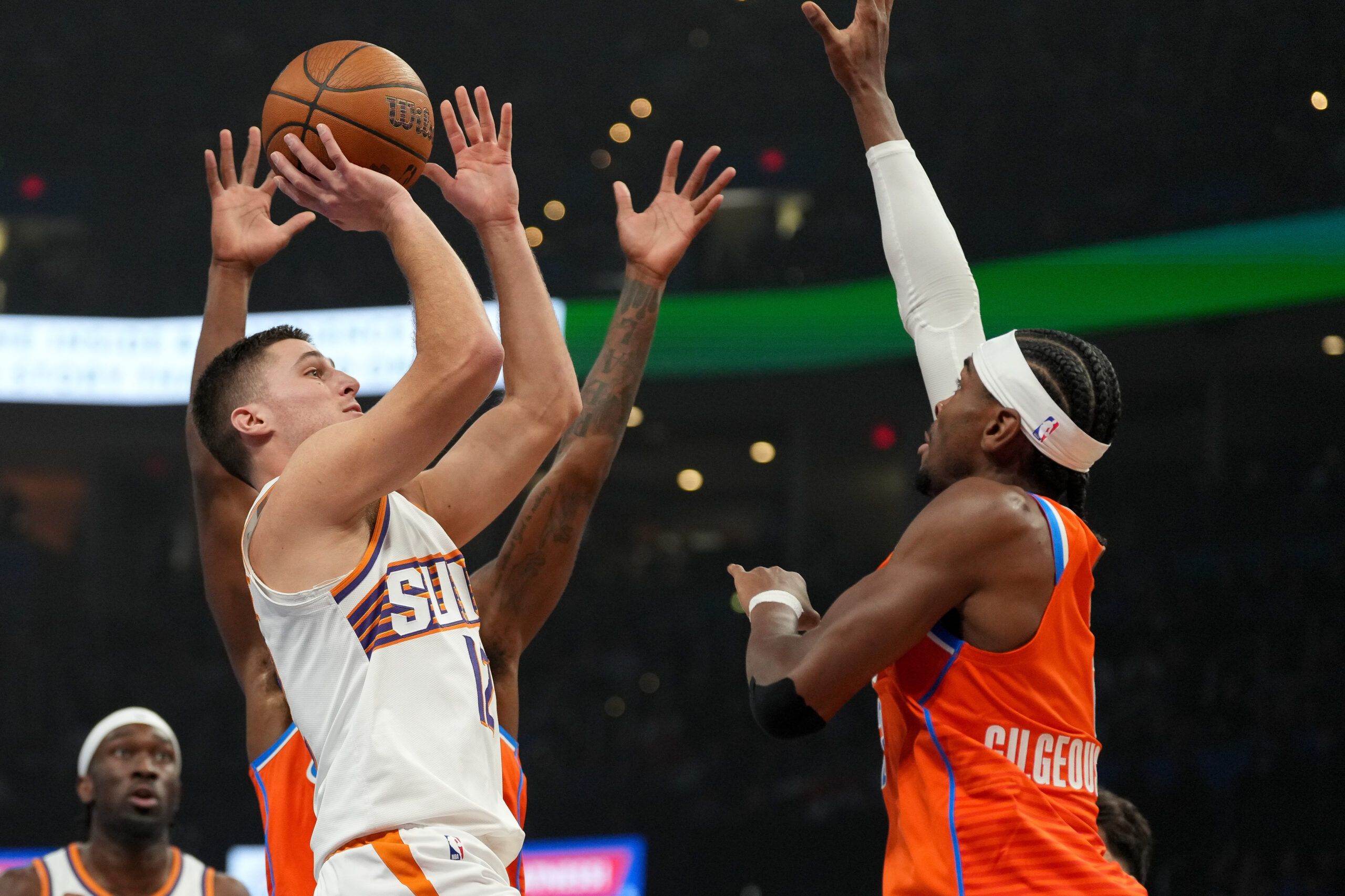
Gillespie — who has molded himself into an NBA starter with the Phoenix Suns after going undrafted in 2022 — nodded along. He didn’t have a Division I scholarship before his senior year at Archbishop Wood and declined to visit Division II schools because he believed bigger programs would eventually see what he already knew: He could play. Redshirt? OK. Bench player? Sure. Coach? Yes, sir.
“I didn’t really believe him,” said Gillespie, who will play against the 76ers on Tuesday night. “I believed in myself. I was just like, ‘Whatever he says, I’ll take it and then prove him wrong.’”
There was Gillespie 15 months later on the court for Wright in the national championship game, taking a charge against Michigan and looking the part. In his fifth year, the kid who had to wait for college scholarships was named the nation’s top point guard in 2022. He went undrafted that June but landed a non-guaranteed contract in July with the Denver Nuggets. He was on track.
Three weeks later, Gillespie suffered a broken right leg while playing in a pickup game at Villanova.
His NBA career — the one that is now flourishing — seemed unlikely then to nearly everyone except the guy who nodded along that day in Wright’s office.
“Everyone has their own journey,” Gillespie, 26, said. “Everyone runs their own race. You just have to stick to what you do, put your head down, and work hard. Don’t compare yourself to anyone else. If you work hard enough, you can probably achieve anything you want to.”
Collin Gillespie (right) became much more than a fifth-year senior role player first envisioned by Villanova coach Jay Wright.
G League to the league
Andre Miller often learned via text messages which players would be flying nearly three hours from Denver to join his G League team that night. He coached the Grand Rapids Gold, the Nuggets’ minor-league affiliate in Michigan that played 1,100 miles from Denver. Those morning flights gave Gillespie a chance to get on the court.
“It wasn’t a good recipe for these guys to be successful, but when he did show up, he didn’t want to come out of the game,” said Miller, who played three of his 17 NBA seasons with the Sixers. “We knew we had to leave him out there because he didn’t have an opportunity with the other team and he took great advantage of it.”
Gillespie feared that the Nuggets would void his contract after he suffered that injury playing at Villanova. That’s the first thing he said to his father, who was in the gym when it happened. But they didn’t. They kept him around that first season while he rehabbed and then split his time the next season between Denver and Grand Rapids.
“There was no ego,” Miller said. “One thing that’s tough to deal with is when your career is in the hands of other people. Some people felt like he wasn’t an NBA player and some people felt like he was an NBA player. The one thing that stood out about him to me is that he’s a competitor. He’s a dog. He’s a guy who enjoys playing basketball. He’s a leader. He plays with a chip on his shoulder.
“I wish I could have coached him more in the G League, but he was an NBA player. I knew that from the first time I saw him on the court with the G League players. I was like, ‘He probably won’t be here much.’”
Gillespie signed before last season with the Suns, again splitting time between the NBA and the G League. The 6-foot-1 guard earned a full-time role this season, starting for the Suns and fitting in with pesky defense and a three-point shot. Just like college, it took time before Gillespie’s game was appreciated.
“You just don’t see it initially. He doesn’t wow you,” Wright said. “But when you see him play over time and you realize this guy is getting to the rim and finishing, he’s elevating on his jumper and shooting over bigger guys, and he’s not getting backed down. You almost need to have time to believe what you’re watching.”
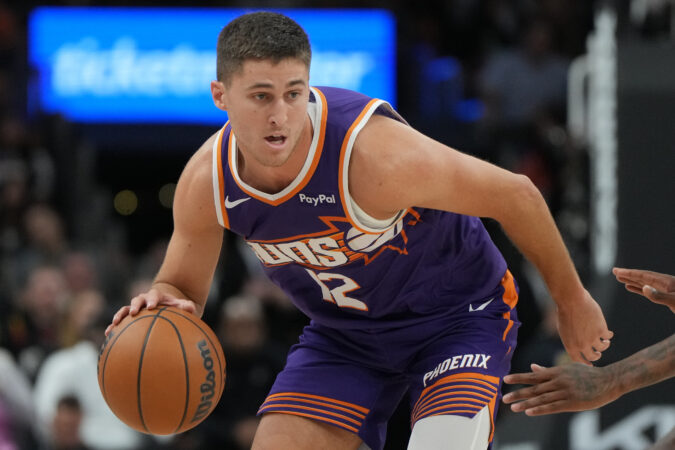
Collin Gillespie is shooting 41.4% from three-point range for the Suns.
Gillespie entered Monday’s game against Brooklyn averaging 13.2 points, 4.9 assists, and shooting 41.4% from three-point range. He hit a game-winner at the buzzer in November, regularly finds ways to create his own shot, and has proved that his game fits in the NBA.
Kevin Durant called him “a dog” and Anthony Edwards said after a loss to the Suns last season that “No. 12 is pretty good at basketball.” Two NBA superstars could see what Gillespie always believed: He belongs.
“He has more heart than talent,” said his father, Jim. “The kid just doesn’t want to lose. When he sets his mind to something, he just does it. And ultimately, he’s a winner. Wherever he’s gone, he’s won. At every level.”
Jay Wright says Collin Gillespie came to Villanova with a “killer mentality and stone face that we try to teach.”
Change of plans
Gillespie was in the stands for a Villanova game as a senior in high school, seated behind the La Salle bench at the Palestra. The Explorers invited him and Gillespie thought a scholarship offer was near.
“But they never offered,” Jim Gillespie said.
Gillespie eventually landed smaller Division I offers as a senior, but he was hopeful a Big 5 school would have a spot for him. None of them did until January when Villanova assistant Ashley Howard urged Wright to watch Gillespie play a game against five-star recruit Quade Green’s Neumann Goretti squad at Archbishop Ryan.
The Northeast Philly gym was packed and the coach couldn’t stay long as he was being hounded. Howard called Wright while he was driving home and told the coach that one kid scored 42 and the other kid scored 31. Wright figured the 42 points belonged to Green, who was already committed to Kentucky. It was Gillespie, the assistant said. Wright was sold.
“Nothing was spectacular, and he’s not bringing any attention to himself,” Wright said. “He just makes the right plays.”
Wright called Gillespie’s father and told him he needed his son at Villanova on Monday. The coach gave Gillespie his pitch that day without any guarantees.
“We left and we were like, ‘What are you going to do?’” his mother, Therese, said. “He said, ‘I’m going to play out my senior [year].’ I said, ‘Collin, it’s Jay Wright.’ He said, ‘Mom, I know what I’m doing.’”
Gillespie committed a week later, simply deciding after a game at Bonner-Prendergast that he had enough of the recruiting trail. He was headed to ’Nova and told a Wood coach without first running it by his parents. Gillespie knew what he was doing.
“He always said, ‘I’ll bet on myself,’” Jim Gillespie said. “He put the work in and the effort in and that’s what he’s always done.”
It took Gillespie just a few weeks to force Wright to rethink the plan that he would redshirt. Every day in practice that June he went up against Jalen Brunson and held his own.
Collin Gillespie (left) got to play in practice against future NBA players Donte DiVincenzo (center) and Jalen Brunson (right) at Villanova.
“He came in with that killer mentality and stone face that we try to teach,” Wright said. “But he came in with that. Then he spent every day with Jalen Brunson and it just became reinforced. It was so obvious. The coaching staff, behind closed doors, was going, ‘This kid is going against Brunson every day. He’s pretty good.’”
Gillespie suffered a minor injury that month and Wright checked with athletic trainer Jeff Pierce to see how the freshman was feeling. He was fine, the trainer said.
“The trainer said, ‘You’re not redshirting this kid,’” Wright said. “I said, ‘Is it that obvious?’ He said ‘Yeah, everyone knows.’ Yeah, it was.”
The guy who nodded along in Wright’s office proved that he belonged. Now, he’s doing it again in the NBA.
“It’s the way I was raised and where I come from,” said Gillespie, who grew up in Pine Valley before moving to Huntington Valley. “My brother is a year older, so I always played a year up. I had to play against older guys and was always smaller. I always had to prove myself and had a chip on my shoulder. My parents always believed in me and my family always believed in me and taught me to believe in myself.”
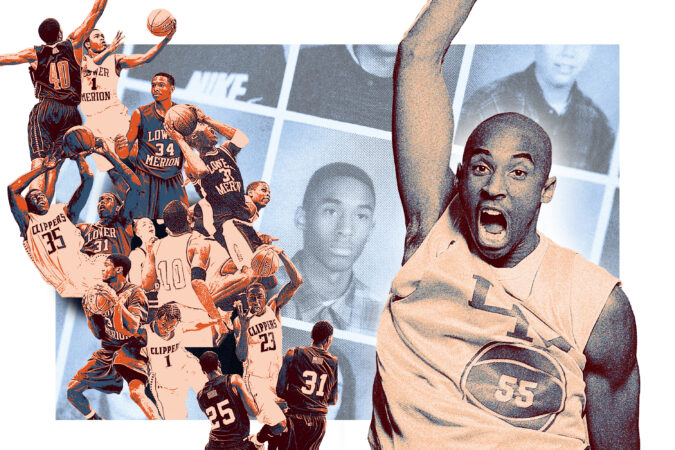
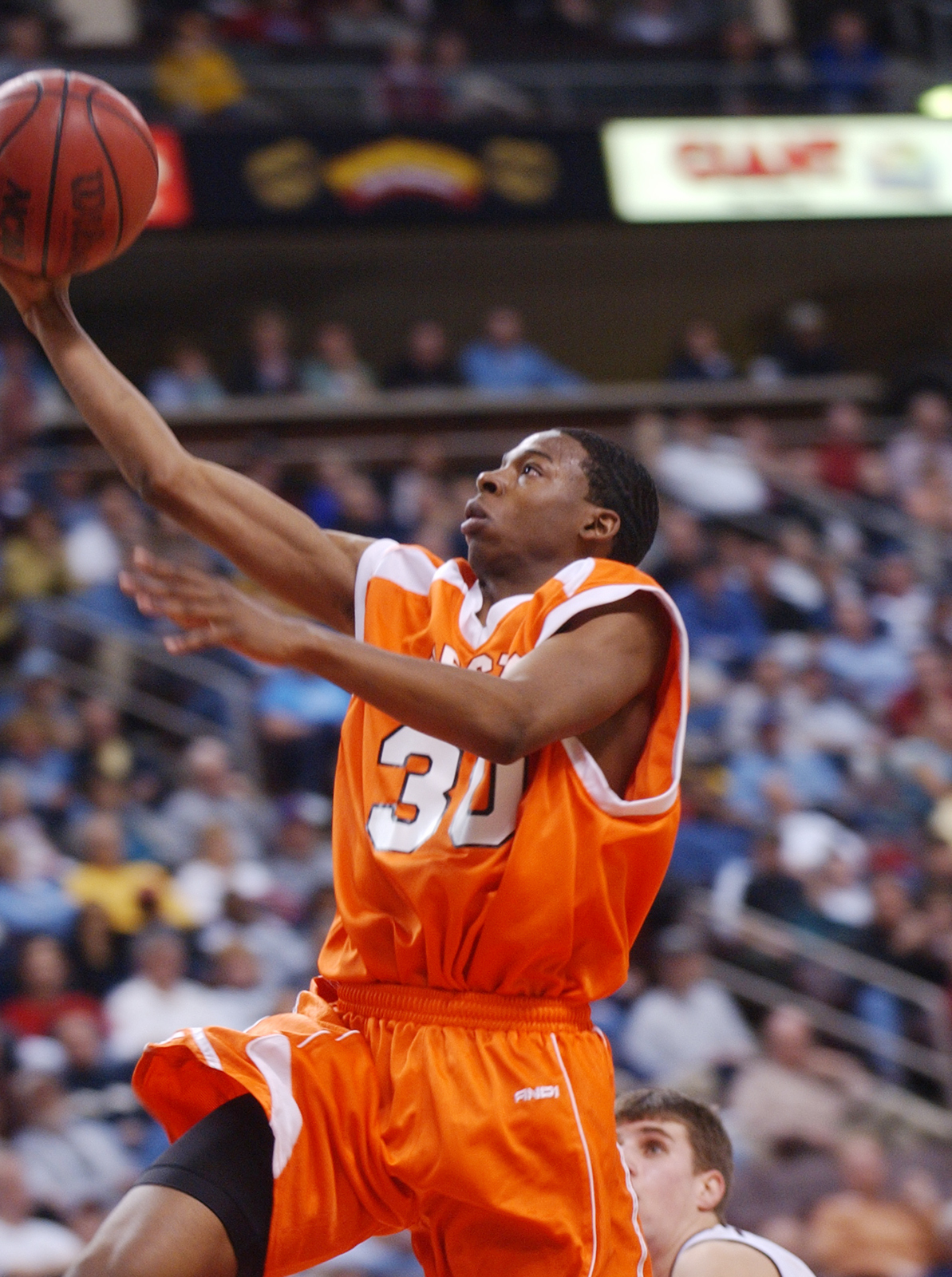
John Linehan and Kobe Bryant used to talk. A lot. This would not have been unusual for other AAU teammates, but these two were fierce high school rivals.
Linehan was a scrappy point guard for Chester. Bryant was a relentless shooting guard for Lower Merion. Both were competitive, almost to a fault, and in the days leading up to big games, they’d get chippy.
The week before the 1996 PIAA Class AAAA District 1 title game, for example, the players talked every day on bulky landline phones, with Bryant often calling Linehan at his home in Chester.
“I just said, ‘You know, John, I haven’t won a championship yet, and you have,’” Bryant told The Inquirer in 1996.
Linehan knew what his friend was doing. The future NBA star did the same thing a few weeks later, on March 19, a day before the teams met again in the state semifinal.
“He was trying to get me to trash talk,” Linehan said. “I think he needed a little edge. I didn’t want to give him too much. I was like, ‘Man, you crazy.’”
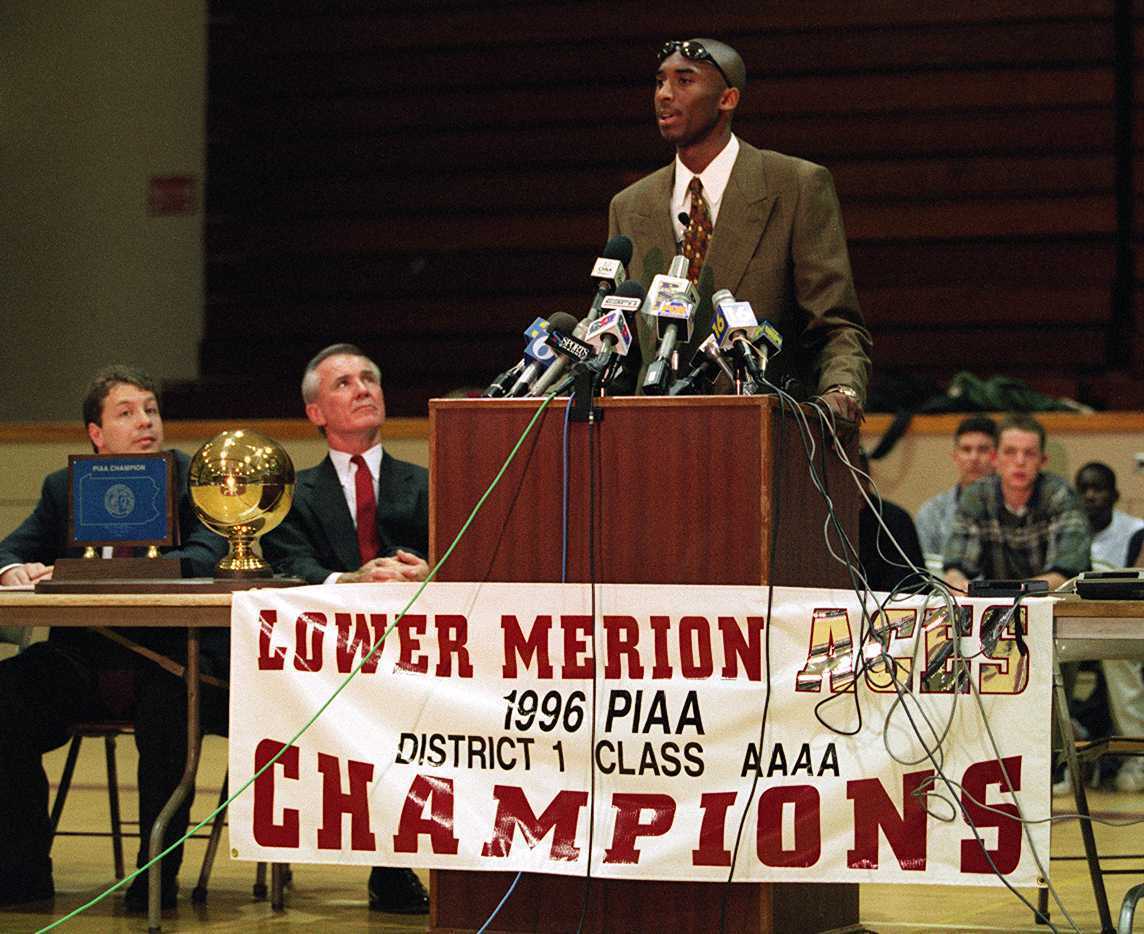
The late Kobe Bryant, a former Lower Merion basketball star, announcing he will go directly into the NBA draft out of high school.
Lower Merion wasn’t a basketball school when Bryant arrived in the fallof 1992. It paled in comparison to the local powerhouses like Simon Gratz, Coatesville, and Chester.
But Bryant changed that. Even in his freshman year, a season in which the Aces went 4-20, he brought a new standard, working out before class and introducing a level of toughness that was foreign to his teammates.
Bythe mid-1990s, Lower Merion was among the best high school teams in the Philadelphia area. Its players were more confident, celebrating after big shots, and talking loud on the court.
The Aces didn’t play as many games against Coatesville, a rising power led by Rip Hamilton. They couldn’t consistently measure themselves against Gratz, which didn’t participate in the PIAA playoffs untilthe 2004-05 season.
But they could against Chester. And so, a decades-long rivalry was born.
From 1996 through the mid-2010s, Chester and Lower Merion put on some of the greatest high school basketball games in the area. They’d often sell out venues like the Palestra and Villanova’s Pavilion. Some fans would even scalp tickets.
Their communities were almost diametrically opposed. Chester was predominantly Black; Lower Merion was predominantly white. Chester was plaguedby poverty; Lower Merion was considered affluent.
Chester, with its Biddy League, had a legacy of basketball greatness, and a steady pipeline of talent. Lower Merion had nothing comparable. But these differences melted away on the court.
And while the rivalry is not what it once was, it lives on today.
“The pride and the intensity and the history will never fade,” said Lower Merion coach Gregg Downer. “I mean, if we played them tomorrow night, that would be an intense game.”
The Bryant-Linehan era
When Downer was named head coach in 1990, he already was well-aware of Chester’s tradition. He’d played youth basketball growing up in Media and had heard about the stars who’d come out of the Biddy League.
It was obvious that his team would have to go through the Clippers to win any sort of accolade. But it wasn’t until Bryant’s arrival that Downer’s aspirations became a real possibility.
The shooting guard, who was the son of former 76er Joe “Jelly Bean” Bryant, was mature for his age. He’d demand more, mentally and physically, of older teammates. Doug Young, a former Lower Merion forward, remembered seeing Bryant leaving the locker room at 7 o’clock one September morning in 1993.
He’d been at the high school gym since 5 a.m., working out by himself. To the Lower Merion basketball team, this was a “crazy” concept, so Young and his cohorts decided to join him.
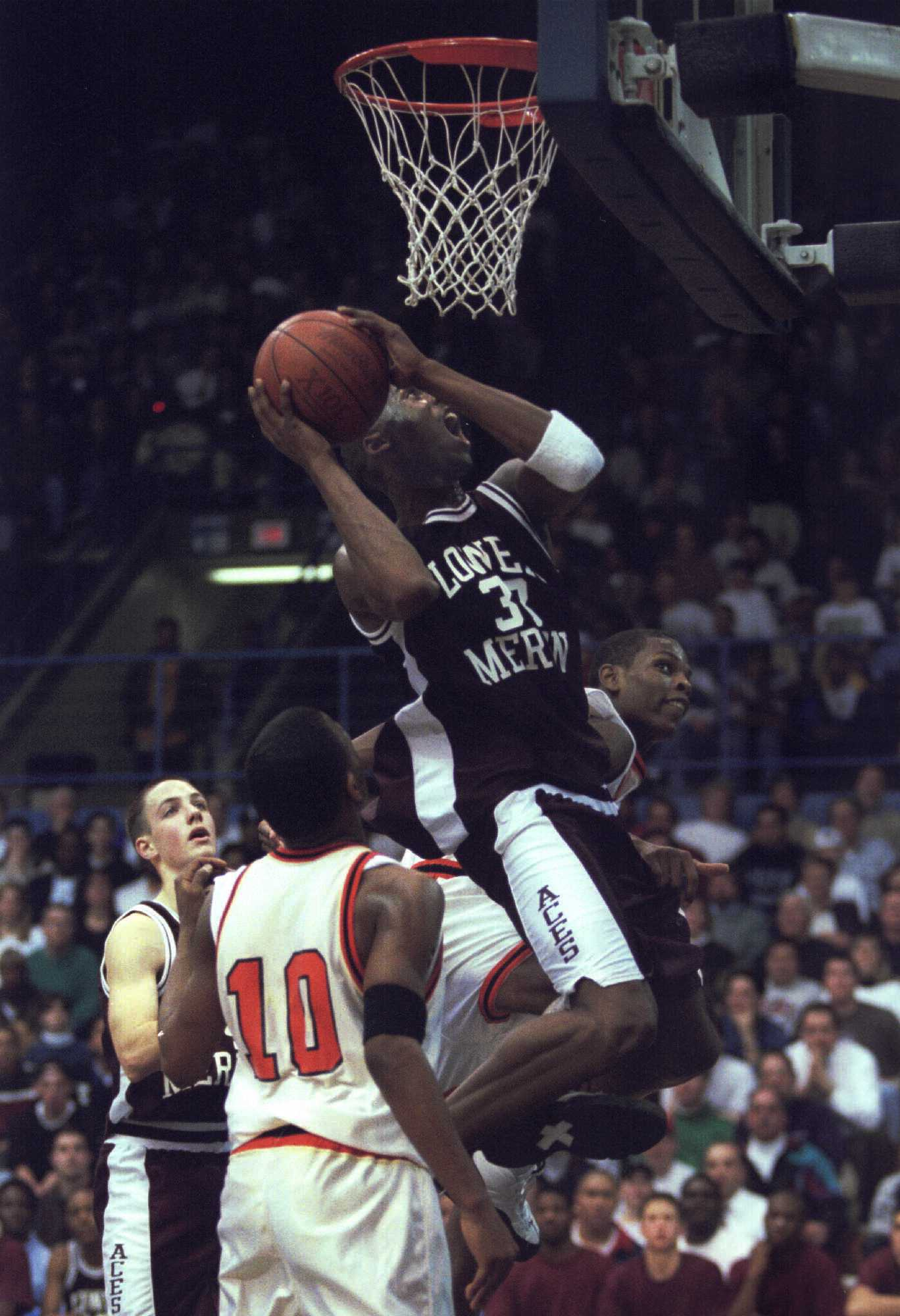
In the District 1 championship game against Chester, Kobe Bryant goes to the hoop over the Clippers’ John Linehan.
They arrived the next day at 5:06 a.m. The players knocked on the door. Bryant didn’t answer.
“He wouldn’t open it,” said Young, who graduated in 1995. “You’re either there or you’re not. We were six minutes late.”
His teammates waited outside until 6:30 a.m., when the school opened. They made sure to show up before 5 a.m. from that day on.
Downer was wired the same way. The coach — and his NBA-bound pupil — would push the team in practice. Losses were particularly tough. The players would go through endless sprints and rebounding drills that sent them running to the trash can.
It wasn’t fun. But over time, the method created a newfound tenacity.
“No one walked into high school saying, ‘Oh, yeah, I want to win a state championship,’” Young said. “But [Kobe] knew what that was. He was like, ‘I don’t know any other way. If we’re not going to win a championship, what the heck are we playing for?’”
Chester was always going to be an obstacle, so Downer tried to play into the battle. He’d use analogies for the tough, hard-nosed team, comparing it to an animal stalking its prey.
The coach began to screen movies to underscore this point. Together, in a Lower Merion classroom, Downer’s players watched Jaws and other tales of survival, like The Edge, a 1997 thriller about a plane that crashes in the Alaskan wilderness.
“This bear is stalking them, and the couple is saying, ’What are we going to do about this bear?’” Downer said. “And one of them says, ‘The only thing we can do is kill the bear.’
“And I remember being like, ‘We can do this.’ But the only solution is to — not to be overly graphic — but to kill them.”
(The bear in this analogy was Chester.)
He added: “We tried everything humanly possible to get through to this team.”
The first few games were ugly. In 1995, Lower Merion met the Clippers in the District 1 championship, only to lose by 27 points. But they came back with a renewed focus the following year, in 1995-96, going 25-3 in the regular season to earn a district final rematch against Chester.
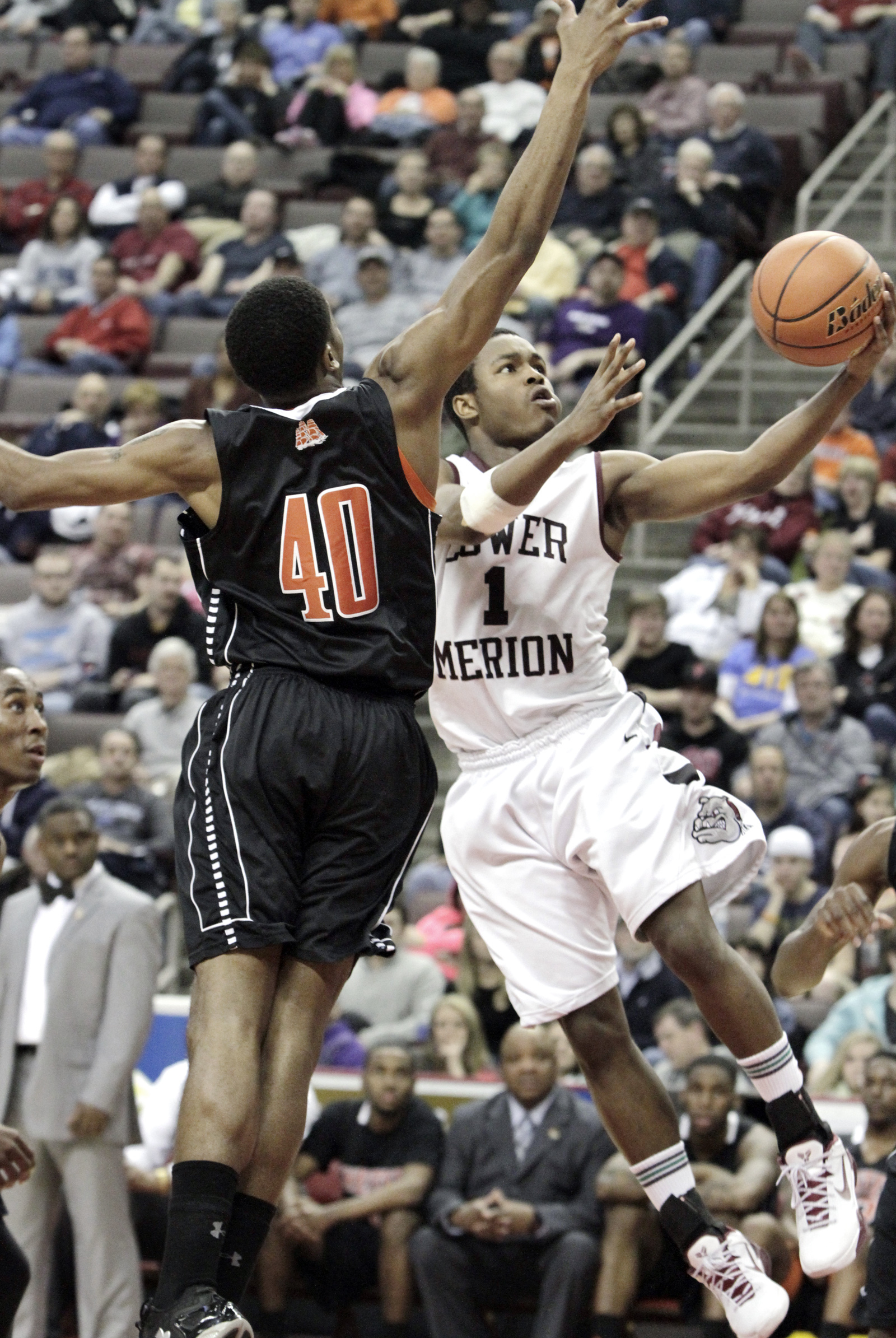
The Aces showed up at the arena with “27″ printed on their warmup shirts. Bryant, armed with fresh bulletin board material from Linehan, dropped 34 points against the Clippers en route to a 60-53 Aces win.
The shooting guard scored 39 points later that month — with a broken nose — in a 77-69 state semifinal win over Chester. Lower Merion went on to beat Erie Cathedral Prep, 48-43, to win its first state championship since 1943.
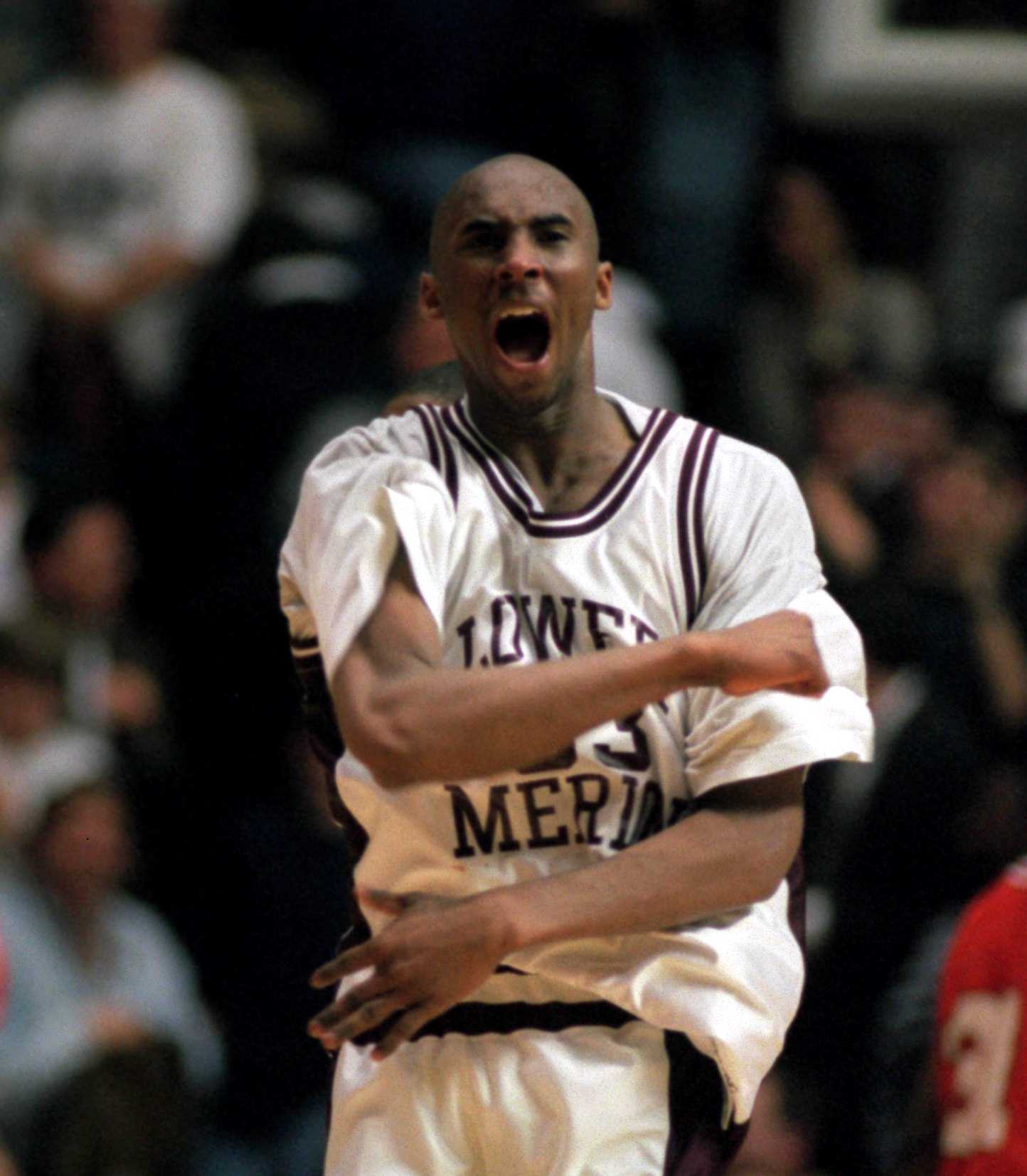
Kobe Bryant celebrates after defeating Chester at the Palestra in 1996 to advance to the state final.
To Linehan, the difference Bryant made was obvious. He joked that he’d “never heard of Lower Merion” before his friend arrived. But once he did, Chester realized it would have to go to great lengths to prepare for the phenom.
Ahead of a big game against Lower Merion in the mid-1990s, the coaching staff reached out to Clippers alumnus Zain Shaw. He played at West Virginia and in Europe and possessed some of the same characteristics as Bryant — a tall frame and an athletic build with strong ballhandling skills.
The Clippers invited Shaw to practice, where he played the role of Bryant (to the best of his ability).
“Kobe was so special, we had to bring in a pro to help us prepare,” said Linehan, who later starred at Providence.
But there was another impact the future Lakers star had, one that had nothing to do with his own prowess. Linehan noticed that Bryant’s Lower Merion teammates started to take on some of his qualities. Suddenly, they were playing brash, confident basketball.
“We didn’t have reason to believe, until Kobe got there, that we belonged on the court with Chester,” Young said. “The fear was real. Teams were afraid of Chester because they’d run you out of the building.
“The idea of Lower Merion being on the court in a meaningful game against [them] was such a crazy thought. But then, you started to believe.”
The buzzer-beater heard ’round Chester
Bryant never got over the rivalry, even after he embarked on his Hall of Fame NBA career in 1996. Sometimes, he’d call the coaching staff before big games against Chester, leaving expletive-laden voicemails to use as motivation.
The Lakers shooting guard also created an incentive structure for his former team.
“You couldn’t get a pair of Nike sneakers unless you qualified for the playoffs,” Young said. “If you don’t earn it, you don’t get it.”
He became especially involved in 2005-06. After a lull in the early 2000s, Chester and Lower Merion found themselves neck-and-neck again. The Aces were led by the duo of Ryan Brooks and Garrett Williamson, and the Clippers boasted a deep roster, headlined by Darrin Govens. All of them eventually played in the Big 5.
(Chester was so stacked that it brought a 1,000-point scorer off the bench in Noel Wilmore.)
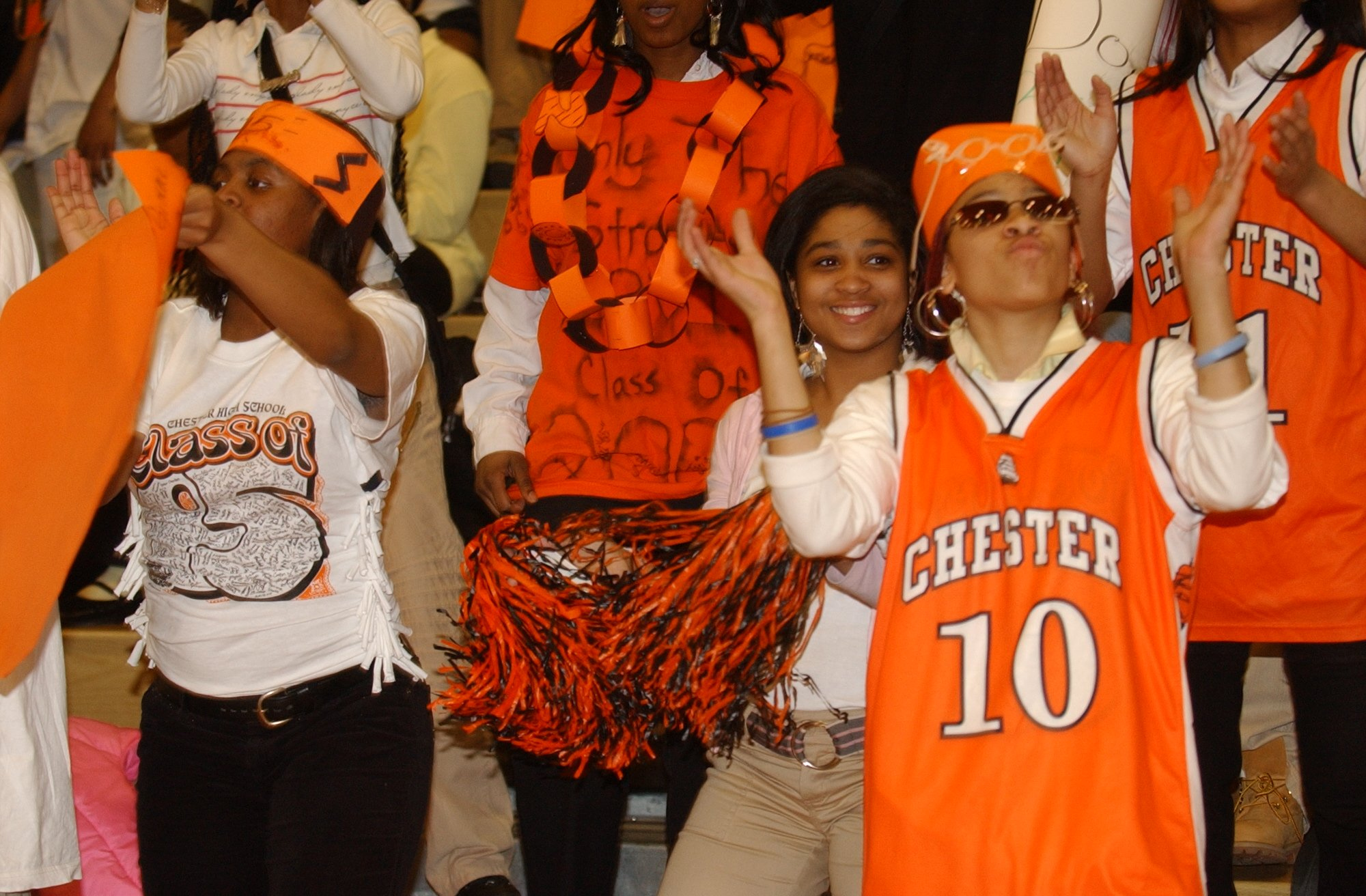
Students from the class of 2005 show their support as Chester and Lower Merion play in the state final.
The rivals met in the state championship on March 19, 2005. Despite strong performances from Williamson and Brooks, the Clippers pulled away in the second half thanks to a dominant third quarter from Govens. Chester won, 74-61.
The teams reconvened the following season with their competitive spark fully reignited. They faced each other three times that year. Chester took Round 1, a one-point regular-season victory on Dec. 27.
Round 2 was in the district final on March 3. Before the game, in front of a packed crowd at the Pavilion, Chester sophomore Karon Burton walked up to the layup line.
Lower Merion’s student section caught his ear with a chant about coach Fred Pickett’s stout stature.
The dig didn’t intimidate Burton. If anything, it fueled him. He grew up playing street ball in Chester and always loved trash talk.
Instead of cowering, like the crowd hoped, the sophomore delivered an unforgettable outing. The game went into overtime, and was tied at 80 with only a few seconds remaining.During a timeout, assistant coach Keith Taylor pulled Burton aside.
“He was like, ‘Hey, listen,’” Burton said. “They’re going to double Darrin. If you get that ball, do your thing.’”
Taylor’s words proved prescient. As Lower Merion’s defenders swarmed Govens, the Clippers inbounded the ball to Burton.
He took a pull-up jumper from beyond the arc and drilled it for an 83-80 win. The Chester fans stormed the court. Burton, who later joined Wilmore in the 1,000-point club, said he felt like a celebrity in his hometown.
“It was like watching a buzzer-beater in the NBA,” he said. “I just ran to my teammates, they picked me up. It was a crazy feeling.
“I’m a big Kobe fan, too. Kobe’s my favorite player ever. So when I came and I hit the game-winner on that team …”
Round 3 took place a few weeks later, in a state semifinal rematch at the Palestra on March 22. Bryant called Lower Merion’s coaches before the game.
“I don’t remember specifically what he said, but I’m sure there were a lot of [expletives] dropped,” said Young. “Like, ‘Don’t call me back if you don’t beat those [expletives].’ That was a line we heard from him a couple times.”
This one didn’t go Chester’s way. After trailing the Clippers, 47-37, at the end of the third quarter, the Aces came roaring back in the fourth and put up 33 points to eke out a 70-65 win.
The celebration in the locker room was cathartic. Water sprayed into the air. Players sat atop each other’s shoulders and turned the showers into a slip ‘n slide. Bryant called in, again, as other members of the 1996 team filtered through.
Darrin Govens scored his 1,000th point for Chester against Lower Merion in the state championship in 2005.
This was not how Govens wanted to end his high school career. And a few months later, when he arrived at St. Joseph’s on a basketball scholarship, he saw a familiar foe.
It was Williamson, his new Hawks teammate.
“We were sitting on the opposite side of the bench,” Govens said. “I didn’t want to sit next to him; he didn’t want to sit next to me. We’d kind of avoid each other and just head nod.
“Even in running drills, it was a competition. He looked to the left. I looked to the right. We tried to beat each other in sprints. But then we realized, ‘All right bro, we’re teammates now.’”
‘Hero status’
Chester had always rallied around its high school basketball team. Linehan said it was akin to playing for the Sixers. The teenagers were treated like professional athletes — especially those who had been a part of big wins.
The Clippers’ public address announcer, James Howard, called this “hero status.”
“All of a sudden, your money’s no good,” he said. “Barbers take care of you, make sure your hair looks nice before games. Free food. Little kids look up to you and ask for your autograph. That’s how it is.”
In Chester, there were plenty of heroes to draw from. There was Linehan, but also Jameer Nelson, who met a young Burton in the late 1990s. Nelson, a friend of Burton’s cousin, gave the aspiring basketball player a gift before he left for St. Joe’s: his MVP medal from the Chester summer league.
“He was one of the biggest guys in our city,” Burton said, “so it’s definitely something that I’ll always remember.”
By the early 2010s, when the rivalry was reignited for a third time, Lower Merion had built more of a basketball tradition. Aces guard Justin McFadden said he’d get stopped in Wawa before big games against the Clippers.
Chester celebrates its win over Lower Merion for the state championship in 2012.
“It became a community thing,” he said. “People would be asking, ‘What do you guys think about Chester? Do you think we can get it done?’”
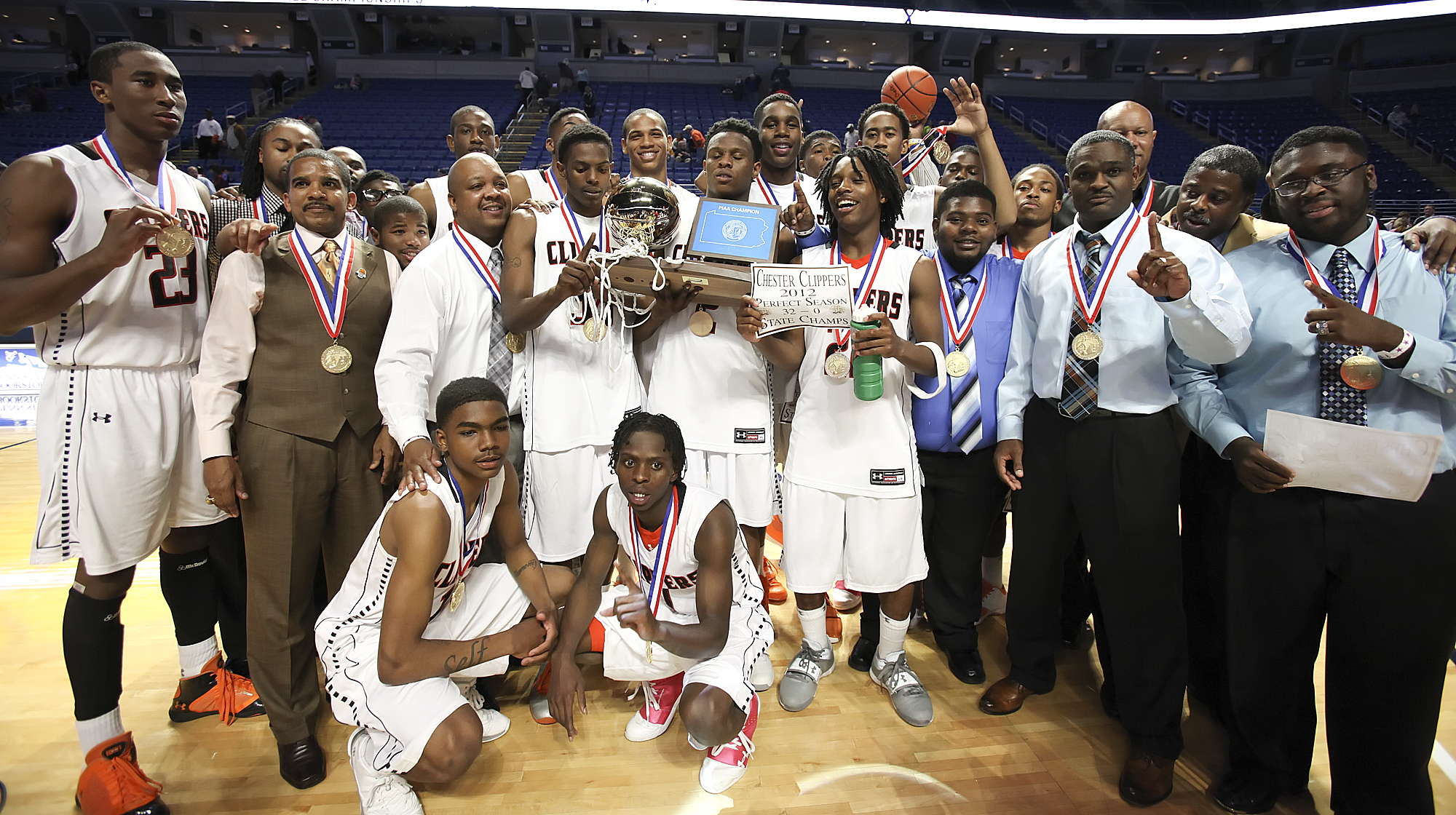
In 2012, the schools met in the state championship for the first time since 2005. Junior forward and future NBA starter Rondae Hollis-Jefferson put up a double-double to lead the Clippers to a resounding 59-33 win over the Aces. It was their second straight title and their 58th straight victory.
A year later, after going 17-0 in the Central League, the Aces met the Clippers in the state final again. Chester had won 78 straight games against in-state opponents. Snapping that streak would be daunting, but Downer had a plethora of motivational tactics at his disposal.
Just as they had in the 1990s, The Aces again spent pockets of the season watching Jaws, The Edge, as well as an addition: Al Pacino’s “Inch by Inch” speech in Any Given Sunday.
“He would have that fired up on YouTube, ready to go,” McFadden said. “Looking back, [your reaction] is a chuckle, but in the moment, it worked. We knew that this was the hill that needed to be climbed.
“And every time they played that speech, we got goose bumps. We were ready to fire.”
Chester got out to an early lead, but Lower Merion rallied behind a 22-point, 11-rebound performance from B.J. Johnson, who later starred at La Salle. The Aces snapped the streak and won their seventh state title with a 63-47 victory.
Lower Merion’s Jaquan Johnson goes to the net as Diamonte Reason guards him in the Chester-Lower Merion state championship game in 2013.
The Clippers then were coached by Larry Yarbray. Pickett, who was diagnosed with cancer in2010, was in declining health. Just before he died in 2014, Downer decided to say goodbye.
He and his former assistant coach Jeremy Treatman drove out to Pickett’s home in Chester. They went to his bedside.
“And we talked,” Downer said. “And we held hands. It was a really touching moment for me. This is a man that carried Chester on his back. That tried to carry Lower Merion on his back. And I knew it was the last time I was going to see Fred.
“We walked out the door, and we told each other that we loved each other. And I never thought he would say that to me, or vice versa. But it was just kind of like, ‘You know what? We’ve had some amazing battles, and there’s a lot of respect there.’”
Keeping the tradition alive
In recent years, the Chester-Lower Merion rivalry has diminished.
There was a brief period when the teams were in different classifications. Both programs have lost players to private schools that can recruit, and the addition of the Philadelphia Catholic League to the PIAA has made the state playoffs more competitive.
One place the Aces and Clippers could meet is in the district tournament, where they reunited in 2024. But they haven’t played each other since. And Howard says the contests don’t have the same feel.
“Both teams have lost D-I talent,” he said. “It’s not as high-flying, above the rim, as it was in the past. But still a great game. Sold out at Lower Merion, and at Chester, same thing.”
The history will always be there, though, and Burton is doing his best to keep it alive. His 8-year-old son, Karon Burton Jr., is playing in the Biddy League. His father is his coach.
Sometimes, they go on YouTube and watch old Clippers games. Junior’s favorite, of course, is the 2006 district final.
Burton believes that his son has a promising future, but isn’t sure of where he’ll go to high school yet. He doesn’t want Karon Jr. to feel obligated to follow his father’s path.
But if it worked out that way, what a story that would be.
“I’d love to be the first father and son to have 1,000 points,” Burton said. “With the same name? That would be crazy.”
TORONTO — Trendon Watford’s eyes widened as he walked into Scotiabank Arena’s visitors’ locker room and noticed the media scrum surrounding Kyle Lowry’s locker. Teammates Justin Edwards and Jared McCain joined the back of the crowd, with McCain pulling out his cell phone to pretend to ask a question.
“This is why I’m here,” Lowry quipped to those gathered.
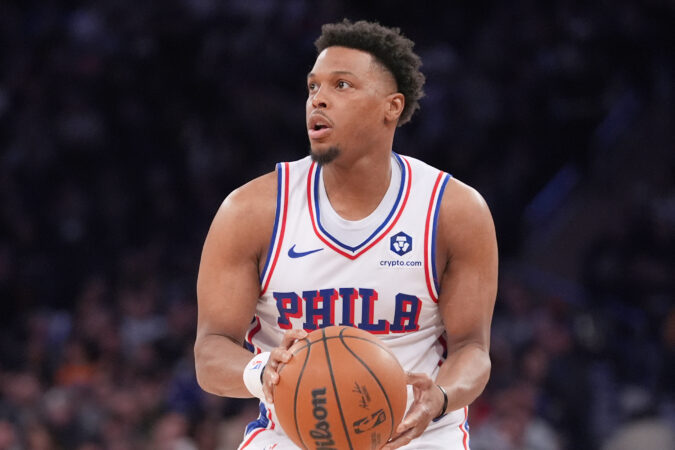
The scene was warranted. This could be Lowry’s final visit as a player to Toronto, where the North Philly native and former Cardinal Dougherty and Villanova star became a Raptors franchise legend and NBA champion. And the 76ers’ back-to-back against the Raptors — they lost a 116-115 overtime heartbreaker Sunday night — represents another bridge between the city that Lowry now calls his second home and his hometown Sixers, the team with which he is likely to wrap up his NBA career primarily as a mentor on the bench and behind the scenes.
“You’ve got to find ways to challenge yourself,” Lowry said when asked about his role before Sunday’s game. “And the challenge for me is to try to help these guys every single day. … It’s just finding that niche and helping people get better — and me being in a place where I’m happy.”
The 39-year-old Lowry went into last offseason with a public declaration that he wanted to play one more season to reach the “massive accomplishment” of 20 in the NBA. Only 12 players have achieved that benchmark in league history, including two who stood 6-foot or shorter (Lowry and Chris Paul). His sons, Karter and Kameron, who are still based in Miami following Lowry’s post-Raptors tenure with the Heat, signed off on him pursuing that milestone.
Yet when asked before the Sixers departed for Toronto late Friday if he expected this to be a farewell trip of sorts, Lowry’s tone shifted to “I don’t know, honestly.” It is possible that the Sixers (21-16) could return to Canada after these consecutive regular-season matchups because, if the playoffs began Monday, the 24-16 Raptors would be their first-round opponents. Lowry also believes his leadership is “immensely important to what this organization is trying to do.”
“You’ve got to be able to kind of take yourself out of it sometimes,” Lowry said, “and be able to say, ‘OK, how can I pay it forward a little bit?’ … It’s that balance of I know I’m not on the court, so I can’t yell at them and curse at them. But I can say, ‘Hey, these are the things that I see. Let’s try to do that.’”
Kyle Lowry played nine seasons in Toronto (2012-21), winning a title in 2019 and being named to six All-Star teams.
It is a transition that those who knew Lowry in Toronto — where he was a six-time All-Star and a notoriously tenacious point guard — might be surprised he has so wholeheartedly welcomed. Though he became a starter after joining the Sixers off the 2024 buyout market, Lowry’s minutes dramatically diminished while hampered by a lingering hip issue for the bulk of last season. He has played in 42 total minutes across five games this season, receiving a rousing reaction from teammates when he buried a three-pointer in his debut at the Brooklyn Nets in November.
Survey those same teammates about Lowry’s daily influence, and faces typically light up.
Rookie VJ Edgecombe can count on Lowry to “keep it real,” including during a pressure-releasing pep talk before Edgecombe scored 34 points in his NBA debut at the Boston Celtics. Quentin Grimes said Lowry’s diligent workout routine — he is still the first Sixer on the floor for his pregame shooting nearly three hours before every game, and puts in extra individual work before and after practices — provides a blueprint on how to prepare as his own career progresses.
And though star Tyrese Maxey jokingly calls Lowry “old as hell,” he also views the veteran as “like, my leader. He comes to me and leads me, and I try to lead the team.” Lowry fosters this relationship while regularly rebounding and screening for Maxey during workouts, and when he calls the 25-year-old “at least three or four times a day,” Maxey said.
“I couldn’t do this without him, honestly, right now,” said Maxey, who finished Sunday ranked third in the NBA in scoring at 30.9 points per game and has entered the MVP conversation.
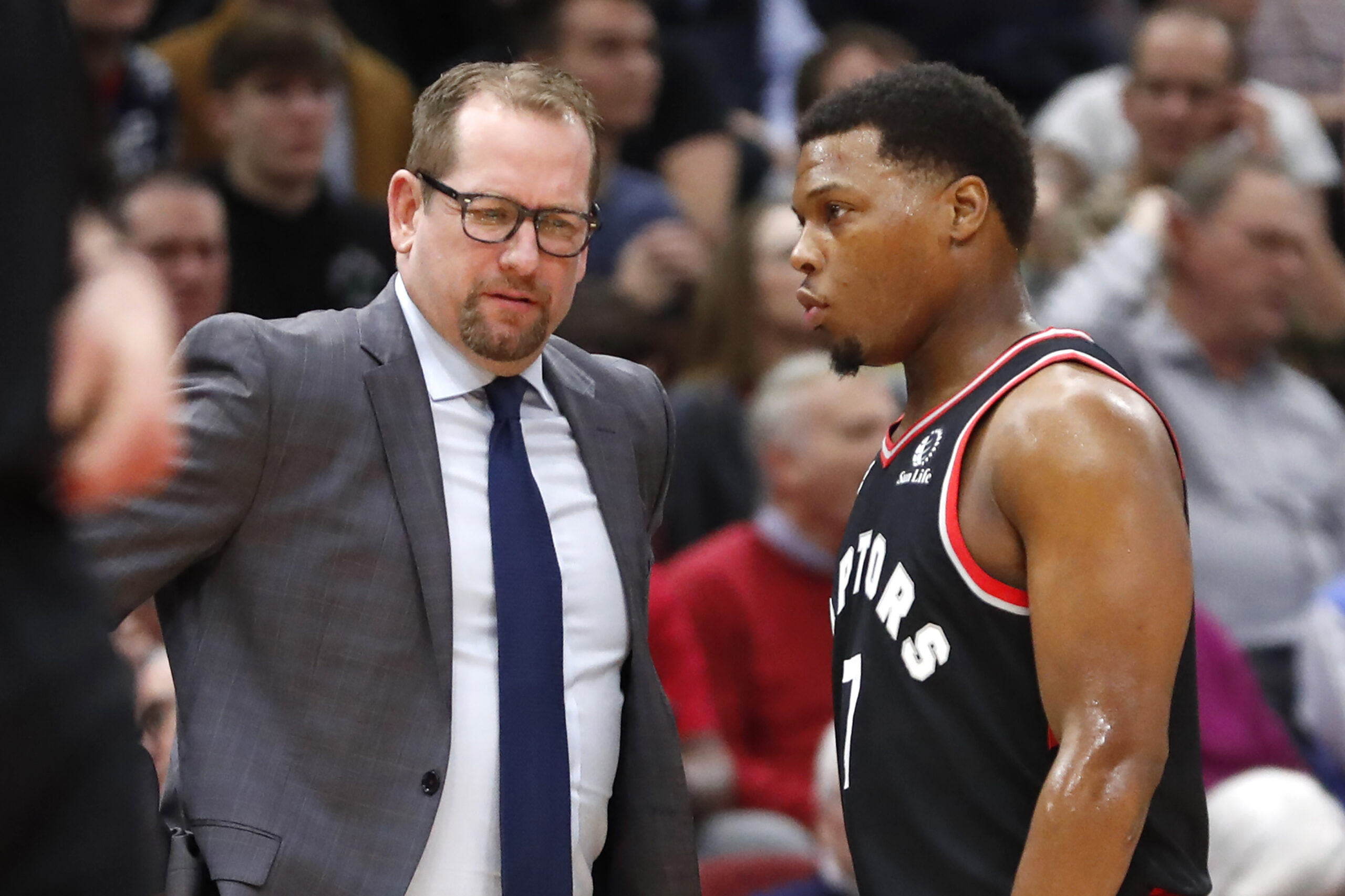
Even Sixers coach Nick Nurse, who also led Lowry’s Raptors teams, said the point guard has “talked me off the ledge a couple times” during games this season. Nurse views Lowry as a valuable conduit between the players and the coaching staff, providing insight on when the Sixers might need a day off from practice or should be pushed.
“There’s times when I’ll be leaning on him,” Nurse said. “He’ll get behind me and say [to teammates] … ‘This is what it takes.’”
The relationship between Nick Nurse and Kyle Lowry is extensive and built on trust.
Before Sunday’s game, Nurse said that he would speak to Lowry about his desire to hit the floor inside Scotiabank Arena again. Lowry acknowledged he would “love to get in there for the fans, and help my team,” but stressed that winning was the top priority. There was no appropriate opportunity for Lowry to enter during Sunday’s down-to-the-wire overtime defeat.
Still, Lowry remained active from the bench. He jetted onto the court to greet Maxey after he drilled a three-pointer with 20.1 seconds remaining in regulation. He stood between Nurse and assistant Bryan Gates during an overtime discussion. And after Kelly Oubre Jr. attempted what he described as a “terrible” inbounds pass to Edgecombe that became a critical crunch-time turnover, Lowry pointed out that Grimes also had leaked open.
“He’s been there, done that,” Oubre said of Lowry. “Been at the highest level. For him to be so engaged and allow him to use his IQ to help us grow ours, it’s amazing. He’s definitely a huge leader on this team, and his voice is always heard.”
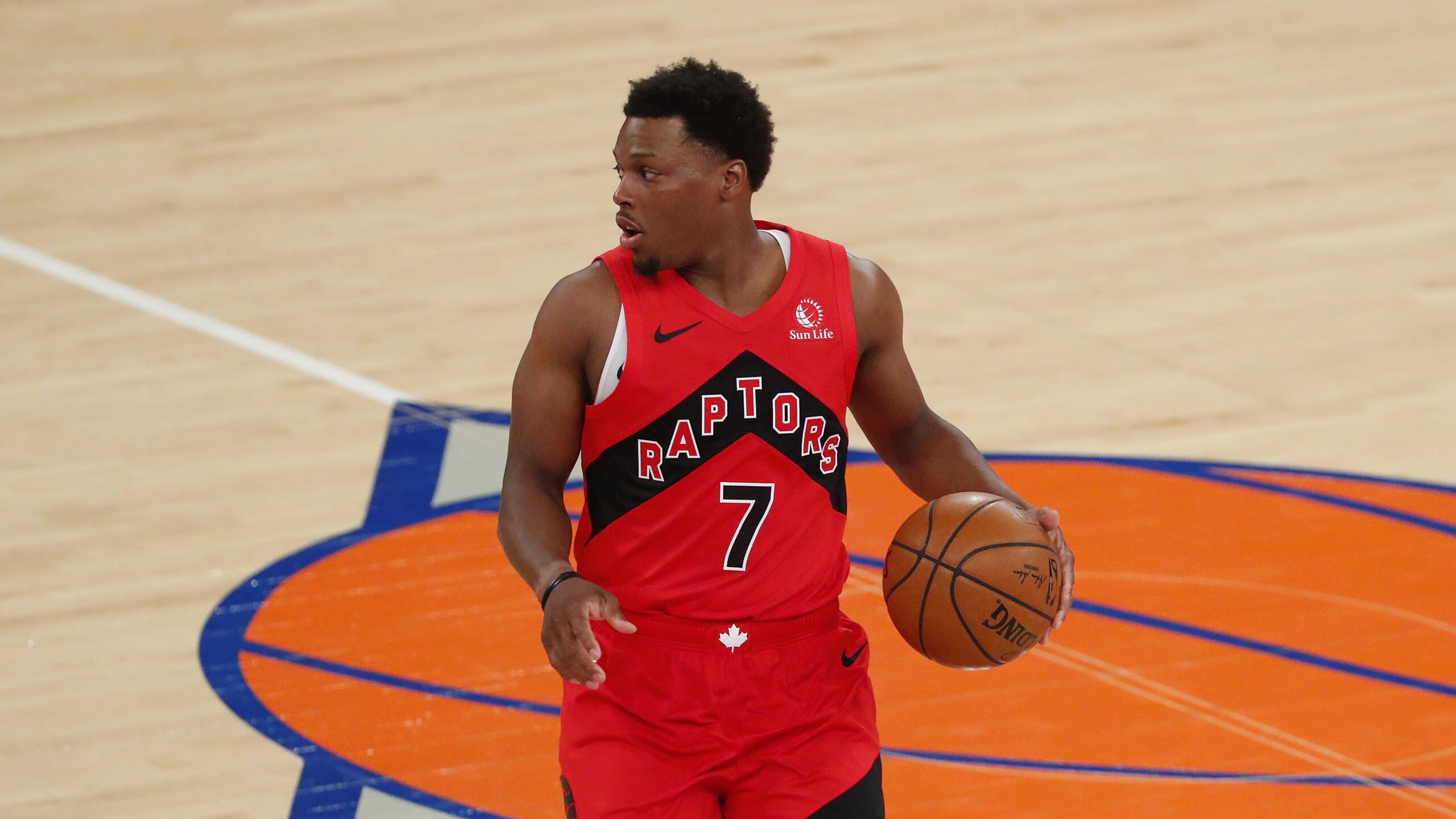
Doug Smith, the longtime Raptors beat writer for the Toronto Star, suggested in an article that Nurse should put Lowry in Monday’s starting lineup so he can bask in a pregame introduction here one last time. When asked how it will feel to see his No. 7 raised into the rafters someday, Lowry’s response was, “Y’all ever seen me cry?”
He walked into the arena Sunday wearing a signed jersey from Maple Leafs star Auston Matthews, a tribute to the player and the city. He confirmed that, whenever the time comes, he would sign a one-day contract to retire as a Raptor.
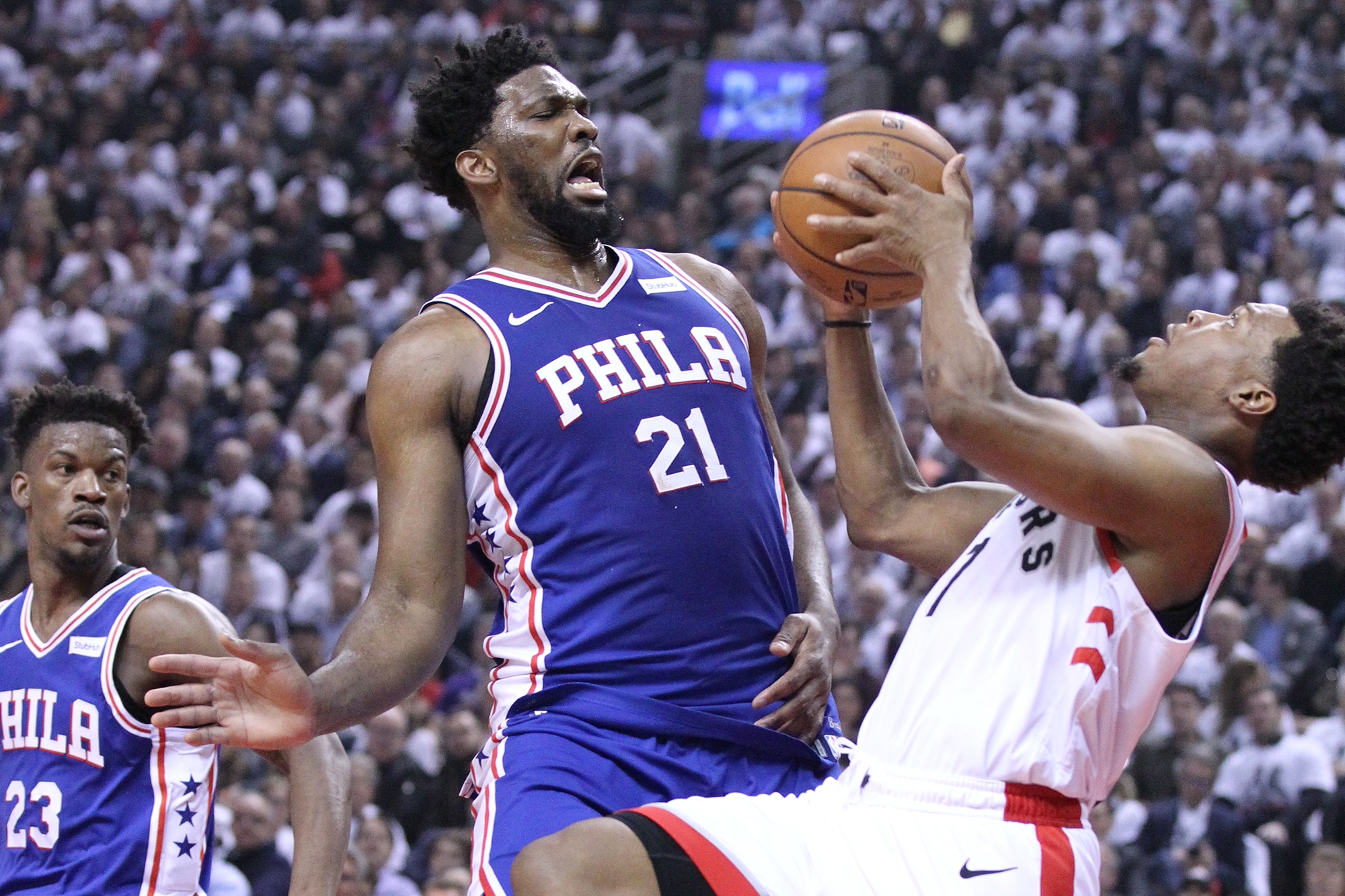
Veterans like Joel Embiid (21) know the impact Kyle Lowry has made during his 20 seasons in the NBA.
And his forever connection to Toronto was clear when Joel Embiid tried to land a playful jab inside Friday’s postgame locker room in Orlando. Hours before the Sixers’ flight across the border, Embiid interrupted an interview with Lowry by asking, “Why are they talking to you?” in an exacerbated tone.
“Where you lost Game 7 at,” said Lowry, referencing the Sixers’ crushing playoff defeat to the eventual-champion Raptors in 2019.
“Talking about how great of a cheerleader you are?” Embiid countered.
“Yes, basically,” Lowry responded.
“He’s a great cheerleader,” Embiid conceded.
Because right now, Lowry is a Sixer. And when asked about how enthusiastically those teammates describe Lowry’s impact in his 20th — and, potentially, final — NBA season, his emotions again bubbled to the surface.
Kyle Lowry could be finishing a storied career with a mentor role on a possible playoff team.
“It means a lot, to be honest,” Lowry said. “Because I really give to them the purity of how I feel about them. Like I said, sacrifice. I don’t care about myself as a basketball player. I know in my career what I’ve done. And what I’ve done is I’ve given everything to this game. Everything I could possibly give to this game, physically and mentally.
“You see me every day with these guys. I cheer for them. I clap for them. I help coach them from a player’s perspective. I try to give them things in life. I try to help them out, just overall, in general.
“I guess it’s a testament to how they feel about me. I’m the ancient man in this locker room. I embrace it, and they embrace me.”
NEWARK, N.J. — As the Prudential Center’s public address announcer rolled through Arkansas’ starting lineup introductions, two players remained on the bench.
Then Darius Acuff, the Razorbacks’ leading scorer and a projected NBA lottery draft pick, was announced. D.J. Wagner was last, a distinction often reserved for a respected team leader.
It might seem unfathomable that Wagner, the former Camden High School star and once the nation’s top-rated recruit, is now in his third college basketball season. The 6-foot-4 combo guard continues to be an interesting case study in expectations put on high school athletes, this era of name, image, and likeness in college sports, and how one defines success.
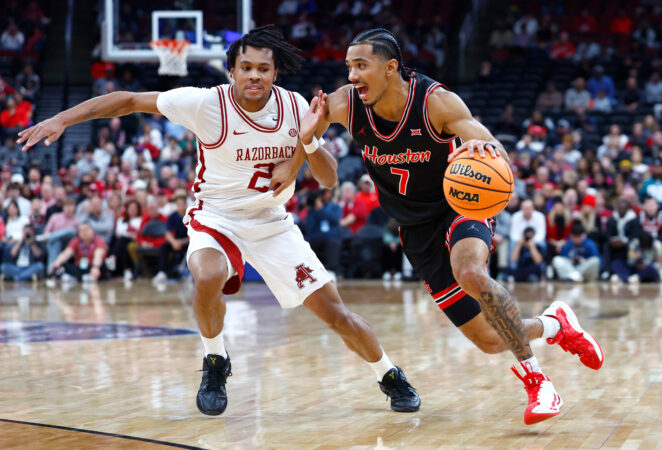
But Wagner has embraced his role as a veteran for a Razorbacks team — which also includes fellow former Camden star Billy Richmond — that was ranked 14th in the Associated Press poll before Arkansas lost to No. 8 Houston, 94-85, Saturday night in the Never Forget Tribute Classic.
“You could say I take a lot of pride in it,” Wagner said earlier in the week. “It’s just an honor. It’s a blessing to be able to be playing under Coach [John Calipari] for three years. …
“I’m just happy to be here. Whatever I can do to help my teammates out, I’m happy to do it.”
When asked before Saturday’s game how many family members and friends would be inside the arena about 80 miles from Camden, he said, “I couldn’t even tell you. I know it’s going to be a lot.” He finished the game with 11 points on 4-of-10 shooting and two assists in a season-high 34 minutes, flashing what made him an intriguing recruit who now possesses an inconsistent college body of work.
Camden’s DJ Wagner guarding Imhotep’s Justin Edwards, now with the Sixers, during a game in 2023.
He got past his defender for a crafty layup for Arkansas’ second bucket, then splashed a three-pointer to tie the score at 11. Early in the second half, Wagner dished a pass to Acuff for a three-pointer that cut what had been a 21-point Houston lead to 51-44. But after those two early buckets, Wagner did not score again until hitting two late three-pointers, when the game had all but been decided.
“Even D.J.’s got to play better, make better plays,” Calipari told one local reporter in the hallway after the game. Arkansas did not hold its scheduled postgame news conference, preventing The Inquirer from asking additional questions about Wagner and Richmond.
Wagner, who played his freshman season at Kentucky before following Calipari to Arkansas, is averaging a career-low 8.4 points this season. But he has improved his shooting from the floor (41.5%) and three-point range (34.9%). He also has totaled 33 assists against 10 turnovers while shifting more to an off-the-ball role. He is one of two players to start all 12 games, a sign of trust from Calipari as a steady presence with deep familial ties. Wagner’s father, Dajuan, played for Calipari at Memphis before being selected sixth overall in the 2002 NBA draft.
“A lot of these kids get ranked, then they’re trying to live up to rankings,” Calipari told the Fort Smith (Ark.) Southwest Times Record before the season. “What does the ranking mean? You’ve got to go in and compete and take what you want, but it could be a burden.
“I think with [Wagner], he needed to shed that and just be the player he is. Let’s see your best version. I believe his best version is being more aggressive, less dribbles, more attack. The things that he’s doing, the way he leads; he’s just matured.”
Wagner’s Razorbacks team gained national prominence in March with a surprise run to the NCAA Tournament’s Sweet 16 as a No. 10 seed. Arkansas upset No. 7 Kansas and second-seeded St. John’s before losing an overtime heartbreaker to third-seeded Texas Tech. Wagner acknowledged he “didn’t really watch” much of the tournament after the Razorbacks were knocked out, but called Arkansas’ Dec. 13 rematch victory over Texas Tech, which was ranked 16th at the time, “definitely personal.”
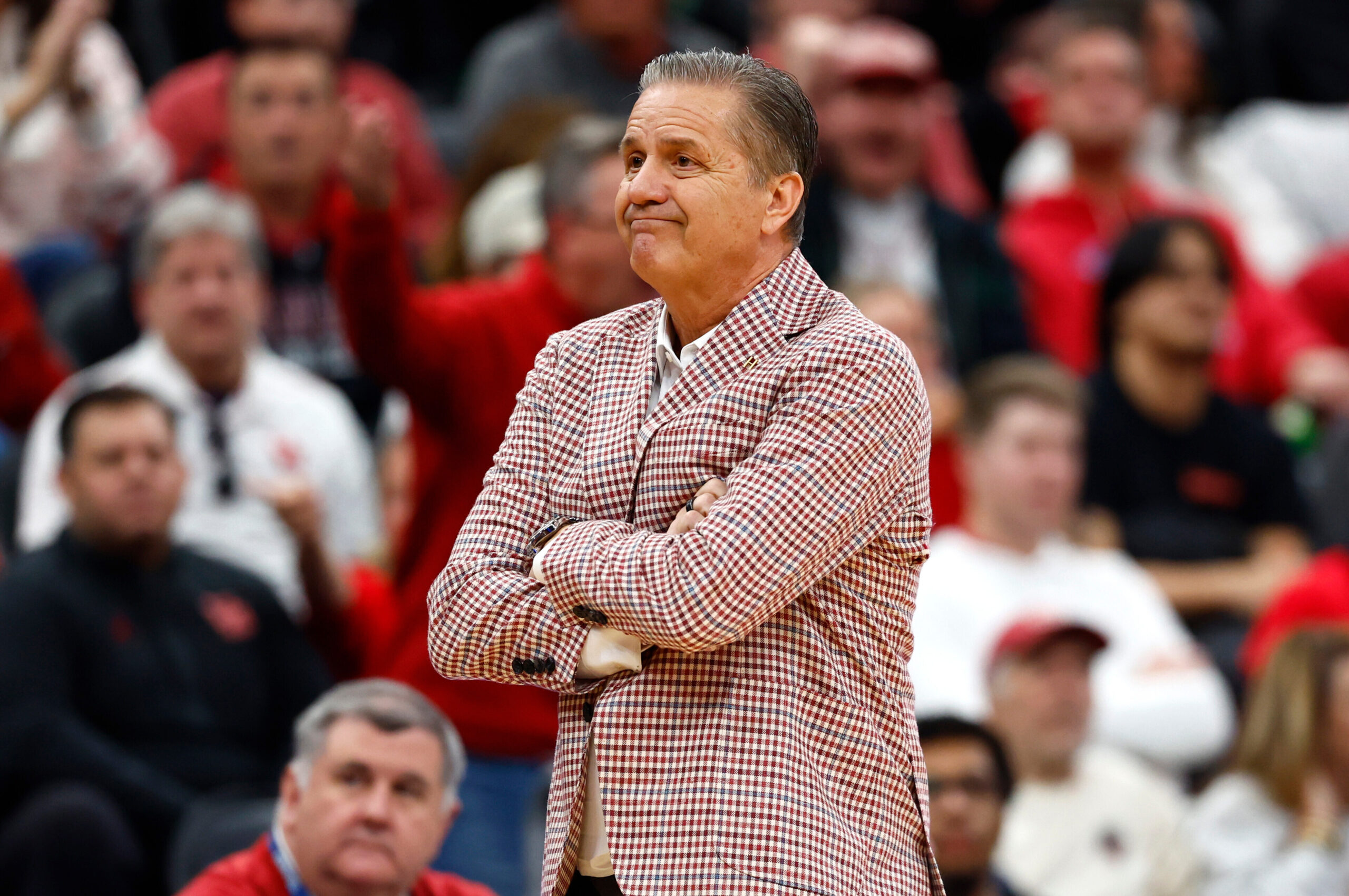
Arkansas coach John Calipari on the sideline during the second half against Houston in Newark, N.J.
That win was part of Arkansas’ 9-3 start against an intentionally difficult schedule. The Razorbacks also already have a victory against No. 11 Louisville. Their other two losses are to No. 9 Michigan State by three points — when Wagner had 13 points on 4-of-6 shooting, three assists, and three steals in perhaps his most impressive performance of the season — and to No. 3 Duke by nine points.
That is why Houston coach Kelvin Sampson called Arkansas the best opponent his Cougars, who advanced to the national title game last season, had faced so far. Sampson added he believes Arkansas has “as good [of] a chance as anybody” to win the loaded SEC, which included six other ranked teams in the most recent AP poll.
The marquee nonconference, neutral-site matchup against the Cougars added to Wagner’s growing list of college experiences in “crazy games in crazy atmospheres,” he said. He played Kansas at Chicago’s United Center as a Kentucky freshman. Last season, he faced Michigan at the legendary Madison Square Garden. And “every game in the SEC, you know you’re going to fight,” he said.
Wagner’s calming leadership was on display Saturday when he approached Malique Ewin to say, “You got this” as Ewin uncharacteristically struggled at the free-throw line. Wagner’s biggest advice to the high-profile youngsters who enter the program is to remember that the uber-demanding Calipari “might be hard on you, but he’s just coaching you because he cares about you.” And with Acuff as the primary point guard, Wagner said he gets more opportunities to read and react to the defense.
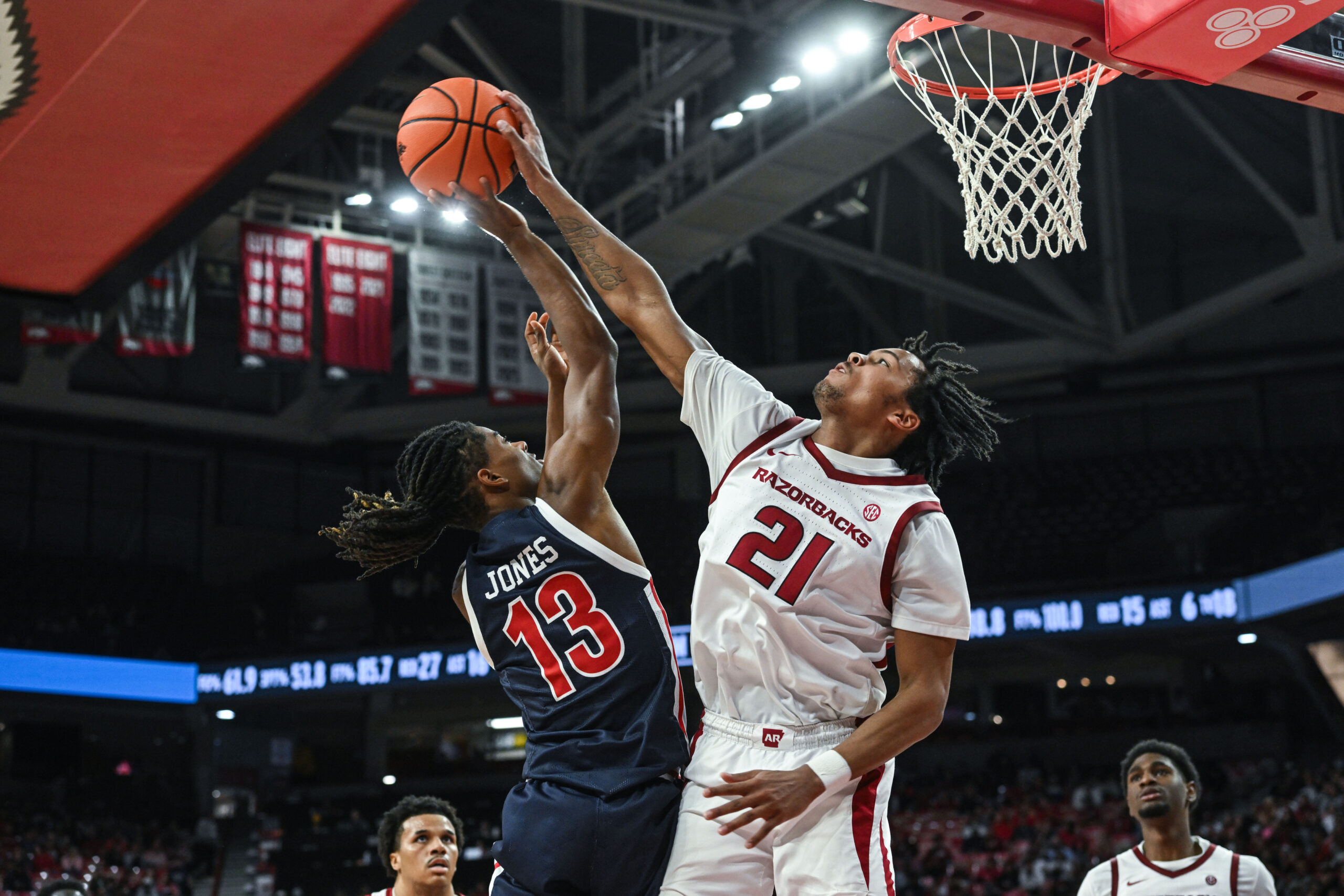
Arkansas guard D.J. Wagner blocks a shot by Jackson State’s Cael Jones on Nov. 21.
“It kind of gives you more time to see what’s happening,” Wagner said. “More time to see a play before it even happens. You could be more aggressive, like attacking more, just from getting passes and not having the ball in your hands all the time.”
Yet the former Camden star whom Sampson singled out as “dynamic” was Richmond, who totaled 12 points on 5-of-6 shooting, two rebounds, and two steals off the bench. It was a sentiment echoed by a spectator behind the basket, who hollered, “Billy Ball!” when Richmond first entered the game.
The sophomore’s versatility fueled the Razorbacks’ rally to cut a 40-19 deficit to eight points at the break. Richmond immediately hit a baseline jumper, a skill Wagner said his teammate has refined while connecting on 57% of his shots. Then Richmond sank a three-pointer. He drove baseline for a dunk that got Razorbacks supporters on their feet, then mean-mugged after swiping a steal underneath the opposite basket and lofting a pass to Ewin for the alley-oop slam.
Added Wagner: “He gets in the game, the energy [is] going to shift, because that’s just the type of player he is.”
Acuff, meanwhile, amassed 27 points, seven assists, and five rebounds. He will likely join Adou Thiero, Reed Sheppard, Rob Dillingham, and the 76ers’ Justin Edwards as former teammates whom Wagner will watch reach the NBA before him.
It is unclear whether Wagner will ever be regarded as a legitimate draft candidate again. He was not listed on last week’s top 100 prospects by ESPN, where teammates Acuff (No. 15), Maleek Thomas (No. 28), Karter Knox (No. 56), and Trevon Brazile (No. 82) were all included.
And without a defined path to the pros, it is far more practical (and lucrative) for Wagner to stay in college. He was one of the first high schoolers to sign an NIL deal with Nike, and has also landed partnerships with Express clothing and Marathon fuel during his college career. One of the Arkansas men’s basketball program’s biggest boosters is John H. Tyson, the chairman of Tyson Foods.
So Wagner’s third college season brought him back to his home state, where he was introduced last in Arkansas’ starting lineup. And he has embraced this unexpected role as the veteran for a Razorbacks team with aspirations of another deep March run.
“Really just taking it one day at a time,” Wagner said. “Just stay in the gym. Just trying to get better at everything.”
Adem Bona got Johni Broome’s attention from across the 76ers’ locker room, subtly interrupting a conversation ahead of their Nov. 30 game against the Atlanta Hawks.
“I’m coming, Bona!” Broome hollered in response.
It was time for the young Sixers to head to chapel, which has become a pregame ritual. Jared McCain, VJ Edgecombe, Justin Edwards, and Hunter Sallis joined them, too.
Those teammates have swiftly forged a bond through serious activities, such as tapping into their faith, and sillier ones, such as intense NBA 2K video game matchups. And everyday ones, such as bus rides and shared meals.
Outside belief that the Sixers are old and washed up is primarily used as a dig at the oft-injured (and max-salaried) Joel Embiid and Paul George. But these youngsters are debunking that notion and injecting energy — and promise — into their team’s 14-11 start.
“We’re all just kids,” Edgecombe recently told The Inquirer. “Just enjoying the moment. Knowing that we’re in the NBA, what we worked for our whole life. …
“It’s just a natural bond, for real. It’s no forced relationship.”
This contingent of the roster is made up of rookies Edgecombe, Broome, and Sallis; second-year players Bona, McCain, and Edwards; and two-way newcomers Jabari Walker and Dominick Barlow. There is also a trio of 25-year-old “tweeners” in star point guard Tyrese Maxey — who noted before the season that he has tried to pick up video games in an effort to connect with his younger teammates — along with Trendon Watford and Quentin Grimes.
The Sixers’ front office more deliberately course-corrected to this roster-building direction in the middle of last season’s 24-58 flop, citing a need for more players who were athletic and consistently available. Bona, McCain, and Edwards received legitimate minutes as first-year players. Edgecombe, the third overall pick in last summer’s draft, is averaging 15.2 points, 5.6 rebounds, and 4 assists as an instant-impact rookie. Barlow is a starter and arguably the Sixers’ biggest surprise so far this season, and Walker is part of the rotation.
The bulk of this 2025-26 group initially linked at the Sixers’ facility for summer league practices. Conversations while sticking around for cold-tub and treatment sessions spilled over to their newly created group chat, a player’s home, or a local restaurant. They went through the two-week summer league odyssey from Salt Lake City to Las Vegas. Then to workouts in Los Angeles, which included a Disneyland trip organized by Maxey. Then back to Philly for informal pickup games.
Sixers guards VJ Edgecombe and Tyrese Maxey talk strategy during an NBA game.
By the time training camp began in late September, those Sixers had already spent nearly three months together. And while the rookies had nothing to compare this early NBA chemistry-building to, Walker, now in his fourth season, called it “a different type of bonding” while likening it to a college-team environment.
“Sometimes, in other situations, you want to hurry up and get off the court and just go home,” Walker said. “I’ve been wanting to lag behind, because there’s so many different personalities. … For things to happen like that so quick, you don’t feel like you’re just coming to a job every day.
“I actually wake up like, ‘Dang, I’ve got to tell Johni this when I get there’ [or] ‘I’ve got to tell Justin this.’”
Coach Nick Nurse grinned when this topic was broached following an early-season practice. He said he first noticed the “entertaining” connection among those players while on the bus heading to gyms in the summer. He added that they embody this staff’s 12-months-a-year philosophy, and helped set the tone for the Sixers’ commitment to “dig ourselves out of a hole” following that disastrous 2024-25 season.
These days, Nurse said, there is a row of chairs along the practice court where those players frequently sit after their work is done.
“I go up there once in a while,” Nurse said, “and I say, ‘What are you guys doing over here?’ And they’re like, ‘We’re just hanging out, Coach.’ And I’m like, ‘All right, keep hanging out.’”
Sixers guard Tyrese Maxey and forward Trendon Watford have a close friendship on and off the court.
Once those players finally leave the Sixers’ facility for the day, they regularly hop on their video-game headset.
Unsurprisingly, NBA 2K is their top choice. In “My Player” mode, Broome has an “elite” 7-foot-4 big man who can shoot. Sallis plays with a point guard “trying to run the show.” Edgecombe has a variety of players, allowing for maximum versatility.
“[We’ll] be on the game 24/7,” Edwards said. “We’ll be on FaceTime, in the group chat, trying to see who wants to play. That’s a big thing that I feel like we didn’t have last year.”
When asked who is the best gamer of the bunch, most provided the politically correct answer. Yet when told that Edwards brushed it off, Walker quipped that “Justin should ‘no comment’ that question.” And while bringing his voice down to a whisper inside a mostly empty postgame locker room, Edgecombe eventually revealed, “I think I’m the best, though, to be honest with you. You can say [it].”
Gaming is how those youngsters also roped Sixers veterans — aka “Uncs” — George and Andre Drummond into their group. The 32-year-old Drummond said being around those players’ lingo — Edwards recently started calling him “Muddy,” an apparent reference from his New York City relatives — music tastes, and overall energy is “why I call myself a young man.” George, 35, added that being immersed in a virtual environment away from the facility or Xfinity Mobile Arena has encouraged them all to open up and bridge age gaps.
“That’s where kind of the trust and the relationship has grown,” George said. “ … We shoot the [expletive] on the game, but then it carries over the next day and we’re looking forward to seeing each other. We laugh about what happened the night prior, and who [stunk], and who was trash.
“It’s a fun way and I think, for us, [it’s] just kind of expressing ourselves outside of the grind of the season.”
Now, such connections fuel aspects of those players’ game-day routines.
Bona is the unofficial leader of the chapel “safe space,” which last season quickly added McCain. The invites then extended to Broome, Edwards, Edgecombe, and Sallis, who now file out of the locker room about an hour before any game’s tipoff.
“Everyone checks on each of us,” Bona said, “Like, ‘Yo, we’ve got five minutes!’ It’s amazing. It’s a really good bonding activity together.”
Added Broome: “Obviously, I’m a rookie, so things kind of get a little tough and frustrating sometimes. So it just kind of keeps me grounded, keeps me on the right path, in the right direction. Keeps me encouraged.”
Those relationships also are noticeable inside the postgame locker room. Following a Nov. 25 blowout loss to the Orlando Magic, for instance, Barlow, Walker, and Broome sat huddled in a corner, immediately dissecting how the game got so out of hand. And after Embiid’s 39-point outburst against the Indiana Pacers on Friday, he was enthusiastically chatting with McCain and Edgecombe before heading to treatment.
“I’m happier coming in here,” Embiid said later that night. “… You look at the guy next to you, you want to always joke around, talk to them, and hang out. Being on the road and just chill, that goes a long way.
“I love all these guys in this locker room.”
A fair amount of credit for such vibes can go to the “kids,” who quickly bonded with one another and then injected energy into the start of the Sixers’ season.
“I can go [down] the list of young guys,” Drummond said. “It really just keeps our whole team spirit high.”
When Tyrese Maxey flew down the court for his game-saving block on the Golden State Warriors’ De’Anthony Melton last week, it was not only an impressive burst of speed.
“That’s conditioning, too,” Doc Rivers, the Milwaukee Bucks coach who formerly was with the 76ers, said while commending Maxey’s play the following day. “If you’re tired mentally or physically, you can’t make that play.”
Maxey insists that, a quarter of the way through this season, he is not fatigued. But perhaps no Sixer is savoring this light stretch in the schedule before Friday night’s game with visiting Indiana more than their star point guard.
Maxey entered Thursday leading the NBA in minutes played, averaging 39.9 in 23 games. That is three minutes greater than the next player with a comparable number of games logged (the Los Angeles Lakers’ Austin Reeves’ 36.9 minutes in 21).
Maxey’s recent workloads have included playing the entire second half and overtime of a Nov. 20 win at the Milwaukee Bucks, when he scored a career-high 54 points. In a Nov. 30 double-overtime loss to the Orlando Magic, he played more minutes (52) than there are in a typical NBA game (48).
No NBA player has averaged 40 minutes or more per game since Monta Ellis with Golden State in 2010-11 (40.3). So conventional wisdom says this pace for Maxey is not sustainable for the 82-game grind. Sixers coach Nick Nurse hopes having the team’s four rotation guards healthy — and productive — will ease Maxey’s load moving forward.
Still, it has taken impressive physical fitness and mental fortitude for Maxey to pull this off for the season’s first seven weeks while playing at an All-NBA level. He entered Thursday ranked third in the league in scoring (31.5 points per game) and averaging a career-high 7.2 assists and 4.7 rebounds.
“He’s a warrior,” teammate Paul George said. “There’s no question about it. He’s a fighter. … [There’s] a leadership about him. And when he’s out there, I play for him. I do everything I can to make the game easier for him. He’s our guy. It’s inspiring. Me, as a vet, it’s inspiring for a guy to consistently do it — and to be efficient with all the minutes that he’s been playing.”
Nurse said Maxey’s relentless energy stems from him being “lost in the competitiveness” of the Sixers’ 13-10 start, that “it’s not like I’m sitting there saying, ‘Hey, you’ve got to come out.’ It’s the other way around. He doesn’t want to come out.”
It’s also a responsibility to which Maxey has become accustomed. Last season, he led the NBA at 37.7 minutes per game in 52 games. In 2023-24, he ranked second in the league in that category, with 37.5 minutes in 70 games.
Nurse’s top players racking up heavy minutes has also become a trademark of his coaching approach. Pascal Siakam, when he was a Toronto Raptor, led the NBA for two consecutive seasons, in 2021-23, while Fred VanVleet landed in the top five in both seasons. This season, fellow Sixers Kelly Oubre Jr. (34.8 minutes) and VJ Edgecombe (34.6) rank in the top 20, although their workloads have been diminished by injuries.
Though there may not appear to be a massive difference between 37 and 40 minutes on the court, they add up game after game. Especially when Maxey is so active in generating the Sixers’ offense with the ball in his hands, and he has become more of a defensive playmaker.
“He’s taken that challenge on a nightly basis, while being guarded by the best defender, usually,” George said Wednesday. “ … He’s doesn’t look for a night off, to go and sit in the corner and guard no one.”
Maxey, 25, credits sports performance consultant Alexander Reeser with building foundational offseason strength and conditioning programs that “[push] me to my max limit, every day.” Maxey also has gained a reputation for his early morning on-court workouts, and for sometimes clocking in for as many as three sessions per day.
Last season, Maxey added, was his first time “really locking in” on recovery, an effort to blend his present high performance with career longevity. Which means his routine between games in-season has become “very minimal work, for obvious reasons,” Nurse said.
Maxey said the goal of his individual sessions is not “running around” to get to his spots on the floor to shoot — or to execute elaborate dribble combinations — which expend more energy. Instead, he drills passing, touch layups, floaters, and jumpers from the midrange and beyond the arc.
“It’s the stuff you do after you do the move,” Maxey said. “Making sure it feels good.”
Added Nurse: “He’s maturing a little bit, to have the confidence to just understand he can roll [in games] without having to have a big day on the floor on the off days.”
Nurse has tinkered with when to rest Maxey, typically at the end of the first and/or third quarters or at the beginning of the second and/or fourth quarters. In that Nov. 20 game at Milwaukee, however, Maxey told Nurse, “Coach, let me go,” leading to him playing the final 29 minutes. Yet even within those lengthy on-court stretches, teammate Jared McCain has noticed Maxey going “straight to sit down” on the bench during timeouts.
“Give him his time to breathe and rest,” McCain said. “[It’s] definitely a responsibility … [that] all the guards take, and something we’ve got to help him with.”
Sixers coach Nick Nurse has started to lean on a three-guard lineup without Tyrese Maxey to give him much-needed time on the sideline.
The Sixers’ new-look offense, after all, has been built around its four rotation guards — Maxey, Edgecombe, McCain, and Quentin Grimes — who can score, push the pace, and pass in a variety of lineup combinations. But only recently did that full group reach full strength.
McCain got off to a rocky start after missing nearly a calendar year following knee and thumb surgeries, but now he looks like a threat to score from all three levels. Edgecombe, a hyper-athletic two-way player, missed three games with a calf injury. And, outside the backcourt, max players George and former MVP Joel Embiid remain limited after offseason knee surgeries.
“That’s kind of part of the reason we spread the floor out and we’re moving the ball a lot more,” Nurse said of those guard-heavy looks last week. “We’re trying to get them to play downhill and off the catch. We just haven’t quite got to it yet. There’s glimpses of it. …
“We’re just [spreading] them out, and they go back and forth and move the pieces a little bit and then, boom, one of them’s down the lane. I hope they make a good decision. They either take it forcibly to the rim, or they just kick it out to a shooter or start it all over again.”
Perhaps the start of the second quarter of Sunday’s 112-108 loss to the Lakers offered some encouragement, when the Sixers turned a tie game into an eight-point advantage while Maxey rested for nearly six minutes. But their latest poor third quarter followed, and then LeBron James’ shot-making buried the Sixers down the stretch.
That the vast majority of the Sixers’ games so far have been tight has also contributed to Maxey’s workload. They entered Wednesday having played the league’s third-most “clutch” games (16), which occurs when the score is within five points or less with five minutes remaining in the fourth quarter.
So when the Sixers staged a rare blowout win over the Washington Wizards last week — and Maxey logged a season-low 29 minutes — he chuckled when asked if he could immediately play another game.
“Yeah, I guess so,” he said.
Maxey followed that up by amassing 40 minutes against the Warriors and 37 at the Bucks on back-to-back nights. Then, another 39 against the Lakers.
After that game, how did Maxey plan to spend this lighter stretch in the schedule?